EP3767712B1 - Composition for coating a negative electrode active material, negative electrode active material and negative electrode for lithium secondary battery including the same - Google Patents
Composition for coating a negative electrode active material, negative electrode active material and negative electrode for lithium secondary battery including the same Download PDFInfo
- Publication number
- EP3767712B1 EP3767712B1 EP19800308.9A EP19800308A EP3767712B1 EP 3767712 B1 EP3767712 B1 EP 3767712B1 EP 19800308 A EP19800308 A EP 19800308A EP 3767712 B1 EP3767712 B1 EP 3767712B1
- Authority
- EP
- European Patent Office
- Prior art keywords
- negative electrode
- active material
- electrode active
- tannic acid
- primary particles
- Prior art date
- Legal status (The legal status is an assumption and is not a legal conclusion. Google has not performed a legal analysis and makes no representation as to the accuracy of the status listed.)
- Active
Links
Images

Classifications
-
- H—ELECTRICITY
- H01—ELECTRIC ELEMENTS
- H01M—PROCESSES OR MEANS, e.g. BATTERIES, FOR THE DIRECT CONVERSION OF CHEMICAL ENERGY INTO ELECTRICAL ENERGY
- H01M4/00—Electrodes
- H01M4/02—Electrodes composed of, or comprising, active material
- H01M4/36—Selection of substances as active materials, active masses, active liquids
- H01M4/362—Composites
- H01M4/366—Composites as layered products
-
- C—CHEMISTRY; METALLURGY
- C01—INORGANIC CHEMISTRY
- C01B—NON-METALLIC ELEMENTS; COMPOUNDS THEREOF; METALLOIDS OR COMPOUNDS THEREOF NOT COVERED BY SUBCLASS C01C
- C01B33/00—Silicon; Compounds thereof
- C01B33/113—Silicon oxides; Hydrates thereof
-
- H—ELECTRICITY
- H01—ELECTRIC ELEMENTS
- H01M—PROCESSES OR MEANS, e.g. BATTERIES, FOR THE DIRECT CONVERSION OF CHEMICAL ENERGY INTO ELECTRICAL ENERGY
- H01M4/00—Electrodes
- H01M4/02—Electrodes composed of, or comprising, active material
- H01M4/13—Electrodes for accumulators with non-aqueous electrolyte, e.g. for lithium-accumulators; Processes of manufacture thereof
- H01M4/134—Electrodes based on metals, Si or alloys
-
- H—ELECTRICITY
- H01—ELECTRIC ELEMENTS
- H01M—PROCESSES OR MEANS, e.g. BATTERIES, FOR THE DIRECT CONVERSION OF CHEMICAL ENERGY INTO ELECTRICAL ENERGY
- H01M4/00—Electrodes
- H01M4/02—Electrodes composed of, or comprising, active material
- H01M4/13—Electrodes for accumulators with non-aqueous electrolyte, e.g. for lithium-accumulators; Processes of manufacture thereof
- H01M4/139—Processes of manufacture
- H01M4/1395—Processes of manufacture of electrodes based on metals, Si or alloys
-
- H—ELECTRICITY
- H01—ELECTRIC ELEMENTS
- H01M—PROCESSES OR MEANS, e.g. BATTERIES, FOR THE DIRECT CONVERSION OF CHEMICAL ENERGY INTO ELECTRICAL ENERGY
- H01M4/00—Electrodes
- H01M4/02—Electrodes composed of, or comprising, active material
- H01M4/36—Selection of substances as active materials, active masses, active liquids
-
- H—ELECTRICITY
- H01—ELECTRIC ELEMENTS
- H01M—PROCESSES OR MEANS, e.g. BATTERIES, FOR THE DIRECT CONVERSION OF CHEMICAL ENERGY INTO ELECTRICAL ENERGY
- H01M4/00—Electrodes
- H01M4/02—Electrodes composed of, or comprising, active material
- H01M4/36—Selection of substances as active materials, active masses, active liquids
- H01M4/38—Selection of substances as active materials, active masses, active liquids of elements or alloys
-
- H—ELECTRICITY
- H01—ELECTRIC ELEMENTS
- H01M—PROCESSES OR MEANS, e.g. BATTERIES, FOR THE DIRECT CONVERSION OF CHEMICAL ENERGY INTO ELECTRICAL ENERGY
- H01M4/00—Electrodes
- H01M4/02—Electrodes composed of, or comprising, active material
- H01M4/36—Selection of substances as active materials, active masses, active liquids
- H01M4/38—Selection of substances as active materials, active masses, active liquids of elements or alloys
- H01M4/386—Silicon or alloys based on silicon
-
- H—ELECTRICITY
- H01—ELECTRIC ELEMENTS
- H01M—PROCESSES OR MEANS, e.g. BATTERIES, FOR THE DIRECT CONVERSION OF CHEMICAL ENERGY INTO ELECTRICAL ENERGY
- H01M4/00—Electrodes
- H01M4/02—Electrodes composed of, or comprising, active material
- H01M4/36—Selection of substances as active materials, active masses, active liquids
- H01M4/48—Selection of substances as active materials, active masses, active liquids of inorganic oxides or hydroxides
- H01M4/485—Selection of substances as active materials, active masses, active liquids of inorganic oxides or hydroxides of mixed oxides or hydroxides for inserting or intercalating light metals, e.g. LiTi2O4 or LiTi2OxFy
-
- H—ELECTRICITY
- H01—ELECTRIC ELEMENTS
- H01M—PROCESSES OR MEANS, e.g. BATTERIES, FOR THE DIRECT CONVERSION OF CHEMICAL ENERGY INTO ELECTRICAL ENERGY
- H01M4/00—Electrodes
- H01M4/02—Electrodes composed of, or comprising, active material
- H01M4/62—Selection of inactive substances as ingredients for active masses, e.g. binders, fillers
-
- H—ELECTRICITY
- H01—ELECTRIC ELEMENTS
- H01M—PROCESSES OR MEANS, e.g. BATTERIES, FOR THE DIRECT CONVERSION OF CHEMICAL ENERGY INTO ELECTRICAL ENERGY
- H01M4/00—Electrodes
- H01M4/02—Electrodes composed of, or comprising, active material
- H01M4/62—Selection of inactive substances as ingredients for active masses, e.g. binders, fillers
- H01M4/624—Electric conductive fillers
- H01M4/625—Carbon or graphite
-
- C—CHEMISTRY; METALLURGY
- C01—INORGANIC CHEMISTRY
- C01P—INDEXING SCHEME RELATING TO STRUCTURAL AND PHYSICAL ASPECTS OF SOLID INORGANIC COMPOUNDS
- C01P2004/00—Particle morphology
- C01P2004/50—Agglomerated particles
-
- C—CHEMISTRY; METALLURGY
- C01—INORGANIC CHEMISTRY
- C01P—INDEXING SCHEME RELATING TO STRUCTURAL AND PHYSICAL ASPECTS OF SOLID INORGANIC COMPOUNDS
- C01P2006/00—Physical properties of inorganic compounds
- C01P2006/40—Electric properties
-
- H—ELECTRICITY
- H01—ELECTRIC ELEMENTS
- H01M—PROCESSES OR MEANS, e.g. BATTERIES, FOR THE DIRECT CONVERSION OF CHEMICAL ENERGY INTO ELECTRICAL ENERGY
- H01M10/00—Secondary cells; Manufacture thereof
- H01M10/05—Accumulators with non-aqueous electrolyte
- H01M10/052—Li-accumulators
- H01M10/0525—Rocking-chair batteries, i.e. batteries with lithium insertion or intercalation in both electrodes; Lithium-ion batteries
-
- H—ELECTRICITY
- H01—ELECTRIC ELEMENTS
- H01M—PROCESSES OR MEANS, e.g. BATTERIES, FOR THE DIRECT CONVERSION OF CHEMICAL ENERGY INTO ELECTRICAL ENERGY
- H01M4/00—Electrodes
- H01M4/02—Electrodes composed of, or comprising, active material
- H01M2004/026—Electrodes composed of, or comprising, active material characterised by the polarity
- H01M2004/027—Negative electrodes
-
- Y—GENERAL TAGGING OF NEW TECHNOLOGICAL DEVELOPMENTS; GENERAL TAGGING OF CROSS-SECTIONAL TECHNOLOGIES SPANNING OVER SEVERAL SECTIONS OF THE IPC; TECHNICAL SUBJECTS COVERED BY FORMER USPC CROSS-REFERENCE ART COLLECTIONS [XRACs] AND DIGESTS
- Y02—TECHNOLOGIES OR APPLICATIONS FOR MITIGATION OR ADAPTATION AGAINST CLIMATE CHANGE
- Y02E—REDUCTION OF GREENHOUSE GAS [GHG] EMISSIONS, RELATED TO ENERGY GENERATION, TRANSMISSION OR DISTRIBUTION
- Y02E60/00—Enabling technologies; Technologies with a potential or indirect contribution to GHG emissions mitigation
- Y02E60/10—Energy storage using batteries
Definitions
- the present invention relates to the use of a composition for forming cross-linked tannic acid-based coating films on primary particles of a silicon-based negative electrode active material to thereby form secondary particles of agglomerated primary particles, as further defined in Claim 1, a negative electrode active material for a secondary battery comprising the secondary particle wherein a plurality of primary particles are agglomerated by crosslinks between tannic acid-based coating films, as further defined in claim 2, a method of manufacturing the same, as specified in claim 3, a negative electrode containing the same, as specified in claim 5, and a lithium secondary battery including the negative electrode.
- the demand for a secondary battery as an energy source is rapidly increasing, and among secondary batteries, a lithium secondary battery which exhibits a high energy density and a high action potential, and has a longer life span and a low self-discharge rate has been commercialized and widely used.
- EVs and HEVs use a nickel-metal hydride (Ni-MH) battery or a lithium battery having a high energy density, a high discharge voltage and high output stability as a power source. Since a lithium secondary battery used in EVs should have a high energy density and a large output in a short time, and should be used for 10 years or longer under harsh conditions, much higher energy density and safety and a much longer life span than a conventional small lithium secondary battery are inevitably required.
- Ni-MH nickel-metal hydride
- a positive electrode active material constituting a positive electrode of a lithium secondary battery a metal oxide such as LiCoO 2 , LiMnO 2 , LiMn 2 O 4 or LiCrO 2 is used
- a negative electrode active material constituting a negative electrode a material such as a metal lithium, a carbon-based material, for example, graphite or activated carbon, or silicon oxide (SiO x ) is used.
- a carbon-based material is generally used.
- a theoretical capacity is approximately 400 mAh/g, a carbon-based material has a small capacity.
- silicon negative electrode materials have a disadvantage in that a silicon volume increases by up to 300% due to lithium intercalation and a negative electrode is broken, and therefore a high cycling characteristic is not obtained.
- volume expansion caused by lithium intercalation may occur, and fading mechanisms such as pulverization, contact losses with conducting agents and current collectors, and formation of an unstable solid-electrolyte-interphase (SEI) may be generated.
- SEI solid-electrolyte-interphase
- Zhang S et al describe a hydrophilic modification of PVDF porous membranes via a dip-coating method in plant tannin solution in RSC Advances, Vol. 6, No. 75, pages 71287-71297 .
- KR 101 692 138 B1 describes a lithium secondary separator and a battery including the same.
- the lithium secondary battery separator comprises: a separator; and a coating film made of polyphenol on a surface of the separator. Examples of the polyphenol include tannic acid.
- the present invention is directed to providing a coating composition that can reduce the volume expansion of a silicon-based negative electrode active material, a negative electrode active material, a negative electrode for a secondary battery, which contains the same, and a secondary battery including the negative electrode.
- the present invention provides the use of a composition for coating a negative electrode active material as defined in Claim 1.
- the composition for coating includes tannic acid and a tris buffer solution, wherein the tannic acid is present in an amount of 0.01 parts by weight to 1 part by weight with respect to 100 parts by weight of the buffer solution and the buffer solution has a pH of 7 to 8.5.
- the present invention also provides a negative electrode active material for a secondary battery, which includes a secondary particle formed by agglomerating a plurality of primary particles.
- a tannic acid-based coating film is formed on the surface of the primary particles, and the secondary particle is formed by agglomerating the primary particles through crosslinking between the tannic acid coating films formed on the surfaces of the primary particles.
- the plurality of primary particles comprise a silicon-based negative electrode active material.
- the present invention also provides a method of preparing the negative electrode active material for a secondary battery, which includes: preparing a composition for coating the negative electrode active material by mixing tannic acid and a tris buffer solution having a pH of 7 to 8.5; obtaining the plurality of primary particles of a negative electrode active material with the tannic acid-based coating film by forming the tannic acid-based coating film on a surface of each of the primary particles by immersing the primary particles in the composition for coating the negative electrode active material; and obtaining the secondary particle by agglomerating the primary particles by adding a crosslinking agent to the solution in which the primary particles with the tannic acid-based coating film are immersed, wherein the tannic acid is mixed at 0.01 part by weight to 1 part by weight with respect to 100 parts by weight of the buffer solution.
- the crosslinking agent is a compound comprising a trivalent metal ion, and the trivalent metal ion may be Fe 3+ , Al 3+ , Ga 3+ , In 3+ or Sc 3+ .
- the present invention also provides a negative electrode for a secondary battery, which includes the negative electrode active material for a secondary battery.
- the present invention provides a negative electrode active material for a secondary battery whose surface is coated with a tannic acid-based coating film using a composition for coating a negative electrode active material, which contains tannic acid, and the negative electrode active material can reduce the volume expansion and prevent damage to the negative electrode active material in charging/discharging due to the tannic acid-based coating film.
- a secondary battery including a negative electrode of the present invention ultimately improves resistance and life span characteristics.
- composition used for forming cross-linked tannic-acid based coating films on primary particles of a silicon-based negative electrode active material to thereby form secondary particles of agglomerated primary particles contains tannic acid and a buffer solution.
- the tannic acid is present in an amount of 0.01 parts by weight to 1 part by weight with respect to 100 parts by weight of the buffer solution.
- the tannic acid When the tannic acid is present in an amount of less than 0.01 part by weight with respect to 100 parts by weight of the buffer solution, it is difficult to sufficiently coat the surface of a negative electrode active material with the composition for coating a negative electrode active material, and the tannic acid exhibits an insignificant effect of controlling a volume change in the negative electrode active material when being used as a coating component.
- the coating layer When the tannic acid is contained at more than 1 part by weight, the coating layer is thickly formed on the surface of the negative electrode active material, and thus cell resistance may increase.
- the tannic acid may be present in an amount of 0.05 to 0.25 part by weight with respect to 100 parts by weight of the buffer solution, and when the negative electrode active material is coated with the above-mentioned content of the composition, the increase in cell resistance may be reduced, and the volume expansion control effect of the negative electrode active material may be maximized.
- the buffer solution has a pH 7 to 8.5, and specifically, pH 7 to 8, and is a Tris buffer solution.
- the pH of the buffer solution is in the above-described range, the tannic acid contained in the coating composition may subsequently form a Tris-complex using a crosslinking agent.
- a negative electrode active material of the present invention is a negative electrode active material for a secondary battery, which includes a secondary particle formed by agglomeration of a plurality of primary particles, and a tannic acid-based coating film is present on a surface of each of the primary particles, and wherein the secondary particle is formed by agglomeration of the primary particles through crosslinking between the tannic acid-based coating films formed on the surfaces of each of the primary particles.
- the volume expansion and accompanying damage of the negative electrode active material of the present invention in charging/discharging may be controlled at excellent levels due to the tannic acid-based coating film and crosslinking between the films.
- the volume expansion in charging/discharging may be effectively controlled.
- the negative electrode active material that has only the tannic acid-based coating film formed on a primary particle is used, the binding strength between the particles is not good, and the effect of controlling volume expansion through the tannic acid-based coating film may not be exhibited.
- the plurality of primary particles is a silicon-based negative electrode active material.
- the silicon-based negative electrode active material may be at least one selected from silicon (Si), a silicon-based alloy and a silicon oxide (SiO x , 0 ⁇ x ⁇ 2), and specifically, a silicon oxide (SiO x , 0 ⁇ x ⁇ 2).
- a tannic acid-based coating film is formed on the primary particle.
- the tannic acid-based coating film may be formed by stirring the above-described composition for coating a negative electrode active material, which contains tannic acid, and the primary particles.
- the secondary particles are formed by agglomeration of the primary particles, and specifically, agglomeration through crosslinking formed between the tannic acid-based coating films formed on the surfaces of the primary particles.
- the tannic acid-based coating film may form a Tris-complex by forming crosslinking using a crosslinking agent, and such crosslinking can agglomerate the primary particles, thereby forming the secondary particles.
- the negative electrode active material may further include a carbonaceous negative electrode active material with the above-described secondary particles.
- the carbonaceous negative electrode active material may be at least one selected from the group consisting of artificial graphite, natural graphite, graphitized carbon fiber and amorphous carbon.
- the negative electrode active material may contain a carbonaceous negative electrode active material and a silicon-based negative electrode active material at a weight ratio of 99:1 to 50:50, and preferably 95:5 to 80:20.
- the negative electrode active material of the present invention may be prepared by the following steps, which will be described with reference to FIG. 1 :
- the crosslinking agent is a compound comprising a trivalent metal ion, and the trivalent metal ion may be Fe 3+ , Al 3+ , Ga 3+ , In 3+ or Sc 3+ .
- the compound containing a trivalent metal ion may be Fe 3 SO 4 or Fe 3 Cl 12 .
- tannic acid forms a Tris-complex as shown in Formula 1 below.
- the tannic acid in the tannic acid-based coating films forms a complex and thus is crosslinked, thereby forming the secondary particles 22 of a negative electrode active material.
- the tannic acid-based coating film 12 forms a Tris complex by the crosslinking agent, thereby forming a crosslinked film 14. That is, the tannic acid-based coating films coated on the surfaces of the primary particles form a Tris-complex, and thus the primary particles 20 are agglomerated, resulting in formation of the secondary particles 22.
- R denotes a residual group of tannic acid.
- the negative electrode of the present invention includes the above-described negative electrode active material of the present invention.
- the negative electrode of the present invention may be manufactured by preparing a negative electrode composite material by dissolving or dispersing the above-described negative electrode active material of the present invention, and a conducting agent and/or a binder in a solvent, applying the negative electrode composite material on at least one surface of a negative electrode current collector, and drying and pressing the resulting product, or casting the negative electrode composite material on a separate support and laminating a film obtained by delamination from the support on a negative electrode current collector.
- the negative electrode current collector is not particularly limited as long as it does not cause chemical changes in a battery and has high conductivity, and may be, for example, copper, stainless steel, aluminum, nickel, titanium, calcined carbon, copper or stainless steel whose surface is treated with carbon, nickel, titanium or silver, or an aluminum-cadmium alloy.
- the negative electrode current collector may generally have a thickness of 3 to 500 ⁇ m, and it is possible to form fine irregularities on the surface of the current collector, and thus the binding strength of the negative electrode active material may be enhanced.
- the negative electrode current collector may be used in various forms such as a film, a sheet, a foil, a net, a porous body, a foamed body, a non-woven fabric, etc.
- the negative electrode active material may be contained at 80 to 99 wt%, and more specifically, 85 to 98 wt% with respect to the total weight of the negative electrode active material layer. When the negative electrode active material is contained in the above-described content range, an excellent capacity characteristic may be exhibited.
- the conducting agent is used to impart conductivity to an electrode, and thus any one that has electronic conductivity without causing a chemical change in a battery can be used without particular limitation.
- the conducting agent may be graphite such as natural graphite or artificial graphite; a carbon-based material such as carbon black, acetylene black, Ketjen black, channel black, furnace black, lamp black, thermal black or a carbon fiber; a metal powder or metal fiber of copper, nickel, aluminum or silver; a conductive whisker consisting of zinc oxide or potassium titanate; a conductive metal oxide such as titanium oxide; or a conductive polymer such as a polyphenylene derivative, and may be used alone or in a mixture of two or more.
- the conducting agent may be contained at 1 to 30 wt% with respect to the total weight of the negative electrode active material layer.
- the binder serves to improve the cohesion between the negative electrode active material particles and the binding strength between the negative electrode active material and the current collector.
- an aqueous binder such as styrene butadiene rubber (SBR), carboxymethylcellulose (CMC), starch, hydroxypropylcellulose or regenerated cellulose is preferably used alone or in a mixture of two or more thereof.
- the binder may be contained at 1 to 30 wt% with respect to the total weight of the negative electrode active material layer.
- the solvent used in the preparation of a negative electrode composite material may be a solvent generally used in the art, and for example, one or a mixture of dimethyl sulfoxide (DMSO), isopropyl alcohol, N-methylpyrrolidone (NMP), acetone or water may be used.
- the amount of the solvent may be suitably adjusted in consideration of the coating thickness of a slurry, a production yield, a viscosity, etc.
- a negative electrode containing the above-described negative electrode active material of the present invention may be effectively used in manufacture of a lithium secondary battery.
- the lithium secondary battery includes a negative electrode, a positive electrode disposed opposite to the negative electrode, a separator interposed between the negative electrode and the positive electrode, and an electrolyte.
- the negative electrode is a negative electrode manufactured by applying the above-described negative electrode active material of the present invention.
- the secondary battery may further include a battery case accommodating an electrode assembly consisting of the positive electrode, a negative electrode and a separator, and a sealing member for sealing the battery case.
- the lithium secondary battery may be manufactured according to a conventional method of manufacturing a secondary battery, except that the negative electrode according to the present invention is used.
- the positive electrode includes a positive electrode current collector and a positive electrode active material layer disposed on at least one surface of the positive electrode current collector.
- the positive electrode may be manufactured according to a conventional method of manufacturing a positive electrode generally known in the art.
- the positive electrode may be manufactured by preparing a positive electrode composite material by dissolving or dispersing components constituting the positive electrode active material layer, that is, the positive electrode active material, a conducting agent and/or a binder in a solvent, applying the positive electrode composite material on at least one surface of the positive electrode current collector, and drying and pressing the resulting product, or casting the positive electrode composite material on a separate support and laminating a film obtained by delamination from the support on the positive electrode current collector.
- the positive electrode current collector is not particularly limited as long as it does not cause chemical changes in a battery and has high conductivity, and may be, for example, stainless steel, aluminum, nickel, titanium, calcined carbon, or aluminum or stainless steel whose surface is treated with carbon, nickel or silver.
- the positive electrode current collector may generally have a thickness of 3 to 500 ⁇ m, and fine irregularities may be formed on the surface of the current collector, thereby increasing the binding strength with the positive electrode active material.
- the positive electrode current collector may be used in various forms such as a film, a sheet, a foil, a net, a porous body, a foamed body, a non-woven fabric, etc.
- binder and the conducting agent may be the same as described above for the negative electrode.
- the separator is not particularly limited as long as it is generally used to separate a negative electrode from a positive electrode and provide a movement path for lithium ions, and is not specifically limited as long as it can be used as a separator in a general secondary battery, and particularly, having a low resistance to ion mobility of an electrolyte and an excellent electrolyte uptake ability.
- a porous polymer film for example, a porous polymer film formed of a polyolefin-based polymer such as an ethylene homopolymer, a propylene homopolymer, an ethylene/butene copolymer, an ethylene/hexene copolymer and an ethylene/methacrylate copolymer, or a stacked structure including two or more layers thereof may be used as a separator.
- a conventional porous non-woven fabric for example, a non-woven fabric formed of a high melting point glass fiber or a polyethylene terephthalate fiber may be used.
- a coated separator including a ceramic component or a polymer material may be used to ensure thermal resistance or mechanical strength, and may be selectively used in a single- or multi-layered structure.
- the electrolyte used in the present invention may be an organic liquid electrolyte, an inorganic liquid electrolyte, a solid polymer electrolyte, a gel-type polymer electrolyte, a solid inorganic electrolyte, or a melt-type inorganic electrolyte, which can be used in manufacture of a lithium secondary battery, but the present invention is not limited thereto.
- the electrolyte may include an organic solvent and a lithium salt.
- the organic solvent is not particularly limited as long as it can serve as a medium enabling the mobility of ions involved in an electrochemical reaction of a battery.
- the organic solvent may be an ester-based solvent such as methyl acetate, ethyl acetate, ⁇ -butyrolactone, or ⁇ -caprolactone; an ether-based solvent such as dibutyl ether or tetrahydrofuran; a ketone-based solvent such as cyclohexanone; an aromatic hydrocarbon-based solvent such as benzene or fluorobenzene; a carbonate-based solvent such as dimethyl carbonate (DMC), diethyl carbonate (DEC), methyl ethyl carbonate (MEC), ethyl methyl carbonate (EMC), ethylene carbonate (EC), or propylene carbonate (PC); an alcohol-based solvent such as ethyl alcohol or isopropyl alcohol; a nitrile-based solvent such as R a -CN (
- a carbonate-based solvent is preferably used, and a mixture of a cyclic carbonate having high ion conductivity and high permittivity to increase the charge/discharge performance of a battery (for example, ethylene carbonate or propylene carbonate) and a low-viscosity linear carbonate-based compound (for example, ethyl methyl carbonate, dimethyl carbonate or diethyl carbonate) is more preferably used.
- a mixture of a cyclic carbonate and a chain-type carbonate in a volume ratio of about 1:1 to about 1:9, the electrolyte solution may exhibit excellent performance.
- the lithium salt is not particularly limited as long as it is a compound capable of providing a lithium ion used in a lithium secondary battery.
- the lithium salt may be LiPF 6 , LiClO 4 , LiAsF 6 , LiBF 4 , LiSbF 6 , LiAlO 4 , LiAlCl 4 , LiCF 3 SO 3 , LiC 4 F 9 SO 3 , LiN(C 2 F 5 SO 3 ) 2 , LiN(C 2 F 5 SO 2 ) 2 , LiN(CF 3 SO 2 ) 2 . LiCl, LiI, or LiB(C 2 O 4 ) 2 .
- the concentration of the lithium salt is preferably in the range of 0.1 to 2.0M. When the concentration of the lithium salt is included in the above-mentioned range, the electrolyte has suitable conductivity and viscosity and thus can exhibit excellent electrolytic performance. Therefore, lithium ions can effectively migrate.
- the electrolyte may further include one or more types of additives, for example, a haloalkylene carbonate-based compound such as difluoroethylene carbonate, pyridine, triethylphosphite, triethanolamine, cyclic ether, ethylenediamine, n-glyme, hexaphosphoric triamide, a nitrobenzene derivative, sulfur, a quinone imine dye, N-substituted oxazolidinone, N,N-substituted imidazolidine, ethylene glycol dialkyl ether, an ammonium salt, pyrrole, 2-methoxy ethanol or aluminum trichloride, in addition to the components of the electrolyte.
- the additive(s) may be included at 0.1 to 5 wt% with respect to the total weight of the electrolyte.
- a composition for coating a negative electrode active material was prepared by adding 0.1 g of tannic acid to 100 g of a bis-Tris buffer solution (pH 7).
- SiO primary particles whose surface was coated with tannic acid were obtained by adding 180 mg of a powder of SiO particles (D 50 : 5 ⁇ m) to the composition for coating a negative electrode active material prepared in Example 1-1 and stirring the mixture for 12 hours.
- a crosslinking agent an Fe 3 SO 4 compound was added to the solution containing the tannic acid-coated SiO primary particles.
- a negative electrode slurry was prepared by mixing a negative electrode active material prepared by mixing the SiO negative electrode active material prepared in Example 1-2 and graphite at a weight ratio of 10:90, Super C65 as a conducting agent, styrene-butadiene rubber (SBR) as a binder, and carboxymethylcellulose (CMC) as a thickening agent at a weight ratio of 95.6: 1:2.3: 1.1 and adding water to the resulting mixture.
- SBR styrene-butadiene rubber
- CMC carboxymethylcellulose
- the slurry was applied to copper foil, vacuum-dried at approximately 130 °C for 8 hours, rolled until a target porosity of 28%, thereby obtaining a negative electrode having an area of 1.4875 cm 2 (the area of a part on which the negative electrode slurry was coated).
- the negative electrode was manufactured to have a load amount of 3.61 mAh/cm 2 .
- the negative electrode manufactured in Example 1-3 and a Li metal as a counter electrode were used, and a polyolefin separator was interposed between the negative electrode and the Li metal, thereby manufacturing an electrode assembly.
- a non-aqueous electrolyte was prepared by adding 1M LiPF 6 to a non-aqueous electrolyte solvent prepared by mixing ethylene carbonate and ethyl methyl carbonate at a volume ratio of 3:7, and then injected into the electrode assembly, thereby manufacturing a coin-type half secondary battery.
- a composition for coating a negative electrode active material, a negative electrode active material, a negative electrode and a secondary battery were manufactured by the same method as described in Example 1, except that tannic acid was used at a concentration 4-fold that of Example 1 (0.4 g of tannic acid was added to 100 g of a bis-Tris buffer solution (pH 7)) in the preparation of a composition for a negative electrode active material.
- a composition for coating a negative electrode active material, a negative electrode active material, a negative electrode and a secondary battery were manufactured by the same method as described in Example 1, except that tannic acid was used at a concentration 1/5-fold that of Example 1 (0.02 g of tannic acid was added to 100 g of a bis-Tris buffer solution (pH 7)) in the preparation of a composition for a negative electrode active material.
- a negative electrode and a secondary battery were manufactured by the same processes of Examples 1-3 and 1-4, except that the processes of Example 1-1 and 1-2 were omitted and a SiO negative electrode active material which was not coated with tannic acid was used.
- a composition for a negative electrode active material was prepared by the same process of Example 1-1, and tannic acid-coated SiO particles were obtained using the composition as described in Example 1-2. Subsequently, only a process of preparing secondary particles by adding a crosslinking agent was omitted, and the same processes as described in Examples 1-3 and 1-4 were performed, thereby manufacturing a negative electrode and a secondary battery.
- the secondary batteries manufactured in Examples 1 to 3 and Comparative Examples 1 and 2 (battery capacity: 60 mAh) were subjected to 100 charge/discharge cycles at 25 °C at a 1C/1C charge/discharge rate.
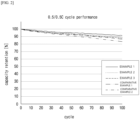
- lithium secondary batteries having a battery capacity of 60 mAh which was manufactured in Examples 1 to 3 and Comparative Examples 1 and 2, were charged to 4.25 V at 25 °C and a 1C constant current and charged again at a constant voltage of 4.25 V, and then charging was terminated when the charge current reached 5 mA. Afterward, the secondary battery was maintained for 10 minutes, and then discharged until 3 V at a 1C constant current. The charge/discharge behavior was set as one cycle, and such a cycle was repeatedly performed 100 times, and then charge/discharge capacities according to Examples and Comparative Examples were measured. The results are shown in Table 1 below and FIG. 2 .
- C is a charge/discharge current rate of a battery expressed in amperes (A), that is, C-rate, and generally represented in the ratio of normal battery capacity.
- A amperes
- the cell resistance of the secondary batteries manufactured in Examples 1 to 3 was measured.
- Example 1 Example 2
- Example 3 Resistance (ohms) 1.4875 1.5632 1.4731
- the secondary battery of Example 1 exhibits very excellent cell resistance and capacity retention.
Landscapes
- Chemical & Material Sciences (AREA)
- Chemical Kinetics & Catalysis (AREA)
- Electrochemistry (AREA)
- General Chemical & Material Sciences (AREA)
- Engineering & Computer Science (AREA)
- Organic Chemistry (AREA)
- Inorganic Chemistry (AREA)
- Composite Materials (AREA)
- Materials Engineering (AREA)
- Manufacturing & Machinery (AREA)
- Battery Electrode And Active Subsutance (AREA)
Description
- This application claims priority to and the benefit of
Korean Patent Application No. 10-2018-0053095, filed on May 9, 2018 - The present invention relates to the use of a composition for forming cross-linked tannic acid-based coating films on primary particles of a silicon-based negative electrode active material to thereby form secondary particles of agglomerated primary particles, as further defined in
Claim 1, a negative electrode active material for a secondary battery comprising the secondary particle wherein a plurality of primary particles are agglomerated by crosslinks between tannic acid-based coating films, as further defined inclaim 2, a method of manufacturing the same, as specified inclaim 3, a negative electrode containing the same, as specified in claim 5, and a lithium secondary battery including the negative electrode. - According to the increase in the development and demand for mobile devices, the demand for a secondary battery as an energy source is rapidly increasing, and among secondary batteries, a lithium secondary battery which exhibits a high energy density and a high action potential, and has a longer life span and a low self-discharge rate has been commercialized and widely used.
- In addition, recently, as environmental concerns increase, there is a lot of research on electric vehicles (EVs) or hybrid electric vehicles (HEVs), which can replace vehicles using fossil fuel such as gasoline vehicles, diesel vehicles, etc., which is one of the main causes of air pollution.
- These EVs and HEVs use a nickel-metal hydride (Ni-MH) battery or a lithium battery having a high energy density, a high discharge voltage and high output stability as a power source. Since a lithium secondary battery used in EVs should have a high energy density and a large output in a short time, and should be used for 10 years or longer under harsh conditions, much higher energy density and safety and a much longer life span than a conventional small lithium secondary battery are inevitably required.
- Meanwhile, as a positive electrode active material constituting a positive electrode of a lithium secondary battery, a metal oxide such as LiCoO2, LiMnO2, LiMn2O4 or LiCrO2 is used, and as a negative electrode active material constituting a negative electrode, a material such as a metal lithium, a carbon-based material, for example, graphite or activated carbon, or silicon oxide (SiOx) is used. Among the negative electrode active materials, while metal lithium was mainly used initially, with the progression of charge/discharge cycles, a phenomenon in which lithium atoms grow on the surface of the metal lithium, thereby damaging a separation membrane and a battery occurs, and therefore, recently, a carbon-based material is generally used. However, although a theoretical capacity is approximately 400 mAh/g, a carbon-based material has a small capacity.
- For this reason, various studies for replacing the carbon-based material using silicon (Si) having a theoretical capacity (4,200 mAh/g) as a negative electrode active material are progressing. The reaction equation when lithium is intercalated into silicon is as follows:
[Reaction Equation 1] 22Li + 5Si = Li22Si5
- However, most silicon negative electrode materials have a disadvantage in that a silicon volume increases by up to 300% due to lithium intercalation and a negative electrode is broken, and therefore a high cycling characteristic is not obtained. In addition, in the case of silicon, as the cycle continues, volume expansion caused by lithium intercalation may occur, and fading mechanisms such as pulverization, contact losses with conducting agents and current collectors, and formation of an unstable solid-electrolyte-interphase (SEI) may be generated.
- For this reason, to solve the above-described problems, various studies are being conducted.
- Zhang S et al describe a hydrophilic modification of PVDF porous membranes via a dip-coating method in plant tannin solution in RSC Advances, Vol. 6, No. 75, pages 71287-71297.
-
KR 101 692 138 B1 - Chenbo L et al describe core-shell nano-structured carbon composites based on tannic acid for lithium-ion batteries in Journal of Materials Chemistry A, Vol. 4, No. 43, pages 17215-17224.
-
Korean Patent No. 1705594 - Since a silicon-based negative electrode active material is easily broken or destroyed due to an increased silicon volume in charging/discharging, in order to solve a problem of a reduced life span, the present invention is directed to providing a coating composition that can reduce the volume expansion of a silicon-based negative electrode active material, a negative electrode active material, a negative electrode for a secondary battery, which contains the same, and a secondary battery including the negative electrode.
- To solve the above-described problem, the present invention provides the use of a composition for coating a negative electrode active material as defined in
Claim 1. The composition for coating includes tannic acid and a tris buffer solution, wherein the tannic acid is present in an amount of 0.01 parts by weight to 1 part by weight with respect to 100 parts by weight of the buffer solution and the buffer solution has a pH of 7 to 8.5. - The present invention also provides a negative electrode active material for a secondary battery, which includes a secondary particle formed by agglomerating a plurality of primary particles. A tannic acid-based coating film is formed on the surface of the primary particles, and the secondary particle is formed by agglomerating the primary particles through crosslinking between the tannic acid coating films formed on the surfaces of the primary particles.
- The plurality of primary particles comprise a silicon-based negative electrode active material.
- The present invention also provides a method of preparing the negative electrode active material for a secondary battery, which includes: preparing a composition for coating the negative electrode active material by mixing tannic acid and a tris buffer solution having a pH of 7 to 8.5; obtaining the plurality of primary particles of a negative electrode active material with the tannic acid-based coating film by forming the tannic acid-based coating film on a surface of each of the primary particles by immersing the primary particles in the composition for coating the negative electrode active material; and obtaining the secondary particle by agglomerating the primary particles by adding a crosslinking agent to the solution in which the primary particles with the tannic acid-based coating film are immersed, wherein the tannic acid is mixed at 0.01 part by weight to 1 part by weight with respect to 100 parts by weight of the buffer solution.
- The crosslinking agent is a compound comprising a trivalent metal ion, and the trivalent metal ion may be Fe3+, Al3+, Ga3+, In3+ or Sc3+.
- The present invention also provides a negative electrode for a secondary battery, which includes the negative electrode active material for a secondary battery.
- The present invention provides a negative electrode active material for a secondary battery whose surface is coated with a tannic acid-based coating film using a composition for coating a negative electrode active material, which contains tannic acid, and the negative electrode active material can reduce the volume expansion and prevent damage to the negative electrode active material in charging/discharging due to the tannic acid-based coating film.
- Therefore, a secondary battery including a negative electrode of the present invention ultimately improves resistance and life span characteristics.
-
-
FIG. 1 is a schematic diagram illustrating the process of preparing a negative electrode active material of the present invention. -
FIG. 2 is a graph illustrating a result obtained according to Experimental Example 1. - Hereinafter, the present invention will be described in further detail.
- Hereinafter, the present invention will be described in further detail to help understanding of the present invention. Here, terms and words used in the specification and claims should not be construed as limited to general or dictionary meanings, and should be interpreted with the meaning and concept in accordance with the technical idea of the present invention based on the principle that the inventors have appropriately defined the concepts of terms in order to explain the invention in the best way.
- The composition used for forming cross-linked tannic-acid based coating films on primary particles of a silicon-based negative electrode active material to thereby form secondary particles of agglomerated primary particles contains tannic acid and a buffer solution.
- The tannic acid is present in an amount of 0.01 parts by weight to 1 part by weight with respect to 100 parts by weight of the buffer solution.
- When the tannic acid is present in an amount of less than 0.01 part by weight with respect to 100 parts by weight of the buffer solution, it is difficult to sufficiently coat the surface of a negative electrode active material with the composition for coating a negative electrode active material, and the tannic acid exhibits an insignificant effect of controlling a volume change in the negative electrode active material when being used as a coating component. When the tannic acid is contained at more than 1 part by weight, the coating layer is thickly formed on the surface of the negative electrode active material, and thus cell resistance may increase.
- Preferably, the tannic acid may be present in an amount of 0.05 to 0.25 part by weight with respect to 100 parts by weight of the buffer solution, and when the negative electrode active material is coated with the above-mentioned content of the composition, the increase in cell resistance may be reduced, and the volume expansion control effect of the negative electrode active material may be maximized.
- The buffer solution has a pH 7 to 8.5, and specifically, pH 7 to 8, and is a Tris buffer solution. When the pH of the buffer solution is in the above-described range, the tannic acid contained in the coating composition may subsequently form a Tris-complex using a crosslinking agent.
- A negative electrode active material of the present invention is a negative electrode active material for a secondary battery, which includes a secondary particle formed by agglomeration of a plurality of primary particles, and a tannic acid-based coating film is present on a surface of each of the primary particles, and wherein the secondary particle is formed by agglomeration of the primary particles through crosslinking between the tannic acid-based coating films formed on the surfaces of each of the primary particles.
- The volume expansion and accompanying damage of the negative electrode active material of the present invention in charging/discharging may be controlled at excellent levels due to the tannic acid-based coating film and crosslinking between the films. In addition, in the case of a secondary particle-type negative electrode active material including the tannic acid-based coating film, because of excellent binding strength between the particles, the volume expansion in charging/discharging may be effectively controlled. When the negative electrode active material that has only the tannic acid-based coating film formed on a primary particle is used, the binding strength between the particles is not good, and the effect of controlling volume expansion through the tannic acid-based coating film may not be exhibited.
- The plurality of primary particles is a silicon-based negative electrode active material.
- The silicon-based negative electrode active material may be at least one selected from silicon (Si), a silicon-based alloy and a silicon oxide (SiOx, 0<x≤2), and specifically, a silicon oxide (SiOx, 0<x≤2).
- A tannic acid-based coating film is formed on the primary particle.
- The tannic acid-based coating film may be formed by stirring the above-described composition for coating a negative electrode active material, which contains tannic acid, and the primary particles.
- The secondary particles are formed by agglomeration of the primary particles, and specifically, agglomeration through crosslinking formed between the tannic acid-based coating films formed on the surfaces of the primary particles.
- The tannic acid-based coating film may form a Tris-complex by forming crosslinking using a crosslinking agent, and such crosslinking can agglomerate the primary particles, thereby forming the secondary particles.
- The negative electrode active material may further include a carbonaceous negative electrode active material with the above-described secondary particles.
- The carbonaceous negative electrode active material may be at least one selected from the group consisting of artificial graphite, natural graphite, graphitized carbon fiber and amorphous carbon.
- The negative electrode active material may contain a carbonaceous negative electrode active material and a silicon-based negative electrode active material at a weight ratio of 99:1 to 50:50, and preferably 95:5 to 80:20.
- The negative electrode active material of the present invention may be prepared by the following steps, which will be described with reference to
FIG. 1 : - preparing a composition for coating the negative electrode active material by mixing tannic acid and a tris buffer solution having a pH of 7 to 8.5 (here, the tannic acid is mixed at 0.01 parts by weight to 1 part by weight with respect to 100 parts by weight of the buffer solution);
- obtaining the plurality of primary particles with the tannic acid-based
coating film 20 by forming the tannic acid-basedcoating film 12 on a surface of each of theprimary particles 10 by immersing the primary particles in the composition of coating the negative electrode active material; and - obtaining the
secondary particle 22 of a negative electrode active material by agglomerating theprimary particles 20 of a negative electrode active material by adding a crosslinking agent to the solution in which the negative active material is immersed. - The crosslinking agent is a compound comprising a trivalent metal ion, and the trivalent metal ion may be Fe3+, Al3+, Ga3+, In3+ or Sc3+.
- The compound containing a trivalent metal ion may be Fe3SO4 or Fe3Cl12.
- When the primary particle with the tannic acid-based
coating film 20 of a negative electrode active material having the tannic acid-based coating film is obtained, and then the crosslinking agent (e.g., Fe3SO4) is added thereto in the preparation process, tannic acid forms a Tris-complex as shown inFormula 1 below. In this process, the tannic acid in the tannic acid-based coating films forms a complex and thus is crosslinked, thereby forming thesecondary particles 22 of a negative electrode active material. The tannic acid-basedcoating film 12 forms a Tris complex by the crosslinking agent, thereby forming acrosslinked film 14. That is, the tannic acid-based coating films coated on the surfaces of the primary particles form a Tris-complex, and thus theprimary particles 20 are agglomerated, resulting in formation of thesecondary particles 22.
- In
Formula 1, R denotes a residual group of tannic acid. - The negative electrode of the present invention includes the above-described negative electrode active material of the present invention.
- The negative electrode of the present invention may be manufactured by preparing a negative electrode composite material by dissolving or dispersing the above-described negative electrode active material of the present invention, and a conducting agent and/or a binder in a solvent, applying the negative electrode composite material on at least one surface of a negative electrode current collector, and drying and pressing the resulting product, or casting the negative electrode composite material on a separate support and laminating a film obtained by delamination from the support on a negative electrode current collector.
- The negative electrode current collector is not particularly limited as long as it does not cause chemical changes in a battery and has high conductivity, and may be, for example, copper, stainless steel, aluminum, nickel, titanium, calcined carbon, copper or stainless steel whose surface is treated with carbon, nickel, titanium or silver, or an aluminum-cadmium alloy. In addition, the negative electrode current collector may generally have a thickness of 3 to 500 µm, and it is possible to form fine irregularities on the surface of the current collector, and thus the binding strength of the negative electrode active material may be enhanced. For example, the negative electrode current collector may be used in various forms such as a film, a sheet, a foil, a net, a porous body, a foamed body, a non-woven fabric, etc.
- The negative electrode active material may be contained at 80 to 99 wt%, and more specifically, 85 to 98 wt% with respect to the total weight of the negative electrode active material layer. When the negative electrode active material is contained in the above-described content range, an excellent capacity characteristic may be exhibited.
- The conducting agent is used to impart conductivity to an electrode, and thus any one that has electronic conductivity without causing a chemical change in a battery can be used without particular limitation. Specifically, the conducting agent may be graphite such as natural graphite or artificial graphite; a carbon-based material such as carbon black, acetylene black, Ketjen black, channel black, furnace black, lamp black, thermal black or a carbon fiber; a metal powder or metal fiber of copper, nickel, aluminum or silver; a conductive whisker consisting of zinc oxide or potassium titanate; a conductive metal oxide such as titanium oxide; or a conductive polymer such as a polyphenylene derivative, and may be used alone or in a mixture of two or more. The conducting agent may be contained at 1 to 30 wt% with respect to the total weight of the negative electrode active material layer.
- In addition, the binder serves to improve the cohesion between the negative electrode active material particles and the binding strength between the negative electrode active material and the current collector. Specifically, an aqueous binder such as styrene butadiene rubber (SBR), carboxymethylcellulose (CMC), starch, hydroxypropylcellulose or regenerated cellulose is preferably used alone or in a mixture of two or more thereof. The binder may be contained at 1 to 30 wt% with respect to the total weight of the negative electrode active material layer.
- Meanwhile, the solvent used in the preparation of a negative electrode composite material may be a solvent generally used in the art, and for example, one or a mixture of dimethyl sulfoxide (DMSO), isopropyl alcohol, N-methylpyrrolidone (NMP), acetone or water may be used. The amount of the solvent may be suitably adjusted in consideration of the coating thickness of a slurry, a production yield, a viscosity, etc.
- A negative electrode containing the above-described negative electrode active material of the present invention may be effectively used in manufacture of a lithium secondary battery.
- Specifically, the lithium secondary battery includes a negative electrode, a positive electrode disposed opposite to the negative electrode, a separator interposed between the negative electrode and the positive electrode, and an electrolyte. Here, the negative electrode is a negative electrode manufactured by applying the above-described negative electrode active material of the present invention.
- Meanwhile, the secondary battery may further include a battery case accommodating an electrode assembly consisting of the positive electrode, a negative electrode and a separator, and a sealing member for sealing the battery case.
- The lithium secondary battery may be manufactured according to a conventional method of manufacturing a secondary battery, except that the negative electrode according to the present invention is used.
- In the secondary battery, the positive electrode includes a positive electrode current collector and a positive electrode active material layer disposed on at least one surface of the positive electrode current collector.
- The positive electrode may be manufactured according to a conventional method of manufacturing a positive electrode generally known in the art. For example, the positive electrode may be manufactured by preparing a positive electrode composite material by dissolving or dispersing components constituting the positive electrode active material layer, that is, the positive electrode active material, a conducting agent and/or a binder in a solvent, applying the positive electrode composite material on at least one surface of the positive electrode current collector, and drying and pressing the resulting product, or casting the positive electrode composite material on a separate support and laminating a film obtained by delamination from the support on the positive electrode current collector.
- The positive electrode current collector is not particularly limited as long as it does not cause chemical changes in a battery and has high conductivity, and may be, for example, stainless steel, aluminum, nickel, titanium, calcined carbon, or aluminum or stainless steel whose surface is treated with carbon, nickel or silver. In addition, the positive electrode current collector may generally have a thickness of 3 to 500 µm, and fine irregularities may be formed on the surface of the current collector, thereby increasing the binding strength with the positive electrode active material. For example, the positive electrode current collector may be used in various forms such as a film, a sheet, a foil, a net, a porous body, a foamed body, a non-woven fabric, etc.
- The positive electrode active material may be, for example, a layered compound such as lithium cobalt oxide (LiCoO2) or lithium nickel oxide (LiNiO2) or a compound substituted with one or more transition metals; a lithium manganese oxide represented by Li1+yMn2-yO4 (wherein y is 0 to 0.33), LiMnO3, LiMn2O3, or LiMnO2; lithium copper oxide (Li2CuO2); a vanadium oxide such as LiVsOs, LiV3O4, V2O5, or Cu2V2O7; an Ni-site lithium nickel oxide represented by LiNi1-yMyO2 (wherein M = Co, Mn, Al, Cu, Fe, Mg, B or Ga, and y = 0.01 to 0.3); a lithium manganese composite oxide represented by LiMn2-yMyO2 (wherein M = Co, Ni, Fe, Cr, Zn or Ta, y = 0.01 to 0.1) or Li2Mn3MO8 (wherein M = Fe, Co, Ni, Cu or Zn); LiMn2O4 in which a part of Li of the formula is substituted with an alkaline earth metal ion; a disulfide compound; or Fe2(MoO4)3, but the present invention is not limited thereto.
- In addition, the binder and the conducting agent may be the same as described above for the negative electrode.
- Meanwhile, in the secondary battery, the separator is not particularly limited as long as it is generally used to separate a negative electrode from a positive electrode and provide a movement path for lithium ions, and is not specifically limited as long as it can be used as a separator in a general secondary battery, and particularly, having a low resistance to ion mobility of an electrolyte and an excellent electrolyte uptake ability. Specifically, a porous polymer film, for example, a porous polymer film formed of a polyolefin-based polymer such as an ethylene homopolymer, a propylene homopolymer, an ethylene/butene copolymer, an ethylene/hexene copolymer and an ethylene/methacrylate copolymer, or a stacked structure including two or more layers thereof may be used as a separator. In addition, a conventional porous non-woven fabric, for example, a non-woven fabric formed of a high melting point glass fiber or a polyethylene terephthalate fiber may be used. In addition, a coated separator including a ceramic component or a polymer material may be used to ensure thermal resistance or mechanical strength, and may be selectively used in a single- or multi-layered structure.
- Meanwhile, the electrolyte used in the present invention may be an organic liquid electrolyte, an inorganic liquid electrolyte, a solid polymer electrolyte, a gel-type polymer electrolyte, a solid inorganic electrolyte, or a melt-type inorganic electrolyte, which can be used in manufacture of a lithium secondary battery, but the present invention is not limited thereto.
- Specifically, the electrolyte may include an organic solvent and a lithium salt.
- The organic solvent is not particularly limited as long as it can serve as a medium enabling the mobility of ions involved in an electrochemical reaction of a battery. Specifically, the organic solvent may be an ester-based solvent such as methyl acetate, ethyl acetate, γ-butyrolactone, or ε-caprolactone; an ether-based solvent such as dibutyl ether or tetrahydrofuran; a ketone-based solvent such as cyclohexanone; an aromatic hydrocarbon-based solvent such as benzene or fluorobenzene; a carbonate-based solvent such as dimethyl carbonate (DMC), diethyl carbonate (DEC), methyl ethyl carbonate (MEC), ethyl methyl carbonate (EMC), ethylene carbonate (EC), or propylene carbonate (PC); an alcohol-based solvent such as ethyl alcohol or isopropyl alcohol; a nitrile-based solvent such as Ra-CN (Ra is a linear, branched or cyclic C2 to C20 hydrocarbon group, and may include a double bonded aromatic ring or an ether bond); an amide-based solvent such as dimethylformamide; a dioxolane-based solvent such as 1,3-dioxolane; or a sulfolane-based solvent. Among these, a carbonate-based solvent is preferably used, and a mixture of a cyclic carbonate having high ion conductivity and high permittivity to increase the charge/discharge performance of a battery (for example, ethylene carbonate or propylene carbonate) and a low-viscosity linear carbonate-based compound (for example, ethyl methyl carbonate, dimethyl carbonate or diethyl carbonate) is more preferably used. In this case, by using a mixture of a cyclic carbonate and a chain-type carbonate in a volume ratio of about 1:1 to about 1:9, the electrolyte solution may exhibit excellent performance.
- The lithium salt is not particularly limited as long as it is a compound capable of providing a lithium ion used in a lithium secondary battery. Specifically, the lithium salt may be LiPF6, LiClO4, LiAsF6, LiBF4, LiSbF6, LiAlO4, LiAlCl4, LiCF3SO3, LiC4F9SO3, LiN(C2F5SO3)2, LiN(C2F5SO2)2, LiN(CF3SO2)2. LiCl, LiI, or LiB(C2O4)2. The concentration of the lithium salt is preferably in the range of 0.1 to 2.0M. When the concentration of the lithium salt is included in the above-mentioned range, the electrolyte has suitable conductivity and viscosity and thus can exhibit excellent electrolytic performance. Therefore, lithium ions can effectively migrate.
- To enhance the lifespan characteristic of the battery, inhibit a decrease in battery capacity, and enhance the discharge capacity of the battery, the electrolyte may further include one or more types of additives, for example, a haloalkylene carbonate-based compound such as difluoroethylene carbonate, pyridine, triethylphosphite, triethanolamine, cyclic ether, ethylenediamine, n-glyme, hexaphosphoric triamide, a nitrobenzene derivative, sulfur, a quinone imine dye, N-substituted oxazolidinone, N,N-substituted imidazolidine, ethylene glycol dialkyl ether, an ammonium salt, pyrrole, 2-methoxy ethanol or aluminum trichloride, in addition to the components of the electrolyte. Here, the additive(s) may be included at 0.1 to 5 wt% with respect to the total weight of the electrolyte.
- A composition for coating a negative electrode active material was prepared by adding 0.1 g of tannic acid to 100 g of a bis-Tris buffer solution (pH 7).
- SiO primary particles whose surface was coated with tannic acid were obtained by adding 180 mg of a powder of SiO particles (D50: 5 µm) to the composition for coating a negative electrode active material prepared in Example 1-1 and stirring the mixture for 12 hours. As a crosslinking agent, an Fe3SO4 compound was added to the solution containing the tannic acid-coated SiO primary particles. As a result, secondary particles in which the tannic acid-coated SiO particles were agglomerated by forming a tannic acids-crosslinked Tris-complex through bonding the terminal phenol group of tannic acid formed on the SiO surface with a Fe3+ ion of a crosslinking agent. Subsequently, an extract was obtained by centrifugation and dried in a 60 °C oven for 6 hours, thereby obtaining a negative electrode active material prepared in the form of secondary particles in which tannic acid-coated SiO primary particles are agglomerated.
- A negative electrode slurry was prepared by mixing a negative electrode active material prepared by mixing the SiO negative electrode active material prepared in Example 1-2 and graphite at a weight ratio of 10:90, Super C65 as a conducting agent, styrene-butadiene rubber (SBR) as a binder, and carboxymethylcellulose (CMC) as a thickening agent at a weight ratio of 95.6: 1:2.3: 1.1 and adding water to the resulting mixture.
- The slurry was applied to copper foil, vacuum-dried at approximately 130 °C for 8 hours, rolled until a target porosity of 28%, thereby obtaining a negative electrode having an area of 1.4875 cm2 (the area of a part on which the negative electrode slurry was coated). Here, the negative electrode was manufactured to have a load amount of 3.61 mAh/cm2.
- The negative electrode manufactured in Example 1-3 and a Li metal as a counter electrode were used, and a polyolefin separator was interposed between the negative electrode and the Li metal, thereby manufacturing an electrode assembly.
- A non-aqueous electrolyte was prepared by adding 1M LiPF6 to a non-aqueous electrolyte solvent prepared by mixing ethylene carbonate and ethyl methyl carbonate at a volume ratio of 3:7, and then injected into the electrode assembly, thereby manufacturing a coin-type half secondary battery.
- A composition for coating a negative electrode active material, a negative electrode active material, a negative electrode and a secondary battery were manufactured by the same method as described in Example 1, except that tannic acid was used at a concentration 4-fold that of Example 1 (0.4 g of tannic acid was added to 100 g of a bis-Tris buffer solution (pH 7)) in the preparation of a composition for a negative electrode active material.
- A composition for coating a negative electrode active material, a negative electrode active material, a negative electrode and a secondary battery were manufactured by the same method as described in Example 1, except that tannic acid was used at a
concentration 1/5-fold that of Example 1 (0.02 g of tannic acid was added to 100 g of a bis-Tris buffer solution (pH 7)) in the preparation of a composition for a negative electrode active material. - A negative electrode and a secondary battery were manufactured by the same processes of Examples 1-3 and 1-4, except that the processes of Example 1-1 and 1-2 were omitted and a SiO negative electrode active material which was not coated with tannic acid was used.
- A composition for a negative electrode active material was prepared by the same process of Example 1-1, and tannic acid-coated SiO particles were obtained using the composition as described in Example 1-2. Subsequently, only a process of preparing secondary particles by adding a crosslinking agent was omitted, and the same processes as described in Examples 1-3 and 1-4 were performed, thereby manufacturing a negative electrode and a secondary battery.
- The cycling characteristics of the secondary batteries manufactured in Examples 1 to 3 and Comparative Examples 1 and 2 were tested.
- The secondary batteries manufactured in Examples 1 to 3 and Comparative Examples 1 and 2 (battery capacity: 60 mAh) were subjected to 100 charge/discharge cycles at 25 °C at a 1C/1C charge/discharge rate.
- Specifically, lithium secondary batteries having a battery capacity of 60 mAh, which was manufactured in Examples 1 to 3 and Comparative Examples 1 and 2, were charged to 4.25 V at 25 °C and a 1C constant current and charged again at a constant voltage of 4.25 V, and then charging was terminated when the charge current reached 5 mA. Afterward, the secondary battery was maintained for 10 minutes, and then discharged until 3 V at a 1C constant current. The charge/discharge behavior was set as one cycle, and such a cycle was repeatedly performed 100 times, and then charge/discharge capacities according to Examples and Comparative Examples were measured. The results are shown in Table 1 below and
FIG. 2 . - Here, C is a charge/discharge current rate of a battery expressed in amperes (A), that is, C-rate, and generally represented in the ratio of normal battery capacity.
[Table 1] Example 1 Example 2 Example 3 Comparative Example 1 Comparative Example 2 Capacity retention (%) in 100 cycles 91.4 89.2 87.5 83.3 86.7 - As shown in Table 1 and
FIG. 2 , it can be confirmed that the secondary batteries of Examples 1 to 3, containing the negative electrode active material of the present invention, have excellent capacity retention as the cycle repeats, compared with the secondary batteries of Comparative Examples 1 and 2. - The cell resistance of the secondary batteries manufactured in Examples 1 to 3 was measured.
- The cell resistance was measured with a difference in voltage drop when a secondary battery was charged to
SOC 50% and discharged at a current of 2.5C for 30 seconds based on the discharge capacity of the secondary battery. The result is shown in Table 2 below.[Table 2] Example 1 Example 2 Example 3 Resistance (ohms) 1.4875 1.5632 1.4731 - Referring to Table 2, it can be seen that Examples 1 to 3 show excellent cell resistances.
- Particularly, it can be confirmed that the secondary battery of Example 1 exhibits very excellent cell resistance and capacity retention.
-
- 10: Primary particle of negative electrode active material
- 12: Tannic acid-based coating film
- 14: Crosslinked film of tannic acid-based coating film (the film having Tris-complex of tannic acid)
- 20: Primary particle of negative electrode active material with tannic acid-based coating film
- 22: Secondary particle of negative electrode active material
Claims (5)
- Use of a composition for forming cross-linked tannic-acid based coating films on primary particles of a silicon-based negative electrode active material to thereby form secondary particles of agglomerated primary particles, the composition comprising:tannic acid; anda tris buffer solution,wherein the tannic acid is present in an amount of 0.01 parts by weight to 1 part by weight with respect to 100 parts by weight of the buffer solution, and wherein the buffer solution has a pH of 7 to 8.5.
- A negative electrode active material for a secondary battery, comprising a secondary particle formed by a plurality of primary particles that are agglomerated by crosslinks between tannic acid-based coating films present on a surface of each of the primary particles,wherein the plurality of primary particles comprise a silicon-based negative electrode active material, andthe crosslinks are formed by a crosslinking agent that is a compound comprising a trivalent metal ion.
- A method of preparing the negative electrode active material for a secondary battery according to claim 2, comprising:preparing a composition for coating the negative electrode active material by mixing tannic acid and a tris buffer solution having a pH of 7 to 8.5;obtaining the plurality of primary particles with the tannic acid-based coating film by forming the tannic acid-based coating film on a surface of each of the primary particles by immersing the primary particles in the composition for coating the negative electrode active material; andobtaining the secondary particle by agglomerating the primary particles by adding a crosslinking agent to the solution in which the primary particles with the tannic acid-based coating film are immersed,wherein the tannic acid is mixed at 0.01 parts by weight to 1 part by weight with respect to 100 parts by weight of the buffer solution, andwherein the crosslinking agent is a compound comprising a trivalent metal ion.
- The method according to claim 3, wherein the trivalent metal ion is selected from the group consisting of Fe3+, Al3+, Ga3+, In3+ and Sc3+.
- A negative electrode for a secondary battery comprising the negative electrode active material for a secondary battery of claim 2.
Applications Claiming Priority (2)
| Application Number | Priority Date | Filing Date | Title |
|---|---|---|---|
| KR20180053095 | 2018-05-09 | ||
| PCT/KR2019/005542 WO2019216658A1 (en) | 2018-05-09 | 2019-05-09 | Composition for anode active material coating, anode active material, and anode comprising same for lithium secondary battery |
Publications (3)
| Publication Number | Publication Date |
|---|---|
| EP3767712A1 EP3767712A1 (en) | 2021-01-20 |
| EP3767712A4 EP3767712A4 (en) | 2021-10-13 |
| EP3767712B1 true EP3767712B1 (en) | 2025-01-29 |
Family
ID=68467398
Family Applications (1)
| Application Number | Title | Priority Date | Filing Date |
|---|---|---|---|
| EP19800308.9A Active EP3767712B1 (en) | 2018-05-09 | 2019-05-09 | Composition for coating a negative electrode active material, negative electrode active material and negative electrode for lithium secondary battery including the same |
Country Status (7)
| Country | Link |
|---|---|
| US (1) | US12021236B2 (en) |
| EP (1) | EP3767712B1 (en) |
| KR (1) | KR102477645B1 (en) |
| CN (1) | CN111954945B (en) |
| ES (1) | ES3013510T3 (en) |
| HU (1) | HUE070187T2 (en) |
| WO (1) | WO2019216658A1 (en) |
Families Citing this family (10)
| Publication number | Priority date | Publication date | Assignee | Title |
|---|---|---|---|---|
| CN113571684B (en) * | 2021-09-26 | 2021-12-28 | 河南电池研究院有限公司 | Aluminum-carbon double-coated natural graphite negative electrode material for lithium ion battery and preparation method thereof |
| KR102824834B1 (en) * | 2022-10-19 | 2025-06-24 | 이화여자대학교 산학협력단 | Cathode active material including tannic acid coating layer and method of preparing the same |
| CN116111111A (en) * | 2022-11-08 | 2023-05-12 | 青岛科技大学 | A kind of palladium nanoparticle oxygen reduction electrocatalyst coated with tannic acid and preparation method thereof |
| JP2025537979A (en) * | 2022-12-13 | 2025-11-20 | エルジー エナジー ソリューション リミテッド | METHOD FOR PRODUCING ANODE ACTIVE MATERIAL FOR LITHIUM SECONDARY BATTERY AND ANODE ACTIVE MATERIAL FOR LITHIUM SECONDARY BATTERY PRODUCED THEREFROM |
| CN116130767A (en) * | 2022-12-29 | 2023-05-16 | 湖南法恩莱特新能源科技有限公司 | Sodium ion battery electrolyte with flame retardant function and preparation method and application thereof |
| CN116445104A (en) * | 2023-03-23 | 2023-07-18 | 北京化工大学 | Polymer binder, physical-chemical double-crosslinked conductive polymer network, and preparation method and application thereof |
| WO2024221286A1 (en) * | 2023-04-24 | 2024-10-31 | 无锡零一未来新材料技术研究院有限公司 | Silicon-based negative electrode material, preparation method therefor and use thereof |
| KR102600047B1 (en) * | 2023-04-24 | 2023-11-08 | (주)디온에너지 | Anode surface coating film formation method and lithium primary battery using the same |
| CN116632172B (en) * | 2023-06-28 | 2025-01-21 | 蜂巢能源科技股份有限公司 | Negative electrode material, preparation method, secondary battery and electrical equipment |
| KR20250062436A (en) | 2023-10-31 | 2025-05-08 | 주식회사 엘지에너지솔루션 | Negative electrode active material, negative electrode slurry for negative electrode, negative electrode and secondarty battery |
Family Cites Families (14)
| Publication number | Priority date | Publication date | Assignee | Title |
|---|---|---|---|---|
| JP4366783B2 (en) | 1998-11-16 | 2009-11-18 | 株式会社デンソー | Multilayer battery and method of manufacturing electrode thereof |
| KR101190364B1 (en) | 2011-07-25 | 2012-10-11 | 한국과학기술원 | Lithium secondary cell comprising anode material coated with polydopamine |
| EP2773254B1 (en) | 2011-11-02 | 2019-02-27 | Alfred Kärcher SE & Co. KG | Handdriven floor cleaning machine |
| JP6511726B2 (en) | 2014-04-25 | 2019-05-15 | 日立化成株式会社 | Negative electrode material for lithium ion secondary battery, negative electrode for lithium ion secondary battery and lithium ion secondary battery |
| KR101807348B1 (en) | 2014-05-09 | 2017-12-08 | 주식회사 엘지화학 | Silicon-carbon composite, preparation method thereof, and anode active material comprising the same |
| KR101924035B1 (en) | 2014-05-09 | 2018-11-30 | 주식회사 엘지화학 | Silicon-carbon composite, preparation method thereof, and anode active material comprising the same |
| KR101724196B1 (en) | 2014-05-09 | 2017-04-06 | 주식회사 엘지화학 | Graphene-wrapped porous silicon-carbon composite and preparation method thereof |
| KR102319772B1 (en) * | 2014-11-10 | 2021-11-03 | 한국전기연구원 | Silicon Or Silicon Alloy Anode Adaptive to Intercalation/ De-intercalation Of Lithium Ions And Manufacturing Methods Thereof |
| KR101692138B1 (en) | 2015-01-28 | 2017-01-02 | 서울대학교산학협력단 | Separator of lithium secondary battery and the lithium secondary battery with the same |
| KR101705594B1 (en) | 2016-06-14 | 2017-02-13 | 한국기초과학지원연구원 | Anode active material, method of fabricating the same and rechargeable battery using the same |
| CN106084215B (en) * | 2016-06-20 | 2018-03-06 | 陕西师范大学 | The bionical method for constructing functionalization Janus particles |
| CN106310977A (en) | 2016-10-10 | 2017-01-11 | 哈尔滨工业大学宜兴环保研究院 | Method for preparing composite nanofiltration membrane by tannic acid/Fe<3+> cocoating |
| JP6493366B2 (en) | 2016-11-18 | 2019-04-03 | トヨタ自動車株式会社 | Vehicle control device |
| CN107381580B (en) * | 2017-07-13 | 2019-09-13 | 福州大学 | A method for preparing internally doped polyphenol-metal mesh degradable silica particles |
-
2019
- 2019-05-09 HU HUE19800308A patent/HUE070187T2/en unknown
- 2019-05-09 US US17/048,913 patent/US12021236B2/en active Active
- 2019-05-09 EP EP19800308.9A patent/EP3767712B1/en active Active
- 2019-05-09 CN CN201980024940.5A patent/CN111954945B/en active Active
- 2019-05-09 WO PCT/KR2019/005542 patent/WO2019216658A1/en not_active Ceased
- 2019-05-09 KR KR1020190054484A patent/KR102477645B1/en active Active
- 2019-05-09 ES ES19800308T patent/ES3013510T3/en active Active
Also Published As
| Publication number | Publication date |
|---|---|
| ES3013510T3 (en) | 2025-04-14 |
| HUE070187T2 (en) | 2025-05-28 |
| EP3767712A4 (en) | 2021-10-13 |
| KR20190129017A (en) | 2019-11-19 |
| WO2019216658A1 (en) | 2019-11-14 |
| US12021236B2 (en) | 2024-06-25 |
| EP3767712A1 (en) | 2021-01-20 |
| CN111954945A (en) | 2020-11-17 |
| KR102477645B1 (en) | 2022-12-15 |
| US20210159503A1 (en) | 2021-05-27 |
| CN111954945B (en) | 2023-05-26 |
Similar Documents
| Publication | Publication Date | Title |
|---|---|---|
| EP3767712B1 (en) | Composition for coating a negative electrode active material, negative electrode active material and negative electrode for lithium secondary battery including the same | |
| EP3396744B1 (en) | Positive electrode for secondary battery and lithium secondary battery comprising same | |
| EP3637526B1 (en) | Lithium secondary battery | |
| EP3396746B1 (en) | Positive electrode for secondary battery, manufacturing method thereof, and lithium secondary battery including same | |
| CN112313818B (en) | Method for manufacturing negative electrode for lithium secondary battery | |
| EP4037016A1 (en) | Anode for secondary battery and secondary battery including same | |
| KR102434067B1 (en) | Negative electrode for lithium secondarty battery, and lithium secondarty battery comprising the negative electrode | |
| EP3680966A2 (en) | Lithium cobalt-based positive electrode active material, method for preparing same, positive electrode comprising same, and secondary battery | |
| KR20200089182A (en) | LITHIUM SECONDARY BATTERY COMPRISING Si-BASED COMPOUND WITH EXCELLENT ENERGY DENSITY | |
| EP3943452B1 (en) | Method for producing positive material for lithium secondary battery | |
| EP2639867A2 (en) | Negative electrode active material, and secondary battery using same | |
| EP3736887A1 (en) | Anode active material for lithium secondary battery and anode for lithium secondary battery comprising same | |
| EP4177985A1 (en) | Negative electrode and secondary battery comprising same | |
| EP4084131A1 (en) | Method for manufacturing anode | |
| EP2639866B1 (en) | Anode active material and secondary battery using the same | |
| US12132200B2 (en) | Positive electrode for secondary battery, method of preparing the same, and lithium secondary battery including the same | |
| EP4002546A1 (en) | Battery system, method for using same, and battery pack including same | |
| JP3968772B2 (en) | Non-aqueous electrolyte battery | |
| EP4456246A1 (en) | Electrode for lithium secondary battery, and lithium secondary battery | |
| CN117136444A (en) | Lithium secondary battery | |
| KR102929049B1 (en) | Anode active material for lithium secondary battery, manufacturing method of the same and lithium secondary battery comprising the same | |
| KR102953444B1 (en) | Anode active material, method of manufacturing the same and lithium secondary battery comprising the same | |
| EP3540830B1 (en) | Cathode for lithium secondary battery and lithium secondary battery comprising same | |
| KR20250059922A (en) | Anode active material, method of manufacturing the same and lithium secondary battery comprising the same |
Legal Events
| Date | Code | Title | Description |
|---|---|---|---|
| STAA | Information on the status of an ep patent application or granted ep patent |
Free format text: STATUS: THE INTERNATIONAL PUBLICATION HAS BEEN MADE |
|
| PUAI | Public reference made under article 153(3) epc to a published international application that has entered the european phase |
Free format text: ORIGINAL CODE: 0009012 |
|
| STAA | Information on the status of an ep patent application or granted ep patent |
Free format text: STATUS: REQUEST FOR EXAMINATION WAS MADE |
|
| 17P | Request for examination filed |
Effective date: 20201014 |
|
| AK | Designated contracting states |
Kind code of ref document: A1 Designated state(s): AL AT BE BG CH CY CZ DE DK EE ES FI FR GB GR HR HU IE IS IT LI LT LU LV MC MK MT NL NO PL PT RO RS SE SI SK SM TR |
|
| AX | Request for extension of the european patent |
Extension state: BA ME |
|
| RIC1 | Information provided on ipc code assigned before grant |
Ipc: H01M 4/36 20060101AFI20210427BHEP Ipc: H01M 4/62 20060101ALI20210427BHEP Ipc: H01M 4/38 20060101ALI20210427BHEP Ipc: H01M 4/485 20100101ALI20210427BHEP Ipc: H01M 10/0525 20100101ALI20210427BHEP Ipc: C01B 33/113 20060101ALI20210427BHEP Ipc: H01M 4/134 20100101ALI20210427BHEP Ipc: H01M 4/1395 20100101ALI20210427BHEP |
|
| DAV | Request for validation of the european patent (deleted) | ||
| DAX | Request for extension of the european patent (deleted) | ||
| A4 | Supplementary search report drawn up and despatched |
Effective date: 20210913 |
|
| RIC1 | Information provided on ipc code assigned before grant |
Ipc: H01M 4/1395 20100101ALI20210906BHEP Ipc: H01M 4/134 20100101ALI20210906BHEP Ipc: C01B 33/113 20060101ALI20210906BHEP Ipc: H01M 10/0525 20100101ALI20210906BHEP Ipc: H01M 4/485 20100101ALI20210906BHEP Ipc: H01M 4/38 20060101ALI20210906BHEP Ipc: H01M 4/62 20060101ALI20210906BHEP Ipc: H01M 4/36 20060101AFI20210906BHEP |
|
| RAP1 | Party data changed (applicant data changed or rights of an application transferred) |
Owner name: LG ENERGY SOLUTION LTD. |
|
| RAP3 | Party data changed (applicant data changed or rights of an application transferred) |
Owner name: LG ENERGY SOLUTION, LTD. |
|
| GRAP | Despatch of communication of intention to grant a patent |
Free format text: ORIGINAL CODE: EPIDOSNIGR1 |
|
| STAA | Information on the status of an ep patent application or granted ep patent |
Free format text: STATUS: GRANT OF PATENT IS INTENDED |
|
| INTG | Intention to grant announced |
Effective date: 20240912 |
|
| GRAS | Grant fee paid |
Free format text: ORIGINAL CODE: EPIDOSNIGR3 |
|
| GRAA | (expected) grant |
Free format text: ORIGINAL CODE: 0009210 |
|
| STAA | Information on the status of an ep patent application or granted ep patent |
Free format text: STATUS: THE PATENT HAS BEEN GRANTED |
|
| P01 | Opt-out of the competence of the unified patent court (upc) registered |
Free format text: CASE NUMBER: APP_63371/2024 Effective date: 20241128 |
|
| AK | Designated contracting states |
Kind code of ref document: B1 Designated state(s): AL AT BE BG CH CY CZ DE DK EE ES FI FR GB GR HR HU IE IS IT LI LT LU LV MC MK MT NL NO PL PT RO RS SE SI SK SM TR |
|
| REG | Reference to a national code |
Ref country code: GB Ref legal event code: FG4D |
|
| REG | Reference to a national code |
Ref country code: CH Ref legal event code: EP |
|
| REG | Reference to a national code |
Ref country code: DE Ref legal event code: R096 Ref document number: 602019065434 Country of ref document: DE |
|
| REG | Reference to a national code |
Ref country code: IE Ref legal event code: FG4D |
|
| REG | Reference to a national code |
Ref country code: ES Ref legal event code: FG2A Ref document number: 3013510 Country of ref document: ES Kind code of ref document: T3 Effective date: 20250414 |
|
| REG | Reference to a national code |
Ref country code: HU Ref legal event code: AG4A Ref document number: E070187 Country of ref document: HU |
|
| REG | Reference to a national code |
Ref country code: NL Ref legal event code: MP Effective date: 20250129 |
|
| PG25 | Lapsed in a contracting state [announced via postgrant information from national office to epo] |
Ref country code: NL Free format text: LAPSE BECAUSE OF FAILURE TO SUBMIT A TRANSLATION OF THE DESCRIPTION OR TO PAY THE FEE WITHIN THE PRESCRIBED TIME-LIMIT Effective date: 20250129 |
|
| PG25 | Lapsed in a contracting state [announced via postgrant information from national office to epo] |
Ref country code: RS Free format text: LAPSE BECAUSE OF FAILURE TO SUBMIT A TRANSLATION OF THE DESCRIPTION OR TO PAY THE FEE WITHIN THE PRESCRIBED TIME-LIMIT Effective date: 20250429 |
|
| PG25 | Lapsed in a contracting state [announced via postgrant information from national office to epo] |
Ref country code: FI Free format text: LAPSE BECAUSE OF FAILURE TO SUBMIT A TRANSLATION OF THE DESCRIPTION OR TO PAY THE FEE WITHIN THE PRESCRIBED TIME-LIMIT Effective date: 20250129 |
|
| PG25 | Lapsed in a contracting state [announced via postgrant information from national office to epo] |
Ref country code: PL Free format text: LAPSE BECAUSE OF FAILURE TO SUBMIT A TRANSLATION OF THE DESCRIPTION OR TO PAY THE FEE WITHIN THE PRESCRIBED TIME-LIMIT Effective date: 20250129 |
|
| PGFP | Annual fee paid to national office [announced via postgrant information from national office to epo] |
Ref country code: DE Payment date: 20250422 Year of fee payment: 7 |
|
| PGFP | Annual fee paid to national office [announced via postgrant information from national office to epo] |
Ref country code: ES Payment date: 20250613 Year of fee payment: 7 |
|
| REG | Reference to a national code |
Ref country code: LT Ref legal event code: MG9D |
|
| PG25 | Lapsed in a contracting state [announced via postgrant information from national office to epo] |
Ref country code: NO Free format text: LAPSE BECAUSE OF FAILURE TO SUBMIT A TRANSLATION OF THE DESCRIPTION OR TO PAY THE FEE WITHIN THE PRESCRIBED TIME-LIMIT Effective date: 20250429 Ref country code: IS Free format text: LAPSE BECAUSE OF FAILURE TO SUBMIT A TRANSLATION OF THE DESCRIPTION OR TO PAY THE FEE WITHIN THE PRESCRIBED TIME-LIMIT Effective date: 20250529 |
|
| PGFP | Annual fee paid to national office [announced via postgrant information from national office to epo] |
Ref country code: HU Payment date: 20250526 Year of fee payment: 7 |
|
| PGFP | Annual fee paid to national office [announced via postgrant information from national office to epo] |
Ref country code: BE Payment date: 20250417 Year of fee payment: 7 |
|
| REG | Reference to a national code |
Ref country code: AT Ref legal event code: MK05 Ref document number: 1764377 Country of ref document: AT Kind code of ref document: T Effective date: 20250129 |
|
| PG25 | Lapsed in a contracting state [announced via postgrant information from national office to epo] |
Ref country code: HR Free format text: LAPSE BECAUSE OF FAILURE TO SUBMIT A TRANSLATION OF THE DESCRIPTION OR TO PAY THE FEE WITHIN THE PRESCRIBED TIME-LIMIT Effective date: 20250129 |
|
| PG25 | Lapsed in a contracting state [announced via postgrant information from national office to epo] |
Ref country code: PT Free format text: LAPSE BECAUSE OF FAILURE TO SUBMIT A TRANSLATION OF THE DESCRIPTION OR TO PAY THE FEE WITHIN THE PRESCRIBED TIME-LIMIT Effective date: 20250529 Ref country code: LV Free format text: LAPSE BECAUSE OF FAILURE TO SUBMIT A TRANSLATION OF THE DESCRIPTION OR TO PAY THE FEE WITHIN THE PRESCRIBED TIME-LIMIT Effective date: 20250129 |
|
| PGFP | Annual fee paid to national office [announced via postgrant information from national office to epo] |
Ref country code: FR Payment date: 20250422 Year of fee payment: 7 |
|
| PG25 | Lapsed in a contracting state [announced via postgrant information from national office to epo] |
Ref country code: BG Free format text: LAPSE BECAUSE OF FAILURE TO SUBMIT A TRANSLATION OF THE DESCRIPTION OR TO PAY THE FEE WITHIN THE PRESCRIBED TIME-LIMIT Effective date: 20250129 Ref country code: GR Free format text: LAPSE BECAUSE OF FAILURE TO SUBMIT A TRANSLATION OF THE DESCRIPTION OR TO PAY THE FEE WITHIN THE PRESCRIBED TIME-LIMIT Effective date: 20250430 |
|
| PG25 | Lapsed in a contracting state [announced via postgrant information from national office to epo] |
Ref country code: AT Free format text: LAPSE BECAUSE OF FAILURE TO SUBMIT A TRANSLATION OF THE DESCRIPTION OR TO PAY THE FEE WITHIN THE PRESCRIBED TIME-LIMIT Effective date: 20250129 |
|
| PG25 | Lapsed in a contracting state [announced via postgrant information from national office to epo] |
Ref country code: SE Free format text: LAPSE BECAUSE OF FAILURE TO SUBMIT A TRANSLATION OF THE DESCRIPTION OR TO PAY THE FEE WITHIN THE PRESCRIBED TIME-LIMIT Effective date: 20250129 |
|
| PG25 | Lapsed in a contracting state [announced via postgrant information from national office to epo] |
Ref country code: SM Free format text: LAPSE BECAUSE OF FAILURE TO SUBMIT A TRANSLATION OF THE DESCRIPTION OR TO PAY THE FEE WITHIN THE PRESCRIBED TIME-LIMIT Effective date: 20250129 |
|
| PG25 | Lapsed in a contracting state [announced via postgrant information from national office to epo] |
Ref country code: DK Free format text: LAPSE BECAUSE OF FAILURE TO SUBMIT A TRANSLATION OF THE DESCRIPTION OR TO PAY THE FEE WITHIN THE PRESCRIBED TIME-LIMIT Effective date: 20250129 |
|
| PG25 | Lapsed in a contracting state [announced via postgrant information from national office to epo] |
Ref country code: IT Free format text: LAPSE BECAUSE OF FAILURE TO SUBMIT A TRANSLATION OF THE DESCRIPTION OR TO PAY THE FEE WITHIN THE PRESCRIBED TIME-LIMIT Effective date: 20250129 |
|
| PG25 | Lapsed in a contracting state [announced via postgrant information from national office to epo] |
Ref country code: CZ Free format text: LAPSE BECAUSE OF FAILURE TO SUBMIT A TRANSLATION OF THE DESCRIPTION OR TO PAY THE FEE WITHIN THE PRESCRIBED TIME-LIMIT Effective date: 20250129 Ref country code: EE Free format text: LAPSE BECAUSE OF FAILURE TO SUBMIT A TRANSLATION OF THE DESCRIPTION OR TO PAY THE FEE WITHIN THE PRESCRIBED TIME-LIMIT Effective date: 20250129 |
|
| PG25 | Lapsed in a contracting state [announced via postgrant information from national office to epo] |
Ref country code: RO Free format text: LAPSE BECAUSE OF FAILURE TO SUBMIT A TRANSLATION OF THE DESCRIPTION OR TO PAY THE FEE WITHIN THE PRESCRIBED TIME-LIMIT Effective date: 20250129 |
|
| PG25 | Lapsed in a contracting state [announced via postgrant information from national office to epo] |
Ref country code: SK Free format text: LAPSE BECAUSE OF FAILURE TO SUBMIT A TRANSLATION OF THE DESCRIPTION OR TO PAY THE FEE WITHIN THE PRESCRIBED TIME-LIMIT Effective date: 20250129 |
|
| REG | Reference to a national code |
Ref country code: DE Ref legal event code: R097 Ref document number: 602019065434 Country of ref document: DE |
|
| PLBE | No opposition filed within time limit |
Free format text: ORIGINAL CODE: 0009261 |
|
| STAA | Information on the status of an ep patent application or granted ep patent |
Free format text: STATUS: NO OPPOSITION FILED WITHIN TIME LIMIT |
|
| REG | Reference to a national code |
Ref country code: CH Ref legal event code: L10 Free format text: ST27 STATUS EVENT CODE: U-0-0-L10-L00 (AS PROVIDED BY THE NATIONAL OFFICE) Effective date: 20251210 |
|
| REG | Reference to a national code |
Ref country code: CH Ref legal event code: H13 Free format text: ST27 STATUS EVENT CODE: U-0-0-H10-H13 (AS PROVIDED BY THE NATIONAL OFFICE) Effective date: 20251223 |
|
| 26N | No opposition filed |
Effective date: 20251030 |
|
| PG25 | Lapsed in a contracting state [announced via postgrant information from national office to epo] |
Ref country code: LU Free format text: LAPSE BECAUSE OF NON-PAYMENT OF DUE FEES Effective date: 20250509 |
|
| PG25 | Lapsed in a contracting state [announced via postgrant information from national office to epo] |
Ref country code: CH Free format text: LAPSE BECAUSE OF NON-PAYMENT OF DUE FEES Effective date: 20250531 |
|
| PG25 | Lapsed in a contracting state [announced via postgrant information from national office to epo] |
Ref country code: MC Free format text: LAPSE BECAUSE OF FAILURE TO SUBMIT A TRANSLATION OF THE DESCRIPTION OR TO PAY THE FEE WITHIN THE PRESCRIBED TIME-LIMIT Effective date: 20250129 |
|
| PGFP | Annual fee paid to national office [announced via postgrant information from national office to epo] |
Ref country code: GB Payment date: 20260324 Year of fee payment: 8 |
|
| PG25 | Lapsed in a contracting state [announced via postgrant information from national office to epo] |
Ref country code: IE Free format text: LAPSE BECAUSE OF NON-PAYMENT OF DUE FEES Effective date: 20250509 |