EP3767576A1 - Device for assisting selection of crop for cultivation, method for assisting selection of crop for cultivation, and computer-readable recording medium - Google Patents
Device for assisting selection of crop for cultivation, method for assisting selection of crop for cultivation, and computer-readable recording medium Download PDFInfo
- Publication number
- EP3767576A1 EP3767576A1 EP19768093.7A EP19768093A EP3767576A1 EP 3767576 A1 EP3767576 A1 EP 3767576A1 EP 19768093 A EP19768093 A EP 19768093A EP 3767576 A1 EP3767576 A1 EP 3767576A1
- Authority
- EP
- European Patent Office
- Prior art keywords
- cultivated land
- information regarding
- cultivation
- specific
- sample
- Prior art date
- Legal status (The legal status is an assumption and is not a legal conclusion. Google has not performed a legal analysis and makes no representation as to the accuracy of the status listed.)
- Ceased
Links
Images




Classifications
-
- G—PHYSICS
- G06—COMPUTING OR CALCULATING; COUNTING
- G06Q—INFORMATION AND COMMUNICATION TECHNOLOGY [ICT] SPECIALLY ADAPTED FOR ADMINISTRATIVE, COMMERCIAL, FINANCIAL, MANAGERIAL OR SUPERVISORY PURPOSES; SYSTEMS OR METHODS SPECIALLY ADAPTED FOR ADMINISTRATIVE, COMMERCIAL, FINANCIAL, MANAGERIAL OR SUPERVISORY PURPOSES, NOT OTHERWISE PROVIDED FOR
- G06Q50/00—Information and communication technology [ICT] specially adapted for implementation of business processes of specific business sectors, e.g. utilities or tourism
- G06Q50/02—Agriculture; Fishing; Forestry; Mining
-
- A—HUMAN NECESSITIES
- A01—AGRICULTURE; FORESTRY; ANIMAL HUSBANDRY; HUNTING; TRAPPING; FISHING
- A01G—HORTICULTURE; CULTIVATION OF VEGETABLES, FLOWERS, RICE, FRUIT, VINES, HOPS OR SEAWEED; FORESTRY; WATERING
- A01G7/00—Botany in general
Definitions
- the invention relates to a cultivation-target crop selection assisting apparatus and a cultivation-target crop selection assisting method that are for assisting a user in selecting a crop that is suitable for being cultivated in a cultivated land. Furthermore, the invention relates to a computer-readable recording medium on which a program for realizing the apparatus and the method is recorded.
- the type of agricultural crops planted in a cultivated land is freely determined by the grower based on the climate of the area in which the cultivated land is located, the amount of sunlight, the soil properties, market demand, and so on. Therefore, after planting is complete, there is the possibility of the situation in which, for example, the planned yield cannot be obtained or the quality of the crops is low occurring due to the cultivated land being not suitable for the crop.
- Patent Document 1 discloses a system for presenting the most suitable crop for the cultivated land.
- the system disclosed in Patent Document 1 selects the most suitable crop by matching the result of analysis of the soil of the cultivated land, obtained from a soil analyzing apparatus, with a database in which soil conditions are registered for each variety of crop, and displays the selected crop on the screen.
- This system can also specify measures for soil improvement by, upon a crop being specified, comparing soil conditions that are suitable for the specified crop with the result of analysis by the soil analyzing apparatus.
- Patent Document 2 also discloses a system for presenting the most suitable crop for the cultivated land.
- the system disclosed in Patent Document 2 proposes the crop to be planted based on soil analysis information that indicates the components of the soil of the cultivated land, market price information regarding crops, cultivation information regarding crops, and annual weather information regarding the area in which cultivated land is located.
- Patent Document 1 it is necessary to collect a huge amount of data in advance and build a database in advance.
- the construction of such a database requires knowledge of a skilled grower or expert, and it takes time and costs.
- Patent Document 2 also requires a similar database, and there is the same problem.
- One example of an object of the invention is to solve the above-described problem and provide a cultivation-target crop selection assisting apparatus, a cultivation-target crop selection assisting method, and a computer-readable recording medium that can make it possible to select a crop that is suitable for being cultivated in the target cultivated land, without specialized knowledge.
- a cultivation-target crop selection assisting apparatus includes:
- a cultivation-target crop selection assisting method includes:
- a computer-readable recording medium includes a program recorded thereon, the program including instructions that cause a computer to carry out:
- the following describes a cultivation-target crop selection assisting apparatus, a cultivation-target crop selection assisting method, and a program according to a first example embodiment of the invention with reference to FIGS. 1 to 5 .
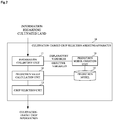
- FIG. 1 is a block diagram showing an overall configuration of a cultivation-target crop selection assisting apparatus according to the first example embodiment of the invention.
- a cultivation-target crop selection assisting apparatus 10 is an apparatus that assists a user, who is an agricultural business operator, in selecting a cultivation-target crop in a specific cultivated land.
- the cultivation-target crop selection assisting apparatus 10 includes an information collection unit 11, a prediction value calculation unit 12, and a crop selection unit 13.
- the information collection unit 11 collects information regarding a specific cultivated land.
- the prediction value calculation unit 12 calculates prediction values of actual performance of cultivation of one or a plurality of varieties of crops in a specific cultivated land by applying information collected by the information collection unit 11 to a prediction model 14.
- the prediction model is a model created by performing machine learning on a relationship between information regarding sample cultivated lands and actual performance information regarding the crops produced in the sample cultivated lands.
- the crop selection unit 13 selects a crop that is suitable for a specific cultivated land based on the prediction values calculated for one or a plurality of varieties of crops.
- prediction values for a case in which a crop is cultivated in the cultivated land can be obtained by simply applying information regarding the cultivated land to the prediction model 14, and also a crop that is suitable for being cultivated is selected. Therefore, with the first example embodiment, the user can select a crop that is suitable for being cultivated in the cultivated land without specialized knowledge.
- FIG. 2 is a block diagram showing a specific configuration of the cultivation-target crop selection assisting apparatus according to the example embodiment of the invention.
- the cultivation-target crop selection assisting apparatus 10 includes a prediction model creation unit 15 in addition to the information collection unit 11, the prediction value calculation unit 12, and the crop selection unit 13 described above.
- the prediction model creation unit 15 creates the prediction model 14 by performing machine learning, using information regarding sample cultivated lands as explanatory variables, and actual performance information regarding the crops produced in the sample cultivated lands as objective variables.
- examples of "actual performance information regarding crops", which serve as objective variables, include yield, quality, sales (profit), and so on.
- quality include pH, color, viscosity, sugar content (Brix), lycopene content, polyphenol content, sensory test results, and so on.
- the value of a quality may be any of an average value, a maximum value, and a minimum value.
- Information regarding a cultivated land collected by the information collection unit 11 and "information regarding cultivated lands” that serves as explanatory variables may be information that includes information regarding the variety of the cultivated crop, information regarding the properties of the soil in the cultivated land, and environmental information regarding the cultivated land.
- Examples of “information regarding the properties of the soil” include the physical properties of the soil, the chemical properties of the soil, the biological properties of the soil, the position coordinates (latitude and longitude) of the cultivated land, and so on. More specifically, examples of the physical properties of the soil include the content rates of specific components (clay, silt, sand, and so on), the mass of unit volume, the saturated hydraulic conductivity, the water retention curve, and so on. Examples of the chemical properties of the soil include the pH, the content rates of specific elements, the cation exchange capacity, the electrical conductivity, and so on. Examples of the biological properties of the soil include soil biota (the species and the volume of organisms present in the soil), and so on.
- Examples of "environmental information regarding the cultivated land” includes weather information, farming information, and so on. More specifically, examples of weather information include the temperature, the humidity, the solar radiation amount, the wind speed, the wind direction, the rainfall amount, and so on, per unit time, for example. Farming information include the amount of irrigation, the amount of fertilizer applied, the amount of chemical sprayed, the number of times plowing is performed, the number of times weeding is performed, and so on, per predetermined period, for example.
- the prediction model creation unit 15 can perform machine learning on the above-described explanatory variables and objective variables, using linear regression (multiple regression, Ridge regression, lasso, fused lasso, principal component regression, partial least square regression, or the like), or non-linear regression (a decision tree, a Gaussian process, neural networks, or the like).
- a method for training a prediction model may be determined in advance, or automatically selected from among a plurality of methods. In the latter case, the prediction model creation unit 15 applies a plurality of methods to the above-described explanatory variables and objective variables, and adopts the method with which indicators that have been determined in advance (the prediction error, the calculation time, and so on) defined in advance are optimal values.
- the prediction model creation unit 15 generates a prediction model expressed by Math 1 shown below for each of varieties 1, 2, ... and n, where an objective variable y denotes an indicator to which attention is paid (yield, sugar content, sales, or the like) and x denotes an explanatory variable.
- y f 1 x : Prediction Model for Variety 1
- y f 2 x : Prediction Model for Variety 2
- ... y f n x : Prediction Model for Variety n
- the prediction value calculation unit 12 inputs, for example, the content rate of sand, the pH, the nitrogen content, the average temperature, and so on of a specific cultivated land, collected by the information collection unit 11, to each prediction model, as an explanatory variable vector x, and calculates a prediction value y for each variety.
- the crop selection unit 13 selects the variety with the highest prediction value y as a crop suitable for being cultivated.
- the prediction model creation unit 15 generates, for each of varieties 1, 2, ... and n, the prediction model expressed by Math. 2 shown below regarding an objective variable y 1 , and the prediction model expressed by Math. 3 shown below regarding an objective variable y 2 .
- the prediction value calculation unit 12 inputs the content rate of sand, the pH, the nitrogen content, the average temperature, and so on of a specific cultivated land, collected by the information collection unit 11, to each prediction model, as the explanatory variable vector x, and calculates prediction values y 1 and y 2 for each variety.
- the crop selection unit 13 calculate the value of y using the functions expressed by Math. 4 or Math. 5 shown below, and selects the variety with the highest value of y as a crop suitable for being cultivated.
- weights w 1 and w 2 can be freely set by the system administrator or the user according to the importance levels of the objective variables.
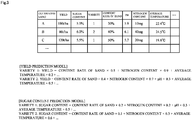
- FIG. 3(a) is a diagram showing examples of objective variables and explanatory variables used to create a prediction model in the first example embodiment of the invention
- FIG. 3(b) is a diagram showing examples of prediction models created in the first example embodiment of the invention.
- the yield and the sugar content in crops (e.g. an average value) in each cultivated land are used as objective variables. Further, the variety of the cultivated crops, the content rate of sand, the pH, the nitrogen content, the average temperature, and so on are used as explanatory variables for each cultivated land.
- the prediction model creation unit 15 can create a prediction model for predicting the yield and a prediction model for predicting the sugar content for each of the variety 1 and the variety 2, as shown in FIG. 3(b) .
- the prediction value calculation unit 12 inputs the content rate of sand, the pH, the nitrogen content, the average temperature, and so on of a specific cultivated land, collected by the information collection unit 11, to the prediction model 14 shown in FIG. 3(b) , and calculates prediction values of the yield and the sugar content for each of the varieties 1 and 2.
- the crop selection unit 13 calculates the product of the yield and the sugar content for each variety, using Math. 5 shown above.
- the crop selection unit 13 selects the variety with the highest product thus calculated, as a crop suitable for being cultivated in the specific cultivated land.
- the crop selection unit 13 selects the variety 2 as a crop suitable for being cultivated.
- FIGS. 1 to 3 are referenced when necessary.
- a cultivation-target crop selection assisting method is performed by operating the cultivation-target crop selection assisting apparatus 10. Therefore, a description of the cultivation-target crop selection assisting method according to the first example embodiment is substituted with the following description of the cultivation-target crop selection assisting apparatus 10.
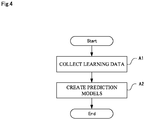
- FIG. 4 is a flowchart showing operations of the cultivation-target crop selection assisting apparatus according to the first example embodiment of the invention, performed when creating a prediction model.
- the information collection unit 11 collects information regarding the cultivated land, which serves as explanatory variables, and actual performance information regarding crops, which serves as objective variables (step A1).
- the information collection unit 11 collects these kinds of information from an external database or a terminal apparatus of the user or the like, via a network such as the Internet. Also, the information collection unit 11 may collect information that can be acquired from sensors that are installed in the cultivated land, such as weather information, from such sensors.
- the information (explanatory variables) regarding the cultivated land collected in step A1 may be information that was collected when the processing shown in FIG. 5 described below was performed in the past.
- actual performance information (objective variables) regarding crops produced in the cultivated land, collected in step A1 is preferably obtained from actual performance information of the same year as the year in which the above-described processing was performed.
- the prediction model creation unit 15 creates a prediction model 14 by performing machine learning using the information acquired in step A1 (step A2).
- the prediction model creation unit 15 creates one or a plurality of prediction models 14 according to the indicators and the varieties to which the user pays attention.
- the prediction models 14 thus created are used in cultivation-target crop selection processing described below.
- FIG. 5 is a flowchart showing operations of the cultivation-target crop selection assisting apparatus according to the first example embodiment of the invention, performed when selecting a cultivation-target crop.
- the information collection unit 11 collects information regarding a specific cultivated land that has been specified by the user (step B1).
- the information collection unit 11 collects information related to the cultivated land from an external database, a terminal apparatus of the user or the like, or sensors or the like installed in the cultivated land, via a network such as the Internet.
- the information collection unit 11 collects information such as normal values or average values in the past, and uses the collected information as explanatory variables. Alternatively, if forecast values (weather forecast and the like) or planned values (a farming plan and the like) are available, the information collection unit 11 may use such values as explanatory variables.
- the prediction value calculation unit 12 inputs the information collected in step B1 to the prediction models 14 created in step A2 shown in FIG. 4 , to calculate prediction values for the indicators and the varieties to which the user pays attention (step B2).
- the crop selection unit 13 selects a crop that is suitable for being cultivated in the specific cultivated land (step B3).
- the cultivation-target crop selection assisting apparatus 10 transmits information that specifies the selected crop (hereinafter referred to as "cultivation-target crop information") to the user's terminal apparatus.
- cultivation-target crop information information that specifies the selected crop
- the user can be informed of the crop that is suitable for being cultivated in a cultivated land by only preparing information regarding the cultivated land. That is to say, according to the first example embodiment, the user can select a crop that is suitable for being cultivated in the cultivated land without specialized knowledge.
- information regarding a cultivated land collected by the information collection unit 11 and "information regarding cultivated lands" that serves as explanatory variables include soil optical reflectance spectrum data measured in a cultivated land.
- soil optical reflectance spectrum data may be used as information regarding the properties of the soil in a cultivated land.
- Soil optical reflection spectrum data is data obtained by measuring the reflectance of light of various wavelengths applied to the ground surface of a cultivated land.
- Examples of soil optical reflection spectrum data include multispectral sensor data, multispectral camera data, hyperspectral sensor data, and hyperspectral camera data.
- Soil optical reflection spectrum data is measured using a dedicated measuring device such as a multispectral sensor, a multispectral camera, a hyperspectral sensor, or a hyperspectral camera.
- a dedicated measuring device such as a multispectral sensor, a multispectral camera, a hyperspectral sensor, or a hyperspectral camera.
- Example of measurement methods include a method in which an operator directly measures the ground surface (bare ground) using a measuring device, at a representative point in a measurement-target cultivated land, and a method in which a measuring device is mounted on a flying body such as a drone, a balloon, or an aircraft, or a satellite, and measurement is performed from above.
- Data obtained by the measuring device can only be obtained from the ground surface, and therefore it is preferable that the soil has been cultivated and agitated in advance using a cultivator or the like so as to be homogenized to some extent, from the surface to the cultivated soil layer.
- the measuring ranger is narrow, and therefore it is preferable to set a plurality of representative points in the cultivated land and perform measurement at each point.
- the measurement range is wide, and therefore measurement may be performed from high altitude so that the entire measurement-target cultivated land is within the angle of view, or performed by capturing an image of the entire cultivated land as a plurality of divided images, and combining these images like a mosaic.
- Soil optical reflectance spectrum data may be used as a substitute for the physical properties of the soil, the chemical properties of the soil, and the biological properties of the soil described above, or may be used in combination therewith. Soil optical reflectance spectrum data can be easily acquired compared to the physical properties of the soil, the chemical properties of the soil, and the biological properties. Therefore, in the former case, it is possible to reduce the operation costs of the cultivation-target crop selection assisting apparatus 10. On the other hand, in the latter case, the selection accuracy can be improved.
- a program according to the present example embodiment need only be a program that causes a computer to carry out steps A1 and A2 shown in FIG. 4 and steps B1 to B3 shown in FIG. 5 .
- a processor of the computer functions as the information collection unit 11, the prediction value calculation unit 12, the crop selection unit 13, and the prediction model creation unit 15, and performs processing.
- the program according to the first example embodiment may be executed by a computer system that is constituted by a plurality of computers.
- the computers may respectively function as the information collection unit 11, the prediction value calculation unit 12, the crop selection unit 13, and the prediction model creation unit 15.
- the following describes a cultivation-target crop selection assisting apparatus, a cultivation-target crop selection assisting method, and a program according to a second example embodiment of the invention with reference to FIGS. 6 and 7 .
- FIG. 6 is a block diagram showing an overall configuration of a cultivation-target crop selection assisting apparatus according to the second example embodiment of the invention.
- a cultivation-target crop selection assisting apparatus 20 also includes an advice creation unit 16 in addition to the components of the cultivation-target crop selection assisting apparatus according to the first example embodiment shown in FIGS. 1 and 2 . That is to say, the cultivation-target crop selection assisting apparatus 20 includes the information collection unit 11, the prediction value calculation unit 12, the crop selection unit 13, the prediction model creation unit 15, and the advice creation unit 16.
- the information collection unit 11, the prediction value calculation unit 12, the crop selection unit 13, and the prediction model creation unit 15 in the second example embodiment function in the same manner as in the first example embodiment.
- “Information regarding a cultivated land” collected by the information collection unit 11 and "information regarding cultivated lands” that serves as explanatory variables in the second example embodiment also include information regarding properties of the soil of the cultivated land.
- the advice creation unit 16 creates an advice on how to improve the soil of a specific cultivated land, based on the weights set to the explanatory variables in the prediction model 14, or the amounts of changes in the objective variables when the explanatory variables are changed.
- an objective variable y denotes an indicator to which attention is paid
- x soil denotes an explanatory variable related to the properties of the soil
- x other denotes another kind of explanatory variable.
- prediction models expressed by Math. 6 shown below are created by the prediction model creation unit 15. Note that "constant” is a term that collectively expresses constant terms.
- y f n x soil x other + constant : Prediction Model for Variety n
- the advice creation unit 16 specifies an explanatory variable of which the weight is positive, and creates an advice regarding a soil improvement for increasing the specified explanatory variable.
- the advice creation unit 16 also transmits the created advice to the terminal apparatus of the user.
- the advice creation unit 16 creates an advice that instructs the user to put a nitrogen fertilizer.
- the advice creation unit 16 creates an advice that instructs the user not to put a nitrogen fertilizer any more.
- the advice creation unit 16 can calculate soil properties for maximizing the objective variable y all at once by setting a feasible range (the upper limit and the lower limit) for each soil property x soil and performing linear optimization.
- the advice creation unit 16 can creates an advice as described above for each variety, and predict the potential maximum value of y resulting from soil improvement.
- the most suitable variety under the given condition x may be different from the variety that will be the most suitable when the soil improvement is performed based on the advice. Therefore, the advice creation unit 16 may provide the user with two options, namely the variety that is suitable when the soil improvement is not performed, and the most suitable variety when the soil improvement is performed and required soil property value. The user can realize that there are two options, and can select one of them.
- the prediction model creation unit 15 can collect a pre-farming soil analysis result x before before farming such as fertilization that changes the soil properties is performed, the content x activity of farming performed thereafter, and a post-farming soil analysis result x soil after farming is performed, from the information collection unit 11.
- the prediction model creation unit 15 can model the effect of the farming on the soil properties.
- the model that can be obtained is as shown in Math. 8 shown below.
- the advice creation unit 16 can derive the farming necessary for realizing the required soil property value by using the model shown in Math. 8.
- the result of substituting Math. 8 into Math. 7 is as shown in Math. 9 shown below.
- the advice creation unit 16 employs linear optimization to efficiently search for the farming content x activity that maximizes y, and thus the advice creation unit 16 can provide the user with the obtained content of farming.
- Soil optical reflectance spectrum data may be used in the second example embodiment as well, as information regarding the properties of the soil in a cultivated land.
- x spectrum denotes soil optical reflectance spectrum
- the prediction model modeled based on linear regression for the objective variable y can be expressed by Math. 10 shown below.
- y w spectrum T ⁇ x spectrum + w other T ⁇ x other + constant
- prediction model creation unit 15 can create a model for predicting the soil optical reflection spectrum data x spectrum from the explanatory variable vector (soil property data) x soil related to the soil properties.
- this model can be expressed by Math. 11 shown below.
- x spectrum w soil T ⁇ x soil + constant
- Math. 10 shown above can be expressed as Math. 12 shown below.
- the advice creation unit 16 uses Math. 12 shown above and employs linear optimization to efficiently search for the farming content x activity that maximizes y, and thus the advice creation unit 16 can provide the user with the obtained content of farming.
- the prediction model 14 is created based on non-linear regression using a neural network or the like.
- non-linear regression it is generally difficult to analytically determine how explanatory variables affect objective variables.
- the advice creation unit 16 repeatedly perform trials in which the advice creation unit 16 sets the explanatory variable vector x soil regarding the soil properties to various values, and records the outputs (the prediction values of the objective variables) for these inputs.
- the advice creation unit 16 can specify, from the record, the explanatory variable vector x soil when the output is the maximum in the trials that have been performed, and set the specified explanatory variable vector x soil as the optimum value.
- the advice creation unit 16 can obtain the optimum value of x activity by modeling the relationship between x activity and y as in the case of using the linear model, and repeating trials in the same manner as above.
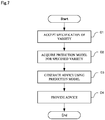
- FIG. 7 is a flowchart showing operations of the cultivation-target crop selection assisting apparatus according to the second example embodiment of the invention, performed when creating an advice.
- FIG. 6 is referenced when necessary.
- a cultivation-target crop selection assisting method is performed by operating the cultivation-target crop selection assisting apparatus 20. Therefore, a description of the cultivation-target crop selection assisting method according to the second example embodiment is substituted with the following description of the cultivation-target crop selection assisting apparatus 20.
- Prediction models are generated by carrying out steps A1 and A2 shown in FIG. 4 , and a cultivation-target crop is selected by carrying out steps B1 to B3 shown in FIG. 5 , in the second example embodiment as well.
- the advice creation unit 16 accepts a specification of a type from the user (step C1). Specifically, the user specifies the variety for which the user needs an advice, via the terminal apparatus.
- the advice creation unit 16 acquires the prediction model 14 for the variety specified in step C1, in order to create an advice regarding soil improvements for the variety specified in step C1 (step C2).
- the advice creation unit 16 creates an advice, using the acquired prediction model 14 (step C3). Specifically, if the prediction model 14 is a linear model, the advice creation unit 16 determines whether the weight value is positive or negative, using Math. 7 shown above, and creates an advice based on the result of determination.
- the advice creation unit 16 transmits the created advice to the user's terminal apparatus, and provides the user with the advice via the terminal apparatus (step C4).
- the second example embodiment it is possible to provide the user with an advance regarding soil improvements for the cultivated land. Therefore, the user can also select a cultivation-target crop on the premise of soil improvements.
- the second example embodiment can achieve the same effect as the first example embodiment.
- a program according to the present example embodiment need only be a program that causes a computer to carry out steps A1 and A2 shown in FIG. 4 , steps B1 to B3 shown in FIG. 5 , and also steps C1 to C4 shown in FIG. 7 .
- a processor of the computer functions as the information collection unit 11, the prediction value calculation unit 12, the crop selection unit 13, the prediction model creation unit 15, and the advice creation unit 16, and performs processing.
- the program according to the second example embodiment may be executed by a computer system that is constituted by a plurality of computers.
- the computers may respectively function as the information collection unit 11, the prediction value calculation unit 12, the crop selection unit 13, the prediction model creation unit 15, and the advice creation unit 16.
- FIG. 8 is a block diagram showing an example of a computer that realizes the cultivation-target crop selection assisting apparatuses according to the first and second example embodiments of the invention.
- a computer 110 includes a CPU (Central Processing Unit) 111, a main memory 112, a storage apparatus 113, an input interface 114, a display controller 115, a data reader/writer 116, and a communication interface 117. These units are connected via a bus 121 so as to be able to perform data communication with each other.
- the computer 110 may include a GPU (Graphics Processing Unit) or an FPGA (Field-Programmable Gate Array) in addition to the CPU 111 or instead of the CPU 111.
- the CPU 111 loads a program (codes) according to the present example embodiments stored in the storage device 113 to the main memory 112, and executes them in a predetermined order to perform various kinds of computations.
- the main memory 112 is typically a volatile storage device such as a DRAM (Dynamic Random Access Memory).
- the program according to the present example embodiments is provided in the state of being stored in a computer-readable recording medium 120. Note that the program according to the present example embodiments may be distributed on the Internet that is connected via the communication interface 117.
- the storage device 113 includes a hard disk drive, and a semiconductor storage device such as a flash memory.
- the input interface 114 mediates data transmission between the CPU 111 and an input device 118 such as a keyboard or a mouse.
- the display controller 115 is connected to a display apparatus 119, and controls display on the display apparatus 119.
- the data reader/writer 116 mediates data transmission between the CPU 111 and the recording medium 120, and reads out the program from the recording medium 120 and writes the results of processing performed in the computer 110 to the recording medium 120.
- the communication interface 117 mediates data transmission between the CPU 111 and another computer.
- the recording medium 120 include general-purpose semiconductor storage devices such as a CF (Compact Flash (registered trademark)) and an SD (Secure Digital), a magnetic recording medium such as a flexible disk, and an optical recording medium such as a CD-ROM (Compact Disk Read Only Memory).
- CF Compact Flash
- SD Secure Digital
- a magnetic recording medium such as a flexible disk
- an optical recording medium such as a CD-ROM (Compact Disk Read Only Memory).
- cultivation-target crop selection assisting apparatuses may be realized using pieces of hardware corresponding to the units, instead of a computer in which a program is installed. Furthermore, part of the cultivation-target crop selection assisting apparatuses may be realized using a program, and the rest may be realized using hardware.
- a cultivation-target crop selection assisting apparatus including:
- the cultivation-target crop selection assisting apparatus further including a prediction model creation unit configured to create the prediction model by performing machine learning using the information regarding the sample cultivated land as an explanatory variable and the actual performance information regarding the crop produced in the sample cultivated land as an objective variable.
- the cultivation-target crop selection assisting apparatus includes an advice creation unit configured to create an advice regarding soil improvements for the specific cultivated land, based on an amount of a change in the explanatory variable when the objective variable is increased in the prediction model, and a weight set to the explanatory variable in the prediction model.
- the cultivation-target crop selection assisting apparatus according to Supplementary Note 1 or 2, wherein the information regarding the specific cultivated land and the information regarding the sample cultivated land include information regarding soil properties of the cultivated land and environmental information regarding the cultivated land.
- the cultivation-target crop selection assisting apparatus according to Supplementary Note 1 or 2, wherein the information regarding the specific cultivated land and the information regarding the sample cultivated land include soil optical reflectance spectrum data measured in the cultivated land.
- a cultivation-target crop selection assisting method including:
- the cultivation-target crop selection assisting method further including (d) a step of creating the prediction model by performing machine learning using the information regarding the sample cultivated land as an explanatory variable and the actual performance information regarding the crop produced in the sample cultivated land as an objective variable.
- the cultivation-target crop selection assisting method includes: (e) a step of creating an advice regarding soil improvements for the specific cultivated land, based on an amount of a change in the explanatory variable when the objective variable is increased in the prediction model, and a weight set to the explanatory variable in the prediction model.
- the cultivation-target crop selection assisting method according to Supplementary Note 6 or 7, wherein the information regarding the specific cultivated land and the information regarding the sample cultivated land include information regarding soil properties of the cultivated land and environmental information regarding the cultivated land.
- the cultivation-target crop selection assisting method according to Supplementary Note 6 or 7, wherein the information regarding the specific cultivated land and the information regarding the sample cultivated land include soil optical reflectance spectrum data measured in the cultivated land.
- a computer-readable recording medium that includes a program recorded thereon, the program including instructions that cause a computer to carry out:
- the computer-readable recording medium according to Supplementary Note 11, wherein the program further includes an instruction that causes the computer to carry out (d) a step of creating the prediction model by performing machine learning using the information regarding the sample cultivated land as an explanatory variable and the actual performance information regarding the crop produced in the sample cultivated land as an objective variable.
- the computer-readable recording medium according to Supplementary Note 12, wherein the information regarding the specific cultivated land and the information regarding the sample cultivated land include information regarding soil properties of the cultivated land, and the program further includes an instruction that causes the computer to carry out (e) a step of creating an advice regarding soil improvements for the specific cultivated land, based on an amount of a change in the explanatory variable when the objective variable is increased in the prediction model, and a weight set to the explanatory variable in the prediction model.
- the computer-readable recording medium according to Supplementary Note 11 or 12, wherein the information regarding the specific cultivated land and the information regarding the sample cultivated land include information regarding soil properties of the cultivated land and environmental information regarding the cultivated land.
- the computer-readable recording medium according to Supplementary Note 11 or 12, wherein the information regarding the specific cultivated land and the information regarding the sample cultivated land include soil optical reflectance spectrum data measured in the cultivated land.
- the invention is useful in the field of agriculture.
Landscapes
- Life Sciences & Earth Sciences (AREA)
- Business, Economics & Management (AREA)
- Engineering & Computer Science (AREA)
- Primary Health Care (AREA)
- Tourism & Hospitality (AREA)
- Mining & Mineral Resources (AREA)
- Animal Husbandry (AREA)
- Health & Medical Sciences (AREA)
- Economics (AREA)
- General Health & Medical Sciences (AREA)
- Human Resources & Organizations (AREA)
- Marketing (AREA)
- Agronomy & Crop Science (AREA)
- Strategic Management (AREA)
- Marine Sciences & Fisheries (AREA)
- Physics & Mathematics (AREA)
- General Business, Economics & Management (AREA)
- General Physics & Mathematics (AREA)
- Theoretical Computer Science (AREA)
- Biodiversity & Conservation Biology (AREA)
- Botany (AREA)
- Ecology (AREA)
- Forests & Forestry (AREA)
- Environmental Sciences (AREA)
- Management, Administration, Business Operations System, And Electronic Commerce (AREA)
Abstract
Description
- The invention relates to a cultivation-target crop selection assisting apparatus and a cultivation-target crop selection assisting method that are for assisting a user in selecting a crop that is suitable for being cultivated in a cultivated land. Furthermore, the invention relates to a computer-readable recording medium on which a program for realizing the apparatus and the method is recorded.
- Conventionally, in open-field cultivation, the type of agricultural crops planted in a cultivated land is freely determined by the grower based on the climate of the area in which the cultivated land is located, the amount of sunlight, the soil properties, market demand, and so on. Therefore, after planting is complete, there is the possibility of the situation in which, for example, the planned yield cannot be obtained or the quality of the crops is low occurring due to the cultivated land being not suitable for the crop.
- In view of such a situation, a technology for selecting a crop that is suitable for a cultivated land has been disclosed (e.g. see
Patent Documents 1 and 2). Specifically,Patent Document 1 discloses a system for presenting the most suitable crop for the cultivated land. The system disclosed inPatent Document 1 selects the most suitable crop by matching the result of analysis of the soil of the cultivated land, obtained from a soil analyzing apparatus, with a database in which soil conditions are registered for each variety of crop, and displays the selected crop on the screen. This system can also specify measures for soil improvement by, upon a crop being specified, comparing soil conditions that are suitable for the specified crop with the result of analysis by the soil analyzing apparatus. -
Patent Document 2 also discloses a system for presenting the most suitable crop for the cultivated land. The system disclosed inPatent Document 2 proposes the crop to be planted based on soil analysis information that indicates the components of the soil of the cultivated land, market price information regarding crops, cultivation information regarding crops, and annual weather information regarding the area in which cultivated land is located. -
- Patent Document 1: Japanese Patent Laid-Open Publication No.
2000-83476 - Patent Document 2: Japanese Patent Laid-Open Publication No.
2005-80514 - However, with the system disclosed in
Patent Document 1, it is necessary to collect a huge amount of data in advance and build a database in advance. The construction of such a database requires knowledge of a skilled grower or expert, and it takes time and costs. The system disclosed inPatent Document 2 also requires a similar database, and there is the same problem. - One example of an object of the invention is to solve the above-described problem and provide a cultivation-target crop selection assisting apparatus, a cultivation-target crop selection assisting method, and a computer-readable recording medium that can make it possible to select a crop that is suitable for being cultivated in the target cultivated land, without specialized knowledge.
- To achieve the above-described object, a cultivation-target crop selection assisting apparatus according to one aspect of the invention includes:
- an information collection unit configured to collect information regarding a specific cultivated land;
- a prediction value calculation unit configured to calculate a prediction value of actual performance of cultivation of one or a plurality of varieties of crops in the specific cultivated land by applying the information collected by the information collection unit to a prediction model created by performing machine learning on a relationship between information regarding a sample cultivated land and actual performance information regarding a crop produced in the sample cultivated land; and
- a crop selection unit configured to select a crop that is suitable for being cultivated in the specific cultivated land based on the prediction value calculated for the one or plurality of varieties of crops.
- To achieve the above-described object, a cultivation-target crop selection assisting method according to one aspect of the invention includes:
- (a) a step of collecting information regarding a specific cultivated land;
- (b) a step of calculating a prediction value of actual performance of cultivation of one or a plurality of varieties of crops in the specific cultivated land by applying the information collected by the information collection unit to a prediction model created by performing machine learning on a relationship between information regarding a sample cultivated land and actual performance information regarding a crop produced in the sample cultivated land; and
- (c) a step of selecting a crop that is suitable for being cultivated in the specific cultivated land based on the prediction value calculated for the one or plurality of varieties of crops.
- Furthermore, to achieve the above-described object, a computer-readable recording medium according to one aspect of the invention includes a program recorded thereon, the program including instructions that cause a computer to carry out:
- (a) a step of collecting information regarding a specific cultivated land;
- (b) a step of calculating a prediction value of actual performance of cultivation of one or a plurality of varieties of crops in the specific cultivated land by applying the information collected by the information collection unit to a prediction model created by performing machine learning on a relationship between information regarding a sample cultivated land and actual performance information regarding a crop produced in the sample cultivated land; and
- (c) a step of selecting a crop that is suitable for being cultivated in the specific cultivated land based on the prediction value calculated for the one or plurality of varieties of crops.
- As described above, with the invention, it is possible to select a crop that is suitable for being cultivated in a target cultivated land, without specialized knowledge.
-
-
FIG. 1 is a block diagram showing an overall configuration of a cultivation-target crop selection assisting apparatus according to a first example embodiment of the invention. -
FIG. 2 is a block diagram showing a specific configuration of the cultivation-target crop selection assisting apparatus according to the example embodiment of the invention. -
FIG. 3(a) is a diagram showing examples of objective variables and explanatory variables used to create a prediction model in the first example embodiment of the invention, andFIG. 3(b) is a diagram showing examples of prediction models created in the first example embodiment of the invention. -
FIG. 4 is a flowchart showing operations of the cultivation-target crop selection assisting apparatus according to the first example embodiment of the invention, performed when creating a prediction model. -
FIG. 5 is a flowchart showing operations of the cultivation-target crop selection assisting apparatus according to the first example embodiment of the invention, performed when selecting a cultivation-target crop. -
FIG. 6 is a block diagram showing an overall configuration of a cultivation-target crop selection assisting apparatus according to a second example embodiment of the invention. -
FIG. 7 is a flowchart showing operations of the cultivation-target crop selection assisting apparatus according to the second example embodiment of the invention, performed when creating an advice. -
FIG. 8 is a block diagram showing an example of a computer that realizes the cultivation-target crop selection assisting apparatuses according to the first and second example embodiments of the invention. - The following describes a cultivation-target crop selection assisting apparatus, a cultivation-target crop selection assisting method, and a program according to a first example embodiment of the invention with reference to
FIGS. 1 to 5 . - First, an overall configuration of a cultivation-target crop selection assisting apparatus according to the first example embodiment will be described.
FIG. 1 is a block diagram showing an overall configuration of a cultivation-target crop selection assisting apparatus according to the first example embodiment of the invention. - A cultivation-target crop
selection assisting apparatus 10 according to the present example embodiment, which is shown inFIG. 1 , is an apparatus that assists a user, who is an agricultural business operator, in selecting a cultivation-target crop in a specific cultivated land. As shown inFIG. 1 , the cultivation-target cropselection assisting apparatus 10 includes aninformation collection unit 11, a predictionvalue calculation unit 12, and acrop selection unit 13. - The
information collection unit 11 collects information regarding a specific cultivated land. The predictionvalue calculation unit 12 calculates prediction values of actual performance of cultivation of one or a plurality of varieties of crops in a specific cultivated land by applying information collected by theinformation collection unit 11 to aprediction model 14. The prediction model is a model created by performing machine learning on a relationship between information regarding sample cultivated lands and actual performance information regarding the crops produced in the sample cultivated lands. Thecrop selection unit 13 selects a crop that is suitable for a specific cultivated land based on the prediction values calculated for one or a plurality of varieties of crops. - In this way, in the first example embodiment, prediction values for a case in which a crop is cultivated in the cultivated land can be obtained by simply applying information regarding the cultivated land to the
prediction model 14, and also a crop that is suitable for being cultivated is selected. Therefore, with the first example embodiment, the user can select a crop that is suitable for being cultivated in the cultivated land without specialized knowledge. - Next, a specific configuration of the cultivation-target crop selection assisting apparatus according to the first example embodiment will be described with reference to
FIG. 2. FIG. 2 is a block diagram showing a specific configuration of the cultivation-target crop selection assisting apparatus according to the example embodiment of the invention. - As shown in
FIG. 2 , the cultivation-target cropselection assisting apparatus 10 according to the first example embodiment includes a predictionmodel creation unit 15 in addition to theinformation collection unit 11, the predictionvalue calculation unit 12, and thecrop selection unit 13 described above. The predictionmodel creation unit 15 creates theprediction model 14 by performing machine learning, using information regarding sample cultivated lands as explanatory variables, and actual performance information regarding the crops produced in the sample cultivated lands as objective variables. - Here, examples of "actual performance information regarding crops", which serve as objective variables, include yield, quality, sales (profit), and so on. Examples of quality include pH, color, viscosity, sugar content (Brix), lycopene content, polyphenol content, sensory test results, and so on. The value of a quality may be any of an average value, a maximum value, and a minimum value.
- "Information regarding a cultivated land" collected by the
information collection unit 11 and "information regarding cultivated lands" that serves as explanatory variables may be information that includes information regarding the variety of the cultivated crop, information regarding the properties of the soil in the cultivated land, and environmental information regarding the cultivated land. - Examples of "information regarding the properties of the soil" include the physical properties of the soil, the chemical properties of the soil, the biological properties of the soil, the position coordinates (latitude and longitude) of the cultivated land, and so on. More specifically, examples of the physical properties of the soil include the content rates of specific components (clay, silt, sand, and so on), the mass of unit volume, the saturated hydraulic conductivity, the water retention curve, and so on. Examples of the chemical properties of the soil include the pH, the content rates of specific elements, the cation exchange capacity, the electrical conductivity, and so on. Examples of the biological properties of the soil include soil biota (the species and the volume of organisms present in the soil), and so on.
- Examples of "environmental information regarding the cultivated land" includes weather information, farming information, and so on. More specifically, examples of weather information include the temperature, the humidity, the solar radiation amount, the wind speed, the wind direction, the rainfall amount, and so on, per unit time, for example. Farming information include the amount of irrigation, the amount of fertilizer applied, the amount of chemical sprayed, the number of times plowing is performed, the number of times weeding is performed, and so on, per predetermined period, for example.
- The prediction
model creation unit 15 can perform machine learning on the above-described explanatory variables and objective variables, using linear regression (multiple regression, Ridge regression, lasso, fused lasso, principal component regression, partial least square regression, or the like), or non-linear regression (a decision tree, a Gaussian process, neural networks, or the like). A method for training a prediction model may be determined in advance, or automatically selected from among a plurality of methods. In the latter case, the predictionmodel creation unit 15 applies a plurality of methods to the above-described explanatory variables and objective variables, and adopts the method with which indicators that have been determined in advance (the prediction error, the calculation time, and so on) defined in advance are optimal values. The following describes a specific example of theprediction model 14. - For example, the prediction
model creation unit 15 generates a prediction model expressed byMath 1 shown below for each ofvarieties 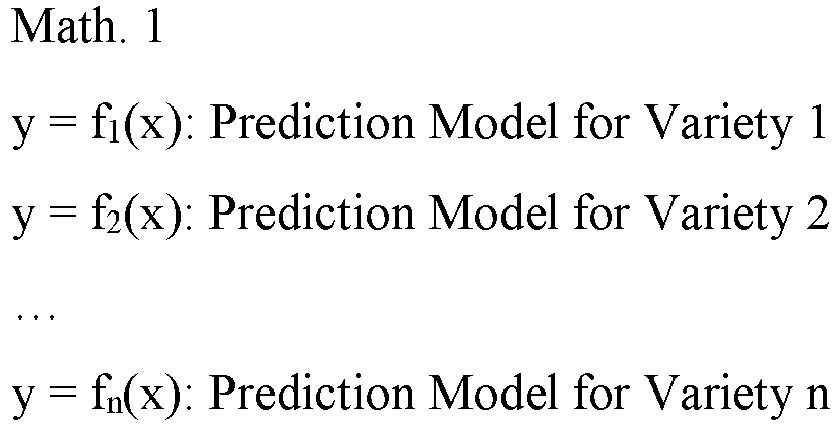
- In this case, the prediction
value calculation unit 12 inputs, for example, the content rate of sand, the pH, the nitrogen content, the average temperature, and so on of a specific cultivated land, collected by theinformation collection unit 11, to each prediction model, as an explanatory variable vector x, and calculates a prediction value y for each variety. Thecrop selection unit 13 selects the variety with the highest prediction value y as a crop suitable for being cultivated. - If there are two indicators to which attention is paid, objective variables y1 and y2 and the explanatory variable vector x are used. In this case, the prediction
model creation unit 15 generates, for each ofvarieties 

- In this case, the prediction
value calculation unit 12 inputs the content rate of sand, the pH, the nitrogen content, the average temperature, and so on of a specific cultivated land, collected by theinformation collection unit 11, to each prediction model, as the explanatory variable vector x, and calculates prediction values y1 and y2 for each variety. - If there are two indicators to which attention is paid, for example, the function expressed by Math. 4 or Math. 5 shown below is defined. Therefore, the
crop selection unit 13 calculate the value of y using the functions expressed by Math. 4 or Math. 5 shown below, and selects the variety with the highest value of y as a crop suitable for being cultivated. Note that whether to use Math. 4 or Math. 5 can be freely set by the system administrator or the user according to the objective variables. In the function expressed by Math. 4, weights w1 and w2 can be freely set by the system administrator or the user according to the importance levels of the objective variables.

- Here, specific examples of prediction models and selection of a crop using the prediction models will be described with reference to
FIG. 3. FIG. 3(a) is a diagram showing examples of objective variables and explanatory variables used to create a prediction model in the first example embodiment of the invention, andFIG. 3(b) is a diagram showing examples of prediction models created in the first example embodiment of the invention. - As shown in
FIG. 3(a) , in the first example embodiment, the yield and the sugar content in crops (e.g. an average value) in each cultivated land are used as objective variables. Further, the variety of the cultivated crops, the content rate of sand, the pH, the nitrogen content, the average temperature, and so on are used as explanatory variables for each cultivated land. - When the objective variables and the explanatory variables shown in
FIG. 3(a) are used, the predictionmodel creation unit 15 can create a prediction model for predicting the yield and a prediction model for predicting the sugar content for each of thevariety 1 and thevariety 2, as shown inFIG. 3(b) . - In this case, the prediction
value calculation unit 12 inputs the content rate of sand, the pH, the nitrogen content, the average temperature, and so on of a specific cultivated land, collected by theinformation collection unit 11, to theprediction model 14 shown inFIG. 3(b) , and calculates prediction values of the yield and the sugar content for each of thevarieties - Also, the
crop selection unit 13 calculates the product of the yield and the sugar content for each variety, using Math. 5 shown above. Thecrop selection unit 13 selects the variety with the highest product thus calculated, as a crop suitable for being cultivated in the specific cultivated land. - For example, it is assumed here that the yield y1 = 105 t/ha and the sugar content y2 = 5.7% have been obtained for the
variety 1, and the yield y1 = 100 t/ha and the sugar content y2 = 6.2% have been obtained for thevariety 2. In this case, the prediction value y of thevariety 1 is 5.96 and the prediction value y of thevariety 2 is 6.20, and therefore thecrop selection unit 13 selects thevariety 2 as a crop suitable for being cultivated. - Next, operations of the cultivation-target crop
selection assisting apparatus 10 according to the first example embodiment will be described with reference toFIGS. 4 and5 . In the following description,FIGS. 1 to 3 are referenced when necessary. In the first example embodiment, a cultivation-target crop selection assisting method is performed by operating the cultivation-target cropselection assisting apparatus 10. Therefore, a description of the cultivation-target crop selection assisting method according to the first example embodiment is substituted with the following description of the cultivation-target cropselection assisting apparatus 10. - First, prediction model creating processing that is performed by the cultivation-target crop
selection assisting apparatus 10 according to the first example embodiment will be described with reference toFIG. 4. FIG. 4 is a flowchart showing operations of the cultivation-target crop selection assisting apparatus according to the first example embodiment of the invention, performed when creating a prediction model. - As shown in
FIG. 4 , first, theinformation collection unit 11 collects information regarding the cultivated land, which serves as explanatory variables, and actual performance information regarding crops, which serves as objective variables (step A1). - Specifically, the
information collection unit 11 collects these kinds of information from an external database or a terminal apparatus of the user or the like, via a network such as the Internet. Also, theinformation collection unit 11 may collect information that can be acquired from sensors that are installed in the cultivated land, such as weather information, from such sensors. - The information (explanatory variables) regarding the cultivated land collected in step A1 may be information that was collected when the processing shown in
FIG. 5 described below was performed in the past. In this case, actual performance information (objective variables) regarding crops produced in the cultivated land, collected in step A1, is preferably obtained from actual performance information of the same year as the year in which the above-described processing was performed. - Next, the prediction
model creation unit 15 creates aprediction model 14 by performing machine learning using the information acquired in step A1 (step A2). - Specifically, as shown in
FIG. 3 , the predictionmodel creation unit 15 creates one or a plurality ofprediction models 14 according to the indicators and the varieties to which the user pays attention. Theprediction models 14 thus created are used in cultivation-target crop selection processing described below. - Next, cultivation-target crop selection processing that is performed by the cultivation-target crop
selection assisting apparatus 10 according to the first example embodiment will be described with reference toFIG. 5. FIG. 5 is a flowchart showing operations of the cultivation-target crop selection assisting apparatus according to the first example embodiment of the invention, performed when selecting a cultivation-target crop. - As shown in
FIG. 5 , first, theinformation collection unit 11 collects information regarding a specific cultivated land that has been specified by the user (step B1). - Specifically, upon the user inputting information that specifies a cultivated land, using their own terminal apparatus, the
information collection unit 11 collects information related to the cultivated land from an external database, a terminal apparatus of the user or the like, or sensors or the like installed in the cultivated land, via a network such as the Internet. - At this time, regarding information that has not been determined at the time of crop selection (e.g. weather information and farming information in the cultivation period), the
information collection unit 11 collects information such as normal values or average values in the past, and uses the collected information as explanatory variables. Alternatively, if forecast values (weather forecast and the like) or planned values (a farming plan and the like) are available, theinformation collection unit 11 may use such values as explanatory variables. - Next, the prediction
value calculation unit 12 inputs the information collected in step B1 to theprediction models 14 created in step A2 shown inFIG. 4 , to calculate prediction values for the indicators and the varieties to which the user pays attention (step B2). - Next, based on the prediction values calculated in step B2, the
crop selection unit 13 selects a crop that is suitable for being cultivated in the specific cultivated land (step B3). Upon performing step B3, the cultivation-target cropselection assisting apparatus 10 transmits information that specifies the selected crop (hereinafter referred to as "cultivation-target crop information") to the user's terminal apparatus. Thus, the user can be informed of the crop that is suitable for being cultivated in the specified cultivated land. - As described above, according to the first example embodiment, the user can be informed of the crop that is suitable for being cultivated in a cultivated land by only preparing information regarding the cultivated land. That is to say, according to the first example embodiment, the user can select a crop that is suitable for being cultivated in the cultivated land without specialized knowledge.
- Next, a modification of the present example embodiment will be described. In the present modification, "information regarding a cultivated land" collected by the
information collection unit 11 and "information regarding cultivated lands" that serves as explanatory variables include soil optical reflectance spectrum data measured in a cultivated land. Specifically, soil optical reflectance spectrum data may be used as information regarding the properties of the soil in a cultivated land. - Soil optical reflection spectrum data is data obtained by measuring the reflectance of light of various wavelengths applied to the ground surface of a cultivated land. Examples of soil optical reflection spectrum data include multispectral sensor data, multispectral camera data, hyperspectral sensor data, and hyperspectral camera data.
- Soil optical reflection spectrum data is measured using a dedicated measuring device such as a multispectral sensor, a multispectral camera, a hyperspectral sensor, or a hyperspectral camera. Example of measurement methods include a method in which an operator directly measures the ground surface (bare ground) using a measuring device, at a representative point in a measurement-target cultivated land, and a method in which a measuring device is mounted on a flying body such as a drone, a balloon, or an aircraft, or a satellite, and measurement is performed from above.
- Data obtained by the measuring device can only be obtained from the ground surface, and therefore it is preferable that the soil has been cultivated and agitated in advance using a cultivator or the like so as to be homogenized to some extent, from the surface to the cultivated soil layer.
- When a multispectral sensor or a hyperspectral sensor is used as a measuring device, the measuring ranger is narrow, and therefore it is preferable to set a plurality of representative points in the cultivated land and perform measurement at each point. On the other hand, when a multispectral camera or a hyperspectral camera is used as a measuring device, the measurement range is wide, and therefore measurement may be performed from high altitude so that the entire measurement-target cultivated land is within the angle of view, or performed by capturing an image of the entire cultivated land as a plurality of divided images, and combining these images like a mosaic.
- Soil optical reflectance spectrum data may be used as a substitute for the physical properties of the soil, the chemical properties of the soil, and the biological properties of the soil described above, or may be used in combination therewith. Soil optical reflectance spectrum data can be easily acquired compared to the physical properties of the soil, the chemical properties of the soil, and the biological properties. Therefore, in the former case, it is possible to reduce the operation costs of the cultivation-target crop
selection assisting apparatus 10. On the other hand, in the latter case, the selection accuracy can be improved. - A program according to the present example embodiment need only be a program that causes a computer to carry out steps A1 and A2 shown in
FIG. 4 and steps B1 to B3 shown inFIG. 5 . By installing such a program in a computer and executing the program, it is possible to realize the cultivation-target cropselection assisting apparatus 10 and the cultivation-target crop selection assisting method according to the first example embodiment. In this case, a processor of the computer functions as theinformation collection unit 11, the predictionvalue calculation unit 12, thecrop selection unit 13, and the predictionmodel creation unit 15, and performs processing. - The program according to the first example embodiment may be executed by a computer system that is constituted by a plurality of computers. In such a case, the computers may respectively function as the
information collection unit 11, the predictionvalue calculation unit 12, thecrop selection unit 13, and the predictionmodel creation unit 15. - The following describes a cultivation-target crop selection assisting apparatus, a cultivation-target crop selection assisting method, and a program according to a second example embodiment of the invention with reference to
FIGS. 6 and7 . - First, a configuration of a cultivation-target crop selection assisting apparatus according to the second example embodiment will be described.
FIG. 6 is a block diagram showing an overall configuration of a cultivation-target crop selection assisting apparatus according to the second example embodiment of the invention. - As shown in
FIG. 2 , a cultivation-target cropselection assisting apparatus 20 according to the second example embodiment also includes anadvice creation unit 16 in addition to the components of the cultivation-target crop selection assisting apparatus according to the first example embodiment shown inFIGS. 1 and2 . That is to say, the cultivation-target cropselection assisting apparatus 20 includes theinformation collection unit 11, the predictionvalue calculation unit 12, thecrop selection unit 13, the predictionmodel creation unit 15, and theadvice creation unit 16. - Among these components, the
information collection unit 11, the predictionvalue calculation unit 12, thecrop selection unit 13, and the predictionmodel creation unit 15 in the second example embodiment function in the same manner as in the first example embodiment. In addition, "Information regarding a cultivated land" collected by theinformation collection unit 11 and "information regarding cultivated lands" that serves as explanatory variables in the second example embodiment also include information regarding properties of the soil of the cultivated land. - The
advice creation unit 16 creates an advice on how to improve the soil of a specific cultivated land, based on the weights set to the explanatory variables in theprediction model 14, or the amounts of changes in the objective variables when the explanatory variables are changed. - Here, the following describes the functions of the
advice creation unit 16 in further details. First, a case in which theprediction model 14 is a linear model created based on linear regression will be described. - For example, an objective variable y denotes an indicator to which attention is paid, xsoil denotes an explanatory variable related to the properties of the soil, and xother denotes another kind of explanatory variable. In this case, prediction models expressed by Math. 6 shown below are created by the prediction
model creation unit 15. Note that "constant" is a term that collectively expresses constant terms.
- The following discusses the case of the
variety 1 in Math. 6 shown above. The function f1 is a linear model, and therefore the prediction model for thevariety 1 expressed by Math. 6 above can be expressed by Math. 7 shown below, using a weight vectors wsoil and wother obtained through training using learning data.
- Therefore, the
advice creation unit 16 specifies an explanatory variable of which the weight is positive, and creates an advice regarding a soil improvement for increasing the specified explanatory variable. Theadvice creation unit 16 also transmits the created advice to the terminal apparatus of the user. - For example, when the yield is the objective variable, if the weight on the nitrogen content in the soil, which is an explanatory variable, is a positive value, the yield can be increased by putting a nitrogen fertilizer to increase the nitrogen content in the soil. Therefore, in such a case, the
advice creation unit 16 creates an advice that instructs the user to put a nitrogen fertilizer. On the other hand, if the weight on the nitrogen content in the soil, which is an explanatory variable, is a negative value, theadvice creation unit 16 creates an advice that instructs the user not to put a nitrogen fertilizer any more. - Also, the
advice creation unit 16 can calculate soil properties for maximizing the objective variable y all at once by setting a feasible range (the upper limit and the lower limit) for each soil property xsoil and performing linear optimization. - Furthermore, the
advice creation unit 16 can creates an advice as described above for each variety, and predict the potential maximum value of y resulting from soil improvement. In such a case, the most suitable variety under the given condition x may be different from the variety that will be the most suitable when the soil improvement is performed based on the advice. Therefore, theadvice creation unit 16 may provide the user with two options, namely the variety that is suitable when the soil improvement is not performed, and the most suitable variety when the soil improvement is performed and required soil property value. The user can realize that there are two options, and can select one of them. - In addition, in the second example embodiment, the prediction
model creation unit 15 can collect a pre-farming soil analysis result xbefore before farming such as fertilization that changes the soil properties is performed, the content xactivity of farming performed thereafter, and a post-farming soil analysis result xsoil after farming is performed, from theinformation collection unit 11. In such a case, the predictionmodel creation unit 15 can model the effect of the farming on the soil properties. When modeling is performed based on linear regression, the model that can be obtained is as shown in Math. 8 shown below.
- In this case, the
advice creation unit 16 can derive the farming necessary for realizing the required soil property value by using the model shown in Math. 8. The result of substituting Math. 8 into Math. 7 is as shown in Math. 9 shown below.
- When using the model shown in the above Math. 9, the
advice creation unit 16 employs linear optimization to efficiently search for the farming content xactivity that maximizes y, and thus theadvice creation unit 16 can provide the user with the obtained content of farming. - Soil optical reflectance spectrum data may be used in the second example embodiment as well, as information regarding the properties of the soil in a cultivated land. Here, when xspectrum denotes soil optical reflectance spectrum, the prediction model modeled based on linear regression for the objective variable y, which is an indicator to which attention is paid, can be expressed by Math. 10 shown below.

- In this case, prediction
model creation unit 15 can create a model for predicting the soil optical reflection spectrum data xspectrum from the explanatory variable vector (soil property data) xsoil related to the soil properties. When modeling is performed based on linear regression, this model can be expressed by Math. 11 shown below.
- Therefore, Math. 10 shown above can be expressed as Math. 12 shown below.

- Therefore, the
advice creation unit 16 uses Math. 12 shown above and employs linear optimization to efficiently search for the farming content xactivity that maximizes y, and thus theadvice creation unit 16 can provide the user with the obtained content of farming. - Next, a case in which the
prediction model 14 is created based on non-linear regression using a neural network or the like will be described. When non-linear regression is employed, it is generally difficult to analytically determine how explanatory variables affect objective variables. - Therefore, the
advice creation unit 16 repeatedly perform trials in which theadvice creation unit 16 sets the explanatory variable vector xsoil regarding the soil properties to various values, and records the outputs (the prediction values of the objective variables) for these inputs. Theadvice creation unit 16 can specify, from the record, the explanatory variable vector xsoil when the output is the maximum in the trials that have been performed, and set the specified explanatory variable vector xsoil as the optimum value. - In this regard, in order to search and find the optimum value more efficiently, if it is possible to calculate the gradient of the prediction model, it is possible to employ a gradient method such as the steepest descent method or a gradient method such as the Newton method. Even when the shape of the prediction model function is unknown (black box), an optimization method such as the Particle Swarm Optimization or the Bayesian Optimization may be employed.
- Also, when the content of farming xactivity that maximizes the objective variable y is to be obtained, the
advice creation unit 16 can obtain the optimum value of xactivity by modeling the relationship between xactivity and y as in the case of using the linear model, and repeating trials in the same manner as above. - Next, operations of the cultivation-target crop
selection assisting apparatus 20 according to the second example embodiment will be described with reference toFIG. 7. FIG. 7 is a flowchart showing operations of the cultivation-target crop selection assisting apparatus according to the second example embodiment of the invention, performed when creating an advice. In the following description,FIG. 6 is referenced when necessary. In the second example embodiment, a cultivation-target crop selection assisting method is performed by operating the cultivation-target cropselection assisting apparatus 20. Therefore, a description of the cultivation-target crop selection assisting method according to the second example embodiment is substituted with the following description of the cultivation-target cropselection assisting apparatus 20. - Prediction models are generated by carrying out steps A1 and A2 shown in
FIG. 4 , and a cultivation-target crop is selected by carrying out steps B1 to B3 shown inFIG. 5 , in the second example embodiment as well. - As shown in
FIG. 7 , first, theadvice creation unit 16 accepts a specification of a type from the user (step C1). Specifically, the user specifies the variety for which the user needs an advice, via the terminal apparatus. - Next, the
advice creation unit 16 acquires theprediction model 14 for the variety specified in step C1, in order to create an advice regarding soil improvements for the variety specified in step C1 (step C2). - Next, the
advice creation unit 16 creates an advice, using the acquired prediction model 14 (step C3). Specifically, if theprediction model 14 is a linear model, theadvice creation unit 16 determines whether the weight value is positive or negative, using Math. 7 shown above, and creates an advice based on the result of determination. - Thereafter, the
advice creation unit 16 transmits the created advice to the user's terminal apparatus, and provides the user with the advice via the terminal apparatus (step C4). - As described above, according to the second example embodiment, it is possible to provide the user with an advance regarding soil improvements for the cultivated land. Therefore, the user can also select a cultivation-target crop on the premise of soil improvements. In addition, the second example embodiment can achieve the same effect as the first example embodiment.
- A program according to the present example embodiment need only be a program that causes a computer to carry out steps A1 and A2 shown in
FIG. 4 , steps B1 to B3 shown inFIG. 5 , and also steps C1 to C4 shown inFIG. 7 . By installing such a program in a computer and executing the program, it is possible to realize the cultivation-target cropselection assisting apparatus 20 and the cultivation-target crop selection assisting method according to the first example embodiment. In this case, a processor of the computer functions as theinformation collection unit 11, the predictionvalue calculation unit 12, thecrop selection unit 13, the predictionmodel creation unit 15, and theadvice creation unit 16, and performs processing. - The program according to the second example embodiment may be executed by a computer system that is constituted by a plurality of computers. In such a case, the computers may respectively function as the
information collection unit 11, the predictionvalue calculation unit 12, thecrop selection unit 13, the predictionmodel creation unit 15, and theadvice creation unit 16. - The following describes a computer that realizes a cultivation-target crop selection assisting apparatus by executing a program according to the first example embodiment or the second example embodiment, with reference to
FIG. 8. FIG. 8 is a block diagram showing an example of a computer that realizes the cultivation-target crop selection assisting apparatuses according to the first and second example embodiments of the invention. - As shown in
FIG. 8 , acomputer 110 includes a CPU (Central Processing Unit) 111, amain memory 112, astorage apparatus 113, aninput interface 114, adisplay controller 115, a data reader/writer 116, and acommunication interface 117. These units are connected via abus 121 so as to be able to perform data communication with each other. Note that thecomputer 110 may include a GPU (Graphics Processing Unit) or an FPGA (Field-Programmable Gate Array) in addition to theCPU 111 or instead of theCPU 111. - The
CPU 111 loads a program (codes) according to the present example embodiments stored in thestorage device 113 to themain memory 112, and executes them in a predetermined order to perform various kinds of computations. Themain memory 112 is typically a volatile storage device such as a DRAM (Dynamic Random Access Memory). Also, the program according to the present example embodiments is provided in the state of being stored in a computer-readable recording medium 120. Note that the program according to the present example embodiments may be distributed on the Internet that is connected via thecommunication interface 117. - Specific examples of the
storage device 113 include a hard disk drive, and a semiconductor storage device such as a flash memory. Theinput interface 114 mediates data transmission between theCPU 111 and aninput device 118 such as a keyboard or a mouse. Thedisplay controller 115 is connected to adisplay apparatus 119, and controls display on thedisplay apparatus 119. - The data reader/
writer 116 mediates data transmission between theCPU 111 and therecording medium 120, and reads out the program from therecording medium 120 and writes the results of processing performed in thecomputer 110 to therecording medium 120. Thecommunication interface 117 mediates data transmission between theCPU 111 and another computer. - Specific examples of the
recording medium 120 include general-purpose semiconductor storage devices such as a CF (Compact Flash (registered trademark)) and an SD (Secure Digital), a magnetic recording medium such as a flexible disk, and an optical recording medium such as a CD-ROM (Compact Disk Read Only Memory). - Note that the cultivation-target crop selection assisting apparatuses according to the first and second example embodiments may be realized using pieces of hardware corresponding to the units, instead of a computer in which a program is installed. Furthermore, part of the cultivation-target crop selection assisting apparatuses may be realized using a program, and the rest may be realized using hardware.
- At least one or all of the above-described example embodiments can be expressed as, but are not limited to,
Supplementary Notes 1 to 15 described below. - A cultivation-target crop selection assisting apparatus including:
- an information collection unit configured to collect information regarding a specific cultivated land;
- a prediction value calculation unit configured to calculate a prediction value of actual performance of cultivation of one or a plurality of varieties of crops in the specific cultivated land by applying the information collected by the information collection unit to a prediction model created by performing machine learning on a relationship between information regarding a sample cultivated land and actual performance information regarding a crop produced in the sample cultivated land; and
- a crop selection unit configured to select a crop that is suitable for being cultivated in the specific cultivated land based on the prediction value calculated for the one or plurality of varieties of crops.
- The cultivation-target crop selection assisting apparatus according to
Supplementary Note 1, further including
a prediction model creation unit configured to create the prediction model by performing machine learning using the information regarding the sample cultivated land as an explanatory variable and the actual performance information regarding the crop produced in the sample cultivated land as an objective variable. - The cultivation-target crop selection assisting apparatus according to
Supplementary Note 2,
wherein the information regarding the specific cultivated land and the information regarding the sample cultivated land include information regarding soil properties of the cultivated land, and
the cultivation-target crop selection assisting apparatus further includes an advice creation unit configured to create an advice regarding soil improvements for the specific cultivated land, based on an amount of a change in the explanatory variable when the objective variable is increased in the prediction model, and a weight set to the explanatory variable in the prediction model. - The cultivation-target crop selection assisting apparatus according to
Supplementary Note
wherein the information regarding the specific cultivated land and the information regarding the sample cultivated land include information regarding soil properties of the cultivated land and environmental information regarding the cultivated land. - The cultivation-target crop selection assisting apparatus according to
Supplementary Note
wherein the information regarding the specific cultivated land and the information regarding the sample cultivated land include soil optical reflectance spectrum data measured in the cultivated land. - A cultivation-target crop selection assisting method including:
- (a) a step of collecting information regarding a specific cultivated land;
- (b) a step of calculating a prediction value of actual performance of cultivation of one or a plurality of varieties of crops in the specific cultivated land by applying the information collected in the (a) step to a prediction model created by performing machine learning on a relationship between information regarding a sample cultivated land and actual performance information regarding a crop produced in the sample cultivated land; and
- (c) a step of selecting a crop that is suitable for being cultivated in the specific cultivated land based on the prediction value calculated for the one or plurality of varieties of crops.
- The cultivation-target crop selection assisting method according to Supplementary Note 6, further including
(d) a step of creating the prediction model by performing machine learning using the information regarding the sample cultivated land as an explanatory variable and the actual performance information regarding the crop produced in the sample cultivated land as an objective variable. - The cultivation-target crop selection assisting method according to Supplementary Note 7,
wherein the information regarding the specific cultivated land and the information regarding the sample cultivated land include information regarding soil properties of the cultivated land, and
the cultivation-target crop selection assisting method further includes:
(e) a step of creating an advice regarding soil improvements for the specific cultivated land, based on an amount of a change in the explanatory variable when the objective variable is increased in the prediction model, and a weight set to the explanatory variable in the prediction model. - The cultivation-target crop selection assisting method according to Supplementary Note 6 or 7,
wherein the information regarding the specific cultivated land and the information regarding the sample cultivated land include information regarding soil properties of the cultivated land and environmental information regarding the cultivated land. - The cultivation-target crop selection assisting method according to Supplementary Note 6 or 7,
wherein the information regarding the specific cultivated land and the information regarding the sample cultivated land include soil optical reflectance spectrum data measured in the cultivated land. - A computer-readable recording medium that includes a program recorded thereon, the program including instructions that cause a computer to carry out:
- (a) a step of collecting information regarding a specific cultivated land;
- (b) a step of calculating a prediction value of actual performance of cultivation of one or a plurality of varieties of crops in the specific cultivated land by applying the information collected in the (a) step to a prediction model created by performing machine learning on a relationship between information regarding a sample cultivated land and actual performance information regarding a crop produced in the sample cultivated land; and
- (c) a step of selecting a crop that is suitable for being cultivated in the specific cultivated land based on the prediction value calculated for the one or plurality of varieties of crops.
- The computer-readable recording medium according to
Supplementary Note 11,
wherein the program further includes an instruction that causes the computer to carry out
(d) a step of creating the prediction model by performing machine learning using the information regarding the sample cultivated land as an explanatory variable and the actual performance information regarding the crop produced in the sample cultivated land as an objective variable. - The computer-readable recording medium according to
Supplementary Note 12,
wherein the information regarding the specific cultivated land and the information regarding the sample cultivated land include information regarding soil properties of the cultivated land, and
the program further includes an instruction that causes the computer to carry out
(e) a step of creating an advice regarding soil improvements for the specific cultivated land, based on an amount of a change in the explanatory variable when the objective variable is increased in the prediction model, and a weight set to the explanatory variable in the prediction model. - The computer-readable recording medium according to
Supplementary Note
wherein the information regarding the specific cultivated land and the information regarding the sample cultivated land include information regarding soil properties of the cultivated land and environmental information regarding the cultivated land. - The computer-readable recording medium according to
Supplementary Note
wherein the information regarding the specific cultivated land and the information regarding the sample cultivated land include soil optical reflectance spectrum data measured in the cultivated land. - While the present invention has been described above with reference to the example embodiments, the invention is not limited to the example embodiments described above. Various modifications that can be understood by a person skilled in the art may be applied to the configuration and the details of the present invention within the scope of the present invention.
- This application claims priority to Japanese Patent Application No.
2018-50198 filed March 16, 2018 - As described above, with the invention, it is possible to select a crop that is suitable for being cultivated in a target cultivated land, without specialized knowledge. The invention is useful in the field of agriculture.
-
- 10: Cultivation-target Crop Selection Assisting Apparatus (First Example Embodiment)
- 11: Information Collection Unit
- 12: Prediction Value Calculation Unit
- 13: Crop Selection Unit
- 14: Prediction Model
- 15: Prediction Model Creation Unit
- 16: Advice Creation Unit
- 20: Cultivation-target Crop Selection Assisting Apparatus (Second Example Embodiment)
- 110: Computer
- 111: CPU
- 112: Main Memory
- 113: Storage Device
- 114: Input Interface
- 115: Display Controller
- 116: Data Reader/Writer
- 117: Communication Interface
- 118: Input Device
- 119: Display Apparatus
- 120: Recording Medium
- 121: Bus
Claims (15)
- A cultivation-target crop selection assisting apparatus comprising:an information collection unit configured to collect information regarding a specific cultivated land;a prediction value calculation unit configured to calculate a prediction value of actual performance of cultivation of one or a plurality of varieties of crops in the specific cultivated land by applying the information collected by the information collection unit to a prediction model created by performing machine learning on a relationship between information regarding a sample cultivated land and actual performance information regarding a crop produced in the sample cultivated land; anda crop selection unit configured to select a crop that is suitable for being cultivated in the specific cultivated land based on the prediction value calculated for the one or plurality of varieties of crops.
- The cultivation-target crop selection assisting apparatus according to claim 1, further comprising:
a prediction model creation unit configured to create the prediction model by performing machine learning using the information regarding the sample cultivated land as an explanatory variable and the actual performance information regarding the crop produced in the sample cultivated land as an objective variable. - The cultivation-target crop selection assisting apparatus according to claim 2,
wherein the information regarding the specific cultivated land and the information regarding the sample cultivated land include information regarding soil properties of the cultivated land, and
the cultivation-target crop selection assisting apparatus further comprises an advice creation unit configured to create an advice regarding soil improvements for the specific cultivated land, based on an amount of a change in the explanatory variable when the objective variable is increased in the prediction model, and a weight set to the explanatory variable in the prediction model. - The cultivation-target crop selection assisting apparatus according to claim 1 or 2,
wherein the information regarding the specific cultivated land and the information regarding the sample cultivated land include information regarding soil properties of the cultivated land and environmental information regarding the cultivated land. - The cultivation-target crop selection assisting apparatus according to claim 1 or 2,
wherein the information regarding the specific cultivated land and the information regarding the sample cultivated land include soil optical reflectance spectrum data measured in the cultivated land. - A cultivation-target crop selection assisting method comprising:(a) a step of collecting information regarding a specific cultivated land;(b) a step of calculating a prediction value of actual performance of cultivation of one or a plurality of varieties of crops in the specific cultivated land by applying the information collected in the (a) step to a prediction model created by performing machine learning on a relationship between information regarding a sample cultivated land and actual performance information regarding a crop produced in the sample cultivated land; and(c) a step of selecting a crop that is suitable for being cultivated in the specific cultivated land based on the prediction value calculated for the one or plurality of varieties of crops.
- The cultivation-target crop selection assisting method according to claim 6, further comprising:
(d) a step of creating the prediction model by performing machine learning using the information regarding the sample cultivated land as an explanatory variable and the actual performance information regarding the crop produced in the sample cultivated land as an objective variable. - The cultivation-target crop selection assisting method according to claim 7,
wherein the information regarding the specific cultivated land and the information regarding the sample cultivated land include information regarding soil properties of the cultivated land, and
the cultivation-target crop selection assisting method further comprises:
(e) a step of creating an advice regarding soil improvements for the specific cultivated land, based on an amount of a change in the explanatory variable when the objective variable is increased in the prediction model, and a weight set to the explanatory variable in the prediction model. - The cultivation-target crop selection assisting method according to claim 6 or 7,
wherein the information regarding the specific cultivated land and the information regarding the sample cultivated land include information regarding soil properties of the cultivated land and environmental information regarding the cultivated land. - The cultivation-target crop selection assisting method according to claim 6 or 7,
wherein the information regarding the specific cultivated land and the information regarding the sample cultivated land include soil optical reflectance spectrum data measured in the cultivated land. - A computer-readable recording medium that includes a program recorded thereon, the program including instructions that cause a computer to carry out:(a) a step of collecting information regarding a specific cultivated land;(b) a step of calculating a prediction value of actual performance of cultivation of one or a plurality of varieties of crops in the specific cultivated land by applying the information collected in the (a) step to a prediction model created by performing machine learning on a relationship between information regarding a sample cultivated land and actual performance information regarding a crop produced in the sample cultivated land; and(c) a step of selecting a crop that is suitable for being cultivated in the specific cultivated land based on the prediction value calculated for the one or plurality of varieties of crops.
- The computer-readable recording medium according to claim 11,
wherein the program further includes an instruction that causes the computer to carry out
(d) a step of creating the prediction model by performing machine learning using the information regarding the sample cultivated land as an explanatory variable and the actual performance information regarding the crop produced in the sample cultivated land as an objective variable. - The computer-readable recording medium according to claim 12,
wherein the information regarding the specific cultivated land and the information regarding the sample cultivated land include information regarding soil properties of the cultivated land, and
the program further includes an instruction that causes the computer to carry out
(e) a step of creating an advice regarding soil improvements for the specific cultivated land, based on an amount of a change in the explanatory variable when the objective variable is increased in the prediction model, and a weight set to the explanatory variable in the prediction model. - The computer-readable recording medium according to claim 11 or 12,
wherein the information regarding the specific cultivated land and the information regarding the sample cultivated land include information regarding soil properties of the cultivated land and environmental information regarding the cultivated land. - The computer-readable recording medium according to claim 11 or 12,
wherein the information regarding the specific cultivated land and the information regarding the sample cultivated land include soil optical reflectance spectrum data measured in the cultivated land.
Applications Claiming Priority (2)
| Application Number | Priority Date | Filing Date | Title |
|---|---|---|---|
| JP2018050198A JP6544453B1 (en) | 2018-03-16 | 2018-03-16 | Cultivated crop selection support device, cultivated crop selection support method, and program |
| PCT/JP2019/009789 WO2019176879A1 (en) | 2018-03-16 | 2019-03-11 | Device for assisting selection of crop for cultivation, method for assisting selection of crop for cultivation, and computer-readable recording medium |
Publications (2)
| Publication Number | Publication Date |
|---|---|
| EP3767576A1 true EP3767576A1 (en) | 2021-01-20 |
| EP3767576A4 EP3767576A4 (en) | 2021-06-02 |
Family
ID=67297646
Family Applications (1)
| Application Number | Title | Priority Date | Filing Date |
|---|---|---|---|
| EP19768093.7A Ceased EP3767576A4 (en) | 2018-03-16 | 2019-03-11 | DEVICE TO ASSIST CULTURE SELECTION FOR PLANT IN CULTURE, PROCESS FOR ASSIST IN SELECTION OF CULTURE FOR PLANT IN CULTURE, AND COMPUTER-READABLE RECORDING MEDIA |
Country Status (4)
| Country | Link |
|---|---|
| US (1) | US11861738B2 (en) |
| EP (1) | EP3767576A4 (en) |
| JP (1) | JP6544453B1 (en) |
| WO (1) | WO2019176879A1 (en) |
Families Citing this family (12)
| Publication number | Priority date | Publication date | Assignee | Title |
|---|---|---|---|---|
| JP6729791B2 (en) * | 2017-03-23 | 2020-07-22 | 日本電気株式会社 | Vegetation index calculation device, vegetation index calculation method, and program |
| JP7163881B2 (en) * | 2019-08-02 | 2022-11-01 | トヨタ自動車株式会社 | Crop Characteristics Prediction System, Crop Characteristics Prediction Method, and Crop Characteristics Prediction Program |
| WO2021084019A1 (en) * | 2019-10-31 | 2021-05-06 | Keygene N.V. | Efficient plant selection |
| KR102604041B1 (en) * | 2020-09-10 | 2023-11-21 | 상명대학교산학협력단 | Method, device and program of recommending cultivation conditions for increase the content active ingredients in crop |
| KR102404710B1 (en) * | 2021-06-01 | 2022-06-07 | 주식회사 긴트 | Method and apparatus for recommending crops suitable for the characteristics of farmland |
| US11622495B2 (en) | 2021-06-01 | 2023-04-11 | Gint Co., Ltd. | Method of automatically combining farm vehicle and work machine and farm vehicle |
| EP4116897A1 (en) | 2021-07-06 | 2023-01-11 | Enrique Menotti Pescarmona | Process and system of management and analysis for agricultural production |
| JP7090953B1 (en) * | 2021-10-05 | 2022-06-27 | HarvestX株式会社 | Agricultural support system, agricultural support equipment, agricultural support method and agricultural support program |
| JP2024007313A (en) * | 2022-07-05 | 2024-01-18 | 吉谷土木株式会社 | Planting support methods and field work support systems, etc. |
| KR102542660B1 (en) * | 2022-07-25 | 2023-06-15 | 농업협동조합중앙회 | Apparatus and method for providing crop recommendation service |
| JP2024064151A (en) * | 2022-10-27 | 2024-05-14 | 国立研究開発法人農業・食品産業技術総合研究機構 | Information processing device, information processing method, and program |
| WO2025211256A1 (en) * | 2024-04-03 | 2025-10-09 | 英俊 高山 | Cultivation support device, cultivation support method, computer-readable recording medium recording cultivation support program, ai training method, and cultivation support system |
Family Cites Families (20)
| Publication number | Priority date | Publication date | Assignee | Title |
|---|---|---|---|---|
| JP2000083476A (en) | 1998-09-17 | 2000-03-28 | Takara Keiki Seisakusho:Kk | Selection of cultivation crop, apparatus for selecting cultivation crop, recording medium for recording cultivation crop-selecting program, presentation of improvement of soil, apparatus for presenting improvement of soil, recording medium for recording soil improvement presentation program, presentation of selection of cultivation crop and soil improvement, apparatus for presenting selection of cultivation crop and soil improvement and recording medium for recording presentation of cultivation crop selection and soil improvement |
| JP2003006247A (en) * | 2001-06-20 | 2003-01-10 | Mitsubishi Electric Corp | Redundant system configuration design / display device |
| JP2005080514A (en) | 2003-09-04 | 2005-03-31 | Matsushita Electric Ind Co Ltd | Fertilizer information providing system, soil information input means, and fertilizer information providing method |
| JP2010166851A (en) * | 2009-01-22 | 2010-08-05 | Chiharu Hongo | Method and device for predicting crop yield |
| CA2697608A1 (en) * | 2010-03-23 | 2011-09-23 | Dennis Bulani | Method of predicting crop yield |
| JP2011254711A (en) * | 2010-06-05 | 2011-12-22 | Zukosha:Kk | Fertilization map generating system, method for the same, industrial helicopter, server, and controlled fertilizer applicator |
| US10115158B2 (en) * | 2010-10-25 | 2018-10-30 | Trimble Inc. | Generating a crop recommendation |
| JP5760432B2 (en) | 2010-12-24 | 2015-08-12 | 富士通株式会社 | Planting support method and planting support device |
| JP6410130B2 (en) * | 2014-05-15 | 2018-10-24 | 株式会社Jsol | Crop yield prediction device, crop prediction system, and crop prediction method |
| US20160147962A1 (en) * | 2014-10-30 | 2016-05-26 | AgriSight, Inc. | Automated agricultural activity determination system and method |
| US20160224703A1 (en) * | 2015-01-30 | 2016-08-04 | AgriSight, Inc. | Growth stage determination system and method |
| US9652840B1 (en) * | 2014-10-30 | 2017-05-16 | AgriSight, Inc. | System and method for remote nitrogen monitoring and prescription |
| JP2017072900A (en) * | 2015-10-05 | 2017-04-13 | 株式会社リバネス | Agricultural land management server, agricultural land management method, agricultural land management program, and computer readable storage medium |
| WO2017164097A1 (en) * | 2016-03-25 | 2017-09-28 | 日本電気株式会社 | Information processing device, control method for information processing device, and recording medium having control program for information processing device recorded therein |
| CN106056457A (en) | 2016-05-25 | 2016-10-26 | 内蒙古地拓农业科技有限公司 | Agricultural information service method and device |
| US10154624B2 (en) * | 2016-08-08 | 2018-12-18 | The Climate Corporation | Estimating nitrogen content using hyperspectral and multispectral images |
| JP6808414B2 (en) | 2016-09-21 | 2021-01-06 | キヤノン株式会社 | Information processing device, its control method, and program |
| US10699185B2 (en) * | 2017-01-26 | 2020-06-30 | The Climate Corporation | Crop yield estimation using agronomic neural network |
| CN111263920A (en) * | 2017-09-08 | 2020-06-09 | 9337-4791魁北克股份有限公司 | System and method for controlling the growing environment of a crop |
| CN107680000A (en) * | 2017-09-21 | 2018-02-09 | 中国农业科学院农业资源与农业区划研究所 | Area crops plant system of selection |
-
2018
- 2018-03-16 JP JP2018050198A patent/JP6544453B1/en active Active
-
2019
- 2019-03-11 WO PCT/JP2019/009789 patent/WO2019176879A1/en not_active Ceased
- 2019-03-11 EP EP19768093.7A patent/EP3767576A4/en not_active Ceased
- 2019-03-11 US US16/979,670 patent/US11861738B2/en active Active
Also Published As
| Publication number | Publication date |
|---|---|
| US11861738B2 (en) | 2024-01-02 |
| JP2019160246A (en) | 2019-09-19 |
| US20210027397A1 (en) | 2021-01-28 |
| WO2019176879A1 (en) | 2019-09-19 |
| EP3767576A4 (en) | 2021-06-02 |
| JP6544453B1 (en) | 2019-07-17 |
Similar Documents
| Publication | Publication Date | Title |
|---|---|---|
| US11861738B2 (en) | Cultivation-target crop selection assisting apparatus, cultivation-target crop selection assisting method, and computer-readable recording medium | |
| Saggi et al. | A survey towards decision support system on smart irrigation scheduling using machine learning approaches: Ks saggi, s. jain | |
| Han et al. | Modeling maize above-ground biomass based on machine learning approaches using UAV remote-sensing data | |
| Han et al. | Clustering field-based maize phenotyping of plant-height growth and canopy spectral dynamics using a UAV remote-sensing approach | |
| US11361184B2 (en) | Modeling trends in crop yields | |
| US10241098B2 (en) | Continual crop development profiling using dynamical extended range weather forecasting with routine remotely-sensed validation imagery | |
| US11816834B2 (en) | Unmanned aerial system genotype analysis using machine learning routines | |
| EP3356799B1 (en) | Estimating intra-field properties within a field using hyperspectral remote sensing | |
| Zhu et al. | Large-scale field phenotyping using backpack LiDAR and CropQuant-3D to measure structural variation in wheat | |
| Wu et al. | Estimation of cotton canopy parameters based on unmanned aerial vehicle (UAV) oblique photography | |
| BR112021001667A2 (en) | automatic yield forecast and sowing rate recommendation based on weather data | |
| CN113038823A (en) | Automated sample collection and tracking system | |
| Thorp et al. | Integrating geospatial data and cropping system simulation within a geographic information system to analyze spatial seed cotton yield, water use, and irrigation requirements | |
| Hadria et al. | Monitoring of irrigated wheat in a semi‐arid climate using crop modelling and remote sensing data: Impact of satellite revisit time frequency | |
| Cheng et al. | Quantifying corn LAI using machine learning and UAV multispectral imaging | |
| WO2025076537A1 (en) | Digital twins for precise agricultural management | |
| Nazeri et al. | Estimating leaf area index in row crops using wheel-based and airborne discrete return light detection and ranging data | |
| JP7053083B2 (en) | Information processing equipment | |
| Yokoyama et al. | Accuracy and robustness of a plant-level cabbage yield prediction system generated by assimilating UAV-based remote sensing data into a crop simulation model | |
| Maldaner et al. | Spatial–temporal analysis to investigate the influence of in-row plant spacing on the sugarcane yield | |
| Fernando et al. | Machine learning approach for satellite-based subfield canola yield prediction using floral phenology metrics and soil parameters | |
| WO2024152027A1 (en) | Framework for modeling synthetic and experimental agronomic data | |
| Wang et al. | Knowledge-guided machine learning for county-level corn yield prediction under drought | |
| Zhao et al. | Multivariety sugarcane sucrose estimation using a combination of spectral and agrotechnology methods | |
| Sweet et al. | Plant height defined growth curves during vegetative development have the potential to predict end of season maize yield and assist with mid-season management decisions |
Legal Events
| Date | Code | Title | Description |
|---|---|---|---|
| STAA | Information on the status of an ep patent application or granted ep patent |
Free format text: STATUS: THE INTERNATIONAL PUBLICATION HAS BEEN MADE |
|
| PUAI | Public reference made under article 153(3) epc to a published international application that has entered the european phase |
Free format text: ORIGINAL CODE: 0009012 |
|
| STAA | Information on the status of an ep patent application or granted ep patent |
Free format text: STATUS: REQUEST FOR EXAMINATION WAS MADE |
|
| 17P | Request for examination filed |
Effective date: 20201016 |
|
| AK | Designated contracting states |
Kind code of ref document: A1 Designated state(s): AL AT BE BG CH CY CZ DE DK EE ES FI FR GB GR HR HU IE IS IT LI LT LU LV MC MK MT NL NO PL PT RO RS SE SI SK SM TR |
|
| AX | Request for extension of the european patent |
Extension state: BA ME |
|
| A4 | Supplementary search report drawn up and despatched |
Effective date: 20210503 |
|
| RIC1 | Information provided on ipc code assigned before grant |
Ipc: G06Q 50/02 20120101AFI20210427BHEP Ipc: A01G 7/00 20060101ALI20210427BHEP |
|
| DAV | Request for validation of the european patent (deleted) | ||
| DAX | Request for extension of the european patent (deleted) | ||
| STAA | Information on the status of an ep patent application or granted ep patent |
Free format text: STATUS: EXAMINATION IS IN PROGRESS |
|
| 17Q | First examination report despatched |
Effective date: 20241008 |
|
| REG | Reference to a national code |
Ref country code: DE Ref legal event code: R003 |
|
| STAA | Information on the status of an ep patent application or granted ep patent |
Free format text: STATUS: THE APPLICATION HAS BEEN REFUSED |
|
| 18R | Application refused |
Effective date: 20251001 |