EP3767545A1 - Method for detecting if a machine learning model has been copied - Google Patents
Method for detecting if a machine learning model has been copied Download PDFInfo
- Publication number
- EP3767545A1 EP3767545A1 EP20184272.1A EP20184272A EP3767545A1 EP 3767545 A1 EP3767545 A1 EP 3767545A1 EP 20184272 A EP20184272 A EP 20184272A EP 3767545 A1 EP3767545 A1 EP 3767545A1
- Authority
- EP
- European Patent Office
- Prior art keywords
- machine learning
- model
- seal
- learning model
- outputs
- Prior art date
- Legal status (The legal status is an assumption and is not a legal conclusion. Google has not performed a legal analysis and makes no representation as to the accuracy of the status listed.)
- Withdrawn
Links
Images



Classifications
-
- G—PHYSICS
- G06—COMPUTING OR CALCULATING; COUNTING
- G06N—COMPUTING ARRANGEMENTS BASED ON SPECIFIC COMPUTATIONAL MODELS
- G06N20/00—Machine learning
- G06N20/20—Ensemble learning
-
- G—PHYSICS
- G06—COMPUTING OR CALCULATING; COUNTING
- G06N—COMPUTING ARRANGEMENTS BASED ON SPECIFIC COMPUTATIONAL MODELS
- G06N3/00—Computing arrangements based on biological models
- G06N3/02—Neural networks
- G06N3/04—Architecture, e.g. interconnection topology
- G06N3/045—Combinations of networks
-
- G—PHYSICS
- G06—COMPUTING OR CALCULATING; COUNTING
- G06N—COMPUTING ARRANGEMENTS BASED ON SPECIFIC COMPUTATIONAL MODELS
- G06N3/00—Computing arrangements based on biological models
- G06N3/02—Neural networks
- G06N3/04—Architecture, e.g. interconnection topology
- G06N3/0499—Feedforward networks
-
- G—PHYSICS
- G06—COMPUTING OR CALCULATING; COUNTING
- G06N—COMPUTING ARRANGEMENTS BASED ON SPECIFIC COMPUTATIONAL MODELS
- G06N3/00—Computing arrangements based on biological models
- G06N3/02—Neural networks
- G06N3/08—Learning methods
Definitions
- This disclosure relates generally to machine learning, and more particularly, to a method for detecting if a machine learning model has been copied.
- Machine learning is becoming more widely used in many of today's applications, such as applications involving forecasting and classification.
- a machine learning (ML) model is trained, at least partly, before it is used.
- Training data is used for training a ML model.
- Machine learning models may be classified by how they are trained.
- Supervised learning, unsupervised learning, semi-supervised learning, and reinforcement learning are examples of training techniques.
- the effectiveness of the ML model is influenced by its accuracy, execution time, storage requirements, and the quality of the training data. The expertise, time, and expense required for creating and training a machine learning model using this training data results in the ML model being a valuable asset.
- Model extraction is an attack that results in a near identical copy, also known as a clone or extracted copy, of the machine learning model being produced.
- To extract the model when the machine learning model is provided as a service valid queries are provided to the model and the resulting output is compiled. Even when an attacker is just given access to the inputs and outputs, the machine learning model can be relatively easily cloned. Model extraction is described in an article by Tramer et al.
- Watermarks are commonly used to mark and prove ownership of a file. Embedding a watermark into a ML model may require the model to be trained with information about the watermark, which may alter the functionality of the model. Also, the watermark needs to be hidden from an attacker. The watermark also needs to be reproducible while being difficult to remove or modify when the ML model is copied. The solutions to these problems can be difficult and costly to effectively implement.
- a method for detecting a clone or a copy of a ML model is provided.
- a copy of a ML model is an exact copy whereas a clone is not an exact copy that may be produced by the model extraction technique. Because the herein described method can be applied to either a clone or a copy of a ML model, the words clone and copy will be used interchangeably throughout the description.
- the ML model includes a plurality of layers, where each of the layers has a plurality of nodes.
- a plurality of predetermined inputs is provided to the ML model, and the ML model provides a plurality of outputs in response.
- the plurality of layers of the ML model is divided into multiple portions. One portion is selected. The layers of the suspected copy are divided the same way as the ML model. Intermediate outputs of the layers of the selected portion of the ML model are compared to the outputs of the same selected portion of the suspected copy.
- one of the portions may be selected to create a seal. The seal is created, if desired, from the predetermined inputs to the selected portion and the resulting outputs of the selected portion.
- the inputs and outputs of the selected portion are concatenated, and a cryptographic hash function is applied.
- the seal may include additional information such as the date and time the seal was created.
- the same inputs are input to the suspected copy. If a seal was created for the original model, a seal is created the same way as the seal of the protected ML model. The two seals are then compared to determine if they are the same. If they are the same, then there is a high likelihood that the suspected copy is an actual copy of the protected ML model. If they are not the same, then the suspected copy may be a clone.
- the disclosed method does not require any modification to the protected ML model, thus preserving accuracy of the ML model. Also, because only intermediate outputs from a hidden layer are compared, less of the ML model is made known to others, thus protecting the confidentiality of the ML model. In addition, the method can be applied to various types of ML models and no retraining of the protected ML model is required.
- a method for detecting a copy of a machine learning model including: providing a first machine learning model, wherein the first machine learning model includes a plurality of layers; dividing the first machine learning model into a first plurality of portions; inputting a plurality of inputs into the first machine learning model, a selected portion of the first plurality of portions providing a first plurality of outputs in response; inputting the plurality of inputs into a second machine learning model; comparing the first plurality of outputs of the selected portion of the first machine learning model to a second plurality of outputs from a corresponding selected portion of the second machine learning model; and determining if the first plurality of outputs and the second plurality of outputs match.
- the plurality of inputs may be characterized as being a plurality of images, music, text, or a video.
- the method may further include: generating a first seal using the plurality of inputs and the first plurality of outputs; generating a second seal using the second plurality of inputs and the second plurality of outputs; and determining if the first seal and the second seal are the same.
- the first and second machine learning models may be neural networks.
- the selected portions of the first and second plurality of portions may each include one or more layers of the plurality of layers.
- the selected portions of the first and second plurality of portions may each include one or more nodes of one or more layers of the plurality of layers.
- the method may further include: applying a one-way function to the plurality of inputs and the first plurality of outputs to produce a seal; adding a date and time stamp to the seal; and making the seal unmodifiable.
- Making the seal unmodifiable may further include inserting the first seal into a blockchain.
- the first machine learning model may a classification type of machine learning model.
- a method for detecting copying of a machine learning model including: providing a first machine learning model, wherein the first machine learning model includes a plurality of layers, each layer of the plurality of layers includes one or more nodes; dividing the first machine learning model into a first plurality of portions; inputting a plurality of inputs into the first machine learning model, a selected portion of the plurality of portions providing a first plurality of outputs in response; and generating a first seal using a one-way function, the plurality of inputs, and the first plurality of outputs, wherein the first seal is for being compared with a corresponding second seal of a second machine learning model to determine if the second machine learning model is a copy of the first machine learning model.
- the one-way function may include a hash function.
- Generating the first seal may include: applying the hash function to the plurality of inputs and the selected portion to produce the first seal; adding a date and time stamp to the first seal; and making the first seal unmodifiable.
- Making the first seal unmodifiable may further include publishing the first seal by inserting the first seal into a blockchain.
- Each portion of the plurality of portions may include one or more layers of the plurality of layers.
- the method may further include: dividing the second machine learning model into a second plurality of portions, wherein the second plurality of portions having a same number and size of portions as the first plurality of portions; inputting the plurality of inputs into the second machine learning model, a selected portion of the second plurality of portions providing a second plurality of outputs in response; generating the second seal using the one-way function, the plurality of inputs and the second plurality of outputs; and determining if the first seal and the second seal are the same.
- a method for detecting copying of a machine learning model including: providing a first machine learning model, wherein the first machine learning model includes a plurality of layers, each layer of the plurality of layers includes one or more nodes; dividing the first machine learning model into a first portion and a second portion; inputting a plurality of inputs into the first machine learning model, and in response, a selected one of the first or second portions providing a first plurality of intermediate outputs; inputting the plurality of inputs into a second machine learning model; comparing the first plurality of intermediate outputs of the selected one of the first or second portions of the first machine learning model to a second plurality of intermediate outputs from a corresponding selected portion of the second machine learning model; and determining if the first plurality of intermediate outputs and the corresponding plurality of intermediate outputs match.
- the method may further include publishing the first seal by inserting the first seal into a blockchain.
- the method may further include generating a first seal using a hash function, the plurality of inputs, and the first plurality of outputs, wherein the first seal is for being compared with a second seal generated from the second machine learning model to determine if the second machine learning model is a copy of the first machine learning model.
- the selected portion of the first and second plurality of portions may each include one or more nodes of one or more layers of the plurality of layers.
- the first machine learning model may be a classification type of machine learning model.
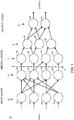
- FIG. 1 illustrates ML model 10 in accordance with an embodiment.
- Machine learning model 10 is based on a neural network and includes a plurality of nodes organized as layers.
- ML model 10 there is one input layer 13 including nodes 12, 14, 16, and 18, three hidden layers 15, 17, and 19 including nodes 20, 22, 24, 26, 28, 30, 32, 34, 36, 38, and 40, and an output layer 21 including nodes 42 and 44.
- Arrows between the nodes represent possible prediction paths that result from training ML model 10.
- Inputs labeled "INPUT" are provided to the input layer nodes 12, 14, 16, and 18 and output predictions OUTPUT are provided from nodes 42 and 44 of the output layer.
- the inputs may be any type of input such as images, music, text, or video.
- the output predictions may be accompanied by confidence levels of the correctness of the output predictions.
- Machine learning model 10 is divided into multiple portions.
- a dashed line 11 in FIG. 1 illustrates one way ML model 10 may be divided.
- dashed line 11 is drawn between hidden layers 15 and 17 separating ML model 10 into a portion on the right side of dashed line 11 and a portion on the left side of dashed line 11.
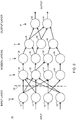
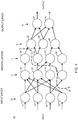
- Figures 2 - 4 illustrate other possible ways ML model 10 may be divided.
- a ML model is trained with training data.
- training data set is the Pima-Indians-Diabetes data set. This training set has 768 records with 8 numeric attributes, and the objective is to decide whether a patient will suffer an onset of diabetes within 5 years of when the measurements were taken.
- a neural network can be trained with this data set and other data sets.
- the ML model After training, the ML model is used for performing inference operations. Because training is time consuming and the training data sets may be expensive to obtain, the trained machine learning model can be very valuable. Also, the ML model may be proprietary and confidential to the owner.
- the herein disclosed method provides a way to detect an unauthorized copy of a ML model without disclosing the entire model.
- a predetermined input or plurality of inputs is provided to input layer 13 of ML model 10.
- Each node applies a weighted activation function and outputs an intermediate result.
- Each subsequent node receives the intermediate result for a previous node, applies a weighted activation function and outputs another intermediate result to the next node.
- a final result is output from output layer 21, which may be a classification of the predetermined inputs provided to input layer 13.
- Machine learning model 10 is divided to two portions as indicated by dashed line 11. The location of dashed line 11 is not important and can be anywhere in ML model 10. Other possibilities are illustrated in figures 2 - 4 .
- intermediate outputs of hidden layer 15 are used.
- the intermediate outputs are outputs from the nodes of hidden layer 15 of the selected portion determined by dashed line 11.
- the outputs of hidden layer 15 are compared to the outputs of the same layer in the suspected copy or clone. If the outputs of hidden layer 15 match the outputs of a corresponding hidden layer 15 in a suspected copy, then the suspected copy may be an exact copy of ML model 10. However, if the outputs do not match, then the suspected copy may be a clone of ML model 10.
- a seal is created using the predetermined inputs and intermediate results from each of the nodes of a chosen one of the two portions determined by dashed line 11.
- the portion on the right side of dashed line 11 is chosen for seal creation.
- a one-way function such as a hash function is applied to a concatenation of the predetermined inputs and the intermediate results.
- the seal may include other information and may be time and date stamped.
- the seal may be published, such as by providing the seal to a blockchain. Publishing the seal has the effect of making the seal unmodifiable after the date of publication.
- the seal may be used to determine if another machine learning model is a copy of ML model 10.
- the suspected copy is divided the same way as ML model 10 when the seal for ML model 10 was created.
- the same predetermined inputs are provided to the suspected copy, and a seal is created the same way as the seal of ML model 10.
- the two seals are compared to determine if they are the same. If the two seals are the same, then there is a high likelihood that the suspected copy is an actual copy of ML model 10. If the seals are not the same, then the suspected copy may be a clone of ML model 10.
- Figures 2 - 4 provide other examples of ways ML model 10 may be divided into multiple portions.
- dashed line 23 may be drawn between any of the layers, for example, dashed line 23 is illustrated between layers 13 and 15. The portions do not have to include only whole layers.
- dashed line 25 divides ML model 10 between nodes 12, 14, 16, 18, 24, and 26 in one portion and nodes 20, 22, 28, 30, 32, 34, 36, 38, 40, 42, and 44 in another portion.
- dashed line 27 divides ML model 10 into one portion having layer 13, nodes 20, 22, and 24 of layer 15, and node 28 or layer 17, and another portion including nodes 30, 32, and 34 in layer 17, and layers 19 and 21.
- FIG. 5 illustrates method 60 for detecting copying of a machine learning model in accordance with an embodiment.
- Method 60 begins at step 61.
- a first machine learning model is divided into a first plurality of portions.
- a plurality of predetermined inputs is provided to the ML model during inference operation of the ML model.
- a plurality of outputs is provided from the ML model.
- the inputs are input into the first ML model, a selected portion of the first plurality of portion provide a first plurality of outputs in response.
- step 64 input the plurality of inputs into a second ML model.
- the first plurality of outputs of the selected portion of the first ML model are compared to a second plurality of outputs from a corresponding selected portion of the second ML model.
- the disclosed method does not require any modification to the protected ML model, thus preserving accuracy of the ML model. Also, because the created seal is based on a portion of the ML model instead of the whole model, less of the ML model is made known to others, thus protecting the secrecy or confidentiality of the ML model. In addition, the method can be applied to various types of ML models and no retraining of the protected ML model is required.
- FIG. 6 illustrates a data processing system 70 useful for implementing the machine learning model and method of FIG. 1 .
- Data processing system 70 may be implemented on one or more integrated circuits and may be used in an implementation of the machine learning system in accordance with the described embodiments.
- Data processing system 70 includes bus 74. Connected to bus 74 is processor 76, memory 78, user interface 80, instruction memory 82, and network interface 84.
- Processor 76 may be any hardware device capable of executing instructions stored in memory 78 or instruction memory 82. For example, processor 76 may execute the machine learning algorithms using training data stored in memory 78.
- Processor 76 may have multiple processing cores.
- Processor 76 may be, for example, a microprocessor, field programmable gate array (FPGA), application-specific integrated circuit (ASIC), or similar device.
- Processor 76 may be implemented in a secure hardware element and may be tamper resistant.
- Memory 78 may be any kind of memory, such as for example, L1, L2, or L3 cache or system memory.
- Memory 78 may include volatile memory such as static random-access memory (SRAM) or dynamic RAM (DRAM), or may include non-volatile memory such as flash memory, read only memory (ROM), or other volatile or non-volatile memory.
- SRAM static random-access memory
- DRAM dynamic RAM
- non-volatile memory such as flash memory, read only memory (ROM), or other volatile or non-volatile memory.
- memory 78 may be implemented in a secure hardware element. Alternately, memory 78 may be a hard drive implemented externally to data processing system 70.
- User interface 80 may be connected to one or more devices for enabling communication with a user such as an administrator.
- user interface 80 may be enabled for coupling to a display, a mouse, a keyboard, or other input/output device.
- Network interface 84 may include one or more devices for enabling communication with other hardware devices.
- network interface 84 may include, or be coupled to, a network interface card (NIC) configured to communicate according to the Ethernet protocol.
- NIC network interface card
- network interface 84 may implement a TCP/IP stack for communication according to the TCP/IP protocols.
- Various other hardware or configurations for communicating are available.
- Instruction memory 82 may include one or more machine-readable storage media for storing instructions for execution by processor 76. In other embodiments, both memories 92 and 96 may also store data upon which processor 76 may operate. Memories 78 and 82 may store, for example, one or more machine learning models, or encryption, decryption, and verification applications. Memory 82 may be implemented in a secure hardware element and be tamper resistant.
- a method for detecting copying of a machine learning model is provided.
- the first machine learning model is divided into a plurality of portions.
- Intermediate outputs from a hidden layer of a selected one of the plurality of portions is compared to corresponding outputs from a second machine learning model to detect the copying.
- a first seal may be generated using the plurality of inputs and the intermediate outputs from nodes of the selected portion.
- a second seal from a suspected copy that has been generated the same way is compared to the first seal to detect the copying. If the first and second seals are the same, then there is a high likelihood that the suspected copy is an actual copy.
- Non-transitory machine-readable storage medium including any mechanism for storing information in a form readable by a machine, such as a personal computer, laptop computer, file server, smart phone, or other computing device.
- the non-transitory machine-readable storage medium may include volatile and non-volatile memories such as read only memory (ROM), random access memory (RAM), magnetic disk storage media, optical storage medium, NVM, and the like.
- ROM read only memory
- RAM random access memory
- magnetic disk storage media such as magnetic disks, optical storage medium, NVM, and the like.
- NVM non-transitory machine-readable storage medium excludes transitory signals.
Landscapes
- Engineering & Computer Science (AREA)
- Theoretical Computer Science (AREA)
- Physics & Mathematics (AREA)
- Software Systems (AREA)
- Computing Systems (AREA)
- Artificial Intelligence (AREA)
- Mathematical Physics (AREA)
- General Physics & Mathematics (AREA)
- Data Mining & Analysis (AREA)
- Evolutionary Computation (AREA)
- General Engineering & Computer Science (AREA)
- Biomedical Technology (AREA)
- Molecular Biology (AREA)
- General Health & Medical Sciences (AREA)
- Computational Linguistics (AREA)
- Biophysics (AREA)
- Life Sciences & Earth Sciences (AREA)
- Health & Medical Sciences (AREA)
- Computer Vision & Pattern Recognition (AREA)
- Medical Informatics (AREA)
- Image Analysis (AREA)
- Collating Specific Patterns (AREA)
Abstract
Description
- This application is related to
application number 16/250,074, filed on January 17, 2019 to Veshchikov et al. - This disclosure relates generally to machine learning, and more particularly, to a method for detecting if a machine learning model has been copied.
- Machine learning is becoming more widely used in many of today's applications, such as applications involving forecasting and classification. Generally, a machine learning (ML) model is trained, at least partly, before it is used. Training data is used for training a ML model. Machine learning models may be classified by how they are trained. Supervised learning, unsupervised learning, semi-supervised learning, and reinforcement learning are examples of training techniques. The effectiveness of the ML model is influenced by its accuracy, execution time, storage requirements, and the quality of the training data. The expertise, time, and expense required for creating and training a machine learning model using this training data results in the ML model being a valuable asset.
- Protecting a ML model from attacks has become a problem. When machine learning is provided as a service, a user only has access to the inputs and outputs of the model. Model extraction is an attack that results in a near identical copy, also known as a clone or extracted copy, of the machine learning model being produced. To extract the model when the machine learning model is provided as a service, valid queries are provided to the model and the resulting output is compiled. Even when an attacker is just given access to the inputs and outputs, the machine learning model can be relatively easily cloned. Model extraction is described in an article by Tramer et al. entitled "Stealing Machine Learning Models via Prediction APIs," Proceedings of 25th USENIX Security Symposium, 2016, which is herein incorporated by reference in its entirety. Once an attacker has copied or cloned the model, it can be illegitimately used and monetized.
- Watermarks are commonly used to mark and prove ownership of a file. Embedding a watermark into a ML model may require the model to be trained with information about the watermark, which may alter the functionality of the model. Also, the watermark needs to be hidden from an attacker. The watermark also needs to be reproducible while being difficult to remove or modify when the ML model is copied. The solutions to these problems can be difficult and costly to effectively implement.
- Therefore, a need exists for a method to determine if a machine learning model is an unauthorized copy without at least some of the problems described above.
- The present invention is illustrated by way of example and is not limited by the accompanying figures, in which like references indicate similar elements. Elements in the figures are illustrated for simplicity and clarity and have not necessarily been drawn to scale.
-
FIG. 1 illustrates a machine learning model in accordance with an embodiment. -
Figures 2 - 4 illustrate various other examples of ways to divide the ML model ofFIG. 1 . -
FIG. 5 illustrates a method for detecting copying of a machine learning model in accordance with an embodiment. -
FIG. 6 illustrates a data processing system suitable for implementing the machine learning model ofFIG. 1 . - A method is provided for detecting a clone or a copy of a ML model. For purposes of this description, a copy of a ML model is an exact copy whereas a clone is not an exact copy that may be produced by the model extraction technique. Because the herein described method can be applied to either a clone or a copy of a ML model, the words clone and copy will be used interchangeably throughout the description.
- Generally, the ML model includes a plurality of layers, where each of the layers has a plurality of nodes. A plurality of predetermined inputs is provided to the ML model, and the ML model provides a plurality of outputs in response. In accordance with one embodiment, the plurality of layers of the ML model is divided into multiple portions. One portion is selected. The layers of the suspected copy are divided the same way as the ML model. Intermediate outputs of the layers of the selected portion of the ML model are compared to the outputs of the same selected portion of the suspected copy. Alternately, in one example, one of the portions may be selected to create a seal. The seal is created, if desired, from the predetermined inputs to the selected portion and the resulting outputs of the selected portion. The inputs and outputs of the selected portion are concatenated, and a cryptographic hash function is applied. The seal may include additional information such as the date and time the seal was created. The same inputs are input to the suspected copy. If a seal was created for the original model, a seal is created the same way as the seal of the protected ML model. The two seals are then compared to determine if they are the same. If they are the same, then there is a high likelihood that the suspected copy is an actual copy of the protected ML model. If they are not the same, then the suspected copy may be a clone.
- The disclosed method does not require any modification to the protected ML model, thus preserving accuracy of the ML model. Also, because only intermediate outputs from a hidden layer are compared, less of the ML model is made known to others, thus protecting the confidentiality of the ML model. In addition, the method can be applied to various types of ML models and no retraining of the protected ML model is required.
- In accordance with an embodiment, there is provided, a method for detecting a copy of a machine learning model, the method including: providing a first machine learning model, wherein the first machine learning model includes a plurality of layers; dividing the first machine learning model into a first plurality of portions; inputting a plurality of inputs into the first machine learning model, a selected portion of the first plurality of portions providing a first plurality of outputs in response; inputting the plurality of inputs into a second machine learning model; comparing the first plurality of outputs of the selected portion of the first machine learning model to a second plurality of outputs from a corresponding selected portion of the second machine learning model; and determining if the first plurality of outputs and the second plurality of outputs match. The plurality of inputs may be characterized as being a plurality of images, music, text, or a video. The method may further include: generating a first seal using the plurality of inputs and the first plurality of outputs; generating a second seal using the second plurality of inputs and the second plurality of outputs; and determining if the first seal and the second seal are the same. The first and second machine learning models may be neural networks. The selected portions of the first and second plurality of portions may each include one or more layers of the plurality of layers. The selected portions of the first and second plurality of portions may each include one or more nodes of one or more layers of the plurality of layers. The method may further include: applying a one-way function to the plurality of inputs and the first plurality of outputs to produce a seal; adding a date and time stamp to the seal; and making the seal unmodifiable. Making the seal unmodifiable may further include inserting the first seal into a blockchain. The first machine learning model may a classification type of machine learning model.
- In accordance with another embodiment, there is provided, a method for detecting copying of a machine learning model, the method including: providing a first machine learning model, wherein the first machine learning model includes a plurality of layers, each layer of the plurality of layers includes one or more nodes; dividing the first machine learning model into a first plurality of portions; inputting a plurality of inputs into the first machine learning model, a selected portion of the plurality of portions providing a first plurality of outputs in response; and generating a first seal using a one-way function, the plurality of inputs, and the first plurality of outputs, wherein the first seal is for being compared with a corresponding second seal of a second machine learning model to determine if the second machine learning model is a copy of the first machine learning model. The one-way function may include a hash function. Generating the first seal may include: applying the hash function to the plurality of inputs and the selected portion to produce the first seal; adding a date and time stamp to the first seal; and making the first seal unmodifiable. Making the first seal unmodifiable may further include publishing the first seal by inserting the first seal into a blockchain. Each portion of the plurality of portions may include one or more layers of the plurality of layers. The method may further include: dividing the second machine learning model into a second plurality of portions, wherein the second plurality of portions having a same number and size of portions as the first plurality of portions; inputting the plurality of inputs into the second machine learning model, a selected portion of the second plurality of portions providing a second plurality of outputs in response; generating the second seal using the one-way function, the plurality of inputs and the second plurality of outputs; and determining if the first seal and the second seal are the same.
- In accordance with yet another embodiment, there is provided, a method for detecting copying of a machine learning model, the method including: providing a first machine learning model, wherein the first machine learning model includes a plurality of layers, each layer of the plurality of layers includes one or more nodes; dividing the first machine learning model into a first portion and a second portion; inputting a plurality of inputs into the first machine learning model, and in response, a selected one of the first or second portions providing a first plurality of intermediate outputs; inputting the plurality of inputs into a second machine learning model; comparing the first plurality of intermediate outputs of the selected one of the first or second portions of the first machine learning model to a second plurality of intermediate outputs from a corresponding selected portion of the second machine learning model; and determining if the first plurality of intermediate outputs and the corresponding plurality of intermediate outputs match. The method may further include publishing the first seal by inserting the first seal into a blockchain. The method may further include generating a first seal using a hash function, the plurality of inputs, and the first plurality of outputs, wherein the first seal is for being compared with a second seal generated from the second machine learning model to determine if the second machine learning model is a copy of the first machine learning model. The selected portion of the first and second plurality of portions may each include one or more nodes of one or more layers of the plurality of layers. The first machine learning model may be a classification type of machine learning model.
-
FIG. 1 illustratesML model 10 in accordance with an embodiment.Machine learning model 10 is based on a neural network and includes a plurality of nodes organized as layers. InML model 10, there is oneinput layer 13 includingnodes hidden layers nodes output layer 21 includingnodes training ML model 10. Inputs labeled "INPUT" are provided to theinput layer nodes nodes -
Machine learning model 10 is divided into multiple portions. A dashedline 11 inFIG. 1 illustrates oneway ML model 10 may be divided. InFIG. 1 , dashedline 11 is drawn betweenhidden layers ML model 10 into a portion on the right side of dashedline 11 and a portion on the left side of dashedline 11.Figures 2 - 4 illustrate other possibleways ML model 10 may be divided. - Initially, a ML model is trained with training data. As an example, one well known training data set is the Pima-Indians-Diabetes data set. This training set has 768 records with 8 numeric attributes, and the objective is to decide whether a patient will suffer an onset of diabetes within 5 years of when the measurements were taken. A neural network can be trained with this data set and other data sets.
- After training, the ML model is used for performing inference operations. Because training is time consuming and the training data sets may be expensive to obtain, the trained machine learning model can be very valuable. Also, the ML model may be proprietary and confidential to the owner. The herein disclosed method provides a way to detect an unauthorized copy of a ML model without disclosing the entire model. In the method, a predetermined input or plurality of inputs is provided to input
layer 13 ofML model 10. Each node applies a weighted activation function and outputs an intermediate result. Each subsequent node then receives the intermediate result for a previous node, applies a weighted activation function and outputs another intermediate result to the next node. A final result is output fromoutput layer 21, which may be a classification of the predetermined inputs provided to inputlayer 13.Machine learning model 10 is divided to two portions as indicated by dashedline 11. The location of dashedline 11 is not important and can be anywhere inML model 10. Other possibilities are illustrated infigures 2 - 4 . - To determine if a ML model is a copy or a clone of
ML model 10, intermediate outputs of hiddenlayer 15 are used. The intermediate outputs are outputs from the nodes of hiddenlayer 15 of the selected portion determined by dashedline 11. The outputs of hiddenlayer 15 are compared to the outputs of the same layer in the suspected copy or clone. If the outputs of hiddenlayer 15 match the outputs of a corresponding hiddenlayer 15 in a suspected copy, then the suspected copy may be an exact copy ofML model 10. However, if the outputs do not match, then the suspected copy may be a clone ofML model 10. - In one embodiment, a seal is created using the predetermined inputs and intermediate results from each of the nodes of a chosen one of the two portions determined by dashed
line 11. In one embodiment, the portion on the right side of dashedline 11 is chosen for seal creation. To create the seal, a one-way function, such as a hash function is applied to a concatenation of the predetermined inputs and the intermediate results. The seal may include other information and may be time and date stamped. In one embodiment, the seal may be published, such as by providing the seal to a blockchain. Publishing the seal has the effect of making the seal unmodifiable after the date of publication. - The seal may be used to determine if another machine learning model is a copy of
ML model 10. To use the seal, the suspected copy is divided the same way asML model 10 when the seal forML model 10 was created. Then, the same predetermined inputs are provided to the suspected copy, and a seal is created the same way as the seal ofML model 10. The two seals are compared to determine if they are the same. If the two seals are the same, then there is a high likelihood that the suspected copy is an actual copy ofML model 10. If the seals are not the same, then the suspected copy may be a clone ofML model 10. -
Figures 2 - 4 provide other examples ofways ML model 10 may be divided into multiple portions. InFIG. 2 , dashedline 23 may be drawn between any of the layers, for example, dashedline 23 is illustrated betweenlayers FIG. 3 , dashedline 25divides ML model 10 betweennodes nodes FIG. 4 , dashedline 27divides ML model 10 into oneportion having layer 13,nodes layer 15, andnode 28 orlayer 17, and anotherportion including nodes layer 17, and layers 19 and 21. -
FIG. 5 illustratesmethod 60 for detecting copying of a machine learning model in accordance with an embodiment.Method 60 begins atstep 61. Atstep 61, a first machine learning model is divided into a first plurality of portions. Atstep 62, a plurality of predetermined inputs is provided to the ML model during inference operation of the ML model. In response, a plurality of outputs is provided from the ML model. Atstep 63, the inputs are input into the first ML model, a selected portion of the first plurality of portion provide a first plurality of outputs in response. Atstep 64, input the plurality of inputs into a second ML model. Atstep 65, the first plurality of outputs of the selected portion of the first ML model are compared to a second plurality of outputs from a corresponding selected portion of the second ML model. Atstep 66, it is determined if the first plurality of outputs and the second plurality of outputs match. If they are not the same, then the second ML model may be a clone of the first ML model. - The disclosed method does not require any modification to the protected ML model, thus preserving accuracy of the ML model. Also, because the created seal is based on a portion of the ML model instead of the whole model, less of the ML model is made known to others, thus protecting the secrecy or confidentiality of the ML model. In addition, the method can be applied to various types of ML models and no retraining of the protected ML model is required.
-
FIG. 6 illustrates adata processing system 70 useful for implementing the machine learning model and method ofFIG. 1 .Data processing system 70 may be implemented on one or more integrated circuits and may be used in an implementation of the machine learning system in accordance with the described embodiments.Data processing system 70 includesbus 74. Connected tobus 74 isprocessor 76,memory 78,user interface 80,instruction memory 82, andnetwork interface 84.Processor 76 may be any hardware device capable of executing instructions stored inmemory 78 orinstruction memory 82. For example,processor 76 may execute the machine learning algorithms using training data stored inmemory 78.Processor 76 may have multiple processing cores.Processor 76 may be, for example, a microprocessor, field programmable gate array (FPGA), application-specific integrated circuit (ASIC), or similar device.Processor 76 may be implemented in a secure hardware element and may be tamper resistant. -
Memory 78 may be any kind of memory, such as for example, L1, L2, or L3 cache or system memory.Memory 78 may include volatile memory such as static random-access memory (SRAM) or dynamic RAM (DRAM), or may include non-volatile memory such as flash memory, read only memory (ROM), or other volatile or non-volatile memory. Also,memory 78 may be implemented in a secure hardware element. Alternately,memory 78 may be a hard drive implemented externally todata processing system 70. -
User interface 80 may be connected to one or more devices for enabling communication with a user such as an administrator. For example,user interface 80 may be enabled for coupling to a display, a mouse, a keyboard, or other input/output device.Network interface 84 may include one or more devices for enabling communication with other hardware devices. For example,network interface 84 may include, or be coupled to, a network interface card (NIC) configured to communicate according to the Ethernet protocol. Also,network interface 84 may implement a TCP/IP stack for communication according to the TCP/IP protocols. Various other hardware or configurations for communicating are available. -
Instruction memory 82 may include one or more machine-readable storage media for storing instructions for execution byprocessor 76. In other embodiments, both memories 92 and 96 may also store data upon whichprocessor 76 may operate.Memories Memory 82 may be implemented in a secure hardware element and be tamper resistant. - A method is provided for detecting copying of a machine learning model. In the method, the first machine learning model is divided into a plurality of portions. Intermediate outputs from a hidden layer of a selected one of the plurality of portions is compared to corresponding outputs from a second machine learning model to detect the copying. Alternately, a first seal may be generated using the plurality of inputs and the intermediate outputs from nodes of the selected portion. A second seal from a suspected copy that has been generated the same way is compared to the first seal to detect the copying. If the first and second seals are the same, then there is a high likelihood that the suspected copy is an actual copy. By using the method, only the intermediate outputs of the machine learning model outputs have to be disclosed to others, thus protecting the confidentiality of the model.
- Various embodiments, or portions of the embodiments, may be implemented in hardware or as instructions on a non-transitory machine-readable storage medium including any mechanism for storing information in a form readable by a machine, such as a personal computer, laptop computer, file server, smart phone, or other computing device. The non-transitory machine-readable storage medium may include volatile and non-volatile memories such as read only memory (ROM), random access memory (RAM), magnetic disk storage media, optical storage medium, NVM, and the like. The non-transitory machine-readable storage medium excludes transitory signals.
- Although the invention is described herein with reference to specific embodiments, various modifications and changes can be made without departing from the scope of the present invention as set forth in the claims below. Accordingly, the specification and figures are to be regarded in an illustrative rather than a restrictive sense, and all such modifications are intended to be included within the scope of the present invention. Any benefits, advantages, or solutions to problems that are described herein with regard to specific embodiments are not intended to be construed as a critical, required, or essential feature or element of any or all the claims.
- Furthermore, the terms "a" or "an," as used herein, are defined as one or more than one. Also, the use of introductory phrases such as "at least one" and "one or more" in the claims should not be construed to imply that the introduction of another claim element by the indefinite articles "a" or "an" limits any particular claim containing such introduced claim element to inventions containing only one such element, even when the same claim includes the introductory phrases "one or more" or "at least one" and indefinite articles such as "a" or "an." The same holds true for the use of definite articles.
- Unless stated otherwise, terms such as "first" and "second" are used to arbitrarily distinguish between the elements such terms describe. Thus, these terms are not necessarily intended to indicate temporal or other prioritization of such elements.
Claims (9)
- A method for detecting a copy of a machine learning model, the method comprising:providing a first machine learning model, wherein the first machine learning model includes a plurality of layers;dividing the first machine learning model into a first plurality of portions;inputting a plurality of inputs into the first machine learning model, a selected portion of the first plurality of portions providing a first plurality of outputs in response;inputting the plurality of inputs into a second machine learning model;comparing the first plurality of outputs of the selected portion of the first machine learning model to a second plurality of outputs from a corresponding selected portion of the second machine learning model; anddetermining if the first plurality of outputs and the second plurality of outputs match.
- The method of claim 1, wherein the plurality of inputs is characterized as being a plurality of images, music, text, or a video.
- The method of claim 1 or 2, further comprising:generating a first seal using the plurality of inputs and the first plurality of outputs;generating a second seal using the second plurality of inputs and the second plurality of outputs; anddetermining if the first seal and the second seal are the same.
- The method of any preceding claim, wherein the first and second machine learning models are neural networks.
- The method of any preceding claim, wherein the selected portions of the first and second plurality of portions each comprises one or more layers of the plurality of layers.
- The method of any preceding claim, wherein the selected portions of the first and second plurality of portions each comprise one or more nodes of one or more layers of the plurality of layers.
- The method of any preceding claim, further comprising:applying a one-way function to the plurality of inputs and the first plurality of outputs to produce a seal;adding a date and time stamp to the seal; andmaking the seal unmodifiable.
- The method of claim 7, wherein making the seal unmodifiable further comprises inserting the first seal into a blockchain.
- The method of any preceding claim, wherein the first machine learning model is a classification type of machine learning model.
Applications Claiming Priority (1)
| Application Number | Priority Date | Filing Date | Title |
|---|---|---|---|
| US16/511,082 US11586989B2 (en) | 2019-07-15 | 2019-07-15 | Method for detecting if a machine learning model has been copied using intermediate outputs of the machine learning model |
Publications (1)
| Publication Number | Publication Date |
|---|---|
| EP3767545A1 true EP3767545A1 (en) | 2021-01-20 |
Family
ID=71522956
Family Applications (1)
| Application Number | Title | Priority Date | Filing Date |
|---|---|---|---|
| EP20184272.1A Withdrawn EP3767545A1 (en) | 2019-07-15 | 2020-07-06 | Method for detecting if a machine learning model has been copied |
Country Status (2)
| Country | Link |
|---|---|
| US (1) | US11586989B2 (en) |
| EP (1) | EP3767545A1 (en) |
Cited By (1)
| Publication number | Priority date | Publication date | Assignee | Title |
|---|---|---|---|---|
| US12493687B2 (en) | 2021-03-31 | 2025-12-09 | British Telecommunications Public Limited Company | Classification model evaluation |
Families Citing this family (8)
| Publication number | Priority date | Publication date | Assignee | Title |
|---|---|---|---|---|
| US20220321424A1 (en) * | 2019-08-28 | 2022-10-06 | Telefonaktiebolaget Lm Ericsson (Publ) | Network nodes and methods for handling machine learning models in a communications network |
| US11681688B2 (en) | 2020-03-16 | 2023-06-20 | Pricewaterhousecoopers Llp | Immutable and decentralized storage of computer models |
| JP2022156786A (en) * | 2021-03-31 | 2022-10-14 | 富士通株式会社 | Inspection program, information processing device and inspection method |
| US11983104B2 (en) | 2022-01-24 | 2024-05-14 | Cisco Technology, Inc. | Validation of a machine learning model |
| WO2023157094A1 (en) * | 2022-02-15 | 2023-08-24 | 富士通株式会社 | Model training program, model training method, and information processing device |
| US12406469B1 (en) * | 2022-09-23 | 2025-09-02 | Amazon Technologies, Inc. | Class-incremental learning with pretrained machine learning models |
| US12455976B2 (en) * | 2022-11-01 | 2025-10-28 | Nxp B.V. | Method for protecting a machine learning model from being copied |
| US11797672B1 (en) * | 2023-06-01 | 2023-10-24 | HiddenLayer, Inc. | Machine learning-based technique for model provenance |
Citations (1)
| Publication number | Priority date | Publication date | Assignee | Title |
|---|---|---|---|---|
| WO2016043734A1 (en) * | 2014-09-17 | 2016-03-24 | Hewlett Packard Enterprise Development Lp | Neural network verification |
Family Cites Families (10)
| Publication number | Priority date | Publication date | Assignee | Title |
|---|---|---|---|---|
| GB0903570D0 (en) | 2009-03-02 | 2009-04-08 | Univ Aston | Watermark encoding and decoding |
| JP5889727B2 (en) * | 2012-06-18 | 2016-03-22 | 新電元工業株式会社 | Electronic symbol marking apparatus and method thereof |
| CN104680473A (en) | 2014-12-20 | 2015-06-03 | 辽宁师范大学 | Machine learning-based color image watermark embedding and detecting method |
| CN106651805B (en) | 2016-12-28 | 2020-08-25 | 贵州大学 | Image watermark removing method based on machine learning |
| CN107194863A (en) | 2017-04-07 | 2017-09-22 | 广东精点数据科技股份有限公司 | Image digital watermark embedded system and method |
| SE541713C2 (en) * | 2017-05-03 | 2019-12-03 | Enigio Time Ab | Method and system for registering digital documents |
| JP6655762B2 (en) | 2017-05-26 | 2020-02-26 | 株式会社日立国際電気 | Machine learning model fraud detection system and fraud detection method |
| US20190087603A1 (en) * | 2017-11-18 | 2019-03-21 | Omer Dror | Mobile device and method for enabling patients to control access to their medical records |
| US10614253B2 (en) * | 2018-02-14 | 2020-04-07 | Fortune Vieyra | Systems and methods for state of data management |
| US11461631B2 (en) * | 2018-03-22 | 2022-10-04 | Amazon Technologies, Inc. | Scheduling neural network computations based on memory capacity |
-
2019
- 2019-07-15 US US16/511,082 patent/US11586989B2/en active Active
-
2020
- 2020-07-06 EP EP20184272.1A patent/EP3767545A1/en not_active Withdrawn
Patent Citations (1)
| Publication number | Priority date | Publication date | Assignee | Title |
|---|---|---|---|---|
| WO2016043734A1 (en) * | 2014-09-17 | 2016-03-24 | Hewlett Packard Enterprise Development Lp | Neural network verification |
Non-Patent Citations (1)
| Title |
|---|
| TRAMER ET AL.: "Stealing Machine Learning Models via Prediction APIs", PROCEEDINGS OF 25TH USENIX SECURITY SYMPOSIUM, 2016 |
Cited By (1)
| Publication number | Priority date | Publication date | Assignee | Title |
|---|---|---|---|---|
| US12493687B2 (en) | 2021-03-31 | 2025-12-09 | British Telecommunications Public Limited Company | Classification model evaluation |
Also Published As
| Publication number | Publication date |
|---|---|
| US11586989B2 (en) | 2023-02-21 |
| US20210019661A1 (en) | 2021-01-21 |
Similar Documents
| Publication | Publication Date | Title |
|---|---|---|
| US11586989B2 (en) | Method for detecting if a machine learning model has been copied using intermediate outputs of the machine learning model | |
| US11100222B2 (en) | Method for hardening a machine learning model against extraction | |
| US11500970B2 (en) | Machine learning model and method for determining if the machine learning model has been copied | |
| US11636380B2 (en) | Method for protecting a machine learning model against extraction using an ensemble of a plurality of machine learning models | |
| EP3683700B1 (en) | Method for determining if a machine learning model has been copied | |
| US11321456B2 (en) | Method and system for protecting a machine learning model against extraction | |
| US11468291B2 (en) | Method for protecting a machine learning ensemble from copying | |
| US11410078B2 (en) | Method and data processing system for making machine learning model more resistent to adversarial examples | |
| US11270227B2 (en) | Method for managing a machine learning model | |
| CN107947917A (en) | A kind of method and device for generating whitepack key | |
| Chang et al. | A blind reversible robust watermarking scheme for relational databases | |
| CN118484791A (en) | A neural network watermark protection method and system based on attention mechanism | |
| Huang et al. | Convolutional neural networks tamper detection and location based on fragile watermarking: Yawen et al. | |
| CN119903815A (en) | A data processing method and system based on AIGC content | |
| Tereshchenko et al. | Features of applying pretrained convolutional neural networks to graphic image steganalysis | |
| US11409843B2 (en) | Method for protecting a software program from copying | |
| CN107968793A (en) | A kind of method, apparatus and system for downloading whitepack key | |
| US12346417B2 (en) | Method for watermarking a machine learning model | |
| US12425187B2 (en) | Stateful order-preserving encryption method and apparatus for enhancing security | |
| Kazmi et al. | Unihach: unicode and hash function supported with counting and frequency recurrence of Arabic characters for Quranic text watermarking | |
| US12603786B2 (en) | Secure digital signature schemes | |
| CN114924749B (en) | A method, device, electronic device and storage medium for intelligent terminal code obfuscation | |
| CN121278693B (en) | Multi-mode controllable large-model identity tag implantation and transmission method and device based on low-rank fusion, and electronic equipment | |
| Iyer | PPPostMark: Private LLM Watermarking | |
| CN119180055A (en) | Data processing method, apparatus, device, storage medium, and program product |
Legal Events
| Date | Code | Title | Description |
|---|---|---|---|
| PUAI | Public reference made under article 153(3) epc to a published international application that has entered the european phase |
Free format text: ORIGINAL CODE: 0009012 |
|
| STAA | Information on the status of an ep patent application or granted ep patent |
Free format text: STATUS: THE APPLICATION HAS BEEN PUBLISHED |
|
| AK | Designated contracting states |
Kind code of ref document: A1 Designated state(s): AL AT BE BG CH CY CZ DE DK EE ES FI FR GB GR HR HU IE IS IT LI LT LU LV MC MK MT NL NO PL PT RO RS SE SI SK SM TR |
|
| AX | Request for extension of the european patent |
Extension state: BA ME |
|
| STAA | Information on the status of an ep patent application or granted ep patent |
Free format text: STATUS: REQUEST FOR EXAMINATION WAS MADE |
|
| 17P | Request for examination filed |
Effective date: 20210720 |
|
| RBV | Designated contracting states (corrected) |
Designated state(s): AL AT BE BG CH CY CZ DE DK EE ES FI FR GB GR HR HU IE IS IT LI LT LU LV MC MK MT NL NO PL PT RO RS SE SI SK SM TR |
|
| STAA | Information on the status of an ep patent application or granted ep patent |
Free format text: STATUS: EXAMINATION IS IN PROGRESS |
|
| 17Q | First examination report despatched |
Effective date: 20230119 |
|
| STAA | Information on the status of an ep patent application or granted ep patent |
Free format text: STATUS: THE APPLICATION IS DEEMED TO BE WITHDRAWN |
|
| 18D | Application deemed to be withdrawn |
Effective date: 20230801 |