EP3767523A1 - Image processing method and apparatus, and computer readable medium, and electronic device - Google Patents
Image processing method and apparatus, and computer readable medium, and electronic device Download PDFInfo
- Publication number
- EP3767523A1 EP3767523A1 EP19814012.1A EP19814012A EP3767523A1 EP 3767523 A1 EP3767523 A1 EP 3767523A1 EP 19814012 A EP19814012 A EP 19814012A EP 3767523 A1 EP3767523 A1 EP 3767523A1
- Authority
- EP
- European Patent Office
- Prior art keywords
- image
- convolutional layer
- convolution
- residual
- processing method
- Prior art date
- Legal status (The legal status is an assumption and is not a legal conclusion. Google has not performed a legal analysis and makes no representation as to the accuracy of the status listed.)
- Pending
Links
Images




Classifications
-
- G—PHYSICS
- G06—COMPUTING OR CALCULATING; COUNTING
- G06N—COMPUTING ARRANGEMENTS BASED ON SPECIFIC COMPUTATIONAL MODELS
- G06N3/00—Computing arrangements based on biological models
- G06N3/02—Neural networks
- G06N3/08—Learning methods
-
- G—PHYSICS
- G06—COMPUTING OR CALCULATING; COUNTING
- G06F—ELECTRIC DIGITAL DATA PROCESSING
- G06F17/00—Digital computing or data processing equipment or methods, specially adapted for specific functions
- G06F17/10—Complex mathematical operations
- G06F17/18—Complex mathematical operations for evaluating statistical data, e.g. average values, frequency distributions, probability functions, regression analysis
-
- G—PHYSICS
- G06—COMPUTING OR CALCULATING; COUNTING
- G06N—COMPUTING ARRANGEMENTS BASED ON SPECIFIC COMPUTATIONAL MODELS
- G06N20/00—Machine learning
- G06N20/10—Machine learning using kernel methods, e.g. support vector machines [SVM]
-
- G—PHYSICS
- G06—COMPUTING OR CALCULATING; COUNTING
- G06N—COMPUTING ARRANGEMENTS BASED ON SPECIFIC COMPUTATIONAL MODELS
- G06N3/00—Computing arrangements based on biological models
- G06N3/02—Neural networks
- G06N3/04—Architecture, e.g. interconnection topology
- G06N3/045—Combinations of networks
-
- G—PHYSICS
- G06—COMPUTING OR CALCULATING; COUNTING
- G06N—COMPUTING ARRANGEMENTS BASED ON SPECIFIC COMPUTATIONAL MODELS
- G06N3/00—Computing arrangements based on biological models
- G06N3/02—Neural networks
- G06N3/04—Architecture, e.g. interconnection topology
- G06N3/0464—Convolutional networks [CNN, ConvNet]
-
- G—PHYSICS
- G06—COMPUTING OR CALCULATING; COUNTING
- G06N—COMPUTING ARRANGEMENTS BASED ON SPECIFIC COMPUTATIONAL MODELS
- G06N3/00—Computing arrangements based on biological models
- G06N3/02—Neural networks
- G06N3/08—Learning methods
- G06N3/09—Supervised learning
-
- G—PHYSICS
- G06—COMPUTING OR CALCULATING; COUNTING
- G06T—IMAGE DATA PROCESSING OR GENERATION, IN GENERAL
- G06T11/00—Two-dimensional [2D] image generation
- G06T11/60—Creating or editing images; Combining images with text
-
- G—PHYSICS
- G06—COMPUTING OR CALCULATING; COUNTING
- G06T—IMAGE DATA PROCESSING OR GENERATION, IN GENERAL
- G06T3/00—Geometric image transformations in the plane of the image
- G06T3/60—Rotation of whole images or parts thereof
-
- G—PHYSICS
- G06—COMPUTING OR CALCULATING; COUNTING
- G06V—IMAGE OR VIDEO RECOGNITION OR UNDERSTANDING
- G06V10/00—Arrangements for image or video recognition or understanding
- G06V10/40—Extraction of image or video features
-
- G—PHYSICS
- G06—COMPUTING OR CALCULATING; COUNTING
- G06V—IMAGE OR VIDEO RECOGNITION OR UNDERSTANDING
- G06V10/00—Arrangements for image or video recognition or understanding
- G06V10/40—Extraction of image or video features
- G06V10/44—Local feature extraction by analysis of parts of the pattern, e.g. by detecting edges, contours, loops, corners, strokes or intersections; Connectivity analysis, e.g. of connected components
- G06V10/443—Local feature extraction by analysis of parts of the pattern, e.g. by detecting edges, contours, loops, corners, strokes or intersections; Connectivity analysis, e.g. of connected components by matching or filtering
- G06V10/449—Biologically inspired filters, e.g. difference of Gaussians [DoG] or Gabor filters
- G06V10/451—Biologically inspired filters, e.g. difference of Gaussians [DoG] or Gabor filters with interaction between the filter responses, e.g. cortical complex cells
- G06V10/454—Integrating the filters into a hierarchical structure, e.g. convolutional neural networks [CNN]
-
- G—PHYSICS
- G06—COMPUTING OR CALCULATING; COUNTING
- G06V—IMAGE OR VIDEO RECOGNITION OR UNDERSTANDING
- G06V10/00—Arrangements for image or video recognition or understanding
- G06V10/70—Arrangements for image or video recognition or understanding using pattern recognition or machine learning
- G06V10/764—Arrangements for image or video recognition or understanding using pattern recognition or machine learning using classification, e.g. of video objects
-
- G—PHYSICS
- G06—COMPUTING OR CALCULATING; COUNTING
- G06V—IMAGE OR VIDEO RECOGNITION OR UNDERSTANDING
- G06V10/00—Arrangements for image or video recognition or understanding
- G06V10/70—Arrangements for image or video recognition or understanding using pattern recognition or machine learning
- G06V10/82—Arrangements for image or video recognition or understanding using pattern recognition or machine learning using neural networks
-
- G—PHYSICS
- G06—COMPUTING OR CALCULATING; COUNTING
- G06N—COMPUTING ARRANGEMENTS BASED ON SPECIFIC COMPUTATIONAL MODELS
- G06N3/00—Computing arrangements based on biological models
- G06N3/02—Neural networks
- G06N3/04—Architecture, e.g. interconnection topology
- G06N3/048—Activation functions
Definitions
- the present disclosure relates to the field of computer technologies, and in particular, to an image processing method and apparatus, a computer readable medium, and an electronic device.
- a neural network is a mathematical model or a calculation module imitating a structure and a function of a biological neural network, and is widely applied to an image processing procedure, for example, being used for image recognition.
- a residual neural network (ResNet) is a neural network provided by He Kaiming et al..
- Embodiments of the present disclosure provide an image processing method and apparatus, a computer readable medium, and an electronic device, to at least ensure that a residual network may extract an accurate image feature from an image to some extent, and improve the accuracy of image recognition.
- an image processing method performed by an electronic device, the method including: obtaining a to-be-processed target image; performing feature extraction on the target image based on a residual network, to determine image feature information, the residual network including a plurality of residual blocks that are successively connected to each other, each of the residual blocks including a convolution branch and a residual branch, a size of a convolution kernel of a first convolutional layer in the convolution branch being less than a size of a convolution kernel of a second convolutional layer located after the first convolutional layer, and a convolution stride of the second convolutional layer being greater than a convolution stride of the first convolutional layer and less than a width of the convolution kernel of the second convolutional layer; and performing recognition processing on the to-be-processed image according to the image feature information.
- an image processing apparatus including: a first obtaining unit, configured to obtain a to-be-processed target image; a first processing unit, configured to perform feature extraction on the target image based on a residual network, to determine image feature information, the residual network including a plurality of residual blocks that are successively connected to each other, each of the residual blocks including a convolution branch and a residual branch, a size of a convolution kernel of a first convolutional layer in the convolution branch being less than a size of a convolution kernel of a second convolutional layer located after the first convolutional layer, and a convolution stride of the second convolutional layer being greater than a convolution stride of the first convolutional layer and less than a width of the convolution kernel of the second convolutional layer; and a second processing unit, configured to perform recognition processing on the to-be-processed image according to the image feature information.
- a computer readable medium storing a computer program, the computer program, when executed by a processor, implementing the image processing method described in the foregoing embodiments.
- an electronic device including: one or more processors; and a storage apparatus, configured to store one or more programs, the one or more programs, when executed by the one or more processors, causing the one or more processors to implement the image processing method described in the foregoing embodiments.
- the block diagrams shown in the accompanying drawings are merely functional entities and do not necessarily correspond to a physically independent entity. That is, the functional entities may be implemented in a software form, or the functional entities may be implemented in one or more hardware modules or integrated circuits, or the functional entities may be implemented in different networks and/or processor apparatuses and/or microcontroller apparatuses.
- FIG. 1 shows a schematic diagram of an exemplary system architecture 100 to which an image processing method or an image processing apparatus is applicable according to an embodiment of the present disclosure.
- the system architecture 100 may include one or more of terminal devices 101, 102, and 103, a network 104, and a server 105.
- the network 104 is used for providing a communication link between the terminal devices 101, 102, and 103 and the server 105.
- the network 104 may include various connection types, for example, a wired communication link and a wireless communication link.
- the quantities of the terminal devices, the network, and the server in FIG. 1 are merely exemplary. According to implementation requirements, any quantity of terminal devices, networks, and servers may be included.
- the server 105 may be a server cluster that includes a plurality of servers.
- a user may interact with the server 105 through the network 104 by using the terminal devices 101, 102, and 103, to receive or send a message, or the like.
- the terminal devices 101, 102, and 103 may be various electronic devices having a display screen, and include, but are not limited to, a smartphone, a tablet computer, a portable computer, a desktop computer, and the like.
- the server 105 may be a server that provides various services. For example, the user acquires a to-be-recognized image by using the terminal device 103 (or may be the terminal device 101 or 102), and then uploads the image to the server 105. After receiving the image, the server 105 may perform feature extraction on the image based on a residual network (for example, a residual neural network (ResNet)), to determine image feature information, and further recognize the image based on the image feature information.
- a residual network for example, a residual neural network (ResNet)
- the residual network used by the server 105 for performing feature extraction includes a plurality of residual blocks that are successively connected to each other, each of the residual blocks including a convolution branch and a residual branch, a size of a convolution kernel of a first convolutional layer in the convolution branch being less than a size of a convolution kernel of a second convolutional layer located after the first convolutional layer, and a convolution stride of the second convolutional layer being greater than a convolution stride of the first convolutional layer and less than a width of the convolution kernel of the second convolutional layer.
- the convolution stride of the first convolutional layer is 1 pixel
- the size of the convolution kernel of the second convolutional layer is 3 ⁇ 3 pixels
- the convolution stride of the second convolutional layer is 2 pixels
- the image processing method provided in this embodiment of the present disclosure is generally performed by the server 105, and correspondingly, the image processing apparatus is generally disposed in the server 105.
- the terminal may alternatively have a function similar to that of the server, to perform the image processing method provided in this embodiment of the present disclosure.
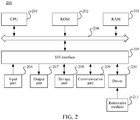
- FIG. 2 shows a schematic structural diagram of a computer system suitable for implementing an electronic device according to an embodiment of the present disclosure.
- a computer system 200 of the electronic device shown in FIG. 2 is merely an example, and is not be construed as any limitation on functions and use scopes of the embodiments of the present disclosure.
- the computer system 200 includes a central processing unit (CPU) 201, which may perform various proper actions and processing according to a program stored in a read-only memory (ROM) 202 or a program loaded from a storage part 208 into a random access memory (RAM) 203.
- the RAM 203 further stores various programs and data required to operate the system.
- the CPU 201, the ROM 202, and the RAM 203 are connected to each other through a bus 204.
- An input/output (I/O) interface 205 is also connected to the bus 204.
- the I/O interface 205 is connected to the following parts: an input part 206 including a keyboard, a mouse, and the like; an output part 207 including a cathode ray tube (CRT), a liquid crystal display (LCD), a speaker, and the like; a storage part 208 including a hard disk and the like; and a communication part 209 including a network interface card such as a local area network (LAN) card or a modem.
- the communication part 209 performs communication processing through a network such as the Internet.
- a driver 210 is also connected to the I/O interface 205 as required.
- a removable medium 211 such as a magnetic disk, an optical disc, a magneto-optical disk, or a semiconductor memory is mounted on the driver 210 as required, so that a computer program read from the removable medium 211 is installed into the storage part 208 as required.
- this embodiment of the present disclosure includes a computer program product, which includes a computer program carried in a computer readable medium.
- the computer program includes program code used for performing the methods shown in the flowcharts.
- the computer program may be downloaded and installed from a network, and/or installed from the removable medium 211.
- various functions defined in the system of the present disclosure are executed.
- the computer readable medium in the present disclosure may be a computer readable signal medium or a computer readable storage medium or any combination thereof.
- the computer readable storage medium may be, for example, but not limited to, an electric, magnetic, optical, electromagnetic, infrared, or semi-conductive system, apparatus, or device, or any combination thereof. More specific examples of the computer readable storage medium may include, but are not limited to: an electrical connection having one or more wires, a portable computer magnetic disk, a hard disk, a RAM, a ROM, an erasable programmable read-only memory (EPROM or flash memory), an optical fiber, a compact disk read-only memory (CD-ROM), an optical storage device, a magnetic storage device, or any appropriate combination thereof.
- the computer readable storage medium may be any tangible medium including or storing a program, and the program may be used by or in combination with an instruction execution system, apparatus, or device.
- the computer readable signal medium may include a data signal propagated in a baseband or as part of a carrier, and stores computer readable program code.
- the propagated data signal may be in a plurality of forms, including, but not limited to, an electromagnetic signal, an optical signal, or any appropriate combination thereof.
- the computer readable signal medium may alternatively be any computer readable medium other than the computer readable storage medium.
- the computer readable medium may be configured to send, propagate, or transmit a program used by or in combination with an instruction execution system, apparatus, or device.
- the program code included in the computer readable medium may be transmitted by using any suitable medium, including, but not limited to, wireless and wired transmission and the like, or any suitable combination thereof.
- each block in a flowchart or a block diagram may represent one module, one program segment, or a part of code.
- the module, the program segment, or the part of code includes one or more executable instructions for implementing a specified logical function.
- functions annotated in blocks may alternatively occur in a sequence different from sequences annotated in the accompanying drawings. For example, two blocks shown in succession may be performed substantially in parallel, or sometimes the two blocks may be performed in a reverse sequence. This is determined by an involved function.
- Each block in the block diagram and/or the flowchart and a combination of blocks in the block diagram and/or the flowchart may be implemented by using a dedicated hardware-based system configured to perform a specified function or operation, or may be implemented by using a combination of dedicated hardware and a computer instruction.
- Involved units described in the embodiments of the present disclosure may be implemented in a software manner, or may be implemented in a hardware manner.
- the units described may alternatively be disposed in a processor. Names of these units do not constitute a limitation on the units in some case.
- the present disclosure further provides a computer readable medium.
- the computer readable medium may be included in the electronic device described in the foregoing embodiments; or may be exist alone and is not mounted in the electronic device.
- the computer readable medium carries one or more programs, and the one or more programs, when executed by the electronic device, cause the electronic device to implement the method described in the following embodiments.
- the electronic device may implement steps shown in FIG. 3 , and FIG. 6 to FIG. 8 .
- FIG. 3 schematically shows a flowchart of an image processing method according to an embodiment of the present disclosure.
- the image processing method is applicable to the electronic device described in the foregoing embodiments.
- the image processing method includes at least step S310 to step S330, and details are as follows: Step S310: Obtain a to-be-processed target image.
- the to-be-processed target image may be an image on which visual processing needs to be performed, for example, an image on which object recognition needs to be performed.
- Step S320 Perform feature extraction on the target image based on a residual network, to determine image feature information, the residual network including a plurality of residual blocks that are successively connected to each other, each of the residual blocks including a convolution branch and a residual branch, a size of a convolution kernel of a first convolutional layer in the convolution branch being less than a size of a convolution kernel of a second convolutional layer located after the first convolutional layer, and a convolution stride of the second convolutional layer being greater than a convolution stride of the first convolutional layer and less than a width of the convolution kernel of the second convolutional layer.
- the residual branch in the residual block points from an input of the convolution branch to an output of the convolution branch.
- the "block”, the "branch”, the “layer”, and the “stage” that are used for describing the residual network represent various processing procedures or steps.
- the term “successively connected” represents that the processing procedures or steps are connected with each other in sequential order.
- the convolutional layer also means performing convolution processing or operation on the to-be-processed target image.
- Convolution is a mathematical operator generating a third function through two functions f and g.
- the target image is represented by using, for example, the function f
- the convolution kernel is the function g.
- the function f and the function g are usually three-dimensional discrete matrices, and the generated function is also a three-dimensional matrix.
- the target image is represented in a format of a (H, W, C)) three-dimensional matrix, where H and W are respectively a height and a width of the target image, which are used for representing a resolution or a size of the target image, and C represents a quantity of channels of the target image.
- elements in a first dimension are pixels of all rows of the target image
- elements in a second dimension are pixels of all columns of the target image
- elements in a third dimension are pixels of all channels of the target image.
- Each pixel in the target image is used as a description unit, and pixel values of the three channels are recorded.
- the convolution kernel is also referred to as a filter matrix.
- the convolution kernel extracts features of different locations of the target image through a manner of "sliding window", and an extracted result is a feature map. Pixels on the feature map are feature points.
- the convolution stride is a quantity of pixels by which a center of the convolution kernel moves on the target image each time.
- the inputted target image is a grayscale image of 5 ⁇ 5 pixels
- the convolution kernel is a matrix of 3 ⁇ 3 pixels
- the convolution stride is 1.
- the convolution procedure is: moving the matrix of 3 ⁇ 3 pixels from the upper left corner to the lower right corner on the image of 5 ⁇ 5 pixels, where 1 pixel is moved by for each time.
- the convolution stride can implement a downsampling function. Through convolution calculation, a resolution of the outputted image is much less than a resolution of the inputted target image.
- the residual network may be a deep residual network.
- the residual network further includes an initial convolutional layer located before the plurality of residual blocks, and an output of the initial convolutional layer is used as an input of the first residual block in the plurality of residual blocks.
- the second convolutional layer in the residual block already can implement downsampling processing, some pooling layers located before the residual block in the residual network may be removed, thereby simplifying the structure of the residual network.
- the plurality of residual blocks in the residual network form a plurality of convolution stages
- the residual branch included in each residual block in each of the convolution stages includes a batch normalization processing layer and a target convolutional layer that are successively connected to each other.
- the residual branch may be an identical mapping. However, if the sizes of the input and the output are different, the input and the output need to be mapped to the same size through a convolution operation. According to this embodiment of the present disclosure, in the first residual block in each convolution stage, sizes of an input and an output of the residual block need to be ensured to be consistent through a residual branch of a nonidentical mapping (that is, adding a convolutional layer).
- a batch normalization (BN) layer may be added before the convolutional layer, to add the offset item, and further, it can be ensured that an optimal processing effect is achieved.
- the BN layer means performing normalization processing on a feature map generated by performing convolution processing on a plurality of samples (target images). Specifically, for feature points generated by each sample, a distribution of the feature points is normalized into a distribution whose average value is 0 and variance is 1 through a manner of subtracting the average value and dividing the variance.
- step S330 recognition processing is performed on the to-be-processed image according to the image feature information.
- FIG. 4 shows a schematic structural diagram of the first residual block in each convolution stage of a residual network according to an embodiment of the present disclosure.
- the first residual block specifically includes: a convolution branch 401 and a residual branch 402.
- the residual branch 402 points from an input of the convolution branch 401 to an output of the convolution branch 401.
- the convolution branch 401 includes a first convolutional layer 4011, a second convolutional layer 4012, and a third convolutional layer 4013.
- a BN layer is set before each of the first convolutional layer 4011, the second convolutional layer 4012, and the third convolutional layer 4013.
- the first convolutional layer 4011, the second convolutional layer 4012, and the third convolutional layer 4013 are all processed through a rectified linear unit (Relu).
- Relu rectified linear unit
- a size of a convolution kernel of the first convolutional layer 4011 is 1 ⁇ 1 pixel, and a convolution stride of the first convolutional layer 4011 is 1 pixel; a size of a convolution kernel of the second convolutional layer 4012 is 3 ⁇ 3 pixels, and a convolution stride of the second convolutional layer 4012 is 2 pixels; and a size of a convolution kernel of the third convolutional layer 4013 is 1 ⁇ 1 pixel, and a convolution stride of the third convolutional layer 4013 is 1 pixel. Because the second convolutional layer 4012 may implement downsampling processing, and may ensure that no feature point is skipped, the residual block of this embodiment of the present disclosure may ensure that no loss occurs in the representation capability of the feature network.
- the size of the convolution kernel of the first convolutional layer is 1 ⁇ 1 pixel
- the convolution stride of the first convolutional layer is 2 pixels
- the size of the convolution kernel of the second convolutional layer is 3 ⁇ 3 pixels
- the convolution stride of the second convolutional layer is 1 pixel.
- the size of the convolution kernel of the first convolutional layer in the convolution branch included in the residual block is less than the size of the convolution kernel of the second convolutional layer located after the first convolutional layer, and the convolution stride of the second convolutional layer is greater than the convolution stride of the first convolutional layer and less than a width of the convolution kernel of the second convolutional layer, so that in response to that the convolutional layer in the residual block performs convolution operation, it is ensured that downsampling processing is implemented through the second convolutional layer, and it may be ensured that no feature point is skipped, thereby further ensuring that no loss in the representation capability of a feature network is caused. Accordingly, the accuracy of image feature extraction may be ensured, and image recognition accuracy is improved.
- x is a feature point on the inputted feature map
- y is a corresponding feature point on the outputted feature map.
- the residual branch 402 includes a convolutional layer 4021 and a BN layer set before the convolutional layer 4021. In addition, after processing is performed through the BN layer, processing is performed through a Relu function.
- An addition calculation is performed on outputs of the convolution branch 401 and the residual branch 402 in terms of elements, to determine an output of each residual block.
- FIG. 5 shows a schematic structural diagram of a residual network according to an embodiment of the present disclosure.
- the structure includes: an initial convolutional layer 501, a convolution stage 502, a convolution stage 503, a convolution stage 504, a convolution stage 505, a global average pooling layer 506, and a fully-connected layer 507 that are successively connected.
- a size of a convolution kernel of the initial convolutional layer 501 is 7 ⁇ 7 pixels
- a convolution stride of the initial convolutional layer 501 is 2 pixels
- a quantity of channels of the initial convolutional layer 501 is 64.
- Each of the convolution stage 502, the convolution stage 503, the convolution stage 504, and the convolution stage 505 includes a plurality of residual blocks.
- Quantities of the residual blocks included in different convolution stages may be different.
- the convolution stage 502 includes 3 residual blocks
- the convolution stage 503 includes 4 residual blocks
- the convolution stage 504 includes 23 residual blocks
- the convolution stage 505 includes 4 residual blocks.
- a structure of the first residual block in each convolution stage is shown in FIG. 4 .
- Residual branches in other residual blocks are identical mappings.
- the convolution branch is the same as the convolution branch 401 shown in FIG. 4 .
- the downsampling procedure is arranged into the first convolution stage, that is, the convolution stage 502, and specifically, is arranged into the second convolutional layer 4012 of the first residual block of the convolution stage 502.
- the downsampling procedure is arranged into a second convolutional layer, where a size of a convolution kernel of the second convolutional layer is 3 ⁇ 3 pixels, to further ensure that no feature point is skipped in the downsampling procedure, and ensure that no loss occurs in the representation capability of the feature network.
- the BN layer is not only added to the convolution branch, but also added to a residual branch of a nonidentical mapping.
- an offset item may be added before the convolutional layer through the BN layer, and further it may be ensured that an optimal processing effect is achieved.
- an embodiment of the present disclosure further provides a solution for training the residual network.
- a method for training the residual network according to this embodiment of the present disclosure includes the following steps:
- a loss function or a cost function is a function of mapping an event (an element in a sample space) to a real number representing opportunity costs related to the event, to visually represent associations between some "costs" and events.
- An objective of an optimization problem is to minimize a loss function.
- a target function is usually a loss function or a negative value of a loss function. In response to that a target function is a negative value of a loss function, a value of the target function needs to be maximized.
- a function of the loss function is to estimate a parameter.
- a Momentum-Stochastic Gradient Descent (SGD) optimization method may be used for training, and a distributed training framework may be used to improve a training rate.
- SGD Momentum-Stochastic Gradient Descent
- a distributed training framework may be used to improve a training rate.
- training may be performed by using a hardware configuration of 4 machines and 32 graphics cards. Specific hyperparameters for training are shown in FIG. 1 , where epoch is iterations used for learning all training images once according to a current batch size.
- the BN layer of the residual network includes learnable parameters, and the learnable parameters are relatively strongly correlated to a distribution of the training image samples.
- learnable parameters are relatively strongly correlated to a distribution of the training image samples.
- ⁇ and ⁇ represent learning parameters
- ⁇ represents an average value of training image samples
- ⁇ represents a variance of the training image samples
- x represents the training image sample
- y represents an output.
- ⁇ and ⁇ are determined by performing, based on the training image sample, iterative learning by using an optimization algorithm.
- a learning procedure is to minimize the loss function by adjusting the parameters (or maximizing in response to that the loss is negative).
- a regular term of the loss function may be generated according to ⁇ and ⁇ , and the regular term may be added to an original loss function (that is, classification loss) of the residual network, to improve a generalization capability of the residual network model.
- a quadratic sum of ⁇ and ⁇ may be calculated, and an arithmetic average value of the quadratic sum may be used as the regular term (that is, ⁇ 2 + ⁇ 2 2 ) of the original loss function. That is, in this embodiment of the present disclosure, a calculation method of an L2 regular term implemented by using Tensorfow is used to calculate the regular term of the original loss function.
- a regular term coefficient set for the regular term is less than the order of magnitude of the weight, for example, less than the order of magnitude of the weight by one order of magnitude, to prevent the added regular term from causing relatively great impact on the original loss function.
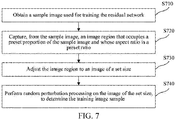
- Step S710 Obtain a sample image used for training the residual network.
- the sample image may be an RGB image.
- Step S720 Capture, from the sample image, an image region that occupies a preset proportion of the sample image and whose aspect ratio is a preset ratio.
- a plurality of image regions may be captured from the sample image, and meanwhile, translation invariance and size invariance of the images determined through capturing may be ensured.
- the preset proportion is a value randomly selected from a preset proportion interval
- the preset ratio is a value randomly selected from a preset aspect ratio interval.
- the preset proportion interval may be [0.05, 1.0]
- the preset aspect ratio interval may be [3/4, 4/3].
- Step S730 Adjust the image region to an image of a set size.
- the image region is adjusted to an image region of a set size, so that in response to that the residual network is trained, images of the same size may be inputted into the network for training.
- Step S740 Perform random perturbation processing on the image of the set size, to determine the training image sample.
- the performing random perturbation processing on the image of the set size includes: horizontally flipping the image of the set size with a first processing probability; and/or rotating on the image of the set size by a random angle with a second processing probability, the random angle being a value randomly selected from a preset angle interval; and/or adjusting attributes of the image of the set size with a third processing probability.
- the attributes of the image include saturation, contrast, luminance, chrominance, and the like.
- whether to process the image may be selected by using a specified probability, thereby further preventing relatively great noise impact caused by excessively introduced data perturbation while increasing differences between training data.
- this embodiment shows a procedure of performing perturbation processing on an image, and the procedure specifically includes:
- step S804 to step S806 are not strictly required, that is, the steps may be performed in a reversed sequence, or the steps may be simultaneously performed.
- the technical solutions of the foregoing embodiments of the present disclosure may be widely applied to vision-related services, for example, may be used for evaluation and recommendation of image quality, object recognition in a game scene, image understanding, or video understanding.
- FIG. 9 schematically shows a block diagram of an image processing apparatus according to an embodiment of the present disclosure.
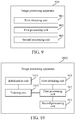
- an image processing apparatus 900 includes: a first obtaining unit 901, a first processing unit 902, and a second processing unit 903.
- the first obtaining unit 901 is configured to obtain a to-be-processed target image; the first processing unit 902 is configured to perform feature extraction on the target image based on a residual network, to determine image feature information, the residual network including a plurality of residual blocks that are successively connected to each other, each of the residual blocks including a convolution branch and a residual branch, a size of a convolution kernel of a first convolutional layer in the convolution branch being less than a size of a convolution kernel of a second convolutional layer located after the first convolutional layer, and a convolution stride of the second convolutional layer being greater than a convolution stride of the first convolutional layer and less than a width of the convolution kernel of the second convolutional layer; and the second processing unit 903 is configured to perform recognition processing on the to-be-processed image according to the image feature information.
- the residual network further includes an initial convolutional layer located before the plurality of residual blocks, and an output of the initial convolutional layer is used as an input of the first residual block in the plurality of residual blocks.
- the plurality of residual blocks form a plurality of convolution stages
- the residual branch included in the first residual block in each of the convolution stages includes a batch normalization processing layer and a target convolutional layer that are successively connected to each other.
- the convolution branch further includes a third convolutional layer, the first convolutional layer, the second convolutional layer, and the third convolutional layer being successively connected to each other, where the size of the convolution kernel of the first convolutional layer and a size of a convolution kernel of the third convolutional layer are 1 ⁇ 1 pixel, the convolution stride of the first convolutional layer and a convolution stride of the third convolutional layer are 1 pixel, the size of the convolution kernel of the second convolutional layer is 3 ⁇ 3 pixels, and the convolution stride of the second convolutional layer is 2 pixels.
- a batch normalization processing layer is set before each of the first convolutional layer, the second convolutional layer, and the third convolutional layer.
- FIG. 10 schematically shows a block diagram of an image processing apparatus according to another embodiment of the present disclosure.
- an image processing apparatus 1000 further includes: an initialization unit 1001 and a training unit 1002 on the basis of the first obtaining unit 901, the first processing unit 902, and the second processing unit 903 shown in FIG. 9 .
- the initialization unit 1001 is configured to initialize the residual network; and the training unit 1002 is configured to input a training image sample into the residual network to perform iterative training until a loss function of the residual network satisfies a convergence condition.
- FIG. 11 schematically shows a block diagram of an image processing apparatus according to still another embodiment of the present disclosure.
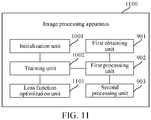
- an image processing apparatus 1100 further includes: a loss function optimization unit 1101 on the basis of the image processing apparatus shown in FIG. 10 .
- the loss function optimization unit 1101 is configured to determine learning parameters included in the batch normalization processing layer in the residual network; and generate a regular term of the loss function through the learning parameters, and add the regular term to the loss function.
- the loss function optimization unit 1101 is configured to determine a coefficient of the regular term, an order of magnitude of the coefficient of the regular term being less than an order of magnitude of a weight of the convolutional layers included in the residual network; and add the regular term to the loss function based on the coefficient of the regular term.
- the loss function optimization unit 1101 is configured to calculate a quadratic sum of the learning parameters; and use an arithmetic average value of the quadratic sum as the regular term of the loss function.
- the image processing apparatus shown in FIG. 10 and FIG. 11 may further include: a second obtaining unit, configured to determine a sample image used for training the residual network; a capturing unit, configured to capture, from the sample image, an image region that occupies a preset proportion of the sample image and whose aspect ratio is a preset ratio; a size adjustment unit, configured to adjust the image region to an image of a set size; and a perturbation processing unit, configured to perform random perturbation processing on the image of the set size, to determine the training image sample.
- a second obtaining unit configured to determine a sample image used for training the residual network
- a capturing unit configured to capture, from the sample image, an image region that occupies a preset proportion of the sample image and whose aspect ratio is a preset ratio
- a size adjustment unit configured to adjust the image region to an image of a set size
- a perturbation processing unit configured to perform random perturbation processing on the image of the set size, to determine the training image sample.
- the preset proportion is a value randomly selected from a preset proportion interval
- the preset ratio is a value randomly selected from a preset aspect ratio interval
- the perturbation processing unit is configured to horizontally flip the image of the set size with a first processing probability; and/or rotating the image of the set size by a random angle with a second processing probability, the random angle being a value randomly selected from a preset angle interval; and/or adjust attributes of the image of the set size with a third processing probability.
- the software product may be stored in a non-volatile storage medium (which may be a CD-ROM, a USB flash drive, a removable hard disk, or the like) or a network, and includes several instructions for instructing a computer device (which may be a personal computer, a server, a network device, or the like) to perform the methods of the implementations of the present disclosure.
- a non-volatile storage medium which may be a CD-ROM, a USB flash drive, a removable hard disk, or the like
- a computer device which may be a personal computer, a server, a network device, or the like
Landscapes
- Engineering & Computer Science (AREA)
- Theoretical Computer Science (AREA)
- Physics & Mathematics (AREA)
- General Physics & Mathematics (AREA)
- Evolutionary Computation (AREA)
- Software Systems (AREA)
- Artificial Intelligence (AREA)
- Health & Medical Sciences (AREA)
- General Health & Medical Sciences (AREA)
- Computing Systems (AREA)
- Data Mining & Analysis (AREA)
- Mathematical Physics (AREA)
- Life Sciences & Earth Sciences (AREA)
- General Engineering & Computer Science (AREA)
- Biomedical Technology (AREA)
- Molecular Biology (AREA)
- Computer Vision & Pattern Recognition (AREA)
- Multimedia (AREA)
- Biophysics (AREA)
- Computational Linguistics (AREA)
- Medical Informatics (AREA)
- Databases & Information Systems (AREA)
- Mathematical Analysis (AREA)
- Pure & Applied Mathematics (AREA)
- Computational Mathematics (AREA)
- Mathematical Optimization (AREA)
- Biodiversity & Conservation Biology (AREA)
- Bioinformatics & Computational Biology (AREA)
- Evolutionary Biology (AREA)
- Operations Research (AREA)
- Probability & Statistics with Applications (AREA)
- Bioinformatics & Cheminformatics (AREA)
- Algebra (AREA)
- Image Analysis (AREA)
Abstract
Description
- This application claims priority to Chinese Patent Application No.
201810588686.9 - The present disclosure relates to the field of computer technologies, and in particular, to an image processing method and apparatus, a computer readable medium, and an electronic device.
- A neural network is a mathematical model or a calculation module imitating a structure and a function of a biological neural network, and is widely applied to an image processing procedure, for example, being used for image recognition. A residual neural network (ResNet) is a neural network provided by He Kaiming et al..
- The information partially disclosed in the Background is only used for enhancing understanding of the background of the present disclosure, and therefore may include information not constituting the related art known by a person of ordinary skill in the art.
- Embodiments of the present disclosure provide an image processing method and apparatus, a computer readable medium, and an electronic device, to at least ensure that a residual network may extract an accurate image feature from an image to some extent, and improve the accuracy of image recognition.
- According to one aspect of the embodiments of the present disclosure, an image processing method is provided, performed by an electronic device, the method including: obtaining a to-be-processed target image; performing feature extraction on the target image based on a residual network, to determine image feature information, the residual network including a plurality of residual blocks that are successively connected to each other, each of the residual blocks including a convolution branch and a residual branch, a size of a convolution kernel of a first convolutional layer in the convolution branch being less than a size of a convolution kernel of a second convolutional layer located after the first convolutional layer, and a convolution stride of the second convolutional layer being greater than a convolution stride of the first convolutional layer and less than a width of the convolution kernel of the second convolutional layer; and performing recognition processing on the to-be-processed image according to the image feature information.
- According to one aspect of the embodiments of the present disclosure, an image processing apparatus is provided, including: a first obtaining unit, configured to obtain a to-be-processed target image; a first processing unit, configured to perform feature extraction on the target image based on a residual network, to determine image feature information, the residual network including a plurality of residual blocks that are successively connected to each other, each of the residual blocks including a convolution branch and a residual branch, a size of a convolution kernel of a first convolutional layer in the convolution branch being less than a size of a convolution kernel of a second convolutional layer located after the first convolutional layer, and a convolution stride of the second convolutional layer being greater than a convolution stride of the first convolutional layer and less than a width of the convolution kernel of the second convolutional layer; and a second processing unit, configured to perform recognition processing on the to-be-processed image according to the image feature information.
- According to one aspect of the embodiments of the present disclosure, a computer readable medium is provided, storing a computer program, the computer program, when executed by a processor, implementing the image processing method described in the foregoing embodiments.
- According to one aspect of the embodiments of the present disclosure, an electronic device is provided, including: one or more processors; and a storage apparatus, configured to store one or more programs, the one or more programs, when executed by the one or more processors, causing the one or more processors to implement the image processing method described in the foregoing embodiments.
- It is to be understood that the foregoing general descriptions and the following detailed descriptions are merely for illustrative and explanatory purposes, and cannot limit the present disclosure.
- The accompanying drawings, which are incorporated herein and constitute a part of this specification, illustrate embodiments consistent with the present disclosure and, together with the specification, serve to explain the principles of the present disclosure. Obviously, the accompanying drawings in the following descriptions are merely some embodiments of the present disclosure, and a person of ordinary skill in the art may further obtain other accompanying drawings according to the accompanying drawings without creative efforts. In the accompanying drawings:
-
FIG. 1 shows a schematic diagram of an exemplary system architecture to which an image processing method or an image processing apparatus is applicable according to an embodiment of the present disclosure. -
FIG. 2 shows a schematic structural diagram of a computer system suitable for implementing an electronic device according to an embodiment of the present disclosure. -
FIG. 3 schematically shows a flowchart of an image processing method according to an embodiment of the present disclosure. -
FIG. 4 shows a schematic structural diagram of the first residual block in each convolution stage of a residual network according to an embodiment of the present disclosure. -
FIG. 5 shows a schematic structural diagram of a residual network according to an embodiment of the present disclosure. -
FIG. 6 shows a flowchart of a method for training a residual network according to an embodiment of the present disclosure. -
FIG. 7 shows a flowchart of determining a training sample image according to an embodiment of the present disclosure. -
FIG. 8 shows a flowchart of performing perturbation processing on an image according to an embodiment of the present disclosure. -
FIG. 9 schematically shows a block diagram of an image processing apparatus according to an embodiment of the present disclosure. -
FIG. 10 schematically shows a block diagram of an image processing apparatus according to another embodiment of the present disclosure. -
FIG. 11 schematically shows a block diagram of an image processing apparatus according to still another embodiment of the present disclosure. - At present, exemplary implementations are more comprehensively described with reference to the accompanying drawings. However, the exemplary implementations may be implemented in multiple forms, and are not to be understood as being limited to examples described herein. Conversely, the implementations are provided to make the present disclosure more comprehensive and complete, and comprehensively convey the idea of the exemplary implementations to a person skilled in the art.
- In addition, the described features, structures or characteristics may be combined in one or more embodiments in any appropriate manner. In the following descriptions, a lot of specific details are provided to give a comprehensive understanding of the embodiments of the present disclosure. However, it is to be appreciated by a person skilled in the art that, the technical solutions in the present disclosure may be implemented without one or more of the particular details, or another method, element, apparatus, or step may be used. In other cases, well-known structures, apparatuses, implementations or operations are not shown or described in detail, in order not to obscure aspects of the present disclosure.
- The block diagrams shown in the accompanying drawings are merely functional entities and do not necessarily correspond to a physically independent entity. That is, the functional entities may be implemented in a software form, or the functional entities may be implemented in one or more hardware modules or integrated circuits, or the functional entities may be implemented in different networks and/or processor apparatuses and/or microcontroller apparatuses.
- The flowcharts shown in the accompanying drawings are merely exemplary descriptions, and do not necessarily include all content and operations/steps, or are not necessarily executed in the described order. For example, some operations/steps may be alternatively decomposed, and some operations/steps may be combined or partially combined. Therefore, an actual execution sequence may be changed according to an actual situation.
-
FIG. 1 shows a schematic diagram of anexemplary system architecture 100 to which an image processing method or an image processing apparatus is applicable according to an embodiment of the present disclosure. - As shown in
FIG. 1 , thesystem architecture 100 may include one or more ofterminal devices network 104, and aserver 105. Thenetwork 104 is used for providing a communication link between theterminal devices server 105. Thenetwork 104 may include various connection types, for example, a wired communication link and a wireless communication link. - The quantities of the terminal devices, the network, and the server in
FIG. 1 are merely exemplary. According to implementation requirements, any quantity of terminal devices, networks, and servers may be included. For example, theserver 105 may be a server cluster that includes a plurality of servers. - A user may interact with the
server 105 through thenetwork 104 by using theterminal devices terminal devices - The
server 105 may be a server that provides various services. For example, the user acquires a to-be-recognized image by using the terminal device 103 (or may be theterminal device 101 or 102), and then uploads the image to theserver 105. After receiving the image, theserver 105 may perform feature extraction on the image based on a residual network (for example, a residual neural network (ResNet)), to determine image feature information, and further recognize the image based on the image feature information. The residual network used by theserver 105 for performing feature extraction includes a plurality of residual blocks that are successively connected to each other, each of the residual blocks including a convolution branch and a residual branch, a size of a convolution kernel of a first convolutional layer in the convolution branch being less than a size of a convolution kernel of a second convolutional layer located after the first convolutional layer, and a convolution stride of the second convolutional layer being greater than a convolution stride of the first convolutional layer and less than a width of the convolution kernel of the second convolutional layer. For example, if the size of the convolution kernel of the first convolutional layer is 1 × 1 pixel, the convolution stride of the first convolutional layer is 1 pixel, the size of the convolution kernel of the second convolutional layer is 3 × 3 pixels, and the convolution stride of the second convolutional layer is 2 pixels, during a convolution operation, it is ensured that downsampling processing can be implemented through the second convolutional layer, and it can be ensured that no feature point is skipped (that is, all pixels in a feature map are considered), thereby further ensuring that there is no loss in the representation capability of a feature network. Accordingly, the accuracy of image feature extraction is ensured, and the accuracy of image recognition is improved. - The image processing method provided in this embodiment of the present disclosure is generally performed by the
server 105, and correspondingly, the image processing apparatus is generally disposed in theserver 105. However, in other embodiments of the present disclosure, the terminal may alternatively have a function similar to that of the server, to perform the image processing method provided in this embodiment of the present disclosure. -
FIG. 2 shows a schematic structural diagram of a computer system suitable for implementing an electronic device according to an embodiment of the present disclosure. - A
computer system 200 of the electronic device shown inFIG. 2 is merely an example, and is not be construed as any limitation on functions and use scopes of the embodiments of the present disclosure. - As shown in
FIG. 2 , thecomputer system 200 includes a central processing unit (CPU) 201, which may perform various proper actions and processing according to a program stored in a read-only memory (ROM) 202 or a program loaded from astorage part 208 into a random access memory (RAM) 203. TheRAM 203 further stores various programs and data required to operate the system. TheCPU 201, theROM 202, and theRAM 203 are connected to each other through abus 204. An input/output (I/O)interface 205 is also connected to thebus 204. - The I/
O interface 205 is connected to the following parts: aninput part 206 including a keyboard, a mouse, and the like; anoutput part 207 including a cathode ray tube (CRT), a liquid crystal display (LCD), a speaker, and the like; astorage part 208 including a hard disk and the like; and acommunication part 209 including a network interface card such as a local area network (LAN) card or a modem. Thecommunication part 209 performs communication processing through a network such as the Internet. Adriver 210 is also connected to the I/O interface 205 as required. Aremovable medium 211 such as a magnetic disk, an optical disc, a magneto-optical disk, or a semiconductor memory is mounted on thedriver 210 as required, so that a computer program read from theremovable medium 211 is installed into thestorage part 208 as required. - Particularly, according to this embodiment of the present disclosure, the processes described in the following with reference to the flowcharts may be implemented as computer software programs. For example, this embodiment of the present disclosure includes a computer program product, which includes a computer program carried in a computer readable medium. The computer program includes program code used for performing the methods shown in the flowcharts. In such an embodiment, by using the
communication part 209, the computer program may be downloaded and installed from a network, and/or installed from theremovable medium 211. When the computer program is executed by theCPU 201, various functions defined in the system of the present disclosure are executed. - The computer readable medium in the present disclosure may be a computer readable signal medium or a computer readable storage medium or any combination thereof. The computer readable storage medium may be, for example, but not limited to, an electric, magnetic, optical, electromagnetic, infrared, or semi-conductive system, apparatus, or device, or any combination thereof. More specific examples of the computer readable storage medium may include, but are not limited to: an electrical connection having one or more wires, a portable computer magnetic disk, a hard disk, a RAM, a ROM, an erasable programmable read-only memory (EPROM or flash memory), an optical fiber, a compact disk read-only memory (CD-ROM), an optical storage device, a magnetic storage device, or any appropriate combination thereof. In the present disclosure, the computer readable storage medium may be any tangible medium including or storing a program, and the program may be used by or in combination with an instruction execution system, apparatus, or device. In the present disclosure, the computer readable signal medium may include a data signal propagated in a baseband or as part of a carrier, and stores computer readable program code. The propagated data signal may be in a plurality of forms, including, but not limited to, an electromagnetic signal, an optical signal, or any appropriate combination thereof. The computer readable signal medium may alternatively be any computer readable medium other than the computer readable storage medium. The computer readable medium may be configured to send, propagate, or transmit a program used by or in combination with an instruction execution system, apparatus, or device. The program code included in the computer readable medium may be transmitted by using any suitable medium, including, but not limited to, wireless and wired transmission and the like, or any suitable combination thereof.
- The flowcharts and block diagrams in the accompanying drawings show architectures, functions, and operations that may be implemented for the system, the method, and the computer program product according to the embodiments of the present disclosure. At this point, each block in a flowchart or a block diagram may represent one module, one program segment, or a part of code. The module, the program segment, or the part of code includes one or more executable instructions for implementing a specified logical function. In some implementations used as substitutes, functions annotated in blocks may alternatively occur in a sequence different from sequences annotated in the accompanying drawings. For example, two blocks shown in succession may be performed substantially in parallel, or sometimes the two blocks may be performed in a reverse sequence. This is determined by an involved function. Each block in the block diagram and/or the flowchart and a combination of blocks in the block diagram and/or the flowchart may be implemented by using a dedicated hardware-based system configured to perform a specified function or operation, or may be implemented by using a combination of dedicated hardware and a computer instruction.
- Involved units described in the embodiments of the present disclosure may be implemented in a software manner, or may be implemented in a hardware manner. The units described may alternatively be disposed in a processor. Names of these units do not constitute a limitation on the units in some case.
- As another aspect, the present disclosure further provides a computer readable medium. The computer readable medium may be included in the electronic device described in the foregoing embodiments; or may be exist alone and is not mounted in the electronic device. The computer readable medium carries one or more programs, and the one or more programs, when executed by the electronic device, cause the electronic device to implement the method described in the following embodiments. For example, the electronic device may implement steps shown in
FIG. 3 , andFIG. 6 toFIG. 8 . - The following describes implementation details of the technical solutions of the embodiments of the present disclosure.
-
FIG. 3 schematically shows a flowchart of an image processing method according to an embodiment of the present disclosure. The image processing method is applicable to the electronic device described in the foregoing embodiments. Referring toFIG. 3 , the image processing method includes at least step S310 to step S330, and details are as follows:
Step S310: Obtain a to-be-processed target image. - In an embodiment of the present disclosure, the to-be-processed target image may be an image on which visual processing needs to be performed, for example, an image on which object recognition needs to be performed.
- Step S320: Perform feature extraction on the target image based on a residual network, to determine image feature information, the residual network including a plurality of residual blocks that are successively connected to each other, each of the residual blocks including a convolution branch and a residual branch, a size of a convolution kernel of a first convolutional layer in the convolution branch being less than a size of a convolution kernel of a second convolutional layer located after the first convolutional layer, and a convolution stride of the second convolutional layer being greater than a convolution stride of the first convolutional layer and less than a width of the convolution kernel of the second convolutional layer. The residual branch in the residual block points from an input of the convolution branch to an output of the convolution branch.
- In this embodiment of the present disclosure, the "block", the "branch", the "layer", and the "stage" that are used for describing the residual network represent various processing procedures or steps. The term "successively connected" represents that the processing procedures or steps are connected with each other in sequential order.
- According to this embodiment of the present disclosure, the convolutional layer also means performing convolution processing or operation on the to-be-processed target image. Convolution is a mathematical operator generating a third function through two functions f and g. According to this embodiment of the present disclosure, the target image is represented by using, for example, the function f, and the convolution kernel is the function g. The function f and the function g are usually three-dimensional discrete matrices, and the generated function is also a three-dimensional matrix. For example, the target image is represented in a format of a (H, W, C)) three-dimensional matrix, where H and W are respectively a height and a width of the target image, which are used for representing a resolution or a size of the target image, and C represents a quantity of channels of the target image. For example, a color image includes three channels (R, G, B), that is, C = 3. In the three-dimensional matrix used for representing the target image, for example, elements in a first dimension are pixels of all rows of the target image, elements in a second dimension are pixels of all columns of the target image, and elements in a third dimension are pixels of all channels of the target image. Each pixel in the target image is used as a description unit, and pixel values of the three channels are recorded.
- The convolution kernel is also referred to as a filter matrix. The convolution kernel extracts features of different locations of the target image through a manner of "sliding window", and an extracted result is a feature map. Pixels on the feature map are feature points. The convolution stride is a quantity of pixels by which a center of the convolution kernel moves on the target image each time. For example, the inputted target image is a grayscale image of 5×5 pixels, the convolution kernel is a matrix of 3×3 pixels, and the convolution stride is 1. The convolution procedure is: moving the matrix of 3×3 pixels from the upper left corner to the lower right corner on the image of 5×5 pixels, where 1 pixel is moved by for each time. Each time the convolution kernel matrix moves, dot multiplication is performed on the convolution kernel matrix and a corresponding feature point of the target image, and summation is performed on products of dot multiplication, to form a new matrix. The convolution stride can implement a downsampling function. Through convolution calculation, a resolution of the outputted image is much less than a resolution of the inputted target image.
- In an embodiment of the present disclosure, the residual network may be a deep residual network. The residual network further includes an initial convolutional layer located before the plurality of residual blocks, and an output of the initial convolutional layer is used as an input of the first residual block in the plurality of residual blocks. In this embodiment, because the second convolutional layer in the residual block already can implement downsampling processing, some pooling layers located before the residual block in the residual network may be removed, thereby simplifying the structure of the residual network.
- In an embodiment of the present disclosure, the plurality of residual blocks in the residual network form a plurality of convolution stages, and the residual branch included in each residual block in each of the convolution stages includes a batch normalization processing layer and a target convolutional layer that are successively connected to each other.
- In this embodiment, for a residual block, if sizes (including sizes, channels, and the like) of an input and an output of the residual block are the same, the residual branch may be an identical mapping. However, if the sizes of the input and the output are different, the input and the output need to be mapped to the same size through a convolution operation. According to this embodiment of the present disclosure, in the first residual block in each convolution stage, sizes of an input and an output of the residual block need to be ensured to be consistent through a residual branch of a nonidentical mapping (that is, adding a convolutional layer). Meanwhile, because there is no offset item in the convolution operation of the convolutional layer, a batch normalization (BN) layer may be added before the convolutional layer, to add the offset item, and further, it can be ensured that an optimal processing effect is achieved. The BN layer means performing normalization processing on a feature map generated by performing convolution processing on a plurality of samples (target images). Specifically, for feature points generated by each sample, a distribution of the feature points is normalized into a distribution whose average value is 0 and variance is 1 through a manner of subtracting the average value and dividing the variance.
- Referring to
FIG. 3 , in step S330, recognition processing is performed on the to-be-processed image according to the image feature information. - In the technical solution of the embodiment shown in
FIG. 3 , in response to that the convolutional layer in the residual block performs convolution operation, it is ensured that downsampling processing is implemented through the second convolutional layer, and it may be ensured that no feature point is skipped, thereby further ensuring that no loss occurs in the representation capability of a feature network. Accordingly, the accuracy of image feature extraction may be ensured, and image recognition accuracy is improved. - Based on the structure of the residual network introduced in the foregoing embodiments, in a specific embodiment of the present disclosure,
FIG. 4 shows a schematic structural diagram of the first residual block in each convolution stage of a residual network according to an embodiment of the present disclosure. The first residual block specifically includes: aconvolution branch 401 and aresidual branch 402. Theresidual branch 402 points from an input of theconvolution branch 401 to an output of theconvolution branch 401. - The
convolution branch 401 includes a firstconvolutional layer 4011, a secondconvolutional layer 4012, and a thirdconvolutional layer 4013. A BN layer is set before each of the firstconvolutional layer 4011, thesecond convolutional layer 4012, and the thirdconvolutional layer 4013. In addition, after being processed through the BN layers, the firstconvolutional layer 4011, thesecond convolutional layer 4012, and the thirdconvolutional layer 4013 are all processed through a rectified linear unit (Relu). Usually, as a quantity of convolutional layers increases, the representation capability of the residual network is improved, and an effect on a specific application is better. For example, in an image recognition application, an object in a target image may be more accurately recognized. A size of a convolution kernel of the firstconvolutional layer 4011 is 1×1 pixel, and a convolution stride of the firstconvolutional layer 4011 is 1 pixel; a size of a convolution kernel of thesecond convolutional layer 4012 is 3×3 pixels, and a convolution stride of thesecond convolutional layer 4012 is 2 pixels; and a size of a convolution kernel of the thirdconvolutional layer 4013 is 1×1 pixel, and a convolution stride of the thirdconvolutional layer 4013 is 1 pixel. Because thesecond convolutional layer 4012 may implement downsampling processing, and may ensure that no feature point is skipped, the residual block of this embodiment of the present disclosure may ensure that no loss occurs in the representation capability of the feature network. - In some residual network structures, in the convolution branch, the size of the convolution kernel of the first convolutional layer is 1×1 pixel, the convolution stride of the first convolutional layer is 2 pixels, the size of the convolution kernel of the second convolutional layer is 3×3 pixels, and the convolution stride of the second convolutional layer is 1 pixel. In this case, in response to that the first convolutional layer performs convolution operation, a feature point is skipped between two convolution procedures, leading to a loss in the feature network. However, by using the residual network of this embodiment of the present disclosure, the size of the convolution kernel of the first convolutional layer in the convolution branch included in the residual block is less than the size of the convolution kernel of the second convolutional layer located after the first convolutional layer, and the convolution stride of the second convolutional layer is greater than the convolution stride of the first convolutional layer and less than a width of the convolution kernel of the second convolutional layer, so that in response to that the convolutional layer in the residual block performs convolution operation, it is ensured that downsampling processing is implemented through the second convolutional layer, and it may be ensured that no feature point is skipped, thereby further ensuring that no loss in the representation capability of a feature network is caused. Accordingly, the accuracy of image feature extraction may be ensured, and image recognition accuracy is improved.
- A calculation formula of the Relu is, for example:

- x is a feature point on the inputted feature map, and y is a corresponding feature point on the outputted feature map. The Relu introduces a nonlinear feature to a system, on which a linear calculation operation is performed, in the convolutional layer.
- The
residual branch 402 includes aconvolutional layer 4021 and a BN layer set before theconvolutional layer 4021. In addition, after processing is performed through the BN layer, processing is performed through a Relu function. - An addition calculation is performed on outputs of the
convolution branch 401 and theresidual branch 402 in terms of elements, to determine an output of each residual block. - In an embodiment of the present disclosure,
FIG. 5 shows a schematic structural diagram of a residual network according to an embodiment of the present disclosure. The structure includes: an initialconvolutional layer 501, aconvolution stage 502, aconvolution stage 503, aconvolution stage 504, aconvolution stage 505, a globalaverage pooling layer 506, and a fully-connectedlayer 507 that are successively connected. A size of a convolution kernel of the initialconvolutional layer 501 is 7×7 pixels, a convolution stride of the initialconvolutional layer 501 is 2 pixels, and a quantity of channels of the initialconvolutional layer 501 is 64. Each of theconvolution stage 502, theconvolution stage 503, theconvolution stage 504, and theconvolution stage 505 includes a plurality of residual blocks. Quantities of the residual blocks included in different convolution stages may be different. For example, in aResNet 101, theconvolution stage 502 includes 3 residual blocks, theconvolution stage 503 includes 4 residual blocks, theconvolution stage 504 includes 23 residual blocks, and theconvolution stage 505 includes 4 residual blocks. A structure of the first residual block in each convolution stage is shown inFIG. 4 . Residual branches in other residual blocks are identical mappings. The convolution branch is the same as theconvolution branch 401 shown inFIG. 4 . - It can be seen from the structure of the residual network shown in
FIG. 4 andFIG. 5 that, after the initialconvolutional layer 501 of the residual network in this embodiment of the present disclosure, some maximum pooling layers in the residual network are removed, and a downsampling procedure is arranged into the first convolution stage, that is, theconvolution stage 502, and specifically, is arranged into thesecond convolutional layer 4012 of the first residual block of theconvolution stage 502. Meanwhile, in each residual block, the downsampling procedure is arranged into a second convolutional layer, where a size of a convolution kernel of the second convolutional layer is 3×3 pixels, to further ensure that no feature point is skipped in the downsampling procedure, and ensure that no loss occurs in the representation capability of the feature network. In addition, the BN layer is not only added to the convolution branch, but also added to a residual branch of a nonidentical mapping. In this way, an offset item may be added before the convolutional layer through the BN layer, and further it may be ensured that an optimal processing effect is achieved. - Based on the structure of the residual network introduced in the foregoing embodiments, an embodiment of the present disclosure further provides a solution for training the residual network. Specifically, as shown in
FIG. 6 , a method for training the residual network according to this embodiment of the present disclosure includes the following steps: - Step S610: Initialize the residual network.
- Step S620: Input a training image sample into the residual network to perform iterative training until a loss function of the residual network satisfies a convergence condition.
- In the field of computer neural science, a loss function or a cost function is a function of mapping an event (an element in a sample space) to a real number representing opportunity costs related to the event, to visually represent associations between some "costs" and events. An objective of an optimization problem is to minimize a loss function. A target function is usually a loss function or a negative value of a loss function. In response to that a target function is a negative value of a loss function, a value of the target function needs to be maximized. A function of the loss function is to estimate a parameter.
- In an embodiment of the present disclosure, in response to that iterative training is performed on the residual network, a Momentum-Stochastic Gradient Descent (SGD) optimization method may be used for training, and a distributed training framework may be used to improve a training rate. For example, training may be performed by using a hardware configuration of 4 machines and 32 graphics cards. Specific hyperparameters for training are shown in
FIG. 1 , where epoch is iterations used for learning all training images once according to a current batch size.Table 1 Hyperparameter Value Batch Size 64×4×32 Learning Rate 0.8 Learning Rate Decay Coefficient 0.1 Learning Rate Decay Interval 30 epoch Learning Rate Warmup 0.1 Learning Rate Warmup Decay Coefficient 0.1 Learning Rate Warmup Decay Interval 1 epoch Coefficient Of Weight Regular Term 1e-4 - In an embodiment of the present disclosure, the BN layer of the residual network includes learnable parameters, and the learnable parameters are relatively strongly correlated to a distribution of the training image samples. For details, refer to the following formula of a forward conduction procedure of the BN layer:

- β and γ represent learning parameters, µ represents an average value of training image samples, σ represents a variance of the training image samples, x represents the training image sample, and y represents an output. β and γ are determined by performing, based on the training image sample, iterative learning by using an optimization algorithm. A learning procedure is to minimize the loss function by adjusting the parameters (or maximizing in response to that the loss is negative).
- Therefore, in an embodiment of the present disclosure, a regular term of the loss function may be generated according to β and γ, and the regular term may be added to an original loss function (that is, classification loss) of the residual network, to improve a generalization capability of the residual network model. A quadratic sum of β and γ may be calculated, and an arithmetic average value of the quadratic sum may be used as the regular term (that is,

- In an embodiment of the present disclosure, a technical solution for determining a training sample image is further provided. Specifically, as shown in
FIG. 7 , the following steps are included:
Step S710: Obtain a sample image used for training the residual network. - In an embodiment of the present disclosure, the sample image may be an RGB image.
- Step S720: Capture, from the sample image, an image region that occupies a preset proportion of the sample image and whose aspect ratio is a preset ratio.
- In the technical solution of this embodiment, a plurality of image regions may be captured from the sample image, and meanwhile, translation invariance and size invariance of the images determined through capturing may be ensured.
- In an embodiment of the present disclosure, the preset proportion is a value randomly selected from a preset proportion interval, and/or the preset ratio is a value randomly selected from a preset aspect ratio interval. For example, the preset proportion interval may be [0.05, 1.0], and the preset aspect ratio interval may be [3/4, 4/3].
- Step S730: Adjust the image region to an image of a set size.
- In this embodiment, the image region is adjusted to an image region of a set size, so that in response to that the residual network is trained, images of the same size may be inputted into the network for training.
- Step S740: Perform random perturbation processing on the image of the set size, to determine the training image sample.
- In an embodiment of the present disclosure, the performing random perturbation processing on the image of the set size includes: horizontally flipping the image of the set size with a first processing probability; and/or rotating on the image of the set size by a random angle with a second processing probability, the random angle being a value randomly selected from a preset angle interval; and/or adjusting attributes of the image of the set size with a third processing probability. The attributes of the image include saturation, contrast, luminance, chrominance, and the like.
- Through the technical solution of the embodiment shown in
FIG. 7 , whether to process the image may be selected by using a specified probability, thereby further preventing relatively great noise impact caused by excessively introduced data perturbation while increasing differences between training data. - In a specific embodiment of the present disclosure, as shown in
FIG. 8 , this embodiment shows a procedure of performing perturbation processing on an image, and the procedure specifically includes: - Step S801: Input an image. The image may be an RGB image.
- Step S802: Randomly crop, from the image, a region that occupies any proportion, which is between [0.05, 1.0], of a total area of the image and whose aspect ratio is any ratio between [3/4, 4/3].
- Step S803: Adjust a size of the image determined through cropping to a size of 224×224 pixels.
- Step S804: Horizontally flip the image with a processing probability of 0.5.
- Step S805: Rotating the image by a random angle with a processing probability of 0.25.
- Step S806: Perform perturbation processing on saturation, contrast, luminance, and chrominance of the image with a processing probability of 0.5.
- The specific values shown in
FIG. 8 are only examples. Processing sequences of step S804 to step S806 are not strictly required, that is, the steps may be performed in a reversed sequence, or the steps may be simultaneously performed. - Through the structure of the residual network provided in the foregoing embodiments of the present disclosure, a currently optimal effect may be achieved. Details are shown in Table 2:
Table 2 Model Frame Top1 Acc (%) Top5 Error (%) ResNet 101Tensorflow 78.22 94.00 ResNet 152 Tensorflow 78.94 94.44 - The technical solutions of the foregoing embodiments of the present disclosure may be widely applied to vision-related services, for example, may be used for evaluation and recommendation of image quality, object recognition in a game scene, image understanding, or video understanding.
- The following describes an apparatus embodiment of the present disclosure, which may be used for performing the image processing method in the foregoing embodiments of the present disclosure. For details not disclosed in the apparatus embodiment of the present disclosure, refer to the foregoing embodiments of the image processing method of the present disclosure.
-
FIG. 9 schematically shows a block diagram of an image processing apparatus according to an embodiment of the present disclosure. - Referring to
FIG. 9 , animage processing apparatus 900 according to an embodiment of the present disclosure includes: a first obtainingunit 901, afirst processing unit 902, and asecond processing unit 903. - The first obtaining
unit 901 is configured to obtain a to-be-processed target image; thefirst processing unit 902 is configured to perform feature extraction on the target image based on a residual network, to determine image feature information, the residual network including a plurality of residual blocks that are successively connected to each other, each of the residual blocks including a convolution branch and a residual branch, a size of a convolution kernel of a first convolutional layer in the convolution branch being less than a size of a convolution kernel of a second convolutional layer located after the first convolutional layer, and a convolution stride of the second convolutional layer being greater than a convolution stride of the first convolutional layer and less than a width of the convolution kernel of the second convolutional layer; and thesecond processing unit 903 is configured to perform recognition processing on the to-be-processed image according to the image feature information. - In some embodiments of the present disclosure, based on the foregoing solution, the residual network further includes an initial convolutional layer located before the plurality of residual blocks, and an output of the initial convolutional layer is used as an input of the first residual block in the plurality of residual blocks.
- In some embodiments of the present disclosure, based on the foregoing solution, the plurality of residual blocks form a plurality of convolution stages, and the residual branch included in the first residual block in each of the convolution stages includes a batch normalization processing layer and a target convolutional layer that are successively connected to each other.
- In some embodiments of the present disclosure, based on the foregoing solution, the convolution branch further includes a third convolutional layer, the first convolutional layer, the second convolutional layer, and the third convolutional layer being successively connected to each other, where the size of the convolution kernel of the first convolutional layer and a size of a convolution kernel of the third convolutional layer are 1 × 1 pixel, the convolution stride of the first convolutional layer and a convolution stride of the third convolutional layer are 1 pixel, the size of the convolution kernel of the second convolutional layer is 3×3 pixels, and the convolution stride of the second convolutional layer is 2 pixels.
- In some embodiments of the present disclosure, based on the foregoing solution, a batch normalization processing layer is set before each of the first convolutional layer, the second convolutional layer, and the third convolutional layer.
-
FIG. 10 schematically shows a block diagram of an image processing apparatus according to another embodiment of the present disclosure. - Referring to
FIG. 10 , animage processing apparatus 1000 according to another embodiment of the present disclosure further includes: aninitialization unit 1001 and atraining unit 1002 on the basis of the first obtainingunit 901, thefirst processing unit 902, and thesecond processing unit 903 shown inFIG. 9 . - The
initialization unit 1001 is configured to initialize the residual network; and thetraining unit 1002 is configured to input a training image sample into the residual network to perform iterative training until a loss function of the residual network satisfies a convergence condition. -
FIG. 11 schematically shows a block diagram of an image processing apparatus according to still another embodiment of the present disclosure. - Referring to
FIG. 11 , animage processing apparatus 1100 according to still another embodiment of the present disclosure further includes: a lossfunction optimization unit 1101 on the basis of the image processing apparatus shown inFIG. 10 . The lossfunction optimization unit 1101 is configured to determine learning parameters included in the batch normalization processing layer in the residual network; and generate a regular term of the loss function through the learning parameters, and add the regular term to the loss function. - In some embodiments of the present disclosure, based on the foregoing solution, the loss
function optimization unit 1101 is configured to determine a coefficient of the regular term, an order of magnitude of the coefficient of the regular term being less than an order of magnitude of a weight of the convolutional layers included in the residual network; and add the regular term to the loss function based on the coefficient of the regular term. - In some embodiments of the present disclosure, based on the foregoing solution, the loss
function optimization unit 1101 is configured to calculate a quadratic sum of the learning parameters; and use an arithmetic average value of the quadratic sum as the regular term of the loss function. - In some embodiments of the present disclosure, based on the foregoing solution, the image processing apparatus shown in
FIG. 10 andFIG. 11 may further include: a second obtaining unit, configured to determine a sample image used for training the residual network; a capturing unit, configured to capture, from the sample image, an image region that occupies a preset proportion of the sample image and whose aspect ratio is a preset ratio; a size adjustment unit, configured to adjust the image region to an image of a set size; and a perturbation processing unit, configured to perform random perturbation processing on the image of the set size, to determine the training image sample. - In some embodiments of the present disclosure, based on the foregoing solution, the preset proportion is a value randomly selected from a preset proportion interval, and/or the preset ratio is a value randomly selected from a preset aspect ratio interval.
- In some embodiments of the present disclosure, based on the foregoing solution, the perturbation processing unit is configured to horizontally flip the image of the set size with a first processing probability; and/or rotating the image of the set size by a random angle with a second processing probability, the random angle being a value randomly selected from a preset angle interval; and/or adjust attributes of the image of the set size with a third processing probability.
- Even though a plurality of modules or units of a device configured to perform actions are provided in the foregoing detailed descriptions, the division is not forced. In fact, according to the embodiments of the present disclosure, the features and functions of the two or more modules or units described above may be embodied in one module or unit. Reversely, the features and functions of one module or unit described above may be further divided to be embodied by a plurality of modules or units.
- Through the description of the foregoing implementations, a person skilled in the art may easily understand that the example implementations described herein may be implemented by software or through a manner of combining software with necessary hardware. Therefore, the technical solutions of the embodiments of the present disclosure may be implemented in the form of a software product. The software product may be stored in a non-volatile storage medium (which may be a CD-ROM, a USB flash drive, a removable hard disk, or the like) or a network, and includes several instructions for instructing a computer device (which may be a personal computer, a server, a network device, or the like) to perform the methods of the implementations of the present disclosure.
- After considering the specification and practicing the present disclosure, a person skilled in the art would easily conceive of other implementations of the present disclosure. The present disclosure is intended to cover any variation, use, or adaptive change of the present disclosure. These variations, uses, or adaptive changes follow the general principles of the present disclosure and include common general knowledge or common technical means in the art that are not disclosed in the present disclosure. The specification and the embodiments are considered as merely exemplary, and the real scope and spirit of the present disclosure are pointed out in the following claims.
- It is to be understood that the present disclosure is not limited to the precise structures described above and shown in the accompanying drawings, and various modifications and changes can be made without departing from the scope of the present disclosure. The scope of the present disclosure is subject only to the appended claims.
Claims (15)
- An image processing method, performed by an electronic device, characterized by comprising:obtaining a to-be-processed target image;performing feature extraction on the target image based on a residual network, to determine image feature information, the residual network comprising a plurality of residual blocks that are successively connected to each other, each of the residual blocks comprising a convolution branch and a residual branch, a size of a convolution kernel of a first convolutional layer in the convolution branch being less than a size of a convolution kernel of a second convolutional layer located after the first convolutional layer, and a convolution stride of the second convolutional layer being greater than a convolution stride of the first convolutional layer and less than a width of the convolution kernel of the second convolutional layer; andperforming recognition processing on the to-be-processed image based on the image feature information.
- The image processing method according to claim 1, characterized in that the residual network further comprises an initial convolutional layer located before the plurality of residual blocks, and an output of the initial convolutional layer is used as an input of a first residual block in the plurality of residual blocks.
- The image processing method according to claim 1, characterized in that the plurality of residual blocks form a plurality of convolution stages, and the residual branch included in a first residual block in each of the convolution stages comprises a batch normalization processing layer and a target convolutional layer that are successively connected to each other.
- The image processing method according to claim 1, characterized in that the convolution branch further comprises a third convolutional layer, wherein the first convolutional layer, the second convolutional layer, and the third convolutional layer are successively connected to each other, and
wherein the size of the convolution kernel of the first convolutional layer and a size of a convolution kernel of the third convolutional layer are 1×1 pixel, the convolution stride of the first convolutional layer and a convolution stride of the third convolutional layer are 1 pixel, the size of the convolution kernel of the second convolutional layer is 3×3 pixels, and the convolution stride of the second convolutional layer is 2 pixels. - The image processing method according to claim 4, characterized in that a batch normalization processing layer is set before each of the first convolutional layer, the second convolutional layer, and the third convolutional layer.
- The image processing method according to any one of claims 1 to 5, characterized in that before the performing feature extraction on the target image based on a residual network, the method further comprises:initializing the residual network; andinputting a training image sample into the residual network to perform iterative training until a loss function of the residual network satisfies a convergence condition.
- The image processing method according to claim 6, characterized in that the method further comprises:determining learning parameters included in a batch normalization processing layer in the residual network; andgenerating a regular term of the loss function through the learning parameters, and adding the regular term to the loss function.
- The image processing method according to claim 7, characterized in that the adding the regular term to the loss function comprises:determining a coefficient of the regular term, an order of a magnitude of the coefficient of the regular term being less than an order of a magnitude of a weight of the convolutional layers included in the residual network; andadding the regular term to the loss function based on the coefficient of the regular term.
- The image processing method according to claim 7, characterized in that the generating a regular term of the loss function through the learning parameters comprises:calculating a quadratic sum of the learning parameters; andusing an arithmetic average value of the quadratic sum as the regular term of the loss function.
- The image processing method according to claim 6, characterized in that prior to the inputting a training image sample into the residual network to perform iterative training, the method further comprises:determining a sample image used for training the residual network;capturing, from the sample image, an image region that occupies a preset proportion of the sample image and whose aspect ratio is a preset ratio;adjusting the image region to an image of a set size; andperforming random perturbation processing on the image of the set size, to determine the training image sample.
- The image processing method according to claim 10, characterized in that the preset proportion is a value randomly selected from a preset proportion interval, and/or the preset ratio is a value randomly selected from a preset aspect ratio interval.
- The image processing method according to claim 10, characterized in that the performing random perturbation processing on the image of the set size comprises:horizontally flipping the image of the set size with a first processing probability; and/orrotating the image of the set size by a random angle with a second processing probability, the random angle being a value randomly selected from a preset angle interval; and/oradjusting attributes of the image of the set size with a third processing probability.
- An image processing apparatus, characterized by comprising:a first obtaining unit, configured to obtain a to-be-processed target image;a first processing unit, configured to perform feature extraction on the target image based on a residual network, to determine image feature information, the residual network comprising a plurality of residual blocks that are successively connected to each other, each of the residual blocks comprising a convolution branch and a residual branch, a size of a convolution kernel of a first convolutional layer in the convolution branch being less than a size of a convolution kernel of a second convolutional layer located after the first convolutional layer, and a convolution stride of the second convolutional layer being greater than a convolution stride of the first convolutional layer and less than a width of the convolution kernel of the second convolutional layer; anda second processing unit, configured to perform recognition processing on the to-be-processed image based on the image feature information.
- A computer readable medium, storing a computer program, characterized by the computer program, when executed by a processor, implementing the image processing method according to any one of claims 1 to 12.
- An electronic device, characterized by comprising:one or more processors; anda storage apparatus, configured to store one or more programs, the one or more programs, when executed by the one or more processors, causing the one or more processors to implement the image processing method according to any one of claims 1 to 12.
Applications Claiming Priority (2)
| Application Number | Priority Date | Filing Date | Title |
|---|---|---|---|
| CN201810588686.9A CN110163215B (en) | 2018-06-08 | 2018-06-08 | Image processing method, image processing device, computer readable medium and electronic equipment |
| PCT/CN2019/086384 WO2019233244A1 (en) | 2018-06-08 | 2019-05-10 | Image processing method and apparatus, and computer readable medium, and electronic device |
Publications (2)
| Publication Number | Publication Date |
|---|---|
| EP3767523A1 true EP3767523A1 (en) | 2021-01-20 |
| EP3767523A4 EP3767523A4 (en) | 2021-06-02 |
Family
ID=67644895
Family Applications (1)
| Application Number | Title | Priority Date | Filing Date |
|---|---|---|---|
| EP19814012.1A Pending EP3767523A4 (en) | 2018-06-08 | 2019-05-10 | IMAGE PROCESSING PROCESS AND APPARATUS, COMPUTER READABLE MEDIA AND ELECTRONIC DEVICE |
Country Status (4)
| Country | Link |
|---|---|
| US (1) | US11416781B2 (en) |
| EP (1) | EP3767523A4 (en) |
| CN (1) | CN110163215B (en) |
| WO (1) | WO2019233244A1 (en) |
Cited By (1)
| Publication number | Priority date | Publication date | Assignee | Title |
|---|---|---|---|---|
| CN114419408A (en) * | 2021-12-30 | 2022-04-29 | 深圳云天励飞技术股份有限公司 | Target re-identification method, terminal device and computer-readable storage medium |
Families Citing this family (60)
| Publication number | Priority date | Publication date | Assignee | Title |
|---|---|---|---|---|
| CN110651277B (en) * | 2019-08-08 | 2023-08-01 | 京东方科技集团股份有限公司 | Computer-implemented method, computer-implemented diagnostic method, image classification device, and computer program product |
| CN110633711B (en) * | 2019-09-09 | 2022-02-11 | 长沙理工大学 | Computer device and method for training feature point detector and feature point detection method |
| CN110930290B (en) * | 2019-11-13 | 2023-07-07 | 东软睿驰汽车技术(沈阳)有限公司 | A data processing method and device |
| CN112883981B (en) * | 2019-11-29 | 2025-01-17 | 阿里巴巴集团控股有限公司 | Image processing method, device and storage medium |
| CN111091521B (en) * | 2019-12-05 | 2023-04-07 | 腾讯科技(深圳)有限公司 | Image processing method and device, electronic equipment and computer readable storage medium |
| CN112949672B (en) * | 2019-12-11 | 2024-10-15 | 顺丰科技有限公司 | Commodity identification method, device, equipment and computer-readable storage medium |
| CN111126303B (en) * | 2019-12-25 | 2023-06-09 | 北京工业大学 | Multi-parking-place detection method for intelligent parking |
| CN111104987B (en) * | 2019-12-25 | 2023-08-01 | 盛景智能科技(嘉兴)有限公司 | Face recognition method and device and electronic equipment |
| CN111047515B (en) * | 2019-12-29 | 2024-01-09 | 兰州理工大学 | An atrous convolutional neural network image super-resolution reconstruction method based on attention mechanism |
| CN111160268B (en) * | 2019-12-30 | 2024-03-29 | 北京化工大学 | A multi-angle SAR target recognition method based on multi-task learning |
| CN111191593A (en) * | 2019-12-30 | 2020-05-22 | 成都云尚物联环境科技有限公司 | Image target detection method and device, storage medium and sewage pipeline detection device |
| CN111242228B (en) * | 2020-01-16 | 2024-02-27 | 武汉轻工大学 | Hyperspectral image classification method, device, equipment and storage medium |
| CN111292268B (en) * | 2020-02-07 | 2023-07-25 | 抖音视界有限公司 | Image processing method, device, electronic equipment and computer readable storage medium |
| CN111353470B (en) * | 2020-03-13 | 2023-08-01 | 北京字节跳动网络技术有限公司 | Image processing method and device, readable medium and electronic equipment |
| US11380023B2 (en) * | 2020-03-18 | 2022-07-05 | Adobe Inc. | End-to-end relighting of a foreground object of an image |
| CN111368937B (en) * | 2020-03-19 | 2024-05-28 | 京东方科技集团股份有限公司 | Image classification method, device, and training method, device, equipment, and medium thereof |
| CN111832383B (en) * | 2020-05-08 | 2023-12-08 | 北京嘀嘀无限科技发展有限公司 | Training method of gesture key point recognition model, gesture recognition method and device |
| CN111783519B (en) * | 2020-05-15 | 2024-09-20 | 北京迈格威科技有限公司 | Image processing method, device, electronic equipment and storage medium |
| EP4165555A4 (en) * | 2020-06-15 | 2024-03-27 | INTEL Corporation | Input image size switchable network for adaptive runtime efficient image classification |
| CN111814653B (en) * | 2020-07-02 | 2024-04-05 | 苏州交驰人工智能研究院有限公司 | Method, device, equipment and storage medium for detecting abnormal behavior in video |
| CN112308145B (en) * | 2020-10-30 | 2024-11-19 | 北京百度网讯科技有限公司 | Classification network training method, classification method, device and electronic equipment |
| CN112464775A (en) * | 2020-11-21 | 2021-03-09 | 西北工业大学 | Video target re-identification method based on multi-branch network |
| CN112508924B (en) * | 2020-12-15 | 2022-09-23 | 桂林电子科技大学 | Small target detection and identification method, device, system and storage medium |
| EP4020388A1 (en) * | 2020-12-22 | 2022-06-29 | Smart Eye AB | Regional spatial enhancement of rgb-ir image |
| CN112801102B (en) * | 2021-01-11 | 2023-06-16 | 成都圭目机器人有限公司 | Method for detecting pavement blocky diseases |
| CN112801161B (en) * | 2021-01-22 | 2024-06-14 | 桂林市国创朝阳信息科技有限公司 | Small sample image classification method, device, electronic equipment and computer storage medium |
| CN112785527B (en) * | 2021-01-28 | 2024-08-02 | 太原巍昂科电子科技有限责任公司 | Image deblurring method based on ResNet network |
| CN113592967B (en) * | 2021-02-04 | 2025-04-15 | 腾讯科技(深圳)有限公司 | Image generation method, device, electronic device and storage medium |
| CN112836804B (en) * | 2021-02-08 | 2024-05-10 | 北京迈格威科技有限公司 | Image processing method, device, electronic equipment and storage medium |
| CN112862079B (en) * | 2021-03-10 | 2023-04-28 | 中山大学 | Design method of running water type convolution computing architecture and residual error network acceleration system |
| CN113010873B (en) * | 2021-03-31 | 2022-09-09 | 山石网科通信技术股份有限公司 | Image processing method, image processing device, nonvolatile storage medium and processor |
| CN112906721B (en) * | 2021-05-07 | 2021-07-23 | 腾讯科技(深圳)有限公司 | Image processing method, device, equipment and computer readable storage medium |
| CN113223107B (en) * | 2021-05-20 | 2023-01-31 | 华北电力大学(保定) | Electrical resistance tomography method, device and terminal equipment of gas-liquid two-phase flow |
| CN113362409B (en) * | 2021-05-28 | 2023-10-31 | 北京百度网讯科技有限公司 | Image coloring and model training methods, devices, electronic equipment, and storage media |
| CN113239899B (en) * | 2021-06-17 | 2024-05-28 | 阿波罗智联(北京)科技有限公司 | Method for processing image and generating convolution kernel, road side equipment and cloud control platform |
| CN113344200B (en) * | 2021-06-17 | 2024-05-28 | 阿波罗智联(北京)科技有限公司 | Method for training separable convolutional network, road side equipment and cloud control platform |
| CN113537378B (en) * | 2021-07-28 | 2025-02-18 | 浙江大华技术股份有限公司 | Image detection method and device, storage medium, and electronic device |
| CN113658076B (en) * | 2021-08-18 | 2022-08-02 | 中科天网(广东)科技有限公司 | Image restoration method, device, equipment and medium based on feature entanglement modulation |
| CN113706416B (en) * | 2021-09-02 | 2025-06-17 | 宁波星帆信息科技有限公司 | Astronomical image restoration method, electronic equipment and program product |
| CN113744160B (en) * | 2021-09-15 | 2022-09-02 | 马上消费金融股份有限公司 | Image processing model training method, image processing device and electronic equipment |
| CN114049584B (en) * | 2021-10-09 | 2025-06-17 | 百果园技术(新加坡)有限公司 | A model training and scene recognition method, device, equipment and medium |
| CN113962889B (en) * | 2021-10-21 | 2025-03-11 | 中国科学院空天信息创新研究院 | Method, device, equipment and medium for removing thin clouds from remote sensing images |
| CN116051570B (en) * | 2021-10-27 | 2025-10-24 | 京东方科技集团股份有限公司 | Image skeleton extraction method, device, electronic device and storage medium |
| CN113887542B (en) * | 2021-12-06 | 2022-04-05 | 孙晖 | Target detection method, electronic device, and storage medium |
| CN114330565A (en) * | 2021-12-31 | 2022-04-12 | 深圳集智数字科技有限公司 | Face recognition method and device |
| CN114548153B (en) * | 2022-01-21 | 2023-06-02 | 电子科技大学 | Planetary gear box fault diagnosis method based on residual error-capsule network |
| CN114429430B (en) * | 2022-01-30 | 2024-11-15 | 京东方科技集团股份有限公司 | Image processing method, electronic device, and non-transitory computer-readable medium |
| CN115001937B (en) * | 2022-04-11 | 2023-06-16 | 北京邮电大学 | Smart city Internet of things-oriented fault prediction method and device |
| CN116994190A (en) * | 2022-04-22 | 2023-11-03 | 中国移动通信集团安徽有限公司 | Information processing methods, devices, electronic equipment, media and program products |
| CN114862713B (en) * | 2022-04-29 | 2023-07-25 | 西安理工大学 | Two-stage image rain removing method based on attention smooth expansion convolution |
| CN114913335B (en) * | 2022-05-07 | 2025-10-03 | 安徽蔚来智驾科技有限公司 | Feature extraction method and convolutional neural network based on automatic parking model |
| CN117095378A (en) * | 2022-05-10 | 2023-11-21 | 顺丰科技有限公司 | License plate recognition method and device |
| CN117151164A (en) * | 2022-05-18 | 2023-12-01 | 北京字跳网络技术有限公司 | Data processing methods, devices, electronic equipment and storage media |
| CN114862681A (en) * | 2022-05-30 | 2022-08-05 | 中国第一汽车股份有限公司 | Image processing method and device for reversing image |
| CN114689030A (en) * | 2022-06-01 | 2022-07-01 | 中国兵器装备集团自动化研究所有限公司 | Unmanned aerial vehicle auxiliary positioning method and system based on airborne vision |
| CN115082887A (en) * | 2022-07-14 | 2022-09-20 | 深圳市豪恩汽车电子装备股份有限公司 | Motor vehicle road auxiliary line detection system and image processing device and method thereof |
| CN115424127A (en) * | 2022-09-22 | 2022-12-02 | 苏州浪潮智能科技有限公司 | Device installation detection method, device, computer equipment and storage medium |
| CN116468100B (en) * | 2023-03-06 | 2024-05-10 | 美的集团(上海)有限公司 | Residual pruning method, device, electronic device and readable storage medium |
| CN118568896B (en) * | 2024-07-29 | 2025-01-24 | 中国海洋大学 | Door hinge subsystem determination method, device, electronic device and storage medium |
| CN118918417B (en) * | 2024-09-29 | 2025-01-24 | 苏州元脑智能科技有限公司 | Image processing method, device, equipment, medium and computer program product |
Family Cites Families (8)
| Publication number | Priority date | Publication date | Assignee | Title |
|---|---|---|---|---|
| CN107871105B (en) * | 2016-09-26 | 2021-10-19 | 北京眼神科技有限公司 | A face authentication method and device |
| US11580398B2 (en) * | 2016-10-14 | 2023-02-14 | KLA-Tenor Corp. | Diagnostic systems and methods for deep learning models configured for semiconductor applications |
| US10528846B2 (en) * | 2016-11-14 | 2020-01-07 | Samsung Electronics Co., Ltd. | Method and apparatus for analyzing facial image |
| CN106778682B (en) * | 2017-01-11 | 2019-07-09 | 厦门中控智慧信息技术有限公司 | A kind of training method and its equipment of convolutional neural networks model |
| CN107527044B (en) * | 2017-09-18 | 2021-04-30 | 北京邮电大学 | Method and device for clearing multiple license plates based on search |
| US11126914B2 (en) * | 2017-10-11 | 2021-09-21 | General Electric Company | Image generation using machine learning |
| CN108009531B (en) * | 2017-12-28 | 2022-01-07 | 北京工业大学 | Multi-strategy anti-fraud face recognition method |
| CN108108499B (en) * | 2018-02-07 | 2023-05-26 | 腾讯科技(深圳)有限公司 | Face retrieval method, device, storage medium and equipment |
-
2018
- 2018-06-08 CN CN201810588686.9A patent/CN110163215B/en active Active
-
2019
- 2019-05-10 EP EP19814012.1A patent/EP3767523A4/en active Pending
- 2019-05-10 WO PCT/CN2019/086384 patent/WO2019233244A1/en not_active Ceased
-
2020
- 2020-07-08 US US16/923,325 patent/US11416781B2/en active Active
Cited By (1)
| Publication number | Priority date | Publication date | Assignee | Title |
|---|---|---|---|---|
| CN114419408A (en) * | 2021-12-30 | 2022-04-29 | 深圳云天励飞技术股份有限公司 | Target re-identification method, terminal device and computer-readable storage medium |
Also Published As
| Publication number | Publication date |
|---|---|
| CN110163215A (en) | 2019-08-23 |
| US11416781B2 (en) | 2022-08-16 |
| WO2019233244A1 (en) | 2019-12-12 |
| CN110163215B (en) | 2022-08-23 |
| US20200342360A1 (en) | 2020-10-29 |
| EP3767523A4 (en) | 2021-06-02 |
Similar Documents
| Publication | Publication Date | Title |
|---|---|---|
| US11416781B2 (en) | Image processing method and apparatus, and computer-readable medium, and electronic device | |
| CN109508681B (en) | Method and device for generating human body key point detection model | |
| TWI721510B (en) | Method, apparatus and storage medium for binocular image depth estimation | |
| KR102295403B1 (en) | Depth estimation method and apparatus, electronic device, program and medium | |
| US9344690B2 (en) | Image demosaicing | |
| CN111340077B (en) | Attention mechanism-based disparity map acquisition method and device | |
| US11348207B2 (en) | Image processing method and apparatus, computer-readable medium, and electronic device | |
| CN111080655B (en) | Image segmentation and model training method, device, medium and electronic equipment | |
| US20240320807A1 (en) | Image processing method and apparatus, device, and storage medium | |
| CN107507153B (en) | Image denoising method and device | |
| CN108122234A (en) | Convolutional neural networks training and method for processing video frequency, device and electronic equipment | |
| CN108764039B (en) | Neural network, building extraction method, medium and computing equipment from remote sensing images | |
| EP3526765A1 (en) | Iterative multiscale image generation using neural networks | |
| US11423597B2 (en) | Method and system for removing scene text from images | |
| US9864871B2 (en) | Masking of haptic data | |
| CN111127310B (en) | Image processing method and device, electronic equipment and storage medium | |
| US9418448B2 (en) | Devices, terminals and methods for image processing | |
| CN113706400A (en) | Image correction method, image correction device, microscope image correction method, and electronic apparatus | |
| CN109241930B (en) | Method and apparatus for processing eyebrow image | |
| US9594955B2 (en) | Modified wallis filter for improving the local contrast of GIS related images | |
| EP3101592A1 (en) | Method and apparatus for scoring an image according to aesthetics | |
| CN108256451B (en) | Method and device for detecting human face | |
| CN112132000B (en) | A living body detection method, device, computer-readable medium and electronic equipment | |
| CN111402291B (en) | Method and apparatus for tracking a target | |
| CN115731442A (en) | Image processing method, image processing device, computer equipment and storage medium |
Legal Events
| Date | Code | Title | Description |
|---|---|---|---|
| STAA | Information on the status of an ep patent application or granted ep patent |
Free format text: STATUS: THE INTERNATIONAL PUBLICATION HAS BEEN MADE |
|
| PUAI | Public reference made under article 153(3) epc to a published international application that has entered the european phase |
Free format text: ORIGINAL CODE: 0009012 |
|
| STAA | Information on the status of an ep patent application or granted ep patent |
Free format text: STATUS: REQUEST FOR EXAMINATION WAS MADE |
|
| 17P | Request for examination filed |
Effective date: 20201016 |
|
| AK | Designated contracting states |
Kind code of ref document: A1 Designated state(s): AL AT BE BG CH CY CZ DE DK EE ES FI FR GB GR HR HU IE IS IT LI LT LU LV MC MK MT NL NO PL PT RO RS SE SI SK SM TR |
|
| AX | Request for extension of the european patent |
Extension state: BA ME |
|
| A4 | Supplementary search report drawn up and despatched |
Effective date: 20210506 |
|
| RIC1 | Information provided on ipc code assigned before grant |
Ipc: G06K 9/00 20060101AFI20210429BHEP |
|
| DAV | Request for validation of the european patent (deleted) | ||
| DAX | Request for extension of the european patent (deleted) | ||
| RAP3 | Party data changed (applicant data changed or rights of an application transferred) |
Owner name: TENCENT TECHNOLOGY (SHENZHEN) COMPANY LIMITED |
|
| STAA | Information on the status of an ep patent application or granted ep patent |
Free format text: STATUS: EXAMINATION IS IN PROGRESS |
|
| 17Q | First examination report despatched |
Effective date: 20240508 |