EP3767504A1 - Fonction a sens unique - Google Patents
Fonction a sens unique Download PDFInfo
- Publication number
- EP3767504A1 EP3767504A1 EP20184643.3A EP20184643A EP3767504A1 EP 3767504 A1 EP3767504 A1 EP 3767504A1 EP 20184643 A EP20184643 A EP 20184643A EP 3767504 A1 EP3767504 A1 EP 3767504A1
- Authority
- EP
- European Patent Office
- Prior art keywords
- function
- circuit
- functions
- way
- authentication
- Prior art date
- Legal status (The legal status is an assumption and is not a legal conclusion. Google has not performed a legal analysis and makes no representation as to the accuracy of the status listed.)
- Granted
Links
Images


Classifications
-
- G—PHYSICS
- G06—COMPUTING OR CALCULATING; COUNTING
- G06F—ELECTRIC DIGITAL DATA PROCESSING
- G06F21/00—Security arrangements for protecting computers, components thereof, programs or data against unauthorised activity
- G06F21/30—Authentication, i.e. establishing the identity or authorisation of security principals
- G06F21/44—Program or device authentication
-
- G—PHYSICS
- G06—COMPUTING OR CALCULATING; COUNTING
- G06F—ELECTRIC DIGITAL DATA PROCESSING
- G06F21/00—Security arrangements for protecting computers, components thereof, programs or data against unauthorised activity
- G06F21/70—Protecting specific internal or peripheral components, in which the protection of a component leads to protection of the entire computer
- G06F21/71—Protecting specific internal or peripheral components, in which the protection of a component leads to protection of the entire computer to assure secure computing or processing of information
- G06F21/75—Protecting specific internal or peripheral components, in which the protection of a component leads to protection of the entire computer to assure secure computing or processing of information by inhibiting the analysis of circuitry or operation
-
- G—PHYSICS
- G06—COMPUTING OR CALCULATING; COUNTING
- G06F—ELECTRIC DIGITAL DATA PROCESSING
- G06F1/00—Details not covered by groups G06F3/00 - G06F13/00 and G06F21/00
- G06F1/04—Generating or distributing clock signals or signals derived directly therefrom
- G06F1/08—Clock generators with changeable or programmable clock frequency
-
- G—PHYSICS
- G06—COMPUTING OR CALCULATING; COUNTING
- G06F—ELECTRIC DIGITAL DATA PROCESSING
- G06F21/00—Security arrangements for protecting computers, components thereof, programs or data against unauthorised activity
- G06F21/60—Protecting data
- G06F21/64—Protecting data integrity, e.g. using checksums, certificates or signatures
-
- G—PHYSICS
- G06—COMPUTING OR CALCULATING; COUNTING
- G06F—ELECTRIC DIGITAL DATA PROCESSING
- G06F21/00—Security arrangements for protecting computers, components thereof, programs or data against unauthorised activity
- G06F21/70—Protecting specific internal or peripheral components, in which the protection of a component leads to protection of the entire computer
- G06F21/71—Protecting specific internal or peripheral components, in which the protection of a component leads to protection of the entire computer to assure secure computing or processing of information
- G06F21/72—Protecting specific internal or peripheral components, in which the protection of a component leads to protection of the entire computer to assure secure computing or processing of information in cryptographic circuits
-
- G—PHYSICS
- G06—COMPUTING OR CALCULATING; COUNTING
- G06F—ELECTRIC DIGITAL DATA PROCESSING
- G06F3/00—Input arrangements for transferring data to be processed into a form capable of being handled by the computer; Output arrangements for transferring data from processing unit to output unit, e.g. interface arrangements
- G06F3/12—Digital output to print unit, e.g. line printer, chain printer
- G06F3/1201—Dedicated interfaces to print systems
- G06F3/1223—Dedicated interfaces to print systems specifically adapted to use a particular technique
- G06F3/1237—Print job management
- G06F3/1238—Secure printing, e.g. user identification, user rights for device usage, unallowed content, blanking portions or fields of a page, releasing held jobs
-
- G—PHYSICS
- G06—COMPUTING OR CALCULATING; COUNTING
- G06Q—INFORMATION AND COMMUNICATION TECHNOLOGY [ICT] SPECIALLY ADAPTED FOR ADMINISTRATIVE, COMMERCIAL, FINANCIAL, MANAGERIAL OR SUPERVISORY PURPOSES; SYSTEMS OR METHODS SPECIALLY ADAPTED FOR ADMINISTRATIVE, COMMERCIAL, FINANCIAL, MANAGERIAL OR SUPERVISORY PURPOSES, NOT OTHERWISE PROVIDED FOR
- G06Q20/00—Payment architectures, schemes or protocols
- G06Q20/30—Payment architectures, schemes or protocols characterised by the use of specific devices or networks
- G06Q20/36—Payment architectures, schemes or protocols characterised by the use of specific devices or networks using electronic wallets or electronic money safes
- G06Q20/367—Payment architectures, schemes or protocols characterised by the use of specific devices or networks using electronic wallets or electronic money safes involving electronic purses or money safes
- G06Q20/3674—Payment architectures, schemes or protocols characterised by the use of specific devices or networks using electronic wallets or electronic money safes involving electronic purses or money safes involving authentication
-
- G—PHYSICS
- G06—COMPUTING OR CALCULATING; COUNTING
- G06Q—INFORMATION AND COMMUNICATION TECHNOLOGY [ICT] SPECIALLY ADAPTED FOR ADMINISTRATIVE, COMMERCIAL, FINANCIAL, MANAGERIAL OR SUPERVISORY PURPOSES; SYSTEMS OR METHODS SPECIALLY ADAPTED FOR ADMINISTRATIVE, COMMERCIAL, FINANCIAL, MANAGERIAL OR SUPERVISORY PURPOSES, NOT OTHERWISE PROVIDED FOR
- G06Q20/00—Payment architectures, schemes or protocols
- G06Q20/38—Payment protocols; Details thereof
- G06Q20/40—Authorisation, e.g. identification of payer or payee, verification of customer or shop credentials; Review and approval of payers, e.g. check credit lines or negative lists
-
- G—PHYSICS
- G06—COMPUTING OR CALCULATING; COUNTING
- G06Q—INFORMATION AND COMMUNICATION TECHNOLOGY [ICT] SPECIALLY ADAPTED FOR ADMINISTRATIVE, COMMERCIAL, FINANCIAL, MANAGERIAL OR SUPERVISORY PURPOSES; SYSTEMS OR METHODS SPECIALLY ADAPTED FOR ADMINISTRATIVE, COMMERCIAL, FINANCIAL, MANAGERIAL OR SUPERVISORY PURPOSES, NOT OTHERWISE PROVIDED FOR
- G06Q30/00—Commerce
- G06Q30/018—Certifying business or products
-
- G—PHYSICS
- G06—COMPUTING OR CALCULATING; COUNTING
- G06Q—INFORMATION AND COMMUNICATION TECHNOLOGY [ICT] SPECIALLY ADAPTED FOR ADMINISTRATIVE, COMMERCIAL, FINANCIAL, MANAGERIAL OR SUPERVISORY PURPOSES; SYSTEMS OR METHODS SPECIALLY ADAPTED FOR ADMINISTRATIVE, COMMERCIAL, FINANCIAL, MANAGERIAL OR SUPERVISORY PURPOSES, NOT OTHERWISE PROVIDED FOR
- G06Q30/00—Commerce
- G06Q30/018—Certifying business or products
- G06Q30/0185—Product, service or business identity fraud
-
- G—PHYSICS
- G07—CHECKING-DEVICES
- G07F—COIN-FREED OR LIKE APPARATUS
- G07F7/00—Mechanisms actuated by objects other than coins to free or to actuate vending, hiring, coin or paper currency dispensing or refunding apparatus
- G07F7/08—Mechanisms actuated by objects other than coins to free or to actuate vending, hiring, coin or paper currency dispensing or refunding apparatus by coded identity card or credit card or other personal identification means
- G07F7/12—Card verification
-
- H—ELECTRICITY
- H04—ELECTRIC COMMUNICATION TECHNIQUE
- H04L—TRANSMISSION OF DIGITAL INFORMATION, e.g. TELEGRAPHIC COMMUNICATION
- H04L9/00—Cryptographic mechanisms or cryptographic arrangements for secret or secure communications; Network security protocols
- H04L9/32—Cryptographic mechanisms or cryptographic arrangements for secret or secure communications; Network security protocols including means for verifying the identity or authority of a user of the system or for message authentication, e.g. authorization, entity authentication, data integrity or data verification, non-repudiation, key authentication or verification of credentials
- H04L9/3236—Cryptographic mechanisms or cryptographic arrangements for secret or secure communications; Network security protocols including means for verifying the identity or authority of a user of the system or for message authentication, e.g. authorization, entity authentication, data integrity or data verification, non-repudiation, key authentication or verification of credentials using cryptographic hash functions
-
- H—ELECTRICITY
- H04—ELECTRIC COMMUNICATION TECHNIQUE
- H04L—TRANSMISSION OF DIGITAL INFORMATION, e.g. TELEGRAPHIC COMMUNICATION
- H04L9/00—Cryptographic mechanisms or cryptographic arrangements for secret or secure communications; Network security protocols
- H04L9/32—Cryptographic mechanisms or cryptographic arrangements for secret or secure communications; Network security protocols including means for verifying the identity or authority of a user of the system or for message authentication, e.g. authorization, entity authentication, data integrity or data verification, non-repudiation, key authentication or verification of credentials
- H04L9/3236—Cryptographic mechanisms or cryptographic arrangements for secret or secure communications; Network security protocols including means for verifying the identity or authority of a user of the system or for message authentication, e.g. authorization, entity authentication, data integrity or data verification, non-repudiation, key authentication or verification of credentials using cryptographic hash functions
- H04L9/3239—Cryptographic mechanisms or cryptographic arrangements for secret or secure communications; Network security protocols including means for verifying the identity or authority of a user of the system or for message authentication, e.g. authorization, entity authentication, data integrity or data verification, non-repudiation, key authentication or verification of credentials using cryptographic hash functions involving non-keyed hash functions, e.g. modification detection codes [MDCs], MD5, SHA or RIPEMD
-
- H—ELECTRICITY
- H04—ELECTRIC COMMUNICATION TECHNIQUE
- H04L—TRANSMISSION OF DIGITAL INFORMATION, e.g. TELEGRAPHIC COMMUNICATION
- H04L9/00—Cryptographic mechanisms or cryptographic arrangements for secret or secure communications; Network security protocols
- H04L9/32—Cryptographic mechanisms or cryptographic arrangements for secret or secure communications; Network security protocols including means for verifying the identity or authority of a user of the system or for message authentication, e.g. authorization, entity authentication, data integrity or data verification, non-repudiation, key authentication or verification of credentials
- H04L9/3247—Cryptographic mechanisms or cryptographic arrangements for secret or secure communications; Network security protocols including means for verifying the identity or authority of a user of the system or for message authentication, e.g. authorization, entity authentication, data integrity or data verification, non-repudiation, key authentication or verification of credentials involving digital signatures
Definitions
- the present description relates generally to electronic circuits and systems, and more particularly to electronic devices suitable for implementing one-way functions, used, for example, in a mechanism for verifying the authenticity of a product. associated with a consumable.
- non-genuine consumables of a product is a problem for the manufacturer of the product and for authorized suppliers of genuine consumables, especially during returns for functional problems. It is important to be able to distinguish genuine products from non-genuine products.
- the role of authentication processes is to verify that the consumable matched to the product is indeed genuine or authorized.
- the consumables and associated products are equipped with electronic circuits executing authenticity verification protocols when a new consumable is put in place, or even periodically.
- One embodiment overcomes all or part of the drawbacks of known product authentication methods.
- An embodiment provides a method of implementing a first one-way function, forming part of a family of one-way functions, by a device: in which a second function takes into account the states of distributed digital nodes in circuits of the device implementing third functions; said states of the nodes depend on a previous result of the first function; and wherein the second function and / or the third functions are one-way functions.
- the first function is selected from said family of one-way functions by using a parameter (P) provided by an activation function (555) to configure the third functions.
- the first function is selected from said family of one-way functions by using the preceding result R to influence the configuration of the third functions.
- said previous result of the first function influences the results of the third functions.
- said result is also used to modify clock signals of the device.
- said result is also used to modify clock signals influencing the implementation of the third functions.
- Another embodiment provides a method for authenticating a first electronic device by a second electronic device, using the method described above.
- Another embodiment provides for an encryption method using the method described above.
- Another embodiment provides for a hashing method using the method described above.
- Another embodiment provides for an electronic device comprising a circuit suitable for implementing the method described above.
- the device is a consumable.
- the device is suitable for implementing the authentication method described above.
- the device is suitable for implementing the encryption method described above.
- the device is suitable for implementing the hashing method described above.
- a consumable will be called an electronic device adapted to be coupled to an electronic product in order to operate.
- Consumables are generally interchangeable once they have been used.
- a memory card is a consumable vis-à-vis a digital camera. It is the same for an ink cartridge vis-à-vis a printer, an interchangeable battery vis-à-vis a mobile phone, a liquid cartridge vis-à-vis a cigarette electronic, a video game cartridge vis-à-vis a console.
- the embodiments described in relation to the figures 1 to 4 are applicable to any consumable-product pair.
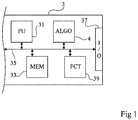
- the figure 1 represents, very schematically and in the form of blocks, an embodiment of an electronic circuit, or device 3 of the type of those fitted to a device and a consumable.
- the circuit 3 further comprises an authentication circuit or function 4 (ALGO) implementing an authentication method.
- AGO authentication circuit or function 4
- block 4 is a device executing hardware cryptographic functions (wired logic) in order, for example, to implement an authentication method.
- a signature or a code
- topography is meant here the arrangement of the components forming the circuit 3 on an electronic chip or on a substrate.
- behavior is meant that the electrical behavior of the circuit is identical during the execution of a calculation, of a program or of identical operations.
- the figure 2 represents, very schematically and in the form of blocks, an embodiment of a circuit 5 implementing a function used by the authentication circuit 4 which itself forms part of the circuit 3 of the figure 1 .
- circuit 5 is part of circuit 4.
- Circuit 5 is suitable for implementing a one-way function that can be used in an authentication method.
- Circuit 5 comprises different logic circuits 53 implementing cryptographic functions.
- Circuit 5 comprises at least two logic circuits 53 (three circuits 53 are shown in figure 3 ).
- Input and output nodes of these logic circuits 53 are digital points, or nodes, 51 of circuit 5, having high states, "1", or low states, "0".
- the nodes 51 can also be nodes internal to the logic circuits 53.
- the distribution of the digital nodes 51 depends on the topography of the circuit 5.
- the number of nodes 51 taken by the circuit 5 and whose electrical states are taken taken into account for the signature conditions the robustness of the calculated signature. For example, it is expected that the circuits 53 each provide 64 internal nodes to obtain a complex function.
- the circuits 53 are further used by the circuit 4 for other operations, for example, encryption operations, hash operations, etc.
- the distribution of the nodes 51 of the circuits 53 taken into account in the signature calculation depends on the application of the function of the circuit 5. The more the nodes are distributed in a large area of the circuit 3, the more the one-way function implemented. by circuit 5 is complex.
- the cryptographic function of block 551 is a function suitable for providing a result called code R from states of nodes 51. More generally, block 551 is suitable for implementing a family of functions capable of providing result R, for choose which function of the family of functions is implemented, the blocks 53 can receive a parameter P coming from the block 555. In other words, the parameter P makes it possible to configure the cryptographic function implemented by each block 53.
- the function, selected and implemented by block 551, can be used over several iterations, the number of which is managed by the function of block 553. According to one embodiment, at each new iteration, the code R or portions of the code R calculated at the previous iteration are injected into circuits 53 to modify their internal states and therefore their operation.
- the injection of the R code or of portions of the R code adds arguments to the functions implemented by the circuits 53, which therefore modifies the operation of said functions.
- the state of digital points 51 is therefore modified. The purpose of this is to make the calculation of the code R more complex.
- the signature calculation function performed by block 551 need not be complex. Indeed, the important thing is that the final signature Rf is produced by two authentication circuits identical. Thus, any calculation is suitable, for example a hash function, or even a direct comparison of a word representing all of the states taken. However, providing a combination or a cryptographic processing or a one-way function to calculate a signature increases the robustness of the authentication. More particularly, the function of block 551 is for example a one-way function, preferably a hash function. If the function of block 551 is not a one-way function, then at least one function of blocks 53 is a one-way function.
- the function for activating an authentication process of block 555 is a function making it possible to start a process for activating circuit 3 of the figure 1 .
- a method for authenticating the circuit consists in generating a signature, or a code, with the function implemented by the circuit 5.
- the circuits 53 are initialized by the processor 31, or else are left in their initial state.
- the states of the nodes 51 are in an initial state, and a first code R is loaded by the function of block 551 from these states.
- the R code of the previous iteration is used to modify the functions implemented by the blocks 53.
- the states of the nodes 51 are modified, and a new R code is generated from of these states and of the R code of the previous iteration.
- the figure 3 represents, very schematically and in the form of blocks, another embodiment of an authentication circuit 5 ′.
- the circuit 5 'of FIG. 5 comprises elements in common with the circuit 5 of the figure 3 . These elements will not be detailed again below.
- Circuit 5 ′ further comprises a block 557 (CLK CTRL) representing a function for managing different clock signals used by circuits 53 and by the function of block 551 of the figure 2 .
- Block 557 thus provides one or more clock signals CLK to circuits 53 and to block 551.
- the block 557 can receive information from the block 551, for example the code R or portions of the code R. This information can make it possible, for example, to modify the clock signals, for example by starting or not starting a new cycle, or by changing the frequencies of the clock signals. More particularly, the R code can be used to slow down or accelerate the executions of the functions implemented by the circuits 53, and thus modify the R code of the following iteration by modifying the states of the nodes 51.
- An advantage of this embodiment is that the use of the code R to modify the clock signals makes it possible to further complicate the obtaining of the final signature Rf.
- the figure 4 is a flowchart illustrating an embodiment of an example of an authentication method using one of the circuits 5 or 5 'described in relation with the figures 2 or 3 .
- this authentication method can be implemented by a product and a consumable.
- a step 61 (INITIAL STATE), the circuit 5 is brought into contact, wired or wireless, with another circuit which is identical to it, or which comprises parts of an identical authentication circuit.
- the authentication method is then started by the functions for activating the authentication method (block 555) of each circuit 3, for example by an exchange of a first datum.
- a first step is the initialization of the logic circuits of the blocks 53.
- a step 62 (INITIAL STATE ID), the functions making up the authentication device 55 are initialized.
- the selection parameter P of the function of block 551 is generated.
- a control signal requests the activation of the authentication mode of circuit 3.
- step 64 ID RDY
- step 64 ID RDY
- the next step is again step 62, otherwise (output Y of block 64) the next step is step 65.
- step 65 the authentication process begins.
- a step 66 the first code R is generated by the signature function of block 551, from the states of the digital points 51. The iterations then begin and the code is modified over the course of these, to finally provide the final signature Rf.
- step 67 (Cycle End?)
- the function of block 553 checks whether the number of iterations defined by the function of block 553 has been reached. If this is the case (output Y of block 67) the next step is a step 68 (COMP). If this is not the case (output N of block 67) then the next step is again step 66, and the signature function continues the iterations.
- step 68 the final signature Rf of circuit 3 is obtained, and it can be compared with the signature obtained in parallel by the circuit with which circuit 3 wishes to authenticate. If the two signatures are identical then the authentication succeeded, otherwise it failed.
- step 68 can be a step of linking to other calculations taking as input the final signature Rf.
- the embodiments described are simplified embodiments to expose the principles of the authentication performed.
- the calculations and the exchanges may be accompanied by any otherwise usual protective measure, for example symmetric or asymmetric encryption of the transmissions between the circuits to be authenticated.
- circuit 5 can be used in the same way as a one-way function, i.e., for example, for a circuit authentication method, for a authentication method. encryption of data, or for a method of hashing data.
Landscapes
- Engineering & Computer Science (AREA)
- Theoretical Computer Science (AREA)
- Computer Security & Cryptography (AREA)
- Physics & Mathematics (AREA)
- General Physics & Mathematics (AREA)
- Business, Economics & Management (AREA)
- General Engineering & Computer Science (AREA)
- Computer Hardware Design (AREA)
- Accounting & Taxation (AREA)
- Software Systems (AREA)
- Computer Networks & Wireless Communication (AREA)
- Finance (AREA)
- Signal Processing (AREA)
- Strategic Management (AREA)
- General Business, Economics & Management (AREA)
- Mathematical Physics (AREA)
- Economics (AREA)
- Entrepreneurship & Innovation (AREA)
- Marketing (AREA)
- Development Economics (AREA)
- Human Computer Interaction (AREA)
- General Health & Medical Sciences (AREA)
- Bioethics (AREA)
- Health & Medical Sciences (AREA)
- Semiconductor Integrated Circuits (AREA)
- Storage Device Security (AREA)
- Dc Digital Transmission (AREA)
- Detection And Prevention Of Errors In Transmission (AREA)
Abstract
Description
- La présente description concerne de façon générale les circuits et systèmes électroniques, et de façon plus particulière les dispositifs électronique adapté à mettre en oeuvre des fonctions à sens unique, utilisées, par exemple, dans un mécanisme de vérification de l'authenticité d'un produit associé à un consommable.
- La présence de consommables non authentiques d'un produit constitue un problème pour le fabriquant du produit et pour les fournisseurs autorisés des consommables authentiques, notamment lors de retours pour problèmes fonctionnels. Il est important de pouvoir distinguer les produits authentiques des produits non authentiques.
- Les procédés d'authentification ont pour rôle de vérifier que le consommable apparié au produit est bien authentique ou autorisé. Pour cela, les consommables et les produits associés sont équipés de circuits électroniques exécutant des protocoles de vérification d'authenticité lors d'une mise en place d'un nouveau consommable, voire périodiquement.
- Il serait souhaitable de pouvoir améliorer, au moins en partie, certains aspects des procédés d'authentification de produits et, plus particulièrement, certains aspects des procédés de mise en oeuvre de fonction utilisée dans les procédés d'authentification.
- Il existe un besoin pour des procédés d'authentification de produits plus performants et mieux sécurisés.
- Un mode de réalisation pallie tout ou partie des inconvénients des procédés d'authentification de produits connus.
- Un mode de réalisation prévoit un procédé de mise en oeuvre d'une première fonction à sens unique, faisant partie d'une famille de fonctions à sens unique, par un dispositif : dans lequel une deuxième fonction prend en compte des états de noeuds numériques répartis dans des circuits du dispositif mettant en oeuvre des troisièmes fonctions ; lesdits états des noeuds dépendent d'un résultat précédent de la première fonction ; et dans lequel la deuxième fonction et/ou les troisièmes fonctions sont des fonctions à sens unique.
- Selon un mode de réalisation, la première fonction est sélectionnée parmi ladite famille de fonctions à sens unique en utilisant un paramètre (P) fourni par une fonction d'activation (555) pour configurer les troisièmes fonctions.
- Selon un mode de réalisation, la première fonction est sélectionnée parmi ladite famille de fonctions à sens unique en utilisant le résultat R précédent pour influer sur la configuration des troisièmes fonctions.
- Selon un mode de réalisation, ledit résultat précédent de la première fonction influe sur les résultats des troisièmes fonctions.
- Selon un mode de réalisation, ledit résultat est utilisé, en outre, pour modifier des signaux d'horloge du dispositif.
- Selon un mode de réalisation, ledit résultat est utilisé, en outre, pour modifier des signaux d'horloge influant sur la mise en oeuvre des troisièmes fonctions.
- Un autre mode de réalisation prévoit un procédé d'authentification d'un premier dispositif électronique par un deuxième dispositif électronique, utilisant le procédé décrit précédemment.
- Un autre mode de réalisation prévoit un procédé de chiffrement utilisant le procédé décrit précédemment.
- Un autre mode de réalisation prévoit un procédé de hachage utilisant le procédé décrit précédemment.
- Un autre mode de réalisation prévoit un dispositif électronique comprenant un circuit adapté à mettre en oeuvre le procédé décrit précédemment.
- Selon un mode de réalisation, le dispositif est un consommable.
- Selon un mode de réalisation, le dispositif est adapté à mettre en oeuvre le procédé d'authentification décrit précédemment.
- Selon un mode de réalisation, le dispositif est adapté à mettre en oeuvre le procédé de chiffrement décrit précédemment.
- Selon un mode de réalisation, le dispositif est adapté à mettre en oeuvre le procédé de hachage décrit précédemment.
- Ces caractéristiques et avantages, ainsi que d'autres, seront exposés en détail dans la description suivante de modes de réalisation particuliers faite à titre non limitatif en relation avec les figures jointes parmi lesquelles :
- la
figure 1 représente, de façon très schématique et sous forme de blocs, un mode de réalisation d'un circuit électronique du type équipant un consommable et un produit ; - la
figure 2 représente, de façon très schématique et sous forme de blocs, un mode de réalisation d'un circuit faisant partie d'un circuit d'authentification ; - la
figure 3 représente, de façon très schématique et sous forme de blocs, un autre mode de réalisation du circuit de lafigure 2 ; et - la
figure 4 représente un organigramme illustrant un mode de réalisation d'un procédé d'authentification. - De mêmes éléments ont été désignés par de mêmes références dans les différentes figures. En particulier, les éléments structurels et/ou fonctionnels communs aux différents modes de réalisation peuvent présenter les mêmes références et peuvent disposer de propriétés structurelles, dimensionnelles et matérielles identiques.
- Par souci de clarté, seuls les étapes et éléments utiles à la compréhension des modes de réalisation décrits ont été représentés et sont détaillés.
- Sauf précision contraire, lorsque l'on fait référence à deux éléments connectés entre eux, cela signifie directement connectés sans éléments intermédiaires autres que des conducteurs, et lorsque l'on fait référence à deux éléments reliés ou couplés entre eux, cela signifie que ces deux éléments peuvent être connectés ou être reliés ou couplés par l'intermédiaire d'un ou plusieurs autres éléments.
- Dans la description qui suit, lorsque l'on fait référence à des qualificatifs de position absolue, tels que les termes "avant", "arrière", "haut", "bas", "gauche", "droite", etc., ou relative, tels que les termes "dessus", "dessous", "supérieur", "inférieur", etc., ou à des qualificatifs d'orientation, tels que les termes "horizontal", "vertical", etc., il est fait référence sauf précision contraire à l'orientation des figures.
- Sauf précision contraire, les expressions "environ", "approximativement", "sensiblement", et "de l'ordre de" signifient à 10 % près, de préférence à 5 % près.
- Dans la suite de la description, on appellera un consommable, un dispositif électronique adapté à être couplé à un produit électronique pour fonctionner. Les consommables sont généralement interchangeables une fois leur utilisation terminée. A titre d'exemple, une carte mémoire est un consommable vis-à-vis d'un appareil photo numérique. Il en est de même pour une cartouche d'encre vis-à-vis d'une imprimante, d'une batterie interchangeable vis-à-vis d'un téléphone portable, une cartouche de liquide vis-à-vis d'une cigarette électronique, une cartouche de jeu vidéo vis-à-vis d'une console. Les modes de réalisation décrits en relation avec les
figures 1 à 4 sont applicables à tout couple consommable-produit. - La
figure 1 représente, de façon très schématique et sous forme de blocs, un mode de réalisation d'un circuit, ou dispositif, électronique 3 du type de ceux équipant un dispositif et un consommable. - Le circuit 3 comprend :
- une entité de calcul 31 (PU), par exemple une machine d'états, un microprocesseur, un circuit logique programmable, etc. ;
- une ou plusieurs zones 33 (MEM) de stockage volatile et/ou non volatile pour stocker tout ou partie des données et programmes ;
- un ou plusieurs bus 35 de données, d'adresses et/ou de commandes entre les différents éléments internes au circuit 3 ;
- une interface d'entrée-sortie 37 (I/O) de communication avec l'extérieur du circuit 3 ; et
- divers autres circuits en fonction de l'application, symbolisés en
figure 1 par un bloc 39 (FCT). - Selon le mode de réalisation représenté, le circuit 3 comprend en outre un circuit ou une fonction d'authentification 4 (ALGO) mettant en oeuvre un procédé d'authentification. Pour cela, le bloc 4 est un dispositif exécutant des fonctions cryptographiques de façon matérielle (logique câblée) pour, par exemple, mettre en oeuvre un procédé d'authentification.
- On prévoit un mécanisme d'authentification basé sur une signature, ou un code, qui a la particularité d'être liée à la topographie du circuit intégré ou de la partie du circuit participant à l'authentification et exécutant cette signature. On fera par la suite référence au circuit d'authentification mais ce qui est décrit peut ne concerner qu'une partie de ce circuit. Par topographie, on entendra ici la disposition des composants formant le circuit 3 sur une puce électronique ou sur un substrat.
- On prévoit également d'équiper des produits et des consommables de circuits d'authentification identiques, c'est-à-dire présentant des topographies identiques, de façon qu'un traitement exécuté sur un des circuits se traduise, lorsqu'il est exécuté sur l'autre circuit, par un comportement identique de ce dernier. Par comportement, on entend que le comportement électrique du circuit est identique lors de l'exécution d'un calcul, d'un programme ou d'opérations identiques.
- La
figure 2 représente, très schématiquement et sous forme de blocs, un mode de réalisation d'un circuit 5 mettant en oeuvre une fonction utilisée par le circuit d'authentification 4 faisant lui-même partie du circuit 3 de lafigure 1 . Autrement dit, le circuit 5 fait partie du circuit 4. - Le circuit 5 est adapté à mettre en oeuvre une fonction à sens unique pouvant être utilisés dans un procédé d'authentification.
- Le circuit 5 comprend différents circuits logiques 53 mettant en oeuvre des fonctions cryptographiques. Le circuit 5 comprend au moins deux circuits logiques 53 (trois circuits 53 sont représentées en
figure 3 ). Plus le circuit 5 comprend de circuits logiques 53, plus la fonction mise en oeuvre par le circuit 5 est complexe. Des noeuds d'entrée et de sortie de ces circuits logiques 53 sont des points, ou noeuds, numériques 51 du circuit 5, ayant des états haut, "1", ou des états bas, "0". A titre de variante, les noeuds 51 peuvent être aussi des noeuds internes aux circuits logiques 53. La répartition des noeuds numériques 51 dépend de la topographie du circuit 5. Le nombre de noeuds 51 prélevés par le circuit 5 et dont les états électriques sont pris en compte pour la signature conditionne la robustesse de la signature calculée. Par exemple, on prévoit que les circuits 53 fournissent chacun 64 noeuds internes pour obtenir une fonction complexe. - Les circuits 53 sont, en outre, utilisé par le circuit 4 pour d'autres opérations, par exemple, des opérations de chiffrement, des opérations de hachage, etc. La répartition des noeuds 51 des circuits 53 pris en compte dans le calcul de signature dépend de l'application de la fonction du circuit 5. Plus les noeuds sont répartis dans une surface importante du circuit 3, plus la fonction à sens unique mise en oeuvre par le circuit 5 est complexe.
- Le circuit 5 comprend, en outre, un dispositif principal représenté par un bloc 55 (ID). Le dispositif 55 comprend plus particulièrement :
- un bloc 551 (ONE-WAY) représentant une fonction cryptographique ;
- un bloc 553 (CYCLE) représentant une fonction de gestion d'un compte de cycles, ou d'itérations ; et
- un bloc 555 (ID MODE) représentant une fonction d'activation d'un procédé d'authentification.
- La fonction cryptographique du bloc 551 est une fonction adaptée à fournir un résultat appelé code R à partir d'états des noeuds 51. Plus généralement, le bloc 551 est adapté à mettre en oeuvre une famille de fonctions capables de fournir le résultat R, pour choisir quelle fonction de la famille de fonctions est mise en oeuvre, les blocs 53 peuvent recevoir un paramètre P provenant du bloc 555. Autrement dit, le paramètre P permet de configurer la fonction cryptographique mise en oeuvre par chaque bloc 53. La fonction, sélectionnée et mise en oeuvre par le bloc 551, peut être utilisée sur plusieurs itérations, dont le nombre est géré par la fonction du bloc 553. Selon un mode de réalisation, à chaque nouvelle itération, le code R ou des portions du code R calculées à l'itération précédente sont injectées dans les circuits 53 pour modifier leurs états internes et donc leur fonctionnement. Plus particulièrement, l'injection du code R ou de portions du code R ajoute des arguments aux fonctions mises en oeuvre par les circuits 53 ce qui en modifie donc le fonctionnement desdites fonctions. L'état des points numériques 51 en est donc modifié. Cela a pour but de complexifier le calcul du code R. Une fois les itérations terminées, la fonction du circuit 5 fournit une signature finale Rf.
- Lorsque la fonction du circuit 5 est utilisée pour un procédé d'authentification, la fonction de calcul de signature exécutée par le bloc 551 n'a pas besoin d'être complexe. En effet, l'important est que la signature finale Rf soit produite par deux circuits d'authentification identiques. Ainsi, n'importe quel calcul convient, par exemple une fonction de hachage, voire même une comparaison directe d'un mot représentant l'ensemble des états prélevés. Toutefois, prévoir une combinaison ou un traitement cryptographique ou une fonction à sens unique pour calculer une signature accroit la robustesse de l'authentification. Plus particulièrement, la fonction du bloc 551 est par exemple une fonction à sens unique de préférence une fonction de hachage. Si la fonction du bloc 551 n'est pas une fonction à sens unique, alors au moins une fonction des blocs 53 est une fonction à sens unique.
- La fonction d'activation d'un procédé d'authentification du bloc 555 est une fonction permettant de démarrer un procédé d'activation du circuit 3 de la
figure 1 . - Dans cet exemple, un procédé d'authentification du circuit consiste à générer une signature, ou un code, avec la fonction mise en oeuvre par le circuit 5. Lors d'une phase initiale, ou première itération, les circuits 53 sont initialisés par le processeur 31, ou alors sont laissés dans leur état initial. Ainsi, les états des noeuds 51 sont à un état initial, et un premier code R est chargé par la fonction du bloc 551 à partir de ces états. Pendant les itérations suivantes, le code R de l'itération précédente est utilisé pour modifier les fonctions mises en oeuvre par les blocs 53. Ainsi, à chaque itération, les états des noeuds 51 sont modifiés, et un nouveau code R est généré à partir de ces états et du code R de l'itération précédente.
- La
figure 3 représente, très schématiquement et sous forme de blocs, un autre mode de réalisation d'un circuit d'authentification 5'. - Le circuit 5' de la figure 5 comprends des éléments communs avec le circuit 5 de la
figure 3 . Ces éléments ne seront pas détaillés à nouveau ci-après. - Le circuit 5' comprend, en outre, un bloc 557 (CLK CTRL) représentant une fonction de gestion de différents signaux d'horloges utilisés par les circuits 53 et par la fonction du bloc 551 de la
figure 2 . Le bloc 557 fournit ainsi un ou plusieurs signaux d'horloge CLK aux circuits 53 et au bloc 551. - Le bloc 557 peut recevoir des informations du bloc 551, par exemple le code R ou des portions du code R. Ces informations peuvent permettre, par exemple, de modifier les signaux d'horloge, par exemple en déclenchant ou non un nouveau cycle, ou en modifiant les fréquences des signaux d'horloge. Plus particulièrement, le code R peut être utilisé pour ralentir ou accélérer les exécutions des fonctions mises en oeuvre par les circuits 53, et ainsi modifier le code R de l'itération suivante en modifiant les états des noeuds 51.
- Un avantage de ce mode de réalisation est que l'utilisation du code R pour modifier les signaux d'horloge permet de complexifier encore l'obtention de la signature finale Rf.
- La
figure 4 est un organigramme illustrant un mode de mise en oeuvre d'un exemple de procédé d'authentification utilisant l'un des circuits 5 ou 5' décrits en relation avec lesfigures 2 ou3 . A titre d'exemple, ce procédé d'authentification peut être mise en oeuvre par un produit et un consommable. - A une étape 61 (INITIAL STATE), le circuit 5 est mis en contact, filaire ou sans fil, avec un autre circuit qui lui est identique, ou qui comprend des parties d'un circuit d'authentification identiques. Le procédé d'authentification est alors démarré par les fonctions d'activation du procédé d'authentification (bloc 555) de chaque circuit 3, par exemple par un échange d'une première donnée. Une première étape est l'initialisation des circuits logiques des blocs 53.
- A une étape 62 (INITIAL STATE ID), les fonctions composant le dispositif d'authentification 55 sont initialisées. A titre d'exemple, le paramètre P de sélection de la fonction du bloc 551 est généré.
- A une étape 63 (ID ENABLE), un signal de commande demande l'activation du mode d'authentification du circuit 3.
- A une étape 64 (ID RDY), il est vérifié si le mode d'authentification est prêt à être utilisé. Si l'activation de ce mode n'est pas possible (sortie N du bloc 64) alors l'étape suivante est à nouveau l'étape 62, sinon (sortie Y du bloc 64) l'étape suivante est l'étape 65.
- A l'étape 65 (START ID), le procédé d'authentification commence.
- A une étape 66 (R DET), le premier code R est généré par la fonction de signature du bloc 551, à partir des états des points numériques 51. Les itérations commencent alors et le code est modifié au fil de celles-ci, pour fournir finalement la signature finale Rf.
- A une étape 67 (Cycle End ?), la fonction du bloc 553 vérifie si le nombre d'itérations défini par la fonction du bloc 553 est atteint. Si c'est le cas (sortie Y du bloc 67) l'étape suivante est une étape 68 (COMP). Si ce n'est pas le cas (sortie N du bloc 67) alors l'étape suivante est à nouveau l'étape 66, et la fonction de signature continue les itérations.
- A l'étape 68, la signature finale Rf du circuit 3 est obtenue, et elle peut être comparée à la signature obtenue parallèlement par le circuit auprès duquel le circuit 3 souhaite s'authentifier. Si les deux signatures sont identiques alors l'authentification a réussi, sinon elle a échoué.
- Selon une variante de réalisation, l'étape 68 peut être une étape de liaison vers d'autres calculs prenant en entrée la signature finale Rf.
- Divers modes de réalisation et variantes ont été décrits. L'homme de l'art comprendra que certaines caractéristiques de ces divers modes de réalisation et variantes pourraient être combinées, et d'autres variantes apparaitront à l'homme de l'art.
- Les modes de réalisation décrits sont des modes de réalisation simplifiés pour exposer les principes de l'authentification réalisée. Les calculs et les échanges pourront s'accompagner de toute mesure de protection par ailleurs usuelle, par exemple un chiffrement symétrique ou asymétrique des transmissions entre les circuits à authentifier.
- De plus, la fonction à sens unique du circuit 5 peut être utilisé de la même façon qu'une fonction à sens unique, c'est-à-dire, par exemple, pour un procédé d'authentification de circuit, pour un procédé de chiffrement de données, ou pour un procédé de hachage de données.
Claims (14)
- Procédé de mise en oeuvre d'une première fonction à sens unique, faisant partie d'une famille de fonctions à sens unique, par un dispositif (3) dans lequel :- une deuxième fonction (551) prend en compte des états de noeuds numériques (51) répartis dans des circuits (53) du dispositif (3) mettant en oeuvre des troisièmes fonctions ;- lesdits états des noeuds (51) dépendent d'un résultat (R) précédent de la deuxième fonction ; et- dans lequel la deuxième fonction (551) et/ou les troisièmes fonctions sont des fonctions à sens unique.
- Procédé selon la revendication 1, dans lequel la première fonction est sélectionnée parmi ladite famille de fonctions à sens unique en utilisant un paramètre (P) fourni par une fonction d'activation (555) pour configurer les troisièmes fonctions.
- Procédé selon la revendication 1 ou 2, dans lequel la première fonction est sélectionnée parmi ladite famille de fonctions à sens unique en utilisant le résultat R précédent pour influer sur la configuration des troisièmes fonctions.
- Procédé selon l'une quelconque des revendications 1 à 3, dans lequel ledit résultat (R) précédent de la première fonction influe sur le résultat des troisièmes fonctions.
- Procédé selon l'une quelconque des revendications 1 à 4, dans lequel ledit résultat (R) est utilisé, en outre, pour modifier des signaux d'horloge du dispositif (3).
- Procédé selon la revendication 5, dans lequel ledit résultat (R) est utilisé, en outre, pour modifier des signaux d'horloge influant sur les troisièmes fonctions.
- Procédé d'authentification d'un premier dispositif électronique par un deuxième dispositif électronique, utilisant le procédé selon l'une quelconque des revendications 1 à 6.
- Procédé de chiffrement utilisant le procédé selon l'une quelconque des revendications 1 à 6.
- Procédé de hachage utilisant le procédé selon l'une quelconque des revendications 1 à 6.
- Dispositif électronique (3) comprenant un circuit adapté à mettre en oeuvre le procédé selon l'une quelconque des revendications 1 à 6.
- Dispositif selon la revendication 10, étant un consommable.
- Dispositif selon la revendication 10 ou 11, étant adapté à mettre en oeuvre le procédé selon la revendication 7.
- Dispositif selon la revendication 10 ou 11, étant adapté à mettre en oeuvre le procédé selon la revendication 8.
- Dispositif selon la revendication 10 ou 11, étant adapté à mettre en oeuvre le procédé selon la revendication 9.
Applications Claiming Priority (1)
| Application Number | Priority Date | Filing Date | Title |
|---|---|---|---|
| FR1907911A FR3098949B1 (fr) | 2019-07-15 | 2019-07-15 | Fonction à sens unique |
Publications (2)
| Publication Number | Publication Date |
|---|---|
| EP3767504A1 true EP3767504A1 (fr) | 2021-01-20 |
| EP3767504B1 EP3767504B1 (fr) | 2026-04-22 |
Family
ID=68806909
Family Applications (1)
| Application Number | Title | Priority Date | Filing Date |
|---|---|---|---|
| EP20184643.3A Active EP3767504B1 (fr) | 2019-07-15 | 2020-07-08 | Fonction a sens unique |
Country Status (4)
| Country | Link |
|---|---|
| US (1) | US11663365B2 (fr) |
| EP (1) | EP3767504B1 (fr) |
| CN (1) | CN112231677B (fr) |
| FR (1) | FR3098949B1 (fr) |
Citations (3)
| Publication number | Priority date | Publication date | Assignee | Title |
|---|---|---|---|---|
| EP1430391A2 (fr) * | 2001-09-26 | 2004-06-23 | Intel Corporation | Generateur de nombres pseudo-aleatoires fonde sur le hachage |
| EP1840731A2 (fr) * | 2006-03-31 | 2007-10-03 | Sap Ag | Système et procédé pour générer des nombres pseudo-aléatoires |
| US20160164672A1 (en) * | 2014-12-08 | 2016-06-09 | Open-Silicon Inc. | High speed and low power hashing system and method |
Family Cites Families (34)
| Publication number | Priority date | Publication date | Assignee | Title |
|---|---|---|---|---|
| FR2566327B1 (fr) | 1984-06-25 | 1989-06-02 | Epson Corp | Imprimante |
| JP3483991B2 (ja) | 1995-07-27 | 2004-01-06 | 沖電気工業株式会社 | 符号分割多重アクセス通信用拡散符号発生器、符号分割多重アクセス通信システム及び符号分割多重アクセス通信用拡散符号発生方法 |
| AUPO799197A0 (en) | 1997-07-15 | 1997-08-07 | Silverbrook Research Pty Ltd | Image processing method and apparatus (ART01) |
| AUPO797897A0 (en) | 1997-07-15 | 1997-08-07 | Silverbrook Research Pty Ltd | Media device (ART18) |
| US7716098B2 (en) * | 1997-07-15 | 2010-05-11 | Silverbrook Research Pty Ltd. | Method and apparatus for reducing optical emissions in an integrated circuit |
| US7249108B1 (en) | 1997-07-15 | 2007-07-24 | Silverbrook Research Pty Ltd | Validation protocol and system |
| AU2001231441B2 (en) | 2000-02-15 | 2004-02-05 | Memjet Technology Limited | Consumable authentication protocol and system |
| FR2841020A1 (fr) | 2002-06-13 | 2003-12-19 | St Microelectronics Sa | Authentification d'une etiquette electronique |
| US7082583B2 (en) | 2002-11-20 | 2006-07-25 | Lsi Logic Corporation | Method for reducing a parasitic graph in moment computation in VLSI systems |
| US6950368B2 (en) | 2003-02-25 | 2005-09-27 | Micron Technology, Inc. | Low-voltage sense amplifier and method |
| JP2005073053A (ja) | 2003-08-26 | 2005-03-17 | Sanyo Electric Co Ltd | Id確認装置、id発生装置及び認証システム |
| US7557941B2 (en) * | 2004-05-27 | 2009-07-07 | Silverbrook Research Pty Ltd | Use of variant and base keys with three or more entities |
| JP5471432B2 (ja) | 2009-12-25 | 2014-04-16 | 富士通株式会社 | 検証支援プログラム、および検証支援装置 |
| US9667626B2 (en) | 2010-01-27 | 2017-05-30 | Keypasco Ab | Network authentication method and device for implementing the same |
| US8966264B2 (en) | 2010-05-28 | 2015-02-24 | Nec Corporation | Signature generation apparatus, signature method, non-transitory computer readable medium storing signature generation program |
| US8839459B2 (en) | 2010-09-22 | 2014-09-16 | Qualcomm Incorporated | Product authentication using end-to-end cryptographic scheme |
| WO2012063617A1 (fr) * | 2010-11-11 | 2012-05-18 | Seiko Epson Corporation | Imprimante fiscale |
| CN102571347B (zh) | 2011-12-16 | 2016-05-25 | 华为技术有限公司 | 现场可更换单元的校验方法、装置和通信设备 |
| BR112015017602A2 (pt) | 2013-01-28 | 2017-07-11 | Koninklijke Philips Nv | aparelho para determinar dados médicos para uma primeira imagem com o uso de processamento de imagens, método para determinar dados médicos para uma primeira imagem com o uso de processamento de imagens, e produto de programa de computador |
| US9104140B2 (en) | 2013-03-15 | 2015-08-11 | Ologn Technologies Ag | Systems, methods and apparatuses for authorized use and refill of a printer cartridge |
| US20150081579A1 (en) | 2013-08-26 | 2015-03-19 | Prepared Response, Inc. | System for conveying data to responders and routing, reviewing and approving supplemental pertinent data |
| PL3022059T5 (pl) | 2013-08-30 | 2025-03-17 | Hewlett-Packard Development Company, L.P. | Uwierzytelnianie wkładów uzupełniających za pomocą odpowiedzi na wezwanie czasowe |
| US9363085B2 (en) * | 2013-11-25 | 2016-06-07 | Seagate Technology Llc | Attestation of data sanitization |
| WO2015119614A1 (fr) | 2014-02-06 | 2015-08-13 | Hewlett-Packard Development Company, L.P. | Enregistrement d'un utilisateur par un service d'abonnement au moyen d'une imprimante compatible avec un réseau |
| IL231550A0 (en) | 2014-03-17 | 2014-08-31 | Nuvoton Technology Corp | Saving secure information in external memory |
| US10255627B2 (en) | 2014-08-22 | 2019-04-09 | Ca, Inc. | Service broker for service-oriented architecture |
| FI126901B (en) | 2014-09-12 | 2017-07-31 | Enics Ag | Method and system for testing an electronic unit |
| WO2017003331A1 (fr) | 2015-06-30 | 2017-01-05 | Telefonaktiebolaget Lm Ericsson (Publ) | Procédés et dispositifs de traitement de signatures de données basées sur des arbres de hachage |
| US9660978B1 (en) | 2016-08-08 | 2017-05-23 | ISARA Corporation | Using a digital certificate with multiple cryptosystems |
| KR101831604B1 (ko) | 2016-10-31 | 2018-04-04 | 삼성에스디에스 주식회사 | 데이터 전송 방법, 인증 방법 및 이를 수행하기 위한 서버 |
| GB2566741A (en) | 2017-09-26 | 2019-03-27 | Phm Associates Ltd | Integrity of data records |
| FR3076923A1 (fr) | 2018-01-16 | 2019-07-19 | Stmicroelectronics (Rousset) Sas | Procede et circuit d'authentification |
| FR3076925B1 (fr) * | 2018-01-16 | 2020-01-24 | Proton World International N.V. | Fonction cryptographique |
| CN109583820B (zh) * | 2018-12-19 | 2021-04-20 | 东莞市盟大塑化科技有限公司 | 一种基于区块链技术的货物跟踪方法 |
-
2019
- 2019-07-15 FR FR1907911A patent/FR3098949B1/fr active Active
-
2020
- 2020-07-08 EP EP20184643.3A patent/EP3767504B1/fr active Active
- 2020-07-14 US US16/928,901 patent/US11663365B2/en active Active
- 2020-07-14 CN CN202010676745.5A patent/CN112231677B/zh active Active
Patent Citations (3)
| Publication number | Priority date | Publication date | Assignee | Title |
|---|---|---|---|---|
| EP1430391A2 (fr) * | 2001-09-26 | 2004-06-23 | Intel Corporation | Generateur de nombres pseudo-aleatoires fonde sur le hachage |
| EP1840731A2 (fr) * | 2006-03-31 | 2007-10-03 | Sap Ag | Système et procédé pour générer des nombres pseudo-aléatoires |
| US20160164672A1 (en) * | 2014-12-08 | 2016-06-09 | Open-Silicon Inc. | High speed and low power hashing system and method |
Also Published As
| Publication number | Publication date |
|---|---|
| US20210019448A1 (en) | 2021-01-21 |
| FR3098949A1 (fr) | 2021-01-22 |
| FR3098949B1 (fr) | 2023-10-06 |
| CN112231677A (zh) | 2021-01-15 |
| CN112231677B (zh) | 2025-03-11 |
| EP3767504B1 (fr) | 2026-04-22 |
| US11663365B2 (en) | 2023-05-30 |
Similar Documents
| Publication | Publication Date | Title |
|---|---|---|
| EP3511854B1 (fr) | Procédé et circuit d'authentification | |
| US20240202707A1 (en) | Trust wallet | |
| EP4068128B1 (fr) | Démarrage sécurisé d'une unité de traitement | |
| EP4068134B1 (fr) | Débogage sécurisé | |
| FR2969876A1 (fr) | Procede d'authentification multimodale a seuil et generation de cle unimodale | |
| EP3767504B1 (fr) | Fonction a sens unique | |
| EP2941843B1 (fr) | Procede de traitement comparatif securise | |
| EP3512153A1 (fr) | Fonction cryptographique et authentification de composant remplaçable pour imprimante | |
| EP1493078B8 (fr) | Procédé cryptographique protégé contre les attaques de type à canal caché | |
| FR2969875A1 (fr) | Procede et systeme pour l'authentification multi-modale multi-seuil utilisant le partage de secret | |
| FR3147030A1 (fr) | Identification d'une application | |
| FR3065550A1 (fr) | Procede d'echange protege de donnees entre deux taches | |
| EP4488833B1 (fr) | Configuration d'une mémoire | |
| FR3121765A1 (fr) | Procédé d'authentification | |
| EP3295297B1 (fr) | Procede de securisation d'une comparaison de donnees lors de l'execution d'un programme | |
| EP3893135A1 (fr) | Procédé d'authentification | |
| EP4390734A1 (fr) | Procede de configuration | |
| EP1591866B1 (fr) | Contrôle de l'exécution d'un algorithme par un circuit intégré | |
| FR3160081A1 (fr) | Génération d'un vecteur uniformément aléatoire | |
| EP3179400B1 (fr) | Procédé de chargement d'une ressource informatique au sein d'un dispositif électronique, module électronique et programme d'ordinateur correspondant | |
| EP4246877A1 (fr) | Generation securisee de clefs d'appairage | |
| EP4307143A1 (fr) | Procede et circuit pour la verification de l'integrite d'un logiciel | |
| EP4614379A1 (fr) | Procede de selection de programmes de demarrage | |
| EP4338078A1 (fr) | Procédé pour l'exécution d'un programme charge dans la mémoire non volatile d'un microcontrôleur en circuit intégré | |
| FR3157600A1 (fr) | Méthode de contrôle d’exécution d’un programme d’ordinateur |
Legal Events
| Date | Code | Title | Description |
|---|---|---|---|
| PUAI | Public reference made under article 153(3) epc to a published international application that has entered the european phase |
Free format text: ORIGINAL CODE: 0009012 |
|
| STAA | Information on the status of an ep patent application or granted ep patent |
Free format text: STATUS: REQUEST FOR EXAMINATION WAS MADE |
|
| 17P | Request for examination filed |
Effective date: 20200708 |
|
| AK | Designated contracting states |
Kind code of ref document: A1 Designated state(s): AL AT BE BG CH CY CZ DE DK EE ES FI FR GB GR HR HU IE IS IT LI LT LU LV MC MK MT NL NO PL PT RO RS SE SI SK SM TR |
|
| AX | Request for extension of the european patent |
Extension state: BA ME |
|
| STAA | Information on the status of an ep patent application or granted ep patent |
Free format text: STATUS: EXAMINATION IS IN PROGRESS |
|
| 17Q | First examination report despatched |
Effective date: 20221208 |
|
| GRAP | Despatch of communication of intention to grant a patent |
Free format text: ORIGINAL CODE: EPIDOSNIGR1 |
|
| STAA | Information on the status of an ep patent application or granted ep patent |
Free format text: STATUS: GRANT OF PATENT IS INTENDED |
|
| RIC1 | Information provided on ipc code assigned before grant |
Ipc: G06F 21/44 20130101AFI20251110BHEP Ipc: H04L 9/06 20060101ALI20251110BHEP Ipc: H04L 9/32 20060101ALI20251110BHEP Ipc: G06Q 30/00 20120101ALI20251110BHEP Ipc: G06Q 30/018 20230101ALI20251110BHEP Ipc: G06Q 20/36 20120101ALI20251110BHEP Ipc: G06Q 20/40 20120101ALI20251110BHEP Ipc: G07F 7/12 20060101ALI20251110BHEP |
|
| INTG | Intention to grant announced |
Effective date: 20251127 |
|
| GRAS | Grant fee paid |
Free format text: ORIGINAL CODE: EPIDOSNIGR3 |
|
| GRAA | (expected) grant |
Free format text: ORIGINAL CODE: 0009210 |
|
| STAA | Information on the status of an ep patent application or granted ep patent |
Free format text: STATUS: THE PATENT HAS BEEN GRANTED |
|
| AK | Designated contracting states |
Kind code of ref document: B1 Designated state(s): AL AT BE BG CH CY CZ DE DK EE ES FI FR GB GR HR HU IE IS IT LI LT LU LV MC MK MT NL NO PL PT RO RS SE SI SK SM TR |
|
| REG | Reference to a national code |
Ref country code: CH Ref legal event code: F10 Free format text: ST27 STATUS EVENT CODE: U-0-0-F10-F00 (AS PROVIDED BY THE NATIONAL OFFICE) Effective date: 20260422 Ref country code: GB Ref legal event code: FG4D Free format text: NOT ENGLISH |
|
| REG | Reference to a national code |
Ref country code: DE Ref legal event code: R096 Ref document number: 602020070665 Country of ref document: DE |
|
| REG | Reference to a national code |
Ref country code: IE Ref legal event code: FG4D Free format text: LANGUAGE OF EP DOCUMENT: FRENCH |