EP3767246B1 - Attack detection device, attack detection program, and attack detection method - Google Patents
Attack detection device, attack detection program, and attack detection method Download PDFInfo
- Publication number
- EP3767246B1 EP3767246B1 EP18916952.7A EP18916952A EP3767246B1 EP 3767246 B1 EP3767246 B1 EP 3767246B1 EP 18916952 A EP18916952 A EP 18916952A EP 3767246 B1 EP3767246 B1 EP 3767246B1
- Authority
- EP
- European Patent Office
- Prior art keywords
- sensor
- sensors
- attack
- threshold value
- intermediate values
- Prior art date
- Legal status (The legal status is an assumption and is not a legal conclusion. Google has not performed a legal analysis and makes no representation as to the accuracy of the status listed.)
- Active
Links
Images





Classifications
-
- G—PHYSICS
- G06—COMPUTING OR CALCULATING; COUNTING
- G06F—ELECTRIC DIGITAL DATA PROCESSING
- G06F21/00—Security arrangements for protecting computers, components thereof, programs or data against unauthorised activity
- G06F21/50—Monitoring users, programs or devices to maintain the integrity of platforms, e.g. of processors, firmware or operating systems
- G06F21/55—Detecting local intrusion or implementing counter-measures
- G06F21/56—Computer malware detection or handling, e.g. anti-virus arrangements
- G06F21/566—Dynamic detection, i.e. detection performed at run-time, e.g. emulation, suspicious activities
-
- G—PHYSICS
- G01—MEASURING; TESTING
- G01D—MEASURING NOT SPECIALLY ADAPTED FOR A SPECIFIC VARIABLE; ARRANGEMENTS FOR MEASURING TWO OR MORE VARIABLES NOT COVERED IN A SINGLE OTHER SUBCLASS; TARIFF METERING APPARATUS; MEASURING OR TESTING NOT OTHERWISE PROVIDED FOR
- G01D3/00—Indicating or recording apparatus with provision for the special purposes referred to in the subgroups
- G01D3/08—Indicating or recording apparatus with provision for the special purposes referred to in the subgroups with provision for safeguarding the apparatus, e.g. against abnormal operation, against breakdown
-
- G—PHYSICS
- G01—MEASURING; TESTING
- G01C—MEASURING DISTANCES, LEVELS OR BEARINGS; SURVEYING; NAVIGATION; GYROSCOPIC INSTRUMENTS; PHOTOGRAMMETRY OR VIDEOGRAMMETRY
- G01C21/00—Navigation; Navigational instruments not provided for in groups G01C1/00 - G01C19/00
- G01C21/10—Navigation; Navigational instruments not provided for in groups G01C1/00 - G01C19/00 by using measurements of speed or acceleration
- G01C21/12—Navigation; Navigational instruments not provided for in groups G01C1/00 - G01C19/00 by using measurements of speed or acceleration executed aboard the object being navigated; Dead reckoning
- G01C21/16—Navigation; Navigational instruments not provided for in groups G01C1/00 - G01C19/00 by using measurements of speed or acceleration executed aboard the object being navigated; Dead reckoning by integrating acceleration or speed, i.e. inertial navigation
-
- G—PHYSICS
- G01—MEASURING; TESTING
- G01C—MEASURING DISTANCES, LEVELS OR BEARINGS; SURVEYING; NAVIGATION; GYROSCOPIC INSTRUMENTS; PHOTOGRAMMETRY OR VIDEOGRAMMETRY
- G01C25/00—Manufacturing, calibrating, cleaning, or repairing instruments or devices referred to in the other groups of this subclass
-
- G—PHYSICS
- G01—MEASURING; TESTING
- G01C—MEASURING DISTANCES, LEVELS OR BEARINGS; SURVEYING; NAVIGATION; GYROSCOPIC INSTRUMENTS; PHOTOGRAMMETRY OR VIDEOGRAMMETRY
- G01C9/00—Measuring inclination, e.g. by clinometers, by levels
- G01C9/02—Details
-
- G—PHYSICS
- G01—MEASURING; TESTING
- G01D—MEASURING NOT SPECIALLY ADAPTED FOR A SPECIFIC VARIABLE; ARRANGEMENTS FOR MEASURING TWO OR MORE VARIABLES NOT COVERED IN A SINGLE OTHER SUBCLASS; TARIFF METERING APPARATUS; MEASURING OR TESTING NOT OTHERWISE PROVIDED FOR
- G01D21/00—Measuring or testing not otherwise provided for
-
- G—PHYSICS
- G01—MEASURING; TESTING
- G01P—MEASURING LINEAR OR ANGULAR SPEED, ACCELERATION, DECELERATION, OR SHOCK; INDICATING PRESENCE, ABSENCE, OR DIRECTION, OF MOVEMENT
- G01P21/00—Testing or calibrating of apparatus or devices covered by the preceding groups
-
- G—PHYSICS
- G06—COMPUTING OR CALCULATING; COUNTING
- G06F—ELECTRIC DIGITAL DATA PROCESSING
- G06F21/00—Security arrangements for protecting computers, components thereof, programs or data against unauthorised activity
- G06F21/50—Monitoring users, programs or devices to maintain the integrity of platforms, e.g. of processors, firmware or operating systems
- G06F21/55—Detecting local intrusion or implementing counter-measures
- G06F21/554—Detecting local intrusion or implementing counter-measures involving event detection and direct action
-
- G—PHYSICS
- G06—COMPUTING OR CALCULATING; COUNTING
- G06F—ELECTRIC DIGITAL DATA PROCESSING
- G06F21/00—Security arrangements for protecting computers, components thereof, programs or data against unauthorised activity
- G06F21/50—Monitoring users, programs or devices to maintain the integrity of platforms, e.g. of processors, firmware or operating systems
- G06F21/55—Detecting local intrusion or implementing counter-measures
- G06F21/56—Computer malware detection or handling, e.g. anti-virus arrangements
- G06F21/567—Computer malware detection or handling, e.g. anti-virus arrangements using dedicated hardware
-
- G—PHYSICS
- G06—COMPUTING OR CALCULATING; COUNTING
- G06F—ELECTRIC DIGITAL DATA PROCESSING
- G06F2221/00—Indexing scheme relating to security arrangements for protecting computers, components thereof, programs or data against unauthorised activity
- G06F2221/03—Indexing scheme relating to G06F21/50, monitoring users, programs or devices to maintain the integrity of platforms
- G06F2221/034—Test or assess a computer or a system
Definitions
- the present invention relates to an attack detection device, an attack detection program, and an attack detection method.
- An inclination sensor is often used for attitude measurement or attitude control of an aircraft and heavy equipment.
- an inclination sensor called an attitude heading reference system (AHRS) is referred to as an inertial measurement unit.
- the AHRS is composed of an acceleration sensor, a gyroscope sensor, a magnetic sensor (compass), and a processor.
- the processor performs signal processing on various types of sensor data and outputs inclination data. Sensors and a module that performs signal processing for the sensors, like this, will be referred to as a sensor module.
- MEMS micro-electro-mechanical system
- the AHRS calculates an inclination by signal processing based on acceleration data obtained from the acceleration sensor, angular velocity data obtained from the gyroscope sensor, and magnetic data obtained from the magnetic sensor.
- Signal processing for fusing different types of sensor data and measuring different types of physical information in this way will be referred to as sensor fusion.
- Non-Patent Literature 1 and Non-Patent Literature 2 disclose sensor fusion algorithms using the Kalman filter for the AHRS.
- the same physical quantity is measured by two types of sensors, and the error is corrected by the Kalman filter to derive the correct measurement value.
- the direction of gravity can be known from the acceleration sensor and the gyroscope sensor.
- the geomagnetic field can be known from the magnetic sensor and the gyroscope sensor. Therefore, by combining both of them, the inclination in world coordinates is calculated.
- Non-Patent Literature 3 and Non-Patent Literature 4 disclose attack methods that deceive a MEMS gyroscope sensor and a MEMS acceleration sensor, respectively, by ultrasonic waves.
- An ultrasonic wave attack leverages the fact that a MEMS sensor includes a spring and a weight, and obtains an abnormal sensor output by forcibly resonating the sensor.
- Non-Patent Literature 3 discloses, as countermeasure methods, physically shielding the sensor and changing the resonance frequency of the sensor as countermeasures in hardware.
- Non-Patent Literature 4 discloses, as a countermeasure method, replacing the parts constituting the sensor with parts that are less susceptible to an ultrasonic attack as a countermeasure in hardware. Furthermore, Non-Patent Literature 4 discloses, as a countermeasure method, changing the sampling interval of the sensor as a countermeasure in software.
- EP 3239884 A1 discloses that a threat detection computer may receive the series of current values from threat nodes, generate a set of current feature vectors, execute the threat detection model, and transmit a threat alert signal based on the current feature vectors and at the least one decision boundary.
- US 2017/264629 A1 discloses a system comprising function blocks, which are configured to monitor the process data in the process image during each scan cycle, and identify a possible cyberattack based on the process data.
- WO 2018/055748 A1 discloses that a signal modulation modulates, by using a modulation signal, an actuator control signal for controlling an actuator.
- a measurement signal indicating a physical state measured by a passive sensor
- a modulated actuator control signal which is the actuator control signal that has been modulated by the signal modulation unit
- a correlation calculation unit calculates the correlation between the received measurement signal and the modulation signal used by the signal modulation unit to modulate the actuator control signal.
- Non-Patent Literature 3 and Non-Patent Literature 4 require modification to the sensor itself, resulting in increased costs.
- the method of shielding the sensor may affect other sensors, and may adversely affect measurement performance.
- Non-Patent Literature 4 has a problem in terms of versatility in that it can be applied only to limited sensors. This is because it is a prerequisite for applying this countermeasure method that a user of the sensor can set the sampling interval of the sensor.
- an attack detection device that detects an attack on a sensor and can be used for many types of sensors without requiring modification to the sensor itself and without adversely affecting other sensors.
- Fig. 1 illustrates a configuration of an attack detection system 30 of a first embodiment.
- the attack detection system 30 includes a sensor module 1 and a controller 3.
- the sensor module 1 includes a plurality of sensor data input units 11, a signal processing unit 12, and an attack detection device 2.
- the attack detection device 2 includes a correlation calculation unit 21 and an attack determination unit 22.
- the attack determination unit 22 includes a threshold value counter 220.
- the correlation calculation unit 21 is a similarity calculation unit.
- the attack determination unit 22 is an intermediate value acquisition unit.
- the attack determination unit 22 is a determination unit.
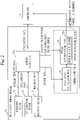
- Fig. 2 illustrates an inclination sensor module 1a as a specific example of an AHRS in the attack detection system 30.
- Fig. 2 is the inclination sensor module 1a as a specific implementation of the sensor module 1.
- the plurality of sensor data input units 11 are a gyroscope sensor 11a, an acceleration sensor 11b, and a magnetic sensor 11c.
- the signal processing unit 12 is a sensor fusion unit 12a.
- the attack detection device 2 is embedded in the inclination sensor module 1a.
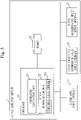
- Fig. 3 illustrates a hardware configuration of the attack detection device 2.
- the attack detection device 2 includes, as hardware, a processor 23, a memory 24, a sensor data input interface 25, a signal processing intermediate value input interface 26, and an attack determination result output interface 27.
- the processor 23 has the correlation calculation unit 21 and the attack determination unit 22 as functional components.
- the attack determination unit 22 includes the threshold value counter 220.
- the functions of the correlation calculation unit 21 and the attack determination unit 22 are implemented as an attack detection program.
- the memory 24 stores the attack detection program that implements the functions of the correlation calculation unit 21 and the attack determination unit 22.
- the processor 23 executes the attack detection program that implements the functions of the correlation calculation unit 21 and the attack determination unit 22.
- the attack detection program may be stored and provided in a computer readable recording medium, or may be provided as a program product.
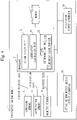
- Fig. 4 is a configuration in which the attack detection device 2 is realized within a processor that performs signal processing in the inclination sensor module 1a. That is, Fig. 4 is a hardware configuration of the inclination sensor module 1a having the attack detection function.
- the inclination sensor module 1a includes, as hardware, the gyroscope sensor 11a, the acceleration sensor 11b, the magnetic sensor 11c, the processor 13, the memory 14, an attack determination result output interface 15, and an inclination output interface 16.
- the processor 13 includes, as functional components, the sensor fusion unit 12a, the correlation calculation unit 21, and the attack determination unit 22.
- the functions of the sensor fusion unit 12a, the correlation calculation unit 21, and the attack determination unit 22 are implemented as the attack detection program.
- the memory 14 stores the attack detection program that implements the functions of the sensor fusion unit 12a, the correlation calculation unit 21, and the attack determination unit 22.
- the processor 13 executes the attack detection program that implements the functions of the sensor fusion unit 12a, the correlation calculation unit 21, and the attack determination unit 22.
- the attack detection program may be stored and provided in a computer readable recording medium, or may be provided as a program product.
- the operation of the attack detection device 2 is operation implemented by execution of the attack detection program by the attack detection device 2.
- the operation of the attack detection device 2 is an attack detection method.
- the attack detection device 2 uses two main methods on the basis of a characteristic that an attack is detected based on an inconsistency between sets of sensor data in the attack detection device 2.
- the first method for detecting an inconsistency between sets of sensor data is to look at a correlation between the sets of sensor data.
- the first method uses the fact that physical states observed by various sensors coincide with each other during normal operation of the AHRS, so that a high correlation appears between sets of sensor data.
- the acceleration sensor 11b and the magnetic sensor 11c are common in that each indicates a certain direction at a certain point, namely gravity and the geomagnetic field, respectively. Therefore, the correlation between them is high.
- the second method for detecting an inconsistency between sets of sensor data is to look at intermediate values of sensor fusion. What is simply described as sensor fusion signifies execution of a sensor fusion algorithm.
- the second method assumes a sensor fusion algorithm that calculates an inclination by measuring an error between sets of sensor data and correcting a measurement value based on that error. Therefore, the attack detection device 2 looks at a sensor fusion error to find an inconsistency between physical states observed by sensors.
- each of the three types of sensors constituting the inclination sensor module 1a which is the target module, has three axes, namely X, Y, and Z axes.
- the first method that detects inconsistencies between sets of sensor data by correlation will be described.
- consistencies between the acceleration sensor 11b and the magnetic sensor 11c will be checked.
- the effectiveness of the first method will be indicated by comparing correlations between sets of sensor data during normal operation with correlations between sets of sensor data during abnormal operation under an attack.
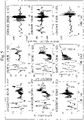
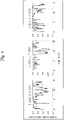
- Fig. 5 indicates sensor data during normal operation.
- Fig. 5 is sensor data when the inclination sensor module 1a was moved by holding it by hand.
- Sensor data of the acceleration sensor 11b, the magnetic sensor 11c, and the gyroscope sensor 11a is indicated from the left.
- Sensor data of the X axis, the Y axis, and the Z axis is indicated from the top to the bottom in Fig. 5 .
- the horizontal axis is time and the vertical axis is the measurement value of the sensor.
- the acceleration sensor 11b and the magnetic sensor 11c appear to be similar in terms of states of changes over time.
- Fig. 6 is results of calculating correlation coefficients between the acceleration sensor 11b and the magnetic sensor 11c for each of the X, Y, and Z axes.
- a certain time window is used to divide data and correlations are calculated on a sample by sample basis.
- the correlation coefficients are mostly above 0.6, indicating high correlations.
- correlations are low because the inclination sensor module 1a was moved vigorously.
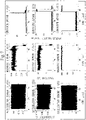
- Fig. 7 is sensor data when an attack was performed on the inclination sensor module 1a in a stationary state by a method discussed in Reference Literature 1 to be described later.
- Sensor data of the acceleration sensor 11b, the magnetic sensor 11c, and the gyroscope sensor 11a is indicated from the left in Fig. 7 .
- the values of the horizontal axis and the vertical axis and the arrangement of sensor data of the X, Y, and Z axes are the same as those in Fig. 5 .
- each of the sensors is affected by the attack.
- the sensor data of each axis of the acceleration sensor 11b changes in a sine wave pattern, and the sensor data of each of the magnetic sensor 11c and the gyroscope sensor 11a is fixed in a biased pattern.
- Fig. 8 indicates results of calculating correlation coefficients between the acceleration sensor 11b and the magnetic sensor 11c for each of the X, Y, and Z axes.
- a certain time window is used to divide data and correlations are calculated on a sample by sample basis, as in Fig. 6 .
- the correlation coefficients mostly fall within the range of -0.5 to 0.5 throughout the entire time period, indicating no correlation.
- the presence or absence of an attack can be determined by determining the presence of an attack if the correlation value goes beyond a certain threshold value.
- the presence of an attack can be determined. It has been described that even during normal operation, low correlations are observed when the inclination sensor module 1a was moved vigorously. Regarding this, an attack can be distinguished from an error by determining the presence of an attack if low correlations are observed for a certain period of time. That is, in the case of an attack, a state in which correlation values are low continues for a longer period of time than in the case of an error.
- Reference Literature 1 Nashimoto, Suzuki, et al., "A Security Evaluation of Attack Resilience of Sensor Fusion", SCIS2018 2018 Symposium on Cryptography and Information Security Niigata, Japan, Jan.23-26,2018,The Institute of Electronics, Information and Communication Engineers .
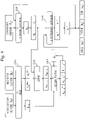
- Fig. 9 illustrates a flow of sensor fusion.
- Fig. 9 illustrates operation of the sensor fusion unit 12a.
- the following description assumes the inclination sensor module 1a of Fig. 2 .
- the input is sensor data of the gyroscope sensor 11a, the acceleration sensor 11b, and the magnetic sensor 11c, and the output is an inclination.
- sensor data of each of the three axes of X, Y, and Z and sensor data of the acceleration sensor 11b, the magnetic sensor 11c, and the gyroscope sensor 11a is represented in vectors as ⁇ G k >, ⁇ B k >, and ⁇ Y k >, respectively.
- the expression ⁇ ⁇ > denotes that ⁇ is a vector.
- k denotes the k-th iteration process of sensor fusion.
- the inclination is given by Euler angles of roll, pitch, and yaw, which are represented as ⁇ k , ⁇ k , and ⁇ k , respectively.
- the inclination is represented by a three-dimensional rotation matrix [R k ] or a quaternion q, each of which can be converted into the other.
- R k the expression
- [ ⁇ ] denotes that ⁇ is a matrix.
- ⁇ q> denotes only a vector portion that is extracted from the quaternion q.
- the geomagnetic vector ⁇ m> is a unit vector parallel to the magnetic field of the Earth
- the gravity vector ⁇ g> is a unit vector pointing to the center of the Earth. It is important that when ⁇ m> and ⁇ g> are given, the inclination is uniquely determined. Conversely, ⁇ m> and ⁇ g> can be calculated from the inclination.
- a geomagnetic vector ⁇ m k 6DOF >, a gravity vector ⁇ g k 6DOF >, and an observation error ⁇ Q k > are calculated from six degrees of freedom (6DOF) sensor data.
- the geomagnetic vector represents the magnetic field of the Earth in a three-dimensional space (X, Y, and Z coordinates).
- the geomagnetic vector is the following equation (3).
- the gravity vector represents the field of gravity.
- the gravity vector is the following equation (4).
- Main components of the observation error ⁇ Q v,k > are disturbance and sensor noise.
- Disturbance includes acceleration ⁇ Q a,k > and magnetic disturbance ⁇ Q d,k >.
- Sensor noise includes ⁇ Q vB,k > in an acceleration sensor and ⁇ Q vG,k > in a compass.
- ⁇ t is the update interval of the Kalman filter.
- ⁇ q denotes a quaternion that converts an angle
- the directions of gravity and the geomagnetic field can be obtained by equation (2). These will be referred to as a gravity vector ⁇ g k - > and a geomagnetic vector ⁇ m k - >.
- step S303 of Fig. 9 ⁇ g k 6DOF >, ⁇ m k 6DOF > ⁇ is compared with ⁇ g k - >, ⁇ m k - > ⁇ to calculate a priori error estimates individually for the gravity vector and the geomagnetic vector.
- the error between ⁇ g k 6DOF > and ⁇ g k - > is a rotation quaternion q zg ⁇ ,k that makes one coincide with the other, and can be obtained from ⁇ g k 6DOF > and ⁇ g k - >.
- ⁇ and X denote the inner product and cross product of the vectors, respectively.
- Equation (9-1) can be used to calculate the two types of rotation quaternions representing the errors.
- step S304 of Fig. 9 the Kalman filter is used to obtain an a posteriori error estimate.
- a Kalman gain is expressed using a Kalman filter model error ⁇ Q W,k > and an observation error ⁇ Q v,k > as indicated in the following equation (10).
- K k Q w , k C k T C k Q w , k C k T + Q v , k ⁇ 1
- [C k ] is what is referred to as an observation matrix in the Kalman filter.
- the a posteriori error estimate is used to correct the a priori estimates of the geomagnetic vector and the gravity vector originated from the gyroscope, so as to obtain an a posteriori estimate of the inclination.
- a posteriori estimates of the geomagnetic vector ⁇ m k - > and the gravity vector ⁇ g k - > are given by the following equations (12) and (13) by rotating the a priori estimates only by the amount of the error.
- attack detection by the attack detection device 2 the presence or absence of an attack is determined by looking at the gravity vector error q zg ⁇ ,k and the geomagnetic vector error q zm ⁇ ,k calculated based on the errors in step S303 of Fig. 9 . That is, the attack detection device 2 focuses attention only on the vector components of the rotation quaternion.
- Fig. 10 indicates geomagnetic vector errors and gravity vector errors under normal conditions.
- the horizontal axis is time and the vertical axis is the error.
- Fig. 11 indicates geomagnetic vector errors and gravity vector errors during an attack.
- the six graphs in Fig. 11 correspond to the six graphs in Fig. 10 .
- the errors are greater during an attack.
- the gravity vector the difference is remarkable.
- the method of detecting an inconsistency between sensors by looking at errors can also determine the presence or absence of an attack by determining the presence of an attack if an error exceeds a certain threshold value.
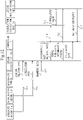
- Fig. 12 is a sequence illustrating operation of the attack detection system 30 including the attack detection device 2. Referring to Fig. 12 , operation of the attack detection device 2 will be described.
- step S11 the gyroscope sensor 11a transmits angular velocity data to the sensor fusion unit 12a.
- step S12 the acceleration sensor 11b transmits acceleration data to the sensor fusion unit 12a.
- step S13 the magnetic sensor 11c transmits magnetic data to the sensor fusion unit 12a.
- step S14 the sensor fusion unit 12a transmits the acceleration data and the magnetic data to the correlation calculation unit 21.
- the sensor fusion unit 12a performs sensor fusion using the angular velocity data, the acceleration data, and the magnetic data, as described in the explanation of Fig. 9 .
- the inclination is calculated by the sensor fusion unit 12a.
- sensor fusion error data which is errors of physical quantities measured by each sensor, is obtained.
- the sensor fusion unit 12a transmits the sensor fusion error data, which is signal processing intermediate values, to the attack determination unit 22.
- the correlation calculation unit 21 calculates correlations between the acceleration data and the magnetic data. In step S16, the correlation calculation unit 21 transmits the calculated correlation values to the attack determination unit 22. In step S17, the attack determination unit 22 determines the presence or absence of an attack based on the sensor fusion error data and the correlation values, and transmits a determination result to the controller 3.
- Fig. 13 is a flowchart illustrating operation of the correlation calculation unit 21. Referring to Fig. 13 , the operation of the correlation calculation unit 21 will be described.
- step S101 the correlation calculation unit 21 receives acceleration data and magnetic data from the sensor fusion unit 12a.
- step S102 the correlation calculation unit 21 calculates correlation coefficients between the acceleration data and the magnetic data.
- step S103 the correlation calculation unit 21 transmits the correlation values to the attack determination unit 22.
- the correlation calculation unit 21 which is the similarity calculation unit, acquires sensor data of the acceleration sensor 11b and the magnetic sensor 11c, which are two sensors of the plurality of sensors, and calculates correlation values between two sets of sensor data as similarities.
- the attack determination unit 22 compares a similarity threshold value with each of the correlation values, which are similarities, to determine whether there is an attack on at least one sensor of the plurality of sensors.
- the two sensors for which similarities are calculated have different observable physical quantities.
- the observable physical quantity of the acceleration sensor 11b is gravity
- the observable physical quantity of the magnetic sensor 11c is the geomagnetic field.
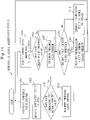
- Fig. 14 is a flowchart illustrating operation of the attack determination unit 22. Referring to Fig. 14 , the operation of the attack determination unit 22 will be described.
- the attack determination unit 22 uses correlation values and sensor fusion error data to count the number of times when each exceeds a threshold value, and determines the presence of an attack when the count exceeds a threshold value. This will be described specifically below.
- step S201 the attack determination unit 22 initializes the threshold value counter 220.
- step S202 the attack determination unit 22 receives correlation values from the correlation calculation unit 21.
- step S203 the attack determination unit 22 determines, for each axis, whether the correlation value exceeds a preset correlation-value threshold value for each axis. If the correlation value exceeds the threshold value, the attack determination unit 22 increments the threshold value counter 220 in step S204. Since there are three axes, the upper limit of the counter for the correlation value is 3.
- threshold value for the X axis There are three threshold values: the threshold value for the X axis, the threshold value for the Y axis, and the threshold value for the Z axis. These will be denoted as a threshold value 1, a threshold value 2, and a threshold value 3, respectively.
- the threshold value 1, the threshold value 2, and the threshold value 3 will be referred to as similarity threshold values.
- the threshold value 1 is the threshold value for the X axis
- the threshold value 2 is the threshold value for the Y axis
- the threshold value 3 is the threshold value for the Z axis.
- step S205 the attack determination unit 22 receives sensor fusion error data, which is signal processing intermediate values, from the sensor fusion unit 12a.
- step S206 the attack determination unit 22 determines whether the error of each axis exceeds a threshold value with regard to two types of physical quantities of the gravity vector and the geomagnetic vector. Since determinations are performed for three axes for each of the two types of errors, the upper limit of the counter regarding the errors is 6. There are six axes in total, three axes for the gravity vector and three axes for the geomagnetic vector, and a threshold value is set separately for each of the axes.
- the threshold values for the X axis, the Y axis, and the Z axis of the gravity vector will be denoted as a threshold value 4, a threshold value 5, and a threshold value 6, respectively.
- the threshold values for the X axis, the Y axis, and the Z axis of the geomagnetic vector will be denoted as a threshold value 7, a threshold value 8, and a threshold value 9, respectively.
- the threshold values 4 to 9 will be referred to as intermediate-value threshold values.
- the attack determination unit 22 increments the threshold value counter if each error exceeds the corresponding threshold value, and does not increment the threshold value counter if each error does not exceed the threshold value for the error (step S207).
- the threshold value counter 220 becomes 9 at the maximum and 0 at the minimum as a result of steps S203 and S206.
- step S208 the attack determination unit 22 determines whether the threshold value counter 220 exceeds a predetermined threshold value.
- This threshold value is the threshold value for the threshold value counter 220 different from the threshold values 1 to 9. This threshold value will be referred to as a counter threshold value. If the threshold value counter 220 exceeds the counter threshold value, the attack determination unit 22 determines the presence of an attack and transmits an anomaly notification to the controller 3 (step S209). If the threshold value counter 220 does not exceed the counter threshold value, the attack determination unit 22 determines the absence of an attack and transmits a normal-state notification to the controller 3 (step S210).
- the attack determination unit 22 determines the presence of an attack.
- the counter threshold value is 1, if even one of the values compared with the threshold values 1 to 9 exceeds the threshold value, the attack determination unit 22 determines the presence of an attack.
- the counter threshold value is 5, if six or more of the nine values compared with the threshold values 1 to 9 exceed the threshold value, the attack determination unit 22 determines the presence of an attack.
- the attack determination unit 22 acquires the respective intermediate values during execution of the sensor fusion algorithm.
- the sensor fusion algorithm executed by the sensor fusion unit 12a is an algorithm that calculates an output by combining a plurality of physical quantities observed by the gyroscope sensor 11a, the acceleration sensor 11b, and the magnetic sensor 11c, which are a plurality of sensors of different types.
- the plurality of physical quantities here are gravity and the geomagnetic field.
- the sensor fusion algorithm is the algorithm that calculates the gravity vector error q zg ⁇ ,k and the geomagnetic vector error q zm ⁇ ,k , which are the respective intermediate values of the plurality of physical quantities, and changes the output using the respective intermediate values.
- the respective intermediate values are the respective error data of the plurality of physical quantities observed by the plurality of sensors of different types.
- the attack determination unit 22 compares the gravity vector error q zg ⁇ ,k and the geomagnetic vector error q zm ⁇ ,k , which are the respective intermediate values, with the threshold values 4 to 9, which are the intermediate-value threshold values, so as to determine whether there is an attack on at least one sensor of the plurality of sensors.
- the correlation calculation unit 21 may calculate similarities by the following methods instead of using the Pearson correlation coefficient.
- the attack determination unit 22 can weight the intermediate-value threshold values depending on the types of intermediate values, and can weight the similarity threshold values depending on the types of two sets of sensor data.
- the weighting of the intermediate-value threshold values may change the intermediate-value threshold values or may change intermediate values.
- the weighting of the similarity threshold values may change the similarity threshold values or may change similarities.
- the attack determination unit 22 can realize the threshold value counter 220 by the following methods.
- the signal processing unit 12 may be realized not only by the sensor fusion algorithm using the Kalman filter described in the first embodiment, but also by algorithms that perform state estimation as follows:
- the attack detection device 2 of the first embodiment can detect an attack on a sensor based on an inconsistency between sets of sensor data, using the fact that when sensors observe different physical states due to an attack, this results in low correlation values and large sensor fusion errors.
- an attack detection mechanism can be introduced by extracting sensor data and intermediate values of signal processing and connecting an attack detection device separately. Therefore, an attack can be detected without any modification to the sensor.
- the attack detection device 2 detects an attack independently of measurement by sensors, it does not adversely affect measurement by the sensors.
- the inclination sensor module that uses, as sensors, the gyroscope sensor 11a, the acceleration sensor 11b, and the magnetic sensor 11c has been described.
- the inclination sensor module may include two or more types of sensors among an acceleration sensor, a gyroscope sensor, a magnetic sensor, and a tilt sensor.
- the inclination sensor is not limiting, and it may be replaced with a position sensor having two or more types of sensors among an acceleration sensor, a gyroscope sensor, a magnetic sensor, an ultrasonic sensor, an optical sensor, a camera, and a GPS sensor.
- the inclination sensor is not limiting, and it may be replaced with a ranging sensor having two or more types of sensors among a radar, an ultrasonic sensor, an optical sensor and a camera.
- the inclination sensor is not limiting, and it may be replaced with a soil sensor having two or more types of sensors among a temperature sensor, a humidity sensor, a radiation sensor, a pH sensor, and a camera.
- the processor 23 is a central processing unit (CPU), a digital signal processor (DSP), or the like.
- the memory 24 is a random access memory (RAM), a read only memory (ROM), a flash memory, a hard disk drive (HDD), a solid state drive (SDD), or the like.
- RAM random access memory
- ROM read only memory
- HDD hard disk drive
- SDD solid state drive
- Each of the sensor data input interface 25, the signal processing intermediate value input interface 26, and the attack determination result output interface 27 is an Inter-Integrated Circuit (I2C) interface, a Serial Peripheral Interface (SPI), an Ethernet (registered trademark) interface, or the like.
- I2C Inter-Integrated Circuit
- SPI Serial Peripheral Interface
- Ethernet registered trademark
- the "unit" of each of the signal processing unit 12, the correlation calculation unit 21, and the attack determination unit 22 may be interpreted as a “circuit", “step”, “procedure”, or "process".
- the attack detection device 2 may be realized by an electronic circuit, such as a logic integrated circuit (IC), a gate array (GA), an application specific integrated circuit (ASIC), or a field-programmable gate array (FPGA).
- IC logic integrated circuit
- G gate array
- ASIC application specific integrated circuit
- FPGA field-programmable gate array
- the processor and the above electronic circuit are also collectively referred to as processing circuitry.
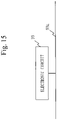
- Fig. 15 is a diagram illustrating realization of the attack detection device 2 by an electronic circuit 99.
- the electronic circuit 99 realizes the functions of the "units" represented as the processor 23, the function of the memory 24, the function of the sensor data input interface 25, the function of the signal processing intermediate value input interface 26, and the function of the attack determination result output interface 27.
- the electronic circuit 99 is connected to a signal line 99a.
- the electronic circuit 99 is a single circuit, a composite circuit, a programmed processor, a parallel-programmed processor, a logic IC, a gate array (GA), an application specific integrated circuit (ASIC), or a field-programmable gate array (FPGA).
Landscapes
- Engineering & Computer Science (AREA)
- Physics & Mathematics (AREA)
- General Physics & Mathematics (AREA)
- Computer Security & Cryptography (AREA)
- Software Systems (AREA)
- Theoretical Computer Science (AREA)
- General Engineering & Computer Science (AREA)
- Computer Hardware Design (AREA)
- Radar, Positioning & Navigation (AREA)
- Remote Sensing (AREA)
- Health & Medical Sciences (AREA)
- General Health & Medical Sciences (AREA)
- Virology (AREA)
- Automation & Control Theory (AREA)
- Manufacturing & Machinery (AREA)
- Gyroscopes (AREA)
- Testing Or Calibration Of Command Recording Devices (AREA)
- Measuring Magnetic Variables (AREA)
- User Interface Of Digital Computer (AREA)
Description
- The present invention relates to an attack detection device, an attack detection program, and an attack detection method.
- An inclination sensor is often used for attitude measurement or attitude control of an aircraft and heavy equipment. In particular, an inclination sensor called an attitude heading reference system (AHRS) is referred to as an inertial measurement unit. The AHRS is composed of an acceleration sensor, a gyroscope sensor, a magnetic sensor (compass), and a processor. The processor performs signal processing on various types of sensor data and outputs inclination data. Sensors and a module that performs signal processing for the sensors, like this, will be referred to as a sensor module.
- As the various sensors constituting the AHRS, micro-electro-mechanical system (MEMS) sensors, which are advantageous in cost and downsizing, are often used. A MEMS sensor has a configuration such that mechanical parts and an electronic circuit are integrated into one unit.
- The AHRS calculates an inclination by signal processing based on acceleration data obtained from the acceleration sensor, angular velocity data obtained from the gyroscope sensor, and magnetic data obtained from the magnetic sensor. Signal processing for fusing different types of sensor data and measuring different types of physical information in this way will be referred to as sensor fusion.
-
Non-Patent Literature 1 andNon-Patent Literature 2 disclose sensor fusion algorithms using the Kalman filter for the AHRS. In the sensor fusion algorithms based on Non-PatentLiterature 1 and Non-Patent Literature 2, the same physical quantity is measured by two types of sensors, and the error is corrected by the Kalman filter to derive the correct measurement value. Specifically, the direction of gravity can be known from the acceleration sensor and the gyroscope sensor. The geomagnetic field can be known from the magnetic sensor and the gyroscope sensor. Therefore, by combining both of them, the inclination in world coordinates is calculated. - In measurement and control using a sensor, the reliability of sensor data is directly linked to the reliability of a system. Therefore, an attack on the sensor is a threat. An attack that disguises sensor data in software using malware can be dealt with by existing information security technologies.
- On the other hand, an attack that deceives in hardware by emitting a physical signal to the sensor to physically vary the state of the sensor cannot be dealt with only by existing information security technologies. Non-Patent
Literature 3 and Non-PatentLiterature 4 disclose attack methods that deceive a MEMS gyroscope sensor and a MEMS acceleration sensor, respectively, by ultrasonic waves. An ultrasonic wave attack leverages the fact that a MEMS sensor includes a spring and a weight, and obtains an abnormal sensor output by forcibly resonating the sensor. -
Non-Patent Literature 3 discloses, as countermeasure methods, physically shielding the sensor and changing the resonance frequency of the sensor as countermeasures in hardware. -
Non-Patent Literature 4 discloses, as a countermeasure method, replacing the parts constituting the sensor with parts that are less susceptible to an ultrasonic attack as a countermeasure in hardware. Furthermore, Non-PatentLiterature 4 discloses, as a countermeasure method, changing the sampling interval of the sensor as a countermeasure in software. -
EP 3239884 A1 discloses that a threat detection computer may receive the series of current values from threat nodes, generate a set of current feature vectors, execute the threat detection model, and transmit a threat alert signal based on the current feature vectors and at the least one decision boundary. -
US 2017/264629 A1 discloses a system comprising function blocks, which are configured to monitor the process data in the process image during each scan cycle, and identify a possible cyberattack based on the process data. -
WO 2018/055748 A1 discloses that a signal modulation modulates, by using a modulation signal, an actuator control signal for controlling an actuator. When a measurement signal, indicating a physical state measured by a passive sensor, is received from the passive sensor after a modulated actuator control signal, which is the actuator control signal that has been modulated by the signal modulation unit, is transmitted to the actuator, a correlation calculation unit calculates the correlation between the received measurement signal and the modulation signal used by the signal modulation unit to modulate the actuator control signal. -
- Non-Patent Literature 1: Daniel Roetenberg, Henk J Luinge, Chris TM Baten, and Peter H Veltink. 2005. Compensation of magnetic disturbances improves inertial and magnetic sensing of human body segment orientation. IEEE Transactions on neural systems and .
- Non-Patent Literature 2: NXP Semiconductors. 2016 AN5023 - Sensor Fusion Kalman Filters.
- Non-Patent Literature 3: Son, Yunmok, et al. "Rocking drones with intentional sound noise on gyroscopic sensors." 24th USENIX Security Symposium (USENIX Security 15). 2015.
- Non-Patent Literature 4: Timothy Trippel, Ofir Weisse, Wenyuan Xu, Peter Honeyman, and Kevin Fu. 2017. WALNUT: Waging doubt on the integrity of mems accelerometers with acoustic injection attacks. In Security and Privacy (EuroS&P), 2017 IEEE European Symposium on. IEEE, 3-18.
- The countermeasure methods in hardware disclosed in Non-Patent
Literature 3 and Non-Patent Literature 4 require modification to the sensor itself, resulting in increased costs. The method of shielding the sensor may affect other sensors, and may adversely affect measurement performance. - The countermeasure method in software disclosed in Non-Patent Literature 4 has a problem in terms of versatility in that it can be applied only to limited sensors. This is because it is a prerequisite for applying this countermeasure method that a user of the sensor can set the sampling interval of the sensor.
- It is an object of the present invention to provide an attack detection device that detects an attack on a sensor and can be used for many types of sensors without requiring modification to the sensor itself and without adversely affecting other sensors.
- The present invention is defined in the appended set of claims.
- According to the present invention, it is possible to provide an attack detection device that detects an attack on a sensor and can be used for many types of sensors without requiring modification to the sensor itself and without adversely affecting other sensors.
-
-
Fig. 1 is a diagram of a first embodiment and is a configuration diagram of an attack detection system; -
Fig. 2 is a diagram of the first embodiment and is a diagram illustrating a configuration of an inclination sensor module; -
Fig. 3 is a diagram of the first embodiment and is a hardware configuration diagram of an attack detection device; -
Fig. 4 is a diagram of the first embodiment and is a hardware configuration diagram of an inclination sensor module; -
Fig. 5 is a diagram of the first embodiment and is a diagram illustrating sensor data under normal conditions; -
Fig. 6 is a diagram of the first embodiment and is a diagram illustrating correlation values under normal conditions; -
Fig. 7 is a diagram of the first embodiment and is a diagram illustrating sensor data under abnormal conditions; -
Fig. 8 is a diagram of the first embodiment and is a diagram illustrating correlation values under abnormal conditions; -
Fig. 9 is a diagram of the first embodiment and is a diagram illustrating a flow of a sensor fusion algorithm; -
Fig. 10 is a diagram of the first embodiment and is a diagram illustrating sensor fusion intermediate values under normal conditions; -
Fig. 11 is a diagram of the first embodiment and is a diagram illustrating sensor fusion intermediate values under abnormal conditions; -
Fig. 12 is a diagram of the first embodiment and is a sequence diagram illustrating operation of the attack detection system; -
Fig. 13 is a diagram of the first embodiment and is a flowchart illustrating operation of a correlation calculation unit; -
Fig. 14 is a diagram of the first embodiment and is a flowchart illustrating operation of an attack detection unit; and -
Fig. 15 is a diagram of the first embodiment and is a diagram illustrating realization of the attack detection device by an electronic circuit. - ∗∗∗ Description of Configurations ∗∗∗
-
Fig. 1 illustrates a configuration of anattack detection system 30 of a first embodiment. Theattack detection system 30 includes asensor module 1 and acontroller 3. Thesensor module 1 includes a plurality of sensordata input units 11, asignal processing unit 12, and anattack detection device 2. - The
attack detection device 2 includes acorrelation calculation unit 21 and anattack determination unit 22. Theattack determination unit 22 includes athreshold value counter 220. Thecorrelation calculation unit 21 is a similarity calculation unit. Theattack determination unit 22 is an intermediate value acquisition unit. Theattack determination unit 22 is a determination unit. -
Fig. 2 illustrates an inclination sensor module 1a as a specific example of an AHRS in theattack detection system 30.Fig. 2 is the inclination sensor module 1a as a specific implementation of thesensor module 1. In the inclination sensor module 1a, the plurality of sensordata input units 11 are agyroscope sensor 11a, anacceleration sensor 11b, and amagnetic sensor 11c. Thesignal processing unit 12 is asensor fusion unit 12a. Theattack detection device 2 is embedded in the inclination sensor module 1a. -
Fig. 3 illustrates a hardware configuration of theattack detection device 2. Theattack detection device 2 includes, as hardware, aprocessor 23, amemory 24, a sensordata input interface 25, a signal processing intermediatevalue input interface 26, and an attack determinationresult output interface 27. Theprocessor 23 has thecorrelation calculation unit 21 and theattack determination unit 22 as functional components. Theattack determination unit 22 includes thethreshold value counter 220. The functions of thecorrelation calculation unit 21 and theattack determination unit 22 are implemented as an attack detection program. Thememory 24 stores the attack detection program that implements the functions of thecorrelation calculation unit 21 and theattack determination unit 22. Theprocessor 23 executes the attack detection program that implements the functions of thecorrelation calculation unit 21 and theattack determination unit 22. The attack detection program may be stored and provided in a computer readable recording medium, or may be provided as a program product. -
Fig. 4 is a configuration in which theattack detection device 2 is realized within a processor that performs signal processing in the inclination sensor module 1a. That is,Fig. 4 is a hardware configuration of the inclination sensor module 1a having the attack detection function. The inclination sensor module 1a includes, as hardware, thegyroscope sensor 11a, theacceleration sensor 11b, themagnetic sensor 11c, theprocessor 13, thememory 14, an attack determinationresult output interface 15, and aninclination output interface 16. - The
processor 13 includes, as functional components, thesensor fusion unit 12a, thecorrelation calculation unit 21, and theattack determination unit 22. The functions of thesensor fusion unit 12a, thecorrelation calculation unit 21, and theattack determination unit 22 are implemented as the attack detection program. Thememory 14 stores the attack detection program that implements the functions of thesensor fusion unit 12a, thecorrelation calculation unit 21, and theattack determination unit 22. Theprocessor 13 executes the attack detection program that implements the functions of thesensor fusion unit 12a, thecorrelation calculation unit 21, and theattack determination unit 22. As described above, the attack detection program may be stored and provided in a computer readable recording medium, or may be provided as a program product. - Operation of the
attack detection device 2 will be described. The operation of theattack detection device 2 is operation implemented by execution of the attack detection program by theattack detection device 2. The operation of theattack detection device 2 is an attack detection method. - The operation of the
attack detection device 2 will be described, assuming the inclination sensor module 1a illustrated inFig. 2 . Theattack detection device 2 uses two main methods on the basis of a characteristic that an attack is detected based on an inconsistency between sets of sensor data in theattack detection device 2. - The first method for detecting an inconsistency between sets of sensor data is to look at a correlation between the sets of sensor data.
- The first method uses the fact that physical states observed by various sensors coincide with each other during normal operation of the AHRS, so that a high correlation appears between sets of sensor data. In particular, the
acceleration sensor 11b and themagnetic sensor 11c are common in that each indicates a certain direction at a certain point, namely gravity and the geomagnetic field, respectively. Therefore, the correlation between them is high. - The second method for detecting an inconsistency between sets of sensor data is to look at intermediate values of sensor fusion. What is simply described as sensor fusion signifies execution of a sensor fusion algorithm.
- The second method assumes a sensor fusion algorithm that calculates an inclination by measuring an error between sets of sensor data and correcting a measurement value based on that error. Therefore, the
attack detection device 2 looks at a sensor fusion error to find an inconsistency between physical states observed by sensors. - For example,
- (1) the
gyroscope sensor 11a and theacceleration sensor 11b can both observe gravity, and - (2) the
gyroscope sensor 11a and themagnetic sensor 11c can both observe the geomagnetic field. - Therefore, by looking at a gravity error and a geomagnetic error calculated by the sensor fusion algorithm in the process of calculating an inclination, inconsistencies can be detected for these two types of combinations of sensors.
- By combining the first method and the second method, inconsistencies can be detected for all of the following three combinations:
- (1) the
gyroscope sensor 11a and theacceleration sensor 11b, - (2) the
gyroscope sensor 11a and themagnetic sensor 11c, and - (3) the
acceleration sensor 11b and themagnetic sensor 11c. - In the following, the effectiveness and feasibility of this technique will be indicated using the actual inclination sensor module 1a as a target module. Each of the three types of sensors constituting the inclination sensor module 1a, which is the target module, has three axes, namely X, Y, and Z axes.
- First, the first method that detects inconsistencies between sets of sensor data by correlation will be described. In the first method, consistencies between the
acceleration sensor 11b and themagnetic sensor 11c will be checked. Specifically, the effectiveness of the first method will be indicated by comparing correlations between sets of sensor data during normal operation with correlations between sets of sensor data during abnormal operation under an attack. -
Fig. 5 indicates sensor data during normal operation.Fig. 5 is sensor data when the inclination sensor module 1a was moved by holding it by hand. Sensor data of theacceleration sensor 11b, themagnetic sensor 11c, and thegyroscope sensor 11a is indicated from the left. Sensor data of the X axis, the Y axis, and the Z axis is indicated from the top to the bottom inFig. 5 . In each set of sensor data, the horizontal axis is time and the vertical axis is the measurement value of the sensor. Under normal conditions, theacceleration sensor 11b and themagnetic sensor 11c appear to be similar in terms of states of changes over time. -
Fig. 6 is results of calculating correlation coefficients between theacceleration sensor 11b and themagnetic sensor 11c for each of the X, Y, and Z axes. InFig. 6 , a certain time window is used to divide data and correlations are calculated on a sample by sample basis. As a result, it can be seen that the correlation coefficients are mostly above 0.6, indicating high correlations. At 7 to 12 seconds, correlations are low because the inclination sensor module 1a was moved vigorously. InFig. 6 , the Pearson correlation coefficient between two series xi and yi (i = 1, 2, ..., n) can be obtained by the following correlation equation.

-
Fig. 7 is sensor data when an attack was performed on the inclination sensor module 1a in a stationary state by a method discussed inReference Literature 1 to be described later. Sensor data of theacceleration sensor 11b, themagnetic sensor 11c, and thegyroscope sensor 11a is indicated from the left inFig. 7 . The values of the horizontal axis and the vertical axis and the arrangement of sensor data of the X, Y, and Z axes are the same as those inFig. 5 . InFig. 7 , each of the sensors is affected by the attack. The sensor data of each axis of theacceleration sensor 11b changes in a sine wave pattern, and the sensor data of each of themagnetic sensor 11c and thegyroscope sensor 11a is fixed in a biased pattern. -
Fig. 8 indicates results of calculating correlation coefficients between theacceleration sensor 11b and themagnetic sensor 11c for each of the X, Y, and Z axes. InFig. 8 , a certain time window is used to divide data and correlations are calculated on a sample by sample basis, as inFig. 6 . As a result, it can be seen that the correlation coefficients mostly fall within the range of -0.5 to 0.5 throughout the entire time period, indicating no correlation. As can be seen when the correlations under normal conditions indicated inFig. 6 are compared with the correlations during the attack indicated inFig. 8 , it can be seen that the presence or absence of an attack can be determined by determining the presence of an attack if the correlation value goes beyond a certain threshold value. In this case, if the correlation value is smaller than the threshold value with respect to the threshold value, the presence of an attack can be determined. It has been described that even during normal operation, low correlations are observed when the inclination sensor module 1a was moved vigorously. Regarding this, an attack can be distinguished from an error by determining the presence of an attack if low correlations are observed for a certain period of time. That is, in the case of an attack, a state in which correlation values are low continues for a longer period of time than in the case of an error. - Reference Literature 1: Nashimoto, Suzuki, et al., "A Security Evaluation of Attack Resilience of Sensor Fusion", SCIS2018 2018 Symposium on Cryptography and Information Security Niigata, Japan, Jan.23-26,2018,The Institute of Electronics, Information and Communication Engineers.
- The second method that detects an inconsistency using intermediate values of sensor fusion will now be described. In order to do so, the technology of sensor fusion will be described first based on
Non-Patent Literature 2. -
Fig. 9 illustrates a flow of sensor fusion.Fig. 9 illustrates operation of thesensor fusion unit 12a. The following description assumes the inclination sensor module 1a ofFig. 2 . The input is sensor data of thegyroscope sensor 11a, theacceleration sensor 11b, and themagnetic sensor 11c, and the output is an inclination. There is sensor data of each of the three axes of X, Y, and Z, and sensor data of theacceleration sensor 11b, themagnetic sensor 11c, and thegyroscope sensor 11a is represented in vectors as <Gk>, <Bk>, and <Yk>, respectively. For convenience, the expression <∗> denotes that ∗ is a vector. Note that k denotes the k-th iteration process of sensor fusion. The inclination is given by Euler angles of roll, pitch, and yaw, which are represented as ϕk, θk, and ψk, respectively. In the internal process of sensor fusion, the inclination is represented by a three-dimensional rotation matrix [Rk] or a quaternion q, each of which can be converted into the other. For convenience, the expression [∗] denotes that ∗ is a matrix. The expression <q> denotes only a vector portion that is extracted from the quaternion q. - In sensor fusion of the AHRS, a geomagnetic vector and a gravity vector have important roles. The geomagnetic vector <m> is a unit vector parallel to the magnetic field of the Earth, and the gravity vector <g> is a unit vector pointing to the center of the Earth. It is important that when <m> and <g> are given, the inclination is uniquely determined. Conversely, <m> and <g> can be calculated from the inclination.
- The basic definitions required hereinafter will be described below. The notation is in accordance with
Non-Patent Literature 2. The premise is that the inclination ([Rk]) in world coordinates is given as a three-dimensional rotation matrix by the following equation (1).
[Formula 3]

- The relationship between sensor data and the rotation matrix is defined as indicated in the following equation (2).
[Formula 4]

- This equation (2) can be explained as follows. In this algorithm, North, East, Down (NED) coordinates are especially adopted. Therefore, since the Z axis of [Rk] indicates the direction of gravity, it is calculated only based on the
acceleration sensor 11b. Since themagnetic sensor 11c indicates the northward direction facing downward, the cross product of <Gk> and <Bk> indicates the East direction along the Y axis. The remaining X axis can be calculated as the cross product of the other two. - The flow of the sensor fusion unit in
Fig. 9 will be described based on the above basic equations. In step S301 ofFig. 9 , a geomagnetic vector <mk 6DOF>, a gravity vector <gk 6DOF>, and an observation error <Qk> are calculated from six degrees of freedom (6DOF) sensor data. The geomagnetic vector represents the magnetic field of the Earth in a three-dimensional space (X, Y, and Z coordinates). The geomagnetic vector is the following equation (3). - Similarly, the gravity vector represents the field of gravity. The gravity vector is the following equation (4).
- That is, they are as indicated below.
[Formula 5]

- Main components of the observation error <Qv,k> are disturbance and sensor noise.
- Disturbance includes acceleration <Qa,k> and magnetic disturbance <Qd,k>.
- Sensor noise includes <QvB,k> in an acceleration sensor and <QvG,k> in a compass.
- Therefore, the absence of any observation error can be expressed by the following equations (5) and (6).
[Formula 6]

- In step S302 of
Fig. 9 , the inclination is obtained from the gyroscope <Yk>. This may be done by integrating an angular velocity measured by the gyroscope with an immediately preceding estimate value q+ k-1 of the inclination. First, the drift of the gyroscope is compensated with an offset <b- k>, which is expressed by the following equation (7).
[Formula 7]

- Next, an a priori estimate value of the inclination is as indicated in the following equation (8).
[Formula 8]

- Note that δt is the update interval of the Kalman filter.
- Note that Δq denotes a quaternion that converts an angle |(ω- k)|δt to rotation, and is expressed by the following equation (9).
[Formula 9]

- By using the inclination q- k obtained with the gyroscope, the directions of gravity and the geomagnetic field can be obtained by equation (2). These will be referred to as a gravity vector <gk -> and a geomagnetic vector <mk ->.
- So far, sets of the gravity vector and the geomagnetic vector obtained by the two methods, that is,

- In step S303 of
Fig. 9 , {<gk 6DOF>, <mk 6DOF>} is compared with {<gk ->, <mk ->} to calculate a priori error estimates individually for the gravity vector and the geomagnetic vector. - The error between <gk 6DOF> and <gk -> is a rotation quaternion qzgε,k that makes one coincide with the other, and can be obtained from <gk 6DOF> and <gk ->.
- Similarly, the error qzme,k between <mk 6DOF> and <mk -> is obtained.
- Generally, a rotation quaternion for making a vector <r> coincide with another vector <s> can be obtained by the following equation (9-1).
[Formula 10]

- Equation (9-1) can be used to calculate the two types of rotation quaternions representing the errors.
- In step S304 of
Fig. 9 , the Kalman filter is used to obtain an a posteriori error estimate. A Kalman gain is expressed using a Kalman filter model error <QW,k> and an observation error <Qv,k> as indicated in the following equation (10).
[Formula 11]

- Note that [Ck] is what is referred to as an observation matrix in the Kalman filter.
- An a posteriori estimate x+ ε,k of the observation error is given by the following equation (11).
[Formula 12]

- In step S305 of
Fig. 9 , the a posteriori error estimate is used to correct the a priori estimates of the geomagnetic vector and the gravity vector originated from the gyroscope, so as to obtain an a posteriori estimate of the inclination. A posteriori estimates of the geomagnetic vector <mk -> and the gravity vector <gk -> are given by the following equations (12) and (13) by rotating the a priori estimates only by the amount of the error.
[Formula 13]

- In equations (12) and (13), ∗ denotes conjugate.
- Furthermore, by substituting equations (12) and (13) into equation (2), an a posteriori estimate [RK +] of the inclination is obtained. Finally, the inclination, that is, roll ϕk, pitch θk, yaw angle ψk, is expressed by the following equation (14).
[Formula 14]

- By repeating the above process, the inclination is calculated successively.
- In attack detection by the
attack detection device 2, the presence or absence of an attack is determined by looking at the gravity vector error qzgε,k and the geomagnetic vector error qzmε,k calculated based on the errors in step S303 ofFig. 9 . That is, theattack detection device 2 focuses attention only on the vector components of the rotation quaternion. - A specific explanation will be given using the sensor data under normal conditions and abnormal conditions indicated in
Figs. 5 and7 , respectively. -
Fig. 10 indicates geomagnetic vector errors and gravity vector errors under normal conditions. In each of the six graphs inFig. 10 , the horizontal axis is time and the vertical axis is the error. -
Fig. 11 indicates geomagnetic vector errors and gravity vector errors during an attack. The six graphs inFig. 11 correspond to the six graphs inFig. 10 . WhenFig. 10 is compared withFig. 11 , the errors are greater during an attack. Especially with regard to the gravity vector, the difference is remarkable. The method of detecting an inconsistency between sensors by looking at errors can also determine the presence or absence of an attack by determining the presence of an attack if an error exceeds a certain threshold value. - The above two inconsistency detection methods are applied to the
attack detection device 2. -
Fig. 12 is a sequence illustrating operation of theattack detection system 30 including theattack detection device 2. Referring toFig. 12 , operation of theattack detection device 2 will be described. - In step S11, the
gyroscope sensor 11a transmits angular velocity data to thesensor fusion unit 12a. - In step S12, the
acceleration sensor 11b transmits acceleration data to thesensor fusion unit 12a. - In step S13, the
magnetic sensor 11c transmits magnetic data to thesensor fusion unit 12a. - In step S14, the
sensor fusion unit 12a transmits the acceleration data and the magnetic data to thecorrelation calculation unit 21. - Then, the
sensor fusion unit 12a performs sensor fusion using the angular velocity data, the acceleration data, and the magnetic data, as described in the explanation ofFig. 9 . By this, the inclination is calculated by thesensor fusion unit 12a. In the process of calculating the inclination by thesensor fusion unit 12a, sensor fusion error data, which is errors of physical quantities measured by each sensor, is obtained. In step S15, thesensor fusion unit 12a transmits the sensor fusion error data, which is signal processing intermediate values, to theattack determination unit 22. - The
correlation calculation unit 21 calculates correlations between the acceleration data and the magnetic data. In step S16, thecorrelation calculation unit 21 transmits the calculated correlation values to theattack determination unit 22. In step S17, theattack determination unit 22 determines the presence or absence of an attack based on the sensor fusion error data and the correlation values, and transmits a determination result to thecontroller 3. -
Fig. 13 is a flowchart illustrating operation of thecorrelation calculation unit 21. Referring toFig. 13 , the operation of thecorrelation calculation unit 21 will be described. - In step S101, the
correlation calculation unit 21 receives acceleration data and magnetic data from thesensor fusion unit 12a. - In step S102, the
correlation calculation unit 21 calculates correlation coefficients between the acceleration data and the magnetic data. - In step S103, the
correlation calculation unit 21 transmits the correlation values to theattack determination unit 22. - As described above, the
correlation calculation unit 21, which is the similarity calculation unit, acquires sensor data of theacceleration sensor 11b and themagnetic sensor 11c, which are two sensors of the plurality of sensors, and calculates correlation values between two sets of sensor data as similarities. As will be described later, theattack determination unit 22 compares a similarity threshold value with each of the correlation values, which are similarities, to determine whether there is an attack on at least one sensor of the plurality of sensors. - The two sensors for which similarities are calculated have different observable physical quantities. Specifically, the observable physical quantity of the
acceleration sensor 11b is gravity, and the observable physical quantity of themagnetic sensor 11c is the geomagnetic field. -
Fig. 14 is a flowchart illustrating operation of theattack determination unit 22. Referring toFig. 14 , the operation of theattack determination unit 22 will be described. Theattack determination unit 22 uses correlation values and sensor fusion error data to count the number of times when each exceeds a threshold value, and determines the presence of an attack when the count exceeds a threshold value. This will be described specifically below. - In step S201, the
attack determination unit 22 initializes thethreshold value counter 220. - In step S202, the
attack determination unit 22 receives correlation values from thecorrelation calculation unit 21. - In step S203, the
attack determination unit 22 determines, for each axis, whether the correlation value exceeds a preset correlation-value threshold value for each axis. If the correlation value exceeds the threshold value, theattack determination unit 22 increments thethreshold value counter 220 in step S204. Since there are three axes, the upper limit of the counter for the correlation value is 3. - There are three threshold values: the threshold value for the X axis, the threshold value for the Y axis, and the threshold value for the Z axis. These will be denoted as a
threshold value 1, athreshold value 2, and athreshold value 3, respectively. Thethreshold value 1, thethreshold value 2, and thethreshold value 3 will be referred to as similarity threshold values. Thethreshold value 1 is the threshold value for the X axis, thethreshold value 2 is the threshold value for the Y axis, and thethreshold value 3 is the threshold value for the Z axis. - In step S205, the
attack determination unit 22 receives sensor fusion error data, which is signal processing intermediate values, from thesensor fusion unit 12a. - In step S206, the
attack determination unit 22 determines whether the error of each axis exceeds a threshold value with regard to two types of physical quantities of the gravity vector and the geomagnetic vector. Since determinations are performed for three axes for each of the two types of errors, the upper limit of the counter regarding the errors is 6. There are six axes in total, three axes for the gravity vector and three axes for the geomagnetic vector, and a threshold value is set separately for each of the axes. - The threshold values for the X axis, the Y axis, and the Z axis of the gravity vector will be denoted as a
threshold value 4, athreshold value 5, and a threshold value 6, respectively. The threshold values for the X axis, the Y axis, and the Z axis of the geomagnetic vector will be denoted as athreshold value 7, a threshold value 8, and athreshold value 9, respectively. The threshold values 4 to 9 will be referred to as intermediate-value threshold values. - The
attack determination unit 22 increments the threshold value counter if each error exceeds the corresponding threshold value, and does not increment the threshold value counter if each error does not exceed the threshold value for the error (step S207). - Since the threshold values are the threshold values 1 to 9, the
threshold value counter 220 becomes 9 at the maximum and 0 at the minimum as a result of steps S203 and S206. - In step S208, the
attack determination unit 22 determines whether thethreshold value counter 220 exceeds a predetermined threshold value. This threshold value is the threshold value for thethreshold value counter 220 different from the threshold values 1 to 9. This threshold value will be referred to as a counter threshold value. If thethreshold value counter 220 exceeds the counter threshold value, theattack determination unit 22 determines the presence of an attack and transmits an anomaly notification to the controller 3 (step S209). If thethreshold value counter 220 does not exceed the counter threshold value, theattack determination unit 22 determines the absence of an attack and transmits a normal-state notification to the controller 3 (step S210). - For example, when the counter threshold value is 1, if even one of the values compared with the threshold values 1 to 9 exceeds the threshold value, the
attack determination unit 22 determines the presence of an attack. When the counter threshold value is 5, if six or more of the nine values compared with the threshold values 1 to 9 exceed the threshold value, theattack determination unit 22 determines the presence of an attack. - As described above, the
attack determination unit 22 acquires the respective intermediate values during execution of the sensor fusion algorithm. The sensor fusion algorithm executed by thesensor fusion unit 12a is an algorithm that calculates an output by combining a plurality of physical quantities observed by thegyroscope sensor 11a, theacceleration sensor 11b, and themagnetic sensor 11c, which are a plurality of sensors of different types. The plurality of physical quantities here are gravity and the geomagnetic field. The sensor fusion algorithm is the algorithm that calculates the gravity vector error qzgε,k and the geomagnetic vector error qzmε,k, which are the respective intermediate values of the plurality of physical quantities, and changes the output using the respective intermediate values. - In this way, the respective intermediate values are the respective error data of the plurality of physical quantities observed by the plurality of sensors of different types.
- The
attack determination unit 22 compares the gravity vector error qzgε,k and the geomagnetic vector error qzmε,k, which are the respective intermediate values, with the threshold values 4 to 9, which are the intermediate-value threshold values, so as to determine whether there is an attack on at least one sensor of the plurality of sensors. - The
correlation calculation unit 21 may calculate similarities by the following methods instead of using the Pearson correlation coefficient. - (1) The
correlation calculation unit 21 calculates mutual correlations, amounts of mutual information, or likelihoods. - (2) The
correlation calculation unit 21 calculates geometric distances (Euclidean distance, Mahalanobis distance, Manhattan distance, Chebyshev distance, Minkowski distance, etc.). - The
attack determination unit 22 can weight the intermediate-value threshold values depending on the types of intermediate values, and can weight the similarity threshold values depending on the types of two sets of sensor data. The weighting of the intermediate-value threshold values may change the intermediate-value threshold values or may change intermediate values. Similarly, the weighting of the similarity threshold values may change the similarity threshold values or may change similarities. - Specifically, the
attack determination unit 22 can realize thethreshold value counter 220 by the following methods. - (1) With regard to each of the correlation value and the error, the value to be incremented when the threshold value is exceeded is weighted, or weighting is performed by changing the threshold value itself. For example, when there is a combination of sensor data with which a correlation is not likely to appear between sets sensor data, a large value is set as the threshold value to be compared with a correlation value calculated from that combination so as to lower the importance.
- (2) Depending on the axis for which comparison with the threshold value is performed, the value to be incremented when the threshold value is exceeded is weighted, or weighting is performed by changing the threshold value itself. For example, when it is known that a mobile robot having an acceleration sensor only moves in the horizontal direction, a large value is set as the threshold value to be compared with a gravity vector error of the axis representing the direction of gravity (for example, the Z axis) so as to lower the importance.
- (3) Differences between a correlation value and the corresponding threshold value and between an error and the corresponding threshold value are stored in the threshold value counter.
- (4) The values to be stored in (3) are weighted, depending on whether each value is a correlation value or error, or depending on the type of the axis.
- The
signal processing unit 12 may be realized not only by the sensor fusion algorithm using the Kalman filter described in the first embodiment, but also by algorithms that perform state estimation as follows: - (1) a sensor fusion algorithm using a particle filter, and
- (2) a sensor fusion algorithm using a Bayesian filter.
- The
attack detection device 2 of the first embodiment can detect an attack on a sensor based on an inconsistency between sets of sensor data, using the fact that when sensors observe different physical states due to an attack, this results in low correlation values and large sensor fusion errors. - Even with a black box sensor whose internal structure is unknown, an attack detection mechanism can be introduced by extracting sensor data and intermediate values of signal processing and connecting an attack detection device separately. Therefore, an attack can be detected without any modification to the sensor.
- In addition, since the
attack detection device 2 detects an attack independently of measurement by sensors, it does not adversely affect measurement by the sensors. - In the first embodiment, the inclination sensor module that uses, as sensors, the
gyroscope sensor 11a, theacceleration sensor 11b, and themagnetic sensor 11c has been described. This is not limiting, and the inclination sensor module may include two or more types of sensors among an acceleration sensor, a gyroscope sensor, a magnetic sensor, and a tilt sensor. - Furthermore, the inclination sensor is not limiting, and it may be replaced with a position sensor having two or more types of sensors among an acceleration sensor, a gyroscope sensor, a magnetic sensor, an ultrasonic sensor, an optical sensor, a camera, and a GPS sensor.
- Furthermore, the inclination sensor is not limiting, and it may be replaced with a ranging sensor having two or more types of sensors among a radar, an ultrasonic sensor, an optical sensor and a camera.
- Furthermore, the inclination sensor is not limiting, and it may be replaced with a soil sensor having two or more types of sensors among a temperature sensor, a humidity sensor, a radiation sensor, a pH sensor, and a camera.
- Lastly, a supplemental description of the hardware configuration of the
attack detection device 2 will be provided. The following description also applies to the inclination sensor module 1a. - The
processor 23 is a central processing unit (CPU), a digital signal processor (DSP), or the like. - The
memory 24 is a random access memory (RAM), a read only memory (ROM), a flash memory, a hard disk drive (HDD), a solid state drive (SDD), or the like. - Each of the sensor
data input interface 25, the signal processing intermediatevalue input interface 26, and the attack determinationresult output interface 27 is an Inter-Integrated Circuit (I2C) interface, a Serial Peripheral Interface (SPI), an Ethernet (registered trademark) interface, or the like. - The "unit" of each of the
signal processing unit 12, thecorrelation calculation unit 21, and theattack determination unit 22 may be interpreted as a "circuit", "step", "procedure", or "process". - The
attack detection device 2 may be realized by an electronic circuit, such as a logic integrated circuit (IC), a gate array (GA), an application specific integrated circuit (ASIC), or a field-programmable gate array (FPGA). - The processor and the above electronic circuit are also collectively referred to as processing circuitry.
-
Fig. 15 is a diagram illustrating realization of theattack detection device 2 by anelectronic circuit 99. Theelectronic circuit 99 realizes the functions of the "units" represented as theprocessor 23, the function of thememory 24, the function of the sensordata input interface 25, the function of the signal processing intermediatevalue input interface 26, and the function of the attack determinationresult output interface 27. - The
electronic circuit 99 is connected to asignal line 99a. Specifically, theelectronic circuit 99 is a single circuit, a composite circuit, a programmed processor, a parallel-programmed processor, a logic IC, a gate array (GA), an application specific integrated circuit (ASIC), or a field-programmable gate array (FPGA). - 1: sensor module, 1a: inclination sensor module, 2: attack detection device, 3: controller, 11: sensor data input unit, 11a: gyroscope sensor, 11b: acceleration sensor, 11c: magnetic sensor, 12: signal processing unit, 12a: sensor fusion unit, 13: processor, 14: memory, 15: attack determination result output interface, 16: inclination output interface, 21: correlation calculation unit, 22: attack determination unit, 23: processor, 24: memory, 25: sensor data input interface, 26: signal processing intermediate value input interface, 27: attack determination result output interface, 30: attack detection system, 99: electronic circuit, 99a: signal line, 220: threshold value counter
Claims (6)
- An attack detection device (2) comprising:an intermediate value acquisition unit (22) configured to acquire respective intermediate values of a plurality of physical quantities during execution of a sensor fusion algorithm that calculates an output by combining the plurality of physical quantities observed by a plurality of sensors of different types, the sensor fusion algorithm calculating the respective intermediate values of the plurality of physical quantities, and changing the output using the respective intermediate values; anda determination unit (22) configured to determine whether there is an attack on at least one sensor of the plurality of sensors by comparing each of the respective intermediate values with an intermediate-value threshold value, which is a threshold value;wherein the respective intermediate values are respective error data of the plurality of physical quantities observed by the plurality of sensors of different types; wherein the device further comprisesa similarity calculation unit (21) configured to acquire sensor data of two sensors of the plurality of sensors, and calculate a similarity between two sets of sensor data,wherein the determination unit (22) is adapted to determine whether there is an attack on at least one sensor of the plurality of sensors by comparing a similarity threshold value, which is a threshold value, with the similarity.
- The attack detection device (2) according to claim 1,
wherein types of physical quantities that can be observed by the two sensors are different from each other. - The attack detection device (2) according to claim 1 or claim 2,
wherein the similarity calculation unit (21) is adapted to calculate a correlation value as the similarity. - The attack detection device (2) according to claim 1,
wherein the determination unit (22) is adapted to weight the intermediate-value threshold value, depending on a type of each of the intermediate values, and to weight the similarity threshold value, depending on types of the two sets of sensor data. - An attack detection program for causing a computer to execute:a process of acquiring respective intermediate values of a plurality of physical quantities during execution of a sensor fusion algorithm that calculates an output by combining the plurality of physical quantities observed by a plurality of sensors of different types, the sensor fusion algorithm calculating the respective intermediate values of the plurality of physical quantities, and changing the output using the respective intermediate values; anda process of determining whether there is an attack on at least one sensor of the plurality of sensors by comparing each of the respective intermediate values with an intermediate-value threshold value, which is a threshold value;wherein the respective intermediate values are respective error data of the plurality of physical quantities observed by the plurality of sensors of different types;wherein the program further causes the computer to execute a process of acquiring sensor data of two sensors of the plurality of sensors, and a process of calculating a similarity between two sets of sensor data,wherein the process of determining whether there is an attack on at least one sensor of the plurality of sensors is performed by comparing a similarity threshold value, which is a threshold value, with the similarity.
- An attack detection method comprising:acquiring respective intermediate values of a plurality of physical quantities during execution of a sensor fusion algorithm that calculates an output by combining the plurality of physical quantities observed by a plurality of sensors of different types, the sensor fusion algorithm calculating the respective intermediate values of the plurality of physical quantities, and changing the output using the respective intermediate values; anddetermining whether there is an attack on at least one sensor of the plurality of sensors by comparing each of the respective intermediate values with an intermediate-value threshold value, which is a threshold value,by a computer;wherein the respective intermediate values are respective error data of the plurality of physical quantities observed by the plurality of sensors of different types;wherein the method further comprises acquiring sensor data of two sensors of the plurality of sensors, and calculating a similarity between two sets of sensor data,wherein the step of determining whether there is an attack on at least one sensor of the plurality of sensors is performed by comparing a similarity threshold value, which is a threshold value, with the similarity.
Applications Claiming Priority (1)
| Application Number | Priority Date | Filing Date | Title |
|---|---|---|---|
| PCT/JP2018/016647 WO2019207652A1 (en) | 2018-04-24 | 2018-04-24 | Attack detection device, attack detection program, and attack detection method |
Publications (3)
| Publication Number | Publication Date |
|---|---|
| EP3767246A1 EP3767246A1 (en) | 2021-01-20 |
| EP3767246A4 EP3767246A4 (en) | 2021-03-10 |
| EP3767246B1 true EP3767246B1 (en) | 2022-08-10 |
Family
ID=68293532
Family Applications (1)
| Application Number | Title | Priority Date | Filing Date |
|---|---|---|---|
| EP18916952.7A Active EP3767246B1 (en) | 2018-04-24 | 2018-04-24 | Attack detection device, attack detection program, and attack detection method |
Country Status (5)
| Country | Link |
|---|---|
| US (1) | US20200394302A1 (en) |
| EP (1) | EP3767246B1 (en) |
| JP (1) | JP6746037B2 (en) |
| CN (1) | CN111971533B (en) |
| WO (1) | WO2019207652A1 (en) |
Families Citing this family (8)
| Publication number | Priority date | Publication date | Assignee | Title |
|---|---|---|---|---|
| US11652839B1 (en) * | 2019-05-02 | 2023-05-16 | Architecture Technology Corporation | Aviation system assessment platform for system-level security and safety |
| WO2021089375A1 (en) * | 2019-11-07 | 2021-05-14 | Sony Corporation | Denoising apparatus, denoising method, and unmanned aerial vehicle |
| DE102021207471A1 (en) * | 2021-07-14 | 2023-01-19 | Robert Bosch Gesellschaft mit beschränkter Haftung | TECHNIQUES FOR PROTECTING A COMPUTER-BASED CLASSIFICATOR |
| CN113741372B (en) * | 2021-09-08 | 2023-01-24 | 南京富岛信息工程有限公司 | Method for reducing error alarm of deviation attack of industrial process control system |
| CN114338161B (en) * | 2021-12-28 | 2022-08-16 | 山东省计算中心(国家超级计算济南中心) | Attack detection method and device for information physical system facing privacy protection |
| CN114527651B (en) * | 2022-01-21 | 2025-03-11 | 深圳市三旺通信股份有限公司 | Control system attack detection method, detection system, device and storage medium |
| KR102790036B1 (en) * | 2022-08-16 | 2025-04-01 | 고려대학교 산학협력단 | Device and method for detecting gyroscope attack and recovering using accelerometer |
| CN118246010A (en) * | 2022-12-22 | 2024-06-25 | 戴尔产品有限公司 | Data detection method and electronic device |
Family Cites Families (14)
| Publication number | Priority date | Publication date | Assignee | Title |
|---|---|---|---|---|
| JP2006350707A (en) * | 2005-06-16 | 2006-12-28 | Hitachi Ltd | Failure diagnosis device for detection means |
| JP2012042285A (en) * | 2010-08-17 | 2012-03-01 | Ono Sokki Co Ltd | Yaw angle initialization abnormality determination device and method |
| US8957812B1 (en) * | 2010-11-12 | 2015-02-17 | Position Imaging, Inc. | Position tracking system and method using radio signals and inertial sensing |
| CN103712642B (en) * | 2013-12-20 | 2016-08-17 | 大唐微电子技术有限公司 | A kind of method and device realizing safety detector oneself detection |
| JP6253455B2 (en) * | 2014-03-07 | 2017-12-27 | リコーエレメックス株式会社 | Attitude detection device |
| JP2019082328A (en) * | 2016-02-16 | 2019-05-30 | 株式会社日立製作所 | Position estimation device |
| US10027699B2 (en) * | 2016-03-10 | 2018-07-17 | Siemens Aktiengesellschaft | Production process knowledge-based intrusion detection for industrial control systems |
| US9998487B2 (en) * | 2016-04-25 | 2018-06-12 | General Electric Company | Domain level threat detection for industrial asset control system |
| WO2017206179A1 (en) * | 2016-06-03 | 2017-12-07 | SZ DJI Technology Co., Ltd. | Simple multi-sensor calibration |
| US10372910B2 (en) * | 2016-06-20 | 2019-08-06 | Jask Labs Inc. | Method for predicting and characterizing cyber attacks |
| WO2018055748A1 (en) * | 2016-09-26 | 2018-03-29 | 三菱電機株式会社 | Signal processing device, signal processing method, and signal processing program |
| US10332409B2 (en) * | 2016-09-27 | 2019-06-25 | Rockwell Collins, Inc. | Midair collision threat detection and assessment using visual information |
| US10417413B2 (en) * | 2017-10-10 | 2019-09-17 | The Florida International University Board Of Trustees | Context-aware intrusion detection method for smart devices with sensors |
| WO2019094843A1 (en) * | 2017-11-10 | 2019-05-16 | Nvidia Corporation | Systems and methods for safe and reliable autonomous vehicles |
-
2018
- 2018-04-24 JP JP2020515345A patent/JP6746037B2/en active Active
- 2018-04-24 CN CN201880092422.2A patent/CN111971533B/en active Active
- 2018-04-24 WO PCT/JP2018/016647 patent/WO2019207652A1/en not_active Ceased
- 2018-04-24 EP EP18916952.7A patent/EP3767246B1/en active Active
-
2020
- 2020-09-01 US US17/009,188 patent/US20200394302A1/en not_active Abandoned
Also Published As
| Publication number | Publication date |
|---|---|
| US20200394302A1 (en) | 2020-12-17 |
| JP6746037B2 (en) | 2020-08-26 |
| CN111971533B (en) | 2022-05-31 |
| JPWO2019207652A1 (en) | 2020-07-30 |
| WO2019207652A1 (en) | 2019-10-31 |
| EP3767246A4 (en) | 2021-03-10 |
| CN111971533A (en) | 2020-11-20 |
| EP3767246A1 (en) | 2021-01-20 |
Similar Documents
| Publication | Publication Date | Title |
|---|---|---|
| EP3767246B1 (en) | Attack detection device, attack detection program, and attack detection method | |
| EP2973127B1 (en) | Heading confidence interval estimation | |
| US8773303B2 (en) | Position tracking device and method | |
| US8185309B2 (en) | Enhanced inertial system performance | |
| EP3136047B1 (en) | Position and attitude estimation device, image processing device, and position and attitude estimation method | |
| CN105716623B (en) | System and method for attitude error detection | |
| Feng et al. | Efficient drone hijacking detection using onboard motion sensors | |
| CN109358344A (en) | A UAV anti-GPS spoofing system and method based on multi-source information fusion | |
| KR101908534B1 (en) | Apparatus and method for determining position and attitude of a vehicle | |
| WO2015199570A1 (en) | Estimation with gyros of the relative attitude between a vehicle body and an implement operably coupled to the vehicle body | |
| Chen et al. | Attacking altitude estimation in drone navigation | |
| CN114964217B (en) | A method and device for estimating state information | |
| CN109916398A (en) | A kind of adaptive quaternary number particle filter attitude data fusion method | |
| KR101140379B1 (en) | Method and apparatus for estimating orientation by using lie algebra and kalman filter | |
| CN120721120A (en) | Attitude estimation method based on adaptive Kalman filtering of gravity and magnetic dual-mode detection | |
| JP2016109608A (en) | Posture estimation device and control program for posture estimation device | |
| Srimoungchanh et al. | Assessing UAV sensor spoofing: More than a GNSS problem | |
| Munguia et al. | An attitude and heading reference system (AHRS) based in a dual filter | |
| Mahler et al. | Bayesian unified registration and tracking | |
| JP6303254B2 (en) | Tracking device | |
| JP2012251870A (en) | Angular velocity detection method and apparatus for the same | |
| KR20230115181A (en) | System for movement direction estimating based on a learning model and method thereof | |
| Tu et al. | Redundancy-free UAV sensor fault isolation and recovery | |
| Jurado | Autonomous and resilient management of all-source sensors for navigation assurance | |
| Nabil et al. | A new Kalman filter-based algorithm to improve the indoor positioning |
Legal Events
| Date | Code | Title | Description |
|---|---|---|---|
| STAA | Information on the status of an ep patent application or granted ep patent |
Free format text: STATUS: THE INTERNATIONAL PUBLICATION HAS BEEN MADE |
|
| PUAI | Public reference made under article 153(3) epc to a published international application that has entered the european phase |
Free format text: ORIGINAL CODE: 0009012 |
|
| STAA | Information on the status of an ep patent application or granted ep patent |
Free format text: STATUS: REQUEST FOR EXAMINATION WAS MADE |
|
| 17P | Request for examination filed |
Effective date: 20201016 |
|
| AK | Designated contracting states |
Kind code of ref document: A1 Designated state(s): AL AT BE BG CH CY CZ DE DK EE ES FI FR GB GR HR HU IE IS IT LI LT LU LV MC MK MT NL NO PL PT RO RS SE SI SK SM TR |
|
| AX | Request for extension of the european patent |
Extension state: BA ME |
|
| A4 | Supplementary search report drawn up and despatched |
Effective date: 20210210 |
|
| RIC1 | Information provided on ipc code assigned before grant |
Ipc: G01D 21/00 20060101AFI20210204BHEP Ipc: G01C 19/00 20130101ALI20210204BHEP Ipc: G01P 21/00 20060101ALI20210204BHEP |
|
| DAV | Request for validation of the european patent (deleted) | ||
| DAX | Request for extension of the european patent (deleted) | ||
| GRAP | Despatch of communication of intention to grant a patent |
Free format text: ORIGINAL CODE: EPIDOSNIGR1 |
|
| STAA | Information on the status of an ep patent application or granted ep patent |
Free format text: STATUS: GRANT OF PATENT IS INTENDED |
|
| INTG | Intention to grant announced |
Effective date: 20211216 |
|
| GRAJ | Information related to disapproval of communication of intention to grant by the applicant or resumption of examination proceedings by the epo deleted |
Free format text: ORIGINAL CODE: EPIDOSDIGR1 |
|
| STAA | Information on the status of an ep patent application or granted ep patent |
Free format text: STATUS: REQUEST FOR EXAMINATION WAS MADE |
|
| GRAP | Despatch of communication of intention to grant a patent |
Free format text: ORIGINAL CODE: EPIDOSNIGR1 |
|
| STAA | Information on the status of an ep patent application or granted ep patent |
Free format text: STATUS: GRANT OF PATENT IS INTENDED |
|
| INTC | Intention to grant announced (deleted) | ||
| INTG | Intention to grant announced |
Effective date: 20220222 |
|
| GRAS | Grant fee paid |
Free format text: ORIGINAL CODE: EPIDOSNIGR3 |
|
| GRAA | (expected) grant |
Free format text: ORIGINAL CODE: 0009210 |
|
| STAA | Information on the status of an ep patent application or granted ep patent |
Free format text: STATUS: THE PATENT HAS BEEN GRANTED |
|
| AK | Designated contracting states |
Kind code of ref document: B1 Designated state(s): AL AT BE BG CH CY CZ DE DK EE ES FI FR GB GR HR HU IE IS IT LI LT LU LV MC MK MT NL NO PL PT RO RS SE SI SK SM TR |
|
| REG | Reference to a national code |
Ref country code: AT Ref legal event code: REF Ref document number: 1510881 Country of ref document: AT Kind code of ref document: T Effective date: 20220815 Ref country code: CH Ref legal event code: EP |
|
| REG | Reference to a national code |
Ref country code: IE Ref legal event code: FG4D |
|
| REG | Reference to a national code |
Ref country code: DE Ref legal event code: R096 Ref document number: 602018039277 Country of ref document: DE |
|
| REG | Reference to a national code |
Ref country code: NL Ref legal event code: MP Effective date: 20220810 |
|
| REG | Reference to a national code |
Ref country code: LT Ref legal event code: MG9D |
|
| PG25 | Lapsed in a contracting state [announced via postgrant information from national office to epo] |
Ref country code: SE Free format text: LAPSE BECAUSE OF FAILURE TO SUBMIT A TRANSLATION OF THE DESCRIPTION OR TO PAY THE FEE WITHIN THE PRESCRIBED TIME-LIMIT Effective date: 20220810 Ref country code: RS Free format text: LAPSE BECAUSE OF FAILURE TO SUBMIT A TRANSLATION OF THE DESCRIPTION OR TO PAY THE FEE WITHIN THE PRESCRIBED TIME-LIMIT Effective date: 20220810 Ref country code: PT Free format text: LAPSE BECAUSE OF FAILURE TO SUBMIT A TRANSLATION OF THE DESCRIPTION OR TO PAY THE FEE WITHIN THE PRESCRIBED TIME-LIMIT Effective date: 20221212 Ref country code: NO Free format text: LAPSE BECAUSE OF FAILURE TO SUBMIT A TRANSLATION OF THE DESCRIPTION OR TO PAY THE FEE WITHIN THE PRESCRIBED TIME-LIMIT Effective date: 20221110 Ref country code: NL Free format text: LAPSE BECAUSE OF FAILURE TO SUBMIT A TRANSLATION OF THE DESCRIPTION OR TO PAY THE FEE WITHIN THE PRESCRIBED TIME-LIMIT Effective date: 20220810 Ref country code: LV Free format text: LAPSE BECAUSE OF FAILURE TO SUBMIT A TRANSLATION OF THE DESCRIPTION OR TO PAY THE FEE WITHIN THE PRESCRIBED TIME-LIMIT Effective date: 20220810 Ref country code: LT Free format text: LAPSE BECAUSE OF FAILURE TO SUBMIT A TRANSLATION OF THE DESCRIPTION OR TO PAY THE FEE WITHIN THE PRESCRIBED TIME-LIMIT Effective date: 20220810 Ref country code: FI Free format text: LAPSE BECAUSE OF FAILURE TO SUBMIT A TRANSLATION OF THE DESCRIPTION OR TO PAY THE FEE WITHIN THE PRESCRIBED TIME-LIMIT Effective date: 20220810 |
|
| REG | Reference to a national code |
Ref country code: AT Ref legal event code: MK05 Ref document number: 1510881 Country of ref document: AT Kind code of ref document: T Effective date: 20220810 |
|
| PG25 | Lapsed in a contracting state [announced via postgrant information from national office to epo] |
Ref country code: PL Free format text: LAPSE BECAUSE OF FAILURE TO SUBMIT A TRANSLATION OF THE DESCRIPTION OR TO PAY THE FEE WITHIN THE PRESCRIBED TIME-LIMIT Effective date: 20220810 Ref country code: IS Free format text: LAPSE BECAUSE OF FAILURE TO SUBMIT A TRANSLATION OF THE DESCRIPTION OR TO PAY THE FEE WITHIN THE PRESCRIBED TIME-LIMIT Effective date: 20221210 Ref country code: HR Free format text: LAPSE BECAUSE OF FAILURE TO SUBMIT A TRANSLATION OF THE DESCRIPTION OR TO PAY THE FEE WITHIN THE PRESCRIBED TIME-LIMIT Effective date: 20220810 Ref country code: GR Free format text: LAPSE BECAUSE OF FAILURE TO SUBMIT A TRANSLATION OF THE DESCRIPTION OR TO PAY THE FEE WITHIN THE PRESCRIBED TIME-LIMIT Effective date: 20221111 |
|
| PG25 | Lapsed in a contracting state [announced via postgrant information from national office to epo] |
Ref country code: SM Free format text: LAPSE BECAUSE OF FAILURE TO SUBMIT A TRANSLATION OF THE DESCRIPTION OR TO PAY THE FEE WITHIN THE PRESCRIBED TIME-LIMIT Effective date: 20220810 Ref country code: RO Free format text: LAPSE BECAUSE OF FAILURE TO SUBMIT A TRANSLATION OF THE DESCRIPTION OR TO PAY THE FEE WITHIN THE PRESCRIBED TIME-LIMIT Effective date: 20220810 Ref country code: ES Free format text: LAPSE BECAUSE OF FAILURE TO SUBMIT A TRANSLATION OF THE DESCRIPTION OR TO PAY THE FEE WITHIN THE PRESCRIBED TIME-LIMIT Effective date: 20220810 Ref country code: DK Free format text: LAPSE BECAUSE OF FAILURE TO SUBMIT A TRANSLATION OF THE DESCRIPTION OR TO PAY THE FEE WITHIN THE PRESCRIBED TIME-LIMIT Effective date: 20220810 Ref country code: CZ Free format text: LAPSE BECAUSE OF FAILURE TO SUBMIT A TRANSLATION OF THE DESCRIPTION OR TO PAY THE FEE WITHIN THE PRESCRIBED TIME-LIMIT Effective date: 20220810 Ref country code: AT Free format text: LAPSE BECAUSE OF FAILURE TO SUBMIT A TRANSLATION OF THE DESCRIPTION OR TO PAY THE FEE WITHIN THE PRESCRIBED TIME-LIMIT Effective date: 20220810 |
|
| REG | Reference to a national code |
Ref country code: DE Ref legal event code: R097 Ref document number: 602018039277 Country of ref document: DE |
|
| PG25 | Lapsed in a contracting state [announced via postgrant information from national office to epo] |
Ref country code: SK Free format text: LAPSE BECAUSE OF FAILURE TO SUBMIT A TRANSLATION OF THE DESCRIPTION OR TO PAY THE FEE WITHIN THE PRESCRIBED TIME-LIMIT Effective date: 20220810 Ref country code: EE Free format text: LAPSE BECAUSE OF FAILURE TO SUBMIT A TRANSLATION OF THE DESCRIPTION OR TO PAY THE FEE WITHIN THE PRESCRIBED TIME-LIMIT Effective date: 20220810 |
|
| PLBE | No opposition filed within time limit |
Free format text: ORIGINAL CODE: 0009261 |
|
| STAA | Information on the status of an ep patent application or granted ep patent |
Free format text: STATUS: NO OPPOSITION FILED WITHIN TIME LIMIT |
|
| P01 | Opt-out of the competence of the unified patent court (upc) registered |
Effective date: 20230512 |
|
| PG25 | Lapsed in a contracting state [announced via postgrant information from national office to epo] |
Ref country code: AL Free format text: LAPSE BECAUSE OF FAILURE TO SUBMIT A TRANSLATION OF THE DESCRIPTION OR TO PAY THE FEE WITHIN THE PRESCRIBED TIME-LIMIT Effective date: 20220810 |
|
| 26N | No opposition filed |
Effective date: 20230511 |
|
| PG25 | Lapsed in a contracting state [announced via postgrant information from national office to epo] |
Ref country code: SI Free format text: LAPSE BECAUSE OF FAILURE TO SUBMIT A TRANSLATION OF THE DESCRIPTION OR TO PAY THE FEE WITHIN THE PRESCRIBED TIME-LIMIT Effective date: 20220810 |
|
| REG | Reference to a national code |
Ref country code: CH Ref legal event code: PL |
|
| PG25 | Lapsed in a contracting state [announced via postgrant information from national office to epo] |
Ref country code: LU Free format text: LAPSE BECAUSE OF NON-PAYMENT OF DUE FEES Effective date: 20230424 |
|
| REG | Reference to a national code |
Ref country code: BE Ref legal event code: MM Effective date: 20230430 |
|
| PG25 | Lapsed in a contracting state [announced via postgrant information from national office to epo] |
Ref country code: MC Free format text: LAPSE BECAUSE OF FAILURE TO SUBMIT A TRANSLATION OF THE DESCRIPTION OR TO PAY THE FEE WITHIN THE PRESCRIBED TIME-LIMIT Effective date: 20220810 |
|
| PG25 | Lapsed in a contracting state [announced via postgrant information from national office to epo] |
Ref country code: MC Free format text: LAPSE BECAUSE OF FAILURE TO SUBMIT A TRANSLATION OF THE DESCRIPTION OR TO PAY THE FEE WITHIN THE PRESCRIBED TIME-LIMIT Effective date: 20220810 Ref country code: LI Free format text: LAPSE BECAUSE OF NON-PAYMENT OF DUE FEES Effective date: 20230430 Ref country code: CH Free format text: LAPSE BECAUSE OF NON-PAYMENT OF DUE FEES Effective date: 20230430 |
|
| REG | Reference to a national code |
Ref country code: IE Ref legal event code: MM4A |
|
| PG25 | Lapsed in a contracting state [announced via postgrant information from national office to epo] |
Ref country code: BE Free format text: LAPSE BECAUSE OF NON-PAYMENT OF DUE FEES Effective date: 20230430 |
|
| PG25 | Lapsed in a contracting state [announced via postgrant information from national office to epo] |
Ref country code: IE Free format text: LAPSE BECAUSE OF NON-PAYMENT OF DUE FEES Effective date: 20230424 |
|
| PG25 | Lapsed in a contracting state [announced via postgrant information from national office to epo] |
Ref country code: IE Free format text: LAPSE BECAUSE OF NON-PAYMENT OF DUE FEES Effective date: 20230424 |
|
| PG25 | Lapsed in a contracting state [announced via postgrant information from national office to epo] |
Ref country code: IT Free format text: LAPSE BECAUSE OF FAILURE TO SUBMIT A TRANSLATION OF THE DESCRIPTION OR TO PAY THE FEE WITHIN THE PRESCRIBED TIME-LIMIT Effective date: 20220810 |
|
| PG25 | Lapsed in a contracting state [announced via postgrant information from national office to epo] |
Ref country code: BG Free format text: LAPSE BECAUSE OF FAILURE TO SUBMIT A TRANSLATION OF THE DESCRIPTION OR TO PAY THE FEE WITHIN THE PRESCRIBED TIME-LIMIT Effective date: 20220810 |
|
| PG25 | Lapsed in a contracting state [announced via postgrant information from national office to epo] |
Ref country code: BG Free format text: LAPSE BECAUSE OF FAILURE TO SUBMIT A TRANSLATION OF THE DESCRIPTION OR TO PAY THE FEE WITHIN THE PRESCRIBED TIME-LIMIT Effective date: 20220810 |
|
| REG | Reference to a national code |
Ref country code: DE Ref legal event code: R084 Ref document number: 602018039277 Country of ref document: DE |
|
| PGFP | Annual fee paid to national office [announced via postgrant information from national office to epo] |
Ref country code: DE Payment date: 20250305 Year of fee payment: 8 |
|
| PG25 | Lapsed in a contracting state [announced via postgrant information from national office to epo] |
Ref country code: CY Free format text: LAPSE BECAUSE OF FAILURE TO SUBMIT A TRANSLATION OF THE DESCRIPTION OR TO PAY THE FEE WITHIN THE PRESCRIBED TIME-LIMIT; INVALID AB INITIO Effective date: 20180424 |
|
| PG25 | Lapsed in a contracting state [announced via postgrant information from national office to epo] |
Ref country code: HU Free format text: LAPSE BECAUSE OF FAILURE TO SUBMIT A TRANSLATION OF THE DESCRIPTION OR TO PAY THE FEE WITHIN THE PRESCRIBED TIME-LIMIT; INVALID AB INITIO Effective date: 20180424 |
|
| REG | Reference to a national code |
Ref country code: GB Ref legal event code: 746 Effective date: 20250805 |
|
| PG25 | Lapsed in a contracting state [announced via postgrant information from national office to epo] |
Ref country code: TR Free format text: LAPSE BECAUSE OF FAILURE TO SUBMIT A TRANSLATION OF THE DESCRIPTION OR TO PAY THE FEE WITHIN THE PRESCRIBED TIME-LIMIT Effective date: 20220810 |
|
| PGFP | Annual fee paid to national office [announced via postgrant information from national office to epo] |
Ref country code: GB Payment date: 20260313 Year of fee payment: 9 |
|
| PGFP | Annual fee paid to national office [announced via postgrant information from national office to epo] |
Ref country code: FR Payment date: 20260309 Year of fee payment: 9 |