EP3766800A1 - Uv light management package and protective cover - Google Patents
Uv light management package and protective cover Download PDFInfo
- Publication number
- EP3766800A1 EP3766800A1 EP20186313.1A EP20186313A EP3766800A1 EP 3766800 A1 EP3766800 A1 EP 3766800A1 EP 20186313 A EP20186313 A EP 20186313A EP 3766800 A1 EP3766800 A1 EP 3766800A1
- Authority
- EP
- European Patent Office
- Prior art keywords
- cover
- bowl
- package
- contact lens
- light
- Prior art date
- Legal status (The legal status is an assumption and is not a legal conclusion. Google has not performed a legal analysis and makes no representation as to the accuracy of the status listed.)
- Withdrawn
Links
- 230000001681 protective effect Effects 0.000 title claims abstract description 12
- 239000011888 foil Substances 0.000 claims description 9
- XAGFODPZIPBFFR-UHFFFAOYSA-N aluminium Chemical compound [Al] XAGFODPZIPBFFR-UHFFFAOYSA-N 0.000 claims description 3
- 229910052782 aluminium Inorganic materials 0.000 claims description 3
- 239000002131 composite material Substances 0.000 claims description 3
- 229920000728 polyester Polymers 0.000 claims description 3
- 230000000903 blocking effect Effects 0.000 claims description 2
- FAPWRFPIFSIZLT-UHFFFAOYSA-M Sodium chloride Chemical compound [Na+].[Cl-] FAPWRFPIFSIZLT-UHFFFAOYSA-M 0.000 abstract 1
- 239000011780 sodium chloride Substances 0.000 abstract 1
- 239000000463 material Substances 0.000 description 15
- 150000001875 compounds Chemical class 0.000 description 14
- 238000012986 modification Methods 0.000 description 10
- 230000004048 modification Effects 0.000 description 10
- 238000003466 welding Methods 0.000 description 8
- 229920000089 Cyclic olefin copolymer Polymers 0.000 description 7
- 238000000034 method Methods 0.000 description 7
- -1 polypropylene Polymers 0.000 description 7
- 239000004743 Polypropylene Substances 0.000 description 6
- 230000005540 biological transmission Effects 0.000 description 6
- 229920001155 polypropylene Polymers 0.000 description 6
- GWEVSGVZZGPLCZ-UHFFFAOYSA-N Titan oxide Chemical compound O=[Ti]=O GWEVSGVZZGPLCZ-UHFFFAOYSA-N 0.000 description 4
- 239000000203 mixture Substances 0.000 description 4
- 238000004806 packaging method and process Methods 0.000 description 4
- 239000000243 solution Substances 0.000 description 4
- 239000004713 Cyclic olefin copolymer Substances 0.000 description 3
- 239000000654 additive Substances 0.000 description 3
- 230000004888 barrier function Effects 0.000 description 3
- 239000003814 drug Substances 0.000 description 3
- 238000009516 primary packaging Methods 0.000 description 3
- 206010034960 Photophobia Diseases 0.000 description 2
- 230000004913 activation Effects 0.000 description 2
- 230000008859 change Effects 0.000 description 2
- 238000013461 design Methods 0.000 description 2
- 229940079593 drug Drugs 0.000 description 2
- 230000004927 fusion Effects 0.000 description 2
- 208000013469 light sensitivity Diseases 0.000 description 2
- 238000004519 manufacturing process Methods 0.000 description 2
- 229920001200 poly(ethylene-vinyl acetate) Polymers 0.000 description 2
- 230000008569 process Effects 0.000 description 2
- 238000004659 sterilization and disinfection Methods 0.000 description 2
- 229920001169 thermoplastic Polymers 0.000 description 2
- 108091092889 HOTTIP Proteins 0.000 description 1
- 239000004594 Masterbatch (MB) Substances 0.000 description 1
- 239000004698 Polyethylene Substances 0.000 description 1
- 239000006096 absorbing agent Substances 0.000 description 1
- 238000000862 absorption spectrum Methods 0.000 description 1
- 239000012965 benzophenone Substances 0.000 description 1
- 150000008366 benzophenones Chemical class 0.000 description 1
- 150000001565 benzotriazoles Chemical class 0.000 description 1
- 230000001010 compromised effect Effects 0.000 description 1
- 230000006866 deterioration Effects 0.000 description 1
- 229940126534 drug product Drugs 0.000 description 1
- 229940088679 drug related substance Drugs 0.000 description 1
- 229920001971 elastomer Polymers 0.000 description 1
- 239000000806 elastomer Substances 0.000 description 1
- 239000005038 ethylene vinyl acetate Substances 0.000 description 1
- 238000001746 injection moulding Methods 0.000 description 1
- 238000002386 leaching Methods 0.000 description 1
- 239000002547 new drug Substances 0.000 description 1
- 238000012856 packing Methods 0.000 description 1
- 230000000149 penetrating effect Effects 0.000 description 1
- 238000001782 photodegradation Methods 0.000 description 1
- 229920000573 polyethylene Polymers 0.000 description 1
- 229920000642 polymer Polymers 0.000 description 1
- 230000002028 premature Effects 0.000 description 1
- 238000012545 processing Methods 0.000 description 1
- QQONPFPTGQHPMA-UHFFFAOYSA-N propylene Natural products CC=C QQONPFPTGQHPMA-UHFFFAOYSA-N 0.000 description 1
- 125000004805 propylene group Chemical group [H]C([H])([H])C([H])([*:1])C([H])([H])[*:2] 0.000 description 1
- 238000001228 spectrum Methods 0.000 description 1
- 238000010561 standard procedure Methods 0.000 description 1
- 230000001954 sterilising effect Effects 0.000 description 1
- 238000012360 testing method Methods 0.000 description 1
- 229920005992 thermoplastic resin Polymers 0.000 description 1
- 238000000411 transmission spectrum Methods 0.000 description 1
- 238000002834 transmittance Methods 0.000 description 1
- 150000003918 triazines Chemical class 0.000 description 1
- 238000002371 ultraviolet--visible spectrum Methods 0.000 description 1
Images

Classifications
-
- B—PERFORMING OPERATIONS; TRANSPORTING
- B65—CONVEYING; PACKING; STORING; HANDLING THIN OR FILAMENTARY MATERIAL
- B65D—CONTAINERS FOR STORAGE OR TRANSPORT OF ARTICLES OR MATERIALS, e.g. BAGS, BARRELS, BOTTLES, BOXES, CANS, CARTONS, CRATES, DRUMS, JARS, TANKS, HOPPERS, FORWARDING CONTAINERS; ACCESSORIES, CLOSURES, OR FITTINGS THEREFOR; PACKAGING ELEMENTS; PACKAGES
- B65D75/00—Packages comprising articles or materials partially or wholly enclosed in strips, sheets, blanks, tubes or webs of flexible sheet material, e.g. in folded wrappers
- B65D75/28—Articles or materials wholly enclosed in composite wrappers, i.e. wrappers formed by associating or interconnecting two or more sheets or blanks
- B65D75/30—Articles or materials enclosed between two opposed sheets or blanks having their margins united, e.g. by pressure-sensitive adhesive, crimping, heat-sealing, or welding
- B65D75/32—Articles or materials enclosed between two opposed sheets or blanks having their margins united, e.g. by pressure-sensitive adhesive, crimping, heat-sealing, or welding one or both sheets or blanks being recessed to accommodate contents
- B65D75/325—Articles or materials enclosed between two opposed sheets or blanks having their margins united, e.g. by pressure-sensitive adhesive, crimping, heat-sealing, or welding one or both sheets or blanks being recessed to accommodate contents one sheet being recessed, and the other being a flat not- rigid sheet, e.g. puncturable or peelable foil
- B65D75/326—Articles or materials enclosed between two opposed sheets or blanks having their margins united, e.g. by pressure-sensitive adhesive, crimping, heat-sealing, or welding one or both sheets or blanks being recessed to accommodate contents one sheet being recessed, and the other being a flat not- rigid sheet, e.g. puncturable or peelable foil and forming one compartment
-
- B—PERFORMING OPERATIONS; TRANSPORTING
- B65—CONVEYING; PACKING; STORING; HANDLING THIN OR FILAMENTARY MATERIAL
- B65D—CONTAINERS FOR STORAGE OR TRANSPORT OF ARTICLES OR MATERIALS, e.g. BAGS, BARRELS, BOTTLES, BOXES, CANS, CARTONS, CRATES, DRUMS, JARS, TANKS, HOPPERS, FORWARDING CONTAINERS; ACCESSORIES, CLOSURES, OR FITTINGS THEREFOR; PACKAGING ELEMENTS; PACKAGES
- B65D75/00—Packages comprising articles or materials partially or wholly enclosed in strips, sheets, blanks, tubes or webs of flexible sheet material, e.g. in folded wrappers
- B65D75/28—Articles or materials wholly enclosed in composite wrappers, i.e. wrappers formed by associating or interconnecting two or more sheets or blanks
- B65D75/30—Articles or materials enclosed between two opposed sheets or blanks having their margins united, e.g. by pressure-sensitive adhesive, crimping, heat-sealing, or welding
- B65D75/32—Articles or materials enclosed between two opposed sheets or blanks having their margins united, e.g. by pressure-sensitive adhesive, crimping, heat-sealing, or welding one or both sheets or blanks being recessed to accommodate contents
- B65D75/36—Articles or materials enclosed between two opposed sheets or blanks having their margins united, e.g. by pressure-sensitive adhesive, crimping, heat-sealing, or welding one or both sheets or blanks being recessed to accommodate contents one sheet or blank being recessed and the other formed of relatively stiff flat sheet material, e.g. blister packages, the recess or recesses being preformed
-
- A—HUMAN NECESSITIES
- A45—HAND OR TRAVELLING ARTICLES
- A45C—PURSES; LUGGAGE; HAND CARRIED BAGS
- A45C11/00—Receptacles for purposes not provided for in groups A45C1/00-A45C9/00
- A45C11/005—Contact lens cases
-
- A—HUMAN NECESSITIES
- A45—HAND OR TRAVELLING ARTICLES
- A45C—PURSES; LUGGAGE; HAND CARRIED BAGS
- A45C11/00—Receptacles for purposes not provided for in groups A45C1/00-A45C9/00
- A45C11/04—Spectacle cases; Pince-nez cases
- A45C11/046—Spectacle cases; Pince-nez cases with contact lens holders
-
- A—HUMAN NECESSITIES
- A45—HAND OR TRAVELLING ARTICLES
- A45C—PURSES; LUGGAGE; HAND CARRIED BAGS
- A45C13/00—Details; Accessories
- A45C13/002—Protective covers
-
- A—HUMAN NECESSITIES
- A45—HAND OR TRAVELLING ARTICLES
- A45C—PURSES; LUGGAGE; HAND CARRIED BAGS
- A45C13/00—Details; Accessories
- A45C13/10—Arrangement of fasteners
- A45C13/1076—Arrangement of fasteners with a snap action
-
- B—PERFORMING OPERATIONS; TRANSPORTING
- B65—CONVEYING; PACKING; STORING; HANDLING THIN OR FILAMENTARY MATERIAL
- B65D—CONTAINERS FOR STORAGE OR TRANSPORT OF ARTICLES OR MATERIALS, e.g. BAGS, BARRELS, BOTTLES, BOXES, CANS, CARTONS, CRATES, DRUMS, JARS, TANKS, HOPPERS, FORWARDING CONTAINERS; ACCESSORIES, CLOSURES, OR FITTINGS THEREFOR; PACKAGING ELEMENTS; PACKAGES
- B65D75/00—Packages comprising articles or materials partially or wholly enclosed in strips, sheets, blanks, tubes or webs of flexible sheet material, e.g. in folded wrappers
- B65D75/28—Articles or materials wholly enclosed in composite wrappers, i.e. wrappers formed by associating or interconnecting two or more sheets or blanks
- B65D75/30—Articles or materials enclosed between two opposed sheets or blanks having their margins united, e.g. by pressure-sensitive adhesive, crimping, heat-sealing, or welding
- B65D75/32—Articles or materials enclosed between two opposed sheets or blanks having their margins united, e.g. by pressure-sensitive adhesive, crimping, heat-sealing, or welding one or both sheets or blanks being recessed to accommodate contents
- B65D75/36—Articles or materials enclosed between two opposed sheets or blanks having their margins united, e.g. by pressure-sensitive adhesive, crimping, heat-sealing, or welding one or both sheets or blanks being recessed to accommodate contents one sheet or blank being recessed and the other formed of relatively stiff flat sheet material, e.g. blister packages, the recess or recesses being preformed
- B65D75/367—Articles or materials enclosed between two opposed sheets or blanks having their margins united, e.g. by pressure-sensitive adhesive, crimping, heat-sealing, or welding one or both sheets or blanks being recessed to accommodate contents one sheet or blank being recessed and the other formed of relatively stiff flat sheet material, e.g. blister packages, the recess or recesses being preformed and forming several compartments
-
- B—PERFORMING OPERATIONS; TRANSPORTING
- B65—CONVEYING; PACKING; STORING; HANDLING THIN OR FILAMENTARY MATERIAL
- B65D—CONTAINERS FOR STORAGE OR TRANSPORT OF ARTICLES OR MATERIALS, e.g. BAGS, BARRELS, BOTTLES, BOXES, CANS, CARTONS, CRATES, DRUMS, JARS, TANKS, HOPPERS, FORWARDING CONTAINERS; ACCESSORIES, CLOSURES, OR FITTINGS THEREFOR; PACKAGING ELEMENTS; PACKAGES
- B65D81/00—Containers, packaging elements, or packages, for contents presenting particular transport or storage problems, or adapted to be used for non-packaging purposes after removal of contents
- B65D81/18—Containers, packaging elements, or packages, for contents presenting particular transport or storage problems, or adapted to be used for non-packaging purposes after removal of contents providing specific environment for contents, e.g. temperature above or below ambient
- B65D81/22—Containers, packaging elements, or packages, for contents presenting particular transport or storage problems, or adapted to be used for non-packaging purposes after removal of contents providing specific environment for contents, e.g. temperature above or below ambient in moist conditions or immersed in liquids
-
- B—PERFORMING OPERATIONS; TRANSPORTING
- B65—CONVEYING; PACKING; STORING; HANDLING THIN OR FILAMENTARY MATERIAL
- B65D—CONTAINERS FOR STORAGE OR TRANSPORT OF ARTICLES OR MATERIALS, e.g. BAGS, BARRELS, BOTTLES, BOXES, CANS, CARTONS, CRATES, DRUMS, JARS, TANKS, HOPPERS, FORWARDING CONTAINERS; ACCESSORIES, CLOSURES, OR FITTINGS THEREFOR; PACKAGING ELEMENTS; PACKAGES
- B65D81/00—Containers, packaging elements, or packages, for contents presenting particular transport or storage problems, or adapted to be used for non-packaging purposes after removal of contents
- B65D81/24—Adaptations for preventing deterioration or decay of contents; Applications to the container or packaging material of food preservatives, fungicides, pesticides or animal repellants
- B65D81/30—Adaptations for preventing deterioration or decay of contents; Applications to the container or packaging material of food preservatives, fungicides, pesticides or animal repellants by excluding light or other outside radiation
-
- G—PHYSICS
- G02—OPTICS
- G02B—OPTICAL ELEMENTS, SYSTEMS OR APPARATUS
- G02B5/00—Optical elements other than lenses
- G02B5/20—Filters
- G02B5/208—Filters for use with infrared or ultraviolet radiation, e.g. for separating visible light from infrared and/or ultraviolet radiation
-
- G—PHYSICS
- G02—OPTICS
- G02C—SPECTACLES; SUNGLASSES OR GOGGLES INSOFAR AS THEY HAVE THE SAME FEATURES AS SPECTACLES; CONTACT LENSES
- G02C7/00—Optical parts
- G02C7/02—Lenses; Lens systems ; Methods of designing lenses
- G02C7/04—Contact lenses for the eyes
- G02C7/049—Contact lenses having special fitting or structural features achieved by special materials or material structures
-
- B—PERFORMING OPERATIONS; TRANSPORTING
- B65—CONVEYING; PACKING; STORING; HANDLING THIN OR FILAMENTARY MATERIAL
- B65D—CONTAINERS FOR STORAGE OR TRANSPORT OF ARTICLES OR MATERIALS, e.g. BAGS, BARRELS, BOTTLES, BOXES, CANS, CARTONS, CRATES, DRUMS, JARS, TANKS, HOPPERS, FORWARDING CONTAINERS; ACCESSORIES, CLOSURES, OR FITTINGS THEREFOR; PACKAGING ELEMENTS; PACKAGES
- B65D2585/00—Containers, packaging elements or packages specially adapted for particular articles or materials
- B65D2585/54—Containers, packaging elements or packages specially adapted for particular articles or materials for articles of special shape not otherwise provided for
- B65D2585/545—Contact lenses
Definitions
- the present invention relates to packages used by consumers of contact lenses. More specifically, the present package helps inhibit the transmittance of ultraviolet light through the package and thus protect contact lens from UV exposure. This attribute will be useful for packaging contact lenses that contain any light or UV sensitive compounds such as a drug and/or light sensitive compounds such as photochromic compounds. It is perceived that exposure of ultraviolet or visible light to the lens may cause the light sensitive compound's efficacy to be compromised, not as a danger to the user, but for its loss of unique product benefits.
- Contact lenses are currently expanding in their choices of offerings, so that product portfolio will include contact lenses containing light or UV absorbing compounds, such as photochromic contact lenses, or high energy visible (HEV) light absorbing contact lenses some of which are light sensitive.
- UV absorbing compounds such as photochromic contact lenses, or high energy visible (HEV) light absorbing contact lenses some of which are light sensitive.
- HEV high energy visible
- current primary packaging does not protect against transmission of UV or visible light and may allow the potential activation of the photochromic lens, resulting in photo-fatigue of the lens and loss of its efficacy.
- light sensitivity includes a contact lens containing a photosensitive compound (such as an HEV light absorbing compound) that exhibits photodegradation when exposed to UV light.
- a photosensitive compound such as an HEV light absorbing compound
- Light sensitivity may be demonstrated by a change in average transmission of at least 2 percent over a wavelength range of 400 to 450 nm.
- Various methods of exposure may be used.
- a preferred method of light exposure is that described by the International Conference on Harmonisation (ICH) of Technical Requirements for Registration of Pharmaceuticals for Human Use guideline, Q1B Photostability Testing of New Drug Substances and Products, published on November 1996.
- the exposure is conducted under the ICH Photostability Guideline using an Option 2 light source with an estimated illuminance exposure of 1.5192 x 10 6 Lux hours (168.8 hours exposure time) and an estimated ultraviolet irradiation exposure of 259.4 Watt hours/m 2 (16.2 hours exposure time), preferably in a photostability chamber that is controlled at 25 oC/Amb RH.
- the UV/Vis spectrum of the sample is collected and compared to the spectrum of a sample that has been protected from exposure.
- contact lenses containing photosensitive compounds according to the invention after exposure to light under ICH guideline Q1B conditions (sometimes shortened herein to " ICH guideline Q1B” or “Q1B conditions") as described above, exhibit at least a 2 percent, or at least a 5 percent, or at least a 7 percent, or at least a 10 percent, change in their average transmission over a wavelength range of 400 to 450 nm. Such changes may be calculated as the absolute value of the difference between the average transmission (over the indicated wavelength range) with and without the light exposure.
- Photochromic compound may be considered to be compounds that generally reversibly darken upon exposure to specific intensities and wavelengths of light.
- Compounds that limit transmission of one or more wavelengths of high energy visible light through the lens may be considered “high energy visible light absorbing,” or “HEV light absorbing” compounds.
- a material's ability to absorb certain wavelengths of light can be determined by measuring its UV/Vis transmission or absorbance spectrum.
- UV light may be considered to be light with wavelength(s) in the range of 100 to 400 nm.
- LMPC Light Management Protective Cover
- the LMPC is an attachable or adhered/bonded cover/shade used on current contact lens primary packaging surfaces to prevent/limit light exposure (including but not limited to UV) to its contents (including but not limited to contact lens).
- a light management protective insert may be attached to a cover, such that the insert controls the type of light which passes through the insert and onto the cover.
- the cover may be a generally translucent cover.
- the cover may be placed over a bowl for holding a contact lens.
- Such an insert can be used on current contact lens primary packaging surfaces to prevent/limit light exposure (including but not limited to UV) to its contents (including but not limited to contact lens).
- the LMPC is applied post-sterilization to the underside of the contact lens bowl and is intended to remain affixed to the outside of primary package.
- this invention will not impact the heat seal or sterilization processes used with the lens packaging, which are the two most important processing techniques utilized to ensure a sterile barrier packaging system.
- the LMPC cover does not come into contact with the packing solution or the physical lens itself and the primary package bowl offers sufficient barrier between the cover and the lens. Therefore, this solution mitigates concerns with respect to any material from the cover leaching into any of the interior of the package, the solution containing the lens, or into the lens itself - as all of these elements never come into contact with the LMPC.
- the cover which is combined with the light management protective insert may be applied in a corresponding manner as described herein in relation to the LMPC cover.
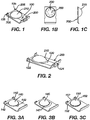
- FIG. 1 there is described a snap on cover 100 to be used with the standard contact lens package 200, as seen in Figure 1B .
- the cover 100 has a snap-on feature presented as tabs 105, placed at one end of the cover 100. These tabs 105 mate with the flanges 205 on package 200.
- the cover 100 thus is enabled to be attached to the bowl portion 210 of package 200, without creating a need to bond the cover 100 to the bowl 210 or, indeed the package 200.
- the cover 100 may be opaque and block ultraviolet light, so that if there is a contact lens placed in bowl 210 such that the lens is light activated, the cover will prevent inadvertent activation of the lens, or alternately deterioration of a drug that is present in the lens.
- Figure 2 describes a modification of the cover of Figure 1 .
- a cover 120 that contains snap on flanges 122, 124. These flanges 122, 124 are provided at either end 121, 123 of cover 120 - so that the cover 120 can be attached at both ends of the blister package 200, that is, the same package 200 which was featured in the description of the cover 100 of Figure 1 .
- the modified design 120 of Figure 2 ensures a better contact between the cover 120 and package 200, and thereby reduces the probability of the passage of light therethrough. This feature enables the cover 120 to be attached to the bowl 210 of package 200, without having to create a bond of any sort between the cover 120 and the bowl 210.
- FIGS 3A, 3B and 3C describe further modifications of the foregoing designs.
- covers 100, 120 are removed.
- covers 140, 145 and 150 incorporate features for ultrasonic welding. These are described as tabs 142, 147, 152 seen in each of these three Figures.
- These modifications now further reduce the probability of lens exposure to light.
- contact between covers 140, 145 or 150 with the bowl 210 is further enhanced, so that any snap-on features are eliminated.
- Each of the flanges 142, 147, 152 can be fusion bonded or welded to the bowl 210 by an ultrasonic or hot tip welding process, which are standard techniques known in the packaging industry.
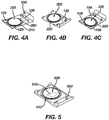
- FIG 3A , 4B and 4C describe further modifications of the concepts of Figures 3A, 3B and 3C .
- FIGs 4A, 4B and 4C there are provided larger weld spots, provided a distance apart from the heat seal ring 220 adjoining bowl 210 of the package 200.
- These extended wings or tails 129, 149, 159 enable welding of the cover 225 to the package bowl 210 apart from the heat seal ring 220. This feature ensures minimal damage to the already created heat seal bond between the bowl 210 and package lidstock and maintains a sterile barrier on the package 200.
- the lidstock is formed from a pressure formable foil, including laminated polyester and aluminum foil laminated composites.
- film may be used interchangeably with the term "lidstock” in the context of the invention.
- Figure 5 demonstrates a "squared up" modification of the cover seen in Figure 4C , so that there is reduced potential for light seepage.
- the attachment of cover 500 to package 550 is provided such that there is an increased surface area for welding. This feature provides enhanced covering of the bowl 510, to make welding of bowl 510 to cover 500 even easier, and further apart from the heat seal ring.
- a cover and package 500, 550 is ideally styled for containing a photochromic contact lens.
- the package is configured to address and minimize UV exposure of the photochromic contact lenses.
- the preferred material for cover 500 is polypropylene with a UV blocker and TiO2. When used with typical contact lens packages formed from polypropylene and having a wall thickness of between 0.55mm and 0.85mm, the preferred material thickness of the cover 500 is roughly 0.375 mm. This allows the cover to be pliable yet sturdily attached to the package 550. It is understood however, that the thickness of cover 500 can be in the range of 0.025 mm to 1.0 mm to meet specific product requirements. As well, other materials are certainly possible, as well be explained below.
- the scope of materials useful as the LMPC cover is contemplated to be quite broad.
- the material of choice should be compatible with the materials used in the primary package 550 and particularly bowl 510, so that a bond is formed between both materials when fusion bonded or welded.
- the bowl 510 is made of polypropylene
- the preferred material for use as the cover 500 is also polypropylene, although any other thermoplastic polymer, such as a propylene-based elastomer, a blend of polypropylene and polyethylene, EVA, etc. may be used. What is required is that the cover 500 is able to restrict passage of UV light.
- LMPC cover 500 is also COP, but any other thermoplastic polymer such as a COP blend, a cyclic olefin copolymer (COC) or a COC blend, EVA, etc., or any other UV restricting material may be used.
- the cover 500 should contain a compatible thermoplastic resin with or without additives such as TiO 2 , UV blocker, colored masterbatch, etc.
- the UV absorbers in cover 500 can be additives to the material such as benzotriazoles; benzophenones; triazines; or a combination of two or more of these additives.
- the light management protective insert may be made of any of the materials described herein in relation to the LMPC cover.
- the cover 500 should be fixedly attached to the package 550.
- a preferred method of fixation is to bond the cover 500 to the blister package by thermally welding it thereto, such as by using a hot tool tip as an external heat source, in order to apply heat in specifically useful areas around the cover 500. Applying heat there will tend to minimally yet sufficiently melt the polymer from which the cover 500 is created, and thereby effectuate a mechanical bond between the surfaces of the cover 500 and the package 550.
- other means of attachment such as forms of thermal attachment (laser, infrared) and friction (such as vibration, ultrasonic) bonding techniques may be utilized.
- package 600 has a preformed cover 601 attached to the bowl 605.
- This cover 601 is typically made by injection molding.
- the cover 601 is typically attached to bowl 605 by laser welding, post-production. Of course, it is UV light impermeable, consistent with the disclosure of the present invention.
- Cover 601 is typically press fit into bowl 605, but alternately it may be laser or sonic welding to bowl 605.
- the configuration of the packages is such that a strip of packages 600 may be formed in production. Then covers 601 may be applied to the bowls 605 consecutively.
- the package described in the above embodiments may also be used to protect contact lenses containing other light sensitive compounds, including light sensitive HEV absorbing compounds.
Landscapes
- Engineering & Computer Science (AREA)
- Mechanical Engineering (AREA)
- Physics & Mathematics (AREA)
- Health & Medical Sciences (AREA)
- Composite Materials (AREA)
- Chemical & Material Sciences (AREA)
- General Physics & Mathematics (AREA)
- Optics & Photonics (AREA)
- Ophthalmology & Optometry (AREA)
- Food Science & Technology (AREA)
- Toxicology (AREA)
- General Health & Medical Sciences (AREA)
- Packages (AREA)
- Eyeglasses (AREA)
Abstract
Description
- This application is a continuation in part of Serial Number
16/514437, filed July 17, 2019 - The present invention relates to packages used by consumers of contact lenses. More specifically, the present package helps inhibit the transmittance of ultraviolet light through the package and thus protect contact lens from UV exposure. This attribute will be useful for packaging contact lenses that contain any light or UV sensitive compounds such as a drug and/or light sensitive compounds such as photochromic compounds. It is perceived that exposure of ultraviolet or visible light to the lens may cause the light sensitive compound's efficacy to be compromised, not as a danger to the user, but for its loss of unique product benefits.
-
-
Figure 1 is a perspective drawing of a contact lens package cover for use with a contact lens blister bowl as inFigures 1B and 1C (pan and elevation view respectively, without the cover), made according to the description of the invention contained herein; -
Figure 2 is a perspective drawing of a modification to the package ofFigure 1 ; -
Figures 3A. 3B and 3C are further modifications of the present invention wherein the cover is ultrasonically welded to the package; -
Figures 4A, 4B and 4C are modifications of the cover ofFigures 3A, 3B and 3C ; -
Figure 5 describes a further configuration of the attachment of the cover to the package; and -
Figures 6A and 6B describe still other modifications of the attachment to the cover of the lens package. - Contact lenses are currently expanding in their choices of offerings, so that product portfolio will include contact lenses containing light or UV absorbing compounds, such as photochromic contact lenses, or high energy visible (HEV) light absorbing contact lenses some of which are light sensitive.
- For example, current primary packaging (polypropylene blister and foil laminated lidstock) does not protect against transmission of UV or visible light and may allow the potential activation of the photochromic lens, resulting in photo-fatigue of the lens and loss of its efficacy.
- Another example of light sensitivity includes a contact lens containing a photosensitive compound (such as an HEV light absorbing compound) that exhibits photodegradation when exposed to UV light. Light sensitivity may be demonstrated by a change in average transmission of at least 2 percent over a wavelength range of 400 to 450 nm. Various methods of exposure may be used. A preferred method of light exposure is that described by the International Conference on Harmonisation (ICH) of Technical Requirements for Registration of Pharmaceuticals for Human Use guideline, Q1B Photostability Testing of New Drug Substances and Products, published on November 1996. Preferably, the exposure is conducted under the ICH Photostability Guideline using an Option 2 light source with an estimated illuminance exposure of 1.5192 x 10⁶ Lux hours (168.8 hours exposure time) and an estimated ultraviolet irradiation exposure of 259.4 Watt hours/m2 (16.2 hours exposure time), preferably in a photostability chamber that is controlled at 25 ºC/Amb RH. After exposure, the UV/Vis spectrum of the sample is collected and compared to the spectrum of a sample that has been protected from exposure. By way of example, contact lenses containing photosensitive compounds according to the invention, after exposure to light under ICH guideline Q1B conditions (sometimes shortened herein to " ICH guideline Q1B" or "Q1B conditions") as described above, exhibit at least a 2 percent, or at least a 5 percent, or at least a 7 percent, or at least a 10 percent, change in their average transmission over a wavelength range of 400 to 450 nm. Such changes may be calculated as the absolute value of the difference between the average transmission (over the indicated wavelength range) with and without the light exposure.
- "Photochromic compound" may be considered to be compounds that generally reversibly darken upon exposure to specific intensities and wavelengths of light.
- Compounds that limit transmission of one or more wavelengths of high energy visible light through the lens, for instance in the range of 400 to 450 nm, may be considered "high energy visible light absorbing," or "HEV light absorbing" compounds. A material's ability to absorb certain wavelengths of light can be determined by measuring its UV/Vis transmission or absorbance spectrum.
- UV light may be considered to be light with wavelength(s) in the range of 100 to 400 nm.
- A "Light Management Protective Cover" (LMPC) was developed to address premature light exposure to photochromic and other light sensitive product. The LMPC is an attachable or adhered/bonded cover/shade used on current contact lens primary packaging surfaces to prevent/limit light exposure (including but not limited to UV) to its contents (including but not limited to contact lens).
- In the present invention, a light management protective insert may be attached to a cover, such that the insert controls the type of light which passes through the insert and onto the cover. In this case, the cover may be a generally translucent cover. The cover may be placed over a bowl for holding a contact lens. Such an insert can be used on current contact lens primary packaging surfaces to prevent/limit light exposure (including but not limited to UV) to its contents (including but not limited to contact lens).
- The LMPC is applied post-sterilization to the underside of the contact lens bowl and is intended to remain affixed to the outside of primary package. As a result, this invention will not impact the heat seal or sterilization processes used with the lens packaging, which are the two most important processing techniques utilized to ensure a sterile barrier packaging system. In addition, the LMPC cover does not come into contact with the packing solution or the physical lens itself and the primary package bowl offers sufficient barrier between the cover and the lens. Therefore, this solution mitigates concerns with respect to any material from the cover leaching into any of the interior of the package, the solution containing the lens, or into the lens itself - as all of these elements never come into contact with the LMPC. The cover which is combined with the light management protective insert may be applied in a corresponding manner as described herein in relation to the LMPC cover.
- As seen in
Figure 1 , there is described a snap oncover 100 to be used with the standardcontact lens package 200, as seen inFigure 1B . Thecover 100 has a snap-on feature presented astabs 105, placed at one end of thecover 100. Thesetabs 105 mate with theflanges 205 onpackage 200. Thecover 100 thus is enabled to be attached to thebowl portion 210 ofpackage 200, without creating a need to bond thecover 100 to thebowl 210 or, indeed thepackage 200. - As previously mentioned, the
cover 100 may be opaque and block ultraviolet light, so that if there is a contact lens placed inbowl 210 such that the lens is light activated, the cover will prevent inadvertent activation of the lens, or alternately deterioration of a drug that is present in the lens. -
Figure 2 describes a modification of the cover ofFigure 1 . As can be seen inFigure 2 , there is described acover 120 that contains snap onflanges flanges cover 120 can be attached at both ends of theblister package 200, that is, thesame package 200 which was featured in the description of thecover 100 ofFigure 1 . The modifieddesign 120 ofFigure 2 ensures a better contact between thecover 120 andpackage 200, and thereby reduces the probability of the passage of light therethrough. This feature enables thecover 120 to be attached to thebowl 210 ofpackage 200, without having to create a bond of any sort between thecover 120 and thebowl 210. -
Figures 3A, 3B and 3C describe further modifications of the foregoing designs. As seen in these Figures, the "snap on" features ofcovers tabs Figures 3A, 3B and 3C , contact between covers 140, 145 or 150 with thebowl 210 is further enhanced, so that any snap-on features are eliminated. Each of theflanges bowl 210 by an ultrasonic or hot tip welding process, which are standard techniques known in the packaging industry. -
Figure 3A ,4B and 4C describe further modifications of the concepts ofFigures 3A, 3B and 3C . Now, as can be seen inFigures 4A, 4B and 4C , there are provided larger weld spots, provided a distance apart from theheat seal ring 220 adjoiningbowl 210 of thepackage 200. These extended wings ortails cover 225 to thepackage bowl 210 apart from theheat seal ring 220. This feature ensures minimal damage to the already created heat seal bond between thebowl 210 and package lidstock and maintains a sterile barrier on thepackage 200. The lidstock is formed from a pressure formable foil, including laminated polyester and aluminum foil laminated composites. The term "film" may be used interchangeably with the term "lidstock" in the context of the invention. - Finally,
Figure 5 demonstrates a "squared up" modification of the cover seen inFigure 4C , so that there is reduced potential for light seepage. The attachment ofcover 500 to package 550 is provided such that there is an increased surface area for welding. This feature provides enhanced covering of thebowl 510, to make welding ofbowl 510 to cover 500 even easier, and further apart from the heat seal ring. - As best seen in
Figure 5 , a cover andpackage cover 500 is polypropylene with a UV blocker and TiO2. When used with typical contact lens packages formed from polypropylene and having a wall thickness of between 0.55mm and 0.85mm, the preferred material thickness of thecover 500 is roughly 0.375 mm. This allows the cover to be pliable yet sturdily attached to thepackage 550. It is understood however, that the thickness ofcover 500 can be in the range of 0.025 mm to 1.0 mm to meet specific product requirements. As well, other materials are certainly possible, as well be explained below. - The scope of materials useful as the LMPC cover is contemplated to be quite broad. The material of choice should be compatible with the materials used in the
primary package 550 and particularlybowl 510, so that a bond is formed between both materials when fusion bonded or welded. For instance, if thebowl 510 is made of polypropylene, the preferred material for use as thecover 500 is also polypropylene, although any other thermoplastic polymer, such as a propylene-based elastomer, a blend of polypropylene and polyethylene, EVA, etc. may be used. What is required is that thecover 500 is able to restrict passage of UV light. - Similarly, if the
bowl 510 is made of a cyclic olefin polymer (COP), a preferred material option forLMPC cover 500 is also COP, but any other thermoplastic polymer such as a COP blend, a cyclic olefin copolymer (COC) or a COC blend, EVA, etc., or any other UV restricting material may be used. Depending on the product critical-to-quality requirements (CTQs) and the material composition of theprimary package bowl 510, thecover 500 should contain a compatible thermoplastic resin with or without additives such as TiO2, UV blocker, colored masterbatch, etc. The UV absorbers incover 500 can be additives to the material such as benzotriazoles; benzophenones; triazines; or a combination of two or more of these additives. The light management protective insert may be made of any of the materials described herein in relation to the LMPC cover. - The
cover 500 should be fixedly attached to thepackage 550. A preferred method of fixation is to bond thecover 500 to the blister package by thermally welding it thereto, such as by using a hot tool tip as an external heat source, in order to apply heat in specifically useful areas around thecover 500. Applying heat there will tend to minimally yet sufficiently melt the polymer from which thecover 500 is created, and thereby effectuate a mechanical bond between the surfaces of thecover 500 and thepackage 550. Naturally, it is contemplated that other means of attachment, such as forms of thermal attachment (laser, infrared) and friction (such as vibration, ultrasonic) bonding techniques may be utilized. - As can be seen in
Figures 6A and 6B , there is described a further modification of the package of the present invention. Here,package 600 has a preformedcover 601 attached to thebowl 605. Thiscover 601 is typically made by injection molding. Thecover 601 is typically attached to bowl 605 by laser welding, post-production. Of course, it is UV light impermeable, consistent with the disclosure of the present invention. Cover 601 is typically press fit intobowl 605, but alternately it may be laser or sonic welding to bowl 605. As can be seen in Figure 605, the configuration of the packages is such that a strip ofpackages 600 may be formed in production. Then covers 601 may be applied to thebowls 605 consecutively. - In this fashion, opening and closing functionality of the package is not impinged upon, as it must not be. Yet, with the covers of the present invention attached to the contact lens package, certain forms of light such as UV light are inhibited from penetrating the package such as
package 550 and acontact lens 570 contained in solution inside it. This arrangement preserves the functionality of the polychromic aspects of the lens. - The package described in the above embodiments may also be used to protect contact lenses containing other light sensitive compounds, including light sensitive HEV absorbing compounds.
- The foregoing invention is to be understood in conjunction with the appended claims, taking into account all appropriate equivalents.
- The following list of the embodiments forms part of the description.
-
- 1. A contact lens package comprising:
- a bowl for holding a contact lens;
- a film engaging said bowl so as to hold a contact lens between said bowl and the film; and
- and a light management protective cover attached to said bowl, such that said cover controls the type of light which passes through said cover and onto said bowl.
- 2. The package of embodiment 1 wherein said cover prevents the passage of ultraviolet light.
- 3. The package of embodiment 1 wherein said bowl is generally translucent.
- 4. The package of embodiment 1 wherein said cover snaps over said bowl.
- 5. The package of embodiment 1 wherein said cover is welded to said bowl.
- 6. The package of embodiment 1 wherein said cover further contains flanges for gripping by the fingers of a user.
- 7. The package of embodiment 1 wherein said cover is sonically welded to said bowl.
- 8. A contact lens package comprising:
- a bowl for holding a contact lens;
- a generally translucent cover placed over said bowl; and
- and a light management protective insert attached to said cover, such that said insert controls the type of light which passes through said insert and onto said cover.
- 9. The package of embodiment 8 wherein said cover prevents the passage of ultraviolet light.
- 10. The package of embodiment 8 wherein said bowl is generally translucent.
- 11. The package of embodiment 8 wherein said cover snaps over said bowl.
- 12. The package of embodiment 8 wherein said cover is welded to said bowl.
- 13. The package of embodiment 8 wherein said cover further contains flanges for gripping by the fingers of a user.
- 14. The package of embodiment 8 wherein said cover is welded to said bowl.
- 15. In combination:
a contact lens package comprising:- a bowl for holding a contact lens;
- a film engaging said bowl so as to hold a contact lens between said bowl and the film; and
- and a light management protective cover releasably attached to said bowl, such that said cover controls the type of light which passes through said cover and onto said bowl; and
- a contact lens held within said package.
- 16. A cover adapted to be placed over the bowl forming the outside of a contact lens package, said cover blocking the passage of ultraviolet light into said bowl.
- 17. The package of embodiment 15 further including a lidstock attached to the bowl, said lidstock formed from a pressure formable foil.
- 18. The package of embodiment 17 wherein the pressure formable foil is a laminated polyester or an aluminum foil composite.
Claims (13)
- A contact lens package comprising:a bowl for holding a contact lens;a film engaging said bowl so as to hold a contact lens between said bowl and the film; anda light management protective cover attached to said bowl, such that said cover controls the type of light which passes through said cover and onto said bowl.
- A contact lens package comprising:a bowl for holding a contact lens;a generally translucent cover placed over said bowl; anda light management protective insert attached to said cover, such that said insert controls the type of light which passes through said insert and onto said cover.
- The package of claim 1 or claim 2 wherein said cover prevents the passage of ultraviolet light.
- The package of claim 2 wherein said insert prevents the passage of ultraviolet light.
- The package of any one of claims 1 to 4 wherein said bowl is generally translucent.
- The package of any one of claims 1 to 5 wherein said cover snaps over said bowl.
- The package of any one of claims 1 to 5 wherein said cover is welded to said bowl.
- The package of any one of claims 1 to 7 wherein said cover further contains flanges for gripping by the fingers of a user.
- The package of any one of claims 1 to 5, and 7 to 8, wherein said cover is sonically welded to said bowl.
- A contact lens package system comprising:a contact lens package of claim 1 wherein the light management protective cover is releasably attached to said bowl; anda contact lens held within said package.
- A cover adapted to be placed over the bowl forming the outside of a contact lens package, said cover blocking the passage of ultraviolet light into said bowl.
- The package of any one of claims 1 to 10 wherein the film is attached to the bowl and is formed from a pressure formable foil.
- The package of claim 12, wherein the pressure formable foil is a laminated polyester or an aluminum foil composite.
Applications Claiming Priority (2)
| Application Number | Priority Date | Filing Date | Title |
|---|---|---|---|
| US16/514,437 US20210015227A1 (en) | 2019-07-17 | 2019-07-17 | UV Light Management Package and Protective Cover |
| US16/901,097 US20210018661A1 (en) | 2019-07-17 | 2020-06-15 | UV Light Management Package and Protective Cover |
Publications (1)
| Publication Number | Publication Date |
|---|---|
| EP3766800A1 true EP3766800A1 (en) | 2021-01-20 |
Family
ID=71661777
Family Applications (1)
| Application Number | Title | Priority Date | Filing Date |
|---|---|---|---|
| EP20186313.1A Withdrawn EP3766800A1 (en) | 2019-07-17 | 2020-07-16 | Uv light management package and protective cover |
Country Status (8)
| Country | Link |
|---|---|
| US (1) | US20210018661A1 (en) |
| EP (1) | EP3766800A1 (en) |
| JP (1) | JP2021018439A (en) |
| KR (1) | KR20210010380A (en) |
| CN (1) | CN112239015A (en) |
| AU (1) | AU2020204376A1 (en) |
| MA (1) | MA53839A (en) |
| TW (1) | TW202108037A (en) |
Families Citing this family (8)
| Publication number | Priority date | Publication date | Assignee | Title |
|---|---|---|---|---|
| US11360240B2 (en) | 2019-12-19 | 2022-06-14 | Johnson & Johnson Vision Care, Inc. | Contact lens containing photosensitive chromophore and package therefor |
| JP1669253S (en) * | 2020-03-10 | 2020-09-28 | ||
| USD965287S1 (en) * | 2021-12-30 | 2022-10-04 | Shenzhen Xin'an Innovation Technology Co., Ltd. | GPS case |
| TWD222835S (en) * | 2022-05-25 | 2022-12-21 | 晶碩光學股份有限公司 | Container for contact lens |
| TWD222836S (en) * | 2022-05-25 | 2022-12-21 | 晶碩光學股份有限公司 | Package for contact lens |
| USD1061023S1 (en) * | 2022-06-21 | 2025-02-11 | Johnson & Johnson Vision Care, Inc. | Contact lens package |
| USD1062223S1 (en) * | 2022-06-21 | 2025-02-18 | Johnson & Johnson Vision Care, Inc. | Contact lens package |
| TWI821026B (en) * | 2022-11-17 | 2023-11-01 | 晶碩光學股份有限公司 | Anti-fatigue contact lens |
Citations (2)
| Publication number | Priority date | Publication date | Assignee | Title |
|---|---|---|---|---|
| EP0604177A2 (en) * | 1992-12-21 | 1994-06-29 | JOHNSON & JOHNSON VISION PRODUCTS, INC. | Ophthalmic lens package |
| WO2015150790A1 (en) * | 2014-03-31 | 2015-10-08 | Coopervision International Holding Company, Lp | Contact lens packaging and methods of manufacturing packaged contact lenses |
Family Cites Families (11)
| Publication number | Priority date | Publication date | Assignee | Title |
|---|---|---|---|---|
| JPH01279222A (en) * | 1988-05-02 | 1989-11-09 | Masaaki Haga | Handy contact lens preservative container |
| WO1994024019A2 (en) * | 1993-04-21 | 1994-10-27 | Allergan, Inc. | Contact lens containers and methods of using |
| US5375698A (en) * | 1993-05-07 | 1994-12-27 | Allergan, Inc. | Prefilled, resealable contact lens container |
| JP4550352B2 (en) * | 2002-07-22 | 2010-09-22 | 富山化学工業株式会社 | Transparent packaging bag and liquid preparation package packaged outside with this |
| EP1556279A4 (en) * | 2002-09-13 | 2006-08-30 | 1 800 Contacts Inc | CASE FOR CONTACT LENSES AND STORAGE BOX, OBJECT HOLDER, AND SYSTEM AND METHOD FOR MANUFACTURING AND USING THE SAME |
| US7404994B2 (en) * | 2003-03-12 | 2008-07-29 | Reynolds Packaging Llc | Lidstock material having improved burst strength |
| US20050205451A1 (en) * | 2004-03-18 | 2005-09-22 | Brown-Skrobot Susan K | Contact lens packages |
| US8459445B2 (en) * | 2006-07-21 | 2013-06-11 | Menicon, Co., Ltd. | Colored contact lens primary packaging |
| WO2010103573A1 (en) * | 2009-03-12 | 2010-09-16 | 株式会社メニコン | Distribution storage method for contact lens and contact lens package |
| US8365910B2 (en) * | 2011-06-02 | 2013-02-05 | Cook Medical Technologies Llc | Medical device packaging |
| SG189576A1 (en) * | 2011-10-18 | 2013-05-31 | Menicon Singapore Pte Ltd | Packaging for disposable soft contact lenses having pre-formed multi-layer structural laminate |
-
2020
- 2020-06-15 US US16/901,097 patent/US20210018661A1/en not_active Abandoned
- 2020-06-30 AU AU2020204376A patent/AU2020204376A1/en not_active Abandoned
- 2020-07-15 KR KR1020200087469A patent/KR20210010380A/en not_active Ceased
- 2020-07-15 TW TW109123825A patent/TW202108037A/en unknown
- 2020-07-16 JP JP2020121969A patent/JP2021018439A/en active Pending
- 2020-07-16 MA MA053839A patent/MA53839A/en unknown
- 2020-07-16 EP EP20186313.1A patent/EP3766800A1/en not_active Withdrawn
- 2020-07-17 CN CN202010691601.7A patent/CN112239015A/en active Pending
Patent Citations (2)
| Publication number | Priority date | Publication date | Assignee | Title |
|---|---|---|---|---|
| EP0604177A2 (en) * | 1992-12-21 | 1994-06-29 | JOHNSON & JOHNSON VISION PRODUCTS, INC. | Ophthalmic lens package |
| WO2015150790A1 (en) * | 2014-03-31 | 2015-10-08 | Coopervision International Holding Company, Lp | Contact lens packaging and methods of manufacturing packaged contact lenses |
Non-Patent Citations (1)
| Title |
|---|
| THE INTERNATIONAL CONFERENCE ON HARMONISATION (ICH) OF TECHNICAL REQUIREMENTS FOR REGISTRATION OF PHARMACEUTICALS FOR HUMAN USE GUIDELINE, Q1 B PHOTOSTABILITY TESTING OF NEW DRUG SUBSTANCES AND PRODUCTS, November 1996 (1996-11-01) |
Also Published As
| Publication number | Publication date |
|---|---|
| AU2020204376A1 (en) | 2021-02-04 |
| CN112239015A (en) | 2021-01-19 |
| US20210018661A1 (en) | 2021-01-21 |
| KR20210010380A (en) | 2021-01-27 |
| TW202108037A (en) | 2021-03-01 |
| MA53839A (en) | 2021-12-01 |
| RU2020123085A (en) | 2022-01-13 |
| RU2020123085A3 (en) | 2022-01-13 |
| JP2021018439A (en) | 2021-02-15 |
Similar Documents
| Publication | Publication Date | Title |
|---|---|---|
| US20210018661A1 (en) | UV Light Management Package and Protective Cover | |
| CA2147190C (en) | An ultraviolet light absorbing and transparent packaging laminate | |
| AU2017202762B2 (en) | A method of removing a syringe from a package | |
| KR100842015B1 (en) | General purpose packaging for sterilization products or products to be sterilized | |
| US10729843B2 (en) | Dual packaging for fill needle and safety needle | |
| US20180161491A1 (en) | Packaging For Safety Needle | |
| JP7427673B2 (en) | UV control contact lens packaging | |
| KR101836759B1 (en) | Contact lens packaging and methods of manufacturing packaged contact lenses | |
| FR2816925A1 (en) | PACKAGE FOR PRODUCTS TO BE STERILIZED WITH A HIGH TEMPERATURE STERILIZING FLUID | |
| KR20170013223A (en) | A safety closure for containers | |
| CA2812375A1 (en) | A reclosable pouring element with a barrier film and a support wall | |
| DK0698487T3 (en) | Use of a contaminant-tight sealing film for packaging of pharmaceutical products | |
| US20210015227A1 (en) | UV Light Management Package and Protective Cover | |
| TWI314124B (en) | Protective packaging for medicament dispenser and combination of a medicament dispenser and a protective package | |
| US20160106507A1 (en) | Packaging, preferably medical, and corresponding assembly of packagings | |
| US3435948A (en) | Gas sterilizable package | |
| HK40043041A (en) | Uv light management package and protective cover | |
| RU2773200C2 (en) | Packaging and protective coating for control of uv radiation | |
| HK40041431A (en) | Uv light management package and protective cover | |
| JP2005305745A (en) | Ultraviolet absorbing film and packaging body using the film | |
| JP4352169B2 (en) | Ultraviolet absorber and packaging material containing the ultraviolet absorber | |
| JP5736704B2 (en) | Sealed container with resealability | |
| US11370590B2 (en) | Packaging, preferably medical, and corresponding assembly of packagings | |
| JP2006087670A (en) | Outer bag for transfusion bag | |
| JP2008230163A (en) | Welding method by surface coating of laser beam absorbent material |
Legal Events
| Date | Code | Title | Description |
|---|---|---|---|
| PUAI | Public reference made under article 153(3) epc to a published international application that has entered the european phase |
Free format text: ORIGINAL CODE: 0009012 |
|
| STAA | Information on the status of an ep patent application or granted ep patent |
Free format text: STATUS: THE APPLICATION HAS BEEN PUBLISHED |
|
| AK | Designated contracting states |
Kind code of ref document: A1 Designated state(s): AL AT BE BG CH CY CZ DE DK EE ES FI FR GB GR HR HU IE IS IT LI LT LU LV MC MK MT NL NO PL PT RO RS SE SI SK SM TR |
|
| AX | Request for extension of the european patent |
Extension state: BA ME |
|
| STAA | Information on the status of an ep patent application or granted ep patent |
Free format text: STATUS: REQUEST FOR EXAMINATION WAS MADE |
|
| 17P | Request for examination filed |
Effective date: 20210701 |
|
| RAV | Requested validation state of the european patent: fee paid |
Extension state: KH Effective date: 20210701 Extension state: MA Effective date: 20210701 Extension state: MD Effective date: 20210701 Extension state: TN Effective date: 20210701 |
|
| RAX | Requested extension states of the european patent have changed |
Extension state: BA Payment date: 20210701 Extension state: ME Payment date: 20210701 |
|
| RBV | Designated contracting states (corrected) |
Designated state(s): AL AT BE BG CH CY CZ DE DK EE ES FI FR GB GR HR HU IE IS IT LI LT LU LV MC MK MT NL NO PL PT RO RS SE SI SK SM TR |
|
| REG | Reference to a national code |
Ref country code: HK Ref legal event code: DE Ref document number: 40043041 Country of ref document: HK |
|
| STAA | Information on the status of an ep patent application or granted ep patent |
Free format text: STATUS: EXAMINATION IS IN PROGRESS |
|
| 17Q | First examination report despatched |
Effective date: 20211103 |
|
| GRAP | Despatch of communication of intention to grant a patent |
Free format text: ORIGINAL CODE: EPIDOSNIGR1 |
|
| STAA | Information on the status of an ep patent application or granted ep patent |
Free format text: STATUS: GRANT OF PATENT IS INTENDED |
|
| INTG | Intention to grant announced |
Effective date: 20230510 |
|
| GRAJ | Information related to disapproval of communication of intention to grant by the applicant or resumption of examination proceedings by the epo deleted |
Free format text: ORIGINAL CODE: EPIDOSDIGR1 |
|
| STAA | Information on the status of an ep patent application or granted ep patent |
Free format text: STATUS: EXAMINATION IS IN PROGRESS |
|
| INTC | Intention to grant announced (deleted) | ||
| GRAP | Despatch of communication of intention to grant a patent |
Free format text: ORIGINAL CODE: EPIDOSNIGR1 |
|
| STAA | Information on the status of an ep patent application or granted ep patent |
Free format text: STATUS: GRANT OF PATENT IS INTENDED |
|
| INTG | Intention to grant announced |
Effective date: 20231030 |
|
| STAA | Information on the status of an ep patent application or granted ep patent |
Free format text: STATUS: THE APPLICATION IS DEEMED TO BE WITHDRAWN |
|
| 18D | Application deemed to be withdrawn |
Effective date: 20240312 |