EP3766736B1 - Stepladder for rescue vehicles - Google Patents
Stepladder for rescue vehicles Download PDFInfo
- Publication number
- EP3766736B1 EP3766736B1 EP20186070.7A EP20186070A EP3766736B1 EP 3766736 B1 EP3766736 B1 EP 3766736B1 EP 20186070 A EP20186070 A EP 20186070A EP 3766736 B1 EP3766736 B1 EP 3766736B1
- Authority
- EP
- European Patent Office
- Prior art keywords
- stepladder
- lateral supports
- vehicle
- inclination
- lateral
- Prior art date
- Legal status (The legal status is an assumption and is not a legal conclusion. Google has not performed a legal analysis and makes no representation as to the accuracy of the status listed.)
- Active
Links
Images

Classifications
-
- B—PERFORMING OPERATIONS; TRANSPORTING
- B60—VEHICLES IN GENERAL
- B60R—VEHICLES, VEHICLE FITTINGS, OR VEHICLE PARTS, NOT OTHERWISE PROVIDED FOR
- B60R3/00—Arrangements of steps or ladders facilitating access to or on the vehicle, e.g. running-boards
- B60R3/02—Retractable steps or ladders, e.g. movable under shock
-
- B—PERFORMING OPERATIONS; TRANSPORTING
- B60—VEHICLES IN GENERAL
- B60R—VEHICLES, VEHICLE FITTINGS, OR VEHICLE PARTS, NOT OTHERWISE PROVIDED FOR
- B60R3/00—Arrangements of steps or ladders facilitating access to or on the vehicle, e.g. running-boards
Definitions
- the present invention relates to a stepladder, in particular to a stepladder for rescue vehicles, for instance firefighting vehicles.
- Firefighting vehicles usually comprise a stepladder whose step supports are fixed on the vehicle chassis in correspondence to the vehicle cabin.
- the stepladder is designed to allow the crew/users of the vehicle to get on and off the vehicle easily, as fast and comfortable as possible, in order to act promptly on the fire/on the outstanding emergency.
- Aforementioned stepladder is usually fixed to the chassis of the vehicle and have fixed steps on the stepladder framework.
- the firefighting vehicle is on a sloping route even the stepladder and the steps are inclined so that the driver movements for getting on and getting off of the vehicle is more difficult.
- EP21320979 A1 discloses the features according to the preamble of claim 1.
- stepladder need to be configured to allow the driver to get on such stepladder when the vehicle is located on inclined routes.
- An aim of the present invention is to satisfy the above mentioned needs in a simple and cost-effective way.
- stepladder for a rescue vehicle according to claim 1 and by a method for operating such stepladder on a rescue vehicle according to claim 7.
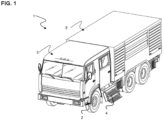
- Figure 1 discloses a rescue vehicle 1, in particular a firefighting vehicle 1 essentially comprising a chassis 2, a cabin 3, e.g. comprising a load compartment 3' for driver and passengers, for example firemen.
- the firefighting vehicle 1 further comprises a stepladder 4, coupled to the cabin 3, configured to facilitate the access of vehicle 1 users from ground to cabin level.
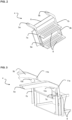
- Stepladder 4 comprises, see figures 2 and 3 , in the upper part, two forks 5a, 5b configured to be coupled to the cabin 3, e.g. via threaded means or by welding.
- the two forks 5a, 5b may be joined each other by means of a transversal stiffener 6.
- the stepladder 4 may further comprise a first and a second lateral supports 7a, 7b movably connected to first and second forks 5a, 5b.
- first and second lateral supports 7a, 7b are connected to forks 5a, 5b so as to allow a rotation of an upper terminal portion of first and second lateral supports 7a, 7b with respect to these latter.
- first and second lateral supports 7a, 7b defines respective pivots 11a, 11b with respect to forks 5a, 5b.
- the stepladder 4 further comprises at least a step 8 located transversally with respect to lateral supports 7a, 7b and configured to allow the support of vehicle user's feet.
- the stepladder 4 comprises two steps 8, each step 8 being pivotally connected to the lateral supports 7a, 7b so as to define a first closed position, into which their support plane is substantially parallel to lateral supports and a second, open, position, into which their support plane is substantially perpendicular to lateral supports, allowing users to step on to jump into the cabin.
- steps 8 have a substantially rectangular shape with two lateral ends, a front end and a back end. Said lateral ends may be connected together by means of first and second beam 9a, 9b, so that the movement of a first step 8 is transmitted to the other steps 8.
- stepladder 4 further comprises first actuator means 10a, 10b ( figure 3 ) configured to move first and second lateral supports 7a, 7b with respect to forks 5a, 5b.
- first actuator means 10a, 10b are hinged to first and second fork 5a, 5b and to first and second lateral support 7a, 7b and may comprise cylinders actuators configured to pass from a first, closed, position and to a second, fully extended, position.
- the lateral supports 7a, 7b may rotate respectively around the pivot 11a, 11b by means of the action of first actuator means 10a, 10b. Therefore, the lateral supports 7a, 7b may move from a first position when first actuator means 10a, 10b are in their closed position to a second position when the first actuators means are in their open position.
- Such actuator means 10a, 10b may be controlled mechanically, e.g. by the movement of an element of the vehicle, e.g. door of the cabin, or electronically as exemplarily described below.
- the cabin 3 of vehicle 1 is not inclined with respect to its chassis (x direction), the lateral supports 7a, 7b lay almost in a vertical direction (y direction), while the at least two steps 8 lay almost in horizontal planes parallel to the ground.
- a driver using the stepladder 4 may easily get on and get off of the cabin 3 of the firefighting vehicle 1. If steps 8 are not useful, they may be rotated to assume their closed position.
- the second position of the stepladder 4 may depend on the inclination of of cabin 3 with respect to its chassis or of the rescue vehicle 1 itself.
- angle ⁇ ( Figure 4B ) represents the rotation of the lateral supports 7a, 7b of the stepladder 4 from their first position to their second position.
- the amplitude of the angle ⁇ is a function of the inclination of cabin 3.
- the lateral supports 7a, 7b may assume the almost vertical direction (y direction) as in the first position.
- the driver will assume a balanced position with the projection of his center of gravity inside the area of the steps. Therefore, to reach this aim, the lateral supports 7a, 7b should assume an inclination different from the predetermined inclination corresponding to the first position ( Figure 4A ).
- the two steps 8 may be optionally further inclined in active way, by means of second actuator means (not shown).
- second actuator means not shown.
- the stepladder 4 according to the present invention is configured to allow a driver to get on and get off the firefighting vehicle 1 in a comfortable way, avoiding the risk of falling down.
- the vehicle may accordingly comprise at least one sensor (not shown) configured to detect the inclination of the vehicle and a control unit (not shown) comprising elaboration means configured to receive inclination vehicle value from sensors and calculate an optimal inclination of said lateral supports 7a, 7b, and optionally of said steps 8, to facilitate the use of the ladder of the vehicle.
- the control unit may therefore control automatically stepladder 4 without any intervention of the driver.
- such control unit is the ECU of the vehicle.
- the at least one sensor may be an inclinometer able to detect the inclination of the vehicle, i.e. the inclination of the rescue vehicle 1 along the x and/or z axis.
- the control unit may actuate first actuator means 10a, 10b to rotate the lateral supports 7a, 7b of a predetermined angle ⁇ so that the lateral supports reach the calculated optimal inclination
- the present invention is moreover directed to a method for operating the above described stepladder 4 on a rescue vehicle, in particular on a firefighting vehicle.
- Such method for operating the stepladder 4 essentially comprises the following steps:
- the above method may further comprise the following step:
- the above method may be carried out by the control unit of the vehicle.
- a suitable algorithm based on a closed loop control may be run by the elaboration means of the control unit.
- the orientation of the lateral support 7a, 7b of the stepladder 4 is essential for allowing the easy and quick get on and get off of the crew from the rescue vehicle 1.
- the proposed stepladder is economic and may be easily implemented on existing vehicles.
- the method for operating the stepladder 4 is simply and versatile and may be applied to different ground inclinations and conditions.
- the lateral supports 7a, 7b may be inclined so that they can reach a maximum opened value thereby allowing an easy access under cabin 3 for maintenance reasons.
- stepladder 4 may be varied without departing from their functionalities. Therefore, stepladder 4 may comprise more steps 8 being of different typologies than the above described.
- first actuators 10a, 10b and second actuator means may be substituted by any equivalent, e.g. pneumatic, hydraulic or electric actuators.
Landscapes
- Engineering & Computer Science (AREA)
- Mechanical Engineering (AREA)
- Ladders (AREA)
- Vehicle Step Arrangements And Article Storage (AREA)
- Fire-Extinguishing By Fire Departments, And Fire-Extinguishing Equipment And Control Thereof (AREA)
- Emergency Lowering Means (AREA)
Description
- The present invention relates to a stepladder, in particular to a stepladder for rescue vehicles, for instance firefighting vehicles.
- All types of rescue vehicles must provide good accessibility of all parts and components. In particular, such vehicles, for example firefighting vehicles, must be readily accessible on difficult and uncomfortable routes.
- Firefighting vehicles usually comprise a stepladder whose step supports are fixed on the vehicle chassis in correspondence to the vehicle cabin. The stepladder is designed to allow the crew/users of the vehicle to get on and off the vehicle easily, as fast and comfortable as possible, in order to act promptly on the fire/on the outstanding emergency.
- Aforementioned stepladder is usually fixed to the chassis of the vehicle and have fixed steps on the stepladder framework. Thus, when the firefighting vehicle is on a sloping route even the stepladder and the steps are inclined so that the driver movements for getting on and getting off of the vehicle is more difficult.
- Examples of known ladder systems are disclosed in documents
EP21320979 A1 CA1 144583 A ,US2007/240936 A1 ,US2006/011416 A1 orUS2012/104721 A1 .EP21320979 A1 claim 1. - In view of the above, stepladder need to be configured to allow the driver to get on such stepladder when the vehicle is located on inclined routes.
- Therefore, the need is felt to provide stepladder for rescue vehicles, which can solve the aforementioned drawbacks.
- An aim of the present invention is to satisfy the above mentioned needs in a simple and cost-effective way.
- The aforementioned aim is reached by a stepladder for a rescue vehicle according to
claim 1 and by a method for operating such stepladder on a rescue vehicle according to claim 7. - For a better understanding of the present invention, a preferred embodiment is described in the following, by way of a non-limiting example, with reference to the attached drawings wherein:
-
Figure 1 is a perspective view of a rescue vehicle comprising a stepladder according to the present invention; -
Figure 2 is a perspective view of the stepladder of the present invention; -
Figure 3 is a perspective view of a portion of the stepladder offigure 2 ; -
Figure 4A is a back view the of the firefighting vehicle offigure 1 in a first working condition; -
Figure 4B is a back view of the firefighting vehicle o offigure 1 in a second working condition. -
Figure 1 discloses arescue vehicle 1, in particular afirefighting vehicle 1 essentially comprising achassis 2, acabin 3, e.g. comprising a load compartment 3' for driver and passengers, for example firemen. Thefirefighting vehicle 1 further comprises astepladder 4, coupled to thecabin 3, configured to facilitate the access ofvehicle 1 users from ground to cabin level. -
Stepladder 4 comprises, seefigures 2 and 3 , in the upper part, twoforks cabin 3, e.g. via threaded means or by welding. The twoforks transversal stiffener 6. - The
stepladder 4 may further comprise a first and a second lateral supports 7a, 7b movably connected to first andsecond forks lateral supports forks lateral supports lateral supports respective pivots forks - The
stepladder 4 further comprises at least astep 8 located transversally with respect tolateral supports stepladder 4 comprises twosteps 8, eachstep 8 being pivotally connected to thelateral supports steps 8 have a substantially rectangular shape with two lateral ends, a front end and a back end. Said lateral ends may be connected together by means of first andsecond beam first step 8 is transmitted to theother steps 8. - According to a first aspect of the invention,
stepladder 4 further comprises first actuator means 10a, 10b (figure 3 ) configured to move first and secondlateral supports forks second fork lateral support - Accordingly, the lateral supports 7a, 7b may rotate respectively around the
pivot - Such actuator means 10a, 10b may be controlled mechanically, e.g. by the movement of an element of the vehicle, e.g. door of the cabin, or electronically as exemplarily described below.
- Assuming the operative condition depicted in
figure 4A , thecabin 3 ofvehicle 1 is not inclined with respect to its chassis (x direction), thelateral supports steps 8 lay almost in horizontal planes parallel to the ground. In that first position, a driver using thestepladder 4 may easily get on and get off of thecabin 3 of thefirefighting vehicle 1. Ifsteps 8 are not useful, they may be rotated to assume their closed position. - The second position of the
stepladder 4 may depend on the inclination of ofcabin 3 with respect to its chassis or of therescue vehicle 1 itself. - In particular, angle α (
Figure 4B ) represents the rotation of thelateral supports stepladder 4 from their first position to their second position. The amplitude of the angle α is a function of the inclination ofcabin 3. In other words, in their second position the lateral supports 7a, 7b may assume the almost vertical direction (y direction) as in the first position. In such a way, when getting on or getting off the vehicle, the driver will assume a balanced position with the projection of his center of gravity inside the area of the steps. Therefore, to reach this aim, the lateral supports 7a, 7b should assume an inclination different from the predetermined inclination corresponding to the first position (Figure 4A ). - Advantageously, in order to let the steps reach a lying parallel to the cabin's floor, the two
steps 8 may be optionally further inclined in active way, by means of second actuator means (not shown). In any case, either operating only first actuator means 10a, 10b or operating both first and second actuator means, thestepladder 4 according to the present invention is configured to allow a driver to get on and get off thefirefighting vehicle 1 in a comfortable way, avoiding the risk of falling down. - The vehicle may accordingly comprise at least one sensor (not shown) configured to detect the inclination of the vehicle and a control unit (not shown) comprising elaboration means configured to receive inclination vehicle value from sensors and calculate an optimal inclination of said
lateral supports said steps 8, to facilitate the use of the ladder of the vehicle. The control unit may therefore control automatically stepladder 4 without any intervention of the driver. Preferably, such control unit is the ECU of the vehicle. - The at least one sensor may be an inclinometer able to detect the inclination of the vehicle, i.e. the inclination of the
rescue vehicle 1 along the x and/or z axis. - The control unit may actuate first actuator means 10a, 10b to rotate the
lateral supports - According to the above described embodiment and its operation, the present invention is moreover directed to a method for operating the above described
stepladder 4 on a rescue vehicle, in particular on a firefighting vehicle. - Such method for operating the
stepladder 4 essentially comprises the following steps: - measuring the
rescue vehicle 1 inclination by means of at least one sensor; - calculating the optimal inclination α of the
lateral supports stepladder 4 as a function of the inclination of therescue vehicle 1; - actively rotating the
lateral supports - Advantageously, in order to maintain the
steps 8 of thestepladder 4 in a position which guarantees comfort to the crew, the above method may further comprise the following step: - inclining the at least two
steps 8 of thestepladder 4 so that they are parallel to ground. - Preferably, the above method may be carried out by the control unit of the vehicle. To perform such a method a suitable algorithm based on a closed loop control may be run by the elaboration means of the control unit.
- In view of the foregoing, the advantages of a
stepladder 4 according to the invention are apparent. - First, the orientation of the
lateral support stepladder 4 is essential for allowing the easy and quick get on and get off of the crew from therescue vehicle 1. - The proposed stepladder is economic and may be easily implemented on existing vehicles.
- Moreover, the method for operating the
stepladder 4 is simply and versatile and may be applied to different ground inclinations and conditions. - Furthermore, the lateral supports 7a, 7b may be inclined so that they can reach a maximum opened value thereby allowing an easy access under
cabin 3 for maintenance reasons. - It is clear that modifications can be made to the described
stepladder 4 which do not extend beyond the scope of protection defined by the claims. - For example, shapes of
stepladder 4 may be varied without departing from their functionalities. Therefore,stepladder 4 may comprisemore steps 8 being of different typologies than the above described. - Further,
first actuators
Claims (7)
- Vehicle comprising a chassis (2), a cabin (3) carried by said chassis (2) and a stepladder (4) , said stepladder (4) comprising two forks (5a,5b), a first lateral support (7a) carried in a movable manner by said first fork (5a) and a second lateral support (7b) carried in a movable manner by said second fork (5b), and at least a step (8) carried by said first and second lateral supports (7a, 7b),said stepladder (4) being configured to be coupled to said cabin (3) by means of said two forks (5a, 5b),wherein the lateral supports (7a, 7b) being configured to move with respect to said forks (5a, 5b)characterized in that said stepladder (4) comprises first actuator means (10a, 10b) configured to move said lateral supports (7a, 7b) between a first position into which said lateral supports (7a, 7b) are substantially vertical, when rescue vehicle (1) inclination is substantially zero and a second position, inclined with respect to a vertical axis, when the rescue vehicle (1) inclination is different from zero,said vehicle comprising an electronic unit configured to calculate a rotation angle (α) of lateral supports (7a, 7b) of a stepladder (4) with respect to said lateral axis as a function of said inclination of the rescue vehicle (1)
- Vehicle according to claim 1, wherein said first and second lateral supports (7a, 7b) are carried pivotally to the respective fork (5a, 5b) by means of a relative pivot (11a, 11b), said first actuator means (10a, 10b) being respectively hinged to the first and second fork (5a, 5b) and to the first and second lateral support (7a, 7b).
- Vehicle according to any of the preceding claims, wherein the at least one step (8) is carried in a movable manner by said lateral supports (7a, 7b).
- Vehicle according to any of the preceding claims, wherein the at least one step (8) is pivotally connected to said lateral supports (7a, 7b), by means of respective first and second beam (9a, 9b).
- Vehicle according to any of the preceding claims, further comprising second actuator means configured to actively vary the inclination of said at least one step (8) with respect to said lateral supports (7a, 7b).
- Vehicle according to any of the preceding claims, wherein said actuator means are mechanically controlled.
- Method for operating a stepladder (4) in a vehicle according to any of the preceding claims comprising the following steps:• measuring a rescue vehicle (1) inclination by means of at least one sensor;• calculating an optimized inclination of lateral supports (7a, 7b) of a stepladder (4) as a function of said inclination of the rescue vehicle (1);• rotating the lateral supports (7a, 7b) of a predetermined angle (α) so that the lateral supports reach the calculated optimized inclination.• inclining said at least one step (8) of the stepladder (4) so that said at least one step (8) reach an optimized inclination with respect to said lateral supports (7a, 7b) as a function of said inclination of said rescue vehicle.
Applications Claiming Priority (1)
| Application Number | Priority Date | Filing Date | Title |
|---|---|---|---|
| IT102019000011769A IT201900011769A1 (en) | 2019-07-15 | 2019-07-15 | LADDER FOR RESCUE VEHICLES |
Publications (3)
| Publication Number | Publication Date |
|---|---|
| EP3766736A1 EP3766736A1 (en) | 2021-01-20 |
| EP3766736B1 true EP3766736B1 (en) | 2024-09-18 |
| EP3766736C0 EP3766736C0 (en) | 2024-09-18 |
Family
ID=68426756
Family Applications (1)
| Application Number | Title | Priority Date | Filing Date |
|---|---|---|---|
| EP20186070.7A Active EP3766736B1 (en) | 2019-07-15 | 2020-07-15 | Stepladder for rescue vehicles |
Country Status (2)
| Country | Link |
|---|---|
| EP (1) | EP3766736B1 (en) |
| IT (1) | IT201900011769A1 (en) |
Citations (3)
| Publication number | Priority date | Publication date | Assignee | Title |
|---|---|---|---|---|
| US4161997A (en) * | 1975-05-16 | 1979-07-24 | Norman Thomas W | Self-storing step structure for vehicular mounting |
| EP2130979B1 (en) * | 2008-05-27 | 2011-10-05 | Volvo Construction Equipment Holding Sweden AB | Step apparatus for heavy construction equipment and tree harvester having leveling system |
| US20170246992A1 (en) * | 2016-02-29 | 2017-08-31 | Deere & Company | Multi-position stair assembly for work vehicles |
Family Cites Families (4)
| Publication number | Priority date | Publication date | Assignee | Title |
|---|---|---|---|---|
| CA1144583A (en) * | 1980-04-03 | 1983-04-12 | G. Ingemar Johansson | Climbing device for vehicles |
| US7905324B2 (en) * | 2004-07-15 | 2011-03-15 | Caterpillar Inc. | Access system for a moveable vehicle |
| US20070240936A1 (en) * | 2006-04-13 | 2007-10-18 | Brookshire Curtis B Jr | Automatically deployable and retractable rear ladder, particularly for emergency vehicles |
| CA2753790C (en) * | 2010-11-03 | 2012-08-21 | Kerry Genest | Step device for a vehicle tailgate |
-
2019
- 2019-07-15 IT IT102019000011769A patent/IT201900011769A1/en unknown
-
2020
- 2020-07-15 EP EP20186070.7A patent/EP3766736B1/en active Active
Patent Citations (3)
| Publication number | Priority date | Publication date | Assignee | Title |
|---|---|---|---|---|
| US4161997A (en) * | 1975-05-16 | 1979-07-24 | Norman Thomas W | Self-storing step structure for vehicular mounting |
| EP2130979B1 (en) * | 2008-05-27 | 2011-10-05 | Volvo Construction Equipment Holding Sweden AB | Step apparatus for heavy construction equipment and tree harvester having leveling system |
| US20170246992A1 (en) * | 2016-02-29 | 2017-08-31 | Deere & Company | Multi-position stair assembly for work vehicles |
Also Published As
| Publication number | Publication date |
|---|---|
| IT201900011769A1 (en) | 2021-01-15 |
| EP3766736C0 (en) | 2024-09-18 |
| EP3766736A1 (en) | 2021-01-20 |
Similar Documents
| Publication | Publication Date | Title |
|---|---|---|
| EP1038823B1 (en) | Safety system for boom-equipped vehicle | |
| JP2022506671A (en) | Lifting device leveling system | |
| EP0994009B1 (en) | An agricultural machine with a self-leveling cab | |
| US10012286B2 (en) | Vehicle vibration device | |
| US10626576B2 (en) | Loader with telescopic lift arm | |
| CN104555838B (en) | Method for controlling the hinge type turntable ladder of the rescue vehicles | |
| JP2009511395A (en) | Working booms, especially for large manipulators and travelable concrete pumps | |
| US10195915B2 (en) | Middle hoop system for an articulated vehicle | |
| WO2015001401A1 (en) | A crane of telescopic segments and control method thereof | |
| CA2957744A1 (en) | Suspension system for a cabin of a mining vehicle | |
| WO2018208571A1 (en) | Grapple with reach limitation | |
| EP3766736B1 (en) | Stepladder for rescue vehicles | |
| WO2002064398A1 (en) | A supporting frame for a seat in a vechicle | |
| EP3755554B1 (en) | Self-propelled vehicle | |
| US11225292B2 (en) | Arrangement and method for levelling a cab of a work machine | |
| KR20180077669A (en) | Controlling apparatus and method for deck of dump truck | |
| KR101286589B1 (en) | Horizontal supporting system of basket for truckcrane | |
| JP2000211899A (en) | Aerial work vehicle | |
| JP6610088B2 (en) | Step mechanism provided in mobile crane | |
| US20070207018A1 (en) | Vehicle equipped with lift device and lift device | |
| RU2245819C1 (en) | On-board loading unit for helicopter | |
| JP5297118B2 (en) | Seismic equipment for aerial work platforms | |
| JPS61271139A (en) | Seat structure of car for rescue or operation | |
| JP7525356B2 (en) | Aerial work platform | |
| US20230029956A1 (en) | Cabin suspension system |
Legal Events
| Date | Code | Title | Description |
|---|---|---|---|
| PUAI | Public reference made under article 153(3) epc to a published international application that has entered the european phase |
Free format text: ORIGINAL CODE: 0009012 |
|
| STAA | Information on the status of an ep patent application or granted ep patent |
Free format text: STATUS: THE APPLICATION HAS BEEN PUBLISHED |
|
| AK | Designated contracting states |
Kind code of ref document: A1 Designated state(s): AL AT BE BG CH CY CZ DE DK EE ES FI FR GB GR HR HU IE IS IT LI LT LU LV MC MK MT NL NO PL PT RO RS SE SI SK SM TR |
|
| AX | Request for extension of the european patent |
Extension state: BA ME |
|
| STAA | Information on the status of an ep patent application or granted ep patent |
Free format text: STATUS: REQUEST FOR EXAMINATION WAS MADE |
|
| 17P | Request for examination filed |
Effective date: 20210705 |
|
| RBV | Designated contracting states (corrected) |
Designated state(s): AL AT BE BG CH CY CZ DE DK EE ES FI FR GB GR HR HU IE IS IT LI LT LU LV MC MK MT NL NO PL PT RO RS SE SI SK SM TR |
|
| STAA | Information on the status of an ep patent application or granted ep patent |
Free format text: STATUS: EXAMINATION IS IN PROGRESS |
|
| 17Q | First examination report despatched |
Effective date: 20230509 |
|
| GRAP | Despatch of communication of intention to grant a patent |
Free format text: ORIGINAL CODE: EPIDOSNIGR1 |
|
| STAA | Information on the status of an ep patent application or granted ep patent |
Free format text: STATUS: GRANT OF PATENT IS INTENDED |
|
| INTG | Intention to grant announced |
Effective date: 20240701 |
|
| GRAS | Grant fee paid |
Free format text: ORIGINAL CODE: EPIDOSNIGR3 |
|
| GRAA | (expected) grant |
Free format text: ORIGINAL CODE: 0009210 |
|
| STAA | Information on the status of an ep patent application or granted ep patent |
Free format text: STATUS: THE PATENT HAS BEEN GRANTED |
|
| AK | Designated contracting states |
Kind code of ref document: B1 Designated state(s): AL AT BE BG CH CY CZ DE DK EE ES FI FR GB GR HR HU IE IS IT LI LT LU LV MC MK MT NL NO PL PT RO RS SE SI SK SM TR |
|
| REG | Reference to a national code |
Ref country code: GB Ref legal event code: FG4D |
|
| REG | Reference to a national code |
Ref country code: CH Ref legal event code: EP |
|
| REG | Reference to a national code |
Ref country code: DE Ref legal event code: R096 Ref document number: 602020037816 Country of ref document: DE |
|
| REG | Reference to a national code |
Ref country code: IE Ref legal event code: FG4D |
|
| U01 | Request for unitary effect filed |
Effective date: 20241007 |
|
| U07 | Unitary effect registered |
Designated state(s): AT BE BG DE DK EE FI FR IT LT LU LV MT NL PT RO SE SI Effective date: 20241025 |
|
| PG25 | Lapsed in a contracting state [announced via postgrant information from national office to epo] |
Ref country code: NO Free format text: LAPSE BECAUSE OF FAILURE TO SUBMIT A TRANSLATION OF THE DESCRIPTION OR TO PAY THE FEE WITHIN THE PRESCRIBED TIME-LIMIT Effective date: 20241218 |
|
| PG25 | Lapsed in a contracting state [announced via postgrant information from national office to epo] |
Ref country code: GR Free format text: LAPSE BECAUSE OF FAILURE TO SUBMIT A TRANSLATION OF THE DESCRIPTION OR TO PAY THE FEE WITHIN THE PRESCRIBED TIME-LIMIT Effective date: 20241219 |
|
| PG25 | Lapsed in a contracting state [announced via postgrant information from national office to epo] |
Ref country code: HR Free format text: LAPSE BECAUSE OF FAILURE TO SUBMIT A TRANSLATION OF THE DESCRIPTION OR TO PAY THE FEE WITHIN THE PRESCRIBED TIME-LIMIT Effective date: 20240918 |
|
| PG25 | Lapsed in a contracting state [announced via postgrant information from national office to epo] |
Ref country code: RS Free format text: LAPSE BECAUSE OF FAILURE TO SUBMIT A TRANSLATION OF THE DESCRIPTION OR TO PAY THE FEE WITHIN THE PRESCRIBED TIME-LIMIT Effective date: 20241218 |
|
| PG25 | Lapsed in a contracting state [announced via postgrant information from national office to epo] |
Ref country code: RS Free format text: LAPSE BECAUSE OF FAILURE TO SUBMIT A TRANSLATION OF THE DESCRIPTION OR TO PAY THE FEE WITHIN THE PRESCRIBED TIME-LIMIT Effective date: 20241218 Ref country code: NO Free format text: LAPSE BECAUSE OF FAILURE TO SUBMIT A TRANSLATION OF THE DESCRIPTION OR TO PAY THE FEE WITHIN THE PRESCRIBED TIME-LIMIT Effective date: 20241218 Ref country code: HR Free format text: LAPSE BECAUSE OF FAILURE TO SUBMIT A TRANSLATION OF THE DESCRIPTION OR TO PAY THE FEE WITHIN THE PRESCRIBED TIME-LIMIT Effective date: 20240918 Ref country code: GR Free format text: LAPSE BECAUSE OF FAILURE TO SUBMIT A TRANSLATION OF THE DESCRIPTION OR TO PAY THE FEE WITHIN THE PRESCRIBED TIME-LIMIT Effective date: 20241219 |
|
| PG25 | Lapsed in a contracting state [announced via postgrant information from national office to epo] |
Ref country code: IS Free format text: LAPSE BECAUSE OF FAILURE TO SUBMIT A TRANSLATION OF THE DESCRIPTION OR TO PAY THE FEE WITHIN THE PRESCRIBED TIME-LIMIT Effective date: 20250118 |
|
| PG25 | Lapsed in a contracting state [announced via postgrant information from national office to epo] |
Ref country code: SM Free format text: LAPSE BECAUSE OF FAILURE TO SUBMIT A TRANSLATION OF THE DESCRIPTION OR TO PAY THE FEE WITHIN THE PRESCRIBED TIME-LIMIT Effective date: 20240918 |
|
| PG25 | Lapsed in a contracting state [announced via postgrant information from national office to epo] |
Ref country code: ES Free format text: LAPSE BECAUSE OF FAILURE TO SUBMIT A TRANSLATION OF THE DESCRIPTION OR TO PAY THE FEE WITHIN THE PRESCRIBED TIME-LIMIT Effective date: 20240918 |
|
| PG25 | Lapsed in a contracting state [announced via postgrant information from national office to epo] |
Ref country code: CZ Free format text: LAPSE BECAUSE OF FAILURE TO SUBMIT A TRANSLATION OF THE DESCRIPTION OR TO PAY THE FEE WITHIN THE PRESCRIBED TIME-LIMIT Effective date: 20240918 Ref country code: PL Free format text: LAPSE BECAUSE OF FAILURE TO SUBMIT A TRANSLATION OF THE DESCRIPTION OR TO PAY THE FEE WITHIN THE PRESCRIBED TIME-LIMIT Effective date: 20240918 |
|
| PG25 | Lapsed in a contracting state [announced via postgrant information from national office to epo] |
Ref country code: SK Free format text: LAPSE BECAUSE OF FAILURE TO SUBMIT A TRANSLATION OF THE DESCRIPTION OR TO PAY THE FEE WITHIN THE PRESCRIBED TIME-LIMIT Effective date: 20240918 |
|
| PLBE | No opposition filed within time limit |
Free format text: ORIGINAL CODE: 0009261 |
|
| STAA | Information on the status of an ep patent application or granted ep patent |
Free format text: STATUS: NO OPPOSITION FILED WITHIN TIME LIMIT |
|
| U20 | Renewal fee for the european patent with unitary effect paid |
Year of fee payment: 6 Effective date: 20250625 |
|
| 26N | No opposition filed |
Effective date: 20250619 |
|
| REG | Reference to a national code |
Ref country code: CH Ref legal event code: H13 Free format text: ST27 STATUS EVENT CODE: U-0-0-H10-H13 (AS PROVIDED BY THE NATIONAL OFFICE) Effective date: 20260224 |
|
| GBPC | Gb: european patent ceased through non-payment of renewal fee |
Effective date: 20250715 |
|
| PG25 | Lapsed in a contracting state [announced via postgrant information from national office to epo] |
Ref country code: GB Free format text: LAPSE BECAUSE OF NON-PAYMENT OF DUE FEES Effective date: 20250715 |
|
| PG25 | Lapsed in a contracting state [announced via postgrant information from national office to epo] |
Ref country code: CH Free format text: LAPSE BECAUSE OF NON-PAYMENT OF DUE FEES Effective date: 20250731 |