EP3765722B1 - Wireless control of actuated valve in variable compression ratio piston - Google Patents
Wireless control of actuated valve in variable compression ratio piston Download PDFInfo
- Publication number
- EP3765722B1 EP3765722B1 EP19711713.8A EP19711713A EP3765722B1 EP 3765722 B1 EP3765722 B1 EP 3765722B1 EP 19711713 A EP19711713 A EP 19711713A EP 3765722 B1 EP3765722 B1 EP 3765722B1
- Authority
- EP
- European Patent Office
- Prior art keywords
- piston
- actuated valve
- engine
- peak pressure
- actuation mechanism
- Prior art date
- Legal status (The legal status is an assumption and is not a legal conclusion. Google has not performed a legal analysis and makes no representation as to the accuracy of the status listed.)
- Not-in-force
Links
Images




Classifications
-
- F—MECHANICAL ENGINEERING; LIGHTING; HEATING; WEAPONS; BLASTING
- F02—COMBUSTION ENGINES; HOT-GAS OR COMBUSTION-PRODUCT ENGINE PLANTS
- F02B—INTERNAL-COMBUSTION PISTON ENGINES; COMBUSTION ENGINES IN GENERAL
- F02B75/00—Other engines
- F02B75/04—Engines with variable distances between pistons at top dead-centre positions and cylinder heads
- F02B75/044—Engines with variable distances between pistons at top dead-centre positions and cylinder heads by means of an adjustable piston length
-
- F—MECHANICAL ENGINEERING; LIGHTING; HEATING; WEAPONS; BLASTING
- F01—MACHINES OR ENGINES IN GENERAL; ENGINE PLANTS IN GENERAL; STEAM ENGINES
- F01M—LUBRICATING OF MACHINES OR ENGINES IN GENERAL; LUBRICATING INTERNAL COMBUSTION ENGINES; CRANKCASE VENTILATING
- F01M11/00—Component parts, details or accessories, not provided for in, or of interest apart from, groups F01M1/00 - F01M9/00
- F01M11/02—Arrangements of lubricant conduits
-
- F—MECHANICAL ENGINEERING; LIGHTING; HEATING; WEAPONS; BLASTING
- F02—COMBUSTION ENGINES; HOT-GAS OR COMBUSTION-PRODUCT ENGINE PLANTS
- F02B—INTERNAL-COMBUSTION PISTON ENGINES; COMBUSTION ENGINES IN GENERAL
- F02B75/00—Other engines
- F02B75/28—Engines with two or more pistons reciprocating within same cylinder or within essentially coaxial cylinders
- F02B75/30—Engines with two or more pistons reciprocating within same cylinder or within essentially coaxial cylinders with one working piston sliding inside another
-
- F—MECHANICAL ENGINEERING; LIGHTING; HEATING; WEAPONS; BLASTING
- F02—COMBUSTION ENGINES; HOT-GAS OR COMBUSTION-PRODUCT ENGINE PLANTS
- F02D—CONTROLLING COMBUSTION ENGINES
- F02D15/00—Varying compression ratio
- F02D15/04—Varying compression ratio by alteration of volume of compression space without changing piston stroke
-
- F—MECHANICAL ENGINEERING; LIGHTING; HEATING; WEAPONS; BLASTING
- F02—COMBUSTION ENGINES; HOT-GAS OR COMBUSTION-PRODUCT ENGINE PLANTS
- F02D—CONTROLLING COMBUSTION ENGINES
- F02D41/00—Electrical control of supply of combustible mixture or its constituents
- F02D41/009—Electrical control of supply of combustible mixture or its constituents using means for generating position or synchronisation signals
Definitions
- Embodiments of the subject matter disclosed herein generally relate to controlling a peak pressure that opens a valve for a variable compression ratio piston, and more specifically, to an internal combustion engine that uses a wireless control for the peak pressure of an actuated valve located in the variable compression ratio piston.
- Internal combustion engines operate by compressing a fuel charge before combustion. This compression is described by the compression ratio, which is defined as the ratio of a maximum volume to a minimum volume in the cylinder of the engine, i.e., Vmax/Vmin.
- Most engines use a fixed compression ratio, normally 10:1 to 14:1 for gasoline engines and 14:1 to 18:1 for diesel engines.
- the optimum compression ratio for such engines is not constant while the engine is running, but rather it changes with the operating conditions and the fuel used. This means that most engines today operate for some extended periods of time with a compression ratio that is not optimal. Operating at a non-optimal compression ratio means that the burning of the fuel generates more pollutants than necessary, and the engine uses more fuel than required, which results in unnecessary pollution and ultimately global warming.
- VCR Variable Compression Ratio
- VCR technologies with variable piston height had also been proposed, for example, by Nissan company, which suggested a Dual Piston Mechanism with compact structure and fast response time.
- the fuel economy for such configuration was claimed to be about 6%.
- a pressure reactive piston technology, with a Belleville spring pack installed between the piston crown and the inner piston had been proposed. This mechanism effectively limited the peak cylinder pressures at high loads, while allowing the engine to operate at high compression ratios under low loads.
- WO 86/01562 discloses a controlled variable compression ratio piston for an internal combustion engine.
- a variable-threshold relief valve has an electrical pressure threshold controlled by a solenoid connected by an electrical wiring to an external control device.
- a telescopic piston for use with an internal combustion engine.
- the telescopic piston includes an inner piston, an outer piston located over the inner piston, an upper oil chamber formed between the inner piston and the outer piston, and an actuated valve having a controllable peak pressure that opens the actuated valve. A value of the peak pressure is wirelessly received at the telescopic piston.
- an internal combustion engine that includes a wireless transmitter, a cylinder, and a telescopic piston located inside the cylinder, the telescopic piston having an actuated valve. A peak pressure of the actuated valve is received wirelessly from the transmitter.
- a method for adjusting a peak pressure of an actuated valve in a telescopic piston of an engine includes receiving at a receiver of the telescopic piston a signal in a wireless manner, wherein the signal is indicative of the new peak pressure; and replacing a current peak pressure of the actuated valve with the new peak pressure.
- an engine that has a telescopic piston.
- the outer part of the telescopic piston can move up and down relative to the inner part of the telescopic piston so that a variable compression ratio can be achieved. Further, a peak pressure during a cycle can be adjusted with a wireless system.
- Telescopic piston 200 has an inner piston 210 and an outer piston 220.
- An upper oil chamber 230 is defined between the inner and outer pistons.
- Oil 232 is fed from the oil system of the engine, through a passage 234 formed in a connecting rod 236 that is connected to the inner piston.
- the connecting rod 236 moves the telescopic piston 200 up and down inside its corresponding cylinder.
- the connecting rod is also connected to the crankshaft (not shown) of the engine.
- the oil is stored in an oil collection chamber 238.
- the oil is fed along a passage 240A to a one-way valve 242, which allows the oil to enter the upper oil chamber 230.
- the check valve 244 opens and the oil 232 from the upper oil chamber 203 is forced through the check valve 244 into the oil collection reservoir (not shown) of the engine.
- the oil from the oil collection chamber 238 is also moving through another passage 240B to a one way valve 246, into a lower oil chamber 248.
- the lower oil chamber 248 is formed between the outer piston, the inner piston, and a lower oil chamber closing ring 250.
- a passage 252 may be formed in the oil chamber closing ring 250 to allow the oil to leak back into the collection oil reservoir of the engine.
- the net upward forces acting on the telescopic piston cause a small movement upwards of the outer piston 220.
- This difference in the relative movement is controlled by the reduction of the lower oil chamber, which results from the expulsion of the oil through the passage 252.
- the additional volume enlarges the upper oil chamber 230 and this volume will be filled with oil 232 coming through the one way valve 242. Therefore, the compression height (relative movement) increases over the number of cycles, but is restricted by the mechanical limit provided by the closing.
- the passage 252 is designed to ensure that the outer piston 220 will not move upward relative to the inner piston 210 more than a small limit during each stroke.
- the cylinder pressure P increases dramatically and exceeds the design limit determined by the cracking pressure of the check valve 244, and thus, the upper oil chamber 230 discharges the oil 232 and reduces its volume, and the outer piston 220 moves down relative to the inner piston 210. This action will also cause the lower oil chamber 248 to expand and be filled by oil through the one way valve 246. Therefore, the amount of the oil discharged during compression/expansion strokes depends on the set peak pressure of the check valve 244.
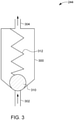
- the check valve 244 includes a housing 300 having an input 302 and an output 304. Oil enters at the input 302. However, a ball 310, which is biased by a spring 312 against the input 302, blocks the oil from flowing through the valve. The elastic force applied by the spring 312 defines the pressure (set peak pressure) at which the valve starts opening up and allowing the oil at the input 302 to travel through the housing 300 towards the output 304. This opening pressure is the set peak pressure mentioned in the embodiment discussed with regard to Figure 2 .
- the peak pressure is constant, i.e., once a certain spring 312 is installed in the valve, the peak pressure is given by the characteristics of that spring. This means that unless the peak pressure is reached in the upper oil chamber 230 in Figure 2 , this valve stays shut and no oil moves past it, irrespective of that load or needs of the engine.
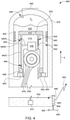
- a telescopic piston 400 is provided with an actuated valve that has an adjustable peak pressure.
- the peak pressure can be changed remotely, through wireless communication between a receiver associated with the actuated valve and a transmitter associated with the engine.
- the transmitter has a global controller that measures one or more parameters of the engine and based on these measurements, decides to change the peak pressure of the actuated valve.
- the new value for the peak pressure is transmitted in a wireless manner to the actuated valve and the actuated valve replaces the current peak pressure with a new peak pressure, in effect, controlling its peak pressure. This adjustment can happen as fast as the duration of one stroke.
- each cylinder in the engine has a corresponding actuated valve with corresponding wireless communication so that the peak pressure of each telescopic piston can be adjusted/controlled independent of the others.
- Figure 4 shows the telescopic piston 400 placed inside a cylinder 470 of an engine 480.
- the engine can have plural cylinders and plural corresponding telescopic pistons.
- An oil reservoir 471 for the entire engine is also shown.
- the oil 432 from the engine oil reservoir 472 moves along a passage 434, formed in the connecting link 436 and arrives at oil collection chamber 438. From here, the oil moves along passages 440A and 440B to the one way valve 442 and then into the upper oil chamber 430, formed between the inner piston 410 and the outer piston 420.
- O-rings 422 may be provided between the inner and outer pistons so that the oil from the upper oil chamber does not escape at the interface between the inner and outer pistons.
- the outer piston 420 can move along axis X relative to the inner piston 410, so that a variable compression ratio may be obtained.
- Oil 432 from the upper oil chamber 430 can move along passage 424, formed in the inner piston 410, through actuated valve 460, when a certain pressure P1 inside the upper oil chamber 430 is larger than a set peak pressure of the actuated valve 460.
- the oil 432 when the pressure is larger than the set peak pressure, returns to the oil engine reservoir 472.
- Oil from the oil collection chamber 438 can also advance along passages 440A and 440C to the one way valve 446, and then enters a lower oil chamber 448.
- the lower oil chamber 448 is defined by the inner piston, the outer piston and a closing ring 450.
- Closing ring 450 may have a passage 452 for leaking the oil back to the engine oil reservoir 472.
- the actuated valve 460 is associated (may include) a receiver 462 for receiving, in a wireless manner, a signal 492 generated by a transmitter 490.
- Transmitter 490 is located within the interior of the engine 480 and is connected to a global controller 494 and a power source 496.
- the global controller and power source may be located anywhere inside or outside the engine.
- the global controller 494 can be programmed by the operator of the engine to send the signal 492 to the receiver 462 at any desired time and as often as the receiver can do it.
- the signal 492 may include a set peak pressure value for the actuated valve 460, i.e., a pressure at which the actuated valve should open and allow the oil 432 to flow from the upper oil chamber 430 to the reservoir 472.
- the global controller 494 is also connected to one or more sensors. For example, it is possible to have a pressure sensor 498 placed inside the cylinder 470 (or other location) for measuring a pressure P2 inside the space between the cylinder 470 and the telescopic piston 400. In one embodiment, the pressure sensor 498 is wired to the global controller 494 by wire 499.
- the global controller 494 may also be connected to an angle sensor 495 that reads a crankshaft angle.
- Other sensors may be linked to the global controller for receiving other parameters of the engine, for example, temperature sensor, fuel composition sensor, air intake sensor, etc.
- the global controller 494 determines that the peak pressure of the actuated valve 460 needs to be changed, it will send the signal 492 to the actuated valve to implement this change.
- One possible implementation of the actuated valve 460 is shown in Figures 5A and 5B.
- Figure 5A shows the actuated valve 460 being closed and
- Figure 5B shows the actuated valve 460 being open.
- the actuated valve 460 has an actuation mechanism 500 (a solenoid 501 in this example) that houses a pin 502.
- the pin 502 may be attached to the solenoid 501 with a spring 504.
- the actuated valve has an inlet 510 and an outlet 520.
- a seat 512 is formed between the inlet and the outlet so that the pin 502 fits inside the seat and blocks the flow of the oil 432 from the inlet to the outlet.
- the receiver 462 may be attached to the actuated valve together with a local controller 530 (e.g., a processor) and a power source 532.
- the power source is connected to the solenoid and is configured to provide an electrical current to the solenoid, to generate a magnetic field.
- the magnetic field interacts with the magnetic field produced by the pin 502, which was previously magnetized.
- the magnetic interaction between the magnetic field of the pin and the magnetic field generated by the solenoid makes the pin to move up or down.
- Figure 5B A result of this magnetic interaction is shown in Figure 5B , in which the pin has moved up with the solenoid and a fluid communication was established between the inlet 510 and outlet 520.
- the local controller 530 determines to electrically connect the power source 532 to the solenoid 501 to open the pin 502.
- the global controller 494 instructs the local controller 530 when to open/close the actuated valve 460.
- the actuated valve 460 is implemented as a combination of a check valve 600 and an actuation mechanism 500 (a solenoid valve in this case).
- the check valve 600 has a housing 601 that accommodates a ball 610 and a biasing mechanism 612 (e.g., a spring).
- the biasing mechanism 612 presses the ball 610 against an inlet 602, so that the oil 432 cannot enter inside the check valve.
- the spring 612 is pressed by the ball 610 and the oil enters inside the valve and then exits through an outlet 604.
- the peak pressure associated with the biasing mechanism 612 is preset.
- the local controller 430 may be programmed to adjust the amount of bias added by the pin 502 to the biasing mechanism 612, to adjust accordingly the set peak pressure.
- the check valve 600 it is possible to control the amount of biased applied by the pin 502 to the biasing mechanism 612 so that the check valve 600's flow is controlled.
- the check valve is controlled by solenoid valve 500 to be on or off
- the solenoid valve 500 controls the flow area between the ball 610 and inlet 602, giving a smaller or larger flow of oil as demanded by the engine.
- the power source 532 may be implemented in various ways.
- the power source is a small rechargeable battery.
- the power source is a linear electric generator as illustrated in Figures 7A and 7B.
- Figure 7A shows a coil 702 in which a rod 704 is located.
- the rod 704 has at al least one end a mass 706. Because the power source 532 is placed on the telescopic piston, which moves up and down inside the engine, the mass 706 would also move up and down during the various strokes, which make the rod 704 to move up and down inside the coil 702 as shown in Figures 7A and 7B . This movement induces an electrical current which can be harvested at pads 708A and 708B as electrical energy.
- the battery is recharged by the linear actuator.
- An extended implementation of one or more of the above embodiments would be to use the two oil chambers 430 and 448.
- the volumes of these two oil chambers will experience pressure with opposite signs, i.e., when the upper oil chamber 430 get increased pressure due to a force, the lower oil chamber 448 will get a reduced pressure.
- the controlled telescopic piston system 400 shows one or more advantages as now discussed.
- the engine block, crankshaft and cylinder head can all remain the same.
- To implement the system 400 it would be needed to replace the piston and possibly the connecting rod. This means that expensive modifications of the current engine architecture can be avoided.
- the controlled telescopic piston can be implemented in current generation engines, and there is no need to wait until the next generation will be introduced.
- the compression ratio is adjusted for each cylinder individually. This is very useful if combustion concepts will be used that rely on controlled temperature levels.
- One such example is Homogeneous Charge Compression Ignition, HCCI.
- control actuation can be made very fast with the actuated valve (i.e., a controlled check valve).
- the forces in the piston are very large and this gives very fast actuation.
- the entire upper oil chamber 430 can be emptied in one stroke. This fast control is not possible with most other VCR systems.
- step 800 engine oil from the crank pin lubrication reservoir 472 is used to feed an oil collection chamber 438.
- a pump 473 (see Figure 4 ) may be used to transfer the oil from the reservoir 472, along the passage 434, to the oil collection chamber 438.
- oil 452 is moved to the upper oil chamber 430, which is formed between the inner and outer pistons of the telescopic piston.
- step 804 a pressure inside the upper oil chamber 430 becomes higher than a set peak pressure, which makes the actuated valve 460, located in the inner piston 410, to open and allow drainage of the oil from the upper oil chamber 430 back to the reservoir 472.
- the outer piston moves in step 806 closer to the inner piston, thus changing a compression ratio of the piston.
- the peak pressure will be low.
- the telescopic piston can increase in height and the compression ratio will be increased as the actuated valve will not open.
- the peak pressure during the cycle is reaching the preset peak value, for instance 70 bar, the actuated valve starts to open for part of the cycle and the compression ratio is stabilized. Should the inlet pressure increase, or combustion happens earlier in the cycle, the peak pressure will increase and the oil leakage over the actuated valve will increase, thus reducing the compression ratio.
- the global controller can adjust the peak value. For this to happen, one or more sensors 498 measures a pressure P2 inside the cylinder and another sensor 495 measures or determines the crankshaft angle. Based on this information, the global controller 494 makes a decision in step 808 to set a new peak pressure for the actuated valve 460.
- the sensor do not need to be an in-cylinder pressure sensor, but a ion-current sensor or knock sensor may be used and this sensor will also give information about combustion, and hence inform the global processed about the need to reduce the compression ratio.
- the decision to change the compression ratio may be made based on various information obtained from the engine.
- the decision to change the peak pressure and set a new peak pressure is sent in step 810, in a wireless manner, from the global controller 494 to a local controller 530 of the actuated valve 460, and in step 812, the local controller 530 implements the new peak pressure at the actuated valve 460.
- the method includes a step 900 of receiving, at a receiver 462 of the telescopic piston 400, a signal in a wireless manner, where the signal is indicative of the new peak pressure, and a step 902 of replacing a current peak pressure of the actuated valve 460 with the new peak pressure.
- the method may further include a step of determining the new peak pressure with a global controller based on a measured pressure around the telescopic piston and a crankshaft angle, and/or a step of opening the actuated valve to allow oil flow between (1) an upper oil chamber formed between an inner piston and an outer piston of the telescopic piston, and (2) an oil reservoir of the engine so that a compression ratio of the engine is changed.
Landscapes
- Engineering & Computer Science (AREA)
- Mechanical Engineering (AREA)
- General Engineering & Computer Science (AREA)
- Chemical & Material Sciences (AREA)
- Combustion & Propulsion (AREA)
- Output Control And Ontrol Of Special Type Engine (AREA)
Description
- This application claims priority to
U.S. Provisional Patent Application No. 62,643,384, filed on March 15, 2018 - Embodiments of the subject matter disclosed herein generally relate to controlling a peak pressure that opens a valve for a variable compression ratio piston, and more specifically, to an internal combustion engine that uses a wireless control for the peak pressure of an actuated valve located in the variable compression ratio piston.
- Internal combustion engines operate by compressing a fuel charge before combustion. This compression is described by the compression ratio, which is defined as the ratio of a maximum volume to a minimum volume in the cylinder of the engine, i.e., Vmax/Vmin. Most engines use a fixed compression ratio, normally 10:1 to 14:1 for gasoline engines and 14:1 to 18:1 for diesel engines. However, the optimum compression ratio for such engines is not constant while the engine is running, but rather it changes with the operating conditions and the fuel used. This means that most engines today operate for some extended periods of time with a compression ratio that is not optimal. Operating at a non-optimal compression ratio means that the burning of the fuel generates more pollutants than necessary, and the engine uses more fuel than required, which results in unnecessary pollution and ultimately global warming.
- To deal with the increasingly rigorous challenges arising from environment pollutions and global warming status quo, it becomes more and more imperative to develop competitive Internal Combustion Engine (ICE) technologies with higher fuel efficiency and less pollution, without sacrificing the brake power and other vehicle performances. Among these new technologies researched in recent years, the Variable Compression Ratio (VCR) technology has been considered as a promising method to improve the engine thermal efficiency, and fuel economy while reducing the emissions.
- During engine operation, a higher compression ratio leads to a higher thermal efficiency, especially under partial load, as is shown in
Figure 1 (which shows the thermal efficiency on the Y axis versus the compression ratio on the X axis for various ratios R of the specific heat at constant pressure and the temperature of the gas in the cycle). However, while increasing the compression ratio, an abnormal combustion, such as the knock, brought by the high temperature, may cause engine damage, which should be avoided at high loads. - Efforts have been made over the years in the VCR field, but with limited success. In 1992, Ford company presented a variable compression ratio methodology with an auxiliary chamber in the cylinder head. In 2005, Saab company introduced a Saab Variable Compression (SVC) engine, whose cylinder head could be tilted to achieve variable compression ratio. With regard to this design, the SVC engine was reported to be able to decrease fuel consumption by 30%, and HC emissions were also decreased significantly. In addition, the Nissan company had launched the first production VCR engine, which adopted a multi-link connecting rod, which could change the compression ratio between 8:1 and 14:1 in a flexible way. This approach claimed a 27 % better fuel economy than a normal engine running at roughly the same power and torque. However, this kind of design still needs to overcome massive oscillating forces and rotating forces. Besides, many other mechanisms have been proposed to change the eccentric pin of the crankshaft, though it requires a significant adjustment of the engine body.
- Moreover, some VCR technologies with variable piston height had also been proposed, for example, by Honda company, which suggested a Dual Piston Mechanism with compact structure and fast response time. The fuel economy for such configuration was claimed to be about 6%. Similarly, a pressure reactive piston technology, with a Belleville spring pack installed between the piston crown and the inner piston, had been proposed. This mechanism effectively limited the peak cylinder pressures at high loads, while allowing the engine to operate at high compression ratios under low loads.
- Still another VCR technology focused on varying the piston deck height, which offers an attractive route to VCR engine production since it requires relatively minor changes to the engine configuration [1, 2]. As for the height adaptation piston, many efforts had been put on it before and some innovations had been presented, for example, a two-piece, hydraulically actuated piston invented by the British Internal Combustion Engine Research Institute (BICERI) in 1959 [3].
- However, this configuration has a set peak pressure during the entire cycle of the engine, which is very limiting. Thus, there is a need for an engine and technology that allows to adjust not only the compression ratio of the engine, but also the peak pressure associated with a piston having a variable height.
-
WO 86/01562 - According to an embodiment, there is a telescopic piston for use with an internal combustion engine. The telescopic piston includes an inner piston, an outer piston located over the inner piston, an upper oil chamber formed between the inner piston and the outer piston, and an actuated valve having a controllable peak pressure that opens the actuated valve. A value of the peak pressure is wirelessly received at the telescopic piston.
- According to another embodiment, there is an internal combustion engine that includes a wireless transmitter, a cylinder, and a telescopic piston located inside the cylinder, the telescopic piston having an actuated valve. A peak pressure of the actuated valve is received wirelessly from the transmitter.
- According to still another embodiment, there is a method for adjusting a peak pressure of an actuated valve in a telescopic piston of an engine. The method includes receiving at a receiver of the telescopic piston a signal in a wireless manner, wherein the signal is indicative of the new peak pressure; and replacing a current peak pressure of the actuated valve with the new peak pressure.
- The accompanying drawings, which are incorporated in and constitute a part of the specification, illustrate one or more embodiments and, together with the description, explain these embodiments. In the drawings:
-
Figure 1 illustrates the thermal efficiency of an internal combustion engine as a function of the compression ratio; -
Figure 2 illustrates a telescopic piston not according to the invention having a check valve with a set peak pressure; -
Figure 3 illustrates a check valve with a set peak pressure; -
Figure 4 illustrates a telescopic piston having an actuated valve with an adjustable peak pressure; -
Figures 5A and 5B illustrate an implementation of the actuated valve with a solenoid valve; -
Figure 6 illustrates an implementation of the actuated valve with a check valve and a solenoid valve; -
Figures 7A and 7B illustrate a linear power generator to be used with the actuated valve for supplying power; -
Figure 8 is a flowchart of a method for operating a variable compression ratio piston having a controllable peak pressure; and -
Figure 9 is a flowchart of a method for adjusting a peak pressure of an actuated valve in a telescopic piston. - The following description of the embodiments refers to the accompanying drawings. The same reference numbers in different drawings identify the same or similar elements. The scope of the invention is defined by the appended claims.
- Reference throughout the specification to "one embodiment" or "an embodiment" means that a particular feature, structure or characteristic described in connection with an embodiment is included in at least one embodiment of the subject matter disclosed. Thus, the appearance of the phrases "in one embodiment" or "in an embodiment" in various places throughout the specification is not necessarily referring to the same embodiment. Further, the particular features, structures or characteristics may be combined in any suitable manner in one or more embodiments.
- According to an embodiment, there is an engine that has a telescopic piston. The outer part of the telescopic piston can move up and down relative to the inner part of the telescopic piston so that a variable compression ratio can be achieved. Further, a peak pressure during a cycle can be adjusted with a wireless system.
- Prior to discussing this telescopic piston with an adjustable peak pressure in more detail, an engine with a telescopic piston not according to the invention having a fixed peak pressure is first discussed with regard to
Figure 2 .Telescopic piston 200 has aninner piston 210 and anouter piston 220. Anupper oil chamber 230 is defined between the inner and outer pistons.Oil 232 is fed from the oil system of the engine, through apassage 234 formed in a connectingrod 236 that is connected to the inner piston. The connectingrod 236 moves thetelescopic piston 200 up and down inside its corresponding cylinder. The connecting rod is also connected to the crankshaft (not shown) of the engine. The oil is stored in anoil collection chamber 238. From here, the oil is fed along apassage 240A to a one-way valve 242, which allows the oil to enter theupper oil chamber 230. When the pressure P above theouter piston 220 is larger than the preset peak pressure, thecheck valve 244 opens and theoil 232 from the upper oil chamber 203 is forced through thecheck valve 244 into the oil collection reservoir (not shown) of the engine. The oil from theoil collection chamber 238 is also moving through anotherpassage 240B to a oneway valve 246, into alower oil chamber 248. Thelower oil chamber 248 is formed between the outer piston, the inner piston, and a lower oilchamber closing ring 250. Apassage 252 may be formed in the oilchamber closing ring 250 to allow the oil to leak back into the collection oil reservoir of the engine. - In operation, at the end of the exhaust stroke, and at the beginning of the intake stroke, the net upward forces acting on the telescopic piston cause a small movement upwards of the
outer piston 220. This difference in the relative movement is controlled by the reduction of the lower oil chamber, which results from the expulsion of the oil through thepassage 252. The additional volume enlarges theupper oil chamber 230 and this volume will be filled withoil 232 coming through the oneway valve 242. Therefore, the compression height (relative movement) increases over the number of cycles, but is restricted by the mechanical limit provided by the closing. Thepassage 252 is designed to ensure that theouter piston 220 will not move upward relative to theinner piston 210 more than a small limit during each stroke. - During the firing stroke, the cylinder pressure P increases dramatically and exceeds the design limit determined by the cracking pressure of the
check valve 244, and thus, theupper oil chamber 230 discharges theoil 232 and reduces its volume, and theouter piston 220 moves down relative to theinner piston 210. This action will also cause thelower oil chamber 248 to expand and be filled by oil through the oneway valve 246. Therefore, the amount of the oil discharged during compression/expansion strokes depends on the set peak pressure of thecheck valve 244. - One possible implementation of the
check valve 244 is shown inFigure 3 . Thecheck valve 244 includes ahousing 300 having aninput 302 and anoutput 304. Oil enters at theinput 302. However, aball 310, which is biased by aspring 312 against theinput 302, blocks the oil from flowing through the valve. The elastic force applied by thespring 312 defines the pressure (set peak pressure) at which the valve starts opening up and allowing the oil at theinput 302 to travel through thehousing 300 towards theoutput 304. This opening pressure is the set peak pressure mentioned in the embodiment discussed with regard toFigure 2 . The peak pressure is constant, i.e., once acertain spring 312 is installed in the valve, the peak pressure is given by the characteristics of that spring. This means that unless the peak pressure is reached in theupper oil chamber 230 inFigure 2 , this valve stays shut and no oil moves past it, irrespective of that load or needs of the engine. - According to an embodiment illustrated in
Figure 4 , atelescopic piston 400 is provided with an actuated valve that has an adjustable peak pressure. The peak pressure can be changed remotely, through wireless communication between a receiver associated with the actuated valve and a transmitter associated with the engine. The transmitter has a global controller that measures one or more parameters of the engine and based on these measurements, decides to change the peak pressure of the actuated valve. The new value for the peak pressure is transmitted in a wireless manner to the actuated valve and the actuated valve replaces the current peak pressure with a new peak pressure, in effect, controlling its peak pressure. This adjustment can happen as fast as the duration of one stroke. In one application, each cylinder in the engine has a corresponding actuated valve with corresponding wireless communication so that the peak pressure of each telescopic piston can be adjusted/controlled independent of the others. -
Figure 4 shows thetelescopic piston 400 placed inside acylinder 470 of anengine 480. The engine can have plural cylinders and plural corresponding telescopic pistons. An oil reservoir 471 for the entire engine is also shown. Theoil 432 from theengine oil reservoir 472 moves along apassage 434, formed in the connectinglink 436 and arrives atoil collection chamber 438. From here, the oil moves alongpassages way valve 442 and then into theupper oil chamber 430, formed between theinner piston 410 and theouter piston 420. O-rings 422 may be provided between the inner and outer pistons so that the oil from the upper oil chamber does not escape at the interface between the inner and outer pistons. Theouter piston 420 can move along axis X relative to theinner piston 410, so that a variable compression ratio may be obtained. -
Oil 432 from theupper oil chamber 430 can move alongpassage 424, formed in theinner piston 410, through actuatedvalve 460, when a certain pressure P1 inside theupper oil chamber 430 is larger than a set peak pressure of the actuatedvalve 460. Theoil 432, when the pressure is larger than the set peak pressure, returns to theoil engine reservoir 472. - Oil from the
oil collection chamber 438 can also advance alongpassages way valve 446, and then enters alower oil chamber 448. Thelower oil chamber 448 is defined by the inner piston, the outer piston and aclosing ring 450.Closing ring 450 may have apassage 452 for leaking the oil back to theengine oil reservoir 472. - The actuated
valve 460 is associated (may include) areceiver 462 for receiving, in a wireless manner, asignal 492 generated by atransmitter 490.Transmitter 490 is located within the interior of theengine 480 and is connected to aglobal controller 494 and apower source 496. The global controller and power source may be located anywhere inside or outside the engine. Theglobal controller 494 can be programmed by the operator of the engine to send thesignal 492 to thereceiver 462 at any desired time and as often as the receiver can do it. Thesignal 492 may include a set peak pressure value for the actuatedvalve 460, i.e., a pressure at which the actuated valve should open and allow theoil 432 to flow from theupper oil chamber 430 to thereservoir 472. - The
global controller 494 is also connected to one or more sensors. For example, it is possible to have apressure sensor 498 placed inside the cylinder 470 (or other location) for measuring a pressure P2 inside the space between thecylinder 470 and thetelescopic piston 400. In one embodiment, thepressure sensor 498 is wired to theglobal controller 494 bywire 499. Theglobal controller 494 may also be connected to an angle sensor 495 that reads a crankshaft angle. Other sensors may be linked to the global controller for receiving other parameters of the engine, for example, temperature sensor, fuel composition sensor, air intake sensor, etc. - If the
global controller 494 determines that the peak pressure of the actuatedvalve 460 needs to be changed, it will send thesignal 492 to the actuated valve to implement this change. One possible implementation of the actuatedvalve 460 is shown inFigures 5A and 5B. Figure 5A shows the actuatedvalve 460 being closed andFigure 5B shows the actuatedvalve 460 being open. - The actuated
valve 460 has an actuation mechanism 500 (asolenoid 501 in this example) that houses apin 502. Thepin 502 may be attached to thesolenoid 501 with aspring 504. The actuated valve has aninlet 510 and anoutlet 520. Aseat 512 is formed between the inlet and the outlet so that thepin 502 fits inside the seat and blocks the flow of theoil 432 from the inlet to the outlet. Thereceiver 462 may be attached to the actuated valve together with a local controller 530 (e.g., a processor) and apower source 532. The power source is connected to the solenoid and is configured to provide an electrical current to the solenoid, to generate a magnetic field. The magnetic field interacts with the magnetic field produced by thepin 502, which was previously magnetized. The magnetic interaction between the magnetic field of the pin and the magnetic field generated by the solenoid makes the pin to move up or down. A result of this magnetic interaction is shown inFigure 5B , in which the pin has moved up with the solenoid and a fluid communication was established between theinlet 510 andoutlet 520. - Note that the
local controller 530, depending on the value of thesignal 492, determines to electrically connect thepower source 532 to thesolenoid 501 to open thepin 502. Thus, with this implementation, theglobal controller 494 instructs thelocal controller 530 when to open/close the actuatedvalve 460. - In another embodiment illustrated in
Figure 6 , the actuatedvalve 460 is implemented as a combination of acheck valve 600 and an actuation mechanism 500 (a solenoid valve in this case). Thecheck valve 600 has ahousing 601 that accommodates aball 610 and a biasing mechanism 612 (e.g., a spring). Thebiasing mechanism 612 presses theball 610 against aninlet 602, so that theoil 432 cannot enter inside the check valve. When the pressure of the oil overcomes the peak pressure of thecheck valve 600, thespring 612 is pressed by theball 610 and the oil enters inside the valve and then exits through anoutlet 604. As discussed with regard toFigure 3 , the peak pressure associated with thebiasing mechanism 612 is preset. - However, by adding a
solenoid valve 500, similar to that described inFigures 5A and 5B , it is possible to use thepin 502 to act on thebiasing mechanism 612 to either apply more bias or less bias, which results in a modification of the peak pressure. Thus, by receiving at thereceiver 462 thesignal 492 from theglobal controller 494, thelocal controller 430 may be programmed to adjust the amount of bias added by thepin 502 to thebiasing mechanism 612, to adjust accordingly the set peak pressure. - In this regard, in one application, it is possible to control the amount of biased applied by the
pin 502 to thebiasing mechanism 612 so that thecheck valve 600's flow is controlled. In other words, while in one embodiment the check valve is controlled bysolenoid valve 500 to be on or off, in this application, thesolenoid valve 500 controls the flow area between theball 610 andinlet 602, giving a smaller or larger flow of oil as demanded by the engine. - The
power source 532 may be implemented in various ways. In one application, the power source is a small rechargeable battery. In another application, the power source is a linear electric generator as illustrated inFigures 7A and 7B. Figure 7A shows acoil 702 in which arod 704 is located. Therod 704 has at al least one end amass 706. Because thepower source 532 is placed on the telescopic piston, which moves up and down inside the engine, themass 706 would also move up and down during the various strokes, which make therod 704 to move up and down inside thecoil 702 as shown inFigures 7A and 7B . This movement induces an electrical current which can be harvested atpads - While the previous embodiments were discussed with regard to an active wireless communication between the
transmitter 494 and areceiver 462, it is also possible to use a passive receiver that is tuned to the frequency of thetransmission signal 492. Thus, it would be possible to power the actuatedvalve 460 by thetransmission signal 492, and for this configuration, nopower source 532 orcontroller 530 would be needed. The activation of thereceiver 462 could still be synchronized to the telescopic piston's motion and thus, use of the large forces in the telescopic piston may be implemented to control the oil flow with either positive or negative forces. - An extended implementation of one or more of the above embodiments would be to use the two
oil chambers upper oil chamber 430 get increased pressure due to a force, thelower oil chamber 448 will get a reduced pressure. With the two chambers, it is possible to install actuated check valves for both. This will offer increased controllability to the entire system. - In comparison to other VCR systems, the controlled
telescopic piston system 400 shows one or more advantages as now discussed. In one application, there is no need to change the main components of an engine. The engine block, crankshaft and cylinder head can all remain the same. To implement thesystem 400, it would be needed to replace the piston and possibly the connecting rod. This means that expensive modifications of the current engine architecture can be avoided. It also means that the controlled telescopic piston can be implemented in current generation engines, and there is no need to wait until the next generation will be introduced. - In another application, it is possible that the compression ratio is adjusted for each cylinder individually. This is very useful if combustion concepts will be used that rely on controlled temperature levels. One such example is Homogeneous Charge Compression Ignition, HCCI.
- In still another application, it is possible that the control actuation can be made very fast with the actuated valve (i.e., a controlled check valve). The forces in the piston are very large and this gives very fast actuation. In principle, the entire
upper oil chamber 430 can be emptied in one stroke. This fast control is not possible with most other VCR systems. - A method for running an engine with such a controlled
telescopic piston system 400 is now discussed with regard toFigure 8 . Instep 800, engine oil from the crankpin lubrication reservoir 472 is used to feed anoil collection chamber 438. A pump 473 (seeFigure 4 ) may be used to transfer the oil from thereservoir 472, along thepassage 434, to theoil collection chamber 438. From here, instep 802,oil 452 is moved to theupper oil chamber 430, which is formed between the inner and outer pistons of the telescopic piston. Instep 804, a pressure inside theupper oil chamber 430 becomes higher than a set peak pressure, which makes the actuatedvalve 460, located in theinner piston 410, to open and allow drainage of the oil from theupper oil chamber 430 back to thereservoir 472. When the oil drains, the outer piston moves instep 806 closer to the inner piston, thus changing a compression ratio of the piston. If the engine is operated with a low inlet pressure or the combustion is late in the cycle, the peak pressure will be low. Hence, the telescopic piston can increase in height and the compression ratio will be increased as the actuated valve will not open. But once the peak pressure during the cycle is reaching the preset peak value, forinstance 70 bar, the actuated valve starts to open for part of the cycle and the compression ratio is stabilized. Should the inlet pressure increase, or combustion happens earlier in the cycle, the peak pressure will increase and the oil leakage over the actuated valve will increase, thus reducing the compression ratio. - However, if the operation conditions of the engine change so that the preset peak value of the pressure is not adequate, the global controller can adjust the peak value. For this to happen, one or
more sensors 498 measures a pressure P2 inside the cylinder and another sensor 495 measures or determines the crankshaft angle. Based on this information, theglobal controller 494 makes a decision instep 808 to set a new peak pressure for the actuatedvalve 460. Those skilled in the art would understand that other mechanisms are available making this decision. For example, the sensor do not need to be an in-cylinder pressure sensor, but a ion-current sensor or knock sensor may be used and this sensor will also give information about combustion, and hence inform the global processed about the need to reduce the compression ratio. In other words, the decision to change the compression ratio may be made based on various information obtained from the engine. The decision to change the peak pressure and set a new peak pressure is sent instep 810, in a wireless manner, from theglobal controller 494 to alocal controller 530 of the actuatedvalve 460, and instep 812, thelocal controller 530 implements the new peak pressure at the actuatedvalve 460. - A method for adjusting a peak pressure of an actuated
valve 460 in atelescopic piston 400 of an engine is now discussed with regard toFigure 9 . The method includes astep 900 of receiving, at areceiver 462 of thetelescopic piston 400, a signal in a wireless manner, where the signal is indicative of the new peak pressure, and astep 902 of replacing a current peak pressure of the actuatedvalve 460 with the new peak pressure. The method may further include a step of determining the new peak pressure with a global controller based on a measured pressure around the telescopic piston and a crankshaft angle, and/or a step of opening the actuated valve to allow oil flow between (1) an upper oil chamber formed between an inner piston and an outer piston of the telescopic piston, and (2) an oil reservoir of the engine so that a compression ratio of the engine is changed. - This written description uses examples of the subject matter disclosed to enable any person skilled in the art to practice the same, including making and using any devices or systems and performing any incorporated methods. The patentable scope of the subject matter is defined by the claims.
-
- [1] Boggs, D., H. Hilbert, and M. Schechter, "The Otto-Atkinson Cycle Engine-Fuel Economy and Emissions Results and Hardware Design," SAE International, SAE Technical Paper 950089, February 1, 1995: p. 220-232;
- [2] Roberts, M., "Benefits and Challenges of Variable Compression Ratio (VCR)," March 3, 2003, SAE International, SAE, Technical Paper 2003-01-0398
- [3] Ashley, C., "Variable Compression Pistons," August 1, 1990, SAE International, SAE Technical Paper 901539
Claims (15)
- A telescopic piston (400) for use with an internal combustion engine, the telescopic piston (400) comprising:an inner piston (410);an outer piston (420) located over the inner piston (410);an upper oil chamber (430) formed between the inner piston (410) and the outer piston (420); andan actuated valve (460) having a controllable peak pressure that opens the actuated valve (460),wherein a value of the peak pressure is wirelessly received at the telescopic piston.
- The telescopic piston of Claim 1, wherein the actuated valve (460) is located in the inner piston and the actuated valve includes an actuation mechanism (500), and wherein the actuation mechanism is a solenoid.
- The telescopic piston of Claim 1, wherein the actuated valve (460) is located in the inner piston and the actuated valve includes an actuation mechanism (500), wherein the actuation mechanism further includes a wireless receiver, and wherein the actuation mechanism further includes a processor and a power source.
- The telescopic piston of Claim 1, wherein the actuated valve (460) is located in the inner piston and the actuated valve includes an actuation mechanism (500), wherein the actuation mechanism includes a solenoid and a check valve, and wherein the solenoid has a pin that acts on a spring of the check valve to change the peak pressure from stroke to stroke.
- The telescopic piston of Claim 1, wherein the actuated valve (460) is located in the inner piston and the actuated valve includes an actuation mechanism (500), and wherein the actuation mechanism actuates the actuated valve based on a signal received from a transmitter located in an engine associated with the telescopic piston.
- The telescopic piston of Claim 1, wherein the actuated valve (460) is located in the inner piston and the actuated valve includes an actuation mechanism (500), and wherein the actuation mechanism opens the actuated valve when a pressure of an oil in the upper oil chamber is larger than the peak pressure.
- An internal combustion engine (480) comprising:a wireless transmitter (490);a cylinder (470); anda telescopic piston (400) located inside the cylinder, the telescopic piston having an actuated valve (460),wherein a peak pressure of the actuated valve (460) is received wirelessly from the transmitter (490).
- The engine of Claim 7, wherein the telescopic piston (400) comprises:an inner piston (410);an outer piston (420) located over the inner piston (410);an upper oil chamber (430) formed between the inner piston (410) and the outer piston (420); andthe actuated valve (460) having a controllable peak pressure that opens the actuated valve (460).
- The engine of Claim 8, wherein the actuated valve (460) is located in the inner piston and the actuated valve includes an actuation mechanism (500), and wherein the actuation mechanism is a solenoid.
- The engine of Claim 7, wherein the actuated valve (460) is located in the inner piston and the actuated valve includes an actuation mechanism (500) and wherein the actuation mechanism further includes a wireless receiver.
- The engine of Claim 7, further comprising:a global controller (494) located on the engine; anda local controller (530) located on the actuated valve.
- The engine of Claim 11, further comprising:a pressure sensor located in the cylinder and configured to measure a pressure exerted on the telescopic piston; andan angle sensor that measures a crankshaft angle,wherein the crankshaft angle describes a position of a crankshaft, which is connected to the telescopic piston, wherein the global controller determines a new value of the peak pressure based on readings from the pressure sensor and the angle sensor, and sends wirelessly the new peak pressure to the actuated valve.
- A method for adjusting a peak pressure of an actuated valve (460) in a telescopic piston (400) of an engine, the method comprising:receiving (900) at a receiver (462) of the telescopic piston (400) a signal in a wireless manner, wherein the signal is indicative of the new peak pressure; andreplacing (902) a current peak pressure of the actuated valve (460) with the new peak pressure.
- The method of Claim 13, further comprising:
determining the new peak pressure with a global controller based on a measured pressure around the telescopic piston and a crankshaft angle. - The method of Claim 13, further comprising:
opening the actuated valve to allow oil flow between (1) an upper oil chamber formed between an inner piston and an outer piston of the telescopic piston, and (2) an oil reservoir of the engine so that a compression ratio of the engine is changed.
Applications Claiming Priority (2)
| Application Number | Priority Date | Filing Date | Title |
|---|---|---|---|
| US201862643384P | 2018-03-15 | 2018-03-15 | |
| PCT/IB2019/051509 WO2019175696A1 (en) | 2018-03-15 | 2019-02-25 | Wireless control of actuated valve in variable compression ratio piston |
Publications (2)
| Publication Number | Publication Date |
|---|---|
| EP3765722A1 EP3765722A1 (en) | 2021-01-20 |
| EP3765722B1 true EP3765722B1 (en) | 2022-02-16 |
Family
ID=65812362
Family Applications (1)
| Application Number | Title | Priority Date | Filing Date |
|---|---|---|---|
| EP19711713.8A Not-in-force EP3765722B1 (en) | 2018-03-15 | 2019-02-25 | Wireless control of actuated valve in variable compression ratio piston |
Country Status (3)
| Country | Link |
|---|---|
| US (1) | US11125151B2 (en) |
| EP (1) | EP3765722B1 (en) |
| WO (1) | WO2019175696A1 (en) |
Families Citing this family (2)
| Publication number | Priority date | Publication date | Assignee | Title |
|---|---|---|---|---|
| US11428174B2 (en) | 2018-03-23 | 2022-08-30 | Lawrence Livermore National Security, Llc | System and method for control of compression in internal combustion engine via compression ratio and elastic piston |
| WO2019183521A1 (en) * | 2018-03-23 | 2019-09-26 | Lawrence Livermore National Security, Llc | System and method for engine control with pressure reactive device to control combustion timing |
Family Cites Families (8)
| Publication number | Priority date | Publication date | Assignee | Title |
|---|---|---|---|---|
| WO1986001562A1 (en) | 1984-08-29 | 1986-03-13 | Dwight Allan Caswell | Controlled variable compression ratio piston for an internal combustion engine |
| JPH11117779A (en) | 1997-10-15 | 1999-04-27 | Toyota Motor Corp | Variable compression ratio mechanism for internal combustion engine |
| DE102007040699A1 (en) * | 2007-08-29 | 2009-03-05 | Robert Bosch Gmbh | Reciprocating-piston internal combustion engine e.g. petrol engine, for use in e.g. passenger car, has magnetic field generating device generating variable magnetic field which appears at actuator so that compression ratio is adjusted |
| US8151691B2 (en) * | 2008-12-04 | 2012-04-10 | Southwest Research Institute | Variable compression ratio piston with rate-sensitive response |
| US8746188B2 (en) * | 2010-03-17 | 2014-06-10 | Larry C. Wilkins | Internal combustion engine with hydraulically-affected stroke |
| DE202011107187U1 (en) * | 2011-10-27 | 2013-02-22 | Eugen Spintzyk | Piston internal combustion engine and hybrid engine with an additional clock |
| DE102012221249B3 (en) * | 2012-11-21 | 2014-03-20 | Continental Automotive Gmbh | Method and device for detecting pre-ignition in an internal combustion engine |
| DE102016115765A1 (en) * | 2016-08-25 | 2018-03-01 | Pierburg Gmbh | Piston and device for changing the compression ratio |
-
2019
- 2019-02-25 EP EP19711713.8A patent/EP3765722B1/en not_active Not-in-force
- 2019-02-25 WO PCT/IB2019/051509 patent/WO2019175696A1/en not_active Ceased
- 2019-02-25 US US16/975,664 patent/US11125151B2/en not_active Expired - Fee Related
Also Published As
| Publication number | Publication date |
|---|---|
| US11125151B2 (en) | 2021-09-21 |
| WO2019175696A1 (en) | 2019-09-19 |
| EP3765722A1 (en) | 2021-01-20 |
| US20200408145A1 (en) | 2020-12-31 |
Similar Documents
| Publication | Publication Date | Title |
|---|---|---|
| JP4154622B2 (en) | Device for changing effective displacement and / or volume ratio during operation of a piston engine | |
| US5611303A (en) | Valve operating apparatus of internal combustion engine | |
| JP3768237B2 (en) | Free piston engine | |
| US5775273A (en) | Free piston internal combustion engine | |
| US4469055A (en) | Controlled variable compression ratio piston for an internal combustion engine | |
| RU2600334C2 (en) | Method for internal combustion engine operation | |
| US20040025814A1 (en) | Piston-in-piston variable compression ratio engine | |
| JP2005522622A (en) | Compact idle motion device for variable valve actuation | |
| WO2000001933A2 (en) | Free piston internal combustion engine | |
| CN101892901B (en) | Vector multiplication cross engine | |
| US20120192817A1 (en) | Variable force valve spring | |
| EP3765722B1 (en) | Wireless control of actuated valve in variable compression ratio piston | |
| CN104929766A (en) | Hydraulic free piston engine | |
| JP2017150444A (en) | Output adjusting device for stirling engine | |
| US11306653B2 (en) | System and method for engine control with pressure reactive device to control combustion timing | |
| US11428174B2 (en) | System and method for control of compression in internal combustion engine via compression ratio and elastic piston | |
| US20160102629A1 (en) | Cylinder head for an auto-ignition engine with direct injection | |
| CN110454251B (en) | Variable valve and variable geometric compression ratio integrated system of diesel engine | |
| CN113396275B (en) | Method for providing variable compression ratio in internal combustion engine and device for the method | |
| CN102933821A (en) | Internal combustion engine | |
| US20170306869A1 (en) | Diesel engine and method for starting a diesel engine | |
| CN114508416A (en) | Internal combustion engine system | |
| KR20190042297A (en) | Piston for variable compression ratio and engine provided with the saem | |
| CN110295965B (en) | Exhaust valve actuation system and large two-stroke internal combustion engine | |
| JP2013503288A (en) | Compensation arrangement structure of variable compression ratio engine |
Legal Events
| Date | Code | Title | Description |
|---|---|---|---|
| STAA | Information on the status of an ep patent application or granted ep patent |
Free format text: STATUS: UNKNOWN |
|
| STAA | Information on the status of an ep patent application or granted ep patent |
Free format text: STATUS: THE INTERNATIONAL PUBLICATION HAS BEEN MADE |
|
| PUAI | Public reference made under article 153(3) epc to a published international application that has entered the european phase |
Free format text: ORIGINAL CODE: 0009012 |
|
| STAA | Information on the status of an ep patent application or granted ep patent |
Free format text: STATUS: REQUEST FOR EXAMINATION WAS MADE |
|
| 17P | Request for examination filed |
Effective date: 20201007 |
|
| AK | Designated contracting states |
Kind code of ref document: A1 Designated state(s): AL AT BE BG CH CY CZ DE DK EE ES FI FR GB GR HR HU IE IS IT LI LT LU LV MC MK MT NL NO PL PT RO RS SE SI SK SM TR |
|
| AX | Request for extension of the european patent |
Extension state: BA ME |
|
| DAV | Request for validation of the european patent (deleted) | ||
| DAX | Request for extension of the european patent (deleted) | ||
| GRAP | Despatch of communication of intention to grant a patent |
Free format text: ORIGINAL CODE: EPIDOSNIGR1 |
|
| STAA | Information on the status of an ep patent application or granted ep patent |
Free format text: STATUS: GRANT OF PATENT IS INTENDED |
|
| INTG | Intention to grant announced |
Effective date: 20211202 |
|
| GRAS | Grant fee paid |
Free format text: ORIGINAL CODE: EPIDOSNIGR3 |
|
| GRAA | (expected) grant |
Free format text: ORIGINAL CODE: 0009210 |
|
| STAA | Information on the status of an ep patent application or granted ep patent |
Free format text: STATUS: THE PATENT HAS BEEN GRANTED |
|
| AK | Designated contracting states |
Kind code of ref document: B1 Designated state(s): AL AT BE BG CH CY CZ DE DK EE ES FI FR GB GR HR HU IE IS IT LI LT LU LV MC MK MT NL NO PL PT RO RS SE SI SK SM TR |
|
| REG | Reference to a national code |
Ref country code: GB Ref legal event code: FG4D |
|
| REG | Reference to a national code |
Ref country code: CH Ref legal event code: EP |
|
| REG | Reference to a national code |
Ref country code: DE Ref legal event code: R096 Ref document number: 602019011677 Country of ref document: DE |
|
| REG | Reference to a national code |
Ref country code: AT Ref legal event code: REF Ref document number: 1469016 Country of ref document: AT Kind code of ref document: T Effective date: 20220315 |
|
| REG | Reference to a national code |
Ref country code: IE Ref legal event code: FG4D |
|
| REG | Reference to a national code |
Ref country code: LT Ref legal event code: MG9D |
|
| REG | Reference to a national code |
Ref country code: NL Ref legal event code: MP Effective date: 20220216 |
|
| REG | Reference to a national code |
Ref country code: AT Ref legal event code: MK05 Ref document number: 1469016 Country of ref document: AT Kind code of ref document: T Effective date: 20220216 |
|
| PG25 | Lapsed in a contracting state [announced via postgrant information from national office to epo] |
Ref country code: SE Free format text: LAPSE BECAUSE OF FAILURE TO SUBMIT A TRANSLATION OF THE DESCRIPTION OR TO PAY THE FEE WITHIN THE PRESCRIBED TIME-LIMIT Effective date: 20220216 Ref country code: RS Free format text: LAPSE BECAUSE OF FAILURE TO SUBMIT A TRANSLATION OF THE DESCRIPTION OR TO PAY THE FEE WITHIN THE PRESCRIBED TIME-LIMIT Effective date: 20220216 Ref country code: PT Free format text: LAPSE BECAUSE OF FAILURE TO SUBMIT A TRANSLATION OF THE DESCRIPTION OR TO PAY THE FEE WITHIN THE PRESCRIBED TIME-LIMIT Effective date: 20220616 Ref country code: NO Free format text: LAPSE BECAUSE OF FAILURE TO SUBMIT A TRANSLATION OF THE DESCRIPTION OR TO PAY THE FEE WITHIN THE PRESCRIBED TIME-LIMIT Effective date: 20220516 Ref country code: NL Free format text: LAPSE BECAUSE OF FAILURE TO SUBMIT A TRANSLATION OF THE DESCRIPTION OR TO PAY THE FEE WITHIN THE PRESCRIBED TIME-LIMIT Effective date: 20220216 Ref country code: LT Free format text: LAPSE BECAUSE OF FAILURE TO SUBMIT A TRANSLATION OF THE DESCRIPTION OR TO PAY THE FEE WITHIN THE PRESCRIBED TIME-LIMIT Effective date: 20220216 Ref country code: HR Free format text: LAPSE BECAUSE OF FAILURE TO SUBMIT A TRANSLATION OF THE DESCRIPTION OR TO PAY THE FEE WITHIN THE PRESCRIBED TIME-LIMIT Effective date: 20220216 Ref country code: ES Free format text: LAPSE BECAUSE OF FAILURE TO SUBMIT A TRANSLATION OF THE DESCRIPTION OR TO PAY THE FEE WITHIN THE PRESCRIBED TIME-LIMIT Effective date: 20220216 Ref country code: BG Free format text: LAPSE BECAUSE OF FAILURE TO SUBMIT A TRANSLATION OF THE DESCRIPTION OR TO PAY THE FEE WITHIN THE PRESCRIBED TIME-LIMIT Effective date: 20220516 |
|
| PG25 | Lapsed in a contracting state [announced via postgrant information from national office to epo] |
Ref country code: PL Free format text: LAPSE BECAUSE OF FAILURE TO SUBMIT A TRANSLATION OF THE DESCRIPTION OR TO PAY THE FEE WITHIN THE PRESCRIBED TIME-LIMIT Effective date: 20220216 Ref country code: LV Free format text: LAPSE BECAUSE OF FAILURE TO SUBMIT A TRANSLATION OF THE DESCRIPTION OR TO PAY THE FEE WITHIN THE PRESCRIBED TIME-LIMIT Effective date: 20220216 Ref country code: GR Free format text: LAPSE BECAUSE OF FAILURE TO SUBMIT A TRANSLATION OF THE DESCRIPTION OR TO PAY THE FEE WITHIN THE PRESCRIBED TIME-LIMIT Effective date: 20220517 Ref country code: FI Free format text: LAPSE BECAUSE OF FAILURE TO SUBMIT A TRANSLATION OF THE DESCRIPTION OR TO PAY THE FEE WITHIN THE PRESCRIBED TIME-LIMIT Effective date: 20220216 Ref country code: AT Free format text: LAPSE BECAUSE OF FAILURE TO SUBMIT A TRANSLATION OF THE DESCRIPTION OR TO PAY THE FEE WITHIN THE PRESCRIBED TIME-LIMIT Effective date: 20220216 |
|
| PG25 | Lapsed in a contracting state [announced via postgrant information from national office to epo] |
Ref country code: IS Free format text: LAPSE BECAUSE OF FAILURE TO SUBMIT A TRANSLATION OF THE DESCRIPTION OR TO PAY THE FEE WITHIN THE PRESCRIBED TIME-LIMIT Effective date: 20220617 |
|
| REG | Reference to a national code |
Ref country code: CH Ref legal event code: PL |
|
| REG | Reference to a national code |
Ref country code: BE Ref legal event code: MM Effective date: 20220228 |
|
| PG25 | Lapsed in a contracting state [announced via postgrant information from national office to epo] |
Ref country code: SM Free format text: LAPSE BECAUSE OF FAILURE TO SUBMIT A TRANSLATION OF THE DESCRIPTION OR TO PAY THE FEE WITHIN THE PRESCRIBED TIME-LIMIT Effective date: 20220216 Ref country code: SK Free format text: LAPSE BECAUSE OF FAILURE TO SUBMIT A TRANSLATION OF THE DESCRIPTION OR TO PAY THE FEE WITHIN THE PRESCRIBED TIME-LIMIT Effective date: 20220216 Ref country code: RO Free format text: LAPSE BECAUSE OF FAILURE TO SUBMIT A TRANSLATION OF THE DESCRIPTION OR TO PAY THE FEE WITHIN THE PRESCRIBED TIME-LIMIT Effective date: 20220216 Ref country code: LU Free format text: LAPSE BECAUSE OF NON-PAYMENT OF DUE FEES Effective date: 20220225 Ref country code: EE Free format text: LAPSE BECAUSE OF FAILURE TO SUBMIT A TRANSLATION OF THE DESCRIPTION OR TO PAY THE FEE WITHIN THE PRESCRIBED TIME-LIMIT Effective date: 20220216 Ref country code: DK Free format text: LAPSE BECAUSE OF FAILURE TO SUBMIT A TRANSLATION OF THE DESCRIPTION OR TO PAY THE FEE WITHIN THE PRESCRIBED TIME-LIMIT Effective date: 20220216 Ref country code: CZ Free format text: LAPSE BECAUSE OF FAILURE TO SUBMIT A TRANSLATION OF THE DESCRIPTION OR TO PAY THE FEE WITHIN THE PRESCRIBED TIME-LIMIT Effective date: 20220216 |
|
| REG | Reference to a national code |
Ref country code: DE Ref legal event code: R097 Ref document number: 602019011677 Country of ref document: DE |
|
| PG25 | Lapsed in a contracting state [announced via postgrant information from national office to epo] |
Ref country code: MC Free format text: LAPSE BECAUSE OF FAILURE TO SUBMIT A TRANSLATION OF THE DESCRIPTION OR TO PAY THE FEE WITHIN THE PRESCRIBED TIME-LIMIT Effective date: 20220216 Ref country code: AL Free format text: LAPSE BECAUSE OF FAILURE TO SUBMIT A TRANSLATION OF THE DESCRIPTION OR TO PAY THE FEE WITHIN THE PRESCRIBED TIME-LIMIT Effective date: 20220216 |
|
| PLBE | No opposition filed within time limit |
Free format text: ORIGINAL CODE: 0009261 |
|
| STAA | Information on the status of an ep patent application or granted ep patent |
Free format text: STATUS: NO OPPOSITION FILED WITHIN TIME LIMIT |
|
| 26N | No opposition filed |
Effective date: 20221117 |
|
| PG25 | Lapsed in a contracting state [announced via postgrant information from national office to epo] |
Ref country code: LI Free format text: LAPSE BECAUSE OF NON-PAYMENT OF DUE FEES Effective date: 20220228 Ref country code: IE Free format text: LAPSE BECAUSE OF NON-PAYMENT OF DUE FEES Effective date: 20220225 Ref country code: CH Free format text: LAPSE BECAUSE OF NON-PAYMENT OF DUE FEES Effective date: 20220228 |
|
| PG25 | Lapsed in a contracting state [announced via postgrant information from national office to epo] |
Ref country code: SI Free format text: LAPSE BECAUSE OF FAILURE TO SUBMIT A TRANSLATION OF THE DESCRIPTION OR TO PAY THE FEE WITHIN THE PRESCRIBED TIME-LIMIT Effective date: 20220216 Ref country code: BE Free format text: LAPSE BECAUSE OF NON-PAYMENT OF DUE FEES Effective date: 20220228 |
|
| PGFP | Annual fee paid to national office [announced via postgrant information from national office to epo] |
Ref country code: FR Payment date: 20230223 Year of fee payment: 5 |
|
| PGFP | Annual fee paid to national office [announced via postgrant information from national office to epo] |
Ref country code: GB Payment date: 20230227 Year of fee payment: 5 Ref country code: DE Payment date: 20230223 Year of fee payment: 5 |
|
| P01 | Opt-out of the competence of the unified patent court (upc) registered |
Effective date: 20230621 |
|
| PG25 | Lapsed in a contracting state [announced via postgrant information from national office to epo] |
Ref country code: IT Free format text: LAPSE BECAUSE OF FAILURE TO SUBMIT A TRANSLATION OF THE DESCRIPTION OR TO PAY THE FEE WITHIN THE PRESCRIBED TIME-LIMIT Effective date: 20220216 |
|
| PG25 | Lapsed in a contracting state [announced via postgrant information from national office to epo] |
Ref country code: MK Free format text: LAPSE BECAUSE OF FAILURE TO SUBMIT A TRANSLATION OF THE DESCRIPTION OR TO PAY THE FEE WITHIN THE PRESCRIBED TIME-LIMIT Effective date: 20220216 Ref country code: CY Free format text: LAPSE BECAUSE OF FAILURE TO SUBMIT A TRANSLATION OF THE DESCRIPTION OR TO PAY THE FEE WITHIN THE PRESCRIBED TIME-LIMIT Effective date: 20220216 |
|
| PG25 | Lapsed in a contracting state [announced via postgrant information from national office to epo] |
Ref country code: HU Free format text: LAPSE BECAUSE OF FAILURE TO SUBMIT A TRANSLATION OF THE DESCRIPTION OR TO PAY THE FEE WITHIN THE PRESCRIBED TIME-LIMIT; INVALID AB INITIO Effective date: 20190225 |
|
| PG25 | Lapsed in a contracting state [announced via postgrant information from national office to epo] |
Ref country code: TR Free format text: LAPSE BECAUSE OF FAILURE TO SUBMIT A TRANSLATION OF THE DESCRIPTION OR TO PAY THE FEE WITHIN THE PRESCRIBED TIME-LIMIT Effective date: 20220216 |
|
| REG | Reference to a national code |
Ref country code: DE Ref legal event code: R119 Ref document number: 602019011677 Country of ref document: DE |
|
| PG25 | Lapsed in a contracting state [announced via postgrant information from national office to epo] |
Ref country code: MT Free format text: LAPSE BECAUSE OF FAILURE TO SUBMIT A TRANSLATION OF THE DESCRIPTION OR TO PAY THE FEE WITHIN THE PRESCRIBED TIME-LIMIT Effective date: 20220216 |
|
| GBPC | Gb: european patent ceased through non-payment of renewal fee |
Effective date: 20240225 |
|
| PG25 | Lapsed in a contracting state [announced via postgrant information from national office to epo] |
Ref country code: DE Free format text: LAPSE BECAUSE OF NON-PAYMENT OF DUE FEES Effective date: 20240903 |
|
| PG25 | Lapsed in a contracting state [announced via postgrant information from national office to epo] |
Ref country code: GB Free format text: LAPSE BECAUSE OF NON-PAYMENT OF DUE FEES Effective date: 20240225 |
|
| PG25 | Lapsed in a contracting state [announced via postgrant information from national office to epo] |
Ref country code: FR Free format text: LAPSE BECAUSE OF NON-PAYMENT OF DUE FEES Effective date: 20240229 |
|
| PG25 | Lapsed in a contracting state [announced via postgrant information from national office to epo] |
Ref country code: GB Free format text: LAPSE BECAUSE OF NON-PAYMENT OF DUE FEES Effective date: 20240225 Ref country code: FR Free format text: LAPSE BECAUSE OF NON-PAYMENT OF DUE FEES Effective date: 20240229 Ref country code: DE Free format text: LAPSE BECAUSE OF NON-PAYMENT OF DUE FEES Effective date: 20240903 |