EP3764265A1 - System, method and computer program product for monitoring compliance to legal requirements - Google Patents
System, method and computer program product for monitoring compliance to legal requirements Download PDFInfo
- Publication number
- EP3764265A1 EP3764265A1 EP20185320.7A EP20185320A EP3764265A1 EP 3764265 A1 EP3764265 A1 EP 3764265A1 EP 20185320 A EP20185320 A EP 20185320A EP 3764265 A1 EP3764265 A1 EP 3764265A1
- Authority
- EP
- European Patent Office
- Prior art keywords
- compliance
- data
- rules
- processing
- regulation
- Prior art date
- Legal status (The legal status is an assumption and is not a legal conclusion. Google has not performed a legal analysis and makes no representation as to the accuracy of the status listed.)
- Granted
Links
Images



Classifications
-
- G—PHYSICS
- G06—COMPUTING OR CALCULATING; COUNTING
- G06F—ELECTRIC DIGITAL DATA PROCESSING
- G06F21/00—Security arrangements for protecting computers, components thereof, programs or data against unauthorised activity
- G06F21/60—Protecting data
- G06F21/62—Protecting access to data via a platform, e.g. using keys or access control rules
- G06F21/6218—Protecting access to data via a platform, e.g. using keys or access control rules to a system of files or objects, e.g. local or distributed file system or database
- G06F21/6245—Protecting personal data, e.g. for financial or medical purposes
Definitions
- the present invention relates to systems and methods for monitoring compliance to legal requirements.
- DTO Data Protection Officers
- the GDPR Designed to modernize laws that protect the personal information of individuals, the GDPR also provides for strong penalties in case of violation by any given data processor.
- processors of personal data may not be able to properly ensure compliance with the regulation.
- Formal methods are a feasible solution to ensure compliance with data protection rules with a high level of trust.
- An example is the described in" Formal methods as a link between software code and legal rules", In: Barthe G., Pardo A., Schneider G. (eds) Software Engineering and Formal Methods, SEFM 2011, Lecture Notes in Computer Science, vol 7041 , Daniel Le Métayer.
- the author calls for the use of these techniques to bridge the gap between legal and technical means in reducing privacy risks related to persons whose data are processed.
- This work provides a formal framework of legal concepts which can serve as a basis for modeling entities' rights and duties.
- the author points out the subtlety of real-life situations that cannot be replicated in programs, because they often go beyond mere dual and static situations.
- the present invention offers a solution to these needs by solving at least the concern of a real-time and constant/automatic analysis of personal data processing, notably in a scaled-up environment having numerous processing.
- an object of the invention is to provide a method for "a posteriori" verification of compliance to data protection rules, when processing of personal data has already happened.
- the invention allows:
- the invention allows monitoring and checking compliance of legacy systems through the analysis of the log files of the IT system processing personal data.
- the compliance monitoring system of the invention operates in an IT system that processes data privacy operations, and comprises at least:
- the method applies for checking compliance to the GDPR.
- an operational model of the GDPR is generated and used to ease the interactions with standard operational models of the IT system.
- a core subset of the GDPR is modeled in the Prolog language. Different dimensions required to properly address data protection obligations are covered, and in particular time-related properties such as retention time.
- the logic-based GDPR model is kept as close as possible to the legal wording to allow a Data Protection Officer to explore the model in case of need.
- the two operational models - the IT system model and the GDPR model - are used by a compliance checker configured to provide a result regarding which compliance aspects is not properly covered.
- the compliance checking module is configured to rely on the activity of the IT log file which records all events having occurred in the IT system.
- the compliance checker is further configured to generate alerts or flags for any point which is identified as requiring a further verification by a Data Protection Officer (DPO).
- DPO Data Protection Officer
- the compliance checker is configured to provide information on which requirement is not met, i.e. which action (of the IT model) was expected to be present in the log (as an event) and which is not found when running the compliance checking process.
- the system of the invention allows adding contextual information for a remedy.
- Another aspect of the present invention is to provide an extensible architecture organizing how the rules from a regulation model can be operationalized through an interface between technique-oriented levels (preferably modelled as state machines) and legal-oriented levels (preferably modelled as property definitions).
- technique-oriented levels preferably modelled as state machines
- legal-oriented levels preferably modelled as property definitions
- the operational models are used by a deontic-based compliance checker to reason about possible violations.
- the present invention is of general application to detect data protection compliance violations for any private or public organizations, and is particularly adapted for administrative, managerial, supervisory governance, risk-management, compliance, accountability, transparency, liability and responsibility purposes.
- a computer implemented method for monitoring compliance of computer data processing with data protection rules of legal regulation comprises the steps of:
- the compliance determination step comprises determining if the data processing does or doesn't fulfill a mandatory obligation.
- the compliance determination step comprises determining which action was expected to be present in the IT log file and which is not found.
- the method comprises replying the query with a compliance approval when the determination step computes no violation, or replying the query with a compliance deny when the determination step computes a potential violation of the protection rules.
- the determination step uses time as an indicator.
- the logic modelling of the regulation model and of the IT system model uses a same syntax.
- the set of rules is defined by a formal computing declarative language such as a "Prolog-like" language.
- the resolution algorithm runs a backtracking routine.
- the determination step comprising instantiating variables used in the rules.
- the legal regulation is the General Data Protection Regulation "GDPR”.
- the invention further addresses a computer system comprising:
- the invention further addresses a computer program comprising instructions for carrying out the steps of the method according to any one of the claims when said computer program is executed on a suitable computer device.
- the present invention provides a method for the Data Protection Officer (i.e. DPO or shortly the Controller) to comply with its accountability (i.e. recited at least in Article 24 of GDPR), through the demonstration of its compliance while carrying any current or future data processing.
- DPO Data Protection Officer
- the proposed method i.e. the software architecture
- the system i.e. the hardware architecture
- the compliance checker is a tool configured to provide assistance to a Data Protection Officer, whose role is notably to ensure that the organization processes the personal data in compliance with the applicable rules, and to facilitate the compliance verification, which is the starting point for data controllers' accountability.
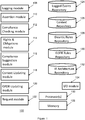
- FIG. 1 and Figure 2 provide block diagrams of the system of the present invention.
- apparatus 100 in accordance with some exemplary embodiments of the disclosed subject matter is shown.
- apparatus 100 may be configured to perform checking of data protection compliance in accordance with the present invention.
- Apparatus 100 may comprise one or more processor(s) 102.
- Processor 102 may be a Central Processing Unit (CPU), a microprocessor, an electronic circuit, an Integrated Circuit (IC) or the like.
- Processor 102 may be utilized to perform computations required by apparatus 100 or any of its subcomponents.
- apparatus 100 may comprise an Input/Output (I/O) module 104.
- I/O Input/Output
- I/O module 104 may be utilized to provide an output to and receive an input from a user, from a computerized apparatus or from another apparatus similar to apparatus 100.
- the I/O module may receive a dynamic program of an application, and may output results of the execution of the method of the present invention.
- apparatus 100 may comprise a memory 106.
- Memory 106 may be a Hard Disk Drive, a Flash disk, a Random Access Memory (RAM), a memory chip, or the like computer-readable storage medium.
- Memory 106 may retain machine executable instructions operative to cause processor 102 to perform acts associated with any of the subcomponents of apparatus 100.
- Apparatus 100 further comprises at least the following components:
- the first step has been to choose and narrow the scope of the regulation. For instance, it has been chosen not to deal with the situation where a data processor is actually processing personal data, but only to focus on the data controller who is liable for the processing of personal data. Indeed, the GDPR gives a key role to the data controller who determines the means and purposes of the processing.
- the data processor is subject to obligations that are deeply linked with the data controller's ones. As a result, provisions regarding the data processor may be added up to the rules already translated, when such a data processor is involved. This is a situation where a false alert can be raised.
- Another benefit of a close text translation of the GDPR is to allow the involvement of a person, such as a DPO, whose role is to ensure compliance with data protection issues.
- the inventor's work aims at being a tool to aid for compliance checking, rather than providing all right answers in order to achieve compliance.
- a data protection practitioner is required to interpret any answer given by the program, and to implement or update the knowledge base of the program.
- the inventor's approach differs from the previously cited one as the proposed method considers the appropriate rules by identifying the involved elements (processings, personal data, data subjects, or other persons, for instance) as well as their relationships to one another. This step implies identifying the conditions for an obligation to be applicable to the data controller as well as any disjunctions.
- the initial translations of the legal rules into actions and states are implemented to make them closer to how an abstract machine works. For this reason, a concrete vision of every obligation and constrained compliance to some specific actions or states of the data processing are adopted. Further, some deontic propositions to express obligations for the controller are included.
- a pattern is dedicated to verify the conditions of success of a request from a data subject about one of his or her rights.
- FIG 2 a high level view of the main components 200 to operate the method of the present invention for an IT system 202 as regard to its compliance to a regulation 204 is shown and described.
- the IT system 202 may be any computing environment from a single computer to any network having a plurality of computers organized to process data according to any kind of simple or more complex processing.
- the method of the invention allows checking compliance of the IT system processing to a regulation 204 expressed in natural language.
- the invention is based on a logic modelling of both the IT system, i.e. the IT System model 206, and of the regulation, i.e. the regulation model 208.
- the logic modelling of each model uses a similar syntax.
- the inventors use the Prolog language, as it allows dealing with implication and instantiation of variables through concrete elements.
- this language is declarative, meaning the need to declare a knowledge base and to define a set of rules in order to resolve a given query.
- backtracking which is a well-known routine automatically handled by Prolog
- the process underlying the method of the invention allows providing a reply to a query by using instantiation of the variables used in the rules.
- the Prolog language is just one example of a declarative language adapted to describe the rules, but the skilled person would devise using another language allowing formal description of rules, such as the Datalog language or the Answer Set Programming (ASP) language.
- ASP Answer Set Programming
- SLD Selective Linear Definite
- the first proposition or rule declares that in order to verify A, it has to be checked whether B and C can be proved.
- the arrow means the implication relation between A on one hand and B and C on the other hand. If B and C are proved (considered as true by Prolog), then A is true.
- the comma after B means a conjunction between B and C: if B is proved but C is not, then A is not true.
- the point means the end of the proposition.
- the variable A on the left is named as the "head" of the two rules, wherein the two "bodies" on the right differ.
- the process uses the knowledge base, and tries to instantiate the variables (for example A, B, C and D) to constants that are stated in the knowledge base, i.e. the process allows replacing the variables by constants.
- the unification is the operation of instantiating the constants where the variables are declared.
- the backtracking operation allows the program to go back to higher rules when an answer is given as "false", in order to try every solution to reach a "true”. In the end, the result replied by the program is an affirmation or a refutation of the original query.
- Prolog an effective programming language that is suitable to translate legal rules in a formal language. As stated, its operation requires declaring a knowledge base and a set of rules which is appropriate to achieve logic modeling of the legal text.
- the IT System Model 206 The IT System Model 206:
- the IT system 202 represents any information system that is processing data, under the responsibility of a data controller.
- the model 206 of such IT system describes the evolution of the data processing, through actions (306-1) and states (306-2) as shown on the IT System Model 306 of figure 3a .
- the IT system is modelled so that actions and states express the evolution of the system, i.e. the evolution of every action occurring about the data processing. It is to be appreciated that one main feature of the IT system model (as well as of the Regulation model) is a "time" indicator used as a parameter for the determination of the compliance.
- a state machine describes the evolution of the system, through the states of that machine. In order to change of state, an action must happen. For instance, if an action in the processing occurs, a state may be reached. But, to reach a state, another state may be required. This idea is expressed as below:
- Actions an action is described with a specific pattern shown below, wherein an Action "action” consists in an “Operation”, performed by someone, identified as a “Doer”. This action occurs at a certain time “Time” and holds a reference “Reference” to allow a direct reference later.
- the reference consists in a document the data controller must record in order to prove that a consent has been given. This reference can then be expressed later when the data subject withdraws his or her consent.
- a State “state” concerns a person “PersonConcerned” who is directly involved in the situation which is described, for example, the data controller or the data subject.
- a state relates to an element “Object”,for instance a request, and is linked to personal data "PersonalData”.
- Object for instance a request
- PersonalData personal data
- a state is reached at a certain time "Time”.
- a state is always replaced by an expression describing the state, including a present perfect verb.
- the expressions "isProvided” or “isMinimised” are used to replace the variable "state” and to describe the state.
- the choice of using a present perfect verb is made in order to faithfully express a state of the system.
- the IT system model 206 expresses that if an action and/or a state is proved by the checking process, then a state is reached in the system.
- a Regulation 204 provides broad provisions and obligations that data controllers need to comply with, when processing personal data. Even if for the GDPR application, the described approach focuses on Articles 5 and 6 (and other articles that relate to these ones), the GDPR itself is not sufficient to understand the concepts stated in the provisions and their scopes, and there is the need to use other sources, such as for example take into account the opinions of Article 29 Data Protection Working Party, or the French supervisory authority opinions' (the "CNIL") or the recitals of the GDPR.
- the GDPR Modelling The GDPR provides rules to ensure data protection for subjects whose personal data are processed. As stated before, one face difficulties reading the GDPR's rules; the scope and the wording of the text have bring the inventors to adopt an approach that remains close to the terms. The other difficulty for the inventors was to derive logic rules from the European regulation: the syntax they have used reflects the rules in their extent, without translating beyond or above the legal text. To achieve this goal, they have been driven by previous works on legal modelling, that focus on expression of rights, permissions, obligations, but also on implied rights, permissions and obligations drawn from the provisions.
- the GDPR model must be expressed using the syntax used for the state machine, i.e. the syntax expressing actions and states.
- an operational level in the GDPR model is expressed through actions and states.
- Deontic Level (308-1): This level aims at expressing obligations for the controller, when an action occurs in the system. Table below provides an example of the use of deontic concepts about the GDPR's rules.
- This pattern expresses a deontic obligation for a doer, when an action occurs in the system, and the obligation on this action is not fulfilled yet. If the two conditions can be proved by the program, then the controller needs to comply with this top-obligation.
- This pattern uses the term "must” in the propositions for the following reason: Deontic obligations are implied in the GDPR, but they are formulated to detect the obligations that the data controller has to comply with, when an action happens. This deontic idea is expressed through the word "must”, meaning the data controller must comply with a legal obligation, if the relevant action happens, as shown below. Thus the deontic level uses the actions recorded in the system to infer obligations for the controller.
- Data Subjects Rights Level (308-2): Another part of the program deals with requests from data subjects concerning their rights. The idea is that the controller must accept the request concerning a right if the conditions are proved by the program. To this aim, an action may be required, or a state, to verify that the conditions are checked.
- a property pertaining to an action is denoted by "prop”.
- an action representing a data processing might be "processesCompliant" or not, which is a property. If an action is not verified (i.e. is not compliant), then the data controller may have an obligation to accept a request from a data subject as shown below:
- the first action is a processing of personal data
- the second one is a request from the data subject about the right to objection ("asksForRight")
- the third one expresses the data subject motivating its request (“motivatesRequest”).
- the last proposition refers to an action from the controller who asserts that he finds legitimate grounds for the processing which override the rights and freedoms of the data subject. Indeed, if this action is not proved, then the controller can't refuse the objection to the processing, he must accept the request.
- the table below illustrates the conditions for a transparent processing to be proved by the program.
- the sub-obligation to be fulfilled is "providesTransparentlnformation”; an action and a state defined as “isDemonstrableCompliance” are also required.
- processsFair For instance, the example below illustrates the obligation for the controller to process personal data fairly, denoted as “processesFair”.
- the first action is an assertion from the controller who confirms that the information provided to the data subject is fair, denoted as “assertsFairInformation”. This action is linked to the transparency principle of processings, but the inventors choose not to bind transparency and fairness together here.
- the second action refers to a fair processing towards the data subject, denoted as “assertsFairProcessingTowardsDataSubject” and does not concern transparency.
- Operational Level (308-5): The last level in this architecture is an operational level that links actions and states. The pattern shown in table below allows defining how a state may be reached in the system: when actions and states are proved by the program.
- table below provides the definition of a processing necessary for the performance of a task carried out in the public interest.
- the first action concerns the processing of personal data undertaken by the controller; the second action relates to the controller, asserting the processing is necessary for the task he is carrying out in the public interest, and which is defined as: "assertsProcessingNecessaryForPerformanceTaskPublicInterest".
- the system 200 further comprises a Knowledge Base module 210 and a Reasoning Engine 212.
- the compliance checker calls for the IT system log which is composed of the events occurring about a certain processing of data.
- the values of the events are concrete, i.e. instantiated.
- the log represents a knowledge base of the compliance checker.
- the events are recorded in the log as 'actions' with the time of their occurrence.
- Table below illustrates an example of an action recorded in the log which is: a data controller (i.e. "Google") provides information about the right to withdraw a data subject's consent, for processing of personal data of a subject (i.e. "id_Jack”), at time "5", with a form to be used to provide this information (i.e. "privacy_form").
- the compliance checker relies on another knowledge base, which describes with declarations the concrete context of the processing of personal data. These declarations permit to add some information to the actions from the log.
- the log and the context are a knowledge base 210 used as input to the reasoning engine 212 to compute compliance results.
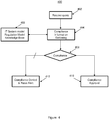
- Figure 4 is a flow chart of the main steps of the compliance monitoring process 400 of the present invention.
- the compliance monitoring process allows comparing a log from the IT system (storing a list of all events that happened in the system), with the two models, the IT model and the Regulation model. This is a dynamic approach which is carried out to check for compliance about a processing of personal data.
- the process allows in step 404 to gather information from the IT model and the Regulation model, the IT log of events that happened in the system, and additional information, about the context of the processing.
- the context information is provided through a complementary source (Knowledge Base with a set of declarations) which does not depend on the IT log.
- the process allows for determining if there is compliance 408 or not, and allows replying the query about no violation, i.e. as a 'Compliance Approval' 410 or replying about a potential violation of the Regulations rules 412.
- a query 402 is preferably defined as shown in the table below.
- the compliance checker can thus be queried about a mandatory obligation for the controller to fulfill upon an action (designated as "must”). This part refers to the deontic level exposed earlier.
- the second proposition asks if the property upon the same action is not proved (" ⁇ + prop"). If the obligation exists and if the property is not proved (i.e. the conditions cannot be met), then the process allows providing an "isViolating" answer, meaning that the action is violating the Regulation provisions.
- the compliance checker's role is to detect when a processing doesn't fulfill the obligations needed to achieve compliance.
- the time of actions are taken into consideration, as part of the compliance checking.
- Figure 5 details the operations of the compliance determination step 404 of figure 4 .
- the compliance checker gathers the two models 506, and receives as input the knowledge base (502, 504), to solve a query 508by verifying the rules, relying on the knowledge base.
- One important assumption here is the log soundly reflects the IT system behavior: all events appearing in the log should have actually happened in (as events), and all events actually happening should appear in the log (as actions).
- the process allows instantiating actions of the IT model from the log events.
- the Prolog's instantiation of the variables are used.
- the process allows to propagate the instantiations parameters to the rights and obligations (R&O) of the regulation model, and on a next step 514 allows to gather all instantiated R&O.
- the process next allows on step 516 for each Obligation to determine the dependent instantiated R&O and on step 518 for each Right to determine the dependent instantiated R&O.
- the process repeats 520 the determination steps (516, 518) of dependent instantiated R&O until all instantiated R&O are processed.
- the process allows determining if all mandatory events are present in the IT system log, and providing the information whether a processing of personal data performed through the system is violating the rules 524 or not 526.
- the process verifies whether there is an obligation to process the personal data compliantly, and then checks for every condition to achieve compliance.
- the process tries to instantiate the variables of the rule. However, only two actions - in top of the processing action itself - are recorded in the log, whereas the rule requires three actions. Indeed, the expression “givesAccessiblelnformation” doesn't appear in the log. As a consequence, the process will reply "true” and thus deduced that the processing is not compliant.
- a "trace” module (known in Prolog) provides instrumented ways to guide the auditor to the missing elements.
Landscapes
- Engineering & Computer Science (AREA)
- Health & Medical Sciences (AREA)
- Bioethics (AREA)
- General Health & Medical Sciences (AREA)
- Theoretical Computer Science (AREA)
- Computer Hardware Design (AREA)
- Databases & Information Systems (AREA)
- Computer Security & Cryptography (AREA)
- Software Systems (AREA)
- Physics & Mathematics (AREA)
- General Engineering & Computer Science (AREA)
- General Physics & Mathematics (AREA)
- Medical Informatics (AREA)
- Debugging And Monitoring (AREA)
Abstract
Description
- The present invention relates to systems and methods for monitoring compliance to legal requirements.
- Collecting, storing, sharing and otherwise processing personal data has become omnipresent with the age of information. In view of the inherent risks for the data subjects, notably in case of unauthorized processing, there was an entry into force of several regulations regarding data protection.
- As an example, the European Union has mutually agreed on a General Data Protection Regulation (GDPR) which came into force on May 25, 2018. The GDPR aims at the protection of natural persons with regard to the processing of personal data, to the free movement of such data, and to protecting data subjects at a high level, all creating many obligations for Data Protection Officers (DTO) (also named as data controllers or controllers) and many rights for data subjects regarding any processing of personal data.
- More generally, public and private organizations are faced to unprecedented challenges to ensure compliance with new data protection rules. To help organizations comply with the many obligations and rights, the academics and technologists propose implementations of various solutions leading to what is known today as "privacy engineering". Among the main goals of these solutions are the one of enabling compliant data processing by controllers and the one of increasing trust in compliance by data subjects. While "data protection by design" constitutes a keystone of the regulation, many legacy systems are not designed and implemented with this concept in mind.
- Designed to modernize laws that protect the personal information of individuals, the GDPR also provides for strong penalties in case of violation by any given data processor. Today, the GDPR has become one of the key elements in regulatory compliance and its enforcement is thoroughly inspected during a legal audit.
- However, because of the increased technological complexities, the large-scale and multiple data-exploiting business practices and the rigorous, continuous tasks implied, processors of personal data may not be able to properly ensure compliance with the regulation.
- Formal methods are a feasible solution to ensure compliance with data protection rules with a high level of trust. An example is the described in"Formal methods as a link between software code and legal rules", In: Barthe G., Pardo A., Schneider G. (eds) Software Engineering and Formal Methods, SEFM 2011, Lecture Notes in Computer Science, vol 7041, Daniel Le Métayer. In this paper, the author calls for the use of these techniques to bridge the gap between legal and technical means in reducing privacy risks related to persons whose data are processed. This work provides a formal framework of legal concepts which can serve as a basis for modeling entities' rights and duties. However, the author points out the subtlety of real-life situations that cannot be replicated in programs, because they often go beyond mere dual and static situations.
- Several articles describe various approaches related to regulation compliance, one of them being from Maxwell, J. C., Antón, A. I.: "Developing production rule models to aid in acquiring requirements from legal texts". 17th IEEE International Requirements Engineering Conference 2009, vol., pp. 101-110. The problem they aim at solving is compliance with complex regulation about the use of patient records by various organizations. In their methodology, the authors suggest translating legal rules into rights and obligations as well as implied ones. They develop production rules, i.e. logic rules generated from a legal rule, and they refactor the rules and add implication rules.
- Current compliance verification generally involves analysis on a processing-by-processing, data-per-data basis, often in a mechanical, non-automatic fashion. In addition, existing compliance tools are mostly built upon business expertise and do not rely on an accurate representation of the regulation, which doesn't provide any guarantee in terms of their adequacy.
- None of the cited references or existing approaches provides a unified interface between data protection requirements coming from the legal domain with IT system artifacts coming from the technical domain.
- Consequently there is a need for solutions to check compliance of systems to legal requirements and to remediate to data protection issues, even for an existing implementation of any processing within an Information Technology (IT) framework which is not "data protection by design" system.
- The present invention offers a solution to these needs by solving at least the concern of a real-time and constant/automatic analysis of personal data processing, notably in a scaled-up environment having numerous processing.
- Accordingly, an object of the invention is to provide a method for "a posteriori" verification of compliance to data protection rules, when processing of personal data has already happened.
- The invention allows:
- constantly monitoring the state of the system/data processing with the regulation, on a real-time, automatic and accurate basis, thereby allowing to analyze conformance through a log-based system, even more so in a scaled-up environment ; and
- a trustful and accurate compliance checking with a formal (i.e. correct by design, extensible, custom policy, case-law update) representation of a legal regulation serving as a baseline for the checking.
- Advantageously, the invention allows monitoring and checking compliance of legacy systems through the analysis of the log files of the IT system processing personal data.
- The compliance monitoring system of the invention operates in an IT system that processes data privacy operations, and comprises at least:
- an IT system model: a modelization of the IT system for which the compliance of an execution is verified, allowing a representation thru actions and states of all events occurring in the IT system ;
- an IT log file: a logger to record information representing all events occurring in the IT system;
- a Regulation model: a formal model of the data protection regulatory text for which compliance is expected;
- a Compliance Checker: a compliance checking engine or module able to run a resolution algorithm to check whether or not an obligation/a right is satisfied , and configured to detect any violation of the regulation by monitoring the IT system's activity logs.
- In an embodiment, the method applies for checking compliance to the GDPR. To achieve, an operational model of the GDPR is generated and used to ease the interactions with standard operational models of the IT system. In some embodiments, a core subset of the GDPR is modeled in the Prolog language. Different dimensions required to properly address data protection obligations are covered, and in particular time-related properties such as retention time. The logic-based GDPR model is kept as close as possible to the legal wording to allow a Data Protection Officer to explore the model in case of need.
- The two operational models - the IT system model and the GDPR model - are used by a compliance checker configured to provide a result regarding which compliance aspects is not properly covered. The compliance checking module is configured to rely on the activity of the IT log file which records all events having occurred in the IT system. The compliance checker is further configured to generate alerts or flags for any point which is identified as requiring a further verification by a Data Protection Officer (DPO). Advantageously, the compliance checker is configured to provide information on which requirement is not met, i.e. which action (of the IT model) was expected to be present in the log (as an event) and which is not found when running the compliance checking process.
- As some alerts may be false alerts because of a lack of contextual information or because of actual violations, advantageously, the system of the invention allows adding contextual information for a remedy.
- Another aspect of the present invention is to provide an extensible architecture organizing how the rules from a regulation model can be operationalized through an interface between technique-oriented levels (preferably modelled as state machines) and legal-oriented levels (preferably modelled as property definitions).
- In an embodiment, the operational models are used by a deontic-based compliance checker to reason about possible violations.
- The present invention is of general application to detect data protection compliance violations for any private or public organizations, and is particularly adapted for administrative, managerial, supervisory governance, risk-management, compliance, accountability, transparency, liability and responsibility purposes.
- To achieve the foregoing objects, a system, method and computer program product for monitoring and checking compliance to legal requirements are provided.
- In an embodiment, a computer implemented method for monitoring compliance of computer data processing with data protection rules of legal regulation, wherein processing of data being implemented within an Information Technology system, comprises the steps of:
- on receiving a query for assessing compliance of a data processing to data protection rules, gathering information from an IT log file of all processing events having occurred in the IT system; and
- determining compliance or not by running on the query a resolution algorithm using the information from the IT log file; an IT system model representing the IT system through actions and states; a regulation model representing the protection rules of the legal regulation through a set of rules with rights and obligations; and processing context information.
- In an embodiment, the compliance determination step comprises determining if the data processing does or doesn't fulfill a mandatory obligation.
- In an embodiment, the compliance determination step comprises determining which action was expected to be present in the IT log file and which is not found.
- In an embodiment, the method comprises replying the query with a compliance approval when the determination step computes no violation, or replying the query with a compliance deny when the determination step computes a potential violation of the protection rules.
- In an embodiment, the determination step uses time as an indicator.
- In an embodiment, the logic modelling of the regulation model and of the IT system model uses a same syntax.
- In an embodiment, the set of rules is defined by a formal computing declarative language such as a "Prolog-like" language.
- In an embodiment, the resolution algorithm runs a backtracking routine.
- In an embodiment, the determination step comprising instantiating variables used in the rules.
- In an embodiment, the legal regulation is the General Data Protection Regulation "GDPR".
- The invention further addresses a computer system comprising:
- a memory having non-transitory computer executable instructions and a dynamic program of an application; and
- a processor for executing the non-transitory computer executable instructions, wherein execution of the computer executable instructions causes the processor to execute at least monitoring and checking compliance to legal requirements.
- The invention further addresses a computer program comprising instructions for carrying out the steps of the method according to any one of the claims when said computer program is executed on a suitable computer device.
- Further aspects of the invention will now be described, by way of preferred implementation and examples, with reference to the accompanying figures.
- The above and other items, features and advantages of the invention will be better understood by reading the following more particular description of the invention in conjunction with the figures wherein:
-
Fig. 1 shows a general block diagram of a computing environment to operate the system of the invention; -
Fig.2 is a block diagram of the main components of the compliance checker in accordance with some embodiment of the present invention; -
Fig. 3a and Fig.3b illustrate an IT model and a regulation model of the system of the present invention in accordance with an embodiment; -
Fig.4 is a flow chart of the main steps of the compliance monitoring process of the present invention; and -
Fig.5 details the operations of the compliance checking step offigure 4 in accordance with an embodiment of the present invention. - For the purposes of the detailed description which is oriented towards an application of the invention to the GDPR, the following remarks are to be set:
Article 24 of GDPR states: "Taking into account the nature, scope, context and purposes of processing as well as the risks of varying likelihood and severity for the rights and freedoms of natural persons, the controller shall implement appropriate technical and organizational measures to ensure and to be able to demonstrate that processing is performed in accordance with this Regulation. Those measures shall be reviewed and updated where necessary." - To address the inherent complexity of the law and fill the gap between legal and technical domains, the inventors have developed for the GDPR, a method based on a translation of core GDPR rules into a logic programming language to help and support legal practitioners in their work. The present invention provides a method for the Data Protection Officer (i.e. DPO or shortly the Controller) to comply with its accountability (i.e. recited at least in Article 24 of GDPR), through the demonstration of its compliance while carrying any current or future data processing.
- The proposed method (i.e. the software architecture) and accordingly the system (i.e. the hardware architecture), provide compliance checking operations thru a compliance checking module that is configured to identify and point out the issues, for any given processing of personal data that should be remedied. The compliance checker is a tool configured to provide assistance to a Data Protection Officer, whose role is notably to ensure that the organization processes the personal data in compliance with the applicable rules, and to facilitate the compliance verification, which is the starting point for data controllers' accountability.
- While executing a definitive compliancy diagnosis in each and every case would be a complex or impossible task, for a preferred and real implementation, the inventors have adopted a conservative approach by enabling the compliance checker to raise alerts when in doubt. Consequently while in some embodiments, a raised alert should not necessarily mean there is a non-compliance, however all non-compliances are tagged and raise alerts. Advantageously, this approach, though increasing the number of false alerts, ensures a high level of trust in the diagnosis.
- Many works, some of which cited previously, have shown that legal rules can be interpreted sometimes according to very different paradigms than logic rules (see for instance a data flow diagram-based description, in Mina Deng, Kim Wuyts, Riccardo Scandariato, Bart Preneel, and Wouter Joosen "A privacy threat analysis framework: supporting the elicitation and fulfillment of privacy requirements" Requirements Engineering Journal, 16(1):3-32, 2011).
- However, in the context of GDPR, it is nevertheless very different from previous developments because of the large concepts and ambiguous writing of some articles of the GDPR.
- As such, at least for sake of clarity of the description, however with no intend to limit the scope of the invention, the following detailed description is focused on two key articles of GDPR, namely Article 5 related to principles on processing of personal data, and Article 6 related to lawfulness of processing, both of which covering the main obligations to be considered as compliant for any given personal data processing. However, as those articles constitute general principles, the approach described creates a core which a person skilled in the art can further extend to cover other aspects of the GDPR or can apply to other data protection regulation.
-
Figure 1 andFigure 2 provide block diagrams of the system of the present invention. - Referring first to
FIG. 1 , anapparatus 100 in accordance with some exemplary embodiments of the disclosed subject matter is shown. In some exemplary embodiments,apparatus 100 may be configured to perform checking of data protection compliance in accordance with the present invention.Apparatus 100 may comprise one or more processor(s) 102.Processor 102 may be a Central Processing Unit (CPU), a microprocessor, an electronic circuit, an Integrated Circuit (IC) or the like.Processor 102 may be utilized to perform computations required byapparatus 100 or any of its subcomponents. In some exemplary embodiments,apparatus 100 may comprise an Input/Output (I/O)module 104. I/O module 104 may be utilized to provide an output to and receive an input from a user, from a computerized apparatus or from another apparatus similar toapparatus 100. In some embodiments, the I/O module may receive a dynamic program of an application, and may output results of the execution of the method of the present invention. In some exemplary embodiments,apparatus 100 may comprise amemory 106.Memory 106 may be a Hard Disk Drive, a Flash disk, a Random Access Memory (RAM), a memory chip, or the like computer-readable storage medium.Memory 106 may retain machine executable instructions operative to causeprocessor 102 to perform acts associated with any of the subcomponents ofapparatus 100. -
Apparatus 100 further comprises at least the following components: - A
Logging Module 108; - An
Assertion module 110; - A
Compliance Checking Module 112; - A Rights &
Obligations Module 114; - A
Compliance Suggestion Module 116; - A
Context Updating Module 118; - A
GPDR Updating Module 120; - A
Request Module 122; - A logged
Events Repository 124; - A
Context Repository 126; - A
Deontic Rules Repository 128 - A
GPDR Rules Repository 130; - An
IT Architecture Repository 132. - Each of the components provides the following function:
- the
Logging module 108 is configured to capture and log all events occurring in the IT system. - the
Assertion module 110 is configured to allow an authorized person to assert some propositions which are required in order to check for compliance, due to the fact that some propositions cannot be checked by the compliance checker, and thus require a human intervention. - the
Compliance Checking module 112 also named as compliance checker is a computing engine configured to detect violations and to raise alerts if a non-compliance situation is detected. - the Rights and
Obligations module 114 is configured to allow the compliance checker to infer rights and obligations related to the controller and to the subjects of the data processing, drawn from the logs of the IT system. - the
Compliance Suggestion module 116 is configured to provide recommendations in order to comply with GDPR (or the considered regulation), whenever the processing is violating one or several provisions from the regulation. - the
Context Updating module 118 is configured to update the context of the data processing (data subject, erasure of data...). - the
GDPR Updating module 120 is configured to update the GDPR rules, for instance whenever a new case law provides a clear answer about a provision stated in the regulation, which makes the interpretation of the law evolve. - the
Request module 122 is configured to allow a user of the compliance checker to submit a query about the compliance of a data processing occurring in the IT system. - the Logged
events repository 124 contains the list of events having occurred in the IT system. - the
Context Repository 126 contains a knowledge base about the context under which the IT system operates. The contextual data (for instance, name of the subjects, the age, etc.) is necessary for the compliance checker to carry out its operations. - the
Deontic Rules repository 128 contains a set of deontic rules used by the compliance checker to determine the rights and obligations of stakeholders. - the
GDPR Rules repository 130 contains a set of formal rules translating the GDPR provisions in a specific structure and format, to be used by the compliance checking module to detect whether a given data processing occurring in the IT system violates any provision. - the
IT Architecture repository 132 contains an architecture representation of the IT system that is processing personal data and for which compliance is to be checked. - As stated before, systems can be modelled in many different ways and the choices made depend on the objectives targeted. Working on the GDPR entails dealing with a large quantity of material. For this reason, the inventors have chosen to strictly translate the words from the GDPR, to keep track of the provisions in the program, and make sure to not go beyond the legal obligations and principles stated in the regulation.
- In such circumstance, the first step has been to choose and narrow the scope of the regulation. For instance, it has been chosen not to deal with the situation where a data processor is actually processing personal data, but only to focus on the data controller who is liable for the processing of personal data. Indeed, the GDPR gives a key role to the data controller who determines the means and purposes of the processing. The data processor is subject to obligations that are deeply linked with the data controller's ones. As a result, provisions regarding the data processor may be added up to the rules already translated, when such a data processor is involved. This is a situation where a false alert can be raised.
- Another benefit of a close text translation of the GDPR is to allow the involvement of a person, such as a DPO, whose role is to ensure compliance with data protection issues. The inventor's work aims at being a tool to aid for compliance checking, rather than providing all right answers in order to achieve compliance. In case of inconsistency between the IT system log and the regulation, a data protection practitioner is required to interpret any answer given by the program, and to implement or update the knowledge base of the program.
- The methodology developed by the inventors has mostly been driven by Maxwell and Antón's methodology which implies rights, obligations and permissions as a systematic step, when translating legal rules.
- However, the inventor's approach differs from the previously cited one as the proposed method considers the appropriate rules by identifying the involved elements (processings, personal data, data subjects, or other persons, for instance) as well as their relationships to one another. This step implies identifying the conditions for an obligation to be applicable to the data controller as well as any disjunctions. The initial translations of the legal rules into actions and states are implemented to make them closer to how an abstract machine works. For this reason, a concrete vision of every obligation and constrained compliance to some specific actions or states of the data processing are adopted. Further, some deontic propositions to express obligations for the controller are included. In addition, a pattern is dedicated to verify the conditions of success of a request from a data subject about one of his or her rights.
- Going now to
figure 2 , a high level view of themain components 200 to operate the method of the present invention for anIT system 202 as regard to its compliance to aregulation 204 is shown and described. - The
IT system 202 may be any computing environment from a single computer to any network having a plurality of computers organized to process data according to any kind of simple or more complex processing. The method of the invention allows checking compliance of the IT system processing to aregulation 204 expressed in natural language. - Advantageously, the invention is based on a logic modelling of both the IT system, i.e. the
IT System model 206, and of the regulation, i.e. theregulation model 208. In a preferred embodiment, the logic modelling of each model uses a similar syntax. - To express legal rules of a regulation into a formal computing language, in a preferred embodiment the inventors use the Prolog language, as it allows dealing with implication and instantiation of variables through concrete elements.
- As the skilled person knows, this language is declarative, meaning the need to declare a knowledge base and to define a set of rules in order to resolve a given query. Through a solving strategy that is called backtracking and which is a well-known routine automatically handled by Prolog, the process underlying the method of the invention allows providing a reply to a query by using instantiation of the variables used in the rules.
- However, the Prolog language is just one example of a declarative language adapted to describe the rules, but the skilled person would devise using another language allowing formal description of rules, such as the Datalog language or the Answer Set Programming (ASP) language. Similarly, in a preferred embodiment the Selective Linear Definite (SLD) clause resolution algorithm is used, but the skilled person would devise using any other variant of resolution algorithms.
- For instance, two rules can be defined as depicted below, with four variables A, B, C and D.
 A ← B, C.
 A ←¬ D.
 <state>(..., T) ←
  action(..., T, Ref),
  ...
  <state>(..., T).
action(Doer, Operation, Time, Reference).
<state>(PersonConcerned, Object, PersonalData, Time).
 isWithdrawn(DataSubject, document(ProofConsent), PersonalData, Time_Withdrawal) ←
  action(DataSubject, withdrawsConsent(DataSubject, Purpose, PersonalData),
      Time_Withdrawal, ReferenceProcessing),
  action(DataController, recordsDocument(document(ProofConsent, DataSubject),
Time_Withdrawal, _). must(<prop>(action(..., T, Ref))) ← action(..., T, Ref), \+ <prop>(action(..., T, Ref)).
 must(processesCompliant(action(DataController, processes(DataSubject, Purpose,
      PersonalData), Time_Process, Reference))) ←
  action(DataController, processes(DataSubject, Purpose, PersonalData),
Time Process, Reference). <isToSucceedRequest>(...) ← action(..., T, Ref), <state>(..., T), \+ <prop>(action(...)), \+ action(..., T, Ref).
 isToSucceedObjectionRequest(DataSubject, objection(Reference), PersonalData, _) ←
  action(DataController, processes(DataSubject, Purpose, PersonalData),
      Time_Process, Reference),
  action(DataSubject, asksForRight(objectsProcessing(DataController, Purpose),
      Time_Request, Reference)),
  Time_Process =< Time_Request,
  action(DataSubject, motivatesRequest(DataSubject, Purpose, PersonalData),
      Time_Request, Reference),
  \+ action(DataController,
  assertsLegitimateGroundsForProcessingOverrideRightsFreedoms(DataSubject,
      Purpose, PersonalData), Time_2, Reference),
Time_Request =< Time_2. <prop>(action(..., T, Ref)) ← <prop_1>(action(..., T, Ref)), <state>(..., T), action(..., T, Ref), <declaration>(...), ... <prop_n>(action(..., T, Ref)).
 processesTransparent(action(DataController, processes(DataSubject, Purpose,
      PersonalData), Time_Process, Reference)) ←
  action(DataController, processes(DataSubject, Purpose, PersonalData),
      Time_Process, Reference),
  providesTransparentInformation(action(DataController, processes(DataSubject,
      Purpose, PersonalData), Time_X, Reference)),
  Time_X =< Time_Process,
  isDemonstrableCompliance(demonstratesTransparency(document(ProofProcess)),
DataController, Reference, PersonalData, Time_Compliance). <prop>(action(..., T, Ref)) ← action(..., Time_n, Ref), <declaration>(...), ... <state>(..., Time_n).
 processesFair(action(DataController, processes(DataSubject, Purpose,
      PersonalData), Time_Process, Reference)) ←
  action(DataController, assertsFairlnformation(DataSubject, Purpose,
      PersonalData), Time_X, Reference),
  action(DataController, assertsFairProcessingTowardsDataSubject(DataSubject,
      Purpose, PersonalData), Time_Process, Reference),
  Time_X =< Time_Process,
  isDemonstrableCompliance(demonstratesFairness(document(ProofProcess)),
DataController, Reference, PersonalData, Time_Compliance). <state>(..., T) ← action(..., T, Ref), <state_1>(..., T), <declaration>(...).
 isNecessaryProcessingForPerformanceTaskPublicInterest(DataController,
      TaskPubliclnterest, PersonalData, Time_X) ←
  action(DataController, processes(DataSubject, Purpose, PersonalData),
      Time_Process, Reference),
  taskPubliclnterestByDataController(TaskPubliclnterest, DataController),
  action(DataController,
      assertsProcessingNecessaryForPerformanceTaskPublicInterest(DataSubject,
      Purpose, PersonalData), Time_X, Reference),
Time_X =< Time_Process. "assertsProcessingNecessaryForPerformanceTaskPublicInterest".
action(google, givesInformationRightToWithdrawConsent(jack), id_ack, 5, privacy_form).
 taskPublicInterestByDataController(police, intelligenceService).
 taskOfficialAuthorityByDataController(dataProtection, supervisoryAuthority).
 legitimateInterestOfDataController(fraudPrevention, anyAuthority).
 isViolating(action(..., T, Ref)) ←
  must(<prop>(action(..., T, Ref))),
  \+ <prop>(action(..., Time, Ref)).
 isViolating(action(Doer, processes(DataSubject, Purpose, PersonalData),
      Time_Process, Reference)) :-
  must(processesCompliant(action(Doer, processes(DataSubject, Purpose, Personal
      Data), Time_Process, Reference))),
  \+ processesCompliant(action(Doer, processes(DataSubject, Purpose, Personal
Data), Time_Process, Reference)). isProvidedTransparentInformation(DataController, Reference, PersonalData, Time_X) ←
action(DataController, givesClearInformationDataSubject(DataSubject,
Purpose, PersonalData), Time_X, Reference),
action(DataController, givesConciselnformationDataSubject(DataSubject,
Purpose, PersonalData), Time_X, Reference),
action(DataController, givesAccessibleInformationDataSubject(DataSubject, Purpose,
PersonalData), Time_X, Reference). action(bank, givesClearInformationDataSubject(john, archiving, johnBankDetails), 1, archives_X). action(bank, givesConciselnformationDataSubject(john, archiving, johnBankDetails), 7, archives_X). action(bank, processes(john, archiving, johnBankDetails), 28, process_john).
?- isViolating(action(bank, processes(john, archiving, johnBankDetails), 28, process_john)).
Claims (12)
- A computer implemented method for monitoring compliance of computer data processing with data protection rules of legal regulation, wherein processing of data being implemented within an Information Technology system, the method comprising the steps of :- on receiving a query for assessing compliance of a data processing to data protection rules, gathering information from an IT log file of all processing events having occurred in the IT system ; and- determining compliance or not by running on the query a resolution algorithm using the information from the IT log file; an IT system model representing the IT system through actions and states; a regulation model representing the protection rules of the legal regulation through a set of rules with rights and obligations; and processing context information.
- The computer implemented method of claim 1 wherein the compliance determination step comprises determining if the data processing does or doesn't fulfill a mandatory obligation.
- The computer implemented method of claim 1 or 2 wherein the compliance determination step comprises determining which action was expected to be present in the IT log file and which is not found.
- The computer implemented method of anyone of claims 1 to 3 further comprising replying the query with a compliance approval when the determination step computes no violation, or replying the query with a compliance deny when the determination step computes a potential violation of the protection rules.
- The computer implemented method of anyone of claims 1 to 4 wherein the determination step uses time as an indicator.
- The computer implemented method of anyone of claims 1 to 5 wherein the logic modelling of the regulation model and of the IT system model uses a same syntax.
- The computer implemented method of anyone of claims 1 to 6 wherein the set of rules is defined by a formal computing declarative language such as a "Prolog-like" language.
- The computer implemented method of anyone of claims 1 to 7 wherein the resolution algorithm runs a backtracking routine.
- The computer implemented method of anyone of claims 1 to 8 wherein the determination step comprising instantiating variables used in the rules.
- The computer implemented method of anyone of claims 1 to 9 wherein the legal regulation is the General Data Protection Regulation "GDPR".
- A system comprising means adapted to carry out the steps of the method according to any one of claims 1 to 10.
- A computer program comprising instructions for carrying out the steps of the method according to any one of claim 1 to 10 when said computer program is executed on a suitable computer device.
Applications Claiming Priority (1)
| Application Number | Priority Date | Filing Date | Title |
|---|---|---|---|
| EP19290056 | 2019-07-12 |
Publications (2)
| Publication Number | Publication Date |
|---|---|
| EP3764265A1 true EP3764265A1 (en) | 2021-01-13 |
| EP3764265B1 EP3764265B1 (en) | 2025-02-26 |
Family
ID=68536740
Family Applications (1)
| Application Number | Title | Priority Date | Filing Date |
|---|---|---|---|
| EP20185320.7A Active EP3764265B1 (en) | 2019-07-12 | 2020-07-10 | System, method and computer program product for monitoring compliance to legal requirements |
Country Status (1)
| Country | Link |
|---|---|
| EP (1) | EP3764265B1 (en) |
Cited By (2)
| Publication number | Priority date | Publication date | Assignee | Title |
|---|---|---|---|---|
| WO2023088249A1 (en) * | 2021-11-18 | 2023-05-25 | 华为技术有限公司 | Method and apparatus for detecting compliance of data processing, and related device |
| EP4439349A1 (en) * | 2023-03-31 | 2024-10-02 | Qohash Inc. | Systems and methods for enforcing data governance policies |
-
2020
- 2020-07-10 EP EP20185320.7A patent/EP3764265B1/en active Active
Non-Patent Citations (5)
| Title |
|---|
| "Lecture Notes in Computer Science", vol. 7041, 2011, article "Software Engineering and Formal Methods, SEFM" |
| HAPPA JASSIM ET AL: "Run-Time Monitoring of Data-Handling Violations", 31 January 2019, ADVANCES IN DATABASES AND INFORMATION SYSTEMS; [LECTURE NOTES IN COMPUTER SCIENCE; LECT.NOTES COMPUTER], SPRINGER INTERNATIONAL PUBLISHING, CHAM, PAGE(S) 213 - 232, ISBN: 978-3-319-10403-4, XP047502239 * |
| MAXWELL, J. C.ANTON, A. I.: "Developing production rule models to aid in acquiring requirements from legal texts", 17TH IEEE INTERNATIONAL REQUIREMENTS ENGINEERING CONFERENCE, 2009, pages 101 - 110, XP031564100 |
| MINA DENGKIM WUYTSRICCARDO SCANDARIATOBART PRENEELWOUTER JOOSEN: "A privacy threat analysis framework: supporting the elicitation and fulfillment of privacy requirements", REQUIREMENTS ENGINEERING JOURNAL, vol. 16, no. 1, 2011, pages 3 - 32, XP019883822, DOI: 10.1007/s00766-010-0115-7 |
| VAN DER AALST W M P ET AL: "Workflow Mining: a Survey of Issues and Approaches", DATA & KNOWLEDGE ENGINEERING, AMSTERDAM, NL, vol. 47, no. 2, 1 January 2003 (2003-01-01), pages 237 - 267, XP003019354 * |
Cited By (2)
| Publication number | Priority date | Publication date | Assignee | Title |
|---|---|---|---|---|
| WO2023088249A1 (en) * | 2021-11-18 | 2023-05-25 | 华为技术有限公司 | Method and apparatus for detecting compliance of data processing, and related device |
| EP4439349A1 (en) * | 2023-03-31 | 2024-10-02 | Qohash Inc. | Systems and methods for enforcing data governance policies |
Also Published As
| Publication number | Publication date |
|---|---|
| EP3764265B1 (en) | 2025-02-26 |
Similar Documents
| Publication | Publication Date | Title |
|---|---|---|
| Lu et al. | Towards a roadmap on software engineering for responsible AI | |
| Zowghi et al. | On the interplay between consistency, completeness, and correctness in requirements evolution | |
| Hoffmann et al. | On compliance checking for clausal constraints in annotated process models | |
| O'Regan | Concise guide to formal methods | |
| US20180046564A1 (en) | System and method for cause point analysis for effective handling of static analysis alarms | |
| Sözer | Integrated static code analysis and runtime verification | |
| EP3764265B1 (en) | System, method and computer program product for monitoring compliance to legal requirements | |
| Tröls et al. | Ensuring safe and consistent coengineering of cyber‐physical production systems: a case study | |
| Remencius et al. | Assessment of software developed by a third-party: A case study and comparison | |
| Atoum | A scalable operational framework for requirements validation using semantic and functional models | |
| Kräuter et al. | Formalization and analysis of BPMN using graph transformation systems | |
| Amit et al. | Which refactoring reduces bug rate? | |
| De Montety et al. | GDPR modelling for log-based compliance checking | |
| Abouei et al. | Causal effect identification in a sub-population with latent variables | |
| Rivera | Cyber security via formal methods: A framework for implementing formal methods | |
| Stein et al. | Computing software metrics from design documents | |
| Sljivo et al. | Guided integration of formal verification in assurance cases | |
| Timakov | Analysis of information flow security using software implementing business logic based on stored database program blocks | |
| Albeanu et al. | Total quality for software engineering management | |
| Steneker | Towards an empirical validation of the TIOBE Quality Indicator | |
| Márquez et al. | Security discussions in quantum software projects on GitHub | |
| Caballero-Villalobos | A Hybrid Compliance Checking Approach: Law Meets Process Domain. | |
| Shenvi Kakodkar | Automated LLM Validation for Enterprise SaaS: A Hybrid Validation Framework for QA | |
| Osaiweran | Validating Quality Metrics of State Machine Models | |
| Mutha et al. | Basis for non-propagation domains, their transformations and their impact on software reliability |
Legal Events
| Date | Code | Title | Description |
|---|---|---|---|
| PUAI | Public reference made under article 153(3) epc to a published international application that has entered the european phase |
Free format text: ORIGINAL CODE: 0009012 |
|
| STAA | Information on the status of an ep patent application or granted ep patent |
Free format text: STATUS: THE APPLICATION HAS BEEN PUBLISHED |
|
| AK | Designated contracting states |
Kind code of ref document: A1 Designated state(s): AL AT BE BG CH CY CZ DE DK EE ES FI FR GB GR HR HU IE IS IT LI LT LU LV MC MK MT NL NO PL PT RO RS SE SI SK SM TR |
|
| AX | Request for extension of the european patent |
Extension state: BA ME |
|
| STAA | Information on the status of an ep patent application or granted ep patent |
Free format text: STATUS: REQUEST FOR EXAMINATION WAS MADE |
|
| 17P | Request for examination filed |
Effective date: 20210713 |
|
| RBV | Designated contracting states (corrected) |
Designated state(s): AL AT BE BG CH CY CZ DE DK EE ES FI FR GB GR HR HU IE IS IT LI LT LU LV MC MK MT NL NO PL PT RO RS SE SI SK SM TR |
|
| STAA | Information on the status of an ep patent application or granted ep patent |
Free format text: STATUS: EXAMINATION IS IN PROGRESS |
|
| 17Q | First examination report despatched |
Effective date: 20231031 |
|
| RAP3 | Party data changed (applicant data changed or rights of an application transferred) |
Owner name: COMMISSARIAT A L'ENERGIE ATOMIQUE ET AUX ENERGIESALTERNATIVES |
|
| GRAP | Despatch of communication of intention to grant a patent |
Free format text: ORIGINAL CODE: EPIDOSNIGR1 |
|
| STAA | Information on the status of an ep patent application or granted ep patent |
Free format text: STATUS: GRANT OF PATENT IS INTENDED |
|
| INTG | Intention to grant announced |
Effective date: 20241211 |
|
| GRAS | Grant fee paid |
Free format text: ORIGINAL CODE: EPIDOSNIGR3 |
|
| GRAA | (expected) grant |
Free format text: ORIGINAL CODE: 0009210 |
|
| STAA | Information on the status of an ep patent application or granted ep patent |
Free format text: STATUS: THE PATENT HAS BEEN GRANTED |
|
| AK | Designated contracting states |
Kind code of ref document: B1 Designated state(s): AL AT BE BG CH CY CZ DE DK EE ES FI FR GB GR HR HU IE IS IT LI LT LU LV MC MK MT NL NO PL PT RO RS SE SI SK SM TR |
|
| REG | Reference to a national code |
Ref country code: GB Ref legal event code: FG4D |
|
| REG | Reference to a national code |
Ref country code: CH Ref legal event code: EP |
|
| REG | Reference to a national code |
Ref country code: DE Ref legal event code: R096 Ref document number: 602020046657 Country of ref document: DE |
|
| REG | Reference to a national code |
Ref country code: IE Ref legal event code: FG4D |
|
| REG | Reference to a national code |
Ref country code: NL Ref legal event code: MP Effective date: 20250226 |
|
| PG25 | Lapsed in a contracting state [announced via postgrant information from national office to epo] |
Ref country code: RS Free format text: LAPSE BECAUSE OF FAILURE TO SUBMIT A TRANSLATION OF THE DESCRIPTION OR TO PAY THE FEE WITHIN THE PRESCRIBED TIME-LIMIT Effective date: 20250526 |
|
| PG25 | Lapsed in a contracting state [announced via postgrant information from national office to epo] |
Ref country code: FI Free format text: LAPSE BECAUSE OF FAILURE TO SUBMIT A TRANSLATION OF THE DESCRIPTION OR TO PAY THE FEE WITHIN THE PRESCRIBED TIME-LIMIT Effective date: 20250226 |
|
| PG25 | Lapsed in a contracting state [announced via postgrant information from national office to epo] |
Ref country code: PL Free format text: LAPSE BECAUSE OF FAILURE TO SUBMIT A TRANSLATION OF THE DESCRIPTION OR TO PAY THE FEE WITHIN THE PRESCRIBED TIME-LIMIT Effective date: 20250226 |
|
| PG25 | Lapsed in a contracting state [announced via postgrant information from national office to epo] |
Ref country code: ES Free format text: LAPSE BECAUSE OF FAILURE TO SUBMIT A TRANSLATION OF THE DESCRIPTION OR TO PAY THE FEE WITHIN THE PRESCRIBED TIME-LIMIT Effective date: 20250226 |
|
| REG | Reference to a national code |
Ref country code: LT Ref legal event code: MG9D |
|
| PG25 | Lapsed in a contracting state [announced via postgrant information from national office to epo] |
Ref country code: NO Free format text: LAPSE BECAUSE OF FAILURE TO SUBMIT A TRANSLATION OF THE DESCRIPTION OR TO PAY THE FEE WITHIN THE PRESCRIBED TIME-LIMIT Effective date: 20250526 Ref country code: IS Free format text: LAPSE BECAUSE OF FAILURE TO SUBMIT A TRANSLATION OF THE DESCRIPTION OR TO PAY THE FEE WITHIN THE PRESCRIBED TIME-LIMIT Effective date: 20250626 |
|
| PG25 | Lapsed in a contracting state [announced via postgrant information from national office to epo] |
Ref country code: NL Free format text: LAPSE BECAUSE OF FAILURE TO SUBMIT A TRANSLATION OF THE DESCRIPTION OR TO PAY THE FEE WITHIN THE PRESCRIBED TIME-LIMIT Effective date: 20250226 |
|
| PG25 | Lapsed in a contracting state [announced via postgrant information from national office to epo] |
Ref country code: HR Free format text: LAPSE BECAUSE OF FAILURE TO SUBMIT A TRANSLATION OF THE DESCRIPTION OR TO PAY THE FEE WITHIN THE PRESCRIBED TIME-LIMIT Effective date: 20250226 |
|
| PG25 | Lapsed in a contracting state [announced via postgrant information from national office to epo] |
Ref country code: PT Free format text: LAPSE BECAUSE OF FAILURE TO SUBMIT A TRANSLATION OF THE DESCRIPTION OR TO PAY THE FEE WITHIN THE PRESCRIBED TIME-LIMIT Effective date: 20250626 Ref country code: LV Free format text: LAPSE BECAUSE OF FAILURE TO SUBMIT A TRANSLATION OF THE DESCRIPTION OR TO PAY THE FEE WITHIN THE PRESCRIBED TIME-LIMIT Effective date: 20250226 |
|
| PG25 | Lapsed in a contracting state [announced via postgrant information from national office to epo] |
Ref country code: BG Free format text: LAPSE BECAUSE OF FAILURE TO SUBMIT A TRANSLATION OF THE DESCRIPTION OR TO PAY THE FEE WITHIN THE PRESCRIBED TIME-LIMIT Effective date: 20250226 Ref country code: GR Free format text: LAPSE BECAUSE OF FAILURE TO SUBMIT A TRANSLATION OF THE DESCRIPTION OR TO PAY THE FEE WITHIN THE PRESCRIBED TIME-LIMIT Effective date: 20250527 |
|
| REG | Reference to a national code |
Ref country code: AT Ref legal event code: MK05 Ref document number: 1771371 Country of ref document: AT Kind code of ref document: T Effective date: 20250226 |
|
| PG25 | Lapsed in a contracting state [announced via postgrant information from national office to epo] |
Ref country code: SE Free format text: LAPSE BECAUSE OF FAILURE TO SUBMIT A TRANSLATION OF THE DESCRIPTION OR TO PAY THE FEE WITHIN THE PRESCRIBED TIME-LIMIT Effective date: 20250226 |
|
| PG25 | Lapsed in a contracting state [announced via postgrant information from national office to epo] |
Ref country code: SM Free format text: LAPSE BECAUSE OF FAILURE TO SUBMIT A TRANSLATION OF THE DESCRIPTION OR TO PAY THE FEE WITHIN THE PRESCRIBED TIME-LIMIT Effective date: 20250226 |
|
| PG25 | Lapsed in a contracting state [announced via postgrant information from national office to epo] |
Ref country code: DK Free format text: LAPSE BECAUSE OF FAILURE TO SUBMIT A TRANSLATION OF THE DESCRIPTION OR TO PAY THE FEE WITHIN THE PRESCRIBED TIME-LIMIT Effective date: 20250226 |
|
| PG25 | Lapsed in a contracting state [announced via postgrant information from national office to epo] |
Ref country code: IT Free format text: LAPSE BECAUSE OF FAILURE TO SUBMIT A TRANSLATION OF THE DESCRIPTION OR TO PAY THE FEE WITHIN THE PRESCRIBED TIME-LIMIT Effective date: 20250226 |
|
| PG25 | Lapsed in a contracting state [announced via postgrant information from national office to epo] |
Ref country code: AT Free format text: LAPSE BECAUSE OF FAILURE TO SUBMIT A TRANSLATION OF THE DESCRIPTION OR TO PAY THE FEE WITHIN THE PRESCRIBED TIME-LIMIT Effective date: 20250226 |
|
| PGFP | Annual fee paid to national office [announced via postgrant information from national office to epo] |
Ref country code: FR Payment date: 20250722 Year of fee payment: 6 |
|
| PG25 | Lapsed in a contracting state [announced via postgrant information from national office to epo] |
Ref country code: CZ Free format text: LAPSE BECAUSE OF FAILURE TO SUBMIT A TRANSLATION OF THE DESCRIPTION OR TO PAY THE FEE WITHIN THE PRESCRIBED TIME-LIMIT Effective date: 20250226 Ref country code: EE Free format text: LAPSE BECAUSE OF FAILURE TO SUBMIT A TRANSLATION OF THE DESCRIPTION OR TO PAY THE FEE WITHIN THE PRESCRIBED TIME-LIMIT Effective date: 20250226 |
|
| PG25 | Lapsed in a contracting state [announced via postgrant information from national office to epo] |
Ref country code: RO Free format text: LAPSE BECAUSE OF FAILURE TO SUBMIT A TRANSLATION OF THE DESCRIPTION OR TO PAY THE FEE WITHIN THE PRESCRIBED TIME-LIMIT Effective date: 20250226 |
|
| PG25 | Lapsed in a contracting state [announced via postgrant information from national office to epo] |
Ref country code: SK Free format text: LAPSE BECAUSE OF FAILURE TO SUBMIT A TRANSLATION OF THE DESCRIPTION OR TO PAY THE FEE WITHIN THE PRESCRIBED TIME-LIMIT Effective date: 20250226 |
|
| REG | Reference to a national code |
Ref country code: DE Ref legal event code: R097 Ref document number: 602020046657 Country of ref document: DE |
|
| PLBE | No opposition filed within time limit |
Free format text: ORIGINAL CODE: 0009261 |
|
| STAA | Information on the status of an ep patent application or granted ep patent |
Free format text: STATUS: NO OPPOSITION FILED WITHIN TIME LIMIT |
|
| REG | Reference to a national code |
Ref country code: CH Ref legal event code: L10 Free format text: ST27 STATUS EVENT CODE: U-0-0-L10-L00 (AS PROVIDED BY THE NATIONAL OFFICE) Effective date: 20260107 |
|
| REG | Reference to a national code |
Ref country code: DE Ref legal event code: R119 Ref document number: 602020046657 Country of ref document: DE |
|
| 26N | No opposition filed |
Effective date: 20251127 |
|
| REG | Reference to a national code |
Ref country code: CH Ref legal event code: H13 Free format text: ST27 STATUS EVENT CODE: U-0-0-H10-H13 (AS PROVIDED BY THE NATIONAL OFFICE) Effective date: 20260224 |
|
| PG25 | Lapsed in a contracting state [announced via postgrant information from national office to epo] |
Ref country code: LU Free format text: LAPSE BECAUSE OF NON-PAYMENT OF DUE FEES Effective date: 20250710 |
|
| GBPC | Gb: european patent ceased through non-payment of renewal fee |
Effective date: 20250710 |
|
| REG | Reference to a national code |
Ref country code: BE Ref legal event code: MM Effective date: 20250731 |
|
| PG25 | Lapsed in a contracting state [announced via postgrant information from national office to epo] |
Ref country code: GB Free format text: LAPSE BECAUSE OF NON-PAYMENT OF DUE FEES Effective date: 20250710 |
|
| PG25 | Lapsed in a contracting state [announced via postgrant information from national office to epo] |
Ref country code: DE Free format text: LAPSE BECAUSE OF NON-PAYMENT OF DUE FEES Effective date: 20260203 |
|
| PG25 | Lapsed in a contracting state [announced via postgrant information from national office to epo] |
Ref country code: BE Free format text: LAPSE BECAUSE OF NON-PAYMENT OF DUE FEES Effective date: 20250731 |
|
| PG25 | Lapsed in a contracting state [announced via postgrant information from national office to epo] |
Ref country code: CH Free format text: LAPSE BECAUSE OF NON-PAYMENT OF DUE FEES Effective date: 20250731 |
|
| PG25 | Lapsed in a contracting state [announced via postgrant information from national office to epo] |
Ref country code: LT Free format text: LAPSE BECAUSE OF FAILURE TO SUBMIT A TRANSLATION OF THE DESCRIPTION OR TO PAY THE FEE WITHIN THE PRESCRIBED TIME-LIMIT Effective date: 20250226 |
|
| PG25 | Lapsed in a contracting state [announced via postgrant information from national office to epo] |
Ref country code: IE Free format text: LAPSE BECAUSE OF NON-PAYMENT OF DUE FEES Effective date: 20250710 |
|
| PG25 | Lapsed in a contracting state [announced via postgrant information from national office to epo] |
Ref country code: MC Free format text: LAPSE BECAUSE OF FAILURE TO SUBMIT A TRANSLATION OF THE DESCRIPTION OR TO PAY THE FEE WITHIN THE PRESCRIBED TIME-LIMIT Effective date: 20250226 |
|
| PG25 | Lapsed in a contracting state [announced via postgrant information from national office to epo] |
Ref country code: CY Free format text: LAPSE BECAUSE OF FAILURE TO SUBMIT A TRANSLATION OF THE DESCRIPTION OR TO PAY THE FEE WITHIN THE PRESCRIBED TIME-LIMIT Effective date: 20250226 |