EP3764217A1 - Arithmetic processing apparatus, control method, and control program - Google Patents
Arithmetic processing apparatus, control method, and control program Download PDFInfo
- Publication number
- EP3764217A1 EP3764217A1 EP20179301.5A EP20179301A EP3764217A1 EP 3764217 A1 EP3764217 A1 EP 3764217A1 EP 20179301 A EP20179301 A EP 20179301A EP 3764217 A1 EP3764217 A1 EP 3764217A1
- Authority
- EP
- European Patent Office
- Prior art keywords
- layer
- error
- determiner
- layers
- point position
- Prior art date
- Legal status (The legal status is an assumption and is not a legal conclusion. Google has not performed a legal analysis and makes no representation as to the accuracy of the status listed.)
- Withdrawn
Links
Images











Classifications
-
- G—PHYSICS
- G06—COMPUTING OR CALCULATING; COUNTING
- G06N—COMPUTING ARRANGEMENTS BASED ON SPECIFIC COMPUTATIONAL MODELS
- G06N3/00—Computing arrangements based on biological models
- G06N3/02—Neural networks
- G06N3/08—Learning methods
-
- G—PHYSICS
- G06—COMPUTING OR CALCULATING; COUNTING
- G06N—COMPUTING ARRANGEMENTS BASED ON SPECIFIC COMPUTATIONAL MODELS
- G06N3/00—Computing arrangements based on biological models
- G06N3/02—Neural networks
- G06N3/06—Physical realisation, i.e. hardware implementation of neural networks, neurons or parts of neurons
- G06N3/063—Physical realisation, i.e. hardware implementation of neural networks, neurons or parts of neurons using electronic means
-
- G—PHYSICS
- G06—COMPUTING OR CALCULATING; COUNTING
- G06F—ELECTRIC DIGITAL DATA PROCESSING
- G06F18/00—Pattern recognition
- G06F18/20—Analysing
- G06F18/21—Design or setup of recognition systems or techniques; Extraction of features in feature space; Blind source separation
- G06F18/214—Generating training patterns; Bootstrap methods, e.g. bagging or boosting
-
- G—PHYSICS
- G06—COMPUTING OR CALCULATING; COUNTING
- G06F—ELECTRIC DIGITAL DATA PROCESSING
- G06F7/00—Methods or arrangements for processing data by operating upon the order or content of the data handled
- G06F7/38—Methods or arrangements for performing computations using exclusively denominational number representation, e.g. using binary, ternary, decimal representation
- G06F7/48—Methods or arrangements for performing computations using exclusively denominational number representation, e.g. using binary, ternary, decimal representation using non-contact-making devices, e.g. tube, solid state device; using unspecified devices
- G06F7/499—Denomination or exception handling, e.g. rounding or overflow
-
- G—PHYSICS
- G06—COMPUTING OR CALCULATING; COUNTING
- G06F—ELECTRIC DIGITAL DATA PROCESSING
- G06F7/00—Methods or arrangements for processing data by operating upon the order or content of the data handled
- G06F7/38—Methods or arrangements for performing computations using exclusively denominational number representation, e.g. using binary, ternary, decimal representation
- G06F7/48—Methods or arrangements for performing computations using exclusively denominational number representation, e.g. using binary, ternary, decimal representation using non-contact-making devices, e.g. tube, solid state device; using unspecified devices
- G06F7/499—Denomination or exception handling, e.g. rounding or overflow
- G06F7/49905—Exception handling
- G06F7/4991—Overflow or underflow
- G06F7/49915—Mantissa overflow or underflow in handling floating-point numbers
-
- G—PHYSICS
- G06—COMPUTING OR CALCULATING; COUNTING
- G06F—ELECTRIC DIGITAL DATA PROCESSING
- G06F7/00—Methods or arrangements for processing data by operating upon the order or content of the data handled
- G06F7/38—Methods or arrangements for performing computations using exclusively denominational number representation, e.g. using binary, ternary, decimal representation
- G06F7/48—Methods or arrangements for performing computations using exclusively denominational number representation, e.g. using binary, ternary, decimal representation using non-contact-making devices, e.g. tube, solid state device; using unspecified devices
- G06F7/499—Denomination or exception handling, e.g. rounding or overflow
- G06F7/49942—Significance control
-
- G—PHYSICS
- G06—COMPUTING OR CALCULATING; COUNTING
- G06F—ELECTRIC DIGITAL DATA PROCESSING
- G06F7/00—Methods or arrangements for processing data by operating upon the order or content of the data handled
- G06F7/38—Methods or arrangements for performing computations using exclusively denominational number representation, e.g. using binary, ternary, decimal representation
- G06F7/48—Methods or arrangements for performing computations using exclusively denominational number representation, e.g. using binary, ternary, decimal representation using non-contact-making devices, e.g. tube, solid state device; using unspecified devices
- G06F7/57—Arithmetic logic units [ALU], i.e. arrangements or devices for performing two or more of the operations covered by groups G06F7/483 – G06F7/556 or for performing logical operations
-
- G—PHYSICS
- G06—COMPUTING OR CALCULATING; COUNTING
- G06F—ELECTRIC DIGITAL DATA PROCESSING
- G06F9/00—Arrangements for program control, e.g. control units
- G06F9/06—Arrangements for program control, e.g. control units using stored programs, i.e. using an internal store of processing equipment to receive or retain programs
- G06F9/30—Arrangements for executing machine instructions, e.g. instruction decode
- G06F9/30003—Arrangements for executing specific machine instructions
- G06F9/30007—Arrangements for executing specific machine instructions to perform operations on data operands
- G06F9/3001—Arithmetic instructions
-
- G—PHYSICS
- G06—COMPUTING OR CALCULATING; COUNTING
- G06N—COMPUTING ARRANGEMENTS BASED ON SPECIFIC COMPUTATIONAL MODELS
- G06N3/00—Computing arrangements based on biological models
- G06N3/02—Neural networks
- G06N3/04—Architecture, e.g. interconnection topology
- G06N3/045—Combinations of networks
-
- G—PHYSICS
- G06—COMPUTING OR CALCULATING; COUNTING
- G06N—COMPUTING ARRANGEMENTS BASED ON SPECIFIC COMPUTATIONAL MODELS
- G06N3/00—Computing arrangements based on biological models
- G06N3/02—Neural networks
- G06N3/04—Architecture, e.g. interconnection topology
- G06N3/0464—Convolutional networks [CNN, ConvNet]
-
- G—PHYSICS
- G06—COMPUTING OR CALCULATING; COUNTING
- G06N—COMPUTING ARRANGEMENTS BASED ON SPECIFIC COMPUTATIONAL MODELS
- G06N3/00—Computing arrangements based on biological models
- G06N3/02—Neural networks
- G06N3/04—Architecture, e.g. interconnection topology
- G06N3/0495—Quantised networks; Sparse networks; Compressed networks
-
- G—PHYSICS
- G06—COMPUTING OR CALCULATING; COUNTING
- G06N—COMPUTING ARRANGEMENTS BASED ON SPECIFIC COMPUTATIONAL MODELS
- G06N3/00—Computing arrangements based on biological models
- G06N3/02—Neural networks
- G06N3/08—Learning methods
- G06N3/09—Supervised learning
-
- Y—GENERAL TAGGING OF NEW TECHNOLOGICAL DEVELOPMENTS; GENERAL TAGGING OF CROSS-SECTIONAL TECHNOLOGIES SPANNING OVER SEVERAL SECTIONS OF THE IPC; TECHNICAL SUBJECTS COVERED BY FORMER USPC CROSS-REFERENCE ART COLLECTIONS [XRACs] AND DIGESTS
- Y02—TECHNOLOGIES OR APPLICATIONS FOR MITIGATION OR ADAPTATION AGAINST CLIMATE CHANGE
- Y02D—CLIMATE CHANGE MITIGATION TECHNOLOGIES IN INFORMATION AND COMMUNICATION TECHNOLOGIES [ICT], I.E. INFORMATION AND COMMUNICATION TECHNOLOGIES AIMING AT THE REDUCTION OF THEIR OWN ENERGY USE
- Y02D10/00—Energy efficient computing, e.g. low power processors, power management or thermal management
Definitions
- the embodiments discussed herein are directed to an arithmetic processing apparatus, a control method, and a control program.
- an arithmetic processing apparatus there is known a method for adjusting the decimal point position of fixed-point number data on the basis of statistical information on the distribution of bits in the data after being subjected to execution of an instruction directed to the fixed-point number data.
- This method makes it possible to execute, for example, the calculating process related to deep learning with high accuracy by means of a fixed-point number to thereby reduce the circuit scale and the power consumption.
- gaps may be generated between a decimal point position estimated on the basis of statistical information of the learning and actual distributions of parameters and output data.
- the updating of the decimal point position on the basis of the statistical information may increase a quantization error due to the saturation or rounding of the fixed point as compared with the case where the gaps are small, and the learning becomes unstable, in other words, the accuracy of a learning result may be lowered.
- One of the objects of the present invention is to suppress decrease in the accuracy of a learning result of a machine learning model.
- an arithmetic processing apparatus includes: a memory that stores, when a training of a given machine learning model is repeatedly performed in a plurality of iterations, an error of a decimal point position of each of a plurality of fixed-point number data obtained one in each of the plurality of iterations, the error being obtained based on statistical information related to a distribution of leftmost set bit positions for positive number and leftmost unset bit positions for negative number or a distribution of rightmost set bit positions of the plurality of fixed-point number data; and a determiner that determines, based on a tendency of the error in each of the plurality of iterations, an offset amount for correcting a decimal point position of fixed-point number data used in the training.
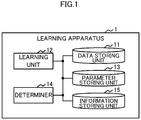
- FIG. 1 is a block diagram schematically illustrating an example of the functional configuration of a learning apparatus 1 as an example of the first embodiment.
- the learning apparatus 1 is an example of an information processing apparatus including an arithmetic processing device (not illustrated) that performs various calculation operations such as calculation operations related to deep learning.
- the learning apparatus 1 may learn parameters of a machine learning model such as a neural network, for example.
- the learning apparatus 1 may illustratively include a data storing unit 11, a learning unit 12, a parameter storing unit 13, a determiner 14, and an information storing unit 15 .
- the data storing unit 11 stores the data for learning used for training given machine learning models.
- the data for learning may be stored in a table format, or may be stored in various formats such as a Database (DB) and an array.
- DB Database
- the data for learning may be a combination of input data and correct answer data (training data) corresponding to the input data.
- Each data can be identified by a data ID indicating identification information.
- the data storing unit 11 may store an entry in which a data ID "00001", the input data "A1", and the correct answer data "B1" are associated with one another.
- a non-limiting example of the input data is image data including RGB elements.
- the learning apparatus 1 uses the data for learning stored in the data storing unit 11 to train a Deep Neural Network (DNN), for example, a Convolutional Neural Network (CNN) 20, which is an example of a machine learning model.
- DNN Deep Neural Network
- CNN Convolutional Neural Network
- FIG. 3 is a diagram illustrating examples of deep learning on the CNN 20.
- the CNN 20 exemplarily illustrated in FIG. 3 may include layers 21 of Conv_1, Pool_1, Conv_2, Pool_2, fc1, fc2, and sm.
- the correct answer data corresponding to the input data is given to the CNN 20.
- the learning apparatus 1 inputs the input data to the CNN 20 from the left end in the drawing of FIG. 3 , and causes the processing results of the respective layers 21 to propagate in the rightward direction in the drawing (forward propagation). Then, the learning apparatus 1 compares the output data and the correct answer data related to the input data, and causes the result difference between the data to propagate in the leftward direction in the drawing (backward propagation).
- the convolution calculation on the Conv 1 layer is accomplished by executing a product-sum calculation of the parameters of the Conv 1 on the input data.
- Each of the layers 21 of Conv_1, Conv_2, fc1, and fc2 retains parameters.
- the calculation result is compared with the correct answer data, and the parameters of each layer 21 are updated on the basis of the comparison result.
- each layer 21 of the CNN 20 a calculation exemplarily illustrated in FIG. 4 is performed.
- the output data "top” is output in accordance with the sum of the product-sum calculation result and "Bias".
- the process of learning and inferring the CNN 20 may be performed by, for example, a Large Scale Integration (LSI) including a dynamic fixed-point processor.
- LSI Large Scale Integration
- the learning apparatus 1 repeatedly trains the CNN 20 using the fixed-point number data.
- a fixed-point number may mean a numerical value expressed by fixing a decimal point position (digit), and the fixed-point number data may mean, for example, variables handled by each layer 21 in training of the CNN 20, or calculation results of each layer 21.
- the initial position (initial decimal point position) of the fixed-point number may be determined by the learning apparatus 1 on the basis of a learning result (trial result) obtained by training the CNN 20 one or more times using a numerical value of a floating-point number, or may be assigned by a user, for example.
- a mini-batch means that multiple pieces of image data are simultaneously subjected to a learning process.
- a mini-batch of "16" means that 16 pieces of image data are simultaneously subjected to the learning process. Therefore, for example, when 65536 pieces of image data is present, all the image data are input by 4096 iterations.
- the learning unit 12 expresses the data for learning stored in the data storing unit 11 by a fixed-point number, trains the CNN 20 by using a numerical value of the fixed-point number, and obtains the parameter WL of each layer 21 of the CNN 20 as the learning result.
- the symbol “L” represents an index for identifying each layer 21 of the CNN 20.
- the parameter WL is a parameter vector exemplified by the following expression (1).
- the subscript "Wn" represents the number of elements in the vector of the parameter WL.
- W L W 0 , L , W 1 , L , ⁇ , W Wn , L
- the parameter vector of the parameter storing unit 13 is updated each time the learning is repeated and then overwritten. For example data on the memory is rewritten in each iteration and when entire training is finished, weight data may be written into a file.
- the determiner 14 determines the decimal point position of the fixed-point number on the basis of statistical information obtained by the learning process on the CNN 20.
- the decimal point position determined by the determiner 14 is used by the learning unit 12 to train the CNN 20.
- the information storing unit 15 is an example of a memory, and stores information obtained on the basis of the statistical information which information is to be used by the determiner 14 to determine a decimal point position.
- the information storing unit 15 and the determiner 14 will be detailed below.
- FIG. 6 is a diagram illustrating an example of expressing data of variables (parameters) in each layer 21 of the CNN 20.
- loads such as a computational load, a memory load, or the like are applied due to a huge computational amount, so that the learning time of the parameters is prolonged.
- the numerical value used in the training is expressed by a fixed-point number (e.g., 16-bit or 8-bit fixed-point number, or the like) instead of a floating-point number (e.g., 32-bit floating-point number).
- a fixed-point number e.g., 16-bit or 8-bit fixed-point number, or the like
- a floating-point number e.g., 32-bit floating-point number
- the amount of data can be reduced, and the load such as the computation load and the memory load can be reduced, so that the learning time of the parameters can be shortened.
- fixed-point numbers have a narrower range of expressible numeral values than floating-point numbers. For this reason, the learning process by means of the numerical value expressed by the fixed-point number may have low accuracy of the learning result.
- FIG. 7 is a diagram illustrating a process performed by a learning apparatus 100 according to a comparative example. As illustrated in FIG. 7 , the learning apparatus 100 executes the following processes (A) to (C) until the learning is completed.
- the learning apparatus 100 stores the statistical information of each variable of each layer 210 during learning a mini-batch of a predetermined number of times (for example, K-times) (see symbol A in FIG. 7 ).
- the statistical information may include, for example, any of the following or a combination thereof.
- the application program that the learning apparatus 100 executes optimizes the decimal point position by obtaining statistical information from the processor.
- the processor executes an instruction for Dynamic Fixed Point (dynamic fixed-point number) calculation.
- the statistical information can be information on a distribution of the leftmost set bit positions for positive number and the leftmost unset bit positions for negative number or a distribution of the rightmost set bit positions of the multiple pieces of fixed-point number data acquired for each time the learning the mini-batch is repeated.
- FIG. 8 is a diagram illustrating an example of a histogram representing the distribution of the leftmost set bit position for positive number and the leftmost unset bit position for negative number.
- the vertical axis represents the number of appearances of the leftmost set bit position for positive number and the leftmost unset bit position for negative number
- the horizontal axis represents the leftmost set bit position for positive number and the leftmost unset bit position for negative number.
- a decimal point is assumed to be positioned on the right side of the drawing of bit 0.
- One example of the leftmost set bit position for positive number and the leftmost unset bit position for negative number is the value of a Count Leading Sign (CLS).
- CLS may indicate the position of the leftmost set bit of a positive number (i.e., the position of the leftmost unset bit of a negative number).
- the "expressible range” indicates a range (region) of the numeric value of the distribution of the leftmost set bit position for positive number and the leftmost unset bit position for negative number and which is included in a numerical value range of the 16-bit fixed-point number.
- the "region to be saturated” indicates a region of the numeric value of the distribution which exceeds the above numerical value range and in which a saturating process is performed.
- the saturating process is, for example, a process of clipping a positive maximum value when positive numbers overflow and a negative minimum value when negative numbers overflow.
- the rounding process may be executed in a case except for the saturation, i.e., as well as a case where an underflowing occurs.
- a positive number may be probablistically rounded to zero or a positive minimum value and a negative number may be probablistically rounded to zero or a negative maximum value. In other cases, the number below the decimal point may be rounded.
- the learning apparatus 100 adjusts the decimal point position of a fixed-point number on the basis of the statistical information on each variable of each layer 210.
- the learning apparatus 100 adjusts the decimal point position of a variable of a certain layer 210 on the basis of the statistical information of the same layer 210.
- the learning apparatus 100 performs such adjustment for each layer 210 and for each variable.
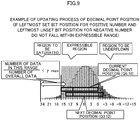
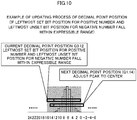
- FIGS. 9 and 10 are diagrams illustrating an example of an updating process of a decimal point position;
- FIG. 9 illustrates a case where the distribution of the leftmost set bit position for positive number and the leftmost unset bit position for negative number appearing in the statistical information does not fall within the expressible range of the learning apparatus 100
- FIG. 10 illustrates a case where the distribution of the leftmost set bit position for positive number and the leftmost unset bit position for negative number appearing in the statistical information is in the expressible range.
- the learning apparatus 100 determines, as the next bit accuracy, the largest "numerical value range" in which the ratio of the number of data of a certain "numerical value range" to the total number of data is less than the overflow rate ymax.
- the learning apparatus 100 determines the next decimal point position to be (Q3. 12).
- the overflow rate ymax may be specified by the user, for example.
- Decimal point position may be a Q format that defines bit data and, for example, (Q5. 10) defines 16-bit data with one sign bit, five integer bits, and ten decimal bits.
- the learning apparatus 100 adjusts, for example, the peak of the histogram to be located at the center of the next decimal point position. In the example of FIG. 10 , the learning apparatus 100 adjusts the next decimal point position to (Q1. 14). Alternatively, the learning apparatus 100 may adjust the decimal point position such that the accuracy matches the average of the number of appearances on the histogram.
- the learning apparatus 100 determines the decimal point position to be used in the next K-time mini-batch processes from the statistical information obtained in the K-time mini-batch processes.
- the data of each mini-batch (data for one iteration) is not uniform, and the distribution of the values of the error to be fed back varies due to the input data of the mini-batch and the backward propagation, so that the distribution of the intermediate values fluctuates.
- the fluctuation of the distribution is large, an error occurs between the decimal point position for calculation and the ideal decimal point position from the distribution of actual parameters or output to increase the quantization error due to a saturation process or a rounding process of the fixed decimal point, so that the learning becomes unstable, in other words, a recognition accuracy may decrease.
- the learning apparatus 1 suppresses the deterioration of the accuracy of the learning result of the machine learning model by adjusting, for example, correcting, the decimal point position determined by K-times statistical information using the statistical information of the previous layer(s).
- FIGS. 12 and 13 are diagrams illustrating statistical information 22 used in an example of a correction process of the decimal point position.
- the previous layer 21 may mean one or more layers 21 ahead of the correction target layer 21 of correcting its decimal point position with respect to the propagation direction of the data, in other words, one or more layers 21 on the input side of the correction target layer 21.
- the layer 21 previous to the correction target layer 21e for correcting its decimal point position becomes at least one layer 21 of the layers 21a to 21d previous to the layer 21e.
- the learning apparatus 1 may correct the decimal point position of the layer 21e by using the statistical information 22a to 22d of the layers 21a to 21d, respectively.
- the layer 21 previous to the correction target layer 21e for correcting the decimal point position becomes at least one layer 21 of the layers 21f to 21p behind the layer 21e.
- the learning apparatus 1 may correct the decimal point position of the layer 21e by using the statistical information 22f to 22p of the layers 21f to 21p, respectively.
- FIG. 14 is a diagram for explaining an example of the progress of learning and a determination process of the decimal point position.
- the learning apparatus 1 trains the CNN 20 by a predetermined number of times of mini-batches, for example, K-times mini-bathes, in the same manner as in the comparative example.
- "S" in the boxes 22a to 22p represent statistical information and "D" in the boxes below the statistical information 22 represents a decimal point position.
- the learning apparatus 1 sequentially obtains and accumulates statistical information 22a to 22p obtained by training the layers 21a to 21p in the respective iterations.
- These statistical information 22 may be stored in, for example, a register or a memory provided in or connected to hardware, such as an LSI, that performs training and inferring of the CNN 20.
- the learning apparatus 1 updates the decimal point position of each layer 21 on the basis of the statistical information 22 of training (iterations t-K to t-1) for K-times mini-batches. For example, the learning apparatus 1 determines a fixed-point number to be the basis of the layers 21a to 21g of the iteration t on the basis of the statistical information 22a to 22g, respectively. The determined fixed-point number may be used as the basis for learning the next K-times (iterations t to t+K-1) mini-batches containing iteration t.
- the learning apparatus 1 sequentially corrects the decimal point position by using statistical information of the layer 21 previous to the current layer 21.
- the learning apparatus 1 corrects the decimal point position of the layer 21b on the basis of the statistical information 22a (22A) of the layer 21a in the iteration t before executing the forward propagation calculation of the layer 21b and storing the statistical information 22b.
- the learning apparatus 1 corrects the decimal point position of the layer 22c based on the statistical information 22a and 22b (statistical information 22B) of the layers 21a and 21b, and corrects the decimal point position of the layer 22d based on the statistical information 22a to 22c (statistical information 22C) of the layers 21a to 21c.
- the learning apparatus 1 may correct the decimal point position of the layer 21 on the basis of the backward statistical information, i.e., the statistical information 22 of from the layers 21p to 21b.
- the distributions of the outputs of the layers 21 in CNN 20 are influenced by the combinations of images of the mini-batches.
- the weight parameter in each layer 21 is gradually changed by, for example, the gradient method. Therefore, in the first embodiment, a correction process for predicting the fluctuation of the distribution for each batch from the feature of the mini batch and correcting the decimal point position is performed in a method exemplified below.
- the determiner 14 obtains the statistical information 22 related to each variable of each layer 21 of the CNN 20, and stores the information obtained from the obtained statistical information 22 in the information storing unit 15.
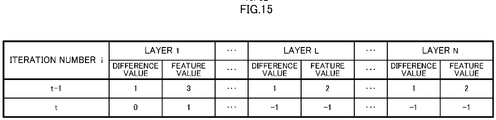
- the information storing unit 15 stores a "iteration number" i representing the number of repeating of the learning process, and a "feature value” and a “difference value” obtained from the statistical information 22 for each layer 21 of the CNN 20 in association with each other.
- the "difference value" is an example of an error in the decimal point position of the fixed-point number data obtained on the basis of the statistical information 22, and is, for example, a value of a difference (for example, a difference in the number of bits of the integer part) between the current decimal point position and an ideal decimal point position.
- the current decimal point position is the decimal point position determined from the statistical information 22 of the same layer 21 in the previous iteration.
- the ideal decimal point position is the decimal point position obtained from the statistical information 22 in the current iteration.
- the determiner 14 calculates, as the "difference value" of the layer 1 of the iteration t, "0" which is a difference between the current decimal point position determined from the statistical information 22 of the previous iteration t-1 and the ideal decimal point position obtained from the statistical information 22 of the current iteration t, as illustrated in FIG. 15 .
- the "feature value” is information on the feature of the decimal point position obtained from the statistical information 22, and may include at least one element of the saturation digit number, the centroid of a histogram, the histogram itself, and the like.
- the "saturation digit number" is the difference between the significant digits that makes the statistical information 22 greater than "0" and the valid range of the numeric value that is the fixed-point number.
- the saturation digit number is exemplified as the feature value.
- the "histogram” may be the statistical information 22 itself, a part of the statistical information 22, or information obtained by processing the statistical information 22.
- the determiner 14 may obtain (calculate) the difference value and the feature value for each layer 21, and store the obtained information into the information storing unit 15 as storage information.
- the determiner 14 corrects the decimal point position of the variables to be used in the training of the certain layer 21 on the basis of the stored information about the layer 21 previous to the certain layer 21 set in the information storing unit 15.
- FIG. 18 is a diagram illustrating an example of a correction process on a decimal point position.
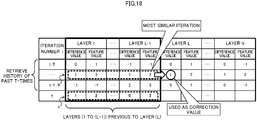
- the determiner 14 retrieves an entry similar to the current iteration from the storage information of the past T (T is an integer of 1 or more) times relating to a layer 21 previous to the layer (layer L) 21 that starts training.
- the determiner 14 determines a correction value for correcting the decimal point position of the layer L (first layer).
- the determiner 14 identifies the x-th (x is an integer less than t) iteration previous to the t-th iteration having a similar tendency of the error in the t-th (t is an integer of 2 or more) iteration of training the layers 1 to L-1 (second layers) prior to layer L.
- the second layers with respect to the first layer e.g., layer L
- layers 1 to L-1 are used as the second layers.
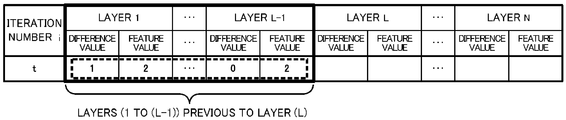
- the determiner 14 retrieves an entry similar to the storage information of layers 1 to L-1 of the iteration t from the storage information of layers 1 to L-1 of the iteration t-T to t-1. For example, the determiner 14 detects an entry (see symbol B) of the iteration most similar to the entry (see symbol A) of the current iteration t from the information storing unit 15.
- the determiner 14 may determine that the similarity between entries (between iterations) is higher as the result of calculating, for example, the sum or the average of at least one of the difference between the difference values and the difference between the feature values for all the layers 21 of the layers 1 to L-1 is smaller, for example.
- the determination of the similarity is not limited to the above-described method, and various methods may be used.
- the determiner 14 determines the correction value for the layer L in the t-th iteration on the basis of the error of the layer L in the identified x-th iteration.
- the determiner 14 uses the "difference value" set in the layer L of the iteration determined (detected) to be similar as the correction value (prediction value) to be set in the layer L in the iteration t.
- the correction value is an example of an "offset amount" for correcting the decimal point position, for example, an offset value.
- the determiner 14 determines an offset amount for correcting the decimal point position of the fixed-point number data to be used for training on the basis of the tendency of the error in each iteration.
- the determiner 14 uses "1", which is the difference value of the layer L in the entry indicated by the symbol B, as the correction value for the layer L in the current iteration t indicated by the symbol A.
- the determiner 14 may add, in the layer L of the iteration t, one bit to the integer bit of a fixed-point number (see FIG. 14 ) of the layer L that is updated on the basis of the statistics 22 of the iteration t-K to t-1 in accordance with the "difference value".
- the determiner 14 determiners a similarity between entries based on both the "difference value” and the “feature value” in the storage information stored in the information storing unit 15, but the determination of the similarity is not limited to this. Alternatively, the determiner 14 determiners such a similarity between entries based on one of the "difference value" and the "feature value”.
- the determiner 14 is assumed to obtain the correction value for the correction target layer 21 based on the history (statistics) of all the layers 21 previous to the correction target layer 21, but the obtaining of the correction value is not limited to this.
- the determiner 14 may calculate the correction value of the correction target layer 21 based on, for example, the history of part of the layers 21 (in other words, the second layers) previous to the correction target layer 21 (in other words, the first layer). Alternatively, the determiner 14 may use a history of only the layer 1, only the leading layer 21 in or a combination of layers 21 in the block to which the correction target layer 21 belongs among the layers 21 previous to the correction target layer 21.
- FIG. 19 is a diagram illustrating a case where the determiner 14 uses the history of the first layer 21 of the block.
- the layers 21 of the CNN 20 may be grouped (classified) into blocks 23 (blocks 23a to 23f in the example of FIG. 19 ) in units of two or more successive layers 21 in accordance with a process or the like for inputting data.
- Layers 21 grouped in the same blocks 23 sometimes have a stronger correlation of tendency in the fluctuation of the fixed-point position of the parameters than the correlation between layers 21 in different blocks 23.
- the determiner 14 may determine the leading layer 21e of the block 23c to which the layer 21g belongs to be the target layer for determination of similarity. In this case, the determiner 14 retrieves an entry similar to the storage information of the layer 21e at the iteration t from the iterations t-T to t-1 of the layer 21e, and determines the "difference value" of the layer 21g in the most similar entry to be the correction value of the layer 21g.
- the determiner 14 may determine multiple layers 21 (for example, the leading layer 21e and the layer 21f) previous to the layer 21g in the block 23c to which the layer 21g belongs to be the target layers for determination of similarity.
- the second layers with respect to the first layer e.g., layer 21g
- the determiner 14 may determine at least one of the leading layers 21a and 21c of the blocks 23a and 23b previous to the layer 21g in addition to the leading layer 21e in the block 23c to which the layer 21g belongs to be target layers for determination of similarity.
- limiting (narrowing) the target layers 21 for determination of similarity can reduce the processing load of the similarity determination and can shorten the processing time (enhance the speed of the processing).
- the backward propagation may determine the correction value for the decimal point position from the rear side (from the layer 21p in the example of FIG. 13 ) toward the front side (toward the layer 21a in the example of FIG. 13 ).
- the decimal point position of the layer 21 on the front side may be corrected by using the feature amount of the layer 21 on the rear side.
- the backward propagation is different from the forward propagation in the point that the correction value of the decimal point position is obtained in the order from the layer 21 on the rear side to the layer 21 on the front side and that the statistical information 22 of the layer 21 on the rear side is used in place of the statistical information 22 of the layer 21 on the front side, but is the same may be the same as in the case of the forward propagation.
- the decimal point position of the layer 21e may be corrected using at least one of the statistical information 22f to 22p of the layers 21f to 21p rear side of the layer 21e.
- FIGS. 20 and 21 are diagrams illustrating examples of simulation results of the relationship between the correction value (prediction value) determined in the above-described manner and the actual difference value in the forward propagation and the backward propagation, respectively.
- the decimal point position were appropriately corrected in many cases of the conv5_4 (see FIG. 20 ) in the forward propagation and the conv2_2 (see FIG. 21 ) in the backward propagation.
- the information storing unit 15 stores the error of the decimal point position of the fixed-point number data obtained based on the statistical information 22. Then, the determiner 14 determines an offset amount for correcting the decimal point position of the fixed-point number data to be used for training on the basis of the tendency of the error in each iteration.
- a neural network to which a dynamic fixed-point number can be applied can be increased.
- the deep learning can be performed with high accuracy by means of a fixed-point number
- the data transfer amount and the circuit scale of the calculator can be reduced, and thereby consumption power can be reduced.
- the 32-bit floating-point number is reduced to a 16-bit fixed-point number
- memory usage and the data transfer amount can be reduced by half.
- the circuit scale of the product-sum calculation in the LSI can be reduced to about half.
- FIG. 22 is a flowchart illustrating an example of the operation of the learning apparatus 1 according to the first embodiment
- FIG. 23 is a flowchart for explaining an example of the operation of the batch learning process illustrated in FIG. 22 .
- the learning unit 12 of the learning apparatus 1 determines whether the learning of the CNN 20 has been completed (Step S4). If the learning is determined to be completed (Yes in Step S4), the process ends. On the other hand, if the learning is determined not to be completed (No in Step S4), the process proceeds to Step S5.
- the criterion for judging the end of learning for example, any one or a combination of two or more of various criteria such as that the error of the learning result falls below the threshold value, that the accuracy of the learning result exceeds the threshold value, and that the number of times of learning exceeds the threshold value may be used.
- Step S5 the learning unit 12 learns batches for the CNN 20, and accumulates the statistical information 22 of the respective layers 21.
- the learning unit 12 adds 1 to k (Step S6), and determines whether k reaches the updating interval K (Step S7). If k is determined not to reach the updating interval K yet (No in Step S7), the process proceeds to Step S4. On the other hand, if k is determined to reach the updating interval K (Yes in Step S7), the process proceeds to step S8.
- step S8 the determiner 14 updates the decimal point position of each variable of each layer 21 on the basis of various pieces of the statistical information 22.
- the decimal point position updated in this process is used to express each variable in the next updating interval.
- steps S1 to S3 is not limited to that of the example of FIG. 22 , and any step may be performed first, or these steps may be performed in parallel.
- the processing order of Steps S9 and S10 is not limited to that of the example of FIG. 22 , and any step may be performed first, or these steps may be performed in parallel.
- the learning unit 12 selects the first layer 21 of the forward propagation in the training of the batch (Step S11).
- the determiner 14 corrects the decimal point position based on the stored information stored in the information storing unit 15 (Step S12).
- the correction process may be omitted for the first layer 21 in the CNN 20 forward order, for example, the first (leading) layer 21a in the example of the forward in FIG. 12 (the leading layer 21a in the CNN 20 structure).
- the learning unit 12 applies the decimal point position corrected by the determiner 14 to execution the forward propagation calculation of the layer 21 and acquisition of the statistical information 22 (in Step S13).
- the determiner 14 calculates the feature values and the difference values for the layer 21 and stores them in the information storing unit 15 as the storage information (Step S14).
- the learning unit 12 determines whether the layer 21 (the layer 21p in the example of FIG. 12 ) being selected is the last layer 21 of the forward propagation (Step S15). If determining the layer 21 not to be the last layer of the forward propagation (No in Step S15), the learning unit 12 selects the next layer 21 in the forward propagation direction and moves the process to Step S12. On the other hand, if determining the layer to be the last layer 21 of the forward propagation (Yes in Step S15), the learning unit 12 selects the first layer 21 of the backward propagation (Step S16).
- the determiner 14 corrects the decimal point position based on the stored information stored in the information storing unit 15 (Step S17).
- the correction process may be omitted for the leading layer 21 of the backward order in the CNN 20, for example, the leading layer 21p in the example of the backward in FIG. 13 (the last layer 21p in the CNN 20 structure).
- the learning unit 12 applies the decimal point position corrected by the determiner 14 to execution of the backward propagation calculation of the layer 21 and acquisition of the statistical information 22 (in Step S18).
- the determiner 14 calculates the feature values and the difference values for the layer 21 and stores them in the information storing unit 15 as the storage information (Step S19).
- the learning unit 12 determines whether the selected layer 21 is the last layer 21 (the layer 21a in the example of FIG. 13 ) of the backward propagation (Step S20). If determining the layer 21 not to be the last layer of the backward propagation (No in Step S20), the learning unit 12 selects the next layer 21 in the backward propagation direction and moves the process to Step S17. On the other hand, if determining the layer to be the last layer 21 of the backward propagation (Yes in Step S20), the learning unit 12 selects the first layer 21 of the forward propagation (Step S21).
- the learning unit 12 updates the weight and the bias of the selected layer 21 and obtains the statistical information 22 on the selected layer 21 (Step S22), and determines whether or not the layer 21 being selected is the last layer 21 (the layer 21p in the example of FIG. 12 ) of the forward propagation (Step S23). If determining the layer 21 not to be the last layer 21 of the forward propagation (No in Step S23), the learning unit 12 selects the next layer 21 of the forward propagation direction and the process proceeds to Step S22. On the other hand, if determining the layer to be the last layer 21 of the forward propagation (Yes in Step S23), the process ends.
- the second embodiment can be regarded as an embodiment that simplifies the process of the determiner 14 of the first embodiment.
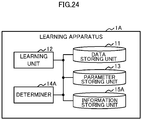
- FIG. 24 is a block diagram schematically illustrating an example of the functional configuration of a learning apparatus 1A according to the second embodiment.
- the learning apparatus 1A includes a determiner 14A and an information storing unit 15A instead of the determiner 14 and the information storing unit 15 included in the learning apparatus 1 of the first embodiment.
- the description not referred to below is the same as that of the first embodiment.
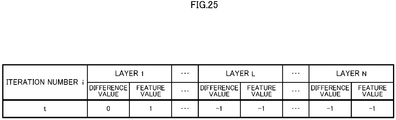
- the determiner 14A stores the feature value and the difference value for the current iteration (one iteration) into the information storing unit 15A.
- the determiner 14A determines the correction value for the layer L based on the storage information of the current iteration t of the layer 21 previous to the layer 21 (the layer L) that starts training.
- the determiner 14A may use the difference value of the leading layer 21 (the layer 21a in the example of FIG. 12 ) as the correction value of the layer L, or may use the difference value of the leading layer 21 in the block 23 to which the layer L belongs, as illustrated in FIG. 19 .
- the determiner 14A may use the calculation result such as the average or the weighted average of the difference values of the leading block layers 1 to L - 1.
- the determiner 14A may omit the calculation of the correction value for the first layer 21 in the forward order or the backward order, and may use the updating result of the decimal point position calculated in units of K-times (updating intervals) as performed in the first embodiment.
- the same effects as those of the first embodiment can be achieved by the learning apparatus 1A according to the second embodiment. Further, since the difference value of the current iteration t in the information storing unit 15A is used as the correction value for the decimal point position of the layer L, the similarity determination process can be omitted, and the processing load can be reduced, so that the processing time can be shortened (the speed of the process can be enhanced).
- the third embodiment can be regarded as an embodiment that predicts the correction value for each layer 21 by deep learning.
- FIG. 27 is a block diagram schematically illustrating an example of the functional configuration of a learning apparatus 1B according to the third embodiment.
- the learning apparatus 1B includes a determiner 14B instead of the determiner 14 included in the learning apparatus 1 according to the first embodiment.
- the description not referred to below is the same as that of the first embodiment.
- the determiner 14B obtains the correction value for the layer L by deep learning in which the correction value is trained and inferred concurrently with the training of the CNN 20 by the learning unit 12 .
- the determiner 14B may store the storage information including the feature value including the statistical information 22 of the T-time mini-batches, and the correction value, in other words, the difference value between the current decimal point position and the ideal value, into the information storing unit 15.
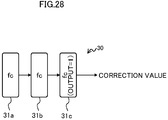
- the determiner 14B may train a predictor 30, which is an example of a machine learning model for determining a correction value (offset amount).
- FIG. 28 is a diagram illustrating an example of the network configuration of the predictor 30.
- the predictor 30 may have a network configuration of about three layers including layers 31a to 31c. Each of these layers 31 may be a fully connected layer fc.
- the determiner 14B may train the predictor 30 each of T-time mini-batches, and may predict the correction value using the predictor 30.
- the determiner 14B trains the predictor 30 by using the data stored in the information storing unit 15 at the training intervals T .
- FIG. 29 is a diagram illustrating an example of training data for a predictor 30.
- the statistical information 22 of each layer 21 (the layers 1 to L-1) of the CNN 20 may be used as the training data in the case of the layer L.
- the determiner 14B may use the difference value of the layer L as the correct answer label.
- the determiner 14B may train the predictor 30 illustrated in FIG. 28 by using "(L-1) ⁇ w" pieces of statistical information 22 as training data and using the difference values stored in the information storing unit 15 as the correct answer data of these training data.
- the symbol (L-1) indicates the number of layers previous to the layer L
- the symbol w indicates the bit width of the statistical information 22.
- the determiner 14B may use the feature values stored in the information storing unit 15, or may refer to and use the statistical information 22 stored in the accelerator that achieves the CNN 20.
- the determiner 14B predicts the correction value of the layer L using the trained predictor 30. For example, the determiner 14B predicts (determines) the correction value for the decimal point position of the layer L by using the statistical information 22 of each layer 21 (the layers 1 to L-1) as an input to the predictor 30 and using the correction value (for example, a real number) as an output from the predictor 30. Note that the determiner 14B may perform a rounding process on the correction value of the real number output from the predictor 30 into an integer number.
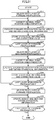
- FIG. 30 is a flowchart illustrating an example of the operation of the learning apparatus 1B according to the third embodiment
- FIG. 31 is a flowchart for explaining an example of the operation of the batch learning process illustrated in FIG. 30 .
- the steps provided with the same reference numbers as those in FIG. 22 designate the same steps illustrated in FIG. 22 .
- the steps provided with the same reference numbers as those in FIG. 23 designate the same steps illustrated in FIG. 23 .
- Step S4 the learning unit 12 carries out training in a batch and accumulates the statistical information 22 of each variable of the layer 21, in Step S32.
- the determiner 14B corrects the decimal point position of the layer 21 on the basis of the predictor 30 trained in Step S37, which will be described below.
- step S33 performed after Step S6, the determiner 14B adds 1 to t, and the process proceeds to Step S34.
- Step S34 the learning unit 12 determines whether or not k has reached the updating interval K. If k is determined not to reach the updating interval K yet (No in Step S34), the process proceeds to Step S36. On the other hand, if k is determined to reach the updating interval K (Yes in Step S34), the process proceeds to step S8.
- step S35 performed after Step S9, the determiner 14B resets the statistical information 22, and the process proceeds to Step S36.
- Step S35 the determiner 14B determiners whether or not t has reached the training interval T in Step S36. If t is determined not to have reached the training interval T (No in Step S36), the process proceeds to step S4. On the other hand, if t is determined to have reached the training interval T (Yes in Step S36), the process proceeds to Step S37.
- Step S37 the determiner 14B trains the correction value of each layer 21 using the predictor 30, and the process proceeds to Step S38.
- steps S1 to S3 is not limited to that of the example of FIG. 30 , and any step may be performed first, or these steps may be performed in parallel.
- the processing order of steps S6 and S44 is not limited to that of the example of FIG. 30 , and any step may be performed first, or these steps may be performed in parallel.
- the processing order of steps S9 and S35 is not limited to that of the example of FIG. 30 , and any step may be performed first, or these steps may be performed in parallel.
- step S32 of FIG. 30 As exemplarily illustrated in FIG. 31 , after Step S11 or in cases of No in Step S15, the determiner 14B predicts the correction value of the layer 21 based on the predictor 30, corrects the decimal point position using the predicted correction value in Step S41, and the process proceeds to step S13.
- step S42 performed after Step S13, the determiner 14B stores the statistical information 22 and the difference values in the information storing unit 15 as storage information, and the process proceeds to Step S15.
- Step S16 the determiner 14B predicts the correction value of the layer 21 based on the predictor 30, corrects the decimal point position using the predicted correction value in Step S43, and the process proceeds to step S18.
- step S44 the determiner 14B stores the statistical information 22 and the difference values in the information storing unit 15 as storage information, and the process proceeds to Step S20.
- the same effects as those of the first and the second embodiments can be achieved by the learning apparatus 1B according to the third embodiment. Further, since the correction value for the decimal point position of the layer L is predicted by using the predictor 30 on the basis of the statistical information 22, the correction value can be determined with higher accuracy as the training of the predictor 30 proceeds.
- the statistical information 22 of the layer 21 serving as the input data to the predictor 30 may be limited to statistical information 22 of the leading layer 21 or the leading layer 21 of the block 23.
- the processing load can be reduced, and the processing time can be shortened (the speed of the process can be enhanced).
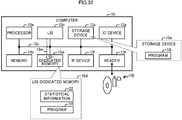
- FIG. 32 is a block diagram illustrating an example of a hardware (HW) configuration of a computer 10.
- the functions of the learning apparatuses 1, 1A, and 1B according to the first, the second, and the third embodiments may be achieved by HW resources of the computer 10 illustrated in FIG. 32 , for example.
- the computer may have the HW configuration illustrated in FIG. 32 .
- the computer 10 exemplarily includes a processor 10a, a memory 10b, a LSI 10c, an LSI-dedicated memory 10d, a storage device 10e, an Interface (I/F) device 10f, an Input/Output (I/O) device 10g, and a reader 10h.
- a processor 10a exemplarily includes a processor 10a, a memory 10b, a LSI 10c, an LSI-dedicated memory 10d, a storage device 10e, an Interface (I/F) device 10f, an Input/Output (I/O) device 10g, and a reader 10h.
- a processor 10a exemplarily includes a processor 10a, a memory 10b, a LSI 10c, an LSI-dedicated memory 10d, a storage device 10e, an Interface (I/F) device 10f, an Input/Output (I/O) device 10g, and a reader 10h.
- I/F Interface
- the processor 10a is an example of a processor that performs various controls and calculations.
- the processor 10a may be communicatively coupled to each of the blocks in the computer 10 via the bus 10k.
- the processor 10a may be a multiprocessor including multiple processors, may be a multicore processor having multiple processor cores, or may have a configuration having multiple multicore processors.
- Examples of the processor 10a include an integrated circuit (IC) such as a Central Processing Unit (CPU), an Micro Processing Unit (MPU), an Accelerated Processing Unit (APU), a Digital Signal Processor (DSP), an Application Specific IC (ASIC), and an Field-Programmable Gate Array (FPGA).
- IC integrated circuit
- CPU Central Processing Unit
- MPU Micro Processing Unit
- APU Accelerated Processing Unit
- DSP Digital Signal Processor
- ASIC Application Specific IC
- FPGA Field-Programmable Gate Array
- the processor 10a may be a combination of two or more of the above ICs.
- the memory 10b is an example of the HW that stores information such as various data and programs.
- An example of the memory 10b includes a volatile memory such as Dynamic Random Access Memory (DRAM).
- DRAM Dynamic Random Access Memory
- the LSI 10c is an HW device including a processor for dynamically changing the decimal point position of a fixed-point number and for performing a predetermined process in cooperation with the processor 10a.
- the LSI 10c may operate under control of the processor 10a via the bus 10k.
- the LSI 10c may include multiple (e.g., a relatively large number) of product-sum calculators and multiple (e.g., a relatively small number) of special calculators.
- the LSI 10c may execute processes such as training and inferring of the CNN 20 in response to an instruction (control) from the processor 10a operating as the learning unit 12.
- the LSI 10c may include a control cores (not illustrated).
- the processor 10a and the control core may perform a communication process via the bus 10k, and the control core that obtains the control information output from the processor 10a may control the entire LSI 10c.
- Examples of the LSI 10c include one or more of Graphics Processing Units (GPUs), one or more FPGAs, and one or more ASICs, or two or more combinations thereof.
- the above-described operation processing apparatus may be regarded as one including an LSI 10c in addition to the processor 10a.
- the processor 10a and the LSI 10c serve as the learning apparatus 1, 1A, or 1B as an example of a calculation operation processing apparatus for performing calculations such as training and inferring the CNN 20.
- the LSI-dedicated memory 10d may store, for example, control data (control information) directed to the LSI 10c and input/output data used for calculations of the LSI 10c, and may include, for example, a memory such as a DRAM, and a register.
- the statistical information 22 of the first to the third embodiments may be stored, as the statistical information 22, in the LSI-dedicated memory 10d.
- the statistical information 22 may be stored in an internal register of the LSI-dedicated memory 10d, for example.
- the LSI-dedicated memory 10d may be directly connected to a bus (communication line) indicated by a reference number 10m. In this alternative, the LSI-dedicated memory 10d do not have to be connected to the bus 10k.
- the storage device 10e is an example of the HW that stores information such as various data and programs.
- Examples of the storage device 10e are various storing devices exemplified by a magnetic disk device such as a Hard Disk Drive (HDD), a semiconductor drive device such as a Solid State Drive (SSD), and a nonvolatile memory.
- Examples of the nonvolatile memory include a flash memory, a Storage Class Memory (SCM), and a Read Only Memory (ROM).
- the storage device 10e may store a program 10i (control program) that implements all or part of various functions of computer 10.
- the program 10i may include, for example, processes that implements the learning unit 12 and the determiner 14, 14A, or 14B.
- the processor 10a of the learning apparatus 1, 1A, or 1B operates as the learning apparatus 1, 1A, or 1B by expanding the program 10i stored in the storage device 10e onto the memory 10b or the LSI-dedicated memory 10d and executing each of the processes that program 10i has.
- the data storing unit 11, the parameter storing unit 13, and the information storing unit 15 or 15A included in the learning apparatuses 1, 1A, and 1B may be achieved by at least part of the storing region of the memory 10b, the LSI-dedicated memory 10d, and the storage device 10e, for example.
- the IF device 10f is an example of a communication IF that controls, for example, the connection and the communication with a non-illustrated network such as an internet.
- the IF device 10f may include adapters compliant with a Local Area Network (LAN), optical communication (e.g., Fibre Channel (FC)), or the like.
- the adapter may deal with one or both of wireless and wired communication schemes.
- the program 10i may be downloaded from a non-illustrated network to the computer 10 via the communication IF and stored in the storage device 10e.
- the I/O device 10g includes one or both of an input device and an output device.
- Examples of the input device include a keyboard, a mouse, and a touch panel.
- Examples of the output device include a monitor, a projector, and a printer.
- the reader 10h is an example of a reader that reads data and programs recorded on the recording medium 10j.
- the reader 10h may include a connecting terminal or device to which the recording medium 10j can be connected or inserted.
- Examples of the reader 10h include an adapter conforming to, for example, Universal Serial Bus (USB), a drive apparatus that accesses a recording disk, and a card reader that accesses a flash memory such as an SD card.
- the recording medium 10j may store the program 10i, and the reader 10h may read the program 10i from the recording medium 10j and store the program 10i into in the storage device 10e.
- the recording medium 10j is an exemplary non-transitory computer-readable recording medium such as a magnetic/optical disk, and a flash memory.
- the magnetic/optical disk include a flexible disk, a Compact Disc (CD), a Digital Versatile Disc (DVD), a Blu-ray disk, and a Holographic Versatile Disc (HVD).
- An examples of the flash memory includes a semiconductor memory such as a USB memory and an SD card.
- the above HW configuration of the computer 10 is a merely example. Accordingly, the computer 10 may appropriately undergo increase or decrease of hardware blocks (e.g., addition or deletion of arbitrary blocks), division, integration in an arbitrary combination, and addition or deletion of the bus.
- hardware blocks e.g., addition or deletion of arbitrary blocks
- division e.g., division
- integration e.g., integration
- addition or deletion of the bus e.g., deletion of the bus.
- the learning apparatus 1, 1A, or 1B at least one of the I/O device 10g and the reader 10h may be omitted.
- the blocks of the learning apparatus 1, 1A, or 1B illustrated in FIG. 1 , 24 , or 27 may be merged in any combinations, or may be divided in each case.
Landscapes
- Engineering & Computer Science (AREA)
- Physics & Mathematics (AREA)
- Theoretical Computer Science (AREA)
- General Physics & Mathematics (AREA)
- General Engineering & Computer Science (AREA)
- Computing Systems (AREA)
- Software Systems (AREA)
- Data Mining & Analysis (AREA)
- Life Sciences & Earth Sciences (AREA)
- Biomedical Technology (AREA)
- Evolutionary Computation (AREA)
- Artificial Intelligence (AREA)
- Health & Medical Sciences (AREA)
- Biophysics (AREA)
- Molecular Biology (AREA)
- Mathematical Physics (AREA)
- Computational Linguistics (AREA)
- General Health & Medical Sciences (AREA)
- Computational Mathematics (AREA)
- Mathematical Analysis (AREA)
- Mathematical Optimization (AREA)
- Pure & Applied Mathematics (AREA)
- Bioinformatics & Cheminformatics (AREA)
- Bioinformatics & Computational Biology (AREA)
- Computer Vision & Pattern Recognition (AREA)
- Evolutionary Biology (AREA)
- Neurology (AREA)
- Image Analysis (AREA)
Abstract
Description
- The embodiments discussed herein are directed to an arithmetic processing apparatus, a control method, and a control program.
- In an arithmetic processing apparatus, there is known a method for adjusting the decimal point position of fixed-point number data on the basis of statistical information on the distribution of bits in the data after being subjected to execution of an instruction directed to the fixed-point number data. This method makes it possible to execute, for example, the calculating process related to deep learning with high accuracy by means of a fixed-point number to thereby reduce the circuit scale and the power consumption.
-
- [Patent Document 1] Japanese Laid-open Patent Publication No.
07-84975 - [Patent Document 2] Japanese Laid-open Patent Publication No.
07-134600 - [Patent Document 3] Japanese Laid-open Patent Publication No.
2018-124681 - When the arithmetic processing apparatus is caused to learn the parameters of machine learning models such as neural networks, gaps may be generated between a decimal point position estimated on the basis of statistical information of the learning and actual distributions of parameters and output data.
- If such gaps are generated, the updating of the decimal point position on the basis of the statistical information may increase a quantization error due to the saturation or rounding of the fixed point as compared with the case where the gaps are small, and the learning becomes unstable, in other words, the accuracy of a learning result may be lowered.
- One of the objects of the present invention is to suppress decrease in the accuracy of a learning result of a machine learning model.
- According to an aspect of the embodiments, an arithmetic processing apparatus includes: a memory that stores, when a training of a given machine learning model is repeatedly performed in a plurality of iterations, an error of a decimal point position of each of a plurality of fixed-point number data obtained one in each of the plurality of iterations, the error being obtained based on statistical information related to a distribution of leftmost set bit positions for positive number and leftmost unset bit positions for negative number or a distribution of rightmost set bit positions of the plurality of fixed-point number data; and a determiner that determines, based on a tendency of the error in each of the plurality of iterations, an offset amount for correcting a decimal point position of fixed-point number data used in the training.
- In one aspect, it is possible to suppress a decrease in accuracy of a learning result of a machine learning model.
-
-
FIG. 1 is a block diagram schematically illustrating an example of the functional configuration of a learning apparatus according to a first embodiment; -
FIG. 2 is a diagram illustrating an example of data stored in a data storing unit; -
FIG. 3 is a diagram illustrating an example of deep learning on a Convolutional Neural Network (CNN) ; -
FIG. 4 is a diagram illustrating an example of learning calculation in each layer of a CNN; -
FIG. 5 is a diagram illustrating an example of updating information that a parameter storing unit stores; -
FIG. 6 is a diagram illustrating an example of expressing data of variables in each layer of a CNN; -
FIG. 7 is a diagram illustrating a process by a learning apparatus according to a comparative example; -
FIG. 8 is a diagram illustrating an example of a histogram representing a distribution of leftmost set bit position for positive number and leftmost unset bit position for negative number; -
FIG. 9 is a diagram illustrating an example of an updating process on a decimal point position; -
FIG. 10 is a diagram illustrating an example of an updating process on a decimal point position; -
FIG. 11 is a diagram illustrating examples of distribution information S(t) to S(t+2) of Count Leading Sign(CLS) in the t- to (t+2)-th mini batches; -
FIG. 12 is a diagram illustrating statistical information used in an example of a correction process of a decimal point position in the forward propagation; -
FIG. 13 is a diagram illustrating statistical information used in an example of a correction process of a decimal point position in the backward propagation; -
FIG. 14 is a diagram for explaining an example of a progress of training and a determination process of a decimal point position; -
FIG. 15 is a diagram illustrating an example of information stored in an information storing unit; -
FIG. 16 is a diagram for explaining a saturation digit number; -
FIG. 17 is a diagram for explaining an example of calculation of the centroid of a histogram; -
FIG. 18 is a diagram illustrating an example of a correction process of the decimal point position; -
FIG. 19 is a diagram illustrating a case where the determiner uses the history of the leading layer of a block; -
FIG. 20 is a diagram illustrating an example of a simulation result of a relationship between a correction value (predicted value) in forward propagation and an actual difference value; -
FIG. 21 is a diagram illustrating an example of a simulation result of the relationship between a correction value (predicted value) in the backward propagation and an actual difference value; -
FIG. 22 is a flowchart illustrating an example of the operation of the learning apparatus according to the first embodiment; -
FIG. 23 is a flowchart illustrating an example of the operation of a batch learning process illustrated inFIG. 22 ; -
FIG. 24 is a block diagram schematically illustrating an example of the functional configuration of a learning apparatus according to a second embodiment; -
FIG. 25 is a diagram illustrating an example of information stored in an information storing unit; -
FIG. 26 is a diagram illustrating an example of a correction process of a decimal point position; -
FIG. 27 is a block diagram schematically illustrating an example of the functional configuration of a learning apparatus according to a third embodiment; -
FIG. 28 is a diagram illustrating an example of the network configuration of a predictor; -
FIG. 29 is a diagram illustrating an example of data for training a predictor; -
FIG. 30 is a flowchart illustrating an example of the operation of the learning apparatus of the third embodiment; -
FIG. 31 is a flowchart illustrating an example of the operation of a batch learning process illustrated inFIG. 30 ; and -
FIG. 32 is a block diagram schematically illustrating an example of a hardware configuration of a computer according to the first to third embodiments. - Hereinafter, embodiments of the present invention will now be described with reference to the accompanying drawings. However, the embodiments described below are merely illustrative and is not intended to exclude the application of various modifications and techniques not explicitly described below. For example, the present embodiments can be variously modified and implemented without departing from the scope thereof. In the drawings to be used in the following description, the same reference numbers denote the same or similar parts, unless otherwise specified.
-
FIG. 1 is a block diagram schematically illustrating an example of the functional configuration of alearning apparatus 1 as an example of the first embodiment. Thelearning apparatus 1 is an example of an information processing apparatus including an arithmetic processing device (not illustrated) that performs various calculation operations such as calculation operations related to deep learning. Thelearning apparatus 1 may learn parameters of a machine learning model such as a neural network, for example. - As illustrated in
FIG. 1 , thelearning apparatus 1 may illustratively include adata storing unit 11, alearning unit 12, aparameter storing unit 13, adeterminer 14, and aninformation storing unit 15 . - The
data storing unit 11 stores the data for learning used for training given machine learning models. As exemplarily illustrated inFIG. 2 , the data for learning may be stored in a table format, or may be stored in various formats such as a Database (DB) and an array. - The data for learning may be a combination of input data and correct answer data (training data) corresponding to the input data. Each data can be identified by a data ID indicating identification information. For example, the
data storing unit 11 may store an entry in which a data ID "00001", the input data "A1", and the correct answer data "B1" are associated with one another. A non-limiting example of the input data is image data including RGB elements. - The
learning apparatus 1 uses the data for learning stored in thedata storing unit 11 to train a Deep Neural Network (DNN), for example, a Convolutional Neural Network (CNN) 20, which is an example of a machine learning model.FIG. 3 is a diagram illustrating examples of deep learning on theCNN 20. - The
CNN 20 exemplarily illustrated inFIG. 3 may includelayers 21 of Conv_1, Pool_1, Conv_2, Pool_2, fc1, fc2, and sm. As illustrated inFIG. 3 , in the deep learning process on theCNN 20, the correct answer data corresponding to the input data is given to theCNN 20. Thelearning apparatus 1 inputs the input data to theCNN 20 from the left end in the drawing ofFIG. 3 , and causes the processing results of therespective layers 21 to propagate in the rightward direction in the drawing (forward propagation). Then, thelearning apparatus 1 compares the output data and the correct answer data related to the input data, and causes the result difference between the data to propagate in the leftward direction in the drawing (backward propagation). - For example, the convolution calculation on the
Conv 1 layer is accomplished by executing a product-sum calculation of the parameters of theConv 1 on the input data. Each of thelayers 21 of Conv_1, Conv_2, fc1, and fc2 retains parameters. When the calculation is accomplished up to the top layer 21 (sm illustrated inFIG. 3 ) of theCNN 20, the calculation result is compared with the correct answer data, and the parameters of eachlayer 21 are updated on the basis of the comparison result. - In each
layer 21 of theCNN 20, a calculation exemplarily illustrated inFIG. 4 is performed. As illustrated inFIG. 4 , when the learning calculation is performed, a product-sum calculation on "bottom", which is the input data or the output data from aprevious layer 21, and "Weight", which is a parameter, is performed. The output data "top" is output in accordance with the sum of the product-sum calculation result and "Bias". - The process of learning and inferring the
CNN 20 may be performed by, for example, a Large Scale Integration (LSI) including a dynamic fixed-point processor. - Here, the
learning apparatus 1 repeatedly trains theCNN 20 using the fixed-point number data. A fixed-point number may mean a numerical value expressed by fixing a decimal point position (digit), and the fixed-point number data may mean, for example, variables handled by eachlayer 21 in training of theCNN 20, or calculation results of eachlayer 21. The initial position (initial decimal point position) of the fixed-point number may be determined by thelearning apparatus 1 on the basis of a learning result (trial result) obtained by training theCNN 20 one or more times using a numerical value of a floating-point number, or may be assigned by a user, for example. - For example, it is assumed that execution of a mini-batch of a learning process once is regarded as one iteration. A mini-batch means that multiple pieces of image data are simultaneously subjected to a learning process. For example, a mini-batch of "16" means that 16 pieces of image data are simultaneously subjected to the learning process. Therefore, for example, when 65536 pieces of image data is present, all the image data are input by 4096 iterations.
- The
learning unit 12 expresses the data for learning stored in thedata storing unit 11 by a fixed-point number, trains theCNN 20 by using a numerical value of the fixed-point number, and obtains the parameter WL of eachlayer 21 of theCNN 20 as the learning result. Here, the symbol "L" represents an index for identifying eachlayer 21 of theCNN 20. The parameter WL is a parameter vector exemplified by the following expression (1). The subscript "Wn" represents the number of elements in the vector of the parameter WL.
- As illustrated in
FIG. 5 , the parameter vector of theparameter storing unit 13 is updated each time the learning is repeated and then overwritten. For example data on the memory is rewritten in each iteration and when entire training is finished, weight data may be written into a file. - The
determiner 14 determines the decimal point position of the fixed-point number on the basis of statistical information obtained by the learning process on theCNN 20. The decimal point position determined by thedeterminer 14 is used by thelearning unit 12 to train theCNN 20. - The
information storing unit 15 is an example of a memory, and stores information obtained on the basis of the statistical information which information is to be used by thedeterminer 14 to determine a decimal point position. Theinformation storing unit 15 and thedeterminer 14 will be detailed below. -
FIG. 6 is a diagram illustrating an example of expressing data of variables (parameters) in eachlayer 21 of theCNN 20. When a parameter is learned in deep learning, loads such as a computational load, a memory load, or the like are applied due to a huge computational amount, so that the learning time of the parameters is prolonged. - Here, in the first embodiment, in order to shorten the learning time of the parameters, as described above, the numerical value used in the training is expressed by a fixed-point number (e.g., 16-bit or 8-bit fixed-point number, or the like) instead of a floating-point number (e.g., 32-bit floating-point number).
- By expressing a numerical value used in the training by a fixed-point number, as illustrated in
FIG. 6 , the amount of data can be reduced, and the load such as the computation load and the memory load can be reduced, so that the learning time of the parameters can be shortened. - However, fixed-point numbers have a narrower range of expressible numeral values than floating-point numbers. For this reason, the learning process by means of the numerical value expressed by the fixed-point number may have low accuracy of the learning result.
- As a solution to the above, statistical information is obtained during the learning in the deep learning and the decimal point positions of the variables used for the learning are adjusted.
FIG. 7 is a diagram illustrating a process performed by alearning apparatus 100 according to a comparative example. As illustrated inFIG. 7 , thelearning apparatus 100 executes the following processes (A) to (C) until the learning is completed. - (A) The
learning apparatus 100 stores the statistical information of each variable of eachlayer 210 during learning a mini-batch of a predetermined number of times (for example, K-times) (see symbol A inFIG. 7 ). - Here, the statistical information may include, for example, any of the following or a combination thereof. The application program that the
learning apparatus 100 executes optimizes the decimal point position by obtaining statistical information from the processor. Along the process of the application program, the processor executes an instruction for Dynamic Fixed Point (dynamic fixed-point number) calculation. - A distribution of a leftmost set bit position for positive number and a leftmost unset bit position for negative number
- A distribution of a rightmost set bit
- The maximum value of the leftmost set bit position for positive number and the leftmost unset bit position for negative number
- The minimum value of the rightmost set bit position
- As described above, the statistical information can be information on a distribution of the leftmost set bit positions for positive number and the leftmost unset bit positions for negative number or a distribution of the rightmost set bit positions of the multiple pieces of fixed-point number data acquired for each time the learning the mini-batch is repeated.
-
FIG. 8 is a diagram illustrating an example of a histogram representing the distribution of the leftmost set bit position for positive number and the leftmost unset bit position for negative number. InFIG. 8 , the vertical axis represents the number of appearances of the leftmost set bit position for positive number and the leftmost unset bit position for negative number, and the horizontal axis represents the leftmost set bit position for positive number and the leftmost unset bit position for negative number. In the example ofFIG. 8 , a decimal point is assumed to be positioned on the right side of the drawing ofbit 0. One example of the leftmost set bit position for positive number and the leftmost unset bit position for negative number is the value of a Count Leading Sign (CLS). The CLS may indicate the position of the leftmost set bit of a positive number (i.e., the position of the leftmost unset bit of a negative number). - The "expressible range" indicates a range (region) of the numeric value of the distribution of the leftmost set bit position for positive number and the leftmost unset bit position for negative number and which is included in a numerical value range of the 16-bit fixed-point number. The "region to be saturated" indicates a region of the numeric value of the distribution which exceeds the above numerical value range and in which a saturating process is performed. The saturating process is, for example, a process of clipping a positive maximum value when positive numbers overflow and a negative minimum value when negative numbers overflow. When a bit representing a minute resolution that the expressible range is unable to express appears, a rounding process is performed. The rounding process may be executed in a case except for the saturation, i.e., as well as a case where an underflowing occurs. For example, in cases where an underflowing occurs, a positive number may be probablistically rounded to zero or a positive minimum value and a negative number may be probablistically rounded to zero or a negative maximum value. In other cases, the number below the decimal point may be rounded.
- (B) In cases where an overflowing occurs while training is performed in a mini-batch, the
learning apparatus 100 executes a saturation process to continue the training (see symbol B inFIG. 7 ). - (C) After the K-time mini-batches are finished, the
learning apparatus 100 adjusts the decimal point position of a fixed-point number on the basis of the statistical information on each variable of eachlayer 210. - For example, the
learning apparatus 100 adjusts the decimal point position of a variable of acertain layer 210 on the basis of the statistical information of thesame layer 210. Thelearning apparatus 100 performs such adjustment for eachlayer 210 and for each variable. -
FIGS. 9 and10 are diagrams illustrating an example of an updating process of a decimal point position;FIG. 9 illustrates a case where the distribution of the leftmost set bit position for positive number and the leftmost unset bit position for negative number appearing in the statistical information does not fall within the expressible range of thelearning apparatus 100, andFIG. 10 illustrates a case where the distribution of the leftmost set bit position for positive number and the leftmost unset bit position for negative number appearing in the statistical information is in the expressible range. - As illustrated in
FIG. 9 , assuming that the present decimal point position (bit accuracy) is (Q5. 10), thelearning apparatus 100 determines, as the next bit accuracy, the largest "numerical value range" in which the ratio of the number of data of a certain "numerical value range" to the total number of data is less than the overflow rate ymax. In the example ofFIG. 9 , thelearning apparatus 100 determines the next decimal point position to be (Q3. 12). The overflow rate ymax may be specified by the user, for example. Decimal point position may be a Q format that defines bit data and, for example, (Q5. 10) defines 16-bit data with one sign bit, five integer bits, and ten decimal bits. - As illustrated in
FIG. 10 , assuming that the current decimal point position is (Q3. 12), thelearning apparatus 100 adjusts, for example, the peak of the histogram to be located at the center of the next decimal point position. In the example ofFIG. 10 , thelearning apparatus 100 adjusts the next decimal point position to (Q1. 14). Alternatively, thelearning apparatus 100 may adjust the decimal point position such that the accuracy matches the average of the number of appearances on the histogram. - Here, in the DNN including the
CNN 200, the parameters and the distributions of the operation result outputs of eachlayer 210 change in accordance with the progress of the training. In the training using the dynamic fixed point, thelearning apparatus 100 according to the above-described comparative example determines the decimal point position to be used in the next K-time mini-batch processes from the statistical information obtained in the K-time mini-batch processes. - However, the data of each mini-batch (data for one iteration) is not uniform, and the distribution of the values of the error to be fed back varies due to the input data of the mini-batch and the backward propagation, so that the distribution of the intermediate values fluctuates. In cases where the fluctuation of the distribution is large, an error occurs between the decimal point position for calculation and the ideal decimal point position from the distribution of actual parameters or output to increase the quantization error due to a saturation process or a rounding process of the fixed decimal point, so that the learning becomes unstable, in other words, a recognition accuracy may decrease.
-
FIG. 11 is a diagram illustrating examples of distribution information S(t) to S(t+2) of CLS in the t- to (t+2)-th mini batches, assuming K=1. Since the data of batches are not uniform, the distribution of values varies as illustrated inFIG. 11 due to variations in the input data and the correct answer data. In the example ofFIG. 11 , a region indicated by a hatched line is a saturation region, a region indicated by a light hatching is a rounded region, and a region indicated by a dark hatching is an expressible range. - As illustrated in
FIG. 11 , when the distribution of the CLS fluctuations greatly, determination of the decimal point position on the basis of S(t+1) increases the number of appearances included in the saturation region in S(t+2). Thus, when the decimal point position is determined based on the distribution of previous one iteration (liter), the quantization error may become large due to the fluctuation of the distribution. - Therefore, the
learning apparatus 1 according to the first embodiment suppresses the deterioration of the accuracy of the learning result of the machine learning model by adjusting, for example, correcting, the decimal point position determined by K-times statistical information using the statistical information of the previous layer(s). -
FIGS. 12 and13 are diagrams illustratingstatistical information 22 used in an example of a correction process of the decimal point position. - As illustrated in
FIGS. 12 and13 , theprevious layer 21 may mean one ormore layers 21 ahead of thecorrection target layer 21 of correcting its decimal point position with respect to the propagation direction of the data, in other words, one ormore layers 21 on the input side of thecorrection target layer 21. - For example, in cases of the forward propagation illustrated in
FIG. 12 , thelayer 21 previous to thecorrection target layer 21e for correcting its decimal point position becomes at least onelayer 21 of thelayers 21a to 21d previous to thelayer 21e. In the example ofFIG. 12 , thelearning apparatus 1 may correct the decimal point position of thelayer 21e by using thestatistical information 22a to 22d of thelayers 21a to 21d, respectively. - On the other hand, for example, in cases of backward propagation illustrated in
FIG. 13 , thelayer 21 previous to thecorrection target layer 21e for correcting the decimal point position becomes at least onelayer 21 of thelayers 21f to 21p behind thelayer 21e. In the example ofFIG. 13 , thelearning apparatus 1 may correct the decimal point position of thelayer 21e by using thestatistical information 22f to 22p of thelayers 21f to 21p, respectively. -
FIG. 14 is a diagram for explaining an example of the progress of learning and a determination process of the decimal point position. Thelearning apparatus 1 trains theCNN 20 by a predetermined number of times of mini-batches, for example, K-times mini-bathes, in the same manner as in the comparative example. InFIG. 14 , "S" in theboxes 22a to 22p represent statistical information and "D" in the boxes below thestatistical information 22 represents a decimal point position. - During training of the
CNN 20, thelearning apparatus 1 sequentially obtains and accumulatesstatistical information 22a to 22p obtained by training thelayers 21a to 21p in the respective iterations. Thesestatistical information 22 may be stored in, for example, a register or a memory provided in or connected to hardware, such as an LSI, that performs training and inferring of theCNN 20. - The
learning apparatus 1 updates the decimal point position of eachlayer 21 on the basis of thestatistical information 22 of training (iterations t-K to t-1) for K-times mini-batches. For example, thelearning apparatus 1 determines a fixed-point number to be the basis of thelayers 21a to 21g of the iteration t on the basis of thestatistical information 22a to 22g, respectively. The determined fixed-point number may be used as the basis for learning the next K-times (iterations t to t+K-1) mini-batches containing iteration t. - In addition, in training of each
layer 21 in iteration t, thelearning apparatus 1 sequentially corrects the decimal point position by using statistical information of thelayer 21 previous to thecurrent layer 21. - For example, the
learning apparatus 1 corrects the decimal point position of thelayer 21b on the basis of thestatistical information 22a (22A) of thelayer 21a in the iteration t before executing the forward propagation calculation of thelayer 21b and storing thestatistical information 22b. Similarly, thelearning apparatus 1 corrects the decimal point position of thelayer 22c based on thestatistical information statistical information 22B) of thelayers layer 22d based on thestatistical information 22a to 22c (statistical information 22C) of thelayers 21a to 21c. The same applies to layers 22e and the subsequent layers. In cases of the backward propagation calculation, thelearning apparatus 1 may correct the decimal point position of thelayer 21 on the basis of the backward statistical information, i.e., thestatistical information 22 of from thelayers 21p to 21b. - The distributions of the outputs of the
layers 21 inCNN 20 are influenced by the combinations of images of the mini-batches. The weight parameter in eachlayer 21 is gradually changed by, for example, the gradient method. Therefore, in the first embodiment, a correction process for predicting the fluctuation of the distribution for each batch from the feature of the mini batch and correcting the decimal point position is performed in a method exemplified below. - For example, during the training of the mini-batch by the
learning unit 12, thedeterminer 14 obtains thestatistical information 22 related to each variable of eachlayer 21 of theCNN 20, and stores the information obtained from the obtainedstatistical information 22 in theinformation storing unit 15. - As illustrated in
FIG. 15 , theinformation storing unit 15 stores a "iteration number" i representing the number of repeating of the learning process, and a "feature value" and a "difference value" obtained from thestatistical information 22 for eachlayer 21 of theCNN 20 in association with each other. - The "difference value" is an example of an error in the decimal point position of the fixed-point number data obtained on the basis of the
statistical information 22, and is, for example, a value of a difference (for example, a difference in the number of bits of the integer part) between the current decimal point position and an ideal decimal point position. The current decimal point position is the decimal point position determined from thestatistical information 22 of thesame layer 21 in the previous iteration. The ideal decimal point position is the decimal point position obtained from thestatistical information 22 in the current iteration. - For example, the
determiner 14 calculates, as the "difference value" of thelayer 1 of the iteration t, "0" which is a difference between the current decimal point position determined from thestatistical information 22 of the previous iteration t-1 and the ideal decimal point position obtained from thestatistical information 22 of the current iteration t, as illustrated inFIG. 15 . - The "feature value" is information on the feature of the decimal point position obtained from the
statistical information 22, and may include at least one element of the saturation digit number, the centroid of a histogram, the histogram itself, and the like. - As illustrated in
FIG. 16 , the "saturation digit number" is the difference between the significant digits that makes thestatistical information 22 greater than "0" and the valid range of the numeric value that is the fixed-point number. InFIG. 15 , the saturation digit number is exemplified as the feature value. - As illustrated in
FIG. 17 , the "centroid of a histogram" may be calculated by the following Expression (2) on the basis of the histogram represented by thestatistical information 22.
[Expression 1]

- The "histogram" may be the
statistical information 22 itself, a part of thestatistical information 22, or information obtained by processing thestatistical information 22. - During the training, the
determiner 14 may obtain (calculate) the difference value and the feature value for eachlayer 21, and store the obtained information into theinformation storing unit 15 as storage information. - Before starting the training of a
certain layer 21, thedeterminer 14 corrects the decimal point position of the variables to be used in the training of thecertain layer 21 on the basis of the stored information about thelayer 21 previous to thecertain layer 21 set in theinformation storing unit 15. -
FIG. 18 is a diagram illustrating an example of a correction process on a decimal point position. For example, thedeterminer 14 retrieves an entry similar to the current iteration from the storage information of the past T (T is an integer of 1 or more) times relating to alayer 21 previous to the layer (layer L) 21 that starts training. - For example, description will now be made in relation to a case where the
determiner 14 determines a correction value for correcting the decimal point position of the layer L (first layer). Thedeterminer 14 identifies the x-th (x is an integer less than t) iteration previous to the t-th iteration having a similar tendency of the error in the t-th (t is an integer of 2 or more) iteration of training thelayers 1 to L-1 (second layers) prior to layer L. The second layers with respect to the first layer (e.g., layer L) may be regarded as, for example, one ormore layers 21 or a combination of two ormore layers 21 among thelayers 21 from the leadinglayer 21 to thelayer 21 previous one to the first layer in the neural network. The following description assumes thatlayers 1 to L-1 are used as the second layers. - In the example of
FIG. 18 , when training of the layer L in the iteration t is started, thedeterminer 14 retrieves an entry similar to the storage information oflayers 1 to L-1 of the iteration t from the storage information oflayers 1 to L-1 of the iteration t-T to t-1. For example, thedeterminer 14 detects an entry (see symbol B) of the iteration most similar to the entry (see symbol A) of the current iteration t from theinformation storing unit 15. - In the determination of similarity, the
determiner 14 may determine that the similarity between entries (between iterations) is higher as the result of calculating, for example, the sum or the average of at least one of the difference between the difference values and the difference between the feature values for all thelayers 21 of thelayers 1 to L-1 is smaller, for example. The determination of the similarity is not limited to the above-described method, and various methods may be used. - Then, the
determiner 14 determines the correction value for the layer L in the t-th iteration on the basis of the error of the layer L in the identified x-th iteration. - For example, the
determiner 14 uses the "difference value" set in the layer L of the iteration determined (detected) to be similar as the correction value (prediction value) to be set in the layer L in the iteration t. - The correction value is an example of an "offset amount" for correcting the decimal point position, for example, an offset value. In other words, the
determiner 14 determines an offset amount for correcting the decimal point position of the fixed-point number data to be used for training on the basis of the tendency of the error in each iteration. - In the example of
FIG. 18 , thedeterminer 14 uses "1", which is the difference value of the layer L in the entry indicated by the symbol B, as the correction value for the layer L in the current iteration t indicated by the symbol A. For example, thedeterminer 14 may add, in the layer L of the iteration t, one bit to the integer bit of a fixed-point number (seeFIG. 14 ) of the layer L that is updated on the basis of thestatistics 22 of the iteration t-K to t-1 in accordance with the "difference value". - In the example illustrated in
FIG. 18 , thedeterminer 14 determiners a similarity between entries based on both the "difference value" and the "feature value" in the storage information stored in theinformation storing unit 15, but the determination of the similarity is not limited to this. Alternatively, thedeterminer 14 determiners such a similarity between entries based on one of the "difference value" and the "feature value". - In the example illustrated in
FIG. 18 , thedeterminer 14 is assumed to obtain the correction value for thecorrection target layer 21 based on the history (statistics) of all thelayers 21 previous to thecorrection target layer 21, but the obtaining of the correction value is not limited to this. - Alternatively, the
determiner 14 may calculate the correction value of thecorrection target layer 21 based on, for example, the history of part of the layers 21 (in other words, the second layers) previous to the correction target layer 21 (in other words, the first layer). Alternatively, thedeterminer 14 may use a history of only thelayer 1, only the leadinglayer 21 in or a combination oflayers 21 in the block to which thecorrection target layer 21 belongs among thelayers 21 previous to thecorrection target layer 21. -
FIG. 19 is a diagram illustrating a case where thedeterminer 14 uses the history of thefirst layer 21 of the block. As illustrated inFIG. 19 , thelayers 21 of theCNN 20 may be grouped (classified) into blocks 23 (blocks 23a to 23f in the example ofFIG. 19 ) in units of two or moresuccessive layers 21 in accordance with a process or the like for inputting data.Layers 21 grouped in the same blocks 23 sometimes have a stronger correlation of tendency in the fluctuation of the fixed-point position of the parameters than the correlation betweenlayers 21 in different blocks 23. - Therefore, in obtaining the correction value of the
layer 21g at the iteration t, for example, thedeterminer 14 may determine theleading layer 21e of theblock 23c to which thelayer 21g belongs to be the target layer for determination of similarity.
In this case, thedeterminer 14 retrieves an entry similar to the storage information of thelayer 21e at the iteration t from the iterations t-T to t-1 of thelayer 21e, and determines the "difference value" of thelayer 21g in the most similar entry to be the correction value of thelayer 21g. For example, in obtaining the correction value of thelayer 21g at the iteration t, thedeterminer 14 may determine multiple layers 21 (for example, the leadinglayer 21e and thelayer 21f) previous to thelayer 21g in theblock 23c to which thelayer 21g belongs to be the target layers for determination of similarity. In other words, the second layers with respect to the first layer (e.g.,layer 21g) may be, for example, one ormore layers 21 in or a combination of two ormore layers 21 oflayers 21 from theleading layer 21e to thelayer 21f previous one to thelayer 21g in theblock 23c to which thelayer 21g belongs. - Alternatively, the
determiner 14 may determine at least one of the leadinglayers blocks layer 21g in addition to theleading layer 21e in theblock 23c to which thelayer 21g belongs to be target layers for determination of similarity. - Like the above manners, limiting (narrowing) the target layers 21 for determination of similarity can reduce the processing load of the similarity determination and can shorten the processing time (enhance the speed of the processing).
- Although the case of forward propagation has been described above, the backward propagation may determine the correction value for the decimal point position from the rear side (from the
layer 21p in the example ofFIG. 13 ) toward the front side (toward thelayer 21a in the example ofFIG. 13 ). At this time, the decimal point position of thelayer 21 on the front side may be corrected by using the feature amount of thelayer 21 on the rear side. As described above, the backward propagation is different from the forward propagation in the point that the correction value of the decimal point position is obtained in the order from thelayer 21 on the rear side to thelayer 21 on the front side and that thestatistical information 22 of thelayer 21 on the rear side is used in place of thestatistical information 22 of thelayer 21 on the front side, but is the same may be the same as in the case of the forward propagation. As an example, in the case of backward propagation, in cases where thetarget layer 21 for correction is thelayer 21e, the decimal point position of thelayer 21e may be corrected using at least one of thestatistical information 22f to 22p of thelayers 21f to 21p rear side of thelayer 21e. -
FIGS. 20 and21 are diagrams illustrating examples of simulation results of the relationship between the correction value (prediction value) determined in the above-described manner and the actual difference value in the forward propagation and the backward propagation, respectively. - According to the method of the first embodiment, the decimal point position were appropriately corrected in many cases of the conv5_4 (see
FIG. 20 ) in the forward propagation and the conv2_2 (seeFIG. 21 ) in the backward propagation. - As described above, according to the
learning apparatus 1 of the first embodiment, theinformation storing unit 15 stores the error of the decimal point position of the fixed-point number data obtained based on thestatistical information 22. Then, thedeterminer 14 determines an offset amount for correcting the decimal point position of the fixed-point number data to be used for training on the basis of the tendency of the error in each iteration. - Thereby, even when the input data of the mini-batches or the distribution of the value of the error to be fed back fluctuates, for example, it is possible to correct the decimal point position of the fixed point data appropriately and to thereby suppress the deterioration of the accuracy of the training result of the machine learning model.
- Therefore, a neural network to which a dynamic fixed-point number can be applied can be increased.
- In addition, since the deep learning can be performed with high accuracy by means of a fixed-point number, the data transfer amount and the circuit scale of the calculator can be reduced, and thereby consumption power can be reduced. For example, if the 32-bit floating-point number is reduced to a 16-bit fixed-point number, memory usage and the data transfer amount can be reduced by half. In addition, the circuit scale of the product-sum calculation in the LSI can be reduced to about half.
- Next, an example of an operation of the
learning apparatus 1 according to the first embodiment will now be described with reference toFIGS. 22 and23 .FIG. 22 is a flowchart illustrating an example of the operation of thelearning apparatus 1 according to the first embodiment, andFIG. 23 is a flowchart for explaining an example of the operation of the batch learning process illustrated inFIG. 22 . - As illustrated in
FIG. 22 , thelearning apparatus 1 determines an initial decimal point position (Step S1), sets the number of times k=0 (Step S2), and initializes the statistical information 22 (Step S3). - The
learning unit 12 of thelearning apparatus 1 determines whether the learning of theCNN 20 has been completed (Step S4). If the learning is determined to be completed (Yes in Step S4), the process ends. On the other hand, if the learning is determined not to be completed (No in Step S4), the process proceeds to Step S5. As the criterion for judging the end of learning, for example, any one or a combination of two or more of various criteria such as that the error of the learning result falls below the threshold value, that the accuracy of the learning result exceeds the threshold value, and that the number of times of learning exceeds the threshold value may be used. - In Step S5, the
learning unit 12 learns batches for theCNN 20, and accumulates thestatistical information 22 of the respective layers 21. - In addition, the
learning unit 12 adds 1 to k (Step S6), and determines whether k reaches the updating interval K (Step S7). If k is determined not to reach the updating interval K yet (No in Step S7), the process proceeds to Step S4. On the other hand, if k is determined to reach the updating interval K (Yes in Step S7), the process proceeds to step S8. - In step S8, the
determiner 14 updates the decimal point position of each variable of eachlayer 21 on the basis of various pieces of thestatistical information 22. The decimal point position updated in this process is used to express each variable in the next updating interval. - The
determiner 14 sets (initializes) k=0 (Step S9), resets the statistical information 22 (step S10), and moves the process to Step S4. - Note that the processing order of steps S1 to S3 is not limited to that of the example of
FIG. 22 , and any step may be performed first, or these steps may be performed in parallel. The processing order of Steps S9 and S10 is not limited to that of the example ofFIG. 22 , and any step may be performed first, or these steps may be performed in parallel. - Next, an example of the operation of the process of step S5 of
FIG. 22 will now be described. As illustrated inFIG. 23 , thelearning unit 12 selects thefirst layer 21 of the forward propagation in the training of the batch (Step S11). - The
determiner 14 corrects the decimal point position based on the stored information stored in the information storing unit 15 (Step S12). The correction process may be omitted for thefirst layer 21 in theCNN 20 forward order, for example, the first (leading)layer 21a in the example of the forward inFIG. 12 (theleading layer 21a in theCNN 20 structure). - The
learning unit 12 applies the decimal point position corrected by thedeterminer 14 to execution the forward propagation calculation of thelayer 21 and acquisition of the statistical information 22 (in Step S13). - The
determiner 14 calculates the feature values and the difference values for thelayer 21 and stores them in theinformation storing unit 15 as the storage information (Step S14). - The
learning unit 12 determines whether the layer 21 (thelayer 21p in the example ofFIG. 12 ) being selected is thelast layer 21 of the forward propagation (Step S15). If determining thelayer 21 not to be the last layer of the forward propagation (No in Step S15), thelearning unit 12 selects thenext layer 21 in the forward propagation direction and moves the process to Step S12. On the other hand, if determining the layer to be thelast layer 21 of the forward propagation (Yes in Step S15), thelearning unit 12 selects thefirst layer 21 of the backward propagation (Step S16). - The
determiner 14 corrects the decimal point position based on the stored information stored in the information storing unit 15 (Step S17). The correction process may be omitted for the leadinglayer 21 of the backward order in theCNN 20, for example, the leadinglayer 21p in the example of the backward inFIG. 13 (thelast layer 21p in theCNN 20 structure). - The
learning unit 12 applies the decimal point position corrected by thedeterminer 14 to execution of the backward propagation calculation of thelayer 21 and acquisition of the statistical information 22 (in Step S18). - The
determiner 14 calculates the feature values and the difference values for thelayer 21 and stores them in theinformation storing unit 15 as the storage information (Step S19). - The
learning unit 12 determines whether the selectedlayer 21 is the last layer 21 (thelayer 21a in the example ofFIG. 13 ) of the backward propagation (Step S20). If determining thelayer 21 not to be the last layer of the backward propagation (No in Step S20), thelearning unit 12 selects thenext layer 21 in the backward propagation direction and moves the process to Step S17. On the other hand, if determining the layer to be thelast layer 21 of the backward propagation (Yes in Step S20), thelearning unit 12 selects thefirst layer 21 of the forward propagation (Step S21). - The
learning unit 12 updates the weight and the bias of the selectedlayer 21 and obtains thestatistical information 22 on the selected layer 21 (Step S22), and determines whether or not thelayer 21 being selected is the last layer 21 (thelayer 21p in the example ofFIG. 12 ) of the forward propagation (Step S23). If determining thelayer 21 not to be thelast layer 21 of the forward propagation (No in Step S23), thelearning unit 12 selects thenext layer 21 of the forward propagation direction and the process proceeds to Step S22. On the other hand, if determining the layer to be thelast layer 21 of the forward propagation (Yes in Step S23), the process ends. - Next, the second embodiment will now be described. The second embodiment can be regarded as an embodiment that simplifies the process of the
determiner 14 of the first embodiment. -
FIG. 24 is a block diagram schematically illustrating an example of the functional configuration of alearning apparatus 1A according to the second embodiment. As illustrated inFIG. 24 , thelearning apparatus 1A includes adeterminer 14A and aninformation storing unit 15A instead of thedeterminer 14 and theinformation storing unit 15 included in thelearning apparatus 1 of the first embodiment. The description not referred to below is the same as that of the first embodiment. - Unlike the
determiner 14, as illustrated inFIG. 25 , thedeterminer 14A stores the feature value and the difference value for the current iteration (one iteration) into theinformation storing unit 15A. - For example, as illustrated in
FIG. 26 , thedeterminer 14A determines the correction value for the layer L based on the storage information of the current iteration t of thelayer 21 previous to the layer 21 (the layer L) that starts training. - As an example, the
determiner 14A may use the difference value of the leading layer 21 (thelayer 21a in the example ofFIG. 12 ) as the correction value of the layer L, or may use the difference value of the leadinglayer 21 in the block 23 to which the layer L belongs, as illustrated inFIG. 19 . Alternatively, thedeterminer 14A may use the calculation result such as the average or the weighted average of the difference values of the leadingblock layers 1 to L - 1. - The
determiner 14A may omit the calculation of the correction value for thefirst layer 21 in the forward order or the backward order, and may use the updating result of the decimal point position calculated in units of K-times (updating intervals) as performed in the first embodiment. - As described above, the same effects as those of the first embodiment can be achieved by the
learning apparatus 1A according to the second embodiment. Further, since the difference value of the current iteration t in theinformation storing unit 15A is used as the correction value for the decimal point position of the layer L, the similarity determination process can be omitted, and the processing load can be reduced, so that the processing time can be shortened (the speed of the process can be enhanced). - Next, a third embodiment will now be described. The third embodiment can be regarded as an embodiment that predicts the correction value for each
layer 21 by deep learning. -
FIG. 27 is a block diagram schematically illustrating an example of the functional configuration of alearning apparatus 1B according to the third embodiment. As illustrated inFIG. 27 , thelearning apparatus 1B includes adeterminer 14B instead of thedeterminer 14 included in thelearning apparatus 1 according to the first embodiment. The description not referred to below is the same as that of the first embodiment. - The
determiner 14B obtains the correction value for the layer L by deep learning in which the correction value is trained and inferred concurrently with the training of theCNN 20 by thelearning unit 12 . - As in the first embodiment, the
determiner 14B may store the storage information including the feature value including thestatistical information 22 of the T-time mini-batches, and the correction value, in other words, the difference value between the current decimal point position and the ideal value, into theinformation storing unit 15. - For example, as illustrated in
FIG. 28 , thedeterminer 14B may train a predictor 30, which is an example of a machine learning model for determining a correction value (offset amount).FIG. 28 is a diagram illustrating an example of the network configuration of the predictor 30. As an example, the predictor 30 may have a network configuration of about threelayers including layers 31a to 31c. Each of these layers 31 may be a fully connected layer fc. - The
determiner 14B may train the predictor 30 each of T-time mini-batches, and may predict the correction value using the predictor 30. A training interval T of the predictor 30 and the updating interval K of the decimal point position in theCNN 20 may have, for example, a relationship of T=K×N (where N is an integer of 1 or more). In other words, T=K does not have to be always satisfied. - In this manner, the
determiner 14B trains the predictor 30 by using the data stored in theinformation storing unit 15 at the training intervals T . -
FIG. 29 is a diagram illustrating an example of training data for a predictor 30.
As illustrated inFIG. 29 , in training of the predictor 30, thestatistical information 22 of each layer 21 (thelayers 1 to L-1) of theCNN 20 may be used as the training data in the case of the layer L. Thedeterminer 14B may use the difference value of the layer L as the correct answer label. - For example, the
determiner 14B may train the predictor 30 illustrated inFIG. 28 by using "(L-1)×w" pieces ofstatistical information 22 as training data and using the difference values stored in theinformation storing unit 15 as the correct answer data of these training data. Here, the symbol (L-1) indicates the number of layers previous to the layer L, and the symbol w indicates the bit width of thestatistical information 22. As thestatistical information 22, thedeterminer 14B may use the feature values stored in theinformation storing unit 15, or may refer to and use thestatistical information 22 stored in the accelerator that achieves theCNN 20. - Then, the
determiner 14B predicts the correction value of the layer L using the trained predictor 30. For example, thedeterminer 14B predicts (determines) the correction value for the decimal point position of the layer L by using thestatistical information 22 of each layer 21 (thelayers 1 to L-1) as an input to the predictor 30 and using the correction value (for example, a real number) as an output from the predictor 30. Note that thedeterminer 14B may perform a rounding process on the correction value of the real number output from the predictor 30 into an integer number. - Next, an example of an operation of the
learning apparatus 1B according to the third embodiment will now be described with reference toFIGS. 30 and31 .FIG. 30 is a flowchart illustrating an example of the operation of thelearning apparatus 1B according to the third embodiment, andFIG. 31 is a flowchart for explaining an example of the operation of the batch learning process illustrated inFIG. 30 . InFIG. 30 , the steps provided with the same reference numbers as those inFIG. 22 designate the same steps illustrated inFIG. 22 . InFIG. 31 , the steps provided with the same reference numbers as those inFIG. 23 designate the same steps illustrated inFIG. 23 . - As illustrated in
FIG. 30 , in Step S31 performed after Step S2, thelearning apparatus 1B sets (initializes) t=0, and the process proceeds to step S3. - If No in Step S4, the
learning unit 12 carries out training in a batch and accumulates thestatistical information 22 of each variable of thelayer 21, in Step S32. At this time, thedeterminer 14B corrects the decimal point position of thelayer 21 on the basis of the predictor 30 trained in Step S37, which will be described below. - In step S33 performed after Step S6, the
determiner 14B adds 1 to t, and the process proceeds to Step S34. - In Step S34, the
learning unit 12 determines whether or not k has reached the updating interval K. If k is determined not to reach the updating interval K yet (No in Step S34), the process proceeds to Step S36. On the other hand, if k is determined to reach the updating interval K (Yes in Step S34), the process proceeds to step S8. - In step S35 performed after Step S9, the
determiner 14B resets thestatistical information 22, and the process proceeds to Step S36. - After step S35, or in cases of No in Step S34, the
determiner 14B determiners whether or not t has reached the training interval T in Step S36. If t is determined not to have reached the training interval T (No in Step S36), the process proceeds to step S4. On the other hand, if t is determined to have reached the training interval T (Yes in Step S36), the process proceeds to Step S37. - In Step S37, the
determiner 14B trains the correction value of eachlayer 21 using the predictor 30, and the process proceeds to Step S38. - In Step S38, the
determiner 14B sets (initializes) t=0, and the process proceeds to Step S4 . - The processing order of steps S1 to S3 is not limited to that of the example of
FIG. 30 , and any step may be performed first, or these steps may be performed in parallel. The processing order of steps S6 and S44 is not limited to that of the example ofFIG. 30 , and any step may be performed first, or these steps may be performed in parallel. Furthermore, the processing order of steps S9 and S35 is not limited to that of the example ofFIG. 30 , and any step may be performed first, or these steps may be performed in parallel. - Next, an example of the operation of the process of step S32 of
FIG. 30 will now be described. As exemplarily illustrated inFIG. 31 , after Step S11 or in cases of No in Step S15, thedeterminer 14B predicts the correction value of thelayer 21 based on the predictor 30, corrects the decimal point position using the predicted correction value in Step S41, and the process proceeds to step S13. - In step S42 performed after Step S13, the
determiner 14B stores thestatistical information 22 and the difference values in theinformation storing unit 15 as storage information, and the process proceeds to Step S15. - After Step S16 or in cases of No in Step S20, the
determiner 14B predicts the correction value of thelayer 21 based on the predictor 30, corrects the decimal point position using the predicted correction value in Step S43, and the process proceeds to step S18. - After step S18, in step S44, the
determiner 14B stores thestatistical information 22 and the difference values in theinformation storing unit 15 as storage information, and the process proceeds to Step S20. - As described above, the same effects as those of the first and the second embodiments can be achieved by the
learning apparatus 1B according to the third embodiment. Further, since the correction value for the decimal point position of the layer L is predicted by using the predictor 30 on the basis of thestatistical information 22, the correction value can be determined with higher accuracy as the training of the predictor 30 proceeds. - In the third embodiment, the
statistical information 22 of thelayer 21 serving as the input data to the predictor 30 may be limited tostatistical information 22 of the leadinglayer 21 or the leadinglayer 21 of the block 23. Thereby, like the first and second embodiments, the processing load can be reduced, and the processing time can be shortened (the speed of the process can be enhanced). -
FIG. 32 is a block diagram illustrating an example of a hardware (HW) configuration of acomputer 10. The functions of thelearning apparatuses computer 10 illustrated inFIG. 32 , for example. In cases where multiple computers are used as the HW resource for achieving the functions of thelearning apparatuses FIG. 32 . - As illustrated in
FIG. 32 , thecomputer 10 exemplarily includes aprocessor 10a, amemory 10b, aLSI 10c, an LSI-dedicatedmemory 10d, astorage device 10e, an Interface (I/F)device 10f, an Input/Output (I/O)device 10g, and areader 10h. - The
processor 10a is an example of a processor that performs various controls and calculations. Theprocessor 10a may be communicatively coupled to each of the blocks in thecomputer 10 via thebus 10k. Theprocessor 10a may be a multiprocessor including multiple processors, may be a multicore processor having multiple processor cores, or may have a configuration having multiple multicore processors. - Examples of the
processor 10a include an integrated circuit (IC) such as a Central Processing Unit (CPU), an Micro Processing Unit (MPU), an Accelerated Processing Unit (APU), a Digital Signal Processor (DSP), an Application Specific IC (ASIC), and an Field-Programmable Gate Array (FPGA). Theprocessor 10a may be a combination of two or more of the above ICs. - The
memory 10b is an example of the HW that stores information such as various data and programs. An example of thememory 10b includes a volatile memory such as Dynamic Random Access Memory (DRAM). - The
LSI 10c is an HW device including a processor for dynamically changing the decimal point position of a fixed-point number and for performing a predetermined process in cooperation with theprocessor 10a. TheLSI 10c may operate under control of theprocessor 10a via thebus 10k. For example, theLSI 10c may include multiple (e.g., a relatively large number) of product-sum calculators and multiple (e.g., a relatively small number) of special calculators. - As an example, the
LSI 10c according to the first to the third embodiments may execute processes such as training and inferring of theCNN 20 in response to an instruction (control) from theprocessor 10a operating as thelearning unit 12. - The
LSI 10c may include a control cores (not illustrated). In this case, for example, theprocessor 10a and the control core may perform a communication process via thebus 10k, and the control core that obtains the control information output from theprocessor 10a may control theentire LSI 10c. - Examples of the
LSI 10c include one or more of Graphics Processing Units (GPUs), one or more FPGAs, and one or more ASICs, or two or more combinations thereof. The above-described operation processing apparatus may be regarded as one including anLSI 10c in addition to theprocessor 10a. In other words, theprocessor 10a and theLSI 10c serve as thelearning apparatus CNN 20. - The LSI-dedicated
memory 10d may store, for example, control data (control information) directed to theLSI 10c and input/output data used for calculations of theLSI 10c, and may include, for example, a memory such as a DRAM, and a register. Thestatistical information 22 of the first to the third embodiments may be stored, as thestatistical information 22, in the LSI-dedicatedmemory 10d. Alternatively, thestatistical information 22 may be stored in an internal register of the LSI-dedicatedmemory 10d, for example. The LSI-dedicatedmemory 10d may be directly connected to a bus (communication line) indicated by areference number 10m. In this alternative, the LSI-dedicatedmemory 10d do not have to be connected to thebus 10k. - The
storage device 10e is an example of the HW that stores information such as various data and programs. Examples of thestorage device 10e are various storing devices exemplified by a magnetic disk device such as a Hard Disk Drive (HDD), a semiconductor drive device such as a Solid State Drive (SSD), and a nonvolatile memory. Examples of the nonvolatile memory include a flash memory, a Storage Class Memory (SCM), and a Read Only Memory (ROM). - The
storage device 10e may store aprogram 10i (control program) that implements all or part of various functions ofcomputer 10. Theprogram 10i may include, for example, processes that implements thelearning unit 12 and thedeterminer processor 10a of thelearning apparatus learning apparatus program 10i stored in thestorage device 10e onto thememory 10b or the LSI-dedicatedmemory 10d and executing each of the processes thatprogram 10i has. - The
data storing unit 11, theparameter storing unit 13, and theinformation storing unit learning apparatuses memory 10b, the LSI-dedicatedmemory 10d, and thestorage device 10e, for example. - The
IF device 10f is an example of a communication IF that controls, for example, the connection and the communication with a non-illustrated network such as an internet. For example, theIF device 10f may include adapters compliant with a Local Area Network (LAN), optical communication (e.g., Fibre Channel (FC)), or the like. The adapter may deal with one or both of wireless and wired communication schemes. For example, theprogram 10i may be downloaded from a non-illustrated network to thecomputer 10 via the communication IF and stored in thestorage device 10e. - The I/
O device 10g includes one or both of an input device and an output device. Examples of the input device include a keyboard, a mouse, and a touch panel. Examples of the output device include a monitor, a projector, and a printer. - The
reader 10h is an example of a reader that reads data and programs recorded on therecording medium 10j. Thereader 10h may include a connecting terminal or device to which therecording medium 10j can be connected or inserted. Examples of thereader 10h include an adapter conforming to, for example, Universal Serial Bus (USB), a drive apparatus that accesses a recording disk, and a card reader that accesses a flash memory such as an SD card. Therecording medium 10j may store theprogram 10i, and thereader 10h may read theprogram 10i from therecording medium 10j and store theprogram 10i into in thestorage device 10e. - The
recording medium 10j is an exemplary non-transitory computer-readable recording medium such as a magnetic/optical disk, and a flash memory. Examples of the magnetic/optical disk include a flexible disk, a Compact Disc (CD), a Digital Versatile Disc (DVD), a Blu-ray disk, and a Holographic Versatile Disc (HVD). An examples of the flash memory includes a semiconductor memory such as a USB memory and an SD card. - The above HW configuration of the
computer 10 is a merely example. Accordingly, thecomputer 10 may appropriately undergo increase or decrease of hardware blocks (e.g., addition or deletion of arbitrary blocks), division, integration in an arbitrary combination, and addition or deletion of the bus. For example, in thelearning apparatus O device 10g and thereader 10h may be omitted. - The techniques according to the first to the third embodiments described above can be modified and implemented as follows.
- For example, the blocks of the
learning apparatus FIG. 1 ,24 , or27 , respectively may be merged in any combinations, or may be divided in each case. -
- 1,1A,1B
- learning apparatus
- 10
- computer
- 10a
- processor
- 10b
- memory
- 10c
- LSI
- 10d
- LSI-dedicated memory
- 10e
- storage device
- 10f
- IF device
- 10g
- 10 device
- 10h
- reader
- 10i
- program
- 10j
- recording medium
- 10k
- bus
- 11
- data storing unit
- 12
- learning unit
- 13
-
parameter storing unit - 15,15A
- information storing unit
- 20
- CNN
- 21,21a-21p
- layer
- 22,22a-22p
- statistical information
- 23,23a-23f
- block
Claims (15)
- An arithmetic processing apparatus comprising:a memory (15,15A) that stores, when a training of a given machine learning model is repeatedly performed in a plurality of iterations, an error of a decimal point position of each of a plurality of fixed-point number data obtained one in each of the plurality of iterations, the error being obtained based on statistical information (22) related to a distribution of leftmost set bit positions for positive number and leftmost unset bit positions for negative number or a distribution of rightmost set bit positions of the plurality of fixed-point number data; anda determiner (14,14A,14B) that determines, based on a tendency of the error in each of the plurality of iterations, an offset amount for correcting a decimal point position of fixed-point number data used in the training.
- The arithmetic processing apparatus according to claim 1, wherein:the machine learning model is a neural network (20) comprising a plurality of layers (21); andthe memory (15,15A) stores the error for each of the plurality of layers (21) included in the neural network (20); andthe determiner (14,14A,14B) determines the offset amount for each of the plurality of layers (21).
- The arithmetic processing apparatus according to claim 2, wherein the determiner (14,14A,14B) determines the offset amount of a first layer (21) based on the error of a second layer (21) previous to the first layer (21), the error being stored in the memory (15,15A).
- The arithmetic processing apparatus according to claim 3, wherein the determiner (14,14A,14B) further specifies an x-th iteration being previous to a t-th iteration (where, t is an integer of 2 or more, and x is an integer less than t) and being similar in a tendency of the error to the t-th iteration of the training for the second layer (21), and wherein
the determiner (14,14A,14B) determines, based on an error of the x-th iteration of the first layer (21), an offset amount of the t-th iteration for the first layer (21). - The arithmetic processing apparatus according to claim 3 or 4, wherein determiner (14B) trains a machine learning model for determining an offset amount, using the statistical information (22) of the second layer (21) and the error of the first layer (21), and wherein
the determiner (14B) determines the offset amount of the first layer (21) based on a learning result of the machine learning model for determining the offset amount. - The arithmetic processing apparatus according to claim 3 or 4, wherein:the memory (15,15A) stores a feature value obtained from the statistical information (22) in each of the plurality of iterations in association with each other; andthe determiner (14,14A,14B) determines the offset amount of the first layer (21), based on a combination of the error and the feature value of the second layer (21) stored in the memory (15,15A).
- The arithmetic processing apparatus according to any one of claims 3-6, wherein the second layer (21) is one of or a combination of two or more of layers (21) from a leading layer (21a, 21p) to a layer previous one to the first layer in the neural network (20) .
- The arithmetic processing apparatus according to any one of claims 3-6, wherein the second layer (21) is a leading layer (21a, 21p) in the neural network (20) .
- The arithmetic processing apparatus according to any one of claims 3-6, wherein the second layer (21) is a leading layer (21) in a block (23) that the first layer (21) belongs to among a plurality of blocks (23) obtained by dividing the plurality of layers (21) in a unit of two or more successive layers (21).
- The arithmetic processing apparatus according to any one of claims 3-6, wherein the second layer is one of or a combination of two or more of layers from a leading layer to a layer previous one to the first layer in a block (23) that the first layer belongs to among a plurality of blocks (23) obtained by dividing the plurality of layers in a unit of two or more successive layers.
- A control program causing a computer to execute a process comprising:storing, when a training of a given machine learning model is repeatedly performed in a plurality of iterations, an error of a decimal point position of each of a plurality of fixed-point number data obtained one in each of the plurality of iterations, the error being obtained based on statistical information (22) related to a distribution of leftmost set bit positions for positive number and leftmost unset bit positions for negative number or a distribution of rightmost set bit positions of the plurality of fixed-point number data, into a memory (15,15A); anddetermining, based on a tendency of the error in each of the plurality of iterations, an offset amount for correcting a decimal point position of fixed-point number data used in the training.
- The control program according to claim 11, wherein:the machine learning model is a neural network (20) comprising a plurality of layers (21); andthe process further comprises:storing the error for each of the plurality of layers (21) included in the neural network (20) into the memory (15,15A); anddetermining the offset amount for each of the plurality of layers (21).
- The control program according to claim 12, the process further comprising determining the offset amount of a first layer (21) based on the error of a second layer (21) previous to the first layer (21), the error being stored in the memory (15,15A).
- The control program according to claim 13, the process further comprising:specifying an x-th iteration being previous to a t-th iteration (where, t is an integer of 2 or more, and x is an integer less than t) and being similar in a tendency of the error to the t-th iteration of the training for the second layer(21), and whereindetermining, based on an error of the x-th iteration of the first layer (21), an offset amount of the t-th iteration for the first layer (21).
- A control method that causes a computer to execute a process comprising:storing, when a training of a given machine learning model is repeatedly performed in a plurality of iterations, an error of a decimal point position of each of a plurality of fixed-point number data obtained one in each of the plurality of iterations, the error being obtained based on statistical information (22) related to a distribution of leftmost set bit positions for positive number and leftmost unset bit positions for negative number or a distribution of rightmost set bit positions of the plurality of fixed-point number data, into a memory (15,15A); anddetermining, based on a tendency of the error in each of the plurality of iterations, an offset amount for correcting a decimal point position of fixed-point number data used in the training.
Applications Claiming Priority (1)
| Application Number | Priority Date | Filing Date | Title |
|---|---|---|---|
| JP2019129368A JP7243498B2 (en) | 2019-07-11 | 2019-07-11 | Arithmetic processing device, control program, and control method |
Publications (1)
| Publication Number | Publication Date |
|---|---|
| EP3764217A1 true EP3764217A1 (en) | 2021-01-13 |
Family
ID=71092279
Family Applications (1)
| Application Number | Title | Priority Date | Filing Date |
|---|---|---|---|
| EP20179301.5A Withdrawn EP3764217A1 (en) | 2019-07-11 | 2020-06-10 | Arithmetic processing apparatus, control method, and control program |
Country Status (4)
| Country | Link |
|---|---|
| US (1) | US11410036B2 (en) |
| EP (1) | EP3764217A1 (en) |
| JP (1) | JP7243498B2 (en) |
| CN (1) | CN112215340A (en) |
Families Citing this family (2)
| Publication number | Priority date | Publication date | Assignee | Title |
|---|---|---|---|---|
| JP7137067B2 (en) * | 2018-10-25 | 2022-09-14 | 富士通株式会社 | Arithmetic processing device, learning program and learning method |
| JP7743778B2 (en) * | 2021-12-13 | 2025-09-25 | 富士通株式会社 | Machine learning program, machine learning method, and machine learning device |
Citations (6)
| Publication number | Priority date | Publication date | Assignee | Title |
|---|---|---|---|---|
| JPH0784975A (en) | 1993-09-10 | 1995-03-31 | Hitachi Ltd | Information processing apparatus and learning calculation processing method |
| JPH07134600A (en) | 1993-11-10 | 1995-05-23 | Oki Electric Ind Co Ltd | Device for encoding voice and device for decoding voice |
| US20170061279A1 (en) * | 2015-01-14 | 2017-03-02 | Intel Corporation | Updating an artificial neural network using flexible fixed point representation |
| JP2018124681A (en) | 2017-01-30 | 2018-08-09 | 富士通株式会社 | Arithmetic processing device, information processing device, method, and program |
| EP3474132A1 (en) * | 2017-10-17 | 2019-04-24 | Fujitsu Limited | Arithmetic processor, arithmetic processing apparatus including arithmetic processor, information processing apparatus including arithmetic processing apparatus, and control method for arithmetic processing apparatus |
| JP6528884B1 (en) * | 2018-06-04 | 2019-06-12 | 富士通株式会社 | Learning program, learning method, and information processing apparatus |
Family Cites Families (7)
| Publication number | Priority date | Publication date | Assignee | Title |
|---|---|---|---|---|
| EP1236086A2 (en) * | 1999-12-10 | 2002-09-04 | Broadcom Corporation | Apparatus and method for reducing precision of data |
| JP6079433B2 (en) * | 2013-05-23 | 2017-02-15 | 富士通株式会社 | Moving average processing program and processor |
| GB201607713D0 (en) | 2016-05-03 | 2016-06-15 | Imagination Tech Ltd | Convolutional neural network |
| JP2019057249A (en) | 2017-09-22 | 2019-04-11 | 富士通株式会社 | Processing unit and processing method |
| CN108053029B (en) * | 2017-12-27 | 2021-08-27 | 上海闪易半导体有限公司 | Neural network training method based on storage array |
| US20190251429A1 (en) * | 2018-02-12 | 2019-08-15 | Kneron, Inc. | Convolution operation device and method of scaling convolution input for convolution neural network |
| EP3651074B1 (en) | 2018-02-13 | 2021-10-27 | Shanghai Cambricon Information Technology Co., Ltd | Computation device and method |
-
2019
- 2019-07-11 JP JP2019129368A patent/JP7243498B2/en active Active
-
2020
- 2020-06-10 EP EP20179301.5A patent/EP3764217A1/en not_active Withdrawn
- 2020-06-11 CN CN202010529216.2A patent/CN112215340A/en active Pending
- 2020-06-11 US US16/898,493 patent/US11410036B2/en active Active
Patent Citations (6)
| Publication number | Priority date | Publication date | Assignee | Title |
|---|---|---|---|---|
| JPH0784975A (en) | 1993-09-10 | 1995-03-31 | Hitachi Ltd | Information processing apparatus and learning calculation processing method |
| JPH07134600A (en) | 1993-11-10 | 1995-05-23 | Oki Electric Ind Co Ltd | Device for encoding voice and device for decoding voice |
| US20170061279A1 (en) * | 2015-01-14 | 2017-03-02 | Intel Corporation | Updating an artificial neural network using flexible fixed point representation |
| JP2018124681A (en) | 2017-01-30 | 2018-08-09 | 富士通株式会社 | Arithmetic processing device, information processing device, method, and program |
| EP3474132A1 (en) * | 2017-10-17 | 2019-04-24 | Fujitsu Limited | Arithmetic processor, arithmetic processing apparatus including arithmetic processor, information processing apparatus including arithmetic processing apparatus, and control method for arithmetic processing apparatus |
| JP6528884B1 (en) * | 2018-06-04 | 2019-06-12 | 富士通株式会社 | Learning program, learning method, and information processing apparatus |
Also Published As
| Publication number | Publication date |
|---|---|
| JP7243498B2 (en) | 2023-03-22 |
| US20210012192A1 (en) | 2021-01-14 |
| US11410036B2 (en) | 2022-08-09 |
| JP2021015420A (en) | 2021-02-12 |
| CN112215340A (en) | 2021-01-12 |
Similar Documents
| Publication | Publication Date | Title |
|---|---|---|
| US11043962B2 (en) | Information processing apparatus, information processing method, and recording medium | |
| US11423311B2 (en) | Automatic tuning of artificial neural networks | |
| CN110008952B (en) | A target recognition method and device | |
| EP3575952B1 (en) | Arithmetic processing device, information processing device, method and program | |
| US20190244097A1 (en) | Information processing apparatus and information processing method | |
| CN109685805B (en) | An image segmentation method and device | |
| JP2017129896A (en) | Machine learning device, machine learning method, and machine learning program | |
| CN112116104B (en) | Method, device, medium and electronic equipment for automatically integrating machine learning | |
| CN112598078B (en) | Hybrid precision training method and device, electronic equipment and storage medium | |
| CN112149809A (en) | Model hyper-parameter determination method and device, calculation device and medium | |
| CN116740343B (en) | Image segmentation method and device based on quantum classical mixed neural network | |
| EP4553702A1 (en) | Model compression method and apparatus, and related device | |
| EP3764217A1 (en) | Arithmetic processing apparatus, control method, and control program | |
| US20200134434A1 (en) | Arithmetic processing device, learning program, and learning method | |
| US20200311545A1 (en) | Information processor, information processing method, and storage medium | |
| EP3748491B1 (en) | Arithmetic processing apparatus and control program | |
| US20230325664A1 (en) | Method and apparatus for generating neural network | |
| KR102731304B1 (en) | Apparatus, method and recording medium storing instructions for optimizing hyperparameter | |
| US20220222544A1 (en) | Analysis device, analysis method, and analysis program | |
| EP4177794A1 (en) | Operation program, operation method, and calculator | |
| CN114612753B (en) | Image recognition model training method, device, electronic device and storage medium | |
| CN120188170A (en) | Hardware-aware generation of machine learning models | |
| EP4466642A2 (en) | Embedding optimization for a machine learning model | |
| EP4246375A1 (en) | Model processing method and related device | |
| US20220413806A1 (en) | Information processing circuit and method of designing information processing circuit |
Legal Events
| Date | Code | Title | Description |
|---|---|---|---|
| PUAI | Public reference made under article 153(3) epc to a published international application that has entered the european phase |
Free format text: ORIGINAL CODE: 0009012 |
|
| STAA | Information on the status of an ep patent application or granted ep patent |
Free format text: STATUS: THE APPLICATION HAS BEEN PUBLISHED |
|
| AK | Designated contracting states |
Kind code of ref document: A1 Designated state(s): AL AT BE BG CH CY CZ DE DK EE ES FI FR GB GR HR HU IE IS IT LI LT LU LV MC MK MT NL NO PL PT RO RS SE SI SK SM TR |
|
| AX | Request for extension of the european patent |
Extension state: BA ME |
|
| STAA | Information on the status of an ep patent application or granted ep patent |
Free format text: STATUS: REQUEST FOR EXAMINATION WAS MADE |
|
| 17P | Request for examination filed |
Effective date: 20210517 |
|
| RBV | Designated contracting states (corrected) |
Designated state(s): AL AT BE BG CH CY CZ DE DK EE ES FI FR GB GR HR HU IE IS IT LI LT LU LV MC MK MT NL NO PL PT RO RS SE SI SK SM TR |
|
| STAA | Information on the status of an ep patent application or granted ep patent |
Free format text: STATUS: EXAMINATION IS IN PROGRESS |
|
| 17Q | First examination report despatched |
Effective date: 20220506 |
|
| STAA | Information on the status of an ep patent application or granted ep patent |
Free format text: STATUS: THE APPLICATION IS DEEMED TO BE WITHDRAWN |
|
| 18D | Application deemed to be withdrawn |
Effective date: 20240618 |