EP3762993B1 - Battery cell arrangement - Google Patents
Battery cell arrangement Download PDFInfo
- Publication number
- EP3762993B1 EP3762993B1 EP19711876.3A EP19711876A EP3762993B1 EP 3762993 B1 EP3762993 B1 EP 3762993B1 EP 19711876 A EP19711876 A EP 19711876A EP 3762993 B1 EP3762993 B1 EP 3762993B1
- Authority
- EP
- European Patent Office
- Prior art keywords
- heat spreader
- battery cell
- spreader plate
- cells
- pouch
- Prior art date
- Legal status (The legal status is an assumption and is not a legal conclusion. Google has not performed a legal analysis and makes no representation as to the accuracy of the status listed.)
- Active
Links
Images




Classifications
-
- H—ELECTRICITY
- H01—ELECTRIC ELEMENTS
- H01M—PROCESSES OR MEANS, e.g. BATTERIES, FOR THE DIRECT CONVERSION OF CHEMICAL ENERGY INTO ELECTRICAL ENERGY
- H01M50/00—Constructional details or processes of manufacture of the non-active parts of electrochemical cells other than fuel cells, e.g. hybrid cells
- H01M50/50—Current conducting connections for cells or batteries
- H01M50/502—Interconnectors for connecting terminals of adjacent batteries; Interconnectors for connecting cells outside a battery casing
- H01M50/503—Interconnectors for connecting terminals of adjacent batteries; Interconnectors for connecting cells outside a battery casing characterised by the shape of the interconnectors
-
- H—ELECTRICITY
- H01—ELECTRIC ELEMENTS
- H01M—PROCESSES OR MEANS, e.g. BATTERIES, FOR THE DIRECT CONVERSION OF CHEMICAL ENERGY INTO ELECTRICAL ENERGY
- H01M10/00—Secondary cells; Manufacture thereof
- H01M10/60—Heating or cooling; Temperature control
- H01M10/65—Means for temperature control structurally associated with the cells
- H01M10/655—Solid structures for heat exchange or heat conduction
- H01M10/6554—Rods or plates
- H01M10/6555—Rods or plates arranged between the cells
-
- H—ELECTRICITY
- H01—ELECTRIC ELEMENTS
- H01M—PROCESSES OR MEANS, e.g. BATTERIES, FOR THE DIRECT CONVERSION OF CHEMICAL ENERGY INTO ELECTRICAL ENERGY
- H01M10/00—Secondary cells; Manufacture thereof
- H01M10/60—Heating or cooling; Temperature control
- H01M10/61—Types of temperature control
- H01M10/613—Cooling or keeping cold
-
- H—ELECTRICITY
- H01—ELECTRIC ELEMENTS
- H01M—PROCESSES OR MEANS, e.g. BATTERIES, FOR THE DIRECT CONVERSION OF CHEMICAL ENERGY INTO ELECTRICAL ENERGY
- H01M10/00—Secondary cells; Manufacture thereof
- H01M10/60—Heating or cooling; Temperature control
- H01M10/64—Heating or cooling; Temperature control characterised by the shape of the cells
- H01M10/647—Prismatic or flat cells, e.g. pouch cells
-
- H—ELECTRICITY
- H01—ELECTRIC ELEMENTS
- H01M—PROCESSES OR MEANS, e.g. BATTERIES, FOR THE DIRECT CONVERSION OF CHEMICAL ENERGY INTO ELECTRICAL ENERGY
- H01M10/00—Secondary cells; Manufacture thereof
- H01M10/60—Heating or cooling; Temperature control
- H01M10/65—Means for temperature control structurally associated with the cells
- H01M10/655—Solid structures for heat exchange or heat conduction
- H01M10/6553—Terminals or leads
-
- H—ELECTRICITY
- H01—ELECTRIC ELEMENTS
- H01M—PROCESSES OR MEANS, e.g. BATTERIES, FOR THE DIRECT CONVERSION OF CHEMICAL ENERGY INTO ELECTRICAL ENERGY
- H01M10/00—Secondary cells; Manufacture thereof
- H01M10/60—Heating or cooling; Temperature control
- H01M10/65—Means for temperature control structurally associated with the cells
- H01M10/655—Solid structures for heat exchange or heat conduction
- H01M10/6556—Solid parts with flow channel passages or pipes for heat exchange
-
- H—ELECTRICITY
- H01—ELECTRIC ELEMENTS
- H01M—PROCESSES OR MEANS, e.g. BATTERIES, FOR THE DIRECT CONVERSION OF CHEMICAL ENERGY INTO ELECTRICAL ENERGY
- H01M10/00—Secondary cells; Manufacture thereof
- H01M10/60—Heating or cooling; Temperature control
- H01M10/62—Heating or cooling; Temperature control specially adapted for specific applications
- H01M10/625—Vehicles
-
- H—ELECTRICITY
- H01—ELECTRIC ELEMENTS
- H01M—PROCESSES OR MEANS, e.g. BATTERIES, FOR THE DIRECT CONVERSION OF CHEMICAL ENERGY INTO ELECTRICAL ENERGY
- H01M2220/00—Batteries for particular applications
- H01M2220/20—Batteries in motive systems, e.g. vehicle, ship, plane
-
- Y—GENERAL TAGGING OF NEW TECHNOLOGICAL DEVELOPMENTS; GENERAL TAGGING OF CROSS-SECTIONAL TECHNOLOGIES SPANNING OVER SEVERAL SECTIONS OF THE IPC; TECHNICAL SUBJECTS COVERED BY FORMER USPC CROSS-REFERENCE ART COLLECTIONS [XRACs] AND DIGESTS
- Y02—TECHNOLOGIES OR APPLICATIONS FOR MITIGATION OR ADAPTATION AGAINST CLIMATE CHANGE
- Y02E—REDUCTION OF GREENHOUSE GAS [GHG] EMISSIONS, RELATED TO ENERGY GENERATION, TRANSMISSION OR DISTRIBUTION
- Y02E60/00—Enabling technologies; Technologies with a potential or indirect contribution to GHG emissions mitigation
- Y02E60/10—Energy storage using batteries
Definitions
- the invention relates to the field of cooling of battery cells.
- the invention relates to a battery cell arrangement.
- WO 2006/101342 A1 shows a battery cell arrangement with cooling plates between adjacent battery cells.
- the cooling plates having interface elements which are in thermal contact with the terminals of the battery cells.
- US 6 512 347 B1 shows a battery cell arrangement with cooling plates between adjacent battery cells that are liquid cooled on a top edge.
- US 2011 212 355 A1 shows a frame for pouch cells, which cooling plates between adjacent cells that are liquid cooled from the side.
- US 2017/069 940 A1 shows two battery cells, which have terminals that are interconnected via a member, which contacts a corrugated plate between the battery cells.
- US 2012/214 033 A1 shows pouch cells, which are separated by cooling plates.
- a cooling tube is attached to an edge of each cooling plate.
- DE 10 2014 216813 A1 shows a battery arrangement with a cooling body, which has a member attached to an edge, which is used for interconnecting terminals of battery cells.
- US 2014/234691 A1 shows a battery module, in which battery cells are mounted into a frame.
- a cooling plate may be provided between adjacent battery cells.
- a battery cell arrangement may comprise a plurality of battery cells, which may be connected in series and/or in parallel.
- the battery cell arrangement may furthermore comprise a housing and/or support member, which mechanically interconnects the battery cells, which, for example, may be arranged one after the other in a stack.
- the battery cell arrangement may be used as electric energy storage device for any kind of electric propelled vehicle, such as an electric vehicle, or for stationary electric energy storage. However, it is also possible that the battery cell arrangement is used in other applications.
- the battery cell arrangement comprises a plurality of battery cells, each battery cell having two terminals.
- the battery cells may be pouch cells or prismatic cells.
- a battery cell may be an electrochemical cell with two electrodes and an electrolyte.
- the battery cell furthermore may comprise a container, in which these components are accommodated, such as a pouch or a housing.
- the terminals may be electrically connected to the electrodes and/or may protrude from the container.
- the battery cells may be stacked with each other.
- the battery cells may be arranged in such a way that the terminals all protrude from one or multiple sides of the battery cell arrangement.
- the battery cell arrangement furthermore comprises a plurality of interconnection elements, each interconnection element electrically interconnecting a terminal of a battery cell with a terminal of a further, such as an adjacent battery cell.
- the cell interconnecting element may be directly represented by the cell tabs of the interconnected cells.
- the battery cells With the electrically conducting interconnection elements, the battery cells may be connected in parallel and/or in series.
- the interconnection elements may be electrically conducting foil strips and/or electrically conducting plates, such as metal sheets.
- the interconnection elements are formed of a terminal of the battery cell and a terminal of an adjacent battery cell, which are bent towards each other.
- the terminals may be foil strips or metal strips, which may be bent towards each other and/or interconnected with each other, for example, via welding.
- the terminals may overlap each other and/or may generate an electrical and thermal contact with each other.
- the battery cell arrangement furthermore comprises a plurality of heat spreader plates, each heat spreader plate arranged between two adjacent battery cells.
- the heat spreader plates may be made of plastics with a high thermal conduction coefficient and/or may be made of metal, such as metal sheets.
- Each heat spreader plate (or the body of the heat spreader plate) may have substantially the same shape as a side of the battery cell it is in contact with.
- the heat spreader plate between two adjacent battery cells may be in two-dimensional contact with the facing sides of the adjacent battery cells.
- the heat spreader plates may be cooled from a side of the battery cell arrangement, where they are in contact with a cooling channel, which may be filled with cooling liquid, or an air cooling duct. With the cooling channel, the heat spreader plates may be liquid cooled and/or heat generated in the battery cells may be transported away with the cooling liquid.
- At least one heat spreader plate between two adjacent battery cells is in contact with an interconnection element formed by the terminals of the two adjacent battery cells, such that the heat spreader plate is in thermal contact with the terminals forming the interconnection element.
- the heat spreader plate may be in mechanical, thermal and/or electrical contact with the interconnection element.
- the terminals of the battery cells and the heat spreader plate are in thermal contact via the interconnection element.
- heat from the inside of the battery cell may be transported away via the terminals and via the outer surface of the battery cell in thermal contact with the heat spreader plate.
- Thermal contact may mean that the heat spreader plate and the interconnection element are in mechanical contact and/or are mechanically interconnected, such that heat from the one component may flow to the other one via a contact area.
- the heat spreader plate may be on cell potential or may be electrically insulated from the cell tabs and/or interconnecting element, while a high thermal conduction from the cell tabs to the heat spreader plate may be maintained.
- the terminals or tabs of a battery cell may have a good thermal conductivity to the inside of the battery cell. This thermal conductivity may be better than a thermal resistance from the center of a battery cell to an outer planar surface via its housing. With the thermal contact of the interconnection element and the heat spreader plate, the battery cell may be cooled via its outer planar surface and the terminals.
- the at least one heat spreader plate has an interface element protruding from a body of the heat spreader plate.
- the body of the heat spreader plate may be the part of the heat spreader plate arranged between the battery cells.
- the heat spreader plate and the interface element may be made of one sheet.
- the interface element may be provided at a position, where the interconnection element is guided between the adjacent battery cells. In such a way, the interface element may be provided between the interconnection element and an outer side of the battery cell arrangement.
- the interface element contacts the interconnection element at a side facing towards the adjacent battery cells.
- the interface element may contact the interconnection elements and/or one of the terminals at an inside, i.e. at a side and/or surface which is directed towards the adjacent batter cells.
- the interface element is provided in a space formed between the adjacent battery cells and the interconnection element. This space may be enclosed by the bent terminals and/or outer side of the adjacent battery cells. A part of the heat spreader plate may protrude into this space.
- the interface element is formed of a bent part of the heat spreader plate, for example at a tab side of the battery cell arrangement and/or at multiple areas around the batter cell arrangement.
- the heat spreader plate and the interface element may be made from one sheet.
- the part protruding from a body of the heat spreader plate may be bent to have an area in direct contact with the interconnection element.
- This part may be mechanically connected to the interconnection element, for example via welding, clamping or pressing.
- the interface element which may be T-shaped, comprises a part attached to an edge of the heat spreader plate. It also may be that a part of the heat spreader plate protruding from a body of the heat spreader plate is attached (such as welded) to a substantially orthogonally arranged plate, which provides an area for contacting the interface element. This plate may be mechanically connected to the interconnection element, for example via welding.
- the interface element comprises a part that is aligned transverse with respect to an extension direction of the heat spreader plate.
- a bent part of the terminals may run substantially orthogonal to an extension direction of the heat spreader plate.
- the part of the interface element aligned transverse e with respect to an extension direction of the heat spreader plate also may run orthogonal to the extensions direction of the heat spreader plate.
- the interconnection element may be attached to an edge of the heat spreader plate. It also may be possible that a part of the heat spreader plate, which protrudes from a body of the heat spreader plate, is directly attached to the interconnection element, for example by welding.
- the battery cell arrangement furthermore comprises an electrically isolating element between the heat spreader plate and at least one of the adjacent battery cells.
- the electrically isolating element may be a foil or plate and/or may be thermally conducting.
- the electrically isolating element may have substantially the same shape as the body of the heat spreader plate. It may be that two electrically isolating elements are arranged on adjacent sides of the heat spreader plate.
- the electrically isolating element may be used for electrically separating the container of at least one battery cell from the heat spreader element. This may be beneficial, when the container is electrically conducting and/or is in electrical contact with one of the electrodes and/or terminals of the battery cell.
- the battery cell arrangement furthermore comprises a cooling channel in thermal contact with at least one interconnection element for cooling the heat spreader plate and the terminals in thermal contact with the interconnection element.
- the cooling channel may be adapted for conducting a cooling liquid, which may be adapted for transporting away heat from the interconnection element.
- interconnection elements may be arranged in a row on one side of the battery cell arrangement.
- the cooling channel may be guided along all of these interconnection elements.
- an electrically isolating element is arranged between the interconnection element and the cooling channel.
- the electrically isolating element may be a foil or plate and/or may be thermally conducting.
- the electrically isolating element may have substantially the same shape as the interconnection element.
- the electrically isolating element may be used for electrically separating the cooling channel from the interconnection element, while maintaining a good thermal conductivity.
- the heat spreader plate has a flange protruding outside between the adjacent battery cells and which is bent towards a battery cell, for example on one or multiple sides.
- the heat spreader plate and the flange may be made from one sheet and the flange may be made by bending a part of the heat spreader plate outside of the battery cells. It may be that the heat spreader plate has flanges on different and/or multiple sides of the battery cell arrangement, such as opposite sides.
- the battery cell arrangement furthermore comprises a cooling channel in thermal contact with the flange.
- a cooling channel in thermal contact with the flange.
- An electrically isolating element may be arranged between the flange and the cooling channel.
- the electrically isolating element may be a foil or plate and/or may be thermally conducting.
- the electrically isolating element may be used for electrically separating the cooling channel from the flange and/or the heat spreader element.
- the battery cells comprise pouch cells.
- a pouch cell may comprise two foil based electrodes, which are accommodated in a pouch, which may be seen as a flexible bag.
- the terminals of a pouch cell may be made of foil and/or may be flexible.
- Each pouch cell may comprise a support frame, which mechanically supports the battery cell at a circumferential border.
- the pouch of the pouch cell may be made of two foils, which are welded together at their border. This border may be clamped in the support frame.
- the support frame may have a rectangular shape.
- an electrically isolating material is included into the support frame for electrically isolating the circumferential border.
- the support frame may include rubber sealing materials to electrically isolate the cut area of the pouch cell, which may be composed of two foils, which may have an electrically conducting layer on a side.
- This electrically isolating material such as the rubber like material, may be directly included in a polymeric support frame by adding a second material in the injection moulding sequence.
- the heat spreader plate which may be arranged between two adjacent pouch cells, may be held between the support frames of the adjacent pouch cells, such that the heat spreader plate is in contact with a pouch of the pouch cells.
- the support frames may have openings, such that the heat spreader plate is in direct contact with the pouch.
- the support frames may be made of bars arranged at the border of the pouch cell.
- an electrical insulating element such as an electrical insulating foil, is placed between the pouch cell and the heat spreader plate.
- the support frame comprises two frame elements, which support the pouch cell between them.
- a pouch cell may be clamped between two frame elements, while the heat spreader plate is clamped between the frame elements of two adjacent pouch cells.
- the battery cells comprise prismatic cells.
- a prismatic cell may have a substantially prismatic housing, which may be stiff.
- the prismatic housing may be made of metal sheets.
- the heat spreader plate may be arranged between the housings of the two adjacent prismatic cells. These housings may comprise planar sides, between which the heat spreader plate is clamped.
- the battery cell arrangement may be composed completely of pouch cells, completely of prismatic cells or of a mixture thereof.
- Fig. 1 and 2 schematically show a pouch cell 10 from the front and from the side.
- the pouch cell 10 has a substantially rectangular pouch 12, which may be made of two foils, which are attached together at a border 14 of the pouch cell 10, for example by welding.
- the pouch cell 10 has two terminals or taps 16, which protrude from a top side of the pouch cell 10.
- Each terminal 16, which may be made of an electrically conducting foil or a thin metal strip, is electrically connected to an electrode inside the pouch 12, which also accommodates an electrolyte.
- Fig. 3 schematically shows a frame element 18 for mechanically supporting the pouch cell 10.
- the frame element 18 may have the same shape as the border 14 of the pouch cell 10 and/or may be made of bars.
- the frame element 18 may be made of polymer and/or metal. In case of a metal frame element 18 a polymeric layer and/or coating may be used as an electrical insulating layer.
- Fig. 4 shows the pouch cell 10 supported by two frame elements 18.
- the border 14 of the pouch cell 10 is clamped between the frame elements 18, which may be mechanically connected at one or more sides of the pouch cells with one or more fixation elements 20, such as clamps, clips, screws or bolts.
- the frame elements 18 may be welded together by polymeric or metal welding techniques depending on the chosen frame material.
- a support frame 22 for the pouch cell may be provided with two frame elements 18.
- an electrically isolating material 23 (see Fig. 3 ) is included into the support frame 22, and in particular into the frame elements 18, for electrically isolating the circumferential border 14 of the pouch cell 10. With the electrically isolating material 23, electrically conducting layers of the foils of the pouch cell 10. Which may be accessible at the border 14, may be isolated.
- Fig. 5 shows a battery cell arrangement 24, which comprises several pouch cells 10.
- the pouch cells 10 are stacked via their support frames 22, which may be used for fixating the pouch cells 10 in the battery cell arrangement 24.
- the support frames 22 may be stacked.
- the frame elements 18 may have substantially half of an intended thickness of the pouch 12 of the pouch cell and/or a compression of the pouch cell 10 in the pouch cell arrangement 24 may be adjusted with the support frame 22.
- a heat spreader plate 26 is arranged, which may be made of sheet metal.
- the heat spreader plate 26 may have a body 28, which may have substantially the shape of the pouch 12.
- the body 28 of the heat spreader plate 26 may cover the frame elements 18 of the pouch cells 10.
- the heat spreader plate may have flanges 30, which are bent towards the support frame 22. With the flanges 30, a side cooling of the heat spreader plates may be facilitated (see below).
- the flanges 30 are formed, such that they do not cover the fixation elements 20.
- the terminals 16 of two adjacent pouch cells 10 are electrically interconnected with each other via an interconnection element 32, which is formed of ends of the terminals 16, which are bent towards each other.
- the terminals 16 may be welded with each other at one or more positions.
- the welds 34 are indicated with lines.
- the heat spreader plate 26 has an interface element 36, which is in direct thermal contact with the interconnection element 32.
- the interface element 36 provides an interface or area which contacts the interconnection element 32.
- the interface element 36 may have a T-shaped cross-section and/or may be made of a part or metal plate 38 that is attached to an edge 40 of the heat spreader plate 26, which protrudes from the body 28.
- the interface element 36 also may be formed of a bent part 42 of the heat spreader plate 26.
- An edge 40 of the heat spreader plate 26, which protrudes from the body 28, may be bent to contact the interconnection element 32.
- a cooling channel may be arranged on the interconnection element 32, which may be directly cooled.
- the interface elements 36 provide a heat conducting bridge between the terminals 16 and the heat spreader plate 26. In such a way, area cooling of the front faces of the pouch cells 10 and tab/terminal cooling is possible.
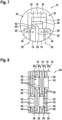
- Fig. 8 shows a top view of a battery cell arrangement 24 that may be designed as the ones shown in Fig. 5 to 7 . It is shown that the interconnection elements 32 and the interface elements 36 may be arranged in two rows in an alternating way. In such a way, the pouch cells 10 may be connected in series with each other.
- Fig. 9 and 10 show a top view and a side view of a battery cell arrangement 24 composed of prismatic cells 10'.
- Each prismatic cell 10' has a substantially prismatic housing 43, which may be made of a stiff material such as plastics or sheet metal.
- Each prismatic cell 10' has two terminals or taps 16, which protrude from a top side of the prismatic cell 10'. The terminals 16 may be electrically connected to electrodes inside the housing 43, which also accommodates an electrolyte.
- Fig. 9 and 10 the prismatic cells 10' are stacked via their housings 43. Analogously to Fig. 5 to 8 , between two adjacent prismatic cells 10' a heat spreader plate 26 is arranged. It has to be noted that the heat spreader plates 26 of Fig. 9 and the following may have the same features as the one of Fig. 5 to 8 and vice versa.
- the heat spreader plate 26 may have a body 28, which may have substantially the shape of a front side of the prismatic cells 10'.
- the body 28 of the heat spreader plate 26 may cover the front sides of the prismatic cells 10'.
- Two terminals 16 of two adjacent prismatic cells 10' are electrically interconnected with each other via an interconnection element 32, which is provided by the respective heat spreader plate 26 between the adjacent prismatic cells 10'.
- the interconnection 32 may be a part or metal plate 38 that is attached to an edge 40 of the heat spreader plate 26, which protrudes from the body 28 of the heat spreader plate 26.
- the interconnection element 32 may be seen as part of an interface element 36 for thermally connecting the heat spreader plate 26 and the terminals 16.
- the interface element 36 may have a T-shaped cross-section and/or may provide a heat conducting bridge between the terminals 16 and the heat spreader plate 26.
- the interconnection elements 32 and the interface elements 36 are arranged in two rows in an alternating way.
- a cooling channel 44 may be arranged on the interconnection elements 32.
- a cooling liquid may be pumped through the cooling channels 44, which directly may cool the interconnection elements 32 and indirectly the terminals 16 and the heat spreader plates 26.
- an electrically isolating but thermally conducting element 46 may be arranged between the heat spreader plate 26 and one of the prismatic cells 10'.
- an electrically isolating but thermally conducting element 48 may be arranged between the cooling channel 44 and the interconnection element 32.
- These isolating elements 46, 48 may be a plastics plate or an electrically isolating foil.
- Fig. 11 and 12 show a battery cell arrangement 24 analogous to the one of Fig. 9 and 10 .
- the heat spreader plates 26 have flanges 30 on lateral sides and on the bottom side of the prismatic cells 10'.
- the flanges 30 are bent towards the housings 43 of the prismatic cells 10'.
- the flanges 30 may be cooled with cooling channels 44 that are arranged on the flanges 30. With the cooling channels 44, the battery cell arrangement 24 may be indirectly liquid cooled from all sides.
- isolating elements are provided between the cooling channels 44 and the flanges 30.
- the battery cell arrangements 24 shown in Fig. 5 to 8 also may be provided with cooling channels 44 as described with respect to Fig. 9 to 12 .
Landscapes
- Chemical & Material Sciences (AREA)
- Chemical Kinetics & Catalysis (AREA)
- Electrochemistry (AREA)
- General Chemical & Material Sciences (AREA)
- Engineering & Computer Science (AREA)
- Manufacturing & Machinery (AREA)
- Secondary Cells (AREA)
- Battery Mounting, Suspending (AREA)
Description
- The invention relates to the field of cooling of battery cells. In particular, the invention relates to a battery cell arrangement.
- When battery cells are charged and discharged heat is generated, which may have to be removed. For example, this is the case for battery cells in electric vehicles, where the charging and discharging may take place rather fast. To extend the lifetime and to improve the performance of battery cells, it may be beneficial to provide cooling means that go beyond a pure air cooling of an outside of the battery cells.
-
WO 2006/101342 A1 shows a battery cell arrangement with cooling plates between adjacent battery cells. The cooling plates having interface elements which are in thermal contact with the terminals of the battery cells. -
US 6 512 347 B1 shows a battery cell arrangement with cooling plates between adjacent battery cells that are liquid cooled on a top edge. -
US 2011 212 355 A1 shows a frame for pouch cells, which cooling plates between adjacent cells that are liquid cooled from the side. -
US 2017/069 940 A1 shows two battery cells, which have terminals that are interconnected via a member, which contacts a corrugated plate between the battery cells. -
US 2012/214 033 A1 shows pouch cells, which are separated by cooling plates. A cooling tube is attached to an edge of each cooling plate. -
DE 10 2016 210839 A1 shows battery cells, which have terminals that are bent together to form an electrical connection. Interconnection member, which may be aligned between faces of the battery cells, are also used to connect adjacent battery cells. -
DE 10 2014 216813 A1 shows a battery arrangement with a cooling body, which has a member attached to an edge, which is used for interconnecting terminals of battery cells. -
US 2014/234691 A1 shows a battery module, in which battery cells are mounted into a frame. A cooling plate may be provided between adjacent battery cells. - It is an objective of the invention to improve the cooling of battery cells.
- This objective is achieved by the subject-matter of the independent claims. Further exemplary embodiments are evident from the dependent claims and the following description.
- The invention relates to a battery cell arrangement. A battery cell arrangement may comprise a plurality of battery cells, which may be connected in series and/or in parallel. The battery cell arrangement may furthermore comprise a housing and/or support member, which mechanically interconnects the battery cells, which, for example, may be arranged one after the other in a stack.
- The battery cell arrangement may be used as electric energy storage device for any kind of electric propelled vehicle, such as an electric vehicle, or for stationary electric energy storage. However, it is also possible that the battery cell arrangement is used in other applications.
- According to an embodiment of the invention, the battery cell arrangement comprises a plurality of battery cells, each battery cell having two terminals. The battery cells may be pouch cells or prismatic cells. In general, a battery cell may be an electrochemical cell with two electrodes and an electrolyte. The battery cell furthermore may comprise a container, in which these components are accommodated, such as a pouch or a housing. The terminals may be electrically connected to the electrodes and/or may protrude from the container. The battery cells may be stacked with each other. The battery cells may be arranged in such a way that the terminals all protrude from one or multiple sides of the battery cell arrangement.
- According to an embodiment of the invention, the battery cell arrangement furthermore comprises a plurality of interconnection elements, each interconnection element electrically interconnecting a terminal of a battery cell with a terminal of a further, such as an adjacent battery cell. The cell interconnecting element may be directly represented by the cell tabs of the interconnected cells. With the electrically conducting interconnection elements, the battery cells may be connected in parallel and/or in series. The interconnection elements may be electrically conducting foil strips and/or electrically conducting plates, such as metal sheets.
- At least some of the interconnection elements are formed of a terminal of the battery cell and a terminal of an adjacent battery cell, which are bent towards each other. For example, the terminals may be foil strips or metal strips, which may be bent towards each other and/or interconnected with each other, for example, via welding. The terminals may overlap each other and/or may generate an electrical and thermal contact with each other.
- The battery cell arrangement furthermore comprises a plurality of heat spreader plates, each heat spreader plate arranged between two adjacent battery cells. The heat spreader plates may be made of plastics with a high thermal conduction coefficient and/or may be made of metal, such as metal sheets. Each heat spreader plate (or the body of the heat spreader plate) may have substantially the same shape as a side of the battery cell it is in contact with.
- The heat spreader plate between two adjacent battery cells may be in two-dimensional contact with the facing sides of the adjacent battery cells.
- The heat spreader plates may be cooled from a side of the battery cell arrangement, where they are in contact with a cooling channel, which may be filled with cooling liquid, or an air cooling duct. With the cooling channel, the heat spreader plates may be liquid cooled and/or heat generated in the battery cells may be transported away with the cooling liquid.
- According to an embodiment of the invention, at least one heat spreader plate between two adjacent battery cells is in contact with an interconnection element formed by the terminals of the two adjacent battery cells, such that the heat spreader plate is in thermal contact with the terminals forming the interconnection element. The heat spreader plate may be in mechanical, thermal and/or electrical contact with the interconnection element.
- In other words, the terminals of the battery cells and the heat spreader plate are in thermal contact via the interconnection element. In such a way, heat from the inside of the battery cell may be transported away via the terminals and via the outer surface of the battery cell in thermal contact with the heat spreader plate. Thermal contact may mean that the heat spreader plate and the interconnection element are in mechanical contact and/or are mechanically interconnected, such that heat from the one component may flow to the other one via a contact area. The heat spreader plate may be on cell potential or may be electrically insulated from the cell tabs and/or interconnecting element, while a high thermal conduction from the cell tabs to the heat spreader plate may be maintained.
- The terminals or tabs of a battery cell may have a good thermal conductivity to the inside of the battery cell. This thermal conductivity may be better than a thermal resistance from the center of a battery cell to an outer planar surface via its housing. With the thermal contact of the interconnection element and the heat spreader plate, the battery cell may be cooled via its outer planar surface and the terminals.
- The at least one heat spreader plate has an interface element protruding from a body of the heat spreader plate. The body of the heat spreader plate may be the part of the heat spreader plate arranged between the battery cells. For example, the heat spreader plate and the interface element may be made of one sheet. The interface element may be provided at a position, where the interconnection element is guided between the adjacent battery cells. In such a way, the interface element may be provided between the interconnection element and an outer side of the battery cell arrangement.
- According to an embodiment of the invention, the interface element contacts the interconnection element at a side facing towards the adjacent battery cells. The interface element may contact the interconnection elements and/or one of the terminals at an inside, i.e. at a side and/or surface which is directed towards the adjacent batter cells.
- According to an embodiment of the invention, the interface element is provided in a space formed between the adjacent battery cells and the interconnection element. This space may be enclosed by the bent terminals and/or outer side of the adjacent battery cells. A part of the heat spreader plate may protrude into this space.
- According to an embodiment of the invention, the interface element is formed of a bent part of the heat spreader plate, for example at a tab side of the battery cell arrangement and/or at multiple areas around the batter cell arrangement. As already mentioned, the heat spreader plate and the interface element may be made from one sheet. The part protruding from a body of the heat spreader plate may be bent to have an area in direct contact with the interconnection element. This part may be mechanically connected to the interconnection element, for example via welding, clamping or pressing.
- According to an embodiment of the invention, the interface element, which may be T-shaped, comprises a part attached to an edge of the heat spreader plate. It also may be that a part of the heat spreader plate protruding from a body of the heat spreader plate is attached (such as welded) to a substantially orthogonally arranged plate, which provides an area for contacting the interface element. This plate may be mechanically connected to the interconnection element, for example via welding.
- According to an embodiment of the invention, the interface element comprises a part that is aligned transverse with respect to an extension direction of the heat spreader plate. A bent part of the terminals may run substantially orthogonal to an extension direction of the heat spreader plate. The part of the interface element aligned transverse e with respect to an extension direction of the heat spreader plate also may run orthogonal to the extensions direction of the heat spreader plate.
- The interconnection element may be attached to an edge of the heat spreader plate. It also may be possible that a part of the heat spreader plate, which protrudes from a body of the heat spreader plate, is directly attached to the interconnection element, for example by welding.
- According to an embodiment of the invention, the battery cell arrangement furthermore comprises an electrically isolating element between the heat spreader plate and at least one of the adjacent battery cells. The electrically isolating element may be a foil or plate and/or may be thermally conducting. The electrically isolating element may have substantially the same shape as the body of the heat spreader plate. It may be that two electrically isolating elements are arranged on adjacent sides of the heat spreader plate.
- The electrically isolating element may be used for electrically separating the container of at least one battery cell from the heat spreader element. This may be beneficial, when the container is electrically conducting and/or is in electrical contact with one of the electrodes and/or terminals of the battery cell.
- According to an embodiment of the invention, the battery cell arrangement furthermore comprises a cooling channel in thermal contact with at least one interconnection element for cooling the heat spreader plate and the terminals in thermal contact with the interconnection element. The cooling channel may be adapted for conducting a cooling liquid, which may be adapted for transporting away heat from the interconnection element.
- For example, some of the interconnection elements may be arranged in a row on one side of the battery cell arrangement. The cooling channel may be guided along all of these interconnection elements.
- According to an embodiment of the invention, an electrically isolating element is arranged between the interconnection element and the cooling channel. The electrically isolating element may be a foil or plate and/or may be thermally conducting. The electrically isolating element may have substantially the same shape as the interconnection element. The electrically isolating element may be used for electrically separating the cooling channel from the interconnection element, while maintaining a good thermal conductivity.
- According to an embodiment of the invention, the heat spreader plate has a flange protruding outside between the adjacent battery cells and which is bent towards a battery cell, for example on one or multiple sides. The heat spreader plate and the flange may be made from one sheet and the flange may be made by bending a part of the heat spreader plate outside of the battery cells. It may be that the heat spreader plate has flanges on different and/or multiple sides of the battery cell arrangement, such as opposite sides.
- According to an embodiment of the invention, the battery cell arrangement furthermore comprises a cooling channel in thermal contact with the flange. With such a cooling channel, heat may be transported away from the heat spreader plates, which also may cool the interconnection elements and via the interconnection elements the terminals.
- An electrically isolating element may be arranged between the flange and the cooling channel. The electrically isolating element may be a foil or plate and/or may be thermally conducting. The electrically isolating element may be used for electrically separating the cooling channel from the flange and/or the heat spreader element.
- According to an embodiment of the invention, the battery cells comprise pouch cells. A pouch cell may comprise two foil based electrodes, which are accommodated in a pouch, which may be seen as a flexible bag. Also the terminals of a pouch cell may be made of foil and/or may be flexible.
- Each pouch cell may comprise a support frame, which mechanically supports the battery cell at a circumferential border. The pouch of the pouch cell may be made of two foils, which are welded together at their border. This border may be clamped in the support frame. For example, the support frame may have a rectangular shape.
- According to an embodiment of the invention, an electrically isolating material is included into the support frame for electrically isolating the circumferential border. The support frame may include rubber sealing materials to electrically isolate the cut area of the pouch cell, which may be composed of two foils, which may have an electrically conducting layer on a side. This electrically isolating material, such as the rubber like material, may be directly included in a polymeric support frame by adding a second material in the injection moulding sequence.
- The heat spreader plate, which may be arranged between two adjacent pouch cells, may be held between the support frames of the adjacent pouch cells, such that the heat spreader plate is in contact with a pouch of the pouch cells. The support frames may have openings, such that the heat spreader plate is in direct contact with the pouch. For example, the support frames may be made of bars arranged at the border of the pouch cell.
- It also may be that an electrical insulating element, such as an electrical insulating foil, is placed between the pouch cell and the heat spreader plate.
- According to an embodiment of the invention, the support frame comprises two frame elements, which support the pouch cell between them. A pouch cell may be clamped between two frame elements, while the heat spreader plate is clamped between the frame elements of two adjacent pouch cells.
- According to an embodiment of the invention, the battery cells comprise prismatic cells. A prismatic cell may have a substantially prismatic housing, which may be stiff. For example, the prismatic housing may be made of metal sheets.
- In the case of prismatic cells, the heat spreader plate may be arranged between the housings of the two adjacent prismatic cells. These housings may comprise planar sides, between which the heat spreader plate is clamped.
- It has to be noted that the battery cell arrangement may be composed completely of pouch cells, completely of prismatic cells or of a mixture thereof.
- These and other aspects of the invention will be apparent from and elucidated with reference to the embodiments described hereinafter.
- The subject-matter of the invention will be explained in more detail in the following text with reference to exemplary embodiments which are illustrated in the attached drawings.
-
Fig. 1 schematically shows a front view of a pouch cell for a battery cell arrangement according to an embodiment of the invention. -
Fig. 2 schematically shows a side view of the pouch cell ofFig. 1 . -
Fig. 3 schematically shows a front view for a frame element for the pouch cell ofFig. 1 . -
Fig. 4 schematically shows a side view of the pouch cell ofFig. 1 together with a support frame. -
Fig. 5 schematically shows a side view of a battery cell arrangement according to an embodiment of the invention. -
Fig. 6 schematically shows a side view of a part of battery cell arrangement according to an embodiment of the invention. -
Fig. 7 schematically shows a side view of a part of battery cell arrangement according to an embodiment of the invention. -
Fig. 8 schematically shows a top view of a battery cell arrangement according to an embodiment of the invention. -
Fig. 9 schematically shows a top view of a battery cell arrangement according to an embodiment of the invention. -
Fig. 10 schematically shows a side view of the battery cell arrangement ofFig. 9 . -
Fig. 11 schematically shows a top view of a battery cell arrangement according to an embodiment of the invention. -
Fig. 12 schematically shows a side view of the battery cell arrangement ofFig. 11 . - The reference symbols used in the drawings, and their meanings, are listed in summary form in the list of reference symbols. In principle, identical parts are provided with the same reference symbols in the figures.
-
Fig. 1 and 2 schematically show apouch cell 10 from the front and from the side. Thepouch cell 10 has a substantiallyrectangular pouch 12, which may be made of two foils, which are attached together at aborder 14 of thepouch cell 10, for example by welding. Thepouch cell 10 has two terminals or taps 16, which protrude from a top side of thepouch cell 10. Each terminal 16, which may be made of an electrically conducting foil or a thin metal strip, is electrically connected to an electrode inside thepouch 12, which also accommodates an electrolyte. -
Fig. 3 schematically shows aframe element 18 for mechanically supporting thepouch cell 10. Theframe element 18 may have the same shape as theborder 14 of thepouch cell 10 and/or may be made of bars. Theframe element 18 may be made of polymer and/or metal. In case of a metal frame element 18 a polymeric layer and/or coating may be used as an electrical insulating layer. -
Fig. 4 shows thepouch cell 10 supported by twoframe elements 18. Theborder 14 of thepouch cell 10 is clamped between theframe elements 18, which may be mechanically connected at one or more sides of the pouch cells with one ormore fixation elements 20, such as clamps, clips, screws or bolts. Alternatively or additionally to thefixation elements 20, theframe elements 18 may be welded together by polymeric or metal welding techniques depending on the chosen frame material. Thus, asupport frame 22 for the pouch cell may be provided with twoframe elements 18. - It may be that an electrically isolating material 23 (see
Fig. 3 ) is included into thesupport frame 22, and in particular into theframe elements 18, for electrically isolating thecircumferential border 14 of thepouch cell 10. With the electrically isolatingmaterial 23, electrically conducting layers of the foils of thepouch cell 10. Which may be accessible at theborder 14, may be isolated. -
Fig. 5 shows abattery cell arrangement 24, which comprisesseveral pouch cells 10. Thepouch cells 10 are stacked via their support frames 22, which may be used for fixating thepouch cells 10 in thebattery cell arrangement 24. The support frames 22 may be stacked. Theframe elements 18 may have substantially half of an intended thickness of thepouch 12 of the pouch cell and/or a compression of thepouch cell 10 in thepouch cell arrangement 24 may be adjusted with thesupport frame 22. - Between two
adjacent pouch cells 10, aheat spreader plate 26 is arranged, which may be made of sheet metal. Theheat spreader plate 26 may have abody 28, which may have substantially the shape of thepouch 12. For example, thebody 28 of theheat spreader plate 26 may cover theframe elements 18 of thepouch cells 10. On one or more sides of thepouch cell arrangement 24, the heat spreader plate may haveflanges 30, which are bent towards thesupport frame 22. With theflanges 30, a side cooling of the heat spreader plates may be facilitated (see below). - In
Fig. 5 , theflanges 30 are formed, such that they do not cover thefixation elements 20. - As shown in more detail in
Fig. 6 , theterminals 16 of twoadjacent pouch cells 10 are electrically interconnected with each other via aninterconnection element 32, which is formed of ends of theterminals 16, which are bent towards each other. Theterminals 16 may be welded with each other at one or more positions. InFig. 6 , thewelds 34 are indicated with lines. - The
heat spreader plate 26 has aninterface element 36, which is in direct thermal contact with theinterconnection element 32. Theinterface element 36 provides an interface or area which contacts theinterconnection element 32. For example, theinterface element 36 may have a T-shaped cross-section and/or may be made of a part ormetal plate 38 that is attached to anedge 40 of theheat spreader plate 26, which protrudes from thebody 28. - As shown in
Fig. 7 , theinterface element 36 also may be formed of abent part 42 of theheat spreader plate 26. Anedge 40 of theheat spreader plate 26, which protrudes from thebody 28, may be bent to contact theinterconnection element 32. - As described above and below, a cooling channel may be arranged on the
interconnection element 32, which may be directly cooled. - The
interface elements 36 provide a heat conducting bridge between theterminals 16 and theheat spreader plate 26. In such a way, area cooling of the front faces of thepouch cells 10 and tab/terminal cooling is possible. -
Fig. 8 shows a top view of abattery cell arrangement 24 that may be designed as the ones shown inFig. 5 to 7 . It is shown that theinterconnection elements 32 and theinterface elements 36 may be arranged in two rows in an alternating way. In such a way, thepouch cells 10 may be connected in series with each other. -
Fig. 9 and 10 show a top view and a side view of abattery cell arrangement 24 composed of prismatic cells 10'. Each prismatic cell 10' has a substantiallyprismatic housing 43, which may be made of a stiff material such as plastics or sheet metal. Each prismatic cell 10' has two terminals or taps 16, which protrude from a top side of the prismatic cell 10'. Theterminals 16 may be electrically connected to electrodes inside thehousing 43, which also accommodates an electrolyte. - In
Fig. 9 and 10 , the prismatic cells 10' are stacked via theirhousings 43. Analogously toFig. 5 to 8 , between two adjacent prismatic cells 10' aheat spreader plate 26 is arranged. It has to be noted that theheat spreader plates 26 ofFig. 9 and the following may have the same features as the one ofFig. 5 to 8 and vice versa. - The
heat spreader plate 26 may have abody 28, which may have substantially the shape of a front side of the prismatic cells 10'. For example, thebody 28 of theheat spreader plate 26 may cover the front sides of the prismatic cells 10'. - Two
terminals 16 of two adjacent prismatic cells 10' are electrically interconnected with each other via aninterconnection element 32, which is provided by the respectiveheat spreader plate 26 between the adjacent prismatic cells 10'. Theinterconnection 32 may be a part ormetal plate 38 that is attached to anedge 40 of theheat spreader plate 26, which protrudes from thebody 28 of theheat spreader plate 26. - The
interconnection element 32 may be seen as part of aninterface element 36 for thermally connecting theheat spreader plate 26 and theterminals 16. Theinterface element 36 may have a T-shaped cross-section and/or may provide a heat conducting bridge between theterminals 16 and theheat spreader plate 26. - As shown in
Fig. 9 , like inFig. 8 , theinterconnection elements 32 and theinterface elements 36 are arranged in two rows in an alternating way. On each row, a coolingchannel 44 may be arranged on theinterconnection elements 32. A cooling liquid may be pumped through the coolingchannels 44, which directly may cool theinterconnection elements 32 and indirectly theterminals 16 and theheat spreader plates 26. - As shown in
Fig. 9 and 10 , an electrically isolating but thermally conductingelement 46 may be arranged between theheat spreader plate 26 and one of the prismatic cells 10'. As shown inFig. 10 , an electrically isolating but thermally conducting element 48 may be arranged between the coolingchannel 44 and theinterconnection element 32. These isolatingelements 46, 48 may be a plastics plate or an electrically isolating foil. -
Fig. 11 and 12 show abattery cell arrangement 24 analogous to the one ofFig. 9 and 10 . InFig. 11 and 12 , theheat spreader plates 26 haveflanges 30 on lateral sides and on the bottom side of the prismatic cells 10'. Theflanges 30 are bent towards thehousings 43 of the prismatic cells 10'. Theflanges 30 may be cooled withcooling channels 44 that are arranged on theflanges 30. With thecooling channels 44, thebattery cell arrangement 24 may be indirectly liquid cooled from all sides. - It is possible that isolating elements are provided between the cooling
channels 44 and theflanges 30. - Furthermore, the
battery cell arrangements 24 shown inFig. 5 to 8 also may be provided withcooling channels 44 as described with respect toFig. 9 to 12 . - While the invention has been illustrated and described in detail in the drawings and foregoing description, such illustration and description are to be considered illustrative or exemplary and not restrictive; the invention is not limited to the disclosed embodiments. Other variations to the disclosed embodiments can be understood and effected by those skilled in the art and practising the claimed invention, from a study of the drawings, the disclosure, and the appended claims. In the claims, the word "comprising" does not exclude other elements or steps, and the indefinite article "a" or "an" does not exclude a plurality. A single processor or controller or other unit may fulfil the functions of several items recited in the claims. The mere fact that certain measures are recited in mutually different dependent claims does not indicate that a combination of these measures cannot be used to advantage. Any reference signs in the claims should not be construed as limiting the scope.
-
- 10
- pouch cell
- 12
- pouch
- 14
- border
- 16
- terminal
- 18
- frame element
- 20
- fixation element
- 22
- support frame
- 23
- electrically isolating material
- 24
- battery cell arrangement
- 26
- heat spreader plate
- 28
- body
- 30
- flange
- 32
- interconnection element
- 34
- weld
- 36
- interface element
- 38
- metal plate
- 40
- edge
- 42
- bent part
- 10'
- prismatic cell
- 43
- housing
- 44
- cooling channel
- 46
- electrically isolating element
- 48
- electrically isolating element
Claims (12)
- A battery cell arrangement (24), comprising:a plurality of battery cells (10, 10'), each battery cell having two terminals (16);a plurality of interconnection elements (32), each interconnection element (32) electrically interconnecting a terminal (16) of a battery cell (10, 10') with a terminal (16) of a further battery cell (10, 10'), wherein the interconnection elements (32) are formed of a terminal (16) of the battery cell (10) and a terminal (16) of an adjacent battery cell (10), which are bent towards each other;a plurality of heat spreader plates (26), each heat spreader plate (26) arranged between two adjacent battery cells (10, 10');wherein at least one heat spreader plate (26) between two adjacent battery cells (10, 10') has an interface element (36) protruding from a body (28) of the heat spreader plate (26);wherein the interface element (36) is formed of a bent part (42) of the heat spreader plate (26);wherein the interface element (36) is in contact with one of the interconnection elements (32) of the two adjacent battery cells (10, 10'), such that the heat spreader plate (26) is in thermal contact with the terminals (16) forming the interconnection element (32);wherein the bent part (42) protruding from the body (28) of the heat spreader plate (26) is bent to have an area in direct contact with the interconnection element (32);wherein the heat spreader plate (26) and the interface element (36) are made from one metal sheet;wherein the battery cell arrangement comprises an electrically isolating and thermally conducting element (46) between the heat spreader plate (26) and at least one of the adjacent battery cells (10, 10').
- The battery cell arrangement (24) of claim 1,
wherein the interface element (36) contacts the interconnection element (32) at a side facing towards the adjacent battery cells (10, 10'). - The battery cell arrangement (24) of claim 1 or 2,
wherein the interface element (26) is provided in a space formed between the adjacent battery cells (10, 10') and the interconnection element (32). - The battery cell arrangement (24) of one of the previous claims,
wherein the interface element comprises a part (42, 38) that is aligned transverse with respect to an extension direction of the heat spreader plate (26). - The battery cell arrangement (24) of one of the previous claims, further comprising:
a cooling channel (44) in thermal contact with at least one interconnection element (32) for cooling the heat spreader plate (26) and the terminals (16) in thermal contact with the interconnection element (32). - The battery cell arrangement (24) of claim 5,
wherein an electrically isolating element (48) is arranged between the interconnection element (32) and the cooling channel (44). - The battery cell arrangement (24) of one of the previous claims,
wherein the heat spreader plate (26) has a flange (30) protruding outside between the adjacent battery cells (10, 10') and which is bent towards a battery cell (10, 10'). - The battery cell arrangement (24) of claim 10, further comprising:
a cooling channel (44) in thermal contact with the flange (30). - The battery cell arrangement (24) of one of the previous claims,wherein the battery cells comprise pouch cells (10);wherein each pouch cell (10) comprises a support frame (22), which mechanically supports the pouch cell (10) at a circumferential border (14).
- The battery cell arrangement (24) of claim 9,
wherein an electrically isolating material (23) is included into the support frame (22) for electrically isolating the circumferential border (14). - The battery cell arrangement (24) of claim 9 or 10,wherein the heat spreader plate (26), which is arranged between two adjacent pouch cells (10), is held between the support frames (22) of the adjacent pouch cells (10), such that the heat spreader plate (26) is in contact with a pouch (12) of the pouch cells (10) and/orwherein the support frame (22) comprises two frame elements (18), which support the pouch cell (10) between them.
- The battery cell arrangement (24) of one of the previous claims,wherein the battery cells comprise prismatic cells (10');wherein the heat spreader plate (26) is arranged between housings (43) of the two adjacent prismatic cells (10').
Applications Claiming Priority (2)
| Application Number | Priority Date | Filing Date | Title |
|---|---|---|---|
| EP18162221.8A EP3540846A1 (en) | 2018-03-16 | 2018-03-16 | Battery cell arrangement |
| PCT/EP2019/056415 WO2019175307A1 (en) | 2018-03-16 | 2019-03-14 | Battery cell arrangement |
Publications (2)
| Publication Number | Publication Date |
|---|---|
| EP3762993A1 EP3762993A1 (en) | 2021-01-13 |
| EP3762993B1 true EP3762993B1 (en) | 2023-07-26 |
Family
ID=61691318
Family Applications (2)
| Application Number | Title | Priority Date | Filing Date |
|---|---|---|---|
| EP18162221.8A Withdrawn EP3540846A1 (en) | 2018-03-16 | 2018-03-16 | Battery cell arrangement |
| EP19711876.3A Active EP3762993B1 (en) | 2018-03-16 | 2019-03-14 | Battery cell arrangement |
Family Applications Before (1)
| Application Number | Title | Priority Date | Filing Date |
|---|---|---|---|
| EP18162221.8A Withdrawn EP3540846A1 (en) | 2018-03-16 | 2018-03-16 | Battery cell arrangement |
Country Status (2)
| Country | Link |
|---|---|
| EP (2) | EP3540846A1 (en) |
| WO (1) | WO2019175307A1 (en) |
Families Citing this family (1)
| Publication number | Priority date | Publication date | Assignee | Title |
|---|---|---|---|---|
| EP4310993A1 (en) * | 2022-07-21 | 2024-01-24 | Newfrey LLC | Battery apparatus with a cell tab cooling system |
Family Cites Families (10)
| Publication number | Priority date | Publication date | Assignee | Title |
|---|---|---|---|---|
| US6512347B1 (en) | 2001-10-18 | 2003-01-28 | General Motors Corporation | Battery having an integral cooling system |
| KR101042132B1 (en) * | 2005-03-23 | 2011-06-16 | 에스케이이노베이션 주식회사 | Case for high output lithium secondary battery |
| EP2494631B1 (en) * | 2009-10-28 | 2013-09-04 | MAGNA STEYR Battery Systems GmbH & Co OG | Battery cell system |
| US8383260B2 (en) | 2010-02-26 | 2013-02-26 | GM Global Technology Operations LLC | U-formed cooling plate with solid fins for lithium pouch cells |
| DE102010021908A1 (en) * | 2010-05-28 | 2011-12-01 | Li-Tec Battery Gmbh | Electric energy storage cell and device |
| KR101447057B1 (en) * | 2012-01-26 | 2014-10-07 | 주식회사 엘지화학 | Battery Module Having Heat Dissipation Mounting Member for Dissipating Heat And Mounting Battery cell |
| US20170069940A1 (en) * | 2014-03-06 | 2017-03-09 | Unicell Llc | Battery cells and arrangements |
| FR3022402B1 (en) * | 2014-06-13 | 2021-05-28 | Ifp Energies Now | MODULAR ELECTRIC BATTERY INCLUDING A THERMAL PROTECTION AND REGULATION DEVICE |
| DE102014216813A1 (en) * | 2014-08-25 | 2016-02-25 | Robert Bosch Gmbh | Cell connector and battery module, battery, battery system, vehicle and method for manufacturing a battery module |
| DE102016210839A1 (en) * | 2016-06-17 | 2017-12-21 | Robert Bosch Gmbh | A method of manufacturing a battery module and battery module made by such a method |
-
2018
- 2018-03-16 EP EP18162221.8A patent/EP3540846A1/en not_active Withdrawn
-
2019
- 2019-03-14 WO PCT/EP2019/056415 patent/WO2019175307A1/en not_active Ceased
- 2019-03-14 EP EP19711876.3A patent/EP3762993B1/en active Active
Also Published As
| Publication number | Publication date |
|---|---|
| EP3762993A1 (en) | 2021-01-13 |
| WO2019175307A1 (en) | 2019-09-19 |
| EP3540846A1 (en) | 2019-09-18 |
Similar Documents
| Publication | Publication Date | Title |
|---|---|---|
| CN109075283B (en) | Cooling arrangement for an energy storage device | |
| CN114424394B (en) | Battery modules, battery packs and vehicles | |
| CN114207924B (en) | Battery module, battery pack including the battery module, and vehicle | |
| KR102619201B1 (en) | Secondary Battery and Battery Module Having the Same | |
| US8859133B2 (en) | Repeating frame battery with compression joining of cell tabs to welded connection terminals | |
| CN104285315B (en) | Battery modules with efficient cooling structure | |
| EP2325923B1 (en) | Battery pack with improved stability | |
| US9452686B2 (en) | Cooling member of novel structure and battery module employed with the same | |
| CN106463651B (en) | Energy storage unit with galvanic cells, galvanic cell and method for the production thereof | |
| US10020549B2 (en) | Battery module with novel structure | |
| CN104412439B (en) | Battery module with indirect air cooling structure | |
| US8535820B2 (en) | Battery module | |
| KR102059077B1 (en) | Battery module, battery pack comprising the battery module and vehicle comprising the battery pack | |
| CN102823019B (en) | Single cell and battery having a plurality of single cells | |
| US9460862B2 (en) | Electric storage cell, electric storage apparatus, and vehicle having electric storage apparatus | |
| US10811744B2 (en) | Battery cell, battery module and production method | |
| US20170077466A1 (en) | High voltage battery submodule | |
| US20120288740A1 (en) | Battery pack | |
| KR20200043402A (en) | Lead tab for battery terminal | |
| EP3540845B1 (en) | Battery cell arrangement | |
| EP3540846A1 (en) | Battery cell arrangement | |
| JP7106920B2 (en) | power storage device | |
| EP3413393A1 (en) | Electrode assembly for a battery module | |
| KR101549171B1 (en) | Improved secondary battery assembly for connection structure of electrode, secondary battery for the same and fabrication method thereof | |
| CN120660234A (en) | Power storage device |
Legal Events
| Date | Code | Title | Description |
|---|---|---|---|
| STAA | Information on the status of an ep patent application or granted ep patent |
Free format text: STATUS: UNKNOWN |
|
| STAA | Information on the status of an ep patent application or granted ep patent |
Free format text: STATUS: THE INTERNATIONAL PUBLICATION HAS BEEN MADE |
|
| PUAI | Public reference made under article 153(3) epc to a published international application that has entered the european phase |
Free format text: ORIGINAL CODE: 0009012 |
|
| STAA | Information on the status of an ep patent application or granted ep patent |
Free format text: STATUS: REQUEST FOR EXAMINATION WAS MADE |
|
| 17P | Request for examination filed |
Effective date: 20201005 |
|
| AK | Designated contracting states |
Kind code of ref document: A1 Designated state(s): AL AT BE BG CH CY CZ DE DK EE ES FI FR GB GR HR HU IE IS IT LI LT LU LV MC MK MT NL NO PL PT RO RS SE SI SK SM TR |
|
| AX | Request for extension of the european patent |
Extension state: BA ME |
|
| STAA | Information on the status of an ep patent application or granted ep patent |
Free format text: STATUS: EXAMINATION IS IN PROGRESS |
|
| 17Q | First examination report despatched |
Effective date: 20210211 |
|
| DAV | Request for validation of the european patent (deleted) | ||
| DAX | Request for extension of the european patent (deleted) | ||
| REG | Reference to a national code |
Ref country code: DE Ref legal event code: R079 Free format text: PREVIOUS MAIN CLASS: H01M0010655300 Ipc: H01M0050550000 Ref country code: DE Ref legal event code: R079 Ref document number: 602019033491 Country of ref document: DE Free format text: PREVIOUS MAIN CLASS: H01M0010655300 Ipc: H01M0050550000 |
|
| GRAP | Despatch of communication of intention to grant a patent |
Free format text: ORIGINAL CODE: EPIDOSNIGR1 |
|
| STAA | Information on the status of an ep patent application or granted ep patent |
Free format text: STATUS: GRANT OF PATENT IS INTENDED |
|
| RIC1 | Information provided on ipc code assigned before grant |
Ipc: H01M 50/557 20210101ALI20230127BHEP Ipc: H01M 50/55 20210101AFI20230127BHEP |
|
| INTG | Intention to grant announced |
Effective date: 20230220 |
|
| GRAS | Grant fee paid |
Free format text: ORIGINAL CODE: EPIDOSNIGR3 |
|
| GRAA | (expected) grant |
Free format text: ORIGINAL CODE: 0009210 |
|
| STAA | Information on the status of an ep patent application or granted ep patent |
Free format text: STATUS: THE PATENT HAS BEEN GRANTED |
|
| AK | Designated contracting states |
Kind code of ref document: B1 Designated state(s): AL AT BE BG CH CY CZ DE DK EE ES FI FR GB GR HR HU IE IS IT LI LT LU LV MC MK MT NL NO PL PT RO RS SE SI SK SM TR |
|
| REG | Reference to a national code |
Ref country code: CH Ref legal event code: EP |
|
| REG | Reference to a national code |
Ref country code: IE Ref legal event code: FG4D |
|
| REG | Reference to a national code |
Ref country code: DE Ref legal event code: R096 Ref document number: 602019033491 Country of ref document: DE |
|
| REG | Reference to a national code |
Ref country code: LT Ref legal event code: MG9D |
|
| REG | Reference to a national code |
Ref country code: NL Ref legal event code: MP Effective date: 20230726 |
|
| REG | Reference to a national code |
Ref country code: AT Ref legal event code: MK05 Ref document number: 1593008 Country of ref document: AT Kind code of ref document: T Effective date: 20230726 |
|
| PG25 | Lapsed in a contracting state [announced via postgrant information from national office to epo] |
Ref country code: NL Free format text: LAPSE BECAUSE OF FAILURE TO SUBMIT A TRANSLATION OF THE DESCRIPTION OR TO PAY THE FEE WITHIN THE PRESCRIBED TIME-LIMIT Effective date: 20230726 |
|
| PG25 | Lapsed in a contracting state [announced via postgrant information from national office to epo] |
Ref country code: GR Free format text: LAPSE BECAUSE OF FAILURE TO SUBMIT A TRANSLATION OF THE DESCRIPTION OR TO PAY THE FEE WITHIN THE PRESCRIBED TIME-LIMIT Effective date: 20231027 |
|
| PG25 | Lapsed in a contracting state [announced via postgrant information from national office to epo] |
Ref country code: IS Free format text: LAPSE BECAUSE OF FAILURE TO SUBMIT A TRANSLATION OF THE DESCRIPTION OR TO PAY THE FEE WITHIN THE PRESCRIBED TIME-LIMIT Effective date: 20231126 |
|
| PG25 | Lapsed in a contracting state [announced via postgrant information from national office to epo] |
Ref country code: SE Free format text: LAPSE BECAUSE OF FAILURE TO SUBMIT A TRANSLATION OF THE DESCRIPTION OR TO PAY THE FEE WITHIN THE PRESCRIBED TIME-LIMIT Effective date: 20230726 Ref country code: RS Free format text: LAPSE BECAUSE OF FAILURE TO SUBMIT A TRANSLATION OF THE DESCRIPTION OR TO PAY THE FEE WITHIN THE PRESCRIBED TIME-LIMIT Effective date: 20230726 Ref country code: PT Free format text: LAPSE BECAUSE OF FAILURE TO SUBMIT A TRANSLATION OF THE DESCRIPTION OR TO PAY THE FEE WITHIN THE PRESCRIBED TIME-LIMIT Effective date: 20231127 Ref country code: NO Free format text: LAPSE BECAUSE OF FAILURE TO SUBMIT A TRANSLATION OF THE DESCRIPTION OR TO PAY THE FEE WITHIN THE PRESCRIBED TIME-LIMIT Effective date: 20231026 Ref country code: LV Free format text: LAPSE BECAUSE OF FAILURE TO SUBMIT A TRANSLATION OF THE DESCRIPTION OR TO PAY THE FEE WITHIN THE PRESCRIBED TIME-LIMIT Effective date: 20230726 Ref country code: LT Free format text: LAPSE BECAUSE OF FAILURE TO SUBMIT A TRANSLATION OF THE DESCRIPTION OR TO PAY THE FEE WITHIN THE PRESCRIBED TIME-LIMIT Effective date: 20230726 Ref country code: IS Free format text: LAPSE BECAUSE OF FAILURE TO SUBMIT A TRANSLATION OF THE DESCRIPTION OR TO PAY THE FEE WITHIN THE PRESCRIBED TIME-LIMIT Effective date: 20231126 Ref country code: HR Free format text: LAPSE BECAUSE OF FAILURE TO SUBMIT A TRANSLATION OF THE DESCRIPTION OR TO PAY THE FEE WITHIN THE PRESCRIBED TIME-LIMIT Effective date: 20230726 Ref country code: GR Free format text: LAPSE BECAUSE OF FAILURE TO SUBMIT A TRANSLATION OF THE DESCRIPTION OR TO PAY THE FEE WITHIN THE PRESCRIBED TIME-LIMIT Effective date: 20231027 Ref country code: FI Free format text: LAPSE BECAUSE OF FAILURE TO SUBMIT A TRANSLATION OF THE DESCRIPTION OR TO PAY THE FEE WITHIN THE PRESCRIBED TIME-LIMIT Effective date: 20230726 Ref country code: AT Free format text: LAPSE BECAUSE OF FAILURE TO SUBMIT A TRANSLATION OF THE DESCRIPTION OR TO PAY THE FEE WITHIN THE PRESCRIBED TIME-LIMIT Effective date: 20230726 |
|
| PG25 | Lapsed in a contracting state [announced via postgrant information from national office to epo] |
Ref country code: PL Free format text: LAPSE BECAUSE OF FAILURE TO SUBMIT A TRANSLATION OF THE DESCRIPTION OR TO PAY THE FEE WITHIN THE PRESCRIBED TIME-LIMIT Effective date: 20230726 |
|
| PG25 | Lapsed in a contracting state [announced via postgrant information from national office to epo] |
Ref country code: ES Free format text: LAPSE BECAUSE OF FAILURE TO SUBMIT A TRANSLATION OF THE DESCRIPTION OR TO PAY THE FEE WITHIN THE PRESCRIBED TIME-LIMIT Effective date: 20230726 |
|
| REG | Reference to a national code |
Ref country code: DE Ref legal event code: R097 Ref document number: 602019033491 Country of ref document: DE |
|
| PG25 | Lapsed in a contracting state [announced via postgrant information from national office to epo] |
Ref country code: SM Free format text: LAPSE BECAUSE OF FAILURE TO SUBMIT A TRANSLATION OF THE DESCRIPTION OR TO PAY THE FEE WITHIN THE PRESCRIBED TIME-LIMIT Effective date: 20230726 Ref country code: RO Free format text: LAPSE BECAUSE OF FAILURE TO SUBMIT A TRANSLATION OF THE DESCRIPTION OR TO PAY THE FEE WITHIN THE PRESCRIBED TIME-LIMIT Effective date: 20230726 Ref country code: ES Free format text: LAPSE BECAUSE OF FAILURE TO SUBMIT A TRANSLATION OF THE DESCRIPTION OR TO PAY THE FEE WITHIN THE PRESCRIBED TIME-LIMIT Effective date: 20230726 Ref country code: EE Free format text: LAPSE BECAUSE OF FAILURE TO SUBMIT A TRANSLATION OF THE DESCRIPTION OR TO PAY THE FEE WITHIN THE PRESCRIBED TIME-LIMIT Effective date: 20230726 Ref country code: DK Free format text: LAPSE BECAUSE OF FAILURE TO SUBMIT A TRANSLATION OF THE DESCRIPTION OR TO PAY THE FEE WITHIN THE PRESCRIBED TIME-LIMIT Effective date: 20230726 Ref country code: CZ Free format text: LAPSE BECAUSE OF FAILURE TO SUBMIT A TRANSLATION OF THE DESCRIPTION OR TO PAY THE FEE WITHIN THE PRESCRIBED TIME-LIMIT Effective date: 20230726 Ref country code: SK Free format text: LAPSE BECAUSE OF FAILURE TO SUBMIT A TRANSLATION OF THE DESCRIPTION OR TO PAY THE FEE WITHIN THE PRESCRIBED TIME-LIMIT Effective date: 20230726 |
|
| PG25 | Lapsed in a contracting state [announced via postgrant information from national office to epo] |
Ref country code: IT Free format text: LAPSE BECAUSE OF FAILURE TO SUBMIT A TRANSLATION OF THE DESCRIPTION OR TO PAY THE FEE WITHIN THE PRESCRIBED TIME-LIMIT Effective date: 20230726 |
|
| PLBE | No opposition filed within time limit |
Free format text: ORIGINAL CODE: 0009261 |
|
| STAA | Information on the status of an ep patent application or granted ep patent |
Free format text: STATUS: NO OPPOSITION FILED WITHIN TIME LIMIT |
|
| 26N | No opposition filed |
Effective date: 20240429 |
|
| PG25 | Lapsed in a contracting state [announced via postgrant information from national office to epo] |
Ref country code: SI Free format text: LAPSE BECAUSE OF FAILURE TO SUBMIT A TRANSLATION OF THE DESCRIPTION OR TO PAY THE FEE WITHIN THE PRESCRIBED TIME-LIMIT Effective date: 20230726 |
|
| PG25 | Lapsed in a contracting state [announced via postgrant information from national office to epo] |
Ref country code: BG Free format text: LAPSE BECAUSE OF FAILURE TO SUBMIT A TRANSLATION OF THE DESCRIPTION OR TO PAY THE FEE WITHIN THE PRESCRIBED TIME-LIMIT Effective date: 20230726 |
|
| PG25 | Lapsed in a contracting state [announced via postgrant information from national office to epo] |
Ref country code: LU Free format text: LAPSE BECAUSE OF NON-PAYMENT OF DUE FEES Effective date: 20240314 |
|
| PG25 | Lapsed in a contracting state [announced via postgrant information from national office to epo] |
Ref country code: MC Free format text: LAPSE BECAUSE OF FAILURE TO SUBMIT A TRANSLATION OF THE DESCRIPTION OR TO PAY THE FEE WITHIN THE PRESCRIBED TIME-LIMIT Effective date: 20230726 |
|
| PG25 | Lapsed in a contracting state [announced via postgrant information from national office to epo] |
Ref country code: MC Free format text: LAPSE BECAUSE OF FAILURE TO SUBMIT A TRANSLATION OF THE DESCRIPTION OR TO PAY THE FEE WITHIN THE PRESCRIBED TIME-LIMIT Effective date: 20230726 Ref country code: LU Free format text: LAPSE BECAUSE OF NON-PAYMENT OF DUE FEES Effective date: 20240314 Ref country code: BG Free format text: LAPSE BECAUSE OF FAILURE TO SUBMIT A TRANSLATION OF THE DESCRIPTION OR TO PAY THE FEE WITHIN THE PRESCRIBED TIME-LIMIT Effective date: 20230726 |
|
| REG | Reference to a national code |
Ref country code: BE Ref legal event code: MM Effective date: 20240331 |
|
| PG25 | Lapsed in a contracting state [announced via postgrant information from national office to epo] |
Ref country code: BE Free format text: LAPSE BECAUSE OF NON-PAYMENT OF DUE FEES Effective date: 20240331 |
|
| PG25 | Lapsed in a contracting state [announced via postgrant information from national office to epo] |
Ref country code: IE Free format text: LAPSE BECAUSE OF NON-PAYMENT OF DUE FEES Effective date: 20240314 |
|
| PG25 | Lapsed in a contracting state [announced via postgrant information from national office to epo] |
Ref country code: IE Free format text: LAPSE BECAUSE OF NON-PAYMENT OF DUE FEES Effective date: 20240314 Ref country code: BE Free format text: LAPSE BECAUSE OF NON-PAYMENT OF DUE FEES Effective date: 20240331 |
|
| PGFP | Annual fee paid to national office [announced via postgrant information from national office to epo] |
Ref country code: CH Payment date: 20250401 Year of fee payment: 7 |
|
| PG25 | Lapsed in a contracting state [announced via postgrant information from national office to epo] |
Ref country code: CY Free format text: LAPSE BECAUSE OF FAILURE TO SUBMIT A TRANSLATION OF THE DESCRIPTION OR TO PAY THE FEE WITHIN THE PRESCRIBED TIME-LIMIT; INVALID AB INITIO Effective date: 20190314 |
|
| PG25 | Lapsed in a contracting state [announced via postgrant information from national office to epo] |
Ref country code: HU Free format text: LAPSE BECAUSE OF FAILURE TO SUBMIT A TRANSLATION OF THE DESCRIPTION OR TO PAY THE FEE WITHIN THE PRESCRIBED TIME-LIMIT; INVALID AB INITIO Effective date: 20190314 |
|
| PG25 | Lapsed in a contracting state [announced via postgrant information from national office to epo] |
Ref country code: TR Free format text: LAPSE BECAUSE OF FAILURE TO SUBMIT A TRANSLATION OF THE DESCRIPTION OR TO PAY THE FEE WITHIN THE PRESCRIBED TIME-LIMIT Effective date: 20230726 |
|
| REG | Reference to a national code |
Ref country code: CH Ref legal event code: U11 Free format text: ST27 STATUS EVENT CODE: U-0-0-U10-U11 (AS PROVIDED BY THE NATIONAL OFFICE) Effective date: 20260401 |
|
| PGFP | Annual fee paid to national office [announced via postgrant information from national office to epo] |
Ref country code: GB Payment date: 20260324 Year of fee payment: 8 |
|
| PGFP | Annual fee paid to national office [announced via postgrant information from national office to epo] |
Ref country code: DE Payment date: 20260319 Year of fee payment: 8 |
|
| PGFP | Annual fee paid to national office [announced via postgrant information from national office to epo] |
Ref country code: FR Payment date: 20260323 Year of fee payment: 8 |