EP3762443B1 - Cycloaliphatic amines for epoxy formulations: a novel curing agent for epoxy systems - Google Patents
Cycloaliphatic amines for epoxy formulations: a novel curing agent for epoxy systems Download PDFInfo
- Publication number
- EP3762443B1 EP3762443B1 EP19708533.5A EP19708533A EP3762443B1 EP 3762443 B1 EP3762443 B1 EP 3762443B1 EP 19708533 A EP19708533 A EP 19708533A EP 3762443 B1 EP3762443 B1 EP 3762443B1
- Authority
- EP
- European Patent Office
- Prior art keywords
- amine
- component
- curing agent
- epoxy resin
- epoxy
- Prior art date
- Legal status (The legal status is an assumption and is not a legal conclusion. Google has not performed a legal analysis and makes no representation as to the accuracy of the status listed.)
- Active
Links
Images

Classifications
-
- C—CHEMISTRY; METALLURGY
- C08—ORGANIC MACROMOLECULAR COMPOUNDS; THEIR PREPARATION OR CHEMICAL WORKING-UP; COMPOSITIONS BASED THEREON
- C08G—MACROMOLECULAR COMPOUNDS OBTAINED OTHERWISE THAN BY REACTIONS ONLY INVOLVING UNSATURATED CARBON-TO-CARBON BONDS
- C08G59/00—Polycondensates containing more than one epoxy group per molecule; Macromolecules obtained by polymerising compounds containing more than one epoxy group per molecule using curing agents or catalysts which react with the epoxy groups
- C08G59/18—Macromolecules obtained by polymerising compounds containing more than one epoxy group per molecule using curing agents or catalysts which react with the epoxy groups ; e.g. general methods of curing
- C08G59/40—Macromolecules obtained by polymerising compounds containing more than one epoxy group per molecule using curing agents or catalysts which react with the epoxy groups ; e.g. general methods of curing characterised by the curing agents used
- C08G59/50—Amines
- C08G59/5026—Amines cycloaliphatic
-
- C—CHEMISTRY; METALLURGY
- C08—ORGANIC MACROMOLECULAR COMPOUNDS; THEIR PREPARATION OR CHEMICAL WORKING-UP; COMPOSITIONS BASED THEREON
- C08G—MACROMOLECULAR COMPOUNDS OBTAINED OTHERWISE THAN BY REACTIONS ONLY INVOLVING UNSATURATED CARBON-TO-CARBON BONDS
- C08G59/00—Polycondensates containing more than one epoxy group per molecule; Macromolecules obtained by polymerising compounds containing more than one epoxy group per molecule using curing agents or catalysts which react with the epoxy groups
- C08G59/18—Macromolecules obtained by polymerising compounds containing more than one epoxy group per molecule using curing agents or catalysts which react with the epoxy groups ; e.g. general methods of curing
- C08G59/20—Macromolecules obtained by polymerising compounds containing more than one epoxy group per molecule using curing agents or catalysts which react with the epoxy groups ; e.g. general methods of curing characterised by the epoxy compounds used
- C08G59/22—Di-epoxy compounds
-
- C—CHEMISTRY; METALLURGY
- C08—ORGANIC MACROMOLECULAR COMPOUNDS; THEIR PREPARATION OR CHEMICAL WORKING-UP; COMPOSITIONS BASED THEREON
- C08G—MACROMOLECULAR COMPOUNDS OBTAINED OTHERWISE THAN BY REACTIONS ONLY INVOLVING UNSATURATED CARBON-TO-CARBON BONDS
- C08G59/00—Polycondensates containing more than one epoxy group per molecule; Macromolecules obtained by polymerising compounds containing more than one epoxy group per molecule using curing agents or catalysts which react with the epoxy groups
- C08G59/18—Macromolecules obtained by polymerising compounds containing more than one epoxy group per molecule using curing agents or catalysts which react with the epoxy groups ; e.g. general methods of curing
- C08G59/40—Macromolecules obtained by polymerising compounds containing more than one epoxy group per molecule using curing agents or catalysts which react with the epoxy groups ; e.g. general methods of curing characterised by the curing agents used
- C08G59/50—Amines
- C08G59/5033—Amines aromatic
-
- C—CHEMISTRY; METALLURGY
- C08—ORGANIC MACROMOLECULAR COMPOUNDS; THEIR PREPARATION OR CHEMICAL WORKING-UP; COMPOSITIONS BASED THEREON
- C08G—MACROMOLECULAR COMPOUNDS OBTAINED OTHERWISE THAN BY REACTIONS ONLY INVOLVING UNSATURATED CARBON-TO-CARBON BONDS
- C08G59/00—Polycondensates containing more than one epoxy group per molecule; Macromolecules obtained by polymerising compounds containing more than one epoxy group per molecule using curing agents or catalysts which react with the epoxy groups
- C08G59/18—Macromolecules obtained by polymerising compounds containing more than one epoxy group per molecule using curing agents or catalysts which react with the epoxy groups ; e.g. general methods of curing
- C08G59/40—Macromolecules obtained by polymerising compounds containing more than one epoxy group per molecule using curing agents or catalysts which react with the epoxy groups ; e.g. general methods of curing characterised by the curing agents used
- C08G59/50—Amines
- C08G59/56—Amines together with other curing agents
-
- C—CHEMISTRY; METALLURGY
- C08—ORGANIC MACROMOLECULAR COMPOUNDS; THEIR PREPARATION OR CHEMICAL WORKING-UP; COMPOSITIONS BASED THEREON
- C08J—WORKING-UP; GENERAL PROCESSES OF COMPOUNDING; AFTER-TREATMENT NOT COVERED BY SUBCLASSES C08B, C08C, C08F, C08G or C08H
- C08J5/00—Manufacture of articles or shaped materials containing macromolecular substances
- C08J5/04—Reinforcing macromolecular compounds with loose or coherent fibrous material
-
- C—CHEMISTRY; METALLURGY
- C08—ORGANIC MACROMOLECULAR COMPOUNDS; THEIR PREPARATION OR CHEMICAL WORKING-UP; COMPOSITIONS BASED THEREON
- C08J—WORKING-UP; GENERAL PROCESSES OF COMPOUNDING; AFTER-TREATMENT NOT COVERED BY SUBCLASSES C08B, C08C, C08F, C08G or C08H
- C08J5/00—Manufacture of articles or shaped materials containing macromolecular substances
- C08J5/24—Impregnating materials with prepolymers which can be polymerised in situ, e.g. manufacture of prepregs
- C08J5/249—Impregnating materials with prepolymers which can be polymerised in situ, e.g. manufacture of prepregs characterised by the additives used in the prepolymer mixture
-
- C—CHEMISTRY; METALLURGY
- C08—ORGANIC MACROMOLECULAR COMPOUNDS; THEIR PREPARATION OR CHEMICAL WORKING-UP; COMPOSITIONS BASED THEREON
- C08J—WORKING-UP; GENERAL PROCESSES OF COMPOUNDING; AFTER-TREATMENT NOT COVERED BY SUBCLASSES C08B, C08C, C08F, C08G or C08H
- C08J2363/00—Characterised by the use of epoxy resins; Derivatives of epoxy resins
Definitions
- Cycloaliphatic amines are commonly used as epoxy curing agents for heat cured structural composite applications.
- the class of amine used as a curing agent is vital to achieve the final performance of the cured product.
- Each of the amine classes, primary or secondary, is cured at a specific temperature in order to achieve full cure. The cure temperature dictates the final service temperature, which is indicated by its T g .
- epoxy resins are predominately cured with primary and secondary amines.
- Tertiary amines are generally used as co-curing agents or catalysts in combination with primary and secondary amines.
- Epoxy resin systems are used in the manufacturing of various structural parts, including composites.
- articles that are being evaluated for manufacturing from epoxy resin systems include composite pipes, pressure vessels, automotive parts and windmill blades. Fabricating such parts includes a number of requirements for effective manufacturing especially when complex manufacturing processes are used. These processes include but are not limited to resin infusion, resin transfer molding, filament winding and large casting.
- One need in the art is for reduced exothermic heat release during the epoxy resin system cure of the article in thicker sections of the article, since in such sections, the exothermic heat released during cure cannot be easily conducted away from the article. If excessive temperatures are reached during the cure process, thermal degradation of the cured resin in the "hot spots" can occur with resultant mechanical property loss in the fabricated parts.
- the composite parts may undergo thermal shrinkage.
- Thermal shrinkage of a cured epoxy resin causes stresses to build up in a composite during cool down from the maximum temperature reached at or after gelation. The stresses sometimes lead to interlaminar cracking in the article, with resultant loss of mechanical properties. The higher the temperature reached during cure after the gel point, the greater the amount of stress that will accumulate in the article during cooling.
- Standard epoxy systems for fabricating structural parts are cured with stoichiometric quantities of aliphatic amines, usually primary amines.
- the systems generally have high cure exothermic temperatures, with the center of a 100-gram mass of resin/curing agent mixture contained within a three inch diameter cylinder often reaching a peak temperature of 250°C or higher when cured in a 70°C oven.
- epoxy systems cured with anhydridebased curing agents may often have lower cure exothermic heat release than those cured with primary amines.
- anhydride-cured systems typically require higher mold temperatures than systems cured with primary aliphatic amines to reach an acceptable degree of cure and level of cured properties.
- Cycloaliphatic amines currently used in epoxy formulations are known to require a higher temperature (>130C for 2 hrs) to achieve full cure in a short time.
- Some limitations to achieving full cure at such a high temperature include (1) increased fuming/volatility of an amine before it crosslinks with the epoxy group which creates an environmental concern and unsafe working conditions for the worker in the manufacturing site who may inhale the highly volatile components, and (2) an excessive exothermic temperature (>200°C) during the cure process which may create a hot (burn) spot in the parts and could melt the thermoplastic liner (e.g. HDPE liner use for Filament wound Pressure Vessels).
- multifunctional resins and curing agents are often used.
- the multifunctional materials usually have a very high starting viscosity.
- heat is commonly used. This approach increases the reactivity, thus causing some handling issues.
- a reinforcement e.g. glass, carbon, Kevlar, natural fiber etc.
- Systems for composite processing require an initial mixed viscosity low enough and rate of viscosity increase at the impregnation temperature low enough to enable the reinforcing fiber preform to be completely wet with resin before the resin system becomes too viscous for satisfactory flow through the fibers and fabric of the substrate.
- the requirement for low initial viscosity and long pot life becomes more stringent as the size of the composite part increases.
- WO2016208618A1 discloses a fiber-reinforced composite material obtained using an epoxy resin composition where the epoxy resin composition comprises an epoxy resin including an aromatic ring and having a functionality of 2 or higher and an amine-based hardener or an acid-anhydride based hardener.
- US2017240691A1 discloses a method for producing a cured epoxy resin composition, comprising reacting an epoxy resin with a curing agent comprising N-cyclohexyl-1,3-propanediamine.
- cycloaliphatic amines preferably N-(3-aminopropyl) cyclohexylamine (APCHA) and the hydrogenated product of oligomeric structure from the 4,4'-Methylenedianiline process
- APCHA N-(3-aminopropyl) cyclohexylamine
- the major drawback with cycloaliphatic amines is that they require a higher curing or processing temperature to achieve full cure.
- formulations containing APCHA and the hydrogenated product of oligomeric structure from the 4,4'-Methylenedianiline process give lower viscosity, longer pot life, low temperature T g development and lower exotherm during cure compared to cured epoxy compositions using current cycloaliphatic amine curing agents.
- APCHA and the hydrogenated product of oligomeric structure from the 4,4'-Methylenedianiline process can also be used in combination with primary and secondary amines as co-curing agents to further enhance the desirable properties.
- the lower viscosity of APCHA helps in fiber wetting.
- An aspect of the invention is an epoxy curing agent comprising a first amine component, a second amine component, and optionally, a third amine component.
- the first amine component is N-(3-aminopropyl) cyclohexylamine (APCHA), represented by the formula:
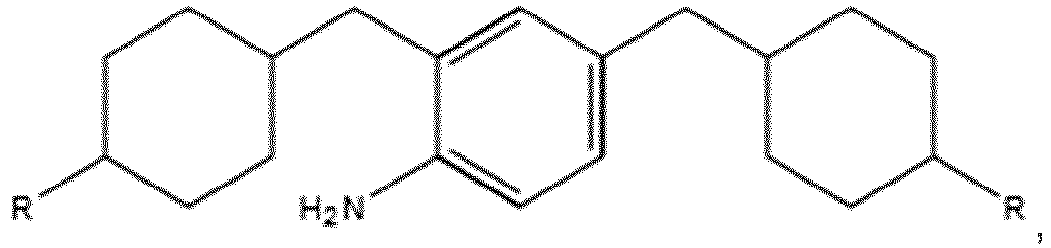
- the second amine component is represented by the formula: where R is NH 2 .
- the second amine component is formed as a hydrogenated product of oligomeric structure in the 4,4'-Methylenedianiline process.
- the second amine component is formaldehyde, polymer with benzenamine, hydrogenated (MPCA, CAS # 135108-88-2 ).
- the third amine component consists of at least one primary amine, at least one secondary amine, and/or at least one tertiary amine.
- the third amine component preferably comprises one or more amine compounds selected from the group consisting of a polyether amine, polyether diamine, a saturated aliphatic ring diamine, a linear aliphatic amine, a cycloaliphatic amine, a polycycloaliphatic amine, an aromatic amine, and combinations thereof.
- the first amine component comprises at least 1% by weight of the epoxy curing agent. In another embodiment, the first amine component comprises at least 10% by weight of the epoxy curing agent. In another embodiment, the first amine component comprises at least 30% by weight of the epoxy curing agent. In another embodiment, the first amine component comprises at least 50% by weight of the epoxy curing agent. In another embodiment, the first amine component comprises at least 70% by weight of the epoxy curing agent. In another embodiment, the first amine component comprises at least 90% by weight of the epoxy curing agent.
- the amine-based curing agent component has a first amine component, a second amine component, and optionally, a third amine component.
- the first amine component is N-(3-aminopropyl) cyclohexylamine (APCHA), represented by the formula:
- the second amine component is represented by the formula: where R is NH 2 .
- the second amine component is formed as a hydrogenated product of oligomeric structure in the 4,4'-Methylenedianiline process.
- the second amine component is formaldehyde, polymer with benzenamine, hydrogenated (MPCA, CAS # 135108-88-2 ).
- the third amine component consists of at least one primary amine, at least one secondary amine, and/or at least one tertiary amine.
- the third amine component preferably comprises one or more amine compounds selected from the group consisting of a polyether amine, polyether diamine, a saturated aliphatic ring diamine, a linear aliphatic amine, a cycloaliphatic amine, a polycycloaliphatic amine, an aromatic amine, and combinations thereof.
- the first amine component comprises at least 1% by weight of the amine-based curing agent. In another embodiment, the first amine component comprises at least 10% by weight of the amine-based curing agent. In another embodiment, the first amine component comprises at least 30% by weight of the amine-based curing agent. In another embodiment, the first amine component comprises at least 50% by weight of the amine-based curing agent. In another embodiment, the first amine component comprises at least 70% by weight of the amine-based curing agent. In another embodiment, the first amine component comprises at least 90% by weight of the amine-based curing agent.
- Another aspect of the invention is a method for producing a cured epoxy resin composition, comprising (a) combining an epoxy resin component with an amine-based curing agent component, the amine-based curing agent component comprising a first amine component and a second amine component; and (b) reacting the amine-based curing agent component and the epoxy resin component to form a cured epoxy resin composition.
- the first amine component is N-(3-aminopropyl) cyclohexylamine (APCHA), represented by the formula: and the second amine component is represented by the formula: where R is NH 2 .
- the second amine component is formed as a hydrogenated product of oligomeric structure in the 4,4'-Methylenedianiline process.
- the second amine component is formaldehyde, polymer with benzenamine, hydrogenated (MPCA, CAS # 135108-88-2 ).
- the first amine component comprises at least 1% by weight of the amine-based curing agent.
- the first amine component comprises at least 10% by weight of the amine-based curing agent.
- the first amine component comprises at least 30% by weight of the amine-based curing agent.
- the first amine component comprises at least 50% by weight of the amine-based curing agent.
- the first amine component comprises at least 70% by weight of the amine-based curing agent.
- the first amine component comprises at least 90% by weight of the amine-based curing agent.
- the weight ratio of the epoxy resin to N-(3-aminopropyl(cyclohexylamine) and second amine is 1:0.05:0.95 - 1:0.95:0.05. In another embodiment, the weight ratio is 1:0.95:0.05. In a further embodiment, the weight ratio is 1:0.29:0.4.
- the amine-based curing agent component can further comprise a third amine component.
- the third amine component consists of at least one primary amine, at least one secondary amine and/or at least one tertiary amine.
- the third amine component preferably comprises one or more amine compounds selected from the group consisting of a polyether amine, polyether diamine, a saturated aliphatic ring diamine, a linear aliphatic amine, a cycloaliphatic amine, a polycycloaliphatic amine, an aromatic amine, and combinations thereof.
- the polyether amine may have the formula: H 2 NCH(CH 3 )CH 2 -[OCH 2 CH(CH 3 )] X NH 2 , and x is from 2 to 70.
- the third amine may comprise a mixture of 4,4'-methylene bis cyclohexylamine, isophorone diamine, 1,2-diamino cyclohexane, 4,4'-methylenebis(2-methylcyclohexyl amine), 1,3-bis aminomethyl cyclohexane and the polyether amine: H 2 NCH(CH 3 )CH 2 [OCH 2 CH(CH 3 )] 2.5 NH 2 .
- a modified amine compound such as a Mannich base, a polyamide compound, an amine-epoxy adduct, and combinations thereof may be used as a co-curing agent for use with the N-(3-aminopropyl(cyclohexylamine) compound as described herein.
- the epoxy resin component may comprise a polyglycidyl ether of a compound selected from the group consisting of an aliphatic glycol, a cycloaliphatic glycol, a triol, a polyol, a polyglycol, and combinations thereof.
- the epoxy resin system may further comprise a polyacrylate or polymethacrylate ester of a polyol.
- FIG. 1 shows the viscosity profile at 40°C for epoxy resin compositions comprising APCHA.
- the epoxy resin system of the invention includes the reaction product of at least one epoxy resin component and an amine-based curing agent component comprising a first amine component and a second amine component.
- the first amine component is N-(3-aminopropyl) cyclohexylamine (APCHA) and the second amine component is the hydrogenated product of oligomeric structure from the 4,4'-Methylenedianiline process.
- the invention comprises the use of APCHA in combination with the hydrogenated product of oligomeric structure from the 4,4'-Methylenedianiline process as a curing agent for epoxy resins, especially in composite applications or ambient and heat cured coating applications.
- the amine-based curing agent component can further comprise a third amine component consisting of at least one primary amine, at least one secondary amine, and/or at least one tertiary amine.
- the amine curing agent is usually added to the epoxy in such an amount that for each epoxy group in the system there is one reactive hydrogen atom in the curing agent. These are known as stoichiometric quantities.
- one aspect of the present invention is that when primary and secondary amines are used as co-curing agents with the N-(3-aminopropyl) cyclohexylamine (APCHA), the -NH bonds of the primary and/or secondary amines may be provided with stoichiometric ratios to epoxy groups ⁇ 1.
- the epoxy resin systems described herein have unexpectedly and surprisingly provided the advantages of lowered cure exothermic temperatures and heat generation with improved control on cure shrinkage, and in some cases, a more rapid cure rate under lower temperature (enabling reduced cycle times).
- amine-based curing agent means a curing agent for which amines comprise at least 80% (by weight) of the overall weight of the curing agent.
- amine or “amine compound” means any derivative of ammonia in which alkyl or aryl groups replace one or more hydrogen atoms bonded to nitrogen.
- primary amine or “primary amine compound” means an amine where one of the three hydrogen atoms in ammonia is replaced by an alkyl or aromatic group (a C-N bond).
- secondary amine or “secondary amine compound” means an amine having two alkyl or aryl groups in place of two hydrogens.
- tertiary amine or “tertiary amine compound” means an amine having three alkyl or aryl groups in place of three hydrogens. Any amine having more than one class of amine functional group may be categorized according to more than one class of amine (primary, secondary, or tertiary).
- the viscosity profile at 40°C for epoxy resin compositions comprising 100% APCHA is compared to the viscosity profile for epoxy resin compositions comprising a combination of APCHA and the hydrogenated product of oligomeric structure from the 4,4'-Methylenedianiline process.
- the time (min) of reactivity of the compositions is significantly increased in the presence of APCHA.
- One aspect of the invention comprises an epoxy resin composition including a reaction product of an epoxy resin component and a curing agent component comprising N-(3-aminopropyl) cyclohexylamine (APCHA), and the hydrogenated product of oligomeric structure from the 4,4'-Methylenedianiline process.
- APCHA N-(3-aminopropyl) cyclohexylamine
- the portion of the curing agent consisting of N-(3-aminopropyl(cyclohexylamine) is referred to as the first amine component and the portion of the curing agent consisting of the hydrogenated product of oligomeric structure from the 4,4'-Methylenedianiline process is referred to as the second amine component.
- the curing agent component can further comprise a third amine component consisting of one or more primary amines, one or more secondary amines, and/or one or more tertiary amines.
- the weight ratio of the epoxy resin component to the first amine component in the curing agent ranges from 1:0.05 to 1:0.95. In one embodiment, the range is 1:0.29.
- the equivalent ratio of resin to an amine is 1:0.1 to 1:0.5.
- the weight ratio of the epoxy resin component to the second amine component ranges from 1:0.05 to 1:0.95.
- the first amine component comprises at least 1% by weight of the overall weight of the curing agent. In another embodiment, the first amine component comprises at least 10% by weight of the overall weight of the curing agent. In another embodiment, the first amine component comprises at least 30% by of the overall weight of the curing agent. In another embodiment, the first amine component comprises at least 50% by weight of the overall weight of the curing agent. In another embodiment, the first amine component comprises at least 70% by weight of the overall weight of the curing agent. In another embodiment, the first amine component comprises at least 90% by weight of the overall weight of the curing agent.
- the epoxy component comprises 30% to 99% (by weight) of the overall weight of the epoxy resin system. In another embodiment, the epoxy component comprises 40% to 92% (by weight) of the overall weight of the epoxy resin system. In another embodiment, the epoxy component comprises 50% to 85% (by weight), of the overall weight of the epoxy resin system.
- the epoxy resin component can consist of a single resin, or it can be a mixture of mutually compatible epoxy resins.
- the epoxy resin may include, but is not limited to, bifunctional epoxies, such as, bisphenol-A and bisphenol-F resins.
- Multifunctional epoxy resin as utilized herein, describes compounds containing two or more 1,2-epoxy groups per molecule. Epoxide compounds of this type are well known to those of skill in the art and are described in Y. Tanaka, "Synthesis and Characteristics of Epoxides", in C. A. May, ed., Epoxy Resins Chemistry and Technology (Marcel Dekker, 1988 ).
- One class of epoxy resins suitable for use in the epoxy resin component comprises the glycidyl ethers of polyhydric phenols, including the glycidyl ethers of dihydric phenols.
- Illustrative examples include, but are not limited to, the glycidyl ethers of: resorcinol, hydroquinone, bis-(4-hydroxy-3,5-difluorophenyl)-methane, 1,1-bis-(4-hydroxyphenyl)-ethane, 2,2-bis-(4-hydroxy-3-methylphenyl)-propane, 2,2-bis-(4-hydroxy-3,5-dichlorophenyl) propane, 2,2-bis-(4-hydroxyphenyl)-propane (commercially known as bisphenol A), bis-(4-hydroxyphenyl)-methane (commercially known as bisphenol-F, and which may contain varying amounts of 2-hydroxyphenyl isomers), and the like, or any combination thereof. Additionally, advanced di
- Materials according to formula (1) can be prepared by polymerizing mixtures of a dihydric phenol and epichlorohydrin, or by advancing a mixture of a diglycidyl ether of the dihydric phenol and the dihydric phenol. While in any given molecule the value of m is an integer, the materials are invariably mixtures which can be characterized by an average value of m which is not necessarily a whole number. Polymeric materials with an average value of m between 0 and about 7 can be used in one aspect of the present disclosure.
- the epoxy component may be a polyglycidyl amine from one or more of 2,2'-methylene dianiline, 4,4'-methylene dianiline, m-xylene dianiline, hydantoin, and isocyanate.
- the epoxy resin component may be a cycloaliphatic (alicyclic) epoxide.
- suitable cycloaliphatic epoxides include diepoxides of cycloaliphaitc esters of dicarboxylic acids such as bis(3,4-epoxycyclohexylmethyl)oxalate, bis(3,4-epoxycyclohexylmethyl)adipate, bis(3,4-epoxy-6-methylcyclohexylmethyl)adipate, vinylcyclohexene diepoxides; limonene diepoxide; bis(3,4-epoxycyclohexylmethyl)pimelate; dicyclopentadiene diepoxide; and other suitable cycloaliphatic epoxides.
- Other suitable diepoxides of cycloaliphatic esters of dicarboxylic acids are described, for example, in Patent Application Publication No. No. WO 2009/089145 A1 .
- cycloaliphatic epoxides include 3,3-epoxycyclohexylmethyl-3,4-epoxycyclohexane carboxylate such as 3,4-epoxycyclohexylmethyl-3,4-epoxycyclohexane carboxylate; 3,3-epoxy-1-methylcyclohexyl-methyl-3,4-epoxy-1-methylcyclohexane carboxylate; 6-methyl-3,4-epoxycyclohexylmethylmethyl-6-methyl-3,4-epoxycyclohexane carboxylate; 3,4-epoxy-2-methylcyclohexyl-methyl-3,4-epoxy-3-methylcyclohexane carboxylate.
- the epoxy component may include polyol polyglycidyl ether from polyethylene glycol, polypropylene glycol or polytetrahydrofuran or combinations thereof.
- epoxy novolac resins which are the glycidyl ethers of novolac resins
- the at least one multifunctional epoxy resin is a diglycidyl ether of bisphenol-A (DGEBA), an advanced or higher molecular weight version of DGEBA, a diglycidyl ether of bisphenol-F, an epoxy novolac resin, or any combination thereof.
- DGEBA diglycidyl ether of bisphenol-A
- EW epoxy equivalent weights
- DGEBA or advanced DGEBA resins are often used for structural formulations due to a combination of their low cost and generally high performance properties.
- the epoxy resins are liquids and are often referred to as liquid epoxy resins. It is understood by those skilled in the art that most grades of liquid epoxy resin are slightly polymeric, since pure DGEBA has an EEW of 174.
- Resins with EEW's between 250 and 450, also generally prepared by the advancement process, are referred to as semi-solid epoxy resins because they are a mixture of solid and liquid at room temperature.
- multifunctional resins with EEW's based on solids of about 160 to about 750 are useful in the present disclosure.
- the multifunctional epoxy resin has an EEW in a range from about 170 to about 250.
- the epoxy resin component which comprises at least one multifunctional epoxy resin, further comprises a monofunctional epoxide.
- monoepoxides include, but are not limited to, styrene oxide, cyclohexene oxide and the glycidyl ethers of phenol, cresols, tert-butylphenol, other alkyl phenols, butanol, 2-ethylhexanol, C 4 to C 14 alcohols, and the like, or combinations thereof.
- the multifunctional epoxy resin can also be present in a solution or emulsion, with the diluent being water, an organic solvent, or a mixture thereof.
- the curing agent component is an amine-based curing agent having a first amine component and a second amine component.
- the first amine component consists of N-(3-aminopropyl) cyclohexylamine (APCHA).
- the second amine component consists of the hydrogenated product of oligomeric structure from the 4,4'-Methylenedianiline process.
- the curing agent component can further comprise a third amine component consisting of at least one primary amine, at least one secondary amine, and/or at least one tertiary amine.
- the first amine component is N-(3-aminopropyl) cyclohexylamine (APCHA), represented by the formula:
- the second amine component is the hydrogenated product of oligomeric structure from the 4,4'-Methylenedianiline process, represented by the formula: where R is NH 2 .
- the third amine component can consist of a single amine or a mixture of amines.
- the amines in the third amine component are primary, secondary, and/or tertiary amines.
- the following are suitable as the third amine component: a polyether diamine, a saturated aliphatic ring diamine, a linear aliphatic amine, a cycloaliphatic amine, a polycycloaliphatic amine, an aromatic amine, and combinations thereof.
- the weight ratio of the epoxy resin to N-(3-aminopropyl(cyclohexylamine) and second amine is 1:0.05:0.95 - 1:0.95:0.05. In another embodiment, the weight ratio is 1:0.4:0.6. In another embodiment, the weight ratio is 1:0.29:0.4.
- Particularly suitable polyamines include isophoronediamine (IPDA), 4,4'-methylene bis cyclohexylamine (PACM), 3,3'-dimethyl PACM (ANCAMINE ® 2049), N-aminoethylpiperazine (NAEP), 4,7-dioxadecane-1,10-diamine,I-propanamine,3,3'-(oxybis(2,1-ethanediyloxy))bis- (ANCAMINE ® 1922A), poly(oxy(methyl-1,2-ethanediyl)),alpha-(2-aminomethylethyl)omega-(2-aminomethylethoxy) (JEFFAMINE ® D 230, D-400), poly(propylene glycol) bis(2-aminopropyl ether), triethylene glycol diamine (JEFFAMINE ® XTJ-504), and poly(oxy(methyl-1,2-ethanediyl))alpha,alpha'-(
- Suitable tertiary amines include N-hydroxyethylpiperidine, N-hydroxypropylpiperidine, 2-methyl-N-hydroxyethylpiperidine, N-hydroxymethylpiperidine, N-hydroxyethylmorpholine, 1,4-bis(2-hydroxyethyl)piperazine, 1,4-dimethylpiperazine, N-cyclohexyl-N,N-dimethylamine, N-cyclohexyl-N,N-diethylamine, N-cyclohexyl-N-ethyl-N-methylamine, N,N-dimethyl-N-(2-methylcyclohexyl)amine, N,N-dicyclohexyl-N-methylamine, N-hydroxyethyl-N-cyclohexyl-N-methylamine, N-cyclohexyl-N,N-dipropylamine, N-cyclohexyl-N,N-dioctylamine, benz
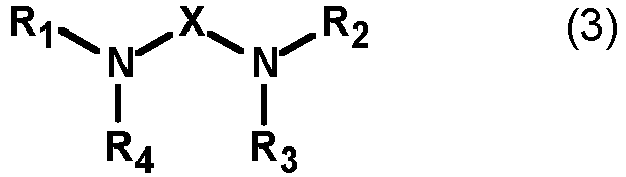
- Additional amines suitable for forming the third amine component are polyamines comprising at least one or more multifunctional amine of structure (3).
- R 1 is CH 2 CH 2 CH 2 NH 2 ;
- R 2 , R 3 and R 4 independently are H or CH 2 CH 2 CH 2 NH 2 ;
- X is CH 2 CH 2 or CH 2 CH 2 CH 2 .
- R 2 and R 3 are not H simultaneously.
- the epoxy system formulation for the composite may optionally include additives, such as, but not limited to, non-reactive plasticizer(s), filler(s), processing aid(s), stabilizer, air release agent, viscosity modifier(s), UV absorbent agent, a flame retardant, and/or an impact modifier.
- additives such as, but not limited to, non-reactive plasticizer(s), filler(s), processing aid(s), stabilizer, air release agent, viscosity modifier(s), UV absorbent agent, a flame retardant, and/or an impact modifier.
- the optional acrylate or methacrylate esters of the polyols are blended with the epoxy resin component in a weight ratio of from 0 to up to about 100 parts of ester for each 100 parts of epoxy resin component. In another embodiment, the acrylate or methacrylate esters of the polyols are blended with the epoxy resin component in a weight ratio of about 5 to about 100 parts of ester for each 100 parts of epoxy resin component.
- Nano materials/fillers may be included.
- Reinforcing fibers may also be included in the epoxy resin system.
- Suitable fibers include organic or inorganic fibers, natural fibers or synthetic fibers, and may be present in the form of wovens or non-crimp fabrics, nonwovens webs or mats, and also in the form of fiber stands (rovings), or staple fiber formed of continuous or discontinuous fiber such as fiber glass, carbon fiber, carbon nanotubes, nano composite fibers, polyaramide fibers such as those sold under the trade name KEVLAR ® , Poly(p-phenylene benzobisoxazole) fiber such as those sold under the trade name ZYLON ® , ultrahigh molecular weight polyethylene fibers such as those sold under the trade name SPECTRA ® , high and low density polyethylene fibers, polypropylene fibers, nylon fibers, cellulose fibers, natural fibers, biodegradable fibers and combinations thereof.
- fibers woven or non-woven
- these fibers can be coated with the solvent or solvent free epoxy resin mixture by the standard impregnating methods, in particular for filament winding (FW), pultrusion, sheet molding compound, bulk molding compound autoclave molding, resin infusion, vacuum assisted resin transfer molding (VARTM), resin transfer molding (RTM), wet/hand lay-up, vacuum bagging, resin impregnation, prepreg, fiber impregnation, compression molding (CM), brushing, spraying, or dipping, casting, injection molding or combination thereof.
- VARTM vacuum assisted resin transfer molding
- RTM resin transfer molding
- CM compression molding
- Mixing of the curing agent component and the epoxy component to form the epoxy resin composition can be in any order and by any appropriate means known in the art for two component epoxy compositions.
- the mixing may be accomplished according to any known method for mixing, including, but not limited to, mixing by magnetic stirrers, high shear mixing, hand mixing, mechanical mixing or other suitable mixing method.
- the mixing of the curing component is preferably carried out at a temperature in the range of 0 to 150°C, preferably 30 to 60°C.
- the curable epoxy resin compositions and cured products described herein may be useful as structural and electrical laminates, coating, casting, structural components for aerospace industries, and as circuit boards and the like for the electronics industry, among other applications.
- the curable epoxy resin compositions disclosed herein may also be used in electrical varnishes, encapsulants, semiconductors, general molding powders, filament wound pipes and fittings, filament wound pressure vessels, low and high pressure pipes and fittings, low and high pressure vessels, storage tanks, wind turbine blades, automotive structural parts, aerospace structural parts, oil and gas buoyance modules, rigs, well plugs, cured-in-place-pipe (CIPP), structural bonding adhesives and laminates, a composite liner, liners for pumps, corrosion resistant coatings, and other suitable epoxy containing products.
- electrical varnishes encapsulants
- semiconductors general molding powders
- filament wound pipes and fittings filament wound pressure vessels
- low and high pressure pipes and fittings low and high pressure vessels
- storage tanks storage tanks
- wind turbine blades automotive structural parts
- aerospace structural parts oil
- the curable epoxy resin composition may be used to form composite materials on a reinforced fiber substrate.
- the reinforced fiber substrate may be one or more layers of fiberglass material.
- Contacting the reinforcing fiber substrate with the epoxy resin system may comprise an application process selected from the group consisting of including hand lamination, an infusion process, filament winding, pultrusion, resin transfer molding, fiber preimpregnation processes, and combinations thereof.
- a method for producing the cured epoxy resin composition comprises (a) combining an epoxy resin component with an amine-based curing agent component, the amine-based curing agent component comprising a first amine component represented by the structure: , and a second amine component represented by the structure: where R is NH 2 ; and (b) reacting the at least one amine compound and the epoxy resin to form a cured epoxy resin composition.
- the method steps (a) and (b) may be performed in an oven at a first ambient temperature and a maximum internal temperature during steps (a) and (b) maintained that is no more than 175°C above the first ambient temperature.
- the first ambient temperature is 25°C.
- the maximum internal temperature is no more than 200°C.
- the amine-based curing agent component can further comprise a third amine component consisting of primary, secondary, and/or tertiary amines.
- the first amine component comprises at least 1% by weight of the amine-based curing agent.
- the first amine component comprises at least 10% by weight of the amine-based curing agent.
- the first amine component comprises at least 30% by weight of the amine-based curing agent.
- the first amine component comprises at least 50% by weight of the amine-based curing agent.
- the first amine component comprises at least 70% by weight of the amine-based curing agent.
- the first amine component comprises at least 90% by weight of the amine-based curing agent.
- the reaction product of the epoxy resin component and the curing agent component may exhibit a T g of 70°C or greater at a cure time of less than 2 hours as measured by Differential Scanning Calorimetry (DSC).
- DSC Differential Scanning Calorimetry
- the glass transition temperature (T g ) was measured using DSC of the epoxide-based composition cured at 100°C for 2 hours according to the present invention. 20mg of the cured composition was carefully measured in an aluminum pan and sealed with the lid. A sample of this cured composition was analyzed by DSC (TA Instruments QA20) using a program that starts at 25°C and heats at 10°C/minute up to 250°C, cools and scans a second time to 250°C.
- the first scan provides residual peak exotherm if any and heat of reaction, while the second scan confirms the glass transition temperature.
- the reaction product of the epoxy resin component and the curing agent may exhibit a maximum exothermic temperature of below 50°C. or lower for a 100 gram mass in an oven at 70°C.
- the product formed from the epoxy resin component and the curing agent may exhibit a maximum exothermic temperature of 50°C or lower during formation.
- the product may further include a reinforcing fiber substrate.
- the product may be in the form of various structural parts.
- the product may exhibit a flexural strength of greater than 70 MPa with a strain of 2% or greater and transverse tensile modulus of greater than 40 GPa, an in-plane inter-laminar shear strength of greater than 40 MPa.
- This example describes the preparation and testing of curing agent blends.
- N-cyclohexyl-1,3-propane diamine is mixed with the hydrogenated product of oligomeric structure from the 4,4'- Methylenedianiline process (MPCA, CAS # 135108-88-2 ) to make the liquid curing component.
- the hydrogenated product of oligomeric structure from the 4,4'-methylenedianiline process was mixed with N-cyclohexyl-1,3-propane diamine (APCHA) at different ratios to determine their efficiency to lower the viscosity. It is desirable to use formulated curing agents in a liquid form for composite applications.
- the hydrogenated product of oligomeric structure from the 4,4'-methylenedianiline process (MPCA) are either semi-solid at 25°C or high viscosity at 40°C.
- N-cyclohexyl-1,3-propane diamine (APCHA) was found to be a very effective reactive solvent at very low loading (10%) that significantly reduced the viscosity of the hydrogenated product of oligomeric structure from the 4,4'-methylenedianiline process (MPCA).
- MPCA 4,4'-methylenedianiline process
- epoxy resin epoxy equivalent weight (EEW) 180
- LER liquid epoxy resin
- EPON ® 826 EPON ® 826.
- EPON ® is a registered trademark of Hexion Specialty Chemicals, Inc.
- FIG. 1 shows formulations 2-5 listed in Tables 2 and 3.
- the formulation 1 reactivity study was not performed due to its higher viscosity and difficulty getting a homogeneous mixture. Based on the reactivity study shown in FIG. 1 , it is possible to use up to 70% of the hydrogenated product of oligomeric structure from the 4,4'-methylenedianiline process (MPCA), when used with N-cyclohexyl-1,3-propane diamine (APCHA) and Epon 826.
- MPCA 4,4'-methylenedianiline process
- APCHA N-cyclohexyl-1,3-propane diamine
- Epon 826 Epon 826.
- lower than 1,500 cPs viscosity is acceptable to adequately process the composite parts.
- the epoxy component and amine curatives shown in Table 3 were hand mixed at 40°C for 3-5 minutes. Entrapped air was removed by placing the mixture in a centrifuge for 5 minutes or until the mixture was clear. The mixture was then poured into a 1/8" aluminum mold. The system in the mold was cured at 80° C for 2 hours plus 150° C for 3 hours. Molds were allowed to cool to room temperature before removing the cured sample. Specimens were prepared from the cast samples according to ASTM methods to perform the mechanical testing; tensile test (ASTM D638), flexural test (ASTM D790), and compressive test (ASTM D695). Additional 1" ⁇ 3" ⁇ 1/8" samples were prepared to perform chemical resistance testing in different reagents.
- a TECHNE ® gel timer was used to measure the gel time of all the formulations shown in Table 3.
- the one end of the metal rod was connected to the TECHNE ® gel timer and another end with the 1" diameter dish.
- the epoxy component and curing agents were preheated separately at 25° C.
- a total of 150 grams of mixture (epoxy component and curing components) was mixed for 3-5 minutes.
- the 1" diameter dish was immersed into the beaker content mixture and Gel time was turned ON immediately to obtain an accurate reading.
- formulations 2-5 The results for formulations 2-5 are reported in Table 3.
- Formulations 3 & 4 provide a Tg in the range of 110C -125C and formulations 2 & 5 provides a Tg in the range of 90C-95C.
- the presence of N-cyclohexyl-1,3-propane diamine in the formulation gives very high elongation and the addition of hydrogenated product of oligomeric structure from the 4,4'-Methylenedianiline process improves the modulus of the cured formulations.
- the neat cast panels for formulations 2-5 were prepared using the process described in Example 2.
- the flexural specimens (1/2"x3"x1/8") were machined according to ASTM D790. The specimens were immersed into different reagents for 30 days @ 25°C to understand the flexural modulus retention before and after immersion.
- the reagents used were; water, acetone, toluene, methanol, ethanol, 25% acetic acid, 10% nitric acid, and 10% ammonium hydroxide.
- the flexural modulus of formulation 2 was retained in most of the reagents except specimens that were fractured in either acetone or methanol. These reagents are considered as very aggressive for attaching an epoxy crosslinked network.
Landscapes
- Chemical & Material Sciences (AREA)
- Health & Medical Sciences (AREA)
- Chemical Kinetics & Catalysis (AREA)
- Medicinal Chemistry (AREA)
- Polymers & Plastics (AREA)
- Organic Chemistry (AREA)
- Engineering & Computer Science (AREA)
- Materials Engineering (AREA)
- Manufacturing & Machinery (AREA)
- Epoxy Resins (AREA)
- Compositions Of Macromolecular Compounds (AREA)
- Organic Low-Molecular-Weight Compounds And Preparation Thereof (AREA)
Description
- Cycloaliphatic amines are commonly used as epoxy curing agents for heat cured structural composite applications. The class of amine used as a curing agent is vital to achieve the final performance of the cured product. Each of the amine classes, primary or secondary, is cured at a specific temperature in order to achieve full cure. The cure temperature dictates the final service temperature, which is indicated by its Tg. In general, epoxy resins are predominately cured with primary and secondary amines. Tertiary amines are generally used as co-curing agents or catalysts in combination with primary and secondary amines.
- Epoxy resin systems are used in the manufacturing of various structural parts, including composites. Examples of articles that are being evaluated for manufacturing from epoxy resin systems include composite pipes, pressure vessels, automotive parts and windmill blades. Fabricating such parts includes a number of requirements for effective manufacturing especially when complex manufacturing processes are used. These processes include but are not limited to resin infusion, resin transfer molding, filament winding and large casting. One need in the art is for reduced exothermic heat release during the epoxy resin system cure of the article in thicker sections of the article, since in such sections, the exothermic heat released during cure cannot be easily conducted away from the article. If excessive temperatures are reached during the cure process, thermal degradation of the cured resin in the "hot spots" can occur with resultant mechanical property loss in the fabricated parts.
- Additionally, during cure, the composite parts may undergo thermal shrinkage. Thermal shrinkage of a cured epoxy resin causes stresses to build up in a composite during cool down from the maximum temperature reached at or after gelation. The stresses sometimes lead to interlaminar cracking in the article, with resultant loss of mechanical properties. The higher the temperature reached during cure after the gel point, the greater the amount of stress that will accumulate in the article during cooling.
- Standard epoxy systems for fabricating structural parts are cured with stoichiometric quantities of aliphatic amines, usually primary amines. The systems generally have high cure exothermic temperatures, with the center of a 100-gram mass of resin/curing agent mixture contained within a three inch diameter cylinder often reaching a peak temperature of 250°C or higher when cured in a 70°C oven. Alternatively, epoxy systems cured with anhydridebased curing agents may often have lower cure exothermic heat release than those cured with primary amines. However, anhydride-cured systems typically require higher mold temperatures than systems cured with primary aliphatic amines to reach an acceptable degree of cure and level of cured properties.
- Cycloaliphatic amines currently used in epoxy formulations are known to require a higher temperature (>130C for 2 hrs) to achieve full cure in a short time. Some limitations to achieving full cure at such a high temperature include (1) increased fuming/volatility of an amine before it crosslinks with the epoxy group which creates an environmental concern and unsafe working conditions for the worker in the manufacturing site who may inhale the highly volatile components, and (2) an excessive exothermic temperature (>200°C) during the cure process which may create a hot (burn) spot in the parts and could melt the thermoplastic liner (e.g. HDPE liner use for Filament wound Pressure Vessels).
- For an advanced composite to achieve higher performance, multifunctional resins and curing agents are often used. The multifunctional materials usually have a very high starting viscosity. To reduce the formulation viscosity, heat is commonly used. This approach increases the reactivity, thus causing some handling issues. As the composite parts get bigger and thicker the formulation viscosity needs to be lower to have an optimum wetting of a reinforcement (e.g. glass, carbon, Kevlar, natural fiber etc).
- Systems for composite processing require an initial mixed viscosity low enough and rate of viscosity increase at the impregnation temperature low enough to enable the reinforcing fiber preform to be completely wet with resin before the resin system becomes too viscous for satisfactory flow through the fibers and fabric of the substrate. The requirement for low initial viscosity and long pot life becomes more stringent as the size of the composite part increases.
-
WO2016208618A1 discloses a fiber-reinforced composite material obtained using an epoxy resin composition where the epoxy resin composition comprises an epoxy resin including an aromatic ring and having a functionality of 2 or higher and an amine-based hardener or an acid-anhydride based hardener. -
US2017240691A1 discloses a method for producing a cured epoxy resin composition, comprising reacting an epoxy resin with a curing agent comprising N-cyclohexyl-1,3-propanediamine. - In light of the above, there is a need in the art for improved curing agents for producing epoxy resin systems which have reduced exothermic heat release combined with desired cured mechanical properties when compared to the prior art resin compositions. Such curing agents must be free of undesirable features such as volatile emissions.
- It has been discovered that cycloaliphatic amines, preferably N-(3-aminopropyl) cyclohexylamine (APCHA) and the hydrogenated product of oligomeric structure from the 4,4'-Methylenedianiline process, can be used as the main curing agent for epoxy resin compositions without inducing the negative impact on mechanical, thermal and chemical properties of the cured product normally seen with cycloaliphatic amine-based curing agents. The major drawback with cycloaliphatic amines is that they require a higher curing or processing temperature to achieve full cure. Using APCHA and the hydrogenated product of oligomeric structure from the 4,4'-Methylenedianiline process as the main curing agent achieves full cure at a significantly lower temperature than current cycloaliphatic amine curing agents. Test results show that using APCHA and the hydrogenated product of oligomeric structure from the 4,4'-Methylenedianiline process as the main curing agent maintains good mechanical, thermal and chemical performance in the cured epoxy composition and exceeds the mechanical properties of other cycloaliphatic amines. In addition, formulations containing APCHA and the hydrogenated product of oligomeric structure from the 4,4'-Methylenedianiline process give lower viscosity, longer pot life, low temperature Tg development and lower exotherm during cure compared to cured epoxy compositions using current cycloaliphatic amine curing agents. APCHA and the hydrogenated product of oligomeric structure from the 4,4'-Methylenedianiline process can also be used in combination with primary and secondary amines as co-curing agents to further enhance the desirable properties. The lower viscosity of APCHA helps in fiber wetting. Preliminary results using APCHA and the hydrogenated product of oligomeric structure from the 4,4'-Methylenedianiline process in composite applications (filament wound pipes & fittings, wind blades, high pressure vessels, structural laminates, automotive body parts, aerospace, etc.) are quite encouraging.
- An aspect of the invention is an epoxy curing agent comprising a first amine component, a second amine component, and optionally, a third amine component. The first amine component is N-(3-aminopropyl) cyclohexylamine (APCHA), represented by the formula:

- In one embodiment, the first amine component comprises at least 1% by weight of the epoxy curing agent. In another embodiment, the first amine component comprises at least 10% by weight of the epoxy curing agent. In another embodiment, the first amine component comprises at least 30% by weight of the epoxy curing agent. In another embodiment, the first amine component comprises at least 50% by weight of the epoxy curing agent. In another embodiment, the first amine component comprises at least 70% by weight of the epoxy curing agent. In another embodiment, the first amine component comprises at least 90% by weight of the epoxy curing agent.
- Another aspect of the invention is a composition containing the reaction product of an epoxy resin component and an amine-based curing agent component. The amine-based curing agent component has a first amine component, a second amine component, and optionally, a third amine component. The first amine component is N-(3-aminopropyl) cyclohexylamine (APCHA), represented by the formula:


- In one embodiment, the first amine component comprises at least 1% by weight of the amine-based curing agent. In another embodiment, the first amine component comprises at least 10% by weight of the amine-based curing agent. In another embodiment, the first amine component comprises at least 30% by weight of the amine-based curing agent. In another embodiment, the first amine component comprises at least 50% by weight of the amine-based curing agent. In another embodiment, the first amine component comprises at least 70% by weight of the amine-based curing agent. In another embodiment, the first amine component comprises at least 90% by weight of the amine-based curing agent.
- Another aspect of the invention is a method for producing a cured epoxy resin composition, comprising (a) combining an epoxy resin component with an amine-based curing agent component, the amine-based curing agent component comprising a first amine component and a second amine component; and (b) reacting the amine-based curing agent component and the epoxy resin component to form a cured epoxy resin composition. The first amine component is N-(3-aminopropyl) cyclohexylamine (APCHA), represented by the formula:


- The weight ratio of the epoxy resin to N-(3-aminopropyl(cyclohexylamine) and second amine is 1:0.05:0.95 - 1:0.95:0.05. In another embodiment, the weight ratio is 1:0.95:0.05. In a further embodiment, the weight ratio is 1:0.29:0.4.
- The amine-based curing agent component can further comprise a third amine component. The third amine component consists of at least one primary amine, at least one secondary amine and/or at least one tertiary amine. The third amine component preferably comprises one or more amine compounds selected from the group consisting of a polyether amine, polyether diamine, a saturated aliphatic ring diamine, a linear aliphatic amine, a cycloaliphatic amine, a polycycloaliphatic amine, an aromatic amine, and combinations thereof.
- The polyether amine may have the formula: H2NCH(CH3)CH2-[OCH2CH(CH3)]XNH2, and x is from 2 to 70. The third amine may comprise a mixture of 4,4'-methylene bis cyclohexylamine, isophorone diamine, 1,2-diamino cyclohexane, 4,4'-methylenebis(2-methylcyclohexyl amine), 1,3-bis aminomethyl cyclohexane and the polyether amine: H2NCH(CH3)CH2[OCH2CH(CH3)]2.5NH2.
- A modified amine compound such as a Mannich base, a polyamide compound, an amine-epoxy adduct, and combinations thereof may be used as a co-curing agent for use with the N-(3-aminopropyl(cyclohexylamine) compound as described herein.
- The epoxy resin component may comprise a polyglycidyl ether of a compound selected from the group consisting of an aliphatic glycol, a cycloaliphatic glycol, a triol, a polyol, a polyglycol, and combinations thereof. The epoxy resin system may further comprise a polyacrylate or polymethacrylate ester of a polyol.
-
FIG. 1 shows the viscosity profile at 40°C for epoxy resin compositions comprising APCHA. - The epoxy resin system of the invention includes the reaction product of at least one epoxy resin component and an amine-based curing agent component comprising a first amine component and a second amine component. The first amine component is N-(3-aminopropyl) cyclohexylamine (APCHA) and the second amine component is the hydrogenated product of oligomeric structure from the 4,4'-Methylenedianiline process. The invention comprises the use of APCHA in combination with the hydrogenated product of oligomeric structure from the 4,4'-Methylenedianiline process as a curing agent for epoxy resins, especially in composite applications or ambient and heat cured coating applications. The amine-based curing agent component can further comprise a third amine component consisting of at least one primary amine, at least one secondary amine, and/or at least one tertiary amine.
- In prior art epoxy resin systems, the amine curing agent is usually added to the epoxy in such an amount that for each epoxy group in the system there is one reactive hydrogen atom in the curing agent. These are known as stoichiometric quantities. However, one aspect of the present invention is that when primary and secondary amines are used as co-curing agents with the N-(3-aminopropyl) cyclohexylamine (APCHA), the -NH bonds of the primary and/or secondary amines may be provided with stoichiometric ratios to epoxy groups ≤ 1.
- In comparison with prior art systems based on mixtures of epoxy resins with stoichiometric quantities of primary and/or secondary amines, the epoxy resin systems described herein have unexpectedly and surprisingly provided the advantages of lowered cure exothermic temperatures and heat generation with improved control on cure shrinkage, and in some cases, a more rapid cure rate under lower temperature (enabling reduced cycle times).
- As used herein, the term "amine-based curing agent" means a curing agent for which amines comprise at least 80% (by weight) of the overall weight of the curing agent.
- As used herein, the term "amine" or "amine compound" means any derivative of ammonia in which alkyl or aryl groups replace one or more hydrogen atoms bonded to nitrogen. The term "primary amine" or "primary amine compound" means an amine where one of the three hydrogen atoms in ammonia is replaced by an alkyl or aromatic group (a C-N bond). The term "secondary amine" or "secondary amine compound" means an amine having two alkyl or aryl groups in place of two hydrogens. The term "tertiary amine" or "tertiary amine compound" means an amine having three alkyl or aryl groups in place of three hydrogens. Any amine having more than one class of amine functional group may be categorized according to more than one class of amine (primary, secondary, or tertiary).
- Referring to
FIG. 1 , the viscosity profile at 40°C for epoxy resin compositions comprising 100% APCHA is compared to the viscosity profile for epoxy resin compositions comprising a combination of APCHA and the hydrogenated product of oligomeric structure from the 4,4'-Methylenedianiline process. The time (min) of reactivity of the compositions is significantly increased in the presence of APCHA. - One aspect of the invention comprises an epoxy resin composition including a reaction product of an epoxy resin component and a curing agent component comprising N-(3-aminopropyl) cyclohexylamine (APCHA), and the hydrogenated product of oligomeric structure from the 4,4'-Methylenedianiline process. Hereinafter, the portion of the curing agent consisting of N-(3-aminopropyl(cyclohexylamine) is referred to as the first amine component and the portion of the curing agent consisting of the hydrogenated product of oligomeric structure from the 4,4'-Methylenedianiline process is referred to as the second amine component. The curing agent component can further comprise a third amine component consisting of one or more primary amines, one or more secondary amines, and/or one or more tertiary amines.
- In the epoxy resin composition, the weight ratio of the epoxy resin component to the first amine component in the curing agent ranges from 1:0.05 to 1:0.95. In one embodiment, the range is 1:0.29. The equivalent ratio of resin to an amine is 1:0.1 to 1:0.5. The weight ratio of the epoxy resin component to the second amine component ranges from 1:0.05 to 1:0.95.
- In one embodiment, the first amine component comprises at least 1% by weight of the overall weight of the curing agent. In another embodiment, the first amine component comprises at least 10% by weight of the overall weight of the curing agent. In another embodiment, the first amine component comprises at least 30% by of the overall weight of the curing agent. In another embodiment, the first amine component comprises at least 50% by weight of the overall weight of the curing agent. In another embodiment, the first amine component comprises at least 70% by weight of the overall weight of the curing agent. In another embodiment, the first amine component comprises at least 90% by weight of the overall weight of the curing agent.
- In one embodiment, the epoxy component comprises 30% to 99% (by weight) of the overall weight of the epoxy resin system. In another embodiment, the epoxy component comprises 40% to 92% (by weight) of the overall weight of the epoxy resin system. In another embodiment, the epoxy component comprises 50% to 85% (by weight), of the overall weight of the epoxy resin system.
- The epoxy resin component can consist of a single resin, or it can be a mixture of mutually compatible epoxy resins. The epoxy resin may include, but is not limited to, bifunctional epoxies, such as, bisphenol-A and bisphenol-F resins. Multifunctional epoxy resin, as utilized herein, describes compounds containing two or more 1,2-epoxy groups per molecule. Epoxide compounds of this type are well known to those of skill in the art and are described in Y. Tanaka, "Synthesis and Characteristics of Epoxides", in C. A. May, ed., Epoxy Resins Chemistry and Technology (Marcel Dekker, 1988).
- One class of epoxy resins suitable for use in the epoxy resin component comprises the glycidyl ethers of polyhydric phenols, including the glycidyl ethers of dihydric phenols. Illustrative examples include, but are not limited to, the glycidyl ethers of: resorcinol, hydroquinone, bis-(4-hydroxy-3,5-difluorophenyl)-methane, 1,1-bis-(4-hydroxyphenyl)-ethane, 2,2-bis-(4-hydroxy-3-methylphenyl)-propane, 2,2-bis-(4-hydroxy-3,5-dichlorophenyl) propane, 2,2-bis-(4-hydroxyphenyl)-propane (commercially known as bisphenol A), bis-(4-hydroxyphenyl)-methane (commercially known as bisphenol-F, and which may contain varying amounts of 2-hydroxyphenyl isomers), and the like, or any combination thereof. Additionally, advanced dihydric phenols of the structure of formula (1) also are useful in the present disclosure:

- Materials according to formula (1) can be prepared by polymerizing mixtures of a dihydric phenol and epichlorohydrin, or by advancing a mixture of a diglycidyl ether of the dihydric phenol and the dihydric phenol. While in any given molecule the value of m is an integer, the materials are invariably mixtures which can be characterized by an average value of m which is not necessarily a whole number. Polymeric materials with an average value of m between 0 and about 7 can be used in one aspect of the present disclosure. In other embodiments, the epoxy component may be a polyglycidyl amine from one or more of 2,2'-methylene dianiline, 4,4'-methylene dianiline, m-xylene dianiline, hydantoin, and isocyanate.
- The epoxy resin component may be a cycloaliphatic (alicyclic) epoxide. Examples of suitable cycloaliphatic epoxides include diepoxides of cycloaliphaitc esters of dicarboxylic acids such as bis(3,4-epoxycyclohexylmethyl)oxalate, bis(3,4-epoxycyclohexylmethyl)adipate, bis(3,4-epoxy-6-methylcyclohexylmethyl)adipate, vinylcyclohexene diepoxides; limonene diepoxide; bis(3,4-epoxycyclohexylmethyl)pimelate; dicyclopentadiene diepoxide; and other suitable cycloaliphatic epoxides. Other suitable diepoxides of cycloaliphatic esters of dicarboxylic acids are described, for example, in Patent Application Publication No. No.
WO 2009/089145 A1 . - Other cycloaliphatic epoxides include 3,3-epoxycyclohexylmethyl-3,4-epoxycyclohexane carboxylate such as 3,4-epoxycyclohexylmethyl-3,4-epoxycyclohexane carboxylate; 3,3-epoxy-1-methylcyclohexyl-methyl-3,4-epoxy-1-methylcyclohexane carboxylate; 6-methyl-3,4-epoxycyclohexylmethylmethyl-6-methyl-3,4-epoxycyclohexane carboxylate; 3,4-epoxy-2-methylcyclohexyl-methyl-3,4-epoxy-3-methylcyclohexane carboxylate. Other suitable 3,4-epoxycyclohexylmentyl-3,4-epoxycyclohexane carboxylates are described, for example, in
U.S. Pat. No. 2,890,194 . In other embodiments, the epoxy component may include polyol polyglycidyl ether from polyethylene glycol, polypropylene glycol or polytetrahydrofuran or combinations thereof. - In another aspect, epoxy novolac resins, which are the glycidyl ethers of novolac resins, can be used as multifunctional epoxy resins in accordance with the present disclosure. In yet another aspect, the at least one multifunctional epoxy resin is a diglycidyl ether of bisphenol-A (DGEBA), an advanced or higher molecular weight version of DGEBA, a diglycidyl ether of bisphenol-F, an epoxy novolac resin, or any combination thereof. Higher molecular weight versions or derivatives of DGEBA are prepared by the advancement process, where excess DGEBA is reacted with bisphenol-A to yield epoxy terminated products. The epoxy equivalent weights (EEW) for such products range from about 450 to 3000 or more. Because these products are solid at room temperature, they are often referred to as solid epoxy resins.
- DGEBA or advanced DGEBA resins are often used for structural formulations due to a combination of their low cost and generally high performance properties. Commercial grades of DGEBA having an EEW ranging from about 174 to about 250, and more commonly from about 185 to about 195, are readily available. At these low molecular weights, the epoxy resins are liquids and are often referred to as liquid epoxy resins. It is understood by those skilled in the art that most grades of liquid epoxy resin are slightly polymeric, since pure DGEBA has an EEW of 174. Resins with EEW's between 250 and 450, also generally prepared by the advancement process, are referred to as semi-solid epoxy resins because they are a mixture of solid and liquid at room temperature. Generally, multifunctional resins with EEW's based on solids of about 160 to about 750 are useful in the present disclosure. In another aspect, the multifunctional epoxy resin has an EEW in a range from about 170 to about 250.
- Depending upon the end-use application, it can be beneficial to reduce the viscosity of the compositions of the present disclosure by modifying the epoxy resin component. The epoxy resin component, which comprises at least one multifunctional epoxy resin, further comprises a monofunctional epoxide. Examples of monoepoxides include, but are not limited to, styrene oxide, cyclohexene oxide and the glycidyl ethers of phenol, cresols, tert-butylphenol, other alkyl phenols, butanol, 2-ethylhexanol, C4 to C14 alcohols, and the like, or combinations thereof. The multifunctional epoxy resin can also be present in a solution or emulsion, with the diluent being water, an organic solvent, or a mixture thereof.
- As noted above, the curing agent component is an amine-based curing agent having a first amine component and a second amine component. The first amine component consists of N-(3-aminopropyl) cyclohexylamine (APCHA). The second amine component consists of the hydrogenated product of oligomeric structure from the 4,4'-Methylenedianiline process. The curing agent component can further comprise a third amine component consisting of at least one primary amine, at least one secondary amine, and/or at least one tertiary amine.
- The first amine component is N-(3-aminopropyl) cyclohexylamine (APCHA), represented by the formula:

- The second amine component is the hydrogenated product of oligomeric structure from the 4,4'-Methylenedianiline process, represented by the formula:

- The third amine component can consist of a single amine or a mixture of amines. The amines in the third amine component are primary, secondary, and/or tertiary amines.
- In some applications, the following are suitable as the third amine component: a polyether diamine, a saturated aliphatic ring diamine, a linear aliphatic amine, a cycloaliphatic amine, a polycycloaliphatic amine, an aromatic amine, and combinations thereof. The weight ratio of the epoxy resin to N-(3-aminopropyl(cyclohexylamine) and second amine is 1:0.05:0.95 - 1:0.95:0.05. In another embodiment, the weight ratio is 1:0.4:0.6. In another embodiment, the weight ratio is 1:0.29:0.4. Polyamines selected from one or more of an aliphatic polyamine such as diethylenetriamine (DETA), triethylenetetramine (TETA), tetraethylenepentamine (TEPA), pentaethylenehexamine (PEHA), hexamethylenediamine (HMDA), N-(2-aminoethyl)-1,3-propanediamine (N3-Amine), N, N'-1,2-ethanediylbis-1,3-propanediamine (N4-amine), or dipropylenetriamine; an arylaliphatic polyamine such as m-xylylenediamine (mXDA), or p-xylylenediamine; a cycloaliphatic polyamine such as 1,3-bis aminomethyl cyclohexane (1,3-BAC), isophorone diamine (IPDA), 4,4'-methylene bis cyclohexylamine (PACM), 1,2-diamino cyclohexane, or 4,4'-methylenebis-(2-methylcyclohexyl-amine); an aromatic polyamine such as m-phenylenediamine, diaminodiphenylmethane (DDM), or diaminodiphenylsulfone (DDS); a heterocyclic polyamine such as N-aminoethylpiperazine (NAEP), or 3,9-bis(3-aminopropyl)2,4,8,10-tetraoxaspiro (5,5)undecane; a polyalkoxypolyamine where the alkoxy group can be an oxyethylene, oxypropylene, oxy-1,2-butylene, oxy-1,4-butylene or co-polymers thereof such as 4,7-dioxadecane-1,10-diamine, 1-propanamine,3,3'-(oxybis(2,1-ethanediyloxy)) bis(diaminopropylated diethylene glycol ANCAMINE® 1922A), poly(oxy(methyl-1,2-ethanediyl)), alpha-(2-aminomethylethyl) omega-(2-aminomethylethoxy) (JEFFAMINE® D 230, D-400), triethyleneglycoldiamine and oligomers (JEFFAMINE® XTJ-504, JEFFAMINE® XTJ-512), poly(oxy(methyl-1,2-ethanediyl)), alpha,alpha'-(oxydi-2,1-ethanediyl)bis(omega-(aminomethylethoxy)) (JEFFAMINE® XTJ-511), bis(3-aminopropyl)polytetrahydrofuran 350, bis(3-aminopropyl)polytetrahydrofuran 750, poly(oxy(methyl-1,2-ethanediyl)), a-hydro-w-(2-aminomethylethoxy)ether with 2-ethyl-2-(hydroxymethyl)-1,3-propanediol (3:1) (JEFFAMINE® T-403), and diaminopropyl dipropylene glycol. JEFFAMINE® is a registered trademark of Huntsman Petrochemical LLC.
- Particularly suitable polyamines include isophoronediamine (IPDA), 4,4'-methylene bis cyclohexylamine (PACM), 3,3'-dimethyl PACM (ANCAMINE® 2049), N-aminoethylpiperazine (NAEP), 4,7-dioxadecane-1,10-diamine,I-propanamine,3,3'-(oxybis(2,1-ethanediyloxy))bis- (ANCAMINE® 1922A), poly(oxy(methyl-1,2-ethanediyl)),alpha-(2-aminomethylethyl)omega-(2-aminomethylethoxy) (JEFFAMINE® D 230, D-400), poly(propylene glycol) bis(2-aminopropyl ether), triethylene glycol diamine (JEFFAMINE® XTJ-504), and poly(oxy(methyl-1,2-ethanediyl))alpha,alpha'-(oxy(di-2,1-ethanediyl))bis(omega-(aminomethylethoxy)) (JEFFAMINE® XTJ-511) or mixture thereof. ANCAMINE® is a registered trademark of Evonik Degussa GmbH.
- Suitable tertiary amines include N-hydroxyethylpiperidine, N-hydroxypropylpiperidine, 2-methyl-N-hydroxyethylpiperidine, N-hydroxymethylpiperidine, N-hydroxyethylmorpholine, 1,4-bis(2-hydroxyethyl)piperazine, 1,4-dimethylpiperazine, N-cyclohexyl-N,N-dimethylamine, N-cyclohexyl-N,N-diethylamine, N-cyclohexyl-N-ethyl-N-methylamine, N,N-dimethyl-N-(2-methylcyclohexyl)amine, N,N-dicyclohexyl-N-methylamine, N-hydroxyethyl-N-cyclohexyl-N-methylamine, N-cyclohexyl-N,N-dipropylamine, N-cyclohexyl-N,N-dioctylamine, benzyldimethylamine (BDMA), tris(dimethylaminomethyl)phenol (DMP-30, K54), TEDA, N,N-dimethylpiperazine, 2-(dimethylaminomethyl)phenol, and combinations thereof.
- Additional amines suitable for forming the third amine component are polyamines comprising at least one or more multifunctional amine of structure (3).
- The epoxy system formulation for the composite may optionally include additives, such as, but not limited to, non-reactive plasticizer(s), filler(s), processing aid(s), stabilizer, air release agent, viscosity modifier(s), UV absorbent agent, a flame retardant, and/or an impact modifier.
- The optional acrylate or methacrylate esters of the polyols are blended with the epoxy resin component in a weight ratio of from 0 to up to about 100 parts of ester for each 100 parts of epoxy resin component. In another embodiment, the acrylate or methacrylate esters of the polyols are blended with the epoxy resin component in a weight ratio of about 5 to about 100 parts of ester for each 100 parts of epoxy resin component.
- Nano materials/fillers may be included. The term "nanomaterials," includes, but is not limited to, multi-wall carbon or boron nitride nanotubes, single-wall carbon, carbon or boron nitride nanoparticles, carbon or boron nitride nanofibers, carbon or boron nitride nanoropes, carbon or boron nitride nano ribbons, nanoclays; nanoclays comprising tubules; layered inorganic clay material; talc; carbon black; cellulose fibers; silica; and alumina.
- Reinforcing fibers may also be included in the epoxy resin system. Suitable fibers include organic or inorganic fibers, natural fibers or synthetic fibers, and may be present in the form of wovens or non-crimp fabrics, nonwovens webs or mats, and also in the form of fiber stands (rovings), or staple fiber formed of continuous or discontinuous fiber such as fiber glass, carbon fiber, carbon nanotubes, nano composite fibers, polyaramide fibers such as those sold under the trade name KEVLAR®, Poly(p-phenylene benzobisoxazole) fiber such as those sold under the trade name ZYLON®, ultrahigh molecular weight polyethylene fibers such as those sold under the trade name SPECTRA®, high and low density polyethylene fibers, polypropylene fibers, nylon fibers, cellulose fibers, natural fibers, biodegradable fibers and combinations thereof.
- These fibers (woven or non-woven) can be coated with the solvent or solvent free epoxy resin mixture by the standard impregnating methods, in particular for filament winding (FW), pultrusion, sheet molding compound, bulk molding compound autoclave molding, resin infusion, vacuum assisted resin transfer molding (VARTM), resin transfer molding (RTM), wet/hand lay-up, vacuum bagging, resin impregnation, prepreg, fiber impregnation, compression molding (CM), brushing, spraying, or dipping, casting, injection molding or combination thereof.
- Mixing of the curing agent component and the epoxy component to form the epoxy resin composition can be in any order and by any appropriate means known in the art for two component epoxy compositions. The mixing may be accomplished according to any known method for mixing, including, but not limited to, mixing by magnetic stirrers, high shear mixing, hand mixing, mechanical mixing or other suitable mixing method. The mixing of the curing component is preferably carried out at a temperature in the range of 0 to 150°C, preferably 30 to 60°C.
- The curable epoxy resin compositions and cured products described herein may be useful as structural and electrical laminates, coating, casting, structural components for aerospace industries, and as circuit boards and the like for the electronics industry, among other applications. The curable epoxy resin compositions disclosed herein may also be used in electrical varnishes, encapsulants, semiconductors, general molding powders, filament wound pipes and fittings, filament wound pressure vessels, low and high pressure pipes and fittings, low and high pressure vessels, storage tanks, wind turbine blades, automotive structural parts, aerospace structural parts, oil and gas buoyance modules, rigs, well plugs, cured-in-place-pipe (CIPP), structural bonding adhesives and laminates, a composite liner, liners for pumps, corrosion resistant coatings, and other suitable epoxy containing products.
- The curable epoxy resin composition may be used to form composite materials on a reinforced fiber substrate. The reinforced fiber substrate may be one or more layers of fiberglass material. Contacting the reinforcing fiber substrate with the epoxy resin system may comprise an application process selected from the group consisting of including hand lamination, an infusion process, filament winding, pultrusion, resin transfer molding, fiber preimpregnation processes, and combinations thereof.
- In an embodiment, a method for producing the cured epoxy resin composition comprises (a) combining an epoxy resin component with an amine-based curing agent component, the amine-based curing agent component comprising a first amine component represented by the structure:


- When cured, the reaction product of the epoxy resin component and the curing agent component may exhibit a Tg of 70°C or greater at a cure time of less than 2 hours as measured by Differential Scanning Calorimetry (DSC). The glass transition temperature (Tg) was measured using DSC of the epoxide-based composition cured at 100°C for 2 hours according to the present invention. 20mg of the cured composition was carefully measured in an aluminum pan and sealed with the lid. A sample of this cured composition was analyzed by DSC (TA Instruments QA20) using a program that starts at 25°C and heats at 10°C/minute up to 250°C, cools and scans a second time to 250°C. The first scan provides residual peak exotherm if any and heat of reaction, while the second scan confirms the glass transition temperature. When curing, the reaction product of the epoxy resin component and the curing agent may exhibit a maximum exothermic temperature of below 50°C. or lower for a 100 gram mass in an oven at 70°C.
- The product formed from the epoxy resin component and the curing agent may exhibit a maximum exothermic temperature of 50°C or lower during formation. The product may further include a reinforcing fiber substrate. The product may be in the form of various structural parts. The product may exhibit a flexural strength of greater than 70 MPa with a strain of 2% or greater and transverse tensile modulus of greater than 40 GPa, an in-plane inter-laminar shear strength of greater than 40 MPa.
- The following invention is directed to the following aspects:
- <1> A method for producing a cured epoxy resin composition, comprising:
- (a) combining an epoxy resin component with an amine-based curing agent component, the amine-based curing agent component comprising a first amine component represented by the structure:


- (b) reacting the amine-based curing agent component and the epoxy resin component to form a cured epoxy resin composition.
- (a) combining an epoxy resin component with an amine-based curing agent component, the amine-based curing agent component comprising a first amine component represented by the structure:
- <2> A preferred method of aspect <1> wherein the first amine component comprises at least 1% by weight of the amine-based curing agent.
- <3> A preferred method of aspect <1> further comprising a third amine component having at least one amine compound selected from the group of a primary amine, a secondary amine, and a tertiary amine.
- <4> A preferred method of aspect <3> wherein the third amine component comprises at least one polyether amine, polyether diamine, a saturated aliphatic ring diamine, a linear aliphatic amine, a cycloaliphatic amine, a polycycloaliphatic amine, an aromatic amine, and combinations thereof.
- <5> A preferred method of aspect <1> further comprising: performing steps (a) and (b) at a first ambient temperature; and maintaining a maximum internal temperature during steps (a) and (b) that is no more than 175°C above the first ambient temperature.
- <6> A preferred method of aspect <1> further comprising: applying the epoxy resin composition to a reinforcing fiber prior to step (b).
- <7> A preferred method of aspect <6> wherein the reinforcing fiber is selected from the group consisting of woven or non-crimp fabrics, nonwoven webs or mats, fiber stands, staple fiber formed of continuous or discontinuous fiber, and combinations thereof.
- <8> A preferred method of aspect <6> wherein the reinforcing fiber is selected from the group consisting of fiberglass, carbon fiber, carbon nanotubes, nano composite fibers, polyaramide fibers, poly(p-phenylene benzobisoxazole) fiber, Aramid Kevlar fiber, ultrahigh molecular weight polyethylene fiber, high and low density polyethylene fibers, polypropylene fibers, nylon fibers, cellulose fibers, natural fibers, biodegradable fibers, and combinations thereof.
- <9> A preferred method of aspect <6> wherein the epoxy resin composition is made from a process selected from the group consisting of resin infusion, vacuum assisted resin transfer molding (VARTM), resin transfer molding (RTM), filament winding (FW), compression molding (CM), wet/hand lay-up, vacuum bagging, injection molding, prepreg, fiber impregnation, casting, and combinations thereof.
- <10> An epoxy curing agent comprising a first amine component represented by the structure:


- <11> A preferred epoxy curing agent of aspect <10> wherein the first amine component comprises at least 1% by weight of the epoxy curing agent.
- <12> A preferred epoxy curing agent of aspect <10> further comprising a third amine component having at least one amine compound selected from the group of a primary amine, a secondary amine, and a tertiary amine.
- <13> A preferred epoxy curing agent of aspect <12> wherein the third amine component comprises at least one polyether amine, polyether diamine, a saturated aliphatic ring diamine, a linear aliphatic amine, a cycloaliphatic amine, a polycycloaliphatic amine, an aromatic amine, and combinations thereof.
- <14> A composition comprising the reaction product of: an epoxy resin component; and an amine-based curing agent component, wherein the amine-based curing agent component comprises a first amine component represented by the structure:


- <15>A preferred composition of aspect <14> wherein the first amine component comprises at least 1% by weight of the amine-based curing agent.
- <16> A preferred composition of aspect <14> further comprising a third amine component having at least one amine compound selected from the group of a primary amine, a secondary amine, and a tertiary amine.
- <17> A preferred composition of aspect <16> wherein the third amine component comprises at least one polyether amine, polyether diamine, a saturated aliphatic ring diamine, a linear aliphatic amine, a cycloaliphatic amine, a polycycloaliphatic amine, an aromatic amine, and combinations thereof.
- <18> A preferred composition of aspect <14> wherein the epoxy resin component comprises about 1% to about 99% by weight of the composition.
- <19> A preferred composition of aspect <14> wherein the epoxy resin component comprises a glycidyl ether of polyhydric phenol.
- <20> A preferred composition of aspect <14> wherein the epoxy resin composition comprises at least one glycidyl ether selected from the group of glycidyl ethers of: resorcinol, hydroquinone, bis-(4-hydroxy-3,5-difluorophenyl)-methane, 1,1-bis-(4-hydroxyphenyl)-ethane, 2,2-bis-(4-hydroxy-3-methylphenyl)-propane, 2,2-bis-(4-hydroxy-3,5-dichlorophenyl) propane, 2,2-bis-(4-hydroxyphenyl)-propane, bis-(4-hydroxyphenyl)-methane, novolac resins, and combinations thereof.
- <21> A preferred composition of aspect <14> wherein the epoxy resin component comprises at least one dihydric phenol of the following structure:

- <22> A preferred composition of aspect <14> wherein the epoxy resin component comprises at least one member selected from the group of: bis(3,4-epoxycyclohexylmethyl)oxalate, bis(3,4-epoxycyclohexylmethyl)adipate, bis(3,4-epoxy-6-methylcyclohexylmethyl)adipate, vinylcyclohexene diepoxides; limonene diepoxide; bis(3,4-epoxycyclohexylmethyl)pimelate; dicyclopentadiene diepoxide, 3,3-epoxycyclohexylmethyl-3,4-epoxycyclohexane carboxylate such as 3,4-epoxycyclohexylmethyl-3,4-epoxycyclohexane carboxylate; 3,3-epoxy-1-methylcyclohexyl-methyl-3,4-epoxy-1-methylcyclohexane carboxylate; 6-methyl-3,4-epoxycyclohexylmethylmethyl-6-methyl-3,4-epoxycyclohexane carboxylate; 3,4-epoxy-2-methylcyclohexyl-methyl-3,4-epoxy-3-methylcyclohexane carboxylate, and combinations thereof.
- <23> Use of the composition of aspect <14>, optionally in combination with reinforcing fiber, for the production of filament wound pipes and fittings, filament wound pressure vessels, low and high pressure pipes and fittings, low and high pressure vessels, storage tanks, wind turbine blades, automotive structural parts, aerospace structural parts, oil and gas buoyance modules, rigs, well plugs, cure-in-place-pipe (CIPP), structural bonding adhesives and laminates, encapsulants, semiconductors, corrosion resistance coatings, a composite liner and other suitable epoxy containing applications.
- These Examples are provided to demonstrate certain aspects of the invention and shall not limit the scope of the claims appended hereto.
- This example describes the preparation and testing of curing agent blends.
- The N-cyclohexyl-1,3-propane diamine (APCHA) is mixed with the hydrogenated product of oligomeric structure from the 4,4'- Methylenedianiline process (MPCA, CAS # 135108-88-2) to make the liquid curing component.
Table 1 Blend Hydrogenated product of oligomeric structure from the 4,4'-Methylenedianiline process (MPCA) N-cyclohexyl-1,3-propane diamine (APCHA) Amine Blend Viscosity @ 25°C (cPs) Amine Blend Viscosity @ 40°C (cPs) 1 100% 0 Semi-Solid >100,000 2 90% 10% 13,679 1,600 3 80% 20% 2,135 409 4 70% 30% 459 128 5 60% 40% 184 62 6 50% 50% 81 31 7 40% 60% 40 20 8 30% 70% 24 12 9 20% 80% 15 10 10 10% 90% 10 6 11 0% 100% 7 5 - In Table 1, the hydrogenated product of oligomeric structure from the 4,4'-methylenedianiline process (MPCA) was mixed with N-cyclohexyl-1,3-propane diamine (APCHA) at different ratios to determine their efficiency to lower the viscosity. It is desirable to use formulated curing agents in a liquid form for composite applications. The hydrogenated product of oligomeric structure from the 4,4'-methylenedianiline process (MPCA) are either semi-solid at 25°C or high viscosity at 40°C. The N-cyclohexyl-1,3-propane diamine (APCHA) was found to be a very effective reactive solvent at very low loading (10%) that significantly reduced the viscosity of the hydrogenated product of oligomeric structure from the 4,4'-methylenedianiline process (MPCA). The reactivity of N-cyclohexyl-1,3-propane with epoxy resin maintained the physical, thermal and chemical properties desired for composite applications.
- This example describes the preparation of epoxy curing agent blends and testing of cured epoxy resin formulations.
Table 2 Epoxy curing agent Hydrogenated product of oligomeric structure from the 4,4'-Methylenedianiline process N-cyclohexyl-1,3-propane diamine Mixed Viscosity with Epoxy (EEW 190) @ 40°C (cPs) 1 100% 0% >100,000 2 0% 100% 183 3 70% 30% 1,000 4 50% 50% 333 5 30% 70% 267 - Several curing agent formulations were prepared. The hydrogenated product of oligomeric structure from the 4,4'-Methylenedianiline process (MPCA) was mixed with N-cyclohexyl-1,3-propane diamine (APCHA) at different ratios to make curing agents for epoxy resin. Both products were mixed in the amounts shown in Table 2. To facilitate mixing, both the hydrogenated product of oligomeric structure from the 4,4'-Methylenedianiline process (MPCA) and the N-cyclohexyl-1,3-propane diamine (APCHA) were preheated separately at 50°C for 1 hour. Curing agents 3-5 were mixed with magnetic stirrer at 1000 rpm at 50°C for 1 hour. Resulting curing agents were used to cure epoxy resin (epoxy equivalent weight (EEW) 180) at varied stoichiometric ratios shown in Table 3. The liquid epoxy resin (LER) (EEW 180) EPON® 826. EPON® is a registered trademark of Hexion Specialty Chemicals, Inc.
- The viscosity of all formulations shown in Tables 2 and 3 were measured at 40°C using Brookfield viscometer RV with spindle number 27. 12 grams of epoxy resin composition were used to measure the viscosity.
- The reactivity of all formulations shown in
FIG. 1 were measured at 40°C using Brookfield viscometer RV with spindle number 27. 12 grams of epoxy resin composition were used to measure the reactivity. -
FIG. 1 shows formulations 2-5 listed in Tables 2 and 3. The formulation 1 reactivity study was not performed due to its higher viscosity and difficulty getting a homogeneous mixture. Based on the reactivity study shown inFIG. 1 , it is possible to use up to 70% of the hydrogenated product of oligomeric structure from the 4,4'-methylenedianiline process (MPCA), when used with N-cyclohexyl-1,3-propane diamine (APCHA) and Epon 826. Typically for composite applications, lower than 1,500 cPs viscosity is acceptable to adequately process the composite parts.Table 3 Formulation 1* 2 3 4 5 Hydrogenated product of oligomeric structure from the 4,4'-Methylenedianiline process 100 - 70 50 30 N-cyclohexyl-1,3- propane diamine 100 30 50 70 LER EEW-180 100 100 100 100 Phr used 29 29 29 29 Mix Viscosity @ 40°C with EEW180 183 1,000 333 267 Tg C (ISO) 2 hrs @ 100°C 1st scan/2nd scan up to 250°C 94/95 109/125 110/114 93/96 Time to 10,000 cps @ 40°C 107 79 79 102 Mix vis @40°C with EEW180 183 1,000 333 267 Mechanical Properties Tensile Strength(psi) 9,725 8,233 9,736 9,235 Tensile Modulus (psi) 298,000 327,000 318,000 310,000 % Elongation at Break 8.1 5.5 5.2 6.3 Flexural Strength (psi) 16,892 15,758 17,950 15,926 Flexural Modulus(psi) 382,000 414,000 401,000 415,000 Comp Strength (psi) 11,693 16,808 19,183 17,246 Comp Modulus (psi) 270,000 262,093 256,000 250,453 *Not performed due to the solid form of Hydrogenated product of oligomeric structure from the 4,4'-Methylenedianiline process it was difficult to get homogeneous mixing with epoxy resin. - The epoxy component and amine curatives shown in Table 3 were hand mixed at 40°C for 3-5 minutes. Entrapped air was removed by placing the mixture in a centrifuge for 5 minutes or until the mixture was clear. The mixture was then poured into a 1/8" aluminum mold. The system in the mold was cured at 80° C for 2 hours plus 150° C for 3 hours. Molds were allowed to cool to room temperature before removing the cured sample. Specimens were prepared from the cast samples according to ASTM methods to perform the mechanical testing; tensile test (ASTM D638), flexural test (ASTM D790), and compressive test (ASTM D695). Additional 1" × 3" × 1/8" samples were prepared to perform chemical resistance testing in different reagents.
- The reactivity of all formulations shown in Table 3 were measured at 40° C using Brookfield viscometer RV with spindle number 27. 12 grams of epoxy resin composition were used to measure the reactivity.
- A TECHNE® gel timer was used to measure the gel time of all the formulations shown in Table 3. The one end of the metal rod was connected to the TECHNE® gel timer and another end with the 1" diameter dish. The epoxy component and curing agents were preheated separately at 25° C. A total of 150 grams of mixture (epoxy component and curing components) was mixed for 3-5 minutes. The 1" diameter dish was immersed into the beaker content mixture and Gel time was turned ON immediately to obtain an accurate reading.
- The results for formulations 2-5 are reported in Table 3. Formulations 2, 4 and 5, according to the present disclosure, give similar initial viscosity < 350 cPs. However, formulations 2 and 5 have a pot life ~100 mins (time to 10,000 cPs) and formulations 3 and 4 have a pot life ~80 mins. Formulations 3 & 4 provide a Tg in the range of 110C -125C and formulations 2 & 5 provides a Tg in the range of 90C-95C. The presence of N-cyclohexyl-1,3-propane diamine in the formulation gives very high elongation and the addition of hydrogenated product of oligomeric structure from the 4,4'-Methylenedianiline process improves the modulus of the cured formulations.
- This example describes the testing of cured epoxy resin formulations after chemical immersion.
Table 4 Formulation 1* 2 3 4 5 Hydrogenated product of oligomeric structure from the 4,4'-Methylenedianiline process 100 - 70 50 30 N-cyclohexyl-1,3- propane diamine 100 30 50 70 LER EEW-180 100 100 100 100 Phr used 29 29 29 29 Flexural Modulus retention after Chemical immersion Flexural Modulus (psi) No exposure 383,000 415,000 402,000 416,000 After 30 days in Acetone @ 25C (psi) Fractured 344,000 350,000 346,000 After 30 days in Methanol @ 25C (psi) Fractured 376,000 323,000 367,000 *Not performed due to the solid form of Hydrogenated product of oligomeric structure from the 4,4'-Methylenedianiline process it was difficult to get homogeneous mixing with epoxy resin - The neat cast panels for formulations 2-5 were prepared using the process described in Example 2. The flexural specimens (1/2"x3"x1/8") were machined according to ASTM D790. The specimens were immersed into different reagents for 30 days @ 25°C to understand the flexural modulus retention before and after immersion. The reagents used were; water, acetone, toluene, methanol, ethanol, 25% acetic acid, 10% nitric acid, and 10% ammonium hydroxide. The flexural modulus of formulation 2 was retained in most of the reagents except specimens that were fractured in either acetone or methanol. These reagents are considered as very aggressive for attaching an epoxy crosslinked network. In formulations 3-5 the incorporation of hydrogenated product of oligomeric structure from the 4,4'-Methylenedianiline into N-cyclohexyl-1,3-propane diamine improves the flexural modulus in these formulations. The flexural modulus in these formulations were regained by having unique amines combinations.
Claims (15)
- A method for producing a cured epoxy resin composition, comprising:(a) combining an epoxy resin component with an amine-based curing agent component, the amine-based curing agent component comprising a first amine component represented by the structure:

 (b) reacting the amine-based curing agent component and the epoxy resin component to form a cured epoxy resin composition.
 - The method of claim 1, further comprising a third amine component having at least one amine compound selected from the group of a primary amine, a secondary amine, and a tertiary amine.
- The method of claim 2, wherein the third amine component comprises at least one polyether amine, polyether diamine, a saturated aliphatic ring diamine, a linear aliphatic amine, a cycloaliphatic amine, a polycycloaliphatic amine, an aromatic amine, and combinations thereof.
- The method of claim 1, further comprising performing steps (a) and (b) at a first ambient temperature; and
maintaining a maximum internal temperature during steps (a) and (b) that is no more than 175°C above the first ambient temperature. - The method of claim 1, further comprising:
applying the epoxy resin composition to a reinforcing fiber prior to step (b). - The method of claim 5, wherein the reinforcing fiber is selected from the group consisting of woven or non-crimp fabrics, nonwoven webs or mats, fiber stands, staple fiber formed of continuous or discontinuous fiber, and combinations thereof.
- An epoxy curing agent comprising a first amine component represented by the structure:


- The epoxy curing agent of claim 7 further comprising a third amine component having at least one amine compound selected from the group of a primary amine, a secondary amine, and a tertiary amine.
- The epoxy curing agent of claim 8 wherein the third amine component comprises at least one polyether amine, polyether diamine, a saturated aliphatic ring diamine, a linear aliphatic amine, a cycloaliphatic amine, a polycycloaliphatic amine, an aromatic amine, and combinations thereof.
- A composition comprising the reaction product of:an epoxy resin component; andan amine-based curing agent component, wherein the amine-based curing agent component comprises a first amine component represented by the structure:


- The composition of claim 10, further comprising a third amine component having at least one amine compound selected from the group of a primary amine, a secondary amine, and a tertiary amine.
- The composition of claim 11, wherein the third amine component comprises at least one polyether amine, polyether diamine, a saturated aliphatic ring diamine, a linear aliphatic amine, a cycloaliphatic amine, a polycycloaliphatic amine, an aromatic amine, and combinations thereof.
- The composition of claim 10, wherein the epoxy resin component comprises a glycidyl ether of polyhydric phenol.
- The composition of claim 10, wherein the epoxy resin composition comprises at least one glycidyl ether selected from the group of glycidyl ethers of: resorcinol, hydroquinone, bis-(4-hydroxy-3,5-difluorophenyl)-methane, 1,1-bis-(4-hydroxyphenyl)-ethane, 2,2-bis-(4-hydroxy-3-methylphenyl)-propane, 2,2-bis-(4-hydroxy-3,5-dichlorophenyl) propane, 2,2-bis-(4-hydroxyphenyl)-propane, bis-(4-hydroxyphenyl)-methane, novolac resins, and combinations thereof.
- Use of a composition as set forth in claim 10, for the production of filament wound pipes and fittings, filament wound pressure vessels, low and high pressure pipes and fittings, low and high pressure vessels, storage tanks, wind turbine blades, automotive structural parts, aerospace structural parts, oil and gas buoyance modules, rigs, well plugs, cured-in-place-pipe (CIPP), structural bonding adhesives and laminates, encapsulants, semiconductors, corrosion resistance coatings, a composite liner and other suitable epoxy containing applications.
Applications Claiming Priority (2)
| Application Number | Priority Date | Filing Date | Title |
|---|---|---|---|
| US201862638413P | 2018-03-05 | 2018-03-05 | |
| PCT/EP2019/055237 WO2019170563A1 (en) | 2018-03-05 | 2019-03-04 | Cycloaliphatic amines for epoxy formulations: a novel curing agent for epoxy systems |
Publications (2)
| Publication Number | Publication Date |
|---|---|
| EP3762443A1 EP3762443A1 (en) | 2021-01-13 |
| EP3762443B1 true EP3762443B1 (en) | 2022-12-28 |
Family
ID=65635729
Family Applications (1)
| Application Number | Title | Priority Date | Filing Date |
|---|---|---|---|
| EP19708533.5A Active EP3762443B1 (en) | 2018-03-05 | 2019-03-04 | Cycloaliphatic amines for epoxy formulations: a novel curing agent for epoxy systems |
Country Status (7)
| Country | Link |
|---|---|
| US (1) | US12049539B2 (en) |
| EP (1) | EP3762443B1 (en) |
| JP (1) | JP7242694B2 (en) |
| KR (1) | KR102702734B1 (en) |
| CN (1) | CN112105671B (en) |
| TW (1) | TWI791096B (en) |
| WO (1) | WO2019170563A1 (en) |
Families Citing this family (8)
| Publication number | Priority date | Publication date | Assignee | Title |
|---|---|---|---|---|
| CA3155376A1 (en) * | 2019-10-28 | 2021-05-06 | Sika Technology Ag | Impregnation resin for a woven or stitched fabric |
| CN112592666B (en) * | 2020-12-16 | 2022-11-25 | 康达新材料(集团)股份有限公司 | 360-DEG C-resistant high-temperature epoxy adhesive and preparation method and application thereof |
| CN114410143B (en) * | 2022-03-30 | 2022-10-11 | 山东多驰材料科技有限公司 | Static-conducting continuous composite internal anti-corrosion steel pipe and manufacturing method thereof |
| KR20250073298A (en) | 2022-10-11 | 2025-05-27 | 아크조노벨코팅스인터내셔널비.브이. | Low temperature curing coating composition |
| PL447286A1 (en) * | 2023-12-27 | 2025-06-30 | Plaston-P Spółka Z Ograniczoną Odpowiedzialnością | Epoxy resin for the production of composites by the winding method, for the production of composite pipes used in underground mining excavations |
| CN117603555B (en) * | 2024-01-24 | 2024-03-22 | 四川大学 | A high thermal conductivity and high toughness epoxy resin composite material and its preparation method and application |
| WO2026109620A1 (en) * | 2024-11-21 | 2026-05-28 | Basf Se | Bisphenol a alternatives |
| WO2026155585A1 (en) * | 2025-01-17 | 2026-07-23 | 룹솔 주식회사 | Method for recycling amine compound from polyurethane foams |
Family Cites Families (36)
| Publication number | Priority date | Publication date | Assignee | Title |
|---|---|---|---|---|
| US3096349A (en) | 1963-07-02 | Production of diglycidyl ethers | ||
| US2890194A (en) | 1956-05-24 | 1959-06-09 | Union Carbide Corp | Compositions of epoxides and polycarboxylic acid compounds |
| CH471811A (en) | 1966-06-23 | 1969-04-30 | Ciba Geigy | Process for the preparation of water-soluble N, N'-diglycidyl compounds |
| DD130580A2 (en) | 1976-09-23 | 1978-04-12 | Fritz Adolph | METHOD FOR THE PRODUCTION OF CALTENING OPTICAL ADHESIVES BASED ON EPOXY POLYADDUCTS |
| US4294792A (en) | 1978-10-27 | 1981-10-13 | Universal Optical Company, Inc. | Molded plastic parts, particularly spin-cast plastic parts for eyeglass frames |
| US5280091A (en) * | 1992-02-07 | 1994-01-18 | Air Products And Chemicals, Inc. | Epoxy resins cured with mixed methylene bridged poly(cyclohexyl-aromatic)amine curing agents |
| US5559086A (en) * | 1993-12-13 | 1996-09-24 | Halliburton Company | Epoxy resin composition and well treatment method |
| DE4410785A1 (en) | 1994-03-28 | 1995-10-05 | Hoechst Ag | Amine modified epoxy resin composition |
| IL126565A0 (en) | 1998-10-14 | 1999-08-17 | Epox Ltd | Highly branched oligomers process for their preparation and applications thereof |
| KR20070026365A (en) | 2004-06-09 | 2007-03-08 | 가부시키가이샤 구라레 | Aqueous dispersions, compositions and coatings for paper |
| DE102005003116A1 (en) | 2005-01-21 | 2006-07-27 | Basf Ag | A composition comprising a hydrogenated bis-glycidyl ether and a crosslinking agent |
| US7683154B2 (en) | 2005-11-25 | 2010-03-23 | Huntsman International Llc | Epoxy resin curing agent of polyethylene polyamine-monoglycidyl ether adduct and amine compound |
| DE102006015774A1 (en) | 2006-04-04 | 2007-10-11 | Construction Research & Technology Gmbh | Two-component (aqueous) hybrid reactive resin system, process for its preparation and its use |
| WO2009089145A1 (en) | 2008-01-08 | 2009-07-16 | Dow Global Technologies Inc. | High tg epoxy systems for composite application |
| WO2010020401A2 (en) | 2008-08-19 | 2010-02-25 | Byk-Chemie Gmbh | Curable polymer mixtures |
| US8512594B2 (en) | 2008-08-25 | 2013-08-20 | Air Products And Chemicals, Inc. | Curing agent of N,N′-dimethyl-meta-xylylenediamine and multifunctional amin(s) |
| US20110218270A1 (en) | 2010-03-02 | 2011-09-08 | Basf Se | Use of linear triethylentetramine as curing agent for epoxy resins |
| US9309381B2 (en) * | 2011-06-24 | 2016-04-12 | Air Products And Chemicals, Inc. | Epoxy resin compositions using solvated solids |
| US20120328811A1 (en) * | 2011-06-24 | 2012-12-27 | Air Products And Chemicals, Inc. | Epoxy Resin Compositions |
| EP2592101A1 (en) | 2011-11-10 | 2013-05-15 | Sika Technology AG | Curing agent for epoxy resin coatings |
| EP2592099A1 (en) | 2011-11-10 | 2013-05-15 | Sika Technology AG | Epoxy resin curing agent with aromatic amino groups |
| EP2592100A1 (en) | 2011-11-10 | 2013-05-15 | Sika Technology AG | Curing agent for epoxy resin coatings |
| DE102012010583A1 (en) | 2012-05-21 | 2013-11-21 | Mankiewicz Gebr. & Co. Gmbh & Co. Kg | Epoxy-based gelcoat for surface treatment of fiber-reinforced plastics components |
| EP2752437A1 (en) | 2013-01-08 | 2014-07-09 | Sika Technology AG | Hardener for low emission epoxy resin products |
| JP6382851B2 (en) | 2013-02-26 | 2018-08-29 | シーカ テクノロジー アクチェンゲゼルシャフト | Two-component composition |
| US8987518B2 (en) | 2013-02-28 | 2015-03-24 | Basf Se | Polyamines and process for preparation thereof |
| CA2935185A1 (en) | 2013-12-27 | 2015-07-02 | 3M Innovative Properties Company | Crosslinked epoxy particles and methods for making and using the same |
| EP3002314A1 (en) | 2014-10-01 | 2016-04-06 | Sika Technology AG | Dual component compound |
| RU2018100340A (en) | 2015-06-25 | 2019-07-25 | Торэй Индастриз, Инк. | EPOXY RESIN COMPOSITION REINFORCED BY FIBER COMPOSITION MATERIAL, FORMED PRODUCT AND HIGH PRESSURE VESSEL |
| US10556985B2 (en) | 2015-11-17 | 2020-02-11 | Evonik Operations Gmbh | Nitrogen-containing heterocyclic epoxy curing agents, compositions and methods |
| EP3178861B1 (en) | 2015-12-11 | 2019-08-28 | Evonik Degussa GmbH | Latent epoxy resin formulations for liquid impregnation processes for making fibre reinforced composite materials |
| EP3178863B1 (en) | 2015-12-11 | 2019-08-28 | Evonik Degussa GmbH | Epoxy resin compositions for the preparation of storage-stable composites |
| CN108779248B (en) * | 2016-02-22 | 2021-08-13 | 赢创运营有限公司 | Benzylated Mannich base curing agents, compositions and methods |
| WO2017151898A1 (en) | 2016-03-02 | 2017-09-08 | 3M Innovative Properties Company | Composition including epoxy adhesive and aluminum flakes and method for making the same |
| EP3255079B1 (en) | 2016-06-10 | 2018-08-15 | Evonik Degussa GmbH | Epoxy resin composition containing 2- (3,3,5-trimethylcyclohexyl) propane-1,3-diamine as curing agents |
| EP3339391B1 (en) | 2016-12-23 | 2020-02-05 | Evonik Operations GmbH | Apcha as a building block in curing agent formulations for structural adhesives |
-
2019
- 2019-03-04 KR KR1020207027703A patent/KR102702734B1/en active Active
- 2019-03-04 TW TW108107100A patent/TWI791096B/en active
- 2019-03-04 WO PCT/EP2019/055237 patent/WO2019170563A1/en not_active Ceased
- 2019-03-04 US US16/976,660 patent/US12049539B2/en active Active
- 2019-03-04 EP EP19708533.5A patent/EP3762443B1/en active Active
- 2019-03-04 JP JP2020546398A patent/JP7242694B2/en active Active
- 2019-03-04 CN CN201980015366.7A patent/CN112105671B/en active Active
Also Published As
| Publication number | Publication date |
|---|---|
| EP3762443A1 (en) | 2021-01-13 |
| TWI791096B (en) | 2023-02-01 |
| US20210054134A1 (en) | 2021-02-25 |
| CN112105671B (en) | 2023-07-14 |
| US12049539B2 (en) | 2024-07-30 |
| TW201945424A (en) | 2019-12-01 |
| WO2019170563A1 (en) | 2019-09-12 |
| KR102702734B1 (en) | 2024-09-05 |
| KR20200130332A (en) | 2020-11-18 |
| CN112105671A (en) | 2020-12-18 |
| JP2021515833A (en) | 2021-06-24 |
| JP7242694B2 (en) | 2023-03-20 |
Similar Documents
| Publication | Publication Date | Title |
|---|---|---|
| US12049539B2 (en) | Cycloaliphatic amines for epoxy formulations: a novel curing agent for epoxy systems | |
| EP2746328B1 (en) | Epoxy resin compositions using solvated solids | |
| JP7814800B2 (en) | Monoalkylated Diamines for Epoxy Formulations: Novel Curing Agents for Epoxy Systems | |
| US10738147B2 (en) | N-hydroxyl ethyl piperidine (NHEP): a novel curing agent for epoxy systems | |
| WO2012174989A1 (en) | Epoxy resin compositions | |
| US10717808B2 (en) | Fast cure epoxy resin compositions |
Legal Events
| Date | Code | Title | Description |
|---|---|---|---|
| STAA | Information on the status of an ep patent application or granted ep patent |
Free format text: STATUS: UNKNOWN |
|
| STAA | Information on the status of an ep patent application or granted ep patent |
Free format text: STATUS: THE INTERNATIONAL PUBLICATION HAS BEEN MADE |
|
| PUAI | Public reference made under article 153(3) epc to a published international application that has entered the european phase |
Free format text: ORIGINAL CODE: 0009012 |
|
| STAA | Information on the status of an ep patent application or granted ep patent |
Free format text: STATUS: REQUEST FOR EXAMINATION WAS MADE |
|
| 17P | Request for examination filed |
Effective date: 20200824 |
|
| AK | Designated contracting states |
Kind code of ref document: A1 Designated state(s): AL AT BE BG CH CY CZ DE DK EE ES FI FR GB GR HR HU IE IS IT LI LT LU LV MC MK MT NL NO PL PT RO RS SE SI SK SM TR |
|
| AX | Request for extension of the european patent |
Extension state: BA ME |
|
| DAV | Request for validation of the european patent (deleted) | ||
| DAX | Request for extension of the european patent (deleted) | ||
| GRAP | Despatch of communication of intention to grant a patent |
Free format text: ORIGINAL CODE: EPIDOSNIGR1 |
|
| STAA | Information on the status of an ep patent application or granted ep patent |
Free format text: STATUS: GRANT OF PATENT IS INTENDED |
|
| INTG | Intention to grant announced |
Effective date: 20220915 |
|
| GRAS | Grant fee paid |
Free format text: ORIGINAL CODE: EPIDOSNIGR3 |
|
| GRAA | (expected) grant |
Free format text: ORIGINAL CODE: 0009210 |
|
| STAA | Information on the status of an ep patent application or granted ep patent |
Free format text: STATUS: THE PATENT HAS BEEN GRANTED |
|
| AK | Designated contracting states |
Kind code of ref document: B1 Designated state(s): AL AT BE BG CH CY CZ DE DK EE ES FI FR GB GR HR HU IE IS IT LI LT LU LV MC MK MT NL NO PL PT RO RS SE SI SK SM TR |
|
| REG | Reference to a national code |
Ref country code: GB Ref legal event code: FG4D |
|
| REG | Reference to a national code |
Ref country code: CH Ref legal event code: EP |
|
| REG | Reference to a national code |
Ref country code: DE Ref legal event code: R096 Ref document number: 602019023664 Country of ref document: DE |
|
| REG | Reference to a national code |
Ref country code: AT Ref legal event code: REF Ref document number: 1540445 Country of ref document: AT Kind code of ref document: T Effective date: 20230115 |
|
| REG | Reference to a national code |
Ref country code: IE Ref legal event code: FG4D |
|
| REG | Reference to a national code |
Ref country code: LT Ref legal event code: MG9D |
|
| PG25 | Lapsed in a contracting state [announced via postgrant information from national office to epo] |
Ref country code: SE Free format text: LAPSE BECAUSE OF FAILURE TO SUBMIT A TRANSLATION OF THE DESCRIPTION OR TO PAY THE FEE WITHIN THE PRESCRIBED TIME-LIMIT Effective date: 20221228 Ref country code: NO Free format text: LAPSE BECAUSE OF FAILURE TO SUBMIT A TRANSLATION OF THE DESCRIPTION OR TO PAY THE FEE WITHIN THE PRESCRIBED TIME-LIMIT Effective date: 20230328 Ref country code: LT Free format text: LAPSE BECAUSE OF FAILURE TO SUBMIT A TRANSLATION OF THE DESCRIPTION OR TO PAY THE FEE WITHIN THE PRESCRIBED TIME-LIMIT Effective date: 20221228 Ref country code: FI Free format text: LAPSE BECAUSE OF FAILURE TO SUBMIT A TRANSLATION OF THE DESCRIPTION OR TO PAY THE FEE WITHIN THE PRESCRIBED TIME-LIMIT Effective date: 20221228 |
|
| REG | Reference to a national code |
Ref country code: NL Ref legal event code: MP Effective date: 20221228 |
|
| REG | Reference to a national code |
Ref country code: AT Ref legal event code: MK05 Ref document number: 1540445 Country of ref document: AT Kind code of ref document: T Effective date: 20221228 |
|
| PG25 | Lapsed in a contracting state [announced via postgrant information from national office to epo] |
Ref country code: RS Free format text: LAPSE BECAUSE OF FAILURE TO SUBMIT A TRANSLATION OF THE DESCRIPTION OR TO PAY THE FEE WITHIN THE PRESCRIBED TIME-LIMIT Effective date: 20221228 Ref country code: LV Free format text: LAPSE BECAUSE OF FAILURE TO SUBMIT A TRANSLATION OF THE DESCRIPTION OR TO PAY THE FEE WITHIN THE PRESCRIBED TIME-LIMIT Effective date: 20221228 Ref country code: HR Free format text: LAPSE BECAUSE OF FAILURE TO SUBMIT A TRANSLATION OF THE DESCRIPTION OR TO PAY THE FEE WITHIN THE PRESCRIBED TIME-LIMIT Effective date: 20221228 Ref country code: GR Free format text: LAPSE BECAUSE OF FAILURE TO SUBMIT A TRANSLATION OF THE DESCRIPTION OR TO PAY THE FEE WITHIN THE PRESCRIBED TIME-LIMIT Effective date: 20230329 |
|
| P01 | Opt-out of the competence of the unified patent court (upc) registered |
Effective date: 20230524 |
|
| PG25 | Lapsed in a contracting state [announced via postgrant information from national office to epo] |
Ref country code: NL Free format text: LAPSE BECAUSE OF FAILURE TO SUBMIT A TRANSLATION OF THE DESCRIPTION OR TO PAY THE FEE WITHIN THE PRESCRIBED TIME-LIMIT Effective date: 20221228 |
|
| PG25 | Lapsed in a contracting state [announced via postgrant information from national office to epo] |
Ref country code: SM Free format text: LAPSE BECAUSE OF FAILURE TO SUBMIT A TRANSLATION OF THE DESCRIPTION OR TO PAY THE FEE WITHIN THE PRESCRIBED TIME-LIMIT Effective date: 20221228 Ref country code: RO Free format text: LAPSE BECAUSE OF FAILURE TO SUBMIT A TRANSLATION OF THE DESCRIPTION OR TO PAY THE FEE WITHIN THE PRESCRIBED TIME-LIMIT Effective date: 20221228 Ref country code: PT Free format text: LAPSE BECAUSE OF FAILURE TO SUBMIT A TRANSLATION OF THE DESCRIPTION OR TO PAY THE FEE WITHIN THE PRESCRIBED TIME-LIMIT Effective date: 20230428 Ref country code: ES Free format text: LAPSE BECAUSE OF FAILURE TO SUBMIT A TRANSLATION OF THE DESCRIPTION OR TO PAY THE FEE WITHIN THE PRESCRIBED TIME-LIMIT Effective date: 20221228 Ref country code: EE Free format text: LAPSE BECAUSE OF FAILURE TO SUBMIT A TRANSLATION OF THE DESCRIPTION OR TO PAY THE FEE WITHIN THE PRESCRIBED TIME-LIMIT Effective date: 20221228 Ref country code: CZ Free format text: LAPSE BECAUSE OF FAILURE TO SUBMIT A TRANSLATION OF THE DESCRIPTION OR TO PAY THE FEE WITHIN THE PRESCRIBED TIME-LIMIT Effective date: 20221228 Ref country code: AT Free format text: LAPSE BECAUSE OF FAILURE TO SUBMIT A TRANSLATION OF THE DESCRIPTION OR TO PAY THE FEE WITHIN THE PRESCRIBED TIME-LIMIT Effective date: 20221228 |
|
| PG25 | Lapsed in a contracting state [announced via postgrant information from national office to epo] |
Ref country code: SK Free format text: LAPSE BECAUSE OF FAILURE TO SUBMIT A TRANSLATION OF THE DESCRIPTION OR TO PAY THE FEE WITHIN THE PRESCRIBED TIME-LIMIT Effective date: 20221228 Ref country code: PL Free format text: LAPSE BECAUSE OF FAILURE TO SUBMIT A TRANSLATION OF THE DESCRIPTION OR TO PAY THE FEE WITHIN THE PRESCRIBED TIME-LIMIT Effective date: 20221228 Ref country code: IS Free format text: LAPSE BECAUSE OF FAILURE TO SUBMIT A TRANSLATION OF THE DESCRIPTION OR TO PAY THE FEE WITHIN THE PRESCRIBED TIME-LIMIT Effective date: 20230428 Ref country code: AL Free format text: LAPSE BECAUSE OF FAILURE TO SUBMIT A TRANSLATION OF THE DESCRIPTION OR TO PAY THE FEE WITHIN THE PRESCRIBED TIME-LIMIT Effective date: 20221228 |
|
| REG | Reference to a national code |
Ref country code: DE Ref legal event code: R097 Ref document number: 602019023664 Country of ref document: DE |
|
| PG25 | Lapsed in a contracting state [announced via postgrant information from national office to epo] |
Ref country code: MC Free format text: LAPSE BECAUSE OF FAILURE TO SUBMIT A TRANSLATION OF THE DESCRIPTION OR TO PAY THE FEE WITHIN THE PRESCRIBED TIME-LIMIT Effective date: 20221228 Ref country code: DK Free format text: LAPSE BECAUSE OF FAILURE TO SUBMIT A TRANSLATION OF THE DESCRIPTION OR TO PAY THE FEE WITHIN THE PRESCRIBED TIME-LIMIT Effective date: 20221228 |
|
| REG | Reference to a national code |
Ref country code: CH Ref legal event code: PL |
|
| PLBE | No opposition filed within time limit |
Free format text: ORIGINAL CODE: 0009261 |
|
| STAA | Information on the status of an ep patent application or granted ep patent |
Free format text: STATUS: NO OPPOSITION FILED WITHIN TIME LIMIT |
|
| REG | Reference to a national code |
Ref country code: BE Ref legal event code: MM Effective date: 20230331 |
|
| 26N | No opposition filed |
Effective date: 20230929 |
|
| PG25 | Lapsed in a contracting state [announced via postgrant information from national office to epo] |
Ref country code: LU Free format text: LAPSE BECAUSE OF NON-PAYMENT OF DUE FEES Effective date: 20230304 |
|
| REG | Reference to a national code |
Ref country code: IE Ref legal event code: MM4A |
|
| PG25 | Lapsed in a contracting state [announced via postgrant information from national office to epo] |
Ref country code: SI Free format text: LAPSE BECAUSE OF FAILURE TO SUBMIT A TRANSLATION OF THE DESCRIPTION OR TO PAY THE FEE WITHIN THE PRESCRIBED TIME-LIMIT Effective date: 20221228 Ref country code: LI Free format text: LAPSE BECAUSE OF NON-PAYMENT OF DUE FEES Effective date: 20230331 Ref country code: IE Free format text: LAPSE BECAUSE OF NON-PAYMENT OF DUE FEES Effective date: 20230304 Ref country code: CH Free format text: LAPSE BECAUSE OF NON-PAYMENT OF DUE FEES Effective date: 20230331 |
|
| PG25 | Lapsed in a contracting state [announced via postgrant information from national office to epo] |
Ref country code: BE Free format text: LAPSE BECAUSE OF NON-PAYMENT OF DUE FEES Effective date: 20230331 |
|
| PG25 | Lapsed in a contracting state [announced via postgrant information from national office to epo] |
Ref country code: BG Free format text: LAPSE BECAUSE OF FAILURE TO SUBMIT A TRANSLATION OF THE DESCRIPTION OR TO PAY THE FEE WITHIN THE PRESCRIBED TIME-LIMIT Effective date: 20221228 |
|
| PG25 | Lapsed in a contracting state [announced via postgrant information from national office to epo] |
Ref country code: BG Free format text: LAPSE BECAUSE OF FAILURE TO SUBMIT A TRANSLATION OF THE DESCRIPTION OR TO PAY THE FEE WITHIN THE PRESCRIBED TIME-LIMIT Effective date: 20221228 |
|
| PG25 | Lapsed in a contracting state [announced via postgrant information from national office to epo] |
Ref country code: CY Free format text: LAPSE BECAUSE OF FAILURE TO SUBMIT A TRANSLATION OF THE DESCRIPTION OR TO PAY THE FEE WITHIN THE PRESCRIBED TIME-LIMIT; INVALID AB INITIO Effective date: 20190304 |
|
| PG25 | Lapsed in a contracting state [announced via postgrant information from national office to epo] |
Ref country code: HU Free format text: LAPSE BECAUSE OF FAILURE TO SUBMIT A TRANSLATION OF THE DESCRIPTION OR TO PAY THE FEE WITHIN THE PRESCRIBED TIME-LIMIT; INVALID AB INITIO Effective date: 20190304 |
|
| PG25 | Lapsed in a contracting state [announced via postgrant information from national office to epo] |
Ref country code: TR Free format text: LAPSE BECAUSE OF FAILURE TO SUBMIT A TRANSLATION OF THE DESCRIPTION OR TO PAY THE FEE WITHIN THE PRESCRIBED TIME-LIMIT Effective date: 20221228 |
|
| PGFP | Annual fee paid to national office [announced via postgrant information from national office to epo] |
Ref country code: GB Payment date: 20260324 Year of fee payment: 8 |
|
| PGFP | Annual fee paid to national office [announced via postgrant information from national office to epo] |
Ref country code: DE Payment date: 20260319 Year of fee payment: 8 |
|
| PGFP | Annual fee paid to national office [announced via postgrant information from national office to epo] |
Ref country code: IT Payment date: 20260324 Year of fee payment: 8 |
|
| PGFP | Annual fee paid to national office [announced via postgrant information from national office to epo] |
Ref country code: FR Payment date: 20260323 Year of fee payment: 8 |