EP3761875B1 - Telemetry integrated system - Google Patents
Telemetry integrated system Download PDFInfo
- Publication number
- EP3761875B1 EP3761875B1 EP19715991.6A EP19715991A EP3761875B1 EP 3761875 B1 EP3761875 B1 EP 3761875B1 EP 19715991 A EP19715991 A EP 19715991A EP 3761875 B1 EP3761875 B1 EP 3761875B1
- Authority
- EP
- European Patent Office
- Prior art keywords
- driver
- parameters
- sensors
- skin
- underwear
- Prior art date
- Legal status (The legal status is an assumption and is not a legal conclusion. Google has not performed a legal analysis and makes no representation as to the accuracy of the status listed.)
- Active
Links
Images


Classifications
-
- A—HUMAN NECESSITIES
- A61—MEDICAL OR VETERINARY SCIENCE; HYGIENE
- A61B—DIAGNOSIS; SURGERY; IDENTIFICATION
- A61B5/00—Measuring for diagnostic purposes; Identification of persons
- A61B5/16—Devices for psychotechnics; Testing reaction times ; Devices for evaluating the psychological state
- A61B5/18—Devices for psychotechnics; Testing reaction times ; Devices for evaluating the psychological state for vehicle drivers or machine operators
-
- A—HUMAN NECESSITIES
- A61—MEDICAL OR VETERINARY SCIENCE; HYGIENE
- A61B—DIAGNOSIS; SURGERY; IDENTIFICATION
- A61B5/00—Measuring for diagnostic purposes; Identification of persons
- A61B5/0002—Remote monitoring of patients using telemetry, e.g. transmission of vital signals via a communication network
- A61B5/0004—Remote monitoring of patients using telemetry, e.g. transmission of vital signals via a communication network characterised by the type of physiological signal transmitted
- A61B5/0006—ECG or EEG signals
-
- A—HUMAN NECESSITIES
- A61—MEDICAL OR VETERINARY SCIENCE; HYGIENE
- A61B—DIAGNOSIS; SURGERY; IDENTIFICATION
- A61B5/00—Measuring for diagnostic purposes; Identification of persons
- A61B5/02—Detecting, measuring or recording for evaluating the cardiovascular system, e.g. pulse, heart rate, blood pressure or blood flow
- A61B5/024—Measuring pulse rate or heart rate
- A61B5/02416—Measuring pulse rate or heart rate using photoplethysmograph signals, e.g. generated by infrared radiation
-
- A—HUMAN NECESSITIES
- A61—MEDICAL OR VETERINARY SCIENCE; HYGIENE
- A61B—DIAGNOSIS; SURGERY; IDENTIFICATION
- A61B5/00—Measuring for diagnostic purposes; Identification of persons
- A61B5/05—Detecting, measuring or recording for diagnosis by means of electric currents or magnetic fields; Measuring using microwaves or radio waves
- A61B5/053—Measuring electrical impedance or conductance of a portion of the body
- A61B5/0531—Measuring skin impedance
- A61B5/0533—Measuring galvanic skin response
-
- A—HUMAN NECESSITIES
- A61—MEDICAL OR VETERINARY SCIENCE; HYGIENE
- A61B—DIAGNOSIS; SURGERY; IDENTIFICATION
- A61B5/00—Measuring for diagnostic purposes; Identification of persons
- A61B5/103—Measuring devices for testing the shape, pattern, colour, size or movement of the body or parts thereof, for diagnostic purposes
- A61B5/11—Measuring movement of the entire body or parts thereof, e.g. head or hand tremor or mobility of a limb
- A61B5/1112—Global tracking of patients, e.g. by using GPS
-
- A—HUMAN NECESSITIES
- A61—MEDICAL OR VETERINARY SCIENCE; HYGIENE
- A61B—DIAGNOSIS; SURGERY; IDENTIFICATION
- A61B5/00—Measuring for diagnostic purposes; Identification of persons
- A61B5/22—Ergometry; Measuring muscular strength or the force of a muscular blow
- A61B5/224—Measuring muscular strength
- A61B5/225—Measuring muscular strength of the fingers, e.g. by monitoring hand-grip force
-
- A—HUMAN NECESSITIES
- A61—MEDICAL OR VETERINARY SCIENCE; HYGIENE
- A61B—DIAGNOSIS; SURGERY; IDENTIFICATION
- A61B5/00—Measuring for diagnostic purposes; Identification of persons
- A61B5/24—Detecting, measuring or recording bioelectric or biomagnetic signals of the body or parts thereof
- A61B5/25—Bioelectric electrodes therefor
- A61B5/251—Means for maintaining electrode contact with the body
- A61B5/256—Wearable electrodes, e.g. having straps or bands
-
- A—HUMAN NECESSITIES
- A61—MEDICAL OR VETERINARY SCIENCE; HYGIENE
- A61B—DIAGNOSIS; SURGERY; IDENTIFICATION
- A61B5/00—Measuring for diagnostic purposes; Identification of persons
- A61B5/24—Detecting, measuring or recording bioelectric or biomagnetic signals of the body or parts thereof
- A61B5/25—Bioelectric electrodes therefor
- A61B5/279—Bioelectric electrodes therefor specially adapted for particular uses
- A61B5/28—Bioelectric electrodes therefor specially adapted for particular uses for electrocardiography [ECG]
-
- A—HUMAN NECESSITIES
- A61—MEDICAL OR VETERINARY SCIENCE; HYGIENE
- A61B—DIAGNOSIS; SURGERY; IDENTIFICATION
- A61B5/00—Measuring for diagnostic purposes; Identification of persons
- A61B5/68—Arrangements of detecting, measuring or recording means, e.g. sensors, in relation to patient
- A61B5/6801—Arrangements of detecting, measuring or recording means, e.g. sensors, in relation to patient specially adapted to be attached to or worn on the body surface
- A61B5/6802—Sensor mounted on worn items
- A61B5/6804—Garments; Clothes
- A61B5/6805—Vests, e.g. shirts or gowns
-
- B—PERFORMING OPERATIONS; TRANSPORTING
- B60—VEHICLES IN GENERAL
- B60W—CONJOINT CONTROL OF VEHICLE SUB-UNITS OF DIFFERENT TYPE OR DIFFERENT FUNCTION; CONTROL SYSTEMS SPECIALLY ADAPTED FOR HYBRID VEHICLES; ROAD VEHICLE DRIVE CONTROL SYSTEMS FOR PURPOSES NOT RELATED TO THE CONTROL OF A PARTICULAR SUB-UNIT
- B60W40/00—Estimation or calculation of non-directly measurable driving parameters for road vehicle drive control systems not related to the control of a particular sub unit, e.g. by using mathematical models
- B60W40/08—Estimation or calculation of non-directly measurable driving parameters for road vehicle drive control systems not related to the control of a particular sub unit, e.g. by using mathematical models related to drivers or passengers
-
- A—HUMAN NECESSITIES
- A61—MEDICAL OR VETERINARY SCIENCE; HYGIENE
- A61B—DIAGNOSIS; SURGERY; IDENTIFICATION
- A61B2503/00—Evaluating a particular growth phase or type of persons or animals
- A61B2503/10—Athletes
-
- A—HUMAN NECESSITIES
- A61—MEDICAL OR VETERINARY SCIENCE; HYGIENE
- A61B—DIAGNOSIS; SURGERY; IDENTIFICATION
- A61B5/00—Measuring for diagnostic purposes; Identification of persons
- A61B5/0002—Remote monitoring of patients using telemetry, e.g. transmission of vital signals via a communication network
- A61B5/0004—Remote monitoring of patients using telemetry, e.g. transmission of vital signals via a communication network characterised by the type of physiological signal transmitted
- A61B5/0008—Temperature signals
-
- A—HUMAN NECESSITIES
- A61—MEDICAL OR VETERINARY SCIENCE; HYGIENE
- A61B—DIAGNOSIS; SURGERY; IDENTIFICATION
- A61B5/00—Measuring for diagnostic purposes; Identification of persons
- A61B5/0002—Remote monitoring of patients using telemetry, e.g. transmission of vital signals via a communication network
- A61B5/0015—Remote monitoring of patients using telemetry, e.g. transmission of vital signals via a communication network characterised by features of the telemetry system
- A61B5/0022—Monitoring a patient using a global network, e.g. telephone networks, internet
-
- A—HUMAN NECESSITIES
- A61—MEDICAL OR VETERINARY SCIENCE; HYGIENE
- A61B—DIAGNOSIS; SURGERY; IDENTIFICATION
- A61B5/00—Measuring for diagnostic purposes; Identification of persons
- A61B5/0002—Remote monitoring of patients using telemetry, e.g. transmission of vital signals via a communication network
- A61B5/0015—Remote monitoring of patients using telemetry, e.g. transmission of vital signals via a communication network characterised by features of the telemetry system
- A61B5/0024—Remote monitoring of patients using telemetry, e.g. transmission of vital signals via a communication network characterised by features of the telemetry system for multiple sensor units attached to the patient, e.g. using a body or personal area network
-
- A—HUMAN NECESSITIES
- A61—MEDICAL OR VETERINARY SCIENCE; HYGIENE
- A61B—DIAGNOSIS; SURGERY; IDENTIFICATION
- A61B5/00—Measuring for diagnostic purposes; Identification of persons
- A61B5/01—Measuring temperature of body parts ; Diagnostic temperature sensing, e.g. for malignant or inflamed tissue
-
- A—HUMAN NECESSITIES
- A61—MEDICAL OR VETERINARY SCIENCE; HYGIENE
- A61B—DIAGNOSIS; SURGERY; IDENTIFICATION
- A61B5/00—Measuring for diagnostic purposes; Identification of persons
- A61B5/08—Measuring devices for evaluating the respiratory organs
- A61B5/0816—Measuring devices for examining respiratory frequency
-
- A—HUMAN NECESSITIES
- A61—MEDICAL OR VETERINARY SCIENCE; HYGIENE
- A61B—DIAGNOSIS; SURGERY; IDENTIFICATION
- A61B5/00—Measuring for diagnostic purposes; Identification of persons
- A61B5/145—Measuring characteristics of blood in vivo, e.g. gas concentration or pH-value ; Measuring characteristics of body fluids or tissues, e.g. interstitial fluid or cerebral tissue
- A61B5/14507—Measuring characteristics of blood in vivo, e.g. gas concentration or pH-value ; Measuring characteristics of body fluids or tissues, e.g. interstitial fluid or cerebral tissue specially adapted for measuring characteristics of body fluids other than blood
- A61B5/14517—Measuring characteristics of blood in vivo, e.g. gas concentration or pH-value ; Measuring characteristics of body fluids or tissues, e.g. interstitial fluid or cerebral tissue specially adapted for measuring characteristics of body fluids other than blood for sweat
-
- A—HUMAN NECESSITIES
- A61—MEDICAL OR VETERINARY SCIENCE; HYGIENE
- A61B—DIAGNOSIS; SURGERY; IDENTIFICATION
- A61B5/00—Measuring for diagnostic purposes; Identification of persons
- A61B5/68—Arrangements of detecting, measuring or recording means, e.g. sensors, in relation to patient
- A61B5/6801—Arrangements of detecting, measuring or recording means, e.g. sensors, in relation to patient specially adapted to be attached to or worn on the body surface
- A61B5/6802—Sensor mounted on worn items
- A61B5/6804—Garments; Clothes
- A61B5/6806—Gloves
-
- A—HUMAN NECESSITIES
- A61—MEDICAL OR VETERINARY SCIENCE; HYGIENE
- A61B—DIAGNOSIS; SURGERY; IDENTIFICATION
- A61B5/00—Measuring for diagnostic purposes; Identification of persons
- A61B5/68—Arrangements of detecting, measuring or recording means, e.g. sensors, in relation to patient
- A61B5/6887—Arrangements of detecting, measuring or recording means, e.g. sensors, in relation to patient mounted on external non-worn devices, e.g. non-medical devices
- A61B5/6893—Cars
-
- B—PERFORMING OPERATIONS; TRANSPORTING
- B60—VEHICLES IN GENERAL
- B60W—CONJOINT CONTROL OF VEHICLE SUB-UNITS OF DIFFERENT TYPE OR DIFFERENT FUNCTION; CONTROL SYSTEMS SPECIALLY ADAPTED FOR HYBRID VEHICLES; ROAD VEHICLE DRIVE CONTROL SYSTEMS FOR PURPOSES NOT RELATED TO THE CONTROL OF A PARTICULAR SUB-UNIT
- B60W40/00—Estimation or calculation of non-directly measurable driving parameters for road vehicle drive control systems not related to the control of a particular sub unit, e.g. by using mathematical models
- B60W40/08—Estimation or calculation of non-directly measurable driving parameters for road vehicle drive control systems not related to the control of a particular sub unit, e.g. by using mathematical models related to drivers or passengers
- B60W2040/0872—Driver physiology
-
- B—PERFORMING OPERATIONS; TRANSPORTING
- B60—VEHICLES IN GENERAL
- B60W—CONJOINT CONTROL OF VEHICLE SUB-UNITS OF DIFFERENT TYPE OR DIFFERENT FUNCTION; CONTROL SYSTEMS SPECIALLY ADAPTED FOR HYBRID VEHICLES; ROAD VEHICLE DRIVE CONTROL SYSTEMS FOR PURPOSES NOT RELATED TO THE CONTROL OF A PARTICULAR SUB-UNIT
- B60W2540/00—Input parameters relating to occupants
- B60W2540/22—Psychological state; Stress level or workload
-
- B—PERFORMING OPERATIONS; TRANSPORTING
- B60—VEHICLES IN GENERAL
- B60W—CONJOINT CONTROL OF VEHICLE SUB-UNITS OF DIFFERENT TYPE OR DIFFERENT FUNCTION; CONTROL SYSTEMS SPECIALLY ADAPTED FOR HYBRID VEHICLES; ROAD VEHICLE DRIVE CONTROL SYSTEMS FOR PURPOSES NOT RELATED TO THE CONTROL OF A PARTICULAR SUB-UNIT
- B60W2540/00—Input parameters relating to occupants
- B60W2540/221—Physiology, e.g. weight, heartbeat, health or special needs
Definitions
- the present invention refers to the field of the human telemetry.
- the human telemetry in the context of sport competitions, is a relatively new discipline, grown in the more general field for remotely measuring physical magnitudes regarding human activities. Particularly, with reference to car racing, it is related to the way of acquiring, storing, and remotely transmitting biomechanical parameters of a driver, which can be related to his/her psychophysical condition, in order to obtain useful information regarding his/her behavior, diagnostics, and safety.
- Document EP-A-3015055 describes a system for monitoring psychological parameters of a vehicle driver.
- the Applicant has observed that the known type human telemetry systems applied to vehicle drivers are not satisfying in determining the psychophysical condition of the driver.
- the object of this invention consists of providing an improved "wearable" human telemetry system overcoming the disadvantages of the prior art.
- the invention can be applied to the automotive field from the racing to the safety areas.
- One of the main uses of the system consists of monitoring the physical parameters of a motorsport driver when he/she trains or races.
- a further application in the safety optics of the system could be related to a widespread use of such system in the driver training centers.
- the invention comprises, according to an example, an analytical-numerical study about the obtained experimental results, useful to correlate the acquired data by wearable sensors to the data from the inboard standard telemetry. Based on such study, it will be possible to optimize the driver behavior under different driving conditions and to better estimate the racing strategies, by considering both the present conditions of the driver and the mechanical performance of the vehicle.
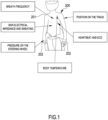
- the following magnitudes to be sensed were selected: breathing rate, heart rate and ECG, electric impedance of the skin and perspiration, pressure on the driving wheel, as shown in Figure 1 .
- the position on the track is advantageously sensed by a GPS technique.
- the telemetry system (generally shown in Figures from 1 to 5) comprises a wearable part 200 having two parts formed by a underwear/(possibly fireproof) undershirt 201 and two gloves 202, suitably instrumented by miniaturized devices for not interfering with the normal activities of the driver.
- Breathing rate measuring the number of breathing acts in a determined time range (breathing rate) is performed by piezoelectric wearable sensors 101, inserted in a thoracic band sewn in the internal part of the underwear 201.
- Heart rate and ECG the heart rate is measured by an optical heart beat sensor 102 (Pulse Sensor Amped), using the photoplethysmography technique (PPG) or similar.
- the sensor 102 must be placed in the body most vascularized parts.
- the ECG is sensed by using a sensor provided with textile electrodes 106, sewn inside the fireproof underwear 201, and tightly positioned against the driver breast.
- the breathing rate can be estimated by the heart rate.
- Electric impedance of the skin and perspiration sensing the electric impedance of the skin and perspiration is performed by measuring the Galvanic Skin Response (GSR) defined as a change of the electric properties of this latter due to events generating stress and/or perspiration.
- GSR Galvanic Skin Response
- the small-sized sensor GSR 103 can be inserted in the cuffs of the driver underwear 201.
- the Galvanic Skin Response (GSR), defined as one among several electrodermal responses, represents the measurement of continuous variations of the electric characteristics of the skin, e.g. the conductance, caused by a perspiration variation of the human body.
- GSR Galvanic Skin Response
- the traditional assumption regarding the GSR analysis is based on the hypothesis that the skin resistance varies as a function of the skin sweat glands.
- the human body perspiration is adjusted by the Autonomous Nervous System (ANS); particularly, when the sympathetic branch (SNS) of the autonomous nervous system is highly energized, consequently the activity of the skin sweat glands increases, which in turn increases the skin conductance, and viceversa. So, the skin conductance can be a measure of the Sympathetic Nervous System responses. This system, in the human beings, is directly implied in the adjustment of the emotional behavior.
- the human skin is a good electric conductor and when a low electric current is supplied to the skin, conductivity changes can be measured.
- the conductance is characterized by two components: tonic and phasic.
- the tonic component is the cause of the slow variation of the GSR signal (from tenths of seconds to minutes) in a GSR signal, the tonic level is generally considered the background activity level, at the top of which rapid GSR responses appear.
- the tonic level represents the absolute value of the skin electric resistance and is an index of the general activation state of the nervous system of an organism. It is higher if a person is at rest, and relaxed, on the contrary if the person is tired and nervous, it increases the skin perspiration and lowers the skin electric resistance.
- the phasic component is the cause of relatively rapid variations of the GSR signal (in the order of seconds) known as skin conductance responses and represent the rapid fluctuations or peaks which are observed in a GSR signal, caused by a purely emotional and sensory activity. According to the present description, at least the phasic component is provided.
- Pressure exerted on the driving wheel the grip on the driving wheel is detected by inserting inside the driver's gloves 202, on the hand palm and fingers, several pressure sensors 104 of the extensometric type, o similar.
- Position in the track the position of the car in a track is detected by a GPS module, having an acquisition frequency of at least 30 Hz, and inserted inside the suit or in the passenger compartment.
- Body temperature measuring the body temperature by wearable devices can be performed in many different ways. It is provided a digital temperature sensor 105, suitably fixed to the underwear 201 by a thermal shield against the external heat flows, which enables to obtain skin temperature measurements from voltage variations.
- the system is configured to provide, besides an absolute magnitude of the perspiration, the integrated detection of the electrolysis and glycolysis, in order to gain an adapted determination of food integrations required for the activity object of the detection.
- the system can be provided with an apparatus for detecting and monitoring the glucose.
- CGM Continuous Glucose Monitoring
- CGM sensors are for example marketed by Dexcom, Medtronic, Abbot, Senseonics.
- a physical activity related to the use of skeletal muscles, requires an energy input greater than the one required to a human being at rest.
- an aerobic physical activity an activity entailing repeated continuous movements with a medium-low contraction rate of the muscular fibers, such as for example in the long-distance races
- anaerobic physical activity a very intense activity, characterized by a high contraction rate of the muscle fibers, such as for example in the motorsport races.
- the blood glycemia levels do not change even though the energy consumption of the muscles can substantially increase.
- the glycemia level of a motorsport driver was recorded during a race trial. It was observed that the basal glucose level, during such recording, was already below the nominal value. Drinking a fruit juice before the race led to a glycemia increase sufficient to compensate the glucose concentration loss during the race, in this way a too low glycemia level was prevented.
- measuring the glucose level is also correlated to an energy consumption in the presence of an anaerobic metabolism.
- the energy is provided by a fat-carbohydrates mixture.
- ATP Addenosine Triphosphate
- storage sugar glycogen
- all the sensors 101-106 are connected, by wire and/or wireless, to a pre-processing-transmission electronic card 300 comprising a signal conditioning module 301 and a converting module 302 performing an analog/digital conversion of the conditioned signals.
- the pre-processing-transmission electronic card 300 comprises a transmission module 303 (a radio frequency and long-distance, and/or a Bluetooth module) configured to transmit the sensor signals in a digital format outside the electronic card 300 itself.
- a transmission module 303 a radio frequency and long-distance, and/or a Bluetooth module
- the electronic card 300 can comprise or can be connected to a suitable storing device enabling to download data when the vehicle returns to the pits.
- the system is connected to a suitable GPS for data positioning on the circuit.
- the pre-processing-transmission electronic card 300 is for example placed inside a pocket made in the suit 201 and it such to deliver digital-format sensor data to a receiving-interface card 310 comprising a receiving module 304 (long-distance RF module, for example) and an interface card 305 with an electronic computer, such as for example a personal computer 306.
- a receiving-interface card 310 comprising a receiving module 304 (long-distance RF module, for example) and an interface card 305 with an electronic computer, such as for example a personal computer 306.
- the transmitted signals are acquired by a radio-frequency receiving module 304 (connected to the personal computer 306).
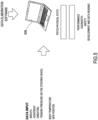
- the system comprises a screen-displaying software ( Figure 5 ) for showing the obtained data.
- a procedure of correlating performances to the psychophysical condition of the driver in different situations/states which can be occur in a driving session was developed from the method of acquiring human-inboard telemetry data ( Figure 5 ) .
- the stress is evaluated by calculating a weighed average of at least the following parameters: a perspiration parameter, a heart parameter, a parameter regarding the pressure exerted on the driving wheel and, for example, also a breathing parameter.
- the stress is evaluated by taking into account into the above cited weighed average of a perspiration parameter representing the phasic component of the signal GSR, obtained from the signal provided by the sensor GSR 103.
- such weighed average takes into account also the parameter regarding the glucose.
- batteries e.g. rechargeable LiPo batteries
- supplying the present sensors and devices are placed inside the suit 201 or car.
Landscapes
- Health & Medical Sciences (AREA)
- Life Sciences & Earth Sciences (AREA)
- Engineering & Computer Science (AREA)
- Physics & Mathematics (AREA)
- Medical Informatics (AREA)
- Animal Behavior & Ethology (AREA)
- Biomedical Technology (AREA)
- Heart & Thoracic Surgery (AREA)
- Biophysics (AREA)
- Molecular Biology (AREA)
- Surgery (AREA)
- Pathology (AREA)
- General Health & Medical Sciences (AREA)
- Public Health (AREA)
- Veterinary Medicine (AREA)
- Physiology (AREA)
- Cardiology (AREA)
- Pulmonology (AREA)
- Dermatology (AREA)
- Psychiatry (AREA)
- Developmental Disabilities (AREA)
- Psychology (AREA)
- Social Psychology (AREA)
- Hospice & Palliative Care (AREA)
- Educational Technology (AREA)
- Child & Adolescent Psychology (AREA)
- Radar, Positioning & Navigation (AREA)
- Transportation (AREA)
- Radiology & Medical Imaging (AREA)
- Computer Networks & Wireless Communication (AREA)
- Mechanical Engineering (AREA)
- Dentistry (AREA)
- Oral & Maxillofacial Surgery (AREA)
- Automation & Control Theory (AREA)
- Mathematical Physics (AREA)
- Nuclear Medicine, Radiotherapy & Molecular Imaging (AREA)
- Physical Education & Sports Medicine (AREA)
- Measuring Pulse, Heart Rate, Blood Pressure Or Blood Flow (AREA)
- Measuring And Recording Apparatus For Diagnosis (AREA)
- Measurement Of The Respiration, Hearing Ability, Form, And Blood Characteristics Of Living Organisms (AREA)
Description
- The present invention refers to the field of the human telemetry.
- The human telemetry, in the context of sport competitions, is a relatively new discipline, grown in the more general field for remotely measuring physical magnitudes regarding human activities. Particularly, with reference to car racing, it is related to the way of acquiring, storing, and remotely transmitting biomechanical parameters of a driver, which can be related to his/her psychophysical condition, in order to obtain useful information regarding his/her behavior, diagnostics, and safety.
- Katsis C. D. et al. in "Toward Emotion recognition in Car-Racing Drivers: biosignal Processing approach", IEE Transactions on Systems, Man and Cybernetics. Part A: Systems and Humans, IEEE Service Center, Piscataway, NJ, US, vol. 38, no. 3; 01/05/2008, pages 502-512, XP011226354, describes a system for estimating an emotional condition of a driver in a car race. LENG H. et al. in "An Experimental Study on Physiological Parameters Toward Driver Emotion Recognition", 22/07/2007, ARXIV.ORG, PAGE(S) 237 - 246, XP019064062, describes systems for estimating the emotional condition of a driver and highlights that gripping force is a pertinent parameter to monitor driver's stress.
- Document
EP-A-3015055 describes a system for monitoring psychological parameters of a vehicle driver. - The Applicant has observed that the known type human telemetry systems applied to vehicle drivers are not satisfying in determining the psychophysical condition of the driver.
- The object of this invention consists of providing an improved "wearable" human telemetry system overcoming the disadvantages of the prior art.
- The invention can be applied to the automotive field from the racing to the safety areas.
- One of the main uses of the system consists of monitoring the physical parameters of a motorsport driver when he/she trains or races. A further application in the safety optics of the system could be related to a widespread use of such system in the driver training centers.
- Moreover, the invention comprises, according to an example, an analytical-numerical study about the obtained experimental results, useful to correlate the acquired data by wearable sensors to the data from the inboard standard telemetry. Based on such study, it will be possible to optimize the driver behavior under different driving conditions and to better estimate the racing strategies, by considering both the present conditions of the driver and the mechanical performance of the vehicle.
- By a preliminary analysis about the driver parameters which are more related to his/her psychophysical conditions, the following magnitudes to be sensed were selected: breathing rate, heart rate and ECG, electric impedance of the skin and perspiration, pressure on the driving wheel, as shown in
Figure 1 . In addition, the position on the track is advantageously sensed by a GPS technique. - It is an object of the invention a system for the integrated/functional detection of a plurality of measurements as defined in claim 1 and by preferred embodiments thereof, defined in the dependent claims.
- The constructive and operative characteristics of the invention could be better understood from the following detailed description, in which it is made reference to the attached drawings representing some preferred non-limiting embodiments thereof, wherein:
-
Figure 1 illustratively shows the telemetry system according to the invention and shows the parameters obtainable by the system itself; -
Figure 2 illustratively shows a plurality of sensors used by the telemetry system; -
Figure 3 illustratively shows a circuit for processing and transmitting signals from the sensors; -
Figure 4 illustratively shows a receiver and a Personal Computer adapted to receive the parameters transmitted by the processing and transmitting circuit; -
Figure 5 schematically shows the correlation processing of the detectable parameters. - The telemetry system (generally shown in Figures from 1 to 5) comprises a
wearable part 200 having two parts formed by a underwear/(possibly fireproof)undershirt 201 and twogloves 202, suitably instrumented by miniaturized devices for not interfering with the normal activities of the driver. - Referring particularly to
Figures 1 and2 , the selection of the sensors used for the telemetry systems is explained. - Breathing rate: measuring the number of breathing acts in a determined time range (breathing rate) is performed by piezoelectric
wearable sensors 101, inserted in a thoracic band sewn in the internal part of theunderwear 201. - Heart rate and ECG: the heart rate is measured by an optical heart beat sensor 102 (Pulse Sensor Amped), using the photoplethysmography technique (PPG) or similar. The
sensor 102 must be placed in the body most vascularized parts. The ECG is sensed by using a sensor provided withtextile electrodes 106, sewn inside thefireproof underwear 201, and tightly positioned against the driver breast. - It is observed that the breathing rate can be estimated by the heart rate.
- Electric impedance of the skin and perspiration: sensing the electric impedance of the skin and perspiration is performed by measuring the Galvanic Skin Response (GSR) defined as a change of the electric properties of this latter due to events generating stress and/or perspiration. The small-sized sensor GSR 103 can be inserted in the cuffs of the
driver underwear 201. - The Galvanic Skin Response (GSR), defined as one among several electrodermal responses, represents the measurement of continuous variations of the electric characteristics of the skin, e.g. the conductance, caused by a perspiration variation of the human body. The traditional assumption regarding the GSR analysis is based on the hypothesis that the skin resistance varies as a function of the skin sweat glands. The human body perspiration is adjusted by the Autonomous Nervous System (ANS); particularly, when the sympathetic branch (SNS) of the autonomous nervous system is highly energized, consequently the activity of the skin sweat glands increases, which in turn increases the skin conductance, and viceversa. So, the skin conductance can be a measure of the Sympathetic Nervous System responses. This system, in the human beings, is directly implied in the adjustment of the emotional behavior.
- The human skin is a good electric conductor and when a low electric current is supplied to the skin, conductivity changes can be measured. The conductance is characterized by two components: tonic and phasic.
- The tonic component is the cause of the slow variation of the GSR signal (from tenths of seconds to minutes) in a GSR signal, the tonic level is generally considered the background activity level, at the top of which rapid GSR responses appear. The tonic level represents the absolute value of the skin electric resistance and is an index of the general activation state of the nervous system of an organism. It is higher if a person is at rest, and relaxed, on the contrary if the person is tired and nervous, it increases the skin perspiration and lowers the skin electric resistance.
- The phasic component is the cause of relatively rapid variations of the GSR signal (in the order of seconds) known as skin conductance responses and represent the rapid fluctuations or peaks which are observed in a GSR signal, caused by a purely emotional and sensory activity. According to the present description, at least the phasic component is provided.
- Pressure exerted on the driving wheel: the grip on the driving wheel is detected by inserting inside the driver's
gloves 202, on the hand palm and fingers,several pressure sensors 104 of the extensometric type, o similar. - Position in the track: the position of the car in a track is detected by a GPS module, having an acquisition frequency of at least 30 Hz, and inserted inside the suit or in the passenger compartment.
- Body temperature: measuring the body temperature by wearable devices can be performed in many different ways. It is provided a
digital temperature sensor 105, suitably fixed to theunderwear 201 by a thermal shield against the external heat flows, which enables to obtain skin temperature measurements from voltage variations. - Moreover, according to an example, the system is configured to provide, besides an absolute magnitude of the perspiration, the integrated detection of the electrolysis and glycolysis, in order to gain an adapted determination of food integrations required for the activity object of the detection.
- Particularly, the system can be provided with an apparatus for detecting and monitoring the glucose.
- Wearable devices for measuring in a semi-continuous way the glucose concentration (Continuous Glucose Monitoring, CGM) are known. Particularly, the CGM devices are classified in mini-invasive devices and non-invasive devices (still under experimentation).
- The mini-invasive devices now on the market use a small needle, usually inserted in the subcutaneous tissue, for measuring an electric current signal proportional to the glucose concentration available in the interstitial liquid. CGM sensors are for example marketed by Dexcom, Medtronic, Abbot, Senseonics.
- It is observed that a physical activity, related to the use of skeletal muscles, requires an energy input greater than the one required to a human being at rest. However, it is required to distinguish among: an aerobic physical activity: an activity entailing repeated continuous movements with a medium-low contraction rate of the muscular fibers, such as for example in the long-distance races,
anaerobic physical activity: a very intense activity, characterized by a high contraction rate of the muscle fibers, such as for example in the motorsport races. - In the aerobic physical activity, the blood glycemia levels do not change even though the energy consumption of the muscles can substantially increase.
- In the anaerobic activity, there is the anaerobic glycolysis, in other words a fast energy production without oxygen, because the epinephrine has an important role. The result is a hypoglycemic effect, since the amount of glucose released to the muscle cells is increased and the amount released to the blood is correspondingly reduced. If the basal glycemia levels immediately before the race trials are too low, probably the driver will be possibly subjected to a hypoglycemic fit.
- For example, in an experimental test, the glycemia level of a motorsport driver was recorded during a race trial. It was observed that the basal glucose level, during such recording, was already below the nominal value. Drinking a fruit juice before the race led to a glycemia increase sufficient to compensate the glucose concentration loss during the race, in this way a too low glycemia level was prevented.
- It is also observed that measuring the glucose level is also correlated to an energy consumption in the presence of an anaerobic metabolism. Generally, the energy is provided by a fat-carbohydrates mixture. However, in an anaerobic sporting activity, it is triggered a process of producing energy as ATP (Adenosine Triphosphate) obtained by substantially using storage sugar (glycogen) which is mainly found in muscles and liver. This information and the heart rate enable to evaluate, by tables, the used energy substrate.
- With reference to
Figure 3 , all the sensors 101-106 (and possibly the glucose sensor) are connected, by wire and/or wireless, to a pre-processing-transmissionelectronic card 300 comprising asignal conditioning module 301 and a convertingmodule 302 performing an analog/digital conversion of the conditioned signals. - Moreover, the pre-processing-transmission
electronic card 300 comprises a transmission module 303 (a radio frequency and long-distance, and/or a Bluetooth module) configured to transmit the sensor signals in a digital format outside theelectronic card 300 itself. As an alternative to thetransmission module 303 or in addition to it, theelectronic card 300 can comprise or can be connected to a suitable storing device enabling to download data when the vehicle returns to the pits. - Advantageously, the system is connected to a suitable GPS for data positioning on the circuit.
- The pre-processing-transmission
electronic card 300 is for example placed inside a pocket made in thesuit 201 and it such to deliver digital-format sensor data to a receiving-interface card 310 comprising a receiving module 304 (long-distance RF module, for example) and aninterface card 305 with an electronic computer, such as for example apersonal computer 306. - The transmitted signals are acquired by a radio-frequency receiving module 304 (connected to the personal computer 306).
- The system comprises a screen-displaying software (
Figure 5 ) for showing the obtained data. A procedure of correlating performances to the psychophysical condition of the driver in different situations/states which can be occur in a driving session was developed from the method of acquiring human-inboard telemetry data (Figure 5 ) . - Particularly, it is possible to associate performances and driver psychophysical condition to the positions thereof along the path or circuit followed by the vehicle during the described parameter detection.
- Particularly, the stress is evaluated by calculating a weighed average of at least the following parameters: a perspiration parameter, a heart parameter, a parameter regarding the pressure exerted on the driving wheel and, for example, also a breathing parameter. Advantageously, the stress is evaluated by taking into account into the above cited weighed average of a perspiration parameter representing the phasic component of the signal GSR, obtained from the signal provided by the
sensor GSR 103. Moreover, such weighed average takes into account also the parameter regarding the glucose. - Lastly, batteries (e.g. rechargeable LiPo batteries) required for supplying the present sensors and devices are placed inside the
suit 201 or car.
Claims (12)
- System for the integrated/functional detection of a plurality of measurements, the system comprising:a) a part (200) wearable by a driver of a vehicle;b) a plurality of sensors (101-106) integrated in the wearable part (200), and configured to supply the following driver parameters: breathing parameters, heart parameters, perspiration parameters and of the pressure exerted on the vehicle driving wheel;c) a processor (306) configured to process said driver parameters and to correlate them to a psychophysical condition of the driver.
- System according to claim 1, wherein said driver wearable part (200) consists of an undershirt/underwear (201) and of two gloves (202).
- System according to at least claim 2, wherein the plurality of sensors comprises:a breathing rate sensor (101) inserted in a thoracic band sewn in the internal part of the underwear (201);a heart rate sensor (102) of the heart rate optical type, using for example the photoplethysmography technique;an ECG sensor (106) with textile electrodes sewn inside the underwear (201).
- System according to at least claim 2, wherein the plurality of sensors comprises a sensor (103) for detecting the electric impedance of the skin and perspiration by measuring the galvanic response of the driver skin (GSR).
- System according to at least claim 2, wherein the plurality of sensors (204) comprise a plurality of pressure sensors inserted inside said gloves (202) on the palm and fingers of the driver hand.
- System according to at least claim 2, further comprising at least one digital-type body temperature sensor (105) fixed to the underwear (201) with a thermal shield against external heat flows in order to enable to obtain measurements about the skin temperature from voltage variations.
- System according to at least claim 2, further comprising a GPS module inserted inside or outside the undershirt/underwear (201).
- System according to claim 7, further comprising a software module for processing driver parameters, a position provided by the GPS and data of a in-board standard telemetry for comprehending the conditions, psychophysical reactions, under different conditions/situations which can occur during the performed activities, such as training, tests, qualification tenders, races.
- System according to at least claim 4, configured to provide, besides an absolute magnitude of the perspiration, the integrated detection of the electrolysis and glycolysis in order to suitably determine food integrations required for the activities to be detected.
- System according to claim 1, further comprising:• a circuit (301) for conditioning signals, connected to the plurality of sensors (101-106);• an analog/digital converter (302) connected to the conditioning circuit (301);• a transmitter (303) connected to the analog/digital converter (302) of the Bluetooth/radiofrequency (RF) type;• a receiver (304) for receiving signals from the transmitter (303);• a computer interface (305) connected to the receiver (304), and whereind) the processor (306) is such to process said driver parameters and to provide a driver stress index indicative of his/her psychophysical condition,
- System according to claim 10, wherein the processor is configured to calculate the driver stress index by processing said driver parameters according to a weighted average.
- System according to claim 4 and to claim 10, wherein the perspiration parameter considers the phasic component associated to said skin galvanic response.
Applications Claiming Priority (2)
| Application Number | Priority Date | Filing Date | Title |
|---|---|---|---|
| IT102017000132925A IT201700132925A1 (en) | 2018-03-09 | 2018-03-09 | INTEGRATED TELEMETRY SYSTEM |
| PCT/IB2019/051841 WO2019171314A1 (en) | 2018-03-09 | 2019-03-07 | Telemetry integrated system |
Publications (3)
| Publication Number | Publication Date |
|---|---|
| EP3761875A1 EP3761875A1 (en) | 2021-01-13 |
| EP3761875C0 EP3761875C0 (en) | 2023-06-07 |
| EP3761875B1 true EP3761875B1 (en) | 2023-06-07 |
Family
ID=62952195
Family Applications (1)
| Application Number | Title | Priority Date | Filing Date |
|---|---|---|---|
| EP19715991.6A Active EP3761875B1 (en) | 2018-03-09 | 2019-03-07 | Telemetry integrated system |
Country Status (8)
| Country | Link |
|---|---|
| US (1) | US11259731B2 (en) |
| EP (1) | EP3761875B1 (en) |
| JP (1) | JP7384841B2 (en) |
| CN (1) | CN112153941B (en) |
| ES (1) | ES2957315T3 (en) |
| IT (1) | IT201700132925A1 (en) |
| PL (1) | PL3761875T3 (en) |
| WO (1) | WO2019171314A1 (en) |
Families Citing this family (2)
| Publication number | Priority date | Publication date | Assignee | Title |
|---|---|---|---|---|
| CN111759322A (en) * | 2020-06-22 | 2020-10-13 | 广东职业技术学院 | Blood sugar real-time monitoring intelligent clothing system based on CGM system |
| DE102024118743A1 (en) | 2024-07-02 | 2026-01-08 | Dr. Ing. H.C. F. Porsche Aktiengesellschaft | Device and method for optimizing a vehicle's driving line, particularly on a race track, the device comprising a vehicle |
Family Cites Families (25)
| Publication number | Priority date | Publication date | Assignee | Title |
|---|---|---|---|---|
| US6016103A (en) * | 1997-09-25 | 2000-01-18 | Leavitt; Larry | Sleep-detecting driving gloves |
| KR20070089213A (en) * | 2004-12-01 | 2007-08-30 | 코닌클리케 필립스 일렉트로닉스 엔.브이. | Interactive application for cycling and other sports on television |
| KR20060066822A (en) * | 2004-12-14 | 2006-06-19 | 현대자동차주식회사 | Driver's bio-monitoring self-monitoring and feedback system |
| US20070028370A1 (en) * | 2005-04-29 | 2007-02-08 | Jarrett Seng | Driver and safety personnel protection apparatus, system and method |
| ITBO20070002A1 (en) * | 2007-01-04 | 2008-07-05 | Ferrari Spa | METHOD AND UNIT OF CONTROL IN FOCUS ON A SERVOCANDED SYSTEM THAT INFLUENCES THE PSYCHO-PHYSICAL STATE OF A USER |
| CN102281816B (en) * | 2008-11-20 | 2015-01-07 | 人体媒介公司 | Method and apparatus for determining critical care parameters |
| CN202010160U (en) * | 2010-09-20 | 2011-10-19 | 天津职业技术师范大学 | Driver fatigue monitoring device based on holding power applied to and temperature of steering wheel |
| US8593251B2 (en) * | 2011-06-16 | 2013-11-26 | Alan Camerik Heller | Systems for detecting a febrile condition and reducing risks of spreading infection |
| US20130325202A1 (en) * | 2012-06-01 | 2013-12-05 | GM Global Technology Operations LLC | Neuro-cognitive driver state processing |
| BR112015006242A2 (en) * | 2012-09-21 | 2017-07-04 | Proteus Digital Health Inc | wireless wearable device, system and method |
| SE537865C2 (en) * | 2012-09-24 | 2015-11-03 | Scania Cv Ab | Method, measuring device and control unit for adapting one-gearbox system |
| US20150313475A1 (en) * | 2012-11-27 | 2015-11-05 | Faurecia Automotive Seating, Llc | Vehicle seat with integrated sensors |
| CN106413547B (en) * | 2014-03-10 | 2020-09-15 | 立芙公司 | Physiological monitoring garment |
| US9759803B2 (en) * | 2014-06-06 | 2017-09-12 | Zih Corp. | Method, apparatus, and computer program product for employing a spatial association model in a real time location system |
| WO2016061362A2 (en) * | 2014-10-15 | 2016-04-21 | Eccrine Systems, Inc. | Sweat sensing device communication security and compliance |
| EP3015055A1 (en) * | 2014-10-30 | 2016-05-04 | Comftech S.r.L. | System for monitoring a driver |
| KR102484148B1 (en) * | 2015-06-03 | 2023-01-03 | 클리어모션, 아이엔씨. | Methods and systems for controlling vehicle body motion and occupant experience |
| US20170153636A1 (en) * | 2015-11-27 | 2017-06-01 | Bragi GmbH | Vehicle with wearable integration or communication |
| US9610476B1 (en) * | 2016-05-02 | 2017-04-04 | Bao Tran | Smart sport device |
| CN205674871U (en) * | 2016-06-17 | 2016-11-09 | 付伟豪 | A kind of driver safety protection system |
| US20180082501A1 (en) * | 2016-09-16 | 2018-03-22 | Ford Global Technologies, Llc | Integrated on-board data collection |
| US10694857B2 (en) * | 2017-04-10 | 2020-06-30 | Nike, Inc. | Sport chair with game integration |
| CN107307870A (en) * | 2017-05-24 | 2017-11-03 | 丹阳慧创医疗设备有限公司 | A kind of driving condition brain monitoring system and method based near infrared spectrum |
| CN111492327A (en) * | 2017-11-07 | 2020-08-04 | 多特布利斯有限责任公司 | Electronic garment with tactile feedback |
| US10482726B2 (en) * | 2017-11-13 | 2019-11-19 | Zebra Technologies Corporation | Methods, systems, and apparatus for bi-directional communication with wearable location devices |
-
2018
- 2018-03-09 IT IT102017000132925A patent/IT201700132925A1/en unknown
-
2019
- 2019-03-07 PL PL19715991.6T patent/PL3761875T3/en unknown
- 2019-03-07 EP EP19715991.6A patent/EP3761875B1/en active Active
- 2019-03-07 WO PCT/IB2019/051841 patent/WO2019171314A1/en not_active Ceased
- 2019-03-07 CN CN201980018042.9A patent/CN112153941B/en active Active
- 2019-03-07 JP JP2020570659A patent/JP7384841B2/en active Active
- 2019-03-07 US US16/971,121 patent/US11259731B2/en active Active
- 2019-03-07 ES ES19715991T patent/ES2957315T3/en active Active
Non-Patent Citations (1)
| Title |
|---|
| LENG H ET AL: "An Experimental Study on Physiological Parameters Toward Driver Emotion Recognition", 22 July 2007, ARXIV.ORG, CORNELL UNIVERSITY LIBRARY, 201 OLIN LIBRARY CORNELL UNIVERSITY ITHACA, NY 14853, PAGE(S) 237 - 246, XP019064062 * |
Also Published As
| Publication number | Publication date |
|---|---|
| WO2019171314A1 (en) | 2019-09-12 |
| US11259731B2 (en) | 2022-03-01 |
| CN112153941A (en) | 2020-12-29 |
| US20210093242A1 (en) | 2021-04-01 |
| PL3761875T4 (en) | 2023-10-23 |
| IT201700132925A1 (en) | 2019-09-09 |
| EP3761875C0 (en) | 2023-06-07 |
| JP2021516598A (en) | 2021-07-08 |
| ES2957315T3 (en) | 2024-01-17 |
| PL3761875T3 (en) | 2023-10-23 |
| JP7384841B2 (en) | 2023-11-21 |
| EP3761875A1 (en) | 2021-01-13 |
| CN112153941B (en) | 2024-09-27 |
Similar Documents
| Publication | Publication Date | Title |
|---|---|---|
| EP3679516B1 (en) | Wearable authentication device | |
| Parak et al. | Evaluation of wearable consumer heart rate monitors based on photopletysmography | |
| Mahmud et al. | An integrated wearable sensor for unobtrusive continuous measurement of autonomic nervous system | |
| CN102281816B (en) | Method and apparatus for determining critical care parameters | |
| RU2330607C2 (en) | Methods and device for consciousness monitoring | |
| EP3370605B1 (en) | Energy efficient system and method for physiological monitoring | |
| EP2042083A2 (en) | Necklace type of detector for electrocardiographic and temperature information | |
| Seeberg et al. | A novel method for continuous, noninvasive, cuff-less measurement of blood pressure: evaluation in patients with nonalcoholic fatty liver disease | |
| JP2017536946A (en) | Device and method for determining consciousness state | |
| EP3761875B1 (en) | Telemetry integrated system | |
| Vinetti et al. | The current use of wearable sensors to enhance safety and performance in breath-hold diving: A systematic review | |
| Haddad et al. | Beat-to-beat detection accuracy using the ultra low power senbiosys PPG sensor | |
| JP3624544B2 (en) | Drinking monitor | |
| Pernice et al. | Minimally invasive assessment of mental stress based on wearable wireless physiological sensors and multivariate biosignal processing | |
| JP3048918B2 (en) | Concentration estimation device | |
| Kumar et al. | Evaluation of the accuracy of Astroskin as a behavioral health self-monitoring system for spaceflight | |
| US20240350053A1 (en) | A device for tracking the mindfulness of a user and a method thereof | |
| KR20170136083A (en) | Coaching System using of Bioelectric Signal | |
| EP3288457B1 (en) | Positioning a medical device based on oxygen saturation measurements | |
| Tomasic et al. | Smart wireless sensor for physiological monitoring. | |
| GB2605351A (en) | System and method for monitoring muscle performance and providing real-time dynamic advice | |
| US12232854B2 (en) | Oral ECG device | |
| Peter et al. | Determination of Blood Vessels Expandability; Multichannel Photoplethysmography | |
| Kapp et al. | Evaluation of environmental effects on the measurement of electrodermal activity under real-life conditions | |
| KR20250096916A (en) | Bio Signal Detector Apparatus for Smart Health Care |
Legal Events
| Date | Code | Title | Description |
|---|---|---|---|
| STAA | Information on the status of an ep patent application or granted ep patent |
Free format text: STATUS: UNKNOWN |
|
| STAA | Information on the status of an ep patent application or granted ep patent |
Free format text: STATUS: THE INTERNATIONAL PUBLICATION HAS BEEN MADE |
|
| PUAI | Public reference made under article 153(3) epc to a published international application that has entered the european phase |
Free format text: ORIGINAL CODE: 0009012 |
|
| STAA | Information on the status of an ep patent application or granted ep patent |
Free format text: STATUS: REQUEST FOR EXAMINATION WAS MADE |
|
| 17P | Request for examination filed |
Effective date: 20201009 |
|
| AK | Designated contracting states |
Kind code of ref document: A1 Designated state(s): AL AT BE BG CH CY CZ DE DK EE ES FI FR GB GR HR HU IE IS IT LI LT LU LV MC MK MT NL NO PL PT RO RS SE SI SK SM TR |
|
| AX | Request for extension of the european patent |
Extension state: BA ME |
|
| DAV | Request for validation of the european patent (deleted) | ||
| DAX | Request for extension of the european patent (deleted) | ||
| GRAP | Despatch of communication of intention to grant a patent |
Free format text: ORIGINAL CODE: EPIDOSNIGR1 |
|
| STAA | Information on the status of an ep patent application or granted ep patent |
Free format text: STATUS: GRANT OF PATENT IS INTENDED |
|
| INTG | Intention to grant announced |
Effective date: 20221102 |
|
| GRAS | Grant fee paid |
Free format text: ORIGINAL CODE: EPIDOSNIGR3 |
|
| GRAA | (expected) grant |
Free format text: ORIGINAL CODE: 0009210 |
|
| STAA | Information on the status of an ep patent application or granted ep patent |
Free format text: STATUS: THE PATENT HAS BEEN GRANTED |
|
| AK | Designated contracting states |
Kind code of ref document: B1 Designated state(s): AL AT BE BG CH CY CZ DE DK EE ES FI FR GB GR HR HU IE IS IT LI LT LU LV MC MK MT NL NO PL PT RO RS SE SI SK SM TR |
|
| REG | Reference to a national code |
Ref country code: GB Ref legal event code: FG4D |
|
| REG | Reference to a national code |
Ref country code: CH Ref legal event code: EP Ref country code: AT Ref legal event code: REF Ref document number: 1572365 Country of ref document: AT Kind code of ref document: T Effective date: 20230615 |
|
| REG | Reference to a national code |
Ref country code: DE Ref legal event code: R096 Ref document number: 602019030135 Country of ref document: DE |
|
| U01 | Request for unitary effect filed |
Effective date: 20230705 |
|
| U07 | Unitary effect registered |
Designated state(s): AT BE BG DE DK EE FI FR IT LT LU LV MT NL PT SE SI Effective date: 20230717 |
|
| REG | Reference to a national code |
Ref country code: LT Ref legal event code: MG9D |
|
| PG25 | Lapsed in a contracting state [announced via postgrant information from national office to epo] |
Ref country code: NO Free format text: LAPSE BECAUSE OF FAILURE TO SUBMIT A TRANSLATION OF THE DESCRIPTION OR TO PAY THE FEE WITHIN THE PRESCRIBED TIME-LIMIT Effective date: 20230907 |
|
| PG25 | Lapsed in a contracting state [announced via postgrant information from national office to epo] |
Ref country code: RS Free format text: LAPSE BECAUSE OF FAILURE TO SUBMIT A TRANSLATION OF THE DESCRIPTION OR TO PAY THE FEE WITHIN THE PRESCRIBED TIME-LIMIT Effective date: 20230607 Ref country code: HR Free format text: LAPSE BECAUSE OF FAILURE TO SUBMIT A TRANSLATION OF THE DESCRIPTION OR TO PAY THE FEE WITHIN THE PRESCRIBED TIME-LIMIT Effective date: 20230607 Ref country code: GR Free format text: LAPSE BECAUSE OF FAILURE TO SUBMIT A TRANSLATION OF THE DESCRIPTION OR TO PAY THE FEE WITHIN THE PRESCRIBED TIME-LIMIT Effective date: 20230908 |
|
| U1N | Appointed representative for the unitary patent procedure changed after the registration of the unitary effect |
Representative=s name: PRAXI INTELLECTUAL PROPERTY MILANO; IT |
|
| PG25 | Lapsed in a contracting state [announced via postgrant information from national office to epo] |
Ref country code: SK Free format text: LAPSE BECAUSE OF FAILURE TO SUBMIT A TRANSLATION OF THE DESCRIPTION OR TO PAY THE FEE WITHIN THE PRESCRIBED TIME-LIMIT Effective date: 20230607 |
|
| REG | Reference to a national code |
Ref country code: ES Ref legal event code: FG2A Ref document number: 2957315 Country of ref document: ES Kind code of ref document: T3 Effective date: 20240117 |
|
| PG25 | Lapsed in a contracting state [announced via postgrant information from national office to epo] |
Ref country code: IS Free format text: LAPSE BECAUSE OF FAILURE TO SUBMIT A TRANSLATION OF THE DESCRIPTION OR TO PAY THE FEE WITHIN THE PRESCRIBED TIME-LIMIT Effective date: 20231007 |
|
| PG25 | Lapsed in a contracting state [announced via postgrant information from national office to epo] |
Ref country code: SM Free format text: LAPSE BECAUSE OF FAILURE TO SUBMIT A TRANSLATION OF THE DESCRIPTION OR TO PAY THE FEE WITHIN THE PRESCRIBED TIME-LIMIT Effective date: 20230607 Ref country code: SK Free format text: LAPSE BECAUSE OF FAILURE TO SUBMIT A TRANSLATION OF THE DESCRIPTION OR TO PAY THE FEE WITHIN THE PRESCRIBED TIME-LIMIT Effective date: 20230607 Ref country code: RO Free format text: LAPSE BECAUSE OF FAILURE TO SUBMIT A TRANSLATION OF THE DESCRIPTION OR TO PAY THE FEE WITHIN THE PRESCRIBED TIME-LIMIT Effective date: 20230607 Ref country code: IS Free format text: LAPSE BECAUSE OF FAILURE TO SUBMIT A TRANSLATION OF THE DESCRIPTION OR TO PAY THE FEE WITHIN THE PRESCRIBED TIME-LIMIT Effective date: 20231007 Ref country code: CZ Free format text: LAPSE BECAUSE OF FAILURE TO SUBMIT A TRANSLATION OF THE DESCRIPTION OR TO PAY THE FEE WITHIN THE PRESCRIBED TIME-LIMIT Effective date: 20230607 |
|
| REG | Reference to a national code |
Ref country code: DE Ref legal event code: R097 Ref document number: 602019030135 Country of ref document: DE |
|
| PLBE | No opposition filed within time limit |
Free format text: ORIGINAL CODE: 0009261 |
|
| STAA | Information on the status of an ep patent application or granted ep patent |
Free format text: STATUS: NO OPPOSITION FILED WITHIN TIME LIMIT |
|
| U20 | Renewal fee for the european patent with unitary effect paid |
Year of fee payment: 6 Effective date: 20240328 |
|
| 26N | No opposition filed |
Effective date: 20240308 |
|
| PGFP | Annual fee paid to national office [announced via postgrant information from national office to epo] |
Ref country code: TR Payment date: 20240306 Year of fee payment: 6 |
|
| PG25 | Lapsed in a contracting state [announced via postgrant information from national office to epo] |
Ref country code: MC Free format text: LAPSE BECAUSE OF FAILURE TO SUBMIT A TRANSLATION OF THE DESCRIPTION OR TO PAY THE FEE WITHIN THE PRESCRIBED TIME-LIMIT Effective date: 20230607 |
|
| PG25 | Lapsed in a contracting state [announced via postgrant information from national office to epo] |
Ref country code: MC Free format text: LAPSE BECAUSE OF FAILURE TO SUBMIT A TRANSLATION OF THE DESCRIPTION OR TO PAY THE FEE WITHIN THE PRESCRIBED TIME-LIMIT Effective date: 20230607 |
|
| PG25 | Lapsed in a contracting state [announced via postgrant information from national office to epo] |
Ref country code: IE Free format text: LAPSE BECAUSE OF NON-PAYMENT OF DUE FEES Effective date: 20240307 |
|
| PG25 | Lapsed in a contracting state [announced via postgrant information from national office to epo] |
Ref country code: IE Free format text: LAPSE BECAUSE OF NON-PAYMENT OF DUE FEES Effective date: 20240307 |
|
| U20 | Renewal fee for the european patent with unitary effect paid |
Year of fee payment: 7 Effective date: 20250328 |
|
| PGFP | Annual fee paid to national office [announced via postgrant information from national office to epo] |
Ref country code: ES Payment date: 20250401 Year of fee payment: 7 |
|
| PGFP | Annual fee paid to national office [announced via postgrant information from national office to epo] |
Ref country code: CH Payment date: 20250401 Year of fee payment: 7 |
|
| PG25 | Lapsed in a contracting state [announced via postgrant information from national office to epo] |
Ref country code: CY Free format text: LAPSE BECAUSE OF FAILURE TO SUBMIT A TRANSLATION OF THE DESCRIPTION OR TO PAY THE FEE WITHIN THE PRESCRIBED TIME-LIMIT; INVALID AB INITIO Effective date: 20190307 |
|
| PG25 | Lapsed in a contracting state [announced via postgrant information from national office to epo] |
Ref country code: HU Free format text: LAPSE BECAUSE OF FAILURE TO SUBMIT A TRANSLATION OF THE DESCRIPTION OR TO PAY THE FEE WITHIN THE PRESCRIBED TIME-LIMIT; INVALID AB INITIO Effective date: 20190307 |
|
| REG | Reference to a national code |
Ref country code: CH Ref legal event code: U11 Free format text: ST27 STATUS EVENT CODE: U-0-0-U10-U11 (AS PROVIDED BY THE NATIONAL OFFICE) Effective date: 20260401 |
|
| PGFP | Annual fee paid to national office [announced via postgrant information from national office to epo] |
Ref country code: GB Payment date: 20260330 Year of fee payment: 8 |
|
| PGFP | Annual fee paid to national office [announced via postgrant information from national office to epo] |
Ref country code: PL Payment date: 20260304 Year of fee payment: 8 |
|
| U20 | Renewal fee for the european patent with unitary effect paid |
Year of fee payment: 8 Effective date: 20260323 |