EP3761705A1 - Interference processing method, apparatus and system, and storage medium - Google Patents
Interference processing method, apparatus and system, and storage medium Download PDFInfo
- Publication number
- EP3761705A1 EP3761705A1 EP19811984.4A EP19811984A EP3761705A1 EP 3761705 A1 EP3761705 A1 EP 3761705A1 EP 19811984 A EP19811984 A EP 19811984A EP 3761705 A1 EP3761705 A1 EP 3761705A1
- Authority
- EP
- European Patent Office
- Prior art keywords
- cell
- boundary value
- downlink rsrp
- downlink
- interfered
- Prior art date
- Legal status (The legal status is an assumption and is not a legal conclusion. Google has not performed a legal analysis and makes no representation as to the accuracy of the status listed.)
- Granted
Links
Images




Classifications
-
- H—ELECTRICITY
- H04—ELECTRIC COMMUNICATION TECHNIQUE
- H04W—WIRELESS COMMUNICATION NETWORKS
- H04W36/00—Hand-off or reselection arrangements
- H04W36/16—Performing reselection for specific purposes
- H04W36/20—Performing reselection for specific purposes for optimising the interference level
-
- H—ELECTRICITY
- H04—ELECTRIC COMMUNICATION TECHNIQUE
- H04W—WIRELESS COMMUNICATION NETWORKS
- H04W36/00—Hand-off or reselection arrangements
- H04W36/0005—Control or signalling for completing the hand-off
- H04W36/0083—Determination of parameters used for hand-off, e.g. generation or modification of neighbour cell lists
- H04W36/00835—Determination of neighbour cell lists
-
- H—ELECTRICITY
- H04—ELECTRIC COMMUNICATION TECHNIQUE
- H04W—WIRELESS COMMUNICATION NETWORKS
- H04W36/00—Hand-off or reselection arrangements
- H04W36/0005—Control or signalling for completing the hand-off
- H04W36/0083—Determination of parameters used for hand-off, e.g. generation or modification of neighbour cell lists
- H04W36/00837—Determination of triggering parameters for hand-off
-
- H—ELECTRICITY
- H04—ELECTRIC COMMUNICATION TECHNIQUE
- H04W—WIRELESS COMMUNICATION NETWORKS
- H04W36/00—Hand-off or reselection arrangements
- H04W36/24—Reselection being triggered by specific parameters
- H04W36/30—Reselection being triggered by specific parameters by measured or perceived connection quality data
- H04W36/302—Reselection being triggered by specific parameters by measured or perceived connection quality data due to low signal strength
Definitions
- Embodiments of the present invention relate to the technical field of communication, for example, to an interference processing method, apparatus, system, and a storage medium.
- Inter-cell handover means that, when a mobile terminal enters another cell from one cell during a call, real-time control can be realized by a network, and the mobile station is handed in a certain channel for a new cell from the channel used by the original cell, ensuing an uninterrupted call.
- a common inter-cell handover method is to select neighboring cells according to the downlink signal quality of neighboring cells reported by a mobile terminal. A neighboring cell with better downlink signal quality is more easily selected as a preferential handover target. Even if there is a neighboring cell selection strategy based on load or neighboring cell priority or the like, a neighboring cell with better downlink quality is preferentially selected, from a filter result set, as a final handover target.
- this method can only ensure that the terminal is preferentially handed in a neighboring cell with low downlink interference.
- uplink signals will cause interference (such as in an atmospheric waveguide scene), and the existence of uplink interference will affect the call quality, so that the user experience is significantly reduced.
- an object of the embodiments of the present invention to provide an interference processing method, apparatus, system and storage medium, so as to solve the problem that the presence of uplink interference in the existing technology affects the call quality and significantly reduces the user experience.
- an interference processing method including steps of:
- an interference processing method applied to a first communication node including steps of:
- an interference processing apparatus including a memory, a processor, and a computer program stored in the memory and executable by the processor.
- the processor is configured to execute the computer program to perform the steps of the method according to the first aspect or the second aspect.
- a storage medium storing one or more programs executable by one or more processors to perform the steps of the method according to the first aspect or the second aspect.
- Embodiment one of the present invention provides an interference processing method, which is applied to a first communication node.
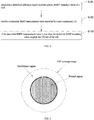
- the method includes steps S101, S102 and S103.
- a downlink reference signal received power (RSRP) boundary value of a cell is determined.
- step S102 a downlink RSRP measurement value reported by a user equipment (UE) is received.
- UE user equipment
- step S103 when the downlink RSRP measurement value is less than the downlink RSRP boundary value, the UE is migrated out of the cell.
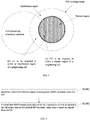
- FIG. 2 is a schematic diagram showing state of an uplink interfered cell.
- the cell coverage range in FIG. 2 refers to a range which can be covered by the signals in the cell, as indicated by an outer circle of a thin line in FIG. 2 .
- This cell is an interfered cell which consists of a "normal region” and an "interference region”.
- the normal region is indicated by a pattern-filled area shown in FIG. 2 .
- the cell can be basically considered as being under weak interference or interference-free, and a normal call quality can be ensured.
- the interference region is beyond the pattern-filled area shown in FIG. 2 and within the cell coverage range, that is, it is a region between the normal region of the interfered cell and the border of the interfered cell. This region is under relatively strong interference, and it is not recommended for mobile users to access this region. This is because the user perception is very poor even if the user accesses this region. Therefore, this region is an invalid part of the interfered cell.
- a base station when a base station identifies uplink interference by regular interference detection, the base station performs baseband anti-interference processing, notifies an interfered cell that it is subjected to uplink interference, and notifies the interfered cell of a noise interference (NI) power value.
- NI noise interference
- the interfered cell learns that it is an uplink interfered cell, to ensure the user perception, the interfered cell determines its own normal region and interference region, and timely migrates out a UE in the interference region (the user experience is poor in this region) through handover. Meanwhile, interaction may be performed with a surrounding neighboring cell to ensure that the neighboring cell enable a UE that is to be handed therein (now referred to as a local cell, to be handed in a normal region of the local cell.
- a surrounding neighboring cell to ensure that the neighboring cell enable a UE that is to be handed therein (now referred to as a local cell, to be handed in a normal region of the local cell.
- the boundary value of the normal region may be set as a downlink reference signal received power (RSRP) boundary value.
- RSRP downlink reference signal received power
- the downlink RSRP boundary value of the cell may be determined based on a downlink reference signal transmitted power of the cell, a maximum uplink transmitted power of the user equipment (UE), a noise interference power, the number of receiving antennas of the cell, a minimum receiving signal-to-interference-plus-noise ratio (SINR) and a preset compensation parameter.
- UE user equipment
- SINR minimum receiving signal-to-interference-plus-noise ratio
- the downlink RSRP boundary value includes a downlink RSRP boundary value of a voice service and/or a downlink RSRP boundary value of a data service.
- the minimum receiving SINR is the minimum receiving SINR of transmission for the voice service; or when the downlink RSRP boundary value includes a downlink RSRP boundary value of a voice service, the minimum receiving SINR is the minimum receiving SINR of transmission for the data service.
- SINR traffic Pcmax ⁇ RS power ⁇ RSRP ⁇ NI + 10 Log AntNum + IDP
- RSRP RS power ⁇ Pcmax + NI ⁇ 10 Log AntNum + SINR traffic ⁇ IDP
- RS power denotes the downlink reference signal transmitted power of the local cell
- Pcmax denotes the maximum uplink transmitted power of the UE
- NI denotes the uplink noise interference power of the cell
- AntNum denotes the number of receiving antennas of the local cell
- SINR traffic denotes the minimum receiving SINR of transmission for different services (including voice services and data services)
- IDP stands for Interference Default Parameter which denotes the preset compensation parameter of an interference model.
- the RSRP in the formula is the downlink RSRP boundary value of the normal region, and is thus used as the boundary value of the normal region.
- the SINR traffic may be configured in the background, and is the minimum receiving SINR of transmission for difference services (including voice services and data services). Different services require different channel conditions. For example, voice services require higher channel conditions, while data services can still satisfy the user's needs under poor channel conditions. Therefore, in case of a voice service, it is necessary to distinguish the SINR traffic (voice) from the SINR traffic (data).
- the IDP is the preset compensation parameter of the interference model (e.g., a compensation parameter of an atmospheric waveguide interference model or compensation parameters of other uplink interference models), and compensation may be performed based on a model of the transmission channel, thermal noise processed by the base station or other factors.
- the IDP may be configured in the background.
- NI may be measured by the base station, and the RS power and AntNum may be configured in the background.
- the maximum transmitted power Pcmax of a UE there are two methods to acquire the maximum transmitted power Pcmax of a UE.
- One method is to acquire the Pcmax from base station content reported by a UE.
- the acquired Pcmax is the Pcmax of an individual UE.
- the other method is to replace the Pcmax with a preset Pcmax value (because the Pcmax is same for most UEs).
- the boundary of the normal region is related to the configuration of the cell itself and may be different among different UEs, different service types for a UE and different interference types and strengths.
- the coverage of the normal region is larger.
- the normal region will be overlapped with the edge of the interfered cell, that is, the interfered cell becomes a completely normal cell.
- the normal region may be considered as an actually available valid range of the local cell.
- the method further includes steps of:
- downlink RSRP measurement values reported by all UEs can be obtained by regular refreshing, and are then compared with the downlink RSRP boundary value.
- the downlink RSRP measurement value of the UE is greater than or equal to the downlink RSRP boundary value (voice)
- the downlink RSRP measurement value of the UE is greater than or equal to the downlink RSRP boundary value (data)
- the method further includes steps of:
- the interfered state message of the neighboring cell carries the downlink RSRP boundary value of the neighboring cell; or the interfered state message of the neighboring cell carries a parameter for calculating the downlink RSRP boundary value of the neighboring cell.
- the local cell when the local cell receives an interfered state update message transmitted by a neighboring cell, the state of the neighboring cell that triggers this message can be acquired and updated.
- the parameters carried by the interfered state update message transmitted by the neighboring cell may have two situations. If the local cell decides to hand over and migrate the UE, during selecting from candidate handover target cells, when a candidate cell has an identifier of interfered cell, different processing will be performed based on the carried parameters, and the downlink RSRP boundary value of this interfered neighboring cell is acquired.
- the interfered state update message carries two parameters, it is considered that the downlink RSRP boundary (data) and the downlink RSRP boundary value (voice) of the interfered neighboring cell are received and stored in the identifier of the interfered neighboring cell.
- the downlink RSRP boundary value (voice) of the interfered neighboring cell is directly used; if there is a data service for the UE to be migrated, the downlink RSRP boundary value (data) of the interfered neighboring cell is directly used.
- the interfered state update message carries five parameters, it is considered that the calculation parameters for the normal region are carried, and the parameters are stored in the identifier of the interfered neighboring cell.
- the calculation parameters are substituted into the above formula to calculate the downlink RSRP boundary value (voice) of the interfered neighboring cell, where the calculation parameters include the RS power , NI, AntNum, SINR traffic (voice) of the interfered neighboring cell, and the Pcmax of the UE to be migrated.
- the calculation parameters are substituted into the above formula to calculate the downlink RSRP boundary value (voice) of the interfered neighboring cell, where the calculation parameters include the RS power , NI, AntNum, SINR traffic (voice) of the interfered neighboring cell, and Pcmax of the UE to be migrated.
- the IDP in the above formula can be acquired from the background of the local cell.
- a step of determining whether the UE to be migrated is within the downlink RSRP boundary value of the neighboring cell includes:
- the method further includes a step of: transmitting an interfered state message to a neighboring cell, the interfered state message carrying the downlink RSRP boundary value of the neighboring cell or a parameter for calculating the downlink RSRP boundary value of the neighboring cell.
- the local cell when the local cell is in an interfered state, the local cell can interact with a neighboring cell in the following ways:
- the interfered state update message may carry the following two kinds of information:
- Mode A two parameters are carried; the content of the carried parameters: the downlink RSRP boundary value (voice service) and downlink RSRP boundary value (data service) of the interfered cell.
- Mode B five parameters are carried; the content of the carried parameters: the downlink RS transmitted power of the local cell, the number of receiving antennas AntNum of the local cell, the uplink noise interference (NI) power of the local cell, the minimum receiving SINR traffic (voice) of the local cell and the minimum receiving SINR traffic (data) of the local cell.
- the downlink RS transmitted power of the local cell the number of receiving antennas AntNum of the local cell
- the uplink noise interference (NI) power of the local cell the minimum receiving SINR traffic (voice) of the local cell and the minimum receiving SINR traffic (data) of the local cell.
- NI uplink noise interference
- an interfered state update message should be transmitted to configured neighboring cells.
- an interfered state update message should be also transmitted to configured neighboring cells, such that the surrounding neighboring cells reset the state of the local cell to be normal upon receiving the interfered state update message, and set the interference-related parameters of the local cell as invalid parameters.
- the local cell may also execute the following operations:
- a normal region and an interference region of the local cell itself are determined by calculating the downlink RSRP boundary value of the local cell, and a UE (the downlink RSRP measurement value reported by this UE is less than the downlink RSRP boundary value) in the interference region (the user experience is poor in this region) is migrated timely through handover, so that the UE can avoid the influence from the uplink interference in the local cell. Therefore, the handover success rate and the user experience under uplink interference can be improved, and the normal region of the interfered cell can be utilized to a maximum extent.
- Embodiment two of the present application provides another interference processing method, which is applied to a first communication node.
- the method includes steps S1001 and S1002.
- a downlink reference signal received power (RSRP) boundary value of a cell is determined.
- step S 1002 when a downlink RSRP measurement value of this cell reported by a UE, that is to be handed in this cell, is less than the downlink RSRP boundary value, a handover request from the UE is rejected.
- the downlink RSRP boundary value of the cell may be determined based on downlink reference signal transmitted power of the cell, a maximum uplink transmitted power of the UE, a noise interference power, the number of receiving antennas of the cell, a minimum receiving SINR and a preset compensation parameter.
- the downlink RSRP boundary value can be calculated by the method described in Embodiment one, and it will not be repeated here.
- the method before the step S202, the method further includes steps of:
- the local cell when used as a target cell for handover, the local cell may not know that it is a cell subjected to uplink interference until a handover. In this case, a target cell needs to decide whether to allow hand-in.
- the Pcmax of the UE to be handed-in and the downlink RSRP measurement value of the local cell reported by the UE to be handed-in may be carried in the handover request a message of the S 1 or X2.
- the local cell Upon receiving the handover request message, the local cell acquires all parameters in this message, including the Pcmax of the UE to be handed-over and the downlink RSRP measurement value.
- the local cell identifiers its own interfered state. If the local cell is a normal cell, the Pcmax of the handed-over UE and the RSRP both contained in the handover request message may be ignored, and processing is performed based on the conventional handover process. If the local cell is an uplink interfered cell, it is necessary to calculate the boundary of the normal region of the local cell and identify the service type of the UE to be handed in.
- the following parameters need to be acquired: the RS power of the local cell, the Pcmax of the UE to be handed-over, the NI of the local cell, the AntNum of the local cell and the SINR traffic of the local cell.
- the SINR traffic can be acquired based on the service type of the UE to be handed-over.
- the minimum receiving SINR traffic (voice) of this interfered cell is acquired; and, if the UE to be handed-over has a voice service, the minimum receiving SINR traffic (data) of this interfered cell is acquired.
- the UE to be handed-over has a voice service, then: when the downlink RSRP measurement value reported by the UE to be handed-in is greater than or equal to the downlink RSRP boundary value (voice) of the local cell, it is indicated that the UE to be handed-in is already within the coverage of the normal region (voice) of the local cell, this handover is accepted, and an acknowledgement message is returned. Otherwise, it is indicated the UE to be handed-in is within the interference region, this handover is rejected, and a rejection message is returned.
- the downlink RSRP boundary value voice
- the UE to be handed-over If there is no voice service for the UE to be handed-over, then: when the downlink RSRP measurement value reported by the UE to be handed-in is greater than or equal to the downlink RSRP boundary value (data) of the local cell, it is indicated that the UE to be handed-in is already within the coverage of the normal region (data) of the local cell, this handover is accepted, and an acknowledgement message is returned. Otherwise, it is indicated the UE to be handed-in is within the interference region, this handover is rejected, and a rejection message is returned.
- the Pcmax of the UE to be handed-over may be omitted from the handover request message transmitted by the source cell because the Pcmax of most UEs is the same; and, the target cell may use a preset Pcmax value during the calculation of the downlink RSRP boundary cell.
- the method when it is known that the local cell is an uplink interfered cell, the method further includes a step of: transmitting an interfered state update message to a neighboring cell, the interfered state update message carrying the downlink RSRP boundary value of the local cell or a parameter for calculating the downlink RSRP boundary value of the local cell.
- the interfered state update message can be transmitted to the neighboring cell by the method described in Embodiment one, and it will not be repeated here.
- a normal region and an interference region of the local cell itself are determined by calculating the downlink RSRP boundary value of the local cell, and a handover request from a UE that is to be handed in the local cell and located beyond the boundary of the normal region (the downlink RSRP measurement value reported by this UE is less than the downlink RSRP boundary value) is rejected, so that the UE can avoid the influence from the uplink interference in the local cell. Therefore, the handover success rate and the user experience under uplink interference can be improved, and the normal region of the interfered cell can be utilized to a maximum extent.
- Embodiment three of the present invention provides another interference processing method.
- interference processing will be described by taking a base station 1 and a base station 2 as an example, where the base station 1 includes cells A and B, and the base station 2 includes cells C and D.
- the cell A contains a UE-A1 and a UE-A2
- the cell B contains a UE-B
- the cell C contains a UE-C1 and a UE-C2.
- the UE-A1 has only a data service
- the UE-A2 has a voice service
- the UE-C1 has a data service
- UE-C2 has a voice service.
- the cells A, B, C and D are adjacent to each other, and communicate with each other by the X2.
- necessary neighboring cell parameter information is already exchanged among the cells A, B, C and D by the X2. If an atmospheric waveguide interference appears suddenly, the base station 1 detects the appearance of the atmospheric waveguide interference and performs anti-interference processing. Meanwhile, the baseband of the base station 1 notifies high-level cells A and B of the existence of the atmospheric waveguide interference, and notifies them of the interference NI value.
- Scenario one the cell A receives the notification from the base station, calculates the downlink RSRP boundary value of the local cell, and decides whether to migrate out UEs in the local cell.
- the cell A may calculate the downlink RSRP boundary value of the local cell by two methods and then decide whether to migrate out UEs in the local cell.
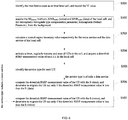
- the first method includes steps S401 to S406.
- the interference state is identified as an interfered state, and the NI value is recorded.
- the RS power , AntNum, SINR traffic (voice) and SINR traffic (data) of the local cell, and an atmospheric waveguide type compensation parameter (Atmospheric Default Parameter) are acquired, from the background.
- a timer is activated, all UEs (including the UE-A1 and UE-A2) in the cell are regularly traversed and scanned, the Pcmax of each UE is acquired according to access information of each UE, and the downlink RSRP measurement value of each UE in the local cell is acquired.
- the service type of each UE is identified.
- the downlink RSRP boundary value of each UE in the local cell is calculated based on the service type of each UE.
- the downlink RSRP measurement value of each UE in the local cell is compared with the downlink RSRP boundary value of each UE in the local cell, and it is determined to migrate a UE out when the downlink RSRP measurement value thereof is less than the downlink RSRP boundary value.
- the Pcmax-Al of the UE-A1 is acquired according to the access information of the UE-A1, and the downlink RSRP measurement value RSRP-A1 of the UE-A1 in the local cell is acquired.
- the service type of the UE-A1 is identified as being of only a data service.
- the RSRP-A1 is compared with the R-A1 (data). Only when the RSRP-A1 is less than the R-A1 (data), it is determined to migrate the UE-A1 out.
- the Pcmax-A2 of the UE-A2 is acquired according to the access information of the UE-A2, and the downlink RSRP measurement value RSRP-A2 of the UE-A2 in the local cell is acquired. Then, the service type of the UE-A2 is identified as including a voice service.
- the RSRP-A2 is compared with the R-A2 (voice). Only when the RSRP-A2 is less than the R-A2 (voice), it is determined to migrate the UE-A2 out.
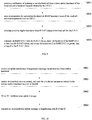
- the second method includes steps S501 to S507.
- the interference state is identified as an interfered state, and the NI value is recorded.
- the RS power , AntNum, SINR traffic (voice), SINR traffic (data), the preset Pcmax value of the local cell and the atmospheric waveguide type compensation parameter (Atmospheric Default Parameter) are acquired, from the background.
- downlink RSRP boundary values of a voice service and a data service of the local cell are calculated.
- the downlink RSRP boundary value R voice of the voice service RS ⁇ Pcmax + NI ⁇ 10 Log AntNum + SINR traffic voice ⁇ Atmospheric Default Parameter
- the downlink RSRP boundary value R data of the data service RS ⁇ Pcmax + NI ⁇ 10 Log AntNum + SINR traffic data ⁇ Atmospheric Default Parameter .
- step S504 a timer is activated, all UEs in the cell are regularly traversed and scanned, and the downlink RSRP measurement value of each UE in the local cell is acquired.
- the service type of each UE is identified.
- the step S506 will be executed; when the UE carries out a service type including a voice service, the step S507 will be executed.
- the downlink RSRP measurement value of the UE is compared with the R (data), and it is determined to migrate the UE out only when the downlink RSRP measurement value is less than the R (data).
- the downlink RSRP measurement value of the UE is compared with the R (voice), and it is determined to migrate the UE out only when the downlink RSRP measurement value is less than the R (voice).
- the downlink quality measurement value RSRP-A1 of the UE-A1 in the local cell is acquired, the service type of the UE-A1 is identified as being of only a data service, the RSRP-A1 is compared with the R (data), and it is determined to migrate the UE-A1 out only when the RSRP-A1 is less than the R (data).
- the downlink quality measurement value RSRP-A2 of the UE-A2 in the local cell is acquired, the service type of the UE-A2 is identified as including a voice service, the RSRP-A2 is compared with the R (voice), and it is determined to migrate the UE-A2 out only when the RSRP-A2 is less than the R (voice).
- Scenario two the cell A transmits an interfered state update message to a neighboring cell (in this scenario, the interfered state of the cell A itself is already updated, that is, the Scenario one already occurs).
- the interfered state update message transmitted to the neighboring cell by the cell A may carry an interference identifier and interference-related parameters. There are two modes for the number and content of the carried parameters.
- Mode one Parameters for calculating the downlink RSRP boundary value is transmitted.
- the parameters to be transmitted for calculating the downlink RSRP boundary value, carried by an interfered state message, will be configured in the background.
- the method of this mode includes steps 1, 2 and 3.
- Step 1 Parameters configured in the background for calculating a normal region are acquired, wherein the parameters will be carried by an interfered state update message.
- Step 2 An X2 interfered state update message is filled, wherein the message includes the following:
- a neighboring cell upon receiving the interfered state update message from the cell A, identifies the state of the cell A as an interfered cell, and acquires the type of parameters carried by the interfered state update message: with five calculation parameters.
- the calculation parameters are read and stored in the identifier of the cell A.
- the calculation parameters include:
- Mode two the downlink RSRP boundary value is directly transmitted, and the downlink RSRP boundary value to be transmitted, carried by the interfered state message, will be configured in the background.
- the method of this mode includes steps 1, 2 and 3.
- Step 1 Values configured in the background for calculating the normal region are acquired, wherein the values will be carried by an interfered state update message.
- Step 2 An X2 interfered state update message is filled, wherein the message includes the following:
- Step 3 The cell A transmits the message to neighboring cells B,C and D.
- a neighboring cell Upon receiving the interfered state update message from the cell A, a neighboring cell identifies the state of the cell A as an interfered cell, and acquires the type of parameters carried by the interfered state update message: with two downlink RSRP boundary values.
- the downlink RSRP boundary values are read and stored in the identifier of the cell A.
- the calculation parameters include:
- the cells A and B have completed the updating of their interfered state in Scenario one and the updating of the interfered state information of neighboring cells in Scenario two. Since the cells A, B, C and D are adjacent to each other, the interfered state information of all the neighboring cells are updated.
- the priority of using cells B, C and D as a candidate cell is B, C and D.
- the UE-A1 in the cell A is decided to be migrated out.
- this method includes steps S601 to S607.
- step S601 measurement report information of neighboring cells B, C and D, measured and reported by the UE-A1, is acquired.
- the interfered state stored in the identifier of each neighboring cell is read, and it is found that the cell B is an interfered cell and the cells C and D are normal cells.
- step S603 parameters stored in the identifier of the cell B are checked.
- the steps S604 and S605 will be executed; when the stored parameters are the downlink RSRP boundary values, the steps S606 and S607 will be executed.
- the downlink RSRP boundary value (data) of the cell B for the UE-A1 is calculated as R-B-A1 (data) by using the Pcmax-Al of the UE-A1 (data service) and the stored calculation parameters of the cell B.
- the downlink RSRP measurement value RSRP-B-A1 of the cell B from the UE-A1 is compared with the R-B-A1 (data); and, the cell B is removed from candidate target cells if the RSRP-B-A1 is less than the R-B-A1 (data).
- the downlink RSRP boundary value (data) stored in the identifier of the cell B is acquired as R-B (data).
- the downlink RSRP measurement value RSRP-B-A1 of the cell B from the UE-A1 is compared with the R-B (data); and, the cell B is removed from candidate target cells if the RSRP-B-A1 is less than the R-B.
- the normal cells C and D are decided according to a conventional handover decision process. Otherwise, the cell B and the normal C and D cells are decided according to the conventional handover decision process.
- Scenario four the UE-C1 in the cell C initiates a handover decision due to movement.
- the cells C and D are normal cells
- the cells A and B are interfered cells
- the cells A, B, C and D have completed the updating of their interfered state and the updating of interfered state information of neighboring cells in Scenario one and two.
- this method includes steps S701 to S707.
- step S701 measurement report information of neighboring cells A, B and D measured and reported by the UE-C1 are acquired, and the measurement values of the neighboring cells A, B and D measured by this UE are recorded as the RSRP-A-C1, RSRP-B-C1 and RSRP-D-C1.
- the neighboring cells A, B and D can be determined as candidate handover target cells based on the measurement report information of neighboring cells A, B and D measured and reported by the UE-C1, with a priority of A, B and D.
- the interfered state stored in the identifier of each neighboring cell is read, and it is found that the cells A and B are interfered cells and the cell D is a normal cell.
- the parameters stored in the identifiers of the interfered cells are checked; when the stored parameters are parameters for calculating the normal region boundary values, the steps S704 and S705 will be executed; and, when the stored parameters are downlink RSRP boundary values, the steps S706 and S707 will be executed.
- the downlink RSRP boundary value (data) of an interfered cell for the UE-C1 is calculated as R-interfered cell-Cl (data) by using the Pcmax-Cl of the UE-C1 (data service) and the stored calculation parameters of the interfered cell.
- the downlink RSRP measurement value RSRP-interfered cell-Cl of the interfered cell from the UE-C1 is compared with the R-interfered cell-Cl (data); and the interfered cell is removed from candidate target cells if the RSRP-interfered cell-Cl is less than the R-interfered cell-Cl (data).
- the downlink RSRP boundary value (data) stored in the identifier of the interfered cell is acquired as R-interfered cell (data).
- the downlink RSRP measurement value RSRP-interfered cell-Cl of the interfered cell from the UE-C1 is compared with the R-interfered cell (data); and (data) is removed from candidate target cells if the RSRP-interfered cell-Cl is less than the R-interfered cell (data).
- a decision on the cell A is taken as an example.
- the cell C finds that the cell A is an interfered cell, in accordance with the service type of the UE-C1 being data type, the R-A-C1 (data) (i.e., the data downlink RSRP boundary value of the cell A obtained based on the PCmax of the UE-C1) or R-A (data) (i.e., the data downlink RSRP boundary value of the cell A obtained based on the PCmax configured in the background) of the cell A is acquired and compared with the RSRP-A-C1.
- the cell A is removed from candidate target cells.
- a set of candidate target cells may be ⁇ A, B, D ⁇ or ⁇ A, D ⁇ or ⁇ B, D ⁇ or ⁇ D ⁇ . If the set is ⁇ D ⁇ , the cell D is directly selected as a handover target cell. If the set is not ⁇ D ⁇ , a handover target cell will be subsequently screened according to the process for a base station under a normal state.
- Scenario five the cell D decides whether to receive a handover request initiated by another cell.
- the cell D is a normal cell, and the cell C already decides that the UE-C1 initiates a handover to the cell D.
- the handover request message transmitted to the cell D by the cell C carries the Pcmax-UECl of the UE-C1 and the downlink RSRP measurement value RSRP-D-C1 of the cell D from the UE-C1, to avoid a temporary occurrence of interference.
- this method includes steps S801 to S804.
- step S801 a notification of updating as an interfered cell by the base station base band of the local cell, and a handover request initiated by the UE-C1, are received.
- step S802 parameters for calculating the downlink RSRP boundary value of the local cell and related parameters of the UE-C1 are acquired.
- the parameters for calculating the downlink RSRP boundary value include: the RS power , AntNum, SINR traffic (data) and NI value of the local cell and the atmospheric waveguide type compensation (Atmospheric Default Parameter).
- the related parameters of the UE-C1 include: the Pcmax of the UE-C1, the service type being data, and the downlink RSRP measurement RSRP-D-C1 reported by the UE-C1.
- the downlink RSRP boundary value R-D-C1 (data) of the local cell for the UE-C1 is calculated.
- the RSRP-D-C1 is compared with the R-D-C1 (data). The handover is rejected if the RSRP-D-C1 is less than the R-D-C1 (data); the handover is accepted if the RSRP-D-C1 is greater than or equal to the R-D-C1 (data).
- Scenario six the uplink interference disappears, and the interfered cell updates its own interfered state and notifies a neighboring cell.
- the base station detects that the atmospheric waveguide interference disappears, and the base station baseband notifies all cells of this station originally covered by the atmospheric waveguide interference, i.e., cells A and B in this scenario.
- the base station baseband notifies all cells of this station originally covered by the atmospheric waveguide interference, i.e., cells A and B in this scenario.
- the following description will be given by taking the cell A as an example.
- this method includes steps S901 to S904.
- step S901 an uplink interference disappearance message transmitted by the base station baseband is received.
- the interfered state is updated as normal, and the calculation parameters related to the downlink RSRP boundary value are reset to be invalid.
- an X2 interfered state update message is filled, wherein the message includes the following:
- the interfered state update message is transmitted to neighboring cells B, C and D.
- the neighboring cells B, C and D upon receiving the interfered state update message from the cell A, identify the state of the cell A as a normal cell, and the cell states of the neighboring cells B, C and D are updated, and all parameters for calculating the boundary of the normal cell of the cell A are reset to be invalid.
- a normal region and an interference region of the local cell are determined by calculating the downlink RSRP boundary value of the local cell, a UE in the interference region (where the user experience is poor) is timely migrated out through handover, and a handover request from a UE that is to be handed in the local cell and located beyond the boundary of the normal region is rejected, so that the UE can avoid the influence from the uplink interference in the local cell. Therefore, the handover success rate and the user experience under uplink interference can be improved, and the normal region of the interfered cell can be utilized to a maximum extent.
- Embodiment four of the present invention provides an interference processing apparatus.
- the apparatus includes: a memory 1101, a processor 1102 and a computer program stored in the memory and executable by the processor.
- the computer program is executed by the processor, the method in Embodiment one, two or three is performed.
- a normal region and an interference region of the local cell are determined by calculating the downlink RSRP boundary value of the local cell, a UE in the interference region (where the user experience is poor) is timely migrated out through handover, and a handover request from a UE that is to be handed in the local cell and located beyond the boundary of the normal region is rejected, so that the UE can avoid the influence from the uplink interference in the local cell. Therefore, the handover success rate and the user experience under uplink interference can be improved, and the normal region of the interfered cell can be utilized to a maximum extent.
- Embodiment four of the present invention provides an interference processing system.
- the system includes at least one base station 1201 and an interference processing apparatus 1202 arranged in a cell of the base station.
- the base station 1201 is configured to detect interference to cells of the local base station, and transmit an uplink interference message to the interference processing apparatus in the interfered cell through a base station baseband when it is detected that a cell is subjected to uplink interference.
- the interference processing apparatus 1202 is configured to migrate an interfered UE to a neighboring cell upon receiving the uplink interference message transmitted by the base station baseband of the local cell.
- the interference processing apparatus 1202 may be the uplink interference apparatus described in Embodiment three, and will not be repeated here.
- the interference processing system also notifies a high-level cell that it is an interfered cell, such that when an interfered cell known that it (referred to as the local cell) is subjected to uplink interference, a normal region and an interference region of the local cell are determined by calculating the downlink RSRP boundary value of the local cell, a UE in the interference region (where the user experience is poor) is timely migrated out through handover, and a handover request from a UE that is to be handed in the local cell and located beyond the boundary of the normal region is rejected, so that the UE can avoid the influence from the uplink interference in the local cell. Therefore, the handover success rate and the user experience under uplink interference can be improved, and the normal region of the interfered cell can be utilized to a maximum extent.
- Embodiment five of the present invention provides a storage medium, including a program stored therein, which, upon running, control an apparatus where the storage medium is located to execute the operations in Embodiment one, two or three.
- Computer storage medium includes volatile and nonvolatile, removable and non-removable media implemented in any method or technology for storing information (such as computer readable instructions, data structures, program modules or other data).
- Computer storage media includes, but is not limited to, Random-Access Memory (RAM), Read-Only Memory (ROM), Electrically Erasable Programmable Read Only Memory (EEPROM), flash memory or other memory technology, Compact Disc Read-Only Memory (CD-ROM), Digital Versatile Disc (DVD) or other optical disc storage, magnetic cartridge, magnetic tape, magnetic disk storage or other magnetic storage device, or may any other medium used to store desired information and that can be accessed by a computer.
- communication media typically includes computer readable instructions, data structures, program modules, or other data in a modulated data signal, such as a carrier wave or other transport mechanism, and may include any information delivery media.
Landscapes
- Engineering & Computer Science (AREA)
- Computer Networks & Wireless Communication (AREA)
- Signal Processing (AREA)
- Mobile Radio Communication Systems (AREA)
Abstract
Description
- This application claims priority to Chinese patent application No.
201810533669.5 - Embodiments of the present invention relate to the technical field of communication, for example, to an interference processing method, apparatus, system, and a storage medium.
- Inter-cell handover means that, when a mobile terminal enters another cell from one cell during a call, real-time control can be realized by a network, and the mobile station is handed in a certain channel for a new cell from the channel used by the original cell, ensuing an uninterrupted call. A common inter-cell handover method is to select neighboring cells according to the downlink signal quality of neighboring cells reported by a mobile terminal. A neighboring cell with better downlink signal quality is more easily selected as a preferential handover target. Even if there is a neighboring cell selection strategy based on load or neighboring cell priority or the like, a neighboring cell with better downlink quality is preferentially selected, from a filter result set, as a final handover target. However, this method can only ensure that the terminal is preferentially handed in a neighboring cell with low downlink interference. In practical applications, uplink signals will cause interference (such as in an atmospheric waveguide scene), and the existence of uplink interference will affect the call quality, so that the user experience is significantly reduced.
- Therefore, there is a need to provide an interference processing method, apparatus, system and a storage medium, which enable a UE to avoid uplink interference.
- In view of the above problem, it is therefore an object of the embodiments of the present invention to provide an interference processing method, apparatus, system and storage medium, so as to solve the problem that the presence of uplink interference in the existing technology affects the call quality and significantly reduces the user experience.
- The technical schemes according to the embodiments of the present invention for solving the above technical problem are as follows:
According to a first aspect of the embodiments of the present invention, there is provided an interference processing method including steps of: - determining a downlink reference signal received power boundary value called a downlink RSRP boundary value, of a cell;
- receiving a downlink RSRP measurement value reported by a user equipment called UE; and in response to the downlink RSRP measurement value being less than the downlink RSRP boundary value, migrating the UE out of the cell.
- According to a second aspect of the embodiments of the present invention, there is provided an interference processing method applied to a first communication node including steps of:
- determining a downlink reference signal received power boundary value called a downlink RSRP boundary value, of a cell; and
- in response to a downlink RSRP measurement value of the cell reported by a user equipment called UE to be handed in the cell being less than the downlink RSRP boundary value, rejecting a handover request from the UE.
- According to a third aspect of the embodiments of the present invention, there is provided an interference processing apparatus including a memory, a processor, and a computer program stored in the memory and executable by the processor. The processor is configured to execute the computer program to perform the steps of the method according to the first aspect or the second aspect.
- According to a fourth aspect of the embodiments of the present invention, there is provided a storage medium storing one or more programs executable by one or more processors to perform the steps of the method according to the first aspect or the second aspect.
-
-
FIG. 1 is a flowchart of an interference processing method according to Embodiment one of the present invention; -
FIG. 2 is a schematic diagram showing state of an uplink interfered cell according to this embodiment of the present invention; -
FIG. 3 is a schematic diagram showing location of a to-be-migrated UE in a candidate target cell according to this embodiment of the present invention; -
FIG. 4 is a flowchart of another interference processing method according to Embodiment two of the present invention; -
FIG. 5 is a flowchart of a first method in a first scenario of still another interference processing method according to Embodiment three of the present invention; -
FIG. 6 is a flowchart of a second method in the first scenario according to Embodiment three of the present invention; -
FIG. 7 is a flowchart of a third scenario according to Embodiment three of the present invention; -
FIG. 8 is a flowchart of a fourth scenario according to Embodiment three of the present invention; -
FIG. 9 is a flowchart of a fifth scenario according to Embodiment three of the present invention; -
FIG. 10 is a flowchart of a sixth scenario according to Embodiment three of the present invention; -
FIG. 11 is a block diagram of an interference processing apparatus according to Embodiment four of the present invention; and -
FIG. 12 is a structural diagram of an interference processing system according to Embodiment five of the present invention. - The implementation of the object, functional features and advantages of the embodiments of the present invention will be further described with reference to the accompanying drawings in combination with the embodiments.
- Embodiments of the present invention are described in further detail with reference to the accompanying drawings and examples. It should be understood that the specific embodiments described herein are used to explain the embodiments of the present invention, and shall not be construed to limit thereto.
- Embodiment one of the present invention provides an interference processing method, which is applied to a first communication node. With reference to
FIG. 1 , the method includes steps S101, S102 and S103. - In the step S101, a downlink reference signal received power (RSRP) boundary value of a cell is determined.
- In the step S102, a downlink RSRP measurement value reported by a user equipment (UE) is received.
- In the step S103, when the downlink RSRP measurement value is less than the downlink RSRP boundary value, the UE is migrated out of the cell.
-
FIG. 2 is a schematic diagram showing state of an uplink interfered cell. The cell coverage range inFIG. 2 refers to a range which can be covered by the signals in the cell, as indicated by an outer circle of a thin line inFIG. 2 . This cell is an interfered cell which consists of a "normal region" and an "interference region". - The normal region is indicated by a pattern-filled area shown in
FIG. 2 . Within this range, the cell can be basically considered as being under weak interference or interference-free, and a normal call quality can be ensured. In practical applications, the closer to the cell is, the less the path loss is, and the better the signal received by the base station is. Therefore, in case of uplink interference, the interference is more obvious if the terminal is farther away from the cell. Otherwise, the interference is not obvious. Therefore, the normal region is a valid part of the interfered cell. - The interference region is beyond the pattern-filled area shown in
FIG. 2 and within the cell coverage range, that is, it is a region between the normal region of the interfered cell and the border of the interfered cell. This region is under relatively strong interference, and it is not recommended for mobile users to access this region. This is because the user perception is very poor even if the user accesses this region. Therefore, this region is an invalid part of the interfered cell. - In practical applications, when a base station identifies uplink interference by regular interference detection, the base station performs baseband anti-interference processing, notifies an interfered cell that it is subjected to uplink interference, and notifies the interfered cell of a noise interference (NI) power value.
- When the interfered cell learns that it is an uplink interfered cell, to ensure the user perception, the interfered cell determines its own normal region and interference region, and timely migrates out a UE in the interference region (the user experience is poor in this region) through handover. Meanwhile, interaction may be performed with a surrounding neighboring cell to ensure that the neighboring cell enable a UE that is to be handed therein (now referred to as a local cell, to be handed in a normal region of the local cell.
- In practical applications, the boundary value of the normal region may be set as a downlink reference signal received power (RSRP) boundary value.
- In a possible scheme, the downlink RSRP boundary value of the cell may be determined based on a downlink reference signal transmitted power of the cell, a maximum uplink transmitted power of the user equipment (UE), a noise interference power, the number of receiving antennas of the cell, a minimum receiving signal-to-interference-plus-noise ratio (SINR) and a preset compensation parameter.
- In a possible scheme, the downlink RSRP boundary value includes a downlink RSRP boundary value of a voice service and/or a downlink RSRP boundary value of a data service.
- In practical applications, when the downlink RSRP boundary value includes a downlink RSRP boundary value of a voice service, the minimum receiving SINR is the minimum receiving SINR of transmission for the voice service; or
when the downlink RSRP boundary value includes a downlink RSRP boundary value of a voice service, the minimum receiving SINR is the minimum receiving SINR of transmission for the data service. - In practical applications, in accordance with the calculation formula of the SINR:


- The RSRP in the formula is the downlink RSRP boundary value of the normal region, and is thus used as the boundary value of the normal region.
- The SINRtraffic may be configured in the background, and is the minimum receiving SINR of transmission for difference services (including voice services and data services). Different services require different channel conditions. For example, voice services require higher channel conditions, while data services can still satisfy the user's needs under poor channel conditions. Therefore, in case of a voice service, it is necessary to distinguish the SINRtraffic (voice) from the SINRtraffic (data).
- Therefore, when there is a voice service for the UE, the downlink RSRP boundary value of the voice service of the local cell is calculated according to the preset formula RSRPvoice = RS - Pcmax + NI - 10Log(AntNum) + SINRtraffic(voice)- IDP.
- When there is no voice service for the UE, the downlink RSRP boundary value of the data service of the local cell is calculated according to the preset formula RSRPdata = RS - Pcmax + NI - 10Log(AntNum) + SINRtraffic(data)- IDP.
- The IDP is the preset compensation parameter of the interference model (e.g., a compensation parameter of an atmospheric waveguide interference model or compensation parameters of other uplink interference models), and compensation may be performed based on a model of the transmission channel, thermal noise processed by the base station or other factors. The IDP may be configured in the background.
- Other parameters such as the NI may be measured by the base station, and the RSpower and AntNum may be configured in the background.
- In practical applications, there are two methods to acquire the maximum transmitted power Pcmax of a UE. One method is to acquire the Pcmax from base station content reported by a UE. In this case, the acquired Pcmax is the Pcmax of an individual UE. The other method is to replace the Pcmax with a preset Pcmax value (because the Pcmax is same for most UEs).
- If the Pcmax reported by each individual UE is substituted into the above formula, a downlink RSRP boundary value (data) and a downlink RSRP boundary value (voice) unique to each UE are calculated.
- If the preset Pcmax value is substituted into the above formula, a downlink RSRP boundary value (data) and a downlink RSRP boundary value (voice) of the interfered cell are calculated.
- Based on the above formula, it can be seen that the boundary of the normal region is related to the configuration of the cell itself and may be different among different UEs, different service types for a UE and different interference types and strengths. Under normal circumstances, if the interference is lower or the base station processes interference better, the coverage of the normal region is larger. When the interference is eliminated or the baseband of the base station can completely resist against interference, the normal region will be overlapped with the edge of the interfered cell, that is, the interfered cell becomes a completely normal cell. In case of interference, the normal region may be considered as an actually available valid range of the local cell.
- In practical applications, before the step S102, the method further includes steps of:
- acquiring a downlink RSRP measurement value of the local cell reported by a UE of the local cell;
- when there is a voice service for the UE in the local cell, determining whether the downlink RSRP measurement value is less than the RSRPvoice;
- if the downlink RSRP measurement value is less than the RSRPvoice, determining that the UE of the local cell is beyond the boundary of the normal region;
- when there is no data service for the UE in the local cell, determining whether the downlink RSRP measurement value is less than the RSRPdata;
- if the downlink RSRP measurement value is less than the RSRPdata, determining that the UE of the local cell is beyond the boundary of the normal region.
- In practical applications, downlink RSRP measurement values reported by all UEs can be obtained by regular refreshing, and are then compared with the downlink RSRP boundary value.
- In practical applications, different services require different channel conditions. For example, voice services require better channel conditions, while data services can still satisfy the user's needs under poor channel conditions. Therefore, in case of a service voice, it is necessary to distinguish the SINRtraffic (voice) from the SINRtraffic (data).
- If there is a voice service for the UE, when the downlink RSRP measurement value of the UE is greater than or equal to the downlink RSRP boundary value (voice), it is considered that the UE is within the normal region where the voice quality can be guaranteed, and it is unnecessary to migrate the UE; however, when the RSRP measurement value of the UE is less than the downlink RSRP boundary value (voice), it is considered that the UE is within the interference region where the voice quality cannot be guaranteed, and it is necessary to migrate the UE out.
- If there is no voice service for the UE, when the downlink RSRP measurement value of the UE is greater than or equal to the downlink RSRP boundary value (data), it is considered that the UE is within the normal region where the quality of the data service can be guaranteed, and it is unnecessary to migrate the UE; however, when the RSRP measurement value of the UE is less than the downlink RSRP boundary value (data), it is considered that the UE is within the interference region where the quality of the data service cannot be guaranteed, and it is necessary to migrate the UE out.
- In a possible scheme, the method further includes steps of:
- receiving an interfered state message of a neighboring cell, and determining a downlink RSRP boundary value of the neighboring cell;
- when a downlink RSRP measurement value of a neighboring cell reported by the UE is greater than or equal to the downlink RSRP boundary value of the neighboring cell, selecting the neighboring cell as a candidate target cell for the UE.
- In practical applications, the interfered state message of the neighboring cell carries the downlink RSRP boundary value of the neighboring cell; or
the interfered state message of the neighboring cell carries a parameter for calculating the downlink RSRP boundary value of the neighboring cell. - In practical applications, when the local cell receives an interfered state update message transmitted by a neighboring cell, the state of the neighboring cell that triggers this message can be acquired and updated.
- If the latest state of the neighboring cell is an interfered state, the parameters carried by the interfered state update message transmitted by the neighboring cell may have two situations. If the local cell decides to hand over and migrate the UE, during selecting from candidate handover target cells, when a candidate cell has an identifier of interfered cell, different processing will be performed based on the carried parameters, and the downlink RSRP boundary value of this interfered neighboring cell is acquired.
- 1. If the interfered state update message carries two parameters, it is considered that the downlink RSRP boundary (data) and the downlink RSRP boundary value (voice) of the interfered neighboring cell are received and stored in the identifier of the interfered neighboring cell.
- If there is a voice service for the UE to be migrated, the downlink RSRP boundary value (voice) of the interfered neighboring cell is directly used; if there is a data service for the UE to be migrated, the downlink RSRP boundary value (data) of the interfered neighboring cell is directly used.
- 2. If the interfered state update message carries five parameters, it is considered that the calculation parameters for the normal region are carried, and the parameters are stored in the identifier of the interfered neighboring cell.
- If there is a voice service for the UE to be migrated, the calculation parameters are substituted into the above formula to calculate the downlink RSRP boundary value (voice) of the interfered neighboring cell, where the calculation parameters include the RSpower, NI, AntNum, SINRtraffic (voice) of the interfered neighboring cell, and the Pcmax of the UE to be migrated.
- If there is only a data service for the UE, the calculation parameters are substituted into the above formula to calculate the downlink RSRP boundary value (voice) of the interfered neighboring cell, where the calculation parameters include the RSpower, NI, AntNum, SINRtraffic (voice) of the interfered neighboring cell, and Pcmax of the UE to be migrated.
- It is to be noted that, the IDP in the above formula can be acquired from the background of the local cell.
- In an embodiment, a step of determining whether the UE to be migrated is within the downlink RSRP boundary value of the neighboring cell includes:
- acquiring the RSRP measurement of the interfered neighboring cell reported by the UE to be migrated;
- determining the service type of the UE to be migrated.
- if there is a voice service for the UE to be migrated, then:
- when the downlink RSRP measurement value reported by the UE to be migrated is greater than or equal to the downlink RSRP boundary value (voice) of the interfered neighboring cell, it is indicated that the UE to be migrated is already within the coverage of the normal region (voice) of the neighboring cell, and the neighboring cell can be remained as a target cell for subsequent handover. Otherwise, it is indicated that the UE to be migrated is within the interference region, and the interfered neighboring cell is no longer selected as a candidate target cell;
- for example, as shown in
FIG. 3 , if the UE to be migrated is within the normal region of the neighboring cell, the neighboring cell can be remained as a target cell for subsequent handover; and, if the UE to be migrated is within the interference region of the neighboring cell, the interfered neighboring cell is no longer selected as a candidate target cell. - if there is no voice service for the UE, then:
when the downlink RSRP measurement value reported by the UE to be migrated is greater than or equal to the downlink RSRP boundary value (data) of the interfered neighboring cell, it is indicated that the UE to be migrated is already within the coverage of the normal region (data) of the interfered neighboring cell, and the neighboring cell can be remained as a target cell for subsequent handover. Otherwise, it is indicated that the UE to be migrated is within the interference region, and the interfered neighboring cell is no longer selected as a candidate target cell.
- In a possible scheme, the method further includes a step of:
transmitting an interfered state message to a neighboring cell, the interfered state message carrying the downlink RSRP boundary value of the neighboring cell or a parameter for calculating the downlink RSRP boundary value of the neighboring cell. - In practical applications, when the local cell is in an interfered state, the local cell can interact with a neighboring cell in the following ways:
- 1. an interaction by a direct message between base stations, for example, the X2 of the 4th-generation mobile communication technology (4G), the Xn of the 5th-generation mobile communication technology (5G).
- 2. an interaction by a message transmitted between base stations via a core network (e.g., the S1 of 4G, the NG-C of 5G).
- When the local cell changes from a normal cell to an interfered cell, the interfered state update message may carry the following two kinds of information:
- 1) an interference identifier which indicates the state of the local cell (for example, 0 represents the normal cell, and 1 represents the interfered cell); and
- 2) the number and content of the carried parameters (either one of the following two modes A and B may be used).
- Mode A: two parameters are carried;
the content of the carried parameters: the downlink RSRP boundary value (voice service) and downlink RSRP boundary value (data service) of the interfered cell. - Mode B: five parameters are carried;
the content of the carried parameters: the downlink RS transmitted power of the local cell, the number of receiving antennas AntNum of the local cell, the uplink noise interference (NI) power of the local cell, the minimum receiving SINRtraffic (voice) of the local cell and the minimum receiving SINRtraffic (data) of the local cell. - In practical applications, when the interfered state of the local cell changes, for example, when the local cell changes from a normal cell to an interfered state, an interfered state update message should be transmitted to configured neighboring cells. In contrast, when the local cell changes from an interfered cell to a normal cell, an interfered state update message should be also transmitted to configured neighboring cells, such that the surrounding neighboring cells reset the state of the local cell to be normal upon receiving the interfered state update message, and set the interference-related parameters of the local cell as invalid parameters.
- In practical applications, when the local cell receives a notification of uplink interference disappearance transmitted by the base station baseband, the local cell may also execute the following operations:
- 1. updating its own state to normal;
- 2. stopping the refresh process of acquiring measurement values of all UEs in the cell, and emptying parameters related to the calculation of the normal region. In this case, all communication processes are processed as processes when the base station is in a normal state.
- In the interference processing method provided in this embodiment, when it is known that the local cell is subjected to uplink interference, a normal region and an interference region of the local cell itself are determined by calculating the downlink RSRP boundary value of the local cell, and a UE (the downlink RSRP measurement value reported by this UE is less than the downlink RSRP boundary value) in the interference region (the user experience is poor in this region) is migrated timely through handover, so that the UE can avoid the influence from the uplink interference in the local cell. Therefore, the handover success rate and the user experience under uplink interference can be improved, and the normal region of the interfered cell can be utilized to a maximum extent.
- Embodiment two of the present application provides another interference processing method, which is applied to a first communication node. With reference to
FIG. 4 , the method includes steps S1001 and S1002. - In the step S1001, a downlink reference signal received power (RSRP) boundary value of a cell is determined.
- In the step S 1002, when a downlink RSRP measurement value of this cell reported by a UE, that is to be handed in this cell, is less than the downlink RSRP boundary value, a handover request from the UE is rejected.
- In a possible scheme, the downlink RSRP boundary value of the cell may be determined based on downlink reference signal transmitted power of the cell, a maximum uplink transmitted power of the UE, a noise interference power, the number of receiving antennas of the cell, a minimum receiving SINR and a preset compensation parameter.
- In practical applications, the downlink RSRP boundary value can be calculated by the method described in Embodiment one, and it will not be repeated here.
- In a possible scheme, before the step S202, the method further includes steps of:
- acquiring, from the received handover request message, the downlink RSRP measurement value of the local cell reported by the UE to be handed-in;
- when there is a voice service for the UE to be handed-in, determining whether the downlink RSRP measurement value is less than the RSRPvoice;
- if the downlink RSRP measurement value is less than the RSRPvoice, determining the UE to be handed-in is beyond the boundary of the normal region;
- when there is no voice service for the UE to be handed-in, determining whether the downlink RSRP measurement value is less than the RSRPdata; and
- if the downlink RSRP measurement value is less than the RSRPdata, determining the UE to be handed-in is beyond the boundary of the normal region.
- In some scenarios, when the local cell is used as a target cell for handover, the local cell may not know that it is a cell subjected to uplink interference until a handover. In this case, a target cell needs to decide whether to allow hand-in.
- In practical applications, when a source cell of the UE to be handed-in initiates a handover, the Pcmax of the UE to be handed-in and the downlink RSRP measurement value of the local cell reported by the UE to be handed-in may be carried in the handover request a message of the S 1 or X2.
- Upon receiving the handover request message, the local cell acquires all parameters in this message, including the Pcmax of the UE to be handed-over and the downlink RSRP measurement value.
- At this time, the local cell identifiers its own interfered state. If the local cell is a normal cell, the Pcmax of the handed-over UE and the RSRP both contained in the handover request message may be ignored, and processing is performed based on the conventional handover process. If the local cell is an uplink interfered cell, it is necessary to calculate the boundary of the normal region of the local cell and identify the service type of the UE to be handed in.
- During the calculation of the boundary of the normal region of the local cell, the following parameters need to be acquired: the RSpower of the local cell, the Pcmax of the UE to be handed-over, the NI of the local cell, the AntNum of the local cell and the SINRtraffic of the local cell.
- In practical applications, the SINRtraffic can be acquired based on the service type of the UE to be handed-over.
- If there is a voice service for the UE to be handed-over, the minimum receiving SINRtraffic (voice) of this interfered cell is acquired; and, if the UE to be handed-over has a voice service, the minimum receiving SINRtraffic (data) of this interfered cell is acquired.
- During making a decision, if the UE to be handed-over has a voice service, then:
when the downlink RSRP measurement value reported by the UE to be handed-in is greater than or equal to the downlink RSRP boundary value (voice) of the local cell, it is indicated that the UE to be handed-in is already within the coverage of the normal region (voice) of the local cell, this handover is accepted, and an acknowledgement message is returned. Otherwise, it is indicated the UE to be handed-in is within the interference region, this handover is rejected, and a rejection message is returned. - If there is no voice service for the UE to be handed-over, then:
when the downlink RSRP measurement value reported by the UE to be handed-in is greater than or equal to the downlink RSRP boundary value (data) of the local cell, it is indicated that the UE to be handed-in is already within the coverage of the normal region (data) of the local cell, this handover is accepted, and an acknowledgement message is returned. Otherwise, it is indicated the UE to be handed-in is within the interference region, this handover is rejected, and a rejection message is returned. - It is to be noted that, in practical applications, the Pcmax of the UE to be handed-over may be omitted from the handover request message transmitted by the source cell because the Pcmax of most UEs is the same; and, the target cell may use a preset Pcmax value during the calculation of the downlink RSRP boundary cell.
- In a possible scheme, when it is known that the local cell is an uplink interfered cell, the method further includes a step of:
transmitting an interfered state update message to a neighboring cell, the interfered state update message carrying the downlink RSRP boundary value of the local cell or a parameter for calculating the downlink RSRP boundary value of the local cell. - In practical applications, the interfered state update message can be transmitted to the neighboring cell by the method described in Embodiment one, and it will not be repeated here.
- In the interference processing method provided in this embodiment, when it is known that the local cell is subjected to uplink interference, a normal region and an interference region of the local cell itself are determined by calculating the downlink RSRP boundary value of the local cell, and a handover request from a UE that is to be handed in the local cell and located beyond the boundary of the normal region (the downlink RSRP measurement value reported by this UE is less than the downlink RSRP boundary value) is rejected, so that the UE can avoid the influence from the uplink interference in the local cell. Therefore, the handover success rate and the user experience under uplink interference can be improved, and the normal region of the interfered cell can be utilized to a maximum extent.
- Embodiment three of the present invention provides another interference processing method. In this embodiment, interference processing will be described by taking a base station 1 and a base station 2 as an example, where the base station 1 includes cells A and B, and the base station 2 includes cells C and D. The cell A contains a UE-A1 and a UE-A2, the cell B contains a UE-B, and the cell C contains a UE-C1 and a UE-C2. The UE-A1 has only a data service, the UE-A2 has a voice service, the UE-C1 has a data service, and UE-C2 has a voice service. The cells A, B, C and D are adjacent to each other, and communicate with each other by the X2. In this embodiment, necessary neighboring cell parameter information is already exchanged among the cells A, B, C and D by the X2. If an atmospheric waveguide interference appears suddenly, the base station 1 detects the appearance of the atmospheric waveguide interference and performs anti-interference processing. Meanwhile, the baseband of the base station 1 notifies high-level cells A and B of the existence of the atmospheric waveguide interference, and notifies them of the interference NI value.
- For convenience of description, this embodiment will be described in different scenarios.
- Scenario one: the cell A receives the notification from the base station, calculates the downlink RSRP boundary value of the local cell, and decides whether to migrate out UEs in the local cell.
- In this scenario, the cell A may calculate the downlink RSRP boundary value of the local cell by two methods and then decide whether to migrate out UEs in the local cell.
- With reference to
FIG. 5 , the first method includes steps S401 to S406. - In the step S401, the interference state is identified as an interfered state, and the NI value is recorded.
- In the step S402, the RSpower, AntNum, SINRtraffic (voice) and SINRtraffic (data) of the local cell, and an atmospheric waveguide type compensation parameter (Atmospheric Default Parameter) are acquired, from the background.
- In the step S403, a timer is activated, all UEs (including the UE-A1 and UE-A2) in the cell are regularly traversed and scanned, the Pcmax of each UE is acquired according to access information of each UE, and the downlink RSRP measurement value of each UE in the local cell is acquired.
- In the step S404, the service type of each UE is identified.
- In the step S405, the downlink RSRP boundary value of each UE in the local cell is calculated based on the service type of each UE.
- In the step S406, the downlink RSRP measurement value of each UE in the local cell is compared with the downlink RSRP boundary value of each UE in the local cell, and it is determined to migrate a UE out when the downlink RSRP measurement value thereof is less than the downlink RSRP boundary value.
- In this scenario, when traversing to UE-A1, the Pcmax-Al of the UE-A1 is acquired according to the access information of the UE-A1, and the downlink RSRP measurement value RSRP-A1 of the UE-A1 in the local cell is acquired. Then, the service type of the UE-A1 is identified as being of only a data service. Thus, the downlink RSRP boundary value of the UE-A1 in the local cell is calculated as R-A1 (data) according to the formula RSRPdata = RSpower - Pcmax + NI - 10Log(AntNum) + SINRtraffic(data)-IDP. The RSRP-A1 is compared with the R-A1 (data). Only when the RSRP-A1 is less than the R-A1 (data), it is determined to migrate the UE-A1 out.
- When traversing to UE-A2, the Pcmax-A2 of the UE-A2 is acquired according to the access information of the UE-A2, and the downlink RSRP measurement value RSRP-A2 of the UE-A2 in the local cell is acquired. Then, the service type of the UE-A2 is identified as including a voice service. Thus, the downlink RSRP boundary value R-A2 (voice) of the voice service of the UE-A2 is calculated according to the formula RSRPvoice= RSpower - Pcmax + NI - 10Log(AntNum) + SINRtraffic(voice)- IDP. The RSRP-A2 is compared with the R-A2 (voice). Only when the RSRP-A2 is less than the R-A2 (voice), it is determined to migrate the UE-A2 out.
- With reference to
FIG. 6 , the second method includes steps S501 to S507. - In the step S501, the interference state is identified as an interfered state, and the NI value is recorded.
- In the step S502, the RSpower, AntNum, SINRtraffic (voice), SINRtraffic (data), the preset Pcmax value of the local cell and the atmospheric waveguide type compensation parameter (Atmospheric Default Parameter) are acquired, from the background.
- In the step S503, downlink RSRP boundary values of a voice service and a data service of the local cell are calculated.


- In the step S504, a timer is activated, all UEs in the cell are regularly traversed and scanned, and the downlink RSRP measurement value of each UE in the local cell is acquired.
- In the step S505, the service type of each UE is identified. When the UE carries out a service type of only a data service, the step S506 will be executed; when the UE carries out a service type including a voice service, the step S507 will be executed.
- In the step S506, the downlink RSRP measurement value of the UE is compared with the R (data), and it is determined to migrate the UE out only when the downlink RSRP measurement value is less than the R (data).
- In the step S507, the downlink RSRP measurement value of the UE is compared with the R (voice), and it is determined to migrate the UE out only when the downlink RSRP measurement value is less than the R (voice).
- In this scenario, when traversing to the UE-A1, the downlink quality measurement value RSRP-A1 of the UE-A1 in the local cell is acquired, the service type of the UE-A1 is identified as being of only a data service, the RSRP-A1 is compared with the R (data), and it is determined to migrate the UE-A1 out only when the RSRP-A1 is less than the R (data).
- When traversing to the UE-A2, the downlink quality measurement value RSRP-A2 of the UE-A2 in the local cell is acquired, the service type of the UE-A2 is identified as including a voice service, the RSRP-A2 is compared with the R (voice), and it is determined to migrate the UE-A2 out only when the RSRP-A2 is less than the R (voice).
- Scenario two: the cell A transmits an interfered state update message to a neighboring cell (in this scenario, the interfered state of the cell A itself is already updated, that is, the Scenario one already occurs).
- The interfered state update message transmitted to the neighboring cell by the cell A may carry an interference identifier and interference-related parameters. There are two modes for the number and content of the carried parameters.
- Mode one: Parameters for calculating the downlink RSRP boundary value is transmitted. In this case, the parameters to be transmitted for calculating the downlink RSRP boundary value, carried by an interfered state message, will be configured in the background.
- The method of this mode includes steps 1, 2 and 3.
- In the Step 1: Parameters configured in the background for calculating a normal region are acquired, wherein the parameters will be carried by an interfered state update message.
- In the Step 2: An X2 interfered state update message is filled, wherein the message includes the following:
- State: interfered;
- Number of parameters: 4;
- the number of receiving antennas AntNum in the cell A;
- the SINRtraffic (voice) of the cell A;
- the SINRtraffic (data) of the cell A;
- the NI value of the cell A.
- In the Step 3: The interfered state update message is transmitted to neighboring cells B, C and D.
- In this case, upon receiving the interfered state update message from the cell A, a neighboring cell identifies the state of the cell A as an interfered cell, and acquires the type of parameters carried by the interfered state update message: with five calculation parameters. The calculation parameters are read and stored in the identifier of the cell A. The calculation parameters include:
- State of the cell A: interfered;
- Number of interference calculation parameters for the cell A: 4;
- the number of receiving antennas, AntNum in the cell A;
- the SINRtraffic (voice) of the cell A;
- the SINRtraffic (data) of the cell A;
- the NI value of the cell A;
- the Atmospheric Default Parameter acquired from the background by the local cell.
- Mode two: the downlink RSRP boundary value is directly transmitted, and the downlink RSRP boundary value to be transmitted, carried by the interfered state message, will be configured in the background.
- The method of this mode includes steps 1, 2 and 3.
- In the Step 1: Values configured in the background for calculating the normal region are acquired, wherein the values will be carried by an interfered state update message.
- In the Step 2: An X2 interfered state update message is filled, wherein the message includes the following:
- State: interfered;
- Parameter type: downlink RSRP boundary value;
- the downlink RSRP boundary values R (data) and R (voice).
- In the Step 3: The cell A transmits the message to neighboring cells B,C and D.
- Upon receiving the interfered state update message from the cell A, a neighboring cell identifies the state of the cell A as an interfered cell, and acquires the type of parameters carried by the interfered state update message: with two downlink RSRP boundary values. The downlink RSRP boundary values are read and stored in the identifier of the cell A. The calculation parameters include:
- State of the cell A: interfered;
- Number of downlink RSRP boundary values of the cell A: 2;
- the downlink RSRP boundary values R (voice) and R (data) of the cell A.
- Scenario three: Migration strategy for the cell A (for screening candidate handover target cells).
- In this scenario, the cells A and B have completed the updating of their interfered state in Scenario one and the updating of the interfered state information of neighboring cells in Scenario two. Since the cells A, B, C and D are adjacent to each other, the interfered state information of all the neighboring cells are updated. The priority of using cells B, C and D as a candidate cell is B, C and D. The UE-A1 in the cell A is decided to be migrated out.
- With reference to
FIG. 7 , this method includes steps S601 to S607. - In the step S601, measurement report information of neighboring cells B, C and D, measured and reported by the UE-A1, is acquired.
- In the step S602, the interfered state stored in the identifier of each neighboring cell is read, and it is found that the cell B is an interfered cell and the cells C and D are normal cells.
- In the step S603, parameters stored in the identifier of the cell B are checked. When the stored parameters are parameters for calculating the normal region boundary values, the steps S604 and S605 will be executed; when the stored parameters are the downlink RSRP boundary values, the steps S606 and S607 will be executed.
- In the step S604, the downlink RSRP boundary value (data) of the cell B for the UE-A1 is calculated as R-B-A1 (data) by using the Pcmax-Al of the UE-A1 (data service) and the stored calculation parameters of the cell B.
- In the step S605, the downlink RSRP measurement value RSRP-B-A1 of the cell B from the UE-A1 is compared with the R-B-A1 (data); and, the cell B is removed from candidate target cells if the RSRP-B-A1 is less than the R-B-A1 (data).
- In the step S606, the downlink RSRP boundary value (data) stored in the identifier of the cell B is acquired as R-B (data).
- In the step S607, the downlink RSRP measurement value RSRP-B-A1 of the cell B from the UE-A1 is compared with the R-B (data); and, the cell B is removed from candidate target cells if the RSRP-B-A1 is less than the R-B.
- In this scenario, if the cell B is removed from candidate target cells, the normal cells C and D are decided according to a conventional handover decision process. Otherwise, the cell B and the normal C and D cells are decided according to the conventional handover decision process.
- Scenario four: the UE-C1 in the cell C initiates a handover decision due to movement.
- In this scenario, the cells C and D are normal cells, the cells A and B are interfered cells, and the cells A, B, C and D have completed the updating of their interfered state and the updating of interfered state information of neighboring cells in Scenario one and two.
- With reference to
FIG. 8 , this method includes steps S701 to S707. - In the step S701, measurement report information of neighboring cells A, B and D measured and reported by the UE-C1 are acquired, and the measurement values of the neighboring cells A, B and D measured by this UE are recorded as the RSRP-A-C1, RSRP-B-C1 and RSRP-D-C1.
- In this step, the neighboring cells A, B and D can be determined as candidate handover target cells based on the measurement report information of neighboring cells A, B and D measured and reported by the UE-C1, with a priority of A, B and D.
- In the step S702, the interfered state stored in the identifier of each neighboring cell is read, and it is found that the cells A and B are interfered cells and the cell D is a normal cell.
- In the step S703, the parameters stored in the identifiers of the interfered cells are checked; when the stored parameters are parameters for calculating the normal region boundary values, the steps S704 and S705 will be executed; and, when the stored parameters are downlink RSRP boundary values, the steps S706 and S707 will be executed.
- In the step S704, the downlink RSRP boundary value (data) of an interfered cell for the UE-C1 is calculated as R-interfered cell-Cl (data) by using the Pcmax-Cl of the UE-C1 (data service) and the stored calculation parameters of the interfered cell.
- In the step S705, the downlink RSRP measurement value RSRP-interfered cell-Cl of the interfered cell from the UE-C1 is compared with the R-interfered cell-Cl (data); and the interfered cell is removed from candidate target cells if the RSRP-interfered cell-Cl is less than the R-interfered cell-Cl (data).
- In the step S706, the downlink RSRP boundary value (data) stored in the identifier of the interfered cell is acquired as R-interfered cell (data).
- In the step S707, the downlink RSRP measurement value RSRP-interfered cell-Cl of the interfered cell from the UE-C1 is compared with the R-interfered cell (data); and (data) is removed from candidate target cells if the RSRP-interfered cell-Cl is less than the R-interfered cell (data).
- A decision on the cell A is taken as an example. After the cell C finds that the cell A is an interfered cell, in accordance with the service type of the UE-C1 being data type, the R-A-C1 (data) (i.e., the data downlink RSRP boundary value of the cell A obtained based on the PCmax of the UE-C1) or R-A (data) (i.e., the data downlink RSRP boundary value of the cell A obtained based on the PCmax configured in the background) of the cell A is acquired and compared with the RSRP-A-C1. When the RSRP-A-C1 is less than the R-A-C1 (data) (calculation is performed using the Pcmax of the UE) or when the RSRP-A-C1 is less than the R-A (data) (calculation is performed using the Pcmax configured in the background), the cell A is removed from candidate target cells.
- The above steps are repeated to determine whether to remove the cell B.
- By the above steps, a set of candidate target cells may be {A, B, D} or {A, D} or {B, D} or {D}. If the set is {D}, the cell D is directly selected as a handover target cell. If the set is not {D}, a handover target cell will be subsequently screened according to the process for a base station under a normal state.
- Scenario five: the cell D decides whether to receive a handover request initiated by another cell.
- In this scenario, the cell D is a normal cell, and the cell C already decides that the UE-C1 initiates a handover to the cell D. In this scenario, recently the atmospheric waveguide often appears, the handover request message transmitted to the cell D by the cell C carries the Pcmax-UECl of the UE-C1 and the downlink RSRP measurement value RSRP-D-C1 of the cell D from the UE-C1, to avoid a temporary occurrence of interference.
- With reference to
FIG. 9 , this method includes steps S801 to S804. - In the step S801, a notification of updating as an interfered cell by the base station base band of the local cell, and a handover request initiated by the UE-C1, are received.
- In the step S802, parameters for calculating the downlink RSRP boundary value of the local cell and related parameters of the UE-C1 are acquired.
- The parameters for calculating the downlink RSRP boundary value include: the RSpower, AntNum, SINRtraffic (data) and NI value of the local cell and the atmospheric waveguide type compensation (Atmospheric Default Parameter).
- The related parameters of the UE-C1 include: the Pcmax of the UE-C1, the service type being data, and the downlink RSRP measurement RSRP-D-C1 reported by the UE-C1.
- In the step 803, the downlink RSRP boundary value R-D-C1 (data) of the local cell for the UE-C1 is calculated.
- In the step S804, the RSRP-D-C1 is compared with the R-D-C1 (data). The handover is rejected if the RSRP-D-C1 is less than the R-D-C1 (data); the handover is accepted if the RSRP-D-C1 is greater than or equal to the R-D-C1 (data).
- Scenario six: the uplink interference disappears, and the interfered cell updates its own interfered state and notifies a neighboring cell.
- In this scenario, the base station detects that the atmospheric waveguide interference disappears, and the base station baseband notifies all cells of this station originally covered by the atmospheric waveguide interference, i.e., cells A and B in this scenario. The following description will be given by taking the cell A as an example.
- With reference to
FIG. 10 , this method includes steps S901 to S904. - In the step S901, an uplink interference disappearance message transmitted by the base station baseband is received.
- In the step S902, the interfered state is updated as normal, and the calculation parameters related to the downlink RSRP boundary value are reset to be invalid.
- In the step S903, an X2 interfered state update message is filled, wherein the message includes the following:
- State: normal
- Parameter type: null.
- In the step S904, the interfered state update message is transmitted to neighboring cells B, C and D.
- In this case, upon receiving the interfered state update message from the cell A, the neighboring cells B, C and D identify the state of the cell A as a normal cell, and the cell states of the neighboring cells B, C and D are updated, and all parameters for calculating the boundary of the normal cell of the cell A are reset to be invalid.
- According to the interference processing method provided in this embodiment, when it is known that the local cell is subjected to uplink interference, a normal region and an interference region of the local cell are determined by calculating the downlink RSRP boundary value of the local cell, a UE in the interference region (where the user experience is poor) is timely migrated out through handover, and a handover request from a UE that is to be handed in the local cell and located beyond the boundary of the normal region is rejected, so that the UE can avoid the influence from the uplink interference in the local cell. Therefore, the handover success rate and the user experience under uplink interference can be improved, and the normal region of the interfered cell can be utilized to a maximum extent.
- Embodiment four of the present invention provides an interference processing apparatus. With reference to
FIG. 11 , the apparatus includes: amemory 1101, aprocessor 1102 and a computer program stored in the memory and executable by the processor. When the computer program is executed by the processor, the method in Embodiment one, two or three is performed. - According to the interference processing apparatus provided in this embodiment, when it is known that the local cell is subjected to uplink interference, a normal region and an interference region of the local cell are determined by calculating the downlink RSRP boundary value of the local cell, a UE in the interference region (where the user experience is poor) is timely migrated out through handover, and a handover request from a UE that is to be handed in the local cell and located beyond the boundary of the normal region is rejected, so that the UE can avoid the influence from the uplink interference in the local cell. Therefore, the handover success rate and the user experience under uplink interference can be improved, and the normal region of the interfered cell can be utilized to a maximum extent.
- Embodiment four of the present invention provides an interference processing system. With reference to
FIG. 12 , the system includes at least onebase station 1201 and aninterference processing apparatus 1202 arranged in a cell of the base station. - The
base station 1201 is configured to detect interference to cells of the local base station, and transmit an uplink interference message to the interference processing apparatus in the interfered cell through a base station baseband when it is detected that a cell is subjected to uplink interference. - The
interference processing apparatus 1202 is configured to migrate an interfered UE to a neighboring cell upon receiving the uplink interference message transmitted by the base station baseband of the local cell. - The
interference processing apparatus 1202 may be the uplink interference apparatus described in Embodiment three, and will not be repeated here. - In this embodiment, based on the interference resistance by the base station, the interference processing system also notifies a high-level cell that it is an interfered cell, such that when an interfered cell known that it (referred to as the local cell) is subjected to uplink interference, a normal region and an interference region of the local cell are determined by calculating the downlink RSRP boundary value of the local cell, a UE in the interference region (where the user experience is poor) is timely migrated out through handover, and a handover request from a UE that is to be handed in the local cell and located beyond the boundary of the normal region is rejected, so that the UE can avoid the influence from the uplink interference in the local cell. Therefore, the handover success rate and the user experience under uplink interference can be improved, and the normal region of the interfered cell can be utilized to a maximum extent.
- Embodiment five of the present invention provides a storage medium, including a program stored therein, which, upon running, control an apparatus where the storage medium is located to execute the operations in Embodiment one, two or three.
- Those of ordinary skill in the art will appreciate that all or some of the steps in the methods, and systems disclosed above may be implemented as software, firmware, hardware, and suitable combinations thereof. In a hardware implementation, the division between functional blocks/elements mentioned in the above description does not necessarily correspond to the division of physical components; for example, one physical component may have multiple functions, or one function or step may be co-executed by several physical components. Some or all of the components may be implemented as software executed by a processor, such as a CPU, digital signal processor or microprocessor, or as hardware, or as an integrated circuit, such as an application specific integrated circuit. Such software may be distributed on a computer readable medium, which may include computer storage media (or non-transitory media) and communication media (or transitory media). As is well known to those of ordinary skill in the art, the term computer storage medium includes volatile and nonvolatile, removable and non-removable media implemented in any method or technology for storing information (such as computer readable instructions, data structures, program modules or other data). Computer storage media includes, but is not limited to, Random-Access Memory (RAM), Read-Only Memory (ROM), Electrically Erasable Programmable Read Only Memory (EEPROM), flash memory or other memory technology, Compact Disc Read-Only Memory (CD-ROM), Digital Versatile Disc (DVD) or other optical disc storage, magnetic cartridge, magnetic tape, magnetic disk storage or other magnetic storage device, or may any other medium used to store desired information and that can be accessed by a computer. Moreover, it is well known to those of ordinary skill in the art that communication media typically includes computer readable instructions, data structures, program modules, or other data in a modulated data signal, such as a carrier wave or other transport mechanism, and may include any information delivery media.
Claims (10)
- An interference processing method applied to a first communication node, comprising steps of:determining a downlink reference signal received power boundary value called a downlink RSRP boundary value, of a cell;receiving a downlink RSRP measurement value reported by a user equipment called UE; andin response to the downlink RSRP measurement value being less than the downlink RSRP boundary value, migrating the UE out of the cell.
- The method according to claim 1, wherein the step of determining a downlink RSRP boundary value of a cell comprises:
determining the downlink RSRP boundary value of the cell based on: a downlink reference signal transmitted power of the cell, a maximum uplink transmitted power of the UE, a noise interference power, a number of receiving antennas of the cell, a minimum receiving signal-to-interference-plus-noise ratio called a minimum receiving SINR, and a preset compensation parameter. - The method according to claim 1, wherein the downlink RSRP boundary value comprises at least one of a downlink RSRP boundary value of a voice service and a downlink RSRP boundary value of a data service.
- The method according to claim 2, wherein the minimum receiving SINR is defined as:in response to the downlink RSRP boundary value comprising a downlink RSRP boundary value of a voice service, the minimum receiving SINR is a minimum receiving SINR of transmission for the voice service; orin response to the downlink RSRP boundary value comprising a downlink RSRP boundary value of a voice service, the minimum receiving SINR is a minimum receiving SINR of transmission for the data service.
- The method according to claim 1, further comprising steps of:receiving an interfered state message of a neighboring cell, and determining a downlink RSRP boundary value of the neighboring cell; andin response to a downlink RSRP measurement value of a neighboring cell reported by the UE being greater than or equal to the downlink RSRP boundary value of the neighboring cell, selecting the neighboring cell as a candidate target cell for the UE.
- The method according to claim 5, wherein the interfered state message of the neighboring cell carries the downlink RSRP boundary value of the neighboring cell; or
the interfered state message of the neighboring cell carries a parameter for calculating the downlink RSRP boundary value of the neighboring cell. - The method according to any one of claims 1 to 6, further comprising a step of:
transmitting an interfered state message to a neighboring cell, wherein the interfered state message carries the downlink RSRP boundary value of the neighboring cell or a parameter for calculating the downlink RSRP boundary value of the neighboring cell. - An interference processing method applied to a first communication node, comprising steps of:determining a downlink reference signal received power boundary value called a downlink RSRP boundary value, of a cell; andin response to a downlink RSRP measurement value of the cell reported by a user equipment called UE to be handed in the cell being less than the downlink RSRP boundary value, rejecting a handover request from the UE.
- An interference processing apparatus, comprising:a memory,a processor, anda computer program stored in the memory and executable by the processor,wherein the processor is configured to execute the computer program to perform the method according to any one of claims 1 to 8.
- A storage medium storing at least one program executable by at least one processor to perform the method according to any one of claims 1 to 8.
Applications Claiming Priority (2)
| Application Number | Priority Date | Filing Date | Title |
|---|---|---|---|
| CN201810533669.5A CN110545561B (en) | 2018-05-29 | 2018-05-29 | Method, device and system for processing interference and storage medium |
| PCT/CN2019/088996 WO2019228395A1 (en) | 2018-05-29 | 2019-05-29 | Interference processing method, apparatus and system, and storage medium |
Publications (3)
| Publication Number | Publication Date |
|---|---|
| EP3761705A1 true EP3761705A1 (en) | 2021-01-06 |
| EP3761705A4 EP3761705A4 (en) | 2021-09-08 |
| EP3761705B1 EP3761705B1 (en) | 2026-02-25 |
Family
ID=68696820
Family Applications (1)
| Application Number | Title | Priority Date | Filing Date |
|---|---|---|---|
| EP19811984.4A Active EP3761705B1 (en) | 2018-05-29 | 2019-05-29 | Interference processing method, apparatus and storage medium |
Country Status (4)
| Country | Link |
|---|---|
| EP (1) | EP3761705B1 (en) |
| JP (1) | JP7142102B2 (en) |
| CN (1) | CN110545561B (en) |
| WO (1) | WO2019228395A1 (en) |
Families Citing this family (4)
| Publication number | Priority date | Publication date | Assignee | Title |
|---|---|---|---|---|
| CN111163502A (en) * | 2020-03-09 | 2020-05-15 | Oppo(重庆)智能科技有限公司 | Cell selection method, device, computer storage medium and equipment |
| CN117279056A (en) * | 2022-06-15 | 2023-12-22 | 大唐移动通信设备有限公司 | Method, device, terminal and storage medium for selecting neighbor cells during quality handover |
| US12684501B2 (en) | 2023-09-07 | 2026-07-14 | T-Mobile Usa, Inc. | Coverage enhancement using selective power class permission |
| US20250088930A1 (en) * | 2023-09-07 | 2025-03-13 | T-Mobile Usa, Inc. | Coverage enhancement using selective uplink (ul) carrier aggregation (ca) |
Family Cites Families (20)
| Publication number | Priority date | Publication date | Assignee | Title |
|---|---|---|---|---|
| US6157834A (en) | 1997-12-29 | 2000-12-05 | Motorola, Inc. | Terrestrial and satellite cellular network interoperability |
| CN102056211A (en) * | 2009-10-28 | 2011-05-11 | 北京三星通信技术研究有限公司 | Method and system for triggering neighbor cell measurement |
| KR20110094163A (en) * | 2010-02-14 | 2011-08-22 | 엘지전자 주식회사 | Method for transmitting measurement result information in mobile communication system and apparatus for same |
| CN101808381B (en) * | 2010-03-24 | 2014-01-01 | 中兴通讯股份有限公司 | Method and device for switching judgment |
| JP5352513B2 (en) | 2010-03-31 | 2013-11-27 | 株式会社日立製作所 | Wireless communication system and handover control method |
| CN102036295B (en) * | 2010-12-02 | 2014-04-16 | 大唐移动通信设备有限公司 | Method, system and equipment for determining uplink and downlink configuration |
| JP5651497B2 (en) | 2011-02-24 | 2015-01-14 | Kddi株式会社 | Threshold calculation apparatus and threshold calculation program |
| US8929880B2 (en) * | 2011-04-21 | 2015-01-06 | Motorola Solutions, Inc. | Uplink interference management for a heterogeneous wireless network |
| CN103650584B (en) * | 2011-05-12 | 2017-08-25 | 瑞典爱立信有限公司 | Method, base station, computer program and computer program product in base station |
| CN103188749A (en) * | 2011-12-30 | 2013-07-03 | 中兴通讯股份有限公司 | Switching method of user equipment and switching device thereof |
| CN109890054B (en) * | 2012-01-21 | 2023-12-15 | 华为技术有限公司 | Method and device for measurement enhancement in wireless communication systems |
| US9661516B2 (en) * | 2012-03-18 | 2017-05-23 | Lg Electronics Inc. | Method and apparatus for performing measurement in wireless communication system |
| EP2882230B1 (en) * | 2012-08-06 | 2020-06-24 | NEC Corporation | Wireless communications system and handover control method |
| US9204356B2 (en) * | 2012-09-04 | 2015-12-01 | Apple Inc. | Reducing call drops in uplink power limited scenarios |
| CN103686879B (en) * | 2012-09-07 | 2016-12-21 | 华为技术有限公司 | The method of up-downgoing proportioning switching and base station |
| CN104244335B (en) * | 2013-06-13 | 2019-12-10 | 索尼公司 | Interference coordination method, interference coordination device and measurement device |
| JP5931815B2 (en) * | 2013-08-20 | 2016-06-08 | 株式会社東芝 | COMMUNICATION CONTROL DEVICE, COMMUNICATION CONTROL METHOD, AND PROGRAM |
| JP5992984B2 (en) * | 2014-12-04 | 2016-09-14 | ソフトバンク株式会社 | Base station equipment |
| EP3245817A4 (en) * | 2015-01-16 | 2018-08-15 | Telefonaktiebolaget LM Ericsson (publ) | Method and device for mobility control |
| WO2017065655A1 (en) * | 2015-10-15 | 2017-04-20 | Telefonaktiebolaget Lm Ericsson (Publ) | Network node and method for managing transmit power |
-
2018
- 2018-05-29 CN CN201810533669.5A patent/CN110545561B/en active Active
-
2019
- 2019-05-29 JP JP2020557926A patent/JP7142102B2/en active Active
- 2019-05-29 EP EP19811984.4A patent/EP3761705B1/en active Active
- 2019-05-29 WO PCT/CN2019/088996 patent/WO2019228395A1/en not_active Ceased
Also Published As
| Publication number | Publication date |
|---|---|
| EP3761705A4 (en) | 2021-09-08 |
| JP2021519036A (en) | 2021-08-05 |
| JP7142102B2 (en) | 2022-09-26 |
| WO2019228395A1 (en) | 2019-12-05 |
| CN110545561A (en) | 2019-12-06 |
| CN110545561B (en) | 2022-04-26 |
| EP3761705B1 (en) | 2026-02-25 |
Similar Documents
| Publication | Publication Date | Title |
|---|---|---|
| US11223403B2 (en) | Mobility measurements | |
| US11856467B2 (en) | Cell ranking in multi beam system | |
| EP2869631B1 (en) | Terminal access method and system, and terminal | |
| EP3761705B1 (en) | Interference processing method, apparatus and storage medium | |
| EP2665305B1 (en) | Interference detection method | |
| CN102036295B (en) | Method, system and equipment for determining uplink and downlink configuration | |
| US20200028545A1 (en) | Beam-based radio link monitoring | |
| US20130005344A1 (en) | User equipment, radio base station and methods therein for determining mobility trigger | |
| JP4934218B2 (en) | Automatic processing of neighboring cells | |
| KR102244945B1 (en) | Uplink power control method, device and system | |
| KR20150089890A (en) | Method and apparatus for compensating channel quality information and allocation resource in wireless communication system | |
| EP2848057A1 (en) | Method for uplink-downlink interference mitigation in heterogeneous network | |
| EP2893745A2 (en) | Handover in heterogeneous radio communication networks based on systematic imbalance differences | |
| JP7382966B2 (en) | Measurement restriction method and device | |
| CN119967505A (en) | Optimization method, device, equipment and storage medium for conditional primary and secondary cell addition | |
| US12022344B2 (en) | Cell ranking in multi beam system | |
| CN102065501A (en) | Method and equipment for switching cells | |
| US12739722B2 (en) | Methods and apparatuses relating to wireless communication | |
| EP1075157B1 (en) | Radio link allocation judging method in mobile communication system and radio link controller | |
| EP2999269B1 (en) | Cell-based processing method, system, and related apparatus | |
| US20210250834A1 (en) | Attenuating a Signal from a Cell, Beam or Frequency in a Resource | |
| CN118804165A (en) | A random access method, device, related equipment and storage medium | |
| EP4171120B1 (en) | Migration method under hybrid networking, storage medium, and electronic device | |
| EP4723772A1 (en) | Beam switching method, communication apparatus, and computer readable storage medium | |
| CN112689331B (en) | Interference avoidance method, device, computer equipment and storage medium |
Legal Events
| Date | Code | Title | Description |
|---|---|---|---|
| STAA | Information on the status of an ep patent application or granted ep patent |
Free format text: STATUS: THE INTERNATIONAL PUBLICATION HAS BEEN MADE |
|
| PUAI | Public reference made under article 153(3) epc to a published international application that has entered the european phase |
Free format text: ORIGINAL CODE: 0009012 |
|
| STAA | Information on the status of an ep patent application or granted ep patent |
Free format text: STATUS: REQUEST FOR EXAMINATION WAS MADE |
|
| 17P | Request for examination filed |
Effective date: 20200930 |
|
| AK | Designated contracting states |
Kind code of ref document: A1 Designated state(s): AL AT BE BG CH CY CZ DE DK EE ES FI FR GB GR HR HU IE IS IT LI LT LU LV MC MK MT NL NO PL PT RO RS SE SI SK SM TR |
|
| AX | Request for extension of the european patent |
Extension state: BA ME |
|
| RIC1 | Information provided on ipc code assigned before grant |
Ipc: H04W 36/20 20090101AFI20210414BHEP Ipc: H04W 36/30 20090101ALI20210414BHEP |
|
| REG | Reference to a national code |
Ref country code: DE Ref legal event code: R079 Free format text: PREVIOUS MAIN CLASS: H04W0036000000 Ipc: H04W0036200000 |
|
| DAV | Request for validation of the european patent (deleted) | ||
| DAX | Request for extension of the european patent (deleted) | ||
| A4 | Supplementary search report drawn up and despatched |
Effective date: 20210811 |
|
| RIC1 | Information provided on ipc code assigned before grant |
Ipc: H04W 36/30 20090101ALI20210805BHEP Ipc: H04W 36/20 20090101AFI20210805BHEP |
|
| STAA | Information on the status of an ep patent application or granted ep patent |
Free format text: STATUS: EXAMINATION IS IN PROGRESS |
|
| 17Q | First examination report despatched |
Effective date: 20230714 |
|
| REG | Reference to a national code |
Ref country code: DE Ref country code: DE Ref legal event code: R079 Ref document number: 602019081829 Country of ref document: DE Free format text: PREVIOUS MAIN CLASS: H04W0036200000 Ipc: H04W0036000000 |
|
| GRAP | Despatch of communication of intention to grant a patent |
Free format text: ORIGINAL CODE: EPIDOSNIGR1 |
|
| STAA | Information on the status of an ep patent application or granted ep patent |
Free format text: STATUS: GRANT OF PATENT IS INTENDED |
|
| RIC1 | Information provided on ipc code assigned before grant |
Ipc: H04W 36/00 20090101AFI20250905BHEP Ipc: H04W 36/20 20090101ALI20250905BHEP |
|
| INTG | Intention to grant announced |
Effective date: 20250926 |
|
| GRAS | Grant fee paid |
Free format text: ORIGINAL CODE: EPIDOSNIGR3 |
|
| GRAA | (expected) grant |
Free format text: ORIGINAL CODE: 0009210 |
|
| STAA | Information on the status of an ep patent application or granted ep patent |
Free format text: STATUS: THE PATENT HAS BEEN GRANTED |
|
| AK | Designated contracting states |
Kind code of ref document: B1 Designated state(s): AL AT BE BG CH CY CZ DE DK EE ES FI FR GB GR HR HU IE IS IT LI LT LU LV MC MK MT NL NO PL PT RO RS SE SI SK SM TR |
|
| REG | Reference to a national code |
Ref country code: CH Ref legal event code: F10 Free format text: ST27 STATUS EVENT CODE: U-0-0-F10-F00 (AS PROVIDED BY THE NATIONAL OFFICE) Effective date: 20260225 Ref country code: GB Ref legal event code: FG4D |
|
| REG | Reference to a national code |
Ref country code: DE Ref legal event code: R096 Ref document number: 602019081829 Country of ref document: DE |
|
| REG | Reference to a national code |
Ref country code: IE Ref legal event code: FG4D |
|
| REG | Reference to a national code |
Ref country code: NL Ref legal event code: MP Effective date: 20260225 |
|
| PG25 | Lapsed in a contracting state [announced via postgrant information from national office to epo] |
Ref country code: RS Free format text: LAPSE BECAUSE OF FAILURE TO SUBMIT A TRANSLATION OF THE DESCRIPTION OR TO PAY THE FEE WITHIN THE PRESCRIBED TIME-LIMIT Effective date: 20260525 |
|
| PG25 | Lapsed in a contracting state [announced via postgrant information from national office to epo] |
Ref country code: ES Free format text: LAPSE BECAUSE OF FAILURE TO SUBMIT A TRANSLATION OF THE DESCRIPTION OR TO PAY THE FEE WITHIN THE PRESCRIBED TIME-LIMIT Effective date: 20260225 |
|
| PG25 | Lapsed in a contracting state [announced via postgrant information from national office to epo] |
Ref country code: PL Free format text: LAPSE BECAUSE OF FAILURE TO SUBMIT A TRANSLATION OF THE DESCRIPTION OR TO PAY THE FEE WITHIN THE PRESCRIBED TIME-LIMIT Effective date: 20260225 |
|
| PGFP | Annual fee paid to national office [announced via postgrant information from national office to epo] |
Ref country code: GB Payment date: 20260410 Year of fee payment: 8 |
|
| PG25 | Lapsed in a contracting state [announced via postgrant information from national office to epo] |
Ref country code: GR Free format text: LAPSE BECAUSE OF FAILURE TO SUBMIT A TRANSLATION OF THE DESCRIPTION OR TO PAY THE FEE WITHIN THE PRESCRIBED TIME-LIMIT Effective date: 20260526 |
|
| REG | Reference to a national code |
Ref country code: LT Ref legal event code: MG9D |
|
| PG25 | Lapsed in a contracting state [announced via postgrant information from national office to epo] |
Ref country code: LT Free format text: LAPSE BECAUSE OF FAILURE TO SUBMIT A TRANSLATION OF THE DESCRIPTION OR TO PAY THE FEE WITHIN THE PRESCRIBED TIME-LIMIT Effective date: 20260225 |
|
| PGFP | Annual fee paid to national office [announced via postgrant information from national office to epo] |
Ref country code: DE Payment date: 20260414 Year of fee payment: 8 |
|
| PG25 | Lapsed in a contracting state [announced via postgrant information from national office to epo] |
Ref country code: NO Free format text: LAPSE BECAUSE OF FAILURE TO SUBMIT A TRANSLATION OF THE DESCRIPTION OR TO PAY THE FEE WITHIN THE PRESCRIBED TIME-LIMIT Effective date: 20260525 |
|
| PG25 | Lapsed in a contracting state [announced via postgrant information from national office to epo] |
Ref country code: SE Free format text: LAPSE BECAUSE OF FAILURE TO SUBMIT A TRANSLATION OF THE DESCRIPTION OR TO PAY THE FEE WITHIN THE PRESCRIBED TIME-LIMIT Effective date: 20260225 Ref country code: FI Free format text: LAPSE BECAUSE OF FAILURE TO SUBMIT A TRANSLATION OF THE DESCRIPTION OR TO PAY THE FEE WITHIN THE PRESCRIBED TIME-LIMIT Effective date: 20260225 Ref country code: AT Free format text: LAPSE BECAUSE OF FAILURE TO SUBMIT A TRANSLATION OF THE DESCRIPTION OR TO PAY THE FEE WITHIN THE PRESCRIBED TIME-LIMIT Effective date: 20260225 |
|
| REG | Reference to a national code |
Ref country code: AT Ref legal event code: MK05 Ref document number: 1892463 Country of ref document: AT Kind code of ref document: T Effective date: 20260225 |
|
| PG25 | Lapsed in a contracting state [announced via postgrant information from national office to epo] |
Ref country code: HR Free format text: LAPSE BECAUSE OF FAILURE TO SUBMIT A TRANSLATION OF THE DESCRIPTION OR TO PAY THE FEE WITHIN THE PRESCRIBED TIME-LIMIT Effective date: 20260225 |
|
| PG25 | Lapsed in a contracting state [announced via postgrant information from national office to epo] |
Ref country code: PT Free format text: LAPSE BECAUSE OF FAILURE TO SUBMIT A TRANSLATION OF THE DESCRIPTION OR TO PAY THE FEE WITHIN THE PRESCRIBED TIME-LIMIT Effective date: 20260625 Ref country code: IS Free format text: LAPSE BECAUSE OF FAILURE TO SUBMIT A TRANSLATION OF THE DESCRIPTION OR TO PAY THE FEE WITHIN THE PRESCRIBED TIME-LIMIT Effective date: 20260625 |
|
| PG25 | Lapsed in a contracting state [announced via postgrant information from national office to epo] |
Ref country code: NL Free format text: LAPSE BECAUSE OF FAILURE TO SUBMIT A TRANSLATION OF THE DESCRIPTION OR TO PAY THE FEE WITHIN THE PRESCRIBED TIME-LIMIT Effective date: 20260225 |
|
| PGFP | Annual fee paid to national office [announced via postgrant information from national office to epo] |
Ref country code: FR Payment date: 20260421 Year of fee payment: 8 |
|
| PG25 | Lapsed in a contracting state [announced via postgrant information from national office to epo] |
Ref country code: LV Free format text: LAPSE BECAUSE OF FAILURE TO SUBMIT A TRANSLATION OF THE DESCRIPTION OR TO PAY THE FEE WITHIN THE PRESCRIBED TIME-LIMIT Effective date: 20260225 |
|
| PG25 | Lapsed in a contracting state [announced via postgrant information from national office to epo] |
Ref country code: BG Free format text: LAPSE BECAUSE OF FAILURE TO SUBMIT A TRANSLATION OF THE DESCRIPTION OR TO PAY THE FEE WITHIN THE PRESCRIBED TIME-LIMIT Effective date: 20260225 |