EP3761187A1 - Method and apparatus for matching multimedia resource, and storage medium and electronic device - Google Patents
Method and apparatus for matching multimedia resource, and storage medium and electronic device Download PDFInfo
- Publication number
- EP3761187A1 EP3761187A1 EP19785786.5A EP19785786A EP3761187A1 EP 3761187 A1 EP3761187 A1 EP 3761187A1 EP 19785786 A EP19785786 A EP 19785786A EP 3761187 A1 EP3761187 A1 EP 3761187A1
- Authority
- EP
- European Patent Office
- Prior art keywords
- target
- frame images
- features
- resource
- matching
- Prior art date
- Legal status (The legal status is an assumption and is not a legal conclusion. Google has not performed a legal analysis and makes no representation as to the accuracy of the status listed.)
- Granted
Links
Images



Classifications
-
- G—PHYSICS
- G06—COMPUTING OR CALCULATING; COUNTING
- G06F—ELECTRIC DIGITAL DATA PROCESSING
- G06F16/00—Information retrieval; Database structures therefor; File system structures therefor
- G06F16/50—Information retrieval; Database structures therefor; File system structures therefor of still image data
- G06F16/58—Retrieval characterised by using metadata, e.g. metadata not derived from the content or metadata generated manually
- G06F16/583—Retrieval characterised by using metadata, e.g. metadata not derived from the content or metadata generated manually using metadata automatically derived from the content
-
- G—PHYSICS
- G06—COMPUTING OR CALCULATING; COUNTING
- G06F—ELECTRIC DIGITAL DATA PROCESSING
- G06F16/00—Information retrieval; Database structures therefor; File system structures therefor
- G06F16/40—Information retrieval; Database structures therefor; File system structures therefor of multimedia data, e.g. slideshows comprising image and additional audio data
- G06F16/43—Querying
-
- G—PHYSICS
- G06—COMPUTING OR CALCULATING; COUNTING
- G06F—ELECTRIC DIGITAL DATA PROCESSING
- G06F16/00—Information retrieval; Database structures therefor; File system structures therefor
- G06F16/40—Information retrieval; Database structures therefor; File system structures therefor of multimedia data, e.g. slideshows comprising image and additional audio data
- G06F16/45—Clustering; Classification
-
- G—PHYSICS
- G06—COMPUTING OR CALCULATING; COUNTING
- G06F—ELECTRIC DIGITAL DATA PROCESSING
- G06F16/00—Information retrieval; Database structures therefor; File system structures therefor
- G06F16/70—Information retrieval; Database structures therefor; File system structures therefor of video data
- G06F16/78—Retrieval characterised by using metadata, e.g. metadata not derived from the content or metadata generated manually
- G06F16/783—Retrieval characterised by using metadata, e.g. metadata not derived from the content or metadata generated manually using metadata automatically derived from the content
-
- G—PHYSICS
- G06—COMPUTING OR CALCULATING; COUNTING
- G06F—ELECTRIC DIGITAL DATA PROCESSING
- G06F18/00—Pattern recognition
- G06F18/20—Analysing
- G06F18/21—Design or setup of recognition systems or techniques; Extraction of features in feature space; Blind source separation
- G06F18/214—Generating training patterns; Bootstrap methods, e.g. bagging or boosting
-
- G—PHYSICS
- G06—COMPUTING OR CALCULATING; COUNTING
- G06V—IMAGE OR VIDEO RECOGNITION OR UNDERSTANDING
- G06V20/00—Scenes; Scene-specific elements
- G06V20/40—Scenes; Scene-specific elements in video content
- G06V20/46—Extracting features or characteristics from the video content, e.g. video fingerprints, representative shots or key frames
-
- G—PHYSICS
- G06—COMPUTING OR CALCULATING; COUNTING
- G06V—IMAGE OR VIDEO RECOGNITION OR UNDERSTANDING
- G06V20/00—Scenes; Scene-specific elements
- G06V20/40—Scenes; Scene-specific elements in video content
- G06V20/48—Matching video sequences
-
- G—PHYSICS
- G06—COMPUTING OR CALCULATING; COUNTING
- G06V—IMAGE OR VIDEO RECOGNITION OR UNDERSTANDING
- G06V10/00—Arrangements for image or video recognition or understanding
- G06V10/40—Extraction of image or video features
- G06V10/46—Descriptors for shape, contour or point-related descriptors, e.g. scale invariant feature transform [SIFT] or bags of words [BoW]; Salient regional features
- G06V10/462—Salient features, e.g. scale invariant feature transforms [SIFT]
Definitions
- This disclosure relates to the field of computers, and specifically, to a multimedia resource matching method and apparatus, a storage medium, and an electronic apparatus.
- Embodiments of this disclosure provide a multimedia resource matching method and apparatus, a storage medium, and an electronic apparatus, to resolve at least a technical problem of relatively low efficiency of matching multimedia resources in the related art.
- a multimedia resource matching method includes: searching a first media resource set among a multimedia resource set, first target frame images of all media resources in the first media resource set meeting a target condition, and features of the first target frame images matching features in frame images of a to-be-matched multimedia resource and meeting a first matching condition; determining second target frame images in the first target frame images, features of the second target frame images matching the features in the frame images of the to-be-matched multimedia resource and meeting a second matching condition; and obtaining matching information of the second target frame images, the matching information being used for indicating a total duration and a playback moment of the second target frame image in a target media resource, and the target media resource being a media resource to which the second target frame image belongs.
- the multimedia resource matching method is applied to a target device.
- the target device includes: a terminal device or a server device.
- a multimedia resource matching apparatus includes: a search module, configured to search a first media resource set among a multimedia resource set, first target frame images of all media resources in the first media resource set meeting a target condition, and features of the first target frame images matching features in frame images of a to-be-matched multimedia resource and meeting a first matching condition; a first determining module, configured to determine second target frame images in the first target frame images, features of the second target frame images matching the features in the frame images of the to-be-matched multimedia resource and meeting a second matching condition; and a first obtaining module, configured to obtain matching information of the second target frame images, the matching information being used for indicating a total duration and a playback moment of the second target frame image in a target media resource, and the target media resource being a media resource to which the second target frame image belongs.
- a storage medium stores a computer program, the computer program being configured to perform, when run, any one method described above.
- an electronic apparatus includes a memory and a processor, the memory storing a computer program, the processor being configured to perform the any one method described above by using the computer program.
- media resources in which features of included first target frame images match features of frame images of a to-be-matched multimedia resource and meet a first matching condition, and the first target frame images meet a target condition are first found from a multimedia resource set, to find media resources in a resource library that are similar to the to-be-matched multimedia resource, to form a first media resource set; then second target frame images whose features match the features in the frame images of the to-be-matched multimedia resource and meet a second matching condition are determined from the first target frame images of the media resources in the first media resource set; and matching information of the second target frame images is obtained, to sift out media resources having higher similarities from the media resources similar to the to-be-matched multimedia resource, and obtain specific matching information, thereby improving efficiency of matching multimedia resources, and further resolving a technical problem of relatively low efficiency of matching multimedia resources in the related art.
- a multimedia resource matching method is provided. As shown in FIG. 1 , the method includes the following steps:
- the multimedia resource matching method may be applied to a hardware environment constituted by a target device 202 shown in FIG. 2 .
- the target device 202 searches a first media resource set among a multimedia resource set, first target frame images of all media resources in the first media resource set meeting a target condition, and features of the first target frame images matching features in frame images of a to-be-matched multimedia resource and meeting a first matching condition.
- the target device 202 determines second target frame images in the first target frame images, features of the second target frame images matching the features in the frame images of the to-be-matched multimedia resource and meeting a second matching condition.
- the target device 202 obtains matching information of the second target frame images, the matching information being used for indicating a total duration and a playback moment of the second target frame image in a target media resource.
- the target device 202 may be, but is not limited to, a terminal device, or may be, but is not limited to, a server device, for example, a terminal device on which a client supporting multimedia can be installed, such as a mobile phone, a tablet computer, or a personal computer (PC).
- the target device 202 may be a server corresponding to a client supporting multimedia.
- the multimedia resource matching method may be applied to, but is not limited to, a scenario in which multimedia resources are matched.
- the client may be, but is not limited to, various types of applications, for example, an online education application, an instant messaging application, a community space application, a game application, a shopping application, a browser application, a financial application, a multimedia application (such as a video application and an audio application), and a live streaming application.
- the multimedia resource matching method may be applied to, but is not limited to, a scenario in which video resources are matched in the foregoing video application, or may be applied to, but is not limited to, a scenario in which audio resources are matched in the foregoing instant messaging application, to improve efficiency of matching multimedia resources.
- the foregoing description is merely an example, and no limitation is imposed in this embodiment.
- the multimedia resources may include, but are not limited to: video resources (video files, video streams, and the like), audio resources (audio files, audio streams, and the like), picture resources (animated pictures, sound pictures, and the like), text resources, and the like.
- the target condition that the first target frame images of all the media resources in the first media resource set need to meet may be, but is not limited to, a condition used for determining a similarity between two multimedia resources.
- a quantity of first target images in a multimedia resource is greater than a first quantity
- a proportion of first target images of a multimedia resource in the multimedia resource is greater than a first proportion
- a quantity of temporally consecutive first frame images in a multimedia resource is greater than a second quantity
- a proportion of the quantity of the consecutive first target images in the multimedia resource is greater than a second proportion.
- the first matching condition that the features of the first target frame images need to meet may include, but is not limited to, that the first target frame images and the frame images of the to-be-matched multimedia resource have same first-type features.
- one or more of the first-type features can be extracted from each frame image.
- the first-type features may be features extracted through deep learning. When all or some of first-type features respectively extracted from two frame images are the same, the two frame images can be determined to be similar.
- the second matching condition that the features of the second target frame images and the features in the frame images of the to-be-matched multimedia resource need to meet may include, but is not limited to, that a quantity of same or similar features in second-type features extracted from the second target frame images and second-type features extracted from the frame images of the to-be-matched multimedia resource is greater than a target value, or a proportion of the quantity of the same or similar features in a total quantity of the second-type features extracted from the second target frame images and the second-type features extracted from the frame images of the to-be-matched multimedia resource is greater than a specific value.
- second-type features may be extracted from a frame image by using a feature extraction algorithm (such as a scale-invariant feature transform (SIFT for short) algorithm or a speeded up robust features (SURF for short) algorithm). If same or similar second-type features in two frame images reach a specific quantity, the two frame images may be considered as same frame images.
- a feature extraction algorithm such as a scale-invariant feature transform (SIFT for short) algorithm or a speeded up robust features (SURF for short) algorithm.
- the matching information of the second target frame image may include, but is not limited to: a total duration and a playback moment of the second target frame image in a target media resource.
- the matching information may further include, but is not limited to: a scaling relationship of matched segments between the target media resource and the to-be-matched media resource, a percentage that the total duration of the second target frame image in the target media resource accounts for in a duration of the target media resource, and the like.
- the matching information may be used for processing the to-be-matched multimedia resource, for example, determining whether the resource infringes on a copyright, pushing a multimedia resource, and performing typesetting on a multimedia resource on an interface.
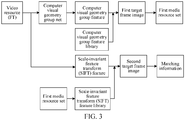
- a video resource is used as an example.
- a to-be-matched video resource (FT) is inputted into a deep learning network (for example, a computer visual geometry group net (VGGNet for short)).
- VGG features of all frames in the FT are extracted; the VGG features are matched with VGG features of frame images of multimedia resources in a multimedia resource set, to sift out first target frame images having the VGG features in the multimedia resource set.
- Multimedia resources to which the first target frame images belong are determined as media resources in the first media resource set.
- SIFT features are extracted then from the frame images of the to-be-matched multimedia resource, and the SIFT features in the frame images of the to-be-matched multimedia resource are matched with SIFT features in the first target frame images.
- Successfully matched frame images in the first target frame images are determined as second target frame images, and matching information of the second target frame images is obtained.
- media resources in which features of included first target frame images match features of frame images of a to-be-matched multimedia resource and meet a first matching condition, and the first target frame images meet a target condition are first found from a multimedia resource set, to find media resources in a resource library that are similar to the to-be-matched multimedia resource, to form a first media resource set; then second target frame images whose features match the features in the frame images of the to-be-matched multimedia resource and meet a second matching condition are determined from the first target frame images of the media resources in the first media resource set; and matching information of the second target frame images is obtained, to sift out media resources having higher similarities from the media resources similar to the to-be-matched multimedia resource, and obtain specific matching information, thereby improving efficiency of matching multimedia resources, and further resolving a technical problem of relatively low efficiency of matching multimedia resources in the related art.
- that the target device searches the first media resource set among the multimedia resource set includes the following steps:
- the target device determines, in frame images of multimedia resources in the multimedia resource set, the first target frame images meeting the target condition.
- the target device obtains first multimedia resources to which the first target frame images belong, the first media resource set including the first multimedia resources.
- a storage form in the multimedia resource set may be, but is not limited to, a feature-frame image pair form.
- the frame images may be represented in a form of coordinates of multimedia resource identifiers and playback time points, for example, [D t ]: ⁇ [ t j , videoID k ], [ t k , videoID x ] ... ⁇ and [D t+1 ]: ⁇ [ t j + n , videoID k + h ], [ t k , videoID x ] ... ⁇ , where D t and D t+1 are features, t is a time point, and videoID is an ID number of a video.
- a specific frame image of a specific multimedia resource in the first multimedia resource set having features the same as or similar to those of the frame images of the to-be-matched multimedia resource can be sifted out in this form.
- the first target frame images meeting the target condition may be obtained, the first target frame images may be aggregated according to multimedia resources, to find the first multimedia resources to which the first target frame images belong. Therefore, the first media resource set is obtained.
- that the target device determines, in frame images of multimedia resources in the multimedia resource set, the first target frame images meeting the target condition includes the following steps:
- the first feature in the frame images of the to-be-matched multimedia resource may be extracted in the following manner: training a classification network model by using a plurality of multimedia resource samples and similarity data, to obtain a target classification network model, the similarity data being data used for indicating similarities among the plurality of multimedia resource samples, a loss function of the classification network model being set to a contrastive loss function, input parameters of the target classification network model being frame images of multimedia resources, and output parameters of the target classification network model being features corresponding to the frame images of the multimedia resources; and inputting the frame images of the to-be-matched multimedia resource into the target classification network model, to obtain the first feature outputted by the target classification network model.
- the classification network model may include, but is not limited to: the VGGNet, the GoogleNet, the ResNet, and the like.
- that the target device determines the second target frame images in the first target frame images includes the following steps:
- second features of the first target frame image include: S1, S2, S3, S4, S5, S6, S7, S8, S9, and S10
- third features of the frame image of the to-be-matched multimedia resource include: S1, S2, S3, S4, S5, S6, S7, S8, S9, and S11
- matched features between the second features of the first target frame image and the third features of the frame image of the to-be-matched multimedia resource are S1, S2, S3, S4, S5, S6, S7, S8, and S9
- a quantity of the matched features is 9
- mutually unmatched features between the second features of the first target frame image and the third features of the frame image of the to-be-matched multimedia resource are S1, S2, S3, S4, S5, S6, S7, S8, S9, S10, and S11
- a quantity of mutually unmatched features is 11, so
- that the target device obtains the matching information of the second target frame images includes the following steps:
- a total duration of a matching part between the to-be-matched multimedia resource and a multimedia resource can be determined by using, for example, but not limited to, a quantity of second target frame images in the multimedia resource and a frame rate of the multimedia resource.
- a scaling relationship of matched parts in a multimedia resource is determined by, for example, but not limited to, constructing a mapping relationship between time points of a second target frame image and a to-be-matched frame image that have a correspondence.
- Information of video time domain deformation is estimated by using a least squares error method.
- the method further includes the following steps:
- whether the to-be-matched multimedia resource infringes on a copyright may be determined according to the obtained matching information. For example, if a duration of a matching part between a to-be-matched video and a video in a video library exceeds 50% of a total duration of the video, it may be determined that the to-be-matched video infringes on a copyright of the video.
- the computer software product is stored in a storage medium (such as a read-only memory (ROM)/ random access memory (RAM), a magnetic disk, or an optical disc), and includes several instructions for instructing a terminal device (which may be a mobile phone, a computer, a server, a network device, or the like) to perform the methods described in the embodiments of this disclosure.
- a storage medium such as a read-only memory (ROM)/ random access memory (RAM), a magnetic disk, or an optical disc
- a terminal device which may be a mobile phone, a computer, a server, a network device, or the like
- a multimedia resource matching apparatus configured to implement the foregoing multimedia resource matching method is further provided. As shown in FIG. 5 , the apparatus includes:
- the multimedia resource matching apparatus may be applied to a hardware environment constituted by a target device 202 shown in FIG. 2 .
- the target device 202 searches a first media resource set among a multimedia resource set, first target frame images of all media resources in the first media resource set meeting a target condition, and features of the first target frame images matching features in frame images of a to-be-matched multimedia resource and meeting a first matching condition.
- Second target frame images are determined in the first target frame images, features of the second target frame images matching the features in the frame images of the to-be-matched multimedia resource and meeting a second matching condition.
- Matching information of the second target frame images is obtained, the matching information being used for indicating a total duration and a playback moment of the second target frame image in a target media resource.
- the target device 202 may be, but is not limited to, a terminal device, or may be, but is not limited to, a server device, for example, a terminal device on which a client supporting multimedia can be installed, such as a mobile phone, a tablet computer, or a PC.
- the target device 202 may be a server corresponding to a client supporting multimedia.
- the multimedia resource matching apparatus may be applied to, but is not limited to, a scenario of performing matching on multimedia resources.
- the client may be, but is not limited to, various types of applications, for example, an online education application, an instant messaging application, a community space application, a game application, a shopping application, a browser application, a financial application, a multimedia application (such as a video application and an audio application), and a live streaming application.
- the multimedia resource matching method may be applied to, but is not limited to, a scenario in which video resources are matched in the foregoing video application, or may be applied to, but is not limited to, a scenario in which audio resources are matched in the foregoing instant messaging application, to improve efficiency of matching multimedia resources.
- the foregoing description is merely an example, and no limitation is imposed in this embodiment.
- the multimedia resources may include, but are not limited to: video resources (video files, video streams, and the like), audio resources (audio files, audio streams, and the like), picture resources (animated pictures, sound pictures, and the like), text resources, and the like.
- the target condition that the first target frame images of all the media resources in the first media resource set need to meet may be, but is not limited to, a condition used for determining a similarity between two multimedia resources.
- a quantity of first target images in a multimedia resource is greater than a first quantity
- a proportion of first target images of a multimedia resource in the multimedia resource is greater than a first proportion
- a quantity of temporally consecutive first target images in a multimedia resource is greater than a second quantity
- a proportion of the quantity of the consecutive first target images in the multimedia resource is greater than a second proportion.
- the first matching condition that the features of the first target frame images need to meet may include, but is not limited to, that the first target frame images and the frame images of the to-be-matched multimedia resource have same first-type features.
- one or more of the first-type features can be extracted from each frame image.
- the first-type features may be features extracted through deep learning. When all or some of first-type features respectively extracted from two frame images are the same, the two frame images can be determined to be similar.
- the second matching condition that the features of the second target frame images and the features in the frame images of the to-be-matched multimedia resource need to meet may include, but is not limited to, that a quantity of same or similar features in second-type features extracted from the second target frame images and second-type features extracted from the frame images of the to-be-matched multimedia resource is greater than a target value, or a proportion of the quantity of the same or similar features in a total quantity of the second-type features extracted from the second target frame images and the second-type features extracted from the frame images of the to-be-matched multimedia resource is greater than a specific value.
- second-type features may be extracted from a frame image by using a feature extraction algorithm (such as a SIFT algorithm or a SURF algorithm). If same or similar second-type features in two frame images reach a particular quantity, it may be considered that the two frame images are same frame images.
- a feature extraction algorithm such as a SIFT algorithm or a SURF algorithm.
- the matching information of the second target frame image may include, but is not limited to: a total duration and a playback moment of the second target frame image in a target media resource.
- the matching information may further include, but is not limited to: a scaling relationship of matched segments between the target media resource and the to-be-matched media resource, a percentage that the total duration of the second target frame image in the target media resource accounts for in a duration of the target media resource, and the like.
- the matching information may be used for processing the to-be-matched multimedia resource, for example, determining whether the resource infringes on a copyright, pushing a multimedia resource, and performing typesetting on a multimedia resource on an interface.
- a video resource is used as an example.
- a to-be-matched video resource FT is inputted into a deep learning network (for example, the VGGNet).
- VGG features of all frames in the FT are extracted.
- the VGG features are matched with VGG features of frame images of multimedia resources in a multimedia resource set, to sift out first target frame images having the VGG features in the multimedia resource set.
- Multimedia resources to which the first target frame images belong are determined as media resources in the first media resource set.
- SIFT features are extracted then from the frame images of the to-be-matched multimedia resource, and the SIFT features in the frame images of the to-be-matched multimedia resource are matched with SIFT features in the first target frame images.
- Successfully matched frame images in the first target frame images are determined as second target frame images, and matching information of the second target frame images is obtained.
- media resources in which features of included first target frame images match features of frame images of a to-be-matched multimedia resource and meet a first matching condition, and the first target frame images meet a target condition are first found from a multimedia resource set, to find media resources in a resource library that are similar to the to-be-matched multimedia resource, to form a first media resource set; then second target frame images whose features match the features in the frame images of the to-be-matched multimedia resource and meet a second matching condition are determined from the first target frame images of the media resources in the first media resource set; and matching information of the second target frame images is obtained, to sift out media resources having higher similarities from the media resources similar to the to-be-matched multimedia resource, and obtain specific matching information, thereby improving efficiency of matching multimedia resources, and further resolving a technical problem of relatively low efficiency of matching multimedia resources in the related art.
- the search module includes:
- a storage form in the multimedia resource set may be, but is not limited to, a feature-frame image pair form.
- the frame images may be represented in a form of coordinates of multimedia resource identifiers and playback time points, for example, [D t ]: ⁇ [ t j , videoID k ], [ t k , videoID x ] ... ⁇ and [D t+1 ]: ⁇ [ t j + n , videoID k + h ], [ t k , videoID x ] ... ⁇ , where D t and D t+1 are features, t is a time point, and videoID is an ID number of a video.
- a specific frame image of a specific multimedia resource in the first multimedia resource set having features the same as or similar to those of the frame images of the to-be-matched multimedia resource can be sifted out in this form.
- the first target frame images meeting the target condition may be obtained, the first target frame images may be aggregated according to multimedia resources, to find the first multimedia resources to which the first target frame images belong. Therefore, the first media resource set is obtained.
- the first determining unit is configured to:
- the first determining unit is further configured to: train a classification network model by using a plurality of multimedia resource samples and similarity data, to obtain a target classification network model, the similarity data being data used for indicating similarities among the plurality of multimedia resource samples, a loss function of the classification network model being set to a contrastive loss function, input parameters of the target classification network model being frame images of multimedia resources, and output parameters of the target classification network model being features corresponding to the frame images of the multimedia resources; and input the frame images of the to-be-matched multimedia resource into the target classification network model, to obtain the first feature outputted by the target classification network model.
- the classification network model may include, but is not limited to: the VGGNet, the GoogleNet, the ResNet, and the like.
- the first determining module is configured to: extract second features from the first target frame images, and extract third features from the frame images of the to-be-matched multimedia resource; obtain correspondences between the first target frame images and the frame images of the to-be-matched multimedia resource; for the first target frame image and the frame image of the to-be-matched multimedia resource that have the correspondence, obtain a quantity of matched features and a quantity of mutually unmatched features in the second features of the first target frame image and the third features of the frame image of the to-be-matched multimedia resource; obtain a ratio of the quantity of the matched features to the quantity of the mutually unmatched features; and determine the first target frame image corresponding to the ratio falling within a first ratio range as the second target frame image, the frame image corresponding to the ratio falling within the first ratio range being a frame image whose features match the features in the frame image of the to-be-matched multimedia resource and meet the second matching condition.
- second features of the first target frame image having the correspondence include: S1, S2, S3, S4, S5, S6, S7, S8, S9, and S10
- third features of the frame image of the to-be-matched multimedia resource include: S1, S2, S3, S4, S5, S6, S7, S8, S9, and S11
- matched features between the second features of the first target frame image and the third features of the frame image of the to-be-matched multimedia resource are S1, S2, S3, S4, S5, S6, S7, S8, and S9
- a quantity of the matched features is 9
- mutually unmatched features between the second features of the first target frame image and the third features of the frame image of the to-be-matched multimedia resource are S1, S2, S3, S4, S5, S6, S7, S8, S9, S10, and S11
- a quantity of mutually unmatched features is 11, so that a ratio of
- the first obtaining module includes:
- a total duration of a matching part between the to-be-matched multimedia resource and a multimedia resource can be determined by using, for example, but not limited to, a quantity of second target frame images in the multimedia resource and a frame rate of the multimedia resource.
- a scaling relationship of matched parts in a multimedia resource is determined by, for example, but not limited to, constructing a mapping relationship between time points of a second target frame image and a to-be-matched frame image that have a correspondence.
- Information of video time domain deformation is estimated by using a least squares error method.
- the apparatus further includes:
- whether the to-be-matched multimedia resource infringes on a copyright may be determined according to the obtained matching information. For example, if a duration of a matching part between a to-be-matched video and a video in a video library exceeds 50% of a total duration of the video, it may be determined that the to-be-matched video infringes on a copyright of the video.
- the multimedia resource matching method may be applied to, but is not limited to, a scenario in which video resources are matched shown in FIG. 6 .
- a process of matching videos includes two procedures of feature matching: a procedure of matching VGG hash features and a procedure of matching RootSIFT features.
- the VGG hash features are first used for performing similarity matching on videos (a VGG hash fingerprint database refers to a set of features of videos having copyrights).
- a VGG hash fingerprint database refers to a set of features of videos having copyrights.
- secondary correction that is, RootSIFT feature matching
- video features are extracted in the following manner: a frame rate of an inputted video (equivalent to the to-be-matched multimedia resource) is first changed to K frames/s (for example, K is set to 3). Subsequently, two methods for extracting features, namely, feature extraction of deep learning and conventional feature extraction, are applied.
- a conventional classification network such as the VGG, the GoogleNet, and the ResNet
- Transfer learning is performed in a pre-trained classification network (for example, the VGGNet that performs classification on 1000 objects and that is obtained through training by using a disclosed dataset imageNet).
- a similar data set of a batch of pictures is collected, and a final loss layer of the VGG (the VGG is used as an example herein, and another network is also applicable) performing classification is changed into a contrastive loss, so that a similarity between two pictures may be measured.
- transfer learning is performed, to obtain a network capable of distinguishing similarities of pictures.
- each picture only has one feature, and the feature is recorded as Fdt herein, where t represents a time point.
- the extracted feature is transformed into a hash through median binarization (median cut), and is recorded as D t .
- a RootSIFT method is used.
- SIFT feature extraction is performed on extracted video frames, to obtain P features.
- a normalization operation is performed on the P features. Normalization may improve an anti-noise capability:
- Original SIFT vector V sift v 1 , v 2 , ... , v 128
- V rootsift V sift / ⁇ i 128 v i
- a process of matching video fingerprints is performed in the following manner: matching video fingerprints includes two processes: 1. VGG feature matching; 2. RootSIFT feature matching.
- the process is as follows: VGG feature matching is first performed on an inputted video, because features extracted by the VGGNet are relatively abstract and a quantity of hash is relatively small. VGG feature matching is very suitable as the first video match filtering. VGG feature matching may have a very high recall rate. After the VGG feature matching, similarities of videos may be calculated. For videos having similarities greater than a threshold, RootSIFT matching analysis is used, to further determine matching information of the videos. The RootSIFT has relatively good detail descriptions, and can better ensure accuracy.
- a process of VGG feature matching includes: fingerprint feature extraction, and hash transformation, and time domain matching analysis.
- Video fingerprint feature extraction is first performed on an inputted video, and then through median binarization, a succession of hash feature values and time points corresponding to the hash.
- a fingerprint database stores features (D t , videoID, t) of videos having copyrights, where t is a time point, and videoID is an ID number of a video.
- features of such a type are stored according to a data structure of an inverted table.
- the inputted video is divided into a plurality of segments of Ks (herein K is set to 5), matching is individually performed for each of the segments. If there are three feature frames per second, when K is set to 5, a single segment has 15 hash values ( D i , i ⁇ [0,15)) in total. Each D i is compared with features in a fingerprint database, to find information ([ t j , videoID k ], [ t k , videoID x ] Among other features in a fingerprint database, to find information ([ t j , videoID k ], [ t k , videoID x ] ...) of a corresponding video having equal hash feature values (for example, data having equal D t ), and then aggregation is performed according to videoID k .
- a quantity of temporally consecutively matched frame images for videoID k is counted, and then, is divided by 15, to obtain a similarity.
- Video segments having similarities greater than 0.8 are selected as matched segments.
- similarity calculation may be performed on segments of each Ks, and finally, a quantity R of similar segments between each video and the inputted video is obtained.
- RootSIFT feature matching is performed. After the VGG feature matching, a videoID list of VGG matching may be obtained. During RootSIFT matching, calibration of secondary matching is performed on the inputted video and videoIDs of VGG matching. RootSIFT feature extraction is first performed on the inputted video, and RootSIFT features of videos of VGG matching are read from the fingerprint database.
- a specific threshold for example, Q, Q being set to 50
- a policy of matching every two videos is used during the matching procedure, that is, the inputted video is matched with videos in the videoID list one by one, to find matching information.
- T t 1 , T t 2 ′ is less than a threshold E (for example, E is set to 0.011)
- a video frame T t1 matches a video frame T t 2 ′
- matching time information (t1, t2) is recorded.
- Information of video time domain deformation is estimated by using a least squares error method.
- matching time points are analyzed to obtain a matching duration.
- a matching percentage of a video may be calculated according to a matching duration and a duration of the inputted video (calculation of the percentage may be adjusted according to related service logic). Matching of the video is finally determined by using the percentage or information of the matching duration.
- RootSIFT secondary matching matching is sequentially performed on every two videos in the videos of the videoID list. Matching results (including matching time points, matching durations, and the like) are finally outputted.
- the manner may also be applied to detecting repeated videos. Not only stored videos of a video platform can be purified, to improve video quality of the platform, but also recommended videos can be filtered during a recommendation made by an application.
- an electronic apparatus configured to perform the foregoing multimedia resource matching.
- the electronic apparatus includes: one or more (only one is shown is the figure) processors 702, a memory 704, a sensor 706, an encoder 708, and a transmission apparatus 710, the memory storing a computer program, and the processor being configured to perform the steps in any one of the foregoing method embodiments by using the computer program.
- the electronic apparatus may be located in at least one of a plurality of network devices in a computer network.
- the processor may be configured to perform the following steps by using the computer program:
- the electronic apparatus may also be a terminal device such as a smartphone (such as an Android mobile phone or an iOS mobile phone), a tablet computer, a palmtop computer, a mobile Internet device (MID), or a PAD.
- a terminal device such as a smartphone (such as an Android mobile phone or an iOS mobile phone), a tablet computer, a palmtop computer, a mobile Internet device (MID), or a PAD.
- FIG. 7 does not constitute a limitation on a structure of the foregoing electronic apparatus.
- the electronic apparatus may alternatively include more or fewer components (such as a network interface and a display apparatus) than those shown in FIG. 7 , or has a configuration different from that shown in FIG. 7 .
- the memory 702 may be configured to store a software program and module, for example, a program instruction/module corresponding to the multimedia resource matching method and apparatus in the embodiments of this disclosure.
- the processor 704 executes various functional applications and performs data processing by running the software program and module stored in the memory 702, that is, implements the foregoing target component control method.
- the memory 702 may include a high speed random access memory, and may alternatively include a non-volatile memory, for example, one or more magnetic storage apparatuses, a flash memory, or another non-volatile solid-state memory.
- the memory 702 may further include memories remotely disposed relative to the processor 704, and the remote memories may be connected to a terminal by using a network. Examples of the network include but are not limited to, the Internet, an intranet, a local area network, a mobile communications network, and a combination thereof.
- the transmission apparatus 710 is configured to receive or transmit data by using a network.
- the network may include a wired network and a wireless network.
- the transmission apparatus 710 includes a network interface controller (NIC), which may be connected to another network device and router by using a cable, to communicate with the Internet or a local area network.
- the transmission apparatus 710 is a radio frequency (RF) module, and is configured to wirelessly communicate with the Internet.
- NIC network interface controller
- RF radio frequency
- the memory 702 is configured to store an application program.
- the embodiments of this disclosure further provide a storage medium.
- the storage medium stores a computer program, the computer program being configured to perform, when run, steps in any one of the foregoing method embodiments.
- the storage medium may be configured to store a computer program used for performing the following steps:
- the storage medium is further configured to store a computer program configured to perform the steps included in the method in the foregoing embodiments. Details are not described again in this embodiment.
- a person of ordinary skill in the art may understand that all or some of the steps of the methods in the embodiments may be implemented by a program by instructing hardware relevant to a terminal device.
- the program may be stored in a computer-readable storage medium, and the storage medium may include a flash drive, a ROM, a RAM, a magnetic disk, an optical disc, and the like.
- the integrated unit in the foregoing embodiments When the integrated unit in the foregoing embodiments is implemented in the form of a software functional unit and sold or used as an independent product, the integrated unit may be stored in the foregoing computer-readable storage medium.
- the technical solutions of this disclosure essentially, or the part contributing to the related technology, or all or some of the technical solutions may be implemented in a form of a software product.
- the computer software product is stored in a storage medium and includes several instructions for instructing one or more computer devices (which may be a personal computer, a server, a network device, and the like) to perform all or some of the steps of the methods in the embodiments of this disclosure.
- the disclosed client may be implemented in other manners.
- the described apparatus embodiment is merely exemplary.
- the unit division is merely logical function division and may be another division in an actual implementation.
- a plurality of units or components may be combined or integrated into another system, or some features may be ignored or not performed.
- the displayed or discussed mutual couplings or direct couplings or communication connections may be implemented through some interfaces.
- the indirect couplings or communication connections between the units or modules may be implemented in electronic or another form.
- the units described as separate parts may or may not be physically separate, and parts displayed as units may or may not be physical units, may be located in one position, or may be distributed on a plurality of network units. Some or all of the units may be selected according to actual needs to achieve the objectives of the solutions of the embodiments.
- functional units in the embodiments of this disclosure may be integrated into one processing unit, or each of the units may exist alone physically, or two or more units are integrated into one unit.
- the integrated unit may be implemented in the form of hardware, or may be implemented in the form of a software function unit.
Landscapes
- Engineering & Computer Science (AREA)
- Theoretical Computer Science (AREA)
- Physics & Mathematics (AREA)
- General Physics & Mathematics (AREA)
- Data Mining & Analysis (AREA)
- Multimedia (AREA)
- General Engineering & Computer Science (AREA)
- Library & Information Science (AREA)
- Databases & Information Systems (AREA)
- Artificial Intelligence (AREA)
- Life Sciences & Earth Sciences (AREA)
- Bioinformatics & Cheminformatics (AREA)
- Bioinformatics & Computational Biology (AREA)
- Computer Vision & Pattern Recognition (AREA)
- Evolutionary Biology (AREA)
- Evolutionary Computation (AREA)
- Information Retrieval, Db Structures And Fs Structures Therefor (AREA)
- Image Analysis (AREA)
- Two-Way Televisions, Distribution Of Moving Picture Or The Like (AREA)
- Television Signal Processing For Recording (AREA)
Abstract
Description
- This application claims priority to Chinese Patent Application No.
2018103338056 - This disclosure relates to the field of computers, and specifically, to a multimedia resource matching method and apparatus, a storage medium, and an electronic apparatus.
- With the rapid development of computer and network technologies, people can access an increasing quantity of multimedia resources on networks. Platforms providing multimedia resources sometimes need to perform matching on the multimedia resources, to perform subsequent processing on the multimedia resources. However, a current manner of matching multimedia resources has relatively low accuracy and relatively low matching efficiency. How to perform matching on multimedia resources with high accuracy and high efficiency becomes a key part of improving efficiency in processing the multimedia resources.
- For the foregoing problem, currently no effective solutions have been put forward.
- Embodiments of this disclosure provide a multimedia resource matching method and apparatus, a storage medium, and an electronic apparatus, to resolve at least a technical problem of relatively low efficiency of matching multimedia resources in the related art.
- According to an aspect of the embodiments of this disclosure, a multimedia resource matching method is provided. The method includes: searching a first media resource set among a multimedia resource set, first target frame images of all media resources in the first media resource set meeting a target condition, and features of the first target frame images matching features in frame images of a to-be-matched multimedia resource and meeting a first matching condition; determining second target frame images in the first target frame images, features of the second target frame images matching the features in the frame images of the to-be-matched multimedia resource and meeting a second matching condition; and obtaining matching information of the second target frame images, the matching information being used for indicating a total duration and a playback moment of the second target frame image in a target media resource, and the target media resource being a media resource to which the second target frame image belongs.
- Optionally, in this embodiment, the multimedia resource matching method is applied to a target device.
- Optionally, in this embodiment, the target device includes: a terminal device or a server device.
- According to another aspect of the embodiments of this disclosure, a multimedia resource matching apparatus is further provided. The apparatus includes: a search module, configured to search a first media resource set among a multimedia resource set, first target frame images of all media resources in the first media resource set meeting a target condition, and features of the first target frame images matching features in frame images of a to-be-matched multimedia resource and meeting a first matching condition; a first determining module, configured to determine second target frame images in the first target frame images, features of the second target frame images matching the features in the frame images of the to-be-matched multimedia resource and meeting a second matching condition; and a first obtaining module, configured to obtain matching information of the second target frame images, the matching information being used for indicating a total duration and a playback moment of the second target frame image in a target media resource, and the target media resource being a media resource to which the second target frame image belongs.
- According to another aspect of the embodiments of this disclosure, a storage medium is further provided. The storage medium stores a computer program, the computer program being configured to perform, when run, any one method described above.
- According to another aspect of the embodiments of this disclosure, an electronic apparatus is further provided. The electronic apparatus includes a memory and a processor, the memory storing a computer program, the processor being configured to perform the any one method described above by using the computer program.
- In the embodiments of this disclosure, media resources in which features of included first target frame images match features of frame images of a to-be-matched multimedia resource and meet a first matching condition, and the first target frame images meet a target condition are first found from a multimedia resource set, to find media resources in a resource library that are similar to the to-be-matched multimedia resource, to form a first media resource set; then second target frame images whose features match the features in the frame images of the to-be-matched multimedia resource and meet a second matching condition are determined from the first target frame images of the media resources in the first media resource set; and matching information of the second target frame images is obtained, to sift out media resources having higher similarities from the media resources similar to the to-be-matched multimedia resource, and obtain specific matching information, thereby improving efficiency of matching multimedia resources, and further resolving a technical problem of relatively low efficiency of matching multimedia resources in the related art.
- The accompanying drawings described herein are used for providing a further understanding of this disclosure, and form a part of this disclosure. Exemplary embodiments of this disclosure and descriptions thereof are used for explaining this disclosure, and do not constitute any inappropriate limitation to this disclosure. In the accompanying drawings:
-
FIG. 1 is a schematic diagram of an optional multimedia resource matching method according to an embodiment of this disclosure. -
FIG. 2 is a schematic diagram of an application environment of an optional multimedia resource matching method according to an embodiment of this disclosure. -
FIG. 3 is a schematic diagram of an optional multimedia resource matching method according to an optional implementation of this disclosure. -
FIG. 4 is a schematic diagram of an optional multimedia resource matching method according to an optional implementation of this disclosure. -
FIG. 5 is a schematic diagram of an optional multimedia resource matching apparatus according to an embodiment of this disclosure. -
FIG. 6 is a schematic diagram of an application scenario of an optional multimedia resource matching method according to an embodiment of this disclosure. -
FIG. 7 is a schematic diagram of an optional electronic apparatus according to an embodiment of this disclosure. - To make a person skilled in the art understand solutions of this disclosure better, the following clearly and completely describes the technical solutions in the embodiments of this disclosure with reference to the accompanying drawings in the embodiments of this disclosure. Apparently, the described embodiments are merely some but not all of the embodiments of this disclosure. All other embodiments obtained by a person of ordinary skill in the art based on the embodiments of this disclosure without creative efforts shall fall within the protection scope of this disclosure.
- The terms such as "first" and "second" in the specification, claims, and accompanying drawings of this disclosure are intended to distinguish between similar objects rather than describe a particular sequence or a chronological order. It is to be understood that the data termed in such a way are interchangeable in proper circumstances so that the embodiments of this disclosure described herein can be implemented in orders except the order illustrated or described herein. In addition, the terms "include", "comprise" and any other variants are intended to cover the non-exclusive inclusion. For example, a process, method, system, product, or device that includes a series of steps or units is not necessarily limited to those expressly listed steps or units, but may include other steps or units not expressly listed or inherent to such a process, method, product, or device.
- According to an aspect of the embodiments of this disclosure, a multimedia resource matching method is provided. As shown in
FIG. 1 , the method includes the following steps: - S102: A target device searches a first media resource set among a multimedia resource set, first target frame images of all media resources in the first media resource set meeting a target condition, and features of the first target frame images matching features in frame images of a to-be-matched multimedia resource and meeting a first matching condition.
- S104: The target device determines second target frame images in the first target frame images, features of the second target frame images matching the features in the frame images of the to-be-matched multimedia resource and meeting a second matching condition.
- S106: The target device obtains matching information of the second target frame images, the matching information being used for indicating a total duration and a playback moment of the second target frame image in a target media resource, and the target media resource being a media resource to which the second target frame image belongs.
- Optionally, in this embodiment, the multimedia resource matching method may be applied to a hardware environment constituted by a
target device 202 shown inFIG. 2 . As shown inFIG. 2 , thetarget device 202 searches a first media resource set among a multimedia resource set, first target frame images of all media resources in the first media resource set meeting a target condition, and features of the first target frame images matching features in frame images of a to-be-matched multimedia resource and meeting a first matching condition. Thetarget device 202 determines second target frame images in the first target frame images, features of the second target frame images matching the features in the frame images of the to-be-matched multimedia resource and meeting a second matching condition. Thetarget device 202 obtains matching information of the second target frame images, the matching information being used for indicating a total duration and a playback moment of the second target frame image in a target media resource. - Optionally, in this embodiment, the
target device 202 may be, but is not limited to, a terminal device, or may be, but is not limited to, a server device, for example, a terminal device on which a client supporting multimedia can be installed, such as a mobile phone, a tablet computer, or a personal computer (PC). Alternatively, thetarget device 202 may be a server corresponding to a client supporting multimedia. The foregoing description is merely an example, and no limitation is imposed in this embodiment. - Optionally, in this embodiment, the multimedia resource matching method may be applied to, but is not limited to, a scenario in which multimedia resources are matched. The client may be, but is not limited to, various types of applications, for example, an online education application, an instant messaging application, a community space application, a game application, a shopping application, a browser application, a financial application, a multimedia application (such as a video application and an audio application), and a live streaming application. Optionally, the multimedia resource matching method may be applied to, but is not limited to, a scenario in which video resources are matched in the foregoing video application, or may be applied to, but is not limited to, a scenario in which audio resources are matched in the foregoing instant messaging application, to improve efficiency of matching multimedia resources. The foregoing description is merely an example, and no limitation is imposed in this embodiment.
- Optionally, in this embodiment, the multimedia resources may include, but are not limited to: video resources (video files, video streams, and the like), audio resources (audio files, audio streams, and the like), picture resources (animated pictures, sound pictures, and the like), text resources, and the like.
- Optionally, in this embodiment, the target condition that the first target frame images of all the media resources in the first media resource set need to meet may be, but is not limited to, a condition used for determining a similarity between two multimedia resources. For example, a quantity of first target images in a multimedia resource is greater than a first quantity, a proportion of first target images of a multimedia resource in the multimedia resource is greater than a first proportion, a quantity of temporally consecutive first frame images in a multimedia resource is greater than a second quantity, or a proportion of the quantity of the consecutive first target images in the multimedia resource is greater than a second proportion.
- Optionally, in this embodiment, the first matching condition that the features of the first target frame images need to meet may include, but is not limited to, that the first target frame images and the frame images of the to-be-matched multimedia resource have same first-type features. For example, one or more of the first-type features can be extracted from each frame image. For example, the first-type features may be features extracted through deep learning. When all or some of first-type features respectively extracted from two frame images are the same, the two frame images can be determined to be similar.
- Optionally, in this embodiment, the second matching condition that the features of the second target frame images and the features in the frame images of the to-be-matched multimedia resource need to meet may include, but is not limited to, that a quantity of same or similar features in second-type features extracted from the second target frame images and second-type features extracted from the frame images of the to-be-matched multimedia resource is greater than a target value, or a proportion of the quantity of the same or similar features in a total quantity of the second-type features extracted from the second target frame images and the second-type features extracted from the frame images of the to-be-matched multimedia resource is greater than a specific value. For example, second-type features may be extracted from a frame image by using a feature extraction algorithm (such as a scale-invariant feature transform (SIFT for short) algorithm or a speeded up robust features (SURF for short) algorithm). If same or similar second-type features in two frame images reach a specific quantity, the two frame images may be considered as same frame images.
- Optionally, in this embodiment, the matching information of the second target frame image may include, but is not limited to: a total duration and a playback moment of the second target frame image in a target media resource. Alternatively, the matching information may further include, but is not limited to: a scaling relationship of matched segments between the target media resource and the to-be-matched media resource, a percentage that the total duration of the second target frame image in the target media resource accounts for in a duration of the target media resource, and the like.
- Optionally, in this embodiment, after the matching information of the second target frame images is obtained, the matching information may be used for processing the to-be-matched multimedia resource, for example, determining whether the resource infringes on a copyright, pushing a multimedia resource, and performing typesetting on a multimedia resource on an interface.
- In an optional implementation, a video resource is used as an example. As shown in
FIG. 3 , a to-be-matched video resource (FT) is inputted into a deep learning network (for example, a computer visual geometry group net (VGGNet for short)). VGG features of all frames in the FT are extracted; the VGG features are matched with VGG features of frame images of multimedia resources in a multimedia resource set, to sift out first target frame images having the VGG features in the multimedia resource set. Multimedia resources to which the first target frame images belong are determined as media resources in the first media resource set. SIFT features are extracted then from the frame images of the to-be-matched multimedia resource, and the SIFT features in the frame images of the to-be-matched multimedia resource are matched with SIFT features in the first target frame images. Successfully matched frame images in the first target frame images are determined as second target frame images, and matching information of the second target frame images is obtained. - It can be learned that through the foregoing steps, media resources in which features of included first target frame images match features of frame images of a to-be-matched multimedia resource and meet a first matching condition, and the first target frame images meet a target condition are first found from a multimedia resource set, to find media resources in a resource library that are similar to the to-be-matched multimedia resource, to form a first media resource set; then second target frame images whose features match the features in the frame images of the to-be-matched multimedia resource and meet a second matching condition are determined from the first target frame images of the media resources in the first media resource set; and matching information of the second target frame images is obtained, to sift out media resources having higher similarities from the media resources similar to the to-be-matched multimedia resource, and obtain specific matching information, thereby improving efficiency of matching multimedia resources, and further resolving a technical problem of relatively low efficiency of matching multimedia resources in the related art.
- In an optional solution, that the target device searches the first media resource set among the multimedia resource set includes the following steps:
- S1: The target device determines, in frame images of multimedia resources in the multimedia resource set, the first target frame images meeting the target condition.
- S2: The target device obtains first multimedia resources to which the first target frame images belong, the first media resource set including the first multimedia resources.
- Optionally, in this embodiment, a storage form in the multimedia resource set may be, but is not limited to, a feature-frame image pair form. The frame images may be represented in a form of coordinates of multimedia resource identifiers and playback time points, for example, [Dt]: {[tj , videoIDk ], [tk , videoIDx ] ...} and [Dt+1]: {[t j+n , videoID k+h ], [tk , videoIDx ] ...}, where Dt and Dt+1 are features, t is a time point, and videoID is an ID number of a video. A specific frame image of a specific multimedia resource in the first multimedia resource set having features the same as or similar to those of the frame images of the to-be-matched multimedia resource can be sifted out in this form.
- Optionally, in this embodiment, after the first target frame images meeting the target condition are obtained, the first target frame images may be aggregated according to multimedia resources, to find the first multimedia resources to which the first target frame images belong. Therefore, the first media resource set is obtained.
- In an optional solution, that the target device determines, in frame images of multimedia resources in the multimedia resource set, the first target frame images meeting the target condition includes the following steps:
- S1: The target device extracts a first feature from the frame images of the to-be-matched multimedia resource.
- S2: The target device obtains, from features and frame image sets that have correspondences, a target frame image set corresponding to the first feature, the target frame image set including frame images that are in multimedia resources of the first media resource set and that have the first feature, features of the frame images in the target frame image set matching the features in the frame images of the to-be-matched multimedia resource and meeting the first matching condition.
- S3: The target device obtains a second multimedia resource to which the frame images in the target frame image set belong.
- S4: The target device obtains a quantity of consecutive frame images that have the first feature and that are in the second multimedia resource.
- S5: The target device determines frame images having the first feature in the second multimedia resource whose quantity of consecutive frame images having the first feature falls within a target quantity threshold range as the first target frame images meeting the target condition.
- S6: The target device determines the media resources to which the first target frame images meeting the target condition belong as the first media resource set.
- Optionally, in this embodiment, the first feature in the frame images of the to-be-matched multimedia resource may be extracted in the following manner: training a classification network model by using a plurality of multimedia resource samples and similarity data, to obtain a target classification network model, the similarity data being data used for indicating similarities among the plurality of multimedia resource samples, a loss function of the classification network model being set to a contrastive loss function, input parameters of the target classification network model being frame images of multimedia resources, and output parameters of the target classification network model being features corresponding to the frame images of the multimedia resources; and inputting the frame images of the to-be-matched multimedia resource into the target classification network model, to obtain the first feature outputted by the target classification network model.
- Optionally, in this embodiment, the classification network model may include, but is not limited to: the VGGNet, the GoogleNet, the ResNet, and the like.
- In an optional solution, that the target device determines the second target frame images in the first target frame images includes the following steps:
- S1: The target device extracts second features from the first target frame images, and extracting third features from the frame images of the to-be-matched multimedia resource.
- S2: The target device obtains correspondences between the first target frame images and the frame images of the to-be-matched multimedia resource.
- S3: For the first target frame image and the frame image of the to-be-matched multimedia resource that have the correspondence, the target device obtains a quantity of matched features and a quantity of mutually unmatched features in the second features of the first target frame image and the third features of the frame image of the to-be-matched multimedia resource.
- S4: The target device obtains a ratio of the quantity of the matched features to the quantity of the mutually unmatched features.
- S5: The target device determines the first target frame image corresponding to the ratio falling within a first ratio range as the second target frame image, the frame image corresponding to the ratio falling within the first ratio range being a frame image whose features match the features in the frame image of the to-be-matched multimedia resource and meet the second matching condition.
- In an optional implementation, as shown in
FIG. 4 , for a first target frame image and a frame image of the to-be-matched multimedia resource that have a correspondence, if second features of the first target frame image include: S1, S2, S3, S4, S5, S6, S7, S8, S9, and S10, and third features of the frame image of the to-be-matched multimedia resource include: S1, S2, S3, S4, S5, S6, S7, S8, S9, and S11, matched features between the second features of the first target frame image and the third features of the frame image of the to-be-matched multimedia resource are S1, S2, S3, S4, S5, S6, S7, S8, and S9, and a quantity of the matched features is 9; mutually unmatched features between the second features of the first target frame image and the third features of the frame image of the to-be-matched multimedia resource are S1, S2, S3, S4, S5, S6, S7, S8, S9, S10, and S11, and a quantity of mutually unmatched features is 11, so that a ratio of the quantity of the matched features to the quantity of the mutually unmatched features is 9/11. Assuming that the first ratio range is being greater than 3/4, and theratio 9/11 is greater than 3/4, then the first target frame image can be determined as a second target frame image. - In an optional solution, that the target device obtains the matching information of the second target frame images includes the following steps:
- S1: The target device obtains target media resources to which the second target frame images belong.
- S2: For each of the target media resources, the target device determines a quantity of second target frame images included in the target media resource and a frame rate value of the target media resource, the frame rate value being used for indicating a quantity of played frame images per second of the target media resource.
- S3: The target device determines a product of the quantity of the second target frame images included in the target media resource and the frame rate value of the target media resource as a total duration corresponding to the target media resource, and determines a playback time point of the second target frame images included in the target media resource in the target media resource as a playback moment corresponding to the target media resource.
- Optionally, in this embodiment, a total duration of a matching part between the to-be-matched multimedia resource and a multimedia resource can be determined by using, for example, but not limited to, a quantity of second target frame images in the multimedia resource and a frame rate of the multimedia resource.
- Optionally, in this embodiment, a scaling relationship of matched parts in a multimedia resource is determined by, for example, but not limited to, constructing a mapping relationship between time points of a second target frame image and a to-be-matched frame image that have a correspondence. For example, a scaling relationship on a video matching time domain is estimated by constructing a time point mapping relationship of at1+bt2=c (t1 is a time point of an inputted video, and t2 is a time point of a matched video). Information of video time domain deformation is estimated by using a least squares error method.
- In an optional solution, after the target device obtains the matching information of the second target frame images, the method further includes the following steps:
- S1: The target device obtains a ratio of the total duration to a duration of the target media resource.
- S2: The target device determines, in a case that the ratio of the total duration to the duration of the target media resource falls within a second ratio range, that the to-be-matched multimedia resource infringes on a copyright of the target media resource, the target media resource being a multimedia resource having a copyright.
- Optionally, in this embodiment, whether the to-be-matched multimedia resource infringes on a copyright may be determined according to the obtained matching information. For example, if a duration of a matching part between a to-be-matched video and a video in a video library exceeds 50% of a total duration of the video, it may be determined that the to-be-matched video infringes on a copyright of the video.
- For brief description, the foregoing method embodiments are represented as a series of action combinations. However, a person skilled in the art shall appreciate that this disclosure is not limited to the described order of the actions, because some steps may be performed in other orders or simultaneously according to this disclosure. In addition, a person skilled in the art shall also learn that all the embodiments described in the specification are exemplary embodiments, and the related actions and modules are not necessarily mandatory to this disclosure.
- According to the foregoing descriptions of implementations, a person skilled in the art may clearly learn that the method according to the foregoing embodiments may be implemented by using software and a necessary general hardware platform, or certainly may be implemented by using hardware. However, in most cases, the former is a better implementation. Based on such an understanding, the technical solutions of this disclosure essentially or the part contributing to a related art may be implemented in a form of a software product. The computer software product is stored in a storage medium (such as a read-only memory (ROM)/ random access memory (RAM), a magnetic disk, or an optical disc), and includes several instructions for instructing a terminal device (which may be a mobile phone, a computer, a server, a network device, or the like) to perform the methods described in the embodiments of this disclosure.
- According to another aspect of the embodiments of this disclosure, a multimedia resource matching apparatus configured to implement the foregoing multimedia resource matching method is further provided. As shown in
FIG. 5 , the apparatus includes: - (1) a
search module 52, configured to search a first media resource set among a multimedia resource set, first target frame images of all media resources in the first media resource set meeting a target condition, and features of the first target frame images matching features in frame images of a to-be-matched multimedia resource and meeting a first matching condition; - (2) a first determining
module 54, configured to determine second target frame images in the first target frame images, features of the second target frame images matching the features in the frame images of the to-be-matched multimedia resource and meeting a second matching condition; and - (3) a first obtaining
module 56, configured to obtain matching information of the second target frame images, the matching information being used for indicating a total duration and a playback moment of the second target frame image in a target media resource, and the target media resource being a media resource to which the second target frame image belongs. - Optionally, in this embodiment, the multimedia resource matching apparatus may be applied to a hardware environment constituted by a
target device 202 shown inFIG. 2 . As shown inFIG. 2 , thetarget device 202 searches a first media resource set among a multimedia resource set, first target frame images of all media resources in the first media resource set meeting a target condition, and features of the first target frame images matching features in frame images of a to-be-matched multimedia resource and meeting a first matching condition. Second target frame images are determined in the first target frame images, features of the second target frame images matching the features in the frame images of the to-be-matched multimedia resource and meeting a second matching condition. Matching information of the second target frame images is obtained, the matching information being used for indicating a total duration and a playback moment of the second target frame image in a target media resource. - Optionally, in this embodiment, the
target device 202 may be, but is not limited to, a terminal device, or may be, but is not limited to, a server device, for example, a terminal device on which a client supporting multimedia can be installed, such as a mobile phone, a tablet computer, or a PC. Alternatively, thetarget device 202 may be a server corresponding to a client supporting multimedia. The foregoing description is merely an example, and no limitation is imposed in this embodiment. - Optionally, in this embodiment, the multimedia resource matching apparatus may be applied to, but is not limited to, a scenario of performing matching on multimedia resources. The client may be, but is not limited to, various types of applications, for example, an online education application, an instant messaging application, a community space application, a game application, a shopping application, a browser application, a financial application, a multimedia application (such as a video application and an audio application), and a live streaming application. Optionally, the multimedia resource matching method may be applied to, but is not limited to, a scenario in which video resources are matched in the foregoing video application, or may be applied to, but is not limited to, a scenario in which audio resources are matched in the foregoing instant messaging application, to improve efficiency of matching multimedia resources. The foregoing description is merely an example, and no limitation is imposed in this embodiment.
- Optionally, in this embodiment, the multimedia resources may include, but are not limited to: video resources (video files, video streams, and the like), audio resources (audio files, audio streams, and the like), picture resources (animated pictures, sound pictures, and the like), text resources, and the like.
- Optionally, in this embodiment, the target condition that the first target frame images of all the media resources in the first media resource set need to meet may be, but is not limited to, a condition used for determining a similarity between two multimedia resources. For example, a quantity of first target images in a multimedia resource is greater than a first quantity, a proportion of first target images of a multimedia resource in the multimedia resource is greater than a first proportion, a quantity of temporally consecutive first target images in a multimedia resource is greater than a second quantity, or a proportion of the quantity of the consecutive first target images in the multimedia resource is greater than a second proportion.
- Optionally, in this embodiment, the first matching condition that the features of the first target frame images need to meet may include, but is not limited to, that the first target frame images and the frame images of the to-be-matched multimedia resource have same first-type features. For example, one or more of the first-type features can be extracted from each frame image. For example, the first-type features may be features extracted through deep learning. When all or some of first-type features respectively extracted from two frame images are the same, the two frame images can be determined to be similar.
- Optionally, in this embodiment, the second matching condition that the features of the second target frame images and the features in the frame images of the to-be-matched multimedia resource need to meet may include, but is not limited to, that a quantity of same or similar features in second-type features extracted from the second target frame images and second-type features extracted from the frame images of the to-be-matched multimedia resource is greater than a target value, or a proportion of the quantity of the same or similar features in a total quantity of the second-type features extracted from the second target frame images and the second-type features extracted from the frame images of the to-be-matched multimedia resource is greater than a specific value. For example, second-type features may be extracted from a frame image by using a feature extraction algorithm (such as a SIFT algorithm or a SURF algorithm). If same or similar second-type features in two frame images reach a particular quantity, it may be considered that the two frame images are same frame images.
- Optionally, in this embodiment, the matching information of the second target frame image may include, but is not limited to: a total duration and a playback moment of the second target frame image in a target media resource. Alternatively, the matching information may further include, but is not limited to: a scaling relationship of matched segments between the target media resource and the to-be-matched media resource, a percentage that the total duration of the second target frame image in the target media resource accounts for in a duration of the target media resource, and the like.
- Optionally, in this embodiment, after the matching information of the second target frame images is obtained, the matching information may be used for processing the to-be-matched multimedia resource, for example, determining whether the resource infringes on a copyright, pushing a multimedia resource, and performing typesetting on a multimedia resource on an interface.
- In an optional implementation, a video resource is used as an example. A to-be-matched video resource FT is inputted into a deep learning network (for example, the VGGNet). VGG features of all frames in the FT are extracted. The VGG features are matched with VGG features of frame images of multimedia resources in a multimedia resource set, to sift out first target frame images having the VGG features in the multimedia resource set. Multimedia resources to which the first target frame images belong are determined as media resources in the first media resource set. SIFT features are extracted then from the frame images of the to-be-matched multimedia resource, and the SIFT features in the frame images of the to-be-matched multimedia resource are matched with SIFT features in the first target frame images. Successfully matched frame images in the first target frame images are determined as second target frame images, and matching information of the second target frame images is obtained.
- It can be learned that by using the apparatus described above, media resources in which features of included first target frame images match features of frame images of a to-be-matched multimedia resource and meet a first matching condition, and the first target frame images meet a target condition are first found from a multimedia resource set, to find media resources in a resource library that are similar to the to-be-matched multimedia resource, to form a first media resource set; then second target frame images whose features match the features in the frame images of the to-be-matched multimedia resource and meet a second matching condition are determined from the first target frame images of the media resources in the first media resource set; and matching information of the second target frame images is obtained, to sift out media resources having higher similarities from the media resources similar to the to-be-matched multimedia resource, and obtain specific matching information, thereby improving efficiency of matching multimedia resources, and further resolving a technical problem of relatively low efficiency of matching multimedia resources in the related art.
- In an optional solution, the search module includes:
- (1) a first determining unit, configured to determine, in frame images of multimedia resources in the multimedia resource set, the first target frame images meeting the target condition; and
- (2) a first obtaining unit, configured to obtain first multimedia resources to which the first target frame images belong, the first media resource set including the first multimedia resources.
- Optionally, in this embodiment, a storage form in the multimedia resource set may be, but is not limited to, a feature-frame image pair form. The frame images may be represented in a form of coordinates of multimedia resource identifiers and playback time points, for example, [Dt]: {[tj , videoIDk ], [tk , videoIDx ] ...} and [Dt+1]: {[t j+n , videoID k+h ], [tk , videoIDx ] ...}, where Dt and Dt+1 are features, t is a time point, and videoID is an ID number of a video. A specific frame image of a specific multimedia resource in the first multimedia resource set having features the same as or similar to those of the frame images of the to-be-matched multimedia resource can be sifted out in this form.
- Optionally, in this embodiment, after the first target frame images meeting the target condition are obtained, the first target frame images may be aggregated according to multimedia resources, to find the first multimedia resources to which the first target frame images belong. Therefore, the first media resource set is obtained.
- In an optional solution, the first determining unit is configured to:
- extract a first feature from the frame images of the to-be-matched multimedia resource;
- obtain, from features and frame image sets that have correspondences, a target frame image set corresponding to the first feature, the target frame image set including frame images that are in multimedia resources of the first media resource set and that have the first feature, features of the frame images in the target frame image set matching the features in the frame images of the to-be-matched multimedia resource and meeting the first matching condition;
- obtain a second multimedia resource to which the frame images in the target frame image set belong;
- obtain a quantity of consecutive frame images that have the first feature and that are in the second multimedia resource;
- determine frame images having the first feature in the second multimedia resource whose quantity of consecutive frame images having the first feature falls within a target quantity threshold range as the first target frame images meeting the target condition; and
- determine the media resources to which the first target frame images meeting the target condition belong as the first media resource set.
- Optionally, in this embodiment, the first determining unit is further configured to: train a classification network model by using a plurality of multimedia resource samples and similarity data, to obtain a target classification network model, the similarity data being data used for indicating similarities among the plurality of multimedia resource samples, a loss function of the classification network model being set to a contrastive loss function, input parameters of the target classification network model being frame images of multimedia resources, and output parameters of the target classification network model being features corresponding to the frame images of the multimedia resources; and input the frame images of the to-be-matched multimedia resource into the target classification network model, to obtain the first feature outputted by the target classification network model.
- Optionally, in this embodiment, the classification network model may include, but is not limited to: the VGGNet, the GoogleNet, the ResNet, and the like.
- In an optional solution, the first determining module is configured to: extract second features from the first target frame images, and extract third features from the frame images of the to-be-matched multimedia resource; obtain correspondences between the first target frame images and the frame images of the to-be-matched multimedia resource; for the first target frame image and the frame image of the to-be-matched multimedia resource that have the correspondence, obtain a quantity of matched features and a quantity of mutually unmatched features in the second features of the first target frame image and the third features of the frame image of the to-be-matched multimedia resource; obtain a ratio of the quantity of the matched features to the quantity of the mutually unmatched features; and determine the first target frame image corresponding to the ratio falling within a first ratio range as the second target frame image, the frame image corresponding to the ratio falling within the first ratio range being a frame image whose features match the features in the frame image of the to-be-matched multimedia resource and meet the second matching condition.
- In an optional implementation, for a first target frame image and a frame image of the to-be-matched multimedia resource that have a correspondence, if second features of the first target frame image having the correspondence include: S1, S2, S3, S4, S5, S6, S7, S8, S9, and S10, and third features of the frame image of the to-be-matched multimedia resource include: S1, S2, S3, S4, S5, S6, S7, S8, S9, and S11, matched features between the second features of the first target frame image and the third features of the frame image of the to-be-matched multimedia resource are S1, S2, S3, S4, S5, S6, S7, S8, and S9, and a quantity of the matched features is 9; mutually unmatched features between the second features of the first target frame image and the third features of the frame image of the to-be-matched multimedia resource are S1, S2, S3, S4, S5, S6, S7, S8, S9, S10, and S11, and a quantity of mutually unmatched features is 11, so that a ratio of the quantity of the matched features to the quantity of the mutually unmatched features is 9/11. Assuming that the first ratio range is being greater than 3/4, and the
ratio 9/11 is greater than 3/4, then the first target frame image can be determined as a second target frame image. - In an optional solution, the first obtaining module includes:
- (1) a second obtaining unit, configured to obtain target media resources to which the second target frame images belong;
- (2) a second determining unit, configured to: for each of the target media resources, determine a quantity of second target frame images included in the target media resources and a frame rate value of the target media resource, the frame rate value being used for indicating a quantity of played frame images per second of the target media resource; and
- (3) a third determining unit, configured to determine a product of the quantity of the second target frame images included in the target media resource and the frame rate value of the target media resource as a total duration corresponding to the target media resource, and determine a playback time point of the second target frame images included in the target media resource in the target media resource as a playback moment corresponding to the target media resource.
- Optionally, in this embodiment, a total duration of a matching part between the to-be-matched multimedia resource and a multimedia resource can be determined by using, for example, but not limited to, a quantity of second target frame images in the multimedia resource and a frame rate of the multimedia resource.
- Optionally, in this embodiment, a scaling relationship of matched parts in a multimedia resource is determined by, for example, but not limited to, constructing a mapping relationship between time points of a second target frame image and a to-be-matched frame image that have a correspondence. For example, a scaling relationship on a video matching time domain is estimated by constructing a time point mapping relationship of at1+bt2=c (t1 is a time point of an inputted video, and t2 is a time point of a matched video). Information of video time domain deformation is estimated by using a least squares error method.
- In an optional solution, the apparatus further includes:
- (1) a second obtaining module, configured to obtain a ratio of the total duration to a duration of the target media resource; and
- (2) a second determining module, configured to determine, in a case that the ratio of the total duration to the duration of the target media resource falls within a second ratio range, that the to-be-matched multimedia resource infringes on a copyright of the target media resource, the target media resource being a multimedia resource having a copyright.
- Optionally, in this embodiment, whether the to-be-matched multimedia resource infringes on a copyright may be determined according to the obtained matching information. For example, if a duration of a matching part between a to-be-matched video and a video in a video library exceeds 50% of a total duration of the video, it may be determined that the to-be-matched video infringes on a copyright of the video.
- For an application environment of this embodiment of this disclosure, reference may be made to, but not limited to, the application environment of the foregoing embodiment. This is not described in detail in this embodiment. This embodiment of this disclosure provides an optional application example used for performing the foregoing real-time communication connection method.
- In an optional embodiment, the multimedia resource matching method may be applied to, but is not limited to, a scenario in which video resources are matched shown in
FIG. 6 . In this scenario, a process of matching videos includes two procedures of feature matching: a procedure of matching VGG hash features and a procedure of matching RootSIFT features. The VGG hash features are first used for performing similarity matching on videos (a VGG hash fingerprint database refers to a set of features of videos having copyrights). During the procedure of matching VGG features, if there is no similarity, a result is directly outputted; and if there is a similarity, secondary correction that is, RootSIFT feature matching, is performed. Through the RootSIFT feature matching, results obtained after correction are finally outputted in a unified manner. - Optionally, in this embodiment, video features are extracted in the following manner: a frame rate of an inputted video (equivalent to the to-be-matched multimedia resource) is first changed to K frames/s (for example, K is set to 3). Subsequently, two methods for extracting features, namely, feature extraction of deep learning and conventional feature extraction, are applied.
- Optionally, in this embodiment, during feature extraction of deep learning, a conventional classification network (such as the VGG, the GoogleNet, and the ResNet) is used. Transfer learning is performed in a pre-trained classification network (for example, the VGGNet that performs classification on 1000 objects and that is obtained through training by using a disclosed dataset imageNet). A similar data set of a batch of pictures is collected, and a final loss layer of the VGG (the VGG is used as an example herein, and another network is also applicable) performing classification is changed into a contrastive loss, so that a similarity between two pictures may be measured. Subsequently, transfer learning is performed, to obtain a network capable of distinguishing similarities of pictures. Based on features extracted by the VGGNet, each picture only has one feature, and the feature is recorded as Fdt herein, where t represents a time point. The extracted feature is transformed into a hash through median binarization (median cut), and is recorded as Dt.
- Optionally, in this embodiment, during conventional feature extraction, a RootSIFT method is used. First, SIFT feature extraction is performed on extracted video frames, to obtain P features. Subsequently, a normalization operation is performed on the P features. Normalization may improve an anti-noise capability:


- The features after the normalization are transformed through median binarization (median cut), so that P hash values are obtained for each frame, and are recorded as Tt, i, where i ∈[0,P).
- Optionally, in this embodiment, a process of matching video fingerprints is performed in the following manner: matching video fingerprints includes two processes: 1. VGG feature matching; 2. RootSIFT feature matching. The process is as follows: VGG feature matching is first performed on an inputted video, because features extracted by the VGGNet are relatively abstract and a quantity of hash is relatively small. VGG feature matching is very suitable as the first video match filtering. VGG feature matching may have a very high recall rate. After the VGG feature matching, similarities of videos may be calculated. For videos having similarities greater than a threshold, RootSIFT matching analysis is used, to further determine matching information of the videos. The RootSIFT has relatively good detail descriptions, and can better ensure accuracy.
- Optionally, in this embodiment, a process of VGG feature matching includes: fingerprint feature extraction, and hash transformation, and time domain matching analysis. Video fingerprint feature extraction is first performed on an inputted video, and then through median binarization, a succession of hash feature values and time points corresponding to the hash. A fingerprint database stores features (Dt, videoID, t) of videos having copyrights, where t is a time point, and videoID is an ID number of a video. In addition, features of such a type are stored according to a data structure of an inverted table.


- ...
- During matching, the inputted video is divided into a plurality of segments of Ks (herein K is set to 5), matching is individually performed for each of the segments. If there are three feature frames per second, when K is set to 5, a single segment has 15 hash values (Di, i ∈ [0,15)) in total. Each Di is compared with features in a fingerprint database, to find information ([tj , videoIDk ], [tk , videoIDx ] ...) of a corresponding video having equal hash feature values (for example, data having equal Dt), and then aggregation is performed according to videoIDk. A quantity of temporally consecutively matched frame images for videoIDk is counted, and then, is divided by 15, to obtain a similarity. Video segments having similarities greater than 0.8 are selected as matched segments. According to the foregoing method, similarity calculation may be performed on segments of each Ks, and finally, a quantity R of similar segments between each video and the inputted video is obtained. A similarity of a video may be calculated by using the quantity of similar segments: MatchPer = 100∗R∗K/dur, where dur is a duration of the matched video.
- Optionally, in this embodiment, when a similarity MatchPer calculated in VGG feature matching is greater than a specific threshold (for example, Q, Q being set to 50), RootSIFT feature matching is performed. After the VGG feature matching, a videoID list of VGG matching may be obtained. During RootSIFT matching, calibration of secondary matching is performed on the inputted video and videoIDs of VGG matching. RootSIFT feature extraction is first performed on the inputted video, and RootSIFT features of videos of VGG matching are read from the fingerprint database.
- A policy of matching every two videos is used during the matching procedure, that is, the inputted video is matched with videos in the videoID list one by one, to find matching information. Herein, a similarity of each frame image is calculated in the following manner:


frame 
- During a procedure of matching every two videos, information of matching time points between two videos is obtained. A scaling relationship between two videos on a matching time domain is estimated by constructing a time point mapping relationship of at1+bt2=c (t1 is a time point of the inputted video, and t2 is a time point of a matched video). Information of video time domain deformation is estimated by using a least squares error method. Finally, matching time points are analyzed to obtain a matching duration. A matching percentage of a video may be calculated according to a matching duration and a duration of the inputted video (calculation of the percentage may be adjusted according to related service logic). Matching of the video is finally determined by using the percentage or information of the matching duration. During RootSIFT secondary matching, matching is sequentially performed on every two videos in the videos of the videoID list. Matching results (including matching time points, matching durations, and the like) are finally outputted.
- In the foregoing manner, originality of videos made by excellent users can be protected, to provide originality protection for users; and advertisement revenue may be provided. Some excellent video makers are encouraged to provide more excellent contents to a platform. In addition, copyright protection is further provided for copyrights of films, television dramas, variety shows, and the like.
- On the other hand, the manner may also be applied to detecting repeated videos. Not only stored videos of a video platform can be purified, to improve video quality of the platform, but also recommended videos can be filtered during a recommendation made by an application.
- According to still another aspect of the embodiments of this disclosure, an electronic apparatus configured to perform the foregoing multimedia resource matching is further provided. As shown in
FIG. 7 , the electronic apparatus includes: one or more (only one is shown is the figure)processors 702, amemory 704, asensor 706, anencoder 708, and atransmission apparatus 710, the memory storing a computer program, and the processor being configured to perform the steps in any one of the foregoing method embodiments by using the computer program. - Optionally, in this embodiment, the electronic apparatus may be located in at least one of a plurality of network devices in a computer network.
- Optionally, in this embodiment, the processor may be configured to perform the following steps by using the computer program:
- S1: Search a first media resource set among a multimedia resource set, first target frame images of all media resources in the first media resource set meeting a target condition, and features of the first target frame images matching features in frame images of a to-be-matched multimedia resource and meeting a first matching condition.
- S2: Determine second target frame images in the first target frame images, features of the second target frame images matching the features in the frame images of the to-be-matched multimedia resource and meeting a second matching condition.
- S3: Obtain matching information of the second target frame images, the matching information being used for indicating a total duration and a playback moment of the second target frame image in a target media resource, and the target media resource being a media resource to which the second target frame image belongs.
- Optionally, a person of ordinary skill in the art may understand that, the structure shown in
FIG. 7 is only illustrative. The electronic apparatus may also be a terminal device such as a smartphone (such as an Android mobile phone or an iOS mobile phone), a tablet computer, a palmtop computer, a mobile Internet device (MID), or a PAD.FIG. 7 does not constitute a limitation on a structure of the foregoing electronic apparatus. For example, the electronic apparatus may alternatively include more or fewer components (such as a network interface and a display apparatus) than those shown inFIG. 7 , or has a configuration different from that shown inFIG. 7 . - The
memory 702 may be configured to store a software program and module, for example, a program instruction/module corresponding to the multimedia resource matching method and apparatus in the embodiments of this disclosure. Theprocessor 704 executes various functional applications and performs data processing by running the software program and module stored in thememory 702, that is, implements the foregoing target component control method. Thememory 702 may include a high speed random access memory, and may alternatively include a non-volatile memory, for example, one or more magnetic storage apparatuses, a flash memory, or another non-volatile solid-state memory. In some embodiments, thememory 702 may further include memories remotely disposed relative to theprocessor 704, and the remote memories may be connected to a terminal by using a network. Examples of the network include but are not limited to, the Internet, an intranet, a local area network, a mobile communications network, and a combination thereof. - The
transmission apparatus 710 is configured to receive or transmit data by using a network. Optional examples of the network may include a wired network and a wireless network. In an example, thetransmission apparatus 710 includes a network interface controller (NIC), which may be connected to another network device and router by using a cable, to communicate with the Internet or a local area network. In an example, thetransmission apparatus 710 is a radio frequency (RF) module, and is configured to wirelessly communicate with the Internet. - Optionally, the
memory 702 is configured to store an application program. - The embodiments of this disclosure further provide a storage medium. The storage medium stores a computer program, the computer program being configured to perform, when run, steps in any one of the foregoing method embodiments.
- Optionally, in this embodiment, the storage medium may be configured to store a computer program used for performing the following steps:
- S1: Search a first media resource set among a multimedia resource set, first target frame images of all media resources in the first media resource set meeting a target condition, and features of the first target frame images matching features in frame images of a to-be-matched multimedia resource and meeting a first matching condition.
- S2: Determine second target frame images in the first target frame images, features of the second target frame images matching the features in the frame images of the to-be-matched multimedia resource and meeting a second matching condition.
- S3: Obtain matching information of the second target frame images, the matching information being used for indicating a total duration and a playback moment of the second target frame image in a target media resource, and the target media resource being a media resource to which the second target frame image belongs.
- Optionally, the storage medium is further configured to store a computer program configured to perform the steps included in the method in the foregoing embodiments. Details are not described again in this embodiment.
- Optionally, in this embodiment, a person of ordinary skill in the art may understand that all or some of the steps of the methods in the embodiments may be implemented by a program by instructing hardware relevant to a terminal device. The program may be stored in a computer-readable storage medium, and the storage medium may include a flash drive, a ROM, a RAM, a magnetic disk, an optical disc, and the like.
- The sequence numbers of the foregoing embodiments of this disclosure are merely for description purpose and do not indicate the preference of the embodiments.
- When the integrated unit in the foregoing embodiments is implemented in the form of a software functional unit and sold or used as an independent product, the integrated unit may be stored in the foregoing computer-readable storage medium. Based on such an understanding, the technical solutions of this disclosure essentially, or the part contributing to the related technology, or all or some of the technical solutions may be implemented in a form of a software product. The computer software product is stored in a storage medium and includes several instructions for instructing one or more computer devices (which may be a personal computer, a server, a network device, and the like) to perform all or some of the steps of the methods in the embodiments of this disclosure.
- In the foregoing embodiments of this disclosure, the descriptions of the embodiments have their respective focuses. For a part that is not described in detail in an embodiment, reference may be made to the relevant descriptions of the other embodiments.
- In the several embodiments provided in this disclosure, it is to be understood that the disclosed client may be implemented in other manners. The described apparatus embodiment is merely exemplary. For example, the unit division is merely logical function division and may be another division in an actual implementation. For example, a plurality of units or components may be combined or integrated into another system, or some features may be ignored or not performed. In addition, the displayed or discussed mutual couplings or direct couplings or communication connections may be implemented through some interfaces. The indirect couplings or communication connections between the units or modules may be implemented in electronic or another form.
- The units described as separate parts may or may not be physically separate, and parts displayed as units may or may not be physical units, may be located in one position, or may be distributed on a plurality of network units. Some or all of the units may be selected according to actual needs to achieve the objectives of the solutions of the embodiments.
- In addition, functional units in the embodiments of this disclosure may be integrated into one processing unit, or each of the units may exist alone physically, or two or more units are integrated into one unit. The integrated unit may be implemented in the form of hardware, or may be implemented in the form of a software function unit.
- The foregoing descriptions are merely exemplary implementations of this disclosure. A person of ordinary skill in the art may further make several improvements and refinements without departing from the principle of this disclosure, and the improvements and refinements shall fall within the protection scope of this disclosure.
Claims (14)
- A multimedia resource matching method, comprising:searching, by a target device, a first media resource set among a multimedia resource set, first target frame images of all media resources in the first media resource set meeting a target condition, and features of the first target frame images matching features in frame images of a to-be-matched multimedia resource and meeting a first matching condition;determining, by the target device, second target frame images in the first target frame images, features of the second target frame images matching the features in the frame images of the to-be-matched multimedia resource and meeting a second matching condition; andobtaining, by the target device, matching information of the second target frame images, the matching information being used for indicating a total duration and a playback moment of the second target frame image in a target media resource, and the target media resource being a media resource to which the second target frame image belongs.
- The method according to claim 1, wherein the searching, by a target device, a first media resource set among a multimedia resource set comprises:determining, by the target device in frame images of multimedia resources in the multimedia resource set, the first target frame images meeting the target condition; andobtaining, by the target device, first multimedia resources to which the first target frame images belong, the first media resource set comprising the first multimedia resources.
- The method according to claim 2, wherein the determining, by the target device in frame images of multimedia resources in the multimedia resource set, the first target frame images meeting the target condition comprises:extracting, by the target device, a first feature from the frame images of the to-be-matched multimedia resource;obtaining, by the target device from features and frame image sets that have correspondences with the features, a target frame image set corresponding to the first feature, the target frame image set comprising frame images that are in multimedia resources of the first media resource set and that have the first feature, features of the frame images in the target frame image set matching the features in the frame images of the to-be-matched multimedia resource and meeting the first matching condition;obtaining, by the target device, a second multimedia resource to which the frame images in the target frame image set belong;obtaining, by the target device, a quantity of consecutive frame images that have the first feature and that are in the second multimedia resource;determining, by the target device, frame images having the first feature in the second multimedia resource whose quantity of consecutive frame images having the first feature falls within a target quantity threshold range as the first target frame images meeting the target condition; anddetermining, by the target device, the media resources to which the first target frame images meeting the target condition belong as the first media resource set.
- The method according to claim 3, wherein the extracting, by the target device, a first feature from the frame images of the to-be-matched multimedia resource comprises:training, by the target device, a classification network model by using a plurality of multimedia resource samples and similarity data, to obtain a target classification network model, the similarity data being data used for indicating similarities among the plurality of multimedia resource samples, a loss function of the classification network model being set to a contrastive loss function, input parameters of the target classification network model being frame images of multimedia resources, and output parameters of the target classification network model being features corresponding to the frame images of the multimedia resources; andinputting, by the target device, the frame images of the to-be-matched multimedia resource into the target classification network model, to obtain the first feature outputted by the target classification network model.
- The method according to claim 1, wherein the determining, by the target device, second target frame images in the first target frame images comprises:extracting, by the target device, second features from the first target frame images, and extracting third features from the frame images of the to-be-matched multimedia resource;obtaining, by the target device, correspondences between the first target frame images and the frame images of the to-be-matched multimedia resource;obtaining, by the target device, a quantity of matched features and a quantity of mutually unmatched features between the second features of the first target frame image and the third features of the frame image of the to-be-matched multimedia resource, the first target feature image having correspondences with the frame images of the to-be-matched multimedia resource;obtaining, by the target device, a ratio of the quantity of the matched features to the quantity of the mutually unmatched features; anddetermining, by the target device, the first target frame image corresponding to the ratio falling within a first ratio range as the second target frame image, the frame image corresponding to the ratio falling within the first ratio range being a frame image which have features matching the features in the frame images of the to-be-matched multimedia resource and meet the second matching condition.
- The method according to claim 1, wherein the obtaining, by the target device, matching information of the second target frame images comprises:obtaining, by the target device, target media resources to which the second target frame images belong;for each of the target media resources, determining, by the target device, a quantity of second target frame images comprised in the target media resource and a frame rate value of the target media resource, the frame rate value being used for indicating a quantity of played frame images per second of the target media resource; andfor each of the target media resources, determining, by the target device, a product of the quantity of the second target frame images comprised in the target media resource and the frame rate value of the target media resource as a total duration corresponding to the target media resource, and determining a playback time point of the second target frame images comprised in the target media resource in the target media resource as a playback moment corresponding to the target media resource.
- The method according to claim 1, wherein after the obtaining, by the target device, matching information of the second target frame images, the method further comprises:obtaining, by the target device, a ratio of the total duration to a duration of the target media resource; anddetermining, by the target device in a case that the ratio of the total duration to the duration of the target media resource falls within a second ratio range, that the to-be-matched multimedia resource infringes on a copyright of the target media resource, the target media resource being a multimedia resource having a copyright.
- A multimedia resource matching apparatus, comprising: one or more processors and one or more memories storing program units, the program units being executed by the processor, and the program units comprising:a search module, configured to search a first media resource set among a multimedia resource set, first target frame images of all media resources in the first media resource set meeting a target condition, and features of the first target frame images matching features in frame images of a to-be-matched multimedia resource and meeting a first matching condition;a first determining module, configured to determine second target frame images in the first target frame images, features of the second target frame images matching the features in the frame images of the to-be-matched multimedia resource and meeting a second matching condition; anda first obtaining module, configured to obtain matching information of the second target frame images, the matching information being used for indicating a total duration and a playback moment of the second target frame image in a target media resource, and the target media resource being a media resource to which the second target frame image belongs.
- The apparatus according to claim 8, wherein the search module comprises:a first determining unit, configured to determine, in frame images of multimedia resources in the multimedia resource set, the first target frame images meeting the target condition; anda first obtaining unit, configured to obtain first multimedia resources to which the first target frame images belong, the first media resource set comprising the first multimedia resources.
- The apparatus according to claim 8, wherein the first determining module is configured to:extract second features from the first target frame image, and extract third features from the frame images of the to-be-matched multimedia resource;obtain correspondences between the first target frame images and the frame images of the to-be-matched multimedia resource;obtain a quantity of matched features and a quantity of mutually unmatched features between the second features of the first target frame image and the third features of the frame image of the to-be-matched multimedia resource, the first target feature image having correspondences with the frame images of the to-be-matched multimedia resource;obtain a ratio of the quantity of the matched features to the quantity of the mutually unmatched features;determine the first target frame image corresponding to the ratio falling within a first ratio range as the second target frame image, the frame image corresponding to the ratio falling within the first ratio range being a frame image which has features matching the features in the frame images of the to-be-matched multimedia resource and meet the second matching condition; anddetermine the media resources to which the first target frame images meeting the target condition belong as the first media resource set.
- The apparatus according to claim 8, wherein the first obtaining module comprises:a second obtaining unit, configured to obtain target media resources to which the second target frame images belong;a second determining unit, configured to: for each of the target media resources, determine a quantity of second target frame images comprised in the target media resources and a frame rate value of the target media resource, the frame rate value being used for indicating a quantity of played frame images per second of the target media resource; anda third determining unit, configured to determine, for each of the target media resources, a product of the quantity of the second target frame images comprised in the target media resource and the frame rate value of the target media resource as a total duration corresponding to the target media resource, and determine a playback time point of the second target frame images comprised in the target media resource in the target media resource as a playback moment corresponding to the target media resource.
- The apparatus according to claim 8, wherein the apparatus further comprises:a second obtaining module, configured to obtain a ratio of the total duration to a duration of the target media resource; anda second determining module, configured to determine, in a case that the ratio of the total duration to the duration of the target media resource falls within a second ratio range, that the to-be-matched multimedia resource infringes on a copyright of the target media resource, the target media resource being a multimedia resource having a copyright.
- A storage medium, storing a computer program, and the computer program being configured to perform, when run, the method according to any one of claims 1 to 7.
- An electronic apparatus, comprising a memory and a processor, the memory storing a computer program, the processor being configured to perform the method according to any one of claims 1 to 7 by using the computer program.
Applications Claiming Priority (2)
| Application Number | Priority Date | Filing Date | Title |
|---|---|---|---|
| CN201810333805.6A CN108647245B (en) | 2018-04-13 | 2018-04-13 | Multimedia resource matching method and device, storage medium and electronic device |
| PCT/CN2019/079988 WO2019196659A1 (en) | 2018-04-13 | 2019-03-28 | Method and apparatus for matching multimedia resource, and storage medium and electronic device |
Publications (3)
| Publication Number | Publication Date |
|---|---|
| EP3761187A1 true EP3761187A1 (en) | 2021-01-06 |
| EP3761187A4 EP3761187A4 (en) | 2021-12-15 |
| EP3761187B1 EP3761187B1 (en) | 2025-03-19 |
Family
ID=63746162
Family Applications (1)
| Application Number | Title | Priority Date | Filing Date |
|---|---|---|---|
| EP19785786.5A Active EP3761187B1 (en) | 2018-04-13 | 2019-03-28 | Method and apparatus for matching multimedia resource, and storage medium and electronic device |
Country Status (5)
| Country | Link |
|---|---|
| US (1) | US11914639B2 (en) |
| EP (1) | EP3761187B1 (en) |
| JP (1) | JP7013587B2 (en) |
| CN (1) | CN108647245B (en) |
| WO (1) | WO2019196659A1 (en) |
Cited By (1)
| Publication number | Priority date | Publication date | Assignee | Title |
|---|---|---|---|---|
| CN113254707A (en) * | 2021-06-10 | 2021-08-13 | 北京达佳互联信息技术有限公司 | Model determination method and device and associated media resource determination method and device |
Families Citing this family (15)
| Publication number | Priority date | Publication date | Assignee | Title |
|---|---|---|---|---|
| CN108647245B (en) * | 2018-04-13 | 2023-04-18 | 腾讯科技(深圳)有限公司 | Multimedia resource matching method and device, storage medium and electronic device |
| CN109871490B (en) * | 2019-03-08 | 2021-03-09 | 腾讯科技(深圳)有限公司 | Media resource matching method and device, storage medium and computer equipment |
| CN110390352A (en) * | 2019-06-26 | 2019-10-29 | 华中科技大学 | A kind of dark data value appraisal procedure of image based on similitude Hash |
| US20220413512A1 (en) * | 2019-11-29 | 2022-12-29 | Sony Group Corporation | Information processing device, information processing method, and information processing program |
| CN111314736B (en) * | 2020-03-19 | 2022-03-04 | 北京奇艺世纪科技有限公司 | Video copyright analysis method and device, electronic equipment and storage medium |
| CN111737522B (en) * | 2020-08-14 | 2021-03-02 | 支付宝(杭州)信息技术有限公司 | Video matching method, and block chain-based infringement evidence-saving method and device |
| CN112257595A (en) * | 2020-10-22 | 2021-01-22 | 广州市百果园网络科技有限公司 | Video matching method, device, equipment and storage medium |
| CN115623267A (en) * | 2021-07-16 | 2023-01-17 | 北京字跳网络技术有限公司 | Dynamic picture display method, device, electronic device and storage medium |
| TWI780881B (en) * | 2021-08-27 | 2022-10-11 | 緯創資通股份有限公司 | Method for establishing defect detection model and electronic apparatus |
| CN113810733B (en) * | 2021-09-22 | 2024-06-25 | 湖南快乐阳光互动娱乐传媒有限公司 | Method and device for launching media resources |
| CN113870133B (en) * | 2021-09-27 | 2024-03-12 | 抖音视界有限公司 | Multimedia display and matching method, device, equipment and medium |
| CN117131212A (en) * | 2022-08-31 | 2023-11-28 | 深圳Tcl新技术有限公司 | Multimedia resource aggregation method, device, electronic device and readable storage medium |
| TWI838028B (en) * | 2022-12-21 | 2024-04-01 | 宏碁股份有限公司 | Electronic device and method for loading graphic resource and image processing model |
| CN118337997B (en) * | 2024-06-13 | 2024-08-20 | 中亿(深圳)信息科技有限公司 | Video identification method, device, medium and equipment based on embedded system |
| WO2026063683A1 (en) * | 2024-09-17 | 2026-03-26 | Samsung Electronics Co., Ltd. | Method for handling video compression in extended reality (xr) environment by electronic device |
Family Cites Families (20)
| Publication number | Priority date | Publication date | Assignee | Title |
|---|---|---|---|---|
| JP2009272936A (en) * | 2008-05-08 | 2009-11-19 | Sony Corp | Information processor and method as well as program |
| US8671109B2 (en) * | 2009-10-01 | 2014-03-11 | Crim (Centre De Recherche Informatique De Montreal) | Content-based video copy detection |
| KR101541495B1 (en) * | 2012-08-17 | 2015-08-05 | 네이버 주식회사 | Apparatus, method and computer readable recording medium for analyzing a video using the image captured from the video |
| US9659014B1 (en) * | 2013-05-01 | 2017-05-23 | Google Inc. | Audio and video matching using a hybrid of fingerprinting and content based classification |
| CN104182719B (en) * | 2013-05-21 | 2017-06-30 | 宁波华易基业信息科技有限公司 | A kind of image-recognizing method and device |
| US9465995B2 (en) * | 2013-10-23 | 2016-10-11 | Gracenote, Inc. | Identifying video content via color-based fingerprint matching |
| CN103593464B (en) * | 2013-11-25 | 2017-02-15 | 华中科技大学 | Video fingerprint detecting and video sequence matching method and system based on visual features |
| CN103605773A (en) * | 2013-11-27 | 2014-02-26 | 乐视网信息技术(北京)股份有限公司 | Multimedia file searching method and device |
| US9934453B2 (en) * | 2014-06-19 | 2018-04-03 | Bae Systems Information And Electronic Systems Integration Inc. | Multi-source multi-modal activity recognition in aerial video surveillance |
| US10592926B2 (en) * | 2014-12-18 | 2020-03-17 | Nbcuniversal Media, Llc | System and method for multimedia content composition |
| CN104504059B (en) * | 2014-12-22 | 2018-03-27 | 合一网络技术(北京)有限公司 | Multimedia resource recommends method |
| CN105681898B (en) * | 2015-12-31 | 2018-10-30 | 北京奇艺世纪科技有限公司 | A kind of detection method and device of similar video and pirate video |
| US20170277955A1 (en) * | 2016-03-23 | 2017-09-28 | Le Holdings (Beijing) Co., Ltd. | Video identification method and system |
| CN106202413B (en) * | 2016-07-11 | 2018-11-20 | 北京大学深圳研究生院 | A kind of cross-media retrieval method |
| CN106844528A (en) | 2016-12-29 | 2017-06-13 | 广州酷狗计算机科技有限公司 | The method and apparatus for obtaining multimedia file |
| CN107180074A (en) * | 2017-03-31 | 2017-09-19 | 北京奇艺世纪科技有限公司 | A kind of video classification methods and device |
| CN107291910A (en) * | 2017-06-26 | 2017-10-24 | 图麟信息科技(深圳)有限公司 | A kind of video segment structuralized query method, device and electronic equipment |
| CN107766571B (en) * | 2017-11-08 | 2021-02-09 | 北京大学 | Multimedia resource retrieval method and device |
| CN108647245B (en) * | 2018-04-13 | 2023-04-18 | 腾讯科技(深圳)有限公司 | Multimedia resource matching method and device, storage medium and electronic device |
| CN111723813B (en) * | 2020-06-05 | 2021-07-06 | 中国科学院自动化研究所 | Weakly supervised image semantic segmentation method, system and device based on intra-class discriminator |
-
2018
- 2018-04-13 CN CN201810333805.6A patent/CN108647245B/en active Active
-
2019
- 2019-03-28 WO PCT/CN2019/079988 patent/WO2019196659A1/en not_active Ceased
- 2019-03-28 JP JP2020545252A patent/JP7013587B2/en active Active
- 2019-03-28 EP EP19785786.5A patent/EP3761187B1/en active Active
-
2020
- 2020-07-15 US US16/930,069 patent/US11914639B2/en active Active
Cited By (1)
| Publication number | Priority date | Publication date | Assignee | Title |
|---|---|---|---|---|
| CN113254707A (en) * | 2021-06-10 | 2021-08-13 | 北京达佳互联信息技术有限公司 | Model determination method and device and associated media resource determination method and device |
Also Published As
| Publication number | Publication date |
|---|---|
| JP2021518005A (en) | 2021-07-29 |
| WO2019196659A1 (en) | 2019-10-17 |
| JP7013587B2 (en) | 2022-01-31 |
| EP3761187A4 (en) | 2021-12-15 |
| EP3761187B1 (en) | 2025-03-19 |
| US11914639B2 (en) | 2024-02-27 |
| CN108647245B (en) | 2023-04-18 |
| CN108647245A (en) | 2018-10-12 |
| US20200349385A1 (en) | 2020-11-05 |
Similar Documents
| Publication | Publication Date | Title |
|---|---|---|
| US11914639B2 (en) | Multimedia resource matching method and apparatus, storage medium, and electronic apparatus | |
| CN110309795B (en) | Video detection method, device, electronic equipment and storage medium | |
| US9749710B2 (en) | Video analysis system | |
| CN109871490B (en) | Media resource matching method and device, storage medium and computer equipment | |
| CN110121098B (en) | Video playing method and device, storage medium and electronic device | |
| Ma et al. | No-reference retargeted image quality assessment based on pairwise rank learning | |
| KR20190022662A (en) | System and method for identifying matching content | |
| CN110796098A (en) | Training and review method, device, device and storage medium for content review model | |
| CN104899195B (en) | Recommendation method and device for personalized education resources | |
| CN113762107B (en) | Object state assessment method, device, electronic device and readable storage medium | |
| CN106339507A (en) | Method and device for pushing streaming media message | |
| CN107247919A (en) | The acquisition methods and system of a kind of video feeling content | |
| CN115687670A (en) | Image searching method and device, computer readable storage medium and electronic equipment | |
| CN112199582A (en) | A content recommendation method, apparatus, device and medium | |
| JP2019091487A (en) | Method of benchmarking media content based on viewer behavior | |
| CN117216362A (en) | Content recommends methods, apparatus, equipment, media and program products | |
| CN108024148B (en) | Behavior feature-based multimedia file identification method, processing method and device | |
| EP4685754A1 (en) | Image processing method and apparatus, computer device and storage medium | |
| US9830533B2 (en) | Analyzing and exploring images posted on social media | |
| CN112445921B (en) | Abstract generation method and device | |
| CN107992501B (en) | Social network information identification method, processing method and device | |
| CN115580547A (en) | Method and system for website fingerprint recognition based on spatio-temporal correlation between network data streams | |
| CN115438221B (en) | Recommendation method and device based on artificial intelligence and electronic equipment | |
| CN107733874A (en) | Information processing method, device, computer equipment and storage medium | |
| CN110163043B (en) | Face detection method, device, storage medium and electronic device |
Legal Events
| Date | Code | Title | Description |
|---|---|---|---|
| STAA | Information on the status of an ep patent application or granted ep patent |
Free format text: STATUS: THE INTERNATIONAL PUBLICATION HAS BEEN MADE |
|
| PUAI | Public reference made under article 153(3) epc to a published international application that has entered the european phase |
Free format text: ORIGINAL CODE: 0009012 |
|
| STAA | Information on the status of an ep patent application or granted ep patent |
Free format text: STATUS: REQUEST FOR EXAMINATION WAS MADE |
|
| 17P | Request for examination filed |
Effective date: 20200929 |
|
| AK | Designated contracting states |
Kind code of ref document: A1 Designated state(s): AL AT BE BG CH CY CZ DE DK EE ES FI FR GB GR HR HU IE IS IT LI LT LU LV MC MK MT NL NO PL PT RO RS SE SI SK SM TR |
|
| AX | Request for extension of the european patent |
Extension state: BA ME |
|
| DAV | Request for validation of the european patent (deleted) | ||
| DAX | Request for extension of the european patent (deleted) | ||
| A4 | Supplementary search report drawn up and despatched |
Effective date: 20211117 |
|
| RIC1 | Information provided on ipc code assigned before grant |
Ipc: G06K 9/46 20060101ALI20211111BHEP Ipc: G06K 9/00 20060101ALI20211111BHEP Ipc: G06F 16/583 20190101ALI20211111BHEP Ipc: G06F 16/783 20190101ALI20211111BHEP Ipc: G06F 16/00 20190101AFI20211111BHEP |
|
| RAP3 | Party data changed (applicant data changed or rights of an application transferred) |
Owner name: TENCENT TECHNOLOGY (SHENZHEN) COMPANY LIMITED |
|
| STAA | Information on the status of an ep patent application or granted ep patent |
Free format text: STATUS: EXAMINATION IS IN PROGRESS |
|
| 17Q | First examination report despatched |
Effective date: 20230615 |
|
| REG | Reference to a national code |
Ref country code: DE Free format text: PREVIOUS MAIN CLASS: G06F0016000000 Ref country code: DE Ref legal event code: R079 Ref document number: 602019067511 Country of ref document: DE Free format text: PREVIOUS MAIN CLASS: G06F0016000000 Ipc: G06V0020400000 |
|
| RIC1 | Information provided on ipc code assigned before grant |
Ipc: G06F 16/583 20190101ALI20241024BHEP Ipc: G06F 16/783 20190101ALI20241024BHEP Ipc: G06F 16/00 20190101ALI20241024BHEP Ipc: G06V 20/40 20220101AFI20241024BHEP |
|
| GRAP | Despatch of communication of intention to grant a patent |
Free format text: ORIGINAL CODE: EPIDOSNIGR1 |
|
| STAA | Information on the status of an ep patent application or granted ep patent |
Free format text: STATUS: GRANT OF PATENT IS INTENDED |
|
| INTG | Intention to grant announced |
Effective date: 20250102 |
|
| GRAS | Grant fee paid |
Free format text: ORIGINAL CODE: EPIDOSNIGR3 |
|
| GRAA | (expected) grant |
Free format text: ORIGINAL CODE: 0009210 |
|
| STAA | Information on the status of an ep patent application or granted ep patent |
Free format text: STATUS: THE PATENT HAS BEEN GRANTED |
|
| AK | Designated contracting states |
Kind code of ref document: B1 Designated state(s): AL AT BE BG CH CY CZ DE DK EE ES FI FR GB GR HR HU IE IS IT LI LT LU LV MC MK MT NL NO PL PT RO RS SE SI SK SM TR |
|
| REG | Reference to a national code |
Ref country code: GB Ref legal event code: FG4D |
|
| REG | Reference to a national code |
Ref country code: CH Ref legal event code: EP |
|
| REG | Reference to a national code |
Ref country code: DE Ref legal event code: R096 Ref document number: 602019067511 Country of ref document: DE |
|
| REG | Reference to a national code |
Ref country code: IE Ref legal event code: FG4D |
|
| PG25 | Lapsed in a contracting state [announced via postgrant information from national office to epo] |
Ref country code: RS Free format text: LAPSE BECAUSE OF FAILURE TO SUBMIT A TRANSLATION OF THE DESCRIPTION OR TO PAY THE FEE WITHIN THE PRESCRIBED TIME-LIMIT Effective date: 20250619 |
|
| PG25 | Lapsed in a contracting state [announced via postgrant information from national office to epo] |
Ref country code: FI Free format text: LAPSE BECAUSE OF FAILURE TO SUBMIT A TRANSLATION OF THE DESCRIPTION OR TO PAY THE FEE WITHIN THE PRESCRIBED TIME-LIMIT Effective date: 20250319 |
|
| REG | Reference to a national code |
Ref country code: LT Ref legal event code: MG9D |
|
| PG25 | Lapsed in a contracting state [announced via postgrant information from national office to epo] |
Ref country code: NO Free format text: LAPSE BECAUSE OF FAILURE TO SUBMIT A TRANSLATION OF THE DESCRIPTION OR TO PAY THE FEE WITHIN THE PRESCRIBED TIME-LIMIT Effective date: 20250619 |
|
| PG25 | Lapsed in a contracting state [announced via postgrant information from national office to epo] |
Ref country code: HR Free format text: LAPSE BECAUSE OF FAILURE TO SUBMIT A TRANSLATION OF THE DESCRIPTION OR TO PAY THE FEE WITHIN THE PRESCRIBED TIME-LIMIT Effective date: 20250319 |
|
| PG25 | Lapsed in a contracting state [announced via postgrant information from national office to epo] |
Ref country code: LV Free format text: LAPSE BECAUSE OF FAILURE TO SUBMIT A TRANSLATION OF THE DESCRIPTION OR TO PAY THE FEE WITHIN THE PRESCRIBED TIME-LIMIT Effective date: 20250319 |
|
| PG25 | Lapsed in a contracting state [announced via postgrant information from national office to epo] |
Ref country code: BG Free format text: LAPSE BECAUSE OF FAILURE TO SUBMIT A TRANSLATION OF THE DESCRIPTION OR TO PAY THE FEE WITHIN THE PRESCRIBED TIME-LIMIT Effective date: 20250319 Ref country code: GR Free format text: LAPSE BECAUSE OF FAILURE TO SUBMIT A TRANSLATION OF THE DESCRIPTION OR TO PAY THE FEE WITHIN THE PRESCRIBED TIME-LIMIT Effective date: 20250620 |
|
| REG | Reference to a national code |
Ref country code: NL Ref legal event code: MP Effective date: 20250319 |
|
| REG | Reference to a national code |
Ref country code: AT Ref legal event code: MK05 Ref document number: 1777616 Country of ref document: AT Kind code of ref document: T Effective date: 20250319 |
|
| PG25 | Lapsed in a contracting state [announced via postgrant information from national office to epo] |
Ref country code: NL Free format text: LAPSE BECAUSE OF FAILURE TO SUBMIT A TRANSLATION OF THE DESCRIPTION OR TO PAY THE FEE WITHIN THE PRESCRIBED TIME-LIMIT Effective date: 20250319 |
|
| PG25 | Lapsed in a contracting state [announced via postgrant information from national office to epo] |
Ref country code: SE Free format text: LAPSE BECAUSE OF FAILURE TO SUBMIT A TRANSLATION OF THE DESCRIPTION OR TO PAY THE FEE WITHIN THE PRESCRIBED TIME-LIMIT Effective date: 20250319 |
|
| PG25 | Lapsed in a contracting state [announced via postgrant information from national office to epo] |
Ref country code: SM Free format text: LAPSE BECAUSE OF FAILURE TO SUBMIT A TRANSLATION OF THE DESCRIPTION OR TO PAY THE FEE WITHIN THE PRESCRIBED TIME-LIMIT Effective date: 20250319 |
|
| PG25 | Lapsed in a contracting state [announced via postgrant information from national office to epo] |
Ref country code: ES Free format text: LAPSE BECAUSE OF FAILURE TO SUBMIT A TRANSLATION OF THE DESCRIPTION OR TO PAY THE FEE WITHIN THE PRESCRIBED TIME-LIMIT Effective date: 20250319 Ref country code: PT Free format text: LAPSE BECAUSE OF FAILURE TO SUBMIT A TRANSLATION OF THE DESCRIPTION OR TO PAY THE FEE WITHIN THE PRESCRIBED TIME-LIMIT Effective date: 20250721 |
|
| PG25 | Lapsed in a contracting state [announced via postgrant information from national office to epo] |
Ref country code: PL Free format text: LAPSE BECAUSE OF FAILURE TO SUBMIT A TRANSLATION OF THE DESCRIPTION OR TO PAY THE FEE WITHIN THE PRESCRIBED TIME-LIMIT Effective date: 20250319 Ref country code: IT Free format text: LAPSE BECAUSE OF FAILURE TO SUBMIT A TRANSLATION OF THE DESCRIPTION OR TO PAY THE FEE WITHIN THE PRESCRIBED TIME-LIMIT Effective date: 20250319 |
|
| PG25 | Lapsed in a contracting state [announced via postgrant information from national office to epo] |
Ref country code: AT Free format text: LAPSE BECAUSE OF FAILURE TO SUBMIT A TRANSLATION OF THE DESCRIPTION OR TO PAY THE FEE WITHIN THE PRESCRIBED TIME-LIMIT Effective date: 20250319 |
|
| PG25 | Lapsed in a contracting state [announced via postgrant information from national office to epo] |
Ref country code: EE Free format text: LAPSE BECAUSE OF FAILURE TO SUBMIT A TRANSLATION OF THE DESCRIPTION OR TO PAY THE FEE WITHIN THE PRESCRIBED TIME-LIMIT Effective date: 20250319 Ref country code: CZ Free format text: LAPSE BECAUSE OF FAILURE TO SUBMIT A TRANSLATION OF THE DESCRIPTION OR TO PAY THE FEE WITHIN THE PRESCRIBED TIME-LIMIT Effective date: 20250319 |
|
| REG | Reference to a national code |
Ref country code: CH Ref legal event code: H13 Free format text: ST27 STATUS EVENT CODE: U-0-0-H10-H13 (AS PROVIDED BY THE NATIONAL OFFICE) Effective date: 20251023 |
|
| PG25 | Lapsed in a contracting state [announced via postgrant information from national office to epo] |
Ref country code: RO Free format text: LAPSE BECAUSE OF FAILURE TO SUBMIT A TRANSLATION OF THE DESCRIPTION OR TO PAY THE FEE WITHIN THE PRESCRIBED TIME-LIMIT Effective date: 20250319 |
|
| PG25 | Lapsed in a contracting state [announced via postgrant information from national office to epo] |
Ref country code: SK Free format text: LAPSE BECAUSE OF FAILURE TO SUBMIT A TRANSLATION OF THE DESCRIPTION OR TO PAY THE FEE WITHIN THE PRESCRIBED TIME-LIMIT Effective date: 20250319 |
|
| PG25 | Lapsed in a contracting state [announced via postgrant information from national office to epo] |
Ref country code: IS Free format text: LAPSE BECAUSE OF FAILURE TO SUBMIT A TRANSLATION OF THE DESCRIPTION OR TO PAY THE FEE WITHIN THE PRESCRIBED TIME-LIMIT Effective date: 20250719 |
|
| PG25 | Lapsed in a contracting state [announced via postgrant information from national office to epo] |
Ref country code: LU Free format text: LAPSE BECAUSE OF NON-PAYMENT OF DUE FEES Effective date: 20250328 |
|
| REG | Reference to a national code |
Ref country code: BE Ref legal event code: MM Effective date: 20250331 |
|
| PG25 | Lapsed in a contracting state [announced via postgrant information from national office to epo] |
Ref country code: MC Free format text: LAPSE BECAUSE OF FAILURE TO SUBMIT A TRANSLATION OF THE DESCRIPTION OR TO PAY THE FEE WITHIN THE PRESCRIBED TIME-LIMIT Effective date: 20250319 |
|
| REG | Reference to a national code |
Ref country code: DE Ref legal event code: R097 Ref document number: 602019067511 Country of ref document: DE |
|
| PG25 | Lapsed in a contracting state [announced via postgrant information from national office to epo] |
Ref country code: DK Free format text: LAPSE BECAUSE OF FAILURE TO SUBMIT A TRANSLATION OF THE DESCRIPTION OR TO PAY THE FEE WITHIN THE PRESCRIBED TIME-LIMIT Effective date: 20250319 |
|
| PG25 | Lapsed in a contracting state [announced via postgrant information from national office to epo] |
Ref country code: BE Free format text: LAPSE BECAUSE OF NON-PAYMENT OF DUE FEES Effective date: 20250331 |
|
| PG25 | Lapsed in a contracting state [announced via postgrant information from national office to epo] |
Ref country code: CH Free format text: LAPSE BECAUSE OF NON-PAYMENT OF DUE FEES Effective date: 20250331 |
|
| PG25 | Lapsed in a contracting state [announced via postgrant information from national office to epo] |
Ref country code: IE Free format text: LAPSE BECAUSE OF NON-PAYMENT OF DUE FEES Effective date: 20250328 |
|
| PLBE | No opposition filed within time limit |
Free format text: ORIGINAL CODE: 0009261 |
|
| STAA | Information on the status of an ep patent application or granted ep patent |
Free format text: STATUS: NO OPPOSITION FILED WITHIN TIME LIMIT |
|
| REG | Reference to a national code |
Ref country code: CH Ref legal event code: L10 Free format text: ST27 STATUS EVENT CODE: U-0-0-L10-L00 (AS PROVIDED BY THE NATIONAL OFFICE) Effective date: 20260128 |
|
| 26N | No opposition filed |
Effective date: 20251222 |
|
| PGFP | Annual fee paid to national office [announced via postgrant information from national office to epo] |
Ref country code: GB Payment date: 20260324 Year of fee payment: 8 |
|
| PGFP | Annual fee paid to national office [announced via postgrant information from national office to epo] |
Ref country code: DE Payment date: 20260320 Year of fee payment: 8 |
|
| PGFP | Annual fee paid to national office [announced via postgrant information from national office to epo] |
Ref country code: FR Payment date: 20260324 Year of fee payment: 8 |