EP3760685A1 - Adhesive film - Google Patents
Adhesive film Download PDFInfo
- Publication number
- EP3760685A1 EP3760685A1 EP19761120.5A EP19761120A EP3760685A1 EP 3760685 A1 EP3760685 A1 EP 3760685A1 EP 19761120 A EP19761120 A EP 19761120A EP 3760685 A1 EP3760685 A1 EP 3760685A1
- Authority
- EP
- European Patent Office
- Prior art keywords
- groups
- silicone adhesive
- adhesive layer
- adhesive film
- component
- Prior art date
- Legal status (The legal status is an assumption and is not a legal conclusion. Google has not performed a legal analysis and makes no representation as to the accuracy of the status listed.)
- Withdrawn
Links
- 239000002313 adhesive film Substances 0.000 title claims abstract description 46
- 239000013464 silicone adhesive Substances 0.000 claims abstract description 53
- 239000010410 layer Substances 0.000 claims abstract description 31
- 239000000758 substrate Substances 0.000 claims abstract description 19
- 238000003860 storage Methods 0.000 claims abstract description 11
- 239000000463 material Substances 0.000 claims abstract description 8
- -1 siloxane unit Chemical group 0.000 claims description 88
- 239000000853 adhesive Substances 0.000 claims description 25
- 230000001070 adhesive effect Effects 0.000 claims description 25
- 125000004432 carbon atom Chemical group C* 0.000 claims description 21
- 229920001296 polysiloxane Polymers 0.000 claims description 21
- XUIMIQQOPSSXEZ-UHFFFAOYSA-N Silicon Chemical group [Si] XUIMIQQOPSSXEZ-UHFFFAOYSA-N 0.000 claims description 16
- 125000003342 alkenyl group Chemical group 0.000 claims description 15
- 229910020388 SiO1/2 Inorganic materials 0.000 claims description 11
- 229910020485 SiO4/2 Inorganic materials 0.000 claims description 11
- 125000004435 hydrogen atom Chemical group [H]* 0.000 claims description 10
- 238000006459 hydrosilylation reaction Methods 0.000 claims description 10
- 229910052710 silicon Inorganic materials 0.000 claims description 10
- 239000010703 silicon Substances 0.000 claims description 10
- 229910001220 stainless steel Inorganic materials 0.000 claims description 5
- 239000010935 stainless steel Substances 0.000 claims description 5
- 229920002799 BoPET Polymers 0.000 claims description 4
- 239000007809 chemical reaction catalyst Substances 0.000 claims description 4
- 230000003197 catalytic effect Effects 0.000 claims description 3
- 229920005645 diorganopolysiloxane polymer Polymers 0.000 claims description 3
- 229910052736 halogen Inorganic materials 0.000 claims description 3
- 229920006136 organohydrogenpolysiloxane Polymers 0.000 claims description 3
- 125000005843 halogen group Chemical group 0.000 claims 1
- 125000001183 hydrocarbyl group Chemical group 0.000 claims 1
- 229920001577 copolymer Polymers 0.000 description 30
- 230000002265 prevention Effects 0.000 description 25
- 239000010408 film Substances 0.000 description 24
- 239000000203 mixture Substances 0.000 description 24
- BASFCYQUMIYNBI-UHFFFAOYSA-N platinum Chemical compound [Pt] BASFCYQUMIYNBI-UHFFFAOYSA-N 0.000 description 20
- 238000011282 treatment Methods 0.000 description 17
- VYPSYNLAJGMNEJ-UHFFFAOYSA-N Silicium dioxide Chemical compound O=[Si]=O VYPSYNLAJGMNEJ-UHFFFAOYSA-N 0.000 description 14
- 125000000391 vinyl group Chemical group [H]C([*])=C([H])[H] 0.000 description 12
- 125000002496 methyl group Chemical group [H]C([H])([H])* 0.000 description 11
- 239000011248 coating agent Substances 0.000 description 9
- 229910052697 platinum Inorganic materials 0.000 description 9
- 238000000576 coating method Methods 0.000 description 8
- 239000004205 dimethyl polysiloxane Substances 0.000 description 8
- 235000013870 dimethyl polysiloxane Nutrition 0.000 description 8
- 229920000435 poly(dimethylsiloxane) Polymers 0.000 description 8
- 239000003054 catalyst Substances 0.000 description 7
- 150000002430 hydrocarbons Chemical group 0.000 description 7
- YXFVVABEGXRONW-UHFFFAOYSA-N Toluene Chemical compound CC1=CC=CC=C1 YXFVVABEGXRONW-UHFFFAOYSA-N 0.000 description 6
- 125000000217 alkyl group Chemical group 0.000 description 6
- 239000002216 antistatic agent Substances 0.000 description 6
- VLKZOEOYAKHREP-UHFFFAOYSA-N n-Hexane Chemical compound CCCCCC VLKZOEOYAKHREP-UHFFFAOYSA-N 0.000 description 6
- 125000001997 phenyl group Chemical group [H]C1=C([H])C([H])=C(*)C([H])=C1[H] 0.000 description 6
- 239000002904 solvent Substances 0.000 description 6
- 229920005989 resin Polymers 0.000 description 5
- 239000011347 resin Substances 0.000 description 5
- 239000000377 silicon dioxide Substances 0.000 description 5
- IMNFDUFMRHMDMM-UHFFFAOYSA-N N-Heptane Chemical compound CCCCCCC IMNFDUFMRHMDMM-UHFFFAOYSA-N 0.000 description 4
- 125000002255 pentenyl group Chemical group C(=CCCC)* 0.000 description 4
- 229920001843 polymethylhydrosiloxane Polymers 0.000 description 4
- 239000000243 solution Substances 0.000 description 4
- 230000003068 static effect Effects 0.000 description 4
- ZWEHNKRNPOVVGH-UHFFFAOYSA-N 2-Butanone Chemical compound CCC(C)=O ZWEHNKRNPOVVGH-UHFFFAOYSA-N 0.000 description 3
- 125000000094 2-phenylethyl group Chemical group [H]C1=C([H])C([H])=C(C([H])=C1[H])C([H])([H])C([H])([H])* 0.000 description 3
- CSCPPACGZOOCGX-UHFFFAOYSA-N Acetone Chemical compound CC(C)=O CSCPPACGZOOCGX-UHFFFAOYSA-N 0.000 description 3
- UHOVQNZJYSORNB-UHFFFAOYSA-N Benzene Chemical compound C1=CC=CC=C1 UHOVQNZJYSORNB-UHFFFAOYSA-N 0.000 description 3
- RTZKZFJDLAIYFH-UHFFFAOYSA-N Diethyl ether Chemical compound CCOCC RTZKZFJDLAIYFH-UHFFFAOYSA-N 0.000 description 3
- XEKOWRVHYACXOJ-UHFFFAOYSA-N Ethyl acetate Chemical compound CCOC(C)=O XEKOWRVHYACXOJ-UHFFFAOYSA-N 0.000 description 3
- YCKRFDGAMUMZLT-UHFFFAOYSA-N Fluorine atom Chemical compound [F] YCKRFDGAMUMZLT-UHFFFAOYSA-N 0.000 description 3
- 125000003710 aryl alkyl group Chemical group 0.000 description 3
- 125000003118 aryl group Chemical group 0.000 description 3
- 125000001797 benzyl group Chemical group [H]C1=C([H])C([H])=C(C([H])=C1[H])C([H])([H])* 0.000 description 3
- 125000000484 butyl group Chemical group [H]C([*])([H])C([H])([H])C([H])([H])C([H])([H])[H] 0.000 description 3
- 239000003795 chemical substances by application Substances 0.000 description 3
- 125000004218 chloromethyl group Chemical group [H]C([H])(Cl)* 0.000 description 3
- 230000000052 comparative effect Effects 0.000 description 3
- 125000002704 decyl group Chemical group [H]C([H])([H])C([H])([H])C([H])([H])C([H])([H])C([H])([H])C([H])([H])C([H])([H])C([H])([H])C([H])([H])C([H])([H])* 0.000 description 3
- 125000005388 dimethylhydrogensiloxy group Chemical group 0.000 description 3
- 125000003438 dodecyl group Chemical group [H]C([H])([H])C([H])([H])C([H])([H])C([H])([H])C([H])([H])C([H])([H])C([H])([H])C([H])([H])C([H])([H])C([H])([H])C([H])([H])C([H])([H])* 0.000 description 3
- BITPLIXHRASDQB-UHFFFAOYSA-N ethenyl-[ethenyl(dimethyl)silyl]oxy-dimethylsilane Chemical compound C=C[Si](C)(C)O[Si](C)(C)C=C BITPLIXHRASDQB-UHFFFAOYSA-N 0.000 description 3
- 125000001495 ethyl group Chemical group [H]C([H])([H])C([H])([H])* 0.000 description 3
- 229910052731 fluorine Inorganic materials 0.000 description 3
- 239000011737 fluorine Substances 0.000 description 3
- 238000010438 heat treatment Methods 0.000 description 3
- 125000003187 heptyl group Chemical group [H]C([*])([H])C([H])([H])C([H])([H])C([H])([H])C([H])([H])C([H])([H])C([H])([H])[H] 0.000 description 3
- 125000006038 hexenyl group Chemical group 0.000 description 3
- 125000000959 isobutyl group Chemical group [H]C([H])([H])C([H])(C([H])([H])[H])C([H])([H])* 0.000 description 3
- 125000001972 isopentyl group Chemical group [H]C([H])([H])C([H])(C([H])([H])[H])C([H])([H])C([H])([H])* 0.000 description 3
- 125000001449 isopropyl group Chemical group [H]C([H])([H])C([H])(*)C([H])([H])[H] 0.000 description 3
- 230000000873 masking effect Effects 0.000 description 3
- 125000001971 neopentyl group Chemical group [H]C([*])([H])C(C([H])([H])[H])(C([H])([H])[H])C([H])([H])[H] 0.000 description 3
- 125000001400 nonyl group Chemical group [H]C([*])([H])C([H])([H])C([H])([H])C([H])([H])C([H])([H])C([H])([H])C([H])([H])C([H])([H])C([H])([H])[H] 0.000 description 3
- 125000002347 octyl group Chemical group [H]C([*])([H])C([H])([H])C([H])([H])C([H])([H])C([H])([H])C([H])([H])C([H])([H])C([H])([H])[H] 0.000 description 3
- 230000003287 optical effect Effects 0.000 description 3
- 125000001147 pentyl group Chemical group C(CCCC)* 0.000 description 3
- 239000000047 product Substances 0.000 description 3
- 125000001436 propyl group Chemical group [H]C([*])([H])C([H])([H])C([H])([H])[H] 0.000 description 3
- 230000003014 reinforcing effect Effects 0.000 description 3
- 125000003944 tolyl group Chemical group 0.000 description 3
- VZCYOOQTPOCHFL-UHFFFAOYSA-N trans-butenedioic acid Natural products OC(=O)C=CC(O)=O VZCYOOQTPOCHFL-UHFFFAOYSA-N 0.000 description 3
- 125000002948 undecyl group Chemical group [H]C([*])([H])C([H])([H])C([H])([H])C([H])([H])C([H])([H])C([H])([H])C([H])([H])C([H])([H])C([H])([H])C([H])([H])C([H])([H])[H] 0.000 description 3
- 125000005023 xylyl group Chemical group 0.000 description 3
- QYLFHLNFIHBCPR-UHFFFAOYSA-N 1-ethynylcyclohexan-1-ol Chemical compound C#CC1(O)CCCCC1 QYLFHLNFIHBCPR-UHFFFAOYSA-N 0.000 description 2
- OJVAMHKKJGICOG-UHFFFAOYSA-N 2,5-hexanedione Chemical compound CC(=O)CCC(C)=O OJVAMHKKJGICOG-UHFFFAOYSA-N 0.000 description 2
- QQZOPKMRPOGIEB-UHFFFAOYSA-N 2-Oxohexane Chemical compound CCCCC(C)=O QQZOPKMRPOGIEB-UHFFFAOYSA-N 0.000 description 2
- XLLIQLLCWZCATF-UHFFFAOYSA-N 2-methoxyethyl acetate Chemical compound COCCOC(C)=O XLLIQLLCWZCATF-UHFFFAOYSA-N 0.000 description 2
- 125000003903 2-propenyl group Chemical group [H]C([*])([H])C([H])=C([H])[H] 0.000 description 2
- HCFAJYNVAYBARA-UHFFFAOYSA-N 4-heptanone Chemical compound CCCC(=O)CCC HCFAJYNVAYBARA-UHFFFAOYSA-N 0.000 description 2
- XTHFKEDIFFGKHM-UHFFFAOYSA-N Dimethoxyethane Chemical compound COCCOC XTHFKEDIFFGKHM-UHFFFAOYSA-N 0.000 description 2
- CTQNGGLPUBDAKN-UHFFFAOYSA-N O-Xylene Chemical compound CC1=CC=CC=C1C CTQNGGLPUBDAKN-UHFFFAOYSA-N 0.000 description 2
- KDLHZDBZIXYQEI-UHFFFAOYSA-N Palladium Chemical compound [Pd] KDLHZDBZIXYQEI-UHFFFAOYSA-N 0.000 description 2
- 239000002253 acid Substances 0.000 description 2
- 150000001338 aliphatic hydrocarbons Chemical class 0.000 description 2
- 125000000129 anionic group Chemical group 0.000 description 2
- 150000004945 aromatic hydrocarbons Chemical class 0.000 description 2
- 125000004369 butenyl group Chemical group C(=CCC)* 0.000 description 2
- 125000002091 cationic group Chemical group 0.000 description 2
- 229920001940 conductive polymer Polymers 0.000 description 2
- JHIVVAPYMSGYDF-UHFFFAOYSA-N cyclohexanone Chemical compound O=C1CCCCC1 JHIVVAPYMSGYDF-UHFFFAOYSA-N 0.000 description 2
- DIOQZVSQGTUSAI-UHFFFAOYSA-N decane Chemical compound CCCCCCCCCC DIOQZVSQGTUSAI-UHFFFAOYSA-N 0.000 description 2
- 230000007423 decrease Effects 0.000 description 2
- 125000005066 dodecenyl group Chemical group C(=CCCCCCCCCCC)* 0.000 description 2
- 230000004313 glare Effects 0.000 description 2
- 150000002367 halogens Chemical group 0.000 description 2
- CATSNJVOTSVZJV-UHFFFAOYSA-N heptan-2-one Chemical compound CCCCCC(C)=O CATSNJVOTSVZJV-UHFFFAOYSA-N 0.000 description 2
- FFUAGWLWBBFQJT-UHFFFAOYSA-N hexamethyldisilazane Chemical compound C[Si](C)(C)N[Si](C)(C)C FFUAGWLWBBFQJT-UHFFFAOYSA-N 0.000 description 2
- 125000002887 hydroxy group Chemical group [H]O* 0.000 description 2
- 150000002500 ions Chemical class 0.000 description 2
- 239000004973 liquid crystal related substance Substances 0.000 description 2
- 238000004519 manufacturing process Methods 0.000 description 2
- 238000005259 measurement Methods 0.000 description 2
- 229910052751 metal Inorganic materials 0.000 description 2
- 239000002184 metal Substances 0.000 description 2
- 238000000034 method Methods 0.000 description 2
- UAEPNZWRGJTJPN-UHFFFAOYSA-N methylcyclohexane Chemical compound CC1CCCCC1 UAEPNZWRGJTJPN-UHFFFAOYSA-N 0.000 description 2
- 125000004365 octenyl group Chemical group C(=CCCCCCC)* 0.000 description 2
- 239000012788 optical film Substances 0.000 description 2
- 239000003960 organic solvent Substances 0.000 description 2
- 244000144985 peep Species 0.000 description 2
- XNLICIUVMPYHGG-UHFFFAOYSA-N pentan-2-one Chemical compound CCCC(C)=O XNLICIUVMPYHGG-UHFFFAOYSA-N 0.000 description 2
- FDPIMTJIUBPUKL-UHFFFAOYSA-N pentan-3-one Chemical compound CCC(=O)CC FDPIMTJIUBPUKL-UHFFFAOYSA-N 0.000 description 2
- 229920000058 polyacrylate Polymers 0.000 description 2
- 229920001721 polyimide Polymers 0.000 description 2
- 229920000193 polymethacrylate Polymers 0.000 description 2
- 230000001681 protective effect Effects 0.000 description 2
- 230000002829 reductive effect Effects 0.000 description 2
- 235000012239 silicon dioxide Nutrition 0.000 description 2
- 125000005065 undecenyl group Chemical group C(=CCCCCCCCCC)* 0.000 description 2
- 238000007740 vapor deposition Methods 0.000 description 2
- 239000008096 xylene Substances 0.000 description 2
- HMVBQEAJQVQOTI-SOFGYWHQSA-N (e)-3,5-dimethylhex-3-en-1-yne Chemical compound CC(C)\C=C(/C)C#C HMVBQEAJQVQOTI-SOFGYWHQSA-N 0.000 description 1
- GRGVQLWQXHFRHO-AATRIKPKSA-N (e)-3-methylpent-3-en-1-yne Chemical compound C\C=C(/C)C#C GRGVQLWQXHFRHO-AATRIKPKSA-N 0.000 description 1
- XLYMOEINVGRTEX-ONEGZZNKSA-N (e)-4-ethoxy-4-oxobut-2-enoic acid Chemical compound CCOC(=O)\C=C\C(O)=O XLYMOEINVGRTEX-ONEGZZNKSA-N 0.000 description 1
- KNIBYEXSDVPWDA-ARJAWSKDSA-N (z)-4-(1-methoxypropan-2-yloxy)-4-oxobut-2-enoic acid Chemical compound COCC(C)OC(=O)\C=C/C(O)=O KNIBYEXSDVPWDA-ARJAWSKDSA-N 0.000 description 1
- IQBLWPLYPNOTJC-FPLPWBNLSA-N (z)-4-(2-ethylhexoxy)-4-oxobut-2-enoic acid Chemical compound CCCCC(CC)COC(=O)\C=C/C(O)=O IQBLWPLYPNOTJC-FPLPWBNLSA-N 0.000 description 1
- FDNBQVCBHKEDOJ-FPLPWBNLSA-N (z)-4-(6-methylheptoxy)-4-oxobut-2-enoic acid Chemical compound CC(C)CCCCCOC(=O)\C=C/C(O)=O FDNBQVCBHKEDOJ-FPLPWBNLSA-N 0.000 description 1
- RYHBNJHYFVUHQT-UHFFFAOYSA-N 1,4-Dioxane Chemical compound C1COCCO1 RYHBNJHYFVUHQT-UHFFFAOYSA-N 0.000 description 1
- DURPTKYDGMDSBL-UHFFFAOYSA-N 1-butoxybutane Chemical compound CCCCOCCCC DURPTKYDGMDSBL-UHFFFAOYSA-N 0.000 description 1
- DKFHWNGVMWFBJE-UHFFFAOYSA-N 1-ethynylcyclohexene Chemical compound C#CC1=CCCCC1 DKFHWNGVMWFBJE-UHFFFAOYSA-N 0.000 description 1
- VMAWODUEPLAHOE-UHFFFAOYSA-N 2,4,6,8-tetrakis(ethenyl)-2,4,6,8-tetramethyl-1,3,5,7,2,4,6,8-tetraoxatetrasilocane Chemical compound C=C[Si]1(C)O[Si](C)(C=C)O[Si](C)(C=C)O[Si](C)(C=C)O1 VMAWODUEPLAHOE-UHFFFAOYSA-N 0.000 description 1
- PTTPXKJBFFKCEK-UHFFFAOYSA-N 2-Methyl-4-heptanone Chemical compound CC(C)CC(=O)CC(C)C PTTPXKJBFFKCEK-UHFFFAOYSA-N 0.000 description 1
- NQBXSWAWVZHKBZ-UHFFFAOYSA-N 2-butoxyethyl acetate Chemical compound CCCCOCCOC(C)=O NQBXSWAWVZHKBZ-UHFFFAOYSA-N 0.000 description 1
- SVONRAPFKPVNKG-UHFFFAOYSA-N 2-ethoxyethyl acetate Chemical compound CCOCCOC(C)=O SVONRAPFKPVNKG-UHFFFAOYSA-N 0.000 description 1
- CEBKHWWANWSNTI-UHFFFAOYSA-N 2-methylbut-3-yn-2-ol Chemical compound CC(C)(O)C#C CEBKHWWANWSNTI-UHFFFAOYSA-N 0.000 description 1
- KSLSOBUAIFEGLT-UHFFFAOYSA-N 2-phenylbut-3-yn-2-ol Chemical compound C#CC(O)(C)C1=CC=CC=C1 KSLSOBUAIFEGLT-UHFFFAOYSA-N 0.000 description 1
- NECRQCBKTGZNMH-UHFFFAOYSA-N 3,5-dimethylhex-1-yn-3-ol Chemical compound CC(C)CC(C)(O)C#C NECRQCBKTGZNMH-UHFFFAOYSA-N 0.000 description 1
- ZCTILCZSUSTVHT-UHFFFAOYSA-N 3,5-dimethylhex-1-yn-3-yloxy(trimethyl)silane Chemical compound CC(C)CC(C)(C#C)O[Si](C)(C)C ZCTILCZSUSTVHT-UHFFFAOYSA-N 0.000 description 1
- HFYAEUXHCMTPOL-UHFFFAOYSA-N 3-Methyl-1-penten-3-ol Chemical compound CCC(C)(O)C=C HFYAEUXHCMTPOL-UHFFFAOYSA-N 0.000 description 1
- LAKYCCVWZNCNIO-UHFFFAOYSA-N 3-methylidenepent-1-yne Chemical compound CCC(=C)C#C LAKYCCVWZNCNIO-UHFFFAOYSA-N 0.000 description 1
- XJBGJIHHXFXOFJ-UHFFFAOYSA-N 5-methyl-3-methylidenehex-1-yne Chemical compound CC(C)CC(=C)C#C XJBGJIHHXFXOFJ-UHFFFAOYSA-N 0.000 description 1
- NIXOWILDQLNWCW-UHFFFAOYSA-M Acrylate Chemical compound [O-]C(=O)C=C NIXOWILDQLNWCW-UHFFFAOYSA-M 0.000 description 1
- ZOXJGFHDIHLPTG-UHFFFAOYSA-N Boron Chemical compound [B] ZOXJGFHDIHLPTG-UHFFFAOYSA-N 0.000 description 1
- DKPFZGUDAPQIHT-UHFFFAOYSA-N Butyl acetate Natural products CCCCOC(C)=O DKPFZGUDAPQIHT-UHFFFAOYSA-N 0.000 description 1
- KYOGSVAQRNIVQL-VOTSOKGWSA-N CC\C=C(/C)C#C Chemical compound CC\C=C(/C)C#C KYOGSVAQRNIVQL-VOTSOKGWSA-N 0.000 description 1
- 239000004215 Carbon black (E152) Substances 0.000 description 1
- 229920002284 Cellulose triacetate Polymers 0.000 description 1
- XDTMQSROBMDMFD-UHFFFAOYSA-N Cyclohexane Chemical compound C1CCCCC1 XDTMQSROBMDMFD-UHFFFAOYSA-N 0.000 description 1
- XMSXQFUHVRWGNA-UHFFFAOYSA-N Decamethylcyclopentasiloxane Chemical compound C[Si]1(C)O[Si](C)(C)O[Si](C)(C)O[Si](C)(C)O[Si](C)(C)O1 XMSXQFUHVRWGNA-UHFFFAOYSA-N 0.000 description 1
- ZAFNJMIOTHYJRJ-UHFFFAOYSA-N Diisopropyl ether Chemical compound CC(C)OC(C)C ZAFNJMIOTHYJRJ-UHFFFAOYSA-N 0.000 description 1
- LFQSCWFLJHTTHZ-UHFFFAOYSA-N Ethanol Chemical compound CCO LFQSCWFLJHTTHZ-UHFFFAOYSA-N 0.000 description 1
- 229910004726 HSiO3/2 Inorganic materials 0.000 description 1
- NHTMVDHEPJAVLT-UHFFFAOYSA-N Isooctane Chemical compound CC(C)CC(C)(C)C NHTMVDHEPJAVLT-UHFFFAOYSA-N 0.000 description 1
- 239000005909 Kieselgur Substances 0.000 description 1
- NTIZESTWPVYFNL-UHFFFAOYSA-N Methyl isobutyl ketone Chemical compound CC(C)CC(C)=O NTIZESTWPVYFNL-UHFFFAOYSA-N 0.000 description 1
- UIHCLUNTQKBZGK-UHFFFAOYSA-N Methyl isobutyl ketone Natural products CCC(C)C(C)=O UIHCLUNTQKBZGK-UHFFFAOYSA-N 0.000 description 1
- 229930182556 Polyacetal Natural products 0.000 description 1
- 239000004952 Polyamide Substances 0.000 description 1
- 239000004698 Polyethylene Substances 0.000 description 1
- 239000004642 Polyimide Substances 0.000 description 1
- 239000004734 Polyphenylene sulfide Substances 0.000 description 1
- 239000004743 Polypropylene Substances 0.000 description 1
- 239000004793 Polystyrene Substances 0.000 description 1
- 229910007161 Si(CH3)3 Inorganic materials 0.000 description 1
- 229910020487 SiO3/2 Inorganic materials 0.000 description 1
- NNLVGZFZQQXQNW-ADJNRHBOSA-N [(2r,3r,4s,5r,6s)-4,5-diacetyloxy-3-[(2s,3r,4s,5r,6r)-3,4,5-triacetyloxy-6-(acetyloxymethyl)oxan-2-yl]oxy-6-[(2r,3r,4s,5r,6s)-4,5,6-triacetyloxy-2-(acetyloxymethyl)oxan-3-yl]oxyoxan-2-yl]methyl acetate Chemical compound O([C@@H]1O[C@@H]([C@H]([C@H](OC(C)=O)[C@H]1OC(C)=O)O[C@H]1[C@@H]([C@@H](OC(C)=O)[C@H](OC(C)=O)[C@@H](COC(C)=O)O1)OC(C)=O)COC(=O)C)[C@@H]1[C@@H](COC(C)=O)O[C@@H](OC(C)=O)[C@H](OC(C)=O)[C@H]1OC(C)=O NNLVGZFZQQXQNW-ADJNRHBOSA-N 0.000 description 1
- BKPKTOIGWIYKJZ-UHFFFAOYSA-N [bis(ethenyl)-methylsilyl]oxy-bis(ethenyl)-methylsilane Chemical compound C=C[Si](C=C)(C)O[Si](C)(C=C)C=C BKPKTOIGWIYKJZ-UHFFFAOYSA-N 0.000 description 1
- 125000003668 acetyloxy group Chemical group [H]C([H])([H])C(=O)O[*] 0.000 description 1
- 238000007754 air knife coating Methods 0.000 description 1
- 150000001336 alkenes Chemical class 0.000 description 1
- 125000003545 alkoxy group Chemical group 0.000 description 1
- HSFWRNGVRCDJHI-UHFFFAOYSA-N alpha-acetylene Natural products C#C HSFWRNGVRCDJHI-UHFFFAOYSA-N 0.000 description 1
- 150000001565 benzotriazoles Chemical class 0.000 description 1
- JSAYQGVHWNBMNG-UHFFFAOYSA-N bis(2-methylbut-3-yn-2-yloxy)-prop-1-enylsilane Chemical compound CC=C[SiH](OC(C#C)(C)C)OC(C#C)(C)C JSAYQGVHWNBMNG-UHFFFAOYSA-N 0.000 description 1
- ZPOLOEWJWXZUSP-AATRIKPKSA-N bis(prop-2-enyl) (e)-but-2-enedioate Chemical compound C=CCOC(=O)\C=C\C(=O)OCC=C ZPOLOEWJWXZUSP-AATRIKPKSA-N 0.000 description 1
- ZPOLOEWJWXZUSP-WAYWQWQTSA-N bis(prop-2-enyl) (z)-but-2-enedioate Chemical compound C=CCOC(=O)\C=C/C(=O)OCC=C ZPOLOEWJWXZUSP-WAYWQWQTSA-N 0.000 description 1
- 229910052796 boron Inorganic materials 0.000 description 1
- RSLWZZXJRRZAOD-UHFFFAOYSA-N but-1-en-3-yn-2-ylbenzene Chemical compound C#CC(=C)C1=CC=CC=C1 RSLWZZXJRRZAOD-UHFFFAOYSA-N 0.000 description 1
- 229940043232 butyl acetate Drugs 0.000 description 1
- 239000006227 byproduct Substances 0.000 description 1
- 125000002915 carbonyl group Chemical group [*:2]C([*:1])=O 0.000 description 1
- 150000001733 carboxylic acid esters Chemical class 0.000 description 1
- 239000000919 ceramic Substances 0.000 description 1
- YGZSVWMBUCGDCV-UHFFFAOYSA-N chloro(methyl)silane Chemical class C[SiH2]Cl YGZSVWMBUCGDCV-UHFFFAOYSA-N 0.000 description 1
- 239000003086 colorant Substances 0.000 description 1
- 238000004040 coloring Methods 0.000 description 1
- 239000002131 composite material Substances 0.000 description 1
- 150000001875 compounds Chemical class 0.000 description 1
- 238000006482 condensation reaction Methods 0.000 description 1
- 238000003851 corona treatment Methods 0.000 description 1
- 229910002026 crystalline silica Inorganic materials 0.000 description 1
- 238000007766 curtain coating Methods 0.000 description 1
- 238000005520 cutting process Methods 0.000 description 1
- 125000004122 cyclic group Chemical group 0.000 description 1
- 150000001925 cycloalkenes Chemical class 0.000 description 1
- IEPRKVQEAMIZSS-AATRIKPKSA-N diethyl fumarate Chemical compound CCOC(=O)\C=C\C(=O)OCC IEPRKVQEAMIZSS-AATRIKPKSA-N 0.000 description 1
- 238000009792 diffusion process Methods 0.000 description 1
- LDCRTTXIJACKKU-ARJAWSKDSA-N dimethyl maleate Chemical compound COC(=O)\C=C/C(=O)OC LDCRTTXIJACKKU-ARJAWSKDSA-N 0.000 description 1
- RWGWWFFEIPJXAN-UHFFFAOYSA-N dimethyl-bis(3-methylbut-1-ynoxy)silane Chemical compound CC(C)C#CO[Si](C)(C)OC#CC(C)C RWGWWFFEIPJXAN-UHFFFAOYSA-N 0.000 description 1
- JVSWJIKNEAIKJW-UHFFFAOYSA-N dimethyl-hexane Natural products CCCCCC(C)C JVSWJIKNEAIKJW-UHFFFAOYSA-N 0.000 description 1
- POLCUAVZOMRGSN-UHFFFAOYSA-N dipropyl ether Chemical compound CCCOCCC POLCUAVZOMRGSN-UHFFFAOYSA-N 0.000 description 1
- KPUWHANPEXNPJT-UHFFFAOYSA-N disiloxane Chemical class [SiH3]O[SiH3] KPUWHANPEXNPJT-UHFFFAOYSA-N 0.000 description 1
- 239000000975 dye Substances 0.000 description 1
- 230000000694 effects Effects 0.000 description 1
- 229920001971 elastomer Polymers 0.000 description 1
- 239000003822 epoxy resin Substances 0.000 description 1
- 239000003759 ester based solvent Substances 0.000 description 1
- 125000004185 ester group Chemical group 0.000 description 1
- 238000005530 etching Methods 0.000 description 1
- 239000004210 ether based solvent Substances 0.000 description 1
- 125000001033 ether group Chemical group 0.000 description 1
- 125000001301 ethoxy group Chemical group [H]C([H])([H])C([H])([H])O* 0.000 description 1
- 229940093499 ethyl acetate Drugs 0.000 description 1
- VZCYOOQTPOCHFL-OWOJBTEDSA-L fumarate(2-) Chemical compound [O-]C(=O)\C=C\C([O-])=O VZCYOOQTPOCHFL-OWOJBTEDSA-L 0.000 description 1
- XLYMOEINVGRTEX-UHFFFAOYSA-N fumaric acid monoethyl ester Natural products CCOC(=O)C=CC(O)=O XLYMOEINVGRTEX-UHFFFAOYSA-N 0.000 description 1
- NKHAVTQWNUWKEO-UHFFFAOYSA-N fumaric acid monomethyl ester Natural products COC(=O)C=CC(O)=O NKHAVTQWNUWKEO-UHFFFAOYSA-N 0.000 description 1
- 229910021485 fumed silica Inorganic materials 0.000 description 1
- 238000007756 gravure coating Methods 0.000 description 1
- UQEAIHBTYFGYIE-UHFFFAOYSA-N hexamethyldisiloxane Chemical compound C[Si](C)(C)O[Si](C)(C)C UQEAIHBTYFGYIE-UHFFFAOYSA-N 0.000 description 1
- 229940073561 hexamethyldisiloxane Drugs 0.000 description 1
- FUZZWVXGSFPDMH-UHFFFAOYSA-M hexanoate Chemical compound CCCCCC([O-])=O FUZZWVXGSFPDMH-UHFFFAOYSA-M 0.000 description 1
- 229930195733 hydrocarbon Natural products 0.000 description 1
- 150000007529 inorganic bases Chemical class 0.000 description 1
- GJRQTCIYDGXPES-UHFFFAOYSA-N iso-butyl acetate Natural products CC(C)COC(C)=O GJRQTCIYDGXPES-UHFFFAOYSA-N 0.000 description 1
- FGKJLKRYENPLQH-UHFFFAOYSA-M isocaproate Chemical compound CC(C)CCC([O-])=O FGKJLKRYENPLQH-UHFFFAOYSA-M 0.000 description 1
- JMMWKPVZQRWMSS-UHFFFAOYSA-N isopropanol acetate Natural products CC(C)OC(C)=O JMMWKPVZQRWMSS-UHFFFAOYSA-N 0.000 description 1
- 229940011051 isopropyl acetate Drugs 0.000 description 1
- GWYFCOCPABKNJV-UHFFFAOYSA-M isovalerate Chemical compound CC(C)CC([O-])=O GWYFCOCPABKNJV-UHFFFAOYSA-M 0.000 description 1
- OQAGVSWESNCJJT-UHFFFAOYSA-N isovaleric acid methyl ester Natural products COC(=O)CC(C)C OQAGVSWESNCJJT-UHFFFAOYSA-N 0.000 description 1
- 239000005453 ketone based solvent Substances 0.000 description 1
- 239000007788 liquid Substances 0.000 description 1
- 230000014759 maintenance of location Effects 0.000 description 1
- VZCYOOQTPOCHFL-UPHRSURJSA-N maleic acid Chemical compound OC(=O)\C=C/C(O)=O VZCYOOQTPOCHFL-UPHRSURJSA-N 0.000 description 1
- 229910044991 metal oxide Inorganic materials 0.000 description 1
- 150000004706 metal oxides Chemical class 0.000 description 1
- 150000002739 metals Chemical class 0.000 description 1
- 125000000956 methoxy group Chemical group [H]C([H])([H])O* 0.000 description 1
- NKHAVTQWNUWKEO-IHWYPQMZSA-N methyl hydrogen fumarate Chemical compound COC(=O)\C=C/C(O)=O NKHAVTQWNUWKEO-IHWYPQMZSA-N 0.000 description 1
- GYNNXHKOJHMOHS-UHFFFAOYSA-N methyl-cycloheptane Natural products CC1CCCCCC1 GYNNXHKOJHMOHS-UHFFFAOYSA-N 0.000 description 1
- QXLPXWSKPNOQLE-UHFFFAOYSA-N methylpentynol Chemical compound CCC(C)(O)C#C QXLPXWSKPNOQLE-UHFFFAOYSA-N 0.000 description 1
- 239000012046 mixed solvent Substances 0.000 description 1
- 238000002156 mixing Methods 0.000 description 1
- 229940074369 monoethyl fumarate Drugs 0.000 description 1
- 239000000178 monomer Substances 0.000 description 1
- YKYONYBAUNKHLG-UHFFFAOYSA-N n-Propyl acetate Natural products CCCOC(C)=O YKYONYBAUNKHLG-UHFFFAOYSA-N 0.000 description 1
- JFNLZVQOOSMTJK-KNVOCYPGSA-N norbornene Chemical compound C1[C@@H]2CC[C@H]1C=C2 JFNLZVQOOSMTJK-KNVOCYPGSA-N 0.000 description 1
- HMMGMWAXVFQUOA-UHFFFAOYSA-N octamethylcyclotetrasiloxane Chemical compound C[Si]1(C)O[Si](C)(C)O[Si](C)(C)O[Si](C)(C)O1 HMMGMWAXVFQUOA-UHFFFAOYSA-N 0.000 description 1
- CXQXSVUQTKDNFP-UHFFFAOYSA-N octamethyltrisiloxane Chemical compound C[Si](C)(C)O[Si](C)(C)O[Si](C)(C)C CXQXSVUQTKDNFP-UHFFFAOYSA-N 0.000 description 1
- TVMXDCGIABBOFY-UHFFFAOYSA-N octane Chemical compound CCCCCCCC TVMXDCGIABBOFY-UHFFFAOYSA-N 0.000 description 1
- JRZJOMJEPLMPRA-UHFFFAOYSA-N olefin Chemical class CCCCCCCC=C JRZJOMJEPLMPRA-UHFFFAOYSA-N 0.000 description 1
- 125000000962 organic group Chemical group 0.000 description 1
- 150000001451 organic peroxides Chemical class 0.000 description 1
- AHHWIHXENZJRFG-UHFFFAOYSA-N oxetane Chemical compound C1COC1 AHHWIHXENZJRFG-UHFFFAOYSA-N 0.000 description 1
- 229910052763 palladium Inorganic materials 0.000 description 1
- 239000003208 petroleum Substances 0.000 description 1
- 239000005011 phenolic resin Substances 0.000 description 1
- 239000011941 photocatalyst Substances 0.000 description 1
- 239000000049 pigment Substances 0.000 description 1
- 238000009832 plasma treatment Methods 0.000 description 1
- 239000002985 plastic film Substances 0.000 description 1
- 229920006255 plastic film Polymers 0.000 description 1
- 239000004014 plasticizer Substances 0.000 description 1
- 229920003207 poly(ethylene-2,6-naphthalate) Polymers 0.000 description 1
- 229920002647 polyamide Polymers 0.000 description 1
- 229920001707 polybutylene terephthalate Polymers 0.000 description 1
- 239000004417 polycarbonate Substances 0.000 description 1
- 229920000515 polycarbonate Polymers 0.000 description 1
- 229920006289 polycarbonate film Polymers 0.000 description 1
- 229920000647 polyepoxide Polymers 0.000 description 1
- 229920000728 polyester Polymers 0.000 description 1
- 229920006267 polyester film Polymers 0.000 description 1
- 229920000573 polyethylene Polymers 0.000 description 1
- 239000011112 polyethylene naphthalate Substances 0.000 description 1
- 229920000139 polyethylene terephthalate Polymers 0.000 description 1
- 239000005020 polyethylene terephthalate Substances 0.000 description 1
- 230000000379 polymerizing effect Effects 0.000 description 1
- 229920006324 polyoxymethylene Polymers 0.000 description 1
- 229920000069 polyphenylene sulfide Polymers 0.000 description 1
- 229920001155 polypropylene Polymers 0.000 description 1
- 229920002223 polystyrene Polymers 0.000 description 1
- 229920001343 polytetrafluoroethylene Polymers 0.000 description 1
- 239000004810 polytetrafluoroethylene Substances 0.000 description 1
- 229920002635 polyurethane Polymers 0.000 description 1
- 239000004814 polyurethane Substances 0.000 description 1
- 239000004800 polyvinyl chloride Substances 0.000 description 1
- 229920000915 polyvinyl chloride Polymers 0.000 description 1
- 239000000843 powder Substances 0.000 description 1
- 230000001737 promoting effect Effects 0.000 description 1
- 125000002572 propoxy group Chemical group [*]OC([H])([H])C(C([H])([H])[H])([H])[H] 0.000 description 1
- 229940090181 propyl acetate Drugs 0.000 description 1
- LLHKCFNBLRBOGN-UHFFFAOYSA-N propylene glycol methyl ether acetate Chemical compound COCC(C)OC(C)=O LLHKCFNBLRBOGN-UHFFFAOYSA-N 0.000 description 1
- 239000010453 quartz Substances 0.000 description 1
- 239000002683 reaction inhibitor Substances 0.000 description 1
- 238000007763 reverse roll coating Methods 0.000 description 1
- 239000010948 rhodium Substances 0.000 description 1
- 229910052703 rhodium Inorganic materials 0.000 description 1
- MHOVAHRLVXNVSD-UHFFFAOYSA-N rhodium atom Chemical compound [Rh] MHOVAHRLVXNVSD-UHFFFAOYSA-N 0.000 description 1
- 239000005060 rubber Substances 0.000 description 1
- 150000003377 silicon compounds Chemical class 0.000 description 1
- 239000007787 solid Substances 0.000 description 1
- 238000004544 sputter deposition Methods 0.000 description 1
- 238000004381 surface treatment Methods 0.000 description 1
- 239000004094 surface-active agent Substances 0.000 description 1
- VNRWTCZXQWOWIG-UHFFFAOYSA-N tetrakis(trimethylsilyl) silicate Chemical compound C[Si](C)(C)O[Si](O[Si](C)(C)C)(O[Si](C)(C)C)O[Si](C)(C)C VNRWTCZXQWOWIG-UHFFFAOYSA-N 0.000 description 1
- JNRUXZIXAXHXTN-UHFFFAOYSA-N trimethyl(2-methylbut-3-yn-2-yloxy)silane Chemical compound C#CC(C)(C)O[Si](C)(C)C JNRUXZIXAXHXTN-UHFFFAOYSA-N 0.000 description 1
- SFYZMDKNGLHBKF-UHFFFAOYSA-N trimethyl-[silyl-bis(trimethylsilyloxy)methoxy]silane Chemical compound C[Si](C)(C)OC([SiH3])(O[Si](C)(C)C)O[Si](C)(C)C SFYZMDKNGLHBKF-UHFFFAOYSA-N 0.000 description 1
- NQPDZGIKBAWPEJ-UHFFFAOYSA-N valeric acid Chemical compound CCCCC(O)=O NQPDZGIKBAWPEJ-UHFFFAOYSA-N 0.000 description 1
- 229920002554 vinyl polymer Polymers 0.000 description 1
- 239000002699 waste material Substances 0.000 description 1
Images

Classifications
-
- C—CHEMISTRY; METALLURGY
- C09—DYES; PAINTS; POLISHES; NATURAL RESINS; ADHESIVES; COMPOSITIONS NOT OTHERWISE PROVIDED FOR; APPLICATIONS OF MATERIALS NOT OTHERWISE PROVIDED FOR
- C09J—ADHESIVES; NON-MECHANICAL ASPECTS OF ADHESIVE PROCESSES IN GENERAL; ADHESIVE PROCESSES NOT PROVIDED FOR ELSEWHERE; USE OF MATERIALS AS ADHESIVES
- C09J7/00—Adhesives in the form of films or foils
- C09J7/30—Adhesives in the form of films or foils characterised by the adhesive composition
-
- C—CHEMISTRY; METALLURGY
- C09—DYES; PAINTS; POLISHES; NATURAL RESINS; ADHESIVES; COMPOSITIONS NOT OTHERWISE PROVIDED FOR; APPLICATIONS OF MATERIALS NOT OTHERWISE PROVIDED FOR
- C09J—ADHESIVES; NON-MECHANICAL ASPECTS OF ADHESIVE PROCESSES IN GENERAL; ADHESIVE PROCESSES NOT PROVIDED FOR ELSEWHERE; USE OF MATERIALS AS ADHESIVES
- C09J7/00—Adhesives in the form of films or foils
- C09J7/30—Adhesives in the form of films or foils characterised by the adhesive composition
- C09J7/38—Pressure-sensitive adhesives [PSA]
-
- C—CHEMISTRY; METALLURGY
- C09—DYES; PAINTS; POLISHES; NATURAL RESINS; ADHESIVES; COMPOSITIONS NOT OTHERWISE PROVIDED FOR; APPLICATIONS OF MATERIALS NOT OTHERWISE PROVIDED FOR
- C09J—ADHESIVES; NON-MECHANICAL ASPECTS OF ADHESIVE PROCESSES IN GENERAL; ADHESIVE PROCESSES NOT PROVIDED FOR ELSEWHERE; USE OF MATERIALS AS ADHESIVES
- C09J183/00—Adhesives based on macromolecular compounds obtained by reactions forming in the main chain of the macromolecule a linkage containing silicon, with or without sulfur, nitrogen, oxygen, or carbon only; Adhesives based on derivatives of such polymers
- C09J183/04—Polysiloxanes
-
- C—CHEMISTRY; METALLURGY
- C09—DYES; PAINTS; POLISHES; NATURAL RESINS; ADHESIVES; COMPOSITIONS NOT OTHERWISE PROVIDED FOR; APPLICATIONS OF MATERIALS NOT OTHERWISE PROVIDED FOR
- C09J—ADHESIVES; NON-MECHANICAL ASPECTS OF ADHESIVE PROCESSES IN GENERAL; ADHESIVE PROCESSES NOT PROVIDED FOR ELSEWHERE; USE OF MATERIALS AS ADHESIVES
- C09J183/00—Adhesives based on macromolecular compounds obtained by reactions forming in the main chain of the macromolecule a linkage containing silicon, with or without sulfur, nitrogen, oxygen, or carbon only; Adhesives based on derivatives of such polymers
- C09J183/04—Polysiloxanes
- C09J183/06—Polysiloxanes containing silicon bound to oxygen-containing groups
-
- C—CHEMISTRY; METALLURGY
- C09—DYES; PAINTS; POLISHES; NATURAL RESINS; ADHESIVES; COMPOSITIONS NOT OTHERWISE PROVIDED FOR; APPLICATIONS OF MATERIALS NOT OTHERWISE PROVIDED FOR
- C09J—ADHESIVES; NON-MECHANICAL ASPECTS OF ADHESIVE PROCESSES IN GENERAL; ADHESIVE PROCESSES NOT PROVIDED FOR ELSEWHERE; USE OF MATERIALS AS ADHESIVES
- C09J7/00—Adhesives in the form of films or foils
- C09J7/20—Adhesives in the form of films or foils characterised by their carriers
-
- C—CHEMISTRY; METALLURGY
- C09—DYES; PAINTS; POLISHES; NATURAL RESINS; ADHESIVES; COMPOSITIONS NOT OTHERWISE PROVIDED FOR; APPLICATIONS OF MATERIALS NOT OTHERWISE PROVIDED FOR
- C09J—ADHESIVES; NON-MECHANICAL ASPECTS OF ADHESIVE PROCESSES IN GENERAL; ADHESIVE PROCESSES NOT PROVIDED FOR ELSEWHERE; USE OF MATERIALS AS ADHESIVES
- C09J7/00—Adhesives in the form of films or foils
- C09J7/20—Adhesives in the form of films or foils characterised by their carriers
- C09J7/22—Plastics; Metallised plastics
- C09J7/25—Plastics; Metallised plastics based on macromolecular compounds obtained otherwise than by reactions involving only carbon-to-carbon unsaturated bonds
- C09J7/255—Polyesters
-
- C—CHEMISTRY; METALLURGY
- C08—ORGANIC MACROMOLECULAR COMPOUNDS; THEIR PREPARATION OR CHEMICAL WORKING-UP; COMPOSITIONS BASED THEREON
- C08G—MACROMOLECULAR COMPOUNDS OBTAINED OTHERWISE THAN BY REACTIONS ONLY INVOLVING UNSATURATED CARBON-TO-CARBON BONDS
- C08G77/00—Macromolecular compounds obtained by reactions forming a linkage containing silicon with or without sulfur, nitrogen, oxygen or carbon in the main chain of the macromolecule
- C08G77/04—Polysiloxanes
- C08G77/12—Polysiloxanes containing silicon bound to hydrogen
-
- C—CHEMISTRY; METALLURGY
- C08—ORGANIC MACROMOLECULAR COMPOUNDS; THEIR PREPARATION OR CHEMICAL WORKING-UP; COMPOSITIONS BASED THEREON
- C08G—MACROMOLECULAR COMPOUNDS OBTAINED OTHERWISE THAN BY REACTIONS ONLY INVOLVING UNSATURATED CARBON-TO-CARBON BONDS
- C08G77/00—Macromolecular compounds obtained by reactions forming a linkage containing silicon with or without sulfur, nitrogen, oxygen or carbon in the main chain of the macromolecule
- C08G77/04—Polysiloxanes
- C08G77/20—Polysiloxanes containing silicon bound to unsaturated aliphatic groups
-
- C—CHEMISTRY; METALLURGY
- C08—ORGANIC MACROMOLECULAR COMPOUNDS; THEIR PREPARATION OR CHEMICAL WORKING-UP; COMPOSITIONS BASED THEREON
- C08L—COMPOSITIONS OF MACROMOLECULAR COMPOUNDS
- C08L2205/00—Polymer mixtures characterised by other features
- C08L2205/02—Polymer mixtures characterised by other features containing two or more polymers of the same C08L -group
- C08L2205/025—Polymer mixtures characterised by other features containing two or more polymers of the same C08L -group containing two or more polymers of the same hierarchy C08L, and differing only in parameters such as density, comonomer content, molecular weight, structure
-
- C—CHEMISTRY; METALLURGY
- C09—DYES; PAINTS; POLISHES; NATURAL RESINS; ADHESIVES; COMPOSITIONS NOT OTHERWISE PROVIDED FOR; APPLICATIONS OF MATERIALS NOT OTHERWISE PROVIDED FOR
- C09J—ADHESIVES; NON-MECHANICAL ASPECTS OF ADHESIVE PROCESSES IN GENERAL; ADHESIVE PROCESSES NOT PROVIDED FOR ELSEWHERE; USE OF MATERIALS AS ADHESIVES
- C09J2203/00—Applications of adhesives in processes or use of adhesives in the form of films or foils
- C09J2203/318—Applications of adhesives in processes or use of adhesives in the form of films or foils for the production of liquid crystal displays
-
- C—CHEMISTRY; METALLURGY
- C09—DYES; PAINTS; POLISHES; NATURAL RESINS; ADHESIVES; COMPOSITIONS NOT OTHERWISE PROVIDED FOR; APPLICATIONS OF MATERIALS NOT OTHERWISE PROVIDED FOR
- C09J—ADHESIVES; NON-MECHANICAL ASPECTS OF ADHESIVE PROCESSES IN GENERAL; ADHESIVE PROCESSES NOT PROVIDED FOR ELSEWHERE; USE OF MATERIALS AS ADHESIVES
- C09J2301/00—Additional features of adhesives in the form of films or foils
- C09J2301/10—Additional features of adhesives in the form of films or foils characterized by the structural features of the adhesive tape or sheet
- C09J2301/12—Additional features of adhesives in the form of films or foils characterized by the structural features of the adhesive tape or sheet by the arrangement of layers
- C09J2301/122—Additional features of adhesives in the form of films or foils characterized by the structural features of the adhesive tape or sheet by the arrangement of layers the adhesive layer being present only on one side of the carrier, e.g. single-sided adhesive tape
-
- C—CHEMISTRY; METALLURGY
- C09—DYES; PAINTS; POLISHES; NATURAL RESINS; ADHESIVES; COMPOSITIONS NOT OTHERWISE PROVIDED FOR; APPLICATIONS OF MATERIALS NOT OTHERWISE PROVIDED FOR
- C09J—ADHESIVES; NON-MECHANICAL ASPECTS OF ADHESIVE PROCESSES IN GENERAL; ADHESIVE PROCESSES NOT PROVIDED FOR ELSEWHERE; USE OF MATERIALS AS ADHESIVES
- C09J2301/00—Additional features of adhesives in the form of films or foils
- C09J2301/10—Additional features of adhesives in the form of films or foils characterized by the structural features of the adhesive tape or sheet
- C09J2301/12—Additional features of adhesives in the form of films or foils characterized by the structural features of the adhesive tape or sheet by the arrangement of layers
- C09J2301/124—Additional features of adhesives in the form of films or foils characterized by the structural features of the adhesive tape or sheet by the arrangement of layers the adhesive layer being present on both sides of the carrier, e.g. double-sided adhesive tape
-
- C—CHEMISTRY; METALLURGY
- C09—DYES; PAINTS; POLISHES; NATURAL RESINS; ADHESIVES; COMPOSITIONS NOT OTHERWISE PROVIDED FOR; APPLICATIONS OF MATERIALS NOT OTHERWISE PROVIDED FOR
- C09J—ADHESIVES; NON-MECHANICAL ASPECTS OF ADHESIVE PROCESSES IN GENERAL; ADHESIVE PROCESSES NOT PROVIDED FOR ELSEWHERE; USE OF MATERIALS AS ADHESIVES
- C09J2301/00—Additional features of adhesives in the form of films or foils
- C09J2301/30—Additional features of adhesives in the form of films or foils characterized by the chemical, physicochemical or physical properties of the adhesive or the carrier
- C09J2301/312—Additional features of adhesives in the form of films or foils characterized by the chemical, physicochemical or physical properties of the adhesive or the carrier parameters being the characterizing feature
-
- C—CHEMISTRY; METALLURGY
- C09—DYES; PAINTS; POLISHES; NATURAL RESINS; ADHESIVES; COMPOSITIONS NOT OTHERWISE PROVIDED FOR; APPLICATIONS OF MATERIALS NOT OTHERWISE PROVIDED FOR
- C09J—ADHESIVES; NON-MECHANICAL ASPECTS OF ADHESIVE PROCESSES IN GENERAL; ADHESIVE PROCESSES NOT PROVIDED FOR ELSEWHERE; USE OF MATERIALS AS ADHESIVES
- C09J2467/00—Presence of polyester
- C09J2467/006—Presence of polyester in the substrate
-
- C—CHEMISTRY; METALLURGY
- C09—DYES; PAINTS; POLISHES; NATURAL RESINS; ADHESIVES; COMPOSITIONS NOT OTHERWISE PROVIDED FOR; APPLICATIONS OF MATERIALS NOT OTHERWISE PROVIDED FOR
- C09J—ADHESIVES; NON-MECHANICAL ASPECTS OF ADHESIVE PROCESSES IN GENERAL; ADHESIVE PROCESSES NOT PROVIDED FOR ELSEWHERE; USE OF MATERIALS AS ADHESIVES
- C09J2483/00—Presence of polysiloxane
-
- Y—GENERAL TAGGING OF NEW TECHNOLOGICAL DEVELOPMENTS; GENERAL TAGGING OF CROSS-SECTIONAL TECHNOLOGIES SPANNING OVER SEVERAL SECTIONS OF THE IPC; TECHNICAL SUBJECTS COVERED BY FORMER USPC CROSS-REFERENCE ART COLLECTIONS [XRACs] AND DIGESTS
- Y10—TECHNICAL SUBJECTS COVERED BY FORMER USPC
- Y10T—TECHNICAL SUBJECTS COVERED BY FORMER US CLASSIFICATION
- Y10T428/00—Stock material or miscellaneous articles
- Y10T428/24—Structurally defined web or sheet [e.g., overall dimension, etc.]
- Y10T428/24942—Structurally defined web or sheet [e.g., overall dimension, etc.] including components having same physical characteristic in differing degree
- Y10T428/2495—Thickness [relative or absolute]
- Y10T428/24967—Absolute thicknesses specified
Definitions
- the present invention relates to an adhesive film having a silicone adhesive layer.
- An adhesive film having a silicone adhesive layer on one surface or both surfaces of a substrate film is used for the purpose of scratch prevention, stain prevention, fingerprint adhesion prevention, static prevention, reflection prevention, glare prevention, peep prevention, etc. of the surfaces of CRT displays, liquid crystal displays, plasma displays, organic EL displays, inorganic EL displays, LED displays, surface electrolytic displays (SED), field emitting displays (FED), and touch panels utilizing these displays, etc.
- Such an adhesive film has good wettability to the surface of an adherend and can be easily attached without creating air bubbles, to the extent that, even if air bubbles are created, the air bubbles are required to be easily dissipated (see Patent Documents 1 to 3).
- Such an adhesive film has typically been required to not be easily peeled from the attached adherend, but rather has been required to be capable of being peeled from the adherend with a small adhesive force if necessary.
- Such an adhesive film problematically, if the wettability to the surface of the adherend is improved, the adhesive force during high speed peeling increases; in contrast, if the adhesive force is reduced, the wettability decreases.
- An object of the present invention is to provide an adhesive film which has good wettability to the surface of an adherend and can be easily attached without creating air bubbles, to the extent that, even if air bubbles are created, the air bubbles can be easily dissipated, and further, even though the adhesive film is generally not easily peeled, peeling is possible with a small adhesive force during high speed peeling.
- the adhesive film according to the present invention has a silicone adhesive layer on one surface or both surfaces of a substrate film, wherein a silicone adhesive material froming the silicone adhesive layer has 120 to 380% of an elongation at break (tensile speed of 300 mm/min, temperature of 25°C) specified in JIS K 6251, and 1.8 ⁇ 10 5 to 4.5 ⁇ 10 5 Pa of a shear storage modulus (frequency of 10 Hz, temperature of 25°C).
- a thickness of the silicone adhesive layer is preferably within a range of 5 ⁇ m to 1000 ⁇ m.
- the present adhesive film preferably has 20 mN/25 mm to 60 mN/25 mm of a 180° peeling adhesive force (peeling speed of 6 m/min, temperature of 25°C) to a mirror surface stainless steel plate specified in JIS Z 0237, when the substrate film is a PET film with a thickness of 50 ⁇ m and the thickness of the silicone adhesive layer is 40 ⁇ m.
- a silicone adhesive forming a silicone adhesive layer preferably comprises:
- the adhesive film according to the present invention has good wettability to the surface of an adherend and can be easily attached without creating air bubbles, to the extent that, even if air bubbles are created, the air bubbles can be easily dissipated, and further, even though the adhesive film is generally not easily peeled, peeling is possible with a small adhesive force during high speed peeling.
- FIG. 1 is a cross sectional view of an adhesive film according to the present invention.
- the adhesive film according to the present invention is an adhesive film having a silicone adhesive layer on one surface or both surfaces of a substrate film.
- exemplary substrate films include: plastic films consisting of polyester, poly(meth)acrylate, polycarbonate, polyethylene, polypropylene, polystyrene, polyamide, polyimide, polyphenylene sulfide, polytetrafluoroethylene, polyvinyl chloride, polyurethane, triacetylcellulose, polyacetal, norbornene based resin, cycloolefin based resin, epoxy resin, phenol resin, etc.; and composite films obtained using a plurality of these films.
- the substrate films are preferably polyester films such as polyethylene terephthalate, polybutylene terephthalate, and polyethylene naphthalate; polyacrylate films such as polyimide films, polyacrylate, and polymethacrylate; or polycarbonate films.
- a thickness of the substrate film is preferably within a range of 5 to 300 ⁇ m or within a range of 10 to 150 ⁇ m.
- the surface of the substrate film may be subjected to primer treatment, corona treatment, etching treatment, plasma treatment, or sandblast treatment in advance.
- the surface opposite the surface of the silicone adhesive layer of the substrate film may be subjected to surface treatment such as scratch prevention, stain prevention, fingerprint adhesion prevention, glare prevention, reflection prevention, static prevention, and releasability imparting.
- exemplary scratch prevention treatments include treatments with hard coating agents such as an acrylate base, silicone base, oxetane base, inorganic base, and organic-inorganic hybrid base.
- Exemplary dirt prevention treatments include treatments with dirt prevention treatment agents such as a fluorine base, silicone base, ceramic base, and photocatalyst base.
- Such a silicone adhesive preferably comprises:
- Component (A1) is an organopolysiloxane having at least two alkenyl groups per molecule.
- exemplary alkenyl groups in component (A1) include alkenyl groups having 2 to 12 carbon atoms, such as vinyl groups, allyl groups, butenyl groups, pentenyl groups, hexenyl groups, heptenyl groups, octenyl groups, pentenyl groups, undecenyl groups, and dodecenyl groups, with vinyl groups and hexenyl groups preferable.
- the bonding position of the alkenyl group is not limited, for example, the alkenyl group may be bonded to silicon atoms at a terminal of a molecular chain and/or silicon atoms in a molecular chain, with silicon atoms at a terminal of a molecular chain preferable.
- Exemplary organic groups that are bonded to silicon atoms other than alkenyl groups in component (A1) include: alkyl groups having 1 to 12 carbon atoms, such as methyl groups, ethyl groups, propyl groups, isopropyl groups, butyl groups, isobutyl groups, pentyl groups, isopentyl groups, neopentyl groups, heptyl groups, octyl groups, nonyl groups, decyl groups, undecyl groups, and dodecyl groups; aryl groups having 6 to 12 carbon atoms, such as phenyl groups, tolyl groups, and xylyl groups; aralkyl groups having 6 to 12 carbon atoms, such as benzyl groups and phenethyl groups; and halogenated alkyl groups having 1 to 12 carbon atoms, such as chloromethyl groups, 3-chloropropyl groups, and 3,3,3-trifluoropropyl groups, with
- Exemplary components (A1) include: a dimethylpolysiloxane end-blocked at both molecular chain terminals with dimethylvinylsiloxy groups, dimethylpolysiloxane end-blocked at both molecular chain terminals with hexenyldimethylsiloxy groups, dimethylpolysiloxane end-blocked at both molecular chain terminals with diphenylvinylsiloxy groups, dimethylsiloxane-methylphenylsiloxane copolymer end-blocked at both molecular chain terminals with dimethylvinylsiloxy groups, dimethylsiloxane-diphenylsiloxane copolymer end-blocked at both molecular chain terminals with dimethylvinylsiloxy groups, dimethylsiloxane-methylphenylsiloxane copolymer end-blocked at both molecular chain terminals with diphenylvinylsiloxy groups, dimethylsiloxane-
- a viscosity of such component (A1) at 25°C is preferably 10 mPa ⁇ s or more and 100,000 mPa ⁇ s or less, or 100 mPa ⁇ s or more and 50,000 mPa ⁇ s or less. This is because, if the viscosity of component (A1) is the lower limit of the abovementioned range or more, sufficient adhesive force can be obtained; in contrast, if the viscosity is the upper limit of the abovementioned range or less, any increase in the adhesive force during high speed peeling is suppressed. Note that the viscosity of component (A1) at 25°C can be measured by a rotational viscometer in accordance with JIS K7117-1.
- Component (A2) is an organopolysiloxane which has a siloxane unit represented by the formula: R 1 3 SiO 1/2 and a siloxane unit represented by the formula: SiO 4/2 , wherein a molar ratio of the siloxane unit represented by the formula: R 1 3 SiO 1/2 to the siloxane unit represented by the formula: SiO 4/2 is within a range 0.5 to 1.7, wherein this molar ratio is preferably within a range of 0.5 to 1.5 or within a range of 0.6 to 1.5. This is because, if this molar ratio is within the abovementioned range, the adhesive force and retention force of the obtained silicone adhesive layer are larger.
- R 1 is the same or different unsubstituted or halogen-substituted monovalent hydrocarbon group having 1 to 12 carbon atoms, with specific examples thereof including alkyl groups having 1 to 12 carbon atoms, such as methyl groups, ethyl groups, propyl groups, isopropyl groups, butyl groups, isobutyl groups, pentyl groups, isopentyl groups, neopentyl groups, heptyl groups, octyl groups, nonyl groups, decyl groups, undecyl groups, and dodecyl groups; alkenyl groups having 2 to 12 carbon atoms, such as vinyl groups, allyl groups, butenyl groups, pentenyl groups, hexenyl groups, heptenyl groups, octenyl groups, pentenyl groups, undecenyl groups, and dodecenyl groups; aryl groups having 6 to 12 carbon atoms, such as
- silicon atoms in component (A2) may have hydroxyl groups or hydrolyzable groups in addition to the abovementioned monovalent hydrocarbon groups.
- exemplary hydrolyzable groups include alkoxy groups having 1 to 3 carbon atoms, such as methoxy groups, ethoxy groups, and propoxy groups; acetoxy groups; and isopropenoxy groups. If component (A2) has silicon atom-bonded hydroxyl groups, while a content thereof is not limited, it is preferably within the range of 0.01 to 4.0 mass%.
- a content of component (A2) is 0 mass% or more and 20 mass% or less in component (A). This is because, if the content of component (A2) is the upper limit of the abovementioned range or less, the adhesive force of the obtained silicone adhesive layer is smaller.
- component (A2) is in a solid state at 25°C and it is difficult to uniformly mix component (A2) in the present composition, such can be resolved by preparing an organic solution of component (A2) in advance, and mixing the same with a portion or all of components (A1) or (B), after which the used organic solvent can be removed from this mixture.
- the organic solvent which can be used to prepare the organic solution of component (A2) can be used as long as it is able to dissolve component (A2) and can be easily removed. While not limited thereto, specific examples thereof include: aromatic hydrocarbons such as toluene and xylene; and aliphatic hydrocarbons such as hexane and heptane.
- a content of alkenyl groups in component (A) is preferably within a range of 0.30 to 0.60 mass%, within a range of 0.35 to 0.55 mass%, or within a range of 0.40 to 0.50 mass%.
- Component (B) is an organopolysiloxane having at least two silicon atom-bonded hydrogen atoms per molecule.
- Exemplary groups bonded to silicon atoms other than hydrogen atoms in component (B) include unsubstituted or halogen-substituted monovalent hydrocarbon groups which have no aliphatic unsaturated carbon-carbon bond and have 1 to 12 carbon atoms, with specific examples thereof including: alkyl groups having 1 to 12 carbon atoms, such as methyl groups, ethyl groups, propyl groups, isopropyl groups, butyl groups, isobutyl groups, pentyl groups, isopentyl groups, neopentyl groups, heptyl, octyl groups, nonyl groups, decyl groups, undecyl groups, and dodecyl groups; aryl groups having 6 to 12 carbon atoms, such as phenyl groups, tolyl groups, and xylyl groups;
- a molecular structure of component (B) is not limited. Examples thereof include a linear structure, a partially branched linear structure, a branched structure, a cyclic structure, a network structure, and a resinous structure, with a linear structure or a partially branched linear structure preferable.
- Exemplary components (B) include a methylhydrogenpolysiloxane end-blocked at both molecular chain terminals with trimethylsiloxy groups, dimethylsiloxane-methylhydrogensiloxane copolymer end-blocked at both molecular chain terminals with trimethylsiloxy groups, dimethylsiloxane-methylhydrogensiloxane-methylphenylsiloxane copolymer end-blocked at both molecular chain terminals with trimethylsiloxy groups, dimethylsiloxane-methylhydrogensiloxane copolymer end-blocked at both molecular chain terminals with dimethylhydrogensiloxy groups, dimethylsiloxane-methylphenylsiloxane-methylhydrogensiloxane copolymer end-blocked at both molecular chain terminals with dimethylhydrogensiloxy groups, methylsiloxane-methylphenylsiloxane-methylhydrogensiloxane copolymer
- R 2 in the formulas is an unsubstituted or halogen-substituted monovalent hydrocarbon group which has no aliphatic unsaturated carbon-carbon bond and has 1 to 12 carbon atoms, with examples thereof including the same groups as described above.
- a content of component (B) is an amount such that the amount of silicon atom-bonded hydrogen atoms provided by the present component is 0.5 mols or more and 20 mols or less with respect to 1 mol of the alkenyl groups in component (A), wherein the lower limit thereof is preferably 0.8 mols or more, 0.9 mols or more, or 1.5 mols or more, while the upper limit thereof is preferably 15 mols or less, 10 mols or less, or 5 mols or less.
- component (B) is the lower limit of the abovementioned range or more, a silicone adhesive layer having sufficient mechanical properties can be formed; in contrast, if the content is the upper limit of the abovementioned range or less, an increase in the adhesive force over time can be reduced with the obtained adhesive film attached to the adherend.
- a hydrosilylation reaction catalyst in component (C) is a catalyst for promoting curing of the abovementioned composition, with examples thereof including platinum based catalysts, palladium based catalysts, and rhodium based catalysts, with platinum based catalysts preferable.
- platinum based catalysts include chloroplatinic acid, alcohol solutions of chloroplatinic acid, carbonyl complexes of platinum, alkenyl siloxane complexes of platinum, and olefin complexes of platinum.
- alkenyl siloxane complexes of platinum are preferable in that the compatibility with component (A) is good.
- alkenyl siloxanes in this alkenyl siloxane complex of platinum include 1,3-divinyltetramethyldisiloxane and 1,1,3,3-tetravinyldimethyldisiloxane.
- composition may comprise: (D) a reaction inhibitor in order to adjust the hydrosilylation reaction.
- exemplary components (D) include alkyne alcohols such as 2-methyl-3-butyn-2-ol, 3,5-dimethyl-1-hexyn-3-ol, 3-methyl-1-penten-3-ol, 2-phenyl-3-butyn-2-ol, 1-ethynyl-1-cyclohexanol, 2-ethynylisopropanol, and 2-ethynylbutan-2-ol; silylated acetylene alcohols such as trimethyl(3,5-dimethyl-1-hexyn-3-oxy)silane, dimethyl bis(3-methyl-1-butynoxy)silane, methylvinyl bis(3-methyl-1-butyn-3-oxy)silane, and [(1,1-dimethyl-2-propynyl)oxy]trimethylsilane; enyne compounds such as 2-iso
- a content of component (D) with respect to 100 parts by mass of components (A) and (B) is preferably 5 parts by mass or less or 3 parts by mass or less, while the lower limit thereof is 0.01 parts by mass or more or 0.1 parts by mass or more. This is because, if the content of component (D) is the lower limit of the abovementioned range or more, the usable time of a coating liquid can be ensured; in contrast, if the content is the upper limit of the abovementioned range or less, the composition can be cured at the normal curing temperature.
- the composition may comprise: reinforcing silica such as fumed silica, precipitated silica, burned silica, crystalline silica, quartz powder, and diatomaceous earth; and those obtained by treating the surface of this reinforcing silica with organic silicon compounds such as methylchlorosilanes, dimethylpolysiloxane, and hexamethyldisilazane.
- reinforcing silica such as fumed silica, precipitated silica, burned silica, crystalline silica, quartz powder, and diatomaceous earth
- organic silicon compounds such as methylchlorosilanes, dimethylpolysiloxane, and hexamethyldisilazane.
- the composition may comprise: aromatic hydrocarbon based solvents such as toluene and xylene; aliphatic hydrocarbon based solvents such as hexane, heptane, octane, isooctane, decane, cyclohexane, methylcyclohexane, and isoparaffin; hydrocarbon based solvents such as industrial gasoline, petroleum benzene, and solvent naphtha; ketone based solvents such as acetone, methyl ethyl ketone, 2-pentanone, 3-pentanone, 2-hexanone, 2-heptanone, 4-heptanone, methyl isobutyl ketone, diisobutyl ketone, acetonyl acetone, and cyclohexanone; ester based solvents such as ethyl acetate, propyl a
- the composition can be subjected to a hydrosilylation reaction at room temperature or by heating to form a silicone adhesive layer on the substrate film.
- This heating condition can be 15 seconds to 60 minutes at 60 to 180°C.
- step curing is preferably carried out in which the composition is heated from room temperature to 100°C, or heated from 60 to 80°C, and is then heated from 80 to 180°C, or heated from 100 to 180°C to cure.
- the heating temperature may be continuously increased in a continuous furnace, etc.
- a thickness of the silicone adhesive layer is not limited, it is preferably within a range of 5 ⁇ m to 1000 ⁇ m.
- the elongation at break of the silicone adhesive material specified in JIS K 6251 can be measured in accordance with the measurement of tensile properties specified in JIS K 6251, with the shape of the test piece being of a dumbbell shaped No. 3 type, having a tensile speed of 300 mm/min and a temperature of 25°C, and being within a range of 120 to 380%, wherein the lower limit thereof is preferably 180% or more or 250% or more, while the upper limit thereof is preferably 370% or less or 360% or less.
- the silicone adhesive material exhibits sufficient tenacity, while if the adhesive film is cut, cutting waste tends not to occur; in contrast, if the elongation at break is the upper limit of the abovementioned range or less, the adhesive force is suppressed from increasing during high speed peeling.
- the shear storage modulus of the silicone adhesive material can be measured by viscoelasticity measurement with a ⁇ 8 mm parallel plate, a strain of 0.2%, a frequency of 10 Hz, a temperature of 25°C, and a sample thickness of 1 mm, and is within a range of 1.8 ⁇ 10 5 to 4.5 ⁇ 10 5 Pa, preferably within a range of 1.8 ⁇ 10 5 to 3.5 ⁇ 10 5 Pa, within a range of 2.0 ⁇ 10 5 to 3.5 ⁇ 10 5 Pa, or within a range of 2.2 ⁇ 10 5 to 3.5 ⁇ 10 5 Pa.
- the shear storage modulus of this silicone adhesive material with a ⁇ 8 mm parallel plate, a strain of 0.2%, a frequency of 10 Hz, a temperature of -30°C, and a sample thickness of 1 mm is preferably within the range of 1.8 ⁇ 10 5 to 4.5 ⁇ 10 5 Pa.
- a 180° peeling adhesive force (peeling speed of 6 m/min, temperature of 25°C) of the adhesive film to a mirror surface stainless steel plate specified in JIS Z 0237 is preferably within a range of 20 mN/25 mm to 60 mN/25 mm.
- the 180° peeling adhesive force is the lower limit of the abovementioned range or more, the wettability of the adhesive film to the surface of the adherend is good; in contrast, if the 180° peeling adhesive force is the upper limit of the abovementioned range or less, the workability upon peeling the adhesive film attached from the adherend is good.
- the present adhesive film can be used in various touch panels and flat panel displays (FPDs) for displaying characters, symbols, and images such as television receivers, computer monitors, monitors for portable information terminals, surveillance monitors, video cameras, digital cameras, mobile phones, portable information terminals, displays for instrument panels of automobiles or the like, displays for instrument panels of various equipment, devices, and instruments, automatic ticket machines, and automated teller machines.
- FPDs flat panel displays
- the present invention can be applied to display devices such as CRT displays, liquid crystal displays, plasma displays, organic EL displays, inorganic EL displays, LED displays, surface electrolytic displays (SEDs), and field emitting displays (FEDs), or touch panels utilizing the same.
- the adhesive film according to the present invention is used for the purpose of scratch prevention, stain prevention, fingerprint adhesion prevention, static prevention, reflection prevention, peep prevention, and the like of these display surfaces.
- the present adhesive film is also suitable as a protective film for manufacturing various optical films, as well as for a protective film for manufacturing an electronic component.
- a protective film for manufacturing an electronic component examples thereof include: protecting and masking adhesive films upon processing optical components such as polarizing plates and light diffusion plates; heat-resistant masking tapes for use in processing of electronic components such as flexible printed circuit boards; etc.
- the viscosity (mPa ⁇ s) is a value measured using a rotary viscometer in accordance with JIS K7117-1, while the kinematic viscosity (mm 2 /s) is a value measured with an Ubbelohde viscometer in accordance with JIS Z8803).
- silicone adhesives having the compositions indicated in Table 1 were prepared.
- the content of component (B) is an amount such that the silicon atom-bonded hydrogen atoms are 3.0 mols with respect to 1 mol of the vinyl grops in component (A)
- the content of component (C) is an amount such that platinum atoms in a silicone adhesive are 40 ppm in mass units
- the content of component (D) is an amount of 0.2 mass% in the silicone adhesive.
- component (B) an organopolysiloxane having a kinematic viscosity of 58 mm 2 /s and represented by the formula: (CH 3 ) 3 SiO[(CH 3 )HSiO] 51 [(CH 3 ) 2 SiO] 23 Si(CH 3 ) 3
- component (C) A 1,3-divinyl-1,1,3,3-tetramethyldisiloxane solution of a 1,3-divinyl-1,1,3,3-tetramethyldisiloxane complex of platinum (content of platinum atoms: approximately 5200 ppm).
- component (D) 1-ethynylcyclohexan-1-ol
- the silicone adhesive was cured at 70°C for 10 minutes, and then at 120°C for 20 minutes in order to produce a sheet having a thickness of 1 mm.
- a dumbbell shaped No. 3 type test piece specified in JIS K 6251 was produced from this sheet to measure the elongation at break at a tensile speed of 300 mm/min and a temperature of 25°C.
- a sample having a diameter of 8 mm was cut out from the abovementioned sheet.
- the shear storage modulus of this sample was measured using a dynamic viscoelasticity apparatus (MCR302 produced by Anoton Paar) under conditions of a ⁇ 8 mm parallel plate, a strain of 0.2%, a frequency of 10 Hz, and temperatures of 25°C and -30°C.
- this silicone adhesive was coated on a PET film (trade name: Lumilar S10 produced by Toray Industries, Inc.) with a thickness of 50 ⁇ m to produce a smooth coating surface, then cured at 120°C for 3 minutes in order to produce an adhesive film having a silicone adhesive layer with a thickness of 40 ⁇ m.
- the wettability and 180° peeling adhesive force of this adhesive film were measured as follows, with the results thereof indicated in Table 1.
- the adhesive film stored for one day at 25°C was cut into a width of 25 mm and a length of 100 mm to produce a test piece.
- a mirror surface-processed stainless steel SUS304
- the state of this test piece was evaluated as follows by fixing one end of the width side to an adherend, lifting the end on the width side not fixed, releasing the hand therefrom, and pasting in place.
- the adhesive film stored at 25°C for one day was cut into a width of 75 mm and a length of 150 mm to produce a test piece, after which a mirror surface-processed adherend made of stainless steel (SUS304) was pressure bonded using a 2 kgf rubber roller. Thereafter, the mixture was left to stand at 25°C for one hour.
- a tensile tester at the peeling speed (6 m/min) the adhesive force thereof was measured by the 180° peeling method to determine the adhesive force (mN/25 mm).
- the 180° peeling adhesive force was also similarly measured.
- the adhesive film according to the present invention has good wettability to the surface of the adherend and can be peeled with a small adhesive force during high speed peeling, allowing it to be suitably attached to flat panel displays and suitably attached for the purpose of protecting and masking upon processing optical members such as optical films along with electronic components such as printed circuit boards.
Landscapes
- Chemical & Material Sciences (AREA)
- Organic Chemistry (AREA)
- Chemical Kinetics & Catalysis (AREA)
- Adhesives Or Adhesive Processes (AREA)
- Laminated Bodies (AREA)
- Adhesive Tapes (AREA)
Abstract
Description
- The present invention relates to an adhesive film having a silicone adhesive layer.
- An adhesive film having a silicone adhesive layer on one surface or both surfaces of a substrate film is used for the purpose of scratch prevention, stain prevention, fingerprint adhesion prevention, static prevention, reflection prevention, glare prevention, peep prevention, etc. of the surfaces of CRT displays, liquid crystal displays, plasma displays, organic EL displays, inorganic EL displays, LED displays, surface electrolytic displays (SED), field emitting displays (FED), and touch panels utilizing these displays, etc.
- Such an adhesive film has good wettability to the surface of an adherend and can be easily attached without creating air bubbles, to the extent that, even if air bubbles are created, the air bubbles are required to be easily dissipated (see
Patent Documents 1 to 3). - Such an adhesive film has typically been required to not be easily peeled from the attached adherend, but rather has been required to be capable of being peeled from the adherend with a small adhesive force if necessary. Unfortunately, with such an adhesive film, problematically, if the wettability to the surface of the adherend is improved, the adhesive force during high speed peeling increases; in contrast, if the adhesive force is reduced, the wettability decreases.
-
- Patent Document 1: Japanese Unexamined Patent Application Publication No.
2006-152266 - Patent Document 2: Japanese Unexamined Patent Application Publication No.
2011-102336 - Patent Document 3: Japanese Unexamined Patent Application Publication No.
2016-169319 - An object of the present invention is to provide an adhesive film which has good wettability to the surface of an adherend and can be easily attached without creating air bubbles, to the extent that, even if air bubbles are created, the air bubbles can be easily dissipated, and further, even though the adhesive film is generally not easily peeled, peeling is possible with a small adhesive force during high speed peeling.
- The adhesive film according to the present invention has a silicone adhesive layer on one surface or both surfaces of a substrate film, wherein a silicone adhesive material froming the silicone adhesive layer has 120 to 380% of an elongation at break (tensile speed of 300 mm/min, temperature of 25°C) specified in JIS K 6251, and 1.8×10⁵ to 4.5×10⁵ Pa of a shear storage modulus (frequency of 10 Hz, temperature of 25°C).
- In the present adhesive film, a thickness of the silicone adhesive layer is preferably within a range of 5 µm to 1000 µm.
- The present adhesive film preferably has 20 mN/25 mm to 60 mN/25 mm of a 180° peeling adhesive force (peeling speed of 6 m/min, temperature of 25°C) to a mirror surface stainless steel plate specified in JIS Z 0237, when the substrate film is a PET film with a thickness of 50 µm and the thickness of the silicone adhesive layer is 40 µm.
- In the present adhesive film, a silicone adhesive forming a silicone adhesive layer preferably comprises:
- (A) 100 parts by mass of an organopolysiloxane consisting of (A1) 100 to 80 mass% of a diorganopolysiloxane having at least two alkenyl groups per molecule and (A2) 0 to 20 mass% of an organopolysiloxane containing a siloxane unit represented by the formula: R1 3SiO1/2 and a siloxane unit represented by the formula: SiO4/2, wherein a molar ratio of the siloxane unit represented by the formula: R1 3SiO1/2 to the siloxane unit represented by the formula: SiO4/2 is 0.5 to 1.7, and wherein R1 is the same or different unsubstituted or halogen substituted monovalent hydrocarbon group having 1 to 12 carbon atoms;
- (B) an organohydrogenpolysiloxane having at least two silicon atom-bonded hydrogen atoms per molecule, in an amount such that the silicon atom-bonded hydrogen atoms are 0.5 to 20 mols with respect to 1 mol of the alkenyl groups in component (A); and
- (C) a catalytic amount of a hydrosilylation reaction catalyst.
- The adhesive film according to the present invention has good wettability to the surface of an adherend and can be easily attached without creating air bubbles, to the extent that, even if air bubbles are created, the air bubbles can be easily dissipated, and further, even though the adhesive film is generally not easily peeled, peeling is possible with a small adhesive force during high speed peeling.
-
FIG. 1 is a cross sectional view of an adhesive film according to the present invention. - The adhesive film according to the present invention is an adhesive film having a silicone adhesive layer on one surface or both surfaces of a substrate film.
- While not limited thereto, exemplary substrate films include: plastic films consisting of polyester, poly(meth)acrylate, polycarbonate, polyethylene, polypropylene, polystyrene, polyamide, polyimide, polyphenylene sulfide, polytetrafluoroethylene, polyvinyl chloride, polyurethane, triacetylcellulose, polyacetal, norbornene based resin, cycloolefin based resin, epoxy resin, phenol resin, etc.; and composite films obtained using a plurality of these films. In particular, the substrate films are preferably polyester films such as polyethylene terephthalate, polybutylene terephthalate, and polyethylene naphthalate; polyacrylate films such as polyimide films, polyacrylate, and polymethacrylate; or polycarbonate films.
- While not limited thereto, a thickness of the substrate film is preferably within a range of 5 to 300 µm or within a range of 10 to 150 µm.
- In order to improve adhesion between the substrate film and the silicone adhesive layer, the surface of the substrate film may be subjected to primer treatment, corona treatment, etching treatment, plasma treatment, or sandblast treatment in advance.
- If the silicone adhesive layer is on one surface of the substrate film, the surface opposite the surface of the silicone adhesive layer of the substrate film may be subjected to surface treatment such as scratch prevention, stain prevention, fingerprint adhesion prevention, glare prevention, reflection prevention, static prevention, and releasability imparting. Exemplary scratch prevention treatments (hard coating treatments) include treatments with hard coating agents such as an acrylate base, silicone base, oxetane base, inorganic base, and organic-inorganic hybrid base. Exemplary dirt prevention treatments include treatments with dirt prevention treatment agents such as a fluorine base, silicone base, ceramic base, and photocatalyst base. Exemplary reflection prevention treatments include wet treatment involving coating reflection prevention agents such as a fluorine base and silicone base, along with dry treatment by vapor deposition and sputtering. Further, exemplary static prevention treatments include treatments with antistatic agents such as a surfactant base, silicone base, organic boron base, conductive polymer base, metal oxide base, and vapor deposition metal base. Moreover, exemplary releasability imparting treatments include treatments with release treatment agents such as a silicone base and fluorine base.
- Moreover, a polarizing film and color filter are used as the substrate film to allow the adhesive film to have optical functions.
- In contrast, while not limited thereto, exemplary silicone adhesives forming the silicone adhesive layer include a hydrosilylation reaction curing silicone adhesive, organic peroxide curing silicone adhesive, or condensation reaction curing silicone adhesive, with a hydrosilylation reaction curing silicone adhesive preferable because it generates no byproduct upon curing.
- Such a silicone adhesive preferably comprises:
- (A) 100 parts by mass of an organopolysiloxane consisting of (A1) 100 to 80 mass% of a diorganopolysiloxane having at least two alkenyl groups per molecule and (A2) 0 to 20 mass% of an organopolysiloxane containing a siloxane unit represented by the formula: R1 3SiO1/2 and a siloxane unit represented by the formula: SiO4/2, wherein a molar ratio of the siloxane unit represented by the formula: R1 3SiO1/2 to the siloxane unit represented by the formula: SiO4/2 is 0.5 to 1.7, and wherein R1 is the same or different unsubstituted or halogen substituted monovalent hydrocarbon group having 1 to 12 carbon atoms;
- (B) an organohydrogenpolysiloxane having at least two silicon atom-bonded hydrogen atoms per molecule, in an amount such that the silicon atom-bonded hydrogen atoms are 0.5 to 20 mols with respect to 1 mol of the alkenyl groupd in component (A); and
- (C) a catalytic amount of a hydrosilylation reaction catalyst.
- Component (A1) is an organopolysiloxane having at least two alkenyl groups per molecule. Exemplary alkenyl groups in component (A1) include alkenyl groups having 2 to 12 carbon atoms, such as vinyl groups, allyl groups, butenyl groups, pentenyl groups, hexenyl groups, heptenyl groups, octenyl groups, pentenyl groups, undecenyl groups, and dodecenyl groups, with vinyl groups and hexenyl groups preferable. While the bonding position of the alkenyl group is not limited, for example, the alkenyl group may be bonded to silicon atoms at a terminal of a molecular chain and/or silicon atoms in a molecular chain, with silicon atoms at a terminal of a molecular chain preferable. Exemplary organic groups that are bonded to silicon atoms other than alkenyl groups in component (A1) include: alkyl groups having 1 to 12 carbon atoms, such as methyl groups, ethyl groups, propyl groups, isopropyl groups, butyl groups, isobutyl groups, pentyl groups, isopentyl groups, neopentyl groups, heptyl groups, octyl groups, nonyl groups, decyl groups, undecyl groups, and dodecyl groups; aryl groups having 6 to 12 carbon atoms, such as phenyl groups, tolyl groups, and xylyl groups; aralkyl groups having 6 to 12 carbon atoms, such as benzyl groups and phenethyl groups; and halogenated alkyl groups having 1 to 12 carbon atoms, such as chloromethyl groups, 3-chloropropyl groups, and 3,3,3-trifluoropropyl groups, with methyl groups and phenyl groups preferable. Moreover, a molecular structure of component (A1) is a chain structure, with specific examples thereof including a linear structure, a partially branched linear structure, or a branched structure, with a linear structure preferable.
- Exemplary components (A1) include: a dimethylpolysiloxane end-blocked at both molecular chain terminals with dimethylvinylsiloxy groups, dimethylpolysiloxane end-blocked at both molecular chain terminals with hexenyldimethylsiloxy groups, dimethylpolysiloxane end-blocked at both molecular chain terminals with diphenylvinylsiloxy groups, dimethylsiloxane-methylphenylsiloxane copolymer end-blocked at both molecular chain terminals with dimethylvinylsiloxy groups, dimethylsiloxane-diphenylsiloxane copolymer end-blocked at both molecular chain terminals with dimethylvinylsiloxy groups, dimethylsiloxane-methylphenylsiloxane copolymer end-blocked at both molecular chain terminals with diphenylvinylsiloxy groups, dimethylsiloxane-methylvinylsiloxane copolymer end-blocked at both molecular chain terminals with dimethylvinylsiloxy groups, dimethylsiloxane-methylphenylsiloxane-methylvinylsiloxane copolymer end-blocked at both molecular chain terminals with dimethylvinylsiloxy groups, dimethylsiloxane-diphenylsiloxane-methylvinylsiloxane copolymer end-blocked at both molecular chain terminals with dimethylvinylsiloxy groups, methylvinylpolysiloxane end-blocked at both molecular chain terminals with trimethylsiloxy groups, dimethylsiloxane-hexenylmethylsiloxane copolymer end-blocked at both molecular chain terminals with trimethylsiloxy groups, methylvinylsiloxane-methylphenylsiloxane copolymer end-blocked at both molecular chain terminals with trimethylsiloxy groups, methylvinylsiloxane-diphenylsiloxane copolymer end-blocked at both molecular chain terminals with trimethylsiloxy groups, dimethylsiloxane-methylvinylsiloxane copolymer end-blocked at both molecular chain terminals with trimethylsiloxy groups, dimethylpolysiloxane-methylvinylsiloxane copolymer end-blocked at both molecular chain terminals with dimethylhexenylsiloxy groups, dimethylsiloxane-methylhexenylsiloxane copolymer end-blocked at both molecular chain terminals with dimethylhexenylsiloxy groups, dimethylvinylsiloxy group-terminated poly(dimethylsiloxane-methylsilsesquioxane) copolymer, dimethylvinylsiloxy group-terminated poly(dimethylsiloxane-methylvinylsiloxane-methylsilsesquioxane) copolymer, trimethylsiloxy group-terminated poly(dimethylsiloxane-methylvinylsiloxane-methylsilsesquioxane) copolymer, hexenyldimethylsiloxy group-terminated poly(dimethylsiloxane-monomethylsilsesquioxane) copolymer, hexenyldimethylsiloxy group-terminated poly(dimethylsiloxane-hexenylmethylsiloxane-methylsilsesquioxane) copolymer, trimethylsiloxy group-terminated poly(dimethylsiloxane-hexenylmethylsiloxane-methylsilsesquioxane) copolymer, dimethylvinylsiloxy group-terminated poly(dimethylsiloxane-silicate) copolymer, hexenyldimethylsiloxy group-terminated poly(dimethylsiloxane-silicate) copolymer, trimethylsiloxy group-terminated poly(dimethylsiloxane-methylvinylsiloxane-silicate) copolymer, trimethylsiloxy group-terminated poly(dimethylsiloxane-hexenylmethylsiloxane-silicate) copolymer, trimethylsiloxy group-dimethylvinylsiloxy group-mixed terminated poly(dimethylsiloxane-silicate) copolymer, trimethylsiloxy group-hexenyldimethylsiloxy group-mixed terminated poly(dimethylsiloxane-silicate) copolymer, trimethylsiloxy group-dimethylvinylsiloxy group-mixed terminated poly(dimethylsiloxane-methylvinylsiloxane-silicate) copolymer, trimethylsiloxy group-hexenyldimethylsiloxy group-mixed terminated poly(dimethylsiloxane-hexenylmethylsiloxane-silicate) copolymer, and mixtures of two or more of these organopolysiloxanes.
- While not limited thereto, a viscosity of such component (A1) at 25°C is preferably 10 mPa·s or more and 100,000 mPa·s or less, or 100 mPa·s or more and 50,000 mPa·s or less. This is because, if the viscosity of component (A1) is the lower limit of the abovementioned range or more, sufficient adhesive force can be obtained; in contrast, if the viscosity is the upper limit of the abovementioned range or less, any increase in the adhesive force during high speed peeling is suppressed. Note that the viscosity of component (A1) at 25°C can be measured by a rotational viscometer in accordance with JIS K7117-1.
- Component (A2) is an organopolysiloxane which has a siloxane unit represented by the formula: R1 3SiO1/2 and a siloxane unit represented by the formula: SiO4/2, wherein a molar ratio of the siloxane unit represented by the formula: R1 3SiO1/2 to the siloxane unit represented by the formula: SiO4/2 is within a range 0.5 to 1.7, wherein this molar ratio is preferably within a range of 0.5 to 1.5 or within a range of 0.6 to 1.5. This is because, if this molar ratio is within the abovementioned range, the adhesive force and retention force of the obtained silicone adhesive layer are larger.
- In the formula, R1 is the same or different unsubstituted or halogen-substituted monovalent hydrocarbon group having 1 to 12 carbon atoms, with specific examples thereof including alkyl groups having 1 to 12 carbon atoms, such as methyl groups, ethyl groups, propyl groups, isopropyl groups, butyl groups, isobutyl groups, pentyl groups, isopentyl groups, neopentyl groups, heptyl groups, octyl groups, nonyl groups, decyl groups, undecyl groups, and dodecyl groups; alkenyl groups having 2 to 12 carbon atoms, such as vinyl groups, allyl groups, butenyl groups, pentenyl groups, hexenyl groups, heptenyl groups, octenyl groups, pentenyl groups, undecenyl groups, and dodecenyl groups; aryl groups having 6 to 12 carbon atoms, such as phenyl groups, tolyl groups, and xylyl groups; aralkyl groups having 6 to 12 carbon atoms, such as benzyl groups and phenethyl groups; and halogenated alkyl groups having 1 to 12 carbon atoms, such as chloromethyl groups, 3-chloropropyl groups, and 3,3,3-trifluoropropyl groups, with methyl groups, vinyl groups, and phenyl groups preferable.
- Moreover, silicon atoms in component (A2) may have hydroxyl groups or hydrolyzable groups in addition to the abovementioned monovalent hydrocarbon groups. Exemplary hydrolyzable groups include alkoxy groups having 1 to 3 carbon atoms, such as methoxy groups, ethoxy groups, and propoxy groups; acetoxy groups; and isopropenoxy groups. If component (A2) has silicon atom-bonded hydroxyl groups, while a content thereof is not limited, it is preferably within the range of 0.01 to 4.0 mass%.
- A content of component (A2) is 0 mass% or more and 20 mass% or less in component (A). This is because, if the content of component (A2) is the upper limit of the abovementioned range or less, the adhesive force of the obtained silicone adhesive layer is smaller.
- Note that if component (A2) is in a solid state at 25°C and it is difficult to uniformly mix component (A2) in the present composition, such can be resolved by preparing an organic solution of component (A2) in advance, and mixing the same with a portion or all of components (A1) or (B), after which the used organic solvent can be removed from this mixture. Note that the organic solvent which can be used to prepare the organic solution of component (A2) can be used as long as it is able to dissolve component (A2) and can be easily removed. While not limited thereto, specific examples thereof include: aromatic hydrocarbons such as toluene and xylene; and aliphatic hydrocarbons such as hexane and heptane.
- In the abovementioned composition, because the wettability to the surface of an adherend is good and the silicone adhesive layer which is peeled by small adhesive force during high speed peeling is formed, a content of alkenyl groups in component (A) is preferably within a range of 0.30 to 0.60 mass%, within a range of 0.35 to 0.55 mass%, or within a range of 0.40 to 0.50 mass%.
- Component (B) is an organopolysiloxane having at least two silicon atom-bonded hydrogen atoms per molecule. Exemplary groups bonded to silicon atoms other than hydrogen atoms in component (B) include unsubstituted or halogen-substituted monovalent hydrocarbon groups which have no aliphatic unsaturated carbon-carbon bond and have 1 to 12 carbon atoms, with specific examples thereof including: alkyl groups having 1 to 12 carbon atoms, such as methyl groups, ethyl groups, propyl groups, isopropyl groups, butyl groups, isobutyl groups, pentyl groups, isopentyl groups, neopentyl groups, heptyl, octyl groups, nonyl groups, decyl groups, undecyl groups, and dodecyl groups; aryl groups having 6 to 12 carbon atoms, such as phenyl groups, tolyl groups, and xylyl groups; aralkyl groups having 6 to 12 carbon atoms, such as benzyl groups and phenethyl groups; and halogenated alkyl groups having 1 to 12 carbon atoms, such as chloromethyl groups, 3-chloropropyl groups, and 3,3,3-trifluoropropyl groups, with methyl groups and phenyl groups preferable.
- A molecular structure of component (B) is not limited. Examples thereof include a linear structure, a partially branched linear structure, a branched structure, a cyclic structure, a network structure, and a resinous structure, with a linear structure or a partially branched linear structure preferable.
- Exemplary components (B) include a methylhydrogenpolysiloxane end-blocked at both molecular chain terminals with trimethylsiloxy groups, dimethylsiloxane-methylhydrogensiloxane copolymer end-blocked at both molecular chain terminals with trimethylsiloxy groups, dimethylsiloxane-methylhydrogensiloxane-methylphenylsiloxane copolymer end-blocked at both molecular chain terminals with trimethylsiloxy groups, dimethylsiloxane-methylhydrogensiloxane copolymer end-blocked at both molecular chain terminals with dimethylhydrogensiloxy groups, dimethylsiloxane-methylphenylsiloxane-methylhydrogensiloxane copolymer end-blocked at both molecular chain terminals with dimethylhydrogensiloxy groups, methylphenylsiloxane-methylhydrogensiloxane copolymer end-blocked at both molecular chain terminals with dimethylhydrogensiloxy groups, an organopolysiloxane resin consisting of a siloxane unit represented by the formula: R2 3SiO1/2, a siloxane unit represented by the formula; R2 2HSiO1/2, and a siloxane unit represented by the formula: SiO4/2, an organopolysiloxane resin consisting of a siloxane unit represented by the formula: R2 2HSiO1/2 and a siloxane unit represented by the formula: SiO4/2, an organopolysiloxane resin consisting of a siloxane unit represented by the formula: R2HSiO2/2 and a siloxane unit represented by the formula: R2SiO3/2 or a siloxane unit represented by the formula: HSiO3/2, and mixtures of two or more of these organopolysiloxane. Note that R2 in the formulas is an unsubstituted or halogen-substituted monovalent hydrocarbon group which has no aliphatic unsaturated carbon-carbon bond and has 1 to 12 carbon atoms, with examples thereof including the same groups as described above.
- Moreover, while a viscosity of component (B) is not limited thereto, the kinematic viscosity at 25°C is preferably within a range of 3 to 1,000 mm2/s, preferably within a range of 3 to 300 mm2/s, within a range of 3 to 100 mm2/s, or within a range of 3 to 50 mm2/s. This is because, if the viscosity of component (B) is at the lower limit of the abovementioned range or more, the volatility of component (B) decreases and the properties of the obtained cured product become stable; in contrast, if the viscosity is at the upper limit of the abovementioned range or less, the cured product is difficult to obtain. Note that the kinematic viscosity of component (B) at 25°C can be measured by a Ubbelohde type viscometer in accordance with JIS Z8803.
- A content of component (B) is an amount such that the amount of silicon atom-bonded hydrogen atoms provided by the present component is 0.5 mols or more and 20 mols or less with respect to 1 mol of the alkenyl groups in component (A), wherein the lower limit thereof is preferably 0.8 mols or more, 0.9 mols or more, or 1.5 mols or more, while the upper limit thereof is preferably 15 mols or less, 10 mols or less, or 5 mols or less. This is because, if the content of component (B) is the lower limit of the abovementioned range or more, a silicone adhesive layer having sufficient mechanical properties can be formed; in contrast, if the content is the upper limit of the abovementioned range or less, an increase in the adhesive force over time can be reduced with the obtained adhesive film attached to the adherend.
- Note that while not limited thereto, a viscosity of the mixture of the abovementioned components (A) and (B) at 25°C is preferably 10000 mPa·s or less because the wettability of the obtained adhesive film to the surface of the adherend is good and the adhesive force of the silicone adhesive layer is smaller.
- A hydrosilylation reaction catalyst in component (C) is a catalyst for promoting curing of the abovementioned composition, with examples thereof including platinum based catalysts, palladium based catalysts, and rhodium based catalysts, with platinum based catalysts preferable. Examples of platinum based catalysts include chloroplatinic acid, alcohol solutions of chloroplatinic acid, carbonyl complexes of platinum, alkenyl siloxane complexes of platinum, and olefin complexes of platinum. In particular, alkenyl siloxane complexes of platinum are preferable in that the compatibility with component (A) is good. Examples of alkenyl siloxanes in this alkenyl siloxane complex of platinum include 1,3-divinyltetramethyldisiloxane and 1,1,3,3-tetravinyldimethyldisiloxane.
- A content of component (C) is a sufficient amount to promote the hydrosilylation reaction of the abovementioned composition and is preferably an amount in which the catalyst metals in the present component are, in mass units, within a range of 0.1 to 1,000 ppm, within a range of 0.1 to 500 ppm, or within a range of 0.1 to 250 ppm, with respect to the abovementioned composition. This is because, if the content of component (C) is the abovementioned lower limit range or more, curing of the abovementioned composition is sufficiently promoted; in contrast, if the content is the abovementioned upper limit range or less, problems such as coloring of the obtained silicone adhesive layer are less likely to occur.
- The abovementioned composition may comprise: (D) a reaction inhibitor in order to adjust the hydrosilylation reaction. Exemplary components (D) include alkyne alcohols such as 2-methyl-3-butyn-2-ol, 3,5-dimethyl-1-hexyn-3-ol, 3-methyl-1-penten-3-ol, 2-phenyl-3-butyn-2-ol, 1-ethynyl-1-cyclohexanol, 2-ethynylisopropanol, and 2-ethynylbutan-2-ol; silylated acetylene alcohols such as trimethyl(3,5-dimethyl-1-hexyn-3-oxy)silane, dimethyl bis(3-methyl-1-butynoxy)silane, methylvinyl bis(3-methyl-1-butyn-3-oxy)silane, and [(1,1-dimethyl-2-propynyl)oxy]trimethylsilane; enyne compounds such as 2-isobutyl-1-buten-3-yne, 3,5-dimethyl-3-hexen-1-yne, 3-methyl-3-penten-1-yne, 3-methyl-3-hexen-1-yne, 1-ethynylcyclohexene, 3-ethyl-3-buten-1-yne, and 3-phenyl-3-buten-1-yne; unsaturated carboxylic acid esters such as diallyl maleate, dimethyl maleate, diethyl fumarate, diallyl fumarate, bis-2-methoxy-1-methylethyl maleate, monooctyl maleate, monoisooctyl maleate, monoallyl maleate, monomethyl maleate, monoethyl fumarate, monoallyl fumarate, and 2-methoxy-1-methylethyl maleate; alkenylsiloxanes such as 1,3,5,7-tetramethyl-1,3,5,7-tetravinylcyclotetrasiloxane and 1,3,5,7-tetramethyl-1,3,5,7-tetrahexenylcyclotetrasiloxane; and benzotriazoles.
- While not particularly limited thereto, a content of component (D) with respect to 100 parts by mass of components (A) and (B) is preferably 5 parts by mass or less or 3 parts by mass or less, while the lower limit thereof is 0.01 parts by mass or more or 0.1 parts by mass or more. This is because, if the content of component (D) is the lower limit of the abovementioned range or more, the usable time of a coating liquid can be ensured; in contrast, if the content is the upper limit of the abovementioned range or less, the composition can be cured at the normal curing temperature.
- Moreover, as long as the abovementioned composition does not impair the object of the present invention, the composition may comprise: reinforcing silica such as fumed silica, precipitated silica, burned silica, crystalline silica, quartz powder, and diatomaceous earth; and those obtained by treating the surface of this reinforcing silica with organic silicon compounds such as methylchlorosilanes, dimethylpolysiloxane, and hexamethyldisilazane. While not limited thereto, the content of such reinforcing silica is, in terms of the handleability of the abovementioned composition, preferably 200 parts by mass or less, further preferably within a range of 3 to 150 parts by mass, with respect to 100 parts by mass of component (A).
- Moreover, as long as the abovementioned composition does not impair the object of the present invention, the composition may comprise: aromatic hydrocarbon based solvents such as toluene and xylene; aliphatic hydrocarbon based solvents such as hexane, heptane, octane, isooctane, decane, cyclohexane, methylcyclohexane, and isoparaffin; hydrocarbon based solvents such as industrial gasoline, petroleum benzene, and solvent naphtha; ketone based solvents such as acetone, methyl ethyl ketone, 2-pentanone, 3-pentanone, 2-hexanone, 2-heptanone, 4-heptanone, methyl isobutyl ketone, diisobutyl ketone, acetonyl acetone, and cyclohexanone; ester based solvents such as ethyl acetate, propyl acetate, isopropyl acetate, butyl acetate, and isobutyl acetate; ether based solvents such as diethyl ether, dipropyl ether, diisopropyl ether, dibutyl ether, 1,2-dimethoxyethane, and 1,4-dioxane; solvents having ester groups and ether groups, such as 2-methoxyethylacetate, 2-ethoxyethylacetate, propylene glycol monomethylether acetate, and 2-butoxyethylacetate; siloxane based solvents such as hexamethyl disiloxane, octamethyl trisiloxane, octamethyl cyclotetrasiloxane, decamethyl cyclopentasiloxane, tris(trimethylsiloxy)methylsilane, and tetrakis(trimethylsiloxy)silane; mixed solvents thereof; non-reactive, branched, linear, or cyclic organosiloxanes; and cationic antistatic agents, anionic antistatic agents, amphoteric ionic antistatic agents, nonioic antistatic agents, and antistatic agents such as ion conductive polymers obtained by polymerizing or copolymerizing monomers having such cationic, anionic, amphoteric ionic ion conductive groups; in addition to plasticizers, age resistors, and coloring agents (pigments, dyes, etc.)
- While not limited thereto, exemplary methods for coating the composition on the substrate film include gravure coating, offset coating, offset gravure, roll coating, reverse roll coating, air knife coating, curtain coating, and comma coating.
- Next, the composition can be subjected to a hydrosilylation reaction at room temperature or by heating to form a silicone adhesive layer on the substrate film. This heating condition can be 15 seconds to 60 minutes at 60 to 180°C. Note that in order to sufficiently subject the composition to the hydrosilylation reaction, so-called step curing is preferably carried out in which the composition is heated from room temperature to 100°C, or heated from 60 to 80°C, and is then heated from 80 to 180°C, or heated from 100 to 180°C to cure. Moreover, the heating temperature may be continuously increased in a continuous furnace, etc.
- With the present adhesive film, while a thickness of the silicone adhesive layer is not limited, it is preferably within a range of 5 µm to 1000 µm.
- In the present adhesive film, an elongation at break (tensile speed of 300 mm/min, temperature of 25°C) of a silicone adhesive material forming the silicone adhesive layer specified in JIS K 6251 is 120 to 380%, while a shear storage modulus (frequency of 10 Hz, temperature of 25°C) is 1.8×10⁵ to 4.5×10⁵ Pa.
- The elongation at break of the silicone adhesive material specified in JIS K 6251 can be measured in accordance with the measurement of tensile properties specified in JIS K 6251, with the shape of the test piece being of a dumbbell shaped No. 3 type, having a tensile speed of 300 mm/min and a temperature of 25°C, and being within a range of 120 to 380%, wherein the lower limit thereof is preferably 180% or more or 250% or more, while the upper limit thereof is preferably 370% or less or 360% or less. This is because if the elongation at break is the lower limit of the abovementioned range or more, the silicone adhesive material exhibits sufficient tenacity, while if the adhesive film is cut, cutting waste tends not to occur; in contrast, if the elongation at break is the upper limit of the abovementioned range or less, the adhesive force is suppressed from increasing during high speed peeling.
- Moreover, the shear storage modulus of the silicone adhesive material can be measured by viscoelasticity measurement with a φ8 mm parallel plate, a strain of 0.2%, a frequency of 10 Hz, a temperature of 25°C, and a sample thickness of 1 mm, and is within a range of 1.8×10⁵ to 4.5×10⁵ Pa, preferably within a range of 1.8×10⁵ to 3.5×10⁵ Pa, within a range of 2.0×10⁵ to 3.5×10⁵ Pa, or within a range of 2.2×10⁵ to 3.5×10⁵ Pa. This is because, if the storage modulus is at the lower limit of the abovementioned range or more, the adhesive force is suppressed from increasing during high speed peeling; in contrast, if the storage modulus is at the upper limit of the abovementioned range or less, the adhesive film has good wettability. Note that the shear storage modulus of this silicone adhesive material with a φ8 mm parallel plate, a strain of 0.2%, a frequency of 10 Hz, a temperature of -30°C, and a sample thickness of 1 mm is preferably within the range of 1.8×10⁵ to 4.5×10⁵ Pa.
- Further, in the present adheseive film, when the substrate film is a PET film with a thickness of 50 µm and the thickness of the silicone adhesive layer is 40 µm, a 180° peeling adhesive force (peeling speed of 6 m/min, temperature of 25°C) of the adhesive film to a mirror surface stainless steel plate specified in JIS Z 0237 is preferably within a range of 20 mN/25 mm to 60 mN/25 mm. This is because, if the 180° peeling adhesive force is the lower limit of the abovementioned range or more, the wettability of the adhesive film to the surface of the adherend is good; in contrast, if the 180° peeling adhesive force is the upper limit of the abovementioned range or less, the workability upon peeling the adhesive film attached from the adherend is good.
- The present adhesive film can be used in various touch panels and flat panel displays (FPDs) for displaying characters, symbols, and images such as television receivers, computer monitors, monitors for portable information terminals, surveillance monitors, video cameras, digital cameras, mobile phones, portable information terminals, displays for instrument panels of automobiles or the like, displays for instrument panels of various equipment, devices, and instruments, automatic ticket machines, and automated teller machines. As a device, the present invention can be applied to display devices such as CRT displays, liquid crystal displays, plasma displays, organic EL displays, inorganic EL displays, LED displays, surface electrolytic displays (SEDs), and field emitting displays (FEDs), or touch panels utilizing the same. The adhesive film according to the present invention is used for the purpose of scratch prevention, stain prevention, fingerprint adhesion prevention, static prevention, reflection prevention, peep prevention, and the like of these display surfaces.
- Furthermore, the present adhesive film is also suitable as a protective film for manufacturing various optical films, as well as for a protective film for manufacturing an electronic component. Examples thereof include: protecting and masking adhesive films upon processing optical components such as polarizing plates and light diffusion plates; heat-resistant masking tapes for use in processing of electronic components such as flexible printed circuit boards; etc.
- The adhesive film according to the present invention will be described in further detail hereinafter using examples and comparative examples. Note that in the examples, viscosity is a value at 25°C.
- The viscosity (mPa·s) is a value measured using a rotary viscometer in accordance with JIS K7117-1, while the kinematic viscosity (mm2/s) is a value measured with an Ubbelohde viscometer in accordance with JIS Z8803).
- In the examples and comparative examples, using the following components (A) to (D), silicone adhesives having the compositions indicated in Table 1 were prepared. Note that the content of component (B) is an amount such that the silicon atom-bonded hydrogen atoms are 3.0 mols with respect to 1 mol of the vinyl grops in component (A), the content of component (C) is an amount such that platinum atoms in a silicone adhesive are 40 ppm in mass units, and further, the content of component (D) is an amount of 0.2 mass% in the silicone adhesive.
- The following components were used as component (A1) of component (A).
- (a-1): a dimethylpolysiloxane end-blocked at both molecular chain terminals with dimethylvinylsiloxy groups and having a viscosity of 1,900 mPa·s (content of vinyl groups: 0.23 mass%)
- (a-2): a dimethylpolysiloxane end-blocked at both molecular chain terminals with dimethylvinylsiloxy groups and having a viscosity of 350 mPa·s (content of vinyl groups: 0.49 mass%)
- (a-3): a dimethylpolysiloxane end-blocked at both molecular chain terminals with dimethylvinylsiloxy groups and having a viscosity of 9,400 mPa·s (content of vinyl groups: 0.13 mass%)
- (a-4): a dimethylpolysiloxane end-blocked at both molecular chain terminals with dimethylvinylsiloxy groups and having a viscosity of 40,000 mPa·s (content of vinyl groups: 0.09 mass%)
- (a-5): a dimethylsiloxane-methylvinylsiloxane copolymer end-blocked at both molecular chain terminals with trimethylsiloxy groups and having a viscosity of 40,000 mPa·s (content of vinyl groups: 0.49 mass%)
- (a-6): a dimethylsiloxane-methylvinylsiloxane copolymer end-blocked at both molecular chain terminals with trimethylsiloxy groups and having a viscosity of 7,000 mPa·s (content of vinyl groups: 0.30 mass%)
- (a-7): a dimethylsiloxane-methylvinylsiloxane copolymer end-blocked at both molecular chain terminals with dimethylvinylsiloxy groups and having a viscosity of 14,000 mPa·s (content of vinyl groups: 0.79 mass%)
- The following component was used as component (A2) of component (A).
(a-8): an organopolysiloxane represented by the average unit formula:
[(CH2=CH)(CH3)2SiO1/2]0.05[(CH3)3SiO1/2]0.37(SiO4/2)0.58
- The following component was used as component (B).
(b-1): an organopolysiloxane having a kinematic viscosity of 58 mm2/s and represented by the formula:
(CH3)3SiO[(CH3)HSiO]51[(CH3)2SiO]23Si(CH3)3
- The following component was used as component (C). A 1,3-divinyl-1,1,3,3-tetramethyldisiloxane solution of a 1,3-divinyl-1,1,3,3-tetramethyldisiloxane complex of platinum (content of platinum atoms: approximately 5200 ppm).
- The following component was used as component (D). 1-ethynylcyclohexan-1-ol
- A cured product of this silicone adhesive was produced, after which the elongation thereof at break and the shear storage modulus thereof were measured, with the results thereof indicated in Table 1.
- The silicone adhesive was cured at 70°C for 10 minutes, and then at 120°C for 20 minutes in order to produce a sheet having a thickness of 1 mm. A dumbbell shaped No. 3 type test piece specified in JIS K 6251 was produced from this sheet to measure the elongation at break at a tensile speed of 300 mm/min and a temperature of 25°C.
- A sample having a diameter of 8 mm was cut out from the abovementioned sheet. The shear storage modulus of this sample was measured using a dynamic viscoelasticity apparatus (MCR302 produced by Anoton Paar) under conditions of a φ8 mm parallel plate, a strain of 0.2%, a frequency of 10 Hz, and temperatures of 25°C and -30°C.
- Subsequently, this silicone adhesive was coated on a PET film (trade name: Lumilar S10 produced by Toray Industries, Inc.) with a thickness of 50 µm to produce a smooth coating surface, then cured at 120°C for 3 minutes in order to produce an adhesive film having a silicone adhesive layer with a thickness of 40 µm. The wettability and 180° peeling adhesive force of this adhesive film were measured as follows, with the results thereof indicated in Table 1.
- The adhesive film stored for one day at 25°C was cut into a width of 25 mm and a length of 100 mm to produce a test piece. Using a mirror surface-processed stainless steel (SUS304), the state of this test piece was evaluated as follows by fixing one end of the width side to an adherend, lifting the end on the width side not fixed, releasing the hand therefrom, and pasting in place.
- ○: The test piece can be smoothly attached without creating air bubbles.
- ×: The air bubbles can be pushed out from above the film having air bubbles created.
- The adhesive film stored at 25°C for one day was cut into a width of 75 mm and a length of 150 mm to produce a test piece, after which a mirror surface-processed adherend made of stainless steel (SUS304) was pressure bonded using a 2 kgf rubber roller. Thereafter, the mixture was left to stand at 25°C for one hour. Using a tensile tester at the peeling speed (6 m/min), the adhesive force thereof was measured by the 180° peeling method to determine the adhesive force (mN/25 mm). Moreover, in the case of the peeling speed (1 m/min), the 180° peeling adhesive force was also similarly measured.
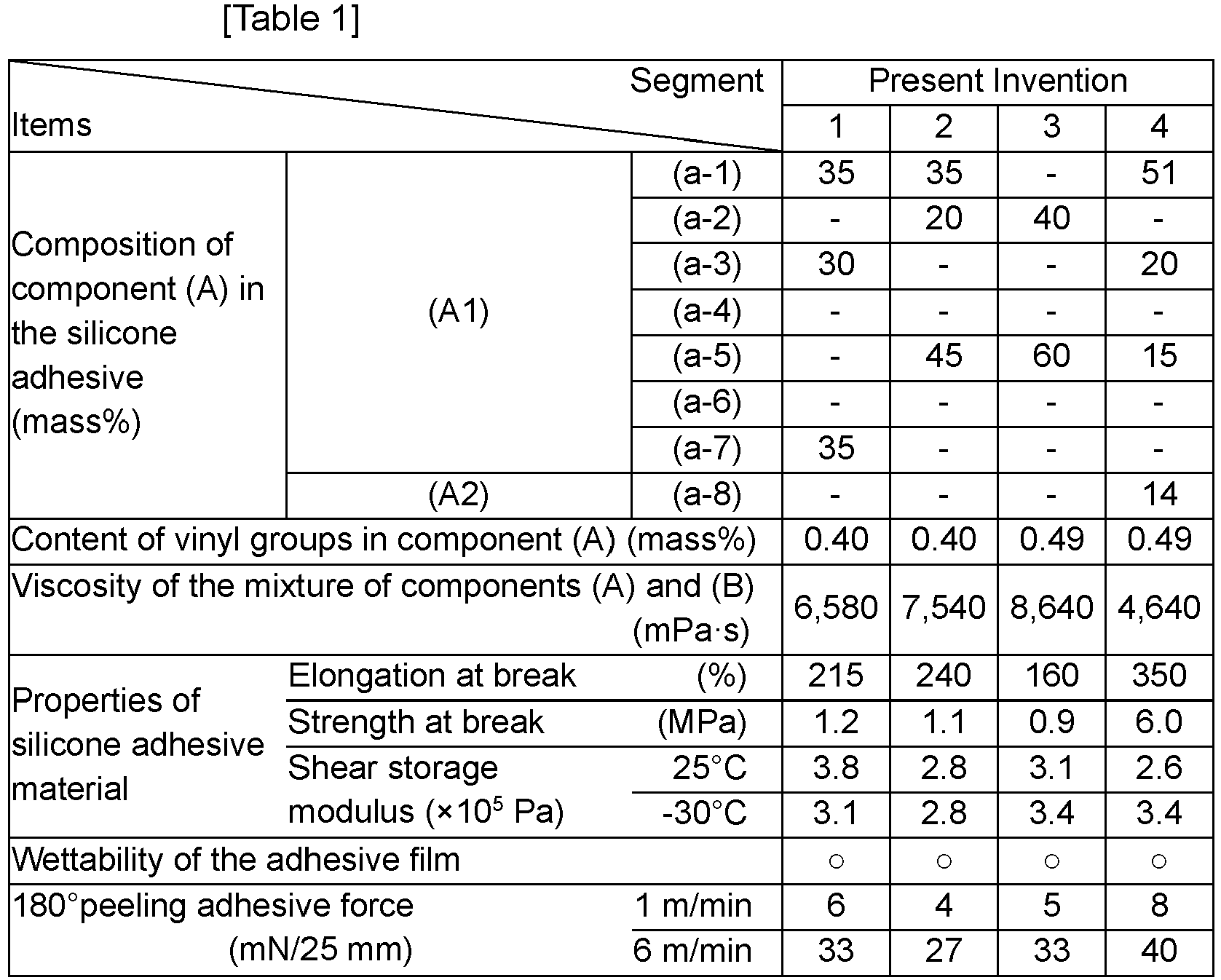

- The adhesive film according to the present invention has good wettability to the surface of the adherend and can be peeled with a small adhesive force during high speed peeling, allowing it to be suitably attached to flat panel displays and suitably attached for the purpose of protecting and masking upon processing optical members such as optical films along with electronic components such as printed circuit boards.
-
- 1
- Substrate film
- 2
- Silicone adhesive layer
Claims (4)
- An adhesive film having a silicone adhesive layer on one surface or both surfaces of a substrate film, wherein a silicone adhesive material froming the silicone adhesive layer has 120 to 380% of an elongation at break (tensile speed of 300 mm/min, temperature of 25°C) specified in JIS K 6251, and 1.8×10⁵ to 4.5×10⁵ Pa of a shear storage modulus (frequency of 10 Hz, temperature of 25°C).
- The adhesive film according to claim 1, wherein a thickness of the silicone adhesive layer is 5 µm to 1000 µm.
- The adhesive film according to claim 1 or 2, wherein, when the substrate film is a PET film with a thickness of 50 µm and the thickness of the silicone adhesive layer is 40 µm, the adhesive film has 20 mN/25 mm to 60 mN/25 mm of a 180° peeling adhesive force (peeling speed of 6 m/min, temperature of 25°C) to a mirror surface stainless steel plate specified in JIS Z 0237.
- The adhesive film according to any one of claims 1 to 3, wherein a silicone adhesive forming the silicone adhesive layer, comprises:(A) 100 parts by mass of an organopolysiloxane consisting of (A1) 100 to 80 mass% of a diorganopolysiloxane having at least two alkenyl groups per molecule and (A2) 0 to 20 mass% of an organopolysiloxane containing a siloxane unit represented by the formula: R1 3SiO1/2 and a siloxane unit represented by the formula: SiO4/2, wherein a molar ratio of the siloxane unit represented by the formula: R1 3SiO1/2 to the siloxane unit represented by the formula: SiO4/2 is 0.5 to 1.7, and wherein R1 is the same or different unsubstituted or halogen substituted monovalent hydrocarbon group having 1 to 12 carbon atoms;(B) an organohydrogenpolysiloxane having at least two silicon atom-bonded hydrogen atoms per molecule, in an amount such that the silicon atom-bonded hydrogen atoms are 0.5 to 20 mols with respect to 1 mol of the alkenyl groups in component (A); and(C) a catalytic amount of a hydrosilylation reaction catalyst.
Applications Claiming Priority (3)
| Application Number | Priority Date | Filing Date | Title |
|---|---|---|---|
| JP2018035706 | 2018-02-28 | ||
| JP2018043856 | 2018-03-12 | ||
| PCT/JP2019/001927 WO2019167479A1 (en) | 2018-02-28 | 2019-01-22 | Adhesive film |
Publications (2)
| Publication Number | Publication Date |
|---|---|
| EP3760685A1 true EP3760685A1 (en) | 2021-01-06 |
| EP3760685A4 EP3760685A4 (en) | 2021-12-01 |
Family
ID=67805787
Family Applications (1)
| Application Number | Title | Priority Date | Filing Date |
|---|---|---|---|
| EP19761120.5A Withdrawn EP3760685A4 (en) | 2018-02-28 | 2019-01-22 | Adhesive film |
Country Status (7)
| Country | Link |
|---|---|
| US (1) | US11254843B2 (en) |
| EP (1) | EP3760685A4 (en) |
| JP (1) | JP7244198B2 (en) |
| KR (1) | KR102605013B1 (en) |
| CN (1) | CN111670235B (en) |
| TW (1) | TW201938724A (en) |
| WO (1) | WO2019167479A1 (en) |
Families Citing this family (2)
| Publication number | Priority date | Publication date | Assignee | Title |
|---|---|---|---|---|
| US12415923B2 (en) | 2020-08-06 | 2025-09-16 | Dow Tray Co., Ltd. | Curable silicone composition and cured product of same |
| TW202602647A (en) * | 2024-03-01 | 2026-01-16 | 日商信越化學工業股份有限公司 | Double-sided molding method and molded products |
Family Cites Families (13)
| Publication number | Priority date | Publication date | Assignee | Title |
|---|---|---|---|---|
| JP2519571B2 (en) * | 1990-05-15 | 1996-07-31 | 信越化学工業株式会社 | Silicone composition with excellent releasability |
| US5466532A (en) * | 1991-03-26 | 1995-11-14 | Gen Electric | Solventless or high solids-containing silicone pressure sensitive adhesive compositions |
| US6569521B1 (en) * | 2000-07-06 | 2003-05-27 | 3M Innovative Properties Company | Stretch releasing pressure sensitive adhesive tape and articles |
| JP3888679B2 (en) * | 2002-04-23 | 2007-03-07 | 日東電工株式会社 | Double-sided adhesive tape and fixing method |
| JP3912525B2 (en) * | 2002-12-12 | 2007-05-09 | 信越化学工業株式会社 | Addition-curing silicone rubber composition and adhesive rubber sheet |
| JP4678847B2 (en) * | 2004-10-28 | 2011-04-27 | 信越化学工業株式会社 | Adhesive film having an adhesive layer obtained from a silicone composition |
| JP5155636B2 (en) * | 2007-10-12 | 2013-03-06 | 日東電工株式会社 | Cable assembly forming tape and manufacturing method thereof |
| JP5338626B2 (en) | 2009-11-10 | 2013-11-13 | 信越化学工業株式会社 | Silicone adhesive composition and adhesive film |
| JP5234064B2 (en) | 2010-08-23 | 2013-07-10 | 信越化学工業株式会社 | Solvent-free addition-type silicone adhesive composition and adhesive article |
| WO2013103330A2 (en) | 2010-12-22 | 2013-07-11 | Dow Corning Corporation | Silicone composition, silicone adhesive, coated and laminated substrates |
| EP2954022B1 (en) * | 2013-02-11 | 2019-05-01 | Dow Silicones Corporation | Clustered functional polyorganosiloxanes, processes for forming same and methods for their use |
| JP6378516B2 (en) * | 2014-03-27 | 2018-08-22 | 日東電工株式会社 | Silicone adhesive tape |
| JP6549392B2 (en) | 2015-03-13 | 2019-07-24 | 日東電工株式会社 | Adhesive film functional film and film set |
-
2019
- 2019-01-22 WO PCT/JP2019/001927 patent/WO2019167479A1/en not_active Ceased
- 2019-01-22 EP EP19761120.5A patent/EP3760685A4/en not_active Withdrawn
- 2019-01-22 CN CN201980010983.8A patent/CN111670235B/en active Active
- 2019-01-22 JP JP2020502860A patent/JP7244198B2/en active Active
- 2019-01-22 US US16/971,700 patent/US11254843B2/en not_active Expired - Fee Related
- 2019-01-22 KR KR1020207025872A patent/KR102605013B1/en active Active
- 2019-02-14 TW TW108104889A patent/TW201938724A/en unknown
Also Published As
| Publication number | Publication date |
|---|---|
| JP7244198B2 (en) | 2023-03-22 |
| EP3760685A4 (en) | 2021-12-01 |
| KR102605013B1 (en) | 2023-11-24 |
| WO2019167479A1 (en) | 2019-09-06 |
| CN111670235A (en) | 2020-09-15 |
| KR20200125627A (en) | 2020-11-04 |
| US11254843B2 (en) | 2022-02-22 |
| JPWO2019167479A1 (en) | 2021-02-12 |
| TW201938724A (en) | 2019-10-01 |
| US20210363389A1 (en) | 2021-11-25 |
| CN111670235B (en) | 2022-06-17 |
Similar Documents
| Publication | Publication Date | Title |
|---|---|---|
| CN112703240B (en) | Polyorganosiloxane composition having pressure-sensitive adhesive layer-forming property and use thereof | |
| EP3650515B1 (en) | Organopolysiloxane composition for forming pressure sensitive adhesive layer and use of same | |
| JP4678847B2 (en) | Adhesive film having an adhesive layer obtained from a silicone composition | |
| JP7046198B2 (en) | Pressure-sensitive adhesive layer-forming organopolysiloxane composition and its use | |
| JP5338626B2 (en) | Silicone adhesive composition and adhesive film | |
| JP7469232B2 (en) | Silicone pressure sensitive adhesive composition and its uses | |
| KR101529060B1 (en) | Silicone-based pressure-sensitive adhesive composition and pressure-sensitive tape or sheet | |
| CN112673073A (en) | Polyorganosiloxane composition having pressure-sensitive adhesive layer-forming property and use thereof | |
| JP7491655B2 (en) | Silicone pressure sensitive adhesive composition and uses thereof | |
| CN114269875B (en) | Pressure-sensitive adhesive layer-forming polyorganosiloxane composition and use thereof | |
| JP2014047310A (en) | Adhesive film and method for manufacturing the same | |
| US11254843B2 (en) | Adhesive film | |
| WO2024130670A1 (en) | Silicone-based pressure sensitive adhesive layer-forming composition and use thereof | |
| CN115777004B (en) | Curable silicone composition and cured product thereof | |
| WO2025183127A1 (en) | Double-sided molding method and molded product |
Legal Events
| Date | Code | Title | Description |
|---|---|---|---|
| STAA | Information on the status of an ep patent application or granted ep patent |
Free format text: STATUS: THE INTERNATIONAL PUBLICATION HAS BEEN MADE |
|
| PUAI | Public reference made under article 153(3) epc to a published international application that has entered the european phase |
Free format text: ORIGINAL CODE: 0009012 |
|
| STAA | Information on the status of an ep patent application or granted ep patent |
Free format text: STATUS: REQUEST FOR EXAMINATION WAS MADE |
|
| 17P | Request for examination filed |
Effective date: 20200921 |
|
| AK | Designated contracting states |
Kind code of ref document: A1 Designated state(s): AL AT BE BG CH CY CZ DE DK EE ES FI FR GB GR HR HU IE IS IT LI LT LU LV MC MK MT NL NO PL PT RO RS SE SI SK SM TR |
|
| AX | Request for extension of the european patent |
Extension state: BA ME |
|
| DAV | Request for validation of the european patent (deleted) | ||
| DAX | Request for extension of the european patent (deleted) | ||
| A4 | Supplementary search report drawn up and despatched |
Effective date: 20211104 |
|
| RIC1 | Information provided on ipc code assigned before grant |
Ipc: C09J 183/07 20060101ALI20211028BHEP Ipc: C09J 183/06 20060101ALI20211028BHEP Ipc: C09J 183/05 20060101ALI20211028BHEP Ipc: C09J 183/04 20060101ALI20211028BHEP Ipc: C09J 11/06 20060101ALI20211028BHEP Ipc: C09J 11/04 20060101ALI20211028BHEP Ipc: C09J 7/25 20180101ALI20211028BHEP Ipc: C09J 7/38 20180101AFI20211028BHEP |
|
| STAA | Information on the status of an ep patent application or granted ep patent |
Free format text: STATUS: THE APPLICATION HAS BEEN WITHDRAWN |
|
| 18W | Application withdrawn |
Effective date: 20221027 |