EP3757874B1 - Action recognition method and apparatus - Google Patents
Action recognition method and apparatus Download PDFInfo
- Publication number
- EP3757874B1 EP3757874B1 EP19810779.9A EP19810779A EP3757874B1 EP 3757874 B1 EP3757874 B1 EP 3757874B1 EP 19810779 A EP19810779 A EP 19810779A EP 3757874 B1 EP3757874 B1 EP 3757874B1
- Authority
- EP
- European Patent Office
- Prior art keywords
- feature
- optical flow
- spatial
- picture
- features
- Prior art date
- Legal status (The legal status is an assumption and is not a legal conclusion. Google has not performed a legal analysis and makes no representation as to the accuracy of the status listed.)
- Active
Links
Images


Classifications
-
- G—PHYSICS
- G06—COMPUTING OR CALCULATING; COUNTING
- G06V—IMAGE OR VIDEO RECOGNITION OR UNDERSTANDING
- G06V40/00—Recognition of biometric, human-related or animal-related patterns in image or video data
- G06V40/20—Movements or behaviour, e.g. gesture recognition
-
- G—PHYSICS
- G06—COMPUTING OR CALCULATING; COUNTING
- G06F—ELECTRIC DIGITAL DATA PROCESSING
- G06F18/00—Pattern recognition
- G06F18/20—Analysing
- G06F18/21—Design or setup of recognition systems or techniques; Extraction of features in feature space; Blind source separation
-
- G—PHYSICS
- G06—COMPUTING OR CALCULATING; COUNTING
- G06F—ELECTRIC DIGITAL DATA PROCESSING
- G06F18/00—Pattern recognition
- G06F18/20—Analysing
- G06F18/22—Matching criteria, e.g. proximity measures
-
- G—PHYSICS
- G06—COMPUTING OR CALCULATING; COUNTING
- G06F—ELECTRIC DIGITAL DATA PROCESSING
- G06F18/00—Pattern recognition
- G06F18/20—Analysing
- G06F18/24—Classification techniques
-
- G—PHYSICS
- G06—COMPUTING OR CALCULATING; COUNTING
- G06V—IMAGE OR VIDEO RECOGNITION OR UNDERSTANDING
- G06V10/00—Arrangements for image or video recognition or understanding
- G06V10/40—Extraction of image or video features
-
- G—PHYSICS
- G06—COMPUTING OR CALCULATING; COUNTING
- G06V—IMAGE OR VIDEO RECOGNITION OR UNDERSTANDING
- G06V10/00—Arrangements for image or video recognition or understanding
- G06V10/40—Extraction of image or video features
- G06V10/62—Extraction of image or video features relating to a temporal dimension, e.g. time-based feature extraction; Pattern tracking
-
- G—PHYSICS
- G06—COMPUTING OR CALCULATING; COUNTING
- G06V—IMAGE OR VIDEO RECOGNITION OR UNDERSTANDING
- G06V10/00—Arrangements for image or video recognition or understanding
- G06V10/70—Arrangements for image or video recognition or understanding using pattern recognition or machine learning
- G06V10/72—Data preparation, e.g. statistical preprocessing of image or video features
-
- G—PHYSICS
- G06—COMPUTING OR CALCULATING; COUNTING
- G06V—IMAGE OR VIDEO RECOGNITION OR UNDERSTANDING
- G06V10/00—Arrangements for image or video recognition or understanding
- G06V10/70—Arrangements for image or video recognition or understanding using pattern recognition or machine learning
- G06V10/74—Image or video pattern matching; Proximity measures in feature spaces
- G06V10/761—Proximity, similarity or dissimilarity measures
-
- G—PHYSICS
- G06—COMPUTING OR CALCULATING; COUNTING
- G06V—IMAGE OR VIDEO RECOGNITION OR UNDERSTANDING
- G06V10/00—Arrangements for image or video recognition or understanding
- G06V10/70—Arrangements for image or video recognition or understanding using pattern recognition or machine learning
- G06V10/77—Processing image or video features in feature spaces; using data integration or data reduction, e.g. principal component analysis [PCA] or independent component analysis [ICA] or self-organising maps [SOM]; Blind source separation
- G06V10/7715—Feature extraction, e.g. by transforming the feature space, e.g. multi-dimensional scaling [MDS]; Mappings, e.g. subspace methods
-
- G—PHYSICS
- G06—COMPUTING OR CALCULATING; COUNTING
- G06V—IMAGE OR VIDEO RECOGNITION OR UNDERSTANDING
- G06V10/00—Arrangements for image or video recognition or understanding
- G06V10/70—Arrangements for image or video recognition or understanding using pattern recognition or machine learning
- G06V10/82—Arrangements for image or video recognition or understanding using pattern recognition or machine learning using neural networks
-
- G—PHYSICS
- G06—COMPUTING OR CALCULATING; COUNTING
- G06V—IMAGE OR VIDEO RECOGNITION OR UNDERSTANDING
- G06V20/00—Scenes; Scene-specific elements
- G06V20/40—Scenes; Scene-specific elements in video content
- G06V20/41—Higher-level, semantic clustering, classification or understanding of video scenes, e.g. detection, labelling or Markovian modelling of sport events or news items
-
- G—PHYSICS
- G06—COMPUTING OR CALCULATING; COUNTING
- G06V—IMAGE OR VIDEO RECOGNITION OR UNDERSTANDING
- G06V20/00—Scenes; Scene-specific elements
- G06V20/40—Scenes; Scene-specific elements in video content
- G06V20/46—Extracting features or characteristics from the video content, e.g. video fingerprints, representative shots or key frames
Definitions
- This application relates to the field of action recognition technologies, and more specifically, to an action recognition method and apparatus.
- Action recognition includes action recognition on a person in a video and action recognition on a person in a picture. Because the video includes a relatively large amount of information, it is relatively easy to recognize an action of the person in the video. Compared with the video, the picture includes less information. Therefore, how to effectively recognize an action category of the person in the picture is a problem that needs to be resolved.
- MARJANEH SAFAEI ET AL "Single Image Action Recognition by Predicting Space-Time Saliency", 12 May 2017, arXiv:1705.04641 , proposes a novel approach based on deep Convolutional Neural Networks (CNN) to recognize human actions in still images by predicting the future motion, and detecting the shape and location of the salient parts of the image.
- CNN deep Convolutional Neural Networks
- This application provides an action recognition method and apparatus, to improve action recognition accuracy.
- an action recognition method includes: obtaining a to-be-processed picture; determining a spatial feature of the to-be-processed picture; determining a virtual optical flow feature of the to-be-processed picture based on the spatial feature of the to-be-processed picture, and the X spatial features and the X optical flow features in a preset feature library, wherein there is a one-to-one correspondence between the X spatial features and the X optical flow features, and X is an integer greater than 1; determining, based on similarities between the virtual optical flow feature of the to-be-processed picture and Y optical flow features in the feature library, wherein each of the Y optical flow features corresponds to one action category, and Y is an integer greater than 1, a first type of confidence of the to-be-processed picture in different action categories; and determining an action category of the to-be-processed picture based on the first type of confidence.
- Determining a virtual optical flow feature of the to-be-processed picture based on the spatial feature of the to-be-processed picture and X spatial features and X optical flow features in a preset feature library comprises: determining a weight coefficient of each of the X optical flow features based on a similarity between the spatial feature of the to-be-processed picture and each of the X spatial features; and performing weighted summation on the X optical flow features based on the weight coefficient of each of the X optical flow features, to obtain the virtual optical flow feature of the to-be-processed picture.
- a value of the determined weight coefficient of each of the X optical flow features is positively correlated to a first similarity, and the first similarity is a similarity between the spatial feature of the to-be-processed picture and a spatial feature in the X spatial features that corresponds to each of the X optical flow features.
- an action category corresponding to each spatial feature and an action category corresponding to each optical flow feature are obtained through pretraining based on a convolutional neural network model.
- the virtual optical flow feature of the to-be-processed picture can be obtained by using the spatial feature of the to-be-processed picture and the spatial feature and the optical flow feature in the feature library, to simulate, for the picture, time sequence information closely related to an action. Then, action recognition may be performed on the to-be-processed picture based on a similarity between the virtual optical flow feature of the to-be-processed picture and the optical flow feature in the feature library.
- action recognition is directly performed by comparing the virtual optical flow feature of the to-be-processed picture with the optical flow feature in the feature library, without establishing a training model to perform action recognition on the to-be-processed picture. Therefore, action recognition on the to-be-processed picture can be implemented by using a relatively small quantity of optical flow features.
- the X spatial features and the X optical flow features are respectively all spatial features and all optical flow features in the feature library.
- the virtual optical flow feature of the to-be-processed picture is determined based on the spatial feature of the to-be-processed picture, and all the spatial features and all the optical flow features in the feature library, so that the virtual optical flow feature of the to-be-processed picture can be determined more accurately, and an action category of the to-be-processed picture can be determined more accurately.
- the X spatial features and the X optical flow features are respectively some spatial features and some optical flow features in the feature library.
- the virtual optical flow feature of the to-be-processed picture is determined in combination with the some spatial features and the some optical flow features in the feature library and the spatial feature of the to-be-processed picture, so that a calculation amount of the virtual optical flow feature of the to-be-processed picture can be reduced, thereby improving a speed of performing action recognition on the to-be-processed picture.
- Y optical flow features may be all or some optical flow features in the feature library.
- X and Y may be the same or may be different.
- the action category of the to-be-processed picture is obtained based on similarities between the virtual optical flow feature of the to-be-processed picture and all the optical flow features in the feature library. In this way, accuracy of the first type of confidence can be improved, to further improve an effect of performing action recognition on the to-be-processed picture.
- a calculation amount of determining the first type of confidence can be reduced, thereby improving a speed of performing action recognition on the to-be-processed picture.
- the to-be-processed picture is a picture including a person
- the determining an action category of the to-be-processed picture based on the first type of confidence includes: determining an action category of the person in the to-be-processed picture based on the first type of confidence.
- determining the action category of the to-be-processed picture is actually determining an action category of the person or another target object in the to-be-processed picture.
- the to-be-processed picture is a static picture.
- the spatial feature is specifically a spatial feature vector
- the optical flow feature is specifically an optical flow feature vector
- the determining a virtual optical flow feature of the to-be-processed picture based on the spatial feature of the to-be-processed picture, and the X spatial features and the X optical flow features in a feature library includes: performing weighted summation on the X optical flow features based on a similarity between the spatial feature of the to-be-processed picture and each of the X spatial features in the feature library, to obtain the virtual optical flow feature of the to-be-processed picture.
- the feature library includes a spatial feature and an optical flow feature of a training video.
- the virtual optical flow feature of the to-be-processed picture may be determined based on the spatial feature and the optical flow feature of the training video and the spatial feature of the to-be-processed picture, and the action category of the to-be-processed picture is further determined based on the virtual optical flow feature.
- the feature library further includes a spatial feature and a virtual optical flow feature of a training picture.
- the virtual optical flow feature of the to-be-processed picture may be comprehensively determined based on the spatial feature and the optical flow feature of the training video, the spatial feature and the optical flow feature of the training picture, and the spatial feature of the to-be-processed picture, so that a more accurate virtual optical flow feature can be obtained, and action recognition accuracy can be further improved.
- an action category of the training picture is not exactly the same as an action category of the training video.
- the action category of the training video is not completely the same as the action category of the training picture, a class of a recognizable action category can be increased, thereby improving an applicable scope of action recognition.
- different action categories of the training video correspond to a same quantity of videos.
- the method further includes: selecting, from a preset picture library, a picture that matches an action category that needs to be recognized, to obtain the training picture.
- the foregoing picture library may be a local picture database, or may be a picture database located in a network server.
- the method further includes: selecting, from a preset video library, a video whose similarity with the spatial feature of the training picture meets a preset requirement, to obtain the training video.
- the video library may be a local video library, or may be a video library in the network server.
- the selecting, from a preset video library, a video whose similarity with the spatial feature of the training picture meets a preset requirement, to obtain the training video includes: selecting, from the preset video library, a video whose similarity with the spatial feature of the training picture is greater than a preset similarity threshold, to obtain the training video.
- all videos whose similarity with the spatial feature of the training picture is greater than 0.5 in the preset video library may be selected, to form the training video.
- the selecting, from a preset video library, a video whose similarity with the spatial feature of the training picture meets a preset requirement, to obtain the training video includes: determining a similarity between a spatial feature of a video in the video library and the spatial feature of the training picture; and selecting first J videos in the video library that have a maximum similarity with the spatial feature of the training picture, to obtain the training video, where J is less than K, both J and K are integers greater than 0, and K is a total quantity of videos in the video library.
- the video library includes 100 videos in total.
- first 50 videos in the video library that have a maximum similarity with the spatial feature of the training picture may be selected to form the training video.
- a spatial feature and an optical flow feature that correspond to each other in the feature library correspond to a same video or picture.
- the spatial feature and the optical flow feature that correspond to each other in the feature library belong to a same video or a same picture.
- the X spatial features include a first spatial feature
- the X optical flow features include a first optical flow feature
- a similarity between the first spatial feature and the spatial feature of the to-be-processed picture is a similarity 1.
- a value of a weight coefficient of the first optical flow feature and the similarity 1 have a positive correlation (which may be specifically a direct proportion relationship).
- the weight coefficient of the optical flow feature is properly set, so that the virtual optical flow feature that is of the to-be-processed picture and that is obtained based on the optical flow feature in the feature library is more accurate.
- the feature library includes the spatial feature and the optical flow feature of the training video
- the determining a virtual optical flow feature of the to-be-processed picture based on the spatial feature of the to-be-processed picture and spatial features and optical flow features in a feature library specifically includes: determining, based on a similarity between the spatial feature of the to-be-processed picture and each spatial feature of the training video, a weight coefficient of an optical flow feature corresponding to each spatial feature of the training video; and performing weighted summation on the optical flow feature in the feature library based on the weight coefficient of each optical flow feature of the training video, to obtain the virtual optical flow feature of the to-be-processed picture.
- the training video has both a plurality of spatial features and a plurality of optical flow features.
- the virtual optical flow feature of the to-be-processed picture is determined based on only the spatial feature and the optical flow feature of the training video, so that complexity of determining the virtual optical flow feature can be reduced.
- the feature library includes the spatial feature and the optical flow feature of the training video and the spatial feature and the virtual optical flow feature of the training picture, and the determining a virtual optical flow feature of the to-be-processed picture based on the spatial feature of the to-be-processed picture and spatial features and optical flow features in a feature library specifically includes: determining, based on a similarity between the spatial feature of the to-be-processed picture and each spatial feature of the training video and the training picture, a weight coefficient of an optical flow feature corresponding to each spatial feature of the training video and the training picture; and performing weighted summation on the optical flow feature of the training video and the training picture based on the weight coefficient of each optical flow feature of the training video and the training picture, to obtain the virtual optical flow feature of the to-be-processed picture.
- the training picture has both a plurality of spatial features and a plurality of optical flow features.
- the virtual optical flow feature of the to-be-processed picture is comprehensively determined by using the spatial feature and the optical flow feature of the training video and the spatial feature and the virtual optical flow feature of the training picture, so that the obtained virtual optical flow feature of the to-be-processed picture can better reflect motion information of the to-be-processed picture.
- the virtual optical flow feature of the training picture is obtained by performing weighted summation on the optical flow feature of the training video based on a similarity between the spatial feature of the training picture and the spatial feature of the training video.
- the method further includes: performing weighted summation on the optical flow feature of the training video based on the similarity between the spatial feature of the training picture and the spatial feature of the training video, to obtain the virtual optical flow feature of the training picture.
- the performing weighted summation on the optical flow feature of the training video based on the similarity between the spatial feature of the training picture and the spatial feature of the training video, to obtain the virtual optical flow feature of the training picture includes: determining, based on the similarity between the spatial feature of the to-be-processed picture and each spatial feature of the training video, a weight coefficient of an optical flow feature that is of the training video and that corresponds to each spatial feature, and performing weighted summation on the optical flow feature of the training video based on the weight coefficient of each optical flow feature of the training video, to obtain the virtual optical flow feature of the to-be-processed picture.
- the feature library may initially include only the spatial feature and the optical flow feature of the training video.
- the spatial feature and the virtual optical flow feature of the training picture may be further added to the feature library, and the virtual optical flow feature of the training picture may be determined based on the spatial feature and the optical flow feature that are of the training video and that are included in the feature library.
- the virtual optical flow feature of the training picture is determined by using the spatial feature and the optical flow feature of the training video, and the spatial feature and the virtual optical flow feature of the training picture are added the feature library, so that an action recognition effect can be improved to a specific extent.
- the method further includes: determining a second type of confidence of the to-be-processed picture in the different action categories based on similarities between the spatial feature of the to-be-processed picture and Z spatial features in a preset feature library, where each spatial feature of the Z spatial features corresponds to one action category; and the determining an action category of the to-be-processed picture based on the first type of confidence includes: determining the action category of the to-be-processed picture based on the first type of confidence and the second type of confidence.
- the first type of confidence is obtained by using an optical flow prediction process
- the second type of confidence is obtained by using a spatial prediction process.
- Z is an integer greater than 1. Any two values of X, Y, and Z may be the same or may be different.
- the Z spatial features may be all or some spatial features in the feature library.
- the determining the action category of the to-be-processed picture based on the first type of confidence and the second type of confidence includes: performing weighted summation on the first type of confidence and the second type of confidence, to obtain final confidence of the to-be-processed picture in the different action categories; and determining the action category of the to-be-processed picture based on the final confidence.
- Weighted summation is performed on the first type of confidence and the second type of confidence, so that confidence of the to-be-processed picture in the different action categories can be comprehensively obtained, and an action category of the to-be-processed picture can be better determined.
- the method further includes: adding the spatial feature and the virtual optical flow feature of the to-be-processed picture and action category information in the to-be-processed picture to the feature library.
- the spatial feature and the virtual optical flow feature of the to-be-processed picture and the corresponding action category information are added to the feature library, so that quantities of the spatial features and the optical flow features that are included in the feature library can be increased, to better perform action recognition on the picture based on the spatial feature and the optical flow feature in the feature library subsequently.
- an action recognition apparatus includes a module configured to perform the method in the first aspect.
- an action recognition apparatus includes a memory and a processor.
- the memory is configured to store a program
- the processor is configured to execute the program stored in the memory, and when executing the program stored in the memory, the processor is configured to perform the method in the first aspect.
- a computer readable medium stores program code to be executed by a device, and the program code includes an instruction used to perform the method in the first aspect.
- a computer program product including an instruction is provided.
- the computer program product runs on a computer, the computer is enabled to perform the method in the first aspect.
- an electronic device includes the action recognition apparatus in the second aspect or the third aspect.
- An action recognition method in embodiments of this application can be applied to picture retrieval, album management, safe city, man-machine interaction, and a scenario in which action recognition needs to be performed.
- the action recognition method in the embodiments of this application can be applied to an album management system and a picture search system. The following briefly describes the album management system and the picture search system separately.
- the user may classify pictures in an album.
- action recognition may be performed on the picture in the album by using the action recognition method in the embodiments of this application, to obtain an action category of each picture, so that the user can classify and manage different action categories of pictures, thereby helping the user search for a picture, reducing management time, and improving album management efficiency.
- a person image is extracted from a large quantity of training pictures, and then a convolutional neural network (convolutional neural networks, CNN) model is trained based on the person image extracted from the training pictures and an action category corresponding to the person image, to obtain each parameter of the CNN model.
- CNN convolutional neural networks
- a person image may be extracted from the to-be-processed picture, and the person image extracted from the to-be-processed picture is input into the trained CNN model for action recognition, to determine an action category of the to-be-processed picture.
- the conventional solution only a spatial feature of the picture is considered during action recognition, and a time attribute of an action of the person in the to-be-processed picture is not further explored. Consequently, action recognition accuracy is still relatively low.
- this application provides a new action recognition method.
- An optical flow feature of the to-be-processed picture is simulated by using a known optical flow feature, to obtain a virtual optical flow feature of the to-be-processed picture. Then, an action in the to-be-processed picture is recognized based on the virtual optical flow feature of the to-be-processed picture.
- a method shown in FIG. 1 may be performed by an action recognition apparatus.
- the action recognition apparatus may be specifically a device having a picture processing function, for example, a monitoring device, a terminal device, a network server, or a network cloud platform.
- the method shown in FIG. 1 includes step 101 to step 105. The following separately describes step 101 to step 105 in detail.
- the to-be-processed picture (which may also be referred to as a to-be-processed image) may be a picture including a person.
- Performing action recognition on the to-be-processed picture is essentially recognizing an action of a person in the to-be-processed picture, and determining an action category of the to-be-processed picture.
- the to-be-processed picture may be a photo taken by using an electronic device, or may be a picture captured from a video.
- the to-be-processed picture may be stored in a local picture database, or may be stored in a network.
- the to-be-processed picture may be directly retrieved from the local picture database, or may be obtained online from the network.
- the action category may be an action specifically performed by the person in the to-be-processed picture.
- the action category may include running (run), walking (walk), baseball pitching (Baseball_pitch), baseball swinging (Baseball_swing), bowling (bowl), clean and jerk (clean_and_jerk), golf swinging (golf_swing), jumping a rope (jump_rope), a pull-up (pullup), a push-up (pushup), sitting up (situp), a squat (squat), strumming a guitar (strum_guitar), swimming (swim), and the like.
- action types which are mainly action categories in a sports aspect.
- action types included in this embodiment of this application are not limited thereto.
- the action categories in this application may further include an action other than sports, for example, watching a mobile phone, and a posture of a person in a man-machine interaction system.
- the action category may also be referred to as an action class, an action type, or the like.
- a convolution operation may be performed on the to-be-processed picture by using a convolutional neural network (convolutional neural networks, CNN) model (the CNN model may be a pre-trained model), to obtain the spatial feature of the to-be-processed picture.
- CNN convolutional neural networks
- both X and Y are integers greater than 1.
- the feature library is a preset feature library.
- the feature library includes a plurality of spatial features and a plurality of optical flow features, each of the plurality of spatial features corresponds to one action category, and each of the plurality of optical flow features also corresponds to one action category.
- An action category corresponding to each spatial feature and an action category corresponding to each optical flow feature may be obtained through pre-training based on the convolutional neural network model.
- any one of the plurality of spatial features corresponds to one of the plurality of optical flow features
- any one of the plurality of optical flow features corresponds to one of the plurality of spatial features.
- a quantity of spatial features and a quantity of optical flow features are usually the same in the feature library.
- the X spatial features and the X optical flow features are in a one-to-one correspondence. That is, in the X spatial features and the X optical flow features, each spatial feature corresponds to one optical flow feature, and each optical flow feature corresponds to one spatial feature.
- the X spatial features may be all or some spatial features in the feature library.
- the X optical flow features may be all or some optical flow features in the feature library.
- the virtual optical flow feature of the to-be-processed picture can be determined based on the spatial feature of the to-be-processed picture, and all the spatial features and all the optical flow features in the feature library. In this way, the virtual optical flow feature of the to-be-processed picture can be determined more accurately, to further determine the action category of the to-be-processed picture more accurately.
- the virtual optical flow feature of the to-be-processed picture is determined in combination with the some spatial features and the some optical flow features in the feature library and the spatial features of the to-be-processed picture. In this way, a calculation amount of calculating the virtual optical flow feature of the to-be-processed picture can be reduced, thereby improving a speed of performing action recognition on the to-be-processed picture.
- a spatial feature and an optical flow feature that have a correspondence in the feature library correspond to a same video or picture.
- the spatial feature and the optical flow feature that have a correspondence in the feature library belong to a same video or a same picture.
- a specific representation form of the spatial feature mentioned in this application may be a spatial feature vector
- a specific representation form of the optical flow feature or the virtual optical flow feature may be an optical flow feature vector or a virtual optical flow feature vector.
- each spatial feature in the feature library corresponds to one optical flow feature (the spatial feature and the optical flow feature are in a one-to-one correspondence in the feature library). Therefore, when the virtual optical flow feature of the to-be-processed picture is being determined based on the spatial feature of the to-be-processed picture and the spatial feature and the optical flow feature in the preset feature library, weighted summation is performed, based on a similarity between the spatial feature of the to-be-processed picture and the spatial feature in the feature library, on the optical flow feature that is in the feature library and that corresponds to the spatial feature in the feature library, to obtain the virtual optical flow feature of the to-be-processed picture.
- the determining a virtual optical flow feature of the to-be-processed picture based on the spatial feature of the to-be-processed picture and X spatial features and X optical flow features in a preset feature library in step 103 includes the following specific process:
- a value of the weight coefficient of each of the X optical flow features and a first similarity have a positive correlation.
- the first similarity is a similarity between the spatial feature of the to-be-processed picture and a spatial feature in the X spatial features that corresponds to each of the X optical flow features.
- the X spatial features include a first spatial feature and a second spatial feature
- the Y optical flow features include a first optical flow feature and a second optical flow feature
- the first spatial feature corresponds to the first optical flow feature
- the second spatial feature corresponds to the second optical flow feature
- a similarity between the spatial feature of the to-be-processed picture and the first spatial feature is a similarity 1
- a similarity between the spatial feature of the to-be-processed picture and the second spatial feature is a similarity 2
- the similarity 1 is greater than the similarity 2.
- the weight coefficient of the optical flow feature is properly set, so that the virtual optical flow feature that is of the to-be-processed picture and that is obtained based on the optical flow feature in the feature library is more accurate.
- Each of the Y optical flow features corresponds to one action category, and Y is an integer greater than 1.
- Y optical flow features may be all or some optical flow features in the feature library.
- Y and X may be the same or may be different.
- the action category of the to-be-processed picture is obtained based on similarities between the virtual optical flow feature of the to-be-processed picture and all the optical flow features in the feature library. In this way, accuracy of the first type of confidence can be improved, to further improve an effect of performing action recognition on the to-be-processed picture.
- a calculation amount of determining the first type of confidence can be reduced, to further improve a speed of performing action recognition on the to-be-processed picture.
- the virtual optical flow feature of the to-be-processed picture can be obtained by using the spatial feature of the to-be-processed picture and the spatial feature and the optical flow feature in the preset feature library, to simulate, for the picture, time sequence information closely related to an action. Then, action recognition may be performed on the to-be-processed picture based on a similarity between the virtual optical flow feature of the to-be-processed picture and the optical flow feature in the preset feature library.
- action recognition is directly performed by comparing the virtual optical flow feature of the to-be-processed picture with the optical flow feature in the feature library, without establishing a training model to perform action recognition on the to-be-processed picture. Therefore, action recognition on the to-be-processed picture can be implemented by using a relatively small quantity of optical flow features.
- the spatial features in the feature library include a spatial feature of a training video
- the optical flow features in the feature library include an optical flow feature of the training video
- the training video may have a plurality of spatial features, and the training video may also have a plurality of optical flow features.
- the virtual optical flow feature of the to-be-processed picture can be simulated based on the spatial feature and the optical flow feature of the training video, and action recognition may be further performed in combination with the spatial feature and the virtual optical flow feature of the to-be-processed picture, thereby improving action recognition accuracy.
- the spatial features in the feature library further include a spatial feature of a training picture
- the optical flow features in the feature library further include a virtual optical flow feature of the training picture
- the training picture may have a plurality of spatial features, and the training picture may also have a plurality of optical flow features.
- the feature library not only includes the spatial feature and the optical flow feature of the training video, but also includes the spatial feature and the optical flow feature of the training picture.
- the virtual optical flow feature of the to-be-processed picture can be determined in combination with the spatial feature and the optical flow feature of the training video and the spatial feature and the optical flow feature of the training picture, thereby further improving final action recognition accuracy.
- the virtual optical flow feature of the to-be-processed picture is comprehensively determined by using the spatial feature and the optical flow feature of the training video and the spatial feature and the virtual optical flow feature of the training picture, so that a more accurate virtual optical flow feature can be obtained.
- the virtual optical flow feature of the to-be-processed picture when the virtual optical flow feature of the to-be-processed picture is being determined based on the spatial feature and the optical flow feature in the feature library, the virtual optical flow feature of the to-be-processed picture may be determined based on only the spatial feature and the optical flow feature of the training video in the feature library, or the virtual optical flow feature of the to-be-processed picture may be comprehensively determined in combination with the spatial feature and the optical flow feature of the training video in the feature library and the spatial feature and the virtual optical flow feature of the training picture in the feature library.
- the feature library includes the spatial feature and the optical flow feature of the training video
- the determining a virtual optical flow feature of the to-be-processed picture based on the spatial feature of the to-be-processed picture and spatial features and optical flow features in a feature library specifically includes: determining, based on a similarity between the spatial feature of the to-be-processed picture and each spatial feature of the training video, a weight coefficient of an optical flow feature corresponding to each spatial feature of the training video; and performing weighted summation on the optical flow feature in the feature library based on the weight coefficient of each optical flow feature of the training video, to obtain the virtual optical flow feature of the to-be-processed picture.
- the virtual optical flow feature of the to-be-processed picture is determined based on only the spatial feature and the optical flow feature of the training video, so that complexity of determining the virtual optical flow feature can be reduced.
- the feature library includes the spatial feature and the optical flow feature of the training video and the spatial feature and the virtual optical flow feature of the training picture, and the determining a virtual optical flow feature of the to-be-processed picture based on the spatial feature of the to-be-processed picture and spatial features and optical flow features in a feature library specifically includes: determining, based on a similarity between the spatial feature of the to-be-processed picture and each spatial feature of the training video and the training picture, a weight coefficient of an optical flow feature corresponding to each spatial feature of the training video and the training picture; and performing weighted summation on the optical flow feature of the training video and the training picture based on the weight coefficient of each optical flow feature of the training video and the training picture, to obtain the virtual optical flow feature of the to-be-processed picture.
- the virtual optical flow feature of the to-be-processed picture is comprehensively determined by using the spatial feature and the optical flow feature of the training video and the spatial feature and the virtual optical flow feature of the training picture, so that the obtained virtual optical flow feature of the to-be-processed picture can better reflect motion information of the to-be-processed picture.
- the virtual optical flow feature of the training picture in the feature library may be obtained based on the spatial feature and the optical flow feature of the training video and the spatial feature of the training picture.
- the virtual optical flow feature of the training picture is obtained by performing weighted summation on the optical flow feature of the training video based on a similarity between the spatial feature of the training picture and the spatial feature of the training video.
- the virtual optical flow feature of the training picture may be determined before action recognition is performed on the to-be-processed picture.
- the method shown in FIG. 1 further includes: performing weighted summation on the optical flow feature of the training video based on the similarity between the spatial feature of the training picture and the spatial feature of the training video, to obtain the virtual optical flow feature of the training picture.
- the performing weighted summation on the optical flow feature of the training video based on the similarity between the spatial feature of the training picture and the spatial feature of the training video, to obtain the virtual optical flow feature of the training picture specifically includes: determining, based on the similarity between the spatial feature of the training picture and each spatial feature of the training video, a weight coefficient of an optical flow feature corresponding to each spatial feature of the training video; and performing weighted summation on the optical flow feature of the training video based on the weight coefficient of each optical flow feature of the training video, to obtain the virtual optical flow feature of the training picture.
- confidence of the to-be-processed picture in the different action categories may be further calculated based on the spatial feature of the to-be-processed picture, and then the action category of the to-be-processed picture is comprehensively determined based on the two types of confidence.
- a second type of confidence of the to-be-processed picture in the different action categories may be determined based on similarities between the spatial feature of the to-be-processed picture and Z spatial features in the preset feature library. Each of the Z spatial features corresponds to one action category.
- Z is an integer greater than 1, and a value of Z may be the same as or different from a value of X or Y.
- the Z spatial features may be all or some spatial features in the feature library.
- the action category of the to-be-processed picture may be comprehensively determined based on the first type of confidence and the second type of confidence.
- weighted summation may be first performed on the first type of confidence and the second type of confidence, to obtain final confidence of the to-be-processed picture in the different action categories, and then the action category of the to-be-processed picture is determined based on the final confidence.
- Weighted summation is performed on the first type of confidence and the second type of confidence, so that the confidence of the to-be-processed picture in the different action categories can be comprehensively obtained, and the action category of the to-be-processed picture can be better determined.
- action category of the to-be-processed picture may be further determined separately according to the first type of confidence and the second type of confidence, and then the action category of the to-be-processed picture is determined.
- determining the action category of the to-be-processed picture based on the first type of confidence and the second type of confidence includes: determining the action category of the to-be-processed picture as a first action category based on the first type of confidence; determining the action category of the to-be-processed picture as a second action category based on the second type of confidence; and determining the action category of the to-be-processed picture as the first action category when the first action category is the same as the second action category.
- information such as the spatial feature and the optical flow feature of the to-be-processed picture and the action category of the to-be-processed picture may be further added to the feature library.
- the method shown in FIG. 1 further includes: adding the spatial feature and the virtual optical flow feature of the to-be-processed picture and action category information in the to-be-processed picture to the feature library.
- the spatial feature and the virtual optical flow feature of the to-be-processed picture, and the corresponding action category information are added to the feature library, so that the quantities of spatial features and optical flow features that are included in the feature library can be increased, to better perform action recognition on the picture based on the spatial feature and the optical flow feature in the feature library subsequently.
- FIG. 2 is a schematic diagram of an action recognition method according to an embodiment of this application.
- a specific process of the action recognition method shown in FIG. 2 includes the following steps.
- the input picture is equivalent to the foregoing to-be-processed picture.
- the spatial feature of the input picture may be extracted by using a convolutional neural network CNN model.
- convolution processing is performed on the input picture by using the CNN model, to obtain a convolutional feature map C t ⁇ R K 1 ⁇ K 2 ⁇ d c of the input image.
- C t ⁇ R K 1 ⁇ K 2 ⁇ d c is changed to a one-dimensional vector, to obtain a vector u rgb .
- the vector u rgb is the spatial feature of the input picture.
- the CNN module may be implemented by using a plurality of architectures, for example, VGG16 and a TSN network.
- a coefficient of the CNN module needs to be obtained through pretraining by using an action recognition dataset.
- the virtual optical flow feature of the input image may be simulated or generated based on an optical flow feature of a video stored in a video repository.
- the video repository stores N videos.
- the virtual optical flow feature of the input picture may be generated based on virtual optical flow features of the N videos.
- a spatial feature and an optical flow feature of each of the N videos may be extracted according to a process shown in FIG. 4 .
- a specific process of extracting the spatial feature and the optical flow feature of the video includes:
- the optical flow map in the middle of the video may be generated by using a plurality of frames of pictures before and after a middle moment of the video.
- extracting the spatial feature of the video and extracting the optical flow feature of the video may be independent from each other, and may be performed simultaneously or may be performed sequentially.
- the extracted spatial feature and optical flow feature of the video may be specifically a spatial feature vector and an optical flow feature vector.
- a length of the spatial feature vector and a length of the optical flow feature vector of each video each may be M.
- spatial feature vectors of the N videos may be represented by using a matrix V rgb ⁇ N ⁇ M
- optical flow feature vectors of the N videos may be represented by using a matrix V flow ⁇ N ⁇ M .
- the spatial feature vectors V rgb ⁇ N ⁇ M and the optical flow feature vectors V flow ⁇ N * M of the N videos are obtained.
- weighted summation may be performed on the optical flow features of the N videos based on a similarity between the spatial feature of the input picture and the spatial feature of each of the N videos, to obtain the virtual optical flow feature of the input picture.
- a specific process of performing weighted summation on the optical flow features of the N videos based on a similarity between the spatial feature of the input picture and the spatial feature of each of the N videos, to obtain the virtual optical flow feature of the input picture includes:
- the similarity between the spatial feature of the input picture and the spatial feature of the video in the video repository may be calculated by using a Gaussian process.
- the similarity between the spatial feature of the input picture and the spatial feature of the video in the video repository may be determined by using a formula (3).
- u rgb is the spatial feature of the input picture
- V rgb is the spatial feature of the video in the video repository
- each element in K h ( u rgb , V rgb ) ⁇ 1 ⁇ N is a dot product of u rgb and V rgb in each row
- ⁇ h 2 is a noise parameter
- I is an identity matrix
- w h is the similarity between the spatial feature of the input picture and the spatial feature of the video in the video repository.
- w h is a one-dimensional vector whose length is N
- the i th element in w h represents a similarity between the spatial feature of the input picture and a spatial feature of the i th video
- a larger value of the i th element in w h indicates a higher similarity between the spatial feature of the input picture and the spatial feature of the i th video.
- the virtual optical flow feature of the input picture may be specifically calculated by using a formula (4).
- u flow w h ⁇ V flow ⁇ 1 ⁇ M
- w h represents the similarity between the spatial feature of the input picture and the spatial feature of the video in the video repository
- V flow represents the optical flow feature of the video in the video repository
- u flow represents the virtual optical flow feature of the input picture
- u flow is also a feature vector whose length is M.
- the action category label (One-hot-label) is used to indicate an action category label of each video or picture.
- the action category label may be represented by using a vector.
- a length of the vector is the same as a total quantity of action types, and each location in the action category label corresponds to one action category.
- a value at only one location in the vector is 1, and values at the remaining locations are 0.
- An action category corresponding to a location at which a value is 1 is an action category of the video or picture.
- Video 1 Video 1
- Video 2 Video 2
- Video 3 Video 3
- Picture 1 Picture 2 Picture 3 Running 1 0 1 0 0 1 Dancing 0 1 0 0 1 0 Jumping 0 0 0 1 0 0
- action category labels of the three videos and the three pictures are sequentially [1, 0, 0], [0, 1, 0], [1, 0, 0], [0, 0, 1], [0, 1, 0], and [1, 0, 0]. Then, it may be learned, based on the action category labels, that action categories sequentially corresponding to the three videos and the three pictures are respectively running, dancing, running, jumping, dancing, and running.
- the optical flow feature library may include optical flow features of N v videos and virtual optical flow features of N i pictures.
- the optical flow features of the N v videos are V train flow ⁇ N ⁇ * M
- the virtual optical flow feature of the N i pictures are U train flow ⁇ N i * M
- the Gaussian process may still be used to calculate the similarity between the virtual optical flow feature of the input picture and the optical flow feature in the optical flow feature library.
- the similarity between the virtual optical flow feature of the input picture and the optical flow feature in the optical flow feature library may be calculated by using a formula (5).
- u flow represents the virtual optical flow feature of the input picture
- M flow represents the optical flow feature in the optical flow feature repository
- each element in K P ( u flow ,M flow ) ⁇ 1 ⁇ ( N v + N i ) is a dot product of u flow and M flow in each row
- K p ( M flow , M flow ) is a covariance matrix of M flow
- ⁇ p ⁇ ⁇ 2 I 0 0 ⁇ i 2 I is a noise parameter matrix
- w flow represents the similarity between the virtual optical flow feature of the input picture and the optical flow feature in the optical flow feature library
- w flow is a one-dimensional vector whose length is N v + N i .
- the i th element represents a similarity between the virtual optical flow feature of the input picture and the i th optical flow feature, and a larger value of the i th element indicates that the optical flow feature of the input picture is closer to the i th optical flow feature.
- the first type of confidence of the input picture in each action category may be calculated according to a formula (6).
- L flow w flow L ⁇ 1 ⁇ P
- Each row in L ⁇ ( N v + Ni ) ⁇ P indicates an action category label corresponding to each optical flow feature in the optical flow repository, P is a total quantity of action categories, andfor each action category label, the value is 1 only on the category to which it belongs and 0 for the rest of the label.
- L flow is the first type of confidence of the input picture in each action category of the person.
- the optical flow feature repository includes three videos and three pictures: a video 1 (Video 1), a video 2 (Video 2), a video 3 (Video 3), a picture 1 (Image 1), a picture 2 (Image 2), and a picture 3 (Image 3).
- Action categories are sequentially running (Run), dancing (Dance), running (Run), jumping (Jump), dancing (Dance), and running (Run).
- Action category labels respectively corresponding to the three videos and the three pictures are shown in the second column to the seventh column (not including the last row) in Table 2, similarities between the optical flow feature of the input picture and optical flow features of the three video/pictures in the optical flow feature library are shown in the last row in Table 2, and the finally obtained first type of confidence of the input picture in each action category is shown in the last column in Table 2.
- a process of performing spatial prediction on the input picture is basically the same as the process of performing optical flow prediction on the input picture.
- a similarity w rgb between the spatial feature u rgb of the input picture and a spatial feature M rsb in a spatial feature library is first obtained through comparison, then confidence L rgb in each category in space is obtained by weighting w rgb and the action category, and the second type of confidence of the input picture in each action category of the person is finally obtained.
- optical flow feature library and the spatial feature library used in step 204 and step 205 may be pre-established feature libraries.
- optical flow feature library (which may also be referred to as the optical flow feature repository) and the spatial feature library (which may also be referred to as the spatial feature repository) may be established by using a process shown in FIG. 7 .
- a spatial feature and an optical flow feature are extracted from a training video set and a training picture set, the extracted spatial feature of the training video set and the extracted spatial feature of the training picture set are stored in the spatial feature library, and the extracted optical flow feature of the training video set and the extracted optical flow feature of the training picture set are stored in the optical flow feature library.
- a finally obtained spatial feature library includes spatial features of N v training videos and spatial features of N i pictures
- a finally obtained optical flow feature library includes optical flow features of the N v training videos and virtual optical flow features of the N i pictures.
- the foregoing video training set and the picture training set may be a video set and a picture set that are stored in a local database.
- the first type of confidence and the second type of confidence are fused by using proportional fusion without limitation, to obtain the target confidence of the input picture in each action category (namely, final confidence of the input picture in each action category).
- the target confidence includes confidence of the input picture in each action type. Therefore, when the action category of the person in the input picture is determined based on the target confidence, an action category corresponding to maximum confidence in the target confidence may be determined as the action category of the person in the input picture.
- the action category of the person in the input picture is determined based on the target confidence
- confidence greater than a preset threshold may be first selected from the target confidence, then the maximum confidence is selected from the confidence, and the action category corresponding to the maximum confidence is determined as the action category of the person in the input picture.
- a video that is relatively highly related to the training picture may be first selected from a local video library and then is placed in the video repository.
- videos in an existing video library correspond to P v action categories in total, and different action categories correspond to different quantities of videos.
- a same quantity for example, K, where K is an integer greater than 0
- K K
- K candidate videos in each video packet There are totally P i action categories in existing training picture set, and these action categories are not exactly the same as the action categories of the videos.
- an action in the picture lacks a time context relationship, and it is relatively difficult to perform action recognition.
- This application provides an action recognition method based on the virtual optical flow and the feature library. An optical flow feature closely related to an action is generated for a single picture, so that action recognition is performed in combination with a spatial feature and an action feature of the picture, thereby improving action recognition accuracy.
- the feature library is established by using the spatial feature and the (virtual) optical flow feature of the training video and the training picture
- the action category is obtained by comparing the feature library with the spatial feature and the virtual optical flow feature of the input picture, so that when the training data is relatively sparse, relatively high action recognition accuracy is achieved.
- Table 3 shows recognition accuracy of the action recognition method in this embodiment of this application and the existing action recognition method for different action recognition datasets. To highlight a case in which this application is applicable to sparse training pictures, in the training set shown in Table 2, only one picture is used as a training set of each type of training picture.
- Table 3 Action recognition method WEB 101 dataset VOC dataset DIFF 20 dataset KNN algorithm 26.1 38.3 55.7 SVM algorithm 22.3 32.0 54.2 TSN algorithm 26.1 40.3 56.3 RCNN algorithm n/a 28.3 n/a This application 35.4 42.2 60.2
- Action recognition apparatuses in the embodiments of this application are described above in detail with reference to FIG. 1 to FIG. 7 .
- Action recognition apparatuses in the embodiments of this application are described below with reference to FIG. 8 to FIG. 11 .
- the action recognition apparatuses shown in FIG. 8 to FIG. 11 may be specifically devices having a picture processing function, for example, a monitoring device, a terminal device, a network server, or a network cloud platform.
- the action recognition apparatuses shown in FIG. 8 to FIG. 11 may perform the steps of the action recognition method in the embodiments of this application. For brevity, repeated descriptions are properly omitted below.
- FIG. 8 is a schematic block diagram of an action recognition apparatus according to an embodiment of this application.
- the action recognition apparatus 800 shown in FIG. 8 includes:
- the processing module 803 is further configured to determine a first type of confidence of the to-be-processed picture in different action categories based on similarities between the virtual optical flow feature of the to-be-processed picture and Y optical flow features in the feature library.
- Each of the Y optical flow features corresponds to one action category, and Y is an integer greater than 1.
- the processing module 803 is further configured to determine an action category of the to-be-processed picture based on the first type of confidence.
- the virtual optical flow feature of the to-be-processed picture can be obtained by using the spatial feature of the to-be-processed picture and the spatial feature and the optical flow feature in the feature library, to simulate, for the picture, time sequence information closely related to an action. Then, action recognition may be performed on the to-be-processed picture based on a similarity between the virtual optical flow feature of the to-be-processed picture and the optical flow feature in the feature library.
- FIG. 9 is a schematic diagram of hardware structure of an action recognition apparatus according to an embodiment of this application.
- An action recognition apparatus 900 (the action recognition apparatus 900 may be specifically a computer device) shown in FIG. 9 includes a memory 901, a processor 902, a communications interface 903, and a bus 904. A communication connection between the memory 901, the processor 902, and the communications interface 903 is implemented by using the bus 904.
- the memory 901 may be a read-only memory (read only memory, ROM), a static storage device, a dynamic storage device, or a random access memory (random access memory, RAM).
- the memory 901 may store a program. When the program stored in the memory 901 is executed by the processor 902, the processor 902 and communications interface 903 are configured to perform the steps of the action recognition method in the embodiments of this application.
- the processor 902 may be a general-purpose central processing unit (central processing unit, CPU), a microprocessor, an application-specific integrated circuit (application specific integrated circuit, ASIC), a graphics processing unit (graphics processing unit, GPU), or one or more integrated circuits, and is configured to execute a related program, so as to implement a function that needs to be performed by a module of the action recognition apparatus in this embodiment of this application, or perform the action recognition method in the method embodiment of this application.
- CPU central processing unit
- ASIC application specific integrated circuit
- GPU graphics processing unit
- the processor 902 may be an integrated circuit chip, and has a signal processing capability. In an implementation process, the steps of the action recognition method in this application may be implemented by using an integrated logic circuit of hardware in the processor 902 or an instruction in a form of software.
- the processor 902 may be a general purpose processor, a digital signal processor (digital signal processing, DSP), an application-specific integrated circuit (ASIC), a field programmable gate array (field programmable gate array, FPGA) or another programmable logic device, a discrete gate or a transistor logic device, or a discrete hardware component.
- DSP digital signal processing
- ASIC application-specific integrated circuit
- FPGA field programmable gate array
- the processor 902 may implement or perform methods, steps, and logical block diagrams that are disclosed in the embodiments of this application.
- the general purpose processor may be a microprocessor, or the processor may be any conventional processor, or the like. Steps of the method disclosed with reference to the embodiments of this application may be directly performed and completed by a hardware decoding processor, or may be performed and completed by using a combination of hardware and software modules in a decoding processor.
- the software module may be located in a mature storage medium in the art, such as a random access memory, a flash memory, a read-only memory, a programmable read-only memory, or an electrically erasable programmable memory.
- the storage medium is located in the memory 901.
- the processor 902 reads information in the memory 901, and completes, in combination with hardware of the processor 902, the function that needs to be performed by the module of the action recognition apparatus in this embodiment of this application, or perform the action recognition method in the method embodiment of this application.
- the communications interface 903 uses a transceiver apparatus, for example but not for limitation, a transceiver, to implement communication between the apparatus 900 and another device or communications network. For example, a to-be-processed picture may be obtained by using the communications interface 903.
- a transceiver apparatus for example but not for limitation, a transceiver, to implement communication between the apparatus 900 and another device or communications network.
- a to-be-processed picture may be obtained by using the communications interface 903.
- the bus 904 may include a path for transmitting information between the components (for example, the memory 901, the processor 902, and the communications interface 903) of the apparatus 900.
- the apparatus 900 further includes other components necessary for implementing a normal operation.
- the apparatus 900 may further include hardware components for implementing other additional functions.
- the apparatus 900 may alternatively include only devices required for implementing the embodiments of this application, but does not necessarily include all the devices shown in FIG. 9 .
- the obtaining module 801 of the action recognition apparatus 800 is equivalent to the communications interface 903 of the action recognition apparatus 900, and the extraction module 802 and the processing module 803 are equivalent to the processor 902.
- FIG. 10 is a schematic block diagram of an action recognition apparatus according to an embodiment of this application.
- An action recognition apparatus 1000 shown in FIG. 10 includes: a CNN module 1001, a virtual optical flow module 1002, a spatial prediction module 1003, an optical flow prediction module 1004, a fusion and output module 1005, a video repository 1006, a spatial feature repository 1007, and an optical flow feature repository 1008.
- the video repository 1006, the spatial feature repository 1007, and the optical flow feature repository 1008 may be located inside the action recognition apparatus 1000, or may be located outside the action recognition apparatus 1000.
- the video repository 1006, the spatial feature repository 1007, and the optical flow feature repository 1008 may be located in a server or a local database, the action recognition apparatus may invoke, from the server or the local database, features included in the video repository 1006, the spatial feature repository 1007, and the optical flow feature repository 1008.
- the action recognition apparatus 1000 may perform the steps of the action recognition method in the embodiments of this application. Specific functions of the modules are as follows:
- the CNN module 1001 is configured to perform a convolution operation on a to-be-processed picture, to obtain a spatial feature u rgb of the image.
- the video repository 1006 is configured to store a spatial feature V rgb and an optical flow feature V flow of a training video.
- the virtual optical flow module 1002 is configured to generate a virtual optical flow feature u flow of the to-be-processed picture by using the spatial feature u rgb of the to-be-processed picture, and the spatial feature V rgb and the optical flow feature V flow of the training video that are stored in the video repository 1006.
- the spatial feature repository 1007 is configured to store spatial features and category labels of the training video and image.
- the optical flow feature repository 1008 is configured to store an optical flow feature of the training video, the virtual optical flow feature of the training picture, and action category labels of the training video and the training picture.
- the spatial prediction module 1003 is configured to compare the spatial feature of the to-be-processed picture with a feature in the spatial feature repository, to obtain confidence of the to-be-processed picture in each action category.
- the optical flow prediction module 1004 is configured to compare the virtual optical flow feature of the to-be-processed picture with a feature in the optical flow feature repository, to obtain confidence of the to-be-processed picture in each category.
- the fusion and output module 1005 is configured to: fuse confidence that is in each action category of the to-be-processed picture and that is obtained by the spatial prediction module 1003 and the optical flow prediction module 1004, to obtain final confidence of the to-be-processed picture in each category, and select an action category with maximum confidence for outputting.
- the action recognition apparatus 1000 shown in FIG. 10 may further include an obtaining module 1009 and a video selection module 1010.
- the obtaining module 1009 is configured to obtain a to-be-processed picture
- the video selection module 1010 is configured to select a video for the video repository 1006.
- the obtaining module 1009 of the action recognition apparatus 1000 is equivalent to the communications interface 903 of the action recognition apparatus 900, and other modules of the action recognition apparatus 1000 are equivalent to the processor 902 of the action recognition apparatus 900.
- the CNN module 1001, the virtual optical flow module 1002, the spatial prediction module 1003, the optical flow prediction module 1004, the fusion and output module 1005, the obtaining module 1009, and the video selection module 1010 of the action recognition apparatus 1000 may be implemented by using hardware, software, or a combination of hardware and software.
- a process in which the action recognition apparatus 1000 performs action recognition on an input picture is specifically as follows:
- the CNN module 1001 obtains an input picture, and extracts a spatial feature of the input picture.
- the virtual optical flow module 1002 determines a virtual optical flow feature of the input picture based on an optical flow feature and a spatial feature in the video repository 1006 and the spatial feature of the input picture.
- the optical flow prediction module 1004 performs optical flow prediction based on the extracted virtual optical flow feature of the input picture and an optical flow feature in the optical flow feature repository 1008, to obtain a first type of confidence.
- the spatial prediction module 1003 performs spatial prediction based on the extracted spatial feature of the input picture and a spatial feature in the spatial feature repository 1007, to obtain a second type of confidence.
- the fusion and output module 1005 fuses the first type of confidence and the second type of confidence to obtain target confidence, and then determines an action category of a person in the input picture based on the target confidence.
- the disclosed system, apparatus, and method may be implemented in another manner.
- the described apparatus embodiment is merely an example.
- the unit division is merely logical function division and may be other division in actual implementation.
- a plurality of units or components may be combined or integrated into another system, or some features may be ignored or not performed.
- the displayed or discussed mutual couplings or direct couplings or communication connections may be implemented through some interfaces.
- the indirect couplings or communication connections between the apparatuses or units may be implemented in electronic, mechanical, or other forms.
- the units described as separate parts may or may not be physically separated, and parts displayed as units may or may not be physical units, may be located in one position, or may be distributed on a plurality of network units. Some or all of the units may be selected based on an actual requirement to achieve an objective of the solution in the embodiments.
- the functions When the functions are implemented in a form of a software function unit and sold or used as an independent product, the functions may be stored in a computer readable storage medium. Based on such an understanding, the technical solutions of this application essentially, or the part contributing to the prior art, or some of the technical solutions may be implemented in a form of a software product.
- the computer software product is stored in a storage medium, and includes several instructions, so that one computer device (which may be a personal computer, a server, a network device, or the like) is enabled to perform all or some of the steps of the method in the embodiments of this application.
- the storage medium includes any medium that can store program code, for example, a USB flash drive, a removable hard disk, a read-only memory (read-only memory, ROM), a random access memory (random access memory, RAM), a magnetic disk, or a compact disc.
- program code for example, a USB flash drive, a removable hard disk, a read-only memory (read-only memory, ROM), a random access memory (random access memory, RAM), a magnetic disk, or a compact disc.
Landscapes
- Engineering & Computer Science (AREA)
- Theoretical Computer Science (AREA)
- General Physics & Mathematics (AREA)
- Physics & Mathematics (AREA)
- Computer Vision & Pattern Recognition (AREA)
- Multimedia (AREA)
- Evolutionary Computation (AREA)
- Artificial Intelligence (AREA)
- General Health & Medical Sciences (AREA)
- Health & Medical Sciences (AREA)
- Data Mining & Analysis (AREA)
- Software Systems (AREA)
- Medical Informatics (AREA)
- Computing Systems (AREA)
- Databases & Information Systems (AREA)
- Life Sciences & Earth Sciences (AREA)
- Bioinformatics & Cheminformatics (AREA)
- Bioinformatics & Computational Biology (AREA)
- Evolutionary Biology (AREA)
- General Engineering & Computer Science (AREA)
- Human Computer Interaction (AREA)
- Social Psychology (AREA)
- Psychiatry (AREA)
- Computational Linguistics (AREA)
- Image Analysis (AREA)
Description
- This application relates to the field of action recognition technologies, and more specifically, to an action recognition method and apparatus.
- Action recognition includes action recognition on a person in a video and action recognition on a person in a picture. Because the video includes a relatively large amount of information, it is relatively easy to recognize an action of the person in the video. Compared with the video, the picture includes less information. Therefore, how to effectively recognize an action category of the person in the picture is a problem that needs to be resolved.
- MARJANEH SAFAEI ET AL: "Single Image Action Recognition by Predicting Space-Time Saliency", 12 May 2017, arXiv:1705.04641, proposes a novel approach based on deep Convolutional Neural Networks (CNN) to recognize human actions in still images by predicting the future motion, and detecting the shape and location of the salient parts of the image.
- This application provides an action recognition method and apparatus, to improve action recognition accuracy.
- According to a first aspect, an action recognition method is provided. The method includes: obtaining a to-be-processed picture; determining a spatial feature of the to-be-processed picture; determining a virtual optical flow feature of the to-be-processed picture based on the spatial feature of the to-be-processed picture, and the X spatial features and the X optical flow features in a preset feature library, wherein there is a one-to-one correspondence between the X spatial features and the X optical flow features, and X is an integer greater than 1; determining, based on similarities between the virtual optical flow feature of the to-be-processed picture and Y optical flow features in the feature library, wherein each of the Y optical flow features corresponds to one action category, and Y is an integer greater than 1, a first type of confidence of the to-be-processed picture in different action categories; and determining an action category of the to-be-processed picture based on the first type of confidence. Determining a virtual optical flow feature of the to-be-processed picture based on the spatial feature of the to-be-processed picture and X spatial features and X optical flow features in a preset feature library comprises: determining a weight coefficient of each of the X optical flow features based on a similarity between the spatial feature of the to-be-processed picture and each of the X spatial features; and performing weighted summation on the X optical flow features based on the weight coefficient of each of the X optical flow features, to obtain the virtual optical flow feature of the to-be-processed picture. A value of the determined weight coefficient of each of the X optical flow features is positively correlated to a first similarity, and the first similarity is a similarity between the spatial feature of the to-be-processed picture and a spatial feature in the X spatial features that corresponds to each of the X optical flow features.
- Optionally, an action category corresponding to each spatial feature and an action category corresponding to each optical flow feature are obtained through pretraining based on a convolutional neural network model.
- In this application, the virtual optical flow feature of the to-be-processed picture can be obtained by using the spatial feature of the to-be-processed picture and the spatial feature and the optical flow feature in the feature library, to simulate, for the picture, time sequence information closely related to an action. Then, action recognition may be performed on the to-be-processed picture based on a similarity between the virtual optical flow feature of the to-be-processed picture and the optical flow feature in the feature library.
- In addition, in this application, action recognition is directly performed by comparing the virtual optical flow feature of the to-be-processed picture with the optical flow feature in the feature library, without establishing a training model to perform action recognition on the to-be-processed picture. Therefore, action recognition on the to-be-processed picture can be implemented by using a relatively small quantity of optical flow features.
- Optionally, the X spatial features and the X optical flow features are respectively all spatial features and all optical flow features in the feature library.
- The virtual optical flow feature of the to-be-processed picture is determined based on the spatial feature of the to-be-processed picture, and all the spatial features and all the optical flow features in the feature library, so that the virtual optical flow feature of the to-be-processed picture can be determined more accurately, and an action category of the to-be-processed picture can be determined more accurately.
- Optionally, the X spatial features and the X optical flow features are respectively some spatial features and some optical flow features in the feature library.
- The virtual optical flow feature of the to-be-processed picture is determined in combination with the some spatial features and the some optical flow features in the feature library and the spatial feature of the to-be-processed picture, so that a calculation amount of the virtual optical flow feature of the to-be-processed picture can be reduced, thereby improving a speed of performing action recognition on the to-be-processed picture.
- It should be understood that the Y optical flow features may be all or some optical flow features in the feature library. In addition, X and Y may be the same or may be different.
- When the Y optical flow features are all the optical flow features in the feature library, the action category of the to-be-processed picture is obtained based on similarities between the virtual optical flow feature of the to-be-processed picture and all the optical flow features in the feature library. In this way, accuracy of the first type of confidence can be improved, to further improve an effect of performing action recognition on the to-be-processed picture.
- When the Y optical flow features are some optical flow features in the feature library, a calculation amount of determining the first type of confidence can be reduced, thereby improving a speed of performing action recognition on the to-be-processed picture.
- Optionally, the to-be-processed picture is a picture including a person, and the determining an action category of the to-be-processed picture based on the first type of confidence includes: determining an action category of the person in the to-be-processed picture based on the first type of confidence.
- That is, in this application, determining the action category of the to-be-processed picture is actually determining an action category of the person or another target object in the to-be-processed picture.
- Optionally, the to-be-processed picture is a static picture.
- Optionally, the spatial feature is specifically a spatial feature vector, and the optical flow feature is specifically an optical flow feature vector.
- In some implementations, the determining a virtual optical flow feature of the to-be-processed picture based on the spatial feature of the to-be-processed picture, and the X spatial features and the X optical flow features in a feature library includes: performing weighted summation on the X optical flow features based on a similarity between the spatial feature of the to-be-processed picture and each of the X spatial features in the feature library, to obtain the virtual optical flow feature of the to-be-processed picture.
- In some implementations, the feature library includes a spatial feature and an optical flow feature of a training video.
- In this application, the virtual optical flow feature of the to-be-processed picture may be determined based on the spatial feature and the optical flow feature of the training video and the spatial feature of the to-be-processed picture, and the action category of the to-be-processed picture is further determined based on the virtual optical flow feature.
- In some implementations, the feature library further includes a spatial feature and a virtual optical flow feature of a training picture.
- In this application, the virtual optical flow feature of the to-be-processed picture may be comprehensively determined based on the spatial feature and the optical flow feature of the training video, the spatial feature and the optical flow feature of the training picture, and the spatial feature of the to-be-processed picture, so that a more accurate virtual optical flow feature can be obtained, and action recognition accuracy can be further improved.
- Optionally, an action category of the training picture is not exactly the same as an action category of the training video.
- Because the action category of the training video is not completely the same as the action category of the training picture, a class of a recognizable action category can be increased, thereby improving an applicable scope of action recognition.
- Optionally, different action categories of the training video correspond to a same quantity of videos.
- When different categories of the training video correspond to a same quantity of videos, it can be ensured that the number of training videos corresponding to different action categories could be balanced, and stability of an action recognition result is ensured.
- Optionally, the method further includes: selecting, from a preset picture library, a picture that matches an action category that needs to be recognized, to obtain the training picture.
- The foregoing picture library may be a local picture database, or may be a picture database located in a network server.
- Optionally, the method further includes: selecting, from a preset video library, a video whose similarity with the spatial feature of the training picture meets a preset requirement, to obtain the training video.
- The video library may be a local video library, or may be a video library in the network server.
- Specifically, the selecting, from a preset video library, a video whose similarity with the spatial feature of the training picture meets a preset requirement, to obtain the training video includes: selecting, from the preset video library, a video whose similarity with the spatial feature of the training picture is greater than a preset similarity threshold, to obtain the training video.
- For example, all videos whose similarity with the spatial feature of the training picture is greater than 0.5 in the preset video library may be selected, to form the training video.
- Optionally, the selecting, from a preset video library, a video whose similarity with the spatial feature of the training picture meets a preset requirement, to obtain the training video includes: determining a similarity between a spatial feature of a video in the video library and the spatial feature of the training picture; and selecting first J videos in the video library that have a maximum similarity with the spatial feature of the training picture, to obtain the training video, where J is less than K, both J and K are integers greater than 0, and K is a total quantity of videos in the video library.
- For example, the video library includes 100 videos in total. In this case, first 50 videos in the video library that have a maximum similarity with the spatial feature of the training picture may be selected to form the training video.
- It should be understood that a spatial feature and an optical flow feature that correspond to each other in the feature library correspond to a same video or picture. In other words, the spatial feature and the optical flow feature that correspond to each other in the feature library belong to a same video or a same picture.
- For example, the X spatial features include a first spatial feature, the X optical flow features include a first optical flow feature, there is a correspondence between the first spatial feature and the first optical flow feature, and a similarity between the first spatial feature and the spatial feature of the to-be-processed picture is a
similarity 1. In this case, a value of a weight coefficient of the first optical flow feature and thesimilarity 1 have a positive correlation (which may be specifically a direct proportion relationship). - The weight coefficient of the optical flow feature is properly set, so that the virtual optical flow feature that is of the to-be-processed picture and that is obtained based on the optical flow feature in the feature library is more accurate.
- Optionally, the feature library includes the spatial feature and the optical flow feature of the training video, and the determining a virtual optical flow feature of the to-be-processed picture based on the spatial feature of the to-be-processed picture and spatial features and optical flow features in a feature library specifically includes: determining, based on a similarity between the spatial feature of the to-be-processed picture and each spatial feature of the training video, a weight coefficient of an optical flow feature corresponding to each spatial feature of the training video; and performing weighted summation on the optical flow feature in the feature library based on the weight coefficient of each optical flow feature of the training video, to obtain the virtual optical flow feature of the to-be-processed picture.
- It should be understood that the training video has both a plurality of spatial features and a plurality of optical flow features.
- In this application, the virtual optical flow feature of the to-be-processed picture is determined based on only the spatial feature and the optical flow feature of the training video, so that complexity of determining the virtual optical flow feature can be reduced.
- Optionally, the feature library includes the spatial feature and the optical flow feature of the training video and the spatial feature and the virtual optical flow feature of the training picture, and the determining a virtual optical flow feature of the to-be-processed picture based on the spatial feature of the to-be-processed picture and spatial features and optical flow features in a feature library specifically includes: determining, based on a similarity between the spatial feature of the to-be-processed picture and each spatial feature of the training video and the training picture, a weight coefficient of an optical flow feature corresponding to each spatial feature of the training video and the training picture; and performing weighted summation on the optical flow feature of the training video and the training picture based on the weight coefficient of each optical flow feature of the training video and the training picture, to obtain the virtual optical flow feature of the to-be-processed picture.
- It should be understood that the training picture has both a plurality of spatial features and a plurality of optical flow features.
- In this application, the virtual optical flow feature of the to-be-processed picture is comprehensively determined by using the spatial feature and the optical flow feature of the training video and the spatial feature and the virtual optical flow feature of the training picture, so that the obtained virtual optical flow feature of the to-be-processed picture can better reflect motion information of the to-be-processed picture.
- In some implementations, the virtual optical flow feature of the training picture is obtained by performing weighted summation on the optical flow feature of the training video based on a similarity between the spatial feature of the training picture and the spatial feature of the training video.
- In some implementations, the method further includes: performing weighted summation on the optical flow feature of the training video based on the similarity between the spatial feature of the training picture and the spatial feature of the training video, to obtain the virtual optical flow feature of the training picture.
- Optionally, the performing weighted summation on the optical flow feature of the training video based on the similarity between the spatial feature of the training picture and the spatial feature of the training video, to obtain the virtual optical flow feature of the training picture includes: determining, based on the similarity between the spatial feature of the to-be-processed picture and each spatial feature of the training video, a weight coefficient of an optical flow feature that is of the training video and that corresponds to each spatial feature, and performing weighted summation on the optical flow feature of the training video based on the weight coefficient of each optical flow feature of the training video, to obtain the virtual optical flow feature of the to-be-processed picture.
- It should be understood that the feature library may initially include only the spatial feature and the optical flow feature of the training video. To further improve final action recognition accuracy, the spatial feature and the virtual optical flow feature of the training picture may be further added to the feature library, and the virtual optical flow feature of the training picture may be determined based on the spatial feature and the optical flow feature that are of the training video and that are included in the feature library.
- Therefore, in this application, the virtual optical flow feature of the training picture is determined by using the spatial feature and the optical flow feature of the training video, and the spatial feature and the virtual optical flow feature of the training picture are added the feature library, so that an action recognition effect can be improved to a specific extent.
- In some implementations, the method further includes: determining a second type of confidence of the to-be-processed picture in the different action categories based on similarities between the spatial feature of the to-be-processed picture and Z spatial features in a preset feature library, where each spatial feature of the Z spatial features corresponds to one action category; and the determining an action category of the to-be-processed picture based on the first type of confidence includes: determining the action category of the to-be-processed picture based on the first type of confidence and the second type of confidence.
- It should be understood that the first type of confidence is obtained by using an optical flow prediction process, and the second type of confidence is obtained by using a spatial prediction process. Z is an integer greater than 1. Any two values of X, Y, and Z may be the same or may be different. In addition, the Z spatial features may be all or some spatial features in the feature library.
- In this application, confidence of the to-be-processed picture is comprehensively obtained through optical flow prediction and spatial prediction, so that the action category of the to-be-processed picture can be determined more accurately.
- In some implementations, the determining the action category of the to-be-processed picture based on the first type of confidence and the second type of confidence includes: performing weighted summation on the first type of confidence and the second type of confidence, to obtain final confidence of the to-be-processed picture in the different action categories; and determining the action category of the to-be-processed picture based on the final confidence.
- Weighted summation is performed on the first type of confidence and the second type of confidence, so that confidence of the to-be-processed picture in the different action categories can be comprehensively obtained, and an action category of the to-be-processed picture can be better determined.
- In some implementations, after the determining an action category of the to-be-processed picture, the method further includes: adding the spatial feature and the virtual optical flow feature of the to-be-processed picture and action category information in the to-be-processed picture to the feature library.
- The spatial feature and the virtual optical flow feature of the to-be-processed picture and the corresponding action category information are added to the feature library, so that quantities of the spatial features and the optical flow features that are included in the feature library can be increased, to better perform action recognition on the picture based on the spatial feature and the optical flow feature in the feature library subsequently.
- According to a second aspect, an action recognition apparatus is provided. The action recognition apparatus includes a module configured to perform the method in the first aspect.
- According to a third aspect, an action recognition apparatus is provided. The action recognition apparatus includes a memory and a processor. The memory is configured to store a program, the processor is configured to execute the program stored in the memory, and when executing the program stored in the memory, the processor is configured to perform the method in the first aspect.
- According to a fourth aspect, a computer readable medium is provided. The computer readable medium stores program code to be executed by a device, and the program code includes an instruction used to perform the method in the first aspect.
- According to a fifth aspect, a computer program product including an instruction is provided. When the computer program product runs on a computer, the computer is enabled to perform the method in the first aspect.
- According to a sixth aspect, an electronic device is provided. The electronic device includes the action recognition apparatus in the second aspect or the third aspect.
-
-
FIG. 1 is a schematic flowchart of an action recognition method according to an embodiment of this application; -
FIG. 2 is a schematic flowchart of an action recognition method according to an embodiment of this application; -
FIG. 3 is a schematic diagram of extracting a spatial feature based on a CNN model; -
FIG. 4 is a schematic diagram of extracting a spatial feature and an optical flow feature of a video; -
FIG. 5 is a schematic diagram of obtaining a virtual optical flow feature of an input picture; -
FIG. 6 is a schematic diagram of performing optical flow prediction on an input picture; -
FIG. 7 is a schematic diagram of establishing an optical flow feature library and a spatial feature library; -
FIG. 8 is a schematic block diagram of an action recognition apparatus according to an embodiment of this application; -
FIG. 9 is a schematic block diagram of an action recognition apparatus according to an embodiment of this application; -
FIG. 10 is a schematic block diagram of an action recognition apparatus according to an embodiment of this application; and -
FIG. 11 is a schematic block diagram of action recognition performed by an action recognition apparatus on an input picture according to an embodiment of this application. - The following describes technical solutions in this application with reference to accompanying drawings.
- An action recognition method in embodiments of this application can be applied to picture retrieval, album management, safe city, man-machine interaction, and a scenario in which action recognition needs to be performed. Specifically, the action recognition method in the embodiments of this application can be applied to an album management system and a picture search system. The following briefly describes the album management system and the picture search system separately.
- When a user stores a large quantity of pictures in a mobile phone or a cloud disk, to conveniently search for different classes of pictures, the user may classify pictures in an album. For example, action recognition may be performed on the picture in the album by using the action recognition method in the embodiments of this application, to obtain an action category of each picture, so that the user can classify and manage different action categories of pictures, thereby helping the user search for a picture, reducing management time, and improving album management efficiency.
- There are massive pictures on the Internet. Currently, a picture is searched for mainly based on a text of a web page on which the picture is located, but the text of the web page on which the picture is located cannot completely reflect a feature of the picture. According to the action recognition method in the embodiments of this application, an action type in the picture can be recognized, so that a picture of interest can be found from the Internet or a database based on the action type in the picture.
- To implement action recognition on the picture, in a conventional solution, a person image is extracted from a large quantity of training pictures, and then a convolutional neural network (convolutional neural networks, CNN) model is trained based on the person image extracted from the training pictures and an action category corresponding to the person image, to obtain each parameter of the CNN model. When action recognition needs to be performed on a person in a to-be-processed picture, a person image may be extracted from the to-be-processed picture, and the person image extracted from the to-be-processed picture is input into the trained CNN model for action recognition, to determine an action category of the to-be-processed picture. In the conventional solution, only a spatial feature of the picture is considered during action recognition, and a time attribute of an action of the person in the to-be-processed picture is not further explored. Consequently, action recognition accuracy is still relatively low.
- Therefore, this application provides a new action recognition method. An optical flow feature of the to-be-processed picture is simulated by using a known optical flow feature, to obtain a virtual optical flow feature of the to-be-processed picture. Then, an action in the to-be-processed picture is recognized based on the virtual optical flow feature of the to-be-processed picture.
- The action recognition method in the embodiments of this application is described below in detail with reference to
FIG. 1 . A method shown inFIG. 1 may be performed by an action recognition apparatus. The action recognition apparatus may be specifically a device having a picture processing function, for example, a monitoring device, a terminal device, a network server, or a network cloud platform. The method shown inFIG. 1 includesstep 101 to step 105. The following separately describesstep 101 to step 105 in detail. - 101. Obtain a to-be-processed picture.
- The to-be-processed picture (which may also be referred to as a to-be-processed image) may be a picture including a person. Performing action recognition on the to-be-processed picture is essentially recognizing an action of a person in the to-be-processed picture, and determining an action category of the to-be-processed picture.
- The to-be-processed picture may be a photo taken by using an electronic device, or may be a picture captured from a video. The to-be-processed picture may be stored in a local picture database, or may be stored in a network.
- The to-be-processed picture may be directly retrieved from the local picture database, or may be obtained online from the network.
- In this application, the action category may be an action specifically performed by the person in the to-be-processed picture. For example, the action category may include running (run), walking (walk), baseball pitching (Baseball_pitch), baseball swinging (Baseball_swing), bowling (bowl), clean and jerk (clean_and_jerk), golf swinging (golf_swing), jumping a rope (jump_rope), a pull-up (pullup), a push-up (pushup), sitting up (situp), a squat (squat), strumming a guitar (strum_guitar), swimming (swim), and the like.
- It should be understood that the foregoing examples are merely some specific examples of action types (which are mainly action categories in a sports aspect). Actually, action types included in this embodiment of this application are not limited thereto. The action categories in this application may further include an action other than sports, for example, watching a mobile phone, and a posture of a person in a man-machine interaction system. In addition, the action category may also be referred to as an action class, an action type, or the like.
- 102. Extract a spatial feature of the to-be-processed picture.
- When the spatial feature of the to-be-processed picture is being determined, a convolution operation may be performed on the to-be-processed picture by using a convolutional neural network (convolutional neural networks, CNN) model (the CNN model may be a pre-trained model), to obtain the spatial feature of the to-be-processed picture.
- 103. Determine a virtual optical flow feature of the to-be-processed picture based on the spatial feature of the to-be-processed picture and X spatial features and Y optical flow features in a preset feature library.
- Herein, both X and Y are integers greater than 1.
- It should be understood that the feature library is a preset feature library. The feature library includes a plurality of spatial features and a plurality of optical flow features, each of the plurality of spatial features corresponds to one action category, and each of the plurality of optical flow features also corresponds to one action category. An action category corresponding to each spatial feature and an action category corresponding to each optical flow feature may be obtained through pre-training based on the convolutional neural network model.
- In addition, there is a one-to-one correspondence between the plurality of spatial features and the plurality of optical flow features in the feature library, any one of the plurality of spatial features corresponds to one of the plurality of optical flow features, and any one of the plurality of optical flow features corresponds to one of the plurality of spatial features. A quantity of spatial features and a quantity of optical flow features are usually the same in the feature library.
- The X spatial features and the X optical flow features are in a one-to-one correspondence. That is, in the X spatial features and the X optical flow features, each spatial feature corresponds to one optical flow feature, and each optical flow feature corresponds to one spatial feature.
- The X spatial features may be all or some spatial features in the feature library.
- The X optical flow features may be all or some optical flow features in the feature library.
- When the X spatial features and the X optical flow features are respectively all the spatial features and all the optical flow features in the feature library, the virtual optical flow feature of the to-be-processed picture can be determined based on the spatial feature of the to-be-processed picture, and all the spatial features and all the optical flow features in the feature library. In this way, the virtual optical flow feature of the to-be-processed picture can be determined more accurately, to further determine the action category of the to-be-processed picture more accurately.
- When the X spatial features and the X optical flow features are respectively some spatial features and some optical flow features in the feature library, the virtual optical flow feature of the to-be-processed picture is determined in combination with the some spatial features and the some optical flow features in the feature library and the spatial features of the to-be-processed picture. In this way, a calculation amount of calculating the virtual optical flow feature of the to-be-processed picture can be reduced, thereby improving a speed of performing action recognition on the to-be-processed picture.
- In addition, a spatial feature and an optical flow feature that have a correspondence in the feature library correspond to a same video or picture. In other words, the spatial feature and the optical flow feature that have a correspondence in the feature library belong to a same video or a same picture. In addition, a specific representation form of the spatial feature mentioned in this application may be a spatial feature vector, and a specific representation form of the optical flow feature or the virtual optical flow feature may be an optical flow feature vector or a virtual optical flow feature vector.
- Specifically, each spatial feature in the feature library corresponds to one optical flow feature (the spatial feature and the optical flow feature are in a one-to-one correspondence in the feature library). Therefore, when the virtual optical flow feature of the to-be-processed picture is being determined based on the spatial feature of the to-be-processed picture and the spatial feature and the optical flow feature in the preset feature library, weighted summation is performed, based on a similarity between the spatial feature of the to-be-processed picture and the spatial feature in the feature library, on the optical flow feature that is in the feature library and that corresponds to the spatial feature in the feature library, to obtain the virtual optical flow feature of the to-be-processed picture.
- Therefore, the determining a virtual optical flow feature of the to-be-processed picture based on the spatial feature of the to-be-processed picture and X spatial features and X optical flow features in a preset feature library in
step 103 includes the following specific process: - (1) Determine a weight coefficient (which may also be referred to as a weighting coefficient) of each of the X optical flow features based on a similarity between the spatial feature of the to-be-processed picture and each of the X spatial features.
- (2) Perform weighted summation on the X optical flow features based on the weight coefficient of each of the X optical flow features, to obtain the virtual optical flow feature of the to-be-processed picture.
- A value of the weight coefficient of each of the X optical flow features and a first similarity have a positive correlation. The first similarity is a similarity between the spatial feature of the to-be-processed picture and a spatial feature in the X spatial features that corresponds to each of the X optical flow features.
- For example, the X spatial features include a first spatial feature and a second spatial feature, the Y optical flow features include a first optical flow feature and a second optical flow feature, the first spatial feature corresponds to the first optical flow feature, the second spatial feature corresponds to the second optical flow feature, a similarity between the spatial feature of the to-be-processed picture and the first spatial feature is a
similarity 1, a similarity between the spatial feature of the to-be-processed picture and the second spatial feature is a similarity 2, and thesimilarity 1 is greater than the similarity 2. Then, when weighted summation is performed on the first optical flow feature, the second optical flow feature, and another optical flow feature in the X optical flow features, a weight coefficient of the first optical flow feature is greater than a weight coefficient of the second optical flow feature. - In this application, the weight coefficient of the optical flow feature is properly set, so that the virtual optical flow feature that is of the to-be-processed picture and that is obtained based on the optical flow feature in the feature library is more accurate.
- 104. Determine a first type of confidence of the to-be-processed picture in different action categories based on similarities between the virtual optical flow feature of the to-be-processed picture and Y optical flow features in the feature library.
- Each of the Y optical flow features corresponds to one action category, and Y is an integer greater than 1.
- It should be understood that the Y optical flow features may be all or some optical flow features in the feature library. In addition, Y and X may be the same or may be different.
- When the Y optical flow features are all the optical flow features in the feature library, the action category of the to-be-processed picture is obtained based on similarities between the virtual optical flow feature of the to-be-processed picture and all the optical flow features in the feature library. In this way, accuracy of the first type of confidence can be improved, to further improve an effect of performing action recognition on the to-be-processed picture.
- When the Y optical flow features are some optical flow features in the feature library, a calculation amount of determining the first type of confidence can be reduced, to further improve a speed of performing action recognition on the to-be-processed picture.
- 105. Determine an action category of the to-be-processed picture based on the first type of confidence.
- In this application, the virtual optical flow feature of the to-be-processed picture can be obtained by using the spatial feature of the to-be-processed picture and the spatial feature and the optical flow feature in the preset feature library, to simulate, for the picture, time sequence information closely related to an action. Then, action recognition may be performed on the to-be-processed picture based on a similarity between the virtual optical flow feature of the to-be-processed picture and the optical flow feature in the preset feature library.
- Further, in this application, action recognition is directly performed by comparing the virtual optical flow feature of the to-be-processed picture with the optical flow feature in the feature library, without establishing a training model to perform action recognition on the to-be-processed picture. Therefore, action recognition on the to-be-processed picture can be implemented by using a relatively small quantity of optical flow features.
- Optionally, the spatial features in the feature library include a spatial feature of a training video, and the optical flow features in the feature library include an optical flow feature of the training video.
- The training video may have a plurality of spatial features, and the training video may also have a plurality of optical flow features.
- In this application, the virtual optical flow feature of the to-be-processed picture can be simulated based on the spatial feature and the optical flow feature of the training video, and action recognition may be further performed in combination with the spatial feature and the virtual optical flow feature of the to-be-processed picture, thereby improving action recognition accuracy.
- Optionally, the spatial features in the feature library further include a spatial feature of a training picture, and the optical flow features in the feature library further include a virtual optical flow feature of the training picture.
- The training picture may have a plurality of spatial features, and the training picture may also have a plurality of optical flow features.
- The feature library not only includes the spatial feature and the optical flow feature of the training video, but also includes the spatial feature and the optical flow feature of the training picture. In this case, the virtual optical flow feature of the to-be-processed picture can be determined in combination with the spatial feature and the optical flow feature of the training video and the spatial feature and the optical flow feature of the training picture, thereby further improving final action recognition accuracy.
- The virtual optical flow feature of the to-be-processed picture is comprehensively determined by using the spatial feature and the optical flow feature of the training video and the spatial feature and the virtual optical flow feature of the training picture, so that a more accurate virtual optical flow feature can be obtained.
- It should be understood that, when the virtual optical flow feature of the to-be-processed picture is being determined based on the spatial feature and the optical flow feature in the feature library, the virtual optical flow feature of the to-be-processed picture may be determined based on only the spatial feature and the optical flow feature of the training video in the feature library, or the virtual optical flow feature of the to-be-processed picture may be comprehensively determined in combination with the spatial feature and the optical flow feature of the training video in the feature library and the spatial feature and the virtual optical flow feature of the training picture in the feature library.
- Optionally, the feature library includes the spatial feature and the optical flow feature of the training video, and the determining a virtual optical flow feature of the to-be-processed picture based on the spatial feature of the to-be-processed picture and spatial features and optical flow features in a feature library specifically includes: determining, based on a similarity between the spatial feature of the to-be-processed picture and each spatial feature of the training video, a weight coefficient of an optical flow feature corresponding to each spatial feature of the training video; and performing weighted summation on the optical flow feature in the feature library based on the weight coefficient of each optical flow feature of the training video, to obtain the virtual optical flow feature of the to-be-processed picture.
- In this application, the virtual optical flow feature of the to-be-processed picture is determined based on only the spatial feature and the optical flow feature of the training video, so that complexity of determining the virtual optical flow feature can be reduced.
- Optionally, the feature library includes the spatial feature and the optical flow feature of the training video and the spatial feature and the virtual optical flow feature of the training picture, and the determining a virtual optical flow feature of the to-be-processed picture based on the spatial feature of the to-be-processed picture and spatial features and optical flow features in a feature library specifically includes: determining, based on a similarity between the spatial feature of the to-be-processed picture and each spatial feature of the training video and the training picture, a weight coefficient of an optical flow feature corresponding to each spatial feature of the training video and the training picture; and performing weighted summation on the optical flow feature of the training video and the training picture based on the weight coefficient of each optical flow feature of the training video and the training picture, to obtain the virtual optical flow feature of the to-be-processed picture.
- In this application, the virtual optical flow feature of the to-be-processed picture is comprehensively determined by using the spatial feature and the optical flow feature of the training video and the spatial feature and the virtual optical flow feature of the training picture, so that the obtained virtual optical flow feature of the to-be-processed picture can better reflect motion information of the to-be-processed picture.
- Optionally, the virtual optical flow feature of the training picture in the feature library may be obtained based on the spatial feature and the optical flow feature of the training video and the spatial feature of the training picture. In other words, the virtual optical flow feature of the training picture is obtained by performing weighted summation on the optical flow feature of the training video based on a similarity between the spatial feature of the training picture and the spatial feature of the training video.
- Specifically, the virtual optical flow feature of the training picture may be determined before action recognition is performed on the to-be-processed picture.
- Optionally, in an embodiment, the method shown in
FIG. 1 further includes: performing weighted summation on the optical flow feature of the training video based on the similarity between the spatial feature of the training picture and the spatial feature of the training video, to obtain the virtual optical flow feature of the training picture. - The performing weighted summation on the optical flow feature of the training video based on the similarity between the spatial feature of the training picture and the spatial feature of the training video, to obtain the virtual optical flow feature of the training picture specifically includes:
determining, based on the similarity between the spatial feature of the training picture and each spatial feature of the training video, a weight coefficient of an optical flow feature corresponding to each spatial feature of the training video; and performing weighted summation on the optical flow feature of the training video based on the weight coefficient of each optical flow feature of the training video, to obtain the virtual optical flow feature of the training picture. - In addition to calculating confidence of the to-be-processed picture in the different action categories based on the virtual optical flow feature of the to-be-processed picture, confidence of the to-be-processed picture in the different action categories may be further calculated based on the spatial feature of the to-be-processed picture, and then the action category of the to-be-processed picture is comprehensively determined based on the two types of confidence.
- Specifically, after the spatial feature of the to-be-processed picture is extracted in
step 102, a second type of confidence of the to-be-processed picture in the different action categories may be determined based on similarities between the spatial feature of the to-be-processed picture and Z spatial features in the preset feature library. Each of the Z spatial features corresponds to one action category. - Herein, Z is an integer greater than 1, and a value of Z may be the same as or different from a value of X or Y. The Z spatial features may be all or some spatial features in the feature library.
- After the second type of confidence is obtained, the action category of the to-be-processed picture may be comprehensively determined based on the first type of confidence and the second type of confidence.
- In this application, confidence of the to-be-processed picture is comprehensively obtained through optical flow prediction and spatial prediction, so that the action category of the to-be-processed picture can be determined more accurately.
- Specifically, when the action category of the to-be-processed picture is determined based on the first type of confidence and the second type of confidence, weighted summation may be first performed on the first type of confidence and the second type of confidence, to obtain final confidence of the to-be-processed picture in the different action categories, and then the action category of the to-be-processed picture is determined based on the final confidence.
- Weighted summation is performed on the first type of confidence and the second type of confidence, so that the confidence of the to-be-processed picture in the different action categories can be comprehensively obtained, and the action category of the to-be-processed picture can be better determined.
- It should be understood that the action category of the to-be-processed picture may be further determined separately according to the first type of confidence and the second type of confidence, and then the action category of the to-be-processed picture is determined.
- Optionally, determining the action category of the to-be-processed picture based on the first type of confidence and the second type of confidence includes: determining the action category of the to-be-processed picture as a first action category based on the first type of confidence; determining the action category of the to-be-processed picture as a second action category based on the second type of confidence; and determining the action category of the to-be-processed picture as the first action category when the first action category is the same as the second action category.
- To increase quantities of spatial features and optical flow features that are included in the feature library to facilitate better action recognition on the picture subsequently, after the action category of the to-be-processed picture is determined, information such as the spatial feature and the optical flow feature of the to-be-processed picture and the action category of the to-be-processed picture may be further added to the feature library.
- Optionally, in an embodiment, after the action category of the to-be-processed picture is determined, the method shown in
FIG. 1 further includes: adding the spatial feature and the virtual optical flow feature of the to-be-processed picture and action category information in the to-be-processed picture to the feature library. - The spatial feature and the virtual optical flow feature of the to-be-processed picture, and the corresponding action category information are added to the feature library, so that the quantities of spatial features and optical flow features that are included in the feature library can be increased, to better perform action recognition on the picture based on the spatial feature and the optical flow feature in the feature library subsequently.
- A process of the action recognition method in the embodiments of this application is described below in detail with reference to
FIG. 2 . -
FIG. 2 is a schematic diagram of an action recognition method according to an embodiment of this application. A specific process of the action recognition method shown inFIG. 2 includes the following steps. - 201. Obtain an input picture.
- The input picture is equivalent to the foregoing to-be-processed picture.
- 202. Extract a spatial feature of the input picture.
- Specifically, in
step 202, the spatial feature of the input picture may be extracted by using a convolutional neural network CNN model. As shown inFIG. 3 , convolution processing is performed on the input picture by using the CNN model, to obtain a convolutional feature map C t ∈ R K1 ×K2 ×dc of the input image. Then, C t ∈ R K1 ×K2 ×dc is changed to a one-dimensional vector, to obtain a vector urgb . The vector urgb is the spatial feature of the input picture. The CNN module may be implemented by using a plurality of architectures, for example, VGG16 and a TSN network. In addition, a coefficient of the CNN module needs to be obtained through pretraining by using an action recognition dataset. - 203. Generate a virtual optical flow feature of the input picture.
- In
step 203, the virtual optical flow feature of the input image may be simulated or generated based on an optical flow feature of a video stored in a video repository. - Specifically, it is assumed that the video repository stores N videos. In this case, the virtual optical flow feature of the input picture may be generated based on virtual optical flow features of the N videos.
- Before generating a virtual optical flow feature of the input picture, spatial features and optical flow features of the N videos need to be obtained first. A spatial feature and an optical flow feature of each of the N videos may be extracted according to a process shown in
FIG. 4 . - As shown in
FIG. 4 , a specific process of extracting the spatial feature and the optical flow feature of the video includes: - first extracting an RGB image in the middle of the video and an intermediate optical flow map (the intermediate optical flow map includes an optical flow x and an optical flow y);
- then putting the RGB image in the middle of the video to a pretrained spatial feature CNN model, to obtain the spatial feature of the video;
- then putting the optical flow map in the middle of the video to a pretrained optical flow feature CNN model, to obtain the optical flow feature of the video; and
- finally putting the spatial feature and the optical flow feature of each video to the video repository.
- It should be understood that the optical flow map in the middle of the video may be generated by using a plurality of frames of pictures before and after a middle moment of the video. In addition, extracting the spatial feature of the video and extracting the optical flow feature of the video may be independent from each other, and may be performed simultaneously or may be performed sequentially.
- In the process shown in
FIG. 4 , the extracted spatial feature and optical flow feature of the video may be specifically a spatial feature vector and an optical flow feature vector. A length of the spatial feature vector and a length of the optical flow feature vector of each video each may be M. In this case, spatial feature vectors of the N videos may be represented by using a matrix Vrgb ∈ N ∗ M , and optical flow feature vectors of the N videos may be represented by using a matrix Vflow ∈ N ∗ M. In this way, the spatial feature vectors Vrgb ∈ N∗M and the optical flow feature vectors Vflow ∈ N * M of the N videos are obtained. - After the spatial features and the optical flow features of the N videos in the video repository are obtained, weighted summation may be performed on the optical flow features of the N videos based on a similarity between the spatial feature of the input picture and the spatial feature of each of the N videos, to obtain the virtual optical flow feature of the input picture.
- As shown in
FIG. 5 , a specific process of performing weighted summation on the optical flow features of the N videos based on a similarity between the spatial feature of the input picture and the spatial feature of each of the N videos, to obtain the virtual optical flow feature of the input picture includes: - first comparing the spatial feature of the input picture with the spatial feature of the video in the video repository, to obtain the similarity between the spatial feature of the input picture and the spatial feature of each video in the video repository; and
- then performing weighted summation on the optical flow feature of each in the video repository based on a similarity between the spatial feature of the input picture and the spatial feature of each video in the video repository, to obtain the virtual optical flow feature of the input picture.
- Specifically, the similarity between the spatial feature of the input picture and the spatial feature of the video in the video repository may be calculated by using a Gaussian process. For example, the similarity between the spatial feature of the input picture and the spatial feature of the video in the video repository may be determined by using a formula (3).

- Herein, urgb is the spatial feature of the input picture, Vrgb is the spatial feature of the video in the video repository, each element in Kh (urgb , Vrgb ) ∈ 1∗ N is a dot product of urgb and V rgb in each row, Kh (Vrgb, Vrgb is a covariance matrix of Vrgb,

- After the similarity between the spatial feature of the input picture and the spatial feature of each video in the video repository is obtained, the virtual optical flow feature of the input picture may be specifically calculated by using a formula (4).

- Herein, wh represents the similarity between the spatial feature of the input picture and the spatial feature of the video in the video repository, Vflow represents the optical flow feature of the video in the video repository, uflow represents the virtual optical flow feature of the input picture, and uflow is also a feature vector whose length is M.
- 204. Perform optical flow prediction on the input picture to obtain a first type of confidence of the input picture in each action category of a person.
- As shown in
FIG. 6 , a specific process of performing optical flow prediction on the input picture to obtain the first type of confidence is as follows: - first determining a similarity between the virtual optical flow feature of the input picture and an optical flow feature in an optical flow feature library; and
- then performing, based on the similarity between the virtual optical flow feature of the input picture and the optical flow feature in the optical flow feature library, weighted summation on an action category label corresponding to the optical flow feature in the optical flow feature library, to obtain optical flow prediction confidence (which is equivalent to the first type of confidence in step 204).
- The action category label (One-hot-label) is used to indicate an action category label of each video or picture. The action category label may be represented by using a vector. A length of the vector is the same as a total quantity of action types, and each location in the action category label corresponds to one action category. A value at only one location in the vector is 1, and values at the remaining locations are 0. An action category corresponding to a location at which a value is 1 is an action category of the video or picture.
- For example, there are three existing videos and three pictures: a video 1 (Video 1), a video 2 (Video 2), a video 3 (Video 3), a picture 1 (Image 1), a picture 2 (Image 2), and a picture 3 (Image 3). Action categories are sequentially running (Run), dancing (Dance), running (Run), jumping (Jump), dancing (Dance), and running (Run).
Table 1 Video 1Video 2 Video 3 Picture 1Picture 2 Picture 3 Running 1 0 1 0 0 1 Dancing 0 1 0 0 1 0 Jumping 0 0 0 1 0 0 - As shown in Table 1, action category labels of the three videos and the three pictures are sequentially [1, 0, 0], [0, 1, 0], [1, 0, 0], [0, 0, 1], [0, 1, 0], and [1, 0, 0]. Then, it may be learned, based on the action category labels, that action categories sequentially corresponding to the three videos and the three pictures are respectively running, dancing, running, jumping, dancing, and running.
- The optical flow feature library may include optical flow features of Nv videos and virtual optical flow features of Ni pictures. The optical flow features of the Nv videos are


- The Gaussian process may still be used to calculate the similarity between the virtual optical flow feature of the input picture and the optical flow feature in the optical flow feature library. For example, the similarity between the virtual optical flow feature of the input picture and the optical flow feature in the optical flow feature library may be calculated by using a formula (5).

- Herein, uflow represents the virtual optical flow feature of the input picture, M flow represents the optical flow feature in the optical flow feature repository, each element in KP (uflow,M flow )∈1∗(Nv + Ni ) is a dot product of uflow and M flow in each row, Kp (Mflow , Mflow ) is a covariance matrix of M flow ,

- After the similarity between the virtual optical flow feature of the input picture and the optical flow feature in the optical flow feature library is obtained, the first type of confidence of the input picture in each action category may be calculated according to a formula (6).

- Each row in L ∈ (Nv + Ni) ∗ P indicates an action category label corresponding to each optical flow feature in the optical flow repository, P is a total quantity of action categories, andfor each action category label, the value is 1 only on the category to which it belongs and 0 for the rest of the label.. Lflow is the first type of confidence of the input picture in each action category of the person.
- A process of calculating the first type of confidence of the input picture in each action category of the person is described below with reference to Table 2. For example, the optical flow feature repository includes three videos and three pictures: a video 1 (Video 1), a video 2 (Video 2), a video 3 (Video 3), a picture 1 (Image 1), a picture 2 (Image 2), and a picture 3 (Image 3). Action categories are sequentially running (Run), dancing (Dance), running (Run), jumping (Jump), dancing (Dance), and running (Run). Action category labels respectively corresponding to the three videos and the three pictures are shown in the second column to the seventh column (not including the last row) in Table 2, similarities between the optical flow feature of the input picture and optical flow features of the three video/pictures in the optical flow feature library are shown in the last row in Table 2, and the finally obtained first type of confidence of the input picture in each action category is shown in the last column in Table 2.
Table 2 Video 1Video 2 Video 3 Picture 1Picture 2 Picture 3 Confidence Running 1 0 1 0 0 1 03 Dancing 0 1 0 0 1 0 045 Jumping 0 0 0 1 0 0 025 01 02 001 025 025 019 - 205. Perform spatial prediction on the input picture to obtain a second type of confidence of the input picture in each action of a person.
- A process of performing spatial prediction on the input picture is basically the same as the process of performing optical flow prediction on the input picture. A similarity wrgb between the spatial feature urgb of the input picture and a spatial feature Mrsb in a spatial feature library is first obtained through comparison, then confidence Lrgb in each category in space is obtained by weighting wrgb and the action category, and the second type of confidence of the input picture in each action category of the person is finally obtained.
- The optical flow feature library and the spatial feature library used in
step 204 and step 205 may be pre-established feature libraries. - Specifically, the optical flow feature library (which may also be referred to as the optical flow feature repository) and the spatial feature library (which may also be referred to as the spatial feature repository) may be established by using a process shown in
FIG. 7 . - As shown in
FIG. 7 , a spatial feature and an optical flow feature are extracted from a training video set and a training picture set, the extracted spatial feature of the training video set and the extracted spatial feature of the training picture set are stored in the spatial feature library, and the extracted optical flow feature of the training video set and the extracted optical flow feature of the training picture set are stored in the optical flow feature library. - It is assumed that a finally obtained spatial feature library includes spatial features of Nv training videos and spatial features of Ni pictures, and a finally obtained optical flow feature library includes optical flow features of the Nv training videos and virtual optical flow features of the Ni pictures. In this case, the spatial feature in the spatial feature library may be represented as
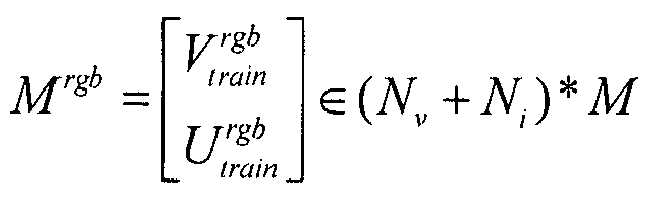

- In addition, the foregoing video training set and the picture training set may be a video set and a picture set that are stored in a local database.
- 206. Fuse the first type of confidence and the second type of confidence to obtain target confidence.
- The first type of confidence and the second type of confidence are fused by using proportional fusion without limitation, to obtain the target confidence of the input picture in each action category (namely, final confidence of the input picture in each action category).
- 207. Determine an action category of the person in the input picture based on the target confidence.
- It should be understood that the target confidence includes confidence of the input picture in each action type. Therefore, when the action category of the person in the input picture is determined based on the target confidence, an action category corresponding to maximum confidence in the target confidence may be determined as the action category of the person in the input picture.
- Further, when the action category of the person in the input picture is determined based on the target confidence, confidence greater than a preset threshold may be first selected from the target confidence, then the maximum confidence is selected from the confidence, and the action category corresponding to the maximum confidence is determined as the action category of the person in the input picture.
- When there is no confidence greater than the preset threshold in the target confidence, it indicates that an accurate action category of the input picture cannot be recognized when action recognition is performed.
- It should be understood that, before
step 201 to step 207, a video that is relatively highly related to the training picture may be first selected from a local video library and then is placed in the video repository. - It is assumed that videos in an existing video library correspond to Pv action categories in total, and different action categories correspond to different quantities of videos. To avoid an imbalance of action categories, a same quantity (for example, K, where K is an integer greater than 0) of candidate videos need to be selected from each action category to form Pv video packets (Video Bag). There are K candidate videos in each video packet. There are totally Pi action categories in existing training picture set, and these action categories are not exactly the same as the action categories of the videos.
- Therefore, a specific process of selecting, based on the training picture, the video that is relatively highly related to the training picture is as follows:
- (1) Extract a spatial feature and an optical flow feature of a video in each video packet in the video library.
- (2) Extract spatial features of all training pictures in the training picture set, and determine a virtual optical flow feature of each training picture based on the spatial feature and the optical flow feature of the video in each video packet in the video library.
- (3) Establish a local picture spatial feature library and a local picture optical flow feature library based on the spatial feature and the virtual optical flow feature of the training picture.
- (4) Perform similarity comparison on a spatial feature and an optical flow feature of each video in the video packet with a picture spatial feature library and a picture optical flow feature library respectively, to finally obtain confidence of each video in the video packet in different action categories, and then use a largest value of the confidence as a similarity measurement between each video and the training picture.
- (5) In each video packet, select first J (J<K and both J and K are integers greater than 0) videos with a largest similarity measurement as videos finally saved to the database.
- In comparison with the video, an action in the picture lacks a time context relationship, and it is relatively difficult to perform action recognition. This application provides an action recognition method based on the virtual optical flow and the feature library. An optical flow feature closely related to an action is generated for a single picture, so that action recognition is performed in combination with a spatial feature and an action feature of the picture, thereby improving action recognition accuracy.
- In addition, in this application, the feature library is established by using the spatial feature and the (virtual) optical flow feature of the training video and the training picture, and the action category is obtained by comparing the feature library with the spatial feature and the virtual optical flow feature of the input picture, so that when the training data is relatively sparse, relatively high action recognition accuracy is achieved.
- For comparison with performance of an existing action recognition method, a recognition effect of the action recognition method in this embodiment of this application is described below with reference to Table 3. Table 3 shows recognition accuracy of the action recognition method in this embodiment of this application and the existing action recognition method for different action recognition datasets. To highlight a case in which this application is applicable to sparse training pictures, in the training set shown in Table 2, only one picture is used as a training set of each type of training picture.
Table 3 Action recognition method WEB 101 dataset VOC dataset DIFF 20 dataset KNN algorithm 26.1 38.3 55.7 SVM algorithm 22.3 32.0 54.2 TSN algorithm 26.1 40.3 56.3 RCNN algorithm n/a 28.3 n/a This application 35.4 42.2 60.2 - It can be learned from Table 3 that for different data sets, recognition accuracy of the action recognition method in this application is higher than recognition accuracy of another existing solution. Therefore, the action recognition method in this embodiment of this application has relatively high recognition accuracy.
- The action recognition method in the embodiments of this application is described above in detail with reference to
FIG. 1 to FIG. 7 . Action recognition apparatuses in the embodiments of this application are described below with reference toFIG. 8 to FIG. 11 . It should be understood that the action recognition apparatuses shown inFIG. 8 to FIG. 11 may be specifically devices having a picture processing function, for example, a monitoring device, a terminal device, a network server, or a network cloud platform. The action recognition apparatuses shown inFIG. 8 to FIG. 11 may perform the steps of the action recognition method in the embodiments of this application. For brevity, repeated descriptions are properly omitted below. -
FIG. 8 is a schematic block diagram of an action recognition apparatus according to an embodiment of this application. The action recognition apparatus 800 shown inFIG. 8 includes: - an obtaining
module 801, configured to obtain a to-be-processed picture; - an
extraction module 802, configured to extract a spatial feature of the to-be-processed picture; and - a
processing module 803, configured to determine a virtual optical flow feature of the to-be-processed picture based on the spatial feature of the to-be-processed picture and X spatial features and X optical flow features in a preset feature library, where there is a one-to-one correspondence between the X spatial features and the X optical flow features, and X is an integer greater than 1. - The
processing module 803 is further configured to determine a first type of confidence of the to-be-processed picture in different action categories based on similarities between the virtual optical flow feature of the to-be-processed picture and Y optical flow features in the feature library. Each of the Y optical flow features corresponds to one action category, and Y is an integer greater than 1. - The
processing module 803 is further configured to determine an action category of the to-be-processed picture based on the first type of confidence. - In this application, the virtual optical flow feature of the to-be-processed picture can be obtained by using the spatial feature of the to-be-processed picture and the spatial feature and the optical flow feature in the feature library, to simulate, for the picture, time sequence information closely related to an action. Then, action recognition may be performed on the to-be-processed picture based on a similarity between the virtual optical flow feature of the to-be-processed picture and the optical flow feature in the feature library.
-
FIG. 9 is a schematic diagram of hardware structure of an action recognition apparatus according to an embodiment of this application. An action recognition apparatus 900 (the action recognition apparatus 900 may be specifically a computer device) shown inFIG. 9 includes amemory 901, aprocessor 902, acommunications interface 903, and a bus 904. A communication connection between thememory 901, theprocessor 902, and thecommunications interface 903 is implemented by using the bus 904. - The
memory 901 may be a read-only memory (read only memory, ROM), a static storage device, a dynamic storage device, or a random access memory (random access memory, RAM). Thememory 901 may store a program. When the program stored in thememory 901 is executed by theprocessor 902, theprocessor 902 and communications interface 903 are configured to perform the steps of the action recognition method in the embodiments of this application. - The
processor 902 may be a general-purpose central processing unit (central processing unit, CPU), a microprocessor, an application-specific integrated circuit (application specific integrated circuit, ASIC), a graphics processing unit (graphics processing unit, GPU), or one or more integrated circuits, and is configured to execute a related program, so as to implement a function that needs to be performed by a module of the action recognition apparatus in this embodiment of this application, or perform the action recognition method in the method embodiment of this application. - Alternatively, the
processor 902 may be an integrated circuit chip, and has a signal processing capability. In an implementation process, the steps of the action recognition method in this application may be implemented by using an integrated logic circuit of hardware in theprocessor 902 or an instruction in a form of software. Alternatively, theprocessor 902 may be a general purpose processor, a digital signal processor (digital signal processing, DSP), an application-specific integrated circuit (ASIC), a field programmable gate array (field programmable gate array, FPGA) or another programmable logic device, a discrete gate or a transistor logic device, or a discrete hardware component. Theprocessor 902 may implement or perform methods, steps, and logical block diagrams that are disclosed in the embodiments of this application. The general purpose processor may be a microprocessor, or the processor may be any conventional processor, or the like. Steps of the method disclosed with reference to the embodiments of this application may be directly performed and completed by a hardware decoding processor, or may be performed and completed by using a combination of hardware and software modules in a decoding processor. The software module may be located in a mature storage medium in the art, such as a random access memory, a flash memory, a read-only memory, a programmable read-only memory, or an electrically erasable programmable memory. The storage medium is located in thememory 901. Theprocessor 902 reads information in thememory 901, and completes, in combination with hardware of theprocessor 902, the function that needs to be performed by the module of the action recognition apparatus in this embodiment of this application, or perform the action recognition method in the method embodiment of this application. - The
communications interface 903 uses a transceiver apparatus, for example but not for limitation, a transceiver, to implement communication between the apparatus 900 and another device or communications network. For example, a to-be-processed picture may be obtained by using thecommunications interface 903. - The bus 904 may include a path for transmitting information between the components (for example, the
memory 901, theprocessor 902, and the communications interface 903) of the apparatus 900. - It should be noted that although only the
memory 901, theprocessor 902, and thecommunications interface 903 are shown in the apparatus 900 shown inFIG. 9 , in a specific implementation process, a person skilled in the art should understand that the apparatus 900 further includes other components necessary for implementing a normal operation. In addition, based on a specific requirement, a person skilled in the art should understand that the apparatus 900 may further include hardware components for implementing other additional functions. In addition, a person skilled in the art should understand that the apparatus 900 may alternatively include only devices required for implementing the embodiments of this application, but does not necessarily include all the devices shown inFIG. 9 . - It should be understood that the obtaining
module 801 of the action recognition apparatus 800 is equivalent to thecommunications interface 903 of the action recognition apparatus 900, and theextraction module 802 and theprocessing module 803 are equivalent to theprocessor 902. -
FIG. 10 is a schematic block diagram of an action recognition apparatus according to an embodiment of this application. An action recognition apparatus 1000 shown inFIG. 10 includes: aCNN module 1001, a virtualoptical flow module 1002, a spatial prediction module 1003, an opticalflow prediction module 1004, a fusion andoutput module 1005, avideo repository 1006, aspatial feature repository 1007, and an opticalflow feature repository 1008. - The
video repository 1006, thespatial feature repository 1007, and the opticalflow feature repository 1008 may be located inside the action recognition apparatus 1000, or may be located outside the action recognition apparatus 1000. For example, thevideo repository 1006, thespatial feature repository 1007, and the opticalflow feature repository 1008 may be located in a server or a local database, the action recognition apparatus may invoke, from the server or the local database, features included in thevideo repository 1006, thespatial feature repository 1007, and the opticalflow feature repository 1008. - It should be understood that the action recognition apparatus 1000 may perform the steps of the action recognition method in the embodiments of this application. Specific functions of the modules are as follows:
- The
CNN module 1001 is configured to perform a convolution operation on a to-be-processed picture, to obtain a spatial feature urgb of the image. - The
video repository 1006 is configured to store a spatial feature Vrgb and an optical flow feature Vflow of a training video. - The virtual
optical flow module 1002 is configured to generate a virtual optical flow feature uflow of the to-be-processed picture by using the spatial feature urgb of the to-be-processed picture, and the spatial feature Vrgb and the optical flow feature Vflow of the training video that are stored in thevideo repository 1006. - The
spatial feature repository 1007 is configured to store spatial features and category labels of the training video and image. - The optical
flow feature repository 1008 is configured to store an optical flow feature of the training video, the virtual optical flow feature of the training picture, and action category labels of the training video and the training picture. - The spatial prediction module 1003 is configured to compare the spatial feature of the to-be-processed picture with a feature in the spatial feature repository, to obtain confidence of the to-be-processed picture in each action category.
- The optical
flow prediction module 1004 is configured to compare the virtual optical flow feature of the to-be-processed picture with a feature in the optical flow feature repository, to obtain confidence of the to-be-processed picture in each category. - The fusion and
output module 1005 is configured to: fuse confidence that is in each action category of the to-be-processed picture and that is obtained by the spatial prediction module 1003 and the opticalflow prediction module 1004, to obtain final confidence of the to-be-processed picture in each category, and select an action category with maximum confidence for outputting. - Optionally, the action recognition apparatus 1000 shown in
FIG. 10 may further include an obtainingmodule 1009 and avideo selection module 1010. The obtainingmodule 1009 is configured to obtain a to-be-processed picture, and thevideo selection module 1010 is configured to select a video for thevideo repository 1006. - It should be understood that the obtaining
module 1009 of the action recognition apparatus 1000 is equivalent to thecommunications interface 903 of the action recognition apparatus 900, and other modules of the action recognition apparatus 1000 are equivalent to theprocessor 902 of the action recognition apparatus 900. - In specific implementation, the
CNN module 1001, the virtualoptical flow module 1002, the spatial prediction module 1003, the opticalflow prediction module 1004, the fusion andoutput module 1005, the obtainingmodule 1009, and thevideo selection module 1010 of the action recognition apparatus 1000 may be implemented by using hardware, software, or a combination of hardware and software. - To better understand a working procedure of each module of the action recognition apparatus 1000, the following briefly describes an action recognition process of the action recognition apparatus 1000 with reference to
FIG. 11 (for a detailed process, refer to each step of the method shown inFIG. 2 . Details are not described herein again). - As shown in
FIG. 11 , a process in which the action recognition apparatus 1000 performs action recognition on an input picture is specifically as follows: - The
CNN module 1001 obtains an input picture, and extracts a spatial feature of the input picture. - The virtual
optical flow module 1002 determines a virtual optical flow feature of the input picture based on an optical flow feature and a spatial feature in thevideo repository 1006 and the spatial feature of the input picture. - Next, the optical
flow prediction module 1004 performs optical flow prediction based on the extracted virtual optical flow feature of the input picture and an optical flow feature in the opticalflow feature repository 1008, to obtain a first type of confidence. - The spatial prediction module 1003 performs spatial prediction based on the extracted spatial feature of the input picture and a spatial feature in the
spatial feature repository 1007, to obtain a second type of confidence. - The fusion and
output module 1005 fuses the first type of confidence and the second type of confidence to obtain target confidence, and then determines an action category of a person in the input picture based on the target confidence. - A person of ordinary skill in the art may be aware that, in combination with the examples described in the embodiments disclosed in this specification, units and algorithm steps can be implemented by electronic hardware or a combination of computer software and electronic hardware. Whether the functions are performed by hardware or software depends on a particular application and a design constraint condition of a technical solution. A person skilled in the art may use different methods to implement the described functions for each particular application, but it should not be considered that the implementation goes beyond the scope of this application.
- A person skilled in the art may clearly understand that, for convenience and brevity of description, for specific working processes of the system, apparatus, and unit described above, refer to a corresponding process in the foregoing method embodiment. Details are not described herein again.
- In the several embodiments provided in this application, it should be understood that the disclosed system, apparatus, and method may be implemented in another manner. For example, the described apparatus embodiment is merely an example. For example, the unit division is merely logical function division and may be other division in actual implementation. For example, a plurality of units or components may be combined or integrated into another system, or some features may be ignored or not performed. In addition, the displayed or discussed mutual couplings or direct couplings or communication connections may be implemented through some interfaces. The indirect couplings or communication connections between the apparatuses or units may be implemented in electronic, mechanical, or other forms.
- The units described as separate parts may or may not be physically separated, and parts displayed as units may or may not be physical units, may be located in one position, or may be distributed on a plurality of network units. Some or all of the units may be selected based on an actual requirement to achieve an objective of the solution in the embodiments.
- In addition, functional units in the embodiments of this application may be integrated into one processing unit, or the units may exist alone physically, or two or more units may be integrated into one unit.
- When the functions are implemented in a form of a software function unit and sold or used as an independent product, the functions may be stored in a computer readable storage medium. Based on such an understanding, the technical solutions of this application essentially, or the part contributing to the prior art, or some of the technical solutions may be implemented in a form of a software product. The computer software product is stored in a storage medium, and includes several instructions, so that one computer device (which may be a personal computer, a server, a network device, or the like) is enabled to perform all or some of the steps of the method in the embodiments of this application. The storage medium includes any medium that can store program code, for example, a USB flash drive, a removable hard disk, a read-only memory (read-only memory, ROM), a random access memory (random access memory, RAM), a magnetic disk, or a compact disc.
- Any variation or replacement readily figured out by the person skilled in the art within the technical scope of the claims shall fall within the protection scope of this application. Therefore, the protection scope of this application shall be subject to the protection scope of the claims.
Claims (11)
- An action recognition method, comprising:obtaining (101) a to-be-processed picture;extracting (102) a spatial feature of the to-be-processed picture;determining (103) a virtual optical flow feature of the to-be-processed picture based on the spatial feature of the to-be-processed picture and X spatial features and X optical flow features in a preset feature library, wherein there is a one-to-one correspondence between the X spatial features and the X optical flow features, and X is an integer greater than 1;determining (104) a first type of confidence of the to-be-processed picture in different action categories based on similarities between the virtual optical flow feature of the to-be-processed picture and Y optical flow features in the feature library, wherein each of the Y optical flow features corresponds to one action category, and Y is an integer greater than 1; anddetermining (105) an action category of the to-be-processed picture based on the first type of confidence;wherein the determining a virtual optical flow feature of the to-be-processed picture based on the spatial feature of the to-be-processed picture and X spatial features and X optical flow features in a preset feature library comprises:determining a weight coefficient of each of the X optical flow features based on a similarity between the spatial feature of the to-be-processed picture and each of the X spatial features; andperforming weighted summation on the X optical flow features based on the weight coefficient of each of the X optical flow features, to obtain the virtual optical flow feature of the to-be-processed picture;wherein a value of the determined weight coefficient of each of the X optical flow features is positively correlated to a first similarity, and the first similarity is a similarity between the spatial feature of the to-be-processed picture and a spatial feature in the X spatial features that corresponds to each of the X optical flow features.
- The method according to claim 1, wherein the spatial features in the feature library comprise a spatial feature of a training video, and the optical flow features in the feature library comprise an optical flow feature of the training video.
- The method according to claim 2, wherein the spatial feature in the feature library further comprises a spatial feature of a training picture, and the optical flow feature in the feature library further comprises a virtual optical flow feature of the training picture.
- The method according to claim 3, wherein the virtual optical flow feature of the training picture is obtained by performing weighted summation on the optical flow feature of the training video based on a similarity between the spatial feature of the training picture and the spatial feature of the training video.
- The method according to any one of claims 1 to 4, wherein the method further comprises:determining a second type of confidence of the to-be-processed picture in the different action categories based on similarities between the spatial feature of the to-be-processed picture and Z spatial features in the feature library, wherein each of the Z spatial features corresponds to one action category, and Z is an integer greater than 1; andthe determining an action category of the to-be-processed picture based on the first type of confidence comprises:
determining the action category of the to-be-processed picture based on the first type of confidence and the second type of confidence. - The method according to claim 5, wherein the determining the action category of the to-be-processed picture based on the first type of confidence and the second type of confidence comprises:performing weighted summation on the first type of confidence and the second type of confidence, to obtain final confidence of the to-be-processed picture in the different action categories; anddetermining the action category of the to-be-processed picture based on the final confidence.
- The method according to any one of claims 1 to 6, wherein after the determining an action category of the to-be-processed picture, the method further comprises:
adding the spatial feature and the virtual optical flow feature of the to-be-processed picture and action category information in the to-be-processed picture to the feature library. - An action recognition apparatus, comprising:a memory(901), configured to store a program; anda processor (902), configured to execute the program stored in the memory, wherein when the program stored in the memory is executed, the processor is configured to:obtain (101) a to-be-processed picture;extract (102) a spatial feature of the to-be-processed picture;determine (103) a virtual optical flow feature of the to-be-processed picture based on the spatial feature of the to-be-processed picture and X spatial features and X optical flow features in a preset feature library, wherein there is a one-to-one correspondence between the X spatial features and the X optical flow features, and X is an integer greater than 1;determine (104) a first type of confidence of the to-be-processed picture in different action categories based on similarities between the virtual optical flow feature of the to-be-processed picture and Y optical flow features in the feature library, wherein each of the Y optical flow features corresponds to one action category, and Y is an integer greater than 1; anddetermine (105) an action category of the to-be-processed picture based on the first type of confidence;wherein the processor is configured to:determine a weight coefficient of each of the X optical flow features based on a similarity between the spatial feature of the to-be-processed picture and each of the X spatial features; andperform weighted summation on the optical flow feature in the feature library based on the weight coefficient of each optical flow feature in the feature library, to obtain the virtual optical flow feature of the to-be-processed picture;wherein a value of the determined weight coefficient of each of the X optical flow features is positively correlated to a first similarity, and the first similarity is a similarity between the spatial feature of the to-be-processed picture and a spatial feature in the X spatial features that corresponds to each of the X optical flow features.
- The apparatus according to claim 8, wherein the spatial features in the feature library comprise a spatial feature of a training video, and the optical flow features in the feature library comprise an optical flow feature of the training video.
- The apparatus according to claim 9, wherein the spatial feature in the feature library further comprises a spatial feature of a training picture, and the optical flow feature in the feature library further comprises a virtual optical flow feature of the training picture.
- The apparatus according to claim 10, wherein the virtual optical flow feature of the training picture is obtained by performing weighted summation on the optical flow feature of the training video based on a similarity between the spatial feature of the training picture and the spatial feature of the training video.
Applications Claiming Priority (2)
| Application Number | Priority Date | Filing Date | Title |
|---|---|---|---|
| CN201810533284.9A CN109902547B (en) | 2018-05-29 | 2018-05-29 | Action recognition method and device |
| PCT/CN2019/088694 WO2019228316A1 (en) | 2018-05-29 | 2019-05-28 | Action recognition method and apparatus |
Publications (3)
| Publication Number | Publication Date |
|---|---|
| EP3757874A1 EP3757874A1 (en) | 2020-12-30 |
| EP3757874A4 EP3757874A4 (en) | 2021-04-07 |
| EP3757874B1 true EP3757874B1 (en) | 2023-10-25 |
Family
ID=66943243
Family Applications (1)
| Application Number | Title | Priority Date | Filing Date |
|---|---|---|---|
| EP19810779.9A Active EP3757874B1 (en) | 2018-05-29 | 2019-05-28 | Action recognition method and apparatus |
Country Status (4)
| Country | Link |
|---|---|
| US (2) | US11392801B2 (en) |
| EP (1) | EP3757874B1 (en) |
| CN (1) | CN109902547B (en) |
| WO (1) | WO2019228316A1 (en) |
Families Citing this family (9)
| Publication number | Priority date | Publication date | Assignee | Title |
|---|---|---|---|---|
| US11741699B2 (en) * | 2019-02-24 | 2023-08-29 | Wrethink, Inc. | Methods and apparatus for detecting features of scanned images, associating tags with images and/or using tagged images |
| US11748509B2 (en) | 2019-02-24 | 2023-09-05 | Wrethink, Inc. | Methods and apparatus for automatically controlling access to stored data, a storage location of stored data, and/or ownership of stored data based on life event information |
| US11714961B2 (en) | 2019-02-24 | 2023-08-01 | Wrethink, Inc. | Methods and apparatus for suggesting and/or associating tags corresponding to identified image content and/or storing said image content in association with tags to facilitate retrieval and use |
| CN110597251B (en) * | 2019-09-03 | 2022-10-25 | 三星电子(中国)研发中心 | Method and device for controlling intelligent mobile equipment |
| CN112668597B (en) * | 2019-10-15 | 2023-07-28 | 杭州海康威视数字技术股份有限公司 | Feature comparison method, device and equipment |
| CN112766207A (en) * | 2021-01-28 | 2021-05-07 | 珠海格力电器股份有限公司 | Behavior recognition model construction method, behavior recognition method and smart home |
| KR20230077330A (en) * | 2021-11-25 | 2023-06-01 | 삼성전자주식회사 | Electronic device for using self-similarity in space and time and method for operating method thereof |
| KR102554848B1 (en) * | 2022-10-31 | 2023-07-12 | 주식회사 디퍼아이 | Behavioral cognitive apparatus and method therefor |
| CN121608721B (en) * | 2026-02-03 | 2026-04-03 | 烟台施丹普汽车零部件有限公司 | A method for diagnosing electromechanical faults in an electronic parking brake system |
Family Cites Families (26)
| Publication number | Priority date | Publication date | Assignee | Title |
|---|---|---|---|---|
| KR100421740B1 (en) * | 2000-11-14 | 2004-03-10 | 삼성전자주식회사 | Object activity modeling method |
| US8189866B1 (en) * | 2008-08-26 | 2012-05-29 | Adobe Systems Incorporated | Human-action recognition in images and videos |
| US8345984B2 (en) | 2010-01-28 | 2013-01-01 | Nec Laboratories America, Inc. | 3D convolutional neural networks for automatic human action recognition |
| US8761437B2 (en) * | 2011-02-18 | 2014-06-24 | Microsoft Corporation | Motion recognition |
| US8774499B2 (en) * | 2011-02-28 | 2014-07-08 | Seiko Epson Corporation | Embedded optical flow features |
| US9111375B2 (en) * | 2012-01-05 | 2015-08-18 | Philip Meier | Evaluation of three-dimensional scenes using two-dimensional representations |
| CN103164694B (en) * | 2013-02-20 | 2016-06-01 | 上海交通大学 | A kind of human action knows method for distinguishing |
| US9436890B2 (en) * | 2014-01-23 | 2016-09-06 | Samsung Electronics Co., Ltd. | Method of generating feature vector, generating histogram, and learning classifier for recognition of behavior |
| US10083233B2 (en) * | 2014-09-09 | 2018-09-25 | Microsoft Technology Licensing, Llc | Video processing for motor task analysis |
| CN104408444A (en) * | 2014-12-15 | 2015-03-11 | 北京国双科技有限公司 | Human body action recognition method and device |
| CN104899554A (en) | 2015-05-07 | 2015-09-09 | 东北大学 | Vehicle ranging method based on monocular vision |
| CN105069413B (en) | 2015-07-27 | 2018-04-06 | 电子科技大学 | A kind of human posture's recognition methods based on depth convolutional neural networks |
| CN105160310A (en) * | 2015-08-25 | 2015-12-16 | 西安电子科技大学 | 3D (three-dimensional) convolutional neural network based human body behavior recognition method |
| CN105303571A (en) * | 2015-10-23 | 2016-02-03 | 苏州大学 | Time-space saliency detection method for video processing |
| CN105551182A (en) | 2015-11-26 | 2016-05-04 | 吉林大学 | Driving state monitoring system based on Kinect human body posture recognition |
| CN106933340B (en) * | 2015-12-31 | 2024-04-26 | 北京体基科技有限公司 | Gesture motion recognition method, control method and device and wrist type equipment |
| CN106570480B (en) | 2016-11-07 | 2019-04-19 | 南京邮电大学 | A Human Action Classification Method Based on Gesture Recognition |
| CN106846367B (en) * | 2017-02-15 | 2019-10-01 | 北京大学深圳研究生院 | A kind of Mobile object detection method of the complicated dynamic scene based on kinematic constraint optical flow method |
| CN107169415B (en) * | 2017-04-13 | 2019-10-11 | 西安电子科技大学 | Human Action Recognition Method Based on Convolutional Neural Network Feature Coding |
| CN107194419A (en) * | 2017-05-10 | 2017-09-22 | 百度在线网络技术(北京)有限公司 | Video classification methods and device, computer equipment and computer-readable recording medium |
| CN110622169A (en) * | 2017-05-15 | 2019-12-27 | 渊慧科技有限公司 | Neural network system for motion recognition in video |
| CN107609460B (en) * | 2017-05-24 | 2021-02-02 | 南京邮电大学 | A Human Action Recognition Method Integrating Spatio-temporal Dual Network Flow and Attention Mechanism |
| CN107463949B (en) * | 2017-07-14 | 2020-02-21 | 北京协同创新研究院 | A processing method and device for video action classification |
| CN107967441B (en) * | 2017-09-19 | 2021-03-30 | 北京工业大学 | Video behavior identification method based on two-channel 3D-2D RBM model |
| CN107644519A (en) * | 2017-10-09 | 2018-01-30 | 中电科新型智慧城市研究院有限公司 | A kind of intelligent alarm method and system based on video human Activity recognition |
| CN107862376A (en) * | 2017-10-30 | 2018-03-30 | 中山大学 | A kind of human body image action identification method based on double-current neutral net |
-
2018
- 2018-05-29 CN CN201810533284.9A patent/CN109902547B/en active Active
-
2019
- 2019-05-28 WO PCT/CN2019/088694 patent/WO2019228316A1/en not_active Ceased
- 2019-05-28 EP EP19810779.9A patent/EP3757874B1/en active Active
-
2020
- 2020-09-28 US US17/034,654 patent/US11392801B2/en active Active
-
2022
- 2022-06-22 US US17/846,533 patent/US11704938B2/en active Active
Also Published As
| Publication number | Publication date |
|---|---|
| US11704938B2 (en) | 2023-07-18 |
| EP3757874A4 (en) | 2021-04-07 |
| CN109902547A (en) | 2019-06-18 |
| US20210012164A1 (en) | 2021-01-14 |
| US11392801B2 (en) | 2022-07-19 |
| US20220391645A1 (en) | 2022-12-08 |
| WO2019228316A1 (en) | 2019-12-05 |
| EP3757874A1 (en) | 2020-12-30 |
| CN109902547B (en) | 2020-04-28 |
Similar Documents
| Publication | Publication Date | Title |
|---|---|---|
| US11704938B2 (en) | Action recognition method and apparatus | |
| CN111859023B (en) | Video classification method, apparatus, device and computer readable storage medium | |
| CN110766096B (en) | Video classification method and device and electronic equipment | |
| CN109977262B (en) | Method and device for acquiring candidate segments from video and processing equipment | |
| US20230290003A1 (en) | Model training method and apparatus, device, medium, and program product | |
| CN112070044B (en) | Video object classification method and device | |
| CN115661943B (en) | Fall detection method based on lightweight attitude assessment network | |
| CN112200041B (en) | Video motion recognition method and device, storage medium and electronic equipment | |
| CN110533097A (en) | Image resolution recognition method, device, electronic equipment and storage medium | |
| CN110765860A (en) | Tumble determination method, tumble determination device, computer apparatus, and storage medium | |
| CN111400615B (en) | Resource recommendation method, device, equipment and storage medium | |
| CN111954860A (en) | System and method for fine-grained adversarial multi-player motion prediction | |
| CN111539290A (en) | Video motion recognition method and device, electronic equipment and storage medium | |
| CN106874857A (en) | A kind of living body determination method and system based on video analysis | |
| WO2018196718A1 (en) | Image disambiguation method and device, storage medium, and electronic device | |
| CN110309795A (en) | Video detecting method, device, electronic equipment and storage medium | |
| CN112131944B (en) | A video behavior recognition method and system | |
| Dey et al. | Umpire’s signal recognition in cricket using an attention based DC-GRU network | |
| CN111860353A (en) | Video behavior prediction method, device and medium based on dual-stream neural network | |
| JP7446338B2 (en) | Method, device, equipment and storage medium for detecting degree of association between face and hand | |
| CN110659641B (en) | Method, device and electronic equipment for character recognition | |
| WO2023109361A1 (en) | Video processing method and system, device, medium and product | |
| CN113221837A (en) | Object segmentation method, and training method and device of object segmentation model | |
| CN116189284A (en) | Human motion prediction method, device, equipment and storage medium | |
| CN113409350A (en) | Method and related device for separating foreground and background of video |
Legal Events
| Date | Code | Title | Description |
|---|---|---|---|
| STAA | Information on the status of an ep patent application or granted ep patent |
Free format text: STATUS: THE INTERNATIONAL PUBLICATION HAS BEEN MADE |
|
| PUAI | Public reference made under article 153(3) epc to a published international application that has entered the european phase |
Free format text: ORIGINAL CODE: 0009012 |
|
| STAA | Information on the status of an ep patent application or granted ep patent |
Free format text: STATUS: REQUEST FOR EXAMINATION WAS MADE |
|
| 17P | Request for examination filed |
Effective date: 20200923 |
|
| AK | Designated contracting states |
Kind code of ref document: A1 Designated state(s): AL AT BE BG CH CY CZ DE DK EE ES FI FR GB GR HR HU IE IS IT LI LT LU LV MC MK MT NL NO PL PT RO RS SE SI SK SM TR |
|
| AX | Request for extension of the european patent |
Extension state: BA ME |
|
| A4 | Supplementary search report drawn up and despatched |
Effective date: 20210310 |
|
| RIC1 | Information provided on ipc code assigned before grant |
Ipc: G06T 7/20 20170101ALI20210303BHEP Ipc: G06K 9/62 20060101ALI20210303BHEP Ipc: G06K 9/00 20060101AFI20210303BHEP |
|
| DAV | Request for validation of the european patent (deleted) | ||
| DAX | Request for extension of the european patent (deleted) | ||
| STAA | Information on the status of an ep patent application or granted ep patent |
Free format text: STATUS: EXAMINATION IS IN PROGRESS |
|
| 17Q | First examination report despatched |
Effective date: 20230124 |
|
| REG | Reference to a national code |
Ref country code: DE Ref legal event code: R079 Free format text: PREVIOUS MAIN CLASS: G06K0009000000 Ipc: G06V0010400000 Ref country code: DE Ref legal event code: R079 Ref document number: 602019040198 Country of ref document: DE Free format text: PREVIOUS MAIN CLASS: G06K0009000000 Ipc: G06V0010400000 |
|
| GRAP | Despatch of communication of intention to grant a patent |
Free format text: ORIGINAL CODE: EPIDOSNIGR1 |
|
| STAA | Information on the status of an ep patent application or granted ep patent |
Free format text: STATUS: GRANT OF PATENT IS INTENDED |
|
| RIC1 | Information provided on ipc code assigned before grant |
Ipc: G06V 10/74 20220101ALI20230607BHEP Ipc: G06V 10/62 20220101ALI20230607BHEP Ipc: G06V 10/40 20220101AFI20230607BHEP |
|
| INTG | Intention to grant announced |
Effective date: 20230627 |
|
| GRAS | Grant fee paid |
Free format text: ORIGINAL CODE: EPIDOSNIGR3 |
|
| GRAA | (expected) grant |
Free format text: ORIGINAL CODE: 0009210 |
|
| STAA | Information on the status of an ep patent application or granted ep patent |
Free format text: STATUS: THE PATENT HAS BEEN GRANTED |
|
| P01 | Opt-out of the competence of the unified patent court (upc) registered |
Effective date: 20230901 |
|
| AK | Designated contracting states |
Kind code of ref document: B1 Designated state(s): AL AT BE BG CH CY CZ DE DK EE ES FI FR GB GR HR HU IE IS IT LI LT LU LV MC MK MT NL NO PL PT RO RS SE SI SK SM TR |
|
| REG | Reference to a national code |
Ref country code: GB Ref legal event code: FG4D |
|
| REG | Reference to a national code |
Ref country code: CH Ref legal event code: EP |
|
| REG | Reference to a national code |
Ref country code: DE Ref legal event code: R096 Ref document number: 602019040198 Country of ref document: DE |
|
| REG | Reference to a national code |
Ref country code: IE Ref legal event code: FG4D |
|
| REG | Reference to a national code |
Ref country code: LT Ref legal event code: MG9D |
|
| REG | Reference to a national code |
Ref country code: NL Ref legal event code: MP Effective date: 20231025 |
|
| REG | Reference to a national code |
Ref country code: AT Ref legal event code: MK05 Ref document number: 1625458 Country of ref document: AT Kind code of ref document: T Effective date: 20231025 |
|
| PG25 | Lapsed in a contracting state [announced via postgrant information from national office to epo] |
Ref country code: NL Free format text: LAPSE BECAUSE OF FAILURE TO SUBMIT A TRANSLATION OF THE DESCRIPTION OR TO PAY THE FEE WITHIN THE PRESCRIBED TIME-LIMIT Effective date: 20231025 |
|
| PG25 | Lapsed in a contracting state [announced via postgrant information from national office to epo] |
Ref country code: GR Free format text: LAPSE BECAUSE OF FAILURE TO SUBMIT A TRANSLATION OF THE DESCRIPTION OR TO PAY THE FEE WITHIN THE PRESCRIBED TIME-LIMIT Effective date: 20240126 |
|
| PG25 | Lapsed in a contracting state [announced via postgrant information from national office to epo] |
Ref country code: IS Free format text: LAPSE BECAUSE OF FAILURE TO SUBMIT A TRANSLATION OF THE DESCRIPTION OR TO PAY THE FEE WITHIN THE PRESCRIBED TIME-LIMIT Effective date: 20240225 |
|
| PG25 | Lapsed in a contracting state [announced via postgrant information from national office to epo] |
Ref country code: LT Free format text: LAPSE BECAUSE OF FAILURE TO SUBMIT A TRANSLATION OF THE DESCRIPTION OR TO PAY THE FEE WITHIN THE PRESCRIBED TIME-LIMIT Effective date: 20231025 |
|
| PG25 | Lapsed in a contracting state [announced via postgrant information from national office to epo] |
Ref country code: AT Free format text: LAPSE BECAUSE OF FAILURE TO SUBMIT A TRANSLATION OF THE DESCRIPTION OR TO PAY THE FEE WITHIN THE PRESCRIBED TIME-LIMIT Effective date: 20231025 |
|
| PG25 | Lapsed in a contracting state [announced via postgrant information from national office to epo] |
Ref country code: ES Free format text: LAPSE BECAUSE OF FAILURE TO SUBMIT A TRANSLATION OF THE DESCRIPTION OR TO PAY THE FEE WITHIN THE PRESCRIBED TIME-LIMIT Effective date: 20231025 |
|
| PG25 | Lapsed in a contracting state [announced via postgrant information from national office to epo] |
Ref country code: LT Free format text: LAPSE BECAUSE OF FAILURE TO SUBMIT A TRANSLATION OF THE DESCRIPTION OR TO PAY THE FEE WITHIN THE PRESCRIBED TIME-LIMIT Effective date: 20231025 Ref country code: IS Free format text: LAPSE BECAUSE OF FAILURE TO SUBMIT A TRANSLATION OF THE DESCRIPTION OR TO PAY THE FEE WITHIN THE PRESCRIBED TIME-LIMIT Effective date: 20240225 Ref country code: GR Free format text: LAPSE BECAUSE OF FAILURE TO SUBMIT A TRANSLATION OF THE DESCRIPTION OR TO PAY THE FEE WITHIN THE PRESCRIBED TIME-LIMIT Effective date: 20240126 Ref country code: ES Free format text: LAPSE BECAUSE OF FAILURE TO SUBMIT A TRANSLATION OF THE DESCRIPTION OR TO PAY THE FEE WITHIN THE PRESCRIBED TIME-LIMIT Effective date: 20231025 Ref country code: BG Free format text: LAPSE BECAUSE OF FAILURE TO SUBMIT A TRANSLATION OF THE DESCRIPTION OR TO PAY THE FEE WITHIN THE PRESCRIBED TIME-LIMIT Effective date: 20240125 Ref country code: AT Free format text: LAPSE BECAUSE OF FAILURE TO SUBMIT A TRANSLATION OF THE DESCRIPTION OR TO PAY THE FEE WITHIN THE PRESCRIBED TIME-LIMIT Effective date: 20231025 Ref country code: PT Free format text: LAPSE BECAUSE OF FAILURE TO SUBMIT A TRANSLATION OF THE DESCRIPTION OR TO PAY THE FEE WITHIN THE PRESCRIBED TIME-LIMIT Effective date: 20240226 |
|
| PG25 | Lapsed in a contracting state [announced via postgrant information from national office to epo] |
Ref country code: SE Free format text: LAPSE BECAUSE OF FAILURE TO SUBMIT A TRANSLATION OF THE DESCRIPTION OR TO PAY THE FEE WITHIN THE PRESCRIBED TIME-LIMIT Effective date: 20231025 Ref country code: RS Free format text: LAPSE BECAUSE OF FAILURE TO SUBMIT A TRANSLATION OF THE DESCRIPTION OR TO PAY THE FEE WITHIN THE PRESCRIBED TIME-LIMIT Effective date: 20231025 Ref country code: PL Free format text: LAPSE BECAUSE OF FAILURE TO SUBMIT A TRANSLATION OF THE DESCRIPTION OR TO PAY THE FEE WITHIN THE PRESCRIBED TIME-LIMIT Effective date: 20231025 Ref country code: NO Free format text: LAPSE BECAUSE OF FAILURE TO SUBMIT A TRANSLATION OF THE DESCRIPTION OR TO PAY THE FEE WITHIN THE PRESCRIBED TIME-LIMIT Effective date: 20240125 Ref country code: LV Free format text: LAPSE BECAUSE OF FAILURE TO SUBMIT A TRANSLATION OF THE DESCRIPTION OR TO PAY THE FEE WITHIN THE PRESCRIBED TIME-LIMIT Effective date: 20231025 Ref country code: HR Free format text: LAPSE BECAUSE OF FAILURE TO SUBMIT A TRANSLATION OF THE DESCRIPTION OR TO PAY THE FEE WITHIN THE PRESCRIBED TIME-LIMIT Effective date: 20231025 |
|
| PG25 | Lapsed in a contracting state [announced via postgrant information from national office to epo] |
Ref country code: DK Free format text: LAPSE BECAUSE OF FAILURE TO SUBMIT A TRANSLATION OF THE DESCRIPTION OR TO PAY THE FEE WITHIN THE PRESCRIBED TIME-LIMIT Effective date: 20231025 |
|
| PG25 | Lapsed in a contracting state [announced via postgrant information from national office to epo] |
Ref country code: CZ Free format text: LAPSE BECAUSE OF FAILURE TO SUBMIT A TRANSLATION OF THE DESCRIPTION OR TO PAY THE FEE WITHIN THE PRESCRIBED TIME-LIMIT Effective date: 20231025 |
|
| REG | Reference to a national code |
Ref country code: DE Ref legal event code: R097 Ref document number: 602019040198 Country of ref document: DE |
|
| PG25 | Lapsed in a contracting state [announced via postgrant information from national office to epo] |
Ref country code: SK Free format text: LAPSE BECAUSE OF FAILURE TO SUBMIT A TRANSLATION OF THE DESCRIPTION OR TO PAY THE FEE WITHIN THE PRESCRIBED TIME-LIMIT Effective date: 20231025 |
|
| PG25 | Lapsed in a contracting state [announced via postgrant information from national office to epo] |
Ref country code: SM Free format text: LAPSE BECAUSE OF FAILURE TO SUBMIT A TRANSLATION OF THE DESCRIPTION OR TO PAY THE FEE WITHIN THE PRESCRIBED TIME-LIMIT Effective date: 20231025 Ref country code: SK Free format text: LAPSE BECAUSE OF FAILURE TO SUBMIT A TRANSLATION OF THE DESCRIPTION OR TO PAY THE FEE WITHIN THE PRESCRIBED TIME-LIMIT Effective date: 20231025 Ref country code: RO Free format text: LAPSE BECAUSE OF FAILURE TO SUBMIT A TRANSLATION OF THE DESCRIPTION OR TO PAY THE FEE WITHIN THE PRESCRIBED TIME-LIMIT Effective date: 20231025 Ref country code: IT Free format text: LAPSE BECAUSE OF FAILURE TO SUBMIT A TRANSLATION OF THE DESCRIPTION OR TO PAY THE FEE WITHIN THE PRESCRIBED TIME-LIMIT Effective date: 20231025 Ref country code: EE Free format text: LAPSE BECAUSE OF FAILURE TO SUBMIT A TRANSLATION OF THE DESCRIPTION OR TO PAY THE FEE WITHIN THE PRESCRIBED TIME-LIMIT Effective date: 20231025 Ref country code: DK Free format text: LAPSE BECAUSE OF FAILURE TO SUBMIT A TRANSLATION OF THE DESCRIPTION OR TO PAY THE FEE WITHIN THE PRESCRIBED TIME-LIMIT Effective date: 20231025 Ref country code: CZ Free format text: LAPSE BECAUSE OF FAILURE TO SUBMIT A TRANSLATION OF THE DESCRIPTION OR TO PAY THE FEE WITHIN THE PRESCRIBED TIME-LIMIT Effective date: 20231025 |
|
| PLBE | No opposition filed within time limit |
Free format text: ORIGINAL CODE: 0009261 |
|
| STAA | Information on the status of an ep patent application or granted ep patent |
Free format text: STATUS: NO OPPOSITION FILED WITHIN TIME LIMIT |
|
| 26N | No opposition filed |
Effective date: 20240726 |
|
| PG25 | Lapsed in a contracting state [announced via postgrant information from national office to epo] |
Ref country code: SI Free format text: LAPSE BECAUSE OF FAILURE TO SUBMIT A TRANSLATION OF THE DESCRIPTION OR TO PAY THE FEE WITHIN THE PRESCRIBED TIME-LIMIT Effective date: 20231025 |
|
| PG25 | Lapsed in a contracting state [announced via postgrant information from national office to epo] |
Ref country code: SI Free format text: LAPSE BECAUSE OF FAILURE TO SUBMIT A TRANSLATION OF THE DESCRIPTION OR TO PAY THE FEE WITHIN THE PRESCRIBED TIME-LIMIT Effective date: 20231025 |
|
| REG | Reference to a national code |
Ref country code: CH Ref legal event code: PL |
|
| PG25 | Lapsed in a contracting state [announced via postgrant information from national office to epo] |
Ref country code: MC Free format text: LAPSE BECAUSE OF FAILURE TO SUBMIT A TRANSLATION OF THE DESCRIPTION OR TO PAY THE FEE WITHIN THE PRESCRIBED TIME-LIMIT Effective date: 20231025 |
|
| PG25 | Lapsed in a contracting state [announced via postgrant information from national office to epo] |
Ref country code: LU Free format text: LAPSE BECAUSE OF NON-PAYMENT OF DUE FEES Effective date: 20240528 |
|
| PG25 | Lapsed in a contracting state [announced via postgrant information from national office to epo] |
Ref country code: MC Free format text: LAPSE BECAUSE OF FAILURE TO SUBMIT A TRANSLATION OF THE DESCRIPTION OR TO PAY THE FEE WITHIN THE PRESCRIBED TIME-LIMIT Effective date: 20231025 Ref country code: LU Free format text: LAPSE BECAUSE OF NON-PAYMENT OF DUE FEES Effective date: 20240528 Ref country code: CH Free format text: LAPSE BECAUSE OF NON-PAYMENT OF DUE FEES Effective date: 20240531 |
|
| REG | Reference to a national code |
Ref country code: BE Ref legal event code: MM Effective date: 20240531 |
|
| PG25 | Lapsed in a contracting state [announced via postgrant information from national office to epo] |
Ref country code: IE Free format text: LAPSE BECAUSE OF NON-PAYMENT OF DUE FEES Effective date: 20240528 |
|
| PG25 | Lapsed in a contracting state [announced via postgrant information from national office to epo] |
Ref country code: BE Free format text: LAPSE BECAUSE OF NON-PAYMENT OF DUE FEES Effective date: 20240531 |
|
| PG25 | Lapsed in a contracting state [announced via postgrant information from national office to epo] |
Ref country code: CY Free format text: LAPSE BECAUSE OF FAILURE TO SUBMIT A TRANSLATION OF THE DESCRIPTION OR TO PAY THE FEE WITHIN THE PRESCRIBED TIME-LIMIT; INVALID AB INITIO Effective date: 20190528 |
|
| PG25 | Lapsed in a contracting state [announced via postgrant information from national office to epo] |
Ref country code: FI Free format text: LAPSE BECAUSE OF FAILURE TO SUBMIT A TRANSLATION OF THE DESCRIPTION OR TO PAY THE FEE WITHIN THE PRESCRIBED TIME-LIMIT Effective date: 20231025 |
|
| PG25 | Lapsed in a contracting state [announced via postgrant information from national office to epo] |
Ref country code: HU Free format text: LAPSE BECAUSE OF FAILURE TO SUBMIT A TRANSLATION OF THE DESCRIPTION OR TO PAY THE FEE WITHIN THE PRESCRIBED TIME-LIMIT; INVALID AB INITIO Effective date: 20190528 |
|
| PGFP | Annual fee paid to national office [announced via postgrant information from national office to epo] |
Ref country code: GB Payment date: 20260325 Year of fee payment: 8 |
|
| PG25 | Lapsed in a contracting state [announced via postgrant information from national office to epo] |
Ref country code: TR Free format text: LAPSE BECAUSE OF FAILURE TO SUBMIT A TRANSLATION OF THE DESCRIPTION OR TO PAY THE FEE WITHIN THE PRESCRIBED TIME-LIMIT Effective date: 20231025 |
|
| PGFP | Annual fee paid to national office [announced via postgrant information from national office to epo] |
Ref country code: DE Payment date: 20260331 Year of fee payment: 8 |
|
| PGFP | Annual fee paid to national office [announced via postgrant information from national office to epo] |
Ref country code: FR Payment date: 20260401 Year of fee payment: 8 |