EP3757871A1 - Device and corresponding method for calculating video quality information of a video sequence - Google Patents
Device and corresponding method for calculating video quality information of a video sequence Download PDFInfo
- Publication number
- EP3757871A1 EP3757871A1 EP19183146.0A EP19183146A EP3757871A1 EP 3757871 A1 EP3757871 A1 EP 3757871A1 EP 19183146 A EP19183146 A EP 19183146A EP 3757871 A1 EP3757871 A1 EP 3757871A1
- Authority
- EP
- European Patent Office
- Prior art keywords
- video frame
- video
- value
- denotes
- respect
- Prior art date
- Legal status (The legal status is an assumption and is not a legal conclusion. Google has not performed a legal analysis and makes no representation as to the accuracy of the status listed.)
- Granted
Links
Images


Classifications
-
- G—PHYSICS
- G06—COMPUTING OR CALCULATING; COUNTING
- G06V—IMAGE OR VIDEO RECOGNITION OR UNDERSTANDING
- G06V20/00—Scenes; Scene-specific elements
- G06V20/40—Scenes; Scene-specific elements in video content
-
- G—PHYSICS
- G06—COMPUTING OR CALCULATING; COUNTING
- G06T—IMAGE DATA PROCESSING OR GENERATION, IN GENERAL
- G06T7/00—Image analysis
- G06T7/0002—Inspection of images, e.g. flaw detection
-
- G—PHYSICS
- G06—COMPUTING OR CALCULATING; COUNTING
- G06T—IMAGE DATA PROCESSING OR GENERATION, IN GENERAL
- G06T7/00—Image analysis
- G06T7/97—Determining parameters from multiple pictures
-
- G—PHYSICS
- G06—COMPUTING OR CALCULATING; COUNTING
- G06V—IMAGE OR VIDEO RECOGNITION OR UNDERSTANDING
- G06V10/00—Arrangements for image or video recognition or understanding
- G06V10/98—Detection or correction of errors, e.g. by rescanning the pattern or by human intervention; Evaluation of the quality of the acquired patterns
- G06V10/993—Evaluation of the quality of the acquired pattern
-
- G—PHYSICS
- G06—COMPUTING OR CALCULATING; COUNTING
- G06T—IMAGE DATA PROCESSING OR GENERATION, IN GENERAL
- G06T2207/00—Indexing scheme for image analysis or image enhancement
- G06T2207/10—Image acquisition modality
- G06T2207/10016—Video; Image sequence
-
- G—PHYSICS
- G06—COMPUTING OR CALCULATING; COUNTING
- G06T—IMAGE DATA PROCESSING OR GENERATION, IN GENERAL
- G06T2207/00—Indexing scheme for image analysis or image enhancement
- G06T2207/30—Subject of image; Context of image processing
- G06T2207/30168—Image quality inspection
Definitions
- the invention relates to a device for calculating video quality information of a video sequence and a corresponding method.
- WO 2016/146038 A1 relates to a system and method for codebook construction and use thereof in image quality assessment.
- a codebook including a plurality of code words is provided. Each one of the plurality of code words has a reference score relating to image quality.
- a test image is acquired.
- One or more feature vectors are extracted from the test image based on statistical independence between neighboring divisive normalization transform coefficients of the test image.
- a score is generated based on a comparison between the extracted feature vectors of the test image and at least some of the plurality of code words in the codebook and the corresponding reference scores of the code words.
- a device for calculating video quality information of a video sequence comprises a data acquisition unit for acquiring at least one video frame with respect to the video sequence, and a calculation unit connected to the data acquisition unit.
- the calculation unit is configured to calculate at least one video quality indicator value R on the basis of a non-linear transformation with the aid of at least one absolute gradient value E with respect to the at least one video frame and at least one lateral average value S with respect to the at least one video frame.
- the calculation unit is configured to calculate at least one video quality indicator value R on the basis of a non-linear transformation with the aid of at least one absolute gradient value E with respect to the at least one video frame and at least one lateral average value S with respect to the at least one video frame.
- the comparison of at least one video quality indicator value R with a reference value Rref may especially be an indicator of video quality as perceived by a human viewer.
- the at least one video quality indicator value R may especially imply an array comprising video quality indicator values preferably with respect to the respective pixels of the at least one video frame.
- the at least one absolute gradient value E may especially imply an array comprising absolute gradient values preferably with respect to the respective pixels of the at least one video frame.
- the at least one lateral average value S may especially imply an array comprising lateral average values preferably with respect to the respective pixels of the at least one video frame.
- R (max(0,(E-S))) / (E+S+c(E)).
- max(0,(E-S)) denotes the maximum of zero and the difference between the at least one absolute gradient value E and the at least one lateral average value S.
- c(E) denotes a function depending on the at least one absolute gradient value E, preferably depending on the respective absolute gradient values over the at least one video frame as a whole.
- c0 denotes a constant
- mean(E) denotes the mean value of the at least one absolute gradient value E, preferably of the respective absolute gradient values over the at least one video frame as a whole.
- the calculation unit is configured to calculate at least one gradient value with respect to the at least one video frame on the basis of a derivative in horizontal direction with respect to an attribute A of the at least one video frame.
- accuracy can further be increased.
- the attribute A of the at least one video frame may especially comprise or be a luminance value Y of the least one video frame, at least one of chrominance values Cb, Cr of the at least one video frame, or any combination thereof. It is noted that the attribute A of the at least one video frame may especially imply an array comprising attribute values preferably with respect to the respective pixels of the at least one video frame.
- the calculation unit is configured to calculate at least one gradient value with respect to the at least one video frame on the basis of a derivative in vertical direction with respect to an attribute A of the at least one video frame.
- calculation accuracy can further be increased.
- the attribute A of the at least one video frame may especially comprise or be a luminance value Y of the least one video frame, at least one of chrominance values Cb, Cr of the at least one video frame, or any combination thereof.
- H(i,j) denotes a horizontal result value for the pixel at (i,j)-position of the at least one video frame
- A(i,j) denotes the attribute of the at least one video frame for the pixel at (i,j)-position of the at least one video frame
- phi() denotes a non-linear strictly monotonic function.
- the attribute A of the at least one video frame may especially comprise or be a luminance value Y of the least one video frame, at least one of chrominance values Cb, Cr of the at least one video frame, or any combination thereof.
- Y(i,j) denotes the luminance value of the at least one video frame for the pixel at (i,j)-position of the at least one video frame.
- V(i,j) denotes a vertical result value for the pixel at (i,j)-position of the at least one video frame
- A(i,j) denotes the attribute of the at least one video frame for the pixel at (i,j)-position of the at least one video frame
- phi() denotes a non-linear strictly monotonic function.
- the attribute A of the at least one video frame may especially comprise or be a luminance value Y of the least one video frame, at least one of chrominance values Cb, Cr of the at least one video frame, or any combination thereof.
- V i j phi Y i j ⁇ Y i ⁇ 1 j .
- Y(i,j) denotes the luminance value of the at least one video frame for the pixel at (i,j)-position of the at least one video frame.
- the calculation unit is configured to apply the non-linear strictly monotonic function phi() at each position of the at least one video frame especially in order to rescale the respective values to a fixed range, preferably to the range from -1 to 1.
- efficiency can further be increased.
- the calculation unit is configured to calculate the at least one absolute gradient value E on the basis of a function depending on the derivative in horizontal direction and the derivative in vertical direction.
- accuracy can further be increased.
- sqrt() denotes the square root
- H denotes the horizontal result value for a pixel of the at least one video frame
- V denotes the vertical result value for a pixel of the at least one video frame.
- the horizontal result value H may especially imply an array comprising horizontal result values preferably with respect to the respective pixels of the at least one video frame.
- the vertical result value V may especially imply an array comprising vertical result values preferably with respect to the respective pixels of the at least one video frame.
- E(i,j) denotes the absolute gradient value for the pixel at (i,j)-position of the at least one video frame.
- the calculation unit is configured to calculate the at least one video quality indicator value R in each of the at least one video frame for each position.
- calculation accuracy can further be increased.
- the device further comprises an output unit.
- the output unit is configured to output the at least one video quality indicator value R to a file especially for further processing.
- the output unit is configured to display the at least one video quality indicator value R on a screen especially for further processing.
- efficiency can further be increased.
- the calculation unit is configured to aggregate the at least one video quality indicator value R and to compare the aggregated at least one video quality indicator value R to at least one aggregated reference video quality indicator value Rref.
- the calculation unit is configured to aggregate the at least one video quality indicator value R and to compare the aggregated at least one video quality indicator value R to at least one aggregated reference video quality indicator value Rref.
- the at least one aggregated reference video quality indicator value Rref may especially imply an array comprising aggregated reference video quality indicator values preferably with respect to the respective pixels of the at least one video frame.
- the aggregated reference video quality indicator values may be computed by calculating the aggregated video quality indicator values for the respective undistorted high quality source video.
- the aggregated reference video quality indicator values may be computed on the basis of the aggregated video quality indicator values calculated on a reference set of undistorted videos.
- an indicator based on the above-mentioned comparison of R with Rref may especially be used as an estimate of the video quality preferably rated by an average human viewer.
- a method for calculating video quality information of a video sequence comprises the steps of acquiring at least one video frame with respect to the video sequence, and calculating at least one video quality indicator value R on the basis of a non-linear transformation with the aid of at least one absolute gradient value E with respect to the at least one video frame and at least one lateral average value S with respect to the at least one video frame.
- the at least one video quality indicator value R may especially be an indicator of video quality as perceived by a human viewer.
- the at least one video quality indicator value R may especially imply an array comprising video quality indicator values preferably with respect to the respective pixels of the at least one video frame.
- the at least one absolute gradient value E may especially imply an array comprising absolute gradient values preferably with respect to the respective pixels of the at least one video frame.
- the at least one lateral average value S may especially imply an array comprising lateral average values preferably with respect to the respective pixels of the at least one video frame.
- FIG. 1 a block diagram of an exemplary embodiment of a device 10 for calculating video quality information of a video sequence is shown.
- the device 10 comprises a data acquisition unit 11 for acquiring at least one video frame with respect to the video sequence, a calculation unit 12 connected to the data acquisition unit 11, and an output unit 13 connect to the calculation unit 12.
- the calculation unit 12 is configured to calculate at least one video quality indicator value R on the basis of a non-linear transformation with the aid of at least one absolute gradient value E with respect to the at least one video frame and at least one lateral average value S with respect to the at least one video frame.
- non-linear transformation may especially comprise a sparse edge representation by lateral inhibition, which will be explained below with respect to Fig. 2 .
- max(0,(E-S)) denotes the maximum of zero and the difference between the at least one absolute gradient value E and the at least one lateral average value S
- c(E) denotes a function depending on the at least one absolute gradient value E, preferably depending depending on the respective absolute gradient values over the at least one video frame as a whole.
- c0 denotes a constant
- mean(E) denotes the mean value of the at least one absolute gradient value E, preferably of the respective absolute gradient values over the at least one video frame as a whole.
- calculation unit 12 may be configured to calculate at least one gradient value with respect to the at least one video frame on the basis of a derivative in horizontal direction with respect to an attribute A of the at least one video frame.
- calculation unit 12 may be configured to calculate at least one gradient value with respect to the at least one video frame on the basis of a derivative in vertical direction with respect to an attribute A of the at least one video frame.
- H(i,j) denotes a horizontal result value for the pixel at (i,j)-position of the at least one video frame
- A(i,j), preferably Y(i,j) denotes the attribute, preferably the luminance value, of the at least one video frame for the pixel at (i,j)-position of the at least one video frame
- phi() denotes a non-linear strictly monotonic function.
- V(i,j) denotes a vertical result value for the pixel at (i,j)-position of the at least one video frame
- A(i,j), preferably Y(i,j) denotes the attribute, the luminance value, of the at least one video frame for the pixel at (i,j)-position of the at least one video frame
- phi() denotes a non-linear strictly monotonic function.
- calculation unit 12 is configured to apply the non-linear strictly monotonic function phi() at each position of the at least one video frame especially in order to rescale the respective values to a fixed range, preferably to the range from -1 to 1.
- the calculation unit 12 may be configured to calculate the at least one absolute gradient value E on the basis of a function depending on the derivative in horizontal direction and the derivative in vertical direction.
- sqrt() denotes the square root
- H denotes the horizontal result value for a pixel of the at least one video frame
- V denotes the vertical result value for a pixel of the at least one video frame.
- calculation unit 12 is configured to calculate the at least one video quality indicator value R in each of the at least one video frame for each position.
- the above-mentioned output unit 13 is configured to output the at least one video quality indicator value R to a file especially for further processing.
- the output unit 13 is configured to display the at least one video quality indicator value R on a screen especially for further processing.
- calculation unit 12 may be configured to aggregate the at least one video quality indicator value R and to compare the aggregated at least one video quality indicator value R to at least one aggregated reference video quality indicator value Rref.
- E(i,j) denotes the absolute gradient value for the pixel at (i,j)-position of the at least one video frame.
- an average signal is computed along the line perpendicular to the respective edge, especially defined by the gradient vector.
- edges in a frame are exemplarily denoted by reference sign 1 of Fig. 2 which illustrates an exemplary video frame in an abstracted and schematic manner.
- reference sign 2 of Fig. 2 denotes an exemplary (i,j)-position
- reference sign 3 denotes exemplary positions of lateral inhibition in accordance with the above-mentioned sparse edge representation by lateral inhibition.
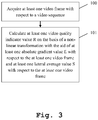
- Fig. 3 shows a flow chart of an embodiment of the inventive method for calculating video quality information of a video sequence.
- a first step 100 at least one video frame with respect to the video sequence is acquired.
- at least one video quality indicator value R is calculated on the basis of a non-linear transformation with the aid of at least one absolute gradient value E with respect to the at least one video frame and at least one lateral average value S with respect to the at least one video frame.
- max(0,(E-S)) denotes the maximum of zero and the difference between the at least one absolute gradient value E and the at least one lateral average value S
- c(E) denotes a function depending on the at least one absolute gradient value E, preferably depending depending on the respective absolute gradient values over the at least one video frame as a whole.
- mean(E) denotes the mean value of the at least one absolute gradient value E, preferably of the respective absolute gradient values over the at least one video frame as a whole.
- the method may comprise the step of calculating at least one gradient value with respect to the at least one video frame on the basis of a derivative in horizontal direction with respect to an attribute A of the at least one video frame.
- the method method may further comprise the step of calculating at least one gradient value with respect to the at least one video frame on the basis of a derivative in vertical direction with respect to an attribute A of the at least one video frame.
- H(i,j) denotes a horizontal result value for the pixel at (i,j)-position of the at least one video frame
- A(i,j) denotes the attribute of the at least one video frame for the pixel at (i,j)-position of the at least one video frame
- phi() denotes a non-linear strictly monotonic function
- V(i,j) denotes a vertical result value for the pixel at (i,j)-position of the at least one video frame
- A(i,j) denotes the attribute of the at least one video frame for the pixel at (i,j)-position of the at least one video frame
- phi() denotes a non-linear strictly monotonic function
- the method comprises the step of applying the non-linear strictly monotonic function phi() at each position of the at least one video frame especially in order to rescale the respective values to a fixed range, preferably to the range from -1 to 1.
- the method may comprise the step of calculating the at least one absolute gradient value E on the basis of a function depending on the derivative in horizontal direction and the derivative in vertical direction.
- sqrt() denotes the square root
- H denotes the horizontal result value for a pixel of the at least one video frame
- V denotes the vertical result value for a pixel of the at least one video frame.
- E(i,j) denotes the absolute gradient value for the pixel at (i,j)-position of the at least one video frame.
- the method may comprise the step of calculating the at least one video quality indicator value R in each of the at least one video frame for each position.
- the method may comprise the step of outputting the at least one video quality indicator value R to a file especially for further processing.
- the method may comprise the step of displaying the at least one video quality indicator value R on a screen especially for further processing.
- the method may further comprise the step of aggregating the at least one video quality indicator value R and to compare the aggregated at least one video quality indicator value R to at least one aggregated reference video quality indicator value Rref.
Landscapes
- Engineering & Computer Science (AREA)
- Physics & Mathematics (AREA)
- General Physics & Mathematics (AREA)
- Theoretical Computer Science (AREA)
- Quality & Reliability (AREA)
- Multimedia (AREA)
- Computer Vision & Pattern Recognition (AREA)
- Testing, Inspecting, Measuring Of Stereoscopic Televisions And Televisions (AREA)
- Television Systems (AREA)
Abstract
Description
- The invention relates to a device for calculating video quality information of a video sequence and a corresponding method.
- Generally, in times of an increasing number of videos viewed on the basis of streaming technologies, there is a growing need of a device and a method for calculating video quality information of a video sequence especially in order to verify that the respective video to view has the desired quality. For instance, there may especially be a need for testing, monitoring or optimizing the subjectively perceived quality of a received video signal that results from a reference video signal having been transmitted via a telecommunication network in conjunction with an offered video service.
-
WO 2016/146038 A1 relates to a system and method for codebook construction and use thereof in image quality assessment. A codebook including a plurality of code words is provided. Each one of the plurality of code words has a reference score relating to image quality. A test image is acquired. One or more feature vectors are extracted from the test image based on statistical independence between neighboring divisive normalization transform coefficients of the test image. A score is generated based on a comparison between the extracted feature vectors of the test image and at least some of the plurality of code words in the codebook and the corresponding reference scores of the code words. - Accordingly, there is the object to provide a device and a method for calculating an improved video quality information of a video sequence, thereby ensuring a high accuracy and efficiency.
- This object is solved by the features of the first independent claim for a device for calculating video quality information of a video sequence and the features of the second independent claim for a method for calculating video quality information of a video sequence. The dependent claims contain further developments.
- According to a first aspect of the invention, a device for calculating video quality information of a video sequence is provided. The device comprises a data acquisition unit for acquiring at least one video frame with respect to the video sequence, and a calculation unit connected to the data acquisition unit. In this context, the calculation unit is configured to calculate at least one video quality indicator value R on the basis of a non-linear transformation with the aid of at least one absolute gradient value E with respect to the at least one video frame and at least one lateral average value S with respect to the at least one video frame. Advantageously, not only a high accuracy but also a high efficiency can be ensured.
- Further advantageously, the comparison of at least one video quality indicator value R with a reference value Rref may especially be an indicator of video quality as perceived by a human viewer.
- It is noted that the at least one video quality indicator value R may especially imply an array comprising video quality indicator values preferably with respect to the respective pixels of the at least one video frame.
- It is further noted that the at least one absolute gradient value E may especially imply an array comprising absolute gradient values preferably with respect to the respective pixels of the at least one video frame.
- It is additionally noted that the at least one lateral average value S may especially imply an array comprising lateral average values preferably with respect to the respective pixels of the at least one video frame.
- According to a first preferred implementation form of the first aspect of the invention, the calculation unit is configured to calculate the at least one video quality indicator value R on the basis of the following formula:
R = (max(0,(E-S))) / (E+S+c(E)). Advantageously, both accuracy and efficiency can further be increased. In this context, max(0,(E-S)) denotes the maximum of zero and the difference between the at least one absolute gradient value E and the at least one lateral average value S. Additionally, c(E) denotes a function depending on the at least one absolute gradient value E, preferably depending depending on the respective absolute gradient values over the at least one video frame as a whole. - According to a second preferred implementation form of the first aspect of the invention, the calculation unit is configured to calculate the function c(E) on the basis of the following formula:
c(E) = 0.5 ∗ (c0 + mean(E)). Advantageously, for instance, calculation efficiency can further be increased. In this context c0 denotes a constant, and mean(E) denotes the mean value of the at least one absolute gradient value E, preferably of the respective absolute gradient values over the at least one video frame as a whole. - According to a further preferred implementation form of the first aspect of the invention, the calculation unit is configured to calculate at least one gradient value with respect to the at least one video frame on the basis of a derivative in horizontal direction with respect to an attribute A of the at least one video frame. Advantageously, for instance, accuracy can further be increased.
- Further advantageously and preferably, the attribute A of the at least one video frame may especially comprise or be a luminance value Y of the least one video frame, at least one of chrominance values Cb, Cr of the at least one video frame, or any combination thereof. It is noted that the attribute A of the at least one video frame may especially imply an array comprising attribute values preferably with respect to the respective pixels of the at least one video frame.
- According to a further preferred implementation form of the first aspect of the invention, the calculation unit is configured to calculate at least one gradient value with respect to the at least one video frame on the basis of a derivative in vertical direction with respect to an attribute A of the at least one video frame. Advantageously, for example, calculation accuracy can further be increased.
- Further advantageously and preferably, as already mentioned above, the attribute A of the at least one video frame may especially comprise or be a luminance value Y of the least one video frame, at least one of chrominance values Cb, Cr of the at least one video frame, or any combination thereof.
- According to a further preferred implementation form of the first aspect of the invention, the calculation unit is configured to calculate at least one difference of horizontally adjacent pixels of the at least one video frame with respect to an attribute A of the at least one video frame on the basis of the following formula:

- Advantageously and preferably, as already mentioned above, the attribute A of the at least one video frame may especially comprise or be a luminance value Y of the least one video frame, at least one of chrominance values Cb, Cr of the at least one video frame, or any combination thereof.
- It is further noted that it might be particularly advantageous if the attribute A is replaced by the luminance value Y of the at least one video frame, which leads to the following formula:

- According to a further preferred implementation form of the first aspect of the invention, the calculation unit is configured to calculate at least one difference of vertically adjacent pixels of the at least one video frame with respect to an attribute A of the at least one video frame on the basis of the following formula:

- Advantageously, as already mentioned above, the attribute A of the at least one video frame may especially comprise or be a luminance value Y of the least one video frame, at least one of chrominance values Cb, Cr of the at least one video frame, or any combination thereof.
- It is further noted that it might be particularly advantageous and preferred if the attribute A is replaced by the luminance value Y of the at least one video frame, which leads to the following formula:

- According to a further preferred implementation form of the first aspect of the invention, the calculation unit is configured to apply the non-linear strictly monotonic function phi() at each position of the at least one video frame especially in order to rescale the respective values to a fixed range, preferably to the range from -1 to 1. Advantageously, for instance, efficiency can further be increased.
- According to a further preferred implementation form of the first aspect of the invention, the calculation unit is configured to calculate the at least one absolute gradient value E on the basis of a function depending on the derivative in horizontal direction and the derivative in vertical direction. Advantageously, for example, accuracy can further be increased.
- According to a further preferred implementation form of the first aspect of the invention, the calculation unit is configured to calculate the at least one absolute gradient value E on the basis of the following formula:

- It is noted that the horizontal result value H may especially imply an array comprising horizontal result values preferably with respect to the respective pixels of the at least one video frame.
- It is further noted that the vertical result value V may especially imply an array comprising vertical result values preferably with respect to the respective pixels of the at least one video frame.
- According to a further preferred implementation form of the first aspect of the invention, with the aid of a small displacement vector of fixed length (di,dj) in direction of the gradient at position (i,j) of the at least one video frame, the calculation unit is configured to calculate the lateral average value S(i,j) at position (i,j) on the basis of the following formula:

- According to a further preferred implementation form of the first aspect of the invention, the calculation unit is configured to calculate the at least one video quality indicator value R in each of the at least one video frame for each position. Advantageously, for example, calculation accuracy can further be increased.
- According to a further preferred implementation form of the first aspect of the invention, the device further comprises an output unit. In this context, the output unit is configured to output the at least one video quality indicator value R to a file especially for further processing. In addition to this or as an alternative, the output unit is configured to display the at least one video quality indicator value R on a screen especially for further processing. Advantageously, for instance, efficiency can further be increased.
- According to a further preferred implementation form of the first aspect of the invention, the calculation unit is configured to aggregate the at least one video quality indicator value R and to compare the aggregated at least one video quality indicator value R to at least one aggregated reference video quality indicator value Rref. Advantageously, for example, not only accuracy but also efficiency can further be increased.
- It is noted that the at least one aggregated reference video quality indicator value Rref may especially imply an array comprising aggregated reference video quality indicator values preferably with respect to the respective pixels of the at least one video frame.
- Further advantageously, the aggregated reference video quality indicator values may be computed by calculating the aggregated video quality indicator values for the respective undistorted high quality source video.
- Alternatively, the aggregated reference video quality indicator values may be computed on the basis of the aggregated video quality indicator values calculated on a reference set of undistorted videos.
- Further advantageously, an indicator based on the above-mentioned comparison of R with Rref may especially be used as an estimate of the video quality preferably rated by an average human viewer.
- According to a second aspect of the invention, a method for calculating video quality information of a video sequence is provided. The method comprises the steps of acquiring at least one video frame with respect to the video sequence, and calculating at least one video quality indicator value R on the basis of a non-linear transformation with the aid of at least one absolute gradient value E with respect to the at least one video frame and at least one lateral average value S with respect to the at least one video frame. Advantageously, not only a high accuracy but also a high efficiency can be ensured.
- Further advantageously and preferably, the at least one video quality indicator value R may especially be an indicator of video quality as perceived by a human viewer.
- It is noted that the at least one video quality indicator value R may especially imply an array comprising video quality indicator values preferably with respect to the respective pixels of the at least one video frame.
- It is further noted that the at least one absolute gradient value E may especially imply an array comprising absolute gradient values preferably with respect to the respective pixels of the at least one video frame.
- It is additionally noted that the at least one lateral average value S may especially imply an array comprising lateral average values preferably with respect to the respective pixels of the at least one video frame.
- Exemplary embodiments of the invention are now further explained with respect to the drawings by way of example only, and not for limitation. In the drawings:
- Fig. 1
- shows an exemplary embodiment of an inventive device according to the first aspect of the invention;
- Fig. 2
- shows an exemplary schematic video frame; and
- Fig. 3
- shows a flow chart of an embodiment of the second aspect of the invention.
- With respect to
Fig. 1 , a block diagram of an exemplary embodiment of adevice 10 for calculating video quality information of a video sequence is shown. - According to
Fig. 1 , thedevice 10 comprises adata acquisition unit 11 for acquiring at least one video frame with respect to the video sequence, acalculation unit 12 connected to thedata acquisition unit 11, and anoutput unit 13 connect to thecalculation unit 12. - In this context, the
calculation unit 12 is configured to calculate at least one video quality indicator value R on the basis of a non-linear transformation with the aid of at least one absolute gradient value E with respect to the at least one video frame and at least one lateral average value S with respect to the at least one video frame. - It is noted that the non-linear transformation may especially comprise a sparse edge representation by lateral inhibition, which will be explained below with respect to
Fig. 2 . - Furthermore, the
calculation unit 12 is configured to calculate the at least one video quality indicator value R on the basis of the following formula:
- In this context, max(0,(E-S)) denotes the maximum of zero and the difference between the at least one absolute gradient value E and the at least one lateral average value S, and c(E) denotes a function depending on the at least one absolute gradient value E, preferably depending depending on the respective absolute gradient values over the at least one video frame as a whole.
- Moreover, the
calculation unit 12 is configured to calculate the above-mentioned function c(E) on the basis of the following formula:
- In this context, c0 denotes a constant, and mean(E) denotes the mean value of the at least one absolute gradient value E, preferably of the respective absolute gradient values over the at least one video frame as a whole.
- It is noted that the
calculation unit 12 may be configured to calculate at least one gradient value with respect to the at least one video frame on the basis of a derivative in horizontal direction with respect to an attribute A of the at least one video frame. - It is further noted that the
calculation unit 12 may be configured to calculate at least one gradient value with respect to the at least one video frame on the basis of a derivative in vertical direction with respect to an attribute A of the at least one video frame. - Furthermore, the
calculation unit 12 is configured to calculate at least one difference of horizontally adjacent pixels of the at least one video frame with respect to an attribute A, preferably a luminance value Y, of the at least one video frame on the basis of the following formula:

- In this context, H(i,j) denotes a horizontal result value for the pixel at (i,j)-position of the at least one video frame, A(i,j), preferably Y(i,j), denotes the attribute, preferably the luminance value, of the at least one video frame for the pixel at (i,j)-position of the at least one video frame, and phi() denotes a non-linear strictly monotonic function.
- Moreover, the
calculation unit 12 is configured to calculate at least one difference of vertically adjacent pixels of the at least one video frame with respect to an attribute A, preferably a luminance value Y, of the at least one video frame on the basis of the following formula:

- In this context, V(i,j) denotes a vertical result value for the pixel at (i,j)-position of the at least one video frame, A(i,j), preferably Y(i,j), denotes the attribute, the luminance value, of the at least one video frame for the pixel at (i,j)-position of the at least one video frame, and phi() denotes a non-linear strictly monotonic function.
- It is noted that it might be particularly advantageous if the
calculation unit 12 is configured to apply the non-linear strictly monotonic function phi() at each position of the at least one video frame especially in order to rescale the respective values to a fixed range, preferably to the range from -1 to 1. - Further advantageously, the
calculation unit 12 may be configured to calculate the at least one absolute gradient value E on the basis of a function depending on the derivative in horizontal direction and the derivative in vertical direction. - Moreover, the
calculation unit 12 is configured to calculate the at least one absolute gradient value E on the basis of the following formula:
- In this context, sqrt() denotes the square root, H denotes the horizontal result value for a pixel of the at least one video frame, and V denotes the vertical result value for a pixel of the at least one video frame.
- It might be particularly advantageous if the
calculation unit 12 is configured to calculate the at least one video quality indicator value R in each of the at least one video frame for each position. - Furthermore, the above-mentioned
output unit 13 is configured to output the at least one video quality indicator value R to a file especially for further processing. - In addition to this or as an alternative, the
output unit 13 is configured to display the at least one video quality indicator value R on a screen especially for further processing. - It is further noted that the
calculation unit 12 may be configured to aggregate the at least one video quality indicator value R and to compare the aggregated at least one video quality indicator value R to at least one aggregated reference video quality indicator value Rref. - Furthermore, with the aid of a small displacement vector of fixed length (di,dj) in direction of the gradient at position (i,j) of the at least one video frame, the
calculation unit 12 is configured to calculate the lateral average value S(i,j) at position (i,j) on the basis of the following formula:
- In this context, E(i,j) denotes the absolute gradient value for the pixel at (i,j)-position of the at least one video frame.
- Accordingly, an average signal is computed along the line perpendicular to the respective edge, especially defined by the gradient vector.
- In this context, edges in a frame (absolute value of the gradient) are exemplarily denoted by reference sign 1 of
Fig. 2 which illustrates an exemplary video frame in an abstracted and schematic manner. - In addition to this,
reference sign 2 ofFig. 2 denotes an exemplary (i,j)-position, whereasreference sign 3 denotes exemplary positions of lateral inhibition in accordance with the above-mentioned sparse edge representation by lateral inhibition. - Finally,
Fig. 3 shows a flow chart of an embodiment of the inventive method for calculating video quality information of a video sequence. In afirst step 100, at least one video frame with respect to the video sequence is acquired. Then, in asecond step 101, at least one video quality indicator value R is calculated on the basis of a non-linear transformation with the aid of at least one absolute gradient value E with respect to the at least one video frame and at least one lateral average value S with respect to the at least one video frame. - It might be particularly advantageous if the method further comprises the step of calculating the at least one video quality indicator value R on the basis of the above-mentioned formula (1):

- In this context, as already mentioned above, max(0,(E-S)) denotes the maximum of zero and the difference between the at least one absolute gradient value E and the at least one lateral average value S, and c(E) denotes a function depending on the at least one absolute gradient value E, preferably depending depending on the respective absolute gradient values over the at least one video frame as a whole.
- Furthermore, the method may comprise the step of calculating the function c(E) on the basis of the above-mentioned formula (2):

- In this context, as already mentioned above, c0 denotes a constant, and mean(E) denotes the mean value of the at least one absolute gradient value E, preferably of the respective absolute gradient values over the at least one video frame as a whole.
- It is further noted that the method may comprise the step of calculating at least one gradient value with respect to the at least one video frame on the basis of a derivative in horizontal direction with respect to an attribute A of the at least one video frame.
- Moreover, the method method may further comprise the step of calculating at least one gradient value with respect to the at least one video frame on the basis of a derivative in vertical direction with respect to an attribute A of the at least one video frame.
- It might be particularly advantageous if the method further comprises the step of calculating at least one difference of horizontally adjacent pixels of the at least one video frame with respect to an attribute A of the at least one video frame on the basis of the above-mentioned formula (3) :

- In this context, as already mentioned above, H(i,j) denotes a horizontal result value for the pixel at (i,j)-position of the at least one video frame, A(i,j) denotes the attribute of the at least one video frame for the pixel at (i,j)-position of the at least one video frame, and phi() denotes a non-linear strictly monotonic function.
- It is noted that the above-mentioned formula (4) analogously applies for the method.
- Furthermore, the method may comprise the step of calculating at least one difference of vertically adjacent pixels of the at least one video frame with respect to an attribute A of the at least one video frame on the basis of the above-mentioned formula (5) :

- In this context, as already mentioned above, V(i,j) denotes a vertical result value for the pixel at (i,j)-position of the at least one video frame, A(i,j) denotes the attribute of the at least one video frame for the pixel at (i,j)-position of the at least one video frame, and phi() denotes a non-linear strictly monotonic function.
- It is noted that the above-mentioned formula (6) analogously applies for the method.
- It is further noted that it might be particularly advantageous if the method comprises the step of applying the non-linear strictly monotonic function phi() at each position of the at least one video frame especially in order to rescale the respective values to a fixed range, preferably to the range from -1 to 1.
- Moreover, the method may comprise the step of calculating the at least one absolute gradient value E on the basis of a function depending on the derivative in horizontal direction and the derivative in vertical direction.
- It is further noted that the method may comprise the step of calculating the at least one absolute gradient value E on the basis of the above-mentioned formula (7):

- In this context, as already mentioned above, sqrt() denotes the square root, H denotes the horizontal result value for a pixel of the at least one video frame, and V denotes the vertical result value for a pixel of the at least one video frame.
- Furthermore, with the aid of a small displacement vector of fixed length (di,dj) in direction of the gradient at position (i,j) of the at least one video frame, the method may comprise the step of calculating the lateral average value S(i,j) at position (i,j) on the basis of the above-mentioned formula (8):

- In this context, as already mentioned above, E(i,j) denotes the absolute gradient value for the pixel at (i,j)-position of the at least one video frame.
- Advantageously, the method may comprise the step of calculating the at least one video quality indicator value R in each of the at least one video frame for each position.
- It is further noted that the method may comprise the step of outputting the at least one video quality indicator value R to a file especially for further processing.
- In addition to this or as an alternative, the method may comprise the step of displaying the at least one video quality indicator value R on a screen especially for further processing.
- Moreover, the method may further comprise the step of aggregating the at least one video quality indicator value R and to compare the aggregated at least one video quality indicator value R to at least one aggregated reference video quality indicator value Rref.
- While various embodiments of the present invention have been described above, it should be understood that they have been presented by way of example only, and not limitation. Numerous changes to the disclosed embodiments can be made in accordance with the disclosure herein without departing from the spirit or scope of the invention. Thus, the breadth and scope of the present invention should not be limited by any of the above described embodiments. Rather, the scope of the invention should be defined in accordance with the following claims and their equivalents.
- Although the invention has been illustrated and described with respect to one or more implementations, equivalent alterations and modifications will occur to others skilled in the art upon the reading and understanding of this specification and the annexed drawings. In addition, while a particular feature of the invention may have been disclosed with respect to only one of several implementations, such feature may be combined with one or more other features of the other implementations as may be desired and advantageous for any given or particular application.
Claims (15)
- A device (10) for calculating video quality information of a video sequence, the device comprising:a data acquisition unit (11) for acquiring at least one video frame with respect to the video sequence, anda calculation unit (12) connected to the data acquisition unit,wherein the calculation unit (12) is configured to calculate at least one video quality indicator value on the basis of a non-linear transformation with the aid of at least one absolute gradient value with respect to the at least one video frame and at least one lateral average value with respect to the at least one video frame.
- The device (10) according to claim 1,
wherein the calculation unit (12) is configured to calculate the at least one video quality indicator value R on the basis of the following formula: wherein max(0,(E-S)) denotes the maximum of zero and the difference between the at least one absolute gradient value E and the at least one lateral average value S, andwherein c(E) denotes a function depending on the at least one absolute gradient value E, preferably depending depending on the respective absolute gradient values over the at least one video frame as a whole.
 - The device (10) according to claim 2,
wherein the calculation unit (12) is configured to calculate the function c(E) on the basis of the following formula: wherein c0 denotes a constant, andwherein mean(E) denotes the mean value of the at least one absolute gradient value E, preferably of the respective absolute gradient values over the at least one video frame as a whole.
 - The device (10) according to any of the claims 1 to 3, wherein the calculation unit (12) is configured to calculate at least one gradient value with respect to the at least one video frame on the basis of a derivative in horizontal direction with respect to an attribute A of the at least one video frame.
- The device (10) according to any of the claims 1 to 4, wherein the calculation unit (12) is configured to calculate at least one gradient value with respect to the at least one video frame on the basis of a derivative in vertical direction with respect to an attribute A of the at least one video frame.
- The device (10) according to any of the claims 1 to 5, wherein the calculation unit (12) is configured to calculate at least one difference of horizontally adjacent pixels of the at least one video frame with respect to an attribute A of the at least one video frame on the basis of the following formula:
 wherein H(i,j) denotes a horizontal result value for the pixel at (i,j)-position of the at least one video frame, wherein A(i,j) denotes the attribute of the at least one video frame for the pixel at (i,j)-position of the at least one video frame, andwherein phi() denotes a non-linear strictly monotonic function.
 - The device (10) according to any of the claims 1 to 6, wherein the calculation unit (12) is configured to calculate at least one difference of vertically adjacent pixels of the at least one video frame with respect to an attribute A of the at least one video frame on the basis of the following formula:
 wherein V(i,j) denotes a vertical result value for the pixel at (i,j)-position of the at least one video frame,wherein A(i,j) denotes the attribute of the at least one video frame for the pixel at (i,j)-position of the at least one video frame, andwherein phi() denotes a non-linear strictly monotonic function.
 - The device (10) according to claim 6 or 7,
wherein the calculation unit (12) is configured to apply the non-linear strictly monotonic function phi() at each position of the at least one video frame especially in order to rescale the respective values to a fixed range, preferably to the range from -1 to 1. - The device (10) according to claims 4 and 5,
wherein the calculation unit (12) is configured to calculate the at least one absolute gradient value E on the basis of a function depending on the derivative in horizontal direction and the derivative in vertical direction. - The device (10) according to claims 6 and 7,
wherein the calculation unit (12) is configured to calculate the at least one absolute gradient value E on the basis of the following formula: wherein sqrt() denotes the square root,wherein H denotes the horizontal result value for a pixel of the at least one video frame, andwherein V denotes the vertical result value for a pixel of the at least one video frame.
 - The device (10) according to any of the claims 1 to 10, wherein with the aid of a small displacement vector of fixed length (di,dj) in direction of the gradient at position (i,j) of the at least one video frame, the calculation unit (12) is configured to calculate the lateral average value S(i,j) at position (i,j) on the basis of the following formula:

- The device (10) according to any of the claims 1 to 11, wherein the calculation unit (12) is configured to calculate the at least one video quality indicator value R in each of the at least one video frame for each position.
- The device (10) according to any of the claims 1 to 12, wherein the device (10) further comprises an output unit (13),
wherein the output unit (13) is configured to output the at least one video quality indicator value R to a file especially for further processing, and/or
wherein the output unit (13) is configured to display the at least one video quality indicator value R on a screen especially for further processing. - The device (10) according to any of the claims 1 to 13, wherein the calculation unit (12) is configured to aggregate the at least one video quality indicator value R and to compare the aggregated at least one video quality indicator value R to at least one aggregated reference video quality indicator value Rref.
- A method for calculating video quality information of a video sequence, the method comprising the steps of:acquiring at least one video frame with respect to the video sequence, andcalculating at least one video quality indicator value on the basis of a non-linear transformation with the aid of at least one absolute gradient value with respect to the at least one video frame and at least one lateral average value with respect to the at least one video frame.
Priority Applications (2)
| Application Number | Priority Date | Filing Date | Title |
|---|---|---|---|
| EP19183146.0A EP3757871B1 (en) | 2019-06-28 | 2019-06-28 | Device and corresponding method for calculating video quality information of a video sequence |
| US16/588,256 US11270424B2 (en) | 2019-06-28 | 2019-09-30 | Device and corresponding methhod for calculating video quality information of a video sequence |
Applications Claiming Priority (1)
| Application Number | Priority Date | Filing Date | Title |
|---|---|---|---|
| EP19183146.0A EP3757871B1 (en) | 2019-06-28 | 2019-06-28 | Device and corresponding method for calculating video quality information of a video sequence |
Publications (2)
| Publication Number | Publication Date |
|---|---|
| EP3757871A1 true EP3757871A1 (en) | 2020-12-30 |
| EP3757871B1 EP3757871B1 (en) | 2025-10-15 |
Family
ID=67139619
Family Applications (1)
| Application Number | Title | Priority Date | Filing Date |
|---|---|---|---|
| EP19183146.0A Active EP3757871B1 (en) | 2019-06-28 | 2019-06-28 | Device and corresponding method for calculating video quality information of a video sequence |
Country Status (2)
| Country | Link |
|---|---|
| US (1) | US11270424B2 (en) |
| EP (1) | EP3757871B1 (en) |
Citations (1)
| Publication number | Priority date | Publication date | Assignee | Title |
|---|---|---|---|---|
| WO2016146038A1 (en) | 2015-03-13 | 2016-09-22 | Shenzhen University | System and method for blind image quality assessment |
Family Cites Families (3)
| Publication number | Priority date | Publication date | Assignee | Title |
|---|---|---|---|---|
| US8494251B2 (en) * | 2008-01-11 | 2013-07-23 | Sri International | System and method for measuring image quality |
| US8594385B2 (en) * | 2011-04-19 | 2013-11-26 | Xerox Corporation | Predicting the aesthetic value of an image |
| CN103918271B (en) | 2011-06-01 | 2018-04-24 | 王舟 | Perceptual video coding method and system based on structural similarity |
-
2019
- 2019-06-28 EP EP19183146.0A patent/EP3757871B1/en active Active
- 2019-09-30 US US16/588,256 patent/US11270424B2/en active Active
Patent Citations (1)
| Publication number | Priority date | Publication date | Assignee | Title |
|---|---|---|---|---|
| WO2016146038A1 (en) | 2015-03-13 | 2016-09-22 | Shenzhen University | System and method for blind image quality assessment |
Non-Patent Citations (2)
| Title |
|---|
| ANMIN LIU ET AL: "Image Quality Assessment Based on Gradient Similarity", IEEE TRANSACTIONS ON IMAGE PROCESSING, IEEE SERVICE CENTER, PISCATAWAY, NJ, US, vol. 21, no. 4, 30 April 2012 (2012-04-30), pages 1500 - 1512, XP011491984, ISSN: 1057-7149, DOI: 10.1109/TIP.2011.2175935 * |
| S. RAJKUMAR ET AL: "A Comparative Analysis on Image Quality Assessment for Real Time Satellite Images", INDIAN JOURNAL OF SCIENCE & TECHNOLOGY, vol. 9, no. 34, 23 September 2016 (2016-09-23), XP055651770, ISSN: 0974-6846, DOI: 10.17485/ijst/2016/v9i34/96766 * |
Also Published As
| Publication number | Publication date |
|---|---|
| US11270424B2 (en) | 2022-03-08 |
| EP3757871B1 (en) | 2025-10-15 |
| US20200410659A1 (en) | 2020-12-31 |
Similar Documents
| Publication | Publication Date | Title |
|---|---|---|
| EP1059004B1 (en) | Method and arrangement for objective assessment of video quality | |
| CN102845071B (en) | Image and video quality assessment for high dynamic range, visual dynamic range, and wide color gamut | |
| EP1622395B1 (en) | Device, method and program for quality evaluation of a video signal after its transmission or encoding | |
| US8953873B2 (en) | Method for objectively evaluating quality of stereo image | |
| Hemami et al. | No-reference image and video quality estimation: Applications and human-motivated design | |
| EP2352301B1 (en) | Image processing device, image processing method, and program | |
| US8587606B2 (en) | Apparatus and method for processing image, and apparatus for displaying image | |
| US20050219362A1 (en) | Quality analysis in imaging | |
| US8294770B2 (en) | Systems and methods for spatially isolated artifact dissection, classification and measurement | |
| EP1251703B1 (en) | Apparatus for monitoring quality of picture transmission | |
| CN112950592B (en) | No-reference light field image quality assessment method based on high-dimensional discrete cosine transform | |
| US8036485B2 (en) | Systems and methods for measuring loss of detail in a video codec block | |
| US20170263171A1 (en) | Offset method and equipment of rgbw panel subpixel | |
| CN102236790B (en) | Image processing method and device | |
| US6437821B1 (en) | Harmonic measurement of blockiness in video signals | |
| EP1351493B1 (en) | Image processing apparatus, computer readable medium storing program and image processing method | |
| EP3757871B1 (en) | Device and corresponding method for calculating video quality information of a video sequence | |
| Wolf | Video quality model for variable frame delay (VQM_VFD) | |
| Lukeš et al. | Performance evaluation of image quality metrics with respect to their use for super-resolution enhancement | |
| Hammou et al. | Comparison of metrics for predicting image and video quality at varying viewing distances | |
| CN103686158B (en) | Analog video signal output equipment detection method and system | |
| Ponomarenko et al. | Statistical evaluation of no-reference image visual quality metrics | |
| US20050105802A1 (en) | Method and an arrangement for objective assessment of video quality | |
| Barańczuk et al. | Image quality measures for evaluating gamut mapping | |
| Ajagamelle et al. | Analysis of the difference of gaussians model in image difference metrics |
Legal Events
| Date | Code | Title | Description |
|---|---|---|---|
| PUAI | Public reference made under article 153(3) epc to a published international application that has entered the european phase |
Free format text: ORIGINAL CODE: 0009012 |
|
| STAA | Information on the status of an ep patent application or granted ep patent |
Free format text: STATUS: THE APPLICATION HAS BEEN PUBLISHED |
|
| AK | Designated contracting states |
Kind code of ref document: A1 Designated state(s): AL AT BE BG CH CY CZ DE DK EE ES FI FR GB GR HR HU IE IS IT LI LT LU LV MC MK MT NL NO PL PT RO RS SE SI SK SM TR |
|
| AX | Request for extension of the european patent |
Extension state: BA ME |
|
| STAA | Information on the status of an ep patent application or granted ep patent |
Free format text: STATUS: REQUEST FOR EXAMINATION WAS MADE |
|
| 17P | Request for examination filed |
Effective date: 20210630 |
|
| RBV | Designated contracting states (corrected) |
Designated state(s): AL AT BE BG CH CY CZ DE DK EE ES FI FR GB GR HR HU IE IS IT LI LT LU LV MC MK MT NL NO PL PT RO RS SE SI SK SM TR |
|
| STAA | Information on the status of an ep patent application or granted ep patent |
Free format text: STATUS: EXAMINATION IS IN PROGRESS |
|
| 17Q | First examination report despatched |
Effective date: 20221124 |
|
| P01 | Opt-out of the competence of the unified patent court (upc) registered |
Effective date: 20230525 |
|
| REG | Reference to a national code |
Ref country code: DE Ref legal event code: R079 Free format text: PREVIOUS MAIN CLASS: G06K0009000000 Ipc: G06V0010980000 Ref country code: DE Ref legal event code: R079 Ref document number: 602019076818 Country of ref document: DE Free format text: PREVIOUS MAIN CLASS: G06K0009000000 Ipc: G06V0010980000 |
|
| GRAP | Despatch of communication of intention to grant a patent |
Free format text: ORIGINAL CODE: EPIDOSNIGR1 |
|
| STAA | Information on the status of an ep patent application or granted ep patent |
Free format text: STATUS: GRANT OF PATENT IS INTENDED |
|
| RIC1 | Information provided on ipc code assigned before grant |
Ipc: G06V 10/98 20220101AFI20250709BHEP Ipc: G06V 20/40 20220101ALI20250709BHEP |
|
| INTG | Intention to grant announced |
Effective date: 20250728 |
|
| GRAS | Grant fee paid |
Free format text: ORIGINAL CODE: EPIDOSNIGR3 |
|
| GRAA | (expected) grant |
Free format text: ORIGINAL CODE: 0009210 |
|
| STAA | Information on the status of an ep patent application or granted ep patent |
Free format text: STATUS: THE PATENT HAS BEEN GRANTED |
|
| AK | Designated contracting states |
Kind code of ref document: B1 Designated state(s): AL AT BE BG CY CZ DE DK EE ES FI FR GB GR HR HU IS IT LT LU LV MC MK MT NL NO PL PT RO RS SE SI SK SM TR |
|
| RBV | Designated contracting states (corrected) |
Designated state(s): AL AT BE BG CY CZ DE DK EE ES FI FR GB GR HR HU IS IT LT LU LV MC MK MT NL NO PL PT RO RS SE SI SK SM TR |
|
| REG | Reference to a national code |
Ref country code: GB Ref legal event code: FG4D |
|
| REG | Reference to a national code |
Ref country code: DE Ref legal event code: R096 Ref document number: 602019076818 Country of ref document: DE |
|
| REG | Reference to a national code |
Ref country code: NL Ref legal event code: MP Effective date: 20251015 |
|
| REG | Reference to a national code |
Ref country code: AT Ref legal event code: MK05 Ref document number: 1847696 Country of ref document: AT Kind code of ref document: T Effective date: 20251015 |
|
| PG25 | Lapsed in a contracting state [announced via postgrant information from national office to epo] |
Ref country code: NL Free format text: LAPSE BECAUSE OF FAILURE TO SUBMIT A TRANSLATION OF THE DESCRIPTION OR TO PAY THE FEE WITHIN THE PRESCRIBED TIME-LIMIT Effective date: 20251015 |
|
| PG25 | Lapsed in a contracting state [announced via postgrant information from national office to epo] |
Ref country code: ES Free format text: LAPSE BECAUSE OF FAILURE TO SUBMIT A TRANSLATION OF THE DESCRIPTION OR TO PAY THE FEE WITHIN THE PRESCRIBED TIME-LIMIT Effective date: 20251015 |
|
| REG | Reference to a national code |
Ref country code: LT Ref legal event code: MG9D |
|
| PG25 | Lapsed in a contracting state [announced via postgrant information from national office to epo] |
Ref country code: NO Free format text: LAPSE BECAUSE OF FAILURE TO SUBMIT A TRANSLATION OF THE DESCRIPTION OR TO PAY THE FEE WITHIN THE PRESCRIBED TIME-LIMIT Effective date: 20260115 |
|
| PG25 | Lapsed in a contracting state [announced via postgrant information from national office to epo] |
Ref country code: FI Free format text: LAPSE BECAUSE OF FAILURE TO SUBMIT A TRANSLATION OF THE DESCRIPTION OR TO PAY THE FEE WITHIN THE PRESCRIBED TIME-LIMIT Effective date: 20251015 Ref country code: AT Free format text: LAPSE BECAUSE OF FAILURE TO SUBMIT A TRANSLATION OF THE DESCRIPTION OR TO PAY THE FEE WITHIN THE PRESCRIBED TIME-LIMIT Effective date: 20251015 Ref country code: HR Free format text: LAPSE BECAUSE OF FAILURE TO SUBMIT A TRANSLATION OF THE DESCRIPTION OR TO PAY THE FEE WITHIN THE PRESCRIBED TIME-LIMIT Effective date: 20251015 |
|
| PG25 | Lapsed in a contracting state [announced via postgrant information from national office to epo] |
Ref country code: RS Free format text: LAPSE BECAUSE OF FAILURE TO SUBMIT A TRANSLATION OF THE DESCRIPTION OR TO PAY THE FEE WITHIN THE PRESCRIBED TIME-LIMIT Effective date: 20260115 |
|
| PG25 | Lapsed in a contracting state [announced via postgrant information from national office to epo] |
Ref country code: IS Free format text: LAPSE BECAUSE OF FAILURE TO SUBMIT A TRANSLATION OF THE DESCRIPTION OR TO PAY THE FEE WITHIN THE PRESCRIBED TIME-LIMIT Effective date: 20260215 |
|
| PG25 | Lapsed in a contracting state [announced via postgrant information from national office to epo] |
Ref country code: PT Free format text: LAPSE BECAUSE OF FAILURE TO SUBMIT A TRANSLATION OF THE DESCRIPTION OR TO PAY THE FEE WITHIN THE PRESCRIBED TIME-LIMIT Effective date: 20260216 |
|
| PG25 | Lapsed in a contracting state [announced via postgrant information from national office to epo] |
Ref country code: PL Free format text: LAPSE BECAUSE OF FAILURE TO SUBMIT A TRANSLATION OF THE DESCRIPTION OR TO PAY THE FEE WITHIN THE PRESCRIBED TIME-LIMIT Effective date: 20251015 |
|
| PG25 | Lapsed in a contracting state [announced via postgrant information from national office to epo] |
Ref country code: LV Free format text: LAPSE BECAUSE OF FAILURE TO SUBMIT A TRANSLATION OF THE DESCRIPTION OR TO PAY THE FEE WITHIN THE PRESCRIBED TIME-LIMIT Effective date: 20251015 |
|
| PG25 | Lapsed in a contracting state [announced via postgrant information from national office to epo] |
Ref country code: BG Free format text: LAPSE BECAUSE OF FAILURE TO SUBMIT A TRANSLATION OF THE DESCRIPTION OR TO PAY THE FEE WITHIN THE PRESCRIBED TIME-LIMIT Effective date: 20251015 |
|
| PG25 | Lapsed in a contracting state [announced via postgrant information from national office to epo] |
Ref country code: LT Free format text: LAPSE BECAUSE OF FAILURE TO SUBMIT A TRANSLATION OF THE DESCRIPTION OR TO PAY THE FEE WITHIN THE PRESCRIBED TIME-LIMIT Effective date: 20251015 |
|
| PG25 | Lapsed in a contracting state [announced via postgrant information from national office to epo] |
Ref country code: SM Free format text: LAPSE BECAUSE OF FAILURE TO SUBMIT A TRANSLATION OF THE DESCRIPTION OR TO PAY THE FEE WITHIN THE PRESCRIBED TIME-LIMIT Effective date: 20251015 |
|
| PG25 | Lapsed in a contracting state [announced via postgrant information from national office to epo] |
Ref country code: DK Free format text: LAPSE BECAUSE OF FAILURE TO SUBMIT A TRANSLATION OF THE DESCRIPTION OR TO PAY THE FEE WITHIN THE PRESCRIBED TIME-LIMIT Effective date: 20251015 |
|
| PGFP | Annual fee paid to national office [announced via postgrant information from national office to epo] |
Ref country code: GB Payment date: 20260623 Year of fee payment: 8 |
|
| PG25 | Lapsed in a contracting state [announced via postgrant information from national office to epo] |
Ref country code: IT Free format text: LAPSE BECAUSE OF FAILURE TO SUBMIT A TRANSLATION OF THE DESCRIPTION OR TO PAY THE FEE WITHIN THE PRESCRIBED TIME-LIMIT Effective date: 20251015 |
|
| PGFP | Annual fee paid to national office [announced via postgrant information from national office to epo] |
Ref country code: DE Payment date: 20260623 Year of fee payment: 8 |
|
| PG25 | Lapsed in a contracting state [announced via postgrant information from national office to epo] |
Ref country code: EE Free format text: LAPSE BECAUSE OF FAILURE TO SUBMIT A TRANSLATION OF THE DESCRIPTION OR TO PAY THE FEE WITHIN THE PRESCRIBED TIME-LIMIT Effective date: 20251015 |
|
| PG25 | Lapsed in a contracting state [announced via postgrant information from national office to epo] |
Ref country code: CZ Free format text: LAPSE BECAUSE OF FAILURE TO SUBMIT A TRANSLATION OF THE DESCRIPTION OR TO PAY THE FEE WITHIN THE PRESCRIBED TIME-LIMIT Effective date: 20251015 |
|
| PGFP | Annual fee paid to national office [announced via postgrant information from national office to epo] |
Ref country code: FR Payment date: 20260623 Year of fee payment: 8 |
|
| PG25 | Lapsed in a contracting state [announced via postgrant information from national office to epo] |
Ref country code: SK Free format text: LAPSE BECAUSE OF FAILURE TO SUBMIT A TRANSLATION OF THE DESCRIPTION OR TO PAY THE FEE WITHIN THE PRESCRIBED TIME-LIMIT Effective date: 20251015 |
|
| PG25 | Lapsed in a contracting state [announced via postgrant information from national office to epo] |
Ref country code: SE Free format text: LAPSE BECAUSE OF FAILURE TO SUBMIT A TRANSLATION OF THE DESCRIPTION OR TO PAY THE FEE WITHIN THE PRESCRIBED TIME-LIMIT Effective date: 20251015 |