EP3757722B1 - Information processing device, information processing method, and computer program - Google Patents
Information processing device, information processing method, and computer program Download PDFInfo
- Publication number
- EP3757722B1 EP3757722B1 EP18907051.9A EP18907051A EP3757722B1 EP 3757722 B1 EP3757722 B1 EP 3757722B1 EP 18907051 A EP18907051 A EP 18907051A EP 3757722 B1 EP3757722 B1 EP 3757722B1
- Authority
- EP
- European Patent Office
- Prior art keywords
- information processing
- processing apparatus
- vibration
- unit
- case
- Prior art date
- Legal status (The legal status is an assumption and is not a legal conclusion. Google has not performed a legal analysis and makes no representation as to the accuracy of the status listed.)
- Active
Links
Images



Classifications
-
- G—PHYSICS
- G05—CONTROLLING; REGULATING
- G05D—SYSTEMS FOR CONTROLLING OR REGULATING NON-ELECTRIC VARIABLES
- G05D19/00—Control of mechanical oscillations, e.g. of amplitude, of frequency, of phase
- G05D19/02—Control of mechanical oscillations, e.g. of amplitude, of frequency, of phase characterised by the use of electric means
-
- G—PHYSICS
- G06—COMPUTING OR CALCULATING; COUNTING
- G06F—ELECTRIC DIGITAL DATA PROCESSING
- G06F3/00—Input arrangements for transferring data to be processed into a form capable of being handled by the computer; Output arrangements for transferring data from processing unit to output unit, e.g. interface arrangements
- G06F3/01—Input arrangements or combined input and output arrangements for interaction between user and computer
- G06F3/016—Input arrangements with force or tactile feedback as computer generated output to the user
-
- B—PERFORMING OPERATIONS; TRANSPORTING
- B06—GENERATING OR TRANSMITTING MECHANICAL VIBRATIONS IN GENERAL
- B06B—METHODS OR APPARATUS FOR GENERATING OR TRANSMITTING MECHANICAL VIBRATIONS OF INFRASONIC, SONIC, OR ULTRASONIC FREQUENCY, e.g. FOR PERFORMING MECHANICAL WORK IN GENERAL
- B06B1/00—Methods or apparatus for generating mechanical vibrations of infrasonic, sonic, or ultrasonic frequency
- B06B1/02—Methods or apparatus for generating mechanical vibrations of infrasonic, sonic, or ultrasonic frequency making use of electrical energy
- B06B1/0207—Driving circuits
-
- G—PHYSICS
- G06—COMPUTING OR CALCULATING; COUNTING
- G06F—ELECTRIC DIGITAL DATA PROCESSING
- G06F3/00—Input arrangements for transferring data to be processed into a form capable of being handled by the computer; Output arrangements for transferring data from processing unit to output unit, e.g. interface arrangements
- G06F3/01—Input arrangements or combined input and output arrangements for interaction between user and computer
-
- G—PHYSICS
- G06—COMPUTING OR CALCULATING; COUNTING
- G06F—ELECTRIC DIGITAL DATA PROCESSING
- G06F3/00—Input arrangements for transferring data to be processed into a form capable of being handled by the computer; Output arrangements for transferring data from processing unit to output unit, e.g. interface arrangements
- G06F3/16—Sound input; Sound output
-
- G—PHYSICS
- G06—COMPUTING OR CALCULATING; COUNTING
- G06F—ELECTRIC DIGITAL DATA PROCESSING
- G06F3/00—Input arrangements for transferring data to be processed into a form capable of being handled by the computer; Output arrangements for transferring data from processing unit to output unit, e.g. interface arrangements
- G06F3/16—Sound input; Sound output
- G06F3/165—Management of the audio stream, e.g. setting of volume, audio stream path
-
- G—PHYSICS
- G11—INFORMATION STORAGE
- G11B—INFORMATION STORAGE BASED ON RELATIVE MOVEMENT BETWEEN RECORD CARRIER AND TRANSDUCER
- G11B27/00—Editing; Indexing; Addressing; Timing or synchronising; Monitoring; Measuring tape travel
- G11B27/10—Indexing; Addressing; Timing or synchronising; Measuring tape travel
- G11B27/11—Indexing; Addressing; Timing or synchronising; Measuring tape travel by using information not detectable on the record carrier
-
- H—ELECTRICITY
- H02—GENERATION; CONVERSION OR DISTRIBUTION OF ELECTRIC POWER
- H02J—ELECTRIC POWER NETWORKS; CIRCUIT ARRANGEMENTS OR SYSTEMS FOR SUPPLYING OR DISTRIBUTING ELECTRIC POWER; SYSTEMS FOR STORING ELECTRIC ENERGY
- H02J50/00—Circuit arrangements or systems for wireless supply or distribution of electric power
- H02J50/90—Circuit arrangements or systems for wireless supply or distribution of electric power involving detection or optimisation of position, e.g. alignment
-
- H—ELECTRICITY
- H02—GENERATION; CONVERSION OR DISTRIBUTION OF ELECTRIC POWER
- H02J—ELECTRIC POWER NETWORKS; CIRCUIT ARRANGEMENTS OR SYSTEMS FOR SUPPLYING OR DISTRIBUTING ELECTRIC POWER; SYSTEMS FOR STORING ELECTRIC ENERGY
- H02J7/00—Circuit arrangements for charging or discharging batteries or for supplying loads from batteries
- H02J7/80—Circuit arrangements for charging or discharging batteries or for supplying loads from batteries including monitoring or indicating arrangements
-
- H—ELECTRICITY
- H04—ELECTRIC COMMUNICATION TECHNIQUE
- H04M—TELEPHONIC COMMUNICATION
- H04M1/00—Substation equipment, e.g. for use by subscribers
-
- H—ELECTRICITY
- H02—GENERATION; CONVERSION OR DISTRIBUTION OF ELECTRIC POWER
- H02J—ELECTRIC POWER NETWORKS; CIRCUIT ARRANGEMENTS OR SYSTEMS FOR SUPPLYING OR DISTRIBUTING ELECTRIC POWER; SYSTEMS FOR STORING ELECTRIC ENERGY
- H02J50/00—Circuit arrangements or systems for wireless supply or distribution of electric power
- H02J50/10—Circuit arrangements or systems for wireless supply or distribution of electric power using inductive coupling
Definitions
- the present disclosure relates to an information processing apparatus, an information processing method, and a computer program.
- Japanese patent document JP 2015-2310 A like US patent family member US 2017/136354 A1 , discloses a technology of, in a case where a vibration device acquires an audio signal from an electronic device, generating vibration on the basis of the acquired audio signal.
- US 2018/035208 A1 discloses controlling a vibration operation based on a folding state of a foldable display.
- US 2005/275508 A1 discloses a handheld electronic device including a housing adapted to engage a holster and a vibrator within the housing.
- US 2015/0348379 A1 discloses using at least two independent renderers, namely a speaker render and a haptic renderer, to render at least two output streams that are to be synchronized.
- US 2016/0374049 A1 discloses providing a notification on a wireless charging state in an electronic device.
- US 2014/217828 A1 discloses a power receiver (e.g. a mobile phone) with a speaker for outputting music and a vibration unit for notifying a user of certain events, such as an incoming call or an alarm. Vibration of the vibration unit is inhibited while the power receiver is in a wireless power charging state. Instead, in the wireless power charging state, events are acoustically or visually notified by the power receiver.
- US 2015/303732 A1 discloses wirelessly charging a first device by a second device.
- the first device determines a first charging position of the first device relative to the second device and, based on the first charging position, automatically moves into a second charging position on the second device.
- the first device comprises a first motor and a second motor.
- the first motor is capable of moving the first device along a first axis.
- the second motor is capable of moving the first device along a second axis.
- an electronic device includes a vibration device and the vibration device generates vibration on the basis of a signal
- the present disclosure proposes a new and improved information processing apparatus, information processing method, and computer program, each of which is capable of controlling vibration in accordance with a situation in a case where the vibration is generated on the basis of an audio signal.
- the present disclosure can provide a new and improved information processing apparatus, information processing method, and computer program, each of which is capable of controlling vibration in accordance with a situation in a case where the vibration is generated on the basis of an audio signal.
- FIG. 1 is an explanatory diagram illustrating the configuration example of the information processing system according to the embodiment of the present disclosure.
- the configuration example of the information processing system according to the embodiment of the present disclosure will be described with reference to Fig. 1 .
- the information processing system includes an information processing apparatus 100, a wireless speaker 200, a smartwatch 300, and a wireless charger 400.
- the information processing apparatus 100 is, for example, a high-performance mobile phone such as a smartphone, a tablet terminal, a portable game console, a portable music player, or the like, and is an apparatus including a vibration device such as a vibrator in the apparatus. Although a functional configuration example of the information processing apparatus 100 will be described later, the information processing apparatus 100 has a function of vibrating the vibration device in accordance with output of sound on the basis of settings while the sound is being output.
- the wireless speaker 200 is a speaker that receives an audio signal from the wirelessly-connected information processing apparatus 100 and outputs sound based on the audio signal.
- Wireless communication between the wireless speaker 200 and the information processing apparatus 100 is performed by, for example, a communication method using radio waves in a 2.4 GHz band and conforming to the IEEE 802.15.1 standard.
- the smartwatch 300 is a wristwatch device having a wireless communication function.
- the smartwatch 300 can operate alone, and can also operate while transmitting and receiving signals to and from the wirelessly-connected information processing apparatus 100.
- the wireless charger 400 is a charger that charges the information processing apparatus 100 without connecting metal contacts such as terminals and connectors.
- the wireless charger 400 includes a coil in the wireless charger 400, and a magnetic field generated by causing a current to flow through the coil passes through a coil of the information processing apparatus 100.
- a current flows through the information processing apparatus 100 because of electromagnetic induction.
- the current flowing through the information processing apparatus 100 is used for charging a battery inside the information processing apparatus 100. Therefore, the wireless charger 400 can charge the information processing apparatus 100 without depending on connection of the metal contacts.
- Fig. 2 is an explanatory diagram illustrating the functional configuration example of the information processing apparatus 100 according to the embodiment of the present disclosure.
- the functional configuration example of the information processing apparatus 100 according to the embodiment of the present disclosure will be described with reference to Fig. 2 .
- the information processing apparatus 100 includes a control unit 110, a storage unit 120, an input unit 130, a display unit 140, a communication unit 150, a vibration unit 160, and an output unit 170.
- the control unit 110 includes, for example, a processor such as a central processing unit (CPU), and controls operation of each unit of the information processing apparatus 100.
- the control unit 110 executes, for example, an application stored in the storage unit 120 to execute processing of reproducing content stored in the storage unit 120 or received from the communication unit 150 by streaming. Further, in this embodiment, the control unit 110 controls the vibration unit 160 to vibrate on the basis of settings while sound is being output from the output unit 170. Then, in a case where a state of the information processing apparatus 100 satisfies a vibration restriction condition of the vibration unit 160, the control unit 110 restricts vibration of the vibration unit 160.
- the control unit 110 may determine that the vibration restriction condition is satisfied and restrict the vibration caused by the vibration unit 160.
- the restriction of the vibration caused by the vibration unit 160 herein may be completely stopping the vibration caused by the vibration unit 160, or may be weakening the vibration caused by the vibration unit 160 as compared with a case where the vibration is not restricted.
- control unit 110 may control the vibration of the vibration unit 160 on the basis of content output to the display unit 140 or an application executed by the control unit 110 immediately before the screen display by the display unit 140 is turned off. For example, in a case where the control unit 110 executes a music reproduction application, the control unit 110 may continue to vibrate the vibration unit 160 in conjunction with reproduction of music even when the screen display by the display unit 140 is turned off.
- the control unit 110 may determine that the vibration restriction condition is satisfied when the screen display by the display unit 140 is turned off, and restrict the vibration caused by the vibration unit 160. Note that, in a case where the control unit 110 executes the moving image reproduction application and content reproduced by the moving image reproduction application is a music video, the control unit 110 may cause the moving image reproduction application to continue to reproduce sound (music) of the music video and continue to vibrate the vibration unit 160 in conjunction with the sound even when the screen display by the display unit 140 is turned off.
- control unit 110 may determine that the vibration restriction condition is satisfied when the screen display by the display unit 140 is turned off, and restrict the vibration caused by the vibration unit 160. In this case, reproduction of the video content (video and sound) is stopped at a timing at which the screen display is turned off.
- control unit 110 may change behavior of the vibration caused by the vibration unit 160 in a case where the screen display by the display unit 140 is turned off in accordance with a file format of the content reproduced by the application.
- control unit 110 may determine the type of the content by music analysis, and change the behavior of the vibration caused by the vibration unit 160 on the basis of the determination result in a case where the screen display is turned off.
- control unit 110 may determine the type of the content by machine learning, and change the behavior of the vibration caused by the vibration unit 160 on the basis of the determination result in a case where the screen display is turned off.
- the control unit 110 may control the vibration of the vibration unit 160 on the basis of sensing data output by sensors included in the input unit 130 described later. For example, when the control unit 110 detects that the information processing apparatus 100 is placed on a flat place such as a floor or a table for a predetermined time period or more on the basis of sensing data output from the sensors such as an acceleration sensor and a gyro sensor, the control unit 110 may determine that the vibration restriction condition is satisfied, and restrict the vibration caused by the vibration unit 160. In addition, as examples of the place, the control unit 110 may detect that the information processing apparatus 100 is placed on an uneven object such as a chair or that the information processing apparatus 100 is hung on a hook on the basis of sensing data.
- control unit 110 may determine that the vibration restriction condition is satisfied and restrict the vibration caused by the vibration unit 160.
- the control unit 110 may determine that the vibration restriction condition is satisfied, and restrict the vibration caused by the vibration unit 160 even if the screen display by the display unit 140 is on.
- the detection that the information processing apparatus 100 is placed on the wireless charger 400 may be performed by, for example, detecting strength of the magnetic field from the wireless charger 400. In this case, when the control unit 110 detects that the information processing apparatus 100 has been removed from the wireless charger 400, the control unit 110 may cancel the restriction of the vibration caused by the vibration unit 160.
- the control unit 110 may control the vibration of the vibration unit 160 so that the information processing apparatus 100 is moved to a position where efficiency of wireless charging by the wireless charger 400 is improved.
- the information processing apparatus 100 includes a plurality of vibrators
- the information processing apparatus 100 placed on a flat surface can be moved in an arbitrary direction by changing a vibration pattern of each vibrator. Therefore, by repeatedly vibrating the vibration unit 160 and detecting the strength of the magnetic field from the wireless charger 400, the control unit 110 can move the information processing apparatus 100 to a position where the efficiency of wireless charging by the wireless charger 400 is improved.
- the control unit 110 transmits data for vibrating another device connected to the information processing apparatus 100, for example, the smartwatch 300 from the communication unit 150. This makes it possible to vibrate another device connected to the information processing apparatus 100 in a state in which the control unit 110 restricts the vibration caused by the vibration unit 160.
- the storage unit 120 includes, for example, storage devices such as a read only memory (ROM) and various random access memories (RAMs), and stores programs and various settings for operating the information processing apparatus 100, content to be displayed on the display unit 140, and the like.
- the content stored in the storage unit 120 may include content displayed on the display unit 140 as a stereoscopic image.
- the input unit 130 includes, for example, input devices such as a touchscreen and a button, various sensors such as a ToF sensor, an acceleration sensor, a gyro sensor, a pressure sensor, and a position information sensor, an imaging device including a lens and an image sensor, and the like.
- the input unit 130 provides data acquired by the input device and the various sensors for the control unit 110.
- the display unit 140 includes, for example, a thin display device such as a liquid crystal display and an organic EL display. Display of an image on the display unit 140 is controlled by the control unit 110.
- the communication unit 150 performs communication with an external device.
- the communication unit 150 may include an interface for wired communication and an interface for wireless communication.
- the output unit 170 includes a device that outputs predetermined information, and includes, for example, a speaker that outputs sound, a light-emitting diode that emits light, and the like.
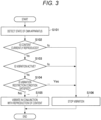
- Fig. 3 is a flowchart showing an operation example of the information processing apparatus 100 according to the embodiment of the present disclosure.
- Fig. 3 shows an operation example of the information processing apparatus 100 that vibrates the vibration unit 160 in accordance with output of sound while the sound is being output.
- the information processing apparatus 100 first detects a state of the own apparatus (step S101). This detection processing in step S101 is executed by the control unit 110. Information obtained by this detection processing includes, for example, information about whether or not sound is output from the output unit 170, an application that is currently executed, details of content that is currently reproduced, a state of the information processing apparatus 100 based on sensing data transmitted from the input unit 130, settings of vibration of the vibration unit 160, information regarding a wirelessly-connected device, and the like.
- step S102 the information processing apparatus 100 determines whether or not vibration caused by the vibration unit 160 is set to be active (step S103). This determination processing in step S103 is executed by, for example, the control unit 110.
- step S104 determines whether or not the own apparatus satisfies the vibration restriction condition for restricting the vibration caused by the vibration unit 160 (step S104).
- This determination processing in step S104 is executed by, for example, the control unit 110. Examples of the vibration restriction condition have been described above.
- the information processing apparatus 100 restricts the vibration of the vibration unit 160.
- the information processing apparatus 100 may change algorithm of the vibration of the vibration unit 160 in accordance with details of content to be reproduced. For example, in a case where the content to be reproduced is music content, the information processing apparatus 100 may vibrate the vibration unit 160 so as to emphasize rhythm or cause the user to feel a lingering sound. Further, for example, in a case where the content to be reproduced is game content, the information processing apparatus 100 may vibrate the vibration unit 160 in conjunction with music in the game, or, in an example not covered by the claims, may vibrate the vibration unit 160 in conjunction with user operation instead of the music in the game.
- the information processing apparatus 100 can vibrate the vibration unit 160 in accordance with reproduction of the content.
- vibration of the vibration unit 160 it takes time until the vibration unit 160 actually starts to vibrate (until the user starts to feel the vibration) even if a signal for the vibration is transmitted to the vibration unit 160 so as to match a start timing of output of sound in response to input of the sound with a start timing of the vibration of the vibration unit 160. That is, the sound is output from the output unit 170 first, and the vibration unit 160 starts vibrating with a delay.
- the information processing apparatus 100 may have a function of adjusting such time of delay on a setting screen or the like. For example, the information processing apparatus 100 may prepare a plurality of time-of-delay patterns to allow the user to select which time of delay is suitable for the user. When the user selects a time-of-delay pattern, the user can experience output of the sound and output of the vibration that reflect each of the plurality of time-of-delay patterns through operation on the setting screen or the like.
- the sound of the information processing apparatus 100 is output from the wireless speaker 200 of Fig. 1 , which however is not covered by the claims, the sound is further delayed, as compared to a case where the sound is output from the output unit 170 of the information processing apparatus 100, because sound data is transmitted from the information processing apparatus 100 to the wireless speaker 200 via wireless communication. Therefore, in a case where the sound of the information processing apparatus 100 is output from the wireless speaker 200, the information processing apparatus 100 may adjust the time of delay on the basis of device information regarding the wireless speaker 200. Further, in a case where the sound of the information processing apparatus 100 is output from the wireless speaker 200, the information processing apparatus 100 may measure a delay time in advance and determine the time of delay by using the delay time.
- the information processing apparatus 100 may weakly vibrate the vibration unit 160, or may increase the frequency of the vibration of the vibration unit 160.
- the vibration of the vibration unit 160 may be restricted, and, in that case, the vibration unit 160 may not be vibrated.
- the information processing apparatus 100 may change the vibration pattern of the vibration unit 160 in accordance with the content of a received email. For example, in a case where the content of the received email requires an urgent reply or includes an emotion of anger, the information processing apparatus 100 may strongly vibrate the vibration unit 160, or may decrease the frequency of the vibration of the vibration unit 160. For example, machine learning may be adopted to analyze the email. Further, the email may be analyzed by the information processing apparatus 100, or may be analyzed by a source of the email or a mail server. In such a case, the information processing apparatus 100 may change the vibration pattern of the vibration unit 160 on the basis of information regarding importance that is added to the email by the source of the email or the mail server.
- the information processing apparatus 100 may set the vibration of the vibration unit 160 to be comfortable for the user.
- the vibration that is comfortable for the user may be, for example, vibration with low strength or frequency.
- the information processing apparatus 100 may restrict the vibration of the vibration unit 160.
- the information processing apparatus 100 in order to prevent the user from walking while operating a smartphone, in a case where the information processing apparatus 100 detects that the user operates the information processing apparatus 100 while walking on the basis of sensing data, the information processing apparatus 100 may set the vibration of the vibration unit 160 to be uncomfortable for the user as described above. In this case, the information processing apparatus 100 may vibrate the vibration unit 160 so strongly that the user cannot operate the information processing apparatus 100.
Landscapes
- Engineering & Computer Science (AREA)
- Theoretical Computer Science (AREA)
- General Engineering & Computer Science (AREA)
- Physics & Mathematics (AREA)
- General Physics & Mathematics (AREA)
- Human Computer Interaction (AREA)
- General Health & Medical Sciences (AREA)
- Health & Medical Sciences (AREA)
- Audiology, Speech & Language Pathology (AREA)
- Power Engineering (AREA)
- Automation & Control Theory (AREA)
- Mechanical Engineering (AREA)
- Signal Processing (AREA)
- Multimedia (AREA)
- Computer Networks & Wireless Communication (AREA)
- User Interface Of Digital Computer (AREA)
- Telephone Function (AREA)
Description
- The present disclosure relates to an information processing apparatus, an information processing method, and a computer program.
- Conventionally, various apparatuses for reproducing, for example, content such as music and images have been developed. Further, there have been proposed various technologies of generating vibration, emitting light, and driving devices on the basis of a control signal from the outside. For example, Japanese patent document
JP 2015-2310 A US 2017/136354 A1 , discloses a technology of, in a case where a vibration device acquires an audio signal from an electronic device, generating vibration on the basis of the acquired audio signal.US 2018/035208 A1 discloses controlling a vibration operation based on a folding state of a foldable display.US 2005/275508 A1 discloses a handheld electronic device including a housing adapted to engage a holster and a vibrator within the housing.US 2015/0348379 A1 discloses using at least two independent renderers, namely a speaker render and a haptic renderer, to render at least two output streams that are to be synchronized.US 2016/0374049 A1 discloses providing a notification on a wireless charging state in an electronic device.US 2014/217828 A1 discloses a power receiver (e.g. a mobile phone) with a speaker for outputting music and a vibration unit for notifying a user of certain events, such as an incoming call or an alarm. Vibration of the vibration unit is inhibited while the power receiver is in a wireless power charging state. Instead, in the wireless power charging state, events are acoustically or visually notified by the power receiver. -
US 2015/303732 A1 discloses wirelessly charging a first device by a second device. The first device determines a first charging position of the first device relative to the second device and, based on the first charging position, automatically moves into a second charging position on the second device. The first device comprises a first motor and a second motor. The first motor is capable of moving the first device along a first axis. The second motor is capable of moving the first device along a second axis. - In a case where an electronic device includes a vibration device and the vibration device generates vibration on the basis of a signal, it is desirable to control the vibration of the vibration device in accordance with a state of the electronic device.
- Therefore, the present disclosure proposes a new and improved information processing apparatus, information processing method, and computer program, each of which is capable of controlling vibration in accordance with a situation in a case where the vibration is generated on the basis of an audio signal.
- The invention is defined by the claims.
- As described above, the present disclosure can provide a new and improved information processing apparatus, information processing method, and computer program, each of which is capable of controlling vibration in accordance with a situation in a case where the vibration is generated on the basis of an audio signal.
- Note that the above effects are not necessarily limited, and any of the effects described in the present specification or other effects that can be grasped from the present specification may be exhibited in addition to or in place of the above effects.
-
-
Fig. 1 is an explanatory diagram illustrating a configuration example of an information processing system according to an embodiment of the present disclosure. -
Fig. 2 is an explanatory diagram illustrating a functional configuration example of an information processing apparatus according to the embodiment. -
Fig. 3 is a flowchart showing an operation example of the information processing apparatus according to the embodiment. -
Fig. 4 is an explanatory diagram illustrating an example of a user interface displayed by an information processing apparatus. -
Fig. 5 is an explanatory diagram illustrating an example of output of sound and a change in vibration caused by a vibration unit. -
Fig. 6 is an explanatory diagram illustrating a state in which sound of an information processing apparatus is output from a wireless speaker. -
Fig. 7 is an explanatory diagram illustrating a state in which a notification to an information processing apparatus is transferred to a smartwatch while sound from the information processing apparatus is being output from a wireless speaker. - Hereinafter, preferred embodiments of the present disclosure will be described in detail with reference to the accompanying drawings. Note that, in this specification and the drawings, components having substantially the same functional configurations will be represented as the same reference signs, and repeated description thereof will be omitted.
- Note that description will be provided in the following order.
- 1. Embodiment of present disclosure
- 1.1. Configuration example
- 1.2. Operation example
- 2. Conclusion
- First, a configuration example of an information processing system according to an embodiment of the present disclosure will be described.
Fig. 1 is an explanatory diagram illustrating the configuration example of the information processing system according to the embodiment of the present disclosure. Hereinafter, the configuration example of the information processing system according to the embodiment of the present disclosure will be described with reference toFig. 1 . - As illustrated in
Fig. 1 , the information processing system according to the embodiment of the present disclosure includes aninformation processing apparatus 100, awireless speaker 200, asmartwatch 300, and awireless charger 400. - The
information processing apparatus 100 is, for example, a high-performance mobile phone such as a smartphone, a tablet terminal, a portable game console, a portable music player, or the like, and is an apparatus including a vibration device such as a vibrator in the apparatus. Although a functional configuration example of theinformation processing apparatus 100 will be described later, theinformation processing apparatus 100 has a function of vibrating the vibration device in accordance with output of sound on the basis of settings while the sound is being output. - The
wireless speaker 200 is a speaker that receives an audio signal from the wirelessly-connectedinformation processing apparatus 100 and outputs sound based on the audio signal. Wireless communication between thewireless speaker 200 and theinformation processing apparatus 100 is performed by, for example, a communication method using radio waves in a 2.4 GHz band and conforming to the IEEE 802.15.1 standard. - The
smartwatch 300 is a wristwatch device having a wireless communication function. Thesmartwatch 300 can operate alone, and can also operate while transmitting and receiving signals to and from the wirelessly-connectedinformation processing apparatus 100. - The
wireless charger 400 is a charger that charges theinformation processing apparatus 100 without connecting metal contacts such as terminals and connectors. Thewireless charger 400 includes a coil in thewireless charger 400, and a magnetic field generated by causing a current to flow through the coil passes through a coil of theinformation processing apparatus 100. Thus, a current flows through theinformation processing apparatus 100 because of electromagnetic induction. The current flowing through theinformation processing apparatus 100 is used for charging a battery inside theinformation processing apparatus 100. Therefore, thewireless charger 400 can charge theinformation processing apparatus 100 without depending on connection of the metal contacts. - Hereinabove, the configuration example of the information processing system according to the embodiment of the present disclosure has been described. Next, the functional configuration example of the
information processing apparatus 100 according to the embodiment of the present disclosure will be described. -
Fig. 2 is an explanatory diagram illustrating the functional configuration example of theinformation processing apparatus 100 according to the embodiment of the present disclosure. Hereinafter, the functional configuration example of theinformation processing apparatus 100 according to the embodiment of the present disclosure will be described with reference toFig. 2 . - As illustrated in
Fig. 2 , theinformation processing apparatus 100 according to the embodiment of the present disclosure includes acontrol unit 110, astorage unit 120, aninput unit 130, adisplay unit 140, acommunication unit 150, avibration unit 160, and anoutput unit 170. - The
control unit 110 includes, for example, a processor such as a central processing unit (CPU), and controls operation of each unit of theinformation processing apparatus 100. Thecontrol unit 110 executes, for example, an application stored in thestorage unit 120 to execute processing of reproducing content stored in thestorage unit 120 or received from thecommunication unit 150 by streaming. Further, in this embodiment, thecontrol unit 110 controls thevibration unit 160 to vibrate on the basis of settings while sound is being output from theoutput unit 170. Then, in a case where a state of theinformation processing apparatus 100 satisfies a vibration restriction condition of thevibration unit 160, thecontrol unit 110 restricts vibration of thevibration unit 160. - In an example not covered by the claims, when, in a case where the
output unit 170 outputs sound, a non-operation state of theinformation processing apparatus 100 continues for a predetermined time period and screen display by thedisplay unit 140 is stopped (screen display is turned off) because of a sleep function that theinformation processing apparatus 100 has, thecontrol unit 110 may determine that the vibration restriction condition is satisfied and restrict the vibration caused by thevibration unit 160. Note that the restriction of the vibration caused by thevibration unit 160 herein may be completely stopping the vibration caused by thevibration unit 160, or may be weakening the vibration caused by thevibration unit 160 as compared with a case where the vibration is not restricted. - Further, in an example not covered by the claims, the
control unit 110 may control the vibration of thevibration unit 160 on the basis of content output to thedisplay unit 140 or an application executed by thecontrol unit 110 immediately before the screen display by thedisplay unit 140 is turned off. For example, in a case where thecontrol unit 110 executes a music reproduction application, thecontrol unit 110 may continue to vibrate thevibration unit 160 in conjunction with reproduction of music even when the screen display by thedisplay unit 140 is turned off. - Further, in an example not covered by the claims, in a case where the
control unit 110 executes a moving image reproduction application, thecontrol unit 110 may determine that the vibration restriction condition is satisfied when the screen display by thedisplay unit 140 is turned off, and restrict the vibration caused by thevibration unit 160. Note that, in a case where thecontrol unit 110 executes the moving image reproduction application and content reproduced by the moving image reproduction application is a music video, thecontrol unit 110 may cause the moving image reproduction application to continue to reproduce sound (music) of the music video and continue to vibrate thevibration unit 160 in conjunction with the sound even when the screen display by thedisplay unit 140 is turned off. Meanwhile, in a case where thecontrol unit 110 executes the moving image reproduction application and content reproduced by the moving image reproduction application is video content such as a movie, thecontrol unit 110 may determine that the vibration restriction condition is satisfied when the screen display by thedisplay unit 140 is turned off, and restrict the vibration caused by thevibration unit 160. In this case, reproduction of the video content (video and sound) is stopped at a timing at which the screen display is turned off. - Further, in an example not covered by the claims, the
control unit 110 may change behavior of the vibration caused by thevibration unit 160 in a case where the screen display by thedisplay unit 140 is turned off in accordance with a file format of the content reproduced by the application. - Further, for example, the
control unit 110 may determine the type of the content by music analysis, and change the behavior of the vibration caused by thevibration unit 160 on the basis of the determination result in a case where the screen display is turned off. - Further, in an example not covered by the claims, the
control unit 110 may determine the type of the content by machine learning, and change the behavior of the vibration caused by thevibration unit 160 on the basis of the determination result in a case where the screen display is turned off. - Further, in an example not covered by the claims, the
control unit 110 may control the vibration of thevibration unit 160 on the basis of sensing data output by sensors included in theinput unit 130 described later. For example, when thecontrol unit 110 detects that theinformation processing apparatus 100 is placed on a flat place such as a floor or a table for a predetermined time period or more on the basis of sensing data output from the sensors such as an acceleration sensor and a gyro sensor, thecontrol unit 110 may determine that the vibration restriction condition is satisfied, and restrict the vibration caused by thevibration unit 160. In addition, as examples of the place, thecontrol unit 110 may detect that theinformation processing apparatus 100 is placed on an uneven object such as a chair or that theinformation processing apparatus 100 is hung on a hook on the basis of sensing data. - Further, for example, in a case where the music reproduction application or the moving image reproduction application is being executed and sound output from the
output unit 170 is stopped by user operation, thecontrol unit 110 may determine that the vibration restriction condition is satisfied and restrict the vibration caused by thevibration unit 160. - When the
vibration unit 160 vibrates while theinformation processing apparatus 100 is being placed on thewireless charger 400, theinformation processing apparatus 100 may unexpectedly move and may not be normally charged by thewireless charger 400. Therefore, in a case where sound is output from theoutput unit 170 and thecontrol unit 110 detects that theinformation processing apparatus 100 is placed on thewireless charger 400, thecontrol unit 110 may determine that the vibration restriction condition is satisfied, and restrict the vibration caused by thevibration unit 160 even if the screen display by thedisplay unit 140 is on. The detection that theinformation processing apparatus 100 is placed on thewireless charger 400 may be performed by, for example, detecting strength of the magnetic field from thewireless charger 400. In this case, when thecontrol unit 110 detects that theinformation processing apparatus 100 has been removed from thewireless charger 400, thecontrol unit 110 may cancel the restriction of the vibration caused by thevibration unit 160. - Meanwhile, when the
control unit 110 detects that theinformation processing apparatus 100 is placed on thewireless charger 400, thecontrol unit 110 may control the vibration of thevibration unit 160 so that theinformation processing apparatus 100 is moved to a position where efficiency of wireless charging by thewireless charger 400 is improved. For example, in a case where theinformation processing apparatus 100 includes a plurality of vibrators, theinformation processing apparatus 100 placed on a flat surface can be moved in an arbitrary direction by changing a vibration pattern of each vibrator. Therefore, by repeatedly vibrating thevibration unit 160 and detecting the strength of the magnetic field from thewireless charger 400, thecontrol unit 110 can move theinformation processing apparatus 100 to a position where the efficiency of wireless charging by thewireless charger 400 is improved. - As described above, in a state in which the
control unit 110 restricts the vibration caused by thevibration unit 160, thecontrol unit 110 transmits data for vibrating another device connected to theinformation processing apparatus 100, for example, thesmartwatch 300 from thecommunication unit 150. This makes it possible to vibrate another device connected to theinformation processing apparatus 100 in a state in which thecontrol unit 110 restricts the vibration caused by thevibration unit 160. - The
storage unit 120 includes, for example, storage devices such as a read only memory (ROM) and various random access memories (RAMs), and stores programs and various settings for operating theinformation processing apparatus 100, content to be displayed on thedisplay unit 140, and the like. The content stored in thestorage unit 120 may include content displayed on thedisplay unit 140 as a stereoscopic image. - The
input unit 130 includes, for example, input devices such as a touchscreen and a button, various sensors such as a ToF sensor, an acceleration sensor, a gyro sensor, a pressure sensor, and a position information sensor, an imaging device including a lens and an image sensor, and the like. Theinput unit 130 provides data acquired by the input device and the various sensors for thecontrol unit 110. - The
display unit 140 includes, for example, a thin display device such as a liquid crystal display and an organic EL display. Display of an image on thedisplay unit 140 is controlled by thecontrol unit 110. - The
communication unit 150 performs communication with an external device. Thecommunication unit 150 may include an interface for wired communication and an interface for wireless communication. - The
vibration unit 160 vibrates under the control of thecontrol unit 110. Thevibration unit 160 includes, for example, an actuator such as an eccentric rotating mass motor (ERM) or a linear resonant actuator (LRA). The number of actuators may be one or more. - The
output unit 170 includes a device that outputs predetermined information, and includes, for example, a speaker that outputs sound, a light-emitting diode that emits light, and the like. - Hereinabove, the functional configuration example of the
information processing apparatus 100 according to the embodiment of the present disclosure has been described. Next, an operation example of theinformation processing apparatus 100 according to the embodiment of the present disclosure will be described. -
Fig. 3 is a flowchart showing an operation example of theinformation processing apparatus 100 according to the embodiment of the present disclosure.Fig. 3 shows an operation example of theinformation processing apparatus 100 that vibrates thevibration unit 160 in accordance with output of sound while the sound is being output. - The
information processing apparatus 100 first detects a state of the own apparatus (step S101). This detection processing in step S101 is executed by thecontrol unit 110. Information obtained by this detection processing includes, for example, information about whether or not sound is output from theoutput unit 170, an application that is currently executed, details of content that is currently reproduced, a state of theinformation processing apparatus 100 based on sensing data transmitted from theinput unit 130, settings of vibration of thevibration unit 160, information regarding a wirelessly-connected device, and the like. - When the
information processing apparatus 100 detects the state of the own apparatus in step S101, theinformation processing apparatus 100 then determines whether or not content is currently reproduced in the own apparatus (step S102). This determination processing in step S102 is executed by, for example, thecontrol unit 110. - In a case where the content is currently reproduced in the own apparatus as a result of the determination in step S102 (Yes in step S102), the
information processing apparatus 100 then determines whether or not vibration caused by thevibration unit 160 is set to be active (step S103). This determination processing in step S103 is executed by, for example, thecontrol unit 110. - In a case where the vibration caused by the
vibration unit 160 is set to be active as a result of the determination in step S103 (Yes in step S103), theinformation processing apparatus 100 then determines whether or not the own apparatus satisfies the vibration restriction condition for restricting the vibration caused by the vibration unit 160 (step S104). This determination processing in step S104 is executed by, for example, thecontrol unit 110. Examples of the vibration restriction condition have been described above. - Then, in a case where the vibration restriction condition is not satisfied as a result of the determination in step S104 (No in step S104), the
information processing apparatus 100 vibrates thevibration unit 160 in accordance with reproduction of the content (step S105). - Meanwhile, in a case where the content is not currently reproduced in the own apparatus (No in step S102), in a case where the vibration caused by the
vibration unit 160 is not set to be active (No in step S103), or in a case where the vibration restriction condition is satisfied (Yes in step S104), theinformation processing apparatus 100 restricts the vibration of thevibration unit 160. - By executing the above series of operation, the
information processing apparatus 100 according to the embodiment of the present disclosure can control the vibration caused by thevibration unit 160 depending on a situation of the own apparatus. - Note that the
information processing apparatus 100 according to the embodiment of the present disclosure can vibrate thevibration unit 160 in accordance with reproduction of the content, and may change magnitude of the vibration of thevibration unit 160 in conjunction with volume of sound or may independently set the volume of the sound and the magnitude of the vibration of thevibration unit 160. In a case where the volume of the sound and the magnitude of the vibration of thevibration unit 160 are independently set, theinformation processing apparatus 100 may display, for example, a user interface illustrated inFig. 4 on thedisplay unit 140 to allow the user to set the volume of the sound and the magnitude of the vibration of thevibration unit 160. The user interface ofFig. 4 is for setting both the volume of the sound and the magnitude of the vibration of thevibration unit 160, and allows the user to set both the volume and magnitude so that the volume and magnitude are larger as a slider is closer to a right side and are smaller as the slider is closer to a left side. - Further, the
information processing apparatus 100 according to the embodiment of the present disclosure may change algorithm of the vibration of thevibration unit 160 in accordance with details of content to be reproduced. For example, in a case where the content to be reproduced is music content, theinformation processing apparatus 100 may vibrate thevibration unit 160 so as to emphasize rhythm or cause the user to feel a lingering sound. Further, for example, in a case where the content to be reproduced is game content, theinformation processing apparatus 100 may vibrate thevibration unit 160 in conjunction with music in the game, or, in an example not covered by the claims, may vibrate thevibration unit 160 in conjunction with user operation instead of the music in the game. Further, for example, in a case where the content to be reproduced is movie content, theinformation processing apparatus 100 may vibrate thevibration unit 160 in conjunction with music in the movie, or may vibrate thevibration unit 160 in conjunction with a sound effect such as a gunshot or explosive sound instead of the music in the movie. - As described above, the
information processing apparatus 100 according to the embodiment of the present disclosure can vibrate thevibration unit 160 in accordance with reproduction of the content. However, when vibration of thevibration unit 160 is started, it takes time until thevibration unit 160 actually starts to vibrate (until the user starts to feel the vibration) even if a signal for the vibration is transmitted to thevibration unit 160 so as to match a start timing of output of sound in response to input of the sound with a start timing of the vibration of thevibration unit 160. That is, the sound is output from theoutput unit 170 first, and thevibration unit 160 starts vibrating with a delay. - Therefore, in a case where the content is reproduced in conjunction with the vibration of the
vibration unit 160, theinformation processing apparatus 100 according to the embodiment of the present disclosure may match the start timing of output of the sound in response to input of the sound with the start timing of the vibration of the vibration unit 160 (the timing at which the user starts to feel the vibration) by reproducing the content with a delay. -
Fig. 5 is an explanatory diagram illustrating an example of output of sound and a change in vibration caused by thevibration unit 160. Vibration of thevibration unit 160 increases with time after the vibration starts, and it takes time until the vibration has a set magnitude. Therefore, theinformation processing apparatus 100 according to the embodiment of the present disclosure can match the start timing of output of the sound with the start timing of the vibration of the vibration unit 160 (the timing at which the user starts to feel the vibration) by delaying output of the sound as illustrated inFig. 5 . - In a case where output of the sound is delayed, some people may feel that output of the sound is earlier than the start of the vibration, and some people may feel that the start of the vibration is earlier than output of the sound even with the same setting. Therefore, in a case where output of the sound is delayed, the
information processing apparatus 100 may have a function of adjusting such time of delay on a setting screen or the like. For example, theinformation processing apparatus 100 may prepare a plurality of time-of-delay patterns to allow the user to select which time of delay is suitable for the user. When the user selects a time-of-delay pattern, the user can experience output of the sound and output of the vibration that reflect each of the plurality of time-of-delay patterns through operation on the setting screen or the like. - Further, in a case where the sound of the
information processing apparatus 100 is output from thewireless speaker 200 ofFig. 1 , which however is not covered by the claims, the sound is further delayed, as compared to a case where the sound is output from theoutput unit 170 of theinformation processing apparatus 100, because sound data is transmitted from theinformation processing apparatus 100 to thewireless speaker 200 via wireless communication. Therefore, in a case where the sound of theinformation processing apparatus 100 is output from thewireless speaker 200, theinformation processing apparatus 100 may adjust the time of delay on the basis of device information regarding thewireless speaker 200. Further, in a case where the sound of theinformation processing apparatus 100 is output from thewireless speaker 200, theinformation processing apparatus 100 may measure a delay time in advance and determine the time of delay by using the delay time. The delay time may be measured by, for example, recording the sound output from thewireless speaker 200 in theinformation processing apparatus 100. This makes it possible to compare a timing at which the sound is output from theoutput unit 170 of theinformation processing apparatus 100 with a timing at which the sound is output from thewireless speaker 200. - In a case where the content is reproduced in conjunction with the vibration of the
vibration unit 160, the user may input characters by using a touchscreen provided as theinput unit 130. At this time, in an example not covered by the claims, thevibration unit 160 may be set to vibrate in response to input of the characters. In this case, the vibration generated from thevibration unit 160 in response to input of the characters and the vibration generated from thevibration unit 160 in conjunction with reproduction of the content are mixed. Thus, those two kinds of vibration cannot be distinguished. In view of this, in a case where the content is reproduced in conjunction with the vibration of thevibration unit 160 and the user operates the touchscreen, theinformation processing apparatus 100 may temporarily restrict the conjunctive vibration. Then, when the user finishes operation on the touchscreen (for example, in a case where the next touch operation is not performed by the user for one second after the last operation by the user on the touchscreen), theinformation processing apparatus 100 may start the vibration, which has been restricted, in conjunction with reproduction of the content again. As a matter of course, in a case where the content is reproduced in conjunction with the vibration of thevibration unit 160, theinformation processing apparatus 100 may not restrict the conjunctive vibration even when the user operates the touchscreen. Whether to restrict the conjunctive vibration even when the user operates the touchscreen may be set by the user on the setting screen or the like. Further, the vibration of thevibration unit 160 in response to input of the characters may be controlled by prioritizing the vibration of thevibration unit 160 performed in conjunction with reproduction of the content. - In addition, in an example not covered by the claims, the
information processing apparatus 100 may not restrict the vibration of thevibration unit 160 in a state in which theinformation processing apparatus 100 detects that the user holds the own apparatus with his/her hand, and may restrict the vibration of thevibration unit 160 in a state in which theinformation processing apparatus 100 detects that the user does not hold the own apparatus with his/her hand. Whether or not the user holds the own apparatus with his/her hand may be determined by using sensing data output by the sensor. For example, a touch sensor may be provided on a surface of a housing of theinformation processing apparatus 100, and theinformation processing apparatus 100 may determine whether or not the user holds theinformation processing apparatus 100 by using sensing data output by the touch sensor. Further, whether or not the user holds the own apparatus with his/her hand may be determined on the basis of sensing data output from the acceleration sensor and the gyro sensor. - Hereinabove, the operation example of the
information processing apparatus 100 performed in a case where the content is reproduced in conjunction with the vibration of thevibration unit 160 has been described. Next, a processing example of the vibration of thevibration unit 160 depending on a state of theinformation processing apparatus 100 will be described. - In an example not covered by the claims, J Z in a case where the
vibration unit 160 is set to vibrate without playing a ringtone at the time of an incoming call or email (so-called silent mode or the like), theinformation processing apparatus 100 may change a vibration strength and vibration pattern of thevibration unit 160 in accordance with a caller/transmitter. For example, in a case where there is an incoming call from a party who is registered in a telephone directory of theinformation processing apparatus 100, such as a family member or a friend, theinformation processing apparatus 100 may strongly vibrate thevibration unit 160, or may decrease a frequency of the vibration of thevibration unit 160. Meanwhile, in a case where there is an incoming call from a party who is not registered in the telephone directory of theinformation processing apparatus 100, theinformation processing apparatus 100 may weakly vibrate thevibration unit 160, or may increase the frequency of the vibration of thevibration unit 160. Alternatively, in a case where there is an incoming call from a party who is not registered in the telephone directory of theinformation processing apparatus 100, the vibration of thevibration unit 160 may be restricted, and, in that case, thevibration unit 160 may not be vibrated. - Further, in an example not covered by the claims, the
information processing apparatus 100 may change the vibration pattern of thevibration unit 160 in accordance with the content of a received email. For example, in a case where the content of the received email requires an urgent reply or includes an emotion of anger, theinformation processing apparatus 100 may strongly vibrate thevibration unit 160, or may decrease the frequency of the vibration of thevibration unit 160. For example, machine learning may be adopted to analyze the email. Further, the email may be analyzed by theinformation processing apparatus 100, or may be analyzed by a source of the email or a mail server. In such a case, theinformation processing apparatus 100 may change the vibration pattern of thevibration unit 160 on the basis of information regarding importance that is added to the email by the source of the email or the mail server. - Further, for example, in a case where the user of the
information processing apparatus 100 wears thesmartwatch 300 ofFig. 1 , theinformation processing apparatus 100 may vibrate thesmartwatch 300 in accordance with reproduction of the content. For example, in a case where theinformation processing apparatus 100 is in the user's bag and the user is listening to the sound of the content with a wired or wireless earphone, no vibration is transmitted to the hand of the user even if theinformation processing apparatus 100 is vibrated. Therefore, in such a case, theinformation processing apparatus 100 may transmit a signal for vibrating thesmartwatch 300 to thesmartwatch 300 in accordance with reproduction of the content. Then, thesmartwatch 300 may vibrate a vibrator provided in thesmartwatch 300 in response to the signal from theinformation processing apparatus 100. - Further, in a case where the user of the
information processing apparatus 100 wears thesmartwatch 300 ofFig. 1 and there is an incoming call or email as described above, a vibration strength and vibration pattern of thesmartwatch 300 may be changed in accordance with a caller/transmitter thereof. - Further, in an example not covered by the claims, there will be described a case where the sound of the
information processing apparatus 100 is output from thewireless speaker 200 ofFig. 1 in a case where the user of theinformation processing apparatus 100 wears thesmartwatch 300 ofFig. 1 .Fig. 6 is an explanatory diagram illustrating a state in which the sound of theinformation processing apparatus 100 is output from thewireless speaker 200 in a case where the user of theinformation processing apparatus 100 wears thesmartwatch 300 ofFig. 1 . In such a case, theinformation processing apparatus 100 may notify thesmartwatch 300 that there is an incoming call or email.Fig. 7 is an explanatory diagram illustrating a state in which, in a case where the sound of the content of theinformation processing apparatus 100 is output from thewireless speaker 200 and theinformation processing apparatus 100 receives an incoming email or call, theinformation processing apparatus 100 transmits a signal to thesmartwatch 300 to vibrate thesmartwatch 300. At this time, for example, theinformation processing apparatus 100 is set to the silent mode, i.e., theinformation processing apparatus 100 is set so as not to play a ringtone or notify thewireless speaker 200 of reception of an incoming call or email, and thus no ringtone is reproduced from thewireless speaker 200. This makes it possible to allow the user to recognize an incoming email or call by vibration, without interrupting reproduction of the sound of the content from thewireless speaker 200. Note that the ringtone may be set not to be played. Alternatively, the ringtone may be set to be played while the sound of the content is being played, or may also be set to be played while the sound of the content is being played in a small volume. - In an example not covered by the claims, in a case where the
information processing apparatus 100 captures an image, theinformation processing apparatus 100 may change the vibration strength and vibration pattern of thevibration unit 160 in accordance with the content of the captured image. For example, in a case where theinformation processing apparatus 100 finds that a subject person smiles from image analysis, theinformation processing apparatus 100 may determine that the best shot has been taken and vibrate thevibration unit 160 immediately after the imaging processing to notify the user that the best shot has been taken. Further, for example, when theinformation processing apparatus 100 analyzes the content of an image displayed on thedisplay unit 140 on the basis of camera through display and determines that a photo opportunity occurs, theinformation processing apparatus 100 may vibrate thevibration unit 160 to notify the user that a photo opportunity occurs. The photo opportunity is, for example, a state in which a subject person smiles, a state in which many people smile if there is a plurality of subjects, and the like. - In an example not covered by the claims, in a case where the
information processing apparatus 100 executes a map application and displays a map on thedisplay unit 140, theinformation processing apparatus 100 may change the vibration strength and vibration pattern of thevibration unit 160 by using information regarding a current position acquired by the position information sensor. - For example, in a case where the
information processing apparatus 100 executes the map application and displays the map on thedisplay unit 140 and the user is heading in a direction toward a destination, theinformation processing apparatus 100 may set the vibration of thevibration unit 160 to be comfortable for the user. The vibration that is comfortable for the user may be, for example, vibration with low strength or frequency. Further, in a case where theinformation processing apparatus 100 executes the map application and displays the map on thedisplay unit 140 and the user is heading in the direction toward the destination, theinformation processing apparatus 100 may restrict the vibration of thevibration unit 160. - Meanwhile, in a case where the
information processing apparatus 100 executes the map application and displays the map on thedisplay unit 140 and the user is not heading in the direction toward the destination, theinformation processing apparatus 100 may set the vibration of thevibration unit 160 to be uncomfortable for the user. The vibration that is uncomfortable for the user may be, for example, vibration with high strength or frequency. Further, the vibration that is uncomfortable for the user may be vibration in a random pattern. The vibration in a random pattern may mean that the vibration strength changes randomly, a strong vibration interval changes randomly, or the vibration frequency changes randomly. - Further, for example, in a case where the
information processing apparatus 100 executes the map application and displays the map on thedisplay unit 140 and the user reaches a corner to turn, theinformation processing apparatus 100 may vibrate thevibration unit 160 to notify the user that a current place is a corner at which the user should turn. - A so-called "smartphone zombie", which means that a user walks while operating a smartphone, is a social problem. In an example not covered by the claims, in order to prevent the user from walking while operating a smartphone, in a case where the
information processing apparatus 100 detects that the user operates theinformation processing apparatus 100 while walking on the basis of sensing data, theinformation processing apparatus 100 may set the vibration of thevibration unit 160 to be uncomfortable for the user as described above. In this case, theinformation processing apparatus 100 may vibrate thevibration unit 160 so strongly that the user cannot operate theinformation processing apparatus 100. - As described above, the embodiment of the present disclosure can provide the
information processing apparatus 100 capable of controlling vibration in accordance with a situation in a case where the vibration is generated on the basis of an audio signal. - The steps in the processing executed by each apparatus in this specification do not necessarily need to be processed in a time series in the order described in a sequence diagram or a flowchart. For example, the steps in the processing executed by each apparatus may be processed in order different from the order described in the flowchart, or may be processed in parallel.
- Further, it is also possible to create a computer program for causing hardware such as a CPU, a ROM, and a RAM included in each apparatus to exhibit a function equivalent to the configuration of each apparatus a storage medium storing the computer program. Further, a series of processing can also be realized by hardware when each functional block illustrated in the functional block diagram is configured by hardware.
- Further, the effects described in this specification are merely illustrative or exemplary and are not limited. In other words, the technology according to the present disclosure can have other effects that are apparent to those skilled in the art from the description of the present specification in addition to or in place of the above effects.
-
- 100
- Information processing apparatus
- 200
- Wireless speaker
- 300
- Smartwatch
- 400
- Wireless charger
Claims (6)
- An information processing apparatus (100) comprising:a communication unit (150) configured to perform communication with an external device (300);a vibration unit (160) configured to generate vibrations which can be felt by a user; anda control unit (110) configured to detect a state of the information processing apparatus and control a state of the vibration unit on a basis of a detection result of the state of the information processing apparatus, whereinthe control unit is configured to control the vibration unit to vibrate in accordance with reproduction of sound content while the sound content is being reproduced in the information processing apparatus, and, in a case where the detection result of the state of the information processing apparatus satisfies a predetermined condition that wireless power charging of the information processing apparatus is detected, restrict vibration of the vibration unit even while the sound content is being reproduced in the information processing apparatus and cause the communication unit to transmit data for causing vibration of the external device.
- The information processing apparatus according to claim 1, wherein in a case where wireless power charging of the information processing apparatus is performed, the control unit is configured to control the vibration unit to vibrate to move the information processing apparatus to a position at which charging is performed with high efficiency, the information processing apparatus comprising a plurality of vibrators and the control unit being configured to change a vibration pattern of each vibrator to move the information processing apparatus.
- The information processing apparatus according to claim 1, wherein the sound content is music content.
- The information processing apparatus according to claim 3, wherein the music content is accompanied by displaying a moving image.
- An information processing method comprising:detecting (S101) a state of an information processing apparatus (100) and controlling a state of a vibration unit (160) of the information processing apparatus on a basis of a detection result of the state of the information processing apparatus, the vibration unit being configured to generate vibrations which can be felt by a user; andvibrating (S105) the vibration unit in accordance with reproduction of sound content while the sound content is being reproduced in the information processing apparatus apparatus, and, in a case where the detection result of the state of the information processing apparatus satisfies a predetermined condition that wireless power charging of the information processing apparatus is detected, restricting vibration of the vibration unit even while the sound content is being reproduced in the information processing apparatus and causing transmission of data for causing vibration of an external device (300) in communication with the information processing apparatus.
- A computer program for causing an information processing apparatus according to any of claims 1 to 4 to execute an information processing method according to claim 5.
Applications Claiming Priority (2)
| Application Number | Priority Date | Filing Date | Title |
|---|---|---|---|
| JP2018031278 | 2018-02-23 | ||
| PCT/JP2018/047900 WO2019163283A1 (en) | 2018-02-23 | 2018-12-26 | Information processing device, information processing method, and computer program |
Publications (3)
| Publication Number | Publication Date |
|---|---|
| EP3757722A1 EP3757722A1 (en) | 2020-12-30 |
| EP3757722A4 EP3757722A4 (en) | 2021-04-14 |
| EP3757722B1 true EP3757722B1 (en) | 2023-12-13 |
Family
ID=67686762
Family Applications (1)
| Application Number | Title | Priority Date | Filing Date |
|---|---|---|---|
| EP18907051.9A Active EP3757722B1 (en) | 2018-02-23 | 2018-12-26 | Information processing device, information processing method, and computer program |
Country Status (4)
| Country | Link |
|---|---|
| US (1) | US11774991B2 (en) |
| EP (1) | EP3757722B1 (en) |
| CN (1) | CN111712778B (en) |
| WO (1) | WO2019163283A1 (en) |
Families Citing this family (5)
| Publication number | Priority date | Publication date | Assignee | Title |
|---|---|---|---|---|
| JP2020177440A (en) * | 2019-04-18 | 2020-10-29 | 株式会社東海理化電機製作所 | Control device and notification device |
| JP7571782B2 (en) | 2020-02-25 | 2024-10-23 | ソニーグループ株式会社 | Information processing device and information processing method |
| WO2021171587A1 (en) * | 2020-02-28 | 2021-09-02 | 日本電信電話株式会社 | Emotional stabilization assisting device, emotional stabilization assisting system, and emotional stabilization assisting program |
| CN117356107A (en) * | 2021-05-31 | 2024-01-05 | 索尼集团公司 | Signal processing device, signal processing method and program |
| KR20230022666A (en) | 2021-08-09 | 2023-02-16 | 삼성전자주식회사 | Electronic device and method for providing user interface thereof |
Citations (2)
| Publication number | Priority date | Publication date | Assignee | Title |
|---|---|---|---|---|
| US20140217828A1 (en) * | 2012-02-10 | 2014-08-07 | Canon Kabushiki Kaisha | Power receiver, method of controlling power receiver, and program |
| US20150303732A1 (en) * | 2014-04-16 | 2015-10-22 | International Business Machines Corporation | Multi Axis Vibration Unit In Device For Vectored Motion |
Family Cites Families (18)
| Publication number | Priority date | Publication date | Assignee | Title |
|---|---|---|---|---|
| US7019622B2 (en) | 2004-05-27 | 2006-03-28 | Research In Motion Limited | Handheld electronic device including vibrator having different vibration intensities and method for vibrating a handheld electronic device |
| KR101031113B1 (en) * | 2010-04-06 | 2011-04-25 | 한국기계연구원 | Ultra-small microphone-based hearing aid |
| JP5697521B2 (en) * | 2011-04-07 | 2015-04-08 | 京セラ株式会社 | Character input device, character input control method, and character input program |
| KR101873415B1 (en) * | 2011-09-08 | 2018-07-02 | 엘지전자 주식회사 | Mobile terminal and control method for the same |
| US9577710B2 (en) * | 2012-02-29 | 2017-02-21 | Nokia Technologies Oy | Engaging terminal devices |
| JP6093659B2 (en) * | 2013-06-24 | 2017-03-08 | シャープ株式会社 | Information processing apparatus and information processing program |
| JP6264542B2 (en) * | 2014-01-30 | 2018-01-24 | 任天堂株式会社 | Information processing apparatus, information processing program, information processing system, and information processing method |
| KR102160636B1 (en) | 2014-02-21 | 2020-09-28 | 삼성전자주식회사 | Electronic device and method for controlling an input-output device |
| WO2015162942A1 (en) * | 2014-04-25 | 2015-10-29 | 株式会社ソニー・コンピュータエンタテインメント | Information processing device, information processing method, program, and information storage medium |
| US9613506B2 (en) * | 2014-05-30 | 2017-04-04 | Apple Inc. | Synchronization of independent output streams |
| JP2015231098A (en) * | 2014-06-04 | 2015-12-21 | ソニー株式会社 | Vibration device and vibration method |
| JP6156262B2 (en) | 2014-06-13 | 2017-07-05 | 株式会社デンソー | Non-contact power feeding device for vehicles |
| US9812165B2 (en) | 2014-12-19 | 2017-11-07 | Immersion Corporation | Systems and methods for recording haptic data for use with multi-media data |
| KR102412315B1 (en) * | 2015-06-19 | 2022-06-24 | 삼성전자주식회사 | Apparatus and Method for providing Notification of Wireless Charging State |
| JP6728386B2 (en) * | 2016-03-31 | 2020-07-22 | センセル インコーポレイテッドSensel,Inc. | Human computer interface system |
| KR102589751B1 (en) * | 2016-07-26 | 2023-10-17 | 삼성디스플레이 주식회사 | Display device |
| JP7000683B2 (en) * | 2017-01-20 | 2022-01-19 | 富士フイルムビジネスイノベーション株式会社 | Information processing system and program |
| KR102350497B1 (en) * | 2017-06-20 | 2022-01-14 | 삼성전자주식회사 | Method for determining data of barometer sensor using data obtained from motion sensor and electronic device for the same |
-
2018
- 2018-12-26 WO PCT/JP2018/047900 patent/WO2019163283A1/en not_active Ceased
- 2018-12-26 EP EP18907051.9A patent/EP3757722B1/en active Active
- 2018-12-26 CN CN201880089240.XA patent/CN111712778B/en active Active
- 2018-12-26 US US16/969,989 patent/US11774991B2/en active Active
Patent Citations (2)
| Publication number | Priority date | Publication date | Assignee | Title |
|---|---|---|---|---|
| US20140217828A1 (en) * | 2012-02-10 | 2014-08-07 | Canon Kabushiki Kaisha | Power receiver, method of controlling power receiver, and program |
| US20150303732A1 (en) * | 2014-04-16 | 2015-10-22 | International Business Machines Corporation | Multi Axis Vibration Unit In Device For Vectored Motion |
Also Published As
| Publication number | Publication date |
|---|---|
| US11774991B2 (en) | 2023-10-03 |
| EP3757722A4 (en) | 2021-04-14 |
| CN111712778A (en) | 2020-09-25 |
| CN111712778B (en) | 2023-08-29 |
| WO2019163283A1 (en) | 2019-08-29 |
| US20200401164A1 (en) | 2020-12-24 |
| EP3757722A1 (en) | 2020-12-30 |
Similar Documents
| Publication | Publication Date | Title |
|---|---|---|
| EP3757722B1 (en) | Information processing device, information processing method, and computer program | |
| CN110868626B (en) | Method and device for preloading content data | |
| CN110381197A (en) | Many-one throws the processing method of screen sound intermediate frequency data, apparatus and system | |
| CN107800821B (en) | One kind preventing motor and shake sub-resonance method and mobile terminal | |
| US12147729B2 (en) | Method and system for playing audios | |
| CN109062535B (en) | Voice control method, device, electronic device and computer readable medium | |
| CN105138319B (en) | Event-prompting method and device | |
| CN110996305A (en) | Method, device, electronic equipment and medium for connecting Bluetooth equipment | |
| CN110808021B (en) | Audio playing method, device, terminal and storage medium | |
| US20190265798A1 (en) | Information processing apparatus, information processing method, program, and information processing system | |
| CN107749306B (en) | A vibration optimization method and mobile terminal | |
| CN109451146B (en) | A vibration processing method and terminal | |
| CN106293602A (en) | Voice data control method for playing back in earphone and equipment | |
| CN111752370A (en) | Motor vibration control method, device, terminal and storage medium | |
| CN111045945B (en) | Method, device, terminal, storage medium and program product for simulating live broadcast | |
| CN108900688B (en) | Voice control method, device, electronic device and computer readable medium | |
| CN111092991B (en) | Lyric display method and device and computer storage medium | |
| WO2019187745A1 (en) | Electronic device and processing system | |
| CN110234036B (en) | Method, device and system for playing multimedia file | |
| JP6727921B2 (en) | Information processing device, information processing system, and information processing method | |
| CN111930438B (en) | Method, device, equipment and storage medium for determining page loading time | |
| CN110912830A (en) | Method and device for transmitting data | |
| CN107870758B (en) | Audio playback method and device, and electronic equipment | |
| WO2019128430A1 (en) | Method, apparatus and device for determining bandwidth, and storage medium | |
| EP2608497B1 (en) | Electronic device including modifiable output parameter |
Legal Events
| Date | Code | Title | Description |
|---|---|---|---|
| STAA | Information on the status of an ep patent application or granted ep patent |
Free format text: STATUS: THE INTERNATIONAL PUBLICATION HAS BEEN MADE |
|
| PUAI | Public reference made under article 153(3) epc to a published international application that has entered the european phase |
Free format text: ORIGINAL CODE: 0009012 |
|
| STAA | Information on the status of an ep patent application or granted ep patent |
Free format text: STATUS: REQUEST FOR EXAMINATION WAS MADE |
|
| 17P | Request for examination filed |
Effective date: 20200802 |
|
| AK | Designated contracting states |
Kind code of ref document: A1 Designated state(s): AL AT BE BG CH CY CZ DE DK EE ES FI FR GB GR HR HU IE IS IT LI LT LU LV MC MK MT NL NO PL PT RO RS SE SI SK SM TR |
|
| AX | Request for extension of the european patent |
Extension state: BA ME |
|
| A4 | Supplementary search report drawn up and despatched |
Effective date: 20210317 |
|
| RIC1 | Information provided on ipc code assigned before grant |
Ipc: G06F 3/01 20060101AFI20210311BHEP Ipc: H04M 1/00 20060101ALI20210311BHEP Ipc: G11B 27/10 20060101ALI20210311BHEP Ipc: G06F 3/16 20060101ALI20210311BHEP |
|
| DAV | Request for validation of the european patent (deleted) | ||
| DAX | Request for extension of the european patent (deleted) | ||
| RAP3 | Party data changed (applicant data changed or rights of an application transferred) |
Owner name: SONY GROUP CORPORATION |
|
| STAA | Information on the status of an ep patent application or granted ep patent |
Free format text: STATUS: EXAMINATION IS IN PROGRESS |
|
| 17Q | First examination report despatched |
Effective date: 20220627 |
|
| GRAP | Despatch of communication of intention to grant a patent |
Free format text: ORIGINAL CODE: EPIDOSNIGR1 |
|
| STAA | Information on the status of an ep patent application or granted ep patent |
Free format text: STATUS: GRANT OF PATENT IS INTENDED |
|
| RIC1 | Information provided on ipc code assigned before grant |
Ipc: G06F 3/16 20060101ALI20230627BHEP Ipc: G11B 27/11 20060101ALI20230627BHEP Ipc: G06F 3/01 20060101AFI20230627BHEP |
|
| INTG | Intention to grant announced |
Effective date: 20230710 |
|
| GRAS | Grant fee paid |
Free format text: ORIGINAL CODE: EPIDOSNIGR3 |
|
| GRAA | (expected) grant |
Free format text: ORIGINAL CODE: 0009210 |
|
| STAA | Information on the status of an ep patent application or granted ep patent |
Free format text: STATUS: THE PATENT HAS BEEN GRANTED |
|
| AK | Designated contracting states |
Kind code of ref document: B1 Designated state(s): AL AT BE BG CH CY CZ DE DK EE ES FI FR GB GR HR HU IE IS IT LI LT LU LV MC MK MT NL NO PL PT RO RS SE SI SK SM TR |
|
| REG | Reference to a national code |
Ref country code: GB Ref legal event code: FG4D |
|
| REG | Reference to a national code |
Ref country code: CH Ref legal event code: EP |
|
| REG | Reference to a national code |
Ref country code: DE Ref legal event code: R096 Ref document number: 602018062767 Country of ref document: DE |
|
| REG | Reference to a national code |
Ref country code: IE Ref legal event code: FG4D |
|
| PG25 | Lapsed in a contracting state [announced via postgrant information from national office to epo] |
Ref country code: GR Free format text: LAPSE BECAUSE OF FAILURE TO SUBMIT A TRANSLATION OF THE DESCRIPTION OR TO PAY THE FEE WITHIN THE PRESCRIBED TIME-LIMIT Effective date: 20240314 |
|
| REG | Reference to a national code |
Ref country code: LT Ref legal event code: MG9D |
|
| PG25 | Lapsed in a contracting state [announced via postgrant information from national office to epo] |
Ref country code: LT Free format text: LAPSE BECAUSE OF FAILURE TO SUBMIT A TRANSLATION OF THE DESCRIPTION OR TO PAY THE FEE WITHIN THE PRESCRIBED TIME-LIMIT Effective date: 20231213 |
|
| REG | Reference to a national code |
Ref country code: NL Ref legal event code: MP Effective date: 20231213 |
|
| PG25 | Lapsed in a contracting state [announced via postgrant information from national office to epo] |
Ref country code: ES Free format text: LAPSE BECAUSE OF FAILURE TO SUBMIT A TRANSLATION OF THE DESCRIPTION OR TO PAY THE FEE WITHIN THE PRESCRIBED TIME-LIMIT Effective date: 20231213 |
|
| PG25 | Lapsed in a contracting state [announced via postgrant information from national office to epo] |
Ref country code: LT Free format text: LAPSE BECAUSE OF FAILURE TO SUBMIT A TRANSLATION OF THE DESCRIPTION OR TO PAY THE FEE WITHIN THE PRESCRIBED TIME-LIMIT Effective date: 20231213 Ref country code: GR Free format text: LAPSE BECAUSE OF FAILURE TO SUBMIT A TRANSLATION OF THE DESCRIPTION OR TO PAY THE FEE WITHIN THE PRESCRIBED TIME-LIMIT Effective date: 20240314 Ref country code: ES Free format text: LAPSE BECAUSE OF FAILURE TO SUBMIT A TRANSLATION OF THE DESCRIPTION OR TO PAY THE FEE WITHIN THE PRESCRIBED TIME-LIMIT Effective date: 20231213 Ref country code: BG Free format text: LAPSE BECAUSE OF FAILURE TO SUBMIT A TRANSLATION OF THE DESCRIPTION OR TO PAY THE FEE WITHIN THE PRESCRIBED TIME-LIMIT Effective date: 20240313 |
|
| REG | Reference to a national code |
Ref country code: AT Ref legal event code: MK05 Ref document number: 1640994 Country of ref document: AT Kind code of ref document: T Effective date: 20231213 |
|
| PG25 | Lapsed in a contracting state [announced via postgrant information from national office to epo] |
Ref country code: NL Free format text: LAPSE BECAUSE OF FAILURE TO SUBMIT A TRANSLATION OF THE DESCRIPTION OR TO PAY THE FEE WITHIN THE PRESCRIBED TIME-LIMIT Effective date: 20231213 |
|
| PG25 | Lapsed in a contracting state [announced via postgrant information from national office to epo] |
Ref country code: SE Free format text: LAPSE BECAUSE OF FAILURE TO SUBMIT A TRANSLATION OF THE DESCRIPTION OR TO PAY THE FEE WITHIN THE PRESCRIBED TIME-LIMIT Effective date: 20231213 Ref country code: RS Free format text: LAPSE BECAUSE OF FAILURE TO SUBMIT A TRANSLATION OF THE DESCRIPTION OR TO PAY THE FEE WITHIN THE PRESCRIBED TIME-LIMIT Effective date: 20231213 Ref country code: NO Free format text: LAPSE BECAUSE OF FAILURE TO SUBMIT A TRANSLATION OF THE DESCRIPTION OR TO PAY THE FEE WITHIN THE PRESCRIBED TIME-LIMIT Effective date: 20240313 Ref country code: NL Free format text: LAPSE BECAUSE OF FAILURE TO SUBMIT A TRANSLATION OF THE DESCRIPTION OR TO PAY THE FEE WITHIN THE PRESCRIBED TIME-LIMIT Effective date: 20231213 Ref country code: LV Free format text: LAPSE BECAUSE OF FAILURE TO SUBMIT A TRANSLATION OF THE DESCRIPTION OR TO PAY THE FEE WITHIN THE PRESCRIBED TIME-LIMIT Effective date: 20231213 Ref country code: HR Free format text: LAPSE BECAUSE OF FAILURE TO SUBMIT A TRANSLATION OF THE DESCRIPTION OR TO PAY THE FEE WITHIN THE PRESCRIBED TIME-LIMIT Effective date: 20231213 |
|
| PG25 | Lapsed in a contracting state [announced via postgrant information from national office to epo] |
Ref country code: IS Free format text: LAPSE BECAUSE OF FAILURE TO SUBMIT A TRANSLATION OF THE DESCRIPTION OR TO PAY THE FEE WITHIN THE PRESCRIBED TIME-LIMIT Effective date: 20240413 |
|
| PG25 | Lapsed in a contracting state [announced via postgrant information from national office to epo] |
Ref country code: CZ Free format text: LAPSE BECAUSE OF FAILURE TO SUBMIT A TRANSLATION OF THE DESCRIPTION OR TO PAY THE FEE WITHIN THE PRESCRIBED TIME-LIMIT Effective date: 20231213 Ref country code: AT Free format text: LAPSE BECAUSE OF FAILURE TO SUBMIT A TRANSLATION OF THE DESCRIPTION OR TO PAY THE FEE WITHIN THE PRESCRIBED TIME-LIMIT Effective date: 20231213 |
|
| PG25 | Lapsed in a contracting state [announced via postgrant information from national office to epo] |
Ref country code: SK Free format text: LAPSE BECAUSE OF FAILURE TO SUBMIT A TRANSLATION OF THE DESCRIPTION OR TO PAY THE FEE WITHIN THE PRESCRIBED TIME-LIMIT Effective date: 20231213 |
|
| PG25 | Lapsed in a contracting state [announced via postgrant information from national office to epo] |
Ref country code: SM Free format text: LAPSE BECAUSE OF FAILURE TO SUBMIT A TRANSLATION OF THE DESCRIPTION OR TO PAY THE FEE WITHIN THE PRESCRIBED TIME-LIMIT Effective date: 20231213 Ref country code: SK Free format text: LAPSE BECAUSE OF FAILURE TO SUBMIT A TRANSLATION OF THE DESCRIPTION OR TO PAY THE FEE WITHIN THE PRESCRIBED TIME-LIMIT Effective date: 20231213 Ref country code: RO Free format text: LAPSE BECAUSE OF FAILURE TO SUBMIT A TRANSLATION OF THE DESCRIPTION OR TO PAY THE FEE WITHIN THE PRESCRIBED TIME-LIMIT Effective date: 20231213 Ref country code: IT Free format text: LAPSE BECAUSE OF FAILURE TO SUBMIT A TRANSLATION OF THE DESCRIPTION OR TO PAY THE FEE WITHIN THE PRESCRIBED TIME-LIMIT Effective date: 20231213 Ref country code: IS Free format text: LAPSE BECAUSE OF FAILURE TO SUBMIT A TRANSLATION OF THE DESCRIPTION OR TO PAY THE FEE WITHIN THE PRESCRIBED TIME-LIMIT Effective date: 20240413 Ref country code: EE Free format text: LAPSE BECAUSE OF FAILURE TO SUBMIT A TRANSLATION OF THE DESCRIPTION OR TO PAY THE FEE WITHIN THE PRESCRIBED TIME-LIMIT Effective date: 20231213 Ref country code: CZ Free format text: LAPSE BECAUSE OF FAILURE TO SUBMIT A TRANSLATION OF THE DESCRIPTION OR TO PAY THE FEE WITHIN THE PRESCRIBED TIME-LIMIT Effective date: 20231213 Ref country code: AT Free format text: LAPSE BECAUSE OF FAILURE TO SUBMIT A TRANSLATION OF THE DESCRIPTION OR TO PAY THE FEE WITHIN THE PRESCRIBED TIME-LIMIT Effective date: 20231213 |
|
| REG | Reference to a national code |
Ref country code: CH Ref legal event code: PL |
|
| PG25 | Lapsed in a contracting state [announced via postgrant information from national office to epo] |
Ref country code: PT Free format text: LAPSE BECAUSE OF FAILURE TO SUBMIT A TRANSLATION OF THE DESCRIPTION OR TO PAY THE FEE WITHIN THE PRESCRIBED TIME-LIMIT Effective date: 20240415 Ref country code: PL Free format text: LAPSE BECAUSE OF FAILURE TO SUBMIT A TRANSLATION OF THE DESCRIPTION OR TO PAY THE FEE WITHIN THE PRESCRIBED TIME-LIMIT Effective date: 20231213 |
|
| PG25 | Lapsed in a contracting state [announced via postgrant information from national office to epo] |
Ref country code: LU Free format text: LAPSE BECAUSE OF NON-PAYMENT OF DUE FEES Effective date: 20231226 |
|
| REG | Reference to a national code |
Ref country code: BE Ref legal event code: MM Effective date: 20231231 |
|
| PG25 | Lapsed in a contracting state [announced via postgrant information from national office to epo] |
Ref country code: PT Free format text: LAPSE BECAUSE OF FAILURE TO SUBMIT A TRANSLATION OF THE DESCRIPTION OR TO PAY THE FEE WITHIN THE PRESCRIBED TIME-LIMIT Effective date: 20240415 Ref country code: PL Free format text: LAPSE BECAUSE OF FAILURE TO SUBMIT A TRANSLATION OF THE DESCRIPTION OR TO PAY THE FEE WITHIN THE PRESCRIBED TIME-LIMIT Effective date: 20231213 Ref country code: LU Free format text: LAPSE BECAUSE OF NON-PAYMENT OF DUE FEES Effective date: 20231226 |
|
| REG | Reference to a national code |
Ref country code: DE Ref legal event code: R097 Ref document number: 602018062767 Country of ref document: DE |
|
| PG25 | Lapsed in a contracting state [announced via postgrant information from national office to epo] |
Ref country code: MC Free format text: LAPSE BECAUSE OF FAILURE TO SUBMIT A TRANSLATION OF THE DESCRIPTION OR TO PAY THE FEE WITHIN THE PRESCRIBED TIME-LIMIT Effective date: 20231213 |
|
| REG | Reference to a national code |
Ref country code: IE Ref legal event code: MM4A |
|
| PG25 | Lapsed in a contracting state [announced via postgrant information from national office to epo] |
Ref country code: IE Free format text: LAPSE BECAUSE OF NON-PAYMENT OF DUE FEES Effective date: 20231226 |
|
| PG25 | Lapsed in a contracting state [announced via postgrant information from national office to epo] |
Ref country code: DK Free format text: LAPSE BECAUSE OF FAILURE TO SUBMIT A TRANSLATION OF THE DESCRIPTION OR TO PAY THE FEE WITHIN THE PRESCRIBED TIME-LIMIT Effective date: 20231213 |
|
| PG25 | Lapsed in a contracting state [announced via postgrant information from national office to epo] |
Ref country code: BE Free format text: LAPSE BECAUSE OF NON-PAYMENT OF DUE FEES Effective date: 20231231 |
|
| PLBE | No opposition filed within time limit |
Free format text: ORIGINAL CODE: 0009261 |
|
| STAA | Information on the status of an ep patent application or granted ep patent |
Free format text: STATUS: NO OPPOSITION FILED WITHIN TIME LIMIT |
|
| PG25 | Lapsed in a contracting state [announced via postgrant information from national office to epo] |
Ref country code: CH Free format text: LAPSE BECAUSE OF NON-PAYMENT OF DUE FEES Effective date: 20231231 |
|
| PG25 | Lapsed in a contracting state [announced via postgrant information from national office to epo] |
Ref country code: SI Free format text: LAPSE BECAUSE OF FAILURE TO SUBMIT A TRANSLATION OF THE DESCRIPTION OR TO PAY THE FEE WITHIN THE PRESCRIBED TIME-LIMIT Effective date: 20231213 |
|
| PG25 | Lapsed in a contracting state [announced via postgrant information from national office to epo] |
Ref country code: SI Free format text: LAPSE BECAUSE OF FAILURE TO SUBMIT A TRANSLATION OF THE DESCRIPTION OR TO PAY THE FEE WITHIN THE PRESCRIBED TIME-LIMIT Effective date: 20231213 Ref country code: IE Free format text: LAPSE BECAUSE OF NON-PAYMENT OF DUE FEES Effective date: 20231226 Ref country code: DK Free format text: LAPSE BECAUSE OF FAILURE TO SUBMIT A TRANSLATION OF THE DESCRIPTION OR TO PAY THE FEE WITHIN THE PRESCRIBED TIME-LIMIT Effective date: 20231213 Ref country code: CH Free format text: LAPSE BECAUSE OF NON-PAYMENT OF DUE FEES Effective date: 20231231 Ref country code: BE Free format text: LAPSE BECAUSE OF NON-PAYMENT OF DUE FEES Effective date: 20231231 |
|
| 26N | No opposition filed |
Effective date: 20240916 |
|
| GBPC | Gb: european patent ceased through non-payment of renewal fee |
Effective date: 20240313 |
|
| PG25 | Lapsed in a contracting state [announced via postgrant information from national office to epo] |
Ref country code: GB Free format text: LAPSE BECAUSE OF NON-PAYMENT OF DUE FEES Effective date: 20240313 |
|
| PG25 | Lapsed in a contracting state [announced via postgrant information from national office to epo] |
Ref country code: FR Free format text: LAPSE BECAUSE OF NON-PAYMENT OF DUE FEES Effective date: 20240213 |
|
| PG25 | Lapsed in a contracting state [announced via postgrant information from national office to epo] |
Ref country code: GB Free format text: LAPSE BECAUSE OF NON-PAYMENT OF DUE FEES Effective date: 20240313 Ref country code: FR Free format text: LAPSE BECAUSE OF NON-PAYMENT OF DUE FEES Effective date: 20240213 |
|
| PG25 | Lapsed in a contracting state [announced via postgrant information from national office to epo] |
Ref country code: FI Free format text: LAPSE BECAUSE OF FAILURE TO SUBMIT A TRANSLATION OF THE DESCRIPTION OR TO PAY THE FEE WITHIN THE PRESCRIBED TIME-LIMIT Effective date: 20231213 |
|
| PG25 | Lapsed in a contracting state [announced via postgrant information from national office to epo] |
Ref country code: CY Free format text: LAPSE BECAUSE OF FAILURE TO SUBMIT A TRANSLATION OF THE DESCRIPTION OR TO PAY THE FEE WITHIN THE PRESCRIBED TIME-LIMIT; INVALID AB INITIO Effective date: 20181226 |
|
| PG25 | Lapsed in a contracting state [announced via postgrant information from national office to epo] |
Ref country code: HU Free format text: LAPSE BECAUSE OF FAILURE TO SUBMIT A TRANSLATION OF THE DESCRIPTION OR TO PAY THE FEE WITHIN THE PRESCRIBED TIME-LIMIT; INVALID AB INITIO Effective date: 20181226 |
|
| PG25 | Lapsed in a contracting state [announced via postgrant information from national office to epo] |
Ref country code: TR Free format text: LAPSE BECAUSE OF FAILURE TO SUBMIT A TRANSLATION OF THE DESCRIPTION OR TO PAY THE FEE WITHIN THE PRESCRIBED TIME-LIMIT Effective date: 20231213 |
|
| P01 | Opt-out of the competence of the unified patent court (upc) registered |
Free format text: CASE NUMBER: UPC_APP_0013325_3757722/2025 Effective date: 20251113 |
|
| PGFP | Annual fee paid to national office [announced via postgrant information from national office to epo] |
Ref country code: DE Payment date: 20251126 Year of fee payment: 8 |