EP3757371B1 - A fuel staging system for a gas turbine engine - Google Patents
A fuel staging system for a gas turbine engine Download PDFInfo
- Publication number
- EP3757371B1 EP3757371B1 EP20180029.9A EP20180029A EP3757371B1 EP 3757371 B1 EP3757371 B1 EP 3757371B1 EP 20180029 A EP20180029 A EP 20180029A EP 3757371 B1 EP3757371 B1 EP 3757371B1
- Authority
- EP
- European Patent Office
- Prior art keywords
- fuel
- mains
- delivery line
- line
- staging system
- Prior art date
- Legal status (The legal status is an assumption and is not a legal conclusion. Google has not performed a legal analysis and makes no representation as to the accuracy of the status listed.)
- Active
Links
Images


Classifications
-
- F—MECHANICAL ENGINEERING; LIGHTING; HEATING; WEAPONS; BLASTING
- F02—COMBUSTION ENGINES; HOT-GAS OR COMBUSTION-PRODUCT ENGINE PLANTS
- F02C—GAS-TURBINE PLANTS; AIR INTAKES FOR JET-PROPULSION PLANTS; CONTROLLING FUEL SUPPLY IN AIR-BREATHING JET-PROPULSION PLANTS
- F02C7/00—Features, components parts, details or accessories, not provided for in, or of interest apart form groups F02C1/00 - F02C6/00; Air intakes for jet-propulsion plants
- F02C7/22—Fuel supply systems
- F02C7/222—Fuel flow conduits, e.g. manifolds
-
- F—MECHANICAL ENGINEERING; LIGHTING; HEATING; WEAPONS; BLASTING
- F02—COMBUSTION ENGINES; HOT-GAS OR COMBUSTION-PRODUCT ENGINE PLANTS
- F02C—GAS-TURBINE PLANTS; AIR INTAKES FOR JET-PROPULSION PLANTS; CONTROLLING FUEL SUPPLY IN AIR-BREATHING JET-PROPULSION PLANTS
- F02C7/00—Features, components parts, details or accessories, not provided for in, or of interest apart form groups F02C1/00 - F02C6/00; Air intakes for jet-propulsion plants
- F02C7/22—Fuel supply systems
- F02C7/228—Dividing fuel between various burners
-
- F—MECHANICAL ENGINEERING; LIGHTING; HEATING; WEAPONS; BLASTING
- F02—COMBUSTION ENGINES; HOT-GAS OR COMBUSTION-PRODUCT ENGINE PLANTS
- F02C—GAS-TURBINE PLANTS; AIR INTAKES FOR JET-PROPULSION PLANTS; CONTROLLING FUEL SUPPLY IN AIR-BREATHING JET-PROPULSION PLANTS
- F02C7/00—Features, components parts, details or accessories, not provided for in, or of interest apart form groups F02C1/00 - F02C6/00; Air intakes for jet-propulsion plants
- F02C7/22—Fuel supply systems
- F02C7/232—Fuel valves; Draining valves or systems
-
- F—MECHANICAL ENGINEERING; LIGHTING; HEATING; WEAPONS; BLASTING
- F23—COMBUSTION APPARATUS; COMBUSTION PROCESSES
- F23R—GENERATING COMBUSTION PRODUCTS OF HIGH PRESSURE OR HIGH VELOCITY, e.g. GAS-TURBINE COMBUSTION CHAMBERS
- F23R3/00—Continuous combustion chambers using liquid or gaseous fuel
- F23R3/28—Continuous combustion chambers using liquid or gaseous fuel characterised by the fuel supply
-
- F—MECHANICAL ENGINEERING; LIGHTING; HEATING; WEAPONS; BLASTING
- F23—COMBUSTION APPARATUS; COMBUSTION PROCESSES
- F23R—GENERATING COMBUSTION PRODUCTS OF HIGH PRESSURE OR HIGH VELOCITY, e.g. GAS-TURBINE COMBUSTION CHAMBERS
- F23R3/00—Continuous combustion chambers using liquid or gaseous fuel
- F23R3/28—Continuous combustion chambers using liquid or gaseous fuel characterised by the fuel supply
- F23R3/283—Attaching or cooling of fuel injecting means including supports for fuel injectors, stems, or lances
-
- F—MECHANICAL ENGINEERING; LIGHTING; HEATING; WEAPONS; BLASTING
- F23—COMBUSTION APPARATUS; COMBUSTION PROCESSES
- F23R—GENERATING COMBUSTION PRODUCTS OF HIGH PRESSURE OR HIGH VELOCITY, e.g. GAS-TURBINE COMBUSTION CHAMBERS
- F23R3/00—Continuous combustion chambers using liquid or gaseous fuel
- F23R3/28—Continuous combustion chambers using liquid or gaseous fuel characterised by the fuel supply
- F23R3/34—Feeding into different combustion zones
-
- F—MECHANICAL ENGINEERING; LIGHTING; HEATING; WEAPONS; BLASTING
- F23—COMBUSTION APPARATUS; COMBUSTION PROCESSES
- F23R—GENERATING COMBUSTION PRODUCTS OF HIGH PRESSURE OR HIGH VELOCITY, e.g. GAS-TURBINE COMBUSTION CHAMBERS
- F23R3/00—Continuous combustion chambers using liquid or gaseous fuel
- F23R3/28—Continuous combustion chambers using liquid or gaseous fuel characterised by the fuel supply
- F23R3/34—Feeding into different combustion zones
- F23R3/343—Pilot flames, i.e. fuel nozzles or injectors using only a very small proportion of the total fuel to insure continuous combustion
-
- F—MECHANICAL ENGINEERING; LIGHTING; HEATING; WEAPONS; BLASTING
- F05—INDEXING SCHEMES RELATING TO ENGINES OR PUMPS IN VARIOUS SUBCLASSES OF CLASSES F01-F04
- F05D—INDEXING SCHEME FOR ASPECTS RELATING TO NON-POSITIVE-DISPLACEMENT MACHINES OR ENGINES, GAS-TURBINES OR JET-PROPULSION PLANTS
- F05D2220/00—Application
- F05D2220/30—Application in turbines
- F05D2220/32—Application in turbines in gas turbines
- F05D2220/323—Application in turbines in gas turbines for aircraft propulsion, e.g. jet engines
-
- F—MECHANICAL ENGINEERING; LIGHTING; HEATING; WEAPONS; BLASTING
- F05—INDEXING SCHEMES RELATING TO ENGINES OR PUMPS IN VARIOUS SUBCLASSES OF CLASSES F01-F04
- F05D—INDEXING SCHEME FOR ASPECTS RELATING TO NON-POSITIVE-DISPLACEMENT MACHINES OR ENGINES, GAS-TURBINES OR JET-PROPULSION PLANTS
- F05D2240/00—Components
- F05D2240/35—Combustors or associated equipment
-
- F—MECHANICAL ENGINEERING; LIGHTING; HEATING; WEAPONS; BLASTING
- F05—INDEXING SCHEMES RELATING TO ENGINES OR PUMPS IN VARIOUS SUBCLASSES OF CLASSES F01-F04
- F05D—INDEXING SCHEME FOR ASPECTS RELATING TO NON-POSITIVE-DISPLACEMENT MACHINES OR ENGINES, GAS-TURBINES OR JET-PROPULSION PLANTS
- F05D2260/00—Function
- F05D2260/20—Heat transfer, e.g. cooling
-
- F—MECHANICAL ENGINEERING; LIGHTING; HEATING; WEAPONS; BLASTING
- F05—INDEXING SCHEMES RELATING TO ENGINES OR PUMPS IN VARIOUS SUBCLASSES OF CLASSES F01-F04
- F05D—INDEXING SCHEME FOR ASPECTS RELATING TO NON-POSITIVE-DISPLACEMENT MACHINES OR ENGINES, GAS-TURBINES OR JET-PROPULSION PLANTS
- F05D2260/00—Function
- F05D2260/20—Heat transfer, e.g. cooling
- F05D2260/213—Heat transfer, e.g. cooling by the provision of a heat exchanger within the cooling circuit
-
- F—MECHANICAL ENGINEERING; LIGHTING; HEATING; WEAPONS; BLASTING
- F05—INDEXING SCHEMES RELATING TO ENGINES OR PUMPS IN VARIOUS SUBCLASSES OF CLASSES F01-F04
- F05D—INDEXING SCHEME FOR ASPECTS RELATING TO NON-POSITIVE-DISPLACEMENT MACHINES OR ENGINES, GAS-TURBINES OR JET-PROPULSION PLANTS
- F05D2260/00—Function
- F05D2260/20—Heat transfer, e.g. cooling
- F05D2260/221—Improvement of heat transfer
-
- F—MECHANICAL ENGINEERING; LIGHTING; HEATING; WEAPONS; BLASTING
- F05—INDEXING SCHEMES RELATING TO ENGINES OR PUMPS IN VARIOUS SUBCLASSES OF CLASSES F01-F04
- F05D—INDEXING SCHEME FOR ASPECTS RELATING TO NON-POSITIVE-DISPLACEMENT MACHINES OR ENGINES, GAS-TURBINES OR JET-PROPULSION PLANTS
- F05D2260/00—Function
- F05D2260/20—Heat transfer, e.g. cooling
- F05D2260/232—Heat transfer, e.g. cooling characterized by the cooling medium
-
- F—MECHANICAL ENGINEERING; LIGHTING; HEATING; WEAPONS; BLASTING
- F05—INDEXING SCHEMES RELATING TO ENGINES OR PUMPS IN VARIOUS SUBCLASSES OF CLASSES F01-F04
- F05D—INDEXING SCHEME FOR ASPECTS RELATING TO NON-POSITIVE-DISPLACEMENT MACHINES OR ENGINES, GAS-TURBINES OR JET-PROPULSION PLANTS
- F05D2260/00—Function
- F05D2260/60—Fluid transfer
- F05D2260/606—Bypassing the fluid
Definitions
- the present disclosure relates to a fuel staging system for a gas turbine engine, and a gas turbine engine having the fuel staging system.
- Fuel staging systems in gas turbine engines are used to distribute fuel to mains burners and pilot burners of a plurality of fuel injectors within a gas turbine engine.
- the fuel injectors are for injecting fuel and air into a combustion chamber of a gas turbine engine for burning.
- a fuel staging system may be used to control the amount of fuel and air injected by the fuel injectors in order to reduce emissions.
- EP 1553344 A2 discloses a fuel staging system for a gas turbine engine which comprises a fuel metering unit having a fuel metering valve which is controlled to meter the flow in use, and a fuel staging unit which receives fuel from the fuel metering valve.
- the staging unit supplies fuel to the pilot and main burners.
- US 2018/163636 A1 discloses a fuel supply system that includes a metering unit having a piston.
- the metering unit is further connected to a fuel distribution valve for the main and pilot burner.
- a fuel staging system for a gas turbine engine having the features of claim 1.
- the check valve may close when the pressure of fuel in the main delivery line is below the threshold pressure to prevent any flow.
- the check valve may close to prevent flow of fuel from the mains manifold to the mains delivery line. There may be no check valve provided at each of the fuel injectors.
- the fuel staging system may comprise a splitter valve for splitting a fuel supply between the mains delivery line and a pilot delivery line.
- the plurality of fuel injectors may each comprise a pilot burner which is configured to receive fuel through the pilot delivery line.
- the splitter valve may be configured to variably split the fuel supply between the mains delivery line and the pilot delivery line.
- the fuel staging system may comprise a pilot manifold connected to the pilot delivery line and configured to distribute fuel from the pilot delivery line to the pilot burner of each of the plurality of injectors.
- the mains manifold is in heat exchange relationship with a secondary fuel line.
- the mains manifold may comprise a common mains distribution line, and a plurality of feed lines which are configured to direct fuel to the mains burner of each of the fuel injectors.
- the common mains distribution line may be in heat exchange relationship with the secondary fuel line.
- the fuel staging system may comprise a pipe-in-pipe arrangement in which a portion of the mains manifold is in heat exchange relationship with a portion of a secondary fuel line.
- the expression pipe-in-pipe arrangement is intended to mean that a portion of the mains manifold is disposed within the portion of the secondary fuel line or vice versa.
- Each fuel injector may be provided with a weight distribution valve at the main burner, the weight distribution valve having a variable size opening, through which fuel is permitted to flow.
- the size of the opening may be a function of the orientation of the fuel injector within the gas turbine engine.
- the plurality of weight distribution valves may be configured to counteract effects on flow rate of a fuel head pressure through the respective fuel injectors which varies around a gas turbine engine.
- Each fuel injector may be provided with a weight distributor valve at the pilot burner.
- the fuel staging system may comprise a further check valve disposed in the main delivery line upstream of the mains manifold.
- the fuel staging system comprises a bypass line forming part of a main cooling circuit.
- the bypass line is configured to receive fuel from the main delivery line when the check valve is closed and recirculate the fuel back into the main delivery line.
- the secondary fuel line may be a portion of the pilot delivery line.
- the secondary fuel line may be a portion of the bypass line.
- a gas turbine engine for an aircraft comprising a fuel staging system according to the first aspect.
- Such a gas turbine engine may comprise an engine core comprising a turbine, a combustor, a compressor, and a core shaft connecting the turbine to the compressor.
- a gas turbine engine may comprise a fan (having fan blades) located upstream of the engine core.
- FIG. 1 illustrates a gas turbine engine 10 having a principal rotational axis 9.
- the engine 10 comprises an air intake 12 and a propulsive fan 23 that generates two airflows: a core airflow A and a bypass airflow B.
- the gas turbine engine 10 comprises a core 11 that receives the core airflow A.
- the engine core 11 comprises, in axial flow series, a low pressure compressor 14, a high-pressure compressor 15, combustion equipment 16, a high-pressure turbine 17, a low pressure turbine 19 and a core exhaust nozzle 20.
- a nacelle 21 surrounds the gas turbine engine 10 and defines a bypass duct 22 and a bypass exhaust nozzle 18.
- the bypass airflow B flows through the bypass duct 22.
- the fan 23 is attached to and driven by the low pressure turbine 19 via a shaft 26 and an epicyclic gearbox 30.
- the core airflow A is accelerated and compressed by the low pressure compressor 14 and directed into the high pressure compressor 15 where further compression takes place.
- the compressed air exhausted from the high pressure compressor 15 is directed into the combustion equipment 16 where it is mixed with fuel and the mixture is combusted.
- the resultant hot combustion products then expand through, and thereby drive, the high pressure and low pressure turbines 17, 19 before being exhausted through the core exhaust nozzle 20 to provide some propulsive thrust.
- the high pressure turbine 17 drives the high pressure compressor 15 by a suitable interconnecting shaft 27.
- the fan 23 generally provides the majority of the propulsive thrust.
- the epicyclic gearbox 30 is a reduction gearbox.
- FIG. 2 An exemplary arrangement for a geared fan gas turbine engine 10 is shown in Figure 2 .
- the low pressure turbine 19 (see Figure 1 ) drives the shaft 26, which is coupled to a sun wheel, or sun gear, 28 of the epicyclic gear arrangement 30.
- a sun wheel, or sun gear, 28 of the epicyclic gear arrangement 30 Radially outwardly of the sun gear 28 and intermeshing therewith is a plurality of planet gears 32 that are coupled together by a planet carrier 34.
- the planet carrier 34 constrains the planet gears 32 to precess around the sun gear 28 in synchronicity whilst enabling each planet gear 32 to rotate about its own axis.
- the planet carrier 34 is coupled via linkages 36 to the fan 23 in order to drive its rotation about the engine axis 9.
- an annulus or ring gear 38 Radially outwardly of the planet gears 32 and intermeshing therewith is an annulus or ring gear 38 that is coupled, via linkages 40, to a stationary supporting structure 24.
- low pressure turbine and “low pressure compressor” as used herein may be taken to mean the lowest pressure turbine stages and lowest pressure compressor stages (i.e. not including the fan 23) respectively and/or the turbine and compressor stages that are connected together by the interconnecting shaft 26 with the lowest rotational speed in the engine (i.e. not including the gearbox output shaft that drives the fan 23).
- the "low pressure turbine” and “low pressure compressor” referred to herein may alternatively be known as the "intermediate pressure turbine” and “intermediate pressure compressor”. Where such alternative nomenclature is used, the fan 23 may be referred to as a first, or lowest pressure, compression stage.
- the epicyclic gearbox 30 is shown by way of example in greater detail in Figure 3 .
- Each of the sun gear 28, planet gears 32 and ring gear 38 comprise teeth about their periphery to intermesh with the other gears. However, for clarity only exemplary portions of the teeth are illustrated in Figure 3 .
- Practical applications of a planetary epicyclic gearbox 30 generally comprise at least three planet gears 32.
- the epicyclic gearbox 30 illustrated by way of example in Figures 2 and 3 is of the planetary type, in that the planet carrier 34 is coupled to an output shaft via linkages 36, with the ring gear 38 fixed.
- the epicyclic gearbox 30 may be a star arrangement, in which the planet carrier 34 is held fixed, with the ring (or annulus) gear 38 allowed to rotate. In such an arrangement the fan 23 is driven by the ring gear 38.
- the gearbox 30 may be a differential gearbox in which the ring gear 38 and the planet carrier 34 are both allowed to rotate.
- any suitable arrangement may be used for locating the gearbox 30 in the engine 10 and/or for connecting the gearbox 30 to the engine 10.
- the connections (such as the linkages 36, 40 in the Figure 2 example) between the gearbox 30 and other parts of the engine 10 (such as the input shaft 26, the output shaft and the fixed structure 24) may have any desired degree of stiffness or flexibility.
- any suitable arrangement of the bearings between rotating and stationary parts of the engine may be used, and the disclosure is not limited to the exemplary arrangement of Figure 2 .
- the gearbox 30 has a star arrangement (described above)
- the skilled person would readily understand that the arrangement of output and support linkages and bearing locations would typically be different to that shown by way of example in Figure 2 .
- the present disclosure extends to a gas turbine engine having any arrangement of gearbox styles (for example star or planetary), support structures, input and output shaft arrangement, and bearing locations.
- gearbox styles for example star or planetary
- support structures for example star or planetary
- input and output shaft arrangement for example star or planetary
- bearing locations for example star or planetary
- the gearbox may drive additional and/or alternative components (e.g. the intermediate pressure compressor and/or a booster compressor).
- additional and/or alternative components e.g. the intermediate pressure compressor and/or a booster compressor.
- gas turbine engines to which the present disclosure may be applied may have alternative configurations.
- such engines may have an alternative number of compressors and/or turbines and/or an alternative number of interconnecting shafts.
- the gas turbine engine shown in Figure 1 has a split flow nozzle 18, 20 meaning that the flow through the bypass duct 22 has its own nozzle 18 that is separate to and radially outside the core exhaust nozzle 20.
- this is not limiting, and any aspect of the present disclosure may also apply to engines in which the flow through the bypass duct 22 and the flow through the core 11 are mixed, or combined, before (or upstream of) a single nozzle, which may be referred to as a mixed flow nozzle.
- One or both nozzles may have a fixed or variable area.
- the described example relates to a turbofan engine, the disclosure may apply, for example, to any type of gas turbine engine, such as an open rotor (in which the fan stage is not surrounded by a nacelle) or turboprop engine, for example.
- the gas turbine engine 10 may not comprise a gearbox 30.
- the geometry of the gas turbine engine 10, and components thereof, is defined by a conventional axis system, comprising an axial direction (which is aligned with the rotational axis 9), a radial direction (in the bottom-to-top direction in Figure 1 ), and a circumferential direction (perpendicular to the page in the Figure 1 view).
- the axial, radial and circumferential directions are mutually perpendicular.
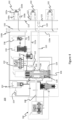
- Figure 4 shows a schematic view of an example fuel staging system 100 which may form part of the combustion equipment 16 of the gas turbine engine 10.
- the fuel staging system 100 comprises a plurality of fuel injectors 102 which are configured to mix fuel with air, and to inject the fuel-air mixture into a combustion chamber for combustion.
- Each fuel injector 102 comprises a mains burner 102a and a pilot burner 102b.
- the staging unit 100 comprises a fuel flow splitting valve 106 which receives fuel from a fuel source 104 via a fuel supply line 108.
- the fuel flow splitting valve 106 is configured to split the flow into a mains delivery line 110 and a pilot delivery line 112.
- the mains delivery line 110 and the pilot delivery line 112 are configured to deliver fuel to the mains burner 102a and pilot burner 102b respectively of each fuel injector 102.
- the fuel flow splitting valve 106 comprises a spool 122 which is disposed within a bore 126 of a housing 124.
- the spool 122 is movable in a longitudinal direction within the bore 126, so as to selectively expose or cover a mains outlet 128 and pilot outlet 130 to thereby permit or block fuel flow respectively through the mains outlet 128 and pilot outlet 130.
- the mains outlet 128 is connected to the mains delivery line 110 and the pilot outlet 130 is connected to the pilot delivery line 112.
- the fuel flow splitting valve 106 is configured to variably split the fuel supply between the mains delivery line 110 and the pilot delivery line 112.
- the fuel flow splitting valve 106 is configured to enable the fuel flow from the fuel supply line 108 to be split between the mains delivery line 110 and the pilot delivery line 112 in variable proportions.
- the proportions of fuel flow split into the mains delivery line 110 and the pilot delivery line 112 depend on the position of the spool 122 within the bore 126 of the housing 124.
- the staging unit 100 also comprises a fuel splitting servo valve 132 which is configured to control the movement of the spool 122, and thus the position of the spool 122 within the bore 126, to thereby control the flow of fuel into the mains delivery line 110 and the pilot delivery line 112.
- the mains delivery line 110 is connected to a mains manifold 114 which is configured to distribute the flow from the mains delivery line 110 to the mains burner 102a of each of the fuel injectors 102.
- the mains manifold 114 comprises a mains distribution line 115 extending circumferentially around the gas turbine engine, and a plurality of feed lines 117 distributed around the mains distribution line 115. Each feed line 117 is configured to feed fuel from the mains distribution line 115 to the mains burner 102a of a fuel injector 102.
- the pilot delivery line 112 is split into two lines 112a, 112b which are each connected to a respective pilot manifold 116a, 116b.
- the pilot manifolds 116a, 116b are configured to distribute the fuel flow from the split pilot lines 112a, 112a to the pilot burners 102b in each of the fuel injectors 102.
- splitting the pilot delivery line 112 into two lines 112a, 112b enables the system to control delivery of fuel to the pilot burner 102b of specific groups of fuel injectors 102, in order to allow preferential fuelling of certain pilot burners 102b connected to one of the two lines 112a.
- the staging unit 100 comprises a pilot fuel flow reducing valve 134 and a lean blow out fuel control valve 136 to act as a restrictor and control fuel flow into one of the split pilot lines 116b. This allows the fuel staging unit 100 to preferentially provide fuel to pilot burners 102b of specific injectors 102.
- the fuel staging system 100 comprises a check valve 120 disposed in the mains delivery line 110, upstream of the mains manifold 114.
- the check valve 120 is configured to permit the fuel to flow from the mains delivery line 110 into the mains manifold 114 if the pressure of fuel in the mains delivery line 110 exceeds a threshold delivery pressure.
- the check valve 120 is also configured to prevent any flow therethrough if the pressure in the mains delivery line 114 is below a threshold pressure, and to prevent any flow from the mains manifold 114 to the mains delivery line 110.
- Having a check valve 120 in the mains delivery line 110 enables the staging system 100 to omit check valves at each of the fuel injectors 102. This ensures that there will be no fuel maldistribution to the fuel injectors 102 which would otherwise occur in the event of a check valve at a fuel injector failing open.
- a feed line to each fuel injector should remain primed with fuel at all times by providing a check valve at each fuel injector.
- the inventors have found that fuel can be replenished downstream of a check valve in the mains delivery line sufficiently rapidly such that check valves at the individual injectors can be omitted without detrimentally affecting the performance of the engine.
- the fuel flow into the mains delivery line 110 is controlled by the position of the spool 122 in the bore 126 of the splitting valve 106. Therefore, the pressure of fuel in the mains delivery line 110 is also determined by the splitting valve 106.
- Each of the fuel injectors 102 is provided with a mains weight distributor valve 140a at the mains burner 102a and a pilot weight distributor valve 140b at the pilot burner 102b.
- the mains weight distributor valves 140a of each fuel injector 102 are together configured to evenly distribute the fuel flow to the mains burners 102a to avoid maldistribution of fuel (i.e. to ensure an equal flow of fuel into each main burner 102a).
- the pilot weight distribution valves 140b of each fuel injector 102 are together configured to evenly distribute the fuel flow in the pilot burners 102b, to avoid maldistribution of fuel (i.e. to ensure equal flow of fuel into each pilot burner 102b).
- the weight distributor valves 140 comprise a weight and a spring, wherein the weight acts either with the force from the spring or against it, depending on the orientation of the weight distributor valve 140 (i.e. depending on the orientation of the fuel injector 102 within the gas turbine engine 10).
- the orientation of the fuel injectors 102 around the gas turbine engine 10 varies depending on the circumferential position of the fuel injector 102 around the gas turbine engine 10.
- the weight distributor valves 140 comprise an opening through which fuel is permitted to flow.
- the size of the opening is variable and is determined by the combined force of the weight and the spring force of the weight distributor valve 140. Therefore, the size of the opening is dependent on the orientation of the respective weight distributor valve 140, and therefore the orientation of the respective fuel injector 102. Varying the size of the opening depending on the orientation of the fuel injector 102 can counteract effects on fuel flow rate of varying fuel head pressure around the mains distribution line 115.
- the staging system 100 comprises a balancing pressure check valve 142, which is disposed between the fuel flow splitting valve 106 and the pilot fuel flow reducing valve 134.
- the balancing pressure check valve 142 is configured to return the flow upstream to the pilot delivery line 112 if the pressure downstream of the balancing pressure check valve 142 is too high.
- the balancing pressure check valve 142 together with the pilot weight distributor valves 140 therefore controls the pressure and fuel distribution in the pilot manifolds 116a, 116b.
- the staging system 100 comprises a main cooling circuit comprising a bypass line 150 which is configured to receive fuel from the main delivery line 110 when the check valve 120 is closed.
- the fuel in the main delivery line 110 is recirculated through the bypass line 150 when the check valve 120 is closed, so as to maintain the main delivery line 110 primed.
- the bypass line 150 comprises a recirculation valve 152 which is configured to open when the check valve 120 is closed, and to close when the check valve 120 is open.
- the recirculation valve 152 is controlled to open when the spool 122 is moved in the fuel flow splitting valve 106 to prevent the supply of fuel to flow into the main delivery line 110, and is controlled to close when the spool 122 is moved in the fuel flow splitting valve 106 to permit the supply of fuel into the main delivery line 110.
- the fuel in the bypass line 150 is kept cool by the fact that it is circulated away from the fuel injectors 102, and therefore away from the main burners 102a and pilot burners 102b. It is then directed back into the mains delivery line 110.
- the fuel in the main delivery line 110 and bypass line 150 may also be cooled by air flows passing over the bypass line 150 or any other pipes in the main cooling circuit. Keeping the fuel in the main delivery line 110 and bypass line 150 cool prevents thermal degradation of the fuel.
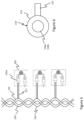
- a portion of the mains manifold 114 is in heat exchange relationship with a secondary line, as shown for example in Figures 5 and 6.
- Figure 5 shows the mains distribution line 115 of the mains manifold 114 intertwined with the bypass line 150, such that it is in heat exchange relationship with the bypass line 150.
- the mains distribution line 115 and the bypass line 150 may be helically intertwined.
- the feed lines 117 extend from the mains distribution line 115 to the mains burner 102a of the fuel injectors 102.
- the mains manifold may additionally or alternatively be in a heat exchange relationship with one or both of the pilot manifolds 116a 116b.
- Having the mains manifold 114 in heat exchange relationship with the bypass line 150 ensures that any stagnant fuel or fuel residue in the mains manifold 114 when the check valve 120 is closed, is cooled by exchange of heat with the fuel in the bypass line 150.
- the fuel to the bypass line 150 is circulating in the main cooling circuit and so continues to be cooled so as to receive heat from the mains manifold 114.
- Figure 6 shows a cross sectional view of an alternative arrangement in which the mains manifold 114 is in heat exchange relationship with a secondary line.
- a portion of one of the pilot manifolds 116a, 116b is enclosed within the mains distribution line 115 of the mains manifold 114 in a pipe-in-pipe arrangement, such that the mains manifold 114 is in heat exchange relationship with the pilot manifold 116a, 116b.
- a portion of the mains manifold may be enclosed within a portion of one or both of the pilot manifolds, or within a portion of the bypass line in a pipe-in-pipe arrangement.
- a portion of the bypass line may be enclosed within a portion of the mains manifold in a pipe-in-pipe arrangement.
- check valve 120 is disposed in the main delivery line 110, in some examples, there may be two or more check valves 120 disposed in the main delivery line 110 to provide redundancy, in the event that one of the check valves 120 fails open.
Landscapes
- Engineering & Computer Science (AREA)
- Chemical & Material Sciences (AREA)
- Combustion & Propulsion (AREA)
- Mechanical Engineering (AREA)
- General Engineering & Computer Science (AREA)
- Structures Of Non-Positive Displacement Pumps (AREA)
- Fuel-Injection Apparatus (AREA)
Description
- The present disclosure relates to a fuel staging system for a gas turbine engine, and a gas turbine engine having the fuel staging system.
- Fuel staging systems in gas turbine engines are used to distribute fuel to mains burners and pilot burners of a plurality of fuel injectors within a gas turbine engine. The fuel injectors are for injecting fuel and air into a combustion chamber of a gas turbine engine for burning. A fuel staging system may be used to control the amount of fuel and air injected by the fuel injectors in order to reduce emissions.
-
EP 1553344 A2 discloses a fuel staging system for a gas turbine engine which comprises a fuel metering unit having a fuel metering valve which is controlled to meter the flow in use, and a fuel staging unit which receives fuel from the fuel metering valve. The staging unit supplies fuel to the pilot and main burners. -
US 2018/163636 A1 discloses a fuel supply system that includes a metering unit having a piston. The metering unit is further connected to a fuel distribution valve for the main and pilot burner. - According to a first aspect, there is provided a fuel staging system for a gas turbine engine the fuel staging system having the features of claim 1.
- The check valve may close when the pressure of fuel in the main delivery line is below the threshold pressure to prevent any flow. The check valve may close to prevent flow of fuel from the mains manifold to the mains delivery line. There may be no check valve provided at each of the fuel injectors.
- The fuel staging system may comprise a splitter valve for splitting a fuel supply between the mains delivery line and a pilot delivery line. The plurality of fuel injectors may each comprise a pilot burner which is configured to receive fuel through the pilot delivery line. The splitter valve may be configured to variably split the fuel supply between the mains delivery line and the pilot delivery line.
- The fuel staging system may comprise a pilot manifold connected to the pilot delivery line and configured to distribute fuel from the pilot delivery line to the pilot burner of each of the plurality of injectors.
- The mains manifold is in heat exchange relationship with a secondary fuel line. The mains manifold may comprise a common mains distribution line, and a plurality of feed lines which are configured to direct fuel to the mains burner of each of the fuel injectors. The common mains distribution line may be in heat exchange relationship with the secondary fuel line.
- The fuel staging system may comprise a pipe-in-pipe arrangement in which a portion of the mains manifold is in heat exchange relationship with a portion of a secondary fuel line. The expression pipe-in-pipe arrangement is intended to mean that a portion of the mains manifold is disposed within the portion of the secondary fuel line or vice versa.
- Each fuel injector may be provided with a weight distribution valve at the main burner, the weight distribution valve having a variable size opening, through which fuel is permitted to flow. The size of the opening may be a function of the orientation of the fuel injector within the gas turbine engine. The plurality of weight distribution valves may be configured to counteract effects on flow rate of a fuel head pressure through the respective fuel injectors which varies around a gas turbine engine.
- Each fuel injector may be provided with a weight distributor valve at the pilot burner.
- The fuel staging system may comprise a further check valve disposed in the main delivery line upstream of the mains manifold.
- The fuel staging system comprises a bypass line forming part of a main cooling circuit. The bypass line is configured to receive fuel from the main delivery line when the check valve is closed and recirculate the fuel back into the main delivery line.
- The secondary fuel line may be a portion of the pilot delivery line. The secondary fuel line may be a portion of the bypass line.
- According to a second aspect, there is provided a gas turbine engine for an aircraft, the gas turbine engine comprising a fuel staging system according to the first aspect.
- As noted elsewhere herein, the present disclosure may relate to a gas turbine engine. Such a gas turbine engine may comprise an engine core comprising a turbine, a combustor, a compressor, and a core shaft connecting the turbine to the compressor. Such a gas turbine engine may comprise a fan (having fan blades) located upstream of the engine core.
- Embodiments will now be described by way of example only, with reference to the Figures, in which:
-
Figure 1 is a sectional side view of a gas turbine engine; -
Figure 2 is a close up sectional side view of an upstream portion of a gas turbine engine; -
Figure 3 is a partially cut-away view of a gearbox for a gas turbine engine; -
Figure 4 shows a schematic view of an example fuel staging system; and -
Figures 5 and 6 schematically show examples of a mains manifold of the fuel staging system in heat exchange relationship with a secondary line of the fuel staging system. -
Figure 1 illustrates agas turbine engine 10 having a principalrotational axis 9. Theengine 10 comprises anair intake 12 and apropulsive fan 23 that generates two airflows: a core airflow A and a bypass airflow B. Thegas turbine engine 10 comprises acore 11 that receives the core airflow A. Theengine core 11 comprises, in axial flow series, alow pressure compressor 14, a high-pressure compressor 15,combustion equipment 16, a high-pressure turbine 17, alow pressure turbine 19 and acore exhaust nozzle 20. Anacelle 21 surrounds thegas turbine engine 10 and defines abypass duct 22 and abypass exhaust nozzle 18. The bypass airflow B flows through thebypass duct 22. Thefan 23 is attached to and driven by thelow pressure turbine 19 via ashaft 26 and anepicyclic gearbox 30. - In use, the core airflow A is accelerated and compressed by the
low pressure compressor 14 and directed into thehigh pressure compressor 15 where further compression takes place. The compressed air exhausted from thehigh pressure compressor 15 is directed into thecombustion equipment 16 where it is mixed with fuel and the mixture is combusted. The resultant hot combustion products then expand through, and thereby drive, the high pressure andlow pressure turbines core exhaust nozzle 20 to provide some propulsive thrust. Thehigh pressure turbine 17 drives thehigh pressure compressor 15 by a suitable interconnectingshaft 27. Thefan 23 generally provides the majority of the propulsive thrust. Theepicyclic gearbox 30 is a reduction gearbox. - An exemplary arrangement for a geared fan
gas turbine engine 10 is shown inFigure 2 . The low pressure turbine 19 (seeFigure 1 ) drives theshaft 26, which is coupled to a sun wheel, or sun gear, 28 of theepicyclic gear arrangement 30. Radially outwardly of thesun gear 28 and intermeshing therewith is a plurality ofplanet gears 32 that are coupled together by aplanet carrier 34. Theplanet carrier 34 constrains theplanet gears 32 to precess around thesun gear 28 in synchronicity whilst enabling eachplanet gear 32 to rotate about its own axis. Theplanet carrier 34 is coupled vialinkages 36 to thefan 23 in order to drive its rotation about theengine axis 9. Radially outwardly of theplanet gears 32 and intermeshing therewith is an annulus orring gear 38 that is coupled, vialinkages 40, to a stationary supportingstructure 24. - Note that the terms "low pressure turbine" and "low pressure compressor" as used herein may be taken to mean the lowest pressure turbine stages and lowest pressure compressor stages (i.e. not including the fan 23) respectively and/or the turbine and compressor stages that are connected together by the interconnecting
shaft 26 with the lowest rotational speed in the engine (i.e. not including the gearbox output shaft that drives the fan 23). In some literature, the "low pressure turbine" and "low pressure compressor" referred to herein may alternatively be known as the "intermediate pressure turbine" and "intermediate pressure compressor". Where such alternative nomenclature is used, thefan 23 may be referred to as a first, or lowest pressure, compression stage. - The
epicyclic gearbox 30 is shown by way of example in greater detail inFigure 3 . Each of thesun gear 28, planet gears 32 andring gear 38 comprise teeth about their periphery to intermesh with the other gears. However, for clarity only exemplary portions of the teeth are illustrated inFigure 3 . There are fourplanet gears 32 illustrated, although it will be apparent to the skilled reader that more or fewer planet gears 32 may be provided within the scope of the claimed invention. Practical applications of a planetaryepicyclic gearbox 30 generally comprise at least three planet gears 32. - The
epicyclic gearbox 30 illustrated by way of example inFigures 2 and3 is of the planetary type, in that theplanet carrier 34 is coupled to an output shaft vialinkages 36, with thering gear 38 fixed. However, any other suitable type ofepicyclic gearbox 30 may be used. By way of further example, theepicyclic gearbox 30 may be a star arrangement, in which theplanet carrier 34 is held fixed, with the ring (or annulus)gear 38 allowed to rotate. In such an arrangement thefan 23 is driven by thering gear 38. By way of further alternative example, thegearbox 30 may be a differential gearbox in which thering gear 38 and theplanet carrier 34 are both allowed to rotate. - It will be appreciated that the arrangement shown in
Figures 2 and3 is by way of example only, and various alternatives are within the scope of the present disclosure. Purely by way of example, any suitable arrangement may be used for locating thegearbox 30 in theengine 10 and/or for connecting thegearbox 30 to theengine 10. By way of further example, the connections (such as thelinkages Figure 2 example) between thegearbox 30 and other parts of the engine 10 (such as theinput shaft 26, the output shaft and the fixed structure 24) may have any desired degree of stiffness or flexibility. By way of further example, any suitable arrangement of the bearings between rotating and stationary parts of the engine (for example between the input and output shafts from the gearbox and the fixed structures, such as the gearbox casing) may be used, and the disclosure is not limited to the exemplary arrangement ofFigure 2 . For example, where thegearbox 30 has a star arrangement (described above), the skilled person would readily understand that the arrangement of output and support linkages and bearing locations would typically be different to that shown by way of example inFigure 2 . - Accordingly, the present disclosure extends to a gas turbine engine having any arrangement of gearbox styles (for example star or planetary), support structures, input and output shaft arrangement, and bearing locations.
- Optionally, the gearbox may drive additional and/or alternative components (e.g. the intermediate pressure compressor and/or a booster compressor).
- Other gas turbine engines to which the present disclosure may be applied may have alternative configurations. For example, such engines may have an alternative number of compressors and/or turbines and/or an alternative number of interconnecting shafts. By way of further example, the gas turbine engine shown in
Figure 1 has asplit flow nozzle bypass duct 22 has itsown nozzle 18 that is separate to and radially outside thecore exhaust nozzle 20. However, this is not limiting, and any aspect of the present disclosure may also apply to engines in which the flow through thebypass duct 22 and the flow through the core 11 are mixed, or combined, before (or upstream of) a single nozzle, which may be referred to as a mixed flow nozzle. One or both nozzles (whether mixed or split flow) may have a fixed or variable area. Whilst the described example relates to a turbofan engine, the disclosure may apply, for example, to any type of gas turbine engine, such as an open rotor (in which the fan stage is not surrounded by a nacelle) or turboprop engine, for example. In some arrangements, thegas turbine engine 10 may not comprise agearbox 30. - The geometry of the
gas turbine engine 10, and components thereof, is defined by a conventional axis system, comprising an axial direction (which is aligned with the rotational axis 9), a radial direction (in the bottom-to-top direction inFigure 1 ), and a circumferential direction (perpendicular to the page in theFigure 1 view). The axial, radial and circumferential directions are mutually perpendicular. -
Figure 4 shows a schematic view of an examplefuel staging system 100 which may form part of thecombustion equipment 16 of thegas turbine engine 10. - The
fuel staging system 100 comprises a plurality offuel injectors 102 which are configured to mix fuel with air, and to inject the fuel-air mixture into a combustion chamber for combustion. Eachfuel injector 102 comprises amains burner 102a and apilot burner 102b. - The
staging unit 100 comprises a fuelflow splitting valve 106 which receives fuel from afuel source 104 via afuel supply line 108. The fuelflow splitting valve 106 is configured to split the flow into amains delivery line 110 and apilot delivery line 112. Themains delivery line 110 and thepilot delivery line 112 are configured to deliver fuel to themains burner 102a andpilot burner 102b respectively of eachfuel injector 102. - The fuel
flow splitting valve 106 comprises aspool 122 which is disposed within abore 126 of ahousing 124. Thespool 122 is movable in a longitudinal direction within thebore 126, so as to selectively expose or cover amains outlet 128 andpilot outlet 130 to thereby permit or block fuel flow respectively through themains outlet 128 andpilot outlet 130. Themains outlet 128 is connected to themains delivery line 110 and thepilot outlet 130 is connected to thepilot delivery line 112. - The fuel
flow splitting valve 106 is configured to variably split the fuel supply between themains delivery line 110 and thepilot delivery line 112. In other words, the fuelflow splitting valve 106 is configured to enable the fuel flow from thefuel supply line 108 to be split between themains delivery line 110 and thepilot delivery line 112 in variable proportions. In this example, the proportions of fuel flow split into themains delivery line 110 and thepilot delivery line 112 depend on the position of thespool 122 within thebore 126 of thehousing 124. - In this example, the
staging unit 100 also comprises a fuelsplitting servo valve 132 which is configured to control the movement of thespool 122, and thus the position of thespool 122 within thebore 126, to thereby control the flow of fuel into themains delivery line 110 and thepilot delivery line 112. - The
mains delivery line 110 is connected to a mains manifold 114 which is configured to distribute the flow from themains delivery line 110 to themains burner 102a of each of thefuel injectors 102. The mains manifold 114 comprises amains distribution line 115 extending circumferentially around the gas turbine engine, and a plurality offeed lines 117 distributed around themains distribution line 115. Eachfeed line 117 is configured to feed fuel from themains distribution line 115 to themains burner 102a of afuel injector 102. - In this example, the
pilot delivery line 112 is split into twolines 112a, 112b which are each connected to arespective pilot manifold pilot manifolds pilot burners 102b in each of thefuel injectors 102. In some examples, there may be only one pilot delivery line which is connected to a pilot manifold. - Splitting the
pilot delivery line 112 into twolines 112a, 112b enables the system to control delivery of fuel to thepilot burner 102b of specific groups offuel injectors 102, in order to allow preferential fuelling ofcertain pilot burners 102b connected to one of the two lines 112a. - The
staging unit 100 comprises a pilot fuelflow reducing valve 134 and a lean blow outfuel control valve 136 to act as a restrictor and control fuel flow into one of thesplit pilot lines 116b. This allows thefuel staging unit 100 to preferentially provide fuel to pilotburners 102b ofspecific injectors 102. - The
fuel staging system 100 comprises acheck valve 120 disposed in themains delivery line 110, upstream of themains manifold 114. Thecheck valve 120 is configured to permit the fuel to flow from themains delivery line 110 into the mains manifold 114 if the pressure of fuel in themains delivery line 110 exceeds a threshold delivery pressure. Thecheck valve 120 is also configured to prevent any flow therethrough if the pressure in themains delivery line 114 is below a threshold pressure, and to prevent any flow from the mains manifold 114 to themains delivery line 110. - Having a
check valve 120 in themains delivery line 110 enables thestaging system 100 to omit check valves at each of thefuel injectors 102. This ensures that there will be no fuel maldistribution to thefuel injectors 102 which would otherwise occur in the event of a check valve at a fuel injector failing open. In the design of previously-considered fuel staging systems, it was believed that a feed line to each fuel injector should remain primed with fuel at all times by providing a check valve at each fuel injector. However, the inventors have found that fuel can be replenished downstream of a check valve in the mains delivery line sufficiently rapidly such that check valves at the individual injectors can be omitted without detrimentally affecting the performance of the engine. - As explained above, the fuel flow into the
mains delivery line 110 is controlled by the position of thespool 122 in thebore 126 of the splittingvalve 106. Therefore, the pressure of fuel in themains delivery line 110 is also determined by the splittingvalve 106. - Each of the
fuel injectors 102 is provided with a mainsweight distributor valve 140a at themains burner 102a and a pilotweight distributor valve 140b at thepilot burner 102b. The mainsweight distributor valves 140a of eachfuel injector 102 are together configured to evenly distribute the fuel flow to themains burners 102a to avoid maldistribution of fuel (i.e. to ensure an equal flow of fuel into eachmain burner 102a). The pilotweight distribution valves 140b of eachfuel injector 102 are together configured to evenly distribute the fuel flow in thepilot burners 102b, to avoid maldistribution of fuel (i.e. to ensure equal flow of fuel into eachpilot burner 102b). - The weight distributor valves 140 comprise a weight and a spring, wherein the weight acts either with the force from the spring or against it, depending on the orientation of the weight distributor valve 140 (i.e. depending on the orientation of the
fuel injector 102 within the gas turbine engine 10). The orientation of thefuel injectors 102 around thegas turbine engine 10 varies depending on the circumferential position of thefuel injector 102 around thegas turbine engine 10. - The weight distributor valves 140 comprise an opening through which fuel is permitted to flow. The size of the opening is variable and is determined by the combined force of the weight and the spring force of the weight distributor valve 140. Therefore, the size of the opening is dependent on the orientation of the respective weight distributor valve 140, and therefore the orientation of the
respective fuel injector 102. Varying the size of the opening depending on the orientation of thefuel injector 102 can counteract effects on fuel flow rate of varying fuel head pressure around themains distribution line 115. - The
staging system 100 comprises a balancingpressure check valve 142, which is disposed between the fuelflow splitting valve 106 and the pilot fuelflow reducing valve 134. The balancingpressure check valve 142 is configured to return the flow upstream to thepilot delivery line 112 if the pressure downstream of the balancingpressure check valve 142 is too high. The balancingpressure check valve 142 together with the pilot weight distributor valves 140 therefore controls the pressure and fuel distribution in thepilot manifolds - The
staging system 100 comprises a main cooling circuit comprising abypass line 150 which is configured to receive fuel from themain delivery line 110 when thecheck valve 120 is closed. The fuel in themain delivery line 110 is recirculated through thebypass line 150 when thecheck valve 120 is closed, so as to maintain themain delivery line 110 primed. - The
bypass line 150 comprises arecirculation valve 152 which is configured to open when thecheck valve 120 is closed, and to close when thecheck valve 120 is open. In this example, therecirculation valve 152 is controlled to open when thespool 122 is moved in the fuelflow splitting valve 106 to prevent the supply of fuel to flow into themain delivery line 110, and is controlled to close when thespool 122 is moved in the fuelflow splitting valve 106 to permit the supply of fuel into themain delivery line 110. - When the
recirculation valve 152 is opened, flow is permitted through therecirculation valve 152 and acheck valve 154. The fuel in thebypass line 150 is kept cool by the fact that it is circulated away from thefuel injectors 102, and therefore away from themain burners 102a andpilot burners 102b. It is then directed back into themains delivery line 110. The fuel in themain delivery line 110 andbypass line 150 may also be cooled by air flows passing over thebypass line 150 or any other pipes in the main cooling circuit. Keeping the fuel in themain delivery line 110 andbypass line 150 cool prevents thermal degradation of the fuel. - In this example, a portion of the mains manifold 114 is in heat exchange relationship with a secondary line, as shown for example in
Figures 5 and 6. Figure 5 shows themains distribution line 115 of the mains manifold 114 intertwined with thebypass line 150, such that it is in heat exchange relationship with thebypass line 150. Themains distribution line 115 and thebypass line 150 may be helically intertwined. The feed lines 117 extend from themains distribution line 115 to themains burner 102a of thefuel injectors 102. In other examples, the mains manifold may additionally or alternatively be in a heat exchange relationship with one or both of thepilot manifolds 116a 116b. - Having the mains manifold 114 in heat exchange relationship with the
bypass line 150 ensures that any stagnant fuel or fuel residue in the mains manifold 114 when thecheck valve 120 is closed, is cooled by exchange of heat with the fuel in thebypass line 150. The fuel to thebypass line 150 is circulating in the main cooling circuit and so continues to be cooled so as to receive heat from themains manifold 114. -
Figure 6 shows a cross sectional view of an alternative arrangement in which the mains manifold 114 is in heat exchange relationship with a secondary line. In this example, a portion of one of thepilot manifolds mains distribution line 115 of the mains manifold 114 in a pipe-in-pipe arrangement, such that the mains manifold 114 is in heat exchange relationship with thepilot manifold - Although it has been described that a
single check valve 120 is disposed in themain delivery line 110, in some examples, there may be two ormore check valves 120 disposed in themain delivery line 110 to provide redundancy, in the event that one of thecheck valves 120 fails open. - It will be understood that the invention is not limited to the embodiments above-described and various modifications and improvements can be made without departing from the concepts described provided they fall within the scope of the appended claims.
Claims (12)
- A fuel staging system (100) for a gas turbine engine, the fuel staging system comprising:a plurality of fuel injectors (102) each comprising a mains burner (102a);a mains manifold (114) connected to a mains delivery line (110) and configured to distribute fuel from the mains delivery line (110) to the mains burner (102a) of each of the plurality of fuel injectors (102); anda check valve (120) disposed in the mains delivery line (110) upstream of the mains manifold (114), the check valve (120) being configured to permit flow of fuel from the mains delivery line (110) to the mains manifold (114) when the pressure of fuel in the mains delivery line (110) exceeds a threshold pressure;the fuel staging system (100) being characterised in that the mains manifold (114) is in heat exchange relationship with a secondary fuel line; and the fuel staging system further comprising a bypass line (150) forming part of a main cooling circuit, wherein the bypass line is configured to receive fuel from the main delivery line (110) when the check valve (120) is closed and recirculate the fuel back into the main delivery line.
- The fuel staging system according to claim 1, further comprising a splitter valve for splitting a fuel supply between the mains delivery line (110) and a pilot delivery line (112); wherein the plurality of fuel injectors (102) each comprise a pilot burner (102b) which is configured to receive fuel through the pilot delivery line (112).
- The fuel staging system according to claim 2, wherein the splitter valve is configured to variably split the fuel supply between the mains delivery line (110) and the pilot delivery line (112).
- The fuel staging system according to claim 2 or 3, further comprising a pilot manifold connected to the pilot delivery line (112) and configured to distribute fuel from the pilot delivery line (112) to the pilot burner (102b) of each of the plurality of injectors.
- The fuel staging system according to claim 1, wherein the mains manifold (114) comprises a common mains distribution line (115), and a plurality of feed lines (117) which are configured to direct fuel to the mains burner (102a) of each of the fuel injectors (102), wherein the common mains distribution line (115) is in heat exchange relationship with the secondary fuel line.
- The fuel staging system according to claim 1 or 5, further comprising a pipe-in-pipe arrangement in which a portion of the mains manifold (114) is in heat exchange relationship with a portion of a secondary fuel line.
- The fuel staging system according to claim 5 or 6 when dependent on claim 4, wherein the secondary fuel line is a portion of the pilot delivery line (112).
- The fuel staging system according to any one of the preceding claims, wherein each fuel injector (102) is provided with a weight distribution valve (140) at the main burner, the weight distribution valve (140) having a variable size opening, through which fuel is permitted to flow;
wherein the size of the opening is a function of the orientation of the fuel injector within the gas turbine engine; whereby the plurality of weight distribution valves (140) are configured to counteract effects on flow rate of a fuel head pressure through the respective fuel injectors (102) which varies around a gas turbine engine (10). - The fuel staging system according to claim 4 or 8, wherein each fuel injector (102) is provided with a weight distributor valve (140) at the pilot burner (102b).
- The fuel staging system according to any one of the preceding claims, further comprising a further check valve disposed in the main delivery line (110) upstream of the mains manifold (114).
- The fuel staging system according to any one of claims 5 to 7, wherein the secondary fuel line is a portion of the bypass line (150).
- A gas turbine engine (10) for an aircraft, the gas turbine engine comprising a fuel staging system (100) according to any one of the preceding claims.
Applications Claiming Priority (1)
| Application Number | Priority Date | Filing Date | Title |
|---|---|---|---|
| GBGB1909169.3A GB201909169D0 (en) | 2019-06-26 | 2019-06-26 | A fuel staging system |
Publications (2)
| Publication Number | Publication Date |
|---|---|
| EP3757371A1 EP3757371A1 (en) | 2020-12-30 |
| EP3757371B1 true EP3757371B1 (en) | 2024-11-20 |
Family
ID=67511729
Family Applications (1)
| Application Number | Title | Priority Date | Filing Date |
|---|---|---|---|
| EP20180029.9A Active EP3757371B1 (en) | 2019-06-26 | 2020-06-15 | A fuel staging system for a gas turbine engine |
Country Status (3)
| Country | Link |
|---|---|
| US (1) | US11371439B2 (en) |
| EP (1) | EP3757371B1 (en) |
| GB (1) | GB201909169D0 (en) |
Families Citing this family (13)
| Publication number | Priority date | Publication date | Assignee | Title |
|---|---|---|---|---|
| GB201903261D0 (en) | 2019-03-11 | 2019-04-24 | Rolls Royce Plc | Efficient gas turbine engine installation and operation |
| GB201903257D0 (en) | 2019-03-11 | 2019-04-24 | Rolls Royce Plc | Efficient gas turbine engine installation and operation |
| GB201903262D0 (en) | 2019-03-11 | 2019-04-24 | Rolls Royce Plc | Efficient gas turbine engine installation and operation |
| US11970977B2 (en) * | 2022-08-26 | 2024-04-30 | Hamilton Sundstrand Corporation | Variable restriction of a secondary circuit of a fuel injector |
| US12270343B2 (en) | 2022-08-26 | 2025-04-08 | Collins Engine Nozzles, Inc. | Proportional restriction of fuel nozzle with an auxiliary circuit |
| US12286931B2 (en) | 2022-08-26 | 2025-04-29 | Collins Engine Nozzles, Inc. | Variable restriction of a fuel circuit of a fuel nozzle |
| US12454915B2 (en) | 2022-08-26 | 2025-10-28 | Hamilton Sundstrand Corporation | Force modification of passive valve spools for control of nozzles |
| US12313004B2 (en) | 2022-08-26 | 2025-05-27 | Collins Engine Nozzles, Inc. | Proportional force modification of passive spool for control of secondary nozzle circuits |
| US11913381B1 (en) | 2022-08-26 | 2024-02-27 | Hamilton Sundstrand Corporation | Force modification of passive spool for control of secondary nozzle circuits |
| US12305581B2 (en) | 2022-08-26 | 2025-05-20 | Collins Engine Nozzles, Inc. | Proportional restriction of a secondary circuit of a fuel injector |
| US11970976B2 (en) * | 2022-08-26 | 2024-04-30 | Hamilton Sundstrand Corporation | Variable restriction of fuel nozzle with an auxiliary circuit |
| US11913382B1 (en) | 2022-08-26 | 2024-02-27 | Hamilton Sundstrand Corporation | Variable restriction of a fuel circuit of a fuel nozzle |
| US20250044816A1 (en) * | 2023-07-31 | 2025-02-06 | Hamilton Sundstrand Corporation | Valve systems |
Citations (1)
| Publication number | Priority date | Publication date | Assignee | Title |
|---|---|---|---|---|
| US9874351B2 (en) * | 2015-04-14 | 2018-01-23 | General Electric Company | Thermally-coupled fuel manifold |
Family Cites Families (12)
| Publication number | Priority date | Publication date | Assignee | Title |
|---|---|---|---|---|
| US4041695A (en) * | 1975-11-21 | 1977-08-16 | The Garrett Corporation | Fuel system pneumatic purge apparatus and method |
| US5167122A (en) * | 1991-04-30 | 1992-12-01 | Sundstrand Corporation | Fuel system for a turbo machine |
| GB0329626D0 (en) * | 2003-12-23 | 2004-01-28 | Goodrich Control Sys Ltd | Fuel system |
| US8127524B2 (en) | 2007-01-10 | 2012-03-06 | Hamilton Sundstrand Corporation | Gas turbine fuel metering unit |
| EP2469057B1 (en) * | 2010-12-22 | 2013-11-13 | Rolls-Royce Engine Control Systems Ltd | Fuel staging system |
| US8567201B2 (en) * | 2011-06-28 | 2013-10-29 | Triumph Engine Control Systems, Llc | Ecology system for draining the manifold of a gas turbine engine |
| FR3017416B1 (en) * | 2014-02-12 | 2018-12-07 | Safran Aircraft Engines | COOLING A MAIN CHANNEL IN A FUEL SYSTEM WITH MULTIPOINT INJECTION |
| GB201604379D0 (en) * | 2016-03-15 | 2016-04-27 | Rolls Royce Plc | A combustion chamber system and a method of operating a combustion chamber system |
| GB2557603B (en) | 2016-12-09 | 2020-01-15 | Rolls Royce Plc | Fuel supply system |
| GB2557599B (en) * | 2016-12-09 | 2019-05-15 | Rolls Royce Plc | Gas turbine engine fuel supply system having de-priming and re-priming sub-systems |
| GB2563659B (en) | 2017-06-23 | 2019-10-02 | Rolls Royce Plc | Combustion staging system for fuel injectors of a gas turbine engine |
| GB2563656B (en) | 2017-06-23 | 2019-09-18 | Rolls Royce Plc | Combustion staging system for fuel injectors of a gas turbine engine |
-
2019
- 2019-06-26 GB GBGB1909169.3A patent/GB201909169D0/en not_active Ceased
-
2020
- 2020-06-15 EP EP20180029.9A patent/EP3757371B1/en active Active
- 2020-06-16 US US16/902,433 patent/US11371439B2/en active Active
Patent Citations (1)
| Publication number | Priority date | Publication date | Assignee | Title |
|---|---|---|---|---|
| US9874351B2 (en) * | 2015-04-14 | 2018-01-23 | General Electric Company | Thermally-coupled fuel manifold |
Also Published As
| Publication number | Publication date |
|---|---|
| US11371439B2 (en) | 2022-06-28 |
| EP3757371A1 (en) | 2020-12-30 |
| US20210017908A1 (en) | 2021-01-21 |
| GB201909169D0 (en) | 2019-08-07 |
Similar Documents
| Publication | Publication Date | Title |
|---|---|---|
| EP3757371B1 (en) | A fuel staging system for a gas turbine engine | |
| US11215121B2 (en) | Fuel spray nozzle | |
| US10669940B2 (en) | Gas turbine engine with intercooled cooling air and turbine drive | |
| EP3767091B1 (en) | Combustion staging system | |
| US12078109B2 (en) | Fuel management system | |
| US20120304660A1 (en) | Turbomachine combustors having different flow paths | |
| US20230279813A1 (en) | Fuel management system | |
| US20240210039A1 (en) | Combustor re-light procedure | |
| US20240209800A1 (en) | Aircraft fuel system | |
| US20230015929A1 (en) | Lean burn injector with supply line switching | |
| US20250327424A1 (en) | Staged combustor | |
| US12292197B2 (en) | Fuel spray nozzle | |
| US20260043352A1 (en) | Gas turbine performance | |
| US20240209801A1 (en) | Gas turbine operation | |
| EP4063632B1 (en) | Burner head | |
| US12158115B2 (en) | Gas turbine engine heat exchange | |
| GB2626855A (en) | Fuel oil heat exchange | |
| GB2626082A (en) | A method of operating a gas turbine engine | |
| GB2625923A (en) | A fuelling system | |
| GB2625924A (en) | Management of fuel |
Legal Events
| Date | Code | Title | Description |
|---|---|---|---|
| PUAI | Public reference made under article 153(3) epc to a published international application that has entered the european phase |
Free format text: ORIGINAL CODE: 0009012 |
|
| STAA | Information on the status of an ep patent application or granted ep patent |
Free format text: STATUS: THE APPLICATION HAS BEEN PUBLISHED |
|
| AK | Designated contracting states |
Kind code of ref document: A1 Designated state(s): AL AT BE BG CH CY CZ DE DK EE ES FI FR GB GR HR HU IE IS IT LI LT LU LV MC MK MT NL NO PL PT RO RS SE SI SK SM TR |
|
| AX | Request for extension of the european patent |
Extension state: BA ME |
|
| STAA | Information on the status of an ep patent application or granted ep patent |
Free format text: STATUS: REQUEST FOR EXAMINATION WAS MADE |
|
| 17P | Request for examination filed |
Effective date: 20210625 |
|
| RBV | Designated contracting states (corrected) |
Designated state(s): AL AT BE BG CH CY CZ DE DK EE ES FI FR GB GR HR HU IE IS IT LI LT LU LV MC MK MT NL NO PL PT RO RS SE SI SK SM TR |
|
| STAA | Information on the status of an ep patent application or granted ep patent |
Free format text: STATUS: EXAMINATION IS IN PROGRESS |
|
| 17Q | First examination report despatched |
Effective date: 20221219 |
|
| GRAP | Despatch of communication of intention to grant a patent |
Free format text: ORIGINAL CODE: EPIDOSNIGR1 |
|
| STAA | Information on the status of an ep patent application or granted ep patent |
Free format text: STATUS: GRANT OF PATENT IS INTENDED |
|
| GRAJ | Information related to disapproval of communication of intention to grant by the applicant or resumption of examination proceedings by the epo deleted |
Free format text: ORIGINAL CODE: EPIDOSDIGR1 |
|
| STAA | Information on the status of an ep patent application or granted ep patent |
Free format text: STATUS: EXAMINATION IS IN PROGRESS |
|
| INTG | Intention to grant announced |
Effective date: 20240715 |
|
| INTC | Intention to grant announced (deleted) | ||
| GRAP | Despatch of communication of intention to grant a patent |
Free format text: ORIGINAL CODE: EPIDOSNIGR1 |
|
| STAA | Information on the status of an ep patent application or granted ep patent |
Free format text: STATUS: GRANT OF PATENT IS INTENDED |
|
| GRAS | Grant fee paid |
Free format text: ORIGINAL CODE: EPIDOSNIGR3 |
|
| GRAA | (expected) grant |
Free format text: ORIGINAL CODE: 0009210 |
|
| STAA | Information on the status of an ep patent application or granted ep patent |
Free format text: STATUS: THE PATENT HAS BEEN GRANTED |
|
| INTG | Intention to grant announced |
Effective date: 20240923 |
|
| P01 | Opt-out of the competence of the unified patent court (upc) registered |
Free format text: CASE NUMBER: APP_54058/2024 Effective date: 20240930 |
|
| AK | Designated contracting states |
Kind code of ref document: B1 Designated state(s): AL AT BE BG CH CY CZ DE DK EE ES FI FR GB GR HR HU IE IS IT LI LT LU LV MC MK MT NL NO PL PT RO RS SE SI SK SM TR |
|
| REG | Reference to a national code |
Ref country code: GB Ref legal event code: FG4D |
|
| REG | Reference to a national code |
Ref country code: CH Ref legal event code: EP |
|
| REG | Reference to a national code |
Ref country code: DE Ref legal event code: R096 Ref document number: 602020041550 Country of ref document: DE |
|
| REG | Reference to a national code |
Ref country code: IE Ref legal event code: FG4D |
|
| REG | Reference to a national code |
Ref country code: LT Ref legal event code: MG9D |
|
| REG | Reference to a national code |
Ref country code: NL Ref legal event code: MP Effective date: 20241120 |
|
| PG25 | Lapsed in a contracting state [announced via postgrant information from national office to epo] |
Ref country code: IS Free format text: LAPSE BECAUSE OF FAILURE TO SUBMIT A TRANSLATION OF THE DESCRIPTION OR TO PAY THE FEE WITHIN THE PRESCRIBED TIME-LIMIT Effective date: 20250320 Ref country code: PT Free format text: LAPSE BECAUSE OF FAILURE TO SUBMIT A TRANSLATION OF THE DESCRIPTION OR TO PAY THE FEE WITHIN THE PRESCRIBED TIME-LIMIT Effective date: 20250320 Ref country code: HR Free format text: LAPSE BECAUSE OF FAILURE TO SUBMIT A TRANSLATION OF THE DESCRIPTION OR TO PAY THE FEE WITHIN THE PRESCRIBED TIME-LIMIT Effective date: 20241120 |
|
| PG25 | Lapsed in a contracting state [announced via postgrant information from national office to epo] |
Ref country code: FI Free format text: LAPSE BECAUSE OF FAILURE TO SUBMIT A TRANSLATION OF THE DESCRIPTION OR TO PAY THE FEE WITHIN THE PRESCRIBED TIME-LIMIT Effective date: 20241120 Ref country code: NL Free format text: LAPSE BECAUSE OF FAILURE TO SUBMIT A TRANSLATION OF THE DESCRIPTION OR TO PAY THE FEE WITHIN THE PRESCRIBED TIME-LIMIT Effective date: 20241120 |
|
| REG | Reference to a national code |
Ref country code: AT Ref legal event code: MK05 Ref document number: 1743772 Country of ref document: AT Kind code of ref document: T Effective date: 20241120 |
|
| PG25 | Lapsed in a contracting state [announced via postgrant information from national office to epo] |
Ref country code: BG Free format text: LAPSE BECAUSE OF FAILURE TO SUBMIT A TRANSLATION OF THE DESCRIPTION OR TO PAY THE FEE WITHIN THE PRESCRIBED TIME-LIMIT Effective date: 20241120 |
|
| PG25 | Lapsed in a contracting state [announced via postgrant information from national office to epo] |
Ref country code: ES Free format text: LAPSE BECAUSE OF FAILURE TO SUBMIT A TRANSLATION OF THE DESCRIPTION OR TO PAY THE FEE WITHIN THE PRESCRIBED TIME-LIMIT Effective date: 20241120 |
|
| PG25 | Lapsed in a contracting state [announced via postgrant information from national office to epo] |
Ref country code: NO Free format text: LAPSE BECAUSE OF FAILURE TO SUBMIT A TRANSLATION OF THE DESCRIPTION OR TO PAY THE FEE WITHIN THE PRESCRIBED TIME-LIMIT Effective date: 20250220 |
|
| PG25 | Lapsed in a contracting state [announced via postgrant information from national office to epo] |
Ref country code: LV Free format text: LAPSE BECAUSE OF FAILURE TO SUBMIT A TRANSLATION OF THE DESCRIPTION OR TO PAY THE FEE WITHIN THE PRESCRIBED TIME-LIMIT Effective date: 20241120 Ref country code: GR Free format text: LAPSE BECAUSE OF FAILURE TO SUBMIT A TRANSLATION OF THE DESCRIPTION OR TO PAY THE FEE WITHIN THE PRESCRIBED TIME-LIMIT Effective date: 20250221 Ref country code: AT Free format text: LAPSE BECAUSE OF FAILURE TO SUBMIT A TRANSLATION OF THE DESCRIPTION OR TO PAY THE FEE WITHIN THE PRESCRIBED TIME-LIMIT Effective date: 20241120 |
|
| PG25 | Lapsed in a contracting state [announced via postgrant information from national office to epo] |
Ref country code: PL Free format text: LAPSE BECAUSE OF FAILURE TO SUBMIT A TRANSLATION OF THE DESCRIPTION OR TO PAY THE FEE WITHIN THE PRESCRIBED TIME-LIMIT Effective date: 20241120 |
|
| PG25 | Lapsed in a contracting state [announced via postgrant information from national office to epo] |
Ref country code: RS Free format text: LAPSE BECAUSE OF FAILURE TO SUBMIT A TRANSLATION OF THE DESCRIPTION OR TO PAY THE FEE WITHIN THE PRESCRIBED TIME-LIMIT Effective date: 20250220 |
|
| PG25 | Lapsed in a contracting state [announced via postgrant information from national office to epo] |
Ref country code: SM Free format text: LAPSE BECAUSE OF FAILURE TO SUBMIT A TRANSLATION OF THE DESCRIPTION OR TO PAY THE FEE WITHIN THE PRESCRIBED TIME-LIMIT Effective date: 20241120 |
|
| PGFP | Annual fee paid to national office [announced via postgrant information from national office to epo] |
Ref country code: DE Payment date: 20250626 Year of fee payment: 6 |
|
| PG25 | Lapsed in a contracting state [announced via postgrant information from national office to epo] |
Ref country code: DK Free format text: LAPSE BECAUSE OF FAILURE TO SUBMIT A TRANSLATION OF THE DESCRIPTION OR TO PAY THE FEE WITHIN THE PRESCRIBED TIME-LIMIT Effective date: 20241120 |
|
| PGFP | Annual fee paid to national office [announced via postgrant information from national office to epo] |
Ref country code: GB Payment date: 20250617 Year of fee payment: 6 |
|
| PG25 | Lapsed in a contracting state [announced via postgrant information from national office to epo] |
Ref country code: EE Free format text: LAPSE BECAUSE OF FAILURE TO SUBMIT A TRANSLATION OF THE DESCRIPTION OR TO PAY THE FEE WITHIN THE PRESCRIBED TIME-LIMIT Effective date: 20241120 |
|
| PGFP | Annual fee paid to national office [announced via postgrant information from national office to epo] |
Ref country code: FR Payment date: 20250624 Year of fee payment: 6 |
|
| PG25 | Lapsed in a contracting state [announced via postgrant information from national office to epo] |
Ref country code: RO Free format text: LAPSE BECAUSE OF FAILURE TO SUBMIT A TRANSLATION OF THE DESCRIPTION OR TO PAY THE FEE WITHIN THE PRESCRIBED TIME-LIMIT Effective date: 20241120 |
|
| PG25 | Lapsed in a contracting state [announced via postgrant information from national office to epo] |
Ref country code: SK Free format text: LAPSE BECAUSE OF FAILURE TO SUBMIT A TRANSLATION OF THE DESCRIPTION OR TO PAY THE FEE WITHIN THE PRESCRIBED TIME-LIMIT Effective date: 20241120 |
|
| PG25 | Lapsed in a contracting state [announced via postgrant information from national office to epo] |
Ref country code: CZ Free format text: LAPSE BECAUSE OF FAILURE TO SUBMIT A TRANSLATION OF THE DESCRIPTION OR TO PAY THE FEE WITHIN THE PRESCRIBED TIME-LIMIT Effective date: 20241120 |
|
| PG25 | Lapsed in a contracting state [announced via postgrant information from national office to epo] |
Ref country code: IT Free format text: LAPSE BECAUSE OF FAILURE TO SUBMIT A TRANSLATION OF THE DESCRIPTION OR TO PAY THE FEE WITHIN THE PRESCRIBED TIME-LIMIT Effective date: 20241120 |
|
| REG | Reference to a national code |
Ref country code: DE Ref legal event code: R097 Ref document number: 602020041550 Country of ref document: DE |
|
| PG25 | Lapsed in a contracting state [announced via postgrant information from national office to epo] |
Ref country code: SE Free format text: LAPSE BECAUSE OF FAILURE TO SUBMIT A TRANSLATION OF THE DESCRIPTION OR TO PAY THE FEE WITHIN THE PRESCRIBED TIME-LIMIT Effective date: 20241120 |
|
| PLBE | No opposition filed within time limit |
Free format text: ORIGINAL CODE: 0009261 |
|
| STAA | Information on the status of an ep patent application or granted ep patent |
Free format text: STATUS: NO OPPOSITION FILED WITHIN TIME LIMIT |
|
| 26N | No opposition filed |
Effective date: 20250821 |
|
| REG | Reference to a national code |
Ref country code: CH Ref legal event code: H13 Free format text: ST27 STATUS EVENT CODE: U-0-0-H10-H13 (AS PROVIDED BY THE NATIONAL OFFICE) Effective date: 20260127 |
|
| PG25 | Lapsed in a contracting state [announced via postgrant information from national office to epo] |
Ref country code: MC Free format text: LAPSE BECAUSE OF FAILURE TO SUBMIT A TRANSLATION OF THE DESCRIPTION OR TO PAY THE FEE WITHIN THE PRESCRIBED TIME-LIMIT Effective date: 20241120 |
|
| PG25 | Lapsed in a contracting state [announced via postgrant information from national office to epo] |
Ref country code: LU Free format text: LAPSE BECAUSE OF NON-PAYMENT OF DUE FEES Effective date: 20250615 |
|
| REG | Reference to a national code |
Ref country code: BE Ref legal event code: MM Effective date: 20250630 |
|
| PG25 | Lapsed in a contracting state [announced via postgrant information from national office to epo] |
Ref country code: IE Free format text: LAPSE BECAUSE OF NON-PAYMENT OF DUE FEES Effective date: 20250615 |
|
| PG25 | Lapsed in a contracting state [announced via postgrant information from national office to epo] |
Ref country code: BE Free format text: LAPSE BECAUSE OF NON-PAYMENT OF DUE FEES Effective date: 20250630 |
|
| PG25 | Lapsed in a contracting state [announced via postgrant information from national office to epo] |
Ref country code: CH Free format text: LAPSE BECAUSE OF NON-PAYMENT OF DUE FEES Effective date: 20250630 |