EP3757270B1 - Dryer comprising a wireless sensing device and method of controlling the same - Google Patents
Dryer comprising a wireless sensing device and method of controlling the same Download PDFInfo
- Publication number
- EP3757270B1 EP3757270B1 EP20181496.9A EP20181496A EP3757270B1 EP 3757270 B1 EP3757270 B1 EP 3757270B1 EP 20181496 A EP20181496 A EP 20181496A EP 3757270 B1 EP3757270 B1 EP 3757270B1
- Authority
- EP
- European Patent Office
- Prior art keywords
- laundry
- drum
- sensor
- sensing device
- dryer
- Prior art date
- Legal status (The legal status is an assumption and is not a legal conclusion. Google has not performed a legal analysis and makes no representation as to the accuracy of the status listed.)
- Active
Links
Images







Classifications
-
- D—TEXTILES; PAPER
- D06—TREATMENT OF TEXTILES OR THE LIKE; LAUNDERING; FLEXIBLE MATERIALS NOT OTHERWISE PROVIDED FOR
- D06F—LAUNDERING, DRYING, IRONING, PRESSING OR FOLDING TEXTILE ARTICLES
- D06F58/00—Domestic laundry dryers
- D06F58/32—Control of operations performed in domestic laundry dryers
- D06F58/34—Control of operations performed in domestic laundry dryers characterised by the purpose or target of the control
- D06F58/46—Control of the operating time
-
- D—TEXTILES; PAPER
- D06—TREATMENT OF TEXTILES OR THE LIKE; LAUNDERING; FLEXIBLE MATERIALS NOT OTHERWISE PROVIDED FOR
- D06F—LAUNDERING, DRYING, IRONING, PRESSING OR FOLDING TEXTILE ARTICLES
- D06F34/00—Details of control systems for washing machines, washer-dryers or laundry dryers
- D06F34/04—Signal transfer or data transmission arrangements
- D06F34/05—Signal transfer or data transmission arrangements for wireless communication between components, e.g. for remote monitoring or control
-
- D—TEXTILES; PAPER
- D06—TREATMENT OF TEXTILES OR THE LIKE; LAUNDERING; FLEXIBLE MATERIALS NOT OTHERWISE PROVIDED FOR
- D06F—LAUNDERING, DRYING, IRONING, PRESSING OR FOLDING TEXTILE ARTICLES
- D06F34/00—Details of control systems for washing machines, washer-dryers or laundry dryers
- D06F34/06—Timing arrangements
-
- D—TEXTILES; PAPER
- D06—TREATMENT OF TEXTILES OR THE LIKE; LAUNDERING; FLEXIBLE MATERIALS NOT OTHERWISE PROVIDED FOR
- D06F—LAUNDERING, DRYING, IRONING, PRESSING OR FOLDING TEXTILE ARTICLES
- D06F34/00—Details of control systems for washing machines, washer-dryers or laundry dryers
- D06F34/10—Power supply arrangements, e.g. stand-by circuits
-
- D—TEXTILES; PAPER
- D06—TREATMENT OF TEXTILES OR THE LIKE; LAUNDERING; FLEXIBLE MATERIALS NOT OTHERWISE PROVIDED FOR
- D06F—LAUNDERING, DRYING, IRONING, PRESSING OR FOLDING TEXTILE ARTICLES
- D06F58/00—Domestic laundry dryers
- D06F58/32—Control of operations performed in domestic laundry dryers
- D06F58/34—Control of operations performed in domestic laundry dryers characterised by the purpose or target of the control
- D06F58/36—Control of operational steps, e.g. for optimisation or improvement of operational steps depending on the condition of the laundry
-
- D—TEXTILES; PAPER
- D06—TREATMENT OF TEXTILES OR THE LIKE; LAUNDERING; FLEXIBLE MATERIALS NOT OTHERWISE PROVIDED FOR
- D06F—LAUNDERING, DRYING, IRONING, PRESSING OR FOLDING TEXTILE ARTICLES
- D06F58/00—Domestic laundry dryers
- D06F58/32—Control of operations performed in domestic laundry dryers
- D06F58/34—Control of operations performed in domestic laundry dryers characterised by the purpose or target of the control
- D06F58/36—Control of operational steps, e.g. for optimisation or improvement of operational steps depending on the condition of the laundry
- D06F58/38—Control of operational steps, e.g. for optimisation or improvement of operational steps depending on the condition of the laundry of drying, e.g. to achieve the target humidity
-
- D—TEXTILES; PAPER
- D06—TREATMENT OF TEXTILES OR THE LIKE; LAUNDERING; FLEXIBLE MATERIALS NOT OTHERWISE PROVIDED FOR
- D06F—LAUNDERING, DRYING, IRONING, PRESSING OR FOLDING TEXTILE ARTICLES
- D06F58/00—Domestic laundry dryers
- D06F58/32—Control of operations performed in domestic laundry dryers
- D06F58/34—Control of operations performed in domestic laundry dryers characterised by the purpose or target of the control
- D06F58/48—Control of the energy consumption
-
- H—ELECTRICITY
- H02—GENERATION; CONVERSION OR DISTRIBUTION OF ELECTRIC POWER
- H02J—ELECTRIC POWER NETWORKS; CIRCUIT ARRANGEMENTS OR SYSTEMS FOR SUPPLYING OR DISTRIBUTING ELECTRIC POWER; SYSTEMS FOR STORING ELECTRIC ENERGY
- H02J50/00—Circuit arrangements or systems for wireless supply or distribution of electric power
- H02J50/001—Energy harvesting or scavenging
-
- H—ELECTRICITY
- H02—GENERATION; CONVERSION OR DISTRIBUTION OF ELECTRIC POWER
- H02J—ELECTRIC POWER NETWORKS; CIRCUIT ARRANGEMENTS OR SYSTEMS FOR SUPPLYING OR DISTRIBUTING ELECTRIC POWER; SYSTEMS FOR STORING ELECTRIC ENERGY
- H02J50/00—Circuit arrangements or systems for wireless supply or distribution of electric power
- H02J50/10—Circuit arrangements or systems for wireless supply or distribution of electric power using inductive coupling
-
- H—ELECTRICITY
- H02—GENERATION; CONVERSION OR DISTRIBUTION OF ELECTRIC POWER
- H02J—ELECTRIC POWER NETWORKS; CIRCUIT ARRANGEMENTS OR SYSTEMS FOR SUPPLYING OR DISTRIBUTING ELECTRIC POWER; SYSTEMS FOR STORING ELECTRIC ENERGY
- H02J50/00—Circuit arrangements or systems for wireless supply or distribution of electric power
- H02J50/15—Circuit arrangements or systems for wireless supply or distribution of electric power using ultrasonic waves
-
- D—TEXTILES; PAPER
- D06—TREATMENT OF TEXTILES OR THE LIKE; LAUNDERING; FLEXIBLE MATERIALS NOT OTHERWISE PROVIDED FOR
- D06F—LAUNDERING, DRYING, IRONING, PRESSING OR FOLDING TEXTILE ARTICLES
- D06F2103/00—Parameters monitored or detected for the control of domestic laundry washing machines, washer-dryers or laundry dryers
- D06F2103/02—Characteristics of laundry or load
- D06F2103/04—Quantity, e.g. weight or variation of weight
-
- D—TEXTILES; PAPER
- D06—TREATMENT OF TEXTILES OR THE LIKE; LAUNDERING; FLEXIBLE MATERIALS NOT OTHERWISE PROVIDED FOR
- D06F—LAUNDERING, DRYING, IRONING, PRESSING OR FOLDING TEXTILE ARTICLES
- D06F2103/00—Parameters monitored or detected for the control of domestic laundry washing machines, washer-dryers or laundry dryers
- D06F2103/02—Characteristics of laundry or load
- D06F2103/08—Humidity
-
- D—TEXTILES; PAPER
- D06—TREATMENT OF TEXTILES OR THE LIKE; LAUNDERING; FLEXIBLE MATERIALS NOT OTHERWISE PROVIDED FOR
- D06F—LAUNDERING, DRYING, IRONING, PRESSING OR FOLDING TEXTILE ARTICLES
- D06F2103/00—Parameters monitored or detected for the control of domestic laundry washing machines, washer-dryers or laundry dryers
- D06F2103/28—Air properties
- D06F2103/34—Humidity
-
- D—TEXTILES; PAPER
- D06—TREATMENT OF TEXTILES OR THE LIKE; LAUNDERING; FLEXIBLE MATERIALS NOT OTHERWISE PROVIDED FOR
- D06F—LAUNDERING, DRYING, IRONING, PRESSING OR FOLDING TEXTILE ARTICLES
- D06F2103/00—Parameters monitored or detected for the control of domestic laundry washing machines, washer-dryers or laundry dryers
- D06F2103/44—Current or voltage
- D06F2103/46—Current or voltage of the motor driving the drum
-
- D—TEXTILES; PAPER
- D06—TREATMENT OF TEXTILES OR THE LIKE; LAUNDERING; FLEXIBLE MATERIALS NOT OTHERWISE PROVIDED FOR
- D06F—LAUNDERING, DRYING, IRONING, PRESSING OR FOLDING TEXTILE ARTICLES
- D06F2105/00—Systems or parameters controlled or affected by the control systems of washing machines, washer-dryers or laundry dryers
- D06F2105/12—Humidity or dryness of laundry
-
- D—TEXTILES; PAPER
- D06—TREATMENT OF TEXTILES OR THE LIKE; LAUNDERING; FLEXIBLE MATERIALS NOT OTHERWISE PROVIDED FOR
- D06F—LAUNDERING, DRYING, IRONING, PRESSING OR FOLDING TEXTILE ARTICLES
- D06F2105/00—Systems or parameters controlled or affected by the control systems of washing machines, washer-dryers or laundry dryers
- D06F2105/52—Changing sequence of operational steps; Carrying out additional operational steps; Modifying operational steps, e.g. by extending duration of steps
-
- D—TEXTILES; PAPER
- D06—TREATMENT OF TEXTILES OR THE LIKE; LAUNDERING; FLEXIBLE MATERIALS NOT OTHERWISE PROVIDED FOR
- D06F—LAUNDERING, DRYING, IRONING, PRESSING OR FOLDING TEXTILE ARTICLES
- D06F2105/00—Systems or parameters controlled or affected by the control systems of washing machines, washer-dryers or laundry dryers
- D06F2105/56—Remaining operation time; Remaining operational cycles
-
- D—TEXTILES; PAPER
- D06—TREATMENT OF TEXTILES OR THE LIKE; LAUNDERING; FLEXIBLE MATERIALS NOT OTHERWISE PROVIDED FOR
- D06F—LAUNDERING, DRYING, IRONING, PRESSING OR FOLDING TEXTILE ARTICLES
- D06F2105/00—Systems or parameters controlled or affected by the control systems of washing machines, washer-dryers or laundry dryers
- D06F2105/58—Indications or alarms to the control system or to the user
-
- D—TEXTILES; PAPER
- D06—TREATMENT OF TEXTILES OR THE LIKE; LAUNDERING; FLEXIBLE MATERIALS NOT OTHERWISE PROVIDED FOR
- D06F—LAUNDERING, DRYING, IRONING, PRESSING OR FOLDING TEXTILE ARTICLES
- D06F34/00—Details of control systems for washing machines, washer-dryers or laundry dryers
- D06F34/14—Arrangements for detecting or measuring specific parameters
- D06F34/18—Condition of the laundry, e.g. nature or weight
-
- D—TEXTILES; PAPER
- D06—TREATMENT OF TEXTILES OR THE LIKE; LAUNDERING; FLEXIBLE MATERIALS NOT OTHERWISE PROVIDED FOR
- D06F—LAUNDERING, DRYING, IRONING, PRESSING OR FOLDING TEXTILE ARTICLES
- D06F34/00—Details of control systems for washing machines, washer-dryers or laundry dryers
- D06F34/14—Arrangements for detecting or measuring specific parameters
- D06F34/26—Condition of the drying air, e.g. air humidity or temperature
-
- D—TEXTILES; PAPER
- D06—TREATMENT OF TEXTILES OR THE LIKE; LAUNDERING; FLEXIBLE MATERIALS NOT OTHERWISE PROVIDED FOR
- D06F—LAUNDERING, DRYING, IRONING, PRESSING OR FOLDING TEXTILE ARTICLES
- D06F34/00—Details of control systems for washing machines, washer-dryers or laundry dryers
- D06F34/28—Arrangements for program selection, e.g. control panels therefor; Arrangements for indicating program parameters, e.g. the selected program or its progress
- D06F34/32—Arrangements for program selection, e.g. control panels therefor; Arrangements for indicating program parameters, e.g. the selected program or its progress characterised by graphical features, e.g. touchscreens
-
- Y—GENERAL TAGGING OF NEW TECHNOLOGICAL DEVELOPMENTS; GENERAL TAGGING OF CROSS-SECTIONAL TECHNOLOGIES SPANNING OVER SEVERAL SECTIONS OF THE IPC; TECHNICAL SUBJECTS COVERED BY FORMER USPC CROSS-REFERENCE ART COLLECTIONS [XRACs] AND DIGESTS
- Y02—TECHNOLOGIES OR APPLICATIONS FOR MITIGATION OR ADAPTATION AGAINST CLIMATE CHANGE
- Y02B—CLIMATE CHANGE MITIGATION TECHNOLOGIES RELATED TO BUILDINGS, e.g. HOUSING, HOUSE APPLIANCES OR RELATED END-USER APPLICATIONS
- Y02B40/00—Technologies aiming at improving the efficiency of home appliances, e.g. induction cooking or efficient technologies for refrigerators, freezers or dish washers
Definitions
- the disclosure relates to a wireless sensing device used in a dryer that dries the laundry, e.g., clothes, a dryer having the wireless sensing device, and a method of controlling the dryer.
- a dryer is a device for drying laundry, such as garments, towels, bedclothes, etc., by supplying hot air into its drum containing the laundry while rotating the drum.
- a drying course for the laundry may be performed for a time set in advance, determined depending on original weight of the laundry, or initially selected by the user.
- the drying course proceeds regardless of an actual degree of dryness of the laundry, so the drying course continues unnecessarily even after the laundry is already dried out or otherwise finished even when the laundry is not yet dried.
- US 2017/037563 A1 discloses a dryer and a method of controlling the dryer, including fixed humidity sensors.
- DE 4031981 A1 discloses a measuring ball that includes a humidity sensor that is provided to be placed in the drum along with the laundry.
- the disclosure provides a wireless sensing device thrown into a drum along with laundry to measure humidity in the drum, thereby increasing accuracy in estimation of a degree of dryness, a dryer for determining a degree of dryness of the laundry using the wireless sensing device, and a method of controlling the dryer.
- the disclosure also provides a wireless sensing device powering itself by having an energy harvesting technology applied to kinetic energy generated when the wireless sensing device thrown into a drum along with laundry is rotated along with the drum.
- the disclosure also provides a wireless sensing device thrown into a drum along with laundry to measure acceleration while being rotated along with the drum, a dryer for determining a load of laundry using the acceleration measured by the wireless sensing device, and a method of controlling the dryer.
- a wireless sensing device includes a sensing module including a humidity sensor for measuring humidity in a drum of a dryer into which the wireless sensing module is thrown; a sensor communication module transmitting or receiving data with a main communication module of the dryer through wireless communication; a sensor controller configured to control the sensor communication module to transmit a humidity value corresponding to an output of the sensing module to the main communication module; and a sensor power supplier supplying power to the sensing module, the sensor communication module, and the sensor controller.
- the sensor power supplier may include an energy generation module generating electric energy using energy harvesting; and an energy storage module storing the electric energy.
- the energy generation module may use at least one of an electromagnetic induction method, a triboelectrification method, piezoelectric method, or thermoelectric method to generate electric energy.
- the energy generation module may use kinetic energy of the wireless sensing device rotating, free falling or tumbling in the rotating drum to generate electric energy.
- the energy generation module may include a coil, and a magnet movable around the coil due to rotation of the drum, and the energy generation module may store electromotive force generated when the magnet is moving inside the coil as the wireless sensing device rotates, free-falls, or tumbles due to rotation of the drum.
- the energy generation module may convert thermal energy of hot air supplied into the drum to electric energy.
- the sensing module includes an acceleration sensor, and the sensor controller controls the sensor communication module to transmit an acceleration value corresponding to an output of the acceleration sensor to the main communication module of the dryer.
- the wireless sensing device may include a main body accompanying the sensing module, the sensor controller, the sensor communication module, and the sensor power supplier, and the main body may include at least one opening.
- the wireless sensing device may include a first plate and a second plate to divide the inside of the main body, and the humidity sensor may be arranged in a space between the first and second plates; air in the drum may be brought into the main body through the opening; a flow path in which the air brought in flows may be defined by a space between the second plate and an inner wall of the main body.
- a hole through which the air flowing in the flow path is brought in may be formed in an area on the second plate facing the humidity sensor, and the wireless sensing device may further include a moisture passing filter arranged across the hole for passing moisture and filtering out foreign materials.
- the wireless sensing device may further include a printed circuit board (PCB) circuit arranged in a space between the first plate and the second plate, and a heat shielding wall arranged between the humidity sensor and the PCB circuit.
- PCB printed circuit board
- a dryer includes a drum; a wireless sensing device comprising a sensing module including a humidity sensor for measuring humidity in the drum, a sensor communication module transmitting or receiving data through wireless communication, a sensor controller configured to control the sensor communication module to transmit a humidity value corresponding to an output of the humidity sensor, and a sensor power supplier supplying power to the sensing module, the sensor communication module, and the sensor controller; a main communication module receiving the humidity value from the wireless sensing device thrown into the drum; and a main controller configured to determine that drying is completed when the humidity value is equal to or less than a set threshold.
- the sensing module includes an acceleration sensor, and the sensor controller controls the sensor communication module to transmit an acceleration value corresponding to an output of the acceleration sensor.
- the main controller determines a load of laundry contained in the drum based on the acceleration value.
- the dryer may further include a display, and the main controller may determine initial expected time taken to complete drying of the laundry based on the load of the laundry and control the display to display the initial expected time.
- the main controller may set a different threshold for each load of the laundry.
- the main controller may determine remaining time of drying based on a current humidity value received from the wireless sensing device and the set threshold, and control the display to display the remaining time of drying.
- the main controller determines whether the laundry contained in the drum is entangled based on the acceleration value, and when it is determined that the laundry is entangled, performs a laundry disentanglement course.
- the main controller may determine that the laundry is entangled when an amount of change in the acceleration value is reduced by a set threshold or more.
- the main controller may perform the laundry disentanglement course by repeating changing at least one of rotation speed or rotation direction of the drum.
- the sensor power supplier may use kinetic energy of the wireless sensing device rotating, free falling or tumbling in the rotating drum to generate electric energy.
- the main controller determines a load of laundry contained in the drum based on an amount of the electric energy generated.
- the main controller may determine whether the laundry contained in the drum is entangled based on an amount of the electric energy generated.
- a method of controlling a dryer includes generating electric energy using kinetic energy of a wireless sensing device thrown into a drum of the dryer when the drum is rotated; supplying power to a sensing module of the wireless sensing device using the electric energy; measuring, by the sensing module, humidity in the drum; and transmitting a humidity value corresponding to an output of the sensing module to a main communication module of the dryer.
- the generating of the electric energy may include using at least one of an electromagnetic induction method, a triboelectrification method, piezoelectric method, or thermoelectric method to generate electric energy.
- the method further includes determining that drying is completed when the humidity value is equal to or less than the set threshold.
- the method further includes measuring, by the sensing module, acceleration; and transmitting an acceleration value corresponding to an output of the sensing module to the main communication module.
- the method further includes determining a load of laundry contained in the drum based on the acceleration value.
- the method may further include determine initial expected time taken to complete drying of the laundry based on the load of the laundry and displaying the initial expected time on a display.
- the method may further include setting a different threshold for each load of the laundry.
- the method may further include determining remaining time of drying based on a current humidity value transmitted from the wireless sensing device and a set threshold; and displaying the remaining time of drying on a display.
- the method further includes determining whether the laundry contained in the drum is entangled based on the acceleration value; and performing a laundry disentanglement course when it is determined that the laundry is entangled.
- the determining of whether the laundry is entangled may include determining that the laundry is entangled when an amount of change in the acceleration value is reduced by a set threshold or more.
- various functions described below can be implemented or supported by one or more computer programs, each of which is formed from computer readable program code and embodied in a computer readable medium.
- application and “program” refer to one or more computer programs, software components, sets of instructions, procedures, functions, objects, classes, instances, related data, or a portion thereof adapted for implementation in a suitable computer readable program code.
- computer readable program code includes any type of computer code, including source code, object code, and executable code.
- computer readable medium includes any type of medium capable of being accessed by a computer, such as read only memory (ROM), random access memory (RAM), a hard disk drive, a compact disc (CD), a digital video disc (DVD), or any other type of memory.
- ROM read only memory
- RAM random access memory
- CD compact disc
- DVD digital video disc
- a "non-transitory” computer readable medium excludes wired, wireless, optical, or other communication links that transport transitory electrical or other signals.
- a non-transitory computer readable medium includes media where data can be permanently stored and media where data can be stored and later overwritten, such as a rewritable optical disc or an erasable memory device.
- FIGS. 1 through 19 discussed below, and the various embodiments used to describe the principles of the present disclosure in this patent document are by way of illustration only and should not be construed in any way to limit the scope of the disclosure.
- connection refers both to direct and indirect connection, and the indirect connection includes a connection over a wireless communication network.
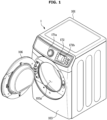
- FIG. 1 illustrates an exterior view of a dryer, according to an embodiment of the disclosure
- FIG. 2 illustrates a side cross-sectional view of a dryer, according to an embodiment of the disclosure.
- a dryer 1 includes a main body 101 defining the exterior of the dryer 1, and a drum 120 rotationally installed in the main body 101 to accommodate laundry.
- the main body 101 may include a base plate 102, a front cover 103, a top cover 104, and a side and rear cover 105.
- An opening 103a is formed on the front cover 103, and opened or closed by a door 106 pivotally installed on the front cover 103.
- the drum 120 having the form of a cylinder with an open front may also be opened or closed by the door 106.
- inputs 171a and 171b for receiving control commands from the user and a display 172 for displaying a screen to present various information about operations of the dryer 1 or guide user inputs.
- the inputs 171a and 171b may be provided as a jog shuttle or in the form of a dial, allowing the user to hold and turn the input 171a to enter a control command, or provided as a touch pad or buttons, allowing the user to touch or press the input 171b to enter a control command.
- the display 172 may be implemented by various types of display panel, such as liquid crystal display (LCD) panel, a light emitting diode (LED) panel, an organic LED (OLED) panel, a quantum LED (QLED) panel, etc., and also implemented as a touch screen having a touch pad on the front.
- LCD liquid crystal display
- LED light emitting diode
- OLED organic LED
- QLED quantum LED
- a front panel 121 having an entrance 121a formed on the front may be arranged on the front of the drum 120, and the laundry may be thrown into the drum 120 through the entrance 121a.
- the rear of the drum 120 may be blocked by a rear panel 122 with an inlet 122a through which hot and dry air flows in.
- An outlet 121b through which the air used in drying of the laundry flows out may be formed on the front panel 121 of the drum 120, and a filter 123 may be installed at the outlet 121b to capture foreign materials from the laundry.
- At least one protruding lifter may be formed on the inner wall of the drum 120 to assist in tumbling of the laundry.
- the drum 120 may be rotated by driving force provided from a drum motor 125.
- the drum 120 may be connected to the drum motor 125 by a belt 126, which may convey the driving force provided from the drum motor 125 to the drum 120.
- the dryer 1 In order for the dryer 1 to dry the laundry, there may be a heater method of drying the laundry by supplying air heated by a heater into the drum, and a heat pump method of drying the laundry by removing moisture from the laundry. In the embodiment of the disclosure, the latter case that the dryer 1 dries the laundry in the heat pump method will be described as an example.
- the dryer 1 may include a fan 140 for circulating air in the drum 120.
- the fan 140 may suck in air from the inside of the drum 120 and release the air to the duct 150.
- the air from inside the drum 120 may be circulated by the fan 140 between the drum 120 and the duct 150.
- a heat pump 160 may be equipped in the duct 150 in which the air from inside the drum 120 circulates.
- the heat pump 160 may include a compressor, a condenser 162, an evaporator 164, and an expander.
- the compressor may compress a gaseous refrigerant into a hot and highly compressed state and discharge the hot and highly compressed gaseous refrigerant.
- the compressor may compress the refrigerant by reciprocating motions of a piston or rotating motions of a rotor.
- the discharged refrigerant is passed to the condenser 162.
- the condenser 162 may radiate heat while condensing the compressed gaseous refrigerant into a liquid state.
- the condenser 162 may be arranged in the duct 150 to heat air by the heat radiated in the process of condensing the refrigerant.
- the heated air may be supplied into the drum 120.
- the liquid refrigerant condensed by the condenser 162 may be passed to the expander.
- the expander may expand the high temperature and high pressure liquid refrigerant condensed by the condenser 162 to a low pressure liquid refrigerant.
- the expander may include an electronic expansion valve whose opening degree is variable by a capillary tube and an electronic signal for controlling the pressure of the liquid refrigerant.
- the evaporator 164 may evaporate the liquid refrigerant expanded by the expander. As a result, the evaporator 164 may return the low temperature and low pressure gaseous refrigerant to the compressor.
- the evaporator 164 may absorb heat from the surroundings during the evaporation process for turning the low pressure liquid refrigerant to the gaseous refrigerant.
- the evaporator 164 may be arranged in the duct 150 to cool the air that is passing the evaporator 164 during the evaporation process.
- the air around the evaporator 164 may be condensed.
- Water resulting from the air condensation in the evaporator 164 may be collected by a water tray arranged under the evaporator 164. The water collected by the water tray may be moved to a separate reservoir or discharged out of the dryer 1.
- the dryer 1 may reduce the amount of water vapor contained in the air in the drum 120 and dry the laundry.
- the evaporator 164 may be located in farther upstream of airflow from the fan 140 than the condenser 162.
- the air circulating by the fan 140 may be dried out (i.e., water vapor is condensed) by the evaporator 164 while passing the evaporator 164, and then heated by the condenser 162 while later passing the condenser 162.
- a heater 155 may be provided to assist the condenser 162 in heating the air.
- the heater 155 may be located in farther downstream of the airflow from the fan 140 than the condenser 162.
- the air in the duct 150 may be sufficiently heated when the heater 155 additionally heats the air that has already been heated by the condenser 162 of the heat pump 160.
- the temperature in the drum 120 may rise more rapidly by the heater 155 that assists the condenser 162, so the time taken to dry the laundry may be reduced.
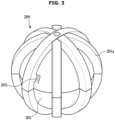
- FIG. 3 illustrates an exterior view of a wireless sensing device, according to an embodiment of the disclosure
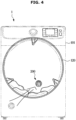
- FIG. 4 illustrates a dryer with a wireless sensing device thrown into the dryer, according to an embodiment of the disclosure.
- a wireless sensing device 200 may include a main body 201 defining the exterior of the wireless sensing device 200, and the main body 201 may include a sensing module 210, a sensor controller 220, a sensor communication module 230, and sensor power supplier 240, which will be described later.
- At least one opening 203 may be formed on the main body 201.
- the air in the drum 120 may flow into the main body 201 through the opening 203, and the sensing module 210 arranged in the main body 201 may measure humidity or temperature of the air flowing in.
- a portion of the sensing module 210 may be exposed through the opening to measure the humidity or temperature in the drum 120.
- the wireless sensing device 200 may be physically separated from other elements of the dryer 1, such as the drum 120, the main body 101, etc.
- the phrase 'physically separated' means that the wireless sensing device 200 is not connected to the other elements of the dryer 1 via wiring such as a cable, nor fixed to the main body 101 or the drum 120. However, there may be an occasion when the wireless sensing device 200 may be detachably attached to the dryer 1 while the dryer 1 is not activated.
- the wireless sensing device 200 may be thrown into the drum 120 along with laundry.
- the wireless sensing device 200 is disposed into the drum 120.
- laundry as herein used may be defined by taking into account objects to be dried by an ordinary dryer 1, including wet garments, bed clothes, towels, shoes, etc., resulting from washing, without excluding clothes in a non-washed state.
- the wireless sensing device 200 makes free motions, such as repetition of rotation, free-fall, and tumbling in the drum 120 along with the laundry.
- the wireless sensing device 200 may use the motion to create its own energy for operation of the wireless sensing device 200 and to accurately measure humidity in the drum 120. Furthermore, using acceleration data of the wireless sensing device 200, a load of the laundry or whether the laundry is entangled may be determined. This will be described in more detail later.
- main body 201 of the wireless sensing device 200 is shown as having the shape of a sphere in the example of FIGS. 3 and 4 , it is not limited thereto.
- the main body 201 may have any size and any shape that may allow itself to freely move in the drum 120, and may be implemented in any of various three-dimensional figures such as a rectangular parallelepiped, a cylinder, etc.
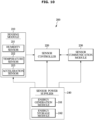
- FIG. 5 illustrates a control block diagram of a wireless sensing device
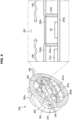
- FIG. 6 illustrates a cross-sectional view illustrating a humidity sensor equipped in a wireless sensing device and related structure.
- the wireless sensing device 200 includes the sensing module 210 that includes a humidity sensor 211 for measuring humidity in the drum 120, a sensor communication module 230 for transmitting or receiving data through wireless communication with a main communication module 130 of the dryer 1 (see FIG. 8 ), a sensor controller 220 for controlling the sensor communication module 230 to transmit a humidity value corresponding to an output of the sensing module 210 to the main communication module 130, and a sensor power supplier 240 for supplying power to the sensing module 210, the sensor communication module 230, and the sensor controller 220.
- the sensing module 210 that includes a humidity sensor 211 for measuring humidity in the drum 120, a sensor communication module 230 for transmitting or receiving data through wireless communication with a main communication module 130 of the dryer 1 (see FIG. 8 ), a sensor controller 220 for controlling the sensor communication module 230 to transmit a humidity value corresponding to an output of the sensing module 210 to the main communication module 130, and a sensor power supplier 240 for supplying power to the sensing module 210, the
- the humidity sensor 211 may employ one of various methods of measuring humidity to measure the humidity in the drum 120.
- the humidity sensor 211 may measure the humidity in an electrically resistive method or an electrically capacitive method.
- the conventional dryer has a structure in which a humidity sensor connected to an external power source is mounted in the dryer but has a limited mounting location by the nature of continuous rotation of the drum. Hence, it is common for most of the conventional humidity sensors to be fixed on the front surface or the rear surface of the drum. In this case, sometimes, the humidity sensor may not come into contact with the laundry depending on weight or textile properties of the laundry, which causes reduction in measurement accuracy of the humidity value.
- the wireless sensing device 200 may measure the humidity in a way of directly contacting the laundry or in a way of measuring moisture contained in the air in the drum 120. In either way, the wireless sensing device 200 may output a value representing humidity in the drum 120.
- the wireless sensing device 200 moves freely along with the laundry in the drum 120, easily contacting the laundry and thus obtaining more accurate humidity data from the output of the humidity sensor 211. Furthermore, the wireless sensing device 200 freely moves everywhere in the drum 120, so that it may provide higher accuracy in measuring moisture contained in the air in the drum 120.
- the sensing module 210 may further include a temperature sensor 212.
- the sensor controller 220 may calculate an absolute humidity value in the drum 120 using an output of the humidity sensor 211 and an output of the temperature sensor 212.
- the sensor controller 220 may just transmit an output of the humidity sensor 211 and an output of the temperature sensor 212 to the main communication module 130 through the sensor communication module 230, and then the main controller 110 of the dryer 1 may perform calculation of the absolute humidity value.
- FIG. 6 shows a structure applicable when the humidity sensor employs a method of measuring moisture in the air.
- An enlarged view on the right in FIG. 6 is a front view of the cross-section shown on the left.
- the air in the drum 120 may flow into the main body 201 through the opening 203 formed on the main body 201.
- the wireless sensing device 200 makes motions, such as rotation, free-fall, tumbling, etc., when the drum 120 is rotated, so that, even without a separate blower device such as a fan, air may be brought into the wireless sensing device 200.
- the space in the main body 201 may be divided by a first plate 204a and a second plate 204b.
- the humidity sensor 211 and a printed circuit board (PCB) 211a connected to the humidity sensor 211 may be arranged in the space between the first and second plates 204a and 204b.
- a structure of connection, e.g., wiring, between the PCB circuit 211a and the humidity sensor 211 is not shown in FIG. 6 . It is, however, shown for just convenience, and the PCB circuit 211a and the humidity sensor 211 may share a substrate and all electronic parts but the humidity sensor 211 may be arranged in an area represented for the PCB circuit 211a.
- the PCB circuit 211a may refer to a circuit structure including all the electronic parts but the humidity sensor 211.
- a hole may be formed in an area of the second plate 204b corresponding to the location of the humidity sensor 211.
- the area of the second plate 204b corresponding to the location of the humidity sensor 211 may refer to an area above the humidity sensor 211 or an area facing the humidity sensor 211.
- the space between the second plate 204b and the inner wall of the main body 201 may serve as a flow path 205 in which air flows.
- the air brought in through the opening 203 may flow in the flow path 205, and contact the humidity sensor 211 through the hole formed at the second plate 204b.
- the humidity sensor 211 may measure humidity in the air brought in through the hole formed at the second plate 204b.
- the moisture passing filter 210b may pass moisture but filter out foreign materials such as water drops or dust, thereby protecting the humidity sensor 211 and the PCB circuit 211a connected to the humidity sensor 211 against the foreign materials.
- the humidity sensor 211 may be enclose with a heat shielding wall 210a.
- the PCB circuit 211a may be placed outside the heat shielding wall 210a to prevent the PCB circuit 211a from being damaged or malfunctioning by heat from the moisture having passed through the moisture passing filter 210b.
- the opening 203 formed on the wireless sensing device 200 and motions of the wireless sensing device 200 may enable the air in the drum 120 to flow into the wireless sensing device 200 without a separate blower device; the moisture passing filter 210b may protect the humidity sensor 211 and the PCB circuit 211a against foreign materials; and the heat shielding wall 210a enclosing the humidity sensor 211 may protect the PCB circuit 211a against heat.
- an electrode of the humidity sensor 211 may be exposed through the opening 203; a conductive material may be applied onto a projection 201a formed on the outer wall of the main body 201 and may serve as an electrode of the humidity sensor 211; or the projection 201a formed on the outer wall of the main body 201 may be made with a conductive substance to serve as the electrode of the humidity sensor 211.
- wireless sensing device 200 What are described above is merely an example to be applied to the wireless sensing device 200.Embodiments of the wireless sensing device 200 are not limited thereto.
- the sensor controller 220 may include at least one memory for storing a program for carrying out the aforementioned and following operations, and at least one processor for executing the program.
- the sensor controller 220 may be implemented with a micro controller unit (MCU).
- MCU micro controller unit
- the sensor communication module 230 may include at least one of wireless communication modules, such as a Bluetooth module, a Bluetooth low energy (BLE) module, a wireless fidelity (Wi-Fi) module, etc. There are no limitations on the type of the communication module to be applied to the sensor communication module 230 as long as the communication module may be able to transmit or receive data through wireless communication with the main communication module 130 of the dryer 1.
- wireless communication modules such as a Bluetooth module, a Bluetooth low energy (BLE) module, a wireless fidelity (Wi-Fi) module, etc.
- the sensor power supplier 240 may supply its own power to the elements of the wireless sensing device 200 without being connected to an external power source.
- the sensor power supplier 240 may employ an energy harvesting technology to create its own electric energy, or even receive power from a battery. An occasion when the energy harvesting technology is applied will now be described.
- the energy harvesting technology is used to collect abandoned energy to generate electric energy.
- An energy generation module 241 may create electric energy used to operate the wireless sensing device 200 using the energy harvesting technology that employs at least one of an electromagnetic induction method, a triboelectrification method, piezoelectric method, or thermoelectric method.
- the energy generation module 241 may generate electric energy by inducing electromagnetic fields, generating electricity by friction, or making a piezoelectric effect using kinetic energy generated by the wireless sensing device 200 while the wireless sensing device 200 makes at least one of rotation, free-fall, or tumbling motions.
- the energy generation module 241 may convert thermal energy from hot air in the drum 120 to electric energy.
- FIG. 7 illustrates a diagram for describing operation of a wireless sensing device generating energy in an electromagnetic induction method, according to an embodiment of the disclosure.
- the energy generation module 241 may include a coil 241a and a magnet 241b.
- the magnet 241b has a position and shape to be able to move around the coil 241a when the drum 120 is rotated.
- the magnet 241b may be shaped like a sphere and positioned to be able to move around inside the coil 241a.
- the wireless sensing device 200 thrown into the drum 120 may make rotation, free-fall, or tumbling motions due to rotation of the drum 120, and the magnet 241b equipped in the wireless sensing device 200 may move around inside the coil 241a with the motion of the wireless sensing device 200.
- the magnet 241b moves around inside the coil 241a, an induced current flows in the coil 241a according to the electromagnetic induction law, causing induced electromotive force at both ends of the coil 241a.
- the coil 241a may move while the magnet 241b is stationary.
- Mutual movements of the magnet 241b and the coil 241a are the same as in the embodiment of FIG. 7 , and similarly, an induced current flows in the coil 241a according to the electromagnetic induction, causing induced electromotive force at both ends of the coil 241a.
- the induced electromotive force is stored in an energy storage module 242.
- the energy storage module 242 may include at least one element such as a capacitor that may store energy.
- Electric energy stored in the energy storage module 242 may be supplied to the sensing module 210, the sensor controller 220, and the sensor communication module 230.
- the wireless sensing device 200 may create its own power even without receiving power from the dryer 1 by generating electric energy by applying the energy harvesting technology to the kinetic energy generated when the wireless sensing device 200 is freely moving around in the drum 120. Accordingly, the wireless sensing device 200 may be able to measure humidity and transmit the result to the main communication module 130 of the dryer 1 with the power created by itself even without being connected to the dryer 1 via cable or attached to the dryer 1.
- FIG. 8 illustrates a control block diagram of a dryer, according to an embodiment of the disclosure.
- the dryer 1 includes the main communication module 130 for receiving a humidity value from the wireless sensing device 200 and the main controller 110 for determining that drying is completed when the received humidity value reaches a set threshold.
- the main communication module 130 exchanges data with the sensor communication module 230 of the wireless sensing device 200 through wireless communication. Accordingly, it may include a communication module that corresponds to the communication method of the wireless sensing device 200.
- the main communication module 130 may include at least one of wireless communication modules, such as a Bluetooth module, a BLE module, a Wi-Fi module, etc. furthermore, the main communication module 130 may further include a communication module for communicating with an external server or another home appliance.
- the main controller 110 may include at least one memory 111 for storing a program for carrying out the aforementioned and following operations, and at least one processor 112 for executing the program.
- the main controller 110 may be implemented with an MCU.
- the main controller 110 may control general operation of the dryer 1 as well as determine a drying completion time based on the humidity value.
- a drying course may include operation of the heat pump 160 and rotation of the drum 120. In addition, the drying course may also include operation of the heater 155.
- the heat pump 160 operates, the inside of the drum 120 may be dehumidified and hot air may be supplied into the drum 120. As the drum 120 is rotated, the laundry may be tumbled, making it more effective to heat and remove moisture from the laundry.
- the main controller 110 may control the heat pump 160 and the drum 120 to perform the drying course.
- the main controller 110 may control rotations of the drum 120 and the fan 140 by sending control signals to a motor driver 180 to drive a drum motor 125 to rotate the drum 120 and a fan motor to rotate the fan 140.
- the motor driver 180 may include a motor driving circuit.
- the main controller 110 may remove humidity in the drum 120 and supply hot air into the drum 120 by sending a control signal to the heat pump 160. As described above, when the heater 155 is located in the duct 150, the main controller 110 may send a control signal even to the heater 155 to raise the temperature of the hot air supplied to the drum 120.
- the user may enter commands to power on/off, select the drying course, start/stop the drying course, etc., by manipulating the input 171.
- the input 171 may include the inputs 171a and 171b as shown in FIG.1 , and may further include a microphone to receive a voice command when the main controller 110 may be able to perform voice recognition.
- the main controller 110 may send a control signal to each element of the dryer 1 in response to a command entered to the input 171 by the user.
- the display 172 may display a screen to indicate various information about operation of the dryer 1 or to guide an input from the user. Furthermore, the display 172 may display an expected time taken to complete drying, which will be described later.
- the dryer 1 includes the wireless sensing device 200 having the aforementioned structure.
- the wireless sensing device 200 may be manufactured and sold separately from the dryer 1.
- FIG. 9 illustrates a graph representing an example of humidity values used by a dryer to determine drying completion time, according to an embodiment of the disclosure.
- Humidity values reflecting such an effect are like what is shown in FIG. 9 .
- Humidity in the drum 120 rises due to the moisture of the laundry, and decreases again as the moisture in the air is removed by the heat pump 160 and the laundry is dried. Once the laundry is completely dried, the humidity reaches to a certain level.
- the main controller 110 may store a humidity value at the certain level, H TH as a threshold in advance, and determine that drying of the laundry is completed when the humidity value transmitted from the wireless sensing device 200 reaches the threshold.
- the threshold stored in advance may be set by experiment, statistic, simulation, etc.
- the main controller 110 may determine whether drying is completed after a set period of time after the start of the drying course or after the humidity value reaches the peak and then starts to decrease.
- the threshold used in determination of completion of drying may be differently set depending on the load of the laundry.
- the dryer 1 may determine a load of the laundry thrown into the drum 120. This will now be described in connection with FIGS. 10 to 13 .
- FIG. 10 illustrates a control block diagram of a wireless sensing device equipped with an acceleration sensor
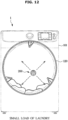
- FIGS. 11 and 12 illustrate motions of a wireless sensing device depending on the load of laundry
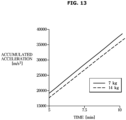
- FIG. 13 illustrates a graph representing a relationship between acceleration of a wireless sensing device and load of laundry.
- the sensing module 210 of the wireless sensing device 200 further includes an acceleration sensor 213 for measuring acceleration.
- the sensor controller 220 controls the sensor communication module 230 to transmit an acceleration value corresponding to an output of the acceleration sensor 213 to the main communication module 130.
- the wireless sensing device 200 thrown into the drum 120 along with the laundry is moved along with the laundry due to rotation of the drum 120.
- the more the load of the laundry the smaller the space in which the wireless sensing device 200 may be able to move around, and as a result, the wireless sensing device 200 makes small motions.
- the load of laundry may refer to weight or volume of the laundry.
- the wireless sensing device 200 makes big motions.
- FIG. 13 shows a graph representing accumulated values of acceleration measured by the acceleration sensor 213 when there are 7 kg and 14 kg of laundry, respectively.
- the accumulated value is an absolute value of acceleration.
- the accumulated absolute value of acceleration in the case of 14 kg of laundry may be less than that of 7 kg of laundry.
- the main controller 110 determines a load of laundry based on an acceleration value transmitted from the wireless sensing device 200.
- the main controller 110 may accumulate absolute values of acceleration for a predefined time, or the sensor controller 220 of the wireless sensing device 200 may transmit an accumulated absolute value.
- the main controller 110 may store at least one threshold used to determine a load of the laundry, and compare the accumulated acceleration value from the wireless sensing device 200 with the threshold to determine a load of the laundry.
- the main controller 110 may determine a load of the laundry to be 'large' when the accumulated acceleration value from the wireless sensing device 200 is equal to or less than a first threshold, 'medium' when the accumulated acceleration value from the wireless sensing device 200 exceeds the first threshold but is equal to or less than a second threshold, and 'small' when the accumulated acceleration value from the wireless sensing device 200 exceeds the second threshold.
- 'large', 'medium', and 'small' that represent the load of the laundry may each be defined with upper and lower limits of weight.
- the accumulated acceleration value and corresponding weight of the laundry may be matched and stored, or rules or equations to derive weight of the laundry corresponding to the accumulated acceleration value may be obtained and stored.
- an amount of energy generated by the sensor power supplier 240 may be used.
- the energy generation module 241 may generate electric energy using kinetic energy of the wireless sensing device 200. According, it may be seen that the higher the electric energy generated, the higher the kinetic energy of the wireless sensing device 200, which may mean that a load of the laundry is small.
- the sensor controller 220 may control the sensor communication module 230 to notify the main communication module 130 of an amount of energy generated by the energy generation module 241.
- the main controller 110 may then determine a load of the laundry based on the amount of energy.
- the amount of energy transmitted may be an accumulated value of the induced electromotive force generated from the energy generation module 241 for a certain time, or a power value stored in the energy storage module 242.
- the main controller 110 may store at least one threshold to be used in determining a load of the laundry, and compare the amount of energy transmitted with the threshold to determine a load of the laundry.
- the main controller 110 may determine a load of the laundry to be 'large' when the amount of energy transmitted is equal to or less than a first threshold, 'medium' when the amount of energy transmitted exceeds the first threshold but is equal to or less than a second threshold, and 'small 'when the amount of energy transmitted exceeds the second threshold.
- 'large', 'medium', and 'small' that represent the load of the laundry may each be defined with upper and lower limits of weight.
- the amount of energy transmitted and corresponding weight of the laundry may be matched and stored, or rules or equations to derive weight of the laundry corresponding to the amount of energy transmitted may be obtained and stored.
- a reference humidity value used in determining completion of drying may be set to be high.
- the main controller 110 may set the reference humidity value to 'A' when the load of the laundry determined based on the acceleration value of the wireless sensing device 200 is 'large', 'B' when the load of the laundry is 'medium', and 'C' when the load of the laundry is 'small', where A > B> C.
- the main controller 110 may set a threshold to be used in determining completion of drying as described above and further determine expected time to complete drying, as will be described below. Accordingly, determination of a load of the laundry can be made in the beginning of the drying course, so that within a set time after the drum 120 starts to rotate, the load of the laundry may be determined, the threshold to be used in determining completion of drying may be set, and the expected time to complete drying may be determined. For example, the aforementioned operations may be performed within two or five minutes.
- the threshold to be used in determining completion of drying being differently set depending on the load of the laundry is merely an example used in embodiments of the dryer 1.
- a single threshold to be used in determining completion of drying may be set regardless of the load of the laundry and drying may be determined as completed when measured humidity reaches the threshold.
- FIG. 14 illustrates a graph representing changes in acceleration of a wireless sensing device.
- the wireless sensing device 200 is thrown into the drum 120, and moved along with the laundry as the drum 120 is rotated. Hence, the wireless sensing device 200 may sometimes be stuck in the entangled laundry.
- the wireless sensing device 200 freely moving around in the drum 120 due to rotation of the drum 120 has big changes in acceleration before stuck in the laundry, as shown in FIG. 14 .
- an amount of acceleration change is drastically reduced.
- the main controller 110 may monitor the acceleration of the wireless sensing device 200 and when the amount of acceleration change is reduced by a set threshold or more, i.e., when a reduction in the amount of acceleration change is equal to or greater than the threshold, determine that the laundry is entangled. Specifically, the main controller 110 may calculate the amount of acceleration change for a set time, and when the amount of acceleration change is reduced by the threshold or more, determine that the laundry is entangled. For example, when the acceleration change has periodicity and an amount of reduction in amplitude is equal to or greater than a threshold, it may be determined that the laundry is entangled.
- whether the laundry is entangled may be determined based on an amount of energy generated by the energy generation module 241 of the wireless sensing device 200.
- the larger the motion of the wireless sensing device 200 the greater the amount of energy generated by the energy generation module 241, so it may be seen that the less the motion of the wireless sensing device 200, the smaller the amount of the energy generated by the energy generation module 241.
- the sensor controller 220 or the main controller 110 monitors the amount of energy generated by the energy generation module 241 and finds that the amount of energy is significantly reduced, it may determine that the laundry is entangled.
- the energy stored in the energy storage module 242 is used during the drying course, so the induced electromotive force generated by the energy generation module 241 may be measured in real time or periodically to determine whether the laundry is entangled.
- the main controller 110 may perform a laundry disentanglement course when determining that the laundry is entangled.
- the laundry disentanglement course may be performed by repeating changing at least one of rotation speed or rotation direction. It is, however, merely an example that may be applied to the dryer 1, and the laundry disentanglement course may be performed in other various methods.
- drying of the laundry may be performed as well by activating the heater 155 and the heat pump 160 during the laundry disentanglement course.
- FIGS. 15 to 17 illustrate examples of information to be displayed on a display of a dryer, according to an embodiment of the disclosure.
- the main controller 110 determines a load of the laundry based on an acceleration value of the wireless sensing device 200 or an amount of energy generated based on or energy harvesting.
- the main controller 110 may determine a load of laundry based on an acceleration value of the wireless sensing device 200 or an amount of energy generated by energy harvesting, and determine expected time taken to complete drying based on the load of the laundry.
- the expected time determined based on the load of the laundry will now be called initial expected time.
- the expected time taken to complete drying may be determined in advance, or a rule to calculate the expected time taken to complete drying depending on the load of laundry may be stored.
- the main controller 110 may determine expected time for a current load of the laundry as the initial expected time, and control the display 172 to display the initial expected time as shown in FIG. 15 .
- the main controller 110 may receive a humidity value from the wireless sensing device 200, and when the humidity value reaches a set threshold (hereinafter, called a drying completion threshold), determine that drying of the laundry is completed. When the humidity value does not reach the drying completion threshold, the main controller 110 may calculate remaining time until completion of drying and control the display 172 to display the remaining time as shown in FIGS. 16 and 17 .
- a drying completion threshold a set threshold
- the main controller 110 may calculate the remaining time until completion of drying by applying the currently received humidity value and the drying completion threshold to a predefined rule.
- the predefined rule may be obtained by experiment, statistics or simulation.
- the remaining time may be represented directly with numerical values as shown in FIG. 16 , or a percentage of progress (%) indicating a ratio of current progress to the entire drying course as shown in FIG. 17 .Both the numerical value and the percentage of progress may be displayed to represent the remaining time.
- a change from a humidity value at a particular time to the drying completion threshold may not conform to a predefined rule.
- remaining time calculated after the particular point may be reduced much sooner or much later than an actual time.
- the main controller 110 may provide the user with information about the drying completion time as accurately as possible by calculating and displaying the remaining time in real time or periodically on the display 172.
- the initial expected time determined based on the load of the laundry and the drying completion time determined based on the humidity value measured during the drying course may not match.
- the main controller 110 may continue the drying course even after the lapse of the initial expected time when the current humidity value has not reached the drying completion threshold, and finish the drying course even before the initial expected time elapses when the current humidity value has reached the drying completion threshold.
- the initial expected time or adjust steps of the drying course by taking into account both the weight value output from the weight sensor and the acceleration value. It is generally seen that the weight and the volume of laundry are proportional to each other, but even when the laundry has a small volume, it may weigh a lot when the laundry contains much moisture.
- the acceleration value of the wireless sensing device 200 may be seen as reflecting the volume of the laundry. Accordingly, the more the difference between the load of the laundry based on the acceleration value and the weight value output from the weight sensor, the more wet the laundry is, so the expected time taken to complete drying the laundry may be determined to be longer.
- the initial expected time may be determined based on the load of the laundry determined using at least one of a weight value or an acceleration value, and may be adjusted by a difference between the load of the laundry based on the acceleration value and the weight value output from the weight sensor.
- the main controller 110 may determine the initial expected time by taking into account this material property.
- the initial expected time may be determined based on the load of the laundry determined using at least one of a weight value or an acceleration value, and may be adjusted depending on the material of the laundry.
- a detailed adjustment method may be determined by taking into account an influence of the material of the laundry to the drying completion time, and the influence of the material of the laundry to the drying completion time may be obtained by experiment, statistics, or simulation.
- a method of controlling the dryer according to an embodiment of the disclosure will now be described.
- the method of controlling the dryer is implemented by using the wireless sensing device 200 and the dryer 1 including the wireless sensing device 200. Accordingly, it may be seen that what are described above in connection with FIGG. 1 to 17 may also be applied in the embodiment of the method of controlling the dryer, and vice versa.
- FIG. 18 illustrates a flowchart of a method of controlling a dryer, according to an embodiment of the disclosure.
- the wireless sensing device 200 may be thrown into the drum 120 along with the laundry.
- the wireless sensing device 200 may make free motions, such as repetition of rotation and tumbling along with the laundry in the drum 120, and the sensor power supplier 240 may generate electric energy for operation of the wireless sensing device 200 using the kinetic energy from the free motions of the wireless sensing device 200. This was described above in detail in the embodiment of the wireless sensing device 200.
- the sensor power supplier 240 may generate the electric energy using thermal energy of hot air supplied into the drum 120.
- the sensing module 210 When powered on, the sensing module 210 measures humidity in the drum in 413, and transmits a value of the humidity to the main communication module 130 of the dryer 1 in 414.
- the sensing module 210 includes the humidity sensor 211.
- the sensor controller 220 controls the sensor communication module 230 to transmit a humidity value corresponding to the output of the humidity sensor 211 to the main communication module 130.
- the sensing module 210 may further include the temperature sensor, and the sensor controller 220 may control the sensor communication module 230 to transmit a relative humidity value output by the humidity sensor 211 and a temperature value output by the temperature sensor 212 to the main communication module 130.
- the sensor controller 220 may calculate an absolute humidity value using the relative humidity value and the temperature value, and transmit the absolute humidity value to the main communication module 130.
- the main controller 110 may receive and monitor the humidity value from the wireless sensing device 200 in real time or periodically.
- the main controller 110 may determine that drying is completed when the humidity value in the drum 120 decreases and reaches a set threshold, i.e., when the humidity value is equal to or less than the set threshold.
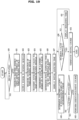
- FIG. 19 illustrates another flowchart of a method of controlling a dryer, according to an embodiment of the disclosure.
- the sensing module 210 further includes an acceleration sensor 213.
- the acceleration sensor measures acceleration of the wireless sensing device 200 in 423
- the sensor controller 220 transmits a value of the acceleration to the main communication module 130 through the sensor communication module 230 in 424.
- the main controller 110 determines a load of the laundry based on the acceleration value in 425, and determines initial expected time to complete drying based on the load of the laundry and sets a threshold to be used in determining completion of drying in 426.
- the main controller 110 may accumulate absolute values of acceleration for a certain time after start of rotation of the drum 120, and determine a load of the laundry based on the accumulated absolute value.
- the initial expected time may be stored for each of different loads of laundry, or rules to calculate the initial expected time for each of the different loads of laundry may be stored.
- the determined initial expected time is displayed on the display 172, in 427.
- the main controller 110 may set a threshold to be used in determining the drying completion time based on a load of the laundry. For example, the larger the load of the laundry, the higher the threshold may be set.
- the main controller 110 may determine the drying completion time while continuously monitoring the humidity value. When a current humidity value is equal to or less than the set threshold in 430, it is determined that drying is completed and the drying course is terminated in 432; when the current humidity value exceeds the set threshold in 430, remaining time until completion of drying is displayed on the display 172 in 431. Calculation and display of the remaining time were described above with reference with FIGS. 16 and 17 .
- the main controller 110 determines whether the laundry is entangled based on the acceleration value while monitoring both the humidity value and the acceleration value, in 440. For example, the main controller 110 may determine that the laundry is entangled when an amount of acceleration change is reduced by a set threshold or more, i.e., when a reduction in the amount of acceleration change is equal to or greater than the threshold,
- the main controller 110 When it is determined that the laundry is entangled in 441, the main controller 110 performs a laundry disentanglement course in 442. Furthermore, the main controller 110 may keep on monitoring the acceleration value even after performing the laundry disentanglement course, and perform the laundry disentanglement course again when the laundry becomes entangled again.
- Determining the load of the laundry or whether the laundry is entangled may be based on an amount of energy generated by energy harvesting. How to determine the load of the laundry or whether the laundry is entangled based on an amount of energy generated was described above in an embodiment of the dryer 1 and the wireless sensing device 200.
- the drying course may be terminated even when it is determined that the laundry is entangled, or when the current humidity value reaches the drying completion threshold but it is determined that the laundry is entangled, the drying course may not be terminated until the laundry disentanglement course is completed.
- the drum 120 may keep operating while operations of the heat pump 160 and the heater 155 are stopped.
- the wireless sensing device 200 physically separated from the dryer 1 and moving around along with the laundry in the drum 120 is used to measure humidity in the drum 120, thereby increasing accuracy and reliability in measurement of the humidity.
- the wireless sensing device 200 uses kinetic energy generated by motions of the wireless sensing device 200 or thermal energy supplied to the drum 120, the wireless sensing device 200 creates its own electric energy and thus, does not need to receive power from the dryer 1.
- a load of laundry is estimated using acceleration of the wireless sensing device 200 moving around along with the laundry in the drum 120, so that a load of the laundry may be estimated even without an extra weight sensor for measuring the load of the laundry, or the load of the laundry may be estimated more accurately by taking into account both the acceleration and a value from a weight sensor when the weight sensor is equipped therein. Further, accuracy in determining completion of drying may be improved by setting a threshold to be used in determining the completion of drying based on the estimated load of the laundry.
- the measured acceleration may be variously used.
- a wireless sensing device may be thrown into a drum along with laundry to accurately measure humidity in the drum, and a dryer and method of controlling the dryer may have increased accuracy in controlling the timing of stopping a drying course by determining a degree of dryness based on the humidity measured by the wireless sensing device.
Landscapes
- Engineering & Computer Science (AREA)
- Textile Engineering (AREA)
- Computer Networks & Wireless Communication (AREA)
- Power Engineering (AREA)
- Control Of Washing Machine And Dryer (AREA)
Description
- The disclosure relates to a wireless sensing device used in a dryer that dries the laundry, e.g., clothes, a dryer having the wireless sensing device, and a method of controlling the dryer.
- A dryer is a device for drying laundry, such as garments, towels, bedclothes, etc., by supplying hot air into its drum containing the laundry while rotating the drum.
- A drying course for the laundry may be performed for a time set in advance, determined depending on original weight of the laundry, or initially selected by the user.
- However, when the drying time is fixed as mentioned above, the drying course proceeds regardless of an actual degree of dryness of the laundry, so the drying course continues unnecessarily even after the laundry is already dried out or otherwise finished even when the laundry is not yet dried.
- Hence, a technology to determine a drying completion time by measuring a degree of dryness of the laundry during the drying course has recently been developed, but the technology is still less accurate in measuring the degree of dryness.
US 2017/037563 A1 discloses a dryer and a method of controlling the dryer, including fixed humidity sensors.DE 4031981 A1 discloses a measuring ball that includes a humidity sensor that is provided to be placed in the drum along with the laundry. - The disclosure provides a wireless sensing device thrown into a drum along with laundry to measure humidity in the drum, thereby increasing accuracy in estimation of a degree of dryness, a dryer for determining a degree of dryness of the laundry using the wireless sensing device, and a method of controlling the dryer.
- The disclosure also provides a wireless sensing device powering itself by having an energy harvesting technology applied to kinetic energy generated when the wireless sensing device thrown into a drum along with laundry is rotated along with the drum.
- The disclosure also provides a wireless sensing device thrown into a drum along with laundry to measure acceleration while being rotated along with the drum, a dryer for determining a load of laundry using the acceleration measured by the wireless sensing device, and a method of controlling the dryer.
- In accordance with an aspect of the invention, there is provided a dryer according to
claim 1 and a method of controlling a dryer according to claim 8. According to an embodiment of the disclosure, a wireless sensing device includes a sensing module including a humidity sensor for measuring humidity in a drum of a dryer into which the wireless sensing module is thrown; a sensor communication module transmitting or receiving data with a main communication module of the dryer through wireless communication; a sensor controller configured to control the sensor communication module to transmit a humidity value corresponding to an output of the sensing module to the main communication module; and a sensor power supplier supplying power to the sensing module, the sensor communication module, and the sensor controller. - The sensor power supplier may include an energy generation module generating electric energy using energy harvesting; and an energy storage module storing the electric energy.
- The energy generation module may use at least one of an electromagnetic induction method, a triboelectrification method, piezoelectric method, or thermoelectric method to generate electric energy.
- The energy generation module may use kinetic energy of the wireless sensing device rotating, free falling or tumbling in the rotating drum to generate electric energy.
- The energy generation module may include a coil, and a magnet movable around the coil due to rotation of the drum, and the energy generation module may store electromotive force generated when the magnet is moving inside the coil as the wireless sensing device rotates, free-falls, or tumbles due to rotation of the drum.
- The energy generation module may convert thermal energy of hot air supplied into the drum to electric energy.
- The sensing module includes an acceleration sensor, and the sensor controller controls the sensor communication module to transmit an acceleration value corresponding to an output of the acceleration sensor to the main communication module of the dryer.
- The wireless sensing device may include a main body accompanying the sensing module, the sensor controller, the sensor communication module, and the sensor power supplier, and the main body may include at least one opening.
- The wireless sensing device may include a first plate and a second plate to divide the inside of the main body, and the humidity sensor may be arranged in a space between the first and second plates; air in the drum may be brought into the main body through the opening; a flow path in which the air brought in flows may be defined by a space between the second plate and an inner wall of the main body.
- A hole through which the air flowing in the flow path is brought in may be formed in an area on the second plate facing the humidity sensor, and the wireless sensing device may further include a moisture passing filter arranged across the hole for passing moisture and filtering out foreign materials.
- The wireless sensing device may further include a printed circuit board (PCB) circuit arranged in a space between the first plate and the second plate, and a heat shielding wall arranged between the humidity sensor and the PCB circuit.
- According to an embodiment of the disclosure, a dryer includes a drum; a wireless sensing device comprising a sensing module including a humidity sensor for measuring humidity in the drum, a sensor communication module transmitting or receiving data through wireless communication, a sensor controller configured to control the sensor communication module to transmit a humidity value corresponding to an output of the humidity sensor, and a sensor power supplier supplying power to the sensing module, the sensor communication module, and the sensor controller; a main communication module receiving the humidity value from the wireless sensing device thrown into the drum; and a main controller configured to determine that drying is completed when the humidity value is equal to or less than a set threshold.
- The sensing module includes an acceleration sensor, and the sensor controller controls the sensor communication module to transmit an acceleration value corresponding to an output of the acceleration sensor.
- The main controller determines a load of laundry contained in the drum based on the acceleration value.
- The dryer may further include a display, and the main controller may determine initial expected time taken to complete drying of the laundry based on the load of the laundry and control the display to display the initial expected time.
- The main controller may set a different threshold for each load of the laundry.
- The main controller may determine remaining time of drying based on a current humidity value received from the wireless sensing device and the set threshold, and control the display to display the remaining time of drying.
- The main controller determines whether the laundry contained in the drum is entangled based on the acceleration value, and when it is determined that the laundry is entangled, performs a laundry disentanglement course.
- The main controller may determine that the laundry is entangled when an amount of change in the acceleration value is reduced by a set threshold or more.
- The main controller may perform the laundry disentanglement course by repeating changing at least one of rotation speed or rotation direction of the drum.
- The sensor power supplier may use kinetic energy of the wireless sensing device rotating, free falling or tumbling in the rotating drum to generate electric energy.
- The main controller determines a load of laundry contained in the drum based on an amount of the electric energy generated.
- The main controller may determine whether the laundry contained in the drum is entangled based on an amount of the electric energy generated.
- According to an embodiment of the disclosure, a method of controlling a dryer includes generating electric energy using kinetic energy of a wireless sensing device thrown into a drum of the dryer when the drum is rotated; supplying power to a sensing module of the wireless sensing device using the electric energy; measuring, by the sensing module, humidity in the drum; and transmitting a humidity value corresponding to an output of the sensing module to a main communication module of the dryer.
- The generating of the electric energy may include using at least one of an electromagnetic induction method, a triboelectrification method, piezoelectric method, or thermoelectric method to generate electric energy.
- The method further includes determining that drying is completed when the humidity value is equal to or less than the set threshold.
- The method further includes measuring, by the sensing module, acceleration; and transmitting an acceleration value corresponding to an output of the sensing module to the main communication module.
- The method further includes determining a load of laundry contained in the drum based on the acceleration value.
- The method may further include determine initial expected time taken to complete drying of the laundry based on the load of the laundry and displaying the initial expected time on a display.
- The method may further include setting a different threshold for each load of the laundry.
- The method may further include determining remaining time of drying based on a current humidity value transmitted from the wireless sensing device and a set threshold; and displaying the remaining time of drying on a display.
- The method further includes determining whether the laundry contained in the drum is entangled based on the acceleration value; and performing a laundry disentanglement course when it is determined that the laundry is entangled.
- The determining of whether the laundry is entangled may include determining that the laundry is entangled when an amount of change in the acceleration value is reduced by a set threshold or more.
- Before undertaking the DETAILED DESCRIPTION below, it may be advantageous to set forth definitions of certain words and phrases used throughout this patent document: the terms "include" and "comprise," as well as derivatives thereof, mean inclusion without limitation; the term "or," is inclusive, meaning and/or; the phrases "associated with" and "associated therewith," as well as derivatives thereof, may mean to include, be included within, interconnect with, contain, be contained within, connect to or with, couple to or with, be communicable with, cooperate with, interleave, juxtapose, be proximate to, be bound to or with, have, have a property of, or the like; and the term "controller" means any device, system or part thereof that controls at least one operation, such a device may be implemented in hardware, firmware or software, or some combination of at least two of the same. It should be noted that the functionality associated with any particular controller may be centralized or distributed, whether locally or remotely.
- Moreover, various functions described below can be implemented or supported by one or more computer programs, each of which is formed from computer readable program code and embodied in a computer readable medium. The terms "application" and "program" refer to one or more computer programs, software components, sets of instructions, procedures, functions, objects, classes, instances, related data, or a portion thereof adapted for implementation in a suitable computer readable program code. The phrase "computer readable program code" includes any type of computer code, including source code, object code, and executable code. The phrase "computer readable medium" includes any type of medium capable of being accessed by a computer, such as read only memory (ROM), random access memory (RAM), a hard disk drive, a compact disc (CD), a digital video disc (DVD), or any other type of memory. A "non-transitory" computer readable medium excludes wired, wireless, optical, or other communication links that transport transitory electrical or other signals. A non-transitory computer readable medium includes media where data can be permanently stored and media where data can be stored and later overwritten, such as a rewritable optical disc or an erasable memory device.
- Definitions for certain words and phrases are provided throughout this patent document, those of ordinary skill in the art should understand that in many, if not most instances, such definitions apply to prior, as well as future uses of such defined words and phrases.
- The above and other objects, features and advantages of the present disclosure will become more apparent to those of ordinary skill in the art by describing in detail exemplary embodiments thereof with reference to the accompanying drawings, in which:
-
FIG. 1 illustrates an exterior view of a dryer, according to an embodiment of the disclosure; -
FIG. 2 illustrates a side cross-sectional view of a dryer, according to an embodiment of the disclosure; -
FIG. 3 illustrates an exterior view of a wireless sensing device, according to an embodiment of the disclosure; -
FIG. 4 illustrates a dryer with a wireless sensing device thrown into the dryer, according to an embodiment of the disclosure; -
FIG. 5 illustrates a control block diagram of a wireless sensing device; -
FIG. 6 illustrates a cross-sectional view illustrating a humidity sensor equipped in a wireless sensing device and related structure; -
FIG. 7 illustrates a diagram for describing an operation of a wireless sensing device generating energy in an electromagnetic induction method, according to an embodiment of the disclosure; -
FIG. 8 illustrates a control block diagram of a dryer, according to an embodiment of the disclosure; -
FIG. 9 illustrates a graph representing an example of humidity values used by a dryer to determine drying completion time, according to an embodiment of the disclosure; -
FIG. 10 illustrates a control block diagram of a wireless sensing device equipped with an acceleration sensor; -
FIGS. 11 and12 illustrate motions of a wireless sensing device depending on a load of laundry; -
FIG. 13 illustrates a graph representing a relationship between acceleration of a wireless sensing device and load of laundry; -
FIG. 14 illustrates a graph representing changes in acceleration of a wireless sensing device; -
FIGS. 15 to 17 illustrate examples of information to be displayed on a display of a dryer, according to an embodiment of the disclosure; -
FIG. 18 illustrates a flowchart of a method of controlling a dryer, according to an embodiment of the disclosure; and -
FIG. 19 illustrates another flowchart of a method of controlling a dryer, according to an embodiment of the disclosure. -
FIGS. 1 through 19 , discussed below, and the various embodiments used to describe the principles of the present disclosure in this patent document are by way of illustration only and should not be construed in any way to limit the scope of the disclosure. - Like numerals refer to like elements throughout the specification. Not all elements of embodiments of the disclosure will be described, and description of what are commonly known in the art or what overlap each other in the embodiments will be omitted. The term 'unit, module, member, or block' may refer to what is implemented in software or hardware, and a plurality of units, modules, members, or blocks may be integrated in one component or the unit, module, member, or block may include a plurality of components, depending on the embodiment of the disclosure.
- It will be further understood that the term "connect" or its derivatives refer both to direct and indirect connection, and the indirect connection includes a connection over a wireless communication network.
- The term "include (or including)" or "comprise (or comprising)" is inclusive or open-ended and does not exclude additional, unrecited elements or method steps, unless otherwise mentioned.
- Throughout the specification, when it is said that a member is located "on" another member, it implies not only that the member is located adjacent to the other member but also that a third member exists between the two members.
- Throughout the specification, when a component is mentioned to send or transmit a signal to another component, it does not exclude a possibility of an intermediate component that exists between the two components, through which to send or transmit the signal, unless otherwise mentioned.
- It is to be understood that the singular forms "a," "an," and "the" include plural references unless the context clearly dictates otherwise.
- Reference numerals used for method steps are just used for convenience of explanation, but not to limit an order of the steps. Thus, unless the context clearly dictates otherwise, the written order may be practiced otherwise.
- Embodiments of a wireless sensing device, dryer, and method of controlling the dryer will now be described in detail with reference to accompanying drawings.
-
FIG. 1 illustrates an exterior view of a dryer, according to an embodiment of the disclosure, andFIG. 2 illustrates a side cross-sectional view of a dryer, according to an embodiment of the disclosure. - Referring to both
FIGS. 1 and2 , adryer 1 according to an embodiment of the disclosure includes amain body 101 defining the exterior of thedryer 1, and adrum 120 rotationally installed in themain body 101 to accommodate laundry. - The
main body 101 may include abase plate 102, afront cover 103, atop cover 104, and a side andrear cover 105. - An
opening 103a is formed on thefront cover 103, and opened or closed by adoor 106 pivotally installed on thefront cover 103. Thedrum 120 having the form of a cylinder with an open front may also be opened or closed by thedoor 106. - On the top of the
front cover 103,inputs display 172 for displaying a screen to present various information about operations of thedryer 1 or guide user inputs. - The
inputs input 171a to enter a control command, or provided as a touch pad or buttons, allowing the user to touch or press theinput 171b to enter a control command. - The
display 172 may be implemented by various types of display panel, such as liquid crystal display (LCD) panel, a light emitting diode (LED) panel, an organic LED (OLED) panel, a quantum LED (QLED) panel, etc., and also implemented as a touch screen having a touch pad on the front. - A
front panel 121 having anentrance 121a formed on the front may be arranged on the front of thedrum 120, and the laundry may be thrown into thedrum 120 through theentrance 121a. The rear of thedrum 120 may be blocked by arear panel 122 with aninlet 122a through which hot and dry air flows in. - An
outlet 121b through which the air used in drying of the laundry flows out may be formed on thefront panel 121 of thedrum 120, and afilter 123 may be installed at theoutlet 121b to capture foreign materials from the laundry. - Furthermore, at least one protruding lifter may be formed on the inner wall of the
drum 120 to assist in tumbling of the laundry. - The
drum 120 may be rotated by driving force provided from adrum motor 125. Thedrum 120 may be connected to thedrum motor 125 by abelt 126, which may convey the driving force provided from thedrum motor 125 to thedrum 120. - In order for the
dryer 1 to dry the laundry, there may be a heater method of drying the laundry by supplying air heated by a heater into the drum, and a heat pump method of drying the laundry by removing moisture from the laundry. In the embodiment of the disclosure, the latter case that thedryer 1 dries the laundry in the heat pump method will be described as an example. - In this regard, to deal with hot and humid air that has passed the
drum 10, there may be an air-vent method of discharging the hot and humid air out of thedryer 1 and a condensing method of removing moisture from the hot and humid air and then having the resultant air circulate back into thedrum 120. In the embodiment of the disclosure, the case that thedryer 1 employs the condensing method will be described as an example. - The
dryer 1 may include afan 140 for circulating air in thedrum 120. Thefan 140 may suck in air from the inside of thedrum 120 and release the air to theduct 150. The air from inside thedrum 120 may be circulated by thefan 140 between thedrum 120 and theduct 150. - A heat pump 160 (see
FIG. 8 ) may be equipped in theduct 150 in which the air from inside thedrum 120 circulates. Theheat pump 160 may include a compressor, acondenser 162, anevaporator 164, and an expander. - The compressor may compress a gaseous refrigerant into a hot and highly compressed state and discharge the hot and highly compressed gaseous refrigerant. For example, the compressor may compress the refrigerant by reciprocating motions of a piston or rotating motions of a rotor. The discharged refrigerant is passed to the
condenser 162. - The
condenser 162 may radiate heat while condensing the compressed gaseous refrigerant into a liquid state. Thecondenser 162 may be arranged in theduct 150 to heat air by the heat radiated in the process of condensing the refrigerant. The heated air may be supplied into thedrum 120. The liquid refrigerant condensed by thecondenser 162 may be passed to the expander. - The expander may expand the high temperature and high pressure liquid refrigerant condensed by the
condenser 162 to a low pressure liquid refrigerant. Specifically, the expander may include an electronic expansion valve whose opening degree is variable by a capillary tube and an electronic signal for controlling the pressure of the liquid refrigerant. - The
evaporator 164 may evaporate the liquid refrigerant expanded by the expander. As a result, theevaporator 164 may return the low temperature and low pressure gaseous refrigerant to the compressor. - The
evaporator 164 may absorb heat from the surroundings during the evaporation process for turning the low pressure liquid refrigerant to the gaseous refrigerant. Theevaporator 164 may be arranged in theduct 150 to cool the air that is passing theevaporator 164 during the evaporation process. When the surrounding air is cooled down by theevaporator 164 and has a temperature fallen below the dew point, the air around theevaporator 164 may be condensed. Water resulting from the air condensation in theevaporator 164 may be collected by a water tray arranged under theevaporator 164. The water collected by the water tray may be moved to a separate reservoir or discharged out of thedryer 1. - Due to the condensation occurring around the
evaporator 164, absolute humidity of the air that is passing theevaporator 164 may be reduced. In other words, an amount of water vapor contained in the air passing theevaporator 164 may be reduced. Using the condensation around theevaporator 164, thedryer 1 may reduce the amount of water vapor contained in the air in thedrum 120 and dry the laundry. - The
evaporator 164 may be located in farther upstream of airflow from thefan 140 than thecondenser 162. The air circulating by thefan 140 may be dried out (i.e., water vapor is condensed) by theevaporator 164 while passing theevaporator 164, and then heated by thecondenser 162 while later passing thecondenser 162. - In the meantime, a
heater 155 may be provided to assist thecondenser 162 in heating the air. Theheater 155 may be located in farther downstream of the airflow from thefan 140 than thecondenser 162. - For example, the air in the
duct 150 may be sufficiently heated when theheater 155 additionally heats the air that has already been heated by thecondenser 162 of theheat pump 160. - The temperature in the
drum 120 may rise more rapidly by theheater 155 that assists thecondenser 162, so the time taken to dry the laundry may be reduced. -
FIG. 3 illustrates an exterior view of a wireless sensing device, according to an embodiment of the disclosure, andFIG. 4 illustrates a dryer with a wireless sensing device thrown into the dryer, according to an embodiment of the disclosure. - Referring to
FIG. 3 , awireless sensing device 200 may include amain body 201 defining the exterior of thewireless sensing device 200, and themain body 201 may include asensing module 210, asensor controller 220, asensor communication module 230, andsensor power supplier 240, which will be described later. - At least one
opening 203 may be formed on themain body 201. The air in thedrum 120 may flow into themain body 201 through theopening 203, and thesensing module 210 arranged in themain body 201 may measure humidity or temperature of the air flowing in. - Alternatively, a portion of the
sensing module 210 may be exposed through the opening to measure the humidity or temperature in thedrum 120. The aforementioned elements will be described in detail later. - Referring to
FIGS. 3 and4 , thewireless sensing device 200 may be physically separated from other elements of thedryer 1, such as thedrum 120, themain body 101, etc. Herein, the phrase 'physically separated' means that thewireless sensing device 200 is not connected to the other elements of thedryer 1 via wiring such as a cable, nor fixed to themain body 101 or thedrum 120. However, there may be an occasion when thewireless sensing device 200 may be detachably attached to thedryer 1 while thedryer 1 is not activated. - Referring to
FIG. 4 , thewireless sensing device 200 may be thrown into thedrum 120 along with laundry. In other words, thewireless sensing device 200 is disposed into thedrum 120. The term laundry as herein used may be defined by taking into account objects to be dried by anordinary dryer 1, including wet garments, bed clothes, towels, shoes, etc., resulting from washing, without excluding clothes in a non-washed state. - When the
drum 120 is rotated to dry the laundry, thewireless sensing device 200 makes free motions, such as repetition of rotation, free-fall, and tumbling in thedrum 120 along with the laundry. - The
wireless sensing device 200 may use the motion to create its own energy for operation of thewireless sensing device 200 and to accurately measure humidity in thedrum 120. Furthermore, using acceleration data of thewireless sensing device 200, a load of the laundry or whether the laundry is entangled may be determined. This will be described in more detail later. - Although the
main body 201 of thewireless sensing device 200 is shown as having the shape of a sphere in the example ofFIGS. 3 and4 , it is not limited thereto. Themain body 201 may have any size and any shape that may allow itself to freely move in thedrum 120, and may be implemented in any of various three-dimensional figures such as a rectangular parallelepiped, a cylinder, etc. - Operation of the
wireless sensing device 200 will now be described in more detail with reference to a control block diagram of thewireless sensing device 200. -
FIG. 5 illustrates a control block diagram of a wireless sensing device, andFIG. 6 illustrates a cross-sectional view illustrating a humidity sensor equipped in a wireless sensing device and related structure. - Referring to
FIG. 5 , in an embodiment of the disclosure, thewireless sensing device 200 includes thesensing module 210 that includes ahumidity sensor 211 for measuring humidity in thedrum 120, asensor communication module 230 for transmitting or receiving data through wireless communication with amain communication module 130 of the dryer 1 (seeFIG. 8 ), asensor controller 220 for controlling thesensor communication module 230 to transmit a humidity value corresponding to an output of thesensing module 210 to themain communication module 130, and asensor power supplier 240 for supplying power to thesensing module 210, thesensor communication module 230, and thesensor controller 220. - The
humidity sensor 211 may employ one of various methods of measuring humidity to measure the humidity in thedrum 120. For example, thehumidity sensor 211 may measure the humidity in an electrically resistive method or an electrically capacitive method. - The conventional dryer has a structure in which a humidity sensor connected to an external power source is mounted in the dryer but has a limited mounting location by the nature of continuous rotation of the drum. Hence, it is common for most of the conventional humidity sensors to be fixed on the front surface or the rear surface of the drum. In this case, sometimes, the humidity sensor may not come into contact with the laundry depending on weight or textile properties of the laundry, which causes reduction in measurement accuracy of the humidity value.
- In an embodiment of the disclosure, the
wireless sensing device 200 may measure the humidity in a way of directly contacting the laundry or in a way of measuring moisture contained in the air in thedrum 120. In either way, thewireless sensing device 200 may output a value representing humidity in thedrum 120. - In an embodiment of the disclosure, the
wireless sensing device 200 moves freely along with the laundry in thedrum 120, easily contacting the laundry and thus obtaining more accurate humidity data from the output of thehumidity sensor 211. Furthermore, thewireless sensing device 200 freely moves everywhere in thedrum 120, so that it may provide higher accuracy in measuring moisture contained in the air in thedrum 120. - The
sensing module 210 may further include atemperature sensor 212. When thehumidity sensor 211 included in thesensing module 210 measures relative humidity, thesensor controller 220 may calculate an absolute humidity value in thedrum 120 using an output of thehumidity sensor 211 and an output of thetemperature sensor 212. Alternatively, thesensor controller 220 may just transmit an output of thehumidity sensor 211 and an output of thetemperature sensor 212 to themain communication module 130 through thesensor communication module 230, and then themain controller 110 of thedryer 1 may perform calculation of the absolute humidity value. -
FIG. 6 shows a structure applicable when the humidity sensor employs a method of measuring moisture in the air. An enlarged view on the right inFIG. 6 is a front view of the cross-section shown on the left. - Referring to
FIG. 6 , the air in thedrum 120 may flow into themain body 201 through theopening 203 formed on themain body 201. As described above, thewireless sensing device 200 makes motions, such as rotation, free-fall, tumbling, etc., when thedrum 120 is rotated, so that, even without a separate blower device such as a fan, air may be brought into thewireless sensing device 200. - The space in the
main body 201 may be divided by afirst plate 204a and asecond plate 204b. For example, thehumidity sensor 211 and a printed circuit board (PCB) 211a connected to thehumidity sensor 211 may be arranged in the space between the first andsecond plates PCB circuit 211a and thehumidity sensor 211 is not shown inFIG. 6 . It is, however, shown for just convenience, and thePCB circuit 211a and thehumidity sensor 211 may share a substrate and all electronic parts but thehumidity sensor 211 may be arranged in an area represented for thePCB circuit 211a. In other words, in the embodiment of the disclosure, thePCB circuit 211a may refer to a circuit structure including all the electronic parts but thehumidity sensor 211. - A hole may be formed in an area of the
second plate 204b corresponding to the location of thehumidity sensor 211. The area of thesecond plate 204b corresponding to the location of thehumidity sensor 211 may refer to an area above thehumidity sensor 211 or an area facing thehumidity sensor 211. - The space between the
second plate 204b and the inner wall of themain body 201 may serve as aflow path 205 in which air flows. The air brought in through theopening 203 may flow in theflow path 205, and contact thehumidity sensor 211 through the hole formed at thesecond plate 204b. - The
humidity sensor 211 may measure humidity in the air brought in through the hole formed at thesecond plate 204b. - In the meantime, it is possible to arrange a
moisture passing filter 210b across the hole formed at thesecond plate 204b to protect thehumidity sensor 211. Themoisture passing filter 210b may pass moisture but filter out foreign materials such as water drops or dust, thereby protecting thehumidity sensor 211 and thePCB circuit 211a connected to thehumidity sensor 211 against the foreign materials. - It is also possible to enclose the
humidity sensor 211 with aheat shielding wall 210a. In this case, thePCB circuit 211a may be placed outside theheat shielding wall 210a to prevent thePCB circuit 211a from being damaged or malfunctioning by heat from the moisture having passed through themoisture passing filter 210b. In another example, it is also possible to enclose thePCB circuit 211a with the heat shielding wall. - According to the aforementioned example in
FIG. 6 , theopening 203 formed on thewireless sensing device 200 and motions of thewireless sensing device 200 may enable the air in thedrum 120 to flow into thewireless sensing device 200 without a separate blower device; themoisture passing filter 210b may protect thehumidity sensor 211 and thePCB circuit 211a against foreign materials; and theheat shielding wall 210a enclosing thehumidity sensor 211 may protect thePCB circuit 211a against heat. - In the meantime, when the
humidity sensor 211 measures humidity by directly contacting the laundry, an electrode of thehumidity sensor 211 may be exposed through theopening 203; a conductive material may be applied onto aprojection 201a formed on the outer wall of themain body 201 and may serve as an electrode of thehumidity sensor 211; or theprojection 201a formed on the outer wall of themain body 201 may be made with a conductive substance to serve as the electrode of thehumidity sensor 211. - What are described above is merely an example to be applied to the wireless sensing device 200.Embodiments of the
wireless sensing device 200 are not limited thereto. - The
sensor controller 220 may include at least one memory for storing a program for carrying out the aforementioned and following operations, and at least one processor for executing the program. For example, thesensor controller 220 may be implemented with a micro controller unit (MCU). - The
sensor communication module 230 may include at least one of wireless communication modules, such as a Bluetooth module, a Bluetooth low energy (BLE) module, a wireless fidelity (Wi-Fi) module, etc. There are no limitations on the type of the communication module to be applied to thesensor communication module 230 as long as the communication module may be able to transmit or receive data through wireless communication with themain communication module 130 of thedryer 1. - The
sensor power supplier 240 may supply its own power to the elements of thewireless sensing device 200 without being connected to an external power source. For this, thesensor power supplier 240 may employ an energy harvesting technology to create its own electric energy, or even receive power from a battery. An occasion when the energy harvesting technology is applied will now be described. - The energy harvesting technology is used to collect abandoned energy to generate electric energy. An
energy generation module 241 may create electric energy used to operate thewireless sensing device 200 using the energy harvesting technology that employs at least one of an electromagnetic induction method, a triboelectrification method, piezoelectric method, or thermoelectric method. - Specifically, the
energy generation module 241 may generate electric energy by inducing electromagnetic fields, generating electricity by friction, or making a piezoelectric effect using kinetic energy generated by thewireless sensing device 200 while thewireless sensing device 200 makes at least one of rotation, free-fall, or tumbling motions. - Alternatively, the
energy generation module 241 may convert thermal energy from hot air in thedrum 120 to electric energy. -
FIG. 7 illustrates a diagram for describing operation of a wireless sensing device generating energy in an electromagnetic induction method, according to an embodiment of the disclosure. - In the case that the
energy generation module 241 uses the electromagnetic induction method to generate electric energy, theenergy generation module 241 may include acoil 241a and amagnet 241b. Themagnet 241b has a position and shape to be able to move around thecoil 241a when thedrum 120 is rotated. For example, themagnet 241b may be shaped like a sphere and positioned to be able to move around inside thecoil 241a. - The
wireless sensing device 200 thrown into thedrum 120 may make rotation, free-fall, or tumbling motions due to rotation of thedrum 120, and themagnet 241b equipped in thewireless sensing device 200 may move around inside thecoil 241a with the motion of thewireless sensing device 200. When themagnet 241b moves around inside thecoil 241a, an induced current flows in thecoil 241a according to the electromagnetic induction law, causing induced electromotive force at both ends of thecoil 241a. - Alternatively, the
coil 241a may move while themagnet 241b is stationary. Mutual movements of themagnet 241b and thecoil 241a are the same as in the embodiment ofFIG. 7 , and similarly, an induced current flows in thecoil 241a according to the electromagnetic induction, causing induced electromotive force at both ends of thecoil 241a. - The induced electromotive force is stored in an
energy storage module 242. Theenergy storage module 242 may include at least one element such as a capacitor that may store energy. - Electric energy stored in the
energy storage module 242 may be supplied to thesensing module 210, thesensor controller 220, and thesensor communication module 230. - As described above, the
wireless sensing device 200 may create its own power even without receiving power from thedryer 1 by generating electric energy by applying the energy harvesting technology to the kinetic energy generated when thewireless sensing device 200 is freely moving around in thedrum 120. Accordingly, thewireless sensing device 200 may be able to measure humidity and transmit the result to themain communication module 130 of thedryer 1 with the power created by itself even without being connected to thedryer 1 via cable or attached to thedryer 1. -
FIG. 8 illustrates a control block diagram of a dryer, according to an embodiment of the disclosure. - Referring to
FIG. 8 , in addition to the elements as described above in connection withFIGS. 1 and2 , thedryer 1 includes themain communication module 130 for receiving a humidity value from thewireless sensing device 200 and themain controller 110 for determining that drying is completed when the received humidity value reaches a set threshold. - The
main communication module 130 exchanges data with thesensor communication module 230 of thewireless sensing device 200 through wireless communication. Accordingly, it may include a communication module that corresponds to the communication method of thewireless sensing device 200. For example, themain communication module 130 may include at least one of wireless communication modules, such as a Bluetooth module, a BLE module, a Wi-Fi module, etc.
furthermore, themain communication module 130 may further include a communication module for communicating with an external server or another home appliance. - The
main controller 110 may include at least onememory 111 for storing a program for carrying out the aforementioned and following operations, and at least oneprocessor 112 for executing the program. For example, themain controller 110 may be implemented with an MCU. - The
main controller 110 may control general operation of thedryer 1 as well as determine a drying completion time based on the humidity value. A drying course may include operation of theheat pump 160 and rotation of thedrum 120. In addition, the drying course may also include operation of theheater 155. As theheat pump 160 operates, the inside of thedrum 120 may be dehumidified and hot air may be supplied into thedrum 120. As thedrum 120 is rotated, the laundry may be tumbled, making it more effective to heat and remove moisture from the laundry. - Accordingly, the
main controller 110 may control theheat pump 160 and thedrum 120 to perform the drying course. For example, themain controller 110 may control rotations of thedrum 120 and thefan 140 by sending control signals to amotor driver 180 to drive adrum motor 125 to rotate thedrum 120 and a fan motor to rotate thefan 140. Themotor driver 180 may include a motor driving circuit. - Furthermore, the
main controller 110 may remove humidity in thedrum 120 and supply hot air into thedrum 120 by sending a control signal to theheat pump 160. As described above, when theheater 155 is located in theduct 150, themain controller 110 may send a control signal even to theheater 155 to raise the temperature of the hot air supplied to thedrum 120. - The user may enter commands to power on/off, select the drying course, start/stop the drying course, etc., by manipulating the
input 171. As described above, theinput 171 may include theinputs FIG.1 , and may further include a microphone to receive a voice command when themain controller 110 may be able to perform voice recognition. - The
main controller 110 may send a control signal to each element of thedryer 1 in response to a command entered to theinput 171 by the user. - As described above, the
display 172 may display a screen to indicate various information about operation of thedryer 1 or to guide an input from the user. Furthermore, thedisplay 172 may display an expected time taken to complete drying, which will be described later. - Furthermore, the
dryer 1 includes thewireless sensing device 200 having the aforementioned structure. In an embodiment of the disclosure, thewireless sensing device 200 may be manufactured and sold separately from thedryer 1. -
FIG. 9 illustrates a graph representing an example of humidity values used by a dryer to determine drying completion time, according to an embodiment of the disclosure. - When wet laundry is thrown into the
drum 120, humidity rises in thedrum 120, and as the drying course proceeds, hot air is supplied into thedrum 120, heating the air and the laundry in thedrum 120 and thus evaporating the moisture of the laundry. The highly humid air is moved to thecondenser 162 through theduct 150 and dehumidified, and once the moisture completely comes out of the laundry, humidity in thedrum 120 reaches a certain level. - Humidity values reflecting such an effect are like what is shown in
FIG. 9 . Humidity in thedrum 120 rises due to the moisture of the laundry, and decreases again as the moisture in the air is removed by theheat pump 160 and the laundry is dried. Once the laundry is completely dried, the humidity reaches to a certain level. Themain controller 110 may store a humidity value at the certain level, HTH as a threshold in advance, and determine that drying of the laundry is completed when the humidity value transmitted from thewireless sensing device 200 reaches the threshold. For example, the threshold stored in advance may be set by experiment, statistic, simulation, etc. - To prevent determination that drying is completed while the humidity value rises, the
main controller 110 may determine whether drying is completed after a set period of time after the start of the drying course or after the humidity value reaches the peak and then starts to decrease. - The threshold used in determination of completion of drying may be differently set depending on the load of the laundry. For this, the
dryer 1 may determine a load of the laundry thrown into thedrum 120. This will now be described in connection withFIGS. 10 to 13 . -
FIG. 10 illustrates a control block diagram of a wireless sensing device equipped with an acceleration sensor,FIGS. 11 and12 illustrate motions of a wireless sensing device depending on the load of laundry, andFIG. 13 illustrates a graph representing a relationship between acceleration of a wireless sensing device and load of laundry. - Referring to
FIG. 10 , in an embodiment of the disclosure, thesensing module 210 of thewireless sensing device 200 further includes anacceleration sensor 213 for measuring acceleration. Thesensor controller 220 controls thesensor communication module 230 to transmit an acceleration value corresponding to an output of theacceleration sensor 213 to themain communication module 130. - As described above, the
wireless sensing device 200 thrown into thedrum 120 along with the laundry is moved along with the laundry due to rotation of thedrum 120. In this case, as shown inFIG. 11 , the more the load of the laundry, the smaller the space in which thewireless sensing device 200 may be able to move around, and as a result, thewireless sensing device 200 makes small motions. In the embodiment of the disclosure, the load of laundry may refer to weight or volume of the laundry. - On the other hand, as shown in
FIG. 12 , the less the load of the laundry, the larger the space in which thewireless sensing device 200 may be able to move around, and as a result, thewireless sensing device 200 makes big motions. -
FIG. 13 shows a graph representing accumulated values of acceleration measured by theacceleration sensor 213 when there are 7 kg and 14 kg of laundry, respectively. The accumulated value is an absolute value of acceleration. - Referring to
FIG.13 , it may be seen that the accumulated absolute value of acceleration in the case of 14 kg of laundry may be less than that of 7 kg of laundry. - Accordingly, the
main controller 110 determines a load of laundry based on an acceleration value transmitted from thewireless sensing device 200. Themain controller 110 may accumulate absolute values of acceleration for a predefined time, or thesensor controller 220 of thewireless sensing device 200 may transmit an accumulated absolute value. - Specifically, the
main controller 110 may store at least one threshold used to determine a load of the laundry, and compare the accumulated acceleration value from thewireless sensing device 200 with the threshold to determine a load of the laundry. - For example, the
main controller 110 may determine a load of the laundry to be 'large' when the accumulated acceleration value from thewireless sensing device 200 is equal to or less than a first threshold, 'medium' when the accumulated acceleration value from thewireless sensing device 200 exceeds the first threshold but is equal to or less than a second threshold, and 'small' when the accumulated acceleration value from thewireless sensing device 200 exceeds the second threshold. - Furthermore, through experiment, statistics, or simulation, 'large', 'medium', and 'small' that represent the load of the laundry may each be defined with upper and lower limits of weight.
- Moreover, through experiment, statistics, or simulation, the accumulated acceleration value and corresponding weight of the laundry may be matched and stored, or rules or equations to derive weight of the laundry corresponding to the accumulated acceleration value may be obtained and stored.
- In determining a load of the laundry, without using the
separate acceleration sensor 213, an amount of energy generated by thesensor power supplier 240 may be used. As described above, theenergy generation module 241 may generate electric energy using kinetic energy of thewireless sensing device 200. According, it may be seen that the higher the electric energy generated, the higher the kinetic energy of thewireless sensing device 200, which may mean that a load of the laundry is small. - The
sensor controller 220 may control thesensor communication module 230 to notify themain communication module 130 of an amount of energy generated by theenergy generation module 241. Themain controller 110 may then determine a load of the laundry based on the amount of energy. The amount of energy transmitted may be an accumulated value of the induced electromotive force generated from theenergy generation module 241 for a certain time, or a power value stored in theenergy storage module 242. - In the same way of using the acceleration value, the
main controller 110 may store at least one threshold to be used in determining a load of the laundry, and compare the amount of energy transmitted with the threshold to determine a load of the laundry. - For example, the
main controller 110 may determine a load of the laundry to be 'large' when the amount of energy transmitted is equal to or less than a first threshold, 'medium' when the amount of energy transmitted exceeds the first threshold but is equal to or less than a second threshold, and 'small 'when the amount of energy transmitted exceeds the second threshold. - Furthermore, through experiment, statistics, or simulation, 'large', 'medium', and 'small' that represent the load of the laundry may each be defined with upper and lower limits of weight.
- Moreover, through experiment, statistics, or simulation, the amount of energy transmitted and corresponding weight of the laundry may be matched and stored, or rules or equations to derive weight of the laundry corresponding to the amount of energy transmitted may be obtained and stored.
- In the meantime, the larger the load of the laundry, the more the moisture contained in the laundry, so a reference humidity value used in determining completion of drying may be set to be high. For example, the
main controller 110 may set the reference humidity value to 'A' when the load of the laundry determined based on the acceleration value of thewireless sensing device 200 is 'large', 'B' when the load of the laundry is 'medium', and 'C' when the load of the laundry is 'small', where A > B> C. - Based on the load of the laundry, the
main controller 110 may set a threshold to be used in determining completion of drying as described above and further determine expected time to complete drying, as will be described below. Accordingly, determination of a load of the laundry can be made in the beginning of the drying course, so that within a set time after thedrum 120 starts to rotate, the load of the laundry may be determined, the threshold to be used in determining completion of drying may be set, and the expected time to complete drying may be determined. For example, the aforementioned operations may be performed within two or five minutes. - The threshold to be used in determining completion of drying being differently set depending on the load of the laundry is merely an example used in embodiments of the
dryer 1. In another example, a single threshold to be used in determining completion of drying may be set regardless of the load of the laundry and drying may be determined as completed when measured humidity reaches the threshold. -
FIG. 14 illustrates a graph representing changes in acceleration of a wireless sensing device. - As described above, the
wireless sensing device 200 is thrown into thedrum 120, and moved along with the laundry as thedrum 120 is rotated. Hence, thewireless sensing device 200 may sometimes be stuck in the entangled laundry. - The
wireless sensing device 200 freely moving around in thedrum 120 due to rotation of thedrum 120 has big changes in acceleration before stuck in the laundry, as shown inFIG. 14 . When thewireless sensing device 200 is stuck in the laundry, an amount of acceleration change is drastically reduced. - The
main controller 110 may monitor the acceleration of thewireless sensing device 200 and when the amount of acceleration change is reduced by a set threshold or more, i.e., when a reduction in the amount of acceleration change is equal to or greater than the threshold, determine that the laundry is entangled. Specifically, themain controller 110 may calculate the amount of acceleration change for a set time, and when the amount of acceleration change is reduced by the threshold or more, determine that the laundry is entangled. For example, when the acceleration change has periodicity and an amount of reduction in amplitude is equal to or greater than a threshold, it may be determined that the laundry is entangled. - Furthermore, without using the acceleration value, whether the laundry is entangled may be determined based on an amount of energy generated by the
energy generation module 241 of thewireless sensing device 200. As described above, the larger the motion of thewireless sensing device 200, the greater the amount of energy generated by theenergy generation module 241, so it may be seen that the less the motion of thewireless sensing device 200, the smaller the amount of the energy generated by theenergy generation module 241. - Accordingly, when the
sensor controller 220 or themain controller 110 monitors the amount of energy generated by theenergy generation module 241 and finds that the amount of energy is significantly reduced, it may determine that the laundry is entangled. The energy stored in theenergy storage module 242 is used during the drying course, so the induced electromotive force generated by theenergy generation module 241 may be measured in real time or periodically to determine whether the laundry is entangled. - The
main controller 110 may perform a laundry disentanglement course when determining that the laundry is entangled. For example, the laundry disentanglement course may be performed by repeating changing at least one of rotation speed or rotation direction. It is, however, merely an example that may be applied to thedryer 1, and the laundry disentanglement course may be performed in other various methods. - When drying of the laundry is not completed, drying of the laundry may be performed as well by activating the
heater 155 and theheat pump 160 during the laundry disentanglement course. -
FIGS. 15 to 17 illustrate examples of information to be displayed on a display of a dryer, according to an embodiment of the disclosure. - As described above, the
main controller 110 determines a load of the laundry based on an acceleration value of thewireless sensing device 200 or an amount of energy generated based on or energy harvesting. When thedryer 1 is powered on and thedrum 120 starts to rotate, themain controller 110 may determine a load of laundry based on an acceleration value of thewireless sensing device 200 or an amount of energy generated by energy harvesting, and determine expected time taken to complete drying based on the load of the laundry. The expected time determined based on the load of the laundry will now be called initial expected time. - For example, through experiments, statistics, or simulation on different loads of the laundry, the expected time taken to complete drying may be determined in advance, or a rule to calculate the expected time taken to complete drying depending on the load of laundry may be stored.
- The
main controller 110 may determine expected time for a current load of the laundry as the initial expected time, and control thedisplay 172 to display the initial expected time as shown inFIG. 15 . - As described above, during the drying course, the
main controller 110 may receive a humidity value from thewireless sensing device 200, and when the humidity value reaches a set threshold (hereinafter, called a drying completion threshold), determine that drying of the laundry is completed. When the humidity value does not reach the drying completion threshold, themain controller 110 may calculate remaining time until completion of drying and control thedisplay 172 to display the remaining time as shown inFIGS. 16 and17 . - For example, the
main controller 110 may calculate the remaining time until completion of drying by applying the currently received humidity value and the drying completion threshold to a predefined rule. The predefined rule may be obtained by experiment, statistics or simulation. - The remaining time may be represented directly with numerical values as shown in
FIG. 16 , or a percentage of progress (%) indicating a ratio of current progress to the entire drying course as shown inFIG. 17 .Both the numerical value and the percentage of progress may be displayed to represent the remaining time. - In the meantime, a change from a humidity value at a particular time to the drying completion threshold may not conform to a predefined rule. In this case, remaining time calculated after the particular point may be reduced much sooner or much later than an actual time. The
main controller 110 may provide the user with information about the drying completion time as accurately as possible by calculating and displaying the remaining time in real time or periodically on thedisplay 172. - The initial expected time determined based on the load of the laundry and the drying completion time determined based on the humidity value measured during the drying course may not match. The
main controller 110 may continue the drying course even after the lapse of the initial expected time when the current humidity value has not reached the drying completion threshold, and finish the drying course even before the initial expected time elapses when the current humidity value has reached the drying completion threshold. - When a weight sensor for measuring weight of the laundry is equipped in the
dryer 1, it is possible to estimate a load of the laundry more accurately by taking into account both a weight value output from the weight sensor and an acceleration value. - Furthermore, it is also possible to determine the initial expected time or adjust steps of the drying course by taking into account both the weight value output from the weight sensor and the acceleration value. It is generally seen that the weight and the volume of laundry are proportional to each other, but even when the laundry has a small volume, it may weigh a lot when the laundry contains much moisture. The acceleration value of the
wireless sensing device 200 may be seen as reflecting the volume of the laundry. Accordingly, the more the difference between the load of the laundry based on the acceleration value and the weight value output from the weight sensor, the more wet the laundry is, so the expected time taken to complete drying the laundry may be determined to be longer. For example, the initial expected time may be determined based on the load of the laundry determined using at least one of a weight value or an acceleration value, and may be adjusted by a difference between the load of the laundry based on the acceleration value and the weight value output from the weight sensor. - There may be a case that the weight of the laundry is heavy but the volume is small or that the volume is big but the weight is light depending on material property of the laundry. The
main controller 110 may determine the initial expected time by taking into account this material property. For example, the initial expected time may be determined based on the load of the laundry determined using at least one of a weight value or an acceleration value, and may be adjusted depending on the material of the laundry. A detailed adjustment method may be determined by taking into account an influence of the material of the laundry to the drying completion time, and the influence of the material of the laundry to the drying completion time may be obtained by experiment, statistics, or simulation. - A method of controlling the dryer according to an embodiment of the disclosure will now be described. The method of controlling the dryer is implemented by using the
wireless sensing device 200 and thedryer 1 including thewireless sensing device 200. Accordingly, it may be seen that what are described above in connection with FIGG. 1 to 17 may also be applied in the embodiment of the method of controlling the dryer, and vice versa. -
FIG. 18 illustrates a flowchart of a method of controlling a dryer, according to an embodiment of the disclosure. - Referring to
FIG. 18 , when thedrum 120 of thedryer 1 is rotated in 410, electric energy is generated using kinetic energy of thewireless sensing device 200 inoperation 411, and power is supplied to thesensing module 210 in 412. The power may also be supplied to thesensor controller 220 and thesensor communication module 230. - The
wireless sensing device 200 may be thrown into thedrum 120 along with the laundry. When thedrum 120 is rotated to dry the laundry, thewireless sensing device 200 may make free motions, such as repetition of rotation and tumbling along with the laundry in thedrum 120, and thesensor power supplier 240 may generate electric energy for operation of thewireless sensing device 200 using the kinetic energy from the free motions of thewireless sensing device 200. This was described above in detail in the embodiment of thewireless sensing device 200. - Alternatively, the
sensor power supplier 240 may generate the electric energy using thermal energy of hot air supplied into thedrum 120. - When powered on, the
sensing module 210 measures humidity in the drum in 413, and transmits a value of the humidity to themain communication module 130 of thedryer 1 in 414. - The
sensing module 210 includes thehumidity sensor 211. When thehumidity sensor 211 measures the humidity in thedrum 120, thesensor controller 220 controls thesensor communication module 230 to transmit a humidity value corresponding to the output of thehumidity sensor 211 to themain communication module 130. For example, thesensing module 210 may further include the temperature sensor, and thesensor controller 220 may control thesensor communication module 230 to transmit a relative humidity value output by thehumidity sensor 211 and a temperature value output by thetemperature sensor 212 to themain communication module 130. Alternatively, thesensor controller 220 may calculate an absolute humidity value using the relative humidity value and the temperature value, and transmit the absolute humidity value to themain communication module 130. - When the humidity value in the
drum 120 is equal to or less than a set threshold in 415, it is determined that drying is completed in 416. Once it is determined that drying is completed, the drying course may be terminated. - The
main controller 110 may receive and monitor the humidity value from thewireless sensing device 200 in real time or periodically. Themain controller 110 may determine that drying is completed when the humidity value in thedrum 120 decreases and reaches a set threshold, i.e., when the humidity value is equal to or less than the set threshold. -
FIG. 19 illustrates another flowchart of a method of controlling a dryer, according to an embodiment of the disclosure. - Referring to
FIG. 19 , when thedrum 120 of thedryer 1 is rotated in 420, electric energy is generated using kinetic energy of thewireless sensing device 200 inoperation 421, and power is supplied to thesensing module 210 in 422. The power may also be supplied to thesensor controller 220 and thesensor communication module 230. - The
sensing module 210 further includes anacceleration sensor 213.
When the acceleration sensor measures acceleration of thewireless sensing device 200 in 423, thesensor controller 220 transmits a value of the acceleration to themain communication module 130 through thesensor communication module 230 in 424. - The
main controller 110 determines a load of the laundry based on the acceleration value in 425, and determines initial expected time to complete drying based on the load of the laundry and sets a threshold to be used in determining completion of drying in 426. - As described above, the larger the load of the laundry, the smaller the space where the
wireless sensing device 200 is able to move around. Accordingly, it may be determined that the higher the acceleration, the smaller the load of the laundry, and the lower the acceleration, the larger the load of the laundry. For example, themain controller 110 may accumulate absolute values of acceleration for a certain time after start of rotation of thedrum 120, and determine a load of the laundry based on the accumulated absolute value. The initial expected time may be stored for each of different loads of laundry, or rules to calculate the initial expected time for each of the different loads of laundry may be stored. The determined initial expected time is displayed on thedisplay 172, in 427. - As described above with reference to the flowchart of
FIG. 18 , when the humidity value in thedrum 120 reaches the set threshold, it may be determined that drying is completed. However, humidity may differ by the load of laundry at a drying completion time, so themain controller 110 may set a threshold to be used in determining the drying completion time based on a load of the laundry. For example, the larger the load of the laundry, the higher the threshold may be set. - The
main controller 110 may determine the drying completion time while continuously monitoring the humidity value. When a current humidity value is equal to or less than the set threshold in 430, it is determined that drying is completed and the drying course is terminated in 432; when the current humidity value exceeds the set threshold in 430, remaining time until completion of drying is displayed on thedisplay 172 in 431. Calculation and display of the remaining time were described above with reference withFIGS. 16 and17 . - The
main controller 110 determines whether the laundry is entangled based on the acceleration value while monitoring both the humidity value and the acceleration value, in 440. For example, themain controller 110 may determine that the laundry is entangled when an amount of acceleration change is reduced by a set threshold or more, i.e., when a reduction in the amount of acceleration change is equal to or greater than the threshold, - When it is determined that the laundry is entangled in 441, the
main controller 110 performs a laundry disentanglement course in 442. Furthermore, themain controller 110 may keep on monitoring the acceleration value even after performing the laundry disentanglement course, and perform the laundry disentanglement course again when the laundry becomes entangled again. - Determining the load of the laundry or whether the laundry is entangled may be based on an amount of energy generated by energy harvesting. How to determine the load of the laundry or whether the laundry is entangled based on an amount of energy generated was described above in an embodiment of the
dryer 1 and thewireless sensing device 200. - When the current humidity value reaches a drying completion threshold, the drying course may be terminated even when it is determined that the laundry is entangled, or when the current humidity value reaches the drying completion threshold but it is determined that the laundry is entangled, the drying course may not be terminated until the laundry disentanglement course is completed. Alternatively, the
drum 120 may keep operating while operations of theheat pump 160 and theheater 155 are stopped. - According to the aforementioned wireless sensing device, dryer, and method for controlling the dryer, the
wireless sensing device 200 physically separated from thedryer 1 and moving around along with the laundry in thedrum 120 is used to measure humidity in thedrum 120, thereby increasing accuracy and reliability in measurement of the humidity. - Furthermore, using kinetic energy generated by motions of the
wireless sensing device 200 or thermal energy supplied to thedrum 120, thewireless sensing device 200 creates its own electric energy and thus, does not need to receive power from thedryer 1. - Moreover, a load of laundry is estimated using acceleration of the
wireless sensing device 200 moving around along with the laundry in thedrum 120, so that a load of the laundry may be estimated even without an extra weight sensor for measuring the load of the laundry, or the load of the laundry may be estimated more accurately by taking into account both the acceleration and a value from a weight sensor when the weight sensor is equipped therein. Further, accuracy in determining completion of drying may be improved by setting a threshold to be used in determining the completion of drying based on the estimated load of the laundry. - In addition, using the acceleration of the
wireless sensing device 200 moving around along with the laundry in thedrum 120, whether the laundry is entangled may be determined. That is, the measured acceleration may be variously used. - According to the disclosure, a wireless sensing device may be thrown into a drum along with laundry to accurately measure humidity in the drum, and a dryer and method of controlling the dryer may have increased accuracy in controlling the timing of stopping a drying course by determining a degree of dryness based on the humidity measured by the wireless sensing device.
- The above description illustrates the disclosure. Embodiments of the disclosure are described above, and the disclosure may be used in other various combinations and alterations of the embodiments, and environments. The disclosure may be changed or modified within the scope of the claims.
- Several embodiments of the disclosure have been described above, but a person of ordinary skill in the art will understand and appreciate that various modifications can be made without departing the scope of the claims.
- Thus, it will be apparent to those ordinary skilled in the art that the true scope of technical protection is only defined by the following claims.
- Although the present disclosure has been described with various embodiments, various changes and modifications may be suggested to one skilled in the art. It is intended that the present disclosure encompass such changes and modifications as fall within the scope of the appended claims.
Claims (12)
- A dryer (1) comprising:a drum (120);a wireless sensing device (200) disposed in and configured to move freely around the drum (120) and comprising:a sensing module (210) including a humidity sensor (211) configured to measure humidity in the drum (120), and an acceleration sensor (213),a sensor communication module (230) configured to transmit or receive data through wireless communication,a sensor controller (220) configured to control the sensor communication module (230) to transmit a humidity value corresponding to an output of the humidity sensor, anda sensor power supplier (240) configured to supply power to the sensing module (210), the sensor communication module (230), and the sensor controller (220);a main communication module (130) configured to receive the humidity value from the wireless sensing device (200); anda main controller (110) configured to determine that drying is completed when the humidity value is equal to or less than a set threshold,wherein the acceleration sensor (213) is configured to measure acceleration while being rotated along with the drum (120),wherein the sensor controller (220) is configured to control the sensor communication module (230) to transmit an acceleration value corresponding to an output of the acceleration sensor (213), andwherein the main controller (110) is configured to determine at least one of a load of laundry contained in the drum, or determine whether laundry contained in the drum is entangled, based on the acceleration value.
- The dryer of claim 1, further comprising a display (172), wherein the main controller (110) is further configured to:determine an initial expected time taken to complete drying of the laundry based on the load of the laundry, andcontrol the display to display the initial expected time.
- The dryer of claim 2, wherein the main controller (110) is further configured to:determine a remaining time of drying based on a current humidity value received from the wireless sensing device (200) and the set threshold; andcontrol the display to display the remaining time of drying.
- The dryer of claim 1, wherein the main controller (110) is further configured to:
when it is determined that the laundry is entangled, perform a laundry disentanglement course. - The dryer of claim 4, wherein the main controller (110) is further configured to determine that the laundry is entangled when an amount of change in the acceleration value is reduced by a set threshold or more.
- The dryer of claim 1, wherein the sensor power supplier (240) is configured to use kinetic energy of the wireless sensing device (200) rotating, free falling or tumbling in the rotating drum to generate electric energy.
- The dryer of claim 6, wherein the main controller (110) is further configured to determine a load of the laundry contained in the drum or whether the laundry is entangled based on an amount of the electric energy.
- A method of controlling a dryer, the method comprising:generating electric energy using kinetic energy of a wireless sensing device (200) disposed in a drum (120) of the dryer when the drum is rotated;supplying power to a sensing module (210) of the wireless sensing device (200) using the electric energy;measuring, by the sensing module (210), humidity in the drum (120);measuring, by the sensing module (210), acceleration;transmitting an acceleration value corresponding to an output of the sensing module (210) to a main communication module (130);transmitting a humidity value corresponding to an output of the sensing module (210) to the main communication module (130) of the dryer;determine at least one of a load of laundry contained in the drum, or determine whether laundry contained in the drum is entangled, based on the acceleration value; anddetermining that drying is completed when the humidity value is equal to or less than a set threshold.
- The method of claim 8, wherein the generating of the electric energy comprises using at least one of an electromagnetic induction method, a triboelectrification method, piezoelectric method, or thermoelectric method to generate electric energy.
- The method of claim 8, further comprising:determining an initial expected time taken to complete drying of the laundry based on the load of the laundry; anddisplaying the initial expected time on a display (172).
- The method of claim 8, further comprising:determining a remaining time of drying based on a current humidity value transmitted from the wireless sensing device (200) and a set threshold; anddisplaying the remaining time of drying on a display.
- The method of claim 8, further comprising:
performing a laundry disentanglement course when it is determined that the laundry is entangled.
Applications Claiming Priority (1)
| Application Number | Priority Date | Filing Date | Title |
|---|---|---|---|
| KR1020190075563A KR102816223B1 (en) | 2019-06-25 | 2019-06-25 | Wireless sensing device, dryer and method for controlling the same |
Publications (2)
| Publication Number | Publication Date |
|---|---|
| EP3757270A1 EP3757270A1 (en) | 2020-12-30 |
| EP3757270B1 true EP3757270B1 (en) | 2023-04-19 |
Family
ID=71130844
Family Applications (1)
| Application Number | Title | Priority Date | Filing Date |
|---|---|---|---|
| EP20181496.9A Active EP3757270B1 (en) | 2019-06-25 | 2020-06-22 | Dryer comprising a wireless sensing device and method of controlling the same |
Country Status (4)
| Country | Link |
|---|---|
| US (1) | US11643768B2 (en) |
| EP (1) | EP3757270B1 (en) |
| KR (1) | KR102816223B1 (en) |
| CN (1) | CN112127129B (en) |
Families Citing this family (6)
| Publication number | Priority date | Publication date | Assignee | Title |
|---|---|---|---|---|
| KR102695819B1 (en) * | 2019-01-10 | 2024-08-16 | 엘지전자 주식회사 | laundry machine having an induction heater and the control method of the same |
| KR102939007B1 (en) | 2021-01-04 | 2026-03-16 | 삼성전자주식회사 | Self-powered sensor module and electronic device including the same |
| CN117295858A (en) * | 2021-09-28 | 2023-12-26 | 三星电子株式会社 | clothes dryer |
| EP4524313A4 (en) * | 2022-06-22 | 2025-05-21 | LG Electronics Inc. | DRYER AND DRYER ACCESSORY |
| EP4310236A1 (en) * | 2022-07-20 | 2024-01-24 | BSH Hausgeräte GmbH | Measuring unit of household appliance |
| KR20250128537A (en) * | 2024-02-21 | 2025-08-28 | 엘지전자 주식회사 | Laundry Treating Apparatus and Control Method for the same |
Family Cites Families (17)
| Publication number | Priority date | Publication date | Assignee | Title |
|---|---|---|---|---|
| NL193492A (en) | 1953-12-28 | |||
| DE4031981C2 (en) * | 1990-10-09 | 1996-03-07 | Telefunken Microelectron | Measuring device for washing machines |
| US5301523A (en) | 1992-08-27 | 1994-04-12 | General Electric Company | Electronic washer control including automatic balance, spin and brake operations |
| US5561991A (en) * | 1995-06-19 | 1996-10-08 | General Electric Company | System based on inductive coupling for sensing loads in a washing machine by measuring angular acceleration |
| US20100000267A1 (en) * | 2008-06-17 | 2010-01-07 | Electrolux Home Products, Inc. | Spin Drain Cycles for Reduction of Load Tangling in Abbreviated or No Central Column Top Load Laundry Washer |
| CN102021782B (en) * | 2009-09-09 | 2012-05-23 | 建兴电子科技股份有限公司 | Laundry ball device with disinfection and sterilization function |
| KR101687544B1 (en) * | 2009-09-21 | 2016-12-19 | 엘지전자 주식회사 | Method for washing and Washing machine |
| US9279206B2 (en) * | 2011-03-30 | 2016-03-08 | Whirlpool Corporation | Method and apparatus for forming a counterbalance to an imbalance in a laundry treating appliance |
| EP3111002A1 (en) * | 2014-02-28 | 2017-01-04 | Arçelik Anonim Sirketi | Laundry dryer with a cloth disentangling mode and method for controlling the same |
| US9518354B2 (en) | 2014-06-18 | 2016-12-13 | Haier Us Appliance Solutions, Inc. | Clothes dryer with improved moisture sensing and wireless data transfer |
| JP2016107063A (en) | 2014-11-28 | 2016-06-20 | 三星電子株式会社Samsung Electronics Co.,Ltd. | Drier |
| US10301765B2 (en) * | 2014-12-09 | 2019-05-28 | Lg Electronics Inc. | Dryer and control method thereof |
| US10087571B2 (en) * | 2015-08-07 | 2018-10-02 | Haier Us Appliance Solutions, Inc. | Dryer appliances and methods for operating dryer appliances utilizing wireless moisture data transfer systems |
| DE102016216265A1 (en) * | 2016-08-30 | 2018-03-01 | BSH Hausgeräte GmbH | Household appliance with a self-sufficient energy supply and method for operating such a household appliance |
| US9951465B1 (en) * | 2016-10-24 | 2018-04-24 | Haier Us Appliance Solutions, Inc. | Dryer appliance and sensor assembly thereof |
| DE102016222253A1 (en) * | 2016-11-14 | 2018-05-17 | BSH Hausgeräte GmbH | Spectrometer, system containing a spectrometer and a household appliance and method of operation thereof |
| CN110226004B (en) * | 2016-12-28 | 2021-11-12 | 伊莱克斯家用电器股份公司 | Appliance with reliable drying cycle information |
-
2019
- 2019-06-25 KR KR1020190075563A patent/KR102816223B1/en active Active
-
2020
- 2020-06-22 EP EP20181496.9A patent/EP3757270B1/en active Active
- 2020-06-24 CN CN202010586381.1A patent/CN112127129B/en active Active
- 2020-06-24 US US16/946,505 patent/US11643768B2/en active Active
Also Published As
| Publication number | Publication date |
|---|---|
| US11643768B2 (en) | 2023-05-09 |
| EP3757270A1 (en) | 2020-12-30 |
| KR102816223B1 (en) | 2025-06-05 |
| KR20210000449A (en) | 2021-01-05 |
| CN112127129B (en) | 2024-05-24 |
| CN112127129A (en) | 2020-12-25 |
| US20200407903A1 (en) | 2020-12-31 |
Similar Documents
| Publication | Publication Date | Title |
|---|---|---|
| EP3757270B1 (en) | Dryer comprising a wireless sensing device and method of controlling the same | |
| US12435461B2 (en) | Dryer and control method therefor | |
| US9334603B2 (en) | Clothing dryer and control method thereof | |
| US20220034023A1 (en) | Clothes care apparatus and control method thereof | |
| TWI564520B (en) | Dehumidifier | |
| KR20210087388A (en) | Laundry drying apparatus and control method thereof | |
| CN115323738B (en) | Method for determining operation parameters, clothes treatment equipment and storage medium | |
| KR20220000276A (en) | Dryer apparatus and controlling method thereof | |
| US20250034793A1 (en) | Clothing dryer and method for controlling the same | |
| JP5934617B2 (en) | Clothes dryer | |
| EP2977504A1 (en) | Dehumidifier | |
| KR20170068820A (en) | Dryer, and method for controlling thereof | |
| KR102861552B1 (en) | Fabric treating apparatus and method for controlling the same | |
| CN219930533U (en) | Clothes drying control system and clothes nursing equipment | |
| KR20220033167A (en) | Dryer and method for controlling the same | |
| EP2966216A1 (en) | Dehumidifier | |
| KR20240179009A (en) | Dryer and method for controlling the same | |
| KR101565405B1 (en) | Drying apparatus and control method thereof | |
| KR20230103826A (en) | Dryer and control method thereof | |
| US12421651B2 (en) | Dryer and method of controlling the same | |
| KR20250028091A (en) | Clothing dryer and control method thereof | |
| KR20220103578A (en) | Dry apparatus and controlling method thereof | |
| KR20190046445A (en) | Dryer and control method thereof | |
| US20250263884A1 (en) | Dryer and method for controlling the dryer | |
| KR102521866B1 (en) | Dryer and method for clothes |
Legal Events
| Date | Code | Title | Description |
|---|---|---|---|
| PUAI | Public reference made under article 153(3) epc to a published international application that has entered the european phase |
Free format text: ORIGINAL CODE: 0009012 |
|
| STAA | Information on the status of an ep patent application or granted ep patent |
Free format text: STATUS: THE APPLICATION HAS BEEN PUBLISHED |
|
| AK | Designated contracting states |
Kind code of ref document: A1 Designated state(s): AL AT BE BG CH CY CZ DE DK EE ES FI FR GB GR HR HU IE IS IT LI LT LU LV MC MK MT NL NO PL PT RO RS SE SI SK SM TR |
|
| AX | Request for extension of the european patent |
Extension state: BA ME |
|
| STAA | Information on the status of an ep patent application or granted ep patent |
Free format text: STATUS: REQUEST FOR EXAMINATION WAS MADE |
|
| 17P | Request for examination filed |
Effective date: 20210226 |
|
| RBV | Designated contracting states (corrected) |
Designated state(s): AL AT BE BG CH CY CZ DE DK EE ES FI FR GB GR HR HU IE IS IT LI LT LU LV MC MK MT NL NO PL PT RO RS SE SI SK SM TR |
|
| GRAP | Despatch of communication of intention to grant a patent |
Free format text: ORIGINAL CODE: EPIDOSNIGR1 |
|
| STAA | Information on the status of an ep patent application or granted ep patent |
Free format text: STATUS: GRANT OF PATENT IS INTENDED |
|
| RIC1 | Information provided on ipc code assigned before grant |
Ipc: D06F 105/56 20200101ALN20221121BHEP Ipc: D06F 105/52 20200101ALN20221121BHEP Ipc: D06F 103/46 20200101ALN20221121BHEP Ipc: D06F 103/08 20200101ALN20221121BHEP Ipc: D06F 103/04 20200101ALN20221121BHEP Ipc: D06F 58/46 20200101ALI20221121BHEP Ipc: D06F 34/05 20200101AFI20221121BHEP |
|
| RIC1 | Information provided on ipc code assigned before grant |
Ipc: D06F 105/56 20200101ALN20221128BHEP Ipc: D06F 105/52 20200101ALN20221128BHEP Ipc: D06F 103/46 20200101ALN20221128BHEP Ipc: D06F 103/08 20200101ALN20221128BHEP Ipc: D06F 103/04 20200101ALN20221128BHEP Ipc: D06F 58/46 20200101ALI20221128BHEP Ipc: D06F 34/05 20200101AFI20221128BHEP |
|
| INTG | Intention to grant announced |
Effective date: 20221215 |
|
| GRAS | Grant fee paid |
Free format text: ORIGINAL CODE: EPIDOSNIGR3 |
|
| GRAA | (expected) grant |
Free format text: ORIGINAL CODE: 0009210 |
|
| STAA | Information on the status of an ep patent application or granted ep patent |
Free format text: STATUS: THE PATENT HAS BEEN GRANTED |
|
| AK | Designated contracting states |
Kind code of ref document: B1 Designated state(s): AL AT BE BG CH CY CZ DE DK EE ES FI FR GB GR HR HU IE IS IT LI LT LU LV MC MK MT NL NO PL PT RO RS SE SI SK SM TR |
|
| REG | Reference to a national code |
Ref country code: GB Ref legal event code: FG4D |
|
| REG | Reference to a national code |
Ref country code: DE Ref legal event code: R096 Ref document number: 602020009808 Country of ref document: DE |
|
| REG | Reference to a national code |
Ref country code: CH Ref legal event code: EP |
|
| REG | Reference to a national code |
Ref country code: IE Ref legal event code: FG4D |
|
| REG | Reference to a national code |
Ref country code: AT Ref legal event code: REF Ref document number: 1561248 Country of ref document: AT Kind code of ref document: T Effective date: 20230515 |
|
| REG | Reference to a national code |
Ref country code: LT Ref legal event code: MG9D |
|
| REG | Reference to a national code |
Ref country code: NL Ref legal event code: MP Effective date: 20230419 |
|
| REG | Reference to a national code |
Ref country code: AT Ref legal event code: MK05 Ref document number: 1561248 Country of ref document: AT Kind code of ref document: T Effective date: 20230419 |
|
| PG25 | Lapsed in a contracting state [announced via postgrant information from national office to epo] |
Ref country code: NL Free format text: LAPSE BECAUSE OF FAILURE TO SUBMIT A TRANSLATION OF THE DESCRIPTION OR TO PAY THE FEE WITHIN THE PRESCRIBED TIME-LIMIT Effective date: 20230419 |
|
| PG25 | Lapsed in a contracting state [announced via postgrant information from national office to epo] |
Ref country code: SE Free format text: LAPSE BECAUSE OF FAILURE TO SUBMIT A TRANSLATION OF THE DESCRIPTION OR TO PAY THE FEE WITHIN THE PRESCRIBED TIME-LIMIT Effective date: 20230419 Ref country code: PT Free format text: LAPSE BECAUSE OF FAILURE TO SUBMIT A TRANSLATION OF THE DESCRIPTION OR TO PAY THE FEE WITHIN THE PRESCRIBED TIME-LIMIT Effective date: 20230821 Ref country code: NO Free format text: LAPSE BECAUSE OF FAILURE TO SUBMIT A TRANSLATION OF THE DESCRIPTION OR TO PAY THE FEE WITHIN THE PRESCRIBED TIME-LIMIT Effective date: 20230719 Ref country code: ES Free format text: LAPSE BECAUSE OF FAILURE TO SUBMIT A TRANSLATION OF THE DESCRIPTION OR TO PAY THE FEE WITHIN THE PRESCRIBED TIME-LIMIT Effective date: 20230419 Ref country code: AT Free format text: LAPSE BECAUSE OF FAILURE TO SUBMIT A TRANSLATION OF THE DESCRIPTION OR TO PAY THE FEE WITHIN THE PRESCRIBED TIME-LIMIT Effective date: 20230419 |
|
| PG25 | Lapsed in a contracting state [announced via postgrant information from national office to epo] |
Ref country code: RS Free format text: LAPSE BECAUSE OF FAILURE TO SUBMIT A TRANSLATION OF THE DESCRIPTION OR TO PAY THE FEE WITHIN THE PRESCRIBED TIME-LIMIT Effective date: 20230419 Ref country code: PL Free format text: LAPSE BECAUSE OF FAILURE TO SUBMIT A TRANSLATION OF THE DESCRIPTION OR TO PAY THE FEE WITHIN THE PRESCRIBED TIME-LIMIT Effective date: 20230419 Ref country code: LV Free format text: LAPSE BECAUSE OF FAILURE TO SUBMIT A TRANSLATION OF THE DESCRIPTION OR TO PAY THE FEE WITHIN THE PRESCRIBED TIME-LIMIT Effective date: 20230419 Ref country code: LT Free format text: LAPSE BECAUSE OF FAILURE TO SUBMIT A TRANSLATION OF THE DESCRIPTION OR TO PAY THE FEE WITHIN THE PRESCRIBED TIME-LIMIT Effective date: 20230419 Ref country code: IS Free format text: LAPSE BECAUSE OF FAILURE TO SUBMIT A TRANSLATION OF THE DESCRIPTION OR TO PAY THE FEE WITHIN THE PRESCRIBED TIME-LIMIT Effective date: 20230819 Ref country code: HR Free format text: LAPSE BECAUSE OF FAILURE TO SUBMIT A TRANSLATION OF THE DESCRIPTION OR TO PAY THE FEE WITHIN THE PRESCRIBED TIME-LIMIT Effective date: 20230419 Ref country code: GR Free format text: LAPSE BECAUSE OF FAILURE TO SUBMIT A TRANSLATION OF THE DESCRIPTION OR TO PAY THE FEE WITHIN THE PRESCRIBED TIME-LIMIT Effective date: 20230720 Ref country code: AL Free format text: LAPSE BECAUSE OF FAILURE TO SUBMIT A TRANSLATION OF THE DESCRIPTION OR TO PAY THE FEE WITHIN THE PRESCRIBED TIME-LIMIT Effective date: 20230419 |
|
| PG25 | Lapsed in a contracting state [announced via postgrant information from national office to epo] |
Ref country code: FI Free format text: LAPSE BECAUSE OF FAILURE TO SUBMIT A TRANSLATION OF THE DESCRIPTION OR TO PAY THE FEE WITHIN THE PRESCRIBED TIME-LIMIT Effective date: 20230419 |
|
| PG25 | Lapsed in a contracting state [announced via postgrant information from national office to epo] |
Ref country code: SK Free format text: LAPSE BECAUSE OF FAILURE TO SUBMIT A TRANSLATION OF THE DESCRIPTION OR TO PAY THE FEE WITHIN THE PRESCRIBED TIME-LIMIT Effective date: 20230419 |
|
| PG25 | Lapsed in a contracting state [announced via postgrant information from national office to epo] |
Ref country code: MC Free format text: LAPSE BECAUSE OF FAILURE TO SUBMIT A TRANSLATION OF THE DESCRIPTION OR TO PAY THE FEE WITHIN THE PRESCRIBED TIME-LIMIT Effective date: 20230419 |
|
| REG | Reference to a national code |
Ref country code: DE Ref legal event code: R097 Ref document number: 602020009808 Country of ref document: DE |
|
| PG25 | Lapsed in a contracting state [announced via postgrant information from national office to epo] |
Ref country code: SM Free format text: LAPSE BECAUSE OF FAILURE TO SUBMIT A TRANSLATION OF THE DESCRIPTION OR TO PAY THE FEE WITHIN THE PRESCRIBED TIME-LIMIT Effective date: 20230419 Ref country code: SK Free format text: LAPSE BECAUSE OF FAILURE TO SUBMIT A TRANSLATION OF THE DESCRIPTION OR TO PAY THE FEE WITHIN THE PRESCRIBED TIME-LIMIT Effective date: 20230419 Ref country code: RO Free format text: LAPSE BECAUSE OF FAILURE TO SUBMIT A TRANSLATION OF THE DESCRIPTION OR TO PAY THE FEE WITHIN THE PRESCRIBED TIME-LIMIT Effective date: 20230419 Ref country code: MC Free format text: LAPSE BECAUSE OF FAILURE TO SUBMIT A TRANSLATION OF THE DESCRIPTION OR TO PAY THE FEE WITHIN THE PRESCRIBED TIME-LIMIT Effective date: 20230419 Ref country code: EE Free format text: LAPSE BECAUSE OF FAILURE TO SUBMIT A TRANSLATION OF THE DESCRIPTION OR TO PAY THE FEE WITHIN THE PRESCRIBED TIME-LIMIT Effective date: 20230419 Ref country code: DK Free format text: LAPSE BECAUSE OF FAILURE TO SUBMIT A TRANSLATION OF THE DESCRIPTION OR TO PAY THE FEE WITHIN THE PRESCRIBED TIME-LIMIT Effective date: 20230419 Ref country code: CZ Free format text: LAPSE BECAUSE OF FAILURE TO SUBMIT A TRANSLATION OF THE DESCRIPTION OR TO PAY THE FEE WITHIN THE PRESCRIBED TIME-LIMIT Effective date: 20230419 |
|
| REG | Reference to a national code |
Ref country code: CH Ref legal event code: PL |
|
| PLBE | No opposition filed within time limit |
Free format text: ORIGINAL CODE: 0009261 |
|
| STAA | Information on the status of an ep patent application or granted ep patent |
Free format text: STATUS: NO OPPOSITION FILED WITHIN TIME LIMIT |
|
| REG | Reference to a national code |
Ref country code: BE Ref legal event code: MM Effective date: 20230630 |
|
| PG25 | Lapsed in a contracting state [announced via postgrant information from national office to epo] |
Ref country code: LU Free format text: LAPSE BECAUSE OF NON-PAYMENT OF DUE FEES Effective date: 20230622 |
|
| 26N | No opposition filed |
Effective date: 20240122 |
|
| REG | Reference to a national code |
Ref country code: IE Ref legal event code: MM4A |
|
| PG25 | Lapsed in a contracting state [announced via postgrant information from national office to epo] |
Ref country code: LU Free format text: LAPSE BECAUSE OF NON-PAYMENT OF DUE FEES Effective date: 20230622 |
|
| PG25 | Lapsed in a contracting state [announced via postgrant information from national office to epo] |
Ref country code: IE Free format text: LAPSE BECAUSE OF NON-PAYMENT OF DUE FEES Effective date: 20230622 |
|
| PG25 | Lapsed in a contracting state [announced via postgrant information from national office to epo] |
Ref country code: IE Free format text: LAPSE BECAUSE OF NON-PAYMENT OF DUE FEES Effective date: 20230622 Ref country code: CH Free format text: LAPSE BECAUSE OF NON-PAYMENT OF DUE FEES Effective date: 20230630 |
|
| PG25 | Lapsed in a contracting state [announced via postgrant information from national office to epo] |
Ref country code: SI Free format text: LAPSE BECAUSE OF FAILURE TO SUBMIT A TRANSLATION OF THE DESCRIPTION OR TO PAY THE FEE WITHIN THE PRESCRIBED TIME-LIMIT Effective date: 20230419 |
|
| PG25 | Lapsed in a contracting state [announced via postgrant information from national office to epo] |
Ref country code: SI Free format text: LAPSE BECAUSE OF FAILURE TO SUBMIT A TRANSLATION OF THE DESCRIPTION OR TO PAY THE FEE WITHIN THE PRESCRIBED TIME-LIMIT Effective date: 20230419 Ref country code: IT Free format text: LAPSE BECAUSE OF FAILURE TO SUBMIT A TRANSLATION OF THE DESCRIPTION OR TO PAY THE FEE WITHIN THE PRESCRIBED TIME-LIMIT Effective date: 20230419 Ref country code: FR Free format text: LAPSE BECAUSE OF NON-PAYMENT OF DUE FEES Effective date: 20230630 Ref country code: BE Free format text: LAPSE BECAUSE OF NON-PAYMENT OF DUE FEES Effective date: 20230630 |
|
| PG25 | Lapsed in a contracting state [announced via postgrant information from national office to epo] |
Ref country code: BG Free format text: LAPSE BECAUSE OF FAILURE TO SUBMIT A TRANSLATION OF THE DESCRIPTION OR TO PAY THE FEE WITHIN THE PRESCRIBED TIME-LIMIT Effective date: 20230419 |
|
| PG25 | Lapsed in a contracting state [announced via postgrant information from national office to epo] |
Ref country code: BG Free format text: LAPSE BECAUSE OF FAILURE TO SUBMIT A TRANSLATION OF THE DESCRIPTION OR TO PAY THE FEE WITHIN THE PRESCRIBED TIME-LIMIT Effective date: 20230419 |
|
| PGFP | Annual fee paid to national office [announced via postgrant information from national office to epo] |
Ref country code: DE Payment date: 20250520 Year of fee payment: 6 |
|
| PGFP | Annual fee paid to national office [announced via postgrant information from national office to epo] |
Ref country code: GB Payment date: 20250520 Year of fee payment: 6 |
|
| PG25 | Lapsed in a contracting state [announced via postgrant information from national office to epo] |
Ref country code: CY Free format text: LAPSE BECAUSE OF FAILURE TO SUBMIT A TRANSLATION OF THE DESCRIPTION OR TO PAY THE FEE WITHIN THE PRESCRIBED TIME-LIMIT; INVALID AB INITIO Effective date: 20200622 |
|
| PG25 | Lapsed in a contracting state [announced via postgrant information from national office to epo] |
Ref country code: HU Free format text: LAPSE BECAUSE OF FAILURE TO SUBMIT A TRANSLATION OF THE DESCRIPTION OR TO PAY THE FEE WITHIN THE PRESCRIBED TIME-LIMIT; INVALID AB INITIO Effective date: 20200622 |
|
| PG25 | Lapsed in a contracting state [announced via postgrant information from national office to epo] |
Ref country code: TR Free format text: LAPSE BECAUSE OF FAILURE TO SUBMIT A TRANSLATION OF THE DESCRIPTION OR TO PAY THE FEE WITHIN THE PRESCRIBED TIME-LIMIT Effective date: 20230419 |