EP3757051A1 - Elevator load bearing member including a unidirectional weave - Google Patents
Elevator load bearing member including a unidirectional weave Download PDFInfo
- Publication number
- EP3757051A1 EP3757051A1 EP19219663.2A EP19219663A EP3757051A1 EP 3757051 A1 EP3757051 A1 EP 3757051A1 EP 19219663 A EP19219663 A EP 19219663A EP 3757051 A1 EP3757051 A1 EP 3757051A1
- Authority
- EP
- European Patent Office
- Prior art keywords
- load bearing
- fibers
- polymer
- bearing fibers
- type
- Prior art date
- Legal status (The legal status is an assumption and is not a legal conclusion. Google has not performed a legal analysis and makes no representation as to the accuracy of the status listed.)
- Granted
Links
Images
Classifications
-
- B—PERFORMING OPERATIONS; TRANSPORTING
- B66—HOISTING; LIFTING; HAULING
- B66B—ELEVATORS; ESCALATORS OR MOVING WALKWAYS
- B66B7/00—Other common features of elevators
- B66B7/06—Arrangements of ropes or cables
-
- B—PERFORMING OPERATIONS; TRANSPORTING
- B66—HOISTING; LIFTING; HAULING
- B66B—ELEVATORS; ESCALATORS OR MOVING WALKWAYS
- B66B7/00—Other common features of elevators
- B66B7/06—Arrangements of ropes or cables
- B66B7/062—Belts
-
- B—PERFORMING OPERATIONS; TRANSPORTING
- B29—WORKING OF PLASTICS; WORKING OF SUBSTANCES IN A PLASTIC STATE IN GENERAL
- B29D—PRODUCING PARTICULAR ARTICLES FROM PLASTICS OR FROM SUBSTANCES IN A PLASTIC STATE
- B29D29/00—Producing belts or bands
-
- B—PERFORMING OPERATIONS; TRANSPORTING
- B66—HOISTING; LIFTING; HAULING
- B66B—ELEVATORS; ESCALATORS OR MOVING WALKWAYS
- B66B17/00—Hoistway equipment
- B66B17/12—Counterpoises
-
- D—TEXTILES; PAPER
- D02—YARNS; MECHANICAL FINISHING OF YARNS OR ROPES; WARPING OR BEAMING
- D02G—CRIMPING OR CURLING FIBRES, FILAMENTS, THREADS, OR YARNS; YARNS OR THREADS
- D02G3/00—Yarns or threads, e.g. fancy yarns; Processes or apparatus for the production thereof, not otherwise provided for
- D02G3/44—Yarns or threads characterised by the purpose for which they are designed
- D02G3/447—Yarns or threads for specific use in general industrial applications, e.g. as filters or reinforcement
-
- D—TEXTILES; PAPER
- D07—ROPES; CABLES OTHER THAN ELECTRIC
- D07B—ROPES OR CABLES IN GENERAL
- D07B1/00—Constructional features of ropes or cables
- D07B1/02—Ropes built-up from fibrous or filamentary material, e.g. of vegetable origin, of animal origin, regenerated cellulose, plastics
-
- D—TEXTILES; PAPER
- D07—ROPES; CABLES OTHER THAN ELECTRIC
- D07B—ROPES OR CABLES IN GENERAL
- D07B1/00—Constructional features of ropes or cables
- D07B1/16—Ropes or cables with an enveloping sheathing or inlays of rubber or plastics
- D07B1/162—Ropes or cables with an enveloping sheathing or inlays of rubber or plastics characterised by a plastic or rubber enveloping sheathing
-
- D—TEXTILES; PAPER
- D02—YARNS; MECHANICAL FINISHING OF YARNS OR ROPES; WARPING OR BEAMING
- D02G—CRIMPING OR CURLING FIBRES, FILAMENTS, THREADS, OR YARNS; YARNS OR THREADS
- D02G3/00—Yarns or threads, e.g. fancy yarns; Processes or apparatus for the production thereof, not otherwise provided for
- D02G3/22—Yarns or threads characterised by constructional features, e.g. blending, filament/fibre
- D02G3/40—Yarns in which fibres are united by adhesives; Impregnated yarns or threads
- D02G3/402—Yarns in which fibres are united by adhesives; Impregnated yarns or threads the adhesive being one component of the yarn, i.e. thermoplastic yarn
-
- D—TEXTILES; PAPER
- D07—ROPES; CABLES OTHER THAN ELECTRIC
- D07B—ROPES OR CABLES IN GENERAL
- D07B1/00—Constructional features of ropes or cables
- D07B1/22—Flat or flat-sided ropes; Sets of ropes consisting of a series of parallel ropes
-
- D—TEXTILES; PAPER
- D07—ROPES; CABLES OTHER THAN ELECTRIC
- D07B—ROPES OR CABLES IN GENERAL
- D07B2201/00—Ropes or cables
- D07B2201/20—Rope or cable components
- D07B2201/2015—Strands
- D07B2201/2036—Strands characterised by the use of different wires or filaments
-
- D—TEXTILES; PAPER
- D07—ROPES; CABLES OTHER THAN ELECTRIC
- D07B—ROPES OR CABLES IN GENERAL
- D07B2201/00—Ropes or cables
- D07B2201/20—Rope or cable components
- D07B2201/2015—Strands
- D07B2201/2041—Strands characterised by the materials used
-
- D—TEXTILES; PAPER
- D07—ROPES; CABLES OTHER THAN ELECTRIC
- D07B—ROPES OR CABLES IN GENERAL
- D07B2201/00—Ropes or cables
- D07B2201/20—Rope or cable components
- D07B2201/2083—Jackets or coverings
- D07B2201/2087—Jackets or coverings being of the coated type
-
- D—TEXTILES; PAPER
- D07—ROPES; CABLES OTHER THAN ELECTRIC
- D07B—ROPES OR CABLES IN GENERAL
- D07B2205/00—Rope or cable materials
- D07B2205/20—Organic high polymers
- D07B2205/2003—Thermoplastics
-
- D—TEXTILES; PAPER
- D07—ROPES; CABLES OTHER THAN ELECTRIC
- D07B—ROPES OR CABLES IN GENERAL
- D07B2205/00—Rope or cable materials
- D07B2205/20—Organic high polymers
- D07B2205/201—Polyolefins
- D07B2205/2014—High performance polyolefins, e.g. Dyneema or Spectra
-
- D—TEXTILES; PAPER
- D07—ROPES; CABLES OTHER THAN ELECTRIC
- D07B—ROPES OR CABLES IN GENERAL
- D07B2205/00—Rope or cable materials
- D07B2205/20—Organic high polymers
- D07B2205/2046—Polyamides, e.g. nylons
- D07B2205/205—Aramides
-
- D—TEXTILES; PAPER
- D07—ROPES; CABLES OTHER THAN ELECTRIC
- D07B—ROPES OR CABLES IN GENERAL
- D07B2205/00—Rope or cable materials
- D07B2205/20—Organic high polymers
- D07B2205/2046—Polyamides, e.g. nylons
- D07B2205/205—Aramides
- D07B2205/2053—Polybenzimidazol [PBI]
-
- D—TEXTILES; PAPER
- D07—ROPES; CABLES OTHER THAN ELECTRIC
- D07B—ROPES OR CABLES IN GENERAL
- D07B2205/00—Rope or cable materials
- D07B2205/20—Organic high polymers
- D07B2205/2096—Poly-p-phenylenebenzo-bisoxazole [PBO]
-
- D—TEXTILES; PAPER
- D07—ROPES; CABLES OTHER THAN ELECTRIC
- D07B—ROPES OR CABLES IN GENERAL
- D07B2205/00—Rope or cable materials
- D07B2205/30—Inorganic materials
- D07B2205/3007—Carbon
-
- D—TEXTILES; PAPER
- D07—ROPES; CABLES OTHER THAN ELECTRIC
- D07B—ROPES OR CABLES IN GENERAL
- D07B2207/00—Rope or cable making machines
- D07B2207/40—Machine components
- D07B2207/404—Heat treating devices; Corresponding methods
- D07B2207/4054—Heat treating devices; Corresponding methods to soften the load bearing material
-
- D—TEXTILES; PAPER
- D07—ROPES; CABLES OTHER THAN ELECTRIC
- D07B—ROPES OR CABLES IN GENERAL
- D07B2401/00—Aspects related to the problem to be solved or advantage
- D07B2401/20—Aspects related to the problem to be solved or advantage related to ropes or cables
- D07B2401/205—Avoiding relative movement of components
-
- D—TEXTILES; PAPER
- D07—ROPES; CABLES OTHER THAN ELECTRIC
- D07B—ROPES OR CABLES IN GENERAL
- D07B2501/00—Application field
- D07B2501/20—Application field related to ropes or cables
- D07B2501/2007—Elevators
-
- D—TEXTILES; PAPER
- D07—ROPES; CABLES OTHER THAN ELECTRIC
- D07B—ROPES OR CABLES IN GENERAL
- D07B5/00—Making ropes or cables from special materials or of particular form
- D07B5/04—Rope bands
- D07B5/045—Belts comprising additional filaments for laterally interconnected load bearing members
-
- D—TEXTILES; PAPER
- D07—ROPES; CABLES OTHER THAN ELECTRIC
- D07B—ROPES OR CABLES IN GENERAL
- D07B7/00—Details of, or auxiliary devices incorporated in, rope- or cable-making machines; Auxiliary apparatus associated with such machines
- D07B7/02—Machine details; Auxiliary devices
- D07B7/14—Machine details; Auxiliary devices for coating or wrapping ropes, cables, or component strands thereof
- D07B7/145—Coating or filling-up interstices
Definitions
- a variety of elevator systems are known. Some elevator systems use a hydraulic arrangement for moving the elevator car. Others are traction-based and include roping that suspends the elevator car and a counterweight. A machine causes movement of a traction sheave that, in turn, causes movement of the roping for moving the elevator car as desired.
- An illustrative example embodiment of an elevator load bearing member includes a unidirectional weave of a plurality of load bearing fibers including at least a first material and a second material. A melting point of the first material is higher than a melting point of the second material. The plurality of load bearing fibers are bonded together by at least some of the second material that is at least partially melted. A coating covers the plurality of load bearing fibers.
- the first material comprises a first type of polymer
- the second material comprises a second type of polymer
- at least some of the load bearing fibers comprise the first type of polymer
- at least some others of the load bearing fibers comprise the second type of polymer.
- At least some of the load bearing fibers comprise the first material and the second material.
- the coating comprises a jacket that defines a traction surface of the elevator load bearing member.
- the jacket comprises a thermoplastic material and the coating comprises an adhesive between the thermoplastic material and at least some of the load bearing fibers.
- a ratio of the first material to the second material is 1:1.
- a ratio of the first material to the second material is 2:1.
- a ratio of the first material to the second material is 3:2.
- the first material comprises at least one of carbon, liquid crystal polymer, aramid, polyhydroquinone-diimidazopyridine, polybenzimidazole, polypyridobisimidazole and polybenzoxazole; and the second material comprises at least one of ultrahigh molecular weight polyethylene and ultrahigh molecular weight polypropylene.
- An illustrative example embodiment of a method of making an elevator load bearing member includes unidirectional weaving a plurality of load bearing fibers including at least a first material and a second material. A melting point of the first material is higher than a melting point of the second material. The method includes bonding the load bearing fibers together by at least partially melting at least some of the second material and coating the plurality of load bearing fibers.
- the first material comprises a first type of polymer
- the second material comprises a second type of polymer
- at least some of the load bearing fibers comprise the first type of polymer
- at least some others of the load bearing fibers comprise the second type of polymer.
- At least some of the load bearing fibers comprise the first material and the second material.
- the coating comprises applying a jacket onto the load bearing fibers and the jacket defines a traction surface of the elevator load bearing member.
- the jacket comprises a thermoplastic material and the coating comprises applying an adhesive onto the load bearing fibers between the thermoplastic material and at least some of the load bearing fibers.
- the bonding comprises heating and applying pressure to the load bearing fibers.
- the heating includes exposing the load bearing fibers to a temperature that is at least as high as the melting point of the second material and below the melting point of the first material.
- the bonding comprises pressing the load bearing fibers between first rollers that are heated and pressing the load bearing fibers between second rollers that are not heated.
- a ratio of the first material to the second material is between 1:1 and 4:1.
- the ratio is 2:1.
- the first material comprises at least one of carbon, liquid crystal polymer, aramid, polyhydroquinone-diimidazopyridine, polybenzimidazole, polypyridobisimidazole and polybenzoxazole; and the second material comprises at least one of ultrahigh molecular weight polyethylene and ultrahigh molecular weight polypropylene.
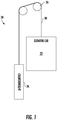
- FIG 1 schematically shows selected portions of an elevator system 20 including an elevator car 22 and counterweight 24.
- a traction sheave 26 associated with a machine selectively controls movement of a load bearing member 30, which suspends the elevator car 22 and counterweight 24, to control the movement or position of the elevator car 22.
- a single load bearing member 30 is represented in Figure 1 . Multiple load bearing members would be included in many embodiments.
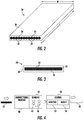
- FIG. 2 schematically illustrates an example load bearing member 30.
- a plurality of load bearing fibers 32 serve as the primary load bearing components of the load bearing member 30.
- the load bearing fibers 32 are woven into a unidirectional weave.
- the load bearing fibers 32 are arranged as warp fibers extending in a length direction L of the load bearing member 30.
- a unidirectional weave has fibers extending in a single direction and does not include weft fibers that would be parallel to a width direction W of the load bearing member.
- the unidirectional weave may include some weft fibers transverse to the single direction of the warp fibers but such weft fibers are far fewer in number than the warp fibers and are not considered significant to the load bearing performance of the unidirectional weave. Any such weft fibers may serve a limited purpose during manufacturing, for example.
- a unidirectional weave of load bearing fibers 32 also provides improved flexibility characteristics.
- the load bearing fibers 32 are arranged or grouped as cords 34 and the cords 34 are woven into the unidirectional weave.
- the load bearing fibers 32 are individually woven into the unidirectional weave, which effectively forms a layer or sheet 36.
- the load bearing fibers 32 include at least two different types of material. Some embodiments include at least one polymer and another type of material such as carbon or another organic material. One of the materials is selected to at least partially melt for bonding the load bearing fibers 32 together.
- the material that provides the bonding has properties including a melting point that allows for at least partially melting that material without compromising the mechanical properties of another material that at least some of the other load bearing fibers 32 are made.
- the illustrated example embodiment includes a first type of polymer material and a second type of polymer material that have different melting points.
- the first type of polymer material has a higher melting point than the melting point of the second type of polymer material.
- Including different types of polymer with different melting points allows for bonding the load bearing fibers 32 of the unidirectional weave together in a way that preserves the mechanical properties of the fibers made of the first type of polymer and maintains the configuration of the unidirectional weave.
- the plurality of load bearing fibers 32 are bonded together by at least some of the second type of polymer that is at least partially melted without melting any of the first type of polymer material.
- each of the load bearing fibers 32 comprises only one type of polymer.
- some of the fibers 32 are made of the first type of polymer while others are made of the second type of polymer.
- at least some of the fibers 32 include more than one material and may include multiple polymers or at least one type of polymer and another type of material.
- the unidirectional weave of fibers 32 includes a ratio of the first type of polymer to the second type of polymer (e.g., higher melting point polymer to lower melting point polymer) in a range from 4:1 to 1:1. Some embodiments include a ratio of the first type of polymer to the second type of polymer of 3:2. An example embodiment includes a ratio of 2: 1. In preparation of the multi-polymer composite, the ratio of high melt point fibers to low melting point fibers depends on the processing and linear density of the fibers.
- the unidirectional woven fibers are consolidated under a selected pressure at the specific temperature that the second or low melting point polymer material melts and forms a hot fluid that adheres the higher melting point fibers together.
- the low melting point polymer fibers On cooling from the consolidated high temperature, the low melting point polymer fibers recrystallize, which forms a resin matrix in composite.
- the original mechanical properties of the low melting point polymer fibers will change because they are at least partially melted.
- Including the higher melting point material allows for preserving the mechanical properties of the higher melting point fibers.
- the final property of the composite provides the necessary characteristics for elevator system operation when there are enough higher melting point fibers, such as having more higher melting point fibers than lower melting point polymer fibers.
- Example higher melting point and high strength polymers include liquid crystal polymer, aramid, polyhydroquinone-diimidazopyridine, polybenzimidazole, polypyridobisimidazole and polybenzoxazole.
- Example lower melting point and high strength polymers include ultrahigh molecular weight polyethylene and ultrahigh molecular weight polypropylene.
- a jacket 38 covers the load bearing fibers in each of the illustrated example embodiments.
- the jacket 38 comprises a material that is suitable for establishing the desired traction with the traction sheave 26 to achieve the desired traction for controlling movement of the elevator car 22.
- Example materials that are useful include compressible materials, such as a thermoplastic material or an elastomer.
- the jacket 36 comprises a thermoplastic polyurethane material.
- Figure 4 schematically illustrates an example method of making the disclosed load bearing member embodiments.
- the plurality of polymer load bearing fibers 32 are introduced or fed into unidirectional weaving equipment 40 where the fibers 32 are woven into the unidirectional weave. Then the woven fibers 32 are heated and pressed together by bonding equipment 42.
- the bonding equipment 42 includes heating elements that subject the woven fibers 32 to a temperature that is at least as high as the melting point of the second type of polymer and less than the melting point of the first type of polymer. Such heating at least partially melts at least some of the second type of polymer without melting any of the first type of polymer. Any fibers composed of only the first type of polymer are not melted or altered during such heating.
- the unidirectionally woven fibers 32 are fed through and pressed between heated rollers 44. At least the rollers 44 heat the woven fibers 32 to a temperature sufficient to at least partially melt at least some of the second type of polymer. That melted polymer bonds the woven fibers 32 together.
- the bonding equipment 42 includes cooling rollers 46 to facilitate shaping or maintaining the shape of the unidirectional weave of fibers 32 while any melted polymer recrystallizes.
- the coating equipment 50 includes an adhesive applicator 52 that applies an adhesive coating onto the polymer load bearing fibers 32.
- a jacket application device 54 such as an extruder, applies the material of the jacket 38.
- a load bearing member including a multi-polymer unidirectional weave of load bearing fibers as disclosed above provides improved strength characteristics compared to traditional elevator roping or belts that rely on steel wires as the primary load bearing components. Additionally, load bearing members consistent with the example embodiments of this disclosure are lighter weight and provide cost savings compared to previous configurations.
Landscapes
- Engineering & Computer Science (AREA)
- Mechanical Engineering (AREA)
- Textile Engineering (AREA)
- Lift-Guide Devices, And Elevator Ropes And Cables (AREA)
- Ropes Or Cables (AREA)
Abstract
Description
- A variety of elevator systems are known. Some elevator systems use a hydraulic arrangement for moving the elevator car. Others are traction-based and include roping that suspends the elevator car and a counterweight. A machine causes movement of a traction sheave that, in turn, causes movement of the roping for moving the elevator car as desired.
- For many years, roping in elevator systems included round steel ropes. More recently, flat belt technologies were developed that provided advantages over traditional, round steel rope arrangements. Even with the advancement, those skilled in the art have been striving to improve elevator load bearing member technology.
- An illustrative example embodiment of an elevator load bearing member includes a unidirectional weave of a plurality of load bearing fibers including at least a first material and a second material. A melting point of the first material is higher than a melting point of the second material. The plurality of load bearing fibers are bonded together by at least some of the second material that is at least partially melted. A coating covers the plurality of load bearing fibers.
- In an example embodiment having one or more features of the elevator load bearing member of the previous paragraph, the first material comprises a first type of polymer, the second material comprises a second type of polymer, at least some of the load bearing fibers comprise the first type of polymer and at least some others of the load bearing fibers comprise the second type of polymer.
- In an example embodiment having one or more features of the elevator load bearing member of any of the previous paragraphs, at least some of the load bearing fibers comprise the first material and the second material.
- In an example embodiment having one or more features of the elevator load bearing member of any of the previous paragraphs, the coating comprises a jacket that defines a traction surface of the elevator load bearing member.
- In an example embodiment having one or more features of the elevator load bearing member of any of the previous paragraphs, the jacket comprises a thermoplastic material and the coating comprises an adhesive between the thermoplastic material and at least some of the load bearing fibers.
- In an example embodiment having one or more features of the elevator load bearing member of any of the previous paragraphs, a ratio of the first material to the second material is 1:1.
- In an example embodiment having one or more features of the elevator load bearing member of any of the previous paragraphs, a ratio of the first material to the second material is 2:1.
- In an example embodiment having one or more features of the elevator load bearing member of any of the previous paragraphs, a ratio of the first material to the second material is 3:2.
- In an example embodiment having one or more features of the elevator load bearing member of any of the previous paragraphs, the first material comprises at least one of carbon, liquid crystal polymer, aramid, polyhydroquinone-diimidazopyridine, polybenzimidazole, polypyridobisimidazole and polybenzoxazole; and the second material comprises at least one of ultrahigh molecular weight polyethylene and ultrahigh molecular weight polypropylene.
- An illustrative example embodiment of a method of making an elevator load bearing member includes unidirectional weaving a plurality of load bearing fibers including at least a first material and a second material. A melting point of the first material is higher than a melting point of the second material. The method includes bonding the load bearing fibers together by at least partially melting at least some of the second material and coating the plurality of load bearing fibers.
- In an example embodiment having one or more features of the method of the previous paragraph, the first material comprises a first type of polymer, the second material comprises a second type of polymer, at least some of the load bearing fibers comprise the first type of polymer, and at least some others of the load bearing fibers comprise the second type of polymer.
- In an example embodiment having one or more features of the method of any of the previous paragraphs, at least some of the load bearing fibers comprise the first material and the second material.
- In an example embodiment having one or more features of the method of any of the previous paragraphs, the coating comprises applying a jacket onto the load bearing fibers and the jacket defines a traction surface of the elevator load bearing member.
- In an example embodiment having one or more features of the method of any of the previous paragraphs, the jacket comprises a thermoplastic material and the coating comprises applying an adhesive onto the load bearing fibers between the thermoplastic material and at least some of the load bearing fibers.
- In an example embodiment having one or more features of the method of any of the previous paragraphs, the bonding comprises heating and applying pressure to the load bearing fibers.
- In an example embodiment having one or more features of the method of any of the previous paragraphs, the heating includes exposing the load bearing fibers to a temperature that is at least as high as the melting point of the second material and below the melting point of the first material.
- In an example embodiment having one or more features of the method of any of the previous paragraphs, the bonding comprises pressing the load bearing fibers between first rollers that are heated and pressing the load bearing fibers between second rollers that are not heated.
- In an example embodiment having one or more features of the method of any of the previous paragraphs, a ratio of the first material to the second material is between 1:1 and 4:1.
- In an example embodiment having one or more features of the method of any of the previous paragraphs, the ratio is 2:1.
- In an example embodiment having one or more features of the method of any of the previous paragraphs, the first material comprises at least one of carbon, liquid crystal polymer, aramid, polyhydroquinone-diimidazopyridine, polybenzimidazole, polypyridobisimidazole and polybenzoxazole; and the second material comprises at least one of ultrahigh molecular weight polyethylene and ultrahigh molecular weight polypropylene.
- The various features and advantages of at least one disclosed example embodiment will become apparent to those skilled in the art from the following detailed description. The drawings that accompany the detailed description can be briefly described as follows.
-
-
Figure 1 schematically illustrates selected portions of an elevator system including a load bearing member designed according to an embodiment of this invention. -
Figure 2 schematically illustrates an example embodiment of an elevator load bearing member. -
Figure 3 is an end view of another example embodiment of an elevator load bearing member. -
Figure 4 schematically illustrates selected features of a process for making an elevator load bearing member like those shown inFigures 2 and 3 . -
Figure 1 schematically shows selected portions of anelevator system 20 including anelevator car 22 andcounterweight 24. Atraction sheave 26 associated with a machine (not specifically illustrated) selectively controls movement of aload bearing member 30, which suspends theelevator car 22 andcounterweight 24, to control the movement or position of theelevator car 22. For illustration purposes, a singleload bearing member 30 is represented inFigure 1 . Multiple load bearing members would be included in many embodiments. -
Figure 2 schematically illustrates an exampleload bearing member 30. A plurality ofload bearing fibers 32 serve as the primary load bearing components of theload bearing member 30. The load bearingfibers 32 are woven into a unidirectional weave. The load bearingfibers 32 are arranged as warp fibers extending in a length direction L of theload bearing member 30. A unidirectional weave has fibers extending in a single direction and does not include weft fibers that would be parallel to a width direction W of the load bearing member. - In some embodiments the unidirectional weave may include some weft fibers transverse to the single direction of the warp fibers but such weft fibers are far fewer in number than the warp fibers and are not considered significant to the load bearing performance of the unidirectional weave. Any such weft fibers may serve a limited purpose during manufacturing, for example.
- Weaving the load bearing fibers into a unidirectional weave avoids any braiding of the fibers and, therefore, provides improved strength characteristics compared to other types of weaves. A unidirectional weave of
load bearing fibers 32 also provides improved flexibility characteristics. - In the embodiment shown in
Figure 2 , theload bearing fibers 32 are arranged or grouped ascords 34 and thecords 34 are woven into the unidirectional weave. In the embodiment shown inFigure 3 , theload bearing fibers 32 are individually woven into the unidirectional weave, which effectively forms a layer orsheet 36. - The load bearing
fibers 32 include at least two different types of material. Some embodiments include at least one polymer and another type of material such as carbon or another organic material. One of the materials is selected to at least partially melt for bonding theload bearing fibers 32 together. The material that provides the bonding has properties including a melting point that allows for at least partially melting that material without compromising the mechanical properties of another material that at least some of the otherload bearing fibers 32 are made. - For discussion purposes, the illustrated example embodiment includes a first type of polymer material and a second type of polymer material that have different melting points. The first type of polymer material has a higher melting point than the melting point of the second type of polymer material. Including different types of polymer with different melting points allows for bonding the
load bearing fibers 32 of the unidirectional weave together in a way that preserves the mechanical properties of the fibers made of the first type of polymer and maintains the configuration of the unidirectional weave. For example, the plurality ofload bearing fibers 32 are bonded together by at least some of the second type of polymer that is at least partially melted without melting any of the first type of polymer material. - In some embodiments each of the
load bearing fibers 32 comprises only one type of polymer. For example, some of thefibers 32 are made of the first type of polymer while others are made of the second type of polymer. In other embodiments at least some of thefibers 32 include more than one material and may include multiple polymers or at least one type of polymer and another type of material. - The unidirectional weave of
fibers 32 includes a ratio of the first type of polymer to the second type of polymer (e.g., higher melting point polymer to lower melting point polymer) in a range from 4:1 to 1:1. Some embodiments include a ratio of the first type of polymer to the second type of polymer of 3:2. An example embodiment includes a ratio of 2: 1. In preparation of the multi-polymer composite, the ratio of high melt point fibers to low melting point fibers depends on the processing and linear density of the fibers. - The unidirectional woven fibers are consolidated under a selected pressure at the specific temperature that the second or low melting point polymer material melts and forms a hot fluid that adheres the higher melting point fibers together. On cooling from the consolidated high temperature, the low melting point polymer fibers recrystallize, which forms a resin matrix in composite. The original mechanical properties of the low melting point polymer fibers will change because they are at least partially melted. Including the higher melting point material allows for preserving the mechanical properties of the higher melting point fibers. The final property of the composite provides the necessary characteristics for elevator system operation when there are enough higher melting point fibers, such as having more higher melting point fibers than lower melting point polymer fibers.
- Example higher melting point and high strength polymers include liquid crystal polymer, aramid, polyhydroquinone-diimidazopyridine, polybenzimidazole, polypyridobisimidazole and polybenzoxazole. Example lower melting point and high strength polymers include ultrahigh molecular weight polyethylene and ultrahigh molecular weight polypropylene.
- A
jacket 38 covers the load bearing fibers in each of the illustrated example embodiments. Thejacket 38 comprises a material that is suitable for establishing the desired traction with thetraction sheave 26 to achieve the desired traction for controlling movement of theelevator car 22. Example materials that are useful include compressible materials, such as a thermoplastic material or an elastomer. In some embodiments thejacket 36 comprises a thermoplastic polyurethane material. -
Figure 4 schematically illustrates an example method of making the disclosed load bearing member embodiments. The plurality of polymerload bearing fibers 32 are introduced or fed intounidirectional weaving equipment 40 where thefibers 32 are woven into the unidirectional weave. Then the wovenfibers 32 are heated and pressed together by bondingequipment 42. For example, thebonding equipment 42 includes heating elements that subject thewoven fibers 32 to a temperature that is at least as high as the melting point of the second type of polymer and less than the melting point of the first type of polymer. Such heating at least partially melts at least some of the second type of polymer without melting any of the first type of polymer. Any fibers composed of only the first type of polymer are not melted or altered during such heating. - In the illustrated example arrangement the unidirectionally woven
fibers 32 are fed through and pressed betweenheated rollers 44. At least therollers 44 heat the wovenfibers 32 to a temperature sufficient to at least partially melt at least some of the second type of polymer. That melted polymer bonds thewoven fibers 32 together. - In
Figure 4 , thebonding equipment 42 includescooling rollers 46 to facilitate shaping or maintaining the shape of the unidirectional weave offibers 32 while any melted polymer recrystallizes. - Once the unidirectional weave is at a suitable temperature it is coated by coating
equipment 50. In the illustrated example arrangement, thecoating equipment 50 includes anadhesive applicator 52 that applies an adhesive coating onto the polymerload bearing fibers 32. Ajacket application device 54, such as an extruder, applies the material of thejacket 38. - A load bearing member including a multi-polymer unidirectional weave of load bearing fibers as disclosed above provides improved strength characteristics compared to traditional elevator roping or belts that rely on steel wires as the primary load bearing components. Additionally, load bearing members consistent with the example embodiments of this disclosure are lighter weight and provide cost savings compared to previous configurations.
- The preceding description is exemplary rather than limiting in nature. Variations and modifications to the disclosed examples may become apparent to those skilled in the art that do not necessarily depart from the essence of this invention. The scope of legal protection given to this invention can only be determined by studying the following claims.
Claims (15)
- An elevator load bearing member, comprising:a unidirectional weave of a plurality of load bearing fibers including at least a first material and a second material, a melting point of the first material is higher than a melting point of the second material, wherein the plurality of load bearing fibers are bonded together by at least some of the second material that is at least partially melted; anda coating over the plurality of load bearing fibers.
- The elevator load bearing member of claim 1, wherein:the first material comprises a first type of polymer;the second material comprises a second type of polymer;at least some of the load bearing fibers comprise the first type of polymer; andat least some others of the load bearing fibers comprise the second type of polymer.
- The elevator load bearing member of claim 1 or 2, wherein at least some of the load bearing fibers comprise the first material and the second material.
- The elevator load bearing member of any preceding claim, wherein the coating comprises a jacket that defines a traction surface of the elevator load bearing member,
and optionally wherein:the jacket comprises a thermoplastic material; andthe coating comprises an adhesive between the thermoplastic material and at least some of the load bearing fibers. - The elevator load bearing member of any preceding claim, wherein a ratio of the first material to the second material is 1:1, or
wherein a ratio of the first material to the second material is 2:1, or
wherein a ratio of the first material to the second material is 3:2. - The elevator load bearing member of any preceding claim, wherein:the first material comprises at least one of carbon, liquid crystal polymer, aramid, polyhydroquinone-diimidazopyridine, polybenzimidazole, polypyridobisimidazole and polybenzoxazole; andthe second material comprises at least one of ultrahigh molecular weight polyethylene and ultrahigh molecular weight polypropylene.
- A method of making an elevator load bearing member, the method comprising:unidirectional weaving a plurality of load bearing fibers including at least a first material and a second material, wherein a melting point of the first material is higher than a melting point of the second material;bonding the load bearing fibers together by at least partially melting at least some of the second material; andcoating the plurality of load bearing fibers.
- The method of claim 7, wherein:the first material comprises a first type of polymer;the second material comprises a second type of polymer;at least some of the load bearing fibers comprise the first type of polymer; andat least some others of the load bearing fibers comprise the second type of polymer.
- The method of claim 7 or 8, wherein at least some of the load bearing fibers comprise the first material and the second material.
- The method of any of claims 7-9, wherein:the coating comprises applying a jacket onto the load bearing fibers; andthe jacket defines a traction surface of the elevator load bearing member.
- The method of claim 10, wherein:the jacket comprises a thermoplastic material; andthe coating comprises applying an adhesive onto the load bearing fibers between the thermoplastic material and at least some of the load bearing fibers.
- The method of any of claims 7-11, wherein the bonding comprises heating and applying pressure to the load bearing fibers.
- The method of claim 12, wherein the heating includes exposing the load bearing fibers to a temperature that is at least as high as the melting point of the second material and below the melting point of the first material.
- The method of claim 12 or 13, wherein the bonding comprises:pressing the load bearing fibers between first rollers that are heated; andpressing the load bearing fibers between second rollers that are not heated.
- The method any of claims 7-14, wherein a ratio of the first material to the second material is between 1:1 and 4:1; and preferably
wherein the ratio is 2:1; and/or
wherein the first material comprises at least one of carbon, liquid crystal polymer, aramid, polyhydroquinone-diimidazopyridine, polybenzimidazole, polypyridobisimidazole and polybenzoxazole; and
the second material comprises at least one of ultrahigh molecular weight polyethylene and ultrahigh molecular weight polypropylene.
Applications Claiming Priority (1)
| Application Number | Priority Date | Filing Date | Title |
|---|---|---|---|
| US16/456,318 US11655120B2 (en) | 2019-06-28 | 2019-06-28 | Elevator load bearing member including a unidirectional weave |
Publications (2)
| Publication Number | Publication Date |
|---|---|
| EP3757051A1 true EP3757051A1 (en) | 2020-12-30 |
| EP3757051B1 EP3757051B1 (en) | 2024-10-16 |
Family
ID=69024199
Family Applications (1)
| Application Number | Title | Priority Date | Filing Date |
|---|---|---|---|
| EP19219663.2A Active EP3757051B1 (en) | 2019-06-28 | 2019-12-24 | Elevator load bearing member including a unidirectional weave |
Country Status (3)
| Country | Link |
|---|---|
| US (2) | US11655120B2 (en) |
| EP (1) | EP3757051B1 (en) |
| CN (1) | CN112141851A (en) |
Families Citing this family (2)
| Publication number | Priority date | Publication date | Assignee | Title |
|---|---|---|---|---|
| US11655120B2 (en) * | 2019-06-28 | 2023-05-23 | Otis Elevator Company | Elevator load bearing member including a unidirectional weave |
| US12522473B2 (en) * | 2022-09-02 | 2026-01-13 | Otis Elevator Company | Elevator load bearing member with conductive adhesive |
Citations (7)
| Publication number | Priority date | Publication date | Assignee | Title |
|---|---|---|---|---|
| DE1269590B (en) * | 1963-10-28 | 1968-06-06 | Leipziger Buchbindereimaschine | Use of braided or non-braided mixed threads or mixed threads for books, staples and similar items |
| US5771673A (en) * | 1994-01-31 | 1998-06-30 | Lozetex-Zwirne Gmbh, Et Al | Line, in particular fishing line, as well as method for its production |
| WO2015126359A1 (en) * | 2014-02-18 | 2015-08-27 | Otis Elevator Company | Elevator belt and method of manufacture |
| US20170066630A1 (en) * | 2015-09-08 | 2017-03-09 | Otis Elevator Company | Elevator tension member |
| EP3205617A1 (en) * | 2016-02-09 | 2017-08-16 | Otis Elevator Company | Elevator tension member |
| EP3392184A1 (en) * | 2017-04-20 | 2018-10-24 | Otis Elevator Company | Hybrid fiber tension member for elevator system belt |
| EP3599307A1 (en) * | 2018-07-25 | 2020-01-29 | Otis Elevator Company | Composite elevator system tension member |
Family Cites Families (69)
| Publication number | Priority date | Publication date | Assignee | Title |
|---|---|---|---|---|
| FR1472461A (en) * | 1965-03-22 | 1967-05-24 | ||
| US3673023A (en) * | 1970-06-24 | 1972-06-27 | Grace W R & Co | Process of producing reinforced laminate |
| NL182497C (en) * | 1976-11-26 | 1988-03-16 | Akzo Nv | METHOD FOR MANUFACTURING A FITTY STRAP, AND CABLES OR ROPES MADE THEREFROM |
| US4275117A (en) * | 1977-09-02 | 1981-06-23 | Ashaway Line & Twine Mfg. Co. | String construction produced by subjecting a fibrous strand composed of fibrous materials having differing melting points to heating conditions sufficient to melt some but not all of the fibrous materials |
| US4228641A (en) * | 1978-09-28 | 1980-10-21 | Exxon Research & Engineering Co. | Thermoplastic twines |
| US4433536A (en) * | 1981-09-23 | 1984-02-28 | Exxon Research & Engineering Co. | Spiral wrapped synthetic twine and method of manufacturing same |
| US4887422A (en) * | 1988-09-06 | 1989-12-19 | Amsted Industries Incorporated | Rope with fiber core and method of forming same |
| JPH0686718B2 (en) * | 1988-10-31 | 1994-11-02 | 東京製綱株式会社 | Method for manufacturing composite twisted filament |
| US5540990A (en) * | 1995-04-27 | 1996-07-30 | Berkley, Inc. | Polyolefin line |
| US5881843A (en) * | 1996-10-15 | 1999-03-16 | Otis Elevator Company | Synthetic non-metallic rope for an elevator |
| WO1998029327A1 (en) * | 1996-12-30 | 1998-07-09 | Kone Corporation | Elevator rope arrangement |
| SG76633A1 (en) * | 1998-10-23 | 2000-11-21 | Inventio Ag | Synthetic fiber rope |
| US7032371B2 (en) * | 2002-01-30 | 2006-04-25 | Thyssen Elevator Capital Corp. | Synthetic fiber rope for an elevator |
| CN1668793B (en) * | 2002-09-25 | 2013-11-20 | 奥蒂斯电梯公司 | Elevator belt assembly with pre-stretched synthetic cords |
| US7147904B1 (en) * | 2003-08-05 | 2006-12-12 | Evelyn Florence, Llc | Expandable tubular fabric |
| BRPI0508324A (en) * | 2004-03-02 | 2007-07-24 | Mamutec Ag | cable structure |
| WO2006085881A1 (en) * | 2005-02-09 | 2006-08-17 | Otis Elevator Company | Elevator load bearing member having a jacket with at least one traction-enhancing exterior surface |
| KR101288158B1 (en) * | 2005-06-13 | 2013-07-23 | 디에스엠 아이피 어셋츠 비.브이. | Braided rope construction |
| WO2007062803A1 (en) * | 2005-12-02 | 2007-06-07 | Dsm Ip Assets B.V. | Rope containing high-performance polyethylene fibres |
| SG141343A1 (en) * | 2006-09-29 | 2008-04-28 | Inventio Ag | Synthetic fibre cable and lift installation with such a synthetic fibre cable |
| KR20100042247A (en) * | 2007-05-18 | 2010-04-23 | 샘슨 로프 테크놀로지스, 인크. | Composite rope structures and systems and methods for making composite rope structures |
| GB2458001B (en) * | 2008-01-18 | 2010-12-08 | Kone Corp | An elevator hoist rope, an elevator and method |
| US9050768B2 (en) * | 2008-04-14 | 2015-06-09 | Inventio Ag | Method and device for producing a support belt for an elevator installation |
| BR112012002556B1 (en) * | 2009-08-04 | 2019-11-05 | Dsm Ip Assets Bv | high strength coated fibers |
| CN108046083B (en) * | 2010-04-22 | 2020-02-21 | 蒂森克虏伯电梯股份有限公司 | Elevator suspension and conveyor belt |
| US8181438B2 (en) * | 2010-10-18 | 2012-05-22 | Pure Fishing, Inc. | Composite fishing line |
| TW201233553A (en) * | 2010-11-09 | 2012-08-16 | Applied Ft Composite Solutions Inc | Multi-layered composite cushioning material and method for making the same |
| CN103917472B (en) * | 2011-11-10 | 2016-12-07 | 奥的斯电梯公司 | Elevator device traction belt |
| KR20160088949A (en) * | 2011-12-14 | 2016-07-26 | 게이츠 코포레이션 | System and method of making open-ended thermoplastic belting |
| FI124486B (en) * | 2012-01-24 | 2014-09-30 | Kone Corp | Line for an elevator device, liner arrangement, elevator and method for condition monitoring of the elevator device line |
| RU2617031C2 (en) * | 2012-04-24 | 2017-04-19 | ДСМ АйПи АССЕТС Б.В. | Combo cable or combination locks |
| WO2014014456A1 (en) * | 2012-07-18 | 2014-01-23 | Otis Elevator Company | Fire-retardant belt |
| ES2549795T3 (en) * | 2013-07-04 | 2015-11-02 | Kone Corporation | An elevator system |
| EP2851325B1 (en) * | 2013-09-24 | 2016-09-14 | KONE Corporation | A rope terminal assembly and an elevator |
| ES2609467T3 (en) * | 2013-10-10 | 2017-04-20 | Kone Corporation | Cable for a lifting and lifting device |
| EP2894119B1 (en) * | 2014-01-08 | 2016-04-06 | KONE Corporation | Rope for an elevator, elevator and method |
| WO2015134023A1 (en) * | 2014-03-06 | 2015-09-11 | Otis Elevator Company | Woven elevator belt with coating |
| WO2015162263A1 (en) * | 2014-04-25 | 2015-10-29 | Thyssenkrupp Elevator Ag | Elevator hoisting member and method of use |
| DK3143196T3 (en) * | 2014-05-13 | 2021-04-26 | Bekaert Advanced Cords Aalter Nv | CUT-RESISTANT ROPE |
| US9834872B2 (en) * | 2014-10-29 | 2017-12-05 | Honeywell International Inc. | High strength small diameter fishing line |
| US9816211B2 (en) * | 2014-10-29 | 2017-11-14 | Honeywell International Inc. | Optimized braid construction |
| EP3015413B1 (en) * | 2014-11-03 | 2017-08-09 | KONE Corporation | Hoisting rope and hoisting apparatus |
| DE102015118970A1 (en) * | 2015-11-05 | 2017-05-11 | Bwg Bergwerk- Und Walzwerk-Maschinenbau Gmbh | Method and plant for producing composite strips or sheets |
| AU2017268631B2 (en) * | 2016-12-02 | 2023-09-28 | Otis Elevator Company | Overbraided non-metallic tension members |
| CN108217385B (en) * | 2016-12-12 | 2021-03-12 | 奥的斯电梯公司 | Hybrid fabric laminated belt for elevator system |
| US10767077B2 (en) * | 2017-01-30 | 2020-09-08 | Otis Elevator Company | Load-bearing member surface treatment |
| KR102558412B1 (en) * | 2017-04-03 | 2023-07-24 | 오티스 엘리베이터 컴파니 | Elevator belt with additive layer |
| AU2018202595B2 (en) * | 2017-04-20 | 2020-01-30 | Otis Elevator Company | Fire-resistant synthetic tension members |
| KR102623964B1 (en) * | 2017-04-20 | 2024-01-11 | 오티스 엘리베이터 컴파니 | Elevator system belt with fabric tension member |
| AU2018202605B2 (en) * | 2017-04-20 | 2023-11-30 | Otis Elevator Company | Tension member for elevator system belt |
| AU2018202597B2 (en) * | 2017-04-20 | 2023-11-16 | Otis Elevator Company | Tension member for elevator system belt |
| AU2018202655B2 (en) * | 2017-04-20 | 2023-12-07 | Otis Elevator Company | Tension member for elevator system belt |
| US20190047821A1 (en) * | 2017-08-11 | 2019-02-14 | Otis Elevator Company | Load bearing member for lifting system |
| US20190062114A1 (en) * | 2017-08-25 | 2019-02-28 | Otis Elevator Company | Self-extinguishing load bearing member for elevator system |
| US10549952B2 (en) * | 2017-08-25 | 2020-02-04 | Otis Elevator Company | Self-extinguishing fabric belt for elevator system |
| US11274017B2 (en) * | 2017-08-25 | 2022-03-15 | Otis Elevator Company | Belt with self-extinguishing layer and method of making |
| KR102623974B1 (en) * | 2017-11-10 | 2024-01-11 | 오티스 엘리베이터 컴파니 | Elevator system belt |
| US11459209B2 (en) * | 2017-11-10 | 2022-10-04 | Otis Elevator Company | Light weight load bearing member for elevator system |
| EP3517572B1 (en) * | 2017-11-30 | 2021-01-27 | Otis Elevator Company | Load bearing traction members and method |
| CN109941863A (en) * | 2017-11-30 | 2019-06-28 | 奥的斯电梯公司 | Carry driving component and method |
| CN110002304B (en) * | 2017-12-06 | 2022-03-01 | 奥的斯电梯公司 | Wear detection for elevator system belt |
| US20190322488A1 (en) * | 2018-04-23 | 2019-10-24 | Otis Elevator Company | Health monitoring of elevator tension member |
| US10764581B2 (en) * | 2018-05-24 | 2020-09-01 | Lockhead Martin Corporation | Multi-resolution regionalized data transmission |
| US12503338B2 (en) * | 2018-06-29 | 2025-12-23 | Otis Elevator Company | Hybrid compensation member |
| US20200031624A1 (en) * | 2018-07-26 | 2020-01-30 | Otis Elevator Company | Elevator tension member verification |
| US11548763B2 (en) * | 2018-08-10 | 2023-01-10 | Otis Elevator Company | Load bearing traction members and method |
| US11655120B2 (en) * | 2019-06-28 | 2023-05-23 | Otis Elevator Company | Elevator load bearing member including a unidirectional weave |
| US20210024328A1 (en) * | 2019-07-22 | 2021-01-28 | Otis Elevator Company | Elevator load bearing member having a jacket including a fluoropolymer |
| US20210062414A1 (en) * | 2019-08-30 | 2021-03-04 | Otis Elevator Company | Tension member and belt for elevator system |
-
2019
- 2019-06-28 US US16/456,318 patent/US11655120B2/en active Active
- 2019-12-24 EP EP19219663.2A patent/EP3757051B1/en active Active
- 2019-12-30 CN CN201911393763.6A patent/CN112141851A/en active Pending
-
2023
- 2023-04-13 US US18/299,818 patent/US11945689B2/en active Active
Patent Citations (7)
| Publication number | Priority date | Publication date | Assignee | Title |
|---|---|---|---|---|
| DE1269590B (en) * | 1963-10-28 | 1968-06-06 | Leipziger Buchbindereimaschine | Use of braided or non-braided mixed threads or mixed threads for books, staples and similar items |
| US5771673A (en) * | 1994-01-31 | 1998-06-30 | Lozetex-Zwirne Gmbh, Et Al | Line, in particular fishing line, as well as method for its production |
| WO2015126359A1 (en) * | 2014-02-18 | 2015-08-27 | Otis Elevator Company | Elevator belt and method of manufacture |
| US20170066630A1 (en) * | 2015-09-08 | 2017-03-09 | Otis Elevator Company | Elevator tension member |
| EP3205617A1 (en) * | 2016-02-09 | 2017-08-16 | Otis Elevator Company | Elevator tension member |
| EP3392184A1 (en) * | 2017-04-20 | 2018-10-24 | Otis Elevator Company | Hybrid fiber tension member for elevator system belt |
| EP3599307A1 (en) * | 2018-07-25 | 2020-01-29 | Otis Elevator Company | Composite elevator system tension member |
Also Published As
| Publication number | Publication date |
|---|---|
| US20200407194A1 (en) | 2020-12-31 |
| US20230249943A1 (en) | 2023-08-10 |
| US11945689B2 (en) | 2024-04-02 |
| US11655120B2 (en) | 2023-05-23 |
| EP3757051B1 (en) | 2024-10-16 |
| CN112141851A (en) | 2020-12-29 |
Similar Documents
| Publication | Publication Date | Title |
|---|---|---|
| US11945689B2 (en) | Elevator load bearing member including a unidirectional weave | |
| CN108217385B (en) | Hybrid fabric laminated belt for elevator system | |
| KR102558412B1 (en) | Elevator belt with additive layer | |
| EP2356054B1 (en) | Elevator belt and corresponding method of making the same | |
| US20180305182A1 (en) | Hybrid fiber tension member for elevator system belt | |
| JP6403771B2 (en) | Method and system for impregnating fibers to form a prepreg | |
| US5599604A (en) | Reinforcement fabric ply and composite | |
| KR102871842B1 (en) | Method and device for forming composite sheets | |
| EP3009390B1 (en) | Method for manufacturing a hoisting rope, hoisting rope and elevator using the same | |
| EP3213916A1 (en) | Fiber-reinforced composite material and method for manufacturing same | |
| EP3426586A1 (en) | Reinforced fabric elevator belt with improved internal wear resistance | |
| CA2830926A1 (en) | Methods to improve the process-ability of uni-directional composites | |
| US11802022B2 (en) | Self healing elevator load bearing member | |
| US20200198266A1 (en) | Annealed unidirectional thermoplastic composite tape | |
| CN111792492B (en) | Elevator load bearing member having a fabric structure | |
| JP6531245B1 (en) | Composite material combining carbon fiber woven fabric and elastic polymer compound and method for producing the same | |
| US9828180B2 (en) | Fabric conveyor belt with layered PVC and polyester coating and method of forming the same | |
| EP3747816B1 (en) | Elevator load bearing member having a fabric structure including warp and weft yarns | |
| US4579766A (en) | Elastomer-coated bias reinforcement fabric | |
| KR102620323B1 (en) | Ceramic fiber composite with improved impregnation property and method for manufacturing the same |
Legal Events
| Date | Code | Title | Description |
|---|---|---|---|
| PUAI | Public reference made under article 153(3) epc to a published international application that has entered the european phase |
Free format text: ORIGINAL CODE: 0009012 |
|
| STAA | Information on the status of an ep patent application or granted ep patent |
Free format text: STATUS: THE APPLICATION HAS BEEN PUBLISHED |
|
| AK | Designated contracting states |
Kind code of ref document: A1 Designated state(s): AL AT BE BG CH CY CZ DE DK EE ES FI FR GB GR HR HU IE IS IT LI LT LU LV MC MK MT NL NO PL PT RO RS SE SI SK SM TR |
|
| AX | Request for extension of the european patent |
Extension state: BA ME |
|
| STAA | Information on the status of an ep patent application or granted ep patent |
Free format text: STATUS: REQUEST FOR EXAMINATION WAS MADE |
|
| 17P | Request for examination filed |
Effective date: 20210629 |
|
| RBV | Designated contracting states (corrected) |
Designated state(s): AL AT BE BG CH CY CZ DE DK EE ES FI FR GB GR HR HU IE IS IT LI LT LU LV MC MK MT NL NO PL PT RO RS SE SI SK SM TR |
|
| STAA | Information on the status of an ep patent application or granted ep patent |
Free format text: STATUS: EXAMINATION IS IN PROGRESS |
|
| 17Q | First examination report despatched |
Effective date: 20221018 |
|
| GRAP | Despatch of communication of intention to grant a patent |
Free format text: ORIGINAL CODE: EPIDOSNIGR1 |
|
| STAA | Information on the status of an ep patent application or granted ep patent |
Free format text: STATUS: GRANT OF PATENT IS INTENDED |
|
| INTG | Intention to grant announced |
Effective date: 20240206 |
|
| GRAJ | Information related to disapproval of communication of intention to grant by the applicant or resumption of examination proceedings by the epo deleted |
Free format text: ORIGINAL CODE: EPIDOSDIGR1 |
|
| STAA | Information on the status of an ep patent application or granted ep patent |
Free format text: STATUS: EXAMINATION IS IN PROGRESS |
|
| GRAP | Despatch of communication of intention to grant a patent |
Free format text: ORIGINAL CODE: EPIDOSNIGR1 |
|
| STAA | Information on the status of an ep patent application or granted ep patent |
Free format text: STATUS: GRANT OF PATENT IS INTENDED |
|
| INTC | Intention to grant announced (deleted) | ||
| INTG | Intention to grant announced |
Effective date: 20240607 |
|
| GRAS | Grant fee paid |
Free format text: ORIGINAL CODE: EPIDOSNIGR3 |
|
| GRAA | (expected) grant |
Free format text: ORIGINAL CODE: 0009210 |
|
| STAA | Information on the status of an ep patent application or granted ep patent |
Free format text: STATUS: THE PATENT HAS BEEN GRANTED |
|
| AK | Designated contracting states |
Kind code of ref document: B1 Designated state(s): AL AT BE BG CH CY CZ DE DK EE ES FI FR GB GR HR HU IE IS IT LI LT LU LV MC MK MT NL NO PL PT RO RS SE SI SK SM TR |
|
| REG | Reference to a national code |
Ref country code: GB Ref legal event code: FG4D |
|
| REG | Reference to a national code |
Ref country code: CH Ref legal event code: EP Ref country code: DE Ref legal event code: R096 Ref document number: 602019060423 Country of ref document: DE |
|
| REG | Reference to a national code |
Ref country code: IE Ref legal event code: FG4D |
|
| REG | Reference to a national code |
Ref country code: LT Ref legal event code: MG9D |
|
| REG | Reference to a national code |
Ref country code: NL Ref legal event code: MP Effective date: 20241016 |
|
| REG | Reference to a national code |
Ref country code: AT Ref legal event code: MK05 Ref document number: 1732784 Country of ref document: AT Kind code of ref document: T Effective date: 20241016 |
|
| PG25 | Lapsed in a contracting state [announced via postgrant information from national office to epo] |
Ref country code: NL Free format text: LAPSE BECAUSE OF FAILURE TO SUBMIT A TRANSLATION OF THE DESCRIPTION OR TO PAY THE FEE WITHIN THE PRESCRIBED TIME-LIMIT Effective date: 20241016 |
|
| PG25 | Lapsed in a contracting state [announced via postgrant information from national office to epo] |
Ref country code: NL Free format text: LAPSE BECAUSE OF FAILURE TO SUBMIT A TRANSLATION OF THE DESCRIPTION OR TO PAY THE FEE WITHIN THE PRESCRIBED TIME-LIMIT Effective date: 20241016 |
|
| PG25 | Lapsed in a contracting state [announced via postgrant information from national office to epo] |
Ref country code: IS Free format text: LAPSE BECAUSE OF FAILURE TO SUBMIT A TRANSLATION OF THE DESCRIPTION OR TO PAY THE FEE WITHIN THE PRESCRIBED TIME-LIMIT Effective date: 20250216 Ref country code: PT Free format text: LAPSE BECAUSE OF FAILURE TO SUBMIT A TRANSLATION OF THE DESCRIPTION OR TO PAY THE FEE WITHIN THE PRESCRIBED TIME-LIMIT Effective date: 20250217 Ref country code: HR Free format text: LAPSE BECAUSE OF FAILURE TO SUBMIT A TRANSLATION OF THE DESCRIPTION OR TO PAY THE FEE WITHIN THE PRESCRIBED TIME-LIMIT Effective date: 20241016 |
|
| PG25 | Lapsed in a contracting state [announced via postgrant information from national office to epo] |
Ref country code: FI Free format text: LAPSE BECAUSE OF FAILURE TO SUBMIT A TRANSLATION OF THE DESCRIPTION OR TO PAY THE FEE WITHIN THE PRESCRIBED TIME-LIMIT Effective date: 20241016 |
|
| PG25 | Lapsed in a contracting state [announced via postgrant information from national office to epo] |
Ref country code: BG Free format text: LAPSE BECAUSE OF FAILURE TO SUBMIT A TRANSLATION OF THE DESCRIPTION OR TO PAY THE FEE WITHIN THE PRESCRIBED TIME-LIMIT Effective date: 20241016 |
|
| PG25 | Lapsed in a contracting state [announced via postgrant information from national office to epo] |
Ref country code: ES Free format text: LAPSE BECAUSE OF FAILURE TO SUBMIT A TRANSLATION OF THE DESCRIPTION OR TO PAY THE FEE WITHIN THE PRESCRIBED TIME-LIMIT Effective date: 20241016 |
|
| PG25 | Lapsed in a contracting state [announced via postgrant information from national office to epo] |
Ref country code: NO Free format text: LAPSE BECAUSE OF FAILURE TO SUBMIT A TRANSLATION OF THE DESCRIPTION OR TO PAY THE FEE WITHIN THE PRESCRIBED TIME-LIMIT Effective date: 20250116 |
|
| PG25 | Lapsed in a contracting state [announced via postgrant information from national office to epo] |
Ref country code: AT Free format text: LAPSE BECAUSE OF FAILURE TO SUBMIT A TRANSLATION OF THE DESCRIPTION OR TO PAY THE FEE WITHIN THE PRESCRIBED TIME-LIMIT Effective date: 20241016 Ref country code: GR Free format text: LAPSE BECAUSE OF FAILURE TO SUBMIT A TRANSLATION OF THE DESCRIPTION OR TO PAY THE FEE WITHIN THE PRESCRIBED TIME-LIMIT Effective date: 20250117 Ref country code: LV Free format text: LAPSE BECAUSE OF FAILURE TO SUBMIT A TRANSLATION OF THE DESCRIPTION OR TO PAY THE FEE WITHIN THE PRESCRIBED TIME-LIMIT Effective date: 20241016 |
|
| PG25 | Lapsed in a contracting state [announced via postgrant information from national office to epo] |
Ref country code: PL Free format text: LAPSE BECAUSE OF FAILURE TO SUBMIT A TRANSLATION OF THE DESCRIPTION OR TO PAY THE FEE WITHIN THE PRESCRIBED TIME-LIMIT Effective date: 20241016 |
|
| PG25 | Lapsed in a contracting state [announced via postgrant information from national office to epo] |
Ref country code: RS Free format text: LAPSE BECAUSE OF FAILURE TO SUBMIT A TRANSLATION OF THE DESCRIPTION OR TO PAY THE FEE WITHIN THE PRESCRIBED TIME-LIMIT Effective date: 20250116 |
|
| PG25 | Lapsed in a contracting state [announced via postgrant information from national office to epo] |
Ref country code: SM Free format text: LAPSE BECAUSE OF FAILURE TO SUBMIT A TRANSLATION OF THE DESCRIPTION OR TO PAY THE FEE WITHIN THE PRESCRIBED TIME-LIMIT Effective date: 20241016 |
|
| PG25 | Lapsed in a contracting state [announced via postgrant information from national office to epo] |
Ref country code: MC Free format text: LAPSE BECAUSE OF FAILURE TO SUBMIT A TRANSLATION OF THE DESCRIPTION OR TO PAY THE FEE WITHIN THE PRESCRIBED TIME-LIMIT Effective date: 20241016 |
|
| PG25 | Lapsed in a contracting state [announced via postgrant information from national office to epo] |
Ref country code: DK Free format text: LAPSE BECAUSE OF FAILURE TO SUBMIT A TRANSLATION OF THE DESCRIPTION OR TO PAY THE FEE WITHIN THE PRESCRIBED TIME-LIMIT Effective date: 20241016 |
|
| REG | Reference to a national code |
Ref country code: DE Ref legal event code: R097 Ref document number: 602019060423 Country of ref document: DE |
|
| PG25 | Lapsed in a contracting state [announced via postgrant information from national office to epo] |
Ref country code: EE Free format text: LAPSE BECAUSE OF FAILURE TO SUBMIT A TRANSLATION OF THE DESCRIPTION OR TO PAY THE FEE WITHIN THE PRESCRIBED TIME-LIMIT Effective date: 20241016 |
|
| PG25 | Lapsed in a contracting state [announced via postgrant information from national office to epo] |
Ref country code: RO Free format text: LAPSE BECAUSE OF FAILURE TO SUBMIT A TRANSLATION OF THE DESCRIPTION OR TO PAY THE FEE WITHIN THE PRESCRIBED TIME-LIMIT Effective date: 20241016 |
|
| PG25 | Lapsed in a contracting state [announced via postgrant information from national office to epo] |
Ref country code: SK Free format text: LAPSE BECAUSE OF FAILURE TO SUBMIT A TRANSLATION OF THE DESCRIPTION OR TO PAY THE FEE WITHIN THE PRESCRIBED TIME-LIMIT Effective date: 20241016 |
|
| PG25 | Lapsed in a contracting state [announced via postgrant information from national office to epo] |
Ref country code: CZ Free format text: LAPSE BECAUSE OF FAILURE TO SUBMIT A TRANSLATION OF THE DESCRIPTION OR TO PAY THE FEE WITHIN THE PRESCRIBED TIME-LIMIT Effective date: 20241016 |
|
| PG25 | Lapsed in a contracting state [announced via postgrant information from national office to epo] |
Ref country code: IT Free format text: LAPSE BECAUSE OF FAILURE TO SUBMIT A TRANSLATION OF THE DESCRIPTION OR TO PAY THE FEE WITHIN THE PRESCRIBED TIME-LIMIT Effective date: 20241016 |
|
| REG | Reference to a national code |
Ref country code: CH Ref legal event code: PL |
|
| PG25 | Lapsed in a contracting state [announced via postgrant information from national office to epo] |
Ref country code: LU Free format text: LAPSE BECAUSE OF NON-PAYMENT OF DUE FEES Effective date: 20241224 |
|
| PLBE | No opposition filed within time limit |
Free format text: ORIGINAL CODE: 0009261 |
|
| STAA | Information on the status of an ep patent application or granted ep patent |
Free format text: STATUS: NO OPPOSITION FILED WITHIN TIME LIMIT |
|
| PG25 | Lapsed in a contracting state [announced via postgrant information from national office to epo] |
Ref country code: SE Free format text: LAPSE BECAUSE OF FAILURE TO SUBMIT A TRANSLATION OF THE DESCRIPTION OR TO PAY THE FEE WITHIN THE PRESCRIBED TIME-LIMIT Effective date: 20241016 |
|
| 26N | No opposition filed |
Effective date: 20250717 |
|
| GBPC | Gb: european patent ceased through non-payment of renewal fee |
Effective date: 20250116 |
|
| REG | Reference to a national code |
Ref country code: BE Ref legal event code: MM Effective date: 20241231 |
|
| PG25 | Lapsed in a contracting state [announced via postgrant information from national office to epo] |
Ref country code: GB Free format text: LAPSE BECAUSE OF NON-PAYMENT OF DUE FEES Effective date: 20250116 Ref country code: BE Free format text: LAPSE BECAUSE OF NON-PAYMENT OF DUE FEES Effective date: 20241231 |
|
| PG25 | Lapsed in a contracting state [announced via postgrant information from national office to epo] |
Ref country code: CH Free format text: LAPSE BECAUSE OF NON-PAYMENT OF DUE FEES Effective date: 20241231 |
|
| PG25 | Lapsed in a contracting state [announced via postgrant information from national office to epo] |
Ref country code: IE Free format text: LAPSE BECAUSE OF NON-PAYMENT OF DUE FEES Effective date: 20241224 |
|
| PGFP | Annual fee paid to national office [announced via postgrant information from national office to epo] |
Ref country code: DE Payment date: 20251126 Year of fee payment: 7 |
|
| PGFP | Annual fee paid to national office [announced via postgrant information from national office to epo] |
Ref country code: FR Payment date: 20251120 Year of fee payment: 7 |