EP3757010A1 - Systems and methods for cooling and generating power on high speed flight vehicles - Google Patents
Systems and methods for cooling and generating power on high speed flight vehicles Download PDFInfo
- Publication number
- EP3757010A1 EP3757010A1 EP20173365.6A EP20173365A EP3757010A1 EP 3757010 A1 EP3757010 A1 EP 3757010A1 EP 20173365 A EP20173365 A EP 20173365A EP 3757010 A1 EP3757010 A1 EP 3757010A1
- Authority
- EP
- European Patent Office
- Prior art keywords
- working fluid
- compressor
- fluid
- supercritical working
- flight vehicle
- Prior art date
- Legal status (The legal status is an assumption and is not a legal conclusion. Google has not performed a legal analysis and makes no representation as to the accuracy of the status listed.)
- Granted
Links
Images
Classifications
-
- B—PERFORMING OPERATIONS; TRANSPORTING
- B64—AIRCRAFT; AVIATION; COSMONAUTICS
- B64D—EQUIPMENT FOR FITTING IN OR TO AIRCRAFT; FLIGHT SUITS; PARACHUTES; ARRANGEMENT OR MOUNTING OF POWER PLANTS OR PROPULSION TRANSMISSIONS IN AIRCRAFT
- B64D13/00—Arrangements or adaptations of air-treatment apparatus for aircraft crew or passengers, or freight space
- B64D13/06—Arrangements or adaptations of air-treatment apparatus for aircraft crew or passengers, or freight space the air being conditioned
- B64D13/08—Arrangements or adaptations of air-treatment apparatus for aircraft crew or passengers, or freight space the air being conditioned the air being heated or cooled
-
- B—PERFORMING OPERATIONS; TRANSPORTING
- B64—AIRCRAFT; AVIATION; COSMONAUTICS
- B64D—EQUIPMENT FOR FITTING IN OR TO AIRCRAFT; FLIGHT SUITS; PARACHUTES; ARRANGEMENT OR MOUNTING OF POWER PLANTS OR PROPULSION TRANSMISSIONS IN AIRCRAFT
- B64D33/00—Arrangement in aircraft of power plant parts or auxiliaries not otherwise provided for
- B64D33/02—Arrangement in aircraft of power plant parts or auxiliaries not otherwise provided for of combustion air intakes
-
- B—PERFORMING OPERATIONS; TRANSPORTING
- B64—AIRCRAFT; AVIATION; COSMONAUTICS
- B64D—EQUIPMENT FOR FITTING IN OR TO AIRCRAFT; FLIGHT SUITS; PARACHUTES; ARRANGEMENT OR MOUNTING OF POWER PLANTS OR PROPULSION TRANSMISSIONS IN AIRCRAFT
- B64D13/00—Arrangements or adaptations of air-treatment apparatus for aircraft crew or passengers, or freight space
- B64D13/006—Arrangements or adaptations of air-treatment apparatus for aircraft crew or passengers, or freight space the air being used to cool structural parts of the aircraft
-
- B—PERFORMING OPERATIONS; TRANSPORTING
- B64—AIRCRAFT; AVIATION; COSMONAUTICS
- B64C—AEROPLANES; HELICOPTERS
- B64C1/00—Fuselages; Constructional features common to fuselages, wings, stabilising surfaces or the like
- B64C1/38—Constructions adapted to reduce effects of aerodynamic or other external heating
-
- B—PERFORMING OPERATIONS; TRANSPORTING
- B64—AIRCRAFT; AVIATION; COSMONAUTICS
- B64C—AEROPLANES; HELICOPTERS
- B64C30/00—Supersonic type aircraft
-
- B—PERFORMING OPERATIONS; TRANSPORTING
- B64—AIRCRAFT; AVIATION; COSMONAUTICS
- B64D—EQUIPMENT FOR FITTING IN OR TO AIRCRAFT; FLIGHT SUITS; PARACHUTES; ARRANGEMENT OR MOUNTING OF POWER PLANTS OR PROPULSION TRANSMISSIONS IN AIRCRAFT
- B64D13/00—Arrangements or adaptations of air-treatment apparatus for aircraft crew or passengers, or freight space
-
- F—MECHANICAL ENGINEERING; LIGHTING; HEATING; WEAPONS; BLASTING
- F01—MACHINES OR ENGINES IN GENERAL; ENGINE PLANTS IN GENERAL; STEAM ENGINES
- F01D—NON-POSITIVE DISPLACEMENT MACHINES OR ENGINES, e.g. STEAM TURBINES
- F01D15/00—Adaptations of machines or engines for special use; Combinations of engines with devices driven thereby
- F01D15/08—Adaptations for driving, or combinations with, pumps
-
- F—MECHANICAL ENGINEERING; LIGHTING; HEATING; WEAPONS; BLASTING
- F01—MACHINES OR ENGINES IN GENERAL; ENGINE PLANTS IN GENERAL; STEAM ENGINES
- F01D—NON-POSITIVE DISPLACEMENT MACHINES OR ENGINES, e.g. STEAM TURBINES
- F01D15/00—Adaptations of machines or engines for special use; Combinations of engines with devices driven thereby
- F01D15/10—Adaptations for driving, or combinations with, electric generators
-
- F—MECHANICAL ENGINEERING; LIGHTING; HEATING; WEAPONS; BLASTING
- F01—MACHINES OR ENGINES IN GENERAL; ENGINE PLANTS IN GENERAL; STEAM ENGINES
- F01K—STEAM ENGINE PLANTS; STEAM ACCUMULATORS; ENGINE PLANTS NOT OTHERWISE PROVIDED FOR; ENGINES USING SPECIAL WORKING FLUIDS OR CYCLES
- F01K25/00—Plants or engines characterised by use of special working fluids, not otherwise provided for; Plants operating in closed cycles and not otherwise provided for
- F01K25/08—Plants or engines characterised by use of special working fluids, not otherwise provided for; Plants operating in closed cycles and not otherwise provided for using special vapours
- F01K25/10—Plants or engines characterised by use of special working fluids, not otherwise provided for; Plants operating in closed cycles and not otherwise provided for using special vapours the vapours being cold, e.g. ammonia, carbon dioxide, ether
- F01K25/103—Carbon dioxide
-
- B—PERFORMING OPERATIONS; TRANSPORTING
- B64—AIRCRAFT; AVIATION; COSMONAUTICS
- B64D—EQUIPMENT FOR FITTING IN OR TO AIRCRAFT; FLIGHT SUITS; PARACHUTES; ARRANGEMENT OR MOUNTING OF POWER PLANTS OR PROPULSION TRANSMISSIONS IN AIRCRAFT
- B64D33/00—Arrangement in aircraft of power plant parts or auxiliaries not otherwise provided for
- B64D33/02—Arrangement in aircraft of power plant parts or auxiliaries not otherwise provided for of combustion air intakes
- B64D2033/024—Arrangement in aircraft of power plant parts or auxiliaries not otherwise provided for of combustion air intakes comprising cooling means
-
- B—PERFORMING OPERATIONS; TRANSPORTING
- B64—AIRCRAFT; AVIATION; COSMONAUTICS
- B64D—EQUIPMENT FOR FITTING IN OR TO AIRCRAFT; FLIGHT SUITS; PARACHUTES; ARRANGEMENT OR MOUNTING OF POWER PLANTS OR PROPULSION TRANSMISSIONS IN AIRCRAFT
- B64D33/00—Arrangement in aircraft of power plant parts or auxiliaries not otherwise provided for
- B64D33/02—Arrangement in aircraft of power plant parts or auxiliaries not otherwise provided for of combustion air intakes
- B64D2033/0253—Arrangement in aircraft of power plant parts or auxiliaries not otherwise provided for of combustion air intakes specially adapted for particular type of aircraft
- B64D2033/026—Arrangement in aircraft of power plant parts or auxiliaries not otherwise provided for of combustion air intakes specially adapted for particular type of aircraft for supersonic or hypersonic aircraft
-
- Y—GENERAL TAGGING OF NEW TECHNOLOGICAL DEVELOPMENTS; GENERAL TAGGING OF CROSS-SECTIONAL TECHNOLOGIES SPANNING OVER SEVERAL SECTIONS OF THE IPC; TECHNICAL SUBJECTS COVERED BY FORMER USPC CROSS-REFERENCE ART COLLECTIONS [XRACs] AND DIGESTS
- Y02—TECHNOLOGIES OR APPLICATIONS FOR MITIGATION OR ADAPTATION AGAINST CLIMATE CHANGE
- Y02T—CLIMATE CHANGE MITIGATION TECHNOLOGIES RELATED TO TRANSPORTATION
- Y02T50/00—Aeronautics or air transport
- Y02T50/40—Weight reduction
Definitions
- the present disclosure generally relates to high speed flight vehicles and, more specifically, to systems and methods for thermal management and power generation on high speed flight vehicles.
- Flight vehicles traveling through atmosphere at high speeds may experience aerodynamic heating of exterior surfaces and wetted duct surfaces.
- the temperature of these surfaces can locally exceed 1000 degrees Celsius, necessitating the use of high density materials such as superalloys or expensive non-metallic materials such as ceramic matrix composites.
- turbofan and turbojet engines cannot be used at speeds above approximately Mach 3, thereby limiting their capability to run generators to power vehicle systems.
- a method of cooling a surface on a flight vehicle includes advancing the flight vehicle at a flight speed of at least Mach 3, wherein the surface of the flight vehicle is aerodynamically heated.
- a supercritical working fluid is circulated through a fluid loop including, in sequence, compressing the supercritical working fluid through a compressor, heating the supercritical working fluid through a heat intake of the fluid loop, wherein the heat intake of the fluid loop is thermally coupled to the surface of the flight vehicle, expanding the supercritical working fluid in a thermal engine, thereby to generate a work output from the thermal engine, cooling the supercritical working fluid, and recirculating the supercritical working fluid to the compressor.
- the work output of the thermal engine is operably coupled to the compressor.
- a system for cooling a surface of a flight vehicle traveling at a flight speed of at least Mach 3.
- the system includes a fluid loop containing a supercritical working fluid.
- the fluid loop has, in sequence, a compressor for compressing the supercritical working fluid, a heat intake, located in thermally coupled relation to the surface of the flight vehicle, for heating the supercritical working fluid, a thermal engine for expanding the supercritical working fluid and generating a work output, wherein the work output is operably coupled to the compressor, and a recuperator for exchanging heat from a low pressure leg of the fluid loop, located downstream of the thermal engine, to a high pressure leg of the fluid loop, located upstream of both the thermal engine and the heat intake of the fluid loop.
- a system for cooling a surface of a flight vehicle and generating electrical power.
- the system includes a fluid loop containing a supercritical working fluid.
- the fluid loop has, in sequence, a compressor for compressing the supercritical working fluid, a heat intake, located in thermally coupled relation to the surface of the flight vehicle, for heating the supercritical working fluid, a thermal engine for expanding the supercritical working fluid and generating a work output, wherein the work output is operably coupled to the compressor, a recuperator for exchanging heat from a low pressure leg of the fluid loop, located downstream of the thermal engine, to a high pressure leg of the fluid loop, located upstream of both the thermal engine and the heat intake of the fluid loop.
- a generator is operably coupled to the thermal engine and configured to receive at least a portion of the work output and generate auxiliary electrical power.
- a controller is operably coupled to the compressor, wherein the controller is programmed to execute a method, comprising initiating operation of the compressor when a flight speed of the flight vehicle is above Mach 3.
- Examples described herein cool a surface of a high speed flight vehicle by circulating a supercritical working fluid through a fluid loop having a compressor and a heat engine.
- a supercritical working fluid absorbs heat from the flight vehicle surface, thereby eliminating hot spots and permitting use of lighter and/or less expensive materials.
- the magnitude of heat generated at high speeds and absorbed by the working fluid maintains the working fluid in a supercritical state, allowing the compressor, heat engine, and other components of the cooling system to be smaller and lighter.
- the heat absorbed by the working fluid may be used to generate electrical power for the flight vehicle.
- the supercritical state of the working fluid improves thermal efficiency of the system which, in combination with the use of lightweight turbomachinery, results in a power source that is compact, lightweight, and efficient compared to conventional batteries or fuel cells.
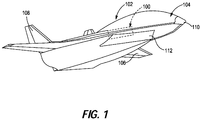
- FIG. 1 illustrates an example of a high speed flight vehicle 102.
- the flight vehicle 102 may be operated manned or unmanned as desired.
- the flight vehicle 102 is just one configuration of a flight vehicle capable of traveling at a speed of at least Mach 3, and other configurations, not shown, may be implemented as desired.
- the flight vehicle 102 may have a different shape, size, aspect ratio, etc., as desired.
- the flight vehicle 102 is merely shown in a particular configuration for purposes of discussion.
- the flight vehicle 102 has a surface 104 exposed to aerodynamic heating.
- the surface 104 is provided on a leading surface, such as on a wing 106, tail 108, nose cap 110, or inlet duct 112 of the flight vehicle 102.
- the surface 104 is aerodynamically heated.
- the temperature of the surface 104 can exceed 1000 degrees Celsius.
- the flight vehicle 102 includes a system 100 for cooling the surface 104, thereby allowing the surface 104 to be formed of lower cost and/or lighter materials.
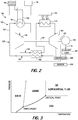
- the system 100 includes a fluid loop 120 through which is circulated a working fluid 122.
- the fluid loop 120 is formed as a closed loop.
- heat from the surface 104 is transferred to the working fluid 122 in the fluid loop 120, thereby to maintain the working fluid 122 at a temperature and pressure above its critical point.
- FIG. 3 graphically illustrates the critical point of a substance, where temperatures and pressures above the critical point will result in a supercritical state.
- the working fluid is supercritical carbon dioxide.
- the system 100 includes components disposed in the fluid loop 120 for performing a sequence of thermodynamic processes involving transfer of heat and work into and out of the system 100, while varying temperature and pressure of the working fluid 122 within the system.
- the system 100 includes a compressor 130 for compressing the supercritical working fluid 122 to an increased pressure.
- the system 100 further includes a heat intake 140 that absorbs heat from a source external to the fluid loop 120 to heat the supercritical working fluid 122.
- the external source is the surface 104 of the flight vehicle 102
- the heat intake 140 is a section of the fluid loop 120 that is located in thermally coupled relation to the surface 104.
- the system 100 further includes a thermal engine 150 that extracts work output 152 from the supercritical working fluid by expanding the supercritical working fluid 122 to a decreased pressure.
- FIG. 2 schematically illustrates the thermal engine 150 as a turbine, other types of thermal engines capable of extracting work output from a heated and pressurized working fluid may be used.
- the work output 152 is in the form of a rotating output shaft of the turbine that is mechanically coupled to the compressor 130 by a shaft 154, thereby to operate the compressor 130.
- the work output 152 may be electrically coupled to the compressor 130, as well as to an electric power generating device.
- the compressor 130 and the thermal engine 150 generally divide the fluid loop 120 into a low pressure leg 124, extending downstream of the thermal engine 150 to an inlet of the compressor 130, and a high pressure leg 126, extending upstream of the thermal engine 150 to an outlet of the compressor 130.
- a recuperator 160 is provided to improve the thermal efficiency of the system 100. As schematically illustrated in FIG. 2 , the recuperator 160 transfers heat from the low pressure leg 124 of the fluid loop 120 to the high pressure leg 126 of the fluid loop. Accordingly, the recuperator 160 alternatively may be referred to as a heat exchanger. By transferring heat to the working fluid 122 prior to further being heated by the heat intake 140 increases the temperature of the working fluid 122 entering the thermal engine 150, thereby increasing the amount of work output 152 that can be extracted from the working fluid.
- a controller 200 may be provided to control operation of the system 100.
- the controller 200 is operably coupled to the compressor 130, and is programmed to execute a method that includes initiating operation of the compressor 130 when one or more operating conditions of the flight vehicle 102 is favorable for maintaining the working fluid 122 in a supercritical state.
- the operating condition is temperature of the surface 104, in which case the controller 200 receives feedback from a sensor 202 configured to detect a temperature of the surface 104 and is programmed to start the compressor 130 when the surface 104 of the flight vehicle 102 exceeds a threshold temperature.
- Exemplary threshold temperatures include, but are not limited to, 500 degrees C, 600 degrees C, 700 degrees C, 800 degrees C, 900 degrees C, and 1000 degrees C.
- the operating condition is a flight speed of the flight vehicle 102, which is indicative of temperature of the surface 104.
- the controller 200 receives an indication of flight speed, such as from an input command or sensor 202 when configured to determine flight speed, and is programmed to start the compressor 130 when the flight vehicle reaches a threshold flight speed.
- Exemplary threshold flight speeds include, but are not limited to, Mach 3, Mach 3.5, Mach 4, and hypersonic speed.
- the controller 200 may be operably coupled to the thermal engine 150.
- controller 200 While the specific hardware implementation of controller 200 is subject to design choices, one particular example includes one or more processors coupled with a current driver.
- the one or more processors may include any electronic circuits and/or optical circuits that are able to perform the functions described herein.
- the processor(s) may perform any functionality described herein for controller 200.
- the processor(s) may include one or more Central Processing Units (CPU), microprocessors, Digital Signal Processors (DSPs), Application-specific Integrated Circuits (ASICs), Programmable Logic Devices (PLD), control circuitry, etc.
- CPU Central Processing Units
- DSPs Digital Signal Processors
- ASICs Application-specific Integrated Circuits
- PLD Programmable Logic Devices
- Some examples of processors include INTEL® CORETM processors, Advanced Reduced Instruction Set Computing (RISC) Machines (ARM®) processors, etc.
- the system 100 is configured to maintain the working fluid 122 in a supercritical state during the entire thermodynamic cycle, thereby enabling the use of lighter and more compact turbomachinery.
- the working fluid 122 is carbon dioxide
- the critical temperature is approximately 31 degrees C and the critical pressure is approximately 74 bar.
- Aerodynamic heating of the surface 104 increases with the speed of the flight vehicle 102. For example, at a speed of Mach 3.5, localized portions of the surface 104 reach 400 degrees C or more, which would be sufficient to maintain the working fluid 122 in the supercritical state. At hypersonic speeds in excess of Mach 5, localized portions of the surface 104 may reach 1000 degrees C. Thermodynamic efficiency of the system 100 increases with the temperature of the surface 104.
- the compressor 130 is sized to maintain a pressure of the working fluid 122 above the critical pressure throughout the thermodynamic cycle. Because the working fluid 122 is in a supercritical state, the compressor 130 and the thermal engine 150 may have a reduced size and weight, making the system 100 feasible for use on board the flight vehicle 102. Additionally, the illustrated system 100 is a closed loop system that is provided independent of a propulsion system of the flight vehicle 102.
- the system 100 is further configured to generate electrical power 172.
- the system 100 may include a generator 170 operably coupled to the thermal engine 150.
- the generator 170 receives at least a portion of the work output 152 from the thermal engine 150 and generates the electrical power 172.
- an auxiliary load 180 is operably coupled to the generator 170 and is configured to operate using the electrical power 172.
- the electrical power 172 may be a primary source of power used to operate engine generators.
- the controller 200 further may be operably coupled to the generator 170 and the auxiliary load 180, thereby to control operation or other aspects of those components.
- the system 100 may be referred to alternatively as an integrated cooling and power generation system 100. Because of the thermal efficiency, compact size, and reduced weight afforded by the use of a supercritical working fluid 122, the integrated cooling and power generation system 100 achieves gravimetric and volumetric power densities that are an order of magnitude greater than batteries or other conventional power sources.
- the system 100 further may include a precooler 190 for removing excess heat from the working fluid 122.
- the precooler 190 includes a precooler heat exchanger 191 disposed in the low pressure leg 124 of the fluid loop 120, between the recuperator 160 and the compressor 130. By removing heat from the working fluid 122, the precooler 190 ensures that the temperature of working fluid 122 does not exceed the rated operating temperature range for the compressor 130. The excess heat may be rejected to the surrounding atmosphere or transferred to a secondary fluid in another system on board the flight vehicle 102.
- the precooler 190 further includes a heat sink loop 193 passing through the precooler heat exchanger 191.
- the heat sink loop 193 carries the excess waste heat to a storage structure, such as vessel containing heat sink fluid 192 (e.g., fuel, water, or other fluid carried on board the flight vehicle 102), or a thermal energy storage device 194. Subsequently, the excess waste heat may be used to generate additional power, provide heat to other systems on board the flight vehicle 102, or simply dissipated to the surrounding environment.
- a storage structure such as vessel containing heat sink fluid 192 (e.g., fuel, water, or other fluid carried on board the flight vehicle 102), or a thermal energy storage device 194.
- the excess waste heat may be used to generate additional power, provide heat to other systems on board the flight vehicle 102, or simply dissipated to the surrounding environment.
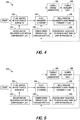
- FIG. 4 is a block diagram 220 illustrating the thermodynamic cycle during operation of the system 100 when the compressor 130 is mechanically driven.
- the working fluid 122 is heated by the surface 104 via the heat intake 140.
- the working fluid 122 is expanded in the thermal engine 150 to obtain the work output 152, which in the illustrated example is a rotating shaft.
- heat from the expanded working fluid 122 is transferred from the low pressure leg 124 of the fluid loop 120 to the high pressure leg 126 by the recuperator 160. In this manner, recuperator 160 harvests heat from the expanded working fluid 122.
- Block 228 illustrates the optional step of transferring excess heat from the working fluid 122 to the heat sink loop 193 using the precooler 190.
- the compressor 130 compresses the working fluid 122 thereby to drive the working fluid 122 through the system (e.g., the fluid loop 120).
- the compressor 130 is mechanically coupled to the thermal engine 150 by the shaft 154, so that the work output 152 directly and mechanically operates (e.g., drives) the compressor 130.
- Block 232 schematically illustrates heating the working fluid 122 via the recuperator 160. In this manner, the temperature of the working fluid 122, which is in a compressed state, is pre-heated. The working fluid 122 then reaches the heat intake 140 at block 222, where the cycle is repeated.
- Block 234 illustrates the optional step of using at least a portion of the work output 152 to drive the generator 170
- block 236 illustrates the optional step of powering the auxiliary load 180 off of the generator. Therefore, in this example, the work output 152 from the thermal engine 150 both mechanically operates the compressor 130 and generates electrical power in the generator 170.
- FIG. 5 is a block diagram 240 illustrating the thermodynamic cycle in a system 100 having an electrically-driven compressor 130.
- the stages of the cycle are identical to those shown in FIG. 4 , except for how the work output 152 is used, and therefore the description of this example will focus only on those differences.
- the system 100 omits the shaft 154 extending between the thermal engine 150 and the compressor 130.
- Driving the generator 170 using the work output 152, illustrated at block 234, is no longer optional but required.
- the compressor 130 is electrically coupled to the generator 170, thereby to drive the compressor 130.
- Powering the auxiliary load 180, shown at block 236, is still optional and may be omitted, in which case the generator 170 is directly coupled to the compressor 130. Therefore, in this example, the work output 152 from the thermal engine 150 is entirely converted to electrical power, which may be used to operate the compressor 130 and, optionally, the auxiliary load 180.
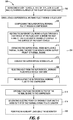
- FIG. 6 is a block diagram illustrating a method 300 of cooling the exterior surface 104 of the high speed flight vehicle 102, with optional power generation.
- the method 300 begins at block 302 by advancing the flight vehicle 102 at a flight speed of at least Mach 3, wherein the surface 104 of the flight vehicle 102 gains heat.
- a supercritical working fluid 122 is circulated through a fluid loop 120.
- Circulation of the working fluid 122 includes, in sequence, compressing the supercritical working fluid 122 through a compressor 130 as shown at block 306, heating the supercritical working fluid 122 through a heat intake 140 of the fluid loop 120 at block 308, wherein the heat intake 140 of the fluid loop 120 is thermally coupled to the surface 104 of the flight vehicle 102, and expanding the supercritical working fluid 122 in a thermal engine 150 at block 310, thereby to generate a work output 152 from the thermal engine 150.
- Circulation of the working fluid 122 through the fluid loop 120 further includes cooling the supercritical working fluid 122 at block 312, and recirculating the supercritical working fluid 122 to the compressor 130 at block 314.
- the method 300 continues at block 316 by operably coupling the work output 152 of the thermal engine 150 to the compressor 130. In this manner, the method 300 absorbs heat from the surface 104 of the flight vehicle 102, thereby allowing the surface 104 to be formed of lower cost and/or lighter materials, and uses the absorbed heat to operate the compressor 130.
- the method 300 may include additional, optional steps for generating electrical power.
- the method 300 may include generating electric power by operably coupling the work output 152 of the thermal engine 150 to a generator 170 at block 318.
- the electrical power from the generator 170 may be used to operate the compressor 130, when the compressor 130 is an electric-powered compressor. Additionally or alternatively, the electrical power from the generator 170 may be used to power an auxiliary load 180, as shown at block 320.
- the method 300 may optionally include an additional step to reduce the temperature of the working fluid 122 to be within a recommended range for the compressor 130. Specifically, the method 300 may include rejecting heat from the supercritical working fluid 122 using a precooler 190 prior to recirculating the supercritical working fluid 122 to the compressor 130, as shown at block 322.
- sequence generally refers to elements (e.g., unit operations) in order. Such order can refer to process order, such as, for example, the order in which a fluid flows from one element to another.
- a compressor, heat storage unit and turbine in sequence includes the compressor upstream of the heat exchange unit, and the heat exchange unit upstream of the turbine.
- a fluid can flow from the compressor to the heat exchange unit and from the heat exchange unit to the turbine.
- a fluid flowing through unit operations in sequence can flow through the unit operations sequentially.
- a sequence of elements can include one or more intervening elements.
- a system comprising a compressor, heat storage unit and turbine in sequence can include an auxiliary tank between the compressor and the heat storage unit.
- a sequence of elements can be cyclical.
- any of the various elements shown in the figures or described herein may be implemented as hardware, software, firmware, or some combination of these.
- an element may be implemented as dedicated hardware.
- Dedicated hardware elements may be referred to as "processors", “controllers”, or some similar terminology.
- processors When provided by a processor, the functions may be provided by a single dedicated processor, by a single shared processor, or by a plurality of individual processors, some of which may be shared.
- processor or “controller” should not be construed to refer exclusively to hardware capable of executing software, and may implicitly include, without limitation, digital signal processor (DSP) hardware, a network processor, application specific integrated circuit (ASIC) or other circuitry, field programmable gate array (FPGA), read only memory (ROM) for storing software, random access memory (RAM), non-volatile storage, logic, or some other physical hardware component or module.
- DSP digital signal processor
- ASIC application specific integrated circuit
- FPGA field programmable gate array
- ROM read only memory
- RAM random access memory
- non-volatile storage logic, or some other physical hardware component or module.
- an element may be implemented as instructions executable by a processor or a computer to perform the functions of the element.
- Some examples of instructions are software, program code, and firmware.
- the instructions are operational when executed by the processor to direct the processor to perform the functions of the element.
- the instructions may be stored on storage devices that are readable by the processor. Some examples of the storage devices are digital or solid-state memories, magnetic storage media such as a magnetic disks and magnetic tapes, hard drives, or optically readable digital data storage media.
Landscapes
- Engineering & Computer Science (AREA)
- Aviation & Aerospace Engineering (AREA)
- Mechanical Engineering (AREA)
- Chemical & Material Sciences (AREA)
- General Engineering & Computer Science (AREA)
- Pulmonology (AREA)
- General Health & Medical Sciences (AREA)
- Health & Medical Sciences (AREA)
- Combustion & Propulsion (AREA)
- Physics & Mathematics (AREA)
- Fluid Mechanics (AREA)
- Chemical Kinetics & Catalysis (AREA)
- Structures Of Non-Positive Displacement Pumps (AREA)
- Engine Equipment That Uses Special Cycles (AREA)
- Cooling, Air Intake And Gas Exhaust, And Fuel Tank Arrangements In Propulsion Units (AREA)
Abstract
Description
- The present disclosure generally relates to high speed flight vehicles and, more specifically, to systems and methods for thermal management and power generation on high speed flight vehicles. Flight vehicles traveling through atmosphere at high speeds may experience aerodynamic heating of exterior surfaces and wetted duct surfaces. When traveling at speeds greater than Mach 3, and more particularly at hypersonic speeds greater than Mach 5, the temperature of these surfaces can locally exceed 1000 degrees Celsius, necessitating the use of high density materials such as superalloys or expensive non-metallic materials such as ceramic matrix composites. Additionally, turbofan and turbojet engines cannot be used at speeds above approximately Mach 3, thereby limiting their capability to run generators to power vehicle systems.
- In accordance with one aspect of the present disclosure, a method of cooling a surface on a flight vehicle includes advancing the flight vehicle at a flight speed of at least Mach 3, wherein the surface of the flight vehicle is aerodynamically heated. A supercritical working fluid is circulated through a fluid loop including, in sequence, compressing the supercritical working fluid through a compressor, heating the supercritical working fluid through a heat intake of the fluid loop, wherein the heat intake of the fluid loop is thermally coupled to the surface of the flight vehicle, expanding the supercritical working fluid in a thermal engine, thereby to generate a work output from the thermal engine, cooling the supercritical working fluid, and recirculating the supercritical working fluid to the compressor. The work output of the thermal engine is operably coupled to the compressor.
- In accordance with another aspect of the present disclosure, a system is provided for cooling a surface of a flight vehicle traveling at a flight speed of at least Mach 3. The system includes a fluid loop containing a supercritical working fluid. The fluid loop has, in sequence, a compressor for compressing the supercritical working fluid, a heat intake, located in thermally coupled relation to the surface of the flight vehicle, for heating the supercritical working fluid, a thermal engine for expanding the supercritical working fluid and generating a work output, wherein the work output is operably coupled to the compressor, and a recuperator for exchanging heat from a low pressure leg of the fluid loop, located downstream of the thermal engine, to a high pressure leg of the fluid loop, located upstream of both the thermal engine and the heat intake of the fluid loop.
- In accordance with a further aspect of the present disclosure, a system is provided for cooling a surface of a flight vehicle and generating electrical power. The system includes a fluid loop containing a supercritical working fluid. The fluid loop has, in sequence, a compressor for compressing the supercritical working fluid, a heat intake, located in thermally coupled relation to the surface of the flight vehicle, for heating the supercritical working fluid, a thermal engine for expanding the supercritical working fluid and generating a work output, wherein the work output is operably coupled to the compressor, a recuperator for exchanging heat from a low pressure leg of the fluid loop, located downstream of the thermal engine, to a high pressure leg of the fluid loop, located upstream of both the thermal engine and the heat intake of the fluid loop. A generator is operably coupled to the thermal engine and configured to receive at least a portion of the work output and generate auxiliary electrical power. A controller is operably coupled to the compressor, wherein the controller is programmed to execute a method, comprising initiating operation of the compressor when a flight speed of the flight vehicle is above Mach 3.
- The features, functions, and advantages that have been discussed can be achieved independently in various examples or may be combined in yet other examples further details of which can be seen with reference to the following description and drawings.
- The novel features believed characteristic of the illustrative examples are set forth in the appended claims. The illustrative examples, however, as well as a preferred mode of use, further objectives and advantages thereof, will best be understood by reference to the following detailed description of illustrative examples of the present disclosure when read in conjunction with the accompanying drawings, wherein:
-
FIG. 1 is a perspective view of a high speed flight vehicle having an integrated cooling and power generation system according to the present disclosure. -
FIG. 2 is a schematic illustration of the integrated cooling and power generation system. -
FIG. 3 is a graph illustrating an exemplary supercritical fluid for use in the integrated cooling and power generation system. -
FIG. 4 is a block diagram of an example of the integrated cooling and power generation system having a mechanical connection between a turbine and a compressor of the system. -
FIG. 5 is a block diagram of another example of the integrated cooling and power generation system having an electrical connection between a turbine and a compressor of the system. -
FIG. 6 is a block diagram illustrating a method of cooling an exterior surface of the high speed flight vehicle ofFIG. 1 , with optional power generation. - The figures and the following description illustrate specific examples of the claimed subject matter. It will thus be appreciated that those skilled in the art will be able to devise various arrangements that, although not explicitly described or shown herein, embody the principles of the examples and are included within the scope of the examples. Furthermore, any examples described herein are intended to aid in understanding the principles of construction, operation, or other features of the disclosed subject matter, and are to be construed as being without limitation to such specifically recited examples and conditions. As a result, the inventive concept(s) is not limited to the specific examples described below, but by the claims and their equivalents.
- Examples described herein cool a surface of a high speed flight vehicle by circulating a supercritical working fluid through a fluid loop having a compressor and a heat engine. When the flight vehicle travels above Mach 3, portions of the surface of the flight vehicle may reach 1000 degrees C or more. The supercritical working fluid absorbs heat from the flight vehicle surface, thereby eliminating hot spots and permitting use of lighter and/or less expensive materials. The magnitude of heat generated at high speeds and absorbed by the working fluid maintains the working fluid in a supercritical state, allowing the compressor, heat engine, and other components of the cooling system to be smaller and lighter. Still further, the heat absorbed by the working fluid may be used to generate electrical power for the flight vehicle. The supercritical state of the working fluid improves thermal efficiency of the system which, in combination with the use of lightweight turbomachinery, results in a power source that is compact, lightweight, and efficient compared to conventional batteries or fuel cells.
-
FIG. 1 illustrates an example of a highspeed flight vehicle 102. Theflight vehicle 102 may be operated manned or unmanned as desired. Theflight vehicle 102 is just one configuration of a flight vehicle capable of traveling at a speed of at least Mach 3, and other configurations, not shown, may be implemented as desired. For example, theflight vehicle 102 may have a different shape, size, aspect ratio, etc., as desired. Thus, theflight vehicle 102 is merely shown in a particular configuration for purposes of discussion. - In this example, the
flight vehicle 102 has asurface 104 exposed to aerodynamic heating. In some examples, thesurface 104 is provided on a leading surface, such as on awing 106,tail 108,nose cap 110, orinlet duct 112 of theflight vehicle 102. During operation of theflight vehicle 102 above Mach 3, or in hypersonic flight (e.g., theflight vehicle 102 moves at hypersonic speeds of Mach 5 and above), thesurface 104 is aerodynamically heated. For example, the temperature of thesurface 104 can exceed 1000 degrees Celsius. - The
flight vehicle 102 includes asystem 100 for cooling thesurface 104, thereby allowing thesurface 104 to be formed of lower cost and/or lighter materials. As best shown inFIG. 2 , thesystem 100 includes afluid loop 120 through which is circulated a workingfluid 122. In the illustrated example, thefluid loop 120 is formed as a closed loop. When theflight vehicle 102 is operated at speeds above Mach 3, heat from thesurface 104 is transferred to the workingfluid 122 in thefluid loop 120, thereby to maintain the workingfluid 122 at a temperature and pressure above its critical point.FIG. 3 graphically illustrates the critical point of a substance, where temperatures and pressures above the critical point will result in a supercritical state. In some examples, the working fluid is supercritical carbon dioxide. - The
system 100 includes components disposed in thefluid loop 120 for performing a sequence of thermodynamic processes involving transfer of heat and work into and out of thesystem 100, while varying temperature and pressure of the workingfluid 122 within the system. As schematically illustrated inFIG. 2 , thesystem 100 includes acompressor 130 for compressing the supercritical workingfluid 122 to an increased pressure. Thesystem 100 further includes aheat intake 140 that absorbs heat from a source external to thefluid loop 120 to heat thesupercritical working fluid 122. In the illustrated example, the external source is thesurface 104 of theflight vehicle 102, and theheat intake 140 is a section of thefluid loop 120 that is located in thermally coupled relation to thesurface 104. - The
system 100 further includes athermal engine 150 that extractswork output 152 from the supercritical working fluid by expanding the supercritical workingfluid 122 to a decreased pressure. WhileFIG. 2 schematically illustrates thethermal engine 150 as a turbine, other types of thermal engines capable of extracting work output from a heated and pressurized working fluid may be used. In the illustrated example, thework output 152 is in the form of a rotating output shaft of the turbine that is mechanically coupled to thecompressor 130 by ashaft 154, thereby to operate thecompressor 130. As discussed in greater detail below, however, thework output 152 may be electrically coupled to thecompressor 130, as well as to an electric power generating device. Additionally, it will be appreciated that thecompressor 130 and thethermal engine 150 generally divide thefluid loop 120 into alow pressure leg 124, extending downstream of thethermal engine 150 to an inlet of thecompressor 130, and ahigh pressure leg 126, extending upstream of thethermal engine 150 to an outlet of thecompressor 130. - A
recuperator 160 is provided to improve the thermal efficiency of thesystem 100. As schematically illustrated inFIG. 2 , therecuperator 160 transfers heat from thelow pressure leg 124 of thefluid loop 120 to thehigh pressure leg 126 of the fluid loop. Accordingly, therecuperator 160 alternatively may be referred to as a heat exchanger. By transferring heat to the workingfluid 122 prior to further being heated by theheat intake 140 increases the temperature of the workingfluid 122 entering thethermal engine 150, thereby increasing the amount ofwork output 152 that can be extracted from the working fluid. - A
controller 200 may be provided to control operation of thesystem 100. InFIG. 2 , thecontroller 200 is operably coupled to thecompressor 130, and is programmed to execute a method that includes initiating operation of thecompressor 130 when one or more operating conditions of theflight vehicle 102 is favorable for maintaining the workingfluid 122 in a supercritical state. In some examples, the operating condition is temperature of thesurface 104, in which case thecontroller 200 receives feedback from asensor 202 configured to detect a temperature of thesurface 104 and is programmed to start thecompressor 130 when thesurface 104 of theflight vehicle 102 exceeds a threshold temperature. Exemplary threshold temperatures include, but are not limited to, 500 degrees C, 600 degrees C, 700 degrees C, 800 degrees C, 900 degrees C, and 1000 degrees C. In other examples, the operating condition is a flight speed of theflight vehicle 102, which is indicative of temperature of thesurface 104. In these examples, thecontroller 200 receives an indication of flight speed, such as from an input command orsensor 202 when configured to determine flight speed, and is programmed to start thecompressor 130 when the flight vehicle reaches a threshold flight speed. Exemplary threshold flight speeds include, but are not limited to,Mach 3, Mach 3.5, Mach 4, and hypersonic speed. Additionally, thecontroller 200 may be operably coupled to thethermal engine 150. - While the specific hardware implementation of
controller 200 is subject to design choices, one particular example includes one or more processors coupled with a current driver. The one or more processors may include any electronic circuits and/or optical circuits that are able to perform the functions described herein. For example, the processor(s) may perform any functionality described herein forcontroller 200. The processor(s) may include one or more Central Processing Units (CPU), microprocessors, Digital Signal Processors (DSPs), Application-specific Integrated Circuits (ASICs), Programmable Logic Devices (PLD), control circuitry, etc. Some examples of processors include INTEL® CORE™ processors, Advanced Reduced Instruction Set Computing (RISC) Machines (ARM®) processors, etc. - The
system 100 is configured to maintain the workingfluid 122 in a supercritical state during the entire thermodynamic cycle, thereby enabling the use of lighter and more compact turbomachinery. When the workingfluid 122 is carbon dioxide, for example, the critical temperature is approximately 31 degrees C and the critical pressure is approximately 74 bar. Aerodynamic heating of thesurface 104 increases with the speed of theflight vehicle 102. For example, at a speed of Mach 3.5, localized portions of thesurface 104 reach 400 degrees C or more, which would be sufficient to maintain the workingfluid 122 in the supercritical state. At hypersonic speeds in excess of Mach 5, localized portions of thesurface 104 may reach 1000 degrees C. Thermodynamic efficiency of thesystem 100 increases with the temperature of thesurface 104. Additionally, thecompressor 130 is sized to maintain a pressure of the workingfluid 122 above the critical pressure throughout the thermodynamic cycle. Because the workingfluid 122 is in a supercritical state, thecompressor 130 and thethermal engine 150 may have a reduced size and weight, making thesystem 100 feasible for use on board theflight vehicle 102. Additionally, the illustratedsystem 100 is a closed loop system that is provided independent of a propulsion system of theflight vehicle 102. - In some examples, the
system 100 is further configured to generateelectrical power 172. As schematically shown inFIG. 2 , thesystem 100 may include agenerator 170 operably coupled to thethermal engine 150. Thegenerator 170 receives at least a portion of thework output 152 from thethermal engine 150 and generates theelectrical power 172. In this example, anauxiliary load 180 is operably coupled to thegenerator 170 and is configured to operate using theelectrical power 172. In other examples, theelectrical power 172 may be a primary source of power used to operate engine generators. Thecontroller 200 further may be operably coupled to thegenerator 170 and theauxiliary load 180, thereby to control operation or other aspects of those components. In examples where agenerator 170 is included, thesystem 100 may be referred to alternatively as an integrated cooling andpower generation system 100. Because of the thermal efficiency, compact size, and reduced weight afforded by the use of a supercritical workingfluid 122, the integrated cooling andpower generation system 100 achieves gravimetric and volumetric power densities that are an order of magnitude greater than batteries or other conventional power sources. - The
system 100 further may include aprecooler 190 for removing excess heat from the workingfluid 122. As schematically illustrated inFIG. 2 , theprecooler 190 includes aprecooler heat exchanger 191 disposed in thelow pressure leg 124 of thefluid loop 120, between therecuperator 160 and thecompressor 130. By removing heat from the workingfluid 122, theprecooler 190 ensures that the temperature of workingfluid 122 does not exceed the rated operating temperature range for thecompressor 130. The excess heat may be rejected to the surrounding atmosphere or transferred to a secondary fluid in another system on board theflight vehicle 102. In the illustrated example, theprecooler 190 further includes aheat sink loop 193 passing through theprecooler heat exchanger 191. Theheat sink loop 193 carries the excess waste heat to a storage structure, such as vessel containing heat sink fluid 192 (e.g., fuel, water, or other fluid carried on board the flight vehicle 102), or a thermalenergy storage device 194. Subsequently, the excess waste heat may be used to generate additional power, provide heat to other systems on board theflight vehicle 102, or simply dissipated to the surrounding environment. -
FIG. 4 is a block diagram 220 illustrating the thermodynamic cycle during operation of thesystem 100 when thecompressor 130 is mechanically driven. Atblock 222, the workingfluid 122 is heated by thesurface 104 via theheat intake 140. Atblock 224, the workingfluid 122 is expanded in thethermal engine 150 to obtain thework output 152, which in the illustrated example is a rotating shaft. Next, atblock 226, heat from the expanded workingfluid 122 is transferred from thelow pressure leg 124 of thefluid loop 120 to thehigh pressure leg 126 by therecuperator 160. In this manner,recuperator 160 harvests heat from the expanded workingfluid 122.Block 228 illustrates the optional step of transferring excess heat from the workingfluid 122 to theheat sink loop 193 using theprecooler 190. In this manner, excess heat is rejected to the vehicleheat sink loop 193. Atblock 230, thecompressor 130 compresses the workingfluid 122 thereby to drive the workingfluid 122 through the system (e.g., the fluid loop 120). In this example, thecompressor 130 is mechanically coupled to thethermal engine 150 by theshaft 154, so that thework output 152 directly and mechanically operates (e.g., drives) thecompressor 130.Block 232 schematically illustrates heating the workingfluid 122 via therecuperator 160. In this manner, the temperature of the workingfluid 122, which is in a compressed state, is pre-heated. The workingfluid 122 then reaches theheat intake 140 atblock 222, where the cycle is repeated.Block 234 illustrates the optional step of using at least a portion of thework output 152 to drive thegenerator 170, and block 236 illustrates the optional step of powering theauxiliary load 180 off of the generator. Therefore, in this example, thework output 152 from thethermal engine 150 both mechanically operates thecompressor 130 and generates electrical power in thegenerator 170. -
FIG. 5 is a block diagram 240 illustrating the thermodynamic cycle in asystem 100 having an electrically-drivencompressor 130. The stages of the cycle are identical to those shown inFIG. 4 , except for how thework output 152 is used, and therefore the description of this example will focus only on those differences. Notably, thesystem 100 omits theshaft 154 extending between thethermal engine 150 and thecompressor 130. Driving thegenerator 170 using thework output 152, illustrated atblock 234, is no longer optional but required. Thecompressor 130 is electrically coupled to thegenerator 170, thereby to drive thecompressor 130. Powering theauxiliary load 180, shown atblock 236, is still optional and may be omitted, in which case thegenerator 170 is directly coupled to thecompressor 130. Therefore, in this example, thework output 152 from thethermal engine 150 is entirely converted to electrical power, which may be used to operate thecompressor 130 and, optionally, theauxiliary load 180. -
FIG. 6 is a block diagram illustrating amethod 300 of cooling theexterior surface 104 of the highspeed flight vehicle 102, with optional power generation. Themethod 300 begins atblock 302 by advancing theflight vehicle 102 at a flight speed of at leastMach 3, wherein thesurface 104 of theflight vehicle 102 gains heat. Atblock 304, a supercritical workingfluid 122 is circulated through afluid loop 120. Circulation of the workingfluid 122 includes, in sequence, compressing the supercritical workingfluid 122 through acompressor 130 as shown atblock 306, heating the supercritical workingfluid 122 through aheat intake 140 of thefluid loop 120 atblock 308, wherein theheat intake 140 of thefluid loop 120 is thermally coupled to thesurface 104 of theflight vehicle 102, and expanding the supercritical workingfluid 122 in athermal engine 150 atblock 310, thereby to generate awork output 152 from thethermal engine 150. Circulation of the workingfluid 122 through thefluid loop 120 further includes cooling the supercritical workingfluid 122 atblock 312, and recirculating the supercritical workingfluid 122 to thecompressor 130 atblock 314. Themethod 300 continues atblock 316 by operably coupling thework output 152 of thethermal engine 150 to thecompressor 130. In this manner, themethod 300 absorbs heat from thesurface 104 of theflight vehicle 102, thereby allowing thesurface 104 to be formed of lower cost and/or lighter materials, and uses the absorbed heat to operate thecompressor 130. - The
method 300 may include additional, optional steps for generating electrical power. For example, as schematically shown inFIG. 6 , themethod 300 may include generating electric power by operably coupling thework output 152 of thethermal engine 150 to agenerator 170 atblock 318. The electrical power from thegenerator 170 may be used to operate thecompressor 130, when thecompressor 130 is an electric-powered compressor. Additionally or alternatively, the electrical power from thegenerator 170 may be used to power anauxiliary load 180, as shown atblock 320. - Still further, the
method 300 may optionally include an additional step to reduce the temperature of the workingfluid 122 to be within a recommended range for thecompressor 130. Specifically, themethod 300 may include rejecting heat from the supercritical workingfluid 122 using aprecooler 190 prior to recirculating the supercritical workingfluid 122 to thecompressor 130, as shown atblock 322. - Further, the disclosure comprises examples according to the following clauses:
- Clause 1. A method of cooling a surface on a flight vehicle, the method comprising advancing the flight vehicle at a flight speed of at least
Mach 3, wherein the surface of the flight vehicle is aerodynamically heated; circulating a supercritical working fluid through a fluid loop including, in sequence: compressing the supercritical working fluid through a compressor heating the supercritical working fluid through a heat intake of the fluid loop, wherein the heat intake of the fluid loop is thermally coupled to the surface of the flight vehicle; expanding the supercritical working fluid in a thermal engine, thereby to generate a work output from the thermal engine; cooling the supercritical working fluid; and recirculating the supercritical working fluid to the compressor; and operably coupling the work output of the thermal engine to the compressor. - Clause 2. The method of clause 1, further comprising generating electric power by operably coupling the work output of the thermal engine to a generator.
-
Clause 3. The method of clause 2, in which the compressor comprises an electric-powered compressor operably coupled to the generator. - Clause 4. The method of clause 2, further comprising powering an auxiliary load using the generator.
- Clause 5. The method of any of clauses 1-4, in which cooling the supercritical working fluid comprises exchanging heat from a low pressure leg of the fluid loop, located downstream of the thermal engine, to a high pressure leg of the fluid loop, located upstream of both the thermal engine and the heat intake of the fluid loop.
- Clause 6. The method of clause 5, in which a recuperator is provided to exchange heat from the low pressure leg of the fluid loop to the high pressure leg of the fluid loop.
- Clause 7. The method of any of clauses 1-6, further comprising rejecting heat from the supercritical working fluid via a precooler prior to recirculating the supercritical working fluid to the compressor.
- Clause 8. The method of any of clauses 1-7, in which the supercritical working fluid comprises supercritical carbon dioxide.
- Clause 9. A system for cooling a surface of a flight vehicle traveling at a flight speed of at least
Mach 3, the system comprising: a fluid loop containing a supercritical working fluid, the fluid loop including, in sequence, a compressor for compressing the supercritical working fluid; a heat intake, located in thermally coupled relation to the surface of the flight vehicle, for heating the supercritical working fluid; a thermal engine for expanding the supercritical working fluid and generating a work output, wherein the work output is operably coupled to the compressor; and a recuperator for exchanging heat from a low pressure leg of the fluid loop, located downstream of the thermal engine, to a high pressure leg of the fluid loop, located upstream of both the thermal engine and the heat intake of the fluid loop. - Clause 10. The system of clause 9, further comprising a generator operably coupled to the thermal engine and configured to receive at least a portion of the work output and generate electrical power.
- Clause 11. The system of clause 10, in which the compressor comprises an electric-powered compressor operably coupled to the generator.
- Clause 12. The system of any of clauses 9-11, further comprising a precooler operably coupled to the low pressure leg of the fluid loop between the recuperator and the compressor.
- Clause 13. The system of any of clauses 9-12, further comprising a controller operably coupled to the compressor, wherein the controller is programmed to execute a method, comprising initiating operation of the compressor when an operating condition of the flight vehicle exceeds an operating threshold.
- Clause 14. The system of clause 13, in which the operating condition of the flight vehicle (102) comprises a temperature of the surface.
- Clause 15. The system of clause 13, in which the operating condition of the flight vehicle comprises a flight speed of the flight vehicle.
- Clause 16. A system for cooling a surface of a flight vehicle and generating electrical power, the system comprising: a fluid loop containing a supercritical working fluid, the fluid loop including, in sequence: a compressor for compressing the supercritical working fluid; a heat intake, located in thermally coupled relation to the surface of the flight vehicle, for heating the supercritical working fluid; a thermal engine for expanding the supercritical working fluid and generating a work output, wherein the work output is operably coupled to the compressor; a recuperator for exchanging heat from a low pressure leg of the fluid loop, located downstream of the thermal engine, to a high pressure leg of the fluid loop, located upstream of both the thermal engine and the heat intake of the fluid loop; and a generator operably coupled to the thermal engine and configured to receive at least a portion of the work output and generate auxiliary electrical power; and a controller operably coupled to the compressor, wherein the controller is programmed to execute a method, comprising initiating operation of the compressor when a flight speed of the flight vehicle is above
Mach 3. - Clause 17. The system of clause 16, in which the compressor comprises an electric-powered compressor operably coupled to the generator.
- Clause 18. The system of any of clauses 16-17, further comprising an auxiliary load operably coupled to the generator.
- Clause 19. The system of any of clauses 16-18, further comprising a precooler operably coupled to the low pressure leg of the fluid loop between the recuperator and the compressor.
- Clause 20. The system of clause 19, in which the precooler comprises a heat sink fluid or a thermal energy storage device.
- The term "sequence," as used herein, generally refers to elements (e.g., unit operations) in order. Such order can refer to process order, such as, for example, the order in which a fluid flows from one element to another. In an example, a compressor, heat storage unit and turbine in sequence includes the compressor upstream of the heat exchange unit, and the heat exchange unit upstream of the turbine. In such a case, a fluid can flow from the compressor to the heat exchange unit and from the heat exchange unit to the turbine. A fluid flowing through unit operations in sequence can flow through the unit operations sequentially. A sequence of elements can include one or more intervening elements. For example, a system comprising a compressor, heat storage unit and turbine in sequence can include an auxiliary tank between the compressor and the heat storage unit. A sequence of elements can be cyclical.
- Any of the various elements shown in the figures or described herein may be implemented as hardware, software, firmware, or some combination of these. For example, an element may be implemented as dedicated hardware. Dedicated hardware elements may be referred to as "processors", "controllers", or some similar terminology. When provided by a processor, the functions may be provided by a single dedicated processor, by a single shared processor, or by a plurality of individual processors, some of which may be shared. Moreover, explicit use of the term "processor" or "controller" should not be construed to refer exclusively to hardware capable of executing software, and may implicitly include, without limitation, digital signal processor (DSP) hardware, a network processor, application specific integrated circuit (ASIC) or other circuitry, field programmable gate array (FPGA), read only memory (ROM) for storing software, random access memory (RAM), non-volatile storage, logic, or some other physical hardware component or module.
- Also, an element may be implemented as instructions executable by a processor or a computer to perform the functions of the element. Some examples of instructions are software, program code, and firmware. The instructions are operational when executed by the processor to direct the processor to perform the functions of the element. The instructions may be stored on storage devices that are readable by the processor. Some examples of the storage devices are digital or solid-state memories, magnetic storage media such as a magnetic disks and magnetic tapes, hard drives, or optically readable digital data storage media.
- Although specific examples were described herein, the scope is not limited to those specific examples. Rather, the scope is defined by the following claims and any equivalents thereof.
Claims (15)
- A method (300) of cooling a surface (104) on a flight vehicle (102), the method comprising:advancing (302) the flight vehicle (102) at a flight speed of at least Mach 3, wherein the surface (104) of the flight vehicle (102) is aerodynamically heated;circulating (304) a supercritical working fluid (122) through a fluid loop (120) including, in sequence:compressing (306) the supercritical working fluid (122) through a compressor (130);heating (308) the supercritical working fluid (122) through a heat intake (140) of the fluid loop (120), wherein the heat intake (140) of the fluid loop (120) is thermally coupled to the surface (104) of the flight vehicle (102);expanding (310) the supercritical working fluid (122) in a thermal engine (150), thereby to generate a work output (152) from the thermal engine (150);cooling (312) the supercritical working fluid (122); andrecirculating (314) the supercritical working fluid (122) to the compressor (130); and operably coupling (316) the work output (152) of the thermal engine (150) to the compressor (130).
- The method (300) of claim 1, further comprising generating electric power (318) by operably coupling the work output (152) of the thermal engine (150) to a generator (170).
- The method (300) of claim 2, in which the compressor (130) comprises an electric-powered compressor operably coupled to the generator (170).
- The method (300) of claim 2, further comprising powering (320) an auxiliary load (180) using the generator (170).
- The method (300) of any of claims 1-4, in which cooling (312) the supercritical working fluid (122) comprises exchanging heat from a low pressure leg (124) of the fluid loop (120), located downstream of the thermal engine (150), to a high pressure leg (126) of the fluid loop (120), located upstream of both the thermal engine (150) and the heat intake (140) of the fluid loop (120).
- The method (300) of claim 5, in which a recuperator (160) is provided to exchange heat from the low pressure leg (124) of the fluid loop (120) to the high pressure leg (126) of the fluid loop (120).
- The method (300) of any of claims 1-6, further comprising rejecting heat (322) from the supercritical working fluid (122) via a precooler (190) prior to recirculating the supercritical working fluid (122) to the compressor (130).
- The method (300) of any of claims 1-7, in which the supercritical working fluid (122) comprises supercritical carbon dioxide.
- A system (100) for cooling a surface (104) of a flight vehicle (102) traveling at a flight speed of at least Mach 3, the system (100) comprising:a fluid loop (120) containing a supercritical working fluid (122), the fluid loop (120) including, in sequence,a compressor (130) for compressing the supercritical working fluid (122);a heat intake (140), located in thermally coupled relation to the surface (104) of the flight vehicle (102), for heating the supercritical working fluid (122);a thermal engine (150) for expanding the supercritical working fluid (122) and generating a work output (152), wherein the work output (152) is operably coupled to the compressor (130); anda recuperator (160) for exchanging heat from a low pressure leg (124) of the fluid loop (120), located downstream of the thermal engine (150), to a high pressure leg (126) of the fluid loop (120), located upstream of both the thermal engine (150) and the heat intake (140) of the fluid loop (120).
- The system (100) of claim 9, further comprising a generator (170) operably coupled to the thermal engine (150) and configured to receive at least a portion of the work output (152) and generate electrical power (172).
- The system (100) of claim 10, in which the compressor (130) comprises an electric-powered compressor operably coupled to the generator (170).
- The system (100) of any of claims 9-11, further comprising a precooler (190) operably coupled to the low pressure leg (124) of the fluid loop (120) between the recuperator (160) and the compressor (130).
- The system (100) of any of claims 9-12, further comprising a controller (200) operably coupled to the compressor (130), wherein the controller (200) is programmed to execute a method, comprising initiating operation of the compressor (130) when an operating condition of the flight vehicle exceeds an operating threshold.
- The system (100) of claim 13, in which the operating condition of the flight vehicle (102) comprises a temperature of the surface (104).
- The system (100) of claim 13, in which the operating condition of the flight vehicle (102) comprises a flight speed of the flight vehicle (102).
Applications Claiming Priority (1)
| Application Number | Priority Date | Filing Date | Title |
|---|---|---|---|
| US16/457,418 US11465766B2 (en) | 2019-06-28 | 2019-06-28 | Systems and methods for cooling and generating power on high speed flight vehicles |
Publications (2)
| Publication Number | Publication Date |
|---|---|
| EP3757010A1 true EP3757010A1 (en) | 2020-12-30 |
| EP3757010B1 EP3757010B1 (en) | 2023-08-16 |
Family
ID=70613712
Family Applications (1)
| Application Number | Title | Priority Date | Filing Date |
|---|---|---|---|
| EP20173365.6A Active EP3757010B1 (en) | 2019-06-28 | 2020-05-07 | Systems and methods for cooling and generating power on high speed flight vehicles |
Country Status (6)
| Country | Link |
|---|---|
| US (1) | US11465766B2 (en) |
| EP (1) | EP3757010B1 (en) |
| JP (1) | JP2021020668A (en) |
| CN (1) | CN112141345B (en) |
| CA (1) | CA3081951C (en) |
| RU (1) | RU2020114714A (en) |
Cited By (3)
| Publication number | Priority date | Publication date | Assignee | Title |
|---|---|---|---|---|
| EP4001613A1 (en) * | 2020-11-23 | 2022-05-25 | The Boeing Company | Methods and systems for generating power and thermal management having dual loop architecture |
| US11465766B2 (en) | 2019-06-28 | 2022-10-11 | The Boeing Company | Systems and methods for cooling and generating power on high speed flight vehicles |
| US11598285B2 (en) | 2020-11-23 | 2023-03-07 | The Boeing Company | Methods and systems for generating power and thermal management having combined cycle architecture |
Families Citing this family (7)
| Publication number | Priority date | Publication date | Assignee | Title |
|---|---|---|---|---|
| US20230373644A1 (en) * | 2022-05-23 | 2023-11-23 | Hamilton Sundstrand Corporation | Vapor compression system for aerospace applications |
| US12497188B2 (en) | 2023-08-14 | 2025-12-16 | The Boeing Company | Liquid hydrogen feed system for fuel cell powered aircraft |
| CN117125244B (en) * | 2023-09-22 | 2024-08-20 | 清华大学 | High-speed aircraft segmented thermal protection structure |
| US12589872B2 (en) * | 2023-09-29 | 2026-03-31 | The Boeing Company | Method and system for reducing a temperature differential across a flight vehicle |
| US12345212B2 (en) | 2023-11-21 | 2025-07-01 | Rtx Corporation | Turbine engine with auxiliary coolant injection |
| CN119590603B (en) * | 2024-12-02 | 2026-03-10 | 东南大学 | High-speed aircraft heat dredging-power generation integrated device |
| CN119749834A (en) * | 2024-12-26 | 2025-04-04 | 西南科技大学 | A method and device for suppressing plasma on the surface of an ultra-high-speed moving object |
Citations (4)
| Publication number | Priority date | Publication date | Assignee | Title |
|---|---|---|---|---|
| JP2002022298A (en) * | 2000-07-04 | 2002-01-23 | Matsushita Electric Ind Co Ltd | Refrigeration cycle apparatus and control method thereof |
| EP2272757A2 (en) * | 2009-07-07 | 2011-01-12 | Hamilton Sundstrand Corporation | Transcritical fluid cooling for aerospace applications |
| CN106640242A (en) * | 2016-09-19 | 2017-05-10 | 清华大学 | Hypersonic flight vehicle engine heat recovery power generation system and control method thereof |
| CN108657442A (en) * | 2018-05-16 | 2018-10-16 | 中国航发湖南动力机械研究所 | aircraft and thermal protection system |
Family Cites Families (46)
| Publication number | Priority date | Publication date | Assignee | Title |
|---|---|---|---|---|
| US7416137B2 (en) * | 2003-01-22 | 2008-08-26 | Vast Power Systems, Inc. | Thermodynamic cycles using thermal diluent |
| EP1853856A1 (en) * | 2005-02-18 | 2007-11-14 | Carrier Corporation | Co2-refrigeration device with heat reclaim |
| US7963100B2 (en) | 2005-05-25 | 2011-06-21 | Alliant Techsystems Inc. | Cooling system for high-speed vehicles and method of cooling high-speed vehicles |
| WO2007035298A2 (en) * | 2005-09-09 | 2007-03-29 | Lugg Richard H | Advanced hypersonic magnetic jet/electric turbine engine |
| US7624592B2 (en) | 2006-05-17 | 2009-12-01 | Northrop Grumman Corporation | Flexible power and thermal architectures using a common machine |
| US7607318B2 (en) | 2006-05-25 | 2009-10-27 | Honeywell International Inc. | Integrated environmental control and auxiliary power system for an aircraft |
| JP2009191611A (en) * | 2007-09-13 | 2009-08-27 | Hiroyasu Tanigawa | Various energy conservation cycle combined engine |
| US8127555B2 (en) | 2007-12-13 | 2012-03-06 | Pratt & Whitney Rocketdyne, Inc. | Flowpath heat exchanger for thermal management and power generation within a hypersonic vehicle |
| CN101301931A (en) * | 2008-04-28 | 2008-11-12 | 全力 | Method and apparatus for manufacturing compound vortex and compound vortex aerocraft |
| US9181900B1 (en) * | 2008-08-19 | 2015-11-10 | Sonic Blue Aerospace, Inc. | Fully advanced superconducting segmented turbo-electric rotormachine (fasster) |
| US20170292412A1 (en) * | 2009-10-27 | 2017-10-12 | Eduardo E. Fonseca | Aircraft Engine Heat Recovery System to Power Environmental Control Systems |
| CA2792331C (en) * | 2010-03-05 | 2017-12-12 | Exxonmobil Upstream Research Company | Flexible liquefied natural gas plant |
| US8522572B2 (en) | 2010-07-01 | 2013-09-03 | General Electric Company | Adaptive power and thermal management system |
| GB2499576A (en) * | 2011-11-29 | 2013-08-28 | Eaton Aerospace Ltd | Aircraft on board inert gas generation system |
| BR112015015516A2 (en) * | 2012-12-28 | 2017-07-11 | Gen Electric | turbine engine mechanism set |
| BR112015015613A2 (en) * | 2012-12-28 | 2017-07-11 | Gen Electric | electrical power system for an aircraft and method for producing electrical power in an aircraft |
| US9718553B2 (en) | 2013-03-14 | 2017-08-01 | Rolls-Royce North America Technologies, Inc. | Adaptive trans-critical CO2 cooling systems for aerospace applications |
| US20160025339A1 (en) * | 2013-03-15 | 2016-01-28 | General Electric Company | Energy-efficient and controlled vaporization of cryofuels for aircraft engines |
| US20160045841A1 (en) * | 2013-03-15 | 2016-02-18 | Transtar Group, Ltd. | New and improved system for processing various chemicals and materials |
| US20150315971A1 (en) | 2013-10-21 | 2015-11-05 | Government Of The United States As Represented By The Secretary Of The Air Force | High-speed vehicle power and thermal management system and methods of use therefor |
| US9739200B2 (en) | 2013-12-30 | 2017-08-22 | Rolls-Royce Corporation | Cooling systems for high mach applications |
| US9810158B2 (en) * | 2014-04-01 | 2017-11-07 | The Boeing Company | Bleed air systems for use with aircraft and related methods |
| US10054051B2 (en) * | 2014-04-01 | 2018-08-21 | The Boeing Company | Bleed air systems for use with aircraft and related methods |
| US20150315966A1 (en) | 2014-05-01 | 2015-11-05 | The Boeing Company | Hypersonic Vehicle Base Drag Reduction and Improved Inlet Performance Through Venting Forebody Bleed Air to Base Area Using Open Core Ceramic Composites |
| NO3136728T3 (en) * | 2014-06-30 | 2018-07-28 | ||
| CN107428415B (en) * | 2015-03-30 | 2021-11-19 | 空中客车德国运营有限责任公司 | Aircraft with redundant active bleed air system |
| US11208893B2 (en) * | 2015-05-25 | 2021-12-28 | Socpra Sciences Et Genie S.E.C. | High temperature ceramic rotary turbomachinery |
| US10100744B2 (en) * | 2015-06-19 | 2018-10-16 | The Boeing Company | Aircraft bleed air and engine starter systems and related methods |
| US9758235B2 (en) | 2015-10-13 | 2017-09-12 | The Boeing Company | Thermal insulation system, aircraft, and vehicle having same |
| DE102015223548A1 (en) * | 2015-11-27 | 2017-06-01 | Airbus Operations Gmbh | Aircraft air conditioning system with ambient air supply and method for operating such an aircraft air conditioning system |
| US20170217592A1 (en) * | 2016-02-01 | 2017-08-03 | General Electric Company | Aircraft Thermal Management System |
| US10364744B2 (en) * | 2016-06-08 | 2019-07-30 | Rolls-Royce Corporation | Deep heat recovery gas turbine engine |
| US10329022B2 (en) * | 2016-10-31 | 2019-06-25 | Honeywell International Inc. | Adjustable sensor or sensor network to selectively enhance identification of select chemical species |
| US10221775B2 (en) | 2016-12-29 | 2019-03-05 | Malta Inc. | Use of external air for closed cycle inventory control |
| US20180215475A1 (en) | 2017-02-01 | 2018-08-02 | General Electric Company | Systems and Methods for Integrated Power and Thermal Management in a Turbine-Powered Aircraft |
| US10239624B2 (en) * | 2017-02-15 | 2019-03-26 | The Boeing Company | Reverse air cycle machine (RACM) thermal management systems and methods |
| CN107150810B (en) | 2017-04-06 | 2018-06-22 | 清华大学 | The guard system of aircraft thermal part |
| US10926480B2 (en) | 2017-09-05 | 2021-02-23 | The Boeing Company | Methods for manufacturing components having spatially graded properties |
| CN107914862B (en) * | 2017-11-20 | 2020-09-18 | 北京临近空间飞行器系统工程研究所 | A fully actively cooled hypersonic vehicle |
| CN108298061B (en) | 2018-01-30 | 2020-03-24 | 南京普国科技有限公司 | Hypersonic aircraft and thermal protection and heat generating device thereof |
| CN108750123B (en) | 2018-06-07 | 2020-10-23 | 北京航空航天大学 | Thermal energy integrated management system and aircraft suitable for hypersonic aircraft |
| CN109823510A (en) * | 2019-03-06 | 2019-05-31 | 中南大学 | Hypersonic vehicle and its thermal protection structure and coolant circulation system |
| CN109989833A (en) | 2019-04-24 | 2019-07-09 | 北京航空航天大学 | An Integrated Thermal Management System for Hypersonic Vehicles or Engines |
| US11465766B2 (en) | 2019-06-28 | 2022-10-11 | The Boeing Company | Systems and methods for cooling and generating power on high speed flight vehicles |
| US11571742B2 (en) | 2020-01-03 | 2023-02-07 | The Boeing Company | Tuned multilayered material systems and methods for manufacturing |
| US11969796B2 (en) | 2020-01-03 | 2024-04-30 | The Boeing Company | Tuned multilayered material systems and methods for manufacturing |
-
2019
- 2019-06-28 US US16/457,418 patent/US11465766B2/en active Active
-
2020
- 2020-04-24 RU RU2020114714A patent/RU2020114714A/en unknown
- 2020-05-07 EP EP20173365.6A patent/EP3757010B1/en active Active
- 2020-05-22 CN CN202010439842.2A patent/CN112141345B/en active Active
- 2020-06-03 CA CA3081951A patent/CA3081951C/en active Active
- 2020-06-29 JP JP2020111068A patent/JP2021020668A/en active Pending
Patent Citations (4)
| Publication number | Priority date | Publication date | Assignee | Title |
|---|---|---|---|---|
| JP2002022298A (en) * | 2000-07-04 | 2002-01-23 | Matsushita Electric Ind Co Ltd | Refrigeration cycle apparatus and control method thereof |
| EP2272757A2 (en) * | 2009-07-07 | 2011-01-12 | Hamilton Sundstrand Corporation | Transcritical fluid cooling for aerospace applications |
| CN106640242A (en) * | 2016-09-19 | 2017-05-10 | 清华大学 | Hypersonic flight vehicle engine heat recovery power generation system and control method thereof |
| CN108657442A (en) * | 2018-05-16 | 2018-10-16 | 中国航发湖南动力机械研究所 | aircraft and thermal protection system |
Cited By (4)
| Publication number | Priority date | Publication date | Assignee | Title |
|---|---|---|---|---|
| US11465766B2 (en) | 2019-06-28 | 2022-10-11 | The Boeing Company | Systems and methods for cooling and generating power on high speed flight vehicles |
| EP4001613A1 (en) * | 2020-11-23 | 2022-05-25 | The Boeing Company | Methods and systems for generating power and thermal management having dual loop architecture |
| US11598285B2 (en) | 2020-11-23 | 2023-03-07 | The Boeing Company | Methods and systems for generating power and thermal management having combined cycle architecture |
| US12031477B2 (en) | 2020-11-23 | 2024-07-09 | The Boeing Company | Methods and systems for generating power and thermal management having dual loop architecture |
Also Published As
| Publication number | Publication date |
|---|---|
| JP2021020668A (en) | 2021-02-18 |
| CA3081951A1 (en) | 2020-12-28 |
| CA3081951C (en) | 2025-08-05 |
| US20200407072A1 (en) | 2020-12-31 |
| EP3757010B1 (en) | 2023-08-16 |
| US11465766B2 (en) | 2022-10-11 |
| CN112141345B (en) | 2025-05-20 |
| RU2020114714A (en) | 2021-10-25 |
| CN112141345A (en) | 2020-12-29 |
Similar Documents
| Publication | Publication Date | Title |
|---|---|---|
| CA3081951C (en) | Systems and methods for cooling and generating power on high speed flight vehicles | |
| CN109677639B (en) | Space high-power nuclear power system based on closed Brayton cycle | |
| US12595759B2 (en) | Methods and systems for generating power and thermal management having dual loop architecture | |
| US11598285B2 (en) | Methods and systems for generating power and thermal management having combined cycle architecture | |
| CN108750123B (en) | Thermal energy integrated management system and aircraft suitable for hypersonic aircraft | |
| CA2785328C (en) | Dual use cooling systems | |
| US10233768B1 (en) | Apparatus and process for optimizing turbine engine performance via load control through a power control module | |
| EP2975683B1 (en) | Heat reclamation and temperature control for submersible vehicles that utilize fuel cells | |
| CN107021233A (en) | Aircraft thermal management system | |
| EP3866235A1 (en) | Electrical generating system comprising a fuel cell and a thermal regulation system | |
| CA3249048A1 (en) | Fuel cell aircraft thermal management system | |
| US9540961B2 (en) | Heat sources for thermal cycles | |
| EP4074951B1 (en) | Air supply system for a power generation system | |
| CN108327917B (en) | Tandem type hybrid power aircraft cooling system | |
| Wang et al. | Coupling study of onboard power generation system of Magnetohydrodynamics enhanced Brayton Cycle | |
| CN213392297U (en) | System for high temperature gas cooled reactor power generation | |
| CN111120066A (en) | Vehicle and its engine cooling system | |
| Giuffré et al. | Thermal Management System Architecture for the Powertrain of a 90-Seater Battery-Electric Aircraft | |
| EP4456212A1 (en) | Power generation system | |
| Hao et al. | Retrofitting a Turboshaft Engine to An Engine-Fuel Cell Hybrid: A Case Study | |
| EP4506253A1 (en) | Ultra-high temperature turbo generator | |
| CN119408719B (en) | A superconducting hydrogen-electric propulsion aircraft thermal management system and working method | |
| EP4510251A2 (en) | Start-up of high temperature proton exchange membrane (htpem) fuel cell aircraft with multiple power generating units | |
| JPS5865917A (en) | Power generating device of exhaust heat recovery in diesel engine | |
| CN103561556A (en) | Aeration-cooling method for avionic devices |
Legal Events
| Date | Code | Title | Description |
|---|---|---|---|
| PUAI | Public reference made under article 153(3) epc to a published international application that has entered the european phase |
Free format text: ORIGINAL CODE: 0009012 |
|
| STAA | Information on the status of an ep patent application or granted ep patent |
Free format text: STATUS: THE APPLICATION HAS BEEN PUBLISHED |
|
| AK | Designated contracting states |
Kind code of ref document: A1 Designated state(s): AL AT BE BG CH CY CZ DE DK EE ES FI FR GB GR HR HU IE IS IT LI LT LU LV MC MK MT NL NO PL PT RO RS SE SI SK SM TR |
|
| AX | Request for extension of the european patent |
Extension state: BA ME |
|
| STAA | Information on the status of an ep patent application or granted ep patent |
Free format text: STATUS: REQUEST FOR EXAMINATION WAS MADE |
|
| 17P | Request for examination filed |
Effective date: 20210621 |
|
| RBV | Designated contracting states (corrected) |
Designated state(s): AL AT BE BG CH CY CZ DE DK EE ES FI FR GB GR HR HU IE IS IT LI LT LU LV MC MK MT NL NO PL PT RO RS SE SI SK SM TR |
|
| STAA | Information on the status of an ep patent application or granted ep patent |
Free format text: STATUS: EXAMINATION IS IN PROGRESS |
|
| 17Q | First examination report despatched |
Effective date: 20220221 |
|
| GRAP | Despatch of communication of intention to grant a patent |
Free format text: ORIGINAL CODE: EPIDOSNIGR1 |
|
| STAA | Information on the status of an ep patent application or granted ep patent |
Free format text: STATUS: GRANT OF PATENT IS INTENDED |
|
| RAP3 | Party data changed (applicant data changed or rights of an application transferred) |
Owner name: THE BOEING COMPANY |
|
| INTG | Intention to grant announced |
Effective date: 20230321 |
|
| P01 | Opt-out of the competence of the unified patent court (upc) registered |
Effective date: 20230508 |
|
| GRAS | Grant fee paid |
Free format text: ORIGINAL CODE: EPIDOSNIGR3 |
|
| GRAA | (expected) grant |
Free format text: ORIGINAL CODE: 0009210 |
|
| STAA | Information on the status of an ep patent application or granted ep patent |
Free format text: STATUS: THE PATENT HAS BEEN GRANTED |
|
| AK | Designated contracting states |
Kind code of ref document: B1 Designated state(s): AL AT BE BG CH CY CZ DE DK EE ES FI FR GB GR HR HU IE IS IT LI LT LU LV MC MK MT NL NO PL PT RO RS SE SI SK SM TR |
|
| REG | Reference to a national code |
Ref country code: CH Ref legal event code: EP |
|
| REG | Reference to a national code |
Ref country code: DE Ref legal event code: R096 Ref document number: 602020015698 Country of ref document: DE |
|
| REG | Reference to a national code |
Ref country code: IE Ref legal event code: FG4D |
|
| REG | Reference to a national code |
Ref country code: LT Ref legal event code: MG9D |
|
| REG | Reference to a national code |
Ref country code: NL Ref legal event code: MP Effective date: 20230816 |
|
| REG | Reference to a national code |
Ref country code: AT Ref legal event code: MK05 Ref document number: 1599835 Country of ref document: AT Kind code of ref document: T Effective date: 20230816 |
|
| PG25 | Lapsed in a contracting state [announced via postgrant information from national office to epo] |
Ref country code: GR Free format text: LAPSE BECAUSE OF FAILURE TO SUBMIT A TRANSLATION OF THE DESCRIPTION OR TO PAY THE FEE WITHIN THE PRESCRIBED TIME-LIMIT Effective date: 20231117 |
|
| PG25 | Lapsed in a contracting state [announced via postgrant information from national office to epo] |
Ref country code: IS Free format text: LAPSE BECAUSE OF FAILURE TO SUBMIT A TRANSLATION OF THE DESCRIPTION OR TO PAY THE FEE WITHIN THE PRESCRIBED TIME-LIMIT Effective date: 20231216 |
|
| PG25 | Lapsed in a contracting state [announced via postgrant information from national office to epo] |
Ref country code: SE Free format text: LAPSE BECAUSE OF FAILURE TO SUBMIT A TRANSLATION OF THE DESCRIPTION OR TO PAY THE FEE WITHIN THE PRESCRIBED TIME-LIMIT Effective date: 20230816 Ref country code: RS Free format text: LAPSE BECAUSE OF FAILURE TO SUBMIT A TRANSLATION OF THE DESCRIPTION OR TO PAY THE FEE WITHIN THE PRESCRIBED TIME-LIMIT Effective date: 20230816 Ref country code: PT Free format text: LAPSE BECAUSE OF FAILURE TO SUBMIT A TRANSLATION OF THE DESCRIPTION OR TO PAY THE FEE WITHIN THE PRESCRIBED TIME-LIMIT Effective date: 20231218 Ref country code: NO Free format text: LAPSE BECAUSE OF FAILURE TO SUBMIT A TRANSLATION OF THE DESCRIPTION OR TO PAY THE FEE WITHIN THE PRESCRIBED TIME-LIMIT Effective date: 20231116 Ref country code: NL Free format text: LAPSE BECAUSE OF FAILURE TO SUBMIT A TRANSLATION OF THE DESCRIPTION OR TO PAY THE FEE WITHIN THE PRESCRIBED TIME-LIMIT Effective date: 20230816 Ref country code: LV Free format text: LAPSE BECAUSE OF FAILURE TO SUBMIT A TRANSLATION OF THE DESCRIPTION OR TO PAY THE FEE WITHIN THE PRESCRIBED TIME-LIMIT Effective date: 20230816 Ref country code: LT Free format text: LAPSE BECAUSE OF FAILURE TO SUBMIT A TRANSLATION OF THE DESCRIPTION OR TO PAY THE FEE WITHIN THE PRESCRIBED TIME-LIMIT Effective date: 20230816 Ref country code: IS Free format text: LAPSE BECAUSE OF FAILURE TO SUBMIT A TRANSLATION OF THE DESCRIPTION OR TO PAY THE FEE WITHIN THE PRESCRIBED TIME-LIMIT Effective date: 20231216 Ref country code: HR Free format text: LAPSE BECAUSE OF FAILURE TO SUBMIT A TRANSLATION OF THE DESCRIPTION OR TO PAY THE FEE WITHIN THE PRESCRIBED TIME-LIMIT Effective date: 20230816 Ref country code: GR Free format text: LAPSE BECAUSE OF FAILURE TO SUBMIT A TRANSLATION OF THE DESCRIPTION OR TO PAY THE FEE WITHIN THE PRESCRIBED TIME-LIMIT Effective date: 20231117 Ref country code: FI Free format text: LAPSE BECAUSE OF FAILURE TO SUBMIT A TRANSLATION OF THE DESCRIPTION OR TO PAY THE FEE WITHIN THE PRESCRIBED TIME-LIMIT Effective date: 20230816 Ref country code: AT Free format text: LAPSE BECAUSE OF FAILURE TO SUBMIT A TRANSLATION OF THE DESCRIPTION OR TO PAY THE FEE WITHIN THE PRESCRIBED TIME-LIMIT Effective date: 20230816 |
|
| PG25 | Lapsed in a contracting state [announced via postgrant information from national office to epo] |
Ref country code: PL Free format text: LAPSE BECAUSE OF FAILURE TO SUBMIT A TRANSLATION OF THE DESCRIPTION OR TO PAY THE FEE WITHIN THE PRESCRIBED TIME-LIMIT Effective date: 20230816 |
|
| PG25 | Lapsed in a contracting state [announced via postgrant information from national office to epo] |
Ref country code: ES Free format text: LAPSE BECAUSE OF FAILURE TO SUBMIT A TRANSLATION OF THE DESCRIPTION OR TO PAY THE FEE WITHIN THE PRESCRIBED TIME-LIMIT Effective date: 20230816 |
|
| PG25 | Lapsed in a contracting state [announced via postgrant information from national office to epo] |
Ref country code: SM Free format text: LAPSE BECAUSE OF FAILURE TO SUBMIT A TRANSLATION OF THE DESCRIPTION OR TO PAY THE FEE WITHIN THE PRESCRIBED TIME-LIMIT Effective date: 20230816 Ref country code: RO Free format text: LAPSE BECAUSE OF FAILURE TO SUBMIT A TRANSLATION OF THE DESCRIPTION OR TO PAY THE FEE WITHIN THE PRESCRIBED TIME-LIMIT Effective date: 20230816 Ref country code: ES Free format text: LAPSE BECAUSE OF FAILURE TO SUBMIT A TRANSLATION OF THE DESCRIPTION OR TO PAY THE FEE WITHIN THE PRESCRIBED TIME-LIMIT Effective date: 20230816 Ref country code: EE Free format text: LAPSE BECAUSE OF FAILURE TO SUBMIT A TRANSLATION OF THE DESCRIPTION OR TO PAY THE FEE WITHIN THE PRESCRIBED TIME-LIMIT Effective date: 20230816 Ref country code: DK Free format text: LAPSE BECAUSE OF FAILURE TO SUBMIT A TRANSLATION OF THE DESCRIPTION OR TO PAY THE FEE WITHIN THE PRESCRIBED TIME-LIMIT Effective date: 20230816 Ref country code: CZ Free format text: LAPSE BECAUSE OF FAILURE TO SUBMIT A TRANSLATION OF THE DESCRIPTION OR TO PAY THE FEE WITHIN THE PRESCRIBED TIME-LIMIT Effective date: 20230816 Ref country code: SK Free format text: LAPSE BECAUSE OF FAILURE TO SUBMIT A TRANSLATION OF THE DESCRIPTION OR TO PAY THE FEE WITHIN THE PRESCRIBED TIME-LIMIT Effective date: 20230816 |
|
| REG | Reference to a national code |
Ref country code: DE Ref legal event code: R097 Ref document number: 602020015698 Country of ref document: DE |
|
| PLBE | No opposition filed within time limit |
Free format text: ORIGINAL CODE: 0009261 |
|
| STAA | Information on the status of an ep patent application or granted ep patent |
Free format text: STATUS: NO OPPOSITION FILED WITHIN TIME LIMIT |
|
| 26N | No opposition filed |
Effective date: 20240517 |
|
| PG25 | Lapsed in a contracting state [announced via postgrant information from national office to epo] |
Ref country code: IT Free format text: LAPSE BECAUSE OF FAILURE TO SUBMIT A TRANSLATION OF THE DESCRIPTION OR TO PAY THE FEE WITHIN THE PRESCRIBED TIME-LIMIT Effective date: 20230816 Ref country code: SI Free format text: LAPSE BECAUSE OF FAILURE TO SUBMIT A TRANSLATION OF THE DESCRIPTION OR TO PAY THE FEE WITHIN THE PRESCRIBED TIME-LIMIT Effective date: 20230816 |
|
| PG25 | Lapsed in a contracting state [announced via postgrant information from national office to epo] |
Ref country code: BG Free format text: LAPSE BECAUSE OF FAILURE TO SUBMIT A TRANSLATION OF THE DESCRIPTION OR TO PAY THE FEE WITHIN THE PRESCRIBED TIME-LIMIT Effective date: 20230816 |
|
| PG25 | Lapsed in a contracting state [announced via postgrant information from national office to epo] |
Ref country code: BG Free format text: LAPSE BECAUSE OF FAILURE TO SUBMIT A TRANSLATION OF THE DESCRIPTION OR TO PAY THE FEE WITHIN THE PRESCRIBED TIME-LIMIT Effective date: 20230816 |
|
| REG | Reference to a national code |
Ref country code: CH Ref legal event code: PL |
|
| PG25 | Lapsed in a contracting state [announced via postgrant information from national office to epo] |
Ref country code: MC Free format text: LAPSE BECAUSE OF FAILURE TO SUBMIT A TRANSLATION OF THE DESCRIPTION OR TO PAY THE FEE WITHIN THE PRESCRIBED TIME-LIMIT Effective date: 20230816 |
|
| PG25 | Lapsed in a contracting state [announced via postgrant information from national office to epo] |
Ref country code: LU Free format text: LAPSE BECAUSE OF NON-PAYMENT OF DUE FEES Effective date: 20240507 |
|
| PG25 | Lapsed in a contracting state [announced via postgrant information from national office to epo] |
Ref country code: MC Free format text: LAPSE BECAUSE OF FAILURE TO SUBMIT A TRANSLATION OF THE DESCRIPTION OR TO PAY THE FEE WITHIN THE PRESCRIBED TIME-LIMIT Effective date: 20230816 Ref country code: LU Free format text: LAPSE BECAUSE OF NON-PAYMENT OF DUE FEES Effective date: 20240507 Ref country code: CH Free format text: LAPSE BECAUSE OF NON-PAYMENT OF DUE FEES Effective date: 20240531 |
|
| REG | Reference to a national code |
Ref country code: BE Ref legal event code: MM Effective date: 20240531 |
|
| PG25 | Lapsed in a contracting state [announced via postgrant information from national office to epo] |
Ref country code: IE Free format text: LAPSE BECAUSE OF NON-PAYMENT OF DUE FEES Effective date: 20240507 |
|
| PG25 | Lapsed in a contracting state [announced via postgrant information from national office to epo] |
Ref country code: BE Free format text: LAPSE BECAUSE OF NON-PAYMENT OF DUE FEES Effective date: 20240531 |
|
| PGFP | Annual fee paid to national office [announced via postgrant information from national office to epo] |
Ref country code: DE Payment date: 20250529 Year of fee payment: 6 |
|
| PGFP | Annual fee paid to national office [announced via postgrant information from national office to epo] |
Ref country code: GB Payment date: 20250527 Year of fee payment: 6 |
|
| PGFP | Annual fee paid to national office [announced via postgrant information from national office to epo] |
Ref country code: FR Payment date: 20250526 Year of fee payment: 6 |
|
| PG25 | Lapsed in a contracting state [announced via postgrant information from national office to epo] |
Ref country code: CY Free format text: LAPSE BECAUSE OF FAILURE TO SUBMIT A TRANSLATION OF THE DESCRIPTION OR TO PAY THE FEE WITHIN THE PRESCRIBED TIME-LIMIT; INVALID AB INITIO Effective date: 20200507 |
|
| PG25 | Lapsed in a contracting state [announced via postgrant information from national office to epo] |
Ref country code: HU Free format text: LAPSE BECAUSE OF FAILURE TO SUBMIT A TRANSLATION OF THE DESCRIPTION OR TO PAY THE FEE WITHIN THE PRESCRIBED TIME-LIMIT; INVALID AB INITIO Effective date: 20200507 |