EP3756608A1 - Calculus removing device and method - Google Patents
Calculus removing device and method Download PDFInfo
- Publication number
- EP3756608A1 EP3756608A1 EP19785655.2A EP19785655A EP3756608A1 EP 3756608 A1 EP3756608 A1 EP 3756608A1 EP 19785655 A EP19785655 A EP 19785655A EP 3756608 A1 EP3756608 A1 EP 3756608A1
- Authority
- EP
- European Patent Office
- Prior art keywords
- guide
- wire
- stone
- respect
- insertion tube
- Prior art date
- Legal status (The legal status is an assumption and is not a legal conclusion. Google has not performed a legal analysis and makes no representation as to the accuracy of the status listed.)
- Granted
Links
Images


Classifications
-
- A—HUMAN NECESSITIES
- A61—MEDICAL OR VETERINARY SCIENCE; HYGIENE
- A61B—DIAGNOSIS; SURGERY; IDENTIFICATION
- A61B34/00—Computer-aided surgery; Manipulators or robots specially adapted for use in surgery
- A61B34/30—Surgical robots
-
- A—HUMAN NECESSITIES
- A61—MEDICAL OR VETERINARY SCIENCE; HYGIENE
- A61B—DIAGNOSIS; SURGERY; IDENTIFICATION
- A61B17/00—Surgical instruments, devices or methods
- A61B17/22—Implements for squeezing-off ulcers or the like on inner organs of the body; Implements for scraping-out cavities of body organs, e.g. bones; for invasive removal or destruction of calculus using mechanical vibrations; for removing obstructions in blood vessels, not otherwise provided for
- A61B17/221—Gripping devices in the form of loops or baskets for gripping calculi or similar types of obstructions
-
- A—HUMAN NECESSITIES
- A61—MEDICAL OR VETERINARY SCIENCE; HYGIENE
- A61B—DIAGNOSIS; SURGERY; IDENTIFICATION
- A61B1/00—Instruments for performing medical examinations of the interior of cavities or tubes of the body by visual or photographical inspection, e.g. endoscopes; Illuminating arrangements therefor
- A61B1/00002—Operational features of endoscopes
- A61B1/00004—Operational features of endoscopes characterised by electronic signal processing
- A61B1/00006—Operational features of endoscopes characterised by electronic signal processing of control signals
-
- A—HUMAN NECESSITIES
- A61—MEDICAL OR VETERINARY SCIENCE; HYGIENE
- A61B—DIAGNOSIS; SURGERY; IDENTIFICATION
- A61B1/00—Instruments for performing medical examinations of the interior of cavities or tubes of the body by visual or photographical inspection, e.g. endoscopes; Illuminating arrangements therefor
- A61B1/00002—Operational features of endoscopes
- A61B1/00043—Operational features of endoscopes provided with output arrangements
- A61B1/00045—Display arrangement
-
- A—HUMAN NECESSITIES
- A61—MEDICAL OR VETERINARY SCIENCE; HYGIENE
- A61B—DIAGNOSIS; SURGERY; IDENTIFICATION
- A61B1/00—Instruments for performing medical examinations of the interior of cavities or tubes of the body by visual or photographical inspection, e.g. endoscopes; Illuminating arrangements therefor
- A61B1/00064—Constructional details of the endoscope body
- A61B1/00071—Insertion part of the endoscope body
- A61B1/0008—Insertion part of the endoscope body characterised by distal tip features
- A61B1/00085—Baskets
-
- A—HUMAN NECESSITIES
- A61—MEDICAL OR VETERINARY SCIENCE; HYGIENE
- A61B—DIAGNOSIS; SURGERY; IDENTIFICATION
- A61B1/00—Instruments for performing medical examinations of the interior of cavities or tubes of the body by visual or photographical inspection, e.g. endoscopes; Illuminating arrangements therefor
- A61B1/00064—Constructional details of the endoscope body
- A61B1/00108—Constructional details of the endoscope body characterised by self-sufficient functionality for stand-alone use
-
- A—HUMAN NECESSITIES
- A61—MEDICAL OR VETERINARY SCIENCE; HYGIENE
- A61B—DIAGNOSIS; SURGERY; IDENTIFICATION
- A61B1/00—Instruments for performing medical examinations of the interior of cavities or tubes of the body by visual or photographical inspection, e.g. endoscopes; Illuminating arrangements therefor
- A61B1/00142—Instruments for performing medical examinations of the interior of cavities or tubes of the body by visual or photographical inspection, e.g. endoscopes; Illuminating arrangements therefor with means for preventing contamination, e.g. by using a sanitary sheath
-
- A—HUMAN NECESSITIES
- A61—MEDICAL OR VETERINARY SCIENCE; HYGIENE
- A61B—DIAGNOSIS; SURGERY; IDENTIFICATION
- A61B1/00—Instruments for performing medical examinations of the interior of cavities or tubes of the body by visual or photographical inspection, e.g. endoscopes; Illuminating arrangements therefor
- A61B1/00147—Holding or positioning arrangements
-
- A—HUMAN NECESSITIES
- A61—MEDICAL OR VETERINARY SCIENCE; HYGIENE
- A61B—DIAGNOSIS; SURGERY; IDENTIFICATION
- A61B1/00—Instruments for performing medical examinations of the interior of cavities or tubes of the body by visual or photographical inspection, e.g. endoscopes; Illuminating arrangements therefor
- A61B1/00147—Holding or positioning arrangements
- A61B1/00154—Holding or positioning arrangements using guiding arrangements for insertion
-
- A—HUMAN NECESSITIES
- A61—MEDICAL OR VETERINARY SCIENCE; HYGIENE
- A61B—DIAGNOSIS; SURGERY; IDENTIFICATION
- A61B1/00—Instruments for performing medical examinations of the interior of cavities or tubes of the body by visual or photographical inspection, e.g. endoscopes; Illuminating arrangements therefor
- A61B1/00147—Holding or positioning arrangements
- A61B1/0016—Holding or positioning arrangements using motor drive units
-
- A—HUMAN NECESSITIES
- A61—MEDICAL OR VETERINARY SCIENCE; HYGIENE
- A61B—DIAGNOSIS; SURGERY; IDENTIFICATION
- A61B1/00—Instruments for performing medical examinations of the interior of cavities or tubes of the body by visual or photographical inspection, e.g. endoscopes; Illuminating arrangements therefor
- A61B1/005—Flexible endoscopes
- A61B1/0051—Flexible endoscopes with controlled bending of insertion part
-
- A—HUMAN NECESSITIES
- A61—MEDICAL OR VETERINARY SCIENCE; HYGIENE
- A61B—DIAGNOSIS; SURGERY; IDENTIFICATION
- A61B1/00—Instruments for performing medical examinations of the interior of cavities or tubes of the body by visual or photographical inspection, e.g. endoscopes; Illuminating arrangements therefor
- A61B1/005—Flexible endoscopes
- A61B1/0051—Flexible endoscopes with controlled bending of insertion part
- A61B1/0052—Constructional details of control elements, e.g. handles
-
- A—HUMAN NECESSITIES
- A61—MEDICAL OR VETERINARY SCIENCE; HYGIENE
- A61B—DIAGNOSIS; SURGERY; IDENTIFICATION
- A61B1/00—Instruments for performing medical examinations of the interior of cavities or tubes of the body by visual or photographical inspection, e.g. endoscopes; Illuminating arrangements therefor
- A61B1/307—Instruments for performing medical examinations of the interior of cavities or tubes of the body by visual or photographical inspection, e.g. endoscopes; Illuminating arrangements therefor for the urinary organs, e.g. urethroscopes, cystoscopes
-
- A—HUMAN NECESSITIES
- A61—MEDICAL OR VETERINARY SCIENCE; HYGIENE
- A61B—DIAGNOSIS; SURGERY; IDENTIFICATION
- A61B34/00—Computer-aided surgery; Manipulators or robots specially adapted for use in surgery
- A61B34/20—Surgical navigation systems; Devices for tracking or guiding surgical instruments, e.g. for frameless stereotaxis
-
- A—HUMAN NECESSITIES
- A61—MEDICAL OR VETERINARY SCIENCE; HYGIENE
- A61B—DIAGNOSIS; SURGERY; IDENTIFICATION
- A61B34/00—Computer-aided surgery; Manipulators or robots specially adapted for use in surgery
- A61B34/30—Surgical robots
- A61B34/32—Surgical robots operating autonomously
-
- A—HUMAN NECESSITIES
- A61—MEDICAL OR VETERINARY SCIENCE; HYGIENE
- A61B—DIAGNOSIS; SURGERY; IDENTIFICATION
- A61B90/00—Instruments, implements or accessories specially adapted for surgery or diagnosis and not covered by any of the groups A61B1/00 - A61B50/00, e.g. for luxation treatment or for protecting wound edges
- A61B90/06—Measuring instruments not otherwise provided for
-
- A—HUMAN NECESSITIES
- A61—MEDICAL OR VETERINARY SCIENCE; HYGIENE
- A61B—DIAGNOSIS; SURGERY; IDENTIFICATION
- A61B90/00—Instruments, implements or accessories specially adapted for surgery or diagnosis and not covered by any of the groups A61B1/00 - A61B50/00, e.g. for luxation treatment or for protecting wound edges
- A61B90/36—Image-producing devices or illumination devices not otherwise provided for
-
- A—HUMAN NECESSITIES
- A61—MEDICAL OR VETERINARY SCIENCE; HYGIENE
- A61B—DIAGNOSIS; SURGERY; IDENTIFICATION
- A61B17/00—Surgical instruments, devices or methods
- A61B2017/00017—Electrical control of surgical instruments
- A61B2017/00022—Sensing or detecting at the treatment site
- A61B2017/00039—Electric or electromagnetic phenomena other than conductivity, e.g. capacity, inductivity, Hall effect
-
- A—HUMAN NECESSITIES
- A61—MEDICAL OR VETERINARY SCIENCE; HYGIENE
- A61B—DIAGNOSIS; SURGERY; IDENTIFICATION
- A61B17/00—Surgical instruments, devices or methods
- A61B2017/00017—Electrical control of surgical instruments
- A61B2017/00212—Electrical control of surgical instruments using remote controls
-
- A—HUMAN NECESSITIES
- A61—MEDICAL OR VETERINARY SCIENCE; HYGIENE
- A61B—DIAGNOSIS; SURGERY; IDENTIFICATION
- A61B17/00—Surgical instruments, devices or methods
- A61B17/00234—Surgical instruments, devices or methods for minimally invasive surgery
- A61B2017/00292—Surgical instruments, devices or methods for minimally invasive surgery mounted on or guided by flexible, e.g. catheter-like, means
- A61B2017/0034—Surgical instruments, devices or methods for minimally invasive surgery mounted on or guided by flexible, e.g. catheter-like, means adapted to be inserted through a working channel of an endoscope
-
- A—HUMAN NECESSITIES
- A61—MEDICAL OR VETERINARY SCIENCE; HYGIENE
- A61B—DIAGNOSIS; SURGERY; IDENTIFICATION
- A61B17/00—Surgical instruments, devices or methods
- A61B2017/00831—Material properties
- A61B2017/00876—Material properties magnetic
-
- A—HUMAN NECESSITIES
- A61—MEDICAL OR VETERINARY SCIENCE; HYGIENE
- A61B—DIAGNOSIS; SURGERY; IDENTIFICATION
- A61B17/00—Surgical instruments, devices or methods
- A61B17/22—Implements for squeezing-off ulcers or the like on inner organs of the body; Implements for scraping-out cavities of body organs, e.g. bones; for invasive removal or destruction of calculus using mechanical vibrations; for removing obstructions in blood vessels, not otherwise provided for
- A61B2017/22038—Implements for squeezing-off ulcers or the like on inner organs of the body; Implements for scraping-out cavities of body organs, e.g. bones; for invasive removal or destruction of calculus using mechanical vibrations; for removing obstructions in blood vessels, not otherwise provided for with a guide wire
-
- A—HUMAN NECESSITIES
- A61—MEDICAL OR VETERINARY SCIENCE; HYGIENE
- A61B—DIAGNOSIS; SURGERY; IDENTIFICATION
- A61B17/00—Surgical instruments, devices or methods
- A61B17/22—Implements for squeezing-off ulcers or the like on inner organs of the body; Implements for scraping-out cavities of body organs, e.g. bones; for invasive removal or destruction of calculus using mechanical vibrations; for removing obstructions in blood vessels, not otherwise provided for
- A61B2017/22082—Implements for squeezing-off ulcers or the like on inner organs of the body; Implements for scraping-out cavities of body organs, e.g. bones; for invasive removal or destruction of calculus using mechanical vibrations; for removing obstructions in blood vessels, not otherwise provided for after introduction of a substance
- A61B2017/22084—Implements for squeezing-off ulcers or the like on inner organs of the body; Implements for scraping-out cavities of body organs, e.g. bones; for invasive removal or destruction of calculus using mechanical vibrations; for removing obstructions in blood vessels, not otherwise provided for after introduction of a substance stone- or thrombus-dissolving
-
- A—HUMAN NECESSITIES
- A61—MEDICAL OR VETERINARY SCIENCE; HYGIENE
- A61B—DIAGNOSIS; SURGERY; IDENTIFICATION
- A61B17/00—Surgical instruments, devices or methods
- A61B17/22—Implements for squeezing-off ulcers or the like on inner organs of the body; Implements for scraping-out cavities of body organs, e.g. bones; for invasive removal or destruction of calculus using mechanical vibrations; for removing obstructions in blood vessels, not otherwise provided for
- A61B17/221—Gripping devices in the form of loops or baskets for gripping calculi or similar types of obstructions
- A61B2017/2215—Gripping devices in the form of loops or baskets for gripping calculi or similar types of obstructions having an open distal end
-
- A—HUMAN NECESSITIES
- A61—MEDICAL OR VETERINARY SCIENCE; HYGIENE
- A61B—DIAGNOSIS; SURGERY; IDENTIFICATION
- A61B34/00—Computer-aided surgery; Manipulators or robots specially adapted for use in surgery
- A61B34/20—Surgical navigation systems; Devices for tracking or guiding surgical instruments, e.g. for frameless stereotaxis
- A61B2034/2046—Tracking techniques
- A61B2034/2051—Electromagnetic tracking systems
-
- A—HUMAN NECESSITIES
- A61—MEDICAL OR VETERINARY SCIENCE; HYGIENE
- A61B—DIAGNOSIS; SURGERY; IDENTIFICATION
- A61B34/00—Computer-aided surgery; Manipulators or robots specially adapted for use in surgery
- A61B34/20—Surgical navigation systems; Devices for tracking or guiding surgical instruments, e.g. for frameless stereotaxis
- A61B2034/2046—Tracking techniques
- A61B2034/2055—Optical tracking systems
-
- A—HUMAN NECESSITIES
- A61—MEDICAL OR VETERINARY SCIENCE; HYGIENE
- A61B—DIAGNOSIS; SURGERY; IDENTIFICATION
- A61B34/00—Computer-aided surgery; Manipulators or robots specially adapted for use in surgery
- A61B34/30—Surgical robots
- A61B2034/301—Surgical robots for introducing or steering flexible instruments inserted into the body, e.g. catheters or endoscopes
-
- A—HUMAN NECESSITIES
- A61—MEDICAL OR VETERINARY SCIENCE; HYGIENE
- A61B—DIAGNOSIS; SURGERY; IDENTIFICATION
- A61B34/00—Computer-aided surgery; Manipulators or robots specially adapted for use in surgery
- A61B34/30—Surgical robots
- A61B2034/303—Surgical robots specifically adapted for manipulations within body lumens, e.g. within lumen of gut, spine, or blood vessels
-
- A—HUMAN NECESSITIES
- A61—MEDICAL OR VETERINARY SCIENCE; HYGIENE
- A61B—DIAGNOSIS; SURGERY; IDENTIFICATION
- A61B90/00—Instruments, implements or accessories specially adapted for surgery or diagnosis and not covered by any of the groups A61B1/00 - A61B50/00, e.g. for luxation treatment or for protecting wound edges
- A61B90/06—Measuring instruments not otherwise provided for
- A61B2090/061—Measuring instruments not otherwise provided for for measuring dimensions, e.g. length
-
- A—HUMAN NECESSITIES
- A61—MEDICAL OR VETERINARY SCIENCE; HYGIENE
- A61B—DIAGNOSIS; SURGERY; IDENTIFICATION
- A61B90/00—Instruments, implements or accessories specially adapted for surgery or diagnosis and not covered by any of the groups A61B1/00 - A61B50/00, e.g. for luxation treatment or for protecting wound edges
- A61B90/06—Measuring instruments not otherwise provided for
- A61B2090/063—Measuring instruments not otherwise provided for for measuring volume
-
- A—HUMAN NECESSITIES
- A61—MEDICAL OR VETERINARY SCIENCE; HYGIENE
- A61B—DIAGNOSIS; SURGERY; IDENTIFICATION
- A61B90/00—Instruments, implements or accessories specially adapted for surgery or diagnosis and not covered by any of the groups A61B1/00 - A61B50/00, e.g. for luxation treatment or for protecting wound edges
- A61B90/06—Measuring instruments not otherwise provided for
- A61B2090/067—Measuring instruments not otherwise provided for for measuring angles
-
- A—HUMAN NECESSITIES
- A61—MEDICAL OR VETERINARY SCIENCE; HYGIENE
- A61B—DIAGNOSIS; SURGERY; IDENTIFICATION
- A61B90/00—Instruments, implements or accessories specially adapted for surgery or diagnosis and not covered by any of the groups A61B1/00 - A61B50/00, e.g. for luxation treatment or for protecting wound edges
- A61B90/36—Image-producing devices or illumination devices not otherwise provided for
- A61B90/37—Surgical systems with images on a monitor during operation
- A61B2090/373—Surgical systems with images on a monitor during operation using light, e.g. by using optical scanners
-
- A—HUMAN NECESSITIES
- A61—MEDICAL OR VETERINARY SCIENCE; HYGIENE
- A61N—ELECTROTHERAPY; MAGNETOTHERAPY; RADIATION THERAPY; ULTRASOUND THERAPY
- A61N5/00—Radiation therapy
- A61N5/06—Radiation therapy using light
- A61N5/0601—Apparatus for use inside the body
- A61N5/0603—Apparatus for use inside the body for treatment of body cavities
- A61N2005/061—Bladder and/or urethra
Definitions
- Example embodiments relate to a calculus removing device and method.
- a surgery is a medical procedure of treating a disease by cutting, incising, or applying a manipulation to the skin, moles, or other tissues using a medical machine.
- a laparotomy in particular, which incises and opens the skin of a surgical site and treats, restores or reconstructs, or removes an organ in an abdominal cavity has some issues such as bleeding, side effects, pains, and/or scars of a patient.
- a surgery using a robot has been receiving attention as an alternative.
- a surgical robot may include a master device which generates and transmits a required signal in response to a manipulation of a surgeon, and a slave device which receives the signal from the master device and applies a manipulation required for a surgery directly to a patient.
- the master device and the slave device may be provided in an integral form, or configured as separate devices to be disposed at an operating room. Also, the master device and the slave device may be disposed apart from each other. In such a case, the surgeon may operate the slave device disposed at a distant location through the master device.
- a single master device may selectively interwork with one of multiple slave devices.
- a calculus refers to a stone in a body that is produced when a biogenic substance is solidified with an organic or inorganic matter, and may clog a biliary duct or a ureter. Thus, when a stone large enough to be of a dangerous size is found, it needs to be removed.
- a stone may be crushed by a crushing device or a lithotriptor, for example, a laser, and then collected by a basket and removed to outside.
- a surgical device for removing a stone may operate as the slave device.
- a stone may be positioned deep inside a body, and thus it may not be easy to measure its size.
- a stone grows to be large, it may damage an inner wall of a ureter while moving, and in severe cases, it may cut the ureter.
- the damaged inner wall of the ureter may cause an acute kidney infection, and the cut ureter may cause peritonitis. To prevent these, the size of a stone needs to be measured.
- An aspect provides a calculus removing device and method that measures the size of a calculus or a stone based on a movement distance of a basket.
- a calculus removing device including an insertion tube, a guide configured to be inserted into an inner side of the insertion tube and relatively movable with respect to the insertion tube, a wire configured to be inserted into an inner side of the guide and relatively movable with respect to the guide, a basket disposed in front of the wire and configured to hold a stone, and a controller configured to determine a size of the stone based on a relative movement of the guide with respect to the insertion tube or a relative movement of the wire with respect to the guide.
- the controller may determine the size of the stone based on a relative position of the wire with respect to the guide in a state in which the basket holding the stone is caught on a front end of the guide.
- the calculus removing device may further include a distance measurer disposed in the wire and configured to measure a relative movement distance of the wire with respect to the guide.
- the controller may determine the relative position of the wire with respect to the guide based on a distance detected by the distance measurer.
- the distance measurer may be provided at a rear end of the wire and configured to measure a distance from the rear end of the wire to the guide.
- the controller may determine the size of the stone based on a relative position of the wire with respect to the insertion tube in a state in which the basket holding the stone is caught on a front end of the insertion tube.
- the calculus removing device may further include a distance measurer disposed in the wire and configured to measure a relative movement distance of the wire with respect to the guide.
- the controller may determine the relative position of the wire with respect to the insertion tube based on a distance detected by the distance measurer.
- the calculus removing device may further include a sheath configured to surround the insertion tube.
- the insertion tube may be relatively movable with respect to the sheath.
- the calculus removing device may further include an impact detector provided in the sheath and configured to detect an impact applied to the sheath.
- the calculus removing device may further include a display configured to display information associated with the size of the stone and information as to whether an impact is detected by the impact detector.
- a calculus removing device including a sheath, an insertion tube configured to be inserted into an inner side of the sheath and relatively movable with respect to the sheath, a guide configured to be inserted into an inner side of the insertion tube and relatively movable with respect to the insertion tube, a wire configured to be inserted into an inner side of the guide and relatively movable with respect to the guide, a basket disposed in front of the wire and configured to hold a stone, and a controller configured to determine a size of the stone based on a relative movement of the guide with respect to the insertion tube or a relative movement of the wire with respect to the guide.
- the calculus removing device may further include a distance measurer disposed in the wire and configured to measure a relative movement distance of the wire with respect to the guide, and an impact detector provided in the sheath and configured to detect an impact applied to the sheath.
- the controller may determine the size of the stone based on a relative position of the wire with respect to the guide in a state in which the basket holding the stone is caught on a front end of the guide.
- a calculus removing device and method may measure a position of a calculus or a stone in an area near the position of the stone, for example, an area around renal pelvis, without a need for a user to take the stone out of a body.
- a calculus removing device and method may identify only a stone having a diameter less than an inner diameter of a sheath and selectively remove the stone, and detect a collision between the sheath and a basket immediately when the collision occurs.
- the calculus removing device and method may enable a user to select whether to remove the stone based on a type of the stone.
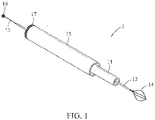
- FIG. 1 is a perspective view of an example of a calculus removing device according to an example embodiment.
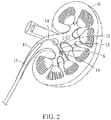
- FIG. 2 is a diagram illustrating an example of how a calculus removing device removes a stone from the inside of a body according to an example embodiment.
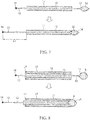
- FIG. 3 is a diagram illustrating an example of a configuration of a calculus removing device according to an example embodiment.
- a calculus removing device 1 may measure a size of a calculus or a stone (hereinafter referred to as only stone), and identify a stone with a size greater than a ureter.
- the calculus removing device 1 may measure the size of the stone at a position near the stone, without a need to take the stone out of a kidney K.
- the calculus removing device 1 includes an insertion tube 11, a guide 12, a wire 13, a basket 14, a sheath 15, a distance measurer 16, an impact detector 17, a controller 19, and a display 18.
- the calculus removing device 1 may determine a size of a stone S based on a pushing distance by which the basket 14 is pushed with respect to the guide 12, at a position near a position at which the stone S is held or grabbed by the basket 14, In addition, after moving the guide 12, the wire 13, and the basket 14 toward the insertion tube 11 while the stone S is being held by the basket 14, and when the basket 14 is caught on the insertion tube 11, the calculus removing device 1 may measure a relative position of the wire 13 with respect to the insertion tube 11 and determine the size of the stone S based on the measured relative position.
- the calculus removing device 1 may perform each of the following three relative movements. Firstly, in a state in which the sheath 15 is in a ureter U, the insertion tube 11 is relatively movable with respect to the sheath 15. Secondly, the guide 12 is relatively movable with respect to the insertion tube 11. Thirdly, the wire 13 is relatively movable with respect to the guide 12.
- the basket 14 may include a material, for example, a shape-memory alloy, which is configured to restore an initial shape exhibited when an external force is not applied. The basket 14 may move forward or backward by the wire 13, and may change its state to an expanded state in which an external force is not applied and a contracted state in which it is contracted by being pushed by the guide 12. The basket 14 may receive the stone S in an inner side thereof in the expanded state and then be pulled backward to be in the contracted state, and thus stably hold the stone S.
- the sheath 15 may be provided inside the ureter U.
- the sheath 15 may be formed of a rubber material, for example.
- the sheath 15 may protect an inner wall of the ureter U by preventing the insertion tube 11 and the guide 12 from damaging the inner wall of the ureter U.
- the sheath 15 may guide a movement of the insertion tube 11.
- the sheath 15 may have a hollow portion at a center thereof to guide the insertion tube 11.
- the insertion tube 11 may be inserted into an inner side of the sheath 15, and relatively movable with respect to the sheath 15.
- the insertion tube 11 may be construed as being part of an endoscope, and an end thereof may be bent according to an operation of the endoscope, thereby moving toward a position where a stone is present.
- the insertion tube 11 may have a hollow portion at a center thereof to guide the guide 12.
- the guide 12 may be inserted into an inner side of the insertion tube 11, and relatively movable with respect to the insertion tube 11.
- the guide 12 may guide the wire 13 and the basket 14 to a position where a stone is present.
- the guide 12 may be construed as being part of an endoscope, and an end thereof may be bent according to an operation of the endoscope, thereby moving toward a position where a stone is present.
- the wire 13 may be inserted into an inner side of the guide 12, and relatively movable with respect to the guide 12.
- the wire 13 may relatively move backward with respect to the guide 12 until as the basket 14 is caught in front of the guide 12 and does not move backward any longer.
- the controller 19 may determine the size of the stone S based on a relative position of the wire 13 with respect to the guide 12 in a state in which such a relative movement of the wire 13 with respect to the guide 12 is limited by the basket 14. For example, when the size of the stone S is small, the wire 13 may move a relatively greater distance with respect to the guide 12. In contrast, when the size of the stone S is large, the wire 13 may move a relatively less distance with respect to the guide 12.
- the basket 14 may be disposed in front of the wire 13 and configured to hold or grab a stone.
- the basket 14 may hold a stone by changing its state to the expanded state or the contracted state.
- the basket 14 may include a material, for example, a shape-memory alloy, which is configured to restore an initial shape exhibited when an external force is not applied.
- the distance measurer 16 may measure a relative movement distance of the wire 13 with respect to the guide 12.
- the distance measurer 16 may be provided at a rear end of the wire 13, and configured to measure a distance from the rear end of the wire 13 to the guide 12.
- the distance measurer 16 may be an infrared sensor or a displacement sensor, for example.
- the distance measurer 16 may be disposed on an opposite side to the basket 14 based on the guide 12. Such a structure may contribute to reducing the number of components provided in front of the guide 12, and it is thus possible to compactly embody a front portion of the calculus removing device 1, for example, an area of the basket 14.
- the distance measurer 16 may transmit displacement information of the wire 13 to the controller 19 which will be described in detail hereinafter.
- the impact detector 17 may be provided in the sheath 15 and configured to detect an impact applied to the sheath 15.
- the impact detector 17 may be a force sensor.
- the impact detector 17 may be a strain gauge provided on a side wall of the sheath 15. For example, when the insertion tube 11 moves along an inner side of the sheath 15 while the basket 14 is holding a stone having a diameter greater than an inner diameter of the sheath 15, the basket 14 may collide a front end of the sheath 15, and the impact detector 17 may detect an impact generated by the collision.
- the controller 19 may receive a distance information signal measured by the distance measurer 16.
- the controller 19 may determine a size of a stone based on a relative position of the wire 13 with respect to the guide 12 in a state in which the basket 14 holding the stone is caught on a front end of the guide 12.
- the controller 19 may determine the size of the stone based on a movement distance of the basket 14 measured by the distance measurer 16.
- the controller 19 may store therein data in which a relative position of the wire 13 with respect to the guide 12 is matched to a stone size.
- the controller 19 may receive an impact signal detected by the impact detector 17.
- the controller 19 may transmit, to the display 18, stone size information and impact information.
- the display 18 may receive the signal from the controller 19 and display the information.
- a user may verify the stone size information displayed on the display 18, and determine whether to remove a stone.
- the user may verify the impact information displayed on the display 18, and determine whether to remove the stone.
- the impact information may be information as to whether an impact is detected.
- the occurrence of an impact based on the impact information may indicate that a size of a stone is greater than the inner diameter of the sheath 15.
- the user may determine whether to remove the stone based on a type of the stone. For example, when the stone has a rough outer surface, the user may reconsider the removal of the stone. However, when the stone has a smooth outer surface, the user may decide to remove the stone along with the sheath 15.
- FIG. 4 is a diagram illustrating an example of how a calculus removing device relatively moves a wire with respect to a guide to measure a size of a stone according to an example embodiment.
- FIG. 5 is a graph illustrating a relationship between a relative position of a wire with respect to a guide and a size of a stone according to an example embodiment.
- FIGS. 4 and 5 the insertion tube 11 and the sheath 15 are not illustrated.
- the basket 14 may receive a stone S.
- the basket 14 may be in an expanded state. While the basket 14 is holding the stone S inside thereof, the wire 13 may relatively move backward with respect to the guide 12. The basket 14 may move backward by the wire 13, and the basket 14 may be pressed and contracted by a front end of the guide 12. Thus, as the basket 14 changes its state from the expanded state to the contracted state, the basket 14 may more stably support the stone S. The wire 13 may move backward until the basket 14 is not deformed anymore. While the wire 13 is moving, the distance measurer 16 may measure a movement distance of the wire 13 by which the wire 13 moves, and a controller may determine the size of the stone S based on the distance measured by' the distance measurer 16.
- the distance measurer 16 may be provided at a rear end of the wire 13 and measure a distance D from a current position of the distance measurer 16 to a rear end of the guide 12.
- the distance measurer 16 may transmit the measured distance D to the controller, and the controller may determine the size of the stone S based on the received distance D.
- a distance D and a size of a stone S may correspond to each other one-to-one.
- the controller may store data of a reference distance at which a diameter of the stone S is the same as an inner diameter of a sheath, for example, the sheath 15 illustrated in FIG. 1 , and generate an alarm signal when the distance D is less than the reference distance.
- a display for example, the display 18 illustrated in FIG. 3 , and/or a sound alarm device may send the alarm signal to outside.
- FIGS. 6 and 7 are diagrams illustrating an example of how a calculus removing device relatively moves a wire and a guide with respect to an insertion tube to measure a size of a stone according to an example embodiment.
- FIGS. 6 and 7 a user may expand the basket 14 to receive therein a stone S1, and allow the basket 14 to be pressed by the guide 12 and thus be contracted to stably hold or grab the stone S1.
- An upper portion of FIG. 6 illustrates a state in which the basket 14 is holding or grabbing the stone S1.
- the basket 14 may be pressed by the guide 12 to the extent that the basket 14 is no longer deformed.
- the wire 13 and the guide 12 may move together backward. While the wire 13 and the guide 12 are moving backward, the basket 14 may be caught on a front end of the insertion tube 11.
- a lower portion of FIG. 6 illustrates a state in which the basket 14 is caught on the front end of the insertion tube 11.
- a controller may determine a size of the stone S1 based on a distance L1 detected by the distance measure 16 in a state in which the basket 14 is caught in the insertion tube 11.
- FIG. 7 illustrates a state in which a stone S2 larger than the stone S1 illustrated in FIG. 6 is grabbed. Since a size of the stone S2 in FIG. 7 is relatively larger, a detected distance L2 may be relatively shorter than the detected distance L1 in FIG. 6 .
- FIG. 8 is a cross sectional view of an example of a calculus removing device according to an example embodiment.
- the basket 14 When a size of a stone S is greater than an inner diameter of the sheath 15, the basket 14 which is holding or grabbing the stone S may collide with the sheath 15.
- the impact detector 17 When the basket 14 collides with the sheath 15, the impact detector 17 may detect an impact from such a collision and transmit a signal associated with the detected impact to a controller.
- the controller may display information as to whether the impact is detected or not to outside through a display.
- a calculus removing device may further include an alarm portion. When the impact is detected, the controller may transmit a signal to the alarm portion, and the alarm portion may generate an alarm signal, for example, an alarm.
- a user may decide whether to remove the stone S having the size greater than the inner diameter of the sheath 15, based on a type of the stone S. For example, when the stone S has a smooth outer surface, the user may remove the stone S along with the sheath 15.
Landscapes
- Health & Medical Sciences (AREA)
- Life Sciences & Earth Sciences (AREA)
- Surgery (AREA)
- Engineering & Computer Science (AREA)
- Medical Informatics (AREA)
- Veterinary Medicine (AREA)
- General Health & Medical Sciences (AREA)
- Public Health (AREA)
- Nuclear Medicine, Radiotherapy & Molecular Imaging (AREA)
- Biomedical Technology (AREA)
- Heart & Thoracic Surgery (AREA)
- Animal Behavior & Ethology (AREA)
- Molecular Biology (AREA)
- Pathology (AREA)
- Radiology & Medical Imaging (AREA)
- Optics & Photonics (AREA)
- Biophysics (AREA)
- Physics & Mathematics (AREA)
- Robotics (AREA)
- Urology & Nephrology (AREA)
- Oral & Maxillofacial Surgery (AREA)
- Vascular Medicine (AREA)
- Orthopedic Medicine & Surgery (AREA)
- Signal Processing (AREA)
- Endoscopes (AREA)
- Surgical Instruments (AREA)
- Processing Of Stones Or Stones Resemblance Materials (AREA)
- High Energy & Nuclear Physics (AREA)
Abstract
Description
- Example embodiments relate to a calculus removing device and method.
- A surgery is a medical procedure of treating a disease by cutting, incising, or applying a manipulation to the skin, moles, or other tissues using a medical machine. A laparotomy, in particular, which incises and opens the skin of a surgical site and treats, restores or reconstructs, or removes an organ in an abdominal cavity has some issues such as bleeding, side effects, pains, and/or scars of a patient. Thus, in recent years, a surgery using a robot has been receiving attention as an alternative.
- A surgical robot may include a master device which generates and transmits a required signal in response to a manipulation of a surgeon, and a slave device which receives the signal from the master device and applies a manipulation required for a surgery directly to a patient. The master device and the slave device may be provided in an integral form, or configured as separate devices to be disposed at an operating room. Also, the master device and the slave device may be disposed apart from each other. In such a case, the surgeon may operate the slave device disposed at a distant location through the master device. In addition, a single master device may selectively interwork with one of multiple slave devices.
- A calculus refers to a stone in a body that is produced when a biogenic substance is solidified with an organic or inorganic matter, and may clog a biliary duct or a ureter. Thus, when a stone large enough to be of a dangerous size is found, it needs to be removed. A stone may be crushed by a crushing device or a lithotriptor, for example, a laser, and then collected by a basket and removed to outside. A surgical device for removing a stone may operate as the slave device.
- A stone may be positioned deep inside a body, and thus it may not be easy to measure its size. When a stone grows to be large, it may damage an inner wall of a ureter while moving, and in severe cases, it may cut the ureter. The damaged inner wall of the ureter may cause an acute kidney infection, and the cut ureter may cause peritonitis. To prevent these, the size of a stone needs to be measured.
- An aspect provides a calculus removing device and method that measures the size of a calculus or a stone based on a movement distance of a basket.
- According to an example embodiment, there is provided a calculus removing device including an insertion tube, a guide configured to be inserted into an inner side of the insertion tube and relatively movable with respect to the insertion tube, a wire configured to be inserted into an inner side of the guide and relatively movable with respect to the guide, a basket disposed in front of the wire and configured to hold a stone, and a controller configured to determine a size of the stone based on a relative movement of the guide with respect to the insertion tube or a relative movement of the wire with respect to the guide.
- The controller may determine the size of the stone based on a relative position of the wire with respect to the guide in a state in which the basket holding the stone is caught on a front end of the guide.
- The calculus removing device may further include a distance measurer disposed in the wire and configured to measure a relative movement distance of the wire with respect to the guide. The controller may determine the relative position of the wire with respect to the guide based on a distance detected by the distance measurer.
- The distance measurer may be provided at a rear end of the wire and configured to measure a distance from the rear end of the wire to the guide.
- The controller may determine the size of the stone based on a relative position of the wire with respect to the insertion tube in a state in which the basket holding the stone is caught on a front end of the insertion tube.
- The calculus removing device may further include a distance measurer disposed in the wire and configured to measure a relative movement distance of the wire with respect to the guide. The controller may determine the relative position of the wire with respect to the insertion tube based on a distance detected by the distance measurer.
- The calculus removing device may further include a sheath configured to surround the insertion tube. The insertion tube may be relatively movable with respect to the sheath.
- The calculus removing device may further include an impact detector provided in the sheath and configured to detect an impact applied to the sheath.
- The calculus removing device may further include a display configured to display information associated with the size of the stone and information as to whether an impact is detected by the impact detector.
- According to another example embodiment, there is provided a calculus removing device including a sheath, an insertion tube configured to be inserted into an inner side of the sheath and relatively movable with respect to the sheath, a guide configured to be inserted into an inner side of the insertion tube and relatively movable with respect to the insertion tube, a wire configured to be inserted into an inner side of the guide and relatively movable with respect to the guide, a basket disposed in front of the wire and configured to hold a stone, and a controller configured to determine a size of the stone based on a relative movement of the guide with respect to the insertion tube or a relative movement of the wire with respect to the guide.
- The calculus removing device may further include a distance measurer disposed in the wire and configured to measure a relative movement distance of the wire with respect to the guide, and an impact detector provided in the sheath and configured to detect an impact applied to the sheath.
- The controller may determine the size of the stone based on a relative position of the wire with respect to the guide in a state in which the basket holding the stone is caught on a front end of the guide.
- According to an example embodiment described herein, a calculus removing device and method may measure a position of a calculus or a stone in an area near the position of the stone, for example, an area around renal pelvis, without a need for a user to take the stone out of a body.
- According to an example embodiment described herein, a calculus removing device and method may identify only a stone having a diameter less than an inner diameter of a sheath and selectively remove the stone, and detect a collision between the sheath and a basket immediately when the collision occurs. In addition, even though a diameter of a stone is greater than the inner diameter of the sheath, the calculus removing device and method may enable a user to select whether to remove the stone based on a type of the stone.
- These and/or other aspects, features, and advantages of the present disclosure will become apparent and more readily appreciated from the following description of example embodiments, taken in conjunction with the accompanying drawings of which:
-
FIG. 1 is a perspective view of an example of a calculus removing device according to an example embodiment; -
FIG. 2 is a diagram illustrating an example of how a calculus removing device removes a stone from the inside of a body according to an example embodiment; -
FIG. 3 is a diagram illustrating an example of a configuration of a calculus removing device according to an example embodiment; -
FIG. 4 is a diagram illustrating an example of how a calculus removing device relatively moves a wire with respect to a guide to measure the size of a stone according to an example embodiment; -
FIG. 5 is a graph illustrating a relationship between a relative position of a wire with respect to a guide and the size of a stone according to an example embodiment; -
FIGS. 6 and7 are diagrams illustrating an example of how a calculus removing device relatively moves a wire and a guide with respect to an insertion tube to measure the size of a stone according to an example embodiment; and -
FIG. 8 is a cross sectional view of an example of a calculus removing device according to an example embodiment. - Hereinafter, example embodiments will be described in detail with reference to the accompanying drawings. It should be understood, however, that there is no intent to limit this disclosure to the particular example embodiments disclosed. On the contrary, example embodiments are to cover all modifications, equivalents, and alternatives falling within the scope of the example embodiments.
- The terminology used herein is for the purpose of describing particular example embodiments only and is not intended to be limiting. Terms such as first, second, A, B, (a), (b), and the like may be used herein to describe components. Each of these terminologies is not used to define an essence, order, or sequence of a corresponding component but used merely to distinguish the corresponding component from other component(s). It should be noted that if it is described in the specification that one component is "connected," "coupled," or "joined" to another component, a third component may be "connected," "coupled," and "joined" between the first and second components, although the first component may be directly connected, coupled or joined to the second component. In addition, it should be noted that if it is described in the specification that one component is "directly connected" or "directly joined" to another component, a third component may not be present therebetween.
- Hereinafter, example embodiments will be described in detail with reference to the accompanying drawings. Regarding the reference numerals assigned to the elements in the drawings, it should be noted that the same elements will be designated by the same reference numerals, wherever, possible, even though they are shown in different drawings.
-
FIG. 1 is a perspective view of an example of a calculus removing device according to an example embodiment.FIG. 2 is a diagram illustrating an example of how a calculus removing device removes a stone from the inside of a body according to an example embodiment.FIG. 3 is a diagram illustrating an example of a configuration of a calculus removing device according to an example embodiment. - A
calculus removing device 1 may measure a size of a calculus or a stone (hereinafter referred to as only stone), and identify a stone with a size greater than a ureter. Thecalculus removing device 1 may measure the size of the stone at a position near the stone, without a need to take the stone out of a kidney K. Thecalculus removing device 1 includes aninsertion tube 11, aguide 12, awire 13, abasket 14, asheath 15, adistance measurer 16, animpact detector 17, acontroller 19, and adisplay 18. Thecalculus removing device 1 may determine a size of a stone S based on a pushing distance by which thebasket 14 is pushed with respect to theguide 12, at a position near a position at which the stone S is held or grabbed by thebasket 14, In addition, after moving theguide 12, thewire 13, and thebasket 14 toward theinsertion tube 11 while the stone S is being held by thebasket 14, and when thebasket 14 is caught on theinsertion tube 11, thecalculus removing device 1 may measure a relative position of thewire 13 with respect to theinsertion tube 11 and determine the size of the stone S based on the measured relative position. - The
calculus removing device 1 may perform each of the following three relative movements. Firstly, in a state in which thesheath 15 is in a ureter U, theinsertion tube 11 is relatively movable with respect to thesheath 15. Secondly, theguide 12 is relatively movable with respect to theinsertion tube 11. Thirdly, thewire 13 is relatively movable with respect to theguide 12. Thebasket 14 may include a material, for example, a shape-memory alloy, which is configured to restore an initial shape exhibited when an external force is not applied. Thebasket 14 may move forward or backward by thewire 13, and may change its state to an expanded state in which an external force is not applied and a contracted state in which it is contracted by being pushed by theguide 12. Thebasket 14 may receive the stone S in an inner side thereof in the expanded state and then be pulled backward to be in the contracted state, and thus stably hold the stone S. - The
sheath 15 may be provided inside the ureter U. Thesheath 15 may be formed of a rubber material, for example. Thesheath 15 may protect an inner wall of the ureter U by preventing theinsertion tube 11 and theguide 12 from damaging the inner wall of the ureter U. Thesheath 15 may guide a movement of theinsertion tube 11. Thesheath 15 may have a hollow portion at a center thereof to guide theinsertion tube 11. - The
insertion tube 11 may be inserted into an inner side of thesheath 15, and relatively movable with respect to thesheath 15. For example, theinsertion tube 11 may be construed as being part of an endoscope, and an end thereof may be bent according to an operation of the endoscope, thereby moving toward a position where a stone is present. Theinsertion tube 11 may have a hollow portion at a center thereof to guide theguide 12. - The
guide 12 may be inserted into an inner side of theinsertion tube 11, and relatively movable with respect to theinsertion tube 11. Theguide 12 may guide thewire 13 and thebasket 14 to a position where a stone is present. For example, theguide 12 may be construed as being part of an endoscope, and an end thereof may be bent according to an operation of the endoscope, thereby moving toward a position where a stone is present. - The
wire 13 may be inserted into an inner side of theguide 12, and relatively movable with respect to theguide 12. Thewire 13 may relatively move backward with respect to theguide 12 until as thebasket 14 is caught in front of theguide 12 and does not move backward any longer. Thecontroller 19 may determine the size of the stone S based on a relative position of thewire 13 with respect to theguide 12 in a state in which such a relative movement of thewire 13 with respect to theguide 12 is limited by thebasket 14. For example, when the size of the stone S is small, thewire 13 may move a relatively greater distance with respect to theguide 12. In contrast, when the size of the stone S is large, thewire 13 may move a relatively less distance with respect to theguide 12. - The
basket 14 may be disposed in front of thewire 13 and configured to hold or grab a stone. Thebasket 14 may hold a stone by changing its state to the expanded state or the contracted state. Thebasket 14 may include a material, for example, a shape-memory alloy, which is configured to restore an initial shape exhibited when an external force is not applied. - The
distance measurer 16 may measure a relative movement distance of thewire 13 with respect to theguide 12. For example, thedistance measurer 16 may be provided at a rear end of thewire 13, and configured to measure a distance from the rear end of thewire 13 to theguide 12. Thedistance measurer 16 may be an infrared sensor or a displacement sensor, for example. Thedistance measurer 16 may be disposed on an opposite side to thebasket 14 based on theguide 12. Such a structure may contribute to reducing the number of components provided in front of theguide 12, and it is thus possible to compactly embody a front portion of thecalculus removing device 1, for example, an area of thebasket 14. Thedistance measurer 16 may transmit displacement information of thewire 13 to thecontroller 19 which will be described in detail hereinafter. - The
impact detector 17 may be provided in thesheath 15 and configured to detect an impact applied to thesheath 15. For example, theimpact detector 17 may be a force sensor. For another example, theimpact detector 17 may be a strain gauge provided on a side wall of thesheath 15. For example, when theinsertion tube 11 moves along an inner side of thesheath 15 while thebasket 14 is holding a stone having a diameter greater than an inner diameter of thesheath 15, thebasket 14 may collide a front end of thesheath 15, and theimpact detector 17 may detect an impact generated by the collision. - The
controller 19 may receive a distance information signal measured by thedistance measurer 16. Thecontroller 19 may determine a size of a stone based on a relative position of thewire 13 with respect to theguide 12 in a state in which thebasket 14 holding the stone is caught on a front end of theguide 12. For example, thecontroller 19 may determine the size of the stone based on a movement distance of thebasket 14 measured by thedistance measurer 16. For example, thecontroller 19 may store therein data in which a relative position of thewire 13 with respect to theguide 12 is matched to a stone size. In addition, thecontroller 19 may receive an impact signal detected by theimpact detector 17. Thecontroller 19 may transmit, to thedisplay 18, stone size information and impact information. - The
display 18 may receive the signal from thecontroller 19 and display the information. A user may verify the stone size information displayed on thedisplay 18, and determine whether to remove a stone. In addition, the user may verify the impact information displayed on thedisplay 18, and determine whether to remove the stone. The impact information may be information as to whether an impact is detected. Here, the occurrence of an impact based on the impact information may indicate that a size of a stone is greater than the inner diameter of thesheath 15. The user may determine whether to remove the stone based on a type of the stone. For example, when the stone has a rough outer surface, the user may reconsider the removal of the stone. However, when the stone has a smooth outer surface, the user may decide to remove the stone along with thesheath 15. -
FIG. 4 is a diagram illustrating an example of how a calculus removing device relatively moves a wire with respect to a guide to measure a size of a stone according to an example embodiment.FIG. 5 is a graph illustrating a relationship between a relative position of a wire with respect to a guide and a size of a stone according to an example embodiment. - In
FIGS. 4 and5 , theinsertion tube 11 and thesheath 15 are not illustrated. - Referring to
FIGS. 4 and5 , when thewire 13 relatively moves forward with respect to theguide 12, thebasket 14 may receive a stone S. In such a state, thebasket 14 may be in an expanded state. While thebasket 14 is holding the stone S inside thereof, thewire 13 may relatively move backward with respect to theguide 12. Thebasket 14 may move backward by thewire 13, and thebasket 14 may be pressed and contracted by a front end of theguide 12. Thus, as thebasket 14 changes its state from the expanded state to the contracted state, thebasket 14 may more stably support the stone S. Thewire 13 may move backward until thebasket 14 is not deformed anymore. While thewire 13 is moving, thedistance measurer 16 may measure a movement distance of thewire 13 by which thewire 13 moves, and a controller may determine the size of the stone S based on the distance measured by' thedistance measurer 16. - For example, the
distance measurer 16 may be provided at a rear end of thewire 13 and measure a distance D from a current position of thedistance measurer 16 to a rear end of theguide 12. Thedistance measurer 16 may transmit the measured distance D to the controller, and the controller may determine the size of the stone S based on the received distance D. Here, a distance D and a size of a stone S may correspond to each other one-to-one. The controller may store data of a reference distance at which a diameter of the stone S is the same as an inner diameter of a sheath, for example, thesheath 15 illustrated inFIG. 1 , and generate an alarm signal when the distance D is less than the reference distance. When the alarm signal is generated, a display, for example, thedisplay 18 illustrated inFIG. 3 , and/or a sound alarm device may send the alarm signal to outside. -
FIGS. 6 and7 are diagrams illustrating an example of how a calculus removing device relatively moves a wire and a guide with respect to an insertion tube to measure a size of a stone according to an example embodiment. - Referring to
FIGS. 6 and7 , a user may expand thebasket 14 to receive therein a stone S1, and allow thebasket 14 to be pressed by theguide 12 and thus be contracted to stably hold or grab the stone S1. An upper portion ofFIG. 6 illustrates a state in which thebasket 14 is holding or grabbing the stone S1. Thebasket 14 may be pressed by theguide 12 to the extent that thebasket 14 is no longer deformed. Subsequently, thewire 13 and theguide 12 may move together backward. While thewire 13 and theguide 12 are moving backward, thebasket 14 may be caught on a front end of theinsertion tube 11. A lower portion ofFIG. 6 illustrates a state in which thebasket 14 is caught on the front end of theinsertion tube 11. A controller may determine a size of the stone S1 based on a distance L1 detected by thedistance measure 16 in a state in which thebasket 14 is caught in theinsertion tube 11. -
FIG. 7 illustrates a state in which a stone S2 larger than the stone S1 illustrated inFIG. 6 is grabbed. Since a size of the stone S2 inFIG. 7 is relatively larger, a detected distance L2 may be relatively shorter than the detected distance L1 inFIG. 6 . -
FIG. 8 is a cross sectional view of an example of a calculus removing device according to an example embodiment. - When a size of a stone S is greater than an inner diameter of the
sheath 15, thebasket 14 which is holding or grabbing the stone S may collide with thesheath 15. When thebasket 14 collides with thesheath 15, theimpact detector 17 may detect an impact from such a collision and transmit a signal associated with the detected impact to a controller. The controller may display information as to whether the impact is detected or not to outside through a display. Although not illustrated, a calculus removing device may further include an alarm portion. When the impact is detected, the controller may transmit a signal to the alarm portion, and the alarm portion may generate an alarm signal, for example, an alarm. - A user may decide whether to remove the stone S having the size greater than the inner diameter of the
sheath 15, based on a type of the stone S. For example, when the stone S has a smooth outer surface, the user may remove the stone S along with thesheath 15. - A number of example embodiments have been described above. Nevertheless, it should be understood that various modifications may be made to these example embodiments. For example, suitable results may be achieved if the described techniques are performed in a different order and/or if components in a described system, architecture, device, or circuit are combined in a different manner and/or replaced or supplemented by other components or their equivalents. Accordingly, other implementations are within the scope of the following claims.
Claims (12)
- A calculus removing device comprising:an insertion tube;a guide configured to be inserted into an inner side of the insertion tube and relatively movable with respect to the insertion tube;a wire configured to be inserted into an inner side of the guide and relatively movable with respect to the guide;a basket disposed in front of the wire and configured to hold a stone; anda controller configured to determine a size of the stone based on a relative movement of the guide with respect to the insertion tube or a relative movement of the wire with respect to the guide.
- The calculus removing device of claim 1, wherein the controller is configured to determine the size of the stone based on a relative position of the wire with respect to the guide in a state in which the basket holding the stone is caught on a front end of the guide.
- The calculus removing device of claim 2, further comprising:
a distance measurer disposed in the wire and configured to measure a relative movement distance of the wire with respect to the guide,
wherein the controller is configured to determine the relative position of the wire with respect to the guide based on a distance detected by the distance measurer. - The calculus removing device of claim 3, wherein the distance measurer is provided at a rear end of the wire and configured to measure a distance from the rear end of the wire to the guide.
- The calculus removing device of claim 1, wherein the controller is configured to determine the size of the stone based on a relative position of the wire with respect to the insertion tube in a state in which the basket holding the stone is caught on a front end of the insertion tube.
- The calculus removing device of claim 5, further comprising:
a distance measurer disposed in the wire and configured to measure a relative movement distance of the wire with respect to the guide,
wherein the controller is configured to determine the relative position of the wire with respect to the insertion tube based on a distance detected by the ) distance measurer. - The calculus removing device of claim 1, further comprising:
a sheath configured to surround the insertion tube,
wherein the insertion tube is relatively movable with respect to the sheath. - The calculus removing device of claim 7, further comprising:
an impact detector provided in the sheath and configured to detect an impact applied to the sheath. - The calculus removing device of claim 8, further comprising:
a display configured to display information associated with the size of the stone and information as to whether an impact is detected by the impact detector. - A calculus removing device comprising:a sheath;an insertion tube configured to be inserted into an inner side of the sheath and relatively movable with respect to the sheath;a guide configured to be inserted into an inner side of the insertion tube and relatively movable with respect to the insertion tube;a wire configured to be inserted into an inner side of the guide and relatively movable with respect to the guide;a basket disposed in front of the wire and configured to hold a stone; anda controller configured to determine a size of the stone based on a relative movement of the guide with respect to the insertion tube or a relative movement of the wire with respect to the guide.
- The calculus removing device of claim 10, further comprising:a distance measurer disposed in the wire and configured to measure a relative movement distance of the wire with respect to the guide; andan impact detector provided in the sheath and configured to detect an impact applied to the sheath.
- The calculus removing device of claim 10, wherein the controller is configured to determine the size of the stone based on a relative position of the wire with respect to the guide in a state in which the basket holding the stone is caught on a front end of the guide.
Applications Claiming Priority (2)
| Application Number | Priority Date | Filing Date | Title |
|---|---|---|---|
| KR20180042794 | 2018-04-12 | ||
| PCT/KR2019/004455 WO2019199126A1 (en) | 2018-04-12 | 2019-04-12 | Calculus removing device and method |
Publications (4)
| Publication Number | Publication Date |
|---|---|
| EP3756608A1 true EP3756608A1 (en) | 2020-12-30 |
| EP3756608A4 EP3756608A4 (en) | 2021-11-17 |
| EP3756608B1 EP3756608B1 (en) | 2023-08-09 |
| EP3756608C0 EP3756608C0 (en) | 2023-08-09 |
Family
ID=68420070
Family Applications (2)
| Application Number | Title | Priority Date | Filing Date |
|---|---|---|---|
| EP19785654.5A Active EP3756607B1 (en) | 2018-04-12 | 2019-04-12 | Autonomous endoscopic system |
| EP19785655.2A Active EP3756608B1 (en) | 2018-04-12 | 2019-04-12 | Calculi removing device |
Family Applications Before (1)
| Application Number | Title | Priority Date | Filing Date |
|---|---|---|---|
| EP19785654.5A Active EP3756607B1 (en) | 2018-04-12 | 2019-04-12 | Autonomous endoscopic system |
Country Status (4)
| Country | Link |
|---|---|
| US (2) | US11083476B2 (en) |
| EP (2) | EP3756607B1 (en) |
| KR (2) | KR102297070B1 (en) |
| CN (2) | CN111936075B (en) |
Families Citing this family (12)
| Publication number | Priority date | Publication date | Assignee | Title |
|---|---|---|---|---|
| US9949749B2 (en) | 2015-10-30 | 2018-04-24 | Auris Surgical Robotics, Inc. | Object capture with a basket |
| US9955986B2 (en) | 2015-10-30 | 2018-05-01 | Auris Surgical Robotics, Inc. | Basket apparatus |
| US10639108B2 (en) | 2015-10-30 | 2020-05-05 | Auris Health, Inc. | Process for percutaneous operations |
| KR102372826B1 (en) * | 2019-12-26 | 2022-03-11 | 계명대학교 산학협력단 | Calculus remover device |
| US11896330B2 (en) | 2019-08-15 | 2024-02-13 | Auris Health, Inc. | Robotic medical system having multiple medical instruments |
| KR102386660B1 (en) * | 2019-11-28 | 2022-04-15 | 주식회사 이지엔도서지컬 | Apparatus for measuring stone size and stone size measuring method |
| DE102019134352B4 (en) * | 2019-12-13 | 2023-03-30 | Albert-Ludwigs-Universität Freiburg | Surgical robot for endoscopic applications |
| EP4084724A4 (en) * | 2019-12-31 | 2023-12-27 | Auris Health, Inc. | ADVANCED BASKET DRIVE MODE |
| WO2022230829A1 (en) * | 2021-04-26 | 2022-11-03 | 川崎重工業株式会社 | Robot system |
| KR102684546B1 (en) | 2021-11-09 | 2024-07-15 | 주식회사 로엔서지컬 | Endoscope apparatus for calculus removing |
| US12616491B2 (en) | 2023-01-11 | 2026-05-05 | Boston Scientific Scimed, Inc. | Medical devices and related methods thereof |
| CN117982200B (en) * | 2024-04-07 | 2024-05-28 | 北京清华长庚医院 | Urinary surgery stone removing device for protecting mucous membrane |
Family Cites Families (42)
| Publication number | Priority date | Publication date | Assignee | Title |
|---|---|---|---|---|
| US5876325A (en) * | 1993-11-02 | 1999-03-02 | Olympus Optical Co., Ltd. | Surgical manipulation system |
| US6468203B2 (en) * | 2000-04-03 | 2002-10-22 | Neoguide Systems, Inc. | Steerable endoscope and improved method of insertion |
| WO2005058137A2 (en) * | 2003-12-12 | 2005-06-30 | University Of Washington | Catheterscope 3d guidance and interface system |
| JP4365865B2 (en) * | 2004-09-28 | 2009-11-18 | オリンパス株式会社 | Insertion device |
| EP1867955A1 (en) | 2006-06-08 | 2007-12-19 | BrainLAB AG | Calibrated medical instrument with environment sensor |
| US9037215B2 (en) | 2007-01-31 | 2015-05-19 | The Penn State Research Foundation | Methods and apparatus for 3D route planning through hollow organs |
| JP4914735B2 (en) * | 2007-02-14 | 2012-04-11 | オリンパスメディカルシステムズ株式会社 | Endoscope system for controlling the position of the treatment tool |
| JP5030639B2 (en) * | 2007-03-29 | 2012-09-19 | オリンパスメディカルシステムズ株式会社 | Endoscope device treatment instrument position control device |
| WO2009042451A2 (en) * | 2007-09-26 | 2009-04-02 | Wilson-Cook Medical Inc. | Wire capture surgical device with fixable handle |
| US8607634B2 (en) | 2007-10-15 | 2013-12-17 | University Of Washington | Ultrasound based method and apparatus to determine the size of kidney stone fragments before removal via ureteroscopy |
| JP4580973B2 (en) * | 2007-11-29 | 2010-11-17 | オリンパスメディカルシステムズ株式会社 | Treatment instrument system |
| CN201127637Y (en) * | 2008-01-23 | 2008-10-08 | 河南大学消化病研究所 | Net basket for fetching gall-stone |
| US8343034B2 (en) * | 2008-05-13 | 2013-01-01 | Olympus Medical Systems Corp. | Electric medical instrument fitting which is attached to a medical instrument holding device |
| JP5384869B2 (en) * | 2008-07-24 | 2014-01-08 | オリンパスメディカルシステムズ株式会社 | Endoscopic treatment system |
| EP2332459B1 (en) * | 2009-06-23 | 2014-05-07 | Olympus Medical Systems Corp. | Medical system |
| EP2471436B1 (en) * | 2009-08-26 | 2017-10-25 | Olympus Corporation | Endoscope apparatus |
| JP5537250B2 (en) * | 2010-05-10 | 2014-07-02 | オリンパス株式会社 | Endoscope system |
| US8900131B2 (en) | 2011-05-13 | 2014-12-02 | Intuitive Surgical Operations, Inc. | Medical system providing dynamic registration of a model of an anatomical structure for image-guided surgery |
| CN102860856B (en) * | 2012-09-04 | 2014-11-05 | 王东 | Stone breaking device |
| WO2014156218A1 (en) * | 2013-03-28 | 2014-10-02 | オリンパス株式会社 | Endoscope system and method for operating endoscope system |
| EP2888991B1 (en) * | 2013-04-15 | 2017-11-01 | Olympus Corporation | Endoscope system |
| CN105101894B (en) * | 2013-05-09 | 2019-03-19 | 美国奥林匹斯外科技术吉鲁斯阿克米公司 | Multi-Mode Oscillating Stone Crusher |
| CN105491967B (en) * | 2013-11-14 | 2019-05-28 | 美国奥林匹斯外科技术吉鲁斯阿克米公司 | Feedback-dependent rubble energy transfer |
| JP2015107249A (en) * | 2013-12-05 | 2015-06-11 | オリンパス株式会社 | Endoscope control method and endoscope system |
| DE102014203097A1 (en) | 2014-02-20 | 2015-08-20 | Siemens Aktiengesellschaft | A method of assisting navigation of an endoscopic device |
| JP6257371B2 (en) * | 2014-02-21 | 2018-01-10 | オリンパス株式会社 | Endoscope system and method for operating endoscope system |
| US10368886B2 (en) * | 2014-03-07 | 2019-08-06 | The University Of Akron | Surgical apparatus with force sensor for extraction of substances within the body |
| US9259231B2 (en) * | 2014-05-11 | 2016-02-16 | Gyrus Acmi, Inc. | Computer aided image-based enhanced intracorporeal lithotripsy |
| US9936964B2 (en) * | 2014-05-15 | 2018-04-10 | Boston Scientific Scimed, Inc. | Retrieval devices and related methods of use |
| EP3155953A4 (en) * | 2014-06-11 | 2018-05-16 | Olympus Corporation | Endoscope system |
| US20150366571A1 (en) * | 2014-06-24 | 2015-12-24 | Gyrus Acmi, Inc. (D.B.A. Olympus Surgical Technologies America) | Image-based computer-aided safe stone extraction advisor |
| JP2016101315A (en) * | 2014-11-28 | 2016-06-02 | テルモ株式会社 | Medical device |
| US10524810B2 (en) * | 2015-03-04 | 2020-01-07 | Gyrus Acmi, Inc. | Medical device for capturing stone fragments |
| WO2016189765A1 (en) * | 2015-05-28 | 2016-12-01 | オリンパス株式会社 | Endoscope system |
| CN108124423B (en) * | 2015-06-25 | 2020-12-04 | 美国奥林匹斯外科技术吉鲁斯阿克米公司 | Retraction Force Sensing Basket |
| US9949749B2 (en) * | 2015-10-30 | 2018-04-24 | Auris Surgical Robotics, Inc. | Object capture with a basket |
| KR101782250B1 (en) * | 2016-02-29 | 2017-09-27 | 가톨릭대학교 산학협력단 | stone removal device |
| KR101805296B1 (en) | 2016-03-15 | 2017-12-07 | 서울대학교병원 | Umbrella basket retrieving calculus in a body and basket assembly having the same |
| WO2017192351A1 (en) * | 2016-05-06 | 2017-11-09 | Boston Scientific Scimed, Inc. | Medical systems, devices, and related methods |
| KR101923404B1 (en) | 2016-07-01 | 2018-11-29 | 가천대학교 산학협력단 | Autonomous driving method of externally powered wireless endoscope system using image process |
| CN106901801A (en) * | 2017-01-19 | 2017-06-30 | 中国人民解放军第三军医大学第附属医院 | Calculi in urinary system cavity inner sleeve takes device |
| US9743944B1 (en) * | 2017-04-24 | 2017-08-29 | Calcula Technologies, Inc. | Stone retrieval balloon catheter |
-
2019
- 2019-04-12 CN CN201980024134.8A patent/CN111936075B/en active Active
- 2019-04-12 KR KR1020190043033A patent/KR102297070B1/en active Active
- 2019-04-12 KR KR1020190043038A patent/KR102261265B1/en active Active
- 2019-04-12 CN CN201980024330.5A patent/CN111936076B/en active Active
- 2019-04-12 EP EP19785654.5A patent/EP3756607B1/en active Active
- 2019-04-12 EP EP19785655.2A patent/EP3756608B1/en active Active
-
2020
- 2020-09-23 US US17/030,369 patent/US11083476B2/en active Active
- 2020-09-23 US US17/030,331 patent/US11172950B2/en active Active
Also Published As
| Publication number | Publication date |
|---|---|
| CN111936075B (en) | 2025-06-17 |
| CN111936076B (en) | 2025-04-08 |
| CN111936075A (en) | 2020-11-13 |
| KR20190119542A (en) | 2019-10-22 |
| EP3756607A1 (en) | 2020-12-30 |
| EP3756608A4 (en) | 2021-11-17 |
| EP3756607C0 (en) | 2024-09-18 |
| US20210007758A1 (en) | 2021-01-14 |
| KR102261265B1 (en) | 2021-06-07 |
| EP3756607B1 (en) | 2024-09-18 |
| US11083476B2 (en) | 2021-08-10 |
| KR102297070B1 (en) | 2021-09-02 |
| KR20190119541A (en) | 2019-10-22 |
| CN111936076A (en) | 2020-11-13 |
| EP3756608B1 (en) | 2023-08-09 |
| EP3756608C0 (en) | 2023-08-09 |
| EP3756607A4 (en) | 2021-12-29 |
| US20210015353A1 (en) | 2021-01-21 |
| US11172950B2 (en) | 2021-11-16 |
Similar Documents
| Publication | Publication Date | Title |
|---|---|---|
| US11083476B2 (en) | Urolithiasis removing device and method | |
| US8025668B2 (en) | Medical device removal system | |
| US8118816B2 (en) | Releasable medical basket and related methods of use | |
| US20090264835A1 (en) | Detachable shaft medical retrieval device methods of use | |
| ES2971075T3 (en) | Device and method to detect and eliminate blood clots for the treatment of ischemic stroke using force and electromagnetic sensors | |
| CN106061402A (en) | System for performing extraluminal coronary bypass and method of operation thereof | |
| US20150157344A1 (en) | Medical retrieval devices and related methods of use | |
| US20170086861A1 (en) | Stone collection device | |
| WO2016042811A1 (en) | Medical observation system | |
| JP7109413B2 (en) | stent system | |
| US10149719B2 (en) | Medical manipulator | |
| WO2019199126A1 (en) | Calculus removing device and method | |
| CN217548205U (en) | Surgical robot | |
| JP7674528B2 (en) | ENDOSCOPYRIGHT: 201002306344. | |
| JP2025519921A (en) | Expandable catheter tip when compressed | |
| WO2019078791A2 (en) | Shape memory tubular retractor and self-expanding graft- coated nitinol tubular retractor arrangement |
Legal Events
| Date | Code | Title | Description |
|---|---|---|---|
| STAA | Information on the status of an ep patent application or granted ep patent |
Free format text: STATUS: THE INTERNATIONAL PUBLICATION HAS BEEN MADE |
|
| PUAI | Public reference made under article 153(3) epc to a published international application that has entered the european phase |
Free format text: ORIGINAL CODE: 0009012 |
|
| STAA | Information on the status of an ep patent application or granted ep patent |
Free format text: STATUS: REQUEST FOR EXAMINATION WAS MADE |
|
| 17P | Request for examination filed |
Effective date: 20200922 |
|
| AK | Designated contracting states |
Kind code of ref document: A1 Designated state(s): AL AT BE BG CH CY CZ DE DK EE ES FI FR GB GR HR HU IE IS IT LI LT LU LV MC MK MT NL NO PL PT RO RS SE SI SK SM TR |
|
| AX | Request for extension of the european patent |
Extension state: BA ME |
|
| DAV | Request for validation of the european patent (deleted) | ||
| DAX | Request for extension of the european patent (deleted) | ||
| REG | Reference to a national code |
Ref country code: DE Ref legal event code: R079 Free format text: PREVIOUS MAIN CLASS: A61B0034300000 Ipc: A61B0017221000 Ref country code: DE Ref legal event code: R079 Ref document number: 602019034694 Country of ref document: DE Free format text: PREVIOUS MAIN CLASS: A61B0034300000 Ipc: A61B0017221000 |
|
| A4 | Supplementary search report drawn up and despatched |
Effective date: 20211020 |
|
| RIC1 | Information provided on ipc code assigned before grant |
Ipc: A61B 34/20 20160101ALN20211014BHEP Ipc: A61N 5/06 20060101ALN20211014BHEP Ipc: A61B 90/00 20160101ALN20211014BHEP Ipc: A61B 17/00 20060101ALN20211014BHEP Ipc: A61B 34/30 20160101ALI20211014BHEP Ipc: A61B 1/307 20060101ALI20211014BHEP Ipc: A61B 1/005 20060101ALI20211014BHEP Ipc: A61B 1/00 20060101ALI20211014BHEP Ipc: A61B 17/221 20060101AFI20211014BHEP |
|
| GRAP | Despatch of communication of intention to grant a patent |
Free format text: ORIGINAL CODE: EPIDOSNIGR1 |
|
| STAA | Information on the status of an ep patent application or granted ep patent |
Free format text: STATUS: GRANT OF PATENT IS INTENDED |
|
| RAP3 | Party data changed (applicant data changed or rights of an application transferred) |
Owner name: KOREA ADVANCED INSTITUTE OF SCIENCE AND TECHNOLOGY Owner name: ROEN SURGICAL, INC. |
|
| RIC1 | Information provided on ipc code assigned before grant |
Ipc: A61B 34/20 20160101ALN20230125BHEP Ipc: A61N 5/06 20060101ALN20230125BHEP Ipc: A61B 90/00 20160101ALN20230125BHEP Ipc: A61B 17/00 20060101ALN20230125BHEP Ipc: A61B 34/32 20160101ALI20230125BHEP Ipc: A61B 34/30 20160101ALI20230125BHEP Ipc: A61B 1/307 20060101ALI20230125BHEP Ipc: A61B 1/005 20060101ALI20230125BHEP Ipc: A61B 1/00 20060101ALI20230125BHEP Ipc: A61B 17/221 20060101AFI20230125BHEP |
|
| INTG | Intention to grant announced |
Effective date: 20230221 |
|
| GRAS | Grant fee paid |
Free format text: ORIGINAL CODE: EPIDOSNIGR3 |
|
| GRAA | (expected) grant |
Free format text: ORIGINAL CODE: 0009210 |
|
| STAA | Information on the status of an ep patent application or granted ep patent |
Free format text: STATUS: THE PATENT HAS BEEN GRANTED |
|
| AK | Designated contracting states |
Kind code of ref document: B1 Designated state(s): AL AT BE BG CH CY CZ DE DK EE ES FI FR GB GR HR HU IE IS IT LI LT LU LV MC MK MT NL NO PL PT RO RS SE SI SK SM TR |
|
| REG | Reference to a national code |
Ref country code: GB Ref legal event code: FG4D |
|
| REG | Reference to a national code |
Ref country code: CH Ref legal event code: EP |
|
| REG | Reference to a national code |
Ref country code: IE Ref legal event code: FG4D |
|
| REG | Reference to a national code |
Ref country code: DE Ref legal event code: R096 Ref document number: 602019034694 Country of ref document: DE |
|
| U01 | Request for unitary effect filed |
Effective date: 20230906 |
|
| U07 | Unitary effect registered |
Designated state(s): AT BE BG DE DK EE FI FR IT LT LU LV MT NL PT SE SI Effective date: 20230913 |
|
| PG25 | Lapsed in a contracting state [announced via postgrant information from national office to epo] |
Ref country code: GR Free format text: LAPSE BECAUSE OF FAILURE TO SUBMIT A TRANSLATION OF THE DESCRIPTION OR TO PAY THE FEE WITHIN THE PRESCRIBED TIME-LIMIT Effective date: 20231110 |
|
| PG25 | Lapsed in a contracting state [announced via postgrant information from national office to epo] |
Ref country code: IS Free format text: LAPSE BECAUSE OF FAILURE TO SUBMIT A TRANSLATION OF THE DESCRIPTION OR TO PAY THE FEE WITHIN THE PRESCRIBED TIME-LIMIT Effective date: 20231209 |
|
| PG25 | Lapsed in a contracting state [announced via postgrant information from national office to epo] |
Ref country code: RS Free format text: LAPSE BECAUSE OF FAILURE TO SUBMIT A TRANSLATION OF THE DESCRIPTION OR TO PAY THE FEE WITHIN THE PRESCRIBED TIME-LIMIT Effective date: 20230809 Ref country code: NO Free format text: LAPSE BECAUSE OF FAILURE TO SUBMIT A TRANSLATION OF THE DESCRIPTION OR TO PAY THE FEE WITHIN THE PRESCRIBED TIME-LIMIT Effective date: 20231109 Ref country code: IS Free format text: LAPSE BECAUSE OF FAILURE TO SUBMIT A TRANSLATION OF THE DESCRIPTION OR TO PAY THE FEE WITHIN THE PRESCRIBED TIME-LIMIT Effective date: 20231209 Ref country code: HR Free format text: LAPSE BECAUSE OF FAILURE TO SUBMIT A TRANSLATION OF THE DESCRIPTION OR TO PAY THE FEE WITHIN THE PRESCRIBED TIME-LIMIT Effective date: 20230809 Ref country code: GR Free format text: LAPSE BECAUSE OF FAILURE TO SUBMIT A TRANSLATION OF THE DESCRIPTION OR TO PAY THE FEE WITHIN THE PRESCRIBED TIME-LIMIT Effective date: 20231110 |
|
| PG25 | Lapsed in a contracting state [announced via postgrant information from national office to epo] |
Ref country code: PL Free format text: LAPSE BECAUSE OF FAILURE TO SUBMIT A TRANSLATION OF THE DESCRIPTION OR TO PAY THE FEE WITHIN THE PRESCRIBED TIME-LIMIT Effective date: 20230809 |
|
| PG25 | Lapsed in a contracting state [announced via postgrant information from national office to epo] |
Ref country code: ES Free format text: LAPSE BECAUSE OF FAILURE TO SUBMIT A TRANSLATION OF THE DESCRIPTION OR TO PAY THE FEE WITHIN THE PRESCRIBED TIME-LIMIT Effective date: 20230809 |
|
| PG25 | Lapsed in a contracting state [announced via postgrant information from national office to epo] |
Ref country code: SM Free format text: LAPSE BECAUSE OF FAILURE TO SUBMIT A TRANSLATION OF THE DESCRIPTION OR TO PAY THE FEE WITHIN THE PRESCRIBED TIME-LIMIT Effective date: 20230809 Ref country code: RO Free format text: LAPSE BECAUSE OF FAILURE TO SUBMIT A TRANSLATION OF THE DESCRIPTION OR TO PAY THE FEE WITHIN THE PRESCRIBED TIME-LIMIT Effective date: 20230809 Ref country code: ES Free format text: LAPSE BECAUSE OF FAILURE TO SUBMIT A TRANSLATION OF THE DESCRIPTION OR TO PAY THE FEE WITHIN THE PRESCRIBED TIME-LIMIT Effective date: 20230809 Ref country code: CZ Free format text: LAPSE BECAUSE OF FAILURE TO SUBMIT A TRANSLATION OF THE DESCRIPTION OR TO PAY THE FEE WITHIN THE PRESCRIBED TIME-LIMIT Effective date: 20230809 Ref country code: SK Free format text: LAPSE BECAUSE OF FAILURE TO SUBMIT A TRANSLATION OF THE DESCRIPTION OR TO PAY THE FEE WITHIN THE PRESCRIBED TIME-LIMIT Effective date: 20230809 |
|
| REG | Reference to a national code |
Ref country code: DE Ref legal event code: R097 Ref document number: 602019034694 Country of ref document: DE |
|
| U20 | Renewal fee for the european patent with unitary effect paid |
Year of fee payment: 6 Effective date: 20240429 |
|
| PLBE | No opposition filed within time limit |
Free format text: ORIGINAL CODE: 0009261 |
|
| STAA | Information on the status of an ep patent application or granted ep patent |
Free format text: STATUS: NO OPPOSITION FILED WITHIN TIME LIMIT |
|
| 26N | No opposition filed |
Effective date: 20240513 |
|
| PG25 | Lapsed in a contracting state [announced via postgrant information from national office to epo] |
Ref country code: MC Free format text: LAPSE BECAUSE OF FAILURE TO SUBMIT A TRANSLATION OF THE DESCRIPTION OR TO PAY THE FEE WITHIN THE PRESCRIBED TIME-LIMIT Effective date: 20230809 |
|
| PG25 | Lapsed in a contracting state [announced via postgrant information from national office to epo] |
Ref country code: MC Free format text: LAPSE BECAUSE OF FAILURE TO SUBMIT A TRANSLATION OF THE DESCRIPTION OR TO PAY THE FEE WITHIN THE PRESCRIBED TIME-LIMIT Effective date: 20230809 |
|
| REG | Reference to a national code |
Ref country code: CH Ref legal event code: PL |
|
| GBPC | Gb: european patent ceased through non-payment of renewal fee |
Effective date: 20240412 |
|
| PG25 | Lapsed in a contracting state [announced via postgrant information from national office to epo] |
Ref country code: GB Free format text: LAPSE BECAUSE OF NON-PAYMENT OF DUE FEES Effective date: 20240412 |
|
| PG25 | Lapsed in a contracting state [announced via postgrant information from national office to epo] |
Ref country code: GB Free format text: LAPSE BECAUSE OF NON-PAYMENT OF DUE FEES Effective date: 20240412 Ref country code: CH Free format text: LAPSE BECAUSE OF NON-PAYMENT OF DUE FEES Effective date: 20240430 |
|
| PG25 | Lapsed in a contracting state [announced via postgrant information from national office to epo] |
Ref country code: IE Free format text: LAPSE BECAUSE OF NON-PAYMENT OF DUE FEES Effective date: 20240412 |
|
| U20 | Renewal fee for the european patent with unitary effect paid |
Year of fee payment: 7 Effective date: 20250422 |
|
| PG25 | Lapsed in a contracting state [announced via postgrant information from national office to epo] |
Ref country code: CY Free format text: LAPSE BECAUSE OF FAILURE TO SUBMIT A TRANSLATION OF THE DESCRIPTION OR TO PAY THE FEE WITHIN THE PRESCRIBED TIME-LIMIT; INVALID AB INITIO Effective date: 20190412 |
|
| PG25 | Lapsed in a contracting state [announced via postgrant information from national office to epo] |
Ref country code: HU Free format text: LAPSE BECAUSE OF FAILURE TO SUBMIT A TRANSLATION OF THE DESCRIPTION OR TO PAY THE FEE WITHIN THE PRESCRIBED TIME-LIMIT; INVALID AB INITIO Effective date: 20190412 |