EP3755580B1 - Vehicle hooks - Google Patents
Vehicle hooks Download PDFInfo
- Publication number
- EP3755580B1 EP3755580B1 EP19709237.2A EP19709237A EP3755580B1 EP 3755580 B1 EP3755580 B1 EP 3755580B1 EP 19709237 A EP19709237 A EP 19709237A EP 3755580 B1 EP3755580 B1 EP 3755580B1
- Authority
- EP
- European Patent Office
- Prior art keywords
- hook
- base
- vehicle
- rotatable
- arm
- Prior art date
- Legal status (The legal status is an assumption and is not a legal conclusion. Google has not performed a legal analysis and makes no representation as to the accuracy of the status listed.)
- Not-in-force
Links
Images



Classifications
-
- B—PERFORMING OPERATIONS; TRANSPORTING
- B60—VEHICLES IN GENERAL
- B60R—VEHICLES, VEHICLE FITTINGS, OR VEHICLE PARTS, NOT OTHERWISE PROVIDED FOR
- B60R5/00—Compartments within vehicle body primarily intended or sufficiently spacious for trunks, suit-cases, or the like
- B60R5/04—Compartments within vehicle body primarily intended or sufficiently spacious for trunks, suit-cases, or the like arranged at rear of vehicle
-
- B—PERFORMING OPERATIONS; TRANSPORTING
- B60—VEHICLES IN GENERAL
- B60R—VEHICLES, VEHICLE FITTINGS, OR VEHICLE PARTS, NOT OTHERWISE PROVIDED FOR
- B60R9/00—Supplementary fittings on vehicle exterior for carrying loads, e.g. luggage, sports gear or the like
- B60R9/06—Supplementary fittings on vehicle exterior for carrying loads, e.g. luggage, sports gear or the like at vehicle front or rear
-
- B—PERFORMING OPERATIONS; TRANSPORTING
- B60—VEHICLES IN GENERAL
- B60R—VEHICLES, VEHICLE FITTINGS, OR VEHICLE PARTS, NOT OTHERWISE PROVIDED FOR
- B60R7/00—Stowing or holding appliances inside vehicle primarily intended for personal property smaller than suit-cases, e.g. travelling articles, or maps
- B60R7/08—Disposition of racks, clips, holders, containers or the like for supporting specific articles
- B60R7/10—Disposition of racks, clips, holders, containers or the like for supporting specific articles for supporting hats, clothes or clothes hangers
-
- B—PERFORMING OPERATIONS; TRANSPORTING
- B60—VEHICLES IN GENERAL
- B60R—VEHICLES, VEHICLE FITTINGS, OR VEHICLE PARTS, NOT OTHERWISE PROVIDED FOR
- B60R7/00—Stowing or holding appliances inside vehicle primarily intended for personal property smaller than suit-cases, e.g. travelling articles, or maps
- B60R7/02—Stowing or holding appliances inside vehicle primarily intended for personal property smaller than suit-cases, e.g. travelling articles, or maps in separate luggage compartment
-
- B—PERFORMING OPERATIONS; TRANSPORTING
- B62—LAND VEHICLES FOR TRAVELLING OTHERWISE THAN ON RAILS
- B62D—MOTOR VEHICLES; TRAILERS
- B62D33/00—Superstructures for load-carrying vehicles
- B62D33/02—Platforms; Open load compartments
- B62D33/0207—Connections of movable or detachable racks or stanchions to platforms
Definitions
- the present specification generally relates to a vehicle hook a vehicle and, more specifically, to a robust vehicle hook for supporting a weight in a trunk or bed of a vehicle.
- Vehicle hooks are hooks that are mountable within a vehicle for example the trunk or bed of the vehicle and may help restrain objects therein.
- these hooks may help retain grocery bags or other types of bags having a strap.
- Such vehicle hooks help prevent bags from moving and/or spilling while the vehicle is in motion.
- current vehicle hooks are typically unable to support heavier loads and are thus limited in their ability to restrain objects.
- a storage space e.g., a trunk or bed
- EP 1724156 discloses a set of baggage holders which comprises an elongate central portion which is partly grasped by a holding means with an arcuate engaging portion.
- the holding means also has a holding portion, the holding means being movable along and rotatably arranged on the central portion.
- the set of baggage holders comprises an elongate peripheral portion which at least partly surrounds the central portion, at a distance and parallel thereto, and which also partly grasps the arcuate engaging portion in such a manner that the space formed by the distance between the central portion and the peripheral portion forms a guide path which in the cross-sectional plane of the set of baggage holders has a curve corresponding to the arcuate shape of the engaging portion of the holding means.
- US2011/095156 discloses a hook according to the preamble of claim 1, including a pivotable hook body adapted to rotate about a pivot axis running in a generally vertical direction.
- the hook assembly can further include at least one hook portion including a generally vertical recess defined by a portion of the top side of the hook body extending downwardly toward a bottom side.
- the assembly can further include a pivot member for pivoting the pivotable hook body about the pivot axis; and a frame member adapted to receive the pivotable hook body in a stowed configuration or one or more deployed configurations.
- frame member is adapted to fix the hook body in a pivotal relation about the pivot axis and can include an indexing opening or seat for defining one or more indexed orientations such as a stowed orientation or a deployed orientation.
- a vehicle hook that are configured top support an objects to prevent the objects from sliding around or spilling within a storage space (e.g., trunk or bed of a vehicle).
- a vehicle hook includes a base configured to be coupled to a support structure within a trunk of a vehicle and a rotatable hook rotatively coupled to the base having an open position and a closed position.
- a "trunk" of a vehicle may refer to a main storage compartment enclosed within or otherwise defined by the body of the vehicle that is used or can be used for transporting objects with the vehicle.
- the trunk can be a typical trunk located at either a front or rear of the vehicle and accessible from the outside of the vehicle by a door.
- the trunk may also refer to an open truck bed.
- the term “trunk” may be used interchangeably with the term “storage space.”
- the vehicle hook is described as being mounted within a storage space of a vehicle, it is contemplated and possible that the vehicle hook may be mounted anywhere within the vehicle, including a passenger cabin of the vehicle.
- the term “longitudinal direction” refers to the +/- X direction depicted in the figures.
- the term “lateral direction” refers to the +/- Y direction depicted in figures, which is perpendicular to the longitudinal direction.
- the term “vertical direction” refers to the +/- Z direction depicted in the figures, which is perpendicular to both the longitudinal direction and the lateral direction.
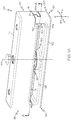
- FIGS. 1A and 1B illustrate a front view of a vehicle hook 100 and a rear view of the vehicle hook 100 respectively in a closed position.
- the vehicle hook 100 includes a base 110 and a rotatable hook 120 rotatively coupled to the base 110.
- the vehicle hook 100 can be provided to an installer as a kit and may include the base 110, the rotatable hook 120, and an installation kit (not shown) having tools and/or hardware for installing the vehicle hook 100 to a support structure within a trunk of a vehicle 10.
- the rotatable hook 120 may already be rotatively coupled to the base 110 or provided as a separate component assemblable to the base 110.
- the base 110 may define a mounting surface 112 for mounting the base 110 to a support structure (e.g., support structure 20 illustrated in FIGS. 7-8 ) within a storage space of a vehicle 10.
- the mounting surface 112 may include apertures extending therethrough for mounting the base 110 to a support structure within a vehicle with, for example, threaded fasteners.
- the mounting surface 112 may be, for example, adhesively or magnetically coupled to the support structure 20 within the vehicle 10. Other conventional coupling techniques are contemplated and possible.
- the rotatable hook 120 is rotatively coupled to the base 110.
- the base 110 may accordingly define the axis of rotation 114 of the rotatable hook 120.
- the axis of rotation 114 is perpendicular to the mounting surface 112.
- a pin 121 e.g., a bolt
- a pin 121 may be passed through the base 110 along the axis of rotation 114 and secured such that the rotatable hook 120 is rotatable relative to the base 110.
- the rotatable hook 120 includes a hook arm 122 illustrated as extending along the longitudinal direction to an end of the hook arm. When in the closed position, the end of the hook arm 122 may be vertically aligned with the base along the vertical direction.
- an interlock projection 130 extends from the hook arm 122 toward the base 110.
- the interlock projection 130 is illustrated as extending perpendicularly from the hook arm 122 at an end of the hook arm 122.
- the interlock projection 130 may extend from the hook arm 122 at a location other than the end of the hook arm 122.
- the interlock projection 130 may include an extending portion 132 and a locking tab 134 projecting laterally from the extending portion 132, as illustrated.
- the locking tab 134 When in the closed position, as shown in FIGS. 1A and 1B , the locking tab 134 extends into a port 115 of the base 110.
- the port 115 is a recess that is sized and arranged to receive the locking tab 134. Friction between the locking tab 134 and the surfaces of the port 115 may inhibit the rotatable hook 120 rotation of the hook arm 122 away from the closed position until caused to move by a user toward an open position, such as shown in FIG. 2 .
- the interlock projection 130 By providing the interlock projection 130 as extending from the hook arm 122 toward the base 110, at least a portion of the hook arm 122 may be spaced vertically from the base 110 thereby defining a gap between the hook arm 122 and the base 110 with the hook arm 122 in the closed position.
- the hook arm 122 includes a first end 124 from which a first interlock projection 131a extends and a second end 126 from which a second interlock projection 131b extends.
- the rotatable hook 120 may be rotatively coupled to the base 110 between the first end 124 and the second end 126 of the hook arm 122.
- the rotatable hook 120 may be rotatively coupled to the base 110 at a midpoint along the hook arm 122 between the first end 124 and the second end 126.
- the first interlock projection 131a forms an interlock with the base 110 on a first side 116 of the base 110 and the second interlock projection 131b forms an interlock with the base 110 on a second side 118 of the base 110 opposite the first side 116.
- a portion (e.g., portion 119a and/or portion 119b) of the base 110 extends from a bottom surface 113 of the base 110 between the hook arm 122 and the interlock projection 130 in the vertical direction.
- portion 119a of the base 110 may extend between and contact the locking tab 134 of the first interlock projection 131a and the first end 124 of the hook arm 122 and portion 119b of the base 110 may extend between and contact the locking tab 134 of the second interlock projection 131b and the second end 126 of the hook arm 122. Accordingly, when a load is supported on the hook arm 122, a portion of the load is also supported by the portion (e.g. portion 119a and/or portion 119b) of the base 110.
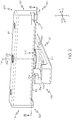
- FIG. 2 illustrates the rotatable hook 120 rotated to an open position.
- the end of the rotatable hook 120 may be angularly spaced from the base 110 when the rotatable hook is rotated to the open position.
- the interlock projection 130 is angularly offset from the portions 119a and 119b and angularly spaced from the base 110 when the rotatable hook 120 is rotated to the open position. This allows for an object such as a bag having straps to be hooked on to either side of the hook arm 122.
- the rotatable hook 120 may be rotated clockwise in the X/Y plane about the axis 114 to a position wherein the hook arm 122 is positioned about 90 degrees relative to the base 110. Stated another way, the rotatable hook 120 may rotate to a position wherein the hook arm 122 is perpendicular to the base 110 in the X/Y plane. In other embodiments, the hook arm 122 may be able to be rotated a greater or lesser amount.
- the rotatable hook 120 may be rotatable a full 360 degrees relative to the base 110 and be freely rotatable to any angular position relative to the base. In other embodiments, the rotatable hook 120 may be rotatable a predetermined amount, such as 90 degrees to the position of FIG. 2 . In some embodiments, the rotatable hook 120 may lock in a particular angular position to inhibit rotation of the rotatable hook 120 relative to the base 110. In some embodiments, the rotatable hook 120 may include multiple locking positions located at predetermined positions relative to the base 110.
- FIG. 3 illustrates a bottom perspective view of the base 110 in isolation.
- a base connector 140 for connecting the base 110 to the rotatable hook 120 is illustrated.
- the base connector 140 is illustrated as protruding from a bottom surface 113 of the base 110. However, it is contemplated that the base connector 140 may be level with the bottom surface 113 of the base 110.
- the base connector 140 defines a receiving aperture 142 extending into the base 110.
- the receiving aperture 142 may have a base stop 144 formed within. As will be described in greater detail, the base stop 144 may provide a limit to a degree of rotation that the rotatable hook 120 may travel through.
- FIG. 4 illustrates a perspective view of the rotatable hook 120 in isolation.
- the rotatable hook 120 may include a hook connector 150 that extends from an upper surface 123 of the hook arm 122.
- the hook connector 150 may include a mating structure 152 configured to be received within the receiving aperture 142 of the base connector 140.
- the mating structure 152 may include a rotation stop 154. The rotation stop 154 of the hook connector 150 and the base stop 144 of the base connector 140 may limit the degree of rotation 114 of the rotatable hook 120.
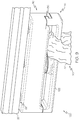
- FIG. 5 illustrates a cross-section of the vehicle hook 100 taken along line A-A in FIG. 1A .
- the rotation stop 154 of the rotatable hook 120 is illustrated in the closed position, wherein the rotation stop 154 contacts a first wall 146 of the base stop 144.
- an open space 170 is positioned between a second wall 148 of the base stop 144 and the rotation stop 154.
- FIG. 6 illustrates a cross-section of the vehicle hook 100 taken along line B-B in FIG. 2 .
- the rotation stop 154 can be rotated through the open space 170 (shown in FIG. 5 ) until the rotation stop 154 contacts the second wall 148 of the base stop 144.
- rotation 114 of the rotatable hook 120 is limited by the interaction between the base stop 144 and the rotation stop 154.
- FIG. 7 illustrates a vehicle 10 (e.g., a truck) that includes a trunk (e.g., a truck bed 14) having side walls 16, 18. Extending between the side walls 16 is a support structure 20 to which a vehicle hook 100 is mounted. It is noted that in other embodiments or vehicles, the support structure 20 may be a wall of the trunk. In some embodiments, there may be multiple vehicle hooks mounted to the support structure 20. Furthermore, and as noted above, the vehicle hook 100 may be mounted to a support structure within a cabin of the vehicle 10.
- FIG. 8 illustrates a view of the vehicle hook 100 mounted to the support structure 20 with one or more fasteners 22 (e.g., one or more bolts, pins, or the like), wherein the rotatable hook 120 is rotated to the open position.
- An object 30 e.g., shopping bag, gym bag, backpack, etc.
- the rotatable hook 120 may be rotated to the closed position as illustrated in FIG. 9 .
- the hook arm 122 is spaced from the base 110 when the rotatable hook 120 is rotated to the closed position.
- vehicle hooks that include a base and a rotatable hook rotatively coupled to the base.
- the rotatable hook includes an open position wherein an object can be mounted onto the rotatable hook and a closed position wherein an interlock projection is engaged with and supported by the base.
- an object supported on the base may be better retained on the hook and additional weight may be supported by the vehicle hook as opposed to a vehicle hook without this engagement feature.
Landscapes
- Engineering & Computer Science (AREA)
- Mechanical Engineering (AREA)
- Chemical & Material Sciences (AREA)
- Combustion & Propulsion (AREA)
- Transportation (AREA)
- Vehicle Step Arrangements And Article Storage (AREA)
- Hooks, Suction Cups, And Attachment By Adhesive Means (AREA)
- Passenger Equipment (AREA)
Description
- The present specification generally relates to a vehicle hook a vehicle and, more specifically, to a robust vehicle hook for supporting a weight in a trunk or bed of a vehicle.
- Vehicle hooks are hooks that are mountable within a vehicle for example the trunk or bed of the vehicle and may help restrain objects therein. For example, these hooks may help retain grocery bags or other types of bags having a strap. Such vehicle hooks help prevent bags from moving and/or spilling while the vehicle is in motion. However, current vehicle hooks are typically unable to support heavier loads and are thus limited in their ability to restrain objects.
- Accordingly, a need exists for alternative vehicle hooks capable of securing items within a storage space (e.g., a trunk or bed) of a vehicle.
-
EP 1724156 discloses a set of baggage holders which comprises an elongate central portion which is partly grasped by a holding means with an arcuate engaging portion. The holding means also has a holding portion, the holding means being movable along and rotatably arranged on the central portion. Moreover the set of baggage holders comprises an elongate peripheral portion which at least partly surrounds the central portion, at a distance and parallel thereto, and which also partly grasps the arcuate engaging portion in such a manner that the space formed by the distance between the central portion and the peripheral portion forms a guide path which in the cross-sectional plane of the set of baggage holders has a curve corresponding to the arcuate shape of the engaging portion of the holding means. -
US2011/095156 discloses a hook according to the preamble of claim 1, including a pivotable hook body adapted to rotate about a pivot axis running in a generally vertical direction. According to some embodiments, the hook assembly can further include at least one hook portion including a generally vertical recess defined by a portion of the top side of the hook body extending downwardly toward a bottom side. The assembly can further include a pivot member for pivoting the pivotable hook body about the pivot axis; and a frame member adapted to receive the pivotable hook body in a stowed configuration or one or more deployed configurations. Furthermore, frame member is adapted to fix the hook body in a pivotal relation about the pivot axis and can include an indexing opening or seat for defining one or more indexed orientations such as a stowed orientation or a deployed orientation. - The invention is defined by the claims.
- These and additional features provided by the embodiments described herein will be more fully understood in view of the following detailed description, in conjunction with the drawings.
- The embodiments set forth in the drawings are illustrative and exemplary in nature and not intended to limit the subject matter defined by the claims. The following detailed description of the illustrative embodiments can be understood when read in conjunction with the following drawings, where like structure is indicated with like reference numerals and in which:
-
FIG. 1A depicts a perspective view of a vehicle hook, according to one or more embodiments shown and described herein; -
FIG. 1B depicts another perspective view of the vehicle hook ofFIG. 1A , according to one or more embodiments shown and described herein; -
FIG. 2 depicts a perspective view of the vehicle hook ofFIG. 1A rotated to an open position, according to one or more embodiments shown and described herein; -
FIG. 3 depicts a base of the vehicle hook ofFIG. 1A in isolation, according to one or more embodiments shown and described herein; -
FIG. 4 depicts a rotatable hook of the vehicle hook ofFIG. 1A in isolation, according to one or more embodiments shown and described herein; -
FIG. 5 depicts a perspective view of a cross-section A-A taken inFIG. 1A , according to one or more embodiments shown and described herein; -
FIG. 6 depicts a perspective view of a cross-section B-B taken inFIG. 2 , according to one or more embodiments shown and described herein; -
FIG. 7 depicts a truck having a truck bed with a vehicle hook mounted therein, according to one or more embodiments shown and described herein; -
FIG. 8 depicts the vehicle hook ofFIG. 7 rotated to an open position and supporting an object thereon, according to one or more embodiments shown and described herein; and -
FIG. 9 depicts the vehicle hook ofFIG. 8 rotated to a closed position, according to one or more embodiments shown and described herein. - Embodiments described herein are directed to vehicle hooks that are configured top support an objects to prevent the objects from sliding around or spilling within a storage space (e.g., trunk or bed of a vehicle). In embodiments, a vehicle hook includes a base configured to be coupled to a support structure within a trunk of a vehicle and a rotatable hook rotatively coupled to the base having an open position and a closed position.
- As used herein, a "trunk" of a vehicle may refer to a main storage compartment enclosed within or otherwise defined by the body of the vehicle that is used or can be used for transporting objects with the vehicle. For example, the trunk can be a typical trunk located at either a front or rear of the vehicle and accessible from the outside of the vehicle by a door. The trunk may also refer to an open truck bed. Furthermore, unless otherwise noted, the term "trunk" may be used interchangeably with the term "storage space." Though the vehicle hook is described as being mounted within a storage space of a vehicle, it is contemplated and possible that the vehicle hook may be mounted anywhere within the vehicle, including a passenger cabin of the vehicle.
- As used herein, the term "longitudinal direction" refers to the +/- X direction depicted in the figures. The term "lateral direction" refers to the +/- Y direction depicted in figures, which is perpendicular to the longitudinal direction. The term "vertical direction" refers to the +/- Z direction depicted in the figures, which is perpendicular to both the longitudinal direction and the lateral direction.
-
FIGS. 1A and1B illustrate a front view of avehicle hook 100 and a rear view of thevehicle hook 100 respectively in a closed position. As shown thevehicle hook 100 includes abase 110 and arotatable hook 120 rotatively coupled to thebase 110. In some embodiments, thevehicle hook 100 can be provided to an installer as a kit and may include thebase 110, therotatable hook 120, and an installation kit (not shown) having tools and/or hardware for installing thevehicle hook 100 to a support structure within a trunk of avehicle 10. In the kit, therotatable hook 120 may already be rotatively coupled to thebase 110 or provided as a separate component assemblable to thebase 110. - The
base 110 may define amounting surface 112 for mounting thebase 110 to a support structure (e.g.,support structure 20 illustrated inFIGS. 7-8 ) within a storage space of avehicle 10. Accordingly, themounting surface 112 may include apertures extending therethrough for mounting thebase 110 to a support structure within a vehicle with, for example, threaded fasteners. In other embodiments, themounting surface 112 may be, for example, adhesively or magnetically coupled to thesupport structure 20 within thevehicle 10. Other conventional coupling techniques are contemplated and possible. - Still referring to
FIGS. 1A and1B and as noted above, therotatable hook 120 is rotatively coupled to thebase 110. Thebase 110 may accordingly define the axis ofrotation 114 of therotatable hook 120. In the depicted embodiment, the axis ofrotation 114 is perpendicular to themounting surface 112. However, other orientations of the axis ofrotation 114 relative to themounting surface 112 are contemplated and possible. In some embodiments, to rotatively couple thebase 110 to therotatable hook 120, a pin 121 (e.g., a bolt) may be passed through thebase 110 along the axis ofrotation 114 and secured such that therotatable hook 120 is rotatable relative to thebase 110. - The
rotatable hook 120 includes ahook arm 122 illustrated as extending along the longitudinal direction to an end of the hook arm. When in the closed position, the end of thehook arm 122 may be vertically aligned with the base along the vertical direction. In some embodiments, aninterlock projection 130 extends from thehook arm 122 toward thebase 110. For example theinterlock projection 130 is illustrated as extending perpendicularly from thehook arm 122 at an end of thehook arm 122. However, it is contemplated that theinterlock projection 130 may extend from thehook arm 122 at a location other than the end of thehook arm 122. Theinterlock projection 130 may include an extendingportion 132 and alocking tab 134 projecting laterally from the extendingportion 132, as illustrated. When in the closed position, as shown inFIGS. 1A and1B , thelocking tab 134 extends into aport 115 of thebase 110. Theport 115 is a recess that is sized and arranged to receive thelocking tab 134. Friction between the lockingtab 134 and the surfaces of theport 115 may inhibit therotatable hook 120 rotation of thehook arm 122 away from the closed position until caused to move by a user toward an open position, such as shown inFIG. 2 . By providing theinterlock projection 130 as extending from thehook arm 122 toward thebase 110, at least a portion of thehook arm 122 may be spaced vertically from the base 110 thereby defining a gap between thehook arm 122 and the base 110 with thehook arm 122 in the closed position. - Still referring to
FIGS. 1A and1B , in the illustrated embodiment, thehook arm 122 includes afirst end 124 from which afirst interlock projection 131a extends and asecond end 126 from which asecond interlock projection 131b extends. In such embodiments, therotatable hook 120 may be rotatively coupled to the base 110 between thefirst end 124 and thesecond end 126 of thehook arm 122. For example, therotatable hook 120 may be rotatively coupled to the base 110 at a midpoint along thehook arm 122 between thefirst end 124 and thesecond end 126. In such embodiment, thefirst interlock projection 131a forms an interlock with the base 110 on afirst side 116 of thebase 110 and thesecond interlock projection 131b forms an interlock with the base 110 on asecond side 118 of the base 110 opposite thefirst side 116. - When in the closed position, such as illustrated in
FIGS. 1A and1B , a portion (e.g.,portion 119a and/orportion 119b) of thebase 110 extends from abottom surface 113 of the base 110 between thehook arm 122 and theinterlock projection 130 in the vertical direction. For example,portion 119a of the base 110 may extend between and contact thelocking tab 134 of thefirst interlock projection 131a and thefirst end 124 of thehook arm 122 andportion 119b of the base 110 may extend between and contact thelocking tab 134 of thesecond interlock projection 131b and thesecond end 126 of thehook arm 122. Accordingly, when a load is supported on thehook arm 122, a portion of the load is also supported by the portion (e.g. portion 119a and/orportion 119b) of thebase 110. -
FIG. 2 illustrates therotatable hook 120 rotated to an open position. As illustrated the end of therotatable hook 120 may be angularly spaced from the base 110 when the rotatable hook is rotated to the open position. In embodiments including an interlock projection, theinterlock projection 130 is angularly offset from theportions rotatable hook 120 is rotated to the open position. This allows for an object such as a bag having straps to be hooked on to either side of thehook arm 122. In some embodiments, therotatable hook 120 may be rotated clockwise in the X/Y plane about theaxis 114 to a position wherein thehook arm 122 is positioned about 90 degrees relative to thebase 110. Stated another way, therotatable hook 120 may rotate to a position wherein thehook arm 122 is perpendicular to the base 110 in the X/Y plane. In other embodiments, thehook arm 122 may be able to be rotated a greater or lesser amount. - In some embodiments, the
rotatable hook 120 may be rotatable a full 360 degrees relative to thebase 110 and be freely rotatable to any angular position relative to the base. In other embodiments, therotatable hook 120 may be rotatable a predetermined amount, such as 90 degrees to the position ofFIG. 2 . In some embodiments, therotatable hook 120 may lock in a particular angular position to inhibit rotation of therotatable hook 120 relative to thebase 110. In some embodiments, therotatable hook 120 may include multiple locking positions located at predetermined positions relative to thebase 110. -
FIG. 3 illustrates a bottom perspective view of the base 110 in isolation. Abase connector 140 for connecting the base 110 to therotatable hook 120 is illustrated. Thebase connector 140 is illustrated as protruding from abottom surface 113 of thebase 110. However, it is contemplated that thebase connector 140 may be level with thebottom surface 113 of thebase 110. Thebase connector 140 defines a receivingaperture 142 extending into thebase 110. The receivingaperture 142 may have abase stop 144 formed within. As will be described in greater detail, thebase stop 144 may provide a limit to a degree of rotation that therotatable hook 120 may travel through. -
FIG. 4 illustrates a perspective view of therotatable hook 120 in isolation. Therotatable hook 120 may include ahook connector 150 that extends from anupper surface 123 of thehook arm 122. Thehook connector 150 may include amating structure 152 configured to be received within the receivingaperture 142 of thebase connector 140. Themating structure 152 may include arotation stop 154. Therotation stop 154 of thehook connector 150 and the base stop 144 of thebase connector 140 may limit the degree ofrotation 114 of therotatable hook 120. - For example,
FIG. 5 illustrates a cross-section of thevehicle hook 100 taken along line A-A inFIG. 1A . Accordingly, the rotation stop 154 of therotatable hook 120 is illustrated in the closed position, wherein the rotation stop 154 contacts afirst wall 146 of thebase stop 144. As shown anopen space 170 is positioned between asecond wall 148 of thebase stop 144 and therotation stop 154.FIG. 6 illustrates a cross-section of thevehicle hook 100 taken along line B-B inFIG. 2 . Accordingly, when therotatable hook 120 is rotated to the open configuration the rotation stop 154 can be rotated through the open space 170 (shown inFIG. 5 ) until the rotation stop 154 contacts thesecond wall 148 of thebase stop 144. Accordingly,rotation 114 of therotatable hook 120 is limited by the interaction between thebase stop 144 and therotation stop 154. -
FIG. 7 illustrates a vehicle 10 (e.g., a truck) that includes a trunk (e.g., a truck bed 14) havingside walls side walls 16 is asupport structure 20 to which avehicle hook 100 is mounted. It is noted that in other embodiments or vehicles, thesupport structure 20 may be a wall of the trunk. In some embodiments, there may be multiple vehicle hooks mounted to thesupport structure 20. Furthermore, and as noted above, thevehicle hook 100 may be mounted to a support structure within a cabin of thevehicle 10. -
FIG. 8 illustrates a view of thevehicle hook 100 mounted to thesupport structure 20 with one or more fasteners 22 (e.g., one or more bolts, pins, or the like), wherein therotatable hook 120 is rotated to the open position. An object 30 (e.g., shopping bag, gym bag, backpack, etc.) having a handle orstrap 32 is draped over thehook arm 122 of therotatable hook 120 by the handle orstrap 32. Once the handle orstrap 32 is draped over thehook arm 122, therotatable hook 120 may be rotated to the closed position as illustrated inFIG. 9 . As noted above, thehook arm 122 is spaced from the base 110 when therotatable hook 120 is rotated to the closed position. This leaves room for the handle orstrap 32 to remain supported on thehook arm 122 when therotatable hook 120 is rotated to the closed position. When in the closed position theinterlock projection 130 is engaged with thebase 110. This allows for greater weights to be supported by therotatable hook 120 as opposed to avehicle hook 100 without this engagement. That is, theobject 30 is supported by both therotatable hook 120 and thebase 110. - It should now be understood that embodiments described herein are directed toward vehicle hooks that include a base and a rotatable hook rotatively coupled to the base. The rotatable hook includes an open position wherein an object can be mounted onto the rotatable hook and a closed position wherein an interlock projection is engaged with and supported by the base. By engaging the rotatable hook with the base, an object supported on the base may be better retained on the hook and additional weight may be supported by the vehicle hook as opposed to a vehicle hook without this engagement feature.
- It is noted that the terms "substantially" and "about" may be utilized herein to represent the inherent degree of uncertainty that may be attributed to any quantitative comparison, value, measurement, or other representation. These terms are also utilized herein to represent the degree by which a quantitative representation may vary from a stated reference without resulting in a change in the basic function of the subject matter at issue.
Claims (8)
- A vehicle hook (200) comprising:a base (110) configured to be coupled to a support structure of a vehicle; anda rotatable hook (200) rotatively coupled to the base (110) having an open position and a closed position, the rotatable hook (200) comprising a hook arm (122) having an end, wherein the end of the hook arm (122) is vertically aligned with the base (110) when the rotatable hook (200) is rotated to the closed position and the end of the hook arm (122) is angularly spaced from the base (110) when the rotatable hook (200) is rotated to the open position, characterized in that the hook arm (122) further comprises an interlock projection (130, 131a, 131b) that extends from the end (124, 126) of the hook arm, wherein a portion (119a, 119b) of the base (110) extends between the hook arm (122) and the interlock projection (130, 131a, 131b) when the rotatable hook (200) is rotated to the closed position.
- The vehicle hook (200) of claim 1, wherein:the base (110) defines a mounting surface for mounting the base (110) to the support structure of the vehicle; andthe base (110) defines an axis of rotation of the rotatable hook (200) that is perpendicular to the mounting surface.
- The vehicle hook (200) of any preceding claim, wherein the hook arm (122) is spaced from the base (110) when the rotatable hook (200) is rotated to the closed position providing a gap between the hook arm (122) and the base (110).
- The vehicle hook (200) of any preceding claim, wherein the interlock projection (131a) extends from a first end of the hook arm (122) and the hook arm (122) further comprises a second interlock projection (131b) that extends from a second end.
- The vehicle hook (200) of claim 4, wherein the rotatable hook (200) is rotatively coupled to the base (110) between the first end and the second end of the hook arm.
- The vehicle hook (200) of claim 4 or claim 5, wherein the first interlock projection (131a) forms an interlock with the base (110) on a first side of the base (110) and the second interlock projection (131b) forms an interlock with the base (110) on a second side of the base (110) opposite the first side.
- A vehicle hook (200) kit comprising:
the vehicle hook (200) of any preceding claim and an installation kit for installing the vehicle hook (200) to a support structure of a vehicle. - A vehicle comprising:a storage space comprising a support structure; anda vehicle hook (200) of any one of claims 1 to 6.
Applications Claiming Priority (2)
| Application Number | Priority Date | Filing Date | Title |
|---|---|---|---|
| US201862632515P | 2018-02-20 | 2018-02-20 | |
| PCT/US2019/018575 WO2019164840A1 (en) | 2018-02-20 | 2019-02-19 | Vehicle hooks |
Publications (2)
| Publication Number | Publication Date |
|---|---|
| EP3755580A1 EP3755580A1 (en) | 2020-12-30 |
| EP3755580B1 true EP3755580B1 (en) | 2021-12-15 |
Family
ID=65686024
Family Applications (1)
| Application Number | Title | Priority Date | Filing Date |
|---|---|---|---|
| EP19709237.2A Not-in-force EP3755580B1 (en) | 2018-02-20 | 2019-02-19 | Vehicle hooks |
Country Status (6)
| Country | Link |
|---|---|
| US (1) | US10940805B2 (en) |
| EP (1) | EP3755580B1 (en) |
| JP (1) | JP2021514331A (en) |
| KR (1) | KR20200120955A (en) |
| CN (1) | CN111770857B (en) |
| WO (1) | WO2019164840A1 (en) |
Families Citing this family (3)
| Publication number | Priority date | Publication date | Assignee | Title |
|---|---|---|---|---|
| EP3825184B1 (en) * | 2019-11-21 | 2023-10-18 | Ningbo Geely Automobile Research & Development Co., Ltd. | A foldable attachment system and a vehicle comprising a foldable attachment system |
| US12307398B2 (en) * | 2020-10-14 | 2025-05-20 | Streamlinx, LLC | Method and system for managing and sourcing materials and services for electrication projects |
| US11738690B2 (en) | 2021-06-17 | 2023-08-29 | Michael Joseph Pawlowski | Vehicle cargo management system |
Family Cites Families (14)
| Publication number | Priority date | Publication date | Assignee | Title |
|---|---|---|---|---|
| US1151246A (en) * | 1914-03-10 | 1915-08-24 | Richard L Criswell | Split connecting-link. |
| US4696405A (en) * | 1986-06-13 | 1987-09-29 | Waring Patrick M | Gun rack |
| US5524772A (en) * | 1994-10-20 | 1996-06-11 | Simmons; James D. | Locking gun rack |
| US5533848A (en) * | 1995-01-03 | 1996-07-09 | Davis; Oliver M. | Payload tie-down system |
| FR2805577B1 (en) * | 2000-02-28 | 2002-05-03 | Zedel | MOBILE FINGER SELF-LOCKING SNAP HOOK |
| FR2876328B1 (en) | 2004-10-07 | 2007-11-30 | Peugeot Citroen Automobiles Sa | REAR STORAGE ASSEMBLY OF MOTOR VEHICLE AND VEHICLE THEREFOR |
| SE0501131L (en) * | 2005-05-18 | 2006-04-18 | Gm Global Tech Operations Inc | Bagagehållarsats |
| FR2897029A3 (en) * | 2006-02-07 | 2007-08-10 | Renault Sas | Bag hooking device for use in e.g. fascia of motor vehicle, e.g. citroen C4, has hook movable between retracted position in housing and deployed position outside housing, where hook is movable in rotation along vertical axis |
| US7631915B2 (en) * | 2007-10-30 | 2009-12-15 | Gm Global Technology Operations, Inc | Active material enabled self-actuated devices |
| US8490935B2 (en) * | 2009-10-28 | 2013-07-23 | Honda Motor Co., Ltd. | Multipurpose hook |
| US8708290B2 (en) * | 2010-09-03 | 2014-04-29 | John E. Franta | Line guide |
| US10124738B2 (en) * | 2013-11-05 | 2018-11-13 | Dee Zee, Inc. | Roof rack assemblies and securing mechanisms for roof rack assemblies |
| US9783117B2 (en) | 2015-02-27 | 2017-10-10 | Ford Global Technologies, Llc | Luggage compartment hook organizer |
| CN106032128B (en) * | 2015-03-11 | 2020-08-07 | 标致·雪铁龙汽车公司 | Automatic clothes hook system |
-
2019
- 2019-02-19 US US16/279,573 patent/US10940805B2/en not_active Expired - Fee Related
- 2019-02-19 KR KR1020207027077A patent/KR20200120955A/en not_active Withdrawn
- 2019-02-19 JP JP2020566532A patent/JP2021514331A/en active Pending
- 2019-02-19 CN CN201980014091.5A patent/CN111770857B/en active Active
- 2019-02-19 WO PCT/US2019/018575 patent/WO2019164840A1/en not_active Ceased
- 2019-02-19 EP EP19709237.2A patent/EP3755580B1/en not_active Not-in-force
Also Published As
| Publication number | Publication date |
|---|---|
| JP2021514331A (en) | 2021-06-10 |
| US20190256008A1 (en) | 2019-08-22 |
| EP3755580A1 (en) | 2020-12-30 |
| CN111770857B (en) | 2025-01-07 |
| US10940805B2 (en) | 2021-03-09 |
| CN111770857A (en) | 2020-10-13 |
| WO2019164840A1 (en) | 2019-08-29 |
| KR20200120955A (en) | 2020-10-22 |
Similar Documents
| Publication | Publication Date | Title |
|---|---|---|
| EP3755580B1 (en) | Vehicle hooks | |
| CN107985210B (en) | Configurable storage space integrated under seat cushion | |
| US6776564B1 (en) | Vertically pivoting wheelchair restraint | |
| US8070208B2 (en) | Multi-position tailgate adjustment apparatus and method | |
| US10166930B2 (en) | Adjustably positionable cargo box and load restraining bar system for pickup truck bed | |
| US9873383B1 (en) | Deployable under-seat cargo assembly | |
| WO1997041001A1 (en) | Removable storage assembly fastening system | |
| US20030127878A1 (en) | Article attachment system | |
| BRPI0911891B1 (en) | STRUCTURAL DISPLAY SYSTEM FOR TRUCK BUCKETS | |
| US5368354A (en) | Pickup bed cap having passenger seat | |
| US8517445B1 (en) | Security deck enclosure system | |
| JP4515517B2 (en) | Vehicle storage device | |
| US11458903B2 (en) | Vehicle storage assembly | |
| US6006971A (en) | Truckbed toolbox system | |
| US10023097B1 (en) | Tie down assembly for cargo bed | |
| EP1597113B1 (en) | Parcel shelf support | |
| US5857633A (en) | Cupholder with engaging rings | |
| US10814771B2 (en) | Carabiner with cantilever spring | |
| US20120298678A1 (en) | Vehicle modular storage system | |
| US10065567B2 (en) | Auxiliary storage mounting arrangement for a vehicle | |
| US6951358B1 (en) | Insert for a tailgate cable assembly and a tailgate cable assembly incorporating the same | |
| US20120263552A1 (en) | Vehicle cargo retention system | |
| US20200079436A1 (en) | Vehicle having floor assembly | |
| US3726410A (en) | Ski clamping device | |
| CN209780522U (en) | Lock subassembly, lid and car |
Legal Events
| Date | Code | Title | Description |
|---|---|---|---|
| STAA | Information on the status of an ep patent application or granted ep patent |
Free format text: STATUS: UNKNOWN |
|
| STAA | Information on the status of an ep patent application or granted ep patent |
Free format text: STATUS: THE INTERNATIONAL PUBLICATION HAS BEEN MADE |
|
| PUAI | Public reference made under article 153(3) epc to a published international application that has entered the european phase |
Free format text: ORIGINAL CODE: 0009012 |
|
| STAA | Information on the status of an ep patent application or granted ep patent |
Free format text: STATUS: REQUEST FOR EXAMINATION WAS MADE |
|
| 17P | Request for examination filed |
Effective date: 20200818 |
|
| AK | Designated contracting states |
Kind code of ref document: A1 Designated state(s): AL AT BE BG CH CY CZ DE DK EE ES FI FR GB GR HR HU IE IS IT LI LT LU LV MC MK MT NL NO PL PT RO RS SE SI SK SM TR |
|
| AX | Request for extension of the european patent |
Extension state: BA ME |
|
| DAV | Request for validation of the european patent (deleted) | ||
| DAX | Request for extension of the european patent (deleted) | ||
| GRAP | Despatch of communication of intention to grant a patent |
Free format text: ORIGINAL CODE: EPIDOSNIGR1 |
|
| STAA | Information on the status of an ep patent application or granted ep patent |
Free format text: STATUS: GRANT OF PATENT IS INTENDED |
|
| INTG | Intention to grant announced |
Effective date: 20210608 |
|
| GRAJ | Information related to disapproval of communication of intention to grant by the applicant or resumption of examination proceedings by the epo deleted |
Free format text: ORIGINAL CODE: EPIDOSDIGR1 |
|
| STAA | Information on the status of an ep patent application or granted ep patent |
Free format text: STATUS: REQUEST FOR EXAMINATION WAS MADE |
|
| GRAS | Grant fee paid |
Free format text: ORIGINAL CODE: EPIDOSNIGR3 |
|
| STAA | Information on the status of an ep patent application or granted ep patent |
Free format text: STATUS: GRANT OF PATENT IS INTENDED |
|
| GRAP | Despatch of communication of intention to grant a patent |
Free format text: ORIGINAL CODE: EPIDOSNIGR1 |
|
| INTC | Intention to grant announced (deleted) | ||
| GRAA | (expected) grant |
Free format text: ORIGINAL CODE: 0009210 |
|
| STAA | Information on the status of an ep patent application or granted ep patent |
Free format text: STATUS: THE PATENT HAS BEEN GRANTED |
|
| INTG | Intention to grant announced |
Effective date: 20211019 |
|
| AK | Designated contracting states |
Kind code of ref document: B1 Designated state(s): AL AT BE BG CH CY CZ DE DK EE ES FI FR GB GR HR HU IE IS IT LI LT LU LV MC MK MT NL NO PL PT RO RS SE SI SK SM TR |
|
| REG | Reference to a national code |
Ref country code: GB Ref legal event code: FG4D Ref country code: CH Ref legal event code: EP |
|
| REG | Reference to a national code |
Ref country code: IE Ref legal event code: FG4D Ref country code: DE Ref legal event code: R096 Ref document number: 602019010103 Country of ref document: DE |
|
| REG | Reference to a national code |
Ref country code: AT Ref legal event code: REF Ref document number: 1455263 Country of ref document: AT Kind code of ref document: T Effective date: 20220115 |
|
| REG | Reference to a national code |
Ref country code: LT Ref legal event code: MG9D |
|
| REG | Reference to a national code |
Ref country code: NL Ref legal event code: MP Effective date: 20211215 |
|
| PG25 | Lapsed in a contracting state [announced via postgrant information from national office to epo] |
Ref country code: RS Free format text: LAPSE BECAUSE OF FAILURE TO SUBMIT A TRANSLATION OF THE DESCRIPTION OR TO PAY THE FEE WITHIN THE PRESCRIBED TIME-LIMIT Effective date: 20211215 Ref country code: LT Free format text: LAPSE BECAUSE OF FAILURE TO SUBMIT A TRANSLATION OF THE DESCRIPTION OR TO PAY THE FEE WITHIN THE PRESCRIBED TIME-LIMIT Effective date: 20211215 Ref country code: FI Free format text: LAPSE BECAUSE OF FAILURE TO SUBMIT A TRANSLATION OF THE DESCRIPTION OR TO PAY THE FEE WITHIN THE PRESCRIBED TIME-LIMIT Effective date: 20211215 Ref country code: BG Free format text: LAPSE BECAUSE OF FAILURE TO SUBMIT A TRANSLATION OF THE DESCRIPTION OR TO PAY THE FEE WITHIN THE PRESCRIBED TIME-LIMIT Effective date: 20220315 |
|
| REG | Reference to a national code |
Ref country code: AT Ref legal event code: MK05 Ref document number: 1455263 Country of ref document: AT Kind code of ref document: T Effective date: 20211215 |
|
| PG25 | Lapsed in a contracting state [announced via postgrant information from national office to epo] |
Ref country code: SE Free format text: LAPSE BECAUSE OF FAILURE TO SUBMIT A TRANSLATION OF THE DESCRIPTION OR TO PAY THE FEE WITHIN THE PRESCRIBED TIME-LIMIT Effective date: 20211215 Ref country code: NO Free format text: LAPSE BECAUSE OF FAILURE TO SUBMIT A TRANSLATION OF THE DESCRIPTION OR TO PAY THE FEE WITHIN THE PRESCRIBED TIME-LIMIT Effective date: 20220315 Ref country code: LV Free format text: LAPSE BECAUSE OF FAILURE TO SUBMIT A TRANSLATION OF THE DESCRIPTION OR TO PAY THE FEE WITHIN THE PRESCRIBED TIME-LIMIT Effective date: 20211215 Ref country code: HR Free format text: LAPSE BECAUSE OF FAILURE TO SUBMIT A TRANSLATION OF THE DESCRIPTION OR TO PAY THE FEE WITHIN THE PRESCRIBED TIME-LIMIT Effective date: 20211215 Ref country code: GR Free format text: LAPSE BECAUSE OF FAILURE TO SUBMIT A TRANSLATION OF THE DESCRIPTION OR TO PAY THE FEE WITHIN THE PRESCRIBED TIME-LIMIT Effective date: 20220316 |
|
| PG25 | Lapsed in a contracting state [announced via postgrant information from national office to epo] |
Ref country code: NL Free format text: LAPSE BECAUSE OF FAILURE TO SUBMIT A TRANSLATION OF THE DESCRIPTION OR TO PAY THE FEE WITHIN THE PRESCRIBED TIME-LIMIT Effective date: 20211215 |
|
| PG25 | Lapsed in a contracting state [announced via postgrant information from national office to epo] |
Ref country code: SM Free format text: LAPSE BECAUSE OF FAILURE TO SUBMIT A TRANSLATION OF THE DESCRIPTION OR TO PAY THE FEE WITHIN THE PRESCRIBED TIME-LIMIT Effective date: 20211215 Ref country code: SK Free format text: LAPSE BECAUSE OF FAILURE TO SUBMIT A TRANSLATION OF THE DESCRIPTION OR TO PAY THE FEE WITHIN THE PRESCRIBED TIME-LIMIT Effective date: 20211215 Ref country code: RO Free format text: LAPSE BECAUSE OF FAILURE TO SUBMIT A TRANSLATION OF THE DESCRIPTION OR TO PAY THE FEE WITHIN THE PRESCRIBED TIME-LIMIT Effective date: 20211215 Ref country code: PT Free format text: LAPSE BECAUSE OF FAILURE TO SUBMIT A TRANSLATION OF THE DESCRIPTION OR TO PAY THE FEE WITHIN THE PRESCRIBED TIME-LIMIT Effective date: 20220418 Ref country code: ES Free format text: LAPSE BECAUSE OF FAILURE TO SUBMIT A TRANSLATION OF THE DESCRIPTION OR TO PAY THE FEE WITHIN THE PRESCRIBED TIME-LIMIT Effective date: 20211215 Ref country code: EE Free format text: LAPSE BECAUSE OF FAILURE TO SUBMIT A TRANSLATION OF THE DESCRIPTION OR TO PAY THE FEE WITHIN THE PRESCRIBED TIME-LIMIT Effective date: 20211215 Ref country code: CZ Free format text: LAPSE BECAUSE OF FAILURE TO SUBMIT A TRANSLATION OF THE DESCRIPTION OR TO PAY THE FEE WITHIN THE PRESCRIBED TIME-LIMIT Effective date: 20211215 |
|
| PG25 | Lapsed in a contracting state [announced via postgrant information from national office to epo] |
Ref country code: PL Free format text: LAPSE BECAUSE OF FAILURE TO SUBMIT A TRANSLATION OF THE DESCRIPTION OR TO PAY THE FEE WITHIN THE PRESCRIBED TIME-LIMIT Effective date: 20211215 Ref country code: AT Free format text: LAPSE BECAUSE OF FAILURE TO SUBMIT A TRANSLATION OF THE DESCRIPTION OR TO PAY THE FEE WITHIN THE PRESCRIBED TIME-LIMIT Effective date: 20211215 |
|
| REG | Reference to a national code |
Ref country code: DE Ref legal event code: R119 Ref document number: 602019010103 Country of ref document: DE |
|
| PG25 | Lapsed in a contracting state [announced via postgrant information from national office to epo] |
Ref country code: MC Free format text: LAPSE BECAUSE OF FAILURE TO SUBMIT A TRANSLATION OF THE DESCRIPTION OR TO PAY THE FEE WITHIN THE PRESCRIBED TIME-LIMIT Effective date: 20211215 Ref country code: IS Free format text: LAPSE BECAUSE OF FAILURE TO SUBMIT A TRANSLATION OF THE DESCRIPTION OR TO PAY THE FEE WITHIN THE PRESCRIBED TIME-LIMIT Effective date: 20220415 |
|
| REG | Reference to a national code |
Ref country code: CH Ref legal event code: PL |
|
| PLBE | No opposition filed within time limit |
Free format text: ORIGINAL CODE: 0009261 |
|
| STAA | Information on the status of an ep patent application or granted ep patent |
Free format text: STATUS: NO OPPOSITION FILED WITHIN TIME LIMIT |
|
| REG | Reference to a national code |
Ref country code: BE Ref legal event code: MM Effective date: 20220228 |
|
| PG25 | Lapsed in a contracting state [announced via postgrant information from national office to epo] |
Ref country code: LU Free format text: LAPSE BECAUSE OF NON-PAYMENT OF DUE FEES Effective date: 20220219 Ref country code: DK Free format text: LAPSE BECAUSE OF FAILURE TO SUBMIT A TRANSLATION OF THE DESCRIPTION OR TO PAY THE FEE WITHIN THE PRESCRIBED TIME-LIMIT Effective date: 20211215 Ref country code: AL Free format text: LAPSE BECAUSE OF FAILURE TO SUBMIT A TRANSLATION OF THE DESCRIPTION OR TO PAY THE FEE WITHIN THE PRESCRIBED TIME-LIMIT Effective date: 20211215 |
|
| 26N | No opposition filed |
Effective date: 20220916 |
|
| PG25 | Lapsed in a contracting state [announced via postgrant information from national office to epo] |
Ref country code: SI Free format text: LAPSE BECAUSE OF FAILURE TO SUBMIT A TRANSLATION OF THE DESCRIPTION OR TO PAY THE FEE WITHIN THE PRESCRIBED TIME-LIMIT Effective date: 20211215 |
|
| PG25 | Lapsed in a contracting state [announced via postgrant information from national office to epo] |
Ref country code: FR Free format text: LAPSE BECAUSE OF NON-PAYMENT OF DUE FEES Effective date: 20220228 |
|
| PG25 | Lapsed in a contracting state [announced via postgrant information from national office to epo] |
Ref country code: LI Free format text: LAPSE BECAUSE OF NON-PAYMENT OF DUE FEES Effective date: 20220228 Ref country code: IE Free format text: LAPSE BECAUSE OF NON-PAYMENT OF DUE FEES Effective date: 20220219 Ref country code: DE Free format text: LAPSE BECAUSE OF NON-PAYMENT OF DUE FEES Effective date: 20220901 Ref country code: CH Free format text: LAPSE BECAUSE OF NON-PAYMENT OF DUE FEES Effective date: 20220228 |
|
| PG25 | Lapsed in a contracting state [announced via postgrant information from national office to epo] |
Ref country code: BE Free format text: LAPSE BECAUSE OF NON-PAYMENT OF DUE FEES Effective date: 20220228 |
|
| PG25 | Lapsed in a contracting state [announced via postgrant information from national office to epo] |
Ref country code: IT Free format text: LAPSE BECAUSE OF FAILURE TO SUBMIT A TRANSLATION OF THE DESCRIPTION OR TO PAY THE FEE WITHIN THE PRESCRIBED TIME-LIMIT Effective date: 20211215 |
|
| GBPC | Gb: european patent ceased through non-payment of renewal fee |
Effective date: 20230219 |
|
| PG25 | Lapsed in a contracting state [announced via postgrant information from national office to epo] |
Ref country code: GB Free format text: LAPSE BECAUSE OF NON-PAYMENT OF DUE FEES Effective date: 20230219 |
|
| PG25 | Lapsed in a contracting state [announced via postgrant information from national office to epo] |
Ref country code: GB Free format text: LAPSE BECAUSE OF NON-PAYMENT OF DUE FEES Effective date: 20230219 |
|
| PG25 | Lapsed in a contracting state [announced via postgrant information from national office to epo] |
Ref country code: MK Free format text: LAPSE BECAUSE OF FAILURE TO SUBMIT A TRANSLATION OF THE DESCRIPTION OR TO PAY THE FEE WITHIN THE PRESCRIBED TIME-LIMIT Effective date: 20211215 Ref country code: CY Free format text: LAPSE BECAUSE OF FAILURE TO SUBMIT A TRANSLATION OF THE DESCRIPTION OR TO PAY THE FEE WITHIN THE PRESCRIBED TIME-LIMIT Effective date: 20211215 |
|
| PG25 | Lapsed in a contracting state [announced via postgrant information from national office to epo] |
Ref country code: HU Free format text: LAPSE BECAUSE OF FAILURE TO SUBMIT A TRANSLATION OF THE DESCRIPTION OR TO PAY THE FEE WITHIN THE PRESCRIBED TIME-LIMIT; INVALID AB INITIO Effective date: 20190219 |
|
| PG25 | Lapsed in a contracting state [announced via postgrant information from national office to epo] |
Ref country code: MT Free format text: LAPSE BECAUSE OF FAILURE TO SUBMIT A TRANSLATION OF THE DESCRIPTION OR TO PAY THE FEE WITHIN THE PRESCRIBED TIME-LIMIT Effective date: 20211215 |
|
| PG25 | Lapsed in a contracting state [announced via postgrant information from national office to epo] |
Ref country code: TR Free format text: LAPSE BECAUSE OF FAILURE TO SUBMIT A TRANSLATION OF THE DESCRIPTION OR TO PAY THE FEE WITHIN THE PRESCRIBED TIME-LIMIT Effective date: 20211215 |