EP3755017A1 - Targeted over-the-air updates - Google Patents
Targeted over-the-air updates Download PDFInfo
- Publication number
- EP3755017A1 EP3755017A1 EP20177504.6A EP20177504A EP3755017A1 EP 3755017 A1 EP3755017 A1 EP 3755017A1 EP 20177504 A EP20177504 A EP 20177504A EP 3755017 A1 EP3755017 A1 EP 3755017A1
- Authority
- EP
- European Patent Office
- Prior art keywords
- ota
- sim
- message
- configuration message
- ota configuration
- Prior art date
- Legal status (The legal status is an assumption and is not a legal conclusion. Google has not performed a legal analysis and makes no representation as to the accuracy of the status listed.)
- Withdrawn
Links
Images




Classifications
-
- H—ELECTRICITY
- H04—ELECTRIC COMMUNICATION TECHNIQUE
- H04W—WIRELESS COMMUNICATION NETWORKS
- H04W4/00—Services specially adapted for wireless communication networks; Facilities therefor
- H04W4/12—Messaging; Mailboxes; Announcements
-
- H—ELECTRICITY
- H04—ELECTRIC COMMUNICATION TECHNIQUE
- H04W—WIRELESS COMMUNICATION NETWORKS
- H04W12/00—Security arrangements; Authentication; Protecting privacy or anonymity
- H04W12/30—Security of mobile devices; Security of mobile applications
- H04W12/37—Managing security policies for mobile devices or for controlling mobile applications
-
- H—ELECTRICITY
- H04—ELECTRIC COMMUNICATION TECHNIQUE
- H04W—WIRELESS COMMUNICATION NETWORKS
- H04W12/00—Security arrangements; Authentication; Protecting privacy or anonymity
- H04W12/40—Security arrangements using identity modules
-
- H—ELECTRICITY
- H04—ELECTRIC COMMUNICATION TECHNIQUE
- H04W—WIRELESS COMMUNICATION NETWORKS
- H04W76/00—Connection management
- H04W76/10—Connection setup
- H04W76/11—Allocation or use of connection identifiers
-
- H—ELECTRICITY
- H04—ELECTRIC COMMUNICATION TECHNIQUE
- H04W—WIRELESS COMMUNICATION NETWORKS
- H04W8/00—Network data management
- H04W8/02—Processing of mobility data, e.g. registration information at HLR [Home Location Register] or VLR [Visitor Location Register]; Transfer of mobility data, e.g. between HLR, VLR or external networks
- H04W8/08—Mobility data transfer
- H04W8/12—Mobility data transfer between location registers or mobility servers
-
- H—ELECTRICITY
- H04—ELECTRIC COMMUNICATION TECHNIQUE
- H04W—WIRELESS COMMUNICATION NETWORKS
- H04W88/00—Devices specially adapted for wireless communication networks, e.g. terminals, base stations or access point devices
- H04W88/02—Terminal devices
- H04W88/022—Selective call receivers
- H04W88/023—Selective call receivers with message or information receiving capability
-
- H—ELECTRICITY
- H04—ELECTRIC COMMUNICATION TECHNIQUE
- H04L—TRANSMISSION OF DIGITAL INFORMATION, e.g. TELEGRAPHIC COMMUNICATION
- H04L2101/00—Indexing scheme associated with group H04L61/00
- H04L2101/30—Types of network names
- H04L2101/375—Access point names [APN]
-
- H—ELECTRICITY
- H04—ELECTRIC COMMUNICATION TECHNIQUE
- H04L—TRANSMISSION OF DIGITAL INFORMATION, e.g. TELEGRAPHIC COMMUNICATION
- H04L2101/00—Indexing scheme associated with group H04L61/00
- H04L2101/60—Types of network addresses
- H04L2101/618—Details of network addresses
- H04L2101/654—International mobile subscriber identity [IMSI] numbers
-
- H—ELECTRICITY
- H04—ELECTRIC COMMUNICATION TECHNIQUE
- H04W—WIRELESS COMMUNICATION NETWORKS
- H04W8/00—Network data management
- H04W8/18—Processing of user or subscriber data, e.g. subscribed services, user preferences or user profiles; Transfer of user or subscriber data
- H04W8/183—Processing at user equipment or user record carrier
Definitions
- SIMs subscriber identity modules
- eSIMs electronic SIMS
- IMSI international mobile subscriber identity
- MNCs preferred mobile network codes
- each UE may be of a different type (e.g., pre-paid or post-paid) or may use a different operating system (OS) (e.g., iOS or Android).
- OS operating system
- MNOs Mobile network operators
- OTA updates are sent to large user-bases, such as all UEs using a same OS or all UEs that have downloaded an application. Sending such broad-ranging OTAs can limit the types of OTAs that can be sent out and can result results in security risks and errors in updates.
- aspects of this disclosure are directed to sending OTA updates (e.g., OTA configuration messages) to a specified UE or group of UEs using an OTA server.
- the OTA server may receive identifying information of the specified UE or group of UEs and accesses an equipment identifying register (EIR) to determine which UE(s) to receive the OTA update based on the identifying information.
- EIR equipment identifying register
- the system described herein can be implemented in a wireless network including various UEs.
- UEs can include cellular and smart phones, tablet and laptop computers, games, USB data sticks, and other network enabled electronic equipment.
- examples of the present disclosure can comprise systems and methods for sending OTA updates to a specified UE or group of UEs via an OTA server.
- the system can utilize identifying information of the UEs to provide granularity when specifying a UE or group of UEs that are determined to receive the OTA update.
- Being able to send an OTA update to a specified UE or group of UEs increases the level of security by which an OTA server operates (i.e., by introducing fewer potential compromised devices into a framework) and increases the types of OTA updates that may be sent out (i.e., sending specialized OTA updates to a certain group of compatible UEs).
- an OTA server may receive identifying information from an operator associated with a MNO that specifies a UE or a group of UEs.
- the identifying information may be received from a computing device that presents a user interface to the operator enabling the operator to fill out multiple fields specifying the UE or the group of UEs in which the operator would like to send an OTA update.
- the identifying information may include a type allocation code (TAC), an international mobile subscriber range (IMSI) range, a type of over the air (OTA) message (e.g., change in access point name (APN), change in mobile station international subscriber directory number (MSISDN) change in roaming settings, change in security settings etc.), and/or an OTA configuration reference (e.g., OTA-CONFIG FI APN, OTA CONFIG FI VM, etc.).
- the OTA server may generate an OTA configuration message (e.g., an OTA update) based on the identifying information.
- the OTA server may access an OTA Policy Engine and/or an OTA Configuration Server based on the type of OTA message information received and/or the OTA configuration reference information received.
- the OTA server may determine a UE or a group of UEs in which to send the configuration information based on the identifying information.
- the identifying information may include a TAC and an IMSI range which specifies the UE or the group of UEs.
- the OTA server may access an Equipment Identity Register (EIR) in order to determine which UE or group of UEs to receive the OTA configuration message by selecting the UE or the group of UEs using the IMSI range or the TAC compared to the UE data stored in the EIR.
- EIR Equipment Identity Register
- the EIR may receive UE data from various mobility management nodes (e.g., an Access Management Function (AMF), a Mobility Management Entity (MME), a Serving GPRS Support Node (SGSN), etc.) in a telecommunication network that are in communication with UEs.
- AMF Access Management Function
- MME Mobility Management Entity
- SGSN Serving GPRS Support Node
- the OTA server may send the OTA configuration message to the UE or the group of UEs.
- the OTA server may send the OTA configuration message to the UE or the group of UEs via a short message service center (SMSC).
- SMSC short message service center
- the OTA server may be configured to send multiple different OTA configuration messages to multiple different SIMs (e.g., a physical SIM and an eSIM) that are associated with the same UE.
- SIMs e.g., a physical SIM and an eSIM
- the different SIMs that are associated with the UE may each include a unique international mobile equipment identity (IMEI).
- IMEI international mobile equipment identity
- the OTA server may also receive IMEI information specifying specific SIMs in which to send the OTA configuration message.
- FIG. 1 illustrates an overview and example environment 100, including UEs 102 communicating with a telecommunication network 104.
- Each UE 102 may be associated with a SIM or multiple SIMs, such as SIM 106 or eSIM 108 that are associated with UE 102(1).
- the SIM 106 and/or eSIM 108 may include identifying information for a user and the UE 102, including, among other things, an integrated circuit card identifier (ICCID), international mobile subscriber identity (IMSI) number, and its related key. This information can be used to identify and authenticate the UE 102, the SIM 106, and the eSIM 108 on cellular voice and data networks, such as the telecommunication network 104.
- ICCID integrated circuit card identifier
- IMSI international mobile subscriber identity
- UEs 102 can initiate communications with the telecommunication network 104 via a macrocell 110.
- the telecommunication network 104 in the depicted environment includes an AMF 112, a MME 114, a SGSN 116, and an EIR 118.
- the UEs 102 may be any sort of computing device or computing devices, such as cellular phones, tablet computers, laptop computers, wearable computers, media players, personal computers (PCs), workstations, thumb drives, USB data sticks, or any other sort of device or devices.
- Each UE 102(1), 102(2), and 102(N) may be different of a different type.
- UE 102(1) may be a cellular phone (e.g., a smart phone), for example, UE 102(2) may be a tablet computer, and UE 102(N) may be a laptop computer.
- the UEs 102 may include one or more additional wireless communications ports.
- the wireless communications port may be compliant with any unlicensed wireless protocol such as Wi-Fi (e.g., 802.11-based technologies), WiMax, Bluetooth, infrared communications, or any other wireless protocol.
- the UEs 102 may communicate with the telecommunication network 104 through macrocell 110.
- the communication channel between the UEs 102 and the macrocell 110 may comprise at least a cellular voice channel and a cellular data channel.
- the UEs 102 may communicate with the telecommunication network 104 via a small cell.
- the macrocell 110 may be replaced with a microcell, a picocell, or a femtocell.
- the UEs 102 may communicate with the telecommunication network 104 via a macrocell, small cell, microcell, a picocell, a femtocell, and/or combinations thereof.
- the macrocell 110 may include any node that provides radio access for UEs 102.
- One example macrocell 110 is a node in an evolved UMTS Terrestrial Radio Access Network (E-UTRAN) of an LTE system.
- the E-UTRAN includes an evolved NodeB (eNodeB or eNB).
- eNodeB evolved NodeB
- an eNB functions similarly to a base transceiver station in a GSM network.
- the E-UTRAN facilitates communication between the UEs 102 and the telecommunication network 104.
- an eNB is connected to the telecommunication network 104 and communicates directly with UEs 102.
- the macrocell 110 may include a gNodeB of a Fifth Generation (5G) cellular network.
- 5G Fifth Generation
- the telecommunication network 104 includes an EIR 118.
- the EIR 118 includes a database for storing information about the subscribers (e.g., UEs 102) of the mobile carrier.
- the EIR 118 may be queried using an International Mobile Subscriber Identity (IMSI) and/or International Mobile Equipment Identity (IMEI) as keys.
- IMSI International Mobile Subscriber Identity
- IMEI International Mobile Equipment Identity
- the IMSI number may be stored in the SIM 106 and/or the eSIM 108 of the UEs 102.
- the telecommunication network 104 may be any sort of telecommunication network or networks associated with a telecommunication service provider. Such a telecommunication network 104 may include a core network and multiple access networks associated with multiple locations.
- the access networks may include cellular networks - utilizing Long Term Evolution (LTE), Global System for Mobility (GSM), 5G radio access technology, or other cellular technology - and other networks (e.g., Wi-Fi) utilizing unlicensed spectrum.
- LTE Long Term Evolution
- GSM Global System for Mobility
- 5G radio access technology or other cellular technology - and other networks (e.g., Wi-Fi) utilizing unlicensed spectrum.
- the access networks can also include airborne Wi-Fi and cellular networks such as, for example, Gogo in-flight services.
- the UE identity information may be obtained from various sources, including a SIM, UMTS Subscriber Identity Module (USIM), a CDMA Subscriber Identity Module (CSIM) or Re-Useable Identification Module (R-UIM), IP Multimedia Services Identity Module (ISIM), or from a database.
- the user equipment identity information may be stored in various databases, including the EIR 118.
- SIM information may be obtained from a universal integrated circuit card (UICC).
- the UICC includes a universal subscriber identity module (USIM).
- the UICC may also include an ISIM, SIM, USIM, CSIM, or R-UIM.
- the USIM may include a SIM number and an International Mobile Equipment Identity (IMEI).
- the SIM number provides contact information (such as the telephone number) of the UEs 102.
- the SIM number may be used as a key into a database (such as a EIR 118) to obtain the contact or telephone number of UEs 102.
- the SIM information may be stored in an IP Multimedia Services Identity Module (ISIM).
- the IMEI identifies or indicates the identity of the UEs 102.
- the IMEI may be stored (i) in the UEs 102, (ii) in a database operated by a mobile carrier associated with the user of the UEs 102, (iii) in database accessible by a mobile carrier, and/or (iv) in a third-party database.
- the IMEI may be stored in the one or multiple databases.
- the telecommunication network 104 may comprise of a core network which may support packet-switched or circuit-switched connections and may include a number of network components. Such components may include a home location register (HLR) or HSS for storing user and device information, as well as IMS components, such as the P-CSCF and S-CSCF. The components may also include an application server(s), such as a telephony application server (TAS) or rich communication service (RCS) server. Further, the telecommunication network 104 may include an account information server (AIS), which may provide network identities, contact addresses, credentials, and other information to the UEs 102.
- HLR home location register
- IMS IMS components
- the components may also include an application server(s), such as a telephony application server (TAS) or rich communication service (RCS) server.
- TAS telephony application server
- RCS rich communication service
- the telecommunication network 104 may include an account information server (AIS), which may provide network identities, contact addresses, credentials
- the telecommunication network 104 devices may be implemented on a single computing device.
- Such computing devices may each be or include a server or server farm, multiple, distributed server farms, a mainframe, a work station, a PC, a laptop computer, a tablet computer, an embedded system, or any other sort of device or devices.
- the computing device(s) represent a plurality of computing devices working in communication, such as a cloud-computing network of nodes.
- the environment 100 can also include an OTA platform 120 including an OTA server 122, an OTA policy engine 124, an OTA configuration server 126, and an SMSC 128.
- the OTA platform 120 can provide initial, or updated configurations to the UEs 102 and/or the SIM 106 and eSIM 108 via the OTA server 122.
- the OTA policy engine 124 may interface with a computing device 130 in order to receive identifying information for specifying the UEs 102 and the types of OTA updates that will be sent to the UEs 102.
- the OTA server 122 may receive the identifying information from the OTA policy engine 124 and access the OTA configuration server 126 to retrieve the configurations.
- the OTA configuration server 126 may store a number of configurations (e.g., OTA_CONFIG_FI_APN, OTA-CONFIG FI VM, OTA_CONFIG WEL ROAM, OTA-_CONFIG_WEL_ROAM_APN, etc.) that may be retrieved by the OTA server 122 and sent to the UEs 102 via an OTA configuration message.
- a number of configurations e.g., OTA_CONFIG_FI_APN, OTA-CONFIG FI VM, OTA_CONFIG WEL ROAM, OTA-_CONFIG_WEL_ROAM_APN, etc.
- the OTA platform 120 can be a "back-end" entity (or network entity) that receives notifications from other network systems, such as the telecommunication network 104. In other examples, the OTA platform 120 may be part of the telecommunication network 104.
- the UEs 102 may connect to the telecommunication network 104 via the macrocell 110 and may be authenticated by the AMF 112, MME 114, and/or the SGSN 116.
- the AMF 112, MME 114, and/or the SGSN 116 may communicate with the EIR 118 and provide the EIR 118 with identifying information associated with the UEs 102, such as TACs, IMSIs, IMEIs, and the like.
- the EIR 118 may store the identifying information associated with the UEs.
- the EIR 118 may receive the identifying information from the AMF 112, MME 114, and/or the SGSN 116 via 3GPP standard interfaces (e.g., S13, S13', N17, etc.).
- the OTA server 122 may receive identifying information from an operator accessing a computing device 130 associated with a MNO that specifies the UE 102 or a group of UEs 132.
- the computing device 130 may be associated with a mobile network operator (MNO) of the telecommunication network 104 and the computing device 130 may present an interface to an operator associated with the MNO that enables the user to fill out multiple fields specifying the UEs 102 in which the operator would like to send an OTA update.
- MNO mobile network operator
- the identifying information may include a type allocation code (TAC), an international mobile subscriber range (IMSI) range, a type of over the air (OTA) message (e.g., change in access point name (APN), change in mobile station international subscriber directory number (MSISDN) change in roaming settings, change in security settings etc.), and/or an OTA configuration reference (e.g., OTA-CONFIG FI APN, OTA CONFIG _FI_VM, etc.).
- the OTA server 122 may generate an OTA configuration message (e.g., OTA update) based on the identifying information.
- the computing device 130 may access the OTA policy engine 124 and provide the identifying information specifying the UEs 102, the type of OTA message, and the OTA configuration information.
- the OTA server 122 may receive a transmission from the OTA policy engine 124 indicating that an OTA update has been requested and the OTA policy engine 124 may provide the identifying information specifying the UEs 102, the type of OTA message, and the OTA configuration information to the OTA server 122.
- the OTA server 122 may then access the OTA Configuration Server 126 and request a configuration, based on the type of OTA message information received and/or the OTA configuration reference information received, that may be provided to the specified UEs 102 via an OTA configuration message.
- the OTA server 122 may determine, based at least in part on the identifying information, the UEs 102 to receive the OTA configuration message. For example, the OTA server 122 may access the EIR 118 in order to determine the UEs 102 that satisfy the specified identifying information received from the computing device 130. In some examples, the OTA server 122 may access the EIR and/or the OTA Policy Engine 124 via an application programming interface (API). Once the UEs 102 are determined and the OTA configuration message is generated, the OTA server 122 may send the OTA configuration message to the UEs 102. In some examples, the OTA server 122 may send the OTA configuration message to the UEs via the SMSC 128.
- API application programming interface
- the OTA server 122 may be configured to send multiple different OTA configuration messages to multiple different SIMs (e.g., a physical SIM and an eSIM), such as SIM 106 and eSIM 108 that are associated with the same UE 102.
- SIM 106 and eSIM 108 may both be associated with the UE 102 and may each include a unique IMEI.
- the OTA server 122 may also receive IMEI information specifying specific SIMs, such as SIM 106 and eSIM 108 in which to send the OTA configuration message.
- the OTA server 122 may also receive a different type of OTA message and OTA configuration refence for the SIM 106 then the eSIM 108. In this case, the OTA server 122 would access the OTA configuration server 126 to retrieve a configuration for the SIM 106 and a different configuration for the eSIM 108. The different configurations may then be sent to the SIM 106 an eSIM 108 in separate OTA configuration messages via the SMSC 128.
- FIG. 2 illustrates an example SIM 200 that may represent SIM 106, eSIM 108, or any other SIM or eSIM that may be associated with the UEs 102.
- SIMs 200 currently use a mobile country code (MCC) 202 and mobile network code (MNC) 204 entries on the SIM 200.
- MCC 202 is a three-decimal digit value 210 that, as the name implies, indicates the country of origin of the SIM 200 provider.
- the MNC 204 is a two or three decimal digit value 212 that provides the name of the carrier, or network provider, associated with the SIM 200.
- SIMs 200 nonetheless contain entries for group identifier 1 (GID1) 206 and group identifier 2 (GID2) 208. When they are used, they may be used to provide a single piece of information, generally using a 2-byte value 214, 216.
- the GID1 and/or the GID2 may associate a particular SIM 200 to a particular brand of UE (e.g., Apple, Google, Samsung, etc.) within a network, for example.
- These entries MCC, 202, MNC 204, GID1 206, and GID2 208 can be used to provide additional granularity when specifying a group of UEs 102.
- the subdivision of the bits for GID2 208 can be based on the values 218, 220, 222, 224, 226.
- Value 218 can comprise six bits, for example, and can be used to denote a field that requires slightly more information.
- Value 218 could be used to denote a rate plan, for example, or a particular brand of UE.
- Value 220 can be used to denote a binary field.
- Value 220 could be "0" if the SIM 200 is for use with a prepaid plan (or UE), for example, and "1" if the SIM 200 is for use with a postpaid plan.
- Value 220 could also be used to denote a particular brand of UE, for example, where a carrier only has two brands.
- an operator of the computing device 130 may provide the OTA policy engine 124 with any one of the values 210-216 and the OTA server 122 may send the OTA configuration message to the UEs 102 that correlate to the values 210-216.
- the values 210-216 can include more or fewer fields or bits, depending on a particular implementation.
- the SIM 200 may be programmed to contain one or more values 218-226 using the GID1 206 entry, GID2 208 entry, or both.
- this additional programming can be hardcoded at the time the SIM 200 is manufactured.
- the additional programming can be done when the SIM 200 is sold.
- a salesperson or technician at the phone retailer for example, can add the necessary information to the SIM 200 using a SIM card writer, or similar device.
- Each of the values of GID1 206, GID2 208, and other SIM 200 entries can be used in this manner to provide exceptional granularity.
- the particular layout shown in Fig. 2 is entirely illustrative.
- the allocation of bits to each value 218-226 is, therefore, arbitrary and can be changed to suit different configuration.
- FIGS. 3A and 3B illustrate example user interfaces 300 and 302 that may be presented to an operator (e.g., via computing device 130) to allow the operator to specify UEs 102 in which to send an OTA configuration message.
- the user interface 300 may be formatted as a table and may provide a number of fields that the operator may input information used to identify the UEs 102.
- the fields may include a type allocation code (TAC), an international mobile subscriber range (IMSI) range, a type of over the air (OTA) message (e.g., change in access point name (APN), change in mobile station international subscriber directory number (MSISDN) change in roaming settings, change in security settings etc.), and/or an OTA configuration reference (e.g., OTA_CONFIG_FI_APN, OTA-CONFIG FI VM, etc.).
- TAC type allocation code
- IMSI international mobile subscriber range
- OTA over the air
- APN access point name
- MSISDN mobile station international subscriber directory number
- OTA_CONFIG_FI_APN OTA-CONFIG FI VM, etc.
- the TAC may include an eight-digit portion of a fifteen-digit IMEI and sixteen-digit IMEISV code used to uniquely identify user equipment, such as the UEs 102. In some cases, the TAC may identity a particular manufacturer and model of user equipment. In some cases, the IMSI may include a fifteen-digit number where the first three digits represent the MCC followed by the MNC, which may be represented by either a two-digit number or a three-digit number. The remaining IMSI digits include the MSIN, which often includes a nine-digit number or ten-digit number representing a unique number that a wireless carrier uses to identify a specific user equipment.
- the user interface 300 may enable an operator to specify the UEs 102 based on device type (e.g., smartphone, USB data stick, etc.), operating system (e.g., iOS, Android, etc.), geographic region, network operator, and the like.
- the user interface 300 further enables an operator to determine a specific level of granularity by which the operator would like to use in sending out the OTA configuration message.
- the TAC field in row 304 of user interface 300 may include values "35803582" and "99001201,” which may specify two different models of UEs having two different manufacturers.
- the IMSI field in row 304 of user interface 300 may include a value "310 260*," which may indicate that the operator is only specifying an MCC and an MNC value of the UEs that include TAC codes "35803582" and "99001201.”
- a value "310 260*” which may indicate that the operator is only specifying an MCC and an MNC value of the UEs that include TAC codes "35803582" and "99001201.”
- TAC fields and IMSI fields of the user interface 300 more or fewer digits may be entered depending on the level of granularity that the operator wishes to specify. For example, if the operator wanted to send an OTA configuration message to a specific UE 102, then all of the digits of the IMSI field at row 304 or 306 may be filled out.
- the operator may input a Type of OTA Message field which may specify the type of change that may be implemented on the UEs 102. For example, if the operator wishes to change an access-point-name (APN) of the UEs 102, then the operator may select "Change APN,” as illustrated in row 304 of user interface 300.
- APN access-point-name
- the operator may select "Change VM MSISDN,” as illustrated in row 304 of user interface 300.
- the operator may then include the OTA Configuration Reference associated with the Type of OTA message. For example, if the operator wishes to change an access-point-name (APN) of the UEs 102, then the operator may select "OTA_CONFIG_FI_APN,” as illustrated in row 304 of user interface 300. In another example, if the operator wishes to change a VM MSISDN of the UEs 102, then the operator may select "OTA_CONFIG_FI_VM,” as illustrated in row 304 of user interface 300.
- the computing device 130 may present a user interface 302 that may be presented to an operator to allow the operator to specify UEs 102 in which to send an OTA configuration message.
- user interface 302 may be formatted as a table and may provide a number of fields that the operator may input information used to identify the UEs 102.
- the fields may include a type allocation code (TAC), an international mobile subscriber range (IMSI) range, a type of over the air (OTA) message, and/or an OTA configuration reference.
- a user interface may include a field for inputting an IMEI value.
- a UE 102 may include both a physical SIM (e.g., SIM 106) and an eSIM (e.g., eSIM 108), which means that both of the physical SIM and the eSIM share the same TAC because they are both associated with the same UE 102.
- the operator may wish to send a different OTA configuration message to each of the physical SIM and the eSIM.
- the user interface 302 may allow the operator to specify a different type of OTA message for each of the physical SIM and the eSIM by including a field for specifying the IMEI.
- the operator may input an IMEI value of "12345678XXYYZZ,” an IMSI value of "310 260 88*,” select "Welcome SMS when roaming,” and "OTA_CONFIG_WEL_ROAM,” as illustrated in row 308 of user interface 302.
- the operator may input an IMEI value of "12345678AABBCC,” an IMSI value of "310 260 89*,” select "Welcome SMS when roaming and change APN,” and "OTA_CONFIG_WEL_ROAM_APN,” as illustrated in row 310 of user interface 302.
- IMEI IMEI value of "12345678AABBCC”
- IMSI value IMSI value of "310 260 89*”
- OTA_CONFIG_WEL_ROAM_APN as illustrated in row 310 of user interface 302.
- both of the TAC fields for rows 308 and 310 include the same value, different OTA configuration messages will be sent to the different SIMs associated with the respective IMEI and IMSI values.
- the identifying information for the UEs 102 in user interfaces 300 and 302 is not limited to TAC values, IMEI values, and IMSI values. Rather, any information that may specify a user equipment may be used to identify the UEs 102.
- the identifying information may include a type of data plan, such as a pre-paid plan or a post-paid plan.
- the techniques described herein are not limited to a UI, and any input method may be used.
- the UIs 300 and 302 can represent a data structure including information discussed herein.
- Fig. 4 illustrates a component level view of a telecommunication network device configured to receive identifying information and OTA configuration information associated with UEs and to provide OTA configurations, among other things.
- the telecommunication network device 400 may be an example of the OTA server 122, the OTA policy engine 124, the OTA configuration server 126, another network device, or a combination thereof.
- the telecommunication network device 400 comprises a system memory 402 storing an EIR component 404, a policy engine component 406, a configuration component 408, and an SMSC component 410.
- the telecommunication network device 400 can include a processor(s) 412, a removable storage 414, a non-removable storage 416, transceivers 418, output device(s) 420, and input device(s) 422.
- system memory 402 is volatile (such as RAM), non-volatile (such as ROM, flash memory, etc.), or some combination of the two.
- the EIR component 404 may communicate with the EIR 118, including retrieving and storing identifying information associated with the UEs 102.
- the identifying information may include TACs, IMSIs, IMEIs, and the like.
- the policy engine component 406 may communicate with the OTA policy engine 124 and determine that an OTA update has been requested and the OTA policy engine 124 may provide the identifying information specifying the UEs 102, the type of OTA message, and the OTA configuration information to the policy engine component 406, which may store the information.
- the EIR component 404 may use the information received by the policy engine component 406 to access the EIR 118 and determine the contact information associate with the specified UEs 102.
- the configuration component 408 may communicate with the OTA configuration server 126 and request a configuration, based on the type of OTA message information received and/or the OTA configuration reference information received. For example, the configuration component 408 may use the information received by the policy engine component 406 to query the OTA configuration server 126 and to retrieve any specified configurations.
- the SMSC component 410 may communicate with the SMSC 128 to send the OTA configuration message to the UEs 102. For example, once the UEs 102 are determined via the EIR component 404 and the configurations are received via the configuration component 408, the telecommunication network device 400 may generate an OTA configuration message that is addressed to the UEs 102 and contains the configurations. The SMSC component 410 may then transmit the OTA configuration message via the SMSC 128.
- the processor(s) 412 is a central processing unit (CPU), a graphics processing unit (GPU), or both CPU and GPU, or any other sort of processing unit.
- the telecommunication network device 400 may also include additional data storage devices (removable and/or non-removable) such as, for example, magnetic disks, optical disks, or tape. Such additional storage is illustrated in Fig. 4 by removable storage 414 and non-removable storage 416.
- Non-transitory computer-readable media may include volatile and nonvolatile, removable and non-removable tangible, physical media implemented in technology for storage of information, such as computer readable instructions, data structures, program modules, or other data.
- System memory 402, removable storage 414, and non-removable storage 416 are all examples of non-transitory computer-readable media.
- Non-transitory computer-readable media include, but are not limited to, RAM, ROM, EEPROM, flash memory or other memory technology, CD-ROM, digital versatile discs (DVD) or other optical storage, magnetic cassettes, magnetic tape, magnetic disk storage or other magnetic storage devices, or any other tangible, physical medium which can be used to store the desired information and which can be accessed by the telecommunication network device 400. Any such non-transitory computer-readable media may be part of the telecommunication network device 400.
- the transceivers 418 include any sort of transceivers known in the art.
- the transceivers 418 may include wired communication components, such as an Ethernet port, for communicating with other networked devices.
- the transceivers 418 may include wireless modem(s) to may facilitate wireless connectivity with other computing devices.
- the transceivers 418 may include a radio transceiver that performs the function of transmitting and receiving radio frequency communications via an antenna.
- the output devices 420 include any sort of output devices known in the art, such as a display (e.g., a liquid crystal display), speakers, a vibrating mechanism, or a tactile feedback mechanism.
- Output devices 420 also include ports for one or more peripheral devices, such as headphones, peripheral speakers, or a peripheral display.
- input devices 422 include any sort of input devices known in the art.
- input devices 422 may include a camera, a microphone, a keyboard/keypad, or a touch-sensitive display.
- a keyboard/keypad may be a push button numeric dialing pad (such as on a typical telecommunication device), a multi-key keyboard (such as a conventional QWERTY keyboard), or one or more other types of keys or buttons, and may also include a joystick-like controller and/or designated navigation buttons, or the like.
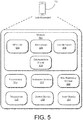
- Fig. 5 illustrates a component level view of an example UE 102 including provisions for receiving an OTA configuration message, as discussed above.
- the UE 102 can comprise a system memory 502 storing a SIP client 504, application(s) 506, a user interface 508, and a configuration engine 510.
- the UE 102 includes processor(s) 512, a removable storage 514, a non-removable storage 516, transceivers 518, output device(s) 520, and input device(s) 522.
- system memory 502 is volatile (such as RAM), non-volatile (such as ROM, flash memory, etc.), or some combination of the two.
- the SIP client 504 may perform any or all of the receiving of network identities, contact addresses, and other functions related to identifying the UE 102 to the telecommunication network 104.
- the application(s) 506 can include various common applications (e.g., navigation, text messaging, web browsers, etc.).
- the UE 102 can also include a user interface 508, such as a graphical user interface (GUI) configured to receive user input and generate user preferences.
- GUI graphical user interface
- the UE 102 can also comprise a configuration engine 510.
- the configuration engine 510 can receive, store, and update any type of configuration information that may be associated with the UE 102.
- the initial configuration can be hardcoded into the UE 102 via the configuration engine 510 during manufacture.
- the configuration engine 510 can retrieve the initial configuration from the telecommunication network 104, for example, when the UE 102 is first powered up.
- the configuration engine 510 can be responsible for communicating with the OTA platform 120 via the SMSC 128 in order to receive OTA configuration messages and to store and/or update configurations associated with the UE 102.
- the configuration engine 510 can be implemented as hardware, software, or a combination thereof.
- the configuration engine 510 can comprise an application running on the UE 102.
- the configuration engine 510 may run in a secure trusted execution environment (TEE), for example, that is separate from the rich operating system (OS) of the UE 102.
- TEE secure trusted execution environment
- the configuration engine 510 can be implemented as hardware on the UE 102.
- the processor(s) 512 is a central processing unit (CPU), a graphics processing unit (GPU), or both CPU and GPU, or any other sort of processing unit.
- the UE 102 may also include additional data storage devices (removable and/or non-removable) such as, for example, magnetic disks, optical disks, or tape. Such additional storage is illustrated in Fig. 5 by removable storage 514 and non-removable storage 516.
- Non-transitory computer-readable media may include volatile and nonvolatile, removable and non-removable tangible, physical media implemented in technology for storage of information, such as computer readable instructions, data structures, program modules, or other data.
- System memory 502, removable storage 514, and non-removable storage 516 are all examples of non-transitory computer-readable media.
- Non-transitory computer-readable media include, but are not limited to, RAM, ROM, EEPROM, flash memory or other memory technology, CD-ROM, digital versatile discs (DVD) or other optical storage, magnetic cassettes, magnetic tape, magnetic disk storage or other magnetic storage devices, or any other tangible, physical medium which can be used to store the desired information and which can be accessed by the UE 102. Any such non-transitory computer-readable media may be part of the UE 102.
- the transceivers 518 include any sort of transceivers known in the art.
- transceivers 518 may include a radio transceiver that performs the function of transmitting and receiving radio frequency communications via an antenna.
- the transceivers 518 may facilitate wireless connectivity between the UE 102 and other devices.
- the transceivers 518 may also include a wireless communication transceiver and a near field antenna for communicating over unlicensed wireless IP networks, such as local wireless data networks and personal area networks (e.g., Bluetooth or near field communication (NFC) networks).
- the transceivers 518 may include wired communication components, such as an Ethernet port, that connect the UE 102 in a wired fashion to other devices.
- the output devices 520 include any sort of output devices known in the art, such as a display (e.g., a liquid crystal display), speakers, a vibrating mechanism, or a tactile feedback mechanism.
- Output devices 520 also include ports for one or more peripheral devices, such as headphones, peripheral speakers, or a peripheral display.
- input devices 522 include any sort of input devices known in the art.
- input devices 522 may include a camera, a microphone, a keyboard/keypad, or a touch-sensitive display.
- a keyboard/keypad may be a push button numeric dialing pad (such as on a typical telecommunication device), a multi-key keyboard (such as a conventional QWERTY keyboard), or one or more other types of keys or buttons, and may also include a joystick-like controller and/or designated navigation buttons, or the like.
- Figs. 6-7 illustrate example processes. These processes are illustrated as logical flow graphs, each operation of which represents a sequence of operations that can be implemented in hardware, software, or a combination thereof.
- the operations represent computer-executable instructions stored on one or more computer-readable storage media that, when executed by one or more processors, perform the recited operations.
- computer-executable instructions include routines, programs, objects, components, data structures, and the like that perform particular functions or implement particular abstract data types.
- the order in which the operations are described should not be construed as a limitation, and any number of the described operations can be combined in any order and/or in parallel to implement the processes.
- examples of the present disclosure can also comprise a method 600 for generating an OTA configuration message and sending the OTA configuration message to a UE.
- a telecommunication network device can receive at least a type allocation code (TAC), an international mobile subscriber (IMSI) range, a type of over the air (OTA) message, and an OTA configuration reference.
- TAC type allocation code
- IMSI international mobile subscriber
- OTA over the air
- the OTA server 122 may receive identifying information from an operator accessing a computing device 130 associated with a MNO that specifies the UE 102 or a group of UEs 132.
- the computing device 130 may be associated with a mobile network operator (MNO) of the telecommunication network 104 and the computing device 130 may present an interface to a user associated with the MNO that enables the user to fill out multiple fields specifying the UEs 102 in which the user would like to send an OTA update.
- MNO mobile network operator
- the identifying information may include a type allocation code (TAC), an international mobile subscriber range (IMSI) range, a type of over the air (OTA) message (e.g., change in access point name (APN), change in mobile station international subscriber directory number (MSISDN) change in roaming settings, change in security settings etc.), and/or an OTA configuration reference (e.g., OTA_CONFIG_FI_APN, OTA_CONFIG_FI_VM, etc.).
- TAC type allocation code
- IMSI international mobile subscriber range
- OTA over the air
- APN access point name
- MSISDN mobile station international subscriber directory number
- a telecommunication network device can generate, based at least in part on the type of OTA message and the OTA configuration reference, an OTA configuration message.
- the OTA server 122 may generate an OTA configuration message (e.g., OTA update) based on the identifying information.
- the computing device 130 may access the OTA policy engine 124 and provide the identifying information specifying the UEs 102, the type of OTA message, and the OTA configuration information.
- the OTA server 122 may receive a transmission from the OTA policy engine 124 indicating that an OTA update has been requested and the OTA policy engine 124 may provide the identifying information specifying the UEs 102, the type of OTA message, and the OTA configuration information to the OTA server 122.
- the OTA server 122 may then access the OTA Configuration Server 126 and request a configuration, based on the type of OTA message information received and/or the OTA configuration reference information received, that may be provided to the specified UEs 102 via an OTA configuration message.
- a telecommunication network device can determine, via accessing an equipment identity register (EIR) and based at least in part on the TAC and the IMSI range, at least one user equipment (UE) in which to send the OTA configuration message.
- EIR equipment identity register
- UE user equipment
- the OTA server 122 may determine the UEs 102 in which to send the OTA configuration message based on the identifying information.
- the OTA server 122 may access the EIR 118 in order to determine the UEs 102 that satisfy the specified identifying information received from the computing device 130.
- the OTA server 122 may access the EIR and/ or the OTA Policy Engine 124 via an application programming interface (API).
- API application programming interface
- the UEs 102 may connect to the telecommunication network 104 via the macrocell 110 and may be authenticated by the AMF 112, MME 114, and/or the SGSN 116.
- the AMF 112, MME 114, and/or the SGSN 116 may communicate with the EIR 118 and provide the EIR 118 with identifying information associated with the UEs 102, such as TACs, IMSIs, IMEIs, and the like.
- the EIR 118 may store the identifying information associated with the UEs.
- the EIR 118 may receive the identifying information from the AMF 112, MME 114, and/or the SGSN 116 via 3GPP standard interfaces (e.g., S13, S13', N17, etc.).
- a telecommunication network device can send, to the at least one UE, the OTA configuration message. For example, once the UEs 102 are determined and the OTA configuration message is generated, the OTA server 122 may send the OTA configuration message to the UEs 102. In some examples, the OTA server 122 may send the OTA configuration message to the UEs via the SMSC 128.
- examples of the present disclosure can also comprise a method 700 for generating an OTA configuration message and sending the OTA configuration message to a UE.
- a telecommunication network device can receive at least first identifying information associated with at least one user equipment (UE), second identifying information associated with the at least one UE, a first type of over the air (OTA) message, a second type of over the air (OTA) message, a first OTA configuration reference, and a second OTA configuration reference.
- the OTA server 122 may be configured to send multiple different OTA configuration messages to multiple different SIMs (e.g., a physical SIM and an eSIM), such as SIM 106 and eSIM 108 that are associated with the same UE 102.
- SIM 106 and eSIM 108 may both be associated with the UE 102 and may each include a unique IMEI.
- the OTA server 122 may also receive IMEI information specifying specific SIMs, such as SIM 106 and eSIM 108 in which to send the OTA configuration message.
- the OTA server 122 may also receive a different type of OTA message and OTA configuration refence for the SIM 106 then the eSIM 108. In this case, the OTA server 122 would access the OTA configuration server 126 to retrieve a configuration for the SIM 106 and a different configuration for the eSIM 108.
- a telecommunication network device can generate, based at least in part on the first type of OTA message and the first OTA configuration reference, a first OTA configuration message.
- a telecommunication network device can generate, based at least in part on the second type of OTA message and the second OTA configuration reference, a second OTA configuration message.
- the OTA server 122 may generate an OTA configuration message (e.g., OTA update) based on the identifying information.
- the computing device 130 may access the OTA policy engine 124 and provide the identifying information specifying the UEs 102, the type of OTA message, and the OTA configuration information.
- the OTA server 122 may receive a transmission from the OTA policy engine 124 indicating that an OTA update has been requested and the OTA policy engine 124 may provide the identifying information specifying the UEs 102, the type of OTA message, and the OTA configuration information to the OTA server 122. The OTA server 122 may then access the OTA Configuration Server 126 and request a configuration, based on the type of OTA message information received and/or the OTA configuration reference information received, that may be provided to the specified UEs 102 via an OTA configuration message.
- a telecommunication network device can determine, via accessing an equipment identity register (EIR) and based at least in part on the first identifying information and the second identifying information a first SIM associated with the at least one UE to receive the first OTA configuration message and a second SIM associated with the at least one UE to receive the second OTA configuration message.
- EIR equipment identity register
- the OTA server 122 may determine the UEs 102 in which to send the OTA configuration message based on the identifying information.
- the OTA server 122 may access the EIR 118 in order to determine the UEs 102 that satisfy the specified identifying information received from the computing device 130.
- the OTA server 122 may access the EIR and/ or the OTA Policy Engine 124 via an application programming interface (API).
- the UEs 102 may connect to the telecommunication network 104 via the macrocell 110 and may be authenticated by the AMF 112, MME 114, and/or the SGSN 116.
- the AMF 112, MME 114, and/or the SGSN 116 may communicate with the EIR 118 and provide the EIR 118 with identifying information associated with the UEs 102, such as TACs, IMSIs, IMEIs, and the like.
- the EIR 118 may store the identifying information associated with the UEs.
- the EIR 118 may receive the identifying information from the AMF 112, MME 114, and/or the SGSN 116 via 3GPP standard interfaces (e.g., S13, S13', N17, etc.).
- a telecommunication network device can send the first OTA configuration message to the first SIM and the second OTA configuration message to the second SIM. For example, once the UEs 102 are determined and the OTA configuration message is generated, the OTA server 122 may send the OTA configuration message to the UEs 102. In some examples, the OTA server 122 may send the OTA configuration message to the UEs via the SMSC 128.
- examples of the present disclosure are not so limited. For instance, while various entries 202-208 on the SIM card 200 are discussed for use with the system, other entries on the SIM card 200 could be used to specify a group of UEs 102 in a similar fashion.
- location and configuration used for various features of examples of the present disclosure such as, for example, the layout of the telecommunication network 104 and the OTA platform 120, for example, can be varied according to a particular network, UE, or location that requires a slight variation due to, for example, size or power constraints, the type of processing required, or regulations related to transmission interference, for example. Such changes are intended to be embraced within the scope of this disclosure.
Landscapes
- Engineering & Computer Science (AREA)
- Computer Networks & Wireless Communication (AREA)
- Signal Processing (AREA)
- Computer Security & Cryptography (AREA)
- Databases & Information Systems (AREA)
- Telephone Function (AREA)
- Mobile Radio Communication Systems (AREA)
Abstract
Techniques for configuring data in a subscriber identity module (SIM) of a user equipment (UE) via over-the-air (OTA) configuration messages are discussed herein. An OTA server may receive, from an operator associated with a telecommunication network, identifying information specifying a UE or a group of UEs in which to send the OTA configuration and may receive an indication of a type of configuration to be included in the OTA configuration. The OTA server may access an equipment identity register (EIR) to determine which UEs to receive the OTA configuration message based on the identifying information.
Description
- Smart phones and other cellular devices, referred to as user equipment (UE), are ubiquitous. These UE may be equipped with subscriber identity modules (SIMs or SIM cards) or electronic SIMS (eSIMs), which may store various data and applications, such as international mobile subscriber identity (IMSI), network and/or carrier specific information such as preferred mobile network codes (MNCs), and the like. Additionally, each UE may be of a different type (e.g., pre-paid or post-paid) or may use a different operating system (OS) (e.g., iOS or Android). Mobile network operators (MNOs) of these UEs often require updating the applications and data in the SIM cards of the UEs, which are performed over-the-air (OTA).
- In existing solutions, OTA updates are sent to large user-bases, such as all UEs using a same OS or all UEs that have downloaded an application. Sending such broad-ranging OTAs can limit the types of OTAs that can be sent out and can result results in security risks and errors in updates.
- The detailed description is set forth with reference to the accompanying figures. In the figures, the left-most digit(s) of a reference number identifies the figure in which the reference number first appears. The use of the same reference numbers in different figures indicates similar or identical items or features.
-
Fig. 1 illustrates an overview and example environment, including a system in which OTA configuration messages may be sent to UEs, in accordance with some examples of the present disclosure. -
Fig. 2 depicts a subscriber identity module (SIM), in accordance with some examples of the present disclosure. -
Figs. 3A and 3B illustrate example user interfaces for use with the system, in accordance with some examples of the present disclosure. -
Fig. 4 illustrates a component level view of a telecommunication network device to provide configurations to UE(s), in accordance with some examples of the present disclosure. -
Fig. 5 illustrates a component level view of an example UE for use with the system, in accordance with some examples of the present disclosure. -
Fig. 6 illustrates an example process for generating an OTA configuration message and sending the OTA configuration message to a UE, in accordance with some examples of the present disclosure. -
Fig. 7 illustrates an example process for generating an OTA configuration message and sending the OTA configuration message to a UE, in accordance with some examples of the present disclosure. - Aspects of this disclosure are directed to sending OTA updates (e.g., OTA configuration messages) to a specified UE or group of UEs using an OTA server. The OTA server may receive identifying information of the specified UE or group of UEs and accesses an equipment identifying register (EIR) to determine which UE(s) to receive the OTA update based on the identifying information.
- The system described herein can be implemented in a wireless network including various UEs. One of skill in the art will recognize, however, that the system is equally applicable to other types of networks such as, for example, Wi-Fi, cable or satellite TV networks, or other networks with devices capable of receiving updates. In addition, the term UE used herein can include cellular and smart phones, tablet and laptop computers, games, USB data sticks, and other network enabled electronic equipment.
- To this end, examples of the present disclosure can comprise systems and methods for sending OTA updates to a specified UE or group of UEs via an OTA server. The system can utilize identifying information of the UEs to provide granularity when specifying a UE or group of UEs that are determined to receive the OTA update. Being able to send an OTA update to a specified UE or group of UEs increases the level of security by which an OTA server operates (i.e., by introducing fewer potential compromised devices into a framework) and increases the types of OTA updates that may be sent out (i.e., sending specialized OTA updates to a certain group of compatible UEs).
- In some examples, an OTA server may receive identifying information from an operator associated with a MNO that specifies a UE or a group of UEs. For example, the identifying information may be received from a computing device that presents a user interface to the operator enabling the operator to fill out multiple fields specifying the UE or the group of UEs in which the operator would like to send an OTA update. In some cases, the identifying information may include a type allocation code (TAC), an international mobile subscriber range (IMSI) range, a type of over the air (OTA) message (e.g., change in access point name (APN), change in mobile station international subscriber directory number (MSISDN) change in roaming settings, change in security settings etc.), and/or an OTA configuration reference (e.g., OTA-CONFIG FI APN, OTA CONFIG FI VM, etc.). The OTA server may generate an OTA configuration message (e.g., an OTA update) based on the identifying information. For example, the OTA server may access an OTA Policy Engine and/or an OTA Configuration Server based on the type of OTA message information received and/or the OTA configuration reference information received. The OTA server may determine a UE or a group of UEs in which to send the configuration information based on the identifying information. For example, the identifying information may include a TAC and an IMSI range which specifies the UE or the group of UEs.
- In some examples, the OTA server may access an Equipment Identity Register (EIR) in order to determine which UE or group of UEs to receive the OTA configuration message by selecting the UE or the group of UEs using the IMSI range or the TAC compared to the UE data stored in the EIR. The EIR may receive UE data from various mobility management nodes (e.g., an Access Management Function (AMF), a Mobility Management Entity (MME), a Serving GPRS Support Node (SGSN), etc.) in a telecommunication network that are in communication with UEs. Once the UE or the group of UEs are determined and the OTA configuration message is generated, the OTA server may send the OTA configuration message to the UE or the group of UEs. In some examples, the OTA server may send the OTA configuration message to the UE or the group of UEs via a short message service center (SMSC).
- In some examples, the OTA server may be configured to send multiple different OTA configuration messages to multiple different SIMs (e.g., a physical SIM and an eSIM) that are associated with the same UE. For example, the different SIMs that are associated with the UE may each include a unique international mobile equipment identity (IMEI). When the OTA server receives the identifying information used to specify which UE or group of UEs to send the OTA configuration message, the OTA server may also receive IMEI information specifying specific SIMs in which to send the OTA configuration message.
- The methods, devices, and computer readable media described herein may be implemented in a number of ways. Example implementations are provided below with reference to the following figures.
-
FIG. 1 illustrates an overview andexample environment 100, including UEs 102 communicating with atelecommunication network 104. Each UE 102 may be associated with a SIM or multiple SIMs, such asSIM 106 or eSIM 108 that are associated with UE 102(1). TheSIM 106 and/or eSIM 108 may include identifying information for a user and the UE 102, including, among other things, an integrated circuit card identifier (ICCID), international mobile subscriber identity (IMSI) number, and its related key. This information can be used to identify and authenticate the UE 102, theSIM 106, and the eSIM 108 on cellular voice and data networks, such as thetelecommunication network 104. - As illustrated, UEs 102, such as UE 102(1), UE 102(2) and UE 102(N), can initiate communications with the
telecommunication network 104 via amacrocell 110. Thetelecommunication network 104 in the depicted environment includes an AMF 112, aMME 114, a SGSN 116, and an EIR 118. - In various implementations, the UEs 102 may be any sort of computing device or computing devices, such as cellular phones, tablet computers, laptop computers, wearable computers, media players, personal computers (PCs), workstations, thumb drives, USB data sticks, or any other sort of device or devices. Each UE 102(1), 102(2), and 102(N) may be different of a different type. UE 102(1) may be a cellular phone (e.g., a smart phone), for example, UE 102(2) may be a tablet computer, and UE 102(N) may be a laptop computer. The UEs 102 may include one or more additional wireless communications ports. In an example, the wireless communications port may be compliant with any unlicensed wireless protocol such as Wi-Fi (e.g., 802.11-based technologies), WiMax, Bluetooth, infrared communications, or any other wireless protocol.
- The UEs 102 may communicate with the
telecommunication network 104 throughmacrocell 110. The communication channel between the UEs 102 and themacrocell 110 may comprise at least a cellular voice channel and a cellular data channel. In an example, the UEs 102 may communicate with thetelecommunication network 104 via a small cell. In an example, themacrocell 110 may be replaced with a microcell, a picocell, or a femtocell. In an example, the UEs 102 may communicate with thetelecommunication network 104 via a macrocell, small cell, microcell, a picocell, a femtocell, and/or combinations thereof. - The
macrocell 110 may include any node that provides radio access for UEs 102. Oneexample macrocell 110 is a node in an evolved UMTS Terrestrial Radio Access Network (E-UTRAN) of an LTE system. The E-UTRAN includes an evolved NodeB (eNodeB or eNB). In one example, an eNB functions similarly to a base transceiver station in a GSM network. The E-UTRAN facilitates communication between the UEs 102 and thetelecommunication network 104. In an example, an eNB is connected to thetelecommunication network 104 and communicates directly withUEs 102. In some examples, themacrocell 110 may include a gNodeB of a Fifth Generation (5G) cellular network. - In an example, the
telecommunication network 104 includes an EIR 118. The EIR 118 includes a database for storing information about the subscribers (e.g., UEs 102) of the mobile carrier. The EIR 118 may be queried using an International Mobile Subscriber Identity (IMSI) and/or International Mobile Equipment Identity (IMEI) as keys. In one example, the IMSI number may be stored in theSIM 106 and/or theeSIM 108 of theUEs 102. Thetelecommunication network 104 may be any sort of telecommunication network or networks associated with a telecommunication service provider. Such atelecommunication network 104 may include a core network and multiple access networks associated with multiple locations. The access networks may include cellular networks - utilizing Long Term Evolution (LTE), Global System for Mobility (GSM), 5G radio access technology, or other cellular technology - and other networks (e.g., Wi-Fi) utilizing unlicensed spectrum. The access networks can also include airborne Wi-Fi and cellular networks such as, for example, Gogo in-flight services. - The UE identity information may be obtained from various sources, including a SIM, UMTS Subscriber Identity Module (USIM), a CDMA Subscriber Identity Module (CSIM) or Re-Useable Identification Module (R-UIM), IP Multimedia Services Identity Module (ISIM), or from a database. The user equipment identity information may be stored in various databases, including the EIR 118.
- In some examples, SIM information may be obtained from a universal integrated circuit card (UICC). In an example, the UICC includes a universal subscriber identity module (USIM). The UICC may also include an ISIM, SIM, USIM, CSIM, or R-UIM. The USIM may include a SIM number and an International Mobile Equipment Identity (IMEI). The SIM number provides contact information (such as the telephone number) of the
UEs 102. In an example, the SIM number may be used as a key into a database (such as a EIR 118) to obtain the contact or telephone number ofUEs 102. In an example, the SIM information may be stored in an IP Multimedia Services Identity Module (ISIM). The IMEI identifies or indicates the identity of theUEs 102. The IMEI may be stored (i) in theUEs 102, (ii) in a database operated by a mobile carrier associated with the user of theUEs 102, (iii) in database accessible by a mobile carrier, and/or (iv) in a third-party database. The IMEI may be stored in the one or multiple databases. - In some examples, the
telecommunication network 104 may comprise of a core network which may support packet-switched or circuit-switched connections and may include a number of network components. Such components may include a home location register (HLR) or HSS for storing user and device information, as well as IMS components, such as the P-CSCF and S-CSCF. The components may also include an application server(s), such as a telephony application server (TAS) or rich communication service (RCS) server. Further, thetelecommunication network 104 may include an account information server (AIS), which may provide network identities, contact addresses, credentials, and other information to theUEs 102. - In addition, the
telecommunication network 104 devices may be implemented on a single computing device. Such computing devices may each be or include a server or server farm, multiple, distributed server farms, a mainframe, a work station, a PC, a laptop computer, a tablet computer, an embedded system, or any other sort of device or devices. In one implementation, the computing device(s) represent a plurality of computing devices working in communication, such as a cloud-computing network of nodes. - The
environment 100 can also include anOTA platform 120 including anOTA server 122, anOTA policy engine 124, an OTA configuration server 126, and anSMSC 128. TheOTA platform 120 can provide initial, or updated configurations to theUEs 102 and/or theSIM 106 andeSIM 108 via theOTA server 122. For example, theOTA policy engine 124 may interface with acomputing device 130 in order to receive identifying information for specifying theUEs 102 and the types of OTA updates that will be sent to theUEs 102. TheOTA server 122 may receive the identifying information from theOTA policy engine 124 and access the OTA configuration server 126 to retrieve the configurations. The OTA configuration server 126 may store a number of configurations (e.g., OTA_CONFIG_FI_APN, OTA-CONFIG FI VM, OTA_CONFIG WEL ROAM, OTA-_CONFIG_WEL_ROAM_APN, etc.) that may be retrieved by theOTA server 122 and sent to theUEs 102 via an OTA configuration message. - In some examples, the
OTA platform 120 can be a "back-end" entity (or network entity) that receives notifications from other network systems, such as thetelecommunication network 104. In other examples, theOTA platform 120 may be part of thetelecommunication network 104. - In some examples, the
UEs 102 may connect to thetelecommunication network 104 via themacrocell 110 and may be authenticated by theAMF 112,MME 114, and/or theSGSN 116. TheAMF 112,MME 114, and/or theSGSN 116 may communicate with the EIR 118 and provide the EIR 118 with identifying information associated with theUEs 102, such as TACs, IMSIs, IMEIs, and the like. The EIR 118 may store the identifying information associated with the UEs. The EIR 118 may receive the identifying information from theAMF 112,MME 114, and/or theSGSN 116 via 3GPP standard interfaces (e.g., S13, S13', N17, etc.). - The
OTA server 122 may receive identifying information from an operator accessing acomputing device 130 associated with a MNO that specifies theUE 102 or a group ofUEs 132. For example, thecomputing device 130 may be associated with a mobile network operator (MNO) of thetelecommunication network 104 and thecomputing device 130 may present an interface to an operator associated with the MNO that enables the user to fill out multiple fields specifying theUEs 102 in which the operator would like to send an OTA update. - In some cases, the identifying information may include a type allocation code (TAC), an international mobile subscriber range (IMSI) range, a type of over the air (OTA) message (e.g., change in access point name (APN), change in mobile station international subscriber directory number (MSISDN) change in roaming settings, change in security settings etc.), and/or an OTA configuration reference (e.g., OTA-CONFIG FI APN, OTA CONFIG _FI_VM, etc.). The
OTA server 122 may generate an OTA configuration message (e.g., OTA update) based on the identifying information. For example, thecomputing device 130 may access theOTA policy engine 124 and provide the identifying information specifying theUEs 102, the type of OTA message, and the OTA configuration information. TheOTA server 122 may receive a transmission from theOTA policy engine 124 indicating that an OTA update has been requested and theOTA policy engine 124 may provide the identifying information specifying theUEs 102, the type of OTA message, and the OTA configuration information to theOTA server 122. TheOTA server 122 may then access the OTA Configuration Server 126 and request a configuration, based on the type of OTA message information received and/or the OTA configuration reference information received, that may be provided to the specifiedUEs 102 via an OTA configuration message. - The
OTA server 122 may determine, based at least in part on the identifying information, theUEs 102 to receive the OTA configuration message. For example, theOTA server 122 may access the EIR 118 in order to determine theUEs 102 that satisfy the specified identifying information received from thecomputing device 130. In some examples, theOTA server 122 may access the EIR and/or theOTA Policy Engine 124 via an application programming interface (API). Once theUEs 102 are determined and the OTA configuration message is generated, theOTA server 122 may send the OTA configuration message to theUEs 102. In some examples, theOTA server 122 may send the OTA configuration message to the UEs via theSMSC 128. - In some examples, the
OTA server 122 may be configured to send multiple different OTA configuration messages to multiple different SIMs (e.g., a physical SIM and an eSIM), such asSIM 106 andeSIM 108 that are associated with thesame UE 102. For example,SIM 106 andeSIM 108 may both be associated with theUE 102 and may each include a unique IMEI. When theOTA server 122 receives the identifying information used to specify theUEs 102 to send the OTA configuration message, theOTA server 122 may also receive IMEI information specifying specific SIMs, such asSIM 106 andeSIM 108 in which to send the OTA configuration message. TheOTA server 122 may also receive a different type of OTA message and OTA configuration refence for theSIM 106 then theeSIM 108. In this case, theOTA server 122 would access the OTA configuration server 126 to retrieve a configuration for theSIM 106 and a different configuration for theeSIM 108. The different configurations may then be sent to theSIM 106 aneSIM 108 in separate OTA configuration messages via theSMSC 128. -
FIG. 2 illustrates anexample SIM 200 that may representSIM 106,eSIM 108, or any other SIM or eSIM that may be associated with theUEs 102.Most SIMs 200 currently use a mobile country code (MCC) 202 and mobile network code (MNC) 204 entries on theSIM 200. TheMCC 202 is a three-decimal digit value 210 that, as the name implies, indicates the country of origin of theSIM 200 provider. Similarly, theMNC 204 is a two or threedecimal digit value 212 that provides the name of the carrier, or network provider, associated with theSIM 200. -
Many SIMs 200 nonetheless contain entries for group identifier 1 (GID1) 206 and group identifier 2 (GID2) 208. When they are used, they may be used to provide a single piece of information, generally using a 2-byte value particular SIM 200 to a particular brand of UE (e.g., Apple, Google, Samsung, etc.) within a network, for example. These entries MCC, 202,MNC 204,GID1 206, andGID2 208 can be used to provide additional granularity when specifying a group ofUEs 102. - The subdivision of the bits for
GID2 208, for example, can be based on thevalues Value 218 can comprise six bits, for example, and can be used to denote a field that requires slightly more information.Value 218 could be used to denote a rate plan, for example, or a particular brand of UE.Value 220, on the other hand, can be used to denote a binary field.Value 220 could be "0" if theSIM 200 is for use with a prepaid plan (or UE), for example, and "1" if theSIM 200 is for use with a postpaid plan.Value 220 could also be used to denote a particular brand of UE, for example, where a carrier only has two brands. When specifying aSIM 200 in which to send an OTA configuration message, an operator of thecomputing device 130 may provide theOTA policy engine 124 with any one of the values 210-216 and theOTA server 122 may send the OTA configuration message to theUEs 102 that correlate to the values 210-216. Of course, the values 210-216 can include more or fewer fields or bits, depending on a particular implementation. - The
SIM 200 may be programmed to contain one or more values 218-226 using theGID1 206 entry,GID2 208 entry, or both. In some examples, this additional programming can be hardcoded at the time theSIM 200 is manufactured. In other cases, the additional programming can be done when theSIM 200 is sold. In other words, a salesperson or technician at the phone retailer, for example, can add the necessary information to theSIM 200 using a SIM card writer, or similar device. - Each of the values of
GID1 206,GID2 208, andother SIM 200 entries can be used in this manner to provide exceptional granularity. Thus, the particular layout shown inFig. 2 is entirely illustrative. The allocation of bits to each value 218-226 is, therefore, arbitrary and can be changed to suit different configuration. -
FIGS. 3A and 3B illustrateexample user interfaces UEs 102 in which to send an OTA configuration message. As shown inFIG. 3A , theuser interface 300 may be formatted as a table and may provide a number of fields that the operator may input information used to identify theUEs 102. For example, the fields may include a type allocation code (TAC), an international mobile subscriber range (IMSI) range, a type of over the air (OTA) message (e.g., change in access point name (APN), change in mobile station international subscriber directory number (MSISDN) change in roaming settings, change in security settings etc.), and/or an OTA configuration reference (e.g., OTA_CONFIG_FI_APN, OTA-CONFIG FI VM, etc.). - In some cases, the TAC may include an eight-digit portion of a fifteen-digit IMEI and sixteen-digit IMEISV code used to uniquely identify user equipment, such as the
UEs 102. In some cases, the TAC may identity a particular manufacturer and model of user equipment. In some cases, the IMSI may include a fifteen-digit number where the first three digits represent the MCC followed by the MNC, which may be represented by either a two-digit number or a three-digit number. The remaining IMSI digits include the MSIN, which often includes a nine-digit number or ten-digit number representing a unique number that a wireless carrier uses to identify a specific user equipment. - By inputting a TAC and an IMSI, the
user interface 300 may enable an operator to specify theUEs 102 based on device type (e.g., smartphone, USB data stick, etc.), operating system (e.g., iOS, Android, etc.), geographic region, network operator, and the like. Theuser interface 300 further enables an operator to determine a specific level of granularity by which the operator would like to use in sending out the OTA configuration message. For example, as illustrated in theuser interface 300, the TAC field inrow 304 ofuser interface 300 may include values "35803582" and "99001201," which may specify two different models of UEs having two different manufacturers. The IMSI field inrow 304 ofuser interface 300 may include a value "310 260*," which may indicate that the operator is only specifying an MCC and an MNC value of the UEs that include TAC codes "35803582" and "99001201." For each of the TAC fields and IMSI fields of theuser interface 300, more or fewer digits may be entered depending on the level of granularity that the operator wishes to specify. For example, if the operator wanted to send an OTA configuration message to aspecific UE 102, then all of the digits of the IMSI field atrow user interface 300, the operator may input a Type of OTA Message field which may specify the type of change that may be implemented on theUEs 102. For example, if the operator wishes to change an access-point-name (APN) of theUEs 102, then the operator may select "Change APN," as illustrated inrow 304 ofuser interface 300. - In another example, if the operator wishes to change a VM MSISDN of the
UEs 102, then the operator may select "Change VM MSISDN," as illustrated inrow 304 ofuser interface 300. The operator may then include the OTA Configuration Reference associated with the Type of OTA message. For example, if the operator wishes to change an access-point-name (APN) of theUEs 102, then the operator may select "OTA_CONFIG_FI_APN," as illustrated inrow 304 ofuser interface 300. In another example, if the operator wishes to change a VM MSISDN of theUEs 102, then the operator may select "OTA_CONFIG_FI_VM," as illustrated inrow 304 ofuser interface 300. - In some cases, the
computing device 130 may present auser interface 302 that may be presented to an operator to allow the operator to specifyUEs 102 in which to send an OTA configuration message. As withuser interface 300,user interface 302 may be formatted as a table and may provide a number of fields that the operator may input information used to identify theUEs 102. For example, the fields may include a type allocation code (TAC), an international mobile subscriber range (IMSI) range, a type of over the air (OTA) message, and/or an OTA configuration reference. Additionally, a user interface may include a field for inputting an IMEI value. - In some examples, a
UE 102 may include both a physical SIM (e.g., SIM 106) and an eSIM (e.g., eSIM 108), which means that both of the physical SIM and the eSIM share the same TAC because they are both associated with thesame UE 102. The operator may wish to send a different OTA configuration message to each of the physical SIM and the eSIM. Theuser interface 302 may allow the operator to specify a different type of OTA message for each of the physical SIM and the eSIM by including a field for specifying the IMEI. As an example, if the operator wishes to change an SMS setting while roaming for a first SIM associated with theUE 102, then the operator may input an IMEI value of "12345678XXYYZZ," an IMSI value of "310 260 88*," select "Welcome SMS when roaming," and "OTA_CONFIG_WEL_ROAM," as illustrated inrow 308 ofuser interface 302. Similarly, if the operator wishes to change an SMS setting while roaming and change an APN for a second SIM associated with theUE 102, then the operator may input an IMEI value of "12345678AABBCC," an IMSI value of "310 260 89*," select "Welcome SMS when roaming and change APN," and "OTA_CONFIG_WEL_ROAM_APN," as illustrated inrow 310 ofuser interface 302. Even though both of the TAC fields forrows - It is understood that the identifying information for the
UEs 102 inuser interfaces UEs 102. For example, the identifying information may include a type of data plan, such as a pre-paid plan or a post-paid plan. - It is understood that the techniques described herein are not limited to a UI, and any input method may be used. In some examples, the
UIs -
Fig. 4 illustrates a component level view of a telecommunication network device configured to receive identifying information and OTA configuration information associated with UEs and to provide OTA configurations, among other things. Thetelecommunication network device 400 may be an example of theOTA server 122, theOTA policy engine 124, the OTA configuration server 126, another network device, or a combination thereof. As illustrated, thetelecommunication network device 400 comprises asystem memory 402 storing anEIR component 404, apolicy engine component 406, aconfiguration component 408, and anSMSC component 410. Also, thetelecommunication network device 400 can include a processor(s) 412, aremovable storage 414, anon-removable storage 416,transceivers 418, output device(s) 420, and input device(s) 422. - In various implementations,
system memory 402 is volatile (such as RAM), non-volatile (such as ROM, flash memory, etc.), or some combination of the two. TheEIR component 404 may communicate with the EIR 118, including retrieving and storing identifying information associated with theUEs 102. The identifying information may include TACs, IMSIs, IMEIs, and the like. - The
policy engine component 406 may communicate with theOTA policy engine 124 and determine that an OTA update has been requested and theOTA policy engine 124 may provide the identifying information specifying theUEs 102, the type of OTA message, and the OTA configuration information to thepolicy engine component 406, which may store the information. In some cases, theEIR component 404 may use the information received by thepolicy engine component 406 to access the EIR 118 and determine the contact information associate with the specifiedUEs 102. - The
configuration component 408 may communicate with the OTA configuration server 126 and request a configuration, based on the type of OTA message information received and/or the OTA configuration reference information received. For example, theconfiguration component 408 may use the information received by thepolicy engine component 406 to query the OTA configuration server 126 and to retrieve any specified configurations. - The
SMSC component 410 may communicate with theSMSC 128 to send the OTA configuration message to theUEs 102. For example, once theUEs 102 are determined via theEIR component 404 and the configurations are received via theconfiguration component 408, thetelecommunication network device 400 may generate an OTA configuration message that is addressed to theUEs 102 and contains the configurations. TheSMSC component 410 may then transmit the OTA configuration message via theSMSC 128. - In some implementations, the processor(s) 412 is a central processing unit (CPU), a graphics processing unit (GPU), or both CPU and GPU, or any other sort of processing unit. The
telecommunication network device 400 may also include additional data storage devices (removable and/or non-removable) such as, for example, magnetic disks, optical disks, or tape. Such additional storage is illustrated inFig. 4 byremovable storage 414 andnon-removable storage 416. - Non-transitory computer-readable media may include volatile and nonvolatile, removable and non-removable tangible, physical media implemented in technology for storage of information, such as computer readable instructions, data structures, program modules, or other data.
System memory 402,removable storage 414, andnon-removable storage 416 are all examples of non-transitory computer-readable media. Non-transitory computer-readable media include, but are not limited to, RAM, ROM, EEPROM, flash memory or other memory technology, CD-ROM, digital versatile discs (DVD) or other optical storage, magnetic cassettes, magnetic tape, magnetic disk storage or other magnetic storage devices, or any other tangible, physical medium which can be used to store the desired information and which can be accessed by thetelecommunication network device 400. Any such non-transitory computer-readable media may be part of thetelecommunication network device 400. - In some implementations, the
transceivers 418 include any sort of transceivers known in the art. For example, thetransceivers 418 may include wired communication components, such as an Ethernet port, for communicating with other networked devices. Also or instead, thetransceivers 418 may include wireless modem(s) to may facilitate wireless connectivity with other computing devices. Further, thetransceivers 418 may include a radio transceiver that performs the function of transmitting and receiving radio frequency communications via an antenna. - In some implementations, the
output devices 420 include any sort of output devices known in the art, such as a display (e.g., a liquid crystal display), speakers, a vibrating mechanism, or a tactile feedback mechanism.Output devices 420 also include ports for one or more peripheral devices, such as headphones, peripheral speakers, or a peripheral display. - In various implementations,
input devices 422 include any sort of input devices known in the art. For example,input devices 422 may include a camera, a microphone, a keyboard/keypad, or a touch-sensitive display. A keyboard/keypad may be a push button numeric dialing pad (such as on a typical telecommunication device), a multi-key keyboard (such as a conventional QWERTY keyboard), or one or more other types of keys or buttons, and may also include a joystick-like controller and/or designated navigation buttons, or the like. -
Fig. 5 illustrates a component level view of anexample UE 102 including provisions for receiving an OTA configuration message, as discussed above. As illustrated, theUE 102 can comprise asystem memory 502 storing aSIP client 504, application(s) 506, auser interface 508, and aconfiguration engine 510. Also, theUE 102 includes processor(s) 512, aremovable storage 514, anon-removable storage 516,transceivers 518, output device(s) 520, and input device(s) 522. - In various implementations,
system memory 502 is volatile (such as RAM), non-volatile (such as ROM, flash memory, etc.), or some combination of the two. TheSIP client 504 may perform any or all of the receiving of network identities, contact addresses, and other functions related to identifying theUE 102 to thetelecommunication network 104. The application(s) 506 can include various common applications (e.g., navigation, text messaging, web browsers, etc.). TheUE 102 can also include auser interface 508, such as a graphical user interface (GUI) configured to receive user input and generate user preferences. - The
UE 102 can also comprise aconfiguration engine 510. As the name implies, theconfiguration engine 510 can receive, store, and update any type of configuration information that may be associated with theUE 102. Thus, in some examples, the initial configuration can be hardcoded into theUE 102 via theconfiguration engine 510 during manufacture. In other examples, theconfiguration engine 510 can retrieve the initial configuration from thetelecommunication network 104, for example, when theUE 102 is first powered up. - In some examples, the
configuration engine 510 can be responsible for communicating with theOTA platform 120 via theSMSC 128 in order to receive OTA configuration messages and to store and/or update configurations associated with theUE 102. Theconfiguration engine 510 can be implemented as hardware, software, or a combination thereof. - In some examples, the
configuration engine 510 can comprise an application running on theUE 102. Theconfiguration engine 510 may run in a secure trusted execution environment (TEE), for example, that is separate from the rich operating system (OS) of theUE 102. In other examples, theconfiguration engine 510 can be implemented as hardware on theUE 102. - In some implementations, the processor(s) 512 is a central processing unit (CPU), a graphics processing unit (GPU), or both CPU and GPU, or any other sort of processing unit. The
UE 102 may also include additional data storage devices (removable and/or non-removable) such as, for example, magnetic disks, optical disks, or tape. Such additional storage is illustrated inFig. 5 byremovable storage 514 andnon-removable storage 516. - Non-transitory computer-readable media may include volatile and nonvolatile, removable and non-removable tangible, physical media implemented in technology for storage of information, such as computer readable instructions, data structures, program modules, or other data.
System memory 502,removable storage 514, andnon-removable storage 516 are all examples of non-transitory computer-readable media. Non-transitory computer-readable media include, but are not limited to, RAM, ROM, EEPROM, flash memory or other memory technology, CD-ROM, digital versatile discs (DVD) or other optical storage, magnetic cassettes, magnetic tape, magnetic disk storage or other magnetic storage devices, or any other tangible, physical medium which can be used to store the desired information and which can be accessed by theUE 102. Any such non-transitory computer-readable media may be part of theUE 102. - In some implementations, the
transceivers 518 include any sort of transceivers known in the art. For example,transceivers 518 may include a radio transceiver that performs the function of transmitting and receiving radio frequency communications via an antenna. Thetransceivers 518 may facilitate wireless connectivity between theUE 102 and other devices. In addition, thetransceivers 518 may also include a wireless communication transceiver and a near field antenna for communicating over unlicensed wireless IP networks, such as local wireless data networks and personal area networks (e.g., Bluetooth or near field communication (NFC) networks). Further, thetransceivers 518 may include wired communication components, such as an Ethernet port, that connect theUE 102 in a wired fashion to other devices. - In some implementations, the
output devices 520 include any sort of output devices known in the art, such as a display (e.g., a liquid crystal display), speakers, a vibrating mechanism, or a tactile feedback mechanism.Output devices 520 also include ports for one or more peripheral devices, such as headphones, peripheral speakers, or a peripheral display. - In various implementations,
input devices 522 include any sort of input devices known in the art. For example,input devices 522 may include a camera, a microphone, a keyboard/keypad, or a touch-sensitive display. A keyboard/keypad may be a push button numeric dialing pad (such as on a typical telecommunication device), a multi-key keyboard (such as a conventional QWERTY keyboard), or one or more other types of keys or buttons, and may also include a joystick-like controller and/or designated navigation buttons, or the like. -
Figs. 6-7 illustrate example processes. These processes are illustrated as logical flow graphs, each operation of which represents a sequence of operations that can be implemented in hardware, software, or a combination thereof. In the context of software, the operations represent computer-executable instructions stored on one or more computer-readable storage media that, when executed by one or more processors, perform the recited operations. Generally, computer-executable instructions include routines, programs, objects, components, data structures, and the like that perform particular functions or implement particular abstract data types. The order in which the operations are described should not be construed as a limitation, and any number of the described operations can be combined in any order and/or in parallel to implement the processes. - As shown in
Fig. 6 , examples of the present disclosure can also comprise amethod 600 for generating an OTA configuration message and sending the OTA configuration message to a UE. - For example, at
operation 602, a telecommunication network device can receive at least a type allocation code (TAC), an international mobile subscriber (IMSI) range, a type of over the air (OTA) message, and an OTA configuration reference. For example, theOTA server 122 may receive identifying information from an operator accessing acomputing device 130 associated with a MNO that specifies theUE 102 or a group ofUEs 132. For example, thecomputing device 130 may be associated with a mobile network operator (MNO) of thetelecommunication network 104 and thecomputing device 130 may present an interface to a user associated with the MNO that enables the user to fill out multiple fields specifying theUEs 102 in which the user would like to send an OTA update. In some cases, the identifying information may include a type allocation code (TAC), an international mobile subscriber range (IMSI) range, a type of over the air (OTA) message (e.g., change in access point name (APN), change in mobile station international subscriber directory number (MSISDN) change in roaming settings, change in security settings etc.), and/or an OTA configuration reference (e.g., OTA_CONFIG_FI_APN, OTA_CONFIG_FI_VM, etc.). - At
operation 604, a telecommunication network device can generate, based at least in part on the type of OTA message and the OTA configuration reference, an OTA configuration message. For example, theOTA server 122 may generate an OTA configuration message (e.g., OTA update) based on the identifying information. For example, thecomputing device 130 may access theOTA policy engine 124 and provide the identifying information specifying theUEs 102, the type of OTA message, and the OTA configuration information. TheOTA server 122 may receive a transmission from theOTA policy engine 124 indicating that an OTA update has been requested and theOTA policy engine 124 may provide the identifying information specifying theUEs 102, the type of OTA message, and the OTA configuration information to theOTA server 122. TheOTA server 122 may then access the OTA Configuration Server 126 and request a configuration, based on the type of OTA message information received and/or the OTA configuration reference information received, that may be provided to the specifiedUEs 102 via an OTA configuration message. - At
operation 606, a telecommunication network device can determine, via accessing an equipment identity register (EIR) and based at least in part on the TAC and the IMSI range, at least one user equipment (UE) in which to send the OTA configuration message. For example, theOTA server 122 may determine theUEs 102 in which to send the OTA configuration message based on the identifying information. For example, theOTA server 122 may access the EIR 118 in order to determine theUEs 102 that satisfy the specified identifying information received from thecomputing device 130. In some examples, theOTA server 122 may access the EIR and/ or theOTA Policy Engine 124 via an application programming interface (API). In some examples, theUEs 102 may connect to thetelecommunication network 104 via themacrocell 110 and may be authenticated by theAMF 112,MME 114, and/or theSGSN 116. TheAMF 112,MME 114, and/or theSGSN 116 may communicate with the EIR 118 and provide the EIR 118 with identifying information associated with theUEs 102, such as TACs, IMSIs, IMEIs, and the like. The EIR 118 may store the identifying information associated with the UEs. The EIR 118 may receive the identifying information from theAMF 112,MME 114, and/or theSGSN 116 via 3GPP standard interfaces (e.g., S13, S13', N17, etc.). - At
operation 608, a telecommunication network device can send, to the at least one UE, the OTA configuration message. For example, once theUEs 102 are determined and the OTA configuration message is generated, theOTA server 122 may send the OTA configuration message to theUEs 102. In some examples, theOTA server 122 may send the OTA configuration message to the UEs via theSMSC 128. - As shown in
Fig. 7 , examples of the present disclosure can also comprise amethod 700 for generating an OTA configuration message and sending the OTA configuration message to a UE. - For example, at
operation 702, a telecommunication network device can receive at least first identifying information associated with at least one user equipment (UE), second identifying information associated with the at least one UE, a first type of over the air (OTA) message, a second type of over the air (OTA) message, a first OTA configuration reference, and a second OTA configuration reference. For example, theOTA server 122 may be configured to send multiple different OTA configuration messages to multiple different SIMs (e.g., a physical SIM and an eSIM), such asSIM 106 andeSIM 108 that are associated with thesame UE 102. For example,SIM 106 andeSIM 108 may both be associated with theUE 102 and may each include a unique IMEI. When theOTA server 122 receives the identifying information used to specify theUEs 102 to send the OTA configuration message, theOTA server 122 may also receive IMEI information specifying specific SIMs, such asSIM 106 andeSIM 108 in which to send the OTA configuration message. TheOTA server 122 may also receive a different type of OTA message and OTA configuration refence for theSIM 106 then theeSIM 108. In this case, theOTA server 122 would access the OTA configuration server 126 to retrieve a configuration for theSIM 106 and a different configuration for theeSIM 108. - At
operation 704, a telecommunication network device can generate, based at least in part on the first type of OTA message and the first OTA configuration reference, a first OTA configuration message. Atoperation 706, a telecommunication network device can generate, based at least in part on the second type of OTA message and the second OTA configuration reference, a second OTA configuration message. For example, theOTA server 122 may generate an OTA configuration message (e.g., OTA update) based on the identifying information. For example, thecomputing device 130 may access theOTA policy engine 124 and provide the identifying information specifying theUEs 102, the type of OTA message, and the OTA configuration information. TheOTA server 122 may receive a transmission from theOTA policy engine 124 indicating that an OTA update has been requested and theOTA policy engine 124 may provide the identifying information specifying theUEs 102, the type of OTA message, and the OTA configuration information to theOTA server 122. TheOTA server 122 may then access the OTA Configuration Server 126 and request a configuration, based on the type of OTA message information received and/or the OTA configuration reference information received, that may be provided to the specifiedUEs 102 via an OTA configuration message. - At
operation 708, a telecommunication network device can determine, via accessing an equipment identity register (EIR) and based at least in part on the first identifying information and the second identifying information a first SIM associated with the at least one UE to receive the first OTA configuration message and a second SIM associated with the at least one UE to receive the second OTA configuration message. For example, theOTA server 122 may determine theUEs 102 in which to send the OTA configuration message based on the identifying information. For example, theOTA server 122 may access the EIR 118 in order to determine theUEs 102 that satisfy the specified identifying information received from thecomputing device 130. In some examples, theOTA server 122 may access the EIR and/ or theOTA Policy Engine 124 via an application programming interface (API). In some examples, theUEs 102 may connect to thetelecommunication network 104 via themacrocell 110 and may be authenticated by theAMF 112,MME 114, and/or theSGSN 116. TheAMF 112,MME 114, and/or theSGSN 116 may communicate with the EIR 118 and provide the EIR 118 with identifying information associated with theUEs 102, such as TACs, IMSIs, IMEIs, and the like. The EIR 118 may store the identifying information associated with the UEs. The EIR 118 may receive the identifying information from theAMF 112,MME 114, and/or theSGSN 116 via 3GPP standard interfaces (e.g., S13, S13', N17, etc.). - At
operation 710, a telecommunication network device can send the first OTA configuration message to the first SIM and the second OTA configuration message to the second SIM. For example, once theUEs 102 are determined and the OTA configuration message is generated, theOTA server 122 may send the OTA configuration message to theUEs 102. In some examples, theOTA server 122 may send the OTA configuration message to the UEs via theSMSC 128. - While several possible examples are disclosed above, examples of the present disclosure are not so limited. For instance, while various entries 202-208 on the
SIM card 200 are discussed for use with the system, other entries on theSIM card 200 could be used to specify a group ofUEs 102 in a similar fashion. In addition, the location and configuration used for various features of examples of the present disclosure such as, for example, the layout of thetelecommunication network 104 and theOTA platform 120, for example, can be varied according to a particular network, UE, or location that requires a slight variation due to, for example, size or power constraints, the type of processing required, or regulations related to transmission interference, for example. Such changes are intended to be embraced within the scope of this disclosure. - The specific configurations, choice of materials, and the size and shape of various elements can be varied according to particular design specifications or constraints requiring a device, system, or method constructed according to the principles of this disclosure. Such changes are intended to be embraced within the scope of this disclosure. The presently disclosed examples, therefore, are considered in all respects to be illustrative and not restrictive. The scope of the disclosure is indicated by the appended claims, rather than the foregoing description, and all changes that come within the meaning and range of equivalents thereof are intended to be embraced therein.
Claims (14)
- A method comprising:receiving at least:identifying information that identifies at least one user equipment (UE);a type of over the air (OTA) message; andan OTA configuration reference;generating, based at least in part on the type of OTA message and the OTA configuration reference, an OTA configuration message;determining, via accessing an equipment identity register (EIR) and based at least in part on the identifying information, the at least one UE to receive the OTA configuration message; andsending, to the at least one UE, the OTA configuration message.
- The method of claim 1, wherein the at least one UE comprises a plurality of UEs that are associated with a same type of data plan, a same type of device, and a same type of operating system.
- The method of claim 1 or 2, wherein the OTA configuration message causes the at least one UE to perform at least one operation comprising at least one of:updating a mobile station international subscriber directory number (MSISDN);updating an access point name (APN);updating at least one roaming setting; orupdating at least one security setting.
- The method of any preceding claim, wherein the at least one UE includes a first subscriber identity module (SIM) and a second SIM, the first SIM having a first international mobile equipment identity (IMEI) and the second SIM having a second IMEI that is different than the first IMEI.
- The method of claim 4, further comprising:receiving, from the at least one UE, the first IMEI;wherein sending the OTA configuration message comprises sending the OTA configuration message to the first SIM of the at least one UE based at least in part on the first IMEI.
- The method of claim 4, wherein the identifying information includes a first IMSI range associated with the first SIM, the type of OTA message is a first type of OTA message associated with the first SIM, the OTA configuration reference is a first type of OTA configuration reference associated with the first SIM, the OTA configuration message is a first OTA configuration message, and the method further comprises:
sending a second OTA configuration message to the second SIM based at least in part on at least one of:a second IMSI range;a second type of OTA;a second OTA configuration reference; orthe second IMEI;wherein the first OTA configuration message is different than the second OTA configuration message. - The method of claim 4, wherein the first SIM and the second SIM include a same TAC.
- The method of any preceding claim, wherein the identifying information comprises at least one of a TAC and an IMSI range.
- A computing device comprising:a processor; andcomputer-readable instructions that, when executed by the processor cause the computing device to perform the method of any preceding claim.
- A method comprising:receiving at least:first identifying information associated with at least one user equipment (UE);second identifying information associated with the at least one UE;a first type of over the air (OTA) message;a second type of over the air (OTA) message;a first OTA configuration reference; anda second OTA configuration reference;generating, based at least in part on the first type of OTA and the first OTA configuration reference, a first OTA configuration message;generating, based at least in part on the second type of OTA and the second OTA configuration reference, a second OTA configuration message;determining, via accessing an equipment identity register (EIR) and based at least in part on the first identifying information and the second identifying information, a first SIM associated with the at least one UE to receive the first OTA configuration message and a second SIM associated with the at least one UE to receive the second OTA configuration message; andsending the first OTA configuration message to the first SIM and the second OTA configuration message to the second SIM.
- The method of claim 10, wherein:the first identifying information includes at least one of:a first international mobile subscriber range (IMSI) range; ora first IMEI; andthe second identifying information includes at least one of:a second IMSI range; ora second IMEI.
- The method of claim 10 or 11, wherein the first SIM comprises a physical SIM card and the second SIM comprises an eSIM.
- The method of any one of claims 10 to 12, wherein the first SIM and the second SIM include a same TAC.
- The method of any one of claims 10 to 13, wherein at least one of the first OTA configuration message or the second OTA configuration message causes the at least one UE to perform at least one operation comprising at least one of:updating a mobile station international subscriber directory number (MSISDN);updating an access point name (APN);updating at least one roaming setting; orupdating at least one security setting.
Applications Claiming Priority (1)
| Application Number | Priority Date | Filing Date | Title |
|---|---|---|---|
| US16/443,199 US11082831B2 (en) | 2019-06-17 | 2019-06-17 | Targeted over-the-air updates |
Publications (1)
| Publication Number | Publication Date |
|---|---|
| EP3755017A1 true EP3755017A1 (en) | 2020-12-23 |
Family
ID=71016339
Family Applications (1)
| Application Number | Title | Priority Date | Filing Date |
|---|---|---|---|
| EP20177504.6A Withdrawn EP3755017A1 (en) | 2019-06-17 | 2020-05-29 | Targeted over-the-air updates |
Country Status (2)
| Country | Link |
|---|---|
| US (1) | US11082831B2 (en) |
| EP (1) | EP3755017A1 (en) |
Families Citing this family (1)
| Publication number | Priority date | Publication date | Assignee | Title |
|---|---|---|---|---|
| US12452649B2 (en) * | 2023-01-27 | 2025-10-21 | T-Mobile Usa, Inc. | Enabling an efficient transition of multiple mobile devices from one wireless telecommunication network to another |
Citations (3)
| Publication number | Priority date | Publication date | Assignee | Title |
|---|---|---|---|---|
| US20050075106A1 (en) * | 2003-08-13 | 2005-04-07 | Jiang Yue Jun | Multiple IMSI multiple/single MSISDN (MIMM/MISM) on multiple SIMs for a single operator |
| EP2759154A1 (en) * | 2011-09-19 | 2014-07-30 | Truphone Limited | Managing mobile device identities |
| CN106937283A (en) * | 2015-12-29 | 2017-07-07 | 阿里巴巴集团控股有限公司 | Dual-card dual-standby terminal exempts from cipher authentication method and device |
Family Cites Families (6)
| Publication number | Priority date | Publication date | Assignee | Title |
|---|---|---|---|---|
| US6819921B2 (en) * | 2001-02-02 | 2004-11-16 | Lucent Technologies Inc. | Method of subscriber initiated porting of a wireless number for a mobile station |
| FI20041377A0 (en) * | 2004-10-25 | 2004-10-25 | Nokia Corp | Delivery of services in a telecommunications system |
| WO2011100497A1 (en) * | 2010-02-12 | 2011-08-18 | Interdigital Patent Holdings, Inc. | Group paging for machine-type communications |
| EP2568765A1 (en) * | 2011-09-09 | 2013-03-13 | Buzzinbees Sas | A module MLR for managing machine-to-machine type (M2M) mobile devices |
| CN105009617B (en) * | 2013-03-08 | 2020-01-21 | 诺基亚技术有限公司 | Method and apparatus for multi-SIM devices with embedded SIM functionality |
| US20180376358A1 (en) * | 2017-06-22 | 2018-12-27 | Tambora Systems Singapore Pte. Ltd. | Remote management of base stations and/or the functions performed thereby |
-
2019
- 2019-06-17 US US16/443,199 patent/US11082831B2/en active Active
-
2020
- 2020-05-29 EP EP20177504.6A patent/EP3755017A1/en not_active Withdrawn
Patent Citations (3)
| Publication number | Priority date | Publication date | Assignee | Title |
|---|---|---|---|---|
| US20050075106A1 (en) * | 2003-08-13 | 2005-04-07 | Jiang Yue Jun | Multiple IMSI multiple/single MSISDN (MIMM/MISM) on multiple SIMs for a single operator |
| EP2759154A1 (en) * | 2011-09-19 | 2014-07-30 | Truphone Limited | Managing mobile device identities |
| CN106937283A (en) * | 2015-12-29 | 2017-07-07 | 阿里巴巴集团控股有限公司 | Dual-card dual-standby terminal exempts from cipher authentication method and device |
Non-Patent Citations (1)
| Title |
|---|
| MONACO TELEMATIQUE: "The OTA & Mobile Device Management Whitepaper", 5 April 2006 (2006-04-05), XP055165804, Retrieved from the Internet <URL:http://www.mctel.net/pdf/white-paper-dmc-en.pdf> [retrieved on 20150129] * |
Also Published As
| Publication number | Publication date |
|---|---|
| US11082831B2 (en) | 2021-08-03 |
| US20200396589A1 (en) | 2020-12-17 |
Similar Documents
| Publication | Publication Date | Title |
|---|---|---|
| US11089480B2 (en) | Provisioning electronic subscriber identity modules to mobile wireless devices | |
| US11277738B2 (en) | MNO-specific 5G functionality delivery with eSIM stored encryption keys in user device | |
| US11979940B2 (en) | System and method for provisioning enhanced SIM profiles as standard eUICC profiles | |
| CN112566074B (en) | Apparatus and method for electronic subscriber identity module (ESIM) installation and interoperation | |
| CN115334492B (en) | Offline profile configuration for wireless devices | |
| US8406761B2 (en) | Initializing and provisioning user equipment having multi-network connectivity | |
| US12615515B2 (en) | Minimal configuration synthetic eSIM profiles for wireless devices | |
| US20190223076A1 (en) | Methods for serving gateway selection based on type-of-service in a wireless communication network | |
| EP3437349A1 (en) | System and methods for using embedded subscriber identity module (esim) provisioning processes to provide and activate device configuration packages on a wireless communication device | |
| US12294864B2 (en) | In-field remote profile management for wireless devices | |
| US11622317B2 (en) | Systems and methods for identifying narrow band devices in wireless communication networks | |
| US20260082205A1 (en) | ON-DEVICE SHARED PROVISIONING SIM/eSIM CONTROLLER FOR A WIRELESS DEVICE | |
| US20220167146A1 (en) | Systems and methods for scalable remote sim provisioning | |
| EP3085164B1 (en) | Electronic device with frequency band scanning order | |
| US20250274762A1 (en) | Designing and generating a subscriber identity profile within a secure wireless communication network and providing the profile to a wireless device for use thereby in obtaining wireless services via the wireless communication network | |
| US12520125B2 (en) | Seamless eSIM profile transition at subscription management data preparation (SMDP+) server via Over-The-Air (OTA) server | |
| US11082831B2 (en) | Targeted over-the-air updates | |
| US11974203B2 (en) | Enterprise embedded subscriber identity module management | |
| US11050796B2 (en) | Interface session discovery within wireless communication networks | |
| US20260143330A1 (en) | Self-generation of full function esim profile | |
| EP4161156B1 (en) | Network selection method and apparatus | |
| US20250150809A1 (en) | Subscription service file management for esim transfer | |
| US11140542B1 (en) | Cross-provisioning of mobile device capabilities in wireless communication networks and an OTA SIM update |
Legal Events
| Date | Code | Title | Description |
|---|---|---|---|
| PUAI | Public reference made under article 153(3) epc to a published international application that has entered the european phase |
Free format text: ORIGINAL CODE: 0009012 |
|
| STAA | Information on the status of an ep patent application or granted ep patent |
Free format text: STATUS: THE APPLICATION HAS BEEN PUBLISHED |
|
| AK | Designated contracting states |
Kind code of ref document: A1 Designated state(s): AL AT BE BG CH CY CZ DE DK EE ES FI FR GB GR HR HU IE IS IT LI LT LU LV MC MK MT NL NO PL PT RO RS SE SI SK SM TR |
|
| AX | Request for extension of the european patent |
Extension state: BA ME |
|
| STAA | Information on the status of an ep patent application or granted ep patent |
Free format text: STATUS: THE APPLICATION IS DEEMED TO BE WITHDRAWN |
|
| 18D | Application deemed to be withdrawn |
Effective date: 20210624 |