EP3754781A1 - Attachment arrangement of an antenna device for a vehicle - Google Patents
Attachment arrangement of an antenna device for a vehicle Download PDFInfo
- Publication number
- EP3754781A1 EP3754781A1 EP20180904.3A EP20180904A EP3754781A1 EP 3754781 A1 EP3754781 A1 EP 3754781A1 EP 20180904 A EP20180904 A EP 20180904A EP 3754781 A1 EP3754781 A1 EP 3754781A1
- Authority
- EP
- European Patent Office
- Prior art keywords
- expansion element
- antenna device
- element part
- base plate
- flat area
- Prior art date
- Legal status (The legal status is an assumption and is not a legal conclusion. Google has not performed a legal analysis and makes no representation as to the accuracy of the status listed.)
- Granted
Links
Images

Classifications
-
- H—ELECTRICITY
- H01—ELECTRIC ELEMENTS
- H01Q—ANTENNAS, i.e. RADIO AERIALS
- H01Q1/00—Details of, or arrangements associated with, antennas
- H01Q1/12—Supports; Mounting means
- H01Q1/20—Resilient mountings
-
- H—ELECTRICITY
- H01—ELECTRIC ELEMENTS
- H01Q—ANTENNAS, i.e. RADIO AERIALS
- H01Q1/00—Details of, or arrangements associated with, antennas
- H01Q1/27—Adaptation for use in or on movable bodies
- H01Q1/32—Adaptation for use in or on road or rail vehicles
- H01Q1/325—Adaptation for use in or on road or rail vehicles characterised by the location of the antenna on the vehicle
- H01Q1/3275—Adaptation for use in or on road or rail vehicles characterised by the location of the antenna on the vehicle mounted on a horizontal surface of the vehicle, e.g. on roof, hood, trunk
-
- B—PERFORMING OPERATIONS; TRANSPORTING
- B60—VEHICLES IN GENERAL
- B60R—VEHICLES, VEHICLE FITTINGS, OR VEHICLE PARTS, NOT OTHERWISE PROVIDED FOR
- B60R11/00—Arrangements for holding or mounting articles, not otherwise provided for
- B60R11/02—Arrangements for holding or mounting articles, not otherwise provided for for radio sets, television sets, telephones, or the like; Arrangement of controls thereof
-
- H—ELECTRICITY
- H01—ELECTRIC ELEMENTS
- H01Q—ANTENNAS, i.e. RADIO AERIALS
- H01Q1/00—Details of, or arrangements associated with, antennas
- H01Q1/12—Supports; Mounting means
- H01Q1/1207—Supports; Mounting means for fastening a rigid aerial element
- H01Q1/1214—Supports; Mounting means for fastening a rigid aerial element through a wall
Definitions
- the invention relates to an antenna device for a vehicle, wherein the antenna device has a base plate, an expansion element and an actuating element cooperating with the base plate and the expansion element, according to the features of the preamble of Claim 1.
- the two expansion elements are both elements which are formed and act individually independently and which are both arranged in a cross shape, wherein this cross shape is specified by the clamping element, which is likewise formed in a cross shape.
- Each individual expansion element is effective individually, which means that, in this prior art, even only one single expansion element would be sufficient for permanently arranging and fixing the roof antenna.
- the expansion element In its central area, the expansion element is configured to be flat and has a fully enclosed opening through which the actuating element can be guided.
- the invention is based on the problem of providing an antenna device for a vehicle which is less expensive than the prior art and which offers improved mounting.
- the expansion element is formed by a first expansion element part and at least one further expansion element part that is mated with this first expansion element part, wherein the first expansion element part has at least one flat area and the at least one further expansion element part also has at least one flat area, wherein a side arm protrudes at an angle from the flat area of the first expansion element part and a side arm protrudes from the flat area of the at least further expansion element part, wherein in each flat area there is provided a laterally open breakthrough for mating the first expansion element part with the at least further expansion element part and for forming a single passage opening for the actuating element.
- This configuration firstly has the advantage that only one single expansion element, consisting of two individual parts, is required in order to arrange and permanently fix the antenna device on a bodywork surface.
- the two expansion element parts are provided for this purpose, with these not functioning in isolation but fulfilling the required function when mated.
- the two mated expansion element parts form a circumferentially closed passage opening for the actuating element, with them being laterally open in their flat area in the not yet mated state in order to enable mating, which takes place transverse to the axial orientation of the actuating element.
- the side arms can be configured significantly simpler since it is not necessary to achieve a spring effect with these.
- the side arms thus extend at an angle from the flat area of the respective expansion element part in the direction of the base plate of the antenna device, such that the attachment arrangement of the antenna device, after being placed onto the bodywork surface of the vehicle, can be supported by the front end of the side arms on the underside of the bodywork surface.
- precisely two expansion element parts form the single expansion element of the attachment arrangement. Consideration can also be given to using more than two expansion element parts which are then arranged in a triangle, in a cross or the like and form the single expansion element of the attachment arrangement.
- the two expansion parts need not necessarily be laterally open. Alternatively they may also have a breakthrough at the front or back, i.e. they may be open.
- the above-described mating of the individual parts is also not necessarily required: alternatively, the two parts can be laid over one another and only be secured by the screw.
- the first expansion element part and the at least further expansion element part are prestressed by means of a spring element at the base plate.
- this prestressing by means of the spring element it is advantageously achieved that the side arms of the at least two expansion elements can be fed through the recess in the bodywork surface, after they have been fixed to the base plate by means of the actuating element (before the antenna device is mounted on the bodywork surface).
- This feeding-through takes place either without touching the side rims of the recess or preferably by touching the side rims of the recess, with the side arms of the two expansion element parts being moved somewhat in the direction of the central axis of the attachment arrangement as a result. This means that they are pressed together somewhat during the feed-through process.
- This has the advantage that the two side arms, when the base plate is placed by its underside onto the upper side of the bodywork surface, move back into their starting position again (due to the prestressing by means of the spring element), such that the ends of the two side arms come to rest on the underside of the bodywork surface.
- This guarantees that the antenna device is arranged in a first position (also referred to as the premounting position) on the bodywork surface.
- This arrangement is either already final (enabled in particular through the use of further elasticity means such as seals or the like, because otherwise no sealing effect can be achieved, if it is intended to be achieved), such that further orienting of the placed-on antenna device can be dispensed with, or it is possible that the antenna device, after being placed on, may still be oriented in its final position. This depends on how the base plate and the recess as well as the attachment arrangement of the antenna device are configured. This shall be explored in this regard in the further description of the figures.
- the pressing-apart of the two side arms thus advantageously takes place due to the prestressing by means of the spring element, but, omitting the spring element, can also take place by means of only the actuating element. Where applicable, an additional element is necessary (guide, sliding link, or similar).
- the spring element is formed as a spiral spring to produce the prestressing.
- This has the advantage that a conventional spring element, through which the actuating element, for example a screw, can be fed, is employed.
- each expansion element part has two flat areas, wherein the two flat areas of each expansion element part are oriented offset from one another in planes.
- the two expansion element parts are mated due to the presence of their respective lateral open breakthrough and are pivoted after the mating, so that the flat areas, oriented at a particular angle to one another prior to the pivoting, of a respective expansion element part come to rest on one another virtually parallel to one another.
- the two expansion element parts form a double layer around the passage opening for the actuating element, so that as a result either the area which arises is strengthened around the passage opening overall or the individual flat areas of the at least two expansion element parts can be formed thinner in terms of the material.
- an angled edge area is present at least partially around a flat area.
- the respective angled flat area of each expansion element part causes the facing respective flat area of the other expansion element part to be guided together in a targeted manner after the mating and pivoting, in order to form the double layer around the passage opening for the actuating element.
- This targeted guiding-together of the two expansion element parts by the edge area provides greater stability to the mated expansion element and simplifies mounting.
- the side arm has at least one angled region which is oriented in the longitudinal direction of the side arm, which angled region ends at a distance from the front end of the side arm and/or has, in its axial progression, an arcuate shape at the front end.
- the first variant advantageously causes the end of the angled region to come to rest on the underside of the bodywork surface, after the base plate is arranged with its attachment arrangement on the upper side of the bodywork surface, while the further, i.e. stepped end area of the side arm reaches into the recess of the bodywork surface and in particular comes to rest there on the side rims of the recess.
- the second variant advantageously causes the in particular prestressed side arms to be able to be more easily pressed together when being fed through the recess in the bodywork surface and to reliably move back into their starting position again when the base plate of the antenna device has been placed onto the upper side of the bodywork surface. As a result, the mounting of the antenna device is made easier.
- the side arm of the respective expansion element part has two parallel angled regions.
- the at least two expansion element parts are formed from either a plastics material or a metal substance. If plastic is used, the expansion element parts can be manufactured inexpensively, precisely and in large quantities in a plastics injection-moulding method. This is particularly appropriate if the expansion element parts do not have to take on any electrical function. However, if, for example, a ground connection of the antenna device to further electrical units within the vehicle is required, for example via the electrically conductive bodywork surface, the expansion element parts are formed from a metal substance. In such a case, the manufacture can be carried out in a known stamping-bending method, for example, wherein the desired geometry of the respective expansion element part is formed from a flat sheet-metal material.
- expansion element parts made of identical materials (i.e. either made only of plastic or only of a metal substance) are used.
- the at least two expansion element parts are configured as identical parts (either made of plastic or made of a metal substance). This simplifies the manufacture of the expansion element parts, reduces the variety of parts and increases the ease of mounting because the necessity of mating two different parts is effectively avoided.
- antennas for receiving or transmitting high-frequency signals such as antennas for receiving or transmitting high-frequency signals, printed circuit boards, foils or the like (on which the antennas are arranged), mechanical configurations (such as an antenna cover, seals and the like) and electrical configurations (such as cabling, plug connectors and the like) are not depicted, but are present.
- the antenna device depicted in Figure 1 has a base plate 1 which is equipped on its underside with an elevation, in particular a dome 2.
- the base plate 1 is made of plastic or metal.
- the dome 2 protrudes from the underside, but can also only or additionally be oriented in the direction of the other side of the base plate 1. It is also conceivable that this dome 2 can be dispensed with.
- the dome 2 has a threaded opening 3. Over its circumference, the dome 2 is equipped with at least one support 4, in this case with precisely four supports 4. Protrusions 5 are present on the underside of the base plate 1.
- the underside of the base plate 1 is kept spaced apart from the upper side of the bodywork surface, which is required in particular if a seal and/or an underside of an antenna cover projects over the underside of the base plate 1 over the circumference of the side rim of the base plate 1, in order to bring about uniform bearing of the antenna device on the bodywork surface.
- the base plate 1 may have a plurality of breakthoughs 6 distributed over its circumference, through which screws, for example, are fed, by means of which screws the antenna cover and the base plate 1 are connected to one another.
- the front ends of the supports 4 are in particular selected such that they correspond to side rims of a recess in the bodywork surface (not depicted yet in Figure 1 ), in order to guide the antenna device in a targeted manner after placement onto the bodywork surface and to arrange it in a defined premounting position.
- the further elements of the attachment arrangement are an actuating element in the form of a screw 7.
- the screw 7 has a screw head 8 and a threaded piece 9.
- the threaded piece 9 corresponds to the internal thread in the threaded opening 3 in the dome 2.
- An internal thread may also be provided only in the base plate 1, for example (omitting the dome 2).
- the actuating element may alternatively also be formed as a latching element or as an expansion element.
- the configuration of the actuating element as a screw 7 has the advantage that defined forces may be applied in order to fix the antenna device permanently on the bodywork surface of the vehicle. This may be done, for example, by tightening the screw 7 by means of a torque wrench.
- a first expansion element part 10 and at least one further expansion element part 11 are provided to form a single expansion element of the attachment arrangement.
- the two expansion element parts 10,11 each have a flat area 12,14 and 13,15 respectively.
- the respective flat areas 12,14 and 13,15 respectively are located in one and the same plane.
- the respective flat areas 12,13 and 14,15 of the two expansion element parts 10,11 are arranged offset from one another.
- Each expansion element part 10,11 starting from the associated flat area 14 and 15 respectively, has a side arm 16 and 17 respectively.
- the side arm 16,17 protrudes approximately at a right angle from the flat area 14,15.
- one angled region 18 is present in each case in the lateral elongate end areas of the side arms 16,17. As can be gathered from the depiction, these angled regions 18 have been correspondingly bent in the lateral end area of the side arms 16,17, for example during the manufacture of the respective expansion element part 10,11 in a stamping-bending method.
- an edge area 20 is present around the flat areas 12-15.
- This edge area 20 can also only be present in one of the two expansion element parts 10,11.
- this edge area 20 too is advantageously manufactured from a metal substance in the stamping-bending method.
- the pivoting process of the two expansion element parts 10,11, after mating, is advantageously supported by means of the edge area 20 and causes the two expansion element parts 10,11, after pivoting, to be located in a defined position relative to one another which they can no longer leave without a further reverse pivoting movement.
- this spring element 21 is present.
- this spring element 21 is formed as a spiral spring, through which the screw 7 is fed.
- the spiral spring is arranged in a targeted manner on the attachment arrangement and the base plate 1 and as a result, in the premounting position, can hold the expansion element in a defined state.
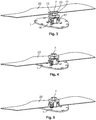
- the premounting position shown in Figure 3 is achieved.
- the prepared antenna device is moved, with the attachment arrangement at the front, in the direction of the upper side of the bodywork surface, wherein the attachment arrangement is fed through the recess 23 in the bodywork surface, in particular the vehicle roof 22, until the underside of the base plate 1 comes to rest on the upper side of the bodywork surface.
- This step is depicted in Figure 4 .
- This final fixing has been achieved in that, after the base plate 1 has come to rest against the side of the bodywork surface in a parallel manner (if necessary spaced apart due to the protrusions 5 and/or a circumferential seal and around the base plate 1 and/or a lower rim of an antenna cover), the side arms 16 have again moved somewhat into their original position.
- the final position of the side arms is reached in that the remote end of the angled regions 18 comes to rest on the underside of the vehicle roof 22 and the stepped front side (the end) of the side arms 16 comes to rest on the circumferential rim of the recess 23. This process takes place automatically by appropriately adjusting the respective geometry when the base plate 1 has come to rest on the bodywork surface as intended.
- This position of the side arms 16, which is occupied in Figure 5 can deviate somewhat from the original position of the side arms 16 in the premounting position which is depicted in Figure 3 .
- This tightening of the screw 7 advantageously takes place with a predetermined torque, so that, once the predetermined torque has been reached, the antenna device is permanently fixed to the bodywork surface.
- a predetermined torque so that, once the predetermined torque has been reached, the antenna device is permanently fixed to the bodywork surface.
- a direction coding pin for example, is also conceivable.
- a spike (pin) which projects out of the base plate, in front of or behind the locking mechanism, in the direction of the bodywork and which, during mounting, is inserted into a hole which determines the orientation of the roof antenna.
Landscapes
- Engineering & Computer Science (AREA)
- Remote Sensing (AREA)
- Mechanical Engineering (AREA)
- Support Of Aerials (AREA)
- Fittings On The Vehicle Exterior For Carrying Loads, And Devices For Holding Or Mounting Articles (AREA)
Abstract
Description
- The invention relates to an antenna device for a vehicle, wherein the antenna device has a base plate, an expansion element and an actuating element cooperating with the base plate and the expansion element, according to the features of the preamble of
Claim 1. - An antenna device for a vehicle is known from
US 2011/0267243 A1 . The antenna device is placed onto the upper side of a bodywork surface, in particular a vehicle roof, wherein the underside of a base plate of the antenna device comes to rest on the upper side of the bodywork surface. An area of the base plate is accessible from the underside of the bodywork surface because this has a corresponding cutout. From the underside of the bodywork surface, an expansion element is brought into operative connection with the base plate, wherein the expansion element is actuated by an actuating element and expands, as a result of which, by virtue of the expanding effect, the antenna device is permanently, but releasably, arranged and fixed on the upper side of the bodywork surface. Two expansion elements which cooperate with a sleeve, a clamping element and the actuating element are present in this prior art. The two expansion elements are both elements which are formed and act individually independently and which are both arranged in a cross shape, wherein this cross shape is specified by the clamping element, which is likewise formed in a cross shape. Each individual expansion element is effective individually, which means that, in this prior art, even only one single expansion element would be sufficient for permanently arranging and fixing the roof antenna. In its central area, the expansion element is configured to be flat and has a fully enclosed opening through which the actuating element can be guided. A number of angled areas protrude from the central flat area of the respective expansion element, these angled areas achieving a spring effect and being required during the process of feeding the preassembled roof antenna through the cutout in the bodywork surface. After the two expansion elements have been arranged in a cross shape on the underside by means of the sleeve and the clamping element, they are firstly held by the actuating element (screw). This can be seen inFigure 4 of this US printed publication. In this state, the roof antenna prepared in this manner is placed onto the upper side of the bodywork surface from above and the prepared attachment arrangement is fed through the cutout in the bodywork surface, such that this attachment arrangement is accessible from the underside of the bodywork surface. While the attachment arrangement is being fed through the cutout in the bodywork surface, the protruding side arms of the two expansion elements, which arms are angled in their axial progression, are pressed together and move back into their starting position again when the underside of the base plate has come to rest on the upper side of the bodywork surface. This process is depicted inFigures 5-7 of the US printed publication. After this movement back, the front ends of an angled area of the side arms rest against the underside of the bodywork surface beside the recess (also referred to as a cutout), thus giving rise to a supporting effect if the actuating element is actuated further. Through this further actuation, which is shown in Figure 8 of the US printed publication, the underside of the base plate is pulled further in the direction of the upper side of the bodywork surface and is permanently fixed as a result. The two expansion elements manufactured separately from one another have, primarily due to their multiple angled regions, an extremely complex geometrical shape both in the longitudinal direction and in the transverse direction and are therefore difficult to manufacture. Furthermore, the entire attachment arrangement consists not only of these two expansion elements, but rather also additionally of the sleeve and the clamping element, so that the two expansion elements do not function without the clamping element or the sleeve being present. Thus, if the clamping element or sleeve were to be forgotten during mounting, the two expansion elements would not function. The two known expansion elements are mated together in the axial direction of the actuating element to form the cross shape. Furthermore, the passage opening for the actuating element is closed in the circumferential direction. - Similar attachment arrangements for arranging and attaching antenna devices, in particular roof antennas, on bodywork surfaces, in particular a roof, of vehicles are known from
US 2013/0082158 A1 andUS 2018/0026328 A1 . - The invention is based on the problem of providing an antenna device for a vehicle which is less expensive than the prior art and which offers improved mounting.
- This problem is solved by the features of
Claim 1. - It is envisaged according to the invention that the expansion element is formed by a first expansion element part and at least one further expansion element part that is mated with this first expansion element part, wherein the first expansion element part has at least one flat area and the at least one further expansion element part also has at least one flat area, wherein a side arm protrudes at an angle from the flat area of the first expansion element part and a side arm protrudes from the flat area of the at least further expansion element part, wherein in each flat area there is provided a laterally open breakthrough for mating the first expansion element part with the at least further expansion element part and for forming a single passage opening for the actuating element. This configuration firstly has the advantage that only one single expansion element, consisting of two individual parts, is required in order to arrange and permanently fix the antenna device on a bodywork surface. The two expansion element parts are provided for this purpose, with these not functioning in isolation but fulfilling the required function when mated. On the one hand, the two mated expansion element parts form a circumferentially closed passage opening for the actuating element, with them being laterally open in their flat area in the not yet mated state in order to enable mating, which takes place transverse to the axial orientation of the actuating element. Furthermore, the side arms can be configured significantly simpler since it is not necessary to achieve a spring effect with these. The side arms thus extend at an angle from the flat area of the respective expansion element part in the direction of the base plate of the antenna device, such that the attachment arrangement of the antenna device, after being placed onto the bodywork surface of the vehicle, can be supported by the front end of the side arms on the underside of the bodywork surface. Advantageously, precisely two expansion element parts form the single expansion element of the attachment arrangement. Consideration can also be given to using more than two expansion element parts which are then arranged in a triangle, in a cross or the like and form the single expansion element of the attachment arrangement.
- The two expansion parts need not necessarily be laterally open. Alternatively they may also have a breakthrough at the front or back, i.e. they may be open. The above-described mating of the individual parts is also not necessarily required: alternatively, the two parts can be laid over one another and only be secured by the screw.
In a further development of the invention, it is envisaged that the first expansion element part and the at least further expansion element part are prestressed by means of a spring element at the base plate. By way of this prestressing by means of the spring element, it is advantageously achieved that the side arms of the at least two expansion elements can be fed through the recess in the bodywork surface, after they have been fixed to the base plate by means of the actuating element (before the antenna device is mounted on the bodywork surface). This feeding-through takes place either without touching the side rims of the recess or preferably by touching the side rims of the recess, with the side arms of the two expansion element parts being moved somewhat in the direction of the central axis of the attachment arrangement as a result. This means that they are pressed together somewhat during the feed-through process. This has the advantage that the two side arms, when the base plate is placed by its underside onto the upper side of the bodywork surface, move back into their starting position again (due to the prestressing by means of the spring element), such that the ends of the two side arms come to rest on the underside of the bodywork surface. This guarantees that the antenna device is arranged in a first position (also referred to as the premounting position) on the bodywork surface. This arrangement is either already final (enabled in particular through the use of further elasticity means such as seals or the like, because otherwise no sealing effect can be achieved, if it is intended to be achieved), such that further orienting of the placed-on antenna device can be dispensed with, or it is possible that the antenna device, after being placed on, may still be oriented in its final position. This depends on how the base plate and the recess as well as the attachment arrangement of the antenna device are configured. This shall be explored in this regard in the further description of the figures. The pressing-apart of the two side arms thus advantageously takes place due to the prestressing by means of the spring element, but, omitting the spring element, can also take place by means of only the actuating element. Where applicable, an additional element is necessary (guide, sliding link, or similar). - In a particularly preferred configuration, the spring element is formed as a spiral spring to produce the prestressing. This has the advantage that a conventional spring element, through which the actuating element, for example a screw, can be fed, is employed.
- In a further development of the invention, it is envisaged that each expansion element part has two flat areas, wherein the two flat areas of each expansion element part are oriented offset from one another in planes. As a result of this, the two expansion element parts are mated due to the presence of their respective lateral open breakthrough and are pivoted after the mating, so that the flat areas, oriented at a particular angle to one another prior to the pivoting, of a respective expansion element part come to rest on one another virtually parallel to one another. As a result, the two expansion element parts form a double layer around the passage opening for the actuating element, so that as a result either the area which arises is strengthened around the passage opening overall or the individual flat areas of the at least two expansion element parts can be formed thinner in terms of the material. Without mating the two expansion element parts and subsequently pivoting them, there is not yet any functional expansion element available for the attachment arrangement of the antenna device. Furthermore, mounting would not yet be possible previously because no unambiguous passage opening is formed for the actuating element.
- In a further development of the invention, it is envisaged that an angled edge area is present at least partially around a flat area. The respective angled flat area of each expansion element part, as a result, causes the facing respective flat area of the other expansion element part to be guided together in a targeted manner after the mating and pivoting, in order to form the double layer around the passage opening for the actuating element. This targeted guiding-together of the two expansion element parts by the edge area provides greater stability to the mated expansion element and simplifies mounting.
- In a further development of the invention, it is envisaged that the side arm has at least one angled region which is oriented in the longitudinal direction of the side arm, which angled region ends at a distance from the front end of the side arm and/or has, in its axial progression, an arcuate shape at the front end. The first variant advantageously causes the end of the angled region to come to rest on the underside of the bodywork surface, after the base plate is arranged with its attachment arrangement on the upper side of the bodywork surface, while the further, i.e. stepped end area of the side arm reaches into the recess of the bodywork surface and in particular comes to rest there on the side rims of the recess. As a result, there is a targeted guiding of the respective side arm after arranging and precisely fixing the antenna device on the bodywork surface. The second variant advantageously causes the in particular prestressed side arms to be able to be more easily pressed together when being fed through the recess in the bodywork surface and to reliably move back into their starting position again when the base plate of the antenna device has been placed onto the upper side of the bodywork surface. As a result, the mounting of the antenna device is made easier.
- In a further development of the invention, the side arm of the respective expansion element part has two parallel angled regions. As a result, the entire strength of the attachment arrangement, with which the antenna device is arranged and fixed permanently and releasably on the bodywork surface, is significantly increased after the attaching process due to a uniform distribution of forces.
- In a further development of the invention, it is envisaged that the at least two expansion element parts are formed from either a plastics material or a metal substance. If plastic is used, the expansion element parts can be manufactured inexpensively, precisely and in large quantities in a plastics injection-moulding method. This is particularly appropriate if the expansion element parts do not have to take on any electrical function. However, if, for example, a ground connection of the antenna device to further electrical units within the vehicle is required, for example via the electrically conductive bodywork surface, the expansion element parts are formed from a metal substance. In such a case, the manufacture can be carried out in a known stamping-bending method, for example, wherein the desired geometry of the respective expansion element part is formed from a flat sheet-metal material. In order to form a single expansion element from two (or where necessary more than two) expansion element parts, expansion element parts made of identical materials (i.e. either made only of plastic or only of a metal substance) are used. However, it is also conceivable, for example, to mate one expansion element part made of plastic and one expansion element part made of a metal substance to form the single expansion element.
- In a further development of the invention, it is envisaged that the at least two expansion element parts are configured as identical parts (either made of plastic or made of a metal substance). This simplifies the manufacture of the expansion element parts, reduces the variety of parts and increases the ease of mounting because the necessity of mating two different parts is effectively avoided.
- An exemplary embodiment of an antenna device according to the invention with an associated attachment arrangement and an appropriate attaching method is described hereafter and explained in greater detail by way of the figures.
-
Figure 1 shows abase plate 1 which is equipped on its underside with an elevation. -
Figure 2 shows the final orientation of the twoexpansion element parts -
Figure 3 shows the premounting position of the attachment arrangement of the antenna device. -
Figure 4 shows the movement of the antenna device during the feeding of the attachment arrangement thereof through therecess 23. -
Figure 5 shows the final mounting position of the antenna device when permanently arranged and fixed on thevehicle roof 22. - The essential elements of the antenna device and the attachment arrangement are depicted in
Figure 1 . For the sake of simplicity, the elements required for the functioning of the antenna device, such as antennas for receiving or transmitting high-frequency signals, printed circuit boards, foils or the like (on which the antennas are arranged), mechanical configurations (such as an antenna cover, seals and the like) and electrical configurations (such as cabling, plug connectors and the like) are not depicted, but are present. - The antenna device depicted in
Figure 1 has abase plate 1 which is equipped on its underside with an elevation, in particular adome 2. Thebase plate 1 is made of plastic or metal. Thedome 2 protrudes from the underside, but can also only or additionally be oriented in the direction of the other side of thebase plate 1. It is also conceivable that thisdome 2 can be dispensed with. Thedome 2 has a threadedopening 3. Over its circumference, thedome 2 is equipped with at least onesupport 4, in this case with precisely foursupports 4.Protrusions 5 are present on the underside of thebase plate 1. By means of theseprotrusions 5, the underside of thebase plate 1 is kept spaced apart from the upper side of the bodywork surface, which is required in particular if a seal and/or an underside of an antenna cover projects over the underside of thebase plate 1 over the circumference of the side rim of thebase plate 1, in order to bring about uniform bearing of the antenna device on the bodywork surface. To attach an antenna cover, which is not depicted, thebase plate 1 may have a plurality ofbreakthoughs 6 distributed over its circumference, through which screws, for example, are fed, by means of which screws the antenna cover and thebase plate 1 are connected to one another. - The front ends of the
supports 4 are in particular selected such that they correspond to side rims of a recess in the bodywork surface (not depicted yet inFigure 1 ), in order to guide the antenna device in a targeted manner after placement onto the bodywork surface and to arrange it in a defined premounting position. - The further elements of the attachment arrangement are an actuating element in the form of a
screw 7. Thescrew 7 has ascrew head 8 and a threaded piece 9. The threaded piece 9 corresponds to the internal thread in the threadedopening 3 in thedome 2. An internal thread may also be provided only in thebase plate 1, for example (omitting the dome 2). The actuating element may alternatively also be formed as a latching element or as an expansion element. However, the configuration of the actuating element as ascrew 7 has the advantage that defined forces may be applied in order to fix the antenna device permanently on the bodywork surface of the vehicle. This may be done, for example, by tightening thescrew 7 by means of a torque wrench. - Furthermore, a first
expansion element part 10 and at least one furtherexpansion element part 11 are provided to form a single expansion element of the attachment arrangement. In the following description and the figures, it is assumed that precisely twoexpansion element parts expansion element parts flat area flat areas Figure 1 , the respectiveflat areas expansion element parts expansion element part flat area side arm side arm flat area side arms angled region 18 in each case. In the design according toFigure 1 , one angledregion 18 is present in each case in the lateral elongate end areas of theside arms angled regions 18 have been correspondingly bent in the lateral end area of theside arms expansion element part - In the central area of the
flat areas breakthrough 19 for the actuating element, in particular thescrew 7. However, thisbreakthrough 19 is not circumferentially closed, but rather has an opening outwards to the side (for example in the form of a slot). This opening causes the twoexpansion element parts screw 7. This process takes place by way of the twoexpansion element parts flat areas expansion element part 10 come to rest flatly on the associatedflat areas expansion element part 11. - The completed mating process and completed pivoting and thus the final orientation of the two
expansion element parts Figure 2 . - Furthermore, it can be seen in
Figure 1 that, in this exemplary embodiment, anedge area 20 is present around the flat areas 12-15. Thisedge area 20 can also only be present in one of the twoexpansion element parts expansion element part edge area 20 too is advantageously manufactured from a metal substance in the stamping-bending method. The pivoting process of the twoexpansion element parts edge area 20 and causes the twoexpansion element parts - In order to perform prestressing of the mated and pivoted
expansion element parts base plate 1, aspring element 21 is present. In this exemplary embodiment, thisspring element 21 is formed as a spiral spring, through which thescrew 7 is fed. As a result, the spiral spring is arranged in a targeted manner on the attachment arrangement and thebase plate 1 and as a result, in the premounting position, can hold the expansion element in a defined state. - After the required elements of the attachment arrangement have been described in view of
Figures 1 and 2 , reference is made toFigure 3 . It can be seen there that the underside of thebase plate 1 is applied in the direction of the upper side of a bodywork surface, in particular of avehicle roof 22. The bodywork surface has acutout 23, through which the attachment arrangement of the antenna arrangement is fed, this attachment arrangement having been prepared on the underside of thebase plate 1. - The premounting position of the attachment arrangement of the antenna device is thus depicted in
Figure 3 . It can be seen that the two matedexpansion element parts Figure 2 , are fixed to thedome 3 and prestressed. This takes place as a result of the threaded piece 9 of thescrew 7 having been fed through the now fully closed passage opening, which has been formed by the twoexpansion element parts spring element 21, in particular the spiral spring, having likewise been pushed onto the threaded piece 9. Thereafter, this unit has been moved in the direction of the underside of thebase plate 1, the end of the threaded piece 9 of thescrew 7 having been screwed somewhat into the threadedopening 3 of thedome 2. As a result, the premounting position shown inFigure 3 is achieved. In other words, the prepared antenna device is moved, with the attachment arrangement at the front, in the direction of the upper side of the bodywork surface, wherein the attachment arrangement is fed through therecess 23 in the bodywork surface, in particular thevehicle roof 22, until the underside of thebase plate 1 comes to rest on the upper side of the bodywork surface. This step is depicted inFigure 4 . In this case it can be seen that, while the attachment arrangement is being fed through therecess 23, the respective front end of theangled regions 18, which preferably runs in an arcuate manner, comes to rest on the circumferential rim of therecess 23. This in turn causes the twoside arms expansion element part screw 7, this pressing-together being occurring against the spring force of thespring element 21. This pressing-together is structurally enabled in that the twoexpansion element parts expansion element parts side arms 16, do not have to provide any spring effect or prestressing when the antenna device is moved from its premounting position in the direction of the end position. The spring effect or prestressing is only made available by thespring element 21 or, in an alternative configuration, by omitting the spring element, is not generated at all. - While, in
Figure 4 , the movement of the antenna device is depicted during the feeding of the attachment arrangement thereof through therecess 23 in thevehicle roof 22 and while thescrew 7 is also not moved out of the position which it occupies in the premounting position, the final mounting position (final position) is depicted inFigure 5 , in which final mounting position the antenna device is permanently arranged and fixed on the vehicle roof 22 (generally the bodywork surface of the vehicle). This final fixing has been achieved in that, after thebase plate 1 has come to rest against the side of the bodywork surface in a parallel manner (if necessary spaced apart due to theprotrusions 5 and/or a circumferential seal and around thebase plate 1 and/or a lower rim of an antenna cover), theside arms 16 have again moved somewhat into their original position. In the exemplary embodiment, the final position of the side arms is reached in that the remote end of theangled regions 18 comes to rest on the underside of thevehicle roof 22 and the stepped front side (the end) of theside arms 16 comes to rest on the circumferential rim of therecess 23. This process takes place automatically by appropriately adjusting the respective geometry when thebase plate 1 has come to rest on the bodywork surface as intended. In other words, theside arms 16, due to the prestressing of these by means of thespring element 21, move back into the position they occupied in the premounting position and occupy the position depicted inFigure 5 . This position of theside arms 16, which is occupied inFigure 5 , can deviate somewhat from the original position of theside arms 16 in the premounting position which is depicted inFigure 3 . This means that, in the premounting position according toFigure 3 , theside arms 16 protrude somewhat more than in the finally mounted position, as is depicted inFigure 5 . - After the
side arms 16 are pressed together due to the feeding of the attachment arrangement of the antenna device through therecess 23 in the bodywork surface, and after theside arms 16 are pivoted back again upon completion of the feeding-through, they bring about, as a result of their geometric shape, in particular in conjunction with theangled regions 18, a prelatching position of the antenna device so that this antenna device is firstly arranged in its final mounting position on the bodywork surface but not yet permanently effectively fixed. This fixing is carried out by tightening thescrew 7, as a result of which thebase plate 1 is moved (pressed on) just a little further in the direction of the upper side of the bodywork surface. This tightening of thescrew 7 advantageously takes place with a predetermined torque, so that, once the predetermined torque has been reached, the antenna device is permanently fixed to the bodywork surface. Instead of rotationally moving thescrew 7 to carry out fixing, it is also possible to conceive of fixing the antenna device permanently to the bodywork surface by means of a latching element, an expansion element or the like, which is employed instead of thescrew 7. - In the movement sequence depicted in
Figures 3-5 , it can also be seen that thesupports 4 protruding from thedome 2 bring about a guiding (due to their front slant which can also be configured in an arcuate manner) when the attachment arrangement is inserted into therecess 23. As a result, a targeted feeding of the attachment arrangement of the antenna device through therecess 23 and a predefinition of the orientation of the antenna device on the bodywork surface, in particular thevehicle roof 22, takes place. - The guiding described above may be present, but does not have to be present. A direction coding pin, for example, is also conceivable. A spike (pin) which projects out of the base plate, in front of or behind the locking mechanism, in the direction of the bodywork and which, during mounting, is inserted into a hole which determines the orientation of the roof antenna.
- The movement sequence described with regard to
Figures 3-5 and depicted therein can also obviously be reversed for removal. To do this, it is necessary to loosen the tightenedscrew 7 and press theside arms 16 together in the direction of the central axis of thescrew 7. As a result, the locking of the attachment arrangement by means of theside arms 16 and theirangled regions 18 in the region of thecutout 23 in the bodywork surface, which was required during mounting for pre-locking, is dispensed with. If theside arms 16 are pressed together in the direction of the central axis of thescrew 7, which can be carried out by hand, for example, or also by means of a tool, the antenna device can be lifted off the bodywork surface and the attachment arrangement can be pulled out of thecutout 23. - In conclusion, an improved antenna device, in particular an attachment arrangement of an antenna device which is clearly improved compared to the prior art, is available according to the invention, which antenna device is constructed very compactly, requires fewer parts and is very simple to mount. The simplification can be seen in particular in that the antenna device can be prepared and made available with its attachment arrangement. Only thereafter is the antenna device, which is prepared in this manner, employed when finally mounted on the vehicle and can be handled very easily in this regard.
-
- 1.
- Base plate
- 2.
- Dome
- 3.
- Threaded opening
- 4.
- Support
- 5.
- Protrusion
- 6.
- Breakthrough
- 7.
- Screw
- 8.
- Screw head
- 9.
- Threaded piece
- 10.
- First expansion element part
- 11.
- Further expansion element part
- 12.
- Flat area
- 13.
- Flat area
- 14.
- Flat area
- 15.
- Flat area
- 16.
- Side arm
- 17.
- Side arm
- 18.
- Angled region
- 19.
- Breakthrough
- 20.
- Edge area
- 21.
- Spring element
- 22.
- Vehicle roof
- 23.
- Cutout
Claims (10)
- An antenna device for a vehicle, wherein the antenna device has a base plate (1), an expansion element and an actuating element cooperating with the base plate (1) and the expansion element, characterised in that the expansion element is formed by a first expansion element part (10) and at least one further expansion element part (11) that is mated with this expansion element part (10), wherein the first expansion element part (10) has at least one flat area (12, 14) and the at least one further expansion element part (11) also has at least one flat area (13,15), wherein a side arm (16) protrudes at an angle from the flat area (14) of the first expansion element part (10) and a side arm (17) protrudes from the flat area (15) of the at least further expansion element part (11), wherein in each flat area (12, 14; 13, 15) there is provided a laterally open breakthrough (19) for mating the first expansion element part (10) with the at least further expansion element part (11) and for forming a single passage opening for the actuating element.
- The antenna device according to Claim 1, characterised in that the first expansion element part (10) and the at least further expansion element part (11) are prestressed by means of a spring element at the base plate (1).
- The antenna device according to Claim 2, characterised in that the spring element (21) is formed as a spiral spring.
- The antenna device according to Claim 1, 2 or 3, characterised in that each expansion element part (10, 11) has two flat areas (12, 14; 13, 15), wherein the two flat areas of each expansion element part (10, 11) are oriented offset from one another.
- The antenna device according to Claim 1, 2, 3 or 4, characterised in that an angled edge area (20) is present at least partially around a flat area.
- The antenna device according to any one of the preceding claims, characterised in that the side arm (16, 17) has at least one angled region (18) which is oriented in the longitudinal direction of the side arm, which angled region ends at a distance from the front end of the side arm and/or has, in its axial progression, an arcuate shape at the front end.
- The antenna device according to any one of the preceding claims, characterised in that the side arm (16, 17) has two parallel angled regions (18).
- The antenna device according to any one of the preceding claims, characterised in that the at least two expansion element parts (10, 11) are formed from a plastics material.
- The antenna device according to any one of the preceding claims, characterised in that the at least two expansion element parts (10, 11) are formed from a metal substance.
- The antenna device according to any one of the preceding claims, characterised in that the at least two expansion element parts (10, 11) are configured as identical parts.
Applications Claiming Priority (1)
| Application Number | Priority Date | Filing Date | Title |
|---|---|---|---|
| DE102019116652.7A DE102019116652B3 (en) | 2019-06-19 | 2019-06-19 | Mounting arrangement of an antenna device for a vehicle |
Publications (2)
| Publication Number | Publication Date |
|---|---|
| EP3754781A1 true EP3754781A1 (en) | 2020-12-23 |
| EP3754781B1 EP3754781B1 (en) | 2023-05-17 |
Family
ID=70859572
Family Applications (1)
| Application Number | Title | Priority Date | Filing Date |
|---|---|---|---|
| EP20180904.3A Active EP3754781B1 (en) | 2019-06-19 | 2020-06-18 | Attachment arrangement of an antenna device for a vehicle |
Country Status (6)
| Country | Link |
|---|---|
| US (1) | US11502386B2 (en) |
| EP (1) | EP3754781B1 (en) |
| JP (1) | JP7521724B2 (en) |
| KR (1) | KR102743262B1 (en) |
| CN (1) | CN112117526B (en) |
| DE (1) | DE102019116652B3 (en) |
Citations (6)
| Publication number | Priority date | Publication date | Assignee | Title |
|---|---|---|---|---|
| DE202009009067U1 (en) * | 2009-07-01 | 2009-11-26 | Antennentechnik Bad Blankenburg Ag | Arrangement for fastening a vehicle antenna |
| US20110133047A1 (en) * | 2008-08-08 | 2011-06-09 | Blaupunkt Antenna Systems Gmbh & Co. Kg | Support for a motor vehicle attachment part and device for supporting a motor vehicle attachment part |
| US20110267243A1 (en) | 2010-04-29 | 2011-11-03 | Laird Technologies Gmbh | Vehicle antenna mounting apparatus, systems, and methods |
| US20130082158A1 (en) | 2011-10-03 | 2013-04-04 | Kyuichi Sato | Fixing device and antenna device |
| US20180026328A1 (en) | 2016-07-21 | 2018-01-25 | Mitsumi Electric Co., Ltd. | Antenna mounting component and antenna device |
| US10148004B2 (en) * | 2014-08-14 | 2018-12-04 | Harada Industry Co., Ltd. | Roof-mount antenna mounting structure |
Family Cites Families (8)
| Publication number | Priority date | Publication date | Assignee | Title |
|---|---|---|---|---|
| US6714171B2 (en) * | 2002-06-14 | 2004-03-30 | Centurion Wireless Technologies, Inc. | Antenna mounting apparatuses and methods |
| DE102005044610A1 (en) | 2004-09-28 | 2006-03-30 | Hirschmann Car Communication Gmbh | Antenna and method for mounting an antenna to a vehicle by means of clamping force, preferably generated by a rotating bayonet |
| DE102006009660B4 (en) * | 2006-03-02 | 2012-03-08 | Blaupunkt Antenna Systems Gmbh & Co. Kg | Antenna bracket and associated antenna |
| US7492319B2 (en) * | 2006-09-22 | 2009-02-17 | Laird Technologies, Inc. | Antenna assemblies including standard electrical connections and captured retainers and fasteners |
| CN104282990B (en) * | 2013-07-12 | 2017-11-14 | 莱尔德无线技术(上海)有限公司 | Car antenna component |
| EP2840290B1 (en) * | 2013-08-20 | 2018-11-07 | Kaiser GmbH & Co. KG | Assembly in the form of a fire-proof and/or gas-proof conduit lead-through |
| JP2018184022A (en) * | 2017-04-24 | 2018-11-22 | ミツミ電機株式会社 | Antenna mounting component and antenna device |
| CN110323532A (en) * | 2018-03-29 | 2019-10-11 | 康普技术有限责任公司 | The method of mounting structure, antenna equipment and assembling aerial equipment |
-
2019
- 2019-06-19 DE DE102019116652.7A patent/DE102019116652B3/en active Active
-
2020
- 2020-06-15 JP JP2020102853A patent/JP7521724B2/en active Active
- 2020-06-17 US US16/903,937 patent/US11502386B2/en active Active
- 2020-06-18 KR KR1020200074031A patent/KR102743262B1/en active Active
- 2020-06-18 EP EP20180904.3A patent/EP3754781B1/en active Active
- 2020-06-19 CN CN202010564777.6A patent/CN112117526B/en active Active
Patent Citations (6)
| Publication number | Priority date | Publication date | Assignee | Title |
|---|---|---|---|---|
| US20110133047A1 (en) * | 2008-08-08 | 2011-06-09 | Blaupunkt Antenna Systems Gmbh & Co. Kg | Support for a motor vehicle attachment part and device for supporting a motor vehicle attachment part |
| DE202009009067U1 (en) * | 2009-07-01 | 2009-11-26 | Antennentechnik Bad Blankenburg Ag | Arrangement for fastening a vehicle antenna |
| US20110267243A1 (en) | 2010-04-29 | 2011-11-03 | Laird Technologies Gmbh | Vehicle antenna mounting apparatus, systems, and methods |
| US20130082158A1 (en) | 2011-10-03 | 2013-04-04 | Kyuichi Sato | Fixing device and antenna device |
| US10148004B2 (en) * | 2014-08-14 | 2018-12-04 | Harada Industry Co., Ltd. | Roof-mount antenna mounting structure |
| US20180026328A1 (en) | 2016-07-21 | 2018-01-25 | Mitsumi Electric Co., Ltd. | Antenna mounting component and antenna device |
Also Published As
| Publication number | Publication date |
|---|---|
| JP2021002828A (en) | 2021-01-07 |
| CN112117526B (en) | 2025-04-29 |
| KR102743262B1 (en) | 2024-12-13 |
| US11502386B2 (en) | 2022-11-15 |
| KR20200145733A (en) | 2020-12-30 |
| CN112117526A (en) | 2020-12-22 |
| DE102019116652B3 (en) | 2020-06-18 |
| US20200403292A1 (en) | 2020-12-24 |
| EP3754781B1 (en) | 2023-05-17 |
| JP7521724B2 (en) | 2024-07-24 |
Similar Documents
| Publication | Publication Date | Title |
|---|---|---|
| EP0685903B1 (en) | Device for connection to a post | |
| US8441401B2 (en) | Vehicle antenna mounting apparatus, systems, and methods | |
| US8622356B2 (en) | Support for a motor vehicle attachment part and device for supporting a motor vehicle attachment part | |
| US8059044B2 (en) | Antenna mounting apparatus and methods including claw fasteners and/or bayonet locking structures | |
| US10008768B2 (en) | Capacitively shielded housing, in particular capacitively shielded component housing for an antenna device | |
| US4090030A (en) | Antenna mount and connector | |
| US20160020514A1 (en) | Methods and Devices for Reducing Passive Intermodulation in RF Antennas | |
| CN103503230A (en) | Locking a roof antenna of a vehicle by means of a star handle | |
| EP2684258B1 (en) | An electric connector accessory and its method of assembly | |
| US4136986A (en) | Automobile antenna mount structure | |
| EP3754781B1 (en) | Attachment arrangement of an antenna device for a vehicle | |
| US5697797A (en) | Device for grounded securing of an element at a hole in a metal plate | |
| US4827273A (en) | Antenna mounting apparatus | |
| US12095137B2 (en) | Fastening system for a modular antenna | |
| US2899485A (en) | Antenna mounting device | |
| US2896010A (en) | Automobile antenna | |
| US2251889A (en) | Antenna mounting | |
| EP3550665B1 (en) | Roof panel fastening device for vehicle antenna and vehicle antenna apparatus | |
| NZ248549A (en) | Loop coupler for resonator: rotates to adjust loaded q | |
| CN117280545A (en) | Fixing bolts | |
| USRE23310E (en) | Standoff insulator | |
| US11398672B2 (en) | Roof antenna | |
| JPH10227306A (en) | Earthing device | |
| KR100552194B1 (en) | Ring terminal | |
| JP2023095075A (en) | Base station antenna, and method of adjusting tilt angle control range |
Legal Events
| Date | Code | Title | Description |
|---|---|---|---|
| PUAI | Public reference made under article 153(3) epc to a published international application that has entered the european phase |
Free format text: ORIGINAL CODE: 0009012 |
|
| STAA | Information on the status of an ep patent application or granted ep patent |
Free format text: STATUS: THE APPLICATION HAS BEEN PUBLISHED |
|
| AK | Designated contracting states |
Kind code of ref document: A1 Designated state(s): AL AT BE BG CH CY CZ DE DK EE ES FI FR GB GR HR HU IE IS IT LI LT LU LV MC MK MT NL NO PL PT RO RS SE SI SK SM TR |
|
| AX | Request for extension of the european patent |
Extension state: BA ME |
|
| STAA | Information on the status of an ep patent application or granted ep patent |
Free format text: STATUS: REQUEST FOR EXAMINATION WAS MADE |
|
| 17P | Request for examination filed |
Effective date: 20210622 |
|
| RBV | Designated contracting states (corrected) |
Designated state(s): AL AT BE BG CH CY CZ DE DK EE ES FI FR GB GR HR HU IE IS IT LI LT LU LV MC MK MT NL NO PL PT RO RS SE SI SK SM TR |
|
| GRAP | Despatch of communication of intention to grant a patent |
Free format text: ORIGINAL CODE: EPIDOSNIGR1 |
|
| STAA | Information on the status of an ep patent application or granted ep patent |
Free format text: STATUS: GRANT OF PATENT IS INTENDED |
|
| INTG | Intention to grant announced |
Effective date: 20221130 |
|
| GRAS | Grant fee paid |
Free format text: ORIGINAL CODE: EPIDOSNIGR3 |
|
| GRAA | (expected) grant |
Free format text: ORIGINAL CODE: 0009210 |
|
| STAA | Information on the status of an ep patent application or granted ep patent |
Free format text: STATUS: THE PATENT HAS BEEN GRANTED |
|
| AK | Designated contracting states |
Kind code of ref document: B1 Designated state(s): AL AT BE BG CH CY CZ DE DK EE ES FI FR GB GR HR HU IE IS IT LI LT LU LV MC MK MT NL NO PL PT RO RS SE SI SK SM TR |
|
| REG | Reference to a national code |
Ref country code: GB Ref legal event code: FG4D |
|
| REG | Reference to a national code |
Ref country code: DE Ref legal event code: R096 Ref document number: 602020010901 Country of ref document: DE |
|
| REG | Reference to a national code |
Ref country code: CH Ref legal event code: EP |
|
| REG | Reference to a national code |
Ref country code: IE Ref legal event code: FG4D |
|
| REG | Reference to a national code |
Ref country code: AT Ref legal event code: REF Ref document number: 1568788 Country of ref document: AT Kind code of ref document: T Effective date: 20230615 |
|
| REG | Reference to a national code |
Ref country code: LT Ref legal event code: MG9D |
|
| REG | Reference to a national code |
Ref country code: NL Ref legal event code: MP Effective date: 20230517 |
|
| REG | Reference to a national code |
Ref country code: AT Ref legal event code: MK05 Ref document number: 1568788 Country of ref document: AT Kind code of ref document: T Effective date: 20230517 |
|
| PG25 | Lapsed in a contracting state [announced via postgrant information from national office to epo] |
Ref country code: SE Free format text: LAPSE BECAUSE OF FAILURE TO SUBMIT A TRANSLATION OF THE DESCRIPTION OR TO PAY THE FEE WITHIN THE PRESCRIBED TIME-LIMIT Effective date: 20230517 Ref country code: PT Free format text: LAPSE BECAUSE OF FAILURE TO SUBMIT A TRANSLATION OF THE DESCRIPTION OR TO PAY THE FEE WITHIN THE PRESCRIBED TIME-LIMIT Effective date: 20230918 Ref country code: NO Free format text: LAPSE BECAUSE OF FAILURE TO SUBMIT A TRANSLATION OF THE DESCRIPTION OR TO PAY THE FEE WITHIN THE PRESCRIBED TIME-LIMIT Effective date: 20230817 Ref country code: NL Free format text: LAPSE BECAUSE OF FAILURE TO SUBMIT A TRANSLATION OF THE DESCRIPTION OR TO PAY THE FEE WITHIN THE PRESCRIBED TIME-LIMIT Effective date: 20230517 Ref country code: ES Free format text: LAPSE BECAUSE OF FAILURE TO SUBMIT A TRANSLATION OF THE DESCRIPTION OR TO PAY THE FEE WITHIN THE PRESCRIBED TIME-LIMIT Effective date: 20230517 Ref country code: AT Free format text: LAPSE BECAUSE OF FAILURE TO SUBMIT A TRANSLATION OF THE DESCRIPTION OR TO PAY THE FEE WITHIN THE PRESCRIBED TIME-LIMIT Effective date: 20230517 |
|
| PG25 | Lapsed in a contracting state [announced via postgrant information from national office to epo] |
Ref country code: RS Free format text: LAPSE BECAUSE OF FAILURE TO SUBMIT A TRANSLATION OF THE DESCRIPTION OR TO PAY THE FEE WITHIN THE PRESCRIBED TIME-LIMIT Effective date: 20230517 Ref country code: PL Free format text: LAPSE BECAUSE OF FAILURE TO SUBMIT A TRANSLATION OF THE DESCRIPTION OR TO PAY THE FEE WITHIN THE PRESCRIBED TIME-LIMIT Effective date: 20230517 Ref country code: LV Free format text: LAPSE BECAUSE OF FAILURE TO SUBMIT A TRANSLATION OF THE DESCRIPTION OR TO PAY THE FEE WITHIN THE PRESCRIBED TIME-LIMIT Effective date: 20230517 Ref country code: LT Free format text: LAPSE BECAUSE OF FAILURE TO SUBMIT A TRANSLATION OF THE DESCRIPTION OR TO PAY THE FEE WITHIN THE PRESCRIBED TIME-LIMIT Effective date: 20230517 Ref country code: IS Free format text: LAPSE BECAUSE OF FAILURE TO SUBMIT A TRANSLATION OF THE DESCRIPTION OR TO PAY THE FEE WITHIN THE PRESCRIBED TIME-LIMIT Effective date: 20230917 Ref country code: HR Free format text: LAPSE BECAUSE OF FAILURE TO SUBMIT A TRANSLATION OF THE DESCRIPTION OR TO PAY THE FEE WITHIN THE PRESCRIBED TIME-LIMIT Effective date: 20230517 Ref country code: GR Free format text: LAPSE BECAUSE OF FAILURE TO SUBMIT A TRANSLATION OF THE DESCRIPTION OR TO PAY THE FEE WITHIN THE PRESCRIBED TIME-LIMIT Effective date: 20230818 |
|
| PG25 | Lapsed in a contracting state [announced via postgrant information from national office to epo] |
Ref country code: FI Free format text: LAPSE BECAUSE OF FAILURE TO SUBMIT A TRANSLATION OF THE DESCRIPTION OR TO PAY THE FEE WITHIN THE PRESCRIBED TIME-LIMIT Effective date: 20230517 |
|
| PG25 | Lapsed in a contracting state [announced via postgrant information from national office to epo] |
Ref country code: SK Free format text: LAPSE BECAUSE OF FAILURE TO SUBMIT A TRANSLATION OF THE DESCRIPTION OR TO PAY THE FEE WITHIN THE PRESCRIBED TIME-LIMIT Effective date: 20230517 |
|
| PG25 | Lapsed in a contracting state [announced via postgrant information from national office to epo] |
Ref country code: SM Free format text: LAPSE BECAUSE OF FAILURE TO SUBMIT A TRANSLATION OF THE DESCRIPTION OR TO PAY THE FEE WITHIN THE PRESCRIBED TIME-LIMIT Effective date: 20230517 Ref country code: SK Free format text: LAPSE BECAUSE OF FAILURE TO SUBMIT A TRANSLATION OF THE DESCRIPTION OR TO PAY THE FEE WITHIN THE PRESCRIBED TIME-LIMIT Effective date: 20230517 Ref country code: RO Free format text: LAPSE BECAUSE OF FAILURE TO SUBMIT A TRANSLATION OF THE DESCRIPTION OR TO PAY THE FEE WITHIN THE PRESCRIBED TIME-LIMIT Effective date: 20230517 Ref country code: EE Free format text: LAPSE BECAUSE OF FAILURE TO SUBMIT A TRANSLATION OF THE DESCRIPTION OR TO PAY THE FEE WITHIN THE PRESCRIBED TIME-LIMIT Effective date: 20230517 Ref country code: DK Free format text: LAPSE BECAUSE OF FAILURE TO SUBMIT A TRANSLATION OF THE DESCRIPTION OR TO PAY THE FEE WITHIN THE PRESCRIBED TIME-LIMIT Effective date: 20230517 Ref country code: CZ Free format text: LAPSE BECAUSE OF FAILURE TO SUBMIT A TRANSLATION OF THE DESCRIPTION OR TO PAY THE FEE WITHIN THE PRESCRIBED TIME-LIMIT Effective date: 20230517 |
|
| REG | Reference to a national code |
Ref country code: CH Ref legal event code: PL |
|
| REG | Reference to a national code |
Ref country code: DE Ref legal event code: R097 Ref document number: 602020010901 Country of ref document: DE |
|
| REG | Reference to a national code |
Ref country code: BE Ref legal event code: MM Effective date: 20230630 |
|
| PG25 | Lapsed in a contracting state [announced via postgrant information from national office to epo] |
Ref country code: MC Free format text: LAPSE BECAUSE OF FAILURE TO SUBMIT A TRANSLATION OF THE DESCRIPTION OR TO PAY THE FEE WITHIN THE PRESCRIBED TIME-LIMIT Effective date: 20230517 |
|
| PG25 | Lapsed in a contracting state [announced via postgrant information from national office to epo] |
Ref country code: MC Free format text: LAPSE BECAUSE OF FAILURE TO SUBMIT A TRANSLATION OF THE DESCRIPTION OR TO PAY THE FEE WITHIN THE PRESCRIBED TIME-LIMIT Effective date: 20230517 |
|
| PG25 | Lapsed in a contracting state [announced via postgrant information from national office to epo] |
Ref country code: LU Free format text: LAPSE BECAUSE OF NON-PAYMENT OF DUE FEES Effective date: 20230618 |
|
| PLBE | No opposition filed within time limit |
Free format text: ORIGINAL CODE: 0009261 |
|
| STAA | Information on the status of an ep patent application or granted ep patent |
Free format text: STATUS: NO OPPOSITION FILED WITHIN TIME LIMIT |
|
| REG | Reference to a national code |
Ref country code: IE Ref legal event code: MM4A |
|
| PG25 | Lapsed in a contracting state [announced via postgrant information from national office to epo] |
Ref country code: LU Free format text: LAPSE BECAUSE OF NON-PAYMENT OF DUE FEES Effective date: 20230618 |
|
| PG25 | Lapsed in a contracting state [announced via postgrant information from national office to epo] |
Ref country code: IE Free format text: LAPSE BECAUSE OF NON-PAYMENT OF DUE FEES Effective date: 20230618 |
|
| 26N | No opposition filed |
Effective date: 20240220 |
|
| PG25 | Lapsed in a contracting state [announced via postgrant information from national office to epo] |
Ref country code: IE Free format text: LAPSE BECAUSE OF NON-PAYMENT OF DUE FEES Effective date: 20230618 Ref country code: CH Free format text: LAPSE BECAUSE OF NON-PAYMENT OF DUE FEES Effective date: 20230630 |
|
| PG25 | Lapsed in a contracting state [announced via postgrant information from national office to epo] |
Ref country code: SI Free format text: LAPSE BECAUSE OF FAILURE TO SUBMIT A TRANSLATION OF THE DESCRIPTION OR TO PAY THE FEE WITHIN THE PRESCRIBED TIME-LIMIT Effective date: 20230517 |
|
| PG25 | Lapsed in a contracting state [announced via postgrant information from national office to epo] |
Ref country code: SI Free format text: LAPSE BECAUSE OF FAILURE TO SUBMIT A TRANSLATION OF THE DESCRIPTION OR TO PAY THE FEE WITHIN THE PRESCRIBED TIME-LIMIT Effective date: 20230517 Ref country code: BE Free format text: LAPSE BECAUSE OF NON-PAYMENT OF DUE FEES Effective date: 20230630 |
|
| PG25 | Lapsed in a contracting state [announced via postgrant information from national office to epo] |
Ref country code: BG Free format text: LAPSE BECAUSE OF FAILURE TO SUBMIT A TRANSLATION OF THE DESCRIPTION OR TO PAY THE FEE WITHIN THE PRESCRIBED TIME-LIMIT Effective date: 20230517 |
|
| PG25 | Lapsed in a contracting state [announced via postgrant information from national office to epo] |
Ref country code: BG Free format text: LAPSE BECAUSE OF FAILURE TO SUBMIT A TRANSLATION OF THE DESCRIPTION OR TO PAY THE FEE WITHIN THE PRESCRIBED TIME-LIMIT Effective date: 20230517 |
|
| GBPC | Gb: european patent ceased through non-payment of renewal fee |
Effective date: 20240618 |
|
| PG25 | Lapsed in a contracting state [announced via postgrant information from national office to epo] |
Ref country code: GB Free format text: LAPSE BECAUSE OF NON-PAYMENT OF DUE FEES Effective date: 20240618 |
|
| PGFP | Annual fee paid to national office [announced via postgrant information from national office to epo] |
Ref country code: DE Payment date: 20250627 Year of fee payment: 6 |
|
| PGFP | Annual fee paid to national office [announced via postgrant information from national office to epo] |
Ref country code: FR Payment date: 20250625 Year of fee payment: 6 |
|
| PG25 | Lapsed in a contracting state [announced via postgrant information from national office to epo] |
Ref country code: CY Free format text: LAPSE BECAUSE OF FAILURE TO SUBMIT A TRANSLATION OF THE DESCRIPTION OR TO PAY THE FEE WITHIN THE PRESCRIBED TIME-LIMIT; INVALID AB INITIO Effective date: 20200618 |
|
| PG25 | Lapsed in a contracting state [announced via postgrant information from national office to epo] |
Ref country code: HU Free format text: LAPSE BECAUSE OF FAILURE TO SUBMIT A TRANSLATION OF THE DESCRIPTION OR TO PAY THE FEE WITHIN THE PRESCRIBED TIME-LIMIT; INVALID AB INITIO Effective date: 20200618 |
|
| PGFP | Annual fee paid to national office [announced via postgrant information from national office to epo] |
Ref country code: IT Payment date: 20250619 Year of fee payment: 6 |
|
| PG25 | Lapsed in a contracting state [announced via postgrant information from national office to epo] |
Ref country code: TR Free format text: LAPSE BECAUSE OF FAILURE TO SUBMIT A TRANSLATION OF THE DESCRIPTION OR TO PAY THE FEE WITHIN THE PRESCRIBED TIME-LIMIT Effective date: 20230517 |