EP3754764A1 - Method and device for preparing lithium transition metal oxide - Google Patents
Method and device for preparing lithium transition metal oxide Download PDFInfo
- Publication number
- EP3754764A1 EP3754764A1 EP19790415.4A EP19790415A EP3754764A1 EP 3754764 A1 EP3754764 A1 EP 3754764A1 EP 19790415 A EP19790415 A EP 19790415A EP 3754764 A1 EP3754764 A1 EP 3754764A1
- Authority
- EP
- European Patent Office
- Prior art keywords
- bed reactor
- moving bed
- transition metal
- gas
- present disclosure
- Prior art date
- Legal status (The legal status is an assumption and is not a legal conclusion. Google has not performed a legal analysis and makes no representation as to the accuracy of the status listed.)
- Withdrawn
Links
- 238000000034 method Methods 0.000 title claims abstract description 51
- 229910021437 lithium-transition metal oxide Inorganic materials 0.000 title 1
- 239000000463 material Substances 0.000 claims abstract description 103
- 239000007789 gas Substances 0.000 claims abstract description 48
- 229910052723 transition metal Inorganic materials 0.000 claims abstract description 39
- 238000001354 calcination Methods 0.000 claims abstract description 37
- 229910001947 lithium oxide Inorganic materials 0.000 claims abstract description 37
- -1 transition metal lithium oxide Chemical class 0.000 claims abstract description 36
- 239000002243 precursor Substances 0.000 claims abstract description 24
- 238000002156 mixing Methods 0.000 claims abstract description 10
- 229910003002 lithium salt Inorganic materials 0.000 claims abstract description 9
- 159000000002 lithium salts Chemical class 0.000 claims abstract description 9
- 150000003623 transition metal compounds Chemical class 0.000 claims abstract description 9
- 239000000919 ceramic Substances 0.000 claims description 26
- QVGXLLKOCUKJST-UHFFFAOYSA-N atomic oxygen Chemical compound [O] QVGXLLKOCUKJST-UHFFFAOYSA-N 0.000 claims description 24
- 239000001301 oxygen Substances 0.000 claims description 24
- 229910052760 oxygen Inorganic materials 0.000 claims description 24
- 238000010438 heat treatment Methods 0.000 claims description 22
- 239000007787 solid Substances 0.000 claims description 18
- 239000003570 air Substances 0.000 claims description 14
- 230000014759 maintenance of location Effects 0.000 claims description 11
- IJGRMHOSHXDMSA-UHFFFAOYSA-N Atomic nitrogen Chemical compound N#N IJGRMHOSHXDMSA-UHFFFAOYSA-N 0.000 claims description 10
- 230000002093 peripheral effect Effects 0.000 claims description 8
- 230000005855 radiation Effects 0.000 claims description 8
- 229910052757 nitrogen Inorganic materials 0.000 claims description 5
- 230000036284 oxygen consumption Effects 0.000 abstract description 8
- 230000003247 decreasing effect Effects 0.000 abstract description 7
- 239000000945 filler Substances 0.000 abstract description 6
- 239000012071 phase Substances 0.000 abstract description 5
- 239000007790 solid phase Substances 0.000 abstract description 5
- 230000000052 comparative effect Effects 0.000 description 34
- 239000002245 particle Substances 0.000 description 16
- 239000012535 impurity Substances 0.000 description 14
- 238000006243 chemical reaction Methods 0.000 description 12
- 238000005260 corrosion Methods 0.000 description 10
- 230000007797 corrosion Effects 0.000 description 10
- 238000009826 distribution Methods 0.000 description 9
- 229910010293 ceramic material Inorganic materials 0.000 description 7
- 238000004519 manufacturing process Methods 0.000 description 7
- 238000004458 analytical method Methods 0.000 description 6
- 238000005524 ceramic coating Methods 0.000 description 6
- GLXDVVHUTZTUQK-UHFFFAOYSA-M lithium hydroxide monohydrate Substances [Li+].O.[OH-] GLXDVVHUTZTUQK-UHFFFAOYSA-M 0.000 description 6
- 239000011224 oxide ceramic Substances 0.000 description 6
- 229910052574 oxide ceramic Inorganic materials 0.000 description 6
- 238000012360 testing method Methods 0.000 description 6
- 150000003624 transition metals Chemical class 0.000 description 6
- 239000002912 waste gas Substances 0.000 description 6
- WMFOQBRAJBCJND-UHFFFAOYSA-M Lithium hydroxide Chemical compound [Li+].[OH-] WMFOQBRAJBCJND-UHFFFAOYSA-M 0.000 description 5
- 239000011247 coating layer Substances 0.000 description 5
- 239000002131 composite material Substances 0.000 description 5
- 238000011109 contamination Methods 0.000 description 5
- PQVSTLUFSYVLTO-UHFFFAOYSA-N ethyl n-ethoxycarbonylcarbamate Chemical group CCOC(=O)NC(=O)OCC PQVSTLUFSYVLTO-UHFFFAOYSA-N 0.000 description 5
- XGZVUEUWXADBQD-UHFFFAOYSA-L lithium carbonate Chemical compound [Li+].[Li+].[O-]C([O-])=O XGZVUEUWXADBQD-UHFFFAOYSA-L 0.000 description 5
- 229910052808 lithium carbonate Inorganic materials 0.000 description 5
- 229940040692 lithium hydroxide monohydrate Drugs 0.000 description 5
- CURLTUGMZLYLDI-UHFFFAOYSA-N Carbon dioxide Chemical compound O=C=O CURLTUGMZLYLDI-UHFFFAOYSA-N 0.000 description 4
- 229910015872 LiNi0.8Co0.1Mn0.1O2 Inorganic materials 0.000 description 4
- 229910017071 Ni0.6Co0.2Mn0.2(OH)2 Inorganic materials 0.000 description 4
- PXHVJJICTQNCMI-UHFFFAOYSA-N Nickel Chemical compound [Ni] PXHVJJICTQNCMI-UHFFFAOYSA-N 0.000 description 4
- 150000001768 cations Chemical class 0.000 description 4
- 229910052744 lithium Inorganic materials 0.000 description 4
- FUJCRWPEOMXPAD-UHFFFAOYSA-N lithium oxide Chemical compound [Li+].[Li+].[O-2] FUJCRWPEOMXPAD-UHFFFAOYSA-N 0.000 description 4
- 238000002360 preparation method Methods 0.000 description 4
- 239000000758 substrate Substances 0.000 description 4
- XLYOFNOQVPJJNP-UHFFFAOYSA-N water Chemical compound O XLYOFNOQVPJJNP-UHFFFAOYSA-N 0.000 description 4
- PNEYBMLMFCGWSK-UHFFFAOYSA-N Alumina Chemical compound [O-2].[O-2].[O-2].[Al+3].[Al+3] PNEYBMLMFCGWSK-UHFFFAOYSA-N 0.000 description 3
- 229910017223 Ni0.8Co0.1Mn0.1(OH)2 Inorganic materials 0.000 description 3
- 238000010586 diagram Methods 0.000 description 3
- 229910021645 metal ion Inorganic materials 0.000 description 3
- 239000000203 mixture Substances 0.000 description 3
- 150000004767 nitrides Chemical class 0.000 description 3
- UGFAIRIUMAVXCW-UHFFFAOYSA-N Carbon monoxide Chemical compound [O+]#[C-] UGFAIRIUMAVXCW-UHFFFAOYSA-N 0.000 description 2
- 229910011328 LiNi0.6Co0.2Mn0.2O2 Inorganic materials 0.000 description 2
- WHXSMMKQMYFTQS-UHFFFAOYSA-N Lithium Chemical compound [Li] WHXSMMKQMYFTQS-UHFFFAOYSA-N 0.000 description 2
- 229910002092 carbon dioxide Inorganic materials 0.000 description 2
- 239000001569 carbon dioxide Substances 0.000 description 2
- 238000010835 comparative analysis Methods 0.000 description 2
- 238000005265 energy consumption Methods 0.000 description 2
- 238000005516 engineering process Methods 0.000 description 2
- 238000002474 experimental method Methods 0.000 description 2
- 239000003546 flue gas Substances 0.000 description 2
- 239000010410 layer Substances 0.000 description 2
- AMXOYNBUYSYVKV-UHFFFAOYSA-M lithium bromide Chemical compound [Li+].[Br-] AMXOYNBUYSYVKV-UHFFFAOYSA-M 0.000 description 2
- KWGKDLIKAYFUFQ-UHFFFAOYSA-M lithium chloride Chemical compound [Li+].[Cl-] KWGKDLIKAYFUFQ-UHFFFAOYSA-M 0.000 description 2
- PQXKHYXIUOZZFA-UHFFFAOYSA-M lithium fluoride Chemical compound [Li+].[F-] PQXKHYXIUOZZFA-UHFFFAOYSA-M 0.000 description 2
- IIPYXGDZVMZOAP-UHFFFAOYSA-N lithium nitrate Chemical compound [Li+].[O-][N+]([O-])=O IIPYXGDZVMZOAP-UHFFFAOYSA-N 0.000 description 2
- 229910052751 metal Inorganic materials 0.000 description 2
- 239000002184 metal Substances 0.000 description 2
- 229910001092 metal group alloy Inorganic materials 0.000 description 2
- 238000012986 modification Methods 0.000 description 2
- 230000004048 modification Effects 0.000 description 2
- 239000002994 raw material Substances 0.000 description 2
- 229910000314 transition metal oxide Inorganic materials 0.000 description 2
- 229910052580 B4C Inorganic materials 0.000 description 1
- OKTJSMMVPCPJKN-UHFFFAOYSA-N Carbon Chemical compound [C] OKTJSMMVPCPJKN-UHFFFAOYSA-N 0.000 description 1
- 229910008096 Li1+aNixCoyMn1-x-yO2 Inorganic materials 0.000 description 1
- 229910032387 LiCoO2 Inorganic materials 0.000 description 1
- 229910015694 LiNi0.85Co0.1Al0.05O2 Inorganic materials 0.000 description 1
- 229910003005 LiNiO2 Inorganic materials 0.000 description 1
- ZOKXTWBITQBERF-UHFFFAOYSA-N Molybdenum Chemical compound [Mo] ZOKXTWBITQBERF-UHFFFAOYSA-N 0.000 description 1
- 229910006180 NixCoyAl1-x-yO2 Inorganic materials 0.000 description 1
- 239000004677 Nylon Substances 0.000 description 1
- 239000004809 Teflon Substances 0.000 description 1
- 229920006362 Teflon® Polymers 0.000 description 1
- RTAQQCXQSZGOHL-UHFFFAOYSA-N Titanium Chemical compound [Ti] RTAQQCXQSZGOHL-UHFFFAOYSA-N 0.000 description 1
- 238000002441 X-ray diffraction Methods 0.000 description 1
- 239000000956 alloy Substances 0.000 description 1
- NDPGDHBNXZOBJS-UHFFFAOYSA-N aluminum lithium cobalt(2+) nickel(2+) oxygen(2-) Chemical compound [Li+].[O--].[O--].[O--].[O--].[Al+3].[Co++].[Ni++] NDPGDHBNXZOBJS-UHFFFAOYSA-N 0.000 description 1
- 230000009286 beneficial effect Effects 0.000 description 1
- INAHAJYZKVIDIZ-UHFFFAOYSA-N boron carbide Chemical compound B12B3B4C32B41 INAHAJYZKVIDIZ-UHFFFAOYSA-N 0.000 description 1
- 239000010941 cobalt Substances 0.000 description 1
- 229910017052 cobalt Inorganic materials 0.000 description 1
- GUTLYIVDDKVIGB-UHFFFAOYSA-N cobalt atom Chemical compound [Co] GUTLYIVDDKVIGB-UHFFFAOYSA-N 0.000 description 1
- 238000002485 combustion reaction Methods 0.000 description 1
- 150000001875 compounds Chemical class 0.000 description 1
- 238000000840 electrochemical analysis Methods 0.000 description 1
- 238000004880 explosion Methods 0.000 description 1
- 239000002737 fuel gas Substances 0.000 description 1
- 239000010439 graphite Substances 0.000 description 1
- 229910002804 graphite Inorganic materials 0.000 description 1
- 230000005484 gravity Effects 0.000 description 1
- 238000009413 insulation Methods 0.000 description 1
- 239000012774 insulation material Substances 0.000 description 1
- XIXADJRWDQXREU-UHFFFAOYSA-M lithium acetate Chemical compound [Li+].CC([O-])=O XIXADJRWDQXREU-UHFFFAOYSA-M 0.000 description 1
- 229910000032 lithium hydrogen carbonate Inorganic materials 0.000 description 1
- HPGPEWYJWRWDTP-UHFFFAOYSA-N lithium peroxide Chemical compound [Li+].[Li+].[O-][O-] HPGPEWYJWRWDTP-UHFFFAOYSA-N 0.000 description 1
- INHCSSUBVCNVSK-UHFFFAOYSA-L lithium sulfate Inorganic materials [Li+].[Li+].[O-]S([O-])(=O)=O INHCSSUBVCNVSK-UHFFFAOYSA-L 0.000 description 1
- HQRPHMAXFVUBJX-UHFFFAOYSA-M lithium;hydrogen carbonate Chemical compound [Li+].OC([O-])=O HQRPHMAXFVUBJX-UHFFFAOYSA-M 0.000 description 1
- WPBNNNQJVZRUHP-UHFFFAOYSA-L manganese(2+);methyl n-[[2-(methoxycarbonylcarbamothioylamino)phenyl]carbamothioyl]carbamate;n-[2-(sulfidocarbothioylamino)ethyl]carbamodithioate Chemical compound [Mn+2].[S-]C(=S)NCCNC([S-])=S.COC(=O)NC(=S)NC1=CC=CC=C1NC(=S)NC(=O)OC WPBNNNQJVZRUHP-UHFFFAOYSA-L 0.000 description 1
- 239000007769 metal material Substances 0.000 description 1
- 229910052750 molybdenum Inorganic materials 0.000 description 1
- 239000011733 molybdenum Substances 0.000 description 1
- AYOOGWWGECJQPI-NSHDSACASA-N n-[(1s)-1-(5-fluoropyrimidin-2-yl)ethyl]-3-(3-propan-2-yloxy-1h-pyrazol-5-yl)imidazo[4,5-b]pyridin-5-amine Chemical compound N1C(OC(C)C)=CC(N2C3=NC(N[C@@H](C)C=4N=CC(F)=CN=4)=CC=C3N=C2)=N1 AYOOGWWGECJQPI-NSHDSACASA-N 0.000 description 1
- 229910052759 nickel Inorganic materials 0.000 description 1
- 229920001778 nylon Polymers 0.000 description 1
- 239000010450 olivine Substances 0.000 description 1
- 229910052609 olivine Inorganic materials 0.000 description 1
- 238000007254 oxidation reaction Methods 0.000 description 1
- RVTZCBVAJQQJTK-UHFFFAOYSA-N oxygen(2-);zirconium(4+) Chemical compound [O-2].[O-2].[Zr+4] RVTZCBVAJQQJTK-UHFFFAOYSA-N 0.000 description 1
- 238000007415 particle size distribution analysis Methods 0.000 description 1
- 238000011056 performance test Methods 0.000 description 1
- 239000002861 polymer material Substances 0.000 description 1
- 229920002635 polyurethane Polymers 0.000 description 1
- 239000004814 polyurethane Substances 0.000 description 1
- 239000000843 powder Substances 0.000 description 1
- 239000000376 reactant Substances 0.000 description 1
- 239000011343 solid material Substances 0.000 description 1
- 238000010532 solid phase synthesis reaction Methods 0.000 description 1
- 229910052596 spinel Inorganic materials 0.000 description 1
- 239000011029 spinel Substances 0.000 description 1
- 239000000126 substance Substances 0.000 description 1
- RBTVSNLYYIMMKS-UHFFFAOYSA-N tert-butyl 3-aminoazetidine-1-carboxylate;hydrochloride Chemical compound Cl.CC(C)(C)OC(=O)N1CC(N)C1 RBTVSNLYYIMMKS-UHFFFAOYSA-N 0.000 description 1
- 239000010936 titanium Substances 0.000 description 1
- 229910052719 titanium Inorganic materials 0.000 description 1
- 229910000299 transition metal carbonate Inorganic materials 0.000 description 1
- UONOETXJSWQNOL-UHFFFAOYSA-N tungsten carbide Chemical compound [W+]#[C-] UONOETXJSWQNOL-UHFFFAOYSA-N 0.000 description 1
- 229910052720 vanadium Inorganic materials 0.000 description 1
- GPPXJZIENCGNKB-UHFFFAOYSA-N vanadium Chemical compound [V]#[V] GPPXJZIENCGNKB-UHFFFAOYSA-N 0.000 description 1
- 229910001928 zirconium oxide Inorganic materials 0.000 description 1
Images


Classifications
-
- H—ELECTRICITY
- H01—ELECTRIC ELEMENTS
- H01M—PROCESSES OR MEANS, e.g. BATTERIES, FOR THE DIRECT CONVERSION OF CHEMICAL ENERGY INTO ELECTRICAL ENERGY
- H01M4/00—Electrodes
- H01M4/02—Electrodes composed of, or comprising, active material
- H01M4/36—Selection of substances as active materials, active masses, active liquids
- H01M4/48—Selection of substances as active materials, active masses, active liquids of inorganic oxides or hydroxides
- H01M4/52—Selection of substances as active materials, active masses, active liquids of inorganic oxides or hydroxides of nickel, cobalt or iron
- H01M4/525—Selection of substances as active materials, active masses, active liquids of inorganic oxides or hydroxides of nickel, cobalt or iron of mixed oxides or hydroxides containing iron, cobalt or nickel for inserting or intercalating light metals, e.g. LiNiO2, LiCoO2 or LiCoOxFy
-
- B—PERFORMING OPERATIONS; TRANSPORTING
- B01—PHYSICAL OR CHEMICAL PROCESSES OR APPARATUS IN GENERAL
- B01J—CHEMICAL OR PHYSICAL PROCESSES, e.g. CATALYSIS OR COLLOID CHEMISTRY; THEIR RELEVANT APPARATUS
- B01J19/00—Chemical, physical or physico-chemical processes in general; Their relevant apparatus
- B01J19/0006—Controlling or regulating processes
- B01J19/002—Avoiding undesirable reactions or side-effects, e.g. avoiding explosions, or improving the yield by suppressing side-reactions
-
- B—PERFORMING OPERATIONS; TRANSPORTING
- B01—PHYSICAL OR CHEMICAL PROCESSES OR APPARATUS IN GENERAL
- B01J—CHEMICAL OR PHYSICAL PROCESSES, e.g. CATALYSIS OR COLLOID CHEMISTRY; THEIR RELEVANT APPARATUS
- B01J19/00—Chemical, physical or physico-chemical processes in general; Their relevant apparatus
- B01J19/28—Moving reactors, e.g. rotary drums
-
- B—PERFORMING OPERATIONS; TRANSPORTING
- B01—PHYSICAL OR CHEMICAL PROCESSES OR APPARATUS IN GENERAL
- B01J—CHEMICAL OR PHYSICAL PROCESSES, e.g. CATALYSIS OR COLLOID CHEMISTRY; THEIR RELEVANT APPARATUS
- B01J4/00—Feed or outlet devices; Feed or outlet control devices
- B01J4/001—Feed or outlet devices as such, e.g. feeding tubes
- B01J4/004—Sparger-type elements
-
- B—PERFORMING OPERATIONS; TRANSPORTING
- B01—PHYSICAL OR CHEMICAL PROCESSES OR APPARATUS IN GENERAL
- B01J—CHEMICAL OR PHYSICAL PROCESSES, e.g. CATALYSIS OR COLLOID CHEMISTRY; THEIR RELEVANT APPARATUS
- B01J6/00—Heat treatments such as Calcining; Fusing ; Pyrolysis
- B01J6/001—Calcining
-
- B—PERFORMING OPERATIONS; TRANSPORTING
- B01—PHYSICAL OR CHEMICAL PROCESSES OR APPARATUS IN GENERAL
- B01J—CHEMICAL OR PHYSICAL PROCESSES, e.g. CATALYSIS OR COLLOID CHEMISTRY; THEIR RELEVANT APPARATUS
- B01J6/00—Heat treatments such as Calcining; Fusing ; Pyrolysis
- B01J6/001—Calcining
- B01J6/002—Calcining using rotating drums
-
- B—PERFORMING OPERATIONS; TRANSPORTING
- B01—PHYSICAL OR CHEMICAL PROCESSES OR APPARATUS IN GENERAL
- B01J—CHEMICAL OR PHYSICAL PROCESSES, e.g. CATALYSIS OR COLLOID CHEMISTRY; THEIR RELEVANT APPARATUS
- B01J8/00—Chemical or physical processes in general, conducted in the presence of fluids and solid particles; Apparatus for such processes
- B01J8/005—Separating solid material from the gas/liquid stream
- B01J8/0055—Separating solid material from the gas/liquid stream using cyclones
-
- B—PERFORMING OPERATIONS; TRANSPORTING
- B01—PHYSICAL OR CHEMICAL PROCESSES OR APPARATUS IN GENERAL
- B01J—CHEMICAL OR PHYSICAL PROCESSES, e.g. CATALYSIS OR COLLOID CHEMISTRY; THEIR RELEVANT APPARATUS
- B01J8/00—Chemical or physical processes in general, conducted in the presence of fluids and solid particles; Apparatus for such processes
- B01J8/08—Chemical or physical processes in general, conducted in the presence of fluids and solid particles; Apparatus for such processes with moving particles
-
- B—PERFORMING OPERATIONS; TRANSPORTING
- B01—PHYSICAL OR CHEMICAL PROCESSES OR APPARATUS IN GENERAL
- B01J—CHEMICAL OR PHYSICAL PROCESSES, e.g. CATALYSIS OR COLLOID CHEMISTRY; THEIR RELEVANT APPARATUS
- B01J8/00—Chemical or physical processes in general, conducted in the presence of fluids and solid particles; Apparatus for such processes
- B01J8/08—Chemical or physical processes in general, conducted in the presence of fluids and solid particles; Apparatus for such processes with moving particles
- B01J8/087—Heating or cooling the reactor
-
- B—PERFORMING OPERATIONS; TRANSPORTING
- B01—PHYSICAL OR CHEMICAL PROCESSES OR APPARATUS IN GENERAL
- B01J—CHEMICAL OR PHYSICAL PROCESSES, e.g. CATALYSIS OR COLLOID CHEMISTRY; THEIR RELEVANT APPARATUS
- B01J8/00—Chemical or physical processes in general, conducted in the presence of fluids and solid particles; Apparatus for such processes
- B01J8/08—Chemical or physical processes in general, conducted in the presence of fluids and solid particles; Apparatus for such processes with moving particles
- B01J8/12—Chemical or physical processes in general, conducted in the presence of fluids and solid particles; Apparatus for such processes with moving particles moved by gravity in a downward flow
-
- B—PERFORMING OPERATIONS; TRANSPORTING
- B01—PHYSICAL OR CHEMICAL PROCESSES OR APPARATUS IN GENERAL
- B01J—CHEMICAL OR PHYSICAL PROCESSES, e.g. CATALYSIS OR COLLOID CHEMISTRY; THEIR RELEVANT APPARATUS
- B01J8/00—Chemical or physical processes in general, conducted in the presence of fluids and solid particles; Apparatus for such processes
- B01J8/18—Chemical or physical processes in general, conducted in the presence of fluids and solid particles; Apparatus for such processes with fluidised particles
- B01J8/24—Chemical or physical processes in general, conducted in the presence of fluids and solid particles; Apparatus for such processes with fluidised particles according to "fluidised-bed" technique
-
- B—PERFORMING OPERATIONS; TRANSPORTING
- B01—PHYSICAL OR CHEMICAL PROCESSES OR APPARATUS IN GENERAL
- B01J—CHEMICAL OR PHYSICAL PROCESSES, e.g. CATALYSIS OR COLLOID CHEMISTRY; THEIR RELEVANT APPARATUS
- B01J8/00—Chemical or physical processes in general, conducted in the presence of fluids and solid particles; Apparatus for such processes
- B01J8/18—Chemical or physical processes in general, conducted in the presence of fluids and solid particles; Apparatus for such processes with fluidised particles
- B01J8/24—Chemical or physical processes in general, conducted in the presence of fluids and solid particles; Apparatus for such processes with fluidised particles according to "fluidised-bed" technique
- B01J8/42—Chemical or physical processes in general, conducted in the presence of fluids and solid particles; Apparatus for such processes with fluidised particles according to "fluidised-bed" technique with fluidised bed subjected to electric current or to radiations this sub-group includes the fluidised bed subjected to electric or magnetic fields
-
- C—CHEMISTRY; METALLURGY
- C01—INORGANIC CHEMISTRY
- C01G—COMPOUNDS CONTAINING METALS NOT COVERED BY SUBCLASSES C01D OR C01F
- C01G53/00—Compounds of nickel
- C01G53/40—Complex oxides containing nickel and at least one other metal element
- C01G53/42—Complex oxides containing nickel and at least one other metal element containing alkali metals, e.g. LiNiO2
-
- C—CHEMISTRY; METALLURGY
- C01—INORGANIC CHEMISTRY
- C01G—COMPOUNDS CONTAINING METALS NOT COVERED BY SUBCLASSES C01D OR C01F
- C01G53/00—Compounds of nickel
- C01G53/40—Complex oxides containing nickel and at least one other metal element
- C01G53/42—Complex oxides containing nickel and at least one other metal element containing alkali metals, e.g. LiNiO2
- C01G53/44—Complex oxides containing nickel and at least one other metal element containing alkali metals, e.g. LiNiO2 containing manganese
- C01G53/50—Complex oxides containing nickel and at least one other metal element containing alkali metals, e.g. LiNiO2 containing manganese of the type (MnO2)n-, e.g. Li(NixMn1-x)O2 or Li(MyNixMn1-x-y)O2
-
- H—ELECTRICITY
- H01—ELECTRIC ELEMENTS
- H01B—CABLES; CONDUCTORS; INSULATORS; SELECTION OF MATERIALS FOR THEIR CONDUCTIVE, INSULATING OR DIELECTRIC PROPERTIES
- H01B1/00—Conductors or conductive bodies characterised by the conductive materials; Selection of materials as conductors
- H01B1/06—Conductors or conductive bodies characterised by the conductive materials; Selection of materials as conductors mainly consisting of other non-metallic substances
- H01B1/08—Conductors or conductive bodies characterised by the conductive materials; Selection of materials as conductors mainly consisting of other non-metallic substances oxides
-
- H—ELECTRICITY
- H01—ELECTRIC ELEMENTS
- H01M—PROCESSES OR MEANS, e.g. BATTERIES, FOR THE DIRECT CONVERSION OF CHEMICAL ENERGY INTO ELECTRICAL ENERGY
- H01M4/00—Electrodes
- H01M4/02—Electrodes composed of, or comprising, active material
- H01M4/04—Processes of manufacture in general
- H01M4/0471—Processes of manufacture in general involving thermal treatment, e.g. firing, sintering, backing particulate active material, thermal decomposition, pyrolysis
-
- H—ELECTRICITY
- H01—ELECTRIC ELEMENTS
- H01M—PROCESSES OR MEANS, e.g. BATTERIES, FOR THE DIRECT CONVERSION OF CHEMICAL ENERGY INTO ELECTRICAL ENERGY
- H01M4/00—Electrodes
- H01M4/02—Electrodes composed of, or comprising, active material
- H01M4/36—Selection of substances as active materials, active masses, active liquids
- H01M4/48—Selection of substances as active materials, active masses, active liquids of inorganic oxides or hydroxides
- H01M4/50—Selection of substances as active materials, active masses, active liquids of inorganic oxides or hydroxides of manganese
- H01M4/505—Selection of substances as active materials, active masses, active liquids of inorganic oxides or hydroxides of manganese of mixed oxides or hydroxides containing manganese for inserting or intercalating light metals, e.g. LiMn2O4 or LiMn2OxFy
-
- B—PERFORMING OPERATIONS; TRANSPORTING
- B01—PHYSICAL OR CHEMICAL PROCESSES OR APPARATUS IN GENERAL
- B01J—CHEMICAL OR PHYSICAL PROCESSES, e.g. CATALYSIS OR COLLOID CHEMISTRY; THEIR RELEVANT APPARATUS
- B01J2208/00—Processes carried out in the presence of solid particles; Reactors therefor
- B01J2208/00008—Controlling the process
- B01J2208/00017—Controlling the temperature
- B01J2208/00106—Controlling the temperature by indirect heat exchange
- B01J2208/00168—Controlling the temperature by indirect heat exchange with heat exchange elements outside the bed of solid particles
-
- B—PERFORMING OPERATIONS; TRANSPORTING
- B01—PHYSICAL OR CHEMICAL PROCESSES OR APPARATUS IN GENERAL
- B01J—CHEMICAL OR PHYSICAL PROCESSES, e.g. CATALYSIS OR COLLOID CHEMISTRY; THEIR RELEVANT APPARATUS
- B01J2208/00—Processes carried out in the presence of solid particles; Reactors therefor
- B01J2208/00008—Controlling the process
- B01J2208/00017—Controlling the temperature
- B01J2208/00106—Controlling the temperature by indirect heat exchange
- B01J2208/00168—Controlling the temperature by indirect heat exchange with heat exchange elements outside the bed of solid particles
- B01J2208/00176—Controlling the temperature by indirect heat exchange with heat exchange elements outside the bed of solid particles outside the reactor
-
- B—PERFORMING OPERATIONS; TRANSPORTING
- B01—PHYSICAL OR CHEMICAL PROCESSES OR APPARATUS IN GENERAL
- B01J—CHEMICAL OR PHYSICAL PROCESSES, e.g. CATALYSIS OR COLLOID CHEMISTRY; THEIR RELEVANT APPARATUS
- B01J2208/00—Processes carried out in the presence of solid particles; Reactors therefor
- B01J2208/00008—Controlling the process
- B01J2208/00017—Controlling the temperature
- B01J2208/00106—Controlling the temperature by indirect heat exchange
- B01J2208/00168—Controlling the temperature by indirect heat exchange with heat exchange elements outside the bed of solid particles
- B01J2208/00203—Coils
-
- B—PERFORMING OPERATIONS; TRANSPORTING
- B01—PHYSICAL OR CHEMICAL PROCESSES OR APPARATUS IN GENERAL
- B01J—CHEMICAL OR PHYSICAL PROCESSES, e.g. CATALYSIS OR COLLOID CHEMISTRY; THEIR RELEVANT APPARATUS
- B01J2208/00—Processes carried out in the presence of solid particles; Reactors therefor
- B01J2208/00008—Controlling the process
- B01J2208/00017—Controlling the temperature
- B01J2208/00106—Controlling the temperature by indirect heat exchange
- B01J2208/00168—Controlling the temperature by indirect heat exchange with heat exchange elements outside the bed of solid particles
- B01J2208/00212—Plates; Jackets; Cylinders
-
- B—PERFORMING OPERATIONS; TRANSPORTING
- B01—PHYSICAL OR CHEMICAL PROCESSES OR APPARATUS IN GENERAL
- B01J—CHEMICAL OR PHYSICAL PROCESSES, e.g. CATALYSIS OR COLLOID CHEMISTRY; THEIR RELEVANT APPARATUS
- B01J2208/00—Processes carried out in the presence of solid particles; Reactors therefor
- B01J2208/00008—Controlling the process
- B01J2208/00017—Controlling the temperature
- B01J2208/00389—Controlling the temperature using electric heating or cooling elements
-
- B—PERFORMING OPERATIONS; TRANSPORTING
- B01—PHYSICAL OR CHEMICAL PROCESSES OR APPARATUS IN GENERAL
- B01J—CHEMICAL OR PHYSICAL PROCESSES, e.g. CATALYSIS OR COLLOID CHEMISTRY; THEIR RELEVANT APPARATUS
- B01J2208/00—Processes carried out in the presence of solid particles; Reactors therefor
- B01J2208/00008—Controlling the process
- B01J2208/00017—Controlling the temperature
- B01J2208/00433—Controlling the temperature using electromagnetic heating
-
- B—PERFORMING OPERATIONS; TRANSPORTING
- B01—PHYSICAL OR CHEMICAL PROCESSES OR APPARATUS IN GENERAL
- B01J—CHEMICAL OR PHYSICAL PROCESSES, e.g. CATALYSIS OR COLLOID CHEMISTRY; THEIR RELEVANT APPARATUS
- B01J2208/00—Processes carried out in the presence of solid particles; Reactors therefor
- B01J2208/00008—Controlling the process
- B01J2208/00017—Controlling the temperature
- B01J2208/0053—Controlling multiple zones along the direction of flow, e.g. pre-heating and after-cooling
-
- B—PERFORMING OPERATIONS; TRANSPORTING
- B01—PHYSICAL OR CHEMICAL PROCESSES OR APPARATUS IN GENERAL
- B01J—CHEMICAL OR PHYSICAL PROCESSES, e.g. CATALYSIS OR COLLOID CHEMISTRY; THEIR RELEVANT APPARATUS
- B01J2208/00—Processes carried out in the presence of solid particles; Reactors therefor
- B01J2208/00796—Details of the reactor or of the particulate material
-
- B—PERFORMING OPERATIONS; TRANSPORTING
- B01—PHYSICAL OR CHEMICAL PROCESSES OR APPARATUS IN GENERAL
- B01J—CHEMICAL OR PHYSICAL PROCESSES, e.g. CATALYSIS OR COLLOID CHEMISTRY; THEIR RELEVANT APPARATUS
- B01J2219/00—Chemical, physical or physico-chemical processes in general; Their relevant apparatus
- B01J2219/00761—Details of the reactor
- B01J2219/00763—Baffles
- B01J2219/00765—Baffles attached to the reactor wall
- B01J2219/00768—Baffles attached to the reactor wall vertical
-
- B—PERFORMING OPERATIONS; TRANSPORTING
- B01—PHYSICAL OR CHEMICAL PROCESSES OR APPARATUS IN GENERAL
- B01J—CHEMICAL OR PHYSICAL PROCESSES, e.g. CATALYSIS OR COLLOID CHEMISTRY; THEIR RELEVANT APPARATUS
- B01J2219/00—Chemical, physical or physico-chemical processes in general; Their relevant apparatus
- B01J2219/02—Apparatus characterised by their chemically-resistant properties
- B01J2219/0204—Apparatus characterised by their chemically-resistant properties comprising coatings on the surfaces in direct contact with the reactive components
- B01J2219/0218—Apparatus characterised by their chemically-resistant properties comprising coatings on the surfaces in direct contact with the reactive components of ceramic
-
- C—CHEMISTRY; METALLURGY
- C01—INORGANIC CHEMISTRY
- C01P—INDEXING SCHEME RELATING TO STRUCTURAL AND PHYSICAL ASPECTS OF SOLID INORGANIC COMPOUNDS
- C01P2002/00—Crystal-structural characteristics
- C01P2002/50—Solid solutions
- C01P2002/52—Solid solutions containing elements as dopants
-
- C—CHEMISTRY; METALLURGY
- C01—INORGANIC CHEMISTRY
- C01P—INDEXING SCHEME RELATING TO STRUCTURAL AND PHYSICAL ASPECTS OF SOLID INORGANIC COMPOUNDS
- C01P2002/00—Crystal-structural characteristics
- C01P2002/70—Crystal-structural characteristics defined by measured X-ray, neutron or electron diffraction data
- C01P2002/72—Crystal-structural characteristics defined by measured X-ray, neutron or electron diffraction data by d-values or two theta-values, e.g. as X-ray diagram
-
- C—CHEMISTRY; METALLURGY
- C01—INORGANIC CHEMISTRY
- C01P—INDEXING SCHEME RELATING TO STRUCTURAL AND PHYSICAL ASPECTS OF SOLID INORGANIC COMPOUNDS
- C01P2002/00—Crystal-structural characteristics
- C01P2002/70—Crystal-structural characteristics defined by measured X-ray, neutron or electron diffraction data
- C01P2002/74—Crystal-structural characteristics defined by measured X-ray, neutron or electron diffraction data by peak-intensities or a ratio thereof only
-
- C—CHEMISTRY; METALLURGY
- C01—INORGANIC CHEMISTRY
- C01P—INDEXING SCHEME RELATING TO STRUCTURAL AND PHYSICAL ASPECTS OF SOLID INORGANIC COMPOUNDS
- C01P2004/00—Particle morphology
- C01P2004/51—Particles with a specific particle size distribution
-
- C—CHEMISTRY; METALLURGY
- C01—INORGANIC CHEMISTRY
- C01P—INDEXING SCHEME RELATING TO STRUCTURAL AND PHYSICAL ASPECTS OF SOLID INORGANIC COMPOUNDS
- C01P2004/00—Particle morphology
- C01P2004/60—Particles characterised by their size
- C01P2004/61—Micrometer sized, i.e. from 1-100 micrometer
-
- C—CHEMISTRY; METALLURGY
- C01—INORGANIC CHEMISTRY
- C01P—INDEXING SCHEME RELATING TO STRUCTURAL AND PHYSICAL ASPECTS OF SOLID INORGANIC COMPOUNDS
- C01P2006/00—Physical properties of inorganic compounds
- C01P2006/40—Electric properties
-
- C—CHEMISTRY; METALLURGY
- C01—INORGANIC CHEMISTRY
- C01P—INDEXING SCHEME RELATING TO STRUCTURAL AND PHYSICAL ASPECTS OF SOLID INORGANIC COMPOUNDS
- C01P2006/00—Physical properties of inorganic compounds
- C01P2006/80—Compositional purity
-
- H—ELECTRICITY
- H01—ELECTRIC ELEMENTS
- H01M—PROCESSES OR MEANS, e.g. BATTERIES, FOR THE DIRECT CONVERSION OF CHEMICAL ENERGY INTO ELECTRICAL ENERGY
- H01M10/00—Secondary cells; Manufacture thereof
- H01M10/05—Accumulators with non-aqueous electrolyte
- H01M10/052—Li-accumulators
- H01M10/0525—Rocking-chair batteries, i.e. batteries with lithium insertion or intercalation in both electrodes; Lithium-ion batteries
-
- Y—GENERAL TAGGING OF NEW TECHNOLOGICAL DEVELOPMENTS; GENERAL TAGGING OF CROSS-SECTIONAL TECHNOLOGIES SPANNING OVER SEVERAL SECTIONS OF THE IPC; TECHNICAL SUBJECTS COVERED BY FORMER USPC CROSS-REFERENCE ART COLLECTIONS [XRACs] AND DIGESTS
- Y02—TECHNOLOGIES OR APPLICATIONS FOR MITIGATION OR ADAPTATION AGAINST CLIMATE CHANGE
- Y02E—REDUCTION OF GREENHOUSE GAS [GHG] EMISSIONS, RELATED TO ENERGY GENERATION, TRANSMISSION OR DISTRIBUTION
- Y02E60/00—Enabling technologies; Technologies with a potential or indirect contribution to GHG emissions mitigation
- Y02E60/10—Energy storage using batteries
Definitions
- the present disclosure relates to the field of lithium battery technology, specifically to a method and apparatus for preparing a transition metal lithium oxide.
- mixed solid raw materials are generally continuously heated in a ceramic crucible or saggar at a high temperature.
- the atmosphere is insufficiently contacted with the solid reactant, the exhaust gas is discharged slowly, the scale of production is small, and the nonuniform contact of the raw material particles with the atmosphere affects product consistency. Therefore, it is necessary to improve the production process, to increase the production efficiency and product batch consistency.
- the battery material is sintered by a converter, which is driven by a motor, and the material is continuously stirred during the calcination process.
- This scheme solves the problem of insufficient contact between the atmosphere and the material.
- driving the entire furnace body to rotate by using the motor greatly increases the energy consumption.
- the temperature in the process for preparing the battery material is relatively high, generally in the range of 600°C-1000°C, and the bearing is driven at a high temperature and bears a large torque, which is a great test for the bearing of the driving motor.
- this invention uses the high-temperature flue gas generated by the gas combustion to heat or thermally insulate the material. Firstly, the accuracy of controlling the temperature in this way is not high, and the impurities in the high-temperature flue gas may cause the material performance to deteriorate.
- An object of the present disclosure is to provide a method and apparatus for preparing transition metal lithium oxide.
- the method in the present disclosure effectively solves the problem of insufficient connection of the gas phase and the solid phase.
- the obtained transition metal lithium oxide has excellent electrochemical performances, and can be continuously mass produced.
- the present disclosure provides a method for preparing a transition metal lithium oxide, comprising steps of
- the precalcination temperature is 300-700°C; and the precalcination time is 1-10h.
- the precursor has an angle of repose of ⁇ 50°.
- the moving bed reactor is filled with gas, and the gas is one or more of oxygen, nitrogen or air; and the gas has a flow velocity of 0.01-10cm/s.
- the intermediate moves downward from the feed port at a moving velocity of 0.01-30m/h.
- the intermediate falls downward in the moving bed reactor in a direction at an angle of 0-45° with respect to perpendicular.
- the calcination temperature is 500-1000° C; and the intermediate in the moving bed reactor has a retention time of 5-20h.
- the method further comprises the following steps:
- the present disclosure provides an apparatus for preparing a transition metal lithium oxide, comprising a moving bed reactor; wherein the moving bed reactor has a ceramic inner wall surface, a peripheral heating device is disposed outside the moving bed reactor, several radiation heating elements are disposed in the inner chamber, and a gas distributing member is disposed at the bottom; wherein the several radiation heating elements are uniformly distributed on the ceramic inner wall surface centering on the central axis; a material buffer tank connected with a feed port of the moving bed reactor; a gas-solid separator provided with an inlet, a top outlet and a bottom outlet, wherein the inlet of the gas-solid separator is connected with an upper portion of the moving bed reactor; and a heat exchanger, whose inlet is connected with the top outlet of the gas-solid separator.
- a ceramic liner is disposed in the material buffer tank.
- the present disclosure provides a method for preparing a transition metal lithium oxide, comprising steps of: A) mixing a lithium salt and a transition metal compound, and performing a pretreatment to obtain a precursor; wherein the pretreatment temperature is 100-300°C; and the pretreatment time is 1-10h; B) precalcining the precursor to obtain an intermediate; and C) continuously feeding the intermediate into a feed port of a moving bed reactor, and calcining, to obtain a transition metal lithium oxide.
- a pretreatment process is performed before the precalcination, and the pretreatment temperature and time are further limited, thereby solving the problem of material hardening during the calcination process of battery materials.
- the gas phase and the solid phase are sufficiently contacted, and at the same time the thickness of the filler is increased, the productivity is enhanced and the oxygen consumption is largely decreased at the same time.
- a battery obtained by using the LiNi 0.8 Co 0.1 Mn 0.1 O 2 material prepared in the examples of the present disclosure as the battery material has an initial discharge specific capacity of 201.2mAh/g at 0.2C, a capacity retention rate of 98.5% after 100 cycles at 1C/1C, and the oxygen consumption of a unit mass material is as low as 1.6kg/kg.
- the apparatus of the present disclosure is provided with heating elements inside and outside the moving bed reactor, solving the problem of nonuniform heating of the moving bed reactor during the calcination process.
- Ceramic liners are designed at the positions in contact with the materials, to avoid the corrosion of the reaction apparatus by the material and the contamination of metal ions.
- the present disclosure provides a method for preparing a transition metal lithium oxide, comprising steps of:
- the lithium salt is preferably lithium hydroxide monohydrate, lithium oxide, lithium sulfate, lithium acetate, lithium nitrate, lithium carbonate, lithium hydroxide, lithium peroxide, lithium hydrogencarbonate and lithium halide
- the lithium halide is preferably lithium fluoride, lithium chloride or lithium bromide; and more preferably one or more selected from the group consisting of lithium carbonate, lithium hydroxide and lithium hydroxide monohydrate.
- the transition metal compound is preferably transition metal oxide, transition metal oxyhydroxide, transition metal hydroxide and transition metal carbonate; the transition metal in the transition metal compound is preferably one or more selected from the group consisting of nickel, cobalt, manganese, titanium, vanadium and molybdenum.
- the transition metal oxide may be Ni 0.8 Co 0.1 Mn 0.1 (OH) 2 , Ni 0.6 Co 0.2 Mn 0.2 (OH) 2 or Ni 0.85 Co 0.1 Al 0.05 (OH) 2 .
- the specific surface arear of the transition metal compound is preferably ⁇ 30m 2 /g, more preferably ⁇ 25 m 2 /g, and most preferably ⁇ 20 m 2 /g.
- the prepared transition metal lithium oxide is at least one selected from the group consisting of lithiated spinel, layered oxide, lithiated olivine or lithium nickel-cobalt-aluminum oxide.
- the transition metal lithium oxide in the present disclosure include LiCoO 2 , Li 2 MnO 4 , LiNiO 2 and Li 1+a Ni x Co y Mn 1-x-y O 2 , Li 1+a Ni x CoyAl 1-x-y O 2 compounds, etc., wherein a is 0-0.2, x is 0.33-0.93, and y is 0-0.33.
- the pretreatment temperature is preferably 100-300°C, preferably 200-280°C, and more preferably 240-260°C.
- the pretreatment temperature may be 240°C, 280°C or 300°C; the pretreatment time is preferably 1-10h, more preferably 3-8h, and most preferably 5-6h.
- the precursor obtained by pretreatment preferably has an angle of repose (angle of rest) of ⁇ 50°, more preferably ⁇ 45°, and most preferably 10-40°. Specifically, in an embodiment of the present disclosure, the angle of repose may be 35°.
- the obtained precursor is precalcined to obtain an intermediate.
- clean oxygen-containing gas is preferably continuously introduced during the precalcination process, and the content of oxygen in the oxygen-containing gas is preferably 20%-95%.
- the precalcination temperature is preferably 300-700°C, more preferably 350-650°C, and most preferably 400-600°C. Specifically, in an embodiment of the present disclosure, the precalcination temperature may be 500°C or 550°C.
- the precalcination time is preferably 1-10h, more preferably 3-8h, and most preferably 5-6h.
- the precalcination can be carried out in a fluidized bed reactor, a moving bed reactor, a fixed bed reactor or an agitated bed reactor, or carried out in a rotary kiln, a pendulum kiln, a roller hearth furnace or a tunnel kiln.
- the intermediate is continuously fed into a feed port of a moving bed reactor.
- the intermediate is fed from the feed port to the moving bed reactor, it preferably moves obliquely from top to bottom.
- the oblique and the perpendicular are preferably at an angle of 0-45°.
- the moving bed reactor is filled with gas, and the flow direction of the gas may be from top to bottom, or from bottom to top, preferably opposite to the moving direction of the intermediate, forming a gas-solid countercurrent contact, thereby increasing the contact efficiency of the gas and solid phases and improving the reaction rate of the two phases.
- the intermediate preferably moves downward from the feed port at a moving velocity of 0.01-30m/h, more preferably 0.1-10m/h, and most preferably 0.1-1m/h.
- the moving velocity is 0.1m/h, 0.2m/h, 0.3m/h or 0.6m/h.
- the gas is preferably an oxygen enrichment gas, preferably one or more oxygen enrichment gas selected from the group consisting of oxygen, nitrogen and air, such as a combination gas of oxygen and nitrogen, or air, oxygen, a combination gas of air and nitrogen, or combination gas of air and oxygen.
- the gas preferably has a flow velocity of 0.01-10cm/s, more preferably 0.1-1cm/s, and most preferably 0.1-0.5cm/s.
- the gas has a flow velocity of 0.1cm/s, 0.4cm/s or 0.5cm/s.
- the calcination temperature is preferably 500-1000°C, more preferably 600-900°C, and most preferably 700-800°C. Specifically, in an embodiment of the present disclosure, the calcination temperature is 780°C, 880°C or 900°C.
- the intermediate in the moving bed reactor preferably has a retention time of 5-20h, and more preferably 5-10h. Specifically, in an embodiment of the present disclosure, the retention time is 5h, 6h or 10h.
- the obtained product is preferably recalcined to obtain a transition metal lithium oxide.
- the recalcination can be carried out in a fluidized bed reactor, a moving bed reactor, a rotary kiln, a pendulum kiln, a roller hearth furnace, a tunnel kiln or an agitated bed reactor.
- the recalcination temperature is preferably 500-1000°C, and more preferably 550-950°C.
- the recalcination time is preferably 1-10h, more preferably 2-8h, and most preferably 5-6h.
- the transition metal lithium oxide prepared by the above method has a mean particle size D50 of 1-20 ⁇ m and a specific surface area of 0.1-20m 2 /g.
- the transition metal lithium oxide is used to produce primary rechargeable battery or secondary rechargeable battery, and preferably used to produce secondary rechargeable battery.
- the present disclosure provides an apparatus for preparing a transition metal lithium oxide, comprising a moving bed reactor; wherein the moving bed reactor has a ceramic inner wall surface, a peripheral heating device is disposed outside the moving bed reactor, several radiation heating elements are disposed in the inner chamber, and a gas distributing member is disposed at the bottom; wherein the several radiation heating elements are uniformly distributed on the ceramic inner wall surface centering on the central axis; a material buffer tank connected with a feed port of the moving bed reactor; a gas-solid separator provided with an inlet, a top outlet and a bottom outlet, wherein the inlet of the gas-solid separator is connected with an upper portion of the moving bed reactor; and a heat exchanger, whose inlet is connected with the top outlet of the gas-solid separator.
- the apparatus has a structure as shown in Figure 1 , wherein 1 is a material buffer tank; 1-1 is a ceramic liner of the buffer tank; 2 is a moving bed; 2-1 is a peripheral kiln; 2-2 is a ceramic liner of the moving bed; 2-3 is a gas distributing member; 3 is a solid-gas separator; 4 is a material collecting tank; 5 is a heat exchanger; and 6-1 to 6-9 are valves.
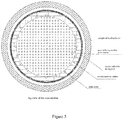
- the moving bed reactor has an inner structure as shown in Figure 5 .
- a liner surface made of ceramic material is disposed inside the moving bed reactor, which is used for preventing the corrosion of reaction apparatus by lithium salts in the material, and preventing the contamination of product by metal ions at the same time.
- the thickness of the ceramic liner is preferably 0.1-20cm, more preferably 1-15cm, and most preferably 5-10cm.
- the ceramic material is preferably one or more selected from the group consisting of oxide ceramics, nitride ceramics, carbide ceramics, ceramic composites, and more preferably oxide ceramics or ceramic composites.
- Several radiation heating elements are disposed in the inner chamber of the moving bed reactor, and the several radiation heating elements are uniformly distributed on the ceramic inner wall surface centering on the central axis; a peripheral heating device is disposed outside the moving bed reactor, which is beneficial to more uniformly temperature distribution inside the moving bed reactor.
- the peripheral heating device is wrapped with a thermal insulation material.
- the peripheral heating device is not limited to electrical heating, and may be fuel gas heating or other heating means.
- the moving bed reactor in the present invention is divided into at least two temperature intervals, and the two temperature intervals are respectively 300-700°C and 700-1000°C; at least one temperature control element that can independently control the temperature is disposed in each temperature interval.
- a gas distributing member is disposed at the bottom of the moving bed reactor, which is used to uniformly distribute the airflow introduced through the air-inflow pipe.
- a gas velocity control device is disposed on the air-inflow pipe, which is used to control the velocity and direction of airflow.
- the size of the moving bed reactor there is no special limitation on the size of the moving bed reactor. Specifically, in an embodiment of the present disclosure, a moving bed reactor having a diameter of 6m and a height of 18m is used, or a moving bed reactor having a diameter of 0.4m and a height of 1m.
- the outlet of the material buffer tank is connected with a feed port of the moving bed reactor, which is used to introduce the reaction material into the moving bed reactor.
- the material buffer tank has an inner wall surface made of a corrosion-resistant material, which is used to withstand the corrosion of lithium salts, and present from reacting with the material to cause contamination.
- the corrosion-resistant material is preferably a ceramic material such as aluminium oxide, zirconium oxide, tungsten carbide, etc., a high polymer material such as Teflon, polyurethane, nylon, etc., or a corrosion-resistant metal alloy material.
- the material buffer tank is preferably provided with a screw-type feeder, or the material feeding is realized by means of free fall under gravity, positive pressure transportation, negative pressure transportation, etc.
- the surface of the screw-type feeder in contact with the material has a surface made of corrosion-resistant material.
- the gas-solid separator is provided with an inlet, a top outlet and a bottom outlet, wherein the inlet of the gas-solid separator is connected with an upper outlet of the moving bed reactor.
- the gas-solid separator is preferably a cyclone separator.
- the material of the cyclone separator is selected from the group consisting of high temperature-resistant, corrosion-resistant metal or metal alloy, or material having an inner wall surface made of ceramic material. The cyclone separator can separate the solid particles entrained in the airflow, and prevent contamination of the air in the workshop.
- the bottom outlet of the gas-solid separator is connected with a material collecting tank, which is used to collect the solid material entrained in the airflow.
- the top outlet of the gas-solid separator is connected with a heat exchanger, which is used to recycle the heat in the exhausted waste gas.
- the exhausted waste gas is heat-exchanged in the heat exchanger to preheat the intake gas, to reduce the heat loss, thereby reducing the energy consumption.
- the moving bed and other kinds of high temperature reactor or kiln can be connected in series by powder transferring pipelines, so as to achieve multiple calcination of the material.
- the pipelines have inner wall surfaces mad of ceramic material.
- the ceramic material can prevent the material from being contaminated to ensure an excellent performance of the material.
- the pipelines have a peripheral heating layer or an insulation layer, so as to ensure that the heat loss is minimized.
- the ceramic material is preferably oxide ceramics, nitride ceramics, carbide ceramics and ceramic composites, and more preferably oxide ceramics or ceramic composites.
- the ceramic composite is preferably oxide ceramic substrate, nitride ceramic substrate, boron carbide ceramic substrate or a combination thereof, and more preferably contains at least one oxide ceramic substrate.
- the present disclosure provides a method for preparing a transition metal lithium oxide, comprising steps of: A) mixing a lithium salt and a transition metal compound, and performing a pretreatment to obtain a precursor; wherein the pretreatment temperature is 100-300°C; and the pretreatment time is 1-10h; B) precalcining the precursor to obtain an intermediate; and C) continuously feeding the intermediate into a feed port of a moving bed reactor, and calcining, to obtain a transition metal lithium oxide.
- a pretreatment process is performed before the precalcination, and the pretreatment temperature and time are further limited, thereby solving the problem of material hardening during the calcination process of battery materials.
- the gas phase and the solid phase are sufficiently contacted, and at the same time the thickness of the filler is increased, the productivity is enhanced and the oxygen consumption is largely decreased at the same time.
- a battery obtained by using the LiNi 0.8 Co 0.1 Mn 0.1 O 2 material prepared in the examples of the present disclosure as the battery material has an initial discharge specific capacity of 201.2mAh/g at 0.2C, a capacity retention rate of 98.5% after 100 cycles at 1C/1C, and the oxygen consumption of a unit mass material is as low as 1.6kg/kg.
- the apparatus of the present disclosure is provided with heating elements inside and outside the moving bed reactor, solving the problem of nonuniform heating of the moving bed reactor during the calcination process.
- Ceramic liners are designed at the positions in contact with the materials, to avoid the corrosion of the reaction apparatus by the material and the contamination of metal ions.
- Ni 0.8 Co 0.1 Mn 0.1 (OH) 2 having a mean particle size of 9 ⁇ m and a specific surface area of 8.2m 2 /g and 48.5kg lithium hydroxide monohydrate were accurately weighted, uniformly mixed, and pretreated at 280°C for 5h. Then, the obtained precursor was precalcined in a tunnel kiln at 500°C, thermal insulated for 5h. In the calcination process, clean oxygen enrichment gas having an oxygen content of 95% was continuously introduced, to obtain a transition metal lithium oxide intermediate.
- the obtained transition metal lithium oxide intermediate was transferred to the feed port at the top of the moving bed reactor through a pipeline, and was then transferred into the moving bed reactor through the feed port at the top of the moving bed reactor.
- the intermediate moved from top to bottom at a velocity of 0.3m/h, and stayed in the moving bed reactor for 6h, and discharged from the bottom of the moving bed reactor, wherein the moving bed reactor had a diameter of 0.6m and a height of 1.8m.
- All of the pipelines, moving bed reactor and feed port had an inner wall surface made of ceramic coating layer which had a thickness of 0.04m, thereby avoiding the introduction of impurities during the calcination process.
- the clean oxygen enrichment gas having an oxygen content of 95% was introduced from the bottom of the moving bed reactor from bottom to top at a velocity of 0.5cm/s. Introduction of oxygen enrichment gas took away waste gases such as water vapor produced in the reaction process.
- the inner temperature of the moving bed reactor was set as 780°C, finally to give a LiNi 0.8 Co 0.1 Mn 0.1 O 2 material.
- the obtained intermediate was transferred to the feed port at the top of the moving bed reactor through a pipeline, and was then transferred into the moving bed reactor through the feed port at the top of the moving bed reactor.
- the intermediate moved from top to bottom at a velocity of 0.1m/h, stayed in the moving bed reactor for 10h, and discharged from the bottom of the moving bed reactor, wherein the moving bed reactor had a diameter of 0.4m and a height of 1m.
- All of the pipelines, moving bed reactor and feed port had an inner wall surface made of ceramic coating layer which had a thickness of 0.05m, thereby avoiding the introduction of impurities during the calcination process.
- Clean air was introduced from the bottom of the moving bed reactor from bottom to top at a velocity of 0.4cm/s. Introduction of clean air took away waste gases such as water vapor and carbon dioxide produced in the reaction process.
- the inner temperature in the moving bed reactor was set as 900°C, finally to give a LiNi 0.6 Co 0.2 Mn 0.2 O 2 material.
- the obtained intermediate was transferred to the feed port at the top of the moving bed reactor through a pipeline, and was then transferred into the moving bed reactor through the feed port at the top of the moving bed reactor.
- the intermediate moved from top to bottom at a velocity of 0.2m/h, stayed in the moving bed reactor for 5h, and discharged from the bottom of the moving bed reactor, wherein the moving bed reactor had a diameter of 0.4m and a height of 1m.
- All of the pipelines, moving bed reactor and feed port had an inner wall surface made of ceramic coating layer which had a thickness of 0.05m, thereby avoiding the introduction of impurities during the calcination process. Clean air was introduced from the bottom of the moving bed reactor from bottom to top at a velocity of 0.1cm/s.
- the inner temperature in the moving bed reactor was set as 880°C, and the calcination time was 10h, finally to give a LiNi 0.6 Co 0.2 Mn 0.2 O 2 material.
- the obtained transition metal lithium oxide intermediate was transferred to the feed port at the top of the moving bed reactor through a pipeline, and was then transferred into the moving bed reactor through the feed port at the top of the moving bed reactor.
- the intermediate moved from top to bottom at a velocity of 0.6m/h, stayed in the moving bed reactor for 6h, and discharged from the bottom of the moving bed reactor, wherein the moving bed reactor had a diameter of 0.6m and a height of 1.8m.
- All of the pipelines, moving bed reactor and feed port had an inner wall surface made of ceramic coating layer which had a thickness of 0.04m, thereby avoiding the introduction of impurities during the calcination process.
- Clean oxygen enrichment gas having an oxygen content of 95% was introduced from the bottom of the moving bed reactor from bottom to top at a velocity of 0.5cm/s. Introduction of oxygen enrichment oxygen took away waste gases such as water vapor produced in the reaction process.
- the inner temperature in the moving bed reactor was set as 780°C, finally to give a LiNi 0.85 Co 0.1 Al 0.05 O 2 material.
- the moving velocity of the material in the moving bed reactor was changed to 0m/h.
- the material stayed in the moving bed reactor for 6h, and discharged from the bottom of the moving bed reactor.
- the other conditions were kept the same as those in Example 4.
- the moving velocity of the material in the moving bed reactor was changed to 40m/h.
- the material stayed in the moving bed reactor for 6h, and discharged from the bottom of the moving bed reactor.
- the other conditions were kept the same as those in Example 4.
- the velocity of the gas was adjusted to 3.5cm/s, and the other conditions were kept the same as those in Example 4.
- Figure 3 showed an XRD figure of the products in Example 2 and Comparative Example 2 of the present disclosure.
- the intensity ratio R of (003) peak and (104) peak was used to indicate the mixing degree of cations in the material.
- the lager R was, the less the mixing degree of the cations in the material was.
- R was larger than 1.2, the cations had a relatively small mixing degree.
- R of the material prepared in the example was 1.72, lager than 1.2, indicating that the mixing degree of the cations in the material was relatively small.
- the material was subjected to electrochemical performance analysis.
- a CR2032 button half-cell was used, and graphite was used as the negative electrode, to test the electrochemical performance of the material at normal temperature (25°C) and normal voltage (3.0-4.3V).
- the preparation process of battery material was an oxidation reaction process, such that sufficient contact with the gas during the calcination process was a necessary condition for ensuring the excellent performance of the material. For this reason, the thickness of filler during the calcination process was a key factor that restricted the production efficiency of battery material.
- Comparison of the electrochemical tests of different batches of material in Example 1 and Comparative example 1 found that this invention solved this problem well and improved the production efficiency.
- Example 1 Oxygen consumption and performance analysis of the material prepared in Example 1 and Comparative example 1 of the present disclosure Test sample Comparative example 1 Example 1 A B C D Height of the filler /mm 25 35 45 55 1800 specific capacity at 0.2C (mAh/g) 200.5 198.4 194.2 191.2 201.2 Retention rate after 100 cycles at 1C/1C /% 93.2 92.8 91.3 87.2 94.1 R(I 003 /I 104 ) 1.66 1.62 1.47 1.29 1.75 oxygen consumption of material of unit mass (kg/kg) 8.0 5.7 4.5 3.9 1.6
- Example 2 showed the particle size distribution analysis of Example 2 and Comparative example 2 in the present disclosure.
- Example 2 was treated at 280°C for 5h, and Comparative example 2 was treated at 80°C for 5h. After the treatment, the angle of repose of the precursor in Example 2 was 35°, and the angle of repose of the precursor in Comparative example2 was 56°.
- the particle size distribution of the material prepared in Example 2 was narrower than that of Comparative example2, and the material had a higher specific capacity, and a better cycle performance. It can be concluded that if the material was directly calcined with a moving bed without pretreatment, the processability and electrochemical performances of the material are seriously influenced.
Landscapes
- Chemical & Material Sciences (AREA)
- Organic Chemistry (AREA)
- Chemical Kinetics & Catalysis (AREA)
- Inorganic Chemistry (AREA)
- Electrochemistry (AREA)
- General Chemical & Material Sciences (AREA)
- Engineering & Computer Science (AREA)
- Combustion & Propulsion (AREA)
- Thermal Sciences (AREA)
- Physics & Mathematics (AREA)
- Manufacturing & Machinery (AREA)
- Battery Electrode And Active Subsutance (AREA)
- Inorganic Compounds Of Heavy Metals (AREA)
Abstract
Description
- This application claims the priority of Chinese Patent Application No.
201910371372.8 201920637155.4 201910433634.9, filed on May 23, 2019 - The present disclosure relates to the field of lithium battery technology, specifically to a method and apparatus for preparing a transition metal lithium oxide.
- In the traditional high-temperature solid-phase methods for producing battery materials, mixed solid raw materials are generally continuously heated in a ceramic crucible or saggar at a high temperature. In the production process, the atmosphere is insufficiently contacted with the solid reactant, the exhaust gas is discharged slowly, the scale of production is small, and the nonuniform contact of the raw material particles with the atmosphere affects product consistency. Therefore, it is necessary to improve the production process, to increase the production efficiency and product batch consistency.
- In
CN 102522526 B , the battery material is sintered by a converter, which is driven by a motor, and the material is continuously stirred during the calcination process. This scheme solves the problem of insufficient contact between the atmosphere and the material. However, driving the entire furnace body to rotate by using the motor greatly increases the energy consumption. At the same time, the temperature in the process for preparing the battery material is relatively high, generally in the range of 600°C-1000°C, and the bearing is driven at a high temperature and bears a large torque, which is a great test for the bearing of the driving motor. At the same time, this invention uses the high-temperature flue gas generated by the gas combustion to heat or thermally insulate the material. Firstly, the accuracy of controlling the temperature in this way is not high, and the impurities in the high-temperature flue gas may cause the material performance to deteriorate. - An object of the present disclosure is to provide a method and apparatus for preparing transition metal lithium oxide. The method in the present disclosure effectively solves the problem of insufficient connection of the gas phase and the solid phase. The obtained transition metal lithium oxide has excellent electrochemical performances, and can be continuously mass produced.
- The present disclosure provides a method for preparing a transition metal lithium oxide, comprising steps of
- A) mixing a lithium salt and a transition metal compound, and performing a pretreatment to obtain a precursor;
wherein the pretreatment temperature is 100-300°C; and the pretreatment time is 1-10h; - B) precalcining the precursor to obtain an intermediate; and
- C) continuously feeding the intermediate into a feed port of a moving bed reactor, and calcining, to obtain a transition metal lithium oxide.
- Preferably, the precalcination temperature is 300-700°C; and
the precalcination time is 1-10h. - Preferably, the precursor has an angle of repose of ≤50°.
- Preferably, the moving bed reactor is filled with gas, and the gas is one or more of oxygen, nitrogen or air; and
the gas has a flow velocity of 0.01-10cm/s. - Preferably, the intermediate moves downward from the feed port at a moving velocity of 0.01-30m/h.
- Preferably, the intermediate falls downward in the moving bed reactor in a direction at an angle of 0-45° with respect to perpendicular.
- Preferably, the calcination temperature is 500-1000° C; and
the intermediate in the moving bed reactor has a retention time of 5-20h. - Preferably, after the calcination of step C), the method further comprises the following steps:
- recalcining the calcined product, to obtain a transition metal lithium oxide;
- wherein the recalcination temperature is 500-1000°C; and
- the recalcination time is 1-10h.
- The present disclosure provides an apparatus for preparing a transition metal lithium oxide, comprising
a moving bed reactor;
wherein the moving bed reactor has a ceramic inner wall surface, a peripheral heating device is disposed outside the moving bed reactor, several radiation heating elements are disposed in the inner chamber, and a gas distributing member is disposed at the bottom;
wherein the several radiation heating elements are uniformly distributed on the ceramic inner wall surface centering on the central axis;
a material buffer tank connected with a feed port of the moving bed reactor;
a gas-solid separator provided with an inlet, a top outlet and a bottom outlet, wherein the inlet of the gas-solid separator is connected with an upper portion of the moving bed reactor; and
a heat exchanger, whose inlet is connected with the top outlet of the gas-solid separator. - Preferably, a ceramic liner is disposed in the material buffer tank.
- The present disclosure provides a method for preparing a transition metal lithium oxide, comprising steps of: A) mixing a lithium salt and a transition metal compound, and performing a pretreatment to obtain a precursor; wherein the pretreatment temperature is 100-300°C; and the pretreatment time is 1-10h; B) precalcining the precursor to obtain an intermediate; and C) continuously feeding the intermediate into a feed port of a moving bed reactor, and calcining, to obtain a transition metal lithium oxide. In the present disclosure, a pretreatment process is performed before the precalcination, and the pretreatment temperature and time are further limited, thereby solving the problem of material hardening during the calcination process of battery materials. In conjunction with using a moving bed reactor, the gas phase and the solid phase are sufficiently contacted, and at the same time the thickness of the filler is increased, the productivity is enhanced and the oxygen consumption is largely decreased at the same time. Experiments show that a battery obtained by using the LiNi0.8Co0.1Mn0.1O2 material prepared in the examples of the present disclosure as the battery material has an initial discharge specific capacity of 201.2mAh/g at 0.2C, a capacity retention rate of 98.5% after 100 cycles at 1C/1C, and the oxygen consumption of a unit mass material is as low as 1.6kg/kg.
- In addition, the apparatus of the present disclosure is provided with heating elements inside and outside the moving bed reactor, solving the problem of nonuniform heating of the moving bed reactor during the calcination process. Ceramic liners are designed at the positions in contact with the materials, to avoid the corrosion of the reaction apparatus by the material and the contamination of metal ions.
- In order to more clearly illustrate the embodiments of the present disclosure or the technical solutions in conventional art, the drawings used in the embodiments or the description in the conventional art will be briefly described hereinafter. It is obvious that the drawings in the following description are merely embodiments of the present disclosure, and one of ordinary skill in the art can obtain other drawings based on the provided drawings without any creative work.
-
Figure 1 shows a structural representation of the apparatus for preparing the transition metal lithium oxide in the present disclosure. -
Figure 2 is a comparison diagram of the particle size distribution of the products in Example 1 and Comparative Example 1 of the present disclosure. -
Figure 3 shows an XRD figure of the products in Example 2 and Comparative Example 2 of the present disclosure. -
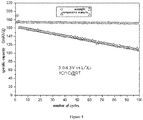
Figure 4 shows a cycle performance diagram of the products in Example 3 and Comparative Example 3 of the present disclosure. -
Figure 5 shows a top view of the cross-section of the moving bed reactor in the present disclosure. - The present disclosure provides a method for preparing a transition metal lithium oxide, comprising steps of:
- A) mixing a lithium salt and a transition metal compound, and performing a pretreatment to obtain a precursor;
wherein the pretreatment temperature is 100-300°C; and the pretreatment time is 1-10h; - B) precalcining the precursor to obtain an intermediate; and
- C) continuously feeding the intermediate into a feed port of a moving bed reactor, and calcining, to obtain a transition metal lithium oxide.
- In the present disclosure, the lithium salt is preferably lithium hydroxide monohydrate, lithium oxide, lithium sulfate, lithium acetate, lithium nitrate, lithium carbonate, lithium hydroxide, lithium peroxide, lithium hydrogencarbonate and lithium halide, and the lithium halide is preferably lithium fluoride, lithium chloride or lithium bromide; and more preferably one or more selected from the group consisting of lithium carbonate, lithium hydroxide and lithium hydroxide monohydrate.
- The transition metal compound is preferably transition metal oxide, transition metal oxyhydroxide, transition metal hydroxide and transition metal carbonate; the transition metal in the transition metal compound is preferably one or more selected from the group consisting of nickel, cobalt, manganese, titanium, vanadium and molybdenum. Specifically, in an embodiment of the present disclosure, the transition metal oxide may be Ni0.8Co0.1Mn0.1(OH)2, Ni0.6Co0.2Mn0.2(OH)2 or Ni0.85Co0.1Al0.05(OH)2. The specific surface arear of the transition metal compound is preferably ≤30m2/g, more preferably ≤25 m2/g, and most preferably ≤20 m2/g.
- In the present disclosure, the prepared transition metal lithium oxide is at least one selected from the group consisting of lithiated spinel, layered oxide, lithiated olivine or lithium nickel-cobalt-aluminum oxide. Examples of the transition metal lithium oxide in the present disclosure include LiCoO2, Li2MnO4, LiNiO2 and Li1+aNixCoyMn1-x-yO2, Li1+aNixCoyAl1-x-yO2 compounds, etc., wherein a is 0-0.2, x is 0.33-0.93, and y is 0-0.33.
- In the present disclosure, the pretreatment temperature is preferably 100-300°C, preferably 200-280°C, and more preferably 240-260°C. Specifically, in an embodiment of the present disclosure, the pretreatment temperature may be 240°C, 280°C or 300°C; the pretreatment time is preferably 1-10h, more preferably 3-8h, and most preferably 5-6h.
- In the present disclosure, the precursor obtained by pretreatment preferably has an angle of repose (angle of rest) of ≤50°, more preferably ≤45°, and most preferably 10-40°. Specifically, in an embodiment of the present disclosure, the angle of repose may be 35°.
- After the pretreatment is completed, in the present disclosure, the obtained precursor is precalcined to obtain an intermediate. In the present disclosure, clean oxygen-containing gas is preferably continuously introduced during the precalcination process, and the content of oxygen in the oxygen-containing gas is preferably 20%-95%.
- In the present disclosure, the precalcination temperature is preferably 300-700°C, more preferably 350-650°C, and most preferably 400-600°C. Specifically, in an embodiment of the present disclosure, the precalcination temperature may be 500°C or 550°C. The precalcination time is preferably 1-10h, more preferably 3-8h, and most preferably 5-6h.
- The precalcination can be carried out in a fluidized bed reactor, a moving bed reactor, a fixed bed reactor or an agitated bed reactor, or carried out in a rotary kiln, a pendulum kiln, a roller hearth furnace or a tunnel kiln.
- After obtaining the intermediate, in the present disclosure, the intermediate is continuously fed into a feed port of a moving bed reactor. After the intermediate is fed from the feed port to the moving bed reactor, it preferably moves obliquely from top to bottom. The oblique and the perpendicular are preferably at an angle of 0-45°. The moving bed reactor is filled with gas, and the flow direction of the gas may be from top to bottom, or from bottom to top, preferably opposite to the moving direction of the intermediate, forming a gas-solid countercurrent contact, thereby increasing the contact efficiency of the gas and solid phases and improving the reaction rate of the two phases.
- The intermediate preferably moves downward from the feed port at a moving velocity of 0.01-30m/h, more preferably 0.1-10m/h, and most preferably 0.1-1m/h. Specifically, in an embodiment of the present disclosure, the moving velocity is 0.1m/h, 0.2m/h, 0.3m/h or 0.6m/h. The gas is preferably an oxygen enrichment gas, preferably one or more oxygen enrichment gas selected from the group consisting of oxygen, nitrogen and air, such as a combination gas of oxygen and nitrogen, or air, oxygen, a combination gas of air and nitrogen, or combination gas of air and oxygen. The gas preferably has a flow velocity of 0.01-10cm/s, more preferably 0.1-1cm/s, and most preferably 0.1-0.5cm/s. Specifically, in an embodiment of the present disclosure, the gas has a flow velocity of 0.1cm/s, 0.4cm/s or 0.5cm/s.
- In the present disclosure, the calcination temperature is preferably 500-1000°C, more preferably 600-900°C, and most preferably 700-800°C. Specifically, in an embodiment of the present disclosure, the calcination temperature is 780°C, 880°C or 900°C. The intermediate in the moving bed reactor preferably has a retention time of 5-20h, and more preferably 5-10h. Specifically, in an embodiment of the present disclosure, the retention time is 5h, 6h or 10h.
- After the calcination in the moving bed reactor is completed, in the present disclosure, the obtained product is preferably recalcined to obtain a transition metal lithium oxide. In the present disclosure, the recalcination can be carried out in a fluidized bed reactor, a moving bed reactor, a rotary kiln, a pendulum kiln, a roller hearth furnace, a tunnel kiln or an agitated bed reactor. The recalcination temperature is preferably 500-1000°C, and more preferably 550-950°C. The recalcination time is preferably 1-10h, more preferably 2-8h, and most preferably 5-6h.
- In the present disclosure, the transition metal lithium oxide prepared by the above method has a mean particle size D50 of 1-20µm and a specific surface area of 0.1-20m2/g. The transition metal lithium oxide is used to produce primary rechargeable battery or secondary rechargeable battery, and preferably used to produce secondary rechargeable battery.
- The present disclosure provides an apparatus for preparing a transition metal lithium oxide, comprising a moving bed reactor;
wherein the moving bed reactor has a ceramic inner wall surface, a peripheral heating device is disposed outside the moving bed reactor, several radiation heating elements are disposed in the inner chamber, and a gas distributing member is disposed at the bottom;
wherein the several radiation heating elements are uniformly distributed on the ceramic inner wall surface centering on the central axis;
a material buffer tank connected with a feed port of the moving bed reactor;
a gas-solid separator provided with an inlet, a top outlet and a bottom outlet, wherein the inlet of the gas-solid separator is connected with an upper portion of the moving bed reactor; and
a heat exchanger, whose inlet is connected with the top outlet of the gas-solid separator. - The apparatus has a structure as shown in
Figure 1 , wherein 1 is a material buffer tank; 1-1 is a ceramic liner of the buffer tank; 2 is a moving bed; 2-1 is a peripheral kiln; 2-2 is a ceramic liner of the moving bed; 2-3 is a gas distributing member; 3 is a solid-gas separator; 4 is a material collecting tank; 5 is a heat exchanger; and 6-1 to 6-9 are valves. - In the present disclosure, the moving bed reactor has an inner structure as shown in
Figure 5 . A liner surface made of ceramic material is disposed inside the moving bed reactor, which is used for preventing the corrosion of reaction apparatus by lithium salts in the material, and preventing the contamination of product by metal ions at the same time. The thickness of the ceramic liner is preferably 0.1-20cm, more preferably 1-15cm, and most preferably 5-10cm. The ceramic material is preferably one or more selected from the group consisting of oxide ceramics, nitride ceramics, carbide ceramics, ceramic composites, and more preferably oxide ceramics or ceramic composites. - Several radiation heating elements are disposed in the inner chamber of the moving bed reactor, and the several radiation heating elements are uniformly distributed on the ceramic inner wall surface centering on the central axis; a peripheral heating device is disposed outside the moving bed reactor, which is beneficial to more uniformly temperature distribution inside the moving bed reactor. The peripheral heating device is wrapped with a thermal insulation material. The peripheral heating device is not limited to electrical heating, and may be fuel gas heating or other heating means. The moving bed reactor in the present invention is divided into at least two temperature intervals, and the two temperature intervals are respectively 300-700°C and 700-1000°C; at least one temperature control element that can independently control the temperature is disposed in each temperature interval.
- A gas distributing member is disposed at the bottom of the moving bed reactor, which is used to uniformly distribute the airflow introduced through the air-inflow pipe. In the present disclosure, there is no special limitation on the structure of the gas distributing member, and a gas distributing member commonly used by one of ordinary skill in the art can be used. A gas velocity control device is disposed on the air-inflow pipe, which is used to control the velocity and direction of airflow.
- In the present disclosure, there is no special limitation on the size of the moving bed reactor. Specifically, in an embodiment of the present disclosure, a moving bed reactor having a diameter of 6m and a height of 18m is used, or a moving bed reactor having a diameter of 0.4m and a height of 1m.
- In the present disclosure, the outlet of the material buffer tank is connected with a feed port of the moving bed reactor, which is used to introduce the reaction material into the moving bed reactor. The material buffer tank has an inner wall surface made of a corrosion-resistant material, which is used to withstand the corrosion of lithium salts, and present from reacting with the material to cause contamination. The corrosion-resistant material is preferably a ceramic material such as aluminium oxide, zirconium oxide, tungsten carbide, etc., a high polymer material such as Teflon, polyurethane, nylon, etc., or a corrosion-resistant metal alloy material.
- The material buffer tank is preferably provided with a screw-type feeder, or the material feeding is realized by means of free fall under gravity, positive pressure transportation, negative pressure transportation, etc. The surface of the screw-type feeder in contact with the material has a surface made of corrosion-resistant material.
- In the present disclosure, the gas-solid separator is provided with an inlet, a top outlet and a bottom outlet, wherein the inlet of the gas-solid separator is connected with an upper outlet of the moving bed reactor. In the present disclosure, the gas-solid separator is preferably a cyclone separator. The material of the cyclone separator is selected from the group consisting of high temperature-resistant, corrosion-resistant metal or metal alloy, or material having an inner wall surface made of ceramic material. The cyclone separator can separate the solid particles entrained in the airflow, and prevent contamination of the air in the workshop.
- The bottom outlet of the gas-solid separator is connected with a material collecting tank, which is used to collect the solid material entrained in the airflow.
- The top outlet of the gas-solid separator is connected with a heat exchanger, which is used to recycle the heat in the exhausted waste gas. The exhausted waste gas is heat-exchanged in the heat exchanger to preheat the intake gas, to reduce the heat loss, thereby reducing the energy consumption.
- Since the calcination of the transition metal lithium oxide in the present disclosure can be divided into different stages (such as precalcination, calcination and recalcination), the moving bed and other kinds of high temperature reactor or kiln can be connected in series by powder transferring pipelines, so as to achieve multiple calcination of the material. The pipelines have inner wall surfaces mad of ceramic material. The ceramic material can prevent the material from being contaminated to ensure an excellent performance of the material. In addition, the pipelines have a peripheral heating layer or an insulation layer, so as to ensure that the heat loss is minimized. The ceramic material is preferably oxide ceramics, nitride ceramics, carbide ceramics and ceramic composites, and more preferably oxide ceramics or ceramic composites. The ceramic composite is preferably oxide ceramic substrate, nitride ceramic substrate, boron carbide ceramic substrate or a combination thereof, and more preferably contains at least one oxide ceramic substrate.
- The present disclosure provides a method for preparing a transition metal lithium oxide, comprising steps of: A) mixing a lithium salt and a transition metal compound, and performing a pretreatment to obtain a precursor; wherein the pretreatment temperature is 100-300°C; and the pretreatment time is 1-10h; B) precalcining the precursor to obtain an intermediate; and C) continuously feeding the intermediate into a feed port of a moving bed reactor, and calcining, to obtain a transition metal lithium oxide. In the present disclosure, a pretreatment process is performed before the precalcination, and the pretreatment temperature and time are further limited, thereby solving the problem of material hardening during the calcination process of battery materials. In conjunction with using a moving bed reactor, the gas phase and the solid phase are sufficiently contacted, and at the same time the thickness of the filler is increased, the productivity is enhanced and the oxygen consumption is largely decreased at the same time. Experiments show that a battery obtained by using the LiNi0.8Co0.1Mn0.1O2 material prepared in the examples of the present disclosure as the battery material has an initial discharge specific capacity of 201.2mAh/g at 0.2C, a capacity retention rate of 98.5% after 100 cycles at 1C/1C, and the oxygen consumption of a unit mass material is as low as 1.6kg/kg.
- In addition, the apparatus of the present disclosure is provided with heating elements inside and outside the moving bed reactor, solving the problem of nonuniform heating of the moving bed reactor during the calcination process. Ceramic liners are designed at the positions in contact with the materials, to avoid the corrosion of the reaction apparatus by the material and the contamination of metal ions.
- In order to further illustrate the present disclosure, a method and an apparatus for preparing a transition metal lithium oxide provided by the present disclosure will be described in detail in conjunction with examples hereinafter, but it should not be understood as the limitation of the scope of protection of the present disclosure.
- 100kg Ni0.8Co0.1Mn0.1(OH)2 having a mean particle size of 9µm and a specific surface area of 8.2m2/g and 48.5kg lithium hydroxide monohydrate were accurately weighted, uniformly mixed, and pretreated at 280°C for 5h. Then, the obtained precursor was precalcined in a tunnel kiln at 500°C, thermal insulated for 5h. In the calcination process, clean oxygen enrichment gas having an oxygen content of 95% was continuously introduced, to obtain a transition metal lithium oxide intermediate.
- The obtained transition metal lithium oxide intermediate was transferred to the feed port at the top of the moving bed reactor through a pipeline, and was then transferred into the moving bed reactor through the feed port at the top of the moving bed reactor. The intermediate moved from top to bottom at a velocity of 0.3m/h, and stayed in the moving bed reactor for 6h, and discharged from the bottom of the moving bed reactor, wherein the moving bed reactor had a diameter of 0.6m and a height of 1.8m. All of the pipelines, moving bed reactor and feed port had an inner wall surface made of ceramic coating layer which had a thickness of 0.04m, thereby avoiding the introduction of impurities during the calcination process. The clean oxygen enrichment gas having an oxygen content of 95% was introduced from the bottom of the moving bed reactor from bottom to top at a velocity of 0.5cm/s. Introduction of oxygen enrichment gas took away waste gases such as water vapor produced in the reaction process. The inner temperature of the moving bed reactor was set as 780°C, finally to give a LiNi0.8Co0.1Mn0.1O2 material.
- 150 kg Ni0.6Co0.2Mn0.2(OH)2 having a specific surface area of 6.2m2/g and 65.3kg lithium carbonate were accurately weighted, uniformly mixed, and pretreated according to step b at 300°C for 5h. Then the obtained precursor was precalcined at 550°C in a roller hearth furnace, and thermal insulated for 5h. Clean air was continuously introduced during the precalcination process, to obtain an intermediate.
- The obtained intermediate was transferred to the feed port at the top of the moving bed reactor through a pipeline, and was then transferred into the moving bed reactor through the feed port at the top of the moving bed reactor. The intermediate moved from top to bottom at a velocity of 0.1m/h, stayed in the moving bed reactor for 10h, and discharged from the bottom of the moving bed reactor, wherein the moving bed reactor had a diameter of 0.4m and a height of 1m. All of the pipelines, moving bed reactor and feed port had an inner wall surface made of ceramic coating layer which had a thickness of 0.05m, thereby avoiding the introduction of impurities during the calcination process. Clean air was introduced from the bottom of the moving bed reactor from bottom to top at a velocity of 0.4cm/s. Introduction of clean air took away waste gases such as water vapor and carbon dioxide produced in the reaction process. The inner temperature in the moving bed reactor was set as 900°C, finally to give a LiNi0.6Co0.2Mn0.2O2 material.
- In the present example, by pretreating the mixture at 300°C for 5h, the problem of hardening in the subsequent calcination process was avoided.
- 150 kg Ni0.6Co0.2Mn0.2(OH)2 having a mean particle size of 9.3µm, and a specific surface area of 12m2/g and 65.3kg lithium carbonate were accurately weighted, uniformly mixed, and pretreated at 200°C for 10h. Then the obtained precursor was precalcined at 550°C in a roller hearth furnace, and thermal insulated for 5h. Clean air was continuously introduced during the calcination process, to obtain an intermediate.
- The obtained intermediate was transferred to the feed port at the top of the moving bed reactor through a pipeline, and was then transferred into the moving bed reactor through the feed port at the top of the moving bed reactor. The intermediate moved from top to bottom at a velocity of 0.2m/h, stayed in the moving bed reactor for 5h, and discharged from the bottom of the moving bed reactor, wherein the moving bed reactor had a diameter of 0.4m and a height of 1m. All of the pipelines, moving bed reactor and feed port had an inner wall surface made of ceramic coating layer which had a thickness of 0.05m, thereby avoiding the introduction of impurities during the calcination process. Clean air was introduced from the bottom of the moving bed reactor from bottom to top at a velocity of 0.1cm/s. Introduction of clean air took away waste gases such as water vapor and carbon dioxide produced in the reaction process. The inner temperature in the moving bed reactor was set as 880°C, and the calcination time was 10h, finally to give a LiNi0.6Co0.2Mn0.2O2 material.
- 100 kg Ni0.85Co0.1Al0.05(OH)2 having a mean particle size of 9.2µm, and a specific surface area of 8.2m2/g and 48.5kg lithium hydroxide monohydrate were accurately weighted, uniformly mixed, and pretreated at 240°C for 5h. Then the obtained precursor was precalcined at 550°C in a tunnel kiln, and thermal insulated for 5h. Clean oxygen enrichment gas having a oxygen content of 95% was continuously introduced during the calcination process, to obtain the transition metal lithium oxide intermediate.
- The obtained transition metal lithium oxide intermediate was transferred to the feed port at the top of the moving bed reactor through a pipeline, and was then transferred into the moving bed reactor through the feed port at the top of the moving bed reactor. The intermediate moved from top to bottom at a velocity of 0.6m/h, stayed in the moving bed reactor for 6h, and discharged from the bottom of the moving bed reactor, wherein the moving bed reactor had a diameter of 0.6m and a height of 1.8m. All of the pipelines, moving bed reactor and feed port had an inner wall surface made of ceramic coating layer which had a thickness of 0.04m, thereby avoiding the introduction of impurities during the calcination process. Clean oxygen enrichment gas having an oxygen content of 95% was introduced from the bottom of the moving bed reactor from bottom to top at a velocity of 0.5cm/s. Introduction of oxygen enrichment oxygen took away waste gases such as water vapor produced in the reaction process. The inner temperature in the moving bed reactor was set as 780°C, finally to give a LiNi0.85Co0.1Al0.05O2 material.
- 100 kg Ni0.8Co0.1Mn0.1(OH)2 having a mean particle size of 9µm, and a specific surface area of 8.2m2/g and 48.5kg lithium hydroxide monohydrate were accurately weighted, and uniformly mixed. The mixture was put in a saggar, in which the heights of the filler were respectively controlled to be 25mm, 35mm, 45mm, and 55mm, marked as four batches A, B, C and D respectively. The mixture was pretreated at 280°C for 5h, and then precalcined at 500°C in a tunnel kiln, thermal insulated for 5h, and then heated to 780°C, thermal insulated for 6h. In the calcination process, clean oxygen enrichment gas having an oxygen content of 95% was continuously introduced, finally to give a LiNi0.8Co0.1Mn0.1O2 material.
- 150 kg Ni0.6Co0.2Mn0.2(OH)2 having a specific surface area of 6.2m2/g and 65.3kg lithium carbonate were accurately weighted, uniformly mixed, and pretreated at 80° C for 5h. The obtained precursor was precalcined at 550°C in a roller hearth furnace, and thermal insulated for 5h. In the calcination process, clean air was continuously introduced, to give an intermediate. The other conditions were kept the same as those in Example 2.
- All of the pipelines of the moving bed reactor, the moving bed reactor and the feed port had no inner wall surfaces made of ceramic coating material, and the other conditions were kept the same as those in Example 3.
- The moving velocity of the material in the moving bed reactor was changed to 0m/h. The material stayed in the moving bed reactor for 6h, and discharged from the bottom of the moving bed reactor. The other conditions were kept the same as those in Example 4.
- The moving velocity of the material in the moving bed reactor was changed to 40m/h. The material stayed in the moving bed reactor for 6h, and discharged from the bottom of the moving bed reactor. The other conditions were kept the same as those in Example 4.
- The velocity of the gas was adjusted to 3.5cm/s, and the other conditions were kept the same as those in Example 4.
- The products obtained in the above examples and comparative examples were subjected to performance tests.
- The XRD analysis was shown in
Figure 3. Figure 3 showed an XRD figure of the products in Example 2 and Comparative Example 2 of the present disclosure. Generally, the intensity ratio R of (003) peak and (104) peak was used to indicate the mixing degree of cations in the material. The lager R was, the less the mixing degree of the cations in the material was. Generally, when R was larger than 1.2, the cations had a relatively small mixing degree. R of the material prepared in the example was 1.72, lager than 1.2, indicating that the mixing degree of the cations in the material was relatively small. - The material was subjected to electrochemical performance analysis. A CR2032 button half-cell was used, and graphite was used as the negative electrode, to test the electrochemical performance of the material at normal temperature (25°C) and normal voltage (3.0-4.3V). The preparation process of battery material was an oxidation reaction process, such that sufficient contact with the gas during the calcination process was a necessary condition for ensuring the excellent performance of the material. For this reason, the thickness of filler during the calcination process was a key factor that restricted the production efficiency of battery material. Comparison of the electrochemical tests of different batches of material in Example 1 and Comparative example 1 (see
Figure 1 ) found that this invention solved this problem well and improved the production efficiency. Compared with the conventional process, since the method of the invention can ensure sufficient contact between the gas and the material, the oxygen consumption is largely decreased and the cost is decreased together with ensuring the performance of the material.Table 1 Oxygen consumption and performance analysis of the material prepared in Example 1 and Comparative example 1 of the present disclosure Test sample Comparative example 1 Example 1 A B C D Height of the filler /mm 25 35 45 55 1800 specific capacity at 0.2C (mAh/g) 200.5 198.4 194.2 191.2 201.2 Retention rate after 100 cycles at 1C/1C /% 93.2 92.8 91.3 87.2 94.1 R(I003/I104) 1.66 1.62 1.47 1.29 1.75 oxygen consumption of material of unit mass (kg/kg) 8.0 5.7 4.5 3.9 1.6 - For battery materials, the narrower the particle size distribution was, the more improved the subsequent processability of the material was. The processability also influenced the electrochemical performance of the material. However, due to the preparation technology (strong alkaline corrosion and high temperature), hardening problems easily occurred during the calcination of battery material. In order to avoid this, a pretreatment process was introduced. The results were shown in
Figure 2 and Table 2.Figure 2 was a particle size distribution comparison diagram of products in Example 1 and Comparative Example 1 of the present disclosure. It can be concluded fromFigure 2 that the particle size distribution of Example 1 which had been subjected to pretreatment was narrower than that in Comparative example 1. - Table 2 showed the particle size distribution analysis of Example 2 and Comparative example 2 in the present disclosure. Example 2 was treated at 280°C for 5h, and Comparative example 2 was treated at 80°C for 5h. After the treatment, the angle of repose of the precursor in Example 2 was 35°, and the angle of repose of the precursor in Comparative example2 was 56°. As shown in Table 2, the particle size distribution of the material prepared in Example 2 was narrower than that of Comparative example2, and the material had a higher specific capacity, and a better cycle performance. It can be concluded that if the material was directly calcined with a moving bed without pretreatment, the processability and electrochemical performances of the material are seriously influenced.
Table 2 Comparative analysis of performances of Example 2 and Comparative example 2 in the present disclosure Sample Angle of repose of the precursor /° Particle size /µm Span XRD Discharge specific capacity at 0.2C (mAh/g) Retention rate after 100 cycles at 1C/1C /% D10 D50 D90 [D90- D10 1/D50R(I003/I104) Example 2 35 6.2 11 16.2 0.91 1.81 174.8 98.5 Comparative example 2 56 4.3 15.2 23.7 1.28 1.57 167.3 91.2 - For battery materials, impurities and magnetic foreign matter directly influenced the performances of the material. Due to strong alkaline substance involved in the material preparation process, routine metal materials were easily corroded and contaminated the material. Therefore, how to avoid the material being contaminated by other metal impurities during the calcination process under high temperature conditions was a difficulty in the preparation of the material. We tested the contents of impurities and magnetic foreign matter (by ICP test) and the electrochemical performances (3.0-4.3V vsLi+/Li@RT) of the materials prepared in Example 3 and Comparative example 3. As shown in Table 3 and
Figure 4 , all of the pipelines, moving bed reactor and feed port of the apparatus in Comparative example 3 had no inner wall surfaces made of ceramic coating layers, and the contents of impurities in the prepared material was seriously higher than those in the material prepared in Example 3. The electrochemical performances of the material prepared in Comparative example 3 were worse. The specific capacity decreased by dozens of mAh/g, especially the cycle performance was seriously degraded, and the retention rate after 100 cycles at 1C/1C decreased by more than 30%. In addition, the impurities and magnetic matter in the battery material severely exceeded the limit, which not only influenced the discharge capacity and cycle performance of the material, but also seriously influenced the safety performance of the material, probably leading to short circuit, fire breaking out and even explosion of the battery. Thus, the control requirements for the content of impurities and magnetic matter were extremely strict.Table 3 Comparative analysis of contents of impurities and magnetic foreign matter and the electrochemical performances of the materials prepared in Example 3 and Comparative example 3 Fe /ppm Cu /ppm Other impurities /ppm Magnetic foreign matter /ppb Discharge specific capacity at 0.2C (mAh/g) Retention rate after 100 cycles at 1C/1C /% Example 3 29 17 21 48 175.1 98.7 Comparative example 3 460 21 167 316 161.3 63.9 Table 4 Contrastive analysis of electrochemical performances and XRD of materials prepared in Example 4 and comparative examples 4-6 of the present disclosure Comparative example 4 Comparative example 5 Comparative example 6 Example 4 Velocity of gas (cm/s) 0.5 0.5 3.5 0.5 Moving velocity (m/h) 0 40 0.6 0.6 Specific capacity at 0.2C (mAh/g) 189 191 176 203.8 Retention rate after 100 cycles at 1C/1C /% 72.3 71.5 67.3 97.6 R(I003/I104) 1.10 1.15 1.02 1.67 [D90-D10]/D50 1.78 1.32 1.12 1.05 - It can be concluded from the data in Table 4 that when the material moved excessive slow or fast in the moving bed, it would affect the progress of reaction. When the moving velocity was too slow (such as Comparative example 4), it would lead to hardening of the material, and the particle size distribution of the material was relatively broad, influencing the electrochemical performance and processability of the material. When the moving velocity was too fast (such as Comparative example 5), it was difficult to ensure full contact between the material and gas, and difficult to ensure sufficient reaction of the material, influencing the electrochemical performance of the material. In Comparative example 6, the gas velocity was increased, and the particle size distribution of the material was relatively narrow. However, due to the gas velocity was excessively high, which in one aspect accelerated the entrainment and volatilization of lithium source, and influenced the progress of reaction at the same time, leading to extremely bad electrochemical performances of the material.
- The above descriptions are only preferred embodiments of the present disclosure. It should be noted that a number of modifications and refinements may be made by one of ordinary skills in the art without departing from the principles of the disclosure, and such modifications and refinements are also considered to be within the scope of protection of the disclosure.
Claims (10)
- A method for preparing a transition metal lithium oxide, comprising steps ofA) mixing a lithium salt and a transition metal compound, and performing a pretreatment to obtain a precursor;
wherein the pretreatment temperature is 100-300°C; and the pretreatment time is 1-10h;B) precalcining the precursor to obtain an intermediate; andC) continuously feeding the intermediate into a feed port of a moving bed reactor, and calcining, to obtain a transition metal lithium oxide. - The method according to claim 1, wherein the precalcination temperature is 300-700°C; and
the precalcination time is 1-10h. - The method according to claim 1, wherein the precursor has an angle of repose of ≤50°.
- The method according to claim 1, wherein the moving bed reactor is filled with gas, and the gas is one or more of oxygen, nitrogen or air;
the gas has a flow velocity of 0.01-10cm/s. - The method according to claim 1, wherein the intermediate moves downward from the feed port at a moving velocity of 0.01-30m/h.
- The method according to claim 1, wherein the intermediate falls downward in the moving bed reactor in a direction at an angle of 0-45° with respect to perpendicular.
- The method according to claim 1, wherein the calcination temperature is 500-1000° C; and
the intermediate in the moving bed reactor has a retention time of 5-20h. - The method according to any one of claims 1-7, wherein after the calcination of step C), the method further comprises the following steps:recalcining the calcined product, to obtain a transition metal lithium oxide;wherein the recalcination temperature is 500-1000° C; andthe recalcination time is 1-10h.
- Apparatus for preparing a transition metal lithium oxide, comprising
a moving bed reactor;
wherein the moving bed reactor has a ceramic inner wall surface, a peripheral heating device is disposed outside the moving bed reactor, several radiation heating elements are disposed in the inner chamber, and a gas distributing member is disposed at the bottom;
wherein the several radiation heating elements are uniformly distributed on the ceramic inner wall surface centering on the central axis;
a material buffer tank connected with a feed port of the moving bed reactor;
a gas-solid separator provided with an inlet, a top outlet and a bottom outlet, wherein the inlet of the gas-solid separator is connected with an upper portion of the moving bed reactor; and
a heat exchanger, whose inlet is connected with the top outlet of the gas-solid separator. - The apparatus according to claim 9, wherein a ceramic liner is disposed in the material buffer tank.
Applications Claiming Priority (4)
| Application Number | Priority Date | Filing Date | Title |
|---|---|---|---|
| CN201910371372 | 2019-05-06 | ||
| CN201920637155.4U CN209766552U (en) | 2019-05-06 | 2019-05-06 | Preparation device of transition metal lithium oxide |
| CN201910433634.9A CN110112400B (en) | 2019-05-06 | 2019-05-23 | Preparation method and device of transition metal lithium oxide |
| PCT/CN2019/089422 WO2020224020A1 (en) | 2019-05-06 | 2019-05-31 | Method and device for preparing lithium transition metal oxide |
Publications (2)
| Publication Number | Publication Date |
|---|---|
| EP3754764A1 true EP3754764A1 (en) | 2020-12-23 |
| EP3754764A4 EP3754764A4 (en) | 2021-12-08 |
Family
ID=73050539
Family Applications (1)
| Application Number | Title | Priority Date | Filing Date |
|---|---|---|---|
| EP19790415.4A Withdrawn EP3754764A4 (en) | 2019-05-06 | 2019-05-31 | Method and device for preparing lithium transition metal oxide |
Country Status (5)
| Country | Link |
|---|---|
| US (1) | US11757095B2 (en) |
| EP (1) | EP3754764A4 (en) |
| JP (1) | JP2021526704A (en) |
| KR (1) | KR102396972B1 (en) |
| WO (1) | WO2020224020A1 (en) |
Families Citing this family (2)
| Publication number | Priority date | Publication date | Assignee | Title |
|---|---|---|---|---|
| US12606753B2 (en) * | 2023-11-02 | 2026-04-21 | Chevron U.S.A. Inc. | Radial flow moving bed reactor for catalytic cracking of light hydrocarbons |
| KR20260041228A (en) * | 2024-09-20 | 2026-03-27 | 주식회사 엘 앤 에프 | Precursor-active material Intermediate Product and Cathode Active Material Prepared Using the Same |
Family Cites Families (19)
| Publication number | Priority date | Publication date | Assignee | Title |
|---|---|---|---|---|
| WO1998037023A1 (en) | 1997-02-19 | 1998-08-27 | H.C. Starck Gmbh & Co. Kg | Method for producing lithium transition metalates |
| JP4122710B2 (en) | 1998-02-09 | 2008-07-23 | トダ・コウギョウ・ヨーロッパ・ゲゼルシャフト・ミット・ベシュレンクテル・ハフツング | Method for preparing lithium-transition metal mixtures |
| JP2004339028A (en) | 2003-05-16 | 2004-12-02 | Rikogaku Shinkokai | Production method for fired body particle, and production plant for fired body particle |
| KR101130589B1 (en) * | 2005-05-17 | 2012-03-30 | 에이지씨 세이미 케미칼 가부시키가이샤 | Process for producing lithium-containing composite oxide for positive electrode in lithium rechargeable battery |
| CN101466461B (en) * | 2006-03-31 | 2012-06-20 | Calix有限公司 | System and method for the calcination of minerals |
| US8333950B2 (en) * | 2009-08-27 | 2012-12-18 | Honeywell International Inc. | Process for the preparation of lithium metal oxides involving fluidized bed techniques |
| CN101771145B (en) | 2010-01-29 | 2012-08-22 | 华中科技大学 | Method for preparing multielement cathode materials for lithium ion batteries |
| JP2012136419A (en) * | 2010-12-08 | 2012-07-19 | Mitsubishi Chemicals Corp | Method for manufacturing transition metal-based compound |
| WO2012124990A2 (en) | 2011-03-16 | 2012-09-20 | 한화케미칼 주식회사 | Method for calcining electrode materials using a rotary kiln |
| JP5439458B2 (en) * | 2011-11-02 | 2014-03-12 | 太陽誘電株式会社 | Lithium titanium composite oxide, battery electrode using the same, and lithium ion secondary battery |
| CN102522526B (en) | 2011-12-13 | 2013-11-20 | 济宁市无界科技有限公司 | Production equipment and technology for cathode or anode material of converter-type lithium battery |
| KR20150020185A (en) | 2012-05-09 | 2015-02-25 | 신에쓰 가가꾸 고교 가부시끼가이샤 | Predoping method for lithium, lithiumpredoped electrode, and electricity storage device |
| US20140109386A1 (en) | 2012-10-20 | 2014-04-24 | Robert Richard Matthews | Non ionic/electrolyte, liquid/gaseous, mechanically refined/nanoparticle dispersion Building Materials/High Wear-Heat Resistant Part Brushes, Windings, Battery Cells, Brake Pads, Die Cast Molding, Refrigeration, Polarized/Integrated Optical, Spectrometric Processors, Central Processor Unit Processors, Electronic Storage Media, Analogous Series/Parallel Circuit Generators/Transceivers, Particulate Matter PM Carbonaceous-Polyamide, Crystalline Silica, and Cellulosic Filament Extraction/Miners Suit |
| CN103943842A (en) | 2013-01-23 | 2014-07-23 | 江南大学 | Synthesis of an anion and cation Cl-, Cr3+ co-doped modified lithium-rich layered cathode material |
| CA2966798C (en) * | 2014-11-26 | 2022-11-29 | Basf Se | Process for making a lithiated transition metal oxide |
| CN104852039B (en) | 2015-04-16 | 2017-05-10 | 中南大学 | A kind of preparation method of positive electrode material of lithium ion battery |
| CN108172823B (en) | 2018-01-26 | 2021-05-25 | 浙江吉利汽车研究院有限公司 | Lithium-manganese-rich material, lithium ion battery positive electrode plate, lithium ion battery and preparation method thereof |
| CN110015699B (en) | 2019-05-24 | 2024-01-30 | 山东泽石新材料科技有限公司 | Preparation method and device of transition metal lithium oxide |
| CN110697801B (en) * | 2019-10-29 | 2020-12-04 | 山东泽石新材料科技有限公司 | A kind of preparation method and device of transition metal lithium oxide compound |
-
2019
- 2019-05-31 KR KR1020197032363A patent/KR102396972B1/en active Active
- 2019-05-31 US US16/609,742 patent/US11757095B2/en active Active
- 2019-05-31 WO PCT/CN2019/089422 patent/WO2020224020A1/en not_active Ceased
- 2019-05-31 EP EP19790415.4A patent/EP3754764A4/en not_active Withdrawn
- 2019-05-31 JP JP2019560683A patent/JP2021526704A/en active Pending
Also Published As
| Publication number | Publication date |
|---|---|
| US20210336261A1 (en) | 2021-10-28 |
| KR102396972B1 (en) | 2022-05-12 |
| US11757095B2 (en) | 2023-09-12 |
| EP3754764A4 (en) | 2021-12-08 |
| KR20200130643A (en) | 2020-11-19 |
| JP2021526704A (en) | 2021-10-07 |
| WO2020224020A1 (en) | 2020-11-12 |
Similar Documents
| Publication | Publication Date | Title |
|---|---|---|
| CN1293656C (en) | Stabilized spinel battery cathode material and methods | |
| KR101193422B1 (en) | A method of calcining an electrode material using a rotary kiln | |
| CN107140696B (en) | A plasma-enhanced oxidation roasting device for synthesizing high-nickel cathode materials for lithium-ion batteries | |
| CN107001068A (en) | Method for preparing lithiated transition metal oxides | |
| CN106992296A (en) | An electromagnetic field confined plasma enhanced oxidation roasting method for high-nickel cathode materials for lithium-ion batteries | |
| CN113299902A (en) | Preparation of concentration gradient magnesium-doped lithium-rich manganese-based oxide positive electrode material and application of concentration gradient magnesium-doped lithium-rich manganese-based oxide positive electrode material in lithium battery | |
| EP4053079A1 (en) | Method and device for preparing transition metal lithium oxide | |
| US11757095B2 (en) | Method and apparatus for preparing transition metal lithium oxide | |
| CN103620829B (en) | Synthesis method of layered oxide cathode composition | |
| CN201697448U (en) | Rotary kiln | |
| TWI234549B (en) | Method for manufacturing particulate high-density manganese oxide | |
| CN110015699B (en) | Preparation method and device of transition metal lithium oxide | |
| CN112747590A (en) | Dynamic synthesis device and dynamic synthesis method for ternary materials of lithium ion battery | |
| CN110112400B (en) | Preparation method and device of transition metal lithium oxide | |
| CN113526481A (en) | A method for preparing lithium ion battery cathode material by fluidized sintering | |
| CN101830520A (en) | Method for producing cobaltosic oxide | |
| CN115579450B (en) | Method for improving sintering quality of lithium battery anode material by isolating refractory material | |
| CN102522526A (en) | Production equipment and technology for cathode or anode material of converter-type lithium battery | |
| KR20110111055A (en) | Method of manufacturing trimanganese tetraoxide | |
| EP4345059A1 (en) | Preparation method of lithium iron phosphate cathode material | |
| KR101171962B1 (en) | Process for preparing manganese composite oxide | |
| JP7541152B1 (en) | Lithium metal composite oxide, positive electrode active material for lithium secondary battery, positive electrode for lithium secondary battery, and lithium secondary battery | |
| CN202373655U (en) | Production equipment of converter lithium battery cathode or anode material | |
| WO2024219262A1 (en) | Method for producing lithium metal composite oxide | |
| CN118398786A (en) | Positive electrode material, preparation method and application thereof |
Legal Events
| Date | Code | Title | Description |
|---|---|---|---|
| STAA | Information on the status of an ep patent application or granted ep patent |
Free format text: STATUS: UNKNOWN |
|
| STAA | Information on the status of an ep patent application or granted ep patent |
Free format text: STATUS: THE INTERNATIONAL PUBLICATION HAS BEEN MADE |
|
| PUAI | Public reference made under article 153(3) epc to a published international application that has entered the european phase |
Free format text: ORIGINAL CODE: 0009012 |
|
| STAA | Information on the status of an ep patent application or granted ep patent |
Free format text: STATUS: REQUEST FOR EXAMINATION WAS MADE |
|
| 17P | Request for examination filed |
Effective date: 20191031 |
|
| AK | Designated contracting states |
Kind code of ref document: A1 Designated state(s): AL AT BE BG CH CY CZ DE DK EE ES FI FR GB GR HR HU IE IS IT LI LT LU LV MC MK MT NL NO PL PT RO RS SE SI SK SM TR |
|
| AX | Request for extension of the european patent |
Extension state: BA ME |
|
| RIN1 | Information on inventor provided before grant (corrected) |
Inventor name: ZHANG, HUIBIN Inventor name: WANG, YING Inventor name: WANG, JINFU Inventor name: ZHAO, HONGDONG Inventor name: NIU, LONGWEI |
|
| RIC1 | Information provided on ipc code assigned before grant |
Ipc: B01J 19/22 20060101ALI20210803BHEP Ipc: C01G 53/00 20060101ALI20210803BHEP Ipc: B01J 19/08 20060101ALI20210803BHEP Ipc: B01J 8/08 20060101ALI20210803BHEP Ipc: H01M 10/052 20100101ALI20210803BHEP Ipc: H01M 4/525 20100101ALI20210803BHEP Ipc: H01M 4/505 20100101ALI20210803BHEP Ipc: H01M 4/485 20100101ALI20210803BHEP Ipc: H01M 4/36 20060101AFI20210803BHEP |
|
| A4 | Supplementary search report drawn up and despatched |
Effective date: 20211109 |
|
| RIC1 | Information provided on ipc code assigned before grant |
Ipc: B01J 19/22 20060101ALI20211103BHEP Ipc: C01G 53/00 20060101ALI20211103BHEP Ipc: B01J 19/08 20060101ALI20211103BHEP Ipc: B01J 8/08 20060101ALI20211103BHEP Ipc: H01M 10/052 20100101ALI20211103BHEP Ipc: H01M 4/525 20100101ALI20211103BHEP Ipc: H01M 4/505 20100101ALI20211103BHEP Ipc: H01M 4/485 20100101ALI20211103BHEP Ipc: H01M 4/36 20060101AFI20211103BHEP |
|
| DAV | Request for validation of the european patent (deleted) | ||
| DAX | Request for extension of the european patent (deleted) | ||
| STAA | Information on the status of an ep patent application or granted ep patent |
Free format text: STATUS: THE APPLICATION HAS BEEN WITHDRAWN |
|
| 18W | Application withdrawn |
Effective date: 20230614 |