EP3754663A1 - Method and system for dating blood pools - Google Patents
Method and system for dating blood pools Download PDFInfo
- Publication number
- EP3754663A1 EP3754663A1 EP19305772.6A EP19305772A EP3754663A1 EP 3754663 A1 EP3754663 A1 EP 3754663A1 EP 19305772 A EP19305772 A EP 19305772A EP 3754663 A1 EP3754663 A1 EP 3754663A1
- Authority
- EP
- European Patent Office
- Prior art keywords
- blood pool
- blood
- time
- given time
- substrate
- Prior art date
- Legal status (The legal status is an assumption and is not a legal conclusion. Google has not performed a legal analysis and makes no representation as to the accuracy of the status listed.)
- Granted
Links
Images


Classifications
-
- G—PHYSICS
- G16—INFORMATION AND COMMUNICATION TECHNOLOGY [ICT] SPECIALLY ADAPTED FOR SPECIFIC APPLICATION FIELDS
- G16H—HEALTHCARE INFORMATICS, i.e. INFORMATION AND COMMUNICATION TECHNOLOGY [ICT] SPECIALLY ADAPTED FOR THE HANDLING OR PROCESSING OF MEDICAL OR HEALTHCARE DATA
- G16H50/00—ICT specially adapted for medical diagnosis, medical simulation or medical data mining; ICT specially adapted for detecting, monitoring or modelling epidemics or pandemics
- G16H50/50—ICT specially adapted for medical diagnosis, medical simulation or medical data mining; ICT specially adapted for detecting, monitoring or modelling epidemics or pandemics for simulation or modelling of medical disorders
-
- G—PHYSICS
- G16—INFORMATION AND COMMUNICATION TECHNOLOGY [ICT] SPECIALLY ADAPTED FOR SPECIFIC APPLICATION FIELDS
- G16H—HEALTHCARE INFORMATICS, i.e. INFORMATION AND COMMUNICATION TECHNOLOGY [ICT] SPECIALLY ADAPTED FOR THE HANDLING OR PROCESSING OF MEDICAL OR HEALTHCARE DATA
- G16H10/00—ICT specially adapted for the handling or processing of patient-related medical or healthcare data
- G16H10/40—ICT specially adapted for the handling or processing of patient-related medical or healthcare data for data related to laboratory analysis, e.g. patient specimen analysis
Definitions
- the present disclosure concerns, but is not limited to, a method and a system for dating blood pools lying on a substrate.
- the term “comprise” is synonym of (means the same as) “include” and “contains”, is inclusive and open and does not exclude other non-recited elements.
- the terms “about” and “substantially” are synonyms of (mean the same as) a margin less and/or more than to 10% of the respective value.
- One of the objectives of the present disclosure is to provide a method for dating blood pools lying on a substrate.
- a method for dating a blood pool lying on a substrate comprising:
- blood pool any blood configuration ( Figure 1B ) intermediate between a drop ( Figure 1A ), which has a curved surface, and an infinite stretch of liquid having a flat surface ( Figure 1C ), as illustrated by Figure 1 .
- a blood pool presents a substantially flat, limited surface.
- the method of the disclosure may be applied to any blood pool drying on a substrate, independently from the volume thereof.
- the method is particularly adapted to blood pools having a volume greater than 170 ⁇ L. Indeed, when the blood pool has a volume smaller than 170 ⁇ L, for substrates giving a contact angle of about 45° and for a surface tension at the gas-liquid interface of 60 mPa ⁇ s, the blood configuration tends to take the shape of a drop.
- the method according to the present disclosure can for example be successfully implemented in routine crime scene investigation, by providing a real-time, accurate estimation of the time elapsed after a victim's death, i.e. the postmortem interval (PMI), and/or the approximate time at which blood was spread on a substrate and thus at which a crime involving bleeding was committed.
- PMI postmortem interval
- the method according to the disclosure provides a real-time and accurate estimation of the time at which the blood of a victim, and/or a culprit, was spilled.
- drying process it is meant a process which comprises at least one evaporation process.
- the drying process initiated by the blood pool comprises the evaporation of water contained within the blood of the blood pool.
- Such drying process may be function of the environmental conditions to which the blood pool is exposed.
- determining the time elapsed between the given time and a time at which the blood pool initiated a drying process on the substrate is done by calculation of such time based on a predetermined mathematical equation representing a predetermined drying model.
- the drying model comprises a function correlating the time elapsed between the given time and a time at which the blood pool initiated a drying process on the substrate with a blood's diffusion coefficient, the blood's diffusion coefficient having a substantially constant value during the time elapsed between the given time and a time at which the blood pool initiated a drying process on the substrate for the same environmental conditions.
- the blood's diffusion coefficient may be measured experimentally, for a plurality of predetermined environmental conditions or, for example, for a set of predetermined environmental conditions susceptible of representing the environmental conditions to which a blood pool may be commonly exposed.
- the environmental conditions comprise at least the temperature and humidity to which the blood pool is exposed, and the nature of the substrate on which the substrate lies.
- the temperature and humidity may refer to the temperature and humidity in the direct surroundings of the blood pool, for example within a 3m radius from the blood pool.
- the nature of the substrate may comprise the composition of the substrate.
- determining the drying front of the blood pool at the given time t comprises determining the wet perimeter of the blood pool at the given time t.
- Such wet perimeter of the blood pool at the given time t is designated by reference sign P t in Figure 2 which illustrates a drying blood pool.
- the wet perimeter is the path surrounding the wet area of the blood pool.
- the wet area of the blood pool at the given time t is designated by reference sign A t in Figure 2 and is delimited by a wet perimeter P t at time t.
- the wet area A t corresponds to the remaining blood pool's liquid surface at time t, by opposition to the blood pool's dry surface at time t.
- the wet area of the blood pool at time t 0 at which the blood pool initiated a drying process on the substrate is designated by reference sign A 0 in Figure 2 and is delimited by a wet perimeter P 0 at time t 0 .
- the area A 0 is the maximum spreading area of the blood pool on the substrate.
- determining the drying front of the blood pool at the given time t further comprises determining the wet area of the blood pool at the given time t, i . e ., A t .
- the method comprises taking at least one picture of the blood pool at a given time t, for example a plurality of pictures of the blood pool starting from the given time t.
- the method comprises taking one picture per 10 minutes for a predetermined period of time, such as for example for 1 hour. In this manner, the margin of error in dating the blood pool may thereby be lowered.
- such at least one picture of the blood pool can be taken in several ways. For example, depending on the country, the forensic standards for taking a picture on a crime scene may vary, and the method according to the invention may be adapted accordingly.
- the at least one picture is taken on top of the blood pool, at a distance from the blood pool comprised between 0.1 m and 3 m, depending on the size of the blood pool.
- the at least one picture is taken on top of the pool, as perpendicularly as possible from the pool with a ruler beside.
- the at least one picture may be taken with a conventional digital camera.
- a conventional digital camera may for example be integrated in a smartphone or a tablet.
- the resolution of the at least one picture is more than 1000 pixels 2 , for example more than 2000 pixels 2 .
- the determining of the drying front of the blood pool is performed via image processing of the at least one picture.
- image processing software such as ImageJ or for example a Python code
- a minimum resolution of 2000 pixels 2 may be advantageous in order to better focus on the blood pool only and an overexposure and/or a flash may result in a better contrast between the wet substrate and the dry substrate.
- the step of taking at least one picture of the blood pool at a given time is performed either during the rim desiccation stage or during the center desiccation stage of the blood pool's drying process and, when the method comprises taking a plurality of pictures of the blood pool at a given time, in at least one of these stages. Contrary to the first drying stage, i .
- the wet area at a given time t is equal or very close to the wet area at time t 0
- the wet area at a given time t during the rim desiccation or center desiccation stages is sufficiently different from the wet area at time t 0
- the wet perimeter at time t is sufficiently different from the wet perimeter at time t 0
- the wet area and the wet perimeter at a given time t are not equal to 0, while this is the case in the last drying stage, i.e., in the final desiccation.
- the at least one picture should be taken in a later stage, for example starting from the rim desiccation stage. If the blood pool is in a still later drying stage such as the final desiccation stage, the least one picture may be taken, but the wet perimeter and/or the wet area of the blood pool may not be determined anymore, since they are both equal to zero in such stage. However, in the majority of cases, the blood pools found on crime scenes have not yet reached this final stage of the blood pool's drying process.
- the drying model comprises a function correlating the mass variation of the blood pool with time with the wet area of the blood pool at the given time t.
- such function comprises correlation coefficients which may be measured experimentally, for a plurality of predetermined environmental conditions or, for example, for a set of predetermined environmental conditions susceptible of representing the environmental conditions to which a blood pool may be commonly exposed.
- the blood's diffusion coefficient D blood may be measured experimentally. According to one or more embodiments, D blood may be measured for a plurality of predetermined environmental conditions or, for example, for a set of predetermined environmental conditions susceptible of representing the environmental conditions to which a blood pool may be commonly exposed.
- the method further comprises determining the area of the blood pool at a time at which the blood pool initiated a drying process on the substrate and, optionally, also the environmental conditions to which the blood pool is exposed at the given time.
- the method further comprises determining the blood pool's height.
- determining the blood pool's height comprises the use of a statistical value of the blood pool's height.
- the statistical value may for example be an average value of blood pool's height measured for the same environmental conditions.
- a statistical value of the blood pool's height may be the average value of blood pool's height measured for a predetermined number of blood pools having the same area of the blood pool at a time at which the blood pool initiated a drying process on the substrate, and for the same environmental conditions.
- the predetermined number of blood pools is no less than 5, for example no less than 10, and may less than 20, and their mass may be comprised, for example, from 0.1g to 50g.
- This equation represents the variation of the normalized mass m t /m 0 as a function of the normalized wet area (A t /A 0 ), and involves correlation coefficients ⁇ and ⁇ .
- the function correlating the mass variation of the blood pool with time with the wet area of the blood pool at the given time t comprises correlation coefficients ⁇ and ⁇ which may be measured experimentally, for a plurality of predetermined environmental conditions or, for example, for a set of predetermined environmental conditions susceptible of representing the environmental conditions to which a blood pool may be commonly exposed.
- the correlation coefficients ⁇ and ⁇ may be measured for a predetermined number of blood pools having different masses.
- the correlation coefficients ⁇ and ⁇ may be determined out of a pool of at least 4 blood pools having different masses, for example a first blood pool weighing from 1g to 2g, a second blood pool weighing from 5g to 6g, a third blood pool weighing from 10g to 12g, and a fourth blood pool weighing from 30g to 35g.
- a fitting curve may be deduced from the superimposition of the predetermined number of corresponding variations of the normalized mass m t /m 0 as functions of the normalized wet area A t /A 0 . Such fitting curve may thus provide the correlation coefficients ⁇ and ⁇ .
- Equation (1) and (6) are combined with each other into equation (8) by considering that the evaporation rate J* may be expressed as the variation of mass with time per surface unit according to equation (3).
- the drying model may take account of the blood pool's size and/or shape, which are reflected by mathematical equations used in the modeling. For example, when one considers equation (8), correlation coefficients ⁇ and ⁇ may take into account the size of the blood pool.
- the dimensionless factor L* takes account of the shape of the blood pool. Indeed, L*, which is directly related to the drying front, for example according to equation (5), correlates the shape properties of the blood pool with the wet perimeter.
- the blood's volume weight is substantially comprised between 1.040 g/mL and 1.066 g/mL.
- the method comprises a step of determining the atmospheric pressure.
- the atmospheric pressure is substantially equal to 1.01325.10 5 Pa.
- the saturation vapor pressure of water at the surface of the blood pool is deduced from determination of the temperature and humidity to which the blood pool is exposed at the given time t.
- the molecular diameter of water molecules is substantially equal to 0.343 nm.
- the method further comprises providing a database comprising sets of measured blood pool parameters at different conditions, wherein each set of measured blood pool parameters comprises the blood's diffusion coefficient, the blood pool's height, and the correlation coefficients, wherein the different conditions comprise predetermined environmental and initial blood pool conditions impacting the drying of blood pools.
- the predetermined environmental conditions impacting the drying of blood pools comprise at least the temperature and humidity of the environment to which the blood pool is exposed, and the nature of the substrate on which the blood pool lies.
- the predetermined initial blood pool conditions impacting the drying of blood pools comprise the area of the blood pool at a time at which the blood pool initiated a drying process on the substrate.
- the method providing the database further comprises the steps of comparing the determined environmental conditions to which the blood pool is exposed at the given time t and the determined area of the blood pool at a time t 0 at which the blood pool initiated a drying process on the substrate, with the sets of predetermined environmental and initial blood pool conditions impacting the drying of blood pools comprised in the database.
- determining the environmental conditions to which a blood pool is exposed may be done by measuring the environmental conditions, directly and/or indirectly, on the crime scene.
- requesting the measurement of environmental conditions may for example be envisaged.
- the method may comprise sending the GPS location of the blood pool to a weather forecast virtual platform and obtaining the measured data sent back by the weather forecast virtual platform.
- Such an indirect measurement may be beneficial when the blood pool has been drying outdoors, since environmental parameters such as the temperature and humidity may sensibly vary with time. A liability level of the recorded values can then be assessed, depending on the available data.
- the environment of the blood pool is expected to be stable in the majority of cases, and a standard ambient temperature, for example of 20°C, may be used. Alternatively, a direct measuring of the environmental parameters may be performed.
- the substrate on which the blood pool lies may be non-porous, i.e., so that the blood may remain substantially stagnant prior to drying.
- the substrate on which the blood pool lies may be selected in the group comprising tiling, linoleum, varnished parquet, unvarnished parquet, glass, paper, wood (for example oak), fabric, asphalt, carpet, grass.
- the blood comprised in the blood pool has a hematocrit level Ht comprised between 35% and 55%, for example between 40% and 50%.
- the hematocrit level Ht is comprised between 40.7% and 50.3% for men and between 36.1% and 44.3% for women.
- the inventors have shown that the hematocrit level does not have a major influence on the blood pool's drying process.
- the method may be specifically adapted to men or women.
- the method comprises the use of two databases, one male database specifically adapted to men and one female database specifically adapted to women.
- the method according to one or more embodiments may include a step of recording the sex of the blood giver. This will orient the method towards the use of a corresponding male or female database.
- the method envisages the determination of certain parameters, such as for example P t , A t and/or A 0 , on the basis of the image processing of at least one blood pool's picture, and the determination of parameters related to the environment of the blood pool, such as temperature, humidity, and to the nature of the substrate. All other parameters may be collected and saved beforehand in a database.
- a dating method allows a very precise and reliable dating of the blood pool. The inventors have indeed realized that such a method is particularly adapted to the dating of blood pools and shows excellent results in dating blood pools.
- an error margin of less than 4% could be obtained in dating blood pools that had been drying for more than 8h, by using the method according to one or more embodiments of the present disclosure.
- Such method for dating blood pools according to the invention provides a low-cost, rapid, easy-to-use and truly portable alternative to more complicated analysis using specialized and highly expensive equipment, e.g. spectroscopy and/or HPLC.
- the method according to the invention comprises the repetition of at least the following steps a predetermined number of times:
- Such repetition may for example occur at predetermined time intervals during a predetermined period.
- an average value of the elapsed time between the given time t and a time t 0 at which the blood pool initiated a drying process on the substrate may be obtained.
- the present disclosure is directed to a system for dating a blood pool lying on a substrate, comprising:
- the means for determining, based on at least one picture of a blood pool lying on a substrate taken at a given time t, the drying front of the blood pool at the given time t comprises at least one image processing software that performs an image processing of the at least one picture of the blood pool.
- Such at least one image processing software may for example be installed on a smartphone or tablet.
- the at least one image processing software is selected in the group comprising ImageJ, a Matlab code, a Python code.
- the means for determining, based on a drying model and the determined drying front of the blood pool at the given time t, the time elapsed between the given time t and a time t 0 at which the blood pool initiated a drying process on the substrate comprises a calculation software.
- the system further comprises a database comprising sets of measured blood pool parameters at different conditions, wherein each set of measured blood pool parameters comprises a blood's diffusion coefficient, a blood pool's height, and parameters correlating the mass variation of the blood pool with time with the wet area of the blood pool at the given time t, and wherein the different conditions comprise predetermined environmental and initial blood pool conditions impacting the drying of blood pools.
- the system according to the second aspect may be used to implement the method according to the first aspect.
- Such system may be a mobile system offering an easy-to-use and portable means for dating blood pools, wherein no training is necessary, such as for example a smartphone wherein a dating software is installed that performs the steps of the method for dating blood pools.
- Such dating software may provide an accurate age estimate by taking account of a user's inputs, such as pictures of the blood pool or determined environmental and initial blood pool conditions impacting the drying of blood pools.
- the system further comprises a camera for taking the at least one picture of the blood pool lying on a substrate.
- the system comprises a conventional digital camera.
- Such conventional digital camera may for example be integrated in a smartphone or a tablet.
- the model of the camera may have an influence on, for example, the color rendering of the picture of the blood pool.
- measures may be taken so that parameters of the smartphone are set so that they may be easily adapted to different forensic standards, depending on the geographical zone of a crime scene.
- the system further comprises a thermometer and a hygrometer for determining the temperature and, respectively, the humidity to which the blood pool is exposed.
- the following description provides a non-limiting example of a system for dating a blood pool lying on a substrate, according to one or more embodiment of the present disclosure.
- the following description also provides non-limiting examples of a method for dating a blood pool lying on a substrate according to one or more embodiments of the present disclosure.
- the system comprises a smart phone 1 comprising a conventional camera (not shown) for taking pictures and an image processing software for determining, based on at least one picture 2 of a blood pool 3 lying on a substrate 4 taken at a given time t, the drying front 5 of the blood pool 3 at the given time t.
- the system further comprises a calculation software for determining, based on the determined drying front of the blood pool at the given time t and a drying model, the time elapsed between the given time t and a time t 0 at which the blood pool initiated a drying process on the substrate.
- the image processing software is imageJ.
- other image processing softwares may be run in the smart phone.
- the image processing software may be run in other devices.
- the image processing software may be integrated within a dating software.
- the imageJ software may be used to determine the area of the blood pool at a time t 0 at which the blood pool initiated a drying process on the substrate from a picture of the blood pool.
- the type of image may first be changed from RGB color type to 8 or 16-bit type image, the black and white threshold may then be manually adjusted in order to define the contours of the blood pool.
- an "analyze particles" function may be used to measure the area of the blood pool.
- the minimum pixel size may be set to 2000 pixels 2 in order to focus on the blood pool only. Holes may be included in order to exclude reflects that may be present on the picture, and the outlines of the measured area may be displayed with the results in order to verify the accuracy of the area's measurement.
- the calculation software may be integrated within a dating software, which may be the same as the above-mentioned dating software comprising the above-mentioned image processing software.
- the dating software is configured to request the measurement of two environmental conditions, namely temperature and humidity, to a weather forecast virtual platform and to obtain the measurement by sending the GPS location to the weather forecast virtual platform.
- the dating software is also configured to ask a user to upload the at least one picture taken by the camera and to fill out blank fields corresponding to a third environmental condition, namely the nature of the substrate.
- the system further comprises a database including sets of measured blood pool parameters at different conditions.
- Each set of measured blood pool parameters comprises a blood's diffusion coefficient D blood , a blood pool's height h, and parameters correlating the mass variation of the blood pool with time with the wet area of the blood pool at the given time t.
- the different conditions comprise predetermined environmental and initial blood pool conditions impacting the drying of blood pools.
- the predetermined environmental conditions comprise the temperature and humidity to which the blood pool is exposed and the nature of the substrate on which the substrate lies.
- the predetermined initial blood pool conditions comprise the area of the blood pool at a time t 0 at which the blood pool initiated a drying process on the substrate.
- this example of system for dating blood pool comprises a smartphone including a conventional camera, which can be used to take one or more pictures of a blood pool lying on a substrate.
- the system also comprises, for example, a thermometer and/or a hygrometer.
- the following describes an example of a method for dating a blood pool lying on a substrate according to embodiments of the present disclosure.
- the method for dating a blood pool lying on a substrate comprises determining, based on at least one picture of a blood pool lying on a substrate taken at a given time t, the drying front of the blood pool at the given time t, and determining, based on the determined drying front of the blood pool at the given time t and a drying model, the time elapsed between the given time t and a time t 0 at which the blood pool initiated a drying process on the substrate.
- the drying model comprises a function correlating the time elapsed between the given time t and a time t 0 at which the blood pool initiated a drying process on the substrate with a blood's diffusion coefficient, the blood's diffusion coefficient having a substantially constant value during the time elapsed between the given time t and a time t 0 at which the blood pool initiated a drying process on the substrate for the same environmental conditions.
- the drying model comprises a blood's diffusion coefficient D blood .
- Such blood's diffusion coefficient is expressed according to mathematical equation (1).
- the blood's diffusion coefficient was measured experimentally for a set of predetermined environmental conditions susceptible of representing the environmental conditions to which a blood pool may be commonly exposed. Hence, such blood's diffusion coefficient was available beforehand to users of the system, i.e., before dating the blood pool, and was stored in the above-mentioned database.
- determining the drying front comprised determining the wet perimeter P t and the wet area A t . Both were determined by image processing a picture of the blood pool taken at the given time t. In this example of method according to the invention, numerical values of 0.16 m and 0.024 m 2 were determined for the wet perimeter and the wet area, respectively.
- the drying model of this example of method further comprises a function correlating the mass variation of the blood pool with time with the wet area of the blood pool at the given time t.
- the function is expressed according to equation (6').
- the area A 0 of the blood pool at a time t 0 at which the blood pool initiated a drying process on the substrate and the environmental conditions to which the blood pool was exposed at the given time t were determined.
- the determination of the area A 0 was performed via image processing the picture of the blood pool taken at the given time t.
- the method further comprised determining the blood pool's height.
- a statistical value of the blood pool's i . e ., the average value of blood pool's height measured for 30 blood pools having the same area of the blood pool at a time t 0 at which the blood pool initiated a drying process on the substrate, was measured, for sets of predetermined environmental conditions. For example, at a temperature of 23 ⁇ 1°C and a humidity of 20%, for a white tile as substrate, such measurement provides 1.44 mm ( ⁇ 0.19 mm) as the statistical value of the blood pool's height.
- This equation represents the variation of the normalized mass m t /m 0 as a function of the normalized wet area A t /A 0 , and involves correlation coefficients ⁇ and ⁇ .
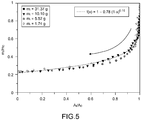
- the normalized mass of the blood pool was plotted with the normalized wet area of the blood pool at the given time t for 3 blood pools having different masses ( i . e ., 1.74 g, 5.52 g, 10.10 g) (see Figure 5 ).
- a fitting curve was deduced from the superimposition of the 3 corresponding variations of the normalized mass m t /m 0 as function of the normalized wet area A t /A 0 .
- Such fitting curve provided the correlation coefficients ⁇ and ⁇ .
- the method allowed to determine the time elapsed ⁇ t between the given time t and a time t 0 at which the blood pool initiated a drying process on the substrate.
- the time elapsed ⁇ t was calculated according to equation (8).
- the blood's volume weight ⁇ was considered to be equal to 1.060 g/mL
- the atmospheric pressure P a was considered to be equal to 1.01325.10 5 Pa
- the saturation vapor pressure of water P w at the surface of the blood pool was obtained from standard charts
- the molecular diameter of water molecules was considered to be equal 0.343 nm.
- Blood was spilled on a white tile at a time t 0 , i . e ., at 10.17 am, thereby forming a blood pool initiating a drying process at time t 0 .
- a picture of the blood pool was then taken by a user via a system for dating blood pool according to the embodiments of the present disclosure while drying on the white tile, at a given time t, which was 6.54 pm, on the same day.
- the calculation software compared these determined environmental conditions and the determined A 0 with the sets of predetermined environmental and initial blood pool conditions impacting the drying of blood pools comprised in the database.
- the calculation software based on this comparison, determined numerical values associated to the determined environmental conditions for the correlation coefficients ⁇ and ⁇ , equal to 0.78 and 0.16, respectively, for the blood's diffusion coefficient D blood , equal to 10 -9 m 2 .s -1 , and for the blood pool's height, equal to 1.44 mm.
- the calculated elapsed time ⁇ t was 498 min (8h18min), which turned out to be 19 min less than the exact measured elapsed time between time t and time t 0 at which the blood pool was spilled on the white tile and initiated a drying process. This corresponded to a margin of error for the calculated elapsed time of less than 4 % of the exact elapsed time.
- the picture of the blood pool was taken only once.
- the taking of a predetermined number of pictures of the blood pool could have been envisaged in order to obtain an average value of the elapsed time ⁇ t.
- the taking of a predetermined number of pictures can be done. Each repetition of such step can be followed by the repetition of the calculation of said elapsed time, thereby leading to the calculation of the elapsed time a predetermined number of times. At that point, an average value of the elapsed time may be obtained.
- such repetitions can be performed in an automated way, at a predetermined time interval, e.g. 1 picture being taken per minute during 10 minutes.
Landscapes
- Health & Medical Sciences (AREA)
- Engineering & Computer Science (AREA)
- Medical Informatics (AREA)
- Public Health (AREA)
- Epidemiology (AREA)
- General Health & Medical Sciences (AREA)
- Primary Health Care (AREA)
- Biomedical Technology (AREA)
- Data Mining & Analysis (AREA)
- Databases & Information Systems (AREA)
- Pathology (AREA)
- Investigating Or Analysing Biological Materials (AREA)
Abstract
Description
- The present disclosure concerns, but is not limited to, a method and a system for dating blood pools lying on a substrate.
- Despite the recent development of forensic science, estimating bloodstain age has not yet been convincingly implemented in routine crime scene investigation. Current methods for estimating blood pools age rely on complex procedures requiring specialist knowledge and/or sophisticated, expensive machines. Spectroscopy-based techniques and hyperspectral imaging are currently the techniques closest to implementation due to their widespread availability. However, both types of techniques suffer from low accuracy, are destructive and non-easily transportable on every crime scene.
- The article by Laan et al., Morphology of drying blood pools, Forensic Sci. Int. 267, pages 104-109, 2016, attempts to characterize the drying process of blood pools and identifies different drying stages. However, this attempt represents only a very preliminary step towards the establishment of a predictive drying model ideally aimed at leading to an accurate determination of the time elapsed between a given time at which a blood pool is considered and a time at which the blood pool has been spread. Indeed, the various characteristics of a blood pool, such as for example the size and shape thereof, together with the variability of the environmental conditions, lead overall to a daunting challenge in establishing such drying model, since no apparent correlation exists that could weight all cited blood pool characteristics and environmental conditions.
- The article by Choi et al., Highly sensitive and accurate estimation of bloodstain age using smartphone, Biosens. Bioelectron. 130, pages 414-419, 2019, describes a system for estimating the age of bloodstains that combines three analyses, namely blood pool analysis, crack ratio analysis and colorimetric analysis, which are all based on the image analysis of a bloodstain. Parameters are extracted from such image analysis and the extracted parameters are then compared to corresponding parameters of reference images stored in a database.
- Another method for estimating the age of bloodstains is described in the article by Thanakiatkrai et al., Age estimation of bloodstains using smartphones and digital image analysis, Forensic Sci. Int. 233, pages 288-297, 2013. Such method is based on colorimetry and plots color parameters extracted from digital images of bloodstains against time, and then compares the results to a calibration curve. The effects of further parameters on the estimation, such as the type of smartphone camera, person-to-person variation, temperature, humidity, light exposure, anticoagulant, and substrate, are further discussed in the article.
- All prior art methods merely provide rough age estimations, and lack a drying model reliably representing a blood pool's drying process. There thus still exists a need for a method offering a high accuracy and reliability in dating blood pools, while remaining simple to be implemented, not destructive or altering, and transferable on the field.
- In what follows, the term "comprise" is synonym of (means the same as) "include" and "contains", is inclusive and open and does not exclude other non-recited elements. Moreover, in the present disclosure, the terms "about" and "substantially" are synonyms of (mean the same as) a margin less and/or more than to 10% of the respective value.
- One of the objectives of the present disclosure is to provide a method for dating blood pools lying on a substrate.
- According to a first aspect of the present disclosure, such an objective is attained by a method for dating a blood pool lying on a substrate, comprising:
- determining, based on at least one picture of a blood pool lying on a substrate taken at a given time, the drying front of the blood pool at the given time; and
- determining, based on the determined drying front of the blood pool at the given time and a drying model, the time elapsed between the given time and a time at which the blood pool initiated a drying process on the substrate.
- In the present description and in the claims, by "blood pool", it is meant any blood configuration (
Figure 1B ) intermediate between a drop (Figure 1A ), which has a curved surface, and an infinite stretch of liquid having a flat surface (Figure 1C ), as illustrated byFigure 1 . According to one or more embodiments, a blood pool presents a substantially flat, limited surface. - The method of the disclosure may be applied to any blood pool drying on a substrate, independently from the volume thereof. However, according to one or more embodiments, the method is particularly adapted to blood pools having a volume greater than 170 µL. Indeed, when the blood pool has a volume smaller than 170 µL, for substrates giving a contact angle of about 45° and for a surface tension at the gas-liquid interface of 60 mPa·s, the blood configuration tends to take the shape of a drop.
- The method according to the present disclosure can for example be successfully implemented in routine crime scene investigation, by providing a real-time, accurate estimation of the time elapsed after a victim's death, i.e. the postmortem interval (PMI), and/or the approximate time at which blood was spread on a substrate and thus at which a crime involving bleeding was committed.
- Hence, by determining, based on a drying front of the blood pool, which is simply determined on the basis of one or more pictures, and based on a drying model, the method according to the disclosure provides a real-time and accurate estimation of the time at which the blood of a victim, and/or a culprit, was spilled.
- By drying process, it is meant a process which comprises at least one evaporation process. The drying process initiated by the blood pool comprises the evaporation of water contained within the blood of the blood pool. Such drying process may be function of the environmental conditions to which the blood pool is exposed.
- According to one or more embodiments, determining the time elapsed between the given time and a time at which the blood pool initiated a drying process on the substrate is done by calculation of such time based on a predetermined mathematical equation representing a predetermined drying model.
- According to the present disclosure, the drying model comprises a function correlating the time elapsed between the given time and a time at which the blood pool initiated a drying process on the substrate with a blood's diffusion coefficient, the blood's diffusion coefficient having a substantially constant value during the time elapsed between the given time and a time at which the blood pool initiated a drying process on the substrate for the same environmental conditions.
- According to one or more embodiments, the blood's diffusion coefficient may be measured experimentally, for a plurality of predetermined environmental conditions or, for example, for a set of predetermined environmental conditions susceptible of representing the environmental conditions to which a blood pool may be commonly exposed.
- According to one or more embodiments, the environmental conditions comprise at least the temperature and humidity to which the blood pool is exposed, and the nature of the substrate on which the substrate lies. The temperature and humidity may refer to the temperature and humidity in the direct surroundings of the blood pool, for example within a 3m radius from the blood pool. The nature of the substrate may comprise the composition of the substrate.
- According to one or more embodiments, determining the drying front of the blood pool at the given time t comprises determining the wet perimeter of the blood pool at the given time t. Such wet perimeter of the blood pool at the given time t is designated by reference sign Pt in
Figure 2 which illustrates a drying blood pool. At a given time t, the wet perimeter is the path surrounding the wet area of the blood pool. The wet area of the blood pool at the given time t is designated by reference sign At inFigure 2 and is delimited by a wet perimeter Pt at time t. The wet area At corresponds to the remaining blood pool's liquid surface at time t, by opposition to the blood pool's dry surface at time t. By analogy, the wet area of the blood pool at time t0 at which the blood pool initiated a drying process on the substrate is designated by reference sign A0 inFigure 2 and is delimited by a wet perimeter P0 at time t0. The area A0 is the maximum spreading area of the blood pool on the substrate. - According to one or more embodiments, determining the drying front of the blood pool at the given time t further comprises determining the wet area of the blood pool at the given time t, i.e., At.
- According to one or more embodiments, the method comprises taking at least one picture of the blood pool at a given time t, for example a plurality of pictures of the blood pool starting from the given time t. According to one or more embodiments, the method comprises taking one picture per 10 minutes for a predetermined period of time, such as for example for 1 hour. In this manner, the margin of error in dating the blood pool may thereby be lowered.
- According to one or more embodiments, such at least one picture of the blood pool can be taken in several ways. For example, depending on the country, the forensic standards for taking a picture on a crime scene may vary, and the method according to the invention may be adapted accordingly. According to one or more embodiments, the at least one picture is taken on top of the blood pool, at a distance from the blood pool comprised between 0.1 m and 3 m, depending on the size of the blood pool. According to one or more embodiments, the at least one picture is taken on top of the pool, as perpendicularly as possible from the pool with a ruler beside.
- According to one or more embodiments, the at least one picture may be taken with a conventional digital camera. A conventional digital camera may for example be integrated in a smartphone or a tablet.
- According to one or more embodiments, the resolution of the at least one picture is more than 1000 pixels2, for example more than 2000 pixels2.
- According to one or more embodiments, the determining of the drying front of the blood pool is performed via image processing of the at least one picture. For example, when an image processing software such as ImageJ or for example a Python code is used, a minimum resolution of 2000 pixels2 may be advantageous in order to better focus on the blood pool only and an overexposure and/or a flash may result in a better contrast between the wet substrate and the dry substrate.
- In the article Laan et al., Morphology of drying blood pools, Forensic Sci. Int. 267, pages 104-109, 2016, the authors have shown that blood pools' drying process can be separated into five main different drying stages: coagulation, gelation, rim desiccation, center desiccation, and final desiccation. According to one or more embodiments of the present disclosure, the step of taking at least one picture of the blood pool at a given time is performed either during the rim desiccation stage or during the center desiccation stage of the blood pool's drying process and, when the method comprises taking a plurality of pictures of the blood pool at a given time, in at least one of these stages. Contrary to the first drying stage, i.e., coagulation, wherein the wet area at a given time t is equal or very close to the wet area at time t0, the wet area at a given time t during the rim desiccation or center desiccation stages is sufficiently different from the wet area at time t0. Likewise, in these embodiments, the wet perimeter at time t is sufficiently different from the wet perimeter at time t0. Also, in these embodiments, the wet area and the wet perimeter at a given time t are not equal to 0, while this is the case in the last drying stage, i.e., in the final desiccation.
- Thus, according to these embodiments, if the blood pool is in a coagulation stage, the at least one picture should be taken in a later stage, for example starting from the rim desiccation stage. If the blood pool is in a still later drying stage such as the final desiccation stage, the least one picture may be taken, but the wet perimeter and/or the wet area of the blood pool may not be determined anymore, since they are both equal to zero in such stage. However, in the majority of cases, the blood pools found on crime scenes have not yet reached this final stage of the blood pool's drying process.
- According to one or more embodiments, the drying model comprises a function correlating the mass variation of the blood pool with time with the wet area of the blood pool at the given time t. According to one or more embodiments, such function comprises correlation coefficients which may be measured experimentally, for a plurality of predetermined environmental conditions or, for example, for a set of predetermined environmental conditions susceptible of representing the environmental conditions to which a blood pool may be commonly exposed.
- According to the method of the present disclosure, the drying model comprises a function correlating the time elapsed between the given time t and a time t0 at which the blood pool initiated a drying process on the substrate with a blood's diffusion coefficient, and the blood's diffusion coefficient is expressed according to the following equation:

- Dblood is the blood's diffusion coefficient;
- K; is a coefficient of transfer from the liquid state into the gaseous state and is expressed according to the following equation:

- M is the molecular weight of water;
- Pw is the saturation vapor pressure of water at the surface of the blood pool;
- R is the ideal gas constant;
- T is the temperature of the environment to which the blood pool is exposed; and
- J* is the evaporation rate of the blood pool and is expressed according to the following equation:

- δm/δt is the mass variation of the blood pool with time; and
- A0 is the area of the blood pool at a time t0 at which the blood pool initiated a drying process on the substrate;
- Lk is the Knudsen layer and is expressed according to the following equation:

- k B is Boltzmann's constant;
- d is the molecular diameter of water molecules; and
- P a is the atmospheric pressure;
- L* is a shape factor and is expressed according to the following equation:

- h is the blood pool's height; and
- Pt is the wet perimeter.
- The blood's diffusion coefficient Dblood may be measured experimentally. According to one or more embodiments, Dblood may be measured for a plurality of predetermined environmental conditions or, for example, for a set of predetermined environmental conditions susceptible of representing the environmental conditions to which a blood pool may be commonly exposed.
- According to one or more embodiments, the method further comprises determining the area of the blood pool at a time at which the blood pool initiated a drying process on the substrate and, optionally, also the environmental conditions to which the blood pool is exposed at the given time.
- According to one or more embodiments, the method further comprises determining the blood pool's height. According to one or more embodiments, determining the blood pool's height comprises the use of a statistical value of the blood pool's height. The statistical value may for example be an average value of blood pool's height measured for the same environmental conditions. According to one or more embodiments, a statistical value of the blood pool's height may be the average value of blood pool's height measured for a predetermined number of blood pools having the same area of the blood pool at a time at which the blood pool initiated a drying process on the substrate, and for the same environmental conditions. According to one or more embodiments, the predetermined number of blood pools is no less than 5, for example no less than 10, and may less than 20, and their mass may be comprised, for example, from 0.1g to 50g.
- According to one or more embodiments, the function correlating the mass variation of the blood pool with time with the wet area of the blood pool at the given time (t) is expressed according to the following equation:

- α and β are correlation coefficients constant at the environmental conditions to which the blood pool is exposed at the given time t;
- At is the wet area of the blood pool at the given time t;
- δt is the time elapsed between the given time t and a time t0 at which the blood pool initiated a drying process on the substrate;
- 8m is the mass variation of the blood pool during the time elapsed between the given time t and a time t0 at which the blood pool initiated a drying process on the substrate;
- m0 is the mass of the blood pool at a time t0 at which the blood pool initiated a drying process on the substrate and is expressed as according to the following equation:

- ρ is the blood's volume weight.
- According to one or more embodiments, the function correlating the mass variation of the blood pool with time with the wet area of the blood pool at the given time may be expressed according to the following equation:

- This equation represents the variation of the normalized mass mt/m0 as a function of the normalized wet area (At/A0), and involves correlation coefficients α and β.
- As mentioned above, according to one or more embodiments, the function correlating the mass variation of the blood pool with time with the wet area of the blood pool at the given time t comprises correlation coefficients α and β which may be measured experimentally, for a plurality of predetermined environmental conditions or, for example, for a set of predetermined environmental conditions susceptible of representing the environmental conditions to which a blood pool may be commonly exposed.
- According to one or more embodiments, the correlation coefficients α and β may be measured for a predetermined number of blood pools having different masses. For example, the correlation coefficients α and β may be determined out of a pool of at least 4 blood pools having different masses, for example a first blood pool weighing from 1g to 2g, a second blood pool weighing from 5g to 6g, a third blood pool weighing from 10g to 12g, and a fourth blood pool weighing from 30g to 35g. According to one or more embodiments, a fitting curve may be deduced from the superimposition of the predetermined number of corresponding variations of the normalized mass mt/m0 as functions of the normalized wet area At/A0. Such fitting curve may thus provide the correlation coefficients α and β.
- According to one or more embodiments, the time elapsed δt between the given time t and the time t0 at which the blood pool initiated a drying process on the substrate is expressed according to the following equation:

- The equations (1) and (6) are combined with each other into equation (8) by considering that the evaporation rate J* may be expressed as the variation of mass with time per surface unit according to equation (3).
- Hence, as apparent from equation (8), the inventors have surprisingly managed to devise one equation correlating all drying parameters of the drying model according to one or more embodiments with the elapsed time δt. The inventors have demonstrated that despite the complexity of establishing a drying model taking account of the variability of all parameters at stake during the blood pools' drying process, a reliable and simple drying model exists and may be used to develop a corresponding method for dating blood pools, in a fast, reliable, and accurate manner. According to one or more embodiments, the drying model may take account of the blood pool's size and/or shape, which are reflected by mathematical equations used in the modeling. For example, when one considers equation (8), correlation coefficients α and β may take into account the size of the blood pool. The dimensionless factor L* takes account of the shape of the blood pool. Indeed, L*, which is directly related to the drying front, for example according to equation (5), correlates the shape properties of the blood pool with the wet perimeter.
- According to one or more embodiments, the blood's volume weight is substantially comprised between 1.040 g/mL and 1.066 g/mL.
- According to one or more embodiments, the method comprises a step of determining the atmospheric pressure. According to one or more embodiments, the atmospheric pressure is substantially equal to 1.01325.105 Pa.
- According to one or more embodiments, the saturation vapor pressure of water at the surface of the blood pool is deduced from determination of the temperature and humidity to which the blood pool is exposed at the given time t.
- According to one or more embodiments, the molecular diameter of water molecules is substantially equal to 0.343 nm.
- According to one or more embodiments, the method further comprises providing a database comprising sets of measured blood pool parameters at different conditions, wherein each set of measured blood pool parameters comprises the blood's diffusion coefficient, the blood pool's height, and the correlation coefficients, wherein the different conditions comprise predetermined environmental and initial blood pool conditions impacting the drying of blood pools.
- According to one or more embodiments, the predetermined environmental conditions impacting the drying of blood pools comprise at least the temperature and humidity of the environment to which the blood pool is exposed, and the nature of the substrate on which the blood pool lies.
- According to one or more embodiments, the predetermined initial blood pool conditions impacting the drying of blood pools comprise the area of the blood pool at a time at which the blood pool initiated a drying process on the substrate.
- According to one or more embodiments the method providing the database further comprises the steps of comparing the determined environmental conditions to which the blood pool is exposed at the given time t and the determined area of the blood pool at a time t0 at which the blood pool initiated a drying process on the substrate, with the sets of predetermined environmental and initial blood pool conditions impacting the drying of blood pools comprised in the database.
- According to one or more embodiments, determining the environmental conditions to which a blood pool is exposed may be done by measuring the environmental conditions, directly and/or indirectly, on the crime scene. According to one or more embodiments, requesting the measurement of environmental conditions may for example be envisaged. For example, the method may comprise sending the GPS location of the blood pool to a weather forecast virtual platform and obtaining the measured data sent back by the weather forecast virtual platform. Such an indirect measurement may be beneficial when the blood pool has been drying outdoors, since environmental parameters such as the temperature and humidity may sensibly vary with time. A liability level of the recorded values can then be assessed, depending on the available data.
- Indoors, in contrast, the environment of the blood pool is expected to be stable in the majority of cases, and a standard ambient temperature, for example of 20°C, may be used. Alternatively, a direct measuring of the environmental parameters may be performed.
- According to one or more embodiments, the substrate on which the blood pool lies may be non-porous, i.e., so that the blood may remain substantially stagnant prior to drying. According to one or more embodiments, the substrate on which the blood pool lies may be selected in the group comprising tiling, linoleum, varnished parquet, unvarnished parquet, glass, paper, wood (for example oak), fabric, asphalt, carpet, grass.
- According to one or more embodiments, the blood comprised in the blood pool has a hematocrit level Ht comprised between 35% and 55%, for example between 40% and 50%. The hematocrit level Ht is comprised between 40.7% and 50.3% for men and between 36.1% and 44.3% for women. The inventors have shown that the hematocrit level does not have a major influence on the blood pool's drying process. However, according to one or more embodiments, the method may be specifically adapted to men or women. According to one or more embodiments, the method comprises the use of two databases, one male database specifically adapted to men and one female database specifically adapted to women. For example, the method according to one or more embodiments may include a step of recording the sex of the blood giver. This will orient the method towards the use of a corresponding male or female database.
- Hence, according to one or more embodiments of the method, the method envisages the determination of certain parameters, such as for example Pt, At and/or A0, on the basis of the image processing of at least one blood pool's picture, and the determination of parameters related to the environment of the blood pool, such as temperature, humidity, and to the nature of the substrate. All other parameters may be collected and saved beforehand in a database. Such a dating method allows a very precise and reliable dating of the blood pool. The inventors have indeed realized that such a method is particularly adapted to the dating of blood pools and shows excellent results in dating blood pools. For example, an error margin of less than 4% could be obtained in dating blood pools that had been drying for more than 8h, by using the method according to one or more embodiments of the present disclosure. Such method for dating blood pools according to the invention provides a low-cost, rapid, easy-to-use and truly portable alternative to more complicated analysis using specialized and highly expensive equipment, e.g. spectroscopy and/or HPLC.
- According to one or more embodiments, the method according to the invention comprises the repetition of at least the following steps a predetermined number of times:
- determining, based on at least one picture of a blood pool lying on a substrate taken at a given time t, the drying front of the blood pool at the given time t; and
- determining, based on a drying model and the determined drying front of the blood pool at the given time (t), the time elapsed between the given time t and a time t0 at which the blood pool initiated a drying process on the substrate.
- Such repetition may for example occur at predetermined time intervals during a predetermined period.
- In this manner, an average value of the elapsed time between the given time t and a time t0 at which the blood pool initiated a drying process on the substrate may be obtained.
- According to a second aspect, the present disclosure is directed to a system for dating a blood pool lying on a substrate, comprising:
- means for determining, based on at least one picture of a blood pool lying on a substrate taken at a given time t, the drying front of the blood pool at the given time t; and
- means for determining, based on a drying model and the determined drying front of the blood pool at the given time t, the time elapsed between the given time t and a time t0 at which the blood pool initiated a drying process on the substrate,
wherein the drying model comprises a function correlating the time elapsed between the given time (t) and a time (t0) at which the blood pool initiated a drying process on the substrate with a blood's diffusion coefficient, the blood's diffusion coefficient having a substantially constant value during the time elapsed between the given time (t) and a time (t0) at which the blood pool initiated a drying process on the substrate for the same environmental conditions,
wherein the blood's diffusion coefficient is expressed according to the following equation:
- Dblood is the blood's diffusion coefficient;
- K; is a coefficient of transfer from the liquid state into the gaseous state and is expressed according to the following equation:

- M is the molecular weight of water;
- Pw is the saturation vapor pressure of water at the surface of the blood pool;
- R is the ideal gas constant;
- T is the temperature of the environment to which the blood pool is exposed; and
- J* is the evaporation rate of the blood pool and is expressed according to the following equation:

- δm/δt is the mass variation of the blood pool with time; and
- A0 is the area of the blood pool at a time (t0) at which the blood pool initiated a drying process on the substrate;
- Lk is the Knudsen layer and is expressed according to the following equation:
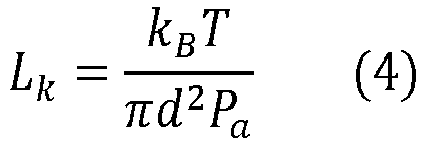
- k B is Boltzmann's constant;
- d is the molecular diameter of water molecules; and
- P a is the atmospheric pressure;
- L* is a shape factor and is expressed according to the following equation:

- h is the blood pool's height; and
- Pt is the wet perimeter.
- According to one or more embodiments, the means for determining, based on at least one picture of a blood pool lying on a substrate taken at a given time t, the drying front of the blood pool at the given time t, comprises at least one image processing software that performs an image processing of the at least one picture of the blood pool. Such at least one image processing software may for example be installed on a smartphone or tablet. According to one or more embodiments, the at least one image processing software is selected in the group comprising ImageJ, a Matlab code, a Python code.
- According to one or more embodiments, the means for determining, based on a drying model and the determined drying front of the blood pool at the given time t, the time elapsed between the given time t and a time t0 at which the blood pool initiated a drying process on the substrate comprises a calculation software.
- According to one or more embodiments, the system further comprises a database comprising sets of measured blood pool parameters at different conditions, wherein each set of measured blood pool parameters comprises a blood's diffusion coefficient, a blood pool's height, and parameters correlating the mass variation of the blood pool with time with the wet area of the blood pool at the given time t, and wherein the different conditions comprise predetermined environmental and initial blood pool conditions impacting the drying of blood pools.
- According to one or more embodiments, the system according to the second aspect may be used to implement the method according to the first aspect. Such system may be a mobile system offering an easy-to-use and portable means for dating blood pools, wherein no training is necessary, such as for example a smartphone wherein a dating software is installed that performs the steps of the method for dating blood pools. Such dating software may provide an accurate age estimate by taking account of a user's inputs, such as pictures of the blood pool or determined environmental and initial blood pool conditions impacting the drying of blood pools.
- According to one or more embodiments, the system further comprises a camera for taking the at least one picture of the blood pool lying on a substrate. According to one or more embodiments, the system comprises a conventional digital camera. Such conventional digital camera may for example be integrated in a smartphone or a tablet. The model of the camera may have an influence on, for example, the color rendering of the picture of the blood pool. Hence, according to one or more embodiments, measures may be taken so that parameters of the smartphone are set so that they may be easily adapted to different forensic standards, depending on the geographical zone of a crime scene.
- According to one or more embodiments, the system further comprises a thermometer and a hygrometer for determining the temperature and, respectively, the humidity to which the blood pool is exposed.
- The embodiments described above are not exhaustive. In particular, it is understood that additional embodiments can be considered on the basis of different combinations of the explicitly described embodiments. Unless otherwise specified in the present disclosure, it will be apparent to the skilled person that all the embodiments described above can be combined together. For example, unless otherwise specified, all features of the embodiments described above, whether they refer to the method or the system for dating blood pools, can be combined with or replaced by other features from other embodiments.
- The present disclosure will be better understood and other advantages and embodiments will become clear on reading the description that follows, given purely by way of indication and in no way limiting, and by referring to the appended figures, in which:
-
FIG. 1A is a transversal scheme illustrating a blood drop. -
FIG. 1B is a transversal scheme illustrating a blood pool. -
FIG. 1C is a transversal scheme illustrating an infinite stretch of blood. -
FIG. 2 is a top view of a sample of drying blood pool in which parameters such as A0, P0, At and Pt are shown. -
FIG. 3 is a simplified scheme illustrating an example of method for dating blood pools lying on a substrate according to one or more embodiments of the present disclosure. -
FIG. 4 is a diagram correlating KiLkL*0.5 with the percentage of water left in different blood pools, drying at 20% humidity, T = 23°C ± 1°C, on the same surface, a tile. The experimentally measured blood's diffusion coefficient Dblood corresponds to the plateau value equal to 10-9m2.s-1. -
FIG. 5 is a diagram correlating the normalized mass with the normalized wet area for different blood pools, drying at 20% humidity, T = 23°C ± 1°C, on the same surface, a tile. - Embodiments of the present disclosure will now be described in detail with reference to the accompanying figures. In the following detailed description of embodiments of the present disclosure, numerous specific details are set forth in order to provide a more thorough understanding of the present disclosure. However, it will be apparent to one of ordinary skill in the art that the present disclosure may be practiced without these specific details. In other instances, well-known features have not been described in detail to avoid unnecessarily complicating the description.
- The following description provides a non-limiting example of a system for dating a blood pool lying on a substrate, according to one or more embodiment of the present disclosure.
- The following description also provides non-limiting examples of a method for dating a blood pool lying on a substrate according to one or more embodiments of the present disclosure.
- An example of system for dating a blood pool lying on a substrate is shown in
Figure 3 . The system comprises asmart phone 1 comprising a conventional camera (not shown) for taking pictures and an image processing software for determining, based on at least onepicture 2 of ablood pool 3 lying on asubstrate 4 taken at a given time t, the dryingfront 5 of theblood pool 3 at the given time t. The system further comprises a calculation software for determining, based on the determined drying front of the blood pool at the given time t and a drying model, the time elapsed between the given time t and a time t0 at which the blood pool initiated a drying process on the substrate. - In the present example, the image processing software is imageJ. However, other image processing softwares may be run in the smart phone. Also, according to other embodiments, the image processing software may be run in other devices.
- The image processing software may be integrated within a dating software.
- The imageJ software may be used to determine the area of the blood pool at a time t0 at which the blood pool initiated a drying process on the substrate from a picture of the blood pool. The type of image may first be changed from RGB color type to 8 or 16-bit type image, the black and white threshold may then be manually adjusted in order to define the contours of the blood pool. To measure the area of the blood pool, an "analyze particles" function may used. The minimum pixel size may be set to 2000 pixels2 in order to focus on the blood pool only. Holes may be included in order to exclude reflects that may be present on the picture, and the outlines of the measured area may be displayed with the results in order to verify the accuracy of the area's measurement.
- The calculation software may be integrated within a dating software, which may be the same as the above-mentioned dating software comprising the above-mentioned image processing software.
- In the present example, the dating software is configured to request the measurement of two environmental conditions, namely temperature and humidity, to a weather forecast virtual platform and to obtain the measurement by sending the GPS location to the weather forecast virtual platform.
- In the present example, the dating software is also configured to ask a user to upload the at least one picture taken by the camera and to fill out blank fields corresponding to a third environmental condition, namely the nature of the substrate.
- In this example of system, the system further comprises a database including sets of measured blood pool parameters at different conditions. Each set of measured blood pool parameters comprises a blood's diffusion coefficient Dblood, a blood pool's height h, and parameters correlating the mass variation of the blood pool with time with the wet area of the blood pool at the given time t. The different conditions comprise predetermined environmental and initial blood pool conditions impacting the drying of blood pools. The predetermined environmental conditions comprise the temperature and humidity to which the blood pool is exposed and the nature of the substrate on which the substrate lies. The predetermined initial blood pool conditions comprise the area of the blood pool at a time t0 at which the blood pool initiated a drying process on the substrate.
- As mentioned above, this example of system for dating blood pool according to the embodiments of the disclosure comprises a smartphone including a conventional camera, which can be used to take one or more pictures of a blood pool lying on a substrate. However, further configurations of the system may be envisaged, in which the system also comprises, for example, a thermometer and/or a hygrometer.
- The following describes an example of a method for dating a blood pool lying on a substrate according to embodiments of the present disclosure.
- The method for dating a blood pool lying on a substrate comprises determining, based on at least one picture of a blood pool lying on a substrate taken at a given time t, the drying front of the blood pool at the given time t, and determining, based on the determined drying front of the blood pool at the given time t and a drying model, the time elapsed between the given time t and a time t0 at which the blood pool initiated a drying process on the substrate.
- The drying model comprises a function correlating the time elapsed between the given time t and a time t0 at which the blood pool initiated a drying process on the substrate with a blood's diffusion coefficient, the blood's diffusion coefficient having a substantially constant value during the time elapsed between the given time t and a time t0 at which the blood pool initiated a drying process on the substrate for the same environmental conditions. The drying model comprises a blood's diffusion coefficient Dblood. Such blood's diffusion coefficient is expressed according to mathematical equation (1). In this example, the blood's diffusion coefficient was measured experimentally for a set of predetermined environmental conditions susceptible of representing the environmental conditions to which a blood pool may be commonly exposed. Hence, such blood's diffusion coefficient was available beforehand to users of the system, i.e., before dating the blood pool, and was stored in the above-mentioned database.
- In this example of method, determining the drying front comprised determining the wet perimeter Pt and the wet area At. Both were determined by image processing a picture of the blood pool taken at the given time t. In this example of method according to the invention, numerical values of 0.16 m and 0.024 m2 were determined for the wet perimeter and the wet area, respectively.
- The drying model of this example of method further comprises a function correlating the mass variation of the blood pool with time with the wet area of the blood pool at the given time t. The function is expressed according to equation (6').
- The evaporations of 4 blood pools having different masses (i.e., 1.75 g, 5.52 g, 10.10 g, 31.37 g) were plotted with time. For each of the 4 blood pools, Ki.Lk.L*0,5 of equation (1) was plotted with time which yielded a common plateau (see
Figure 4 ), yielding a substantially constant value of 10-9 m2.s-1 for the blood's diffusion coefficient Dblood. - In this example of method according to embodiments of the disclosure, the area A0 of the blood pool at a time t0 at which the blood pool initiated a drying process on the substrate and the environmental conditions to which the blood pool was exposed at the given time t, were determined. The determination of the area A0 was performed via image processing the picture of the blood pool taken at the given time t.
- The method further comprised determining the blood pool's height. For this purpose, a statistical value of the blood pool's, i.e., the average value of blood pool's height measured for 30 blood pools having the same area of the blood pool at a time t0 at which the blood pool initiated a drying process on the substrate, was measured, for sets of predetermined environmental conditions. For example, at a temperature of 23 ± 1°C and a humidity of 20%, for a white tile as substrate, such measurement provides 1.44 mm (± 0.19 mm) as the statistical value of the blood pool's height.
- In this example of method, the function correlating the mass variation of the blood pool with time with the wet area of the blood pool at the given time t was expressed according to the following equation:

- This equation represents the variation of the normalized mass mt/m0 as a function of the normalized wet area At/A0, and involves correlation coefficients α and β.
- The normalized mass of the blood pool was plotted with the normalized wet area of the blood pool at the given time t for 3 blood pools having different masses (i.e., 1.74 g, 5.52 g, 10.10 g) (see
Figure 5 ). A fitting curve was deduced from the superimposition of the 3 corresponding variations of the normalized mass mt/m0 as function of the normalized wet area At/A0. Such fitting curve provided the correlation coefficients α and β. - The method allowed to determine the time elapsed δt between the given time t and a time t0 at which the blood pool initiated a drying process on the substrate. The time elapsed δt was calculated according to equation (8).
- As numerical values, the blood's volume weight ρ was considered to be equal to 1.060 g/mL, the atmospheric pressure Pa was considered to be equal to 1.01325.105 Pa, the saturation vapor pressure of water Pw at the surface of the blood pool was obtained from standard charts, and the molecular diameter of water molecules was considered to be equal 0.343 nm.
- Blood was spilled on a white tile at a time t0, i.e., at 10.17 am, thereby forming a blood pool initiating a drying process at time t0. A picture of the blood pool was then taken by a user via a system for dating blood pool according to the embodiments of the present disclosure while drying on the white tile, at a given time t, which was 6.54 pm, on the same day.
- The user then proceeded to date the blood pool as follows.
- Environmental conditions were determined. First, the GPS location of the blood pool was sent to a weather forecast virtual platform, and the temperature (23°C) and humidity (20%) were obtained in this manner. At this point, the user opened the dating software on the smartphone, and was asked by the dating software to upload the picture taken at 6.54 pm and to fill out blank fields corresponding to environmental parameters, i.e., the nature of the substrate, i.e., the tile. The user filled out the blank field. Thanks to the inclusion of the software imageJ within the dating software, the dating software then ran the image processing of the picture taken at time t and extracted At, Pt, A0 of the blood pool corresponding to the following values: A0 = 3.47E-03 m2; Pt = 230E-03 m; At = 3,17E-03 m2.
- The calculation software compared these determined environmental conditions and the determined A0 with the sets of predetermined environmental and initial blood pool conditions impacting the drying of blood pools comprised in the database.
- The calculation software, based on this comparison, determined numerical values associated to the determined environmental conditions for the correlation coefficients α and β, equal to 0.78 and 0.16, respectively, for the blood's diffusion coefficient Dblood, equal to 10-9 m2.s-1, and for the blood pool's height, equal to 1.44 mm.
- For these values, the calculated elapsed time δt was 498 min (8h18min), which turned out to be 19 min less than the exact measured elapsed time between time t and time t0 at which the blood pool was spilled on the white tile and initiated a drying process. This corresponded to a margin of error for the calculated elapsed time of less than 4 % of the exact elapsed time.
- In this example of the method, the picture of the blood pool was taken only once. However, the taking of a predetermined number of pictures of the blood pool could have been envisaged in order to obtain an average value of the elapsed time δt. For example, in one or more embodiments of the present invention, the taking of a predetermined number of pictures can be done. Each repetition of such step can be followed by the repetition of the calculation of said elapsed time, thereby leading to the calculation of the elapsed time a predetermined number of times. At that point, an average value of the elapsed time may be obtained. According to one or more embodiments, such repetitions can be performed in an automated way, at a predetermined time interval, e.g. 1 picture being taken per minute during 10 minutes.
Claims (14)
- Method for dating a blood pool lying on a substrate, comprising:determining, based on at least one picture of a blood pool lying on a substrate taken at a given time (t), the drying front of the blood pool at the given time (t); anddetermining, based on the determined drying front of the blood pool at the given time (t) and a drying model, the time elapsed between the given time (t) and a time (t0) at which the blood pool initiated a drying process on the substrate,wherein the drying model comprises a function correlating the time elapsed between the given time (t) and a time (t0) at which the blood pool initiated a drying process on the substrate with a blood's diffusion coefficient, the blood's diffusion coefficient having a substantially constant value during the time elapsed between the given time (t) and a time (t0) at which the blood pool initiated a drying process on the substrate for the same environmental conditions,wherein the blood's diffusion coefficient is expressed according to the following equation:
 - Dblood is the blood's diffusion coefficient;- K; is a coefficient of transfer from the liquid state into the gaseous state and is expressed according to the following equation:
 - M is the molecular weight of water;- Pw is the saturation vapor pressure of water at the surface of the blood pool;- R is the ideal gas constant;- T is the temperature of the environment to which the blood pool is exposed; and- J* is the evaporation rate of the blood pool and is expressed according to the following equation:
 - δm/δt is the mass variation of the blood pool with time; and- A0 is the area of the blood pool at a time (t0) at which the blood pool initiated a drying process on the substrate;- Lk is the Knudsen layer and is expressed according to the following equation:
 - k B is Boltzmann's constant;- d is the molecular diameter of water molecules; and- P a is the atmospheric pressure;- L* is a shape factor and is expressed according to the following equation:
 - h is the blood pool's height; and- Pt is the wet perimeter.
 - The method of claim 1, wherein determining the drying front of the blood pool at the given time (t) comprises determining the wet perimeter of the blood pool at the given time (t).
- The method of claim 2, wherein determining the drying front of the blood pool at the given time (t) further comprises determining the wet area of the blood pool at the given time (t).
- The method of any of the preceding claims, wherein the drying model comprises a function correlating the mass variation of the blood pool with time with the wet area of the blood pool at the given time (t).
- The method of any of the preceding claims, further comprising determining the area of the blood pool at a time (t0) at which the blood pool initiated a drying process on the substrate and the environmental conditions to which the blood pool is exposed at the given time (t).
- The method of any of claim 4 or claim 5 when dependent from claim 4, wherein the function correlating the mass variation of the blood pool with time with the wet area of the blood pool at the given time (t) is expressed according to the following equation:
 - α and β are correlation coefficients constant at the environmental conditions to which the blood pool is exposed at the given time (t);- At is the wet area of the blood pool at the given time (t);- δt is the time elapsed between the given time (t) and a time (t0) at which the blood pool initiated a drying process on the substrate;- 8m is the mass variation of the blood pool during the time elapsed between the given time (t) and a time (t0) at which the blood pool initiated a drying process on the substrate;- m0 is the mass of the blood pool at a time (t0) at which the blood pool initiated a drying process on the substrate and is expressed as according to the following equation:
 - ρ is the blood's volume weight.
 - The method of claim 6, wherein the time elapsed between the given time (t) and a time (t0) at which the blood pool initiated a drying process on the substrate is expressed according to the following equation :

- The method according to claim 6 or claim 7, further comprising:providing a database comprising sets of measured blood pool parameters at different conditions, wherein each set of measured blood pool parameters comprises the blood's diffusion coefficient, the blood pool's height, and the correlation coefficients,wherein the different conditions comprise predetermined environmental and initial blood pool conditions impacting the drying of blood pools.
- The method of claim 8, wherein the predetermined environmental conditions impacting the drying of blood pools comprise at least the temperature and humidity of the environment to which the blood pool is exposed, and the nature of the substrate on which the blood pool lies.
- The method of claim 8 or claim 9, wherein the predetermined initial blood pool conditions impacting the drying of blood pools comprise the area of the blood pool at a time (t0) at which the blood pool initiated a drying process on the substrate.
- The method according to claim 10 when dependent from claim 8 when dependent from claim 6 when dependent from claim 5, comprising:
comparing the determined environmental conditions to which the blood pool is exposed at the given time (t) and the determined area of the blood pool at a time (t0) at which the blood pool initiated a drying process on the substrate, with the sets of predetermined environmental and initial blood pool conditions impacting the drying of blood pools comprised in the database. - Method according to any of the preceding claims, comprising the repetition of at least the steps of claim 1 a predetermined number of times.
- System for dating a blood pool lying on a substrate, comprising:means for determining, based on at least one picture of a blood pool lying on a substrate taken at a given time (t), the drying front of the blood pool at the given time (t); andmeans for determining, based on a drying model and the determined drying front of the blood pool at the given time (t), the time elapsed between the given time (t) and a time (t0) at which the blood pool initiated a drying process on the substrate,wherein the drying model comprises a function correlating the time elapsed between the given time (t) and a time (t0) at which the blood pool initiated a drying process on the substrate with a blood's diffusion coefficient, the blood's diffusion coefficient having a substantially constant value during the time elapsed between the given time (t) and a time (t0) at which the blood pool initiated a drying process on the substrate for the same environmental conditions,wherein the blood's diffusion coefficient is expressed according to the following equation:
 - Dblood is the blood's diffusion coefficient;- Ki is a coefficient of transfer from the liquid state into the gaseous state and is expressed according to the following equation:
 - M is the molecular weight of water;- Pw is the saturation vapor pressure of water at the surface of the blood pool;- R is the ideal gas constant;- T is the temperature of the environment to which the blood pool is exposed; and- J* is the evaporation rate of the blood pool and is expressed according to the following equation:
 - δm/δt is the mass variation of the blood pool with time; and- A0 is the area of the blood pool at a time (t0) at which the blood pool initiated a drying process on the substrate;- Lk is the Knudsen layer and is expressed according to the following equation:
 - k B is Boltzmann's constant;- d is the molecular diameter of water molecules; and- P a is the atmospheric pressure;- L* is a shape factor and is expressed according to the following equation:
 - h is the blood pool's height; and- Pt is the wet perimeter.
 - System according to claim 13, wherein:- the means for determining, based on at least one picture of a blood pool lying on a substrate taken at a given time (t), the drying front of the blood pool at the given time (t), comprises an image processing software;- the means for determining, based on a drying model and the determined drying front of the blood pool at the given time (t), the time elapsed between the given time (t) and a time (t0) at which the blood pool initiated a drying process on the substrate comprises a calculation software; andwherein the system further comprising a database comprising sets of measured blood pool parameters at different conditions, wherein each set of measured blood pool parameters comprises a blood's diffusion coefficient, a blood pool's height, and parameters correlating the mass variation of the blood pool with time with the wet area of the blood pool at the given time (t), and wherein the different conditions comprise predetermined environmental and initial blood pool conditions impacting the drying of blood pools.
Priority Applications (5)
| Application Number | Priority Date | Filing Date | Title |
|---|---|---|---|
| EP19305772.6A EP3754663B1 (en) | 2019-06-17 | 2019-06-17 | Method and system for dating blood pools |
| EP20736921.6A EP3984041B1 (en) | 2019-06-17 | 2020-06-17 | Method and system for dating blood pools |
| US17/596,710 US20220351867A1 (en) | 2019-06-17 | 2020-06-17 | Method and system for dating blood pools |
| PCT/EP2020/066804 WO2020254431A1 (en) | 2019-06-17 | 2020-06-17 | Method and system for dating blood pools |
| CA3141435A CA3141435A1 (en) | 2019-06-17 | 2020-06-17 | Method and system for dating blood pools |
Applications Claiming Priority (1)
| Application Number | Priority Date | Filing Date | Title |
|---|---|---|---|
| EP19305772.6A EP3754663B1 (en) | 2019-06-17 | 2019-06-17 | Method and system for dating blood pools |
Publications (3)
| Publication Number | Publication Date |
|---|---|
| EP3754663A1 true EP3754663A1 (en) | 2020-12-23 |
| EP3754663C0 EP3754663C0 (en) | 2024-01-24 |
| EP3754663B1 EP3754663B1 (en) | 2024-01-24 |
Family
ID=67220739
Family Applications (2)
| Application Number | Title | Priority Date | Filing Date |
|---|---|---|---|
| EP19305772.6A Active EP3754663B1 (en) | 2019-06-17 | 2019-06-17 | Method and system for dating blood pools |
| EP20736921.6A Active EP3984041B1 (en) | 2019-06-17 | 2020-06-17 | Method and system for dating blood pools |
Family Applications After (1)
| Application Number | Title | Priority Date | Filing Date |
|---|---|---|---|
| EP20736921.6A Active EP3984041B1 (en) | 2019-06-17 | 2020-06-17 | Method and system for dating blood pools |
Country Status (4)
| Country | Link |
|---|---|
| US (1) | US20220351867A1 (en) |
| EP (2) | EP3754663B1 (en) |
| CA (1) | CA3141435A1 (en) |
| WO (1) | WO2020254431A1 (en) |
-
2019
- 2019-06-17 EP EP19305772.6A patent/EP3754663B1/en active Active
-
2020
- 2020-06-17 EP EP20736921.6A patent/EP3984041B1/en active Active
- 2020-06-17 US US17/596,710 patent/US20220351867A1/en active Pending
- 2020-06-17 WO PCT/EP2020/066804 patent/WO2020254431A1/en not_active Ceased
- 2020-06-17 CA CA3141435A patent/CA3141435A1/en active Pending
Non-Patent Citations (9)
| Title |
|---|
| BACCHIN P ET AL: "Drying colloidal systems: Laboratory models for a wide range of applications", EUROPEAN PHYSICAL JOURNAL E. SOFT MATTER, EDP SCIENCES, IT, vol. 41, no. 8, 22 August 2018 (2018-08-22), pages 1 - 34, XP036577123, ISSN: 1292-8941, [retrieved on 20180822], DOI: 10.1140/EPJE/I2018-11712-X * |
| CHOI ET AL.: "Highly sensitive and accurate estimation of bloodstain age using smartphone", BIOSENS. BIOELECTRON., vol. 130, 2019, pages 414 - 419 |
| CHOI W ET AL: "Highly sensitive and accurate estimation of bloodstain age using smartphone", BIOSENSORS AND BIOELECTRONICS, vol. 130, 1 April 2019 (2019-04-01), AMSTERDAM, NL, pages 414 - 419, XP055644236, ISSN: 0956-5663, DOI: 10.1016/j.bios.2018.09.017 * |
| DOTY K C ET AL: "A Raman "spectroscopic clock" for bloodstain age determination: the first week after deposition", ANALYTICAL AND BIOANALYTICAL CHEMISTRY, SPRINGER, DE, vol. 408, no. 15, 23 March 2016 (2016-03-23), pages 3993 - 4001, XP035867780, ISSN: 1618-2642, [retrieved on 20160323], DOI: 10.1007/S00216-016-9486-Z * |
| EDELMAN G J ET AL: "Practical Implementation of Blood Stain Age Estimation Using Spectroscopy", IEEE JOURNAL OF SELECTED TOPICS IN QUANTUM ELECTRONICS, IEEE SERVICE CENTER, PISCATAWAY, NJ, US, vol. 22, no. 3, 1 May 2016 (2016-05-01), pages 1 - 7, XP011611900, ISSN: 1077-260X, [retrieved on 20160525], DOI: 10.1109/JSTQE.2016.2536655 * |
| LAAN ET AL.: "Morphology of drying blood pools", FORENSIC SCI. INT., vol. 267, 2016, pages 104 - 109, XP029761579, DOI: doi:10.1016/j.forsciint.2016.08.005 |
| LAAN N ET AL: "Morphology of drying blood pools", FORENSIC SCIENCE INTERNATIONAL, ELSEVIER B.V, AMSTERDAM, NL, vol. 267, 24 August 2016 (2016-08-24), pages 104 - 109, XP029761579, ISSN: 0379-0738, DOI: 10.1016/J.FORSCIINT.2016.08.005 * |
| THANAKIATKRAI ET AL.: "Age estimation of bloodstains using smartphones and digital image analysis", FORENSIC SCI. INT., vol. 233, 2013, pages 288 - 297, XP028794918, DOI: doi:10.1016/j.forsciint.2013.09.027 |
| THANAKIATKRAI P ET AL: "Age estimation of bloodstains using smartphones and digital image analysis", FORENSIC SCIENCE INTERNATIONAL, ELSEVIER B.V, AMSTERDAM, NL, vol. 233, no. 1, 9 October 2013 (2013-10-09), pages 288 - 297, XP028794918, ISSN: 0379-0738, DOI: 10.1016/J.FORSCIINT.2013.09.027 * |
Also Published As
| Publication number | Publication date |
|---|---|
| EP3984041A1 (en) | 2022-04-20 |
| EP3984041C0 (en) | 2024-01-24 |
| EP3754663C0 (en) | 2024-01-24 |
| EP3754663B1 (en) | 2024-01-24 |
| WO2020254431A1 (en) | 2020-12-24 |
| US20220351867A1 (en) | 2022-11-03 |
| CA3141435A1 (en) | 2020-12-24 |
| EP3984041B1 (en) | 2024-01-24 |
Similar Documents
| Publication | Publication Date | Title |
|---|---|---|
| CN106546581B (en) | Test paper detection card intelligent detection system and test paper detection card intelligent analysis method | |
| CN106558046B (en) | The quality determining method and detection means of a kind of certificate photo | |
| US20150035961A1 (en) | Feature identification using an rgb-nir camera pair | |
| CN110161233B (en) | Rapid quantitative detection method for immunochromatography test paper card | |
| CN109887044B (en) | Reproductive data evaluation method and system | |
| CN107860720B (en) | A method and device for obtaining the quality of jujube | |
| CN111122490A (en) | A method and device for collecting indoor gas leakage information | |
| CN103841410A (en) | Half reference video QoE objective evaluation method based on image feature information | |
| CN113167736B (en) | Method for determining the concentration of an analyte in a body fluid | |
| CN113252655A (en) | Chromatography detection method, mobile terminal, server and chromatography detection device | |
| KR102030131B1 (en) | Continuous skin condition estimating method using infrared image | |
| CN106546756B (en) | A kind of ovulation test paper detection method and system | |
| EP3754663B1 (en) | Method and system for dating blood pools | |
| CN111080722A (en) | A color migration method and system based on saliency detection | |
| US20200049856A1 (en) | Real-time computation of an atmospheric precipitation rate from a digital image of an environment where an atmospheric precipitation is taking place | |
| CN110334583A (en) | A kind of small area soil vegetation coverage measurement method, device and electronic equipment | |
| CN104458736B (en) | A kind of device and detection method for Detecting Pesticide | |
| Jonckheere et al. | Image analysis of hemispherical photographs, algorithms and calculations | |
| KR102094277B1 (en) | System and method for measuring environmental pollutants or disease tracers using smart device | |
| CN110470620A (en) | A smart phone-based transparent liquid identification method | |
| CN106970074A (en) | Urine test paper image recognition method with color correction ability | |
| CN106773051B (en) | Augmented reality device and method for displaying virtual nutritional information of AR markers | |
| KR101541977B1 (en) | smart device-based simple point-of-care colorimetric diagnosis without reference and method. | |
| CN111928970A (en) | Method for acquiring influence relation of surface feature type on surface temperature | |
| KR20180042657A (en) | Skin moisture estimating method using image |
Legal Events
| Date | Code | Title | Description |
|---|---|---|---|
| PUAI | Public reference made under article 153(3) epc to a published international application that has entered the european phase |
Free format text: ORIGINAL CODE: 0009012 |
|
| STAA | Information on the status of an ep patent application or granted ep patent |
Free format text: STATUS: THE APPLICATION HAS BEEN PUBLISHED |
|
| AK | Designated contracting states |
Kind code of ref document: A1 Designated state(s): AL AT BE BG CH CY CZ DE DK EE ES FI FR GB GR HR HU IE IS IT LI LT LU LV MC MK MT NL NO PL PT RO RS SE SI SK SM TR |
|
| AX | Request for extension of the european patent |
Extension state: BA ME |
|
| STAA | Information on the status of an ep patent application or granted ep patent |
Free format text: STATUS: REQUEST FOR EXAMINATION WAS MADE |
|
| 17P | Request for examination filed |
Effective date: 20210412 |
|
| RBV | Designated contracting states (corrected) |
Designated state(s): AL AT BE BG CH CY CZ DE DK EE ES FI FR GB GR HR HU IE IS IT LI LT LU LV MC MK MT NL NO PL PT RO RS SE SI SK SM TR |
|
| GRAP | Despatch of communication of intention to grant a patent |
Free format text: ORIGINAL CODE: EPIDOSNIGR1 |
|
| STAA | Information on the status of an ep patent application or granted ep patent |
Free format text: STATUS: GRANT OF PATENT IS INTENDED |
|
| INTG | Intention to grant announced |
Effective date: 20230921 |
|
| RAP3 | Party data changed (applicant data changed or rights of an application transferred) |
Owner name: ETAT FRANCAIS REPRESENTE PAR LE MINISTERE DE L'INTERIEUR Owner name: CENTRE NATIONAL DE LA RECHERCHE SCIENTIFIQUE Owner name: UNIVERSITE D'AIX-MARSEILLE |
|
| RIN1 | Information on inventor provided before grant (corrected) |
Inventor name: SMITH, FIONA Inventor name: NICLOUX, CELINE Inventor name: BRUTIN, DAVID |
|
| GRAS | Grant fee paid |
Free format text: ORIGINAL CODE: EPIDOSNIGR3 |
|
| GRAA | (expected) grant |
Free format text: ORIGINAL CODE: 0009210 |
|
| STAA | Information on the status of an ep patent application or granted ep patent |
Free format text: STATUS: THE PATENT HAS BEEN GRANTED |
|
| AK | Designated contracting states |
Kind code of ref document: B1 Designated state(s): AL AT BE BG CH CY CZ DE DK EE ES FI FR GB GR HR HU IE IS IT LI LT LU LV MC MK MT NL NO PL PT RO RS SE SI SK SM TR |
|
| REG | Reference to a national code |
Ref country code: GB Ref legal event code: FG4D |
|
| REG | Reference to a national code |
Ref country code: CH Ref legal event code: EP |
|
| REG | Reference to a national code |
Ref country code: IE Ref legal event code: FG4D |
|
| REG | Reference to a national code |
Ref country code: DE Ref legal event code: R096 Ref document number: 602019045536 Country of ref document: DE |
|
| U01 | Request for unitary effect filed |
Effective date: 20240215 |
|
| U07 | Unitary effect registered |
Designated state(s): AT BE BG DE DK EE FI FR IT LT LU LV MT NL PT SE SI Effective date: 20240227 |
|
| PG25 | Lapsed in a contracting state [announced via postgrant information from national office to epo] |
Ref country code: IS Free format text: LAPSE BECAUSE OF FAILURE TO SUBMIT A TRANSLATION OF THE DESCRIPTION OR TO PAY THE FEE WITHIN THE PRESCRIBED TIME-LIMIT Effective date: 20240524 |
|
| U20 | Renewal fee for the european patent with unitary effect paid |
Year of fee payment: 6 Effective date: 20240605 |
|
| PG25 | Lapsed in a contracting state [announced via postgrant information from national office to epo] |
Ref country code: GR Free format text: LAPSE BECAUSE OF FAILURE TO SUBMIT A TRANSLATION OF THE DESCRIPTION OR TO PAY THE FEE WITHIN THE PRESCRIBED TIME-LIMIT Effective date: 20240425 |
|
| PG25 | Lapsed in a contracting state [announced via postgrant information from national office to epo] |
Ref country code: RS Free format text: LAPSE BECAUSE OF FAILURE TO SUBMIT A TRANSLATION OF THE DESCRIPTION OR TO PAY THE FEE WITHIN THE PRESCRIBED TIME-LIMIT Effective date: 20240424 Ref country code: HR Free format text: LAPSE BECAUSE OF FAILURE TO SUBMIT A TRANSLATION OF THE DESCRIPTION OR TO PAY THE FEE WITHIN THE PRESCRIBED TIME-LIMIT Effective date: 20240124 |
|
| PG25 | Lapsed in a contracting state [announced via postgrant information from national office to epo] |
Ref country code: ES Free format text: LAPSE BECAUSE OF FAILURE TO SUBMIT A TRANSLATION OF THE DESCRIPTION OR TO PAY THE FEE WITHIN THE PRESCRIBED TIME-LIMIT Effective date: 20240124 |
|
| PG25 | Lapsed in a contracting state [announced via postgrant information from national office to epo] |
Ref country code: RS Free format text: LAPSE BECAUSE OF FAILURE TO SUBMIT A TRANSLATION OF THE DESCRIPTION OR TO PAY THE FEE WITHIN THE PRESCRIBED TIME-LIMIT Effective date: 20240424 Ref country code: NO Free format text: LAPSE BECAUSE OF FAILURE TO SUBMIT A TRANSLATION OF THE DESCRIPTION OR TO PAY THE FEE WITHIN THE PRESCRIBED TIME-LIMIT Effective date: 20240424 Ref country code: IS Free format text: LAPSE BECAUSE OF FAILURE TO SUBMIT A TRANSLATION OF THE DESCRIPTION OR TO PAY THE FEE WITHIN THE PRESCRIBED TIME-LIMIT Effective date: 20240524 Ref country code: HR Free format text: LAPSE BECAUSE OF FAILURE TO SUBMIT A TRANSLATION OF THE DESCRIPTION OR TO PAY THE FEE WITHIN THE PRESCRIBED TIME-LIMIT Effective date: 20240124 Ref country code: GR Free format text: LAPSE BECAUSE OF FAILURE TO SUBMIT A TRANSLATION OF THE DESCRIPTION OR TO PAY THE FEE WITHIN THE PRESCRIBED TIME-LIMIT Effective date: 20240425 Ref country code: ES Free format text: LAPSE BECAUSE OF FAILURE TO SUBMIT A TRANSLATION OF THE DESCRIPTION OR TO PAY THE FEE WITHIN THE PRESCRIBED TIME-LIMIT Effective date: 20240124 |
|
| PG25 | Lapsed in a contracting state [announced via postgrant information from national office to epo] |
Ref country code: PL Free format text: LAPSE BECAUSE OF FAILURE TO SUBMIT A TRANSLATION OF THE DESCRIPTION OR TO PAY THE FEE WITHIN THE PRESCRIBED TIME-LIMIT Effective date: 20240124 |
|
| PG25 | Lapsed in a contracting state [announced via postgrant information from national office to epo] |
Ref country code: PL Free format text: LAPSE BECAUSE OF FAILURE TO SUBMIT A TRANSLATION OF THE DESCRIPTION OR TO PAY THE FEE WITHIN THE PRESCRIBED TIME-LIMIT Effective date: 20240124 |
|
| PG25 | Lapsed in a contracting state [announced via postgrant information from national office to epo] |
Ref country code: SM Free format text: LAPSE BECAUSE OF FAILURE TO SUBMIT A TRANSLATION OF THE DESCRIPTION OR TO PAY THE FEE WITHIN THE PRESCRIBED TIME-LIMIT Effective date: 20240124 |
|
| PG25 | Lapsed in a contracting state [announced via postgrant information from national office to epo] |
Ref country code: CZ Free format text: LAPSE BECAUSE OF FAILURE TO SUBMIT A TRANSLATION OF THE DESCRIPTION OR TO PAY THE FEE WITHIN THE PRESCRIBED TIME-LIMIT Effective date: 20240124 |
|
| REG | Reference to a national code |
Ref country code: DE Ref legal event code: R097 Ref document number: 602019045536 Country of ref document: DE |
|
| PG25 | Lapsed in a contracting state [announced via postgrant information from national office to epo] |
Ref country code: SK Free format text: LAPSE BECAUSE OF FAILURE TO SUBMIT A TRANSLATION OF THE DESCRIPTION OR TO PAY THE FEE WITHIN THE PRESCRIBED TIME-LIMIT Effective date: 20240124 |
|
| PG25 | Lapsed in a contracting state [announced via postgrant information from national office to epo] |
Ref country code: SM Free format text: LAPSE BECAUSE OF FAILURE TO SUBMIT A TRANSLATION OF THE DESCRIPTION OR TO PAY THE FEE WITHIN THE PRESCRIBED TIME-LIMIT Effective date: 20240124 Ref country code: SK Free format text: LAPSE BECAUSE OF FAILURE TO SUBMIT A TRANSLATION OF THE DESCRIPTION OR TO PAY THE FEE WITHIN THE PRESCRIBED TIME-LIMIT Effective date: 20240124 Ref country code: RO Free format text: LAPSE BECAUSE OF FAILURE TO SUBMIT A TRANSLATION OF THE DESCRIPTION OR TO PAY THE FEE WITHIN THE PRESCRIBED TIME-LIMIT Effective date: 20240124 Ref country code: CZ Free format text: LAPSE BECAUSE OF FAILURE TO SUBMIT A TRANSLATION OF THE DESCRIPTION OR TO PAY THE FEE WITHIN THE PRESCRIBED TIME-LIMIT Effective date: 20240124 |
|
| PLBE | No opposition filed within time limit |
Free format text: ORIGINAL CODE: 0009261 |
|
| STAA | Information on the status of an ep patent application or granted ep patent |
Free format text: STATUS: NO OPPOSITION FILED WITHIN TIME LIMIT |
|
| 26N | No opposition filed |
Effective date: 20241025 |
|
| PG25 | Lapsed in a contracting state [announced via postgrant information from national office to epo] |
Ref country code: MC Free format text: LAPSE BECAUSE OF FAILURE TO SUBMIT A TRANSLATION OF THE DESCRIPTION OR TO PAY THE FEE WITHIN THE PRESCRIBED TIME-LIMIT Effective date: 20240124 |
|
| REG | Reference to a national code |
Ref country code: CH Ref legal event code: PL |
|
| PG25 | Lapsed in a contracting state [announced via postgrant information from national office to epo] |
Ref country code: IE Free format text: LAPSE BECAUSE OF NON-PAYMENT OF DUE FEES Effective date: 20240617 |
|
| PG25 | Lapsed in a contracting state [announced via postgrant information from national office to epo] |
Ref country code: CH Free format text: LAPSE BECAUSE OF NON-PAYMENT OF DUE FEES Effective date: 20240630 |
|
| U1N | Appointed representative for the unitary patent procedure changed after the registration of the unitary effect |
Representative=s name: GERMAIN MAUREAU; FR |
|
| PGFP | Annual fee paid to national office [announced via postgrant information from national office to epo] |
Ref country code: GB Payment date: 20250630 Year of fee payment: 7 |
|
| U20 | Renewal fee for the european patent with unitary effect paid |
Year of fee payment: 7 Effective date: 20250630 |
|
| PG25 | Lapsed in a contracting state [announced via postgrant information from national office to epo] |
Ref country code: CY Free format text: LAPSE BECAUSE OF FAILURE TO SUBMIT A TRANSLATION OF THE DESCRIPTION OR TO PAY THE FEE WITHIN THE PRESCRIBED TIME-LIMIT; INVALID AB INITIO Effective date: 20190617 |
|
| PG25 | Lapsed in a contracting state [announced via postgrant information from national office to epo] |
Ref country code: HU Free format text: LAPSE BECAUSE OF FAILURE TO SUBMIT A TRANSLATION OF THE DESCRIPTION OR TO PAY THE FEE WITHIN THE PRESCRIBED TIME-LIMIT; INVALID AB INITIO Effective date: 20190617 |