EP3753968A1 - Polyalkylene glycol-containing compound - Google Patents
Polyalkylene glycol-containing compound Download PDFInfo
- Publication number
- EP3753968A1 EP3753968A1 EP19755163.3A EP19755163A EP3753968A1 EP 3753968 A1 EP3753968 A1 EP 3753968A1 EP 19755163 A EP19755163 A EP 19755163A EP 3753968 A1 EP3753968 A1 EP 3753968A1
- Authority
- EP
- European Patent Office
- Prior art keywords
- group
- polyalkylene glycol
- formula
- containing compound
- optionally substituted
- Prior art date
- Legal status (The legal status is an assumption and is not a legal conclusion. Google has not performed a legal analysis and makes no representation as to the accuracy of the status listed.)
- Withdrawn
Links
- 150000001875 compounds Chemical class 0.000 title claims abstract description 183
- 229920001515 polyalkylene glycol Polymers 0.000 title claims abstract description 107
- 125000000217 alkyl group Chemical group 0.000 claims description 69
- 125000003118 aryl group Chemical group 0.000 claims description 48
- 125000000962 organic group Chemical group 0.000 claims description 48
- 125000000623 heterocyclic group Chemical group 0.000 claims description 33
- 125000004435 hydrogen atom Chemical group [H]* 0.000 claims description 31
- 239000003599 detergent Substances 0.000 claims description 30
- 239000000203 mixture Substances 0.000 claims description 23
- 125000005702 oxyalkylene group Chemical group 0.000 claims description 16
- 125000003837 (C1-C20) alkyl group Chemical group 0.000 claims description 10
- 125000006832 (C1-C10) alkylene group Chemical group 0.000 claims description 7
- 239000000654 additive Substances 0.000 claims description 7
- 125000006736 (C6-C20) aryl group Chemical group 0.000 claims description 6
- 230000000996 additive effect Effects 0.000 claims description 6
- -1 PAG compound Chemical class 0.000 description 153
- 238000006243 chemical reaction Methods 0.000 description 98
- IJGRMHOSHXDMSA-UHFFFAOYSA-N Atomic nitrogen Chemical compound N#N IJGRMHOSHXDMSA-UHFFFAOYSA-N 0.000 description 88
- HEMHJVSKTPXQMS-UHFFFAOYSA-M Sodium hydroxide Chemical compound [OH-].[Na+] HEMHJVSKTPXQMS-UHFFFAOYSA-M 0.000 description 69
- 229910052757 nitrogen Inorganic materials 0.000 description 48
- 238000000034 method Methods 0.000 description 46
- 239000012299 nitrogen atmosphere Substances 0.000 description 39
- 239000000243 solution Substances 0.000 description 38
- 238000003756 stirring Methods 0.000 description 38
- 125000004432 carbon atom Chemical group C* 0.000 description 35
- XLYOFNOQVPJJNP-UHFFFAOYSA-N water Substances O XLYOFNOQVPJJNP-UHFFFAOYSA-N 0.000 description 30
- 125000002947 alkylene group Chemical group 0.000 description 27
- 125000001165 hydrophobic group Chemical group 0.000 description 27
- HNJBEVLQSNELDL-UHFFFAOYSA-N pyrrolidin-2-one Chemical group O=C1CCCN1 HNJBEVLQSNELDL-UHFFFAOYSA-N 0.000 description 27
- 150000002430 hydrocarbons Chemical group 0.000 description 24
- 239000011521 glass Substances 0.000 description 23
- 125000002887 hydroxy group Chemical group [H]O* 0.000 description 21
- 239000004744 fabric Substances 0.000 description 20
- GYZLOYUZLJXAJU-UHFFFAOYSA-N diglycidyl ether Chemical group C1OC1COCC1CO1 GYZLOYUZLJXAJU-UHFFFAOYSA-N 0.000 description 19
- 238000011084 recovery Methods 0.000 description 19
- 125000001424 substituent group Chemical group 0.000 description 18
- 239000007864 aqueous solution Substances 0.000 description 17
- 239000003054 catalyst Substances 0.000 description 17
- 125000000524 functional group Chemical group 0.000 description 16
- IAYPIBMASNFSPL-UHFFFAOYSA-N Ethylene oxide Chemical compound C1CO1 IAYPIBMASNFSPL-UHFFFAOYSA-N 0.000 description 15
- KWYUFKZDYYNOTN-UHFFFAOYSA-M Potassium hydroxide Chemical compound [OH-].[K+] KWYUFKZDYYNOTN-UHFFFAOYSA-M 0.000 description 15
- 230000003993 interaction Effects 0.000 description 13
- 238000010992 reflux Methods 0.000 description 13
- WEVYAHXRMPXWCK-UHFFFAOYSA-N Acetonitrile Chemical compound CC#N WEVYAHXRMPXWCK-UHFFFAOYSA-N 0.000 description 12
- 239000007809 chemical reaction catalyst Substances 0.000 description 11
- 238000005406 washing Methods 0.000 description 11
- 125000001931 aliphatic group Chemical group 0.000 description 10
- 239000007795 chemical reaction product Substances 0.000 description 10
- 239000004094 surface-active agent Substances 0.000 description 10
- WDQFELCEOPFLCZ-UHFFFAOYSA-N 1-(2-hydroxyethyl)pyrrolidin-2-one Chemical compound OCCN1CCCC1=O WDQFELCEOPFLCZ-UHFFFAOYSA-N 0.000 description 9
- 125000003545 alkoxy group Chemical group 0.000 description 9
- 125000003055 glycidyl group Chemical group C(C1CO1)* 0.000 description 9
- 125000005843 halogen group Chemical group 0.000 description 9
- BRLQWZUYTZBJKN-UHFFFAOYSA-N Epichlorohydrin Chemical compound ClCC1CO1 BRLQWZUYTZBJKN-UHFFFAOYSA-N 0.000 description 8
- 125000002723 alicyclic group Chemical group 0.000 description 8
- 238000002347 injection Methods 0.000 description 8
- 239000007924 injection Substances 0.000 description 8
- 150000003573 thiols Chemical group 0.000 description 8
- 125000002915 carbonyl group Chemical group [*:2]C([*:1])=O 0.000 description 7
- 230000000052 comparative effect Effects 0.000 description 7
- 125000003700 epoxy group Chemical group 0.000 description 7
- 239000000178 monomer Substances 0.000 description 7
- QTBSBXVTEAMEQO-UHFFFAOYSA-N Acetic acid Chemical compound CC(O)=O QTBSBXVTEAMEQO-UHFFFAOYSA-N 0.000 description 6
- RTZKZFJDLAIYFH-UHFFFAOYSA-N Diethyl ether Chemical compound CCOCC RTZKZFJDLAIYFH-UHFFFAOYSA-N 0.000 description 6
- 125000003178 carboxy group Chemical group [H]OC(*)=O 0.000 description 6
- 238000001704 evaporation Methods 0.000 description 6
- 230000008020 evaporation Effects 0.000 description 6
- 125000003827 glycol group Chemical group 0.000 description 6
- 239000008233 hard water Substances 0.000 description 6
- 238000005259 measurement Methods 0.000 description 6
- 210000002374 sebum Anatomy 0.000 description 6
- 239000002904 solvent Substances 0.000 description 6
- OHVLMTFVQDZYHP-UHFFFAOYSA-N 1-(2,4,6,7-tetrahydrotriazolo[4,5-c]pyridin-5-yl)-2-[4-[2-[[3-(trifluoromethoxy)phenyl]methylamino]pyrimidin-5-yl]piperazin-1-yl]ethanone Chemical compound N1N=NC=2CN(CCC=21)C(CN1CCN(CC1)C=1C=NC(=NC=1)NCC1=CC(=CC=C1)OC(F)(F)F)=O OHVLMTFVQDZYHP-UHFFFAOYSA-N 0.000 description 5
- VMSIYTPWZLSMOH-UHFFFAOYSA-N 2-(dodecoxymethyl)oxirane Chemical compound CCCCCCCCCCCCOCC1CO1 VMSIYTPWZLSMOH-UHFFFAOYSA-N 0.000 description 5
- 239000004593 Epoxy Chemical group 0.000 description 5
- 125000003342 alkenyl group Chemical group 0.000 description 5
- 239000002280 amphoteric surfactant Substances 0.000 description 5
- 239000008346 aqueous phase Substances 0.000 description 5
- 235000014113 dietary fatty acids Nutrition 0.000 description 5
- 125000003438 dodecyl group Chemical group [H]C([H])([H])C([H])([H])C([H])([H])C([H])([H])C([H])([H])C([H])([H])C([H])([H])C([H])([H])C([H])([H])C([H])([H])C([H])([H])C([H])([H])* 0.000 description 5
- 239000000194 fatty acid Substances 0.000 description 5
- 229930195729 fatty acid Natural products 0.000 description 5
- 125000004356 hydroxy functional group Chemical group O* 0.000 description 5
- 239000000463 material Substances 0.000 description 5
- 239000012071 phase Substances 0.000 description 5
- 125000001997 phenyl group Chemical group [H]C1=C([H])C([H])=C(*)C([H])=C1[H] 0.000 description 5
- HFQQZARZPUDIFP-UHFFFAOYSA-M sodium;2-dodecylbenzenesulfonate Chemical compound [Na+].CCCCCCCCCCCCC1=CC=CC=C1S([O-])(=O)=O HFQQZARZPUDIFP-UHFFFAOYSA-M 0.000 description 5
- 239000007787 solid Substances 0.000 description 5
- KZEVSDGEBAJOTK-UHFFFAOYSA-N 1-(2,4,6,7-tetrahydrotriazolo[4,5-c]pyridin-5-yl)-2-[5-[2-[[3-(trifluoromethoxy)phenyl]methylamino]pyrimidin-5-yl]-1,3,4-oxadiazol-2-yl]ethanone Chemical compound N1N=NC=2CN(CCC=21)C(CC=1OC(=NN=1)C=1C=NC(=NC=1)NCC1=CC(=CC=C1)OC(F)(F)F)=O KZEVSDGEBAJOTK-UHFFFAOYSA-N 0.000 description 4
- LDXJRKWFNNFDSA-UHFFFAOYSA-N 2-(2,4,6,7-tetrahydrotriazolo[4,5-c]pyridin-5-yl)-1-[4-[2-[[3-(trifluoromethoxy)phenyl]methylamino]pyrimidin-5-yl]piperazin-1-yl]ethanone Chemical compound C1CN(CC2=NNN=C21)CC(=O)N3CCN(CC3)C4=CN=C(N=C4)NCC5=CC(=CC=C5)OC(F)(F)F LDXJRKWFNNFDSA-UHFFFAOYSA-N 0.000 description 4
- JQMFQLVAJGZSQS-UHFFFAOYSA-N 2-[4-[2-(2,3-dihydro-1H-inden-2-ylamino)pyrimidin-5-yl]piperazin-1-yl]-N-(2-oxo-3H-1,3-benzoxazol-6-yl)acetamide Chemical compound C1C(CC2=CC=CC=C12)NC1=NC=C(C=N1)N1CCN(CC1)CC(=O)NC1=CC2=C(NC(O2)=O)C=C1 JQMFQLVAJGZSQS-UHFFFAOYSA-N 0.000 description 4
- JVKRKMWZYMKVTQ-UHFFFAOYSA-N 2-[4-[2-(2,3-dihydro-1H-inden-2-ylamino)pyrimidin-5-yl]pyrazol-1-yl]-N-(2-oxo-3H-1,3-benzoxazol-6-yl)acetamide Chemical compound C1C(CC2=CC=CC=C12)NC1=NC=C(C=N1)C=1C=NN(C=1)CC(=O)NC1=CC2=C(NC(O2)=O)C=C1 JVKRKMWZYMKVTQ-UHFFFAOYSA-N 0.000 description 4
- 229920000742 Cotton Polymers 0.000 description 4
- XDTMQSROBMDMFD-UHFFFAOYSA-N Cyclohexane Chemical compound C1CCCCC1 XDTMQSROBMDMFD-UHFFFAOYSA-N 0.000 description 4
- NBIIXXVUZAFLBC-UHFFFAOYSA-N Phosphoric acid Chemical group OP(O)(O)=O NBIIXXVUZAFLBC-UHFFFAOYSA-N 0.000 description 4
- GOOHAUXETOMSMM-UHFFFAOYSA-N Propylene oxide Chemical compound CC1CO1 GOOHAUXETOMSMM-UHFFFAOYSA-N 0.000 description 4
- QAOWNCQODCNURD-UHFFFAOYSA-N Sulfuric acid Chemical compound OS(O)(=O)=O QAOWNCQODCNURD-UHFFFAOYSA-N 0.000 description 4
- LXEKPEMOWBOYRF-UHFFFAOYSA-N [2-[(1-azaniumyl-1-imino-2-methylpropan-2-yl)diazenyl]-2-methylpropanimidoyl]azanium;dichloride Chemical compound Cl.Cl.NC(=N)C(C)(C)N=NC(C)(C)C(N)=N LXEKPEMOWBOYRF-UHFFFAOYSA-N 0.000 description 4
- 238000005119 centrifugation Methods 0.000 description 4
- 239000002270 dispersing agent Substances 0.000 description 4
- 125000004185 ester group Chemical group 0.000 description 4
- 238000011156 evaluation Methods 0.000 description 4
- 125000002496 methyl group Chemical group [H]C([H])([H])* 0.000 description 4
- VLKZOEOYAKHREP-UHFFFAOYSA-N n-Hexane Chemical compound CCCCCC VLKZOEOYAKHREP-UHFFFAOYSA-N 0.000 description 4
- 125000004433 nitrogen atom Chemical group N* 0.000 description 4
- 239000000047 product Substances 0.000 description 4
- 150000003839 salts Chemical class 0.000 description 4
- 239000002455 scale inhibitor Substances 0.000 description 4
- CWERGRDVMFNCDR-UHFFFAOYSA-N thioglycolic acid Chemical compound OC(=O)CS CWERGRDVMFNCDR-UHFFFAOYSA-N 0.000 description 4
- NAWXUBYGYWOOIX-SFHVURJKSA-N (2s)-2-[[4-[2-(2,4-diaminoquinazolin-6-yl)ethyl]benzoyl]amino]-4-methylidenepentanedioic acid Chemical compound C1=CC2=NC(N)=NC(N)=C2C=C1CCC1=CC=C(C(=O)N[C@@H](CC(=C)C(O)=O)C(O)=O)C=C1 NAWXUBYGYWOOIX-SFHVURJKSA-N 0.000 description 3
- CVDGNRZPDAXOQO-UHFFFAOYSA-N 1-(3-hydroxypropyl)pyrrolidin-2-one Chemical compound OCCCN1CCCC1=O CVDGNRZPDAXOQO-UHFFFAOYSA-N 0.000 description 3
- NTAXRVFLZTVUIN-UHFFFAOYSA-N 1-(4-hydroxybutyl)pyrrolidin-2-one Chemical compound OCCCCN1CCCC1=O NTAXRVFLZTVUIN-UHFFFAOYSA-N 0.000 description 3
- DKIDEFUBRARXTE-UHFFFAOYSA-N 3-mercaptopropanoic acid Chemical compound OC(=O)CCS DKIDEFUBRARXTE-UHFFFAOYSA-N 0.000 description 3
- PEDCQBHIVMGVHV-UHFFFAOYSA-N Glycerine Chemical compound OCC(O)CO PEDCQBHIVMGVHV-UHFFFAOYSA-N 0.000 description 3
- WHNWPMSKXPGLAX-UHFFFAOYSA-N N-Vinyl-2-pyrrolidone Chemical compound C=CN1CCCC1=O WHNWPMSKXPGLAX-UHFFFAOYSA-N 0.000 description 3
- WYURNTSHIVDZCO-UHFFFAOYSA-N Tetrahydrofuran Chemical compound C1CCOC1 WYURNTSHIVDZCO-UHFFFAOYSA-N 0.000 description 3
- 125000003277 amino group Chemical group 0.000 description 3
- 239000003945 anionic surfactant Substances 0.000 description 3
- 239000006229 carbon black Substances 0.000 description 3
- 239000003093 cationic surfactant Substances 0.000 description 3
- 239000002131 composite material Substances 0.000 description 3
- 150000004665 fatty acids Chemical class 0.000 description 3
- RAXXELZNTBOGNW-UHFFFAOYSA-N imidazole Natural products C1=CNC=N1 RAXXELZNTBOGNW-UHFFFAOYSA-N 0.000 description 3
- 239000003999 initiator Substances 0.000 description 3
- 238000005342 ion exchange Methods 0.000 description 3
- 125000001624 naphthyl group Chemical group 0.000 description 3
- 239000002736 nonionic surfactant Substances 0.000 description 3
- WWQAGDWTJOKFQB-UHFFFAOYSA-N penta-1,2,3-triene Chemical group CC=C=C=C WWQAGDWTJOKFQB-UHFFFAOYSA-N 0.000 description 3
- 239000002685 polymerization catalyst Substances 0.000 description 3
- 229910001220 stainless steel Inorganic materials 0.000 description 3
- 239000010935 stainless steel Substances 0.000 description 3
- 239000000126 substance Substances 0.000 description 3
- 125000000547 substituted alkyl group Chemical group 0.000 description 3
- 125000000391 vinyl group Chemical group [H]C([*])=C([H])[H] 0.000 description 3
- 125000004400 (C1-C12) alkyl group Chemical group 0.000 description 2
- 125000006833 (C1-C5) alkylene group Chemical group 0.000 description 2
- XTBWGPZBRPCECM-UHFFFAOYSA-N 1-(5-hydroxypentyl)pyrrolidin-2-one Chemical compound OCCCCCN1CCCC1=O XTBWGPZBRPCECM-UHFFFAOYSA-N 0.000 description 2
- XECFBOUQNVUVOX-UHFFFAOYSA-N 1-(6-hydroxyhexyl)pyrrolidin-2-one Chemical compound OCCCCCCN1C(CCC1)=O XECFBOUQNVUVOX-UHFFFAOYSA-N 0.000 description 2
- VXNZUUAINFGPBY-UHFFFAOYSA-N 1-Butene Chemical group CCC=C VXNZUUAINFGPBY-UHFFFAOYSA-N 0.000 description 2
- YAYNEUUHHLGGAH-UHFFFAOYSA-N 1-chlorododecane Chemical compound CCCCCCCCCCCCCl YAYNEUUHHLGGAH-UHFFFAOYSA-N 0.000 description 2
- BBBUAWSVILPJLL-UHFFFAOYSA-N 2-(2-ethylhexoxymethyl)oxirane Chemical compound CCCCC(CC)COCC1CO1 BBBUAWSVILPJLL-UHFFFAOYSA-N 0.000 description 2
- ZXJBWUAALADCRI-UHFFFAOYSA-N 2-(octadecoxymethyl)oxirane Chemical compound CCCCCCCCCCCCCCCCCCOCC1CO1 ZXJBWUAALADCRI-UHFFFAOYSA-N 0.000 description 2
- YLQBMQCUIZJEEH-UHFFFAOYSA-N Furan Chemical compound C=1C=COC=1 YLQBMQCUIZJEEH-UHFFFAOYSA-N 0.000 description 2
- MHAJPDPJQMAIIY-UHFFFAOYSA-N Hydrogen peroxide Chemical compound OO MHAJPDPJQMAIIY-UHFFFAOYSA-N 0.000 description 2
- SIKJAQJRHWYJAI-UHFFFAOYSA-N Indole Chemical compound C1=CC=C2NC=CC2=C1 SIKJAQJRHWYJAI-UHFFFAOYSA-N 0.000 description 2
- XEEYBQQBJWHFJM-UHFFFAOYSA-N Iron Chemical compound [Fe] XEEYBQQBJWHFJM-UHFFFAOYSA-N 0.000 description 2
- VQTUBCCKSQIDNK-UHFFFAOYSA-N Isobutene Chemical group CC(C)=C VQTUBCCKSQIDNK-UHFFFAOYSA-N 0.000 description 2
- KAESVJOAVNADME-UHFFFAOYSA-N Pyrrole Chemical compound C=1C=CNC=1 KAESVJOAVNADME-UHFFFAOYSA-N 0.000 description 2
- CDBYLPFSWZWCQE-UHFFFAOYSA-L Sodium Carbonate Chemical compound [Na+].[Na+].[O-]C([O-])=O CDBYLPFSWZWCQE-UHFFFAOYSA-L 0.000 description 2
- AWMVMTVKBNGEAK-UHFFFAOYSA-N Styrene oxide Chemical compound C1OC1C1=CC=CC=C1 AWMVMTVKBNGEAK-UHFFFAOYSA-N 0.000 description 2
- YTPLMLYBLZKORZ-UHFFFAOYSA-N Thiophene Chemical compound C=1C=CSC=1 YTPLMLYBLZKORZ-UHFFFAOYSA-N 0.000 description 2
- 239000002253 acid Substances 0.000 description 2
- 125000000304 alkynyl group Chemical group 0.000 description 2
- 229910000147 aluminium phosphate Inorganic materials 0.000 description 2
- ROOXNKNUYICQNP-UHFFFAOYSA-N ammonium persulfate Chemical compound [NH4+].[NH4+].[O-]S(=O)(=O)OOS([O-])(=O)=O ROOXNKNUYICQNP-UHFFFAOYSA-N 0.000 description 2
- 239000012298 atmosphere Substances 0.000 description 2
- 125000001797 benzyl group Chemical group [H]C1=C([H])C([H])=C(C([H])=C1[H])C([H])([H])* 0.000 description 2
- 230000015572 biosynthetic process Effects 0.000 description 2
- WTEOIRVLGSZEPR-UHFFFAOYSA-N boron trifluoride Chemical compound FB(F)F WTEOIRVLGSZEPR-UHFFFAOYSA-N 0.000 description 2
- 239000006227 byproduct Substances 0.000 description 2
- LLSDKQJKOVVTOJ-UHFFFAOYSA-L calcium chloride dihydrate Chemical compound O.O.[Cl-].[Cl-].[Ca+2] LLSDKQJKOVVTOJ-UHFFFAOYSA-L 0.000 description 2
- 229940052299 calcium chloride dihydrate Drugs 0.000 description 2
- HDFRDWFLWVCOGP-UHFFFAOYSA-N carbonothioic O,S-acid Chemical compound OC(S)=O HDFRDWFLWVCOGP-UHFFFAOYSA-N 0.000 description 2
- 229910052801 chlorine Inorganic materials 0.000 description 2
- ZUOUZKKEUPVFJK-UHFFFAOYSA-N diphenyl Chemical compound C1=CC=CC=C1C1=CC=CC=C1 ZUOUZKKEUPVFJK-UHFFFAOYSA-N 0.000 description 2
- 239000006185 dispersion Substances 0.000 description 2
- 238000004821 distillation Methods 0.000 description 2
- LYCAIKOWRPUZTN-UHFFFAOYSA-N ethylene glycol Natural products OCCO LYCAIKOWRPUZTN-UHFFFAOYSA-N 0.000 description 2
- 125000005842 heteroatom Chemical group 0.000 description 2
- 230000002209 hydrophobic effect Effects 0.000 description 2
- WGCNASOHLSPBMP-UHFFFAOYSA-N hydroxyacetaldehyde Natural products OCC=O WGCNASOHLSPBMP-UHFFFAOYSA-N 0.000 description 2
- 239000011261 inert gas Substances 0.000 description 2
- 125000000740 n-pentyl group Chemical group [H]C([H])([H])C([H])([H])C([H])([H])C([H])([H])C([H])([H])* 0.000 description 2
- 238000006386 neutralization reaction Methods 0.000 description 2
- 125000006353 oxyethylene group Chemical group 0.000 description 2
- 125000005561 phenanthryl group Chemical group 0.000 description 2
- BASFCYQUMIYNBI-UHFFFAOYSA-N platinum Chemical compound [Pt] BASFCYQUMIYNBI-UHFFFAOYSA-N 0.000 description 2
- 238000006116 polymerization reaction Methods 0.000 description 2
- 239000000843 powder Substances 0.000 description 2
- 150000003138 primary alcohols Chemical class 0.000 description 2
- 125000004805 propylene group Chemical group [H]C([H])([H])C([H])([*:1])C([H])([H])[*:2] 0.000 description 2
- 238000000746 purification Methods 0.000 description 2
- 238000000967 suction filtration Methods 0.000 description 2
- 125000000542 sulfonic acid group Chemical group 0.000 description 2
- 239000006228 supernatant Substances 0.000 description 2
- 238000003786 synthesis reaction Methods 0.000 description 2
- 150000003536 tetrazoles Chemical class 0.000 description 2
- 150000003568 thioethers Chemical class 0.000 description 2
- 125000004529 1,2,3-triazinyl group Chemical group N1=NN=C(C=C1)* 0.000 description 1
- RBACIKXCRWGCBB-UHFFFAOYSA-N 1,2-Epoxybutane Chemical compound CCC1CO1 RBACIKXCRWGCBB-UHFFFAOYSA-N 0.000 description 1
- YJTKZCDBKVTVBY-UHFFFAOYSA-N 1,3-Diphenylbenzene Chemical group C1=CC=CC=C1C1=CC=CC(C=2C=CC=CC=2)=C1 YJTKZCDBKVTVBY-UHFFFAOYSA-N 0.000 description 1
- 125000004234 1,4-benzodiazepinyl group Chemical group N1C(=CN=CC2=C1C=CC=C2)* 0.000 description 1
- WIGDLUUMGJEPOV-UHFFFAOYSA-N 1-(21-hydroxyhenicosyl)pyrrolidin-2-one Chemical compound OCCCCCCCCCCCCCCCCCCCCCN1C(CCC1)=O WIGDLUUMGJEPOV-UHFFFAOYSA-N 0.000 description 1
- QBUVEXZAONAUTC-UHFFFAOYSA-N 1-(22-hydroxydocosyl)pyrrolidin-2-one Chemical compound OCCCCCCCCCCCCCCCCCCCCCCN1C(CCC1)=O QBUVEXZAONAUTC-UHFFFAOYSA-N 0.000 description 1
- WFNGSNBQAIORNA-UHFFFAOYSA-N 1-(25-hydroxypentacosyl)pyrrolidin-2-one Chemical compound OCCCCCCCCCCCCCCCCCCCCCCCCCN1C(CCC1)=O WFNGSNBQAIORNA-UHFFFAOYSA-N 0.000 description 1
- DHYLUPPYLQQDBW-UHFFFAOYSA-N 1-(30-hydroxytriacontyl)pyrrolidin-2-one Chemical compound OCCCCCCCCCCCCCCCCCCCCCCCCCCCCCCN1C(CCC1)=O DHYLUPPYLQQDBW-UHFFFAOYSA-N 0.000 description 1
- HMUNWXXNJPVALC-UHFFFAOYSA-N 1-[4-[2-(2,3-dihydro-1H-inden-2-ylamino)pyrimidin-5-yl]piperazin-1-yl]-2-(2,4,6,7-tetrahydrotriazolo[4,5-c]pyridin-5-yl)ethanone Chemical compound C1C(CC2=CC=CC=C12)NC1=NC=C(C=N1)N1CCN(CC1)C(CN1CC2=C(CC1)NN=N2)=O HMUNWXXNJPVALC-UHFFFAOYSA-N 0.000 description 1
- VFWCMGCRMGJXDK-UHFFFAOYSA-N 1-chlorobutane Chemical compound CCCCCl VFWCMGCRMGJXDK-UHFFFAOYSA-N 0.000 description 1
- ZTEHOZMYMCEYRM-UHFFFAOYSA-N 1-chlorodecane Chemical compound CCCCCCCCCCCl ZTEHOZMYMCEYRM-UHFFFAOYSA-N 0.000 description 1
- FGIOHOBVUCNHBY-UHFFFAOYSA-N 1-chloroheptadecane Chemical compound CCCCCCCCCCCCCCCCCCl FGIOHOBVUCNHBY-UHFFFAOYSA-N 0.000 description 1
- DZMDPHNGKBEVRE-UHFFFAOYSA-N 1-chloroheptane Chemical compound CCCCCCCCl DZMDPHNGKBEVRE-UHFFFAOYSA-N 0.000 description 1
- CLWAXFZCVYJLLM-UHFFFAOYSA-N 1-chlorohexadecane Chemical compound CCCCCCCCCCCCCCCCCl CLWAXFZCVYJLLM-UHFFFAOYSA-N 0.000 description 1
- MLRVZFYXUZQSRU-UHFFFAOYSA-N 1-chlorohexane Chemical compound CCCCCCCl MLRVZFYXUZQSRU-UHFFFAOYSA-N 0.000 description 1
- ZPHKHTAJPZOPHM-UHFFFAOYSA-N 1-chlorononadecane Chemical compound CCCCCCCCCCCCCCCCCCCCl ZPHKHTAJPZOPHM-UHFFFAOYSA-N 0.000 description 1
- RKAMCQVGHFRILV-UHFFFAOYSA-N 1-chlorononane Chemical compound CCCCCCCCCCl RKAMCQVGHFRILV-UHFFFAOYSA-N 0.000 description 1
- VUQPJRPDRDVQMN-UHFFFAOYSA-N 1-chlorooctadecane Chemical compound CCCCCCCCCCCCCCCCCCCl VUQPJRPDRDVQMN-UHFFFAOYSA-N 0.000 description 1
- CNDHHGUSRIZDSL-UHFFFAOYSA-N 1-chlorooctane Chemical compound CCCCCCCCCl CNDHHGUSRIZDSL-UHFFFAOYSA-N 0.000 description 1
- WFDSCHJVWDKDFK-UHFFFAOYSA-N 1-chloropentadecane Chemical compound CCCCCCCCCCCCCCCCl WFDSCHJVWDKDFK-UHFFFAOYSA-N 0.000 description 1
- SQCZQTSHSZLZIQ-UHFFFAOYSA-N 1-chloropentane Chemical compound CCCCCCl SQCZQTSHSZLZIQ-UHFFFAOYSA-N 0.000 description 1
- RNHWYOLIEJIAMV-UHFFFAOYSA-N 1-chlorotetradecane Chemical compound CCCCCCCCCCCCCCCl RNHWYOLIEJIAMV-UHFFFAOYSA-N 0.000 description 1
- ASZMYJSJEOGSBR-UHFFFAOYSA-N 1-chlorotridecane Chemical compound CCCCCCCCCCCCCCl ASZMYJSJEOGSBR-UHFFFAOYSA-N 0.000 description 1
- ZHKKNUKCXPWZOP-UHFFFAOYSA-N 1-chloroundecane Chemical compound CCCCCCCCCCCCl ZHKKNUKCXPWZOP-UHFFFAOYSA-N 0.000 description 1
- DURRSEGFTCZKMK-UHFFFAOYSA-N 1-prop-2-enylpyrrolidin-2-one Chemical compound C=CCN1CCCC1=O DURRSEGFTCZKMK-UHFFFAOYSA-N 0.000 description 1
- WJFKNYWRSNBZNX-UHFFFAOYSA-N 10H-phenothiazine Chemical compound C1=CC=C2NC3=CC=CC=C3SC2=C1 WJFKNYWRSNBZNX-UHFFFAOYSA-N 0.000 description 1
- HYZJCKYKOHLVJF-UHFFFAOYSA-N 1H-benzimidazole Chemical compound C1=CC=C2NC=NC2=C1 HYZJCKYKOHLVJF-UHFFFAOYSA-N 0.000 description 1
- GELKGHVAFRCJNA-UHFFFAOYSA-N 2,2-Dimethyloxirane Chemical compound CC1(C)CO1 GELKGHVAFRCJNA-UHFFFAOYSA-N 0.000 description 1
- PQXKWPLDPFFDJP-UHFFFAOYSA-N 2,3-dimethyloxirane Chemical compound CC1OC1C PQXKWPLDPFFDJP-UHFFFAOYSA-N 0.000 description 1
- CCTFAOUOYLVUFG-UHFFFAOYSA-N 2-(1-amino-1-imino-2-methylpropan-2-yl)azo-2-methylpropanimidamide Chemical compound NC(=N)C(C)(C)N=NC(C)(C)C(N)=N CCTFAOUOYLVUFG-UHFFFAOYSA-N 0.000 description 1
- LCPVQAHEFVXVKT-UHFFFAOYSA-N 2-(2,4-difluorophenoxy)pyridin-3-amine Chemical compound NC1=CC=CN=C1OC1=CC=C(F)C=C1F LCPVQAHEFVXVKT-UHFFFAOYSA-N 0.000 description 1
- YSUQLAYJZDEMOT-UHFFFAOYSA-N 2-(butoxymethyl)oxirane Chemical compound CCCCOCC1CO1 YSUQLAYJZDEMOT-UHFFFAOYSA-N 0.000 description 1
- NPKKFQUHBHQTSH-UHFFFAOYSA-N 2-(decoxymethyl)oxirane Chemical compound CCCCCCCCCCOCC1CO1 NPKKFQUHBHQTSH-UHFFFAOYSA-N 0.000 description 1
- SCURLAWXZMJRRH-UHFFFAOYSA-N 2-(heptadecoxymethyl)oxirane Chemical compound CCCCCCCCCCCCCCCCCOCC1CO1 SCURLAWXZMJRRH-UHFFFAOYSA-N 0.000 description 1
- INSCMIFABOJDRE-UHFFFAOYSA-N 2-(heptoxymethyl)oxirane Chemical compound CCCCCCCOCC1CO1 INSCMIFABOJDRE-UHFFFAOYSA-N 0.000 description 1
- YZUMRMCHAJVDRT-UHFFFAOYSA-N 2-(hexadecoxymethyl)oxirane Chemical compound CCCCCCCCCCCCCCCCOCC1CO1 YZUMRMCHAJVDRT-UHFFFAOYSA-N 0.000 description 1
- JPEGUDKOYOIOOP-UHFFFAOYSA-N 2-(hexoxymethyl)oxirane Chemical compound CCCCCCOCC1CO1 JPEGUDKOYOIOOP-UHFFFAOYSA-N 0.000 description 1
- LKMJVFRMDSNFRT-UHFFFAOYSA-N 2-(methoxymethyl)oxirane Chemical compound COCC1CO1 LKMJVFRMDSNFRT-UHFFFAOYSA-N 0.000 description 1
- KEKXMAURKVLACV-UHFFFAOYSA-N 2-(nonoxymethyl)oxirane Chemical compound CCCCCCCCCOCC1CO1 KEKXMAURKVLACV-UHFFFAOYSA-N 0.000 description 1
- HRWYHCYGVIJOEC-UHFFFAOYSA-N 2-(octoxymethyl)oxirane Chemical compound CCCCCCCCOCC1CO1 HRWYHCYGVIJOEC-UHFFFAOYSA-N 0.000 description 1
- SNALIOQALXUVIF-UHFFFAOYSA-N 2-(pentadecoxymethyl)oxirane Chemical compound CCCCCCCCCCCCCCCOCC1CO1 SNALIOQALXUVIF-UHFFFAOYSA-N 0.000 description 1
- IQCASZIDTNHBIW-UHFFFAOYSA-N 2-(pentoxymethyl)oxirane Chemical compound CCCCCOCC1CO1 IQCASZIDTNHBIW-UHFFFAOYSA-N 0.000 description 1
- CWNOEVURTVLUNV-UHFFFAOYSA-N 2-(propoxymethyl)oxirane Chemical compound CCCOCC1CO1 CWNOEVURTVLUNV-UHFFFAOYSA-N 0.000 description 1
- NVKSMKFBUGBIGE-UHFFFAOYSA-N 2-(tetradecoxymethyl)oxirane Chemical compound CCCCCCCCCCCCCCOCC1CO1 NVKSMKFBUGBIGE-UHFFFAOYSA-N 0.000 description 1
- ZCZCZLVSKGCRTD-UHFFFAOYSA-N 2-(tridecoxymethyl)oxirane Chemical compound CCCCCCCCCCCCCOCC1CO1 ZCZCZLVSKGCRTD-UHFFFAOYSA-N 0.000 description 1
- HNJSJLKMMRCGKX-UHFFFAOYSA-N 2-(undecoxymethyl)oxirane Chemical compound CCCCCCCCCCCOCC1CO1 HNJSJLKMMRCGKX-UHFFFAOYSA-N 0.000 description 1
- SXAMGRAIZSSWIH-UHFFFAOYSA-N 2-[3-[2-(2,3-dihydro-1H-inden-2-ylamino)pyrimidin-5-yl]-1,2,4-oxadiazol-5-yl]-1-(2,4,6,7-tetrahydrotriazolo[4,5-c]pyridin-5-yl)ethanone Chemical compound C1C(CC2=CC=CC=C12)NC1=NC=C(C=N1)C1=NOC(=N1)CC(=O)N1CC2=C(CC1)NN=N2 SXAMGRAIZSSWIH-UHFFFAOYSA-N 0.000 description 1
- WZFUQSJFWNHZHM-UHFFFAOYSA-N 2-[4-[2-(2,3-dihydro-1H-inden-2-ylamino)pyrimidin-5-yl]piperazin-1-yl]-1-(2,4,6,7-tetrahydrotriazolo[4,5-c]pyridin-5-yl)ethanone Chemical compound C1C(CC2=CC=CC=C12)NC1=NC=C(C=N1)N1CCN(CC1)CC(=O)N1CC2=C(CC1)NN=N2 WZFUQSJFWNHZHM-UHFFFAOYSA-N 0.000 description 1
- ZRPAUEVGEGEPFQ-UHFFFAOYSA-N 2-[4-[2-(2,3-dihydro-1H-inden-2-ylamino)pyrimidin-5-yl]pyrazol-1-yl]-1-(2,4,6,7-tetrahydrotriazolo[4,5-c]pyridin-5-yl)ethanone Chemical compound C1C(CC2=CC=CC=C12)NC1=NC=C(C=N1)C=1C=NN(C=1)CC(=O)N1CC2=C(CC1)NN=N2 ZRPAUEVGEGEPFQ-UHFFFAOYSA-N 0.000 description 1
- YJLUBHOZZTYQIP-UHFFFAOYSA-N 2-[5-[2-(2,3-dihydro-1H-inden-2-ylamino)pyrimidin-5-yl]-1,3,4-oxadiazol-2-yl]-1-(2,4,6,7-tetrahydrotriazolo[4,5-c]pyridin-5-yl)ethanone Chemical compound C1C(CC2=CC=CC=C12)NC1=NC=C(C=N1)C1=NN=C(O1)CC(=O)N1CC2=C(CC1)NN=N2 YJLUBHOZZTYQIP-UHFFFAOYSA-N 0.000 description 1
- 125000006176 2-ethylbutyl group Chemical group [H]C([H])([H])C([H])([H])C([H])(C([H])([H])*)C([H])([H])C([H])([H])[H] 0.000 description 1
- KBNXPWYPEFJHSF-UHFFFAOYSA-N 2-hydroxypropanethioic S-acid 2-sulfanylpropanoic acid Chemical compound C(C(O)C)(=S)O.SC(C(=O)O)C KBNXPWYPEFJHSF-UHFFFAOYSA-N 0.000 description 1
- 125000004493 2-methylbut-1-yl group Chemical group CC(C*)CC 0.000 description 1
- 125000000094 2-phenylethyl group Chemical group [H]C1=C([H])C([H])=C(C([H])=C1[H])C([H])([H])C([H])([H])* 0.000 description 1
- 125000003542 3-methylbutan-2-yl group Chemical group [H]C([H])([H])C([H])(*)C([H])(C([H])([H])[H])C([H])([H])[H] 0.000 description 1
- UQRONKZLYKUEMO-UHFFFAOYSA-N 4-methyl-1-(2,4,6-trimethylphenyl)pent-4-en-2-one Chemical group CC(=C)CC(=O)Cc1c(C)cc(C)cc1C UQRONKZLYKUEMO-UHFFFAOYSA-N 0.000 description 1
- DTRIDVOOPAQEEL-UHFFFAOYSA-N 4-sulfanylbutanoic acid Chemical compound OC(=O)CCCS DTRIDVOOPAQEEL-UHFFFAOYSA-N 0.000 description 1
- CONKBQPVFMXDOV-QHCPKHFHSA-N 6-[(5S)-5-[[4-[2-(2,3-dihydro-1H-inden-2-ylamino)pyrimidin-5-yl]piperazin-1-yl]methyl]-2-oxo-1,3-oxazolidin-3-yl]-3H-1,3-benzoxazol-2-one Chemical compound C1C(CC2=CC=CC=C12)NC1=NC=C(C=N1)N1CCN(CC1)C[C@H]1CN(C(O1)=O)C1=CC2=C(NC(O2)=O)C=C1 CONKBQPVFMXDOV-QHCPKHFHSA-N 0.000 description 1
- ZCYVEMRRCGMTRW-UHFFFAOYSA-N 7553-56-2 Chemical group [I] ZCYVEMRRCGMTRW-UHFFFAOYSA-N 0.000 description 1
- 238000012935 Averaging Methods 0.000 description 1
- 229910015900 BF3 Inorganic materials 0.000 description 1
- LSNNMFCWUKXFEE-UHFFFAOYSA-M Bisulfite Chemical compound OS([O-])=O LSNNMFCWUKXFEE-UHFFFAOYSA-M 0.000 description 1
- WKBOTKDWSSQWDR-UHFFFAOYSA-N Bromine atom Chemical compound [Br] WKBOTKDWSSQWDR-UHFFFAOYSA-N 0.000 description 1
- 125000003860 C1-C20 alkoxy group Chemical group 0.000 description 1
- 0 CC(C)(*N(CCC1)C1=O)O*C(C)(O*)I Chemical compound CC(C)(*N(CCC1)C1=O)O*C(C)(O*)I 0.000 description 1
- ZAMOUSCENKQFHK-UHFFFAOYSA-N Chlorine atom Chemical compound [Cl] ZAMOUSCENKQFHK-UHFFFAOYSA-N 0.000 description 1
- SNRUBQQJIBEYMU-UHFFFAOYSA-N Dodecane Natural products CCCCCCCCCCCC SNRUBQQJIBEYMU-UHFFFAOYSA-N 0.000 description 1
- PXGOKWXKJXAPGV-UHFFFAOYSA-N Fluorine Chemical compound FF PXGOKWXKJXAPGV-UHFFFAOYSA-N 0.000 description 1
- 239000002841 Lewis acid Substances 0.000 description 1
- JZTPOMIFAFKKSK-UHFFFAOYSA-N O-phosphonohydroxylamine Chemical compound NOP(O)(O)=O JZTPOMIFAFKKSK-UHFFFAOYSA-N 0.000 description 1
- ZCQWOFVYLHDMMC-UHFFFAOYSA-N Oxazole Chemical compound C1=COC=N1 ZCQWOFVYLHDMMC-UHFFFAOYSA-N 0.000 description 1
- 239000005662 Paraffin oil Substances 0.000 description 1
- 229920003171 Poly (ethylene oxide) Polymers 0.000 description 1
- XBDQKXXYIPTUBI-UHFFFAOYSA-M Propionate Chemical compound CCC([O-])=O XBDQKXXYIPTUBI-UHFFFAOYSA-M 0.000 description 1
- WTKZEGDFNFYCGP-UHFFFAOYSA-N Pyrazole Chemical compound C=1C=NNC=1 WTKZEGDFNFYCGP-UHFFFAOYSA-N 0.000 description 1
- PMZURENOXWZQFD-UHFFFAOYSA-L Sodium Sulfate Chemical compound [Na+].[Na+].[O-]S([O-])(=O)=O PMZURENOXWZQFD-UHFFFAOYSA-L 0.000 description 1
- 229930006000 Sucrose Natural products 0.000 description 1
- FZWLAAWBMGSTSO-UHFFFAOYSA-N Thiazole Chemical compound C1=CSC=N1 FZWLAAWBMGSTSO-UHFFFAOYSA-N 0.000 description 1
- 229910021627 Tin(IV) chloride Inorganic materials 0.000 description 1
- KXKVLQRXCPHEJC-UHFFFAOYSA-N acetic acid trimethyl ester Natural products COC(C)=O KXKVLQRXCPHEJC-UHFFFAOYSA-N 0.000 description 1
- 239000003377 acid catalyst Substances 0.000 description 1
- 150000007513 acids Chemical class 0.000 description 1
- 125000000641 acridinyl group Chemical group C1(=CC=CC2=NC3=CC=CC=C3C=C12)* 0.000 description 1
- 125000002252 acyl group Chemical group 0.000 description 1
- 125000005073 adamantyl group Chemical group C12(CC3CC(CC(C1)C3)C2)* 0.000 description 1
- 230000032683 aging Effects 0.000 description 1
- 150000008044 alkali metal hydroxides Chemical class 0.000 description 1
- 150000003973 alkyl amines Chemical class 0.000 description 1
- 150000005215 alkyl ethers Chemical class 0.000 description 1
- 150000008051 alkyl sulfates Chemical class 0.000 description 1
- 150000001413 amino acids Chemical class 0.000 description 1
- 229910001870 ammonium persulfate Inorganic materials 0.000 description 1
- 125000002178 anthracenyl group Chemical group C1(=CC=CC2=CC3=CC=CC=C3C=C12)* 0.000 description 1
- 125000005428 anthryl group Chemical group [H]C1=C([H])C([H])=C2C([H])=C3C(*)=C([H])C([H])=C([H])C3=C([H])C2=C1[H] 0.000 description 1
- 125000001204 arachidyl group Chemical group [H]C([*])([H])C([H])([H])C([H])([H])C([H])([H])C([H])([H])C([H])([H])C([H])([H])C([H])([H])C([H])([H])C([H])([H])C([H])([H])C([H])([H])C([H])([H])C([H])([H])C([H])([H])C([H])([H])C([H])([H])C([H])([H])C([H])([H])C([H])([H])[H] 0.000 description 1
- 125000006615 aromatic heterocyclic group Chemical group 0.000 description 1
- 125000002511 behenyl group Chemical group [H]C([*])([H])C([H])([H])C([H])([H])C([H])([H])C([H])([H])C([H])([H])C([H])([H])C([H])([H])C([H])([H])C([H])([H])C([H])([H])C([H])([H])C([H])([H])C([H])([H])C([H])([H])C([H])([H])C([H])([H])C([H])([H])C([H])([H])C([H])([H])C([H])([H])C([H])([H])[H] 0.000 description 1
- 125000000499 benzofuranyl group Chemical group O1C(=CC2=C1C=CC=C2)* 0.000 description 1
- 239000004305 biphenyl Substances 0.000 description 1
- 235000010290 biphenyl Nutrition 0.000 description 1
- GDTBXPJZTBHREO-UHFFFAOYSA-N bromine Substances BrBr GDTBXPJZTBHREO-UHFFFAOYSA-N 0.000 description 1
- 229910052794 bromium Inorganic materials 0.000 description 1
- UOCJDOLVGGIYIQ-PBFPGSCMSA-N cefatrizine Chemical group S([C@@H]1[C@@H](C(N1C=1C(O)=O)=O)NC(=O)[C@H](N)C=2C=CC(O)=CC=2)CC=1CSC=1C=NNN=1 UOCJDOLVGGIYIQ-PBFPGSCMSA-N 0.000 description 1
- 125000003901 ceryl group Chemical group [H]C([*])([H])C([H])([H])C([H])([H])C([H])([H])C([H])([H])C([H])([H])C([H])([H])C([H])([H])C([H])([H])C([H])([H])C([H])([H])C([H])([H])C([H])([H])C([H])([H])C([H])([H])C([H])([H])C([H])([H])C([H])([H])C([H])([H])C([H])([H])C([H])([H])C([H])([H])C([H])([H])C([H])([H])C([H])([H])C([H])([H])[H] 0.000 description 1
- 239000003795 chemical substances by application Substances 0.000 description 1
- 239000000460 chlorine Substances 0.000 description 1
- 125000001309 chloro group Chemical group Cl* 0.000 description 1
- NEHMKBQYUWJMIP-NJFSPNSNSA-N chloro(114C)methane Chemical compound [14CH3]Cl NEHMKBQYUWJMIP-NJFSPNSNSA-N 0.000 description 1
- HRYZWHHZPQKTII-UHFFFAOYSA-N chloroethane Chemical compound CCCl HRYZWHHZPQKTII-UHFFFAOYSA-N 0.000 description 1
- 125000004617 chromonyl group Chemical group O1C(=CC(C2=CC=CC=C12)=O)* 0.000 description 1
- 239000004927 clay Substances 0.000 description 1
- 125000000332 coumarinyl group Chemical group O1C(=O)C(=CC2=CC=CC=C12)* 0.000 description 1
- 125000004122 cyclic group Chemical group 0.000 description 1
- 125000001995 cyclobutyl group Chemical group [H]C1([H])C([H])([H])C([H])(*)C1([H])[H] 0.000 description 1
- 125000004850 cyclobutylmethyl group Chemical group C1(CCC1)C* 0.000 description 1
- 125000000582 cycloheptyl group Chemical group [H]C1([H])C([H])([H])C([H])([H])C([H])([H])C([H])(*)C([H])([H])C1([H])[H] 0.000 description 1
- 125000000113 cyclohexyl group Chemical group [H]C1([H])C([H])([H])C([H])([H])C([H])(*)C([H])([H])C1([H])[H] 0.000 description 1
- 125000004210 cyclohexylmethyl group Chemical group [H]C([H])(*)C1([H])C([H])([H])C([H])([H])C([H])([H])C([H])([H])C1([H])[H] 0.000 description 1
- 125000000640 cyclooctyl group Chemical group [H]C1([H])C([H])([H])C([H])([H])C([H])([H])C([H])(*)C([H])([H])C([H])([H])C1([H])[H] 0.000 description 1
- 125000001511 cyclopentyl group Chemical group [H]C1([H])C([H])([H])C([H])([H])C([H])(*)C1([H])[H] 0.000 description 1
- 125000001559 cyclopropyl group Chemical group [H]C1([H])C([H])([H])C1([H])* 0.000 description 1
- 125000004186 cyclopropylmethyl group Chemical group [H]C([H])(*)C1([H])C([H])([H])C1([H])[H] 0.000 description 1
- 125000002704 decyl group Chemical group [H]C([H])([H])C([H])([H])C([H])([H])C([H])([H])C([H])([H])C([H])([H])C([H])([H])C([H])([H])C([H])([H])C([H])([H])* 0.000 description 1
- VILAVOFMIJHSJA-UHFFFAOYSA-N dicarbon monoxide Chemical compound [C]=C=O VILAVOFMIJHSJA-UHFFFAOYSA-N 0.000 description 1
- ZZVUWRFHKOJYTH-UHFFFAOYSA-N diphenhydramine Chemical group C=1C=CC=CC=1C(OCCN(C)C)C1=CC=CC=C1 ZZVUWRFHKOJYTH-UHFFFAOYSA-N 0.000 description 1
- LQZZUXJYWNFBMV-UHFFFAOYSA-N dodecan-1-ol Chemical compound CCCCCCCCCCCCO LQZZUXJYWNFBMV-UHFFFAOYSA-N 0.000 description 1
- 230000000694 effects Effects 0.000 description 1
- 150000002148 esters Chemical class 0.000 description 1
- 125000001033 ether group Chemical group 0.000 description 1
- 229960003750 ethyl chloride Drugs 0.000 description 1
- 125000001495 ethyl group Chemical group [H]C([H])([H])C([H])([H])* 0.000 description 1
- 125000000816 ethylene group Chemical group [H]C([H])([*:1])C([H])([H])[*:2] 0.000 description 1
- 125000003983 fluorenyl group Chemical group C1(=CC=CC=2C3=CC=CC=C3CC12)* 0.000 description 1
- 229910052731 fluorine Inorganic materials 0.000 description 1
- 239000011737 fluorine Substances 0.000 description 1
- 229920000578 graft copolymer Polymers 0.000 description 1
- 125000000755 henicosyl group Chemical group [H]C([*])([H])C([H])([H])C([H])([H])C([H])([H])C([H])([H])C([H])([H])C([H])([H])C([H])([H])C([H])([H])C([H])([H])C([H])([H])C([H])([H])C([H])([H])C([H])([H])C([H])([H])C([H])([H])C([H])([H])C([H])([H])C([H])([H])C([H])([H])C([H])([H])[H] 0.000 description 1
- 125000002818 heptacosyl group Chemical group [H]C([*])([H])C([H])([H])C([H])([H])C([H])([H])C([H])([H])C([H])([H])C([H])([H])C([H])([H])C([H])([H])C([H])([H])C([H])([H])C([H])([H])C([H])([H])C([H])([H])C([H])([H])C([H])([H])C([H])([H])C([H])([H])C([H])([H])C([H])([H])C([H])([H])C([H])([H])C([H])([H])C([H])([H])C([H])([H])C([H])([H])C([H])([H])[H] 0.000 description 1
- 125000002883 imidazolyl group Chemical group 0.000 description 1
- PZOUSPYUWWUPPK-UHFFFAOYSA-N indole Natural products CC1=CC=CC2=C1C=CN2 PZOUSPYUWWUPPK-UHFFFAOYSA-N 0.000 description 1
- RKJUIXBNRJVNHR-UHFFFAOYSA-N indolenine Natural products C1=CC=C2CC=NC2=C1 RKJUIXBNRJVNHR-UHFFFAOYSA-N 0.000 description 1
- 229910052500 inorganic mineral Inorganic materials 0.000 description 1
- 229910052742 iron Inorganic materials 0.000 description 1
- 238000010409 ironing Methods 0.000 description 1
- 125000000959 isobutyl group Chemical group [H]C([H])([H])C([H])(C([H])([H])[H])C([H])([H])* 0.000 description 1
- 125000001449 isopropyl group Chemical group [H]C([H])([H])C([H])(*)C([H])([H])[H] 0.000 description 1
- 125000002183 isoquinolinyl group Chemical group C1(=NC=CC2=CC=CC=C12)* 0.000 description 1
- ZLTPDFXIESTBQG-UHFFFAOYSA-N isothiazole Chemical compound C=1C=NSC=1 ZLTPDFXIESTBQG-UHFFFAOYSA-N 0.000 description 1
- CTAPFRYPJLPFDF-UHFFFAOYSA-N isoxazole Chemical compound C=1C=NOC=1 CTAPFRYPJLPFDF-UHFFFAOYSA-N 0.000 description 1
- 150000007517 lewis acids Chemical class 0.000 description 1
- 125000002463 lignoceryl group Chemical group [H]C([*])([H])C([H])([H])C([H])([H])C([H])([H])C([H])([H])C([H])([H])C([H])([H])C([H])([H])C([H])([H])C([H])([H])C([H])([H])C([H])([H])C([H])([H])C([H])([H])C([H])([H])C([H])([H])C([H])([H])C([H])([H])C([H])([H])C([H])([H])C([H])([H])C([H])([H])C([H])([H])C([H])([H])[H] 0.000 description 1
- 239000007788 liquid Substances 0.000 description 1
- 125000000040 m-tolyl group Chemical group [H]C1=C([H])C(*)=C([H])C(=C1[H])C([H])([H])[H] 0.000 description 1
- 238000004519 manufacturing process Methods 0.000 description 1
- 125000002960 margaryl group Chemical group [H]C([*])([H])C([H])([H])C([H])([H])C([H])([H])C([H])([H])C([H])([H])C([H])([H])C([H])([H])C([H])([H])C([H])([H])C([H])([H])C([H])([H])C([H])([H])C([H])([H])C([H])([H])C([H])([H])C([H])([H])[H] 0.000 description 1
- 239000011707 mineral Substances 0.000 description 1
- 125000002819 montanyl group Chemical group [H]C([*])([H])C([H])([H])C([H])([H])C([H])([H])C([H])([H])C([H])([H])C([H])([H])C([H])([H])C([H])([H])C([H])([H])C([H])([H])C([H])([H])C([H])([H])C([H])([H])C([H])([H])C([H])([H])C([H])([H])C([H])([H])C([H])([H])C([H])([H])C([H])([H])C([H])([H])C([H])([H])C([H])([H])C([H])([H])C([H])([H])C([H])([H])C([H])([H])[H] 0.000 description 1
- 125000001802 myricyl group Chemical group [H]C([*])([H])C([H])([H])C([H])([H])C([H])([H])C([H])([H])C([H])([H])C([H])([H])C([H])([H])C([H])([H])C([H])([H])C([H])([H])C([H])([H])C([H])([H])C([H])([H])C([H])([H])C([H])([H])C([H])([H])C([H])([H])C([H])([H])C([H])([H])C([H])([H])C([H])([H])C([H])([H])C([H])([H])C([H])([H])C([H])([H])C([H])([H])C([H])([H])C([H])([H])C([H])([H])[H] 0.000 description 1
- 125000001421 myristyl group Chemical group [H]C([*])([H])C([H])([H])C([H])([H])C([H])([H])C([H])([H])C([H])([H])C([H])([H])C([H])([H])C([H])([H])C([H])([H])C([H])([H])C([H])([H])C([H])([H])C([H])([H])[H] 0.000 description 1
- 125000004108 n-butyl group Chemical group [H]C([H])([H])C([H])([H])C([H])([H])C([H])([H])* 0.000 description 1
- 125000003136 n-heptyl group Chemical group [H]C([H])([H])C([H])([H])C([H])([H])C([H])([H])C([H])([H])C([H])([H])C([H])([H])* 0.000 description 1
- 125000001280 n-hexyl group Chemical group C(CCCCC)* 0.000 description 1
- SNMVRZFUUCLYTO-UHFFFAOYSA-N n-propyl chloride Chemical compound CCCCl SNMVRZFUUCLYTO-UHFFFAOYSA-N 0.000 description 1
- 125000004123 n-propyl group Chemical group [H]C([H])([H])C([H])([H])C([H])([H])* 0.000 description 1
- 125000001971 neopentyl group Chemical group [H]C([*])([H])C(C([H])([H])[H])(C([H])([H])[H])C([H])([H])[H] 0.000 description 1
- 230000003472 neutralizing effect Effects 0.000 description 1
- 125000002465 nonacosyl group Chemical group [H]C([*])([H])C([H])([H])C([H])([H])C([H])([H])C([H])([H])C([H])([H])C([H])([H])C([H])([H])C([H])([H])C([H])([H])C([H])([H])C([H])([H])C([H])([H])C([H])([H])C([H])([H])C([H])([H])C([H])([H])C([H])([H])C([H])([H])C([H])([H])C([H])([H])C([H])([H])C([H])([H])C([H])([H])C([H])([H])C([H])([H])C([H])([H])C([H])([H])C([H])([H])[H] 0.000 description 1
- 125000001400 nonyl group Chemical group [H]C([*])([H])C([H])([H])C([H])([H])C([H])([H])C([H])([H])C([H])([H])C([H])([H])C([H])([H])C([H])([H])[H] 0.000 description 1
- 125000002868 norbornyl group Chemical group C12(CCC(CC1)C2)* 0.000 description 1
- 125000003261 o-tolyl group Chemical group [H]C1=C([H])C(*)=C(C([H])=C1[H])C([H])([H])[H] 0.000 description 1
- 125000004430 oxygen atom Chemical group O* 0.000 description 1
- 125000001037 p-tolyl group Chemical group [H]C1=C([H])C(=C([H])C([H])=C1*)C([H])([H])[H] 0.000 description 1
- 125000000913 palmityl group Chemical group [H]C([*])([H])C([H])([H])C([H])([H])C([H])([H])C([H])([H])C([H])([H])C([H])([H])C([H])([H])C([H])([H])C([H])([H])C([H])([H])C([H])([H])C([H])([H])C([H])([H])C([H])([H])C([H])([H])[H] 0.000 description 1
- 125000002460 pentacosyl group Chemical group [H]C([*])([H])C([H])([H])C([H])([H])C([H])([H])C([H])([H])C([H])([H])C([H])([H])C([H])([H])C([H])([H])C([H])([H])C([H])([H])C([H])([H])C([H])([H])C([H])([H])C([H])([H])C([H])([H])C([H])([H])C([H])([H])C([H])([H])C([H])([H])C([H])([H])C([H])([H])C([H])([H])C([H])([H])C([H])([H])[H] 0.000 description 1
- 125000002958 pentadecyl group Chemical group [H]C([*])([H])C([H])([H])C([H])([H])C([H])([H])C([H])([H])C([H])([H])C([H])([H])C([H])([H])C([H])([H])C([H])([H])C([H])([H])C([H])([H])C([H])([H])C([H])([H])C([H])([H])[H] 0.000 description 1
- 125000003538 pentan-3-yl group Chemical group [H]C([H])([H])C([H])([H])C([H])(*)C([H])([H])C([H])([H])[H] 0.000 description 1
- JRKICGRDRMAZLK-UHFFFAOYSA-L persulfate group Chemical group S(=O)(=O)([O-])OOS(=O)(=O)[O-] JRKICGRDRMAZLK-UHFFFAOYSA-L 0.000 description 1
- 229950000688 phenothiazine Drugs 0.000 description 1
- 125000001484 phenothiazinyl group Chemical group C1(=CC=CC=2SC3=CC=CC=C3NC12)* 0.000 description 1
- 125000001644 phenoxazinyl group Chemical group C1(=CC=CC=2OC3=CC=CC=C3NC12)* 0.000 description 1
- 125000004592 phthalazinyl group Chemical group C1(=NN=CC2=CC=CC=C12)* 0.000 description 1
- 239000000049 pigment Substances 0.000 description 1
- 229910052697 platinum Inorganic materials 0.000 description 1
- 229920000642 polymer Polymers 0.000 description 1
- USHAGKDGDHPEEY-UHFFFAOYSA-L potassium persulfate Chemical compound [K+].[K+].[O-]S(=O)(=O)OOS([O-])(=O)=O USHAGKDGDHPEEY-UHFFFAOYSA-L 0.000 description 1
- 102000004169 proteins and genes Human genes 0.000 description 1
- 108090000623 proteins and genes Proteins 0.000 description 1
- 125000000561 purinyl group Chemical group N1=C(N=C2N=CNC2=C1)* 0.000 description 1
- 125000003373 pyrazinyl group Chemical group 0.000 description 1
- 125000002098 pyridazinyl group Chemical group 0.000 description 1
- 125000004076 pyridyl group Chemical group 0.000 description 1
- 125000000714 pyrimidinyl group Chemical group 0.000 description 1
- 150000003242 quaternary ammonium salts Chemical class 0.000 description 1
- 125000002294 quinazolinyl group Chemical group N1=C(N=CC2=CC=CC=C12)* 0.000 description 1
- 125000002943 quinolinyl group Chemical group N1=C(C=CC2=CC=CC=C12)* 0.000 description 1
- 125000002914 sec-butyl group Chemical group [H]C([H])([H])C([H])([H])C([H])(*)C([H])([H])[H] 0.000 description 1
- 125000003548 sec-pentyl group Chemical group [H]C([H])([H])C([H])([H])C([H])([H])C([H])(*)C([H])([H])[H] 0.000 description 1
- 150000003333 secondary alcohols Chemical class 0.000 description 1
- 229910000029 sodium carbonate Inorganic materials 0.000 description 1
- CHQMHPLRPQMAMX-UHFFFAOYSA-L sodium persulfate Substances [Na+].[Na+].[O-]S(=O)(=O)OOS([O-])(=O)=O CHQMHPLRPQMAMX-UHFFFAOYSA-L 0.000 description 1
- 229910052938 sodium sulfate Inorganic materials 0.000 description 1
- 235000011152 sodium sulphate Nutrition 0.000 description 1
- 239000011973 solid acid Substances 0.000 description 1
- 125000004079 stearyl group Chemical group [H]C([*])([H])C([H])([H])C([H])([H])C([H])([H])C([H])([H])C([H])([H])C([H])([H])C([H])([H])C([H])([H])C([H])([H])C([H])([H])C([H])([H])C([H])([H])C([H])([H])C([H])([H])C([H])([H])C([H])([H])C([H])([H])[H] 0.000 description 1
- 125000005156 substituted alkylene group Chemical group 0.000 description 1
- 125000003107 substituted aryl group Chemical group 0.000 description 1
- 239000005720 sucrose Substances 0.000 description 1
- IIACRCGMVDHOTQ-UHFFFAOYSA-N sulfamic acid Chemical group NS(O)(=O)=O IIACRCGMVDHOTQ-UHFFFAOYSA-N 0.000 description 1
- 150000003871 sulfonates Chemical class 0.000 description 1
- ADXGNEYLLLSOAR-UHFFFAOYSA-N tasosartan Chemical compound C12=NC(C)=NC(C)=C2CCC(=O)N1CC(C=C1)=CC=C1C1=CC=CC=C1C=1N=NNN=1 ADXGNEYLLLSOAR-UHFFFAOYSA-N 0.000 description 1
- 125000000999 tert-butyl group Chemical group [H]C([H])([H])C(*)(C([H])([H])[H])C([H])([H])[H] 0.000 description 1
- 125000001973 tert-pentyl group Chemical group [H]C([H])([H])C([H])([H])C(*)(C([H])([H])[H])C([H])([H])[H] 0.000 description 1
- 238000012360 testing method Methods 0.000 description 1
- NJRXVEJTAYWCQJ-UHFFFAOYSA-N thiomalic acid Chemical compound OC(=O)CC(S)C(O)=O NJRXVEJTAYWCQJ-UHFFFAOYSA-N 0.000 description 1
- 229930192474 thiophene Natural products 0.000 description 1
- HPGGPRDJHPYFRM-UHFFFAOYSA-J tin(iv) chloride Chemical compound Cl[Sn](Cl)(Cl)Cl HPGGPRDJHPYFRM-UHFFFAOYSA-J 0.000 description 1
- 238000004448 titration Methods 0.000 description 1
- 125000002469 tricosyl group Chemical group [H]C([*])([H])C([H])([H])C([H])([H])C([H])([H])C([H])([H])C([H])([H])C([H])([H])C([H])([H])C([H])([H])C([H])([H])C([H])([H])C([H])([H])C([H])([H])C([H])([H])C([H])([H])C([H])([H])C([H])([H])C([H])([H])C([H])([H])C([H])([H])C([H])([H])C([H])([H])C([H])([H])[H] 0.000 description 1
- 125000002889 tridecyl group Chemical group [H]C([*])([H])C([H])([H])C([H])([H])C([H])([H])C([H])([H])C([H])([H])C([H])([H])C([H])([H])C([H])([H])C([H])([H])C([H])([H])C([H])([H])C([H])([H])[H] 0.000 description 1
- 125000002221 trityl group Chemical group [H]C1=C([H])C([H])=C([H])C([H])=C1C([*])(C1=C(C(=C(C(=C1[H])[H])[H])[H])[H])C1=C([H])C([H])=C([H])C([H])=C1[H] 0.000 description 1
- 125000002948 undecyl group Chemical group [H]C([*])([H])C([H])([H])C([H])([H])C([H])([H])C([H])([H])C([H])([H])C([H])([H])C([H])([H])C([H])([H])C([H])([H])C([H])([H])[H] 0.000 description 1
- 235000021122 unsaturated fatty acids Nutrition 0.000 description 1
- 239000004711 α-olefin Substances 0.000 description 1
Classifications
-
- C—CHEMISTRY; METALLURGY
- C11—ANIMAL OR VEGETABLE OILS, FATS, FATTY SUBSTANCES OR WAXES; FATTY ACIDS THEREFROM; DETERGENTS; CANDLES
- C11D—DETERGENT COMPOSITIONS; USE OF SINGLE SUBSTANCES AS DETERGENTS; SOAP OR SOAP-MAKING; RESIN SOAPS; RECOVERY OF GLYCEROL
- C11D1/00—Detergent compositions based essentially on surface-active compounds; Use of these compounds as a detergent
- C11D1/66—Non-ionic compounds
- C11D1/72—Ethers of polyoxyalkylene glycols
- C11D1/721—End blocked ethers
-
- C—CHEMISTRY; METALLURGY
- C07—ORGANIC CHEMISTRY
- C07D—HETEROCYCLIC COMPOUNDS
- C07D207/00—Heterocyclic compounds containing five-membered rings not condensed with other rings, with one nitrogen atom as the only ring hetero atom
- C07D207/02—Heterocyclic compounds containing five-membered rings not condensed with other rings, with one nitrogen atom as the only ring hetero atom with only hydrogen or carbon atoms directly attached to the ring nitrogen atom
- C07D207/18—Heterocyclic compounds containing five-membered rings not condensed with other rings, with one nitrogen atom as the only ring hetero atom with only hydrogen or carbon atoms directly attached to the ring nitrogen atom having one double bond between ring members or between a ring member and a non-ring member
- C07D207/22—Heterocyclic compounds containing five-membered rings not condensed with other rings, with one nitrogen atom as the only ring hetero atom with only hydrogen or carbon atoms directly attached to the ring nitrogen atom having one double bond between ring members or between a ring member and a non-ring member with hetero atoms or with carbon atoms having three bonds to hetero atoms with at the most one bond to halogen, e.g. ester or nitrile radicals, directly attached to ring carbon atoms
- C07D207/24—Oxygen or sulfur atoms
- C07D207/26—2-Pyrrolidones
- C07D207/263—2-Pyrrolidones with only hydrogen atoms or radicals containing only hydrogen and carbon atoms directly attached to other ring carbon atoms
- C07D207/27—2-Pyrrolidones with only hydrogen atoms or radicals containing only hydrogen and carbon atoms directly attached to other ring carbon atoms with substituted hydrocarbon radicals directly attached to the ring nitrogen atom
-
- C—CHEMISTRY; METALLURGY
- C08—ORGANIC MACROMOLECULAR COMPOUNDS; THEIR PREPARATION OR CHEMICAL WORKING-UP; COMPOSITIONS BASED THEREON
- C08G—MACROMOLECULAR COMPOUNDS OBTAINED OTHERWISE THAN BY REACTIONS ONLY INVOLVING UNSATURATED CARBON-TO-CARBON BONDS
- C08G65/00—Macromolecular compounds obtained by reactions forming an ether link in the main chain of the macromolecule
- C08G65/02—Macromolecular compounds obtained by reactions forming an ether link in the main chain of the macromolecule from cyclic ethers by opening of the heterocyclic ring
- C08G65/26—Macromolecular compounds obtained by reactions forming an ether link in the main chain of the macromolecule from cyclic ethers by opening of the heterocyclic ring from cyclic ethers and other compounds
- C08G65/2603—Macromolecular compounds obtained by reactions forming an ether link in the main chain of the macromolecule from cyclic ethers by opening of the heterocyclic ring from cyclic ethers and other compounds the other compounds containing oxygen
-
- C—CHEMISTRY; METALLURGY
- C08—ORGANIC MACROMOLECULAR COMPOUNDS; THEIR PREPARATION OR CHEMICAL WORKING-UP; COMPOSITIONS BASED THEREON
- C08G—MACROMOLECULAR COMPOUNDS OBTAINED OTHERWISE THAN BY REACTIONS ONLY INVOLVING UNSATURATED CARBON-TO-CARBON BONDS
- C08G65/00—Macromolecular compounds obtained by reactions forming an ether link in the main chain of the macromolecule
- C08G65/02—Macromolecular compounds obtained by reactions forming an ether link in the main chain of the macromolecule from cyclic ethers by opening of the heterocyclic ring
- C08G65/26—Macromolecular compounds obtained by reactions forming an ether link in the main chain of the macromolecule from cyclic ethers by opening of the heterocyclic ring from cyclic ethers and other compounds
- C08G65/2618—Macromolecular compounds obtained by reactions forming an ether link in the main chain of the macromolecule from cyclic ethers by opening of the heterocyclic ring from cyclic ethers and other compounds the other compounds containing nitrogen
- C08G65/2621—Macromolecular compounds obtained by reactions forming an ether link in the main chain of the macromolecule from cyclic ethers by opening of the heterocyclic ring from cyclic ethers and other compounds the other compounds containing nitrogen containing amine groups
- C08G65/263—Macromolecular compounds obtained by reactions forming an ether link in the main chain of the macromolecule from cyclic ethers by opening of the heterocyclic ring from cyclic ethers and other compounds the other compounds containing nitrogen containing amine groups containing heterocyclic amine groups
-
- C—CHEMISTRY; METALLURGY
- C08—ORGANIC MACROMOLECULAR COMPOUNDS; THEIR PREPARATION OR CHEMICAL WORKING-UP; COMPOSITIONS BASED THEREON
- C08G—MACROMOLECULAR COMPOUNDS OBTAINED OTHERWISE THAN BY REACTIONS ONLY INVOLVING UNSATURATED CARBON-TO-CARBON BONDS
- C08G65/00—Macromolecular compounds obtained by reactions forming an ether link in the main chain of the macromolecule
- C08G65/02—Macromolecular compounds obtained by reactions forming an ether link in the main chain of the macromolecule from cyclic ethers by opening of the heterocyclic ring
- C08G65/26—Macromolecular compounds obtained by reactions forming an ether link in the main chain of the macromolecule from cyclic ethers by opening of the heterocyclic ring from cyclic ethers and other compounds
- C08G65/2618—Macromolecular compounds obtained by reactions forming an ether link in the main chain of the macromolecule from cyclic ethers by opening of the heterocyclic ring from cyclic ethers and other compounds the other compounds containing nitrogen
- C08G65/2633—Macromolecular compounds obtained by reactions forming an ether link in the main chain of the macromolecule from cyclic ethers by opening of the heterocyclic ring from cyclic ethers and other compounds the other compounds containing nitrogen the other compounds containing amide groups
-
- C—CHEMISTRY; METALLURGY
- C08—ORGANIC MACROMOLECULAR COMPOUNDS; THEIR PREPARATION OR CHEMICAL WORKING-UP; COMPOSITIONS BASED THEREON
- C08G—MACROMOLECULAR COMPOUNDS OBTAINED OTHERWISE THAN BY REACTIONS ONLY INVOLVING UNSATURATED CARBON-TO-CARBON BONDS
- C08G65/00—Macromolecular compounds obtained by reactions forming an ether link in the main chain of the macromolecule
- C08G65/02—Macromolecular compounds obtained by reactions forming an ether link in the main chain of the macromolecule from cyclic ethers by opening of the heterocyclic ring
- C08G65/32—Polymers modified by chemical after-treatment
- C08G65/329—Polymers modified by chemical after-treatment with organic compounds
- C08G65/333—Polymers modified by chemical after-treatment with organic compounds containing nitrogen
- C08G65/3332—Polymers modified by chemical after-treatment with organic compounds containing nitrogen containing carboxamide group
- C08G65/33327—Polymers modified by chemical after-treatment with organic compounds containing nitrogen containing carboxamide group cyclic
-
- C—CHEMISTRY; METALLURGY
- C08—ORGANIC MACROMOLECULAR COMPOUNDS; THEIR PREPARATION OR CHEMICAL WORKING-UP; COMPOSITIONS BASED THEREON
- C08G—MACROMOLECULAR COMPOUNDS OBTAINED OTHERWISE THAN BY REACTIONS ONLY INVOLVING UNSATURATED CARBON-TO-CARBON BONDS
- C08G65/00—Macromolecular compounds obtained by reactions forming an ether link in the main chain of the macromolecule
- C08G65/02—Macromolecular compounds obtained by reactions forming an ether link in the main chain of the macromolecule from cyclic ethers by opening of the heterocyclic ring
- C08G65/32—Polymers modified by chemical after-treatment
- C08G65/329—Polymers modified by chemical after-treatment with organic compounds
- C08G65/333—Polymers modified by chemical after-treatment with organic compounds containing nitrogen
- C08G65/33396—Polymers modified by chemical after-treatment with organic compounds containing nitrogen having oxygen in addition to nitrogen
-
- C—CHEMISTRY; METALLURGY
- C11—ANIMAL OR VEGETABLE OILS, FATS, FATTY SUBSTANCES OR WAXES; FATTY ACIDS THEREFROM; DETERGENTS; CANDLES
- C11D—DETERGENT COMPOSITIONS; USE OF SINGLE SUBSTANCES AS DETERGENTS; SOAP OR SOAP-MAKING; RESIN SOAPS; RECOVERY OF GLYCEROL
- C11D3/00—Other compounding ingredients of detergent compositions covered in group C11D1/00
- C11D3/16—Organic compounds
- C11D3/37—Polymers
- C11D3/3703—Macromolecular compounds obtained otherwise than by reactions only involving carbon-to-carbon unsaturated bonds
- C11D3/3707—Polyethers, e.g. polyalkyleneoxides
Definitions
- the present invention relates to polyalkylene glycol-containing compounds. Specifically, the present invention relates to polyalkylene glycol-containing compounds useful for detergents, for example.
- Polyalkylene glycol chain-containing compounds with appropriately adjusted chain lengths and alkylene oxides that constitute the compounds have properties such as hydrophilicity, hydrophobicity, flexibility, and steric repulsion.
- Such compounds are used in various applications such as detergent builders, detergents, chemicals for water treatment, scale inhibitors, and dispersants.
- Patent Literature 1 discloses a polyalkylene glycol represented by a specific structure for the use as a scale inhibitor, a detergent composition, or a dispersant for pigments.
- Patent Literature 1 JP 2012-149186 A
- Patent Literature 1 Although the polyalkylene glycol represented by a specific structure for a detergent composition is disclosed in Patent Literature 1 as described above, conventional polyalkylene glycol-containing compounds still need to be improved in terms of detergency.
- the present invention has been made in view of such a current state of the art and aims to provide a polyalkylene glycol-containing compound having higher detergency than conventional polyalkylene glycol-containing compounds.
- the present inventors have conducted various studies on polyalkylene glycol-containing compounds and found that a polyalkylene glycol-containing compound having a specific structure with a hydrophobic group-terminated polyalkylene glycol chain has higher detergency than conventional polyalkylene glycol-containing compounds. Thereby, the inventors have arrived at the solution to the above problem, completing the present invention.
- a first aspect of the present invention relates to a polyalkylene glycol-containing compound represented by the following formula (1-1): wherein R 0 is a C1-C20 divalent organic group; R 1 s are the same as or different from each other and are each a C2-C20 alkylene group; R a is an optionally substituted C1-C20 alkyl group, an optionally substituted C6-C20 aryl group, or an optionally substituted C1-C20 heterocyclic group; and n is an average number of moles of oxyalkylene groups added and is 1 to 300.
- R 0 is a C1-C20 divalent organic group
- R 1 s are the same as or different from each other and are each a C2-C20 alkylene group
- R a is an optionally substituted C1-C20 alkyl group, an optionally substituted C6-C20 aryl group, or an optionally substituted C1-C20 heterocyclic group
- n is an average number
- R a is a C1-C20 alkyl group or a group represented by the following formula (1-2): -CH 2 CH(OR a2 )CH 2 -OR a1 (1-2) wherein R a1 is a C1-C17 alkyl or heterocyclic group, or a C6-C17 aryl group; and R a2 is a hydrogen atom, an optionally substituted C1-C16 alkyl group, an optionally substituted C6-C16 aryl group, or an optionally substituted C1-C16 heterocyclic group.
- R 0 is a C1-C20 alkylene group; a group represented by the following formula (1-4): - (CH 2 ) p -O-CH 2 CH(OR 01 )CH 2 - (1-4) wherein R 01 is a hydrogen atom or a C1-C17 organic group and p is 0 to 10; a group represented by the following formula (1-7): -(CH 2 ) p' -CH(OH)CH 2 - (1-7) wherein p' is 0 to 5; or a group represented by the following formula (1-8): -R 03 -S-R 04 - (1-8) wherein R 03 and R 04 are the same as or different from each other and are each an optionally substituted C1-C10 alkylene group.
- a second aspect of the present invention relates to a polyalkylene glycol-containing compound represented by the following formula (2-1): wherein R 0 is a C1-C20 divalent organic group; R 1 s are the same as or different from each other and are each a C2-C20 alkylene group; R b is a C21-C50 organic group; and n is an average number of moles of oxyalkylene groups added and is 1 to 300.
- R b is a group represented by the following formula (2-2): -CH 2 CH(OR b2 )CH 2 OR b1 (2-2) wherein R b1 is a C1-C47 organic group; and R b2 is a hydrogen atom or a C1-C46 organic group.
- R b is an optionally substituted C21-C30 alkyl group or an optionally substituted C21-C30 aryl group.
- R 0 is a C1-C20 alkylene group; a group represented by the following formula (1-4): - (CH 2 ) p -O-CH 2 CH(OR 01 )CH 2 - (1-4) wherein R 01 is a hydrogen atom or a C1-C17 organic group and p is 0 to 10; a group represented by the following formula (1-7): - (CH 2 ) p' -CH(OH)CH 2 - (1-7) wherein p' is 0 to 5; or a group represented by the following formula (1-8): -R 03 -S-R 04 - (1-8) wherein R 03 and R 04 are the same as or different from each other and are each an optionally substituted C1-C10 alkylene group.
- a third aspect of the present invention relates to a polyalkylene glycol-containing compound represented by the following formula (3-1): wherein R 2 is a C21-C100 divalent organic group; R 1 s are the same as or different from each other and are each a C2-C20 alkylene group; R c is an optionally substituted C1-C50 alkyl group, an optionally substituted C6-C50 aryl group, or an optionally substituted C1-C50 heterocyclic group; and n is an average number of moles of oxyalkylene groups added and is 1 to 300.
- R 2 is a C21-C100 divalent organic group
- R 1 s are the same as or different from each other and are each a C2-C20 alkylene group
- R c is an optionally substituted C1-C50 alkyl group, an optionally substituted C6-C50 aryl group, or an optionally substituted C1-C50 heterocyclic group
- n is an average number of moles
- R 2 is a group represented by the following formula (3-5): -CH 2 CH 2 OCH 2 CH(OR 22 )CH 2 - (3-5) wherein R 22 is a C16-C95 organic group.
- the present invention also relates to a composition including:
- the present invention also relates to a detergent composition including: the polyalkylene glycol-containing compound; and a detergent additive other than the compound.
- polyalkylene glycol-containing compounds of the present invention having the above-described features have higher detergency than conventional polyalkylene glycol-containing compounds, and are thus suitable for detergents, for example.
- a polyalkylene glycol-containing compound according to the first aspect of the present invention (hereinafter, also referred to as a PAG compound according to the first aspect of the present invention) is represented by the formula (1-1).
- R a is an optionally substituted C1-C20 alkyl group, an optionally substituted C6-C20 aryl group, or an optionally substituted C1-C20 heterocyclic group.
- the PAG compound according to the first aspect of the present invention includes a pyrrolidone structure having an interaction with a carboxyl group or an ester group in stains such as sebum and at an end of the polyalkylene glycol chain a hydrophobic group represented by R a with a specific structure.
- This PAG compound has a strong interaction with stains (in particular, oily stains) and can reduce the interfacial tension between water and oil, leading to improvement of detergency.
- the PAG compound according to the first aspect of the present invention having the aforementioned structure has a good balance between hydrophobicity and hydrophilicity, and thus has good detergency and anti-redeposition ability to composite stains of hydrophilic stains and hydrophobic stains.
- the number of carbon atoms of the alkyl group is preferably 2 to 19, more preferably 3 to 18, still more preferably 4 to 17, further preferably 6 to 16, still further more preferably 8 to 15, particularly preferably 12 to 14.
- the number of carbon atoms of the alkyl group includes the number of carbon atoms of a substituent.
- the number of carbon atoms of each of the below-described optionally substituted hydrocarbon groups also includes the number of carbon atoms of a substituent.
- alkyl group examples include aliphatic alkyl groups such as methyl, ethyl, n-propyl, n-butyl, n-pentyl (amyl), n-hexyl, n-heptyl, n-octyl, n-nonyl, n-decyl, n-undecyl, n-dodecyl, n-tridecyl, n-tetradecyl, n-pentadecyl, n-hexadecyl, n-heptadecyl, n-octadecyl, n-nonadecyl, n-eicosanyl, i-propyl, sec-butyl, i-butyl, t-butyl, 1-methylbutyl, 1-ethylpropyl, 2-methylbutyl, i-amyl, ne
- the number of carbon atoms of the aryl group is preferably 6 to 19, more preferably 6 to 16, still more preferably 6 to 10, particularly preferably 6 to 8.
- aryl group examples include phenyl, benzyl, phenethyl, o-, m-, or p-tolyl, 2,3- or 2,4-xylyl, mesityl, naphthyl, anthryl, phenanthryl, biphenylyl, benzhydryl, and trityl groups and a group in which any of the above alkyl groups bonds to an aromatic ring such as a phenyl group or a naphthyl group.
- the aryl group is preferably a phenyl group or a benzyl group.
- the number of carbon atoms of the heterocyclic group is preferably 1 to 19, more preferably 2 to 16, still more preferably 2 to 10, particularly preferably 2 to 8.
- the heterocyclic group is preferably an aromatic heterocyclic group having aromaticity, and examples include pyrrole, furan, thiophene, imidazole, pyrazole, oxazole, isooxazole, thiazole, isothiazole, tetrazole, pyridinyl, pyrimidinyl, pyridazinyl, pyrazinyl, 1,2,3-triazinyl, quinolinyl, isoquinolinyl, quinazolinyl, phthalazinyl, buteridinyl, coumarinyl, chromonyl, 1,4-benzodiazepinyl, indole, benzimidazole, benzofuranyl, purinyl, acridinyl, phenoxazinyl, and phenothiazinyl groups and a group in which any of the above alkyl groups bonds to an aromatic heterocycle. Preferred among these are a tetra
- Examples of a substituent of each of the optionally substituted alkyl, aryl, and heterocyclic groups include hydroxy, alkoxy, carboxyl, acyl, sulfonic acid, amino, phosphoric acid, ether, thioether, carbonyl, and ester groups. Preferred are a hydroxy group and an alkoxy group.
- R a is preferably a group represented by the following formula (1-2): -CH 2 CH(OR a2 )CH 2 -OR a1 (1-2) wherein R a1 is a C1-C17 alkyl or heterocyclic group, or a C6-C17 aryl group; and R a2 is a hydrogen atom, an optionally substituted C1-C16 alkyl group, an optionally substituted C6-C16 aryl group, or an optionally substituted C1-C16 heterocyclic group.
- formula (1-2) -CH 2 CH(OR a2 )CH 2 -OR a1 (1-2) wherein R a1 is a C1-C17 alkyl or heterocyclic group, or a C6-C17 aryl group; and R a2 is a hydrogen atom, an optionally substituted C1-C16 alkyl group, an optionally substituted C6-C16 aryl group, or an optionally substituted C1-C16 hetero
- a PAG compound in which R a is a group represented by the formula (1-2) is produced.
- alkyl, aryl, and heterocyclic groups for R a1 are included in those exemplified above.
- the number of carbon atoms of the alkyl group for R a1 is preferably 8 to 14, more preferably 12 to 14.
- the number of carbon atoms of the aryl group for R a1 is preferably 6 to 14, more preferably 6 to 12, still more preferably 6 to 10, particularly preferably 6 to 8.
- the number of carbon atoms of the heterocyclic group for R a1 is preferably 2 to 14, more preferably 2 to 12, still more preferably 2 to 8.
- R a2 is an optionally substituted C1-C16 alkyl group, an optionally substituted C6-C16 aryl group, or an optionally substituted C1-C16 heterocyclic group
- R a2 is preferably a group represented by the following formula (1-3) : -[CH 2 CH(CH 2 -O-R a3 )-O] m -H (1-3) wherein R a3 s are the same as or different from each other and are each a C1-C13 alkyl group, a C6-C13 aryl group, or a C1-C13 heterocyclic group; and m is a number of 1 to 4.
- a PAG compound with m in the formula (1-3) being 1 is produced by reacting the hydroxy group of-CH 2 CH(OH)CH 2 -OR a1 obtained with one molecule of a hydrophobic group-containing compound containing a glycidyl ether group.
- a PAG compound with m being 2 is produced by reacting the hydroxy group of the resulting PAG compound with one molecule of a hydrophobic group-containing compound containing a glycidyl ether group.
- alkyl, aryl, and heterocyclic groups for R a3 are included in those exemplified above.
- the number of carbon atoms of the alkyl group for R a3 is preferably 4 to 13, more preferably 8 to 12.
- the number of carbon atoms of the aryl group for R a3 is preferably 6 to 13, more preferably 6 to 10.
- the number of carbon atoms of the heterocyclic group for R a3 is preferably 1 to 13, more preferably 2 to 10.
- R a3 is preferably a C1-C13 alkyl group. Alternatively, R a3 is preferably the same group as R a1 .
- m is 1.
- R a is preferably a C1-C20 alkyl group or a group represented by the formula (1-2) with R a2 being a hydrogen atom, more preferably a C1-C20 alkyl group, still more preferably a linear or branched unsubstituted aliphatic alkyl group.
- R 1 s are the same as or different from each other" and are each a C2-C20 alkylene group. This means that all n alkylene groups for R 1 in the polyalkylene glycol may be the same as or different from each other.
- the oxyalkylene group represented by R 1 O is an alkylene oxide adduct.
- alkylene oxide examples include C2-C8 alkylene oxides such as ethylene oxide, propylene oxide, butylene oxide, isobutylene oxide, 1-butene oxide, 2-butene oxide, and styrene oxide.
- C2-C4 alkylene oxides such as ethylene oxide, propylene oxide, and butylene oxide, with ethylene oxide and propylene oxide being more preferred.
- the alkylene oxides may be added by any addition form such as random addition, block addition, or alternating addition.
- the oxyalkylene groups in the polyalkylene glycol preferably essentially include oxyethylene groups. More preferably, the oxyethylene groups constitute 50 mol% or more of the oxyalkylene groups, still more preferably constitute 90 mol% or more of the oxyalkylene groups.
- n is the average number of moles of the oxyalkylene groups added, and n is 1 to 300, preferably 2 to 200, more preferably 3 to 100, still more preferably 5 to 50, particularly preferably 7 to 30.
- R 0 is a C1-C20 divalent organic group.
- the number of carbon atoms of the divalent organic group is preferably 2 to 15, more preferably 2 to 10, still more preferably 2 to 8, particularly preferably 2 to 5.
- the divalent organic group may be any group and is preferably an optionally substituted divalent hydrocarbon group.
- divalent hydrocarbon group examples include a group obtained by abstracting one hydrogen atom from any of monovalent hydrocarbon groups such as the aliphatic alkyl groups, the alicyclic alkyl groups, and the aryl groups exemplified for R a .
- a substituent of the optionally substituted divalent hydrocarbon group are as described above, and preferred are hydroxy, alkoxy, ether, thioether, and carbonyl groups.
- the divalent hydrocarbon group containing such a preferred substituent is preferably a group represented by any of the formulas (1-4), (1-7), and (1-8) described below.
- the divalent hydrocarbon group is an alkylene group obtained by abstracting one hydrogen atom from an aliphatic alkyl group or an alicyclic alkyl group.
- R 0 is preferably a C1-C20 alkylene group.
- alkylene group examples include methylene, methylmethylene, ethylene, n-propylene, isopropylene, n-butylene, isobutylene, sec-butylene, tert-butylene, n-pentylene, isopentylene, neopentylene, hexylene, heptylene, octylene, nonylene, decylene, undecylene, dodecylene, tridecylene, tetradecylene, pentadecylene, hexadecylene, heptadecylene, and octadecylene groups.
- R 0 is preferably a group represented by the following formula (1-4): - (CH 2 ) p -O-CH 2 CH(OR 01 )CH 2 - (1-4) wherein R 01 is a hydrogen atom or a C1-C17 organic group; and p is a number of 0 to 10.
- p is a number of 1 to 8, more preferably a number of 2 to 5.
- the organic group for R 01 may be an optionally substituted hydrocarbon group.
- the hydrocarbon group may be any of the above-described aliphatic alkyl, alicyclic alkyl, and aryl groups. Specific examples of a substituent of the optionally substituted hydrocarbon group are as described above.
- the C1-C17 organic group is preferably a group represented by the following formula (1-5): wherein R 02 is the same as or different from each other and is a C1-C12 alkyl group; q is 1 or 2; R 1 s are the same as or different from each other and are each a C2-C20 alkylene group; and r is the average number of moles of oxyalkylene groups added and is 1 to 6.
- R 1 in the formula (1-5) is the same group as R 1 in the formula (1).
- the number of carbon atoms of the alkyl group for R 02 is preferably 4 to 12, more preferably 8 to 12.
- R 02 is preferably the same group as R a .
- q is 1.
- R 01 is preferably a hydrogen atom.
- the group represented by the formula (1-4) is preferably a group represented by the following formula (1-6) : -CH 2 CH 2 OCH 2 CH(OH)CH 2 - (1-6).
- R 0 is the group represented by the formula (1-6) or a C1-C20 alkylene group.
- the number of carbon atoms of the alkylene group is preferably 1 to 15, more preferably 2 to 10, still more preferably 2 to 8, particularly preferably 2 to 5.
- R 0 is a group represented by the following formula (1-7): -(CH 2 ) p' -CH(OH)CH 2 - (1-7) wherein p' is 0 to 5.
- p' is 1 to 4, more preferably 1 to 3, most preferably 1.
- R 0 is a group represented by the following formula (1-8): -R 03 -S-R 04 - (1-8) wherein R 03 and R 04 are the same as or different from each other and are each an optionally substituted C1-C10 alkylene group.
- the number of carbon atoms of the alkylene group for R 03 is preferably 1 to 8, more preferably 1 to 6, still more preferably 1 to 4, most preferably 2.
- the number of carbon atoms of the alkylene group for R 04 is preferably 1 to 8, more preferably 1 to 6, still more preferably 1 to 4, most preferably 3.
- R 03 is preferably an unsubstituted alkylene group, more preferably a methylene, methylmethylene, ethylene, n-propylene, isopropylene, n-butylene, isobutylene, sec-butylene, tert-butylene, n-pentylene, isopentylene, or neopentylene group, still more preferably a methylene, methylmethylene, ethylene, or n-propylene group, particularly preferably an ethylene group.
- R 04 is preferably a C1-C5 alkylene group containing a substituent such as a carbonyl, hydroxy, carboxyl, or sulfonic acid group.
- R 04 is more preferably a carbonyl group-containing C1-C5 alkylene group.
- the carbonyl carbon of the carbonyl group-containing alkylene group for R 04 preferably bonds to an oxygen atom derived from the polyalkylene glycol.
- Preferred alkylene groups for R 04 are the same as those for R 03 .
- the group represented by the formula (1-8) is preferably a group represented by the following formula (1-9) : -R 05 -S-R 06 CO- (1-9) (wherein R 05 is a C1-C10 alkylene group; and R 06 is a C1-C9 alkylene group), still more preferably a group represented by the following formula (1-10): -CH 2 CH 2 -S-CH 2 CH 2 -CO- (1-10) .
- the PAG compound according to the first aspect of the present invention preferably has a number average molecular weight of 500 to 100000, more preferably 600 to 50000, still more preferably 650 to 10000, particularly preferably 700 to 5000.
- the number average molecular weight of the PAG compound can be calculated based on the molecular weight and the number of each of the structural units of the PAG compound.
- the proportion of a group represented by R a in the PAG compound according to the first aspect of the present invention represented by the formula (1-1) is preferably 2.5 to 60% by mass based on 100% by mass of the PAG compound. This can provide a PAG compound having more suitable hydrophobicity, which can lead to a higher interaction with stains such as sebum.
- the proportion of a group represented by R a is more preferably 3 to 50% by mass, still more preferably 4 to 40% by mass.
- a polyalkylene glycol-containing compound according to the second aspect of the present invention (hereinafter, also referred to as a PAG compound according to the second aspect of the present invention) is represented by the formula (2-1).
- R 0 , R 1 , and n in the formula (2-1) are the same as R 0 , R 1 , and n in the formula (1-1).
- R b in the formula (2-1) is a C21-C50 organic group.
- the PAG compound according to the second aspect of the present invention also includes a pyrrolidone structure having an interaction with a carboxyl group or an ester group in stains such as sebum and at an end of the polyalkylene glycol chain an organic group represented by R b having a specific number of carbon atoms.
- This PAG compound has a strong interaction with stains and can reduce the interfacial tension between water and oil, leading to improvement of detergency.
- organic group examples include an optionally substituted hydrocarbon group and a hydrocarbon group optionally containing a heteroatom.
- hydrocarbon groups examples include aliphatic alkyl, alicyclic alkyl, alkenyl, alkynyl, and aryl groups.
- heteroatom-containing hydrocarbon group examples include the heterocyclic groups exemplified above.
- Examples of the C21-C50 aliphatic alkyl group include henicosyl, docosyl, tricosyl, tetracosyl, pentacosyl, hexacosyl, heptacosyl, octacosyl, nonacosyl, triacontyl, pentatriacontyl, tetracontyl, pentatetracontyl, and pentacontyl groups.
- Examples of the C21-C50 alicyclic alkyl group include alicyclic alkyl groups such as cyclopropyl octadecyl, cyclobutyl heptadecyl, cyclopentyl hexadecyl, cyclohexyl pentadecyl, cycloheptyl tetradecyl, and cyclooctyl tridecyl groups.
- Examples of the C21-C50 alkenyl group include eicosenyl, henicosenyl, docosenyl, tricosenyl, tetracosenyl, pentacosenyl, hexacosenyl, heptacosenyl, octacosenyl, nonacosenyl, triacontenyl, pentatriacontenyl, tetracontenyl, pentatetracontenyl, and pentacontenyl groups.
- Examples of the C21-C50 alkynyl group include eicosynyl, henicosynyl, docosynyl, tricosynyl, tetracosynyl, pentacosynyl, hexacosynyl, heptacosynyl, octacosynyl, nonacosynyl, triacontynyl, pentatriacontynyl, tetracontynyl, pentatetracontynyl, and pentacontynyl groups.
- Examples of the C21-C50 aryl group include a quarterphenyl group and a quinquephenyl group and a group in which a group such as an alkyl group bonds to an aromatic ring of a quarterphenyl, quinquephenyl, phenyl, naphthyl, fluorenyl, anthracenyl, phenanthryl, biphenyl, terphenyl, or distyrenated phenyl group.
- the number of carbon atoms of the C21-C50 organic group is preferably 21 to 40, more preferably 21 to 35, still more preferably 21 to 30, further preferably 21 to 28, particularly preferably 21 to 25.
- R b is an optionally substituted C21-C30 alkyl group or an optionally substituted C21-C30 aryl group.
- R b is preferably a group represented by the following formula (2-2): -CH 2 CH(OR b2 )CH 2 OR b1 (2-2) wherein R b1 is a C1-C47 organic group; and R b2 is a hydrogen atom or a C1-C46 organic group.
- a PAG compound in which R b is a group represented by the formula (2-2) can be produced.
- R b1 is a C1-C47 organic group and R b2 is a hydrogen atom or a C1-C46 organic group.
- R b2 is a hydrogen atom
- R b1 is a C18-C47 organic group.
- organic group examples include hydrocarbon groups such as aliphatic alkyl, alicyclic alkyl, aryl, and heterocyclic groups.
- C1-C46 aliphatic alkyl C1-C46 alicyclic alkyl, C1-C46 aryl, and C1-C46 heterocyclic groups are included in those exemplified above.
- R b2 is a C1-C46 organic group
- R b2 is preferably a group represented by the following formula (2-3): - [CH 2 CH(CH 2 -O-R b3 )-O] k -H (2-3) wherein R b3 are the same as or different from each other and are each a C1-C43 alkyl group; and k is 1 to 11.
- a PAG compound with k in the formula (2-3) being 1 is produced by reacting the hydroxy group of-CH 2 CH(OH)CH 2 -OR b1 obtained with one molecule of a hydrophobic group-containing compound containing a glycidyl ether group.
- a PAG compound with k being 2 is produced by reacting the hydroxy group of the resulting PAG compound with one molecule of a hydrophobic group-containing compound containing a glycidyl ether group.
- the number of carbon atoms of the alkyl group for R b3 is preferably 1 to 40, more preferably 8 to 30.
- R b3 is preferably the same group as R b1 .
- k is 1.
- R b is preferably a C21-C50 alkyl group or a group represented by the formula (2-2) with R b2 being a hydrogen atom.
- the PAG compound according to the second aspect of the present invention preferably has a number average molecular weight of 500 to 100000, more preferably 600 to 50000, still more preferably 650 to 10000, particularly preferably 700 to 5000.
- the proportion of a group represented by R b in the PAG compound according to the second aspect of the present invention represented by the formula (2-1) is preferably 2.5 to 60% by mass based on 100% by mass of the PAG compound. This can provide a PAG compound having more suitable hydrophobicity, which has a higher interaction with stains such as sebum.
- the proportion of a group represented by R b is more preferably 3 to 50% by mass, still more preferably 4 to 40% by mass.
- a polyalkylene glycol-containing compound according to the third aspect of the present invention (hereinafter, also referred to as a PAG compound according to the third aspect of the present invention) is represented by the formula (3-1).
- R 1 and n in the formula (3-1) are the same as R 1 and n in the formula (1-1), respectively.
- R 2 is a C21-C100 divalent organic group.
- R c is an optionally substituted C1-C50 alkyl group, an optionally substituted C6-C50 aryl group, or an optionally substituted C1-C50 heterocyclic group.
- the PAG compound according to the third aspect of the present invention includes a pyrrolidone structure having an interaction with a carboxyl group or an ester group in stains such as sebum, an organic group for R 2 having a specific number of carbon atoms between the pyrrolidone structure and the polyalkylene glycol chain, and at an end of the polyalkylene glycol chain a hydrophobic group represented by R c with a specific structure.
- This PAG compound has a strong interaction with stains and can reduce the interfacial tension between water and oil, leading to improvement of detergency.
- alkyl, aryl, and heterocyclic groups for R c are included in the above-described specific examples of the alkyl, aryl, and heterocyclic groups.
- the number of carbon atoms of the optionally substituted alkyl group for R c is preferably 2 to 40, more preferably 4 to 30, still more preferably 8 to 20, particularly preferably 10 to 18, most preferably 12 to 14.
- the number of carbon atoms of the optionally substituted aryl group for R c is preferably 6 to 40, more preferably 6 to 30, still more preferably 6 to 25.
- the number of carbon atoms of the optionally substituted heterocyclic group for R c is preferably 1 to 40, more preferably 2 to 30, still more preferably 2 to 20.
- R c is preferably a group represented by the following formula (3-2): -CH 2 CH(OR c2 )CH 2 OR c1 (3-2) wherein R c1 is a C1-C47 alkyl group, a C1-C47 heterocyclic group, or a C6-47 aryl group; and R c2 is a hydrogen atom, an optionally substituted C1-C46 alkyl group, an optionally substituted C6-46 aryl group, or an optionally substituted C1-C46 heterocyclic group.
- a PAG compound in which R c is a group represented by the formula (3-2) can be produced.
- alkyl, aryl, and heterocyclic groups for R c1 are included in those exemplified above.
- the number of carbon atoms of the alkyl group for R c1 is preferably 4 to 30, more preferably 8 to 20.
- the number of carbon atoms of the aryl group for R c1 is preferably 6 to 30, more preferably 6 to 25.
- the number of carbon atoms of the heterocyclic group for R c1 is preferably 1 to 30, more preferably 2 to 20.
- R c2 is an optionally substituted C1-C46 alkyl group, an optionally substituted C6-C46 aryl group, or an optionally substituted C1-C46 heterocyclic group
- R c2 is preferably a group represented by the following formula (3-3) : - [CH 2 CH(CH 2 -O-R c3 )-O] j -H (3-3) wherein R c3 s are the same as or different from each other and are each C1-C43 alkyl group, a C6-C43 aryl group, or a C1-C43 heterocyclic group; and j is 1 to 10.
- a PAG compound with j in the formula (3-3) being 1 is produced by reacting the hydroxy group of-CH 2 CH(OH)CH 2 -OR c1 obtained with one molecule of a hydrophobic group-containing compound containing a glycidyl ether group.
- a PAG compound with j being 2 is produced by reacting the hydroxy group of the resulting PAG compound with one molecule of a hydrophobic group-containing compound containing a glycidyl ether group.
- alkyl, aryl, and heterocyclic groups for R c3 are included in those exemplified above.
- the number of carbon atoms of the alkyl group for R c3 is preferably 4 to 30, more preferably 8 to 20.
- the number of carbon atoms of the aryl group for R c3 is preferably 6 to 30, more preferably 6 to 25.
- the number of carbon atoms of the heterocyclic group for R c3 is preferably 1 to 30, more preferably 2 to 20.
- R c3 is preferably a C12-C14 alkyl group.
- R c3 is preferably the same group as R c1 .
- j is 1 to 5, more preferably 1 or 2.
- R c is preferably an optionally substituted C1-C50 alkyl group, more preferably a linear or branched unsubstituted aliphatic alkyl group.
- R 2 is a C21-C100 divalent organic group.
- the divalent organic group may be any group and is preferably an optionally substituted divalent hydrocarbon group.
- divalent hydrocarbon group examples include a group obtained by abstracting one hydrogen atom from a monovalent hydrocarbon group such as an aliphatic alkyl group, an alicyclic alkyl group, or an aryl group.
- R 2 is preferably an optionally substituted aliphatic or alicyclic alkylene group.
- R 2 is preferably a group represented by the following formula (3-4): - (CH 2 ) s -O-CH 2 CH(OR 21 )CH 2 - (3-4) wherein R 21 is a C8-C97 organic group; and s is 0 to 10.
- s is 1 to 8, more preferably 2 to 5.
- R 2 is more preferably a group represented by the following formula (3-5): -CH 2 CH 2 -O-CH 2 CH(OR 22 )CH 2 - (3-5) wherein R 22 is a C16-C95 organic group.
- the C8-C97 organic group for R 21 in the formula (3-4) and the C16-C95 organic group for R 22 in the formula (3-5) are each preferably a group represented by the following formula (3-6): wherein R 23 is the same as or different from each other and is a C1-C92 alkyl group; t is 1 to 16; R 1 s are the same as or different from each other and are each a C2-C20 alkylene group; u is the average number of moles of oxyalkylene groups added and is 1 to 46.
- R 1 is the same as R 1 in the formula (1-1).
- the number of carbon atoms of the alkyl group for R 23 is preferably 3 to 18, more preferably 4 to 14, still more preferably 8 to 12.
- R 23 is preferably the same group as R c .
- t is 1 to 10, more preferably 1 to 5, still more preferably 1 to 3.
- u is 1 to 30, more preferably 1 to 20, still more preferably 8 to 18.
- the PAG compound according to the third aspect of the present invention preferably has a number average molecular weight of 500 to 100000, more preferably 600 to 50000, still more preferably 650 to 10000, particularly preferably 700 to 5000.
- the proportion of a group represented by R c in the PAG compound according to the third aspect of the present invention represented by the formula (3-1) is preferably 2.5 to 60% by mass based on 100% by mass of the PAG compound. This can provide a PAG compound having more suitable hydrophobicity, which has a higher interaction with stains such as sebum.
- the proportion of a group represented by R c is more preferably 3 to 50% by mass, still more preferably 4 to 40% by mass.
- a PAG compound of the present invention may be produced by any method, and examples of the method include a method (i) including a first step of reacting a compound having a pyrrolidone structure with an alkylene oxide and a second step of reacting the resulting reaction product with a compound containing a hydrophobic group (hydrophobic group-containing compound); and a method (ii) of reacting a compound having a pyrrolidone structure with a compound containing a hydrophobic group at one end of the polyalkylene glycol (hydrophobic group-containing polyalkylene glycol).
- the compound having a pyrrolidone structure (hereinafter, also referred to as pyrrolidone structure-containing compound) is preferably a compound represented by the following formula (4): wherein R 3 is a hydrogen atom or a C1-C20 organic group.
- the PAG compound according to the first aspect of the present invention is preferably produced by a first step of reacting a pyrrolidone structure-containing compound represented by the formula (4) with an alkylene oxide and a second step of reacting a compound obtained in the first step represented by the following formula (5): (wherein R 0 is a C1-C20 divalent organic group; R 1 s are the same as or different from each other and are each a C2-C20 alkylene group; n is the average number of moles of oxyalkylene groups added and is 1 to 300) with a hydrophobic group-containing compound represented by the following formula (6): R 4 -X 1 (6) wherein R 4 is an optionally substituted C1-C20 alkyl group, an optionally substituted C6-C20 aryl group, or an optionally substituted C1-C20 heterocyclic group; and X 1 is a functional group reactive with a hydroxy group.
- R 3 is a hydrogen atom or a C1-C20 organic group.
- the C1-C20 organic group preferably contains a functional group reactive with an alkylene oxide.
- the C1-C20 organic group preferably contains a functional group reactive with a compound represented by the below-described formula (7).
- Non-limiting examples of these functional groups include polymerizable unsaturated groups such as hydroxy, carboxyl, epoxy, glycidyl, amino, sulfonic acid, phosphoric acid, and vinyl groups.
- the functional group is preferably a hydroxy, epoxy, or glycidyl group.
- the C1-C20 organic group is preferably a group in which any of the above-exemplified functional groups bonds to a hydrocarbon group such as an aliphatic alkyl, alicyclic alkyl, or aryl group.
- a hydrocarbon group such as an aliphatic alkyl, alicyclic alkyl, or aryl group.
- Specific examples of the aliphatic alkyl, alicyclic alkyl, and aryl groups and the ranges of the preferred numbers of carbon atoms thereof are the same as those described for R 0 in the formula (1-1).
- pyrrolidone structure-containing compound represented by the formula (4) examples include N-hydroxyethyl pyrrolidone, N-hydroxypropyl pyrrolidone, N-hydroxybutyl pyrrolidone, N-hydroxypentyl pyrrolidone, and N-hydroxyhexyl pyrrolidone, which are compounds in which a C1-C20 hydroxyalkyl group bonds to the nitrogen atom of 2-pyrrolidone.
- the pyrrolidone structure-containing compound represented by the formula (4) is preferably N-hydroxyethyl pyrrolidone, N-hydroxypropyl pyrrolidone, or N-hydroxybutyl pyrrolidone.
- R 0 is a C1-C20 divalent organic group, which is produced when R 3 in the formula (4) is reacted with an alkylene oxide.
- R 4 is an optionally substituted C1-C20 alkyl group, an optionally substituted C6-C20 aryl group, or an optionally substituted C1-C20 heterocyclic group. Specific examples and preferred examples of these groups are the same as those described for R a in the formula (1-1).
- X 1 in the formula (6) may be any functional group reactive with the hydroxy group at an end of the polyalkylene glycol of the compound represented by the formula (5), and examples thereof include a halogen atom and epoxy, glycidyl, hydroxy, carboxyl, and amino groups.
- X 1 is preferably a halogen atom or a glycidyl group.
- halogen atom examples include fluorine, chlorine, bromine, and iodine atoms. Preferred is a chlorine atom.
- hydrophobic group-containing compound represented by the formula (6) examples include a hydrophobic group-containing compound containing a halogen atom, such as a C1-C20 halogenated alkyl, and a hydrophobic group-containing compound containing a glycidyl ether group, such as a C1-C20 alkyl glycidyl ether.
- Examples of the C1-C20 halogenated alkyl include methyl chloride, ethyl chloride, propyl chloride, butyl chloride, pentyl chloride, hexyl chloride, heptyl chloride, octyl chloride, nonyl chloride, decyl chloride, undecyl chloride, dodecyl chloride (lauryl chloride), tridecyl chloride, tetradecyl chloride, pentadecyl chloride, hexadecyl chloride, heptadecyl chloride, octadecyl chloride, nonadecyl chloride, and eicosanyl chloride.
- halogenated alkyl Preferred among these is a C4-C18 halogenated alkyl.
- the number of carbon atoms of the halogenated alkyl is more preferably 8 to 16, still more preferably 12 to 14.
- C1-C20 alkyl glycidyl ether examples include methyl glycidyl ether, ethyl glycidyl ether, propyl glycidyl ether, butyl glycidyl ether, pentyl glycidyl ether, hexyl glycidyl ether, heptyl glycidyl ether, octyl glycidyl ether, nonyl glycidyl ether, decyl glycidyl ether, undecyl glycidyl ether, dodecyl glycidyl ether, tridecyl glycidyl ether, tetradecyl glycidyl ether, pentadecyl glycidyl ether, hexadecyl glycidyl ether, and heptadecyl glycidyl
- alkyl glycidyl ether Preferred among these is a C7-C19 alkyl glycidyl ether.
- the number of carbon atoms of the alkyl glycidyl ether is more preferably 11 to 18, still more preferably 15 to 17.
- Reaction of the compound represented by the formula (5) with a hydrophobic group-containing compound containing a glycidyl ether group gives first a compound represented by the formula (1-1) in which R a is -CH 2 CH(OH)CH 2 -OR a1 .
- This compound represented by the formula (1-1) contains a hydroxy group. Reaction of this hydroxy group with a hydrophobic group-containing compound containing a glycidyl ether group provides a structure in which R a is a group represented by the formula (1-2) with R a2 being a group represented by the formula (1-3).
- the PAG compound according to the first aspect of the present invention is preferably produced by reacting a pyrrolidone structure-containing compound represented by the formula (4) with a compound represented by the following formula (7): X 2 -(OR 1 ) n -O-R a (7) wherein R a is an optionally substituted C1-C20 alkyl group, an optionally substituted C6-C20 aryl group, or an optionally substituted C1-C20 heterocyclic group; R 1 s are the same as or different from each other and are each a C2-C20 alkylene group; n is the average number of moles of oxyalkylene groups added and is 1 to 300; and X 2 is a hydrogen atom or a reactive functional group.
- R 1 , R a , and n in the formula (7) are the same as R 1 , R a , and n in the formula (1-1).
- X 2 is a hydrogen atom or a reactive functional group and may be any one reactive with the organic group for R 3 in the pyrrolidone structure-containing compound represented by the formula (4).
- the reactive functional group include a halogen atom, a glycidyl group, a hydroxy group, a carboxyl group, an amino group, and a thiol group-terminated C1-C10 organic group.
- X 2 is preferably a hydrogen atom, a halogen atom, a glycidyl group, or a thiol group-terminated C1-C10 organic group, more preferably a hydrogen atom, a glycidyl group, or a thiol group-terminated C1-C10 organic group.
- Specific examples of the compound represented by the formula (7) containing a glycidyl group include an alkoxy polyalkylene glycol glycidyl ether containing a C1-C20 alkoxy group.
- alkoxy group of the alkoxy polyalkylene glycol glycidyl ether examples include methoxy, ethoxy, propoxy, butoxy, pentyloxy, hexyloxy, heptyloxy, octyloxy, nonyloxy, decyloxy, undecyloxy, dodecyloxy (lauryloxy), tridecyloxy, tetradecyloxy, pentadecyloxy, hexadecyloxy, heptadecyloxy, octadecyloxy, nonadecyloxy, and eicosanyloxy groups.
- reaction of the pyrrolidone structure-containing compound represented by the formula (4) with an alkoxy polyalkylene glycol glycidyl ether gives first a compound represented by the formula (1-1) in which R 0 is a group represented by the formula (1-6).
- This compound represented by the formula (1-1) contains a hydroxy group.
- Reaction of this hydroxy group with an alkoxy polyalkylene glycol glycidyl ether provides a structure in which R 0 is a group represented by the formula (1-4) with R 01 being a group represented by the formula (1-5) .
- the thiol group-terminated C1-C10 organic group for X 2 is preferably a group represented by the following formula (7-1): -R 04 -SH (7-1) wherein R 04 is an optionally substituted C1-C10 alkylene group.
- the substituent is preferably, for example, a carbonyl, hydroxy, carboxyl, or sulfonic acid group, with a carbonyl group being more preferred.
- the group represented by the formula (7-1) is more preferably a group represented by the following formula (7-2) : -CO-R 06 -SH (7-2) (wherein R 06 is a C1-C9 alkylene group), still more preferably a group represented by the following formula (7-3) : -CO-CH 2 CH 2 -SH (7-3).
- R 04 and R 06 are the same as R 04 in the formula (1-8) and R 06 in the formula (1-9), respectively.
- a compound represented by the formula (7) in which X 2 is a group represented by the formula (7-2) can be obtained by reacting a mercaptocarboxylic acid with a compound represented by the formula (7) in which X 2 is a hydrogen atom.
- the mercaptocarboxylic acid include thioglycolic acid (mercaptoacetic acid), 3-mercaptopropionic acid, 2-mercaptopropionic acid (thiolactic acid), 4-mercaptobutanoic acid, and thiomalic acid.
- the pyrrolidone structure-containing compound represented by the formula (4) has only to have a functional group reactive with the hydroxy group at an end of the polyalkylene glycol of the compound represented by the formula (7).
- the pyrrolidone structure-containing compound preferably contains an epoxy group.
- the pyrrolidone structure-containing compound containing an epoxy group is preferably a compound represented by the following formula (4-1): wherein ⁇ is 0 to 5; and ⁇ is 0 or 1.
- ⁇ is preferably 0 to 3, more preferably 0 to 2, still more preferably 0 or 1.
- a combination of ⁇ and ⁇ ( ⁇ , ⁇ ) is preferably (1, 1) or (1, 0).
- the compound represented by the formula (4-1) can be produced, for example, by reacting a pyrrolidone structure-containing compound such as N-hydroxyethyl pyrrolidone, N-hydroxypropyl pyrrolidone, N-hydroxybutyl pyrrolidone, N-hydroxypentyl pyrrolidone, N-hydroxyhexyl pyrrolidone, or 2-pyrrolidone with a compound containing an epoxy group and a functional group reactive with a nitrogen atom or a hydrogen atom of the pyrrolidone structure-containing compound.
- a pyrrolidone structure-containing compound such as N-hydroxyethyl pyrrolidone, N-hydroxypropyl pyrrolidone, N-hydroxybutyl pyrrolidone, N-hydroxypentyl pyrrolidone, N-hydroxyhexyl pyrrolidone, or 2-pyrrolidone
- a pyrrolidone structure-containing compound such
- Examples of the functional group reactive with a nitrogen atom or a hydrogen atom include an epoxy group, a halogen atom, a hydroxy group, a carboxyl group, and an amino group. Preferred is a halogen atom.
- the compound containing an epoxy group and a halogen atom is preferably an epihalohydrin, more preferably epichlorohydrin.
- the pyrrolidone structure-containing compound represented by the formula (4) preferably contains a polymerizable unsaturated group such as a vinyl group, more preferably contains a vinyl group.
- Specific examples of the pyrrolidone structure-containing compound represented by the formula (4) include N-vinylpyrrolidone and 1-(2-propenyl)-2-pyrrolidone. Preferred is N-vinylpyrrolidone.
- the PAG compound according to the second aspect of the present invention can also be produced by the method (i) or (ii), and is preferably produced by the method (i).
- the PAG compound according to the second aspect of the present invention is preferably produced by a first step similar to that in the production of the PAG compound according to the first aspect of the present invention and a second step of reacting a compound represented by the formula (5) with a compound represented by the following (8): wherein R b4 is a C18-C47 organic group.
- R b4 in the formula (8) is the same as R b1 in the case where R b2 in the formula (2-2) is a hydrogen atom.
- Reaction of the compound represented by the formula (5) with a compound represented by the formula (8) gives first a compound represented by the formula (2-1) in which R b is a group represented by the formula (2-2) with R b2 being a hydrogen atom.
- This compound represented by the formula (2-1) contains a hydroxy group. Reaction of this hydroxy group with a compound represented by the formula (8) provides a structure in which R b2 in the formula (2-2) is a group represented by the formula (2-3).
- the PAG compound according to the third aspect of the present invention can also be produced by the method (i) or (ii).
- the PAG compound according to the third aspect of the present invention is preferably produced by reacting a compound represented by the following formula (9): (wherein R 5 is a C21-C100 organic group) with an alkylene oxide.
- R 5 is a C21-C100 organic group and preferably contains a functional group reactive with an alkylene oxide.
- the functional group include the functional groups exemplified for R 3 in the formula (4).
- the functional group is preferably a hydroxy group.
- the C21-C100 organic group is preferably a group in which any of the above-exemplified functional groups bonds to a hydrocarbon group such as an aliphatic alkyl, alicyclic alkyl, or aryl group.
- a hydrocarbon group such as an aliphatic alkyl, alicyclic alkyl, or aryl group.
- Specific examples and preferred examples of the aliphatic alkyl, alicyclic alkyl, and aryl groups are the same as the aliphatic alkyl, alicyclic alkyl, and aryl groups described for R 2 in the formula (3-1).
- N-hydroxyhenicosyl pyrrolidone N-hydroxydocosyl pyrrolidone, N-hydroxypentacosyl pyrrolidone, and N-hydroxytriacontyl pyrrolidone, which are compounds in which a C21-C100 hydroxyalkyl group bonds to the nitrogen atom of 2-pyrrolidone.
- the reaction product obtained in the first step is preferably reacted with a compound represented by the formula (6).
- the PAG compound according to the third aspect of the present invention is preferably produced by the method (ii).
- a compound represented by the formula (10) (wherein s is 0 to 10) is preferably reacted with a compound represented by the following formula (11): wherein R 1 s are the same as or different from each other and are each a C2-C20 alkylene group; R c is an optionally substituted C1-C50 alkyl group, an optionally substituted C6-C50 aryl group, or an optionally substituted C1-C50 heterocyclic group; and n is the average number of moles of oxyalkylene groups added and is 1 to 300.
- s in the formula (10) is the same as s in the formula (3-4).
- R 1 , R c , and n in the formula (11) are the same as R 1 , R c , and n in the formula (3-1).
- reaction of the compound represented by the formula (10) with a compound represented by the formula (11) gives first a compound represented by the formula (3-1) in which R 2 is-(CH 2 ) s -O-CH 2 CH(OH)CH 2 -.
- This compound represented by the formula (3-1) contains a hydroxy group.
- Reaction of this hydroxy group with a compound represented by the formula (11) provides a structure in which R 2 in the formula (3-1) is a group represented by the formula (3-5) with R 22 being a group represented by the formula (3-6).
- any amount of the hydrophobic group-containing compound may be used in the second step.
- the amount thereof is preferably 90 to 500 mol%, more preferably 100 to 300 mol% relative to 100 mol% of the reaction product obtained in the first step.
- the amount of the hydrophobic group-containing polyalkylene glycol used is preferably 90 to 500 mol%, more preferably 100 to 300 mol% relative to 100 mol% of the pyrrolidone structure-containing compound.
- the amount of the hydrophobic group-containing polyalkylene glycol used is preferably 90 to 1000 mol%, more preferably 100 to 500 mol% relative to 100 mol% of the pyrrolidone structure-containing compound.
- a reaction catalyst is preferably used in terms of reaction rate.
- the reaction catalyst include acid catalysts such as mineral acids (e.g., sulfuric acid, phosphoric acid) and Lewis acids (e.g., tin tetrachloride, boron trifluoride); basic catalysts such as alkali metal hydroxides (e.g., sodium hydroxide, potassium hydroxide); and polymerization catalysts. Preferred are basic catalysts and polymerization catalysts.
- the polymerization catalysts include persulfates such as ammonium persulfate, sodium persulfate, and potassium persulfate; hydrogen peroxide; and watersoluble azo initiators such as azoamidine compounds (e.g., 2,2'-azobis-2-methylpropionamidine hydrochloride), cyclic azoamidine compounds (e.g., 2,2'-azobis-2-(2-imidazolin-2-yl)propane hydrochloride), and azonitrile compounds (e.g., 2-carbamoyl azoisobutyronitrile).
- persulfates such as ammonium persulfate, sodium persulfate, and potassium persulfate
- hydrogen peroxide and watersoluble azo initiators
- azoamidine compounds e.g., 2,2'-azobis-2-methylpropionamidine hydrochloride
- cyclic azoamidine compounds e.g., 2,2'-azobis-2-(2-
- a basic catalyst is preferably used in the first and second steps in the method (i) or in the case of using a hydroxy group-terminated polyalkylene glycol compound or a glycidyl group-containing compound as a (poly)alkylene glycol compound in the method (ii).
- the basic catalyst is more preferably sodium hydroxide.
- a watersoluble azo initiator is preferably used.
- the watersoluble azo initiator is more preferably an azoamidine compound.
- the reaction temperature in each of the first and second steps in the method (i) and the reaction step in the method (ii) may be any temperature and is preferably 20°C to 180°C, more preferably 30°C to 160°C.
- the reaction pressure is preferably from an atmospheric pressure to 20 kg/cm 2 G, more preferably 1 to 10 kg/cm 2 G.
- the first and second steps in the method (i) and the reaction step in the method (ii) are preferably performed under an inert gas atmosphere such as a nitrogen atmosphere. Further, the resulting reaction product may be stored under an inert gas atmosphere such as a nitrogen atmosphere.
- a solvent may be used in these steps. Preferably, no solvent is used for the reactions.
- the methods of producing a PAG compound of the present invention may include purification during or after the first step and/or the second step for the method (i) and the reaction step for the method (ii), if necessary.
- Examples of the purification include removal of components such as residual materials, by-products, moisture, and residual catalysts and neutralization of catalysts.
- a neutralizing agent used may be sulfuric acid, acetic acid, or a solid acid such as activated white earth.
- a composition containing a PAG compound of the present invention essentially contains a PAG compound of the present invention.
- the composition may contain in addition to a PAG compound of the present invention different components such as unreacted materials, by-products, residual catalysts, and solvents.
- a PAG compound of the present invention is preferably present in the composition in an amount of 1 to 99.9% by mass, more preferably 1 to 99% by mass based on 100% by mass of the composition.
- the composition containing any of the polyalkylene glycol-containing compounds of the present invention contains a polyalkylene glycol-containing compound and different components other than the compounds.
- the amount of the polyalkylene glycol-containing compound is 1 to 99.9% by mass, preferably 30 to 99.9% by mass, still more preferably 50 to 99.9% by mass based on 100% by mass of the composition.
- the polyalkylene glycol-containing compounds of the present invention are used in various applications such as detergent builders, detergents, chemicals for water treatment, scale inhibitors, and dispersants, and preferably used for detergent builders and detergents, for example.
- the present invention also encompasses a method of using the polyalkylene glycol-containing compounds as detergent builders, detergent additives, chemicals for water treatment, scale inhibitors, or dispersants.
- the present invention also relates to a detergent composition containing any of the polyalkylene glycol-containing compounds of the present invention and a detergent additive other than the compounds.
- the detergent additive other than the polyalkylene glycol-containing compounds of the present invention may be any additive that is used for surfactants and common detergents.
- the detergent additive may be selected by appropriately referring to common knowledge in the detergent field.
- the detergent composition may also be a powder detergent composition or a liquid detergent composition.
- the surfactant is preferably one or more surfactants selected from the group consisting of anionic surfactants, nonionic surfactants, cationic surfactants, and amphoteric surfactants.
- anionic surfactants include alkylbenzene sulfonates, alkyl ether sulfates, alkenyl ether sulfates, alkyl sulfates, alkenyl sulfates, ⁇ -olefin sulfonates, ⁇ -sulfonated fatty acids and esters thereof, alkane sulfonates, saturated fatty acid salts, unsaturated fatty acid salts, alkyl ether carboxylates, alkenyl ether carboxylates, amino acid-based surfactants, N-acylamino acid-based surfactants, alkyl phosphoric acid esters and salts thereof, and alkenyl phosphoric acid esters and salts thereof.
- the alkyl group or alkenyl group of any of these anionic surfactants may contain an alkyl group such as a methyl group as a branch.
- nonionic surfactants include polyoxyalkylene alkyl ethers, polyoxyalkylene alkenyl ethers, polyoxyethylene alkylphenyl ethers, higher fatty acid alkanolamides and adducts thereof with an alkylene oxide, sucrose fatty acid esters, alkyl glycoxides, fatty acid glycerol monoesters, and alkylamine oxides.
- the alkyl group or alkenyl group of any of these nonionic surfactants may contain an alkyl group such as a methyl group as a branch.
- Suitable examples of the cationic surfactants include quaternary ammonium salts.
- Suitable examples of the amphoteric surfactants include carboxyl-type amphoteric surfactants and sulfobetaine-type amphoteric surfactants.
- the alkyl group or alkenyl group of any of these cationic surfactants and amphoteric surfactants may contain an alkyl group such as a methyl group as a branch.
- the surfactant is typically present in the detergent composition in a proportion of 10 to 60% by mass, preferably 15 to 50% by mass, more preferably 20 to 45% by mass, particularly preferably 25 to 40% by mass based on the total amount of the detergent composition.
- a detergent composition containing too small an amount of the surfactant may fail to exhibit sufficient detergency, whereas a detergent composition containing too large an amount of the surfactant may be disadvantageous in terms of cost.
- a higher anti-redeposition percentage indicates better anti-redeposition ability.
- oil-water interfacial tension With a lower oil-water interfacial tension, oil has a higher affinity for water and is more easily dispersed in washing water. This leads to improvement of detergency.
- the oil-water interfacial tension was measured using a DY-500 system (hereinafter, also referred to as DY-500, available from Kyowa Interface Science Co., Ltd.) in accordance with the following procedure.
- the strength of interaction between each sample and each stain component was evaluated by measuring the absolute values of heat changes that occurred when an aqueous solution of each sample was added dropwise to an aqueous solution of a stain component using a MicroCal ITC 200 system (Malvern Panalytical Ltd., hereinafter, also referred to as ITC).
- a stainless steel autoclave reactor equipped with a thermometer, a stirrer, a material inlet tube, and a nitrogen inlet tube was charged with 374.6 g (2.9 mol) of N-hydroxyethyl pyrrolidone (hereinafter, also referred to as HEP) and 0.33 g of sodium hydroxide as a reaction catalyst.
- HEP N-hydroxyethyl pyrrolidone
- the reactor was purged with nitrogen under stirring, and the contents were heated to 120°C in a nitrogen atmosphere.
- 1281.8 g (29.0 mol) of ethylene oxide was introduced into the reactor over 3.5 hours at a safe pressure while the temperature was maintained at 120°C ⁇ 5°C. Thereafter, the temperature was maintained for two hours.
- a stainless steel autoclave reactor equipped with a thermometer, a stirrer, a material inlet tube, and a nitrogen inlet tube was charged with 600 g (1.1 mol) of the polyalkylene glycol-containing compound (1).
- the reactor was purged with nitrogen under stirring, and the contents were heated to 120°C in a nitrogen atmosphere.
- 195.1 g (4.4 mol) of ethylene oxide was introduced into the reactor over 2.5 hours at a safe pressure while the temperature was maintained at 120°C ⁇ 5°C. Thereafter, the temperature was maintained for 1.5 hours.
- the reactor was purged with nitrogen under stirring, and the contents were cooled to room temperature.
- a polyalkylene glycol-containing compound (2) in which an average of 14.2 mol of ethylene oxide was added to HEP was obtained.
- a stainless steel autoclave reactor equipped with a thermometer, a stirrer, a material inlet tube, and a nitrogen inlet tube was charged with 780.7 g (1.1 mol) of the resulting polyalkylene glycol-containing compound (2).
- the reactor was purged with nitrogen under stirring, and the contents were heated to 120°C in a nitrogen atmosphere.
- 284.2 g (6.5 mol) of ethylene oxide was introduced into the reactor over 5.3 hours at a safe pressure while the temperature was maintained at 120°C ⁇ 5°C. Thereafter, the temperature was maintained for 4.2 hours.
- a four-necked glass recovery flask reaction vessel equipped with a thermometer, a stirrer, a reflux tube, and a nitrogen inlet tube was charged with 2.91 g (5.1 mmol) of the polyalkylene glycol-containing compound (1) and 0.30 g (7.5 mmol) of sodium hydroxide as a reaction catalyst.
- the reaction vessel was purged with nitrogen under stirring, and the contents were heated to 60°C in a nitrogen atmosphere. While the temperature was maintained at 60°C under atmospheric pressure, 1.23 g (5.1 mmol) of lauryl glycidyl ether was added to the reaction vessel in one portion, and then the temperature was maintained for 10 hours in a nitrogen atmosphere. Thereafter, the reaction solution was cooled to room temperature. Thus, an organic group-terminated polyalkylene glycol-containing compound (6-1) was obtained.
- a four-necked glass recovery flask reaction vessel equipped with a thermometer, a stirrer, a reflux tube, and a nitrogen inlet tube was charged with 2.91 g (5.1 mmol) of the polyalkylene glycol-containing compound (1) and 0.30 g (7.5 mmol) of sodium hydroxide as a reaction catalyst.
- the reaction vessel was purged with nitrogen under stirring, and the contents were heated to 60°C in a nitrogen atmosphere. While the temperature was maintained at 60°C under atmospheric pressure, 0.95 g (5.1 mmol) of 2-ethylhexyl glycidyl ether was added to the reaction vessel in one portion, and then the temperature was maintained for 10 hours in a nitrogen atmosphere. Thereafter, the reaction solution was cooled to room temperature. Thus, an organic group-terminated polyalkylene glycol-containing compound (7-1) was obtained.
- a four-necked glass recovery flask reaction vessel equipped with a thermometer, a stirrer, a reflux tube, and a nitrogen inlet tube was charged with 2.91 g (5.1 mmol) of the polyalkylene glycol-containing compound (1) and 0.30 g (7.5 mmol) of sodium hydroxide as a reaction catalyst.
- the reaction vessel was purged with nitrogen under stirring, and the contents were heated to 60°C in a nitrogen atmosphere. While the temperature was maintained at 60°C under atmospheric pressure, 1.67 g (5.1 mmol) of stearyl glycidyl ether was added to the reaction vessel in one portion, and then the temperature was maintained for 12 hours in a nitrogen atmosphere. Thereafter, the reaction solution was cooled to room temperature. Thus, an organic group-terminated polyalkylene glycol-containing compound (8-1) was obtained.
- a four-necked glass recovery flask reaction vessel equipped with a thermometer, a stirrer, a reflux tube, and a nitrogen inlet tube was charged with 5.15 g (5.1 mmol) of the polyalkylene glycol-containing compound (3) and 0.30 g (7.5 mmol) of sodium hydroxide as a reaction catalyst.
- the reaction vessel was purged with nitrogen under stirring, and the contents were heated to 60°C in a nitrogen atmosphere. While the temperature was maintained at 60°C under atmospheric pressure, 1.23 g (5.1 mmol) of lauryl glycidyl ether was added to the reaction vessel in one portion, and then the temperature was maintained for 12 hours in a nitrogen atmosphere. Thereafter, the reaction solution was cooled to room temperature. Thus, an organic group-terminated polyalkylene glycol-containing compound (9-1) was obtained.
- a four-necked glass recovery flask reaction vessel equipped with a thermometer, a stirrer, a reflux tube, and a nitrogen inlet tube was charged with 0.66 g (5.1 mmol) of N-hydroxyethyl pyrrolidone (hereinafter, also referred to as HEP) and 0.30 g (7.5 mmol) of sodium hydroxide as a reaction catalyst.
- HEP N-hydroxyethyl pyrrolidone
- the reaction vessel was purged with nitrogen under stirring, and the contents were heated to 60°C in a nitrogen atmosphere.
- a four-necked glass recovery flask reaction vessel equipped with a thermometer, a stirrer, a reflux tube, and a nitrogen inlet tube was charged with 0.66 g (5.1 mmol) of N-hydroxyethyl pyrrolidone (hereinafter, also referred to as HEP) and 0.30 g (7.5 mmol) of sodium hydroxide as a reaction catalyst.
- HEP N-hydroxyethyl pyrrolidone
- the reaction vessel was purged with nitrogen under stirring, and the contents were heated to 60°C in a nitrogen atmosphere.
- a four-necked glass recovery flask reaction vessel equipped with a thermometer, a stirrer, and a nitrogen inlet tube was charged with 11.38 g (20 mmol) of the polyalkylene glycol-containing compound (1) and 0.52 g of sodium hydroxide as a catalyst.
- the reaction vessel was purged with nitrogen under stirring, and the contents were heated to 120°C in a nitrogen atmosphere. The temperature was maintained for one hour under atmospheric pressure. Thereafter, the temperature was lowered to 80°C, 5.12 g (20 mmol) of lauryl glycidyl ether was added to the reaction vessel in one portion, and then the temperature was maintained for seven hours in a nitrogen atmosphere. Thereafter, the reaction solution was cooled to room temperature. Thus, an organic group-terminated polyalkylene glycol-containing compound (6-2) was obtained.
- a four-necked glass recovery flask reaction vessel equipped with a thermometer, a stirrer, and a nitrogen inlet tube was charged with 11.38 g (20 mmol) of the polyalkylene glycol-containing compound (1) and 0.52 g of sodium hydroxide as a catalyst.
- the reaction vessel was purged with nitrogen under stirring, and the contents were heated to 120°C in a nitrogen atmosphere. The temperature was maintained for one hour under atmospheric pressure. Thereafter, the temperature was lowered to 80°C, 3.73 g (20 mmol) of 2-ethylhexyl glycidyl ether was added to the reaction vessel in one portion, and then the temperature was maintained for seven hours in a nitrogen atmosphere. Thereafter, the reaction solution was cooled to room temperature. Thus, an organic group-terminated polyalkylene glycol-containing compound (7-2) was obtained.
- a four-necked glass recovery flask reaction vessel equipped with a thermometer, a stirrer, and a nitrogen inlet tube was charged with 11.38 g (20 mmol) of the polyalkylene glycol-containing compound (1) and 0.52 g of sodium hydroxide as a catalyst.
- the reaction vessel was purged with nitrogen under stirring, and the contents were heated to 120°C in a nitrogen atmosphere. The temperature was maintained for one hour under atmospheric pressure. Thereafter, the temperature was lowered to 80°C, 6.53 g (20 mmol) of stearyl glycidyl ether was added to the reaction vessel in one portion, and then the temperature was maintained for seven hours in a nitrogen atmosphere. Thereafter, the reaction solution was cooled to room temperature. Thus, an organic group-terminated polyalkylene glycol-containing compound (8-2) was obtained.
- a four-necked glass recovery flask reaction vessel equipped with a thermometer, a stirrer, and a nitrogen inlet tube was charged with 20.18 g (20 mmol) of the polyalkylene glycol-containing compound (3) and 0.52 g of sodium hydroxide as a catalyst.
- the reaction vessel was purged with nitrogen under stirring, and the contents were heated to 120°C in a nitrogen atmosphere. The temperature was maintained for one hour under atmospheric pressure. Thereafter, the temperature was lowered to 80°C, 5.12 g (20 mmol) of lauryl glycidyl ether was added to the reaction vessel in one portion, and then the temperature was maintained for seven hours in a nitrogen atmosphere. Thereafter, the reaction solution was cooled to room temperature. Thus, an organic group-terminated polyalkylene glycol-containing compound (9-2) was obtained.
- a four-necked glass recovery flask reaction vessel equipped with a thermometer, a stirrer, and a nitrogen inlet tube was charged with 12.92 g (100 mmol) of 1-(2-hydroxyethyl)-2-pyrrolidone (HEP) and 2 g of sodium hydroxide as a catalyst.
- the reaction vessel was purged with nitrogen under stirring, and the contents were heated to 120°C in a nitrogen atmosphere. The temperature was maintained for one hour under atmospheric pressure.
- a four-necked glass recovery flask reaction vessel equipped with a thermometer, a stirrer, and a nitrogen inlet tube was charged with 12.92 g (100 mmol) of 1-(2-hydroxyethyl)-2-pyrrolidone (HEP) and 2 g of sodium hydroxide as a catalyst.
- the reaction vessel was purged with nitrogen under stirring, and the contents were heated to 120°C in a nitrogen atmosphere. The temperature was maintained for one hour under atmospheric pressure.
- a 500-ml four-necked glass recovery flask reaction vessel equipped with a thermometer, a stirrer, and a reflux tube was charged with 103.66 g (0.90 mol) of 1-(2-hydroxyethyl)-2-pyrrolidone (hereinafter, also referred to as HEP) and 249.80 g (2.70 mol) of epichlorohydrin (hereinafter, also referred to as ECH).
- HEP 1-(2-hydroxyethyl)-2-pyrrolidone
- ECH epichlorohydrin
- a 2-L four-necked glass recovery flask reaction vessel equipped with a thermometer, a stirrer, and a reflux tube was charged with 297.89 g (3.50 mol) of 2-pyrrolidone (hereinafter, also referred to as 2Py) and 971.46 g (10.50 mol) of epichlorohydrin.
- the contents were heated to 45°C under stirring using a stirrer. Thereafter, while the temperature was maintained at 50°C or lower, 140.0 g (3.50 mol) of granular sodium hydroxide was added in ten portions. Then, 21.0 g (0.53 mol) of granular sodium hydroxide was added in two portions, followed by stirring for one hour at 50°C.
- reaction solution was cooled to room temperature, and the produced salts were removed by suction filtration to give a coarse product.
- the coarse product was subjected to evaporation to mostly remove epichlorohydrin remaining therein and then, subjected to reduced pressure distillation to completely remove the epichlorohydrin.
- a pyrrolidone compound containing an epoxy ring hereinafter, also referred to as a monomer (2) or 2Py-ECH(ECH-2Py) was obtained.
- a four-necked glass recovery flask reaction vessel equipped with a thermometer, a stirrer, and a nitrogen inlet tube was charged with 19.02 g (30 mmol) of NEWCOL 2310 (available from Nippon Nyukazai Co., Ltd., a compound in which an average of 10 mol of ethylene oxide was added to a C12-C13 primary alcohol, hereinafter, also referred to as NC2310) and 0.17 g (0.30 mmol) of potassium hydroxide as a catalyst.
- the reaction vessel was purged with nitrogen under stirring, and the contents were heated to 155°C in a nitrogen atmosphere. The temperature was maintained for one hour under atmospheric pressure.
- a four-necked glass recovery flask reaction vessel equipped with a thermometer, a stirrer, and a nitrogen inlet tube was charged with 19.07 g (32 mmol) of SOFTANOL 90 (available from Nippon Shokubai Co., Ltd., a compound in which an average of 9 mol of ethylene oxide was added to a C12-C14 secondary alcohol, hereinafter, also referred to as SFT90) and 0.18 g (0.32 mmol) of potassium hydroxide as a catalyst.
- SOFTANOL 90 available from Nippon Shokubai Co., Ltd., a compound in which an average of 9 mol of ethylene oxide was added to a C12-C14 secondary alcohol, hereinafter, also referred to as SFT90
- 0.18 g (0.32 mmol) of potassium hydroxide as a catalyst.
- the reaction vessel was purged with nitrogen under stirring, and the contents were heated to 155°C in a nitrogen atmosphere. The temperature was maintained for one hour under atmospheric pressure
- a four-necked glass recovery flask reaction vessel equipped with a thermometer, a stirrer, and a nitrogen inlet tube was charged with 20.28 g (32 mmol) of NEWCOL 2310 (available from Nippon Nyukazai Co., Ltd., a compound in which an average of 10 mol of ethylene oxide was added to a C12-C13 primary alcohol, hereinafter, also referred to as NC2310) and 0.18 g (0.32 mmol) of potassium hydroxide as a catalyst.
- the reaction vessel was purged with nitrogen under stirring, and the contents were heated to 155°C in a nitrogen atmosphere. The temperature was maintained for one hour under atmospheric pressure.
- a glass reaction vessel equipped with a water quantitative receiver including a Dimroth condenser, a stirrer including a stirring blade and a stirring seal, and a temperature sensor including a glass protection tube was charged with 20.75 g of cyclohexane as an azeotropic solvent, 200 g (0.32 mol) of an adduct of lauryl alcohol with 10 mol of EO, 33.9 g (0.32 mol) of mercaptopropionic acid, 4.68 g (24.6 mmol) of paratoluenesulfonic acid monohydrate, and 0.12 g (0.59 mmol) of phenothiazine.
- the water quantitative receiver was filled with cyclohexane, and then the reaction system was heated to reflux under stirring. Cyclohexane was added to control the temperature of the reaction system to 110°C ⁇ 5°C, and stirring was performed for 10 hours. Thereafter, the reaction solution was cooled to about 70°C while stirred so as not to be solidified. Then, 3.12 g (23.4 mmol) of a 30% aqueous solution of sodium hydroxide was promptly put into the reaction vessel. Next, 220 g of ion exchange water was added, and the reaction system was heated to reflux under stirring. While cyclohexane collected in the water quantitative receiver was discharged, it was completely removed from the reaction system.
- a thiol group-terminated polyalkylene glycol-containing compound (15) was obtained.
- a 500-mL glass separable flask equipped with a thermometer, a stirrer, and a reflux condenser was charged with 92.6 g of pure water. The contents were bubbled with nitrogen for 10 minutes under stirring and then heated to 80°C.
- NVP N-vinylpyrrolidone
- V-50 2,2'-azobis(2-methylpropioamidine)dihydrochloride
- V-50 257.2 g (0.18 mol) of a 50% aqueous solution of the thiol group-terminated polyalkylene glycol-containing compound (15) through respective dropping ports.
- the addition times were 160 minutes for NVP, 190 minutes for V-50, and 160 minutes for the polyalkylene glycol-containing compound (15).
Landscapes
- Chemical & Material Sciences (AREA)
- Organic Chemistry (AREA)
- Chemical Kinetics & Catalysis (AREA)
- Health & Medical Sciences (AREA)
- Medicinal Chemistry (AREA)
- Polymers & Plastics (AREA)
- Life Sciences & Earth Sciences (AREA)
- Engineering & Computer Science (AREA)
- Oil, Petroleum & Natural Gas (AREA)
- Wood Science & Technology (AREA)
- General Chemical & Material Sciences (AREA)
- Detergent Compositions (AREA)
- Polyethers (AREA)
Abstract
Description
- The present invention relates to polyalkylene glycol-containing compounds. Specifically, the present invention relates to polyalkylene glycol-containing compounds useful for detergents, for example.
- Polyalkylene glycol chain-containing compounds with appropriately adjusted chain lengths and alkylene oxides that constitute the compounds have properties such as hydrophilicity, hydrophobicity, flexibility, and steric repulsion. Such compounds are used in various applications such as detergent builders, detergents, chemicals for water treatment, scale inhibitors, and dispersants.
- For example, Patent Literature 1 discloses a polyalkylene glycol represented by a specific structure for the use as a scale inhibitor, a detergent composition, or a dispersant for pigments.
- Patent Literature 1:
JP 2012-149186 A - Although the polyalkylene glycol represented by a specific structure for a detergent composition is disclosed in Patent Literature 1 as described above, conventional polyalkylene glycol-containing compounds still need to be improved in terms of detergency.
- The present invention has been made in view of such a current state of the art and aims to provide a polyalkylene glycol-containing compound having higher detergency than conventional polyalkylene glycol-containing compounds.
- The present inventors have conducted various studies on polyalkylene glycol-containing compounds and found that a polyalkylene glycol-containing compound having a specific structure with a hydrophobic group-terminated polyalkylene glycol chain has higher detergency than conventional polyalkylene glycol-containing compounds. Thereby, the inventors have arrived at the solution to the above problem, completing the present invention.
- That is, a first aspect of the present invention relates to a polyalkylene glycol-containing compound represented by the following formula (1-1):

- Preferably, Ra is a C1-C20 alkyl group or a group represented by the following formula (1-2):
-CH2CH(ORa2)CH2-ORa1 (1-2)
wherein Ra1 is a C1-C17 alkyl or heterocyclic group, or a C6-C17 aryl group; and Ra2 is a hydrogen atom, an optionally substituted C1-C16 alkyl group, an optionally substituted C6-C16 aryl group, or an optionally substituted C1-C16 heterocyclic group. - Preferably, R0 is a C1-C20 alkylene group; a group represented by the following formula (1-4):
- (CH2)p-O-CH2CH(OR01)CH2- (1-4)
wherein R01 is a hydrogen atom or a C1-C17 organic group and p is 0 to 10; a group represented by the following formula (1-7):
-(CH2)p'-CH(OH)CH2- (1-7)
wherein p' is 0 to 5; or a group represented by the following formula (1-8):
-R03-S-R04- (1-8)
wherein R03 and R04 are the same as or different from each other and are each an optionally substituted C1-C10 alkylene group. - A second aspect of the present invention relates to a polyalkylene glycol-containing compound represented by the following formula (2-1):

- Preferably, Rb is a group represented by the following formula (2-2):
-CH2CH(ORb2)CH2ORb1 (2-2)
wherein Rb1 is a C1-C47 organic group; and Rb2 is a hydrogen atom or a C1-C46 organic group. - Preferably, Rb is an optionally substituted C21-C30 alkyl group or an optionally substituted C21-C30 aryl group.
- Preferably, R0 is a C1-C20 alkylene group; a group represented by the following formula (1-4):
- (CH2)p-O-CH2CH(OR01)CH2- (1-4)
wherein R01 is a hydrogen atom or a C1-C17 organic group and p is 0 to 10; a group represented by the following formula (1-7):
- (CH2)p'-CH(OH)CH2- (1-7)
wherein p' is 0 to 5; or a group represented by the following formula (1-8):
-R03-S-R04- (1-8)
wherein R03 and R04 are the same as or different from each other and are each an optionally substituted C1-C10 alkylene group. - A third aspect of the present invention relates to a polyalkylene glycol-containing compound represented by the following formula (3-1):

- Preferably, R2 is a group represented by the following formula (3-5):
-CH2CH2OCH2CH(OR22)CH2- (3-5)
wherein R22 is a C16-C95 organic group. - The present invention also relates to a composition including:
- the polyalkylene glycol-containing compound; and
- a different component other than the compound,
- the polyalkylene glycol-containing compound being present in an amount of 1 to 99% by mass based on 100% by mass of the composition.
- The present invention also relates to a detergent composition including:
the polyalkylene glycol-containing compound; and a detergent additive other than the compound. - The polyalkylene glycol-containing compounds of the present invention having the above-described features have higher detergency than conventional polyalkylene glycol-containing compounds, and are thus suitable for detergents, for example.
- The following description is offered to specifically illustrate preferred embodiments of the present invention. It should be noted that the present invention is not limited only to these embodiments, and the embodiments can be appropriately altered within the scope of the present invention. Any combination of two or more of the following preferred embodiments of the present invention is also a preferred embodiment of the present invention.
- The matters referring simply to "the present invention" herein are common to the first to third aspects of the present invention.
- A polyalkylene glycol-containing compound according to the first aspect of the present invention (hereinafter, also referred to as a PAG compound according to the first aspect of the present invention) is represented by the formula (1-1).
- In the formula (1-1), Ra is an optionally substituted C1-C20 alkyl group, an optionally substituted C6-C20 aryl group, or an optionally substituted C1-C20 heterocyclic group.
- The PAG compound according to the first aspect of the present invention includes a pyrrolidone structure having an interaction with a carboxyl group or an ester group in stains such as sebum and at an end of the polyalkylene glycol chain a hydrophobic group represented by Ra with a specific structure. This PAG compound has a strong interaction with stains (in particular, oily stains) and can reduce the interfacial tension between water and oil, leading to improvement of detergency. The PAG compound according to the first aspect of the present invention having the aforementioned structure has a good balance between hydrophobicity and hydrophilicity, and thus has good detergency and anti-redeposition ability to composite stains of hydrophilic stains and hydrophobic stains.
- The number of carbon atoms of the alkyl group is preferably 2 to 19, more preferably 3 to 18, still more preferably 4 to 17, further preferably 6 to 16, still further more preferably 8 to 15, particularly preferably 12 to 14.
- The number of carbon atoms of the alkyl group includes the number of carbon atoms of a substituent.
- The number of carbon atoms of each of the below-described optionally substituted hydrocarbon groups also includes the number of carbon atoms of a substituent.
- Examples of the alkyl group include aliphatic alkyl groups such as methyl, ethyl, n-propyl, n-butyl, n-pentyl (amyl), n-hexyl, n-heptyl, n-octyl, n-nonyl, n-decyl, n-undecyl, n-dodecyl, n-tridecyl, n-tetradecyl, n-pentadecyl, n-hexadecyl, n-heptadecyl, n-octadecyl, n-nonadecyl, n-eicosanyl, i-propyl, sec-butyl, i-butyl, t-butyl, 1-methylbutyl, 1-ethylpropyl, 2-methylbutyl, i-amyl, neopentyl, 1,2-dimethylpropyl, 1,1-dimethylpropyl, t-amyl, 1,3-dimethylbutyl, 3,3-dimethylbutyl, 2-ethylbutyl, 2-ethyl-2-methylpropyl, 1-methylheptyl, 2-ethylhexyl, 1,5-dimethylhexyl, t-octyl, branched nonyl, branched decyl, branched undecyl, branched dodecyl, branched tridecyl, branched tetradecyl, branched pentadecyl, branched hexadecyl, branched heptadecyl, branched stearyl, and branched icosyl groups; and alicyclic alkyl groups such as cyclopropyl, cyclopropylmethyl, cyclobutyl, cyclobutylmethyl, cyclopentyl, cyclohexyl, cyclohexylmethyl, cycloheptyl, cyclooctyl, cyclohexylpropyl, cyclododecyl, norbornyl (C7), adamantyl (C10), and cyclopentylethyl groups. The alkyl group is preferably an aliphatic alkyl group.
- The number of carbon atoms of the aryl group is preferably 6 to 19, more preferably 6 to 16, still more preferably 6 to 10, particularly preferably 6 to 8.
- Examples of the aryl group include phenyl, benzyl, phenethyl, o-, m-, or p-tolyl, 2,3- or 2,4-xylyl, mesityl, naphthyl, anthryl, phenanthryl, biphenylyl, benzhydryl, and trityl groups and a group in which any of the above alkyl groups bonds to an aromatic ring such as a phenyl group or a naphthyl group. The aryl group is preferably a phenyl group or a benzyl group.
- The number of carbon atoms of the heterocyclic group is preferably 1 to 19, more preferably 2 to 16, still more preferably 2 to 10, particularly preferably 2 to 8.
- The heterocyclic group is preferably an aromatic heterocyclic group having aromaticity, and examples include pyrrole, furan, thiophene, imidazole, pyrazole, oxazole, isooxazole, thiazole, isothiazole, tetrazole, pyridinyl, pyrimidinyl, pyridazinyl, pyrazinyl, 1,2,3-triazinyl, quinolinyl, isoquinolinyl, quinazolinyl, phthalazinyl, buteridinyl, coumarinyl, chromonyl, 1,4-benzodiazepinyl, indole, benzimidazole, benzofuranyl, purinyl, acridinyl, phenoxazinyl, and phenothiazinyl groups and a group in which any of the above alkyl groups bonds to an aromatic heterocycle. Preferred among these are a tetrazole group and an imidazole group.
- Examples of a substituent of each of the optionally substituted alkyl, aryl, and heterocyclic groups include hydroxy, alkoxy, carboxyl, acyl, sulfonic acid, amino, phosphoric acid, ether, thioether, carbonyl, and ester groups. Preferred are a hydroxy group and an alkoxy group.
- When Ra contains a substituent, Ra is preferably a group represented by the following formula (1-2):
-CH2CH(ORa2)CH2-ORa1 (1-2)
wherein Ra1 is a C1-C17 alkyl or heterocyclic group, or a C6-C17 aryl group; and Ra2 is a hydrogen atom, an optionally substituted C1-C16 alkyl group, an optionally substituted C6-C16 aryl group, or an optionally substituted C1-C16 heterocyclic group. - For example, in a second step of the below-described method (i) of producing the PAG compound according to the first aspect of the present invention, specifically in reacting a reaction product obtained in a first step with a hydrophobic group-containing compound containing a glycidyl ether group, a PAG compound in which Ra is a group represented by the formula (1-2) is produced.
- Specific examples of the alkyl, aryl, and heterocyclic groups for Ra1 are included in those exemplified above.
- The number of carbon atoms of the alkyl group for Ra1 is preferably 8 to 14, more preferably 12 to 14.
- The number of carbon atoms of the aryl group for Ra1 is preferably 6 to 14, more preferably 6 to 12, still more preferably 6 to 10, particularly preferably 6 to 8.
- The number of carbon atoms of the heterocyclic group for Ra1 is preferably 2 to 14, more preferably 2 to 12, still more preferably 2 to 8.
- When Ra2 is an optionally substituted C1-C16 alkyl group, an optionally substituted C6-C16 aryl group, or an optionally substituted C1-C16 heterocyclic group, Ra2 is preferably a group represented by the following formula (1-3) :
-[CH2CH(CH2-O-Ra3)-O]m-H (1-3)
wherein Ra3s are the same as or different from each other and are each a C1-C13 alkyl group, a C6-C13 aryl group, or a C1-C13 heterocyclic group; and m is a number of 1 to 4. - For example, in a second step of the below-described method (i) of producing the PAG compound according to the first aspect of the present invention, specifically in reacting a reaction product obtained in a first step with a hydrophobic group-containing compound containing a glycidyl ether group, a PAG compound with m in the formula (1-3) being 1 is produced by reacting the hydroxy group of-CH2CH(OH)CH2-ORa1 obtained with one molecule of a hydrophobic group-containing compound containing a glycidyl ether group. Further, a PAG compound with m being 2 is produced by reacting the hydroxy group of the resulting PAG compound with one molecule of a hydrophobic group-containing compound containing a glycidyl ether group.
- Specific examples of the alkyl, aryl, and heterocyclic groups for Ra3 are included in those exemplified above.
- The number of carbon atoms of the alkyl group for Ra3 is preferably 4 to 13, more preferably 8 to 12.
- The number of carbon atoms of the aryl group for Ra3 is preferably 6 to 13, more preferably 6 to 10.
- The number of carbon atoms of the heterocyclic group for Ra3 is preferably 1 to 13, more preferably 2 to 10.
- Ra3 is preferably a C1-C13 alkyl group. Alternatively, Ra3 is preferably the same group as Ra1.
- Preferably, m is 1.
- In the formula (1-1), Ra is preferably a C1-C20 alkyl group or a group represented by the formula (1-2) with Ra2 being a hydrogen atom, more preferably a C1-C20 alkyl group, still more preferably a linear or branched unsubstituted aliphatic alkyl group.
- In the formula (1-1), R1s "are the same as or different from each other" and are each a C2-C20 alkylene group. This means that all n alkylene groups for R1 in the polyalkylene glycol may be the same as or different from each other.
- In the formula (1-1), the oxyalkylene group represented by R1O is an alkylene oxide adduct. Examples of the alkylene oxide include C2-C8 alkylene oxides such as ethylene oxide, propylene oxide, butylene oxide, isobutylene oxide, 1-butene oxide, 2-butene oxide, and styrene oxide. Preferred are C2-C4 alkylene oxides such as ethylene oxide, propylene oxide, and butylene oxide, with ethylene oxide and propylene oxide being more preferred.
- When the polyalkylene glycol is an adduct with any two or more alkylene oxides selected from alkylene oxides such as ethylene oxide, propylene oxide, butylene oxide, and styrene oxide, the alkylene oxides may be added by any addition form such as random addition, block addition, or alternating addition. To balance hydrophilicity and hydrophobicity, the oxyalkylene groups in the polyalkylene glycol preferably essentially include oxyethylene groups. More preferably, the oxyethylene groups constitute 50 mol% or more of the oxyalkylene groups, still more preferably constitute 90 mol% or more of the oxyalkylene groups.
- In the formula (1-1), n is the average number of moles of the oxyalkylene groups added, and n is 1 to 300, preferably 2 to 200, more preferably 3 to 100, still more preferably 5 to 50, particularly preferably 7 to 30.
- In the formula (1-1), R0 is a C1-C20 divalent organic group.
- The number of carbon atoms of the divalent organic group is preferably 2 to 15, more preferably 2 to 10, still more preferably 2 to 8, particularly preferably 2 to 5.
- The divalent organic group may be any group and is preferably an optionally substituted divalent hydrocarbon group.
- Examples of the divalent hydrocarbon group include a group obtained by abstracting one hydrogen atom from any of monovalent hydrocarbon groups such as the aliphatic alkyl groups, the alicyclic alkyl groups, and the aryl groups exemplified for Ra.
- Specific examples of a substituent of the optionally substituted divalent hydrocarbon group are as described above, and preferred are hydroxy, alkoxy, ether, thioether, and carbonyl groups.
- The divalent hydrocarbon group containing such a preferred substituent is preferably a group represented by any of the formulas (1-4), (1-7), and (1-8) described below.
- Preferably, the divalent hydrocarbon group is an alkylene group obtained by abstracting one hydrogen atom from an aliphatic alkyl group or an alicyclic alkyl group.
- In other words, R0 is preferably a C1-C20 alkylene group.
- Examples of the alkylene group include methylene, methylmethylene, ethylene, n-propylene, isopropylene, n-butylene, isobutylene, sec-butylene, tert-butylene, n-pentylene, isopentylene, neopentylene, hexylene, heptylene, octylene, nonylene, decylene, undecylene, dodecylene, tridecylene, tetradecylene, pentadecylene, hexadecylene, heptadecylene, and octadecylene groups.
- When the divalent hydrocarbon group contains a substituent, R0 is preferably a group represented by the following formula (1-4):
- (CH2)p-O-CH2CH(OR01)CH2- (1-4)
wherein R01 is a hydrogen atom or a C1-C17 organic group; and p is a number of 0 to 10. - Preferably, p is a number of 1 to 8, more preferably a number of 2 to 5.
- The organic group for R01 may be an optionally substituted hydrocarbon group.
- The hydrocarbon group may be any of the above-described aliphatic alkyl, alicyclic alkyl, and aryl groups. Specific examples of a substituent of the optionally substituted hydrocarbon group are as described above.
- The C1-C17 organic group is preferably a group represented by the following formula (1-5):

- R1 in the formula (1-5) is the same group as R1 in the formula (1).
- Specific examples of the C1-C12 alkyl group for R02 in the formula (1-5) are included in those exemplified for Ra.
- The number of carbon atoms of the alkyl group for R02 is preferably 4 to 12, more preferably 8 to 12. Alternatively, R02 is preferably the same group as Ra.
- Preferably, q is 1.
- When R0 is the group represented by the formula (1-4), R01 is preferably a hydrogen atom.
- The group represented by the formula (1-4) is preferably a group represented by the following formula (1-6) :
-CH2CH2OCH2CH(OH)CH2- (1-6).
- Preferably, R0 is the group represented by the formula (1-6) or a C1-C20 alkylene group. The number of carbon atoms of the alkylene group is preferably 1 to 15, more preferably 2 to 10, still more preferably 2 to 8, particularly preferably 2 to 5.
- In a preferred embodiment of the present invention, when the divalent hydrocarbon group contains a substituent, R0 is a group represented by the following formula (1-7):
-(CH2)p'-CH(OH)CH2- (1-7)
wherein p' is 0 to 5. - Preferably, p' is 1 to 4, more preferably 1 to 3, most preferably 1.
- In another preferred embodiment of the present invention, when the divalent hydrocarbon group contains a substituent, R0 is a group represented by the following formula (1-8):
-R03-S-R04- (1-8)
wherein R03 and R04 are the same as or different from each other and are each an optionally substituted C1-C10 alkylene group. - Specific examples of the C1-C10 alkylene group are as described above.
- The number of carbon atoms of the alkylene group for R03 is preferably 1 to 8, more preferably 1 to 6, still more preferably 1 to 4, most preferably 2.
- The number of carbon atoms of the alkylene group for R04 is preferably 1 to 8, more preferably 1 to 6, still more preferably 1 to 4, most preferably 3.
- Specific examples of a substituent of the optionally substituted alkylene group are as described above.
- R03 is preferably an unsubstituted alkylene group, more preferably a methylene, methylmethylene, ethylene, n-propylene, isopropylene, n-butylene, isobutylene, sec-butylene, tert-butylene, n-pentylene, isopentylene, or neopentylene group, still more preferably a methylene, methylmethylene, ethylene, or n-propylene group, particularly preferably an ethylene group.
- R04 is preferably a C1-C5 alkylene group containing a substituent such as a carbonyl, hydroxy, carboxyl, or sulfonic acid group. R04 is more preferably a carbonyl group-containing C1-C5 alkylene group. In the formula (1-1), the carbonyl carbon of the carbonyl group-containing alkylene group for R04 preferably bonds to an oxygen atom derived from the polyalkylene glycol. Preferred alkylene groups for R04 are the same as those for R03.
- The group represented by the formula (1-8) is preferably a group represented by the following formula (1-9) :
-R05-S-R06CO- (1-9)
(wherein R05 is a C1-C10 alkylene group; and R06 is a C1-C9 alkylene group), still more preferably a group represented by the following formula (1-10):
-CH2CH2-S-CH2CH2-CO- (1-10) .
- The PAG compound according to the first aspect of the present invention preferably has a number average molecular weight of 500 to 100000, more preferably 600 to 50000, still more preferably 650 to 10000, particularly preferably 700 to 5000. The number average molecular weight of the PAG compound can be calculated based on the molecular weight and the number of each of the structural units of the PAG compound.
- The proportion of a group represented by Ra in the PAG compound according to the first aspect of the present invention represented by the formula (1-1) is preferably 2.5 to 60% by mass based on 100% by mass of the PAG compound. This can provide a PAG compound having more suitable hydrophobicity, which can lead to a higher interaction with stains such as sebum. The proportion of a group represented by Ra is more preferably 3 to 50% by mass, still more preferably 4 to 40% by mass.
- A polyalkylene glycol-containing compound according to the second aspect of the present invention (hereinafter, also referred to as a PAG compound according to the second aspect of the present invention) is represented by the formula (2-1).
- R0, R1, and n in the formula (2-1) are the same as R0, R1, and n in the formula (1-1).
- Rb in the formula (2-1) is a C21-C50 organic group.
- The PAG compound according to the second aspect of the present invention also includes a pyrrolidone structure having an interaction with a carboxyl group or an ester group in stains such as sebum and at an end of the polyalkylene glycol chain an organic group represented by Rb having a specific number of carbon atoms. This PAG compound has a strong interaction with stains and can reduce the interfacial tension between water and oil, leading to improvement of detergency.
- Examples of the organic group include an optionally substituted hydrocarbon group and a hydrocarbon group optionally containing a heteroatom.
- Examples of these hydrocarbon groups include aliphatic alkyl, alicyclic alkyl, alkenyl, alkynyl, and aryl groups.
- Examples of the heteroatom-containing hydrocarbon group include the heterocyclic groups exemplified above.
- Examples of the C21-C50 aliphatic alkyl group include henicosyl, docosyl, tricosyl, tetracosyl, pentacosyl, hexacosyl, heptacosyl, octacosyl, nonacosyl, triacontyl, pentatriacontyl, tetracontyl, pentatetracontyl, and pentacontyl groups.
- Examples of the C21-C50 alicyclic alkyl group include alicyclic alkyl groups such as cyclopropyl octadecyl, cyclobutyl heptadecyl, cyclopentyl hexadecyl, cyclohexyl pentadecyl, cycloheptyl tetradecyl, and cyclooctyl tridecyl groups.
- Examples of the C21-C50 alkenyl group include eicosenyl, henicosenyl, docosenyl, tricosenyl, tetracosenyl, pentacosenyl, hexacosenyl, heptacosenyl, octacosenyl, nonacosenyl, triacontenyl, pentatriacontenyl, tetracontenyl, pentatetracontenyl, and pentacontenyl groups.
- Examples of the C21-C50 alkynyl group include eicosynyl, henicosynyl, docosynyl, tricosynyl, tetracosynyl, pentacosynyl, hexacosynyl, heptacosynyl, octacosynyl, nonacosynyl, triacontynyl, pentatriacontynyl, tetracontynyl, pentatetracontynyl, and pentacontynyl groups.
- Examples of the C21-C50 aryl group include a quarterphenyl group and a quinquephenyl group and a group in which a group such as an alkyl group bonds to an aromatic ring of a quarterphenyl, quinquephenyl, phenyl, naphthyl, fluorenyl, anthracenyl, phenanthryl, biphenyl, terphenyl, or distyrenated phenyl group.
- The number of carbon atoms of the C21-C50 organic group is preferably 21 to 40, more preferably 21 to 35, still more preferably 21 to 30, further preferably 21 to 28, particularly preferably 21 to 25.
- In a preferred embodiment of the present invention, Rb is an optionally substituted C21-C30 alkyl group or an optionally substituted C21-C30 aryl group.
- When Rb contains a substituent, Rb is preferably a group represented by the following formula (2-2):
-CH2CH(ORb2)CH2ORb1 (2-2)
wherein Rb1 is a C1-C47 organic group; and Rb2 is a hydrogen atom or a C1-C46 organic group. - For example, in a second step of the below-described method (i) of producing the PAG compound according to the second aspect of the present invention, specifically in reacting a reaction product obtained in a first step with a hydrophobic group-containing compound containing a glycidyl ether group, a PAG compound in which Rb is a group represented by the formula (2-2) can be produced.
- In the formula (2-2), Rb1 is a C1-C47 organic group and Rb2 is a hydrogen atom or a C1-C46 organic group. When Rb2 is a hydrogen atom, Rb1 is a C18-C47 organic group.
- Examples of the organic group include hydrocarbon groups such as aliphatic alkyl, alicyclic alkyl, aryl, and heterocyclic groups.
- Specific examples of the C1-C46 aliphatic alkyl, C1-C46 alicyclic alkyl, C1-C46 aryl, and C1-C46 heterocyclic groups are included in those exemplified above.
- Specific examples of a substituent of the optionally substituted hydrocarbon group are as described above.
- When Rb2 is a C1-C46 organic group, Rb2 is preferably a group represented by the following formula (2-3):
- [CH2CH(CH2-O-Rb3)-O]k-H (2-3)
wherein Rb3 are the same as or different from each other and are each a C1-C43 alkyl group; and k is 1 to 11. - For example, in a second step of the below-described method (i) of producing the PAG compound according to the second aspect of the present invention, specifically in reacting a reaction product obtained in a first step with a hydrophobic group-containing compound containing a glycidyl ether group, a PAG compound with k in the formula (2-3) being 1 is produced by reacting the hydroxy group of-CH2CH(OH)CH2-ORb1 obtained with one molecule of a hydrophobic group-containing compound containing a glycidyl ether group. Further, a PAG compound with k being 2 is produced by reacting the hydroxy group of the resulting PAG compound with one molecule of a hydrophobic group-containing compound containing a glycidyl ether group.
- Specific examples of the C1-C43 alkyl group for Rb3 are included in those exemplified above.
- The number of carbon atoms of the alkyl group for Rb3 is preferably 1 to 40, more preferably 8 to 30.
- Alternatively, Rb3 is preferably the same group as Rb1.
- Preferably, k is 1.
- In the formula (2-1), Rb is preferably a C21-C50 alkyl group or a group represented by the formula (2-2) with Rb2 being a hydrogen atom.
- The PAG compound according to the second aspect of the present invention preferably has a number average molecular weight of 500 to 100000, more preferably 600 to 50000, still more preferably 650 to 10000, particularly preferably 700 to 5000.
- The proportion of a group represented by Rb in the PAG compound according to the second aspect of the present invention represented by the formula (2-1) is preferably 2.5 to 60% by mass based on 100% by mass of the PAG compound. This can provide a PAG compound having more suitable hydrophobicity, which has a higher interaction with stains such as sebum. The proportion of a group represented by Rb is more preferably 3 to 50% by mass, still more preferably 4 to 40% by mass.
- A polyalkylene glycol-containing compound according to the third aspect of the present invention (hereinafter, also referred to as a PAG compound according to the third aspect of the present invention) is represented by the formula (3-1).
- R1 and n in the formula (3-1) are the same as R1 and n in the formula (1-1), respectively.
- R2 is a C21-C100 divalent organic group.
- Rc is an optionally substituted C1-C50 alkyl group, an optionally substituted C6-C50 aryl group, or an optionally substituted C1-C50 heterocyclic group.
- The PAG compound according to the third aspect of the present invention includes a pyrrolidone structure having an interaction with a carboxyl group or an ester group in stains such as sebum, an organic group for R2 having a specific number of carbon atoms between the pyrrolidone structure and the polyalkylene glycol chain, and at an end of the polyalkylene glycol chain a hydrophobic group represented by Rc with a specific structure. This PAG compound has a strong interaction with stains and can reduce the interfacial tension between water and oil, leading to improvement of detergency.
- Specific examples of the alkyl, aryl, and heterocyclic groups for Rc are included in the above-described specific examples of the alkyl, aryl, and heterocyclic groups.
- The number of carbon atoms of the optionally substituted alkyl group for Rc is preferably 2 to 40, more preferably 4 to 30, still more preferably 8 to 20, particularly preferably 10 to 18, most preferably 12 to 14.
- The number of carbon atoms of the optionally substituted aryl group for Rc is preferably 6 to 40, more preferably 6 to 30, still more preferably 6 to 25.
- The number of carbon atoms of the optionally substituted heterocyclic group for Rc is preferably 1 to 40, more preferably 2 to 30, still more preferably 2 to 20.
- Specific examples of a substituent of each of the optionally substituted alkyl, aryl, and heterocyclic groups are as described above. Preferred are hydroxy, alkoxy, and ether groups.
- When the alkyl, aryl, and heterocyclic groups for Rc each have a substituent, Rc is preferably a group represented by the following formula (3-2):
-CH2CH(ORc2)CH2ORc1 (3-2)
wherein Rc1 is a C1-C47 alkyl group, a C1-C47 heterocyclic group, or a C6-47 aryl group; and Rc2 is a hydrogen atom,
an optionally substituted C1-C46 alkyl group, an optionally substituted C6-46 aryl group, or an optionally substituted C1-C46 heterocyclic group. - For example, in a second step of the below-described method (i) of producing the PAG compound according to the third aspect of the present invention, specifically in reacting a reaction product obtained in a first step with a hydrophobic group-containing compound containing a glycidyl ether group, a PAG compound in which Rc is a group represented by the formula (3-2) can be produced.
- Specific examples of the alkyl, aryl, and heterocyclic groups for Rc1 are included in those exemplified above.
- The number of carbon atoms of the alkyl group for Rc1 is preferably 4 to 30, more preferably 8 to 20.
- The number of carbon atoms of the aryl group for Rc1 is preferably 6 to 30, more preferably 6 to 25.
- The number of carbon atoms of the heterocyclic group for Rc1 is preferably 1 to 30, more preferably 2 to 20.
- When Rc2 is an optionally substituted C1-C46 alkyl group, an optionally substituted C6-C46 aryl group, or an optionally substituted C1-C46 heterocyclic group, Rc2 is preferably a group represented by the following formula (3-3) :
- [CH2CH(CH2-O-Rc3)-O]j-H (3-3)
wherein Rc3s are the same as or different from each other and are each C1-C43 alkyl group, a C6-C43 aryl group, or a C1-C43 heterocyclic group; and j is 1 to 10. - For example, in a second step of the below-described method (i) of producing the PAG compound according to the third aspect of the present invention, specifically in reacting a reaction product obtained in a first step with a hydrophobic group-containing compound containing a glycidyl ether group, a PAG compound with j in the formula (3-3) being 1 is produced by reacting the hydroxy group of-CH2CH(OH)CH2-ORc1 obtained with one molecule of a hydrophobic group-containing compound containing a glycidyl ether group. Further, a PAG compound with j being 2 is produced by reacting the hydroxy group of the resulting PAG compound with one molecule of a hydrophobic group-containing compound containing a glycidyl ether group.
- Specific examples of the alkyl, aryl, and heterocyclic groups for Rc3 are included in those exemplified above.
- The number of carbon atoms of the alkyl group for Rc3 is preferably 4 to 30, more preferably 8 to 20.
- The number of carbon atoms of the aryl group for Rc3 is preferably 6 to 30, more preferably 6 to 25.
- The number of carbon atoms of the heterocyclic group for Rc3 is preferably 1 to 30, more preferably 2 to 20.
- Rc3 is preferably a C12-C14 alkyl group.
- Alternatively, Rc3 is preferably the same group as Rc1.
- Preferably, j is 1 to 5, more preferably 1 or 2.
- In the formula (3-1), Rc is preferably an optionally substituted C1-C50 alkyl group, more preferably a linear or branched unsubstituted aliphatic alkyl group.
- In the formula (3-1), R2 is a C21-C100 divalent organic group.
- The divalent organic group may be any group and is preferably an optionally substituted divalent hydrocarbon group.
- Examples of the divalent hydrocarbon group include a group obtained by abstracting one hydrogen atom from a monovalent hydrocarbon group such as an aliphatic alkyl group, an alicyclic alkyl group, or an aryl group.
- Specific examples of the C21-C100 aliphatic alkyl group and the C21-C100 alicyclic alkyl group are included in those exemplified above.
- R2 is preferably an optionally substituted aliphatic or alicyclic alkylene group. When R2 contains a substituent, R2 is preferably a group represented by the following formula (3-4):
- (CH2)s-O-CH2CH(OR21)CH2- (3-4)
wherein R21 is a C8-C97 organic group; and s is 0 to 10. Preferably, s is 1 to 8, more preferably 2 to 5. R2 is more preferably a group represented by the following formula (3-5):
-CH2CH2-O-CH2CH(OR22)CH2- (3-5)
wherein R22 is a C16-C95 organic group. - The C8-C97 organic group for R21 in the formula (3-4) and the C16-C95 organic group for R22 in the formula (3-5) are each preferably a group represented by the following formula (3-6):
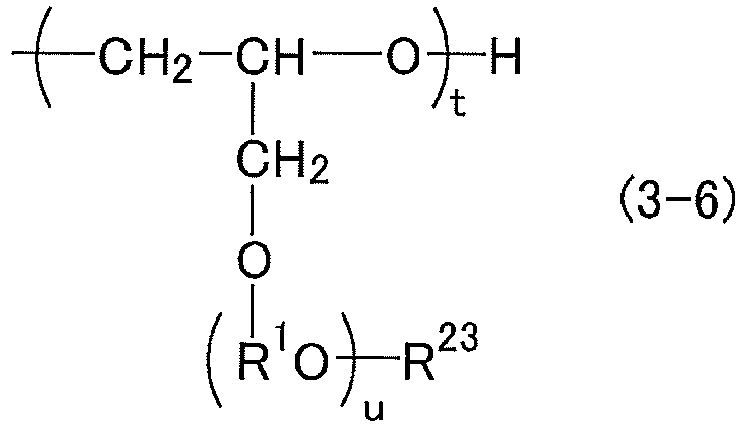
- R1 is the same as R1 in the formula (1-1).
- The number of carbon atoms of the alkyl group for R23 is preferably 3 to 18, more preferably 4 to 14, still more preferably 8 to 12.
- Alternatively, R23 is preferably the same group as Rc.
- Preferably, t is 1 to 10, more preferably 1 to 5, still more preferably 1 to 3.
- Preferably, u is 1 to 30, more preferably 1 to 20, still more preferably 8 to 18.
- The PAG compound according to the third aspect of the present invention preferably has a number average molecular weight of 500 to 100000, more preferably 600 to 50000, still more preferably 650 to 10000, particularly preferably 700 to 5000.
- The proportion of a group represented by Rc in the PAG compound according to the third aspect of the present invention represented by the formula (3-1) is preferably 2.5 to 60% by mass based on 100% by mass of the PAG compound. This can provide a PAG compound having more suitable hydrophobicity, which has a higher interaction with stains such as sebum. The proportion of a group represented by Rc is more preferably 3 to 50% by mass, still more preferably 4 to 40% by mass.
- A PAG compound of the present invention may be produced by any method, and examples of the method include a method (i) including a first step of reacting a compound having a pyrrolidone structure with an alkylene oxide and a second step of reacting the resulting reaction product with a compound containing a hydrophobic group (hydrophobic group-containing compound); and a method (ii) of reacting a compound having a pyrrolidone structure with a compound containing a hydrophobic group at one end of the polyalkylene glycol (hydrophobic group-containing polyalkylene glycol).
- The compound having a pyrrolidone structure (hereinafter, also referred to as pyrrolidone structure-containing compound) is preferably a compound represented by the following formula (4):

- In the case of the method (i), the PAG compound according to the first aspect of the present invention is preferably produced by a first step of reacting a pyrrolidone structure-containing compound represented by the formula (4) with an alkylene oxide and a second step of reacting a compound obtained in the first step represented by the following formula (5):

R4-X1 (6)
wherein R4 is an optionally substituted C1-C20 alkyl group, an optionally substituted C6-C20 aryl group, or an optionally substituted C1-C20 heterocyclic group; and X1 is a functional group reactive with a hydroxy group. - In the formula (4), R3 is a hydrogen atom or a C1-C20 organic group. In the method (i), the C1-C20 organic group preferably contains a functional group reactive with an alkylene oxide. In the method (ii), the C1-C20 organic group preferably contains a functional group reactive with a compound represented by the below-described formula (7).
- Non-limiting examples of these functional groups include polymerizable unsaturated groups such as hydroxy, carboxyl, epoxy, glycidyl, amino, sulfonic acid, phosphoric acid, and vinyl groups. In the method (i), the functional group is preferably a hydroxy, epoxy, or glycidyl group.
- The C1-C20 organic group is preferably a group in which any of the above-exemplified functional groups bonds to a hydrocarbon group such as an aliphatic alkyl, alicyclic alkyl, or aryl group. Specific examples of the aliphatic alkyl, alicyclic alkyl, and aryl groups and the ranges of the preferred numbers of carbon atoms thereof are the same as those described for R0 in the formula (1-1).
- Specific examples of the pyrrolidone structure-containing compound represented by the formula (4) include N-hydroxyethyl pyrrolidone, N-hydroxypropyl pyrrolidone, N-hydroxybutyl pyrrolidone, N-hydroxypentyl pyrrolidone, and N-hydroxyhexyl pyrrolidone, which are compounds in which a C1-C20 hydroxyalkyl group bonds to the nitrogen atom of 2-pyrrolidone.
- The pyrrolidone structure-containing compound represented by the formula (4) is preferably N-hydroxyethyl pyrrolidone, N-hydroxypropyl pyrrolidone, or N-hydroxybutyl pyrrolidone.
- In the formula (5), R0 is a C1-C20 divalent organic group, which is produced when R3 in the formula (4) is reacted with an alkylene oxide.
- In the formula (6), R4 is an optionally substituted C1-C20 alkyl group, an optionally substituted C6-C20 aryl group, or an optionally substituted C1-C20 heterocyclic group. Specific examples and preferred examples of these groups are the same as those described for Ra in the formula (1-1).
- X1 in the formula (6) may be any functional group reactive with the hydroxy group at an end of the polyalkylene glycol of the compound represented by the formula (5), and examples thereof include a halogen atom and epoxy, glycidyl, hydroxy, carboxyl, and amino groups. X1 is preferably a halogen atom or a glycidyl group.
- Examples of the halogen atom include fluorine, chlorine, bromine, and iodine atoms. Preferred is a chlorine atom.
- Specific examples of the hydrophobic group-containing compound represented by the formula (6) include a hydrophobic group-containing compound containing a halogen atom, such as a C1-C20 halogenated alkyl, and a hydrophobic group-containing compound containing a glycidyl ether group, such as a C1-C20 alkyl glycidyl ether.
- Examples of the C1-C20 halogenated alkyl include methyl chloride, ethyl chloride, propyl chloride, butyl chloride, pentyl chloride, hexyl chloride, heptyl chloride, octyl chloride, nonyl chloride, decyl chloride, undecyl chloride, dodecyl chloride (lauryl chloride), tridecyl chloride, tetradecyl chloride, pentadecyl chloride, hexadecyl chloride, heptadecyl chloride, octadecyl chloride, nonadecyl chloride, and eicosanyl chloride.
- Preferred among these is a C4-C18 halogenated alkyl. The number of carbon atoms of the halogenated alkyl is more preferably 8 to 16, still more preferably 12 to 14.
- Examples of the C1-C20 alkyl glycidyl ether include methyl glycidyl ether, ethyl glycidyl ether, propyl glycidyl ether, butyl glycidyl ether, pentyl glycidyl ether, hexyl glycidyl ether, heptyl glycidyl ether, octyl glycidyl ether, nonyl glycidyl ether, decyl glycidyl ether, undecyl glycidyl ether, dodecyl glycidyl ether, tridecyl glycidyl ether, tetradecyl glycidyl ether, pentadecyl glycidyl ether, hexadecyl glycidyl ether, and heptadecyl glycidyl ether.
- Preferred among these is a C7-C19 alkyl glycidyl ether. The number of carbon atoms of the alkyl glycidyl ether is more preferably 11 to 18, still more preferably 15 to 17.
- Reaction of the compound represented by the formula (5) with a hydrophobic group-containing compound containing a glycidyl ether group gives first a compound represented by the formula (1-1) in which Ra is -CH2CH(OH)CH2-ORa1. This compound represented by the formula (1-1) contains a hydroxy group. Reaction of this hydroxy group with a hydrophobic group-containing compound containing a glycidyl ether group provides a structure in which Ra is a group represented by the formula (1-2) with Ra2 being a group represented by the formula (1-3).
- In the case of the method (ii), the PAG compound according to the first aspect of the present invention is preferably produced by reacting a pyrrolidone structure-containing compound represented by the formula (4) with a compound represented by the following formula (7):
X2-(OR1)n-O-Ra (7)
wherein Ra is an optionally substituted C1-C20 alkyl group, an optionally substituted C6-C20 aryl group, or an optionally substituted C1-C20 heterocyclic group; R1s are the same as or different from each other and are each a C2-C20 alkylene group; n is the average number of moles of oxyalkylene groups added and is 1 to 300; and X2 is a hydrogen atom or a reactive functional group. - R1, Ra, and n in the formula (7) are the same as R1, Ra, and n in the formula (1-1).
- In the formula (7), X2 is a hydrogen atom or a reactive functional group and may be any one reactive with the organic group for R3 in the pyrrolidone structure-containing compound represented by the formula (4). Examples of the reactive functional group include a halogen atom, a glycidyl group, a hydroxy group, a carboxyl group, an amino group, and a thiol group-terminated C1-C10 organic group. X2 is preferably a hydrogen atom, a halogen atom, a glycidyl group, or a thiol group-terminated C1-C10 organic group, more preferably a hydrogen atom, a glycidyl group, or a thiol group-terminated C1-C10 organic group.
- Specific examples of the compound represented by the formula (7) containing a glycidyl group include an alkoxy polyalkylene glycol glycidyl ether containing a C1-C20 alkoxy group.
- Examples of the alkoxy group of the alkoxy polyalkylene glycol glycidyl ether include methoxy, ethoxy, propoxy, butoxy, pentyloxy, hexyloxy, heptyloxy, octyloxy, nonyloxy, decyloxy, undecyloxy, dodecyloxy (lauryloxy), tridecyloxy, tetradecyloxy, pentadecyloxy, hexadecyloxy, heptadecyloxy, octadecyloxy, nonadecyloxy, and eicosanyloxy groups.
- In the method (ii), reaction of the pyrrolidone structure-containing compound represented by the formula (4) with an alkoxy polyalkylene glycol glycidyl ether gives first a compound represented by the formula (1-1) in which R0 is a group represented by the formula (1-6). This compound represented by the formula (1-1) contains a hydroxy group. Reaction of this hydroxy group with an alkoxy polyalkylene glycol glycidyl ether provides a structure in which R0 is a group represented by the formula (1-4) with R01 being a group represented by the formula (1-5) .
- The thiol group-terminated C1-C10 organic group for X2 is preferably a group represented by the following formula (7-1):
-R04-SH (7-1)
wherein R04 is an optionally substituted C1-C10 alkylene group. The substituent is preferably, for example, a carbonyl, hydroxy, carboxyl, or sulfonic acid group, with a carbonyl group being more preferred. - The group represented by the formula (7-1) is more preferably a group represented by the following formula (7-2) :
-CO-R06-SH (7-2)
(wherein R06 is a C1-C9 alkylene group), still more preferably a group represented by the following formula (7-3) :
-CO-CH2CH2-SH (7-3).
R04 and R06 are the same as R04 in the formula (1-8) and R06 in the formula (1-9), respectively. - A compound represented by the formula (7) in which X2 is a group represented by the formula (7-2) can be obtained by reacting a mercaptocarboxylic acid with a compound represented by the formula (7) in which X2 is a hydrogen atom. Specific examples of the mercaptocarboxylic acid include thioglycolic acid (mercaptoacetic acid), 3-mercaptopropionic acid, 2-mercaptopropionic acid (thiolactic acid), 4-mercaptobutanoic acid, and thiomalic acid. Preferred is 3-mercaptopropionic acid.
- In the method (ii), when the compound represented by the formula (7) in which X2 is a hydrogen atom is used, the pyrrolidone structure-containing compound represented by the formula (4) has only to have a functional group reactive with the hydroxy group at an end of the polyalkylene glycol of the compound represented by the formula (7). The pyrrolidone structure-containing compound preferably contains an epoxy group.
- The pyrrolidone structure-containing compound containing an epoxy group is preferably a compound represented by the following formula (4-1):

- In the formula (4-1), α is preferably 0 to 3, more preferably 0 to 2, still more preferably 0 or 1.
- In the formula (4-1), a combination of α and β (α, β) is preferably (1, 1) or (1, 0).
- The compound represented by the formula (4-1) can be produced, for example, by reacting a pyrrolidone structure-containing compound such as N-hydroxyethyl pyrrolidone, N-hydroxypropyl pyrrolidone, N-hydroxybutyl pyrrolidone, N-hydroxypentyl pyrrolidone, N-hydroxyhexyl pyrrolidone, or 2-pyrrolidone with a compound containing an epoxy group and a functional group reactive with a nitrogen atom or a hydrogen atom of the pyrrolidone structure-containing compound. Examples of the functional group reactive with a nitrogen atom or a hydrogen atom include an epoxy group, a halogen atom, a hydroxy group, a carboxyl group, and an amino group. Preferred is a halogen atom. The compound containing an epoxy group and a halogen atom is preferably an epihalohydrin, more preferably epichlorohydrin.
- In the method (ii), when the compound represented by the formula (7) in which X2 is a thiol group-terminated C1-C10 organic group is used, the pyrrolidone structure-containing compound represented by the formula (4) preferably contains a polymerizable unsaturated group such as a vinyl group, more preferably contains a vinyl group. Specific examples of the pyrrolidone structure-containing compound represented by the formula (4) include N-vinylpyrrolidone and 1-(2-propenyl)-2-pyrrolidone. Preferred is N-vinylpyrrolidone.
- The PAG compound according to the second aspect of the present invention can also be produced by the method (i) or (ii), and is preferably produced by the method (i).
- In the case of the method (i), the PAG compound according to the second aspect of the present invention is preferably produced by a first step similar to that in the production of the PAG compound according to the first aspect of the present invention and a second step of reacting a compound represented by the formula (5) with a compound represented by the following (8):

- Rb4 in the formula (8) is the same as Rb1 in the case where Rb2 in the formula (2-2) is a hydrogen atom.
- Reaction of the compound represented by the formula (5) with a compound represented by the formula (8) gives first a compound represented by the formula (2-1) in which Rb is a group represented by the formula (2-2) with Rb2 being a hydrogen atom. This compound represented by the formula (2-1) contains a hydroxy group. Reaction of this hydroxy group with a compound represented by the formula (8) provides a structure in which Rb2 in the formula (2-2) is a group represented by the formula (2-3).
- The PAG compound according to the third aspect of the present invention can also be produced by the method (i) or (ii). In the case of the method (i), the PAG compound according to the third aspect of the present invention is preferably produced by reacting a compound represented by the following formula (9):

- In the formula (9), R5 is a C21-C100 organic group and preferably contains a functional group reactive with an alkylene oxide. Examples of the functional group include the functional groups exemplified for R3 in the formula (4). The functional group is preferably a hydroxy group.
- The C21-C100 organic group is preferably a group in which any of the above-exemplified functional groups bonds to a hydrocarbon group such as an aliphatic alkyl, alicyclic alkyl, or aryl group. Specific examples and preferred examples of the aliphatic alkyl, alicyclic alkyl, and aryl groups are the same as the aliphatic alkyl, alicyclic alkyl, and aryl groups described for R2 in the formula (3-1).
- Specific examples of the compound represented by the formula (9) include N-hydroxyhenicosyl pyrrolidone, N-hydroxydocosyl pyrrolidone, N-hydroxypentacosyl pyrrolidone, and N-hydroxytriacontyl pyrrolidone, which are compounds in which a C21-C100 hydroxyalkyl group bonds to the nitrogen atom of 2-pyrrolidone.
- In the second step in the method (i), the reaction product obtained in the first step is preferably reacted with a compound represented by the formula (6).
- The PAG compound according to the third aspect of the present invention is preferably produced by the method (ii). In the method (ii), a compound represented by the formula (10) :


- s in the formula (10) is the same as s in the formula (3-4).
- R1, Rc, and n in the formula (11) are the same as R1, Rc, and n in the formula (3-1).
- In the reaction step in the method (ii), reaction of the compound represented by the formula (10) with a compound represented by the formula (11) gives first a compound represented by the formula (3-1) in which R2 is-(CH2)s-O-CH2CH(OH)CH2-. This compound represented by the formula (3-1) contains a hydroxy group. Reaction of this hydroxy group with a compound represented by the formula (11) provides a structure in which R2 in the formula (3-1) is a group represented by the formula (3-5) with R22 being a group represented by the formula (3-6).
- When a PAG compound of the present invention is produced by the method (i), any amount of the hydrophobic group-containing compound may be used in the second step. The amount thereof is preferably 90 to 500 mol%, more preferably 100 to 300 mol% relative to 100 mol% of the reaction product obtained in the first step.
- When the PAG compounds according to the first and second aspects of the present invention are produced by the method (ii), the amount of the hydrophobic group-containing polyalkylene glycol used is preferably 90 to 500 mol%, more preferably 100 to 300 mol% relative to 100 mol% of the pyrrolidone structure-containing compound.
- When the PAG compound according to the third aspect of the present invention is produced by the method (ii), the amount of the hydrophobic group-containing polyalkylene glycol used is preferably 90 to 1000 mol%, more preferably 100 to 500 mol% relative to 100 mol% of the pyrrolidone structure-containing compound.
- In the first and second steps in the method (i) and the reaction step in the method (ii) for producing a PAG compound of the present invention, a reaction catalyst is preferably used in terms of reaction rate. Examples of the reaction catalyst include acid catalysts such as mineral acids (e.g., sulfuric acid, phosphoric acid) and Lewis acids (e.g., tin tetrachloride, boron trifluoride); basic catalysts such as alkali metal hydroxides (e.g., sodium hydroxide, potassium hydroxide); and polymerization catalysts. Preferred are basic catalysts and polymerization catalysts.
- Examples the polymerization catalysts include persulfates such as ammonium persulfate, sodium persulfate, and potassium persulfate; hydrogen peroxide; and watersoluble azo initiators such as azoamidine compounds (e.g., 2,2'-azobis-2-methylpropionamidine hydrochloride), cyclic azoamidine compounds (e.g., 2,2'-azobis-2-(2-imidazolin-2-yl)propane hydrochloride), and azonitrile compounds (e.g., 2-carbamoyl azoisobutyronitrile).
- A basic catalyst is preferably used in the first and second steps in the method (i) or in the case of using a hydroxy group-terminated polyalkylene glycol compound or a glycidyl group-containing compound as a (poly)alkylene glycol compound in the method (ii). The basic catalyst is more preferably sodium hydroxide.
- In the case of using a thiol group-terminated (poly)alkylene glycol compound in the method (ii), a watersoluble azo initiator is preferably used. The watersoluble azo initiator is more preferably an azoamidine compound.
- The reaction temperature in each of the first and second steps in the method (i) and the reaction step in the method (ii) may be any temperature and is preferably 20°C to 180°C, more preferably 30°C to 160°C. The reaction pressure is preferably from an atmospheric pressure to 20 kg/cm2G, more preferably 1 to 10 kg/cm2G.
- The first and second steps in the method (i) and the reaction step in the method (ii) are preferably performed under an inert gas atmosphere such as a nitrogen atmosphere. Further, the resulting reaction product may be stored under an inert gas atmosphere such as a nitrogen atmosphere.
- A solvent may be used in these steps. Preferably, no solvent is used for the reactions.
- The methods of producing a PAG compound of the present invention may include purification during or after the first step and/or the second step for the method (i) and the reaction step for the method (ii), if necessary.
- Examples of the purification include removal of components such as residual materials, by-products, moisture, and residual catalysts and neutralization of catalysts.
- In the neutralization of catalysts, for example, when sodium hydroxide and/or potassium hydroxide are/is used for reaction, a neutralizing agent used may be sulfuric acid, acetic acid, or a solid acid such as activated white earth.
- A composition containing a PAG compound of the present invention essentially contains a PAG compound of the present invention. The composition may contain in addition to a PAG compound of the present invention different components such as unreacted materials, by-products, residual catalysts, and solvents.
- A PAG compound of the present invention is preferably present in the composition in an amount of 1 to 99.9% by mass, more preferably 1 to 99% by mass based on 100% by mass of the composition.
- Specifically, the composition containing any of the polyalkylene glycol-containing compounds of the present invention contains a polyalkylene glycol-containing compound and different components other than the compounds. The amount of the polyalkylene glycol-containing compound is 1 to 99.9% by mass, preferably 30 to 99.9% by mass, still more preferably 50 to 99.9% by mass based on 100% by mass of the composition.
- The polyalkylene glycol-containing compounds of the present invention are used in various applications such as detergent builders, detergents, chemicals for water treatment, scale inhibitors, and dispersants, and preferably used for detergent builders and detergents, for example. The present invention also encompasses a method of using the polyalkylene glycol-containing compounds as detergent builders, detergent additives, chemicals for water treatment, scale inhibitors, or dispersants.
- The present invention also relates to a detergent composition containing any of the polyalkylene glycol-containing compounds of the present invention and a detergent additive other than the compounds.
- The detergent additive other than the polyalkylene glycol-containing compounds of the present invention may be any additive that is used for surfactants and common detergents. The detergent additive may be selected by appropriately referring to common knowledge in the detergent field.
- The detergent composition may also be a powder detergent composition or a liquid detergent composition.
- The surfactant is preferably one or more surfactants selected from the group consisting of anionic surfactants, nonionic surfactants, cationic surfactants, and amphoteric surfactants.
- Suitable examples of the anionic surfactants include alkylbenzene sulfonates, alkyl ether sulfates, alkenyl ether sulfates, alkyl sulfates, alkenyl sulfates, α-olefin sulfonates, α-sulfonated fatty acids and esters thereof, alkane sulfonates, saturated fatty acid salts, unsaturated fatty acid salts, alkyl ether carboxylates, alkenyl ether carboxylates, amino acid-based surfactants, N-acylamino acid-based surfactants, alkyl phosphoric acid esters and salts thereof, and alkenyl phosphoric acid esters and salts thereof. The alkyl group or alkenyl group of any of these anionic surfactants may contain an alkyl group such as a methyl group as a branch.
- Suitable examples of the nonionic surfactants include polyoxyalkylene alkyl ethers, polyoxyalkylene alkenyl ethers, polyoxyethylene alkylphenyl ethers, higher fatty acid alkanolamides and adducts thereof with an alkylene oxide, sucrose fatty acid esters, alkyl glycoxides, fatty acid glycerol monoesters, and alkylamine oxides. The alkyl group or alkenyl group of any of these nonionic surfactants may contain an alkyl group such as a methyl group as a branch.
- Suitable examples of the cationic surfactants include quaternary ammonium salts. Suitable examples of the amphoteric surfactants include carboxyl-type amphoteric surfactants and sulfobetaine-type amphoteric surfactants. The alkyl group or alkenyl group of any of these cationic surfactants and amphoteric surfactants may contain an alkyl group such as a methyl group as a branch.
- The surfactant is typically present in the detergent composition in a proportion of 10 to 60% by mass, preferably 15 to 50% by mass, more preferably 20 to 45% by mass, particularly preferably 25 to 40% by mass based on the total amount of the detergent composition. A detergent composition containing too small an amount of the surfactant may fail to exhibit sufficient detergency, whereas a detergent composition containing too large an amount of the surfactant may be disadvantageous in terms of cost.
- The present invention is described in further detail below with reference to examples, but the present invention is not limited to these examples. It should be noted that the terms "part(s)" and "%" refer to "part(s) by mass" and "% by mass", respectively, unless otherwise stated.
-
- (1) The whiteness of 5 cm × 5 cm artificially stained wet fabrics (available from Sentaku Kagaku Kyokai) was measured in advance using a color difference meter SE 6000 (Nippon Denshoku Industries Co., Ltd.) based on the reflectance.
- (2) Pure water was added to calcium chloride dihydrate (7.34 g) to prepare 20 kg of hard water.
- (3) In a 20-mL vial, 10 g of an aqueous solution of each sample to be evaluated (solid content: 2%) was prepared.
- (4) Sodium laurylbenzenesulfonate (0.5 g), sodium sulfate pure water (2 g), and sodium carbonate (0.5 g) as detergent components were weighed and put into a beaker.
- (5) To the beaker in (4) was added the hard water prepared in (2) to prepare 2 kg of a wash solution.
- (6) A Terg-o-Tometer was set at 25°C, and each pot was charged with the wash solution (500 mL) prepared in (5) and the aqueous solution (1.0 g) of each sample prepared in (3). The contents were stirred at 100 rpm for two minutes. Thereafter, five stained fabrics and 14.6 g of a cotton fabric (5 cm × 5 cm CW98 available from Testfabrics, Inc.) for liquor ratio control were put into each pot, and they were stirred at 100 rpm for 10 minutes (a reference was also prepared in which pure water was added instead of the aqueous solution of each sample prepared in (3) and was evaluated).
- (7) The stained fabrics taken out from the pots were wrung out by hand to remove water. The hard water (500 mL) prepared in (2) was put into each pot, controlled to 25°C, and stirred at 100 rpm for four minutes.
- (8) The stained fabrics taken out from the pots were wrung out by hand to remove water and dried at room temperature overnight. Thereafter, the whiteness of the stained fabrics was measured again using the color difference meter based on the reflectance.
- (9) The whiteness of the CW98 as an unstained fabric (hereinafter, also referred to as white fabric) was measured based on the reflectance as in (8).
- (10) A washing percentage (detergency) was determined from the resulting measurement values using the following equation:
- A higher washing percentage indicates better detergency.
-
- (1) A cotton fabric (CW98 available from Testfabrics, Inc.) was cut to prepare 5 cm × 5 cm white fabrics. The whiteness of the white fabrics was measured in advance using a color difference meter SE 6000 (Nippon Denshoku Industries Co., Ltd.) based on the reflectance.
- (2) Pure water was added to calcium chloride dihydrate (1.47 g) to prepare 20 kg of hard water.
- (3) In a 20-mL vial, 10 g of an aqueous solution of each sample to be evaluated (solid content: 1%) was prepared.
- (4) 100 g of 4% sodium laurylbenzenesulfonate was prepared as an aqueous surfactant solution.
- (5) A Terg-o-Tometer was set at 25°C, and each pot was charged with the hard water (1 L) prepared in (2), the aqueous solution (5.0 g) of each sample prepared in (3), the aqueous surfactant solution (5.0 g) prepared in (4), carbon black (0.25 g) (available from Sentaku Kagaku Kyokai), and clay (0.50 g) (JIS test powder 1, class 11 (calcined KANTO loam)). The contents were stirred at 100 rpm for one minute. Thereafter, five cotton fabrics were put into each pot, and they were stirred at 100 rpm for 10 minutes (a reference was also prepared in which pure water was added instead of the aqueous solution of each sample prepared in (3) and was evaluated).
- (6) The white fabrics were wrung out by hand to remove water. The hard water (1 L) prepared in (2) was put into each pot, controlled to 25°C, and stirred at 100 rpm for two minutes.
- (7) The white fabrics were covered with an ironing fabric and smoothed with an iron to dry. Thereafter, the whiteness of the cotton fabrics was again measured using the color difference meter based on the reflectance.
- (8) An anti-redeposition percentage (anti-redeposition ability) was determined from the resulting measurement values using the following equation:

- A higher anti-redeposition percentage indicates better anti-redeposition ability.
- With a lower oil-water interfacial tension, oil has a higher affinity for water and is more easily dispersed in washing water. This leads to improvement of detergency. The oil-water interfacial tension was measured using a DY-500 system (hereinafter, also referred to as DY-500, available from Kyowa Interface Science Co., Ltd.) in accordance with the following procedure.
- (1) Pure water was added to sodium laurylbenzenesulfonate (0.4 g) to prepare 1000 g of an aqueous sodium laurylbenzenesulfonate solution (400 ppm).
- (2) In a 20-mL vial, 10 g of an aqueous solution of each sample to be evaluated (solid content: 2%) was prepared.
- (3) To the aqueous solution (0.16 g) of each sample prepared in (2) was added the aqueous sodium laurylbenzenesulfonate solution prepared in (1) to prepare 80.0 g of an aqueous phase solution.
- (4) A glass vessel was charged with the solution (20 g) prepared in (3). To the vessel was added paraffin oil (30.0 g) gently using a dropper as an oil phase solution. Thus, an oil-water two-phase solution was prepared.
- (5) The two-phase solution prepared in (4) was controlled to 25°C and allowed to stand for 10 minutes while the temperature was maintained at 25°C.
- (6) After the solution was allowed to stand, it was sampled and subjected to measurement of oil-water interfacial tension using a platinum plate.
- The strength of interaction between each sample and each stain component was evaluated by measuring the absolute values of heat changes that occurred when an aqueous solution of each sample was added dropwise to an aqueous solution of a stain component using a MicroCal ITC 200 system (Malvern Panalytical Ltd., hereinafter, also referred to as ITC).
- (1) In a 20-mL vial, 10 g of an aqueous solution of each sample to be evaluated (solid content: 800 ppm) was prepared.
- (2) Separately, in a 10-mL vial, 5 g of an aqueous solution of each stain component (solid content: 1%) was prepared. Each stain component as a model stain component was selected from methyl acetate, acetic acid, and alkyl fatty acids.
- (3) The aqueous solution of each sample to be evaluated prepared in (1) was put into a sample cell of the ITC, the aqueous solution of a stain component prepared in (2) was put into a syringe, and the titration was started. The measurement conditions were as follows: the total number of injections was 19, the cell temperature was 25°C, the reference power during measurement was 5 µcal, the duration from the start of data capturing to the 1st injection (initial delay) was 60 seconds, the stirring speed was 750 rpm, each injection volume was 0.4 µL for the 1st injection and 2 µL for the 2nd to 19th injections, the duration of each injection was four seconds, the spacing between injections was 150 seconds, and the data averaging time (filter period) was five seconds. A reference was also prepared in which pure water was added instead of the solution of each sample prepared in (1) and was subjected to measurement.
- (4) The sum of the maximum values of the absolute values of heat changes occurred at the 2nd to 19th injections was determined as the strength of interaction. This means that a larger sum of the maximum values indicates stronger interaction.
- A stainless steel autoclave reactor equipped with a thermometer, a stirrer, a material inlet tube, and a nitrogen inlet tube was charged with 374.6 g (2.9 mol) of N-hydroxyethyl pyrrolidone (hereinafter, also referred to as HEP) and 0.33 g of sodium hydroxide as a reaction catalyst. The reactor was purged with nitrogen under stirring, and the contents were heated to 120°C in a nitrogen atmosphere. Then, 1281.8 g (29.0 mol) of ethylene oxide was introduced into the reactor over 3.5 hours at a safe pressure while the temperature was maintained at 120°C ± 5°C. Thereafter, the temperature was maintained for two hours. Finally, the reactor was purged with nitrogen under stirring, and the contents were cooled to room temperature. Thus, a polyalkylene glycol-containing compound (1) in which an average of 10 mol of ethylene oxide was added to HEP was obtained. Next, a four-necked glass recovery flask reaction vessel equipped with a thermometer, a reflux tube, and a nitrogen inlet tube was charged with 2.91 g (5.1 mmol) of the polyalkylene glycol-containing compound (1), 0.30 g (7.5 mmol) of sodium hydroxide as a reaction catalyst, and a stir bar. The reaction vessel was purged with nitrogen under stirring using a magnetic stirrer, and the contents were heated to 80°C in a nitrogen atmosphere. While the temperature was maintained at 80°C under atmospheric pressure, 1.36 g (6.6 mmol) of 1-lauryl chloride was added to the reaction vessel in one portion, and then the temperature was maintained for 7.5 hours in a nitrogen atmosphere. Thereafter, the reaction solution was cooled to room temperature, and ion exchange water was added thereto, followed by sufficient stirring. The resulting dispersion solution was put into a separatory funnel and washed with n-hexane, and then the lower phase was drained to collect the aqueous phase. This washing operation was repeated three times. The collected aqueous phase was subjected to evaporation to remove the solvent. To the residue was added acetonitrile, and insoluble matter was separated by centrifugation. After the centrifugation, the supernatant was collected and subjected to evaporation to remove acetonitrile. Thus, an organic group-terminated polyalkylene glycol-containing compound (4) was obtained.
- A stainless steel autoclave reactor equipped with a thermometer, a stirrer, a material inlet tube, and a nitrogen inlet tube was charged with 600 g (1.1 mol) of the polyalkylene glycol-containing compound (1). The reactor was purged with nitrogen under stirring, and the contents were heated to 120°C in a nitrogen atmosphere. Then, 195.1 g (4.4 mol) of ethylene oxide was introduced into the reactor over 2.5 hours at a safe pressure while the temperature was maintained at 120°C ± 5°C. Thereafter, the temperature was maintained for 1.5 hours. Finally, the reactor was purged with nitrogen under stirring, and the contents were cooled to room temperature. Thus, a polyalkylene glycol-containing compound (2) in which an average of 14.2 mol of ethylene oxide was added to HEP was obtained. Separately, a stainless steel autoclave reactor equipped with a thermometer, a stirrer, a material inlet tube, and a nitrogen inlet tube was charged with 780.7 g (1.1 mol) of the resulting polyalkylene glycol-containing compound (2). The reactor was purged with nitrogen under stirring, and the contents were heated to 120°C in a nitrogen atmosphere. Then, 284.2 g (6.5 mol) of ethylene oxide was introduced into the reactor over 5.3 hours at a safe pressure while the temperature was maintained at 120°C ± 5°C. Thereafter, the temperature was maintained for 4.2 hours. Finally, the reactor was purged with nitrogen under stirring, and the contents were cooled to room temperature. Thus, a polyalkylene glycol-containing compound (3) in which an average of 20.4 mol of ethylene oxide was added to HEP was obtained. Next, a four-necked glass recovery flask reaction vessel equipped with a thermometer, a reflux tube, and a nitrogen inlet tube was charged with 2.25 g (2.2 mmol) of the polyalkylene glycol-containing compound (3), 0.13 g (3.2 mmol) of sodium hydroxide as a reaction catalyst, and a stirring bar. The reaction vessel was purged with nitrogen under stirring using a magnetic stirrer, and the contents were heated to 80°C in a nitrogen atmosphere. While the temperature was maintained at 80°C under atmospheric pressure, 0.60 g (2.9 mmol) of 1-lauryl chloride was added to the reaction vessel in one portion, and then the temperature was maintained for 7.5 hours in a nitrogen atmosphere. Thereafter, the reaction solution was cooled to room temperature, and ion exchange water was added thereto, followed by sufficient stirring. The resulting dispersion solution was put into a separatory funnel and washed with n-hexane, and then the lower phase was drained to collect the aqueous phase. This washing operation was repeated three times. The collected aqueous phase was subjected to evaporation to remove the solvent. To the residue was added acetonitrile, and insoluble matter was separated by centrifugation. After the centrifugation, the supernatant was collected and subjected to evaporation to remove acetonitrile. Thus, an organic group-terminated polyalkylene glycol-containing compound (5) was obtained.
- A four-necked glass recovery flask reaction vessel equipped with a thermometer, a stirrer, a reflux tube, and a nitrogen inlet tube was charged with 2.91 g (5.1 mmol) of the polyalkylene glycol-containing compound (1) and 0.30 g (7.5 mmol) of sodium hydroxide as a reaction catalyst. The reaction vessel was purged with nitrogen under stirring, and the contents were heated to 60°C in a nitrogen atmosphere. While the temperature was maintained at 60°C under atmospheric pressure, 1.23 g (5.1 mmol) of lauryl glycidyl ether was added to the reaction vessel in one portion, and then the temperature was maintained for 10 hours in a nitrogen atmosphere. Thereafter, the reaction solution was cooled to room temperature. Thus, an organic group-terminated polyalkylene glycol-containing compound (6-1) was obtained.
- A four-necked glass recovery flask reaction vessel equipped with a thermometer, a stirrer, a reflux tube, and a nitrogen inlet tube was charged with 2.91 g (5.1 mmol) of the polyalkylene glycol-containing compound (1) and 0.30 g (7.5 mmol) of sodium hydroxide as a reaction catalyst. The reaction vessel was purged with nitrogen under stirring, and the contents were heated to 60°C in a nitrogen atmosphere. While the temperature was maintained at 60°C under atmospheric pressure, 0.95 g (5.1 mmol) of 2-ethylhexyl glycidyl ether was added to the reaction vessel in one portion, and then the temperature was maintained for 10 hours in a nitrogen atmosphere. Thereafter, the reaction solution was cooled to room temperature. Thus, an organic group-terminated polyalkylene glycol-containing compound (7-1) was obtained.
- A four-necked glass recovery flask reaction vessel equipped with a thermometer, a stirrer, a reflux tube, and a nitrogen inlet tube was charged with 2.91 g (5.1 mmol) of the polyalkylene glycol-containing compound (1) and 0.30 g (7.5 mmol) of sodium hydroxide as a reaction catalyst. The reaction vessel was purged with nitrogen under stirring, and the contents were heated to 60°C in a nitrogen atmosphere. While the temperature was maintained at 60°C under atmospheric pressure, 1.67 g (5.1 mmol) of stearyl glycidyl ether was added to the reaction vessel in one portion, and then the temperature was maintained for 12 hours in a nitrogen atmosphere. Thereafter, the reaction solution was cooled to room temperature. Thus, an organic group-terminated polyalkylene glycol-containing compound (8-1) was obtained.
- A four-necked glass recovery flask reaction vessel equipped with a thermometer, a stirrer, a reflux tube, and a nitrogen inlet tube was charged with 5.15 g (5.1 mmol) of the polyalkylene glycol-containing compound (3) and 0.30 g (7.5 mmol) of sodium hydroxide as a reaction catalyst. The reaction vessel was purged with nitrogen under stirring, and the contents were heated to 60°C in a nitrogen atmosphere. While the temperature was maintained at 60°C under atmospheric pressure, 1.23 g (5.1 mmol) of lauryl glycidyl ether was added to the reaction vessel in one portion, and then the temperature was maintained for 12 hours in a nitrogen atmosphere. Thereafter, the reaction solution was cooled to room temperature. Thus, an organic group-terminated polyalkylene glycol-containing compound (9-1) was obtained.
- A four-necked glass recovery flask reaction vessel equipped with a thermometer, a stirrer, a reflux tube, and a nitrogen inlet tube was charged with 0.66 g (5.1 mmol) of N-hydroxyethyl pyrrolidone (hereinafter, also referred to as HEP) and 0.30 g (7.5 mmol) of sodium hydroxide as a reaction catalyst. The reaction vessel was purged with nitrogen under stirring, and the contents were heated to 60°C in a nitrogen atmosphere. While the temperature was maintained at 60°C under atmospheric pressure, 4.60 g (5.1 mmol) of Denacol EX-171 (available from NCX, lauryl alcohol-EO(15)-glycidyl ether) was added to the reaction vessel in one portion, and then the temperature was maintained for 12 hours in a nitrogen atmosphere. Thereafter, the reaction solution was cooled to room temperature. Thus, an organic group-terminated polyalkylene glycol-containing compound (10-1) was obtained.
- A four-necked glass recovery flask reaction vessel equipped with a thermometer, a stirrer, a reflux tube, and a nitrogen inlet tube was charged with 0.66 g (5.1 mmol) of N-hydroxyethyl pyrrolidone (hereinafter, also referred to as HEP) and 0.30 g (7.5 mmol) of sodium hydroxide as a reaction catalyst. The reaction vessel was purged with nitrogen under stirring, and the contents were heated to 60°C in a nitrogen atmosphere. While the temperature was maintained at 60°C under atmospheric pressure, 13.8 g (15.3 mmol) of Denacol EX-171 (available from NCX, lauryl alcohol-EO(15)-glycidyl ether) was added to the reaction vessel over five minutes, and then the temperature was maintained for 24 hours in a nitrogen atmosphere. Thereafter, the reaction solution was cooled to room temperature. Thus, an organic group-terminated polyalkylene glycol-containing compound (11-1) was obtained.
- A four-necked glass recovery flask reaction vessel equipped with a thermometer, a stirrer, and a nitrogen inlet tube was charged with 11.38 g (20 mmol) of the polyalkylene glycol-containing compound (1) and 0.52 g of sodium hydroxide as a catalyst. The reaction vessel was purged with nitrogen under stirring, and the contents were heated to 120°C in a nitrogen atmosphere. The temperature was maintained for one hour under atmospheric pressure. Thereafter, the temperature was lowered to 80°C, 5.12 g (20 mmol) of lauryl glycidyl ether was added to the reaction vessel in one portion, and then the temperature was maintained for seven hours in a nitrogen atmosphere. Thereafter, the reaction solution was cooled to room temperature. Thus, an organic group-terminated polyalkylene glycol-containing compound (6-2) was obtained.
- A four-necked glass recovery flask reaction vessel equipped with a thermometer, a stirrer, and a nitrogen inlet tube was charged with 11.38 g (20 mmol) of the polyalkylene glycol-containing compound (1) and 0.52 g of sodium hydroxide as a catalyst. The reaction vessel was purged with nitrogen under stirring, and the contents were heated to 120°C in a nitrogen atmosphere. The temperature was maintained for one hour under atmospheric pressure. Thereafter, the temperature was lowered to 80°C, 3.73 g (20 mmol) of 2-ethylhexyl glycidyl ether was added to the reaction vessel in one portion, and then the temperature was maintained for seven hours in a nitrogen atmosphere. Thereafter, the reaction solution was cooled to room temperature. Thus, an organic group-terminated polyalkylene glycol-containing compound (7-2) was obtained.
- A four-necked glass recovery flask reaction vessel equipped with a thermometer, a stirrer, and a nitrogen inlet tube was charged with 11.38 g (20 mmol) of the polyalkylene glycol-containing compound (1) and 0.52 g of sodium hydroxide as a catalyst. The reaction vessel was purged with nitrogen under stirring, and the contents were heated to 120°C in a nitrogen atmosphere. The temperature was maintained for one hour under atmospheric pressure. Thereafter, the temperature was lowered to 80°C, 6.53 g (20 mmol) of stearyl glycidyl ether was added to the reaction vessel in one portion, and then the temperature was maintained for seven hours in a nitrogen atmosphere. Thereafter, the reaction solution was cooled to room temperature. Thus, an organic group-terminated polyalkylene glycol-containing compound (8-2) was obtained.
- A four-necked glass recovery flask reaction vessel equipped with a thermometer, a stirrer, and a nitrogen inlet tube was charged with 20.18 g (20 mmol) of the polyalkylene glycol-containing compound (3) and 0.52 g of sodium hydroxide as a catalyst. The reaction vessel was purged with nitrogen under stirring, and the contents were heated to 120°C in a nitrogen atmosphere. The temperature was maintained for one hour under atmospheric pressure. Thereafter, the temperature was lowered to 80°C, 5.12 g (20 mmol) of lauryl glycidyl ether was added to the reaction vessel in one portion, and then the temperature was maintained for seven hours in a nitrogen atmosphere. Thereafter, the reaction solution was cooled to room temperature. Thus, an organic group-terminated polyalkylene glycol-containing compound (9-2) was obtained.
- A four-necked glass recovery flask reaction vessel equipped with a thermometer, a stirrer, and a nitrogen inlet tube was charged with 12.92 g (100 mmol) of 1-(2-hydroxyethyl)-2-pyrrolidone (HEP) and 2 g of sodium hydroxide as a catalyst. The reaction vessel was purged with nitrogen under stirring, and the contents were heated to 120°C in a nitrogen atmosphere. The temperature was maintained for one hour under atmospheric pressure. Thereafter, the temperature was lowered to 80°C, 90.3 g (100 mmol) of Denacol EX-171 (available from NCX, lauryl alcohol-EO(15)-glycidyl ether) was added to the reaction vessel in one portion, and then the temperature was maintained for seven hours in a nitrogen atmosphere. Thereafter, the reaction solution was cooled to room temperature. Thus, an organic group-terminated polyalkylene glycol-containing compound (10-2) was obtained.
- A four-necked glass recovery flask reaction vessel equipped with a thermometer, a stirrer, and a nitrogen inlet tube was charged with 12.92 g (100 mmol) of 1-(2-hydroxyethyl)-2-pyrrolidone (HEP) and 2 g of sodium hydroxide as a catalyst. The reaction vessel was purged with nitrogen under stirring, and the contents were heated to 120°C in a nitrogen atmosphere. The temperature was maintained for one hour under atmospheric pressure. Thereafter, the temperature was lowered to 80°C, 180.6 g (200 mmol) of Denacol EX-171 (available from NCX, lauryl alcohol-EO(15)-glycidyl ether) was added to the reaction vessel in one portion, and then the temperature was maintained for 20 hours in a nitrogen atmosphere. Thereafter, the reaction solution was cooled to room temperature. Thus, an organic group-terminated polyalkylene glycol-containing compound (11-2) was obtained.
- A 500-ml four-necked glass recovery flask reaction vessel equipped with a thermometer, a stirrer, and a reflux tube was charged with 103.66 g (0.90 mol) of 1-(2-hydroxyethyl)-2-pyrrolidone (hereinafter, also referred to as HEP) and 249.80 g (2.70 mol) of epichlorohydrin (hereinafter, also referred to as ECH). The contents were heated to 40°C under stirring using a stirrer. Thereafter, while the temperature was maintained at 50°C or lower, 36.0 g (0.90 mol) of granular sodium hydroxide was added in ten portions. Then, 36.0 g (0.90 mol) of granular sodium hydroxide was added in two portions, followed by stirring for one hour at 50°C. Thereafter, the reaction solution was cooled to room temperature, and the produced salts were removed by suction filtration to give a coarse product. Subsequently, the coarse product was subjected to evaporation to mostly remove epichlorohydrin remaining therein and then, subjected to reduced pressure distillation to completely remove the epichlorohydrin. Thus, a pyrrolidone compound containing an epoxy ring (hereinafter, also referred to as a monomer (1) or HEP-ECH (ECH-HEP)) was obtained.
- A 2-L four-necked glass recovery flask reaction vessel equipped with a thermometer, a stirrer, and a reflux tube was charged with 297.89 g (3.50 mol) of 2-pyrrolidone (hereinafter, also referred to as 2Py) and 971.46 g (10.50 mol) of epichlorohydrin. The contents were heated to 45°C under stirring using a stirrer. Thereafter, while the temperature was maintained at 50°C or lower, 140.0 g (3.50 mol) of granular sodium hydroxide was added in ten portions. Then, 21.0 g (0.53 mol) of granular sodium hydroxide was added in two portions, followed by stirring for one hour at 50°C. Thereafter, the reaction solution was cooled to room temperature, and the produced salts were removed by suction filtration to give a coarse product. Subsequently, the coarse product was subjected to evaporation to mostly remove epichlorohydrin remaining therein and then, subjected to reduced pressure distillation to completely remove the epichlorohydrin. Thus, a pyrrolidone compound containing an epoxy ring (hereinafter, also referred to as a monomer (2) or 2Py-ECH(ECH-2Py)) was obtained.
- A four-necked glass recovery flask reaction vessel equipped with a thermometer, a stirrer, and a nitrogen inlet tube was charged with 19.02 g (30 mmol) of NEWCOL 2310 (available from Nippon Nyukazai Co., Ltd., a compound in which an average of 10 mol of ethylene oxide was added to a C12-C13 primary alcohol, hereinafter, also referred to as NC2310) and 0.17 g (0.30 mmol) of potassium hydroxide as a catalyst. The reaction vessel was purged with nitrogen under stirring, and the contents were heated to 155°C in a nitrogen atmosphere. The temperature was maintained for one hour under atmospheric pressure. Thereafter, while 5.56 g (30 mmol) of the monomer (1) was added to the reaction vessel with a syringe at a rate of 0.1 mL/min, the temperature was maintained for four hours in a nitrogen atmosphere. Thereafter, the reaction solution was cooled to room temperature. Thus, an organic group-terminated polyalkylene glycol-containing compound (12) was obtained.
- A four-necked glass recovery flask reaction vessel equipped with a thermometer, a stirrer, and a nitrogen inlet tube was charged with 19.07 g (32 mmol) of SOFTANOL 90 (available from Nippon Shokubai Co., Ltd., a compound in which an average of 9 mol of ethylene oxide was added to a C12-C14 secondary alcohol, hereinafter, also referred to as SFT90) and 0.18 g (0.32 mmol) of potassium hydroxide as a catalyst. The reaction vessel was purged with nitrogen under stirring, and the contents were heated to 155°C in a nitrogen atmosphere. The temperature was maintained for one hour under atmospheric pressure. Thereafter, while 5.56 g (30 mmol) of the monomer (1) was added to the reaction vessel with a syringe at a rate of 0.1 mL/min, the temperature was maintained for four hours in a nitrogen atmosphere. Thereafter, the reaction solution was cooled to room temperature. Thus, an organic group-terminated polyalkylene glycol-containing compound (13) was obtained.
- A four-necked glass recovery flask reaction vessel equipped with a thermometer, a stirrer, and a nitrogen inlet tube was charged with 20.28 g (32 mmol) of NEWCOL 2310 (available from Nippon Nyukazai Co., Ltd., a compound in which an average of 10 mol of ethylene oxide was added to a C12-C13 primary alcohol, hereinafter, also referred to as NC2310) and 0.18 g (0.32 mmol) of potassium hydroxide as a catalyst. The reaction vessel was purged with nitrogen under stirring, and the contents were heated to 155°C in a nitrogen atmosphere. The temperature was maintained for one hour under atmospheric pressure. Thereafter, while 4.52 g (32 mmol) of the monomer (2) was added to the reaction vessel with a syringe at a rate of 0.1 mL/min, the temperature was maintained for four hours in a nitrogen atmosphere. Thereafter, the reaction solution was cooled to room temperature. Thus, an organic group-terminated polyalkylene glycol-containing compound (14) was obtained.
- A glass reaction vessel equipped with a water quantitative receiver including a Dimroth condenser, a stirrer including a stirring blade and a stirring seal, and a temperature sensor including a glass protection tube was charged with 20.75 g of cyclohexane as an azeotropic solvent, 200 g (0.32 mol) of an adduct of lauryl alcohol with 10 mol of EO, 33.9 g (0.32 mol) of mercaptopropionic acid, 4.68 g (24.6 mmol) of paratoluenesulfonic acid monohydrate, and 0.12 g (0.59 mmol) of phenothiazine. The water quantitative receiver was filled with cyclohexane, and then the reaction system was heated to reflux under stirring. Cyclohexane was added to control the temperature of the reaction system to 110°C ± 5°C, and stirring was performed for 10 hours. Thereafter, the reaction solution was cooled to about 70°C while stirred so as not to be solidified. Then, 3.12 g (23.4 mmol) of a 30% aqueous solution of sodium hydroxide was promptly put into the reaction vessel. Next, 220 g of ion exchange water was added, and the reaction system was heated to reflux under stirring. While cyclohexane collected in the water quantitative receiver was discharged, it was completely removed from the reaction system. Thus, a thiol group-terminated polyalkylene glycol-containing compound (15) was obtained. Separately, a 500-mL glass separable flask equipped with a thermometer, a stirrer, and a reflux condenser was charged with 92.6 g of pure water. The contents were bubbled with nitrogen for 10 minutes under stirring and then heated to 80°C. Subsequently, to the separable flask were added dropwise 20.0 g (0.18 mol) of N-vinylpyrrolidone (hereinafter, also referred to as NVP), 1.95 g (0.36 mmol) of a 5% aqueous solution of 2,2'-azobis(2-methylpropioamidine)dihydrochloride (hereinafter, also referred to as V-50), 257.2 g (0.18 mol) of a 50% aqueous solution of the thiol group-terminated polyalkylene glycol-containing compound (15) through respective dropping ports. The addition times were 160 minutes for NVP, 190 minutes for V-50, and 160 minutes for the polyalkylene glycol-containing compound (15). The temperature was maintained at 80°C until the end of dropwise addition. The same temperature was further maintained for 60 minutes after the completion of the dropwise addition so that aging was performed to complete the polymerization. After the completion of the polymerization, the reaction solution was cooled to room temperature. Thus, an organic group-terminated polyalkylene glycol-containing compound (16) was obtained.
- A polyalkylene glycol-containing compound (1) in which an average of 10 mol of ethylene oxide was added to HEP was used.
- A polyalkylene glycol-containing compound (3) in which an average of 20.4 mol of ethylene oxide was added to HEP was used.
- With respect to the structures of the polyalkylene glycol-containing compounds (grafted polymers) obtained in Examples 1 to 12 and Comparative Examples 1 and 2, R0, R1, R2, Ra, Rb, Rc, and n in the compounds represented by the formulas (1-1), (2-1), and (3-1) are shown in Table 1 or 2. These polyalkylene glycol-containing compounds were evaluated by the above methods. The results are shown in Table 3.
[Table 1] Polyalkylene glycol-containing compound Formula R0 R1 R2 Ra Rb Rc n Example 1 (4) (1-1) C2H5 C2H5 - C12H25 - - 10 Example 2 (5) (1-1) C2H5 C2H5 - C12H25 - - 20 Example 3 (6-1) or (6-2) (1-1) C2H5 C2H5 - CH2CH(OH)CH2OC12H25 - - 10 Example 4 (7-1) or (7-2) (1-1) C2H5 C2H5 - CH2CH(OH)CH2OC8H17 - - 10 Example 5 (8-1) or (8-2) (2-1) C2H5 C2H5 - - CH2CH(OH)CH2OC18H37 - 10 Example 6 (9-1) or (9-2) (1-1) C2H5 C2H5 - CH2CH(OH)CH2OC12H25 - - 20 Example 7 (10-1) or (10-2) (1-1) CH2CH2OCH2CH(OH)CH2 C2H5 - C12H25 - - 15 Example 8 (11-1) or (11-2) (3-1) - C2H5 CH2CH2OCH2CH(OCH2CH(OH)(OCH2CH2)15OC12H25)CH2 - - C12H25 15 Comparative Examole 1 (1) (1-1) C2H5 C2H5 - H - - 10 Comparative Example 2 (3) (1-1) C2H5 C2H5 - H - - 20 [Table 2] Polyalkylene glycol-containing compound Formula R0 R1 Ra n Example 9 (12) (1-1) CH2CH2OCH2CH2(OH)CH2 C2H5 C12-C13 alkyl group 10 Example 10 (13) (1-1) CH2CH2OCH2CH2(OH)CH2 C2H5 Branched C12-C14 alkyl group 9 Example 11 (14) (1-1) CH2CH(OH)CH2 C2H5 C12-C13 alkyl group 10 Example 12 (16) (1-1) CH2(CH2orCH)CH2SCH2CH2CO C2H5 C12-C13 alkyl group 10 [Table 3] Polyalkylene glycol-containing compound Mixed stain detergency (Without polymer: 9.5) Example 1 (4) 24.7 Example 2 (5) 23.8 Example 3-2 (6-2) 25.4 Example 4-2 (7-2) 22.3 Example 5-2 (8-2) 21.1 Example 6-2 (9-2) 26.3 Example 7-2 (10-2) 24.9 Example 8-2 (11-2) 25.3 Example 9 (12) 26.8 Example 10 (13) 27.1 Example 11 (14) 26.7 Example 12 (16) 20.9 Comparative Example 1 (1) 13.3 Comparative Example 2 (3) 16.3

Claims (10)
- A polyalkylene glycol-containing compound represented by the following formula (1-1):

or an optionally substituted C1-C20 heterocyclic group; and n is an average number of moles of oxyalkylene groups added and is 1 to 300. - The polyalkylene glycol-containing compound according to claim 1,
wherein Ra is a C1-C20 alkyl group or a group represented by the following formula (1-2):
-CH2CH(ORa2)CH2-ORa1 (1-2)
wherein Ra1 is a C1-C17 alkyl or heterocyclic group or a C6-C17 aryl group; and Ra2 is a hydrogen atom, an optionally substituted C1-C16 alkyl group, an optionally substituted C6-C16 aryl group, or an optionally substituted C1-C16 heterocyclic group. - A polyalkylene glycol-containing compound represented by the following formula (2-1):

- The polyalkylene glycol-containing compound according to claim 3,
wherein Rb is a group represented by the following formula (2-2):
-CH2CH(ORb2)CH2ORb1 (2-2)
wherein Rb1 is a C1-C47 organic group; and Rb2 is a hydrogen atom or a C1-C46 organic group. - The polyalkylene glycol-containing compound according to claim 3 or 4,
wherein Rb is an optionally substituted C21-C30 alkyl group or an optionally substituted C21-C30 aryl group. - The polyalkylene glycol-containing compound according to any one of claims 1 to 5,
wherein R0 is a C1-C20 alkylene group; a group represented by the following formula (1-4):
- (CH2)p-O-CH2CH(OR01)CH2- (1-4)
wherein R01 is a hydrogen atom or a C1-C17 organic group and p is 0 to 10; a group represented by the following formula (1-7):
-(CH2)p'-CH(OH)CH2- (1-7)
wherein p' is 0 to 5; or a group represented by the following formula (1-8):
-R03-S-R04- (1-8)
wherein R03 and R04 are the same as or different from each other and are each an optionally substituted C1-C10 alkylene group. - A polyalkylene glycol-containing compound represented by the following formula (3-1):

- The polyalkylene glycol-containing compound according to claim 7,
wherein R2 is a group represented by the following formula (3-5):
-CH2CH2OCH2CH(OR22)CH2- (3-5)
wherein R22 is a C16-C95 organic group. - A composition comprising:the polyalkylene glycol-containing compound according to any one of claims 1 to 8; anda different component other than the compound,the polyalkylene glycol-containing compound being present in an amount of 1 to 99% by mass based on 100% by mass of the composition.
- A detergent composition comprising:the polyalkylene glycol-containing compound according to any one of claims 1 to 8; anda detergent additive other than the compound.
Applications Claiming Priority (3)
| Application Number | Priority Date | Filing Date | Title |
|---|---|---|---|
| JP2018024125 | 2018-02-14 | ||
| JP2018228092A JP2019137833A (en) | 2018-02-14 | 2018-12-05 | Polyalkylene glycol-containing compound |
| PCT/JP2019/002321 WO2019159643A1 (en) | 2018-02-14 | 2019-01-24 | Polyalkylene glycol-containing compound |
Publications (1)
| Publication Number | Publication Date |
|---|---|
| EP3753968A1 true EP3753968A1 (en) | 2020-12-23 |
Family
ID=67693294
Family Applications (1)
| Application Number | Title | Priority Date | Filing Date |
|---|---|---|---|
| EP19755163.3A Withdrawn EP3753968A1 (en) | 2018-02-14 | 2019-01-24 | Polyalkylene glycol-containing compound |
Country Status (3)
| Country | Link |
|---|---|
| US (1) | US20210032568A1 (en) |
| EP (1) | EP3753968A1 (en) |
| JP (1) | JP2019137833A (en) |
Cited By (1)
| Publication number | Priority date | Publication date | Assignee | Title |
|---|---|---|---|---|
| EP3892666A4 (en) * | 2018-12-05 | 2022-08-24 | Nippon Shokubai Co., Ltd. | (poly)alkylene glycol-containing compound |
Families Citing this family (1)
| Publication number | Priority date | Publication date | Assignee | Title |
|---|---|---|---|---|
| WO2021182152A1 (en) * | 2020-03-12 | 2021-09-16 | 株式会社日本触媒 | (poly)alkylene-glycol-containing compound |
-
2018
- 2018-12-05 JP JP2018228092A patent/JP2019137833A/en active Pending
-
2019
- 2019-01-24 EP EP19755163.3A patent/EP3753968A1/en not_active Withdrawn
- 2019-01-24 US US16/969,103 patent/US20210032568A1/en not_active Abandoned
Cited By (2)
| Publication number | Priority date | Publication date | Assignee | Title |
|---|---|---|---|---|
| EP3892666A4 (en) * | 2018-12-05 | 2022-08-24 | Nippon Shokubai Co., Ltd. | (poly)alkylene glycol-containing compound |
| US12018121B2 (en) | 2018-12-05 | 2024-06-25 | Nippon Shokubai Co., Ltd. | (Poly)alkylene glycol-containing compound |
Also Published As
| Publication number | Publication date |
|---|---|
| JP2019137833A (en) | 2019-08-22 |
| US20210032568A1 (en) | 2021-02-04 |
Similar Documents
| Publication | Publication Date | Title |
|---|---|---|
| US4589995A (en) | Maleic acid copolymer, production thereof and scale-preventing agent containing the same | |
| EP2890774B1 (en) | Carboxyl group-containing polymer and composition containing the same | |
| JP2020526602A (en) | Alkoxylated polycarboxylic acid ester | |
| RU2440970C2 (en) | Method of producing alkoxy-polyoxyalkylene(meth)acrylates | |
| EP3472215B1 (en) | Fluorine containing polymers | |
| US20210032568A1 (en) | Polyalkylene glycol-containing compound | |
| JP2000344883A (en) | Polymerizable polyoxyalkylene monoalkyl ether derivative, polymer of the derivative, and dispersant containing the polymer | |
| RU2578320C2 (en) | Regulating molecule | |
| WO2019159643A1 (en) | Polyalkylene glycol-containing compound | |
| US12018121B2 (en) | (Poly)alkylene glycol-containing compound | |
| WO2009071786A1 (en) | Method for synthesizing alkoxypolyalkylene glycol (meth)acrylates by transesterification | |
| EP2497763A1 (en) | Fluorinated compound and fluorinated polymer | |
| Atta | Synthesis and surface activity of poly (maleic diester) surfactants | |
| US20210371588A1 (en) | Alkoxylated Polycarboxylic Acid Amides | |
| WO2017140510A1 (en) | Alkoxylated hydroxybenzoic acid esters or amides | |
| CN110565383B (en) | Fluorine-containing multifunctional antibacterial finishing agent and preparation method and application thereof | |
| KR20180064459A (en) | Method for the Synthesis of Acrylic Acid (co) Polymer from Oligomer of Acrylic Acid | |
| JP7830434B2 (en) | Copolymers derived from substituted benzopinacols and methods for using them as polymerization initiators | |
| WO2026018199A1 (en) | Material under the form of a network of crosslinked polymer(s) exhibiting good mechanical properties based on dioxazaborocanes | |
| JP2602544B2 (en) | New oligomers, their preparation and applications | |
| WO2019053782A1 (en) | Dispersion-maintaining agent for hydraulic composition | |
| JP7184560B2 (en) | polyalkylene glycol compound | |
| FR2828685A1 (en) | Compounds comprising a carboxylic ester function of an alkyl phosphonate and their preparation, useful as charge coatings or dispersants on metals and as monomers for polymerisation | |
| BR112025009845B1 (en) | Coating composition, substrate, binder polymer and butenolide monomer. | |
| KR20230065282A (en) | Method for producing a fluoroether compound having an unsaturated terminal group |
Legal Events
| Date | Code | Title | Description |
|---|---|---|---|
| STAA | Information on the status of an ep patent application or granted ep patent |
Free format text: STATUS: THE INTERNATIONAL PUBLICATION HAS BEEN MADE |
|
| PUAI | Public reference made under article 153(3) epc to a published international application that has entered the european phase |
Free format text: ORIGINAL CODE: 0009012 |
|
| STAA | Information on the status of an ep patent application or granted ep patent |
Free format text: STATUS: REQUEST FOR EXAMINATION WAS MADE |
|
| 17P | Request for examination filed |
Effective date: 20200904 |
|
| AK | Designated contracting states |
Kind code of ref document: A1 Designated state(s): AL AT BE BG CH CY CZ DE DK EE ES FI FR GB GR HR HU IE IS IT LI LT LU LV MC MK MT NL NO PL PT RO RS SE SI SK SM TR |
|
| AX | Request for extension of the european patent |
Extension state: BA ME |
|
| DAV | Request for validation of the european patent (deleted) | ||
| DAX | Request for extension of the european patent (deleted) | ||
| STAA | Information on the status of an ep patent application or granted ep patent |
Free format text: STATUS: THE APPLICATION HAS BEEN WITHDRAWN |
|
| 18W | Application withdrawn |
Effective date: 20210715 |