EP3753935A1 - Substituted dialkyl(oxido)-lambda4-sulfanylidene nicotinamide derivatives as kinase inhibitors - Google Patents
Substituted dialkyl(oxido)-lambda4-sulfanylidene nicotinamide derivatives as kinase inhibitors Download PDFInfo
- Publication number
- EP3753935A1 EP3753935A1 EP20186921.1A EP20186921A EP3753935A1 EP 3753935 A1 EP3753935 A1 EP 3753935A1 EP 20186921 A EP20186921 A EP 20186921A EP 3753935 A1 EP3753935 A1 EP 3753935A1
- Authority
- EP
- European Patent Office
- Prior art keywords
- amino
- methyl
- ethynyl
- phenyl
- carbonyl
- Prior art date
- Legal status (The legal status is an assumption and is not a legal conclusion. Google has not performed a legal analysis and makes no representation as to the accuracy of the status listed.)
- Withdrawn
Links
- 125000000369 oxido group Chemical group [*]=O 0.000 title claims description 124
- 229940043355 kinase inhibitor Drugs 0.000 title description 3
- 239000003757 phosphotransferase inhibitor Substances 0.000 title description 3
- 108090000412 Protein-Tyrosine Kinases Proteins 0.000 claims abstract description 18
- 102000004022 Protein-Tyrosine Kinases Human genes 0.000 claims abstract description 18
- 230000019491 signal transduction Effects 0.000 claims abstract description 17
- DFPAKSUCGFBDDF-UHFFFAOYSA-N Nicotinamide Chemical compound NC(=O)C1=CC=CN=C1 DFPAKSUCGFBDDF-UHFFFAOYSA-N 0.000 claims description 184
- 150000001875 compounds Chemical class 0.000 claims description 169
- -1 hydroxy, hydroxymethyl Chemical group 0.000 claims description 119
- 235000005152 nicotinamide Nutrition 0.000 claims description 96
- 239000011570 nicotinamide Substances 0.000 claims description 96
- 229960003966 nicotinamide Drugs 0.000 claims description 96
- QOXOZONBQWIKDA-UHFFFAOYSA-N 3-hydroxypropyl Chemical compound [CH2]CCO QOXOZONBQWIKDA-UHFFFAOYSA-N 0.000 claims description 90
- 229910052739 hydrogen Inorganic materials 0.000 claims description 69
- 239000001257 hydrogen Substances 0.000 claims description 69
- DFPAKSUCGFBDDF-ZQBYOMGUSA-N [14c]-nicotinamide Chemical compound N[14C](=O)C1=CC=CN=C1 DFPAKSUCGFBDDF-ZQBYOMGUSA-N 0.000 claims description 68
- 125000000118 dimethyl group Chemical group [H]C([H])([H])* 0.000 claims description 63
- HSFWRNGVRCDJHI-UHFFFAOYSA-N alpha-acetylene Natural products C#C HSFWRNGVRCDJHI-UHFFFAOYSA-N 0.000 claims description 62
- 125000002534 ethynyl group Chemical group [H]C#C* 0.000 claims description 61
- 125000002496 methyl group Chemical group [H]C([H])([H])* 0.000 claims description 57
- 208000037265 diseases, disorders, signs and symptoms Diseases 0.000 claims description 50
- 125000000217 alkyl group Chemical group 0.000 claims description 43
- 125000002347 octyl group Chemical group [H]C([*])([H])C([H])([H])C([H])([H])C([H])([H])C([H])([H])C([H])([H])C([H])([H])C([H])([H])[H] 0.000 claims description 35
- 150000003839 salts Chemical class 0.000 claims description 33
- 201000010099 disease Diseases 0.000 claims description 30
- 125000001153 fluoro group Chemical group F* 0.000 claims description 29
- 125000004435 hydrogen atom Chemical group [H]* 0.000 claims description 28
- 125000001997 phenyl group Chemical group [H]C1=C([H])C([H])=C(*)C([H])=C1[H] 0.000 claims description 26
- 238000000034 method Methods 0.000 claims description 25
- 229910052736 halogen Inorganic materials 0.000 claims description 24
- 150000002367 halogens Chemical group 0.000 claims description 23
- 125000003545 alkoxy group Chemical group 0.000 claims description 21
- 229910052757 nitrogen Inorganic materials 0.000 claims description 21
- 125000002924 primary amino group Chemical group [H]N([H])* 0.000 claims description 21
- 241001621636 Pterygia Species 0.000 claims description 19
- 208000035475 disorder Diseases 0.000 claims description 19
- 125000002023 trifluoromethyl group Chemical group FC(F)(F)* 0.000 claims description 19
- 229910052760 oxygen Inorganic materials 0.000 claims description 18
- 229910052717 sulfur Inorganic materials 0.000 claims description 18
- 125000005842 heteroatom Chemical group 0.000 claims description 17
- 125000000954 2-hydroxyethyl group Chemical group [H]C([*])([H])C([H])([H])O[H] 0.000 claims description 14
- 206010012689 Diabetic retinopathy Diseases 0.000 claims description 14
- 125000003118 aryl group Chemical group 0.000 claims description 14
- 125000002887 hydroxy group Chemical group [H]O* 0.000 claims description 14
- 230000002062 proliferating effect Effects 0.000 claims description 13
- 125000003341 7 membered heterocyclic group Chemical group 0.000 claims description 12
- 206010064930 age-related macular degeneration Diseases 0.000 claims description 12
- 125000000623 heterocyclic group Chemical group 0.000 claims description 10
- 230000000306 recurrent effect Effects 0.000 claims description 10
- 208000002780 macular degeneration Diseases 0.000 claims description 9
- LOOXJJXQZXOPQR-UHFFFAOYSA-N methyl 5-[N-[6-amino-5-[2-[3-[(2-fluoro-5-methylphenyl)carbamoyl]phenyl]ethynyl]pyridine-3-carbonyl]-S-methylsulfonimidoyl]pentanoate Chemical compound NC1=C(C=C(C=N1)C(=O)N=S(=O)(C)CCCCC(=O)OC)C#CC1=CC(=CC=C1)C(=O)NC1=C(C=CC(=C1)C)F LOOXJJXQZXOPQR-UHFFFAOYSA-N 0.000 claims description 9
- 201000004681 Psoriasis Diseases 0.000 claims description 8
- 210000004204 blood vessel Anatomy 0.000 claims description 8
- SXGZAYZKUGJQPT-UHFFFAOYSA-N methyl 5-[N-[6-amino-5-[2-[3-[(3-methylfuran-2-carbonyl)amino]phenyl]ethynyl]pyridine-3-carbonyl]-S-methylsulfonimidoyl]pentanoate Chemical compound NC1=C(C=C(C=N1)C(=O)N=S(=O)(C)CCCCC(=O)OC)C#CC1=CC(=CC=C1)NC(=O)C=1OC=CC1C SXGZAYZKUGJQPT-UHFFFAOYSA-N 0.000 claims description 8
- VFXWOLXNXCBURA-UHFFFAOYSA-N methyl 5-[N-[6-amino-5-[2-[3-[(3-methylphenyl)carbamoylamino]phenyl]ethynyl]pyridine-3-carbonyl]-S-methylsulfonimidoyl]pentanoate Chemical compound NC1=C(C=C(C=N1)C(=O)N=S(=O)(C)CCCCC(=O)OC)C#CC1=CC(=CC=C1)NC(=O)NC1=CC(=CC=C1)C VFXWOLXNXCBURA-UHFFFAOYSA-N 0.000 claims description 8
- 201000004700 rosacea Diseases 0.000 claims description 8
- HROSXZOMLGGWHP-UHFFFAOYSA-N 5-[N-[6-amino-5-[2-[3-[(3-methylfuran-2-carbonyl)amino]phenyl]ethynyl]pyridine-3-carbonyl]-S-methylsulfonimidoyl]pentanoic acid Chemical compound NC1=C(C=C(C=N1)C(=O)N=S(=O)(C)CCCCC(=O)O)C#CC1=CC(=CC=C1)NC(=O)C=1OC=CC1C HROSXZOMLGGWHP-UHFFFAOYSA-N 0.000 claims description 7
- 206010038933 Retinopathy of prematurity Diseases 0.000 claims description 7
- 201000011510 cancer Diseases 0.000 claims description 7
- 230000001684 chronic effect Effects 0.000 claims description 7
- HXQPWKIKXVWRSF-UHFFFAOYSA-N methyl 5-[N-[6-amino-5-[2-[3-[(2-fluoro-5-methylbenzoyl)amino]phenyl]ethynyl]pyridine-3-carbonyl]-S-methylsulfonimidoyl]pentanoate Chemical compound NC1=C(C=C(C=N1)C(=O)N=S(=O)(C)CCCCC(=O)OC)C#CC1=CC(=CC=C1)NC(C1=C(C=CC(=C1)C)F)=O HXQPWKIKXVWRSF-UHFFFAOYSA-N 0.000 claims description 7
- KLELWYOISYBNBV-UHFFFAOYSA-N methyl 5-[N-[6-amino-5-[2-[3-[(2-fluoro-5-methylphenyl)carbamoylamino]phenyl]ethynyl]pyridine-3-carbonyl]-S-methylsulfonimidoyl]pentanoate Chemical compound NC1=C(C=C(C=N1)C(=O)N=S(=O)(C)CCCCC(=O)OC)C#CC1=CC(=CC=C1)NC(=O)NC1=C(C=CC(=C1)C)F KLELWYOISYBNBV-UHFFFAOYSA-N 0.000 claims description 7
- RDOPCBYTZLJSSR-UHFFFAOYSA-N methyl 5-[N-[6-amino-5-[2-[3-[(3,4-dimethoxybenzoyl)amino]phenyl]ethynyl]pyridine-3-carbonyl]-S-methylsulfonimidoyl]pentanoate Chemical compound NC1=C(C=C(C=N1)C(=O)N=S(=O)(C)CCCCC(=O)OC)C#CC1=CC(=CC=C1)NC(C1=CC(=C(C=C1)OC)OC)=O RDOPCBYTZLJSSR-UHFFFAOYSA-N 0.000 claims description 7
- ZOTWWNJHIZTSQU-UHFFFAOYSA-N methyl 5-[N-[6-amino-5-[2-[3-[(3-methoxybenzoyl)amino]phenyl]ethynyl]pyridine-3-carbonyl]-S-methylsulfonimidoyl]pentanoate Chemical compound NC1=C(C=C(C=N1)C(=O)N=S(=O)(C)CCCCC(=O)OC)C#CC1=CC(=CC=C1)NC(C1=CC(=CC=C1)OC)=O ZOTWWNJHIZTSQU-UHFFFAOYSA-N 0.000 claims description 7
- SXGZAYZKUGJQPT-KXQOOQHDSA-N methyl 5-[N-[6-amino-5-[2-[3-[(3-methylfuran-2-carbonyl)amino]phenyl]ethynyl]pyridine-3-carbonyl]-S-methylsulfonimidoyl]pentanoate Chemical compound NC1=C(C=C(C=N1)C(=O)N=[S@@](=O)(C)CCCCC(=O)OC)C#CC1=CC(=CC=C1)NC(=O)C=1OC=CC1C SXGZAYZKUGJQPT-KXQOOQHDSA-N 0.000 claims description 7
- VWWWKWXBDHJDSL-UHFFFAOYSA-N methyl 5-[N-[6-amino-5-[2-[3-[(3-methylphenyl)carbamoyl]phenyl]ethynyl]pyridine-3-carbonyl]-S-methylsulfonimidoyl]pentanoate Chemical compound NC1=C(C=C(C=N1)C(=O)N=S(=O)(C)CCCCC(=O)OC)C#CC1=CC(=CC=C1)C(=O)NC1=CC(=CC=C1)C VWWWKWXBDHJDSL-UHFFFAOYSA-N 0.000 claims description 7
- LFRLYJOQYBDOIR-UHFFFAOYSA-N methyl 5-[N-[6-amino-5-[2-[3-[(5-tert-butyl-1,2-oxazol-3-yl)carbamoyl]phenyl]ethynyl]pyridine-3-carbonyl]-S-methylsulfonimidoyl]pentanoate Chemical compound NC1=C(C=C(C=N1)C(=O)N=S(=O)(C)CCCCC(=O)OC)C#CC1=CC(=CC=C1)C(=O)NC1=NOC(=C1)C(C)(C)C LFRLYJOQYBDOIR-UHFFFAOYSA-N 0.000 claims description 7
- DLUVOPPDOKCLLX-UHFFFAOYSA-N methyl 5-[N-[6-amino-5-[2-[3-[[3-(trifluoromethyl)benzoyl]amino]phenyl]ethynyl]pyridine-3-carbonyl]-S-methylsulfonimidoyl]pentanoate Chemical compound NC1=C(C=C(C=N1)C(=O)N=S(=O)(C)CCCCC(=O)OC)C#CC1=CC(=CC=C1)NC(C1=CC(=CC=C1)C(F)(F)F)=O DLUVOPPDOKCLLX-UHFFFAOYSA-N 0.000 claims description 7
- AUWLXKBIQAOUOV-UHFFFAOYSA-N methyl 5-[N-[6-amino-5-[2-[3-[[4-chloro-3-(trifluoromethyl)benzoyl]amino]phenyl]ethynyl]pyridine-3-carbonyl]-S-methylsulfonimidoyl]pentanoate Chemical compound NC1=C(C=C(C=N1)C(=O)N=S(=O)(C)CCCCC(=O)OC)C#CC1=CC(=CC=C1)NC(C1=CC(=C(C=C1)Cl)C(F)(F)F)=O AUWLXKBIQAOUOV-UHFFFAOYSA-N 0.000 claims description 7
- 125000001424 substituent group Chemical group 0.000 claims description 7
- 125000004434 sulfur atom Chemical group 0.000 claims description 7
- 125000003349 3-pyridyl group Chemical group N1=C([H])C([*])=C([H])C([H])=C1[H] 0.000 claims description 6
- 206010020565 Hyperaemia Diseases 0.000 claims description 6
- 206010028980 Neoplasm Diseases 0.000 claims description 6
- 201000000159 corneal neovascularization Diseases 0.000 claims description 6
- 230000003176 fibrotic effect Effects 0.000 claims description 6
- 208000030159 metabolic disease Diseases 0.000 claims description 6
- IPIQDJVAZDCFFX-UHFFFAOYSA-N methyl 5-[N-[6-amino-5-[2-[3-[[2-fluoro-5-(trifluoromethyl)benzoyl]amino]phenyl]ethynyl]pyridine-3-carbonyl]-S-methylsulfonimidoyl]pentanoate Chemical compound NC1=C(C=C(C=N1)C(=O)N=S(=O)(C)CCCCC(=O)OC)C#CC1=CC(=CC=C1)NC(C1=C(C=CC(=C1)C(F)(F)F)F)=O IPIQDJVAZDCFFX-UHFFFAOYSA-N 0.000 claims description 6
- 125000000876 trifluoromethoxy group Chemical group FC(F)(F)O* 0.000 claims description 6
- 206010055665 Corneal neovascularisation Diseases 0.000 claims description 5
- 241001303601 Rosacea Species 0.000 claims description 5
- 125000001495 ethyl group Chemical group [H]C([H])([H])C([H])([H])* 0.000 claims description 5
- 125000002541 furyl group Chemical group 0.000 claims description 5
- 210000003584 mesangial cell Anatomy 0.000 claims description 5
- SXGZAYZKUGJQPT-LHEWISCISA-N methyl 5-[N-[6-amino-5-[2-[3-[(3-methylfuran-2-carbonyl)amino]phenyl]ethynyl]pyridine-3-carbonyl]-S-methylsulfonimidoyl]pentanoate Chemical compound NC1=C(C=C(C=N1)C(=O)N=[S@](=O)(C)CCCCC(=O)OC)C#CC1=CC(=CC=C1)NC(=O)C=1OC=CC1C SXGZAYZKUGJQPT-LHEWISCISA-N 0.000 claims description 5
- ASUVAFYTTOHJIF-UHFFFAOYSA-N methyl 5-[n-[6-amino-5-[2-[3-[(3-methylbenzoyl)amino]phenyl]ethynyl]pyridine-3-carbonyl]-s-methylsulfonimidoyl]pentanoate Chemical compound COC(=O)CCCCS(C)(=O)=NC(=O)C1=CN=C(N)C(C#CC=2C=C(NC(=O)C=3C=C(C)C=CC=3)C=CC=2)=C1 ASUVAFYTTOHJIF-UHFFFAOYSA-N 0.000 claims description 5
- 201000001320 Atherosclerosis Diseases 0.000 claims description 4
- 206010010741 Conjunctivitis Diseases 0.000 claims description 4
- 206010010744 Conjunctivitis allergic Diseases 0.000 claims description 4
- 208000003556 Dry Eye Syndromes Diseases 0.000 claims description 4
- 206010013774 Dry eye Diseases 0.000 claims description 4
- 206010015084 Episcleritis Diseases 0.000 claims description 4
- 208000009319 Keratoconjunctivitis Sicca Diseases 0.000 claims description 4
- 206010039705 Scleritis Diseases 0.000 claims description 4
- 208000002205 allergic conjunctivitis Diseases 0.000 claims description 4
- 206010003246 arthritis Diseases 0.000 claims description 4
- 208000024998 atopic conjunctivitis Diseases 0.000 claims description 4
- 201000005668 blepharoconjunctivitis Diseases 0.000 claims description 4
- 125000005331 diazinyl group Chemical group N1=NC(=CC=C1)* 0.000 claims description 4
- 230000004770 neurodegeneration Effects 0.000 claims description 4
- 208000015122 neurodegenerative disease Diseases 0.000 claims description 4
- 239000008194 pharmaceutical composition Substances 0.000 claims description 4
- 125000004207 3-methoxyphenyl group Chemical group [H]C1=C([H])C(*)=C([H])C(OC([H])([H])[H])=C1[H] 0.000 claims description 3
- 125000001960 7 membered carbocyclic group Chemical group 0.000 claims description 3
- 102100028187 ATP-binding cassette sub-family C member 6 Human genes 0.000 claims description 3
- 206010008790 Choroidal rupture Diseases 0.000 claims description 3
- 201000004624 Dermatitis Diseases 0.000 claims description 3
- 206010012442 Dermatitis contact Diseases 0.000 claims description 3
- 206010012688 Diabetic retinal oedema Diseases 0.000 claims description 3
- 208000010412 Glaucoma Diseases 0.000 claims description 3
- 208000009329 Graft vs Host Disease Diseases 0.000 claims description 3
- 206010065630 Iris neovascularisation Diseases 0.000 claims description 3
- 201000006165 Kuhnt-Junius degeneration Diseases 0.000 claims description 3
- 206010072139 Ocular rosacea Diseases 0.000 claims description 3
- 208000009702 Optic Disk Drusen Diseases 0.000 claims description 3
- 206010073286 Pathologic myopia Diseases 0.000 claims description 3
- 206010063664 Presumed ocular histoplasmosis syndrome Diseases 0.000 claims description 3
- 201000004613 Pseudoxanthoma elasticum Diseases 0.000 claims description 3
- 206010042496 Sunburn Diseases 0.000 claims description 3
- 208000000208 Wet Macular Degeneration Diseases 0.000 claims description 3
- 208000010668 atopic eczema Diseases 0.000 claims description 3
- 208000019425 cirrhosis of liver Diseases 0.000 claims description 3
- 208000010247 contact dermatitis Diseases 0.000 claims description 3
- 201000011190 diabetic macular edema Diseases 0.000 claims description 3
- 239000003937 drug carrier Substances 0.000 claims description 3
- 208000011325 dry age related macular degeneration Diseases 0.000 claims description 3
- 208000024908 graft versus host disease Diseases 0.000 claims description 3
- 201000003142 neovascular glaucoma Diseases 0.000 claims description 3
- 239000000546 pharmaceutical excipient Substances 0.000 claims description 3
- 238000009117 preventive therapy Methods 0.000 claims description 3
- 230000000750 progressive effect Effects 0.000 claims description 3
- 201000007914 proliferative diabetic retinopathy Diseases 0.000 claims description 3
- 208000023558 pseudoxanthoma elasticum (inherited or acquired) Diseases 0.000 claims description 3
- 208000037803 restenosis Diseases 0.000 claims description 3
- 208000004644 retinal vein occlusion Diseases 0.000 claims description 3
- 238000001356 surgical procedure Methods 0.000 claims description 3
- 230000000472 traumatic effect Effects 0.000 claims description 3
- NQPDZGIKBAWPEJ-UHFFFAOYSA-N valeric acid Chemical compound CCCCC(O)=O NQPDZGIKBAWPEJ-UHFFFAOYSA-N 0.000 claims description 3
- 230000000007 visual effect Effects 0.000 claims description 3
- 230000029663 wound healing Effects 0.000 claims description 3
- 206010063209 Chronic allograft nephropathy Diseases 0.000 claims description 2
- 208000007342 Diabetic Nephropathies Diseases 0.000 claims description 2
- 206010018364 Glomerulonephritis Diseases 0.000 claims description 2
- 208000034841 Thrombotic Microangiopathies Diseases 0.000 claims description 2
- 206010052779 Transplant rejections Diseases 0.000 claims description 2
- 125000002915 carbonyl group Chemical group [*:2]C([*:1])=O 0.000 claims description 2
- 206010012601 diabetes mellitus Diseases 0.000 claims description 2
- 208000033679 diabetic kidney disease Diseases 0.000 claims description 2
- 208000016097 disease of metabolism Diseases 0.000 claims description 2
- 125000004029 hydroxymethyl group Chemical group [H]OC([H])([H])* 0.000 claims description 2
- 230000003211 malignant effect Effects 0.000 claims description 2
- 201000009925 nephrosclerosis Diseases 0.000 claims description 2
- 208000011580 syndromic disease Diseases 0.000 claims description 2
- 230000002159 abnormal effect Effects 0.000 abstract description 4
- 230000004663 cell proliferation Effects 0.000 abstract description 4
- XEKOWRVHYACXOJ-UHFFFAOYSA-N Ethyl acetate Chemical compound CCOC(C)=O XEKOWRVHYACXOJ-UHFFFAOYSA-N 0.000 description 105
- IAZDPXIOMUYVGZ-WFGJKAKNSA-N Dimethyl sulfoxide Chemical compound [2H]C([2H])([2H])S(=O)C([2H])([2H])[2H] IAZDPXIOMUYVGZ-WFGJKAKNSA-N 0.000 description 104
- 238000002360 preparation method Methods 0.000 description 77
- 239000000243 solution Substances 0.000 description 74
- UIIMBOGNXHQVGW-UHFFFAOYSA-M Sodium bicarbonate Chemical compound [Na+].OC([O-])=O UIIMBOGNXHQVGW-UHFFFAOYSA-M 0.000 description 55
- 238000005160 1H NMR spectroscopy Methods 0.000 description 52
- 235000019439 ethyl acetate Nutrition 0.000 description 51
- OKKJLVBELUTLKV-UHFFFAOYSA-N Methanol Chemical compound OC OKKJLVBELUTLKV-UHFFFAOYSA-N 0.000 description 45
- 238000006243 chemical reaction Methods 0.000 description 44
- 239000012267 brine Substances 0.000 description 42
- HPALAKNZSZLMCH-UHFFFAOYSA-M sodium;chloride;hydrate Chemical compound O.[Na+].[Cl-] HPALAKNZSZLMCH-UHFFFAOYSA-M 0.000 description 42
- YMWUJEATGCHHMB-UHFFFAOYSA-N Dichloromethane Chemical compound ClCCl YMWUJEATGCHHMB-UHFFFAOYSA-N 0.000 description 40
- PMZURENOXWZQFD-UHFFFAOYSA-L Sodium Sulfate Chemical compound [Na+].[Na+].[O-]S([O-])(=O)=O PMZURENOXWZQFD-UHFFFAOYSA-L 0.000 description 40
- NLXLAEXVIDQMFP-UHFFFAOYSA-N Ammonia chloride Chemical compound [NH4+].[Cl-] NLXLAEXVIDQMFP-UHFFFAOYSA-N 0.000 description 37
- 150000002431 hydrogen Chemical group 0.000 description 36
- 239000011541 reaction mixture Substances 0.000 description 36
- 239000007787 solid Substances 0.000 description 36
- 239000000203 mixture Substances 0.000 description 35
- 239000000047 product Substances 0.000 description 32
- IJGRMHOSHXDMSA-UHFFFAOYSA-N Atomic nitrogen Chemical compound N#N IJGRMHOSHXDMSA-UHFFFAOYSA-N 0.000 description 30
- 229910052938 sodium sulfate Inorganic materials 0.000 description 29
- 239000007832 Na2SO4 Substances 0.000 description 28
- 238000004440 column chromatography Methods 0.000 description 28
- 229920006395 saturated elastomer Polymers 0.000 description 27
- 229910000030 sodium bicarbonate Inorganic materials 0.000 description 25
- 239000012044 organic layer Substances 0.000 description 24
- ZMANZCXQSJIPKH-UHFFFAOYSA-N Triethylamine Chemical compound CCN(CC)CC ZMANZCXQSJIPKH-UHFFFAOYSA-N 0.000 description 21
- 239000006260 foam Substances 0.000 description 19
- VLKZOEOYAKHREP-UHFFFAOYSA-N hexane Substances CCCCCC VLKZOEOYAKHREP-UHFFFAOYSA-N 0.000 description 19
- 239000012074 organic phase Substances 0.000 description 15
- HEDRZPFGACZZDS-UHFFFAOYSA-N Chloroform Chemical compound ClC(Cl)Cl HEDRZPFGACZZDS-UHFFFAOYSA-N 0.000 description 14
- VYPSYNLAJGMNEJ-UHFFFAOYSA-N Silicium dioxide Chemical compound O=[Si]=O VYPSYNLAJGMNEJ-UHFFFAOYSA-N 0.000 description 14
- YNHIGQDRGKUECZ-UHFFFAOYSA-L bis(triphenylphosphine)palladium(ii) dichloride Chemical compound [Cl-].[Cl-].[Pd+2].C1=CC=CC=C1P(C=1C=CC=CC=1)C1=CC=CC=C1.C1=CC=CC=C1P(C=1C=CC=CC=1)C1=CC=CC=C1 YNHIGQDRGKUECZ-UHFFFAOYSA-L 0.000 description 14
- 108091008598 receptor tyrosine kinases Proteins 0.000 description 14
- 239000010410 layer Substances 0.000 description 13
- XLYOFNOQVPJJNP-UHFFFAOYSA-N water Substances O XLYOFNOQVPJJNP-UHFFFAOYSA-N 0.000 description 13
- IAZDPXIOMUYVGZ-UHFFFAOYSA-N Dimethylsulphoxide Chemical compound CS(C)=O IAZDPXIOMUYVGZ-UHFFFAOYSA-N 0.000 description 12
- JGFZNNIVVJXRND-UHFFFAOYSA-N N,N-Diisopropylethylamine (DIPEA) Chemical compound CCN(C(C)C)C(C)C JGFZNNIVVJXRND-UHFFFAOYSA-N 0.000 description 12
- UAOMVDZJSHZZME-UHFFFAOYSA-N diisopropylamine Chemical compound CC(C)NC(C)C UAOMVDZJSHZZME-UHFFFAOYSA-N 0.000 description 12
- 102000027426 receptor tyrosine kinases Human genes 0.000 description 12
- RIOQSEWOXXDEQQ-UHFFFAOYSA-N triphenylphosphine Chemical compound C1=CC=CC=C1P(C=1C=CC=CC=1)C1=CC=CC=C1 RIOQSEWOXXDEQQ-UHFFFAOYSA-N 0.000 description 12
- LJGHYPLBDBRCRZ-UHFFFAOYSA-N 3-(3-aminophenyl)sulfonylaniline Chemical group NC1=CC=CC(S(=O)(=O)C=2C=C(N)C=CC=2)=C1 LJGHYPLBDBRCRZ-UHFFFAOYSA-N 0.000 description 11
- NINIDFKCEFEMDL-UHFFFAOYSA-N Sulfur Chemical compound [S] NINIDFKCEFEMDL-UHFFFAOYSA-N 0.000 description 11
- 238000001914 filtration Methods 0.000 description 11
- 239000001301 oxygen Substances 0.000 description 11
- 102000005962 receptors Human genes 0.000 description 11
- 239000011593 sulfur Substances 0.000 description 11
- VHYFNPMBLIVWCW-UHFFFAOYSA-N 4-Dimethylaminopyridine Chemical compound CN(C)C1=CC=NC=C1 VHYFNPMBLIVWCW-UHFFFAOYSA-N 0.000 description 10
- MYMOFIZGZYHOMD-UHFFFAOYSA-N Dioxygen Chemical compound O=O MYMOFIZGZYHOMD-UHFFFAOYSA-N 0.000 description 10
- 102100033177 Vascular endothelial growth factor receptor 2 Human genes 0.000 description 10
- FLQQKTQUFFPJKT-UHFFFAOYSA-N methyl 5-[N-[6-amino-5-[2-(3-aminophenyl)ethynyl]pyridine-3-carbonyl]-S-methylsulfonimidoyl]pentanoate Chemical compound NC1=C(C=C(C=N1)C(=O)N=S(=O)(C)CCCCC(=O)OC)C#CC1=CC(=CC=C1)N FLQQKTQUFFPJKT-UHFFFAOYSA-N 0.000 description 10
- 239000012299 nitrogen atmosphere Substances 0.000 description 10
- 125000004437 phosphorous atom Chemical group 0.000 description 10
- 229910052698 phosphorus Inorganic materials 0.000 description 10
- 238000003756 stirring Methods 0.000 description 10
- LVIPPTXXRFVETR-UHFFFAOYSA-N tert-butyl-[3-[3-[tert-butyl(dimethyl)silyl]oxypropylsulfonimidoyl]propoxy]-dimethylsilane Chemical compound N=S(CCCO[Si](C(C)(C)C)(C)C)(CCCO[Si](C(C)(C)C)(C)C)=O LVIPPTXXRFVETR-UHFFFAOYSA-N 0.000 description 10
- 239000000706 filtrate Substances 0.000 description 9
- RAXXELZNTBOGNW-UHFFFAOYSA-N imidazole Natural products C1=CNC=N1 RAXXELZNTBOGNW-UHFFFAOYSA-N 0.000 description 9
- 230000005764 inhibitory process Effects 0.000 description 9
- 108020003175 receptors Proteins 0.000 description 9
- 239000000758 substrate Substances 0.000 description 9
- 125000004432 carbon atom Chemical group C* 0.000 description 8
- 210000004027 cell Anatomy 0.000 description 8
- LOKCTEFSRHRXRJ-UHFFFAOYSA-I dipotassium trisodium dihydrogen phosphate hydrogen phosphate dichloride Chemical compound P(=O)(O)(O)[O-].[K+].P(=O)(O)([O-])[O-].[Na+].[Na+].[Cl-].[K+].[Cl-].[Na+] LOKCTEFSRHRXRJ-UHFFFAOYSA-I 0.000 description 8
- 239000002953 phosphate buffered saline Substances 0.000 description 8
- 229910021595 Copper(I) iodide Inorganic materials 0.000 description 7
- 238000004587 chromatography analysis Methods 0.000 description 7
- LSXDOTMGLUJQCM-UHFFFAOYSA-M copper(i) iodide Chemical compound I[Cu] LSXDOTMGLUJQCM-UHFFFAOYSA-M 0.000 description 7
- 125000004093 cyano group Chemical group *C#N 0.000 description 7
- 229940079593 drug Drugs 0.000 description 7
- 239000003814 drug Substances 0.000 description 7
- 150000003254 radicals Chemical class 0.000 description 7
- OHVALHGWGPIOEM-UHFFFAOYSA-N 6-amino-5-[2-[3-[(3-methylfuran-2-carbonyl)amino]phenyl]ethynyl]pyridine-3-carboxylic acid Chemical compound C1=COC(C(=O)NC=2C=C(C=CC=2)C#CC=2C(=NC=C(C=2)C(O)=O)N)=C1C OHVALHGWGPIOEM-UHFFFAOYSA-N 0.000 description 6
- UFHFLCQGNIYNRP-UHFFFAOYSA-N Hydrogen Chemical compound [H][H] UFHFLCQGNIYNRP-UHFFFAOYSA-N 0.000 description 6
- 229910019142 PO4 Inorganic materials 0.000 description 6
- KDLHZDBZIXYQEI-UHFFFAOYSA-N Palladium Chemical compound [Pd] KDLHZDBZIXYQEI-UHFFFAOYSA-N 0.000 description 6
- KWYUFKZDYYNOTN-UHFFFAOYSA-M Potassium hydroxide Chemical compound [OH-].[K+] KWYUFKZDYYNOTN-UHFFFAOYSA-M 0.000 description 6
- 108091008605 VEGF receptors Proteins 0.000 description 6
- 102000005789 Vascular Endothelial Growth Factors Human genes 0.000 description 6
- 125000001309 chloro group Chemical group Cl* 0.000 description 6
- OAYLNYINCPYISS-UHFFFAOYSA-N ethyl acetate;hexane Chemical compound CCCCCC.CCOC(C)=O OAYLNYINCPYISS-UHFFFAOYSA-N 0.000 description 6
- 235000021317 phosphate Nutrition 0.000 description 6
- 229940002612 prodrug Drugs 0.000 description 6
- 239000000651 prodrug Substances 0.000 description 6
- 238000000746 purification Methods 0.000 description 6
- 239000000741 silica gel Substances 0.000 description 6
- 229910002027 silica gel Inorganic materials 0.000 description 6
- 238000012360 testing method Methods 0.000 description 6
- LMDZBCPBFSXMTL-UHFFFAOYSA-N 1-Ethyl-3-(3-dimethylaminopropyl)carbodiimide Substances CCN=C=NCCCN(C)C LMDZBCPBFSXMTL-UHFFFAOYSA-N 0.000 description 5
- NDGMQPWOSPXTBX-UHFFFAOYSA-N 5-[2-[3-[(3-methylfuran-2-carbonyl)amino]phenyl]ethynyl]pyridine-3-carboxylic acid Chemical compound C1=COC(C(=O)NC=2C=C(C=CC=2)C#CC=2C=C(C=NC=2)C(O)=O)=C1C NDGMQPWOSPXTBX-UHFFFAOYSA-N 0.000 description 5
- WEVYAHXRMPXWCK-UHFFFAOYSA-N Acetonitrile Chemical compound CC#N WEVYAHXRMPXWCK-UHFFFAOYSA-N 0.000 description 5
- 0 CS(CCCN*)(=NC(c1cncc(C#Cc2cccc(NC([Al])=O)c2)c1)=O)=O Chemical compound CS(CCCN*)(=NC(c1cncc(C#Cc2cccc(NC([Al])=O)c2)c1)=O)=O 0.000 description 5
- OYPRJOBELJOOCE-UHFFFAOYSA-N Calcium Chemical compound [Ca] OYPRJOBELJOOCE-UHFFFAOYSA-N 0.000 description 5
- LFQSCWFLJHTTHZ-UHFFFAOYSA-N Ethanol Chemical compound CCO LFQSCWFLJHTTHZ-UHFFFAOYSA-N 0.000 description 5
- 101000851007 Homo sapiens Vascular endothelial growth factor receptor 2 Proteins 0.000 description 5
- 108010019530 Vascular Endothelial Growth Factors Proteins 0.000 description 5
- 239000002253 acid Substances 0.000 description 5
- 239000011575 calcium Substances 0.000 description 5
- 229910052791 calcium Inorganic materials 0.000 description 5
- 230000003197 catalytic effect Effects 0.000 description 5
- 125000004663 dialkyl amino group Chemical group 0.000 description 5
- 125000001475 halogen functional group Chemical group 0.000 description 5
- DTGSFFWQUULHIF-UHFFFAOYSA-N imino-dimethyl-oxo-$l^{6}-sulfane Chemical compound CS(C)(=N)=O DTGSFFWQUULHIF-UHFFFAOYSA-N 0.000 description 5
- 230000003834 intracellular effect Effects 0.000 description 5
- IUHNKPKGCVZZPP-UHFFFAOYSA-N methyl 5-[2-(3-aminophenyl)ethynyl]pyridine-3-carboxylate Chemical compound NC=1C=C(C=CC1)C#CC=1C=NC=C(C(=O)OC)C1 IUHNKPKGCVZZPP-UHFFFAOYSA-N 0.000 description 5
- 125000000449 nitro group Chemical group [O-][N+](*)=O 0.000 description 5
- NBIIXXVUZAFLBC-UHFFFAOYSA-K phosphate Chemical compound [O-]P([O-])([O-])=O NBIIXXVUZAFLBC-UHFFFAOYSA-K 0.000 description 5
- 239000010452 phosphate Substances 0.000 description 5
- 230000026731 phosphorylation Effects 0.000 description 5
- 238000006366 phosphorylation reaction Methods 0.000 description 5
- 150000003573 thiols Chemical class 0.000 description 5
- LRSXPPAFIYQXAJ-SRGWNRLKSA-N (2s,3as,8br)-1-(2,4,6-trimethylphenyl)sulfonyl-4,8b-dihydro-3ah-indeno[1,2-d]oxathiazole 2-oxide Chemical compound CC1=CC(C)=CC(C)=C1S(=O)(=O)N1[S@@](=O)O[C@@H]2[C@H]1C1=CC=CC=C1C2 LRSXPPAFIYQXAJ-SRGWNRLKSA-N 0.000 description 4
- FPQQSJJWHUJYPU-UHFFFAOYSA-N 3-(dimethylamino)propyliminomethylidene-ethylazanium;chloride Chemical compound Cl.CCN=C=NCCCN(C)C FPQQSJJWHUJYPU-UHFFFAOYSA-N 0.000 description 4
- NNKQLUVBPJEUOR-UHFFFAOYSA-N 3-ethynylaniline Chemical compound NC1=CC=CC(C#C)=C1 NNKQLUVBPJEUOR-UHFFFAOYSA-N 0.000 description 4
- XHQZJYCNDZAGLW-UHFFFAOYSA-N 3-methoxybenzoic acid Chemical compound COC1=CC=CC(C(O)=O)=C1 XHQZJYCNDZAGLW-UHFFFAOYSA-N 0.000 description 4
- JJYPMNFTHPTTDI-UHFFFAOYSA-N 3-methylaniline Chemical compound CC1=CC=CC(N)=C1 JJYPMNFTHPTTDI-UHFFFAOYSA-N 0.000 description 4
- 229960000549 4-dimethylaminophenol Drugs 0.000 description 4
- SPXOTSHWBDUUMT-UHFFFAOYSA-M 4-nitrobenzenesulfonate Chemical compound [O-][N+](=O)C1=CC=C(S([O-])(=O)=O)C=C1 SPXOTSHWBDUUMT-UHFFFAOYSA-M 0.000 description 4
- WPYMKLBDIGXBTP-UHFFFAOYSA-N Benzoic acid Natural products OC(=O)C1=CC=CC=C1 WPYMKLBDIGXBTP-UHFFFAOYSA-N 0.000 description 4
- 239000005711 Benzoic acid Substances 0.000 description 4
- RTZKZFJDLAIYFH-UHFFFAOYSA-N Diethyl ether Chemical compound CCOCC RTZKZFJDLAIYFH-UHFFFAOYSA-N 0.000 description 4
- TWRXJAOTZQYOKJ-UHFFFAOYSA-L Magnesium chloride Chemical compound [Mg+2].[Cl-].[Cl-] TWRXJAOTZQYOKJ-UHFFFAOYSA-L 0.000 description 4
- MZRVEZGGRBJDDB-UHFFFAOYSA-N N-Butyllithium Chemical compound [Li]CCCC MZRVEZGGRBJDDB-UHFFFAOYSA-N 0.000 description 4
- 108091000080 Phosphotransferase Proteins 0.000 description 4
- 229920001213 Polysorbate 20 Polymers 0.000 description 4
- 235000010233 benzoic acid Nutrition 0.000 description 4
- 239000000872 buffer Substances 0.000 description 4
- FJDQFPXHSGXQBY-UHFFFAOYSA-L caesium carbonate Chemical compound [Cs+].[Cs+].[O-]C([O-])=O FJDQFPXHSGXQBY-UHFFFAOYSA-L 0.000 description 4
- 238000000423 cell based assay Methods 0.000 description 4
- 239000003795 chemical substances by application Substances 0.000 description 4
- 229940043279 diisopropylamine Drugs 0.000 description 4
- 238000001035 drying Methods 0.000 description 4
- UREBWPXBXRYXRJ-UHFFFAOYSA-N ethyl acetate;methanol Chemical compound OC.CCOC(C)=O UREBWPXBXRYXRJ-UHFFFAOYSA-N 0.000 description 4
- HOIWWVVHNJSDLB-HNNXBMFYSA-N imino-methyl-oxo-(3-phenylmethoxypropyl)-lambda6-sulfane Chemical compound C[S@@](=O)(=N)CCCOCC1=CC=CC=C1 HOIWWVVHNJSDLB-HNNXBMFYSA-N 0.000 description 4
- HOIWWVVHNJSDLB-OAHLLOKOSA-N imino-methyl-oxo-(3-phenylmethoxypropyl)-lambda6-sulfane Chemical compound C[S@](=O)(=N)CCCOCC1=CC=CC=C1 HOIWWVVHNJSDLB-OAHLLOKOSA-N 0.000 description 4
- 238000011534 incubation Methods 0.000 description 4
- 239000003112 inhibitor Substances 0.000 description 4
- 230000002401 inhibitory effect Effects 0.000 description 4
- 238000000021 kinase assay Methods 0.000 description 4
- 239000003446 ligand Substances 0.000 description 4
- 239000007788 liquid Substances 0.000 description 4
- GPSDUZXPYCFOSQ-UHFFFAOYSA-N m-toluic acid Chemical compound CC1=CC=CC(C(O)=O)=C1 GPSDUZXPYCFOSQ-UHFFFAOYSA-N 0.000 description 4
- NSOAZNVMCGDFIE-UHFFFAOYSA-N methyl 5-[N-(6-amino-5-iodopyridine-3-carbonyl)-S-methylsulfonimidoyl]pentanoate Chemical compound NC1=C(C=C(C=N1)C(=O)N=S(=O)(C)CCCCC(=O)OC)I NSOAZNVMCGDFIE-UHFFFAOYSA-N 0.000 description 4
- XLZQTGMPRVUBIT-UHFFFAOYSA-N n-(3-ethynylphenyl)-3-methylfuran-2-carboxamide Chemical compound C1=COC(C(=O)NC=2C=C(C=CC=2)C#C)=C1C XLZQTGMPRVUBIT-UHFFFAOYSA-N 0.000 description 4
- 102000020233 phosphotransferase Human genes 0.000 description 4
- 239000000256 polyoxyethylene sorbitan monolaurate Substances 0.000 description 4
- BWHMMNNQKKPAPP-UHFFFAOYSA-L potassium carbonate Chemical compound [K+].[K+].[O-]C([O-])=O BWHMMNNQKKPAPP-UHFFFAOYSA-L 0.000 description 4
- 102000004169 proteins and genes Human genes 0.000 description 4
- 108090000623 proteins and genes Proteins 0.000 description 4
- 230000001105 regulatory effect Effects 0.000 description 4
- 230000000638 stimulation Effects 0.000 description 4
- HJUGFYREWKUQJT-UHFFFAOYSA-N tetrabromomethane Chemical compound BrC(Br)(Br)Br HJUGFYREWKUQJT-UHFFFAOYSA-N 0.000 description 4
- FPGGTKZVZWFYPV-UHFFFAOYSA-M tetrabutylammonium fluoride Chemical compound [F-].CCCC[N+](CCCC)(CCCC)CCCC FPGGTKZVZWFYPV-UHFFFAOYSA-M 0.000 description 4
- 230000000699 topical effect Effects 0.000 description 4
- SCYULBFZEHDVBN-UHFFFAOYSA-N 1,1-Dichloroethane Chemical compound CC(Cl)Cl SCYULBFZEHDVBN-UHFFFAOYSA-N 0.000 description 3
- NRKYWOKHZRQRJR-UHFFFAOYSA-N 2,2,2-trifluoroacetamide Chemical compound NC(=O)C(F)(F)F NRKYWOKHZRQRJR-UHFFFAOYSA-N 0.000 description 3
- UREMNBHWTNQTMS-UHFFFAOYSA-N 2-fluoro-5-methylbenzoic acid Chemical compound CC1=CC=C(F)C(C(O)=O)=C1 UREMNBHWTNQTMS-UHFFFAOYSA-N 0.000 description 3
- BNYIQEFWGSXIKQ-UHFFFAOYSA-N 3-methylfuran-2-carboxylic acid Chemical compound CC=1C=COC=1C(O)=O BNYIQEFWGSXIKQ-UHFFFAOYSA-N 0.000 description 3
- XIWAJNMMDJHQKG-UHFFFAOYSA-N 5-[2-[3-[(2-fluoro-5-methylbenzoyl)amino]phenyl]ethynyl]pyridine-3-carboxylic acid Chemical compound FC1=C(C(=O)NC=2C=C(C=CC2)C#CC=2C=NC=C(C(=O)O)C2)C=C(C=C1)C XIWAJNMMDJHQKG-UHFFFAOYSA-N 0.000 description 3
- FKCUPIYQJSBUPO-UHFFFAOYSA-N 6-amino-5-iodopyridine-3-carboxylic acid Chemical compound NC1=NC=C(C(O)=O)C=C1I FKCUPIYQJSBUPO-UHFFFAOYSA-N 0.000 description 3
- OKTJSMMVPCPJKN-UHFFFAOYSA-N Carbon Chemical compound [C] OKTJSMMVPCPJKN-UHFFFAOYSA-N 0.000 description 3
- DTQVDTLACAAQTR-UHFFFAOYSA-N Trifluoroacetic acid Chemical compound OC(=O)C(F)(F)F DTQVDTLACAAQTR-UHFFFAOYSA-N 0.000 description 3
- ZBIKORITPGTTGI-UHFFFAOYSA-N [acetyloxy(phenyl)-$l^{3}-iodanyl] acetate Chemical compound CC(=O)OI(OC(C)=O)C1=CC=CC=C1 ZBIKORITPGTTGI-UHFFFAOYSA-N 0.000 description 3
- 239000008346 aqueous phase Substances 0.000 description 3
- 239000002585 base Substances 0.000 description 3
- 229910052799 carbon Inorganic materials 0.000 description 3
- WGXZDYPGLJYBJW-UHFFFAOYSA-N chloroform;propan-2-ol Chemical compound CC(C)O.ClC(Cl)Cl WGXZDYPGLJYBJW-UHFFFAOYSA-N 0.000 description 3
- 125000004122 cyclic group Chemical group 0.000 description 3
- 230000001086 cytosolic effect Effects 0.000 description 3
- WBKFWQBXFREOFH-UHFFFAOYSA-N dichloromethane;ethyl acetate Chemical compound ClCCl.CCOC(C)=O WBKFWQBXFREOFH-UHFFFAOYSA-N 0.000 description 3
- 230000000694 effects Effects 0.000 description 3
- 210000002889 endothelial cell Anatomy 0.000 description 3
- 239000000284 extract Substances 0.000 description 3
- GNOIPBMMFNIUFM-UHFFFAOYSA-N hexamethylphosphoric triamide Chemical compound CN(C)P(=O)(N(C)C)N(C)C GNOIPBMMFNIUFM-UHFFFAOYSA-N 0.000 description 3
- 230000002503 metabolic effect Effects 0.000 description 3
- GBMDVOWEEQVZKZ-UHFFFAOYSA-N methanol;hydrate Chemical compound O.OC GBMDVOWEEQVZKZ-UHFFFAOYSA-N 0.000 description 3
- IWBAYJWANLLPPP-UHFFFAOYSA-N methyl 6-amino-5-[2-[3-[(3-methylfuran-2-carbonyl)amino]phenyl]ethynyl]pyridine-3-carboxylate Chemical compound COC(=O)C1=CN=C(N)C(C#CC=2C=C(NC(=O)C3=C(C=CO3)C)C=CC=2)=C1 IWBAYJWANLLPPP-UHFFFAOYSA-N 0.000 description 3
- AJZLNRNUCXXFQK-UHFFFAOYSA-N methyl 6-amino-5-[2-[3-[(3-methylphenyl)carbamoyl]phenyl]ethynyl]pyridine-3-carboxylate Chemical compound NC1=NC=C(C(=O)OC)C=C1C#CC1=CC(=CC=C1)C(NC=1C=C(C=CC1)C)=O AJZLNRNUCXXFQK-UHFFFAOYSA-N 0.000 description 3
- 102000037979 non-receptor tyrosine kinases Human genes 0.000 description 3
- 108091008046 non-receptor tyrosine kinases Proteins 0.000 description 3
- 230000004044 response Effects 0.000 description 3
- 125000006413 ring segment Chemical group 0.000 description 3
- 230000011664 signaling Effects 0.000 description 3
- DYHSDKLCOJIUFX-UHFFFAOYSA-N tert-butoxycarbonyl anhydride Chemical compound CC(C)(C)OC(=O)OC(=O)OC(C)(C)C DYHSDKLCOJIUFX-UHFFFAOYSA-N 0.000 description 3
- 125000000999 tert-butyl group Chemical group [H]C([H])([H])C(*)(C([H])([H])[H])C([H])([H])[H] 0.000 description 3
- BCNZYOJHNLTNEZ-UHFFFAOYSA-N tert-butyldimethylsilyl chloride Chemical compound CC(C)(C)[Si](C)(C)Cl BCNZYOJHNLTNEZ-UHFFFAOYSA-N 0.000 description 3
- GLSUJZPVKMKUPJ-UHFFFAOYSA-N 1-fluoro-2-isocyanato-4-methylbenzene Chemical compound CC1=CC=C(F)C(N=C=O)=C1 GLSUJZPVKMKUPJ-UHFFFAOYSA-N 0.000 description 2
- CPPGZWWUPFWALU-UHFFFAOYSA-N 1-isocyanato-3-methylbenzene Chemical compound CC1=CC=CC(N=C=O)=C1 CPPGZWWUPFWALU-UHFFFAOYSA-N 0.000 description 2
- RKMGAJGJIURJSJ-UHFFFAOYSA-N 2,2,6,6-tetramethylpiperidine Chemical compound CC1(C)CCCC(C)(C)N1 RKMGAJGJIURJSJ-UHFFFAOYSA-N 0.000 description 2
- JKMHFZQWWAIEOD-UHFFFAOYSA-N 2-[4-(2-hydroxyethyl)piperazin-1-yl]ethanesulfonic acid Chemical compound OCC[NH+]1CCN(CCS([O-])(=O)=O)CC1 JKMHFZQWWAIEOD-UHFFFAOYSA-N 0.000 description 2
- NXYHWBZATUVGMY-UHFFFAOYSA-N 3-(methylsulfonimidoyl)propan-1-ol Chemical compound CS(=O)(=N)CCCO NXYHWBZATUVGMY-UHFFFAOYSA-N 0.000 description 2
- NXYHWBZATUVGMY-MRVPVSSYSA-N 3-(methylsulfonimidoyl)propan-1-ol Chemical compound C[S@](=O)(=N)CCCO NXYHWBZATUVGMY-MRVPVSSYSA-N 0.000 description 2
- NXYHWBZATUVGMY-QMMMGPOBSA-N 3-(methylsulfonimidoyl)propan-1-ol Chemical compound C[S@@](=O)(=N)CCCO NXYHWBZATUVGMY-QMMMGPOBSA-N 0.000 description 2
- PZJPWYOGSPYJEX-CQSZACIVSA-N 3-[(R)-methylsulfinyl]propoxymethylbenzene Chemical compound C[S@@](=O)CCCOCC1=CC=CC=C1 PZJPWYOGSPYJEX-CQSZACIVSA-N 0.000 description 2
- PZJPWYOGSPYJEX-AWEZNQCLSA-N 3-[(S)-methylsulfinyl]propoxymethylbenzene Chemical compound C[S@](=O)CCCOCC1=CC=CC=C1 PZJPWYOGSPYJEX-AWEZNQCLSA-N 0.000 description 2
- FQXQBFUUVCDIRK-UHFFFAOYSA-N 3-trifluoromethylbenzoic acid Chemical compound OC(=O)C1=CC=CC(C(F)(F)F)=C1 FQXQBFUUVCDIRK-UHFFFAOYSA-N 0.000 description 2
- PPHHAZOVVZBSCM-UHFFFAOYSA-N 4-chloro-3-(trifluoromethyl)benzoic acid Chemical compound OC(=O)C1=CC=C(Cl)C(C(F)(F)F)=C1 PPHHAZOVVZBSCM-UHFFFAOYSA-N 0.000 description 2
- QWKKYJLAUWFPDB-UHFFFAOYSA-N 4-nitrobenzenesulfonamide Chemical compound NS(=O)(=O)C1=CC=C([N+]([O-])=O)C=C1 QWKKYJLAUWFPDB-UHFFFAOYSA-N 0.000 description 2
- PSVKSGYEDWWKMP-UHFFFAOYSA-N 5-[2-[3-[(3-chloro-4-fluorobenzoyl)amino]phenyl]ethynyl]pyridine-3-carboxylic acid Chemical compound ClC=1C=C(C(=O)NC=2C=C(C=CC2)C#CC=2C=NC=C(C(=O)O)C2)C=CC1F PSVKSGYEDWWKMP-UHFFFAOYSA-N 0.000 description 2
- VKIWEELMFCLVRI-UHFFFAOYSA-N 5-[2-[3-[(3-methylbenzoyl)amino]phenyl]ethynyl]pyridine-3-carboxylic acid Chemical compound CC=1C=C(C(=O)NC=2C=C(C=CC2)C#CC=2C=NC=C(C(=O)O)C2)C=CC1 VKIWEELMFCLVRI-UHFFFAOYSA-N 0.000 description 2
- QPQOXYWLAUSJFN-UHFFFAOYSA-N 5-[2-[3-[[3-(trifluoromethyl)benzoyl]amino]phenyl]ethynyl]pyridine-3-carboxylic acid Chemical compound FC(C=1C=C(C(=O)NC=2C=C(C=CC2)C#CC=2C=NC=C(C(=O)O)C2)C=CC1)(F)F QPQOXYWLAUSJFN-UHFFFAOYSA-N 0.000 description 2
- JCYKDUXDKQIDOV-UHFFFAOYSA-N 5-[2-[3-[[4-chloro-3-(trifluoromethyl)benzoyl]amino]phenyl]ethynyl]pyridine-3-carboxylic acid Chemical compound ClC1=C(C=C(C(=O)NC=2C=C(C=CC2)C#CC=2C=NC=C(C(=O)O)C2)C=C1)C(F)(F)F JCYKDUXDKQIDOV-UHFFFAOYSA-N 0.000 description 2
- FBVDVXJCHYGALC-UHFFFAOYSA-N 6-amino-5-[2-[3-[(3-methoxybenzoyl)amino]phenyl]ethynyl]pyridine-3-carboxylic acid Chemical compound NC1=NC=C(C(=O)O)C=C1C#CC1=CC(=CC=C1)NC(C1=CC(=CC=C1)OC)=O FBVDVXJCHYGALC-UHFFFAOYSA-N 0.000 description 2
- IUMMVPMNCKZFGG-UHFFFAOYSA-N 6-amino-5-[2-[3-[(3-methylphenyl)carbamoyl]phenyl]ethynyl]pyridine-3-carboxylic acid Chemical compound NC1=NC=C(C(=O)O)C=C1C#CC1=CC(=CC=C1)C(NC=1C=C(C=CC1)C)=O IUMMVPMNCKZFGG-UHFFFAOYSA-N 0.000 description 2
- 108010081589 Becaplermin Proteins 0.000 description 2
- KXDHJXZQYSOELW-UHFFFAOYSA-M Carbamate Chemical compound NC([O-])=O KXDHJXZQYSOELW-UHFFFAOYSA-M 0.000 description 2
- 238000002965 ELISA Methods 0.000 description 2
- 102100037362 Fibronectin Human genes 0.000 description 2
- 108010067306 Fibronectins Proteins 0.000 description 2
- OUVXYXNWSVIOSJ-UHFFFAOYSA-N Fluo-4 Chemical compound CC1=CC=C(N(CC(O)=O)CC(O)=O)C(OCCOC=2C(=CC=C(C=2)C2=C3C=C(F)C(=O)C=C3OC3=CC(O)=C(F)C=C32)N(CC(O)=O)CC(O)=O)=C1 OUVXYXNWSVIOSJ-UHFFFAOYSA-N 0.000 description 2
- YSWHPLCDIMUKFE-QWRGUYRKSA-N Glu-Tyr Chemical compound OC(=O)CC[C@H](N)C(=O)N[C@H](C(O)=O)CC1=CC=C(O)C=C1 YSWHPLCDIMUKFE-QWRGUYRKSA-N 0.000 description 2
- KFZMGEQAYNKOFK-UHFFFAOYSA-N Isopropanol Chemical compound CC(C)O KFZMGEQAYNKOFK-UHFFFAOYSA-N 0.000 description 2
- 229910021380 Manganese Chloride Inorganic materials 0.000 description 2
- GLFNIEUTAYBVOC-UHFFFAOYSA-L Manganese chloride Chemical compound Cl[Mn]Cl GLFNIEUTAYBVOC-UHFFFAOYSA-L 0.000 description 2
- ATHHXGZTWNVVOU-UHFFFAOYSA-N N-methylformamide Chemical compound CNC=O ATHHXGZTWNVVOU-UHFFFAOYSA-N 0.000 description 2
- 229910020700 Na3VO4 Inorganic materials 0.000 description 2
- JCXJVPUVTGWSNB-UHFFFAOYSA-N Nitrogen dioxide Chemical compound O=[N]=O JCXJVPUVTGWSNB-UHFFFAOYSA-N 0.000 description 2
- 102000003992 Peroxidases Human genes 0.000 description 2
- JUJWROOIHBZHMG-UHFFFAOYSA-N Pyridine Chemical compound C1=CC=NC=C1 JUJWROOIHBZHMG-UHFFFAOYSA-N 0.000 description 2
- 102000014400 SH2 domains Human genes 0.000 description 2
- 108050003452 SH2 domains Proteins 0.000 description 2
- FAPWRFPIFSIZLT-UHFFFAOYSA-M Sodium chloride Chemical compound [Na+].[Cl-] FAPWRFPIFSIZLT-UHFFFAOYSA-M 0.000 description 2
- QAOWNCQODCNURD-UHFFFAOYSA-N Sulfuric acid Chemical compound OS(O)(=O)=O QAOWNCQODCNURD-UHFFFAOYSA-N 0.000 description 2
- 108010053099 Vascular Endothelial Growth Factor Receptor-2 Proteins 0.000 description 2
- 102000009484 Vascular Endothelial Growth Factor Receptors Human genes 0.000 description 2
- SGEIZTIOKFAGNK-UHFFFAOYSA-M [Br-].[Mg+]CCCOCC1=CC=CC=C1 Chemical compound [Br-].[Mg+]CCCOCC1=CC=CC=C1 SGEIZTIOKFAGNK-UHFFFAOYSA-M 0.000 description 2
- CIUQDSCDWFSTQR-UHFFFAOYSA-N [C]1=CC=CC=C1 Chemical compound [C]1=CC=CC=C1 CIUQDSCDWFSTQR-UHFFFAOYSA-N 0.000 description 2
- 230000001594 aberrant effect Effects 0.000 description 2
- 150000001447 alkali salts Chemical class 0.000 description 2
- 150000001412 amines Chemical class 0.000 description 2
- 150000001413 amino acids Chemical group 0.000 description 2
- 238000003556 assay Methods 0.000 description 2
- RIIWUGSYXOBDMC-UHFFFAOYSA-N benzene-1,2-diamine;hydron;dichloride Chemical compound Cl.Cl.NC1=CC=CC=C1N RIIWUGSYXOBDMC-UHFFFAOYSA-N 0.000 description 2
- 230000015572 biosynthetic process Effects 0.000 description 2
- 150000001649 bromium compounds Chemical class 0.000 description 2
- 125000000484 butyl group Chemical group [H]C([*])([H])C([H])([H])C([H])([H])C([H])([H])[H] 0.000 description 2
- 229910000024 caesium carbonate Inorganic materials 0.000 description 2
- XJHCXCQVJFPJIK-UHFFFAOYSA-M caesium fluoride Chemical compound [F-].[Cs+] XJHCXCQVJFPJIK-UHFFFAOYSA-M 0.000 description 2
- 239000000969 carrier Substances 0.000 description 2
- 230000010261 cell growth Effects 0.000 description 2
- 230000001413 cellular effect Effects 0.000 description 2
- 230000036755 cellular response Effects 0.000 description 2
- 239000003153 chemical reaction reagent Substances 0.000 description 2
- WORJEOGGNQDSOE-UHFFFAOYSA-N chloroform;methanol Chemical compound OC.ClC(Cl)Cl WORJEOGGNQDSOE-UHFFFAOYSA-N 0.000 description 2
- OAIVIYSBZFEOIU-UHFFFAOYSA-N chloroform;propan-2-one Chemical compound CC(C)=O.ClC(Cl)Cl OAIVIYSBZFEOIU-UHFFFAOYSA-N 0.000 description 2
- 230000018109 developmental process Effects 0.000 description 2
- WGLUMOCWFMKWIL-UHFFFAOYSA-N dichloromethane;methanol Chemical compound OC.ClCCl WGLUMOCWFMKWIL-UHFFFAOYSA-N 0.000 description 2
- 230000004069 differentiation Effects 0.000 description 2
- 238000009510 drug design Methods 0.000 description 2
- 239000000975 dye Substances 0.000 description 2
- 238000001952 enzyme assay Methods 0.000 description 2
- OWDODXFYKVRUPT-UHFFFAOYSA-N ethyl 2-(methylsulfonimidoyl)acetate Chemical compound C(C)OC(CS(=O)(=N)C)=O OWDODXFYKVRUPT-UHFFFAOYSA-N 0.000 description 2
- OMTCXLOFJJSDRV-UHFFFAOYSA-N ethyl 2-[N-(6-amino-5-iodopyridine-3-carbonyl)-S-methylsulfonimidoyl]acetate Chemical compound NC1=C(C=C(C=N1)C(=O)N=S(=O)(C)CC(=O)OCC)I OMTCXLOFJJSDRV-UHFFFAOYSA-N 0.000 description 2
- MQUUAAOZMBMSRX-UHFFFAOYSA-N ethyl 2-[N-[6-amino-5-[2-[3-[(3-methylfuran-2-carbonyl)amino]phenyl]ethynyl]pyridine-3-carbonyl]-S-methylsulfonimidoyl]acetate Chemical compound C(C)OC(CS(=O)(=NC(=O)C=1C=NC(=C(C1)C#CC1=CC(=CC=C1)NC(=O)C=1OC=CC1C)N)C)=O MQUUAAOZMBMSRX-UHFFFAOYSA-N 0.000 description 2
- VCAMQBIEOCWETQ-UHFFFAOYSA-N ethyl 2-[S-methyl-N-[(2-methylpropan-2-yl)oxycarbonyl]sulfonimidoyl]acetate Chemical compound C(C)(C)(C)OC(=O)N=S(=O)(C)CC(=O)OCC VCAMQBIEOCWETQ-UHFFFAOYSA-N 0.000 description 2
- 239000007850 fluorescent dye Substances 0.000 description 2
- 125000001072 heteroaryl group Chemical group 0.000 description 2
- 125000001183 hydrocarbyl group Chemical group 0.000 description 2
- 238000003384 imaging method Methods 0.000 description 2
- 238000001727 in vivo Methods 0.000 description 2
- 230000003993 interaction Effects 0.000 description 2
- 150000004694 iodide salts Chemical class 0.000 description 2
- JYJVVHFRSFVEJM-UHFFFAOYSA-N iodosobenzene Chemical compound O=IC1=CC=CC=C1 JYJVVHFRSFVEJM-UHFFFAOYSA-N 0.000 description 2
- 229910001629 magnesium chloride Inorganic materials 0.000 description 2
- 239000000395 magnesium oxide Substances 0.000 description 2
- CPLXHLVBOLITMK-UHFFFAOYSA-N magnesium oxide Inorganic materials [Mg]=O CPLXHLVBOLITMK-UHFFFAOYSA-N 0.000 description 2
- NXPHGHWWQRMDIA-UHFFFAOYSA-M magnesium;carbanide;bromide Chemical compound [CH3-].[Mg+2].[Br-] NXPHGHWWQRMDIA-UHFFFAOYSA-M 0.000 description 2
- AXZKOIWUVFPNLO-UHFFFAOYSA-N magnesium;oxygen(2-) Chemical compound [O-2].[Mg+2] AXZKOIWUVFPNLO-UHFFFAOYSA-N 0.000 description 2
- 239000011565 manganese chloride Substances 0.000 description 2
- 230000007246 mechanism Effects 0.000 description 2
- WWNCHNGNDHKWTP-UHFFFAOYSA-N methyl 5-(methylsulfonimidoyl)pentanoate Chemical compound CS(=O)(=N)CCCCC(=O)OC WWNCHNGNDHKWTP-UHFFFAOYSA-N 0.000 description 2
- QAJALOFTTRCQGG-UHFFFAOYSA-N methyl 5-[2-[3-[(2-fluoro-5-methylbenzoyl)amino]phenyl]ethynyl]pyridine-3-carboxylate Chemical compound FC1=C(C(=O)NC=2C=C(C=CC2)C#CC=2C=NC=C(C(=O)OC)C2)C=C(C=C1)C QAJALOFTTRCQGG-UHFFFAOYSA-N 0.000 description 2
- NRRWXFUPDCDUAC-UHFFFAOYSA-N methyl 5-[2-[3-[(3-chloro-4-fluorobenzoyl)amino]phenyl]ethynyl]pyridine-3-carboxylate Chemical compound ClC=1C=C(C(=O)NC=2C=C(C=CC2)C#CC=2C=NC=C(C(=O)OC)C2)C=CC1F NRRWXFUPDCDUAC-UHFFFAOYSA-N 0.000 description 2
- QKNYBSZMGNVUHS-UHFFFAOYSA-N methyl 5-[2-[3-[(3-methylbenzoyl)amino]phenyl]ethynyl]pyridine-3-carboxylate Chemical compound CC=1C=C(C(=O)NC=2C=C(C=CC2)C#CC=2C=NC=C(C(=O)OC)C2)C=CC1 QKNYBSZMGNVUHS-UHFFFAOYSA-N 0.000 description 2
- PWNONHJBPDLISV-UHFFFAOYSA-N methyl 5-[2-[3-[[3-(trifluoromethyl)benzoyl]amino]phenyl]ethynyl]pyridine-3-carboxylate Chemical compound FC(C=1C=C(C(=O)NC=2C=C(C=CC2)C#CC=2C=NC=C(C(=O)OC)C2)C=CC1)(F)F PWNONHJBPDLISV-UHFFFAOYSA-N 0.000 description 2
- OTYDHRCYAUDQEF-UHFFFAOYSA-N methyl 5-[2-[3-[[4-chloro-3-(trifluoromethyl)benzoyl]amino]phenyl]ethynyl]pyridine-3-carboxylate Chemical compound ClC1=C(C=C(C(=O)NC=2C=C(C=CC2)C#CC=2C=NC=C(C(=O)OC)C2)C=C1)C(F)(F)F OTYDHRCYAUDQEF-UHFFFAOYSA-N 0.000 description 2
- GODAUTMVLLLIIS-UHFFFAOYSA-N methyl 6-amino-5-[2-[3-[(3-methoxybenzoyl)amino]phenyl]ethynyl]pyridine-3-carboxylate Chemical compound NC1=NC=C(C(=O)OC)C=C1C#CC1=CC(=CC=C1)NC(C1=CC(=CC=C1)OC)=O GODAUTMVLLLIIS-UHFFFAOYSA-N 0.000 description 2
- 230000004048 modification Effects 0.000 description 2
- 238000012986 modification Methods 0.000 description 2
- 230000003287 optical effect Effects 0.000 description 2
- 150000007530 organic bases Chemical class 0.000 description 2
- 239000003960 organic solvent Substances 0.000 description 2
- 230000037361 pathway Effects 0.000 description 2
- 108040007629 peroxidase activity proteins Proteins 0.000 description 2
- 239000007981 phosphate-citrate buffer Substances 0.000 description 2
- 235000010486 polyoxyethylene sorbitan monolaurate Nutrition 0.000 description 2
- 229910000027 potassium carbonate Inorganic materials 0.000 description 2
- 239000002244 precipitate Substances 0.000 description 2
- SYBXSZMNKDOUCA-UHFFFAOYSA-J rhodium(2+);tetraacetate Chemical compound [Rh+2].[Rh+2].CC([O-])=O.CC([O-])=O.CC([O-])=O.CC([O-])=O SYBXSZMNKDOUCA-UHFFFAOYSA-J 0.000 description 2
- SVOOVMQUISJERI-UHFFFAOYSA-K rhodium(3+);triacetate Chemical class [Rh+3].CC([O-])=O.CC([O-])=O.CC([O-])=O SVOOVMQUISJERI-UHFFFAOYSA-K 0.000 description 2
- 238000012216 screening Methods 0.000 description 2
- JQWHASGSAFIOCM-UHFFFAOYSA-M sodium periodate Chemical compound [Na+].[O-]I(=O)(=O)=O JQWHASGSAFIOCM-UHFFFAOYSA-M 0.000 description 2
- 235000011152 sodium sulphate Nutrition 0.000 description 2
- 239000012453 solvate Substances 0.000 description 2
- 239000006228 supernatant Substances 0.000 description 2
- 230000008685 targeting Effects 0.000 description 2
- PVOJVPJXTOGYDW-UHFFFAOYSA-N tert-butyl-[3-[3-[tert-butyl(dimethyl)silyl]oxypropylsulfanyl]propoxy]-dimethylsilane Chemical compound CC(C)([Si](OCCCSCCCO[Si](C(C)(C)C)(C)C)(C)C)C PVOJVPJXTOGYDW-UHFFFAOYSA-N 0.000 description 2
- HMQFKPPRLZWOFR-UHFFFAOYSA-N tert-butyl-[3-[3-[tert-butyl(dimethyl)silyl]oxypropylsulfinyl]propoxy]-dimethylsilane Chemical compound CC(C)([Si](OCCCS(CCCO[Si](C(C)(C)C)(C)C)=O)(C)C)C HMQFKPPRLZWOFR-UHFFFAOYSA-N 0.000 description 2
- SUGPADPKIRMTOA-UHFFFAOYSA-N tert-butyl-dimethyl-(3-methylsulfanylpropoxy)silane Chemical compound CSCCCO[Si](C)(C)C(C)(C)C SUGPADPKIRMTOA-UHFFFAOYSA-N 0.000 description 2
- UYKZZYJGOKETLB-UHFFFAOYSA-N tert-butyl-dimethyl-(3-methylsulfinylpropoxy)silane Chemical compound C(C)(C)(C)[Si](OCCCS(=O)C)(C)C UYKZZYJGOKETLB-UHFFFAOYSA-N 0.000 description 2
- KSYXWTYJWWJONT-UHFFFAOYSA-N tert-butyl-dimethyl-[3-(methylsulfonimidoyl)propoxy]silane Chemical compound C(C)(C)(C)[Si](OCCCS(=O)(=N)C)(C)C KSYXWTYJWWJONT-UHFFFAOYSA-N 0.000 description 2
- 230000001225 therapeutic effect Effects 0.000 description 2
- RMVRSNDYEFQCLF-UHFFFAOYSA-N thiophenol Chemical compound SC1=CC=CC=C1 RMVRSNDYEFQCLF-UHFFFAOYSA-N 0.000 description 2
- IHIXIJGXTJIKRB-UHFFFAOYSA-N trisodium vanadate Chemical compound [Na+].[Na+].[Na+].[O-][V]([O-])([O-])=O IHIXIJGXTJIKRB-UHFFFAOYSA-N 0.000 description 2
- AQLJVWUFPCUVLO-UHFFFAOYSA-N urea hydrogen peroxide Chemical compound OO.NC(N)=O AQLJVWUFPCUVLO-UHFFFAOYSA-N 0.000 description 2
- LSPHULWDVZXLIL-UHFFFAOYSA-N (+/-)-Camphoric acid Chemical class CC1(C)C(C(O)=O)CCC1(C)C(O)=O LSPHULWDVZXLIL-UHFFFAOYSA-N 0.000 description 1
- JHHZLHWJQPUNKB-BYPYZUCNSA-N (3s)-pyrrolidin-3-ol Chemical compound O[C@H]1CCNC1 JHHZLHWJQPUNKB-BYPYZUCNSA-N 0.000 description 1
- RYHBNJHYFVUHQT-UHFFFAOYSA-N 1,4-Dioxane Chemical compound C1COCCO1 RYHBNJHYFVUHQT-UHFFFAOYSA-N 0.000 description 1
- FLNQAPQQAZVRDA-UHFFFAOYSA-N 1-(2-(2-Hydroxyethoxy)ethyl)piperazine Chemical compound OCCOCCN1CCNCC1 FLNQAPQQAZVRDA-UHFFFAOYSA-N 0.000 description 1
- VFWCMGCRMGJXDK-UHFFFAOYSA-N 1-chlorobutane Chemical class CCCCCl VFWCMGCRMGJXDK-UHFFFAOYSA-N 0.000 description 1
- VUQPJRPDRDVQMN-UHFFFAOYSA-N 1-chlorooctadecane Chemical class CCCCCCCCCCCCCCCCCCCl VUQPJRPDRDVQMN-UHFFFAOYSA-N 0.000 description 1
- VZNCSZQPNIEEMN-UHFFFAOYSA-N 1-fluoro-2-isocyanatobenzene Chemical compound FC1=CC=CC=C1N=C=O VZNCSZQPNIEEMN-UHFFFAOYSA-N 0.000 description 1
- NMBDLXYCYHEBDJ-UHFFFAOYSA-N 1-iminothiolane 1-oxide Chemical compound N=S1(=O)CCCC1 NMBDLXYCYHEBDJ-UHFFFAOYSA-N 0.000 description 1
- WLDPWZQYAVZTTP-UHFFFAOYSA-N 1-methyl-imidazole-2-carboxylic acid Chemical compound CN1C=CN=C1C(O)=O WLDPWZQYAVZTTP-UHFFFAOYSA-N 0.000 description 1
- BDERNNFJNOPAEC-UHFFFAOYSA-N 1-propanol Substances CCCO BDERNNFJNOPAEC-UHFFFAOYSA-N 0.000 description 1
- LIFKXWNFWIUMJT-UHFFFAOYSA-N 2-fluoro-5-(trifluoromethyl)benzoic acid Chemical compound OC(=O)C1=CC(C(F)(F)F)=CC=C1F LIFKXWNFWIUMJT-UHFFFAOYSA-N 0.000 description 1
- QZUXMXZNVAJNSE-UHFFFAOYSA-N 2-fluoro-5-methylaniline Chemical compound CC1=CC=C(F)C(N)=C1 QZUXMXZNVAJNSE-UHFFFAOYSA-N 0.000 description 1
- WMPPDTMATNBGJN-UHFFFAOYSA-N 2-phenylethylbromide Chemical class BrCCC1=CC=CC=C1 WMPPDTMATNBGJN-UHFFFAOYSA-N 0.000 description 1
- DAUAQNGYDSHRET-UHFFFAOYSA-N 3,4-dimethoxybenzoic acid Chemical compound COC1=CC=C(C(O)=O)C=C1OC DAUAQNGYDSHRET-UHFFFAOYSA-N 0.000 description 1
- QRQVZZMTKYXEKC-UHFFFAOYSA-N 3-(3-hydroxypropylsulfanyl)propan-1-ol Chemical compound OCCCSCCCO QRQVZZMTKYXEKC-UHFFFAOYSA-N 0.000 description 1
- 125000002981 3-(trifluoromethyl)benzoyl group Chemical group FC(C=1C=C(C(=O)*)C=CC1)(F)F 0.000 description 1
- JPGCDYAZWFSYAL-UHFFFAOYSA-N 3-[2-(2-amino-5-methoxycarbonylpyridin-3-yl)ethynyl]benzoic acid Chemical compound NC1=NC=C(C=C1C#CC=1C=C(C(=O)O)C=CC1)C(=O)OC JPGCDYAZWFSYAL-UHFFFAOYSA-N 0.000 description 1
- PKTSBFXIHLYGEY-UHFFFAOYSA-N 3-chloro-4-fluorobenzoic acid Chemical compound OC(=O)C1=CC=C(F)C(Cl)=C1 PKTSBFXIHLYGEY-UHFFFAOYSA-N 0.000 description 1
- PHPIMLZTBYCDSX-UHFFFAOYSA-N 3-ethynylbenzoic acid Chemical compound OC(=O)C1=CC=CC(C#C)=C1 PHPIMLZTBYCDSX-UHFFFAOYSA-N 0.000 description 1
- QBLJMYITBNHQOT-UHFFFAOYSA-N 4-bromo-1,1,1-trimethoxybutane Chemical compound COC(OC)(OC)CCCBr QBLJMYITBNHQOT-UHFFFAOYSA-N 0.000 description 1
- XRHGYUZYPHTUJZ-UHFFFAOYSA-N 4-chlorobenzoic acid Chemical compound OC(=O)C1=CC=C(Cl)C=C1 XRHGYUZYPHTUJZ-UHFFFAOYSA-N 0.000 description 1
- MGYGFNQQGAQEON-UHFFFAOYSA-N 4-tolyl isocyanate Chemical compound CC1=CC=C(N=C=O)C=C1 MGYGFNQQGAQEON-UHFFFAOYSA-N 0.000 description 1
- FQIUCPGDKPXSLL-UHFFFAOYSA-N 5-bromopyridine-3-carboxylic acid Chemical compound OC(=O)C1=CN=CC(Br)=C1 FQIUCPGDKPXSLL-UHFFFAOYSA-N 0.000 description 1
- GGXGVZJHUKEJHO-UHFFFAOYSA-N 5-tert-butyl-1,2-oxazol-3-amine Chemical compound CC(C)(C)C1=CC(N)=NO1 GGXGVZJHUKEJHO-UHFFFAOYSA-N 0.000 description 1
- 239000004475 Arginine Substances 0.000 description 1
- 238000006418 Brown reaction Methods 0.000 description 1
- ACKGMPFWFSFTGT-UHFFFAOYSA-N CC1=N[I]=NC=C1 Chemical compound CC1=N[I]=NC=C1 ACKGMPFWFSFTGT-UHFFFAOYSA-N 0.000 description 1
- LVKVLIITOWRNMP-UHFFFAOYSA-N CCC(C)/N=C\N=C/N Chemical compound CCC(C)/N=C\N=C/N LVKVLIITOWRNMP-UHFFFAOYSA-N 0.000 description 1
- GOQKHEVSMVKYTI-UHFFFAOYSA-N CCC1C=C(C)C=CC1 Chemical compound CCC1C=C(C)C=CC1 GOQKHEVSMVKYTI-UHFFFAOYSA-N 0.000 description 1
- CJEHCGDNTHFHLN-UHFFFAOYSA-N COC(CCCCS(C)(=NC(c(cc1C#Cc2cccc(C(O)=O)c2)cnc1N)=O)=O)=O Chemical compound COC(CCCCS(C)(=NC(c(cc1C#Cc2cccc(C(O)=O)c2)cnc1N)=O)=O)=O CJEHCGDNTHFHLN-UHFFFAOYSA-N 0.000 description 1
- OMVNZFLBOABEIB-UHFFFAOYSA-N CS(CCCBr)(=NC(c1cc(C#Cc2cccc(NC([AlH2])=O)c2)cnc1)=O)=O Chemical compound CS(CCCBr)(=NC(c1cc(C#Cc2cccc(NC([AlH2])=O)c2)cnc1)=O)=O OMVNZFLBOABEIB-UHFFFAOYSA-N 0.000 description 1
- NISQUOUSYQMHMI-UHFFFAOYSA-N CS(CCCO)(=NC(c1cc(C#Cc2cccc(NC([AlH2])=O)c2)cnc1)=O)=O Chemical compound CS(CCCO)(=NC(c1cc(C#Cc2cccc(NC([AlH2])=O)c2)cnc1)=O)=O NISQUOUSYQMHMI-UHFFFAOYSA-N 0.000 description 1
- 239000004215 Carbon black (E152) Substances 0.000 description 1
- 208000005623 Carcinogenesis Diseases 0.000 description 1
- OVZCJDXGHTZATB-UHFFFAOYSA-N Cc(cc1C(Nc2cc(C#Cc3cc(C(NS(CCCO)(CCCO)=O)=O)cnc3)ccc2)=O)ccc1F Chemical compound Cc(cc1C(Nc2cc(C#Cc3cc(C(NS(CCCO)(CCCO)=O)=O)cnc3)ccc2)=O)ccc1F OVZCJDXGHTZATB-UHFFFAOYSA-N 0.000 description 1
- MUOZPXXGWLYLCJ-UHFFFAOYSA-N Cc1c(C(Nc2cc(C#Cc3c(N)ncc(C(N=S(C)=[O]=CCCCC(OC)=O)=O)c3)ccc2)=O)[o]cc1 Chemical compound Cc1c(C(Nc2cc(C#Cc3c(N)ncc(C(N=S(C)=[O]=CCCCC(OC)=O)=O)c3)ccc2)=O)[o]cc1 MUOZPXXGWLYLCJ-UHFFFAOYSA-N 0.000 description 1
- WPYARNWWYMOELE-UHFFFAOYSA-N Cc1c(C(Nc2cc(C#Cc3cc(C(N=S(CC=CCC(OC)=O)=O)=O)cnc3N)ccc2)=O)[o]cc1 Chemical compound Cc1c(C(Nc2cc(C#Cc3cc(C(N=S(CC=CCC(OC)=O)=O)=O)cnc3N)ccc2)=O)[o]cc1 WPYARNWWYMOELE-UHFFFAOYSA-N 0.000 description 1
- BQNQMLPWBQGGJJ-UHFFFAOYSA-N Cc1c(C(Nc2cc(C#Cc3cc(C(N=S4(CCCC4)=O)=O)cnc3N)ccc2)=O)[o]cc1 Chemical compound Cc1c(C(Nc2cc(C#Cc3cc(C(N=S4(CCCC4)=O)=O)cnc3N)ccc2)=O)[o]cc1 BQNQMLPWBQGGJJ-UHFFFAOYSA-N 0.000 description 1
- KBUOUGKAAPDJRZ-XIFFEERXSA-N Cc1c(C(Nc2cc(C#Cc3cc(C(N=[S@](C)(CCCO)=O)=O)cnc3)ccc2)=O)[o]cc1 Chemical compound Cc1c(C(Nc2cc(C#Cc3cc(C(N=[S@](C)(CCCO)=O)=O)cnc3)ccc2)=O)[o]cc1 KBUOUGKAAPDJRZ-XIFFEERXSA-N 0.000 description 1
- UDLYZSYBPOFSSA-UHFFFAOYSA-N Cc1cccc(C(Nc2cc(C#Cc3cc(C(N=S(CCCO)(CCCO)=O)=O)cnc3)ccc2)=O)c1 Chemical compound Cc1cccc(C(Nc2cc(C#Cc3cc(C(N=S(CCCO)(CCCO)=O)=O)cnc3)ccc2)=O)c1 UDLYZSYBPOFSSA-UHFFFAOYSA-N 0.000 description 1
- ZKKRNZFCHLYOFH-UHFFFAOYSA-N Cc1cccc(NC(c2cc(C#Cc3cc(C(N=S(CCCO)(CCCO)=O)=O)cnc3N)ccc2)=O)c1 Chemical compound Cc1cccc(NC(c2cc(C#Cc3cc(C(N=S(CCCO)(CCCO)=O)=O)cnc3N)ccc2)=O)c1 ZKKRNZFCHLYOFH-UHFFFAOYSA-N 0.000 description 1
- ITQTTZVARXURQS-UHFFFAOYSA-N Cc1cccnc1 Chemical compound Cc1cccnc1 ITQTTZVARXURQS-UHFFFAOYSA-N 0.000 description 1
- FKNQCJSGGFJEIZ-UHFFFAOYSA-N Cc1ccncc1 Chemical compound Cc1ccncc1 FKNQCJSGGFJEIZ-UHFFFAOYSA-N 0.000 description 1
- TWGNOYAGHYUFFR-UHFFFAOYSA-N Cc1cncnc1 Chemical compound Cc1cncnc1 TWGNOYAGHYUFFR-UHFFFAOYSA-N 0.000 description 1
- AIKUBOPKWKZULG-UHFFFAOYSA-N Cc1cnncc1 Chemical compound Cc1cnncc1 AIKUBOPKWKZULG-UHFFFAOYSA-N 0.000 description 1
- LNJMHEJAYSYZKK-UHFFFAOYSA-N Cc1ncccn1 Chemical compound Cc1ncccn1 LNJMHEJAYSYZKK-UHFFFAOYSA-N 0.000 description 1
- 208000005590 Choroidal Neovascularization Diseases 0.000 description 1
- 206010060823 Choroidal neovascularisation Diseases 0.000 description 1
- XBPCUCUWBYBCDP-UHFFFAOYSA-N Dicyclohexylamine Chemical class C1CCCCC1NC1CCCCC1 XBPCUCUWBYBCDP-UHFFFAOYSA-N 0.000 description 1
- 102000004190 Enzymes Human genes 0.000 description 1
- 108090000790 Enzymes Proteins 0.000 description 1
- 206010016654 Fibrosis Diseases 0.000 description 1
- 108010009202 Growth Factor Receptors Proteins 0.000 description 1
- 102000009465 Growth Factor Receptors Human genes 0.000 description 1
- CPELXLSAUQHCOX-UHFFFAOYSA-N Hydrogen bromide Chemical class Br CPELXLSAUQHCOX-UHFFFAOYSA-N 0.000 description 1
- DGAQECJNVWCQMB-PUAWFVPOSA-M Ilexoside XXIX Chemical compound C[C@@H]1CC[C@@]2(CC[C@@]3(C(=CC[C@H]4[C@]3(CC[C@@H]5[C@@]4(CC[C@@H](C5(C)C)OS(=O)(=O)[O-])C)C)[C@@H]2[C@]1(C)O)C)C(=O)O[C@H]6[C@@H]([C@H]([C@@H]([C@H](O6)CO)O)O)O.[Na+] DGAQECJNVWCQMB-PUAWFVPOSA-M 0.000 description 1
- OUYCCCASQSFEME-QMMMGPOBSA-N L-tyrosine Chemical compound OC(=O)[C@@H](N)CC1=CC=C(O)C=C1 OUYCCCASQSFEME-QMMMGPOBSA-N 0.000 description 1
- 239000002147 L01XE04 - Sunitinib Substances 0.000 description 1
- WHXSMMKQMYFTQS-UHFFFAOYSA-N Lithium Chemical compound [Li] WHXSMMKQMYFTQS-UHFFFAOYSA-N 0.000 description 1
- KDXKERNSBIXSRK-UHFFFAOYSA-N Lysine Natural products NCCCCC(N)C(O)=O KDXKERNSBIXSRK-UHFFFAOYSA-N 0.000 description 1
- 239000004472 Lysine Substances 0.000 description 1
- JOOMLFKONHCLCJ-UHFFFAOYSA-N N-(trimethylsilyl)diethylamine Chemical compound CCN(CC)[Si](C)(C)C JOOMLFKONHCLCJ-UHFFFAOYSA-N 0.000 description 1
- FKVJYGPXAVBBBC-UHFFFAOYSA-N OC(c1cncc(C#Cc2cccc(NC([AlH2])=O)c2)c1)=O Chemical compound OC(c1cncc(C#Cc2cccc(NC([AlH2])=O)c2)c1)=O FKVJYGPXAVBBBC-UHFFFAOYSA-N 0.000 description 1
- 208000022873 Ocular disease Diseases 0.000 description 1
- 108091008606 PDGF receptors Proteins 0.000 description 1
- 108010038512 Platelet-Derived Growth Factor Proteins 0.000 description 1
- 102000010780 Platelet-Derived Growth Factor Human genes 0.000 description 1
- 102000011653 Platelet-Derived Growth Factor Receptors Human genes 0.000 description 1
- XBDQKXXYIPTUBI-UHFFFAOYSA-N Propionic acid Chemical class CCC(O)=O XBDQKXXYIPTUBI-UHFFFAOYSA-N 0.000 description 1
- KEAYESYHFKHZAL-UHFFFAOYSA-N Sodium Chemical compound [Na] KEAYESYHFKHZAL-UHFFFAOYSA-N 0.000 description 1
- UIIMBOGNXHQVGW-DEQYMQKBSA-M Sodium bicarbonate-14C Chemical compound [Na+].O[14C]([O-])=O UIIMBOGNXHQVGW-DEQYMQKBSA-M 0.000 description 1
- 241000862969 Stella Species 0.000 description 1
- 108010073929 Vascular Endothelial Growth Factor A Proteins 0.000 description 1
- GPVDHNVGGIAOQT-UHFFFAOYSA-N Veratric acid Natural products COC1=CC=C(C(O)=O)C(OC)=C1 GPVDHNVGGIAOQT-UHFFFAOYSA-N 0.000 description 1
- 150000001242 acetic acid derivatives Chemical class 0.000 description 1
- 125000002777 acetyl group Chemical group [H]C([H])([H])C(*)=O 0.000 description 1
- 150000008043 acidic salts Chemical class 0.000 description 1
- 230000002378 acidificating effect Effects 0.000 description 1
- 150000007513 acids Chemical class 0.000 description 1
- 230000004913 activation Effects 0.000 description 1
- 150000001338 aliphatic hydrocarbons Chemical class 0.000 description 1
- 229910052783 alkali metal Inorganic materials 0.000 description 1
- 229910052784 alkaline earth metal Inorganic materials 0.000 description 1
- 150000001350 alkyl halides Chemical class 0.000 description 1
- 125000000539 amino acid group Chemical group 0.000 description 1
- 235000019270 ammonium chloride Nutrition 0.000 description 1
- 150000003863 ammonium salts Chemical class 0.000 description 1
- 230000033115 angiogenesis Effects 0.000 description 1
- 238000010171 animal model Methods 0.000 description 1
- 239000012736 aqueous medium Substances 0.000 description 1
- ODKSFYDXXFIFQN-UHFFFAOYSA-N arginine Natural products OC(=O)C(N)CCCNC(N)=N ODKSFYDXXFIFQN-UHFFFAOYSA-N 0.000 description 1
- 235000010323 ascorbic acid Nutrition 0.000 description 1
- 125000003289 ascorbyl group Chemical class [H]O[C@@]([H])(C([H])([H])O*)[C@@]1([H])OC(=O)C(O*)=C1O* 0.000 description 1
- QVGXLLKOCUKJST-UHFFFAOYSA-N atomic oxygen Chemical compound [O] QVGXLLKOCUKJST-UHFFFAOYSA-N 0.000 description 1
- 229940120638 avastin Drugs 0.000 description 1
- 230000008901 benefit Effects 0.000 description 1
- SRSXLGNVWSONIS-UHFFFAOYSA-N benzenesulfonic acid Chemical class OS(=O)(=O)C1=CC=CC=C1 SRSXLGNVWSONIS-UHFFFAOYSA-N 0.000 description 1
- 150000001558 benzoic acid derivatives Chemical class 0.000 description 1
- 125000003236 benzoyl group Chemical group [H]C1=C([H])C([H])=C(C([H])=C1[H])C(*)=O 0.000 description 1
- 125000001797 benzyl group Chemical group [H]C1=C([H])C([H])=C(C([H])=C1[H])C([H])([H])* 0.000 description 1
- 229960000397 bevacizumab Drugs 0.000 description 1
- 125000005841 biaryl group Chemical group 0.000 description 1
- 230000004071 biological effect Effects 0.000 description 1
- QAOWNCQODCNURD-UHFFFAOYSA-M bisulphate group Chemical group S([O-])(O)(=O)=O QAOWNCQODCNURD-UHFFFAOYSA-M 0.000 description 1
- 230000000903 blocking effect Effects 0.000 description 1
- 239000008280 blood Substances 0.000 description 1
- 210000004369 blood Anatomy 0.000 description 1
- 150000001642 boronic acid derivatives Chemical class 0.000 description 1
- 150000004648 butanoic acid derivatives Chemical class 0.000 description 1
- MXOSTENCGSDMRE-UHFFFAOYSA-N butyl-chloro-dimethylsilane Chemical compound CCCC[Si](C)(C)Cl MXOSTENCGSDMRE-UHFFFAOYSA-N 0.000 description 1
- 239000006227 byproduct Substances 0.000 description 1
- MIOPJNTWMNEORI-UHFFFAOYSA-N camphorsulfonic acid Chemical class C1CC2(CS(O)(=O)=O)C(=O)CC1C2(C)C MIOPJNTWMNEORI-UHFFFAOYSA-N 0.000 description 1
- 230000036952 cancer formation Effects 0.000 description 1
- 150000001732 carboxylic acid derivatives Chemical class 0.000 description 1
- 231100000504 carcinogenesis Toxicity 0.000 description 1
- 230000024245 cell differentiation Effects 0.000 description 1
- 230000032823 cell division Effects 0.000 description 1
- 230000005754 cellular signaling Effects 0.000 description 1
- 238000001311 chemical methods and process Methods 0.000 description 1
- 239000007795 chemical reaction product Substances 0.000 description 1
- 150000001860 citric acid derivatives Chemical class 0.000 description 1
- 238000001816 cooling Methods 0.000 description 1
- 239000012043 crude product Substances 0.000 description 1
- 125000002704 decyl group Chemical group [H]C([H])([H])C([H])([H])C([H])([H])C([H])([H])C([H])([H])C([H])([H])C([H])([H])C([H])([H])C([H])([H])C([H])([H])* 0.000 description 1
- 230000007547 defect Effects 0.000 description 1
- 238000011161 development Methods 0.000 description 1
- 150000008050 dialkyl sulfates Chemical class 0.000 description 1
- LMEDOLJKVASKTP-UHFFFAOYSA-N dibutyl sulfate Chemical class CCCCOS(=O)(=O)OCCCC LMEDOLJKVASKTP-UHFFFAOYSA-N 0.000 description 1
- 125000004177 diethyl group Chemical group [H]C([H])([H])C([H])([H])* 0.000 description 1
- 238000006471 dimerization reaction Methods 0.000 description 1
- 125000002147 dimethylamino group Chemical group [H]C([H])([H])N(*)C([H])([H])[H] 0.000 description 1
- 125000003438 dodecyl group Chemical group [H]C([H])([H])C([H])([H])C([H])([H])C([H])([H])C([H])([H])C([H])([H])C([H])([H])C([H])([H])C([H])([H])C([H])([H])C([H])([H])C([H])([H])* 0.000 description 1
- 238000001647 drug administration Methods 0.000 description 1
- 230000002500 effect on skin Effects 0.000 description 1
- 239000003480 eluent Substances 0.000 description 1
- 230000002255 enzymatic effect Effects 0.000 description 1
- FCZCIXQGZOUIDN-UHFFFAOYSA-N ethyl 2-diethoxyphosphinothioyloxyacetate Chemical compound CCOC(=O)COP(=S)(OCC)OCC FCZCIXQGZOUIDN-UHFFFAOYSA-N 0.000 description 1
- RIFGWPKJUGCATF-UHFFFAOYSA-N ethyl chloroformate Chemical compound CCOC(Cl)=O RIFGWPKJUGCATF-UHFFFAOYSA-N 0.000 description 1
- 238000002474 experimental method Methods 0.000 description 1
- 210000002950 fibroblast Anatomy 0.000 description 1
- 230000004761 fibrosis Effects 0.000 description 1
- 238000009472 formulation Methods 0.000 description 1
- 238000004108 freeze drying Methods 0.000 description 1
- VZCYOOQTPOCHFL-OWOJBTEDSA-L fumarate(2-) Chemical class [O-]C(=O)\C=C\C([O-])=O VZCYOOQTPOCHFL-OWOJBTEDSA-L 0.000 description 1
- 230000012010 growth Effects 0.000 description 1
- 239000003102 growth factor Substances 0.000 description 1
- 150000004820 halides Chemical class 0.000 description 1
- 125000005843 halogen group Chemical group 0.000 description 1
- KDCIHNCMPUBDKT-UHFFFAOYSA-N hexane;propan-2-one Chemical compound CC(C)=O.CCCCCC KDCIHNCMPUBDKT-UHFFFAOYSA-N 0.000 description 1
- 125000004051 hexyl group Chemical group [H]C([H])([H])C([H])([H])C([H])([H])C([H])([H])C([H])([H])C([H])([H])* 0.000 description 1
- 230000013632 homeostatic process Effects 0.000 description 1
- 229930195733 hydrocarbon Natural products 0.000 description 1
- 150000003840 hydrochlorides Chemical class 0.000 description 1
- XMBWDFGMSWQBCA-UHFFFAOYSA-N hydrogen iodide Chemical class I XMBWDFGMSWQBCA-UHFFFAOYSA-N 0.000 description 1
- 230000007062 hydrolysis Effects 0.000 description 1
- 238000006460 hydrolysis reaction Methods 0.000 description 1
- 125000002883 imidazolyl group Chemical group 0.000 description 1
- 238000000099 in vitro assay Methods 0.000 description 1
- 238000005462 in vivo assay Methods 0.000 description 1
- 238000002347 injection Methods 0.000 description 1
- 239000007924 injection Substances 0.000 description 1
- 150000007529 inorganic bases Chemical class 0.000 description 1
- 230000031146 intracellular signal transduction Effects 0.000 description 1
- 125000000959 isobutyl group Chemical group [H]C([H])([H])C([H])(C([H])([H])[H])C([H])([H])* 0.000 description 1
- 125000001449 isopropyl group Chemical group [H]C([H])([H])C([H])(*)C([H])([H])[H] 0.000 description 1
- 150000003893 lactate salts Chemical class 0.000 description 1
- 229910052744 lithium Inorganic materials 0.000 description 1
- 229940076783 lucentis Drugs 0.000 description 1
- 159000000003 magnesium salts Chemical class 0.000 description 1
- 150000002688 maleic acid derivatives Chemical class 0.000 description 1
- 238000004949 mass spectrometry Methods 0.000 description 1
- 230000001404 mediated effect Effects 0.000 description 1
- 239000002609 medium Substances 0.000 description 1
- AFVFQIVMOAPDHO-UHFFFAOYSA-M methanesulfonate group Chemical class CS(=O)(=O)[O-] AFVFQIVMOAPDHO-UHFFFAOYSA-M 0.000 description 1
- RUZLIIJDZBWWSA-INIZCTEOSA-N methyl 2-[[(1s)-1-(7-methyl-2-morpholin-4-yl-4-oxopyrido[1,2-a]pyrimidin-9-yl)ethyl]amino]benzoate Chemical group COC(=O)C1=CC=CC=C1N[C@@H](C)C1=CC(C)=CN2C(=O)C=C(N3CCOCC3)N=C12 RUZLIIJDZBWWSA-INIZCTEOSA-N 0.000 description 1
- WWNCHNGNDHKWTP-GFCCVEGCSA-N methyl 5-(methylsulfonimidoyl)pentanoate Chemical compound C[S@](=O)(=N)CCCCC(=O)OC WWNCHNGNDHKWTP-GFCCVEGCSA-N 0.000 description 1
- WWNCHNGNDHKWTP-LBPRGKRZSA-N methyl 5-(methylsulfonimidoyl)pentanoate Chemical compound C[S@@](=O)(=N)CCCCC(=O)OC WWNCHNGNDHKWTP-LBPRGKRZSA-N 0.000 description 1
- RDOPCBYTZLJSSR-WBCKFURZSA-N methyl 5-[N-[6-amino-5-[2-[3-[(3,4-dimethoxybenzoyl)amino]phenyl]ethynyl]pyridine-3-carbonyl]-S-methylsulfonimidoyl]pentanoate Chemical compound NC1=C(C=C(C=N1)C(=O)N=[S@](=O)(C)CCCCC(=O)OC)C#CC1=CC(=CC=C1)NC(C1=CC(=C(C=C1)OC)OC)=O RDOPCBYTZLJSSR-WBCKFURZSA-N 0.000 description 1
- GFKZHHFSAREJSJ-UHFFFAOYSA-N methyl 6-amino-5-[2-(3-aminophenyl)ethynyl]pyridine-3-carboxylate Chemical compound NC1=NC=C(C(=O)OC)C=C1C#CC1=CC(=CC=C1)N GFKZHHFSAREJSJ-UHFFFAOYSA-N 0.000 description 1
- 150000004702 methyl esters Chemical class 0.000 description 1
- GRVDJDISBSALJP-UHFFFAOYSA-N methyloxidanyl Chemical group [O]C GRVDJDISBSALJP-UHFFFAOYSA-N 0.000 description 1
- 150000007522 mineralic acids Chemical class 0.000 description 1
- 230000035772 mutation Effects 0.000 description 1
- PSZYNBSKGUBXEH-UHFFFAOYSA-N naphthalene-1-sulfonic acid Chemical class C1=CC=C2C(S(=O)(=O)O)=CC=CC2=C1 PSZYNBSKGUBXEH-UHFFFAOYSA-N 0.000 description 1
- 150000002823 nitrates Chemical class 0.000 description 1
- QJGQUHMNIGDVPM-UHFFFAOYSA-N nitrogen group Chemical group [N] QJGQUHMNIGDVPM-UHFFFAOYSA-N 0.000 description 1
- 231100000252 nontoxic Toxicity 0.000 description 1
- 230000003000 nontoxic effect Effects 0.000 description 1
- 150000007524 organic acids Chemical class 0.000 description 1
- 235000005985 organic acids Nutrition 0.000 description 1
- 150000003891 oxalate salts Chemical class 0.000 description 1
- 230000001575 pathological effect Effects 0.000 description 1
- 125000001147 pentyl group Chemical group C(CCCC)* 0.000 description 1
- 230000035699 permeability Effects 0.000 description 1
- DCWXELXMIBXGTH-QMMMGPOBSA-N phosphonotyrosine Chemical group OC(=O)[C@@H](N)CC1=CC=C(OP(O)(O)=O)C=C1 DCWXELXMIBXGTH-QMMMGPOBSA-N 0.000 description 1
- 150000003013 phosphoric acid derivatives Chemical class 0.000 description 1
- CHKVPAROMQMJNQ-UHFFFAOYSA-M potassium bisulfate Chemical compound [K+].OS([O-])(=O)=O CHKVPAROMQMJNQ-UHFFFAOYSA-M 0.000 description 1
- 229910000343 potassium bisulfate Inorganic materials 0.000 description 1
- 159000000001 potassium salts Chemical class 0.000 description 1
- 230000003389 potentiating effect Effects 0.000 description 1
- 239000002243 precursor Substances 0.000 description 1
- 230000002265 prevention Effects 0.000 description 1
- 230000008569 process Effects 0.000 description 1
- 230000035755 proliferation Effects 0.000 description 1
- 125000001436 propyl group Chemical group [H]C([*])([H])C([H])([H])C([H])([H])[H] 0.000 description 1
- 125000003373 pyrazinyl group Chemical group 0.000 description 1
- UMJSCPRVCHMLSP-UHFFFAOYSA-N pyridine Natural products COC1=CC=CN=C1 UMJSCPRVCHMLSP-UHFFFAOYSA-N 0.000 description 1
- ZDYVRSLAEXCVBX-UHFFFAOYSA-N pyridinium p-toluenesulfonate Chemical compound C1=CC=[NH+]C=C1.CC1=CC=C(S([O-])(=O)=O)C=C1 ZDYVRSLAEXCVBX-UHFFFAOYSA-N 0.000 description 1
- 125000004076 pyridyl group Chemical group 0.000 description 1
- 125000000714 pyrimidinyl group Chemical group 0.000 description 1
- 125000000168 pyrrolyl group Chemical group 0.000 description 1
- 238000011160 research Methods 0.000 description 1
- ITDJKCJYYAQMRO-UHFFFAOYSA-L rhodium(2+);diacetate Chemical compound [Rh+2].CC([O-])=O.CC([O-])=O ITDJKCJYYAQMRO-UHFFFAOYSA-L 0.000 description 1
- 150000003873 salicylate salts Chemical class 0.000 description 1
- 238000006748 scratching Methods 0.000 description 1
- 230000002393 scratching effect Effects 0.000 description 1
- 239000013049 sediment Substances 0.000 description 1
- 239000011734 sodium Substances 0.000 description 1
- 229910052708 sodium Inorganic materials 0.000 description 1
- 239000011780 sodium chloride Substances 0.000 description 1
- 239000012312 sodium hydride Substances 0.000 description 1
- 229910000104 sodium hydride Inorganic materials 0.000 description 1
- 238000001228 spectrum Methods 0.000 description 1
- 239000007858 starting material Substances 0.000 description 1
- 150000003900 succinic acid esters Chemical class 0.000 description 1
- 150000003467 sulfuric acid derivatives Chemical class 0.000 description 1
- WINHZLLDWRZWRT-ATVHPVEESA-N sunitinib Chemical compound CCN(CC)CCNC(=O)C1=C(C)NC(\C=C/2C3=CC(F)=CC=C3NC\2=O)=C1C WINHZLLDWRZWRT-ATVHPVEESA-N 0.000 description 1
- 229960001796 sunitinib Drugs 0.000 description 1
- 125000001981 tert-butyldimethylsilyl group Chemical group [H]C([H])([H])[Si]([H])(C([H])([H])[H])[*]C(C([H])([H])[H])(C([H])([H])[H])C([H])([H])[H] 0.000 description 1
- 125000001544 thienyl group Chemical group 0.000 description 1
- 150000003567 thiocyanates Chemical class 0.000 description 1
- 150000003568 thioethers Chemical class 0.000 description 1
- LBLYYCQCTBFVLH-UHFFFAOYSA-M toluenesulfonate group Chemical group C=1(C(=CC=CC1)S(=O)(=O)[O-])C LBLYYCQCTBFVLH-UHFFFAOYSA-M 0.000 description 1
- 125000005490 tosylate group Chemical group 0.000 description 1
- 230000009466 transformation Effects 0.000 description 1
- 230000001052 transient effect Effects 0.000 description 1
- 102000027257 transmembrane receptors Human genes 0.000 description 1
- 108091008578 transmembrane receptors Proteins 0.000 description 1
- 125000004953 trihalomethyl group Chemical group 0.000 description 1
- 230000004614 tumor growth Effects 0.000 description 1
- OUYCCCASQSFEME-UHFFFAOYSA-N tyrosine Natural products OC(=O)C(N)CC1=CC=C(O)C=C1 OUYCCCASQSFEME-UHFFFAOYSA-N 0.000 description 1
- 229940121358 tyrosine kinase inhibitor Drugs 0.000 description 1
- 239000005483 tyrosine kinase inhibitor Substances 0.000 description 1
- 125000001493 tyrosinyl group Chemical group [H]OC1=C([H])C([H])=C(C([H])=C1[H])C([H])([H])C([H])(N([H])[H])C(*)=O 0.000 description 1
- 210000003606 umbilical vein Anatomy 0.000 description 1
- 230000002792 vascular Effects 0.000 description 1
- 229940124676 vascular endothelial growth factor receptor Drugs 0.000 description 1
- 230000004862 vasculogenesis Effects 0.000 description 1
Classifications
-
- C—CHEMISTRY; METALLURGY
- C07—ORGANIC CHEMISTRY
- C07D—HETEROCYCLIC COMPOUNDS
- C07D413/00—Heterocyclic compounds containing two or more hetero rings, at least one ring having nitrogen and oxygen atoms as the only ring hetero atoms
- C07D413/02—Heterocyclic compounds containing two or more hetero rings, at least one ring having nitrogen and oxygen atoms as the only ring hetero atoms containing two hetero rings
- C07D413/12—Heterocyclic compounds containing two or more hetero rings, at least one ring having nitrogen and oxygen atoms as the only ring hetero atoms containing two hetero rings linked by a chain containing hetero atoms as chain links
-
- A—HUMAN NECESSITIES
- A61—MEDICAL OR VETERINARY SCIENCE; HYGIENE
- A61K—PREPARATIONS FOR MEDICAL, DENTAL OR TOILETRY PURPOSES
- A61K31/00—Medicinal preparations containing organic active ingredients
- A61K31/33—Heterocyclic compounds
- A61K31/395—Heterocyclic compounds having nitrogen as a ring hetero atom, e.g. guanethidine or rifamycins
- A61K31/435—Heterocyclic compounds having nitrogen as a ring hetero atom, e.g. guanethidine or rifamycins having six-membered rings with one nitrogen as the only ring hetero atom
- A61K31/44—Non condensed pyridines; Hydrogenated derivatives thereof
-
- A—HUMAN NECESSITIES
- A61—MEDICAL OR VETERINARY SCIENCE; HYGIENE
- A61K—PREPARATIONS FOR MEDICAL, DENTAL OR TOILETRY PURPOSES
- A61K31/00—Medicinal preparations containing organic active ingredients
- A61K31/33—Heterocyclic compounds
- A61K31/395—Heterocyclic compounds having nitrogen as a ring hetero atom, e.g. guanethidine or rifamycins
- A61K31/435—Heterocyclic compounds having nitrogen as a ring hetero atom, e.g. guanethidine or rifamycins having six-membered rings with one nitrogen as the only ring hetero atom
- A61K31/44—Non condensed pyridines; Hydrogenated derivatives thereof
- A61K31/4427—Non condensed pyridines; Hydrogenated derivatives thereof containing further heterocyclic ring systems
- A61K31/443—Non condensed pyridines; Hydrogenated derivatives thereof containing further heterocyclic ring systems containing a five-membered ring with oxygen as a ring hetero atom
-
- A—HUMAN NECESSITIES
- A61—MEDICAL OR VETERINARY SCIENCE; HYGIENE
- A61K—PREPARATIONS FOR MEDICAL, DENTAL OR TOILETRY PURPOSES
- A61K31/00—Medicinal preparations containing organic active ingredients
- A61K31/33—Heterocyclic compounds
- A61K31/395—Heterocyclic compounds having nitrogen as a ring hetero atom, e.g. guanethidine or rifamycins
- A61K31/435—Heterocyclic compounds having nitrogen as a ring hetero atom, e.g. guanethidine or rifamycins having six-membered rings with one nitrogen as the only ring hetero atom
- A61K31/44—Non condensed pyridines; Hydrogenated derivatives thereof
- A61K31/4427—Non condensed pyridines; Hydrogenated derivatives thereof containing further heterocyclic ring systems
- A61K31/4439—Non condensed pyridines; Hydrogenated derivatives thereof containing further heterocyclic ring systems containing a five-membered ring with nitrogen as a ring hetero atom, e.g. omeprazole
-
- A—HUMAN NECESSITIES
- A61—MEDICAL OR VETERINARY SCIENCE; HYGIENE
- A61P—SPECIFIC THERAPEUTIC ACTIVITY OF CHEMICAL COMPOUNDS OR MEDICINAL PREPARATIONS
- A61P1/00—Drugs for disorders of the alimentary tract or the digestive system
- A61P1/16—Drugs for disorders of the alimentary tract or the digestive system for liver or gallbladder disorders, e.g. hepatoprotective agents, cholagogues, litholytics
-
- A—HUMAN NECESSITIES
- A61—MEDICAL OR VETERINARY SCIENCE; HYGIENE
- A61P—SPECIFIC THERAPEUTIC ACTIVITY OF CHEMICAL COMPOUNDS OR MEDICINAL PREPARATIONS
- A61P13/00—Drugs for disorders of the urinary system
- A61P13/12—Drugs for disorders of the urinary system of the kidneys
-
- A—HUMAN NECESSITIES
- A61—MEDICAL OR VETERINARY SCIENCE; HYGIENE
- A61P—SPECIFIC THERAPEUTIC ACTIVITY OF CHEMICAL COMPOUNDS OR MEDICINAL PREPARATIONS
- A61P17/00—Drugs for dermatological disorders
-
- A—HUMAN NECESSITIES
- A61—MEDICAL OR VETERINARY SCIENCE; HYGIENE
- A61P—SPECIFIC THERAPEUTIC ACTIVITY OF CHEMICAL COMPOUNDS OR MEDICINAL PREPARATIONS
- A61P17/00—Drugs for dermatological disorders
- A61P17/02—Drugs for dermatological disorders for treating wounds, ulcers, burns, scars, keloids, or the like
-
- A—HUMAN NECESSITIES
- A61—MEDICAL OR VETERINARY SCIENCE; HYGIENE
- A61P—SPECIFIC THERAPEUTIC ACTIVITY OF CHEMICAL COMPOUNDS OR MEDICINAL PREPARATIONS
- A61P17/00—Drugs for dermatological disorders
- A61P17/06—Antipsoriatics
-
- A—HUMAN NECESSITIES
- A61—MEDICAL OR VETERINARY SCIENCE; HYGIENE
- A61P—SPECIFIC THERAPEUTIC ACTIVITY OF CHEMICAL COMPOUNDS OR MEDICINAL PREPARATIONS
- A61P19/00—Drugs for skeletal disorders
- A61P19/02—Drugs for skeletal disorders for joint disorders, e.g. arthritis, arthrosis
-
- A—HUMAN NECESSITIES
- A61—MEDICAL OR VETERINARY SCIENCE; HYGIENE
- A61P—SPECIFIC THERAPEUTIC ACTIVITY OF CHEMICAL COMPOUNDS OR MEDICINAL PREPARATIONS
- A61P25/00—Drugs for disorders of the nervous system
- A61P25/28—Drugs for disorders of the nervous system for treating neurodegenerative disorders of the central nervous system, e.g. nootropic agents, cognition enhancers, drugs for treating Alzheimer's disease or other forms of dementia
-
- A—HUMAN NECESSITIES
- A61—MEDICAL OR VETERINARY SCIENCE; HYGIENE
- A61P—SPECIFIC THERAPEUTIC ACTIVITY OF CHEMICAL COMPOUNDS OR MEDICINAL PREPARATIONS
- A61P27/00—Drugs for disorders of the senses
- A61P27/02—Ophthalmic agents
-
- A—HUMAN NECESSITIES
- A61—MEDICAL OR VETERINARY SCIENCE; HYGIENE
- A61P—SPECIFIC THERAPEUTIC ACTIVITY OF CHEMICAL COMPOUNDS OR MEDICINAL PREPARATIONS
- A61P27/00—Drugs for disorders of the senses
- A61P27/02—Ophthalmic agents
- A61P27/10—Ophthalmic agents for accommodation disorders, e.g. myopia
-
- A—HUMAN NECESSITIES
- A61—MEDICAL OR VETERINARY SCIENCE; HYGIENE
- A61P—SPECIFIC THERAPEUTIC ACTIVITY OF CHEMICAL COMPOUNDS OR MEDICINAL PREPARATIONS
- A61P3/00—Drugs for disorders of the metabolism
-
- A—HUMAN NECESSITIES
- A61—MEDICAL OR VETERINARY SCIENCE; HYGIENE
- A61P—SPECIFIC THERAPEUTIC ACTIVITY OF CHEMICAL COMPOUNDS OR MEDICINAL PREPARATIONS
- A61P3/00—Drugs for disorders of the metabolism
- A61P3/08—Drugs for disorders of the metabolism for glucose homeostasis
- A61P3/10—Drugs for disorders of the metabolism for glucose homeostasis for hyperglycaemia, e.g. antidiabetics
-
- A—HUMAN NECESSITIES
- A61—MEDICAL OR VETERINARY SCIENCE; HYGIENE
- A61P—SPECIFIC THERAPEUTIC ACTIVITY OF CHEMICAL COMPOUNDS OR MEDICINAL PREPARATIONS
- A61P35/00—Antineoplastic agents
-
- A—HUMAN NECESSITIES
- A61—MEDICAL OR VETERINARY SCIENCE; HYGIENE
- A61P—SPECIFIC THERAPEUTIC ACTIVITY OF CHEMICAL COMPOUNDS OR MEDICINAL PREPARATIONS
- A61P37/00—Drugs for immunological or allergic disorders
- A61P37/02—Immunomodulators
- A61P37/06—Immunosuppressants, e.g. drugs for graft rejection
-
- A—HUMAN NECESSITIES
- A61—MEDICAL OR VETERINARY SCIENCE; HYGIENE
- A61P—SPECIFIC THERAPEUTIC ACTIVITY OF CHEMICAL COMPOUNDS OR MEDICINAL PREPARATIONS
- A61P43/00—Drugs for specific purposes, not provided for in groups A61P1/00-A61P41/00
-
- A—HUMAN NECESSITIES
- A61—MEDICAL OR VETERINARY SCIENCE; HYGIENE
- A61P—SPECIFIC THERAPEUTIC ACTIVITY OF CHEMICAL COMPOUNDS OR MEDICINAL PREPARATIONS
- A61P9/00—Drugs for disorders of the cardiovascular system
-
- A—HUMAN NECESSITIES
- A61—MEDICAL OR VETERINARY SCIENCE; HYGIENE
- A61P—SPECIFIC THERAPEUTIC ACTIVITY OF CHEMICAL COMPOUNDS OR MEDICINAL PREPARATIONS
- A61P9/00—Drugs for disorders of the cardiovascular system
- A61P9/10—Drugs for disorders of the cardiovascular system for treating ischaemic or atherosclerotic diseases, e.g. antianginal drugs, coronary vasodilators, drugs for myocardial infarction, retinopathy, cerebrovascula insufficiency, renal arteriosclerosis
-
- C—CHEMISTRY; METALLURGY
- C07—ORGANIC CHEMISTRY
- C07D—HETEROCYCLIC COMPOUNDS
- C07D213/00—Heterocyclic compounds containing six-membered rings, not condensed with other rings, with one nitrogen atom as the only ring hetero atom and three or more double bonds between ring members or between ring members and non-ring members
- C07D213/02—Heterocyclic compounds containing six-membered rings, not condensed with other rings, with one nitrogen atom as the only ring hetero atom and three or more double bonds between ring members or between ring members and non-ring members having three double bonds between ring members or between ring members and non-ring members
- C07D213/04—Heterocyclic compounds containing six-membered rings, not condensed with other rings, with one nitrogen atom as the only ring hetero atom and three or more double bonds between ring members or between ring members and non-ring members having three double bonds between ring members or between ring members and non-ring members having no bond between the ring nitrogen atom and a non-ring member or having only hydrogen or carbon atoms directly attached to the ring nitrogen atom
- C07D213/60—Heterocyclic compounds containing six-membered rings, not condensed with other rings, with one nitrogen atom as the only ring hetero atom and three or more double bonds between ring members or between ring members and non-ring members having three double bonds between ring members or between ring members and non-ring members having no bond between the ring nitrogen atom and a non-ring member or having only hydrogen or carbon atoms directly attached to the ring nitrogen atom with hetero atoms or with carbon atoms having three bonds to hetero atoms with at the most one bond to halogen, e.g. ester or nitrile radicals, directly attached to ring carbon atoms
- C07D213/78—Carbon atoms having three bonds to hetero atoms, with at the most one bond to halogen, e.g. ester or nitrile radicals
- C07D213/81—Amides; Imides
- C07D213/82—Amides; Imides in position 3
-
- C—CHEMISTRY; METALLURGY
- C07—ORGANIC CHEMISTRY
- C07D—HETEROCYCLIC COMPOUNDS
- C07D401/00—Heterocyclic compounds containing two or more hetero rings, having nitrogen atoms as the only ring hetero atoms, at least one ring being a six-membered ring with only one nitrogen atom
- C07D401/02—Heterocyclic compounds containing two or more hetero rings, having nitrogen atoms as the only ring hetero atoms, at least one ring being a six-membered ring with only one nitrogen atom containing two hetero rings
- C07D401/12—Heterocyclic compounds containing two or more hetero rings, having nitrogen atoms as the only ring hetero atoms, at least one ring being a six-membered ring with only one nitrogen atom containing two hetero rings linked by a chain containing hetero atoms as chain links
-
- C—CHEMISTRY; METALLURGY
- C07—ORGANIC CHEMISTRY
- C07D—HETEROCYCLIC COMPOUNDS
- C07D405/00—Heterocyclic compounds containing both one or more hetero rings having oxygen atoms as the only ring hetero atoms, and one or more rings having nitrogen as the only ring hetero atom
- C07D405/02—Heterocyclic compounds containing both one or more hetero rings having oxygen atoms as the only ring hetero atoms, and one or more rings having nitrogen as the only ring hetero atom containing two hetero rings
- C07D405/12—Heterocyclic compounds containing both one or more hetero rings having oxygen atoms as the only ring hetero atoms, and one or more rings having nitrogen as the only ring hetero atom containing two hetero rings linked by a chain containing hetero atoms as chain links
-
- C—CHEMISTRY; METALLURGY
- C07—ORGANIC CHEMISTRY
- C07D—HETEROCYCLIC COMPOUNDS
- C07D405/00—Heterocyclic compounds containing both one or more hetero rings having oxygen atoms as the only ring hetero atoms, and one or more rings having nitrogen as the only ring hetero atom
- C07D405/14—Heterocyclic compounds containing both one or more hetero rings having oxygen atoms as the only ring hetero atoms, and one or more rings having nitrogen as the only ring hetero atom containing three or more hetero rings
-
- C—CHEMISTRY; METALLURGY
- C07—ORGANIC CHEMISTRY
- C07D—HETEROCYCLIC COMPOUNDS
- C07D409/00—Heterocyclic compounds containing two or more hetero rings, at least one ring having sulfur atoms as the only ring hetero atoms
- C07D409/14—Heterocyclic compounds containing two or more hetero rings, at least one ring having sulfur atoms as the only ring hetero atoms containing three or more hetero rings
Definitions
- the present invention relates to novel compounds capable of modulating, regulating and/or inhibiting tyrosine kinase signal transduction.
- the present invention is also directed to methods of regulating, modulating or inhibiting tyrosine kinases, whether of the receptor or non-receptor class, for the prevention and/or treatment of disorders related to unregulated tyrosine kinase signal transduction, including cell growth, metabolic, and blood vessel proliferative disorders.
- PTKs Protein tyrosine kinases
- receptor tyrosine kinase mediated signal transduction is initiated by extracellular interaction with a specific growth factor (ligand), followed by receptor dimerization, transient stimulation of the intrinsic protein tyrosine kinase activity and phosphorylation. Binding sites are thereby created for intracellular signal transduction molecules and lead to the formation of complexes with a spectrum of cytoplasmic signaling molecules that facilitate the appropriate cellular response (e.g., cell division, metabolic homeostasis, and responses to the extracellular microenvironment).
- ligand specific growth factor
- ligand dimerization transient stimulation of the intrinsic protein tyrosine kinase activity and phosphorylation.
- Binding sites are thereby created for intracellular signal transduction molecules and lead to the formation of complexes with a spectrum of cytoplasmic signaling molecules that facilitate the appropriate cellular response (e.g., cell division, metabolic homeostasis, and responses to the extracellular microenvironment).
- tyrosine phosphorylation sites function as high-affinity binding sites for SH2 (src homology) domains of signaling molecules.
- SH2 serosine kinases
- Several intracellular substrate proteins that associate with receptor tyrosine kinases (RTKs) have been identified. They may be divided into two principal groups: (1) substrates which have a catalytic domain; and (2) substrates which lack such domain but serve as adapters and associate with catalytically active molecules. The specificity of the interactions between receptors or proteins and SH2 domains of their substrates is determined by the amino acid residues immediately surrounding the phosphorylated tyrosine residue.
- Tyrosine kinases can be of the receptor-type (having extracellular, transmembrane and intracellular domains) or the non-receptor type (being wholly intracellular).
- the receptor-type tyrosine kinases comprise a large family of transmembrane receptors with diverse biological activities.
- the intrinsic function of RTKs is activated upon ligand binding, which results in phosphorylation of the receptor and multiple cellular substrates, and subsequently in a variety of cellular responses.
- the non-receptor tyrosine kinases represent a collection of cellular enzymes which lack extracellular and transmembrane sequences.
- RTK kinases have been found to be involved in cellular signaling pathways leading to pathological conditions, including exudative age-related macular degeneration ( Ni et al. Opthalmologica 2009 223 401-410 ; Chappelow et al. Drugs 2008 68 1029-1036 ), diabetic retinopathy ( Zhang et al., Int. J. Biochem. Cell Biol. 2009 41 2368-2371 ), cancer ( Aora et al. J. Path. Exp. Ther. 2006, 315, 971 ), psoriasis ( Heidenreich et al Drug News Perspective 2008 21 97-105 ) and rosacea ( Smith, J. R., V. B.
- VEGFR and PDGFR ⁇ may provide a greater therapeutic effect by causing regression of existing neovascular blood vessels present in the disease ( Adamis et al., Am. J. Pathol. 2006 168 2036-2053 ).
- cancer inhibition of multiple RTK signaling pathways has been suggested to have a greater effect than inhibiting a single RTK pathway ( DePinho et al., Science 2007 318 287-290 ; Bergers et al. J. Clin Invest. 2003 111 1287-1295 ).
- WO 2013/062843 A1 refers to pyridine-sulfoximines as tyrosine kinase inhibitors.
- WO 2008/061236 A2 refers to sulfoximine-nicotine derivatives as kinase inhibitors and their preparation, pharmaceutical compositions and use in the treatment of proliferative diseases.
- Compounds of formula I are useful as kinase inhibitors. As such, compounds of formula I will be useful for treating diseases related to unregulated tyrosine kinase signal transduction, for example, cancer, blood vessel proliferative disorders, fibrotic disorders, and neurodegenerative diseases.
- the compounds of the present invention are useful for treatment of mesangial cell proliferative disorders and metabolic diseases, pterigium, arthritis, restenosis, hepatic cirrhosis, atherosclerosis, psoriasis, rosacea, diabetis mellitus, wound healing, and neurodegenerative diseases and preferably ophthalmic diseases, i.e. diabetic retinopathy, age-related macular degeneration, retinopathy of prematurity, etc.
- ophthalmic diseases i.e. diabetic retinopathy, age-related macular degeneration, retinopathy of prematurity, etc.
- Exemplary acid addition salts include acetates, ascorbates, benzoates, benzenesulfonates, bisulfates, borates, butyrates, citrates, camphorates, camphorsulfonates, fumarates, hydrochlorides, hydrobromides, hydroiodides, lactates, maleates, methanesulfonates, naphthalenesulfonates, nitrates, oxalates, phosphates, propionates, salicylates, succinates, sulfates, tartarates, thiocyanates, toluenesulfonates (also known as tosylates,) and the like.
- reaction mixture was stirred at RT for 15 minutes and the resulting dark brown reaction mixture was partitioned between saturated aq NaHCO 3 and EtOAc. The organic layer was separated, washed with aq NH 4 Cl (IX) and brine (1X), followed by drying with anhydrous Na 2 SO 4 overnight. The upper solution was decanted and concentrated. The solid residue was treated with EtOAc-hexane (1:4). A yellow solid was obtained when filtered. This solid was treated again with EtOAc-hexane (1:4) with stirring at RT for 30 minutes. The title compound , was obtained as light yellow solid upon filtration and was used directly into next step without further purification.
- reaction mixture was stirred at RT for 1.5 hours and then partitioned between saturated aq NaHCO 3 and EtOAc.
- the organic layer was separated, washed sequentially with saturated aq NaHCO 3 (1X), aq NH 4 Cl (1X), and brine (1X), followed by drying with anhydrous Na 2 SO 4 .
- the upper solution was decanted, concentrated, and subject to a gradient column chromatography (EtOAc-hexans 1:4 to 3:1) to give the title compound as a slightly yellow-colored foam (1.72 g, 55%).
- tert-butyl [dimethyl(oxido)- ⁇ 4 -sulfanylidene]carbamate (267 mg, 1.38 mmol, 1 eq) in anhydrous THF (1 mL) was added dropwise and the reaction was first kept at -78 °C for 10 minutes, then warmed to -10 °C within 30 minutes followed by cooling -78 °C.
- Ethyl chloroformate (0.19 mL, 1.4 eq) was added in one portion.
- the reaction was stirred at -78 °C for 30 minutes and then poured into aq NH 4 Cl and extracted with EtOAc. The combined organic extracts were washed with brine and dried over Na 2 SO 4 .
- the upper solution layer was decanted and concentrated to give the title compound as a yellow oil ( ⁇ 270 mg).
- reaction mixture was then diluted with DCM, washed sequentially with aqueous NH 4 Cl, saturated aqueous NaHCO 3 , and brine, and lastly dried with anhydrous sodium sulfate.
- the upper clear solution was decanted, concentrated, and the oily residue was subject to a gradient column chromatography (EtOAc-Hex 1:100 to 1:3) to give the title compound as a white foam (1.53 g).
- N-[bis(3- ⁇ [tert-butyl(dimethyl)silyl]oxy ⁇ propyl)(oxido)- ⁇ 4 -sulfanylidene]-5-( ⁇ 3-[(3-chloro-4-fluorobenzoyl)amino]phenyl ⁇ ethynyl)nicotinamide was converted to the title compound.
- N-[bis(3- ⁇ [tert-butyl(dimethyl)silyl]oxy ⁇ propyl)(oxido)- ⁇ 4 -sulfanylidene]-5-( ⁇ 3-[(2-fluoro-5-methylbenzoyl)amino]phenyl ⁇ ethynyl)nicotinamide was converted to the title compound.
- the resulting solution was treated dropwise with n-Butyllithium (14.6 mL, 1.025 eq) and the resulting reaction mixture was stirred at -78 °C for 10 minutes.
- the reaction flask was lifted out of the bath with stirring for 15 minutes followed by an addition of hexamethyl phosphoramide (11.75 mL, 1.9 eq).
- the reaction solution was cooled back to -78 °C. It was then added dropwise into a solution of trimethyl 4-bromo-orthobutyrate (15.4 g, 1.5 eq) at -78 °C with vigorous stirring. One hour later, the reaction was warmed to RT and stirred for 2.5 hours.
- the reaction was quenched by pouring into ice cold water which was maintained at pH about 6 with addition of 2 N aq HCl.
- the aqueous was extracted with EtOAc.
- the organic layer was isolated, washed with brine (1X), and dried with anhydrous Na 2 SO 4 .
- the upper solution was decanted and concentrated yielding brown oil which was used without purification.
- the reaction mixture was stirred at RT for about 15 minutes and then partitioned between saturated aq NaHCO 3 and EtOAc. The organic layer was washed one more time with saturated aq NaHCO 3 , then with aq NH 4 Cl (1X), brine (1X), and dried with anhydrous Na 2 SO 4 overnight. The upper solution layer was decanted and concentrated. The oily residue was subject to gradient column chromatography. Concentration of the product eluting fractions gave the title compound as white foam (480 mg ,70%).
- the reaction mixture was stirred at RT for 30 minutes and then partitioned between i -PrOH-CHCl 3 (1:5) and aq NH 4 Cl.
- the pH of the aqueous layer was adjusted to 3 using 10% aq KHSO 4 .
- the aqueous layer was isolated and extracted once more with i- PrOH-CHCl 3 (1:5). All organic layers were combined, washed with brine, and dried with anhydrous Na 2 SO 4 .
- the organic phase was decanted, concentrated, and the brown oily residue was subject to a gradient column chromatography [from CHCl 3 to MeOH-CHCl 3 (1:9)].
- the product containing fractions were collected, concentrated, and the solid residue was triturated with i -PrOH.
- Reactions were carried out in 100 ⁇ L reaction volumes containing 2.7 ⁇ M ATP in kinase buffer (50mM Hepes buffer pH 7.4, 20mM MgCl 2 , 0.1 mM MnCl 2 and 0.2 mM Na 3 VO 4 ).
- Test compounds were reconstituted in 100% DMSO and added to the reaction to give a final DMSO concentration of 5%.
- Reactions were initiated by the addition 20 ul per well of kinase buffer containing 200-300 ng purified cytoplasmic domain KDR protein (BPS Bioscience, San Diego, CA). Following a 15 minute incubation at 30° C., the reactions were washed 2 mls per well PBS-T.
- NHDF-Ad Normal Human Dermal Fibroblasts, Adult; Lonza
- NHDF-Ad Normal Human Dermal Fibroblasts, Adult; Lonza
- Cells were loaded with calcium indicator Fluo-4 for 45 minutes at 37°C.
- Cells were washed 2 times (Elx405, Biotek Instruments) to remove extracellular dye.
Landscapes
- Chemical & Material Sciences (AREA)
- Health & Medical Sciences (AREA)
- Organic Chemistry (AREA)
- Animal Behavior & Ethology (AREA)
- Medicinal Chemistry (AREA)
- Pharmacology & Pharmacy (AREA)
- Life Sciences & Earth Sciences (AREA)
- General Health & Medical Sciences (AREA)
- Public Health (AREA)
- Veterinary Medicine (AREA)
- Engineering & Computer Science (AREA)
- Bioinformatics & Cheminformatics (AREA)
- Nuclear Medicine, Radiotherapy & Molecular Imaging (AREA)
- General Chemical & Material Sciences (AREA)
- Chemical Kinetics & Catalysis (AREA)
- Immunology (AREA)
- Diabetes (AREA)
- Epidemiology (AREA)
- Dermatology (AREA)
- Neurology (AREA)
- Hematology (AREA)
- Obesity (AREA)
- Urology & Nephrology (AREA)
- Neurosurgery (AREA)
- Cardiology (AREA)
- Heart & Thoracic Surgery (AREA)
- Ophthalmology & Optometry (AREA)
- Biomedical Technology (AREA)
- Hospice & Palliative Care (AREA)
- Rheumatology (AREA)
- Vascular Medicine (AREA)
- Psychiatry (AREA)
- Gastroenterology & Hepatology (AREA)
- Transplantation (AREA)
- Orthopedic Medicine & Surgery (AREA)
- Endocrinology (AREA)
- Physical Education & Sports Medicine (AREA)
- Emergency Medicine (AREA)
- Pharmaceuticals Containing Other Organic And Inorganic Compounds (AREA)
- Pyridine Compounds (AREA)
Abstract
Description
- This application embodiments priority to and the benefit of U.S. Provisional Patent Application No.
61/915,172, filed December 12, 2013 - The present invention relates to novel compounds capable of modulating, regulating and/or inhibiting tyrosine kinase signal transduction. The present invention is also directed to methods of regulating, modulating or inhibiting tyrosine kinases, whether of the receptor or non-receptor class, for the prevention and/or treatment of disorders related to unregulated tyrosine kinase signal transduction, including cell growth, metabolic, and blood vessel proliferative disorders.
- Protein tyrosine kinases (PTKs) comprise a large and diverse class of proteins having enzymatic activity. The PTKs play an important role in the control of cell growth and differentiation.
- For example, receptor tyrosine kinase mediated signal transduction is initiated by extracellular interaction with a specific growth factor (ligand), followed by receptor dimerization, transient stimulation of the intrinsic protein tyrosine kinase activity and phosphorylation. Binding sites are thereby created for intracellular signal transduction molecules and lead to the formation of complexes with a spectrum of cytoplasmic signaling molecules that facilitate the appropriate cellular response (e.g., cell division, metabolic homeostasis, and responses to the extracellular microenvironment).
- With respect to receptor tyrosine kinases, it has been shown also that tyrosine phosphorylation sites function as high-affinity binding sites for SH2 (src homology) domains of signaling molecules. Several intracellular substrate proteins that associate with receptor tyrosine kinases (RTKs) have been identified. They may be divided into two principal groups: (1) substrates which have a catalytic domain; and (2) substrates which lack such domain but serve as adapters and associate with catalytically active molecules. The specificity of the interactions between receptors or proteins and SH2 domains of their substrates is determined by the amino acid residues immediately surrounding the phosphorylated tyrosine residue. Differences in the binding affinities between SH2 domains and the amino acid sequences surrounding the phosphotyrosine residues on particular receptors are consistent with the observed differences in their substrate phosphorylation profiles. These observations suggest that the function of each receptor tyrosine kinase is determined not only by its pattern of expression and ligand availability but also by the array of downstream signal transduction pathways that are activated by a particular receptor. Thus, phosphorylation provides an important regulatory step which determines the selectivity of signaling pathways recruited by specific growth factor receptors, as well as differentiation factor receptors.
- Aberrant expression or mutations in the PTKs have been shown to lead to either uncontrolled cell proliferation (e.g. malignant tumor growth) or to defects in key developmental processes. Consequently, the biomedical community has expended significant resources to discover the specific biological role of members of the PTK family, their function in differentiation processes, their involvement in tumorigenesis and in other diseases, the biochemical mechanisms underlying their signal transduction pathways activated upon ligand stimulation and the development of novel drugs.
- Tyrosine kinases can be of the receptor-type (having extracellular, transmembrane and intracellular domains) or the non-receptor type (being wholly intracellular).
- The receptor-type tyrosine kinases (RTKs) comprise a large family of transmembrane receptors with diverse biological activities. The intrinsic function of RTKs is activated upon ligand binding, which results in phosphorylation of the receptor and multiple cellular substrates, and subsequently in a variety of cellular responses. The non-receptor tyrosine kinases represent a collection of cellular enzymes which lack extracellular and transmembrane sequences. A more detailed discussion of receptor and non-receptor tyrosine kinases is provided in Cowan-Jacob Cell Mol. Life Sci., 1996, 63, 2608-2625 which is incorporated herein by reference.
- There are a number of examples where RTK kinases, have been found to be involved in cellular signaling pathways leading to pathological conditions, including exudative age-related macular degeneration (Ni et al. Opthalmologica 2009 223 401-410; Chappelow et al. Drugs 2008 68 1029-1036), diabetic retinopathy (Zhang et al., Int. J. Biochem. Cell Biol. 2009 41 2368-2371), cancer (Aora et al. J. Path. Exp. Ther. 2006, 315, 971), psoriasis (Heidenreich et al Drug News Perspective 2008 21 97-105) and rosacea (Smith, J. R., V. B. Lanier, et al. Br J Ophthalmol 2007, 91(2): 226-229). In ophthalmic diseases such as exudative age-related macular degeneration and diabetic retinopathy aberrant activation of VEGF receptors can lead to abnormal blood vessel growth. The importance of VEGFR signaling in the exudative age-related macular degeneration disease process is evident by the clinical success of multiple anti-VEGF targeting agents including Lucentis®, Avastin®, and EYLEA™ (Barakat et al., Expert Opin. Investig. Drugs 2009, 18, 637). Recently it has been suggested that inhibition of multiple RTK signaling pathways may provide a greater therapeutic effect than targeting a single RTK signaling pathway. For example in neovascular ocular disorders such as exudative age-related macular degeneration and diabetic retinopathy the inhibition of both VEGFR and PDGFRβ may provide a greater therapeutic effect by causing regression of existing neovascular blood vessels present in the disease (Adamis et al., Am. J. Pathol. 2006 168 2036-2053). In cancer inhibition of multiple RTK signaling pathways has been suggested to have a greater effect than inhibiting a single RTK pathway (DePinho et al., Science 2007 318 287-290; Bergers et al. J. Clin Invest. 2003 111 1287-1295).
-
WO 2013/062843 A1 refers to pyridine-sulfoximines as tyrosine kinase inhibitors. -
WO 2008/061236 A2 refers to sulfoximine-nicotine derivatives as kinase inhibitors and their preparation, pharmaceutical compositions and use in the treatment of proliferative diseases. - The identification of effective small compounds which specifically inhibit signal transduction by modulating the activity of receptor and non-receptor tyrosine kinases to regulate and modulate abnormal or inappropriate cell proliferation is therefore desirable and one object of this invention.
- The above references are hereby incorporated by reference in their entirety for the purpose of disclosing starting materials and methods for the preparation thereof, screens and assays to determine a claimed compound's ability to modulate, regulate and/or inhibit cell proliferation, indications which are treatable with said compounds, formulations and routes of administration, effective dosages, etc.
- The present invention relates to organic molecules capable of modulating, regulating and/or inhibiting tyrosine kinase signal transduction by blocking the VEGF and/or PDGF receptors. Such compounds are useful for the treatment of diseases related to unregulated tyrosine kinase signal transduction, including vascular proliferative disorders such as diabetic retinopathy, age-related macular degeneration and retinopathy of prematurity.
- In one illustrative embodiment, the compounds of the present invention have the following general formula I:

- Z is

- R is selected from the group consisting of hydrogen, amino and lower alkyl:
- R1 is selected from the group consisting of hydrogen, halogen, lower alkyl, CF3,
- R2 is selected from the group consisting of hydrogen, amino and lower alkyl,
- R3 and R4 are independently selected from the group consisting of hydrogen, C1 to C8 alkyl, (CR5R6)aC(O)OR7, (CR5R6)aOR7, (CR5R6)aN(R5)C(O)R7, (CR5R6)aC(O) N(R7)2, (CR5R6)aN(R5)C(O)OR7 , (CR5R6)aN(R5)C(O)N(R7)2 ,(CR5R6)aN(R7)2, wherein N(R7)2 may be taken together to form a heterocyclic ring optionally substituted with one or more of R5 and wherein when one of R3 and R4 is selected from the group consisting of, (CR5R6)aC(O)OR7 (CR5R6)aOR7, (CR5R6)aC(O)N(R7) and, (CR5R6)aN(R7)2, then the other may not be aryl, or;
- R3 and R4 may be taken together with the sulfur atom to form a 4 to 7 membered carbocyclic or heterocyclic ring containing one or more heteroatoms optionally substititued by one or more of R 9 .
- R5 is selected from the group consisting of hydrogen, C1 to C8 alkyl, fluoro, hydroxy, hydroxymethyl, COCH3, CH2CH2OH, CH2CH2CH2OH and CH2CH2OCH2CH2OH;
- R6 is selected from the group consisting of hydrogen, C1 to C8 alkyl, hydroxy and fluoro;
- R7 is selected from the group consisting of hydrogen, C1 to C8 alkyl, fluoro, hydroxy, hydroxymethyl, COCH3, CH2CH2OH and CH2CH2CH2OH;
- R9 is selected from the group consisting of hydrogen, C1 to C8 alkyl, (CR5R6)aC(O)OR7, (CR5R6)aOR7, (CR5R6)aN(R5)C(O)R7, (CR5R6)aC(O) N(R7)2, (CR5R6)aN(R5)C(O)OR7 , (CR5R6)aN(R5)C(O)N(R7)2 ,(CR5R6)aN(R7)2, (CR5R6)aC(O) N(R5)(CR5R6)aC(O)OR7, (CR5R6)aC(O)N(R5)(CR5R6)aC(O)N(R7)2, wherein N(R7)2 may be taken together to form a heterocyclic ring containing one or more heteroatoms;
- Ar1 and Ar2 are independently selected from the group consisting of




- wherein R8 is selected from the group consisting of hydrogen, alkyl, e.g. lower alkyl, amino, hydroxyl, alkoxy, e.g. lower alkyloxy. halogen and CF3 and
- a is 0 or an integer of from 1 to 4.
- For example, Ar2 may be selected from the group consisting of
- 3-methylfuranyl,
- 2-fluoro 5-methylphenyl,
- 4-chloro 5-t-butylphenyl,
- 3-methoxyphenyl and
- 5-butyloxazoyl.
- Preferably R2 is H.
- Most preferably said compound is selected from the group consisting of
- N-[dimethyl(oxido)-λ4-sulfanylidene]-5-({3-[(3-methyl-2-furoyl)amino]phenyl}ethynyl)nicotinamide,
- 6-amino-N-[dimethyl(oxido)-λ4-sulfanylidene]-5-({3-[(3-methyl-2-furoyl)amino]phenyl}ethynyl)nicotinamide,
- 5-({3-[(3-methyl-2-furoyl)amino]phenyl}ethynyl)-N-(1-oxidotetrahydro-1H-1λ4-thien-1-ylidene)nicotinamide,
- 6-amino-5-({3-[(3-methyl-2-furoyl)amino]phenyl}ethynyl)-N-(1-oxidotetrahydro-1H-1λ4-thien-1-ylidene)nicotinamide,
- 6-amino-5-({3-[(4-chlorobenzoyl)amino]phenyl}ethynyl)-N-[dimethyl(oxido)-λ4-sulfanylidene]nicotinamide,
- 6-amino-N-[dimethyl(oxido)-λ4-sulfanylidene]-5-({3-[(2-fluoro-5-methylbenzoyl)amino]phenyl} ethynyl)nicotinamide,
- 6-amino-N-[dimethyl(oxido)-λ4-sulfanylidene]-5-[(3-{[(1-methyl-1H-imidazol-2-yl)carbonyl]amino}phenyl)ethynyl]nicotinamide,
- N-[dimethyl(oxido)-λ4-sulfanylidene]-5-{[3-({[(2-fluoro-5-methylphenyl)amino]carbonyl}amino)phenyl]ethynyl}nicotinamide,
- N-[dimethyl(oxido)-λ4-sulfanylidene]-5-{[3-({[(2-fluorophenyl)amino]carbonyl}amino)phenyl]ethynyl}nicotinamide,
- N-[dimethyl(oxido)-λ4-sulfanylidene]-5-{[3-({[(3-methylphenyl)amino]carbonyl}amino)phenyl]ethynyl}nicotinamide,
- N-[dimethyl(oxido)-λ4-sulfanylidene]-5-{[3-({[(4-methylphenyl)amino]carbonyl}amino)phenyl]ethynyl}nicotinamide,
- 6-amino-N-{[2-(3-hydroxypyrrolidin-1-yl)-2-oxoethyl](methyl)oxido-λ4-sulfanylidenel-5-({3-[(3-methyl-2-furoyl)amino]phenyl}ethynyl)nicotinamide,
- N-[(3-{4-[2-(2-hydroxyethoxy)ethyl]piperazin-1-yl}propyl)(methyl)oxido-λ4-sulfanylidene]-5-({3-[(3-methyl-2-furoyl)amino]phenyl}ethynyl)nicotinamide,
- N-[bis(3-hydroxypropyl)(oxido)-λ4-sulfanylidene]-5-({3-[(3-methyl-2-furoyl)amino]phenyl}ethynyl)nicotinamide,
- 6-amino-N-[bis(3-hydroxypropyl)(oxido)-λ4-sulfanylidene]-5-({3-[(3-methyl-2-furoyl)amino]phenyl}ethynyl)nicotinamide,
- N-[bis(3-hydroxypropyl)(oxido)-λ4-sulfanylidene]-5-[(3-{[4-chloro-3-(trifluoromethyl)benzoyl]amino}phenyl)ethynyl]nicotinamide,
- N-[bis(3-hydroxypropyl)(oxido)-λ4-sulfanylidene]-5-({3-[(3-methylbenzoyl)amino]phenyl}ethynyl)nicotinamide,
- N-[bis(3-hydroxypropyl)(oxido)-λ4-sulfanylidene]-5-[(3-{[3-(trifluoromethyl)benzoyl]amino}phenyl)ethynyl]nicotinamide,
- N-[bis(3-hydroxypropyl)(oxido)-λ4-sulfanylidene]-5-({3-[(3-chloro-4-fluorobenzoyl)amino]phenyl}ethynyl)nicotinamide,
- N-[bis(3-hydroxypropyl)(oxido)-λ4-sulfanylidene]-5-({3-[(2-fluoro 5-methylbenzoyl)amino]phenyl}ethynyl)nicotinamide,
- 6-amino-N-[bis(3-hydroxypropyl)(oxido)-λ4-sulfanylidene]-5-({3-[(3-methoxybenzoyl)amino]phenyl}ethynyl)nicotinamide,
- 6-amino-N-[bis(3-hydroxypropyl)(oxido)-λ4-sulfanylidene]-5-[(3-{[(3-methylphenyl)amino]carbonyl}phenyl)ethynyl]nicotinamide,
- methyl 5-(N-{[6-amino-5-({3-[(3-methyl-2-furoyl)amino]phenyl}ethynyl)pyridin-3-yl]carbonyl}-S-methylsulfonimidoyl)pentanoate,
- 5-(N-{[6-amino-5-({3-[(3-methyl-2-furoyl)amino]phenyl}ethynyl)pyridin-3-yl]carbonyl}-S-m ethylsulfonimidoyl)pentanoic acid,
- methyl 5-(N-{[6-amino-5-({3-[(2-fluoro-5-methylbenzoyl)amino]phenyl}ethynyl)pyridin-3-yl]carbonyl}-S-methylsulfonimidoyl)pentanoate,
- methyl 5-(N-{[6-amino-5-({3-[(3-methylbenzoyl)amino]phenyl}ethynyl)pyridin-3-yl]carbonyl}-S-methylsulfonimidoyl)pentanoate
- methyl 5-[N-({6-amino-5-[(3-{[2-fluoro-5-(trifluoromethyl)benzoyl]amino}phenyl)ethynyl]pyridin-3-yl}carbonyl)-S-methylsulfonimidoyl]pentanoate,
- methyl 5-[N-({6-amino-5-[(3-{[3-(trifluoromethyl)benzoyl]amino}phenyl)ethynyl]pyridin-3-yl}carbonyl)-S-methylsulfonimidoyl]pentanoate,
- methyl 5-[N-({6-amino-5-[(3-{[4-chloro-3-(trifluoromethyl)benzoyl]amino}phenyl)ethynyl]pyridin-3-yl}carbonyl)-S-methylsulfonimidoyl]pentanoate,
- methyl 5-(N-{[6-amino-5-({3-[(3-methoxybenzoyl)amino]phenyl}ethynyl)pyridin-3-yl]carbonyl}-S-methylsulfonimidoyl)pentanoate,
- methyl 5-(N-{[6-amino-5-({3-[(3,4-dimethoxybenzoyl)amino]phenyl}ethynyl)pyridin-3-yl]carbonyl}-S-methylsulfonimidoyl)pentanoate,
- (S)-methyl 5-(N-{[6-amino-5-({3-[(3-methyl-2-furoyl)amino]phenyl}ethynyl)pyridin-3-yl]carbonyl}-S-methylsulfonimidoyl)pentanoate,
- (R)-methyl 5-(N-{[6-amino-5-({3-[(3-methyl-2-furoyl)amino]phenyl}ethynyl)pyridin-3-yl]carbonyl}-S-methylsulfonimidoyl)pentanoate,
- methyl 5-[N-({6-amino-5-[(3-{[(3-methylphenyl)amino]carbonyl}phenyl)ethynyl]pyridin-3-yl}carbonyl)-S-methylsulfonimidoyl]pentanoate,
- methyl 5-[N-({6-amino-5-[(3-{[(2-fluoro-5-methylphenyl)amino]carbonyl}phenyl)ethynyl]pyridin-3-yl}carbonyl)-S-methylsulfonimidoyl]pentanoate,
- methyl 5-[N-({6-amino-5-[(3-{[(5-tert-butylisoxazol-3-yl)amino]carbonyl}phenyl)ethynyl]pyridin-3-yl}carbonyl)-S-methylsulfonimidoyl]pentanoate,
- methyl 5-{N-[(6-amino-5-{[3-({[(2-fluoro-5-methylphenyl)amino]carbonyl}amino)phenyl]ethynyl}pyridin-3-yl)carbonyl]-S-methylsulfonimidoyl}pentanoate,
- methyl5-{N-[(6-amino-5-{[3-({[(3-methylphenyl)amino]carbonyl}amino)phenyl]ethynyl}pyridin-3-yl)carbonyl]-S-methylsulfonimidoyl}pentanoate,
- N-[(3-hydroxypropyl)(methyl)oxido-λ4-sulfanylidene]-5-({3-[(3-methyl-2-furoyl)amino]phenyl}ethynyl)nicotinamide,
- (R)-N-[(3-hydroxypropyl)(methyl)oxido-λ4-sulfanylidene]-5-({3-[(3-methyl-2-furoyl)amino]phenyl}ethynyl)nicotinamide and
- (S)-N-[(3-hydroxypropyl)(methyl)oxido-λ4-sulfanylidene]-5-({3-[(3-methyl-2-furoyl)amino]phenyl}ethynyl)nicotinamide.
- 6-amino-N-[(3-hydroxypropyl)(methyl)oxido-λ4-sulfanylidene]-5-({3-[(3-methyl-2-furoyl)amino]phenyl}ethynyl)nicotinamide
- Compounds of formula I are useful as kinase inhibitors. As such, compounds of formula I will be useful for treating diseases related to unregulated tyrosine kinase signal transduction, for example, cancer, blood vessel proliferative disorders, fibrotic disorders, and neurodegenerative diseases. In particular, the compounds of the present invention are useful for treatment of mesangial cell proliferative disorders and metabolic diseases, pterigium, arthritis, restenosis, hepatic cirrhosis, atherosclerosis, psoriasis, rosacea, diabetis mellitus, wound healing, and neurodegenerative diseases and preferably ophthalmic diseases, i.e. diabetic retinopathy, age-related macular degeneration, retinopathy of prematurity, etc.
- The present invention is further directed to pharmaceutical compositions comprising a pharmaceutically effective amount of one or more of the above-described compounds and a pharmaceutically acceptable carrier or excipient, wherein said compositions are effective for treating the above diseases and conditions; especially ophthalmic diseases and conditions. Such a composition is believed to modulate signal transduction by a tyrosine kinase, either by inhibition of catalytic activity, affinity to ATP or ability to interact with a substrate.
- More particularly, the compositions of the present invention may be included in methods for treating diseases comprising proliferation, fibrotic or metabolic disorders, for example cancer, fibrosis, psoriasis, rosacea, atherosclerosis, arthritis, and other disorders related to abnormal vasculogenesis and/or angiogenesis, such as exudative age related macular degeneration and diabetic retinopathy. The compositions of the present invention are also useful in treating pterygia, blepharoconjunctivitis, chronic allergic conjunctivitis, recurrent episcleritis, keratoconjunctivitis sicca. In addition the following dermatological indications may be treated: sun burn, eczema, psoriasis contact dermatitis
- Most preferably, the compounds of the present invention are useful an ophthalmic disease, wherein said ophthalmic disease is selected from the group consisting of pterygia, hyperemia related to an actively inflamed pterygia, recurrent pterygia following excisional surgery, prophylactic therapy to prevent recurrent pterygia post-excision, progressive pterygia approaching the visual axis, chronic low grade hyperemia associated with pterygia, corneal neovascularization, neovascular glaucoma, iris neovascularization, chronic allergic conjunctivitis, ocular rosacea, blepharoconjunctivitis, recurrent episcleritis, keratoconjunctivitis sicca, ocular graft vs host disease, diabetic retinopathy, diabetic macular edema, proliferative diabetic retinopathy, exudative or neovascular age-related macular degeneration, high-risk eyes (i.e. fellow eyes have neovascular age-related macular degeneratuon) with dry age-related macular degeneration, neovascular disease associated with retinal vein occlusion, neovascular disease (including choroidal neovascularization) associated with the following: pathologic myopia, pseudoxanthoma elasticum, optic nerve drusen, traumatic choroidal rupture, idiopathic etiologies, presumed ocular histoplasmosis syndrome, and retinopathy of prematurity.
- The following defined terms are used throughout this specification:
- "Ac" refers to acetyl.
- "Me" refers to methyl.
- "PDGF" refers to platelet derived growth factor.
- "DCM' refers to dichloromethane
- "DMF" refers to methylformamide
- "BOP" refers to benzotriazol-1-yloxytris(dimethylamino)phosphoniumhexafluorophnosphate
- "DCE" refers tol,2 dichloroethane
- "DMAP" refers to 4-dimethylaminopyridine
- "EDCI' refers to N-(3-Dimethylaminopropyl)-N'-ethylcarbodiimide
- "HMPA" refers to hexamethylphosphoramide
- "TBDMSCl" refers to tertiary\butyldimethylsilylchloride
- "DIPEA" refers to N,N-diisopropylethylamide
- "BOC" refers to ditertiarybutyldicarbonate
- "Ph" refers to a phenyl radical or a substituted phenyl radical wherein one or more, but not all, of the hydrogen and/or the carbon atoms may be replaced by a halogen, nitrogen, oxygen, sulfur or phosphorus atom or a radical including a halo, nitrogen, oxygen, sulfur or phosphorus atom, e.g. fluoro, chloro, cyano, nitro, dialkylamino, hydroxyl, phosphate, thiol, etc.
- "PTK" refers to protein tyrosine kinase.
- "RT" refers to room temperature.
- "VEGF" refers to vascular endothelial growth factor.
- "VEGFR" refers to vascular endothelial growth factor receptor
- "Hydrocarbyl" refers to a hydrocarbon radical having only carbon and hydrogen atoms. Preferably, the hydrocarbyl radical has from 1 to 20 carbon atoms, more preferably from 1 to 12 carbon atoms and most preferably from 1 to 7 carbon atoms.
- "Substituted hydrocarbyl" refers to a hydrocarbyl radical wherein one or more, but not all, of the hydrogen and/or the carbon atoms are replaced by a halogen, nitrogen, oxygen, sulfur or phosphorus atom or a radical including a halo, nitrogen, oxygen, sulfur or phosphorus atom, e.g. fluoro, chloro, cyano, nitro, dialkylamino, hydroxyl, phosphate, thiol, etc.
"Furanyl" refers to a furanyl radical or a substituted furanyl radical wherein one or more, but not all, of the hydrogen and/or the carbon atoms are replaced by a lower alkyl, halogen, nitrogen, oxygen, sulfur or phosphorus atom or a radical including a halo, nitrogen, oxygen, sulfur or phosphorus atom, e.g. fluoro, chloro, cyano, nitro, dialkylamino, hydroxyl, phosphate, thiol, etc. - "Oxazoyl" refers to an oxzazoyl radical or a substituted oxzazoyl radical wherein one or more, but not all, of the hydrogen and/or the carbon atoms are replaced by a lower alkyl, halogen, nitrogen, oxygen, sulfur or phosphorus atom or a radical including a halo, nitrogen, oxygen, sulfur or phosphorus atom, e.g. fluoro, chloro, cyano, nitro, dialkylamino, hydroxyl, phosphate, thiol, etc.
- "Diazinyl" refers to a diazinyl radical or a substituted diazinyl radical wherein one or more, but not all, of the hydrogen and/or the carbon atoms are replaced by a lower alkyl, halogen, nitrogen, oxygen, sulfur or phosphorus atom or a radical including a halo, nitrogen, oxygen, sulfur or phosphorus atom, e.g. fluoro, chloro, cyano, nitro, dialkylamino, hydroxyl, phosphate, thiol, etc.
- The compounds of Formula I can form salts which are also within the scope of this invention. Reference to a compound of Formula I herein is understood to include reference to salts thereof, unless otherwise indicated. The term "salt(s)", as employed herein, denotes acidic salts formed with inorganic and/or organic acids, as well as basic salts formed with inorganic and/or organic bases. In addition, when a compound of Formula I contains both a basic moiety, such as, but not limited to a pyridine or imidazole, and an acidic moiety, such as, but not limited to a carboxylic acid, zwitterions ("inner salts") may be formed and are included within the term "salt(s)" as used herein. Pharmaceutically acceptable (i.e., non-toxic, physiologically acceptable) salts are preferred, although other salts are also useful. Salts of the compounds of the Formula I may be formed, for example, by reacting a compound of Formula I with an amount of acid or base, such as an equivalent amount, in a medium such as one in which the salt precipitates or in an aqueous medium followed by lyophilization.
- Exemplary acid addition salts include acetates, ascorbates, benzoates, benzenesulfonates, bisulfates, borates, butyrates, citrates, camphorates, camphorsulfonates, fumarates, hydrochlorides, hydrobromides, hydroiodides, lactates, maleates, methanesulfonates, naphthalenesulfonates, nitrates, oxalates, phosphates, propionates, salicylates, succinates, sulfates, tartarates, thiocyanates, toluenesulfonates (also known as tosylates,) and the like. Additionally, acids which are generally considered suitable for the formation of pharmaceutically useful salts from basic pharmaceutical compounds are discussed, for example, by P. Stahl et al, Camille G. (eds.) Handbook of Pharmaceutical Salts. Properties, Selection and Use. (2002) Zurich: Wiley-VCH; S. Berge et al, Journal of Pharmaceutical Sciences (1977) 66(1) 1-19; P. Gould, International J. of Pharmaceutics (1986) 33 201-217; Anderson et al, The Practice of Medicinal Chemistry (1996), Academic Press, New York; and in The Orange Book (Food & Drug Administration, Washington, D.C. on their website). These disclosures are incorporated herein by reference thereto.
- Exemplary basic salts include ammonium salts, alkali metal salts such as sodium, lithium, and potassium salts, alkaline earth metal salts such as calcium and magnesium salts, salts with organic bases (for example, organic amines) such as dicyclohexylamines, t-butyl amines, and salts with amino acids such as arginine, lysine and the like. Basic nitrogen-containing groups may be quarternized with agents such as lower alkyl halides (e.g. methyl, ethyl, and butyl chlorides, bromides and iodides), dialkyl sulfates (e.g. dimethyl, diethyl, and dibutyl sulfates), long chain halides (e.g. decyl, lauryl, and stearyl chlorides, bromides and iodides), aralkyl halides (e.g. benzyl and phenethyl bromides), and others. All such acid salts and base salts are intended to be pharmaceutically acceptable salts within the scope of the invention and all acid and base salts are considered equivalent to the free forms of the corresponding compounds for purposes of the invention.
- Prodrugs and solvates of the compounds of the invention are also contemplated herein. A discussion of prodrugs is provided in T. Higuchi and V. Stella, Pro-drugs as Novel Delivery Systems (1987) 14 of the A.C.S. Symposium Series, and in Bioreversible Carriers in Drug Design, (1987) Edward B. Roche, ed., American Pharmaceutical Association and Pergamon Press. The term "prodrug" means a compound (e.g, a drug precursor) that is transformed in vivo to yield a compound of Formula (I) or a pharmaceutically acceptable salt, hydrate or solvate of the compound. The transformation may occur by various mechanisms (e.g., by metabolic or chemical processes), such as, for example, through hydrolysis in blood. A discussion of the use of prodrugs is provided by T. Higuchi and W. 25 Stella, "Pro-drugs as Novel Delivery Systems," Vol. 14 of the A.C.S. Symposium Series, and in Bioreversible Carriers in Drug Design, ed. Edward B. Roche, American Pharmaceutical Association and Pergamon Press, 1987.
- "Alkyl" refers to a straight-chain, branched or cyclic saturated aliphatic hydrocarbon. Preferably, the alkyl group has 1 to 12 carbons. More preferably, it is a lower alkyl of from 1 to 7 carbons, most preferably 1 to 4 carbons. Typical alkyl groups include methyl, ethyl, propyl, isopropyl, butyl, isobutyl, tertiary butyl, pentyl, hexyl and the like. The alkyl group may be optionally substituted with one or more substituents are selected from the group consisting of hydroxyl, cyano, alkoxy, =O, =S, NO2, halogen, dimethyl amino, and SH.
- "Alkoxy" refers to O-alkyl.
- "Aryl" refers to an aromatic group which has at least one ring having a conjugated pi electron system and includes carbocyclic aryl, heterocyclic aryl and biaryl groups. The aryl group may be optionally substituted with one or more substituents selected from the group consisting of halogen, trihalomethyl, hydroxyl, SH, OH, NO2, amine, thioether, cyano, alkoxy, alkyl, and amino.
- "Carbocyclic aryl" refers to an aryl group wherein the ring atoms are carbon
- Heteroaryl" or "heterocyclic aryl" refers to an aryl group having from 1 to 3 heteroatoms as ring atoms, the remainder of the ring atoms being carbon. Heteroatoms include oxygen, sulfur, and nitrogen. Thus, heteroaryl groups include furanyl, thienyl, pyridyl, pyrrolyl, N-lower alkyl pyrrolo, pyrimidyl, pyrazinyl, imidazolyl and the like.
- "Heterocyclic" refers to cyclic group having at least one enchained heteroatom and includes aromatic and non-aromatic cyclic groups.
- The preferred compounds and their structures are set out in Tables 1 through 5, below.
Example Structure Compound Name 1 
6-amino-N-[dimethyl(oxido)-λ4-sulfanylidene]-5-({3-[(3-methyl-2-furoyl)amino]phenyl} ethynyl)nicotinamide 2 
N-[dimethyl(oxido)-λ4-sulfanylidene]-5-({3-[(3-methyl-2-furoyl)amino]phenyl} ethynyl)nicotinamide 3 
5-({3-[(3-methyl-2-furoyl)amino]phenyl}ethynyl)-N-(1-oxidotetrahydro-1 H-1 λ4-thien-1-ylidene)nicotinamide 4 
6-amino-5-({3-[(3-methyl-2-furoyl)amino]phenyl}ethynyl)-N-(1-oxidotetrahydro-1H-1λ4-thien-1-ylidene)nicotinamide 5 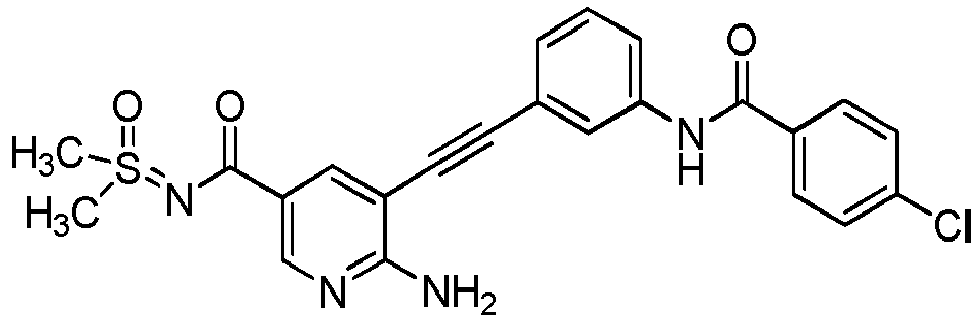
6-amino-5-({3-[(4-chlorobenzoyl)amino]phenyl}ethynyl)-N-[dimethyl(oxido)-λ4-sulfanylidene]nicotinamide 6 
6-amino-N-[dimethyl(oxido)-λ4-sulfanylidene]-5-({3-[(2-fluoro-5-methylbenzoyl)amino]phenyl}ethynyl)nicotinamide 7 
6-amino-N-[dimethyl(oxido)-λ4-sulfanylidene]-5-[(3-{[(1-methyl-1H-imidazol-2-yl)carbonyl]amino}phenyl)ethynyl]nicotinamide 8 
N-[dimethyl(oxido)-λ4-sulfanylidene]-5-{[3-({[(2-fluoro-5-methylphenyl)amino]carbonyl}amino)phenyl]ethynyl} nicotina mide 9 
N-[dimethyl(oxido)-λ4-sulfanylidene]-5-{[3-({[(2-fluorophenyl)amino]carbonyl}amino)phenyl]ethynyl} nicotina mide 10 
N-[dimethyl(oxido)-λ4-sulfanylidene]-5-{[3-({[(3-methylphenyl)amino]carbonyl}amino)phenyl]ethynyl} nicotina mide 11 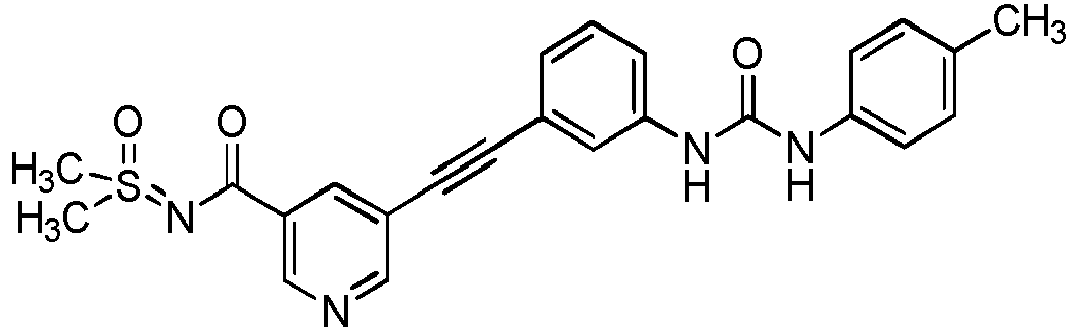
N-[dimethyl(oxido)-λ4-sulfanylidene]-5-{[3-({[(4-methylphenyl)amino]carbonyl}amino)phenyl]ethynyl} nicotina mide 12 
6-amino-N-{[2-(3-hydroxypyrrolidin-1-yl)-2-oxoethyl](methyl)oxido-λ4-sulfanylidene}-5-({3-[(3-methyl-2-furoyl)amino]phenyl} ethynyl)nicotinamide 13 
N-[(3-{4-[2-(2-hydroxyethoxy)ethyl]piperazin-1-yl}propyl)(methyl)oxido-λ4-sulfanylidene]-5-( {3-[(3-methyl-2-furoyl)amino]phenyl} ethynyl)nicotinamide 14 
N-[bis(3-hydroxypropyl)(oxido)-λ4-sulfanylidene]-5-({3-[(3-methyl-2-furoyl)amino]phenyl}ethynyl)nicotinamide 15 
6-amino-N-[bis(3-hydroxypropyl)(oxido)-λ4-sulfanylidene]-5-({3-[(3-methyl-2-furoyl)amino]phenyl}ethynyl)nicotinamide 16 
N-[bis(3-hydroxypropyl)(oxido)-λ4-sulfanylidene]-5-[(3-{[4-chloro-3-trifluoromethyl)benzoyl]amino}phenyl)ethynyl]nicotinamide 17 
N-[bis(3-hydroxypropyl)(oxido)-λ4-sulfanylidene]-5-({3-[(3-methylbenzoyl)amino]phenyl}ethynyl)nicotinamide 18 
N-[bis(3-hydroxypropyl)(oxido)-λ4-sulfanylidene]-5-{[3-[3-(trifluoromethyl)benzoyl]amino}phenyl)ethynyl]nicotinamide 19 
N-[bis(3-hydroxypropyl)(oxido)-λ4-sulfanylidene]-5-({3-[(3-chloro-4-fluorobenzoyl)amino]phenyl}ethynyl)nicotinamide 20 
N-[bis(3-hydroxypropyl)(oxido)-λ4-sulfanylidene]-5-({3-[(2-fluoro-5-methylbenzoyl)amino]phenyl} ethynyl)nicotinamide 21 
6-amino-N-[bis(3-hydroxypropyl)(oxido)-λ4-sulfanylidene]-5-({3-[(3-methoxybenzoyl)amino]phenyl}ethynyl)nicotinamide 22 
6-amino-N-[bis(3-hydroxypropyl)(oxido)-λ4-sulfanylidene]-5-[(3-{[(3-methylphenyl)amino]carbonyl}phenyl)ethynyl]nicotinamide 23 
methyl 5-(N-{[6-amino-5-({3-[(3-methyl-2-furoyl)amino]phenyl} ethynyl)pyridin-3-yl]carbonyl}-S-methylsulfonimidoyl)pentanoate 24 
5-(N-{[6-amino-5-({3-[(3-methyl-2-furoyl)amino]phenyl} ethynyl)pyridin-3-yl]carbonyl}-S-methylsulfonimidoyl)pentanoic acid 25 
methyl 5-(N-{[6-amino-5-({3-[(2-fluoro-5-methylbenzoyl)amino]phenyl}ethynyl)pyridin-3-yl]carbonyl}-S-methylsulfonimidoyl)pentanoate 26 
methyl 5-(N-{[6-amino-5-({3-[(3-methylbenzoyl)amino]phenyl}ethynyl)pyridin-3-yl]carbonyl}-S-methylsulfonimidoyl)pentanoate 27 
methyl 5-[N-({6-amino-5-[(3-{[2-fluoro-5-(trifluoromethyl)benzoyl]amino}phenyl)ethynyl]pyridin-3-yl}carbonyl)-S-methylsulfonimidoyl]pentanoate 28 
methyl 5-[N-({6-amino-5-[(3-{[3-(trifluoromethyl)benzoyl]amino}phenyl)ethynyl]pyridin-3-yl}carbonyl)-S-methylsulfonimidoyl]pentanoate 29 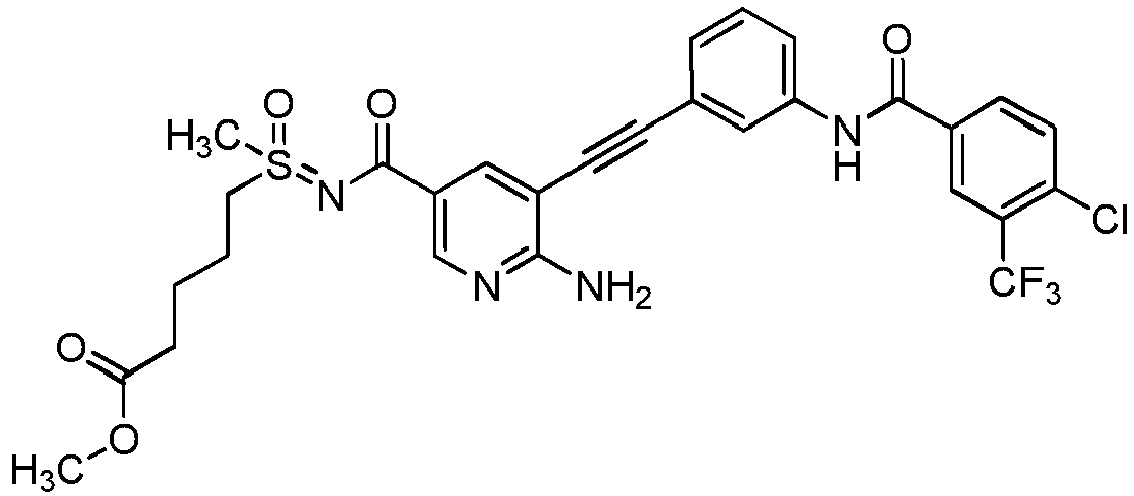
methyl 5-[N-({6-amino-5-[(3-{[4-chloro-3-(trifluoromethyl)benzoyl]amino}phenyl)ethynyl]pyridin-3-yl}carbonyl)-S-methylsulfonimidoyl]pentanoate 30 
methyl 5-(N-{[6-amino-5-({3-[(3-methoxybenzoyl)amino]phenyl} ethynyl)pyridin-3-yl]carbonyl}-S-methylsulfonimidoyl)pentanoate 31 
methyl 5-(N-{[6-amino-5-({3-[(3,4-dimethoxybenzoyl)amino]phenyl} ethynyl)pyridin-3-yl]carbonyl}-S-methylsulfonimidoyl)pentanoate 32 
(S)-methyl 5-(N-{[6-amino-5-({3-[(3-methyl-2-furoyl)amino]phenyl}ethynyl)pyridin-3-yl]carbonyl}-S-methy lsulfonimidoyl)pentanoate 33 
(R)-methyl 5-(N-{[6-amino-5-({3-[(3-methyl-2-furoyl)amino]phenyl} ethynyl)pyridin-3-yl]carbonyl} -S-methylsulfonimidoyl)pentanoate 34 
methyl 5-[N-({6-amino-5-[(3-{[(3-methylphenyl)amino]carbonyl}phenyl)ethynyl]pyridin-3-yl}carbonyl)-S-methylsulfonimidoyl]pentanoate 35 
methyl 5-[N-({6-amino-5-[(3-{[(2-fluoro-5-methylphenyl)amino]carbonyl}phenyl)ethynyl]pyridin-3-yl}carbonyl)-S-methylsulfonimidoyl]pentanoate 36 
methyl 5-[N-({6-amino-5-[(3-{[(5-tert-butylisoxazol-3-yl)amino]carbonyl}phenyl)ethynyl]pyridin-3-yl} carbonyl)-S-methylsulfonimidoyl]pentanoate 37 
methyl 5-{N-[(6-amino-5-{[3-({[(2-fluoro-5-methylphenyl)amino]carbonyl}amino)phenyl]ethynyl}pyridi n-3-yl)carbonyl]-S-methylsulfonimidoyl}pentanoate 38 
methyl 5-{N-[(6-amino-5-{[3-({[(3-methylphenyl)amino]carbonyl}amino)phenyl]ethynyl} pyridi n-3-yl)carbonyl]-S-methylsulfonimidoyl}pentanoate 39 
N-[(3-hydroxypropyl)(methyl)oxido-λ4-sulfanylidene]-5-({3-[(3-methyl-2-furoyl)amino]phenyl} ethynyl)nicotinamide 40 
(R)-N-[(3-hydroxypropyl)(methyl)oxido-λ4-sulfanylidene]-5-({3-[(3-methyl-2-furoyl)amino]phenyl}ethynyl)nicotinamide 41 
(S)-N-[(3-hydroxypropyl)(methyl)oxido-λ4-sulfanylidene]-5-({3-[(3-methyl-2-furoyl)amino]phenyl}ethynyl)nicotinamide 42 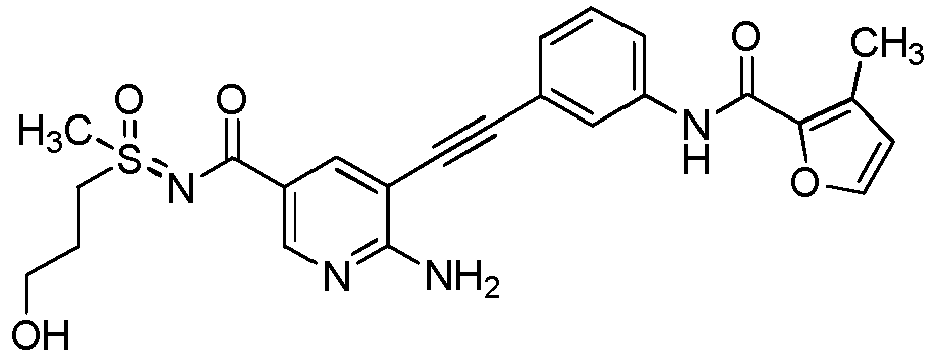
6-amino-N-[(3-hydroxypropyl)(methyl)oxido-λ4-sulfanylidene]-5-({3-[(3-methyl-2-furoyl)amino]phenyl}ethynyl)nicotinamide - Routes to said compounds are illustrated by but not limited to the schemes provided below:


- Experimental procedures for the preparation of said examples are illustrated but not limited to the examples provided below.
-

- To a 250 mL round bottom flask containing 5-iodo-6-amino-nicotinic acid (5 g, 18.9 mmol) and dimethylsulfoximine (1.94 g, 1.1 eq) in anhydrous DMF (50 mL) was added diisopropylamine (6.6 mL, 2 eq) and BOP (9.21 g, 1.1 eq) under nitrogen atmosphere. The reaction mixture was heated at 70 °C for 1.5 hours and then partitioned between aq NH4Cl and EtOAc. The aqueous layer was separated and extracted once with EtOAc. The two organic layers were combined, and washed with saturated aq NaHCO3/brine (1:1, 1X), brine (1X), and dried with anhydrous Na2SO4. The solution layer was decanted, concentrated, and the brown solid residue was treated with EtOAc with stirring at RT for 30 minutes. The solid which formed was colleded by filtration and dried to give the title compound as an offwhite solid (5.31 g ,83%).
-

- To a 250 mL round bottom flask containing 6-amino-N-[dimethyl(oxido)-λ4-sulfanylidene]-5-iodonicotinamide , (6.0 g, 17.8 mmol, 1 eq), bis(triphenylphosphine)palladium(II) dichloride (1.25 g, 0.1 eq), and triphenylphosphine (0.117 g, 0.025 eq) in anhydrous DMF (75 mL) under anhydrous nitrogen atmosphere was added 3-ethynylaniline (2.8 mL, 1.5 eq), triethylamine (10 mL, 4 eq) and copper(I) iodide (0.68 g, 0.2 eq). The reaction mixture was stirred at RT for 15 minutes and the resulting dark brown reaction mixture was partitioned between saturated aq NaHCO3 and EtOAc. The organic layer was separated, washed with aq NH4Cl (IX) and brine (1X), followed by drying with anhydrous Na2SO4 overnight. The upper solution was decanted and concentrated. The solid residue was treated with EtOAc-hexane (1:4). A yellow solid was obtained when filtered. This solid was treated again with EtOAc-hexane (1:4) with stirring at RT for 30 minutes. The title compound , was obtained as light yellow solid upon filtration and was used directly into next step without further purification.
-

- A solution of 6-amino-5-[(3-aminophenyl)ethynyl]-N-[dimethyl(oxido)-λ4-sulfanylidene]nicotinamide (17.8 mmol) in anhydrous DMF (50 mL) under nitrogen atmosphere was treated with 3-methyl-furan-2-carboxylic acid (3.37 g, 1.5 eq), diisopropylamine (12.5 mL, 4.0 equiv.) and BOP (12.2 g, 1.5 equiv.). The reaction mixture was stirred and heated at 60°C for 1.5 hours. The reaction mixture was partitioned between saturated aq NaHCO3 and EtOAc. The organic layer was separated, washed with aqueous NH4Cl (IX) and brine (1X), and dried with anhydrous Na2SO4. The upper solution was decanted, concentrated, and subject to a gradient column chromatography [acetone-CHCl3 1:30 to 1:4 (with 4% of MeOH in the eluent at a later chromatographic stage)]. It was found that significant amount of the desired product still remained as solid on top of the column in addition to the product eluted out in the fractions. The product fractions were collected, concentrated, and the solid residue obtained was treated with EtOAc with stirring at RT for 30 minutes. The white solid which formed was collected by filtration and dried to give an initial batch of the title compound (2.4 g). The filtrate was combined to the solid which originally resided on the top of the column. This mixture was evaporated under reduced pressure and was then treated with EtOAc and small amount of i-PrOH. The resulting mixture was stirred at RT for 2 hours. The light brown solid which formed was collected by filtration and dried to give a second batch of the title compound (3.5 g). The two batches of solid were combined, treated with water, and stirred at RT for 1 hour and then collected by filtration to give the title compound as a slightly brown solid (4.99 g ,65%).
-

- In a manner similar to that described in Example 1, 5-[(3-aminophenyl)ethynyl]-N-[dimethyl(oxido)-λ4-sulfanylidene]nicotinamide and 3-methyl-furan-2-carboxylic acid are converted to the title compound.
1H NMR (DMSO-d6) δ: 10.21 (s, 1H), 9.08 (d, J = 2.0 Hz, 1H), 8.92 (d, J = 2.0 Hz, 1H), 8.39 (t, J = 2.1 Hz, 1H), 8.13 (t, J = 1.6 Hz, 1H), 7.82 (d, J = 1.5 Hz, 1H), 7.78 -7.81 (m, 1H), 7.39-7.43 (m, 1H), 7.34 (dt, J = 7.6, 1.2 Hz, 1H), 6.61 (d, J = 1.5 Hz, 1H), 3.52 (s, 6H), 2.35 (s, 3H) -
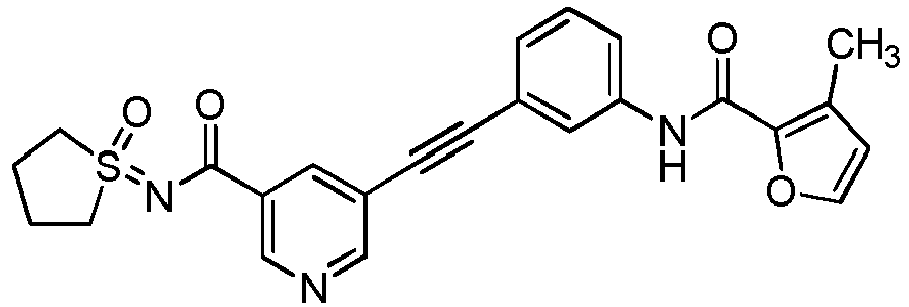
- In a manner similar to that described in Preparation 1, 5-{3-[(3-Methyl-furan-2-carbonyl)-amino]-phenylethynyl}-nicotinic acid and tetrahydro-1H-1λ4-thiophen-1-imine 1-oxide are converted to the title compound.
1H NMR (DMSO-d6) δ: 10.21 (s, 1H), 9.10 (d, J = 2.0 Hz, 1H), 8.93 (d, J = 2.0 Hz, 1H), 8.41 (t, J = 2.1 Hz, 1H), 8.13 (t, J = 1.8 Hz, 1H), 7.82 (d, J = 1.5 Hz, 1H), 7.78 -7.81 (m, 1H), 7.39-7.43 (m, 1H), 7.34 (d, J = 7.6 Hz, 1H), 6.61 (d, J = 1.5 Hz, 1H), 3.73 (ddd, J = 13.8, 7.1, 7.0 Hz, 2H), 3.48 (dt, J = 13.7, 6.8 Hz, 2H), 2.35 (s, 3H), 2.22 - 2.30 (m, 2H), 2.12 - 2.20 (m, 2H) -

- In a manner similar to that described in Preparation 1, 6-amino-5-{3-[(3-Methyl-furan-2-carbonyl)-amino]-phenylethynyl}-nicotinic acid and tetrahydro-1H-1λ 4-thiophen-1-imine 1-oxide are converted to the title compound.
1HNMR (DMSO-d6) δ: 10.13 (s, 1H), 8.59 (d, J = 2.2 Hz, 1H), 8.09 (t, J = 1.7 Hz, 1H), 8.07 (d, J = 2.2 Hz, 1H), 7.81 (d, J = 1.5 Hz, 1H), 7.74 (ddd, J = 8.4, 1.5, 1.3 Hz, 1H), 7.40 - 7.43 (m, 1H), 7.35 - 7.39 (m, 1H), 7.01 (br. s., 2H), 6.61 (d, J = 1.5 Hz, 1H), 3.65 (ddd, J = 13.7, 7.2, 7.0 Hz, 2H), 3.40 (dt, J = 13.7, 6.8 Hz, 2H), 2.35 (s, 3H), 2.19 - 2.26 (m, 2H), 2.08 - 2.17 (m, 2H) -

- In a manner similar to that described in Example 1, 6-amino-5-[(3-aminophenyl)ethynyl]-N-[dimethyl(oxido)-λ4-sulfanylidene]nicotinamide and 4-chlorobenzoic acid are converted to the title compound.
1H NMR (DMSO-d6) δ: 10.40 (s, 1H), 8.57 (d, J = 2.2 Hz, 1H), 8.05 - 8.07 (m, 2H), 7.99 - 8.02 (m, 2H), 7.73 - 7.76 (m, 1H), 7.61 - 7.65 (m, 2H), 7.44 - 7.47 (m, 1H), 7.39 - 7.43 (m, 1H), 7.00 (br. s., 2H), 3.44 (s, 6H) -

- In a manner similar to that described in Example 1, 6-amino-5-[(3-aminophenyl)ethynyl]-N-[dimethyl(oxido)-λ4-sulfanylidene]nicotinamide and 2-fluoro-5-methyl benzoic acid are converted to the title compound.
1H NMR (DMSO-d6) δ: 10.40 (s, 1H), 8.57 (d, J = 2.2 Hz, 1H), 8.05 - 8.07 (m, 2H), 7.99 - 8.02 (m, 2H), 7.73 - 7.76 (m, 1H), 7.61 - 7.65 (m, 2H), 7.44 - 7.47 (m, 1H), 7.39 - 7.43 (m, 1H), 7.00 (br. s., 2H), 3.44 (s, 6H), 2.35 (s, 3H). -

- In a manner similar to that described in Example 1, 6-amino-5-[(3-aminophenyl)ethynyl]-N-[dimethyl(oxido)-λ4-sulfanylidene]nicotinamide and 1-methyl-1H-imidazole-2-carboxylic acid are converted to the title compound.
1H NMR (DMSO-d6) δ: 10.42 (s, 1H), 8.57 (d, J = 2.2 Hz, 1H), 8.14 (t, J = 1.6 Hz, 1H), 8.05 (d, J = 2.2 Hz, 1H), 7.78 - 7.81 (m, 1H), 7.46 (s, 1H), 7.41 - 7.44 (m, 1H), 7.36 - 7.40 (m, 1H), 7.10 (d, J = 0.7 Hz, 1H), 6.99 (br. s., 2H), 4.01 (s, 3H), 3.44 (s, 6H) -

- To the mixture of dimethylsulfoximine (4.0 g, 43 mmol, 1 eq) and 5-bromonicotinic acid (9.31 g, 1.05 eq) in anhydrous DMF (85 mL) under nitrogen atmosphere was added diisopropylamine (15 mL, 2.0 eq) and BOP (21.6 g, 1.1 eq). After the reaction was stirred at RT for 15 minutes, it was poured into saturated aq NaHCO3 and extracted with EtOAc. The organic phase was separated, washed sequentially with saturated NaHCO3 (1X), brine (1X), aq NH4Cl (1X), and brine (1X), and finally dried with anhydrous Na2SO4. The upper brown solution was decanted, concentrated, and the brown oily residue was subject to a gradient column chromatography (EtOAc-Hexane 1:4 to 1:1). The corresponding product fractions were collected and concentrated. The solid residue was treated with EtOAc-Hexane (1:7) and the resulting mixture was stirred at RT for 2 hours. The white solid was collected by filtration and dried to give the title compound (8.89 g, 75%).
-

- To a 100 mL round bottom flask containing 5-bromo-N-[dimethyl(oxido)-λ4-sulfanylidene]nicotinamide (2.8 g, 10 mmol, 1 eq), bis(triphenylphosphine)palladium(II) dichloride (0.70 g, 0.1 eq), and triphenylphosphine (0.07 g, 0.025 eq) in anhydrous DMF (25 mL) under anhydrous nitrogen atmosphere was added 3-ethynylaniline (1.5 mL, 1.5 eq), triethylamine (5.6 mL, 4 eq) and copper(I) iodide (0.38 g, 0.2 eq). The reaction mixture was stirred at RT for 1.5 hours and then partitioned between saturated aq NaHCO3 and EtOAc. The organic layer was separated, washed sequentially with saturated aq NaHCO3 (1X), aq NH4Cl (1X), and brine (1X), followed by drying with anhydrous Na2SO4. The upper solution was decanted, concentrated, and subject to a gradient column chromatography (EtOAc-hexans 1:4 to 3:1) to give the title compound as a slightly yellow-colored foam (1.72 g, 55%).
-

- A solution of 5-[(3-aminophenyl)ethynyl]-N-[dimethyl(oxido)- λ4-sulfanylidene]nicotinamide , (90 mg, 0.28 mmol, 1 eq) in anhydrous THF (1.5 mL) was treated with 2-fluoro-5-methylphenyl isocyanate (0.05 mL, 1.2 eq) The reaction mixture was then stirred at RT for 1 hour. It was then portioned between saturated aq NaHCO3 and EtOAc. The organic phase was isolated, washed with aq NH4Cl (IX) and brine (1X), and lastly dried with anhydrous Na2SO4. The upper solution was decanted, concentrated, and the resulting yellow solid residue was chromatographed (EtOAc-Hexanes 1:5 to 5:1). Concentration of the product eluting fractions gave the title compound as a white solid (102 mg, 77%).
-

- In a manner similar to that described in Example 8, 5-[(3-aminophenyl)ethynyl]-N-[dimethyl(oxido)-λ4-sulfanylidene]nicotinamide and 1-fluoro-2-isocyanatobenzene are converted to the title compound.
1HNMR (DMSO-d6) δ: 9.22 (s, 1H), 9.08 (d, J = 1.8 Hz, 1H), 8.92 (d, J = 2.1 Hz, 1H), 8.61 (d, J = 2.1 Hz, 1H), 8.39 (t, J = 2.1 Hz, 1H), 8.14 (td, J = 8.2, 1.5 Hz, 1H), 7.85 - 7.87 (m, 1H), 7.36 - 7.41 (m, 2H), 7.23 - 7.27 (m, 2H), 7.13 - 7.17 (m, 1H), 7.01 - 7.05 (m, 1H), 3.51 (s, 6H) -

- In a manner similar to that described in Example 8, 5-[(3-aminophenyl)ethynyl]-N-[dimethyl(oxido)-λ4-sulfanylidene]nicotinamide and 1-isocyanato-3-methylbenzene are converted to the title compound.
1H NMR (DMSO-d6) δ: 9.08 (d, J = 2.1 Hz, 1H), 8.91 (d, J = 2.1 Hz, 1H), 8.82 (s, 1H), 8.67 (s, 1H), 8.38 (t, J = 2.1 Hz, 1H), 7.86 (t, J = 1.6 Hz, 1H), 7.39 - 7.41 (m, 1H), 7.35 - 7.38 (m, 1H), 7.32 (s, 1H), 7.21 - 7.24 (m, 2H), 7.15 - 7.18 (m, 1H), 6.81 (d, J = 7.3 Hz, 1H), 3.51 (s, 6H), 2.28 (s, 3H) -

- In a manner similar to that described in Example 8, 5-[(3-aminophenyl)ethynyl]-N-[dimethyl(oxido)-λ4-sulfanylidene]nicotinamide and 1-isocyanato-4-methylbenzene are converted to the title compound.
1H NMR (DMSO-d6) δ: 9.08 (d, J = 1.8 Hz, 1H), 8.91 (d, J = 2.1 Hz, 1H), 8.79 (s, 1H), 8.64 (s, 1H), 8.38 (t, J = 1.9 Hz, 1H), 7.84 (t, J = 1.6 Hz, 1H), 7.39 - 7.42 (m, 1H), 7.33 - 7.38 (m, 3H), 7.22 (ddd, J = 7.5, 1.0, 0.9 Hz, 1H), 7.09 (d, J = 8.2 Hz, 2H), 3.51 (s, 6H), 2.25 (s, 3H). -

- To a 100 mL round bottom flask containing a previously prepared crude dimethylsulfoximine (~0.9 g) in anhydrous THF (35 mL) was added di-tert-butyl dicarbonate (4.1 g) and the resulting solution was kept at ambient temperature. Sodium hydride (0.67 g) was carefully added and the reaction mixture was stirred at RT for 5 hours. The reaction was then poured into ice-cooled aq NH4Cl and was extracted with EtOAc. The organic layer was separated, washed with brine (1X), and dried with Na2SO4 overnight. A gradient column chromatography (EtOAc-Hexanes 1:1 to MeOH-EtOAc 1:50) was performed. Concentration of the product eluting fractions provided the title compound as white solid (274 mg).
1H NMR (DMSO-d6) δ: 3.27 (s, 6H), 1.37 (s, 9H) -

- A solution of 2,2,6,6-tetramethylpiperidine (0.33 mL, 1.4 eq) in anhydrous THF (1 mL) was cooled to 0 °C. To this solution was slowly added n-butyllithium (0.66 mL, 1.2 eq). The resulting reaction mixture was stirred at 0 °C for 10 minutes and then cooled to -78 °C. tert-butyl [dimethyl(oxido)-λ4-sulfanylidene]carbamate (267 mg, 1.38 mmol, 1 eq) in anhydrous THF (1 mL) was added dropwise and the reaction was first kept at -78 °C for 10 minutes, then warmed to -10 °C within 30 minutes followed by cooling -78 °C. Ethyl chloroformate (0.19 mL, 1.4 eq) was added in one portion. The reaction was stirred at -78 °C for 30 minutes and then poured into aq NH4Cl and extracted with EtOAc. The combined organic extracts were washed with brine and dried over Na2SO4. The upper solution layer was decanted and concentrated to give the title compound as a yellow oil (∼270 mg).
-

- A solution of ethyl [N-(tert-butoxycarbonyl)-S-methylsulfonimidoyl]acetate in dichloromethane (2.5 mL) was cooled to 0 °C followed by a dropwise addition of trifluoroacetic acid (0.79 mL). The reaction was then stirred at RT for 2 hours. The excess TFA was removed under reduced pressure and the oily residue was partitioned between EtOAc and saturated aq NaHCO3/brine. The organic layer was separated, washed with brine (1X), and dried over Na2SO4. The upper solution layer was decanted and concentrated yielding the title compound as a brown oil (49 mg).
-

- A solution of ethyl (S-methylsulfonimidoyl)acetate was dissolved in anhydrous DMF (1 mL) and treated with 5-iodo-6-amino-nicotinic acid (82 mg, 1.05 eq), diisopropylamine (0.1 mL, 2 eq), and BOP (149 mg, 1.1 eq) with stirring. The reaction mixture was heated to 70 °C for 6 hours and then partitioned between EtOAc and aq NH4Cl. The organic layer was separated, washed with saturated aq NaHCO3 (IX) and brine (1X), and dried over Na2SO4. The organic phase was filtered and concentrated. The residue as purified by gradient column chromatography (EtOAc-Hexane 1:9 to 2:3). Concentration of the product containing fractions provided the title compound as a brown oil (24 mg).
-

- A solution of ethyl {N-[(6-amino-5-iodopyridin-3-yl)carbonyl]-S-methylsulfonimidoyl} acetate, (24 mg, 0.06 mmol), 3-methyl-furan-2-carboxylic acid (3-ethynyl-phenyl)-amide (20 mg, 1.5 eq), bis(triphenylphosphine)palladium(II) dichloride (4.1 mg, 0.1 eq), and triphenyl phosphine (0.4 mg, 0.025 eq) in anhydrous DMF (0.5 mL) under a nitrogen atmosphere was added triethylamine (0.05 mL, 5 eq) followed by the addition of copper(I) iodide (2.2 mg, 0.2 eq). The reaction mixture was stirred at RT for 15 minutes and then poured into saturated aq NaHCO3 and extracted with EtOAc (1X). The organic extract was washed with brine (IX) and dried over anhydrous Na2SO4. The organic phase was filtered and concentrated. The residue was purified by chromatography (EtOAc-Hexanes 1:4 to EtOAc). The product containing fractions were combined and concentrated to give the title compound (14 mg ,47%).
1HNMR (DMSO-d6) δ: 10.13 (s, 1H), 8.55 (d, J = 2.2 Hz, 1H), 8.07 - 8.10 (m, 1H), 8.03 (d, J = 2.2 Hz, 1H), 7.81 (d, J = 1. 5 Hz, 1H), 7.71 - 7.75 (m, 1H), 7.40 - 7.43 (m, 1H), 7.35 -7.39 (m, 1H), 7.06 (br. s., 2H), 6.61 (d, J = 1.5 Hz, 1H), 4.94 (d, J = 14.4 Hz, 1H), 4.79 (d, J = 14.4 Hz, 1H), 4.20 (q, J = 7.0 Hz, 2H), 3.54 (s, 3H), 2.35 (s, 3H), 1.21 (t, J = 7.1 Hz, 3H). -

- To a solution of ethyl (N-{[6-amino-5-({3-[(3-methyl-2-furoyl)amino]phenyl}ethynyl)pyridin-3-yl]carbonyl}-S-methylsulfonimidoyl)acetate (13 mg, 0.025 mmol, 1eq) in anhydrous THF (1 mL) was added (S)-3-hydroxypyrrolidine (0.021 mL, 10 eq). The reaction was stirred and heated at 70 °C for 2 hours. It was then partitioned between aq NH4Cl and EtOAc. The organic layer was then washed with saturated aq NaHCO3 (1X), brine (1X), and dried over anhydrous Na2SO4. The organic phase was then filtered and concentrated, and the oily residue was subject to purification by gradient column chromatography (EtOAc-Hexane 3:2 to MeOH-EtOAc 1:50). The product containing fractions were combined and concentrated to give the title compound as white solid (7 mg, 50%) as a mixture of two diastereomers.
1H NMR (DMSO-d6) δ: 10.13 (s, 1H), 8.52 - 8.57 (m, 1H), 8.07 - 8.10 (m, 1H), 7.99 - 8.05 (m, 1H), 7.81 (d, J = 1.2 Hz, 1H), 7.73 (d, J = 8.1 Hz, 1H), 7.39 - 7.43 (m, 1H), 7.34 - 7.39 (m, 1H), 7.03 (br. s., 2H), 6.61 (d, J = 1.0 Hz, 1H), 4.85 - 5.12 (m, 2H), 4.61 - 4.75 (m, 1H), 4.24 - 4.37 (m, 1H), 3.43 - 3.80 (m, 7H), 2.35 (s, 3H), 1.74 - 1.91 (m, 2H) -

- A solution of N-[(3-hydroxypropyl)(methyl)oxido-λ4-sulfanylidene]-5-({3-[(3-methyl-2-furoyl)amino]phenyl}ethynyl)nicotinamide (60 mg, 0.13 mmol) in anhydrous DCM (1 mL) was cooled to 0 °C and treated with carbon tetrabromide (60 mg, 1.4 eq) and triphenylphosphine (48 mg, 1.4 eq). The reaction solution was stirred at RT for about an hour, followed by additional addition of carbon tetrabromide (60 mg) and triphenylphosphine (40 mg). The reaction was stirred for another hour and then poured into saturated aq NaHCO3. The mixture was extracted with DCM, and subsequently washed with aq NH4Cl (1X), brine (1X), and dried with anhydrous Na2SO4. The organic phase was collected, concentrated, and subject to a gradient column chromatography (acetone-hexane 1:10 to 1:1) to give the title compound as white foam (48 mg, 71%).
-

- To the solution of N-[(3-bromopropyl)(methyl)oxido-λ4-sulfanylidene]-5-({3-[(3-methyl-2-furoyl)amino]phenyl}ethynyl)nicotinamide (46 mg, 0.087 mmol) in anhydrous DMF (1 mL) was dropwise added 1-[2-(2-hydroxyethoxy)ethyl]piperazine (0.075 mL, 5 eq) and the resulting reaction solution was heated at 60 °C for 40 minutes. It was then partitioned between saturated aq NaHCO3 and EtOAc. The organic layer was washed with brine (IX) and dried with anhydrous Na2SO4. The solution layer was decanted, concentrated, and the oily residue was subject to a gradient column chromatography (MeOH-EtOAc 1:100 to 2:3) to provide the title compound as white foam (42 mg ,78%).
-
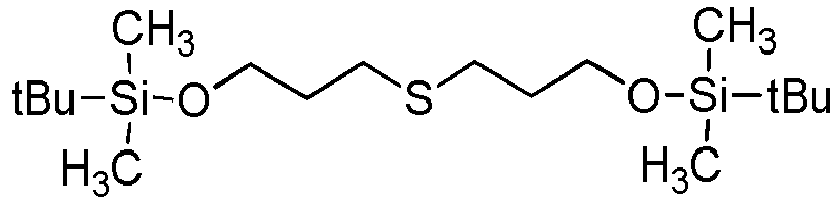
- To a solution of 3,3'-thiodipropanol (5 g, 32.6 mmol, 1 eq) and tert-butyldimethylsilyl chloride (13.18 g, 2.6 eq) in anhydrous DMF (25 mL) at 0 °C was added imidazole (11.21 g, 5 eq). After the reaction was stirred at room temperature for one hour, it was partitioned between ethyl acetate and water. The organic layer was isolated, washed once more with water, then brine, and lastly dried with anhydrous sodium sulfate. The upper clear solution was decanted, concentrated, and the oily residue was subject to a column chromatography (EtOC-Hex: from 1:9 to 4:1). Concentration of the product eluting fractions provided the title compound as a clear oil (12.32 g).
1H NMR (DMSO-d6) δ: 3.64 (t, J = 6.2 Hz, 4H), 2.49 - 2.53 (m, 4H), 1.65 - 1.71 (m, 4H), 0.86 (s, 18H), 0.03 (s, 12H) -

- A solution of sodium (meta)periodate (7.751 g, 1.1 eq) in water (40 mL) was slowly poured into a solution of 2,2,3,3,13,13,14,14-octamethyl-4,12-dioxa-8-thia-3,13-disilapentadecane (12.32 g, 1 eq) in methanol (150 mL) at 0 °C and the reaction mixture was stirred at room temperature for 2 hours. The reaction mixture was then filtered through a pad of celite and silica gel which was washed with methanol. The filtrate was concentrated under reduced pressure at a temperature below 25 °C. The residue was diluted with brine and extracted a couple of times with chloroform. All organic solvents were combined, dried with anhydrous sodium sulfate, and concentrated to give the title compound as a clear oil (12.84 g).
1H NMR (DMSO-d6) δ: 3.69 (t, J = 6.2 Hz, 4H), 2.59 - 2.83 (m, 4H), 1.80 (tdd, J = 6.8, 6.7, 6.4 Hz, 4H), 0.86 (s, 18H), 0.04 (s, 12H) -

- To a solution of 2,2,3,3,13,13,14,14-octamethyl-4,12-dioxa-8-thia-3,13-disilapentadecane 8-oxide in anhydrous dichloromethane (150 mL) was added trifluoroacetamide (7.60 g, 2 eq), magnesium oxide (5.256 g. 4 eq), rhodium acetate dimer (432 mg, 0.03 eq), and (diacetoxyiodo)benzene (15.75 g, 1.5 eq) under nitrogen atmosphere at room temperature. The greenish reaction mixture was stirred at room temperature for 18 hours. Then additional amount of trifluoroacetamide (3.0 g), rhodium acetate dimer (300 mg), (diacetoxyiodo)benzene (5.0 g), and anhydrous DCM (100 mL) was added. The mixture was stirred at room temperature for another 3 hours and then filtered through a pad of celite and silica gel. The pad was washed first with DCM followed by MeOH-DCM (1:5). The filtrate was concentrated and the brown oil was taken up into methanol (200 mL). Potassium carbonate (22.53 g, 5 eq) was added to the newly formed solution. After the mixture was stirred at room temp for 2 hours, it was filtered through a pad of celite and silica gel. The pad was washed first with DCM-EtOAC (1:1) followed by a later 10% (v/v) addition of MeOH with stirring of the sediment on top of the pad. The filtrate was concentrated and the residue mixture was treated with DCM-EtOAc (2:3) with stirring at room temp for 30 minutes. The mixture was filtered again through a pad of celite and silica gel. This filtration and concentration circle may be repeated a couple of times such that most of the solid by-product was removed and a reddish oil was obtained. Purification by a gradient column chromatography (EtOAc-HEX 1:20 to 1:1) provided the title compound as a redish oil (9.538 g) with a total yield of 72% for 4 steps.
1H NMR (DMSO-d6) δ: 3.67 (t, J = 6.3 Hz, 4H), 3.65 (s, 1H), 2.99 (t, J = 7.9 Hz, 4H), 1.82 - 1.88 (m, 4H), 0.86 (s, 18H), 0.04 (s, 12H) -

- A solution of 8-imino-2,2,3,3,13,13,14,14-octamethyl-4,12-dioxa-8λ4-thia-3,13-disilapentadecane 8-oxide (1.227 g, 3 mmol, 1 eq), 5-{3-[(3-Methyl-furan-2-carbonyl)-amino]-phenylethynyl}-nicotinic acid (1.053 g, 1 eq), DMAP (73.5 mg, 0.2 eq), and EDCI (690 mg, 1.2 eq) in anhydrous DCE (30 mL) was heated at 60 °C for 3 hours. The reaction mixture was then diluted with DCM, washed sequentially with aqueous NH4Cl, saturated aqueous NaHCO3, and brine, and lastly dried with anhydrous sodium sulfate. The upper clear solution was decanted, concentrated, and the oily residue was subject to a gradient column chromatography (EtOAc-Hex 1:100 to 1:3) to give the title compound as a white foam (1.53 g).
1H NMR (DMSO-d6) δ: 10.20 (s, 1H), 9.07 (d, J = 2.1 Hz, 1H), 8.92 (d, J = 2.1 Hz, 1H), 8.37 (t, J = 2.1 Hz, 1H), 8.14 (t, J = 1.8 Hz, 1H), 7.81 (d, J = 1.5 Hz, 1H), 7.77 - 7.79 (m, 1H), 7.41 (t, J = 7.9 Hz, 1H), 7.31 - 7.34 (m, 1H), 6.61 (d, J = 1.2 Hz, 1H), 3.70 - 3.76 (m, 6H), 3.63 - 3.69 (m, 2H), 2.35 (s, 3H), 1.93 - 2.05 (m, 4H), 0.86 (s, 18H), 0.04 (s, 12H) -

- To a solution of N-[bis(3-{[tert-butyl(dimethyl)silyl]oxy}propyl)(oxido)-λ4-sulfanylidene]-5-({3-[(3-methyl-2-furoyl)amino]phenyl}ethynyl)nicotinamide (1.48 g, 2.0 mmol, 1 eq) in anhydrous THF (40 mL) at 0 °C was added dropwise tetrabutylammonium fluoride (8.23 mL, 1.0 M in anhyd. THF, 4.1 eq) and the reaction was stirred at that temp for 3 hours. The reaction was then concentrated at room temperature and partitioned between saturated aqueous NaHCO3 and ethyl acetate. The organic layer was washed with aqueous NH4Cl, brine, lastly dried with anhydrous Na2SO4. The organic layer was decanted, concentrated, and the oily residue was subject to a gradient column chromatography (EtOAc-Hex 1:1 to MeOH-EtOAc 1:25). Concentration of the product eluting fractions gave the title compound as a white foam (574 mg).
1H NMR (DMSO-d6) δ: 10.20 (s, 1H), 9.09 (d, J = 1.8 Hz, 1H), 8.92 (d, J = 2.1 Hz, 1H), 8.38 (t, J = 2.1 Hz, 1H), 8.12 (t, J = 1.6 Hz, 1H), 7.82 (d, J = 1.5 Hz, 1H), 7.79 - 7.81 (m, 1H), 7.39-7.43 (m, 1H), 7.34 (dt, J = 7.9, 1.2 Hz, 1H), 6.61 (d, J = 1.5 Hz, 1H), 4.76 (t, J = 5.3 Hz, 2H), 3.69 - 3.75 (m, 2H), 3.62 - 3.68 (m, 2H), 3.54 (q, J = 6.1 Hz, 4H), 2.35 (s, 3H), 1.88 - 2.00 (m, 4H) -

- In a manner similar to that described in Preparation 14, a mixture of 8-imino-2,2,3,3,13,13,14,14-octamethyl-4,12-dioxa-8λ4-thia-3,13-disilapentadecane 8-oxide and 6-amino-5-{3-[(3-methyl-furan-2-carbonyl)-amino]-phenylethynyl}-nicotinic acid were converted to the title compound
-

- In a manner similar to that described in Example 14, 6-amino-N-[bis(3- {[tert-butyl(dimethyl)silyl]oxy}propyl)(oxido)-λ4-sulfanylidene]-5-({3-[(3-methyl-2-furoyl)amino]phenyl}ethynyl)nicotinamide was converted to the title compound.
1HNMR (DMSO-d6) δ: 10.13 (s, 1H), 8.58 (d, J = 2.3 Hz, 1H), 8.07 (t, J = 1.8 Hz, 1H), 8.04 (d, J = 2.1 Hz, 1H), 7.81 (d, J = 1.5 Hz, 1H), 7.73 -7.76 (m, 1H), 7.40 - 7.43 (m, 1H), 7.35 - 7.39 (m, 1H), 6.99 (br. s., 2H), 6.60 (d, J = 1.5 Hz, 1H), 4.74 (t, J = 5.4 Hz, 2H), 3.61 - 3.67 (m, 2H), 3.55 - 3.60 (m, 2H), 3.53 (q, J = 6.1 Hz, 4H), 2.35 (s, 3H), 1.85 - 1.96 (m, 4H) -

- In a manner similar to that described in Example 1, methyl 5-((3-aminophenyl)ethynyl)nicotinate and 4-chloro-3-(trifluoromethyl)benzoic acid are converted to the title compound.
-

- In a manner similar to that described in Preparation 42, methyl 5-((3-(4-chloro-3-(trifluoromethyl)benzamido)phenyl)ethynyl)nicotinate is converted to the title compound.
-

- In a manner similar to that described in Preparation 14, a mixture of 8-imino-2,2,3,3,13,13,14,14-octamethyl-4,12-dioxa-8λ4-thia-3,13-disilapentadecane 8-oxide and 5-((3-(4-chloro-3-(trifluoromethyl)benzamido)phenyl)ethynyl)nicotinic acid were converted to the title compound
-

- In a manner similar to that described in Example 14, N-[bis(3-{[tert-butyl(dimethyl)silyl]oxy}propyl)(oxido)-λ4-sulfanylidene]-5-[(3-{[4-chloro-3-(trifluoromethyl)benzoyl]amino}phenyl)ethynyl]nicotinamide was converted to the title compound.
1H NMR (DMSO-d6) δ: 10.65 (s, 1H), 9.10 (d, J = 2.1 Hz, 1H), 8.93 (d, J = 2.1 Hz, 1H), 8.41 (d, J = 1.8 Hz, 1H), 8.39 (t, J = 2.1 Hz, 1H), 8.28 (dd, J = 8.2, 1.8 Hz, 1H), 8.08 (t, J = 1.6 Hz, 1H), 7.95 (d, J = 8.2 Hz, 1H), 7.80 - 7.83 (m, 1H), 7.48 (t, J = 7.9 Hz, 1H), 7.41 (dt, J = 7.6, 1.2 Hz, 1H), 4.76 (t, J = 5.3 Hz, 2H), 3.69 - 3.75 (m, 2H), 3.62 - 3.68 (m, 2H), 3.54 (q, J = 6.1 Hz, 4H), 1.89 - 2.00 (m, 4H) -

- In a manner similar to that described in Example 1, methyl 5-((3-aminophenyl)ethynyl)nicotinate and 3-methylbenzoic acid are converted to the title compound.
-

- In a manner similar to that described in Preparation 42, methyl 5-((3-(3-methylbenzamido)phenyl)ethynyl)nicotinate is converted to the title compound.
-
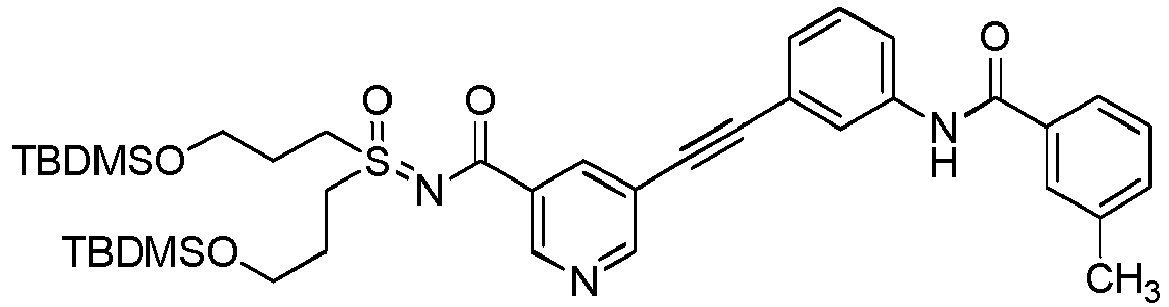
- In a manner similar to that described in Preparation 14, a mixture of 8-imino-2,2,3,3,13,13,14,14-octamethyl-4,12-dioxa-8λ4-thia-3,13-disilapentadecane 8-oxide and 5-((3-(3-methylbenzamido)phenyl)ethynyl)nicotinic acid were converted to the title compound
-

- In a manner similar to that described in Example 14, N-[bis(3-{[tert-butyl(dimethyl)silyl]oxy}propyl)(oxido)- λ4-sulfanylidene]-5-({3-[(3-methylbenzoyl)amino]phenyl} ethynyl)nicotinamide was converted to the title compound.
1HNMR (DMSO-d6) δ: 10.34 (s, 1H), 9.10 (d, J = 1.8 Hz, 1H), 8.92 (d, J = 2.1 Hz, 1H), 8.38 (t, J = 2.1 Hz, 1H), 8.11 (t, J = 1.8 Hz, 1H), 7.82 - 7.84 (m, 1H), 7.79 (s, 1H), 7.76 (ddd, J = 6.0, 2.1, 1.9 Hz, 1H), 7.42 -7.47 (m, 3H), 7.37 (dt, J = 7.6, 1.2 Hz, 1H), 4.76 (t, J = 5.3 Hz, 2H), 3.69 - 3.75 (m, 2H), 3.62 - 3.68 (m, 2H), 3.54 (q, J = 5.9 Hz, 4H), 2.41 (s, 3H), 1.89 - 2.00 (m, 4H) -

- In a manner similar to that described in Example 1, methyl 5-((3-aminophenyl)ethynyl)nicotinate and 3-(trifluoromethyl)benzoic acid are converted to the title compound.
-

- In a manner similar to that described in Preparation 42, methyl 5-((3-(3-(trifluoromethyl)benzamido)phenyl)ethynyl)nicotinate is converted to the title compound.
-

- In a manner similar to that described in Preparation 14, a mixture of 8-imino-2,2,3,3,13,13,14,14-octamethyl-4,12-dioxa-8λ4-thia-3,13-disilapentadecane 8-oxide and 5-((3-(3-(trifluoromethyl)benzamido)phenyl)ethynyl)nicotinic acid were converted to the title compound.
-

- In a manner similar to that described in Example 14, N-[bis(3-{[tert-butyl(dimethyl)silyl]oxy}propyl)(oxido)-λ4-sulfanylidene]-5-[(3-{[3-(trifluoromethyl)benzoyl]amino}phenyl)ethynyl]nicotinamide was converted to the title compound.
1HNMR (DMSO-d6) δ: 10.60 (s, 1H), 9.10 (d, J = 2.1 Hz, 1H), 8.93 (d, J = 2.1 Hz, 1H), 8.39 (t, J = 2.1 Hz, 1H), 8.32 (s, 1H), 8.28 (d, J = 7.9 Hz, 1H), 8.10 (t, J = 1.6 Hz, 1H), 7.99 (d, J = 7.6 Hz, 1H), 7.83 - 7.85 (m, 1H), 7.81 (t, J = 7.9 Hz, 1H), 7.48 (t, J = 7.9 Hz, 1H), 7.39 - 7.42 (m, 1H), 4.76 (t, J = 5.3 Hz, 2H), 3.69 - 3.75 (m, 2H), 3.62 - 3.68 (m, 2H), 3.54 (q, J = 5.9 Hz, 4H), 1.88 -2.00 (m, 4H) -

- In a manner similar to that described in Example 1, methyl 5-((3-aminophenyl)ethynyl)nicotinate and 3-chloro-4-fluorobenzoic acid are converted to the title compound.
-

- In a manner similar to that described in Preparation 42, methyl 5-((3-(3-chloro-4-fluorobenzamido)phenyl)ethynyl)nicotinate is converted to the title compound.
-

- In a manner similar to that described in Preparation 14, a mixture of 8-imino-2,2,3,3,13,13,14,14-octamethyl-4,12-dioxa-8λ4-thia-3,13-disilapentadecane 8-oxide and 5-((3-(3-chloro-4-fluorobenzamido)phenyl)ethynyl)nicotinic acid were converted to the title compound
-

- In a manner similar to that described in Example 14, N-[bis(3-{[tert-butyl(dimethyl)silyl]oxy}propyl)(oxido)-λ4-sulfanylidene]-5-({3-[(3-chloro-4-fluorobenzoyl)amino]phenyl}ethynyl)nicotinamide was converted to the title compound.
1H NMR (DMSO-d6) δ: 10.48 (s, 1H), 9.10 (d, J = 2.1 Hz, 1H), 8.92 (d, J = 2.1 Hz, 1H), 8.38 (t, J = 2.1 Hz, 1H), 8.22 (dd, J = 7.0, 2.3 Hz, 1H), 8.08 (t, J = 1.8 Hz, 1H), 8.01 (ddd, J = 8.8, 4.7, 2.3 Hz, 1H), 7.80 - 7.82 (m, 1H), 7.62 (t, J = 8.8 Hz, 1H), 7.47 (t, J = 7.9 Hz, 1H), 7.39 (dt, J = 7.6, 1.2 Hz, 1H), 4.76 (t, J = 5.3 Hz, 2H), 3.69 - 3.75 (m, 2H), 3.62 - 3.68 (m, 2H), 3.54 (q, J = 5.9 Hz, 4H), 1.88 - 2.00 (m, 4H) -
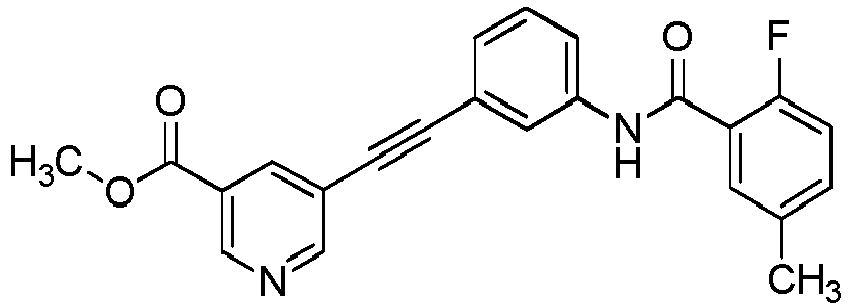
- In a manner similar to that described in Example 1, methyl 5-((3-aminophenyl)ethynyl)nicotinate and 2-fluoro-5-methylbenzoic acid are converted to the title compound.
-

- In a manner similar to that described in Preparation 42, methyl 5-((3-(2-fluoro-5-methylbenzamido)phenyl)ethynyl)nicotinate is converted to the title compound.
-

- In a manner similar to that described in Preparation 14, a mixture of 8-imino-2,2,3,3,13,13,14,14-octamethyl-4,12-dioxa-8λ4-thia-3,13-disilapentadecane 8-oxide and 5-((3-(2-fluoro-5-methylbenzamido)phenyl)ethynyl)nicotinic acid were converted to the title compound
-

- In a manner similar to that described in Example 14, N-[bis(3-{[tert-butyl(dimethyl)silyl]oxy}propyl)(oxido)-λ4-sulfanylidene]-5-({3-[(2-fluoro-5-methylbenzoyl)amino]phenyl} ethynyl)nicotinamide was converted to the title compound.
1H NMR (DMSO-d6) δ: 10.53 (s, 1H), 9.09 (d, J = 1.8 Hz, 1H), 8.93 (d, J = 2.1 Hz, 1H), 8.38 (t, J = 2.1 Hz, 1H), 8.06 (s, 1H), 7.73 (d, J = 7.9 Hz, 1H), 7.49 (dd, J = 6.7, 1.8 Hz, 1H), 7.45 (t, J = 7.9 Hz, 1H), 7.37 - 7.41 (m, 2H), 7.25 (dd, J = 9.8, 8.7 Hz, 1H), 4.76 (t, J = 5.3 Hz, 2H), 3.69 - 3.75 (m, 2H), 3.61 - 3.67 (m, 2H), 3.54 (q, J = 5.9 Hz, 4H), 2.35 (s, 3H), 1.88 - 2.00 (m, 4H) -

- In a manner similar to that described in Example 1, methyl 6-amino-5-((3-aminophenyl)ethynyl)nicotinate and 3-methoxybenzoic acid are converted to the title compound.
-

- In a manner similar to that described in Preparation 42, methyl 6-amino-5-((3-(3-methoxybenzamido)phenyl)ethynyl)nicotinate is converted to the title compound.
-

- In a manner similar to that described in Preparation 14, a mixture of 8-imino-2,2,3,3,13,13,14,14-octamethyl-4,12-dioxa-8λ4-thia-3,13-disilapentadecane 8-oxide and 6-amino-5-((3-(3-methoxybenzamido)phenyl)ethynyl)nicotinic acid were converted to the title compound
-

- In a manner similar to that described in Example 14, 6-amino- N-[bis(3-{[tert-butyl(dimethyl)silyl]oxy}propyl)(oxido)-λ4-sulfanylidene]-5-({3-[(3-methoxybenzoyl)amino]phenyl}ethynyl)nicotinamide was converted to the title compound.
1H NMR (DMSO-d6) δ: 10.68 (br. s., 1H), 8.56 (d, J = 2.3 Hz, 1H), 8.04 (d, J = 2.1 Hz, 1H), 7.99 (br. s., 1H), 7.68 (d, J = 6.5 Hz, 1H), 7.58 - 7.63 (m, 2H), 7.34 (t, J = 7.3 Hz, 1H), 7.21 - 7.30 (m, 2H), 7.03 (d, J = 5.6 Hz, 1H), 6.93 (br. s., 2H), 5.03 (br. s., 2H), 3.82 (s, 3H), 3.61 - 3.68 (m, 2H), 3.54 - 3.60 (m, 2H), 3.52 (t, J = 6.2 Hz, 4H), 1.85 - 1.96 (m, 4H) -

- In a manner similar to that described in Example 1, 3-((2-amino-5-(methoxycarbonyl)pyridin-3-yl)ethynyl)benzoic acid and m-toluidine are converted to the title compound.
-
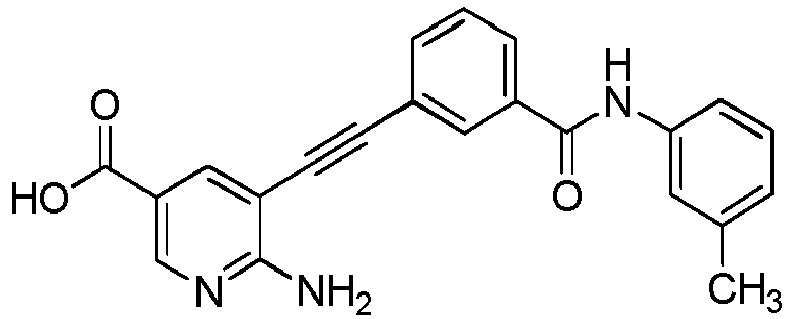
- In a manner similar to that described in Preparation 42, methyl 6-amino-5-((3-(m-tolylcarbamoyl)phenyl)ethynyl)nicotinate is converted to the title compound.
-

- In a manner similar to that described in Preparation 14, a mixture of 8-imino-2,2,3,3,13,13,14,14-octamethyl-4,12-dioxa-8λ4-thia-3,13-disilapentadecane 8-oxide and 6-amino-5-((3-(m-tolylcarbamoyl)phenyl)ethynyl)nicotinic acid were converted to the title compound.
-

- In a manner similar to that described in Example 14, 6-amino- N-[bis(3-{[tert-butyl(dimethyl)silyl]oxy}propyl)(oxido)-λ4-sulfanylidene]-5-[(3-{[(3-methylphenyl)amino]carbonyl}phenyl)ethynyl]nicotinamide was converted to the title compound.
1H NMR (DMSO-d6) δ: 10.25 (s, 1H), 8.59 (d, J = 2.1 Hz, 1H), 8.26 (t, J = 1.5 Hz, 1H), 8.08 (d, J = 2.3 Hz, 1H), 7.93 (ddt, J = 7.9, 1.0, 0.8 Hz, 1H), 7.89 (ddd, J = 7.8, 1.3, 1.2 Hz, 1H), 7.63 (s, 1H), 7.56 - 7.59 (m, 2H), 7.24 (t, J = 7.9 Hz, 1H), 7.09 (br. s., 2H), 6.94 (d, J = 7.6 Hz, 1H), 4.74 (t, J = 5.3 Hz, 2H), 3.64 (ddd, J = 14.1, 10.6, 5.3 Hz, 2H), 3.55 - 3.60 (m, 2H), 3.53 (q, J = 5.9 Hz, 4H), 2.32 (s, 3H), 1.85 - 1.96 (m, 4H) -

- To a solution of dimethylsulfoximine (4 g, 43 mmol, 1 eq) in anhydrous acetonitrile (10 mL) was added dropwise N,N-diethyltrimethylsilylamine (12.6 mL, 1.5 eq). The reaction solution was stirred and heated at 70 °C for 1 hour. It was then concentrated and dried in vacuo yielding brown oil 5.86 g. The residual TMS-protected dimethylsulfoximine (5.86 g, 35.5 mmol) was dissolved in anhydrous THF (40 mL) and cooled to -78 °C. The resulting solution was treated dropwise with n-Butyllithium (14.6 mL, 1.025 eq) and the resulting reaction mixture was stirred at -78 °C for 10 minutes. The reaction flask was lifted out of the bath with stirring for 15 minutes followed by an addition of hexamethyl phosphoramide (11.75 mL, 1.9 eq). The reaction solution was cooled back to -78 °C. It was then added dropwise into a solution of trimethyl 4-bromo-orthobutyrate (15.4 g, 1.5 eq) at -78 °C with vigorous stirring. One hour later, the reaction was warmed to RT and stirred for 2.5 hours. The reaction was quenched by pouring into ice cold water which was maintained at pH about 6 with addition of 2 N aq HCl. The aqueous was extracted with EtOAc. The organic layer was isolated, washed with brine (1X), and dried with anhydrous Na2SO4. The upper solution was decanted and concentrated yielding brown oil which was used without purification.
- The brown oil, obtained in the above step, was dissolved in MeOH-H2O (10:1, 22 mL). To this solution was added cesium fluoride (0.81 g, 0.15 eq). The resulting reaction mixture was stirred and heated at 50 °C for 3 hours. It was then evaporated under reduced pressure to remove the MeOH. The oily residue was partitioned between cold brine and EtOAc. Mass spectrometry revealed that the desired product remained mostly in the aqueous. Thus, the EtOAc layer was extracted with H2O (1X). The water layer was then combined to the brine layer, and this aqueous was extracted with i-PrOH-CHCl3 (1:4, 2X). The organic layers were combined, dried with anhydrous Na2SO4, and concentrated under reduced pressure leading to brown oil in amount of 3.2 g. The crude brown oil was dissolved in MeOH-H2O (40:1, 70 mL). It was then cooled to 0 °C followed by an addition of catalytic amount of pyridinium toluene-4-sulfonate. After the reaction was stirred at 0 °C for 2 hours, it was concentrated under reduced pressure to give the title compound as a brown oil (2.32 g), which was used without further purification.
-

- A solution of methyl 5-(S-methylsulfonimidoyl)pentanoate (2.32 g) was dissolved in anhydrous DMF (30 mL) and to this solution was added 5-iodo-6-amino-nicotinic acid (3.17 g, ∼1eq), diisopropylethylamine (4.2 mL, 2 eq), and BOP (5.85 g, 1.1 eq). The reaction mixture was heated at 70 °C for 1 hour and then partitioned between EtOAc and aq NH4Cl. The organic layer was separated, washed sequentially with aq NH4Cl (1X), saturated aq NaHCO3 (1X), brine (1X), and dried with anhydrous Na2SO4 overnight. The upper solution layer was decanted, concentrated, and the brown oily reside was subject to column chromatography (acetone-CHCl3 1:100 to MeOH-acetone-CHCl3 1:2:50). Concentration of the product eluting fractions provided the title compound as a slight yellow colored foam (2.65 g).
1HNMR (DMSO-d6) δ: 8.52 (d, J = 2.1 Hz, 1H), 8.31 (d, J = 1.9 Hz, 1H), 6.72 (br. s., 2H), 3.52 - 3.63 (m, 5H), 3.38 (s, 3H), 2.39 (t, J = 7.2 Hz, 2H), 1.61 - 1.86 (m, 4H) -

- The solution of methyl 5-{N-[(6-amino-5-iodopyridin-3-yl)carbonyl]-S-methylsulfonimidoyl}pentanoate, (565 mg, 1.28 mmol) in anhydrous DMF (7 mL) was degassed with anhydrous nitrogen and then to the solution was added 3-methyl-furan-2-carboxylic acid (3-ethynyl-phenyl)-amide (376.5 mg, 1.3 eq), bis(triphenylphosphine)palladium(II) dichloride (90.3 mg, 0.1 eq), triphenyl phosphine (8.4 mg, 0.025 eq), triethylamine (0.75 mL, 4 eq) and lastly copper(I) iodide (50 mg, 0.2 eq) under anhydrous nitrogen atmosphere. The reaction mixture was stirred at RT for about 15 minutes and then partitioned between saturated aq NaHCO3 and EtOAc. The organic layer was washed one more time with saturated aq NaHCO3, then with aq NH4Cl (1X), brine (1X), and dried with anhydrous Na2SO4 overnight. The upper solution layer was decanted and concentrated. The oily residue was subject to gradient column chromatography. Concentration of the product eluting fractions gave the title compound as white foam (480 mg ,70%).
1H NMR (DMSO-d6) δ: 10.12 (s, 1H), 8.57 (d, J = 2.3 Hz, 1H), 8.08 (t, J = 1.8 Hz, 1H), 8.04 (d, J = 2.2 Hz, 1H), 7.81 (dd, J = 1.7, 0.4 Hz, 1H), 7.72 - 7.75 (m, 1H), 7.40 - 7.42 (m, 1H), 7.34-7.39 (m, 1H), 6.98 (br. s., 2H), 6.60 (dd, J = 1.7, 0.4 Hz, 1H), 3.51 - 3.65 (m, 5H), 3.40 (s, 3H), 2.40 (t, J = 7.4 Hz, 2H), 2.35 (s, 3H), 1.75 - 1.88 (m, 2H), 1.66 - 1.72 (m, 2H) -

- To the solution of methyl 5-(N-{ [6-amino-5-({3-[(3-methyl-2-furoyl)amino]phenyl} ethynyl)pyridin-3-yl]carbonyl} -S-methylsulfonimidoyl)pentanoate (367 mg, 0.68 mmol) in THF (13 mL) at 0 °C was added dropwise 1N aq KOH (3.42 mL, 5 eq). The reaction was stirred at 0 °C for 20 minutes and then at RT for 4 hours. It was then cooled back to 0 °C and 2N aq HCl was dropwise added to adjust the pH to about 5∼6. The mixture was then evaporated at RT to remove the most of the THF. The oily residue was then partitioned between aq NH4Cl and CHCl3. The chloroform layer was isolated, followed by a wash with brine (1X) and then dried with anhydrous Na2SO4 overnight. The upper clear solution was decanted, concentrated, and subject to a gradient column chromatography (MeOH-DCM 1:500 to 1:9). The corresponding product fractions were collected, concentrated, and treated with EtOAc with stirring. The title compound was obtained upon filtration as white solid (238 mg ,67%).
1HNMR (DMSO-d6) δ: 12.10 (br. s., 1H), 10.13 (s, 1H), 8.57 (d, J = 2.3 Hz, 1H), 8.08 (t, J = 1.6 Hz, 1H), 8.04 (d, J = 2.1 Hz, 1H), 7.81 (d, J = 1.8 Hz, 1H), 7.73 - 7.76 (m, 1H), 7.40 - 7.43 (m, 1H), 7.35 - 7.39 (m, 1H), 6.98 (br. s., 2H), 6.60 (d, J = 1.5 Hz, 1H), 3.53 - 3.64 (m, 2H), 3.40 (s, 3H), 2.35 (s, 3H), 2.27 (t, J = 6.9 Hz, 2H), 1.76 - 1.86 (m, 2H), 1.62 - 1.68 (m, 2H) -

- To the reaction vessel containing methyl 5-{N-[(6-amino-5-iodopyridin-3-yl)carbonyl]-S-methylsulfonimidoyl}pentanoate (2.0 g, 4.56 mmol, 1 eq), 3-ethynylaniline (0.715 mL, 1.5 eq), and bis(triphenylphosphine)palladium(II) dichloride (320 mg, 0.1 eq) in anhydrous DMF (10 mL) under anhydrous nitrogen atmosphere was added triethylamine (2.54 mL, 4 eq) and copper(I) iodide (173 mg, 0.2 eq). The reaction mixture was stirred at RT for 15 minutes and then partitioned between saturated aq NaHCO3 and EtOAc. The organic layer was separated, washed with aq NH4Cl (1X) and brine (1X), followed by drying with anhydrous Na2SO4. The upper clear liquid was decanted, concentrated, and the brown oily residue was subject twice to a gradient column chromatography (EtOAc-Hex from 1:3 to MeOH-EtOAc-Hex 1:30:6). Concentration of the product eluting fractions provided the title compound as a white foam (1.32 g, 68%).
1H NMR (DMSO-d6) δ: 8.54 (d, J = 2.2 Hz, 1H), 7.99 (d, J = 2.2 Hz, 1H), 7.04 (t, J = 8.0 Hz, 1H), 6.85 (s, 2H), 6.78 - 6.81 (m, 2H), 6.58 - 6.61 (m, 1H), 5.20 (s, 2H), 3.52 - 3.64 (m, 5H), 3.40 (s, 3H), 2.40 (t, J = 7.3 Hz, 2H), 1.75 - 1.87 (m, 2H), 1.65 - 1.73 (m, 2H) -
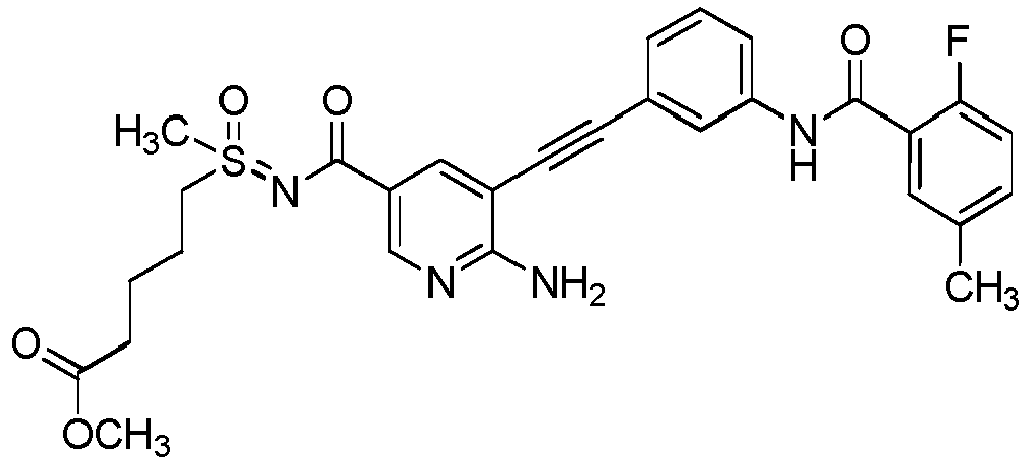
- To the mixture of methyl 5-[N-({6-amino-5-[(3-aminophenyl)ethynyl]pyridin-3-yl}carbonyl)-S-methylsulfonimidoyl]pentanoate, (85.6 mg, 0.2 mmol, 1 eq) and 2-fluoro-5-methylbenzoic acid (32.7 mg, 1.05 eq) in dichloroethane (2 mL) at 60 °C was added catalytic amount of DMAP (5 mg, 0.2 eq) and EDCI (46.1 mg, 1.2 eq). The reaction was stirred at that temperature for 4 h and then cooled to room temperature. It was then partitioned between EtOAc and saturated aq NaHCO3. The organic layer was further washed with aq NH4Cl, brine and then dried with anhydrous sodium sulfate. The organic layer was decanted, concentrated, and the residue was subject to a gradient column chromatography (EtOAc-Hex 1:4 to neat EtOAc). The product containing fractions were concentrated to give the title compound as a white foam (92 mg).
1H NMR (DMSO-d6) δ: 10.46 (s, 1H), 8.57 (d, J = 2.1 Hz, 1H), 8.04 (d, J = 2.1 Hz, 1H), 8.01 (s, 1H), 7.68 (d, J = 8.1 Hz, 1H), 7.46 - 7.49 (m, 1H), 7.43 - 7.46 (m, 1H), 7.36 - 7.42 (m, 2H), 7.24 (t, J = 9.2 Hz, 1H), 7.00 (br. s., 2H), 3.53 - 3.64 (m, 5H), 3.40 (s, 3H), 2.40 (t, J = 7.3 Hz, 2H), 2.35 (s, 3H), 1.75 - 1.86 (m, 2H), 1.66 - 1.72 (m, 2H) -

- In a manner similar to that described in Example 25, methyl 5-[N-({6-amino-5-[(3-aminophenyl)ethynyl]pyridin-3-yl} carbonyl)-S-methylsulfonimidoyl]pentanoate and 3-methylbenzoic acid were coupled to give the title compound as a white foam (82 mg).
1HNMR (DMSO-d6) δ: 10.29 (s, 1H), 8.57 (d, J = 2.2 Hz, 1H), 8.01 - 8.10 (m, 2H), 7.72 - 7.82 (m, 3H), 7.35 - 7.47 (m, 4H), 6.99 (br. s., 2H), 3.52 - 3.66 (m, 5H), 3.40 (s, 3H), 2.36 - 2.44 (m, 5H), 1.74 - 1.87 (m, 2H), 1.65 - 1.73 (m, 2H) -

- In a manner similar to that described in Example 25, methyl 5-[N-({6-amino-5-[(3-aminophenyl)ethynyl]pyridin-3-yl} carbonyl)-S-methylsulfonimidoyl]pentanoate and 2-fluoro-5-(trifluoromethyl)benzoic acid were coupled to give the title compound as a white foam (74 mg).
1H NMR (DMSO-d6) δ: 10.70 (s, 1H), 8.57 (d, J = 2.2Hz, 1H), 8.09 (dd, J = 6.1,2.0 Hz, 1H), 8.05 (d, J = 2.1 Hz, 1H), 8.00 (br. s., 2H), 7.68 (d, J = 8.1 Hz, 1H), 7.64 (t, J = 9.0 Hz, 1H), 7.47 - 7.49 (m, 1H), 7.41 - 7.45 (m, 1H), 7.02 (br. s., 2H), 3.53 - 3.64 (m, 5H), 3.40 (s, 3H), 2.40 (t, J = 7.3 Hz, 2H), 1.76 - 1.86 (m, 2H), 1.65 - 1.72 (m, 2H) -
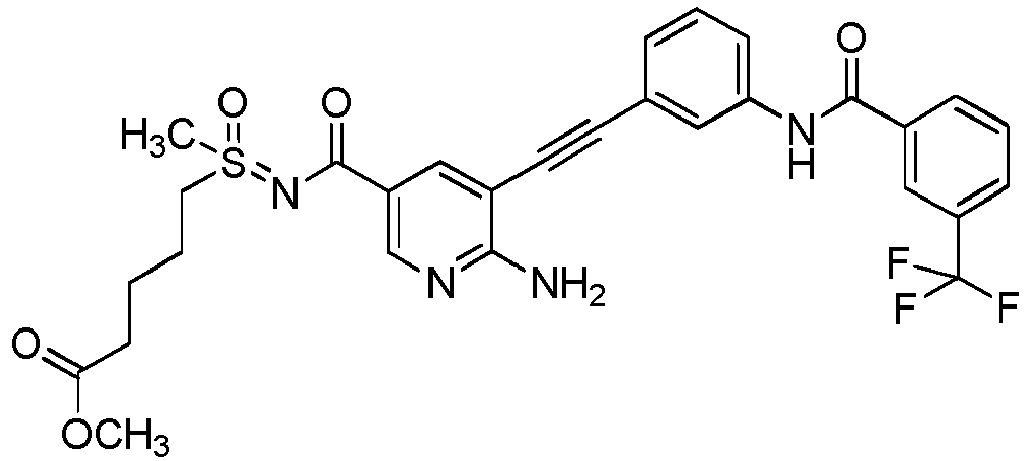
- In a manner similar to that described in Example 25, methyl 5-[N-({6-amino-5-[(3-aminophenyl)ethynyl]pyridin-3-yl} carbonyl)-S-methylsulfonimidoyl]pentanoate and 3-(trifluoromethyl)benzoic acid were coupled to give the title compound as a white foam (78 mg).
1H NMR (DMSO-d6) δ: 10.56 (s, 1H), 8.57 (d, J = 2.2 Hz, 1H), 8.32 (s, 1H), 8.28 (d, J = 7.8 Hz, 1H), 8.06 (s, 1H), 8.05 (d, J = 2.1 Hz, 1H), 7.99 (d, J = 7.8 Hz, 1H), 7.81 (t, J = 7.8 Hz, 1H), 7.78 (d, J = 8.2 Hz, 1H), 7.46 - 7.49 (m, 1H), 7.42 - 7.45 (m, 1H), 7.01 (br. s., 2H), 3.53 - 3.64 (m, 5H), 3.41 (s, 3H), 2.40 (t, J = 7.3 Hz, 2H), 1.75 - 1.87 (m, 2H), 1.66 - 1.73 (m, 2H) -

- In a manner similar to that described in Example 25, methyl 5-[N-({6-amino-5-[(3-aminophenyl)ethynyl]pyridin-3-yl} carbonyl)-S-methylsulfonimidoyl]pentanoate and 4-chloro-3-(trifluoromethyl)benzoic acid were coupled to give the title compound as a white solid (74 mg).
1H NMR (DMSO-d6) δ: 10.61 (s, 1H), 8.57 (d, J = 2.1 Hz, 1H), 8.41 (d, J = 1.5 Hz, 1H), 8.28 (dd, J = 8.4, 1.6 Hz, 1H), 8.03 - 8.06 (m, 2H), 7.95 (d, J = 8.2 Hz, 1H), 7.76 (d, J = 7.9 Hz, 1H), 7.47 - 7.49 (m, 1H), 7.42 - 7.45 (m, 1H), 7.01 (br. s., 2H), 3.53 - 3.64 (m, 5H), 3.40 (s, 3H), 2.40 (t, J = 7.3 Hz, 2H), 1.75 - 1.87 (m, 2H), 1.69 (qd, J = 7.4, 7.2 Hz, 2H) -

- In a manner similar to that described in Example 25, methyl 5-[N-({6-amino-5-[(3-aminophenyl)ethynyl]pyridin-3-yl} carbonyl)-S-methylsulfonimidoyl]pentanoate and 3-methoxybenzoic acid were coupled to give the title compound as a white solid (75 mg).
1H NMR (DMSO-d6) δ: 10.30 (s, 1H), 8.57 (d, J = 2.2 Hz, 1H), 8.03 - 8.07 (m, 2H), 7.77 (d, J = 7.9 Hz, 1H), 7.55 (d, J = 7.8 Hz, 1H), 7.50 (s, 1H), 7.46 (dd, J = 15.1, 7.3 Hz, 2H), 7.39 - 7.42 (m, 1H), 7.18 (dd, J = 8.1, 2.0 Hz, 1H), 7.00 (br. s., 2H), 3.85 (s, 3H), 3.53 - 3.64 (m, 5H), 3.40 (s, 3H), 2.40 (t, J = 7.3 Hz, 2H), 1.75 - 1.86 (m, 2H), 1.66 - 1.72 (m, 2H) -

- In a manner similar to that described in Example 25, methyl 5-[N-({6-amino-5-[(3-aminophenyl)ethynyl]pyridin-3-yl} carbonyl)-S-methylsulfonimidoyl]pentanoate and 3,4-dimethoxybenzoic acid were coupled to give the title compound as a white foam (102 mg).
1HNMR (DMSO-d6) δ: 10.15 (s, 1H), 8.57 (d, J = 2.3 Hz, 1H), 8.03 - 8.05 (m, 2H), 7.77 (ddd, J = 7.8, 1.8, 1.6 Hz, 1H), 7.64 (dd, J = 8.4, 1.9 Hz, 1H), 7.55 (d, J = 1.8 Hz, 1H), 7.38 - 7.44 (m, 2H), 7.10 (d, J = 8.5 Hz, 1H), 7.00 (br. s., 2H), 3.85 (s, 3H), 3.84 (s, 3H), 3.53 - 3.64 (m, 5H), 3.40 (s, 3H), 2.40 (t, J = 7.3 Hz, 2H), 1.75 - 1.86 (m, 2H), 1.66 - 1.72 (m, 2H) -

- To the solution of 3-ethynylaniline (1.2 mL, 11.2 mmol, 1.0 eq) in anhydrous DMF (25 mL) was added 3-methyl-furan-2-carboxylic acid (1.84 g, 1.3 eq), diisopropylethyl amine (7.85 mL, 4.0 eq), and BOP (6.72 g, 1.35 eq). After the reaction solution was heated at 60 °C for two hours, it was cooled to room temperature, diluted with EtOAc, washed sequentially with aqueous NH4Cl, water, brine, and lastly dried with anhydrous sodium sulfate. The clear solution was decanted, concentrated, and the yellow oily residue was subject to column chromatography (EtOAc-Hex from 1:100 to 1:10). The product eluting fractions were concentrated to give the title compound as a yellow oil.
-

- To the solution of 3-methyl-furan-2-carboxylic acid (3-ethynyl-phenyl)-amide (∼1.3 eq) in anhydrous DMF (25 mL) was added 2-amino-3-iodo-5-nicotinic methyl ester (2.4 g, 8.63 mmol, 1 eq). The resulting solution was first degassed several times with dry nitrogen and then treated sequentially with triethylamine (4.82 mL, 4 eq), copper(I) iodide (329 mg, 0.2 eq), and bis(triphenylphosphine)palladium(II) dichloride (605 mg, 0.1 eq). The reaction mixture was stirred at RT for 10 minutes and then partitioned between saturated aq NaHCO3 and CHCl3. The organic layer was separated, washed with aq NH4Cl (1X) and brine (1X), followed by drying with anhydrous Na2SO4. The upper clear liquid was decanted, concentrated, and the solid residue was treated with EtOAc-Hex (1:1). After the mixture was stirred at room temperature for 2 hours, it was filtered and the brown solid obtained was subject to a gradient column chromatography (from CHCl3 to MeOH-CHCl3 1:20). The product containing fractions were concentrated to give the title compound as a white solid (1.82 g).
1H NMR (DMSO-d6) δ: 10.13 (s, 1H), 8.53 (d, J = 2.3 Hz, 1H), 8.10 (t, J = 1.7 Hz, 1H), 8.02 (d, J = 2.2 Hz, 1H), 7.81 (d, J = 1.5 Hz, 1H), 7.72 - 7.75 (m, 1H), 7.41 -7.43 (m, 1H), 7.35 - 7.39 (m, 1H), 7.24 (br. s., 2H), 6.61 (d, J = 1.5 Hz, 1H), 3.80 (s, 3H), 2.35 (s, 3H) -

- To a solution of methyl 6-amino-5-({3-[(3-methyl-2-furoyl)amino]phenyl}ethynyl)nicotinate, (1.82 g, 4.85 mmol, 1 eq) in MeOH-H2O (100 mL, 3:1) at RT was added potassium hydroxide (2.72 g, 10 eq) with stirring. The mixture was heated at 65 °C for 2 hours and a brown solution was observed at this time. The reaction mixture was concentrated to remove most of the methanol. The resulting solution was cooled to 0 °C and concentrated HCl was added until the pH was around 3 at which time a white precipitates formed. The solid which had formed was collected by filtration, rinsed with water, and dried to give the title compound as a white solid (1.75 g).
1H NMR (DMSO-d6) δ: 12.62 (br. s., 1H), 10.13 (s, 1H), 8.51 (d, J = 2.2 Hz, 1H), 8.09 (s, 1H), 7.99 (d, J = 2.2 Hz, 1H), 7.81 (d, J = 1.6 Hz, 1H), 7.74 (dt, J = 7.7, 1.8 Hz, 1H), 7.33 - 7.44 (m, 2H), 7.13 (br. s., 2H), 6.60 (d, J = 1.6 Hz, 1H), 2.35 (s, 3H) -

- To the solution of (S)-methyl 5-(S-methylsulfonimidoyl)pentanoate, (130 mg, 0.672 mmol, 1.2 eq) in anhydrous DMF (3 mL) was added 6-amino-5-({3-[(3-methyl-2-furoyl)amino]phenyl}ethynyl)nicotinic acid, (200 mg, 0.554 mmol, 1.0 eq), diisopropylethyl amine (0.2 mL, 2.0 eq), and BOP (270 mg, 1.1 eq). After the reaction solution was heated at 60 °C for three hours, it was cooled to room temperature, diluted with EtOAc, washed with aqueous NH4Cl, water, brine, and lastly dried with anhydrous sodium sulfate. The clear solution was decanted, concentrated, and the brown oily residue was subject to column chromatography (EtOAc-Hex from 1:4 to 6:1). The corresponding product fractions were collected, concentrated under reduced pressure, and the residue was triturated with EtOAc-Hex (1:9). The solid which formed by scratching was collected by filtration and dried to give the title compound as a white solid (155 mg).
1HNMR (DMSO-d6) δ: 10.13 (s, 1H), 8.57 (d, J = 2.2 Hz, 1H), 8.08 (t, J = 1.6 Hz, 1H), 8.04 (d, J = 2.2 Hz, 1H), 7.81 (d, J = 1.6 Hz, 1H), 7.74 (dt, J = 7.7, 1.8 Hz, 1H), 7.33 - 7.44 (m, 2H), 6.98 (br. s., 2H), 6.60 (d, J = 1.6 Hz, 1H), 3.49 - 3.68 (m, 5H), 3.41 (s, 3H), 2.40 (t, J = 7.2 Hz, 2H), 2.35 (s, 3H), 1.62 - 1.89 (m, 4H) -

- In a manner similar to that described in Example 32, (R)-methyl 5-(S-methylsulfonimidoyl)pentanoate and 6-amino-5-({3-[(3-methyl-2-furoyl)amino]phenyl}ethynyl)nicotinic acid,were reacted to give the title compound .
1H NMR (DMSO-d6) δ: 10.13 (s, 1H), 8.57 (d, J = 2.2 Hz, 1H), 8.08 (t, J = 1.6 Hz, 1H), 8.04 (d, J = 2.2 Hz, 1H), 7.81 (d, J = 1.6 Hz, 1H), 7.74 (dt, J = 7.7, 1.8 Hz, 1H), 7.33 - 7.44 (m, 2H), 6.98 (br. s., 2H), 6.60 (d, J = 1.6 Hz, 1H), 3.49 - 3.68 (m, 5H), 3.41 (s, 3H), 2.40 (t, J = 7.2 Hz, 2H), 2.35 (s, 3H), 1.62 - 1.89 (m, 4H) -

- To the nitrogen degassed solution of methyl 5-{N-[(6-amino-5-iodopyridin-3-yl)carbonyl]-S-methylsulfonimidoyl}pentanoate, (1.119 g, 1.0 eq) and 3-ethynylbenzoic acid (0.47 g, 1.2 eq) in anhydrous DMF (10 mL) was added triethylamine (1.42 mL, 4 eq), copper(I) iodide (97 mg, 0.2 eq), and bis(triphenylphosphine)palladium(II) dichloride (179 mg, 0.1 eq). The reaction mixture was stirred at RT for 30 minutes and then partitioned between i-PrOH-CHCl3 (1:5) and aq NH4Cl. The pH of the aqueous layer was adjusted to 3 using 10% aq KHSO4. The aqueous layer was isolated and extracted once more with i-PrOH-CHCl3 (1:5). All organic layers were combined, washed with brine, and dried with anhydrous Na2SO4. The organic phase was decanted, concentrated, and the brown oily residue was subject to a gradient column chromatography [from CHCl3 to MeOH-CHCl3 (1:9)]. The product containing fractions were collected, concentrated, and the solid residue was triturated with i-PrOH. The solid which formed was collected by filtration to give the title compound as a lightly yellow solid (853 mg).
1HNMR (DMSO-d6) δ: 13.19 (br. s., 1H), 8.57 (br. s., 1H), 8.26 (s, 1H), 8.07 (d, J = 2.1 Hz, 1H), 7.92 (dd, J = 11.5, 8.0 Hz, 2H), 7.51 - 7.59 (m, 1H), 7.10 (br. s., 2H), 3.49 - 3.68 (m, 5H), 3.40 (s, 3H), 2.40 (t, J = 7.1 Hz, 2H), 1.61 - 1.90 (m, 4H) -

- To the mixture of 3-{[2-amino-5-({[(5-methoxy-5-oxopentyl)(methyl)oxido-λ4-sulfanylidene]amino}carbonyl)pyridin-3-yl]ethynyl}benzoic acid (80 mg, 0.175 mmol, 1 eq) and m-toluidine (37.4 mg, 2.0 eq) in dichloroethane (1.5 mL) at 50 °C was added catalytic amount of DMAP (4.3 mg, 0.2 eq) and EDCI (40.3 mg, 1.2 eq). The reaction was stirred at that temperature for 3 h. It was then partitioned between EtOAc and saturated aq NaHCO3. The organic layer was further washed with aq NH4Cl, brine and then dried with anhydrous sodium sulfate. The organic solution was decanted, concentrated, and the residue was subject to a gradient column chromatography (EtOAc-Hex 1:7 to neat EtOAc). Concentration of the product containing fractions gave the title compound as a white foam after dried in vacuo (72 mg).
1H NMR (DMSO-d6) δ: 10.25 (s, 1H), 8.58 (d, J = 2.3 Hz, 1H), 8.26 (t, J = 1.5 Hz, 1H), 8.08 (d, J = 2.3 Hz, 1H), 7.93 (dt, J = 7.9, 1.3 Hz, 1H), 7.89 (dt, J = 7.7, 1.2 Hz, 1H), 7.63 (s, 1H), 7.56 - 7.60 (m, 2H), 7.24 (t, J = 7.8 Hz, 1H), 7.09 (br. s., 2H), 6.94 (d, J = 7.6 Hz, 1H), 3.54 - 3.64 (m, 5H), 3.41 (s, 3H), 2.40 (t, J = 7.3 Hz, 2H), 2.32 (s, 3H), 1.75 - 1.87 (m, 2H), 1.66 - 1.72 (m, 2H) -

- In a manner similar to that described in Example 34, 3-{[2-amino-5-({[(5-methoxy-5-oxopentyl)(methyl)oxido-λ4-sulfanylidene]amino}carbonyl)pyridin-3-yl]ethynyl}benzoic acid and 2-fluoro-5-methylaniline were reacted to give the title compound as a clear oil (89 mg).
1HNMR (DMSO-d6) δ: 10.14 (s, 1H), 8.58 (d, J = 2.2 Hz, 1H), 8.27 (t, J = 1.6 Hz, 1H), 8.07 (d, J = 2.2 Hz, 1H), 7.95 (dt, J = 7.8, 1.4 Hz, 1H), 7.90 (dt, J = 7.7, 1.3 Hz, 1H), 7.58 (t, J = 7.7 Hz, 1H), 7.41 (dd, J = 7.3, 1.6 Hz, 1H), 7.18 (dd, J = 10.3, 8.4 Hz, 1H), 7.04 - 7.13 (m, 3H), 3.53 - 3.64 (m, 5H), 3.40 (s, 3H), 2.40 (t, J = 7.3 Hz, 2H), 2.31 (s, 3H), 1.75 - 1.86 (m, 2H), 1.66 - 1.72 (m, 2H) -

- In a manner similar to that described in Example 34, 3-{[2-amino-5-({[(5-methoxy-5-oxopentyl)(methyl)oxido-λ4-sulfanylidene]amino}carbonyl)pyridin-3-yl]ethynyl}benzoic acid and 5-(tert-butyl)isoxazol-3-amine were reacted to give the title compound as a clear oil (70 mg).
1H NMR (DMSO-d6) δ: 11.40 (s, 1H), 8.58 (d, J = 2.3 Hz, 1H), 8.31 (t, J = 1.5 Hz, 1H), 8.07 (d, J = 2.2 Hz, 1H), 7.99 (dt, J = 7.8, 1.4 Hz, 1H), 7.91 (dt, J = 7.7, 1.1 Hz, 1H), 7.57 (t, J = 7.8 Hz, 1H), 7.08 (br. s., 2H), 6.73 (s, 1H), 3.53 - 3.64 (m, 5H), 3.41 (s, 3H), 2.40 (t, J = 7.3 Hz, 2H), 1.75 - 1.86 (m, 2H), 1.65 - 1.73 (m, 2H), 1.33 (s, 9H) -

- A solution of methyl 5-[N-({6-amino-5-[(3-aminophenyl)ethynyl]pyridin-3-yl}carbonyl)-S-methylsulfonimidoyl]pentanoate (85.6 mg, 0.2 mmol, 1 eq) and 2-fluoro-5-methylphenyl isocyanate (29 µL, 1.1 eq) in anhydrous DMF (2 mL) was stirred at room temperature overnight. The reaction was then diluted with EtOAc, washed sequentially with aq NH4Cl, saturated aq NaHCO3, brine, and lastly dried with sodium sulfate. The clear solution was decanted, concentrated, and the oily residue was subject to a gradient column chromatography (EtOAc-Hex from 1:1 to neat EtOAc). The product containing fractions were concentrated to give the title compound as a white foam (86.2 mg).
1H NMR (DMSO-d6) δ: 9.14 (s, 1H), 8.56 (d, J = 2.2 Hz, 1H), 8.54 (d, J = 2.2 Hz, 1H), 8.05 (d, J = 2.2 Hz, 1H), 7.99 (dd, J = 7.8, 1.5 Hz, 1H), 7.81 (s, 1H), 7.38 - 7.40 (m, 1H), 7.30 - 7.35 (m, 2H), 7.11 (dd, J = 11.3, 8.4 Hz, 1H), 6.99 (br. s., 2H), 6.79 - 6.83 (m, 1H), 3.53 - 3.64 (m, 5H), 3.41 (s, 3H), 2.40 (t, J = 7.3 Hz, 2H), 2.27 (s, 3H), 1.75 - 1.87 (m, 2H), 1.65 - 1.73 (m, 2H) -

- In a manner similar to that describe in Example 37, methyl 5-[N-({6-amino-5-[(3-aminophenyl)ethynyl]pyridin-3-yl} carbonyl)-S-methylsulfonimidoyl]pentanoate and 5-methylphenyl isocyanate were coupled. Purification of the crude reaction product gave the title compound as a white foam (78.8 mg).
1H NMR (DMSO-d6) δ: 8.74 (br. s., 1H), 8.66 (br. s., 1H), 8.56 (d, J = 2.2 Hz, 1H), 8.04 (d, J = 2.1 Hz, 1H), 7.78 (s, 1H), 7.41 (dt, J = 7.8, 1.7 Hz, 1H), 7.28 - 7.34 (m, 3H), 7.23 (d, J = 8.1 Hz, 1H), 7.16 (t, J = 7.7 Hz, 1H), 6.98 (br. s., 2H), 6.80 (d, J = 7.3 Hz, 1H), 3.53 - 3.64 (m, 5H), 3.40 (s, 3H), 2.40 (t, J = 7.3 Hz, 2H), 2.28 (s, 3H), 1.75 - 1.86 (m, 2H), 1.66 - 1.73 (m, 2H) -

- A solution of 3-(methylthiol)-1-propanol (10.52 mL, 0.1 mol, 1.0 eq) in anhydrous DMF (50 mL) was added tert-butyldimethylsilyl chloride (25 g, 1.6 eq) and imidazole (27.5 g, 4.0 eq). The resulting reaction solution was stirred at room temperature for 1 hour. It was then diluted with EtOAc, followed by a sequential wash with water (2X) and brine (1X), and was lastly dried with anhydrous sodium sulfate. The supernatant liquid was decanted, concentrated, and the oily residue was subject to column chromatography (from neat hexanes to EtOAc-hex 1:50). The compound containing fractions were concentrated to give the title compound as a clear oil in quantitative yield.
-
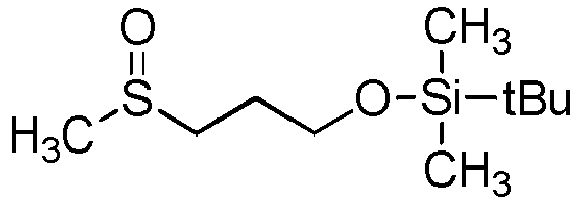
- A solution of tert-butyldimethyl(3-(methylthio)propoxy)silane (0.1 mol) in water/MeOH (3:2, 500 mL) at 0 °C was added sodium (meta)periodate (∼30g). The reaction mixture was stirred first at 0 °C for 20 hours, then at room temperature for 3 hours. The reaction mixture was then filtered and the filtrate was concentrated under reduced pressure to remove the most of the organic solvent. The aqueous residue was then extracted with CHCl3 (2X) and the combined organic extracts were dried with anhydrous sodium sulfate. The organic phase was decanted and concentrated to yield the title compound as an oil which solidified to provide a white solid upon standing (17.65 g).
-

- To a 1-L round-bottom flask containing 2,2,2-trifluoroacetamide (17.43 g), magnesium oxide (12.1 g), and rhodium(II) acetate (0.99 g) in anhydrous dichloromethane (500 mL) was added tert-butyldimethyl(3-(methylsulfinyl)propoxy)silane (17.65 g) and (diacetoxyiodo)benzene (36.1 g). The resulting reaction mixture was stirred at room temperature for 24 hours and then filtered through a short pad of celite. The filtrate was concentrated, the brown oily residue was taken up in MeOH (∼500 mL), and potassium carbonate (51.7 g) was added. The reaction mixture was stirred at RT for 2 hours. The mixture was then filtered through a pad of celite, the pad was washed with MeOH, and the filtrate was concentrated. The resulting soft brown solid was treated with DCM-EtOAc (4:1), the mixture was stirred at room temperature for 1 hour, and it was filtered again through a pad composed of silica gel and celite. The pad was washed with DCM-EtOAc (2:1) first and then with neat EtOAc only. The filtrate was concentrated and the brown oily residue was subject to a column chromatography (EtOAc-Hex 1:2 to neat EtOAc). Concentration of the product eluting fractions gave the title compound as a light brown oil (12.3 g).
-

- To a solution of tert-butyldimethyl(3-(S-methylsulfonimidoyl)propoxy)silane (1.07 g, 4.25 mmol, 1 eq) in anhydrous DMF (8 mL) under nitrogen atmosphere was added 5-{3-[(3-methyl-furan-2-carbonyl)-amino]-phenylethynyl}-nicotinic acid (1.54g, 1.05eq), diisopropylethylamine (1.50 mL, 2.0 eq), and BOP (2.13 g, 1.1 eq). The reaction mixture was stirred at room temperature for 2 hours and then diluted with EtOAc. It was washed sequentially with aqueous NH4Cl (2X), saturated aqueous NaHCO3 (1X), and brine (1X). At last it was dried with anhydrous Na2SO4. The supernatant liquid was decanted, concentrated, and the oily residue was subject to column chromatography (EtOAc-Hex 1:4 to 1:2). Concentration of the product eluting fractions gave the title compound as a white foam (2.05 g).
-

- To a solution of N-[(3-{[tert-butyl(dimethyl)silyl]oxy}propyl)(methyl)oxido-λ4-sulfanylidene]-5-({3-[(3-methyl-2-furoyl)amino]phenyl}ethynyl)nicotinamide, (2.05 g) in anhydrous THF (70 mL) at 0 °C was added dropwise tetrabutylammonium fluoride (8.92 mL, 2.1 eq). After the reaction was further stirred at 0 °C for about 2 hours, it was concentrated at room temperature under reduced pressure and then partitioned between EtOAc and saturated aqueous NaHCO3. The organic layer was isolated, washed with aqueous NH4Cl and brine, and dried with anhydrous sodium sulfate. The clear solution was decanted, concentrated, and the oily residue was subject to a gradient column chromatography (EtOAc-Hex 1:1 to 10:1). Concentration of the product eluting fractions gave the title compound as a white foam (1.34g).
1H NMR (DMSO-d6) δ: 10.20 (s, 1H), 9.09 (d, J = 2.1 Hz, 1H), 8.92 (d, J = 2.1 Hz, 1H), 8.38 (t, J = 2.1 Hz, 1H), 8.12 (t, J = 1.8 Hz, 1H), 7.82 (d, J = 1.6 Hz, 1H), 7.79 - 7.81 (m, 1H), 7.39 - 7.43 (m, 1H), 7.34 (dt, J = 7.6, 1.2 Hz, 1H), 6.61 (d, J = 1.6 Hz, 1H), 4.77 (t, J = 5.3 Hz, 1H), 3.61 - 3.72 (m, 2H), 3.55 (q, J = 5.9 Hz, 2H), 3.51 (s, 3H), 2.35 (s, 3H), 1.92 - 2.02 (m, 2H) -

- The reagent (2S,3aR,8aS)-3-(mesitylsulfonyl)-3,3a,8,8a-tetrahydroindeno[1,2-d][1,2,3]oxathiazole 2-oxide (3.9g, 10.3 mmol) was prepared by the method described by Han, Z. et al Tetrahedron 61 (2005) 6386-6408. To a solution of (2S,3aR,8aS)-3-(mesitylsulfonyl)-3,3a,8,8a-tetrahydroindeno[1,2-d][1,2,3]oxathiazole 2-oxide (3.9g, 10.3 mmol) in THF (40 mL) was cooled to -78 °C and treated with MeMgBr (3.0M in ether, 4.1 mL, 12.4 mmol) slowly. The reaction mixture was stirred at -78 °C for 1h, and quenched with saturated NaHCO3 (30 mL). The organic phase was separated and the aqueous phase was extracted with EtOAc (2 x 40 mL). The combined organic phase was washed with brine (40mL), dried over Na2SO4, concentrated, and purified by chromatography (EtOAc/hexanes). Concentration of the product eluting fractions gave the thitle compound (2.7 g, 67%).
-

- A solution of [S(R)]-(1R,2S)-1-(2,4,6-trimethylphenylsulfonamido)-2,3-dihydro-1H-inden-2-yl methanesulfinate (2.7g, 6.86 mmol) in THF (30 mL) was cooled to -78 °C and then treated with 3-(benzyloxy)propylmagnesium bromide (20 mL, 0.41M, 8.19 mmol) slowly. The reaction mixture was stirred at -78 °C for 1h, warmed to -10 °C during 20 min, and quenched with saturated NaHCO3 (30 mL). The organic phase was separated and the aqueous phase was extracted with EtOAc (2 x 50 mL). The combined organic phase was washed with brine, dried over Na2SO4, concentrated, and purified by chromatography (EtOAc/hexanes). Concentration of the product eluting fractions gave the title compound (0.92 g, 63.7%, 69.7%ee).
-

- To a mixture of (R)-((3-(methylsulfinyl)propoxy)methyl)benzene (0.50 g, 2.36 mmol, 1 eq.) was dissolved in DCM (15 mL) followed by addition of NsNH2 (0.71 g, 3.53 mmol, 1.5 eq.) and PhIO (0.77 g, 03.53 mol, 1.5 eq.). The reaction mixture was stirred at room temperature for 10 min followed by addition of Rh2(OAc)4 (30mg, 0.07 mmol, 0.03eq.), stirred for 1.5 hours, and filtered. The filtered cake was slurried with DCM (30 mL). The combined DCM was concentrated to give an oil product that was reslurried with hexane to give a crude product (0.26g ) that was recrystallized from MeOH/DCM to furnish the title compound (0.148g, 15%, 98%ee).
-

- A mixture of (R)-{[3-(S-methylsulfonimidoyl)propoxy]methyl}benzene nosylate (0.51 g, 1.24 mmol), PhSH (0.22 g, 1.98 mmol) and Cs2CO3 (0.73g, 2.23 mmol) in CH3CN (10 mL) was stirred at 46 °C overnight, filtered, concentrated, and purified by chromatography ( EtOAc/MeOH) to give the title compound (0.26 g, >99%ee).
1H NMR (600MHz, DMSO-d6) d = 7.37 - 7.34 (m, 2H, o), 7.34 - 7.31 (m, 2H, o), 7.31 - 7.27 (m, 1H), 4.47 (s, 2H), 3.62 (s, 1H), 3.53 (t, J=6.3 Hz, 2H), 3.08 (dd, J=7.5, 8.5 Hz, 2H), 2.88 (s, 3H), 2.03 - 1.91 (m, 2H) -

- To a 50 mL round-bottom flask placed with (R)-{[3-(S-methylsulfonimidoyl)propoxy] methyl}benzene (459.23 mg, 2 mmol, 1 eq), EtOH (10 mL), Pd/C (10 wt.%, 92 mg, 0.3 eq), and HCl in dioxane (4.0 M, 0.5 mL, 1 eq) bubbled with nitrogen was attached a hydrogen balloon and the reaction mixture was stirred at room temperature for two hours. Then the whole mixture was transferred into a pressurized flask with ethanol (10 mL), another amount of Pd/C (0.2 eq) was added, and the whole mixture was hydrogenated on Parr at 60 PSI for 2 hours. Then to the reaction system was added again Pd/C (0.3 eq) and the reaction was subjected to 70 PSI for 18 hours. The reaction mixture was then filtered through a pad of celite and silica gel, rinsed with methanol, and the filtrate was concentrated to yield the title compound as a yellow oil (365 mg).
1H NMR (DMSO-d6) δ: 9.60 (br. s., 1H), 4.38 (br. s., 2H), 3.82 - 3.93 (m, 2H), 3.69 (s, 3H), 3.50 - 3.58 (m, 2H), 1.91 - 2.03 (m, 2H) -

- To the solution of 5-{3-[(3-methyl-furan-2-carbonyl)-amino]-phenylethynyl}-nicotinic acid (173 mg, 0.5 mmol, 1 eq), (R)-3-(S-methylsulfonimidoyl)propan-1-ol (200 mg, 2.3 eq), and diisopropylethylamine (0.26 mL, 3 eq) in anhydrous DMF (3 mL) was added BOP (251 mg, 1.1 eq). After the reaction was stirred at room temperature for 15 minutes, it was partitioned between ethyl acetate and aqueous ammonium chloride. The organic layer was isolated, washed with saturated aqueous sodium bicarbonate, brine, and dried with anhydrous sodium sulfate. The upper liquor was decanted, concentrated, and the oily residue was subject to a gradient column chromatography. Concentration of the product eluting fractions gave the title compound as a white foam (162.7 mg).
1H NMR (DMSO-d6) δ: 10.20 (s, 1H), 9.09 (d, J = 1.8 Hz, 1H), 8.92 (d, J = 2.1 Hz, 1H), 8.38 (t, J = 2.1 Hz, 1H), 8.12 (t, J = 1.8 Hz, 1H), 7.82 (d, J = 1.5 Hz, 1H), 7.79 - 7.81 (m, 1H), 7.39 - 7.43 (m, 1H), 7.34 (dt, J = 7.6, 1.2 Hz, 1H), 6.61 (d, J = 1.2 Hz, 1H), 4.77 (t, J = 5.3 Hz, 1H), 3.60 - 3.72 (m, 2H), 3.55 (q, J = 5.9 Hz, 2H), 3.51 (s, 3H), 2.35 (s, 3H), 1.92 - 2.02 (m, 2H) -

- The reagent (2S,3aR,8aS)-3-(mesitylsulfonyl)-3,3a,8,8a-tetrahydroindeno[1 ,2-d][1,2,3]oxathiazole 2-oxide (3.9g, 10.3 mmol) was prepared by the method described by Han, Z. et al Tetrahedron 61 (2005) 6386-6408. To a solution of (2S,3aR,8aS)-3-(mesitylsulfonyl)-3,3a,8,8a-tetrahydroindeno[1,2-d][1,2,3]oxathiazole 2-oxide (3.79g, 10.3 mmol) in THF (40 mL) was at -78 °C added 3-(benzyloxy)propylmagnesium bromide (30 ml, 0.41M, 12.4 mmol, 1.2eq) slowly. The reaction mixture was stirred at -70 °C for 1h, and quenched with saturated NaHCO3 (30 mL), diluted with EtOAc (3 x 50 mL). The organic phase was separated, washed with sat. aq. NaCl (40 mL), dried over Na2SO4, concentrated, and purified by chromatography (EtOAc/hexanes) to give a the title compound (3.0 g, 55.1%).
-

- To a solution of [S(R)]-(1R,2S)-1-(2,4,6-trimethylphenylsulfonamido)-2,3-dihydro-1H-inden-2-yl 3-(benzyloxy)propane-1-sulfinate (3.0g, 5.69 mmol) in THF (30 mL) was added at - 78 °C MeMgBr (3.0 M in ether, 2.85 ml, 8.55 mmol) solution slowly. The reaction mixture was stirred at -78 °C for 1h, quenched with saturated NaHCO3(30 mL). The organic phase was separated and the aqueous phase was extracted with EtOAc (2 x 40 mL). The combined organic phase was washed with brine, dried over Na2SO4, concentrated, and purified by chromatography (EtOAc/hexanes). Concentration of the product eluting fractions gave the title compound (1.09 g, 90%, 87.4%ee).
-

- To a solution of (S)-((3-(methylsulfinyl)propoxy)methyl)benzene (0.5 g, 2.36 mmol, 1 eq.) was dissolved in DCM (1.5 L) followed by addition of NsNH2 (0.71 g, 3.53 mmol, 1.5 eq.) and PhIO (0.77 g, 03.53 mol, 1.5 eq.). The reaction mixture was stirred at room temperature for 10 min followed by addition of Rh2(OAc)4 (30mg, 0.07 mmol, 0.03eq.), stirred for 1.5 hours, and filtered. The filtered cake was slurried with DCM (30 mL). The combined DCM was concentrated to give an oil product that was reslurried with hexane to give the crude title compound (0.26g) that was recrystallized from MeOH/DCM to furnish the title compound ( 0.141g, 15%, 97.78%ee).
-
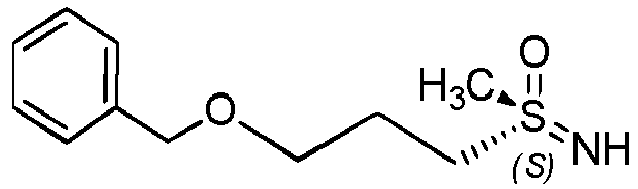
- A mixture of (S)-((3-(S-methylsulfonimidoyl)propoxy)methyl)benzene nosylate (0.45 g, 1.09 mmol) and Cs2CO3 (0.64g, 1.96 mmol) in CH3CN (10 mL) was stirred at 46 °C overnight, filtered, concentrated, and purified by chromatography (EtOAc/MeOH) to furnish the title compound (0.25 g, >99%ee).
1H NMR (600MHz, DMSO-d6) δ = 7.37 - 7.34 (m, 2H, o), 7.35 -7.32 (m, 2H, o), 7.31 - 7.27 (m, 1H), 4.47 (s, 2H), 3.63 (s, 1H), 3.53 (t, J=6.3 Hz, 2H), 3.09 (dd, J=7.5, 8.5 Hz, 2H), 2.88 (s, 3H), 2.02 - 1.93 (m, 2H) -

- In a manner similar to that described in Preparation 52, (S)-((3-(S-methylsulfonimidoyl)propoxy)methyl)benzene is converted to the title compound.
-

- In a manner similar to the procedure described in Example 40, 5-{3-[(3-methyl-furan-2-carbonyl)-amino]-phenylethynyl}-nicotinic acid and (S)-3-(S-methylsulfonimidoyl)propan-1-ol were converted to the title compound.
1HNMR (600MHz, DMSO-d6) δ = 10.20 (s, 1H), 9.09 (d, J=2.0 Hz, 1H), 8.92 (d, J=2.1 Hz, 1H), 8.38 (t, J=2.1 Hz, 1H), 8.12 (t, J=1.7 Hz, 1H), 7.81 (d, J=1.7 Hz, 1H), 7.81 - 7.79 (m, 1H), 7.43 - 7.39 (m, 1H), 7.34 (td, J=1.3, 7.7 Hz, 1H), 6.61 (d, J=1.6 Hz, 1H), 4.78 (t, J=5.3 Hz, 1H), 3.73 - 3.60 (m, 2H), 3.55 (q, J=6.0 Hz, 2H), 3.51 (s, 3H), 2.35 (s, 3H), 2.04 - 1.91 (m, 2H) -

- In a manner similar to the procedure described in Example 40, 6-amino-5-{3-[(3-methylfuran-2-carbonyl)-amino]-phenylethynyl}-nicotinic acid and 3-(S-methylsulfonimidoyl)propan-1-ol are converted to the title compound.
- Biological data for the compounds of the present invention was generated by use of the following assays.
- Biochemical KDR kinase assays were performed in 96 well microtiter plates that were coated overnight with 75 µg/well of poly-Glu-Tyr (4:1) in 10 mM Phosphate Buffered Saline (PBS), pH 7.4. The coated plates were washed with 2 mls per well PBS + 0.05% Tween-20 (PBS-T), blocked by incubation with PBS containing 1% BSA, then washed with 2 mls per well PBS-T prior to starting the reaction. Reactions were carried out in 100 µL reaction volumes containing 2.7 µM ATP in kinase buffer (50mM Hepes buffer pH 7.4, 20mM MgCl2, 0.1 mM MnCl2 and 0.2 mM Na3VO4). Test compounds were reconstituted in 100% DMSO and added to the reaction to give a final DMSO concentration of 5%. Reactions were initiated by the addition 20 ul per well of kinase buffer containing 200-300 ng purified cytoplasmic domain KDR protein (BPS Bioscience, San Diego, CA). Following a 15 minute incubation at 30° C., the reactions were washed 2 mls per well PBS-T. 100µl of a monoclonal anti-phosphotyrosine antibody-peroxidase conjugate diluted 1:10,000 in PBS-T was added to the wells for 30 minutes. Following a 2 mls per well wash with PBS-Tween-20, 100(µl of O-Phenylenediamine Dihydrochloride in phosphate-citrate buffer, containing urea hydrogen peroxide, was added to the wells for 7-10 minutes as a colorimetric substrate for the peroxidase. The reaction was terminated by the addition of 100µl of 2.5N H2SO4 to each well and read using a microplate ELISA reader set at 492 nm. IC50 values for compound inhibition were calculated directly from graphs of optical density (arbitrary units) versus compound concentration following subtraction of blank values.
- Automated FLIPR (Fluorometric Imaging Plate Reader) technology was used to screen for inhibitors of VEGF induced increases in intracellular calcium levels in fluorescent dye loaded endothelial cells. HUVEC (human umbilical vein endothelial cells) (Clonetics) were seeded in 384-well fibronectin coated black- walled plates overnight @ 37°C/5%CO2. Cells were loaded with calcium indicator Fluo-4 for 45 minutes at 37°C. Cells were washed 2 times (Elx405, Biotek Instruments) to remove extracellular dye. For screening, cells were pre-incubated with test agents for 30 minutes, at a single concentration (10 uM) or at concentrations ranging from 0.0001 to 10.0 uM followed by VEGF165 stimulation (10 ng/mL). Changes in fluorescence at 516 nm were measured simultaneously in all 384 wells using a cooled CCD camera. Data were generated by determining max-min fluorescence levels for unstimulated, stimulated, and drug treated samples. IC50 values for test compounds were calculated from % inhibition of VEGF stimulated responses in the absence of inhibitor.
- Biochemical PDGFRβ kinase assays were performed in 96 well microtiter plates that were coated overnight with 75 µg of poly-Glu-Tyr (4:1) in 10mM Phosphate Buffered Saline (PBS), pH 7.4. The coated plates were washed with 2 mls per well PBS + 0.05% Tween-20 (PBS-T), blocked by incubation with PBS containing 1% BSA, then washed with 2 mls per well PBS-T prior to starting the reaction. Reactions were carried out in 100 µL reaction volumes containing 36 µM ATP in kinase buffer (50mM Hepes buffer pH 7.4, 20mM MgCl2, 0.1 mM MnCl2 and 0.2 mM Na3VO4). Test compounds were reconstituted in 100% DMSO and added to the reaction to give a final DMSO concentration of 5%. Reactions were initiated by the addition 20 ul per well of kinase buffer containing 200-300 ng purified cytoplasmic domain PDGFR-b protein (Millipore). Following a 60 minute incubation at 30° C., the reactions were washed 2 mls per well PBS-T. 100µl of a monoclonal anti-phosphotyrosine antibody-peroxidase conjugate diluted 1:10,000 in PBS-T was added to the wells for 30 minutes. Following a 2 mls per well wash with PBS-Tween-20, 100µl of O-Phenylenediamine Dihydrochloride in phosphate-citrate buffer, containing urea hydrogen peroxide, was added to the wells for 7-10 minutes as a colorimetric substrate for the peroxidase. The reaction was terminated by the addition of 100µl of 2.5N H2SO4 to each well and read using a microplate ELISA reader set at 492 nm. IC50 values for compound inhibition were calculated directly from graphs of optical density (arbitrary units) versus compound concentration following subtraction of blank values.
- Automated FLIPR (Fluorometric Imaging Plate Reader) technology was used to screen for inhibitors of PDGF-induced increases in intracellular calcium levels in fluorescent dye loaded endothelial cells. NHDF-Ad (Normal Human Dermal Fibroblasts, Adult; Lonza) were seeded in 384-well fibronectin coated black- walled plates overnight @ 37°C/5%CO2. Cells were loaded with calcium indicator Fluo-4 for 45 minutes at 37°C. Cells were washed 2 times (Elx405, Biotek Instruments) to remove extracellular dye. For screening, cells were pre-incubated with test agents for 30 minutes, at a single concentration (10 uM) or at concentrations ranging from 0.0001 to 10.0 uM followed by PDGF-BB stimulation (30 ng/mL). Changes in fluorescence at 516 nm were measured simultaneously in all 384 wells using a cooled CCD camera. Data were generated by determining max-min fluorescence levels for unstimulated, stimulated, and drug treated samples. IC50 values for test compounds were calculated from % inhibition of PDGF-BB stimulated responses in the absence of inhibitor.
- The biological results for the various compounds are shown in Table 6-10 below.
Example Structure VEGFR2 Enzyme Assay (IC50 nM) VEGFR2 Cellular Assay (IC50 nM) PDGFRβ Enzyme Assay (IC50 nM) PDGFRβ Cellular Assay (IC50 nM) 1 
6 1 16 11 2 
2 6 6 3 
2 3 34 66 4 
2 2 30 15 5 
2 9 22 6 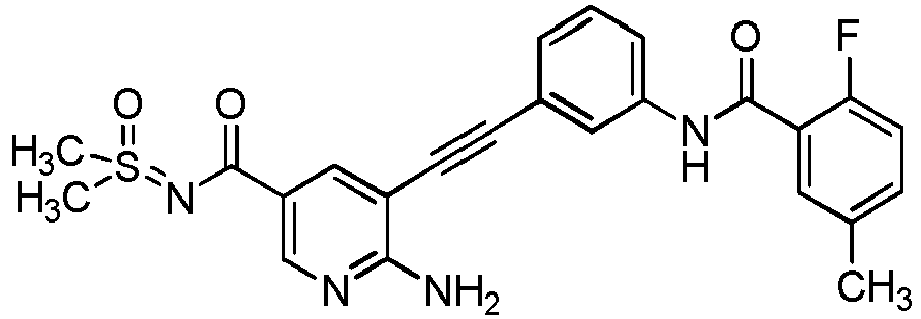
7 5 7 10 7 
6 51 8 
3 10 28 9 
8 48 10 
8 11 19 11 
6 15 19 12 
3 3 13 
9 10 14 
5 26 15 
3 16 16 
3 17 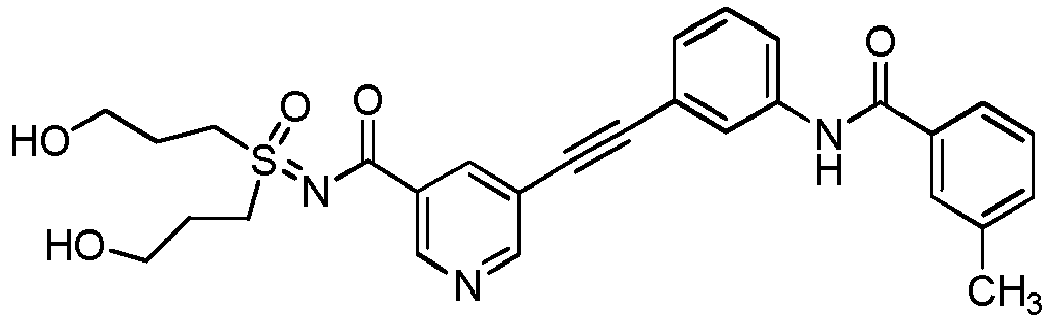
3 6 18 
4 19 
5 20 
9 21 
5 22 
3 8 23 
7 1 54 31 24 
5 46 25 
8 45 27 26 
4 1 11 10 27 
10 1 40 19 28 
4 4 9 12 29 
4 6 25 15 30 
5 1 14 9 31 
15 4 38 13 32 
3 1 31 60 33 
6 1 27 86 34 
7 2 15 13 35 
17 43 36 
10 1 18 37 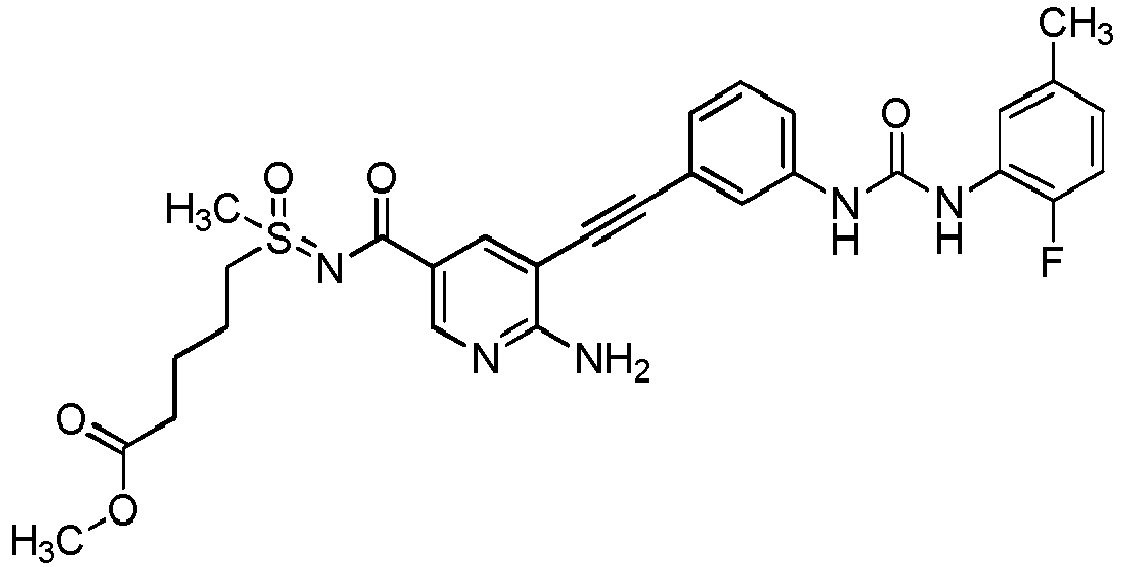
5 14 44 38 
4 13 25 39 
14 1 13 31 40 
3 2 41 
3 18 42 
5 13 - As can be seen from the above Tables, all of the compounds are quite potent at VEGFR2 and PDGFRβ. In particular, the compounds of Examples 23, 26, 30, 32, 33 and 34 are preferred as they have good in vivo efficacy when dosed by intravitreal injection in the VEGF permeability model. (See See J.L. Edelmen, Experimental Eye Research 80 (2005), 249-258.) The compounds of Examples 39 to 41 are also preferred as they have good efficacy when administered by topical delivery in a topical corneal angiogenesis model. ("Inhibition of Corneal Neovascularization by Topical Bevacizumab (Anti-VEGF) and Sunitinib (Anti-VEGF and Anti-PDGF) in an Animal Model", by Juan J. Perez-Sanonja et. al. American Journal of Ophthalmology (2010), 150(4), 519-528) In particular, Example 41 is most preferred as it demonstrated the greatest degree of topical efficacy in the above corneal neovascularization model.
- The present invention is not to be limited in scope by the exemplified embodiments which are intended as illustrations of single aspects of the invention only. Indeed, various modifications of the invention in addition to those described herein will become apparent to those skilled in the art from the foregoing description. Such modifications are intended to fall within the scope of the appended embodiments.
- All references cited herein are hereby incorporated by reference in their entirety. Also, the compounds of the present invention may be tested by the various in-vitro and in-vivo assays disclosed in such references to demonstrate the claimed utilities.
-
- 1. A compound of formula I:

- Z is

- R is selected from the group consisting of hydrogen, amino and lower alkyl,
- R1 is selected from the group consisting of hydrogen, halogen, lower alkyl, CF3, alkoxy, OCF3, CN and N(R5)2
- R2 is selected from the group consisting of hydrogen, amino and lower alkyl,
- R3 and R4 are independently selected from the group consisting of hydrogen, C1 to C8 alkyl, (CR5R6)aC(O)OR7, (CR5R6)aOR7, (CR5R6)aN(R5)C(O)R7, (CR5R6)aC(O)N(R7)2, (CR5R6)aN(R5)C(O)OR7, (CR5R6)aN(R5)C(O)N(R7)2, (CR5R6)aN(R7)2, wherein N(R7)2 may be taken together to form a 3 to 7 membered heterocyclic ring optionally substituted with one or more of R5 and wherein when one of R3 and R4 is selected from the group consisting of, (CR5R6)aC(O)OR7, (CR5R6)aOR7, (CR5R6)aC(O)N(R7) and (CR5R6)aN(R7)2, then the other may not be aryl, or;
- R3 and R4 may be taken together with the sulfur atom to form a 4 to 7 membered heterocyclic ring containing one or more heteroatoms optionally substititued by one or more of R9.
- R5 is selected from the group consisting of hydrogen, C1 to C8 alkyl, fluoro, hydroxy, hydroxymethyl, COCH3, CH2CH2OH, CH2CH2CH2OH and CH2CH2OCH2CH2OH;
- R6 is selected from the group consisting of hydrogen, C1 to C8 alkyl, hydroxy and fluoro;
- R7 is selected from the group consisting of hydrogen, C1 to C8 alkyl, fluoro, hydroxy, hydroxymethyl, COCH3, CH2CH2OH and CH2CH2CH2OH;
- R9 is selected from the group consisting of hydrogen, C1 to C8 alkyl, (CR5R6)aC(O)OR7, (CR5R6)aOR7, (CR5R6)aN(R5)C(O)R7, (CR5R6)aC(O)N(R7)2, (CR5R6)aN(R5)C(O)OR7, (CR5R6)aN(R5)C(O)N(R7)2, (CR5R6)aN(R7)2, (CR5R6)aC(O)N(R5)(CR5R6)aC(O)OR7, (CR5R6)aC(O)N(R5)(CR5R6)aC(O)N(R7)2, wherein N(R7)2 may be taken together to form a 3 to 7 membered heterocyclic ring containing one or more heteroatoms;
- Ar1 and Ar2 are independently selected from the group consisting of



- wherein R8 is selected from the group consisting of hydrogen, alkyl, amino, hydroxyl, alkoxy, halogen and CF3 and
- a is 0 or an integer of from 1 to 4.
- Z is
- 2. The compound of embodiment 1 wherein Ar1 is phenyl.
- 3. The compound of embodiment 1 wherein Ar2 is selected from the group consisting of phenyl, furanyl, oxazoyl, diazinyl and mono and disubstituted derivatives thereof wherein the substituent may be selected from the group consisting of halogen, alkyl, alkyloxy and trifluoromethyl.
- 4. The compound of embodiment 3 wherein said Ar2 substituent is selected from the group consisting of fluoro, chloro, methyl, ethyl, methyloxy, t-butyloxy and trifluoromethyl.
- 5. The compound of embodiment 1 wherein Ar2 is selected from the group consisting of 3-methylfuranyl, 2-fluoro 5-methylphenyl, 4-chloro 5-t-butylphenyl, 3-methoxyphenyl and 5-butyloxazoyl.
- 6. The compound of embodiment 1 wherein R2 is H.
- 7. The compound of embodiment 1 that is selected from the group consisting of
- 6-amino-N-[dimethyl(oxido)-λ4-sulfanylidene]-5-({3-[(3-methyl-2-furoyl)amino]phenyl}ethynyl)nicotinamide,
- N-[dimethyl(oxido)-λ4-sulfanylidene]-5-({3-[(3-methyl-2-furoyl)amino]phenyl}ethynyl)nicotinamide,
- 5-({3-[(3-methyl-2-furoyl)amino]phenyl}ethynyl)-N-(1-oxidotetrahydro-1H-1λ4-thien-1-ylidene)nicotinamide,
- 6-amino-5-({3-[(3-methyl-2-furoyl)amino]phenyl}ethynyl)-N-(1-oxidotetrahydro-1H-1λ4-thien-1-ylidene)nicotinamide,
- 6-amino-5-({3-[(4-chlorobenzoyl)amino]phenyl}ethynyl)-N-[dimethyl(oxido)-λ4-sulfanylidene]nicotinamide,
- 6-amino-N-[dimethyl(oxido)-λ4-sulfanylidene]-5-({3-[(2-fluoro-5-methylbenzoyl)amino]phenyl} ethynyl)nicotinamide,
- 6-amino-N-[dimethyl(oxido)-λ4-sulfanylidene]-5-[(3-{[(1-methyl-1H-imidazol-2-yl)carbonyl]amino}phenyl)ethynyl]nicotinamide,
- N-[dimethyl(oxido)-λ4-sulfanylidene]-5-{[3-({[(2-fluoro-5-methylphenyl)amino]carbonyl}amino)phenyl]ethynyl}nicotinamide,
- N-[dimethyl(oxido)-λ4-sulfanylidene]-5-{[3-({[(2-fluorophenyl)amino]carbonyl}amino)phenyl]ethynyl}nicotinamide,
- N-[dimethyl(oxido)-λ4-sulfanylidene]-5-{[3-({[(3-methylphenyl)amino]carbonyl}amino)phenyl]ethynyl}nicotinamide,
- N-[dimethyl(oxido)-λ4-sulfanylidene]-5-{[3-({[(4-methylphenyl)amino]carbonyl}amino)phenyl]ethynyl}nicotinamide,
- 6-amino-N-{[2-(3-hydroxypyrrolidin-1-yl)-2-oxoethyl](methyl)oxido-λ4-sulfanylidene}-5-({3-[(3-methyl-2-furoyl)amino]phenyl}ethynyl)nicotinamide,
- N-[(3-{4-[2-(2-hydroxyethoxy)ethyl]piperazin-1-yl}propyl)(methyl)oxido-λ4-sulfanylidene]-5-({3-[(3-methyl-2-furoyl)amino]phenyl} ethynyl)nicotinamide,
- N-[bis(3-hydroxypropyl)(oxido)-λ4-sulfanylidene]-5-({3-[(3-methyl-2-furoyl)amino]phenyl}ethynyl)nicotinamide,
- 6-amino-N-[bis(3-hydroxypropyl)(oxido)-λ4-sulfanylidene]-5-({3-[(3-methyl-2-furoyl)amino]phenyl}ethynyl)nicotinamide,
- N-[bis(3-hydroxypropyl)(oxido)-λ4-sulfanylidene]-5-[(3-{[4-chloro-3-(trifluoromethyl)benzoyl]amino}phenyl)ethynyl]nicotinamide,
- N-[bis(3-hydroxypropyl)(oxido)-λ4-sulfanylidene]-5-({3-[(3-methylbenzoyl)amino]phenyl} ethynyl)nicotinamide,
- N-[bis(3-hydroxypropyl)(oxido)-λ4-sulfanylidene]-5-[(3-{[3-(trifluoromethyl)benzoyl]amino}phenyl)ethynyl]nicotinamide,
- N-[bis(3-hydroxypropyl)(oxido)-λ4-sulfanylidene]-5-({3-[(3-chloro-4-fluorobenzoyl)amino]phenyl} ethynyl)nicotinamide,
- N-[bis(3-hydroxypropyl)(oxido)-λ4-sulfanylidene]-5-({3-[(2-fluoro 5-methylbenzoyl)amino]phenyl} ethynyl)nicotinamide,
- 6-amino-N-[bis(3-hydroxypropyl)(oxido)-λ4-sulfanylidene]-5-({3-[(3-methoxybenzoyl)amino]phenyl} ethynyl)nicotinamide,
- 6-amino-N-[bis(3-hydroxypropyl)(oxido)-λ4-sulfanylidene]-5-[(3-{[(3-methylphenyl)amino]carbonyl}phenyl)ethynyl]nicotinamide,
- methyl 5-(N- { [6-amino-5-({3-[(3-methyl-2-furoyl)amino]phenyl} ethynyl)pyridin-3-yl]carbonyl}-S-methylsulfonimidoyl)pentanoate,
- 5-(N-{[6-amino-5-({3-[(3-methyl-2-furoyl)amino]phenyl}ethynyl)pyridin-3-yl]carbonyl}-S-m ethylsulfonimidoyl)pentanoic acid,
- methyl 5-(N-{[6-amino-5-({3-[(2-fluoro-5-methylbenzoyl)amino]phenyl}ethynyl)pyridin-3-yl]carbonyl}-S-methylsulfonimidoyl)pentanoate,
- methyl 5-(N-{[6-amino-5-({3-[(3-methylbenzoyl)amino]phenyl}ethynyl)pyridin-3-yl]carbonyl}-S-methylsulfonimidoyl)pentanoate
- methyl 5-[N-({6-amino-5-[(3-{[2-fluoro-5-(trifluoromethyl)benzoyl]amino}phenyl)ethynyl]pyridin-3-yl}carbonyl)-S-methylsulfonimidoyl]pentanoate,
- methyl 5-[N-({6-amino-5-[(3-{[3-(trifluoromethyl)benzoyl]amino}phenyl)ethynyl]pyridin-3-yl}carbonyl)-S-methylsulfonimidoyl]pentanoate,
- methyl 5-[N-({6-amino-5-[(3-{[4-chloro-3-(trifluoromethyl)benzoyl]amino}phenyl)ethynyl]pyridin-3-yl}carbonyl)-S-methylsulfonimidoyl]pentanoate,
- methyl 5-(N-{[6-amino-5-({3-[(3-methoxybenzoyl)amino]phenyl} ethynyl)pyridin-3-yl]carbonyl}-S-methylsulfonimidoyl)pentanoate,
- methyl 5-(N-{[6-amino-5-({3-[(3,4-dimethoxybenzoyl)amino]phenyl}ethynyl)pyridin-3-yl]carbonyl}-S-methylsulfonimidoyl)pentanoate,
- (S)-methyl 5-(N-{[6-amino-5-({3-[(3-methyl-2-furoyl)amino]phenyl}ethynyl)pyridin-3- yl]carbonyl}-S-methylsulfonimidoyl)pentanoate,
- (R)-methyl 5-(N-{[6-amino-5-({3-[(3-methyl-2-furoyl)amino]phenyl}ethynyl)pyridin-3-yl]carbonyl}-S-methylsulfonimidoyl)pentanoate,
- methyl 5-[N-({6-amino-5-[(3-{[(3-methylphenyl)amino]carbonyl}phenyl)ethynyl]pyridin-3-yl}carbonyl)-S-methylsulfonimidoyl]pentanoate,
- methyl 5-[N-({6-amino-5-[(3-{[(2-fluoro-5-methylphenyl)amino]carbonyl}phenyl)ethynyl]pyridin-3-yl}carbonyl)-S-methylsulfonimidoyl]pentanoate,
- methyl 5-[N-({6-amino-5-[(3-{[(5-tert-butylisoxazol-3-yl)amino]carbonyl}phenyl)ethynyl]pyridin-3-yl}carbonyl)-S-methylsulfonimidoyl]pentanoate,
- methyl 5-{N-[(6-amino-5-{[3-({[(2-fluoro-5-methylphenyl)amino]carbonyl}amino)phenyl]ethynyl}pyridin-3-yl)carbonyl]-S-methylsulfonimidoyl} pentanoate,
- methyl 5-{N-[(6-amino-5-{[3-({[(3-methylphenyl)amino]carbonyl}amino)phenyl]ethynyl}pyridin-3-yl)carbonyl]-S-methylsulfonimidoyl} pentanoate,
- N-[(3-hydroxypropyl)(methyl)oxido-λ4-sulfanylidene]-5-({3-[(3-methyl-2-furoyl)amino]phenyl}ethynyl)nicotinamide,
- (R)-N-[(3-hydroxypropyl)(methyl)oxido-λ4-sulfanylidene]-5-({3-[(3-methyl-2-furoyl)amino]phenyl}ethynyl)nicotinamide,
- (S)-N-[(3-hydroxypropyl)(methyl)oxido-λ4-sulfanylidene]-5-({3-[(3-methyl-2-furoyl)amino]phenyl} ethynyl)nicotinamide, and
- 6-amino-N-[(3-hydroxypropyl)(methyl)oxido-λ4-sulfanylidene]-5-({3-[(3-methyl-2-furoyl)amino]phenyl}ethynyl)nicotinamide; or a pharmaceutically acceptable salt thereof.
- 8. The compound of embodiment 1, that is selected from the group consisting of
- methyl 5-(N-{[6-amino-5-({3-[(3-methyl-2-furoyl)amino]phenyl}ethynyl)pyridin-3-yl]carbonyl}-S-methylsulfonimidoyl)pentanoate,
- 5-(N-{[6-amino-5-({3-[(3-methyl-2-furoyl)amino]phenyl}ethynyl)pyridin-3-yl]carbonyl}-S-m ethylsulfonimidoyl)pentanoic acid,
- methyl 5-(N- { [6-amino-5-({3-[(2-fluoro-5-methylbenzoyl)amino]phenyl} ethynyl)pyridin-3-yl]carbonyl}-S-methylsulfonimidoyl)pentanoate,
- methyl 5-(N-{[6-amino-5-({3-[(3-methylbenzoyl)amino]phenyl}ethynyl)pyridin-3-yl]carbonyl}-S-methylsulfonimidoyl(pentanoate)
- methyl5-[N-({6-amino-5-[(3-{[2-fluoro-5-(trifluoromethyl)benzoyl]amino}phenyl)ethynyl]pyridin-3-yl}carbonyl)-S-methylsulfonimidoyl]pentanoate,
- methyl 5-[N-({6-amino-5-[(3-{[3-(trifluoromethyl)benzoyl]amino}phenyl)ethynyl]pyridin-3-yl}carbonyl)-S-methylsulfonimidoyl]pentanoate,
- methyl 5-[N-({6-amino-5-[(3-{[4-chloro-3-(trifluoromethyl)benzoyl]amino}phenyl)ethynyl]pyridin-3-yl}carbonyl)-S-methylsulfonimidoyl]pentanoate,
- methyl 5-(N-{[6-amino-5-({3-[(3-methoxybenzoyl)amino]phenyl}ethynyl)pyridin-3-yl]carbonyl}-S-methylsulfonimidoyl)pentanoate,
- methyl 5-(N-{[6-amino-5-({3-[(3,4-dimethoxybenzoyl)amino]phenyl}ethynyl)pyridin-3-yl]carbonyl}-S-methylsulfonimidoyl)pentanoate,
- (S)-methyl 5-(N-{[6-amino-5-({3-[(3-methyl-2-furoyl)amino]phenyl} ethynyl)pyridin-3-yl]carbonyl}-S-methylsulfonimidoyl)pentanoate,
- (R)-methyl 5-(N-{[6-amino-5-({3-[(3-methyl-2-furoyl)amino]phenyl}ethynyl)pyridin-3-yl]carbonyl}-S-methylsulfonimidoyl)pentanoate,
- methyl 5-[N-({6-amino-5-[(3-{[(3-methylphenyl)amino]carbonyl}phenyl)ethynyl]pyridin-3-yl}carbonyl)-S-methylsulfonimidoyl]pentanoate,
- methyl 5-[N-({6-amino-5-[(3-{[(2-fluoro-5-methylphenyl)amino]carbonyl}phenyl)ethynyl]pyridin-3-yl}carbonyl)-S-methylsulfonimidoyl]pentanoate'
- methyl 5-[N-({6-amino-5-[(3-{[(5-tert-butylisoxazol-3-yl)amino]carbonyl}phenyl)ethynyl]pyridin-3-yl}carbonyl)-S-methylsulfonimidoyl]pentanoate,
- methyl 5-{N-[(6-amino-5-{[3-({[(2-fluoro-5-methylphenyl)amino]carbonyl}amino)phenyl]ethynyl}pyridin-3-yl)carbonyl]-S-methylsulfonimidoyl}pentanoate and
- methyl 5-{N-[(6-amino-5-{[3-({[(3-methylphenyl)amino]carbonyl}amino)phenyl]ethynyl}pyridin-3-yl)carbonyl]-S-methylsulfonimidoyl}pentanoate; or a pharmaceutically acceptable salt thereof.
- 9. The compound of embodiment 1, that is selected from the group consisting of
- N-[(3-hydroxypropyl)(methyl)oxido-λ4-sulfanylidene]-5-({3-[(3-methyl-2-furoyl)amino]phenyl}ethynyl)nicotinamide,
- (R)-N-[(3-hydroxypropyl)(methyl)oxido-λ4-sulfanylidene]-5-({3-[(3-methyl-2-furoyl)amino]phenyl}ethynyl)nicotinamide and
- (S)-N-[(3-hydroxypropyl)(methyl)oxido-λ4-sulfanylidene]-5-({3-[(3-methyl-2-furoyl)amino]phenyl} ethynyl)nicotinamide and
- 6-amino-N-[(3-hydroxypropyl)(methyl)oxido-λ4-sulfanylidene]-5-({3-[(3-methyl-2-furoyl)amino]phenyl}ethynyl)nicotinamide; or a pharmaceutically acceptable salt thereof.
- 10. The compound of embodiment 1, that is (S)-N-[(3-hydroxypropyl)(methyl)oxido-λ4-sulfanylidene]-5-({3-[(3-methyl-2-furoyl)amino]phenyl}ethynyl)nicotinamide, or a pharmaceutically acceptable salt thereof.
- 11. A method for treating diseases related to unregulated tyrosine kinase signal transduction, the method comprising the step of administering to a subject in need thereof a therapeutically effective amount of at least one compound of formula I

- Z is

- R is selected from the group consisting of hydrogen, amino and lower alkyl,
- R1 is selected from the group consisting of hydrogen, halogen, lower alkyl, CF3, alkoxy, OCF3, CN and N(R5)2
- R2 is selected from the group consisting of hydrogen, amino and lower alkyl, R3 and R4 are independently selected from the group consisting of hydrogen, C1 to C8 alkyl, (CR5R6)aC(O)OR7, (CR5R6)aOR7, (CR5R6)aN(R5)C(O)R7, (CR5R6)aC(O)N(R7)2, (CR5R6)aN(R5)C(O)OR7, (CR5R6)aN(R5)C(O)N(R7)2,(CR5R6)aN(R7)2, wherein N(R7)2 may be taken together to form a 3 to 7 membered heterocyclic ring optionally substituted with one or more of R5 and wherein when one of R3 and R4 is selected from the group consisting of, (CR5R6)aC(O)OR7, (CR5R6)aOR7, (CR5R6)aC(O) N(R7) and (CR5R6)aN(R7)2, then the other may not be aryl, or;
- R3 and R4 may be taken together with the sulfur atom to form a 4 to 7 membered heterocyclic ring containing one or more heteroatoms optionally substititued by one or more of R9;
- R5 is selected from the group consisting of hydrogen, C1 to C8 alkyl, fluoro, 126ydroxyl, hydroxymethyl, COCH3, CH2CH2OH, CH2CH2CH2OH and CH2CH2OCH2CH2OH;
- R6 is selected from the group consisting of hydrogen, C1 to C8 alkyl, hydroxy and fluoro;
- R7 is selected from the group consisting of hydrogen, C1 to C8 alkyl, fluoro, hydroxy, hydroxymethyl, COCH3, CH2CH2OH and CH2CH2CH2OH;
- R9 is selected from the group consisting of hydrogen, C1 to C8 alkyl, (CR5R6)aC(O)OR7, (CR5R6)aOR7, (CR5R6)aN(R5)C(O)R7, (CR5R6)aC(O)N(R7)2, (CR5R6)aN(R5)C(O)OR7, (CR5R6)aN(R5)C(O)N(R7)2,(CR5R6)aN(R7)2, (CR5R6)aC(O)N(R5)(CR5R6)aC(O)OR7, (CR5R6)aC(O)N(R5)(CR5R6)aC(O)N(R7)2, wherein N(R7)2 may be taken together to form a 3 to 7 membered heterocyclic ring containing one or more heteroatoms;
- Ar1 and Ar2 are independently selected from the group consisting of


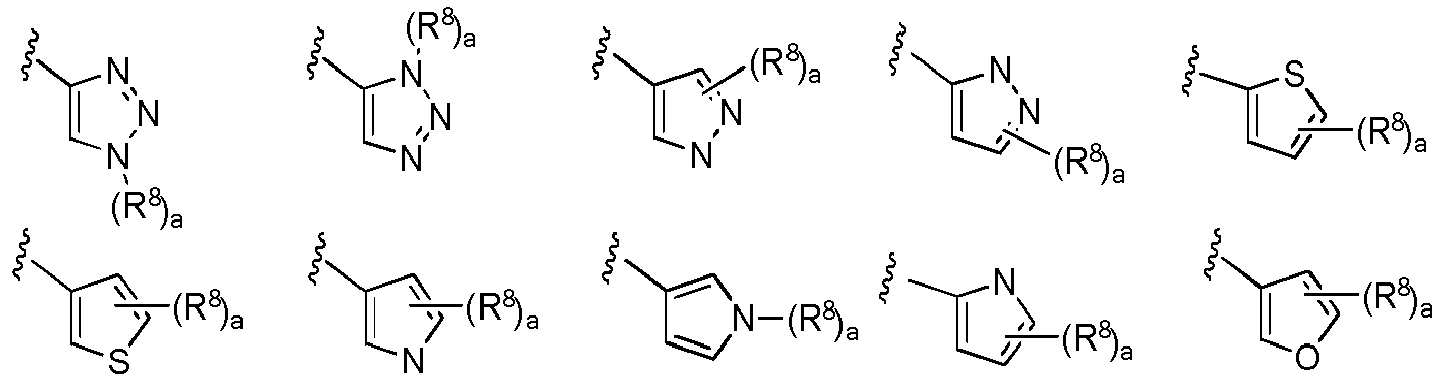


- wherein R8 is selected from the group consisting of hydrogen, alkyl, amino, hydroxyl, alkoxy, halogen and CF3 and
- a is 0 or an integer of from 1 to 4.
- Z is
- 12. The method of embodiment 11 wherein said disease is selected from the group consisting of cancer, blood vessel proliferative disorders, fibrotic disorders, mesangial cell proliferative disorders and metabolic diseases.
- 13. The method of embodiment 12 wherein the blood vessel proliferative disorder is selected from the group consisting of diabetic retinopathy, exudative age-related macular degeneration, retinopathy of prematurity, pterigium, rosacea, arthritis and restenosis.
- 14. The method of embodiment 12 wherein the fibrotic disorder is selected from the group consisting of hepatic cirrhosis and atherosclerosis.
- 15. The method of embodiment 12 wherein the mesangial cell proliferative disorder is selected from the group consisting of glomerulonephritis, diabetic nephropathy, malignant nephrosclerosis, thrombotic microangiopathy syndromes, transplant rejection and glomerulopathies.
- 16. The method of embodiment 12 wherein the metabolic disease is selected from the group consisting of psoriasis, diabetes mellitus, wound healing, and neurodegenerative diseases.
- 17. The method of embodiment 12 wherein said disease is an ophthalmic disease.
- 18. The method of embodiment 17 wherein said ophthalmic disease is selected from the group consisting of pterygia, hyperemia related to an actively inflamed pterygia, recurrent pterygia following excisional surgery, prophylactic therapy to prevent recurrent pterygia post-excision, progressive pterygia approaching the visual axis, chronic low grade hyperemia associated with pterygia, corneal neovascularization, neovascular glaucoma, iris neovascularization, chronic allergic conjunctivitis, ocular rosacea, blepharoconjunctivitis, recurrent episcleritis, keratoconjunctivitis sicca, ocular graft vs host disease, diabetic retinopathy, diabetic macular edema, proliferative diabetic retinopathy, exudative or neovascular age-related macular degeneration, high-risk eyes with dry age-related macular degeneration, neovascular disease associated with retinal vein occlusion, neovascular disease associated with the following: pathologic myopia, pseudoxanthoma elasticum, optic nerve drusen, traumatic choroidal rupture, idiopathic etiologies, presumed ocular histoplasmosis syndrome, and retinopathy of prematurity.
- 19. The method of embodiment 12 wherein said disease is a dermatological indication selected from the group consisting of sun burn , eczema, psoriasis and contact dermatitis.
- 20. A pharmaceutical composition comprising a pharmaceutically effective amount of at least one compound of formula I

- Z is

- R is selected from the group consisting of hydrogen, amino and lower alkyl,
- R1 is selected from the group consisting of hydrogen, halogen, lower alkyl, CF3, alkoxy, OCF3, CN and N(R5)2
- R2 is selected from the group consisting of hydrogen, amino and lower alkyl, R3 and R4 are independently selected from the group consisting of hydrogen, C1 to C8 alkyl, (CR5R6)aC(O)OR7, (CR5R6)aOR7, (CR5R6)aN(R5)C(O)R7, (CR5R6)aC(O)N(R7)2, (CR5R6)aN(R5)C(O)OR7, (CR5R6)aN(R5)C(O)N(R7)2,(CR5R6)aN(R7)2, wherein N(R7)2 may be taken together to form a heterocyclic ring optionally substituted with one or more of R5 and wherein when one of R3 and R4 is selected from the group consisting of, (CR5R6)aC(O)OR7, (CR5R6)aOR7, (CR5R6)aC(O) N(R7) and (CR5R6)aN(R7)2, then the other may not be aryl, or;
- R3 and R4 may be taken together with the sulfur atom to form a 4 to 7 membered carbocyclic or heterocyclic ring containing one or more heteroatoms optionally substititued by one or more of R9.
- R5 is selected from the group consisting of hydrogen, C1 to C8 alkyl, fluoro, hydroxy, hydroxymethyl, COCH3, CH2CH2OH, CH2CH2CH2OH and CH2CH2OCH2CH2OH;
- R6 is selected from the group consisting of hydrogen, C1 to C8 alkyl, hydroxy and fluoro;
- R7 is selected from the group consisting of hydrogen, C1 to C8 alkyl, fluoro, hydroxy, hydroxymethyl, COCH3, CH2CH2OH and CH2CH2CH2OH;
- R9 is selected from the group consisting of hydrogen, C1 to C8 alkyl, (CR5R6)aC(O)OR7, (CR5R6)aOR7, (CR5R6)aN(R5)C(O)R7, (CR5R6)aC(O)N(R7)2, (CR5R6)aN(R5)C(O)OR7, (CR5R6)aN(R5)C(O)N(R7)2, (CR5R6)aN(R7)2, (CR5R6)aC(O)N(R5)(CR5R6)aC(O)OR7, (CR5R6)aC(O)N(R5)(CR5R6)aC(O)N(R7)2, wherein N(R7)2 may be taken together to form a heterocyclic ring containing one or more heteroatoms;
- Ar1 and Ar2 are independently selected from the group consisting of




- wherein R8 is selected from the group consisting of hydrogen, alkyl, amino, hydroxyl, alkoxy, halogen and CF3 and
- a is 0 or an integer of from 1 to 4 and a pharmaceutically acceptable carrier or excipient.
- Z is
phenyl,
Most preferably Ar2 is selected from the group consisting of
phenyl,
furanyl,
oxazoyl
diazinyl
and mono and disubstituted derivatives thereof wherein the substituent may be halogen, e.g.fluoro or chloro, alkyl, e.g. lower alkyl, i.e. methyl or ethyl; alkyloxy, e.g. lower alkyloxy, e.g. methyloxy or t-butyloxy; trifluoromethyl, etc.
Claims (13)
- A compound of formula I:
 Z is
Z is R is selected from the group consisting of hydrogen, amino and lower alkyl,R1 is selected from the group consisting of hydrogen, halogen, lower alkyl, CF3, alkoxy, OCF3, CN and N(R5)2R2 is selected from the group consisting of hydrogen, amino and lower alkyl,R3 and R4 are independently selected from the group consisting of hydrogen, C1 to C8 alkyl, (CR5R6)aC(O)OR7, (CR5R6)aOR7, (CR5R6)aN(R5)C(O)R7, (CR5R6)aC(O)N(R7)2, (CR5R6)aN(R5)C(O)OR7, (CR5R6)aN(R5)C(O)N(R7)2, (CR5R6)aN(R7)2, wherein N(R7)2 may be taken together to form a 3 to 7 membered heterocyclic ring optionally substituted with one or more of R5 and wherein when one of R3 and R4 is selected from the group consisting of, (CR5R6)aC(O)OR7, (CR5R6)aOR7, (CR5R6)aC(O) N(R7) and (CR5R6)aN(R7)2, then the other may not be aryl, or;R3 and R4 may be taken together with the sulfur atom to form a 4 to 7 membered heterocyclic ring containing one or more heteroatoms optionally substititued by one or more of R9.R5 is selected from the group consisting of hydrogen, C1 to C8 alkyl, fluoro, hydroxy, hydroxymethyl, COCH3, CH2CH2OH, CH2CH2CH2OH and CH2CH2OCH2CH2OH;R6 is selected from the group consisting of hydrogen, C1 to C8 alkyl, hydroxy and fluoro;R7 is selected from the group consisting of hydrogen, C1 to C8 alkyl, fluoro, hydroxy, hydroxymethyl, COCH3, CH2CH2OH and CH2CH2CH2OH;R9 is selected from the group consisting of hydrogen, C1 to C8 alkyl, (CR5R6)aC(O)OR7, (CR5R6)aOR7, (CR5R6)aN(R5)C(O)R7, (CR5R6)aC(O)N(R7)2, (CR5R6)aN(R5)C(O)OR7, (CR5R6)aN(R5)C(O)N(R7)2, (CR5R6)aN(R7)2, (CR5R6)aC(O)N(R5)(CR5R6)aC(O)OR7, (CR5R6)aC(O)N(R5)(CR5R6)aC(O)N(R7)2, wherein N(R7)2 may be taken together to form a 3 to 7 membered heterocyclic ring containing one or more heteroatoms;Ar1 and Ar2 are independently selected from the group consisting of


 wherein R8 is selected from the group consisting of hydrogen, alkyl, amino, hydroxyl, alkoxy, halogen and CF3 anda is 0 or an integer of from 1 to 4.
 - The compound of claim 1,wherein Ar1 is phenyl; orwherein Ar2 is selected from the group consisting of phenyl, furanyl, oxazoyl, diazinyl and mono and disubstituted derivatives thereof wherein the substituent may be selected from the group consisting of halogen, alkyl, alkyloxy and trifluoromethyl; wherein said Ar2 substituent is optionally selected from the group consisting of fluoro, chloro, methyl, ethyl, methyloxy, t-butyloxy and trifluoromethyl; or wherein Ar2 is optionally selected from the group consisting of 3-methylfuranyl, 2-fluoro 5-methylphenyl, 4-chloro 5-t-butylphenyl, 3-methoxyphenyl and 5-butyloxazoyl; orwherein R2 is H.
- The compound of claim 1 that is selected from the group consisting of6-amino-N-[dimethyl (oxido)-λ4-sulfanylidene]-5-({3-[(3-methyl-2-furoyl)amino]phenyl}ethynyl)nicotinamide,N-[dimethyl(oxido)-λ4-sulfanylidene]-5-({3-[(3-methyl-2-furoyl)amino]phenyl}ethynyl)nicotinamide,5-({3-[(3-methyl-2-furoyl)amino]phenyl}ethynyl)-N-(1-oxidotetrahydro-1H-1λ4-thien-1-ylidene)nicotinamide,6-amino-5-({3-[(3-methyl-2-furoyl)amino]phenyl}ethynyl)-N-(1-oxidotetrahydro-1H-1λ4-thien-1-ylidene)nicotinamide,6-amino-5-({3-[(4-chlorobenzoyl)amino]phenyl}ethynyl)-N-[dimethyl(oxido)-λ4-sulfanylidene]nicotinamide,6-amino-N-[dimethyl(oxido)-λ4-sulfanylidene]-5-({3-[(2-fluoro-5-methylbenzoyl)amino]phenyl} ethynyl)nicotinamide,6-amino-N-[dimethyl(oxido)-λ4-sulfanylidene]-5-[(3-{[(1-methyl-1H-imidazol-2-yl)carbonyl]amino}phenyl)ethynyl]nicotinamide,N-[dimethyl(oxido)-λ4-sulfanylidene]-5-{[3-({[(2-fluoro-5-methylphenyl)amino]carbonyl}amino)phenyl]ethynyl}nicotinamide,N-[dimethyl(oxido)-λ4-sulfanylidene]-5-{[3-({[(2-fluorophenyl)amino]carbonyl}amino)phenyl]ethynyl}nicotinamide,N-[dimethyl(oxido)-λ4-sulfanylidene]-5-{[3-({[(3-methylphenyl)amino]carbonyl}amino)phenyl]ethynyl}nicotinamide,N-[dimethyl(oxido)-λ4-sulfanylidene]-5-{[3-({[(4-methylphenyl)amino]carbonyl}amino)phenyl]ethynyl}nicotinamide,6-amino-N-{[2-(3-hydroxypyrrolidin-1-yl)-2-oxoethyl](methyl)oxido-λ4-sulfanylidene}-5-({3-[(3-methyl-2-furoyl)amino]phenyl}ethynyl)nicotinamide,N-[(3-{4-[2-(2-hydroxyethoxy)ethyl]piperazin-1-yl}propyl)(methyl)oxido-λ4-sulfanylidene]-5-({3-[(3-methyl-2-furoyl)amino]phenyl}ethynyl)nicotinamide,N-[bis(3-hydroxypropyl)(oxido)-λ4-sulfanylidene]-5-({3-[(3-methyl-2-furoyl)amino]phenyl}ethynyl)nicotinamide,6-amino-N-[bis(3-hydroxypropyl)(oxido)-λ4-sulfanylidene]-5-({3-[(3-methyl-2-furoyl)amino]phenyl}ethynyl)nicotinamide,N-[bis(3-hydroxypropyl)(oxido)-λ4-sulfanylidene]-5-[(3-{[4-chloro-3-(trifluoromethyl)benzoyl]amino}phenyl)ethynyl]nicotinamide,N-[bis(3-hydroxypropyl)(oxido)-λ4-sulfanylidene]-5-({3-[(3-methylbenzoyl)amino]phenyl}ethynyl)nicotinamide,N-[bis(3-hydroxypropyl)(oxido)-λ4-sulfanylidene]-5-[(3-{[3-(trifluoromethyl)benzoyl]amino}phenyl)ethynyl]nicotinamide,N-[bis(3-hydroxypropyl)(oxido)-λ4-sulfanylidene]-5-({3-[(3-chloro-4-fluorobenzoyl)amino]phenyl} ethynyl)nicotinamide,N-[bis(3-hydroxypropyl)(oxido)-λ4-sulfanylidene]-5-({3-[(2-fluoro 5-methylbenzoyl)amino]phenyl}ethynyl)nicotinamide,6-amino-N-[bis(3-hydroxypropyl)(oxido)-λ4-sulfanylidene]-5-({3-[(3-methoxybenzoyl)amino]phenyl}ethynyl)nicotinamide,6-amino-N-[bis(3-hydroxypropyl)(oxido)-λ4-sulfanylidene]-5-[(3-{[(3-methylphenyl)amino]carbonyl}phenyl)ethynyl]nicotinamide,methyl 5-(N-{[6-amino-5-({3-[(3-methyl-2-furoyl)amino]phenyl}ethynyl)pyridin-3-yl]carbonyl}-S-methylsulfonimidoyl)pentanoate,5-(N-{[6-amino-5-({3-[(3-methyl-2-furoyl)amino]phenyl}ethynyl)pyridin-3-yl]carbonyl}-S-m ethylsulfonimidoyl)pentanoic acid,methyl 5-(N-{[6-amino-5-({3-[(2-fluoro-5-methylbenzoyl)amino]phenyl}ethynyl)pyridin-3-yl]carbonyl}-S-methylsulfonimidoyl)pentanoate,methyl 5-(N-{[6-amino-5-({3-[(3-methylbenzoyl)amino]phenyl}ethynyl)pyridin-3-yl]carbonyl}-S-methylsulfonimidoyl)pentanoatemethyl 5-[N-({6-amino-5-[(3-{[2-fluoro-5-(trifluoromethyl)benzoyl]amino}phenyl)ethynyl]pyridin-3-yl}carbonyl)-S-methylsulfonimidoyl]pentanoate,methyl 5-[N-({6-amino-5-[(3-{[3-(trifluoromethyl)benzoyl]amino}phenyl)ethynyl]pyridin-3-yl}carbonyl)-S-methylsulfonimidoyl]pentanoate,methyl 5-[N-({6-amino-5-[(3-{[4-chloro-3-(trifluoromethyl)benzoyl]amino}phenyl)ethynyl]pyridin-3-yl}carbonyl)-S-methylsulfonimidoyl]pentanoate,methyl 5-(N-{[6-amino-5-({3-[(3-methoxybenzoyl)amino]phenyl}ethynyl)pyridin-3-yl]carbonyl}-S-methylsulfonimidoyl)pentanoate,methyl 5-(N-{[6-amino-5-({3-[(3,4-dimethoxybenzoyl)amino]phenyl}ethynyl)pyridin-3-yl]carbonyl}-S-methylsulfonimidoyl)pentanoate,(S)-methyl 5-(N-{[6-amino-5-({3-[(3-methyl-2-furoyl)amino]phenyl}ethynyl)pyridin-3 - yl]carbonyl}-S-methylsulfonimidoyl)pentanoate,(R)-methyl 5-(N-{[6-amino-5-({3-[(3-methyl-2-furoyl)amino]phenyl}ethynyl)pyridin-3-yl]carbonyl}-S-methylsulfonimidoyl)pentanoate,methyl 5-[N-({6-amino-5-[(3-{[(3-methylphenyl)amino]carbonyl}phenyl)ethynyl]pyridin-3-yl}carbonyl)-S-methylsulfonimidoyl]pentanoate,methyl 5-[N-({6-amino-5-[(3-{[(2-fluoro-5-methylphenyl)amino]carbonyl}phenyl)ethynyl]pyridin-3-yl}carbonyl)-S-methylsulfonimidoyl]pentanoate,methyl 5-[N-({6-amino-5-[(3-{[(5-tert-butylisoxazol-3-yl)amino]carbonyl}phenyl)ethynyl]pyridin-3-yl}carbonyl)-S-methylsulfonimidoyl]pentanoate,methyl 5-{N-[(6-amino-5-{[3-({[(2-fluoro-5-methylphenyl)amino]carbonyl}amino)phenyl]ethynyl}pyridin-3-yl)carbonyl]-S-methylsulfonimidoyl} pentanoate,methyl 5-{N-[(6-amino-5-{[3-({[(3-methylphenyl)amino]carbonyl}amino)phenyl]ethynyl}pyridin-3-yl)carbonyl]-S-methylsulfonimidoyl}pentanoate,N-[(3-hydroxypropyl)(methyl)oxido-λ4-sulfanylidene]-5-({3-[(3-methyl-2-furoyl)amino]phenyl}ethynyl)nicotinamide,(R)-N-[(3-hydroxypropyl)(methyl)oxido-λ4-sulfanylidene]-5-({3-[(3-methyl-2-furoyl)amino]phenyl}ethynyl)nicotinamide,(S)-N-[(3-hydroxypropyl)(methyl)oxido-λ4-sulfanylidene]-5-({3-[(3-methyl-2-furoyl)amino]phenyl}ethynyl)nicotinamide, and6-amino-N-[(3-hydroxypropyl)(methyl)oxido-λ4-sulfanylidene]-5-({3-[(3-methyl-2-furoyl)amino]phenyl}ethynyl)nicotinamide; or a pharmaceutically acceptable salt thereof.
- The compound of claim 1, that is selected from the group consisting ofmethyl 5-(N-{[6-amino-5-({3-[(3-methyl-2-furoyl)amino]phenyl}ethynyl)pyridin-3-yl]carbonyl}-S-methylsulfonimidoyl)pentanoate,5-(N-{[6-amino-5-({3-[(3-methyl-2-furoyl)amino]phenyl}ethynyl)pyridin-3-yl]carbonyl}-S-m ethylsulfonimidoyl)pentanoic acid,methyl 5-(N-{[6-amino-5-({3-[(2-fluoro-5-methylbenzoyl)amino]phenyl}ethynyl)pyridin-3-yl]carbonyl}-S-methylsulfonimidoyl)pentanoate,methyl 5-(N-{[6-amino-5-({3-[(3-methylbenzoyl)amino]phenyl}ethynyl)pyridin-3-yl]carbonyl}-S-methylsulfonimidoyl(pentanoate)methyl 5-[N-({6-amino-5-[(3-{[2-fluoro-5-(trifluoromethyl)benzoyl]amino}phenyl)ethynyl]pyridin-3-yl}carbonyl)-S-methylsulfonimidoyl]pentanoate,methyl 5-[N-({6-amino-5-[(3-{[3-(trifluoromethyl)benzoyl]amino}phenyl)ethynyl]pyridin-3-yl}carbonyl)-S-methylsulfonimidoyl]pentanoate,methyl 5-[N-({6-amino-5-[(3-{[4-chloro-3-(trifluoromethyl)benzoyl]amino}phenyl)ethynyl]pyridin-3-yl}carbonyl)-S-methylsulfonimidoyl]pentanoate,methyl 5-(N-{[6-amino-5-({3-[(3-methoxybenzoyl)amino]phenyl}ethynyl)pyridin-3-yl]carbonyl}-S-methylsulfonimidoyl)pentanoate,methyl 5-(N-{[6-amino-5-({3-[(3,4-dimethoxybenzoyl)amino]phenyl}ethynyl)pyridin-3-yl]carbonyl}-S-methylsulfonimidoyl)pentanoate,(S)-methyl 5-(N-{[6-amino-5-({3-[(3-methyl-2-furoyl)amino]phenyl}ethynyl)pyridin-3-yl]carbonyl}-S-methylsulfonimidoyl)pentanoate,(R)-methyl 5-(N-{[6-amino-5-({3-[(3-methyl-2-furoyl)amino]phenyl}ethynyl)pyridin-3-yl]carbonyl}-S-methylsulfonimidoyl)pentanoate,methyl 5-[N-({6-amino-5-[(3-{[(3-methylphenyl)amino]carbonyl}phenyl)ethynyl]pyridin-3-yl}carbonyl)-S-methylsulfonimidoyl]pentanoate,methyl 5-[N-({6-amino-5-[(3-{[(2-fluoro-5-methylphenyl)amino]carbonyl}phenyl)ethynyl]pyridin-3-yl}carbonyl)-S-methylsulfonimidoyl]pentanoate'methyl 5-[N-({6-amino-5-[(3-{[(5-tert-butylisoxazol-3-yl)amino]carbonyl}phenyl)ethynyl]pyridin-3-yl}carbonyl)-S-methylsulfonimidoyl]pentanoate,methyl 5-{N-[(6-amino-5-{[3-({[(2-fluoro-5-methylphenyl)amino]carbonyl}amino)phenyl]ethynyl}pyridin-3-yl)carbonyl]-S-methylsulfonimidoyl} pentanoate andmethyl 5-{N-[(6-amino-5-{[3-({[(3-methylphenyl)amino]carbonyl}amino)phenyl]ethynyl}pyridin-3-yl)carbonyl]-S-methylsulfonimidoyl}pentanoate; or a pharmaceutically acceptable salt thereof.
- The compound of claim 1, that is selected from the group consisting ofN-[(3-hydroxypropyl)(methyl)oxido-λ4-sulfanylidene]-5-({3-[(3-methyl-2-furoyl)amino]phenyl}ethynyl)nicotinamide,(R)-N-[(3-hydroxypropyl)(methyl)oxido-λ4-sulfanylidene]-5-({3-[(3-methyl-2-furoyl)amino]phenyl}ethynyl)nicotinamide and(S)-N-[(3-hydroxypropyl)(methyl)oxido-λ4-sulfanylidene]-5-({3-[(3-methyl-2-furoyl)amino]phenyl}ethynyl)nicotinamide and6-amino-N-[(3-hydroxypropyl)(methyl)oxido-λ4-sulfanylidene]-5-({3-[(3-methyl-2-furoyl)amino]phenyl}ethynyl)nicotinamide; or a pharmaceutically acceptable salt thereof.
- The compound of claim 1, that is (S)-N-[(3-hydroxypropyl)(methyl)oxido-λ4-sulfanylidene]-5-({3-[(3-methyl-2-furoyl)amino]phenyl}ethynyl)nicotinamide, or a pharmaceutically acceptable salt thereof.
- A compound of formula I for use in a method for treating diseases related to unregulated tyrosine kinase signal transduction, the method comprising the step of administering to a subject in need thereof a therapeutically effective amount of at least one compound of formula I
 Z is
Z is R is selected from the group consisting of hydrogen, amino and lower alkyl,R1 is selected from the group consisting of hydrogen, halogen, lower alkyl, CF3, alkoxy, OCF3, CN and N(R5)2R2 is selected from the group consisting of hydrogen, amino and lower alkyl, R3 and R4 are independently selected from the group consisting of hydrogen, C1 to C8 alkyl, (CR5R6)aC(O)OR7, (CR5R6)aOR7, (CR5R6)aN(R5)C(O)R7, (CR5R6)aC(O)N(R7)2, (CR5R6)aN(R5)C(O)OR7, (CR5R6)aN(R5)C(O)N(R7)2, (CR5R6)aN(R7)2, wherein N(R7)2 may be taken together to form a 3 to 7 memberedheterocyclic ring optionally substituted with one or more of R5 and wherein when one of R3 and R4 is selected from the group consisting of, (CR5R6)aC(O)OR7, (CR5R6)aOR7, (CR5R6)aC(O) N(R7) and (CR5R6)aN(R7)2, then the other may not be aryl, or;R3 and R4 may be taken together with the sulfur atom to form a 4 to 7 membered heterocyclic ring containing one or more heteroatoms optionally substititued by one or more of R9;R5 is selected from the group consisting of hydrogen, C1 to C8 alkyl, fluoro, 141ydroxyl, hydroxymethyl, COCH3, CH2CH2OH, CH2CH2CH2OH and CH2CH2OCH2CH2OH;R6 is selected from the group consisting of hydrogen, C1 to C8 alkyl, hydroxy and fluoro;R7 is selected from the group consisting of hydrogen, C1 to C8 alkyl, fluoro, hydroxy, hydroxymethyl, COCH3, CH2CH2OH and CH2CH2CH2OH;R9 is selected from the group consisting of hydrogen, C1 to C8 alkyl, (CR5R6)aC(O)OR7, (CR5R6)aOR7, (CR5R6)aN(R5)C(O)R7, (CR5R6)aC(O)N(R7)2, (CR5R6)aN(R5)C(O)OR7, (CR5R6)aN(R5)C(O)N(R7)2, (CR5R6)aN(R7)2, (CR5R6)aC(O)N(R5)(CR5R6)aC(O)OR7, (CR5R6)aC(O)N(R5)(CR5R6)aC(O)N(R7)2, wherein N(R7)2 may be taken together to form a 3 to 7 membered heterocyclic ring containing one or more heteroatoms;Ar1 and Ar2 are independently selected from the group consisting of


 wherein R8 is selected from the group consisting of hydrogen, alkyl, amino, hydroxyl, alkoxy, halogen and CF3 anda is 0 or an integer of from 1 to 4.
 - The compound for use in the method of claim 7 wherein said disease is selected from the group consisting of cancer, blood vessel proliferative disorders, fibrotic disorders, mesangial cell proliferative disorders and metabolic diseases.
- The compound for use in the method of claim 8 wherein the blood vessel proliferative disorder is selected from the group consisting of diabetic retinopathy, exudative age-related macular degeneration, retinopathy of prematurity, pterigium, rosacea, arthritis and restenosis; or wherein the fibrotic disorder is selected from the group consisting of hepatic cirrhosis and atherosclerosis; or
wherein the mesangial cell proliferative disorder is selected from the group consisting of glomerulonephritis, diabetic nephropathy, malignant nephrosclerosis, thrombotic microangiopathy syndromes, transplant rejection and glomerulopathies; or
wherein the metabolic disease is selected from the group consisting of psoriasis, diabetes mellitus, wound healing, and neurodegenerative diseases. - The compound for use in the method of claim 8 wherein said disease is an ophthalmic disease.
- The compound for use in the method of claim 10 wherein said ophthalmic disease is selected from the group consisting of pterygia, hyperemia related to an actively inflamed pterygia, recurrent pterygia following excisional surgery, prophylactic therapy to prevent recurrent pterygia post-excision, progressive pterygia approaching the visual axis, chronic low grade hyperemia associated with pterygia, corneal neovascularization, neovascular glaucoma, iris neovascularization, chronic allergic conjunctivitis, ocular rosacea, blepharoconjunctivitis, recurrent episcleritis, keratoconjunctivitis sicca, ocular graft vs host disease, diabetic retinopathy, diabetic macular edema, proliferative diabetic retinopathy, exudative or neovascular age-related macular degeneration, high-risk eyes with dry age-related macular degeneration, neovascular disease associated with retinal vein occlusion, neovascular disease associated with the following: pathologic myopia, pseudoxanthoma elasticum, optic nerve drusen, traumatic choroidal rupture, idiopathic etiologies, presumed ocular histoplasmosis syndrome, and retinopathy of prematurity.
- The compound for use in the method of claim 8 wherein said disease is a dermatological indication selected from the group consisting of sun burn, eczema, psoriasis and contact dermatitis.
- A pharmaceutical composition comprising a pharmaceutically effective amount of at least one compound of formula I
 Z is
Z is R is selected from the group consisting of hydrogen, amino and lower alkyl,R1 is selected from the group consisting of hydrogen, halogen, lower alkyl, CF3, alkoxy, OCF3, CN and N(R5)2R2 is selected from the group consisting of hydrogen, amino and lower alkyl, R3 and R4 are independently selected from the group consisting of hydrogen, C1 to C8 alkyl, (CR5R6)aC(O)OR7, (CR5R6)aOR7, (CR5R6)aN(R5)C(O)R7, (CR5R6)aC(O)N(R7)2, (CR5R6)aN(R5)C(O)OR7, (CR5R6)aN(R5)C(O)N(R7)2, (CR5R6)aN(R7)2, wherein N(R7)2 may be taken together to form aheterocyclic ring optionally substituted with one or more of R5 and wherein when one of R3 and R4 is selected from the group consisting of, (CR5R6)aC(O)OR7, (CR5R6)aOR7, (CR5R6)aC(O) N(R7) and (CR5R6)aN(R7)2, then the other may not be aryl, or;R3 and R4 may be taken together with the sulfur atom to form a 4 to 7 membered carbocyclic or heterocyclic ring containing one or more heteroatoms optionally substititued by one or more of R9.R5 is selected from the group consisting of hydrogen, C1 to C8 alkyl, fluoro, hydroxy, hydroxymethyl, COCH3, CH2CH2OH, CH2CH2CH2OH and CH2CH2OCH2CH2OH;R6 is selected from the group consisting of hydrogen, C1 to C8 alkyl, hydroxy and fluoro;R7 is selected from the group consisting of hydrogen, C1 to C8 alkyl, fluoro, hydroxy, hydroxymethyl, COCH3, CH2CH2OH and CH2CH2CH2OH;R9 is selected from the group consisting of hydrogen, C1 to C8 alkyl, (CR5R6)aC(O)OR7, (CR5R6)aOR7, (CR5R6)aN(R5)C(O)R7, (CR5R6)aC(O)N(R7)2, (CR5R6)aN(R5)C(O)OR7, (CR5R6)aN(R5)C(O)N(R7)2 , (CR5R6)aN(R7)2, (CR5R6)aC(O)N(R5)(CR5R6)aC(O)OR7, (CR5R6)aC(O)N(R5)(CR5R6)aC(O)N(R7)2, wherein N(R7)2 may be taken together to form a heterocyclic ring containing one or more heteroatoms;Ar1 and Ar2 are independently selected from the group consisting of


 wherein R8 is selected from the group consisting of hydrogen, alkyl, amino, hydroxyl, alkoxy, halogen and CF3 anda is 0 or an integer of from 1 to 4 and a pharmaceutically acceptable carrier or excipient.
Applications Claiming Priority (3)
| Application Number | Priority Date | Filing Date | Title |
|---|---|---|---|
| US201361915172P | 2013-12-12 | 2013-12-12 | |
| EP14824646.5A EP3080105B1 (en) | 2013-12-12 | 2014-12-10 | Substituted dialkyl(oxido)-lambda4-sulfanylidene nicotinamide derivatives as kinase inhibitors |
| PCT/US2014/069589 WO2015089210A1 (en) | 2013-12-12 | 2014-12-10 | Substituted dialkyl(oxido)-λ4-sulfanylidene nicotinamide derivatives as kinase inhibitors |
Related Parent Applications (2)
| Application Number | Title | Priority Date | Filing Date |
|---|---|---|---|
| EP14824646.5A Division-Into EP3080105B1 (en) | 2013-12-12 | 2014-12-10 | Substituted dialkyl(oxido)-lambda4-sulfanylidene nicotinamide derivatives as kinase inhibitors |
| EP14824646.5A Division EP3080105B1 (en) | 2013-12-12 | 2014-12-10 | Substituted dialkyl(oxido)-lambda4-sulfanylidene nicotinamide derivatives as kinase inhibitors |
Publications (1)
| Publication Number | Publication Date |
|---|---|
| EP3753935A1 true EP3753935A1 (en) | 2020-12-23 |
Family
ID=52293208
Family Applications (2)
| Application Number | Title | Priority Date | Filing Date |
|---|---|---|---|
| EP20186921.1A Withdrawn EP3753935A1 (en) | 2013-12-12 | 2014-12-10 | Substituted dialkyl(oxido)-lambda4-sulfanylidene nicotinamide derivatives as kinase inhibitors |
| EP14824646.5A Active EP3080105B1 (en) | 2013-12-12 | 2014-12-10 | Substituted dialkyl(oxido)-lambda4-sulfanylidene nicotinamide derivatives as kinase inhibitors |
Family Applications After (1)
| Application Number | Title | Priority Date | Filing Date |
|---|---|---|---|
| EP14824646.5A Active EP3080105B1 (en) | 2013-12-12 | 2014-12-10 | Substituted dialkyl(oxido)-lambda4-sulfanylidene nicotinamide derivatives as kinase inhibitors |
Country Status (13)
| Country | Link |
|---|---|
| US (1) | US9266869B2 (en) |
| EP (2) | EP3753935A1 (en) |
| JP (1) | JP6531101B2 (en) |
| KR (1) | KR20160096174A (en) |
| CN (1) | CN105916850B (en) |
| AU (1) | AU2014362381B2 (en) |
| BR (1) | BR112016013544A8 (en) |
| CA (1) | CA2933483A1 (en) |
| ES (1) | ES2838448T3 (en) |
| IL (2) | IL245918B (en) |
| MX (1) | MX372987B (en) |
| RU (1) | RU2711749C2 (en) |
| WO (1) | WO2015089210A1 (en) |
Families Citing this family (5)
| Publication number | Priority date | Publication date | Assignee | Title |
|---|---|---|---|---|
| TWI664965B (en) * | 2015-06-22 | 2019-07-11 | 新源生物科技股份有限公司 | Ophthalmic formulations of tyrosine kinase inhibitors, methods of use thereof, and preparation methods thereof |
| CN108456163A (en) | 2017-02-20 | 2018-08-28 | 中国科学院上海药物研究所 | Compound and its preparation method and application containing adjacent amino heteroaryl cycloalkynyl radical |
| CN111662227B (en) * | 2019-03-06 | 2022-07-05 | 中国科学院上海药物研究所 | O-aminopyridine alkyne compound and preparation method and application thereof |
| FR3102295B1 (en) * | 2019-10-16 | 2021-11-12 | Centre Nat Rech Scient | Directed self-assembly lithography process |
| CN116730978B (en) * | 2022-03-11 | 2025-11-18 | 中国科学院上海药物研究所 | A class of heterocyclic alkyne compounds, their preparation methods and uses |
Citations (2)
| Publication number | Priority date | Publication date | Assignee | Title |
|---|---|---|---|---|
| WO2008061236A2 (en) | 2006-11-16 | 2008-05-22 | Allergan, Inc. | Sulfoximines as kinase inhibitors |
| WO2013062843A1 (en) | 2011-10-20 | 2013-05-02 | Allergan, Inc. | Pyridine- sulfoximines as tyrosine kinase inhibitors |
Family Cites Families (3)
| Publication number | Priority date | Publication date | Assignee | Title |
|---|---|---|---|---|
| DE10349423A1 (en) * | 2003-10-16 | 2005-06-16 | Schering Ag | Sulfoximine-substituted parimidines as CDK and / or VEGF inhibitors, their preparation and use as medicaments |
| WO2005108370A1 (en) * | 2004-04-16 | 2005-11-17 | Ajinomoto Co., Inc. | Benzene compounds |
| US8143410B2 (en) * | 2006-11-16 | 2012-03-27 | Allergan, Inc. | Kinase inhibitors |
-
2014
- 2014-12-10 MX MX2016007719A patent/MX372987B/en active IP Right Grant
- 2014-12-10 RU RU2016127377A patent/RU2711749C2/en active
- 2014-12-10 JP JP2016538615A patent/JP6531101B2/en not_active Expired - Fee Related
- 2014-12-10 EP EP20186921.1A patent/EP3753935A1/en not_active Withdrawn
- 2014-12-10 ES ES14824646T patent/ES2838448T3/en active Active
- 2014-12-10 AU AU2014362381A patent/AU2014362381B2/en not_active Ceased
- 2014-12-10 KR KR1020167018490A patent/KR20160096174A/en not_active Abandoned
- 2014-12-10 CA CA2933483A patent/CA2933483A1/en not_active Abandoned
- 2014-12-10 WO PCT/US2014/069589 patent/WO2015089210A1/en not_active Ceased
- 2014-12-10 EP EP14824646.5A patent/EP3080105B1/en active Active
- 2014-12-10 CN CN201480073112.8A patent/CN105916850B/en not_active Expired - Fee Related
- 2014-12-10 BR BR112016013544A patent/BR112016013544A8/en not_active Application Discontinuation
- 2014-12-10 US US14/565,660 patent/US9266869B2/en active Active
-
2016
- 2016-05-30 IL IL245918A patent/IL245918B/en active IP Right Grant
-
2020
- 2020-05-24 IL IL274874A patent/IL274874A/en unknown
Patent Citations (2)
| Publication number | Priority date | Publication date | Assignee | Title |
|---|---|---|---|---|
| WO2008061236A2 (en) | 2006-11-16 | 2008-05-22 | Allergan, Inc. | Sulfoximines as kinase inhibitors |
| WO2013062843A1 (en) | 2011-10-20 | 2013-05-02 | Allergan, Inc. | Pyridine- sulfoximines as tyrosine kinase inhibitors |
Non-Patent Citations (21)
| Title |
|---|
| "Bioreversible Carriers in Drug Design", 1987, AMERICAN PHARMACEUTICAL ASSOCIATION |
| "Handbook of Pharmaceutical Salts. Properties, Selection and Use", 2002, WILEY-VCH |
| ADAMIS ET AL., AM. J. PATHOL., vol. 168, 2006, pages 2036 - 2053 |
| ANDERSON ET AL.: "The Practice of Medicinal Chemistry", 1996, ACADEMIC PRESS |
| AORA ET AL., J. PATH. EXP. THER., vol. 315, 2006, pages 971 |
| BARAKAT ET AL., EXPERT OPIN. INVESTIG. DRUGS, vol. 18, 2009, pages 637 |
| BERGERS ET AL., J. CLIN INVEST., vol. 111, 2003, pages 1287 - 1295 |
| CHAPPELOW ET AL., DRUGS, vol. 68, 2008, pages 1029 - 1036 |
| COWAN-JACOB, CELL MOL. LIFE SCI., vol. 63, 1996, pages 2608 - 2625 |
| DEPINHO ET AL., SCIENCE, vol. 318, 2007, pages 287 - 290 |
| HAN, Z. ET AL., TETRAHEDRON, vol. 61, 2005, pages 6386 - 6408 |
| HEIDENREICH ET AL., DRUG NEWS PERSPECTIVE, vol. 21, 2008, pages 97 - 105 |
| J.L. EDELMEN, EXPERIMENTAL EYE RESEARCH, vol. 80, 2005, pages 249 - 258 |
| JUAN J. PEREZ-SANONJA: "Inhibition of Corneal Neovascularization by Topical Bevacizumab (Anti-VEGF) and Sunitinib (Anti-VEGF and Anti-PDGF) in an Animal Model", AMERICAN JOURNAL OF OPHTHALMOLOGY, vol. 150, no. 4, 2010, pages 519 - 528, XP027305481 |
| NI ET AL., OPTHALMOLOGICA, vol. 223, 2009, pages 401 - 410 |
| P. GOULD, INTERNATIONAL J. OF PHARMACEUTICS, vol. 33, 1986, pages 201 - 217 |
| S. BERGE, JOURNAL OF PHARMACEUTICAL SCIENCES, vol. 66, no. 1, 1977, pages 1 - 19 |
| SMITH, J. R.V. B. LANIER ET AL., BR J OPHTHALMOL, vol. 91, no. 2, 2007, pages 226 - 229 |
| T. HIGUCHIV. STELLA: "Pro-drugs as Novel Delivery Systems", A.C.S. SYMPOSIUM SERIES, vol. 14, 1987 |
| T. HIGUCHIW. 25 STELLA: "Pro-drugs as Novel Delivery Systems", A.C.S. SYMPOSIUM SERIES, vol. 14 |
| ZHANG ET AL., INT. J. BIOCHEM. CELL BIOL., vol. 41, 2009, pages 2368 - 2371 |
Also Published As
| Publication number | Publication date |
|---|---|
| JP6531101B2 (en) | 2019-06-12 |
| CN105916850A (en) | 2016-08-31 |
| US20150166521A1 (en) | 2015-06-18 |
| US9266869B2 (en) | 2016-02-23 |
| EP3080105B1 (en) | 2020-09-02 |
| BR112016013544A8 (en) | 2020-05-19 |
| AU2014362381A1 (en) | 2016-07-07 |
| WO2015089210A1 (en) | 2015-06-18 |
| IL245918B (en) | 2020-06-30 |
| CA2933483A1 (en) | 2015-06-18 |
| BR112016013544A2 (en) | 2017-08-08 |
| EP3080105A1 (en) | 2016-10-19 |
| KR20160096174A (en) | 2016-08-12 |
| IL274874A (en) | 2020-07-30 |
| JP2016540002A (en) | 2016-12-22 |
| RU2711749C2 (en) | 2020-01-21 |
| MX2016007719A (en) | 2017-01-18 |
| IL245918A0 (en) | 2016-08-02 |
| MX372987B (en) | 2020-04-20 |
| AU2014362381B2 (en) | 2019-04-18 |
| CN105916850B (en) | 2020-03-20 |
| ES2838448T3 (en) | 2021-07-02 |
Similar Documents
| Publication | Publication Date | Title |
|---|---|---|
| EP3080084B1 (en) | Substituted nicotinamide derivatives as kinase inhibitors | |
| EP3080105B1 (en) | Substituted dialkyl(oxido)-lambda4-sulfanylidene nicotinamide derivatives as kinase inhibitors | |
| EP2768809B1 (en) | Pyridine-sulfoximines as tyrosine kinase inhibitors | |
| US9233968B1 (en) | Kinase inhibitors | |
| EP2797916B1 (en) | 3-phenyl-5-ureidoisothiazole-4-carboximide and 3-amino-5-phenylisothiazole derivatives as kinase inhibitors | |
| HK40043779A (en) | Substituted dialkyl(oxido)-lambda4-sulfanylidene nicotinamide derivatives as kinase inhibitors | |
| EP2852594B1 (en) | Pyrimidino[1,2-c]quinazolinone derivatives as tyrosine kinases inhibitors | |
| HK1228396A1 (en) | Substituted dialkyl(oxido)-λ4-sulfanylidene nicotinamide derivatives as kinase inhibitors | |
| HK1228396B (en) | Substituted dialkyl(oxido)-λ4-sulfanylidene nicotinamide derivatives as kinase inhibitors | |
| HK1227390B (en) | Substituted nicotinamide derivatives as kinase inhibitors | |
| HK1227390A1 (en) | Substituted nicotinamide derivatives as kinase inhibitors |
Legal Events
| Date | Code | Title | Description |
|---|---|---|---|
| PUAI | Public reference made under article 153(3) epc to a published international application that has entered the european phase |
Free format text: ORIGINAL CODE: 0009012 |
|
| STAA | Information on the status of an ep patent application or granted ep patent |
Free format text: STATUS: THE APPLICATION HAS BEEN PUBLISHED |
|
| AC | Divisional application: reference to earlier application |
Ref document number: 3080105 Country of ref document: EP Kind code of ref document: P |
|
| AK | Designated contracting states |
Kind code of ref document: A1 Designated state(s): AL AT BE BG CH CY CZ DE DK EE ES FI FR GB GR HR HU IE IS IT LI LT LU LV MC MK MT NL NO PL PT RO RS SE SI SK SM TR |
|
| STAA | Information on the status of an ep patent application or granted ep patent |
Free format text: STATUS: REQUEST FOR EXAMINATION WAS MADE |
|
| 17P | Request for examination filed |
Effective date: 20210622 |
|
| RBV | Designated contracting states (corrected) |
Designated state(s): AL AT BE BG CH CY CZ DE DK EE ES FI FR GB GR HR HU IE IS IT LI LT LU LV MC MK MT NL NO PL PT RO RS SE SI SK SM TR |
|
| REG | Reference to a national code |
Ref country code: HK Ref legal event code: DE Ref document number: 40043779 Country of ref document: HK |
|
| P01 | Opt-out of the competence of the unified patent court (upc) registered |
Effective date: 20230331 |
|
| STAA | Information on the status of an ep patent application or granted ep patent |
Free format text: STATUS: EXAMINATION IS IN PROGRESS |
|
| 17Q | First examination report despatched |
Effective date: 20231212 |
|
| STAA | Information on the status of an ep patent application or granted ep patent |
Free format text: STATUS: THE APPLICATION IS DEEMED TO BE WITHDRAWN |
|
| 18D | Application deemed to be withdrawn |
Effective date: 20240613 |