EP3753684B1 - Method and system for robot manipulation planning - Google Patents
Method and system for robot manipulation planning Download PDFInfo
- Publication number
- EP3753684B1 EP3753684B1 EP19181874.9A EP19181874A EP3753684B1 EP 3753684 B1 EP3753684 B1 EP 3753684B1 EP 19181874 A EP19181874 A EP 19181874A EP 3753684 B1 EP3753684 B1 EP 3753684B1
- Authority
- EP
- European Patent Office
- Prior art keywords
- manipulation
- skills
- sequence
- given
- skill
- Prior art date
- Legal status (The legal status is an assumption and is not a legal conclusion. Google has not performed a legal analysis and makes no representation as to the accuracy of the status listed.)
- Active
Links
Images


Classifications
-
- G—PHYSICS
- G06—COMPUTING OR CALCULATING; COUNTING
- G06N—COMPUTING ARRANGEMENTS BASED ON SPECIFIC COMPUTATIONAL MODELS
- G06N20/00—Machine learning
-
- B—PERFORMING OPERATIONS; TRANSPORTING
- B25—HAND TOOLS; PORTABLE POWER-DRIVEN TOOLS; MANIPULATORS
- B25J—MANIPULATORS; CHAMBERS PROVIDED WITH MANIPULATION DEVICES
- B25J9/00—Program-controlled manipulators
- B25J9/16—Program controls
- B25J9/1679—Program controls characterised by the tasks executed
-
- B—PERFORMING OPERATIONS; TRANSPORTING
- B25—HAND TOOLS; PORTABLE POWER-DRIVEN TOOLS; MANIPULATORS
- B25J—MANIPULATORS; CHAMBERS PROVIDED WITH MANIPULATION DEVICES
- B25J9/00—Program-controlled manipulators
- B25J9/16—Program controls
- B25J9/1656—Program controls characterised by programming, planning systems for manipulators
- B25J9/1664—Program controls characterised by programming, planning systems for manipulators characterised by motion, path, trajectory planning
-
- B—PERFORMING OPERATIONS; TRANSPORTING
- B25—HAND TOOLS; PORTABLE POWER-DRIVEN TOOLS; MANIPULATORS
- B25J—MANIPULATORS; CHAMBERS PROVIDED WITH MANIPULATION DEVICES
- B25J9/00—Program-controlled manipulators
- B25J9/16—Program controls
- B25J9/1628—Program controls characterised by the control loop
- B25J9/163—Program controls characterised by the control loop learning, adaptive, model based, rule based expert control
-
- B—PERFORMING OPERATIONS; TRANSPORTING
- B25—HAND TOOLS; PORTABLE POWER-DRIVEN TOOLS; MANIPULATORS
- B25J—MANIPULATORS; CHAMBERS PROVIDED WITH MANIPULATION DEVICES
- B25J9/00—Program-controlled manipulators
- B25J9/16—Program controls
- B25J9/1656—Program controls characterised by programming, planning systems for manipulators
- B25J9/1661—Program controls characterised by programming, planning systems for manipulators characterised by task planning, object-oriented languages
-
- G—PHYSICS
- G06—COMPUTING OR CALCULATING; COUNTING
- G06N—COMPUTING ARRANGEMENTS BASED ON SPECIFIC COMPUTATIONAL MODELS
- G06N5/00—Computing arrangements using knowledge-based models
- G06N5/01—Dynamic search techniques; Heuristics; Dynamic trees; Branch-and-bound
-
- G—PHYSICS
- G05—CONTROLLING; REGULATING
- G05B—CONTROL OR REGULATING SYSTEMS IN GENERAL; FUNCTIONAL ELEMENTS OF SUCH SYSTEMS; MONITORING OR TESTING ARRANGEMENTS FOR SUCH SYSTEMS OR ELEMENTS
- G05B2219/00—Program-control systems
- G05B2219/30—Nc systems
- G05B2219/39—Robotics, robotics to robotics hand
- G05B2219/39205—Markov model
-
- G—PHYSICS
- G05—CONTROLLING; REGULATING
- G05B—CONTROL OR REGULATING SYSTEMS IN GENERAL; FUNCTIONAL ELEMENTS OF SUCH SYSTEMS; MONITORING OR TESTING ARRANGEMENTS FOR SUCH SYSTEMS OR ELEMENTS
- G05B2219/00—Program-control systems
- G05B2219/30—Nc systems
- G05B2219/40—Robotics, robotics mapping to robotics vision
- G05B2219/40113—Task planning
-
- G—PHYSICS
- G05—CONTROLLING; REGULATING
- G05B—CONTROL OR REGULATING SYSTEMS IN GENERAL; FUNCTIONAL ELEMENTS OF SUCH SYSTEMS; MONITORING OR TESTING ARRANGEMENTS FOR SUCH SYSTEMS OR ELEMENTS
- G05B2219/00—Program-control systems
- G05B2219/30—Nc systems
- G05B2219/40—Robotics, robotics mapping to robotics vision
- G05B2219/40391—Human to robot skill transfer
-
- G—PHYSICS
- G05—CONTROLLING; REGULATING
- G05B—CONTROL OR REGULATING SYSTEMS IN GENERAL; FUNCTIONAL ELEMENTS OF SUCH SYSTEMS; MONITORING OR TESTING ARRANGEMENTS FOR SUCH SYSTEMS OR ELEMENTS
- G05B2219/00—Program-control systems
- G05B2219/30—Nc systems
- G05B2219/40—Robotics, robotics mapping to robotics vision
- G05B2219/40429—Stochastic, probabilistic generation of intermediate points
-
- G—PHYSICS
- G05—CONTROLLING; REGULATING
- G05B—CONTROL OR REGULATING SYSTEMS IN GENERAL; FUNCTIONAL ELEMENTS OF SUCH SYSTEMS; MONITORING OR TESTING ARRANGEMENTS FOR SUCH SYSTEMS OR ELEMENTS
- G05B2219/00—Program-control systems
- G05B2219/30—Nc systems
- G05B2219/40—Robotics, robotics mapping to robotics vision
- G05B2219/40465—Criteria is lowest cost function, minimum work path
-
- G—PHYSICS
- G05—CONTROLLING; REGULATING
- G05B—CONTROL OR REGULATING SYSTEMS IN GENERAL; FUNCTIONAL ELEMENTS OF SUCH SYSTEMS; MONITORING OR TESTING ARRANGEMENTS FOR SUCH SYSTEMS OR ELEMENTS
- G05B2219/00—Program-control systems
- G05B2219/30—Nc systems
- G05B2219/40—Robotics, robotics mapping to robotics vision
- G05B2219/40629—Manipulation planning, consider manipulation task, path, grasping
-
- G—PHYSICS
- G06—COMPUTING OR CALCULATING; COUNTING
- G06N—COMPUTING ARRANGEMENTS BASED ON SPECIFIC COMPUTATIONAL MODELS
- G06N7/00—Computing arrangements based on specific mathematical models
- G06N7/01—Probabilistic graphical models, e.g. probabilistic networks
Definitions
- the present invention relates to automatic processes for planning tasks by determining a sequence of manipulation skills.
- the present invention relates to a motion planning framework for robot manipulation.
- the robot needs to recognize and encode the intentions behind these demonstrations and should be capable to generalize the trained manipulation to unforeseen situations. Furthermore, several skills need to be performed in a sequence to accomplish complex tasks.
- the task planning problem aims to define the right sequence of actions and needs a prespecified definition of the planning model and of the preconditions and effects of all available skills. Due to the large variation of skills, the definition of such a planning model quickly becomes impractical.
- Document C. Paxton et al., "Do What I Want, Not what I Did: Imitation of Skills by Planning Sequences of Actions", arXiv.org, Cornell University Library, NY, December 5, 2016 discloses a computer implemented method and associated device for planning a manipulation task wherein a number of manipulation skills are learnt and a symbolic abstraction of the manipulation skill is generated. A concatenated sequence of manipulation skills selected from the number of learnt manipulation skills is determined based on their symbolic abstractions so that a given goal specification indicating a given complex manipulation task is satisfied.
- Document KR 2016 0080349 A discloses a computer-implemented method for planning a manipulation task.
- a method for planning a manipulation task of an agent comprising the steps of:
- the learning of the number of manipulation skills is performed in that a plurality of manipulation trajectories for each respective manipulation skill is recorded, particularly by demonstration, a task parametrized Hidden Semi-Markov model (TP-HSMM) is determined depending on the plurality of manipulation trajectories for each respective manipulation skill and the symbolic abstraction of the respective manipulation skill is generated.
- TP-HSMM Hidden Semi-Markov model
- the generating of the symbolic abstraction of the manipulations skills comprises constructing a PDDL model, wherein objects, initial state and goal specification define a problem instance, while a set of predicates and actions define a domain of a given manipulation, wherein particularly the symbolic abstraction of the manipulations skills uses a classical PDDL planning language.
- the concatenated sequence of manipulation skills is determined, such that the probability of achieving the given goal specification is maximized.
- a PDDL planning step is used to find a sequence of actions to fulfill the given goal specification, starting from a given initial state.
- determining the concatenated sequence of manipulation skills includes the steps of:
- the modified Viterbi algorithm includes missing observations and duration probabilities.
- Manipulation skills are action skills in general which may also include translations or movements.
- the general manipulation skills are object-oriented and respectively relate to a single action performed on the object, such as a grasping skill, a dropping skill, a moving skill or the like. These manipulations skills may have different instances, which means that the skills can be carried out in different ways (instances) according to what is needed to be done next.
- the general skills are provided with object centric symbolic action descriptions for the logic-based planning.
- the above method is based on the idea of learning from demonstration by means of fitting a prescribed skilled model, such as a Gaussian mixture model to a handful of demonstrations.
- a TP-GMM task parameterized Gaussian mixture model may be described which can then be used to an execution to reproduce a trajectory for the learned manipulation skill.
- the TP-GMM is defined by one or more specific frames (coordinate systems) which indicates the translation and rotation with respect to a word frame. After observation of the actual frame, the learned TP-GMM can be converted into a single GMM.
- One advantage of the TP-GMM is that the resulting GMM can be updated in a real time according to the observed task parameters. Hence, the TP-HSMM allows to adapt to changes in the objects during the execution of the manipulation task.
- the transition probability between states of the TP-HSMM may be determined using Expectation-Maximization.
- Parameters of the TP-HSMM may be learned through a classical Expectation-Maximization algorithm.
- the symbolic abstractions of the demonstrated manipulation skills may be determined by mapping low-variance geometric relations of segments of manipulation trajectories into the set of predicates.
- the step of determining the concatenated sequence of manipulation skills may comprise an optimization process, particularly with the goal specification of minimizing the total length of the trajectory.
- determining the concatenated sequence of manipulation skills may comprise selectively reproducing one or more of the manipulation skills of a given sequence of manipulation skills so as to maximize the probability of satisfying the given goal specification.
- a device for planning a manipulation task of an agent particularly a robot, wherein the device is configured to:
- Figure 1 shows a system (agent) 1 including a controllable robot arm 2 as an example of an object manipulator.
- the robot arm 2 is a multi-DoF robotic arm with several links 21 and an end-effector 22 which allows a state x ⁇ R 3 ⁇ S 3 ⁇ R 1 (describing the Cartesian position, orientation and gripper state in a global coordinate system (frame)), that operates within a static or dynamic and known workspace.
- O ⁇ o 1 , o 1 , ... , o l ⁇ .
- a human user can perform several kinesthetic demonstrations on the arm to manipulate one or several objects for certain manipulation skills.
- A ⁇ a 1 , a 1 , ..., a H ⁇ the set of demonstrated skills.
- O a h the set of objects involved is given by O a h and the set of available demonstrations is denoted by D a h .
- the robot arm 2 is controlled by means of a control unit 3 which may actuate actuators to move the robot arm 2 and activate the end effector 22.
- Sensors may be provided at the robot arm 2 or at the robot workspace to record the state of objects in the robot workspace.
- the control unit 3 is configured to record movements made with the robot arm 2 and to obtain information about objects in the workspace from the sensors and further to perform a task planning process as described below.
- the control unit 3 has a processing unit where the algorithm as described below is implemented in hardware and/or software.
- TP-GMM task-parametrized- Gaussian Mixture Models
- the basic idea is to fit a prescribed skill model such as GMMs to multiple demonstrations.
- GMMs are well known in the art as e.g. disclosed in S. Niekum et al. "Learning grounded finite-state representations from unstructured demonstrations", The International Journal of Robotics Research, 34(2), pages 131-157, 2015 .
- TP-GMM task-parametrized-Gaussian Mixture Model
- the mixture model above cannot be learned independently for each frame p .
- the mixing coefficients ⁇ k are shared by all frames p and the k -th component in frame p must map to the corresponding k -th component in the global frame.
- Expectation-Maximization EM
- an expectation-maximization (EM) algorithm is an iterative method to find maximum likelihood or maximum a posteriori (MAP) estimates of parameters in a statistical model, which depends on unobserved latent variables.
- HMMs Hidden semi-Markov Models
- HMMs Hidden semi-Markov Models
- HMMs Hidden semi-Markov Models
- HSMM the probability of observation, corresponding to state k.
- the number of states correspond to the number of Gaussian components in the "attached" TP-GMM.
- HSMM states are Gaussian distributions, which means that its observation probability distribution is represented as a classical GMM.
- the observation probabilities can be parametrized as it is done in TP-GMM to obtain a TP-HSMM.
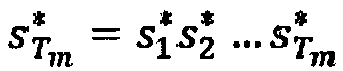
- the same forward variable can also be used during reproduction to predict future steps until T m .
- future observations are not available, only transition and duration information are used, i.e., by setting N ⁇ l
- a goal specification G is given as a propositional logic expression over the predicates B , i.e., via nested conjunction, disjunction and negation operators.
- the goal specification G represents the desired configuration of the arm and the objects, assumed to be feasible.
- one specification could be "within ( peg, cylinder ) ⁇ onTop ( cylinder, box )" , i.e., "the peg should be inside the cylinder and the cylinder should be on top of the box”.
- the PDDL model P includes a domain for the demonstrated skills and a problem instance given the goal specification G.
- the Planning Domain Definition Language (PDDL) is the standard classic planning language. Formally, the language consists of the following key ingredients:
- motion planning is performed at the end-effector/gripper trajectory level. This means it is assumed that a low-level motion controller is used to track the desired trajectory.
- TP-HSMM model M ⁇ is to be learned for each demonstrated skill a h and reproduce the skill for a given final configuration G.
- the TP-HSMM model M a h abstracting the spatio-temporal features of trajectories related to skill a h , can be learned in step S1 using e.g. an EM-like algorithm.
- This is beneficial as only one model for the general skill is constructed.
- Figure 3 shows an example of an HSMM for "pick the peg" skill that contains 10 demonstrations for "pick from top” and "pick from side”.
- the learned HSMM model in the global frame has a single initial HSMM state from which two branches encode the two different instantiations of the same "pick” skill.
- Figure 3 shows illustrations for HSMM states of a learned skill wherein demonstration trajectories in 2D(left) and transition probabilities between associated states are shown.
- a final goal configuration G is provided in step S2 which can be translated into the final state of the end effector 22 x G ⁇ R 3 ⁇ S 3 ⁇ R 1 .
- This configuration can be imposed as the desired final observation of the reproduction, i.e., ⁇ Tm ⁇ x G .
- the initial configuration of the end-effector 22 can be imposed as the initial observation, i.e., ⁇ 0 ⁇ x 0 .
- step S3 a modification of the Viterbi algorithm is used.
- the classical Viterbi algorithm has been extensively used to find the most likely sequence of states (also called the Viterbi path) in classical HMMs that result in a given sequence of observed events
- the modified implementation differs in that: (a) it works on HSMM instead of HMM; and that (b) most observations except the first and the last ones are missing.
- b ⁇ j ⁇ t ′ ⁇ N ⁇ t ′
- the Viterbi algorithm is modified to include missing observations, which is basically what is described for variable 'b'. Moreover, the inclusion of duration probabilities p j ( d ) in the computation of variable 'd_t(j)' makes it work for HSMM.
- the above modified Viterbi algorithm provides the most likely state sequence for a single TP-HSMM model that produces the final observation ⁇ T .
- these models need to be sequenced and ⁇ t ( j ) has to be computed for each individual model M a h .
- ⁇ 1 and ⁇ T can be observed, thus some models will not produce observations.
- An additional challenge emerges when sequencing HSMMs: as the state transition probabilities between subsequent HSMM states are unknown, the Viterbi algorithm cannot be applied directly to find the optimal state sequence.
- a PDDL model contains the problem instance P P and the domain P D .
- a h ⁇ A is a symbolic representation for one demonstrated skill in PDDL form.
- the segments of demonstrations that belong to any of the initial state are to be identified, and to further derive the low-variance geometric relations which can be mapped into the set of predicates B .
- These frames correspond to objects ⁇ ⁇ 1 ,..., ⁇ p ⁇ , i.e., skill a h interacts with these objects.
- B i the set of instantiated predicates that are True within state i , ⁇ i ⁇ J .
- PreCond a h ⁇ i ⁇ J ⁇ b ⁇ B i b
- v and ⁇ are the disjunction and conjunction operations.
- the procedure described above can be applied to the set of final states .
- the set of instantiated predicates that are True within f is denoted by B f .
- the effect cannot contain a disjunction of predicates.
- the PDDL model P can be generated in an automated way. More importantly, the domain P D can be constructed incrementally whenever a new skill is demonstrated and its descriptions are abstracted as above. On the other hand, the problem instance P P needs to be re-constructed whenever a new initial state or goal specification is given.
- the PDDL definition P has been constructed, which can be directly fed into any compatible PDDL planner. Different optimization techniques can be enforced during the planning, e.g., minimizing the total length of the plan or total cost.
- a D ⁇ a 1 ⁇ a 2 ⁇ ... a D ⁇ the generated optimal sequence of skills, where a d ⁇ ⁇ A holds for each skill.
- M a d ⁇ the learned TP-HSMM associated with a d ⁇ .
- the learned TP-HSMM encapsulates a general skill that might have several plausible paths and the choice relies heavily on the desired initial and final configurations.
- a compatibility measure shall be embedded while concatenating the skills within a D * .
- the proposed solution contains three main steps:
- step S4 the concatenated sequence of manipulation skills is executed.
Landscapes
- Engineering & Computer Science (AREA)
- Robotics (AREA)
- Mechanical Engineering (AREA)
- Theoretical Computer Science (AREA)
- Physics & Mathematics (AREA)
- General Physics & Mathematics (AREA)
- Software Systems (AREA)
- Artificial Intelligence (AREA)
- Data Mining & Analysis (AREA)
- Evolutionary Computation (AREA)
- General Engineering & Computer Science (AREA)
- Mathematical Physics (AREA)
- Computing Systems (AREA)
- Computational Mathematics (AREA)
- Pure & Applied Mathematics (AREA)
- Mathematical Optimization (AREA)
- Mathematical Analysis (AREA)
- Computational Linguistics (AREA)
- Computer Vision & Pattern Recognition (AREA)
- Medical Informatics (AREA)
- Algebra (AREA)
- Probability & Statistics with Applications (AREA)
- Manipulator (AREA)
Description
- The present invention relates to automatic processes for planning tasks by determining a sequence of manipulation skills. Particularly, the present invention relates to a motion planning framework for robot manipulation.
- General use of robots for performing various tasks is challenging, as it is almost impossible to preprogram all robot capabilities that may potentially be required in the latter application. Training the skill whenever it is needed renders the use of robots inconvenient and will not be accepted by a user. Further, simply recording and replaying a demonstrated manipulation is often insufficient, because changes in the environment, such as varying robot and/or object poses, would render any attempt unsuccessful.
- Therefore, the robot needs to recognize and encode the intentions behind these demonstrations and should be capable to generalize the trained manipulation to unforeseen situations. Furthermore, several skills need to be performed in a sequence to accomplish complex tasks. The task planning problem aims to define the right sequence of actions and needs a prespecified definition of the planning model and of the preconditions and effects of all available skills. Due to the large variation of skills, the definition of such a planning model quickly becomes impractical.
- Document C. Paxton et al., "Do What I Want, Not what I Did: Imitation of Skills by Planning Sequences of Actions", arXiv.org, Cornell University Library, NY, December 5, 2016 discloses a computer implemented method and associated device for planning a manipulation task wherein a number of manipulation skills are learnt and a symbolic abstraction of the manipulation skill is generated. A concatenated sequence of manipulation skills selected from the number of learnt manipulation skills is determined based on their symbolic abstractions so that a given goal specification indicating a given complex manipulation task is satisfied. Document
KR 2016 0080349 A - Furthermore, R. Ahmadzadeh et al., "Visuospatial Skill Learning for Robots", arXiv.org, Cornell University Library, June 3, 2017 discloses a skill learning approach that allows a robot to acquire human-like skills for object manipulation tasks.
- According to the invention, a method for planning an object manipulation according to
claim 1 and a device for planning object manipulation according toclaim 8. - Further embodiments are indicated in the depending subclaims.
- According to a first aspect a method for planning a manipulation task of an agent, particularly a robot, is provided, comprising the steps of:
- Learning (Training) a number of manipulation skills wherein a symbolic abstraction of the respective manipulation skill is generated;
- Determining a concatenated sequence of manipulation skills selected from the number of learned manipulation skills based on their symbolic abstraction so that a given goal specification indicating a given complex manipulation task is satisfied;
- Executing the sequence of manipulation skills.
- Further, the learning of the number of manipulation skills is performed in that a plurality of manipulation trajectories for each respective manipulation skill is recorded, particularly by demonstration, a task parametrized Hidden Semi-Markov model (TP-HSMM) is determined depending on the plurality of manipulation trajectories for each respective manipulation skill and the symbolic abstraction of the respective manipulation skill is generated.
- The generating of the symbolic abstraction of the manipulations skills comprises constructing a PDDL model, wherein objects, initial state and goal specification define a problem instance, while a set of predicates and actions define a domain of a given manipulation, wherein particularly the symbolic abstraction of the manipulations skills uses a classical PDDL planning language. The concatenated sequence of manipulation skills is determined, such that the probability of achieving the given goal specification is maximized. A PDDL planning step is used to find a sequence of actions to fulfill the given goal specification, starting from a given initial state.
- Furthermore, determining the concatenated sequence of manipulation skills includes the steps of:
- a) Cascading the TP-HSMMs of consecutive manipulation skills into one complete model by computing transition probabilities according to a divergence of emission probabilities between end states and initial states of consecutive manipulations skills;
- b) Searching a most-likely complete state sequence between the initial and goal states of the manipulation task using a modified Viterbi algorithm; and
- c) Generating a robot end-effector trajectory that optimally tracks the most-likely complete state sequence.
- The modified Viterbi algorithm includes missing observations and duration probabilities.
- The above task planning framework allows a high-level planning of a task by sequencing general manipulation skills. Manipulation skills are action skills in general which may also include translations or movements. The general manipulation skills are object-oriented and respectively relate to a single action performed on the object, such as a grasping skill, a dropping skill, a moving skill or the like. These manipulations skills may have different instances, which means that the skills can be carried out in different ways (instances) according to what is needed to be done next. Furthermore, the general skills are provided with object centric symbolic action descriptions for the logic-based planning.
- The above method is based on the idea of learning from demonstration by means of fitting a prescribed skilled model, such as a Gaussian mixture model to a handful of demonstrations. Generally, a TP-GMM task parameterized Gaussian mixture model may be described which can then be used to an execution to reproduce a trajectory for the learned manipulation skill. The TP-GMM is defined by one or more specific frames (coordinate systems) which indicates the translation and rotation with respect to a word frame. After observation of the actual frame, the learned TP-GMM can be converted into a single GMM. One advantage of the TP-GMM is that the resulting GMM can be updated in a real time according to the observed task parameters. Hence, the TP-HSMM allows to adapt to changes in the objects during the execution of the manipulation task.
- According to an embodiment, the transition probability between states of the TP-HSMM may be determined using Expectation-Maximization.
- Parameters of the TP-HSMM may be learned through a classical Expectation-Maximization algorithm.
- Furthermore, the symbolic abstractions of the demonstrated manipulation skills may be determined by mapping low-variance geometric relations of segments of manipulation trajectories into the set of predicates.
- According to an embodiment, the step of determining the concatenated sequence of manipulation skills may comprise an optimization process, particularly with the goal specification of minimizing the total length of the trajectory. Particularly, determining the concatenated sequence of manipulation skills may comprise selectively reproducing one or more of the manipulation skills of a given sequence of manipulation skills so as to maximize the probability of satisfying the given goal specification.
- According to a further embodiment, a device for planning a manipulation task of an agent, particularly a robot, is provided, wherein the device is configured to:
- learn a number of manipulation skills, wherein a symbolic abstraction of the respective manipulation skill is generated, wherein the learning of the number of manipulation skills is performed in that a plurality of manipulation trajectories for each respective manipulation skill is recorded, a task parametrized Hidden Semi-Markov model TP-HSMM is determined depending on the plurality of manipulation trajectories for each respective manipulation skill and the symbolic abstraction of the respective manipulation skill is generated by constructing a PDDL model, wherein objects, initial state and goal specification define a problem instance, while a set of predicates and actions define a domain of a given manipulation;
- determine a concatenated sequence of manipulation skills selected from the number of learned manipulation skills based on their symbolic abstraction, such that the probability of achieving a given goal specification indicating a given complex manipulation task is maximized wherein a PDDL planning step is used to find a sequence of manipulation skills to fulfill the given goal specification, starting from a given initial state; wherein determining the concatenated sequence of manipulation skills includes the steps of:
- a) Cascading the TP-HSMMs of consecutive manipulation skills into one complete model by computing transition probabilities according to a divergence of emission probabilities between end states and initial states of consecutive manipulations skills;
- b) Searching a most-likely complete state sequence between the initial and goal states of the manipulation task using a modified Viterbi algorithm, wherein the modified Viterbi algorithm includes missing observations and duration probabilities;
- c) Generating a robot end-effector trajectory that optimally tracks the most-likely complete state sequence; and
- instruct execution of the sequence of manipulation skills.
- Embodiments are described in more detail in conjunction with the accompanying drawings, in which:
- Figure 1
- schematically shows a robot arm; and
- Figure 2
- shows a flowchart illustrating the method or manipulation of an object by sequencing of manipulation skills.
- Figure 3
- shows illustrations for HSMM states of a learned manipulation skill wherein demonstration trajectories and transition probabilities are illustrated.
-
Figure 1 shows a system (agent) 1 including acontrollable robot arm 2 as an example of an object manipulator. Therobot arm 2 is a multi-DoF robotic arm withseveral links 21 and an end-effector 22 which allows a state
robot arm 2, there are objects of interest denoted by O = {o 1,o 1, ... ,ol }. - Within this setup, a human user can perform several kinesthetic demonstrations on the arm to manipulate one or several objects for certain manipulation skills. Denote by A = {a 1,a 1, ..., aH } the set of demonstrated skills. Moreover, for manipulation skill ah ∈ A, the set of objects involved is given by Oa
h and the set of available demonstrations is denoted by Dah . - The
robot arm 2 is controlled by means of acontrol unit 3 which may actuate actuators to move therobot arm 2 and activate theend effector 22. Sensors may be provided at therobot arm 2 or at the robot workspace to record the state of objects in the robot workspace. Furthermore, thecontrol unit 3 is configured to record movements made with therobot arm 2 and to obtain information about objects in the workspace from the sensors and further to perform a task planning process as described below. Thecontrol unit 3 has a processing unit where the algorithm as described below is implemented in hardware and/or software. - All demonstrations are described by the structure of TP-GMM (task-parametrized- Gaussian Mixture Models). The basic idea is to fit a prescribed skill model such as GMMs to multiple demonstrations. GMMs are well known in the art as e.g. disclosed in S. Niekum et al. "Learning grounded finite-state representations from unstructured demonstrations", The International Journal of Robotics Research, 34(2), pages 131-157, 2015. For a number M of given demonstrations (trajectory measurement results), each of which contains Tm data points for a dataset, N = M * Tm total observations


- Differently from standard GMM learning, the mixture model above cannot be learned independently for each frame p. Indeed, the mixing coefficients πk are shared by all frames p and the k-th component in frame p must map to the corresponding k-th component in the global frame. For example, Expectation-Maximization (EM) is a well-established method to learn such models. In general, an expectation-maximization (EM) algorithm is an iterative method to find maximum likelihood or maximum a posteriori (MAP) estimates of parameters in a statistical model, which depends on unobserved latent variables.
- Once learned, the TP-GMM can be used during execution to reproduce a trajectory for the learned skill. Namely, given the observed frames




- Hidden semi-Markov Models (HSMMs) have been successfully applied, in combination with TP-GMMs, for robot skill encoding to learn spatio-temporal features of the demonstrations, such as manipulation trajectories of a robot or trajectories of a movable agent.
- Hidden semi-Markov Models (HSMMs) extend standard hidden Markov Models (HMMs) by embedding temporal information of the underlying stochastic process. That is, while in HMM the underlying hidden process is assumed to be Markov, i.e., the probability of transitioning to the next state depends only on the current state, in HSMM the state process is assumed semi-Markov. This means that a transition to the next state depends on the current state as well as on the elapsed time since the state was entered.
- More specifically, a task parametrized HSMM model consists of the following parameters


- Given a certain sequence of observed data points


- All demonstrations are recorded from multiple frames. Normally, these frames are closely attached to the objects in Oa
h . For example, the skill "insert the peg in the cylinder" involves the objects "peg" and "cylinder", and the associated demonstrations are recorded from both the robot, the "peg" and the "cylinder" frames, respectively. - In addition, consider a set of pre-defined predicates, denoted by B = {b 1 , b 2, ... , bL }, representing possible geometric relations among the objects of interest. Here, predicates b ∈ B are abstracted as Boolean functions taking as inputs the status of several objects while outputting whether the associated geometric relation holds or not. For instance, grasp := O → B indicates whether an object is grasped by the robot arm; within: O × O → B indicates whether an object is inside another object; and onTop: O × O → B indicates whether an object is on the top of another object. Note that these predicates are not bound to specific manipulation skills but rather shared among them. Usually, such predicate functions can be easily validated for the robot arm states and the object states (e.g., position and orientations).
- Finally, a goal specification G is given as a propositional logic expression over the predicates B, i.e., via nested conjunction, disjunction and negation operators. In general, the goal specification G represents the desired configuration of the arm and the objects, assumed to be feasible. As an example, one specification could be "within(peg, cylinder) ∧ onTop(cylinder, box)", i.e., "the peg should be inside the cylinder and the cylinder should be on top of the box".
- In the following, a problem can be defined as follows: Given a set of demonstrations D for skills A and the goal G, the objective is
- a) to learn a TP-HSMM model Mθ of the form

- b) to construct a PDDL model P of the form P = (PD, PP ) where Objects, Initial State and Goal Specification define a problem instance Pp, while Predicates and Actions define the domain of a problem PD ;
- c) to derive and subsequently execute the sequence of manipulation skills, such that the probability of achieving the given goal specification G is maximized. Once the domain and problem files are specified, a PDDL (Planning Domain Definition Language.) planner has to find a sequence of actions to fulfill the given goal specification, starting from the initial state.
- The PDDL model P includes a domain for the demonstrated skills and a problem instance given the goal specification G.
- The Planning Domain Definition Language (PDDL) is the standard classic planning language. Formally, the language consists of the following key ingredients:
- Objects, everything of interest in the world;
- Predicates, object properties and relations;
- Initial States, set of grounded predicates as the initial states;
- A goal Specification, the goal states; and
- Actions, how predicates are changed by an action and also the preconditions on the actions.
- In the embodiment described herein, motion planning is performed at the end-effector/gripper trajectory level. This means it is assumed that a low-level motion controller is used to track the desired trajectory.
- The method for planning a manipulation task is described in detail with respect to the flowchart of
Figure 2 . - Firstly, a TP-HSMM model Mθ is to be learned for each demonstrated skill ah and reproduce the skill for a given final configuration G.
- One demonstrated skill ah ∈ A is considered. As described above, the set of available demonstrations, recorded in P frames, is given by

h . The P frames are directly attached to the objects in Oah . - Given a properly chosen number of components K which correspond to the TP-HSMM states, which are the Gaussian components representing the observation probability distributions, the TP-HSMM model Ma
h abstracting the spatio-temporal features of trajectories related to skill ah , can be learned in step S1 using e.g. an EM-like algorithm. This is beneficial as only one model for the general skill is constructed.Figure 3 shows an example of an HSMM for "pick the peg" skill that contains 10 demonstrations for "pick from top" and "pick from side". The learned HSMM model in the global frame has a single initial HSMM state from which two branches encode the two different instantiations of the same "pick" skill.Figure 3 shows illustrations for HSMM states of a learned skill wherein demonstration trajectories in 2D(left) and transition probabilities between associated states are shown. - A final goal configuration G is provided in step S2 which can be translated into the final state of the end effector

effector 22 can be imposed as the initial observation, i.e., ξ 0 ≡ x 0. Following, the most likely sequence
m . - The forward variable of formula


Figure 3 , it may return the lower branch as the most likely sequence (i.e., to grasp the object from the side), even if the desired final configuration is that theend effector 22 is on the top of object. - To overcome this issue, in step S3 a modification of the Viterbi algorithm is used. Whereas the classical Viterbi algorithm has been extensively used to find the most likely sequence of states (also called the Viterbi path) in classical HMMs that result in a given sequence of observed events, the modified implementation differs in that: (a) it works on HSMM instead of HMM; and that (b) most observations except the first and the last ones are missing.
- Specifically, in the absence of observations the Viterbi algorithm becomes



- The Viterbi algorithm is modified to include missing observations, which is basically what is described for variable 'b'. Moreover, the inclusion of duration probabilities pj (d) in the computation of variable 'd_t(j)' makes it work for HSMM.
- At each time t and for each state j, the two arguments that maximize equation δt (j) are recorded, and a simple backtracking procedure can then be used to find the most probable state sequence

- The above modified Viterbi algorithm provides the most likely state sequence for a single TP-HSMM model that produces the final observation ξT . As multiple skills are used, these models need to be sequenced and δ t (j) has to be computed for each individual model Ma
h . However, only ξ 1 and ξT can be observed, thus some models will not produce observations. An additional challenge emerges when sequencing HSMMs: as the state transition probabilities between subsequent HSMM states are unknown, the Viterbi algorithm cannot be applied directly to find the optimal state sequence. - As a next step, symbolic abstractions of the demonstrated skills allow the robot to understand the meaning of each skill on a symbolic level, instead of the data level of HSMM. This may generalize a demonstrated and learned skill. Hence, the high-level reasoning of the herein described PDDL planner, needs to understand how a skill can be incorporated into an action sequence in order to achieve a desired goal specification starting from an initial state. A PDDL model contains the problem instance PP and the domain PD .
- While the problem PP can be easily specified given the objects O, the initial state and the goal specification G, the key ingredient for symbolic abstraction is to construct the actions description in the domain PD for each demonstrated skill, wherein PD should be invariant to different task parameters.
- ah ∈ A is a symbolic representation for one demonstrated skill in PDDL form. The learned TP-HSMM Ma
h contains a task-parametrized model
- For each model, it is then possible to identify two sets, each of which containing initial and final states and denoted by

- To construct the preconditions of a skill, the segments of demonstrations that belong to any of the initial state are to be identified, and to further derive the low-variance geometric relations which can be mapped into the set of predicates B. For each initial state




 . In particular, for each final state f ∈
 , the set of instantiated predicates that are True within f is denoted by Bf . However, in contrast to the precondition, the effect cannot contain a disjunction of predicates.
 - Consequently, the effect of skill ah is given by

- Following, it is referred to the planning and sequencing of trained and abstracted skills. The PDDL definition P has been constructed, which can be directly fed into any compatible PDDL planner. Different optimization techniques can be enforced during the planning, e.g., minimizing the total length of the plan or total cost. Denote by


- Given this sequence


- The learned TP-HSMM encapsulates a general skill that might have several plausible paths and the choice relies heavily on the desired initial and final configurations. To avoid incompatible transitions from one skill to the next, a compatibility measure shall be embedded while concatenating the skills within

- a) Cascade the TP-HSMMs of each skill within


- b) Find the most-likely complete state sequence


- c) Generate the robot end-effector trajectory that optimally tracks


effector 22 cannot be defined on MR , since it is not a vector space. However, the linear tangent spaces can be exploited to achieve a similar result. Specifically, the state error between the desired reference µ̂st and current robot state xt can be computed using the logarithmic map log µ̂st (xt ) that projects the minimum length path between µ̂st and xt into the Euclidean space


t . - Finally, in step S4 the concatenated sequence of manipulation skills is executed.
Claims (10)
- Computer-implemented method for planning a manipulation task of an agent (1), particularly a robot, comprising the steps of:- Learning (S1) a number of manipulation skills wherein a symbolic abstraction of the respective manipulation skill is generated, wherein the learning (S1) of the number of manipulation skills is performed in that a plurality of manipulation trajectories for each respective manipulation skill is recorded, a task parametrized Hidden Semi-Markov model TP-HSMM is determined depending on the plurality of manipulation trajectories for each respective manipulation skill and the symbolic abstraction of the respective manipulation skill is generated by constructing a PDDL model, wherein objects, initial state and goal specification define a problem instance, while a set of predicates and actions define a domain of a given manipulation;- Determining (S3) a concatenated sequence of manipulation skills selected from the number of learned manipulation skills based on their symbolic abstraction such that the probability of achieving a given goal specification indicating a given complex manipulation task is maximized wherein a PDDL planning step is used to find a sequence of manipulation skills to fulfill the given goal specification, starting from a given initial state; wherein determining the concatenated sequence of manipulation skills includes the steps of:- a) Cascading the TP-HSMMs of consecutive manipulation skills into one complete model by computing transition probabilities according to a divergence of emission probabilities between end states and initial states of consecutive manipulations skills;- b) Searching a most-likely complete state sequence between the initial and goal states of the manipulation task using a modified Viterbi algorithm, wherein the modified Viterbi algorithm includes missing observations and duration probabilities;- c) Generating a robot end-effector trajectory that optimally tracks the most-likely complete state sequence; and- Executing (S4) the sequence of manipulation skills.
- Method according to claim 1, wherein the symbolic abstraction of the manipulations skills uses a classical PDDL planning language.
- Method according to any of the claims 1 to 2, where the transition probability between states of the TP-HSMM are determined using Expectation-Maximization.
- Method according to claim 3, wherein parameters of the TP-HSMM are learned through a classical Expectation-Maximization algorithm.
- Method according to any of the claims 1 to 4, wherein the symbolic abstractions of the demonstrated manipulation skills are determined by mapping low-variance geometric relations of segments of manipulation trajectories into the set of predicates.
- Method according to any of the claims 1 to 5, wherein determining a concatenated sequence of manipulation skills comprises an optimization process, particularly with the goal specification of minimizing the total length of the trajectory.
- Method according to claim 6, wherein determining the concatenated sequence of manipulation skills comprises selectively reproducing one or more of the manipulation skills of a given sequence of manipulation skills so as to maximize the probability of satisfying the given goal specification.
- Device for planning a manipulation task of an agent, particularly a robot, wherein the device is configured to:- learn a number of manipulation skills, wherein a symbolic abstraction of the respective manipulation skill is generated, wherein the learning (S1) of the number of manipulation skills is performed in that a plurality of manipulation trajectories for each respective manipulation skill is recorded, a task parametrized Hidden Semi-Markov model TP-HSMM is determined depending on the plurality of manipulation trajectories for each respective manipulation skill and the symbolic abstraction of the respective manipulation skill is generated by constructing a PDDL model, wherein objects, initial state and goal specification define a problem instance, while a set of predicates and actions define a domain of a given manipulation;- determine a concatenated sequence of manipulation skills selected from the number of learned manipulation skills based on their symbolic abstraction such that the probability of achieving a given goal specification indicating a given complex manipulation task is maximized wherein a PDDL planning step is used to find a sequence of manipulation skills to fulfill the given goal specification, starting from a given initial state; wherein determining the concatenated sequence of manipulation skills includes the steps of:- a) Cascading the TP-HSMMs of consecutive manipulation skills into one complete model by computing transition probabilities according to a divergence of emission probabilities between end states and initial states of consecutive manipulations skills;- b) Searching a most-likely complete state sequence between the initial and goal states of the manipulation task using a modified Viterbi algorithm, wherein the modified Viterbi algorithm includes missing observations and duration probabilities;- c) Generating a robot end-effector trajectory that optimally tracks the most-likely complete state sequence; and- instruct execution of the sequence of manipulation skills.
- A computer program product comprising instructions which, when the program is executed by a data processing unit, cause the data processing unit to carry out the method of any of the claims 1 to 7.
- A machine-readable storage medium having stored thereon a computer program comprising a routine of set instructions for causing the machine to perform the method of any of the claims 1 to 7.
Priority Applications (3)
| Application Number | Priority Date | Filing Date | Title |
|---|---|---|---|
| EP19181874.9A EP3753684B1 (en) | 2019-06-21 | 2019-06-21 | Method and system for robot manipulation planning |
| US16/892,811 US11498212B2 (en) | 2019-06-21 | 2020-06-04 | Method and system for robot manipulation planning |
| CN202010564725.9A CN112109079B (en) | 2019-06-21 | 2020-06-19 | Method and system for robotic manipulation planning |
Applications Claiming Priority (1)
| Application Number | Priority Date | Filing Date | Title |
|---|---|---|---|
| EP19181874.9A EP3753684B1 (en) | 2019-06-21 | 2019-06-21 | Method and system for robot manipulation planning |
Publications (2)
| Publication Number | Publication Date |
|---|---|
| EP3753684A1 EP3753684A1 (en) | 2020-12-23 |
| EP3753684B1 true EP3753684B1 (en) | 2022-08-10 |
Family
ID=67003225
Family Applications (1)
| Application Number | Title | Priority Date | Filing Date |
|---|---|---|---|
| EP19181874.9A Active EP3753684B1 (en) | 2019-06-21 | 2019-06-21 | Method and system for robot manipulation planning |
Country Status (3)
| Country | Link |
|---|---|
| US (1) | US11498212B2 (en) |
| EP (1) | EP3753684B1 (en) |
| CN (1) | CN112109079B (en) |
Cited By (1)
| Publication number | Priority date | Publication date | Assignee | Title |
|---|---|---|---|---|
| DE102022201116A1 (en) | 2022-02-02 | 2023-08-03 | Robert Bosch Gesellschaft mit beschränkter Haftung | Method of controlling a robotic device |
Families Citing this family (18)
| Publication number | Priority date | Publication date | Assignee | Title |
|---|---|---|---|---|
| CN112580795B (en) * | 2019-09-29 | 2024-09-06 | 华为技术有限公司 | A method for acquiring a neural network and related equipment |
| JP2021094677A (en) * | 2019-12-19 | 2021-06-24 | 本田技研工業株式会社 | Robot control device, robot control method, program and learning model |
| US12384031B2 (en) * | 2020-02-28 | 2025-08-12 | Nec Corporation | Control device, control method and storage medium |
| DE102020207085A1 (en) * | 2020-06-05 | 2021-12-09 | Robert Bosch Gesellschaft mit beschränkter Haftung | METHOD OF CONTROLLING A ROBOT AND ROBOT CONTROL UNIT |
| DE102020208169A1 (en) * | 2020-06-30 | 2021-12-30 | Robert Bosch Gesellschaft mit beschränkter Haftung | Method and device for operating a machine |
| JP7480670B2 (en) * | 2020-10-19 | 2024-05-10 | オムロン株式会社 | MOTION PLANNING APPARATUS, MOTION PLANNING METHOD, AND MOTION PLANNING PROGRAM |
| DE102020214231A1 (en) * | 2020-11-12 | 2022-05-12 | Robert Bosch Gesellschaft mit beschränkter Haftung | METHOD OF CONTROLLING A ROBOT DEVICE AND ROBOT CONTROLLER |
| CN112828894B (en) * | 2021-01-21 | 2022-09-02 | 中国科学院重庆绿色智能技术研究院 | Position and force hybrid control method of redundant manipulator |
| DE102021204961B4 (en) | 2021-05-17 | 2023-06-07 | Robert Bosch Gesellschaft mit beschränkter Haftung | Method of controlling a robotic device |
| CN114043478B (en) * | 2021-11-24 | 2023-07-07 | 深圳大学 | Representation method, device, intelligent terminal and medium of robot complex operation skills |
| CN114578727B (en) * | 2022-01-29 | 2025-02-25 | 深圳市云鼠科技开发有限公司 | Business logic control method for cleaning robot |
| US20230342677A1 (en) * | 2022-04-22 | 2023-10-26 | Meta Platforms Technologies, Llc | Task optimization in an extended reality environment |
| DE102022206381B4 (en) * | 2022-06-24 | 2024-12-19 | Robert Bosch Gesellschaft mit beschränkter Haftung | Method for controlling a robot device |
| CN115070764B (en) * | 2022-06-24 | 2023-05-23 | 中国科学院空间应用工程与技术中心 | Mechanical arm movement track planning method, system, storage medium and electronic equipment |
| US12496735B2 (en) * | 2022-07-14 | 2025-12-16 | University Of South Florida | Multiple object grasping using robotics |
| CN115048282B (en) * | 2022-08-15 | 2022-10-25 | 北京弘玑信息技术有限公司 | Extraction method of repeated operation, electronic device and storage medium |
| CN116604566A (en) * | 2023-06-20 | 2023-08-18 | 西北工业大学 | Rapid task planning method and system under motion constraint of space mechanical arm |
| EP4624107A1 (en) * | 2024-03-28 | 2025-10-01 | Robert Bosch GmbH | Method of planning a long-term task for a robot |
Family Cites Families (15)
| Publication number | Priority date | Publication date | Assignee | Title |
|---|---|---|---|---|
| US5835684A (en) * | 1994-11-09 | 1998-11-10 | Amada Company, Ltd. | Method for planning/controlling robot motion |
| US5946673A (en) * | 1996-07-12 | 1999-08-31 | Francone; Frank D. | Computer implemented machine learning and control system |
| US7024360B2 (en) * | 2003-03-17 | 2006-04-04 | Rensselaer Polytechnic Institute | System for reconstruction of symbols in a sequence |
| JP4169063B2 (en) * | 2006-04-06 | 2008-10-22 | ソニー株式会社 | Data processing apparatus, data processing method, and program |
| JP5440840B2 (en) * | 2009-06-11 | 2014-03-12 | ソニー株式会社 | Information processing apparatus, information processing method, and program |
| AT509927B1 (en) * | 2010-06-08 | 2015-05-15 | Keba Ag | METHOD FOR PROGRAMMING OR PRESENTING MOVEMENTS OR RUNS OF AN INDUSTRIAL ROBOT |
| JP6106594B2 (en) * | 2010-11-11 | 2017-04-05 | ザ・ジョンズ・ホプキンス・ユニバーシティ | Human-machine linkage robot system |
| KR101676541B1 (en) * | 2014-12-29 | 2016-11-15 | 한양대학교 산학협력단 | Method for Learning Task Skill and Robot Using Thereof |
| DE102015012959B4 (en) * | 2015-10-08 | 2019-01-17 | Franka Emika Gmbh | Robot system and method for controlling a robot system |
| DE102015012961B4 (en) * | 2015-10-08 | 2022-05-05 | Kastanienbaum GmbH | robotic system |
| CN106826789A (en) * | 2017-03-10 | 2017-06-13 | 蒙柳 | A kind of modular remote operating machinery arm controller |
| CN108393884B (en) * | 2018-01-18 | 2021-01-05 | 西北工业大学 | Petri network-based collaborative task planning method for multi-mechanical-arm teleoperation system |
| GB2577312B (en) * | 2018-09-21 | 2022-07-20 | Imperial College Innovations Ltd | Task embedding for device control |
| CN109176532B (en) * | 2018-11-09 | 2020-09-29 | 中国科学院自动化研究所 | Method, system and device for planning path of mechanical arm |
| DE102020214231A1 (en) * | 2020-11-12 | 2022-05-12 | Robert Bosch Gesellschaft mit beschränkter Haftung | METHOD OF CONTROLLING A ROBOT DEVICE AND ROBOT CONTROLLER |
-
2019
- 2019-06-21 EP EP19181874.9A patent/EP3753684B1/en active Active
-
2020
- 2020-06-04 US US16/892,811 patent/US11498212B2/en active Active
- 2020-06-19 CN CN202010564725.9A patent/CN112109079B/en active Active
Non-Patent Citations (1)
| Title |
|---|
| CANAL GERARD ET AL: "Joining High-Level Symbolic Planning with Low-Level Motion Primitives in Adaptive HRI: Application to Dressing Assistance", 2018 IEEE INTERNATIONAL CONFERENCE ON ROBOTICS AND AUTOMATION (ICRA), IEEE, 21 May 2018 (2018-05-21), pages 1 - 9, XP033403143, DOI: 10.1109/ICRA.2018.8460606 * |
Cited By (2)
| Publication number | Priority date | Publication date | Assignee | Title |
|---|---|---|---|---|
| DE102022201116A1 (en) | 2022-02-02 | 2023-08-03 | Robert Bosch Gesellschaft mit beschränkter Haftung | Method of controlling a robotic device |
| DE102022201116B4 (en) | 2022-02-02 | 2024-05-16 | Robert Bosch Gesellschaft mit beschränkter Haftung | Method for controlling a robot device |
Also Published As
| Publication number | Publication date |
|---|---|
| US20200398427A1 (en) | 2020-12-24 |
| CN112109079B (en) | 2024-07-30 |
| CN112109079A (en) | 2020-12-22 |
| US11498212B2 (en) | 2022-11-15 |
| EP3753684A1 (en) | 2020-12-23 |
Similar Documents
| Publication | Publication Date | Title |
|---|---|---|
| EP3753684A1 (en) | Method and system for robot manipulation planning | |
| Qureshi et al. | Motion planning networks | |
| Pertsch et al. | Accelerating reinforcement learning with learned skill priors | |
| Bechtle et al. | Meta learning via learned loss | |
| Osa et al. | An algorithmic perspective on imitation learning | |
| Schmeckpeper et al. | Learning predictive models from observation and interaction | |
| US12208522B2 (en) | Method for controlling a robot and robot controller | |
| Osa et al. | Guiding trajectory optimization by demonstrated distributions | |
| Luo et al. | Human intention inference and on-line human hand motion prediction for human-robot collaboration | |
| Montgomery et al. | Reset-free guided policy search: Efficient deep reinforcement learning with stochastic initial states | |
| Calinon et al. | Encoding the time and space constraints of a task in explicit-duration hidden Markov model | |
| Tavassoli et al. | Learning skills from demonstrations: A trend from motion primitives to experience abstraction | |
| Zhou et al. | Clone swarms: Learning to predict and control multi-robot systems by imitation | |
| Akbari et al. | Ontological physics-based motion planning for manipulation | |
| Paxton et al. | Do what i want, not what i did: Imitation of skills by planning sequences of actions | |
| Francis et al. | Stochastic functional gradient for motion planning in continuous occupancy maps | |
| Braun et al. | Incorporation of expert knowledge for learning robotic assembly tasks | |
| Tan et al. | Source-target inference models for spatial instruction understanding | |
| Havoutis et al. | Online incremental learning of manipulation tasks for semi-autonomous teleoperation | |
| CN113867137A (en) | Method and device for operating a machine | |
| CN119365304A (en) | Method for dynamic detection of ratcheting effects in collaborative robots and dynamic compensation of trajectories using artificial intelligence | |
| Alizadeh et al. | Exploiting the task space redundancy in robot programming by demonstration | |
| Kim et al. | Unicon: Uncertainty-conditioned policy for robust behavior in unfamiliar scenarios | |
| Röhler et al. | Knowledge-based implementation of deep reinforcement learning agents in assembly | |
| Bruno et al. | Learning adaptive movements from demonstration and self-guided exploration |
Legal Events
| Date | Code | Title | Description |
|---|---|---|---|
| PUAI | Public reference made under article 153(3) epc to a published international application that has entered the european phase |
Free format text: ORIGINAL CODE: 0009012 |
|
| STAA | Information on the status of an ep patent application or granted ep patent |
Free format text: STATUS: THE APPLICATION HAS BEEN PUBLISHED |
|
| AK | Designated contracting states |
Kind code of ref document: A1 Designated state(s): AL AT BE BG CH CY CZ DE DK EE ES FI FR GB GR HR HU IE IS IT LI LT LU LV MC MK MT NL NO PL PT RO RS SE SI SK SM TR |
|
| AX | Request for extension of the european patent |
Extension state: BA ME |
|
| STAA | Information on the status of an ep patent application or granted ep patent |
Free format text: STATUS: REQUEST FOR EXAMINATION WAS MADE |
|
| 17P | Request for examination filed |
Effective date: 20210623 |
|
| RBV | Designated contracting states (corrected) |
Designated state(s): AL AT BE BG CH CY CZ DE DK EE ES FI FR GB GR HR HU IE IS IT LI LT LU LV MC MK MT NL NO PL PT RO RS SE SI SK SM TR |
|
| STAA | Information on the status of an ep patent application or granted ep patent |
Free format text: STATUS: EXAMINATION IS IN PROGRESS |
|
| 17Q | First examination report despatched |
Effective date: 20210813 |
|
| GRAP | Despatch of communication of intention to grant a patent |
Free format text: ORIGINAL CODE: EPIDOSNIGR1 |
|
| STAA | Information on the status of an ep patent application or granted ep patent |
Free format text: STATUS: GRANT OF PATENT IS INTENDED |
|
| INTG | Intention to grant announced |
Effective date: 20211123 |
|
| GRAJ | Information related to disapproval of communication of intention to grant by the applicant or resumption of examination proceedings by the epo deleted |
Free format text: ORIGINAL CODE: EPIDOSDIGR1 |
|
| STAA | Information on the status of an ep patent application or granted ep patent |
Free format text: STATUS: EXAMINATION IS IN PROGRESS |
|
| GRAP | Despatch of communication of intention to grant a patent |
Free format text: ORIGINAL CODE: EPIDOSNIGR1 |
|
| STAA | Information on the status of an ep patent application or granted ep patent |
Free format text: STATUS: GRANT OF PATENT IS INTENDED |
|
| INTC | Intention to grant announced (deleted) | ||
| INTG | Intention to grant announced |
Effective date: 20220201 |
|
| GRAS | Grant fee paid |
Free format text: ORIGINAL CODE: EPIDOSNIGR3 |
|
| GRAA | (expected) grant |
Free format text: ORIGINAL CODE: 0009210 |
|
| STAA | Information on the status of an ep patent application or granted ep patent |
Free format text: STATUS: THE PATENT HAS BEEN GRANTED |
|
| AK | Designated contracting states |
Kind code of ref document: B1 Designated state(s): AL AT BE BG CH CY CZ DE DK EE ES FI FR GB GR HR HU IE IS IT LI LT LU LV MC MK MT NL NO PL PT RO RS SE SI SK SM TR |
|
| REG | Reference to a national code |
Ref country code: AT Ref legal event code: REF Ref document number: 1510153 Country of ref document: AT Kind code of ref document: T Effective date: 20220815 Ref country code: CH Ref legal event code: EP |
|
| REG | Reference to a national code |
Ref country code: DE Ref legal event code: R096 Ref document number: 602019017998 Country of ref document: DE |
|
| REG | Reference to a national code |
Ref country code: IE Ref legal event code: FG4D |
|
| REG | Reference to a national code |
Ref country code: NL Ref legal event code: MP Effective date: 20220810 |
|
| REG | Reference to a national code |
Ref country code: LT Ref legal event code: MG9D |
|
| PG25 | Lapsed in a contracting state [announced via postgrant information from national office to epo] |
Ref country code: SE Free format text: LAPSE BECAUSE OF FAILURE TO SUBMIT A TRANSLATION OF THE DESCRIPTION OR TO PAY THE FEE WITHIN THE PRESCRIBED TIME-LIMIT Effective date: 20220810 Ref country code: RS Free format text: LAPSE BECAUSE OF FAILURE TO SUBMIT A TRANSLATION OF THE DESCRIPTION OR TO PAY THE FEE WITHIN THE PRESCRIBED TIME-LIMIT Effective date: 20220810 Ref country code: PT Free format text: LAPSE BECAUSE OF FAILURE TO SUBMIT A TRANSLATION OF THE DESCRIPTION OR TO PAY THE FEE WITHIN THE PRESCRIBED TIME-LIMIT Effective date: 20221212 Ref country code: NO Free format text: LAPSE BECAUSE OF FAILURE TO SUBMIT A TRANSLATION OF THE DESCRIPTION OR TO PAY THE FEE WITHIN THE PRESCRIBED TIME-LIMIT Effective date: 20221110 Ref country code: NL Free format text: LAPSE BECAUSE OF FAILURE TO SUBMIT A TRANSLATION OF THE DESCRIPTION OR TO PAY THE FEE WITHIN THE PRESCRIBED TIME-LIMIT Effective date: 20220810 Ref country code: LV Free format text: LAPSE BECAUSE OF FAILURE TO SUBMIT A TRANSLATION OF THE DESCRIPTION OR TO PAY THE FEE WITHIN THE PRESCRIBED TIME-LIMIT Effective date: 20220810 Ref country code: LT Free format text: LAPSE BECAUSE OF FAILURE TO SUBMIT A TRANSLATION OF THE DESCRIPTION OR TO PAY THE FEE WITHIN THE PRESCRIBED TIME-LIMIT Effective date: 20220810 Ref country code: FI Free format text: LAPSE BECAUSE OF FAILURE TO SUBMIT A TRANSLATION OF THE DESCRIPTION OR TO PAY THE FEE WITHIN THE PRESCRIBED TIME-LIMIT Effective date: 20220810 |
|
| REG | Reference to a national code |
Ref country code: AT Ref legal event code: MK05 Ref document number: 1510153 Country of ref document: AT Kind code of ref document: T Effective date: 20220810 |
|
| PG25 | Lapsed in a contracting state [announced via postgrant information from national office to epo] |
Ref country code: PL Free format text: LAPSE BECAUSE OF FAILURE TO SUBMIT A TRANSLATION OF THE DESCRIPTION OR TO PAY THE FEE WITHIN THE PRESCRIBED TIME-LIMIT Effective date: 20220810 Ref country code: IS Free format text: LAPSE BECAUSE OF FAILURE TO SUBMIT A TRANSLATION OF THE DESCRIPTION OR TO PAY THE FEE WITHIN THE PRESCRIBED TIME-LIMIT Effective date: 20221210 Ref country code: HR Free format text: LAPSE BECAUSE OF FAILURE TO SUBMIT A TRANSLATION OF THE DESCRIPTION OR TO PAY THE FEE WITHIN THE PRESCRIBED TIME-LIMIT Effective date: 20220810 Ref country code: GR Free format text: LAPSE BECAUSE OF FAILURE TO SUBMIT A TRANSLATION OF THE DESCRIPTION OR TO PAY THE FEE WITHIN THE PRESCRIBED TIME-LIMIT Effective date: 20221111 |
|
| PG25 | Lapsed in a contracting state [announced via postgrant information from national office to epo] |
Ref country code: SM Free format text: LAPSE BECAUSE OF FAILURE TO SUBMIT A TRANSLATION OF THE DESCRIPTION OR TO PAY THE FEE WITHIN THE PRESCRIBED TIME-LIMIT Effective date: 20220810 Ref country code: RO Free format text: LAPSE BECAUSE OF FAILURE TO SUBMIT A TRANSLATION OF THE DESCRIPTION OR TO PAY THE FEE WITHIN THE PRESCRIBED TIME-LIMIT Effective date: 20220810 Ref country code: ES Free format text: LAPSE BECAUSE OF FAILURE TO SUBMIT A TRANSLATION OF THE DESCRIPTION OR TO PAY THE FEE WITHIN THE PRESCRIBED TIME-LIMIT Effective date: 20220810 Ref country code: DK Free format text: LAPSE BECAUSE OF FAILURE TO SUBMIT A TRANSLATION OF THE DESCRIPTION OR TO PAY THE FEE WITHIN THE PRESCRIBED TIME-LIMIT Effective date: 20220810 Ref country code: CZ Free format text: LAPSE BECAUSE OF FAILURE TO SUBMIT A TRANSLATION OF THE DESCRIPTION OR TO PAY THE FEE WITHIN THE PRESCRIBED TIME-LIMIT Effective date: 20220810 Ref country code: AT Free format text: LAPSE BECAUSE OF FAILURE TO SUBMIT A TRANSLATION OF THE DESCRIPTION OR TO PAY THE FEE WITHIN THE PRESCRIBED TIME-LIMIT Effective date: 20220810 |
|
| REG | Reference to a national code |
Ref country code: DE Ref legal event code: R097 Ref document number: 602019017998 Country of ref document: DE |
|
| PG25 | Lapsed in a contracting state [announced via postgrant information from national office to epo] |
Ref country code: SK Free format text: LAPSE BECAUSE OF FAILURE TO SUBMIT A TRANSLATION OF THE DESCRIPTION OR TO PAY THE FEE WITHIN THE PRESCRIBED TIME-LIMIT Effective date: 20220810 Ref country code: EE Free format text: LAPSE BECAUSE OF FAILURE TO SUBMIT A TRANSLATION OF THE DESCRIPTION OR TO PAY THE FEE WITHIN THE PRESCRIBED TIME-LIMIT Effective date: 20220810 |
|
| PLBE | No opposition filed within time limit |
Free format text: ORIGINAL CODE: 0009261 |
|
| STAA | Information on the status of an ep patent application or granted ep patent |
Free format text: STATUS: NO OPPOSITION FILED WITHIN TIME LIMIT |
|
| PG25 | Lapsed in a contracting state [announced via postgrant information from national office to epo] |
Ref country code: AL Free format text: LAPSE BECAUSE OF FAILURE TO SUBMIT A TRANSLATION OF THE DESCRIPTION OR TO PAY THE FEE WITHIN THE PRESCRIBED TIME-LIMIT Effective date: 20220810 |
|
| 26N | No opposition filed |
Effective date: 20230511 |
|
| PG25 | Lapsed in a contracting state [announced via postgrant information from national office to epo] |
Ref country code: SI Free format text: LAPSE BECAUSE OF FAILURE TO SUBMIT A TRANSLATION OF THE DESCRIPTION OR TO PAY THE FEE WITHIN THE PRESCRIBED TIME-LIMIT Effective date: 20220810 |
|
| PG25 | Lapsed in a contracting state [announced via postgrant information from national office to epo] |
Ref country code: MC Free format text: LAPSE BECAUSE OF FAILURE TO SUBMIT A TRANSLATION OF THE DESCRIPTION OR TO PAY THE FEE WITHIN THE PRESCRIBED TIME-LIMIT Effective date: 20220810 |
|
| PG25 | Lapsed in a contracting state [announced via postgrant information from national office to epo] |
Ref country code: MC Free format text: LAPSE BECAUSE OF FAILURE TO SUBMIT A TRANSLATION OF THE DESCRIPTION OR TO PAY THE FEE WITHIN THE PRESCRIBED TIME-LIMIT Effective date: 20220810 |
|
| REG | Reference to a national code |
Ref country code: CH Ref legal event code: PL |
|
| REG | Reference to a national code |
Ref country code: BE Ref legal event code: MM Effective date: 20230630 |
|
| GBPC | Gb: european patent ceased through non-payment of renewal fee |
Effective date: 20230621 |
|
| PG25 | Lapsed in a contracting state [announced via postgrant information from national office to epo] |
Ref country code: LU Free format text: LAPSE BECAUSE OF NON-PAYMENT OF DUE FEES Effective date: 20230621 |
|
| REG | Reference to a national code |
Ref country code: IE Ref legal event code: MM4A |
|
| PG25 | Lapsed in a contracting state [announced via postgrant information from national office to epo] |
Ref country code: LU Free format text: LAPSE BECAUSE OF NON-PAYMENT OF DUE FEES Effective date: 20230621 |
|
| PG25 | Lapsed in a contracting state [announced via postgrant information from national office to epo] |
Ref country code: IE Free format text: LAPSE BECAUSE OF NON-PAYMENT OF DUE FEES Effective date: 20230621 |
|
| PG25 | Lapsed in a contracting state [announced via postgrant information from national office to epo] |
Ref country code: IE Free format text: LAPSE BECAUSE OF NON-PAYMENT OF DUE FEES Effective date: 20230621 Ref country code: CH Free format text: LAPSE BECAUSE OF NON-PAYMENT OF DUE FEES Effective date: 20230630 Ref country code: GB Free format text: LAPSE BECAUSE OF NON-PAYMENT OF DUE FEES Effective date: 20230621 |
|
| PG25 | Lapsed in a contracting state [announced via postgrant information from national office to epo] |
Ref country code: IT Free format text: LAPSE BECAUSE OF FAILURE TO SUBMIT A TRANSLATION OF THE DESCRIPTION OR TO PAY THE FEE WITHIN THE PRESCRIBED TIME-LIMIT Effective date: 20220810 Ref country code: FR Free format text: LAPSE BECAUSE OF NON-PAYMENT OF DUE FEES Effective date: 20230630 Ref country code: BE Free format text: LAPSE BECAUSE OF NON-PAYMENT OF DUE FEES Effective date: 20230630 |
|
| PG25 | Lapsed in a contracting state [announced via postgrant information from national office to epo] |
Ref country code: BG Free format text: LAPSE BECAUSE OF FAILURE TO SUBMIT A TRANSLATION OF THE DESCRIPTION OR TO PAY THE FEE WITHIN THE PRESCRIBED TIME-LIMIT Effective date: 20220810 |
|
| PG25 | Lapsed in a contracting state [announced via postgrant information from national office to epo] |
Ref country code: BG Free format text: LAPSE BECAUSE OF FAILURE TO SUBMIT A TRANSLATION OF THE DESCRIPTION OR TO PAY THE FEE WITHIN THE PRESCRIBED TIME-LIMIT Effective date: 20220810 |
|
| PG25 | Lapsed in a contracting state [announced via postgrant information from national office to epo] |
Ref country code: CY Free format text: LAPSE BECAUSE OF FAILURE TO SUBMIT A TRANSLATION OF THE DESCRIPTION OR TO PAY THE FEE WITHIN THE PRESCRIBED TIME-LIMIT; INVALID AB INITIO Effective date: 20190621 |
|
| PG25 | Lapsed in a contracting state [announced via postgrant information from national office to epo] |
Ref country code: HU Free format text: LAPSE BECAUSE OF FAILURE TO SUBMIT A TRANSLATION OF THE DESCRIPTION OR TO PAY THE FEE WITHIN THE PRESCRIBED TIME-LIMIT; INVALID AB INITIO Effective date: 20190621 |
|
| PGFP | Annual fee paid to national office [announced via postgrant information from national office to epo] |
Ref country code: DE Payment date: 20250814 Year of fee payment: 7 |
|
| PG25 | Lapsed in a contracting state [announced via postgrant information from national office to epo] |
Ref country code: TR Free format text: LAPSE BECAUSE OF FAILURE TO SUBMIT A TRANSLATION OF THE DESCRIPTION OR TO PAY THE FEE WITHIN THE PRESCRIBED TIME-LIMIT Effective date: 20220810 |