EP3753573A1 - Vaccines against genital herpes simplex infections - Google Patents
Vaccines against genital herpes simplex infections Download PDFInfo
- Publication number
- EP3753573A1 EP3753573A1 EP20184563.3A EP20184563A EP3753573A1 EP 3753573 A1 EP3753573 A1 EP 3753573A1 EP 20184563 A EP20184563 A EP 20184563A EP 3753573 A1 EP3753573 A1 EP 3753573A1
- Authority
- EP
- European Patent Office
- Prior art keywords
- hsv
- virus
- recombinant
- recombinant hsv
- genome
- Prior art date
- Legal status (The legal status is an assumption and is not a legal conclusion. Google has not performed a legal analysis and makes no representation as to the accuracy of the status listed.)
- Pending
Links
- 229960005486 vaccine Drugs 0.000 title claims abstract description 88
- 208000015181 infectious disease Diseases 0.000 title description 37
- 208000001688 Herpes Genitalis Diseases 0.000 title description 2
- 201000004946 genital herpes Diseases 0.000 title description 2
- 206010073931 Genital herpes simplex Diseases 0.000 title 1
- 241000700584 Simplexvirus Species 0.000 claims abstract description 168
- 241000700605 Viruses Species 0.000 claims abstract description 129
- 238000000034 method Methods 0.000 claims abstract description 60
- 241000700588 Human alphaherpesvirus 1 Species 0.000 claims description 156
- 101150050388 UL20 gene Proteins 0.000 claims description 93
- 241000701074 Human alphaherpesvirus 2 Species 0.000 claims description 87
- 238000012217 deletion Methods 0.000 claims description 73
- 230000037430 deletion Effects 0.000 claims description 73
- 210000004027 cell Anatomy 0.000 claims description 64
- 108090000623 proteins and genes Proteins 0.000 claims description 50
- 101150109586 Gk gene Proteins 0.000 claims description 38
- 230000004048 modification Effects 0.000 claims description 38
- 238000012986 modification Methods 0.000 claims description 38
- 101150041636 NEC1 gene Proteins 0.000 claims description 37
- 150000001413 amino acids Chemical class 0.000 claims description 36
- 210000002569 neuron Anatomy 0.000 claims description 20
- 108091007433 antigens Proteins 0.000 claims description 19
- 102000036639 antigens Human genes 0.000 claims description 19
- 239000000427 antigen Substances 0.000 claims description 17
- 230000010076 replication Effects 0.000 claims description 17
- 230000003612 virological effect Effects 0.000 claims description 17
- 244000052769 pathogen Species 0.000 claims description 11
- 241000725303 Human immunodeficiency virus Species 0.000 claims description 9
- 239000002671 adjuvant Substances 0.000 claims description 9
- 238000004519 manufacturing process Methods 0.000 claims description 9
- 244000052616 bacterial pathogen Species 0.000 claims description 8
- 230000015572 biosynthetic process Effects 0.000 claims description 8
- 230000028993 immune response Effects 0.000 claims description 8
- 230000001717 pathogenic effect Effects 0.000 claims description 8
- 239000003381 stabilizer Substances 0.000 claims description 8
- 230000002349 favourable effect Effects 0.000 claims description 7
- 229960001438 immunostimulant agent Drugs 0.000 claims description 7
- 239000003755 preservative agent Substances 0.000 claims description 7
- 244000052613 viral pathogen Species 0.000 claims description 7
- 241000700328 Herpes simplex virus (type 1 / strain F) Species 0.000 claims description 6
- 230000003376 axonal effect Effects 0.000 claims description 6
- 239000003022 immunostimulating agent Substances 0.000 claims description 6
- 230000003308 immunostimulating effect Effects 0.000 claims description 6
- 239000000546 pharmaceutical excipient Substances 0.000 claims description 6
- 230000002335 preservative effect Effects 0.000 claims description 5
- 241000606153 Chlamydia trachomatis Species 0.000 claims description 4
- 229940038705 chlamydia trachomatis Drugs 0.000 claims description 4
- 230000009385 viral infection Effects 0.000 claims description 2
- 239000000203 mixture Substances 0.000 abstract description 34
- 230000002163 immunogen Effects 0.000 abstract description 23
- 208000009889 Herpes Simplex Diseases 0.000 abstract description 19
- 241000699670 Mus sp. Species 0.000 description 75
- 239000002773 nucleotide Substances 0.000 description 64
- 125000003729 nucleotide group Chemical group 0.000 description 64
- 102000004169 proteins and genes Human genes 0.000 description 35
- 241001465754 Metazoa Species 0.000 description 33
- 125000003275 alpha amino acid group Chemical group 0.000 description 33
- 125000002924 primary amino group Chemical group [H]N([H])* 0.000 description 29
- 201000010099 disease Diseases 0.000 description 27
- 208000037265 diseases, disorders, signs and symptoms Diseases 0.000 description 27
- 108020004414 DNA Proteins 0.000 description 22
- 108091033319 polynucleotide Proteins 0.000 description 21
- 102000040430 polynucleotide Human genes 0.000 description 21
- 239000002157 polynucleotide Substances 0.000 description 21
- 238000002255 vaccination Methods 0.000 description 21
- 210000001519 tissue Anatomy 0.000 description 18
- 108090000765 processed proteins & peptides Proteins 0.000 description 17
- 102000003886 Glycoproteins Human genes 0.000 description 15
- 108090000288 Glycoproteins Proteins 0.000 description 15
- 210000001744 T-lymphocyte Anatomy 0.000 description 15
- 108020005202 Viral DNA Proteins 0.000 description 14
- 210000004436 artificial bacterial chromosome Anatomy 0.000 description 13
- 210000002966 serum Anatomy 0.000 description 13
- 208000024891 symptom Diseases 0.000 description 13
- 210000003501 vero cell Anatomy 0.000 description 13
- 230000002238 attenuated effect Effects 0.000 description 12
- 238000003752 polymerase chain reaction Methods 0.000 description 12
- 239000013615 primer Substances 0.000 description 12
- 102000004196 processed proteins & peptides Human genes 0.000 description 12
- 238000006467 substitution reaction Methods 0.000 description 12
- 238000004458 analytical method Methods 0.000 description 11
- 238000003556 assay Methods 0.000 description 11
- 238000010790 dilution Methods 0.000 description 11
- 239000012895 dilution Substances 0.000 description 11
- 230000000574 ganglionic effect Effects 0.000 description 11
- 230000035772 mutation Effects 0.000 description 11
- 108091028043 Nucleic acid sequence Proteins 0.000 description 9
- 230000024932 T cell mediated immunity Effects 0.000 description 9
- 230000036039 immunity Effects 0.000 description 9
- 150000002500 ions Chemical class 0.000 description 9
- 238000010384 proximity ligation assay Methods 0.000 description 9
- 238000003753 real-time PCR Methods 0.000 description 9
- 210000003594 spinal ganglia Anatomy 0.000 description 9
- 102100036011 T-cell surface glycoprotein CD4 Human genes 0.000 description 8
- 210000004392 genitalia Anatomy 0.000 description 8
- 238000003780 insertion Methods 0.000 description 8
- 230000037431 insertion Effects 0.000 description 8
- 230000003993 interaction Effects 0.000 description 8
- 239000013598 vector Substances 0.000 description 8
- 208000001860 Eye Infections Diseases 0.000 description 7
- 241000699666 Mus <mouse, genus> Species 0.000 description 7
- 230000000694 effects Effects 0.000 description 7
- 239000000463 material Substances 0.000 description 7
- 238000012360 testing method Methods 0.000 description 7
- 239000006144 Dulbecco’s modified Eagle's medium Substances 0.000 description 6
- 241000282412 Homo Species 0.000 description 6
- 230000005867 T cell response Effects 0.000 description 6
- 230000033289 adaptive immune response Effects 0.000 description 6
- 230000008901 benefit Effects 0.000 description 6
- 238000004113 cell culture Methods 0.000 description 6
- 230000028996 humoral immune response Effects 0.000 description 6
- 230000006698 induction Effects 0.000 description 6
- 238000010255 intramuscular injection Methods 0.000 description 6
- 239000007927 intramuscular injection Substances 0.000 description 6
- 231100000518 lethal Toxicity 0.000 description 6
- 230000001665 lethal effect Effects 0.000 description 6
- 238000006386 neutralization reaction Methods 0.000 description 6
- 230000003472 neutralizing effect Effects 0.000 description 6
- 102000039446 nucleic acids Human genes 0.000 description 6
- 108020004707 nucleic acids Proteins 0.000 description 6
- 150000007523 nucleic acids Chemical class 0.000 description 6
- 230000001681 protective effect Effects 0.000 description 6
- 239000000523 sample Substances 0.000 description 6
- 230000029812 viral genome replication Effects 0.000 description 6
- 238000002965 ELISA Methods 0.000 description 5
- 206010061218 Inflammation Diseases 0.000 description 5
- 210000004369 blood Anatomy 0.000 description 5
- 239000008280 blood Substances 0.000 description 5
- 230000003053 immunization Effects 0.000 description 5
- 238000000338 in vitro Methods 0.000 description 5
- 230000002458 infectious effect Effects 0.000 description 5
- 230000004054 inflammatory process Effects 0.000 description 5
- 238000011081 inoculation Methods 0.000 description 5
- 238000007918 intramuscular administration Methods 0.000 description 5
- 210000001215 vagina Anatomy 0.000 description 5
- CMSMOCZEIVJLDB-UHFFFAOYSA-N Cyclophosphamide Chemical compound ClCCN(CCCl)P1(=O)NCCCO1 CMSMOCZEIVJLDB-UHFFFAOYSA-N 0.000 description 4
- 108090000695 Cytokines Proteins 0.000 description 4
- 102000004127 Cytokines Human genes 0.000 description 4
- 102000002356 Nectin Human genes 0.000 description 4
- 108060005251 Nectin Proteins 0.000 description 4
- 125000000539 amino acid group Chemical group 0.000 description 4
- 230000007910 cell fusion Effects 0.000 description 4
- 238000010276 construction Methods 0.000 description 4
- 230000000875 corresponding effect Effects 0.000 description 4
- 229960004397 cyclophosphamide Drugs 0.000 description 4
- 238000011161 development Methods 0.000 description 4
- UREBDLICKHMUKA-CXSFZGCWSA-N dexamethasone Chemical compound C1CC2=CC(=O)C=C[C@]2(C)[C@]2(F)[C@@H]1[C@@H]1C[C@@H](C)[C@@](C(=O)CO)(O)[C@@]1(C)C[C@@H]2O UREBDLICKHMUKA-CXSFZGCWSA-N 0.000 description 4
- 229960003957 dexamethasone Drugs 0.000 description 4
- 239000012091 fetal bovine serum Substances 0.000 description 4
- 238000009472 formulation Methods 0.000 description 4
- 230000000670 limiting effect Effects 0.000 description 4
- 230000001537 neural effect Effects 0.000 description 4
- 239000013641 positive control Substances 0.000 description 4
- 230000007420 reactivation Effects 0.000 description 4
- 230000004044 response Effects 0.000 description 4
- 238000004448 titration Methods 0.000 description 4
- 210000000427 trigeminal ganglion Anatomy 0.000 description 4
- 210000002845 virion Anatomy 0.000 description 4
- FWMNVWWHGCHHJJ-SKKKGAJSSA-N 4-amino-1-[(2r)-6-amino-2-[[(2r)-2-[[(2r)-2-[[(2r)-2-amino-3-phenylpropanoyl]amino]-3-phenylpropanoyl]amino]-4-methylpentanoyl]amino]hexanoyl]piperidine-4-carboxylic acid Chemical compound C([C@H](C(=O)N[C@H](CC(C)C)C(=O)N[C@H](CCCCN)C(=O)N1CCC(N)(CC1)C(O)=O)NC(=O)[C@H](N)CC=1C=CC=CC=1)C1=CC=CC=C1 FWMNVWWHGCHHJJ-SKKKGAJSSA-N 0.000 description 3
- VDABVNMGKGUPEY-UHFFFAOYSA-N 6-carboxyfluorescein succinimidyl ester Chemical compound C=1C(O)=CC=C2C=1OC1=CC(O)=CC=C1C2(C1=C2)OC(=O)C1=CC=C2C(=O)ON1C(=O)CCC1=O VDABVNMGKGUPEY-UHFFFAOYSA-N 0.000 description 3
- 238000001712 DNA sequencing Methods 0.000 description 3
- IAZDPXIOMUYVGZ-UHFFFAOYSA-N Dimethylsulphoxide Chemical compound CS(C)=O IAZDPXIOMUYVGZ-UHFFFAOYSA-N 0.000 description 3
- LFQSCWFLJHTTHZ-UHFFFAOYSA-N Ethanol Chemical compound CCO LFQSCWFLJHTTHZ-UHFFFAOYSA-N 0.000 description 3
- PEDCQBHIVMGVHV-UHFFFAOYSA-N Glycerine Chemical compound OCC(O)CO PEDCQBHIVMGVHV-UHFFFAOYSA-N 0.000 description 3
- 108010061593 Member 14 Tumor Necrosis Factor Receptors Proteins 0.000 description 3
- 102000012220 Member 14 Tumor Necrosis Factor Receptors Human genes 0.000 description 3
- 108010052285 Membrane Proteins Proteins 0.000 description 3
- 108091034117 Oligonucleotide Proteins 0.000 description 3
- 206010037569 Purulent discharge Diseases 0.000 description 3
- 238000011529 RT qPCR Methods 0.000 description 3
- 230000006052 T cell proliferation Effects 0.000 description 3
- 101150036065 UL37 gene Proteins 0.000 description 3
- JLCPHMBAVCMARE-UHFFFAOYSA-N [3-[[3-[[3-[[3-[[3-[[3-[[3-[[3-[[3-[[3-[[3-[[5-(2-amino-6-oxo-1H-purin-9-yl)-3-[[3-[[3-[[3-[[3-[[3-[[5-(2-amino-6-oxo-1H-purin-9-yl)-3-[[5-(2-amino-6-oxo-1H-purin-9-yl)-3-hydroxyoxolan-2-yl]methoxy-hydroxyphosphoryl]oxyoxolan-2-yl]methoxy-hydroxyphosphoryl]oxy-5-(5-methyl-2,4-dioxopyrimidin-1-yl)oxolan-2-yl]methoxy-hydroxyphosphoryl]oxy-5-(6-aminopurin-9-yl)oxolan-2-yl]methoxy-hydroxyphosphoryl]oxy-5-(6-aminopurin-9-yl)oxolan-2-yl]methoxy-hydroxyphosphoryl]oxy-5-(6-aminopurin-9-yl)oxolan-2-yl]methoxy-hydroxyphosphoryl]oxy-5-(6-aminopurin-9-yl)oxolan-2-yl]methoxy-hydroxyphosphoryl]oxyoxolan-2-yl]methoxy-hydroxyphosphoryl]oxy-5-(5-methyl-2,4-dioxopyrimidin-1-yl)oxolan-2-yl]methoxy-hydroxyphosphoryl]oxy-5-(4-amino-2-oxopyrimidin-1-yl)oxolan-2-yl]methoxy-hydroxyphosphoryl]oxy-5-(5-methyl-2,4-dioxopyrimidin-1-yl)oxolan-2-yl]methoxy-hydroxyphosphoryl]oxy-5-(5-methyl-2,4-dioxopyrimidin-1-yl)oxolan-2-yl]methoxy-hydroxyphosphoryl]oxy-5-(6-aminopurin-9-yl)oxolan-2-yl]methoxy-hydroxyphosphoryl]oxy-5-(6-aminopurin-9-yl)oxolan-2-yl]methoxy-hydroxyphosphoryl]oxy-5-(4-amino-2-oxopyrimidin-1-yl)oxolan-2-yl]methoxy-hydroxyphosphoryl]oxy-5-(4-amino-2-oxopyrimidin-1-yl)oxolan-2-yl]methoxy-hydroxyphosphoryl]oxy-5-(4-amino-2-oxopyrimidin-1-yl)oxolan-2-yl]methoxy-hydroxyphosphoryl]oxy-5-(6-aminopurin-9-yl)oxolan-2-yl]methoxy-hydroxyphosphoryl]oxy-5-(4-amino-2-oxopyrimidin-1-yl)oxolan-2-yl]methyl [5-(6-aminopurin-9-yl)-2-(hydroxymethyl)oxolan-3-yl] hydrogen phosphate Polymers Cc1cn(C2CC(OP(O)(=O)OCC3OC(CC3OP(O)(=O)OCC3OC(CC3O)n3cnc4c3nc(N)[nH]c4=O)n3cnc4c3nc(N)[nH]c4=O)C(COP(O)(=O)OC3CC(OC3COP(O)(=O)OC3CC(OC3COP(O)(=O)OC3CC(OC3COP(O)(=O)OC3CC(OC3COP(O)(=O)OC3CC(OC3COP(O)(=O)OC3CC(OC3COP(O)(=O)OC3CC(OC3COP(O)(=O)OC3CC(OC3COP(O)(=O)OC3CC(OC3COP(O)(=O)OC3CC(OC3COP(O)(=O)OC3CC(OC3COP(O)(=O)OC3CC(OC3COP(O)(=O)OC3CC(OC3COP(O)(=O)OC3CC(OC3COP(O)(=O)OC3CC(OC3COP(O)(=O)OC3CC(OC3COP(O)(=O)OC3CC(OC3CO)n3cnc4c(N)ncnc34)n3ccc(N)nc3=O)n3cnc4c(N)ncnc34)n3ccc(N)nc3=O)n3ccc(N)nc3=O)n3ccc(N)nc3=O)n3cnc4c(N)ncnc34)n3cnc4c(N)ncnc34)n3cc(C)c(=O)[nH]c3=O)n3cc(C)c(=O)[nH]c3=O)n3ccc(N)nc3=O)n3cc(C)c(=O)[nH]c3=O)n3cnc4c3nc(N)[nH]c4=O)n3cnc4c(N)ncnc34)n3cnc4c(N)ncnc34)n3cnc4c(N)ncnc34)n3cnc4c(N)ncnc34)O2)c(=O)[nH]c1=O JLCPHMBAVCMARE-UHFFFAOYSA-N 0.000 description 3
- 210000004102 animal cell Anatomy 0.000 description 3
- 238000013459 approach Methods 0.000 description 3
- 230000037396 body weight Effects 0.000 description 3
- 230000001413 cellular effect Effects 0.000 description 3
- 230000008859 change Effects 0.000 description 3
- 230000001276 controlling effect Effects 0.000 description 3
- 210000000805 cytoplasm Anatomy 0.000 description 3
- 230000034994 death Effects 0.000 description 3
- 102000013035 dynein heavy chain Human genes 0.000 description 3
- 108060002430 dynein heavy chain Proteins 0.000 description 3
- 238000002474 experimental method Methods 0.000 description 3
- 239000012634 fragment Substances 0.000 description 3
- 230000006870 function Effects 0.000 description 3
- 230000001965 increasing effect Effects 0.000 description 3
- 238000011534 incubation Methods 0.000 description 3
- 229940124590 live attenuated vaccine Drugs 0.000 description 3
- 229940023012 live-attenuated vaccine Drugs 0.000 description 3
- 230000001404 mediated effect Effects 0.000 description 3
- 230000035755 proliferation Effects 0.000 description 3
- 230000006798 recombination Effects 0.000 description 3
- 238000005215 recombination Methods 0.000 description 3
- 230000009467 reduction Effects 0.000 description 3
- 239000000126 substance Substances 0.000 description 3
- 239000000758 substrate Substances 0.000 description 3
- 229940031626 subunit vaccine Drugs 0.000 description 3
- 230000001225 therapeutic effect Effects 0.000 description 3
- 230000004797 therapeutic response Effects 0.000 description 3
- 238000001890 transfection Methods 0.000 description 3
- 238000011282 treatment Methods 0.000 description 3
- 230000007419 viral reactivation Effects 0.000 description 3
- XLYOFNOQVPJJNP-UHFFFAOYSA-N water Substances O XLYOFNOQVPJJNP-UHFFFAOYSA-N 0.000 description 3
- 208000030507 AIDS Diseases 0.000 description 2
- IJGRMHOSHXDMSA-UHFFFAOYSA-N Atomic nitrogen Chemical compound N#N IJGRMHOSHXDMSA-UHFFFAOYSA-N 0.000 description 2
- 208000003322 Coinfection Diseases 0.000 description 2
- 241000699802 Cricetulus griseus Species 0.000 description 2
- 241000588724 Escherichia coli Species 0.000 description 2
- WSFSSNUMVMOOMR-UHFFFAOYSA-N Formaldehyde Chemical compound O=C WSFSSNUMVMOOMR-UHFFFAOYSA-N 0.000 description 2
- 208000022555 Genital disease Diseases 0.000 description 2
- 206010054816 Genital erythema Diseases 0.000 description 2
- 206010048461 Genital infection Diseases 0.000 description 2
- 108060003951 Immunoglobulin Proteins 0.000 description 2
- PIWKPBJCKXDKJR-UHFFFAOYSA-N Isoflurane Chemical compound FC(F)OC(Cl)C(F)(F)F PIWKPBJCKXDKJR-UHFFFAOYSA-N 0.000 description 2
- KFZMGEQAYNKOFK-UHFFFAOYSA-N Isopropanol Chemical compound CC(C)O KFZMGEQAYNKOFK-UHFFFAOYSA-N 0.000 description 2
- 241000124008 Mammalia Species 0.000 description 2
- 102000018697 Membrane Proteins Human genes 0.000 description 2
- 206010030104 Oedema genital Diseases 0.000 description 2
- 108700026244 Open Reading Frames Proteins 0.000 description 2
- 239000004793 Polystyrene Substances 0.000 description 2
- 108010026552 Proteome Proteins 0.000 description 2
- 240000002114 Satureja hortensis Species 0.000 description 2
- 241000251539 Vertebrata <Metazoa> Species 0.000 description 2
- 230000000240 adjuvant effect Effects 0.000 description 2
- 230000003321 amplification Effects 0.000 description 2
- 230000000890 antigenic effect Effects 0.000 description 2
- 210000003050 axon Anatomy 0.000 description 2
- 210000004899 c-terminal region Anatomy 0.000 description 2
- 239000000969 carrier Substances 0.000 description 2
- 238000001516 cell proliferation assay Methods 0.000 description 2
- 238000012512 characterization method Methods 0.000 description 2
- 239000012707 chemical precursor Substances 0.000 description 2
- 210000004978 chinese hamster ovary cell Anatomy 0.000 description 2
- 239000013078 crystal Substances 0.000 description 2
- 210000001151 cytotoxic T lymphocyte Anatomy 0.000 description 2
- 230000002950 deficient Effects 0.000 description 2
- 230000001419 dependent effect Effects 0.000 description 2
- 238000001514 detection method Methods 0.000 description 2
- 238000005516 engineering process Methods 0.000 description 2
- -1 for example Substances 0.000 description 2
- 230000000799 fusogenic effect Effects 0.000 description 2
- 210000000609 ganglia Anatomy 0.000 description 2
- 230000002068 genetic effect Effects 0.000 description 2
- 239000001963 growth medium Substances 0.000 description 2
- 208000010726 hind limb paralysis Diseases 0.000 description 2
- 210000005260 human cell Anatomy 0.000 description 2
- 238000002649 immunization Methods 0.000 description 2
- 102000018358 immunoglobulin Human genes 0.000 description 2
- 238000001727 in vivo Methods 0.000 description 2
- 230000002401 inhibitory effect Effects 0.000 description 2
- 230000005764 inhibitory process Effects 0.000 description 2
- 238000002347 injection Methods 0.000 description 2
- 239000007924 injection Substances 0.000 description 2
- 230000015788 innate immune response Effects 0.000 description 2
- 229960002725 isoflurane Drugs 0.000 description 2
- HQKMJHAJHXVSDF-UHFFFAOYSA-L magnesium stearate Chemical compound [Mg+2].CCCCCCCCCCCCCCCCCC([O-])=O.CCCCCCCCCCCCCCCCCC([O-])=O HQKMJHAJHXVSDF-UHFFFAOYSA-L 0.000 description 2
- 239000012528 membrane Substances 0.000 description 2
- 210000003071 memory t lymphocyte Anatomy 0.000 description 2
- 238000002703 mutagenesis Methods 0.000 description 2
- 231100000350 mutagenesis Toxicity 0.000 description 2
- 238000003199 nucleic acid amplification method Methods 0.000 description 2
- 210000001672 ovary Anatomy 0.000 description 2
- 230000007170 pathology Effects 0.000 description 2
- 229920001184 polypeptide Polymers 0.000 description 2
- 229920002223 polystyrene Polymers 0.000 description 2
- 230000003389 potentiating effect Effects 0.000 description 2
- 238000002360 preparation method Methods 0.000 description 2
- 230000002265 prevention Effects 0.000 description 2
- 230000000069 prophylactic effect Effects 0.000 description 2
- 230000001105 regulatory effect Effects 0.000 description 2
- 238000002864 sequence alignment Methods 0.000 description 2
- 238000012163 sequencing technique Methods 0.000 description 2
- 238000013207 serial dilution Methods 0.000 description 2
- 238000002560 therapeutic procedure Methods 0.000 description 2
- 230000001018 virulence Effects 0.000 description 2
- 201000004384 Alopecia Diseases 0.000 description 1
- GUBGYTABKSRVRQ-XLOQQCSPSA-N Alpha-Lactose Chemical compound O[C@@H]1[C@@H](O)[C@@H](O)[C@@H](CO)O[C@H]1O[C@@H]1[C@@H](CO)O[C@H](O)[C@H](O)[C@H]1O GUBGYTABKSRVRQ-XLOQQCSPSA-N 0.000 description 1
- 201000004569 Blindness Diseases 0.000 description 1
- 108091003079 Bovine Serum Albumin Proteins 0.000 description 1
- 241000283707 Capra Species 0.000 description 1
- BQENDLAVTKRQMS-SBBGFIFASA-L Carbenoxolone sodium Chemical compound [Na+].[Na+].C([C@H]1C2=CC(=O)[C@H]34)[C@@](C)(C([O-])=O)CC[C@]1(C)CC[C@@]2(C)[C@]4(C)CC[C@@H]1[C@]3(C)CC[C@H](OC(=O)CCC([O-])=O)C1(C)C BQENDLAVTKRQMS-SBBGFIFASA-L 0.000 description 1
- 241000700198 Cavia Species 0.000 description 1
- 241000282693 Cercopithecidae Species 0.000 description 1
- 102000019034 Chemokines Human genes 0.000 description 1
- 108010012236 Chemokines Proteins 0.000 description 1
- 241001227713 Chiron Species 0.000 description 1
- 108091026890 Coding region Proteins 0.000 description 1
- 102000007644 Colony-Stimulating Factors Human genes 0.000 description 1
- 108010071942 Colony-Stimulating Factors Proteins 0.000 description 1
- FBPFZTCFMRRESA-KVTDHHQDSA-N D-Mannitol Chemical compound OC[C@@H](O)[C@@H](O)[C@H](O)[C@H](O)CO FBPFZTCFMRRESA-KVTDHHQDSA-N 0.000 description 1
- 101150026402 DBP gene Proteins 0.000 description 1
- 108020001019 DNA Primers Proteins 0.000 description 1
- 239000003155 DNA primer Substances 0.000 description 1
- 230000006820 DNA synthesis Effects 0.000 description 1
- 229940021995 DNA vaccine Drugs 0.000 description 1
- 206010061818 Disease progression Diseases 0.000 description 1
- 206010015150 Erythema Diseases 0.000 description 1
- 108700039887 Essential Genes Proteins 0.000 description 1
- 206010071602 Genetic polymorphism Diseases 0.000 description 1
- WQZGKKKJIJFFOK-GASJEMHNSA-N Glucose Natural products OC[C@H]1OC(O)[C@H](O)[C@@H](O)[C@@H]1O WQZGKKKJIJFFOK-GASJEMHNSA-N 0.000 description 1
- 102100039620 Granulocyte-macrophage colony-stimulating factor Human genes 0.000 description 1
- 101150064935 HELI gene Proteins 0.000 description 1
- 208000031886 HIV Infections Diseases 0.000 description 1
- 102000006354 HLA-DR Antigens Human genes 0.000 description 1
- 108010058597 HLA-DR Antigens Proteins 0.000 description 1
- 239000012981 Hank's balanced salt solution Substances 0.000 description 1
- 101000807236 Human cytomegalovirus (strain AD169) Membrane glycoprotein US3 Proteins 0.000 description 1
- 101100048381 Human cytomegalovirus (strain AD169) UL58 gene Proteins 0.000 description 1
- 101150027427 ICP4 gene Proteins 0.000 description 1
- 206010061598 Immunodeficiency Diseases 0.000 description 1
- 206010062016 Immunosuppression Diseases 0.000 description 1
- 102100037850 Interferon gamma Human genes 0.000 description 1
- 108010074328 Interferon-gamma Proteins 0.000 description 1
- 108010002350 Interleukin-2 Proteins 0.000 description 1
- 108090000978 Interleukin-4 Proteins 0.000 description 1
- 108010002616 Interleukin-5 Proteins 0.000 description 1
- 101100288095 Klebsiella pneumoniae neo gene Proteins 0.000 description 1
- GUBGYTABKSRVRQ-QKKXKWKRSA-N Lactose Natural products OC[C@H]1O[C@@H](O[C@H]2[C@H](O)[C@@H](O)C(O)O[C@@H]2CO)[C@H](O)[C@@H](O)[C@H]1O GUBGYTABKSRVRQ-QKKXKWKRSA-N 0.000 description 1
- 208000032420 Latent Infection Diseases 0.000 description 1
- 229930195725 Mannitol Natural products 0.000 description 1
- 101710139658 Membrane protein UL20 Proteins 0.000 description 1
- 101100394237 Mus musculus Hand1 gene Proteins 0.000 description 1
- 101100243977 Mus musculus Pilra gene Proteins 0.000 description 1
- 206010061308 Neonatal infection Diseases 0.000 description 1
- 206010028980 Neoplasm Diseases 0.000 description 1
- 101710163270 Nuclease Proteins 0.000 description 1
- 239000004677 Nylon Substances 0.000 description 1
- 206010030113 Oedema Diseases 0.000 description 1
- 241000283973 Oryctolagus cuniculus Species 0.000 description 1
- 206010056273 Perianal erythema Diseases 0.000 description 1
- 101710186352 Probable membrane antigen 3 Proteins 0.000 description 1
- 101710181078 Probable membrane antigen 75 Proteins 0.000 description 1
- 108020004511 Recombinant DNA Proteins 0.000 description 1
- 208000035415 Reinfection Diseases 0.000 description 1
- VMHLLURERBWHNL-UHFFFAOYSA-M Sodium acetate Chemical compound [Na+].CC([O-])=O VMHLLURERBWHNL-UHFFFAOYSA-M 0.000 description 1
- FAPWRFPIFSIZLT-UHFFFAOYSA-M Sodium chloride Chemical compound [Na+].[Cl-] FAPWRFPIFSIZLT-UHFFFAOYSA-M 0.000 description 1
- 229920002472 Starch Polymers 0.000 description 1
- 101710172711 Structural protein Proteins 0.000 description 1
- 210000000662 T-lymphocyte subset Anatomy 0.000 description 1
- 101710178472 Tegument protein Proteins 0.000 description 1
- 108060008682 Tumor Necrosis Factor Proteins 0.000 description 1
- 102000000852 Tumor Necrosis Factor-alpha Human genes 0.000 description 1
- 101150008036 UL29 gene Proteins 0.000 description 1
- 101150085237 UL36 gene Proteins 0.000 description 1
- 101150099321 UL42 gene Proteins 0.000 description 1
- 101150099617 UL5 gene Proteins 0.000 description 1
- 101150026859 UL9 gene Proteins 0.000 description 1
- 108010067390 Viral Proteins Proteins 0.000 description 1
- 108010066342 Virus Receptors Proteins 0.000 description 1
- 102000018265 Virus Receptors Human genes 0.000 description 1
- 206010070437 Vulvovaginal erythema Diseases 0.000 description 1
- 238000010521 absorption reaction Methods 0.000 description 1
- 230000004075 alteration Effects 0.000 description 1
- 229940037003 alum Drugs 0.000 description 1
- 238000010171 animal model Methods 0.000 description 1
- 230000003622 anti-hsv Effects 0.000 description 1
- 230000005875 antibody response Effects 0.000 description 1
- 239000012062 aqueous buffer Substances 0.000 description 1
- 239000011324 bead Substances 0.000 description 1
- WQZGKKKJIJFFOK-VFUOTHLCSA-N beta-D-glucose Chemical compound OC[C@H]1O[C@@H](O)[C@H](O)[C@@H](O)[C@@H]1O WQZGKKKJIJFFOK-VFUOTHLCSA-N 0.000 description 1
- 230000004071 biological effect Effects 0.000 description 1
- 230000007321 biological mechanism Effects 0.000 description 1
- 230000005540 biological transmission Effects 0.000 description 1
- 210000004556 brain Anatomy 0.000 description 1
- 238000009395 breeding Methods 0.000 description 1
- 230000001488 breeding effect Effects 0.000 description 1
- 239000007975 buffered saline Substances 0.000 description 1
- 201000011510 cancer Diseases 0.000 description 1
- 239000002775 capsule Substances 0.000 description 1
- 230000000747 cardiac effect Effects 0.000 description 1
- 230000004663 cell proliferation Effects 0.000 description 1
- 239000006285 cell suspension Substances 0.000 description 1
- 239000001913 cellulose Substances 0.000 description 1
- 229920002678 cellulose Polymers 0.000 description 1
- 238000005119 centrifugation Methods 0.000 description 1
- 210000003756 cervix mucus Anatomy 0.000 description 1
- 239000002962 chemical mutagen Substances 0.000 description 1
- 238000006243 chemical reaction Methods 0.000 description 1
- 239000002975 chemoattractant Substances 0.000 description 1
- 238000010367 cloning Methods 0.000 description 1
- 230000008045 co-localization Effects 0.000 description 1
- 238000004737 colorimetric analysis Methods 0.000 description 1
- 230000000295 complement effect Effects 0.000 description 1
- 239000003636 conditioned culture medium Substances 0.000 description 1
- 239000013068 control sample Substances 0.000 description 1
- 230000002596 correlated effect Effects 0.000 description 1
- 238000010219 correlation analysis Methods 0.000 description 1
- 210000003618 cortical neuron Anatomy 0.000 description 1
- 239000012228 culture supernatant Substances 0.000 description 1
- 230000001086 cytosolic effect Effects 0.000 description 1
- 230000003247 decreasing effect Effects 0.000 description 1
- 230000007547 defect Effects 0.000 description 1
- 239000008121 dextrose Substances 0.000 description 1
- 230000029087 digestion Effects 0.000 description 1
- 239000003085 diluting agent Substances 0.000 description 1
- LOKCTEFSRHRXRJ-UHFFFAOYSA-I dipotassium trisodium dihydrogen phosphate hydrogen phosphate dichloride Chemical compound P(=O)(O)(O)[O-].[K+].P(=O)(O)([O-])[O-].[Na+].[Na+].[Cl-].[K+].[Cl-].[Na+] LOKCTEFSRHRXRJ-UHFFFAOYSA-I 0.000 description 1
- 208000037771 disease arising from reactivation of latent virus Diseases 0.000 description 1
- 230000005750 disease progression Effects 0.000 description 1
- 238000002224 dissection Methods 0.000 description 1
- 229940079593 drug Drugs 0.000 description 1
- 239000003814 drug Substances 0.000 description 1
- 239000003937 drug carrier Substances 0.000 description 1
- 230000008482 dysregulation Effects 0.000 description 1
- 239000003995 emulsifying agent Substances 0.000 description 1
- 239000000839 emulsion Substances 0.000 description 1
- 230000002255 enzymatic effect Effects 0.000 description 1
- 230000007717 exclusion Effects 0.000 description 1
- 230000001747 exhibiting effect Effects 0.000 description 1
- 239000000284 extract Substances 0.000 description 1
- 238000005206 flow analysis Methods 0.000 description 1
- 238000000684 flow cytometry Methods 0.000 description 1
- 230000005714 functional activity Effects 0.000 description 1
- 230000004927 fusion Effects 0.000 description 1
- 238000012224 gene deletion Methods 0.000 description 1
- 210000003714 granulocyte Anatomy 0.000 description 1
- 230000012010 growth Effects 0.000 description 1
- 208000024963 hair loss Diseases 0.000 description 1
- 230000003676 hair loss Effects 0.000 description 1
- 208000014829 head and neck neoplasm Diseases 0.000 description 1
- 230000036541 health Effects 0.000 description 1
- 229940124725 herpes simplex vaccine Drugs 0.000 description 1
- 230000008348 humoral response Effects 0.000 description 1
- 229940072221 immunoglobulins Drugs 0.000 description 1
- 238000003364 immunohistochemistry Methods 0.000 description 1
- 230000001506 immunosuppresive effect Effects 0.000 description 1
- 230000003116 impacting effect Effects 0.000 description 1
- 230000006872 improvement Effects 0.000 description 1
- 229940031551 inactivated vaccine Drugs 0.000 description 1
- 238000010348 incorporation Methods 0.000 description 1
- 230000001939 inductive effect Effects 0.000 description 1
- 238000007689 inspection Methods 0.000 description 1
- 230000010189 intracellular transport Effects 0.000 description 1
- 238000010253 intravenous injection Methods 0.000 description 1
- 238000005304 joining Methods 0.000 description 1
- 210000003292 kidney cell Anatomy 0.000 description 1
- 238000002372 labelling Methods 0.000 description 1
- 239000008101 lactose Substances 0.000 description 1
- 230000003902 lesion Effects 0.000 description 1
- 230000021633 leukocyte mediated immunity Effects 0.000 description 1
- 239000007788 liquid Substances 0.000 description 1
- 239000006193 liquid solution Substances 0.000 description 1
- 210000004698 lymphocyte Anatomy 0.000 description 1
- 239000008176 lyophilized powder Substances 0.000 description 1
- 101710130522 mRNA export factor Proteins 0.000 description 1
- 210000002540 macrophage Anatomy 0.000 description 1
- ZLNQQNXFFQJAID-UHFFFAOYSA-L magnesium carbonate Chemical compound [Mg+2].[O-]C([O-])=O ZLNQQNXFFQJAID-UHFFFAOYSA-L 0.000 description 1
- 239000001095 magnesium carbonate Substances 0.000 description 1
- 229910000021 magnesium carbonate Inorganic materials 0.000 description 1
- 235000019359 magnesium stearate Nutrition 0.000 description 1
- 208000026037 malignant tumor of neck Diseases 0.000 description 1
- 210000004962 mammalian cell Anatomy 0.000 description 1
- 239000000594 mannitol Substances 0.000 description 1
- 235000010355 mannitol Nutrition 0.000 description 1
- 230000035800 maturation Effects 0.000 description 1
- 238000005259 measurement Methods 0.000 description 1
- 201000001441 melanoma Diseases 0.000 description 1
- 210000004379 membrane Anatomy 0.000 description 1
- 230000034217 membrane fusion Effects 0.000 description 1
- 229920000609 methyl cellulose Polymers 0.000 description 1
- 239000001923 methylcellulose Substances 0.000 description 1
- 230000003278 mimic effect Effects 0.000 description 1
- 238000010369 molecular cloning Methods 0.000 description 1
- 210000001616 monocyte Anatomy 0.000 description 1
- 229940035032 monophosphoryl lipid a Drugs 0.000 description 1
- 125000001446 muramyl group Chemical group N[C@@H](C=O)[C@@H](O[C@@H](C(=O)*)C)[C@H](O)[C@H](O)CO 0.000 description 1
- 231100000219 mutagenic Toxicity 0.000 description 1
- 239000003471 mutagenic agent Substances 0.000 description 1
- 231100000707 mutagenic chemical Toxicity 0.000 description 1
- 230000003505 mutagenic effect Effects 0.000 description 1
- 239000013642 negative control Substances 0.000 description 1
- 230000007935 neutral effect Effects 0.000 description 1
- 238000007481 next generation sequencing Methods 0.000 description 1
- 229910052757 nitrogen Inorganic materials 0.000 description 1
- 229920001778 nylon Polymers 0.000 description 1
- 210000000056 organ Anatomy 0.000 description 1
- 229940026778 other chemotherapeutics in atc Drugs 0.000 description 1
- 239000006179 pH buffering agent Substances 0.000 description 1
- 230000036961 partial effect Effects 0.000 description 1
- 239000002245 particle Substances 0.000 description 1
- 230000008506 pathogenesis Effects 0.000 description 1
- 210000003200 peritoneal cavity Anatomy 0.000 description 1
- WVDDGKGOMKODPV-ZQBYOMGUSA-N phenyl(114C)methanol Chemical compound O[14CH2]C1=CC=CC=C1 WVDDGKGOMKODPV-ZQBYOMGUSA-N 0.000 description 1
- 239000002953 phosphate buffered saline Substances 0.000 description 1
- 239000006187 pill Substances 0.000 description 1
- 239000013612 plasmid Substances 0.000 description 1
- 238000012809 post-inoculation Methods 0.000 description 1
- 239000000843 powder Substances 0.000 description 1
- 239000002987 primer (paints) Substances 0.000 description 1
- 230000002062 proliferating effect Effects 0.000 description 1
- 230000004850 protein–protein interaction Effects 0.000 description 1
- 230000001698 pyrogenic effect Effects 0.000 description 1
- 230000005855 radiation Effects 0.000 description 1
- 102000005962 receptors Human genes 0.000 description 1
- 108020003175 receptors Proteins 0.000 description 1
- 238000010188 recombinant method Methods 0.000 description 1
- 230000007115 recruitment Effects 0.000 description 1
- 238000011160 research Methods 0.000 description 1
- 108091008146 restriction endonucleases Proteins 0.000 description 1
- 238000005096 rolling process Methods 0.000 description 1
- CVHZOJJKTDOEJC-UHFFFAOYSA-N saccharin Chemical compound C1=CC=C2C(=O)NS(=O)(=O)C2=C1 CVHZOJJKTDOEJC-UHFFFAOYSA-N 0.000 description 1
- 238000007423 screening assay Methods 0.000 description 1
- 230000035945 sensitivity Effects 0.000 description 1
- 108010057338 simplexvirus receptor Proteins 0.000 description 1
- 238000002741 site-directed mutagenesis Methods 0.000 description 1
- 239000001632 sodium acetate Substances 0.000 description 1
- 235000017281 sodium acetate Nutrition 0.000 description 1
- 239000011780 sodium chloride Substances 0.000 description 1
- 239000007787 solid Substances 0.000 description 1
- 238000001179 sorption measurement Methods 0.000 description 1
- 210000000278 spinal cord Anatomy 0.000 description 1
- 210000000273 spinal nerve root Anatomy 0.000 description 1
- 210000000952 spleen Anatomy 0.000 description 1
- 206010041823 squamous cell carcinoma Diseases 0.000 description 1
- 208000017572 squamous cell neoplasm Diseases 0.000 description 1
- 238000010186 staining Methods 0.000 description 1
- 238000010561 standard procedure Methods 0.000 description 1
- 239000008107 starch Substances 0.000 description 1
- 235000019698 starch Nutrition 0.000 description 1
- 230000000638 stimulation Effects 0.000 description 1
- 210000002330 subarachnoid space Anatomy 0.000 description 1
- 239000006228 supernatant Substances 0.000 description 1
- 230000000153 supplemental effect Effects 0.000 description 1
- 230000004083 survival effect Effects 0.000 description 1
- 239000000725 suspension Substances 0.000 description 1
- 238000013268 sustained release Methods 0.000 description 1
- 239000012730 sustained-release form Substances 0.000 description 1
- 239000003826 tablet Substances 0.000 description 1
- 238000010998 test method Methods 0.000 description 1
- RTKIYNMVFMVABJ-UHFFFAOYSA-L thimerosal Chemical compound [Na+].CC[Hg]SC1=CC=CC=C1C([O-])=O RTKIYNMVFMVABJ-UHFFFAOYSA-L 0.000 description 1
- 229940033663 thimerosal Drugs 0.000 description 1
- 230000036962 time dependent Effects 0.000 description 1
- 231100000419 toxicity Toxicity 0.000 description 1
- 230000001988 toxicity Effects 0.000 description 1
- 241001529453 unidentified herpesvirus Species 0.000 description 1
- 206010046901 vaginal discharge Diseases 0.000 description 1
- 229960004854 viral vaccine Drugs 0.000 description 1
- 238000009736 wetting Methods 0.000 description 1
- 239000000080 wetting agent Substances 0.000 description 1
- 238000012070 whole genome sequencing analysis Methods 0.000 description 1
Images




Classifications
-
- A—HUMAN NECESSITIES
- A61—MEDICAL OR VETERINARY SCIENCE; HYGIENE
- A61K—PREPARATIONS FOR MEDICAL, DENTAL OR TOILETRY PURPOSES
- A61K39/00—Medicinal preparations containing antigens or antibodies
- A61K39/12—Viral antigens
- A61K39/245—Herpetoviridae, e.g. herpes simplex virus
-
- A—HUMAN NECESSITIES
- A61—MEDICAL OR VETERINARY SCIENCE; HYGIENE
- A61K—PREPARATIONS FOR MEDICAL, DENTAL OR TOILETRY PURPOSES
- A61K39/00—Medicinal preparations containing antigens or antibodies
- A61K39/12—Viral antigens
-
- A—HUMAN NECESSITIES
- A61—MEDICAL OR VETERINARY SCIENCE; HYGIENE
- A61P—SPECIFIC THERAPEUTIC ACTIVITY OF CHEMICAL COMPOUNDS OR MEDICINAL PREPARATIONS
- A61P37/00—Drugs for immunological or allergic disorders
- A61P37/02—Immunomodulators
- A61P37/04—Immunostimulants
-
- C—CHEMISTRY; METALLURGY
- C12—BIOCHEMISTRY; BEER; SPIRITS; WINE; VINEGAR; MICROBIOLOGY; ENZYMOLOGY; MUTATION OR GENETIC ENGINEERING
- C12N—MICROORGANISMS OR ENZYMES; COMPOSITIONS THEREOF; PROPAGATING, PRESERVING, OR MAINTAINING MICROORGANISMS; MUTATION OR GENETIC ENGINEERING; CULTURE MEDIA
- C12N7/00—Viruses; Bacteriophages; Compositions thereof; Preparation or purification thereof
-
- A—HUMAN NECESSITIES
- A61—MEDICAL OR VETERINARY SCIENCE; HYGIENE
- A61K—PREPARATIONS FOR MEDICAL, DENTAL OR TOILETRY PURPOSES
- A61K39/00—Medicinal preparations containing antigens or antibodies
- A61K2039/51—Medicinal preparations containing antigens or antibodies comprising whole cells, viruses or DNA/RNA
- A61K2039/525—Virus
- A61K2039/5254—Virus avirulent or attenuated
-
- C—CHEMISTRY; METALLURGY
- C12—BIOCHEMISTRY; BEER; SPIRITS; WINE; VINEGAR; MICROBIOLOGY; ENZYMOLOGY; MUTATION OR GENETIC ENGINEERING
- C12N—MICROORGANISMS OR ENZYMES; COMPOSITIONS THEREOF; PROPAGATING, PRESERVING, OR MAINTAINING MICROORGANISMS; MUTATION OR GENETIC ENGINEERING; CULTURE MEDIA
- C12N2710/00—MICROORGANISMS OR ENZYMES; COMPOSITIONS THEREOF; PROPAGATING, PRESERVING, OR MAINTAINING MICROORGANISMS; MUTATION OR GENETIC ENGINEERING; CULTURE MEDIA dsDNA viruses
- C12N2710/00011—Details
- C12N2710/16011—Herpesviridae
- C12N2710/16611—Simplexvirus, e.g. human herpesvirus 1, 2
- C12N2710/16622—New viral proteins or individual genes, new structural or functional aspects of known viral proteins or genes
-
- C—CHEMISTRY; METALLURGY
- C12—BIOCHEMISTRY; BEER; SPIRITS; WINE; VINEGAR; MICROBIOLOGY; ENZYMOLOGY; MUTATION OR GENETIC ENGINEERING
- C12N—MICROORGANISMS OR ENZYMES; COMPOSITIONS THEREOF; PROPAGATING, PRESERVING, OR MAINTAINING MICROORGANISMS; MUTATION OR GENETIC ENGINEERING; CULTURE MEDIA
- C12N2710/00—MICROORGANISMS OR ENZYMES; COMPOSITIONS THEREOF; PROPAGATING, PRESERVING, OR MAINTAINING MICROORGANISMS; MUTATION OR GENETIC ENGINEERING; CULTURE MEDIA dsDNA viruses
- C12N2710/00011—Details
- C12N2710/16011—Herpesviridae
- C12N2710/16611—Simplexvirus, e.g. human herpesvirus 1, 2
- C12N2710/16634—Use of virus or viral component as vaccine, e.g. live-attenuated or inactivated virus, VLP, viral protein
-
- C—CHEMISTRY; METALLURGY
- C12—BIOCHEMISTRY; BEER; SPIRITS; WINE; VINEGAR; MICROBIOLOGY; ENZYMOLOGY; MUTATION OR GENETIC ENGINEERING
- C12N—MICROORGANISMS OR ENZYMES; COMPOSITIONS THEREOF; PROPAGATING, PRESERVING, OR MAINTAINING MICROORGANISMS; MUTATION OR GENETIC ENGINEERING; CULTURE MEDIA
- C12N2710/00—MICROORGANISMS OR ENZYMES; COMPOSITIONS THEREOF; PROPAGATING, PRESERVING, OR MAINTAINING MICROORGANISMS; MUTATION OR GENETIC ENGINEERING; CULTURE MEDIA dsDNA viruses
- C12N2710/00011—Details
- C12N2710/16011—Herpesviridae
- C12N2710/16611—Simplexvirus, e.g. human herpesvirus 1, 2
- C12N2710/16661—Methods of inactivation or attenuation
- C12N2710/16662—Methods of inactivation or attenuation by genetic engineering
Definitions
- sequence listing is submitted electronically via EFS-Web as an ASCII formatted sequence listing with a file named 070114-0006SEQLST.TXT, created on May 7, 2015, and having a size of 21.6 kilobytes, and is filed concurrently with the specification.
- the sequence listing contained in this ASCII formatted document is part of the specification and is herein incorporated by reference in its entirety.
- the present invention relates to the field of vaccines for treating or preventing a herpes simplex virus infection.
- HSV-1 herpes simplex type-1
- Most infected individuals experience frequent, but asymptomatic episodes of virus shedding that contribute to high virus transmission rates ( Hofstetter et al. (2014) Curr. Opin. Infect. Dis. 27:75-83 ; Tronstein et al. (2011) JAMA 305:1441-1449 ; Mertz (2008) J. Infect. Dis. 198:1098-1100 ).
- HSV-1 rather than HSV-2 infections are being observed in clinical cases ( Roberts et al. (2003) Sex. Transm. Dis. 30:797-800 ).
- genital HSV infection is considered a risk factor for acquiring human immunodeficiency virus infection (HIV) ( Anuradha et al. (2008) Indian J. Dermatol. Venereol. Leprol. 74:230-233 ; Mugo et al. (2011) Sex. Transm. Dis. 38:1059-1066 ; Reynolds et al. (2003) J. Infect. Dis. 187:1513-1521 ; Renzi et al. (2003) J. Infect Dis. 187:19-25 ; Wald and Link (2002) J. Infect. Dis.
- HSV-2 infection may be a contributing factor to 30-50% of new HIV infections ( Brown et al. (2007) AIDS 21:1515-1523 ; Freeman et al. (2006) AIDS 20:73-83 ).
- a successful vaccination strategy against HSV-2 infection is predicted to have a dramatic global impact on HIV spread, prevention of genital clinical disease and neonatal infections ( Freeman et al. (2009) Vaccine 27:940-946 ; Johnston et al. (2014) Vaccine 32:1553-1560 ; Gottling et al. (2014) Vaccine 32:1527-1535 ).
- Prior HSV immunity may confer only partial protection against HSV re-infection and the appearance of clinical disease symptoms ( Hofstetter et al. (2014) Curr. Opin. Infect. Dis. 27:75-83 ; Blank and Haines (1973) J. Invest. Dermatol. 61:223-225 ).
- Adaptive immune responses particularly tissue specific CD4 + and CD8 + T cells are crucial for controlling HSV infections and clearing the virus after initial infection. These T cell responses are also important in containing the virus in a latent state in ganglionic or dorsal neurons, as well as for controlling the virus after reactivation from latency ( Koelle et al. (1998) J. Clin. Invest. 101:1500-1508 ; Milligan et al. (1998) J.
- a newer subunit vaccine approach currently in phase I/IIa clinical trials is based on an attempt to generate a balanced T cell and antibody response through the use of T-cell epitopes derived from the ICP4 protein and antibody generated by the gD2 glycoprotein in conjunction with the proprietary adjuvant Matrix-M ( Roth et al. (2012) Microb. Pathog. 58:45-54 ).
- live attenuated vaccines have distinct advantages over subunit and inactivated vaccines, primarily because replication of the pathogen allows for the entire repertoire of pathogen-specific antigen expression.
- cross protective immunity may be achieved by a single safe and efficacious vaccine expressing a large enough repertoire of cross-protective antigens.
- Attempts at generating a live attenuated HSV vaccine have focused on the preparation of attenuated viruses that can generate robust immune responses, while minimizing potential virulence in the host.
- Viral genome modifications include deletions in glycoprotein E (gE) ( Brittle et al. (2008) J. Virol 82:8431-8441 ; Awasthi et al. (2012) J. Virol 86:4586-4598 ), multiple deletions in ⁇ 34.5, UL55-56, UL43.5, US10-12 ( Prichard et al. (2005) Vaccine 23:5424-5431 ), UL5, UL29, UL42, ICP27 genes ( van Lint et al.
- gE glycoprotein E
- Virol 78:5756-5765 Other live virus vaccines under study include the HSV-1 virus CJ9-gD engineered to overexpress gD1 and having a dominant negative mutation to prevent virus replication. This vaccine strain has been reported to protect guinea pigs from HSV-2 intravaginal challenge, with marked reduction in vital titer and lesion formation ( Brans and Yao (2010) BMC Microbiol. 10:163 ).
- HSV has many non-essential genes and can stably carry large fragments of foreign DNA. This genetic flexibility is ideal for the expression of antigens specific to other pathogens ( Murphy et al. (2000) J. Virol 74:7745-7754 ; Watanabe et al. (2007) Virology 357:186-198 ).
- the present invention provides vaccines for treating or preventing a herpes simplex virus (HSV) infection.
- the vaccines of the invention comprise recombinant HSVs.
- a recombinant HSV of the present invention comprises a recombinant HSV genome, particularly a recombinant genome that is derived from the genome of a herpes simplex virus type 1 (HSV-1) or a herpes simplex virus type 2 (HSV-2).
- the vaccines comprise attenuated, recombinant HSVs that are capable of replication in a host cell and incapable of entry into axonal compartments of neurons.
- the recombinant HSV genomes of the present invention have been engineered to comprise at least one modification in each of the UL53 and UL20 genes.
- the modifications in the UL53 and UL20 genes include, for example, insertions, substitutions, and deletions of one or more nucleotides that result in changes in the nucleotide sequence of each of these genes.
- the present invention further provides methods of immunizing a patient against an HSV infection comprising the step of administering to the patient a therapeutically effective amount vaccine of the present invention.
- recombinant HSV genomes and compositions comprising a recombinant HSV genome of the present invention including, but not limited to, viruses and immunogenic compositions.
- Methods for producing vaccines, immunogenic compositions, and viruses comprising a recombinant HSV genome of the present invention are also provided.
- nucleotide and amino acid sequences listed in the accompanying sequence listing are shown using standard letter abbreviations for nucleotide bases, and three-letter code for amino acids.
- the nucleotide sequences follow the standard convention of beginning at the 5' end of the sequence and proceeding forward ( i.e., from left to right in each line) to the 3' end. Only one strand of each nucleotide sequence is shown, but the complementary strand is understood to be included by any reference to the displayed strand.
- amino acid sequences follow the standard convention of beginning at the amino terminus of the sequence and proceeding forward (i.e., from left to right in each line) to the carboxy terminus.
- the present invention provides vaccines for treating or preventing an HSV infection in an animal that is capable of being infected with an HSV, particularly a mammal, more particularly a human.
- the present invention provides vaccines that are useful for treating or preventing a herpes simplex virus type 1 (HSV-1) infection, a herpes simplex virus type 2 (HSV-2) infection, or an infection with both HSV-1 and HSV-2.
- HSV-1 and HSV-2 establish life-long infections and cause significant orofacial and genital infections in humans.
- HSV-1 is the leading cause of infectious blindness in the western world.
- the vaccines of the present invention comprises a recombinant HSV, particularly a recombinant HSV-1, that has been engineered to be incapable of entry into axonal compartments of neurons in a host while be capable of efficient replication in a host cell.
- the vaccines of the present invention find use in treating and/or preventing orofacial and genital HSV infections in humans.
- the vaccines of the present invention comprise a recombinant HSV that was been genetically engineered to contain certain modifications in its genome.
- the recombinant HSV comprises a recombinant HSV genome that comprises at least one modification in each of the UL53 and UL20 genes.
- a recombinant HSV genome of the present invention is a non-naturally occurring HSV genome that is produced by methods that are disclosed elsewhere herein.
- a recombinant HSV of the present invention is an HSV comprising a recombinant HSV genome of the invention.
- the UL53 gene encodes glycoprotein K (gK), and the UL20 gene encodes the UL20 protein.
- gK and the UL20 protein are membrane proteins and are known to form a complex that interacts with glycoprotein B (gB), another HSV-1 encoded membrane protein. It is known that the amino terminal regions of both gK and the UL20 protein interact with gB and that these interactions modulate virus-induced cell fusion mediated by the gK/UL20 protein complex.
- the modifications in the UL53 and UL20 genes are those that cause changes in the amino acid sequences of the gK and the UL20 protein, respectively.
- the modifications in the UL53 and UL20 genes include, for example, insertions, substitutions, and/or deletions of one or more nucleotides, which cause insertions, substitutions, and/or deletions of one or more amino acids in the proteins encoded thereby.
- the vaccines comprise live, attenuated, recombinant HSVs.
- modifications in the gK and the UL20 protein disrupt or otherwise negatively affect the interaction of the wild-type gK/UL20 protein complex with wild-type gB.
- Preferred modifications are modifications in the portions of gK and/or the UL20 protein that disrupt or otherwise negatively affect the interaction of the wild-type gK/UL20 protein complex with wild-type gB, including, for example, the amino terminal regions of both gK and the UL20 protein. More preferred modifications are deletions of amino acids in the amino terminal regions of gK and/or the UL20 protein that disrupt or otherwise negatively affect the interaction of the wild-type gK/UL20 protein complex with wild-type gB.
- the modification in the UL53 gene is a deletion of nucleotides, which corresponds to a deletion of nucleotides 112160 to 112274 in the genome of HSV-1(F), and which results in the deletion of amino acids 31 to 68 (SEQ ID NO: 4) in the amino terminal region of gK
- the modification the UL20 gene is a deletion of nucleotides 10 to 66, which corresponds to a deletion of nucleotides 41339 to 41395 in the genome of HSV-1(F), respectively, and which results in the deletion of amino acids 4 to 22 (SEQ ID NO: 2) in the amino terminal region of the UL20 protein.
- the modification in the UL53 gene is a deletion of nucleotides, which corresponds to a deletion of nucleotides 112160 to 112274 in the genome of HSV-1(F), and which results in the deletion of amino acids 31 to 68 (SEQ ID NO 4) in the amino terminal region of gK
- the modification the UL20 gene is a deletion of nucleotides 10 to 81, which corresponds to a deletion of nucleotides 41324 to 41395, in the genome of HSV-1(F), and which results in the deletion of amino acids 4 to 27 (SEQ ID NO: 2) in the amino terminal region of the UL20 protein.
- the A preferred recombinant HSV genome of the present invention is the VC2 genome.
- the VC2 genome which is derived from the genome of HSV-1(F), comprises the deletion of nucleotides 112160 to 112274 from the genome of HSV-1(F), which results in the deletion of amino acids 31 to 68 in the amino terminal region of gK and the deletion of nucleotides 41339 to 41395 from the genome of HSV-1, which results in the deletion of amino acids 4-22 in the amino terminal region of the UL20 protein.
- a virus comprising the VC2 genome is referred to herein as "VC2" or a "VC2 virus”.
- the nucleotide and amino acid sequences corresponding to UL20 and UL53 genes of VC2 are set forth in SEQ ID NOS: 1-4.
- the gK and the UL20 proteins of HSV-2 are known to have a high degree of identity with, and identical overall predicted 3-dimensional structures to, the corresponding gK and the UL20 proteins of HSV-1. Moreover, it is known that the gK ⁇ 31-68 deletion spans a ⁇ -sheet domain in the amino terminus of gK that is conserved between HSV-1 and HSV-2. Therefore, it is expected that similar deletions in the gK and UL20 proteins of HSV-2 will function the same as the deletions in the gK and UL20 proteins of HSV-1. Thus, the present invention encompasses the same modifications in the gK and UL20 proteins of HSV-2 as described above for the gK and UL20 proteins of HSV-1.
- the modification in the UL53 gene is a deletion which results in the deletion of amino acids 31 to 68 (SEQ ID NO: 10) in the amino terminal region of gK and the modification the UL20 gene is a deletion which results in the deletion of amino acids 4 to 22 (SEQ ID NO: 9) in the amino terminal region of the UL20 protein.
- the modification in the UL53 gene is a deletion which results in the deletion of amino acids 31 to 68 (SEQ ID NO 10) in the amino terminal region of gK and the modification the UL20 gene is a deletion which results in the deletion of amino acids 4 to 27 (SEQ ID NO: 9) in the amino terminal region of the UL20 protein.
- Other preferred modifications to the UL20 protein of HSV-2 include, for example, the deletions of amino acids 4-23, 4-24, 4-25, and 4-26 from a native or wild-type gK protein (SEQ ID NO: 9)
- the present invention involves making modifications to an HSV genome, so as to produce a recombinant HSV genome.
- the HSV genome that is modified is an HSV-1 or HSV-2 genome. More preferably, the HSV genome that is modified is an HSV-1 genome. Most preferably, the HSV genome that is modified is an HSV-1(F) genome.
- the modifications can be made by any one of more of the methods known in the art for modifying a nucleic acid molecule including, for example, restriction endonuclease digestion, polymerase chain reaction (PCR) amplification, site-directed mutagenesis, ligation, chemical DNA synthesis, and the like.
- a recombinant HSV of the present invention that is produced by modifying a particular HSV genome can also be referred to being derived from that particular HSV genome.
- the HSV genome that is modified by methods of the present invention is a naturally occurring or wild-type HSV genome.
- the HSV genome that is modified by methods of the present invention has been previously modified through human intervention involving the use of, for example, recombinant DNA methods or mutagenesis methods involving mutagens such as, for example, chemical mutagens and radiation.
- the present invention further provides the recombinant HSV genomes and recombinant HSV viruses described above as well as immunogenic compositions comprising at least one recombinant HSV genome of the present invention.
- the immunogenic compositions comprise a recombinant HSV genome that is contained within a recombinant HSV virus.
- the immunogenic compositions comprise a recombinant HSV genome that is not contained within a recombinant HSV virus
- the vaccines and other immunogenic compositions of the present invention can comprise a live recombinant HSV and/or an inactivated recombinant HSV.
- the vaccines of the present invention comprise a live, attenuated recombinant HSV.
- the vaccines and immunogenic compositions can further comprise one or more pharmaceutically acceptable components including, but not limited to, a carrier, an excipient, a stabilizing agent, a preservative, an immunostimulant, and an adjuvant.
- a pharmaceutically acceptable amount is an amount that is sufficient to produce the desired result (e.g. the amount of stabilizer sufficient to stabilize the vaccine after making and until administration) but is considered safe for administration to an animal, particularly a human.
- the present invention further provides methods of immunizing a patient against an HSV infection comprising the step of administering to the patient a therapeutically effective amount vaccine of the present invention.
- the patient is an animal. More preferably, the patient is a human.
- a “therapeutically effective amount” as used herein refers to that amount which provides a therapeutic effect for a given condition and administration regimen.
- a “therapeutically effective amount” refers to an amount of a vaccine or other immunogenic composition of the invention that, when administered to an animal, brings about a positive therapeutic response with respect to the prevention or treatment of the animal for an HSV infection.
- a positive therapeutic response with respect to preventing an HSV infection includes, for example, the production of HSV antibodies by the animal in a quantity sufficient to protect against development of disease caused by the HSV.
- a positive therapeutic response in regard to treating an HSV infection includes curing or ameliorating the symptoms of the disease.
- the phrase "therapeutically effective amount” is used herein to mean an amount sufficient to cause an improvement in a clinically significant condition in an animal, particularly a human.
- the therapeutically effective amount of a vaccine of the invention is administered to the patient in a single dose. In other embodiments, the vaccine is administered to the patient in multiple doses. It is recognized that the therapeutically effective amount of a vaccine of the invention can vary depending on the dosing regimen and can even vary from one administration to the next in multiple dosing regimens.
- the present invention additionally provides methods for producing a recombinant HSV.
- the methods comprising transfecting a host cell with the recombinant HSV genome of the present invention and incubating the transfected host cell under conditions favorable for the formation of a recombinant HSV virus comprising the recombinant HSV genome, whereby a recombinant HSV is produced.
- the host cell is an animal cell and can be either a host cell contained in an animal or an in-vitro-cultured animal cell including, for example, an in-vitro cultured human cell.
- the conditions under which the transfected host cell is incubated will depend on a number of factors including, but not limited to, the particular host cell, the amount of the recombinant HSV genome that is transfected into the host cell, and the particular HSV that is produced from the recombinant HSV genome. It is recognized that those of skill in the art can determine empirically the optimal conditions for producing a recombinant HSV of the present invention in a transfected host cell by methods described elsewhere herein or otherwise known in the art.
- the methods can further comprise the optional step of purifying the recombinant HSV virus by separating the recombinant HSV from the cellular components of the host cell using standard methods that are known in the art.
- the recombinant HSV comprises a recombinant HSV genome comprising the deletion of nucleotides 41339 to 41395 and 112160 to 112274 from the genome of HSV-1(F) (GenBank Accession No. GU734771.1).
- HSV-1(F) GenBank Accession No. GU734771.1
- Such a recombinant HSV genome encodes both a modified gK in which amino acids 31 to 68 in the amino terminal region of gK from HSV-1(F) have been deleted and a modified UL20 protein in which amino acids 4-22 in the amino terminal region of the UL20 protein from HSV-1(F) have been deleted.
- the amino acid sequences of the modified UL20 protein and the modified gK are set forth in SEQ ID NOS: 6 and 8, respectively.
- nucleotide sequences encoding the modified UL20 protein and the modified gK are set forth in SEQ ID NOS: 5 and 7, respectively.
- the VC2 genome of the invention comprises the nucleotide sequences of the modified UL20 and UL58 genes set forth in SEQ ID NOS: 5 and 7, respectively.
- the methods for producing a vaccine or immunogenic composition involve producing the recombinant HSV essentially as described above.
- the methods for producing a vaccine or immunogenic composition comprise transfecting a host cell with the recombinant HSV genome of the invention, incubating the transfected host cell under conditions favorable for the formation of a recombinant HSV virus comprising the recombinant HSV genome, purifying the recombinant HSV virus comprising the recombinant HSV genome, and optionally, combining the purified recombinant HSV virus with at least one pharmaceutically acceptable component.
- the compositions and methods of the present invention also find use in treating and preventing diseases that are caused by other viral and bacterial pathogens.
- one or more genes encoding a protein antigen from another viral and/or bacterial pathogen is added to a recombinant HSV of the present invention. Transfection of such a recombinant HSV genome into a host cell and incubation of the transfected host cell under conditions favorable for the formation of a recombinant HSV virus results in the production of the antigen(s) in the host cell, whereby an immune response is elicited in the host cell.
- a recombinant HSV genome of the present invention can be utilized as a vector for expression of other viral and bacterial pathogens.
- the recombinant HSV genome is the VC2 genome described above and further comprises an additional gene, preferably an additional gene encoding an antigen, particularly a foreign antigen.
- Foreign antigens expressed in a host cell from the VC2 genome are expected to provide a strong adjuvant effect causing the generation of protective adaptive immune responses against mucosally transmitted pathogens such as HIV and Chlamydia trachomatis.
- a foreign antigen for the present invention is an antigen that is not encoded by a genome of the host cell.
- the vaccines and other immunogenic compositions of the present invention can comprise one or more pharmaceutically acceptable components including, but not limited to, a carrier, an excipient, a stabilizing agent, a preservative, an immunostimulant, and an adjuvant.
- a pharmaceutically acceptable component does not itself induce the production of an immune response in the animal receiving the component and can be administered without undue toxicity in composition of the present invention.
- pharmaceutically acceptable means being approved by a regulatory agency of the Federal or a state government or listed in the U.S. Pharmacopia, European Pharmacopia or other generally recognized pharmacopia for use in vertebrates, and more particularly in humans.
- These compositions can be useful as a vaccine and/or antigenic compositions for inducing a protective immune response in a vertebrate.
- Carriers include but are not limited to saline, buffered saline, dextrose, water, glycerol, sterile isotonic aqueous buffer, and combinations thereof.
- saline buffered saline
- dextrose water
- glycerol sterile isotonic aqueous buffer
- the formulation should suit the mode of administration.
- the formulation is suitable for administration to humans, preferably is sterile, non-particulate and/or non-pyrogenic.
- stabilizing agents examples include alum, incomplete Freud's adjuvant, MR-59 (Chiron), muramyl tripeptide phosphatidylethanolamide, and mono-phosphoryl Lipid A.
- Preservatives include, for example, thimerosal, benzyl alcohol, and parabens.
- Such stabilizing agents, adjuvants, immune stimulants, and preservatives are well known in the art and can be used singly or in combination.
- compositions can include, for example, minor amounts of wetting or emulsifying agents, or pH buffering agents.
- the composition can be a solid form, such as a lyophilized powder suitable for reconstitution, a liquid solution, suspension, emulsion, tablet, pill, capsule, sustained release formulation, or powder.
- Oral formulation can include standard carriers such as pharmaceutical grades of mannitol, lactose, starch, magnesium stearate, sodium saccharine, cellulose, magnesium carbonate, and the like.
- Certain methods of the invention involve administering a therapeutically effective amount of a vaccine or other immunogenic composition to a patient.
- the methods of the present invention do not depend of a particularly method of administering the vaccine or other immunogenic composition to the patient.
- the vaccine or other immunogenic composition can be administered orally, intradermally, intranasally, intramusclarly, intraperitoneally, intravenously, or subcutaneously using routine methods known in the art or disclosed elsewhere herein.
- the recombinant HSV genomes of the present invention comprise nucleotide sequences which are modified by methods disclosed herein or otherwise known in the art so as to produce a recombinant HSV genome.
- the recombinant HSV genome comprises: (a) the modified UL20 and UL53 genes set forth in SEQ ID NOS: 5 and 7, respectively, (b) a nucleotide sequence encoding the modified UL20 protein and the modified gK having the amino acid sequences set forth in SEQ ID NOS: 6 and 8, respectively, or (c) a variant nucleotide sequence comprising at least one modification in each of the UL53 and UL20 genes, wherein a virus comprising the recombinant HSV genome capable of replication in a host cell and incapable of entry into axonal compartments of neurons.
- Such variants include, for example, recombinant HSV genomes that are derived from the genome of HSV-1(F), another strain of HSV-1, or a strain of HSV-2.
- the UL20 and UL53 genes of such variants have at least about 80%, 85%, 90%, 91%, 92%, 93%, 94%, 95%, 96%, 97%, 98%, 99% or more sequence identity to the full-length nucleotide sequences set forth in SEQ ID NOS: 5 and 7, respectively, and/or the UL20 and UL53 genes of such variants encode UL20 and gK proteins having at least about 80%, 85%, 90%, 91%, 92%, 93%, 94%, 95%, 96%, 97%, 98%, 99% or more sequence identity to the full-length amino acid sequences set forth in SEQ ID NOS: 6 and 8, respectively.
- the present invention encompasses isolated or substantially purified polynucleotide (also referred to herein as “nucleic acid molecule", “nucleic acid” and the like) or protein (also referred to herein as “polypeptide") compositions.
- An “isolated” or “purified” polynucleotide or protein, or biologically active portion thereof, is substantially or essentially free from components that normally accompany or interact with the polynucleotide or protein as found in its naturally occurring environment.
- an isolated or purified polynucleotide or protein is substantially free of other cellular material or culture medium when produced by recombinant techniques, or substantially free of chemical precursors or other chemicals when chemically synthesized.
- an "isolated" polynucleotide is free of sequences (optimally protein encoding sequences) that naturally flank the polynucleotide (i.e., sequences located at the 5' and 3' ends of the polynucleotide) in the genomic DNA of the organism from which the polynucleotide is derived.
- the isolated polynucleotide can contain less than about 5 kb, 4 kb, 3 kb, 2 kb, 1 kb, 0.5 kb, or 0.1 kb of nucleotide sequence that naturally flank the polynucleotide in genomic DNA of the cell from which the polynucleotide is derived.
- a protein that is substantially free of cellular material includes preparations of protein having less than about 30%, 20%, 10%, 5%, or 1% (by dry weight) of contaminating protein.
- optimally culture medium represents less than about 30%, 20%, 10%, 5%, or 1% (by dry weight) of chemical precursors or non-protein-of-interest chemicals.
- a variant comprises a polynucleotide having deletions (i.e., truncations) at the 5' and/or 3' end; deletion and/or addition of one or more nucleotides at one or more internal sites in the native polynucleotide; and/or substitution of one or more nucleotides at one or more sites in the native polynucleotide.
- a "native" polynucleotide or polypeptide comprises a naturally occurring nucleotide sequence or amino acid sequence, respectively.
- variants of a particular recombinant HSV genome of the invention will have at least about 80%, 85%, 90%, 91%, 92%, 93%, 94%, 95%, 96%, 97%, 98%, 99% or more sequence identity to the recombinant HSV genome as determined by sequence alignment
- Variant protein is intended to mean a protein derived from the native protein by deletion (so-called truncation) of one or more amino acids at the N-terminal and/or C-terminal end of the native protein; deletion and/or addition of one or more amino acids at one or more internal sites in the native protein; or substitution of one or more amino acids at one or more sites in the native protein. Such variants may result from, for example, genetic polymorphism or from human manipulation.
- Biologically active variants of a protein will have at least about 80%, 85%, 90%, 91%, 92%, 93%, 94%, 95%, 96%, 97%, 98%, 99% or more sequence identity to the amino acid sequence for the native protein as determined by sequence alignment programs and parameters described elsewhere herein.
- a biologically active variant of a protein of the invention may differ from that protein by as few as 1-15 amino acid residues, as few as 1-10, such as 6-10, as few as 5, as few as 4, 3, 2, or even 1 amino acid residue.
- the proteins of the invention may be altered in various ways including amino acid substitutions, deletions, and insertions. Methods for such manipulations are generally known in the art. Methods for mutagenesis and polynucleotide alterations are well known in the art. See, for example, Kunkel (1985) Proc. Natl. Acad. Sci. USA 82:488-492 ; Kunkel et al. (1987) Methods in Enzymol. 154:367-382 ; U. S. Patent No. 4,873,192 ; Walker and Gaastra, eds. (1983) Techniques in Molecular Biology (MacMillan Publishing Company, New York ) and the references cited therein.
- deletions, insertions, and substitutions of the protein sequences encompassed herein are not expected to produce radical changes in the characteristics of the protein except for those changes that are disclosed herein. However, when it is difficult to predict the exact effect of the substitution, deletion, or insertion in advance of doing so, one skilled in the art will appreciate that the effect will be evaluated by routine screening assays. That is, the activity can be evaluated by assays that are disclosed hereinbelow.
- Variant polynucleotides and proteins also encompass sequences and proteins derived from a mutagenic and recombinogenic procedure such as DNA shuffling.
- Strategies for such DNA shuffling are known in the art. See, for example, Stemmer (1994) Proc. Natl. Acad. Sci. USA 91:10747-10751 ; Stemmer (1994) Nature 370:389-391 ; Crameri et al. (1997) Nature Biotech. 15:436-438 ; Moore et al. (1997) J. Mol. Biol. 272:336-347 ; Zhang et al. (1997) Proc. Natl. Acad. Sci. USA 94:4504-4509 ; Crameri et al. (1998) Nature 391:288-291 ; and U.S. Patent Nos. 5,605,793 and 5,837,458 .
- PCR amplication methods can be used in making the recombinant HSV genomes of the present invention.
- Methods for designing PCR primers and PCR cloning are generally known in the art and are disclosed in Sambrook et al. (1989) Molecular Cloning: A Laboratory Manual (2d ed., Cold Spring Harbor Laboratory Press, Plainview, New York ). See also Innis et al., eds. (1990) PCR Protocols: A Guide to Methods and Applications (Academic Press, New York ); Innis and Gelfand, eds. (1995) PCR Strategies (Academic Press, New York ); and Innis and Gelfand, eds. (1999) PCR Methods Manual (Academic Press, New York ).
- Known methods of PCR include, but are not limited to, methods using paired primers, nested primers, single specific primers, degenerate primers, gene-specific primers, vector-specific primers, partially-mismatched primers,
- the recombinant HSV genomes of the present invention encompass other nucleic acid molecules comprising a nucleotide sequence that is sufficiently identical to a nucleotide sequence disclosed herein.
- the term "sufficiently identical" is used herein to refer to a first amino acid or nucleotide sequence that contains a sufficient or minimum number of identical or equivalent (e.g., with a similar side chain) amino acid residues or nucleotides to a second amino acid or nucleotide sequence such that the first and second amino acid or nucleotide sequences have a common structural domain and/or common functional activity.
- amino acid or nucleotide sequences that contain a common structural domain having at least about 80% identity, preferably or 85% identity, more preferably 90% or 95% identity, most preferably 96%, 97%, 98% or 99% identity, are defined herein as sufficiently identical.
- the sequences are aligned for optimal comparison purposes.
- the two sequences are the same length.
- the percent identity between two sequences can be determined using techniques similar to those described below, with or without allowing gaps. In calculating percent identity, typically exact matches are counted.
- the determination of percent identity between two sequences can be accomplished using a mathematical algorithm.
- a preferred, nonlimiting example of a mathematical algorithm utilized for the comparison of two sequences is the algorithm of Karlin and Altschul (1990) Proc. Natl. Acad. Sci. USA 87:2264 , modified as in Karlin and Altschul (1993) Proc. Natl. Acad. Sci. USA 90:5873-5877 .
- Such an algorithm is incorporated into the NBLAST and XBLAST programs of Altschul et al. (1990) J. Mol. Biol. 215:403 .
- Gapped BLAST can be utilized as described in Altschul et al. (1997) Nucleic Acids Res. 25:3389 .
- PSI-Blast can be used to perform an iterated search that detects distant relationships between molecules. See Altschul et al. (1997) supra.
- BLAST BLAST
- Gapped BLAST BLAST
- PSI-Blast XBLAST and NBLAST
- LAST, Gapped BLAST, and PSI-Blast, XBLAST and NBLAST are available on the World Wide Web at ncbi.nlm.nih.gov.
- Another preferred, non-limiting example of a mathematical algorithm utilized for the comparison of sequences is the algorithm of Myers and Miller (1988) CABIOS 4:11-17 . Such an algorithm is incorporated into the ALIGN program (version 2.0), which is part of the GCG sequence alignment software package.
- ALIGN program version 2.0
- Alignment may also be performed manually by inspection.
- sequence identity/similarity values provided herein refer to the value obtained using the full-length sequences of the invention using BLAST with the default parameters; or any equivalent program thereof.
- equivalent program is intended any sequence comparison program that, for any two sequences in question, generates an alignment having identical nucleotide or amino acid residue matches and an identical percent sequence identity when compared to the corresponding alignment generated by BLAST using default parameters.
- operably linked is intended to mean a functional linkage between two or more elements.
- an operable linkage between a polynucleotide or gene of interest and a regulatory sequence is functional link that allows for expression of the polynucleotide of interest.
- Operably linked elements may be contiguous or non-contiguous. When used to refer to the joining of two protein coding regions, by operably linked is intended that the coding regions are in the same reading frame.
- a host cell is an animal cell, preferably a mammalian cell, more preferably a human cell.
- a host or host organism is an animal, preferably a mammal, more preferably a human.
- compositions and methods disclosed herein are as follows:
- mice with the attenuated gK-null virus conferred significant cellular immune responses and protection against intravaginal challenge of mice with either virulent HSV-1(McKrae) or HSV-2(G) viruses ( Iyer et al. (2013) Virol. J. 10:317 ).
- the VC2 mutant virus of the present invention was constructed.
- the VC2 mutation virus has specific deletions within the genes coding for glycoprotein K (gK) and UL20.
- the VC2 virus contains the gK ⁇ 31-68 mutation that prevents the virus from infecting ganglionic neurons after ocular infection in mice ( Saied et al. KG. (2014) Curr. Eye Res. 39:596-603 ).
- the VC2 virus can replicate efficiently in infected Vero cells achieving titers similar to that of the wild-type HSV-1(F) parental virus in cell culture ( Saied et al. KG. (2014) Curr. Eye Res. 39:596-603 ).
- Intramuscular injection of mice with 107 VC2 plaque forming units did not cause any significant clinical disease in mice.
- a single intramuscular vaccination with the VC2 virus was very well tolerated at a high infectious dose (10 7 PFU), produced a robust humoral and cell-mediated immune response and conferred 100% sterile immunity against lethal intravaginal challenge with either HSV-1 (McKrae) or HSV-2 (G) viruses.
- the VC2 virus vaccine elicits strong humoral and cellular immune responses capable of conferring sterile immunity to mice infected via the vaginal route.
- the VC2 recombinant virus was constructed utilizing the two-step double-Red recombination protocol ( Tischer et al. (2006) Biotechniques 40:191-197 ) implemented on the cloned HSV-1(F) genome in a bacterial artificial chromosome (BAC) plasmid ( Tanaka et al. (2003) J. Virol 77:1382-1391 ) as described previously ( Chouljenko et al. (2009) J. Virol 83:12301-12313 ; Lee et al. (2009) J. Virol 83:6115-6124 ), and detailed in the Materials and Methods section below.
- BAC bacterial artificial chromosome
- the VC2 virus contains the gK ⁇ 31-68 deletion (38 aa; gK aa 31-68) in the amino terminus of gK that prevents the virus from entering into ganglionic neurons after infection via the ocular route ( Saied et al. KG. (2014) Curr. Eye Res. 39:596-603 ), as well as a deletion of the amino-terminal 19 amino acids of the UL20 virus ( FIG. 1A ).
- Next generation whole genome sequencing was performed to validate that only intended mutations were induced into the HSV-1(F) BAG.
- a total sequence output of Q20 quality that is derived from the predicted per-base quality scores and corresponds to an error rate of 1% generated 2666and 4436 coverage for the two biological replica samples sequenced.
- the simultaneous presence of the gK ⁇ 31-68 and UL20 ⁇ 4-22 deletions produce an non-syncytial plaque phenotype, which were 30-40% smaller in size than the parental virus ( FIG. 2A ).
- the VC2 virus replicated as efficiently as the parental wild-type HSV-1(F) BAC virus at a multiplicity of infection (MOI) of 5.
- MOI multiplicity of infection
- VC2 replicated with slower kinetics, but achieved similar peak virus titers by 36 hpi ( FIG. 2B ).
- the VC2 and HSV-1(F) BAC viruses exhibited similar entry efficiencies into Chinese hamster ovary (CHO) cells expressing the HSV-1 receptors Nectin-1, and HVEM ( FIG. 2C ).
- HSV-1(F) and VC2 failed to enter into paired immunoglobulin receptor- ⁇ (PILR ⁇ ), expressing CHO cells, as reported previously for HSV-1(F) in comparison to HSV-1(McKrae) ( Chowdhury et al. (2013) J. Virol 87:3305-3313 ).
- PILR ⁇ paired immunoglobulin receptor- ⁇
- the vaccine strategy involved intramuscular injection of 10 7 PFU of the VC2 virus in each mouse followed by treatment of mice at day 15 post vaccination via intramuscular injection of Depo Provera, as described previously ( Iyer et al. (2013) Virol. J. 10:317 ), and intravaginal challenge with 10 6 PFU of either HSV-1(McKrae) or HSV-2(G) viral strains at day 21 post vaccination.
- VC2 vaccinated mice were monitored for clinical disease symptoms and the body weights were also monitored daily. No significant clinical disease symptoms were noted throughout the 15 day observation period. Also, no significant differences in body weights of vaccinated versus mock-vaccinated animals were observed except on day 14 post vaccination (p ⁇ 0.05) ( Fig 3A ). Following vaginal challenge with either HSV-1(McKrae) or HSV-2(G), infected mice were observed daily for disease manifestations. For fifteen days following challenge, clinical scores and weight measurement were recorded for all live mice. Mock-vaccinated animals showed pronounced, time-dependent increase in clinical disease symptoms and a significant concomitant decrease in weight by day 5 post challenge ( FIG. 3 : B, C).
- HSV-1 McKrae
- HSV-2(G) HSV-2(G) were able to infect ganglionic or dorsal root neurons and establish latent infection
- challenged mice were immunocompromised by injection of cyclophosphamide followed by injection of dexamethasone at 100 days post challenge.
- No infectious virus was recovered from vaginal swabs of vaccinated mice treated with cyclophosphamide and dexamethasone which is known to chemically induce reactivation of virus from latency ( Cook et al. (1991) Invest. Ophthalmol. Vis. Sci. 32:1558-1561 ).
- HSV-1 specific antibodies raised by the VC2 vaccination a commercially available ELISA was utilized to measure the relative quantity of HSV-specific IgG.
- plates were coated with HSV-1-infected cell extracts and HSV-1 bound antibodies were quantified by colorimetry (see Materials and Methods). All VC2 vaccinated mice produced HSV-1-specific antibodies, while none of the mock-vaccinated animals produced detectable anti-HSV antibodies ( FIG. 7A ).
- the VC-2-induced antibodies were tested for ability to neutralize HSV-1(McKrae) virus.
- HSV-1(McKrae) Antisera from five vaccinated and mock-vaccinated mice were individually tested at serial dilutions for ability to neutralize the virus, as described in Materials and Methods. Substantial neutralization of HSV-1(McKrae) was noted at 1:160, 1:80, 1:40 and 1:20 dilutions of each mouse serum ( FIG. 7B ). To further investigate the neutralization activities of these sera, the 1:20 dilution was chosen to test for ability to neutralize both HSV-1(McKrae) and HSV-2(G).
- a CFSE-membrane labeling assay was utilized to detect cellular proliferation of CD4 + and CD8 + T cells in the presence of a pool of specific peptides representing known or predicted CD4 + and CD8 + T epitopes (Table 2).
- Spleenocytes from vaccinated mice produced both CD8 + and CD4+T cell proliferation, while lymphocytes from mock-vaccinated mice did not respond to the pooled peptide stimuli ( FIG. 8A ). Additional analysis was performed by determining the relative levels of Th1/Th2 cytokines in response to the peptide pool.
- gK-null virus As a potential vaccine for HSV-1 and HSV-2 genital infection, the use of a gK-null virus as a potential vaccine for HSV-1 and HSV-2 genital infection was investigated. This initial work demonstrated that gK-null vaccination produced effective strong cellular immune responses and provided significant protection in mice ( Iyer et al. (2013) Virol. J. 10:317 ). However, replication of the gK-null virus requires the use of a complementing cell line, negatively impacting the possibility that this virus could be produced for human use. In contrast, the VC2 engineered virus can efficiently replicate in standard cell cultures, while retaining the in vivo avirulent characteristics of the gK-null virus. The VC2 virus was highly immunogenic and conferred sterile immunity to vaccinated mice against lethal intravaginal challenge with highly virulent HSV-1 and HSV-2 strains.
- gK forms a functional protein complex with the UL20 membrane protein that is required for their intracellular transport, cell-surface expression and ability to modulate gB-mediate membrane fusion
- gB fusogenic properties is mediated via direct protein-protein interactions between the gK and gB amino termini, as well as between the gB carboxyl-terminus and the UL20 amino terminus ( Chouljenko et al. (2009) J. Virol 83:12301-12313 ; Chouljenko et al. (2010) J.
- Virol 84:8596-8606 The VC2 virus was constructed based on the hypothesis that disruption of gK/UL20 interaction with gB will lead to viral attenuation. This hypothesis was supported by the fact that deletion of 38 aa from the amino terminus of gK prevented the virus from infecting ganglionic neurons after ocular infection of mice. Serial deletions of amino acids 4-22, 4-27, 4-47 and 4-48 from the amino terminus of the UL20 protein have revealed that amino acids 4-27 are dispensable for virus replication in cell culture with the 4-22 deletion producing similar virus titers to that of the HSV-1(F) parental virus.
- the 4-22 UL20 deletion was engineered into the VC2 virus to provide an additional safety feature because rescue of the VC2 virus by a wild-type genome in vivo would require a double recombination-rescue event to occur. Moreover, disruption of the UL20 amino terminus would provide additional dysregulation of gB functions, as evidenced by the fact that the UL20 ⁇ 4-22 mutant virus caused virus-induced cell fusion in cell culture (not shown).
- the VC2 virus replicated efficiently in Vero cells in comparison to its parental virus HSV-1(F), while it produced on average smaller viral plaques as has been shown previously for the gK ⁇ 31-68 mutation in both the HSV-1(F) and HSV-1(McKrae) genetic backgrounds ( Saied et al. KG. (2014) Curr. Eye Res. 39:596-603 ; Chouljenko et al. (2009) J. Virol 83:12301-12313 ). Also, the VC2 virus efficiently utilized the nectin-1 and HVEM receptors for virus entry except the PILR ⁇ receptor, as shown previously for the HSV-1(F) virus ( Chowdhury et al. (2013) J. Virol 87:3305-3313 ).
- HSV-1(F) BAC does not cause substantial disease symptoms after ocular infection of mice, in contrast to the highly virulent HSV-1(McKrae) strain, although both viruses are readily transmitted to ganglionic neurons and establish latency ( Saied et al. KG. (2014) Curr. Eye Res. 39:596-603 ; Kim et al. (2014) Curr. Eye Res. 39:1169-77 ). Consistent with these previously reported results, safety experiments performed by intranasal infection with 10 6 PFU of either HSV-1(F) BAC or VC2 viruses revealed no apparent clinical symptoms and absence of detectable viral genomes in trigeminal ganglia.
- infectious doses of up to 10 7 PFU of either HSV-1(F) BAC or VC2 delivered intramuscularly did not produce any significant clinical disease symptoms and there was no viral DNA detected in either trigeminal or dorsal root ganglia of infected mice.
- Glycoprotein K has been associated with increased virulence and immunopathogenesis. Specifically, ocular infection of mice previously vaccinated with gK exacerbated corneal immunopathogenesis, while an HSV-1 virus expressing two copies of the gK gene was significantly more virulent than the wild-type virus ( Allen et al. (2014) Invest. Ophthalmol. Vis. Sci. 55-2442-2451 ; Allen et al. (2010) Virology 399:11-22 ; Ghiasi H et al. (2000) Virus Res. 68:137-144 ; Mott et al. (2009) Invest. Ophthalmol. Vis. Sci. 50:2903-2912 ; Mott et al. (2007) J.
- Virol 81:12962-12972 Recently, it has been reported that the gK ⁇ 31-68 mutation attenuates the highly virulent ocular HSV-1(McKrae) strain and prevent infection of trigeminal ganglionic neurons after ocular infection ( Saied et al. KG. (2014) Curr. Eye Res. 39:596-603 ).
- the VC2 vaccine strain contains the gK ⁇ 31-68 mutation, which is expected to attenuate the virus and prevent infection of ganglionic neurons. Therefore, it is reasonable to assume that VC2 is substantially safer than HSV-1(F) BAC, since it contains double gene deletions in gK and UL20 associated with defects in neuronal entry.
- live-attenuated viral vaccines mimic natural infections and induce more robust humoral and cellular immune responses against a broad spectrum of viral proteins.
- subunit vaccines can only carry a limited number of immunogenic epitopes and do not directly induce innate immune responses, as is the case with live virus vaccines.
- Intramuscular immunization with the VC2 virus produced neutralizing antibody against both HSV-1(McKrae) and HSV-2(G) virus.
- HSV-1 and HSV-2 share a relatively high degree of protein sequence homology and are known to induce type-common antibodies (cross reactive between HSV-1 and HSV-2) that recognize major antigenic viral determinants, the majority of which constitute sequential and conformational domains of viral glycoproteins ( Kousoulas et al. (1988) Virology 166:423-431 ; Pereira et al. (1980) Infect. Immun. 29:724-732 ). Moreover, pre-existing HSV-1 exposure is known to reduce the severity and duration of HSV-2 infection ( Koelle and Corey (2003) Clin. Microbiol. Rev. 16:96-113 ) suggesting the elicitation of type-common immune responses.
- T cell responses were facilitated by the use of pools of selected and well-characterized peptides representing gB and gD-specific CD4+ andCD8+ T cell epitopes, as reported previously ( Iyer et al. (2013) Virol. J. 10:317 ), including few more viral peptides (supplemental figure 1B ).
- Proliferation of T-cells cultured with pooled peptides is a direct measure of memory T cells capable of recognizing the epitopes present in the peptide pool only. As such, they may underestimate the overall T-cell response against the HSV proteome that is expressed by the VC2 vaccine.
- T cell response As reported previously, the most prominent T cell response observed in gK-null vaccinated mice was from gB-specific CD8+T cells (specifically peptide 161-176). Interestingly in human patients, this particular T-cell epitope has been identified as immunodominant, recalling the strongest HLA-DR-dependent CD4+T-cell proliferation and IFN- ⁇ production in contrast to other epitopes ( Chentoufi et al. (2008) J. Virol 82:11792-11802 ).
- gB (161-176) and gB (499-506) peptide sequences are identical between HSV-1 and HSV-2, therefore, it was hypothesized that immune responses directed toward these two epitopes may contribute to the observed cross-protection against both HSV-1 and HSV-2 infections.
- most other peptides utilized for the proliferation assays exhibited a high level of amino acid conservation and homology in the HSV-1 and HSV-2 proteomes suggesting that they may also be involved in the induction of cross-protective immunity.
- HSV-2-specific CD8+T cells generated after chemo-attractant therapy given vaginally in mice mediate long-lived protection against HSV-2 challenge ( Shin and Iwasaki (2012) Nature 491:463-467 ).
- a live-attenuated vaccine could be used for both prophylactic and therapeutic purposes. Elicitation of robust tissue-specific T-cell memory responses would confer substantial advantage in limiting replication of reactivated virus, as well as inhibiting secondary infections. It is also possible, that CD8+T cells may be sufficient to prevent viral reactivation from latently infected neurons.
- the VC2 virus could be effectively utilized as a vector for expression of other viral and bacterial pathogens. VC2 expressed foreign antigens may take advantage of the innate immune responses elicited by the VC2 virus that lead to a strong adaptive immune response enabling the induction of protective adaptive immune responses against additional mucosally transmitted pathogens such as HIV and Chlamydia trachomatis .
- a live-attenuated vaccine could be used for both prophylactic and therapeutic purposes. Elicitation of robust tissue-specific T-cell memory responses would confer substantial advantage in limiting replication of reactivated virus, as well as inhibiting secondary infections. It is also likely, that CD8+T cells may prevent viral reactivation from latently infected neurons.
- the VC2 virus could be effectively utilized as a vector for expression of other viral and bacterial pathogens. VC2 expressed foreign antigens may provide a strong adjuvant effect causing the generation of protective adaptive immune responses against mucosally transmitted pathogens such as HIV and Chlamydia trachomatis.
- the results disclosed herein demonstrate that an attenuated HSV-1 vaccine has been developed with at least two important properties.
- the vaccine is avirulent because it cannot enter into neurons due to two small deletions in the amino termini of glycoprotein K (gK) and the membrane protein UL20.
- the vaccine virus when inoculated intramuscularly into mice protected them 100% against lethal intravaginal challenge with either virulent herpes simplex virus type-1 (McKrae) and virulent herpes simplex type-2 (HSV-2G). There were no symptoms of any kind associated with herpetic disease in the challenged mice.
- mice developed "sterile" immunity, since there was not viral HSV-1 (McKrae) or HSV-2G viral DNA detected in the dorsal ganglia of challenged mice. Protection was associated with high neutralizing antibodies against both viruses and induction of robust cytotoxic T cell responses. It is expected that the vaccine will produce similar results in humans.
- herpes simplex virus There is no available vaccine against herpes simplex virus. However, there are at least few vaccines that are being pursued by others, most notably a live-attenuated virus produced by Sanofi-Pasteur. However, the vaccine of the present invention is far superior to the Pasteur-Sanofi virus, since it does not infect neutrons and establish latency and procedures sterile immunity that has never been demonstrated before for any other herpes simplex vaccine.
- VC2 recombinant virus construction was performed using double red recombination system in E. coli SW 105 cells as described previously ( Tischer et al. (2006) Biotechniques 40:191-197 ). Briefly, specific oligonucleotides designed to delete (aa 31-68) within the ORF encoding the HSV-1 gene UL53 (gK) were used first to generate the respective BAC cloned into E. coli. After transfection of the Vero cells the recombinant HSV-1 virus gK ⁇ 31-68 was recovered. Fresh Vero cells were infected with this virus and circular viral DNA was isolated 6 hours post infection (hpi) using the method previously described ( Hirt (1967) J. Mol. Biol.
- Virus DNA was electroporated into SW 105 cells and a second round of recombination was performed using specific oligonucleotides designed to delete (aa 4-22) within the ORF encoding HSV-1 gene UL20.
- Recombinant virus VC2 was recovered after transfection of Vero cells. Double deletions within the gK and UL20 genes were confirmed by capillary DNA sequencing. The absence of any other mutations within all HSV-1 structural proteins was confirmed by NGS sequencing using Ion Torrent Personal Genome Machine. Stocks of VC2, HSV-1 (McKrae), and HSV-2 (G), were grown to high titers and titrated in Vero cells.
- DNA sequencing of the HSV-1 VC2 mutant virus was performed using the Ion Torrent Personal Genome Machine (PGM) and the 316 sequencing Chip (Life Technologies). Two independent total DNA samples derived from infected Vero cells and from partially purified virions were isolated using the PureLink Genomic DNA mini Kit (Invitrogen). The Ion Xpress Plus Fragment Library Kit (Life Technologies) was used to prepare high-quality fragment libraries from approximately 1 mg of total DNA. Template-positive Ion Sphere Particles (ISPs) containing clonally amplified DNA were produced using the Ion OneTouch 200 Template Kit v2 DL (for 200 base-read libraries) with the Ion OneTouch instrument. The Ion OneTouch ES instrument was used to enrich ISPs intended for the Ion PGM System using the Ion PGM 200 Sequencing Kit.
- ISPs Ion Sphere Particles
- Replication kinetics assay was performed on confluent monolayers of green African monkey kidney cells (Vero) in 12 well plates. Infections with either HSV-1 (F) or mutant virus VC2 were performed at an MOI of . 1 and 5. Inoculated plates were placed at 4 °C for 1 hour to allow for virion attachment and returned to 37 °C for another hour to allow for entry. Plates were then washed with 1x Phosphate Buffered Saline and a final volume of 1 mL of complete DMEM 10% heat inactivated FBS applied to each. Plates were frozen at -80°C until titrated for the following times post infection; 0, 2, 4, 6, 9, 12, 18, 24, and 36 hours.
- Entry assay into CHO cells expressing known HSV-1 entry receptors was conducted as described in Chowdhury et al. ( Chowdhury et al. (2013) J. Virol 87:3305-3313 ). Plaque morphology assays were conducted on confluent monolayers of Vero cells in 6-well formats. Virus was serial diluted until single isolated plaques were visible. Immunohistochemistry was performed using polyclonal rabbit anit-HSV-1 primary antibody (Dako, Denmark), polyclonal goat anti-rabbit immunoglobulins HRP conjugated secondary antibody (Dako, Denmark), and visualized using Vector® NovaRED Substrate Kit (Vector, Burlingame, CA). Substrate was allowed to develop until sufficient coloration for microscopic imagery.
- mice All animal studies were carried out after the appropriate approvals were obtained from the Louisiana State University Institutional Animal Care and Use Committee. Six week old female Balb/c mice (LSU DLAM Breeding Colony, Baton Rouge, LA) were used in this study. Each mouse was identified with an ear tag (National Band and Tag Company, KY, USA). Mice were divided into two groups to receive either the vaccine or mock inoculations. Eighty mice, 40 in each group, were mildly anesthetized by inhalation of 2-3% isoflurane and administered a single 100uL intramuscular injection of either 1x10 7 PFU of VC-2 or equivalent volume of conditioned media. Mice were then observed daily collecting weight and clinical observations.
- mice from each group were anesthetized by inhalation of 2-3% isoflurane and bled via cardiac stick. Maximum volume of blood was collected and mice were euthanized by cervical dislocation. Blood was allowed to clot at 4C overnight in 5mL falcon tubes (Becton Dickinson, Franklin lakes, NJ) and serum collected into 2 mL Sarstedt Screw Cap Micro Tubes (Sarstedt Inc, Newton, NC) and stored at -20 C until use. Spleens were excised from euthanized animals, minced and passed through a 10 um nylon mesh cell strainer (Fisher Scientific) in Hank's Balanced Salt Solution. Cell suspensions were then pelleted by centrifugation at 300 x g for 5 minutes and frozen in 5% DMSO Heat Inactivated Fetal Bovine Serum at a concentration of 10 7 cells/ml. Cells were stored in liquid nitrogen until use.
- Dorsal root ganglia were excised as described in Murphy et al. (2000) J. Virol 74:7745-7754 . Briefly, the peritoneal cavity of the mouse was opened and eviscerated of all organs. Tissues covering the ventral portion of the spine were removed. Dissection was conducted under magnification with a dissecting microscope. Carefully with curved scissors the spinal column was cut medially and scissors inserted into the subarachnoid space to make two lateral cuts along the length of the spine. Spinal cords were removed with attached dorsal root ganglia.
- DNA was extracted using the Qiagen DNeasy Blood and Tissue kit (Qiagen Sciences, Maryland, USA) as per the manufactures instructions and DNA was precipitated with an equal volume of isopropanol plus 0.3 M sodium acetate, washed with 70% ethanol, and resuspended to a final volume of 50 ⁇ L nuclease free water.
- Cryopreserved Cells were resuspended at a concentration of 10 6 cells/mL and labeled with the membrane stain Carboxyfluorescein succinimidyl ester (CFSE). Labeled cells were then cultured at a concentration of 10 5 cells/well in a 96 well U-bottom plate and incubated at 37°C and 5% CO 2 for 7 days in the presence of pooled peptides specific to either HSV-1 or HSV-2 at a concentration of 10 ⁇ g/mL Cells were then stained with polyclonal anti-mouse CD4 antibody conjugated to PE (BD Biosciences) and polyclonal anti-mouse CD8a antibody conjugated to APC (BD Biosciences).
- PE polyclonal anti-mouse CD4 antibody conjugated to PE
- APC BD Biosciences
- mice were administered Depo Provera (Upjohn, Kalamazoo, MI) via intra muscular injection as described previously Iyer et al. ( Iyer et al. (2013) Virol. J. 10:317 )
- vaginas were swabbed with sterile polystyrene applicator tips dipped in 100 ⁇ L DMEM containing 50 mg/L primocin.
- 10 6 plaque forming units of highly virulent HSV-1 (McKrae) or HSV-2 (G) were instilled in the vaginal vault and mice were closely monitored daily for clinical manifestation of disease recording daily weight and clinical scores.
- 0-6 no disease
- 1 ruffled fur and generalized morbidity
- 2 mild genital erythema and edema
- 3 moderate genital inflammation
- 4 genital inflammation with purulent discharge
- 5 hind limb paralysis
- 6 death).
- Dorsal root ganglia were resected from vaccinated mice and unvaccinated controls, challenged with either HSV1 McKrae or HSV2-G.
- the DRGs were vigorously aspirated and DNA was extracted using the Qiagen DNeasy Blood & Tissue KitTM as per the manufacturer's instructions.
- the eluted DNA was quantified using a Nanodrop 1000TM spectrophotometer. Equal amounts of DNA from each sample were used to perform quantitative real-time PCR analysis on an Applied Biosystems 7900HT Fast Real-Time PCR System.
- Viral DNA from purified HSV-1 (McKrae) and HSV-2(G) were used as positive controls.
- the following primer/probe combinations were used to specifically detect HSV-1 (McKrae) or HSV-2(G) (see also Table 1):
- vaginas were swabbed with sterile polystyrene applicator tips dipped in 100 ⁇ L DMEM containing 50 mg/L Primocin (InvivoGen, San Diego, CA). Swab samples were stored at -80°C until titration. Titration of swab samples was conducted on confluent monolayers of Vero cells. Samples were resuspended in 900 ⁇ L of DMEM + 50 mg/L Primocin for an initial dilution of 10 -1 and diluted in 10 fold increments out to 10 -6 .
- Relative anti-HSV-1 IgG serum concentrations were quantified using commercially available Mouse/Rat HSV-1 IgG ELISA (Calbiotech, Spring Valley, CA). Serum collected on day 21 was used to neutralize 50 ⁇ L of stock HSV-1 McKrae and HSV-2 G. Serum was first diluted 1:10 in complete DMEM containing 10% heat inactivated FBS. Diluted serum was then two fold serial diluted to 1:160. 50 ⁇ L of stock virus was then added to each dilution of serum, 50 ⁇ L each, to a total volume of 100 ⁇ L. Addition of virus made serum dilutions 1:20, 1:40, 1:80, 1:160, and 1:320. Serum virus mixtures were then placed on a rocker at room temperature for 1 hour and frozen at -80 C until titration on Vero cells.
- EXAMPLE 2 The gKA31-68 Mutation Prevents HSV Entry in Neuronal Axons
- PLA proximity ligation assay
- the two primers When the two primers are in close proximity to each other, they can interact with two other circle-forming primers that are added later. Enzymatic ligation of these two fluorescently-labeled oligonucleotides followed by polymerase-dependent rolling circle amplification result in the generation of intense fluorescence visualized as a distinct bright spot using a fluorescence microscope ( Jarvius et al. (2007) Mol. Cell. Proteomics 6:1500-1509 ; Soderberg et al. (2006) Nat. Methods 3:995-1000 ).
- PLA was utilized to detect the known gD/Nectin-1 interactions on infected cell surfaces immediately after a 2 hour adsorption of the virus at 4°C on ganglionic neurons, when the virus was attached to cell surfaces, but not yet entered into cells ( FIG. 9 ).
- PLA using anti-UL37 and anti-dynein antibodies detected UL37 colocalization with dynein in the cytoplasm after incubation of the infected cells at 37°C for one hour ( FIG. 9 ). This assay effectively demonstrates that HSV-1 (McKrae) gK ⁇ 31-68 attached efficiently, but was defective for entry into neuronal axons.
Landscapes
- Health & Medical Sciences (AREA)
- Life Sciences & Earth Sciences (AREA)
- Chemical & Material Sciences (AREA)
- Immunology (AREA)
- Virology (AREA)
- General Health & Medical Sciences (AREA)
- Medicinal Chemistry (AREA)
- Microbiology (AREA)
- Public Health (AREA)
- Pharmacology & Pharmacy (AREA)
- Animal Behavior & Ethology (AREA)
- Veterinary Medicine (AREA)
- Engineering & Computer Science (AREA)
- Organic Chemistry (AREA)
- Bioinformatics & Cheminformatics (AREA)
- Epidemiology (AREA)
- Mycology (AREA)
- Zoology (AREA)
- Genetics & Genomics (AREA)
- Wood Science & Technology (AREA)
- Biomedical Technology (AREA)
- Biotechnology (AREA)
- Biochemistry (AREA)
- General Engineering & Computer Science (AREA)
- Chemical Kinetics & Catalysis (AREA)
- General Chemical & Material Sciences (AREA)
- Nuclear Medicine, Radiotherapy & Molecular Imaging (AREA)
- Micro-Organisms Or Cultivation Processes Thereof (AREA)
- Medicines Containing Antibodies Or Antigens For Use As Internal Diagnostic Agents (AREA)
Abstract
Description
- This application claims the benefit of
U.S. Provisional Application No. 61/990,975, filed May 9, 2014 - This invention was made with United States Government support under grant number AI 43000 awarded by the National Institutes of Health. The United States Government has certain rights in the invention.
- The official copy of the sequence listing is submitted electronically via EFS-Web as an ASCII formatted sequence listing with a file named 070114-0006SEQLST.TXT, created on May 7, 2015, and having a size of 21.6 kilobytes, and is filed concurrently with the specification. The sequence listing contained in this ASCII formatted document is part of the specification and is herein incorporated by reference in its entirety.
- The present invention relates to the field of vaccines for treating or preventing a herpes simplex virus infection.
- Genital herpes has a very high global prevalence and disease burden. Recent seroprevalence studies for the years 2005-2010 indicate that 1 out of 2 adults in the United States ages 14-49 years old is latently infected with herpes simplex type-1 (HSV-1) (Bradley et al. (2013) J. Infect. Dis. 209:325-333). Most infected individuals experience frequent, but asymptomatic episodes of virus shedding that contribute to high virus transmission rates (Hofstetter et al. (2014) Curr. Opin. Infect. Dis. 27:75-83; Tronstein et al. (2011) JAMA 305:1441-1449; Mertz (2008) J. Infect. Dis. 198:1098-1100). An increasing number of HSV-1 rather than HSV-2 infections are being observed in clinical cases (Roberts et al. (2003) Sex. Transm. Dis. 30:797-800). Importantly, genital HSV infection is considered a risk factor for acquiring human immunodeficiency virus infection (HIV) (Anuradha et al. (2008) Indian J. Dermatol. Venereol. Leprol. 74:230-233; Mugo et al. (2011) Sex. Transm. Dis. 38:1059-1066; Reynolds et al. (2003) J. Infect. Dis. 187:1513-1521; Renzi et al. (2003) J. Infect Dis. 187:19-25; Wald and Link (2002) J. Infect. Dis. 185:45-52; Sartori et al. (2011) Virol. J. 8:166), and in some geographical areas HSV-2 infection may be a contributing factor to 30-50% of new HIV infections (Brown et al. (2007) AIDS 21:1515-1523; Freeman et al. (2006) AIDS 20:73-83). A successful vaccination strategy against HSV-2 infection is predicted to have a dramatic global impact on HIV spread, prevention of genital clinical disease and neonatal infections (Freeman et al. (2009) Vaccine 27:940-946; Johnston et al. (2014) Vaccine 32:1553-1560; Gottlieb et al. (2014) Vaccine 32:1527-1535). Prior HSV immunity may confer only partial protection against HSV re-infection and the appearance of clinical disease symptoms (Hofstetter et al. (2014) Curr. Opin. Infect. Dis. 27:75-83; Blank and Haines (1973) J. Invest. Dermatol. 61:223-225). Adaptive immune responses, particularly tissue specific CD4+ and CD8+ T cells are crucial for controlling HSV infections and clearing the virus after initial infection. These T cell responses are also important in containing the virus in a latent state in ganglionic or dorsal neurons, as well as for controlling the virus after reactivation from latency (Koelle et al. (1998) J. Clin. Invest. 101:1500-1508; Milligan et al. (1998) J. Immunol. 160:6093-6100; Schiffer and Corey (2013) Nat. Med. 19:280-290; Wakim et al. (2008) Immunol. Cell Biol. 86:666-675; Zhu et al. (2007) J. Exp. Med. 204:595-603; Dudley et al. (2000) Virology 270:454-463; St. Leger and Hendricks (2011) J. Neurovirol. 17:528-534). Humoral responses have also been implicated in playing an important role in controlling HSV infectivity, spread, and the rate of reactivation from latency (Li et al. (2011) PNAS 108:4388-4393; Morrison et al. (2001) J. Virol 75:1195-1204;Seppanen et al. (2006) J. Infect. Dis. 194:571-578).
- A number of vaccine approaches and candidates have been evaluated in laboratory animals and humans including purified peptides, recombinant glycoprotein subunits, inactivated, live attenuated, replication competent and replication defective whole virus, as well as DNA-based vaccines administered via different routes of immunization (reviewed in: Koelle and Corey (2003) Clin. Microbiol. Rev. 16:96-113; Roth et al. (2012) Microb. Pathog. 58:45-54; Rupp and Bernstein (2008) Expert. Opin. Emerg. Drugs 13:41-52; Dropulic and Cohen (2012) Expert Rev. Vaccines 11:1429-1440; and Zhu et al. (2014) Viruses 6:371-390). In a double-blind controlled, randomized efficacy field trial of a gD-2 HSV vaccine adjuvanted with A04 (Herpevac Trial) in 8323 women, it was found that the vaccine was 82% protective against HSV-1 genital disease, but offered no significant protection against HSV-2 genital disease (Belshe et al. (2012) N. Engl. J. Med. 366:34-43). This protection correlated with induction of neutralizing antibody against gD-2, while cellular immune responses did not appear to be involved in the observed protection (Belshe et al. (2014) J. Infect. Dis. 209:828-836; Awasthi and Friedman (2014) J. Infect. Dis. 209:813-815). A newer subunit vaccine approach currently in phase I/IIa clinical trials is based on an attempt to generate a balanced T cell and antibody response through the use of T-cell epitopes derived from the ICP4 protein and antibody generated by the gD2 glycoprotein in conjunction with the proprietary adjuvant Matrix-M (Roth et al. (2012) Microb. Pathog. 58:45-54).
- In principle, live attenuated vaccines have distinct advantages over subunit and inactivated vaccines, primarily because replication of the pathogen allows for the entire repertoire of pathogen-specific antigen expression. Given the 83% nucleotide identity shared by both HSV-1 and HSV-2 genomes (Dolan et al. (1998) J. Virol 72:2010-2021), cross protective immunity may be achieved by a single safe and efficacious vaccine expressing a large enough repertoire of cross-protective antigens. Attempts at generating a live attenuated HSV vaccine have focused on the preparation of attenuated viruses that can generate robust immune responses, while minimizing potential virulence in the host. Generally, entire genes that play important roles in the virus lifecycle have been deleted or otherwise modified to attenuate the virus and allow a more robust production of humoral and cellular immune responses. Viral genome modifications include deletions in glycoprotein E (gE) (Brittle et al. (2008) J. Virol 82:8431-8441; Awasthi et al. (2012) J. Virol 86:4586-4598), multiple deletions in γ34.5, UL55-56, UL43.5, US10-12 (Prichard et al. (2005) Vaccine 23:5424-5431), UL5, UL29, UL42, ICP27 genes (van Lint et al. (2007) Virology 368:227-231; Dudek et al. (2008) Virology 372:165-175; Hoshino et al. (2008) Vaccine 26:4034-4040; Da Costa et al. (2001) Virology 288:256-263), deletion of ICP0- (Halford et al. (2011) PLoS One 6:e17748) and the UL9 gene (Akhrameyeva et al. (2011) J. Virol 85:5036-5047; Brans et al. (2009) J. Invest. Dermatol. 129:2470-2479; Brans and Yao (2010) BMC Microbiol. 10:163; Augustinova et al. (2004) J. Virol 78:5756-5765). Other live virus vaccines under study include the HSV-1 virus CJ9-gD engineered to overexpress gD1 and having a dominant negative mutation to prevent virus replication. This vaccine strain has been reported to protect guinea pigs from HSV-2 intravaginal challenge, with marked reduction in vital titer and lesion formation (Brans and Yao (2010) BMC Microbiol. 10:163).
- Generation of a safe and effective replication competent HSV-1 virus is important to not only vaccinate against acquiring HSV infection and reduce HIV prevalence, but also as a safe vaccine vector that could be utilized for expression of heterologous antigens from other pathogens. HSV has many non-essential genes and can stably carry large fragments of foreign DNA. This genetic flexibility is ideal for the expression of antigens specific to other pathogens (Murphy et al. (2000) J. Virol 74:7745-7754; Watanabe et al. (2007) Virology 357:186-198). Already recombinant HSV expressing granulocyte monocyte colony stimulating factor (GM-CSF), a potent chemokine functioning in the maturation of macrophages, is being used combined with other chemotherapeutics for the treatment of squamous cell cancer of the head and neck with promising phase I/II results (Harrington et al. (2010) Clin. Cancer Res. 16:4005-4015). FDA approval for this particular HSV vaccine therapy for melanoma is expected to pave the way for the use of live-attenuated HSV-based vectors for vaccination against HSV and other pathogens. See also,
U.S. Pat. App. Pub. Nos. 2013/0202639 and2010/0297085 . - The present invention provides vaccines for treating or preventing a herpes simplex virus (HSV) infection. The vaccines of the invention comprise recombinant HSVs. A recombinant HSV of the present invention comprises a recombinant HSV genome, particularly a recombinant genome that is derived from the genome of a herpes simplex virus type 1 (HSV-1) or a herpes simplex virus type 2 (HSV-2). In one embodiment of the invention, the vaccines comprise attenuated, recombinant HSVs that are capable of replication in a host cell and incapable of entry into axonal compartments of neurons. The recombinant HSV genomes of the present invention have been engineered to comprise at least one modification in each of the UL53 and UL20 genes. The modifications in the UL53 and UL20 genes include, for example, insertions, substitutions, and deletions of one or more nucleotides that result in changes in the nucleotide sequence of each of these genes.
- The present invention further provides methods of immunizing a patient against an HSV infection comprising the step of administering to the patient a therapeutically effective amount vaccine of the present invention.
- Additionally provided are recombinant HSV genomes and compositions comprising a recombinant HSV genome of the present invention including, but not limited to, viruses and immunogenic compositions. Methods for producing vaccines, immunogenic compositions, and viruses comprising a recombinant HSV genome of the present invention are also provided.
-
-
FIG. 1 is a schematic of the construction of VC2.FIG. 1A : The top line represents the prototypic arrangement of the HSV-1 genome, with the unique long (UL) and unique short (US) regions flanked by the terminal repeat (TR) and internal repeat (IR) regions. Shown below are the expanded genomic regions which encompass the open reading frames of UL20 and glycoprotein K. In black are the approximate deletions within their respective genes.FIG. 1B : A graphical depiction of the glycoprotein K (gK)-UL20 complex interacting with gB. Areas between the black lines on the graphical depiction represent the approximate location of the deletion in their respective genes. -
FIG. 2 depicts the results of in-vitro analysis of the replication and entry characteristics of VC2 vs F BAC.FIG. 2A : Plaque morphology of VC2 vs F BAC on VERO cells 48 hours post infection visualized by IHC and developed with NovaRED substrate.FIG. 2B : Growth curve representative of the replication kinetics of VC2 vs F BAC at both and low (0.1) and high (5) multiplicity of infection (MOI). Samples collected attimes FIG. 2C : Entry assay depicting VC-2 vs F BAC into Chinese hamster ovary (CHO) cells expressing known herpes virus entry receptors PILRa, nectin -1, HVEM, and NEO for a negative control. -
FIG. 3 provides graphical representations of pre- and post-challenge morbidity.FIG. 3A : Pre challenge percent change in weight in Mock vs vaccinated animals. Percentages normalized to the initial weight atday 0. ** p ≤ 0.01. Bars represent the 95% confidence interval about the mean. Statistical comparison conducted by SAS using ProcMixed Type 3 Tests of Fixed Effects.FIG. 3B : Clinical scoring of mice previously receiving mock IM vaccination or 107 PFU IM vaccination of VC2. Two groups (Mock and Vaccinated n=10 each) received a intravaginal challenge of 106 PFU of HSV-2 (G) and 2 groups (Mock and Vaccinated n=10 each) received a intravaginal challenge of 106 PFU of HSV-1 (McKrae). Mice were scored on a scale of 0-6 (0 = no disease, 1 = ruffled fur and generalized morbidity, 2 = mild genital erythema and edema, 3 = moderate genital inflammation, 4 = genital inflammation with purulent discharge, 5= hind limb paralysis, 6 = death).FIG. 3C : Percent change in weights post challenge in Mock vs vaccinated animals challenged with either HSV-1 (McKrae) or HSV-2 (G). Percentages normalized to the initial weight atday 0. ** p ≤ 0.01. Bars represent the 95% confidence interval about the mean. Statistical comparison conducted by SAS using ProcMixed Type 3 Tests of Fixed Effects.FIG. 3D : Correlation between percent change in weight VS. Clinical score of unvaccinated mice Gaussian Approximation p < 0.0001 Spearman r = -0.84108. -
FIG. 4 provides photographic illustrations of pathogenesis post challenge. Disease pathology among mock (FIGS. 4A, 4B ) and vaccinated (FIGS. 4C, 4D ) animals challenged with either HSV-1 (McKrae) or HSV-2 (G) 5 days post challenge. HSV-1(McKrae) and HSV-2(G) infected mice exhibited similar disease progression and pathology in the mock groups (top two panels). Vaccinated mice (bottom two panels) did not exhibit any clinical disease over the observation period post challenge. Mild disease symptoms included ruffled fur, hunching posture, inflammation and redness of vagina (top right). More serious manifestations included purulent vaginal discharge (top left). -
FIG. 5 provides Kaplan-Meier survival curves. Vaccinated and mock-vaccinated mice in challenge groups were challenged thorough the intra-vaginal route with 106 PFU of HSV-1 McKrae (FIG. 5A ) or HSV-2G (FIG. 5B ) 21 days post primary vaccination and observed for 14 days. One hundred percent of the vaccinated animals in the HSV-1 and HSV-2 challenged group survived, while 100% of the mock-vaccinated animals died.FIG. 5A : A statistically significant difference was observed between the vaccinated and mock-vaccinated groups (p < 0.0001) using the Gehan-Breslow-Wilcoxin test.FIG. 5B : A statistically significant difference was observed between the vaccinated and mock-vaccinated groups (p < 0.0001) using the Gehan-Breslow-Wilcoxin test. -
FIG. 6 provides graphical representations of vaginal shedding post challenge.FIG. 6A : HSV-1 shedding post challenge in mock vs vaccinated animals.FIG. 6B : HSV-2 shedding post challenge in mock vs vaccinated animals. Significant differences in shed titers noted as * p ≤ 0.05, ** p ≤ 0.01, or *** p ≤ 0.0001. Bars represent the 95% confidence interval about the mean. Statistical comparison conducted by SAS using TheMixed Procedure Type 3 Tests of Fixed Effects. -
FIG. 7 provides graphical representations of in-vitro analysis of humoral immune response.FIG. 7A : Colorimetric ELISA based analysis of HSV-1 reactive polyclonal IgG produced 21 days post vaccination n=20. Statistical comparison conducted by SAS using the T test Procedure. Bars represent the 95% confidence interval about the mean.FIG. 7B : Titration of serum neutralizing fixed PFU of HSV-1 (McKrae) normalized to a no serum control n=5. Significant reduction in PFU observed 1:160, 1:80, 1:40, and 1:20 dilutions of the sera. Statistical comparison conducted by SAS using The Mixed Procedure and Differences in Least Squares Means. Bars represent the 95% confidence interval about the mean.FIG. 7C : Cross reactive neutralization of HSV-1 (McKrae) and HSV-2 (G) at a 1:20 dilution of sera from vaccinated and mock inoculated mice. Percent neutralization normalized to no serum controls. Statistical comparison conducted by SAS using The Mixed Procedure and Differences in Least Squares Means. Bars represent the 95% confidence interval about the mean. Significant differences noted as * p ≤ 0.05, ** p ≤ 0.01, or *** p ≤ 0.0001. -
FIG. 8 provides graphical representations of in-vitro analysis of cellular immune response.FIG. 8A : Proliferation of CD4+ vs CD8+ T cells from mice which received the vaccine and mice which were mock injected and stimulated with pooled HSV-1 or HSV-2 peptides. (FIGS. 8B-8F ) CBA analysis of secreted cytokine concentration in cell culture supernatant from T cell proliferation assay. Statistical comparison conducted by SAS using The Mixed Procedure and Differences in Least Squares Means. Bars represent the 95% confidence interval about the mean. Significant differences noted as * p ≤ 0.05, ** p ≤ 0.01, or *** p ≤ 0.0001. -
FIG. 9 . Proximity ligation assay (PLA) for virus binding and virus entry and cell-to-cell fusion. Primary mouse cortical neurons were infected with HSV-1 McKrae or HSV-1 McKraegKΔ31-68 at an MOI of 5. PLA was performed at 0 hours post infection with anti-gD and antin-nectin-1 mAbs to detect cell-surface bound virus after absorption of the virus for 2 hours at 4°C (top and bottom left panels) and with anti-dynein and anti-UL37 antibody after 1 hour incubation at 37°C, respectively (top and bottom right panels). - The nucleotide and amino acid sequences listed in the accompanying sequence listing are shown using standard letter abbreviations for nucleotide bases, and three-letter code for amino acids. The nucleotide sequences follow the standard convention of beginning at the 5' end of the sequence and proceeding forward (i.e., from left to right in each line) to the 3' end. Only one strand of each nucleotide sequence is shown, but the complementary strand is understood to be included by any reference to the displayed strand. The amino acid sequences follow the standard convention of beginning at the amino terminus of the sequence and proceeding forward (i.e., from left to right in each line) to the carboxy terminus.
- SEQ ID NO: 1 sets forth the nucleotide sequence of the UL20 gene of human herpes
simplex virus 1, strain F ("HSV-1(F)"). The entire genome of HSV-1 strain F is publicly available as GenBank Accession No. GU734771.1. The GenBank database can be accessed on the World Wide Web at ncbi.nlm.nih.gov/genbank. - SEQ ID NO: 2 sets forth the amino acid sequence of the UL20 protein that is encoded by the UL20 gene of HSV-1(F).
- SEQ ID NO: 3 sets forth the nucleotide sequence of the UL53 gene of HSV-1(F).
- SEQ ID NO: 4 sets forth the amino acid sequence of glycoprotein K (gK), which is encoded by UL53 gene of HSV-1(F).
- SEQ ID NO: 5 sets forth the nucleotide sequence of the modified UL20 gene of VC2.
- SEQ ID NO: 6 sets forth the amino acid sequence of the modified UL20 protein that is encoded by the modified UL20 gene of VC2.
- SEQ ID NO: 7 sets forth the nucleotide sequence of the modified UL53 gene of VC2.
- SEQ ID NO: 8 sets forth the amino acid sequence of the modified gK that is encoded by modified UL53 gene of VC2.
- SEQ ID NO: 9 sets forth the amino acid sequence of the UL20 protein that is encoded by the UL20 gene of HSV-2. The complete genome of HSV-2 including, but not limited to, the nucleotide sequence of the UL20 gene is publicly available as GenBank Accession No. NC_001798.1
- SEQ ID NO: 10 sets forth the amino acid sequence of glycoprotein K (gK), which is encoded by UL53 gene of HSV-2. The complete genome of HSV-2 including, but not limited to, the nucleotide sequence of the UL53 gene is publicly available as GenBank Accession No. NC_001798.1.
- SEQ ID NOS: 11-19 set forth the amino acid sequences of the peptides shown in Table 2.
- SEQ ID NOS: 20-25 set forth the nucleotide sequences of the PCR primers described below in the Example.
- The present inventions now will be described more fully hereinafter with reference to the accompanying drawings, in which some, but not all embodiments of the inventions are shown. Indeed, these inventions may be embodied in many different forms and should not be construed as limited to the embodiments set forth herein; rather, these embodiments are provided so that this disclosure will satisfy applicable legal requirements. Like numbers refer to like elements throughout.
- Many modifications and other embodiments of the inventions set forth herein will come to mind to one skilled in the art to which these inventions pertain having the benefit of the teachings presented in the foregoing descriptions and the associated drawings. Therefore, it is to be understood that the inventions are not to be limited to the specific embodiments disclosed and that modifications and other embodiments are intended to be included within the scope of the appended claims. Although specific terms are employed herein, they are used in a generic and descriptive sense only and not for purposes of limitation.
- The present invention provides vaccines for treating or preventing an HSV infection in an animal that is capable of being infected with an HSV, particularly a mammal, more particularly a human. In one embodiment, the present invention provides vaccines that are useful for treating or preventing a herpes simplex virus type 1 (HSV-1) infection, a herpes simplex virus type 2 (HSV-2) infection, or an infection with both HSV-1 and HSV-2. HSV-1 and HSV-2 establish life-long infections and cause significant orofacial and genital infections in humans. HSV-1 is the leading cause of infectious blindness in the western world. Currently, there are no available vaccines to protect against herpes simplex infections. The vaccines of the present invention comprises a recombinant HSV, particularly a recombinant HSV-1, that has been engineered to be incapable of entry into axonal compartments of neurons in a host while be capable of efficient replication in a host cell. The vaccines of the present invention find use in treating and/or preventing orofacial and genital HSV infections in humans.
- The vaccines of the present invention comprise a recombinant HSV that was been genetically engineered to contain certain modifications in its genome. The recombinant HSV comprises a recombinant HSV genome that comprises at least one modification in each of the UL53 and UL20 genes. A recombinant HSV genome of the present invention is a non-naturally occurring HSV genome that is produced by methods that are disclosed elsewhere herein. A recombinant HSV of the present invention is an HSV comprising a recombinant HSV genome of the invention.
- In the genome of HSV-1, the UL53 gene encodes glycoprotein K (gK), and the UL20 gene encodes the UL20 protein. Both gK and the UL20 protein are membrane proteins and are known to form a complex that interacts with glycoprotein B (gB), another HSV-1 encoded membrane protein. It is known that the amino terminal regions of both gK and the UL20 protein interact with gB and that these interactions modulate virus-induced cell fusion mediated by the gK/UL20 protein complex. For the present invention, the modifications in the UL53 and UL20 genes are those that cause changes in the amino acid sequences of the gK and the UL20 protein, respectively. The modifications in the UL53 and UL20 genes include, for example, insertions, substitutions, and/or deletions of one or more nucleotides, which cause insertions, substitutions, and/or deletions of one or more amino acids in the proteins encoded thereby. In preferred embodiments of the invention, the vaccines comprise live, attenuated, recombinant HSVs.
- While the present invention does not depend on a particular biological mechanism, it is believed that the modifications in the gK and the UL20 protein disrupt or otherwise negatively affect the interaction of the wild-type gK/UL20 protein complex with wild-type gB. Preferred modifications are modifications in the portions of gK and/or the UL20 protein that disrupt or otherwise negatively affect the interaction of the wild-type gK/UL20 protein complex with wild-type gB, including, for example, the amino terminal regions of both gK and the UL20 protein. More preferred modifications are deletions of amino acids in the amino terminal regions of gK and/or the UL20 protein that disrupt or otherwise negatively affect the interaction of the wild-type gK/UL20 protein complex with wild-type gB. In one embodiment of the invention involving modifications to the genome of HSV-1 strain F, ("HSV-1(F)"), the modification in the UL53 gene (SEQ ID NO: 3) is a deletion of nucleotides, which corresponds to a deletion of nucleotides 112160 to 112274 in the genome of HSV-1(F), and which results in the deletion of amino acids 31 to 68 (SEQ ID NO: 4) in the amino terminal region of gK and the modification the UL20 gene (SEQ ID NO: 1) is a deletion of
nucleotides 10 to 66, which corresponds to a deletion of nucleotides 41339 to 41395 in the genome of HSV-1(F), respectively, and which results in the deletion ofamino acids 4 to 22 (SEQ ID NO: 2) in the amino terminal region of the UL20 protein. In another embodiment of the invention involving modifications to the genome of HSV-1 strain F, ("HSV-1(F)"), the modification in the UL53 gene (SEQ ID NO: 3) is a deletion of nucleotides, which corresponds to a deletion of nucleotides 112160 to 112274 in the genome of HSV-1(F), and which results in the deletion of amino acids 31 to 68 (SEQ ID NO 4) in the amino terminal region of gK and the modification the UL20 gene (SEQ ID NO: 1) is a deletion ofnucleotides 10 to 81, which corresponds to a deletion of nucleotides 41324 to 41395, in the genome of HSV-1(F), and which results in the deletion ofamino acids 4 to 27 (SEQ ID NO: 2) in the amino terminal region of the UL20 protein. - Other preferred modifications to the UL20 protein include, for example, the deletions of amino acids 4-23, 4-24, 4-25, and 4-26 from a native or wild-type UL20 protein (SEQ ID NO:2). The
A preferred recombinant HSV genome of the present invention is the VC2 genome. The VC2 genome, which is derived from the genome of HSV-1(F), comprises the deletion of nucleotides 112160 to 112274 from the genome of HSV-1(F), which results in the deletion of amino acids 31 to 68 in the amino terminal region of gK and the deletion of nucleotides 41339 to 41395 from the genome of HSV-1, which results in the deletion of amino acids 4-22 in the amino terminal region of the UL20 protein. A virus comprising the VC2 genome is referred to herein as "VC2" or a "VC2 virus". The nucleotide and amino acid sequences corresponding to UL20 and UL53 genes of VC2 are set forth in SEQ ID NOS: 1-4. - The gK and the UL20 proteins of HSV-2 are known to have a high degree of identity with, and identical overall predicted 3-dimensional structures to, the corresponding gK and the UL20 proteins of HSV-1. Moreover, it is known that the gKΔ31-68 deletion spans a β-sheet domain in the amino terminus of gK that is conserved between HSV-1 and HSV-2. Therefore, it is expected that similar deletions in the gK and UL20 proteins of HSV-2 will function the same as the deletions in the gK and UL20 proteins of HSV-1. Thus, the present invention encompasses the same modifications in the gK and UL20 proteins of HSV-2 as described above for the gK and UL20 proteins of HSV-1.
- In an embodiment of the invention involving modifications to the genome of HSV-2, the modification in the UL53 gene is a deletion which results in the deletion of amino acids 31 to 68 (SEQ ID NO: 10) in the amino terminal region of gK and the modification the UL20 gene is a deletion which results in the deletion of
amino acids 4 to 22 (SEQ ID NO: 9) in the amino terminal region of the UL20 protein. In another embodiment of the invention involving modifications to the genome of HSV-2, the modification in the UL53 gene is a deletion which results in the deletion of amino acids 31 to 68 (SEQ ID NO 10) in the amino terminal region of gK and the modification the UL20 gene is a deletion which results in the deletion ofamino acids 4 to 27 (SEQ ID NO: 9) in the amino terminal region of the UL20 protein. Other preferred modifications to the UL20 protein of HSV-2 include, for example, the deletions of amino acids 4-23, 4-24, 4-25, and 4-26 from a native or wild-type gK protein (SEQ ID NO: 9) - The present invention involves making modifications to an HSV genome, so as to produce a recombinant HSV genome. Preferably, the HSV genome that is modified is an HSV-1 or HSV-2 genome. More preferably, the HSV genome that is modified is an HSV-1 genome. Most preferably, the HSV genome that is modified is an HSV-1(F) genome. The modifications can be made by any one of more of the methods known in the art for modifying a nucleic acid molecule including, for example, restriction endonuclease digestion, polymerase chain reaction (PCR) amplification, site-directed mutagenesis, ligation, chemical DNA synthesis, and the like. A recombinant HSV of the present invention that is produced by modifying a particular HSV genome can also be referred to being derived from that particular HSV genome. Typically, the HSV genome that is modified by methods of the present invention is a naturally occurring or wild-type HSV genome. However, in certain embodiments, the HSV genome that is modified by methods of the present invention has been previously modified through human intervention involving the use of, for example, recombinant DNA methods or mutagenesis methods involving mutagens such as, for example, chemical mutagens and radiation.
- The present invention further provides the recombinant HSV genomes and recombinant HSV viruses described above as well as immunogenic compositions comprising at least one recombinant HSV genome of the present invention. In some embodiments, the immunogenic compositions comprise a recombinant HSV genome that is contained within a recombinant HSV virus. In other embodiments, the immunogenic compositions comprise a recombinant HSV genome that is not contained within a recombinant HSV virus
- The vaccines and other immunogenic compositions of the present invention can comprise a live recombinant HSV and/or an inactivated recombinant HSV. Preferably, the vaccines of the present invention comprise a live, attenuated recombinant HSV.
- The vaccines and immunogenic compositions can further comprise one or more pharmaceutically acceptable components including, but not limited to, a carrier, an excipient, a stabilizing agent, a preservative, an immunostimulant, and an adjuvant. Each of the pharmaceutically acceptable components is present in the vaccines and immunogenic compositions in a pharmaceutically acceptable amount. Such a pharmaceutically acceptable amount is an amount that is sufficient to produce the desired result (e.g. the amount of stabilizer sufficient to stabilize the vaccine after making and until administration) but is considered safe for administration to an animal, particularly a human.
- The present invention further provides methods of immunizing a patient against an HSV infection comprising the step of administering to the patient a therapeutically effective amount vaccine of the present invention. Preferably, the patient is an animal. More preferably, the patient is a human.
- A "therapeutically effective amount" as used herein refers to that amount which provides a therapeutic effect for a given condition and administration regimen. In particular aspects of the invention, a "therapeutically effective amount" refers to an amount of a vaccine or other immunogenic composition of the invention that, when administered to an animal, brings about a positive therapeutic response with respect to the prevention or treatment of the animal for an HSV infection. A positive therapeutic response with respect to preventing an HSV infection includes, for example, the production of HSV antibodies by the animal in a quantity sufficient to protect against development of disease caused by the HSV. Similarly, a positive therapeutic response in regard to treating an HSV infection includes curing or ameliorating the symptoms of the disease. The phrase "therapeutically effective amount" is used herein to mean an amount sufficient to cause an improvement in a clinically significant condition in an animal, particularly a human.
- In some embodiments of the methods of the invention, the therapeutically effective amount of a vaccine of the invention is administered to the patient in a single dose. In other embodiments, the vaccine is administered to the patient in multiple doses. It is recognized that the therapeutically effective amount of a vaccine of the invention can vary depending on the dosing regimen and can even vary from one administration to the next in multiple dosing regimens.
- The present invention additionally provides methods for producing a recombinant HSV. The methods comprising transfecting a host cell with the recombinant HSV genome of the present invention and incubating the transfected host cell under conditions favorable for the formation of a recombinant HSV virus comprising the recombinant HSV genome, whereby a recombinant HSV is produced. Preferably, the host cell is an animal cell and can be either a host cell contained in an animal or an in-vitro-cultured animal cell including, for example, an in-vitro cultured human cell. The conditions under which the transfected host cell is incubated will depend on a number of factors including, but not limited to, the particular host cell, the amount of the recombinant HSV genome that is transfected into the host cell, and the particular HSV that is produced from the recombinant HSV genome. It is recognized that those of skill in the art can determine empirically the optimal conditions for producing a recombinant HSV of the present invention in a transfected host cell by methods described elsewhere herein or otherwise known in the art. The methods can further comprise the optional step of purifying the recombinant HSV virus by separating the recombinant HSV from the cellular components of the host cell using standard methods that are known in the art. In a preferred embodiment, the recombinant HSV comprises a recombinant HSV genome comprising the deletion of nucleotides 41339 to 41395 and 112160 to 112274 from the genome of HSV-1(F) (GenBank Accession No. GU734771.1). Such a recombinant HSV genome encodes both a modified gK in which amino acids 31 to 68 in the amino terminal region of gK from HSV-1(F) have been deleted and a modified UL20 protein in which amino acids 4-22 in the amino terminal region of the UL20 protein from HSV-1(F) have been deleted. The amino acid sequences of the modified UL20 protein and the modified gK are set forth in SEQ ID NOS: 6 and 8, respectively. Examples of nucleotide sequences encoding the modified UL20 protein and the modified gK are set forth in SEQ ID NOS: 5 and 7, respectively. The VC2 genome of the invention comprises the nucleotide sequences of the modified UL20 and UL58 genes set forth in SEQ ID NOS: 5 and 7, respectively.
- Further provided are methods for producing a vaccine or immunogenic composition. The methods involve producing the recombinant HSV essentially as described above. In particular, the methods for producing a vaccine or immunogenic composition comprise transfecting a host cell with the recombinant HSV genome of the invention, incubating the transfected host cell under conditions favorable for the formation of a recombinant HSV virus comprising the recombinant HSV genome, purifying the recombinant HSV virus comprising the recombinant HSV genome, and optionally, combining the purified recombinant HSV virus with at least one pharmaceutically acceptable component.
- Because it is known that the HSV genome can accommodate additional DNA and still form viruses when transfected into a host cell, the compositions and methods of the present invention also find use in treating and preventing diseases that are caused by other viral and bacterial pathogens. In certain embodiments of the invention one or more genes encoding a protein antigen from another viral and/or bacterial pathogen is added to a recombinant HSV of the present invention. Transfection of such a recombinant HSV genome into a host cell and incubation of the transfected host cell under conditions favorable for the formation of a recombinant HSV virus results in the production of the antigen(s) in the host cell, whereby an immune response is elicited in the host cell. Thus, a recombinant HSV genome of the present invention can be utilized as a vector for expression of other viral and bacterial pathogens. In one embodiment of the invention, the recombinant HSV genome is the VC2 genome described above and further comprises an additional gene, preferably an additional gene encoding an antigen, particularly a foreign antigen. Foreign antigens expressed in a host cell from the VC2 genome are expected to provide a strong adjuvant effect causing the generation of protective adaptive immune responses against mucosally transmitted pathogens such as HIV and Chlamydia trachomatis. Unless stated otherwise or apparent from the context of use, a foreign antigen for the present invention is an antigen that is not encoded by a genome of the host cell.
- The vaccines and other immunogenic compositions of the present invention can comprise one or more pharmaceutically acceptable components including, but not limited to, a carrier, an excipient, a stabilizing agent, a preservative, an immunostimulant, and an adjuvant. In general, a pharmaceutically acceptable component does not itself induce the production of an immune response in the animal receiving the component and can be administered without undue toxicity in composition of the present invention. As used herein, the term "pharmaceutically acceptable" means being approved by a regulatory agency of the Federal or a state government or listed in the U.S. Pharmacopia, European Pharmacopia or other generally recognized pharmacopia for use in vertebrates, and more particularly in humans. These compositions can be useful as a vaccine and/or antigenic compositions for inducing a protective immune response in a vertebrate.
- Carriers include but are not limited to saline, buffered saline, dextrose, water, glycerol, sterile isotonic aqueous buffer, and combinations thereof. A thorough discussion of pharmaceutically acceptable carriers, diluents, and other excipients is presented in Remington's Pharmaceutical Sciences (Mack Pub. Co. N.J. current edition), herein incorporated in its entirety by reference. The formulation should suit the mode of administration. In a preferred embodiment, the formulation is suitable for administration to humans, preferably is sterile, non-particulate and/or non-pyrogenic.
- Examples of stabilizing agents, immunostimulants, and adjuvants include alum, incomplete Freud's adjuvant, MR-59 (Chiron), muramyl tripeptide phosphatidylethanolamide, and mono-phosphoryl Lipid A. Preservatives include, for example, thimerosal, benzyl alcohol, and parabens. Such stabilizing agents, adjuvants, immune stimulants, and preservatives are well known in the art and can be used singly or in combination.
- Pharmaceutically acceptable components can include, for example, minor amounts of wetting or emulsifying agents, or pH buffering agents. The composition can be a solid form, such as a lyophilized powder suitable for reconstitution, a liquid solution, suspension, emulsion, tablet, pill, capsule, sustained release formulation, or powder. Oral formulation can include standard carriers such as pharmaceutical grades of mannitol, lactose, starch, magnesium stearate, sodium saccharine, cellulose, magnesium carbonate, and the like.
- Certain methods of the invention involve administering a therapeutically effective amount of a vaccine or other immunogenic composition to a patient. The methods of the present invention do not depend of a particularly method of administering the vaccine or other immunogenic composition to the patient. For example, the vaccine or other immunogenic composition can be administered orally, intradermally, intranasally, intramusclarly, intraperitoneally, intravenously, or subcutaneously using routine methods known in the art or disclosed elsewhere herein.
- The recombinant HSV genomes of the present invention comprise nucleotide sequences which are modified by methods disclosed herein or otherwise known in the art so as to produce a recombinant HSV genome. In one embodiment of the invention, the recombinant HSV genome comprises: (a) the modified UL20 and UL53 genes set forth in SEQ ID NOS: 5 and 7, respectively, (b) a nucleotide sequence encoding the modified UL20 protein and the modified gK having the amino acid sequences set forth in SEQ ID NOS: 6 and 8, respectively, or (c) a variant nucleotide sequence comprising at least one modification in each of the UL53 and UL20 genes, wherein a virus comprising the recombinant HSV genome capable of replication in a host cell and incapable of entry into axonal compartments of neurons. Such variants include, for example, recombinant HSV genomes that are derived from the genome of HSV-1(F), another strain of HSV-1, or a strain of HSV-2. Preferably, the UL20 and UL53 genes of such variants have at least about 80%, 85%, 90%, 91%, 92%, 93%, 94%, 95%, 96%, 97%, 98%, 99% or more sequence identity to the full-length nucleotide sequences set forth in SEQ ID NOS: 5 and 7, respectively, and/or the UL20 and UL53 genes of such variants encode UL20 and gK proteins having at least about 80%, 85%, 90%, 91%, 92%, 93%, 94%, 95%, 96%, 97%, 98%, 99% or more sequence identity to the full-length amino acid sequences set forth in SEQ ID NOS: 6 and 8, respectively.
- The present invention encompasses isolated or substantially purified polynucleotide (also referred to herein as "nucleic acid molecule", "nucleic acid" and the like) or protein (also referred to herein as "polypeptide") compositions. An "isolated" or "purified" polynucleotide or protein, or biologically active portion thereof, is substantially or essentially free from components that normally accompany or interact with the polynucleotide or protein as found in its naturally occurring environment. Thus, an isolated or purified polynucleotide or protein is substantially free of other cellular material or culture medium when produced by recombinant techniques, or substantially free of chemical precursors or other chemicals when chemically synthesized. Optimally, an "isolated" polynucleotide is free of sequences (optimally protein encoding sequences) that naturally flank the polynucleotide (i.e., sequences located at the 5' and 3' ends of the polynucleotide) in the genomic DNA of the organism from which the polynucleotide is derived. For example, in various embodiments, the isolated polynucleotide can contain less than about 5 kb, 4 kb, 3 kb, 2 kb, 1 kb, 0.5 kb, or 0.1 kb of nucleotide sequence that naturally flank the polynucleotide in genomic DNA of the cell from which the polynucleotide is derived. A protein that is substantially free of cellular material includes preparations of protein having less than about 30%, 20%, 10%, 5%, or 1% (by dry weight) of contaminating protein. When the protein of the invention or biologically active portion thereof is recombinantly produced, optimally culture medium represents less than about 30%, 20%, 10%, 5%, or 1% (by dry weight) of chemical precursors or non-protein-of-interest chemicals.
- "Variants" is intended to mean substantially similar sequences. For polynucleotides, a variant comprises a polynucleotide having deletions (i.e., truncations) at the 5' and/or 3' end; deletion and/or addition of one or more nucleotides at one or more internal sites in the native polynucleotide; and/or substitution of one or more nucleotides at one or more sites in the native polynucleotide. As used herein, a "native" polynucleotide or polypeptide comprises a naturally occurring nucleotide sequence or amino acid sequence, respectively. Generally, variants of a particular recombinant HSV genome of the invention will have at least about 80%, 85%, 90%, 91%, 92%, 93%, 94%, 95%, 96%, 97%, 98%, 99% or more sequence identity to the recombinant HSV genome as determined by sequence alignment
- "Variant" protein is intended to mean a protein derived from the native protein by deletion (so-called truncation) of one or more amino acids at the N-terminal and/or C-terminal end of the native protein; deletion and/or addition of one or more amino acids at one or more internal sites in the native protein; or substitution of one or more amino acids at one or more sites in the native protein. Such variants may result from, for example, genetic polymorphism or from human manipulation. Biologically active variants of a protein will have at least about 80%, 85%, 90%, 91%, 92%, 93%, 94%, 95%, 96%, 97%, 98%, 99% or more sequence identity to the amino acid sequence for the native protein as determined by sequence alignment programs and parameters described elsewhere herein. A biologically active variant of a protein of the invention may differ from that protein by as few as 1-15 amino acid residues, as few as 1-10, such as 6-10, as few as 5, as few as 4, 3, 2, or even 1 amino acid residue.
- The proteins of the invention may be altered in various ways including amino acid substitutions, deletions, and insertions. Methods for such manipulations are generally known in the art. Methods for mutagenesis and polynucleotide alterations are well known in the art. See, for example, Kunkel (1985) Proc. Natl. Acad. Sci. USA 82:488-492; Kunkel et al. (1987) Methods in Enzymol. 154:367-382;
U. S. Patent No. 4,873,192 ; Walker and Gaastra, eds. (1983) Techniques in Molecular Biology (MacMillan Publishing Company, New York) and the references cited therein. Guidance as to appropriate amino acid substitutions that do not affect biological activity of the protein of interest may be found in the model of Dayhoff et al. (1978) Atlas of Protein Sequence and Structure (Natl. Biomed. Res. Found., Washington, D.C.), herein incorporated by reference. Conservative substitutions, such as exchanging one amino acid with another having similar properties, may be optimal. - The deletions, insertions, and substitutions of the protein sequences encompassed herein are not expected to produce radical changes in the characteristics of the protein except for those changes that are disclosed herein. However, when it is difficult to predict the exact effect of the substitution, deletion, or insertion in advance of doing so, one skilled in the art will appreciate that the effect will be evaluated by routine screening assays. That is, the activity can be evaluated by assays that are disclosed hereinbelow.
- Variant polynucleotides and proteins also encompass sequences and proteins derived from a mutagenic and recombinogenic procedure such as DNA shuffling. Strategies for such DNA shuffling are known in the art. See, for example, Stemmer (1994) Proc. Natl. Acad. Sci. USA 91:10747-10751; Stemmer (1994) Nature 370:389-391; Crameri et al. (1997) Nature Biotech. 15:436-438; Moore et al. (1997) J. Mol. Biol. 272:336-347; Zhang et al. (1997) Proc. Natl. Acad. Sci. USA 94:4504-4509; Crameri et al. (1998) Nature 391:288-291; and
U.S. Patent Nos. 5,605,793 and5,837,458 . - PCR amplication methods can be used in making the recombinant HSV genomes of the present invention. Methods for designing PCR primers and PCR cloning are generally known in the art and are disclosed in Sambrook et al. (1989) Molecular Cloning: A Laboratory Manual (2d ed., Cold Spring Harbor Laboratory Press, Plainview, New York). See also Innis et al., eds. (1990) PCR Protocols: A Guide to Methods and Applications (Academic Press, New York); Innis and Gelfand, eds. (1995) PCR Strategies (Academic Press, New York); and Innis and Gelfand, eds. (1999) PCR Methods Manual (Academic Press, New York). Known methods of PCR include, but are not limited to, methods using paired primers, nested primers, single specific primers, degenerate primers, gene-specific primers, vector-specific primers, partially-mismatched primers, and the like.
- It is recognized that the recombinant HSV genomes of the present invention encompass other nucleic acid molecules comprising a nucleotide sequence that is sufficiently identical to a nucleotide sequence disclosed herein. The term "sufficiently identical" is used herein to refer to a first amino acid or nucleotide sequence that contains a sufficient or minimum number of identical or equivalent (e.g., with a similar side chain) amino acid residues or nucleotides to a second amino acid or nucleotide sequence such that the first and second amino acid or nucleotide sequences have a common structural domain and/or common functional activity. For example, amino acid or nucleotide sequences that contain a common structural domain having at least about 80% identity, preferably or 85% identity, more preferably 90% or 95% identity, most preferably 96%, 97%, 98% or 99% identity, are defined herein as sufficiently identical.
- To determine the percent identity of two amino acid sequences or of two nucleic acids, the sequences are aligned for optimal comparison purposes. The percent identity between the two sequences is a function of the number of identical positions shared by the sequences (i.e., percent identity = number of identical positions/total number of positions (e.g., overlapping positions) x 100). In one embodiment, the two sequences are the same length. The percent identity between two sequences can be determined using techniques similar to those described below, with or without allowing gaps. In calculating percent identity, typically exact matches are counted.
- The determination of percent identity between two sequences can be accomplished using a mathematical algorithm. A preferred, nonlimiting example of a mathematical algorithm utilized for the comparison of two sequences is the algorithm of Karlin and Altschul (1990) Proc. Natl. Acad. Sci. USA 87:2264, modified as in Karlin and Altschul (1993) Proc. Natl. Acad. Sci. USA 90:5873-5877. Such an algorithm is incorporated into the NBLAST and XBLAST programs of Altschul et al. (1990) J. Mol. Biol. 215:403. BLAST nucleotide searches can be performed with the NBLAST program, score = 100, wordlength = 12, to obtain nucleotide sequences homologous to the polynucleotide molecules of the invention. BLAST protein searches can be performed with the XBLAST program, score = 50, wordlength = 3, to obtain amino acid sequences homologous to protein molecules of the invention. To obtain gapped alignments for comparison purposes, Gapped BLAST can be utilized as described in Altschul et al. (1997) Nucleic Acids Res. 25:3389. Alternatively, PSI-Blast can be used to perform an iterated search that detects distant relationships between molecules. See Altschul et al. (1997) supra. When utilizing BLAST, Gapped BLAST, and PSI-Blast programs, the default parameters of the respective programs (e.g., XBLAST and NBLAST) can be used. LAST, Gapped BLAST, and PSI-Blast, XBLAST and NBLAST are available on the World Wide Web at ncbi.nlm.nih.gov. Another preferred, non-limiting example of a mathematical algorithm utilized for the comparison of sequences is the algorithm of Myers and Miller (1988) CABIOS 4:11-17. Such an algorithm is incorporated into the ALIGN program (version 2.0), which is part of the GCG sequence alignment software package. When utilizing the ALIGN program for comparing amino acid sequences, a PAM120 weight residue table, a gap length penalty of 12, and a gap penalty of 4 can be used. Alignment may also be performed manually by inspection.
- Unless otherwise stated, sequence identity/similarity values provided herein refer to the value obtained using the full-length sequences of the invention using BLAST with the default parameters; or any equivalent program thereof. By "equivalent program" is intended any sequence comparison program that, for any two sequences in question, generates an alignment having identical nucleotide or amino acid residue matches and an identical percent sequence identity when compared to the corresponding alignment generated by BLAST using default parameters.
- As used herein, the term "operably linked" is intended to mean a functional linkage between two or more elements. For example, an operable linkage between a polynucleotide or gene of interest and a regulatory sequence (i.e., a promoter) is functional link that allows for expression of the polynucleotide of interest. Operably linked elements may be contiguous or non-contiguous. When used to refer to the joining of two protein coding regions, by operably linked is intended that the coding regions are in the same reading frame.
- As used herein unless stated otherwise or apparent from the context of usage, a host cell is an animal cell, preferably a mammalian cell, more preferably a human cell. Similarly, a host or host organism is an animal, preferably a mammal, more preferably a human.
- Non-limiting examples of the compositions and methods disclosed herein are as follows:
- 1. A vaccine for treating or preventing a herpes simplex virus (HSV) infection, the vaccine comprising a recombinant HSV, wherein the recombinant HSV comprises a recombinant HSV genome comprising at least one modification in each of the UL53 and UL20 genes and wherein the recombinant HSV is capable of replication in a host cell and incapable of entry into axonal compartments of neurons.
- 2. The vaccine of
claim 1, wherein the recombinant HSV genome is derived from the genome of HSV-1 or HSV-2. - 3. The vaccine of
claim 2, wherein HSV-1 is HSV-1 strain F. - 4. The vaccine of any one of claims 1-3, wherein the at least one modification is selected from the group consisting of an insertion, a substitution, and a deletion.
- 5. The vaccine of any one of claims 2-4, wherein the modified UL53 gene comprises a deletion.
- 6. The vaccine of any one of claims 2-5, wherein the modified UL20 gene comprises a deletion.
- 7. The vaccine of
claim - 8. The vaccine of any one of claims 5-7, wherein the deletion in the modified UL53 gene corresponds to the region of the UL53 gene that encodes amino acids 31-68 of wild-type gK.
- 9. The vaccine of any one of claims 6-8, wherein the deletion in the modified UL20 gene corresponds to the portion of the UL20 gene encoding the amino terminal region of the UL20 protein.
- 10. The vaccine of claim 6-9, wherein the deletion in the modified UL20 gene corresponds to the region of the UL20 gene that encodes amino acids 4-22 of wild-type UL20 protein.
- 11. The vaccine of any one of claims 1-10, wherein the genome comprises a member selected from the group consisting of:
- (a) the nucleotide sequence set forth in SEQ ID NO: 5;
- (b) a nucleotide sequence comprising at least 90% identity to the nucleotide sequence set forth in SEQ ID NO: 5;
- (c) a nucleotide sequence encoding the amino acid sequence set forth in SEQ ID NO: 6;
- (d) a nucleotide sequence encoding an amino acid sequence comprising at least 90% identity to the amino acid sequence set forth in SEQ ID NO: 6;
- (e) the nucleotide sequence set forth in SEQ ID NO: 7;
- (f) a nucleotide sequence comprising at least 90% identity to the nucleotide sequence set forth in SEQ ID NO: 7;
- (g) a nucleotide sequence encoding the amino acid sequence set forth in SEQ ID NO: 8;
- (h) a nucleotide sequence encoding an amino acid sequence comprising at least 90% identity to the amino acid sequence set forth in SEQ ID NO: 8; and
- (i) the nucleotide sequence of (a), (b), (c), or (d) and the nucleotide sequence of (e), (f), (g), or (h).
- 12. The vaccine of any one of claims 1-11, wherein the recombinant HSV is a live virus.
- 13. The vaccine of any one of claims 1-12, wherein the HSV infection comprises a genital HSV infection.
- 14. The vaccine of any one of claims 1-13, wherein the HSV infection comprises or further comprises an orofacial HSV infection.
- 15. The vaccine of any one of claims 1-14, further comprising a pharmaceutically acceptable component selected from the group consisting of a carrier, an excipient, a stabilizing agent, a preservative, an immunostimulant, and an adjuvant.
- 16. A method of immunizing a patient against an HSV infection comprising the step of administering to the patient a therapeutically effective amount vaccine of any one of claims 1-15.
- 17. The method of
claim 16, wherein the patient is a human. - 18. An recombinant herpes simplex virus (HSV) genome comprising at least one modification in each of the UL53 and UL20 genes and wherein a virus comprising the genome is capable of replication in a host cell and incapable of entry into axonal compartments of neurons.
- 19. The recombinant HSV genome of claim 18, wherein the recombinant HSV genome is derived from the genome of HSV-1 or HSV-2.
- 20. The recombinant HSV genome of claim 19, wherein HSV-1 is HSV-1 strain F.
- 21. The recombinant HSV genome of any one of claims 18-20, wherein the at least one modification is selected from the group consisting of an insertion, a substitution, and a deletion.
- 22. The recombinant HSV genome of any one of claims 19-21, wherein the modified UL53 gene comprises a deletion.
- 23. The recombinant HSV genome of any one of claims 19-22, wherein the modified UL20 gene comprises a deletion.
- 24. The recombinant HSV genome of claim 22 or 23, wherein the deletion in the modified UL53 gene corresponds to the portion of the UL53 gene encoding the amino terminal region of glycoprotein K (gK).
- 25. The recombinant HSV genome of any one of claims 22-24, wherein the deletion in the modified UL53 gene corresponds to the region of the UL53 gene that encodes amino acids 31-68 of wild-type gK.
- 26. The recombinant HSV genome of any one of claims 23-25, wherein the deletion in the modified UL20 gene corresponds to the portion of the UL20 gene encoding the amino terminal region of the UL20 protein.
- 27. The recombinant HSV genome of claim 23-26, wherein the deletion in the modified UL20 gene corresponds to the region of the UL20 gene that encodes amino acids 4-22 of wild-type UL20 protein.
- 28. The recombinant HSV genome of any one of claims 18-27, wherein the genome comprises a member selected from the group consisting of:
- (a) the nucleotide sequence set forth in SEQ ID NO: 5;
- (b) a nucleotide sequence comprising at least 90% identity to the nucleotide sequence set forth in SEQ ID NO: 5;
- (c) a nucleotide sequence encoding the amino acid sequence set forth in SEQ ID NO: 6;
- (d) a nucleotide sequence encoding an amino acid sequence comprising at least 90% identity to the amino acid sequence set forth in SEQ ID NO: 6;
- (e) the nucleotide sequence set forth in SEQ ID NO: 7;
- (f) a nucleotide sequence comprising at least 90% identity to the nucleotide sequence set forth in SEQ ID NO: 7;
- (g) a nucleotide sequence encoding the amino acid sequence set forth in SEQ ID NO: 8;
- (h) a nucleotide sequence encoding an amino acid sequence comprising at least 90% identity to the amino acid sequence set forth in SEQ ID NO: 8; and
- (i) the nucleotide sequence of (a), (b), (c), or (d) and the nucleotide sequence of (e), (f), (g), or (h).
- 29. The recombinant HSV genome of any one of claims 18-28, further comprising an additional gene.
- 30. The recombinant HSV genome of claim 29, wherein the additional gene encodes an antigen.
- 31. The recombinant HSV genome of
claim 30, wherein the antigen is capable of eliciting an immune response is a host cell against a pathogenic virus or a pathogenic bacterium. - 32. The recombinant HSV genome of claim 31, wherein the pathogenic virus is not HSV.
- 33. An immunogenic composition comprising the recombinant HSV genome of any one of claims 18-32.
- 34. The immunogenic composition of claim 33, wherein the recombinant HSV genome is contained in a live virus.
- 35. The immunogenic composition of claim 33, wherein the recombinant HSV genome is contained in an inactivated virus.
- 36. The immunogenic composition of any one of claims 33-35, further comprising at least one pharmaceutically acceptable component selected from the group consisting of a carrier, an excipient, a stabilizing agent, a preservative, an immunostimulant, and an adjuvant.
- 37. A virus comprising the recombinant HSV genome of any one of claims 18-32.
- 38. The virus of claim 37, wherein the virus is an isolated virus.
- 39. A method for producing a vaccine or immunogenic composition, the method comprising:
- (a) transfecting a host cell with the recombinant HSV genome of any of claims 18-32;
- (b) incubating the transfected host cell under conditions favorable for the formation of a recombinant HSV virus comprising the recombinant HSV genome;
- (c) purifying the recombinant HSV virus comprising the recombinant HSV genome; and optionally
- (d) combining the purified recombinant HSV virus with at least one pharmaceutically acceptable component.
- 40. The method of claim 39, wherein the virus is HSV-1 or HSV-2.
- 41. A method for producing a recombinant HSV, the method comprising:
- (a) transfecting a host cell with the recombinant HSV genome of any of claims 18-32; and
- (b) incubating the transfected host cell under conditions favorable for the formation of a recombinant HSV virus comprising the recombinant HSV genome, whereby a recombinant HSV is produced.
- 42. The method of claim 41, further comprising purifying the recombinant HSV virus produced in (b).
- 43. The method of claim 41 or 42, wherein the virus is HSV-1 or HSV-2.
- The following examples are offered by way of illustration and not by way of limitation.
- Previously, it was shown that a gK-null virus was unable to infect ganglionic neurons and establish latency after ocular infection of mice (David et al. (2008) Curr. Eye Res. 33:455-467; David et al. (2012) MBio 3:e00144-00112). It was further shown that intramuscular vaccination of mice with the attenuated gK-null virus conferred significant cellular immune responses and protection against intravaginal challenge of mice with either virulent HSV-1(McKrae) or HSV-2(G) viruses (Iyer et al. (2013) Virol. J. 10:317). To further improve on this vaccination approach, the VC2 mutant virus of the present invention was constructed. The VC2 mutation virus has specific deletions within the genes coding for glycoprotein K (gK) and UL20. The VC2 virus contains the gKΔ31-68 mutation that prevents the virus from infecting ganglionic neurons after ocular infection in mice (Saied et al. KG. (2014) Curr. Eye Res. 39:596-603). In contrast to the gK-null virus that requires replication in the complementing cell line VK302 that expresses gK, the VC2 virus can replicate efficiently in infected Vero cells achieving titers similar to that of the wild-type HSV-1(F) parental virus in cell culture (Saied et al. KG. (2014) Curr. Eye Res. 39:596-603). Intramuscular injection of mice with 107 VC2 plaque forming units did not cause any significant clinical disease in mice. A single intramuscular vaccination with the VC2 virus was very well tolerated at a high infectious dose (107 PFU), produced a robust humoral and cell-mediated immune response and conferred 100% sterile immunity against lethal intravaginal challenge with either HSV-1 (McKrae) or HSV-2 (G) viruses. The VC2 virus vaccine elicits strong humoral and cellular immune responses capable of conferring sterile immunity to mice infected via the vaginal route.
- The VC2 recombinant virus was constructed utilizing the two-step double-Red recombination protocol (Tischer et al. (2006) Biotechniques 40:191-197) implemented on the cloned HSV-1(F) genome in a bacterial artificial chromosome (BAC) plasmid (Tanaka et al. (2003) J. Virol 77:1382-1391) as described previously (Chouljenko et al. (2009) J. Virol 83:12301-12313; Lee et al. (2009) J. Virol 83:6115-6124), and detailed in the Materials and Methods section below. The VC2 virus contains the gKΔ31-68 deletion (38 aa; gK aa 31-68) in the amino terminus of gK that prevents the virus from entering into ganglionic neurons after infection via the ocular route (Saied et al. KG. (2014) Curr. Eye Res. 39:596-603), as well as a deletion of the amino-terminal 19 amino acids of the UL20 virus (
FIG. 1A ). Next generation whole genome sequencing was performed to validate that only intended mutations were induced into the HSV-1(F) BAG. A total sequence output of Q20 quality that is derived from the predicted per-base quality scores and corresponds to an error rate of 1% generated 2666and 4436 coverage for the two biological replica samples sequenced. A total of 37 nt changes and 13 of that caused aa differences were detected in comparison to the Gene bank submission GU 734771 of human herpes simplex virus type 1 (strain F, complete genome), as reported previously for other HSV-1(F) BAG mutant viruses (Kim et al. (2013) J. Virol. 87: 8029-8037). Overall, there were no nucleotide changes between the parental HSV-1(F) BAG and the derived VG2 mutant virus with the exception of the engineered deletions within the UL20 and gK genes. - It has been previously shown that the amino termini of both gK and UL20 interact with gB and that these interactions modulate virus-induced cell fusion mediated by the gK/UL20 protein complex (Chouljenko et al. (2009) J. Virol 83:12301-12313; Chouljenko et al. (2010) J. Virol 84:8596-8606; Foster et al. (2008) J. Virol 82:6310-6323) (
FIG. 1B ). The UL20Δ4-22 mutation does not affect virus replication, although it produces a syncytial phenotype (not shown). However, the simultaneous presence of the gKΔ31-68 and UL20Δ4-22 deletions produce an non-syncytial plaque phenotype, which were 30-40% smaller in size than the parental virus (FIG. 2A ). The VC2 virus replicated as efficiently as the parental wild-type HSV-1(F) BAC virus at a multiplicity of infection (MOI) of 5. At low MOI (0.1), VC2 replicated with slower kinetics, but achieved similar peak virus titers by 36 hpi (FIG. 2B ). The VC2 and HSV-1(F) BAC viruses exhibited similar entry efficiencies into Chinese hamster ovary (CHO) cells expressing the HSV-1 receptors Nectin-1, and HVEM (FIG. 2C ). Both HSV-1(F) and VC2 failed to enter into paired immunoglobulin receptor-α (PILRα), expressing CHO cells, as reported previously for HSV-1(F) in comparison to HSV-1(McKrae) (Chowdhury et al. (2013) J. Virol 87:3305-3313). - Initial safety experiments indicated that the VC2 virus did not produce significant clinical disease symptoms after intranasal or intramuscular injection of nearly 107 PFU per mouse, and there was no viral DNA was detected by PCR in either dorsal or trigeminal ganglia from these mice (not shown). The vaccine strategy involved intramuscular injection of 107 PFU of the VC2 virus in each mouse followed by treatment of mice at
day 15 post vaccination via intramuscular injection of Depo Provera, as described previously (Iyer et al. (2013) Virol. J. 10:317), and intravaginal challenge with 106 PFU of either HSV-1(McKrae) or HSV-2(G) viral strains at day 21 post vaccination. VC2 vaccinated mice were monitored for clinical disease symptoms and the body weights were also monitored daily. No significant clinical disease symptoms were noted throughout the 15 day observation period. Also, no significant differences in body weights of vaccinated versus mock-vaccinated animals were observed except onday 14 post vaccination (p<0.05) (Fig 3A ). Following vaginal challenge with either HSV-1(McKrae) or HSV-2(G), infected mice were observed daily for disease manifestations. For fifteen days following challenge, clinical scores and weight measurement were recorded for all live mice. Mock-vaccinated animals showed pronounced, time-dependent increase in clinical disease symptoms and a significant concomitant decrease in weight byday 5 post challenge (FIG. 3 : B, C). Analysis of clinical scores with the corresponding changes in weights of unvaccinated mice revealed a strong correlation between increasing clinical scores and decreasing body weights (FIG. 3D ). This correlation analysis revealed that the observed difference in vaccinated versus mock-vaccinated animals onday 10 post vaccination was not indicative of significant overall morbidity. Disease symptoms in the mildest cases consisted primarily of hair loss, hunched posture and fur ruffling (not shown). More advanced disease symptoms included significant vaginal and perianal erythema and edema and purulent discharge (FIG. 4 ). As noted previously (Iyer et al. (2013) Virol. J. 10:317), HSV-1(McKrae) caused significant clinical disease approaching that observed in HSV-2(G) infections (FIG. 4 ). - Vaccinated mice were completely protected against lethal challenge. Mice in the mock-vaccinated group started dying on
day 6 for the HSV-1 challenged group, andday 7 in the HSV-2 challenged group. In both groups of mice, challenged with either HSV-1 or HSV-2, protection against lethal challenge was significantly higher in vaccinated than mock-vaccinated animals (p<0.0001) (FIG. 5 ). Vaginal shedding was assessed for 4 days following challenge. Significant reductions in virus shedding were observed on all days post challenge in the HSV-1 (days 1, 2: p=0.0002; day 3: p = 0.008; day 4: p = 0.0244): and HSV-2 group of mice (day 1: p = 0.0014; days, 3-4: p<0.0001). In both cases, vaccinated animals did not shed any virus afterday 4 post challenge. Overall, lower viral titers were recovered from the vaginas of the HSV-2 than the HSV-1 challenged mice (FIG. 6 : A, B). - To determine whether HSV-1 (McKrae), or HSV-2(G) were able to infect ganglionic or dorsal root neurons and establish latent infection, challenged mice were immunocompromised by injection of cyclophosphamide followed by injection of dexamethasone at 100 days post challenge. No infectious virus was recovered from vaginal swabs of vaccinated mice treated with cyclophosphamide and dexamethasone which is known to chemically induce reactivation of virus from latency (Cook et al. (1991) Invest. Ophthalmol. Vis. Sci. 32:1558-1561). Similarly, there was no viral DNA detected for either HSV-1(McKrae) or HSV-2(G) in the extracted neuronal tissues by virus type-specific quantitative PCR (qPCR) for the vaccinated mice; however, tissues from mock-vaccinated animals revealed the presence of either HSV-1(McKrae) or HSV-2(G) viral DNA in the respective animal groups (Table 1).
Table 1. qPCR1 of Dorsal Root Ganglia from Vaccinated Animals HSV-1 Challenge HSV-1 gD HSV-2 gD HSV-2 Challenge HSV-1 gD HSV-2 gD Positive Control -1 - Positive Control - -2 161 - - 171 - - 162 - - 172 - - 163 - - 173 - - 164 - - 174 - - 165 - - 175 - - 166 - - 176 - - 167 - - 177 - - 168 - - 178 - - 169 - - 179 - - 170 - - 180 - - 1qPCR results from sacral dorsal root ganglia excised from vaccinated mice challenged with either HSV-1 (McKrae) or HSV-2 (G). Positive controls were sacral dorsal root ganglia excised from unvaccinated mice challenged with either HSV-1 (McKrae) or HSV-2 (G). Samples below the limit of detection are designated as ND. The qPCR assays specific for either HSV-1 and HSV-2 viral DNA detected as low as 3 viral DNA copies/J.L (see Materials and Methods). - To assess the relative levels of HSV-1 specific antibodies raised by the VC2 vaccination a commercially available ELISA was utilized to measure the relative quantity of HSV-specific IgG. In this ELISA, plates were coated with HSV-1-infected cell extracts and HSV-1 bound antibodies were quantified by colorimetry (see Materials and Methods). All VC2 vaccinated mice produced HSV-1-specific antibodies, while none of the mock-vaccinated animals produced detectable anti-HSV antibodies (
FIG. 7A ). The VC-2-induced antibodies were tested for ability to neutralize HSV-1(McKrae) virus. Antisera from five vaccinated and mock-vaccinated mice were individually tested at serial dilutions for ability to neutralize the virus, as described in Materials and Methods. Substantial neutralization of HSV-1(McKrae) was noted at 1:160, 1:80, 1:40 and 1:20 dilutions of each mouse serum (FIG. 7B ). To further investigate the neutralization activities of these sera, the 1:20 dilution was chosen to test for ability to neutralize both HSV-1(McKrae) and HSV-2(G). Significant differences were observed between the neutralization of HSV-1(McKrae) and HSV-2(G) by sera of HSV-1(VC2)-vaccinated animals in comparison to the mock-vaccinated mice, as well as between HSV-1(McKrae) and HSV-2(G) vaccinated animals. However, no significant differences were observed between the mock-vaccinated groups (FIG. 7C ). - To test for the generation of VC2-specific cellular immune responses, a CFSE-membrane labeling assay was utilized to detect cellular proliferation of CD4+ and CD8+ T cells in the presence of a pool of specific peptides representing known or predicted CD4+ and CD8+ T epitopes (Table 2). Spleenocytes from vaccinated mice produced both CD8+ and CD4+T cell proliferation, while lymphocytes from mock-vaccinated mice did not respond to the pooled peptide stimuli (
FIG. 8A ). Additional analysis was performed by determining the relative levels of Th1/Th2 cytokines in response to the peptide pool. Significant induction of IPNγ, TNFα, IL-4 and IL-5 were noted, while IL-2 was not significantly induced in the vaccinated versus mock-vaccinated mice (FIGS. 8B-8F ).Table 2. Peptides Used in Pools for Spleenocyte Stimulation Assays Virus Glycoprotein Locus Amino Acids Reference HSV-1 gD 70-78 SLPITVYYA (SEQ ID NO: 11) J. Immunol. 2010; 184:2561-71 HSV-2 gD 77-85 SIPITVYYA (SEQ ID NO: 12) NA HSV-1 gD 270-287 YTSTLLPPELSETPN (SEQ ID NO: 13) NA HSV-2 gD 270-287 YTSTLLPPELSDTTN (SEQ ID NO: 14) Cell Immunol. 2006; 239:113-20 HSV-1 gD 278-286 ALLEDPVGT (SEQ ID NO: 15) J. Immunol. 2010; 184:2561-71 HSV-2 gD 250-258 ALLEDPAGT (SEQ ID NO: 16) NA HSV-1 gB 566-580 HVNDMLGRIAVAWCE (SEQ ID NO: 17) Vaccine 2011; 29:7058-66 HSV-1/HSV-2 gB 161-176 ATMYYKDVTVSQVWF (SEQ ID NO: 18) J. Immunol. 2010; 184:2561-71 HSV-1/HSV-2 gB 499-506 SSIEFARL (SEQ ID NO: 19) J. Immunol. 2011; 186:3927-3933 - Because it was known that gK is necessary for infection of ganglionic neurons after ocular infection, the use of a gK-null virus as a potential vaccine for HSV-1 and HSV-2 genital infection was investigated. This initial work demonstrated that gK-null vaccination produced effective strong cellular immune responses and provided significant protection in mice (Iyer et al. (2013) Virol. J. 10:317). However, replication of the gK-null virus requires the use of a complementing cell line, negatively impacting the possibility that this virus could be produced for human use. In contrast, the VC2 engineered virus can efficiently replicate in standard cell cultures, while retaining the in vivo avirulent characteristics of the gK-null virus. The VC2 virus was highly immunogenic and conferred sterile immunity to vaccinated mice against lethal intravaginal challenge with highly virulent HSV-1 and HSV-2 strains.
- It was reported previously that gK forms a functional protein complex with the UL20 membrane protein that is required for their intracellular transport, cell-surface expression and ability to modulate gB-mediate membrane fusion (Foster et al. (2008) J. Virol 82:6310-6323; Foster et al. (2004) J. Virol 78:13262-13277). Modulation of gB fusogenic properties is mediated via direct protein-protein interactions between the gK and gB amino termini, as well as between the gB carboxyl-terminus and the UL20 amino terminus (Chouljenko et al. (2009) J. Virol 83:12301-12313; Chouljenko et al. (2010) J. Virol 84:8596-8606). The VC2 virus was constructed based on the hypothesis that disruption of gK/UL20 interaction with gB will lead to viral attenuation. This hypothesis was supported by the fact that deletion of 38 aa from the amino terminus of gK prevented the virus from infecting ganglionic neurons after ocular infection of mice. Serial deletions of amino acids 4-22, 4-27, 4-47 and 4-48 from the amino terminus of the UL20 protein have revealed that amino acids 4-27 are dispensable for virus replication in cell culture with the 4-22 deletion producing similar virus titers to that of the HSV-1(F) parental virus. Therefore, the 4-22 UL20 deletion was engineered into the VC2 virus to provide an additional safety feature because rescue of the VC2 virus by a wild-type genome in vivo would require a double recombination-rescue event to occur. Moreover, disruption of the UL20 amino terminus would provide additional dysregulation of gB functions, as evidenced by the fact that the UL20Δ4-22 mutant virus caused virus-induced cell fusion in cell culture (not shown). However, incorporation of the gKΔ31-68 mutation eliminated the UL20Δ4-22-induced cell fusion providing additional support for our longstanding hypothesis that UL20 and gK cooperate to regulate gB's fusogenic properties primarily through interactions of the amino-termini of gK and gB (Chouljenko et al. (2009) J. Virol 83:12301-12313; Chouljenko et al. (2010) J. Virol 84:8596-8606). As expected the VC2 virus replicated efficiently in Vero cells in comparison to its parental virus HSV-1(F), while it produced on average smaller viral plaques as has been shown previously for the gKΔ31-68 mutation in both the HSV-1(F) and HSV-1(McKrae) genetic backgrounds (Saied et al. KG. (2014) Curr. Eye Res. 39:596-603; Chouljenko et al. (2009) J. Virol 83:12301-12313). Also, the VC2 virus efficiently utilized the nectin-1 and HVEM receptors for virus entry except the PILRαreceptor, as shown previously for the HSV-1(F) virus (Chowdhury et al. (2013) J. Virol 87:3305-3313).
- It was previously shown that HSV-1(F) BAC does not cause substantial disease symptoms after ocular infection of mice, in contrast to the highly virulent HSV-1(McKrae) strain, although both viruses are readily transmitted to ganglionic neurons and establish latency (Saied et al. KG. (2014) Curr. Eye Res. 39:596-603; Kim et al. (2014) Curr. Eye Res. 39:1169-77). Consistent with these previously reported results, safety experiments performed by intranasal infection with 106 PFU of either HSV-1(F) BAC or VC2 viruses revealed no apparent clinical symptoms and absence of detectable viral genomes in trigeminal ganglia. Similarly, infectious doses of up to 107 PFU of either HSV-1(F) BAC or VC2 delivered intramuscularly did not produce any significant clinical disease symptoms and there was no viral DNA detected in either trigeminal or dorsal root ganglia of infected mice.
- Glycoprotein K has been associated with increased virulence and immunopathogenesis. Specifically, ocular infection of mice previously vaccinated with gK exacerbated corneal immunopathogenesis, while an HSV-1 virus expressing two copies of the gK gene was significantly more virulent than the wild-type virus (Allen et al. (2014) Invest. Ophthalmol. Vis. Sci. 55-2442-2451; Allen et al. (2010) Virology 399:11-22; Ghiasi H et al. (2000) Virus Res. 68:137-144; Mott et al. (2009) Invest. Ophthalmol. Vis. Sci. 50:2903-2912; Mott et al. (2007) J. Virol 81:12962-12972). Recently, it has been reported that the gKΔ31-68 mutation attenuates the highly virulent ocular HSV-1(McKrae) strain and prevent infection of trigeminal ganglionic neurons after ocular infection (Saied et al. KG. (2014) Curr. Eye Res. 39:596-603). The VC2 vaccine strain contains the gKΔ31-68 mutation, which is expected to attenuate the virus and prevent infection of ganglionic neurons. Therefore, it is reasonable to assume that VC2 is substantially safer than HSV-1(F) BAC, since it contains double gene deletions in gK and UL20 associated with defects in neuronal entry.
- In general, live-attenuated viral vaccines mimic natural infections and induce more robust humoral and cellular immune responses against a broad spectrum of viral proteins. In contrast, subunit vaccines can only carry a limited number of immunogenic epitopes and do not directly induce innate immune responses, as is the case with live virus vaccines. Intramuscular immunization with the VC2 virus produced neutralizing antibody against both HSV-1(McKrae) and HSV-2(G) virus. HSV-1 and HSV-2 share a relatively high degree of protein sequence homology and are known to induce type-common antibodies (cross reactive between HSV-1 and HSV-2) that recognize major antigenic viral determinants, the majority of which constitute sequential and conformational domains of viral glycoproteins (Kousoulas et al. (1988) Virology 166:423-431; Pereira et al. (1980) Infect. Immun. 29:724-732). Moreover, pre-existing HSV-1 exposure is known to reduce the severity and duration of HSV-2 infection (Koelle and Corey (2003) Clin. Microbiol. Rev. 16:96-113) suggesting the elicitation of type-common immune responses.
- Assessment of T cell responses was facilitated by the use of pools of selected and well-characterized peptides representing gB and gD-specific CD4+ andCD8+ T cell epitopes, as reported previously (Iyer et al. (2013) Virol. J. 10:317), including few more viral peptides (supplemental
figure 1B ). Proliferation of T-cells cultured with pooled peptides is a direct measure of memory T cells capable of recognizing the epitopes present in the peptide pool only. As such, they may underestimate the overall T-cell response against the HSV proteome that is expressed by the VC2 vaccine. As reported previously, the most prominent T cell response observed in gK-null vaccinated mice was from gB-specific CD8+T cells (specifically peptide 161-176). Interestingly in human patients, this particular T-cell epitope has been identified as immunodominant, recalling the strongest HLA-DR-dependent CD4+T-cell proliferation and IFN-γ production in contrast to other epitopes (Chentoufi et al. (2008) J. Virol 82:11792-11802). The gB (161-176) and gB (499-506) peptide sequences are identical between HSV-1 and HSV-2, therefore, it was hypothesized that immune responses directed toward these two epitopes may contribute to the observed cross-protection against both HSV-1 and HSV-2 infections. In addition, most other peptides utilized for the proliferation assays exhibited a high level of amino acid conservation and homology in the HSV-1 and HSV-2 proteomes suggesting that they may also be involved in the induction of cross-protective immunity. - Intramuscular vaccination with the VC2 virus followed by intra vaginal lethal challenge with either HSV-1 (McKrae) or HSV-2 (G) protected 100% of the vaccinated mice, while all mock-vaccinated mice died. Importantly, infectious virus could not be recovered after immunosuppression of vaccinated and challenged mice and the ganglia of these mice did not contain detectable viral DNA. Collectively these results, with the observed rapid inhibition of virus replication in infected vaginal tissues in vaccinated versus mock-vaccinated mice, suggests that protection against the challenging viruses was conferred largely by limiting virus replication in infected vaginal tissues.
- Adaptive immune responses are essential for providing protection against HSV-1 and HSV-2 infections (Dropulic and Cohen (2012) Expert Rev. Vaccines 11:1429-1440; Coleman and Shukla (2013) Hum. Vaccin. Immunother. 9:729-735; Dervillez et al. (2012) Future Virol. 7:371-378). Recently, it was shown that HSV-2-specific CD8+T cells generated after chemo-attractant therapy given vaginally in mice mediate long-lived protection against HSV-2 challenge (Shin and Iwasaki (2012) Nature 491:463-467). Our observations of the inhibition of viral replication in vaginal tissues within the first 3-4 days post infection suggests that the induction of neutralizing antibodies and the rapid local recruitment of cytotoxic T-cells are sufficient to protect against HSV infection. This theory is supported by the presence of neutralizing IgG antibodies and the development of potent memory T cell pools in the vaccinated mice. Additional studies are needed to assess the level of tissue-specific, intra-vaginal immunity to HSV-1 and HSV-2 infections after a single dose of VC2.
- Ideally, a live-attenuated vaccine could be used for both prophylactic and therapeutic purposes. Elicitation of robust tissue-specific T-cell memory responses would confer substantial advantage in limiting replication of reactivated virus, as well as inhibiting secondary infections. It is also possible, that CD8+T cells may be sufficient to prevent viral reactivation from latently infected neurons. The VC2 virus could be effectively utilized as a vector for expression of other viral and bacterial pathogens. VC2 expressed foreign antigens may take advantage of the innate immune responses elicited by the VC2 virus that lead to a strong adaptive immune response enabling the induction of protective adaptive immune responses against additional mucosally transmitted pathogens such as HIV and Chlamydia trachomatis .
- Ideally, a live-attenuated vaccine could be used for both prophylactic and therapeutic purposes. Elicitation of robust tissue-specific T-cell memory responses would confer substantial advantage in limiting replication of reactivated virus, as well as inhibiting secondary infections. It is also likely, that CD8+T cells may prevent viral reactivation from latently infected neurons. The VC2 virus could be effectively utilized as a vector for expression of other viral and bacterial pathogens. VC2 expressed foreign antigens may provide a strong adjuvant effect causing the generation of protective adaptive immune responses against mucosally transmitted pathogens such as HIV and Chlamydia trachomatis.
- In summary, the results disclosed herein demonstrate that an attenuated HSV-1 vaccine has been developed with at least two important properties. First, the vaccine is avirulent because it cannot enter into neurons due to two small deletions in the amino termini of glycoprotein K (gK) and the membrane protein UL20. Second, the vaccine virus when inoculated intramuscularly into mice protected them 100% against lethal intravaginal challenge with either virulent herpes simplex virus type-1 (McKrae) and virulent herpes simplex type-2 (HSV-2G). There were no symptoms of any kind associated with herpetic disease in the challenged mice. Importantly, the vaccinated mice developed "sterile" immunity, since there was not viral HSV-1 (McKrae) or HSV-2G viral DNA detected in the dorsal ganglia of challenged mice. Protection was associated with high neutralizing antibodies against both viruses and induction of robust cytotoxic T cell responses. It is expected that the vaccine will produce similar results in humans.
- There is no available vaccine against herpes simplex virus. However, there are at least few vaccines that are being pursued by others, most notably a live-attenuated virus produced by Sanofi-Pasteur. However, the vaccine of the present invention is far superior to the Pasteur-Sanofi virus, since it does not infect neutrons and establish latency and procedures sterile immunity that has never been demonstrated before for any other herpes simplex vaccine.
- VC2 recombinant virus construction was performed using double red recombination system in E. coli SW 105 cells as described previously (Tischer et al. (2006) Biotechniques 40:191-197). Briefly, specific oligonucleotides designed to delete (aa 31-68) within the ORF encoding the HSV-1 gene UL53 (gK) were used first to generate the respective BAC cloned into E. coli. After transfection of the Vero cells the recombinant HSV-1 virus gKΔ31-68 was recovered. Fresh Vero cells were infected with this virus and circular viral DNA was isolated 6 hours post infection (hpi) using the method previously described (Hirt (1967) J. Mol. Biol. 26:365-369). Virus DNA was electroporated into SW 105 cells and a second round of recombination was performed using specific oligonucleotides designed to delete (aa 4-22) within the ORF encoding HSV-1 gene UL20. Recombinant virus VC2 was recovered after transfection of Vero cells. Double deletions within the gK and UL20 genes were confirmed by capillary DNA sequencing. The absence of any other mutations within all HSV-1 structural proteins was confirmed by NGS sequencing using Ion Torrent Personal Genome Machine. Stocks of VC2, HSV-1 (McKrae), and HSV-2 (G), were grown to high titers and titrated in Vero cells.
- DNA sequencing of the HSV-1 VC2 mutant virus was performed using the Ion Torrent Personal Genome Machine (PGM) and the 316 sequencing Chip (Life Technologies). Two independent total DNA samples derived from infected Vero cells and from partially purified virions were isolated using the PureLink Genomic DNA mini Kit (Invitrogen). The Ion Xpress Plus Fragment Library Kit (Life Technologies) was used to prepare high-quality fragment libraries from approximately 1 mg of total DNA. Template-positive Ion Sphere Particles (ISPs) containing clonally amplified DNA were produced using the
Ion OneTouch 200 Template Kit v2 DL (for 200 base-read libraries) with the Ion OneTouch instrument. The Ion OneTouch ES instrument was used to enrich ISPs intended for the Ion PGM System using theIon PGM 200 Sequencing Kit. - Replication kinetics assay was performed on confluent monolayers of green African monkey kidney cells (Vero) in 12 well plates. Infections with either HSV-1 (F) or mutant virus VC2 were performed at an MOI of . 1 and 5. Inoculated plates were placed at 4 °C for 1 hour to allow for virion attachment and returned to 37 °C for another hour to allow for entry. Plates were then washed with 1x Phosphate Buffered Saline and a final volume of 1 mL of complete DMEM 10% heat inactivated FBS applied to each. Plates were frozen at -80°C until titrated for the following times post infection; 0, 2, 4, 6, 9, 12, 18, 24, and 36 hours. Samples were titrated on confluent monolayers of Vero cells. Infected cell cultures were fixed 48 hpi using formalin-acetic acid- alcohol (FAA) and stained with crystal violet. Plaques were counted using a light microscope and virion titers expressed as PFU/mL were derived for each sample.
- Entry assay into CHO cells expressing known HSV-1 entry receptors was conducted as described in Chowdhury et al. (Chowdhury et al. (2013) J. Virol 87:3305-3313). Plaque morphology assays were conducted on confluent monolayers of Vero cells in 6-well formats. Virus was serial diluted until single isolated plaques were visible. Immunohistochemistry was performed using polyclonal rabbit anit-HSV-1 primary antibody (Dako, Denmark), polyclonal goat anti-rabbit immunoglobulins HRP conjugated secondary antibody (Dako, Denmark), and visualized using Vector® NovaRED Substrate Kit (Vector, Burlingame, CA). Substrate was allowed to develop until sufficient coloration for microscopic imagery.
- Route of administration for neurovirulence assessment was conducted by inoculation of 20 mice with 106 PFU either intranasally or intramuscularly, 10 in each group. Mice were monitored daily for 20 days post inoculation for the manifestation of disease. On day 21, mice were sacrificed and trigeminal ganglia for intranasal inoculations and dorsal root ganglia (for intramuscular inoculations) were collected. Total tissue DNA was extracted using the Qiagen DNeasy Blood and Tissue Kit (Qiagen) and viral genomes were estimated using quantitative PCR.
- All animal studies were carried out after the appropriate approvals were obtained from the Louisiana State University Institutional Animal Care and Use Committee. Six week old female Balb/c mice (LSU DLAM Breeding Colony, Baton Rouge, LA) were used in this study. Each mouse was identified with an ear tag (National Band and Tag Company, KY, USA). Mice were divided into two groups to receive either the vaccine or mock inoculations. Eighty mice, 40 in each group, were mildly anesthetized by inhalation of 2-3% isoflurane and administered a single 100uL intramuscular injection of either 1x10⁷ PFU of VC-2 or equivalent volume of conditioned media. Mice were then observed daily collecting weight and clinical observations.
- On day 21
post vaccination 20 mice from each group were anesthetized by inhalation of 2-3% isoflurane and bled via cardiac stick. Maximum volume of blood was collected and mice were euthanized by cervical dislocation. Blood was allowed to clot at 4C overnight in 5mL falcon tubes (Becton Dickinson, Franklin lakes, NJ) and serum collected into 2 mL Sarstedt Screw Cap Micro Tubes (Sarstedt Inc, Newton, NC) and stored at -20 C until use. Spleens were excised from euthanized animals, minced and passed through a 10 um nylon mesh cell strainer (Fisher Scientific) in Hank's Balanced Salt Solution. Cell suspensions were then pelleted by centrifugation at 300 x g for 5 minutes and frozen in 5% DMSO Heat Inactivated Fetal Bovine Serum at a concentration of 107 cells/ml. Cells were stored in liquid nitrogen until use. - Dorsal root ganglia were excised as described in Murphy et al. (2000) J. Virol 74:7745-7754. Briefly, the peritoneal cavity of the mouse was opened and eviscerated of all organs. Tissues covering the ventral portion of the spine were removed. Dissection was conducted under magnification with a dissecting microscope. Carefully with curved scissors the spinal column was cut medially and scissors inserted into the subarachnoid space to make two lateral cuts along the length of the spine. Spinal cords were removed with attached dorsal root ganglia. DNA was extracted using the Qiagen DNeasy Blood and Tissue kit (Qiagen Sciences, Maryland, USA) as per the manufactures instructions and DNA was precipitated with an equal volume of isopropanol plus 0.3 M sodium acetate, washed with 70% ethanol, and resuspended to a final volume of 50 µL nuclease free water.
- Cryopreserved Cells were resuspended at a concentration of 106 cells/mL and labeled with the membrane stain Carboxyfluorescein succinimidyl ester (CFSE). Labeled cells were then cultured at a concentration of 105 cells/well in a 96 well U-bottom plate and incubated at 37°C and 5% CO2 for 7 days in the presence of pooled peptides specific to either HSV-1 or HSV-2 at a concentration of 10 µg/mL Cells were then stained with polyclonal anti-mouse CD4 antibody conjugated to PE (BD Biosciences) and polyclonal anti-mouse CD8a antibody conjugated to APC (BD Biosciences). Proliferation of labeled T cell subsets was assessed using an Accuri C6 personal flow cytometer. Unstimulated CFSE-labeled spleenocytes were used to establish the CFSEbright population and to define the gating used to quantify CFSEdim (proliferating) T cells.
- Supernatants from cultured spleenocytes were stored at -20 C until analysis. Cytokine responses from cultured spleenocytes were analyzed using the BD™ Cytometric Bead Array (CBA) Mouse Th1/Th2 Cytokine Kit (BD Biosciences, San Diego, CA) read using a Bioplex analyzer (Bio-Rad, Hercules, CA) as per the manufacturer's instructions.
- On
day 15 post vaccination mice were administered Depo Provera (Upjohn, Kalamazoo, MI) via intra muscular injection as described previously Iyer et al. (Iyer et al. (2013) Virol. J. 10:317) On the day of challenge mice vaginas were swabbed with sterile polystyrene applicator tips dipped in 100 µL DMEM containing 50 mg/L primocin. 106 plaque forming units of highly virulent HSV-1 (McKrae) or HSV-2 (G) were instilled in the vaginal vault and mice were closely monitored daily for clinical manifestation of disease recording daily weight and clinical scores. Mice were scored on a scale of 0-6 (0 = no disease, 1 = ruffled fur and generalized morbidity, 2 = mild genital erythema and edema, 3 = moderate genital inflammation, 4 = genital inflammation with purulent discharge, 5= hind limb paralysis, 6 = death). On the day an animal succumbed to disease, or on the day of sacrifice pertinent tissues were collected and preserved in 10% neutral buffered formalin (American Mastertech, Lodi, CA). Whole vaginas and brains were excised and submitted to histological staining. Unvaccinated challenged tissues were similarly collected and stained for the presence of virus at the time of death. - Reactivation was conducted as described in Cook et al. (1991) Invest. Ophthalmol. Vis. Sci. 32:1558-1561. Briefly, on
day 100 post challenge vaccinated mice, which had already survived challenge, received a series of intravenous injections. First 5 mg of cyclophosphamide (Baxter, Deerfield, IL) followed 24 hours later by 0.2 mg of dexamethasone (Butler Schein, Dublin, OH) injected via the same route. Mice were monitored daily for any clinical manifestation of disease. Vaginal swab samples were taken daily for 5 days prior to and post administration of cyclophosphamide and dexamethasone after which surviving mice were sacrificed for analysis of excised nervous tissue for the presence of viral DNA. - Dorsal root ganglia (DRG) were resected from vaccinated mice and unvaccinated controls, challenged with either HSV1 McKrae or HSV2-G. The DRGs were vigorously aspirated and DNA was extracted using the Qiagen DNeasy Blood & Tissue Kit™ as per the manufacturer's instructions. The eluted DNA was quantified using a
Nanodrop 1000™ spectrophotometer. Equal amounts of DNA from each sample were used to perform quantitative real-time PCR analysis on an Applied Biosystems 7900HT Fast Real-Time PCR System. Viral DNA from purified HSV-1 (McKrae) and HSV-2(G) were used as positive controls. The following primer/probe combinations were used to specifically detect HSV-1 (McKrae) or HSV-2(G) (see also Table 1): - (1) HSV1gDFP (SEQ ID NO: 20)
ACGTACCTGCGGCTCGTGAAGA - (2) HSV1 Probe (SEQ ID NO: 21)
Fam-AGCCAAGGGCTCCTGTAAGTACGCCCT-Tamra - (3) HSV1 gD RP (SEQ ID NO: 22)
TCACCCCCTGCTGGTAGGCC - (4) HSV2gDFP (SEQ ID NO: 23)
CCGCGGGTACGTACCTGCGGCTAG - (5) HSV2 Probe (SEQ ID NO: 24)
HEX-GGCCC GCGC/ZEN/CTCCTGCAAGTACGCTCT-IABkFQ and - (6) HSV2 gD RP (SEQ ID NO: 25)
GCCCTGTTGGTAGGCCTTCGAGGTG. - On the day of challenge, before administration of virus, and daily following inoculation, vaginas were swabbed with sterile polystyrene applicator tips dipped in 100 µL DMEM containing 50 mg/L Primocin (InvivoGen, San Diego, CA). Swab samples were stored at -80°C until titration. Titration of swab samples was conducted on confluent monolayers of Vero cells. Samples were resuspended in 900 µL of DMEM + 50 mg/L Primocin for an initial dilution of 10-1 and diluted in 10 fold increments out to 10-6. 250 µL of each dilution was plated in duplicate and incubated at 24°C for 1 hour. Dilutions were then aspirated and wells were covered with 1% DMEM methylcellulose containing 1% FBS and 50 mg/L Primocin. Plates were then incubated at 37°C with 5% CO2 for 36-48 hours until visible plaques had formed. Plates were then fixed with FAA and stained with crystal violet. Plaques were counted at dilutions yielding greater than 20 plaques per well.
- Relative anti-HSV-1 IgG serum concentrations were quantified using commercially available Mouse/Rat HSV-1 IgG ELISA (Calbiotech, Spring Valley, CA). Serum collected on day 21 was used to neutralize 50 µL of stock HSV-1 McKrae and HSV-2 G. Serum was first diluted 1:10 in complete DMEM containing 10% heat inactivated FBS. Diluted serum was then two fold serial diluted to 1:160. 50 µL of stock virus was then added to each dilution of serum, 50 µL each, to a total volume of 100 µL. Addition of virus made serum dilutions 1:20, 1:40, 1:80, 1:160, and 1:320. Serum virus mixtures were then placed on a rocker at room temperature for 1 hour and frozen at -80 C until titration on Vero cells.
- Recently, a novel assay was developed for the assessment of virion entry into cytoplasm of cells by adapting the proximity ligation assay (PLA) (Jarvius et al. (2007) Mol. Cell. Proteomics 6:1500-1509; Soderberg et al. (2006) Nat. Methods 3:995-1000; Soderberg et al. (2008) Methods 45:227-232). PLA has been extensively utilized to determine whether two different proteins colocalize and likely interact in the cytoplasm of cells. PLA is performed by first attaching specific antibodies to the two proteins of interest, and then attaching to these primary antibodies two secondary antibodies covalently linked with a short DNA primer. When the two primers are in close proximity to each other, they can interact with two other circle-forming primers that are added later. Enzymatic ligation of these two fluorescently-labeled oligonucleotides followed by polymerase-dependent rolling circle amplification result in the generation of intense fluorescence visualized as a distinct bright spot using a fluorescence microscope (Jarvius et al. (2007) Mol. Cell. Proteomics 6:1500-1509; Soderberg et al. (2006) Nat. Methods 3:995-1000). PLA was utilized to detect the known gD/Nectin-1 interactions on infected cell surfaces immediately after a 2 hour adsorption of the virus at 4°C on ganglionic neurons, when the virus was attached to cell surfaces, but not yet entered into cells (
FIG. 9 ). To determine cytoplasmic entry we specifically targeted the UL37 tegument protein and dynein, since published literature has suggested that UL37/UL36 protein complex interacts with the dynein motor complex. PLA using anti-UL37 and anti-dynein antibodies detected UL37 colocalization with dynein in the cytoplasm after incubation of the infected cells at 37°C for one hour (FIG. 9 ). This assay effectively demonstrates that HSV-1 (McKrae) gKΔ31-68 attached efficiently, but was defective for entry into neuronal axons. - The article "a" and "an" are used herein to refer to one or more than one (i.e., to at least one) of the grammatical object of the article. By way of example, "an element" means one or more element.
- Throughout the specification the word "comprising," or variations such as "comprises" or "comprising," will be understood to imply the inclusion of a stated element, integer or step, or group of elements, integers or steps, but not the exclusion of any other element, integer or step, or group of elements, integers or steps.
- All publications and patent applications mentioned in the specification are indicative of the level of those skilled in the art to which this invention pertains. All publications and patent applications are herein incorporated by reference to the same extent as if each individual publication or patent application was specifically and individually indicated to be incorporated by reference.
- Although the foregoing invention has been described in some detail by way of illustration and example for purposes of clarity of understanding, it will be obvious that certain changes and modifications may be practiced within the scope of the appended claims.
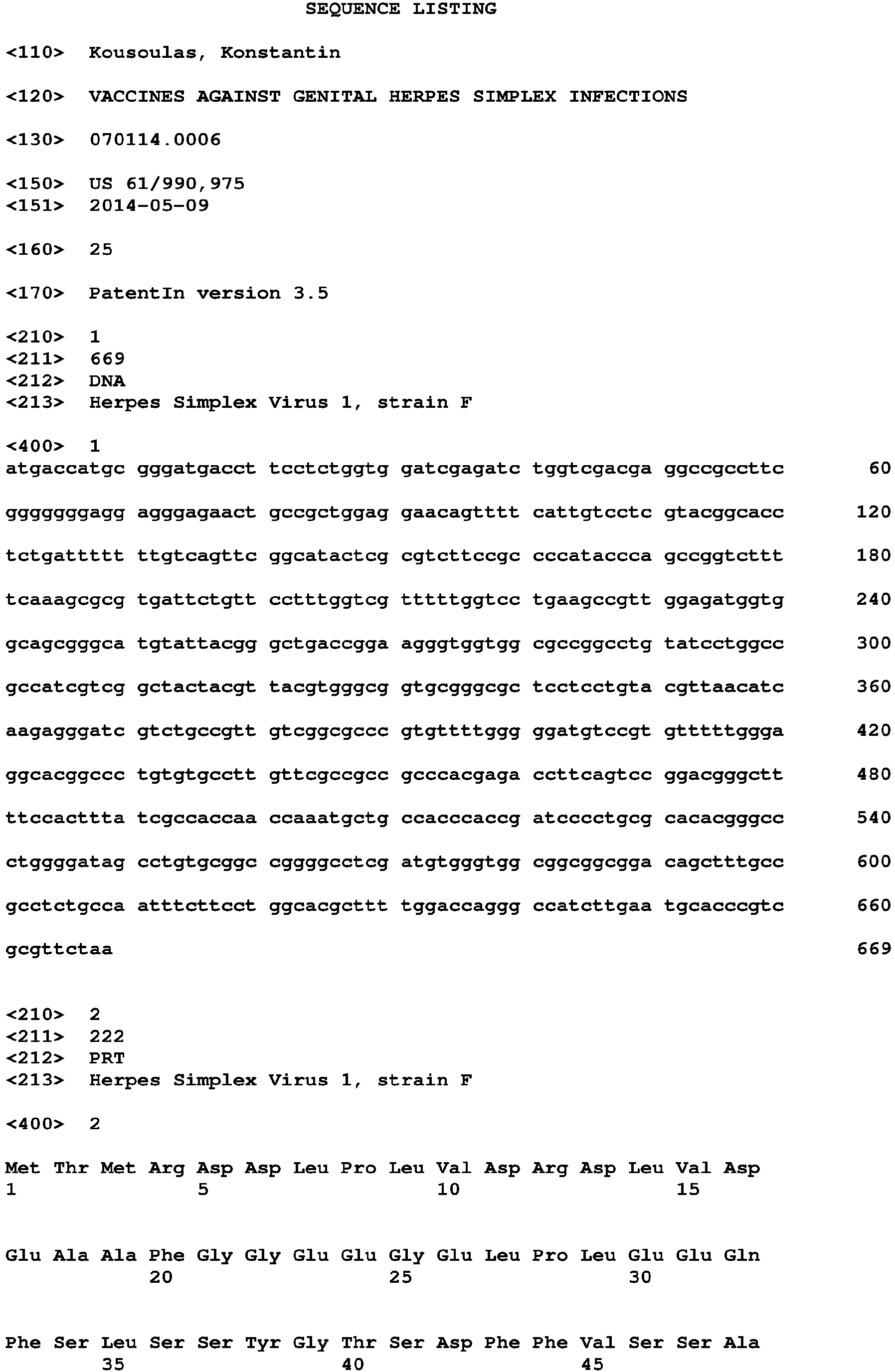


Claims (15)
- A recombinant herpes simplex virus (HSV), wherein the recombinant HSV comprises a recombinant HSV genome comprising:(a) at least one modification in the UL53 gene;(b) at least one modification in the UL20 gene; and(c) a gene encoding a foreign antigen;wherein the recombinant HSV is capable of replication in a host cell and incapable of entry into axonal compartments of neurons.
- The recombinant HSV of claim 1, wherein the foreign antigen is a protein antigen from a viral or bacterial pathogen of the host cell.
- The recombinant HSV of claim 1 or 2, wherein the foreign antigen is capable of eliciting an immune response in a host cell against a mucosally transmitted pathogen.
- The recombinant HSV of claim 3, wherein the mucosally transmitted pathogen is a pathogenic virus or a pathogenic bacterium.
- The recombinant HSV of claim 3 or 4, wherein the mucosally transmitted pathogen is human immunodeficiency virus infection (HIV) or Chlamydia trachomatis.
- The recombinant HSV of any one of claims 2-4, wherein the viral pathogen is not HSV.
- The recombinant HSV of any one of claims 1-6 wherein the recombinant HSV genome is derived from the genome of HSV-1 or HSV-2, wherein the HSV-1 is preferably HSV-1 strain F.
- The recombinant HSV of any one of claims 1-7, wherein (i) the modified UL53 gene comprises a deletion corresponding to the region of the UL53 gene that encodes amino acids 31-68 of wild-type gK and (ii) the modified UL20 gene comprising a deletion corresponding to the region of the UL20 gene that encodes amino acids 4-22 of wild-type UL20 protein.
- The recombinant HSV of any one of claims 1-8, wherein the recombinant HSV is a live virus.
- The recombinant HSV of any one of claims 1-8, wherein the recombinant HSV is an inactivated virus.
- A genome of a recombinant HSV according to any one of claims 1-10.
- A vaccine comprising a recombinant HSV of any one of claims 1-10 or a recombinant genome of claim 11.
- The vaccine of claim 12, further comprising a pharmaceutically acceptable component selected from the group consisting of a carrier, an excipient, a stabilizing agent, a preservative, an immunostimulant, and an adjuvant.
- A method for producing a vaccine, the method comprising:(a) transfecting a host cell with a recombinant HSV genome of claim 11;(b) incubating the transfected host cell under conditions favorable for the formation of a recombinant HSV virus comprising the recombinant HSV genome;(c) purifying the recombinant HSV virus comprising the recombinant HSV genome; and optionally(d) combining the purified recombinant HSV virus with at least one pharmaceutically acceptable component.
- A method for producing a recombinant HSV, the method comprising:(a) transfecting a host cell with the recombinant HSV genome of claim 11; and(b) incubating the transfected host cell under conditions favorable for the formation of a recombinant HSV virus comprising the recombinant HSV genome, whereby a recombinant HSV is produced.
Applications Claiming Priority (3)
| Application Number | Priority Date | Filing Date | Title |
|---|---|---|---|
| US201461990975P | 2014-05-09 | 2014-05-09 | |
| EP15789628.3A EP3139745B8 (en) | 2014-05-09 | 2015-05-08 | Vaccines against genital herpes simplex infections |
| PCT/US2015/029905 WO2015172033A1 (en) | 2014-05-09 | 2015-05-08 | Vaccines against genital herpes simplex infections |
Related Parent Applications (2)
| Application Number | Title | Priority Date | Filing Date |
|---|---|---|---|
| EP15789628.3A Division-Into EP3139745B8 (en) | 2014-05-09 | 2015-05-08 | Vaccines against genital herpes simplex infections |
| EP15789628.3A Division EP3139745B8 (en) | 2014-05-09 | 2015-05-08 | Vaccines against genital herpes simplex infections |
Publications (1)
| Publication Number | Publication Date |
|---|---|
| EP3753573A1 true EP3753573A1 (en) | 2020-12-23 |
Family
ID=54393049
Family Applications (2)
| Application Number | Title | Priority Date | Filing Date |
|---|---|---|---|
| EP20184563.3A Pending EP3753573A1 (en) | 2014-05-09 | 2015-05-08 | Vaccines against genital herpes simplex infections |
| EP15789628.3A Active EP3139745B8 (en) | 2014-05-09 | 2015-05-08 | Vaccines against genital herpes simplex infections |
Family Applications After (1)
| Application Number | Title | Priority Date | Filing Date |
|---|---|---|---|
| EP15789628.3A Active EP3139745B8 (en) | 2014-05-09 | 2015-05-08 | Vaccines against genital herpes simplex infections |
Country Status (6)
| Country | Link |
|---|---|
| US (4) | US10130703B2 (en) |
| EP (2) | EP3753573A1 (en) |
| CA (1) | CA2948491C (en) |
| DK (1) | DK3139745T3 (en) |
| ES (1) | ES2819548T3 (en) |
| WO (1) | WO2015172033A1 (en) |
Families Citing this family (3)
| Publication number | Priority date | Publication date | Assignee | Title |
|---|---|---|---|---|
| US10328147B2 (en) * | 2017-03-24 | 2019-06-25 | Board Of Supervisors Of Louisiana State University And Agricultural And Mechanical College | Herpes simplex virus type-1(HSV-1) vaccine strain VC2 generating an anti-EHV-1 immune response |
| WO2020014013A1 (en) * | 2018-07-09 | 2020-01-16 | Board Of Supervisors Of Louisiana State University And Agricultural And Mechanical College | Viral-vectored vaccine for malaria |
| EP3829608B1 (en) | 2018-08-01 | 2024-01-10 | Board of Supervisors of Louisiana State University and Agricultural and Mechanical College | Compositions comprising herpes simplex virus-1 for use in methods of treating and preventing cancer |
Citations (9)
| Publication number | Priority date | Publication date | Assignee | Title |
|---|---|---|---|---|
| US4873192A (en) | 1987-02-17 | 1989-10-10 | The United States Of America As Represented By The Department Of Health And Human Services | Process for site specific mutagenesis without phenotypic selection |
| WO1992013943A1 (en) * | 1991-01-31 | 1992-08-20 | Smithkline Beecham Biologicals S.A. | Herpes simplex virus-1 deletion variants and vaccines thereof |
| US5605793A (en) | 1994-02-17 | 1997-02-25 | Affymax Technologies N.V. | Methods for in vitro recombination |
| US5837458A (en) | 1994-02-17 | 1998-11-17 | Maxygen, Inc. | Methods and compositions for cellular and metabolic engineering |
| WO1999036087A1 (en) * | 1998-01-20 | 1999-07-22 | Aurx, Inc. | Novel vaccine compositions for herpes simplex virus |
| US7374768B1 (en) * | 1990-09-25 | 2008-05-20 | Xenova Research Limited | Viral vaccines |
| WO2008141151A2 (en) * | 2007-05-09 | 2008-11-20 | Board Of Supervisors Of Louisiana State University And Agricultural And Mechanical College | Synthetic herpes simplex viruses type-1 for treatment of cancers |
| US20130202639A1 (en) | 2010-03-25 | 2013-08-08 | Konstantin G. Kousoulas | Synthetic Herpes Simplex Viruses for Treatment of Cancers |
| WO2013177172A2 (en) * | 2012-05-21 | 2013-11-28 | Sanofi Pasteur Limited | Herpesvirus compositions and related methods |
-
2015
- 2015-05-08 CA CA2948491A patent/CA2948491C/en active Active
- 2015-05-08 ES ES15789628T patent/ES2819548T3/en active Active
- 2015-05-08 WO PCT/US2015/029905 patent/WO2015172033A1/en not_active Ceased
- 2015-05-08 US US15/310,004 patent/US10130703B2/en active Active
- 2015-05-08 DK DK15789628.3T patent/DK3139745T3/en active
- 2015-05-08 EP EP20184563.3A patent/EP3753573A1/en active Pending
- 2015-05-08 EP EP15789628.3A patent/EP3139745B8/en active Active
-
2018
- 2018-10-01 US US16/148,414 patent/US10596253B2/en active Active
-
2020
- 2020-02-07 US US16/784,665 patent/US11229697B2/en active Active
-
2021
- 2021-12-14 US US17/550,272 patent/US20220241401A1/en not_active Abandoned
Patent Citations (10)
| Publication number | Priority date | Publication date | Assignee | Title |
|---|---|---|---|---|
| US4873192A (en) | 1987-02-17 | 1989-10-10 | The United States Of America As Represented By The Department Of Health And Human Services | Process for site specific mutagenesis without phenotypic selection |
| US7374768B1 (en) * | 1990-09-25 | 2008-05-20 | Xenova Research Limited | Viral vaccines |
| WO1992013943A1 (en) * | 1991-01-31 | 1992-08-20 | Smithkline Beecham Biologicals S.A. | Herpes simplex virus-1 deletion variants and vaccines thereof |
| US5605793A (en) | 1994-02-17 | 1997-02-25 | Affymax Technologies N.V. | Methods for in vitro recombination |
| US5837458A (en) | 1994-02-17 | 1998-11-17 | Maxygen, Inc. | Methods and compositions for cellular and metabolic engineering |
| WO1999036087A1 (en) * | 1998-01-20 | 1999-07-22 | Aurx, Inc. | Novel vaccine compositions for herpes simplex virus |
| WO2008141151A2 (en) * | 2007-05-09 | 2008-11-20 | Board Of Supervisors Of Louisiana State University And Agricultural And Mechanical College | Synthetic herpes simplex viruses type-1 for treatment of cancers |
| US20100297085A1 (en) | 2007-05-09 | 2010-11-25 | Kousoulas Konstantin G | Synthetic Herpes Simplex Viruses Type-1 for Treatment of Cancers |
| US20130202639A1 (en) | 2010-03-25 | 2013-08-08 | Konstantin G. Kousoulas | Synthetic Herpes Simplex Viruses for Treatment of Cancers |
| WO2013177172A2 (en) * | 2012-05-21 | 2013-11-28 | Sanofi Pasteur Limited | Herpesvirus compositions and related methods |
Non-Patent Citations (96)
| Title |
|---|
| "PCR Methods Manual", 1999, ACADEMIC PRESS |
| "PCR Strategies", 1995, ACADEMIC PRESS |
| "Techniques in Molecular Biology", 1983, MACMILLAN PUBLISHING COMPANY |
| AKHRAMEYEVA ET AL., J. VIROL, vol. 85, 2011, pages 5036 - 5047 |
| ALLEN ET AL., INVEST. OPHTHALMOL. VIS. SCI., 2014, pages 55 - 2442,2451 |
| ALLEN ET AL., VIROLOGY, vol. 399, 2010, pages 11 - 22 |
| ALTSCHUL ET AL., J. MOL. BIOL., vol. 215, 1990, pages 403 |
| ALTSCHUL ET AL., NUCLEIC ACIDS RES., vol. 25, 1997, pages 3389 |
| ANURADHA ET AL., INDIAN J. DERMATOL. VENEREOL. LEPROL., vol. 74, 2008, pages 230 - 233 |
| AUGUSTINOVA ET AL., J. VIROL, vol. 78, 2004, pages 13262 - 13277 |
| AWASTHI ET AL., J. VIROL, vol. 86, 2012, pages 4586 - 4598 |
| AWASTHIFRIEDMAN, J. INFECT. DIS., vol. 209, 2014, pages 813 - 815 |
| BELSHE ET AL., N. ENGL. J. MED., vol. 366, 2012, pages 34 - 43 |
| BLANKHAINES, J. INVEST. DERMATOL., vol. 61, 1973, pages 223 - 225 |
| BRADLEY ET AL., J. INFECT. DIS., vol. 209, 2013, pages 325 - 333 |
| BRANS ET AL., J. INVEST. DERMATOL., vol. 129, 2009, pages 2470 - 2479 |
| BRANSYAO, BMC MICROBIOL., vol. 10, 2010, pages 163 |
| BRENT STANFIELD: "Vaccination with the HSV-1 Attenuated Virus VC2 Protects Mice against Lethal Challenge with Virulen HSV-1 and HSV-2 Strains (ID09)", 2013 SOUTHEAST REGIONAL IDEA MEETING, 17 November 2013 (2013-11-17), pages 51, XP055409749, Retrieved from the Internet <URL:http://se13idea.uams.edu/Proceedings (final 4).pdf> [retrieved on 20170925] * |
| BROWN ET AL., AIDS, vol. 21, 2007, pages 1515 - 1523 |
| CHENTOUFI ET AL., J. VIROL, vol. 82, 2008, pages 11792 - 11802 |
| CHOULJENKO ET AL., J. VIROL, vol. 83, 2009, pages 12301 - 12313 |
| CHOULJENKO ET AL., J. VIROL, vol. 84, 2010, pages 8596 - 8606 |
| CHOWDHURY ET AL., J. VIROL, vol. 87, 2013, pages 3305 - 3313 |
| COLEMANSHUKLA, HUM. VACCIN. IMMUNOTHER., vol. 9, 2013, pages 729 - 735 |
| COOK ET AL., INVEST. OPHTHALMOL. VIS. SCI., vol. 32, 1991, pages 1558 - 1561 |
| CRAMERI ET AL., NATURE BIOTECH., vol. 15, 1997, pages 436 - 438 |
| CRAMERI ET AL., NATURE, vol. 391, 1998, pages 288 - 291 |
| DA COSTA ET AL., VIROLOGY, vol. 288, 2001, pages 256 - 263 |
| DANNY J SCHUST ET AL: "Mucosal co-infections and HIV-1 transmission and pathogenesis Mucosal Barriers to Pathogen Transmission", CURR HIV RES., 1 April 2012 (2012-04-01), pages 195 - 201, XP055744980, Retrieved from the Internet <URL:https://www.ncbi.nlm.nih.gov/pmc/articles/PMC3914145/pdf/nihms534760.pdf> [retrieved on 20201029] * |
| DAVID ET AL., CURR. EYE RES., vol. 33, 2008, pages 455 - 467 |
| DAVID ET AL., MBIO, vol. 3, 2012, pages e00144 - 00112 |
| DAYHOFF ET AL.: "Atlas of Protein Sequence and Structure", 1978, NATL. BIOMED. RES. FOUND. |
| DERVILLEZ ET AL., FUTURE VIROL., vol. 7, 2012, pages 371 - 378 |
| DOLAN ET AL., J. VIROL, vol. 72, 1998, pages 2010 - 2021 |
| DROPULICCOHEN, EXPERT REV. VACCINES, vol. 11, 2012, pages 1429 - 1440 |
| DUDEK ET AL., VIROLOGY, vol. 372, 2008, pages 165 - 175 |
| DUDLEY ET AL., VIROLOGY, vol. 270, 2000, pages 454 - 463 |
| FOSTER TIMOTHY P ET AL: "Functional and physical interactions of the herpes simplex virus type 1 UL20 membrane protein with glycoprotein K", JOURNAL OF VIROLOGY, THE AMERICAN SOCIETY FOR MICROBIOLOGY, US, vol. 82, no. 13, 1 July 2008 (2008-07-01), pages 6310 - 6323, XP002587598, ISSN: 0022-538X, DOI: 10.1128/JVI.00147-08 * |
| FREEMAN ET AL., AIDS, vol. 20, 2006, pages 73 - 83 |
| FREEMAN ET AL., VACCINE, vol. 27, 2009, pages 940 - 946 |
| GHIASI H ET AL., VIRUS RES., vol. 68, 2000, pages 137 - 144 |
| GOTTLIEB ET AL., VACCINE, vol. 32, 2014, pages 1527 - 1535 |
| HALFORD ET AL., PLOS ONE, vol. 6, 2011, pages el7748 |
| HARRINGTON ET AL., CLIN. CANCER RES., vol. 16, 2010, pages 4005 - 4015 |
| HIRT, J. MOL. BIOL., vol. 26, 1967, pages 365 - 369 |
| HOFSTETTER ET AL., CURR. OPIN. INFECT. DIS., vol. 27, 2014, pages 75 - 83 |
| HOSHINO ET AL., VACCINE, vol. 26, 2008, pages 4034 - 4040 |
| IYER ET AL., VIROL. J., vol. 10, 2013, pages 317 |
| J. M. MELANCON ET AL: "Genetic Analysis of the Herpes Simplex Virus Type 1 UL20 Protein Domains Involved in Cytoplasmic Virion Envelopment and Virus-Induced Cell Fusion", JOURNAL OF VIROLOGY., vol. 78, no. 14, 15 July 2004 (2004-07-15), US, pages 7329 - 7343, XP055409901, ISSN: 0022-538X, DOI: 10.1128/JVI.78.14.7329-7343.2004 * |
| JARVIUS ET AL., MOL. CELL. PROTEOMICS, vol. 6, 2007, pages 1500 - 1509 |
| KARLINALTSCHUL, PROC. NATL. ACAD. SCI. USA, vol. 87, 1990, pages 2264 |
| KARLINALTSCHUL, PROC. NATL. ACAD. SCI. USA, vol. 90, 1993, pages 5873 - 5877 |
| KIM ET AL., J. VIROL., vol. 87, 2013, pages 8029 - 8037 |
| KOELLE ET AL., J. CLIN. INVEST., vol. 101, 1998, pages 1500 - 1508 |
| KOELLECOREY, CLIN. MICROBIOL. REV., vol. 16, 2003, pages 96 - 113 |
| KOUSOULAS ET AL., VIROLOGY, vol. 166, 1988, pages 423 - 431 |
| KUNKEL ET AL., METHODS IN ENZYMOL., vol. 154, 1987, pages 367 - 382 |
| KUNKEL, PROC. NATL. ACAD. SCI. USA, vol. 82, 1985, pages 488 - 492 |
| LI ET AL., PNAS, vol. 108, 2011, pages 4388 - 4393 |
| MERTZ, J. INFECT. DIS., vol. 198, 2008, pages 1098 - 1100 |
| MILLIGAN ET AL., J. IMMUNOL., vol. 160, 1998, pages 6093 - 6100 |
| MOORE ET AL., J. MOL. BIOL., vol. 272, 1997, pages 336 - 347 |
| MORRISON ET AL., J. VIROL, vol. 75, 2001, pages 1195 - 1204 |
| MOTT ET AL., INVEST. OPHTHALMOL. VIS. SCI., vol. 50, 2009, pages 2903 - 2912 |
| MOTT ET AL., J. VIROL, vol. 81, 2007, pages 12962 - 12972 |
| MUGO ET AL., SEX. TRANSM. DIS., vol. 38, 2011, pages 1059 - 1066 |
| MURPHY ET AL., J. VIROL, vol. 74, 2000, pages 7745 - 7754 |
| MYERSMILLER, CABIOS, vol. 4, 1988, pages 11 - 17 |
| N. JAMBUNATHAN ET AL: "Site-Specific Proteolytic Cleavage of the Amino Terminus of Herpes Simplex Virus Glycoprotein K on Virion Particles Inhibits Virus Entry", JOURNAL OF VIROLOGY., vol. 85, no. 24, 15 December 2011 (2011-12-15), US, pages 12910 - 12918, XP055409910, ISSN: 0022-538X, DOI: 10.1128/JVI.06268-11 * |
| PEREIRA ET AL., INFECT. IMMUN., vol. 29, 1980, pages 724 - 732 |
| PRICHARD ET AL., VACCINE, vol. 23, 2005, pages 5424 - 5431 |
| RENZI ET AL., J. INFECT DIS., vol. 187, 2003, pages 19 - 25 |
| REYNOLDS ET AL., J. INFECT. DIS., vol. 187, 2003, pages 1513 - 1521 |
| ROBERTS ET AL., SEX. TRANSM. DIS., vol. 30, 2003, pages 797 - 800 |
| ROTH ET AL., MICROB. PATHOG., vol. 58, 2012, pages 45 - 54 |
| RUPPBERNSTEIN, EXPERT. OPIN. EMERG. DRUGS, vol. 13, 2008, pages 41 - 52 |
| SAIED ET AL., CURR. EYE RES., vol. 39, 2014, pages 1169 - 603 |
| SAIED ET AL: "A replication competent HSV-1(McKrae) with a mutation in the amino-terminus of glycoprotein K (gK) is unable to infect mouse trigeminal ganglia after cornea infection", CURRENT EYE RESEARCH, INFORMA HEALTHCARE USA, US, vol. 39, no. 6, 1 January 2014 (2014-01-01), pages 596 - 603, XP008185311, ISSN: 0271-3683, [retrieved on 20140108], DOI: 10.3109/02713683.2013.855238 * |
| SAMBROOK ET AL.: "Molecular Cloning: A Laboratory Manual", 1989, COLD SPRING HARBOR LABORATORY PRESS |
| SARTORI ET AL., VIROL. J., vol. 8, 2011, pages 166 |
| SCHIFFERCOREY, NAT. MED., vol. 19, 2013, pages 280 - 290 |
| SEPPANEN ET AL., J. INFECT. DIS., vol. 194, 2006, pages 571 - 578 |
| SHINIWASAKI, NATURE, vol. 491, 2012, pages 463 - 467 |
| SODERBERG ET AL., METHODS, vol. 45, 2008, pages 227 - 232 |
| SODERBERG ET AL., NAT. METHODS, vol. 3, 2006, pages 995 - 1000 |
| ST. LEGERHENDRICKS, J. NEUROVIROL., vol. 17, 2011, pages 528 - 534 |
| STEMMER, NATURE, vol. 370, 1994, pages 389 - 391 |
| STEMMER, PROC. NATL. ACAD. SCI. USA, vol. 91, 1994, pages 10747 - 10751 |
| TANAKA ET AL., J. VIROL, vol. 77, 2003, pages 1382 - 1391 |
| TISCHER ET AL., BIOTECHNIQUES, vol. 40, 2006, pages 191 - 197 |
| TRONSTEIN ET AL., JAMA, vol. 305, 2011, pages 1441 - 1449 |
| WAKIM ET AL., IMMUNOL. CELL BIOL., vol. 86, 2008, pages 666 - 675 |
| WATANABE ET AL., VIROLOGY, vol. 357, 2007, pages 186 - 198 |
| ZHANG ET AL., PROC. NATL. ACAD. SCI. USA, vol. 94, 1997, pages 4504 - 4509 |
| ZHU ET AL., J. EXP. MED., vol. 204, 2007, pages 595 - 603 |
| ZHU ET AL., VIRUSES, vol. 6, 2014, pages 371 - 390 |
Also Published As
| Publication number | Publication date |
|---|---|
| US10130703B2 (en) | 2018-11-20 |
| ES2819548T3 (en) | 2021-04-16 |
| US20220241401A1 (en) | 2022-08-04 |
| US11229697B2 (en) | 2022-01-25 |
| EP3139745B8 (en) | 2020-08-26 |
| EP3139745B1 (en) | 2020-07-08 |
| CA2948491C (en) | 2024-01-16 |
| EP3139745A4 (en) | 2017-11-08 |
| DK3139745T3 (en) | 2020-09-28 |
| CA2948491A1 (en) | 2015-11-12 |
| EP3139745A1 (en) | 2017-03-15 |
| US20190091327A1 (en) | 2019-03-28 |
| US10596253B2 (en) | 2020-03-24 |
| WO2015172033A1 (en) | 2015-11-12 |
| US20170266275A1 (en) | 2017-09-21 |
| US20200345836A1 (en) | 2020-11-05 |
Similar Documents
| Publication | Publication Date | Title |
|---|---|---|
| Stanfield et al. | A single intramuscular vaccination of mice with the HSV-1 VC2 virus with mutations in the glycoprotein K and the membrane protein UL20 confers full protection against lethal intravaginal challenge with virulent HSV-1 and HSV-2 strains | |
| US8501194B2 (en) | Vaccine for viruses that cause persistent or latent infections | |
| CA2674051C (en) | Herpes simplex virus combined subunit vaccines and methods of use thereof | |
| RU2670012C1 (en) | Conditionally replicating cytomegalovirus as vaccine against cmv | |
| US20220241401A1 (en) | Vaccines against genital herpes simplex infections | |
| JPH08507784A (en) | Virus vaccine | |
| AU742281B2 (en) | Vaccine composition for herpes simplex virus and methods of using | |
| WO2014043189A1 (en) | Conditionally replication deficient herpes viruses and use thereof in vaccines | |
| JP2015144619A (en) | Herpes simplex virus vaccines | |
| KR20110053340A (en) | Vaccines against HPP | |
| Diaz et al. | Intramuscular delivery of replication-defective herpes simplex virus gives antigen expression in muscle syncytia and improved protection against pathogenic HSV-2 strains | |
| US5837261A (en) | Viral vaccines | |
| US7141243B2 (en) | gM-negative EHV-mutants without heterologous elements | |
| US10034935B2 (en) | Neuroattenuated herpes simplex virus | |
| US10328147B2 (en) | Herpes simplex virus type-1(HSV-1) vaccine strain VC2 generating an anti-EHV-1 immune response | |
| IL298288B1 (en) | Methods of using hsv-2 single cycle virus delta-gd and hsv-2 recombinant glycoprotein d | |
| US20240123059A1 (en) | Kaposi's Sarcoma Associated Herpesvirus Vaccine and Methods of Making and Using Thereof | |
| US20250312441A1 (en) | Immunogenic compositions for herpes simplex virus proteins | |
| Ritchie et al. | Passive transfer of anti-herpes simplex virus type 2 monoclonal and polyclonal antibodies protect against herpes simplex virus type 1-induced but not herpes simplex virus type 2-induced stromal keratitis. | |
| Smith et al. | NON-NEUROINVASIVEVIRUSESAND USES THEREOF | |
| JP2025541824A (en) | Polynucleotide constructs and uses thereof | |
| Ďurmanová et al. | Herpes Simplex Virus 1 and 2 Vaccine Design: What can | |
| Halford | Genital herpes meets its match: A live HSV-2 ICP0-virus vaccine that succeeds where subunit vaccines have failed | |
| Zumbrun et al. | An Attenuated HSV-1 Live Virus Vaccine Candidate that is Replication Competent but Defective in Epithelial Cell-to-Cell and Neuronal Spread |
Legal Events
| Date | Code | Title | Description |
|---|---|---|---|
| PUAI | Public reference made under article 153(3) epc to a published international application that has entered the european phase |
Free format text: ORIGINAL CODE: 0009012 |
|
| STAA | Information on the status of an ep patent application or granted ep patent |
Free format text: STATUS: THE APPLICATION HAS BEEN PUBLISHED |
|
| AC | Divisional application: reference to earlier application |
Ref document number: 3139745 Country of ref document: EP Kind code of ref document: P |
|
| AK | Designated contracting states |
Kind code of ref document: A1 Designated state(s): AL AT BE BG CH CY CZ DE DK EE ES FI FR GB GR HR HU IE IS IT LI LT LU LV MC MK MT NL NO PL PT RO RS SE SI SK SM TR |
|
| STAA | Information on the status of an ep patent application or granted ep patent |
Free format text: STATUS: REQUEST FOR EXAMINATION WAS MADE |
|
| 17P | Request for examination filed |
Effective date: 20210615 |
|
| RBV | Designated contracting states (corrected) |
Designated state(s): AL AT BE BG CH CY CZ DE DK EE ES FI FR GB GR HR HU IE IS IT LI LT LU LV MC MK MT NL NO PL PT RO RS SE SI SK SM TR |
|
| STAA | Information on the status of an ep patent application or granted ep patent |
Free format text: STATUS: EXAMINATION IS IN PROGRESS |
|
| 17Q | First examination report despatched |
Effective date: 20220811 |