EP3751816A1 - Ims routing based on subscriber type - Google Patents
Ims routing based on subscriber type Download PDFInfo
- Publication number
- EP3751816A1 EP3751816A1 EP20177266.2A EP20177266A EP3751816A1 EP 3751816 A1 EP3751816 A1 EP 3751816A1 EP 20177266 A EP20177266 A EP 20177266A EP 3751816 A1 EP3751816 A1 EP 3751816A1
- Authority
- EP
- European Patent Office
- Prior art keywords
- cscf
- subscriber type
- message
- subscriber
- ims
- Prior art date
- Legal status (The legal status is an assumption and is not a legal conclusion. Google has not performed a legal analysis and makes no representation as to the accuracy of the status listed.)
- Withdrawn
Links
Images




Classifications
-
- H—ELECTRICITY
- H04—ELECTRIC COMMUNICATION TECHNIQUE
- H04L—TRANSMISSION OF DIGITAL INFORMATION, e.g. TELEGRAPHIC COMMUNICATION
- H04L65/00—Network arrangements, protocols or services for supporting real-time applications in data packet communication
- H04L65/1066—Session management
- H04L65/1069—Session establishment or de-establishment
-
- H—ELECTRICITY
- H04—ELECTRIC COMMUNICATION TECHNIQUE
- H04L—TRANSMISSION OF DIGITAL INFORMATION, e.g. TELEGRAPHIC COMMUNICATION
- H04L61/00—Network arrangements, protocols or services for addressing or naming
- H04L61/50—Address allocation
- H04L61/5007—Internet protocol [IP] addresses
- H04L61/503—Internet protocol [IP] addresses using an authentication, authorisation and accounting [AAA] protocol, e.g. remote authentication dial-in user service [RADIUS] or Diameter
-
- H—ELECTRICITY
- H04—ELECTRIC COMMUNICATION TECHNIQUE
- H04L—TRANSMISSION OF DIGITAL INFORMATION, e.g. TELEGRAPHIC COMMUNICATION
- H04L65/00—Network arrangements, protocols or services for supporting real-time applications in data packet communication
-
- H—ELECTRICITY
- H04—ELECTRIC COMMUNICATION TECHNIQUE
- H04L—TRANSMISSION OF DIGITAL INFORMATION, e.g. TELEGRAPHIC COMMUNICATION
- H04L65/00—Network arrangements, protocols or services for supporting real-time applications in data packet communication
- H04L65/10—Architectures or entities
- H04L65/1016—IP multimedia subsystem [IMS]
-
- H—ELECTRICITY
- H04—ELECTRIC COMMUNICATION TECHNIQUE
- H04L—TRANSMISSION OF DIGITAL INFORMATION, e.g. TELEGRAPHIC COMMUNICATION
- H04L65/00—Network arrangements, protocols or services for supporting real-time applications in data packet communication
- H04L65/1066—Session management
- H04L65/1073—Registration or de-registration
-
- H—ELECTRICITY
- H04—ELECTRIC COMMUNICATION TECHNIQUE
- H04L—TRANSMISSION OF DIGITAL INFORMATION, e.g. TELEGRAPHIC COMMUNICATION
- H04L65/00—Network arrangements, protocols or services for supporting real-time applications in data packet communication
- H04L65/1066—Session management
- H04L65/1101—Session protocols
- H04L65/1104—Session initiation protocol [SIP]
-
- H—ELECTRICITY
- H04—ELECTRIC COMMUNICATION TECHNIQUE
- H04M—TELEPHONIC COMMUNICATION
- H04M15/00—Arrangements for metering, time-control or time indication ; Metering, charging or billing arrangements for voice wireline or wireless communications, e.g. VoIP
- H04M15/66—Policy and charging system
-
- H—ELECTRICITY
- H04—ELECTRIC COMMUNICATION TECHNIQUE
- H04W—WIRELESS COMMUNICATION NETWORKS
- H04W8/00—Network data management
- H04W8/02—Processing of mobility data, e.g. registration information at HLR [Home Location Register] or VLR [Visitor Location Register]; Transfer of mobility data, e.g. between HLR, VLR or external networks
- H04W8/04—Registration at HLR or HSS [Home Subscriber Server]
Definitions
- a telecommunication network can include an IP Multimedia Subsystem (IMS) that can manage communication sessions for mobile phones and other user equipment (UE).
- IMS IP Multimedia Subsystem
- UE user equipment
- IMS IP Multimedia Subsystem
- elements that set up communication sessions for a UE and that provide services during such communication sessions, such as services for voice calls, video calls, or messaging.
- An IMS registration process can occur when a UE attaches to the telecommunication network.
- the UE can attach to, and/or be assigned to, various IMS elements.
- the IMS elements can handle message routing, provide services, or otherwise assist with communication sessions for the UE.
- a telecommunication network can include an IP Multimedia Subsystem (IMS).
- IMS IP Multimedia Subsystem
- An IMS can set up and manage communication sessions for user equipment (UE), such as sessions for voice calls, video calls, or other types of communications.
- UE user equipment
- An IMS can have Call Session Control Functions (CSCFs) that can register UEs with the IMS and manage communication sessions.
- CSCFs Call Session Control Functions
- the IMS can also have application servers that provide services for the communication sessions, such as services for voice calls, video calls, or other types of communications.
- the IMS can have a telephony application server (TAS) that provides telephony services, such as services for voice and/or video calls.
- TAS telephony application server
- an IMS registration process can occur.
- the UE can send a registration message to a Proxy CSCF (P-CSCF) in the IMS.
- P-CSCF Proxy CSCF
- the P-CSCF can forward the registration message to an Interrogating CSCF (I-CSCF), which can assign the UE to a particular Serving CSCF (S-CSCF).
- I-CSCF Interrogating CSCF
- S-CSCF Serving CSCF
- the S-CSCF can authenticate the UE to complete the UE's registration with the IMS.
- the S-CSCF can also send third party registration messages about the UE to one or more application servers, and the application servers can, in response, provide services for the UE's communication sessions.
- the P-CSCF can also request that a Policy and Charging Rules Function (PCRF) provide a core network with provide Policy and Charging Control (PCC) rules associated with the communication sessions for the UE.
- PCC rules can define how data packets associated with the communication sessions for the UE should be handled, or how a subscriber account associated with the UE should be charged.
- network elements such as S-CSCFs, application servers, or PCRFs are configured to help set up and/or manage communication sessions for any UE.
- an operator of a telecommunication network may want to carve out or reserve certain network elements specifically for UEs associated with particular types of subscribers. For example, the network operator may want to group or partition network elements into different realms or domains that are specific to particular subscriber types.
- a mobile network operator that owns and operates a telecommunication network and provides services to its own subscribers may also grant a mobile virtual network operator (MVNO) access to the MNO's telecommunication network.
- MNO mobile network operator
- MVNO mobile virtual network operator
- This arrangement can allow the MVNO's subscribers to also receive services through the MNO's telecommunication network.
- MNO-MVNO relationships the same network elements often handle communication sessions for both MNO subscribers and MVNO subscribers.
- the MNO may want to carve out a subset of the telecommunication network's elements into a designated realm to handle communication sessions just for MNO subscribers.
- an MNO may want to carve out network elements for other types of subscribers. For instance, an MNO may want to carve out one set of network elements for subscribers that have access to Long-Term Evolution (LTE) services and another set of network elements for subscribers that have access to 5G services, or carve out different sets of network elements for MNO subscribers that are on different MNO service plan types or tiers.
- LTE Long-Term Evolution
- CSCFs may be unable to determine a subscriber type associated with a UE during IMS registration. Accordingly, in such conventional systems CSCFs may not be able to identify subsets of network elements that are associated with a particular UE's subscriber type during IMS registration, and thus not be able to select or route messages to network elements that correspond to the UE's subscriber type.
- IMS elements Described herein are systems and processes that allow IMS elements to determine a subscriber type associated with a UE during IMS registration. The IMS elements can then use that subscriber type to identify and select other network elements that are specifically associated with that subscriber type, and to route messages associated with the UE to network elements that are specifically associated with the UE's subscriber type.
- FIG. 1 depicts an example network environment in which user equipment (UE) 102 can connect to a telecommunication network to engage in communication sessions for voice calls, video calls, messaging, data transfers, or any other type of communication.
- UE 102 can be any device that can wirelessly connect to the telecommunication network.
- a UE 102 can be a mobile phone such as a smart phone or other cellular phone, a personal digital assistant (PDA), a personal computer (PC) such as a laptop, desktop, or workstation, a media player, a tablet, a gaming device, a smart watch, a hotspot, or any other type of computing or communication device.
- PDA personal digital assistant
- PC personal computer
- a UE 102 can connect to an access point 104, such as a base station, through which the UE 102 can access a core network 106 of the telecommunication network.
- the access point 104 and/or core network 106 can be compatible with one or more wireless access technologies, protocols, or standards.
- wireless access technologies can include fifth generation (5G) technology, Long Term Evolution (LTE)/LTE Advanced technology, other fourth generation (4G) technology, High-Speed Data Packet Access (HSDPA)/Evolved High-Speed Packet Access (HSPA+) technology, Universal Mobile Telecommunications System (UMTS) technology, Code Division Multiple Access (CDMA) technology, Global System for Mobile Communications (GSM) technology, WiMax® technology, WiFi® technology, and/or any other previous or future generation of wireless access technology.
- 5G Fifth Generation
- LTE Long Term Evolution
- 4G fourth generation
- HSDPA High-Speed Data Packet Access
- HSPA+ High-Speed Packet Access
- UMTS Universal Mobile Telecommunications System
- CDMA Code Division Multiple Access
- GSM Global System for Mobile Communications
- WiMax® technology Wireless Fidelity
- WiFi® Wireless Fidelity
- access points 104 can be part of a radio access network linked to the core network 106.
- an access point 104 can be a base station, such as an evolved Node B (eNB) in an LTE network or a gNB in a 5G network.
- eNB evolved Node B
- an access point 104 can be a Wi-Fi access point or other type of access point that can be connected to the core network 106 through the Internet or another type of connection.
- Gateways or other elements of the core network 106 can link the core network 106 to other networks, such as the Internet or an IP Multimedia Subsystem (IMS) 108.
- IMS IP Multimedia Subsystem
- An IMS 108 can set up and/or manage communication sessions for UEs 102 that are connected to the core network 106, such as sessions for voice calls, video calls, messaging, or other types of communications.
- An IMS 108 can include Call Session Control Functions (CSCFs) that can perform various operations including registering and authenticating UEs 102 with the IMS 108, routing messages, and managing communication sessions for UEs 102.
- CSCFs can include Proxy CSCFs (P-CSCFs) 110, Interrogating CSCFs (I-CSCFs) 112, and Serving CSCFs (S-CSCFs) 114.
- P-CSCFs Proxy CSCFs
- I-CSCFs Interrogating CSCFs
- S-CSCFs Serving CSCFs
- CSCF CSCF
- P-CSCF P-CSCF
- I-CSCF I-CSCF
- S-CSCF S-CSCF
- IMS nodes such as nodes of a 5G-specific IMS 108 that may or may not have different names but that are configured to perform the same or similar functions as described herein.
- Example architecture for a CSCF is illustrated in greater detail in FIG. 5 , and is described in detail below with reference to that figure.
- the IMS 108 can also include application servers 116. While CSCFs can set up and manage communication sessions, application servers 116 can provide services for those communication sessions.
- an application server 116 can be a telephony application server (TAS) that provides telephony services during a communication session, such as services for voice over LTE (VoLTE) calls or other voice calls, and/or video over LTE (ViLTE) calls or other video calls.
- application servers 116 can include a multimedia telephony application server (M-TAS), a rich messaging server (RMS), rich communication services (RCS) server, or other messaging server, a presence server, a notification server, or any other type of application server 116.
- M-TAS multimedia telephony application server
- RMS rich messaging server
- RCS rich communication services
- CSCFs in the IMS 108 can exchange data with each other, and/or with UEs 102 or application servers 116, using Session Initiation Protocol (SIP) messages.
- SIP Session Initiation Protocol
- CSCFs in the IMS 108 can also communicate with other types of network elements through Diameter protocol interfaces and/or Representational State Transfer (REST) Hypertext Transfer Protocol (HTTP) requests instead of SIP messages.
- REST Representational State Transfer
- HTTP Hypertext Transfer Protocol
- P-CSCFs 110 can be connected to Policy and Charging Rules Functions (PCRFs) 118 via Diameter protocol Rx interfaces and/or HTTP requests.
- PCRFs Policy and Charging Rules Functions
- a PCRF 118 can store and distribute Policy and Charging Control (PCC) rules that define how the core network 106 should treat data associated with communication session or how subscriber accounts should be charged.
- PCC Policy and Charging Control
- a PCRF 118 can provide PCC rules to a gateway of the core network 106 via a Diameter protocol Gx interface.
- a Policy Control Function (PCF) can be used in place of a PCRF 118, and a P-CSCF 110 can similarly reach a PCF via a Diameter protocol Rx interface or an HTTP request.
- PCF Policy Control Function
- PCRFs 118 can be used to provide PCC rules in LTE and other 4G networks, while PCFs can provide PCC rules in 5G networks.
- PCRF 118 can refer to a PCRF, a PCF, or any other similar element that can provide PCC rules.
- I-CSCFs 112 and S-CSCFs 114 can communicate with a Home Subscriber Server (HSS) 120 via Diameter protocol Cx interfaces or HTTP requests.
- HSS 120 can have, or be linked to, a user profile database 122 that stores user profiles 124.
- the user profiles 124 can contain information about users who may be associated with UEs 102, as discussed further below with respect to FIG. 2 .
- a Home Location Register HLR can take the place of the HSS 120 described herein, or be linked to an HSS 120, such that the HLR can also access the user profile database 122.
- HSS 120 can refer to an HSS, an HLR, a combined HSS/HLR, a 5G Unified Data Management (UDM) element and/or other 5G elements that can manage or access user profiles 124, or any other similar element that can access a user profile database 122 and communicate with I-CSCFs 112 and S-CSCFs 114.
- UDM Unified Data Management
- PCRFs 118 and/or the HSS 120 can be considered part of the core network 106. In other examples, PCRFs 118 and/or the HSS 120 can be considered part of the IMS 108 or be considered to be outside the core network 106 and the IMS 108.
- a P-CSCF 110 can be an entry point into the IMS 108 that routes SIP messages to and/or from UEs 102. For example, when a UE 102 is attached to the telecommunication networks, an IMS registration process can occur during which the UE 102 sends a SIP Register message to the P-CSCF 110. The P-CSCF 110 can then route the SIP Register message to an I-CSCF 112.
- a P-CSCF 110 can also use a Diameter protocol Rx interface or an HTTP request to communicate with a PCRF 118 about a communication session for a UE 102, such that the PCRF 118 can provide PCC rules for the communication session to a gateway of the core network 106 that is processing traffic for the UE 102.
- the PCC rules can define how the gateway should treat data associated with the communication session for the UE 102, for instance by identifying a Quality of Service (QoS) or a priority level associated with the communication session, or define how a subscriber account associated with the UE 102 should be charged.
- QoS Quality of Service
- priority level associated with the communication session
- An I-CSCF 112 can assign a UE 102 to a particular S-CSCF 114 during IMS registration, and/or route messages to or from an S-CSCF 114 when an S-CSCF 114 has already been assigned to the UE 102. For example, during IMS registration, an I-CSCF 112 can receive a SIP Register message associated with a UE 102 from a P-CSCF 110. The I-CSCF 112 can exchange messages with the HSS 120 over a Diameter protocol Cx interface or use HTTP requests to obtain data from a user profile 124 in the user profile database 122 that corresponds to the UE 102.
- the I-CSCF 112 can use the data from the user profile 124 to determine if an S-CSCF 114 has already been assigned to the UE 102, and if not can assign a new S-CSCF 114 to the UE 102. In some examples, the I-CSCF 112 can use the data from the user profile 124 when deciding which S-CSCF 114 to assign to the UE 102. The I-CSCF 112 can then forward the UE's SIP Register message to the assigned S-CSCF 114.
- An S-CSCF 114 can be a registrar for the IMS 108 that receives SIP Register messages that originated from UEs 102, and authenticates the UEs 102 to complete the UEs' IMS registrations. For example, during IMS registration for a UE 102, the S-CSCF 114 can exchange messages with the HSS 120 over a Diameter protocol Cx interface or use HTTP requests to obtain data from a user profile 124 in the user profile database 122 that corresponds to the UE 102. The S-CSCF 114 can then use that data from the user profile 124 to authenticate the UE 102.
- the S-CSCF 114 can also manage communication sessions for UEs 102, such as by sending or routing other types of SIP messages within the IMS 108. For example, during IMS registration for a UE 102, the S-CSCF 114 can send a third-party registration (TPR) message about the UE 102 to one or more application servers 116.
- TPR third-party registration
- a TPR message can be a separate SIP Register message.
- a TPR message can inform an application server 116 that a UE 102 has registered with the IMS 108 and is ready to receive services from the application server 116 during a communication session.
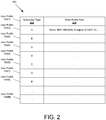
- FIG. 2 depicts an example of user profiles 124 stored in the user profile database 122.
- Each user profile 124 in the user profile database 122 can include information about users associated with UEs 102, such as subscribers to services that can be accessed via the IMS 108.
- a user profile 124 can indicate a particular subscriber type 202 associated with a user.
- Multiple predefined subscriber types 202 can be known to the telecommunication network.
- different values for the subscriber type 202 attribute in user profiles 124 can identify different types or classes of subscribers that may be associated with different classes of service, service levels, service plans, network operators, network generations, or other characteristics.
- the value of the subscriber type 202 in a user profile 124 for a particular user can indicate that the user has been categorized as a particular type of subscriber or is in a particular class of subscribers, distinct from other known types or classes of subscribers.
- a user profile's subscriber type 202 can identify a network operator associated with a user.
- a mobile network operator MNO
- MNO mobile network operator
- the MNO may own and/or operate the telecommunication network, including some or all parts of the IMS 108, and provide services to subscribers of the MNO via the telecommunication network.
- the MNO may also grant a mobile virtual network operator (MVNO) bulk access to the MNO's telecommunication network, such that the MVNO can provide services to the MVNO's own subscribers through the telecommunication network despite not owning or directly operating the telecommunication network.
- MVNO mobile virtual network operator
- one value for the subscriber type 202 may indicate that a user is a subscriber of the MNO, while another value for the subscriber type 202 may indicate that a user is a subscriber of a particular MVNO.
- a user profile's subscriber type 202 can identify a network generation associated with a user, such as a network generation associated with certain services available to the user or a network generation associated with certain subscription plans or tiers.
- a network generation associated with certain services available to the user or a network generation associated with certain subscription plans or tiers For example, an MNO or MVNO may offer some services to subscribers on an LTE plan and offer other services to subscribers on a 5G plan.
- one value for the subscriber type 202 may indicate that a user is an LTE subscriber or has access to LTE services, while another value for the subscriber type 202 may indicate that a user is a 5G subscriber or has access to 5G services.
- a user profile's subscriber type 202 can identify a subscription plan type or tier associated with a user.
- an MNO may offer a priority level subscription plan as well as standard subscription plans. Accordingly, in this example one value for the subscriber type 202 may indicate that a user is a subscriber to a priority level subscription plan, while another value for the subscriber type 202 may indicate that a user is a subscriber to a standard subscription plan.
- a user's particular subscriber type 202 can be indicated in a user profile 124 with a single value that maps to a particular subscriber type.
- a subscriber type 202 can be expressed as an alphanumeric character, an integer, a binary value, text string, or any other value.
- network elements such as the CSCFs, the application servers 116, and/or the PCRFs 118 can have predefined mappings of such values to corresponding subscriber types 202, such that the network elements can determine users' subscriber types 202 from such values.
- the subscriber type 202 can expressed as a text string that explains a type or class of subscriber to which a user belongs, or otherwise be expressed as a value that can be interpreted by network elements without predefined mappings.
- a single value for the subscriber type 202 attribute of a user profile 124 can correspond to a single subscriber type 202.
- subscriber type "A" may identify users who are subscribers to an MNO's services
- subscriber type "B” may identify users who are subscribers to services of a first MVNO that has access to the MNO's telecommunication network
- subscriber type "C” may identify users who are subscribers to services of a second MVNO that has access to the MNO's telecommunication network.
- subscriber type "A” may identify users who are LTE subscribers
- subscriber type "B” may identify users who are 5G subscribers.
- a single value for the subscriber type 202 attribute of a user profile 124 can correspond to a specific combination of different subscriber types 202.
- subscriber type "A” may identify users who are subscribers to an MNO's services and have a 5G plan
- subscriber type "B” may identify users who are subscribers to an MNO's services and have an LTE plan
- subscriber type "C” may identify users who are subscribers to an MVNO's services and have a 5G plan
- subscriber type "D” may identify users who are subscribers to an MVNO's services and have an LTE plan.
- the subscriber type 202 attribute of a user profile 124 can be expressed as a combination of multiple individual values that may each indicate a different characteristic of a user's overall subscriber type 202.
- a subscriber type 202 can be expressed as a three-byte value, with the first byte corresponding to a particular network operator, the second byte corresponding to a network generation, and the third byte corresponding to a service tier.
- a user profile 124 may also indicate other profile data 204 associated with a user.
- the other profile data 204 can include one or more identifiers of the user, such as an international mobile subscriber identity (IMSI), IP Multimedia Private Identity (IMPI), IP multimedia public identity (IMPU), the user's name, an email address for the user, and/or other unique identifiers for the user.
- the other profile data 204 can also include other types of information, such as a Mobile Station International Subscriber Directory Number (MSISDN) associated with the user, an identifier of an S-CSCF 114 that has been assigned to a UE 102 associated with the user, if any, and/or any other information about the user.
- MSISDN Mobile Station International Subscriber Directory Number
- the telecommunication network can carve out or reserve network elements for specific subscriber types 202, including S-CSCFs 114, application servers 116, and/or PCRFs 118.
- S-CSCFs 114 S-CSCFs 114
- application servers 116 application servers 116
- PCRFs 118 PCRFs 118
- an MNO can carve out one or more PCRFs 118 from a larger pool of PCRFs 118 exclusively for MNO subscribers, while leaving other PCRFs 118 in the larger pool available for use with MVNO subscribers. Accordingly, even if the PCRFs 118 available to MVNO subscribers become overloaded or experience other issues, the PCRFs 118 carved out exclusively for MNO subscribers may remain available.
- PCRFs 118 carved out for MNO subscribers may store PCC rules that are specifically applicable to MNO subscribers, while other PCRFs 118 available to MVNO subscribers may store other PCC rules that may apply to MVNO subscribers.
- an MNO may partition a pool of PCRFs 118 into a first realm that has PCC rules for LTE subscribers, and a second realm that has PCC rules for 5G subscribers.
- a CSCF such as an I-CSCF 112 or an S-CSCF 114, can retrieve data associated with user profiles 124 from the HSS 120 over Diameter profile Cx interfaces or via HTTP requests.
- the HSS 120 can provide a CSCF with a subscriber type 202 from a user profile 124 associated with a user of the UE 102.
- the CSCF can then use policies to determine subsequent actions to take based on the subscriber type 202 associated with a UE 102.
- an I-CSCF 112 that obtains a subscriber type 202 associated with a UE 102 can select and assign the UE 102 to an S-CSCF 114 that has been carved out or reserved for that particular subscriber type 202.
- an S-CSCF 114 that obtains a subscriber type 202 associated with a UE 102 can send a SIP message to a P-CSCF 110 that informs the P-CSCF 110 about the UE's subscriber type 202, such that the P-CSCF 110 can in turn contact a PCRF 118 that has been carved out or reserved for that particular subscriber type 202.
- An S-CSCF 114 that obtains a subscriber type 202 associated with a UE 102 can also send third-party registration (TPR) messages about the UE 102 to one or more application servers 116 that have been carved out or reserved for that particular subscriber type 202.
- TPR third-party registration
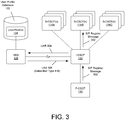
- FIG. 3 depicts a first example of messages that can be sent between network elements during IMS registration for a UE 102 based in part on a subscriber type 202 associated with the UE 102.
- a network operator can have grouped a set of S-CSCFs 114 into subsets that each contain one or more S-CSCFs 114.
- a subset can include multiple S-CSCFs 114 for load balancing purposes.
- Each subset of S-CSCFs 114 can be associated with a particular subscriber type 202.
- an MNO can carve out a first subset containing S-CSCFs 114A for subscribers of the MNO, a second subset containing S-CSCFs 114B for subscribers of a first MVNO, and a third subset containing S-CSCFs 114C for subscribers of a second MVNO.
- a P-CSCF 110 can forward a SIP Register message 302 that it received from a UE 102 on to an I-CSCF 112.
- the SIP Register message 302 can include information about the UE 102 and/or a user of the UE 102, such as an IMPI, IMPU, and/or an IP address.
- the I-CSCF 112 can send a User Authorization Request (UAR) 304 to the HSS 120 via a Diameter protocol Cx interface.
- UAR User Authorization Request
- the UAR 304 can similarly include information about the UE 102 and/or a user of the UE 102, such that the HSS 120 can look up a user profile 124 associated with a user of the UE 102 in the user profile database 122.
- the UAR 304 can include an IMPI included in the SIP Register message 302 from the UE 102, and the HSS 120 can identify a user profile 124 with that IMPI in other profile data 204.
- the I-CSCF 112 can request data from a user profile 124 in an HTTP request.
- the HSS 120 can return some or all data from the user profile 124 to the I-CSCF 112 in a User Authorization Answer (UAA) 306 via the Diameter protocol Cx interface.
- the UAA 306 can include the value of the subscriber type 202 from the user profile 124.
- the UAA 306 can include one or more attribute-value pairs (AVPs) for different types of information from the user profile 124, and one of the AVPs can contain the value of the subscriber type 202 from the user profile 124.
- AVPs attribute-value pairs
- the UAA 306 sent from the HSS 120 to the I-CSCF 112 can include an AVP indicating that the subscriber type 202 for the UE 102 is type "B.”
- the HSS 120 can return some or all data from the user profile 124 in a reply to an HTTP request from the I-CSCF 112, for instance by returning the value of the subscriber type 202 in an HTTP header.
- the I-CSCF 112 can have policies or mapping data in memory that allow the I-CSCF 112 to interpret subscriber type 202 values returned by the HSS 120.
- data returned by the HSS 120 in an UAA 306 or other message may also indicate that no S-CSCF 114 has been assigned to the UE 102 yet. Accordingly, the I-CSCF 112 can use the subscriber type 202 associated with the UE 102 that was returned by the HSS 120 to identify a subset of S-CSCFs 114 that has been carved out for that subscriber type 202.
- a UAA 306 indicates that the UE's subscriber type 202 is type "B," and subscriber type "B" is used to indicate that a user is a subscriber to the first MVNO's services
- the I-CSCF 112 can determine that an S-CSCF 114B in the subset carved out for the first MVNO should be assigned to the UE 102.
- the I-CSCF 112 can forward the UE's SIP Register message 302 to the selected S-CSCF 114.
- the selected S-CSCF 114 can then authenticate the UE 102 and complete the IMS registration for the UE 102.
- the selected S-CSCF 114 may be better positioned to handle the UE 102 than S-CSCFs 114 associated with other subscriber types 202.
- the selected S-CSCF 114 may have policies, rules, or other configurations that are specific to the subscriber type 202 associated with the UE 102.
- S-CSCFs 114 associated with different subscriber types 202 go offline, become overloaded, or experience other issues, the selected S-CSCF 114 may remain available such that UEs 102 associated with the same subscriber type 202 can continue IMS registrations despite the problems with the other S-CSCFs 114.
- FIG. 4 depicts a second example of messages that can be sent between network elements during IMS registration for a UE 102 based in part on a subscriber type 202 associated with the UE 102.
- network operator can have grouped a set of application servers 116 into subsets that each contain one or more application servers 116.
- Each subset of application servers 116 can be associated with a particular subscriber type 202.
- an MNO can carve out a first subset containing application servers 116A for subscribers of the MNO, a second subset containing application servers 116B for subscribers of a first MVNO, and a third subset containing S-CSCFs 114C for subscribers of a second MVNO.
- each subset of application servers 116 for a particular subscriber types 202 can include duplicates of the same type of application server 116 for load balancing purposes, or different types of application servers 116.
- a subset carved out for MNO subscribers can contain at least one TAS reserved for MNO subscribers and at least one RCS server reserved for MNO subscribers, while a different subset can include a TAS and an RCS reserved for MVNO subscribers.
- a network operator can also have grouped a set of PCRFs 118 into subsets that each contain one or more PCRFs 118.
- a subset can include multiple PCRFs 118 for load balancing purposes.
- Each subset of PCRFs 118 can be associated with a particular subscriber type 202. For example, an MNO can carve out a first subset containing PCRFs 118A for subscribers of the MNO and a second subset containing PCRFs 118B for subscribers of an MVNO.
- a SIP Register message 302 received by a P-CSCF 110 from a UE 102 can be routed through the IMS 108 to an S-CSCF 114.
- the SIP Register message 302 can be routed from a P-CSCF 110 to an S-CSCF 114 through an I-CSCF 112, as discussed above with respect to FIG. 3 .
- the SIP Register message 302 can include information about the UE 102 and/or a user of the UE 102, such as an IMPI, IMPU, and/or an IP address.
- the S-CSCF 114 can then authenticate the UE 102 in part based on information retrieved from the HSS 120 over a Diameter protocol Cx interface using a Multimedia Authorization Request (MAR) and a Multimedia Authorization Answer (MAA). For example, based on information returned to the S-CSCF 114 in a MAA, the S-CSCF 114 can exchange additional SIP messages with the UE 102, including a second SIP Register message 302 that contains authentication credentials.
- MAR Multimedia Authorization Request
- MAA Multimedia Authorization Answer
- the S-CSCF 114 can also send a Server Assignment Request (SAR) 402 to the HSS 120 via a Diameter protocol Cx interface.
- the SAR 402 can include information about the UE 102 and/or a user of the UE 102, such that the HSS 120 can look up a user profile 124 associated with a user of the UE 102 in the user profile database 122.
- the SAR 402 can include an IMPI included in the SIP Register message 302 from the UE 102, and the HSS 120 can identify a user profile 124 with that IMPI in other profile data 204.
- the S-CSCF 114 can request data from a user profile 124 in an HTTP request.
- the HSS 120 can return some or all data from the user profile 124 to the S-CSCF 114 in a Server Assignment Answer (SAA) 404 via the Diameter protocol Cx interface.
- the SAA 404 can include the value of the subscriber type 202 from the user profile 124.
- the SAA 404 can include one or more AVPs for different types of information from the user profile 124, and one of the AVPs can contain the value of the subscriber type 202 from the user profile 124.
- the SAA 404 sent from the HSS 120 to the S-CSCF 114 can include an AVP indicating that the subscriber type 202 for the UE 102 is type "B."
- the HSS 120 can return some or all data from the user profile 124 in a reply to an HTTP request from the S-CSCF 114, for instance by returning the value of the subscriber type 202 in an HTTP header.
- the S-CSCF 114 can have policies or mapping data in memory that allow the S-CSCF 114 to interpret subscriber type 202 values returned by the HSS 120 in SAA 404 messages.
- the S-CSCF 114 when the S-CSCF 114 receives an SAA 404 from the HSS 120 that indicates a subscriber type 202 associated with the UE 102, the S-CSCF 114 can generate a SIP response message 406 for the P-CSCF 110 that forwarded the SIP Register message 302 from the UE 102.
- the SIP response message 406 can use a message header or message body to indicate the subscriber type 202 associated with the UE 102 to the P-CSCF 110.
- a SIP response message 406 generated by the S-CSCF 114 can include a header field for a subscriber type 202 value, such as a field in a private header or other type of header.
- the SIP response message 406 can be a message, such as a SIP "200 OK" message that responds to the SIP Register message 302, but includes a value for the subscriber type 202.
- the S-CSCF 114 receives an SAA 404 indicating a subscriber type 202 of "B" via a Diameter protocol Cx interface from the HSS, the S-CSCF 114 can then send a SIP response message 406 to the P-CSCF 110 that indicates in a private header field that the UE 102 is associated with the subscriber type 202 of "B.”
- the P-CSCF 110 can have policies or mapping data in memory that allow the P-CSCF 110 to interpret subscriber type 202 values identified in SIP response messages 406 from S-CSCFs 114.
- the P-CSCF 110 When the P-CSCF 110 receives a SIP response message 406 that identifies a subscriber type 202 associated with a UE 102, the P-CSCF 110 can use a Diameter protocol Rx interface or a REST HTTP interface to send a PCRF request message 408 to a PCRF 118 selected from a subset of PCRFs 118 that have been carved out for that subscriber type 202.
- a PCRF request message 408 can be a Diameter protocol Authorize/Authenticate Request (AAR) message or an HTTP request.
- AAR Diameter protocol Authorize/Authenticate Request
- the P-CSCF 110 can send a PCRF request message 408 over an Rx interface to request that a PCRF 118 that has been carved out for subscribers of that MVNO provide the core network 106 with PCC rules for the UE 102.
- the P-CSCF 110 can still identify the subscriber type 202 associated with a UE 102 based on information in the SIP response message 406 received from the S-CSCF 114. Because this can allow the P-CSCF 110 to contact a PCRF 118 that corresponds to the same subscriber type 202 as the UE 102, the selected PCRF 118 may be better positioned to assist with communication sessions for the UE 102 than PCRFs 118 associated with other subscriber types 202. For instance, the selected PCRF 118 may store PCC rules that are specific to the subscriber type 202 associated with the UE 102.
- PCRFs 118 associated with different subscriber types 202 go offline, become overloaded, or experience other issues, the selected PCRF 118 may remain available to provide PCC rules for traffic associated with UEs 102 of the same subscriber type 202 despite the problems with the other PCRFs 118.
- the S-CSCF 114 when the S-CSCF 114 receives an SAA 404 from the HSS 120 that indicates a subscriber type 202 associated with the UE 102, the S-CSCF 114 can send third-party registration (TPR) messages 410 to one or more application servers 116 that have been carved out for that subscriber type 202.
- TPR third-party registration
- the S-CSCF 114 can send TPR messages 410 about the UE 102 to one or more application servers 116B in the subset carved out for the first MVNO.
- the SAA 404 can contain AVPs or other information that identify which types of application servers 116 should be sent TPR messages 410, for instance indicating that the S-CSCF 114 should send a TPR message 410 to a TAS and also to an RCS server for the UE 102.
- the S-CSCF 114 can use default rules or other logic to determine which types of application servers 116 should be sent TPR messages 410. Accordingly, the S-CSCF 114 can send TPR messages 410 to one or more specific types of application servers 116 within a subset corresponding to the UE's subscriber type 202.
- a selected application server 116 that receives a TPR message 410 about a UE 102 from the S-CSCF 114 corresponds to the same subscriber type 202 as the UE 102
- the selected application server 116 may be better positioned to handle the UE 102 than application servers 116 associated with other subscriber types 202.
- the selected application server 116 may have policies, rules, or other configurations that are specific to the subscriber type 202 associated with the UE 102.
- the selected application server 116 may remain available such that UEs 102 associated with the same subscriber type 202 can receive services from the selected application server 116 despite problems with the other application servers. For example, if a first TAS is reserved to provide services for voice calls for MNO subscribers and a second TAS is reserved to provide services for voice calls for MVNO subscribers, and the second TAS becomes overloaded, voice calls for MNO subscribers can be unaffected because S-CSCFs 114 can send TPR messages 410 to the first TAS for UEs 102 associated with MNO subscribers.
- application servers 116 may not be specifically reserved or carved out for specific subscriber types 202, but can be configured to provide different services for different subscriber types 202 or prioritize between different subscriber types 202.
- an S-CSCF 114 may include a value for a UE's subscriber type in a TPR message 410, and the application server 116 can have policies or mapping data in memory that allows it to interpret subscriber type 202 values in TPR messages 410 and provide services to UEs 102 based on their subscriber type 202.
- the S-CSCF 114 can express a UE's subscriber type 202 in a private header or other element of a TPR message 410 application server 116, such that the UE's subscriber type 202 can be used by the application server 116.
- informing an application server 116 of a UE's subscriber type 202 in a TPR message 410 can reduce or eliminate other types of messaging.
- an application server 116 may be able to exchange messages with the HSS 120 via a Diameter protocol Sh interface to obtain data about the UE 102 or a user associated with the UE 102, the application server may be able to avoid such messaging because it knows the UE's subscriber type 202 directly from the TPR message 410.
- FIG. 5 depicts an example system architecture of a Call Session Control Function (CSCF) 500 of an IMS 108.
- CSCF Call Session Control Function
- the CSCF 500 shown in FIG. 5 can be an S-CSCF 114.
- the CSCF 500 shown in FIG. 5 can be a P-CSCF 110 or an I-CSCF 112.
- the CSCF 500 can be, or run on, a computing device that has a system memory 502.
- the system memory 502 can store data for the CSCF 500, including a subscriber type determiner 504, subscriber type policies 506, a message generator 508, a message router 510, and/or other modules and data 512.
- the computing device of the CSCF 500 can also include processor(s) 514, removable storage 516, non-removable storage 518, input device(s) 520, output device(s) 522, and/or communication connections 524 for communicating with other network elements 526.
- system memory 502 can be volatile (such as RAM), nonvolatile (such as ROM, flash memory, etc.), or some combination of the two.
- Example system memory 502 can include one or more of RAM, ROM, EEPROM, a Flash Memory, a hard drive, a memory card, an optical storage, a magnetic cassette, a magnetic tape, a magnetic disk storage or another magnetic storage devices, or any other medium.
- the subscriber type determiner 504 can use data returned to the CSCF 500 in a message, such as a Diameter message, an HTTP message, or a SIP message, to determine a subscriber type 202 associated with a UE 102.
- a subscriber type determiner 504 of an I-CSCF 112 can determine a UE's subscriber type 202 based on subscriber type 202 information in a UAA 306 sent to the I-CSCF 112 from an HSS 120 over a Diameter protocol Cx interface.
- a subscriber type determiner 504 of an S-CSCF 114 can determine a UE's subscriber type 202 based on subscriber type 202 information in a SAA 404 sent to the S-CSCF 114 from an HSS 120 over a Diameter protocol Cx interface.
- a subscriber type determiner 504 of a P-CSCF 110 can determine a UE's subscriber type 202 based on subscriber type 202 information in a SIP response message 406 sent to the P-CSCF 110 from an S-CSCF 114, such as subscriber type 202 information in a private header of the SIP response message 406.
- the subscriber type determiner 504 can have predefined mappings of possible values for the subscriber type 202 information in a Diameter message or a SIP message to specific types or classes of subscribers, such that the subscriber type determiner 504 can interpret and/or translate predefined values in received messages into corresponding mapped subscriber types 202.
- the subscriber type policies 506 can indicate, based on the subscriber type 202 associated with a UE 102, one or more actions that the CSCF 500 should perform in association with the UE 102.
- the subscriber type policies 506 can be policies that have been predefined by an MNO or other operator of the telecommunication network.
- subscriber type policies 506 can identify subsets of S-CSCFs 114, application servers 116, and/or PCRFs 118 that have been carved out or reserved for specific subscriber types 202 by an MNO or other network operator.
- the CSCF 500 can route messages to, or otherwise contact, one or more other network elements that correspond to the same subscriber type 202 as the UE 102.
- an I-CSCF 112 can determine which S-CSCF 114 to assign to a UE 102 based at least in part on a subscriber type policy 506 that identifies S-CSCFs 114 associated with the same subscriber type 202 as the UE 102.
- an S-CSCF 114 can determine which application servers 116 it should send TPR messages 410 to for a UE 102 based at least in part on a subscriber type policy 506 that identifies application servers 116 associated with the same subscriber type 202 as the UE 102.
- a P-CSCF 110 can determine which PCRF 118 to contact about a UE 102 based at least in part on a subscriber type policy 506 that identifies PCRFs 118 associated with the same subscriber type 202 as the UE 102.
- the message generator 508 can generate Diameter, HTTP, and/or SIP messages sent by the CSCF 500.
- the message generator 508 can generate messages sent by the CSCF to an HSS 120 over a Diameter protocol Cx interface, or to a PCRF over a Diameter protocol Rx interface.
- the message generator 508 can generate SIP response messages 406 and/or TPR messages 410 that include information about a subscriber type 202 for a UE 102 in a message header or body.
- the message router 510 can send messages that have been generated by the message generator 508 or that were received by the CSCF 500 to another network element based on the subscriber type policies 506 and/or the subscriber type 202 associated with a UE 102.
- a message router 510 of an I-CSCF 112 can route a SIP Register message 302 associated with a UE 102 that was received from a P-CSCF 110 on to a particular S-CSCF 114 that is associated with the same subscriber type 202 as the UE 102.
- a message router 510 of an S-CSCF 114 can send a SIP response message 406 that identifies the subscriber type 202 associated with a UE 102 to a P-CSCF 110, and/or send TPR messages 410 for the UE 102 to one or more application servers 116 that are associated with the same subscriber type 202 as the UE 102.
- the other modules and data 512 can be utilized by the CSCF 500 to perform or enable performing any action taken by the CSCF 500.
- the other modules and data 512 can include a platform and applications, and data utilized by the platform and applications.
- the processor(s) 514 can be a central processing unit (CPU), a graphics processing unit (GPU), both CPU and GPU, or other processing unit or component known in the art.
- CPU central processing unit
- GPU graphics processing unit
- both CPU and GPU or other processing unit or component known in the art.
- the computing device of the CSCF 500 can also include additional data storage devices (removable and/or non-removable) such as, for example, magnetic disks, optical disks, or tape. Such additional storage is illustrated in FIG. 5 by removable storage 516 and non-removable storage 518.
- Computer storage media may include volatile and nonvolatile, removable and non-removable media implemented in any method or technology for storage of information, such as computer readable instructions, data structures, program modules, or other data.
- System memory 502, removable storage 516 and non-removable storage 518 are all examples of computer-readable storage media.
- Computer-readable storage media include, but are not limited to, RAM, ROM, EEPROM, flash memory or other memory technology, CD-ROM, digital versatile discs (DVD) or other optical storage, magnetic cassettes, magnetic tape, magnetic disk storage or other magnetic storage devices, or any other medium which can be used to store the desired information and which can be accessed by the CSCF 500. Any such computer-readable storage media can be part of the CSCF 500. In various examples, any or all of system memory 502, removable storage 516, and non-removable storage 518, store programming instructions which, when executed, implement some or all of the herein-described operations of the CSCF 500.
- the computing device of the CSCF 500 can also have input device(s) 520, such as a keyboard, a mouse, a touch-sensitive display, voice input device, etc., and/or output device(s) 522 such as a display, speakers, a printer, etc. These devices are well known in the art and need not be discussed at length here.
- the computing device of the CSCF 500 can also contain communication connections 524 that allow the CSCF 500 to communicate with other network elements 526, such as UEs 102, application servers 116, other CSCFs 500, PCRFs 118, an HSS 120, and/or any other elements of the telecommunication network.
- the communication connections 524 can allow the CSCF 500 to send, receive, and/or forward SIP messages, such as a SIP message received from a UE 102 or another CSCF 500, or a SIP message sent to or from an application server 116.
- the communication connections 524 can allow the CSCF 500 to send and receive Diameter protocol messages, such as messages exchanged over a Diameter Rx interface with a PCRF 118 when the CSCF 500 is a P-CSCF 110 or messages exchanged over a Diameter Cx interface with an HSS 120 when the CSCF 500 is an I-CSCF 112 or a S-CSCF 114.
- Diameter protocol messages such as messages exchanged over a Diameter Rx interface with a PCRF 118 when the CSCF 500 is a P-CSCF 110 or messages exchanged over a Diameter Cx interface with an HSS 120 when the CSCF 500 is an I-CSCF 112 or a S-CSCF 114.
- FIG. 6 depicts a flow chart of actions that can be taken by an I-CSCF 112 during IMS registration for a UE 102.
- the I-CSCF 112 can receive a SIP Register message 302 from a P-CSCF 110.
- the SIP Register message 302 can have originated at a UE 102, and can include information about the UE 102 and/or a user of the UE 102, such as an IMPI, IMPU, and/or an IP address.
- the I-CSCF 112 can send a UAR 304 to an HSS 120 via a Diameter protocol Cx interface.
- the UAR 304 can include information about the UE 102 and/or a user of the UE 102, such that the HSS 120 can look up a user profile 124 associated with a user of the UE 102 in a user profile database 122.
- the UAR 304 can include an IMPI included in the SIP Register message 302 from the UE 102, such that the HSS 120 can identify a user profile 124 with that IMPI in other profile data 204.
- the I-CSCF 112 can receive a UAA 306 from the HSS 120 via the Diameter protocol Cx interface.
- the UAA 306 can express a value of a subscriber type 202 associated with the user of the UE 102.
- the HSS 120 can have found a user profile 124 corresponding to the user, and included the value of the subscriber type 202 from that user profile in an AVP of the UAA 306.
- the UAA 306 may also indicate that an S-CSCF 114 has not yet been assigned to the UE 102.
- the I-CSCF 112 can assign a S-CSCF 114 to the UE 102 based at least in part on the subscriber type 202 for the UE 102 returned in the UAA 306.
- the I-CSCF 112 can have mapping information and/or predefined policies that identifies one or more S-CSCFs 114 associated with the same subscriber type 202 as the UE 102.
- the I-CSCF 112 can assign the UE 102 to an S-CSCF 114 that is associated with the same subscriber type 202.
- the I-CSCF 112 can forward the SIP Register message 302 received at block 602 on to the S-CSCF 114 assigned to the UE 102 during block 608.
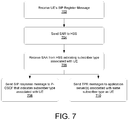
- FIG. 7 depicts a flow chart of actions that can be taken by an S-CSCF 114 during IMS registration for a UE 102.
- the S-CSCF 114 can receive a SIP Register message 302 associated with a UE 102.
- the SIP Register message 302 can have originated at a UE 102, and have been routed through the IMS 108 via a P-CSCF 110 and an I-CSCF 112.
- the SIP Register message 302 can include information about the UE 102 and/or a user of the UE 102, such as an IMPI, IMPU, and/or an IP address.
- the SIP Register message 302 received at block 702 can be a second SIP Register message 302 sent by the UE 102 that includes authentication credentials for the UE 102, such that the S-CSCF 114 can authenticate the UE 102.
- the S-CSCF 114 may have previously received another SIP Register message 302 from the UE 102, obtained authentication data for the UE 102 from the HSS 120, denied the UE's IMS registration, and then waited for a second SIP register message 302 that includes the authentication credentials.
- the SIP Register message 302 received at block 702 can be a first SIP Register message 302 sent by the UE 102 during IMS registration.
- the S-CSCF 114 can send a SAR 402 to an HSS 120 via a Diameter protocol Cx interface.
- the SAR 402 can include information about the UE 102 and/or a user of the UE 102, such that the HSS 120 can look up a user profile 124 associated with a user of the UE 102 in a user profile database 122.
- the SAR 402 can include an IMPI included in the SIP Register message 302 from the UE 102, such that the HSS 120 can identify a user profile 124 with that IMPI in other profile data 204.
- the S-CSCF 114 can receive a SAA 404 from the HSS 120 via the Diameter protocol Cx interface.
- the SAA 404 can express a value of a subscriber type 202 associated with the user of the UE 102.
- the HSS 120 can have found a user profile 124 corresponding to the user, and included the value of the subscriber type 202 from that user profile in an AVP of the SAA 404.
- the S-CSCF 114 can generate a SIP response message 406 that includes the value of the subscriber type 202 associated with the UE 102, and send the SIP response message 406 to the P-CSCF 110 that initially received the SIP Register message 320 from the UE 102.
- the S-CSCF 114 can include the value of the subscriber type 202 associated with the UE 102 in a private header of a "200 OK" SIP message sent to the P-CSCF 110 in response to the SIP Register message 302.
- the P-CSCF 110 can then use the subscriber type 202 associated with the UE 102 to contact a PCRF 118 that is associated with the same subscriber type 202 as the UE 102.
- the P-CSCF 110 can identify a PCRF 118 that is associated with the same subscriber type 202 as a UE 102, and send a PCRF request message 408, such as an AAR, over a Diameter protocol Rx interface to the identified PCRF 118.
- the PCRF request message 408 can request that the identified PCRF 118 provide the core network 106 with PCC rules for traffic associated with the UE 102.
- the S-CSCF 114 can send TPR messages 410 to one or more application servers 116 associated with the same subscriber type 202 as the UE 102.
- the S-CSCF 114 can have mapping information and/or predefined policies that identifies one or more application servers 116 associated with the same subscriber type 202 as the UE 102.
- the SAA 404 may identify which types of application servers 116 should be sent TPR messages 410 for the UE 102, and the S-CSCF 114 may select one of each of those types of application servers 116 based on which ones are associated with the same subscriber type 202 as the UE 102.
- the S-CSCF 114 can include information about the subscriber type 202 associated with the UE 102 within the TPR messages 410, such that the application servers 116 can take actions based on the UE's subscriber type 202.
- the application server 116 can determine that the UE 102 is associated with that subscriber type 202 based on receipt of the TPR message 410 even if the TPR message 410 does not directly indicate the subscriber type 202 associated with the UE 102.
- blocks 708 and 710 can occur sequentially in either order, or occur substantially simultaneously. Alternately, in some examples the S-CSCF 114 may perform block 708 and not block 710, or block 710 and not block 708.
- FIG. 8 depicts a flow chart of actions that can be taken by a P-CSCF 110 during IMS registration for a UE 102.
- the P-CSCF 110 can receive a SIP Register message 302 from a UE 102.
- the P-CSCF 110 can forward the SIP Register message 302 to an I-CSCF 112, which can in turn forward the SIP Register message 302 to an S-CSCF 114.
- the P-CSCF 110 can receive a SIP response message 406 from the S-CSCF 114 via the I-CSCF 112.
- the SIP response message 406 can indicate a subscriber type 202 associated with the UE 102.
- the S-CSCF 114 can include a value for the subscriber type 202 associated with the UE 102 in a private header of a "200 OK" SIP message sent to the P-CSCF 110 in response to the SIP Register message 302.
- the P-CSCF 110 can use the subscriber type 202 associated with the UE 102, as identified in the SIP response message 406, to contact a PCRF 118 that is associated with the same subscriber type 202 as the UE 102.
- the P-CSCF 110 can have mapping information and/or predefined policies that identifies one or more PCRFs 118 associated with the same subscriber type 202 as the UE 102.
- the P-CSCF 110 can accordingly identify a PCRF 118 that is associated with the same subscriber type 202 as a UE 102, and send a PCRF request message 408, such as an AAR, over a Diameter protocol Rx interface to the identified PCRF 118.
- the PCRF request message 408 can request that the identified PCRF 118 provide the core network 106 with PCC rules for traffic associated with the UE 102.
Landscapes
- Engineering & Computer Science (AREA)
- Computer Networks & Wireless Communication (AREA)
- Signal Processing (AREA)
- Multimedia (AREA)
- Business, Economics & Management (AREA)
- General Business, Economics & Management (AREA)
- Databases & Information Systems (AREA)
- Accounting & Taxation (AREA)
- Computer Security & Cryptography (AREA)
- Mobile Radio Communication Systems (AREA)
- Telephonic Communication Services (AREA)
Abstract
A network operator can partition network elements, including elements of an IP Multimedia Subsystem (IMS) or Policy and Charging Rules Functions (PCRFs) into groups reserved for specific types of subscribers. When a user equipment (UE) registers with an IMS, elements of the IMS can contact a Home Subscriber Server (HSS) to determine a subscriber type associated with the UE. Based on the UE's subscriber type, an IMS element can determine an application server or other IMS element to contact about the UE based on identifying application servers or IMS elements that are also associated with the same subscriber type as the UE. Similarly, an IMS element can determine a PCRF to contact about the UE based on identifying a PCRF that is associated with the same subscriber type as the UE.
Description
- A telecommunication network can include an IP Multimedia Subsystem (IMS) that can manage communication sessions for mobile phones and other user equipment (UE). For example, an IMS can include elements that set up communication sessions for a UE and that provide services during such communication sessions, such as services for voice calls, video calls, or messaging.
- An IMS registration process can occur when a UE attaches to the telecommunication network. During IMS registration, the UE can attach to, and/or be assigned to, various IMS elements. The IMS elements can handle message routing, provide services, or otherwise assist with communication sessions for the UE.
- The detailed description is set forth with reference to the accompanying figures. In the figures, the left-most digit(s) of a reference number identifies the figure in which the reference number first appears. The use of the same reference numbers in different figures indicates similar or identical items or features.
-
FIG. 1 depicts an example network environment in which user equipment (UE) can connect to a telecommunication network. -
FIG. 2 depicts an example of user profiles stored in a user profile database. -
FIG. 3 depicts a first example of messages that can be sent between network elements during IP Multimedia Subsystem (IMS) registration for a UE based in part on a subscriber type associated with the UE. -
FIG. 4 depicts a second example of messages that can be sent between network elements during IMS registration for a UE based in part on a subscriber type associated with the UE. -
FIG. 5 depicts an example system architecture of a Call Session Control Function (CSCF) of an IMS. -
FIG. 6 depicts a flow chart of actions that can be taken by an I-CSCF during IMS registration for a UE. -
FIG. 7 depicts a flow chart of actions that can be taken by an S-CSCF during IMS registration for a UE. -
FIG. 8 depicts a flow chart of actions that can be taken by a P-CSCF during IMS registration for a UE. - A telecommunication network can include an IP Multimedia Subsystem (IMS). An IMS can set up and manage communication sessions for user equipment (UE), such as sessions for voice calls, video calls, or other types of communications. An IMS can have Call Session Control Functions (CSCFs) that can register UEs with the IMS and manage communication sessions. The IMS can also have application servers that provide services for the communication sessions, such as services for voice calls, video calls, or other types of communications. For example, the IMS can have a telephony application server (TAS) that provides telephony services, such as services for voice and/or video calls.
- When a UE attaches to the telecommunication network, an IMS registration process can occur. During IMS registration, the UE can send a registration message to a Proxy CSCF (P-CSCF) in the IMS. The P-CSCF can forward the registration message to an Interrogating CSCF (I-CSCF), which can assign the UE to a particular Serving CSCF (S-CSCF). The S-CSCF can authenticate the UE to complete the UE's registration with the IMS. The S-CSCF can also send third party registration messages about the UE to one or more application servers, and the application servers can, in response, provide services for the UE's communication sessions. The P-CSCF can also request that a Policy and Charging Rules Function (PCRF) provide a core network with provide Policy and Charging Control (PCC) rules associated with the communication sessions for the UE. For example, PCC rules can define how data packets associated with the communication sessions for the UE should be handled, or how a subscriber account associated with the UE should be charged.
- Conventionally, network elements such as S-CSCFs, application servers, or PCRFs are configured to help set up and/or manage communication sessions for any UE. However, in some cases an operator of a telecommunication network may want to carve out or reserve certain network elements specifically for UEs associated with particular types of subscribers. For example, the network operator may want to group or partition network elements into different realms or domains that are specific to particular subscriber types.
- In some examples, a mobile network operator (MNO) that owns and operates a telecommunication network and provides services to its own subscribers may also grant a mobile virtual network operator (MVNO) access to the MNO's telecommunication network. This arrangement can allow the MVNO's subscribers to also receive services through the MNO's telecommunication network. In conventional MNO-MVNO relationships, the same network elements often handle communication sessions for both MNO subscribers and MVNO subscribers. However, the MNO may want to carve out a subset of the telecommunication network's elements into a designated realm to handle communication sessions just for MNO subscribers. Accordingly, if network elements that handle MVNO subscribers go offline, become overloaded, or experience other problems, a subset of network elements that have been carved out just for MNO subscribers may remain unaffected. As such, communication sessions for MNO subscribers could continue normally using network elements reserved for MNO subscribers even if elements of the same telecommunication network available for MVNO subscribers are experiencing problems.
- In other examples, an MNO may want to carve out network elements for other types of subscribers. For instance, an MNO may want to carve out one set of network elements for subscribers that have access to Long-Term Evolution (LTE) services and another set of network elements for subscribers that have access to 5G services, or carve out different sets of network elements for MNO subscribers that are on different MNO service plan types or tiers.
- Although it may be beneficial for an MNO to carve out or reserve network elements for particular types of subscribers, in conventional systems CSCFs may be unable to determine a subscriber type associated with a UE during IMS registration. Accordingly, in such conventional systems CSCFs may not be able to identify subsets of network elements that are associated with a particular UE's subscriber type during IMS registration, and thus not be able to select or route messages to network elements that correspond to the UE's subscriber type.
- Described herein are systems and processes that allow IMS elements to determine a subscriber type associated with a UE during IMS registration. The IMS elements can then use that subscriber type to identify and select other network elements that are specifically associated with that subscriber type, and to route messages associated with the UE to network elements that are specifically associated with the UE's subscriber type.
-
FIG. 1 depicts an example network environment in which user equipment (UE) 102 can connect to a telecommunication network to engage in communication sessions for voice calls, video calls, messaging, data transfers, or any other type of communication. A UE 102 can be any device that can wirelessly connect to the telecommunication network. For example, a UE 102 can be a mobile phone such as a smart phone or other cellular phone, a personal digital assistant (PDA), a personal computer (PC) such as a laptop, desktop, or workstation, a media player, a tablet, a gaming device, a smart watch, a hotspot, or any other type of computing or communication device. - A UE 102 can connect to an
access point 104, such as a base station, through which the UE 102 can access acore network 106 of the telecommunication network. Theaccess point 104 and/orcore network 106 can be compatible with one or more wireless access technologies, protocols, or standards. For example, wireless access technologies can include fifth generation (5G) technology, Long Term Evolution (LTE)/LTE Advanced technology, other fourth generation (4G) technology, High-Speed Data Packet Access (HSDPA)/Evolved High-Speed Packet Access (HSPA+) technology, Universal Mobile Telecommunications System (UMTS) technology, Code Division Multiple Access (CDMA) technology, Global System for Mobile Communications (GSM) technology, WiMax® technology, WiFi® technology, and/or any other previous or future generation of wireless access technology. - In some examples,
access points 104 can be part of a radio access network linked to thecore network 106. For example, anaccess point 104 can be a base station, such as an evolved Node B (eNB) in an LTE network or a gNB in a 5G network. In other examples, anaccess point 104 can be a Wi-Fi access point or other type of access point that can be connected to thecore network 106 through the Internet or another type of connection. - Gateways or other elements of the
core network 106 can link thecore network 106 to other networks, such as the Internet or an IP Multimedia Subsystem (IMS) 108. AnIMS 108 can set up and/or manage communication sessions for UEs 102 that are connected to thecore network 106, such as sessions for voice calls, video calls, messaging, or other types of communications. - An
IMS 108 can include Call Session Control Functions (CSCFs) that can perform various operations including registering and authenticatingUEs 102 with theIMS 108, routing messages, and managing communication sessions for UEs 102. As described in more detail below, CSCFs can include Proxy CSCFs (P-CSCFs) 110, Interrogating CSCFs (I-CSCFs) 112, and Serving CSCFs (S-CSCFs) 114. In some examples, the terms "CSCF," "P-CSCF," "I-CSCF," and/or "S-CSCF" can refer to other types of IMS nodes, such as nodes of a 5G-specific IMS 108 that may or may not have different names but that are configured to perform the same or similar functions as described herein. Example architecture for a CSCF is illustrated in greater detail inFIG. 5 , and is described in detail below with reference to that figure. - The IMS 108 can also include
application servers 116. While CSCFs can set up and manage communication sessions,application servers 116 can provide services for those communication sessions. For example, anapplication server 116 can be a telephony application server (TAS) that provides telephony services during a communication session, such as services for voice over LTE (VoLTE) calls or other voice calls, and/or video over LTE (ViLTE) calls or other video calls. In other examples,application servers 116 can include a multimedia telephony application server (M-TAS), a rich messaging server (RMS), rich communication services (RCS) server, or other messaging server, a presence server, a notification server, or any other type ofapplication server 116. - CSCFs in the
IMS 108 can exchange data with each other, and/or withUEs 102 orapplication servers 116, using Session Initiation Protocol (SIP) messages. CSCFs in theIMS 108 can also communicate with other types of network elements through Diameter protocol interfaces and/or Representational State Transfer (REST) Hypertext Transfer Protocol (HTTP) requests instead of SIP messages. - For example, P-
CSCFs 110 can be connected to Policy and Charging Rules Functions (PCRFs) 118 via Diameter protocol Rx interfaces and/or HTTP requests. APCRF 118 can store and distribute Policy and Charging Control (PCC) rules that define how thecore network 106 should treat data associated with communication session or how subscriber accounts should be charged. For example, aPCRF 118 can provide PCC rules to a gateway of thecore network 106 via a Diameter protocol Gx interface. In some situations, a Policy Control Function (PCF) can be used in place of aPCRF 118, and a P-CSCF 110 can similarly reach a PCF via a Diameter protocol Rx interface or an HTTP request. For example,PCRFs 118 can be used to provide PCC rules in LTE and other 4G networks, while PCFs can provide PCC rules in 5G networks. As used herein, theterm PCRF 118 can refer to a PCRF, a PCF, or any other similar element that can provide PCC rules. - As another example, I-
CSCFs 112 and S-CSCFs 114 can communicate with a Home Subscriber Server (HSS) 120 via Diameter protocol Cx interfaces or HTTP requests. TheHSS 120 can have, or be linked to, auser profile database 122 that stores user profiles 124. The user profiles 124 can contain information about users who may be associated withUEs 102, as discussed further below with respect toFIG. 2 . In some examples, a Home Location Register (HLR) can take the place of theHSS 120 described herein, or be linked to anHSS 120, such that the HLR can also access theuser profile database 122. As used herein, theterm HSS 120 can refer to an HSS, an HLR, a combined HSS/HLR, a 5G Unified Data Management (UDM) element and/or other 5G elements that can manage or accessuser profiles 124, or any other similar element that can access auser profile database 122 and communicate with I-CSCFs 112 and S-CSCFs 114. - In some examples,
PCRFs 118 and/or theHSS 120 can be considered part of thecore network 106. In other examples,PCRFs 118 and/or theHSS 120 can be considered part of theIMS 108 or be considered to be outside thecore network 106 and theIMS 108. - A P-
CSCF 110 can be an entry point into theIMS 108 that routes SIP messages to and/or fromUEs 102. For example, when aUE 102 is attached to the telecommunication networks, an IMS registration process can occur during which theUE 102 sends a SIP Register message to the P-CSCF 110. The P-CSCF 110 can then route the SIP Register message to an I-CSCF 112. A P-CSCF 110 can also use a Diameter protocol Rx interface or an HTTP request to communicate with aPCRF 118 about a communication session for aUE 102, such that thePCRF 118 can provide PCC rules for the communication session to a gateway of thecore network 106 that is processing traffic for theUE 102. The PCC rules can define how the gateway should treat data associated with the communication session for theUE 102, for instance by identifying a Quality of Service (QoS) or a priority level associated with the communication session, or define how a subscriber account associated with theUE 102 should be charged. - An I-
CSCF 112 can assign aUE 102 to a particular S-CSCF 114 during IMS registration, and/or route messages to or from an S-CSCF 114 when an S-CSCF 114 has already been assigned to theUE 102. For example, during IMS registration, an I-CSCF 112 can receive a SIP Register message associated with aUE 102 from a P-CSCF 110. The I-CSCF 112 can exchange messages with theHSS 120 over a Diameter protocol Cx interface or use HTTP requests to obtain data from auser profile 124 in theuser profile database 122 that corresponds to theUE 102. The I-CSCF 112 can use the data from theuser profile 124 to determine if an S-CSCF 114 has already been assigned to theUE 102, and if not can assign a new S-CSCF 114 to theUE 102. In some examples, the I-CSCF 112 can use the data from theuser profile 124 when deciding which S-CSCF 114 to assign to theUE 102. The I-CSCF 112 can then forward the UE's SIP Register message to the assigned S-CSCF 114. - An S-
CSCF 114 can be a registrar for theIMS 108 that receives SIP Register messages that originated fromUEs 102, and authenticates theUEs 102 to complete the UEs' IMS registrations. For example, during IMS registration for aUE 102, the S-CSCF 114 can exchange messages with theHSS 120 over a Diameter protocol Cx interface or use HTTP requests to obtain data from auser profile 124 in theuser profile database 122 that corresponds to theUE 102. The S-CSCF 114 can then use that data from theuser profile 124 to authenticate theUE 102. - The S-
CSCF 114 can also manage communication sessions forUEs 102, such as by sending or routing other types of SIP messages within theIMS 108. For example, during IMS registration for aUE 102, the S-CSCF 114 can send a third-party registration (TPR) message about theUE 102 to one ormore application servers 116. In some examples, a TPR message can be a separate SIP Register message. A TPR message can inform anapplication server 116 that aUE 102 has registered with theIMS 108 and is ready to receive services from theapplication server 116 during a communication session. -
FIG. 2 depicts an example ofuser profiles 124 stored in theuser profile database 122. Eachuser profile 124 in theuser profile database 122 can include information about users associated withUEs 102, such as subscribers to services that can be accessed via theIMS 108. - A
user profile 124 can indicate aparticular subscriber type 202 associated with a user. Multiplepredefined subscriber types 202 can be known to the telecommunication network. For example, different values for thesubscriber type 202 attribute inuser profiles 124 can identify different types or classes of subscribers that may be associated with different classes of service, service levels, service plans, network operators, network generations, or other characteristics. Accordingly, the value of thesubscriber type 202 in auser profile 124 for a particular user can indicate that the user has been categorized as a particular type of subscriber or is in a particular class of subscribers, distinct from other known types or classes of subscribers. - In some examples, a user profile's
subscriber type 202 can identify a network operator associated with a user. For example, a mobile network operator (MNO) may own and/or operate the telecommunication network, including some or all parts of theIMS 108, and provide services to subscribers of the MNO via the telecommunication network. However, the MNO may also grant a mobile virtual network operator (MVNO) bulk access to the MNO's telecommunication network, such that the MVNO can provide services to the MVNO's own subscribers through the telecommunication network despite not owning or directly operating the telecommunication network. Accordingly, in this example, one value for thesubscriber type 202 may indicate that a user is a subscriber of the MNO, while another value for thesubscriber type 202 may indicate that a user is a subscriber of a particular MVNO. - In some examples, a user profile's
subscriber type 202 can identify a network generation associated with a user, such as a network generation associated with certain services available to the user or a network generation associated with certain subscription plans or tiers. For example, an MNO or MVNO may offer some services to subscribers on an LTE plan and offer other services to subscribers on a 5G plan. Accordingly, in this example one value for thesubscriber type 202 may indicate that a user is an LTE subscriber or has access to LTE services, while another value for thesubscriber type 202 may indicate that a user is a 5G subscriber or has access to 5G services. - In some examples, a user profile's
subscriber type 202 can identify a subscription plan type or tier associated with a user. For example, an MNO may offer a priority level subscription plan as well as standard subscription plans. Accordingly, in this example one value for thesubscriber type 202 may indicate that a user is a subscriber to a priority level subscription plan, while another value for thesubscriber type 202 may indicate that a user is a subscriber to a standard subscription plan. - In some examples, a user's
particular subscriber type 202 can be indicated in auser profile 124 with a single value that maps to a particular subscriber type. For example, asubscriber type 202 can be expressed as an alphanumeric character, an integer, a binary value, text string, or any other value. In these examples, network elements such as the CSCFs, theapplication servers 116, and/or thePCRFs 118 can have predefined mappings of such values to correspondingsubscriber types 202, such that the network elements can determine users'subscriber types 202 from such values. In other examples, thesubscriber type 202 can expressed as a text string that explains a type or class of subscriber to which a user belongs, or otherwise be expressed as a value that can be interpreted by network elements without predefined mappings. - In some examples, a single value for the
subscriber type 202 attribute of auser profile 124 can correspond to asingle subscriber type 202. For example, inFIG. 2 , subscriber type "A" may identify users who are subscribers to an MNO's services, while subscriber type "B" may identify users who are subscribers to services of a first MVNO that has access to the MNO's telecommunication network and subscriber type "C" may identify users who are subscribers to services of a second MVNO that has access to the MNO's telecommunication network. As another example, inFIG. 2 , subscriber type "A" may identify users who are LTE subscribers, while subscriber type "B" may identify users who are 5G subscribers. - However, in other examples, a single value for the
subscriber type 202 attribute of auser profile 124 can correspond to a specific combination of different subscriber types 202. For example, subscriber type "A" may identify users who are subscribers to an MNO's services and have a 5G plan, subscriber type "B" may identify users who are subscribers to an MNO's services and have an LTE plan, subscriber type "C" may identify users who are subscribers to an MVNO's services and have a 5G plan, and subscriber type "D" may identify users who are subscribers to an MVNO's services and have an LTE plan. - In still other examples, the
subscriber type 202 attribute of auser profile 124 can be expressed as a combination of multiple individual values that may each indicate a different characteristic of a user'soverall subscriber type 202. For example, asubscriber type 202 can be expressed as a three-byte value, with the first byte corresponding to a particular network operator, the second byte corresponding to a network generation, and the third byte corresponding to a service tier. - In addition to a
subscriber type 202, auser profile 124 may also indicate other profile data 204 associated with a user. For example, the other profile data 204 can include one or more identifiers of the user, such as an international mobile subscriber identity (IMSI), IP Multimedia Private Identity (IMPI), IP multimedia public identity (IMPU), the user's name, an email address for the user, and/or other unique identifiers for the user. The other profile data 204 can also include other types of information, such as a Mobile Station International Subscriber Directory Number (MSISDN) associated with the user, an identifier of an S-CSCF 114 that has been assigned to aUE 102 associated with the user, if any, and/or any other information about the user. - The telecommunication network can carve out or reserve network elements for
specific subscriber types 202, including S-CSCFs 114,application servers 116, and/orPCRFs 118. For example, an MNO can carve out one or more PCRFs 118 from a larger pool ofPCRFs 118 exclusively for MNO subscribers, while leavingother PCRFs 118 in the larger pool available for use with MVNO subscribers. Accordingly, even if thePCRFs 118 available to MVNO subscribers become overloaded or experience other issues, thePCRFs 118 carved out exclusively for MNO subscribers may remain available. Additionally, in some examples,PCRFs 118 carved out for MNO subscribers may store PCC rules that are specifically applicable to MNO subscribers, whileother PCRFs 118 available to MVNO subscribers may store other PCC rules that may apply to MVNO subscribers. As another example, an MNO may partition a pool ofPCRFs 118 into a first realm that has PCC rules for LTE subscribers, and a second realm that has PCC rules for 5G subscribers. - As discussed above, a CSCF, such as an I-
CSCF 112 or an S-CSCF 114, can retrieve data associated withuser profiles 124 from theHSS 120 over Diameter profile Cx interfaces or via HTTP requests. According, during IMS registration for aUE 102, theHSS 120 can provide a CSCF with asubscriber type 202 from auser profile 124 associated with a user of theUE 102. The CSCF can then use policies to determine subsequent actions to take based on thesubscriber type 202 associated with aUE 102. For example, an I-CSCF 112 that obtains asubscriber type 202 associated with aUE 102 can select and assign theUE 102 to an S-CSCF 114 that has been carved out or reserved for thatparticular subscriber type 202. As another example, an S-CSCF 114 that obtains asubscriber type 202 associated with aUE 102 can send a SIP message to a P-CSCF 110 that informs the P-CSCF 110 about the UE'ssubscriber type 202, such that the P-CSCF 110 can in turn contact aPCRF 118 that has been carved out or reserved for thatparticular subscriber type 202. An S-CSCF 114 that obtains asubscriber type 202 associated with aUE 102 can also send third-party registration (TPR) messages about theUE 102 to one ormore application servers 116 that have been carved out or reserved for thatparticular subscriber type 202. -
FIG. 3 depicts a first example of messages that can be sent between network elements during IMS registration for aUE 102 based in part on asubscriber type 202 associated with theUE 102. In the example ofFIG. 3 , a network operator can have grouped a set of S-CSCFs 114 into subsets that each contain one or more S-CSCFs 114. In some example, a subset can include multiple S-CSCFs 114 for load balancing purposes. Each subset of S-CSCFs 114 can be associated with aparticular subscriber type 202. For example, an MNO can carve out a first subset containing S-CSCFs 114A for subscribers of the MNO, a second subset containing S-CSCFs 114B for subscribers of a first MVNO, and a third subset containing S-CSCFs 114C for subscribers of a second MVNO. - A P-
CSCF 110 can forward aSIP Register message 302 that it received from aUE 102 on to an I-CSCF 112. TheSIP Register message 302 can include information about theUE 102 and/or a user of theUE 102, such as an IMPI, IMPU, and/or an IP address. In some examples, when the I-CSCF 112 receives aSIP Register message 302, the I-CSCF 112 can send a User Authorization Request (UAR) 304 to theHSS 120 via a Diameter protocol Cx interface. TheUAR 304 can similarly include information about theUE 102 and/or a user of theUE 102, such that theHSS 120 can look up auser profile 124 associated with a user of theUE 102 in theuser profile database 122. For example, theUAR 304 can include an IMPI included in theSIP Register message 302 from theUE 102, and theHSS 120 can identify auser profile 124 with that IMPI in other profile data 204. In other examples, the I-CSCF 112 can request data from auser profile 124 in an HTTP request. - In some examples, the
HSS 120 can return some or all data from theuser profile 124 to the I-CSCF 112 in a User Authorization Answer (UAA) 306 via the Diameter protocol Cx interface. TheUAA 306 can include the value of thesubscriber type 202 from theuser profile 124. In some examples, theUAA 306 can include one or more attribute-value pairs (AVPs) for different types of information from theuser profile 124, and one of the AVPs can contain the value of thesubscriber type 202 from theuser profile 124. For example, if thesubscriber type 202 in theuser profile 124 corresponding to theUE 102 was "B," theUAA 306 sent from theHSS 120 to the I-CSCF 112 can include an AVP indicating that thesubscriber type 202 for theUE 102 is type "B." In other examples, theHSS 120 can return some or all data from theuser profile 124 in a reply to an HTTP request from the I-CSCF 112, for instance by returning the value of thesubscriber type 202 in an HTTP header. The I-CSCF 112 can have policies or mapping data in memory that allow the I-CSCF 112 to interpretsubscriber type 202 values returned by theHSS 120. - In this example, data returned by the
HSS 120 in anUAA 306 or other message may also indicate that no S-CSCF 114 has been assigned to theUE 102 yet. Accordingly, the I-CSCF 112 can use thesubscriber type 202 associated with theUE 102 that was returned by theHSS 120 to identify a subset of S-CSCFs 114 that has been carved out for thatsubscriber type 202. For example, when an MNO has carved out a subset of S-CSCFs 114 containing S-CSCFs 114B for subscribers of a first MVNO, aUAA 306 indicates that the UE'ssubscriber type 202 is type "B," and subscriber type "B" is used to indicate that a user is a subscriber to the first MVNO's services, the I-CSCF 112 can determine that an S-CSCF 114B in the subset carved out for the first MVNO should be assigned to theUE 102. - After identifying and assigning an S-
CSCF 114 in a subset corresponding to thesame subscriber type 202 as theUE 102, the I-CSCF 112 can forward the UE'sSIP Register message 302 to the selected S-CSCF 114. The selected S-CSCF 114 can then authenticate theUE 102 and complete the IMS registration for theUE 102. - In the example of
FIG. 3 , because the S-CSCF 114 that is selected by the I-CSCF 112 to receive theSIP Register message 302 corresponds to thesame subscriber type 202 as theUE 102, the selected S-CSCF 114 may be better positioned to handle theUE 102 than S-CSCFs 114 associated with other subscriber types 202. For instance, the selected S-CSCF 114 may have policies, rules, or other configurations that are specific to thesubscriber type 202 associated with theUE 102. Similarly, if S-CSCFs 114 associated withdifferent subscriber types 202 go offline, become overloaded, or experience other issues, the selected S-CSCF 114 may remain available such thatUEs 102 associated with thesame subscriber type 202 can continue IMS registrations despite the problems with the other S-CSCFs 114. -
FIG. 4 depicts a second example of messages that can be sent between network elements during IMS registration for aUE 102 based in part on asubscriber type 202 associated with theUE 102. In the example ofFIG. 4 , network operator can have grouped a set ofapplication servers 116 into subsets that each contain one ormore application servers 116. Each subset ofapplication servers 116 can be associated with aparticular subscriber type 202. For example, an MNO can carve out a first subset containingapplication servers 116A for subscribers of the MNO, a second subset containingapplication servers 116B for subscribers of a first MVNO, and a third subset containing S-CSCFs 114C for subscribers of a second MVNO. In some examples, each subset ofapplication servers 116 for aparticular subscriber types 202 can include duplicates of the same type ofapplication server 116 for load balancing purposes, or different types ofapplication servers 116. For example, a subset carved out for MNO subscribers can contain at least one TAS reserved for MNO subscribers and at least one RCS server reserved for MNO subscribers, while a different subset can include a TAS and an RCS reserved for MVNO subscribers. - In the example of
FIG. 4 , a network operator can also have grouped a set ofPCRFs 118 into subsets that each contain one or more PCRFs 118. In some example, a subset can includemultiple PCRFs 118 for load balancing purposes. Each subset ofPCRFs 118 can be associated with aparticular subscriber type 202. For example, an MNO can carve out a firstsubset containing PCRFs 118A for subscribers of the MNO and a secondsubset containing PCRFs 118B for subscribers of an MVNO. - In
FIG. 4 , aSIP Register message 302 received by a P-CSCF 110 from aUE 102 can be routed through theIMS 108 to an S-CSCF 114. For example, theSIP Register message 302 can be routed from a P-CSCF 110 to an S-CSCF 114 through an I-CSCF 112, as discussed above with respect toFIG. 3 . TheSIP Register message 302 can include information about theUE 102 and/or a user of theUE 102, such as an IMPI, IMPU, and/or an IP address. In some cases, the S-CSCF 114 can then authenticate theUE 102 in part based on information retrieved from theHSS 120 over a Diameter protocol Cx interface using a Multimedia Authorization Request (MAR) and a Multimedia Authorization Answer (MAA). For example, based on information returned to the S-CSCF 114 in a MAA, the S-CSCF 114 can exchange additional SIP messages with theUE 102, including a secondSIP Register message 302 that contains authentication credentials. - The S-
CSCF 114 can also send a Server Assignment Request (SAR) 402 to theHSS 120 via a Diameter protocol Cx interface. TheSAR 402 can include information about theUE 102 and/or a user of theUE 102, such that theHSS 120 can look up auser profile 124 associated with a user of theUE 102 in theuser profile database 122. For example, theSAR 402 can include an IMPI included in theSIP Register message 302 from theUE 102, and theHSS 120 can identify auser profile 124 with that IMPI in other profile data 204. In other examples, the S-CSCF 114 can request data from auser profile 124 in an HTTP request. - The
HSS 120 can return some or all data from theuser profile 124 to the S-CSCF 114 in a Server Assignment Answer (SAA) 404 via the Diameter protocol Cx interface. TheSAA 404 can include the value of thesubscriber type 202 from theuser profile 124. In some examples, theSAA 404 can include one or more AVPs for different types of information from theuser profile 124, and one of the AVPs can contain the value of thesubscriber type 202 from theuser profile 124. For example, if thesubscriber type 202 in theuser profile 124 corresponding to theUE 102 was "B," theSAA 404 sent from theHSS 120 to the S-CSCF 114 can include an AVP indicating that thesubscriber type 202 for theUE 102 is type "B." In other examples, theHSS 120 can return some or all data from theuser profile 124 in a reply to an HTTP request from the S-CSCF 114, for instance by returning the value of thesubscriber type 202 in an HTTP header. The S-CSCF 114 can have policies or mapping data in memory that allow the S-CSCF 114 to interpretsubscriber type 202 values returned by theHSS 120 inSAA 404 messages. - In some examples, when the S-
CSCF 114 receives anSAA 404 from theHSS 120 that indicates asubscriber type 202 associated with theUE 102, the S-CSCF 114 can generate aSIP response message 406 for the P-CSCF 110 that forwarded theSIP Register message 302 from theUE 102. TheSIP response message 406 can use a message header or message body to indicate thesubscriber type 202 associated with theUE 102 to the P-CSCF 110. For example, aSIP response message 406 generated by the S-CSCF 114 can include a header field for asubscriber type 202 value, such as a field in a private header or other type of header. In some examples, theSIP response message 406 can be a message, such as a SIP "200 OK" message that responds to theSIP Register message 302, but includes a value for thesubscriber type 202. For example, if the S-CSCF 114 receives anSAA 404 indicating asubscriber type 202 of "B" via a Diameter protocol Cx interface from the HSS, the S-CSCF 114 can then send aSIP response message 406 to the P-CSCF 110 that indicates in a private header field that theUE 102 is associated with thesubscriber type 202 of "B." Like the S-CSCF 114, the P-CSCF 110 can have policies or mapping data in memory that allow the P-CSCF 110 to interpretsubscriber type 202 values identified inSIP response messages 406 from S-CSCFs 114. - When the P-
CSCF 110 receives aSIP response message 406 that identifies asubscriber type 202 associated with aUE 102, the P-CSCF 110 can use a Diameter protocol Rx interface or a REST HTTP interface to send aPCRF request message 408 to aPCRF 118 selected from a subset ofPCRFs 118 that have been carved out for thatsubscriber type 202. In some examples, aPCRF request message 408 can be a Diameter protocol Authorize/Authenticate Request (AAR) message or an HTTP request. For example, when aSIP response message 406 from an S-CSCF 114 has a value for asubscriber type 202 indicating that aUE 102 is associated with a subscriber of an MVNO's services, the P-CSCF 110 can send aPCRF request message 408 over an Rx interface to request that aPCRF 118 that has been carved out for subscribers of that MVNO provide thecore network 106 with PCC rules for theUE 102. - Accordingly, even though a P-
CSCF 110 may not have a Diameter protocol Cx interface or other connection with theHSS 120, the P-CSCF 110 can still identify thesubscriber type 202 associated with aUE 102 based on information in theSIP response message 406 received from the S-CSCF 114. Because this can allow the P-CSCF 110 to contact aPCRF 118 that corresponds to thesame subscriber type 202 as theUE 102, the selectedPCRF 118 may be better positioned to assist with communication sessions for theUE 102 thanPCRFs 118 associated with other subscriber types 202. For instance, the selectedPCRF 118 may store PCC rules that are specific to thesubscriber type 202 associated with theUE 102. Similarly, ifPCRFs 118 associated withdifferent subscriber types 202 go offline, become overloaded, or experience other issues, the selectedPCRF 118 may remain available to provide PCC rules for traffic associated withUEs 102 of thesame subscriber type 202 despite the problems with theother PCRFs 118. - In some examples, when the S-
CSCF 114 receives anSAA 404 from theHSS 120 that indicates asubscriber type 202 associated with theUE 102, the S-CSCF 114 can send third-party registration (TPR)messages 410 to one ormore application servers 116 that have been carved out for thatsubscriber type 202. For example, when an MNO has carved out a subset ofapplication servers 116 containingapplication servers 116B for subscribers of a first MVNO, theSAA 404 indicates that the UE'ssubscriber type 202 is type "B," and subscriber type "B" is used to indicate that a user is a subscriber to the first MVNO's services, the S-CSCF 114 can sendTPR messages 410 about theUE 102 to one ormore application servers 116B in the subset carved out for the first MVNO. - In some cases, the
SAA 404 can contain AVPs or other information that identify which types ofapplication servers 116 should be sentTPR messages 410, for instance indicating that the S-CSCF 114 should send aTPR message 410 to a TAS and also to an RCS server for theUE 102. In other cases, the S-CSCF 114 can use default rules or other logic to determine which types ofapplication servers 116 should be sentTPR messages 410. Accordingly, the S-CSCF 114 can sendTPR messages 410 to one or more specific types ofapplication servers 116 within a subset corresponding to the UE'ssubscriber type 202. - Here, because a selected
application server 116 that receives aTPR message 410 about aUE 102 from the S-CSCF 114 corresponds to thesame subscriber type 202 as theUE 102, the selectedapplication server 116 may be better positioned to handle theUE 102 thanapplication servers 116 associated with other subscriber types 202. For instance, the selectedapplication server 116 may have policies, rules, or other configurations that are specific to thesubscriber type 202 associated with theUE 102. Similarly, ifapplication servers 116 associated withdifferent subscriber types 202 go offline, become overloaded, or experience other issues, the selectedapplication server 116 may remain available such thatUEs 102 associated with thesame subscriber type 202 can receive services from the selectedapplication server 116 despite problems with the other application servers. For example, if a first TAS is reserved to provide services for voice calls for MNO subscribers and a second TAS is reserved to provide services for voice calls for MVNO subscribers, and the second TAS becomes overloaded, voice calls for MNO subscribers can be unaffected because S-CSCFs 114 can sendTPR messages 410 to the first TAS forUEs 102 associated with MNO subscribers. - In other examples,
application servers 116 may not be specifically reserved or carved out forspecific subscriber types 202, but can be configured to provide different services fordifferent subscriber types 202 or prioritize between different subscriber types 202. In these examples, an S-CSCF 114 may include a value for a UE's subscriber type in aTPR message 410, and theapplication server 116 can have policies or mapping data in memory that allows it to interpretsubscriber type 202 values inTPR messages 410 and provide services to UEs 102 based on theirsubscriber type 202. For example, the S-CSCF 114 can express a UE'ssubscriber type 202 in a private header or other element of aTPR message 410application server 116, such that the UE'ssubscriber type 202 can be used by theapplication server 116. In some examples, informing anapplication server 116 of a UE'ssubscriber type 202 in aTPR message 410 can reduce or eliminate other types of messaging. For example, while anapplication server 116 may be able to exchange messages with theHSS 120 via a Diameter protocol Sh interface to obtain data about theUE 102 or a user associated with theUE 102, the application server may be able to avoid such messaging because it knows the UE'ssubscriber type 202 directly from theTPR message 410. -
FIG. 5 depicts an example system architecture of a Call Session Control Function (CSCF) 500 of anIMS 108. In some examples, theCSCF 500 shown inFIG. 5 can be an S-CSCF 114. In other examples, theCSCF 500 shown inFIG. 5 can be a P-CSCF 110 or an I-CSCF 112. - The
CSCF 500 can be, or run on, a computing device that has asystem memory 502. Thesystem memory 502 can store data for theCSCF 500, including asubscriber type determiner 504,subscriber type policies 506, amessage generator 508, amessage router 510, and/or other modules anddata 512. The computing device of theCSCF 500 can also include processor(s) 514,removable storage 516, non-removable storage 518, input device(s) 520, output device(s) 522, and/orcommunication connections 524 for communicating withother network elements 526. - In various examples,
system memory 502 can be volatile (such as RAM), nonvolatile (such as ROM, flash memory, etc.), or some combination of the two.Example system memory 502 can include one or more of RAM, ROM, EEPROM, a Flash Memory, a hard drive, a memory card, an optical storage, a magnetic cassette, a magnetic tape, a magnetic disk storage or another magnetic storage devices, or any other medium. - The
subscriber type determiner 504 can use data returned to theCSCF 500 in a message, such as a Diameter message, an HTTP message, or a SIP message, to determine asubscriber type 202 associated with aUE 102. For example, asubscriber type determiner 504 of an I-CSCF 112 can determine a UE'ssubscriber type 202 based onsubscriber type 202 information in aUAA 306 sent to the I-CSCF 112 from anHSS 120 over a Diameter protocol Cx interface. As another example, asubscriber type determiner 504 of an S-CSCF 114 can determine a UE'ssubscriber type 202 based onsubscriber type 202 information in aSAA 404 sent to the S-CSCF 114 from anHSS 120 over a Diameter protocol Cx interface. As yet another example, asubscriber type determiner 504 of a P-CSCF 110 can determine a UE'ssubscriber type 202 based onsubscriber type 202 information in aSIP response message 406 sent to the P-CSCF 110 from an S-CSCF 114, such assubscriber type 202 information in a private header of theSIP response message 406. In some examples, thesubscriber type determiner 504 can have predefined mappings of possible values for thesubscriber type 202 information in a Diameter message or a SIP message to specific types or classes of subscribers, such that thesubscriber type determiner 504 can interpret and/or translate predefined values in received messages into corresponding mapped subscriber types 202. - The
subscriber type policies 506 can indicate, based on thesubscriber type 202 associated with aUE 102, one or more actions that theCSCF 500 should perform in association with theUE 102. In some examples, thesubscriber type policies 506 can be policies that have been predefined by an MNO or other operator of the telecommunication network. For example,subscriber type policies 506 can identify subsets of S-CSCFs 114,application servers 116, and/orPCRFs 118 that have been carved out or reserved forspecific subscriber types 202 by an MNO or other network operator. - Accordingly, based on
subscriber type policies 506, theCSCF 500 can route messages to, or otherwise contact, one or more other network elements that correspond to thesame subscriber type 202 as theUE 102. For example, an I-CSCF 112 can determine which S-CSCF 114 to assign to aUE 102 based at least in part on asubscriber type policy 506 that identifies S-CSCFs 114 associated with thesame subscriber type 202 as theUE 102. As another example, an S-CSCF 114 can determine whichapplication servers 116 it should sendTPR messages 410 to for aUE 102 based at least in part on asubscriber type policy 506 that identifiesapplication servers 116 associated with thesame subscriber type 202 as theUE 102. As yet another example, a P-CSCF 110 can determine whichPCRF 118 to contact about aUE 102 based at least in part on asubscriber type policy 506 that identifiesPCRFs 118 associated with thesame subscriber type 202 as theUE 102. - The
message generator 508 can generate Diameter, HTTP, and/or SIP messages sent by theCSCF 500. For example, themessage generator 508 can generate messages sent by the CSCF to anHSS 120 over a Diameter protocol Cx interface, or to a PCRF over a Diameter protocol Rx interface. As another example, themessage generator 508 can generateSIP response messages 406 and/orTPR messages 410 that include information about asubscriber type 202 for aUE 102 in a message header or body. - The
message router 510 can send messages that have been generated by themessage generator 508 or that were received by theCSCF 500 to another network element based on thesubscriber type policies 506 and/or thesubscriber type 202 associated with aUE 102. For example, amessage router 510 of an I-CSCF 112 can route aSIP Register message 302 associated with aUE 102 that was received from a P-CSCF 110 on to a particular S-CSCF 114 that is associated with thesame subscriber type 202 as theUE 102. As another example, amessage router 510 of an S-CSCF 114 can send aSIP response message 406 that identifies thesubscriber type 202 associated with aUE 102 to a P-CSCF 110, and/or sendTPR messages 410 for theUE 102 to one ormore application servers 116 that are associated with thesame subscriber type 202 as theUE 102. - The other modules and
data 512 can be utilized by theCSCF 500 to perform or enable performing any action taken by theCSCF 500. The other modules anddata 512 can include a platform and applications, and data utilized by the platform and applications. - In some examples, the processor(s) 514 can be a central processing unit (CPU), a graphics processing unit (GPU), both CPU and GPU, or other processing unit or component known in the art.
- The computing device of the
CSCF 500 can also include additional data storage devices (removable and/or non-removable) such as, for example, magnetic disks, optical disks, or tape. Such additional storage is illustrated inFIG. 5 byremovable storage 516 and non-removable storage 518. Computer storage media may include volatile and nonvolatile, removable and non-removable media implemented in any method or technology for storage of information, such as computer readable instructions, data structures, program modules, or other data.System memory 502,removable storage 516 and non-removable storage 518 are all examples of computer-readable storage media. Computer-readable storage media include, but are not limited to, RAM, ROM, EEPROM, flash memory or other memory technology, CD-ROM, digital versatile discs (DVD) or other optical storage, magnetic cassettes, magnetic tape, magnetic disk storage or other magnetic storage devices, or any other medium which can be used to store the desired information and which can be accessed by theCSCF 500. Any such computer-readable storage media can be part of theCSCF 500. In various examples, any or all ofsystem memory 502,removable storage 516, and non-removable storage 518, store programming instructions which, when executed, implement some or all of the herein-described operations of theCSCF 500. - In some examples, the computing device of the
CSCF 500 can also have input device(s) 520, such as a keyboard, a mouse, a touch-sensitive display, voice input device, etc., and/or output device(s) 522 such as a display, speakers, a printer, etc. These devices are well known in the art and need not be discussed at length here. - The computing device of the
CSCF 500 can also containcommunication connections 524 that allow theCSCF 500 to communicate withother network elements 526, such asUEs 102,application servers 116,other CSCFs 500,PCRFs 118, anHSS 120, and/or any other elements of the telecommunication network. For example, thecommunication connections 524 can allow theCSCF 500 to send, receive, and/or forward SIP messages, such as a SIP message received from aUE 102 or anotherCSCF 500, or a SIP message sent to or from anapplication server 116. As another example, thecommunication connections 524 can allow theCSCF 500 to send and receive Diameter protocol messages, such as messages exchanged over a Diameter Rx interface with aPCRF 118 when theCSCF 500 is a P-CSCF 110 or messages exchanged over a Diameter Cx interface with anHSS 120 when theCSCF 500 is an I-CSCF 112 or a S-CSCF 114. -
FIG. 6 depicts a flow chart of actions that can be taken by an I-CSCF 112 during IMS registration for aUE 102. - At
block 602, the I-CSCF 112 can receive aSIP Register message 302 from a P-CSCF 110. TheSIP Register message 302 can have originated at aUE 102, and can include information about theUE 102 and/or a user of theUE 102, such as an IMPI, IMPU, and/or an IP address. - At
block 604, the I-CSCF 112 can send aUAR 304 to anHSS 120 via a Diameter protocol Cx interface. TheUAR 304 can include information about theUE 102 and/or a user of theUE 102, such that theHSS 120 can look up auser profile 124 associated with a user of theUE 102 in auser profile database 122. For example, theUAR 304 can include an IMPI included in theSIP Register message 302 from theUE 102, such that theHSS 120 can identify auser profile 124 with that IMPI in other profile data 204. - At
block 606, the I-CSCF 112 can receive aUAA 306 from theHSS 120 via the Diameter protocol Cx interface. TheUAA 306 can express a value of asubscriber type 202 associated with the user of theUE 102. For example, theHSS 120 can have found auser profile 124 corresponding to the user, and included the value of thesubscriber type 202 from that user profile in an AVP of theUAA 306. TheUAA 306 may also indicate that an S-CSCF 114 has not yet been assigned to theUE 102. - At
block 608, the I-CSCF 112 can assign a S-CSCF 114 to theUE 102 based at least in part on thesubscriber type 202 for theUE 102 returned in theUAA 306. For example, the I-CSCF 112 can have mapping information and/or predefined policies that identifies one or more S-CSCFs 114 associated with thesame subscriber type 202 as theUE 102. The I-CSCF 112 can assign theUE 102 to an S-CSCF 114 that is associated with thesame subscriber type 202. - At
block 610, the I-CSCF 112 can forward theSIP Register message 302 received atblock 602 on to the S-CSCF 114 assigned to theUE 102 duringblock 608. -
FIG. 7 depicts a flow chart of actions that can be taken by an S-CSCF 114 during IMS registration for aUE 102. - At
block 702, the S-CSCF 114 can receive aSIP Register message 302 associated with aUE 102. TheSIP Register message 302 can have originated at aUE 102, and have been routed through theIMS 108 via a P-CSCF 110 and an I-CSCF 112. TheSIP Register message 302 can include information about theUE 102 and/or a user of theUE 102, such as an IMPI, IMPU, and/or an IP address. In some examples, theSIP Register message 302 received atblock 702 can be a secondSIP Register message 302 sent by theUE 102 that includes authentication credentials for theUE 102, such that the S-CSCF 114 can authenticate theUE 102. For example, the S-CSCF 114 may have previously received anotherSIP Register message 302 from theUE 102, obtained authentication data for theUE 102 from theHSS 120, denied the UE's IMS registration, and then waited for a secondSIP register message 302 that includes the authentication credentials. However, in other examples, theSIP Register message 302 received atblock 702 can be a firstSIP Register message 302 sent by theUE 102 during IMS registration. - At
block 704, the S-CSCF 114 can send aSAR 402 to anHSS 120 via a Diameter protocol Cx interface. TheSAR 402 can include information about theUE 102 and/or a user of theUE 102, such that theHSS 120 can look up auser profile 124 associated with a user of theUE 102 in auser profile database 122. For example, theSAR 402 can include an IMPI included in theSIP Register message 302 from theUE 102, such that theHSS 120 can identify auser profile 124 with that IMPI in other profile data 204. - At
block 706, the S-CSCF 114 can receive aSAA 404 from theHSS 120 via the Diameter protocol Cx interface. TheSAA 404 can express a value of asubscriber type 202 associated with the user of theUE 102. For example, theHSS 120 can have found auser profile 124 corresponding to the user, and included the value of thesubscriber type 202 from that user profile in an AVP of theSAA 404. - At
block 708, the S-CSCF 114 can generate aSIP response message 406 that includes the value of thesubscriber type 202 associated with theUE 102, and send theSIP response message 406 to the P-CSCF 110 that initially received the SIP Register message 320 from theUE 102. For example, the S-CSCF 114 can include the value of thesubscriber type 202 associated with theUE 102 in a private header of a "200 OK" SIP message sent to the P-CSCF 110 in response to theSIP Register message 302. The P-CSCF 110 can then use thesubscriber type 202 associated with theUE 102 to contact aPCRF 118 that is associated with thesame subscriber type 202 as theUE 102. For example, the P-CSCF 110 can identify aPCRF 118 that is associated with thesame subscriber type 202 as aUE 102, and send aPCRF request message 408, such as an AAR, over a Diameter protocol Rx interface to the identifiedPCRF 118. ThePCRF request message 408 can request that the identifiedPCRF 118 provide thecore network 106 with PCC rules for traffic associated with theUE 102. - At
block 710, the S-CSCF 114 can sendTPR messages 410 to one ormore application servers 116 associated with thesame subscriber type 202 as theUE 102. For example, the S-CSCF 114 can have mapping information and/or predefined policies that identifies one ormore application servers 116 associated with thesame subscriber type 202 as theUE 102. In some examples, theSAA 404 may identify which types ofapplication servers 116 should be sentTPR messages 410 for theUE 102, and the S-CSCF 114 may select one of each of those types ofapplication servers 116 based on which ones are associated with thesame subscriber type 202 as theUE 102. In some examples, the S-CSCF 114 can include information about thesubscriber type 202 associated with theUE 102 within theTPR messages 410, such that theapplication servers 116 can take actions based on the UE'ssubscriber type 202. In other examples, because anapplication server 116 that receives aTPR message 410 was selected by the S-CSCF 114 because it is associated with thesame subscriber type 202 as theUE 102, theapplication server 116 can determine that theUE 102 is associated with thatsubscriber type 202 based on receipt of theTPR message 410 even if theTPR message 410 does not directly indicate thesubscriber type 202 associated with theUE 102. - In some examples, blocks 708 and 710 can occur sequentially in either order, or occur substantially simultaneously. Alternately, in some examples the S-
CSCF 114 may perform block 708 and not block 710, or block 710 and not block 708. -
FIG. 8 depicts a flow chart of actions that can be taken by a P-CSCF 110 during IMS registration for aUE 102. - At
block 802, the P-CSCF 110 can receive aSIP Register message 302 from aUE 102. - At
block 804, the P-CSCF 110 can forward theSIP Register message 302 to an I-CSCF 112, which can in turn forward theSIP Register message 302 to an S-CSCF 114. - At
block 806, the P-CSCF 110 can receive aSIP response message 406 from the S-CSCF 114 via the I-CSCF 112. TheSIP response message 406 can indicate asubscriber type 202 associated with theUE 102. For example, the S-CSCF 114 can include a value for thesubscriber type 202 associated with theUE 102 in a private header of a "200 OK" SIP message sent to the P-CSCF 110 in response to theSIP Register message 302. - At
block 808, the P-CSCF 110 can use thesubscriber type 202 associated with theUE 102, as identified in theSIP response message 406, to contact aPCRF 118 that is associated with thesame subscriber type 202 as theUE 102. For example, the P-CSCF 110 can have mapping information and/or predefined policies that identifies one or more PCRFs 118 associated with thesame subscriber type 202 as theUE 102. The P-CSCF 110 can accordingly identify aPCRF 118 that is associated with thesame subscriber type 202 as aUE 102, and send aPCRF request message 408, such as an AAR, over a Diameter protocol Rx interface to the identifiedPCRF 118. ThePCRF request message 408 can request that the identifiedPCRF 118 provide thecore network 106 with PCC rules for traffic associated with theUE 102. - Although the subject matter has been described in language specific to structural features and/or methodological acts, it is to be understood that the subject matter is not necessarily limited to the specific features or acts described above. Rather, the specific features and acts described above are disclosed as example embodiments.
Claims (16)
- A method comprising:receiving, by a serving call session control function (S-CSCF) of an IP Multimedia Subsystem (IMS), a registration message for a UE during registration of the UE with the IMS;retrieving, by the S-CSCF, a subscriber type associated with the UE from a Home Subscriber Server (HSS);generating, by the S-CSCF, a response message that indicates the subscriber type associated with the UE; andsending, by the S-CSCF, the response message to a proxy call session control function (P-CSCF) associated with the UE.
- The method of claim 1, wherein the P-CSCF is configured to select a Policy and Charging Rules Function (PCRF) that is also associated with the subscriber type associated with the UE and to send information about the UE to the PCRF.
- The method of claim 1 or 2, wherein the S-CSCF receives the subscriber type associated with the UE from the HSS in a Diameter protocol message and wherein the S-CSCF generates the response message as a Session Initiation Protocol (SIP) message.
- The method of claim 3, wherein the Diameter protocol message includes the subscriber type in an attribute-value pair, and the SIP message includes the subscriber type in a header field.
- The method of any preceding claim, further comprising:identifying, by the S-CSCF, an application server that is associated with the subscriber type associated with the UE; andsending, by the S-CSCF, a third-party registration message about the UE to the application server.
- The method of claim 5, wherein the third-party registration message identifies the subscriber type associated with the UE to the application server.
- The method of any preceding claim, wherein the subscriber type is selected from one of:at least a first value indicating that a user of the UE subscribes to services of a mobile network operator (MNO) and a second value indicating that the user of the UE subscribes to services of a mobile virtual network operator (MVNO);at least a first value indicating that a user of the UE subscribes to a first type of subscription plan for Long-Term Evolution (LTE) services and a second value indicating that the user of the UE subscribes to a second type of subscription plan for fifth generation (5G) services;at least a first value indicating that a user of the UE subscribes to a priority tier subscription plan and a second value indicating that the user of the UE subscribes to a standard tier subscription plan.
- An IP Multimedia Subsystem (IMS) comprising:a proxy call session control function (P-CSCF) associated with a user equipment (UE); anda serving call session control function (S-CSCF) configured to:receive, during registration of the UE with the IMS, a registration message associated with the UE from the P-CSCF;retrieve a subscriber type associated with the UE from a Home Subscriber Server (HSS);generate a response message that indicates the subscriber type associated with the UE; andsend the response message to the P-CSCF.
- The IMS of claim 8, wherein the P-CSCF is configured to:identify a plurality of Policy and Charging Rules Functions (PCRFs) that are associated with different subscriber types;select a PCRF from the plurality of PCRFs that is associated with the subscriber type associated with the UE; andsend information about the UE to the PCRF.
- The IMS of claim 8 or 9, wherein the S-CSCF is configured to receive the subscriber type associated with the UE from the HSS in a Diameter protocol message and generate the response message as a Session Initiation Protocol (SIP) message.
- The IMS of any one of claims 8 to 10, wherein the S-CSCF is further configured to:identify an application server that is associated with the subscriber type associated with the UE; andsend a third-party registration message about the UE to the application server.
- The IMS of any one of claims 8 to 11, wherein the subscriber type is selected from at least a first value and a second value, the first value and the second value being associated with subscribers to different network operators, subscribers to Long-Term Evolution (LTE) services or fifth generation (5G) services, or subscribers to different tiers of subscription plans
- A method comprising:receiving, by a call session control function (CSCF) of an IP Multimedia Subsystem (IMS), a registration message for a UE during registration of the UE with the IMS;retrieving, by the CSCF, a subscriber type associated with the UE from a Home Subscriber Server (HSS);identifying, by the CSCF, a next element of the IMS that is also associated with the subscriber type associated with the UE; andsending, by the CSCF, a message about the UE to the next element.
- The method of claim 13, wherein:the CSCF is a serving CSCF (S-CSCF), the next element is an application server that is also associated with the subscriber type associated with the UE, and the message is a third-party registration message sent by the S-CSCF to the application server; orthe CSCF is an interrogating CSCF (I-CSCF), the next element is a serving CSCF (S-CSCF) that is also associated with the subscriber type associated with the UE, and sending the message about the UE to the next element comprises forwarding, by the I-CSCF, the registration message for the UE to the S-CSCF
- The method of claim 13, wherein the CSCF is a serving CSCF (S-CSCF), the next element is an application server that is also associated with the subscriber type associated with the UE, and the message is a third-party registration message sent by the S-CSCF to the application server and wherein the third-party registration message identifies the subscriber type associated with the UE to the application server.
- The method of any one of claims 13 to 15, wherein the subscriber type is selected from:at least a first value indicating that a user of the UE subscribes to services of a mobile network operator (MNO) and a second value indicating that the user of the UE subscribes to services of a mobile virtual network operator (MVNO); orat least a first value indicating that a user of the UE subscribes to a first type of subscription plan for Long-Term Evolution (LTE) services and a second value indicating that the user of the UE subscribes to a second type of subscription plan for fifth generation (5G) services.
Applications Claiming Priority (1)
| Application Number | Priority Date | Filing Date | Title |
|---|---|---|---|
| US16/442,343 US11516261B2 (en) | 2019-06-14 | 2019-06-14 | IMS routing based on subscriber type |
Publications (1)
| Publication Number | Publication Date |
|---|---|
| EP3751816A1 true EP3751816A1 (en) | 2020-12-16 |
Family
ID=70968729
Family Applications (1)
| Application Number | Title | Priority Date | Filing Date |
|---|---|---|---|
| EP20177266.2A Withdrawn EP3751816A1 (en) | 2019-06-14 | 2020-05-28 | Ims routing based on subscriber type |
Country Status (2)
| Country | Link |
|---|---|
| US (3) | US11516261B2 (en) |
| EP (1) | EP3751816A1 (en) |
Families Citing this family (5)
| Publication number | Priority date | Publication date | Assignee | Title |
|---|---|---|---|---|
| US11516261B2 (en) | 2019-06-14 | 2022-11-29 | T-Mobile Usa, Inc. | IMS routing based on subscriber type |
| US11444987B2 (en) * | 2020-05-13 | 2022-09-13 | Verizon Patent And Licensing Inc. | Systems and methods for user capability exchange across networks |
| US12127149B2 (en) * | 2021-10-19 | 2024-10-22 | At&T Intellectual Property I, L.P. | API driven subscriber IMS registration status changes and IMS routing steering |
| US12074921B2 (en) * | 2021-11-08 | 2024-08-27 | Charter Communications Operating, Llc | Managing IP multimedia subsystem (IMS) registration |
| US12484004B2 (en) * | 2023-04-25 | 2025-11-25 | T-Mobile Innovations Llc | Internet protocol multimedia subsystem (IMS) registration in wireless communication networks |
Citations (2)
| Publication number | Priority date | Publication date | Assignee | Title |
|---|---|---|---|---|
| US20100154029A1 (en) * | 2007-05-22 | 2010-06-17 | Susana Fernandez Alonso | Method, Apparatuses and Computer Program for Dynamically Configuring a Proxy Call Session Control Function of the IP Multimedia Subsystem From a Policy Control Rules Server |
| US20180007612A1 (en) * | 2016-06-30 | 2018-01-04 | T-Mobile Usa, Inc. | Restoration of serving call session control and application server function |
Family Cites Families (23)
| Publication number | Priority date | Publication date | Assignee | Title |
|---|---|---|---|---|
| US8751652B2 (en) * | 2004-09-15 | 2014-06-10 | Nokia Corporation | Service specific subscriber priority |
| CN101167097A (en) * | 2005-04-29 | 2008-04-23 | Ut斯达康通讯有限公司 | The Method of Realizing the Flexible Configuration of Billing Mode in IMS System |
| JP4758475B2 (en) * | 2005-05-03 | 2011-08-31 | テレフオンアクチーボラゲット エル エム エリクソン(パブル) | Apparatus and method for distinguishing services in a multimedia network for roaming subscribers |
| WO2007028122A2 (en) * | 2005-09-02 | 2007-03-08 | Nortel Networks Limited | Sip header reduction |
| ATE418227T1 (en) * | 2006-03-01 | 2009-01-15 | Nokia Siemens Networks Gmbh | METHOD FOR INDEPENDENT PROVISION OF USER DATA IN AN IP MULTIMEDIA SUBSYSTEM (IMS) |
| CN101222483A (en) * | 2007-01-11 | 2008-07-16 | 华为技术有限公司 | Service trigger method, system and service trigger device |
| US20080205267A1 (en) * | 2007-02-23 | 2008-08-28 | Telefonaktiebolaget Lm Ericsson (Publ) | Service Differentiation in the IP Multimedia Subsystem Utilizing Context-Aware Signaling |
| JP2008236183A (en) * | 2007-03-19 | 2008-10-02 | Nec Corp | Call session control server allocation method and call session control server allocation system |
| US7954866B2 (en) | 2008-07-03 | 2011-06-07 | Honda Motor Co., Ltd. | Bumper beam with gussets to prevent underride |
| US8812700B2 (en) * | 2008-12-12 | 2014-08-19 | At&T Intellectual Property I, L.P. | Method and apparatus for providing network based services to non-registering endpoints |
| US8620262B2 (en) * | 2009-01-21 | 2013-12-31 | Alcatel Lucent | Advice of charging (AoC) services in IMS networks |
| WO2011063853A1 (en) * | 2009-11-30 | 2011-06-03 | Nokia Siemens Networks Oy | Method and network device establishing a binding between a plurality of separate sessions in a network |
| US20110149750A1 (en) * | 2009-12-18 | 2011-06-23 | Sonus Networks, Inc. | Subscriber fallback/migration mechanisms in ims geographic redundant networks |
| EP2375681A1 (en) * | 2010-04-06 | 2011-10-12 | Vodafone Holding GmbH | Method for generating a uniform user identity for communication and communication method |
| US8521858B2 (en) * | 2010-06-07 | 2013-08-27 | Verizon Patent Licensing Inc. | Selection of a policy and charging rules function device |
| US9699644B2 (en) * | 2013-08-30 | 2017-07-04 | Telefonaktiebolaget Lm Ericsson (Publ) | Method and devices for providing network identification to a UE |
| WO2015158378A1 (en) * | 2014-04-16 | 2015-10-22 | Telefonaktiebolaget L M Ericsson (Publ) | Methods and nodes for managing subscription-related information of users in an ip multimedia subsystem as well as a corresponding system and computer program |
| EP3165014B1 (en) * | 2014-07-04 | 2019-05-01 | Telefonaktiebolaget LM Ericsson (publ) | Policy and charging rules function (pcrf) selection |
| CN107002049A (en) | 2014-12-16 | 2017-08-01 | 诺维信公司 | Polypeptide with N acerylglucosamine oxidase actives |
| WO2016148001A1 (en) * | 2015-03-13 | 2016-09-22 | 日本電気株式会社 | Communication device, system, and method, and allocation device and program |
| US10084700B1 (en) * | 2016-09-27 | 2018-09-25 | Sprint Spectrum L.P. | Method and system for controlling message routing |
| US20180279214A1 (en) * | 2017-03-21 | 2018-09-27 | Nokia Solutions And Networks Oy | Radio-access-technology-specific access restrictions |
| US11516261B2 (en) | 2019-06-14 | 2022-11-29 | T-Mobile Usa, Inc. | IMS routing based on subscriber type |
-
2019
- 2019-06-14 US US16/442,343 patent/US11516261B2/en active Active
-
2020
- 2020-05-28 EP EP20177266.2A patent/EP3751816A1/en not_active Withdrawn
-
2022
- 2022-11-28 US US18/070,003 patent/US12052294B2/en active Active
-
2024
- 2024-05-08 US US18/658,261 patent/US20240291871A1/en active Pending
Patent Citations (2)
| Publication number | Priority date | Publication date | Assignee | Title |
|---|---|---|---|---|
| US20100154029A1 (en) * | 2007-05-22 | 2010-06-17 | Susana Fernandez Alonso | Method, Apparatuses and Computer Program for Dynamically Configuring a Proxy Call Session Control Function of the IP Multimedia Subsystem From a Policy Control Rules Server |
| US20180007612A1 (en) * | 2016-06-30 | 2018-01-04 | T-Mobile Usa, Inc. | Restoration of serving call session control and application server function |
Also Published As
| Publication number | Publication date |
|---|---|
| US20230088323A1 (en) | 2023-03-23 |
| US20240291871A1 (en) | 2024-08-29 |
| US12052294B2 (en) | 2024-07-30 |
| US11516261B2 (en) | 2022-11-29 |
| US20200396262A1 (en) | 2020-12-17 |
Similar Documents
| Publication | Publication Date | Title |
|---|---|---|
| US12052294B2 (en) | IMS routing based on subscriber type | |
| JP4550905B2 (en) | User identity | |
| US8520689B2 (en) | Network interoperability between IP communications networks or sub-networks | |
| JP5530542B2 (en) | Service profile processing in IMS | |
| EP4142253B1 (en) | Ims slicing based on slice identifiers from hss | |
| US11438831B2 (en) | Network slicing awareness in IP multimedia subsystem | |
| EP2277352B1 (en) | A mobile switching center platform having interfaces with functionalities defined by an architecture that provides packet-switched multimedia subscriber services | |
| EP3453154A1 (en) | Restoration of serving call session control and application server function | |
| US20250039247A1 (en) | Method, apparatus and computer program | |
| EP3471379B1 (en) | Method and apparatuses for multi-identity service based on registration of shared identities | |
| US8374605B2 (en) | Method for selecting an S-CSCF unit within an IMS-based service communication system | |
| EP2710775B1 (en) | Method and network entity for selecting for a subscriber a call session establishing server to be registered with in a voice over internet protocol network | |
| EP3248399B1 (en) | Method, apparatus and computer program product for provisioning multiple user identities in an ip multimedia subsystem | |
| EP4221152A1 (en) | Method, apparatus and computer program for p-cscf discovery | |
| EP3016364B1 (en) | Duration based routing | |
| CN118101827A (en) | Communication method, system, equipment and medium based on fixed network IMS (IP multimedia subsystem) explicit privacy number | |
| HK1144855A (en) | Network interoperability between ip communications networks or sub-networks |
Legal Events
| Date | Code | Title | Description |
|---|---|---|---|
| PUAI | Public reference made under article 153(3) epc to a published international application that has entered the european phase |
Free format text: ORIGINAL CODE: 0009012 |
|
| STAA | Information on the status of an ep patent application or granted ep patent |
Free format text: STATUS: THE APPLICATION HAS BEEN PUBLISHED |
|
| AK | Designated contracting states |
Kind code of ref document: A1 Designated state(s): AL AT BE BG CH CY CZ DE DK EE ES FI FR GB GR HR HU IE IS IT LI LT LU LV MC MK MT NL NO PL PT RO RS SE SI SK SM TR |
|
| AX | Request for extension of the european patent |
Extension state: BA ME |
|
| STAA | Information on the status of an ep patent application or granted ep patent |
Free format text: STATUS: THE APPLICATION IS DEEMED TO BE WITHDRAWN |
|
| 18D | Application deemed to be withdrawn |
Effective date: 20210617 |