EP3751654B1 - Fuel cell system - Google Patents
Fuel cell system Download PDFInfo
- Publication number
- EP3751654B1 EP3751654B1 EP19763879.4A EP19763879A EP3751654B1 EP 3751654 B1 EP3751654 B1 EP 3751654B1 EP 19763879 A EP19763879 A EP 19763879A EP 3751654 B1 EP3751654 B1 EP 3751654B1
- Authority
- EP
- European Patent Office
- Prior art keywords
- fuel cell
- oxide
- interconnector
- supply passage
- cathode
- Prior art date
- Legal status (The legal status is an assumption and is not a legal conclusion. Google has not performed a legal analysis and makes no representation as to the accuracy of the status listed.)
- Active
Links
Images



Classifications
-
- H—ELECTRICITY
- H01—ELECTRIC ELEMENTS
- H01M—PROCESSES OR MEANS, e.g. BATTERIES, FOR THE DIRECT CONVERSION OF CHEMICAL ENERGY INTO ELECTRICAL ENERGY
- H01M8/00—Fuel cells; Manufacture thereof
- H01M8/06—Combination of fuel cells with means for production of reactants or for treatment of residues
- H01M8/0662—Treatment of gaseous reactants or gaseous residues, e.g. cleaning
- H01M8/0675—Removal of sulfur
-
- H—ELECTRICITY
- H01—ELECTRIC ELEMENTS
- H01M—PROCESSES OR MEANS, e.g. BATTERIES, FOR THE DIRECT CONVERSION OF CHEMICAL ENERGY INTO ELECTRICAL ENERGY
- H01M8/00—Fuel cells; Manufacture thereof
- H01M8/02—Details
- H01M8/0202—Collectors; Separators, e.g. bipolar separators; Interconnectors
- H01M8/0204—Non-porous and characterised by the material
- H01M8/0206—Metals or alloys
- H01M8/0208—Alloys
- H01M8/021—Alloys based on iron
-
- H—ELECTRICITY
- H01—ELECTRIC ELEMENTS
- H01M—PROCESSES OR MEANS, e.g. BATTERIES, FOR THE DIRECT CONVERSION OF CHEMICAL ENERGY INTO ELECTRICAL ENERGY
- H01M8/00—Fuel cells; Manufacture thereof
- H01M8/06—Combination of fuel cells with means for production of reactants or for treatment of residues
- H01M8/0662—Treatment of gaseous reactants or gaseous residues, e.g. cleaning
-
- H—ELECTRICITY
- H01—ELECTRIC ELEMENTS
- H01M—PROCESSES OR MEANS, e.g. BATTERIES, FOR THE DIRECT CONVERSION OF CHEMICAL ENERGY INTO ELECTRICAL ENERGY
- H01M8/00—Fuel cells; Manufacture thereof
- H01M8/06—Combination of fuel cells with means for production of reactants or for treatment of residues
- H01M8/0662—Treatment of gaseous reactants or gaseous residues, e.g. cleaning
- H01M8/0687—Reactant purification by the use of membranes or filters
-
- H—ELECTRICITY
- H01—ELECTRIC ELEMENTS
- H01M—PROCESSES OR MEANS, e.g. BATTERIES, FOR THE DIRECT CONVERSION OF CHEMICAL ENERGY INTO ELECTRICAL ENERGY
- H01M8/00—Fuel cells; Manufacture thereof
- H01M8/10—Fuel cells with solid electrolytes
- H01M8/12—Fuel cells with solid electrolytes operating at high temperature, e.g. with stabilised ZrO2 electrolyte
- H01M8/1231—Fuel cells with solid electrolytes operating at high temperature, e.g. with stabilised ZrO2 electrolyte with both reactants being gaseous or vaporised
-
- H—ELECTRICITY
- H01—ELECTRIC ELEMENTS
- H01M—PROCESSES OR MEANS, e.g. BATTERIES, FOR THE DIRECT CONVERSION OF CHEMICAL ENERGY INTO ELECTRICAL ENERGY
- H01M8/00—Fuel cells; Manufacture thereof
- H01M8/10—Fuel cells with solid electrolytes
- H01M8/12—Fuel cells with solid electrolytes operating at high temperature, e.g. with stabilised ZrO2 electrolyte
- H01M2008/1293—Fuel cells with solid oxide electrolytes
-
- Y—GENERAL TAGGING OF NEW TECHNOLOGICAL DEVELOPMENTS; GENERAL TAGGING OF CROSS-SECTIONAL TECHNOLOGIES SPANNING OVER SEVERAL SECTIONS OF THE IPC; TECHNICAL SUBJECTS COVERED BY FORMER USPC CROSS-REFERENCE ART COLLECTIONS [XRACs] AND DIGESTS
- Y02—TECHNOLOGIES OR APPLICATIONS FOR MITIGATION OR ADAPTATION AGAINST CLIMATE CHANGE
- Y02E—REDUCTION OF GREENHOUSE GAS [GHG] EMISSIONS, RELATED TO ENERGY GENERATION, TRANSMISSION OR DISTRIBUTION
- Y02E60/00—Enabling technologies; Technologies with a potential or indirect contribution to GHG emissions mitigation
- Y02E60/30—Hydrogen technology
- Y02E60/50—Fuel cells
Definitions
- the present invention relates to a fuel cell system, and more specifically relates to a fuel cell system having a mechanism for capturing Cr and/or S each being a poisonous substance for a fuel cell electrode.
- a fuel cell typically includes a unit cell including an electrolyte membrane, and an anode and a cathode each containing an electrode catalyst and attached to either side of the electrolyte membrane.
- An interconnector which may be referred to as “separator” or “collector”, having a gas channel is disposed on either side of the unit cell.
- the fuel cell typically has a stacking structure (fuel cell stack) of a plurality of such unit cells and a plurality of interconnectors.
- interconnector means a component interconnecting between the unit cells in a narrow sense. In the present invention, however, the term includes not only “the interconnector in the narrow sense” but also a component that supplies a reaction gas to a unit cell located at an end of the fuel cell stack and supplies/receives electrons to/from the unit cell.
- Fuel cells are classified into various types such as a solid oxide type, a solid polymer type, an alkaline type, and a phosphoric acid type, etc. according to the type of electrolyte.
- a solid oxide type a solid polymer type
- an alkaline type a phosphoric acid type
- various approaches have been provided.
- Patent Literature 1 discloses a fuel cell system including
- Patent Literature 1 describes that using the absorbent made of the same material (perovskite oxide) as a cathode material makes it possible to trap the poisonous element before the poisonous element reacts with the cathode.
- Patent Literature 2 discloses a sulfur-resistant anode collector layer containing Ni, Co, and samarium-doped ceria (Ce 0.85 Sm 0.15 O 1.925 ).
- Patent Literature 2 describes that using such an anode collector layer converts H 2 S contained in a fuel gas into SO x so that absorption of H 2 S is minimized.
- Patent Literature 3 discloses an interconnector for a solid oxide fuel cell including perovskite oxide and silica, wherein the composition of the perovskite oxide is expressed by La 1-x Sr x Ti 1-y Fe y O 3- ⁇ , where 0.4 ⁇ x ⁇ 0.6 and 0 ⁇ y ⁇ 1 are satisfied and ⁇ is determined to satisfy a charge neutrality condition, and the content of silica is 5 to 14 mass%.
- Patent Literature 3 describes that using the interconnector including no Cr prevents deterioration in cell performance due to Cr poisoning.
- Patent Literatures 1 to 3 disclose the respective methods of
- US 2013/0230792 A1 discloses coatings for metal interconnects to reduce SOFC degradation.
- An object of the invention is to provide a novel fuel cell system capable of capturing Cr and/or S each being a poisonous substance for a fuel cell electrode.
- a fuel cell system according to the present invention has a configuration in accordance with claim 1.
- a fuel cell system according to the present invention includes
- the present invention can be applied to all types of fuel cells .
- Examples of the fuel cell to which the present invention is applied include a solid oxide fuel cell, a solid polymer fuel cell, an alkaline fuel cell, and a phosphoric acid fuel cell.
- the solid oxide fuel cell may include a peripheral component made of a material containing Cr (for example, Fe-Cr stainless steel) and is operated at high temperature.
- the present invention is therefore preferably applied to the solid oxide fuel cell.
- fuel gas supply passage refers to a passage to supply a fuel gas from a fuel gas source to the anode of the fuel cell.
- structural components of the fuel gas supply passage include
- oxidizer gas supply passage refers to a passage to supply an oxidizer gas from an oxidizer gas source to the cathode of the fuel cell.
- oxidizer gas supply passage examples include
- the term "capturing component” refers to a component for capturing the poisonous substance.
- the capturing component is provided in an appropriate portion on the fuel gas supply passage and/or the oxidizer gas supply passage.
- the capturing component such as a structure and a setting method are not limited as long as the capturing component can capture the poisonous substance before the electrode is poisoned.
- the capturing component include
- the capturing component is preferably a poisoning prevention layer formed on the inner surface of the gas channel of the interconnector of the fuel cell.
- the capturing agent needs to be heated to an appropriate adsorption temperature to adsorb the poisonous substance.
- the solid oxide fuel cell is operated at high temperature. Accordingly, when the poisoning prevention layer is formed on the inner surface of the gas channel of the interconnector of the solid oxide fuel cell, it is unnecessary to provide a heat source to maintain the poisoning prevention layer at the appropriate temperature.
- the term "poisonous substance" refers to Cr and/or S.
- a material containing Cr for example, Fe-Cr stainless steel
- a vapor containing Cr is generated from the material containing Cr.
- the vapor containing Cr poisons, for example, the cathode and the anode (in particular, the cathode) of the solid oxide fuel cell, causing deterioration in fuel cell performance.
- the fuel gas may contain a sulfur constituent derived from the raw material.
- the air may contain a sulfur constituent.
- the sulfur constituent poisons the anode and/or the cathode, causing deterioration in fuel cell performance.
- the capturing component is used to capture Cr and/or S before the electrode is poisoned by Cr and/or S that has entered the gas supply passage of the fuel cell.
- the capturing agent contains the oxide having the corundum structure or the titania-based oxide.
- the present invention is different in this point from the existing fuel cell systems.
- the capturing agent may contain one or both of such oxides.
- oxide having the corundum structure examples include alumina, ⁇ -Ga 2 O 3 (gallium oxide), ⁇ -Ti 2 O 3 (titanium oxide), ⁇ -In 2 O 3 (indium oxide), ⁇ -Fe 2 O 3 (iron oxide), ⁇ -Cr 2 O 3 (chromium oxide) , ⁇ -V 2 O 3 (vanadium oxide) , and ⁇ -Rh 2 O 3 (rhodium oxide).
- Alumina is preferable as the oxide having the corundum structure. This is because alumina is easily available and thermally stable and easily dissolves Cr as seen in ruby.
- the oxide having the corundum structure (in particular, alumina) serves as the capturing agent of Cr and S.
- the reason for this is as follows.
- the oxide having the corundum structure easily forms a solid solution such as Fe 2 O 3 -Cr 2 O 3 , Ga 2 O 3 -Cr 2 O 3 , Al 2 O 3 -Cr 2 O 3 , V 2 O 3 -Cr 2 O 3 , and Al 2 O 3 -Cr 2 O 3 , and thus potentially has a capturing effect of Cr as typically seen in alumina.
- titanium-based oxide refers to an oxide mainly containing titanium oxide (TiO x ).
- titania-based oxide examples include
- the titania-based oxide (in particular, titania-based solid solution) serves as the capturing agent of Cr and S.
- the reason for this is as follows.
- FIG. 1 shows a schematic diagram of a fuel cell system having a solid oxide fuel cell of an external reforming type.
- a fuel cell system 10 includes a vaporizer 12, a reformer 14, a heat exchanger 16, and a fuel cell (solid oxide fuel cell) 20.
- the vaporizer 12 vaporizes hydrocarbon (for example, methane) and water as raw materials for synthesizing a reformed gas and supplies such vapor to the reformer 14.
- hydrocarbon for example, methane
- Two respective inlets of the vaporizer 12 are connected to an undepicted hydrocarbon source and an undepicted water source.
- An outlet of the vaporizer 12 is connected to an inlet of the reformer 14 via a gas tube 18a.
- the reformer 14 generates a mixed gas (synthesis gas) of CO and H 2 through steam reforming of hydrocarbon. Since the steam reforming reaction is an endothermic reaction, the reformer 14 includes a reforming part 14a for steam reforming and a combustion part 14b to supply heat necessary for the steam reforming reaction to the reforming part 14a.
- the inlet of the reforming part 14a is connected to the outlet of the vaporizer 12 via the gas tube 18a.
- An outlet of the reforming part 14a is connected to an inlet of an anode of the fuel cell 20 via a gas tube 18b.
- the combustion part 14b reacts an unreacted fuel (H 2 , CO) contained in anode off-gas with residual oxygen contained in cathode off-gas, and supplies the combustion heat to the reforming part 14a.
- Two inlets of the combustion part 14b are connected to an outlet of the anode and an outlet of the cathode of the fuel cell 20 via gas tubes 18c and 18d, respectively.
- An outlet of the combustion part 14b is connected to an exhaust-gas-side inlet of the heat exchanger 16 via a gas tube 18e.
- the fuel cell 20 generates electric power using the fuel such as hydrocarbon, CO, and H 2 , and oxygen.
- the fuel cell 20 of FIG. 1 is a solid oxide fuel cell. The solid oxide fuel cell is described in detail later.
- the heat exchanger 16 heats air to be supplied to the cathode of the fuel cell 20. Since the solid oxide fuel cell is operated at approximately 700°C, if air at room temperature is directly supplied to the cathode, temperature of the fuel cell 20 is lowered. In the solid oxide fuel cell, therefore, the heat exchanger 16 is typically used to heat the air.
- the atmosphere-side inlet of the heat exchanger 16 is connected to the atmosphere via a gas tube 18f.
- the atmosphere-side outlet of the heat exchanger 16 is connected to the inlet of the cathode of the fuel cell 20 via a gas tube 18g.
- the fuel gas supply passage includes the vaporizer 12, the gas tube 18a, the reforming part 14a, the gas tube 18b, and an anode gas channel of the fuel cell 20.
- the oxidizer gas supply passage includes the gas tube 18f, the heat exchanger 16, the gas tube 18g, and a cathode gas channel of the fuel cell 20.
- the capturing component is provided in an appropriate portion on the fuel gas supply passage and/or the oxidizer gas supply passage.
- the capturing component may be provided in the middle of the gas tube 18b or 18g. This advantageously allows the capturing component to be easily replaced when the capturing component is reduced in ability of capturing the poisonous substance.
- the capturing agent needs to be maintained at a certain temperature or higher to capture the poisonous substance.
- the temperature of the capturing agent is preferably 300°C or higher, and more preferably 600°C or higher.
- a heat source is therefore required to maintain the capturing component at an appropriate temperature if the capturing component is provided in the middle of the gas tube 18b or 18g.
- a Cr emission source and/or a S emission source additionally exist between the setting point of the capturing component and the fuel cell 20, the poisoning prevention effect is insufficient.
- the capturing component when the capturing component is provided on a surface of the interconnector of the fuel cell 20, the capturing component is maintained at a temperature equal to the temperature of the fuel cell 20. It is therefore unnecessary to provide the heat source to maintain the capturing component at an appropriate temperature.
- the interconnector is located closest to the anode or the cathode. The capturing component is therefore preferably formed on the inner surface of the gas channel of the interconnector of the fuel cell 20.
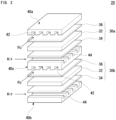
- FIG. 2 shows a schematic diagram of a solid oxide fuel cell stack having flat interconnectors.
- a fuel cell stack 20 includes unit cells 30a and 30b and interconnectors 40a to 40c.
- FIG. 2 merely exemplarily illustrates the two unit cells 30a and 30b, and the fuel cell stack may include any optional number of unit cells for each purpose.
- the unit cells 30a and 30b each include an electrolyte membrane 32, and a cathode 34 and an anode 36 bonded to two respective surfaces of the electrolyte membrane 32.
- an undepicted intermediate layer is typically provided between the electrolyte membrane 32 and the cathode 34 to prevent them from reacting with each other.
- various materials may be used for each of the electrolyte membrane 32, the cathode 34, the anode 36, and the intermediate layer.
- materials of the electrolyte membrane 32 typically include yttria-stabilized zirconia (YSZ), scandia-stabilized zirconia (ScSZ), and lanthanum gallate (LaGaO 3 ).
- YSZ yttria-stabilized zirconia
- ScSZ scandia-stabilized zirconia
- LaGaO 3 lanthanum gallate
- Materials of the cathode 34 typically include lanthanum manganite (LaAeMnO 3 , where Ae is Sr or Ce), lanthanum cobaltite (LaSrCoO 3 ), lanthanum ferrite (LaSrFeO 3 ), lanthanum strontium cobalt ferrite (LaSrCoFeO 3 ), lanthanum nickel oxide (LaNiO 3 ), and samarium cobaltite (SmSrCoO 3 ).
- LaAeMnO 3 lanthanum manganite
- Ae is Sr or Ce
- LaSrCoO 3 lanthanum cobaltite
- LaSrFeO 3 lanthanum ferrite
- LaSrCoFeO 3 lanthanum strontium cobalt ferrite
- LaNiO 3 lanthanum nickel oxide
- SmSrCoO 3 samarium cobaltite
- Materials of the anode 36 typically include composite materials of nickel oxide and a solid electrolyte such as NiO-YSZ and NiO-ScSZ.
- Materials of the intermediate layer typically include gadolinium-doped ceria (GDC).
- GDC gadolinium-doped ceria
- the interconnectors 40a to 40c are flat and provided at an upper end of the unit cell 30a, a lower end of the unit cell 30b, and between the unit cells 30a and 30b, respectively.
- the interconnector 40a is provided at the anode 36-side end of the fuel cell stack 20.
- the interconnector 40a has a fuel gas channel 42 in its surface adjacent to the unit cell 30a.
- the interconnector 40b is provided at the cathode 34-side end of the fuel cell stack 20.
- the interconnector 40b has an oxidizer gas channel 44 in its surface adjacent to the unit cell 30b.
- the interconnector 40c is provided between the unit cells 30a and 30b.
- the interconnector 40c has an oxidizer gas channel 44 in its surface adjacent to the unit cell 30a.
- the interconnector 40c further has a fuel gas channel 42 in its surface adjacent to the unit cell 30b.
- the capturing agent is preferably in a form of a thin film (poisoning prevention layer) including the capturing agent formed on an inner surface of the gas channel (the fuel gas channel 42 or the oxidizer gas channel 44) of each of the interconnectors 40a to 40c.
- inner surface of the gas channel refers to a surface to be in direct contact with the reaction gas (fuel gas or oxidizer gas) among the surfaces of the interconnectors 40a to 40c, i.e., does not include a surface to be in direct contact with the cathode 34 or the anode 36.
- no poisoning prevention layer is formed on a surface in direct contact with the cathode 34 or the anode 36 among the surfaces of the interconnectors 40a to 40c so that each of the unit cells 30a and 30b is electrically connected to some of the interconnectors 40a to 40c.
- the cathode 34 or the anode 36 is poisoned by Cr via a gas phase.
- Cr Fe-Cr alloy
- substantially no Cr poisoning occurs through solid-phase diffusion even if some of the interconnectors 40a to 40c is in direct contact with the cathode 34 or the anode 36.
- Cr and S may each act as a poisonous substance for the fuel cell electrode.
- the oxide having the corundum structure and the titania-based oxide each has the function of capturing Cr and S. Accordingly, in a case where such an oxide is provided in an appropriate portion on the fuel gas supply passage and/or the oxidizer gas supply passage, it is possible to prevent the fuel cell electrode from being poisoned by Cr or S.
- Titania powder (rutile type, from Kojundo Chemical Laboratory Co., Ltd.), ethanol, a dispersant (MALIALIM (registered tradename), from NOF CORPORATION), and a binder (S-LEC (registered tradename), from SEKISUI CHEMICAL CO., LTD.) were mixed by a planetary ball mill (from Fritsch Japan Co., Ltd) to prepare a titania slurry.
- FIG. 3 shows a photograph of the alumina honeycomb (aeration setter, from MINO CERAMIC CO., LTD.) used in the experiment.
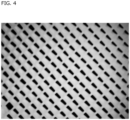
- FIG. 4 shows a photograph of the alumina honeycomb coated with titania (Example 1).
- Example 1 The alumina honeycomb used in Example 1 was directly used for a test.
- LSCF LaSrCoFeO 3 , lanthanum strontium cobalt ferrite sintered body used for the cathode of the SOFC was used as a specimen (poisoning object).
- the LSCF sintered body was prepared through sintering for 10 hours at 1100°C in the atmosphere.
- SUS 304 was used as a chromium source, and sulfide-dispersed lead-free copper alloy (CAC411) was used as a sulfur source.
- FIG. 5 shows a schematic diagram of the poisoning test.
- the capturing component titanium-coated alumina honeycomb or alumina honeycomb
- the poisoning sources chromium source and sulfur source
- the LSCF sintered body was further placed on the capturing component.
- Such a sample was accommodated in an alumina crucible and subjected to heat treatment. The heat treatment was performed for 120 hours at 850°C in the atmosphere.
- Comparative Example 1 pillars having the same height as the alumina honeycomb were set up on the poisoning sources, and the LSCF sintered body was placed on the pillars. Such a sample was accommodated in an alumina crucible and subjected to heat treatment under the same condition as in Example 1.
- Comparative Example 2 (reference), pillars having the same height as the alumina honeycomb were set up without the capturing component, and the LSCF sintered body was placed on the pillars. Such a sample was accommodated in an alumina crucible and subjected to heat treatment under the same condition as in Example 1.
- X-ray fluorescence (XRF) measurement was performed on the poisoning-source-side surface of each LSCF sintered body.
- Table 1 shows the XRF measurement result of the poisoning-source-side surface of the LSCF sintered body after the poisoning test. Table 1 reveals the following.
- Titania powder (rutile type, from Kojundo Chemical Laboratory Co., Ltd.), alumina powder (from Kojundo Chemical Laboratory Co., Ltd.), ethanol, a dispersant (MALIALIM (registered tradename), from NOF CORPORATION), and a binder (S-LEC (registered tradename), from SEKISUI CHEMICAL CO., LTD.) were mixed by a planetary ball mill (from Fritsch Japan Co., Ltd) to prepare an alumina/titania mixed slurry.
- MALIALIM registered tradename
- NOF CORPORATION NOF CORPORATION
- S-LEC binder
- a surface of an interconnector material (Fe-Cr alloy) was dip-coated with the alumina/titania mixed slurry to form an alumina/titania thin film.
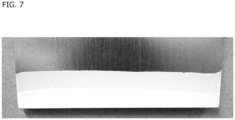
- FIG. 7 shows a photograph of the interconnector material coated with the alumina/titania mixed slurry.
- a uniform alumina/titania thin film was successfully formed by dip coating on the surface of the interconnector material.
- a uniform alumina/titania thin film was successfully formed by the dip coating not only on the alumina honeycomb but also on a sheet material.
- the fuel cell system according to the present invention can be used for various power supplies such as a mobile charger, a power supply of a small mobility, and a power supply of a walking support robot.
Landscapes
- Life Sciences & Earth Sciences (AREA)
- Engineering & Computer Science (AREA)
- Manufacturing & Machinery (AREA)
- Sustainable Development (AREA)
- Sustainable Energy (AREA)
- Chemical & Material Sciences (AREA)
- Chemical Kinetics & Catalysis (AREA)
- Electrochemistry (AREA)
- General Chemical & Material Sciences (AREA)
- Fuel Cell (AREA)
Description
- The present invention relates to a fuel cell system, and more specifically relates to a fuel cell system having a mechanism for capturing Cr and/or S each being a poisonous substance for a fuel cell electrode.
- A fuel cell typically includes a unit cell including an electrolyte membrane, and an anode and a cathode each containing an electrode catalyst and attached to either side of the electrolyte membrane. An interconnector, which may be referred to as "separator" or "collector", having a gas channel is disposed on either side of the unit cell. The fuel cell typically has a stacking structure (fuel cell stack) of a plurality of such unit cells and a plurality of interconnectors.
- The term "interconnector" means a component interconnecting between the unit cells in a narrow sense. In the present invention, however, the term includes not only "the interconnector in the narrow sense" but also a component that supplies a reaction gas to a unit cell located at an end of the fuel cell stack and supplies/receives electrons to/from the unit cell.
- Fuel cells are classified into various types such as a solid oxide type, a solid polymer type, an alkaline type, and a phosphoric acid type, etc. according to the type of electrolyte. In each type, poisoning of an electrode by a poisonous substance deteriorates cell performance. To address such a difficulty, various approaches have been provided.
- For example,
Patent Literature 1 discloses a fuel cell system including - a solid oxide fuel cell,
- a heat exchanger to heat air to be supplied to a cathode of the solid oxide fuel cell, and
- a poisonous element remover provided between the cathode and the heat exchanger and including an absorbent to remove poisonous elements including chromium, sulfur, and/or boron.
-
Patent Literature 1 describes that using the absorbent made of the same material (perovskite oxide) as a cathode material makes it possible to trap the poisonous element before the poisonous element reacts with the cathode. -
Patent Literature 2 discloses a sulfur-resistant anode collector layer containing Ni, Co, and samarium-doped ceria (Ce0.85Sm0.15O1.925). -
Patent Literature 2 describes that using such an anode collector layer converts H2S contained in a fuel gas into SOx so that absorption of H2S is minimized. - Patent Literature 3 discloses an interconnector for a solid oxide fuel cell including perovskite oxide and silica, wherein the composition of the perovskite oxide is expressed by La1-xSrxTi1-yFeyO3-δ, where 0.4 ≤ x ≤ 0.6 and 0 < y ≤ 1 are satisfied and δ is determined to satisfy a charge neutrality condition, and the content of silica is 5 to 14 mass%.
- Patent Literature 3 describes that using the interconnector including no Cr prevents deterioration in cell performance due to Cr poisoning.
- To suppress poisoning of a cathode or an anode of a solid oxide fuel cell by Cr or S,
Patent Literatures 1 to 3 disclose the respective methods of - (a) removing the poisonous element contained in the oxidizer gas using the same material (perovskite oxide) as the cathode material,
- (b) converting H2S contained in the fuel gas into SOX using the material containing samarium-doped ceria, and
- (c) using the perovskite oxide containing no Cr as a material of the interconnector.
- However, there has been no case where an oxide having a corundum structure or a titania-based oxide is used to prevent the electrode from being poisoned by a poisonous substance.
-
- Patent Literature 1:
Japanese Unexamined Patent Application Publication No. 2017-216071 - Patent Literature 2:
Japanese Patent No. 5608674 - Patent Literature 3:
Japanese Patent No. 5364393 -
US 2013/0230792 A1 discloses coatings for metal interconnects to reduce SOFC degradation. - An object of the invention is to provide a novel fuel cell system capable of capturing Cr and/or S each being a poisonous substance for a fuel cell electrode.
- To achieve the object, a fuel cell system according to the present invention has a configuration in accordance with
claim 1. - Cr and S may each act as a poisonous substance for a fuel cell electrode. The oxide having the corundum structure and the titania-based oxide each has the function of capturing Cr and S. Accordingly, in a case where such an oxide is provided in an appropriate portion on the fuel gas supply passage and/or the oxidizer gas supply passage, it is possible to prevent the fuel cell electrode from being poisoned by Cr or S.
-
-
FIG. 1 is a schematic diagram of a fuel cell system having a solid oxide fuel cell of an external reforming type; -
FIG. 2 is a schematic diagram of a solid oxide fuel cell stack having flat interconnectors; -
FIG. 3 is a photograph of an alumina honeycomb (Example 2) ; -
FIG. 4 is a photograph of an alumina honeycomb coated with titania (Example 1); -
FIG. 5 is a schematic diagram of a poisoning test; -
FIG. 6 is XRD patterns of poisoning-source-side surfaces of LSCF sintered bodies after the poisoning test; and -
FIG. 7 is a photograph of an interconnector material coated with an alumina/titania mixed slurry. - One embodiment of the present invention will now be described in detail.
- A fuel cell system according to the present invention includes
- a fuel cell,
- a fuel gas supply passage supplying a fuel gas to an anode of the fuel cell,
- an oxidizer gas supply passage supplying an oxidizer gas to a cathode of the fuel cell, and
- a capturing component provided in an appropriate portion on the fuel gas supply passage and/or the oxidizer gas supply passage and containing a capturing agent to capture a poisonous substance.
- The present invention can be applied to all types of fuel cells . Examples of the fuel cell to which the present invention is applied include a solid oxide fuel cell, a solid polymer fuel cell, an alkaline fuel cell, and a phosphoric acid fuel cell.
- Of these, the solid oxide fuel cell (SOFC) may include a peripheral component made of a material containing Cr (for example, Fe-Cr stainless steel) and is operated at high temperature. The present invention is therefore preferably applied to the solid oxide fuel cell.
- The term "fuel gas supply passage" refers to a passage to supply a fuel gas from a fuel gas source to the anode of the fuel cell. Examples of structural components of the fuel gas supply passage include
- (a) a gas tube connecting between the fuel gas source and the anode of the fuel cell,
- (b) a heat exchanger to heat the fuel gas to be supplied to the anode,
- (c) a reformer for steam reforming of a hydrocarbon fuel gas, and
- (d) a gas channel (interconnector) for the fuel gas inside the fuel cell.
- The term "oxidizer gas supply passage" refers to a passage to supply an oxidizer gas from an oxidizer gas source to the cathode of the fuel cell. Examples of structural components of the oxidizer gas supply passage include
- (a) a gas tube connecting between the oxidizer gas source and the cathode of the fuel cell,
- (b) a heat exchanger to heat the oxidizer gas to be supplied to the cathode, and
- (c) a gas channel (interconnector) for the oxidizer gas inside the fuel cell.
- The term "capturing component" refers to a component for capturing the poisonous substance. The capturing component is provided in an appropriate portion on the fuel gas supply passage and/or the oxidizer gas supply passage.
- In the present invention, details of the capturing component such as a structure and a setting method are not limited as long as the capturing component can capture the poisonous substance before the electrode is poisoned. Examples of the capturing component include
- (a) a filter or a honeycomb including a capturing agent and provided in the middle of the gas tube of the fuel gas supply passage or the oxidizer gas supply passage,
- (b) a filter or a honeycomb having a base material coated with the capturing agent, and
- (c) a thin film (poisoning prevention layer) including the capturing agent and provided on an inner surface of a gas channel of the interconnector.
- In the case of the solid oxide fuel cell, the capturing component is preferably a poisoning prevention layer formed on the inner surface of the gas channel of the interconnector of the fuel cell.
- The capturing agent needs to be heated to an appropriate adsorption temperature to adsorb the poisonous substance. On the other hand, the solid oxide fuel cell is operated at high temperature. Accordingly, when the poisoning prevention layer is formed on the inner surface of the gas channel of the interconnector of the solid oxide fuel cell, it is unnecessary to provide a heat source to maintain the poisoning prevention layer at the appropriate temperature.
- Although various materials have been used for the interconnector of the solid oxide fuel cell, use of inexpensive Fe-Cr alloy (so-called ferritic stainless steel) is now specifically investigated. However, since the interconnector is disposed close to the electrode, if the Fe-Cr alloy is used for the material of the interconnector, the electrode is poisoned by the interconnector. In contrast, when a poisoning prevention layer is formed in the inner surface of the gas channel of the interconnector, Cr poisoning of the electrode can be suppressed even if the interconnector is made of a material to be a poisoning source such as Fe-Cr alloy.
- In the present invention, the term "poisonous substance" refers to Cr and/or S.
- In a case where a material containing Cr (for example, Fe-Cr stainless steel) is used for one of the fuel gas supply passage and the oxidizer gas supply passage, when the gas supply passage is exposed to high temperature, a vapor containing Cr is generated from the material containing Cr. The vapor containing Cr poisons, for example, the cathode and the anode (in particular, the cathode) of the solid oxide fuel cell, causing deterioration in fuel cell performance.
- The fuel gas may contain a sulfur constituent derived from the raw material. When air is used as the oxidizer gas, the air may contain a sulfur constituent. When such a sulfur constituent is supplied to the anode and/or the cathode of the fuel cell, the sulfur constituent poisons the anode and/or the cathode, causing deterioration in fuel cell performance.
- In the present invention, the capturing component is used to capture Cr and/or S before the electrode is poisoned by Cr and/or S that has entered the gas supply passage of the fuel cell.
- In the present invention, the capturing agent contains the oxide having the corundum structure or the titania-based oxide. The present invention is different in this point from the existing fuel cell systems. The capturing agent may contain one or both of such oxides.
- Examples of the oxide having the corundum structure include alumina, α-Ga2O3 (gallium oxide), α-Ti2O3 (titanium oxide), α-In2O3 (indium oxide), α-Fe2O3 (iron oxide), α-Cr2O3 (chromium oxide) , α-V2O3 (vanadium oxide) , and α-Rh2O3 (rhodium oxide).
- Alumina is preferable as the oxide having the corundum structure. This is because alumina is easily available and thermally stable and easily dissolves Cr as seen in ruby.
- The oxide having the corundum structure (in particular, alumina) serves as the capturing agent of Cr and S. The reason for this is as follows.
- That is, the oxide having the corundum structure easily forms a solid solution such as Fe2O3-Cr2O3, Ga2O3-Cr2O3, Al2O3-Cr2O3, V2O3-Cr2O3, and Al2O3-Cr2O3, and thus potentially has a capturing effect of Cr as typically seen in alumina.
- The term "titania-based oxide" refers to an oxide mainly containing titanium oxide (TiOx).
- Examples of the titania-based oxide include
- (a)

- (b)

- The titania-based oxide (in particular, titania-based solid solution) serves as the capturing agent of Cr and S. The reason for this is as follows.
- That is, basicity of titania contributes to the capturing effect of Cr and S. The solid solution maintains the basicity and thus also serves as the capturing agent.
- The present invention can be applied to various fuel cell systems .
FIG. 1 shows a schematic diagram of a fuel cell system having a solid oxide fuel cell of an external reforming type. InFIG. 1 , afuel cell system 10 includes avaporizer 12, areformer 14, aheat exchanger 16, and a fuel cell (solid oxide fuel cell) 20. - The
vaporizer 12 vaporizes hydrocarbon (for example, methane) and water as raw materials for synthesizing a reformed gas and supplies such vapor to thereformer 14. Two respective inlets of thevaporizer 12 are connected to an undepicted hydrocarbon source and an undepicted water source. An outlet of thevaporizer 12 is connected to an inlet of thereformer 14 via agas tube 18a. - The
reformer 14 generates a mixed gas (synthesis gas) of CO and H2 through steam reforming of hydrocarbon. Since the steam reforming reaction is an endothermic reaction, thereformer 14 includes a reformingpart 14a for steam reforming and acombustion part 14b to supply heat necessary for the steam reforming reaction to the reformingpart 14a. - The inlet of the reforming
part 14a is connected to the outlet of thevaporizer 12 via thegas tube 18a. An outlet of the reformingpart 14a is connected to an inlet of an anode of thefuel cell 20 via agas tube 18b. - The
combustion part 14b reacts an unreacted fuel (H2, CO) contained in anode off-gas with residual oxygen contained in cathode off-gas, and supplies the combustion heat to the reformingpart 14a. Two inlets of thecombustion part 14b are connected to an outlet of the anode and an outlet of the cathode of thefuel cell 20 viagas tubes combustion part 14b is connected to an exhaust-gas-side inlet of theheat exchanger 16 via agas tube 18e. - The
fuel cell 20 generates electric power using the fuel such as hydrocarbon, CO, and H2, and oxygen. Thefuel cell 20 ofFIG. 1 is a solid oxide fuel cell. The solid oxide fuel cell is described in detail later. - The
heat exchanger 16 heats air to be supplied to the cathode of thefuel cell 20. Since the solid oxide fuel cell is operated at approximately 700°C, if air at room temperature is directly supplied to the cathode, temperature of thefuel cell 20 is lowered. In the solid oxide fuel cell, therefore, theheat exchanger 16 is typically used to heat the air. - The atmosphere-side inlet of the
heat exchanger 16 is connected to the atmosphere via agas tube 18f. The atmosphere-side outlet of theheat exchanger 16 is connected to the inlet of the cathode of thefuel cell 20 via agas tube 18g. - In the
fuel cell system 10 ofFIG. 1 , the fuel gas supply passage includes thevaporizer 12, thegas tube 18a, the reformingpart 14a, thegas tube 18b, and an anode gas channel of thefuel cell 20. - The oxidizer gas supply passage includes the
gas tube 18f, theheat exchanger 16, thegas tube 18g, and a cathode gas channel of thefuel cell 20. - In the present invention, the capturing component is provided in an appropriate portion on the fuel gas supply passage and/or the oxidizer gas supply passage.
- For example, the capturing component may be provided in the middle of the
gas tube - However, the capturing agent needs to be maintained at a certain temperature or higher to capture the poisonous substance. Specifically, the temperature of the capturing agent is preferably 300°C or higher, and more preferably 600°C or higher. A heat source is therefore required to maintain the capturing component at an appropriate temperature if the capturing component is provided in the middle of the
gas tube fuel cell 20, the poisoning prevention effect is insufficient. - In contrast, when the capturing component is provided on a surface of the interconnector of the
fuel cell 20, the capturing component is maintained at a temperature equal to the temperature of thefuel cell 20. It is therefore unnecessary to provide the heat source to maintain the capturing component at an appropriate temperature. In addition, the interconnector is located closest to the anode or the cathode. The capturing component is therefore preferably formed on the inner surface of the gas channel of the interconnector of thefuel cell 20. - The present invention can be applied to fuel cell systems having various fuel cell stacks.
FIG. 2 shows a schematic diagram of a solid oxide fuel cell stack having flat interconnectors. InFIG. 2 , afuel cell stack 20 includesunit cells interconnectors 40a to 40c. -
FIG. 2 merely exemplarily illustrates the twounit cells - The
unit cells electrolyte membrane 32, and acathode 34 and ananode 36 bonded to two respective surfaces of theelectrolyte membrane 32. In the solid oxide fuel cell, an undepicted intermediate layer is typically provided between theelectrolyte membrane 32 and thecathode 34 to prevent them from reacting with each other. In the present invention, various materials may be used for each of theelectrolyte membrane 32, thecathode 34, theanode 36, and the intermediate layer. - In the solid oxide fuel cell, materials of the
electrolyte membrane 32 typically include yttria-stabilized zirconia (YSZ), scandia-stabilized zirconia (ScSZ), and lanthanum gallate (LaGaO3). - Materials of the
cathode 34 typically include lanthanum manganite (LaAeMnO3, where Ae is Sr or Ce), lanthanum cobaltite (LaSrCoO3), lanthanum ferrite (LaSrFeO3), lanthanum strontium cobalt ferrite (LaSrCoFeO3), lanthanum nickel oxide (LaNiO3), and samarium cobaltite (SmSrCoO3). - Materials of the
anode 36 typically include composite materials of nickel oxide and a solid electrolyte such as NiO-YSZ and NiO-ScSZ. - Materials of the intermediate layer typically include gadolinium-doped ceria (GDC).
- The
interconnectors 40a to 40c are flat and provided at an upper end of theunit cell 30a, a lower end of theunit cell 30b, and between theunit cells - The
interconnector 40a is provided at the anode 36-side end of thefuel cell stack 20. Theinterconnector 40a has afuel gas channel 42 in its surface adjacent to theunit cell 30a. - The interconnector 40b is provided at the cathode 34-side end of the
fuel cell stack 20. The interconnector 40b has anoxidizer gas channel 44 in its surface adjacent to theunit cell 30b. - The interconnector 40c is provided between the
unit cells oxidizer gas channel 44 in its surface adjacent to theunit cell 30a. The interconnector 40c further has afuel gas channel 42 in its surface adjacent to theunit cell 30b. - As described above, the capturing agent is preferably in a form of a thin film (poisoning prevention layer) including the capturing agent formed on an inner surface of the gas channel (the
fuel gas channel 42 or the oxidizer gas channel 44) of each of theinterconnectors 40a to 40c. - The term "inner surface of the gas channel" refers to a surface to be in direct contact with the reaction gas (fuel gas or oxidizer gas) among the surfaces of the
interconnectors 40a to 40c, i.e., does not include a surface to be in direct contact with thecathode 34 or theanode 36. - That is, no poisoning prevention layer is formed on a surface in direct contact with the
cathode 34 or theanode 36 among the surfaces of theinterconnectors 40a to 40c so that each of theunit cells interconnectors 40a to 40c. - The
cathode 34 or theanode 36 is poisoned by Cr via a gas phase. Hence, when Fe-Cr alloy is used for theinterconnectors 40a to 40c, substantially no Cr poisoning occurs through solid-phase diffusion even if some of theinterconnectors 40a to 40c is in direct contact with thecathode 34 or theanode 36. - Cr and S may each act as a poisonous substance for the fuel cell electrode. The oxide having the corundum structure and the titania-based oxide each has the function of capturing Cr and S. Accordingly, in a case where such an oxide is provided in an appropriate portion on the fuel gas supply passage and/or the oxidizer gas supply passage, it is possible to prevent the fuel cell electrode from being poisoned by Cr or S.
- Titania powder (rutile type, from Kojundo Chemical Laboratory Co., Ltd.), ethanol, a dispersant (MALIALIM (registered tradename), from NOF CORPORATION), and a binder (S-LEC (registered tradename), from SEKISUI CHEMICAL CO., LTD.) were mixed by a planetary ball mill (from Fritsch Japan Co., Ltd) to prepare a titania slurry.
- A surface of an alumina honeycomb was dip-coated with the titania slurry to form a titania thin film on the surface of the alumina honeycomb.
FIG. 3 shows a photograph of the alumina honeycomb (aeration setter, from MINO CERAMIC CO., LTD.) used in the experiment.FIG. 4 shows a photograph of the alumina honeycomb coated with titania (Example 1). - The alumina honeycomb used in Example 1 was directly used for a test.
- An LSCF (LaSrCoFeO3, lanthanum strontium cobalt ferrite) sintered body used for the cathode of the SOFC was used as a specimen (poisoning object). The LSCF sintered body was prepared through sintering for 10 hours at 1100°C in the atmosphere.
- SUS 304 was used as a chromium source, and sulfide-dispersed lead-free copper alloy (CAC411) was used as a sulfur source.
-
FIG. 5 shows a schematic diagram of the poisoning test. In Examples 1 and 2, the capturing component (titania-coated alumina honeycomb or alumina honeycomb) was placed on the poisoning sources (chromium source and sulfur source), and the LSCF sintered body was further placed on the capturing component. Such a sample was accommodated in an alumina crucible and subjected to heat treatment. The heat treatment was performed for 120 hours at 850°C in the atmosphere. - In Comparative Example 1, pillars having the same height as the alumina honeycomb were set up on the poisoning sources, and the LSCF sintered body was placed on the pillars. Such a sample was accommodated in an alumina crucible and subjected to heat treatment under the same condition as in Example 1.
- In Comparative Example 2 (reference), pillars having the same height as the alumina honeycomb were set up without the capturing component, and the LSCF sintered body was placed on the pillars. Such a sample was accommodated in an alumina crucible and subjected to heat treatment under the same condition as in Example 1.
- After the poisoning test, X-ray diffraction (XRD) measurement was performed on the poisoning-source-side surface of each LSCF sintered body.
FIG. 6 shows each XRD pattern of the poisoning-source-side surface of the LSCF sintered body after the poisoning test. In Example 1, impurity peaks other than the peaks derived from the LSCF were smallest in number and low in intensity. - After the poisoning test, X-ray fluorescence (XRF) measurement was performed on the poisoning-source-side surface of each LSCF sintered body. Table 1 shows the XRF measurement result of the poisoning-source-side surface of the LSCF sintered body after the poisoning test. Table 1 reveals the following.
- (1) In Example 2 (alumina honeycomb), the amount of S was large compared with Comparative Example 1, but the amount of Cr was small, approximately 1/3 of that in Comparative Example 1.
- (2) In Example 1 (titania-coated alumina honeycomb), the S amount and the Cr amount were each not large, i.e., at the same level as that in Comparative Example 2.
- (3) Alumina exhibited a capturing effect that was large for vanadium but moderate for lead, copper, and bismuth. Titania exhibited a capturing effect that was large for bismuth but moderate for zinc, lead, and copper.
- Titania powder (rutile type, from Kojundo Chemical Laboratory Co., Ltd.), alumina powder (from Kojundo Chemical Laboratory Co., Ltd.), ethanol, a dispersant (MALIALIM (registered tradename), from NOF CORPORATION), and a binder (S-LEC (registered tradename), from SEKISUI CHEMICAL CO., LTD.) were mixed by a planetary ball mill (from Fritsch Japan Co., Ltd) to prepare an alumina/titania mixed slurry.
- A surface of an interconnector material (Fe-Cr alloy) was dip-coated with the alumina/titania mixed slurry to form an alumina/titania thin film.
-
FIG. 7 shows a photograph of the interconnector material coated with the alumina/titania mixed slurry. A uniform alumina/titania thin film was successfully formed by dip coating on the surface of the interconnector material. A uniform alumina/titania thin film was successfully formed by the dip coating not only on the alumina honeycomb but also on a sheet material. - The fuel cell system according to the present invention can be used for various power supplies such as a mobile charger, a power supply of a small mobility, and a power supply of a walking support robot.
-
- 10
- Fuel cell system
- 20
- Fuel cell
- 34
- Cathode
- 36
- Anode
| Sample | [mass%] | |||||||||||
| S | V | Cr | Fe | Co | Cu | Zn | Sr | Zr | La | Pb | Bi | |
| Comparative Example 1 | 4.7 | 0.14 | 2.8 | 23 | 6.0 | 0.52 | 0.80 | 19 | 0.15 | 42 | 0.77 | 0.81 |
| Example 2 | 6.7 | <0.1 | 1.0 | 23 | 6.2 | 0.36 | 0.87 | 18 | 0.13 | 42 | 0.52 | 0.64 |
| Example 1 | 3.5 | <0.1 | <0.1 | 25 | 6.4 | 0.18 | 0.14 | 19 | 0.14 | 46 | 0.33 | <0.1 |
| Comparative Example 2 | 3.4 | <0.1 | <0.1 | 25 | 6.4 | <0.1 | <0.1 | 19 | 0.13 | 46 | <0.1 | <0.1 |
Claims (3)
- A fuel cell system (10), comprising:a solid oxide fuel cell (20);a fuel gas supply passage supplying a fuel gas to an anode (34) of the solid oxide fuel cell;an oxidizer gas supply passage supplying an oxidizer gas to a cathode (34) of the solid oxide fuel cell; anda capturing component provided in a portion on the fuel gas supply passage and/or the oxidizer gas supply passage and containing a capturing agent to capture a poisonous substance,the capturing component being a thin film including the capturing agent formed on an inner surface of a gas channel (42, 44) of an interconnector (40a, 40b, 40c) of the solid oxide fuel cell (20) without being formed on a surface of the interconnector that is in direct contact with the cathode (34) or the anode (36),the interconnector (40a, 40b, 40c) being made of ferritic stainless steel,the poisonous substance being Cr and/or S, andthe capturing agent including an oxide having a corundum structure and/or a titania-based oxide.
- The fuel cell system according to claim 1, wherein the oxide having the corundum structure is alumina.
- The fuel cell system according to claim 1 or 2, wherein the titania-based oxide includes(a)
 (b)
(b)
Applications Claiming Priority (2)
| Application Number | Priority Date | Filing Date | Title |
|---|---|---|---|
| JP2018042646A JP6856043B2 (en) | 2018-03-09 | 2018-03-09 | Fuel cell system |
| PCT/JP2019/006204 WO2019171945A1 (en) | 2018-03-09 | 2019-02-20 | Fuel cell system |
Publications (3)
| Publication Number | Publication Date |
|---|---|
| EP3751654A1 EP3751654A1 (en) | 2020-12-16 |
| EP3751654A4 EP3751654A4 (en) | 2021-12-01 |
| EP3751654B1 true EP3751654B1 (en) | 2025-01-15 |
Family
ID=67846738
Family Applications (1)
| Application Number | Title | Priority Date | Filing Date |
|---|---|---|---|
| EP19763879.4A Active EP3751654B1 (en) | 2018-03-09 | 2019-02-20 | Fuel cell system |
Country Status (3)
| Country | Link |
|---|---|
| EP (1) | EP3751654B1 (en) |
| JP (1) | JP6856043B2 (en) |
| WO (1) | WO2019171945A1 (en) |
Families Citing this family (4)
| Publication number | Priority date | Publication date | Assignee | Title |
|---|---|---|---|---|
| US20250125392A1 (en) * | 2023-10-16 | 2025-04-17 | Robert Bosch Gmbh | Solid oxide fuel cell system chromium poisoning prevention materials |
| DE102023213048A1 (en) | 2023-12-20 | 2025-06-26 | Robert Bosch Gesellschaft mit beschränkter Haftung | Fuel cell device |
| DE102023213057A1 (en) | 2023-12-20 | 2025-06-26 | Robert Bosch Gesellschaft mit beschränkter Haftung | System of catalyst, electrochemical cell device |
| DE102024208040A1 (en) * | 2024-08-23 | 2026-02-26 | Robert Bosch Gesellschaft mit beschränkter Haftung | Filter, electrochemical cell device, process |
Family Cites Families (8)
| Publication number | Priority date | Publication date | Assignee | Title |
|---|---|---|---|---|
| JPS5258743A (en) | 1975-11-11 | 1977-05-14 | Dainippon Toryo Co Ltd | Method for corrosionproof coating |
| US8444945B2 (en) * | 2002-12-26 | 2013-05-21 | Idemitsu Kosan Co., Ltd. | Method for removing sulfur compound in hydrocarbon-containing gas |
| KR100871898B1 (en) * | 2005-10-28 | 2008-12-05 | 에스케이에너지 주식회사 | Exhaust gas purification device of diesel engine |
| JP4993346B2 (en) * | 2006-12-12 | 2012-08-08 | 住友精密工業株式会社 | Fuel cell equipment |
| JP5364393B2 (en) | 2009-02-12 | 2013-12-11 | 株式会社ノリタケカンパニーリミテド | Interconnector for solid oxide fuel cell and its utilization |
| US10431833B2 (en) * | 2012-03-01 | 2019-10-01 | Bloom Energy Corporation | Coatings for metal interconnects to reduce SOFC degradation |
| JP6141753B2 (en) * | 2013-11-06 | 2017-06-07 | 日本特殊陶業株式会社 | Solid oxide fuel cell |
| JP2017216071A (en) * | 2016-05-30 | 2017-12-07 | 東京瓦斯株式会社 | Fuel cell system |
-
2018
- 2018-03-09 JP JP2018042646A patent/JP6856043B2/en active Active
-
2019
- 2019-02-20 WO PCT/JP2019/006204 patent/WO2019171945A1/en not_active Ceased
- 2019-02-20 EP EP19763879.4A patent/EP3751654B1/en active Active
Also Published As
| Publication number | Publication date |
|---|---|
| WO2019171945A1 (en) | 2019-09-12 |
| JP6856043B2 (en) | 2021-04-07 |
| JP2019160475A (en) | 2019-09-19 |
| EP3751654A1 (en) | 2020-12-16 |
| EP3751654A4 (en) | 2021-12-01 |
Similar Documents
| Publication | Publication Date | Title |
|---|---|---|
| EP2797147B1 (en) | Solid oxide fuel cell | |
| CN105940540B (en) | Electrochemical energy conversion device, battery, and positive electrode material for same | |
| TWI761479B (en) | Electrochemical element, electrochemical module, electrochemical device, energy system, solid oxide fuel cell and manufacturing method for electrochemical element | |
| EP3751654B1 (en) | Fuel cell system | |
| Marrero-López et al. | Applicability of La2Mo2− yWyO9 materials as solid electrolyte for SOFCs | |
| KR20100112124A (en) | High performance multilayer electrodes for use in reducing gases | |
| KR20100107007A (en) | High performance multilayer electrodes for use in oxygen-containing gases | |
| CA2906709A1 (en) | Fuel cell system configured to capture chromium | |
| US8586251B2 (en) | Fuel cell system | |
| EP3499617B1 (en) | Electrochemical reaction single cell and electrochemical reaction cell stack | |
| EP3604625A1 (en) | Method for producing alloy member, alloy member, electrochemical element, electrochemical module, electrochemical device, energy system, and solid oxide fuel cell | |
| EP3809505B1 (en) | Cell, cell stack device, module, and module storage device | |
| US12199326B2 (en) | Fabrication processes for metal-supported proton conducting solid oxide electrochemical devices | |
| US11101484B2 (en) | Electrochemical cell stack | |
| JP6818960B1 (en) | Cells, cell stack devices, modules and module containment devices | |
| JP2023101476A (en) | Optimized processing of electrodes for SOFC and SOEC | |
| US11101483B2 (en) | Electrochemical cell stack | |
| US20250230562A1 (en) | Solid oxide electrochemical cell containing strontium getter | |
| EP4108809A1 (en) | Electrochemical cell and electrochemical cell stack | |
| WO2025203449A1 (en) | Electrochemical cell | |
| Sudarsan et al. | Exceptional cathodic performance of nanostructured La–Sr–Co–Fe–O highly dispersed in porous yttria-stabilized zirconia frameworks for intermediate-temperature solid oxide fuel cells | |
| WO2022098535A1 (en) | Anode catalysts for fuel cells | |
| Garibay | Manufacturing of intermediate-temperature solid oxide fuel cells using novel cathode compositions | |
| Torres Garibay | Manufacturing of intermediate-temperature solid oxide fuel cells using novel cathode compositions | |
| Bourell et al. | MANUFACTURING OF INTERMEDIATE-TEMPERATURE SOLID OXIDE FUEL CELLS USING NOVEL CATHODE COMPOSITIONS |
Legal Events
| Date | Code | Title | Description |
|---|---|---|---|
| STAA | Information on the status of an ep patent application or granted ep patent |
Free format text: STATUS: THE INTERNATIONAL PUBLICATION HAS BEEN MADE |
|
| PUAI | Public reference made under article 153(3) epc to a published international application that has entered the european phase |
Free format text: ORIGINAL CODE: 0009012 |
|
| STAA | Information on the status of an ep patent application or granted ep patent |
Free format text: STATUS: REQUEST FOR EXAMINATION WAS MADE |
|
| 17P | Request for examination filed |
Effective date: 20200911 |
|
| AK | Designated contracting states |
Kind code of ref document: A1 Designated state(s): AL AT BE BG CH CY CZ DE DK EE ES FI FR GB GR HR HU IE IS IT LI LT LU LV MC MK MT NL NO PL PT RO RS SE SI SK SM TR |
|
| AX | Request for extension of the european patent |
Extension state: BA ME |
|
| DAV | Request for validation of the european patent (deleted) | ||
| DAX | Request for extension of the european patent (deleted) | ||
| A4 | Supplementary search report drawn up and despatched |
Effective date: 20211102 |
|
| RIC1 | Information provided on ipc code assigned before grant |
Ipc: H01M 8/1231 20160101ALI20211026BHEP Ipc: H01M 8/124 20160101ALI20211026BHEP Ipc: H01M 8/021 20160101ALI20211026BHEP Ipc: H01M 8/0662 20160101AFI20211026BHEP |
|
| GRAP | Despatch of communication of intention to grant a patent |
Free format text: ORIGINAL CODE: EPIDOSNIGR1 |
|
| RIC1 | Information provided on ipc code assigned before grant |
Ipc: H01M 8/12 20160101ALN20240918BHEP Ipc: H01M 8/1231 20160101ALI20240918BHEP Ipc: H01M 8/124 20160101ALI20240918BHEP Ipc: H01M 8/021 20160101ALI20240918BHEP Ipc: H01M 8/0662 20160101AFI20240918BHEP |
|
| STAA | Information on the status of an ep patent application or granted ep patent |
Free format text: STATUS: GRANT OF PATENT IS INTENDED |
|
| INTG | Intention to grant announced |
Effective date: 20241024 |
|
| RIN1 | Information on inventor provided before grant (corrected) |
Inventor name: MATSUO, HIDEHITO Inventor name: TANI, TOSHIHIKO Inventor name: HAYASHI, YUJIRO Inventor name: NOZAKI, HIROSHI |
|
| GRAS | Grant fee paid |
Free format text: ORIGINAL CODE: EPIDOSNIGR3 |
|
| GRAA | (expected) grant |
Free format text: ORIGINAL CODE: 0009210 |
|
| STAA | Information on the status of an ep patent application or granted ep patent |
Free format text: STATUS: THE PATENT HAS BEEN GRANTED |
|
| P01 | Opt-out of the competence of the unified patent court (upc) registered |
Free format text: CASE NUMBER: APP_62032/2024 Effective date: 20241120 |
|
| AK | Designated contracting states |
Kind code of ref document: B1 Designated state(s): AL AT BE BG CH CY CZ DE DK EE ES FI FR GB GR HR HU IE IS IT LI LT LU LV MC MK MT NL NO PL PT RO RS SE SI SK SM TR |
|
| REG | Reference to a national code |
Ref country code: CH Ref legal event code: EP Ref country code: GB Ref legal event code: FG4D |
|
| REG | Reference to a national code |
Ref country code: DE Ref legal event code: R096 Ref document number: 602019064890 Country of ref document: DE |
|
| REG | Reference to a national code |
Ref country code: IE Ref legal event code: FG4D |
|
| REG | Reference to a national code |
Ref country code: NL Ref legal event code: MP Effective date: 20250115 |
|
| PG25 | Lapsed in a contracting state [announced via postgrant information from national office to epo] |
Ref country code: NL Free format text: LAPSE BECAUSE OF FAILURE TO SUBMIT A TRANSLATION OF THE DESCRIPTION OR TO PAY THE FEE WITHIN THE PRESCRIBED TIME-LIMIT Effective date: 20250115 |
|
| PG25 | Lapsed in a contracting state [announced via postgrant information from national office to epo] |
Ref country code: RS Free format text: LAPSE BECAUSE OF FAILURE TO SUBMIT A TRANSLATION OF THE DESCRIPTION OR TO PAY THE FEE WITHIN THE PRESCRIBED TIME-LIMIT Effective date: 20250415 |
|
| PG25 | Lapsed in a contracting state [announced via postgrant information from national office to epo] |
Ref country code: FI Free format text: LAPSE BECAUSE OF FAILURE TO SUBMIT A TRANSLATION OF THE DESCRIPTION OR TO PAY THE FEE WITHIN THE PRESCRIBED TIME-LIMIT Effective date: 20250115 |
|
| PG25 | Lapsed in a contracting state [announced via postgrant information from national office to epo] |
Ref country code: PL Free format text: LAPSE BECAUSE OF FAILURE TO SUBMIT A TRANSLATION OF THE DESCRIPTION OR TO PAY THE FEE WITHIN THE PRESCRIBED TIME-LIMIT Effective date: 20250115 |
|
| PG25 | Lapsed in a contracting state [announced via postgrant information from national office to epo] |
Ref country code: ES Free format text: LAPSE BECAUSE OF FAILURE TO SUBMIT A TRANSLATION OF THE DESCRIPTION OR TO PAY THE FEE WITHIN THE PRESCRIBED TIME-LIMIT Effective date: 20250115 |
|
| REG | Reference to a national code |
Ref country code: LT Ref legal event code: MG9D |
|
| PG25 | Lapsed in a contracting state [announced via postgrant information from national office to epo] |
Ref country code: IS Free format text: LAPSE BECAUSE OF FAILURE TO SUBMIT A TRANSLATION OF THE DESCRIPTION OR TO PAY THE FEE WITHIN THE PRESCRIBED TIME-LIMIT Effective date: 20250515 Ref country code: NO Free format text: LAPSE BECAUSE OF FAILURE TO SUBMIT A TRANSLATION OF THE DESCRIPTION OR TO PAY THE FEE WITHIN THE PRESCRIBED TIME-LIMIT Effective date: 20250415 |
|
| REG | Reference to a national code |
Ref country code: AT Ref legal event code: MK05 Ref document number: 1760427 Country of ref document: AT Kind code of ref document: T Effective date: 20250115 |
|
| PG25 | Lapsed in a contracting state [announced via postgrant information from national office to epo] |
Ref country code: HR Free format text: LAPSE BECAUSE OF FAILURE TO SUBMIT A TRANSLATION OF THE DESCRIPTION OR TO PAY THE FEE WITHIN THE PRESCRIBED TIME-LIMIT Effective date: 20250115 |
|
| PG25 | Lapsed in a contracting state [announced via postgrant information from national office to epo] |
Ref country code: LV Free format text: LAPSE BECAUSE OF FAILURE TO SUBMIT A TRANSLATION OF THE DESCRIPTION OR TO PAY THE FEE WITHIN THE PRESCRIBED TIME-LIMIT Effective date: 20250115 Ref country code: PT Free format text: LAPSE BECAUSE OF FAILURE TO SUBMIT A TRANSLATION OF THE DESCRIPTION OR TO PAY THE FEE WITHIN THE PRESCRIBED TIME-LIMIT Effective date: 20250515 |
|
| PG25 | Lapsed in a contracting state [announced via postgrant information from national office to epo] |
Ref country code: BG Free format text: LAPSE BECAUSE OF FAILURE TO SUBMIT A TRANSLATION OF THE DESCRIPTION OR TO PAY THE FEE WITHIN THE PRESCRIBED TIME-LIMIT Effective date: 20250115 Ref country code: GR Free format text: LAPSE BECAUSE OF FAILURE TO SUBMIT A TRANSLATION OF THE DESCRIPTION OR TO PAY THE FEE WITHIN THE PRESCRIBED TIME-LIMIT Effective date: 20250416 |
|
| PG25 | Lapsed in a contracting state [announced via postgrant information from national office to epo] |
Ref country code: AT Free format text: LAPSE BECAUSE OF FAILURE TO SUBMIT A TRANSLATION OF THE DESCRIPTION OR TO PAY THE FEE WITHIN THE PRESCRIBED TIME-LIMIT Effective date: 20250115 |
|
| PG25 | Lapsed in a contracting state [announced via postgrant information from national office to epo] |
Ref country code: SE Free format text: LAPSE BECAUSE OF FAILURE TO SUBMIT A TRANSLATION OF THE DESCRIPTION OR TO PAY THE FEE WITHIN THE PRESCRIBED TIME-LIMIT Effective date: 20250115 |
|
| REG | Reference to a national code |
Ref country code: CH Ref legal event code: PL |
|
| PG25 | Lapsed in a contracting state [announced via postgrant information from national office to epo] |
Ref country code: SM Free format text: LAPSE BECAUSE OF FAILURE TO SUBMIT A TRANSLATION OF THE DESCRIPTION OR TO PAY THE FEE WITHIN THE PRESCRIBED TIME-LIMIT Effective date: 20250115 |
|
| PG25 | Lapsed in a contracting state [announced via postgrant information from national office to epo] |
Ref country code: DK Free format text: LAPSE BECAUSE OF FAILURE TO SUBMIT A TRANSLATION OF THE DESCRIPTION OR TO PAY THE FEE WITHIN THE PRESCRIBED TIME-LIMIT Effective date: 20250115 |
|
| PG25 | Lapsed in a contracting state [announced via postgrant information from national office to epo] |
Ref country code: MC Free format text: LAPSE BECAUSE OF FAILURE TO SUBMIT A TRANSLATION OF THE DESCRIPTION OR TO PAY THE FEE WITHIN THE PRESCRIBED TIME-LIMIT Effective date: 20250115 |
|
| PG25 | Lapsed in a contracting state [announced via postgrant information from national office to epo] |
Ref country code: LU Free format text: LAPSE BECAUSE OF NON-PAYMENT OF DUE FEES Effective date: 20250220 Ref country code: IT Free format text: LAPSE BECAUSE OF FAILURE TO SUBMIT A TRANSLATION OF THE DESCRIPTION OR TO PAY THE FEE WITHIN THE PRESCRIBED TIME-LIMIT Effective date: 20250115 |
|
| REG | Reference to a national code |
Ref country code: DE Ref legal event code: R097 Ref document number: 602019064890 Country of ref document: DE |
|
| PG25 | Lapsed in a contracting state [announced via postgrant information from national office to epo] |
Ref country code: CH Free format text: LAPSE BECAUSE OF NON-PAYMENT OF DUE FEES Effective date: 20250228 |
|
| PG25 | Lapsed in a contracting state [announced via postgrant information from national office to epo] |
Ref country code: EE Free format text: LAPSE BECAUSE OF FAILURE TO SUBMIT A TRANSLATION OF THE DESCRIPTION OR TO PAY THE FEE WITHIN THE PRESCRIBED TIME-LIMIT Effective date: 20250115 Ref country code: CZ Free format text: LAPSE BECAUSE OF FAILURE TO SUBMIT A TRANSLATION OF THE DESCRIPTION OR TO PAY THE FEE WITHIN THE PRESCRIBED TIME-LIMIT Effective date: 20250115 |
|
| PG25 | Lapsed in a contracting state [announced via postgrant information from national office to epo] |
Ref country code: RO Free format text: LAPSE BECAUSE OF FAILURE TO SUBMIT A TRANSLATION OF THE DESCRIPTION OR TO PAY THE FEE WITHIN THE PRESCRIBED TIME-LIMIT Effective date: 20250115 |
|
| PG25 | Lapsed in a contracting state [announced via postgrant information from national office to epo] |
Ref country code: SK Free format text: LAPSE BECAUSE OF FAILURE TO SUBMIT A TRANSLATION OF THE DESCRIPTION OR TO PAY THE FEE WITHIN THE PRESCRIBED TIME-LIMIT Effective date: 20250115 |
|
| PLBE | No opposition filed within time limit |
Free format text: ORIGINAL CODE: 0009261 |
|
| STAA | Information on the status of an ep patent application or granted ep patent |
Free format text: STATUS: NO OPPOSITION FILED WITHIN TIME LIMIT |
|
| REG | Reference to a national code |
Ref country code: BE Ref legal event code: MM Effective date: 20250228 |
|
| 26N | No opposition filed |
Effective date: 20251016 |
|
| GBPC | Gb: european patent ceased through non-payment of renewal fee |
Effective date: 20250415 |
|
| PG25 | Lapsed in a contracting state [announced via postgrant information from national office to epo] |
Ref country code: GB Free format text: LAPSE BECAUSE OF NON-PAYMENT OF DUE FEES Effective date: 20250415 |
|
| PG25 | Lapsed in a contracting state [announced via postgrant information from national office to epo] |
Ref country code: FR Free format text: LAPSE BECAUSE OF NON-PAYMENT OF DUE FEES Effective date: 20250315 |
|
| PG25 | Lapsed in a contracting state [announced via postgrant information from national office to epo] |
Ref country code: BE Free format text: LAPSE BECAUSE OF NON-PAYMENT OF DUE FEES Effective date: 20250228 |
|
| PG25 | Lapsed in a contracting state [announced via postgrant information from national office to epo] |
Ref country code: IE Free format text: LAPSE BECAUSE OF NON-PAYMENT OF DUE FEES Effective date: 20250220 |
|
| PGFP | Annual fee paid to national office [announced via postgrant information from national office to epo] |
Ref country code: DE Payment date: 20251230 Year of fee payment: 8 |