EP3751631B1 - Polymer material, material for electroluminescence device, liquid composition, thin film, and electroluminescence device - Google Patents
Polymer material, material for electroluminescence device, liquid composition, thin film, and electroluminescence device Download PDFInfo
- Publication number
- EP3751631B1 EP3751631B1 EP20178942.7A EP20178942A EP3751631B1 EP 3751631 B1 EP3751631 B1 EP 3751631B1 EP 20178942 A EP20178942 A EP 20178942A EP 3751631 B1 EP3751631 B1 EP 3751631B1
- Authority
- EP
- European Patent Office
- Prior art keywords
- group
- formula
- substituted
- unsubstituted
- compound
- Prior art date
- Legal status (The legal status is an assumption and is not a legal conclusion. Google has not performed a legal analysis and makes no representation as to the accuracy of the status listed.)
- Active
Links
Images


Classifications
-
- H—ELECTRICITY
- H10—SEMICONDUCTOR DEVICES; ELECTRIC SOLID-STATE DEVICES NOT OTHERWISE PROVIDED FOR
- H10K—ORGANIC ELECTRIC SOLID-STATE DEVICES
- H10K85/00—Organic materials used in the body or electrodes of devices covered by this subclass
- H10K85/10—Organic polymers or oligomers
- H10K85/111—Organic polymers or oligomers comprising aromatic, heteroaromatic, or aryl chains, e.g. polyaniline, polyphenylene or polyphenylene vinylene
-
- C—CHEMISTRY; METALLURGY
- C08—ORGANIC MACROMOLECULAR COMPOUNDS; THEIR PREPARATION OR CHEMICAL WORKING-UP; COMPOSITIONS BASED THEREON
- C08G—MACROMOLECULAR COMPOUNDS OBTAINED OTHERWISE THAN BY REACTIONS ONLY INVOLVING UNSATURATED CARBON-TO-CARBON BONDS
- C08G61/00—Macromolecular compounds obtained by reactions forming a carbon-to-carbon link in the main chain of the macromolecule
- C08G61/12—Macromolecular compounds containing atoms other than carbon in the main chain of the macromolecule
-
- C—CHEMISTRY; METALLURGY
- C08—ORGANIC MACROMOLECULAR COMPOUNDS; THEIR PREPARATION OR CHEMICAL WORKING-UP; COMPOSITIONS BASED THEREON
- C08G—MACROMOLECULAR COMPOUNDS OBTAINED OTHERWISE THAN BY REACTIONS ONLY INVOLVING UNSATURATED CARBON-TO-CARBON BONDS
- C08G61/00—Macromolecular compounds obtained by reactions forming a carbon-to-carbon link in the main chain of the macromolecule
- C08G61/02—Macromolecular compounds containing only carbon atoms in the main chain of the macromolecule, e.g. polyxylylenes
- C08G61/10—Macromolecular compounds containing only carbon atoms in the main chain of the macromolecule, e.g. polyxylylenes only aromatic carbon atoms, e.g. polyphenylenes
-
- C—CHEMISTRY; METALLURGY
- C08—ORGANIC MACROMOLECULAR COMPOUNDS; THEIR PREPARATION OR CHEMICAL WORKING-UP; COMPOSITIONS BASED THEREON
- C08G—MACROMOLECULAR COMPOUNDS OBTAINED OTHERWISE THAN BY REACTIONS ONLY INVOLVING UNSATURATED CARBON-TO-CARBON BONDS
- C08G61/00—Macromolecular compounds obtained by reactions forming a carbon-to-carbon link in the main chain of the macromolecule
- C08G61/12—Macromolecular compounds containing atoms other than carbon in the main chain of the macromolecule
- C08G61/122—Macromolecular compounds containing atoms other than carbon in the main chain of the macromolecule derived from five- or six-membered heterocyclic compounds, other than imides
- C08G61/123—Macromolecular compounds containing atoms other than carbon in the main chain of the macromolecule derived from five- or six-membered heterocyclic compounds, other than imides derived from five-membered heterocyclic compounds
- C08G61/126—Macromolecular compounds containing atoms other than carbon in the main chain of the macromolecule derived from five- or six-membered heterocyclic compounds, other than imides derived from five-membered heterocyclic compounds with a five-membered ring containing one sulfur atom in the ring
-
- C—CHEMISTRY; METALLURGY
- C08—ORGANIC MACROMOLECULAR COMPOUNDS; THEIR PREPARATION OR CHEMICAL WORKING-UP; COMPOSITIONS BASED THEREON
- C08L—COMPOSITIONS OF MACROMOLECULAR COMPOUNDS
- C08L65/00—Compositions of macromolecular compounds obtained by reactions forming a carbon-to-carbon link in the main chain; Compositions of derivatives of such polymers
-
- C—CHEMISTRY; METALLURGY
- C09—DYES; PAINTS; POLISHES; NATURAL RESINS; ADHESIVES; COMPOSITIONS NOT OTHERWISE PROVIDED FOR; APPLICATIONS OF MATERIALS NOT OTHERWISE PROVIDED FOR
- C09K—MATERIALS FOR MISCELLANEOUS APPLICATIONS, NOT PROVIDED FOR ELSEWHERE
- C09K11/00—Luminescent materials, e.g. electroluminescent or chemiluminescent
- C09K11/02—Use of particular materials as binders, particle coatings or suspension media therefor
-
- C—CHEMISTRY; METALLURGY
- C09—DYES; PAINTS; POLISHES; NATURAL RESINS; ADHESIVES; COMPOSITIONS NOT OTHERWISE PROVIDED FOR; APPLICATIONS OF MATERIALS NOT OTHERWISE PROVIDED FOR
- C09K—MATERIALS FOR MISCELLANEOUS APPLICATIONS, NOT PROVIDED FOR ELSEWHERE
- C09K11/00—Luminescent materials, e.g. electroluminescent or chemiluminescent
- C09K11/08—Luminescent materials, e.g. electroluminescent or chemiluminescent containing inorganic luminescent materials
- C09K11/0883—Arsenides; Nitrides; Phosphides
-
- C—CHEMISTRY; METALLURGY
- C09—DYES; PAINTS; POLISHES; NATURAL RESINS; ADHESIVES; COMPOSITIONS NOT OTHERWISE PROVIDED FOR; APPLICATIONS OF MATERIALS NOT OTHERWISE PROVIDED FOR
- C09K—MATERIALS FOR MISCELLANEOUS APPLICATIONS, NOT PROVIDED FOR ELSEWHERE
- C09K11/00—Luminescent materials, e.g. electroluminescent or chemiluminescent
- C09K11/08—Luminescent materials, e.g. electroluminescent or chemiluminescent containing inorganic luminescent materials
- C09K11/88—Luminescent materials, e.g. electroluminescent or chemiluminescent containing inorganic luminescent materials containing selenium, tellurium or unspecified chalcogen elements
- C09K11/881—Chalcogenides
- C09K11/883—Chalcogenides with zinc or cadmium
-
- H—ELECTRICITY
- H10—SEMICONDUCTOR DEVICES; ELECTRIC SOLID-STATE DEVICES NOT OTHERWISE PROVIDED FOR
- H10K—ORGANIC ELECTRIC SOLID-STATE DEVICES
- H10K50/00—Organic light-emitting devices
-
- H—ELECTRICITY
- H10—SEMICONDUCTOR DEVICES; ELECTRIC SOLID-STATE DEVICES NOT OTHERWISE PROVIDED FOR
- H10K—ORGANIC ELECTRIC SOLID-STATE DEVICES
- H10K85/00—Organic materials used in the body or electrodes of devices covered by this subclass
- H10K85/10—Organic polymers or oligomers
- H10K85/111—Organic polymers or oligomers comprising aromatic, heteroaromatic, or aryl chains, e.g. polyaniline, polyphenylene or polyphenylene vinylene
- H10K85/113—Heteroaromatic compounds comprising sulfur or selene, e.g. polythiophene
-
- H—ELECTRICITY
- H10—SEMICONDUCTOR DEVICES; ELECTRIC SOLID-STATE DEVICES NOT OTHERWISE PROVIDED FOR
- H10K—ORGANIC ELECTRIC SOLID-STATE DEVICES
- H10K85/00—Organic materials used in the body or electrodes of devices covered by this subclass
- H10K85/10—Organic polymers or oligomers
- H10K85/151—Copolymers
-
- C—CHEMISTRY; METALLURGY
- C08—ORGANIC MACROMOLECULAR COMPOUNDS; THEIR PREPARATION OR CHEMICAL WORKING-UP; COMPOSITIONS BASED THEREON
- C08G—MACROMOLECULAR COMPOUNDS OBTAINED OTHERWISE THAN BY REACTIONS ONLY INVOLVING UNSATURATED CARBON-TO-CARBON BONDS
- C08G2261/00—Macromolecular compounds obtained by reactions forming a carbon-to-carbon link in the main chain of the macromolecule
- C08G2261/10—Definition of the polymer structure
- C08G2261/12—Copolymers
- C08G2261/124—Copolymers alternating
-
- C—CHEMISTRY; METALLURGY
- C08—ORGANIC MACROMOLECULAR COMPOUNDS; THEIR PREPARATION OR CHEMICAL WORKING-UP; COMPOSITIONS BASED THEREON
- C08G—MACROMOLECULAR COMPOUNDS OBTAINED OTHERWISE THAN BY REACTIONS ONLY INVOLVING UNSATURATED CARBON-TO-CARBON BONDS
- C08G2261/00—Macromolecular compounds obtained by reactions forming a carbon-to-carbon link in the main chain of the macromolecule
- C08G2261/10—Definition of the polymer structure
- C08G2261/14—Side-groups
- C08G2261/141—Side-chains having aliphatic units
- C08G2261/1412—Saturated aliphatic units
-
- C—CHEMISTRY; METALLURGY
- C08—ORGANIC MACROMOLECULAR COMPOUNDS; THEIR PREPARATION OR CHEMICAL WORKING-UP; COMPOSITIONS BASED THEREON
- C08G—MACROMOLECULAR COMPOUNDS OBTAINED OTHERWISE THAN BY REACTIONS ONLY INVOLVING UNSATURATED CARBON-TO-CARBON BONDS
- C08G2261/00—Macromolecular compounds obtained by reactions forming a carbon-to-carbon link in the main chain of the macromolecule
- C08G2261/10—Definition of the polymer structure
- C08G2261/14—Side-groups
- C08G2261/143—Side-chains containing nitrogen
-
- C—CHEMISTRY; METALLURGY
- C08—ORGANIC MACROMOLECULAR COMPOUNDS; THEIR PREPARATION OR CHEMICAL WORKING-UP; COMPOSITIONS BASED THEREON
- C08G—MACROMOLECULAR COMPOUNDS OBTAINED OTHERWISE THAN BY REACTIONS ONLY INVOLVING UNSATURATED CARBON-TO-CARBON BONDS
- C08G2261/00—Macromolecular compounds obtained by reactions forming a carbon-to-carbon link in the main chain of the macromolecule
- C08G2261/10—Definition of the polymer structure
- C08G2261/14—Side-groups
- C08G2261/143—Side-chains containing nitrogen
- C08G2261/1434—Side-chains containing nitrogen containing triarylamine moieties
-
- C—CHEMISTRY; METALLURGY
- C08—ORGANIC MACROMOLECULAR COMPOUNDS; THEIR PREPARATION OR CHEMICAL WORKING-UP; COMPOSITIONS BASED THEREON
- C08G—MACROMOLECULAR COMPOUNDS OBTAINED OTHERWISE THAN BY REACTIONS ONLY INVOLVING UNSATURATED CARBON-TO-CARBON BONDS
- C08G2261/00—Macromolecular compounds obtained by reactions forming a carbon-to-carbon link in the main chain of the macromolecule
- C08G2261/10—Definition of the polymer structure
- C08G2261/14—Side-groups
- C08G2261/148—Side-chains having aromatic units
-
- C—CHEMISTRY; METALLURGY
- C08—ORGANIC MACROMOLECULAR COMPOUNDS; THEIR PREPARATION OR CHEMICAL WORKING-UP; COMPOSITIONS BASED THEREON
- C08G—MACROMOLECULAR COMPOUNDS OBTAINED OTHERWISE THAN BY REACTIONS ONLY INVOLVING UNSATURATED CARBON-TO-CARBON BONDS
- C08G2261/00—Macromolecular compounds obtained by reactions forming a carbon-to-carbon link in the main chain of the macromolecule
- C08G2261/10—Definition of the polymer structure
- C08G2261/14—Side-groups
- C08G2261/149—Side-chains having heteroaromatic units
-
- C—CHEMISTRY; METALLURGY
- C08—ORGANIC MACROMOLECULAR COMPOUNDS; THEIR PREPARATION OR CHEMICAL WORKING-UP; COMPOSITIONS BASED THEREON
- C08G—MACROMOLECULAR COMPOUNDS OBTAINED OTHERWISE THAN BY REACTIONS ONLY INVOLVING UNSATURATED CARBON-TO-CARBON BONDS
- C08G2261/00—Macromolecular compounds obtained by reactions forming a carbon-to-carbon link in the main chain of the macromolecule
- C08G2261/30—Monomer units or repeat units incorporating structural elements in the main chain
- C08G2261/31—Monomer units or repeat units incorporating structural elements in the main chain incorporating aromatic structural elements in the main chain
- C08G2261/312—Non-condensed aromatic systems, e.g. benzene
-
- C—CHEMISTRY; METALLURGY
- C08—ORGANIC MACROMOLECULAR COMPOUNDS; THEIR PREPARATION OR CHEMICAL WORKING-UP; COMPOSITIONS BASED THEREON
- C08G—MACROMOLECULAR COMPOUNDS OBTAINED OTHERWISE THAN BY REACTIONS ONLY INVOLVING UNSATURATED CARBON-TO-CARBON BONDS
- C08G2261/00—Macromolecular compounds obtained by reactions forming a carbon-to-carbon link in the main chain of the macromolecule
- C08G2261/30—Monomer units or repeat units incorporating structural elements in the main chain
- C08G2261/31—Monomer units or repeat units incorporating structural elements in the main chain incorporating aromatic structural elements in the main chain
- C08G2261/314—Condensed aromatic systems, e.g. perylene, anthracene or pyrene
-
- C—CHEMISTRY; METALLURGY
- C08—ORGANIC MACROMOLECULAR COMPOUNDS; THEIR PREPARATION OR CHEMICAL WORKING-UP; COMPOSITIONS BASED THEREON
- C08G—MACROMOLECULAR COMPOUNDS OBTAINED OTHERWISE THAN BY REACTIONS ONLY INVOLVING UNSATURATED CARBON-TO-CARBON BONDS
- C08G2261/00—Macromolecular compounds obtained by reactions forming a carbon-to-carbon link in the main chain of the macromolecule
- C08G2261/30—Monomer units or repeat units incorporating structural elements in the main chain
- C08G2261/31—Monomer units or repeat units incorporating structural elements in the main chain incorporating aromatic structural elements in the main chain
- C08G2261/314—Condensed aromatic systems, e.g. perylene, anthracene or pyrene
- C08G2261/3142—Condensed aromatic systems, e.g. perylene, anthracene or pyrene fluorene-based, e.g. fluorene, indenofluorene, or spirobifluorene
-
- C—CHEMISTRY; METALLURGY
- C08—ORGANIC MACROMOLECULAR COMPOUNDS; THEIR PREPARATION OR CHEMICAL WORKING-UP; COMPOSITIONS BASED THEREON
- C08G—MACROMOLECULAR COMPOUNDS OBTAINED OTHERWISE THAN BY REACTIONS ONLY INVOLVING UNSATURATED CARBON-TO-CARBON BONDS
- C08G2261/00—Macromolecular compounds obtained by reactions forming a carbon-to-carbon link in the main chain of the macromolecule
- C08G2261/30—Monomer units or repeat units incorporating structural elements in the main chain
- C08G2261/32—Monomer units or repeat units incorporating structural elements in the main chain incorporating heteroaromatic structural elements in the main chain
- C08G2261/322—Monomer units or repeat units incorporating structural elements in the main chain incorporating heteroaromatic structural elements in the main chain non-condensed
- C08G2261/3223—Monomer units or repeat units incorporating structural elements in the main chain incorporating heteroaromatic structural elements in the main chain non-condensed containing one or more sulfur atoms as the only heteroatom, e.g. thiophene
-
- C—CHEMISTRY; METALLURGY
- C08—ORGANIC MACROMOLECULAR COMPOUNDS; THEIR PREPARATION OR CHEMICAL WORKING-UP; COMPOSITIONS BASED THEREON
- C08G—MACROMOLECULAR COMPOUNDS OBTAINED OTHERWISE THAN BY REACTIONS ONLY INVOLVING UNSATURATED CARBON-TO-CARBON BONDS
- C08G2261/00—Macromolecular compounds obtained by reactions forming a carbon-to-carbon link in the main chain of the macromolecule
- C08G2261/30—Monomer units or repeat units incorporating structural elements in the main chain
- C08G2261/32—Monomer units or repeat units incorporating structural elements in the main chain incorporating heteroaromatic structural elements in the main chain
- C08G2261/324—Monomer units or repeat units incorporating structural elements in the main chain incorporating heteroaromatic structural elements in the main chain condensed
- C08G2261/3247—Monomer units or repeat units incorporating structural elements in the main chain incorporating heteroaromatic structural elements in the main chain condensed containing combinations of different heteroatoms other than nitrogen and oxygen or nitrogen and sulfur
-
- C—CHEMISTRY; METALLURGY
- C08—ORGANIC MACROMOLECULAR COMPOUNDS; THEIR PREPARATION OR CHEMICAL WORKING-UP; COMPOSITIONS BASED THEREON
- C08G—MACROMOLECULAR COMPOUNDS OBTAINED OTHERWISE THAN BY REACTIONS ONLY INVOLVING UNSATURATED CARBON-TO-CARBON BONDS
- C08G2261/00—Macromolecular compounds obtained by reactions forming a carbon-to-carbon link in the main chain of the macromolecule
- C08G2261/50—Physical properties
- C08G2261/51—Charge transport
- C08G2261/512—Hole transport
-
- C—CHEMISTRY; METALLURGY
- C08—ORGANIC MACROMOLECULAR COMPOUNDS; THEIR PREPARATION OR CHEMICAL WORKING-UP; COMPOSITIONS BASED THEREON
- C08G—MACROMOLECULAR COMPOUNDS OBTAINED OTHERWISE THAN BY REACTIONS ONLY INVOLVING UNSATURATED CARBON-TO-CARBON BONDS
- C08G2261/00—Macromolecular compounds obtained by reactions forming a carbon-to-carbon link in the main chain of the macromolecule
- C08G2261/90—Applications
- C08G2261/95—Use in organic luminescent diodes
-
- H—ELECTRICITY
- H10—SEMICONDUCTOR DEVICES; ELECTRIC SOLID-STATE DEVICES NOT OTHERWISE PROVIDED FOR
- H10K—ORGANIC ELECTRIC SOLID-STATE DEVICES
- H10K50/00—Organic light-emitting devices
- H10K50/10—OLEDs or polymer light-emitting diodes [PLED]
- H10K50/11—OLEDs or polymer light-emitting diodes [PLED] characterised by the electroluminescent [EL] layers
- H10K50/115—OLEDs or polymer light-emitting diodes [PLED] characterised by the electroluminescent [EL] layers comprising active inorganic nanostructures, e.g. luminescent quantum dots
-
- H—ELECTRICITY
- H10—SEMICONDUCTOR DEVICES; ELECTRIC SOLID-STATE DEVICES NOT OTHERWISE PROVIDED FOR
- H10K—ORGANIC ELECTRIC SOLID-STATE DEVICES
- H10K50/00—Organic light-emitting devices
- H10K50/10—OLEDs or polymer light-emitting diodes [PLED]
- H10K50/14—Carrier transporting layers
- H10K50/15—Hole transporting layers
Definitions
- the present disclosure relates to a polymer material, a material for an electroluminescence device, a liquid composition, a thin film, and an electroluminescence device.
- an electroluminescence device is expected as such a device.
- organic electroluminescence device organic EL device
- an improvement in color gamut due to material development of the light emitting layer has been tested (for example, see Patent document 1).
- quantum dots As a material having a sharp emission spectrum, quantum dots are known, and quantum dot light emitting devices, which are electroluminescence devices using quantum dots as light emitting layers, have been developed (for example, see Patent document 2).
- KR 2018 0076294 discloses a polymer, a composition including the polymer, and an organic light emitting device including the polymer.
- a hole injection material, an electron injection material, and a light emitting material are each organic materials, a hole injection material, an electron injection material, and a light emitting material have a small energy difference between energy levels, and thus a barrier is small when charges are injected into the light emitting layer.
- an embodiment of the present disclosure provides a polymer material capable of improving luminescence life-span in an electroluminescence device, particularly in a quantum dot light emitting device.
- the polymer material may improve luminescence life-span in an electroluminescence device, particularly in a quantum dot light emitting device.
- X is at least one selected from groups represented by Formula (2-I) to Formula (2-L), and Y is a substituted or unsubstituted divalent aromatic hydrocarbon group having 6 to 60 ring-forming carbon atoms or a substituted or unsubstituted divalent aromatic heterocyclic group having 3 to 60 ring-forming atoms.
- the polymer material according to the present embodiment may include one or more structural units represented by Formula (1), and may further include one or more other structural units.
- the polymer material according to the present embodiment includes the segment of the alternating copolymer in which X and Y are alternately bonded, reproducibility of production may be high.
- the polymer material according to the present embodiment has no maldistribution of X and Y, homogeneous properties may be obtained when used as a thin film.
- the polymer material according to the present embodiment includes a nitrogen-containing aromatic heterocycle (e.g., carbazole skeleton) in which X is substituted with an amino group, hole transportability may be improved.
- a nitrogen-containing aromatic heterocycle e.g., carbazole skeleton
- the aromatic hydrocarbon group is a group derived from an aromatic hydrocarbon compound including one or more aromatic hydrocarbon rings.
- an aromatic hydrocarbon group includes two or more aromatic hydrocarbon rings, two or more aromatic hydrocarbon rings may be condensed with each other.
- the aromatic hydrocarbon group may be substituted with one or more substituents.
- the aromatic hydrocarbon compound is not particularly limited, but may include benzene, pentalene, indene, naphthalene, anthracene, azulene, heptalene, acenaphthylene, phenalene, fluorene, phenanthrene, biphenyl, triphenylene, pyrene, chrysene, picene, perylene, pentaphene, pentacene, tetraphene (benzanthracene), hexaphene, hexacene, rubicene, trinaphthylene, heptaphene, pyranthrene, and the like.
- the alkoxy group may be a C1 to C24 linear or branched alkoxy group, for example a C1 to C8 linear or branched alkoxy group.
- * is a binding portion forming a main chain.
- Ar 2 and Ar 3 are independently a substituted or unsubstituted monovalent aromatic hydrocarbon group having ring-forming 6 to 60 carbon atoms, or substituted or unsubstituted monovalent aromatic heterocyclic group having 3 to 60 ring-forming atoms.
- the monovalent aromatic heterocyclic group may include a pyridyl group, a bipyridyl group, a pyrrolyl group, a pyradinyl group, a pyridinyl group, a pyrimidyl group, an indolyl group, a furyl group, a benzofuranyl group, a dibenzofuranyl group, a quinolyl group, a quinoxalyl group, a carbazolyl group, a phenanthridinyl group, an acridinyl group, a phenazinyl group, a phenothiazinyl group, a phenoxazinyl group, an oxazolyl group, an oxadiazolyl group, a furazanyl group, a thienyl group,
- the substituent when the monovalent aromatic hydrocarbon group or the monovalent aromatic heterocyclic group is substituted is not particularly limited, and examples thereof include a halogen atom, an alkyl group, an alkoxy group, an aromatic hydrocarbon group, and an aromatic heterocyclic group. Two or more types may be used in combination.
- a C1 to C8 alkyl group is desirable, and a C1 to C3 alkyl group is more desirable.
- a C10 to 60 alkyl group may be desirable and a C12 to C60 alkyl group may be more desirable.
- the alkyl group when the monovalent aromatic hydrocarbon group or monovalent aromatic heterocyclic group is substituted, as the substituent, the alkyl group may be linear, branched, or cyclic. In an embodiment, it may be linear or branched and in another embodiment, it may be linear.
- At least one of Ar 2 and Ar 3 may be a substituted monovalent aromatic hydrocarbon group having 3 to 60 ring-forming atoms, or a substituted monovalent aromatic heterocyclic group having 3 to 60 ring-forming atoms.
- Ar 2 and Ar 3 may be a substituted or unsubstituted monovalent aromatic hydrocarbon group having ring-forming 6 to 60 carbon atoms, and at least one of these may be a substituted monovalent aromatic hydrocarbon group having 6 to 60 ring-forming carbon atoms.
- examples of desirable combinations of Ar 2 and Ar 3 may be that at least one of them is a monovalent aromatic hydrocarbon group having 6 to 60 ring-forming carbon atoms substituted or unsubstituted with a C1 to C3 alkyl group and the other is a monovalent aromatic hydrocarbon group having 6 to 60 ring-forming carbon atoms substituted with a C12 to C60 alkyl group.
- R 6 is independently a substituted or unsubstituted C1 to C60 alkyl group, a substituted or unsubstituted C1 to C20 alkoxy group, a substituted or unsubstituted monovalent aromatic hydrocarbon group having ring-forming 6 to 60 carbon atoms, or substituted or unsubstituted monovalent aromatic heterocyclic group having 3 to 60 ring-forming atoms.
- * is a binding portion.
- Alkyl means substitution with an alkyl group.
- Each p is independently an integer of 1 to 4.
- Each q is an integer of 1 to 5.
- Ar 2 and Ar 3 may be groups represented by the following formulas from the viewpoint of improving a HOMO level, hole transportability, a hole injection property, solubility, and a coating property of the polymer material and improving a luminescence life-span.
- Alkyl means substitution with an alkyl group.
- Alkyl in the specific examples of Ar 2 and Ar 3 are the same as the description of the alkyl group which is a substituent when Ar 2 and Ar 3 are a substituted monovalent aromatic hydrocarbon group or a substituted monovalent aromatic heterocyclic group.
- L 1 and L 2 are independently a single bond, a substituted or unsubstituted divalent aromatic hydrocarbon group having 6 to 60 ring-forming carbon atoms, or a substituted or unsubstituted divalent aromatic heterocyclic group having 3 to 60 ring-forming atoms.
- the divalent aromatic hydrocarbon group and the divalent aromatic heterocyclic group are the same as Ar 1 of Formula (2-I) to Formula (2-L) except that the trivalent aromatic hydrocarbon group and the trivalent aromatic heterocyclic group are changed into divalent groups, and thus the descriptions thereof are not provided.
- the substituent in the case where the divalent aromatic hydrocarbon group or the divalent aromatic heterocyclic group is substituted is the same as the substituent in Ar 1 of Formula (2-I) to Formula (2-L), the descriptions thereof are not provided.
- the divalent aromatic hydrocarbon group may be a phenylene group, a biphenylene group, a fluorenylene group, a naphthylene group, an anthrylene group, a phenanthryl group, a naphthacenylene group, a pyrenylene group, a terphenylene group, a tolylene group, a t-butyl phenylene group, or a (phenylpropyl) phenylene group.
- the divalent aromatic heterocyclic group may be a pyridine diyl group, a bipyridine diyl group, a pyrroline diyl group, a pyradine diyl group, a pyridinyl group, a pyrimidine diyl group, an indolin diyl group, a furan diyl group, a benzofuran diyl group, a dibenzofuran diyl group, a quinoline diyl group, a quinoxaline diyl group, a carbazole diyl group, a phenaltridinyl diyl group, an acridine diyl group, a phenazine diyl group, a phenothiazine diyl group, a phenoxazine diyl group, an oxazol diyl group, an oxadiazol diyl group, a furazan
- it may be a pyridine diyl group, a pyrroline diyl group, a carbazole diyl group, a dibenzofuran diyl group, a dibenzothiophen diyl group, or a bipyridine diyl group.
- the substituent may be a C1 to C50 alkyl group, an alkoxy group, an alkyl thio group, an aryl group, an aryloxy group, an aryl thio group, an aryl alkyl group, an aryl alkoxy group, an arylalkyl thio group, an aryl alkenyl group, an aryl alkynyl group, an amino group, an amino group substituted with a substituent, a silyl group, a substituted silyl group, a halogen atom, an acyl group, an acyl oxy group, an imine moiety, an amide group, an acid imide group, a monovalent
- L 1 and L 2 are independently a single bond, a phenylene group, a biphenylene group, a fluorenylene group, a naphthylene group, an anthrylene group, a phenanthryl group, a naphthacenylene group, a pyrenylene group, and a terphenylene group.
- L 1 and L 2 may be a tolylene group, a t-butyl phenylene group, or a (phenylpropyl) phenylene group.
- L 1 and L 2 may be a single bond, a phenylene group, a biphenylene group, a terphenylene group, or a fluorenylene group, and in an embodiment, L 1 and L 2 may be a single bond or a phenylene group. In another embodiment, L 1 is a single bond and L 2 is a phenylene group.
- the C1 to C20 alkyl group may be a C1 to C20 linear or branched alkyl group, for example a C1 to C8 linear or branched alkyl group.
- the C1 to C20 alkoxy group is not particularly limited, but may be a methoxy group, an ethoxy group, an n-propoxy group, an isopropoxy group, an n-butoxy group, an isobutoxy group, a sec-butoxy group, a tert-butoxy group, an n-pentoxy group, an isopentoxy group, a tert-pentoxy group, a neopentoxy group, a 1,2-dimethylpropoxy group, an n-hexyloxy group, an isohexyloxy group, a 1,3-dimethylbutoxy group, a 1-isopropyl propoxy group, a 1,2-dimethylbutoxy group, an n-heptyloxy group, a 1,4-dimethylpentyloxy group, a 3-ethylpentyloxy group, a 2-methyl-1-isopropyl propoxy group, a 1-ethyl-3-methylbutoxy group,
- the C1 to C20 alkoxy group may be a C1 to C20 linear or branched alkoxy group, for example a C1 to C8 linear or branched alkoxy group.
- the monovalent aromatic hydrocarbon group having 6 to 60 ring-forming carbon atoms and the monovalent aromatic heterocyclic group having 3 to 60 ring-forming atoms are the same as Ar 1 of Formula (2-A) to Formula (2-D) except that the trivalent aromatic hydrocarbon group and the trivalent aromatic heterocyclic group are changed into monovalent groups, and thus the descriptions thereof are not provided.
- R 1 and R 2 may be a phenyl group or a fluorenyl group.
- the a indicates the number in which R 1 in Formula (2-J) to Formula (2-L) is bound to a nitrogen-containing aromatic heterocycle positioned in the side chain, but may desirably be an integer of 1 to 4, for example 1 or 2, or may be more desirably 1.
- the b indicates the number in which R 2 in Formula (2-J) to Formula (2-L) is bound to a nitrogen-containing aromatic heterocycle positioned in the side chain, but may be an integer of 1 to 3, for example 1 or 2, or 1.
- R 1 and R 2 are not combined with each other to form a ring.
- a plurality of X's included in the segment of the alternating copolymer of the structural unit represented by Formula (1) may be same or different.
- X may be at least one selected from groups represented by Formulas (2-3) and (2-6).
- a plurality of X's included in the segment of the alternating copolymer of the structural unit represented by Formula (1) may be same or different.
- the polymer material according to the present embodiment includes Y as a structural unit, solubility is improved. For this reason, when the polymer material according to the present embodiment is used, a thin film may be easily formed by a coating method.
- the substituent when the divalent aromatic hydrocarbon group or the divalent aromatic heterocyclic group is substituted, the substituent may be a C1 to C60 alkyl group.
- the substituent may be a C1 to C12 alkyl group, for example a C3 to C10 alkyl group or a C6 to C8 alkyl group.
- it may be a C14 to C60 alkyl group, a C14 to C40 alkyl group, or a C14 to C30 alkyl group.
- Y is a substituted cyclic C6 to C60 divalent aromatic hydrocarbon group, or a substituted divalent aromatic heterocyclic group having 3 to 60 ring-forming atoms.
- the divalent aromatic hydrocarbon group or the divalent aromatic heterocyclic group is substituted, at least one of the substituents may be a C14 to C60 alkyl group.
- the alkyl group as a substituent when the divalent aromatic hydrocarbon group or the divalent aromatic heterocyclic group is substituted in Y may be any linear, branched or cyclic, but in an embodiment, the alkyl group may desirably be linear or branched and in another embodiment, the alkyl group may more desirably linear.
- Y may be at least one selected from groups represented by Formula (2-7) to Formula (2-23) from the viewpoint of adjusting a HOMO level.
- a plurality of Y's included in the segment of the alternating copolymer of the structural unit represented by Formula (1) may be the same or different.
- Alkyl as the specific example of Y is the same as the description of the alkyl group which is a substituent when Y is a substituted divalent aromatic hydrocarbon group or a substituted divalent aromatic heterocyclic group.
- a particularly desirable polymer material may be a polymer material having a glass transition temperature of greater than or equal to about 50 °C and less than or equal to about 250 °C and including segments of alternating copolymers of structural units represented by Formula (1).
- the polymer material may include the segment of the alternating copolymer of the structural unit represented by Formula (1), wherein X may be at least one selected from groups that exemplified above, Y may be at least one selected from groups that exemplified above, and at least one "Alkyl” that X includes may be an alkyl group having 10 to 60 carbon atoms or at least one "Alkyl” that Y includes may be an alkyl group having 14 to 60 carbon atoms.
- X may be desirably at least one selected from the groups represented by Formula (X-4) to Formula (X-6) and (X-8) and may be more desirably at least one selected from the groups represented by Formula (X-4).
- Y may be desirably at least one selected from groups represented by Formula (Y-1) to Formula (Y-9), and may be more desirably at least one selected from the groups represented by Formula (Y-1), Formula (Y-2), Formula (Y-4), and Formula (Y-6) to Formula (Y-8).
- the polymer material may more desirably include the segment of the alternating copolymer of the structural unit represented by Formula (1), wherein X may be at least one selected from the groups represented by Formula (X-4) to Formula (X-6) and (X-8), Y may be at least one selected from the groups represented by Formula (Y-1) to Formula (Y-9), and at least one "Alkyl” that X includes may be an alkyl group having 10 to 60 carbon atoms or at least one "Alkyl” that Y includes may be an alkyl group having 14 to 60 carbon atoms.
- Formula (1) wherein X may be at least one selected from the groups represented by Formula (X-4) to Formula (X-6) and (X-8), Y may be at least one selected from the groups represented by Formula (Y-1) to Formula (Y-9), and at least one "Alkyl” that X includes may be an alkyl group having 10 to 60 carbon atoms or at least one "Alkyl” that Y includes may be an alkyl group having
- the polymer material is at least one selected from represented by Formula (X-4), wherein Y may be at least one selected from the groups represented by Formula (Y-1), Formula (Y-2), Formula (Y-4) and Formula (Y-6) to Formula (Y-8), and at least one "Alkyl” that X includes may be an alkyl group having 10 to 60 carbon atoms or at least one "Alkyl” that Y includes may be an alkyl group having 14 to 60 carbon atoms.
- Formula (X-4) wherein Y may be at least one selected from the groups represented by Formula (Y-1), Formula (Y-2), Formula (Y-4) and Formula (Y-6) to Formula (Y-8), and at least one "Alkyl” that X includes may be an alkyl group having 10 to 60 carbon atoms or at least one "Alkyl” that Y includes may be an alkyl group having 14 to 60 carbon atoms.
- polymer material according to the present embodiment includes those including the following segments of the alternating copolymer, but the present disclosure is not limited thereto.
- the polymer material according to this embodiment may be represented by Formula (3). Thereby, the luminescence life-span of quantum dot light emitting device becomes longer.
- the monovalent aromatic hydrocarbon group and the monovalent aromatic heterocyclic group are the same as the same as Ar 1 of Formula (2-I) to Formula (2-L) except that the trivalent aromatic hydrocarbon group and the trivalent aromatic heterocyclic group are changed into divalent groups, and thus the descriptions thereof are not provided.
- the substituent in the case where the monovalent aromatic hydrocarbon group or monovalent aromatic heterocyclic group is substituted is the same as the substituent in Ar 1 of Formula (2-I) to Formula (2-L), the descriptions thereof are not provided.
- * is a binding portion
- the glass transition temperature of the polymer material according to the present embodiment may be greater than or equal to about 50 °C and less than or equal to about 250 °C.
- the film may be cracked at a heating temperature for drying the thin film, and sufficient luminescence properties may not be obtained.
- a process temperature for drawing the performance of the hole transport material may become high, and a thermal load on the device may be applied, so that sufficient device life-span may not be obtained.
- the lower limit of the glass transition temperature of the polymer material is not particularly limited as long as it is greater than or equal to about 50 °C, but may be desirably greater than or equal to about 100 °C, and more desirably greater than or equal to about 130 °C.
- the upper limit of the glass transition temperature of the polymer material is not particularly limited as long as it is less than or equal to about 250 °C, but may be desirably less than or equal to about 240 °C, and more desirably less than or equal to about 230 °C.
- the glass transition temperature may be measured using a differential scanning calorimeter (DSC) (manufactured by Seiko Instruments, product name: DSC6000). Meanwhile, details of the measurement method are described in examples.
- DSC differential scanning calorimeter
- the number average molecular weight (Mn) of the polymer material according to the present embodiment may be desirably greater than or equal to about 2,000 and less than or equal to about 1,000,000, and more desirably greater than or equal to about 3,000 and less than or equal to about 500,000. Thereby, it is possible to appropriately adjust a viscosity of a coating solution for forming a thin film (for example, a hole injection layer and a hole transport layer) including the polymer material, and thus a thin film of uniform thickness may be formed.
- a coating solution for forming a thin film for example, a hole injection layer and a hole transport layer
- the weight average molecular weight (Mw) of the polymer material according to the present embodiment is desirably greater than or equal to about 4,000 and more desirably greater than or equal to about 5,000.
- Mw weight average molecular weight
- the number average molecular weight (Mn) and the weight average molecular weight (Mw) are not particularly limited and may be measured by using a known method or by appropriately modifying a known method. As used herein, the number average molecular weight (Mn) and the weight average molecular weight (Mw) may adopt the values measured by the following method.
- the number average molecular weight (Mn) and the weight average molecular weight (Mw) of the polymer material are measured under the following conditions by using polystyrene as a standard material and by SEC (Size Exclusion Chromatography).
- the polymer material according to the present embodiment may be synthesized by appropriately combining known organic synthesis reactions.
- the specific method of synthesizing the polymer material according to the present embodiment may be easily understood by those skilled in the art with reference to examples described later.
- the polymer material according to the present embodiment may be synthesized by copolymerizing a monomer ( ⁇ ) which is at least one monomer selected from Monomers ( ⁇ -1) to Monomers ( ⁇ -4) represented by Formula (4), and one or more monomers ( ⁇ ) represented by Formula (5) at a mole ratio of about 1: 1.
- the monomers ( ⁇ ) and ( ⁇ ) may be synthesized by appropriately combining known organic synthesis reactions.
- the monomers ( ⁇ ) and ( ⁇ ) may be identified using known analytical methods (e.g., NMR, LC-MS, etc.).
- W 1 to W 4 may independently be a halogen atom (a fluorine atom, a chlorine atom, a bromine atom, an iodine atom, particularly a bromine atom) or the group represented below.
- R A to R D are independently a C1 to C3 alkyl group.
- the material for the EL device according to the present embodiment includes the polymer material according to the present embodiment.
- the polymer material according to the present embodiment has improved charge mobility, it may be used when forming organic layers such as a hole injection layer, a hole transport layer, and a light emitting layer. At this time, the polymer material according to the present embodiment may be desirably used when forming a hole injection layer and/or a hole transport layer from the viewpoint of hole transportability, and particularly desirably when forming a hole transport layer.
- the organic layer including the polymer material according to the present embodiment is formed by a coating method (solution coating method).
- the coating method is not particularly limited, but may be a spin coating method, a casting method, a microgravure coating method, a gravure coating method, a bar coating method, a roll coating method, a wire barcode method, a dip coating method, a spray coating method, a screen printing method, a flexo printing method, an offset method, an inkjet printing method, and the like.
- a concentration of the polymer material in the solution may be desirably greater than or equal to about 0.1 mass% and less than or equal to about 10 mass%, and more desirably greater than or equal to about 0.5 mass% and less than or equal to about 5 mass%.
- the hole injection layer 130 may be a layer that facilitates injection of holes from the first electrode 120.
- the hole injection layer 130 may be formed by a vacuum deposition method, a spin coating method, an inkjet method, or the like, using a known hole injection material.
- Examples of the hole injection material may include triphenylamine-containing polyether ketone, 4-isopropyl-4'-methyldiphenyl iodonium trakis (pentafluorophenyl) borate, N,N'-diphenyl-N,N'-bis-[4-(phenyl-m-tolyl-amino) - phenyl]-biphenyl-4,4'-diamine, copper phthalocyanine, 4,4',4"-tris(3-methylphenylphenylamino) triphenylamine, N,N'-di(1-naphthyl)-N,N'-diphenyl benzidine, 4,4',4"-tris(diphenyl amino) triphenylamine, 4,4',4"-tris(N,N-2-naphthylphenylamino) triphenylamine, polyaniline/dodeylbenzenesulfonic acid, poly
- a thickness of the hole transport layer 140 may be desirably greater than or equal to about 10 nm and less than or equal to about 150 nm.
- the hole transport layer 140 may be desirably formed by a solution coating method using the polymer material according to the present embodiment. Accordingly, the polymer material capable of improving luminous efficiency of the quantum dot light emitting device 100 may be efficiently formed into a large area.
- the hole transport layer 140 may be formed using a known hole transport material.
- the quantum dots arranged in the light emitting layer 150 may be synthesized by a wet chemical method, an organometallic chemical vapor deposition method, a molecular beam epitaxy method, or the like.
- the wet chemical method is a method in which a precursor is put in an organic solvent to grow particles.
- the organic solvent is naturally coordinated to the surface of the quantum dot crystal, acting as a dispersing agent, and controlling the growth of the crystal.
- the wet chemical method may control the growth of particles more easily and at a lower cost than vapor deposition methods such as organometallic chemical vapor deposition (MOCVD) and molecular beam epitaxy (MBE).
- MOCVD organometallic chemical vapor deposition
- MBE molecular beam epitaxy
- the energy band gap may be adjusted, and as a result, the light emitting layer 150 may emit light of various wavelengths.
- a display emitting light of a plurality of wavelengths may be produced.
- the sizes of the quantum dots may be appropriately selected so as to emit red light, green light, and blue light to provide a color display. Further, the sizes of the quantum dots may be combined such that various color lights emit white light.
- the Group II-VI compound may be, for example, a binary compound of CdSe, CdTe, ZnS, ZnSe, ZnTe, ZnO, HgS, HgSe, HgTe, and the like; a ternary compound of CdSeS, CdSeTe, CdSTe, ZnSeS, ZnSeTe, ZnSTe, HgSeS, HgSeTe, HgSTe, CdZnS, CdZnSe, CdZnTe, CdHgS, CdHgSe, CdHgTe, HgZnS, HgZnSe, HgZnTe, and the like; a quaternary compound of CdZnSeS, CdZnSeTe, CdZnSTe, CdHgSeS, CdHgSeTe, CdHgSTe, HgZnSeS, Hg
- the Group IV-VI compound may be, for example, a binary compound of SnS, SnSe, SnTe, PbS, PbSe, PbTe, and the like; a ternary compound of SnSeS, SnSeTe, SnSTe, PbSeS, PbSeTe, PbSTe, SnPbS, SnPbSe, SnPbTe, and the like; a quaternary compound of SnPbSSe, SnPbSeTe, SnPbSTe, and the like, and the like.
- the Group IV element or compound may be, for example, a single-element compound of Si or Ge; a binary compound of SiC or SiGe, and the like.
- the quantum dots may have a homogeneous structure or may have a core-shell structure.
- the core-shell structure may include different materials, and the materials constituting the core and the shell may be different semiconductor materials. However, the semiconductor material constituting the shell may have a larger energy band gap than the semiconductor material constituting the core.
- crystals may be grown by injecting precursors of core (CdSe) such as (CH 3 ) 2 Cd (dimethyl cadmium), TOPSe (trioctylphosphine selenide) into TOPO (trioctylphosphine oxide), as an organic solvent (dispersing agent).
- precursors of core (CdSe) such as (CH 3 ) 2 Cd (dimethyl cadmium)
- TOPSe trioctylphosphine selenide
- TOPO trioctylphosphine oxide
- the crystals are grown to a constant size, and then maintained at a high temperature for a certain time, and then a precursor material of the shell (ZnS) is injected to form a shell on the surface of the core.
- quantum dots of CdSe/ZnS capped by TOPO may be produced.
- the quantum dots of a core-shell structure may include InP/ZnSe/ZnS three-layered quantum dots which use InP as a core.
- a thickness of the electron transport layer 160 may be desirably greater than or equal to about 15 nm and less than or equal to about 50 nm.
- the electron transport layer 160 may be formed by using a known electron transport material and using a vacuum deposition method, a spin coating method, an inkjet method, or the like.
- Examples of the electron transporting material may include ZnMgO, (8-) lithium, tris(8-) aluminum, and a compound having a nitrogen-containing aromatic heterocycle.
- the compound having the nitrogen-containing aromatic heterocycle may include a compound including a pyridine ring such as 1,3,5-tri[(3-pyridyl)-phen-3-yl] benzene, a compound including a triazine ring such as 2,4,6-tris(3'-(pyridin-3-yl) biphenyl-3-yl)-1,3,5-trizine, a compound including an imidazole ring such as 2-(4-(N-phenylbenzoimidazolyl-1-yl-phenyl) -9,10-dinaphthylanthracene, and the like.
- a pyridine ring such as 1,3,5-tri[(3-pyridyl)-phen-3-yl] benzene
- a compound including a triazine ring such as 2,4,6-tris(3'-(pyridin-3-yl) biphenyl-3-yl)-1,3,5-trizine
- Examples of the electron injection material include a lithium compound such as (8-) lithium and lithium fluoride (LiF), sodium chloride (NaCl), cesium fluoride (CsF), lithium oxide (Li 2 O), and barium oxide (BaO).
- a lithium compound such as (8-) lithium and lithium fluoride (LiF), sodium chloride (NaCl), cesium fluoride (CsF), lithium oxide (Li 2 O), and barium oxide (BaO).
- the quantum dot light emitting device 100 may further include a hole blocking layer between the hole transport layer 140 and the light emitting layer 150 in order to prevent the excitons or holes from diffusing in the electron transport layer 160.
- 1,3-dibromo-5-tetradecylbenzene (0.869 g), RM1-3 (2.00 g), palladium acetate (4.8 mg), tris(2-methoxy phenyl)phosphine (45.4 mg), toluene (55 mL), and a 20 mass% tetraethyl ammonium hydroxide aqueous solution (6.33 g) are put in a reaction vessel under an argon atmosphere and then, refluxed for 6 hours.
- Mn 136,000 and Mw/Mn is 3.20.
- Mn 20,100 and Mw/Mn is 1.93.
- Mn 15,400 and Mw/Mn is 2.77.
- Comonomer-3 is synthesized according to the following reaction scheme.
- Mn 10,000 and Mw/Mn is 1.57.
- Mn 22,000 and Mw/Mn is 1.34.
- Mn 23,000 and Mw/Mn is 1.67.
- Mn 19,000 and Mw/Mn is 1.65.
- 3-bromo-6-phenyl-9H-carbazole (10.0 g, 31.0 mmol), bis(pinacolato)diboron (10.2 g, 40.3 mmol), potassium acetate (19.7 g, 186 mmol), [bis(diphenyl phosphino)ferrocene]dichloro palladium (0.218 g, 0.310 mmol), and DMF (30 ml) are added in a reaction vessel under an argon atmosphere and then, mixed. Then, the mixture is stirred at 90 °C for 6 hours, and after the reaction is completed, the mixed reaction solution is cooled down to room temperature.
- phenyl boronic acid (0.100 g), palladium acetate (3.0 mg), tris(2-methoxy phenyl)phosphine (28.0 mg), and a 20 mass% tetraethylammonium hydroxide aqueous solution (4.84 g) are added to the obtained mixed solution and then, heated and refluxed for 3 hours. Then, N,N-sodium diethyldithiocarbamate trihydrate (5.00 g) and ion exchange water (45 mL) are added the obtained mixed solution except for a water layer, and and then, stirred at 85 °C.
- Mn 12,000 and Mw/Mn is 1.85.
- Comonomer RM17-1 is synthesized according to the following reaction scheme.
- phenyl boronic acid 0.1 g
- palladium acetate 4.5 mg
- tris(2-methoxy phenyl)phosphine 35.1 mg
- a 20 mass% tetraethyl ammonium hydroxide aqueous solution 5.86 g
- N,N-sodium diethyldithiocarbamate trihydrate 5.00 g
- ion exchange water 45 mL
- Mn 38,000 and Mw/Mn is 1.35.
- Compound RM20-2 (55.0 g, 66.7 mmol), 3-(4,4,4,5,5-tetramethyl-1,3,2-dioxaborolan-2-yl)-9H-carbazole (19.6 g, 66.7 mmol), dichloro bis(triphenylphosphine)palladium (II) (0.94 g, 1.31mmol), sodium carbonate (17.6 g, 166 mmol), 1,4-dioxane (360 ml), and pure water (180 ml) are put in a reaction vessel under an argon atmosphere and stirred at 90 °C for 7 hours.
- Mn 25,000 and Mw/Mn is 1.55.
- Mn 6,500 and Mw/Mn is 1.33.
- Mn 8,200 and Mw/Mn is 1.64.
- Mn 6,900 and Mw/Mn is 1.66.
- Comonomer RM24-1 is synthesized according to the following reaction scheme.
- Comonomer RM24-2 is synthesized according to the following reaction scheme.
- Compound RM24-1 (4.0 g, 7.1 mmol), 2-bromo carbazole (1.6 g, 6.5 mmol), bis(triphenylphosphine)palladium(II)dichloride (0.025 g, 0.036 mmol), sodium carbonate (0.75 g, 7.1 mmol), toluene (40 ml), and water (20 ml) are put in a reaction vessel under an argon atmosphere, and then, the mixture is stirred at 85 °C for 4 hours. After the reaction is completed, the mixed reaction solution is allowed to cool to room temperature, and impurities are filtered by using Celite (registered trademark). After distilling off the solvent, by column chromatography to obtain Compound RM24-2 (5.4 g, a yield: 67%).
- Comonomer RM24-3 is synthesized according to the following reaction scheme.
- Compound RM24-2 (8.5 g, 14.1 mmol), 1,3-dibromo-5-iodo benzene (6.1 g, 16.9 mmol), copper(I) iodide (0.13 g, 0.70 mmol), trans-1,2-cyclohexanediamine (0.32 g, 2.82 mmol), sodium tert-butoxide (2.71 g, 28.2 mmol), and dehydrated 1,4-dioxane (50 ml) are put in a reaction vessel under an argon atmosphere, and then, the mixture is stirred at 90 °C for 7 hours.
- phenyl boronic acid 134 mg
- bis(triphenylphosphine)palladium(II)dichloride 51.6 mg
- a 20 mass% tetraethylammonium hydroxide aqueous solution 8.39 g
- N,N-sodium diethyldithiocarbamate trihydrate 11.0 g
- ion exchange water 88 mL
- Mn 19,000 and Mw/Mn is 1.57.
- Comonomer RM27-1 is synthesized according to the following reaction scheme.
- Mn 4,410 and Mw/Mn is 1.75.
- Each polymer material is dissolved in xylene so that the concentration is 1 mass%, and each coating solution is prepared.
- the coating solutions are respectively spin-coated at 2000 rpm to form films, and then, the films are dried on a hot plate at 150 °C for 30 minutes to obtain samples.
- HOMO levels of the samples are measured by using an optoelectronic spectrometer (AC-3 manufactured by Riken Keiki Korea Co., Ltd.) in the air.
- AC-3 manufactured by Riken Keiki Korea Co., Ltd.
- the measurement results are used to calculate increasing tangential intersections to obtain the HOMO levels.
- the HOMO levels are usually negative values.
- Each polymer material is dissolved in toluene at a concentration of 3.2 mass% to prepare coating solutions.
- the coating solutions are respectively spin-coated at 1600 rpm to form films, and the films are dried on a hot plate at 250 °C for 60 minutes to obtain samples.
- the films have a film thickness of about 70 nm.
- the obtained samples are cooled down to 77K (-196 °C), and photo luminance (PL) spectra thereof are measured. Peaks of the PL spectra at the shortest wavelength are used to calculate the LUMO levels [eV].
- Each polymer material is measured with respect to a glass transition temperature (Tg) by using differential scanning calorimetry (DSC) (DSC6000 manufactured by Seiko Instruments Inc.), heating the samples up to 300 °C at 10 °C/min and holding them for 10 minutes, cooling them down to 25 °C at 10 °C/min and holing them for 10 minutes, and then, heating them up to 300 °C at 10 °C/min. When the measurement is complete, the samples are cooled down to room temperature (25 °C) at 10 °C/min.
- DSC differential scanning calorimetry
- the HOMO levels and glass transition temperatures (Tg) of the polymer materials are shown in Table 1.
- Table 1 Table 1: HOMO Level and Glass Transition Temperature (Tg) of Each Polymer Material
- Polymer material Absolute value of HOMO level [eV] Tg [°C] Reference Example 1 A-1 5.60 141 Reference Example 2 A-2 5.60 224 Reference Example 3 A-3 5.57 154 Reference Example 4 A-4 5.58 235 Reference Example 5 A-5 5.57 230 Reference Example 6 A-6 5.58 229 Reference Example 7 A-7 5.60 222 Reference Example 8 A-8 5.65 193 Reference Example 9 A-9 5.59 236 Reference Example 10 A-10 5.55 232 Reference Example 11 A-11 5.56 217 Reference Example 12 A-12 5.55 216 Reference Example 13 A-13 5.55 197 Reference Example 14 A-14 5.60 93 Reference Example 15 A-15 5.66 185 Reference Example 16 A-16 5.65 192 Reference Example 17 A-17 5.56 110 Reference Example 18 A-18 5.62 133 Reference Example 19 A-19 5.55 99 Reference Example 20 A-20 5.64 74 Reference Example 21 A-21
- an ITO-adhered glass substrate in which indium tin oxide (ITO) is formed into a 150 nm-thick stripe-shaped film is washed with a neutral detergent, deionized water, water, and isopropylalcohol in order and treated with a UV-ozone.
- a neutral detergent, deionized water, water, and isopropylalcohol in order and treated with a UV-ozone.
- PEDOT/PSS poly(thieno[3,4-b]thiopene
- HIL hole injection layer having a thickness (a dried film thickness) of 30 nm is formed on the ITO-adhered glass substrate.
- Polymer Compound A-1 of Reference Example 1 (a hole transport material) is dissolved in xylene (a solvent) at a concentration of 1.0 mass% to prepare a coating solution for forming a hole transport layer (HTL).
- xylene a solvent
- the coating solution for a hole transport layer (HTL) is spin-coated and heat-treated at 150 °C for 1 hour to form a hole transport layer (HTL).
- the hole transport layer (HTL) having a thickness (a dried film thickness) of 30 nm is formed on the hole injection layer (HIL).
- quantum dots of InP/ZnSe/ZnS (core/shell/shell) (refer to FIG. 2 ) are dispersed in n-octane not dissolving the hole transport layer (HTL) at 1.0 mass% to prepare dispersion, and the dispersion is spin-coated and then, dried. As a result, a quantum dot light emitting layer having a thickness (a dried film thickness) of 30 nm is formed on the hole transport layer (HTL).
- light emitted by irradiating the dispersion of the quantum dots with ultraviolet (UV) has a center wavelength of 627 nm and a full width at half maximum (FWHM) of 34 nm (refer to FIG. 3 ).
- ZnMgO is dispersed in ethanol at 1.5 mass% to prepare dispersion for an electron transport layer (ETL).
- This dispersion is spin-coated on the quantum dot light emitting layer to have a dried film thickness of 60 nm and then, dried.
- the electron transport layer (ETL) having a dried film thickness of 60 nm is formed on the quantum dot light emitting layer.
- a vacuum deposition device is used to deposit aluminum (Al) on the electron transport layer (ETL).
- a 100 nm-thick second electrode (a cathode) is formed on the electron transport layer (ETL), obtaining a quantum dot light emitting device 101 of Reference Example 28.
- quantum dot light emitting devices 102 and 113 of Reference Examples 29 and 30 are obtained according to the same method as Reference Example 28 except that Polymer Compounds A-2 and A-13 of Reference Examples 2 and 13 are respectively used to form hole transport layers (HTL) instead of Polymer Compound A-1.
- HTL hole transport layers
- a quantum dot light emitting device C1 of Comparative Example 2 is manufactured according to the same method as Reference Example 28 except that the polymer material (TFB) of Comparative Example 1 is used to form a hole transport layer (HTL) instead of Polymer Compound A-1.
- TFB polymer material
- HTL hole transport layer
- FIGS. 4 and 5 show energy diagrams of the quantum dot light emitting devices of Comparative Example 2 and Reference Example 28.
- the energy diagrams of the quantum dot light emitting devices of Reference Examples 29 and 30 respectively exhibit the same relationship as that of the energy diagram of the quantum dot light emitting device of Reference Example 28 shown in FIG. 5 .
- a DC constant voltage source (a source meter, Keyence Corp.) is used to apply a voltage to each quantum dot light emitting device, and a current starts to flow at a predetermined voltage
- the quantum dot light emitting devices emit light.
- a voltage at current density of 5 mA/cm 2 is regarded as a driving voltage (Vop) [V].
- the current is slowly increased and constantly maintained at the luminance of 100 nits (cd/m 2 and then, allowed to stand.
- the measured spectral radiation luminance spectra are used, under assumption of Lambertian radiation, to calculate external quantum efficiency (EQE) at the luminance of 100 nits and thus evaluate luminous efficiency.
- the luminance is measured by using a luminance-measuring device of SR-3 manufactured by Topcom Technology Co., Ltd.
- LT50 (h) is obtained as a relative value based on 100 of the measurement of the quantum dot light emitting device C1 of Comparative Example 2.
- Quantum dot light emitting devices of Examples 31 to 34 are respectively manufactured according to the same method as that of the quantum dot light emitting device 101 of Reference Example 28 except that Polymer Compounds A-24 to A-27 of Examples 24 to 27 as a hole transport material are respectively used to form hole transport layers (HTL) instead of Polymer Compound A-1.
- HTL hole transport layers
- energy diagrams of the quantum dot light emitting devices of Examples 31 to 34 respectively exhibit the same relationship as that of the energy diagram of the quantum dot light emitting device of Reference Example 28, which is shown in FIG. 5 .
- a luminance-measuring device is used to measure initial luminance and "LT50 (h)" of time when the initial luminance is slowly deteriorated and decreased down to 50%.
- a method of evaluating "LT50 (h)" LT50 (h) is the same as those of the quantum dot light emitting devices 101, 102, and 113 of Reference Examples 28 to 30 and the quantum dot light emitting device C2 of Comparative Example 1.
- LT50 (h) evaluation results of the quantum dot light emitting devices are shown.
- LT50 (h) is a relative value based on 100 of the measurement of the quantum dot light emitting device C1 of Comparative Example 2.
- Table 3 (Table 3: Evaluation Result of Electroluminescence Device) Quantum dot light emitting device Hole transport material (polymer material) Tg [°C] LT50 relative value
- Example 31 124 A-24 166 786
- Example 32 125 A-25 181 714
- Example 34 127 A-27 143 1110 Comparative Example 2 C1 TFB 155 100
- the quantum dot light emitting devices of Reference Examples/Examples 28 to 34 respectively use Polymer Compounds A-1, A-2, A-13, and A-24 to A-27, specific examples of a polymer material according to the present embodiment, as a hole transport material and accordingly, exhibit very long time that luminance becomes 50% of the initial luminance and thus a significantly long life-span.
- the quantum dot light emitting device of Comparative Example 2 uses TFB as a hole transport material and thus exhibits short time that luminance becomes 50% of the initial luminance and thus a short life-span.
Landscapes
- Chemical & Material Sciences (AREA)
- Engineering & Computer Science (AREA)
- Materials Engineering (AREA)
- Organic Chemistry (AREA)
- Polymers & Plastics (AREA)
- Health & Medical Sciences (AREA)
- Chemical Kinetics & Catalysis (AREA)
- Medicinal Chemistry (AREA)
- Inorganic Chemistry (AREA)
- Physics & Mathematics (AREA)
- Optics & Photonics (AREA)
- Crystallography & Structural Chemistry (AREA)
- Nanotechnology (AREA)
- Electroluminescent Light Sources (AREA)
- Compositions Of Macromolecular Compounds (AREA)
- Polyoxymethylene Polymers And Polymers With Carbon-To-Carbon Bonds (AREA)
Description
- The present disclosure relates to a polymer material, a material for an electroluminescence device, a liquid composition, a thin film, and an electroluminescence device.
- In recent years, development of a display corresponding to a wide color gamut has been actively made, and an electroluminescence device is expected as such a device. For example, in an organic electroluminescence device (organic EL device), an improvement in color gamut due to material development of the light emitting layer has been tested (for example, see Patent document 1).
- However, it is in principle difficult to obtain a sharp emission spectrum in a fluorescent light emitting material or a phosphorescent light emitting material, which is an organic light emitting material constituting a light emitting layer of an organic EL device.
- As a material having a sharp emission spectrum, quantum dots are known, and quantum dot light emitting devices, which are electroluminescence devices using quantum dots as light emitting layers, have been developed (for example, see Patent document 2).
-
- 1. International Publication No.
2014/042265 - 2.
Japanese Patent Laid-Open Publication No. 2010-199067 -
KR 2018 0076294 - However, there are needs for improving luminescence life-span of quantum dot light emitting devices.
- In order to improve the luminescence life-span of the quantum dot light emitting device, carrier balance needs to be adjusted.
- Herein, in the organic EL device, since a hole injection material, an electron injection material, and a light emitting material are each organic materials, a hole injection material, an electron injection material, and a light emitting material have a small energy difference between energy levels, and thus a barrier is small when charges are injected into the light emitting layer.
- On the other hand, quantum dots, in general, have a deep valence band (hereinafter referred to as VB), so that when injecting holes from the hole transport layer, which is an organic layer, a large barrier is one of causes of deterioration in luminescence life-span.
- In view of this, an embodiment of the present disclosure provides a polymer material capable of improving luminescence life-span in an electroluminescence device, particularly in a quantum dot light emitting device.
- An embodiment of the present disclosure provides a polymer in accordance with
claim 1.. - According to embodiment of the present disclosure, the polymer material may improve luminescence life-span in an electroluminescence device, particularly in a quantum dot light emitting device.
-
-
FIG. 1 is a schematic view showing an example of a quantum dot light emitting device according to an embodiment. -
FIG. 2 is a cross-sectional view showing a structure of the quantum dot of Reference Example 28. -
FIG. 3 is a photoluminescence spectrum of the quantum dot of Reference Example 28. -
FIG. 4 is an energy diagram of the quantum dot light emitting device C1 of Comparative Example 2. -
FIG. 5 is an energy diagram of the quantum dot light emitting device 101 of Reference Example 28. - Hereinafter, embodiments for implementing this invention are described. However, the present disclosure is not limited to the following embodiments.
- The polymer material according to the present embodiment includes a segment of an alternating copolymer of a structural unit represented by Formula (1).

- In Formula (1), X is at least one selected from groups represented by Formula (2-I) to Formula (2-L), and Y is a substituted or unsubstituted divalent aromatic hydrocarbon group having 6 to 60 ring-forming carbon atoms or a substituted or unsubstituted divalent aromatic heterocyclic group having 3 to 60 ring-forming atoms.


- In Formula (2-I) to Formula (2-L), Ar1 is a substituted or unsubstituted cyclic C6 to C60 trivalent aromatic hydrocarbon group or a substituted or unsubstituted trivalent aromatic heterocyclic group having 3 to 60 ring-forming atoms,
- Ar2 and Ar3 are independently a substituted or unsubstituted monovalent aromatic hydrocarbon group having ring-forming 6 to 60 carbon atoms or a substituted or unsubstituted monovalent aromatic heterocyclic group having 3 to 60 ring-forming atoms,
- L1 and L2 are independently a single bond, a substituted or unsubstituted divalent aromatic hydrocarbon group having 6 to 60 ring-forming carbon atoms, or a substituted or unsubstituted divalent aromatic heterocyclic group having 3 to 60 ring-forming atoms,
- * is a binding portion forming a main chain,
- in Formula (2-J) to Formula (2-L), R1 and R2 are independently a substituted or unsubstituted C1 to C20 alkyl group, a substituted or unsubstituted C1 to C20 alkoxy group, a substituted or unsubstituted monovalent aromatic hydrocarbon group having ring-forming 6 to 60 carbon atoms, or a substituted or unsubstituted monovalent aromatic heterocyclic group having 3 to 60 ring-forming atoms,
- wherein R1 and R2 are combined with each other to form a ring,
- a is an integer of 1 to 4, and
- b is an integer of 1 to 3.
- The polymer material according to the present embodiment may include one or more structural units represented by Formula (1), and may further include one or more other structural units. Herein, since the polymer material according to the present embodiment includes the segment of the alternating copolymer in which X and Y are alternately bonded, reproducibility of production may be high. Moreover, since the polymer material according to the present embodiment has no maldistribution of X and Y, homogeneous properties may be obtained when used as a thin film.
- The polymer material according to the present embodiment may include one type of X or two or more types of X as structural units.
- Since the polymer material according to the present embodiment includes a nitrogen-containing aromatic heterocycle (e.g., carbazole skeleton) in which X is substituted with an amino group, hole transportability may be improved.
- In addition, in the polymer material according to the present embodiment, X is an aromatic group (Ar1) in the main chain, a nitrogen-containing aromatic heterocycle in the side chain, and an amino group (N(Ar2)(Ar3)) bound to the nitrogen-containing aromatic heterocycle. For this reason, in the polymer material according to the present embodiment, a HOMO level is deepened, and as a result, luminescence life-span may be improved in an electroluminescence device, particularly in a quantum dot light emitting device. Further, high luminous efficiency and low driving voltage may be achieved.
- In Formula (2-I) to Formula (2-L), Ar1 is a substituted or unsubstituted cyclic C6 to C60 trivalent aromatic hydrocarbon group or a substituted or unsubstituted trivalent aromatic heterocyclic group having 3 to 60 ring-forming atoms.
- Herein, the aromatic hydrocarbon group is a group derived from an aromatic hydrocarbon compound including one or more aromatic hydrocarbon rings. Herein, when an aromatic hydrocarbon group includes two or more aromatic hydrocarbon rings, two or more aromatic hydrocarbon rings may be condensed with each other. Moreover, the aromatic hydrocarbon group may be substituted with one or more substituents.
- The aromatic hydrocarbon compound is not particularly limited, but may include benzene, pentalene, indene, naphthalene, anthracene, azulene, heptalene, acenaphthylene, phenalene, fluorene, phenanthrene, biphenyl, triphenylene, pyrene, chrysene, picene, perylene, pentaphene, pentacene, tetraphene (benzanthracene), hexaphene, hexacene, rubicene, trinaphthylene, heptaphene, pyranthrene, and the like.
- In addition, the aromatic heterocyclic group is a group derived from derived from an aromatic heterocyclic compound including one or more aromatic heterocycles having one or more hetero atoms (for example, nitrogen atom (N), oxygen atom (O), phosphorus atom (P), sulfur atom (S)), and the remaining ring-forming atoms that are carbon atoms (C). Further, when an aromatic heterocyclic group includes two or more aromatic heterocycles, two or more aromatic heterocycles may be condensed with each other. Moreover, the aromatic heterocyclic group may be substituted with one or more substituents.
- The aromatic heterocycle compound is not particularly limited, but may be pyrazoline, imidazoline, oxazoline, thiazoline, triazoline, tetrazoline, oxadiazoline, pyridine, pyridadinine, pyrimidine, triadine, carbazoline, azacarbazoline, indoline, quinoline, isoquinoline, benzoimidazoline, imidazopyridine, imidazopyrimidine, furan, benzofuran, dibenzofuran, azadibenzofuran, thiophene, benzothiophene, dibenzothiophene, azadibenzothiophene, and the like.
- Examples of the trivalent aromatic hydrocarbon group in Ar1 include groups removing any three hydrogen atoms from the hydrogen atoms of the aromatic hydrocarbon compound. Moreover, the trivalent aromatic heterocyclic group may be a group except arbitrary 3 hydrogen atoms among the hydrogen atoms of the aromatic heterocyclic compound.
- Among these, from the viewpoint of adjusting a HOMO level, Ar1 may be groups shown below.


- In the above formulas, * is a binding portion forming a main chain.
- The substituent when the trivalent aromatic hydrocarbon group or the trivalent aromatic heterocyclic group is substituted is not particularly limited, and examples thereof may include a halogen atom, an alkyl group, an alkoxy group, an aromatic hydrocarbon group, and an aromatic heterocyclic group. Two or more types may be used in combination.
- Herein, the halogen atom may be, for example, a fluorine atom, a chlorine atom, a bromine atom, and an iodine atom.
- The alkyl group may be, for example, a methyl group, an ethyl group, an n-propyl group, an isopropyl group, an n-butyl group, an isobutyl group, a sec-butyl group, a tert-butyl group, an n-pentyl group, an isopentyl group, a tert-pentyl group, a neopentyl group, a 1,2-dimethyl propyl group, an n-hexyl group, isohexyl group, a 1,3-dimethylbutyl group, a 1-isopropylpropyl group, a 1,2-dimethylbutyl group, an n-heptyl group, a 1,4-dimethyl pentyl group, a 3-ethylpentyl group, a 2-methyl-1-isopropylpropyl group, a 1-ethyl-3-methylbutyl group, an n-octyl group, a 2-ethylhexyl group, a 3-methyl-1-isopropylbutyl group, a 2-methyl-1-isopropylbutyl group, a 1-tert-butyl-2-methylpropyl group, an n-nonyl group, a 3,5,5-trimethylhexyl group, an n-decyl group, an isodecyl group, an n-undecyl group, a 1-methyldecyl group, an n-dodecyl group, an n-tridecyl group, an n-tetradecyl group, an n-pentadecyl group, an n-hexadecyl group, an n-heptadecyl group, an n-octadecyl group, an n-nonadecyl group, an n-eicosyl group, an n-heneicosyl group, an n-docosyl group, an n-tricosyl group, an n-tetracosyl group, and the like.
- The alkyl group may be a C1 to C24 linear or branched alkyl group, for example a C1 to C8 linear or branched alkyl group.
- The alkoxy group may include, for example, a methoxy group, an ethoxy group, a propoxy group, an isopropoxy group, a butoxy group, a pentyloxy group, a hexyloxy group, a heptyloxy group, an octyloxy group, a nonyloxy group, a decyloxy group, an undecyloxy group, a dodecyloxy group, a tridecyloxy group, a tetradecyloxy group, a pentadecyloxy group, a hexadecyloxy group, a heptadecyloxy group, an octadecyloxy group, a 2-ethylhexyloxy group, a 3-ethylpentyloxy group, and the like.
- The alkoxy group may be a C1 to C24 linear or branched alkoxy group, for example a C1 to C8 linear or branched alkoxy group.
- The aromatic heterocyclic group (or aromatic hydrocarbon group) which may be introduced into the trivalent aromatic hydrocarbon group (or trivalent aromatic heterocyclic group) may be, for example, groups obtained by removing any one hydrogen atom of the aromatic heterocycle group (or aromatic hydrocarbon group).
- Among these, Ar1 may be an unsubstituted trivalent aromatic hydrocarbon group or a trivalent aromatic heterocyclic group, and in an embodiment, Ar1 may be an unsubstituted trivalent aromatic hydrocarbon group. It may be a group represented by Formula (AA) or Formula (AB), and in an embodiment, it may be a group represented by Formula (AA).

- In the above formulas, * is a binding portion forming a main chain.
- In Formula (2-A) to Formula (2-D), Ar2 and Ar3 are independently a substituted or unsubstituted monovalent aromatic hydrocarbon group having ring-forming 6 to 60 carbon atoms, or substituted or unsubstituted monovalent aromatic heterocyclic group having 3 to 60 ring-forming atoms.
- Herein, the monovalent aromatic hydrocarbon group and the monovalent aromatic heterocyclic group are the same as Ar1 of Formula (2-A) to Formula (2-D) except that the trivalent aromatic hydrocarbon group and the trivalent aromatic heterocyclic group are changed into monovalent groups, and thus the descriptions thereof are not provided. In addition, since the substituent in the case where the monovalent aromatic hydrocarbon group or the monovalent aromatic heterocyclic group is substituted is the same as the substituent in Ar1 of Formula (2-A) to Formula (2-D), the descriptions thereof are not provided.
- From the viewpoint of increasing a HOMO level, hole transportability, and hole injection property of the polymer material according to the present embodiment, the monovalent aromatic hydrocarbon group may be a phenyl group, a biphenyl group, a fluorenyl group, a naphthyl group, an anthryl group, a phenanthryl group, a naphthacenyl group, a pyrenyl group, a terphenyl group, a tolyl group, a t-butylphenyl group, or a (phenylpropyl) phenyl group. In an embodiment, it may be a phenyl group, a biphenyl group, a fluorenyl group, a naphthyl group, an anthryl group, a terphenyl group, or a tolyl group. In another embodiment, it may be a biphenyl group and a fluorenyl group.
- In addition, from the viewpoint of increasing a HOMO level, hole transportability, and a hole injection property of the polymer material according to the present embodiment, the monovalent aromatic heterocyclic group may include a pyridyl group, a bipyridyl group, a pyrrolyl group, a pyradinyl group, a pyridinyl group, a pyrimidyl group, an indolyl group, a furyl group, a benzofuranyl group, a dibenzofuranyl group, a quinolyl group, a quinoxalyl group, a carbazolyl group, a phenanthridinyl group, an acridinyl group, a phenazinyl group, a phenothiazinyl group, a phenoxazinyl group, an oxazolyl group, an oxadiazolyl group, a furazanyl group, a thienyl group, a thiophenyl group, an isothiophenyl group, or a dibenzothiophenyl group. In an embodiment, it may be a pyridyl group, a pyrrolyl group, a carbazolyl group, a dibenzofuranyl group, a dibenzothiophenyl group, or a bipyridyl group.
- The substituent when the monovalent aromatic hydrocarbon group or the monovalent aromatic heterocyclic group is substituted is not particularly limited, and examples thereof include a halogen atom, an alkyl group, an alkoxy group, an aromatic hydrocarbon group, and an aromatic heterocyclic group. Two or more types may be used in combination.
- In addition, in view of improving a HOMO level, hole transportability, a hole injection property, solubility, or a coating property of the polymer material according to the present embodiment and improving a luminescence life-span, when the monovalent aromatic hydrocarbon group or the monovalent aromatic heterocyclic group is substituted, the substituent may be a C1 to C60 alkyl group, an alkoxy group, an alkyl thio group, an aryl group, an aryloxy group, an aryl thio group, an aryl alkyl group, an aryl alkoxy group, an arylalkyl thio group, an aryl alkenyl group, an aryl alkynyl group, an amino group, an amino group substituted with a substituent, a silyl group, a substituted silyl group, a halogen atom, an acyl group, an acyl oxy group, an imine moiety, an amide group, an acid imide group, a monovalent heterocyclic group, a carboxyl group, a carboxyl group substituted with a substituent, a cyano group, or a nitro group.
- Among these, from the viewpoint of increasing a HOMO level, hole transportability, a hole injection property, solubility, and a coating property of the polymer material, a C1 to C8 alkyl group is desirable, and a C1 to C3 alkyl group is more desirable. Moreover, from a viewpoint of further improving luminescence life-span, a C10 to 60 alkyl group may be desirable and a C12 to C60 alkyl group may be more desirable.
- Herein, when the monovalent aromatic hydrocarbon group or monovalent aromatic heterocyclic group is substituted, as the substituent, the alkyl group may be linear, branched, or cyclic. In an embodiment, it may be linear or branched and in another embodiment, it may be linear.
- From the functions of these substituents, in the polymer material according to the present embodiment, at least one of Ar2 and Ar3 may be a substituted monovalent aromatic hydrocarbon group having 3 to 60 ring-forming atoms, or a substituted monovalent aromatic heterocyclic group having 3 to 60 ring-forming atoms. In addition, Ar2 and Ar3 may be a substituted or unsubstituted monovalent aromatic hydrocarbon group having ring-forming 6 to 60 carbon atoms, and at least one of these may be a substituted monovalent aromatic hydrocarbon group having 6 to 60 ring-forming carbon atoms. Moreover, at least one of the monovalent aromatic hydrocarbon group and the substituent which substitutes the monovalent aromatic hydrocarbon group in Ar2 and Ar3 may be a C1 to C60 alkyl group. Moreover, in an embodiment, it may be a C12 to C60 alkyl group among these, and in another embodiment, it may be a C12 to C20 alkyl group.
- From the above, examples of desirable combinations of Ar2 and Ar3 may be that at least one of them is a monovalent aromatic hydrocarbon group having 6 to 60 ring-forming carbon atoms substituted or unsubstituted with a C1 to C3 alkyl group and the other is a monovalent aromatic hydrocarbon group having 6 to 60 ring-forming carbon atoms substituted with a C12 to C60 alkyl group.
- Specific examples of Ar2 and Ar3 are shown below.









- In the above formulas, R6 is independently a substituted or unsubstituted C1 to C60 alkyl group, a substituted or unsubstituted C1 to C20 alkoxy group, a substituted or unsubstituted monovalent aromatic hydrocarbon group having ring-forming 6 to 60 carbon atoms, or substituted or unsubstituted monovalent aromatic heterocyclic group having 3 to 60 ring-forming atoms. * is a binding portion. "Alkyl" means substitution with an alkyl group. Each p is independently an integer of 1 to 4. Each q is an integer of 1 to 5.
- Specific examples of Ar2 and Ar3 may be groups represented by the following formulas from the viewpoint of improving a HOMO level, hole transportability, a hole injection property, solubility, and a coating property of the polymer material and improving a luminescence life-span.


- In the above formulas, "Alkyl" means substitution with an alkyl group.
- On the other hand, desirable examples of Alkyl in the specific examples of Ar2 and Ar3 are the same as the description of the alkyl group which is a substituent when Ar2 and Ar3 are a substituted monovalent aromatic hydrocarbon group or a substituted monovalent aromatic heterocyclic group.
- In Formula (2-I) to Formula (2-L), L1 and L2 are independently a single bond, a substituted or unsubstituted divalent aromatic hydrocarbon group having 6 to 60 ring-forming carbon atoms, or a substituted or unsubstituted divalent aromatic heterocyclic group having 3 to 60 ring-forming atoms.
- Herein, the divalent aromatic hydrocarbon group and the divalent aromatic heterocyclic group are the same as Ar1 of Formula (2-I) to Formula (2-L) except that the trivalent aromatic hydrocarbon group and the trivalent aromatic heterocyclic group are changed into divalent groups, and thus the descriptions thereof are not provided. In addition, since the substituent in the case where the divalent aromatic hydrocarbon group or the divalent aromatic heterocyclic group is substituted is the same as the substituent in Ar1 of Formula (2-I) to Formula (2-L), the descriptions thereof are not provided.
- From the viewpoint of improving a HOMO level, hole transportability, a hole injection property of the polymer material according to the present embodiment and improving luminescence life-span, the divalent aromatic hydrocarbon group may be a phenylene group, a biphenylene group, a fluorenylene group, a naphthylene group, an anthrylene group, a phenanthryl group, a naphthacenylene group, a pyrenylene group, a terphenylene group, a tolylene group, a t-butyl phenylene group, or a (phenylpropyl) phenylene group. In an embodiment, it may be a phenylene group, a biphenylene group, a fluorene group. In another embodiment, it may be a phenylene group, a naphthylene group, an anthrylene group, a terphenylene group, or a tolylene group.
- In addition, from the viewpoint of improving a HOMO level, hole transportability, and a hole injection property of the polymer material according to the present embodiment, the divalent aromatic heterocyclic group may be a pyridine diyl group, a bipyridine diyl group, a pyrroline diyl group, a pyradine diyl group, a pyridinyl group, a pyrimidine diyl group, an indolin diyl group, a furan diyl group, a benzofuran diyl group, a dibenzofuran diyl group, a quinoline diyl group, a quinoxaline diyl group, a carbazole diyl group, a phenaltridinyl diyl group, an acridine diyl group, a phenazine diyl group, a phenothiazine diyl group, a phenoxazine diyl group, an oxazol diyl group, an oxadiazol diyl group, a furazane diyl group, a thiophene diyl group, a thiophenyl group, an isothiophen diyl group, or a dibenzothiophen diyl group. In an embodiment, it may be a pyridine diyl group, a pyrroline diyl group, a carbazole diyl group, a dibenzofuran diyl group, a dibenzothiophen diyl group, or a bipyridine diyl group.
- In addition, from the viewpoint of improving a HOMO level, hole transportability, a hole injection property, solubility, a coating property of the polymer material according to the present embodiment, and improving luminescence life-span, when the divalent aromatic hydrocarbon group or a divalent aromatic heterocyclic group is substituted, the substituent may be a C1 to C50 alkyl group, an alkoxy group, an alkyl thio group, an aryl group, an aryloxy group, an aryl thio group, an aryl alkyl group, an aryl alkoxy group, an arylalkyl thio group, an aryl alkenyl group, an aryl alkynyl group, an amino group, an amino group substituted with a substituent, a silyl group, a substituted silyl group, a halogen atom, an acyl group, an acyl oxy group, an imine moiety, an amide group, an acid imide group, a monovalent heterocyclic group, a carboxyl group, a carboxyl group substituted with a substituent, a cyano group, or a nitro group. In an embodiment, the substituent may be a C1 to C50 alkyl group.
- Among these, L1 and L2 are independently a single bond, a phenylene group, a biphenylene group, a fluorenylene group, a naphthylene group, an anthrylene group, a phenanthryl group, a naphthacenylene group, a pyrenylene group, and a terphenylene group. In an embodiment, L1 and L2 may be a tolylene group, a t-butyl phenylene group, or a (phenylpropyl) phenylene group. Among these, L1 and L2 may be a single bond, a phenylene group, a biphenylene group, a terphenylene group, or a fluorenylene group, and in an embodiment, L1 and L2 may be a single bond or a phenylene group. In another embodiment, L1 is a single bond and L2 is a phenylene group.
- R1 and R2 are independently a substituted or unsubstituted C1 to C20 alkyl group, a substituted or unsubstituted C1 to C20 alkoxy group, a substituted or unsubstituted monovalent aromatic hydrocarbon group having ring-forming 6 to 60 carbon atoms, or a substituted or unsubstituted monovalent aromatic heterocyclic group having 3 to 60 ring-forming atoms. Herein, R1 and R2 may be combined with each other to form a ring. On the other hand, R1 and R2 may be the same or different. In addition, when a is 2 to 4, a plurality of R1's may be the same or different. Likewise, when b is 2 or 3, a plurality of R2's may be the same or different.
- Herein, the C1 to C20 alkyl group is not particularly limited, but may be a methyl group, an ethyl group, an n-propyl group, an isopropyl group, an n-butyl group, an isobutyl group, a sec-butyl group, a tert-butyl group, an n-pentyl group, an isopentyl group, a tert-pentyl group, a neopentyl group, a 1,2-dimethyl propyl group, an n-hexyl group, an isohexyl group, a 1,3-dimethylbutyl group, a 1-isopropyl propyl group, a 1,2-dimethylbutyl group, an n-heptyl group, a 1,4-dimethyl pentyl group, a 3-ethyl pentyl group, a 2-methyl-1-isopropylpropyl group, a 1-ethyl-3-methylbutyl group, an n-octyl group, a 2-ethylhexyl group, a 3-methyl-1-isopropylbutyl group, a 2-methyl-1-isopropylbutyl group, a 1-tert-butyl-2-methyl propyl group, an n-nonyl group, a 3,5,5-trimethyl hexyl group, an n-decyl group, an isodecyl group, an n-undecyl group, a 1-methyldecyl group, an n-dodecyl group, an n-tridecyl group, an n-tetradecyl group, an n-pentadecyl group, an n-hexadecyl group, an n-heptadecyl group, an n-octadecyl group, an n-eicosyl group, and the like.
- The C1 to C20 alkyl group may be a C1 to C20 linear or branched alkyl group, for example a C1 to C8 linear or branched alkyl group.
- Herein, the C1 to C20 alkoxy group is not particularly limited, but may be a methoxy group, an ethoxy group, an n-propoxy group, an isopropoxy group, an n-butoxy group, an isobutoxy group, a sec-butoxy group, a tert-butoxy group, an n-pentoxy group, an isopentoxy group, a tert-pentoxy group, a neopentoxy group, a 1,2-dimethylpropoxy group, an n-hexyloxy group, an isohexyloxy group, a 1,3-dimethylbutoxy group, a 1-isopropyl propoxy group, a 1,2-dimethylbutoxy group, an n-heptyloxy group, a 1,4-dimethylpentyloxy group, a 3-ethylpentyloxy group, a 2-methyl-1-isopropyl propoxy group, a 1-ethyl-3-methylbutoxy group, an n-octyloxy group, a 2-ethylhexyloxy group, a 3-methyl-1-isopropylbutoxy group, a 2-methyl-1-isopropoxy group, a 1-tert-butyl-2-methyl propoxy group, an n-nonyloxy group, a 3,5,5-trimethylhexyloxy group, an n-decyloxy group, an isodecyloxy group, an n-undecyloxy group, a 1-methyldecyloxy group, an n-dodecyloxy group, an n-tridecyloxy group, an n-tetradecyloxy group, an n-pentadecyloxy group, an n-hexadecyloxy group, an n-heptadecyloxy group, an n-octadecyloxy group, and an n-eicosyloxy group.
- The C1 to C20 alkoxy group may be a C1 to C20 linear or branched alkoxy group, for example a C1 to C8 linear or branched alkoxy group.
- Herein, the monovalent aromatic hydrocarbon group having 6 to 60 ring-forming carbon atoms and the monovalent aromatic heterocyclic group having 3 to 60 ring-forming atoms are the same as Ar1 of Formula (2-A) to Formula (2-D) except that the trivalent aromatic hydrocarbon group and the trivalent aromatic heterocyclic group are changed into monovalent groups, and thus the descriptions thereof are not provided. In addition, since the substituent in the case where the C1 to C20 alkyl group, the C1 to C20 alkoxy group, the monovalent aromatic hydrocarbon group having 6 to 60 ring-forming carbon atoms, or the monovalent aromatic heterocyclic group having 3 to 60 ring-forming atoms is substituted, is the same as the substituent in Ar1 of Formula (2-A) to Formula (2-D), the descriptions thereof are not provided.
- Among these, R1 and R2 may be a phenyl group or a fluorenyl group.
- The a indicates the number in which R1 in Formula (2-J) to Formula (2-L) is bound to a nitrogen-containing aromatic heterocycle positioned in the side chain, but may desirably be an integer of 1 to 4, for example 1 or 2, or may be more desirably 1.
- The b indicates the number in which R2 in Formula (2-J) to Formula (2-L) is bound to a nitrogen-containing aromatic heterocycle positioned in the side chain, but may be an integer of 1 to 3, for example 1 or 2, or 1.
- Among the groups represented by Formula (2-I) to Formula (2-L), groups represented by Formula (2-I), Formula (2-K) or Formula (2-L) are desirable, the group represented by Formula (2-I) or Formula (2-L) may be more desirable, and the group represented by Formula (2-I) is much more desirable.
- In Formula (2-J) to Formula (2-L), it is desirable that R1 and R2 are not combined with each other to form a ring. Herein, a plurality of X's included in the segment of the alternating copolymer of the structural unit represented by Formula (1) may be same or different.
- Moreover, among these, from the viewpoint of further improving a HOMO level and hole transportability, further lowering a driving voltage, and further improving luminescence life-span, X may be at least one selected from groups represented by Formulas (2-3) and (2-6). Herein, a plurality of X's included in the segment of the alternating copolymer of the structural unit represented by Formula (1) may be same or different.

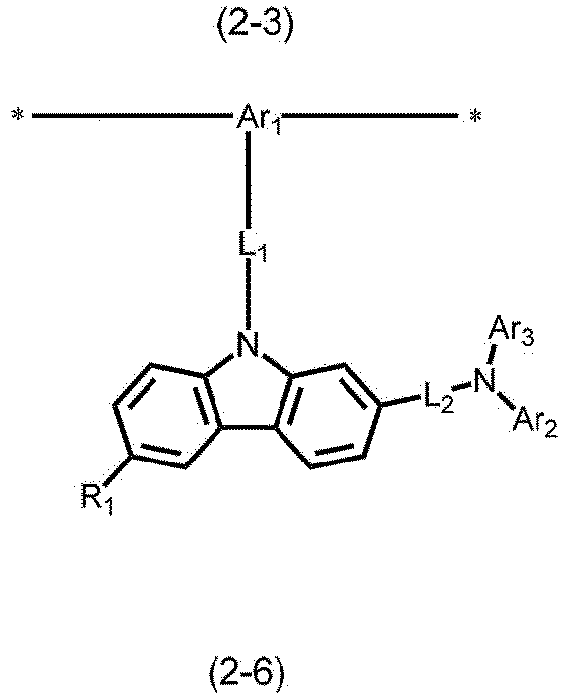
- In Formula (2-3) and Formula (2-6), Ar1, Ar2, Ar3, L1, L2, R1, and * are the same as Formula (2-I) to the Formula (2-L).
- The specific example of X is shown below.


- In the above formulas, * is a binding portion forming a main chain, and "Alkyl" means a substitution with an alkyl group.
- Among these, specific examples of X include at least one selected from the groups represented by Formula (X-4) to (X-6) and (X-8) from the viewpoint of improving a HOMO level, hole transportability, a hole injection property, solubility, and a coating property of the polymer material and improving a luminescence life-span. Moreover, a specific example of X may be a group represented by Formula (X-4). Herein, a plurality of X's included in the segment of the alternating copolymer of the structural unit represented by Formula (1) may be same or different. However, the plurality of X's may be the same.


- On the other hand, examples of "Alkyl" in the examples of X are the same as the alkyl group as a substituent in the case where the monovalent aromatic hydrocarbon group or the monovalent aromatic heterocyclic group in Ar2 and Ar3 is substituted.
- The polymer material according to the present embodiment may include one type of Y or may include two or more types of Y as a structural unit.
- Since the polymer material according to the present embodiment includes Y as a structural unit, solubility is improved. For this reason, when the polymer material according to the present embodiment is used, a thin film may be easily formed by a coating method.
- In Formula (1), Y is a substituted or unsubstituted divalent aromatic hydrocarbon group having 6 to 60 ring-forming carbon atoms, or a substituted or unsubstituted divalent aromatic heterocyclic group having 3 to 60 ring-forming atoms. Here, the "aromatic hydrocarbon group" is intended to be a group including at least one aromatic hydrocarbon ring, but may be a group composed of an aromatic hydrocarbon ring alone. Moreover, the "aromatic heterocyclic group" as Y is intended to be a group including at least one aromatic heterocyclic group, but may be a group composed of an aromatic heterocycle alone or a group composed of an aromatic hydrocarbon ring and an aromatic heterocycle. The aromatic heterocyclic group as Y may be a group composed of an aromatic heterocycle alone.
- Herein, a typical structural example of the divalent aromatic hydrocarbon group is the same as Ar1 in Formula (2-I) to Formula (2-L), except that the trivalent aromatic hydrocarbon group is changed into a divalent group, and thus the descriptions thereof are not provided. In addition, a typical structural example of the divalent aromatic heterocyclic group is the same as Ar1 in Formula (2-I) to Formula (2-L), except that the trivalent aromatic heterocyclic group is changed into a divalent group, and thus the descriptions thereof are not provided.
- Among these, from the viewpoint of improving solubility of the polymer material, Y may be a phenylene group, a fluorenediyl group, a biphenylene group, a fluorenylene group, a naphthylene group, an anthrylene group, a phenanthrylene group, a naphthacenylene group, a pyrenylene group, a terphenylene group, a tolylene group, a t-butyl phenylene group, a (phenylpropyl) phenylene group, or a thienylene group. In an embodiment, Y may be a phenylene group, a fluorenediyl group, or a terphenylene group.
- In addition, since the substituent in the case where the divalent aromatic hydrocarbon group or the divalent aromatic heterocyclic group is substituted is the same as the substituent in Ar1 of Formula (2-I) to Formula (2-L), the descriptions thereof are not provided.
- Among these, from the viewpoint of improving solubility of the polymer material according to the present embodiment and improving a luminescence life-span, when the divalent aromatic hydrocarbon group or the divalent aromatic heterocyclic group is substituted, the substituent may be a C1 to C60 alkyl group. Among these, from the viewpoint of further improving solubility, it may be a C1 to C12 alkyl group, for example a C3 to C10 alkyl group or a C6 to C8 alkyl group. In addition, among these, from the viewpoint of further improving the luminescence life-span, it may be a C14 to C60 alkyl group, a C14 to C40 alkyl group, or a C14 to C30 alkyl group. From the above, Y is a substituted cyclic C6 to C60 divalent aromatic hydrocarbon group, or a substituted divalent aromatic heterocyclic group having 3 to 60 ring-forming atoms. When the divalent aromatic hydrocarbon group or the divalent aromatic heterocyclic group is substituted, at least one of the substituents may be a C14 to C60 alkyl group. The alkyl group as a substituent when the divalent aromatic hydrocarbon group or the divalent aromatic heterocyclic group is substituted in Y, may be any linear, branched or cyclic, but in an embodiment, the alkyl group may desirably be linear or branched and in another embodiment, the alkyl group may more desirably linear.
- Y may be at least one selected from groups represented by Formula (2-7) to Formula (2-23) from the viewpoint of adjusting a HOMO level. Herein, a plurality of Y's included in the segment of the alternating copolymer of the structural unit represented by Formula (1) may be the same or different.

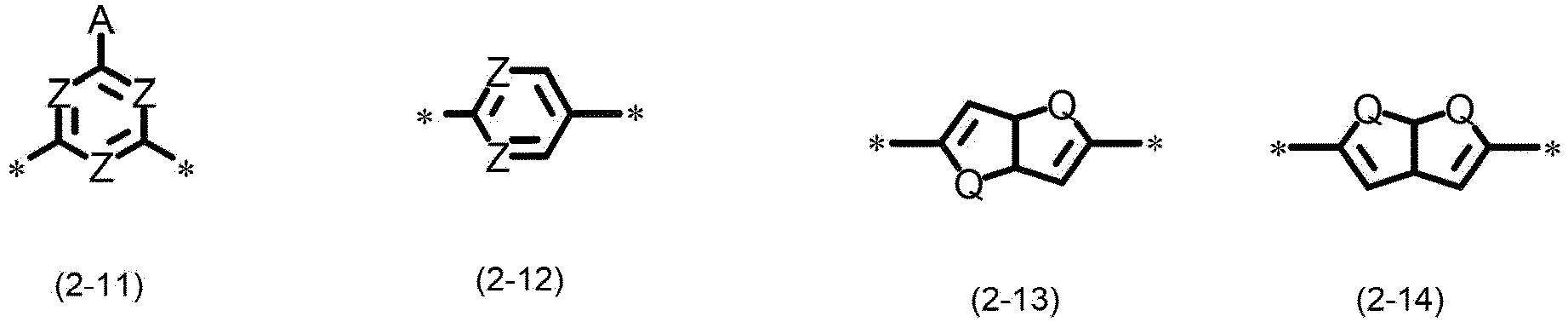


- In Formula (2-7) to Formula 2-23, A is independently a substituted or unsubstituted monovalent aromatic hydrocarbon group having ring-forming 6 to 60 carbon atoms, a substituted or unsubstituted monovalent aromatic heterocyclic group having 3 to 60 ring-forming atoms, a C1 to C60 alkyl group, or a hydrogen atom,
- Q is independently -O-, -S-, -Se-, -CR7R8-, -SiR7R8- (wherein R7 and R8 are independently a hydrogen atom, a deuterium atom, a substituted or unsubstituted alkyl group, a substituted or unsubstituted aryl group, or a substituted or unsubstituted heteroaryl group),
- Z is independently -CR9=, -N=, or -SiRg= (wherein R9 is hydrogen, a deuterium atom, a substituted or unsubstituted alkyl group, a substituted or unsubstituted aryl group, or a substituted or unsubstituted heteroaryl group), and
- * is a binding portion forming a main chain.
- Among these, in the polymer material, in Formula (1), Y may be at least one of groups represented by Formula (2-7), Formula (2-8), Formula (2-10), Formula (2-11), Formula (2-15) to Formula (2-20), Formula (2-22), and Formula (2-23), wherein at least one of A may be C14 to C60 alkyl group.
- The specific examples of Y are shown below.





- In the above formulas, * is a binding portion forming a main chain, and "Alkyl" means a substitution with an alkyl group. Moreover, r is an integer of 1 to 4 and s is an integer of 1 to 5.
- Among these, specific examples of Y may be at least one of groups represented by Formula (Y-1) to Formula (Y-9) from a viewpoint of improving luminescence life-span. Further, specific examples of Y may be at least one of groups represented by Formula (Y-1), Formula (Y-2), Formula (Y-4), and Formula (Y-6) to Formula (Y-8). Herein, although a plurality of Y's included in the segment of the alternating copolymer of the structural unit represented by Formula (1) may be the same or different. However, the plurality of Y's may be the same.


- On the other hand, "Alkyl" as the specific example of Y is the same as the description of the alkyl group which is a substituent when Y is a substituted divalent aromatic hydrocarbon group or a substituted divalent aromatic heterocyclic group.
- Hereinafter, a structure of a particularly desirable polymer material is described from the viewpoint of improving luminescence life-span. However, the present disclosure is not limited thereto.
- A particularly desirable polymer material may be a polymer material having a glass transition temperature of greater than or equal to about 50 °C and less than or equal to about 250 °C and including segments of alternating copolymers of structural units represented by Formula (1).
- The polymer material may include the segment of the alternating copolymer of the structural unit represented by Formula (1), wherein X may be at least one selected from groups that exemplified above, Y may be at least one selected from groups that exemplified above, and at least one "Alkyl" that X includes may be an alkyl group having 10 to 60 carbon atoms or at least one "Alkyl" that Y includes may be an alkyl group having 14 to 60 carbon atoms. Herein, X may be desirably at least one selected from the groups represented by Formula (X-4) to Formula (X-6) and (X-8) and may be more desirably at least one selected from the groups represented by Formula (X-4). Moreover, Y may be desirably at least one selected from groups represented by Formula (Y-1) to Formula (Y-9), and may be more desirably at least one selected from the groups represented by Formula (Y-1), Formula (Y-2), Formula (Y-4), and Formula (Y-6) to Formula (Y-8). Rather, the polymer material may more desirably include the segment of the alternating copolymer of the structural unit represented by Formula (1), wherein X may be at least one selected from the groups represented by Formula (X-4) to Formula (X-6) and (X-8), Y may be at least one selected from the groups represented by Formula (Y-1) to Formula (Y-9), and at least one "Alkyl" that X includes may be an alkyl group having 10 to 60 carbon atoms or at least one "Alkyl" that Y includes may be an alkyl group having 14 to 60 carbon atoms. Further, the polymer material is at least one selected from represented by Formula (X-4), wherein Y may be at least one selected from the groups represented by Formula (Y-1), Formula (Y-2), Formula (Y-4) and Formula (Y-6) to Formula (Y-8), and at least one "Alkyl" that X includes may be an alkyl group having 10 to 60 carbon atoms or at least one "Alkyl" that Y includes may be an alkyl group having 14 to 60 carbon atoms.
- In other words, specific combinations of desirable X and Y ([X, Y]) are as follows, wherein at least one "Alkyl" that X includes may be an alkyl group having 10 to 60 carbon atoms or at least one "Alkyl" that Y includes may be an alkyl group having 14 to 60 carbon atoms.
- [X-4, Y-1], [X-4, Y-2], [X-4, Y-3], [X-4, Y-4], [X-4, Y-5], [X-4, Y-6], [X-4, Y-7], [X-4, Y-8], [X-4, Y-9], [X-5, Y-1], [X-5, Y-2], [X-5, Y-3], [X-5, Y-4], [X-5, Y-5], [X-5, Y-6], [X-5, Y-7], [X-5, Y-8], [X-5, Y-9], [X-6, Y-1], [X-6, Y-2], [X-6, Y-3], [X-6, Y-4], [X-6, Y-5], [X-6, Y-6], [X-6, Y-7], [X-6, Y-8], [X-6, Y-9], [X-8, Y-1], [X-8, Y-2], [X-8, Y-3], [X-8, Y-4], [X-8, Y-5], [X-8, Y-6], [X-8, Y-7], [X-8, Y-8], [X-8, Y-9].
- More specific details of the polymer material according to the present embodiment include those including the following segments of the alternating copolymer, but the present disclosure is not limited thereto.
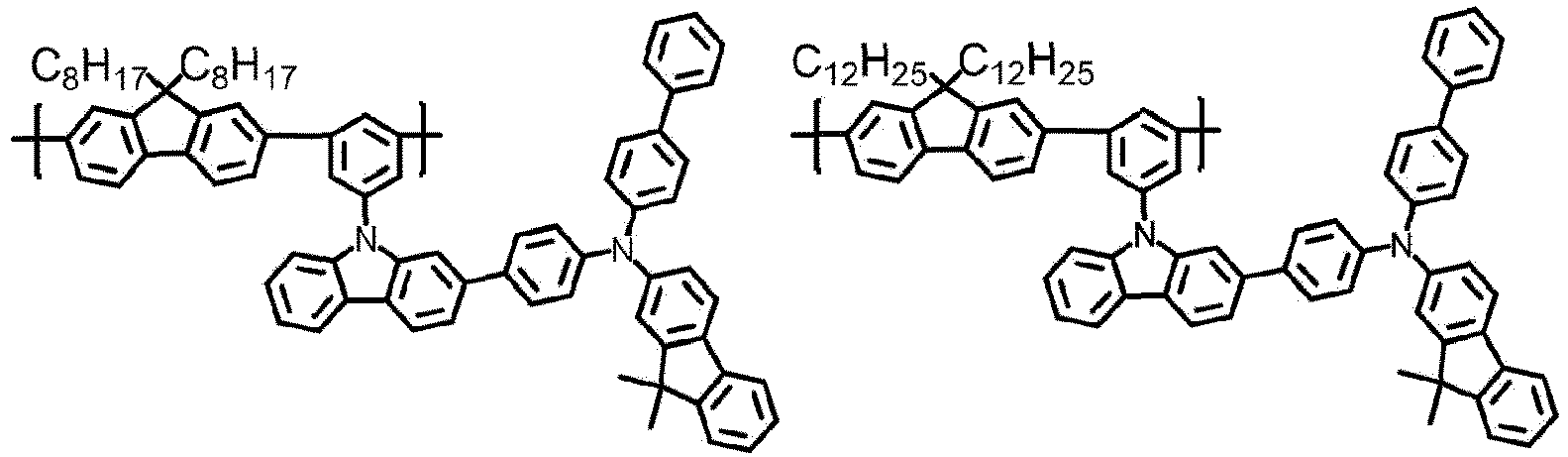


- The polymer material according to this embodiment may be represented by Formula (3). Thereby, the luminescence life-span of quantum dot light emitting device becomes longer.

- In Formula (3), E is a substituted or unsubstituted monovalent aromatic hydrocarbon group having ring-forming 6 to 60 carbon atoms, or a substituted or unsubstituted monovalent aromatic heterocyclic group having 3 to 60 ring-forming atoms,
- m is an integer of 2 or more, and a plurality of X and Y may independently be the same or different.
- Herein, the monovalent aromatic hydrocarbon group and the monovalent aromatic heterocyclic group are the same as the same as Ar1 of Formula (2-I) to Formula (2-L) except that the trivalent aromatic hydrocarbon group and the trivalent aromatic heterocyclic group are changed into divalent groups, and thus the descriptions thereof are not provided. In addition, since the substituent in the case where the monovalent aromatic hydrocarbon group or monovalent aromatic heterocyclic group is substituted is the same as the substituent in Ar1 of Formula (2-I) to Formula (2-L), the descriptions thereof are not provided.
- The specific examples of E (terminal group) in Formula (3) are shown below.


- In the above formula, * is a binding portion.
- The polymer material according to the present embodiment may be used as a material for an electroluminescence (EL) device, but it is particularly effective to use it as a hole transport material for an EL device including quantum dots.
- The glass transition temperature of the polymer material according to the present embodiment may be greater than or equal to about 50 °C and less than or equal to about 250 °C. When the glass transition temperature is less than about 50 °C, the film may be cracked at a heating temperature for drying the thin film, and sufficient luminescence properties may not be obtained. In addition, when the glass transition temperature is greater than about 250 °C, a process temperature for drawing the performance of the hole transport material may become high, and a thermal load on the device may be applied, so that sufficient device life-span may not be obtained.
- The lower limit of the glass transition temperature of the polymer material is not particularly limited as long as it is greater than or equal to about 50 °C, but may be desirably greater than or equal to about 100 °C, and more desirably greater than or equal to about 130 °C. In addition, the upper limit of the glass transition temperature of the polymer material is not particularly limited as long as it is less than or equal to about 250 °C, but may be desirably less than or equal to about 240 °C, and more desirably less than or equal to about 230 °C. The glass transition temperature may be measured using a differential scanning calorimeter (DSC) (manufactured by Seiko Instruments, product name: DSC6000). Meanwhile, details of the measurement method are described in examples.
- The absolute value of the HOMO level of the polymer material according to the present embodiment is not particularly limited, but may be desirably greater than or equal to about 5.5 eV and less than or equal to about 6.0 eV from the viewpoint of further improving a luminescence life-span. Moreover, it may be desirably greater than or equal to about 5.5 eV and less than or equal to about 5.9 eV. On the other hand, the HOMO level has usually a negative value. The HOMO level of the polymer material may be measured using an air photoelectron spectroscopy device (AC-3 manufactured by Riken Instruments Co., Ltd.). Meanwhile, details of the measurement method are described in examples.
- The number average molecular weight (Mn) of the polymer material according to the present embodiment may be desirably greater than or equal to about 2,000 and less than or equal to about 1,000,000, and more desirably greater than or equal to about 3,000 and less than or equal to about 500,000. Thereby, it is possible to appropriately adjust a viscosity of a coating solution for forming a thin film (for example, a hole injection layer and a hole transport layer) including the polymer material, and thus a thin film of uniform thickness may be formed.
- In addition, the weight average molecular weight (Mw) of the polymer material according to the present embodiment is desirably greater than or equal to about 4,000 and more desirably greater than or equal to about 5,000. Thereby, it is possible to appropriately adjust the viscosity of the coating solution for forming a thin film (for example, a hole injection layer and a hole transport layer) including the polymer material, and thus a thin film of uniform thickness may be formed.
- Herein, the number average molecular weight (Mn) and the weight average molecular weight (Mw) are not particularly limited and may be measured by using a known method or by appropriately modifying a known method. As used herein, the number average molecular weight (Mn) and the weight average molecular weight (Mw) may adopt the values measured by the following method.
- The number average molecular weight (Mn) and the weight average molecular weight (Mw) of the polymer material are measured under the following conditions by using polystyrene as a standard material and by SEC (Size Exclusion Chromatography).
- Analysis device (GPC): Shimadzu Corporation, Prominence
- Column: Polymer Laboratories, PLgel MIXED-B
- Column temperature: 40°C
- Flow rate: 1.0 mL/min
- Injection volume of sample solution: 20 µL (concentration: about 0.05 mass%)
- Eluent: Tetrahydrofuran (THF)
- Detector (UV-VIS detector): Shimadzu Corporation, SPD-10AV
- Standard sample: Polystyrene
- The polymer material according to the present embodiment may be synthesized by appropriately combining known organic synthesis reactions. The specific method of synthesizing the polymer material according to the present embodiment may be easily understood by those skilled in the art with reference to examples described later. Specifically, the polymer material according to the present embodiment may be synthesized by copolymerizing a monomer (α) which is at least one monomer selected from Monomers (α-1) to Monomers (α-4) represented by Formula (4), and one or more monomers (β) represented by Formula (5) at a mole ratio of about 1: 1. On the other hand, the monomers (α) and (β) may be synthesized by appropriately combining known organic synthesis reactions. In addition, the monomers (α) and (β) may be identified using known analytical methods (e.g., NMR, LC-MS, etc.).


W3-Ar4-W4 Monomer (β) (5)
- In Formula (4), monomers (α-1) to (α-1) are understood to share the corresponding structural features defined in Formula (2-I) to (2-L). In addition, Ar4 in monomer (β) of Formula (5) is the same as Y in Formula (1). W1 to W4 may independently be a halogen atom (a fluorine atom, a chlorine atom, a bromine atom, an iodine atom, particularly a bromine atom) or the group represented below.

- In the above formula, RA to RD are independently a C1 to C3 alkyl group.
- The material for the EL device according to the present embodiment includes the polymer material according to the present embodiment.
- The EL device according to the present embodiment includes a pair of electrodes and one or more organic layers including the polymer material according to the present embodiment disposed between the pair of electrodes. At this time, the EL device further includes a layer including quantum dots. Moreover, at least one layer of one or more layers of the EL device may be formed by a coating method.
- The EL device may include a quantum dot light emitting device, an organic EL device, an organic inorganic perovskite light emitting device etc.
- The liquid composition according to the present embodiment includes the polymer material according to the present embodiment and a solvent or dispersion medium. In addition, the thin film according to the present embodiment includes the polymer material according to the present embodiment.
- Since the polymer material according to the present embodiment has improved solubility, it may be particularly desirably used when producing an EL device (especially a thin film) by a coating method (wet process).
- Since the polymer material according to the present embodiment has improved charge mobility, it may be used when forming organic layers such as a hole injection layer, a hole transport layer, and a light emitting layer. At this time, the polymer material according to the present embodiment may be desirably used when forming a hole injection layer and/or a hole transport layer from the viewpoint of hole transportability, and particularly desirably when forming a hole transport layer.
- The present embodiment provides an electroluminescent device including the polymer material. Herein, the electroluminescent device according to the present embodiment includes a pair of electrodes and at least one organic layer including the polymer material disposed between the pair of electrodes. The electroluminescent device according to the present embodiment is not particularly limited, but as described above, the polymer material has improved solubility, so that at least one of the organic layers may be desirably formed by a coating method. In addition, the electroluminescent device according to the present embodiment is not particularly limited, but from the viewpoint of further improving luminescence life-span, a layer including quantum dots may be further provided, and the quantum dots may be desirably inorganic nanoparticles.
- Next, a quantum dot light emitting device will be described as one example of the EL device according to the present embodiment.
-
FIG. 1 shows one example of the quantum dot light emitting device according to the present embodiment. - The quantum dot
light emitting device 100 essentially includes thelight emitting layer 150. For example, thefirst electrode 120, thelight emitting layer 150, and thesecond electrode 180 are sequentially disposed on thesubstrate 110. In addition, for example, on thesubstrate 110, thefirst electrode 120, thehole injection layer 130, thehole transport layer 140, thelight emitting layer 150, the electron transport layer 160, thesecond electrode 180 are sequentially disposed. For example, on thesubstrate 110, thefirst electrode 120, thehole injection layer 130, thehole transport layer 140, thelight emitting layer 150, the electron transport layer 160, theelectron injection layer 170, and thesecond electrode 180 may sequentially disposed. - Herein, the polymer material according to the present embodiment is included, for example, in one or more organic layers disposed between the
first electrode 120 and thesecond electrode 180. Specifically, the polymer material according to the present embodiment is desirably included in thehole injection layer 130, thehole transport layer 140, or thelight emitting layer 150 as a hole injection material, a hole transport material, or a light emitting material. Further, the polymer material according to the present embodiment is more desirably included in thehole injection layer 130 or thehole transport layer 140 as a hole injection material or a hole transport material. In addition, the polymer material according to the present embodiment is particularly desirably included in thehole transport layer 140 as a hole transport material. - In addition, the organic layer including the polymer material according to the present embodiment is formed by a coating method (solution coating method).
- The coating method (solution coating method) is not particularly limited, but may be a spin coating method, a casting method, a microgravure coating method, a gravure coating method, a bar coating method, a roll coating method, a wire barcode method, a dip coating method, a spray coating method, a screen printing method, a flexo printing method, an offset method, an inkjet printing method, and the like.
- On the other hand, the solvent used in the solution coating method is not particularly limited as long as it may dissolve the polymer material according to the present embodiment, but may be toluene, xylene, diethylether, chloroform, ethyl acetate, methylene chloride, tetrahydrofuran, acetone, acetonitrile, N,N-dimethyl formamide, dimethyl sulfoxide, anisole, hexamethyl phosphoric acid triamide, 1,2-dichloroethane, 1,1,2-trichloroethane, chlorobenzene, o-dichloro benzene, dioxane, cyclohexane, n-pentane, n-hexane, n-heptane, n-octane, n-nonane, n-decane, methylethylketone, cyclohexanone, butyl acetate, ethylcellosolve acetate, ethylene glycol, ethylene glycol monobutylether, ethylene glycol monoethylether, ethylene glycolmonomethylether, dimethoxy ethane, propylene glycol, diethoxy methane, triethylene glycol monoethylether, glycerine, 1,2-hexanediol, methanol, ethanol, propanol, isopropanol, cyclohexanol, N-methyl-2-pyrrolidone, and the like.
- Herein, considering an ease of coating, a concentration of the polymer material in the solution may be desirably greater than or equal to about 0.1 mass% and less than or equal to about 10 mass%, and more desirably greater than or equal to about 0.5 mass% and less than or equal to about 5 mass%.
- On the other hand, a method for forming a layer other than the organic layer including the polymer material according to the present embodiment is not particularly limited, and examples thereof include a vacuum deposition method and a solution coating method.
- The
substrate 110 is not particularly limited, and substrates used in general EL devices may be used. Thesubstrate 110 may be a glass substrate, a semiconductor substrate such as a silicon substrate, and a transparent plastic substrate. - The
first electrode 120 may be an anode, and may be formed using a material having a large work function among materials such as a metal, an alloy, and a conductive compound. Thefirst electrode 120 may be formed by depositing a transparent conductive material such as indium tin oxide (In2O3-SnO2:ITO), indium zinc oxide (In2O3-ZnO), tin oxide (SnO2), zinc oxide (ZnO), and so on, and may be formed as a transmissive electrode. In addition, thefirst electrode 120 may be formed as a reflective electrode by depositing a reflective material such as magnesium (Mg) or aluminum (Al) with respect to the transmissive electrode. - The
hole injection layer 130 may be a layer that facilitates injection of holes from thefirst electrode 120. - A thickness of the
hole injection layer 130 may be desirably greater than or equal to about 10 nm and less than or equal to about 1000 nm, and more desirably greater than or equal to about 10 nm and less than or equal to about 100 nm. - The
hole injection layer 130 may be formed by a vacuum deposition method, a spin coating method, an inkjet method, or the like, using a known hole injection material. - Examples of the hole injection material may include triphenylamine-containing polyether ketone, 4-isopropyl-4'-methyldiphenyl iodonium trakis (pentafluorophenyl) borate, N,N'-diphenyl-N,N'-bis-[4-(phenyl-m-tolyl-amino) - phenyl]-biphenyl-4,4'-diamine, copper phthalocyanine, 4,4',4"-tris(3-methylphenylphenylamino) triphenylamine, N,N'-di(1-naphthyl)-N,N'-diphenyl benzidine, 4,4',4"-tris(diphenyl amino) triphenylamine, 4,4',4"-tris(N,N-2-naphthylphenylamino) triphenylamine, polyaniline/dodeylbenzenesulfonic acid, poly(3,4-ethylenedioxythiophene)/poly(4-styrenesulfonate) (PEDOT/PSS), polyaniline / 10-camphorsulfonic acid, and the like.
- The
hole transport layer 140 is a layer having a function of transporting holes. - A thickness of the
hole transport layer 140 may be desirably greater than or equal to about 10 nm and less than or equal to about 150 nm. - The
hole transport layer 140 may be desirably formed by a solution coating method using the polymer material according to the present embodiment. Accordingly, the polymer material capable of improving luminous efficiency of the quantum dotlight emitting device 100 may be efficiently formed into a large area. - However, when the organic layer other than the quantum dot
light emitting device 100 includes the polymer material according to the present embodiment, thehole transport layer 140 may be formed using a known hole transport material. - Examples of the hole transport material may include a carbazole derivative such as 1,1-bis[(di-4-tolylamino) phenyl] cyclohexane, N-phenyl carbazole, and polyvinyl carbazole, N,N'-bis(3-methylphenyl)-N,N'-diphenyl-[1,1-biphenyl]-4,4'-diamine, 4,4 ',4"-tris(N-carbazolyl) triphenyl amine, N,N'-di (1-naphthyl) -N,N'-diphenyl benzidine, and the like.
- The
light emitting layer 150 may be a layer that emits light such as fluorescence and phosphorescence. - A thickness of the
light emitting layer 150 may be is desirably greater than or equal to about 10 nm and less than or equal to about 60 nm. - In the
light emitting layer 150, a plurality of quantum dots may be arranged in one layer, or may be arranged in a plurality of layers. Herein, quantum dots may be inorganic nanoparticles having a quantum confinement effect. A diameter of the inorganic nanoparticles may be greater than or equal to about 1 nm and less than or equal to about 10 nm. - The quantum dots arranged in the
light emitting layer 150 may be synthesized by a wet chemical method, an organometallic chemical vapor deposition method, a molecular beam epitaxy method, or the like. - The wet chemical method is a method in which a precursor is put in an organic solvent to grow particles. At this time, the organic solvent is naturally coordinated to the surface of the quantum dot crystal, acting as a dispersing agent, and controlling the growth of the crystal. For this reason, the wet chemical method may control the growth of particles more easily and at a lower cost than vapor deposition methods such as organometallic chemical vapor deposition (MOCVD) and molecular beam epitaxy (MBE). At this time, by adjusting the size of the quantum dot, the energy band gap may be adjusted, and as a result, the
light emitting layer 150 may emit light of various wavelengths. Therefore, by using a plurality of quantum dots of different sizes, a display emitting light of a plurality of wavelengths may be produced. The sizes of the quantum dots may be appropriately selected so as to emit red light, green light, and blue light to provide a color display. Further, the sizes of the quantum dots may be combined such that various color lights emit white light. - Although the materials constituting the quantum dots are not particularly limited, a semiconductor material selected from a Group II-VI compound, a Group III-V compound, a Group IV-VI compound, a Group IV element or compound may be used. Two or more types may be used in combination.
- The Group II-VI compound may be, for example, a binary compound of CdSe, CdTe, ZnS, ZnSe, ZnTe, ZnO, HgS, HgSe, HgTe, and the like; a ternary compound of CdSeS, CdSeTe, CdSTe, ZnSeS, ZnSeTe, ZnSTe, HgSeS, HgSeTe, HgSTe, CdZnS, CdZnSe, CdZnTe, CdHgS, CdHgSe, CdHgTe, HgZnS, HgZnSe, HgZnTe, and the like; a quaternary compound of CdZnSeS, CdZnSeTe, CdZnSTe, CdHgSeS, CdHgSeTe, CdHgSTe, HgZnSeS, HgZnSeTe, HgZnSTe, and the like.
- The Group III-V compound may be, for example, a binary compound of GaN, GaP, GaAs, GaSb, AlN, AlP, AlAs, AlSb, InN, InP, InAs, InSb, and the like; a ternary compound of GaNP, GaNAs, GaNSb, GaPAs, GaPSb, AlNP, AlNAs, AlNSb, AlPAs, AlPSb, InNP, InNAs, InNSb, InPAs, InPSb, GaAlNP, and the like; a quaternary compound of GaAlNAs, GaAlNSb, GaAlPAs, GaAlPSb, GaInNP, GaInNAs, GaInNSb, GaInPAs, GaInPSb, InAlNP, InAlNAs, InAlNSb, InAlPAs, InAlPSb, and the like.
- The Group IV-VI compound may be, for example, a binary compound of SnS, SnSe, SnTe, PbS, PbSe, PbTe, and the like; a ternary compound of SnSeS, SnSeTe, SnSTe, PbSeS, PbSeTe, PbSTe, SnPbS, SnPbSe, SnPbTe, and the like; a quaternary compound of SnPbSSe, SnPbSeTe, SnPbSTe, and the like, and the like.
- The Group IV element or compound may be, for example, a single-element compound of Si or Ge; a binary compound of SiC or SiGe, and the like.
- The quantum dots may have a homogeneous structure or may have a core-shell structure.
- The core-shell structure may include different materials, and the materials constituting the core and the shell may be different semiconductor materials. However, the semiconductor material constituting the shell may have a larger energy band gap than the semiconductor material constituting the core.
- For example, production of a quantum dot having a core (CdSe)-shell (ZnS) structure is described. First, crystals may be grown by injecting precursors of core (CdSe) such as (CH3)2Cd (dimethyl cadmium), TOPSe (trioctylphosphine selenide) into TOPO (trioctylphosphine oxide), as an organic solvent (dispersing agent). Herein, the crystals are grown to a constant size, and then maintained at a high temperature for a certain time, and then a precursor material of the shell (ZnS) is injected to form a shell on the surface of the core. Thereby, quantum dots of CdSe/ZnS capped by TOPO may be produced.
- Moreover, the quantum dots of a core-shell structure may include InP/ZnSe/ZnS three-layered quantum dots which use InP as a core.
- The electron transport layer 160 may be a layer having a function of transporting electrons.
- A thickness of the electron transport layer 160 may be desirably greater than or equal to about 15 nm and less than or equal to about 50 nm.
- The electron transport layer 160 may be formed by using a known electron transport material and using a vacuum deposition method, a spin coating method, an inkjet method, or the like.
- Examples of the electron transporting material may include ZnMgO, (8-) lithium, tris(8-) aluminum, and a compound having a nitrogen-containing aromatic heterocycle.
- Specific examples of the compound having the nitrogen-containing aromatic heterocycle may include a compound including a pyridine ring such as 1,3,5-tri[(3-pyridyl)-phen-3-yl] benzene, a compound including a triazine ring such as 2,4,6-tris(3'-(pyridin-3-yl) biphenyl-3-yl)-1,3,5-trizine, a compound including an imidazole ring such as 2-(4-(N-phenylbenzoimidazolyl-1-yl-phenyl) -9,10-dinaphthylanthracene, and the like.
- The
electron injection layer 170 is a layer having a function to facilitate injection of electrons from thesecond electrode 180. - A thickness of the
electron injection layer 170 may be desirably greater than or equal to about 0.3 nm and less than or equal to about 9 nm. - The
electron injection layer 170 may be formed by using a known electron injection material and vacuum deposition. - Examples of the electron injection material include a lithium compound such as (8-) lithium and lithium fluoride (LiF), sodium chloride (NaCl), cesium fluoride (CsF), lithium oxide (Li2O), and barium oxide (BaO).
- The
second electrode 180 may be a cathode and may be formed using a metal, an alloy, or a conductive compound having a small work function. Thesecond electrode 180 may be formed as a reflective electrode by using a metal such as lithium (Li), magnesium (Mg), aluminum (Al), or calcium (Ca), an alloy such as aluminum-lithium (Al-Li), magnesium-indium (Mg-In), magnesium-silver (Mg-Ag). In addition, thesecond electrode 180 may be formed as a transmissive electrode having a thickness of less than or equal to about 20 nm using the metal. In addition, thesecond electrode 180 may be formed as a transmissive electrode using a transparent conductive material such as indium tin oxide (In2O3-SnO2) and indium zinc oxide (In2O3-ZnO). - Meanwhile, a stacked structure of the EL device according to the present embodiment is not limited to the stacked structure of the quantum dot
light emitting device 100. The EL element according to the present embodiment may have other well-known stacked structures. For example, in the quantum dotlight emitting device 100, one or more of thehole injection layer 130, thehole transport layer 140, the electron transport layer 160, and theelectron injection layer 170 may be omitted. Further, the quantum dotlight emitting device 100 may further include another layer. In addition, in the quantum dotlight emitting device 100, each layer may be formed in a multilayer stacked structure. - For example, the quantum dot
light emitting device 100 may further include a hole blocking layer between thehole transport layer 140 and thelight emitting layer 150 in order to prevent the excitons or holes from diffusing in the electron transport layer 160. - The hole blocking layer may be formed using an oxadiazole derivative, a triazole derivative, or a phenanthroline derivative.
- Hereinafter, examples of the present disclosure are described. However, the technical scope of the present disclosure is not limited to the following examples. In the following Examples, unless specifically described, each operation was performed at room temperature (25 °C). In addition, unless specifically stated, % and a part mean mass% and a part by mass, respectively.
- Compound RM1-1 is synthesized according to the following reaction scheme.

- Specifically, under an argon atmosphere, 2-amino-N-[(1,1'-biphenyl)-4-yl]-N-(4-bromophenyl)-9,9-dimethyl fluorene (15.00 g, 29.04 mmol), 3-(4,4,5,5,-tetramethyl-1,3,2-dioxaborolan-2-yl) carbazole (7.66 g, 26.14 mmol), bis(triphenylphosphine) palladium (II) dichloride (0.41 g, 0.58 mmol), sodium carbonate (7.70 g, 72.61 mmol), dioxane (290 ml), and water (145 ml) are added in a reaction vessel, and then mixed. Then, the mixture is stirred at 85 °C for 4 hours, and after the reaction is completed, the mixed reaction solution is allowed to cool to room temperature. Then, the mixed reaction solution is filtered using Celite (registered trademark), and impurities are filtered off. Then, the solvent is distilled off from the filtrate, and then purified by column chromatography to obtain Compound RM1-1 (12.7 g).
- Compound RM1-2 is synthesized according to the following reaction scheme.

- Specifically, under an argon atmosphere, Compound RM1-1 (7.00 g, 11.6 mmol), 1,3-dibromo-5-iodo benzene (4.62 g, 12.77 mmol), copper iodide (I) (0.11 g, 0.58 mmol), trans-1,2-cyclohexanediamine (0.29 g, 2.55 mmol), sodium tert-butoxide (2.23 g, 23.23 mmol), and dioxane (35 ml) are added in a reaction vessel, and then mixed. Then, the mixture is stirred at 90 °C for 6 hours, and after the reaction is completed, the reaction mixture is allowed to cool to room temperature. Then, the mixed reaction solution is filtered using Celite (registered trademark), and impurities are filtered off. Then, the solvent is distilled off from the filtrate, and then purified by column chromatography to obtain Compound RM1-2 (6 g).
- Compound RM1-3 is synthesized according to the following reaction scheme.

- Specifically, under an argon atmosphere, Compound RM1-2 (4.00 g, 4.78 mmol), bis(pinacolato)diboron (3.64 g, 14.34 mmol), potassium acetate (2.82 g, 28.69 mmol), [bis(diphenyl phosphino)ferrocene]dichloro palladium (0.11 g, 0.13 mmol), and dioxane (50 ml) are added in a reaction vessel, and then mixed. Then, the mixture is stirred at 90 °C for 6 hours, and after the reaction is completed, the reaction mixture is allowed to cool to room temperature. Then, the mixed reaction solution is filtered using Celite (registered trademark), and impurities are filtered off. Then, the solvent is distilled off from the filtrate, and then purified by column chromatography to obtain Compound RM1-3 (3 g).
- 1,3-dibromo-5-tetradecylbenzene (0.869 g), RM1-3 (2.00 g), palladium acetate (4.8 mg), tris(2-methoxy phenyl)phosphine (45.4 mg), toluene (55 mL), and a 20 mass% tetraethyl ammonium hydroxide aqueous solution (6.33 g) are put in a reaction vessel under an argon atmosphere and then, refluxed for 6 hours. Subsequently, phenyl boronic acid (0.023 g), palladium acetate (4.3 mg), tris(2-methoxy phenyl)phosphine (27.0 mg), and a 20 mass% tetraethyl ammonium hydroxide aqueous solution (6.33 g) are added thereto, and then, the obtained mixed solution is heated and refluxed for 3 hours. Then, N,N-sodium diethyldithiocarbamate trihydrate (5.0 g) and ion exchange water (50 mL) are added to the obtained mixed solution except for a water layer and then, stirred at 85 °C for 3 hours. An organic layer is separated from the water layer and then, washed with water, a 3 mass% acetic acid aqueous solution, and water. The organic layer is added dropwise in methanol to precipitate a polymer compound, and the compound is filtered and dried to obtain a solid. This solid is dissolved in toluene and passed through column chromatography filled with silica gel/alumina, and the solvent is distilled off under a reduced pressure. The obtained liquid is added dropwise in methanol to precipitate a solid, and the solid is filtered and dried to obtain Polymer Compound A-1 (0.50 g). The number average molecular weight and polydispersity of the obtained polymer compound measured by SEC are respectively Mn = 6,000 and Mw/Mn is 1.77.
- Polymer Compound A-1 is presumed to be a polymer compound having the following repeating units and a mole ratio of the structural unit of X: the structural unit of Y = 1: 1 from the preparation ratio of the monomers, and including the structural unit of X and the structural unit of Y which are alternately polymerized.

- Subsequently, the same polymerization as in Reference Example 1 is performed except that 1,3-dibromo benzene is used instead of the 1,3-dibromo-5-tetradecylbenzene, to obtain Polymer Compound A-2 (0.60 g).
- The number average molecular weight and polydispersity of the obtained polymer compound measured by SEC are respectively Mn = 16,000, and Mw/Mn is 1.8.
- Polymer Compound A-2 is presumed to be a polymer compound having the following repeating units and a mole ratio of the structural units of X: the structural units of Y = 1: 1 from the preparation ratio of the monomers, and including the structural unit of X and the structural unit of Y which are alternately polymerized.

- Subsequently, the same polymerization as in Reference Example 1 is performed except that 2,5-dibromo-3-dodecyl thiophene is used instead of the 1,3-dibromo-5-tetradecylbenzene, to obtain Polymer Compound A-3 (0.45 g).
- The number average molecular weight and polydispersity of the obtained polymer compound measured by SEC are respectively Mn = 8,500, and Mw/Mn is 1.48.
- Polymer Compound A-3 is presumed to be a polymer compound having the following repeating units and a mole ratio of the structural units of X: the structural units of Y = 1: 1 from the preparation ratio of the monomers, and including the structural unit of X and the structural unit of Y which are alternately polymerized.

- Subsequently, the same polymerization as in Reference Example 1 is performed except that 2,5-dibromo-3,4-ethylenedioxythiophene is used instead of the 1,3-dibromo-5-tetradecylbenzene, to obtain Polymer Compound A-4 (0.42 g).
- When the number average molecular weight and polydispersity of the obtained polymer compound are measured by SEC, Mn is 6,000 and Mw/Mn is 1.4.
- Polymer Compound A-4 is presumed to be a polymer compound having the following repeating units and a mole ratio of the structural units of X: the structural units of Y = 1: 1 from the preparation ratio of the monomers, and including the structural unit of X and the structural unit of Y which are alternately polymerized.

- Comonomer-2 is synthesized according to the following reaction scheme.

- Specifically, 3-biphenyl boronic acid (10.0 g, 50.5 mmol), 1,3-dibromo-5-iodo benzene (18.3 g, 50.5 mmol), bis(triphenyl phosphine) palladium (II) dichloride (0.248 g, 0.353 mmol), sodium carbonate (2.24 g, 21.1 mmol), dioxane (40 ml), and water (20 ml) are added and mixed in a reaction vessel under an argon atmosphere. Then, the mixture is stirred at 85 °C for 4 hours, and after the reaction is completed, the mixed reaction solution is allowed to cool down to room temperature. Then, the mixed reaction solution is filtered by using Celite (registered trademark), and impurities are filtered off. After distilling the solvent off, the filtrate is purified by column chromatography to obtain Comonomer-2 (12.7 g).
- Subsequently, the same polymerization as in Reference Example 1 is performed except that Comonomer-2 is used instead of the 1,3-dibromo-5-tetradecylbenzene, to obtain Polymer Compound A-5 (0.77 g).
- When the number average molecular weight and polydispersity of the obtained polymer compound are measured by SEC, Mn is 5,500 and Mw/Mn is 1.42.
- Polymer Compound A-5 is presumed to be a polymer compound having the following repeating units and a mole ratio of the structural units of X: the structural units of Y = 1: 1 from the preparation ratio of the monomers, and including the structural unit of X and the structural unit of Y which are alternately polymerized.

- Subsequently, the same polymerization as in Reference Example 1 is performed except that 2,7-dibromo-9,9-diphenyl fluorene is used instead of the 1,3-dibromo-5-tetradecylbenzene, to obtain Polymer Compound A-6 (0.19 g).
- When the number average molecular weight and polydispersity of the obtained polymer compound are measured by SEC, Mn is 10,000 and Mw/Mn is 1.72.
- Polymer Compound A-6 is presumed to be a polymer compound having the following repeating units and a mole ratio of the structural units of X: the structural units of Y = 1: 1 from the preparation ratio of the monomers, and including the structural unit of X and the structural unit of Y which are alternately polymerized.

- Comonomer-1 is synthesized according to the following reaction scheme.

- Specifically, carbazole (15.0 g, 89.7 mmol), 1,4-dibromo-2-fluorobenzene (25.1 g, 98.7 mmol), sodium hydride (2.05 g, 85.2 mmol), and NMP (10 ml) are added and then, mixed in a reaction vessel under an argon atmosphere. Then, the mixture is stirred at 120 °C for 2 hours, and after the reaction is completed, the mixed reaction solution is cooled to room temperature. Then, 50 mL of water and 50 mL of toluene are added to wash an organic layer. After 3 times repeating this, magnesium sulfate is added to the organic layer, followed by filtration separation. After distilling off the solvent, the filtrate and purified by column chromatography to obtain Comonomer-1 (21.5 g).
- Subsequently, the same polymerization as in Reference Example 1 is performed except that Comonomer-1 is used instead of the 1,3-dibromo-5-tetradecylbenzene, to obtain Polymer Compound A-7 (1.00 g).
- When the number average molecular weight and polydispersity of the obtained polymer compound are measured by SEC, Mn is 6,700 and Mw/Mn is 1.54.
- Polymer Compound A-7 is presumed to be a polymer compound having the following repeating units and a mole ratio of the structural units of X: the structural units of Y = 1: 1 from the preparation ratio of the monomers, and including the structural unit of X and the structural unit of Y which are alternately polymerized.

- The same polymerization as in Reference Example 1 is performed except that the following compound is used instead of the 1,3-dibromo-5-tetradecylbenzene, and Compound RM1-2 is used instead of Compound RM1-3, to obtain Polymer Compound A-8 (1.20 g).

- When the number average molecular weight and polydispersity of the obtained polymer compound are measured by SEC, Mn is 136,000 and Mw/Mn is 3.20.
- Polymer Compound A-8 is presumed to be a polymer compound having the following repeating units and a mole ratio of the structural units of X: the structural units of Y = 1: 1 from the preparation ratio of the monomers, and including the structural unit of X and the structural unit of Y which are alternately polymerized.

- The same polymerization as in Reference Example 1 is performed except that 2,7-dibromo naphthalene is used instead of the 1,3-dibromo-5-tetradecylbenzene, to obtain Polymer Compound A-9 (0.78 g).
- When the number average molecular weight and polydispersity of the obtained polymer compound are measured by SEC, Mn is 20,100 and Mw/Mn is 1.93.
- Polymer Compound A-9 is presumed to be a polymer compound having the following repeating units and a mole ratio of the structural units of X: the structural units of Y = 1: 1 from the preparation ratio of the monomers, and including the structural unit of X and the structural unit of Y which are alternately polymerized.

- The same polymerization as in Reference Example 1 is performed except that the following compound is used instead of the 1,3-dibromo-5-tetradecylbenzene, to obtain Polymer Compound A-10 (0.35 g).

- When the number average molecular weight and polydispersity of the obtained polymer compound are measured by SEC, Mn is 15,400 and Mw/Mn is 2.77.
- Polymer Compound A-10 is presumed to be a polymer compound having the following repeating units and a mole ratio of the structural units of X: the structural units of Y = 1: 1 from the preparation ratio of the monomers, and including the structural unit of X and the structural unit of Y which are alternately polymerized.

- Comonomer-3 is synthesized according to the following reaction scheme.

- Specifically 2-((1,1'-3'1-terphenyl boron 3-yl)4,4,5,5-
tetramethyl - Subsequently, the same polymerization as in Reference Example 1 is performed except that Comonomer-3 is used instead of the 1,3-dibromo-5-tetradecylbenzene, to obtain Polymer Compound A-11 (0.38 g).
- When the number average molecular weight and polydispersity of the obtained polymer compound are measured by SEC, Mn is 10,000 and Mw/Mn is 1.57.
- Polymer Compound A-11 is presumed to be a polymer compound having the following repeating units and a mole ratio of the structural units of X: the structural units of Y = 1: 1 from the preparation ratio of the monomers, and including the structural unit of X and the structural unit of Y which are alternately polymerized.
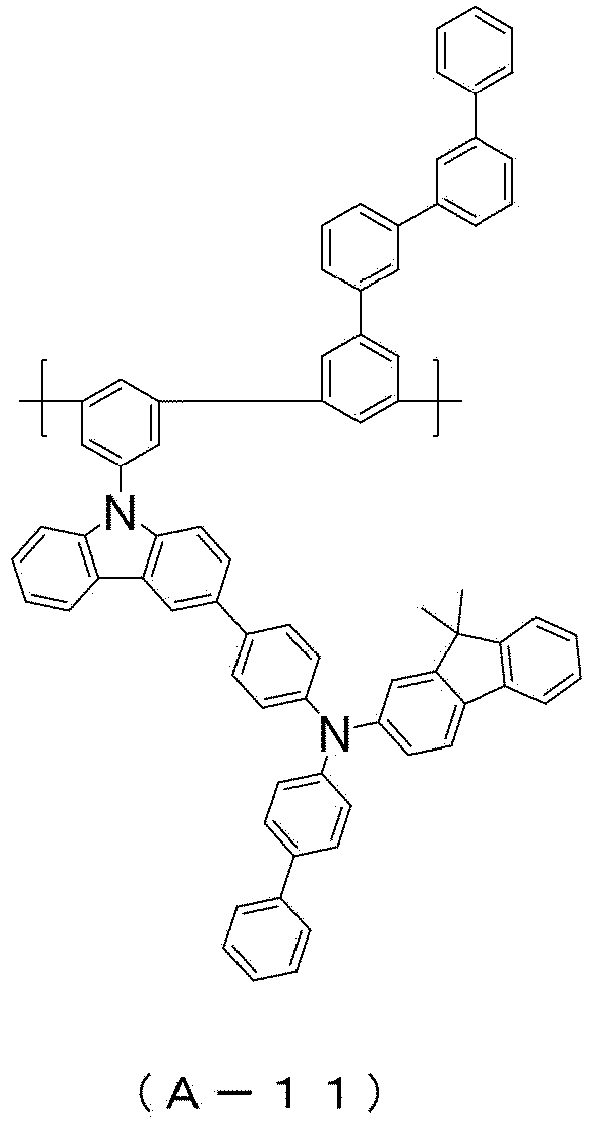
- The same polymerization as in Reference Example 1 is performed except that 1,3-dibromo-5-hexylbenzene is used instead of the 1,3-dibromo-5-tetradecylbenzene, to obtain Polymer Compound A-12 (0.40 g).
- When the number average molecular weight and polydispersity of the obtained polymer compound are measured by SEC, Mn is 22,000 and Mw/Mn is 1.34.
- Polymer Compound A-12 is presumed to be a polymer compound having the following repeating units and a mole ratio of the structural units of X: the structural units of Y = 1: 1 from the preparation ratio of the monomers, and including the structural unit of X and the structural unit of Y which are alternately polymerized.

- The same polymerization as in Reference Example 1 is performed except that 1,3-dibromo-5-octyl benzene is used instead of the 1,3-dibromo-5-tetradecylbenzene, to obtain Polymer Compound A-13 (0.45 g).
- When the number average molecular weight and polydispersity of the obtained polymer compound are measured by SEC, Mn is 23,000 and Mw/Mn is 1.67.
- Polymer Compound A-13 is presumed to be a polymer compound having the following repeating units and a mole ratio of the structural units of X: the structural units of Y = 1: 1 from the preparation ratio of the monomers, and including the structural unit of X and the structural unit of Y which are alternately polymerized.

- The same polymerization as in Reference Example 1 is performed except that 1,4-dibromo-2,5-didodecylbenzene is used instead of the 1,3-dibromo-5-tetradecylbenzene, to obtain Polymer Compound A-14 (0.82 g).
- When the number average molecular weight and polydispersity of the obtained polymer compound are measured by SEC, Mn is 19,000 and Mw/Mn is 1.65.
- Polymer Compound A-14 is presumed to be a polymer compound having the following repeating units and a mole ratio of the structural units of X: the structural units of Y = 1: 1 from the preparation ratio of the monomers, and including the structural unit of X and the structural unit of Y which are alternately polymerized.

- Compound RM15-1 is synthesized according to the following reaction scheme.

- Specifically, 3-bromo-6-phenyl-9H-carbazole (10.0 g, 31.0 mmol), bis(pinacolato)diboron (10.2 g, 40.3 mmol), potassium acetate (19.7 g, 186 mmol), [bis(diphenyl phosphino)ferrocene]dichloro palladium (0.218 g, 0.310 mmol), and DMF (30 ml) are added in a reaction vessel under an argon atmosphere and then, mixed. Then, the mixture is stirred at 90 °C for 6 hours, and after the reaction is completed, the mixed reaction solution is cooled down to room temperature. Then, 200 mL of toluene is added, and then 300 mL of water is added to wash the organic layer. After repeating this 3 times, magnesium sulfate is added to the organic layer, followed by filtration separation. After distilling off the solvent is distilled off, the filtrate is purified by column chromatography to obtain Compound RM15-1 (10.2 g).
- Compound RM15-2 is synthesized according to the following reaction scheme.

- Specifically, 2-amino-N-[(1,1'-biphenyl)-4-yl]-N-(4-bromophenyl)-9,9-dimethyl fluorene (13.00 g, 25.2 mmol), Compound RM15-1 (9.76 g, 26.4 mmol), bis(triphenylphosphine)palladium (II) dichloride (0.177 g, 0.252 mmol), sodium carbonate (8.00 g, 75.5 mmol), dioxane (100 ml), and water (80 ml) are added in a reaction vessel under an argon atmosphere and then, mixed. Then, the mixture is stirred at 85 °C for 4 hours, and after the reaction is completed, the mixed reaction solution is allowed to cool to room temperature. Then, the mixed reaction solution is filtered by using Celite (registered trademark), and impurities are filtered off. After distilling off the solvent, the filtrate is purified by column chromatography to obtain Compound RM15-2 (12.7 g).
- Compound RM15-3 is synthesized according to the following reaction scheme.

- Specifically, Compound RM15-2 (4.70 g, 6.92 mmol), 1,3-dibromo-5-fluorobenzene (1.93 g, 7.61 mmol), sodium hydride (0.33 g, 13.8 mmol), and NMP (5 ml) are added in a reaction vessel under an argon atmosphere and then, mixed. Then, the mixture is stirred at 120 °C for 2 hours, and after the reaction is completed, the mixed reaction solution is cooled to room temperature. Then, 50 mL of water and 50 mL of toluene are added to wash the organic layer. After repeating this 3 times, magnesium sulfate is added to the organic layer, followed by filtration separation. After distilling off the solvent, the filtrate is purified by column chromatography to obtain Compound RM15-3 (4.19 g).
- Continuously, 2,2'-(2,5-dihexyl-1,4-phenylene)bis[4,4,5,5-tetramethyl-1,3,2-dioxaborolane] (0.644 g), Compound RM15-3 (1.500 g), palladium acetate (3.7 mg), tris(2-methoxy phenyl)phosphine (29.0 mg), toluene (30 mL), and a 20 mass% tetraethyl ammonium hydroxide aqueous solution (4.84 g) are put in a reaction vessel under an argon atmosphere and then, refluxed for 6 hours. Subsequently, phenyl boronic acid (0.100 g), palladium acetate (3.0 mg), tris(2-methoxy phenyl)phosphine (28.0 mg), and a 20 mass% tetraethylammonium hydroxide aqueous solution (4.84 g) are added to the obtained mixed solution and then, heated and refluxed for 3 hours. Then, N,N-sodium diethyldithiocarbamate trihydrate (5.00 g) and ion exchange water (45 mL) are added the obtained mixed solution except for a water layer, and and then, stirred at 85 °C. An organic layer is separated from the water layer and then, washed with water, a 3 mass% acetic acid aqueous solution, and water. The organic layer is added dropwise in methanol to precipitate a polymer compound, and the polymer compound is filtered and dried to obtain a solid. This solid is dissolved in toluene and passed through column chromatography filled with silica gel/alumina, and the solvent is distilled off under a reduced pressure. The obtained liquid is added dropwise to methanol, and the precipitates therefrom are filtered and dried to obtain Polymer Compound A-15 (0.55 g).
- When the number average molecular weight and polydispersity of the obtained polymer compound are measured by SEC, Mn is 12,000 and Mw/Mn is 1.85.
- Polymer Compound A-15 is presumed to be a polymer compound having the following repeating units and a mole ratio of the structural units of X: the structural units of Y = 1: 1 from the preparation ratio of the monomers, and including the structural unit of X and the structural unit of Y which are alternately polymerized.

- The same polymerization as in Reference Example 15 is performed except that 2,2'-(9,9-dioctyl-9H-fluorene-2,7-diyl)bis (4,4,5,5-tetramethyl-1,3,2-dioxaborolane) is used instead of the 2,2'-(2,5-dihexyl-1,4-phenylene)bis[4,4,5,5-tetramethyl-1,3,2-dioxaborolane], to obtain Polymer Compound A-16 (0.82 g).
- When the number average molecular weight and polydispersity of the obtained polymer compound are measured by SEC, Mn is 11,000 and Mw/Mn is 1.52.
- Polymer Compound A-16 is presumed to be a polymer compound having the following repeating units and a mole ratio of the structural units of X: the structural units of Y = 1: 1 from the preparation ratio of the monomers, and including the structural unit of X and the structural unit of Y which are alternately polymerized.
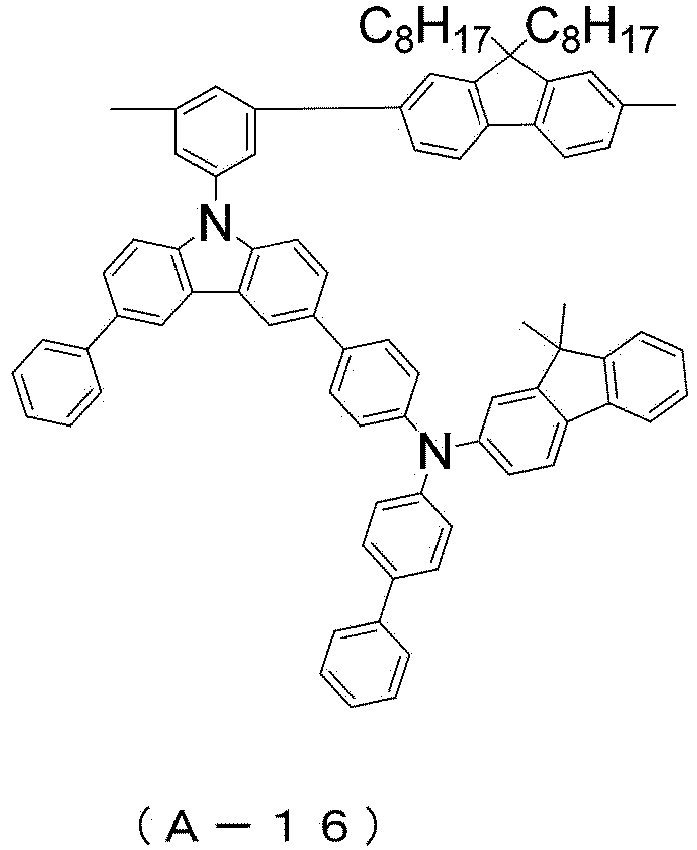
- Comonomer RM17-1 is synthesized according to the following reaction scheme.

- Specifically, under an argon atmosphere, 1-bromo-4-dodecyl benzene (50.0 g, 154 mmol), bis(pinacolato)diboron (46.8 g, 184 mmol), potassium acetate (45.3 g, 461 mmol), [bis(diphenyl phosphino)ferrocene]dichloro palladium (3.37 g, 4.61 mmol), and DMF (230 ml) are added in a reaction vessel and then, mixed. Then, the mixture is stirred at 90 °C for 6 hours, and after the reaction is completed, the mixed reaction solution is cooled to room temperature. Then, 200 mL of toluene and 300 mL of water is added to wash the organic layer. After repeating this 3 times, magnesium sulfate is added to the organic layer, followed by filtration separation. After distilling off the solvent, the filtrate is purified by column chromatography to obtain Compound RM17-1 (45.9 g).
- Compound RM17-2 is synthesized according to the following reaction scheme.

- Specifically, under an argon atmosphere, Compound RM17-1 (40.0 g, 107 mmol), 1-iodine-4-bromo benzene (33.4 g, 118 mmol), [bis(diphenyl phosphino)ferrocene]dichloro palladium (1.57 g, 2.15 mmol), sodium carbonate (34.2 g, 322 mmol), dioxane (200 ml), and water (160 ml) are added in a reaction vessel and then, mixed. Then, the mixture is stirred at 85 °C for 3 hours, and after the reaction is completed, the mixed reaction solution is cooled to room temperature. Then, the mixed reaction solution is filtered by using Celite (registered trademark), and impurities are filtered off. After distilling off the solvent, the filtrate is purified by column chromatography to obtain Compound RM17-2 (30.3 g).
- Compound RM17-3 is synthesized according to the following reaction scheme.

- Specifically, under an argon atmosphere, 9-9dimethyl-9H-fluorene-2-amine (15.0 g, 71.7 mmol), Compound RM17-2 (28.2 g, 70.2 mmol), [bis(diphenyl phosphino)ferrocene]dichloro palladium (1.05 g, 1.43 mmol), sodium tert-butoxide (20.0 g, 215 mmol), and toluene (150 ml) are added in a reaction vessel and then, mixed. Then, the mixture is stirred at 85 °C for 3 hours, and after the reaction is completed, the mixed reaction solution is cooled to room temperature. Then, the mixed reaction solution is filtered by using Celite (registered trademark), and impurities are filtered off. After distilling off the solvent, the filtrate is purified by column chromatography to obtain Compound RM17-3 (22.7 g).
- Compound RM17-4 is synthesized according to the following reaction scheme.

- Specifically, under an argon atmosphere, Compound RM17-3 (22.0 g, 41.5 mmol), 1-iodine-4-bromo benzene (12.9 g, 45.7 mmol), bis(triphenylphosphine)palladium(II)dichloride (0.668 g, 0.914 mmol), sodium tert-butoxide (12.0 g, 125 mmol), and toluene (150 ml) are added in a reaction vessel and then, mixed. Then, the mixture is stirred at 85 °C for 4 hours, and after the reaction is completed, the mixed reaction solution is allowed to cool to room temperature. Then, the mixed reaction solution is filtered by using Celite (registered trademark), and impurities are filtered off. After distilling off the solvent, the filtrate is purified by column chromatography to obtain Compound RM17-4 (20.6 g).
- Compound RM17-5 is synthesized according to the following reaction scheme.

- Specifically, under an argon atmosphere, Compound RM17-4 (20.0 g, 29.04 mmol), 3-(4,4,5,5,-tetramethyl-1,3,2-dioxaborolan-2-yl)carbazole (8.99 g, 30.7 mmol), bis(triphenylphosphine)palladium(II)dichloride (0.431 g, 0.613 mmol), sodium carbonate (9.28 g, 87.61 mmol), dioxane (260 ml), and water (110 ml) are added in a reaction vessel and then, mixed. Then, the mixture is stirred at 85 °C for 4 hours, and after the reaction is completed, the mixed reaction solution is allowed to cool to room temperature. Then, the mixed reaction solution is filtered by using Celite (registered trademark), and impurities are filtered off. After distilling off the solvent, the filtrate is purified by column chromatography to obtain Compound RM17-5 (15.5 g).
- Compound RM17-6 is synthesized according to the following reaction scheme.
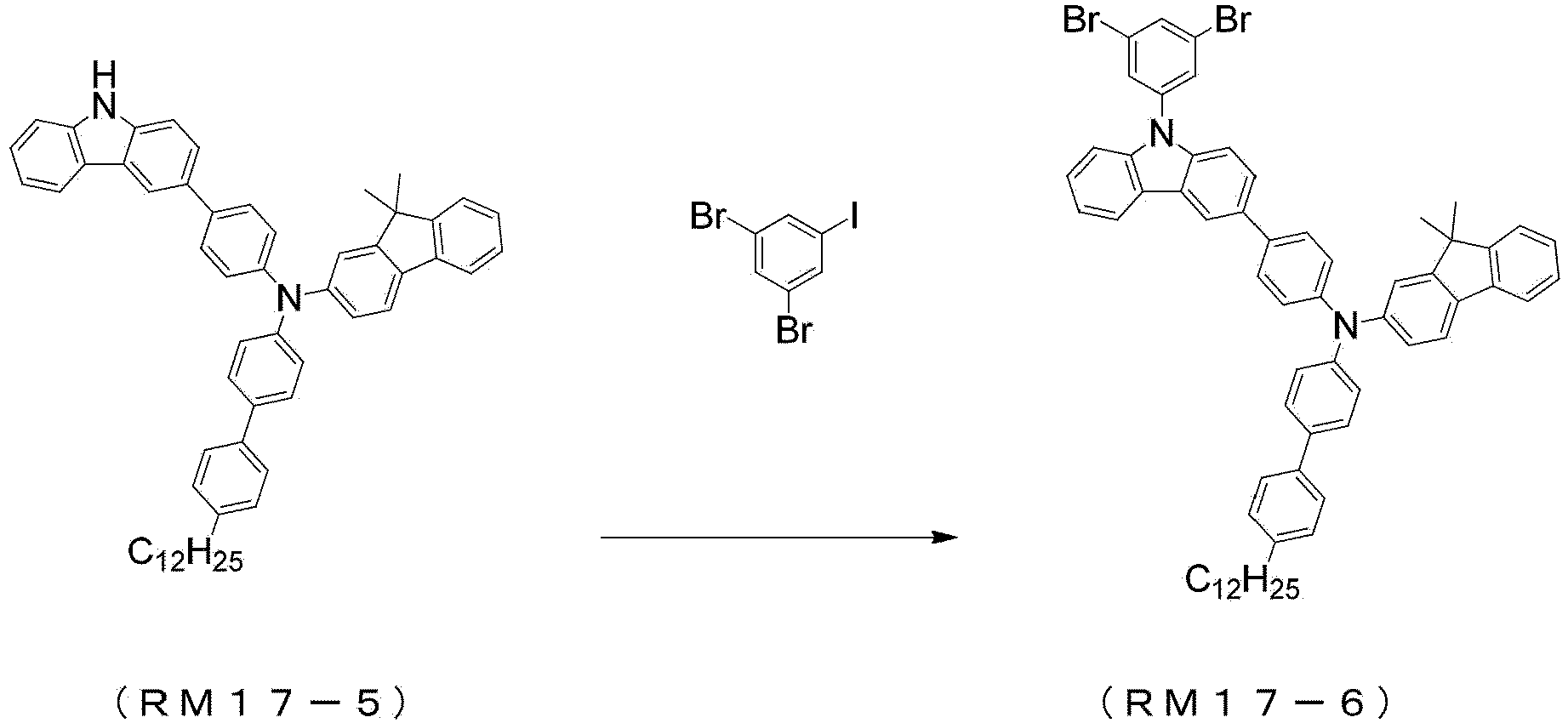
- Specifically, under an argon atmosphere, Compound RM17-5 (12.0 g, 15.6 mmol), 1,3-dibromo-5-iodo benzene (6.19 g, 17.1 mmol), copper (I) iodide (0.163 g, 0.856 mmol), trans-1,2-cyclohexanediamine (0.355 g, 3.11 mmol), sodium tert-butoxide (2.99 g, 31.1 mmol), and dioxane (70 ml) are added in a reaction vessel, and then mixed. Then, the mixture is stirred at 90 °C for 9 hours, and after the reaction is completed, the mixed reaction solution is allowed to cool to room temperature. Then, the mixed reaction solution is filtered by using Celite (registered trademark), and impurities are filtered off. After distilling off the solvent, the filtrate is purified by column chromatography to obtain Compound RM17-6 (11.8 g).
- Continuously, 2,2'-(2,5-dihexyl-1,4-phenylene)bis[4,4,5,5-tetramethyl-1,3,2-dioxaborolane (0.992 g), Compound RM17-6 (2.000 g), palladium acetate (4.5 mg), tris(2-methoxy phenyl)phosphine (35.1 mg), toluene (50 mL), and a 20 mass% tetraethylammonium hydroxide aqueous solution (5.86 g) are put in a reaction vessel under an argon atmosphere and then, refluxed for 6 hours. Then, phenyl boronic acid (0.1 g), palladium acetate (4.5 mg), tris(2-methoxy phenyl)phosphine (35.1 mg), and a 20 mass% tetraethyl ammonium hydroxide aqueous solution (5.86 g) are added thereto and then, heated and refluxed for 3 hours. Subsequently, N,N-sodium diethyldithiocarbamate trihydrate (5.00 g) and ion exchange water (45 mL) are added to the obtained mixed solution except for a water layer and then, stirred at 85 °C for 3 hours. An organic layer is separated from the water layer and then, washed with water, a 3 mass% acetic acid aqueous solution, and water. The organic layer is added dropwise in methanol to precipitate a polymer compound, and the polymer compound is filtered and dried to obtain a solid. This solid is dissolved in toluene and passed through column chromatography filled with silica gel/alumina, and the solvent is distilled off under a reduced pressure. The obtained liquid is added dropwise in methanol, and precipitates therefrom are filtered and dried to obtain Polymer Compound A-17 (0.32 g).
- When the number average molecular weight and polydispersity of the obtained polymer compound are measured by SEC, Mn is 38,000 and Mw/Mn is 1.35.
- Polymer Compound A-17 is presumed to be a polymer compound having the following repeating units and a mole ratio of the structural units of X: the structural units of Y = 1: 1 from the preparation ratio of the monomers, and including the structural unit of X and the structural unit of Y which are alternately polymerized.

- The same polymerization as in the synthesis of Polymer Compound A-17 of Reference Example 17 is performed except that 2,2'-(9,9-dioctyl-9H-fluorene-2,7-diyl)bis(4,4,5,5-tetramethyl-1,3,2-dioxaborolane) is used instead of the 2,2'-(2,5-dihexyl-1,4-phenylene)bis[4,4,5,5-tetramethyl-1,3,2-dioxaborolane], to obtain Polymer Compound A-18 (0.96 g).
- When the number average molecular weight and polydispersity of the obtained polymer compound are measured by SEC, Mn is 46,000 and Mw/Mn is 2.12.
- Polymer Compound A-18 is presumed to be a polymer compound having the following repeating units and a mole ratio of the structural units of X: the structural units of Y = 1: 1 from the preparation ratio of the monomers, and including the structural unit of X and the structural unit of Y which are alternately polymerized.

- Compound RM19-1 is synthesized according to the following reaction scheme.

- Specifically, under an argon atmosphere, Compound RM17-6 (4.00 g, 3.98 mmol), bis(pinacolato)diboron (3.03 g, 11.9 mmol), potassium acetate (2.34 g, 23.9 mmol), [bis(diphenyl phosphino)ferrocene]dichloropalladiumdichloromethane (91.0 mg, 0.111 mmol), and dioxane (50 ml) are added in a reaction vessel and then, mixed. Then, the mixture is stirred at 90 °C for 6 hours, and after the reaction is completed, the mixed reaction solution is cooled to room temperature. Then, the mixed reaction solution is filtered by using Celite (registered trademark), and impurities are filtered off. After distilling off the solvent, the filtrate is purified by column chromatography to obtain Compound RM19-1 (3.62 g).
- Subsequently, the same polymerization as in the synthesis of Polymer Compound A-17 of Reference Example 17 is performed except that Compound RM19-1 is used instead of Compound RM17-6, and 1,3-dibromo-5-dodecylbenzene is used instead of the 2,2'-(2,5-dihexyl-1,4-phenylene)bis[4,4,5,5-tetramethyl-1,3,2-dioxaneborolane], to obtain Polymer Compound A-19 (0.38 g).
- When the number average molecular weight and polydispersity of the obtained polymer compound are measured by SEC, Mn is 17,000 and Mw/Mn is 1.56.
- Polymer Compound A-19 is presumed to be a polymer compound having the following repeating units and a mole ratio of the structural units of X: the structural units of Y = 1: 1 from the preparation ratio of the monomers, and including the structural unit of X and the structural unit of Y which are alternately polymerized.

- Compound RM20-1 is synthesized according to the following reaction scheme.

- Specifically, 2-iodo fluorene (50.0 g, 171.1 mmol), sodium hydroxide (36.2 g, 377.6 mmol), dimethyl sulfoxide (263 ml), and pure water (33 ml) are put in a reaction vessel under an argon atmosphere and then, cooled down to 0 °C. 1-bromododecane (108.8 g, 436.5 mmol) is added dropwise thereto, and the obtained mixture is stirred at room temperature. After the reaction is completed, the mixed reaction solution is allowed to cool to room temperature, and impurities are filtered by using Celite (registered trademark). After distilling off the solvent, it is purified by column chromatography to obtain Compound RM20-1 (100.5 g, a yield: 93%).
- Compound RM20-2 is synthesized according to the following reaction scheme.

- Specifically, Compound RM20-1 (113.5 g, 180.4 mmol), N-(4-bromophenyl)-[1,1'-biphenyl]-4-amine (45.0 g, 138.8 mmol), a [1,1'-bis(diphenyl phosphino)ferrocene]palladium(II)dichloridedichloromethane addition product (2.27 g, 2.78 mmol), sodium-tert-butoxide (26.7 g, 278 mmol), and toluene (463 ml) are put in a reaction vessel under an argon atmosphere and then, stirred at 90 °C for 5 hours. After the reaction is completed, the mixed reaction solution is allowed to cool to room temperature, and impurities are filtered using Celite (registered trademark). After distilling off the solvent, it is purified by column chromatography to obtain Compound RM20-2 (106.5 g, a yield: 93%).
- Compound RM20-3 is synthesized according to the following reaction scheme.

- Specifically, Compound RM20-2 (55.0 g, 66.7 mmol), 3-(4,4,4,5,5-tetramethyl-1,3,2-dioxaborolan-2-yl)-9H-carbazole (19.6 g, 66.7 mmol), dichloro bis(triphenylphosphine)palladium (II) (0.94 g, 1.31mmol), sodium carbonate (17.6 g, 166 mmol), 1,4-dioxane (360 ml), and pure water (180 ml) are put in a reaction vessel under an argon atmosphere and stirred at 90 °C for 7 hours. After the reaction is completed, the mixed reaction solution is allowed to cool to room temperature, and impurities are filtered by using Celite (registered trademark). After distilling off the solvent, it is purified by column chromatography to obtain Compound RM20-3 (37.0 g, yield: 61%).
- Compound RM20-4 is synthesized according to the following reaction scheme.

- Specifically, under an argon atmosphere, Compound RM20-3 (22.0 g, 24.1 mmol), 1,3-dibromo-5-iodo benzene (9.61 g, 26.6 mmol), copper (I) iodide (0.23 g, 1.21 mmol), trans-1,2-cyclohexanediamine (0.55 g, 4.83 mmol), sodium tert-butoxide (4.64 g, 48.3 mmol), and dehydrated 1,4-dioxane (120 ml) are added in a reaction vessel, and then, the mixture is stirred at 9 °C for 7 hours. After the reaction is completed, the mixed reaction solution is allowed to cool to room temperature, and impurities are filtered by using Celite (registered trademark). After distilling off the solvent, it is purified by column chromatography to obtain Compound RM20-4 (18.3 g, yield: 66%).
- Continuously, the same polymerization as in the synthesis of Polymer Compound A-17 of Reference Example 17 is performed except that Compound RM20-4 is used instead of Compound RM17-6, to obtain Polymer Compound A-20 (1.3 g).
- When the number average molecular weight and polydispersity of the obtained polymer compound are measured by SEC, Mn is 25,000 and Mw/Mn is 1.55.
- Polymer Compound A-20 is presumed to be a polymer compound having the following repeating units and a mole ratio of the structural units of X: the structural units of Y = 1: 1 from the preparation ratio of the monomers, and including the structural unit of X and the structural unit of Y which are alternately polymerized.

- Compound RM21-1 is synthesized according to the following reaction scheme.

- Specifically, Compound RM20-4 (2.0 g, 1.75 mmol), bis(pinacolato)diboron (1.33 g, 5.24 mmol), potassium acetate (1.03 g, 10.5 mmol), [bis(diphenyl phosphino)ferrocene]dichloro palladium (0.043 g, 0.05 mmol), and dioxane (17 ml) are put in a reaction vessel under an argon atmosphere. Then, the mixture is stirred for 6 hours while refluxed, and when the reaction is complete, the mixed reaction solution is cooled down to room temperature. Then, the mixed reaction solution is filtered by using Celite (registered trademark), and impurities are filtered off. Subsequently, after distilling off the solvent, the filtrate is recrystallized and purified by using toluene/acetonitrile to obtain Compound RM21-1 (1.8 g, a yield: 83%).
- Continuously, the same polymerization as in the synthesis of Polymer Compound A-20 of Reference Example 20 is performed except that 1,3-dibromo-5-dodecyl benzene is used instead of the 2,2'-(2,5-dihexyl-1,4-phenylene)bis[4,4,5,5-tetramethyl-1,3,2-dioxaborolane], and Compound RM21-1 is used instead of Compound RM20-4, to obtain Polymer Compound A-21 (1.3 g).
- When the number average molecular weight and polydispersity of the obtained polymer compound are measured by SEC, Mn is 6,500 and Mw/Mn is 1.33.
- Polymer Compound A-21 is presumed to be a polymer compound having the following repeating units and a mole ratio of the structural units of X: the structural units of Y = 1: 1 from the preparation ratio of the monomers, and including the structural unit of X and the structural unit of Y which are alternately polymerized.

- The same polymerization as in the synthesis of Polymer Compound A-20 of Reference Example 20 is performed except that 1,3-dibromo benzene is used instead of the 2,2'-(2,5-dihexyl-1,4-phenylene)bis[4,4,5,5-tetramethyl-1,3,2-dioxaborolane], and Compound RM21-1 is used instead of Compound RM20-4, to obtain Polymer Compound A-22 (1.3 g).
- When the number average molecular weight and polydispersity of the obtained polymer compound are measured by SEC, Mn is 8,200 and Mw/Mn is 1.64.
- Polymer Compound A-22 is presumed to be a polymer compound having the following repeating units and a mole ratio of the structural units of X: the structural units of Y = 1: 1 from the preparation ratio of the monomers, and including the structural unit of X and the structural unit of Y which are alternately polymerized.

- The same polymerization as in the synthesis of Polymer Compound A-20 of Reference Example 20 is performed except that 1,3-dibromo-5-hexyl benzene is used instead of the 2,2'-(2,5-dihexyl-1,4-phenylene)bis[4,4,5,5-tetramethyl-1,3,2-dioxaborolane], and Compound RM21-1 is used instead of Compound RM20-4, to obtain Polymer Compound A-23 (1.3 g).
- When the number average molecular weight and polydispersity of the obtained polymer compound are measured by SEC, Mn is 6,900 and Mw/Mn is 1.66.
- Polymer Compound A-23 is presumed to be a polymer compound having the following repeating units and a mole ratio of the structural units of X: the structural units of Y = 1: 1 from the preparation ratio of the monomers, and including the structural unit of X and the structural unit of Y which are alternately polymerized.
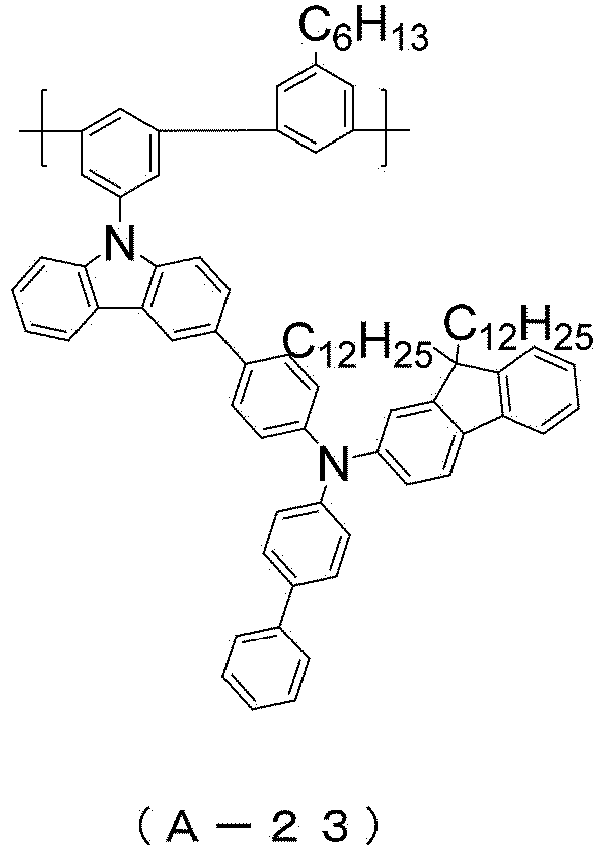
- Comonomer RM24-1 is synthesized according to the following reaction scheme.

- Specifically, under an argon atmosphere, 2-amino-N-[(1,1'-biphenyl)-4-yl]-N-(4-bromophenyl)-9,9-dimethyl fluorene (10.0 g, 19.36 mmol), bis(pinacolato)diboron (7.38 g, 29.04 mmol), potassium acetate (5.70 g, 58.09 mmol), and dehydrated 1,4-dioxane (195 mL) are added in a reaction vessel and then, stirred for 30 minutes. Subsequently, bis[(diphenyl phosphino)ferrocene]dichloro palladium (0.22 g, 0.27 mmol) is added thereto and then, heated and stirred under reflux for 3 hours. After the reaction is completed, the mixed reaction solution is cooled to room temperature and filtered through Celite (registered trademark), and the filtrate is concentrated. The concentrate residue is washed with methanol to obtain 9.1 g of a solid (Compound RM24-1, a yield of 79%).
- Comonomer RM24-2 is synthesized according to the following reaction scheme.

- Specifically, Compound RM24-1 (4.0 g, 7.1 mmol), 2-bromo carbazole (1.6 g, 6.5 mmol), bis(triphenylphosphine)palladium(II)dichloride (0.025 g, 0.036 mmol), sodium carbonate (0.75 g, 7.1 mmol), toluene (40 ml), and water (20 ml) are put in a reaction vessel under an argon atmosphere, and then, the mixture is stirred at 85 °C for 4 hours. After the reaction is completed, the mixed reaction solution is allowed to cool to room temperature, and impurities are filtered by using Celite (registered trademark). After distilling off the solvent, by column chromatography to obtain Compound RM24-2 (5.4 g, a yield: 67%).
- Comonomer RM24-3 is synthesized according to the following reaction scheme.

- Specifically, Compound RM24-2 (8.5 g, 14.1 mmol), 1,3-dibromo-5-iodo benzene (6.1 g, 16.9 mmol), copper(I) iodide (0.13 g, 0.70 mmol), trans-1,2-cyclohexanediamine (0.32 g, 2.82 mmol), sodium tert-butoxide (2.71 g, 28.2 mmol), and dehydrated 1,4-dioxane (50 ml) are put in a reaction vessel under an argon atmosphere, and then, the mixture is stirred at 90 °C for 7 hours. After the reaction is completed, the mixed reaction solution is allowed to cool to room temperature, and impurities are filtered by using Celite (registered trademark). After distilling off the solvent, it is purified by column chromatography to obtain Compound RM24-3 (6.6 g, a yield: 56%).
- Continuously, Compound RM24-3 (1.37 g), 2,2'-(2,5-dihexyl-1,4-phenylene)bis[4,4,5,5-tetramethyl-1,3,2-dioxaborolane] (0.816 g), palladium acetate (7.8 mg), tris(2-methoxy phenyl)phosphine (33.8 mg), toluene (22 mL), and a 20 mass% tetraethylammonium hydroxide aqueous solution (8.39 g) are put in a reaction vessel under an argon atmosphere and then, refluxed for 8 hours. Then, phenyl boronic acid (134 mg), bis(triphenylphosphine)palladium(II)dichloride (51.6 mg), and a 20 mass% tetraethylammonium hydroxide aqueous solution (8.39 g) are added thereto and then, heated and refluxed for 7 hours. Subsequently, N,N-sodium diethyldithiocarbamate trihydrate (11.0 g) and ion exchange water (88 mL) are added to the obtained mixed solution except for a water layer and then, stirred at 85 °C for 2 hours. An organic layer is separated from the water layer and then, washed with water and a 3 mass% acetic acid aqueous solution and rewashed with water. The organic layer is added dropwise in methanol to precipitate a polymer compound, and the polymer compound is filtered and dried to obtain a solid. This solid is dissolved in toluene and passed through column chromatography filled with silica gel/alumina, and the solvent is distilled off under a reduced pressure. The obtained liquid is added dropwise in methanol, and precipitates therefrom are filtered and dried to obtain Polymer Compound A-24 (1.18 g).
- When the number average molecular weight and polydispersity of the obtained polymer compound are measured by SEC, Mn is 19,000 and Mw/Mn is 1.57.
- Polymer Compound A-24 is presumed to be a polymer compound having the following repeating units and a mole ratio of the structural units of X: the structural units of Y = 1: 1 from the preparation ratio of the monomers, and including the structural unit of X and the structural unit of Y which are alternately polymerized.

- The same polymerization as in the synthesis of Polymer Compound A-24 of Example 24 is performed except that 2,7-bis(4,4,5,5-tetramethyl-1,3,2-dioxaborolan-2-yl)-9,9-di-N-octylfluorene is used instead of the 2,2'-(2,5-dihexyl-1,4-phenylene)bis[4,4,5,5-tetramethyl-1,3,2-dioxaborolane], to obtain Polymer Compound A-24 (1.18 g).
- When the number average molecular weight and polydispersity of the obtained polymer compound are measured by SEC, Mn is 41,000 and Mw/Mn is 1.85.
- Polymer Compound A-25 is presumed to be a polymer compound having the following repeating units and a mole ratio of the structural units of X: the structural units of Y = 1: 1 from the preparation ratio of the monomers, and including the structural unit of X and the structural unit of Y which are alternately polymerized.

- The same polymerization as in the synthesis of Polymer Compound A-24 of Example 24 is performed except that the following compound is used instead of the 2,2'-(2,5-dihexyl-1,4-phenylene)bis[4,4,5,5-tetramethyl-1,3,2-dioxaborolane], to obtain Polymer Compound A-26 (0.88 g).

- When the number average molecular weight and polydispersity of the obtained polymer compound are measured by SEC, Mn is 87,000 and Mw/Mn is 3.21.
- Polymer Compound A-26 is presumed to be a polymer compound having the following repeating units and a mole ratio of the structural units of X: the structural units of Y = 1: 1 from the preparation ratio of the monomers, and including the structural unit of X and the structural unit of Y which are alternately polymerized.

- Comonomer RM27-1 is synthesized according to the following reaction scheme.

- Specifically, Compound RM24-3 (5.0 g, 5.98 mmol), bis(pinacolato)diboron (6.1 g, 23.9 mmol), potassium acetate (3.5 g, 35.8 mmol), [bis(diphenyl phosphino)ferrocene]dichloro palladium (0.22 g, 0.3 mmol), and dioxane (50 ml) are mixed in a reaction vessel under an argon atmosphere. Subsequently, the mixture is reflux-stirred for 6 hours, and when the reaction is complete, the mixed reaction solution is allowed to cool to room temperature. Then, the mixed reaction solution is filtered by using Celite (registered trademark), and impurities are filtered off. After distilling off the solvent, the filtrate is purified by column chromatography to obtain Compound RM27-1 (4.4 g, a yield: 79%).
- Continuously, the same polymerization as in the synthesis of Polymer Compound A-24 of Example 24 is performed except that 1,3-dibromo-5-dodecyl benzene is used instead of the 2,2'-(2,5-dihexyl-1,4-phenylene)bis[4,4,5,5-tetramethyl-1,3,2-dioxaborolane], and Compound RM27-1 is used instead of Compound RM24-3, to obtain Polymer Compound A-27 (1.19 g).
- When the number average molecular weight and polydispersity of the obtained polymer compound are measured by SEC, Mn is 4,410 and Mw/Mn is 1.75.
- Polymer Compound A-27 is presumed to be a polymer compound having the following repeating units and a mole ratio of the structural units of X: the structural units of Y = 1: 1 from the preparation ratio of the monomers, and including the structural unit of X and the structural unit of Y which are alternately polymerized.

- Subsequently, HOMO levels and glass transition temperatures of Polymer Compounds A-1 to A-27 of Reference Examples 1 to 8 and poly[(9,9-dioctyl fluorenyl-2,7-diyl)-co-(4,4'-(N-(4-sec-butyl phenyl)diphenyl amine)] having the following structural unit (TFB) (Luminescence Technology Corp.) (the polymer material of Comparative Example 1) are measured.

- Each polymer material is dissolved in xylene so that the concentration is 1 mass%, and each coating solution is prepared.
- Onn ITO-adhered glass substrate which is UV-cleaned, the coating solutions are respectively spin-coated at 2000 rpm to form films, and then, the films are dried on a hot plate at 150 °C for 30 minutes to obtain samples.
- HOMO levels of the samples are measured by using an optoelectronic spectrometer (AC-3 manufactured by Riken Keiki Korea Co., Ltd.) in the air. Herein, the measurement results are used to calculate increasing tangential intersections to obtain the HOMO levels.
- On the other hand, the HOMO levels are usually negative values.
- Each polymer material is dissolved in toluene at a concentration of 3.2 mass% to prepare coating solutions.
- On an ITO-adhered glass substrate which is UV-cleaned, the coating solutions are respectively spin-coated at 1600 rpm to form films, and the films are dried on a hot plate at 250 °C for 60 minutes to obtain samples. Herein, the films have a film thickness of about 70 nm. The obtained samples are cooled down to 77K (-196 °C), and photo luminance (PL) spectra thereof are measured. Peaks of the PL spectra at the shortest wavelength are used to calculate the LUMO levels [eV].
- Each polymer material is measured with respect to a glass transition temperature (Tg) by using differential scanning calorimetry (DSC) (DSC6000 manufactured by Seiko Instruments Inc.), heating the samples up to 300 °C at 10 °C/min and holding them for 10 minutes, cooling them down to 25 °C at 10 °C/min and holing them for 10 minutes, and then, heating them up to 300 °C at 10 °C/min. When the measurement is complete, the samples are cooled down to room temperature (25 °C) at 10 °C/min.
- The HOMO levels and glass transition temperatures (Tg) of the polymer materials are shown in Table 1.
(Table 1) (Table 1: HOMO Level and Glass Transition Temperature (Tg) of Each Polymer Material) Polymer material Absolute value of HOMO level [eV] Tg [°C] Reference Example 1 A-1 5.60 141 Reference Example 2 A-2 5.60 224 Reference Example 3 A-3 5.57 154 Reference Example 4 A-4 5.58 235 Reference Example 5 A-5 5.57 230 Reference Example 6 A-6 5.58 229 Reference Example 7 A-7 5.60 222 Reference Example 8 A-8 5.65 193 Reference Example 9 A-9 5.59 236 Reference Example 10 A-10 5.55 232 Reference Example 11 A-11 5.56 217 Reference Example 12 A-12 5.55 216 Reference Example 13 A-13 5.55 197 Reference Example 14 A-14 5.60 93 Reference Example 15 A-15 5.66 185 Reference Example 16 A-16 5.65 192 Reference Example 17 A-17 5.56 110 Reference Example 18 A-18 5.62 133 Reference Example 19 A-19 5.55 99 Reference Example 20 A-20 5.64 74 Reference Example 21 A-21 5.62 76 Reference Example 22 A-22 5.63 142 Reference Example 23 A-23 5.62 128 Example 24 A-24 5.65 166 Example 25 A-25 5.69 181 Example 26 A-26 5.73 196 Example 27 A-27 5.58 143 Comparative Example 1 TFB 5.48 155 - Referring to the results of Table 1, Polymer Compounds A-1 to A-27 of Reference Examples/Examples 1 to 27 have a deeper HOMO level than that of a conventional polymer material (TFB) of Comparative Example 1.
- As for a first electrode (an anode), an ITO-adhered glass substrate in which indium tin oxide (ITO) is formed into a 150 nm-thick stripe-shaped film is washed with a neutral detergent, deionized water, water, and isopropylalcohol in order and treated with a UV-ozone. Subsequently, on the ITO-adhered glass substrate, poly(thieno[3,4-b]thiopene (PEDOT/PSS) (Sigma-Aldrich Co., Ltd.) is spin-coated and dried. As a result, a hole injection layer (HIL) having a thickness (a dried film thickness) of 30 nm is formed on the ITO-adhered glass substrate.
- Subsequently, Polymer Compound A-1 of Reference Example 1 (a hole transport material) is dissolved in xylene (a solvent) at a concentration of 1.0 mass% to prepare a coating solution for forming a hole transport layer (HTL). On the hole injection layer (HIL), the coating solution for a hole transport layer (HTL) is spin-coated and heat-treated at 150 °C for 1 hour to form a hole transport layer (HTL). As a result, the hole transport layer (HTL) having a thickness (a dried film thickness) of 30 nm is formed on the hole injection layer (HIL).
- On the hole transport layer (HTL), quantum dots of InP/ZnSe/ZnS (core/shell/shell) (refer to
FIG. 2 ) are dispersed in n-octane not dissolving the hole transport layer (HTL) at 1.0 mass% to prepare dispersion, and the dispersion is spin-coated and then, dried. As a result, a quantum dot light emitting layer having a thickness (a dried film thickness) of 30 nm is formed on the hole transport layer (HTL). On the other hand, light emitted by irradiating the dispersion of the quantum dots with ultraviolet (UV) has a center wavelength of 627 nm and a full width at half maximum (FWHM) of 34 nm (refer toFIG. 3 ). - After completely drying the quantum dot light emitting layer, ZnMgO is dispersed in ethanol at 1.5 mass% to prepare dispersion for an electron transport layer (ETL). This dispersion is spin-coated on the quantum dot light emitting layer to have a dried film thickness of 60 nm and then, dried. As a result, the electron transport layer (ETL) having a dried film thickness of 60 nm is formed on the quantum dot light emitting layer.
- A vacuum deposition device is used to deposit aluminum (Al) on the electron transport layer (ETL). As a result, a 100 nm-thick second electrode (a cathode) is formed on the electron transport layer (ETL), obtaining a quantum dot light emitting device 101 of Reference Example 28.
- In addition, quantum dot light emitting devices 102 and 113 of Reference Examples 29 and 30 are obtained according to the same method as Reference Example 28 except that Polymer Compounds A-2 and A-13 of Reference Examples 2 and 13 are respectively used to form hole transport layers (HTL) instead of Polymer Compound A-1.
- In addition, a quantum dot light emitting device C1 of Comparative Example 2 is manufactured according to the same method as Reference Example 28 except that the polymer material (TFB) of Comparative Example 1 is used to form a hole transport layer (HTL) instead of Polymer Compound A-1.
-
FIGS. 4 and5 show energy diagrams of the quantum dot light emitting devices of Comparative Example 2 and Reference Example 28. - On the other hand, the energy diagrams of the quantum dot light emitting devices of Reference Examples 29 and 30 respectively exhibit the same relationship as that of the energy diagram of the quantum dot light emitting device of Reference Example 28 shown in
FIG. 5 . - Subsequently, in the quantum dot light emitting devices 101, 102, and 113 of Reference Examples 28 to 30 and the quantum dot light emitting device C1 of Comparative Example 2, a driving voltage, quantum efficiency, and initial luminance measured by using a luminance-measuring device, and "LT50 (h)" of time when the initial luminance are slowly deteriorated and decreased down to 50% are evaluated.
- When a DC constant voltage source (a source meter, Keyence Corp.) is used to apply a voltage to each quantum dot light emitting device, and a current starts to flow at a predetermined voltage, the quantum dot light emitting devices emit light. Herein, a voltage at current density of 5 mA/cm2 is regarded as a driving voltage (Vop) [V]. In addition, the current is slowly increased and constantly maintained at the luminance of 100 nits (cd/m2 and then, allowed to stand. Herein, the measured spectral radiation luminance spectra are used, under assumption of Lambertian radiation, to calculate external quantum efficiency (EQE) at the luminance of 100 nits and thus evaluate luminous efficiency. In addition, the luminance is measured by using a luminance-measuring device of SR-3 manufactured by Topcom Technology Co., Ltd.
- In Table 2, the driving voltage [V], quantum efficiency [%], and LT50(h) results of the quantum dot light emitting devices are shown. On the other hand, LT50 (h) is obtained as a relative value based on 100 of the measurement of the quantum dot light emitting device C1 of Comparative Example 2.
(Table 2) (Table 2: Evaluation Result of Quantum Dot Light Emitting Device) Quantum dot light emitting device Hole transport material (polymer material) Tg [°C] Driving voltage [V] Quantum efficiency [%] LT50 relative value Reference Example 28 101 A-1 141 2.8 12.4 786 Reference Example 29 102 A-2 224 3.0 11.4 242 Reference Example 30 113 A-13 197 2.6 11.5 267 Comparative Example 2 C1 TFB 155 4.8 8.5 100 - Quantum dot light emitting devices of Examples 31 to 34 are respectively manufactured according to the same method as that of the quantum dot light emitting device 101 of Reference Example 28 except that Polymer Compounds A-24 to A-27 of Examples 24 to 27 as a hole transport material are respectively used to form hole transport layers (HTL) instead of Polymer Compound A-1.
- On the other hand, energy diagrams of the quantum dot light emitting devices of Examples 31 to 34 respectively exhibit the same relationship as that of the energy diagram of the quantum dot light emitting device of Reference Example 28, which is shown in
FIG. 5 . - Subsequently, as for the quantum dot light emitting devices 124 to 127 of Examples 31 to 34, a luminance-measuring device is used to measure initial luminance and "LT50 (h)" of time when the initial luminance is slowly deteriorated and decreased down to 50%. On the other hand, a method of evaluating "LT50 (h)" LT50 (h)is the same as those of the quantum dot light emitting devices 101, 102, and 113 of Reference Examples 28 to 30 and the quantum dot light emitting device C2 of Comparative Example 1.
- In Table 2, the LT50 (h) evaluation results of the quantum dot light emitting devices are shown. On the other hand, LT50 (h) is a relative value based on 100 of the measurement of the quantum dot light emitting device C1 of Comparative Example 2.
(Table 3) (Table 3: Evaluation Result of Electroluminescence Device) Quantum dot light emitting device Hole transport material (polymer material) Tg [°C] LT50 relative value Example 31 124 A-24 166 786 Example 32 125 A-25 181 714 Example 33 126 A-26 196 607 Example 34 127 A-27 143 1110 Comparative Example 2 C1 TFB 155 100 - Referring to Tables 2 and 3, the quantum dot light emitting devices of Reference Examples/Examples 28 to 34 respectively use Polymer Compounds A-1, A-2, A-13, and A-24 to A-27, specific examples of a polymer material according to the present embodiment, as a hole transport material and accordingly, exhibit very long time that luminance becomes 50% of the initial luminance and thus a significantly long life-span.
- On the contrary, the quantum dot light emitting device of Comparative Example 2 uses TFB as a hole transport material and thus exhibits short time that luminance becomes 50% of the initial luminance and thus a short life-span.
- The reason of this difference, as shown in Table 1 and the like, is that since HOMO levels of Polymer Compounds A-1, A-2, A-13, and A-24 to A-27 are close to valence bands of quantum dots compared with the HOMO level of TFB, a barrier against injection of holes into the quantum dots from the hole transport layers (HTL) becomes smaller.
- While this disclosure has been described in connection with what is presently considered to be practical example embodiments, it is to be understood that the invention is not limited to the disclosed embodiments. On the contrary, it is intended to cover various modifications and equivalent arrangements included within the scope of the appended claims.
-
- 100 quantum dot light emitting device
- 110 substrate
- 120 first electrode
- 130 hole injection layer
- 140 hole transport layer
- 150 light emitting layer
- 160 electron transport layer
- 170 electron injection layer
- 180 second electrode
Claims (13)
- A polymer material comprisinga segment of an alternating copolymer of a structural unit represented by Formula (1) and having a glass transition temperature of greater than or equal to 50°C and less than or equal to 250°C:
 wherein, in Formula (1), X is at least one selected from groups represented by Formula (2-I) to Formula (2-L) and Y is a substituted or unsubstituted divalent aromatic hydrocarbon group having 6 to 60 ring-forming carbon atoms, or a substituted or unsubstituted divalent aromatic heterocyclic group having 3 to 60 ring-forming atoms,
 wherein, in Formula (2-I) to Formula (2-L), Ar1 is a substituted or unsubstituted cyclic C6 to C60 trivalent aromatic hydrocarbon group or a substituted or unsubstituted trivalent aromatic heterocyclic group having 3 to 60 ring-forming atoms,Ar2 and Ar3 are independently a substituted or unsubstituted monovalent aromatic hydrocarbon group having ring-forming 6 to 60 carbon atoms or a substituted or unsubstituted monovalent aromatic heterocyclic group having 3 to 60 ring-forming atoms,L1 and L2 are independently a single bond, a substituted or unsubstituted divalent aromatic hydrocarbon group having 6 to 60 ring-forming carbon atoms, or a substituted or unsubstituted divalent aromatic heterocyclic group having 3 to 60 ring-forming atoms,* is a binding portion forming a main chain,in Formula (2-J) to Formula (2-L), R1 and R2 are independently a substituted or unsubstituted C1 to C20 alkyl group, a substituted or unsubstituted C1 to C20 alkoxy group, a substituted or unsubstituted monovalent aromatic hydrocarbon group having ring-forming 6 to 60 carbon atoms, or a substituted or unsubstituted monovalent aromatic heterocyclic group having 3 to 60 ring-forming atoms,wherein R1 and R2 are combined with each other to form a ring,a is an integer of 1 to 4, andb is an integer of 1 to 3.
 - The polymer material of claim 1, wherein in Formula (1), X is at least one selected from groups represented by Formula (2-3) or Formula (2-6):


- The polymer material of any of claims 1 or 2, whereinat least one of Ar2 and Ar3 is a substituted monovalent aromatic hydrocarbon group having 6 to 60 ring-forming carbon atoms, or a substituted monovalent aromatic heterocyclic group having 3 to 60 ring-forming atoms, andin Ar2 and Ar3, at least one of the substituents for the monovalent aromatic hydrocarbon group or the monovalent aromatic heterocyclic group is an alkyl group having 10 to 60 carbon atoms.
- The polymer material of any of claims 1-3, wherein Y is a substituted cyclic C6 to C60 divalent aromatic hydrocarbon group or a substituted divalent aromatic heterocyclic group having 3 to 60 ring-forming atoms, wherein at least one of the substituents for the divalent aromatic hydrocarbon group or the divalent aromatic heterocyclic group is an alkyl group having 14 to 60 carbon atoms.
- The polymer material of any of claims 1-4, wherein in Formula (1), Y is at least one selected from groups represented by Formula (2-7) to Formula (2-23).


 wherein, in Formula (2-7) to Formula (2-23), A is independently a substituted or unsubstituted monovalent aromatic hydrocarbon group having ring-forming 6 to 60 carbon atoms, a substituted or unsubstituted monovalent aromatic heterocyclic group having 3 to 60 ring-forming atoms, or a C1 to C60 alkyl group,Q is independently -O-, -S-, -Se-, -CR7R8-, or -SiR7R8-(wherein R7 and R8 are independently a hydrogen atom, a deuterium atom, a substituted or unsubstituted alkyl group, a substituted or unsubstituted aryl group, or a substituted or unsubstituted heteroaryl group),Z is independently -CR9=, -N=, or -SiR9= (wherein, R9 is hydrogen, a deuterium atom, a substituted or unsubstituted alkyl group, a substituted or unsubstituted aryl group, or a substituted or unsubstituted heteroaryl group), and* is a binding portion forming a main chain,
 - The polymer material of claim 5, whereinin Formula (1), Y is at least one selected from groups represented by Formula (2-7), Formula (2-8), Formula (2-10), Formula (2-11), Formula (2-15) to Formula (2-20), Formula (2-22), and Formula (2-23), andat least one of A is an alkyl group having 14 to 60 carbon atoms.
- The polymer material of any of claims 1-6, which is represented by Formula (3):
 wherein, in Formula (3), E is a substituted or unsubstituted monovalent aromatic hydrocarbon group having ring-forming 6 to 60 carbon atoms, or a substituted or unsubstituted monovalent aromatic heterocyclic group having 3 to 60 ring-forming atoms,m is an integer of greater than or equal to 2, and a plurality of X and Y are the same or different.
 - A material for an electroluminescence device comprising the polymer material of any of claims 1-7.
- A liquid composition comprising the polymer material of any of claims 1-7, a solvent, and a dispersing agent.
- A thin film comprising the polymer material of any of claims 1-7.
- An electroluminescence device comprisinga pair of electrodes, andone or more organic layers disposed between the pair of electrodes and comprising the polymer material of any of claims 1-7.
- The electroluminescence device of claim 11, wherein at least one of the organic layers is formed by a coating method.
- The electroluminescence device of claims 11 or 12,which further comprises a layer comprising quantum dots,wherein the quantum dots are inorganic nanoparticles.
Applications Claiming Priority (1)
| Application Number | Priority Date | Filing Date | Title |
|---|---|---|---|
| JP2019108262A JP2020200397A (en) | 2019-06-10 | 2019-06-10 | Polymer material, material for electroluminescence device, liquid composition, thin film, and electroluminescence device |
Publications (2)
| Publication Number | Publication Date |
|---|---|
| EP3751631A1 EP3751631A1 (en) | 2020-12-16 |
| EP3751631B1 true EP3751631B1 (en) | 2023-12-13 |
Family
ID=71083361
Family Applications (1)
| Application Number | Title | Priority Date | Filing Date |
|---|---|---|---|
| EP20178942.7A Active EP3751631B1 (en) | 2019-06-10 | 2020-06-09 | Polymer material, material for electroluminescence device, liquid composition, thin film, and electroluminescence device |
Country Status (4)
| Country | Link |
|---|---|
| US (1) | US11758800B2 (en) |
| EP (1) | EP3751631B1 (en) |
| JP (1) | JP2020200397A (en) |
| KR (1) | KR102906652B1 (en) |
Families Citing this family (3)
| Publication number | Priority date | Publication date | Assignee | Title |
|---|---|---|---|---|
| US12289936B2 (en) * | 2019-09-30 | 2025-04-29 | Sharp Kabushiki Kaisha | Light-emitting element, light-emitting device |
| CN114695690A (en) * | 2020-12-30 | 2022-07-01 | Tcl科技集团股份有限公司 | Solution composition, film layer and light emitting diode |
| US20240389374A1 (en) * | 2021-08-26 | 2024-11-21 | Beijing Boe Technology Development Co., Ltd. | Quantum dot light emitting device and manufacturing method therefor, display panel, and display apparatus |
Family Cites Families (13)
| Publication number | Priority date | Publication date | Assignee | Title |
|---|---|---|---|---|
| US20050186444A1 (en) * | 2004-02-25 | 2005-08-25 | Eastman Kodak Company | Electroluminescent devices having conjugated arylamine polymers |
| GB0526185D0 (en) | 2005-12-22 | 2006-02-01 | Cambridge Display Tech Ltd | Electronic device |
| JP5691177B2 (en) | 2009-01-29 | 2015-04-01 | 住友化学株式会社 | Polymer compound and light emitting device using the same |
| KR101652789B1 (en) | 2009-02-23 | 2016-09-01 | 삼성전자주식회사 | Quantum dot light emitting device having quantum dot multilayer |
| WO2013084885A1 (en) | 2011-12-05 | 2013-06-13 | 出光興産株式会社 | Organic electroluminescent element |
| JP2015167150A (en) | 2012-05-28 | 2015-09-24 | 出光興産株式会社 | Organic electroluminescent element |
| US10038143B2 (en) | 2012-09-14 | 2018-07-31 | Idemitsu Kosan Co., Ltd. | Polymer compound, material for electronic elements, material for organic electroluminescent elements, and organic electroluminescent element |
| WO2014185079A1 (en) | 2013-05-17 | 2014-11-20 | 三井化学株式会社 | Polymer compound, material for organic electroluminescence element using same, and organic electroluminescence element |
| KR102357590B1 (en) | 2015-04-13 | 2022-02-03 | 덕산네오룩스 주식회사 | Compound for organic electric element, organic electric element comprising the same and electronic device thereof |
| JP7044515B2 (en) * | 2016-12-27 | 2022-03-30 | 三星電子株式会社 | Polymer compounds, compositions, liquid compositions, thin films, materials for electroluminescence devices and electroluminescence devices |
| US10270036B2 (en) * | 2016-12-27 | 2019-04-23 | Samsung Electronics Co., Ltd. | Polymer, composition including the polymer, and organic light-emitting device including the polymer |
| JP7104518B2 (en) * | 2018-01-10 | 2022-07-21 | 三星電子株式会社 | Polymer materials, materials for electroluminescence devices, liquid compositions, thin films and electroluminescence devices |
| EP3512307B1 (en) | 2018-01-10 | 2021-04-21 | Samsung Electronics Co., Ltd. | Polymer material, material for electroluminescence device, composition, thin film, and electroluminescence device comprising the same |
-
2019
- 2019-06-10 JP JP2019108262A patent/JP2020200397A/en active Pending
-
2020
- 2020-06-09 EP EP20178942.7A patent/EP3751631B1/en active Active
- 2020-06-10 KR KR1020200070468A patent/KR102906652B1/en active Active
- 2020-06-10 US US16/898,065 patent/US11758800B2/en active Active
Also Published As
| Publication number | Publication date |
|---|---|
| EP3751631A1 (en) | 2020-12-16 |
| KR102906652B1 (en) | 2025-12-31 |
| US11758800B2 (en) | 2023-09-12 |
| JP2020200397A (en) | 2020-12-17 |
| KR20200141952A (en) | 2020-12-21 |
| US20200388763A1 (en) | 2020-12-10 |
Similar Documents
| Publication | Publication Date | Title |
|---|---|---|
| JP7044515B2 (en) | Polymer compounds, compositions, liquid compositions, thin films, materials for electroluminescence devices and electroluminescence devices | |
| EP3512307B1 (en) | Polymer material, material for electroluminescence device, composition, thin film, and electroluminescence device comprising the same | |
| KR102511545B1 (en) | Polymer material, and material for electroluminescence device, composition, thin film, electroluminescence device comprising the same | |
| US10270036B2 (en) | Polymer, composition including the polymer, and organic light-emitting device including the polymer | |
| JP7233923B2 (en) | Quantum dot electroluminescence device | |
| JP6995563B2 (en) | Polymer compounds, compositions, liquid compositions, thin films, and materials for electroluminescence devices, and electroluminescence devices. | |
| KR20210113556A (en) | Arylamine-fluorene alternating copolymer including silicone, and electroluminescence device material and electroluminescence device using the polymer | |
| EP3751631A1 (en) | Polymer material, material for electroluminescence device, liquid composition, thin film, and electroluminescence device | |
| US11631815B2 (en) | Quantum dot electroluminescence device | |
| KR20220034011A (en) | Copolymer, electroluminescence device material including copolymer, and electroluminescence device | |
| JP7602318B2 (en) | Silicon-containing arylamine polymer, and electroluminescent device material and electroluminescent device using said polymer | |
| KR20240086581A (en) | Polymer Compound, Composition, Organic Film, and Electroluminescent Device Comprising Polymer Compound, and Method of Preparing Electroluminescent Device | |
| EP4141041B1 (en) | A polymer, a composition, and an electroluminescence device | |
| KR20190074931A (en) | Condensed cyclic compound, composition including the same and organic light-emitting device including the same | |
| EP4624509A1 (en) | Polymeric compound, electroluminescence device materilal and liquid composition including the polymeric compound, and electroluminescence device including the material | |
| JP7713396B2 (en) | Polymer, and electroluminescent device material and electroluminescent device using said polymer | |
| EP4624510A1 (en) | Copolymer, composition, liquid composition, and electroluminsecnt device including the copolymer | |
| US20230212334A1 (en) | Polymer, electroluminescence material, electroluminescence device, and electronic device | |
| JP7650148B2 (en) | Copolymer, and electroluminescent device material and electroluminescent device using said copolymer | |
| JP2025149032A (en) | Copolymer, and composition, liquid composition, and electroluminescent device containing the copolymer | |
| KR20230033619A (en) | A Polymer, A Composition, and An Electroluminescence Device | |
| JP2023035869A (en) | Polymer having overlap index within specific range, polymer having specific structure, composition, and electroluminescent device |
Legal Events
| Date | Code | Title | Description |
|---|---|---|---|
| PUAI | Public reference made under article 153(3) epc to a published international application that has entered the european phase |
Free format text: ORIGINAL CODE: 0009012 |
|
| STAA | Information on the status of an ep patent application or granted ep patent |
Free format text: STATUS: THE APPLICATION HAS BEEN PUBLISHED |
|
| AK | Designated contracting states |
Kind code of ref document: A1 Designated state(s): AL AT BE BG CH CY CZ DE DK EE ES FI FR GB GR HR HU IE IS IT LI LT LU LV MC MK MT NL NO PL PT RO RS SE SI SK SM TR |
|
| AX | Request for extension of the european patent |
Extension state: BA ME |
|
| STAA | Information on the status of an ep patent application or granted ep patent |
Free format text: STATUS: REQUEST FOR EXAMINATION WAS MADE |
|
| 17P | Request for examination filed |
Effective date: 20210614 |
|
| RBV | Designated contracting states (corrected) |
Designated state(s): AL AT BE BG CH CY CZ DE DK EE ES FI FR GB GR HR HU IE IS IT LI LT LU LV MC MK MT NL NO PL PT RO RS SE SI SK SM TR |
|
| STAA | Information on the status of an ep patent application or granted ep patent |
Free format text: STATUS: EXAMINATION IS IN PROGRESS |
|
| 17Q | First examination report despatched |
Effective date: 20221103 |
|
| REG | Reference to a national code |
Ref country code: DE Ref legal event code: R079 Free format text: PREVIOUS MAIN CLASS: H01L0051540000 Ipc: H10K0085100000 Ref document number: 602020022566 Country of ref document: DE |
|
| P01 | Opt-out of the competence of the unified patent court (upc) registered |
Effective date: 20230520 |
|
| RIC1 | Information provided on ipc code assigned before grant |
Ipc: H10K 85/10 20230101AFI20230523BHEP |
|
| GRAP | Despatch of communication of intention to grant a patent |
Free format text: ORIGINAL CODE: EPIDOSNIGR1 |
|
| STAA | Information on the status of an ep patent application or granted ep patent |
Free format text: STATUS: GRANT OF PATENT IS INTENDED |
|
| INTG | Intention to grant announced |
Effective date: 20230630 |
|
| GRAS | Grant fee paid |
Free format text: ORIGINAL CODE: EPIDOSNIGR3 |
|
| GRAA | (expected) grant |
Free format text: ORIGINAL CODE: 0009210 |
|
| STAA | Information on the status of an ep patent application or granted ep patent |
Free format text: STATUS: THE PATENT HAS BEEN GRANTED |
|
| AK | Designated contracting states |
Kind code of ref document: B1 Designated state(s): AL AT BE BG CH CY CZ DE DK EE ES FI FR GB GR HR HU IE IS IT LI LT LU LV MC MK MT NL NO PL PT RO RS SE SI SK SM TR |
|
| REG | Reference to a national code |
Ref country code: GB Ref legal event code: FG4D |
|
| REG | Reference to a national code |
Ref country code: CH Ref legal event code: EP |
|
| REG | Reference to a national code |
Ref country code: DE Ref legal event code: R096 Ref document number: 602020022566 Country of ref document: DE |
|
| REG | Reference to a national code |
Ref country code: IE Ref legal event code: FG4D |
|
| PG25 | Lapsed in a contracting state [announced via postgrant information from national office to epo] |
Ref country code: GR Free format text: LAPSE BECAUSE OF FAILURE TO SUBMIT A TRANSLATION OF THE DESCRIPTION OR TO PAY THE FEE WITHIN THE PRESCRIBED TIME-LIMIT Effective date: 20240314 |
|
| REG | Reference to a national code |
Ref country code: LT Ref legal event code: MG9D |
|
| PG25 | Lapsed in a contracting state [announced via postgrant information from national office to epo] |
Ref country code: LT Free format text: LAPSE BECAUSE OF FAILURE TO SUBMIT A TRANSLATION OF THE DESCRIPTION OR TO PAY THE FEE WITHIN THE PRESCRIBED TIME-LIMIT Effective date: 20231213 |
|
| REG | Reference to a national code |
Ref country code: NL Ref legal event code: MP Effective date: 20231213 |
|
| PG25 | Lapsed in a contracting state [announced via postgrant information from national office to epo] |
Ref country code: ES Free format text: LAPSE BECAUSE OF FAILURE TO SUBMIT A TRANSLATION OF THE DESCRIPTION OR TO PAY THE FEE WITHIN THE PRESCRIBED TIME-LIMIT Effective date: 20231213 |
|
| PG25 | Lapsed in a contracting state [announced via postgrant information from national office to epo] |
Ref country code: LT Free format text: LAPSE BECAUSE OF FAILURE TO SUBMIT A TRANSLATION OF THE DESCRIPTION OR TO PAY THE FEE WITHIN THE PRESCRIBED TIME-LIMIT Effective date: 20231213 Ref country code: GR Free format text: LAPSE BECAUSE OF FAILURE TO SUBMIT A TRANSLATION OF THE DESCRIPTION OR TO PAY THE FEE WITHIN THE PRESCRIBED TIME-LIMIT Effective date: 20240314 Ref country code: ES Free format text: LAPSE BECAUSE OF FAILURE TO SUBMIT A TRANSLATION OF THE DESCRIPTION OR TO PAY THE FEE WITHIN THE PRESCRIBED TIME-LIMIT Effective date: 20231213 Ref country code: BG Free format text: LAPSE BECAUSE OF FAILURE TO SUBMIT A TRANSLATION OF THE DESCRIPTION OR TO PAY THE FEE WITHIN THE PRESCRIBED TIME-LIMIT Effective date: 20240313 |
|
| REG | Reference to a national code |
Ref country code: AT Ref legal event code: MK05 Ref document number: 1641612 Country of ref document: AT Kind code of ref document: T Effective date: 20231213 |
|
| PG25 | Lapsed in a contracting state [announced via postgrant information from national office to epo] |
Ref country code: NL Free format text: LAPSE BECAUSE OF FAILURE TO SUBMIT A TRANSLATION OF THE DESCRIPTION OR TO PAY THE FEE WITHIN THE PRESCRIBED TIME-LIMIT Effective date: 20231213 |
|
| PG25 | Lapsed in a contracting state [announced via postgrant information from national office to epo] |
Ref country code: SE Free format text: LAPSE BECAUSE OF FAILURE TO SUBMIT A TRANSLATION OF THE DESCRIPTION OR TO PAY THE FEE WITHIN THE PRESCRIBED TIME-LIMIT Effective date: 20231213 Ref country code: RS Free format text: LAPSE BECAUSE OF FAILURE TO SUBMIT A TRANSLATION OF THE DESCRIPTION OR TO PAY THE FEE WITHIN THE PRESCRIBED TIME-LIMIT Effective date: 20231213 Ref country code: NO Free format text: LAPSE BECAUSE OF FAILURE TO SUBMIT A TRANSLATION OF THE DESCRIPTION OR TO PAY THE FEE WITHIN THE PRESCRIBED TIME-LIMIT Effective date: 20240313 Ref country code: NL Free format text: LAPSE BECAUSE OF FAILURE TO SUBMIT A TRANSLATION OF THE DESCRIPTION OR TO PAY THE FEE WITHIN THE PRESCRIBED TIME-LIMIT Effective date: 20231213 Ref country code: LV Free format text: LAPSE BECAUSE OF FAILURE TO SUBMIT A TRANSLATION OF THE DESCRIPTION OR TO PAY THE FEE WITHIN THE PRESCRIBED TIME-LIMIT Effective date: 20231213 Ref country code: HR Free format text: LAPSE BECAUSE OF FAILURE TO SUBMIT A TRANSLATION OF THE DESCRIPTION OR TO PAY THE FEE WITHIN THE PRESCRIBED TIME-LIMIT Effective date: 20231213 |
|
| PG25 | Lapsed in a contracting state [announced via postgrant information from national office to epo] |
Ref country code: IS Free format text: LAPSE BECAUSE OF FAILURE TO SUBMIT A TRANSLATION OF THE DESCRIPTION OR TO PAY THE FEE WITHIN THE PRESCRIBED TIME-LIMIT Effective date: 20240413 |
|
| PG25 | Lapsed in a contracting state [announced via postgrant information from national office to epo] |
Ref country code: AT Free format text: LAPSE BECAUSE OF FAILURE TO SUBMIT A TRANSLATION OF THE DESCRIPTION OR TO PAY THE FEE WITHIN THE PRESCRIBED TIME-LIMIT Effective date: 20231213 Ref country code: CZ Free format text: LAPSE BECAUSE OF FAILURE TO SUBMIT A TRANSLATION OF THE DESCRIPTION OR TO PAY THE FEE WITHIN THE PRESCRIBED TIME-LIMIT Effective date: 20231213 |
|
| PG25 | Lapsed in a contracting state [announced via postgrant information from national office to epo] |
Ref country code: SK Free format text: LAPSE BECAUSE OF FAILURE TO SUBMIT A TRANSLATION OF THE DESCRIPTION OR TO PAY THE FEE WITHIN THE PRESCRIBED TIME-LIMIT Effective date: 20231213 |
|
| PG25 | Lapsed in a contracting state [announced via postgrant information from national office to epo] |
Ref country code: SM Free format text: LAPSE BECAUSE OF FAILURE TO SUBMIT A TRANSLATION OF THE DESCRIPTION OR TO PAY THE FEE WITHIN THE PRESCRIBED TIME-LIMIT Effective date: 20231213 Ref country code: SK Free format text: LAPSE BECAUSE OF FAILURE TO SUBMIT A TRANSLATION OF THE DESCRIPTION OR TO PAY THE FEE WITHIN THE PRESCRIBED TIME-LIMIT Effective date: 20231213 Ref country code: RO Free format text: LAPSE BECAUSE OF FAILURE TO SUBMIT A TRANSLATION OF THE DESCRIPTION OR TO PAY THE FEE WITHIN THE PRESCRIBED TIME-LIMIT Effective date: 20231213 Ref country code: IT Free format text: LAPSE BECAUSE OF FAILURE TO SUBMIT A TRANSLATION OF THE DESCRIPTION OR TO PAY THE FEE WITHIN THE PRESCRIBED TIME-LIMIT Effective date: 20231213 Ref country code: IS Free format text: LAPSE BECAUSE OF FAILURE TO SUBMIT A TRANSLATION OF THE DESCRIPTION OR TO PAY THE FEE WITHIN THE PRESCRIBED TIME-LIMIT Effective date: 20240413 Ref country code: EE Free format text: LAPSE BECAUSE OF FAILURE TO SUBMIT A TRANSLATION OF THE DESCRIPTION OR TO PAY THE FEE WITHIN THE PRESCRIBED TIME-LIMIT Effective date: 20231213 Ref country code: CZ Free format text: LAPSE BECAUSE OF FAILURE TO SUBMIT A TRANSLATION OF THE DESCRIPTION OR TO PAY THE FEE WITHIN THE PRESCRIBED TIME-LIMIT Effective date: 20231213 Ref country code: AT Free format text: LAPSE BECAUSE OF FAILURE TO SUBMIT A TRANSLATION OF THE DESCRIPTION OR TO PAY THE FEE WITHIN THE PRESCRIBED TIME-LIMIT Effective date: 20231213 |
|
| PG25 | Lapsed in a contracting state [announced via postgrant information from national office to epo] |
Ref country code: PT Free format text: LAPSE BECAUSE OF FAILURE TO SUBMIT A TRANSLATION OF THE DESCRIPTION OR TO PAY THE FEE WITHIN THE PRESCRIBED TIME-LIMIT Effective date: 20240415 Ref country code: PL Free format text: LAPSE BECAUSE OF FAILURE TO SUBMIT A TRANSLATION OF THE DESCRIPTION OR TO PAY THE FEE WITHIN THE PRESCRIBED TIME-LIMIT Effective date: 20231213 |
|
| PG25 | Lapsed in a contracting state [announced via postgrant information from national office to epo] |
Ref country code: PT Free format text: LAPSE BECAUSE OF FAILURE TO SUBMIT A TRANSLATION OF THE DESCRIPTION OR TO PAY THE FEE WITHIN THE PRESCRIBED TIME-LIMIT Effective date: 20240415 Ref country code: PL Free format text: LAPSE BECAUSE OF FAILURE TO SUBMIT A TRANSLATION OF THE DESCRIPTION OR TO PAY THE FEE WITHIN THE PRESCRIBED TIME-LIMIT Effective date: 20231213 |
|
| REG | Reference to a national code |
Ref country code: DE Ref legal event code: R097 Ref document number: 602020022566 Country of ref document: DE |
|
| PG25 | Lapsed in a contracting state [announced via postgrant information from national office to epo] |
Ref country code: DK Free format text: LAPSE BECAUSE OF FAILURE TO SUBMIT A TRANSLATION OF THE DESCRIPTION OR TO PAY THE FEE WITHIN THE PRESCRIBED TIME-LIMIT Effective date: 20231213 |
|
| PLBE | No opposition filed within time limit |
Free format text: ORIGINAL CODE: 0009261 |
|
| STAA | Information on the status of an ep patent application or granted ep patent |
Free format text: STATUS: NO OPPOSITION FILED WITHIN TIME LIMIT |
|
| PG25 | Lapsed in a contracting state [announced via postgrant information from national office to epo] |
Ref country code: SI Free format text: LAPSE BECAUSE OF FAILURE TO SUBMIT A TRANSLATION OF THE DESCRIPTION OR TO PAY THE FEE WITHIN THE PRESCRIBED TIME-LIMIT Effective date: 20231213 |
|
| PG25 | Lapsed in a contracting state [announced via postgrant information from national office to epo] |
Ref country code: SI Free format text: LAPSE BECAUSE OF FAILURE TO SUBMIT A TRANSLATION OF THE DESCRIPTION OR TO PAY THE FEE WITHIN THE PRESCRIBED TIME-LIMIT Effective date: 20231213 Ref country code: DK Free format text: LAPSE BECAUSE OF FAILURE TO SUBMIT A TRANSLATION OF THE DESCRIPTION OR TO PAY THE FEE WITHIN THE PRESCRIBED TIME-LIMIT Effective date: 20231213 |
|
| 26N | No opposition filed |
Effective date: 20240916 |
|
| PG25 | Lapsed in a contracting state [announced via postgrant information from national office to epo] |
Ref country code: MC Free format text: LAPSE BECAUSE OF FAILURE TO SUBMIT A TRANSLATION OF THE DESCRIPTION OR TO PAY THE FEE WITHIN THE PRESCRIBED TIME-LIMIT Effective date: 20231213 |
|
| REG | Reference to a national code |
Ref country code: CH Ref legal event code: PL |
|
| PG25 | Lapsed in a contracting state [announced via postgrant information from national office to epo] |
Ref country code: LU Free format text: LAPSE BECAUSE OF NON-PAYMENT OF DUE FEES Effective date: 20240609 |
|
| PG25 | Lapsed in a contracting state [announced via postgrant information from national office to epo] |
Ref country code: IE Free format text: LAPSE BECAUSE OF NON-PAYMENT OF DUE FEES Effective date: 20240609 |
|
| PG25 | Lapsed in a contracting state [announced via postgrant information from national office to epo] |
Ref country code: BE Free format text: LAPSE BECAUSE OF NON-PAYMENT OF DUE FEES Effective date: 20240630 Ref country code: CH Free format text: LAPSE BECAUSE OF NON-PAYMENT OF DUE FEES Effective date: 20240630 |
|
| REG | Reference to a national code |
Ref country code: BE Ref legal event code: MM Effective date: 20240630 |
|
| PGFP | Annual fee paid to national office [announced via postgrant information from national office to epo] |
Ref country code: DE Payment date: 20250507 Year of fee payment: 6 |
|
| PGFP | Annual fee paid to national office [announced via postgrant information from national office to epo] |
Ref country code: GB Payment date: 20250508 Year of fee payment: 6 |
|
| PGFP | Annual fee paid to national office [announced via postgrant information from national office to epo] |
Ref country code: FR Payment date: 20250508 Year of fee payment: 6 |
|
| PG25 | Lapsed in a contracting state [announced via postgrant information from national office to epo] |
Ref country code: FI Free format text: LAPSE BECAUSE OF FAILURE TO SUBMIT A TRANSLATION OF THE DESCRIPTION OR TO PAY THE FEE WITHIN THE PRESCRIBED TIME-LIMIT Effective date: 20231213 |
|
| PG25 | Lapsed in a contracting state [announced via postgrant information from national office to epo] |
Ref country code: CY Free format text: LAPSE BECAUSE OF FAILURE TO SUBMIT A TRANSLATION OF THE DESCRIPTION OR TO PAY THE FEE WITHIN THE PRESCRIBED TIME-LIMIT; INVALID AB INITIO Effective date: 20200609 |
|
| PG25 | Lapsed in a contracting state [announced via postgrant information from national office to epo] |
Ref country code: HU Free format text: LAPSE BECAUSE OF FAILURE TO SUBMIT A TRANSLATION OF THE DESCRIPTION OR TO PAY THE FEE WITHIN THE PRESCRIBED TIME-LIMIT; INVALID AB INITIO Effective date: 20200609 |