EP3751517A1 - Fast articulated motion tracking - Google Patents
Fast articulated motion tracking Download PDFInfo
- Publication number
- EP3751517A1 EP3751517A1 EP20171899.6A EP20171899A EP3751517A1 EP 3751517 A1 EP3751517 A1 EP 3751517A1 EP 20171899 A EP20171899 A EP 20171899A EP 3751517 A1 EP3751517 A1 EP 3751517A1
- Authority
- EP
- European Patent Office
- Prior art keywords
- model
- tracking
- images
- view
- pose
- Prior art date
- Legal status (The legal status is an assumption and is not a legal conclusion. Google has not performed a legal analysis and makes no representation as to the accuracy of the status listed.)
- Granted
Links
Images


Classifications
-
- G—PHYSICS
- G06—COMPUTING OR CALCULATING; COUNTING
- G06T—IMAGE DATA PROCESSING OR GENERATION, IN GENERAL
- G06T7/00—Image analysis
- G06T7/20—Analysis of motion
- G06T7/246—Analysis of motion using feature-based methods, e.g. the tracking of corners or segments
- G06T7/251—Analysis of motion using feature-based methods, e.g. the tracking of corners or segments involving models
-
- G—PHYSICS
- G06—COMPUTING OR CALCULATING; COUNTING
- G06T—IMAGE DATA PROCESSING OR GENERATION, IN GENERAL
- G06T7/00—Image analysis
- G06T7/20—Analysis of motion
- G06T7/292—Multi-camera tracking
-
- G—PHYSICS
- G06—COMPUTING OR CALCULATING; COUNTING
- G06T—IMAGE DATA PROCESSING OR GENERATION, IN GENERAL
- G06T17/00—Three-dimensional [3D] modelling for computer graphics
-
- G—PHYSICS
- G06—COMPUTING OR CALCULATING; COUNTING
- G06F—ELECTRIC DIGITAL DATA PROCESSING
- G06F2218/00—Aspects of pattern recognition specially adapted for signal processing
- G06F2218/12—Classification; Matching
-
- G—PHYSICS
- G06—COMPUTING OR CALCULATING; COUNTING
- G06T—IMAGE DATA PROCESSING OR GENERATION, IN GENERAL
- G06T2207/00—Indexing scheme for image analysis or image enhancement
- G06T2207/10—Image acquisition modality
- G06T2207/10016—Video; Image sequence
-
- G—PHYSICS
- G06—COMPUTING OR CALCULATING; COUNTING
- G06T—IMAGE DATA PROCESSING OR GENERATION, IN GENERAL
- G06T2207/00—Indexing scheme for image analysis or image enhancement
- G06T2207/10—Image acquisition modality
- G06T2207/10024—Color image
-
- G—PHYSICS
- G06—COMPUTING OR CALCULATING; COUNTING
- G06T—IMAGE DATA PROCESSING OR GENERATION, IN GENERAL
- G06T2207/00—Indexing scheme for image analysis or image enhancement
- G06T2207/20—Special algorithmic details
- G06T2207/20036—Morphological image processing
- G06T2207/20044—Skeletonization; Medial axis transform
-
- G—PHYSICS
- G06—COMPUTING OR CALCULATING; COUNTING
- G06T—IMAGE DATA PROCESSING OR GENERATION, IN GENERAL
- G06T2207/00—Indexing scheme for image analysis or image enhancement
- G06T2207/30—Subject of image; Context of image processing
- G06T2207/30196—Human being; Person
Definitions
- the present invention relates to fast articulated motion tracking.
- Motion capture is an essential part in a wide range of modern industries, ranging from sport science, over biomechanics to animation for games and movies.
- the state-of-the-art in industrial applications are still marker-based optical capture systems, which enable accurate capture at the cost of requiring a complex setup of cameras and markers.
- Marker-less methods that are able to track the motion of characters without interfering with the scene geometry, rely on pose detection based on some image features. These approaches, however, assume that the poses have been previously observed during training.
- Pfinder Real-time tracking system
- Wren et al. C. Wren, A. Azarbayejani, T. Darrell, and A. Pentland. Pfinder: Real-time tracking of the human body.
- TPAMI 19: 780-785, 1997 .
- It models the human by 2D Gaussians in the image domain and represents the appearance of each blob by an uncorrelated Gaussian in the color space.
- the background is modeled by Gaussians in the color space for each image pixel.
- Pose estimation is finally formulated as 2D blob detection, i.e., each image pixel is assigned to the background or to one of the human blobs.
- the final 2D pose is obtained by iterative morphological growing operations and 2D Markov priors.
- the approach has been extended to the multi-view case in [ S. Yonemoto, D. Arita, and R. Taniguchi. Real-time human motion analysis and ik-based human figure control. In Workshop on Human Motion, pages 149-154, 2000 ] where the blobs are detected in each image and the 3D position of the blobs is then reconstructed using inverse kinematics.
- Implicit surfaces have been used for 3D surface reconstruction. More particularly, a human model comprising a skeleton, implicit surfaces to simulate muscles and fat tissue, and a polygonal surface for the skin have been used for multi-view shape reconstruction from dynamic 3D point clouds and silhouette data.
- the implicit surfaces are modeled by Gaussians. Since the estimation of the shape and pose parameters is performed by several processes, the whole approach is very time consuming and not suitable for real-time application. To increase the reliability, motion priors can be used to improve model fitting.
- An implicit surface model of a human has been matched to 3D points with known normals.
- a human model may be represented by a set of spatial Gaussians instead of making use of an explicit surface modeled by geometric primitives or a detailed triangle mesh.
- a person-specific model may be created from a sparse set of images.
- the model may comprise a kinematic skeleton that defines the degrees-of-freedom (DoF) of the human model and a statistical model that represents the shape and appearance of the human.
- DoF degrees-of-freedom
- SoG Sums of 3D Gaussians
- the image may also be represented as a sum of spatial 2D Gaussians that cover image blobs that are consistent in color.
- the invention introduces a novel formulation of the model-to-image similarity, whose analytical solution may be solved very efficiently with a gradient ascent algorithm.
- the inventive approach does not rely on a statistical background model to detect 2D blobs in the image, but uses 3D spatial Gaussians for the human model and 2D spatial Gaussians for the images to introduce an objective function for the model-to-image similarity that can be very efficiently maximized.
- the approach does not rely on 3D data clouds or silhouette data for tracking, but models the similarity between the model and the unsegmented image data directly.
- Figure 1 shows an overview of a method according to an embodiment of the invention
- a low number of manually segmented multi-view images showing example poses may be used to estimate an actor specific body model.
- the human body model comprises a kinematic skeleton and an attached body approximation.
- the acquired model may then be used for tracking the articulated motion of the actor from multi-view input videos. More particularly, the performance of an actor may be captured with n cam synchronized and calibrated video cameras. Each input image may be converted into a body model representation in step 120.
- Tracking may start with the estimated pose of the model in the previous frame, and may optimize the parameters such that the overlap similarity between the model and image SoG at the current frame is essentially maximized.
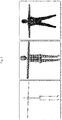
- Figure 2 shows, from left to right, a kinematic skeleton model, a default body model and an actor-specific model according to an embodiment of the invention.
- the kinematic skeleton model according to the present embodiment of the invention comprises 58 joints, modeling a detailed spine and clavicles. Each joint may be defined by an offset to its parent joint and a rotation represented in axis-angle form. It may also feature an allowable joint limit range l 1 to l h .
- the model comprises a total of 61 parameters A, 58 rotational and an additional 3 translational.
- the kinematic skeleton model further comprises a separate degree of freedom (DoF) hierarchy, having nDoF pose parameters ⁇ .
- DoF degree of freedom
- This construction allows the kinematic skeleton model to reproduce a natural deformation of the spine, as a single DoF can model smooth bending. It also allows straight-forward creation of several different levels of detail without having to edit the kinematic joint hierarchy itself.
- the default human model combines the kinematic skeleton model with an attached approximation of the spatial extent of the human body model.
- the approximation may be represented as a sum of un-normalized Gaussians (SoG).
- SoG un-normalized Gaussians
- the Gaussians model only spatial statistics but not any appearance information like color. In order to achieve real-time performance, one need not model the full covariance matrix.
- Eq. (3) describes the spatial extent of the human model.
- the present model has infinite spatial support, but the influence decreases with the spatial distance to the mean.
- An additional color model C ⁇ c i ⁇ i may be stored for each sum of Gaussians K , where c i is the color associated with the respective Gaussian B i .
- the default human body model may comprise 63 Gaussians and 58 joints. Each Gaussian is attached to or associated with a single parent joint of the skeleton, resulting in a default body model K m that is parameterized by the pose parameters ⁇ of the kinematic skeleton.
- This model may be adapted to generate an actor specific body model that roughly represents the shape and color statistics for each person or actor to be tracked.
- the pose parameters ⁇ of the human body model may be selected such that a two-dimensional projection of the body model becomes essentially equal to a representation of the input image, according to a chosen norm.
- the input image may be represented by a sum of Gaussians.
- Both the image domain ⁇ ⁇ R 2 and the 3D human body model may be represented as Sums of un-normalized Gaussians (SoG).
- SoG Sums of un-normalized Gaussians
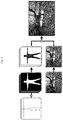
- Eq. (3) describes the spatial extend of super-pixels that cluster pixels with similar colors as shown in figure 3 .
- An additional color model C ⁇ c i ⁇ i is stored for each SoG K, where c i is the color associated with the respective Gaussian B i . 2D-Gaussians.
- a single Gaussian B i may be created for each image pixel p i and one may assign to each Gaussian the color value c i ⁇ R 3 of the pixel.
- image pixels having similar color may alternatively be clustered into larger regions.
- the clustering step may use a quad-tree structure for efficiency.
- Each of the resulting regions may then be approximated using a single Gaussian B i .
- Figure 3 shows an input image and a quad-tree structure with average colors used to generate an approximation of the input image by Sums of Gaussians.
- a threshold ⁇ col may be used to determine which pixels to cluster together (typically set to 0:15). If the standard deviation of colors on a quad-tree node is larger than ⁇ col , the node may be subdivided into four sub-nodes, up to a maximum quad-tree depth of typically 8. Each quadratic cluster is then represented by a Gaussian B i where ⁇ is the center of the cluster and ⁇ 2 is set to be the square of half the side-length of the node. Furthermore, the average color c i of the cluster may be assigned to the Gaussian.
- ⁇ For comparing a 3D body model K m with a 2D image model K I , one may define a projection operator ⁇ , which projects a given Gaussian B ⁇ i : R 3 ⁇ R of the model to a Gaussian B i : R 2 ⁇ R .
- Eq. (4) is only an approximation of the true projection that may be used for computational efficiency.
- the perspective projection of a sphere is an ellipsoid rather than a circle.
- the error introduced by this approximation proved to be negligible.
- This functional results in a smooth similarity measure that allows for a certain degree of variation in color matching and is guaranteed to be 0 if the difference between the colors is larger than ⁇ sim , which was typically chosen to be 0:15.
- This particular similarity measure is one-sided, i.e., it only measures the regions that are similar and does not consider or penalize regions that are dissimilar.
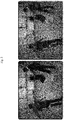
- Figure 4 compares a projection with no occlusions (left) with an occlusion situation (right). A top view of the 3D model is shown in the upper row while the lower row shows a view of the 2D model.
- Eq. (5) calculates a correct overlap of a single element.
- the color (blue) and the shape are identical, yielding the similarity E ii .
- Eq. (8) limits the contribution of a single 2D image Gaussians, yielding the same similarity E ii for both cases.
- an energy function E( ⁇ ) may be defined that evaluates how accurately the model described by the parameters ⁇ represents what may be seen in the images.
- the function is based on the proposed SoG models and can be used for estimating the initial actor-specific body model as well as for tracking articulated motion.
- the most important part of the energy function according to the invention is measuring the similarity of the body model in the pose defined by ⁇ with all input images.
- E ⁇ E ⁇ ⁇ w l E lim M ⁇ ⁇ w a E acc ⁇
- E lim ⁇ ⁇ l ⁇ ⁇ ⁇ 0 if l l l ⁇ ⁇ l ⁇ l h l ⁇ l l ⁇ ⁇ l ⁇ 2 if ⁇ l ⁇ l l l ⁇ ⁇ l h l ⁇ 2 if ⁇ l > l h l
- E acc ⁇ t ⁇ l ⁇ ⁇ t 1 2 ⁇ t ⁇ 2 l + ⁇ t l ⁇ ⁇ t ⁇ 1 l 2
- l l and l h are lower and upper joint limits and ⁇ t-1 and ⁇ t-2 the poses of the previous frames.
- the impact of the constraints is evaluated in the experimental section.
- Figure 5 shows different actor-specific models (right) derived from example pose images (left).
- the default skeleton and body model may be used to estimate an actor specific model in a pre-processing step.
- a low number of temporally not subsequent, manually segmented multi-view images of example poses may be used as shown in figure 5 .
- the four example poses are chosen to articulate a wide range of skeletal joints and therefore allow a relatively accurate estimation of the bone lengths of the skeleton.
- the pose parameters ⁇ are estimated.
- a common set of shape parameters ⁇ shape may be optimized that define bone lengths as well as the positions and variances of the Gaussian model for a total of 216 degrees of freedom.
- the pose parameters ⁇ may roughly be initialized to correspond to the initial poses manually, and the similarity measure according to Eq. (9) based on the binary color values c i of the silhouette is maximized using a gradient-ascent approach explained below.
- the color images of each pose may be back-projected onto the 3D Gaussian models and the mean color c i for each Gaussian blob may be calculated taking occlusions into account.
- the parameters may now be optimized in order to maximize the energy (10). Because of the analytic formulation of similarity measure according to the invention, the analytic gradient ⁇ ⁇ ( ⁇ ) may be calculated efficiently and used it in the optimization procedure.
- a conditioned gradient ascent may be used for optimizing the energy function.
- Simple gradient ascent tends to be slow when optimizing energy functions that consist of long narrow valleys in the energy landscape, as it tends to "zig-zag" between opposing walls.
- it is proposed to introduce a conditioning vector ⁇ i into the optimization ⁇ i + 1 t ⁇ i t + ⁇ E ⁇ i t ⁇ ⁇ i
- ⁇ is the component-wise Hadamard product of two vectors.
- this conditioning will increase step-size in directions where the gradient sign is constant, and decrease it if the ascent is "zig-zagging". This proved to reduce the number of iterations necessary to reach a minimum drastically without having to resort to a more complex and more expensive second order optimizer.
- the inventive method may be implemented using an array of synchronized and calibrated video cameras for obtaining multi-view videos of the actor's movements, and a standard computer. Since the similarity measure is continuous and differentiable, human pose estimation may be solved nearly in real-time even for many camera views. Computation time can further be reduced by parallelizing the evaluation of the double sum in equation 8 using graphics processing units (GPUs) or multi-processor systems.
- GPUs graphics processing units
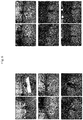
- Figure 6 shows tracking results of a method according to an embodiment of the invention as skeleton overlay over 12 input images from different camera views.
- sequences were recorded with 12 cameras at a resolution of 1296 x 972 pixels at 45 frames per second.
- the quad-tree based image conversion according to the invention was set to a maximal depth of 8 nodes, effectively limiting the used resolution to 162 x 121 2D Gaussians. This resolution was found to be a suitable compromise between tracking accuracy in all scenes and processing speed.
- the HSV color space was used for calculating color similarity in all examples.
- sequences were recorded in a room without any special background and cover a wide range of different motions, including simple walking/running, multi-person interactions, fast acrobatic motions, and scenes having strong occlusions by objects in the scene, such as chairs and tables.
- all image Gaussians B i may be removed whose color similarity is 0 to all of the body model Gaussians B j , as they will not contribute to the energy function at all. Also, all elements that are outside of an enlarged bounding box of the pose in the last estimated frame may be removed.
- the inventive method tracked all 17 sequences successfully at 5 to 15 frames per second depending on the scene complexity and the actor's motion speed.
- a standard gradient ascent optimization was compared to the inventive conditioned gradient ascent on the cartwheel sequence shown in figure 6 .
- the standard gradient ascent method required on average 65:38 iterations per frame to converge and failed to track the pose of the arms correctly in some frames.
- the inventive method on the other hand required only 34:56 iterations per frame and tracked the sequence successfully.
- Table 2 shows the effect of the smoothness weight w a on tracking the ground truth dataset. Low smoothness leads to jitter in the motion, while high smoothness decreases tracking accuracy. Table 2 Effect of the smoothness weight w a on tracking the ground truth dataset w a 0.0 0.015 0.05 0.1 0.5 error (mm) 46.75 46.33 44.93 46.37 51.74
Landscapes
- Engineering & Computer Science (AREA)
- Physics & Mathematics (AREA)
- General Physics & Mathematics (AREA)
- Theoretical Computer Science (AREA)
- Multimedia (AREA)
- Computer Vision & Pattern Recognition (AREA)
- Computer Graphics (AREA)
- Geometry (AREA)
- Software Systems (AREA)
- Image Analysis (AREA)
Abstract
- acquiring a model of the object;
- tracking the object in the multi-view input video image sequence, using the model.
Description
- The present invention relates to fast articulated motion tracking.
- One of the fundamental problems in computer vision is estimating the 3D motion of humans. Motion capture is an essential part in a wide range of modern industries, ranging from sport science, over biomechanics to animation for games and movies. The state-of-the-art in industrial applications are still marker-based optical capture systems, which enable accurate capture at the cost of requiring a complex setup of cameras and markers. Marker-less methods that are able to track the motion of characters without interfering with the scene geometry, rely on pose detection based on some image features. These approaches, however, assume that the poses have been previously observed during training.
- Most related to the present invention is a real-time tracking system called Pfinder proposed by Wren et al. [ C. Wren, A. Azarbayejani, T. Darrell, and A. Pentland. Pfinder: Real-time tracking of the human body. TPAMI, 19: 780-785, 1997 ]. It models the human by 2D Gaussians in the image domain and represents the appearance of each blob by an uncorrelated Gaussian in the color space. The background is modeled by Gaussians in the color space for each image pixel. Pose estimation is finally formulated as 2D blob detection, i.e., each image pixel is assigned to the background or to one of the human blobs. The final 2D pose is obtained by iterative morphological growing operations and 2D Markov priors. The approach has been extended to the multi-view case in [ S. Yonemoto, D. Arita, and R. Taniguchi. Real-time human motion analysis and ik-based human figure control. In Workshop on Human Motion, pages 149-154, 2000 ] where the blobs are detected in each image and the 3D position of the blobs is then reconstructed using inverse kinematics.
- Other approaches to Human pose estimation without silhouette information combine segmentation with a shape prior and pose estimation. Graph-cut segmentation has been used as well as level set segmentation together with motion features or an analysis-by-synthesis approach. Handheld video cameras and a structure-from-motion approach are also used to calibrate the moving cameras. While these approaches iterate over segmentation and pose estimation, the energy functional commonly used for level-set segmentation can be directly integrated in the pose estimation scheme to speed-up the computation. The approach, however, does not achieve real-time performance and requires 15 seconds per frame for a multi-view sequence recorded with 4 cameras at resolution of 656 x 490 pixels.
- Implicit surfaces have been used for 3D surface reconstruction. More particularly, a human model comprising a skeleton, implicit surfaces to simulate muscles and fat tissue, and a polygonal surface for the skin have been used for multi-view shape reconstruction from dynamic 3D point clouds and silhouette data. The implicit surfaces are modeled by Gaussians. Since the estimation of the shape and pose parameters is performed by several processes, the whole approach is very time consuming and not suitable for real-time application. To increase the reliability, motion priors can be used to improve model fitting. An implicit surface model of a human has been matched to 3D points with known normals.
- It is therefore an object of the invention, to provide a method for acquiring a model and for tracking the pose of an actor in a digital video that is fast and efficient.
- This object is achieved by the methods and a device according to the independent claims. Advantageous embodiments are defined in the dependent claims.
- According to the invention, a human model may be represented by a set of spatial Gaussians instead of making use of an explicit surface modeled by geometric primitives or a detailed triangle mesh. To this end, a person-specific model may be created from a sparse set of images. The model may comprise a kinematic skeleton that defines the degrees-of-freedom (DoF) of the human model and a statistical model that represents the shape and appearance of the human. In order to achieve real-time performance for pose estimation from multiple views, Sums of 3D Gaussians (SoG) may be used for the statistical model. Furthermore, the image may also be represented as a sum of spatial 2D Gaussians that cover image blobs that are consistent in color. Based on the representation of the model and the images as Sums of Gaussians, the invention introduces a novel formulation of the model-to-image similarity, whose analytical solution may be solved very efficiently with a gradient ascent algorithm.
- More particularly, it allows a nearly real-time approach that does not rely on extracted silhouettes or training data.
- Also, the inventive approach does not rely on a statistical background model to detect 2D blobs in the image, but uses 3D spatial Gaussians for the human model and 2D spatial Gaussians for the images to introduce an objective function for the model-to-image similarity that can be very efficiently maximized.
- Finally, the approach does not rely on 3D data clouds or silhouette data for tracking, but models the similarity between the model and the unsegmented image data directly.
-
- Fig. 1
- shows an overview of a method according to an embodiment of the invention.
- Fig. 2
- shows, from left to right, a default skeleton, a default body model and an actor-specific model according to an embodiment of the invention.
- Fig. 3
- is a schematic diagram illustrating self-occlusion handling according to an embodiment of the invention.
- Fig. 4
- shows an example of SoG image approximation according to an embodiment of the invention. Left: Input image. Right: Quad-tree structure with average colors used to generate the SoG. Each square is represented by a single Gaussian.
- Fig. 5
- shows an example of estimating an actor specific model from example pose images according to an embodiment of the invention. Left: Single segmented input image of the multi-view sets for each pose. Right: Resulting actor-specific body model after optimization and color estimation.
- Fig. 6
- shows tracking results of a method according to an embodiment of the invention as skeleton overlay over 12 input images from different camera views.
-
Figure 1 shows an overview of a method according to an embodiment of the invention - In a pre-processing step 110, a low number of manually segmented multi-view images showing example poses may be used to estimate an actor specific body model. The human body model comprises a kinematic skeleton and an attached body approximation.
- The acquired model may then be used for tracking the articulated motion of the actor from multi-view input videos. More particularly, the performance of an actor may be captured with ncam synchronized and calibrated video cameras. Each input image may be converted into a body model representation in step 120.
- Tracking may start with the estimated pose of the model in the previous frame, and may optimize the parameters such that the overlap similarity between the model and image SoG at the current frame is essentially maximized.
-
Figure 2 shows, from left to right, a kinematic skeleton model, a default body model and an actor-specific model according to an embodiment of the invention. - The kinematic skeleton model according to the present embodiment of the invention comprises 58 joints, modeling a detailed spine and clavicles. Each joint may be defined by an offset to its parent joint and a rotation represented in axis-angle form. It may also feature an allowable joint limit range l1 to lh. The model comprises a total of 61 parameters A, 58 rotational and an additional 3 translational. The kinematic skeleton model further comprises a separate degree of freedom (DoF) hierarchy, having nDoF pose parameters Θ. In the present embodiment of the invention, a DoF hierarchy comprising nDoF = 43 pose parameters was used.
- A relationship between Θ and A may be modeled as a linear mapping given by an 61 x nDoF matrix M:

- According to the invention, the default human model combines the kinematic skeleton model with an attached approximation of the spatial extent of the human body model.
- More particularly, the approximation may be represented as a sum of un-normalized Gaussians (SoG).
- A single Gaussian B has the form

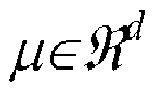
- To cover the full 3D model, several spatial Gaussians may be combined into a Sum of Gaussians K:

- For the human body model, Eq. (3) describes the spatial extent of the human model. In contrast to explicit surfaces, the present model has infinite spatial support, but the influence decreases with the spatial distance to the mean.
- An additional color model C = {ci}i may be stored for each sum of Gaussians K, where ci is the color associated with the respective Gaussian Bi .
- The default human body model may comprise 63 Gaussians and 58 joints. Each Gaussian is attached to or associated with a single parent joint of the skeleton, resulting in a default body model Km that is parameterized by the pose parameters Θ of the kinematic skeleton.
- This model may be adapted to generate an actor specific body model that roughly represents the shape and color statistics for each person or actor to be tracked.
- In order to obtain the pose parameters Θ of the human body model from a given input image, they may be selected such that a two-dimensional projection of the body model becomes essentially equal to a representation of the input image, according to a chosen norm.
- The input image may be represented by a sum of Gaussians. Both the image domain

figure 3 . An additional color model C = {ci}i is stored for each SoG K, where ci is the color associated with the respective Gaussian Bi. 2D-Gaussians. - In order to find an approximation KI that represents consistent pixel regions in a given image I, a single Gaussian Bi may be created for each image pixel pi and one may assign to each Gaussian the color value

- In order to avoid an excessive amount of elements and the associated performance penalty, image pixels having similar color may alternatively be clustered into larger regions. The clustering step may use a quad-tree structure for efficiency. Each of the resulting regions may then be approximated using a single Gaussian Bi .
-
Figure 3 shows an input image and a quad-tree structure with average colors used to generate an approximation of the input image by Sums of Gaussians. - For clustering, a threshold εcol may be used to determine which pixels to cluster together (typically set to 0:15). If the standard deviation of colors on a quad-tree node is larger than εcol, the node may be subdivided into four sub-nodes, up to a maximum quad-tree depth of typically 8. Each quadratic cluster is then represented by a Gaussian Bi where µ is the center of the cluster and σ2 is set to be the square of half the side-length of the node. Furthermore, the average color ci of the cluster may be assigned to the Gaussian.
- For comparing a 3D body model Km with a 2D image model KI, one may define a projection operator Ψ, which projects a given Gaussian


- Eq. (4) is only an approximation of the true projection that may be used for computational efficiency. In general, the perspective projection of a sphere is an ellipsoid rather than a circle. However, the error introduced by this approximation proved to be negligible.
- According to the invention, a similarity between two given two-dimensional models


- The similarity d(ci; cj) may be modeled by

- When considering the similarity between a projected two-dimensional human body model Ψ(Km) and an image model KI, the special properties of the projection operation have to be taken into account. The projection function above ignores possible self-occlusions that may occur when projecting the 3D model onto the 2D image plane. Several Gaussians may be projected onto overlapping 2D positions and thereby contribute several times to the energy function.
-
Figure 4 compares a projection with no occlusions (left) with an occlusion situation (right). A top view of the 3D model is shown in the upper row while the lower row shows a view of the 2D model. - Without occlusions, Eq. (5) calculates a correct overlap of a single element. In this example, the color (blue) and the shape are identical, yielding the similarity Eii.
- If several 3D model Gaussians project to the same screen space coordinate, their contribution is cumulative, yielding a similarity larger than Eii, even though two of the model Gaussians should be occluded.
- According to the invention, this issue may be resolved implicitly by modifying Eq. (5) to limit the energy that a single image Gaussian can contribute to the total energy of the model:

- Eq. (8) limits the contribution of a single 2D image Gaussians, yielding the same similarity Eii for both cases.
- If an image Gaussian and a projected 3D Gaussian coincide completely the overlap should be maximal. When projecting a second 3D model Gaussian to a nearby location, it cannot contribute more to the already perfect overlap. While this only partially approximates the effects of occlusion, the inventors found that it is sufficient to resolve most ambiguities introduced by occlusions, while analytic derivatives of the similarity function may still be calculated.
- In order to estimate the pose-parameters Θ of the kinematic skeleton model from a set of ncam input images I, an energy function E(Θ) may be defined that evaluates how accurately the model described by the parameters Θ represents what may be seen in the images. The function is based on the proposed SoG models and can be used for estimating the initial actor-specific body model as well as for tracking articulated motion.
- The most important part of the energy function according to the invention is measuring the similarity of the body model in the pose defined by Θ with all input images. Given ncam cameras C1 with respective SoG images (Kl, Cl) and the 3D body (Km , Cm) parameterized by the pose vector Θ, the similarity function E (Θ) may be defined as

- For the final energy function E(Θ), one may add a skeleton and motion-specific term:

- Elim (Λ), with Λ = M Θ (1), is a soft constraint on the joint limits and Eacc (Θ) is a smoothness term that penalizes high acceleration in parameter space:


- The weights wl and wa influence the strength of the constraints and were set to wl = 1 and wa = 0.05 for the majority of the experiments. The impact of the constraints is evaluated in the experimental section.
-
Figure 5 shows different actor-specific models (right) derived from example pose images (left). - The default skeleton and body model may be used to estimate an actor specific model in a pre-processing step. A low number of temporally not subsequent, manually segmented multi-view images of example poses may be used as shown in
figure 5 . The four example poses are chosen to articulate a wide range of skeletal joints and therefore allow a relatively accurate estimation of the bone lengths of the skeleton. For each pose represented through a set of multi-view images, the pose parameters Θ are estimated. Additionally, a common set of shape parameters Θshape may be optimized that define bone lengths as well as the positions and variances of the Gaussian model for a total of 216 degrees of freedom. - The pose parameters Θ may roughly be initialized to correspond to the initial poses manually, and the similarity measure according to Eq. (9) based on the binary color values ci of the silhouette is maximized using a gradient-ascent approach explained below. After the joint optimization, the color images of each pose may be back-projected onto the 3D Gaussian models and the mean color ci for each Gaussian blob may be calculated taking occlusions into account.
- Given an image sequence with m frames, one wants to estimate the pose parameters Θ t for each time-step. In each time-step, the parameters Θt may be initialized by linear extrapolation of the motion in the previous time-steps, i.e., Θt 0 = Θt-1 + α(Θt-1- Θt-2) with α set to 0.5 for all sequences. The parameters may now be optimized in order to maximize the energy (10). Because of the analytic formulation of similarity measure according to the invention, the analytic gradient ∇ε(θ) may be calculated efficiently and used it in the optimization procedure.
- In order to achieve fast performance, a conditioned gradient ascent may be used for optimizing the energy function. Simple gradient ascent tends to be slow when optimizing energy functions that consist of long narrow valleys in the energy landscape, as it tends to "zig-zag" between opposing walls. To prevent this, it is proposed to introduce a conditioning vector σi into the optimization

- Here, ○ is the component-wise Hadamard product of two vectors. The conditioner σi is updated after every iteration, according to the following rule:

- Intuitively this conditioning will increase step-size in directions where the gradient sign is constant, and decrease it if the ascent is "zig-zagging". This proved to reduce the number of iterations necessary to reach a minimum drastically without having to resort to a more complex and more expensive second order optimizer. The inventors chose µ+ = 1.2 and µ- = 0.5 for all experiments.
- At least niter iterations are performed for each time-step and the iterations are stopped when

- The inventive method may be implemented using an array of synchronized and calibrated video cameras for obtaining multi-view videos of the actor's movements, and a standard computer. Since the similarity measure is continuous and differentiable, human pose estimation may be solved nearly in real-time even for many camera views. Computation time can further be reduced by parallelizing the evaluation of the double sum in equation 8 using graphics processing units (GPUs) or multi-processor systems.
-
Figure 6 shows tracking results of a method according to an embodiment of the invention as skeleton overlay over 12 input images from different camera views. - Experiments of the inventors demonstrate that the inventive method, which does not assume an a-priori background estimate, works even in relatively uncontrolled settings. The motion may be tracked in some challenging situations including characters closely interacting with each other, and occlusion situations, such as a person sitting on a chair at a desk. A quantitative evaluation of the tracking performance demonstrates the reliability of the inventive approach on 17 sequences with over 12000 frames of multiview video. An unoptimized implementation may process a multi-view sequence recorded with 12 cameras at a resolution of 1296 x 972 pixels at 5-15 frames per second on a standard computer.
- More particularly, the sequences were recorded with 12 cameras at a resolution of 1296 x 972 pixels at 45 frames per second. The quad-tree based image conversion according to the invention was set to a maximal depth of 8 nodes, effectively limiting the used resolution to 162 x 121 2D Gaussians. This resolution was found to be a suitable compromise between tracking accuracy in all scenes and processing speed. The HSV color space was used for calculating color similarity in all examples.
- The sequences were recorded in a room without any special background and cover a wide range of different motions, including simple walking/running, multi-person interactions, fast acrobatic motions, and scenes having strong occlusions by objects in the scene, such as chairs and tables.
- The remaining 5 sequences are taken from a different dataset [Y. Liu, C. Stoll, J. Gall, H.-P. Seidel, and C. Theobalt. Markerless motion capture of interacting characters using multiview image segmentation. In CVPR, 2011]. These sequences were recorded with a greenscreen background and show closely interacting characters fighting, dancing, and hugging. Since the inventive approach does not rely on background subtraction, no explicit use is made of the green-screen, but the approach still benefits from the distinct background color. The segmentation is handled implicitly.
- To speed up the calculation of the energy function in Eq. (10), all image Gaussians Bi may be removed whose color similarity is 0 to all of the body model Gaussians Bj, as they will not contribute to the energy function at all. Also, all elements that are outside of an enlarged bounding box of the pose in the last estimated frame may be removed.
- The inventive method tracked all 17 sequences successfully at 5 to 15 frames per second depending on the scene complexity and the actor's motion speed. To evaluate the range of image resolution one may reliably deal with, and thus how robust the algorithm is to camera resolution, the images of several sequences were downsampled to 81 x 60 pixels and a single Gaussian was created for each pixel. In this experiment, no significant loss of the tracking quality would be observed.
- A standard gradient ascent optimization was compared to the inventive conditioned gradient ascent on the cartwheel sequence shown in
figure 6 . The standard gradient ascent method required on average 65:38 iterations per frame to converge and failed to track the pose of the arms correctly in some frames. The inventive method on the other hand required only 34:56 iterations per frame and tracked the sequence successfully. - Finally, the accuracy of the inventive tracking approach was evaluated and compared to the method of Liu et al. [Y. Liu, C. Stoll, J. Gall, H.-P. Seidel, and C. Theobalt. Markerless motion capture of interacting characters using multiview image segmentation. In CVPR, 2011] on the ground truth multi-person data set kindly provided. The 38 marker positions of the marker system were associated with virtual markers on the inventive body model in the first frame by calculating the closest Gaussian and attaching the marker to its parent joint. Due to the black motion-capture suit and the fast motion, the sequence is difficult to track. The average distance between markers and their corresponding virtual markers on the tracked model of the invention is 44:93mm with a standard deviation of 27:16mm. While this is not as accurate as the result reported in [Liu et al.], namely 29:61mm 25:50mm, their tracking algorithm employs a laser scanned model and requires several minutes per frame for tracking, while the inventive method tracks the sequence at roughly 6 frames per second.
- Without compensating for self-occlusions in the overlap term as in Eq. (8), the sequence fails to track correctly at all, leading to an error of 229:09mm 252:04mm. The impact of the weights wl and wa for the joint limits and the smoothness term in Eq. (10) is shown in Tables 1 and 2:
Table 1 shows the effect of the joint limit weight wl on tracking the ground truth dataset. Disregarding this term will lead to physically implausible joint motions, e.g., knees bending backwards.Table 1 Effect of the joint limit weight wl on tracking the ground truth dataset. wl 0.0 1.0 2.0 error (mm) 48.29 44.93 47.78 - Table 2 shows the effect of the smoothness weight wa on tracking the ground truth dataset. Low smoothness leads to jitter in the motion, while high smoothness decreases tracking accuracy.
Table 2 Effect of the smoothness weight wa on tracking the ground truth dataset wa 0.0 0.015 0.05 0.1 0.5 error (mm) 46.75 46.33 44.93 46.37 51.74
Claims (20)
- Computer-implemented method for tracking an object in a sequence of multi-view input video images, comprising the steps:- acquiring a model of the object;- tracking the object in the multi-view input video image sequence, using the model.
- Method according to claim 1, wherein the model comprises a statistical model representing the shape of the object.
- Method according to claim 2, wherein the statistical model comprises sums of spatially varying functions chosen such that an overlap or convolution of two or more blobs can be approximated efficiently, including radial-symmetric and monotone functions, further including three dimensional Gaussians, hyperspheres, multiquadrics, superquadrics or polyharmonic splines.
- Method according to claim 2, wherein the model further comprises a kinematic model defining the degrees- of -freedom of the object.
- Method according to claim 1, wherein the object is a human body.
- Method according to claim 1, wherein the model is acquired by scaling, translating or rotating a generic object model.
- Method according to claim 1, wherein the multi-view input video cameras are synchronized or gen-locked.
- Method according to claim 1, characterized in that the model comprises attributes characterizing the acquired object.
- Method according to claim 1, wherein the model is acquired online during tracking.
- System for tracking an object, comprising:- A range of multi-view video cameras;- A memory for storing a model of the object;- A processor for tracking the object, based on the model.
- Computer-implemented method for acquiring a model of an object, comprising the steps:- acquiring a number of images of example poses of the object;- estimating the model, based on the acquired images; and- storing the model in a computer-readable medium.
- Method according to claim 11, wherein the images are multi-view images.
- Method according to claim 12, wherein the number of multi-view images is low.
- Method according to claim 12, further comprising the step of manually segmenting the multi-view images.
- Method according to claim 12, wherein estimating the model comprises- estimating pose parameters for each example pose of the object; and- estimating a set of shape parameters of the object.
- Method according to claim 15, wherein the pose parameters are estimated using a conditioned gradient ascent.
- Method according to claim 11, wherein the model is estimated further based on additional inputs, such as marker-based, magnetic, accelerometer based or other motion capture systems, etc.
- Method according to claim 11, wherein the model is estimated based on an input of a depth camera or a 2.5D or a 3D scanner, e.g. a structured light 3D scanner.
- Method according to claim 11, wherein the model may further be manually constrained by a user.
- Computer-readable medium, comprising a model acquired according to claim 11.
Applications Claiming Priority (4)
| Application Number | Priority Date | Filing Date | Title |
|---|---|---|---|
| US201161486380P | 2011-05-16 | 2011-05-16 | |
| EP11166259 | 2011-05-16 | ||
| EP12712105.1A EP2710557B1 (en) | 2011-05-16 | 2012-03-29 | Fast articulated motion tracking |
| PCT/EP2012/055650 WO2012156141A1 (en) | 2011-05-16 | 2012-03-29 | Fast articulated motion tracking |
Related Parent Applications (2)
| Application Number | Title | Priority Date | Filing Date |
|---|---|---|---|
| EP12712105.1A Division EP2710557B1 (en) | 2011-05-16 | 2012-03-29 | Fast articulated motion tracking |
| EP12712105.1A Previously-Filed-Application EP2710557B1 (en) | 2011-05-16 | 2012-03-29 | Fast articulated motion tracking |
Publications (2)
| Publication Number | Publication Date |
|---|---|
| EP3751517A1 true EP3751517A1 (en) | 2020-12-16 |
| EP3751517B1 EP3751517B1 (en) | 2026-03-18 |
Family
ID=47176324
Family Applications (2)
| Application Number | Title | Priority Date | Filing Date |
|---|---|---|---|
| EP12712105.1A Active EP2710557B1 (en) | 2011-05-16 | 2012-03-29 | Fast articulated motion tracking |
| EP20171899.6A Active EP3751517B1 (en) | 2011-05-16 | 2012-03-29 | Fast articulated motion tracking |
Family Applications Before (1)
| Application Number | Title | Priority Date | Filing Date |
|---|---|---|---|
| EP12712105.1A Active EP2710557B1 (en) | 2011-05-16 | 2012-03-29 | Fast articulated motion tracking |
Country Status (4)
| Country | Link |
|---|---|
| US (1) | US9619704B2 (en) |
| EP (2) | EP2710557B1 (en) |
| CN (1) | CN103733226B (en) |
| WO (1) | WO2012156141A1 (en) |
Families Citing this family (30)
| Publication number | Priority date | Publication date | Assignee | Title |
|---|---|---|---|---|
| EP2674913B1 (en) * | 2012-06-14 | 2014-07-23 | Softkinetic Software | Three-dimensional object modelling fitting & tracking. |
| KR101933921B1 (en) * | 2013-06-03 | 2018-12-31 | 삼성전자주식회사 | Method and apparatus for estimating pose |
| US11013451B2 (en) | 2014-09-19 | 2021-05-25 | Brigham Young University | Marker-less monitoring of movement disorders |
| US10140745B2 (en) * | 2015-01-09 | 2018-11-27 | Vital Mechanics Research Inc. | Methods and systems for computer-based animation of musculoskeletal systems |
| EP3136290A1 (en) * | 2015-08-28 | 2017-03-01 | Thomson Licensing | Method and device for determining the shape of an object represented in an image, corresponding computer program product and computer readable medium |
| US10565791B2 (en) * | 2015-12-29 | 2020-02-18 | Microsoft Technology Licensing, Llc | Tracking rigged polygon-mesh models of articulated objects |
| US10186081B2 (en) * | 2015-12-29 | 2019-01-22 | Microsoft Technology Licensing, Llc | Tracking rigged smooth-surface models of articulated objects |
| EP3430562B1 (en) | 2016-03-18 | 2020-04-01 | Telefonaktiebolaget LM Ericsson (PUBL) | Using nano-services to secure multi-tenant networking in datacenters |
| DE102016107667A1 (en) | 2016-04-25 | 2017-10-26 | Simi Reality Motion Systems Gmbh | Motion analysis and / or tracking system of moving or moving objects thermally lifted from their environment |
| US10356182B2 (en) * | 2016-07-19 | 2019-07-16 | Telefonaktiebolaget Lm Ericsson (Publ) | Communication stack optimized per application without virtual machine overhead |
| JP6996557B2 (en) | 2017-05-10 | 2022-02-21 | 富士通株式会社 | Object recognition method, device, system, program |
| CN107274480B (en) * | 2017-06-06 | 2021-07-20 | 山东大学深圳研究院 | Object motion characteristic reconstruction method based on random sampling consistency |
| CN107479693A (en) * | 2017-07-07 | 2017-12-15 | 大圣科技股份有限公司 | Real-time hand recognition methods based on RGB information, storage medium, electronic equipment |
| EP3667611A4 (en) * | 2017-08-07 | 2020-08-26 | Fujitsu Limited | INFORMATION PROCESSING DEVICE, MODEL DATA GENERATION PROGRAM AND MODEL DATA GENERATION METHOD |
| JP2019168394A (en) * | 2018-03-26 | 2019-10-03 | 株式会社エクォス・リサーチ | Body orientation estimation device and program |
| CN108710830B (en) * | 2018-04-20 | 2020-08-28 | 浙江工商大学 | A Human 3D Pose Estimation Method Combining Densely Connected Attention Pyramid Residual Networks and Isometric Constraints |
| CN110443833B (en) * | 2018-05-04 | 2023-09-26 | 佳能株式会社 | Object tracking method and device |
| WO2020020436A1 (en) | 2018-07-23 | 2020-01-30 | Xccelo Gmbh | Method and system for object tracking in image sequences |
| KR102194282B1 (en) * | 2019-05-17 | 2020-12-23 | 네이버 주식회사 | Method for generating pose similarity measurement model and apparatus for the same |
| CN110782482A (en) * | 2019-10-21 | 2020-02-11 | 深圳市网心科技有限公司 | Exercise evaluation method, device, computer equipment and storage medium |
| CN112750159B (en) * | 2019-10-31 | 2025-02-18 | 华为技术有限公司 | Method, device and storage medium for obtaining posture information and determining object symmetry |
| CN111260764B (en) * | 2020-02-04 | 2021-06-25 | 腾讯科技(深圳)有限公司 | A method, device and storage medium for producing animation |
| CN111754573B (en) * | 2020-05-19 | 2024-05-10 | 新拓三维技术(深圳)有限公司 | Scanning method and system |
| CN112183184B (en) * | 2020-08-13 | 2022-05-13 | 浙江大学 | Motion capture method based on asynchronous video |
| US12020374B2 (en) * | 2020-09-29 | 2024-06-25 | Samsung Electronics Co., Ltd. | Body shape and pose estimation via volumetric regressor for raw three dimensional scan models |
| US11727637B2 (en) * | 2020-12-15 | 2023-08-15 | Kwangwoon University Industry-Academic Collaboration Foundation | Method for generating 3D skeleton using joint-based calibration acquired from multi-view camera |
| EP4044118A1 (en) * | 2021-02-12 | 2022-08-17 | Grazper Technologies ApS | A computer-implemented method, data processing apparatus and computer program for generating three-dimensional pose-estimation data |
| WO2023225673A1 (en) * | 2022-05-20 | 2023-11-23 | DARI Motion, Inc. | System and method for image segmentation for detecting the location of a joint center |
| WO2024081127A1 (en) * | 2022-10-11 | 2024-04-18 | Microsoft Technology Licensing, Llc | Tracking three-dimensional geometric shapes |
| US12597155B2 (en) | 2022-10-11 | 2026-04-07 | Microsoft Technology Licensing, Llc | Tracking three-dimensional geometric shapes |
Family Cites Families (4)
| Publication number | Priority date | Publication date | Assignee | Title |
|---|---|---|---|---|
| JP4148281B2 (en) * | 2006-06-19 | 2008-09-10 | ソニー株式会社 | Motion capture device, motion capture method, and motion capture program |
| CA2734143C (en) * | 2008-08-15 | 2021-08-31 | Brown University | Method and apparatus for estimating body shape |
| CN101533528B (en) * | 2009-04-18 | 2014-11-26 | 大连大学 | Optical motion capture data processing method based on module piecewise linear model |
| US9147260B2 (en) * | 2010-12-20 | 2015-09-29 | International Business Machines Corporation | Detection and tracking of moving objects |
-
2012
- 2012-03-29 WO PCT/EP2012/055650 patent/WO2012156141A1/en not_active Ceased
- 2012-03-29 EP EP12712105.1A patent/EP2710557B1/en active Active
- 2012-03-29 CN CN201280023332.0A patent/CN103733226B/en active Active
- 2012-03-29 EP EP20171899.6A patent/EP3751517B1/en active Active
-
2013
- 2013-11-15 US US14/081,310 patent/US9619704B2/en active Active
Non-Patent Citations (6)
| Title |
|---|
| FUA P ET AL: "Articulated soft objects for multiview shape and motion capture", IEEE TRANSACTIONS ON PATTERN ANALYSIS AND MACHINE INTELLIGENCE, IEEE SERVICE CENTER, LOS ALAMITOS, CA, US, vol. 25, no. 9, 1 September 2003 (2003-09-01), pages 1182 - 1187, XP011100744, ISSN: 0162-8828, DOI: 10.1109/TPAMI.2003.1227995 * |
| GAVRILA D M ET AL: "3-D MODEL-BASED TRACKING OF HUMANS IN ACTION: A MULTI-VIEW APPROACH", PROCEEDINGS OF THE 1996 IEEE COMPUTER SOCIETY CONFERENCE ON COMPUTER VISION AND PATTERN RECOGNITION. SAN FRANCISCO, JUNE 18 - 20, 1996; [PROCEEDINGS OF THE IEEE COMPUTER SOCIETY CONFERENCE ON COMPUTER VISION AND PATTERN RECOGNITION], LOS ALAMITOS, IE, 18 June 1996 (1996-06-18), pages 73 - 80, XP000640232, ISBN: 978-0-8186-7258-3, DOI: 10.1109/CVPR.1996.517056 * |
| HASLER N ET AL: "Markerless Motion Capture with unsynchronized moving cameras", COMPUTER VISION AND PATTERN RECOGNITION, 2009. CVPR 2009. IEEE CONFERENCE ON, IEEE, PISCATAWAY, NJ, USA, 20 June 2009 (2009-06-20), pages 224 - 231, XP031607386, ISBN: 978-1-4244-3992-8 * |
| JOJIC N ET AL: "Tracking self-occluding articulated objects in dense disparity maps", COMPUTER VISION, 1999. THE PROCEEDINGS OF THE SEVENTH IEEE INTERNATION AL CONFERENCE ON KERKYRA, GREECE 20-27 SEPT. 1999, LOS ALAMITOS, CA, USA,IEEE COMPUT. SOC, US, vol. 1, 20 September 1999 (1999-09-20), pages 123 - 130, XP010350445, ISBN: 978-0-7695-0164-2 * |
| MOESLUND T B ET AL: "A survey of advances in vision-based human motion capture and analysis", COMPUTER VISION AND IMAGE UNDERSTANDING, ACADEMIC PRESS, US, vol. 104, no. 2-3, 1 November 2006 (2006-11-01), pages 90 - 126, XP024917692, ISSN: 1077-3142, [retrieved on 20061101], DOI: 10.1016/J.CVIU.2006.08.002 * |
| STARCK ET AL: "Model-based multiple view reconstruction of people", PROCEEDINGS OF THE EIGHT IEEE INTERNATIONAL CONFERENCE ON COMPUTER VISION. (ICCV). NICE, FRANCE, OCT. 13 - 16, 2003; [INTERNATIONAL CONFERENCE ON COMPUTER VISION], LOS ALAMITOS, CA : IEEE COMP. SOC, US, 13 October 2003 (2003-10-13), pages 915 - 922VOL.2, XP031213144, ISBN: 978-0-7695-1950-0 * |
Also Published As
| Publication number | Publication date |
|---|---|
| US20140072175A1 (en) | 2014-03-13 |
| WO2012156141A1 (en) | 2012-11-22 |
| US9619704B2 (en) | 2017-04-11 |
| EP3751517B1 (en) | 2026-03-18 |
| CN103733226B (en) | 2017-06-06 |
| EP2710557B1 (en) | 2020-04-29 |
| CN103733226A (en) | 2014-04-16 |
| EP2710557A1 (en) | 2014-03-26 |
Similar Documents
| Publication | Publication Date | Title |
|---|---|---|
| EP2710557B1 (en) | Fast articulated motion tracking | |
| Stoll et al. | Fast articulated motion tracking using a sums of gaussians body model | |
| Bronstein et al. | Calculus of nonrigid surfaces for geometry and texture manipulation | |
| US9477878B2 (en) | Rigid stabilization of facial expressions | |
| EP0907144A2 (en) | Method for extracting a three-dimensional model from a sequence of images | |
| US9036898B1 (en) | High-quality passive performance capture using anchor frames | |
| US9224245B2 (en) | Mesh animation | |
| US20070185946A1 (en) | Method and apparatus for matching portions of input images | |
| US20060285770A1 (en) | Direct method for modeling non-rigid motion with thin plate spline transformation | |
| JP2011521357A (en) | System, method and apparatus for motion capture using video images | |
| Huang et al. | Robust human body shape and pose tracking | |
| WO2011075082A1 (en) | Method and system for single view image 3 d face synthesis | |
| US12361663B2 (en) | Dynamic facial hair capture of a subject | |
| Fan et al. | Convex hull aided registration method (CHARM) | |
| CN115965765A (en) | Human motion capture method in deformable scene based on neural deformation | |
| Shan et al. | Deformable Gaussian splatting for efficient and high-fidelity reconstruction of surgical scenes | |
| Yookwan et al. | Multimodal fusion of deeply inferred point clouds for 3D scene reconstruction using cross-entropy ICP | |
| Xu et al. | Human body reshaping and its application using multiple RGB-D sensors | |
| Dornaika et al. | Real time 3D face and facial feature tracking | |
| Duveau et al. | Cage-based motion recovery using manifold learning | |
| Prasad et al. | A robust head pose estimation system for uncalibrated monocular videos | |
| Nguyen et al. | Real-time subject-specific head and facial mimic animation system using a contactless Kinect sensor and system of systems approach | |
| Neumann et al. | Constructing a realistic head animation mesh for a specific person | |
| Seeber | Realistic Hands: Multi-Modal 3D Hand Reconstruction using Deep Neural Networks and Differential Rendering | |
| JP2025501453A (en) | Processing images of objects and object parts, including multi-object constructs and deformed objects |
Legal Events
| Date | Code | Title | Description |
|---|---|---|---|
| PUAI | Public reference made under article 153(3) epc to a published international application that has entered the european phase |
Free format text: ORIGINAL CODE: 0009012 |
|
| STAA | Information on the status of an ep patent application or granted ep patent |
Free format text: STATUS: THE APPLICATION HAS BEEN PUBLISHED |
|
| AC | Divisional application: reference to earlier application |
Ref document number: 2710557 Country of ref document: EP Kind code of ref document: P |
|
| AK | Designated contracting states |
Kind code of ref document: A1 Designated state(s): AL AT BE BG CH CY CZ DE DK EE ES FI FR GB GR HR HU IE IS IT LI LT LU LV MC MK MT NL NO PL PT RO RS SE SI SK SM TR |
|
| STAA | Information on the status of an ep patent application or granted ep patent |
Free format text: STATUS: REQUEST FOR EXAMINATION WAS MADE |
|
| 17P | Request for examination filed |
Effective date: 20210616 |
|
| RBV | Designated contracting states (corrected) |
Designated state(s): AL AT BE BG CH CY CZ DE DK EE ES FI FR GB GR HR HU IE IS IT LI LT LU LV MC MK MT NL NO PL PT RO RS SE SI SK SM TR |
|
| STAA | Information on the status of an ep patent application or granted ep patent |
Free format text: STATUS: EXAMINATION IS IN PROGRESS |
|
| 17Q | First examination report despatched |
Effective date: 20230125 |
|
| GRAP | Despatch of communication of intention to grant a patent |
Free format text: ORIGINAL CODE: EPIDOSNIGR1 |
|
| STAA | Information on the status of an ep patent application or granted ep patent |
Free format text: STATUS: GRANT OF PATENT IS INTENDED |
|
| INTG | Intention to grant announced |
Effective date: 20251015 |
|
| RIN1 | Information on inventor provided before grant (corrected) |
Inventor name: HASLER, NILS, Inventor name: STOLL, CARSTEN, Inventor name: THEOBALT, CHRISTIAN, Inventor name: GALL, JUERGEN, Inventor name: SEIDEL, HANS-PETER, |
|
| GRAS | Grant fee paid |
Free format text: ORIGINAL CODE: EPIDOSNIGR3 |
|
| GRAA | (expected) grant |
Free format text: ORIGINAL CODE: 0009210 |
|
| STAA | Information on the status of an ep patent application or granted ep patent |
Free format text: STATUS: THE PATENT HAS BEEN GRANTED |
|
| P01 | Opt-out of the competence of the unified patent court (upc) registered |
Free format text: CASE NUMBER: UPC_APP_0001503_3751517/2026 Effective date: 20260116 |
|
| AC | Divisional application: reference to earlier application |
Ref document number: 2710557 Country of ref document: EP Kind code of ref document: P |
|
| AK | Designated contracting states |
Kind code of ref document: B1 Designated state(s): AL AT BE BG CH CY CZ DE DK EE ES FI FR GB GR HR HU IE IS IT LI LT LU LV MC MK MT NL NO PL PT RO RS SE SI SK SM TR |
|
| REG | Reference to a national code |
Ref country code: CH Ref legal event code: F10 Free format text: ST27 STATUS EVENT CODE: U-0-0-F10-F00 (AS PROVIDED BY THE NATIONAL OFFICE) Effective date: 20260318 Ref country code: GB Ref legal event code: FG4D |
|
| REG | Reference to a national code |
Ref country code: CH Ref legal event code: R17 Free format text: ST27 STATUS EVENT CODE: U-0-0-R10-R17 (AS PROVIDED BY THE NATIONAL OFFICE) Effective date: 20260326 |
|
| REG | Reference to a national code |
Ref country code: IE Ref legal event code: FG4D |
|
| PGFP | Annual fee paid to national office [announced via postgrant information from national office to epo] |
Ref country code: GB Payment date: 20260327 Year of fee payment: 15 |
|
| REG | Reference to a national code |
Ref country code: DE Ref legal event code: R096 Ref document number: 602012081984 Country of ref document: DE |
|
| PGFP | Annual fee paid to national office [announced via postgrant information from national office to epo] |
Ref country code: DE Payment date: 20260323 Year of fee payment: 15 |