EP3751482A1 - A method for processing sensor input data captured from sensors placed in a production line, and a system thereof - Google Patents
A method for processing sensor input data captured from sensors placed in a production line, and a system thereof Download PDFInfo
- Publication number
- EP3751482A1 EP3751482A1 EP20179506.9A EP20179506A EP3751482A1 EP 3751482 A1 EP3751482 A1 EP 3751482A1 EP 20179506 A EP20179506 A EP 20179506A EP 3751482 A1 EP3751482 A1 EP 3751482A1
- Authority
- EP
- European Patent Office
- Prior art keywords
- variables
- generator
- kpi
- group
- production line
- Prior art date
- Legal status (The legal status is an assumption and is not a legal conclusion. Google has not performed a legal analysis and makes no representation as to the accuracy of the status listed.)
- Granted
Links
Images


Classifications
-
- G—PHYSICS
- G06—COMPUTING OR CALCULATING; COUNTING
- G06Q—INFORMATION AND COMMUNICATION TECHNOLOGY [ICT] SPECIALLY ADAPTED FOR ADMINISTRATIVE, COMMERCIAL, FINANCIAL, MANAGERIAL OR SUPERVISORY PURPOSES; SYSTEMS OR METHODS SPECIALLY ADAPTED FOR ADMINISTRATIVE, COMMERCIAL, FINANCIAL, MANAGERIAL OR SUPERVISORY PURPOSES, NOT OTHERWISE PROVIDED FOR
- G06Q50/00—Information and communication technology [ICT] specially adapted for implementation of business processes of specific business sectors, e.g. utilities or tourism
- G06Q50/04—Manufacturing
-
- G—PHYSICS
- G06—COMPUTING OR CALCULATING; COUNTING
- G06Q—INFORMATION AND COMMUNICATION TECHNOLOGY [ICT] SPECIALLY ADAPTED FOR ADMINISTRATIVE, COMMERCIAL, FINANCIAL, MANAGERIAL OR SUPERVISORY PURPOSES; SYSTEMS OR METHODS SPECIALLY ADAPTED FOR ADMINISTRATIVE, COMMERCIAL, FINANCIAL, MANAGERIAL OR SUPERVISORY PURPOSES, NOT OTHERWISE PROVIDED FOR
- G06Q10/00—Administration; Management
- G06Q10/06—Resources, workflows, human or project management; Enterprise or organisation planning; Enterprise or organisation modelling
- G06Q10/063—Operations research, analysis or management
- G06Q10/0639—Performance analysis of employees; Performance analysis of enterprise or organisation operations
- G06Q10/06393—Score-carding, benchmarking or key performance indicator [KPI] analysis
Definitions
- the invention relates to the field of food processing, such as liquid food processing and packaging. More particularly, it is related to methods and systems for processing sensor input data captured from sensors placed in a production line.
- a food processing line of today is in most cases a complex system comprising a number of different pieces of equipment that can process food products in various ways. There are several reasons for the complexity. One reason is that in order to provide for that the line can be cleaned during operation, some of processing steps may be duplicated. For instance, there may be two or more balance tanks provided in the line such that one of them can be serviced while one or several of the others are used for production during the service, which is beneficial from a production point of view since the service in this way does not require that the line is closed down. Another reason for having complex systems is that food producers are interested in having flexible lines that can be used for a number of different products. By having such flexible lines, it is possible for the food producers to process and/or pack different products if needed. Further, many of the food processing lines of today have been upgraded several times over the years, which as an effect results in that the lines become increasingly complex.
- the level of complexity increases when taking into account that different sensors are being used. For instance, some food producers may prefer to have magnetic relays provided on each door to be able to detect when this is open or closed such that this can be used as input for determining when a machine interruption has occurred. Other food producers may choose not include such relays on all doors, but instead prefer to, for the same purpose, rely on temperature sensors, conductive sensors, flow transmitters etc., which most often is used for analyzing operations or for control purposes.
- KPIs key performance indicators
- a method for processing sensor input data captured from sensors placed in a production line comprising receiving sensor input data from the sensors placed in the production line by a variables generator, wherein the variables generator comprises a first processor, a first data communications module and a first memory, generating a number of variables based on the sensor input data according to a variable generation scheme, transferring the number of variables to a key performance indicator (KPI) generator, wherein the KPI generator comprises a second processor, a second data communications module and a second memory, and generating a number of key performance indicators (KPIs) based on the number of variables according to a KPI generation scheme.
- the variables generator comprises a first processor, a first data communications module and a first memory, generating a number of variables based on the sensor input data according to a variable generation scheme, transferring the number of variables to a key performance indicator (KPI) generator, wherein the KPI generator comprises a second processor, a second data communications module and a second memory, and generating a number of key performance indicators (K
- variables generator and the KPI generator may share one and the same processor, memory and data communications device.
- the method may comprise transferring the number of KPIs to a user interface (Ul) enabled device.
- Ul user interface
- variables generator and the KPI generator may be different physical entities.
- variable generation scheme may be shared among a first group of production lines and the KPI generation scheme may be shared among a second group of the production lines.
- the second group may be a sub-set of the first group.
- An amendment of the variable generation scheme may be distributed to the production lines of the first group via a variable generation data center.
- An amendment of the KPI generation scheme may be distributed to the production lines of the second group.
- the KPI generation scheme may be shared in the second group via secure data communications channels.
- the production line may be a food production line, such as a liquid food production line.
- a system arranged to process sensor input data captured from sensors placed in a production line, said system comprising a variables generator arranged to receive sensor input data from the sensors placed in the production line and to generate a number of variables based on the sensor input data according to a variable generation scheme, wherein the variables generator comprises a first processor, a first data communications module and a first memory, and a key performance indicator (KPI) generator arranged to receive the number of variables from the variables generator, and to generate a number of key performance indicators (KPIs) based on the number of variables according to a KPI generation scheme, wherein the KPI generator comprises a second processor, a second data communications module and a second memory.
- KPI key performance indicator
- the KPI generator may be arranged to transfer the number of KPIs to a user interface (Ul) enabled device.
- Ul user interface
- variables generator and the KPI generator may be different physical entities.
- variable generation scheme may be shared among a first group of production lines and the KPI generation scheme may be shared among a second group of the production lines.
- the second group may be a sub-set of the first group.
- An amendment of the variable generation scheme may be distributed to the production lines of the first group via a variable generation data center.
- An amendment of the KPI generation scheme may be distributed to the production lines of the second group.
- the KPI generation scheme may be shared in the second group via secure data communications channels.
- the production line may be a food production line, such as a liquid food production line.
- the system 100 comprises a food production line 102, also referred to as food processing line, which may be a food treatment line comprising steps such as heat treatment, homogenization, filtration and separation, or a food packaging line or a combination thereof.
- the food production line 102 comprises a filling machine 104, a card board packer 106 arranged to group packages and place them in a cardboard tray, and a film wrapper 108 arranged to provide a plastic film around the tray and packages.
- a first and second sensor 110, 112 are placed in the filling machine 104, a third sensor 114 is placed in the card board packer 106 and a fourth sensor 116 is placed in the film wrapper 108.
- the sensors 110-116 may be of various kind.
- the first sensor 110 may be a temperature sensor for determining that sufficient heat is generated when forming transversal sealings
- the second sensor 112 may be an optical sensor for determining that a web of packaging material is correctly aligned when forming a longitudinal sealing.
- the third sensor 114 placed in the card board packer 106 may, by way of example be a magnetic-based door sensor for determining whether or not a service door is opened.
- the fourth sensor 116 also by way of example, may be an optical sensor configured to calculate packages entering the film wrapper 116.
- Sensor input data 118, 120 ,122, 124 from the sensors 110, 112, 114, 116 can be fed to a variables generator 126, i.e. data generated and fed from the sensors 110, 112, 114, 116.
- the variables generator 126 can be configured to determine a number of variables 128, 130, illustrated as var1 and var2 in fig. 1 .
- the variables may be determined in various ways and sensor input data from one or several of the sensors may be taken into account. For instance, based on the sensor input data 122 from the third sensor 114, a variable called "time service door is opened" may be determined.
- a variable "packages produced" may be determined based on sensor input data 124 from the fourth sensor 116.
- KPI key performance indicator
- the KPI generator 132 can be configured to determine KPIs 134, 136 based on the variables 128, 130. For instance, a KPI called “time service door is opened per 1000 packages” may be determined by combining the variables called “time service door is opened” and "packages produced”. After having determined the KPIs 134, 136 these may be transmitted to a user interface (Ul) device 138, e.g. a personal computer, a mobile phone or a tablet, such that the KPIs can be communicated to an operator.
- Ul user interface
- the sensor input data 118, 120, 122, 124 will be altered and as an effect the variables 128, 130 are to be determined in a different manner.
- this information may be downloaded from the variable generation data center to the variables generator 126 in the form of a variable generation scheme 142.
- variable generation scheme 142 In case data related to the new piece of equipment is not to be found in the variable generation scheme 142 and this is manually entered by the operator, this data may after having been entered be uploaded to the variable generation data center 140. In this way, by sharing how variables are to be determined for different sensors and for different pieces of equipment, a time for setting up the system 100 may be shortened, and also by sharing a likelihood to find inaccuracies or mistakes will increase, which in turn provides for increased reliability.
- a KPI generation data center 144 may be used for sharing how KPIs are to be determined, and also a KPI generation scheme 146 may be used for downloading and uploading information between the KPI generator 132 and the KPI generation data center 144.
- KPIs are closely related to how the food production line 102 can be run efficiently, these may by some food producers be considered as business-critical information that is not to be shared with everyone.
- variable generation data center 140 may be shared with a number of food production lines 148a-e, together forming a first group 150
- the information held in the KPI generation data center 144 may be shared with a second group 152, being a subset of the first group, herein comprising the food production lines 148d-e.
- the variables generator 126 and the KPI generator 132 may be set up in different ways.
- Fig. 2 illustrates by way of example, one possible set up.
- an event may be registered by a logger 204, more particularly a data logger connected to at least one sensor.
- Data registered by the logger 204 is parsed by parsers, herein by way of example a first and a second parser 204a, 204b, to identify different event types 208, such as service door opened.
- the event types 208 identified by the data parsers 204a, 204b can be stored in a database 206. By combining the event types 208, variables 210 may be determined.
- the variables 210 may be transferred to a formula calculations step 212 in which KPIs are determined based on the variables 210.
- the variables generator 126 may comprise the equipment 202 including the logger 204 and the data parsers 204a, 204b, and the KPI generator 132 may comprise the database 206 and the formula calculations 212.
- the variables generator 126 and the KPI generator 132 may be set to share information with the first group 150 and the second group 152, respectively. To assure that the information is not spread unduly the variables generator 126 and the KPI generator 132 may be different physical entities.
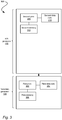
- the variables generator 126 may comprise a first processor 302, a first data communications module 304 and a first memory 306, and the KPI generator 132 may comprise a second processor 308, a second data communications module 310 and a second memory 312.
- processors 126 and/or the KPI generator 132 may be used by the variables generator 126 and/or the KPI generator 132.
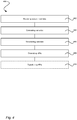
- Fig. 4 illustrates a flow chart 400 comprising steps for processing the sensor input data 118, 120 ,122, 124 captured from the sensors 110, 112, 114, 116 placed in the food production line 102.
- a first step 402 the sensor input data 118, 120, 122, 124 from the sensors 110, 112, 114, 116 placed in the food production line can be received by a variables generator 126.
- a number of variables 128, 130 may be determined based on the sensor input data 118, 120, 122, 124 according to a variable generation scheme.
- the number of variables 128, 130 can be transferred to the KPI generator 146.
- the number of KPIs 134, 136 can be generated based on the number of variables 128, 130 according to the KPI generation scheme 146.
- the number of KPIs can be transferred to the UI enabled device 138.
Landscapes
- Business, Economics & Management (AREA)
- Human Resources & Organizations (AREA)
- Engineering & Computer Science (AREA)
- Strategic Management (AREA)
- Economics (AREA)
- Entrepreneurship & Innovation (AREA)
- Educational Administration (AREA)
- Development Economics (AREA)
- General Business, Economics & Management (AREA)
- Tourism & Hospitality (AREA)
- Physics & Mathematics (AREA)
- Marketing (AREA)
- General Physics & Mathematics (AREA)
- Theoretical Computer Science (AREA)
- Game Theory and Decision Science (AREA)
- Quality & Reliability (AREA)
- Operations Research (AREA)
- Manufacturing & Machinery (AREA)
- Primary Health Care (AREA)
- Health & Medical Sciences (AREA)
- General Health & Medical Sciences (AREA)
- General Factory Administration (AREA)
- General Preparation And Processing Of Foods (AREA)
- Auxiliary Devices For And Details Of Packaging Control (AREA)
- Control By Computers (AREA)
Abstract
Description
- The invention relates to the field of food processing, such as liquid food processing and packaging. More particularly, it is related to methods and systems for processing sensor input data captured from sensors placed in a production line.
- A food processing line of today is in most cases a complex system comprising a number of different pieces of equipment that can process food products in various ways. There are several reasons for the complexity. One reason is that in order to provide for that the line can be cleaned during operation, some of processing steps may be duplicated. For instance, there may be two or more balance tanks provided in the line such that one of them can be serviced while one or several of the others are used for production during the service, which is beneficial from a production point of view since the service in this way does not require that the line is closed down Another reason for having complex systems is that food producers are interested in having flexible lines that can be used for a number of different products. By having such flexible lines, it is possible for the food producers to process and/or pack different products if needed. Further, many of the food processing lines of today have been upgraded several times over the years, which as an effect results in that the lines become increasingly complex.
- In addition to that the food processing lines are complex as such; the level of complexity increases when taking into account that different sensors are being used. For instance, some food producers may prefer to have magnetic relays provided on each door to be able to detect when this is open or closed such that this can be used as input for determining when a machine interruption has occurred. Other food producers may choose not include such relays on all doors, but instead prefer to, for the same purpose, rely on temperature sensors, conductive sensors, flow transmitters etc., which most often is used for analyzing operations or for control purposes.
- The complexity of the food processing lines and the sensors used in the food processing lines have effect on the key performance indicators (KPIs) used for keeping track of the performance of the lines. Due to that the lines may be set up differently and that they may comprise different pieces of equipment as well as different types of sensors, it is challenging and time consuming to set up a structure for determining KPIs for a food processing line. Thus, there is a need for methods and systems that can reduce time needed for setting up a system for reliably measuring KPIs.
- It is an object of the invention to at least partly overcome one or more of the above-identified limitations of the prior art. In particular, it is an object to provide methods and systems for efficiently and reliably set up structures for determining KPIs related to a food processing line.
- According to a first aspect it is provided a method for processing sensor input data captured from sensors placed in a production line, said method comprising receiving sensor input data from the sensors placed in the production line by a variables generator, wherein the variables generator comprises a first processor, a first data communications module and a first memory, generating a number of variables based on the sensor input data according to a variable generation scheme, transferring the number of variables to a key performance indicator (KPI) generator, wherein the KPI generator comprises a second processor, a second data communications module and a second memory, and generating a number of key performance indicators (KPIs) based on the number of variables according to a KPI generation scheme.
- Alternatively, the variables generator and the KPI generator may share one and the same processor, memory and data communications device.
- Further, the method may comprise transferring the number of KPIs to a user interface (Ul) enabled device.
- The variables generator and the KPI generator may be different physical entities.
- The variable generation scheme may be shared among a first group of production lines and the KPI generation scheme may be shared among a second group of the production lines.
- The second group may be a sub-set of the first group.
- An amendment of the variable generation scheme may be distributed to the production lines of the first group via a variable generation data center.
- An amendment of the KPI generation scheme may be distributed to the production lines of the second group.
- The KPI generation scheme may be shared in the second group via secure data communications channels.
- The production line may be a food production line, such as a liquid food production line.
- According to a second aspect it is provided a system arranged to process sensor input data captured from sensors placed in a production line, said system comprising a variables generator arranged to receive sensor input data from the sensors placed in the production line and to generate a number of variables based on the sensor input data according to a variable generation scheme, wherein the variables generator comprises a first processor, a first data communications module and a first memory, and a key performance indicator (KPI) generator arranged to receive the number of variables from the variables generator, and to generate a number of key performance indicators (KPIs) based on the number of variables according to a KPI generation scheme, wherein the KPI generator comprises a second processor, a second data communications module and a second memory.
- Further, the KPI generator may be arranged to transfer the number of KPIs to a user interface (Ul) enabled device.
- The variables generator and the KPI generator may be different physical entities.
- The variable generation scheme may be shared among a first group of production lines and the KPI generation scheme may be shared among a second group of the production lines.
- The second group may be a sub-set of the first group.
- An amendment of the variable generation scheme may be distributed to the production lines of the first group via a variable generation data center.
- An amendment of the KPI generation scheme may be distributed to the production lines of the second group.
- The KPI generation scheme may be shared in the second group via secure data communications channels.
- The production line may be a food production line, such as a liquid food production line.
- Still other objectives, features, aspects and advantages of the invention will appear from the following detailed description as well as from the drawings.
- Embodiments of the invention will now be described, by way of example, with reference to the accompanying schematic drawings, in which
-
Fig. 1 illustrates a system comprising a food production line provided with sensors. -
Fig. 2 illustrates a variables generator and a KPI generator in further detail. -
Fig. 3 illustrates an example of a hardware set up for the variables generator and the KPI generator. -
Fig. 4 is a flowchart illustrating a method for processing sensor input data captured from sensors placed in a food production line. - With reference to
Fig. 1 asystem 100 is illustrated. Thesystem 100 comprises afood production line 102, also referred to as food processing line, which may be a food treatment line comprising steps such as heat treatment, homogenization, filtration and separation, or a food packaging line or a combination thereof. In the example illustrated inFig.1 , thefood production line 102 comprises afilling machine 104, acard board packer 106 arranged to group packages and place them in a cardboard tray, and afilm wrapper 108 arranged to provide a plastic film around the tray and packages. By way of example, to monitor performance of thefood production line 102, a first andsecond sensor filling machine 104, athird sensor 114 is placed in thecard board packer 106 and afourth sensor 116 is placed in thefilm wrapper 108. The sensors 110-116 may be of various kind. For instance, in case thefilling machine 104 is a carton-based roll-fed filling machine, thefirst sensor 110 may be a temperature sensor for determining that sufficient heat is generated when forming transversal sealings, and thesecond sensor 112 may be an optical sensor for determining that a web of packaging material is correctly aligned when forming a longitudinal sealing. Thethird sensor 114 placed in thecard board packer 106 may, by way of example be a magnetic-based door sensor for determining whether or not a service door is opened. Thefourth sensor 116, also by way of example, may be an optical sensor configured to calculate packages entering thefilm wrapper 116. -
Sensor input data sensors variables generator 126, i.e. data generated and fed from thesensors variables generator 126 can be configured to determine a number ofvariables fig. 1 . The variables may be determined in various ways and sensor input data from one or several of the sensors may be taken into account. For instance, based on thesensor input data 122 from thethird sensor 114, a variable called "time service door is opened" may be determined. More particularly, by logging when the service door is opened and a point of time as well as when the service door is closed and a point of time, it can be determined for how long the service door was opened. Further, a variable "packages produced" may be determined based onsensor input data 124 from thefourth sensor 116. - From the
variables generator 126 thevariables generator 132. TheKPI generator 132 can be configured to determineKPIs variables KPIs device 138, e.g. a personal computer, a mobile phone or a tablet, such that the KPIs can be communicated to an operator. - In case one or several of the
sensors food production line 102 is replaced with a new piece of equipment, thesensor input data variables generation data center 140, it may be possible to instead of manually set how the variables are to be determined with the other sensors or with the new piece of equipment, this information may be downloaded from the variable generation data center to thevariables generator 126 in the form of avariable generation scheme 142. In case data related to the new piece of equipment is not to be found in thevariable generation scheme 142 and this is manually entered by the operator, this data may after having been entered be uploaded to the variablegeneration data center 140. In this way, by sharing how variables are to be determined for different sensors and for different pieces of equipment, a time for setting up thesystem 100 may be shortened, and also by sharing a likelihood to find inaccuracies or mistakes will increase, which in turn provides for increased reliability. - In a similar manner, a KPI
generation data center 144 may be used for sharing how KPIs are to be determined, and also aKPI generation scheme 146 may be used for downloading and uploading information between theKPI generator 132 and the KPIgeneration data center 144. However, since the KPIs are closely related to how thefood production line 102 can be run efficiently, these may by some food producers be considered as business-critical information that is not to be shared with everyone. For this reason, the information held in the variablegeneration data center 140 may be shared with a number offood production lines 148a-e, together forming afirst group 150, and the information held in the KPIgeneration data center 144 may be shared with asecond group 152, being a subset of the first group, herein comprising thefood production lines 148d-e. By separating the variablegeneration data center 140 and the KPIgeneration data center 144, it is made possible to collaborate with respect to how the variables are generated, but not with respect to how the variables are used for determining KPIs, e.g. measures based on a combination of different variables. Thus, the time for setting up the system can be shortened and still keep some information within a limited group, e.g. food production lines owned by the same company. - The
variables generator 126 and theKPI generator 132 may be set up in different ways.Fig. 2 illustrates by way of example, one possible set up. In a piece ofequipment 202, an event may be registered by alogger 204, more particularly a data logger connected to at least one sensor. Data registered by thelogger 204 is parsed by parsers, herein by way of example a first and asecond parser different event types 208, such as service door opened. The event types 208 identified by thedata parsers database 206. By combining the event types 208,variables 210 may be determined. Thevariables 210 may be transferred to a formula calculations step 212 in which KPIs are determined based on thevariables 210. As illustrated, thevariables generator 126 may comprise theequipment 202 including thelogger 204 and thedata parsers KPI generator 132 may comprise thedatabase 206 and theformula calculations 212. - As set forth above, the
variables generator 126 and theKPI generator 132 may be set to share information with thefirst group 150 and thesecond group 152, respectively. To assure that the information is not spread unduly thevariables generator 126 and theKPI generator 132 may be different physical entities. For instance, thevariables generator 126 may comprise afirst processor 302, a firstdata communications module 304 and afirst memory 306, and theKPI generator 132 may comprise asecond processor 308, a second data communications module 310 and asecond memory 312. - Alternatively, one and the same processor, memory and/or data communications module may be used by the
variables generator 126 and/or theKPI generator 132. -
Fig. 4 illustrates aflow chart 400 comprising steps for processing thesensor input data sensors food production line 102. In afirst step 402 thesensor input data sensors variables generator 126. Thereafter, in asecond step 404, a number ofvariables sensor input data third step 406, the number ofvariables KPI generator 146. In afourth step 408 the number ofKPIs variables KPI generation scheme 146. Optionally, in afifth step 410 the number of KPIs can be transferred to the UI enableddevice 138. - Even though the production line above is described above in a context of food production, it should be understood that the principles and advantages may also be applied in other fields of production.
- From the description above follows that, although various embodiments of the invention have been described and shown, the invention is not restricted thereto, but may also be embodied in other ways within the scope of the subject-matter defined in the following claims.
Claims (15)
- A method (400) for processing sensor input data (118, 120 ,122, 124) captured from sensors (110, 112, 114, 116) placed in a production line (102), said method comprising
receiving (402) sensor input data (118, 120, 122, 124) from the sensors (110, 112, 114, 116) placed in the production line by a variables generator (126), wherein the variables generator (126) comprises a first processor (302), a first data communications module (304) and a first memory (306),
generating (404) a number of variables (128, 130) based on the sensor input data (118, 120, 122, 124) according to a variable generation scheme (142),
transferring (406) the number of variables (128, 130) to a key performance indicator (KPI) generator (146), wherein the KPI generator (146) comprises a second processor (308), a second data communications module (310) and a second memory (312), and
generating (408) a number of key performance indicators (KPIs) (134, 136) based on the number of variables (128, 130) according to a KPI generation scheme (146) . - The method according to claim 1, further comprising
transferring (410) the number of KPIs to a user interface (UI) enabled device (138). - The method according to claim 1 or 2, wherein the variables generator (126) and the KPI generator (132) are different physical entities.
- The method according to any one of the preceding claims, wherein the variable generation scheme (142) is shared among a first group (150) of production lines (148a-e) and the KPI generation scheme (146) is shared among a second group (152) of the production lines (148a-e).
- The method according to claim 4, wherein the second group (152) is a sub-set of the first group (150).
- The method according to claim 4 or 5, wherein an amendment of the variable generation scheme (142) is distributed to the production lines (148a-e) of the first group (150) via a variable generation data center (140).
- The method according to any one of claims 4 to 6, wherein an amendment of the KPI generation scheme (146) is distributed to the production lines (148d-e) of the second group (152).
- The method according to any one of the preceding claims, wherein the production line is a food production line.
- A system (100) arranged to process sensor input data (118, 120 ,122, 124) captured from sensors (110, 112, 114, 116) placed in a production line (102), said system (100) comprising
a variables generator (126) arranged to receive sensor input data (118, 120, 122, 124) from the sensors (110, 112, 114, 116) placed in the production line and to generate a number of variables (128, 130) based on the sensor input data (118, 120, 122, 124) according to a variable generation scheme (142), wherein the variables generator (126) comprises a first processor (302), a first data communications module (304) and a first memory (306), and
a key performance indicator (KPI) generator (132) arranged to receive the number of variables (128, 130) from the variables generator (126), to generate a number of key performance indicators (KPIs) (134, 136) based on the number of variables (128, 130) according to a KPI generation scheme (146), and to transfer the number of KPIs (134,136), wherein the KPI generator (146) comprises a second processor (308), a second data communications module (310) and a second memory (312). - The system according to claim 8, wherein the variables generator (126) and the KPI generator (132) are different physical entities.
- The system according to any one of the claims 9 or 10, wherein the variable generation scheme (142) is shared among a first group (150) of production lines (148a-e) and the KPI generation scheme (146) is shared among a second group (152) of the production lines (148a-e).
- The system according to claim 11, wherein the second group (152) is a sub-set of the first group (150).
- The system according to claim 11 or 12, wherein an amendment of the variable generation scheme (142) is distributed to the production lines (148a-e) of the first group (150) via a variable generation data center (140).
- The system according to any one of claims 11 to 13, wherein an amendment of the KPI generation scheme (146) is distributed to the production lines (148d-e) of the second group (152).
- The system according to any one of claims 9 to 14, wherein the production line is a food production line.
Applications Claiming Priority (1)
| Application Number | Priority Date | Filing Date | Title |
|---|---|---|---|
| EP19180265 | 2019-06-14 |
Publications (2)
| Publication Number | Publication Date |
|---|---|
| EP3751482A1 true EP3751482A1 (en) | 2020-12-16 |
| EP3751482B1 EP3751482B1 (en) | 2026-02-25 |
Family
ID=67003192
Family Applications (1)
| Application Number | Title | Priority Date | Filing Date |
|---|---|---|---|
| EP20179506.9A Active EP3751482B1 (en) | 2019-06-14 | 2020-06-11 | A method for processing sensor input data captured from sensors placed in a production line, and a system thereof |
Country Status (7)
| Country | Link |
|---|---|
| US (1) | US20220222754A1 (en) |
| EP (1) | EP3751482B1 (en) |
| JP (1) | JP7600154B2 (en) |
| CN (1) | CN113950696B (en) |
| BR (1) | BR112021023087A2 (en) |
| ES (1) | ES3068814T3 (en) |
| WO (1) | WO2020249671A1 (en) |
Families Citing this family (1)
| Publication number | Priority date | Publication date | Assignee | Title |
|---|---|---|---|---|
| DE102024136118A1 (en) * | 2024-12-04 | 2026-06-11 | Khs Gmbh | Method for processing machine data of a container treatment device as well as central monitoring point and system for this purpose |
Citations (2)
| Publication number | Priority date | Publication date | Assignee | Title |
|---|---|---|---|---|
| US20150039401A1 (en) * | 2013-08-05 | 2015-02-05 | International Business Machines Corporation | Method and system for implementation of engineered key performance indicators |
| US20180039249A1 (en) * | 2016-08-02 | 2018-02-08 | General Electric Company | Automated dynamical control of operations and design of physical systems through time |
Family Cites Families (14)
| Publication number | Priority date | Publication date | Assignee | Title |
|---|---|---|---|---|
| US7108192B2 (en) * | 1999-09-17 | 2006-09-19 | Silverbrook Research Pty Ltd | Rotationally symmetric tags |
| US7380213B2 (en) * | 2001-12-28 | 2008-05-27 | Kimberly-Clark Worldwide, Inc. | User interface for reporting event-based production information in product manufacturing |
| JP2004038904A (en) * | 2002-07-03 | 2004-02-05 | Yosuke Kanamori | Automatic production efficiency calculating system for each product |
| WO2012103125A1 (en) | 2011-01-24 | 2012-08-02 | Abb Inc. | Method for analyzing and diagnosing large scale process automation control systems |
| JP6443312B2 (en) | 2015-09-28 | 2018-12-26 | オムロン株式会社 | Management system |
| US10402511B2 (en) * | 2015-12-15 | 2019-09-03 | Hitachi, Ltd. | System for maintenance recommendation based on performance degradation modeling and monitoring |
| JP6461779B2 (en) * | 2015-12-21 | 2019-01-30 | 株式会社日立製作所 | Plan adjustment system and plan adjustment method |
| US11416533B2 (en) * | 2016-06-06 | 2022-08-16 | Avlino Inc. | System and method for automated key-performance-indicator discovery |
| US10643167B2 (en) * | 2016-07-28 | 2020-05-05 | Honeywell International Inc. | MPC with unconstrained dependent variables for KPI performance analysis |
| US20180129191A1 (en) * | 2016-11-04 | 2018-05-10 | Rockwell Automation Technologies, Inc. | Industrial automation system machine analytics for a connected enterprise |
| US10713271B2 (en) * | 2017-02-10 | 2020-07-14 | Oracle International Corporation | Querying distributed log data using virtual fields defined in query strings |
| JP7015317B2 (en) | 2017-04-26 | 2022-02-02 | ビューラー アーゲー | Self-optimizing adaptive industrial chocolate production system and corresponding methods |
| EP3404593A1 (en) * | 2017-05-15 | 2018-11-21 | Tata Consultancy Services Limited | Method and system for data based optimization of performance indicators in process and manufacturing industries |
| US10838843B1 (en) * | 2017-12-15 | 2020-11-17 | Glassbeam, Inc. | Parsing hierarchical session log data for search and analytics |
-
2020
- 2020-06-11 JP JP2021574201A patent/JP7600154B2/en active Active
- 2020-06-11 CN CN202080042974.XA patent/CN113950696B/en active Active
- 2020-06-11 EP EP20179506.9A patent/EP3751482B1/en active Active
- 2020-06-11 BR BR112021023087A patent/BR112021023087A2/en unknown
- 2020-06-11 US US17/613,271 patent/US20220222754A1/en not_active Abandoned
- 2020-06-11 ES ES20179506T patent/ES3068814T3/en active Active
- 2020-06-11 WO PCT/EP2020/066200 patent/WO2020249671A1/en not_active Ceased
Patent Citations (2)
| Publication number | Priority date | Publication date | Assignee | Title |
|---|---|---|---|---|
| US20150039401A1 (en) * | 2013-08-05 | 2015-02-05 | International Business Machines Corporation | Method and system for implementation of engineered key performance indicators |
| US20180039249A1 (en) * | 2016-08-02 | 2018-02-08 | General Electric Company | Automated dynamical control of operations and design of physical systems through time |
Also Published As
| Publication number | Publication date |
|---|---|
| JP2022536184A (en) | 2022-08-12 |
| ES3068814T3 (en) | 2026-06-02 |
| BR112021023087A2 (en) | 2022-01-04 |
| JP7600154B2 (en) | 2024-12-16 |
| WO2020249671A1 (en) | 2020-12-17 |
| US20220222754A1 (en) | 2022-07-14 |
| CN113950696A (en) | 2022-01-18 |
| EP3751482B1 (en) | 2026-02-25 |
| CN113950696B (en) | 2025-01-10 |
Similar Documents
| Publication | Publication Date | Title |
|---|---|---|
| CN105607605B (en) | Composing room's intelligence control system and control method | |
| EP3460612A1 (en) | Method, apparatus and device for detecting abnormal data, and machine-readable medium | |
| JP6824732B2 (en) | Collection device, collection method, program and collection system | |
| EP3751482B1 (en) | A method for processing sensor input data captured from sensors placed in a production line, and a system thereof | |
| US20090164850A1 (en) | Electronic Supervisor | |
| US20110313810A1 (en) | Service tracking system | |
| CN116319865A (en) | Cloud edge cooperation-based intelligent detection method and system for equipment faults | |
| CN109919505A (en) | A kind of mode of operation judgment method, device, system, equipment and storage medium | |
| CN106596567A (en) | Keyboard panel on-line detecting method and implementing system thereof | |
| US12443476B2 (en) | Method for detecting and reporting an operation error in an in-vitro diagnostic system and an in-vitro diagnostic system | |
| Bonomi et al. | Smart quality control powered by machine learning algorithms | |
| CN106151169A (en) | A kind of oil product detection devices and methods therefor | |
| CN203786830U (en) | Self-service equipment and article detecting system in self-service equipment | |
| CN120087386A (en) | A self-adaptive stabilization code scanning weighing method and system | |
| CN118644153A (en) | Agricultural product processing quality traceability monitoring system based on edge nodes | |
| WO2020245020A1 (en) | A method for food package assessment, and a system thereof | |
| CN114707606B (en) | Data processing method and device based on federal learning, equipment and storage medium | |
| CN111967546B (en) | Lithium battery test data binding method, device and storage medium | |
| US7921978B2 (en) | Processing data transfer method in sheet processing apparatus | |
| JP5168132B2 (en) | Quality control system | |
| RU2796165C1 (en) | Control system for composition and characteristics of aircraft equipment to ensure the functioning of its digital twins | |
| Kumar et al. | Connected On-Board Inert Gas Generation System with Real-Time Data Access & Machine Learning Approach for Predictive/Prognostics Maintenance | |
| CN117558423B (en) | A method and system for early warning of medical device failures based on endogenous diagnostics | |
| CN117823798A (en) | A safety monitoring and evaluation system for LNG filling stations | |
| CN107862480A (en) | Business management method, distribution management device, medium and electronic equipment |
Legal Events
| Date | Code | Title | Description |
|---|---|---|---|
| PUAI | Public reference made under article 153(3) epc to a published international application that has entered the european phase |
Free format text: ORIGINAL CODE: 0009012 |
|
| STAA | Information on the status of an ep patent application or granted ep patent |
Free format text: STATUS: THE APPLICATION HAS BEEN PUBLISHED |
|
| AK | Designated contracting states |
Kind code of ref document: A1 Designated state(s): AL AT BE BG CH CY CZ DE DK EE ES FI FR GB GR HR HU IE IS IT LI LT LU LV MC MK MT NL NO PL PT RO RS SE SI SK SM TR |
|
| AX | Request for extension of the european patent |
Extension state: BA ME |
|
| STAA | Information on the status of an ep patent application or granted ep patent |
Free format text: STATUS: REQUEST FOR EXAMINATION WAS MADE |
|
| 17P | Request for examination filed |
Effective date: 20210616 |
|
| RBV | Designated contracting states (corrected) |
Designated state(s): AL AT BE BG CH CY CZ DE DK EE ES FI FR GB GR HR HU IE IS IT LI LT LU LV MC MK MT NL NO PL PT RO RS SE SI SK SM TR |
|
| STAA | Information on the status of an ep patent application or granted ep patent |
Free format text: STATUS: EXAMINATION IS IN PROGRESS |
|
| 17Q | First examination report despatched |
Effective date: 20220715 |
|
| REG | Reference to a national code |
Ref country code: DE Ref legal event code: R079 Free format text: PREVIOUS MAIN CLASS: G06Q0010060000 Ipc: G06Q0010063900 Ref document number: 602020067388 Country of ref document: DE |
|
| GRAP | Despatch of communication of intention to grant a patent |
Free format text: ORIGINAL CODE: EPIDOSNIGR1 |
|
| STAA | Information on the status of an ep patent application or granted ep patent |
Free format text: STATUS: GRANT OF PATENT IS INTENDED |
|
| RIC1 | Information provided on ipc code assigned before grant |
Ipc: G06Q 10/0639 20230101AFI20250929BHEP |
|
| INTG | Intention to grant announced |
Effective date: 20251009 |
|
| GRAS | Grant fee paid |
Free format text: ORIGINAL CODE: EPIDOSNIGR3 |
|
| GRAA | (expected) grant |
Free format text: ORIGINAL CODE: 0009210 |
|
| STAA | Information on the status of an ep patent application or granted ep patent |
Free format text: STATUS: THE PATENT HAS BEEN GRANTED |
|
| AK | Designated contracting states |
Kind code of ref document: B1 Designated state(s): AL AT BE BG CH CY CZ DE DK EE ES FI FR GB GR HR HU IE IS IT LI LT LU LV MC MK MT NL NO PL PT RO RS SE SI SK SM TR |
|
| REG | Reference to a national code |
Ref country code: CH Ref legal event code: F10 Free format text: ST27 STATUS EVENT CODE: U-0-0-F10-F00 (AS PROVIDED BY THE NATIONAL OFFICE) Effective date: 20260225 Ref country code: GB Ref legal event code: FG4D |
|
| REG | Reference to a national code |
Ref country code: DE Ref legal event code: R096 Ref document number: 602020067388 Country of ref document: DE |
|
| REG | Reference to a national code |
Ref country code: IE Ref legal event code: FG4D |
|
| REG | Reference to a national code |
Ref country code: ES Ref legal event code: FG2A Ref document number: 3068814 Country of ref document: ES Kind code of ref document: T3 Effective date: 20260602 |
|
| REG | Reference to a national code |
Ref country code: NL Ref legal event code: MP Effective date: 20260225 |
|
| PG25 | Lapsed in a contracting state [announced via postgrant information from national office to epo] |
Ref country code: RS Free format text: LAPSE BECAUSE OF FAILURE TO SUBMIT A TRANSLATION OF THE DESCRIPTION OR TO PAY THE FEE WITHIN THE PRESCRIBED TIME-LIMIT Effective date: 20260525 |
|
| PG25 | Lapsed in a contracting state [announced via postgrant information from national office to epo] |
Ref country code: PL Free format text: LAPSE BECAUSE OF FAILURE TO SUBMIT A TRANSLATION OF THE DESCRIPTION OR TO PAY THE FEE WITHIN THE PRESCRIBED TIME-LIMIT Effective date: 20260225 |
|
| PG25 | Lapsed in a contracting state [announced via postgrant information from national office to epo] |
Ref country code: GR Free format text: LAPSE BECAUSE OF FAILURE TO SUBMIT A TRANSLATION OF THE DESCRIPTION OR TO PAY THE FEE WITHIN THE PRESCRIBED TIME-LIMIT Effective date: 20260526 |
|
| PGFP | Annual fee paid to national office [announced via postgrant information from national office to epo] |
Ref country code: IT Payment date: 20260623 Year of fee payment: 7 |
|
| REG | Reference to a national code |
Ref country code: LT Ref legal event code: MG9D |
|
| PG25 | Lapsed in a contracting state [announced via postgrant information from national office to epo] |
Ref country code: LT Free format text: LAPSE BECAUSE OF FAILURE TO SUBMIT A TRANSLATION OF THE DESCRIPTION OR TO PAY THE FEE WITHIN THE PRESCRIBED TIME-LIMIT Effective date: 20260225 |
|
| PGFP | Annual fee paid to national office [announced via postgrant information from national office to epo] |
Ref country code: DE Payment date: 20260623 Year of fee payment: 7 |
|
| PG25 | Lapsed in a contracting state [announced via postgrant information from national office to epo] |
Ref country code: NO Free format text: LAPSE BECAUSE OF FAILURE TO SUBMIT A TRANSLATION OF THE DESCRIPTION OR TO PAY THE FEE WITHIN THE PRESCRIBED TIME-LIMIT Effective date: 20260525 |
|
| PG25 | Lapsed in a contracting state [announced via postgrant information from national office to epo] |
Ref country code: AT Free format text: LAPSE BECAUSE OF FAILURE TO SUBMIT A TRANSLATION OF THE DESCRIPTION OR TO PAY THE FEE WITHIN THE PRESCRIBED TIME-LIMIT Effective date: 20260225 Ref country code: FI Free format text: LAPSE BECAUSE OF FAILURE TO SUBMIT A TRANSLATION OF THE DESCRIPTION OR TO PAY THE FEE WITHIN THE PRESCRIBED TIME-LIMIT Effective date: 20260225 Ref country code: SE Free format text: LAPSE BECAUSE OF FAILURE TO SUBMIT A TRANSLATION OF THE DESCRIPTION OR TO PAY THE FEE WITHIN THE PRESCRIBED TIME-LIMIT Effective date: 20260225 |
|
| REG | Reference to a national code |
Ref country code: AT Ref legal event code: MK05 Ref document number: 1891731 Country of ref document: AT Kind code of ref document: T Effective date: 20260225 |
|
| PG25 | Lapsed in a contracting state [announced via postgrant information from national office to epo] |
Ref country code: HR Free format text: LAPSE BECAUSE OF FAILURE TO SUBMIT A TRANSLATION OF THE DESCRIPTION OR TO PAY THE FEE WITHIN THE PRESCRIBED TIME-LIMIT Effective date: 20260225 |
|
| PG25 | Lapsed in a contracting state [announced via postgrant information from national office to epo] |
Ref country code: IS Free format text: LAPSE BECAUSE OF FAILURE TO SUBMIT A TRANSLATION OF THE DESCRIPTION OR TO PAY THE FEE WITHIN THE PRESCRIBED TIME-LIMIT Effective date: 20260625 Ref country code: PT Free format text: LAPSE BECAUSE OF FAILURE TO SUBMIT A TRANSLATION OF THE DESCRIPTION OR TO PAY THE FEE WITHIN THE PRESCRIBED TIME-LIMIT Effective date: 20260625 |
|
| PG25 | Lapsed in a contracting state [announced via postgrant information from national office to epo] |
Ref country code: NL Free format text: LAPSE BECAUSE OF FAILURE TO SUBMIT A TRANSLATION OF THE DESCRIPTION OR TO PAY THE FEE WITHIN THE PRESCRIBED TIME-LIMIT Effective date: 20260225 |
|
| PG25 | Lapsed in a contracting state [announced via postgrant information from national office to epo] |
Ref country code: LV Free format text: LAPSE BECAUSE OF FAILURE TO SUBMIT A TRANSLATION OF THE DESCRIPTION OR TO PAY THE FEE WITHIN THE PRESCRIBED TIME-LIMIT Effective date: 20260225 |
|
| PG25 | Lapsed in a contracting state [announced via postgrant information from national office to epo] |
Ref country code: BG Free format text: LAPSE BECAUSE OF FAILURE TO SUBMIT A TRANSLATION OF THE DESCRIPTION OR TO PAY THE FEE WITHIN THE PRESCRIBED TIME-LIMIT Effective date: 20260225 |