EP3751301A1 - New non-linear parallel reconstruction magnetic resonance imaging method, device and medium - Google Patents
New non-linear parallel reconstruction magnetic resonance imaging method, device and medium Download PDFInfo
- Publication number
- EP3751301A1 EP3751301A1 EP18882276.1A EP18882276A EP3751301A1 EP 3751301 A1 EP3751301 A1 EP 3751301A1 EP 18882276 A EP18882276 A EP 18882276A EP 3751301 A1 EP3751301 A1 EP 3751301A1
- Authority
- EP
- European Patent Office
- Prior art keywords
- data
- term
- sampling space
- nonlinear
- sampling
- Prior art date
- Legal status (The legal status is an assumption and is not a legal conclusion. Google has not performed a legal analysis and makes no representation as to the accuracy of the status listed.)
- Pending
Links
- 238000000034 method Methods 0.000 title description 33
- 238000002595 magnetic resonance imaging Methods 0.000 title description 3
- 238000005070 sampling Methods 0.000 claims abstract description 134
- 238000003384 imaging method Methods 0.000 claims abstract description 40
- 230000035945 sensitivity Effects 0.000 claims description 8
- 238000012417 linear regression Methods 0.000 claims description 7
- 230000000694 effects Effects 0.000 abstract description 3
- 230000017105 transposition Effects 0.000 description 3
- 238000006073 displacement reaction Methods 0.000 description 2
- 239000011159 matrix material Substances 0.000 description 2
- 230000001681 protective effect Effects 0.000 description 2
- 238000012986 modification Methods 0.000 description 1
- 230000004048 modification Effects 0.000 description 1
- 238000004088 simulation Methods 0.000 description 1
Images


Classifications
-
- G—PHYSICS
- G01—MEASURING; TESTING
- G01R—MEASURING ELECTRIC VARIABLES; MEASURING MAGNETIC VARIABLES
- G01R33/00—Arrangements or instruments for measuring magnetic variables
- G01R33/20—Arrangements or instruments for measuring magnetic variables involving magnetic resonance
- G01R33/44—Arrangements or instruments for measuring magnetic variables involving magnetic resonance using nuclear magnetic resonance [NMR]
- G01R33/48—NMR imaging systems
- G01R33/54—Signal processing systems, e.g. using pulse sequences ; Generation or control of pulse sequences; Operator console
- G01R33/56—Image enhancement or correction, e.g. subtraction or averaging techniques, e.g. improvement of signal-to-noise ratio and resolution
- G01R33/561—Image enhancement or correction, e.g. subtraction or averaging techniques, e.g. improvement of signal-to-noise ratio and resolution by reduction of the scanning time, i.e. fast acquiring systems, e.g. using echo-planar pulse sequences
- G01R33/5611—Parallel magnetic resonance imaging, e.g. sensitivity encoding [SENSE], simultaneous acquisition of spatial harmonics [SMASH], unaliasing by Fourier encoding of the overlaps using the temporal dimension [UNFOLD], k-t-broad-use linear acquisition speed-up technique [k-t-BLAST], k-t-SENSE
-
- G—PHYSICS
- G01—MEASURING; TESTING
- G01R—MEASURING ELECTRIC VARIABLES; MEASURING MAGNETIC VARIABLES
- G01R33/00—Arrangements or instruments for measuring magnetic variables
- G01R33/20—Arrangements or instruments for measuring magnetic variables involving magnetic resonance
- G01R33/44—Arrangements or instruments for measuring magnetic variables involving magnetic resonance using nuclear magnetic resonance [NMR]
- G01R33/48—NMR imaging systems
- G01R33/54—Signal processing systems, e.g. using pulse sequences ; Generation or control of pulse sequences; Operator console
- G01R33/56—Image enhancement or correction, e.g. subtraction or averaging techniques, e.g. improvement of signal-to-noise ratio and resolution
- G01R33/5608—Data processing and visualization specially adapted for MR, e.g. for feature analysis and pattern recognition on the basis of measured MR data, segmentation of measured MR data, edge contour detection on the basis of measured MR data, for enhancing measured MR data in terms of signal-to-noise ratio by means of noise filtering or apodization, for enhancing measured MR data in terms of resolution by means for deblurring, windowing, zero filling, or generation of gray-scaled images, colour-coded images or images displaying vectors instead of pixels
-
- G—PHYSICS
- G01—MEASURING; TESTING
- G01R—MEASURING ELECTRIC VARIABLES; MEASURING MAGNETIC VARIABLES
- G01R33/00—Arrangements or instruments for measuring magnetic variables
- G01R33/20—Arrangements or instruments for measuring magnetic variables involving magnetic resonance
- G01R33/44—Arrangements or instruments for measuring magnetic variables involving magnetic resonance using nuclear magnetic resonance [NMR]
- G01R33/48—NMR imaging systems
- G01R33/58—Calibration of imaging systems, e.g. using test probes, Phantoms; Calibration objects or fiducial markers such as active or passive RF coils surrounding an MR active material
Definitions
- the present disclosure relates to the field of magnetic resonance image reconstruction, and in particular to an imaging method for nonlinear parallel magnetic resonance image reconstruction, a device for magnetic resonance image reconstruction and a medium.
- Image reconstruction is an important step in parallel magnetic resonance imaging. In actual clinical studies, high-performance image reconstruction method plays a critical role in parallel rapid imaging.
- SENSE Sensitivity encoded
- GRAPPA Generalized auto calibrating partially parallel acquisitions
- SMASH Simultaneous acquisition of spatial harmonics
- a Nonlinear GRAPPA reconstruction method is limited by the number of channels of magnetic resonance data, thus quality of a reconstructed image is poor.
- a GRAPPA reconstruction method based on Virtual Coil Conception (VCC) has a poor performance on the aspect of reducing artifacts and noise.
- an imaging method is provided in the present disclosure, to improve the quality of a reconstructed image and reduce artifacts and noise of the reconstructed image.
- An imaging method for nonlinear parallel magnetic resonance image reconstruction includes:
- step S6 includes: squaring the complete sampling space data for each channel to obtain a square of the complete sampling space data for each channel and summing the squares of the complete sampling space data for the multiple channels to obtain the final reconstructed image; or multiplying the complete sampling space data for the multiple channels by sensitivities of the coils for the multiple channels to obtain products respectively and summing the products to obtain the final reconstructed image.
- the data combination term includes a constant, a linear data term, and a nonlinear data term.
- step S3 includes: generating a mixed data combination term by using the data combination term and the full-sampling data in the low-frequency region of the sampling space, where the mixed data combination term includes a constant, a linear data term, and a nonlinear data term.
- the nonlinear data term in the data combination term is a nonlinear data term which is raised to the power of two or more; and/or the nonlinear data term in the mixed data combination term is a nonlinear data term which is raised to the power of two or more.
- the calibrating in step S3 includes: performing fitting by using a linear regression method to obtain a set of weighting factors and constructing a set of linear combination relationships between data and adjacent data of the data in the sampling space.
- a computer readable medium stores a program, the program is executed by a computer to perform the imaging method.
- a device for magnetic resonance image reconstruction implementing the imaging method includes:
- the imaging module is configured to: square the complete sampling space data for each channel to obtain a square of the complete sampling space data for each channel and summing the squares of the complete sampling space data for the multiple channels to obtain the final reconstructed image; or multiply the complete sampling space data for the multiple channels by sensitivities of the coils for the multiple channels to obtain products respectively and summing the products to obtain the final reconstructed image.
- the data combination term obtained by the data combining module includes a constant, a linear data term, and a nonlinear data term.
- the calibrating module is configured to generate a mixed data combination term by using the data combination term and the full-sampling data in the low-frequency region of the sampling space, where the mixed data combination term includes a constant, a linear mixed data term, and a nonlinear data term.
- the nonlinear data term in the data combination term obtained by the calibrating module is a nonlinear data term which is raised to the power of two or more; and/or the nonlinear data term in the mixed data combination term is a nonlinear data term which is raised to the power of two or more.
- the calibrating module is configured to perform fitting by using a linear regression method to obtain a set of weighting factors and constructing a set of linear combination relationships between data and adjacent data of the data in the sampling space.
- the quality of a reconstructed image obtained by using the parallel magnetic resonance rapid imaging can be improved, and artifacts and noise of the reconstructed image can be reduced.
- the present disclosure aims to solve the problems existing in the corresponding conventional technology in the field of magnetic resonance image reconstruction. Therefore, the present disclosure is particularly applicable to the subdivision of magnetic resonance image reconstruction. However, it is not meant that the scope of application of the technical solutions of the present disclosure is limited to magnetic resonance image reconstruction. Those skilled in the art can reasonably implement the present disclosure in various specific applications in the field of magnetic resonance imaging as needed.
- the imaging method includes the following steps S1 to S6.
- step S1 actual coil data is acquired in a parallel manner by using coils for multiple channels and the actual coil data is expanded to obtain virtual coil data having the same number of channels as the actual coil data.
- the virtual coil data and the actual coil data have a conjugate symmetric relationship.
- step S2 the actual coil data and the virtual coil data are combined to obtain a data combination term.
- step S3 a weighting factor is calibrated by using the data combination term and full-sampling data in a low-frequency region of a sampling space.
- step S4 missing data in the sampling space is reconstructed based on the calibrated weighting factor to obtain reconstructed data.
- the missing data indicates data which is not sampled in a high-frequency region of the sampling space.
- step S5 the full-sampling data in the low-frequency region of the sampling space and the reconstructed data are fused to obtain complete sampling space data.
- step S6 a final reconstructed image is obtained based on the complete sampling space data for multiple channels.
- the number of channels of the magnetic resonance data is expanded by using conjugate symmetry of complex numbers.
- multi-channel complex number data obtained by actually sampling is subjected to a process of conjugate transposition, to obtain virtual data having the same number of channels as the multi-channel complex number data, such that the amount of the known data for a subsequent reconstruction step is doubled, thereby improving signal-to-noise ratio and accuracy of a subsequent reconstruction result.
- a nonlinear data term is obtained in the process of image reconstruction, thus the quality of a reconstructed image can be full improved and artifacts and noise of the reconstructed image can be reduced.
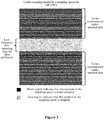
- FIG. 2 shows an under-sampling scheme in which a VCC-NL-GRAPPA (nonlinear generalized auto calibrating partially parallel acquisitions based on virtual coil conception) method performs reduction in a sampling space.
- VCC-NL-GRAPPA onlinear generalized auto calibrating partially parallel acquisitions based on virtual coil conception
- margins of the full-sampling data in the low-frequency region also include parts of high-frequency data.
- step S6 the complete sampling space data for each channel is squared to obtain a square of the complete sampling space data for each channel and the squares of the complete sampling space data for the multiple channels are summed to obtain the final reconstructed image, or the complete sampling space data for the multiple channels are multiplied by sensitivities of the coils for the multiple channels to obtain products respectively and the products are summed to obtain the final reconstructed image.
- the data combination term includes a constant, a linear data term, and a nonlinear data term.
- An exponent of the nonlinear data term in the present disclosure may be two, three or more, or may be a combination of at least two of the above exponents.
- a mixed data combination term is generated by using the data combination term and the full-sampling data in the low-frequency region of the sampling space.
- the mixed data combination term includes a constant, a linear data term, and a nonlinear data term.
- the nonlinear data term in the data combination term is a nonlinear data term which is raised to the power of two or more; and/or the nonlinear data term in the mixed data combination term is a nonlinear data term which is raised to the power of two or more.
- step S3 fitting is performed by using a linear regression method to obtain a set of weighting factors and constructing a set of linear combination relationships between data and adjacent data of the data in the sampling space.
- parts of full-sampling data in the low-frequency region of the sampling space are firstly used to perform the calibrating, that is, a set of weighting factors are obtained by a linear regression method and then a set of linear combination relationships between data and its adjacent data in the sampling space are constructed.
- a computer readable medium is provided according to the present disclosure.
- the computer readable medium stores a program.
- the program is executed by a computer to perform the imaging method.
- a device for magnetic resonance image reconstruction implementing the imaging method includes an acquiring module, a data combining module, a calibrating module, a reconstructing data module, a fusing module and an imaging module.
- the acquiring module is configured to: acquire, in a parallel manner, actual coil data by using coils for multiple channels; and expand the actual coil data to obtain virtual coil data having the same number of channels as the actual coil data.
- the virtual coil data and the actual coil data have a conjugate symmetric relationship.
- the data combining module is configured to combine the actual coil data and the virtual coil data to obtain a data combination term.
- the calibrating module is configured to calibrate a weighting factor by using the data combination term and full-sampling data in a low-frequency region of a sampling space.
- the reconstructing data module is configured to reconstruct missing data in the sampling space based on the calibrated weighting factor to obtain reconstructed data.
- the missing data indicates data which is not sampled in a high-frequency region of the sampling space.
- the fusing module is configured to fuse the full-sampling data in the low-frequency region of the sampling space and the reconstructed data to obtain complete sampling space data.
- the imaging module is configured to obtain a final reconstructed image based on the complete sampling space data for multiple channels.
- the imaging module is configured to: square the complete sampling space data for each channel to obtain a square of the complete sampling space data for each channel and sum the squares of the complete sampling space data for the multiple channels to obtain the final reconstructed image; or multiply the complete sampling space data for the multiple channels by sensitivities of the coils for the multiple channels to obtain products respectively and sum the products to obtain the final reconstructed image.
- the data combination term obtained by the data combining module includes a constant, a linear data term, and a nonlinear data term.
- the calibrating module is configured to generate a mixed data combination term by using the data combination term and the full-sampling data in the low-frequency region of the sampling space.
- the mixed data combination term includes a constant, a linear data term, and a nonlinear data term.
- the nonlinear data term in the data combination term obtained by the calibrating module is a nonlinear data term which is raised to the power of two or more; and/or the nonlinear data term in the mixed data combination term is a nonlinear data term which is raised to the power of two or more.
- the calibrating module is configured to perform fitting by using a linear regression method to obtain a set of weighting factors and construct a set of linear combination relationships between data and adjacent data of the data in the sampling space.
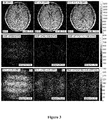
- Figure 3 shows reconstructed images in a generalized auto calibrating partially parallel acquisitions (GRAPPA) method, a nonlinear GRAPPA (NL-GRAPPA) method and a nonlinear GRAPPA based on virtual coil conception (VCC-NL-GRAPPA) method at five-times reduction (three-times net reduction).
- Figure 4 shows a relationship of a mean-square-error and an outer reduction factor in a GRAPPA method, an NL-GRAPPA method, and a VCC-NL-GRAPPA method.
- Diff. denotes a difference between a reconstructed image and a reference image.
- ⁇ 5 denotes that the difference is displayed with being magnified for 5 times.
- MES denotes the mean-square-error.
- R denotes the outer reduction factor.
- NetR denotes a net reduction factor.
- the MES, artifacts, and noise of the reconstructed image obtained by the imaging method in the present disclosure are reduced compared with that in the reconstructed images obtained by the GRAPPA method and the Nonlinear GRAPPA method.
Landscapes
- Physics & Mathematics (AREA)
- Engineering & Computer Science (AREA)
- High Energy & Nuclear Physics (AREA)
- Condensed Matter Physics & Semiconductors (AREA)
- General Physics & Mathematics (AREA)
- Nuclear Medicine, Radiotherapy & Molecular Imaging (AREA)
- General Health & Medical Sciences (AREA)
- Radiology & Medical Imaging (AREA)
- Health & Medical Sciences (AREA)
- Signal Processing (AREA)
- Artificial Intelligence (AREA)
- Computer Vision & Pattern Recognition (AREA)
- Magnetic Resonance Imaging Apparatus (AREA)
Abstract
Description
- The present disclosure relates to the field of magnetic resonance image reconstruction, and in particular to an imaging method for nonlinear parallel magnetic resonance image reconstruction, a device for magnetic resonance image reconstruction and a medium.
- Image reconstruction is an important step in parallel magnetic resonance imaging. In actual clinical studies, high-performance image reconstruction method plays a critical role in parallel rapid imaging. Currently, there are multiple image reconstruction methods in multi-channel coil parallel imaging, such as SENSE (Sensitivity encoded) method, GRAPPA (Generalized auto calibrating partially parallel acquisitions) method and SMASH (Simultaneous acquisition of spatial harmonics) method. The GRAPPA method has a wide applicable range because the GRAPPA method does not require a linear method of calculating sensitivities of coils for multiple channels.
- Among multiple methods based on the GRAPPA method, a Nonlinear GRAPPA reconstruction method is limited by the number of channels of magnetic resonance data, thus quality of a reconstructed image is poor. A GRAPPA reconstruction method based on Virtual Coil Conception (VCC) has a poor performance on the aspect of reducing artifacts and noise.
- In view of the above technical problems, an imaging method is provided in the present disclosure, to improve the quality of a reconstructed image and reduce artifacts and noise of the reconstructed image.
- To address the above technical problems, there are disclosed an imaging method for nonlinear parallel magnetic resonance image reconstruction, a device for magnetic resonance image reconstruction and a medium in the present disclosure. Technical solutions of the present disclosure are as follows.
- An imaging method for nonlinear parallel magnetic resonance image reconstruction includes:
- step S1, acquiring, in a parallel manner, actual coil data by using coils for multiple channels and expanding the actual coil data to obtain virtual coil data having the same number of channels as the actual coil data, where the virtual coil data and the actual coil data have a conjugate symmetric relationship;
- step S2, combining the actual coil data and the virtual coil data to obtain a data combination term;
- step S3, calibrating a weighting factor by using the data combination term and full-sampling data in a low-frequency region of a sampling space;
- step S4, reconstructing missing data in the sampling space based on the calibrated weighting factor to obtain reconstructed data, where the missing data indicates data which is not sampled in a high-frequency region of the sampling space;
- step S5, fusing the full-sampling data in the low-frequency region of the sampling space and the reconstructed data to obtain complete sampling space data; and
- step S6, obtaining a final reconstructed image based on the complete sampling space data for multiple channels.
- Preferably, step S6 includes: squaring the complete sampling space data for each channel to obtain a square of the complete sampling space data for each channel and summing the squares of the complete sampling space data for the multiple channels to obtain the final reconstructed image; or multiplying the complete sampling space data for the multiple channels by sensitivities of the coils for the multiple channels to obtain products respectively and summing the products to obtain the final reconstructed image.
- Preferably, in step S2, the data combination term includes a constant, a linear data term, and a nonlinear data term.
- Preferably, step S3 includes: generating a mixed data combination term by using the data combination term and the full-sampling data in the low-frequency region of the sampling space, where the mixed data combination term includes a constant, a linear data term, and a nonlinear data term.
- Preferably, the nonlinear data term in the data combination term is a nonlinear data term which is raised to the power of two or more; and/or the nonlinear data term in the mixed data combination term is a nonlinear data term which is raised to the power of two or more.
- Preferably, the calibrating in step S3 includes: performing fitting by using a linear regression method to obtain a set of weighting factors and constructing a set of linear combination relationships between data and adjacent data of the data in the sampling space.
- Preferably, the calibrating in step S3 is performed by using the following formula:


- A computer readable medium is provided according to the disclosure, the computer readable medium stores a program, the program is executed by a computer to perform the imaging method.
- A device for magnetic resonance image reconstruction implementing the imaging method is provided according to the disclosure. The device includes:
- an acquiring module configured to acquire, in a parallel manner, actual coil data by using coils for multiple channels and expanding the actual coil data to obtain virtual coil data having the same number of channels as the actual coil data, where the virtual coil data and the actual coil data have a conjugate symmetric relationship;
- a data combining module configured to combine the actual coil data and the virtual coil data to obtain a data combination term;
- a calibrating module configured to calibrate a weighting factor by using the data combination term and full-sampling data in a low-frequency region of a sampling space;
- a reconstructing data module configured to reconstruct missing data in the sampling space based on the calibrated weighting factor to obtain reconstructed data, where the missing data indicates data which is not sampled in a high-frequency region of the sampling space;
- a fusing module configured to fuse the full-sampling data in the low-frequency region of the sampling space and the reconstructed data to obtain complete sampling space data; and
- an imaging module configured to obtain a final reconstructed image based on the complete sampling space data for multiple channels.
- Preferably, the imaging module is configured to: square the complete sampling space data for each channel to obtain a square of the complete sampling space data for each channel and summing the squares of the complete sampling space data for the multiple channels to obtain the final reconstructed image; or multiply the complete sampling space data for the multiple channels by sensitivities of the coils for the multiple channels to obtain products respectively and summing the products to obtain the final reconstructed image.
- Preferably, the data combination term obtained by the data combining module includes a constant, a linear data term, and a nonlinear data term. The calibrating module is configured to generate a mixed data combination term by using the data combination term and the full-sampling data in the low-frequency region of the sampling space, where the mixed data combination term includes a constant, a linear mixed data term, and a nonlinear data term.
- Preferably, the nonlinear data term in the data combination term obtained by the calibrating module is a nonlinear data term which is raised to the power of two or more; and/or the nonlinear data term in the mixed data combination term is a nonlinear data term which is raised to the power of two or more. The calibrating module is configured to perform fitting by using a linear regression method to obtain a set of weighting factors and constructing a set of linear combination relationships between data and adjacent data of the data in the sampling space.
- Preferably, the calibrating module is configured to perform the calibrating by using the following formula:


- The following two advantageous effects can be achieved by implementing the present disclosure. First, the quality of a reconstructed image obtained by using the parallel magnetic resonance rapid imaging can be improved, and artifacts and noise of the reconstructed image can be reduced. Second, it is unnecessary to acquire extra data and lengthen scanning time while the quality of the reconstructed image is improved.
- For a better understanding of the technical solutions of the present disclosure, reference may be made to the following drawings for illustrating embodiments or the conventional technology. Products or methods involved in some embodiments or the conventional technology are briefly shown in the drawings. Basic information of the drawings is as follows.
-
Figure 1 is a schematic flowchart of a VCC-NL-GRAPPA method; -
Figure 2 shows an under-sampling scheme in which a VCC-NL-GRAPPA method performs reduction in a sampling space; -
Figure 3 shows reconstructed images in a GRAPPA method, an NL-GRAPPA method and a VCC-NL-GRAPPA method at five-times reduction (three-times net reduction); and -
Figure 4 shows a relationship of a mean-square-error and an outer reduction factor in a GRAPPA method, an NL-GRAPPA method, and a VCC-NL-GRAPPA method. - Technical solutions or advantageous effects in embodiments of the present disclosure are further described in detail herein. It is apparent that the embodiments described herein are only parts not all embodiments of the present disclosure.
- It should be noted that the present disclosure aims to solve the problems existing in the corresponding conventional technology in the field of magnetic resonance image reconstruction. Therefore, the present disclosure is particularly applicable to the subdivision of magnetic resonance image reconstruction. However, it is not meant that the scope of application of the technical solutions of the present disclosure is limited to magnetic resonance image reconstruction. Those skilled in the art can reasonably implement the present disclosure in various specific applications in the field of magnetic resonance imaging as needed.
- There is provided an imaging method for nonlinear parallel magnetic resonance image reconstruction. Referring to
Figure 1 , the imaging method includes the following steps S1 to S6. - In step S1, actual coil data is acquired in a parallel manner by using coils for multiple channels and the actual coil data is expanded to obtain virtual coil data having the same number of channels as the actual coil data. The virtual coil data and the actual coil data have a conjugate symmetric relationship.
- In step S2, the actual coil data and the virtual coil data are combined to obtain a data combination term.
- In step S3, a weighting factor is calibrated by using the data combination term and full-sampling data in a low-frequency region of a sampling space.
- In step S4, missing data in the sampling space is reconstructed based on the calibrated weighting factor to obtain reconstructed data. The missing data indicates data which is not sampled in a high-frequency region of the sampling space.
- In step S5, the full-sampling data in the low-frequency region of the sampling space and the reconstructed data are fused to obtain complete sampling space data.
- In step S6, a final reconstructed image is obtained based on the complete sampling space data for multiple channels.
- In the imaging method provided in the present disclosure, the number of channels of the magnetic resonance data is expanded by using conjugate symmetry of complex numbers. Specifically, in a case that scanning time is not lengthened and extra data is not acquired, multi-channel complex number data obtained by actually sampling is subjected to a process of conjugate transposition, to obtain virtual data having the same number of channels as the multi-channel complex number data, such that the amount of the known data for a subsequent reconstruction step is doubled, thereby improving signal-to-noise ratio and accuracy of a subsequent reconstruction result. Further, a nonlinear data term is obtained in the process of image reconstruction, thus the quality of a reconstructed image can be full improved and artifacts and noise of the reconstructed image can be reduced.
- Reference is made to
Figure 2 , which shows an under-sampling scheme in which a VCC-NL-GRAPPA (nonlinear generalized auto calibrating partially parallel acquisitions based on virtual coil conception) method performs reduction in a sampling space. In a quadrate sampling space, a black region indicates an under-sampled region and a gray region indicates a sampled region. - Further, it should be noted that, in some cases, margins of the full-sampling data in the low-frequency region also include parts of high-frequency data.
- In a preferred embodiment, in step S6, the complete sampling space data for each channel is squared to obtain a square of the complete sampling space data for each channel and the squares of the complete sampling space data for the multiple channels are summed to obtain the final reconstructed image, or the complete sampling space data for the multiple channels are multiplied by sensitivities of the coils for the multiple channels to obtain products respectively and the products are summed to obtain the final reconstructed image.
- In a preferred embodiment, in step S2, the data combination term includes a constant, a linear data term, and a nonlinear data term.
- An exponent of the nonlinear data term in the present disclosure may be two, three or more, or may be a combination of at least two of the above exponents.
- In a preferred embodiment, in step S3, a mixed data combination term is generated by using the data combination term and the full-sampling data in the low-frequency region of the sampling space. The mixed data combination term includes a constant, a linear data term, and a nonlinear data term.
- In a preferred embodiment, the nonlinear data term in the data combination term is a nonlinear data term which is raised to the power of two or more; and/or the nonlinear data term in the mixed data combination term is a nonlinear data term which is raised to the power of two or more.
- Actual multi-channel coil data and virtual multi-channel coil data are combined to obtain the constant, the linear data term and the nonlinear data term. Since there are a large number of linear data terms, nonlinear data combination terms which are raised to the power of two are generally selected, to accelerate computing speed without greatly reducing final imaging quality. Data combination terms which are raised to the power of three or more are omitted in implementation.
- In a preferred embodiment, in the calibrating in step S3, fitting is performed by using a linear regression method to obtain a set of weighting factors and constructing a set of linear combination relationships between data and adjacent data of the data in the sampling space.
- In order to reconstruct missing data which is not sampled in the high-frequency region of the sampling space, parts of full-sampling data in the low-frequency region of the sampling space are firstly used to perform the calibrating, that is, a set of weighting factors are obtained by a linear regression method and then a set of linear combination relationships between data and its adjacent data in the sampling space are constructed.
- In a preferred embodiment, the calibrating in step S3 is performed by using the following formula:


- k denotes any position in a K space,
- l denotes an ordinal number of a channel,
- b denotes a distance between to-be-estimated data and actual sampling data in an under-sampling phase encoding gradient direction in a sampling space,
- h denotes a distance between the to-be-estimated data and the actual sampling data in a full-sampling frequency encoding gradient direction in the sampling space,
- Sl denotes sampling space data of an 1-th channel,
- Sl* denotes a conjugate transposition matrix of Sl,
- kx, ky denote coordinate values of a sampling data point in a two-dimensional sampling space,
- Δkx, Δky denote a minimum distance between adjacent sampling points when the full-sampling is performed in the sampling space,
- R denotes the number of times of reduction, i.e., the number of times of under-sampling,
-


- B1, B2, H1, H2 denote the numbers of weighting factors in the imaging method.
- A computer readable medium is provided according to the present disclosure. The computer readable medium stores a program. The program is executed by a computer to perform the imaging method.
- A device for magnetic resonance image reconstruction implementing the imaging method is provided according to the disclosure. The device includes an acquiring module, a data combining module, a calibrating module, a reconstructing data module, a fusing module and an imaging module.
- The acquiring module is configured to: acquire, in a parallel manner, actual coil data by using coils for multiple channels; and expand the actual coil data to obtain virtual coil data having the same number of channels as the actual coil data. The virtual coil data and the actual coil data have a conjugate symmetric relationship.
- The data combining module is configured to combine the actual coil data and the virtual coil data to obtain a data combination term.
- The calibrating module is configured to calibrate a weighting factor by using the data combination term and full-sampling data in a low-frequency region of a sampling space.
- The reconstructing data module is configured to reconstruct missing data in the sampling space based on the calibrated weighting factor to obtain reconstructed data. The missing data indicates data which is not sampled in a high-frequency region of the sampling space.
- The fusing module is configured to fuse the full-sampling data in the low-frequency region of the sampling space and the reconstructed data to obtain complete sampling space data.
- The imaging module is configured to obtain a final reconstructed image based on the complete sampling space data for multiple channels.
- In a preferred embodiment, the imaging module is configured to: square the complete sampling space data for each channel to obtain a square of the complete sampling space data for each channel and sum the squares of the complete sampling space data for the multiple channels to obtain the final reconstructed image; or multiply the complete sampling space data for the multiple channels by sensitivities of the coils for the multiple channels to obtain products respectively and sum the products to obtain the final reconstructed image.
- In a preferred embodiment, the data combination term obtained by the data combining module includes a constant, a linear data term, and a nonlinear data term. The calibrating module is configured to generate a mixed data combination term by using the data combination term and the full-sampling data in the low-frequency region of the sampling space. The mixed data combination term includes a constant, a linear data term, and a nonlinear data term.
- In a preferred embodiment, the nonlinear data term in the data combination term obtained by the calibrating module is a nonlinear data term which is raised to the power of two or more; and/or the nonlinear data term in the mixed data combination term is a nonlinear data term which is raised to the power of two or more. The calibrating module is configured to perform fitting by using a linear regression method to obtain a set of weighting factors and construct a set of linear combination relationships between data and adjacent data of the data in the sampling space.
- In a preferred embodiment, the calibrating module is configured to perform the calibrating by using the following formula:


- k denotes any position in a K space,
- l denotes an ordinal number of a channel,
- b denotes a distance between to-be-estimated data and actual sampling data in an under-sampling phase encoding gradient direction in a sampling space,
- h denotes a distance between the to-be-estimated data and the actual sampling data in a full-sampling frequency encoding gradient direction in the sampling space,
- Sl denotes sampling space data of an 1-th channel,
- Sl* denotes a conjugate transposition matrix of Sl,
- kx, ky denote coordinate values of a sampling data point in a two-dimensional sampling space,
- Δkx, Δky denote a minimum distance between adjacent sampling points when the full-sampling is performed in the sampling space,
- R denotes the number of times of reduction, i.e., the number of times of under-sampling,
- With the imaging method disclosed in the present disclosure, results obtained through simulation and experiments are shown in
Figures 3 and4 .Figure 3 shows reconstructed images in a generalized auto calibrating partially parallel acquisitions (GRAPPA) method, a nonlinear GRAPPA (NL-GRAPPA) method and a nonlinear GRAPPA based on virtual coil conception (VCC-NL-GRAPPA) method at five-times reduction (three-times net reduction).Figure 4 shows a relationship of a mean-square-error and an outer reduction factor in a GRAPPA method, an NL-GRAPPA method, and a VCC-NL-GRAPPA method. Diff. denotes a difference between a reconstructed image and a reference image. ×5 denotes that the difference is displayed with being magnified for 5 times. MES denotes the mean-square-error. R denotes the outer reduction factor. NetR denotes a net reduction factor. - As shown in Figures, the MES, artifacts, and noise of the reconstructed image obtained by the imaging method in the present disclosure are reduced compared with that in the reconstructed images obtained by the GRAPPA method and the Nonlinear GRAPPA method.
- Finally, it should be noted that the embodiments above described are typical and preferred embodiments of the present disclosure, which are used to only describe and explain the technical solutions of the present disclosure, so as to facilitate understanding of readers and are not intended to limit the protective scope or application of the present disclosure. Therefore, technical resolutions obtained from any modifications, equivalent replacements, improvements or the like that are made within the spirit and principle of the present disclosure should be included in the protective scope of the present disclosure.


Claims (13)
- An imaging method for nonlinear parallel magnetic resonance image reconstruction, comprising:step S1, acquiring, in a parallel manner, actual coil data by using coils for a plurality of channels and expanding the actual coil data to obtain virtual coil data having the same number of channels as the actual coil data, wherein the virtual coil data and the actual coil data have a conjugate symmetric relationship;step S2, combining the actual coil data and the virtual coil data to obtain a data combination term;step S3, calibrating a weighting factor by using the data combination term and full-sampling data in a low-frequency region of a sampling space;step S4, reconstructing missing data in the sampling space based on the calibrated weighting factor to obtain reconstructed data, wherein the missing data indicates data which is not sampled in a high-frequency region of the sampling space;step S5, fusing the full-sampling data in the low-frequency region of the sampling space and the reconstructed data to obtain complete sampling space data; andstep S6, obtaining a final reconstructed image based on the complete sampling space data for the plurality of channels.
- The imaging method according to claim 1, wherein step S6 comprises:squaring the complete sampling space data for each channel to obtain a square of the complete sampling space data for each channel and summing the squares of the complete sampling space data for the plurality of channels to obtain the final reconstructed image; ormultiplying the complete sampling space data for the plurality of channels by sensitivities of the coils for the plurality of channels to obtain products respectively and summing the products to obtain the final reconstructed image.
- The imaging method according to claim 2, wherein in step S2, the data combination term comprises a constant, a linear data term, and a nonlinear data term.
- The imaging method according to claim 3, wherein step S3 comprises:
generating a mixed data combination term by using the data combination term and the full-sampling data in the low-frequency region of the sampling space, wherein the mixed data combination term comprises a constant, a linear data term, and a nonlinear data term. - The imaging method according to claim 4, wherein the nonlinear data term in the data combination term is a nonlinear data term which is raised to the power of two or more; and/or the nonlinear data term in the mixed data combination term is a nonlinear data term which is raised to the power of two or more.
- The imaging method according to claim 5, wherein the calibrating in step S3 comprises:
performing fitting by using a linear regression method to obtain a set of weighting factors and constructing a set of linear combination relationships between data and adjacent data of the data in the sampling space. - The imaging method according to claim 6, wherein the calibrating in step S3 is performed by using the following formula:


- A computer readable medium storing a program, wherein the program is executed by a computer to perform the imaging method according to any one of claims 1 to 7.
- A device for magnetic resonance image reconstruction implementing the imaging method according to any one of claims 1 to 7, the device comprising:an acquiring module configured to acquire, in a parallel manner, actual coil data by using coils for a plurality of channels and expand the actual coil data to obtain virtual coil data having the same number of channels as the actual coil data, wherein the virtual coil data and the actual coil data have a conjugate symmetric relationship;a data combining module configured to combine the actual coil data and the virtual coil data to obtain a data combination term;a calibrating module configured to calibrate a weighting factor by using the data combination term and full-sampling data in a low-frequency region of a sampling space;a reconstructing data module configured to reconstruct missing data in the sampling space based on the calibrated weighting factor to obtain reconstructed data, wherein the missing data indicates data which is not sampled in a high-frequency region of the sampling space;a fusing module configured to fuse the full-sampling data in the low-frequency region of the sampling space and the reconstructed data to obtain complete sampling space data; andan imaging module configured to obtain a final reconstructed image based on the complete sampling space data for the plurality of channels.
- The device according to claim 9, wherein the imaging module is configured to:square the complete sampling space data for each channel to obtain a square of the complete sampling space data for each channel and sum the squares of the complete sampling space data for the plurality of channels to obtain the final reconstructed image; ormultiply the complete sampling space data for the plurality of channels by sensitivities of the coils for the plurality of channels to obtain products respectively and sum the products to obtain the final reconstructed image.
- The device according to claim 9, wherein
the data combination term obtained by the data combining module comprises a constant, a linear data term, and a nonlinear data term;
the calibrating module is configured to generate a mixed data combination term by using the data combination term and the full-sampling data in the low-frequency region of the sampling space, wherein the mixed data combination term comprises a constant, a linear data term, and a nonlinear data term. - The device according to claim 9, wherein
the nonlinear data term in the data combination term obtained by the calibrating module is a nonlinear data term which is raised to the power of two or more; and/or the nonlinear data term in the mixed data combination term is a nonlinear data term which is raised to the power of two or more;
the calibrating module is configured to perform fitting by using a linear regression method to obtain a set of weighting factors and construct a set of linear combination relationships between data and adjacent data of the data in the sampling space. - The device according to claim 9, wherein the calibrating module is configured to perform the calibrating by using the following formula:


Applications Claiming Priority (2)
| Application Number | Priority Date | Filing Date | Title |
|---|---|---|---|
| CN201810132444.9A CN110133557B (en) | 2018-02-09 | 2018-02-09 | A Novel Nonlinear Parallel Reconstruction Magnetic Resonance Imaging Method, Device and Medium |
| PCT/CN2018/096782 WO2019153659A1 (en) | 2018-02-09 | 2018-07-24 | New non-linear parallel reconstruction magnetic resonance imaging method, device and medium |
Publications (2)
| Publication Number | Publication Date |
|---|---|
| EP3751301A1 true EP3751301A1 (en) | 2020-12-16 |
| EP3751301A4 EP3751301A4 (en) | 2021-11-17 |
Family
ID=67549146
Family Applications (1)
| Application Number | Title | Priority Date | Filing Date |
|---|---|---|---|
| EP18882276.1A Pending EP3751301A4 (en) | 2018-02-09 | 2018-07-24 | MAGNETIC RESONANCE TOMOGRAPHY WITH NEW NON-LINEAR PARALLEL RECONSTRUCTION, DEVICE AND MEDIUM |
Country Status (4)
| Country | Link |
|---|---|
| US (1) | US11579229B2 (en) |
| EP (1) | EP3751301A4 (en) |
| CN (1) | CN110133557B (en) |
| WO (1) | WO2019153659A1 (en) |
Cited By (1)
| Publication number | Priority date | Publication date | Assignee | Title |
|---|---|---|---|---|
| WO2022132659A1 (en) * | 2020-12-17 | 2022-06-23 | University Of Southern California | Region-optimized virtual (rovir) coils |
Families Citing this family (5)
| Publication number | Priority date | Publication date | Assignee | Title |
|---|---|---|---|---|
| CN111103562B (en) * | 2019-12-09 | 2022-03-04 | 中国科学院深圳先进技术研究院 | Reconstruction method and device for simultaneous multiple slice imaging |
| CN112557981B (en) * | 2020-12-03 | 2023-06-13 | 川北医学院 | An Improved Algorithm for Parallel Magnetic Resonance Imaging |
| CN112526423B (en) * | 2020-12-10 | 2023-06-06 | 川北医学院 | Parallel MRI algorithm based on conjugate and interslice information |
| US12105169B2 (en) * | 2021-01-26 | 2024-10-01 | Ohio State Innovation Foundation | High-dimensional fast convolutional framework (HICU) for calibrationless MRI |
| CN114565690B (en) * | 2021-12-15 | 2024-09-13 | 中国科学院深圳先进技术研究院 | Magnetic resonance imaging method based on wave gradient coding field and deep learning model |
Family Cites Families (16)
| Publication number | Priority date | Publication date | Assignee | Title |
|---|---|---|---|---|
| CN1799498B (en) | 2004-12-31 | 2010-04-28 | 西门子(中国)有限公司 | Fast Generalized Self-calibration Parallel Acquisition Image Reconstruction Method for Magnetic Resonance Imaging |
| CN100396240C (en) | 2005-02-28 | 2008-06-25 | 西门子(中国)有限公司 | Frequency Domain Sensitivity Coding MRI Parallel Imaging Method |
| JP2010508054A (en) * | 2006-10-31 | 2010-03-18 | コーニンクレッカ フィリップス エレクトロニクス エヌ ヴィ | MRIRF encoding using multiple transmit coils |
| US20140163664A1 (en) * | 2006-11-21 | 2014-06-12 | David S. Goldsmith | Integrated system for the ballistic and nonballistic infixion and retrieval of implants with or without drug targeting |
| US8076938B2 (en) * | 2009-03-31 | 2011-12-13 | General Electric Company | System and method of parallel imaging with calibration to a virtual coil |
| US9035003B2 (en) * | 2010-08-31 | 2015-05-19 | The University Of Kansas | High capacity magnetic nanoparticles as supports for reagents and catalysts |
| CN102519597B (en) * | 2011-12-14 | 2013-12-25 | 中国电子科技集团公司第四十一研究所 | Phase correction apodization method for Fourier transform spectrometer |
| CN103185878B (en) * | 2011-12-27 | 2015-04-15 | 上海联影医疗科技有限公司 | Magnetic resonance parallel image acquisition and image reconstruction method |
| CN102937706B (en) * | 2012-10-31 | 2016-08-03 | 中国科学院深圳先进技术研究院 | A kind of MRI parallel imaging method utilizing and magnetic resonance imager |
| CN104166110B (en) * | 2013-05-17 | 2017-12-26 | 深圳联影医疗科技有限公司 | Magnetic resonance parallel collected image reconstruction method and apparatus |
| US9581671B2 (en) * | 2014-02-27 | 2017-02-28 | Toshiba Medical Systems Corporation | Magnetic resonance imaging with consistent geometries |
| CN104434108B (en) * | 2014-12-09 | 2017-02-01 | 中国科学院武汉物理与数学研究所 | Multi-layer magnetic resonance fast imaging method based on adjacent layer information and undersampling |
| CN104749538B (en) | 2015-04-30 | 2016-02-03 | 郑州轻工业学院 | A kind of parallel MR imaging Phase Processing method |
| WO2017113205A1 (en) * | 2015-12-30 | 2017-07-06 | 中国科学院深圳先进技术研究院 | Rapid magnetic resonance imaging method and apparatus based on deep convolutional neural network |
| CN106772167B (en) * | 2016-12-01 | 2019-05-07 | 中国科学院深圳先进技术研究院 | Magnetic resonance imaging method and device |
| CN107507148B (en) * | 2017-08-30 | 2018-12-18 | 南方医科大学 | Method based on the convolutional neural networks removal down-sampled artifact of magnetic resonance image |
-
2018
- 2018-02-09 CN CN201810132444.9A patent/CN110133557B/en active Active
- 2018-07-24 WO PCT/CN2018/096782 patent/WO2019153659A1/en not_active Ceased
- 2018-07-24 EP EP18882276.1A patent/EP3751301A4/en active Pending
- 2018-07-24 US US16/473,806 patent/US11579229B2/en active Active
Cited By (2)
| Publication number | Priority date | Publication date | Assignee | Title |
|---|---|---|---|---|
| WO2022132659A1 (en) * | 2020-12-17 | 2022-06-23 | University Of Southern California | Region-optimized virtual (rovir) coils |
| US12561870B2 (en) | 2020-12-17 | 2026-02-24 | University Of Southern California | Region-optimzed virtual (ROVir) coils |
Also Published As
| Publication number | Publication date |
|---|---|
| CN110133557A (en) | 2019-08-16 |
| WO2019153659A1 (en) | 2019-08-15 |
| EP3751301A4 (en) | 2021-11-17 |
| US20210356545A1 (en) | 2021-11-18 |
| US11579229B2 (en) | 2023-02-14 |
| CN110133557B (en) | 2021-08-31 |
Similar Documents
| Publication | Publication Date | Title |
|---|---|---|
| US11579229B2 (en) | Imaging method and device for nonlinear parallel magnetic resonance image reconstruction, and medium | |
| Zhao et al. | Applications of a deep learning method for anti-aliasing and super-resolution in MRI | |
| Ma et al. | Removal of nuisance signals from limited and sparse 1H MRSI data using a union‐of‐subspaces model | |
| Chen et al. | A primal–dual fixed point algorithm for convex separable minimization with applications to image restoration | |
| US11327137B2 (en) | One-dimensional partial Fourier parallel magnetic resonance imaging method based on deep convolutional network | |
| US8427156B2 (en) | Systems and methods for image reconstruction of sensitivity encoded MRI data | |
| Tao et al. | Integrated image reconstruction and gradient nonlinearity correction | |
| US10809337B2 (en) | Reconstructing magnetic resonance images with different contrasts | |
| US20140210469A1 (en) | Nonrigid motion correction in 3d using autofocusing with localized linear translations | |
| US11308661B2 (en) | Motion robust reconstruction of multi-shot diffusion-weighted images without phase estimation via locally low-rank regularization | |
| US20130044960A1 (en) | Coil compression for three dimensional autocalibrating parallel imaging with cartesian sampling | |
| US20120286783A1 (en) | Accelerated MRI with Nonlinear Spatial Encoding Gradients | |
| US11313933B2 (en) | Diffusion-weighted MRI with magnitude-based locally low-rank regularization | |
| US8054078B2 (en) | Parallel imaging method and MRI apparatus | |
| Wang et al. | High‐resolution, 3D multi‐TE 1H MRSI using fast spatiospectral encoding and subspace imaging | |
| Yang et al. | Artificial intelligence for neuro MRI acquisition: a review | |
| Pawar et al. | Domain knowledge augmentation of parallel MR image reconstruction using deep learning | |
| US10698056B2 (en) | Magnetic resonance magnification imaging | |
| CN101248366A (en) | Apparatus and method for parallel magnetic resonance imaging | |
| Nencka et al. | A Mathematical Model for Understanding the STatistical effects of k-space (AMMUST-k) preprocessing on observed voxel measurements in fcMRI and fMRI | |
| Josephs et al. | MORSE: Multiple Orthogonal Reference Sensitivity Encoding | |
| Islam et al. | Improved regularisation constraints for compressed sensing of multi-slice mri | |
| JP7183048B2 (en) | MAGNETIC RESONANCE IMAGING SYSTEM, MAGNETIC RESONANCE IMAGING METHOD AND MAGNETIC RESONANCE IMAGING PROGRAM | |
| Zhu et al. | Improving multi-contrast imaging with reference guided location and orientation priors on edges | |
| CN108344961B (en) | Method and device for acquiring magnetic resonance phase information |
Legal Events
| Date | Code | Title | Description |
|---|---|---|---|
| STAA | Information on the status of an ep patent application or granted ep patent |
Free format text: STATUS: UNKNOWN |
|
| STAA | Information on the status of an ep patent application or granted ep patent |
Free format text: STATUS: THE INTERNATIONAL PUBLICATION HAS BEEN MADE |
|
| PUAI | Public reference made under article 153(3) epc to a published international application that has entered the european phase |
Free format text: ORIGINAL CODE: 0009012 |
|
| STAA | Information on the status of an ep patent application or granted ep patent |
Free format text: STATUS: REQUEST FOR EXAMINATION WAS MADE |
|
| 17P | Request for examination filed |
Effective date: 20190604 |
|
| AK | Designated contracting states |
Kind code of ref document: A1 Designated state(s): AL AT BE BG CH CY CZ DE DK EE ES FI FR GB GR HR HU IE IS IT LI LT LU LV MC MK MT NL NO PL PT RO RS SE SI SK SM TR |
|
| AX | Request for extension of the european patent |
Extension state: BA ME |
|
| DAV | Request for validation of the european patent (deleted) | ||
| DAX | Request for extension of the european patent (deleted) | ||
| A4 | Supplementary search report drawn up and despatched |
Effective date: 20211018 |
|
| RIC1 | Information provided on ipc code assigned before grant |
Ipc: G01R 33/561 20060101ALI20211012BHEP Ipc: G01R 33/54 20060101AFI20211012BHEP |
|
| STAA | Information on the status of an ep patent application or granted ep patent |
Free format text: STATUS: EXAMINATION IS IN PROGRESS |
|
| 17Q | First examination report despatched |
Effective date: 20240326 |