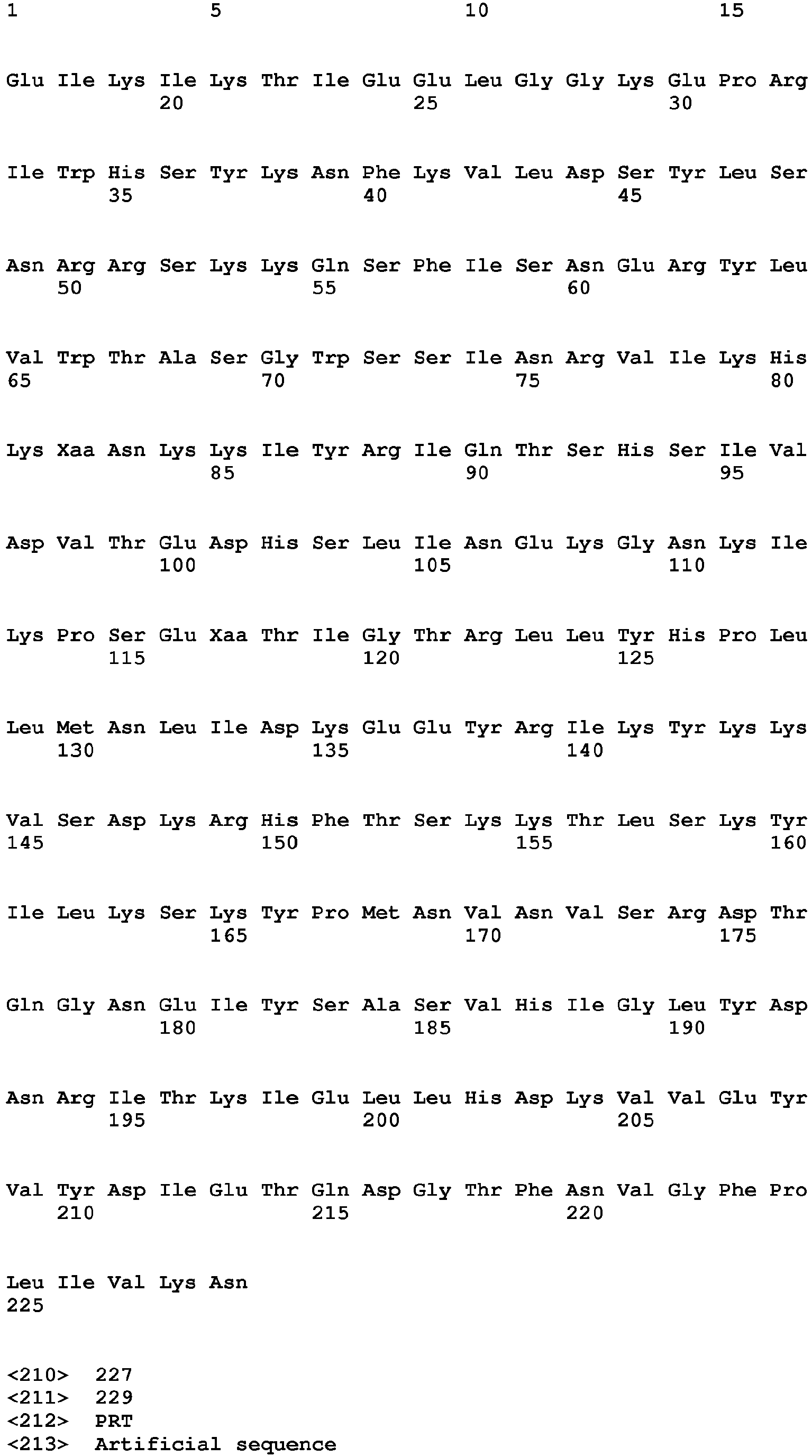
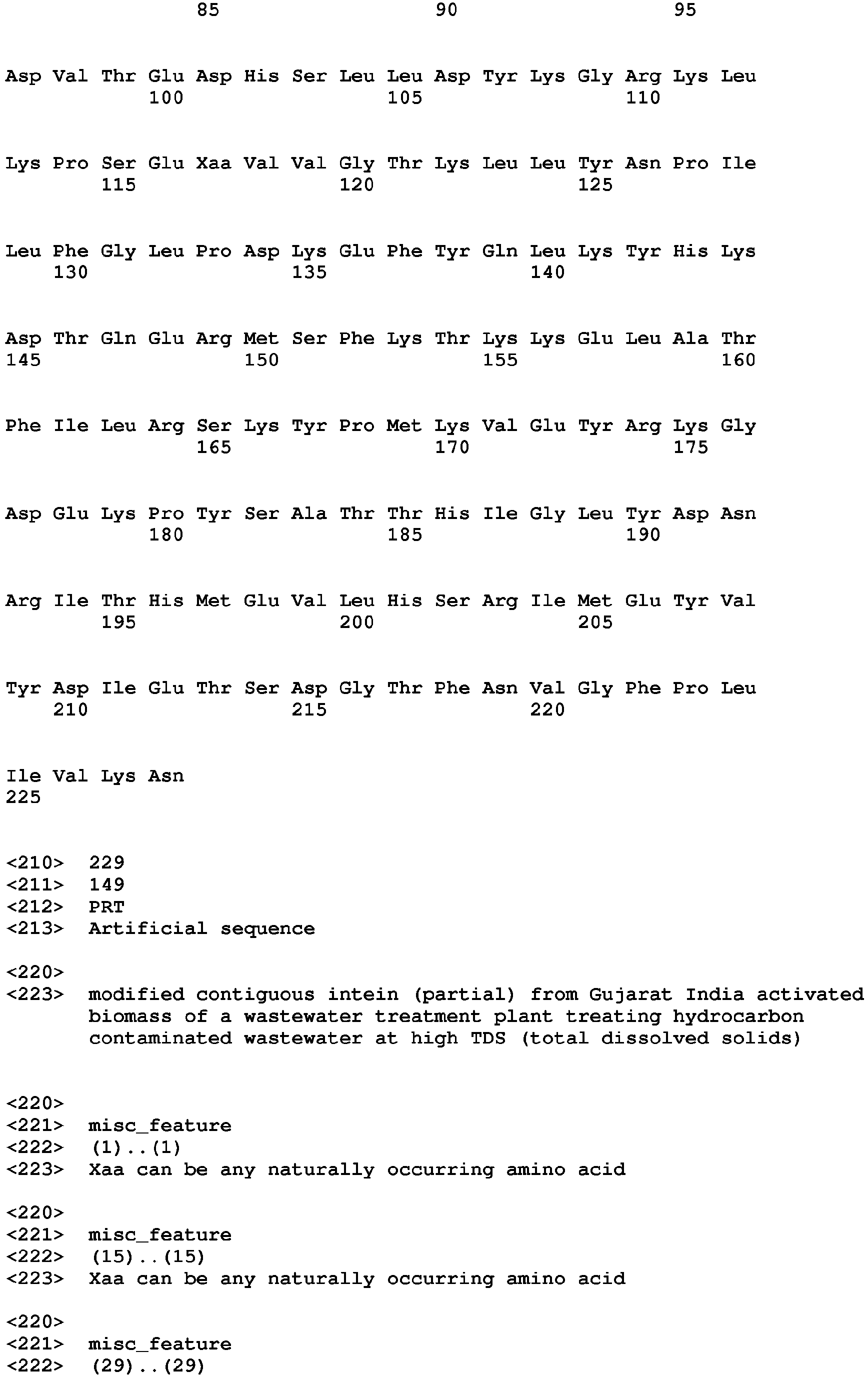
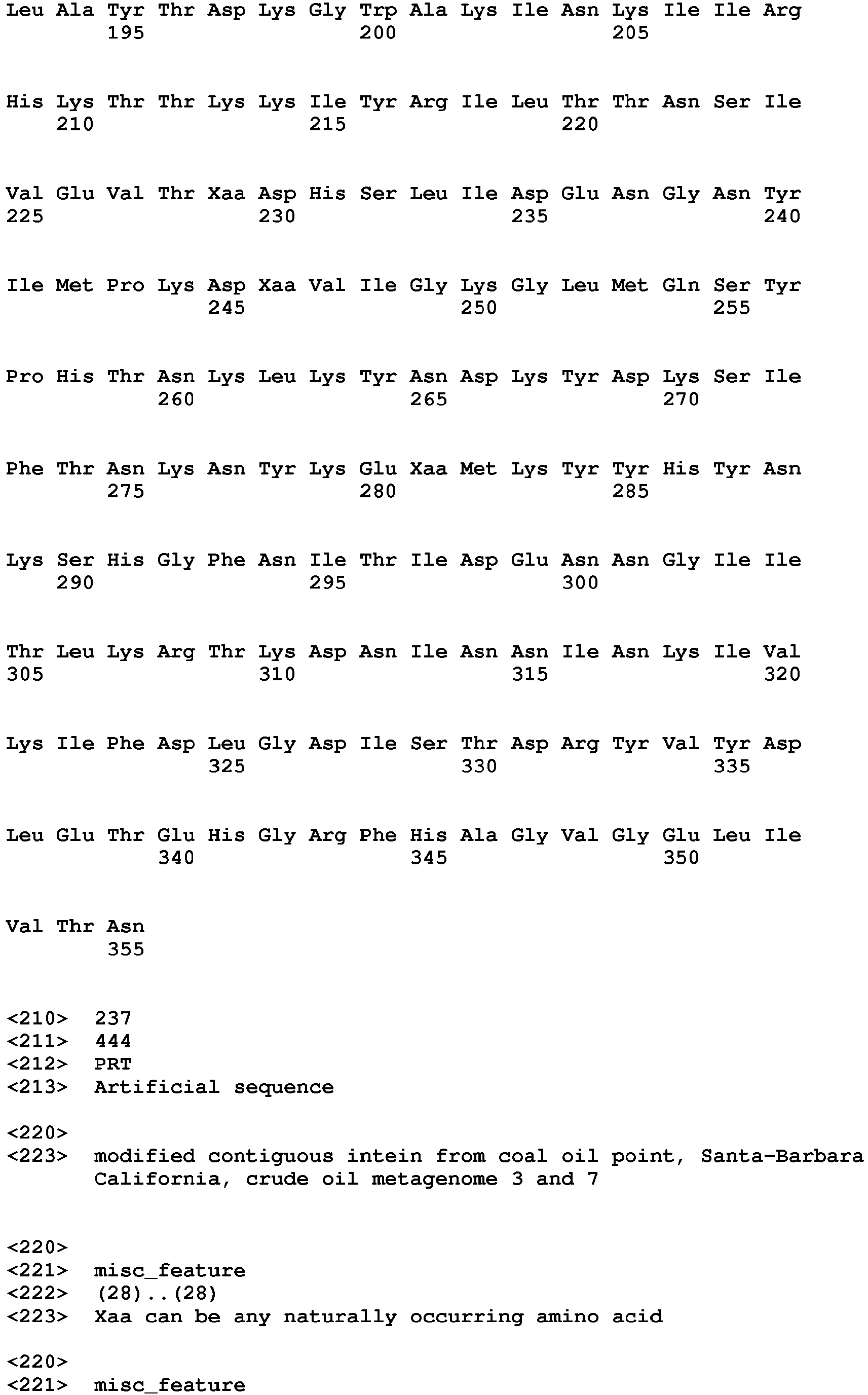
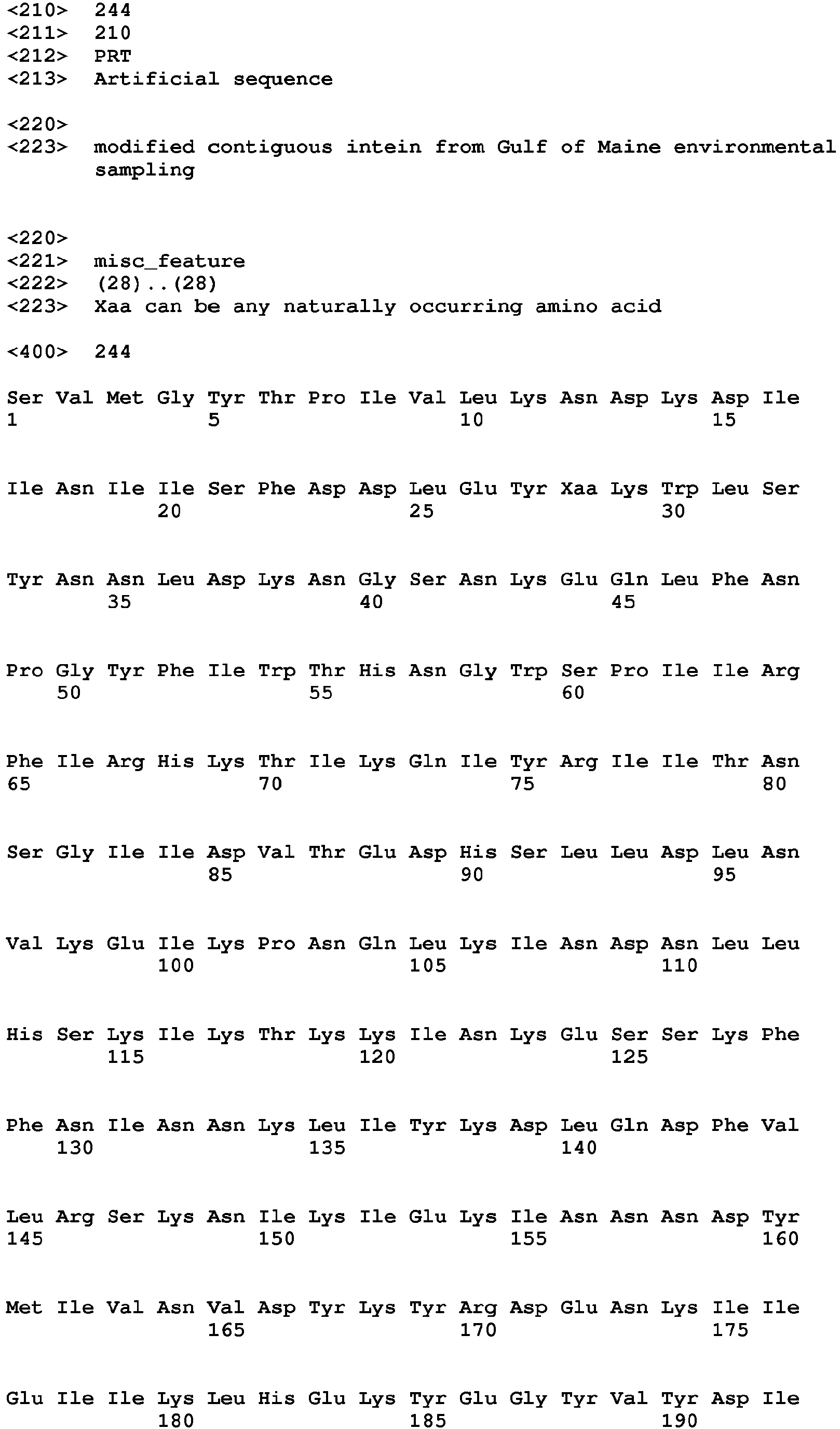
FIELD OF THE INVENTION
-
The present invention relates to an isolated polypeptide or to a composition of isolated polypeptides comprising (a) at least one first intein amino acid sequence (a1) and at least one first extein amino acid sequence (a2); wherein the at least one first intein amino acid sequence is an N-terminal sequence of a split intein or fragment thereof; wherein the at least one first extein sequence is fused to the N-terminus of the at least one first intein sequence and has a length of at least 1; and (b) at least one second intein amino acid sequence (b1) and at least one second extein sequence (b2); wherein the at least one second intein sequence is a C-terminal sequence of a split intein or fragment thereof; wherein the at least one second extein sequence is fused to the C-terminus of the at least one second intein sequence and has a length of at least 1; wherein the catalytic motifs of the at least one first intein amino acid sequence and/or of the at least one second intein amino acid sequence are free of cysteine residues; wherein the first and second intein amino acid sequence specifically interact with each other. Additionally, the invention relates to at least one isolated nucleic acid molecule comprising at least one nucleotide sequence encoding an isolated polypeptide according to the invention or a homolog, variant or complement thereof. Finally, the invention pertains to a method for modifying amino acid sequences or to a use of said isolated polypeptide(s) or said at least one isolated nucleic acid molecule.
BACKGROUND OF THE INVENTION
-
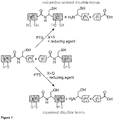
Inteins are intervening protein sequences that auto-catalyze a protein splicing post-translational reaction, whereby the intein excises itself out of the precursor polypeptide and ligates the two flanking N- and C-terminal fragments (exteins also referred to as ExN and ExC) via a native peptide bond (1-4). A variety of applications for protein modification and purification have been developed based on this unique protein backbone alteration and its mechanism, involving peptide bond rearrangements in labile (thio)esters and cleavage reactions (5-8). Some naturally occurring inteins exist in a split form, also referred to as trans-inteins, where the two intein fragments (also referred to as N- and C-terminal intein fragments or IntN and IntC) are expressed as two separate proteins, which first associate and then carry out protein trans-splicing (Figure 1) (9, 10). Artificially split inteins can be engineered from contiguous inteins (or cis-inteins) (11, 12). Protein trans-splicing is of particular interest to facilitate the reconstitution of a protein of interest (POI) from two fragments or to modify a POI by transfer of a synthetic, chemically or isotopically labeled part. In both these cases, the split intein precursor proteins can be generated and modified individually before being combined to carry out the protein trans-splicing reaction.
-
A major limitation of established split inteins is their inclusion of at least one mechanistically critical cysteine residue at the positions 1 or +1 at the N-terminal or the C-terminal splice junctions, respectively, that needs to be in a reduced state for the splicing reaction to take place. Intein precursors must thus be generated in a reducing environment or be treated with reducing agents. Partially oxidized cysteines at the splice junctions result in a proportional loss of the ligation yield. Some inteins have even evolved a redox-switch consisting of a disulfide bond of one of these critical cysteines with another cysteine to hold the intein in an inactive form (13, 14). The required in vitro addition of reducing agents like DTT or TCEP, however, has detrimental effects on intein-fused POIs that are sensitive to reduction, for example by breaking structurally critical disulfide bonds, such as in antibodies (15-17). Moreover, such cysteine-dependent inteins will at best be only partially active in oxidizing environments like the endoplasmic reticulum, bacterial periplasmic space or the in vivo extracellular milieu (18-20). Collateral damage by the reducing agents will also occur on other proteins when performing the trans-splicing reaction on an extracellular domain of a cell surface protein in a whole cell context (21, 22). Virtually all characterized inteins face this limitation, including the most widely used split Npu DnaE intein and its engineered variants (17, 23, 24), as well as the split Gp41-1 intein (25, 26), the fastest splicing intein known to date. Cysteine-less split inteins with suitable splicing properties at ambient temperatures have not been described so far. In general, inteins employing only serine or threonine and no cysteine residues at the catalytic 1 and +1 positions are very rare (27, 28). As cysteine residues may also be present in other conserved motifs or unconserved regions of inteins, completely cysteine-less inteins are very rare and naturally split inteins are even rarer, with the Neq Pol and the Psp-GBD Pol inteins being the only two reported cases of cysteine-less split inteins. These are, however, not suitable as general tools for protein manipulation owing to their extremely poor splicing properties under native and ambient conditions.
-
The naturally split Neq Pol intein derived from the hyperthermophile Nanoarchaeum equitans splices only at temperatures above 50 °C, with an optimum at 70 °C, prohibiting applications with less thermostable proteins and mammalian cells (29). The Psp-GBD Pol intein was artificially split in its internal homing endonuclease domain and the only cysteine, located in the homing endonuclease domain, was removed by mutation (30, 31). However, this intein requires a denaturation step to induce assembly of the two intein fragments, which significantly restricts its scope of application to proteins that can be refolded and prohibits its use on living cells. Notably, also native chemical ligation (NCL) requires reducing conditions (32). This reaction can be regarded as the chemical equivalent of protein trans-splicing to link two polypeptide chains and has been extensively used in biotechnological applications. Together, these considerations underline the challenge and the urgent need to identify a cysteine-less split intein that overcomes or mitigates the drawbacks of known split inteins.
-
Despite tremendous developments in recent years in the field of protein chemistry (33, 34), classical cysteine bioconjugation still is the unsurpassed technique for simple, efficient and chemoselective covalent protein modification. Cysteine is a much less frequently occurring amino acid compared to lysine and the thiol side chain displays a unique reactivity towards reagents with maleimides and iodoacetamides as the preferred functional groups (35). Cysteine bioconjugation is also highly attractive because of the much larger variety of commercially available and affordable reagents compared to other technologies like modern bioorthogonal click reactions. However, in general it is difficult or impossible to restrict cysteine bioconjugation to a desired cysteine when multiple cysteines are present in the target protein. Previous attempts to circumvent this regioselectivity problem included introducing an additional unpaired cysteine into proteins that contain only disulfide-paired cysteines, such as antibodies, antibody fragments and single-domain antibodies, also referred to as nanobodies (36, 37). However, these strategies cannot fully prevent the formation of scrambled disulfides and the resulting loss of sample homogeneity (38, 39), which can promote aggregation as well as the subsequent partial labeling of undesired cysteines. They typically necessitate an optimized mild reduction step as well as an additional purification step to remove the undesired mixed disulfide by-products (36). The so-called CysTag approach to achieve (regioselective) modification of a single cysteine in the presence of additional cysteines in the POI has been reported previously. The CysTag approach exploits the assembly of the POI with a short, pre-labeled cysteine tag (CysTag) using protein trans-splicing and thereby circumvents the exposure of the cysteines in the POI to the thiol-reactive reagent (16, 40-42). However, as outlined above, previously used split inteins require reducing conditions for trans-splicing, precluding the CysTag protocol with currently available split inteins for disulfide containing proteins and other experimental challenges that require the avoidance of reducing agents.
-
Hence, new methods that enable protein reconstitution from two fragments and preferably protein chemical labeling would be of great utility.
SUMMARY OF THE INVENTION
-
The inventors have found/designed novel split inteins with catalytic motifs that are free of cysteine residues and which are redox-insensitive. These inteins (e.g. Aes intein) and certain engineered intein variants, as described herein, are capable of (trans-)splicing at ambient temperatures and without the requirement of any chemical reducing step or denaturation step.
-
In a first aspect, the invention relates to an isolated polypeptide comprising
- (a) at least one first intein amino acid sequence (a1) and at least one first extein amino acid sequence (a2); wherein the at least one first intein amino acid sequence is an N-terminal sequence of a split intein or fragment thereof; wherein the at least one first extein sequence is fused to the N-terminus of the at least one first intein sequence and has a length of at least 1, preferably at least 5 amino acids; and
- (b) at least one second intein amino acid sequence (b1) and at least one second extein sequence (b2); wherein the at least one second intein sequence is a C-terminal sequence of a split intein or fragment thereof; wherein the at least one second extein sequence is fused to the C-terminus of the at least one second intein sequence and has a length of at least 1, preferably at least 5 amino acids;
wherein the catalytic motifs of the at least one first intein amino acid sequence and/or of the at least one second intein amino acid sequence are free of cysteine residues and wherein the first N-terminal amino acid of the second extein sequence (+1 position) is not a cysteine residue;
wherein the first and second intein amino acid sequence interact with each other to catalyze the cleavage of the peptide bonds between the C-terminal amino acid of the first extein sequence and the N-terminal amino acid of the first intein sequence and the N-terminal amino acid of the second extein sequence and the C-terminal amino acid of the second intein sequence and to ligate the C-terminal amino acid of the first extein sequence to the N-terminal amino acid of the second extein sequence by a peptide bond.
-
In a second aspect, the invention relates to a composition comprising
- (a) a first isolated polypeptide comprising at least one first intein amino acid sequence (a1) and at least one first extein amino acid sequence (a2); wherein the at least one first intein amino acid sequence is an N-terminal sequence of a split intein or fragment thereof; wherein the at least one first extein sequence is fused to the N-terminus of the at least one first intein sequence and has a length of at least 1, preferably at least 5 amino acids; and
- (b) a second isolated polypeptide comprising at least one second intein amino acid sequence (b1), wherein the at least one second intein sequence is a C-terminal sequence of a split intein or fragment thereof and at least one second extein sequence (b2), wherein the at least one second extein sequence is fused to the C-terminus of the at least one second intein sequence and has a length of at least 1, preferably at least 5 amino acids;
wherein the catalytic motifs of the at least one first intein amino acid sequence and/or of the at least one second intein amino acid sequence are free of cysteine residues and wherein the first N-terminal amino acid of the second extein sequence is not a cysteine residue;
wherein the first and second intein amino acid sequence interact with each other to catalyze the cleavage of the peptide bonds between the C-terminal amino acid of the first extein sequence and the N-terminal amino acid of the first intein sequence and the N-terminal amino acid of the second extein sequence and the C-terminal amino acid of the second intein sequence and to ligate the C-terminal amino acid of the first extein sequence to the N-terminal amino acid of the second extein sequence by a peptide bond.
-
In various non-limiting embodiments, the catalytic motif(s) of the at least one first intein amino acid sequence comprise(s) the amino acid sequence (A)
X1X2X3X4X5X6X7X8X9X10X11 (A)
wherein
- X1 is S or T, most preferably S;
- X2 is V, C, F, Q, I, T, S, L, G or A, preferably V, C, F, Q, I or T, more preferably V, F, Q, I or T, most preferably V;
- X3 is V, T, L, S, I, N, D, A, Q, R, H, F, E, Y, C, K or P, preferably V, D, S, T, L or A, more preferably V, D or S, most preferably V or D;
- X4 is any naturally occuring amino acid or not present, preferably G, A, W, E, S, T, K, N, F, H, Y, R, C, Q, M or not present, more preferably G, A, W, S, F, M or K, more preferably G, A, S, F or K, most preferably G;
- X5 is D, S, K, N, L, E, C, T, A, Q or I, preferably D, S, K, N, Q or L, most preferably D or N;
- X6 is T, S, V, A, C, M or E, preferably T, S, E or C, more preferably T or S, most preferably T;
- X7 is I, Q, S, K, E, T, L, V, H, C, F, A, M, N, Y or P, preferably I, L, Q, K or P, more preferably I, L, Q or K, most preferably I or L;
- X8 is any naturally occuring amino acid or not present, preferably I, V, F, L, N, M or not present, more preferably I, V, F, L or M, more preferably I, V, F or L, most preferably I or L;
- X9 is D, N, V, R, F, Y, Q, E, K, C, S, I, M, H, W or L, preferably D, Y, K, R, N, L or V, most preferably D or Y;
- X10 is any naturally occuring amino acid or not present, preferably V, I, L, Y, T, A, C, W or not present, more preferably V, I, L, T, C or W, more preferably V, I, L or T, more preferably V, I or T, most preferably V or I; and
- X11 is S, N, D, R, K, E, T, M, G, I or H, preferably S, N, D, R, K, E or H, preferably S, N, D, R or K, more preferably S, N or D, most preferably S or N;
- wherein the amino acid sequence (A) comprises or consists of at least 8 amino acids (X1-X3, X5-X7, X9, X11), preferably at least 9 amino acids (X1-X3, X5-X7, X9-X11) or 10 amino acids (X1-X3, X5-X11 or X1-X9, X11), most preferably it comprises or consists of 11 amino acids (X1-X11).
-
In various other non-limiting embodiments, the catalytic motif(s) of the at least one first intein amino acid sequence comprise(s) the amino acid sequence (A')
X1X2X3X4X5X6X7X8X9X10X11 (A')
wherein
- X1 is S;
- X2 is V, F, I or L, preferably V, F or I, most preferably V;
- X3 is G, A, T, M, L, E, S, V, D, N, I or K, preferably A, T, M, L or V, most preferably T;
- X4 is K, G, A, P, S, E, Y, H, D or N, preferably K, G, A, P, Y or H, most preferably G;
- X5 is D, S, Y, E, G, N, A, T or C, preferably D, S, Y, E or C, more preferably D, S, Y or E, most preferably D;
- X6 is T, S, E or R, preferably T, S or R, more preferably T or S, most preferably T;
- X7 is E, I, V, P, Q, L, A, R, D, C, F, W or M, preferably I, V, P, Q, L, C, W or M, more preferably I, V, P, Q, L, W or M, more preferably I, V, P or L, most preferably P;
- X8 is I, V, L or M, preferably I, V or L, most preferably I;
- X9 is V, A, S, I, M, L, F, Y, T or R, preferably V, I, M, L, F, Y or T, more preferably V, I, M, L or Y, most preferably V, I or L;
- X10 is M, V, T, I, L, A or Y, preferably M, V, T, I or L, more preferably V, I or L, most preferably V; and X11 is any naturally occuring amino acid, preferably N, R, K, Y, S, G, D, E, L or not present, preferably R, K, Y, D or L, more preferably R or K, most preferably R;
- wherein the amino acid sequence (A') comprises or consists of at least 10 amino acids (X1-X10), preferably it comprises or consists of 11 amino acids (X1-X11).
-
Preferably, the amino acid sequence (A) or (A') forms the N-terminus of the first intein amino acid sequence. In various embodiments, the at least one first intein sequence comprises one catalytic motif comprising the amino acid sequence (A) or (A').
-
In various non-limiting embodiments, the catalytic motif(s) of the at least one second intein amino acid sequence comprise(s) the amino acid sequence (B1)
X45X46X47X48X49X50X51X52X53X54X55X56X57 (B1)
wherein
- X45 is N, C, Y, T, D, P, S, H, A, G, M or R, preferably N, C, T, S, or H, more preferably N, T or S, most preferably T or N;
- X46 is H, P, S or F, preferably H, F or P, most preferably H;
- X47 is N, T, C, Y, M, V, A, S or H, preferably N, T, Y, M, A or H, most preferably N or T;
- X48 is F or A, preferably F;
- X49 is F, V, Y, I or G, preferably F, V, Y or I, most preferably F;
- X50 is G, A, C or I, preferably G or A;
- X51 is N, S, D or G, preferably N or G, most preferably N;
- X52 is D, G, N, E, T, S or R, preferably D, N, G or R, more preferably D, N or G, more preferably D or N, most preferably D;
- X53 is I, V, M or T, preferably I, M or V, more preferably I or V, most preferably I;
- X54 is L, C, Y, I or V, preferably L;
- X55 is V, A, I or L, preferably V;
- X56 is H; and
- X57 is N;
- wherein the amino acid sequence (B1) comprises or consists of at least 13 amino acids (X45-X57).
-
In various other non-limiting embodiments, the catalytic motif(s) of the at least one second intein amino acid sequence comprise(s) the amino acid sequence (B1')
X43X44X45X46X47X48X49X50X51X52X53X54 (B1')
wherein
- X43 is any naturally occuring amino acid or not present, preferably R, C, F, V, L, P, H, N or not present, more preferably C, F, V or H, more preferably F, V or H, most preferably F;
- X44 is any naturally occuring amino acid or not present, preferably F, H, Q, V, I, S, A, N, Y, C, T, W or not present, more preferably F, H, V, A, N, C, T or W, more preferably F, H, V, N or A, most preferably F, H, A or V;
- X45 is F, Y, A, V, N, G, S, I, C or D, preferably F, A, N, C or D, most preferably F, A, N or D;
- X46 is any naturally occuring amino acid or not present, preferably G, A, R, F, M or not present, preferably G, A or F, most preferably G;
- X47 is A, V, I, P, L, S, F, G, K or C, preferably A, V, I, P, L or C, more preferably A, V, I, L or C, most preferably A, V, I or L;
- X48 is any naturally occuring amino acid or not present, preferably N, G, D or not present, most preferably N or G;
- X49 is N, D, R, G, E, L, M, S, P or Q, preferably N, D, G, E or M, most preferably N, G, E or M;
- X50 is V, I, M, L or N, preferably I, M or L, most preferably I or L;
- X51 is L, I, V, D or C, preferably L, I, V or C, most preferably L, I or V;
- X52 is V, I, N, L, C or A, preferably V, L or C, most preferably V or L;
- X53 is H, K, S or T, preferably H or K, most preferably H; and
- X54 is N or Q, preferably N;
- wherein the amino acid sequence (B1') comprises or consists of at least 8 amino acids (X45, X49-X54), preferably at least 10 amino acids (X45-X54) or at least 11 amino acids (X43-X45, X47-X54, or X43-X47, X49-X54), most preferably it comprises or consists of 12 amino acids (X43-X54).
-
Preferably, the amino acid sequence (B1) or (B1') forms the C-terminus of the second intein amino acid sequence. In various embodiments, the at least one second intein sequence comprises one catalytic motif comprising the amino acid sequence (B1) or (B1').
-
In various non-limiting embodiments, the catalytic motif(s) of the at least one second intein amino acid sequence comprise(s) the amino acid sequence (B2)
X28X29X30X31X32X33X34X35X36X37 (B2)
wherein
- X28 is I, L, E, V, Q, D or N, preferably I, L, E, Q, D or N, more preferably I, E or D, most preferably I or E;
- X29 is D, Y, W, F, P, I or M, preferably D, Y or W, most preferably D or Y;
- X30 is V or A, preferably V;
- X31 is Y or F, preferably Y;
- X32 is D;
- X33 is I, V, L, C, A or M, preferably I, V, L or C, more preferably I, V or L, most preferably I;
- X34 is E, S, G or V, preferably E;
- X35 is any naturally occuring amino acid or not present, preferably V, M, I, T or not present, more preferably V or M, most preferably V;
- X36 is any naturally occuring amino acid or not present, preferably D, E, Q, P, K, F, A, N, G or not present, more preferably D or E, most preferably D; and
- X37 is any naturally occuring amino acid or not present, preferably G, E, D, K, T, N, S or not present, more preferably G, E, D or N, more preferably G, E or D, most preferably G or D;
- wherein the amino acid sequence (B2) comprises or consists of at least 7 amino acids (X28-X34), preferably at least 8 amino acids (X28-X34, X37 or X28-X35) or at least 9 amino acids (X28-X35, X37 or X28-X36), most preferably at least 10 amino acids (X28-X37).
-
In various other non-limiting embodiments, the catalytic motif(s) of the at least one second intein amino acid sequence comprise(s) the amino acid sequence (B2')
X27X28X29X30X31X32X33X34X35X36X37 (B2')
wherein
- X27 is D, E, Y, F, V, T, M or W, preferably Y, F, M or W, most preferably Y;
- X28 is V;
- X29 is Y;
- X30 is D;
- X31 is L, I, M or V, preferably L or I, most preferably L;
- X32 is E, T, S, Q, C or G, preferably E, T, S or C, more preferably E, T or S, most preferably E or S; X33 is I, L, M, V, T, C or A, preferably I, L, M, V, T or C, more preferably I, L, M, V or T, most preferably VorT;
- X34 is any naturally occuring amino acid or not present, preferably E, P, D, G, S, A, Q, T, V, K, N, F, G, R or not present, more preferably E, D, A or K, most preferably E;
- X35 is any naturally occuring amino acid or not present, preferably V, D, S, Q, N, R, A, C, H, G, E, T or not present, more preferably D, S, N, C or E, more preferably D, S, N or E, most preferably D or N, X36 is any naturally occuring amino acid or not present, preferably D, G, H, Q, N, E, T, S, A or not present, more preferably D, G, H, Q or N, more preferably G, H or N, most preferably G or H,
- X37 is any naturally occuring amino acid or not present, preferably T, D, S, H, V, E, R, Q, K, N, I or not present, more preferably T, D, H or E, most preferably T or H;
- wherein the amino acid sequence (B2') comprises or consists of at least 7 amino acids (X27-X33), preferably at least 9 amino acids (X27-X35) or at least 10 amino acids (X27-X33, X35-X37 or X27-X35, X37 or X27-X34, X36-X37), most preferably at least 11 amino acids (X27-X37).
-
In various embodiments, the at least one second intein amino acid sequence comprises a catalytic motif having both amino acid sequences (B1) and (B2) or (B1') and (B2'). In such embodiments, the amino acid sequence (B2) or (B2') is located N-terminally to the amino acid sequence (B1) or (B1') in the second intein amino acid sequence. In some embodiments, amino acids X37 of (B2) and X45 of (B1) or amino acids X37 of (B2') and X43 of (B1') are linked to each other by a peptide bond. In these embodiments the catalytic motif of the second intein sequence comprises (B2)-(B1) or (B2')-(B1') with the amino acids of the respective motifs being as defined above. In various other embodiments, B2 and B1 or B2' and B1' are linked as described above, but there is a linker amino acid sequence between the two motifs. This is as defined below and is, for example, up to 10 amino acids long, for example 5 or 7 amino acids long, with these amino acids being selected from any amino acid, as defined herein. In various embodiments, the second intein sequence comprises only one catalytic motif comprising one copy of the amino acid sequence (B1) and (B2) or (B1') and (B2').
-
In various non-limiting embodiments, the catalytic motif(s) of the first or the second intein amino acid sequence further comprise(s) the amino acid sequence (C)
X12X13X14X15X16X17X18X19X20X21X22X23 (C)
wherein
- X12 is any naturally occuring amino acid or not present, preferably E, K, T, M, S, P, F, D, V, C, Q, A, Y or not present, more preferably E, C, S, V or P, more preferably E, S, V or P, most preferably E;
- X13 is V, L, T or I, most preferably V or I;
- X14 is I, T, E, V, L, F, K, D, S, Y, M or H, preferably I, T, E, V, Y or H, more preferably I, T, E or V, most preferably I;
- X15 is V, M, I, L, T, C or A, preferably V, T, C or I, more preferably V or I, most preferably V;
- X16 is T or S, preferably T;
- X17 is A, E, C, G, N, Q, D, T or S, preferably A, E, C, G, N or T, more preferably A, E, G, N or T, most preferably A, E or G;
- X18 is D, E or N, preferably D;
- X19 is H;
- X20 is S, C, G, I, V or N, preferably S, C, V or N, more preferably S or V, most preferably S;
- X21 is V, I, L, M, C, or F, preferably V, I, L, M or C, more preferably V, I, C or L, more preferably V, I or L, most preferably V;
- X22 is any naturally occuring amino acid or not present, preferably M, I, K, V, L or not present, more preferably M, I or V, most preferably M; and
- X23 is any naturally occuring amino acid or not present, preferably V, I, K, R, A, D or not present, more preferably, V, I, D, R or A, more preferably V, I or A, most preferably V,
- wherein the amino acid sequence (C) comprises or consists of at least 9 amino acids (X13-X21), preferably at least 10 amino acids (X12-X21) or at least 11 amino acids (X13-X23), most preferably 12 amino acids (X12-X23).
-
In various other non-limiting embodiments, the catalytic motif(s) of the first or the second intein amino acid sequence further comprise(s) the amino acid sequence (C')
X12X13X14X15X16X17X18X19X20X21X22X23 (C')
wherein
- X12 is Y, H, C, V, I, L, M, S, T, K, E, D, Q, W, R or A, preferably Y, C, I, L, K or E, more preferably Y, C or E, more preferably Y or E, most preferably E;
- X13 is I, V, C, T or S, preferably I, V, C or S, more preferably I, V or S, most preferably V;
- X14 is D, T, M, E, C, K, H, N, V, S, I or R, preferably D, T, E, C, H, V or I, more preferably D, T or H, more preferably D or T, most preferably D;
- X15 is V, C, A, I or T, preferably V, C or T, most preferably V;
- X16 is T;
- X17 is E, R, A, S, D, K, N, H, C, P or T, preferably E, R, D, H or C, more preferably E, R, D or H, more preferably E or R, most preferably E;
- X18 is D, N, Q or E, preferably D;
- X19 is H;
- X20 is S or R, preferably S;
- X21 is L, V, A, I or Y, preferably L, I or Y, most preferably L;
- X22 is I, L, F, V, M or Y, preferably I, L, F, V or M, most preferably I, L, F or V; and
- X23 is G, D, N, L, Q, K, R, Y, V, I, A, T, S or K, preferably G, D, N, V, I or T, more preferably D or V; wherein the amino acid sequence (C') comprises or consists of 12 amino acids (X12-X23).
-
The amino acid sequence (C) or (C'), if present in the first intein amino acid sequence, is located C-terminally to amino acid sequence (A) or (A'), or, if present in the second intein amino acid sequence, is located N-terminally to amino acid sequence (B2) or (B2'). In various embodiments only the first or the second intein sequence but not both comprise the amino acid sequence (C)/(C'). It is further preferred that the respective intein sequence comprises the motif (C) or (C') only once.
-
In various embodiments of the intein sequences of the invention (A) is paired with (B1), (B2) and (C) and (A') is paired with (B1'), (B2') and (C').
-
In various non-limiting embodiments, the amino acid sequence (A) or (A'), the amino acid sequence (B1) or (B1'), the amino acid sequence (B2) or (B2') and/or the amino acid sequence (C) or (C'), preferably at least two, more preferably at least three, most preferably all four amino acid sequences are free of cysteine residues.
-
In various embodiments, (i) the at least one first intein amino acid sequence, i.e. the complete sequence and not only the catalytic motifs as defined above, is free of cysteine residues, and/or (ii) the at least one second intein amino acid sequence, i.e. the complete sequence and not only the catalytic motifs as defined above, is free of cysteine residues. This may mean that the complete intein construct comprising the first and second intein sequence does not contain any cysteine residue. In various embodiments, this can be achieved by substituting naturally occurring cysteine residues by other amino acid residues.
-
In addition to the catalytic motifs of the first and/or second intein sequence being free of cysteine residues, the N-terminal amino acid of the second extein, i.e. the sequence fused to the C-terminus of the second intein sequence, is also not cysteine. In various embodiments, the second extein sequence comprises an N-terminal serine or threonine residue that is fused to the C-terminal amino acid of the second intein sequence by a peptide bond.
-
Furthermore, in various embodiments the first intein amino acid sequence and the second intein amino acid sequence are not derived from a thermophilic organism.
-
In various non-limiting embodiments, the first and second intein amino acid sequence interact with each other to catalyze the cleavage of the peptide bonds between the C-terminal amino acid of the first extein sequence and the N-terminal amino acid of the first intein sequence and the N-terminal amino acid of the second extein sequence and the C-terminal amino acid of the second intein sequence and to ligate the C-terminal amino acid of the first extein sequence to the N-terminal amino acid of the second extein sequence by a peptide bond
- (a) at a temperature of ≤ 40 °C, preferably less than 40 °C, more preferably 0 to 37 °C, more preferably 8 °C or 37 °C; and/or
- (b) under oxidizing reaction conditions, preferably under atmospheric oxygen.
-
The above-mentioned conditions mean that the intein functions under these conditions at least at about 60 % efficiency, preferably at least 80 % efficiency, relative to its efficiency under optimal conditions.
-
In various non-limiting embodiments
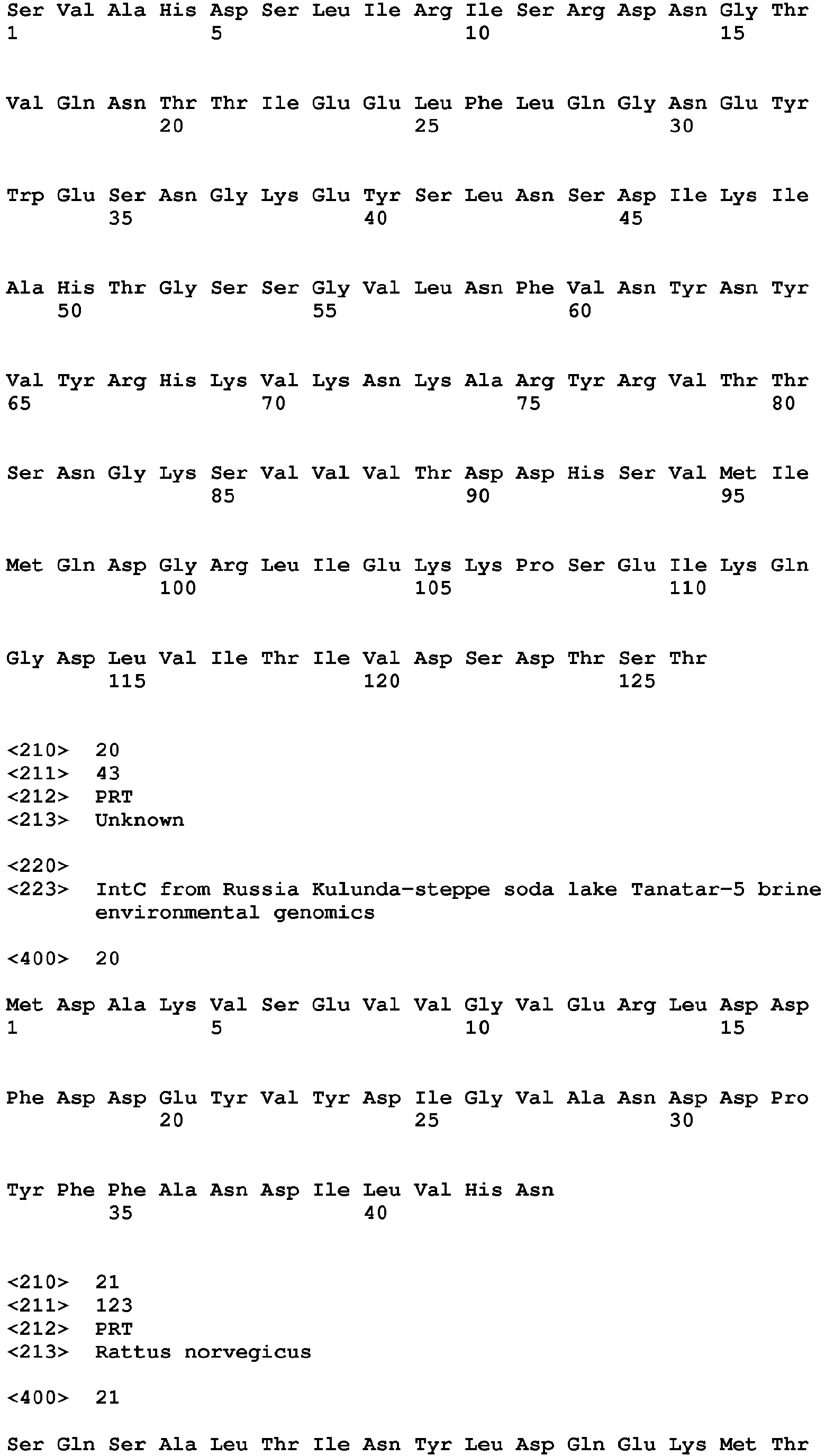
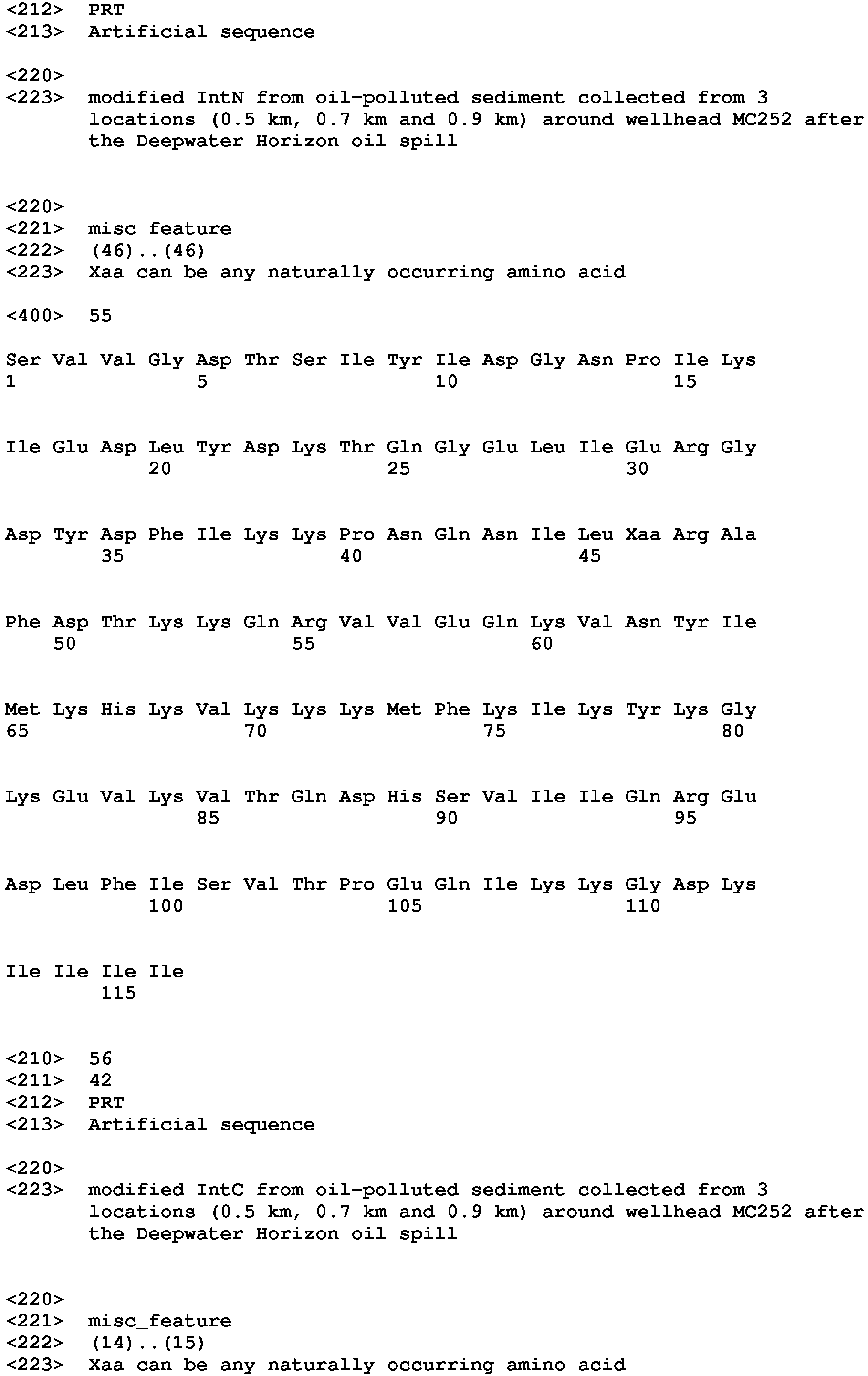
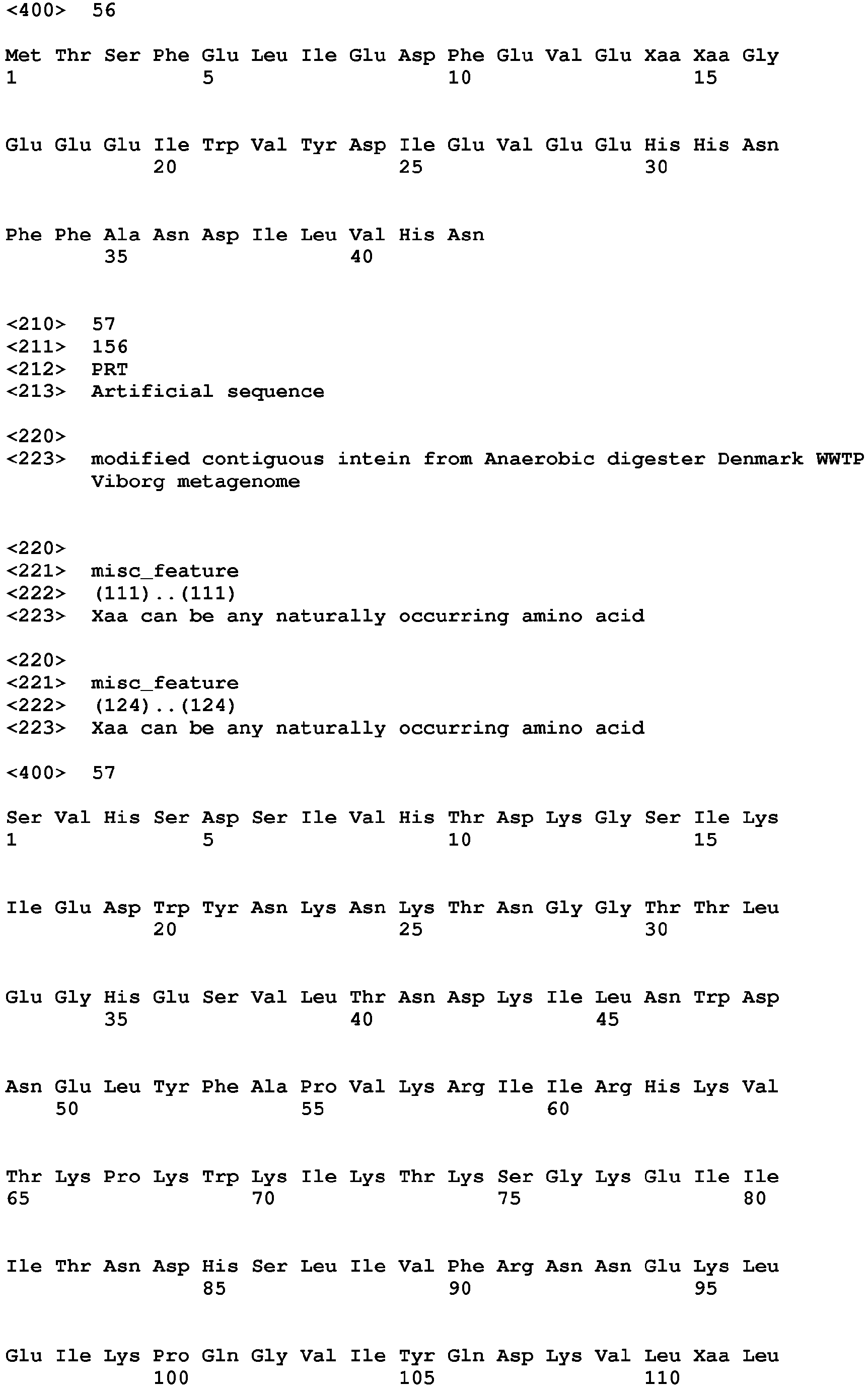
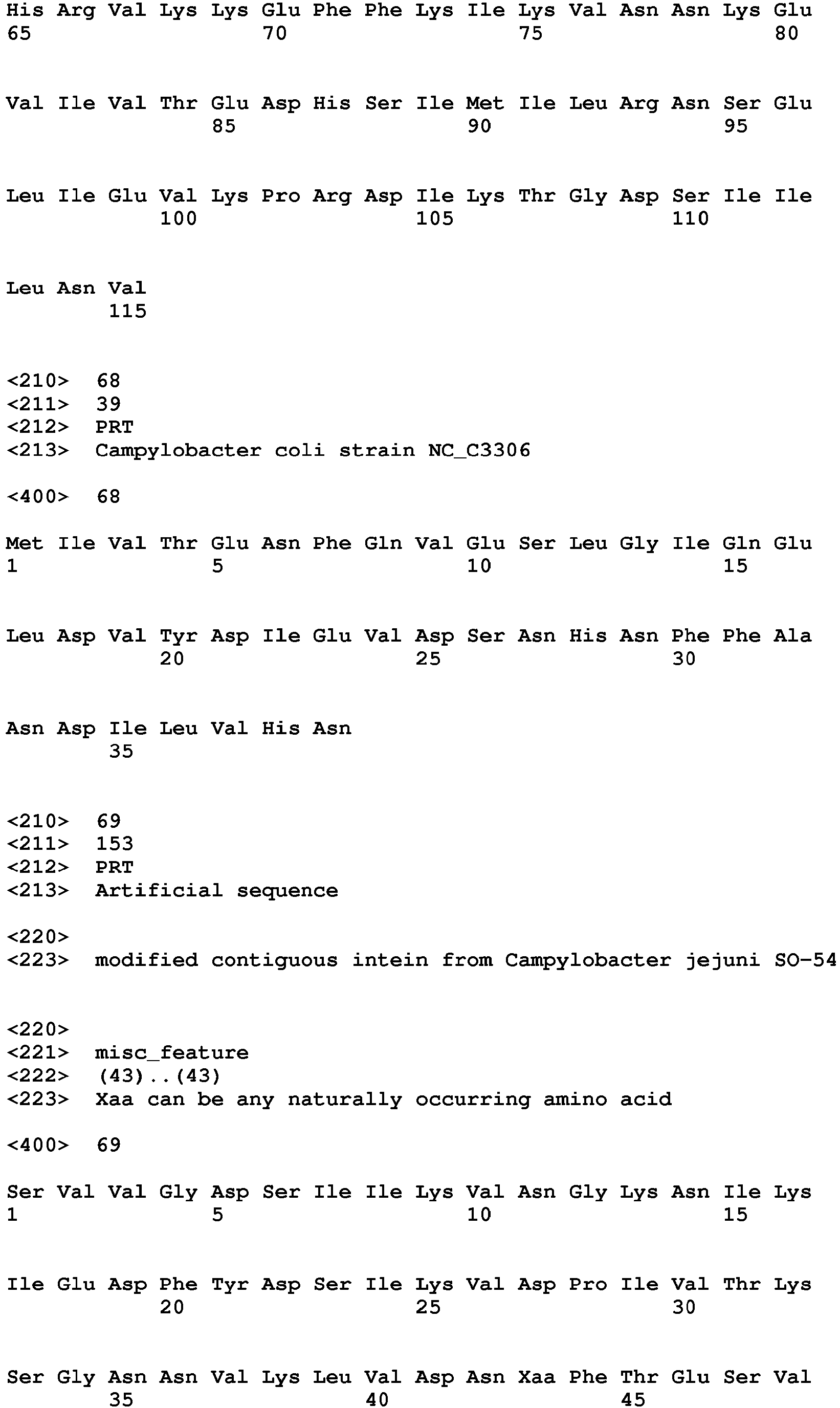
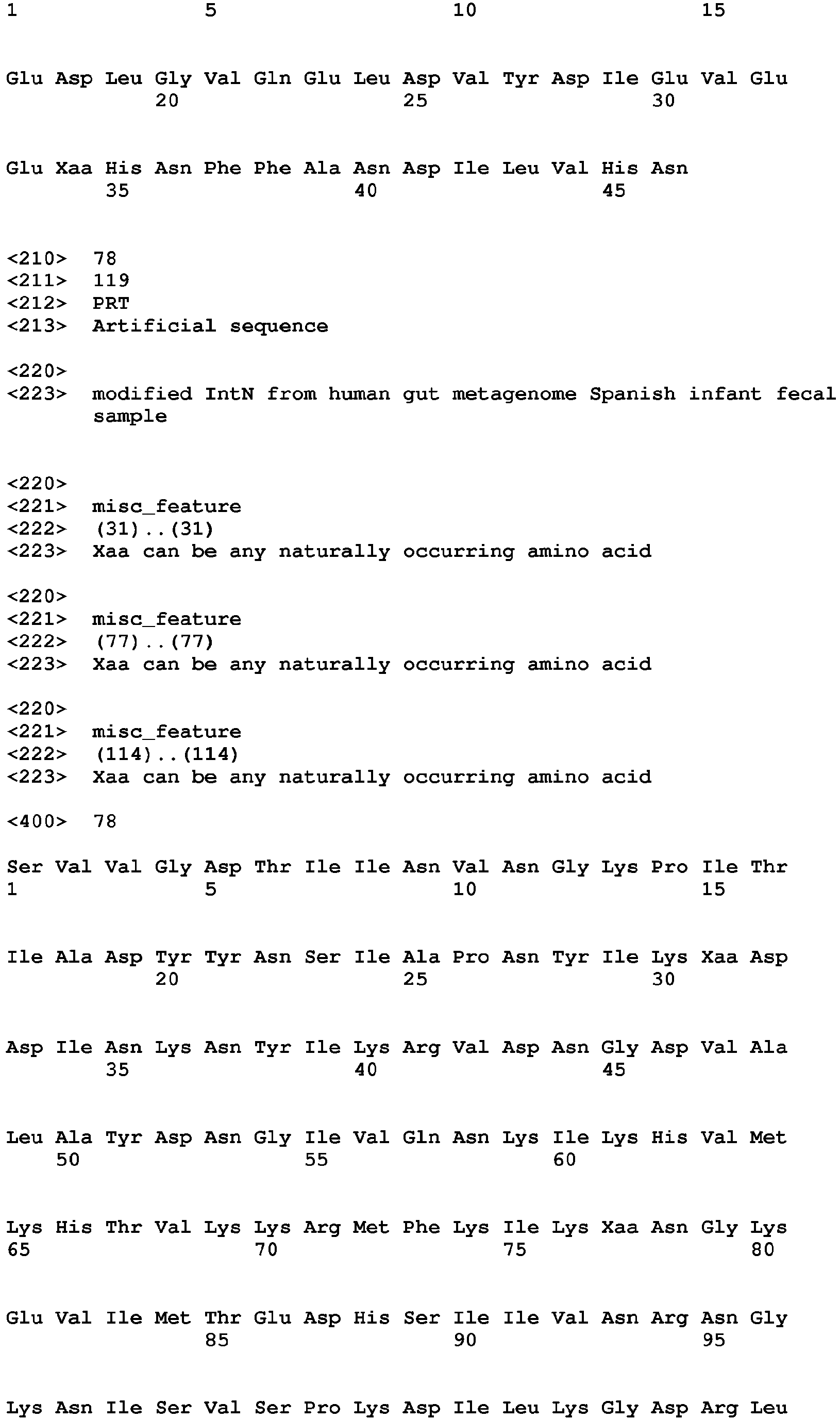
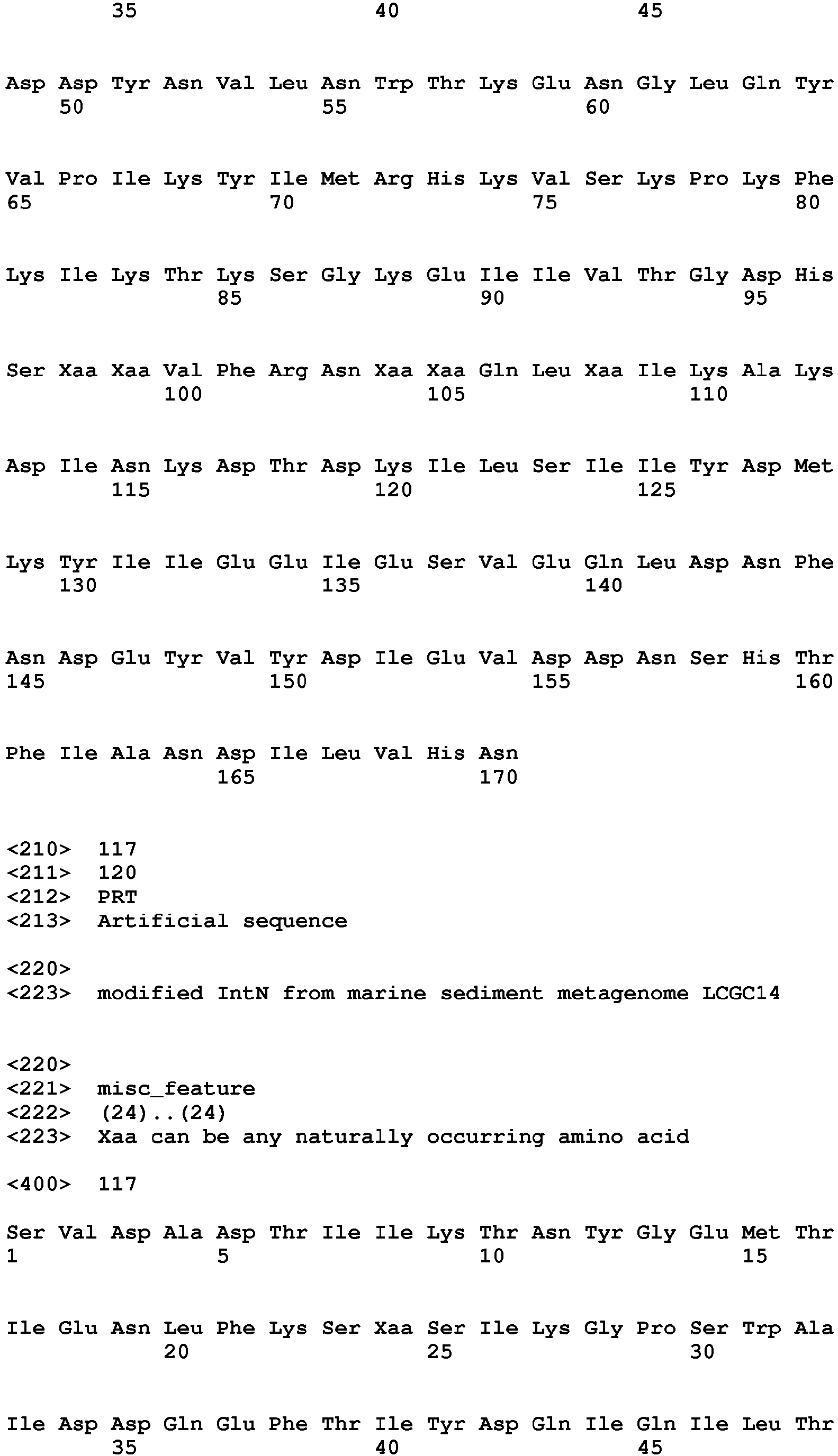
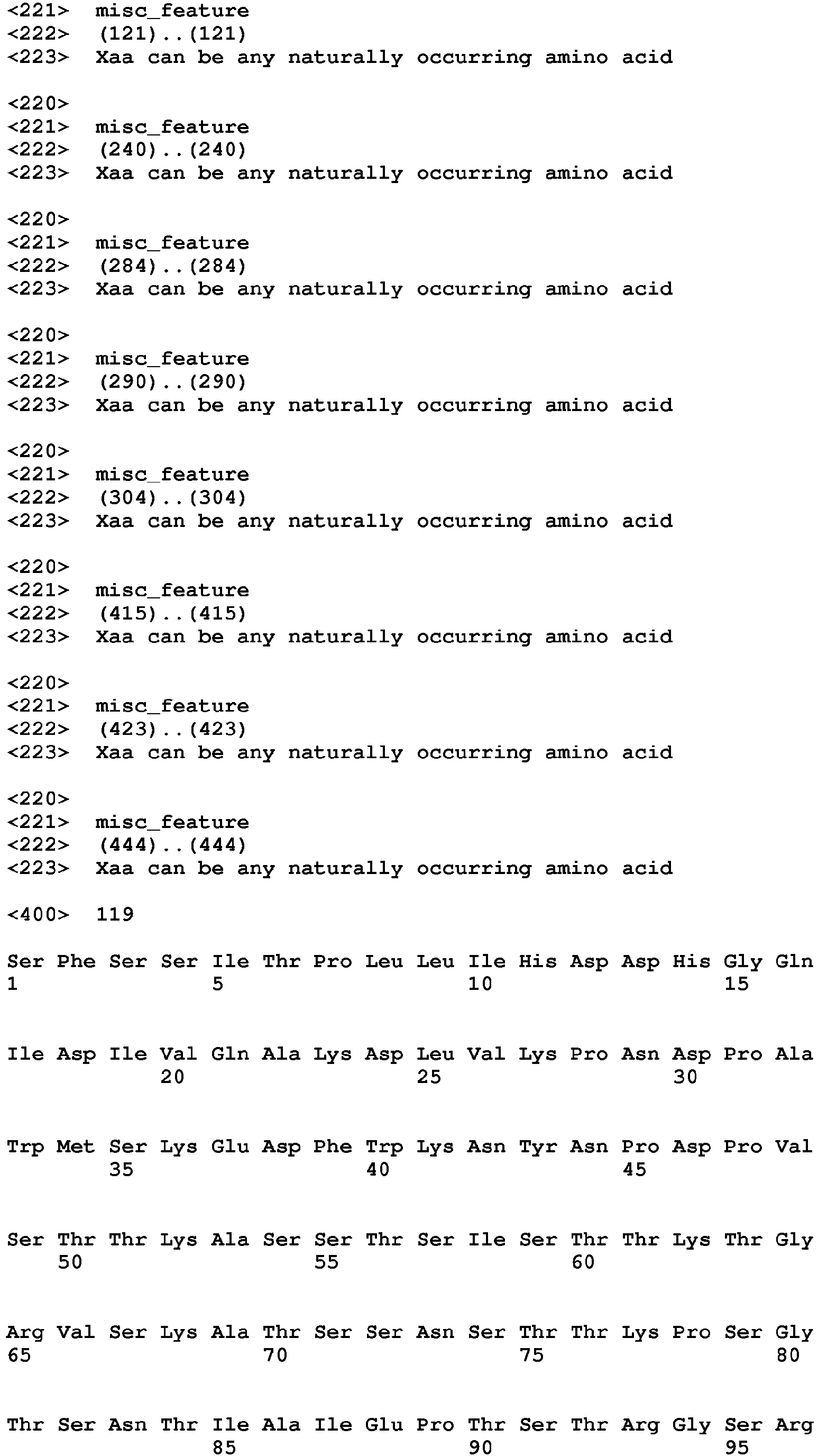
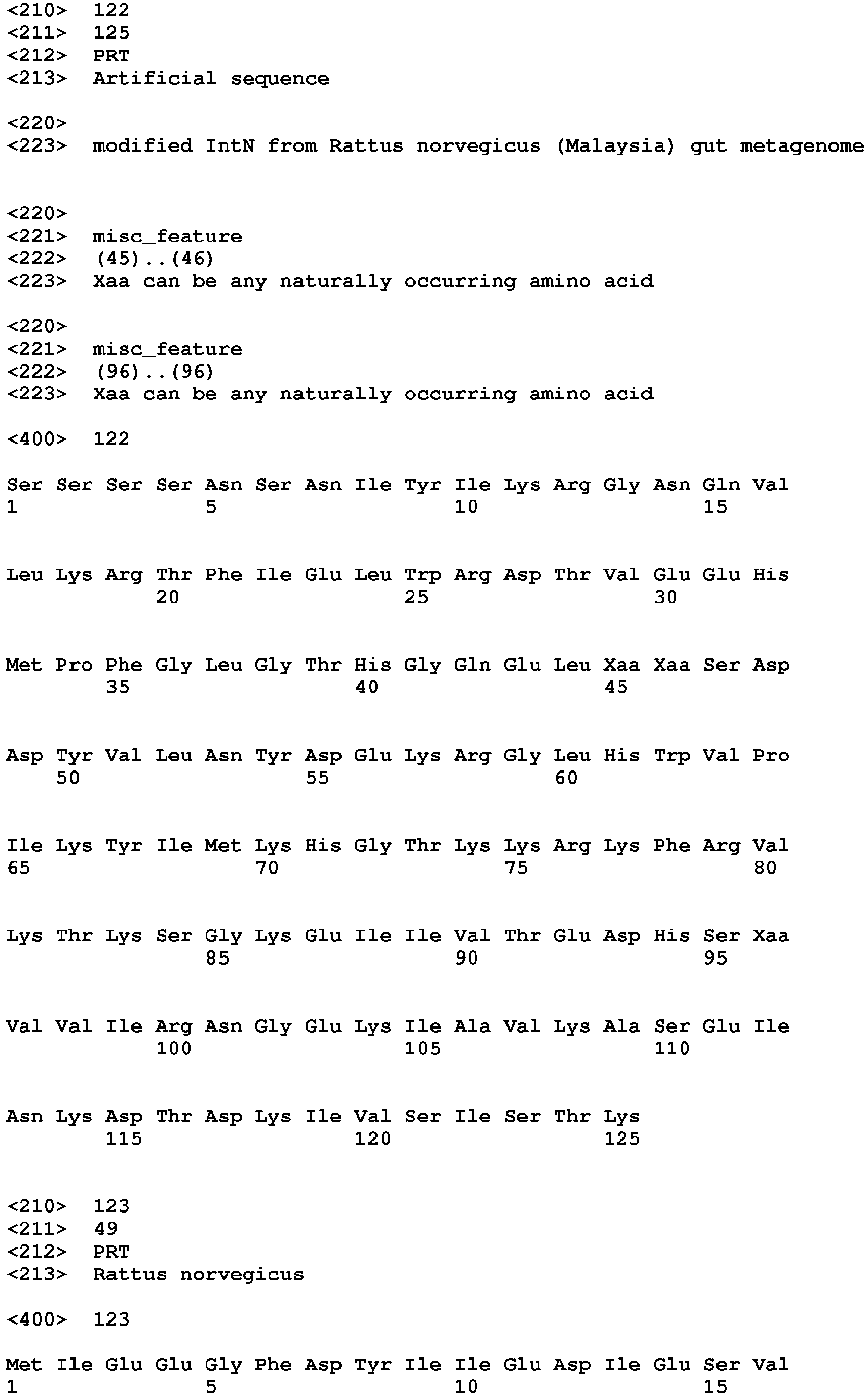
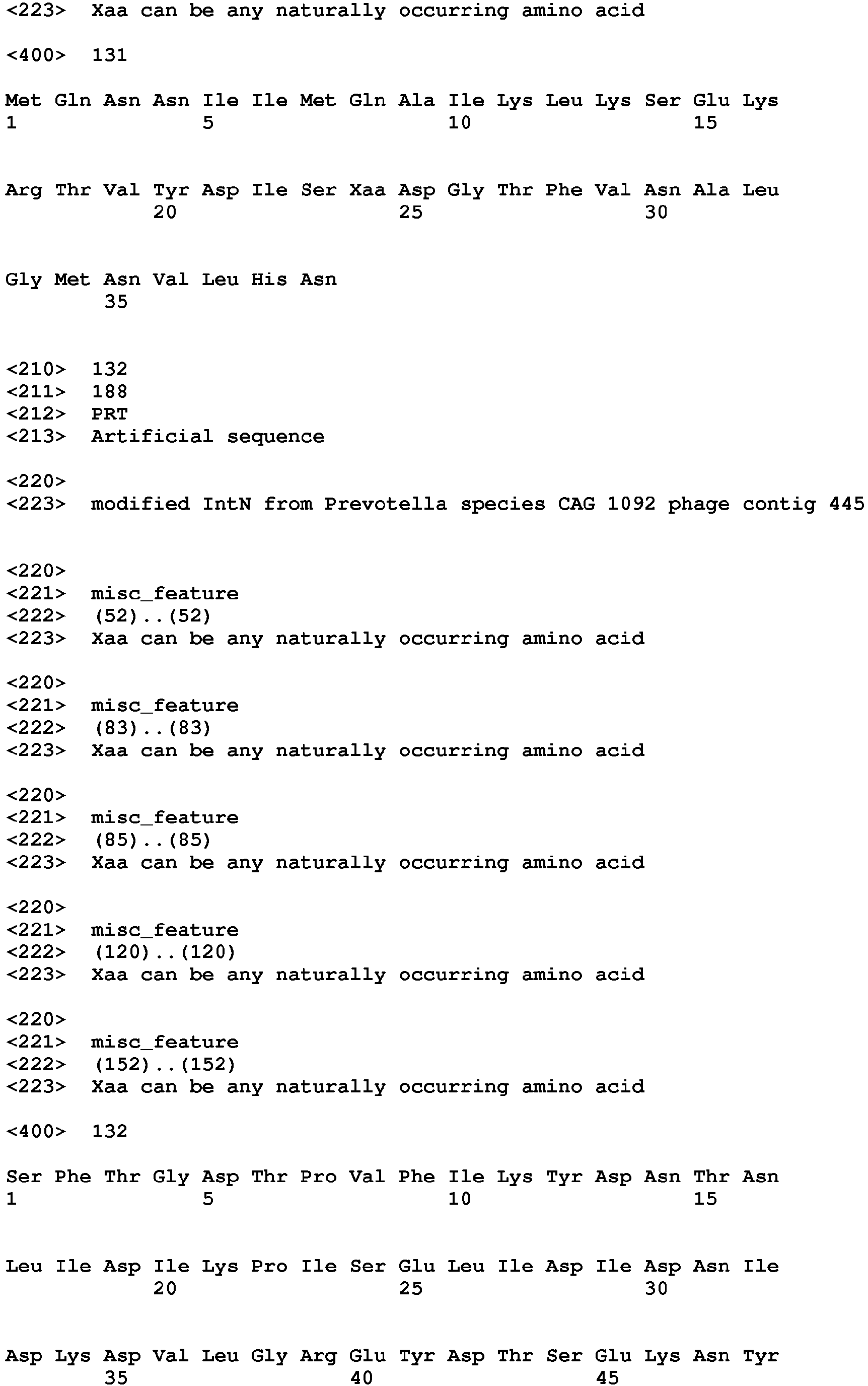
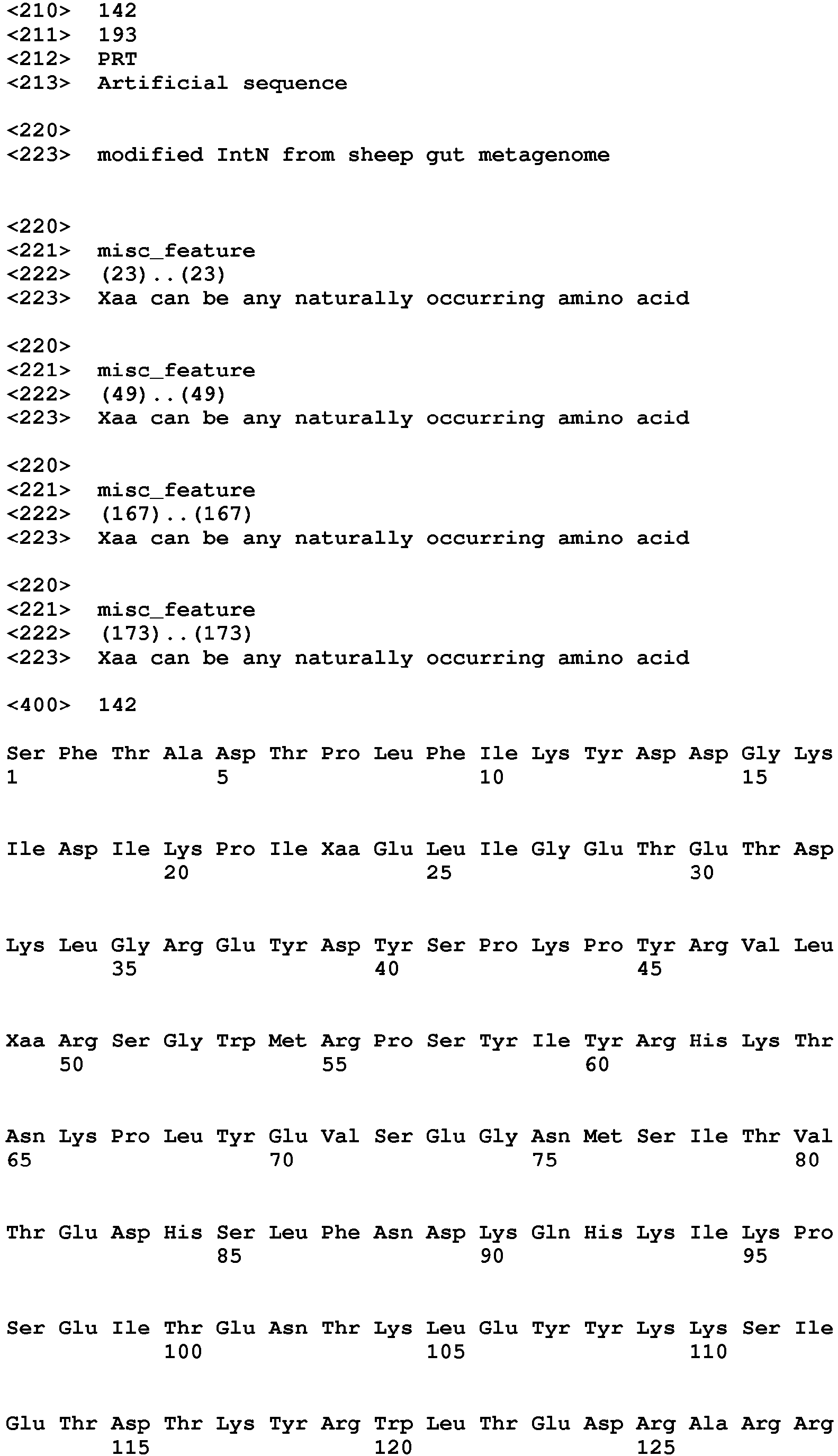
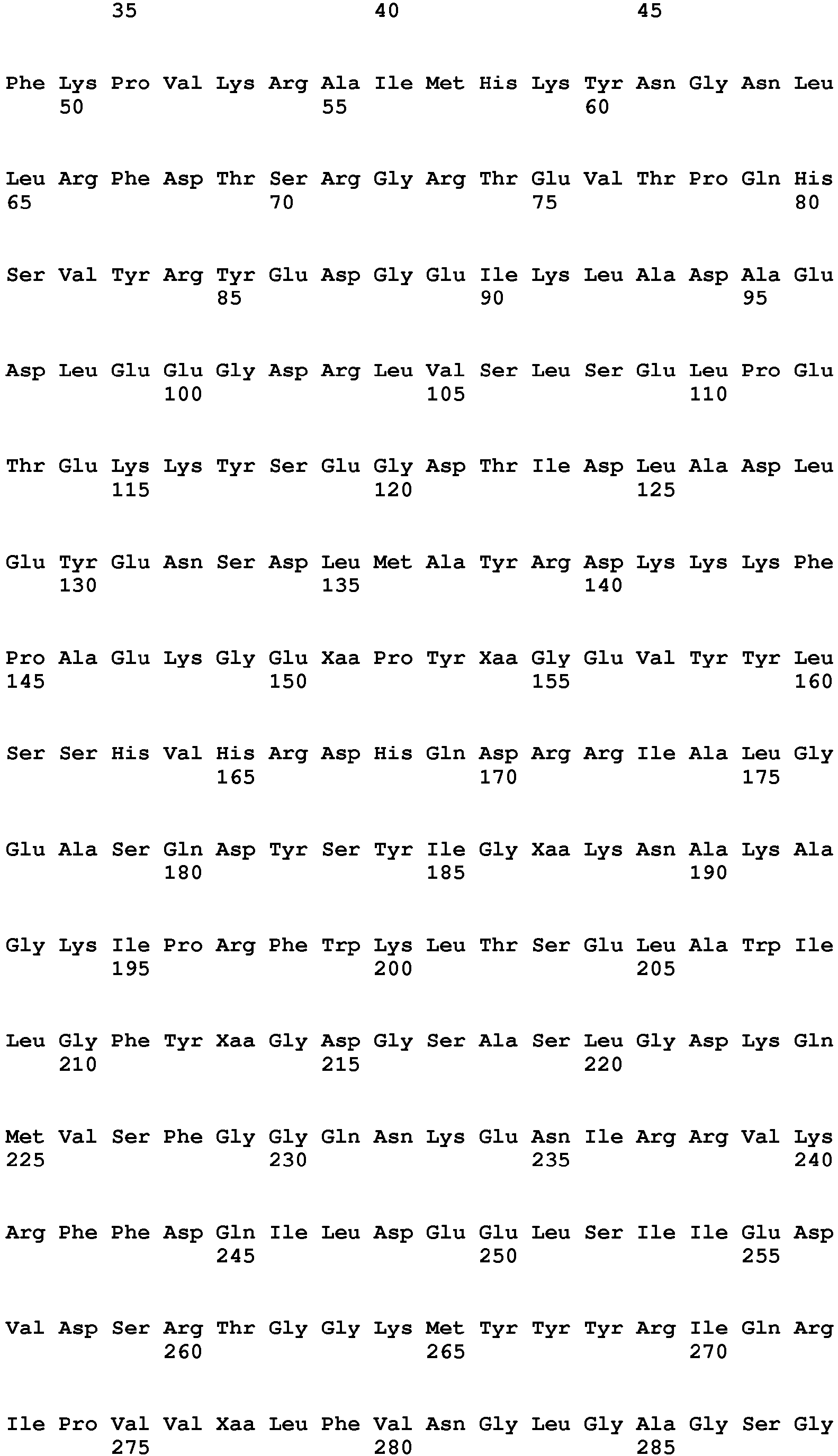
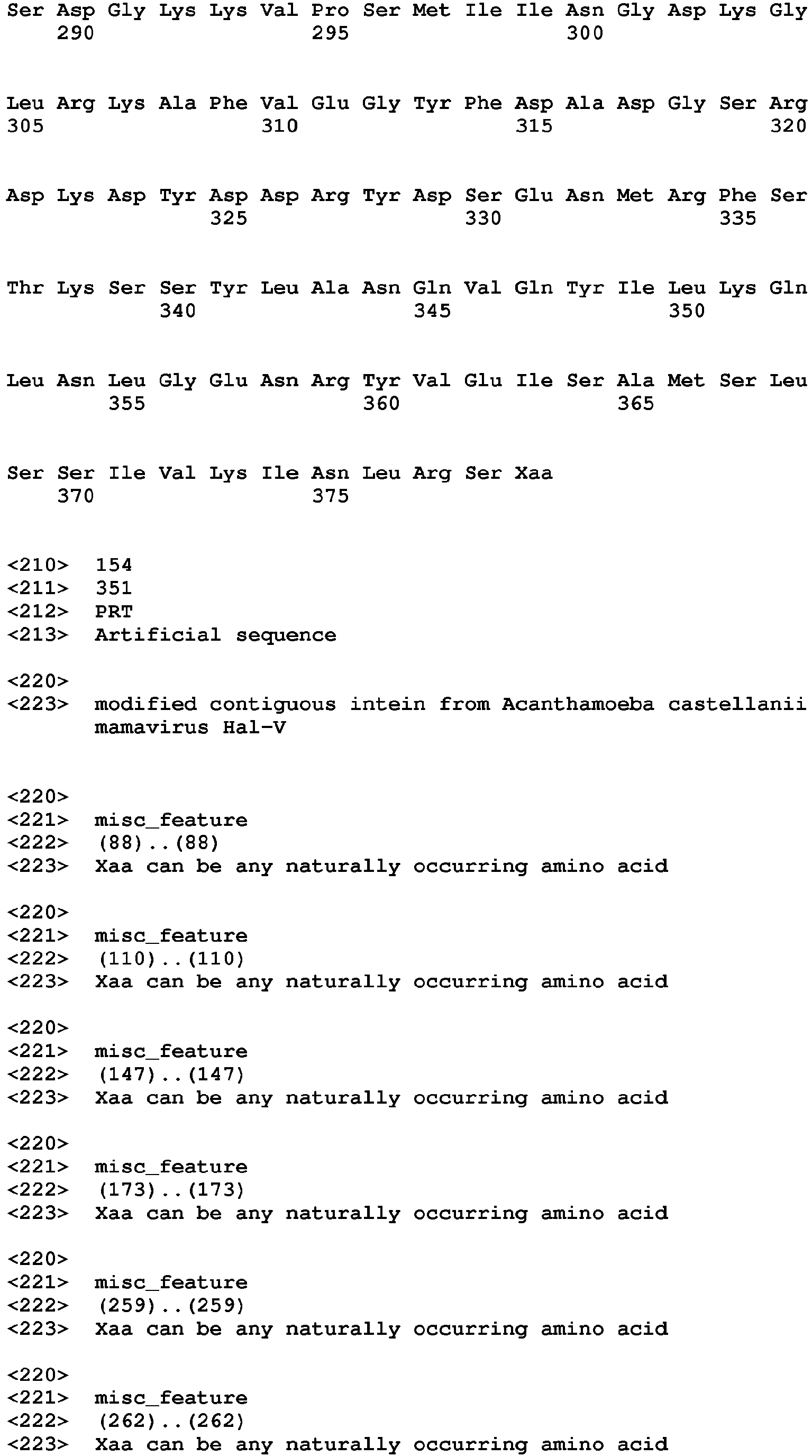
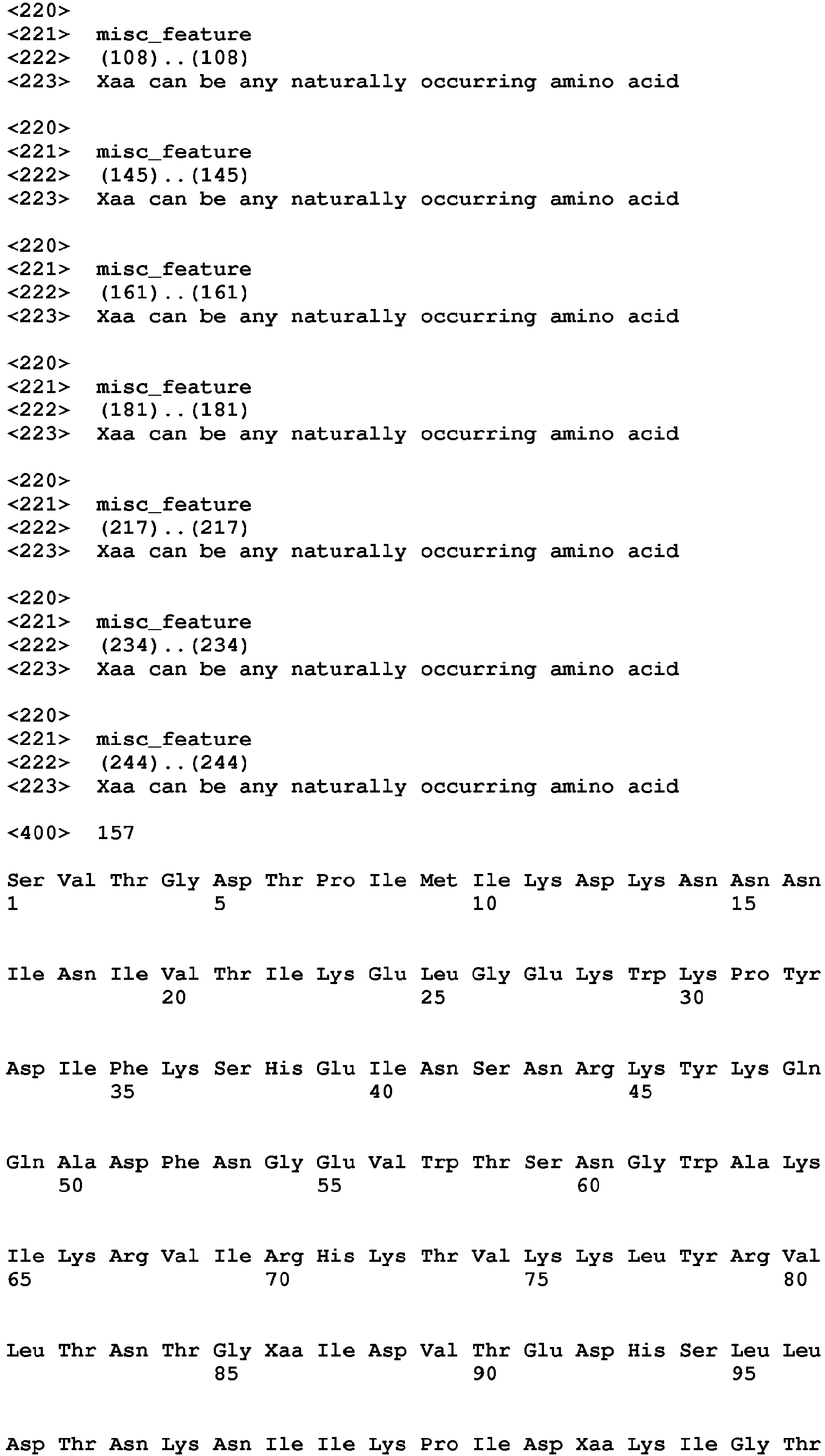
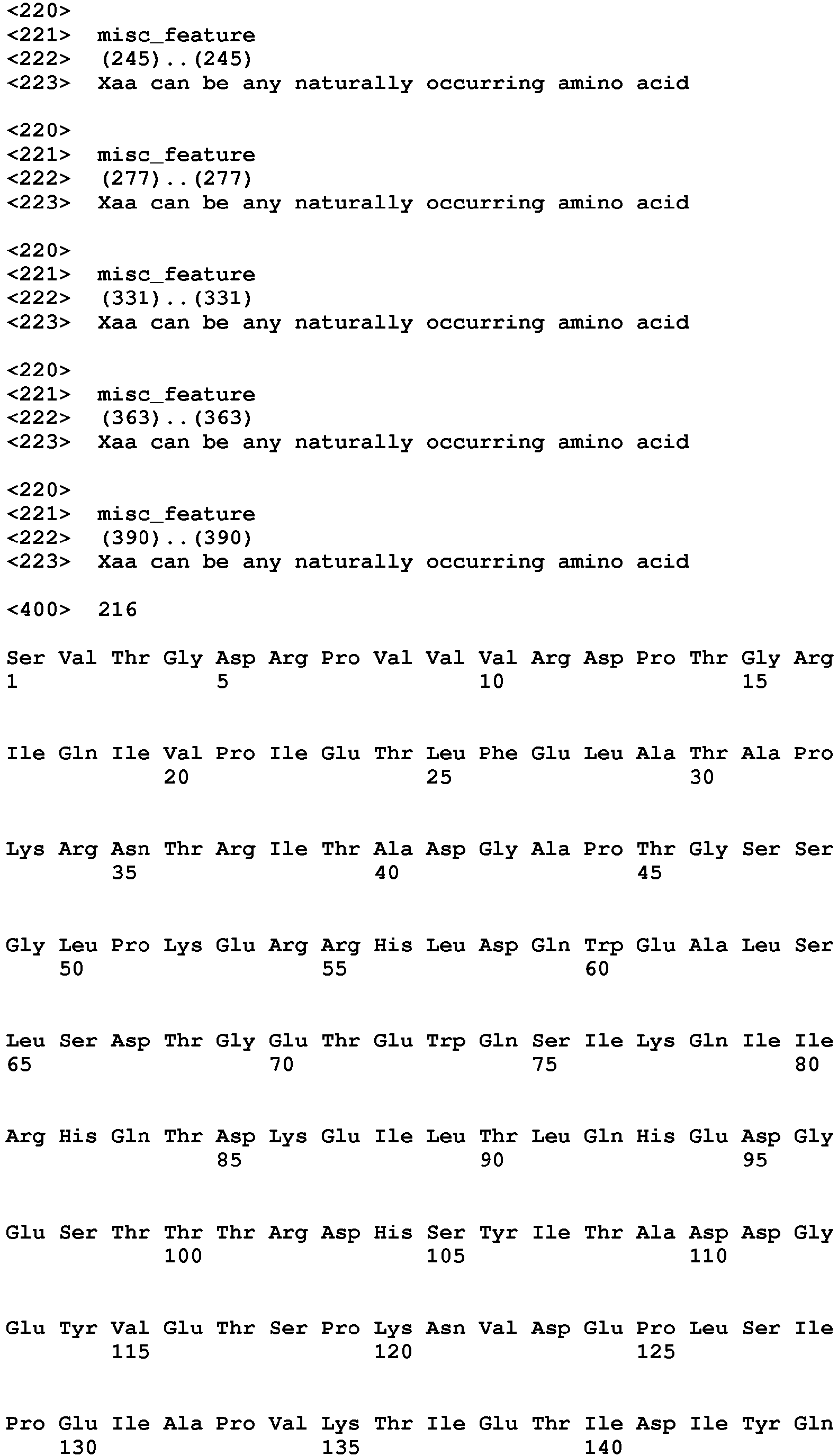
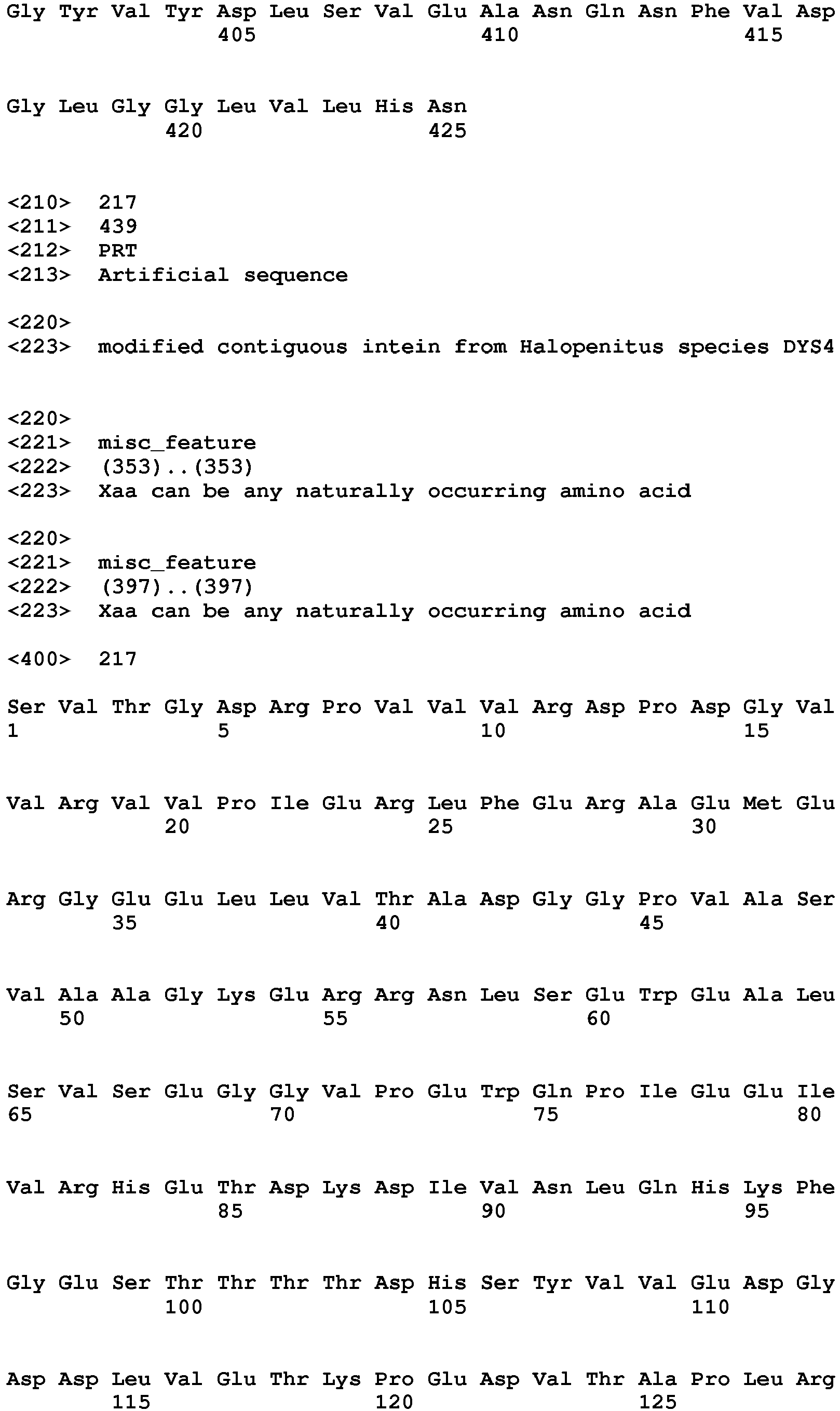
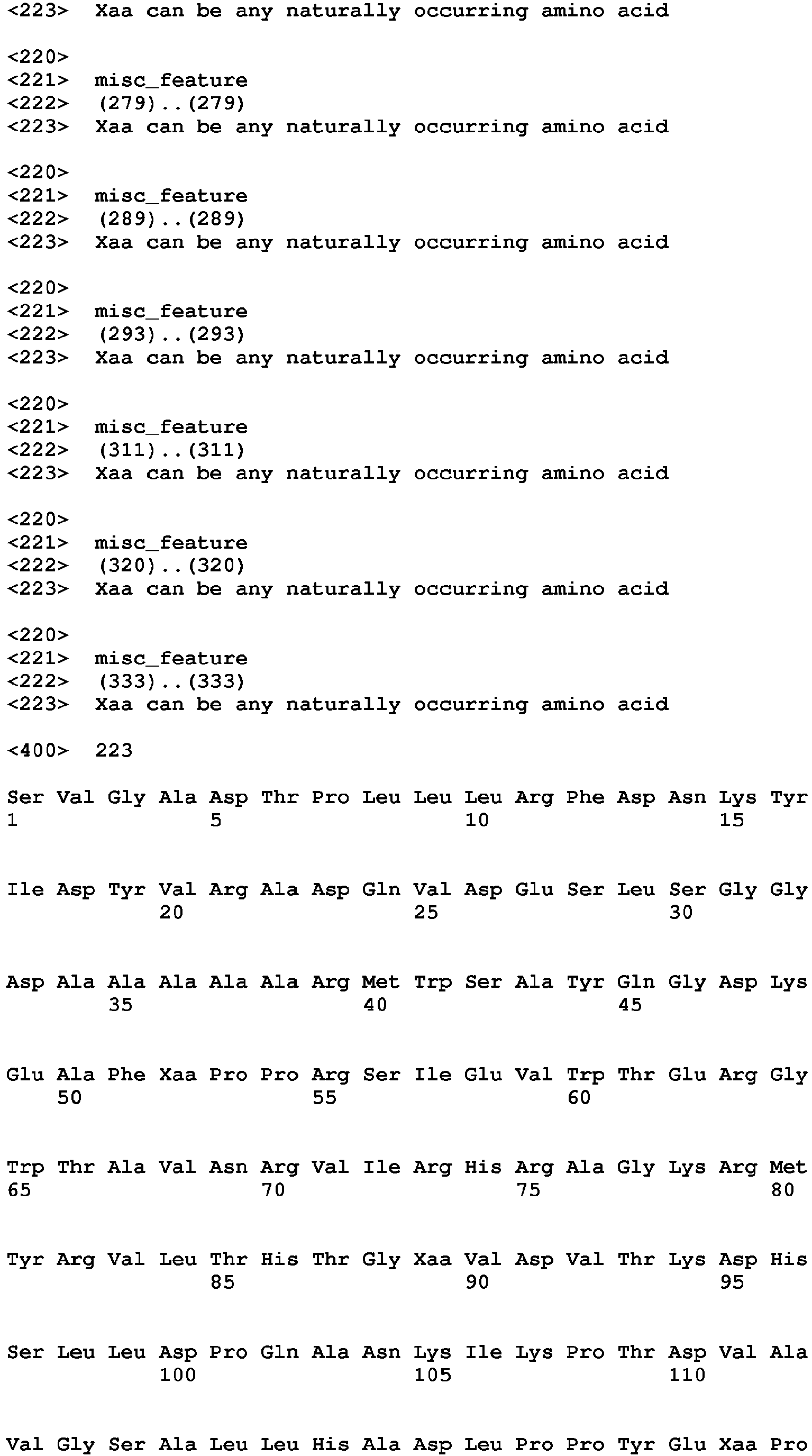
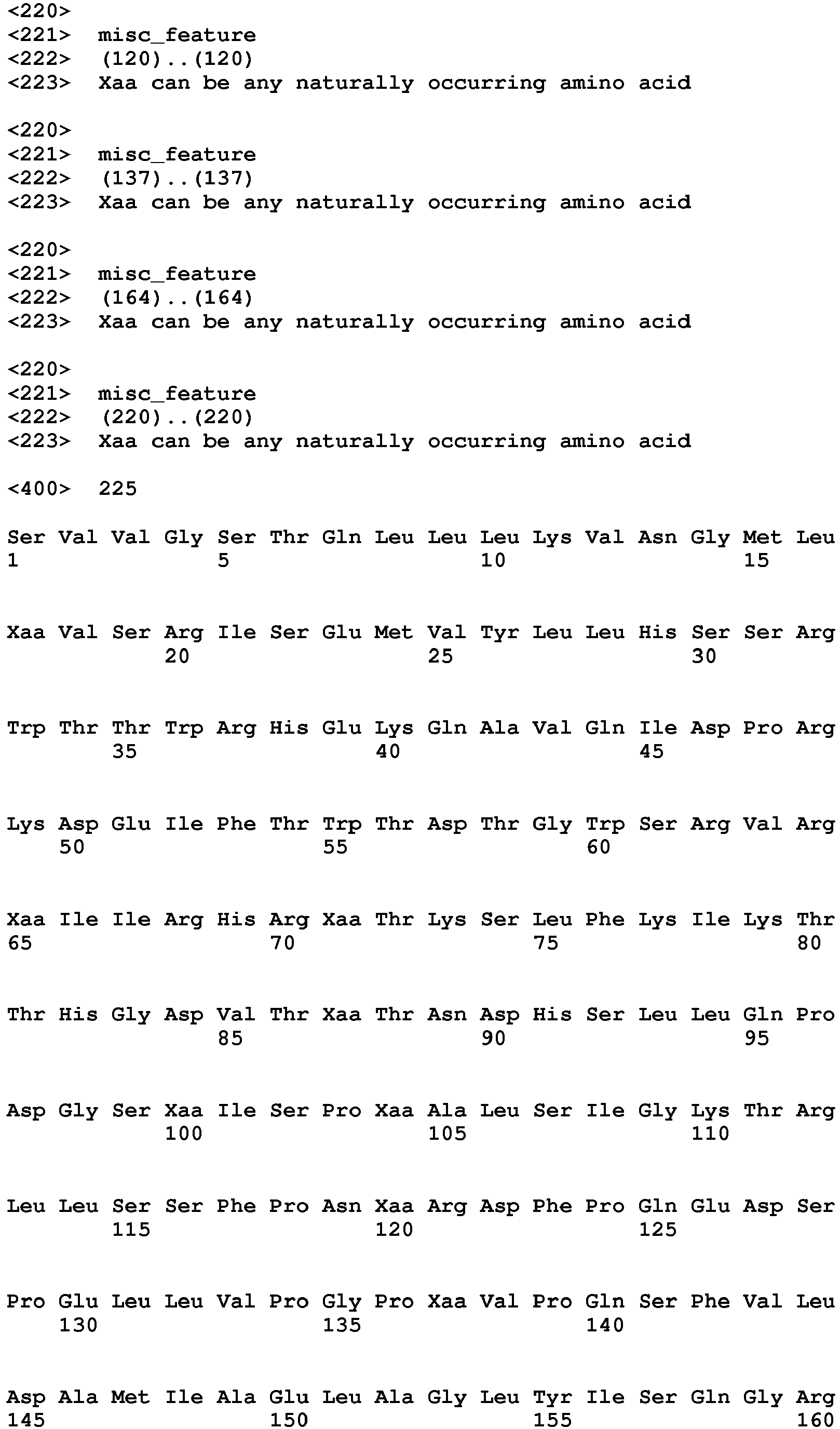
- (i) said at least one first intein amino acid sequence has at least 70 %, at least 80 %, at least 85 %, at least 90 %, at least 95 %, at least 99 % or 100 % sequence identity with any one of the amino acid sequences set forth in SEQ ID Nos. 1, 3, 5, 7, 9, 11, 13, 15, 17, 19, 21, 23, 25, 27, 29, 31, 33, 35, 37, 39, 41, 43, 45, 48, 51, 53, 55, 58, 61, 63, 65, 67, 70, 74, 76, 78, 80, 82, 85, 87, 89, 92, 97, 100, 102, 106, 108, 111, 114, 117, 120, 122, 124, 126, 128, 130, 132, 134, 136, 138, 140, 142, 144, 146 and 147, preferably SEQ ID Nos. 1, 3, 5, 7, 9, 11, 13, 15, 17, 19, 21, 23, 25, 27, 29, 31, 33, 35, 37, 39, 41, 43 and 45, more preferably SEQ ID NO:1 or 3, more preferably SEQ ID NO:3; and/or
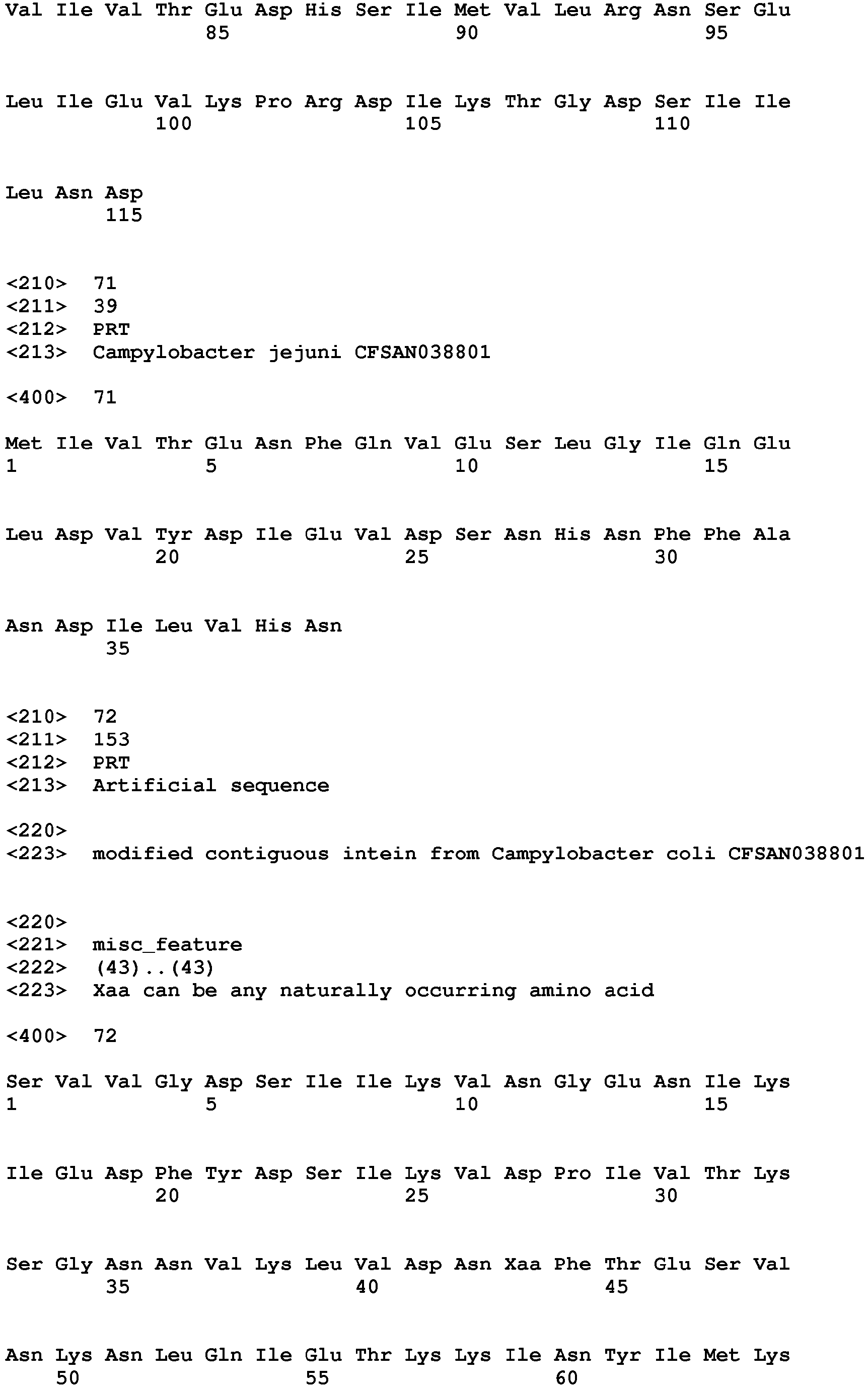
- (ii) said at least one second intein amino acid sequence has at least 70 %, at least 80 %, at least 85 %, at least 90 %, at least 95 %, at least 99 % or 100 % sequence identity with any one of the amino acid sequences set forth in SEQ ID Nos. 2, 4, 6, 8, 10, 12, 14, 16, 18, 20, 22, 24, 26, 28, 30, 32, 34, 36, 38, 40, 42, 44, 46, 49, 52, 54, 56, 59, 62, 64, 66, 68, 71, 75, 77, 79, 81, 83, 86, 88, 90, 93, 98, 101, 103, 107, 109, 112, 115, 118, 121, 123, 125, 127, 129, 131, 133, 135, 137, 139, 141, 143, 145, 148, 149, 150, 151 and 152, preferably SEQ ID Nos. 2, 4, 6, 8, 10, 12, 14, 16, 18, 20, 22, 24, 26, 28, 30, 32, 34, 36, 38, 40, 42, 44 and 46, more preferably SEQ ID NO:2 or 4, more preferably SEQ ID NO:4; or
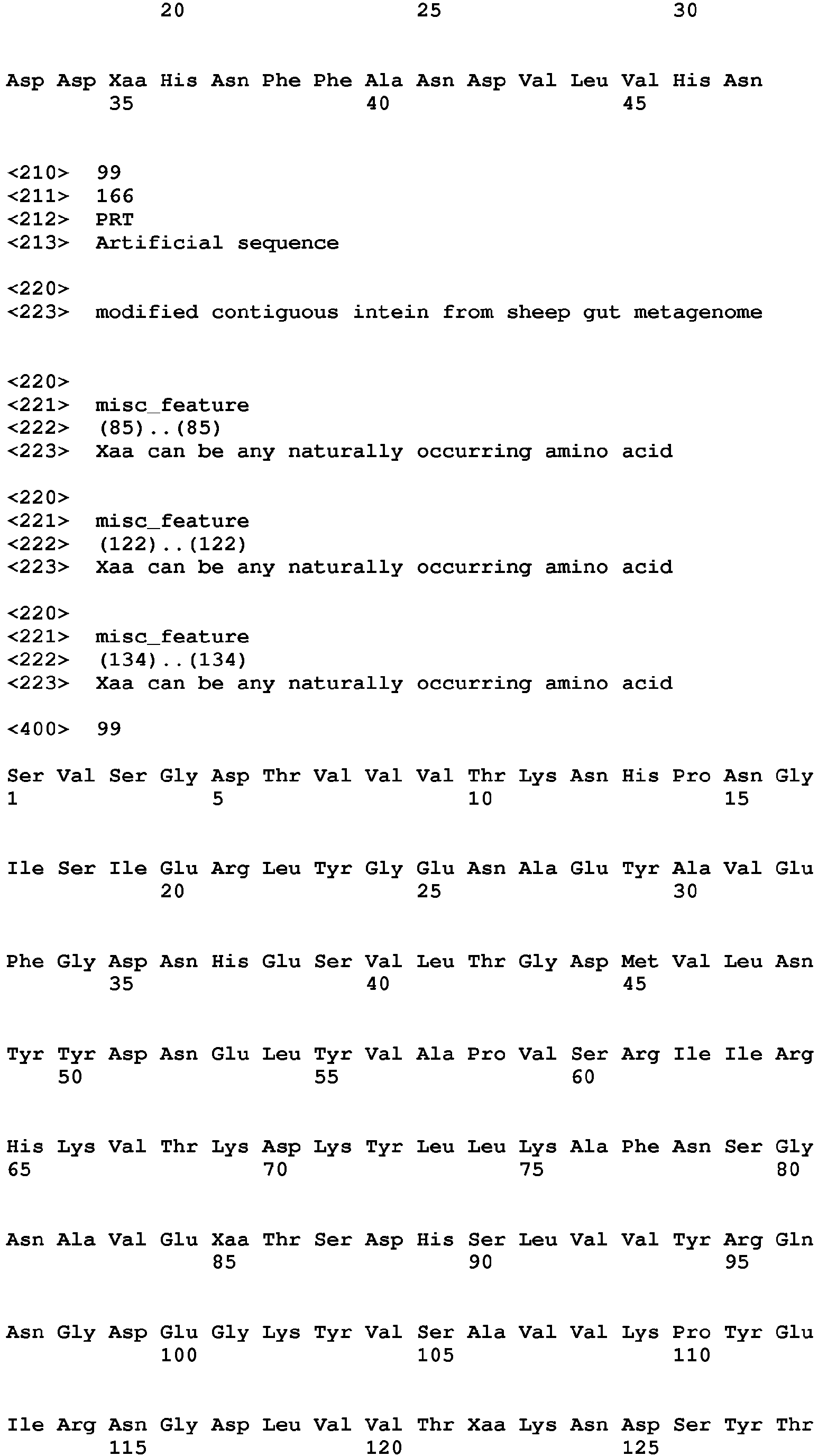
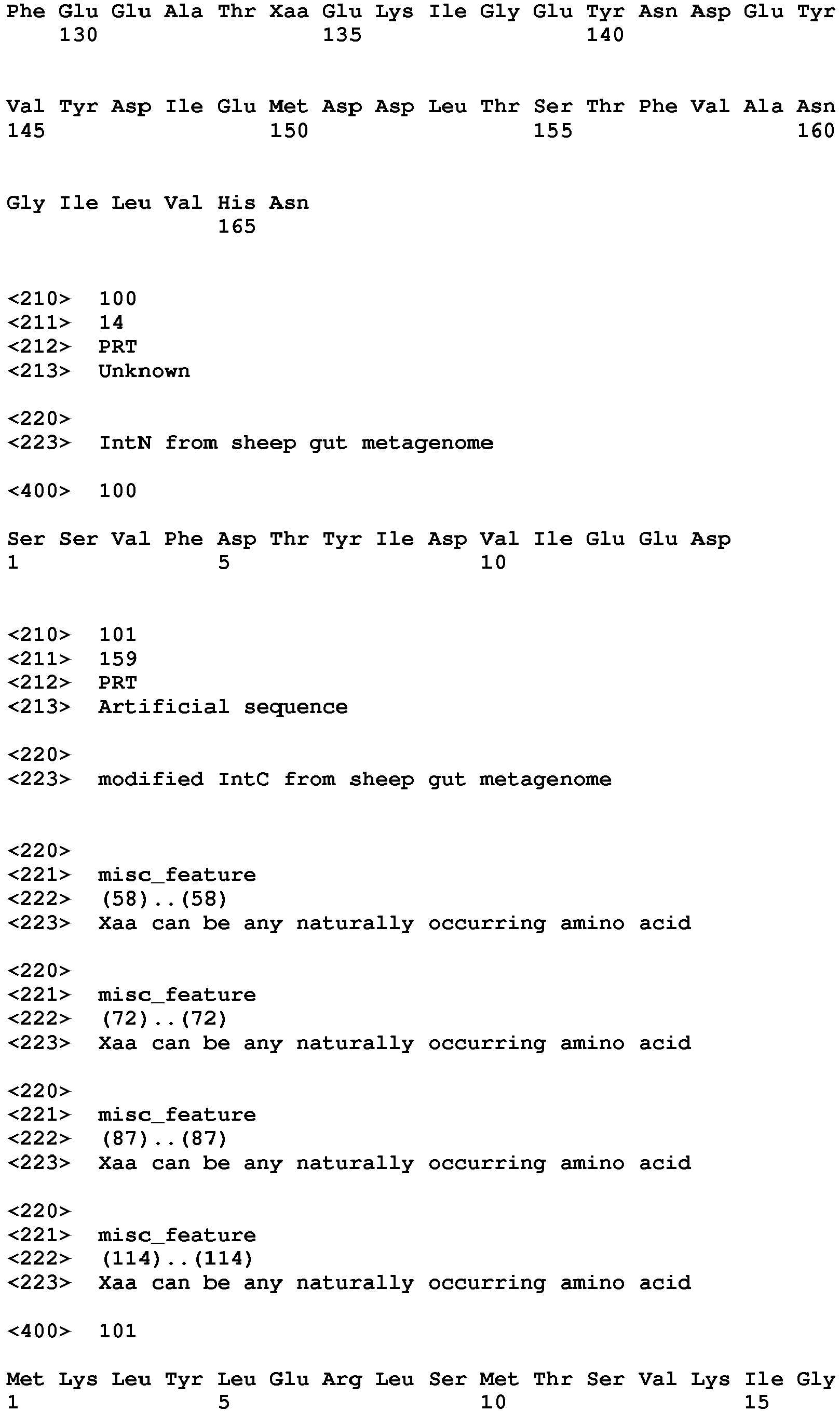
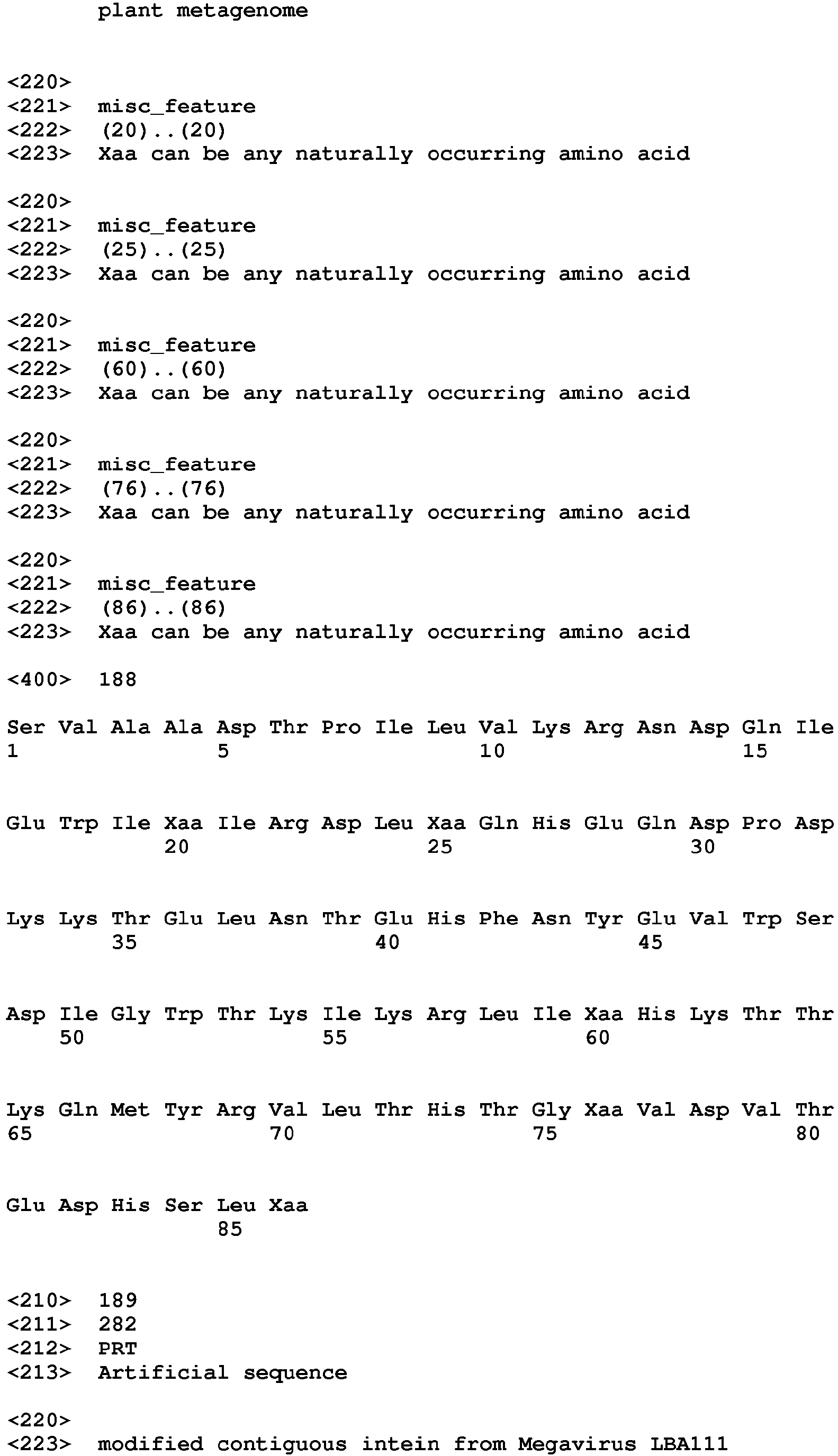
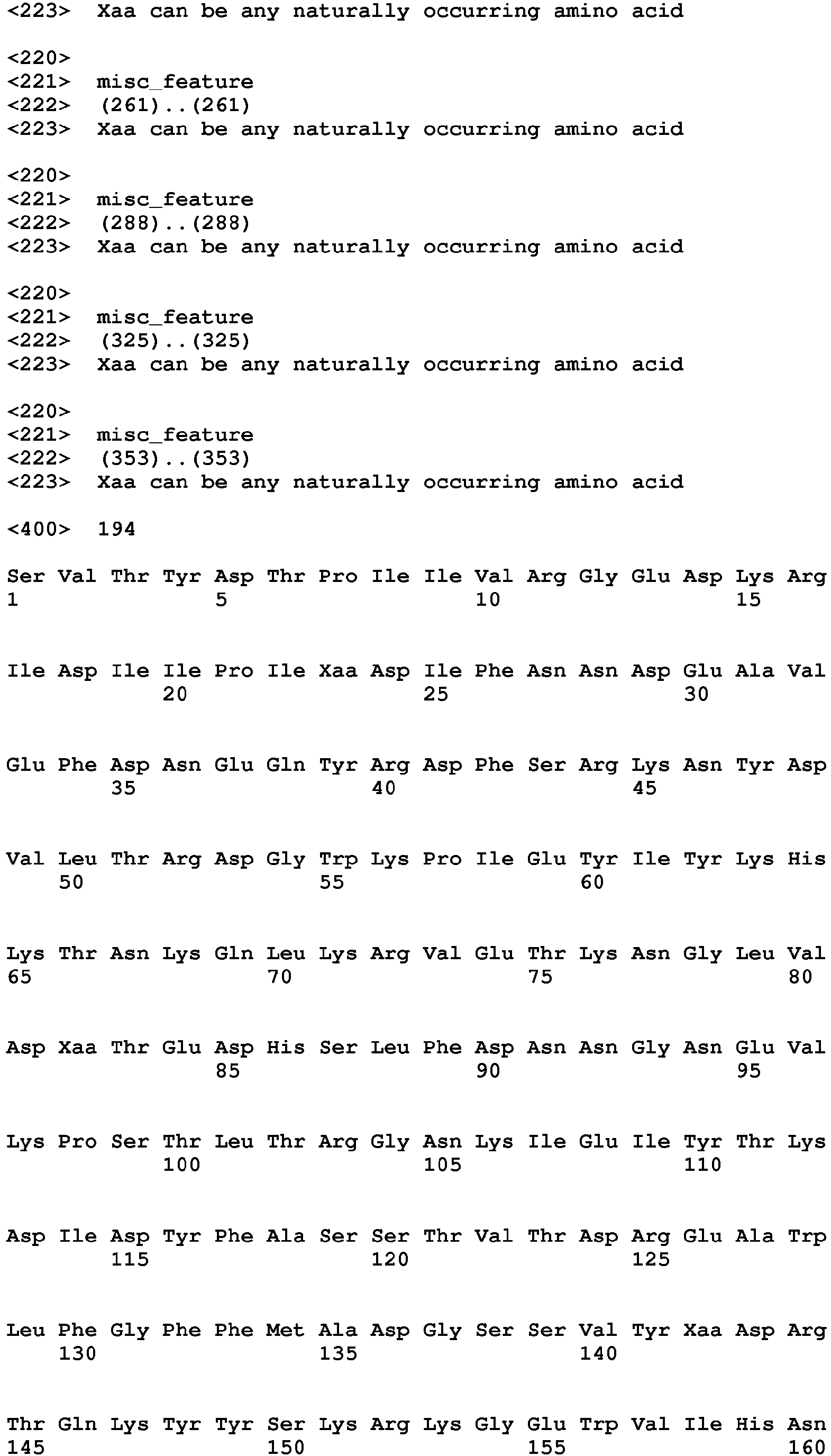
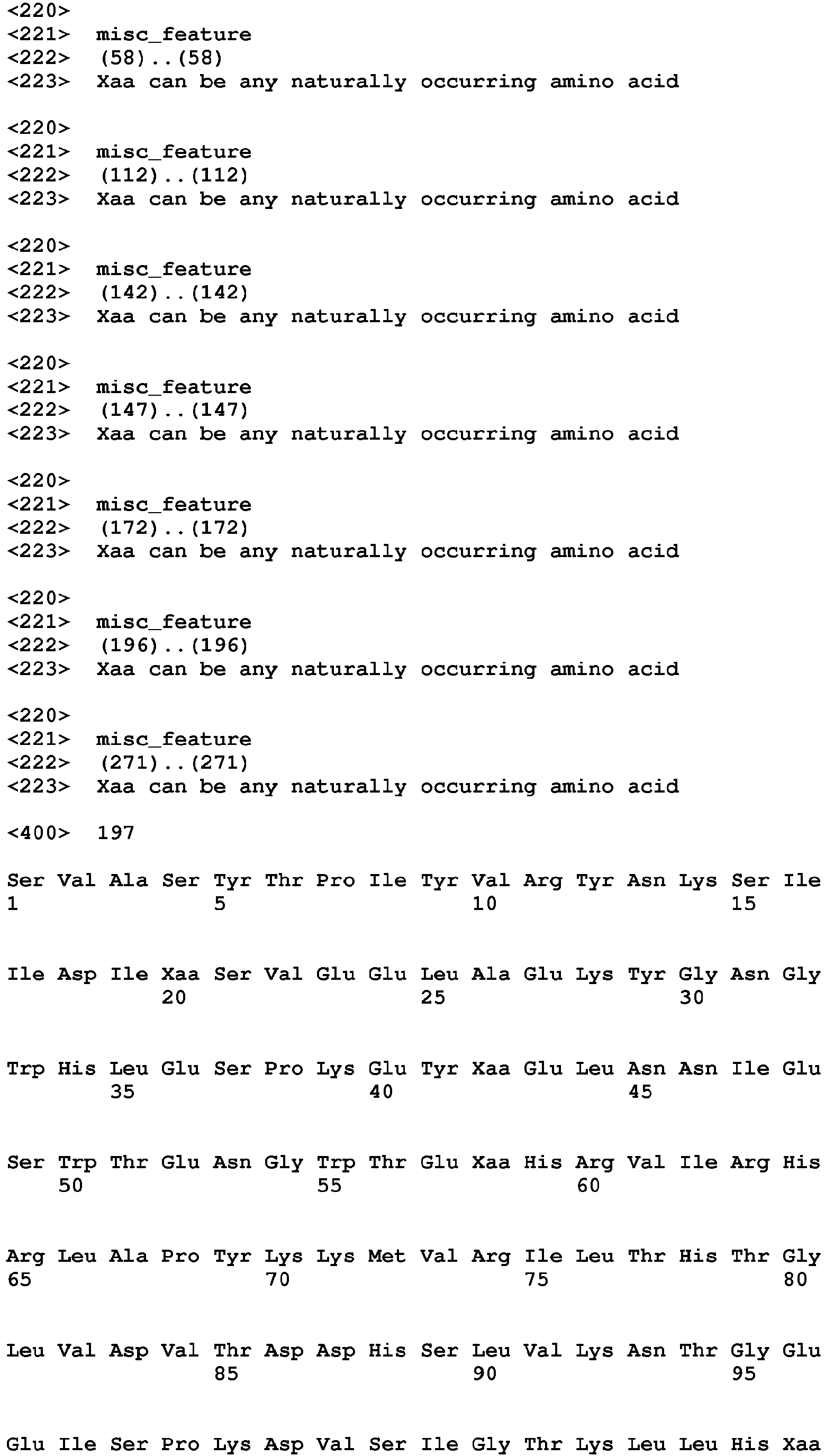
- (iii) at least one intein amino acid sequence comprises the first intein amino acid sequence and the second intein amino acid sequence in one contiguous amino acid sequence; wherein the C-terminus of the first intein sequence is ligated to the N-terminus of the second intein sequence, and wherein the contiguous amino acid sequence has at least 70 %, at least 80 %, at least 85 %, at least 90 %, at least 95 %, at least 99 % or 100 % sequence identity with any one of the amino acid sequences set forth in SEQ ID Nos. 47, 50, 57, 60, 69, 72, 73, 84, 91, 94, 95, 96, 99, 104, 105, 110, 113, 116, 119, 153, 154, 155, 156, 157, 158, 159, 160, 161, 162, 163, 164, 165, 166, 167, 168, 169, 170, 171, 172, 173, 174, 175, 176, 177, 178, 179, 180, 181, 182,183, 184, 185, 186, 187, 188, 189, 190, 191, 192, 193, 194, 195, 196, 197, 198, 199, 200, 201, 202, 203, 204, 205, 206, 207, 208, 209, 210, 211, 212, 213, 214, 215, 216, 217, 218, 219, 220, 221, 222, 223, 224, 225, 226, 227, 228, 229, 230, 231, 232, 233, 234, 235, 236, 237, 238, 239, 240, 241, 242, 243, 244, 245, 246, 247, 248, 249 and 250.
-
Preferably, (a) said at least one first intein amino acid sequence has at least 70 %, at least 80 %, at least 85 %, at least 90 %, at least 95 %, at least 99 % or 100 % sequence identity with the amino acid sequence set forth in SEQ ID NO:1 and said at least one second intein amino acid sequence has at least 70 %, at least 80 %, at least 85 %, at least 90 %, at least 95 %, at least 99 % or 100 % sequence identity with the amino acid sequence set forth in SEQ ID NO:2; or
- (b) said at least one first intein amino acid sequence has at least 70 %, at least 80 %, at least 85 %, at least 90 %, at least 95 %, at least 99 % or 100 % sequence identity with the amino acid sequence set forth in SEQ ID NO:3 and said at least one second intein amino acid sequence has at least 70 %, at least 80 %, at least 85 %, at least 90 %, at least 95 %, at least 99 % or 100 % sequence identity with the amino acid sequence set forth in SEQ ID NO:4; or
- (c) wherein said at least one first intein amino acid sequence has at least 70 %, at least 80 %, at least 85 %, at least 90 %, at least 95 %, at least 99 % or 100 % sequence identity with the amino acid sequence set forth in SEQ ID NO:5 and said at least one second intein amino acid sequence has at least 70 %, at least 80 %, at least 85 %, at least 90 %, at least 95 %, at least 99 % or 100 % sequence identity with the amino acid sequence set forth in SEQ ID NO:6; or
- (d) wherein said at least one first intein amino acid sequence has at least 70 %, at least 80 %, at least 85 %, at least 90 %, at least 95 %, at least 99 % or 100 % sequence identity with the amino acid sequence set forth in SEQ ID NO:7 and said at least one second intein amino acid sequence has at least 70 %, at least 80 %, at least 85 %, at least 90 %, at least 95 %, at least 99 % or 100 % sequence identity with the amino acid sequence set forth in SEQ ID NO:8; or
- (e) wherein said at least one first intein amino acid sequence has at least 70 %, at least 80 %, at least 85 %, at least 90 %, at least 95 %, at least 99 % or 100 % sequence identity with the amino acid sequence set forth in SEQ ID NO:9 and said at least one second intein amino acid sequence has at least 70 %, at least 80 %, at least 85 %, at least 90 %, at least 95 %, at least 99 % or 100 % sequence identity with the amino acid sequence set forth in SEQ ID NO:10; or
- (f) wherein said at least one first intein amino acid sequence has at least 70 %, at least 80 %, at least 85 %, at least 90 %, at least 95 %, at least 99 % or 100 % sequence identity with the amino acid sequence set forth in SEQ ID NO:11 and said at least one second intein amino acid sequence has at least 70 %, at least 80 %, at least 85 %, at least 90 %, at least 95 %, at least 99 % or 100 % sequence identity with the amino acid sequence set forth in SEQ ID NO:12; or
- (g) wherein said at least one first intein amino acid sequence has at least 70 %, at least 80 %, at least 85 %, at least 90 %, at least 95 %, at least 99 % or 100 % sequence identity with the amino acid sequence set forth in SEQ ID NO:13 and said at least one second intein amino acid sequence has at least 70 %, at least 80 %, at least 85 %, at least 90 %, at least 95 %, at least 99 % or 100 % sequence identity with the amino acid sequence set forth in SEQ ID NO:14; or
- (h) wherein said at least one first intein amino acid sequence has at least 70 %, at least 80 %, at least 85 %, at least 90 %, at least 95 %, at least 99 % or 100 % sequence identity with the amino acid sequence set forth in SEQ ID NO:15 and said at least one second intein amino acid sequence has at least 70 %, at least 80 %, at least 85 %, at least 90 %, at least 95 %, at least 99 % or 100 % sequence identity with the amino acid sequence set forth in SEQ ID NO:16; or
- (i) wherein said at least one firstl intein amino acid sequence has at least 70 %, at least 80 %, at least 85 %, at least 90 %, at least 95 %, at least 99 % or 100 % sequence identity with the amino acid sequence set forth in SEQ ID NO:17 and said at least one second intein amino acid sequence has at least 70 %, at least 80 %, at least 85 %, at least 90 %, at least 95 %, at least 99 % or 100 % sequence identity with the amino acid sequence set forth in SEQ ID NO:18; or
- (j) wherein said at least one first intein amino acid sequence has at least 70 %, at least 80 %, at least 85 %, at least 90 %, at least 95 %, at least 99 % or 100 % sequence identity with the amino acid sequence set forth in SEQ ID NO:19 and said at least one second intein amino acid sequence has at least 70 %, at least 80 %, at least 85 %, at least 90 %, at least 95 %, at least 99 % or 100 % sequence identity with the amino acid sequence set forth in SEQ ID NO:20; or
- (k) wherein said at least one first intein amino acid sequence has at least 70 %, at least 80 %, at least 85 %, at least 90 %, at least 95 %, at least 99 % or 100 % sequence identity with the amino acid sequence set forth in SEQ ID NO:21 and said at least one second intein amino acid sequence has at least 70 %, at least 80 %, at least 85 %, at least 90 %, at least 95 %, at least 99 % or 100 % sequence identity with the amino acid sequence set forth in SEQ ID NO:22; or
- (I) wherein said at least one first intein amino acid sequence has at least 70 %, at least 80 %, at least 85 %, at least 90 %, at least 95 %, at least 99 % or 100 % sequence identity with the amino acid sequence set forth in SEQ ID NO:23 and said at least one second intein amino acid sequence has at least 70 %, at least 80 %, at least 85 %, at least 90 %, at least 95 %, at least 99 % or 100 % sequence identity with the amino acid sequence set forth in SEQ ID NO:24; or
- (m) wherein said at least one first intein amino acid sequence has at least 70 %, at least 80 %, at least 85 %, at least 90 %, at least 95 %, at least 99 % or 100 % sequence identity with the amino acid sequence set forth in SEQ ID NO:25 and said at least one second intein amino acid sequence has at least 70 %, at least 80 %, at least 85 %, at least 90 %, at least 95 %, at least 99 % or 100 % sequence identity with the amino acid sequence set forth in SEQ ID NO:26; or
- (n) wherein said at least one first intein amino acid sequence has at least 70 %, at least 80 %, at least 85 %, at least 90 %, at least 95 %, at least 99 % or 100 % sequence identity with the amino acid sequence set forth in SEQ ID NO:27 and said at least one second intein amino acid sequence has at least 70 %, at least 80 %, at least 85 %, at least 90 %, at least 95 %, at least 99 % or 100 % sequence identity with the amino acid sequence set forth in SEQ ID NO:28; or
- (o) wherein said at least one first intein amino acid sequence has at least 70 %, at least 80 %, at least 85 %, at least 90 %, at least 95 %, at least 99 % or 100 % sequence identity with the amino acid sequence set forth in SEQ ID NO:29 and said at least one second intein amino acid sequence has at least 70 %, at least 80 %, at least 85 %, at least 90 %, at least 95 %, at least 99 % or 100 % sequence identity with the amino acid sequence set forth in SEQ ID NO:30; or
- (p) wherein said at least one first intein amino acid sequence has at least 70 %, at least 80 %, at least 85 %, at least 90 %, at least 95 %, at least 99 % or 100 % sequence identity with the amino acid sequence set forth in SEQ ID NO:31 and said at least one second intein amino acid sequence has at least 70 %, at least 80 %, at least 85 %, at least 90 %, at least 95 %, at least 99 % or 100 % sequence identity with the amino acid sequence set forth in SEQ ID NO:32; or
- (q) wherein said at least one first intein amino acid sequence has at least 70 %, at least 80 %, at least 85 %, at least 90 %, at least 95 %, at least 99 % or 100 % sequence identity with the amino acid sequence set forth in SEQ ID NO:33 and said at least one second intein amino acid sequence has at least 70 %, at least 80 %, at least 85 %, at least 90 %, at least 95 %, at least 99 % or 100 % sequence identity with the amino acid sequence set forth in SEQ ID NO:34; or
- (r) wherein said at least one first intein amino acid sequence has at least 70 %, at least 80 %, at least 85 %, at least 90 %, at least 95 %, at least 99 % or 100 % sequence identity with the amino acid sequence set forth in SEQ ID NO:35 and said at least one second intein amino acid sequence has at least 70 %, at least 80 %, at least 85 %, at least 90 %, at least 95 %, at least 99 % or 100 % sequence identity with the amino acid sequence set forth in SEQ ID NO:36; or
- (s) wherein said at least one first intein amino acid sequence has at least 70 %, at least 80 %, at least 85 %, at least 90 %, at least 95 %, at least 99 % or 100 % sequence identity with the amino acid sequence set forth in SEQ ID NO:37 and said at least one second intein amino acid sequence has at least 70 %, at least 80 %, at least 85 %, at least 90 %, at least 95 %, at least 99 % or 100 % sequence identity with the amino acid sequence set forth in SEQ ID NO:38; or
- (t) wherein said at least one first intein amino acid sequence has at least 70 %, at least 80 %, at least 85 %, at least 90 %, at least 95 %, at least 99 % or 100 % sequence identity with the amino acid sequence set forth in SEQ ID NO:39 and said at least one second intein amino acid sequence has at least 70 %, at least 80 %, at least 85 %, at least 90 %, at least 95 %, at least 99 % or 100 % sequence identity with the amino acid sequence set forth in SEQ ID NO:40; or
- (u) wherein said at least one first intein amino acid sequence has at least 70 %, at least 80 %, at least 85 %, at least 90 %, at least 95 %, at least 99 % or 100 % sequence identity with the amino acid sequence set forth in SEQ ID NO:41 and said at least one second intein amino acid sequence has at least 70 %, at least 80 %, at least 85 %, at least 90 %, at least 95 %, at least 99 % or 100 % sequence identity with the amino acid sequence set forth in SEQ ID NO:42; or
- (v) wherein said at least one first intein amino acid sequence has at least 70 %, at least 80 %, at least 85 %, at least 90 %, at least 95 %, at least 99 % or 100 % sequence identity with the amino acid sequence set forth in SEQ ID NO:43 and said at least one second intein amino acid sequence has at least 70 %, at least 80 %, at least 85 %, at least 90 %, at least 95 %, at least 99 % or 100 % sequence identity with the amino acid sequence set forth in SEQ ID NO:44; or
- (w) wherein said at least one first intein amino acid sequence has at least 70 %, at least 80 %, at least 85 %, at least 90 %, at least 95 %, at least 99 % or 100 % sequence identity with the amino acid sequence set forth in SEQ ID NO:45 and said at least one second intein amino acid sequence has at least 70 %, at least 80 %, at least 85 %, at least 90 %, at least 95 %, at least 99 % or 100 % sequence identity with the amino acid sequence set forth in SEQ ID NO:46.
-
Preferably,
- (i) the at least one first intein amino acid sequence is at least 10 amino acids, more preferably at least 11 amino acids, more preferably at least 12 amino acids, more preferably 26 or 120 amino acids in length; and/or
- (ii) the at least one second intein amino acid sequence is at least 6 amino acids, more preferably at least 24 amino acids, more preferably at least 30 amino acids, more preferably 39 or 129 amino acids in length; and/or
- (iii) the split site between the N-terminal and C-terminal amino acid sequence of the split intein is between residues 10 to 200, more preferably between 11 to 200, more preferably between 12 to 200, more preferably between 25 to 200, more preferably after amino acid 10 or 11 or 12 or 26 or 120, preferably after amino acids 26 or 120 as calculated from the intein's N-terminal end.
-
In various non-limiting embodiments, the last amino acid at the C-terminal end of the first extein amino acid sequence is D,
preferably the last two amino acids at the C-terminal end of the first extein amino acid sequence are TD, more preferably the last three amino acids at the C-terminal end of the first extein amino acid sequence are DTD,
more preferably the last four amino acids at the C-terminal end of the first extein amino acid sequence are IDTD,
most preferably the last five amino acids at the C-terminal end of the first extein amino acid sequence are YIDTD; and/or
the first amino acid at the N-terminal end of the second extein amino acid sequence is S,
preferably the first two amino acids at the N-terminal end of the second extein amino acid sequence are SV,
more preferably the first three amino acids at the N-terminal end of the second extein amino acid sequence are SVY,
more preferably the first four amino acids at the N-terminal end of the second extein amino acid sequence are SVYL,
most preferably the first five amino acids at the N-terminal end of the second extein amino acid sequence are SVYLN.
-
In various non-limiting embodiments, the isolated polypeptide(s), preferably the first and/or second extein amino acid sequence(s) of the polypeptide(s), comprise(s) the amino acid sequence of a recombinant protein, an antibody, a nanobody, a protein hormone, or a fragment or homolog thereof. These sequences may be split, such that upon the intein mediated splicing the full sequences is obtained or may be completely contained in either the first or second extein sequence.
-
In various non-limiting embodiments, the isolated polypeptide(s), preferably the first and/or second extein amino acid sequence(s) of the polypeptide(s), further comprise(s) a cysteine tag (Cys tag), wherein the cysteine tag comprises a single cysteine residue in its amino acid sequence.
-
In various non-limiting embodiments, the isolated polypeptide(s), preferably the first and/or second extein amino acid sequence(s) of the isolated polypeptide(s), further comprise(s) at least one component selected from a solubility factor, a marker, a linker, an epitope, an affinity tag, a fluorophore or a fluorescent protein, a toxic compound or protein and a small-molecule or a small-molecule binding protein.
-
The first and second extein sequence may thus be used to label a given protein, such as those listed above, with a tag, such as those listed above.
-
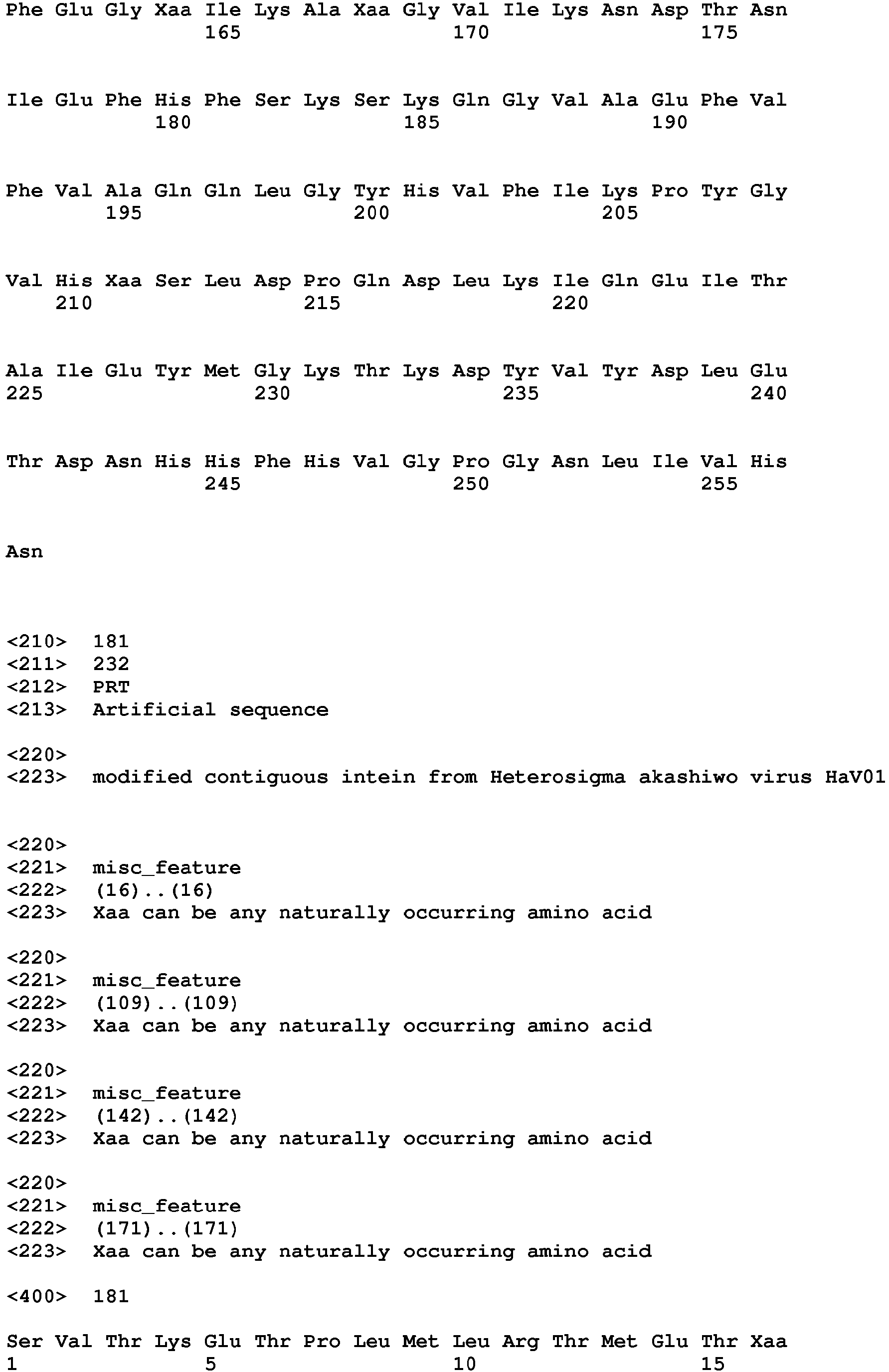
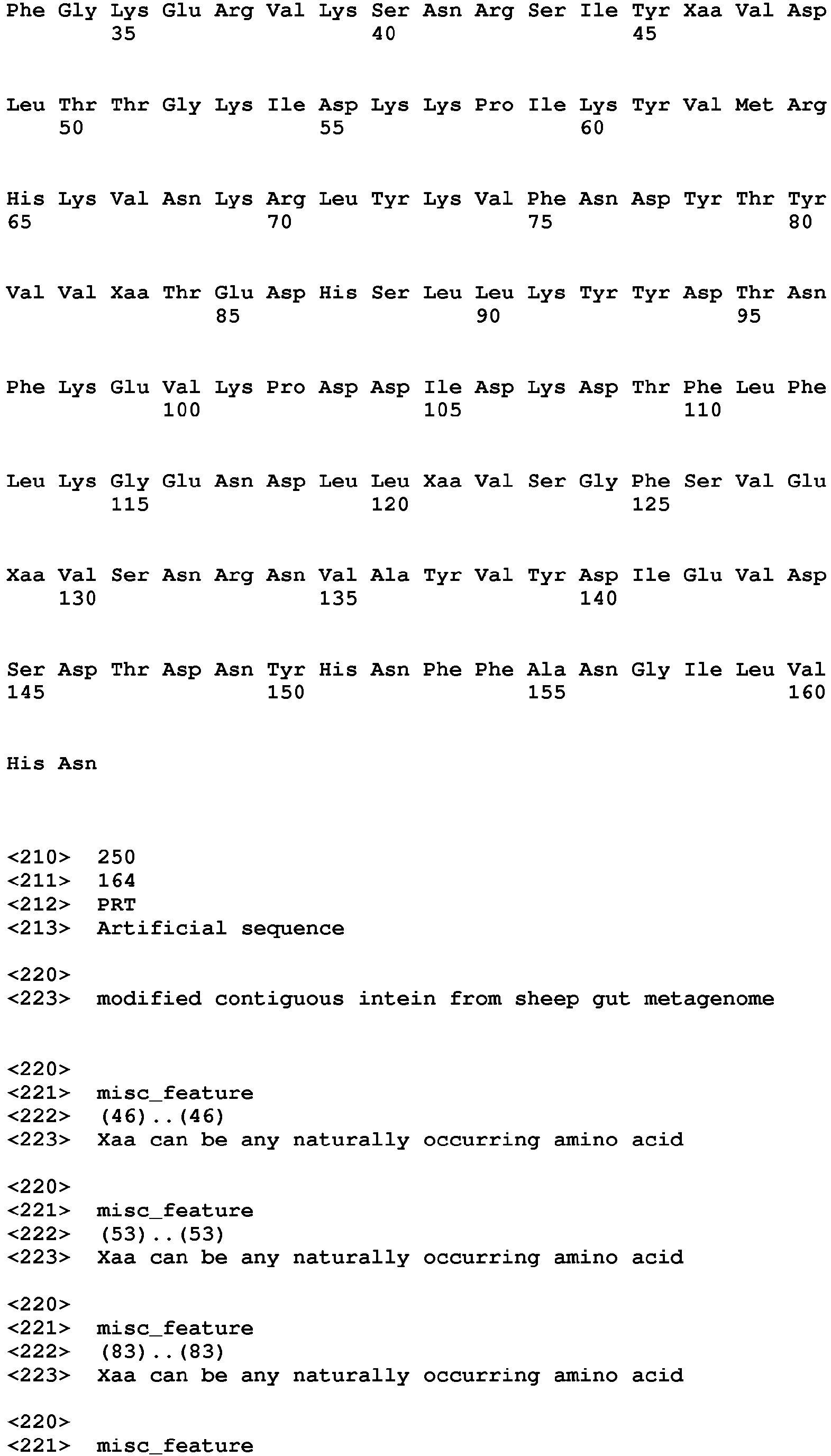
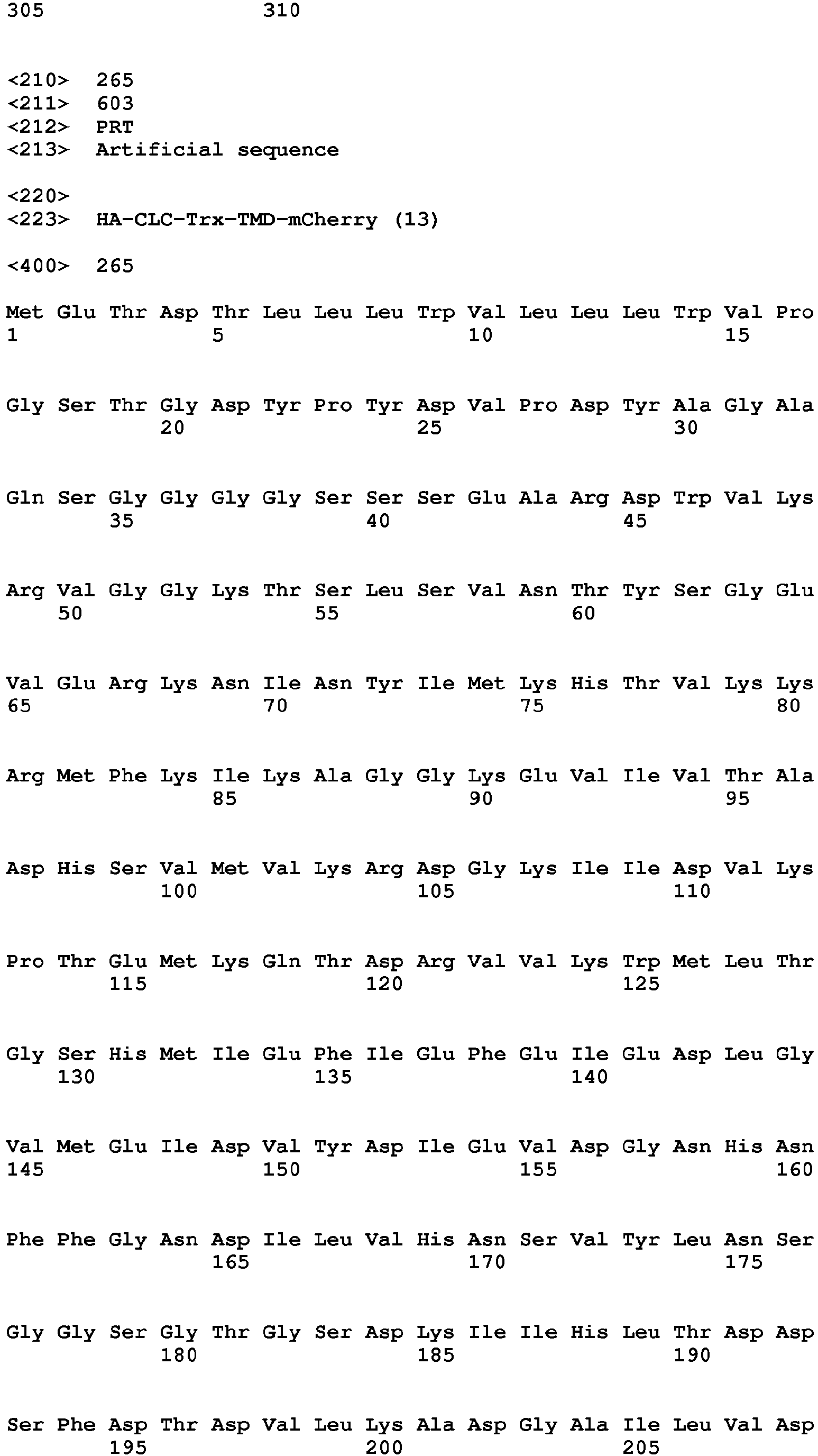
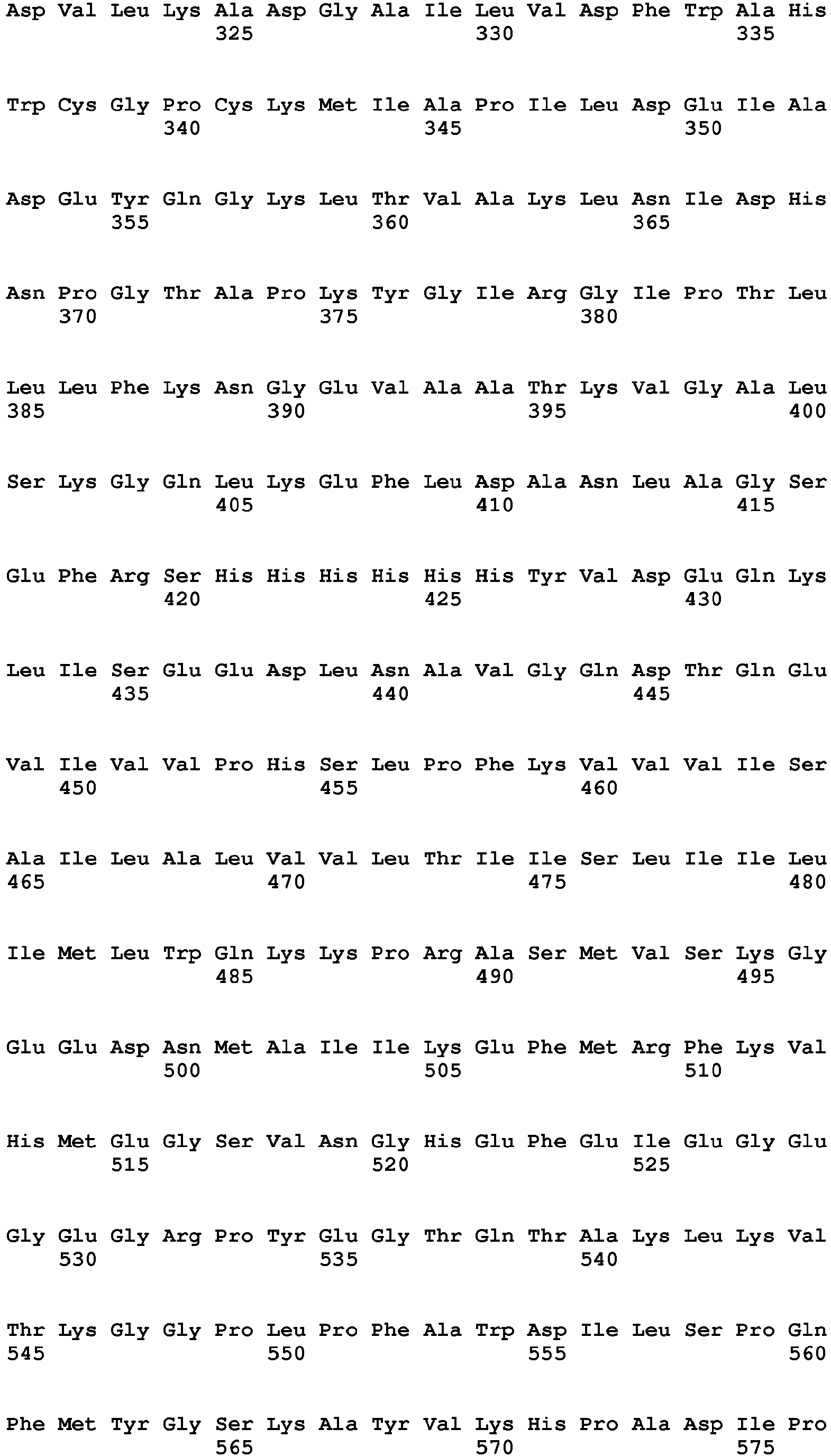
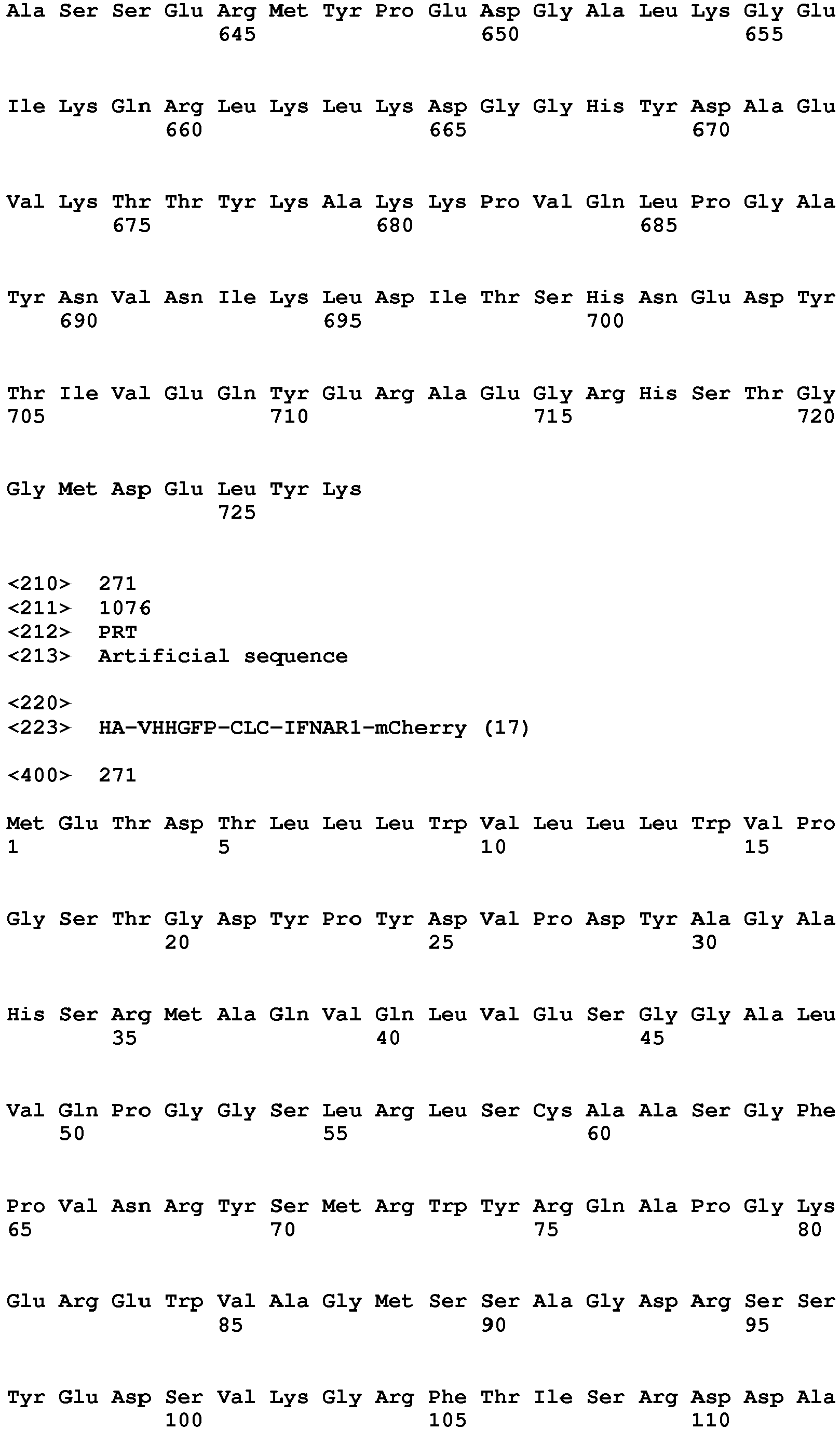
Preferably, the isolated polypeptide(s) comprise(s) or consist(s) of an amino acid sequence having at least 70 %, at least 80 %, at least 85 %, at least 90 %, at least 95 %, at least 99 % or 100 % sequence identity with any one of the sequences set forth in SEQ ID Nos. 251 to 272 and 275 to 279.
-
In a third aspect, the invention relates to at least one isolated nucleic acid molecule comprising at least one nucleotide sequence encoding an isolated polypeptide according to the invention or a homolog, variant or complement thereof.
-
In a fourth aspect, the invention relates to a method for modifying amino acid sequences, preferably ligating two amino acid sequences to each other, using an isolated polypeptide according to the invention or a composition according to the invention or at least one isolated nucleic acid molecule according to the invention, wherein the modification is preferably selected from the group consisting of modification of a protein, protein lipidation, protein immobilization, protein backbone ligation, protein backbone semi-synthesis, protein or peptide cyclization, protein modification with a chemically modified tag sequence, preferably with a cysteine tag, and artificial control of protein splicing by light.
-
Preferably, in the method according to the invention
- (i) the isolated polypeptide or the composition according to the invention is exposed to oxidizing conditions, preferably to atmospheric oxygen, for example in that the method is performed under oxidizing coditions or in the presence of atmospheric oxygen; and/or
- (ii) the isolated polypeptide or the composition according to the invention is exposed to a temperature of ≤ 40 °C, preferably less than 40 °C, more preferably 0 to 37 °C, more preferably 8 °C or 37 °C, for example in that the method is carried out at these temperatures; and/or
- (iii) the method is essentially free of a reducing step or a reducing agent; and/or
- (iv) the method is free of a denaturation step.
-
In various non-limiting embodiments, the method comprises the step(s) of
- (i) protein preparation, preferably recombinant protein expression or in vitro translation; and/or
- (ii) protein purification; and/or
- (iii) dialysis of produced/purified protein.
-
In a fifth aspect, the invention relates to a use of an isolated polypeptide according to the invention or a composition according to the invention or at least one nucleic acid molecule according to the invention, wherein the polypeptide or the composition or the nucleic acid molecule is preferably used for modification of a protein, protein lipidation, protein immobilization, protein backbone ligation, protein backbone semi-synthesis, protein or peptide cyclization, protein modification with a (chemically modified) tag sequence, preferably with a cysteine tag, and as molecular switch.
BRIEF DESCRIPTION OF FIGURES
-
The invention will be better understood with reference to the detailed description when considered in conjunction with the non-limiting examples and the accompanying figures.
- Figure 1 . Protein trans-splicing (PTS) using a redox-insensitive intein. Schematic representation of a trans-splicing reaction. Inteins containing at least one catalytically active cysteine residue at the upstream or downstream splice junction (X= S) require the presence of reducing agents for quantitative trans-splicing to occur. In contrast, a cysteine-free intein can carry out trans-splicing in the absence of any reducing agent, thus preserving disulfide bonds and avoiding other potentially deleterious effects.
- Figure 2 . Sequence and biochemical characterization of the split Aes123 PoIB1 intein. (A) Amino acid sequences of the AesN and AesC split intein fragments, each with five residues of extein sequence (underlined). The active serine residues are shown as blue characters. (B) Scheme of the constructs used for protein trans-splicing. (C) Analysis of the protein trans-splicing reaction carried out at 37 °C using different molar ratios of the precursors (either 10 µM or 30 µM). Shown is a representative Coomassie-stained SDS-PAGE gel. (D) Time course of the splicing reactions carried out at 37 °C and 8 °C under pseudo-unimolecular conditions (1: 10 µM and 2: 30 µM). The data points represent averages and standard deviations obtained from three experiments. SP = splice product. Calculated molecular weights: 1: 58.2 kDa, 2: 14.6 kDa, SP: 48.6 kDa, AesN: 14.7 kDa, AesC: 9.6 kDa.
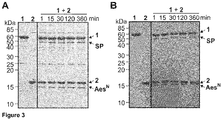
- Figure 3 . Splicing kinetics of the Aes123 PoIB1 intein at different temperatures. Representative gels showing PAGE analysis of the time-course of splicing at 8 °C (A) and 37 °C (B). The precursor proteins and splicing products are the same as shown in Figure 2B. Calculated molecular weights: 1: 58.2 kDa, 2: 14.6 kDa, SP: 48.6 kDa, AesN: 14.7 kDa, AesC: 9.6 kDa.
- Figure 4 . N-terminal labeling of target proteins using the CL intein under oxidizing conditions. (A) Reaction scheme. (B) SDS-PAGE analysis of the labeling and purification steps for the generation of Alexa647-labeled VHHGFP nanobody (SP). FT and E represent the flow through and elution fractions from Streptactin resin, respectively. The arrows mark the purified splice product (SP) that was used for further experiments. (C) Confocal microscopy images of HeLa cells transfected with HA-eGFP-TMD-mCherry (HA= hemagglutinin A tag, TMD= transmembrane domain of the PDGF receptor) that were treated with 1 nM of Alexa647-labeled VHHGFP nanobody (SP). Scale bars represent 20 µm. (D) Sequence of the fluorescein labeled CLN peptide (9) synthesized via SPPS. M15 was replaced with nor-leucine (NorL). (E) Mass spectrometric analysis of the purified peptide 9. M(calc) 3736.69 Da, M(obs) 3736.03 Da. (F) Time-course of the trans-splicing reaction between 9 (40 µM) and 4 (10 µM). SP = splice product. Calculated molecular weights: 7: 9.6 kDa, 7a: 10.5 kDa, 8: 35.0 kDa, SP: 16.4 kDa, CLN: 8.9 kDa, CLC: 19.8 kDa.
- Figure 5 . Engineering the CL intein. (A) Sequence alignment of the concatenated AesN and AesC sequences with the sequence of the Ssp DnaB intein showing the presence of an extra stretch of residues from Phe28 to Thr46 (highlighted). (B) Sequences of the fragments corresponding to the original Aes123 PoIB1 intein and the engineered CL-intein, together with the steps carried out to generate the engineered intein. The catalytic serines are shown as shaded residues, while the native extein residues are underlined. The residues deleted and inserted are highlighted . The catalytic residues that were mutated in different experiments are denoted by arrows and black alphabets, while the residues where the original intein was artificially split are denoted by arrows and red alphabets. The last residue of the CL intein is still denoted as N159'.
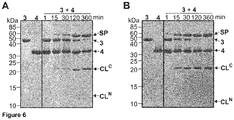
- Figure 6 . Splicing kinetics of the CL intein at different temperatures. Representative gels showing PAGE analysis of the time-course of splicing at 8 °C (A) and 37 °C (B). The precursor proteins and splicing products are the same as shown in Figure 4B. Calculated molecular weights: 3: 47.3 kDa, 4: 33.8 kDa, SP: 57.5 kDa, CLN: 3.8 kDa, CLC: 19.8 kDa.
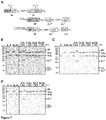
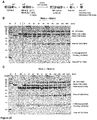
- Figure 7 . Splicing activity of the CL intein with cysteines at key catalytic positions. (A) Schematic representation of the fusion proteins. The Ser1 and Ser+1 residues were mutated into Cys. (B-D) PAGE analysis of splicing reactions carried out with the non-mutated and mutated fragments of the CL-intein in different combinations either in the absence of any reducing agents (B), with 1 mM TCEP (C), or with 50 mM DTT (D). 10 µM of each precursor protein were used. The splice product (SP) is only formed when both fragments do not contain Cys (but contain Ser) as catalytic residues. Calculated molecular weights: 3/3a: 47.3 kDa, 4/4a: 33.8 kDa, SP: 57.5 kDa, CLN: 3.8 kDa, CLC: 19.8 kDa, CC: 13.9 kDa.
- Figure 8 . N-terminal labeling of target proteins using the CL intein under oxidizing conditions. (A) Reaction scheme. (B) SDS-PAGE analysis of the labeling and purification steps for the generation of Alexa647-labeled VHHGFP nanobody (SP). FT and E represent the flow through and elution fractions from Streptactin resin, respectively. The arrows mark the purified splice product (SP) that was used for further experiments. (C) Confocal microscopy images of HeLa cells transfected with HA-eGFP-TMD-mCherry (HA= hemagglutinin A tag, TMD= transmembrane domain of the PDGF receptor) that were treated with 1 nM of Alexa647-labeled VHHGFP nanobody (SP). Scale bars represent 20 µm. (D) Sequence of the fluorescein labeled CLN peptide (9) synthesized via SPPS. M15 was replaced with nor-leucine (NorL). (E) Mass spectrometric analysis of the purified peptide 9. M(calc) 3736.69 Da, M(obs) 3736.03 Da. (F) Time-course of the trans-splicing reaction between 9 (40 µM) and 4 (10 µM). SP = splice product. Calculated molecular weights: 7: 9.6 kDa, 7a: 10.5 kDa, 8: 35.0 kDa, SP: 16.4 kDa, CLN: 8.9 kDa, CLC: 19.8 kDa.
- Figure 9 . ESI-MS analysis of proteins used for N-terminal labeling of VHHGFP. (A) Mass spectrum of CysTag-CLN-SBP (7) after labeling the unique Cys with Alexa647 maleimide (7a). The two peaks correspond to the protein labeled with one molecule of Alexa647 with and without hydrolysis of the succinimide ring as shown in the schemes within the red boxes. (B) Mass spectrum of SBP-CLC-VHHGFP-H6 (8).
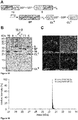
- Figure 10 . Splice activity of fluorescein-labeled CLN synthesized by solid phase peptide synthesis. (A) Schematic representation of the proteins used for analyzing the splice activity. (B) PAGE analysis flowed by Coomassie staining (left panel) and imaging of fluorescein fluorescence (right panel) for the splice assay showed in (A). 40 µM of 9 and 10 µM of 4 was used for the assay. Densitometric analysis of the Coomassie-stained gel was used for the generation of the data shown in Figure 8F. Calculated molecular weights: 9: 3.7 kDa, 4: 33.8 kDa, SP: 15 kDa, CLN: 2.8 kDa, CLC: 19.8 kDa.
- Figure 11 . C-terminal labeling of a nanobody using the CL intein under oxidizing conditions. (A) Reaction scheme. (B) SDS-PAGE analysis of the labeling and purification steps for the generation of Alexa647-labeled VHHEGFR nanobody (SP). FT and E represent the flow through and elution fractions from Streptactin resin, respectively. The arrows mark the purified splice product (SP) that was used for further experiments. (C) Confocal microscopy images of HeLa cells transfected with HA-EGFR-mCherry (HA= hemagglutinin A tag) that were treated with 10 nM Alexa647-labeled VHHEGFR (SP). Scale bars represent 20 µm. SP = splice product. Calculated molecular weights: 10: 23.4 kDa, 11: 22.0 kDa, 11a: 22.9 kDa, SP = 18.7, kDa, CLN = 7.8 kDa, CLC = 19.8 kDa.
- Figure 12 . ESI-MS analysis of proteins used for C-terminal labeling of VHHEGFR. (A) Mass spectrum of SBP-CLC-CysTag-H6 (11) after labeling the unique Cys with Alexa647 maleimide (11a). The three peaks correspond to the unlabeled protein and protein labeled with one molecule of Alexa647 with and without hydrolysis of the succinimide ring as shown in the schemes within the red boxes. (B) Mass spectrum of VHHEGFR-CLN-SBP (10). (C) Mass spectrum of the purified splice product of 10 + 11a. The two peaks correspond to the protein labeled with one molecule of Alexa647 with and without hydrolysis of the succinimide ring as shown in the schemes within the red boxes.
- Figure 13 . C-terminal labeling of an antibody Fc dimer fusion protein under oxidizing conditions. (A) Reaction scheme. The protein SBP-CLC-CysTag-H6 (11) was first reacted with fluorescein-maleimide to label the unique thiol on the CysTag resulting in 11b (not shown). (B) SDS-PAGE analysis of the labeling and purification process. The arrows mark the purified splice product (SP) in the FT fraction. The subscripts M and D refer to the monomeric and dimeric forms of the Fc-fusion protein. FT, W and E refer to the flow through, wash and elution fractions from Streptactin resin, respectively. Note that 11b is not seen on the gel because of its low molecular weight. (C) MS-analysis of the FT fraction containing the desired SPD protein. Calculated molecular weights: 11b = 22.4 kDa, 12M = 77.3 kDa, 12D = 154.5 kDa, SPD = 144.1 kDa, CLN = 7.8 kDa, CLC = 19.8 kDa.
- Figure 14 . ESI-MS analysis of MBP-Fc-CLN-SBP. MBP-Fc-CLN-SBP (12) was expressed and purified from E. coli Origami cells. The observed mass for the dimer corresponds to the presence of one disulfide bond.
- Figure 15 . Creation of a bispecific-nanobody using the CL intein. (A) Reaction scheme. (B) Analysis of the splicing reaction and purification of VHHEGFR-VHHGFP using Coomassie-stained SDS-PAGE. FT and E represent the flow through and elution fractions from Streptactin resin respectively. The arrow marks the purified splice product. (C) Confocal microscopy images of HeLa cells transfected with HA-EGFR-mCherry (HA= hemagglutinin A tag) that were treated with 10 nM VHHEGFR-VHHGFP (SP), followed by washing and subsequent incubation with by 1 nM eGFP. Scale bars represent 20 µm. SP = splice product. Calculated molecular weights: 8: 35.0 kDa, 10: 23.4 kDa, SP: 30.5 kDa, CLN: 7.8 kDa, CLC: 19.8 kDa.
- Figure 16 . ESI-MS analysis of the purified splice product VHHEGFR-VHHGFP-H6.
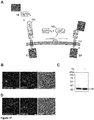
- Figure 17 . Low affinity between CLN and CLC prevents protein trans-splicing to cell surface receptors. (A) Schematic representation of the strategy for trans-splicing on cell surface receptors. (B) Confocal images of HeLa cells expressing 13 that were exposed to 5 µM of 14 for 3 h. Non-specific binding of 14 (eGFP channel) could be observed on cells transfected with 13 (mCherry positive) as well as on untransfected (mCherry negative) cells. (C) Western blot analysis of lysates of cells from the experiment in (B) that were probed against GFP showed a band corresponding to 14 for both untransfected cells and cells transfected with 13, but no band corresponding to SP. (D) Control experiment to confirm correct localization of 13. Immunostaining of HeLa cells expressing 13 against the extracellular HA-tag on 13 via an anti-HA primary antibody, followed by a Dy633-labeled secondary antibody showed selective Dy633 labeling of cells expressing 13. A significant fraction of 13 is also present inside cells, presumably due to mislocalization in the secretory pathway caused by overexpression. Scale bars represent 20 µm. HA= hemagglutinin A tag, Trx= thioredoxin, mCh= mCherry. Calculate molecular weights: 13: 65.1 kDa, 14: 32.9 kDa, SP: 77.4 kDa.
- Figure 18 . Nanobody-mediated high affinity interaction enhances trans-splicing on a model cell-surface receptor. (A) Schematic representation of the strategy. (B) Confocal images of HeLa cells expressing 15 that were exposed to 500 nM of 14 for 3 h. Specific binding of 14 (eGFP channel) could be observed on cells transfected with 15 (mCherry positive) but not on untransfected (mCherry negative) cells. Endocytosis of the model receptor led to significant intracellular eGFP signal, although clear membrane localization could also be observed. A significant fraction of 15 is also present inside cells, presumably due to mislocalization in the secretory pathway caused by overexpression. (C) Western blot analysis of lysates of cells from the experiment in (B) that were probed with an anti-GFP antibody showed a band corresponding to 14, as well as a higher molecular weight band corresponding to SP. Exposure of HeLa cells expressing a variant of 15 (15a) with a splice-inactivating mutation of CLC (N159'A) showed a band corresponding to 14, but not SP. Since samples were denatured prior to western blotting, HA-VHHGFP-CLC no longer remained bound to SP during western blot analysis. Scale bars represent 20 µm. HA= hemagglutinin A tag, Trx= thioredoxin, mCh=mCherry. Calculate molecular weights: 14: 32.9 kDa, 15/15a: 78.8 kDa, SP: 77.4 kDa.
- Figure 19 . Traceless fluorescent labeling of a model receptor via trans-splicing with the CL intein. (A) Schematic representation of the strategy for the traceless labeling of a model receptor with Alexa647. The transmembrane domain of 15 was derived from PDGFR. Protein 16 was produced in E. coli and site-selectively labeled on a single Cys residue in the CysTag with Alexa647-maleimide to get 16a. (B) Confocal images of HeLa cells expressing 15 that were exposed to 150 nM of 16a for 3 h. Specific binding of 16a (Alexa647 channel) could be observed on cells transfected with 15 (mCherry positive) but not on untransfected (mCherry negative) cells. Endocytosis of the model receptor led to significant intracellular Alexa647 signal, although clear membrane localization could also be observed. A significant fraction of 15 is also present inside cells, presumably due to mislocalization in the secretory pathway caused by overexpression. (C) SDS-PAGE analysis followed by imaging of Alexa647 fluorescence on lysates from either untransfected Hela cells or Hela cells expressing different cell surface receptor constructs (13, 15 or 15a) that were treated with 150 nM of 16a for 3 h. While all experiments showed a band corresponding to 16a, a band corresponding to SP was detected only for cells expressing 15. Scale bars represent 20 µm. HA= hemagglutinin A tag, Trx= thioredoxin, mCh=mCherry. Calculate molecular weights: 16a: 33.4 kDa, 15/15a: 78.8 kDa, SP: 51.4 kDa.
- Figure 20 . Traceless fluorescent labeling of IFNAR1 under oxidizing conditions via high-affinity protein trans-splicing. (A) Schematic representation of the labeling strategy. Protein CysTag(Alexa647)-H8-CLN-eGFP(C49S) (16a) was obtained by production of 16 in E. coli and its subsequent thiol bioconjugation with Alexa647-maleimide (not shown). (B) PAGE analysis of lysates from Hela cells transfected with 17 or 17a that 24 h later were treated with 16a. The unusual migration behavior of the splice product (SP) stems from the post-translational glycosylation of IFNAR1. (C) Confocal microscopy images of HeLa cells expressing 17 that were exposed to 10 nM of 16a for 30 min. Specific binding of 16a could be observed only on cells transfected with 17 but not on untransfected cells. Note that IFNAR1 is strongly endocytosed at 37 °C which results in significant intracellular Alexa647 signal. Scale bars represent 20 µm. HA= hemagglutinin A tag. mCh = mCherry. Calculated molecular weights: 16a: 33.4 kDa, 17/17a: 120 kDa, SP: 92.5 kDa.
- Figure 21 . Traceless fluorescent labeling of IFNAR1 via trans-splicing with the CL intein. (A) Confocal microscopy images of HeLa cells expressing HA-VHHGFP-CLC-IFNAR1 (17) that were exposed to 150 nM of 16a for 3 h. Specific binding of 16a (Alexa647 channel) could be observed on cells transfected with 17 (mCherry positive) but not on untransfected (mCherry negative) cells. IFNAR1 is strongly endocytosed at 37 °C which resulted in significant intracellular Alexa647 signal. Scale bars represent 20 µm.
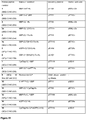
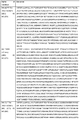
- Figure 22 . List of recombinantly produced proteins and synthesized peptides used in this study.
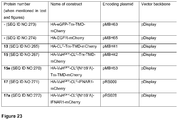
- Figure 23 . List of plasmids used for transfection of HeLa cells.
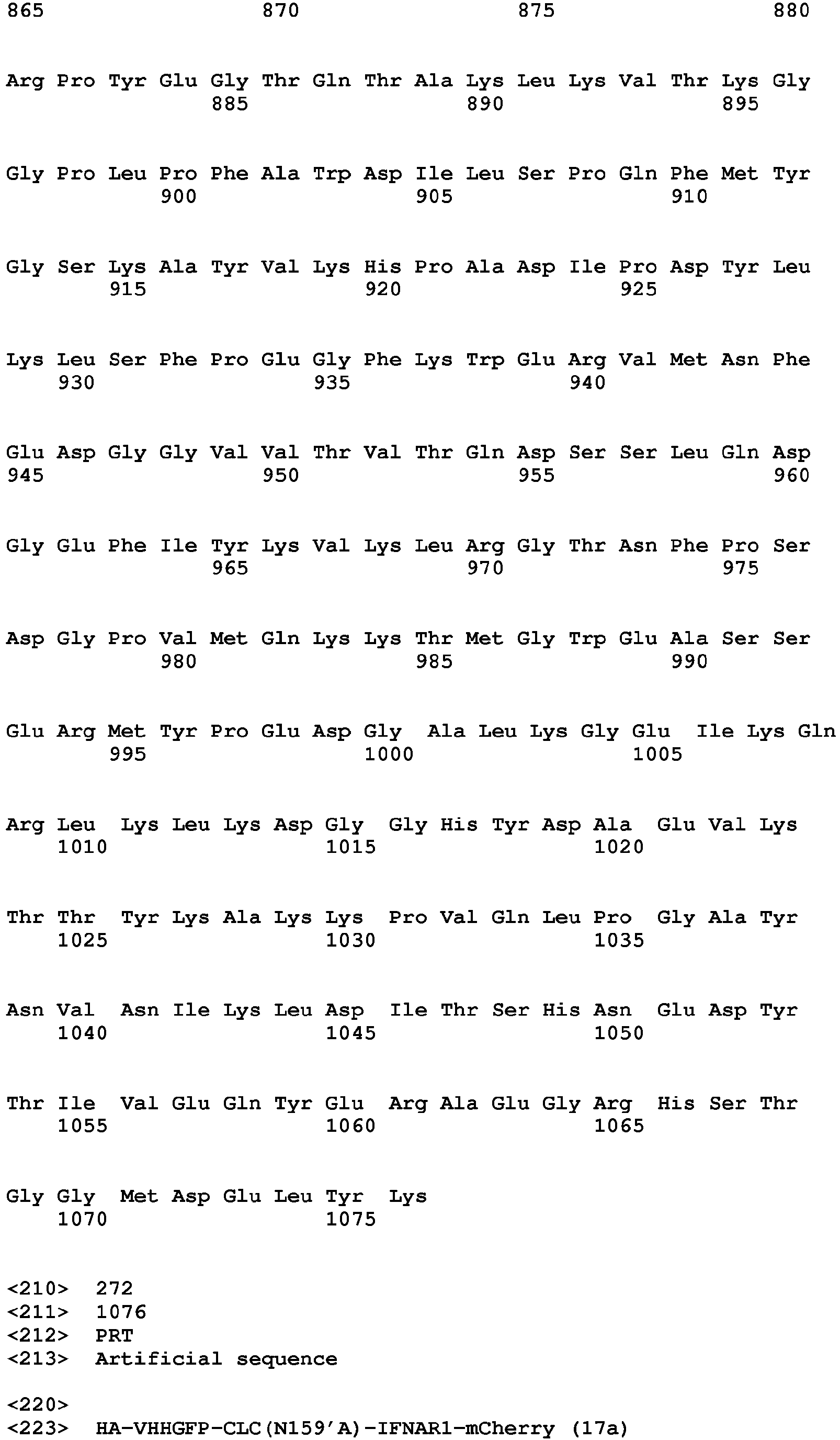
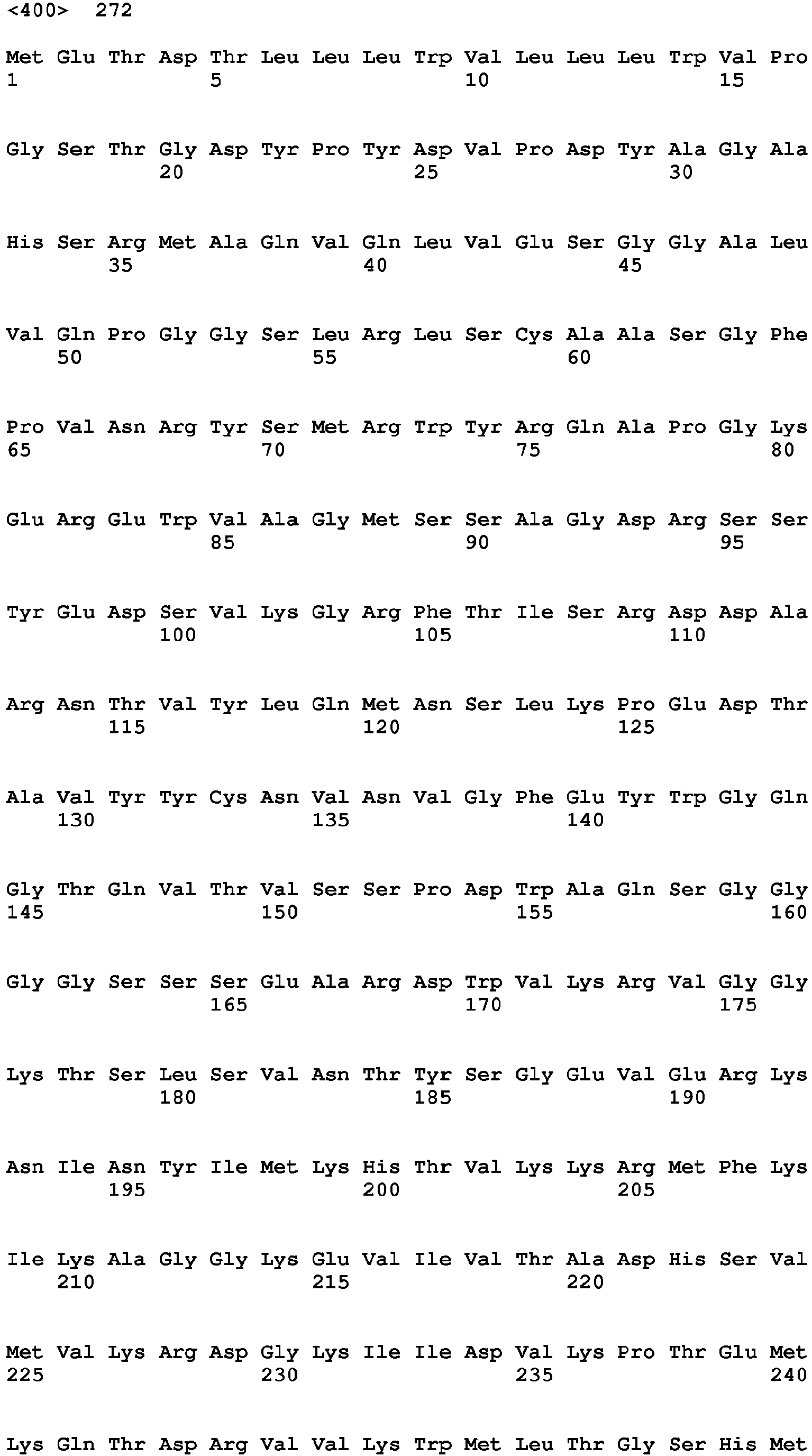
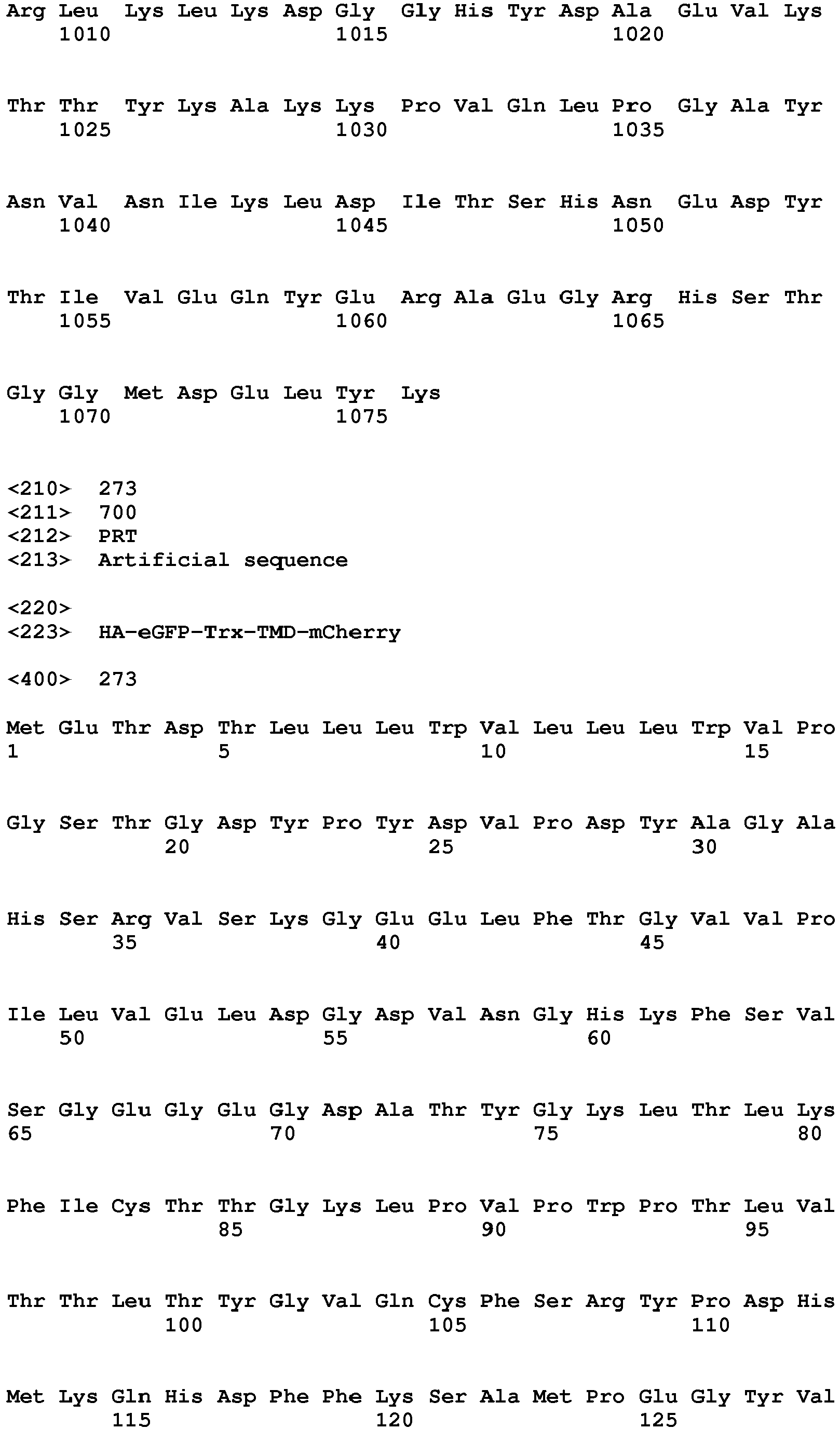
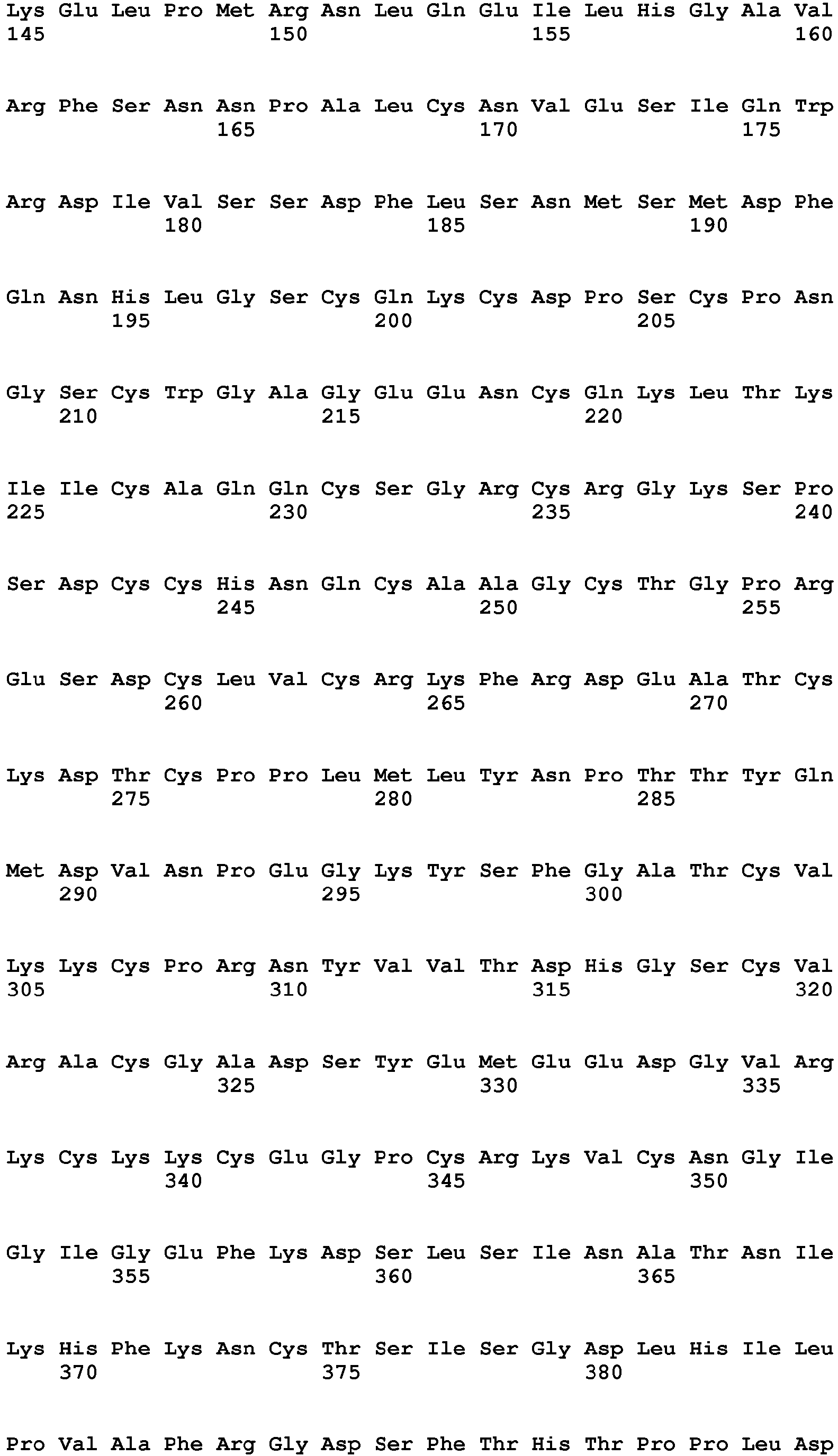
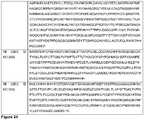
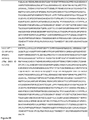
- Figure 24 . Amino acid sequences of recombinantly produced proteins and synthesized peptides.
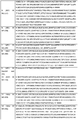
- Figure 25 . Amino acid sequences of proteins expressed in HeLa cells.
- Figure 26 . Splicing of the CL intein with full-length human IgG1 antibody. Cixutumumab was produced and purified as fusion with the IntN fragment at the C terminus of the heavy chain (HC), here designated as A12-AB. A12-AB thus consisted of the heavy chain HC-IntN and the light chain (LC). Shown is a Coomassie brilliant blue-stained SDS-PAGE gel (reducing) of the proteins and the splice reactions as indicated. The HC-IntN fusion contained a GGSGG linker (HC-GGSGG-IntN). A12-AB was provided at 2 µM, and each of the IntC fusion proteins were at 8 µM. Reactions were performed in Tris-buffer at pH 7.0 and at 25 °C. No reducing agent was present in the protein preparations or the splice reaction.
- Figure 27 . Splicing of the PoIB-16_OarG. (A) Schematic description of model fusion constructs PB16-1 and PB16-2 to investigate splicing of the PoIB-16_OarG intein and their protein trans-splicing reaction. (B) and (C) Coomassie brilliant blue-stained SDS-PAGE gels (reducing) of purified proteins and the protein trans-splicing reactions quenched at the indicated time points. (B) shows the reaction of MBP-IntN-H6 (PB16-1; 15 µM) with the wild-type (WT) IntC fragment (PB16-2; 5 µM) and (C) shows the reaction of MBP-IntN-H6 (PB16-1; 5 µM) with the double-cysteine mutant (IntC(C96A, C150A)) (PB16-2a;15 µM). Reactions were performed at 37 °C in Tris-buffer (pH 7.0) with 1 mM TCEP.
- Figure 28 . Specific amino acid sequence constructs of example 2. (A) Amino acid sequence of CL-intein construct IntC-Trx-H6 (shown in Figure 26); IntC sequence is underlined, (B) amino acid sequence of CL-intein construct SBP-IntC-SBP (shown in Figure 26); IntC sequence is underlined, (C) amino acid sequence of PoIB-16_OarG-intein construct MBP-IntN-H6 (PB16-1; shown in Figure 27); IntN sequence is underlined, (D) amino acid sequence of PoIB-16_OarG-intein construct IntC-Trx-H6 (PB16-2; shown in Figure 27); IntC sequence is underlined, (E) amino acid sequence of PoIB-16_OarG-intein construct IntC(C96A, C150A)-Trx-H6 (PB16-2a; shown in Figure 27); IntC sequence is underlined.
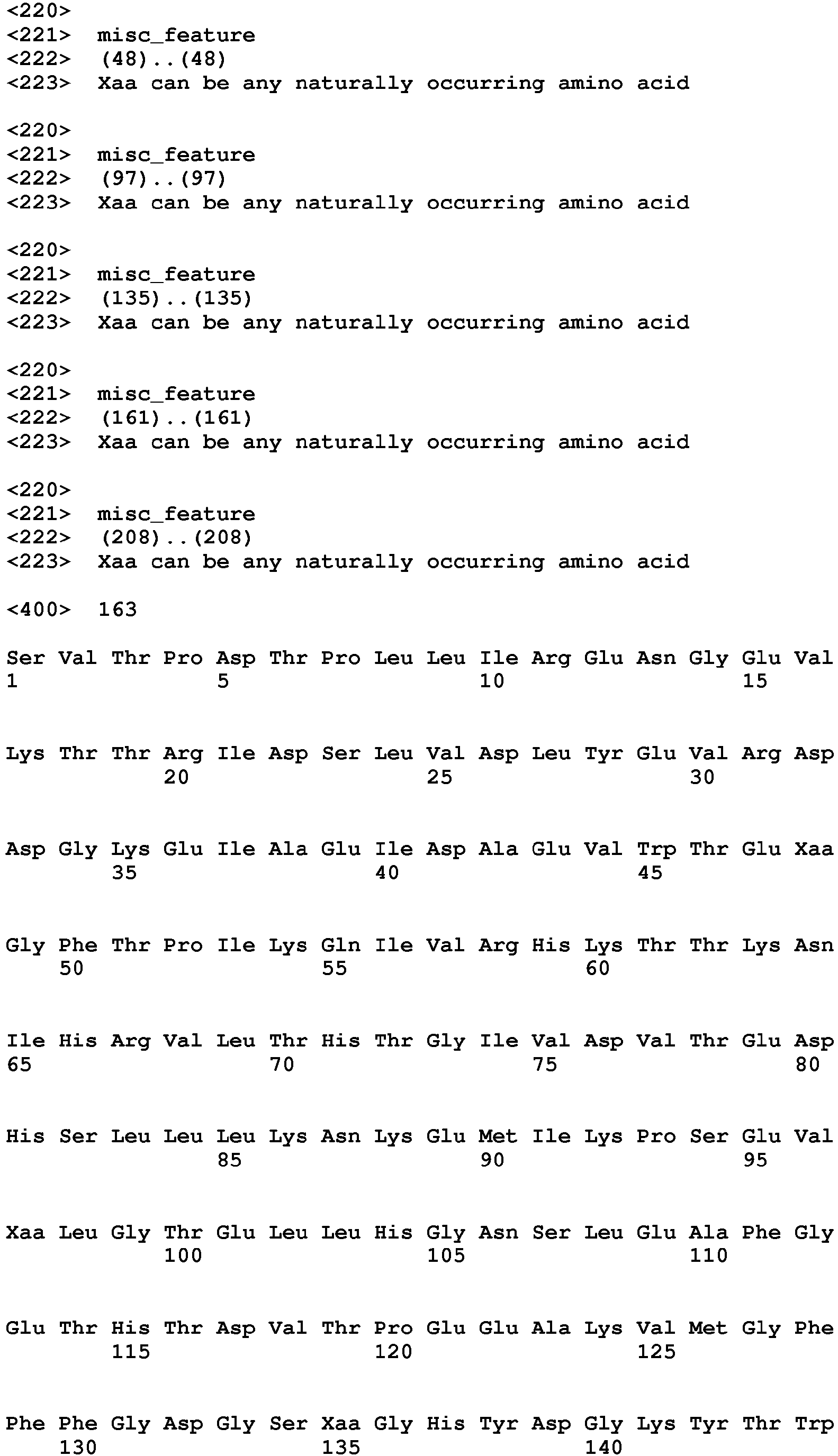
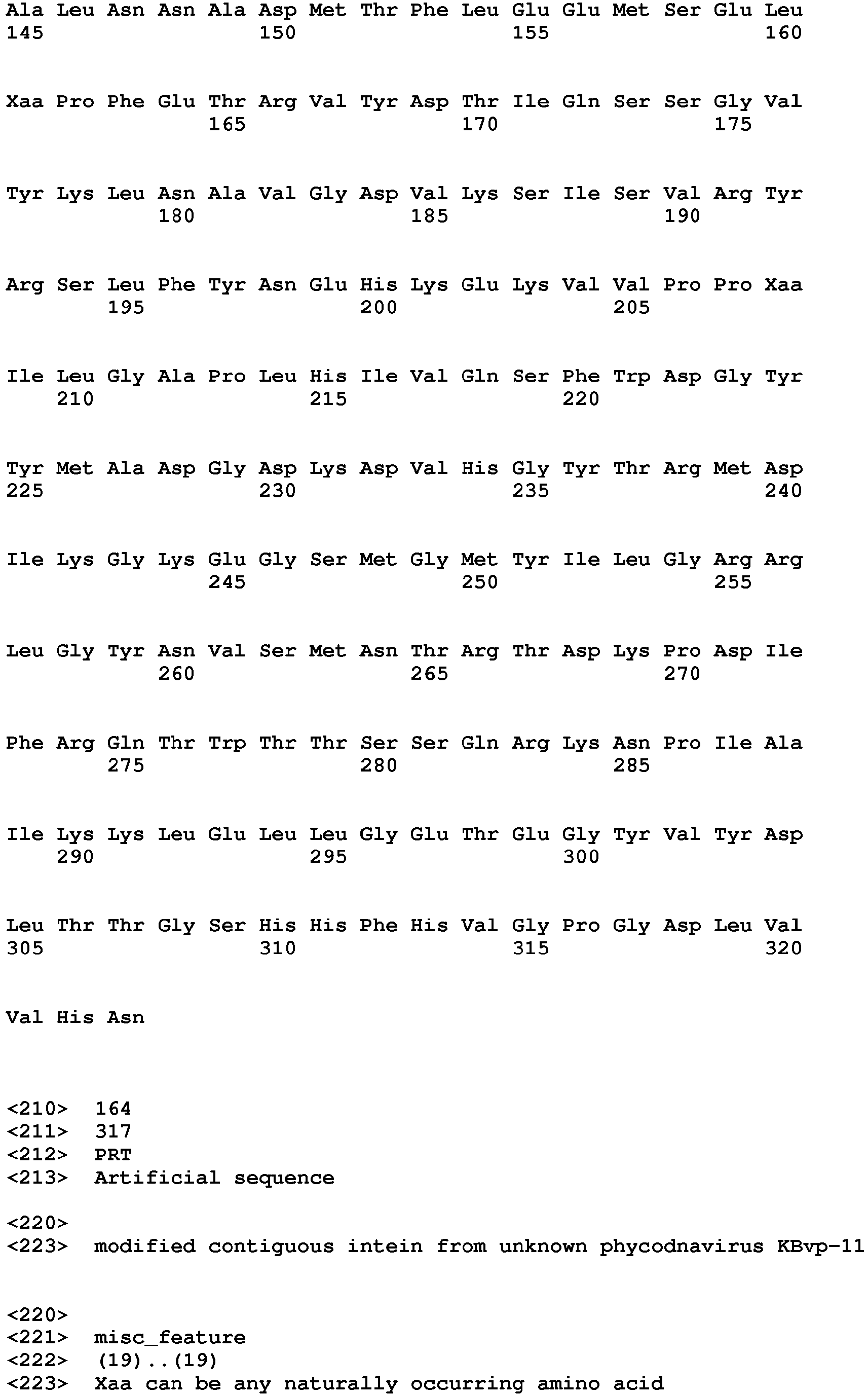
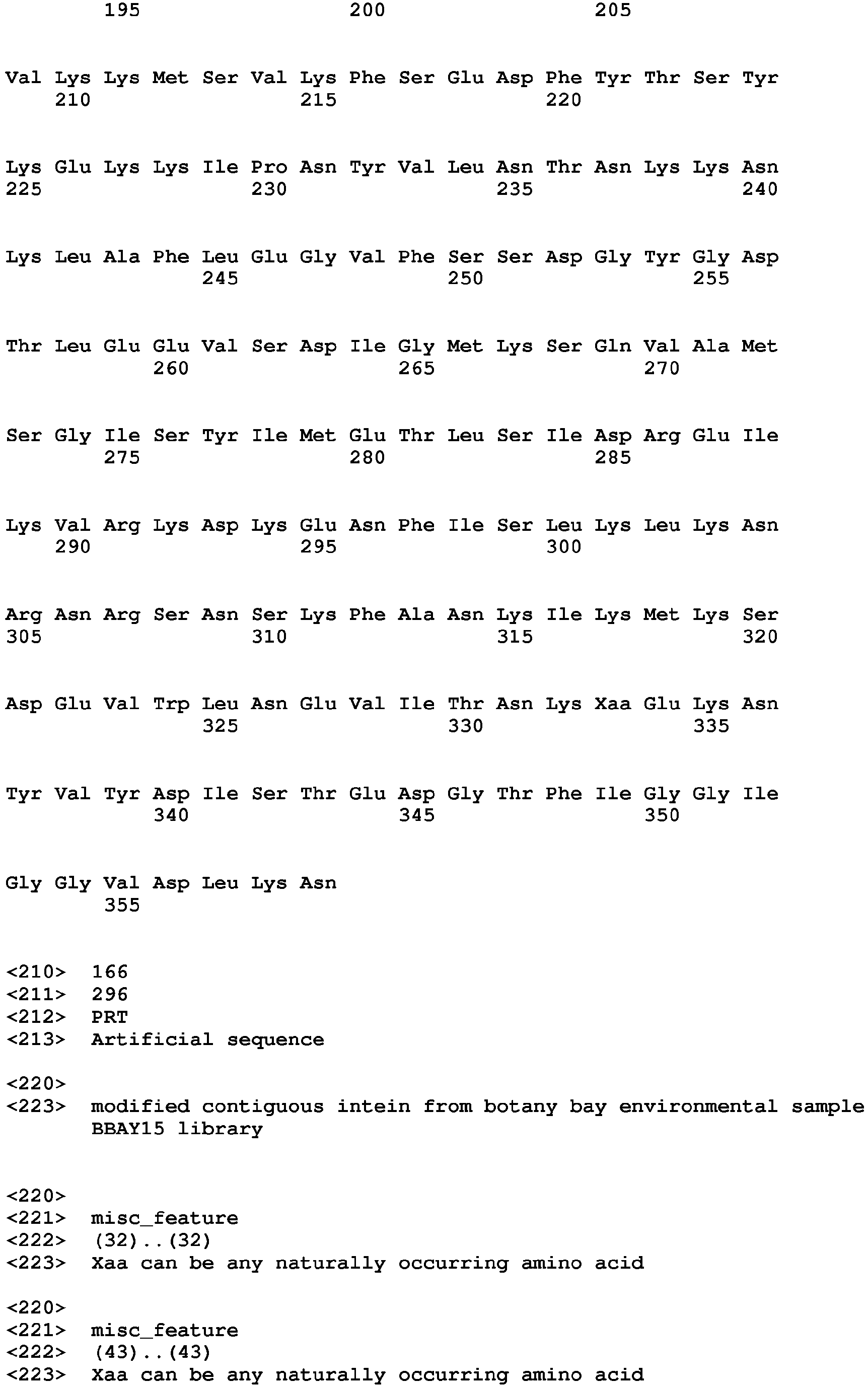
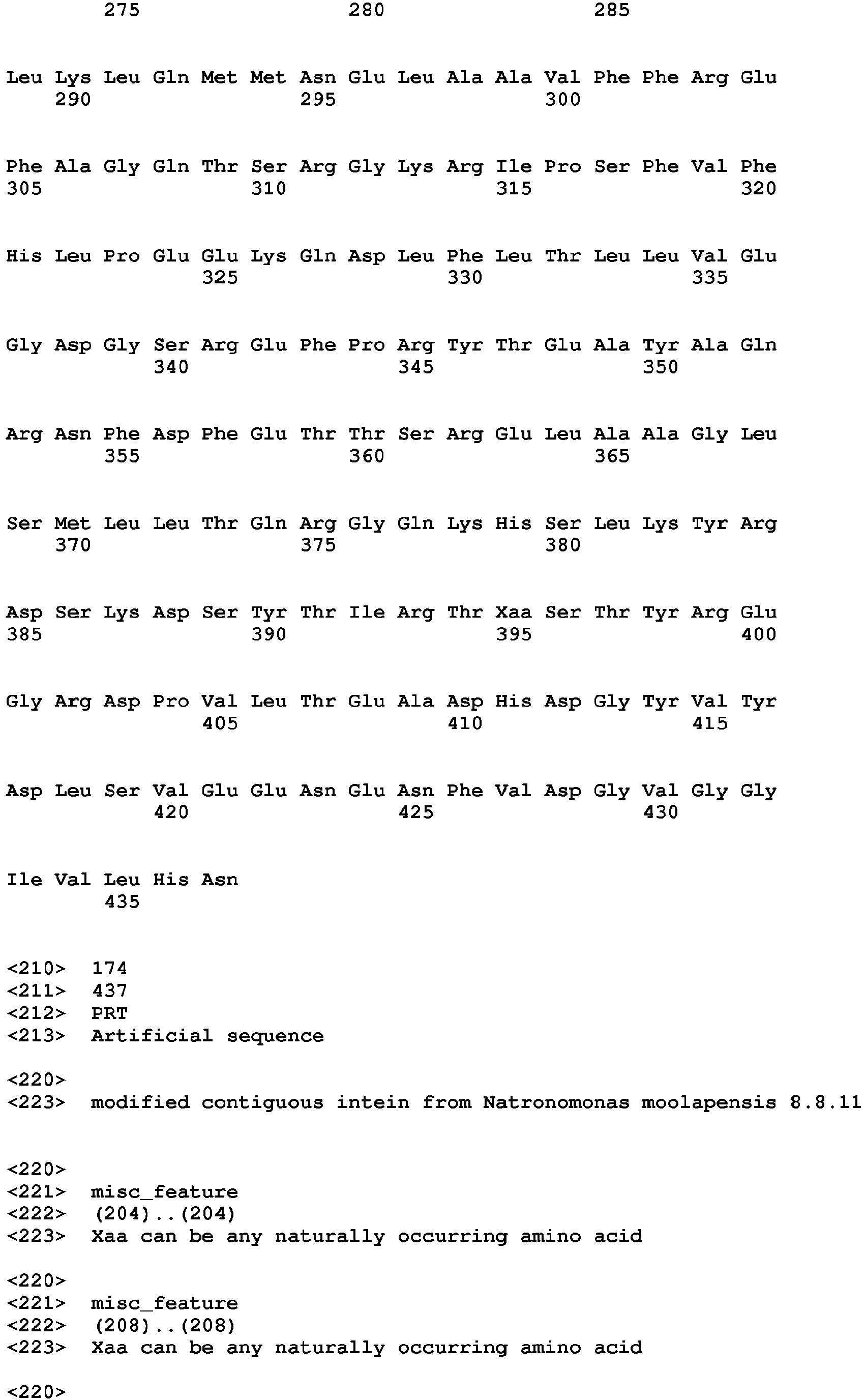
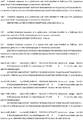
- Figure 29 . Amino acid sequences of N-terminal and C-terminal sequences of split inteins and an amino acid sequence of a contiguous intein sequence (pol-e-integration point alleles/ pol-e type inteins) (with information of intein name, split-intein part name, host protein NCBI accession, species, host type, position in host protein, occuring cysteine residues (positions), comments, aa sequence, in that order).
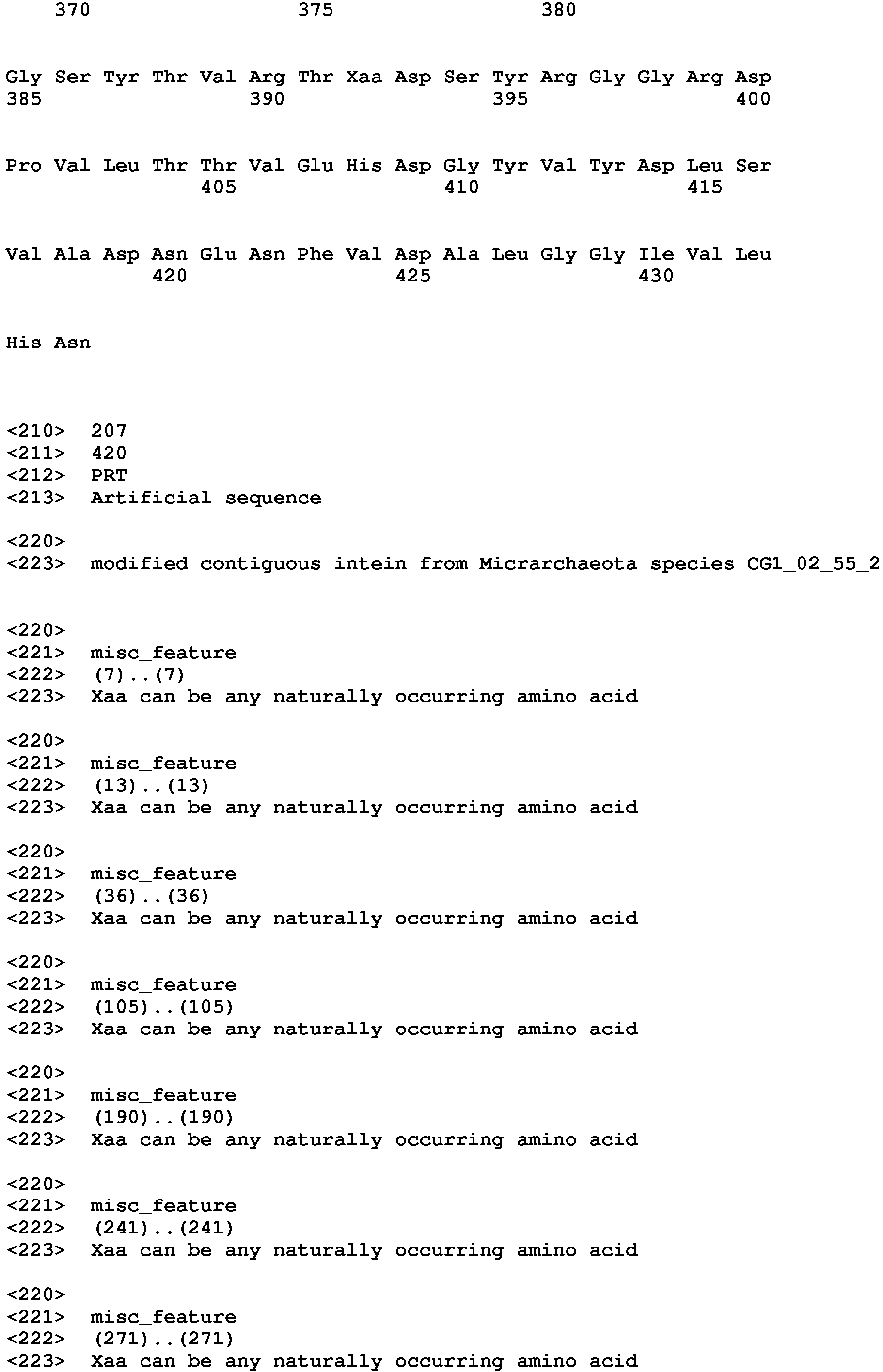
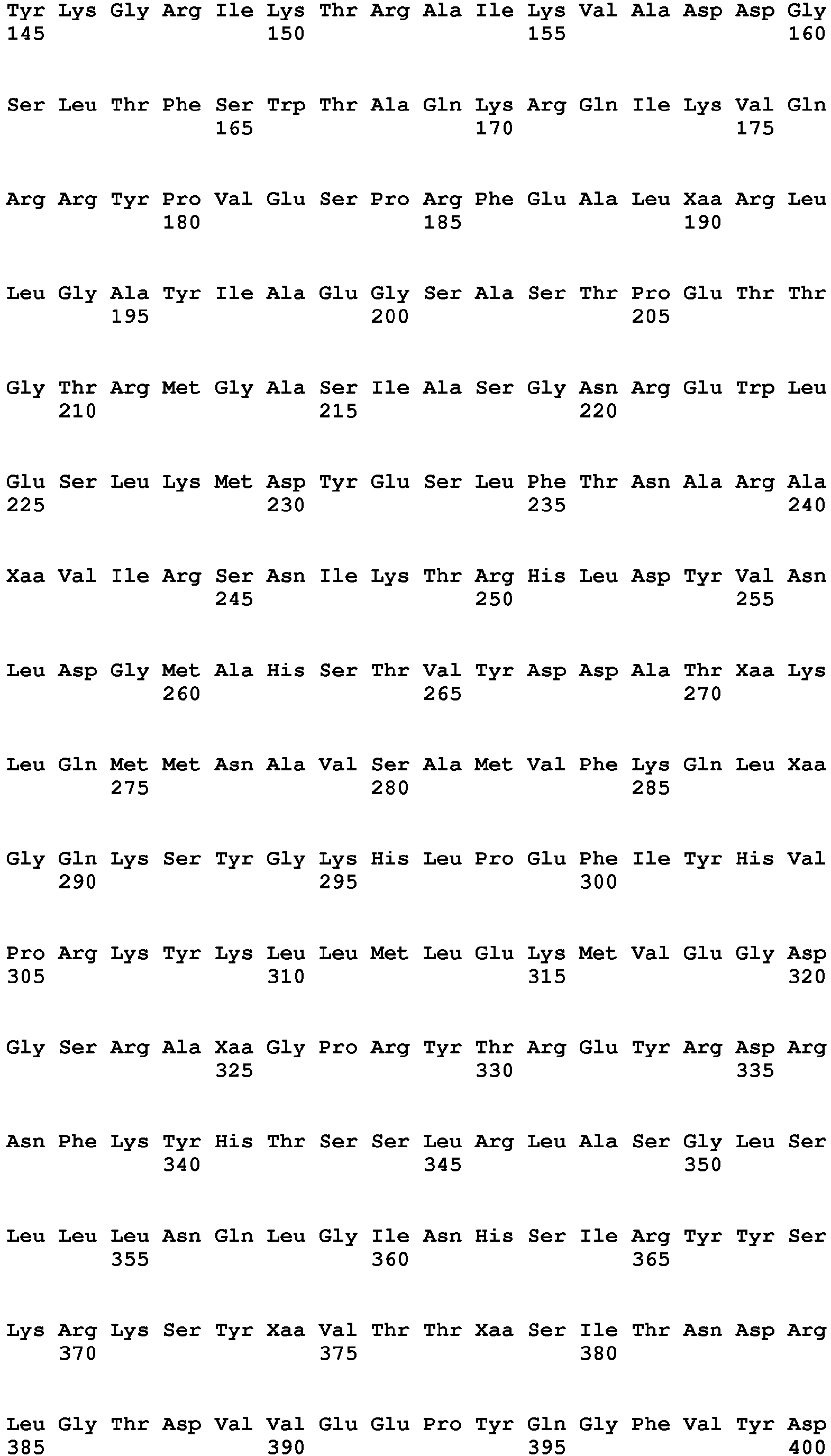
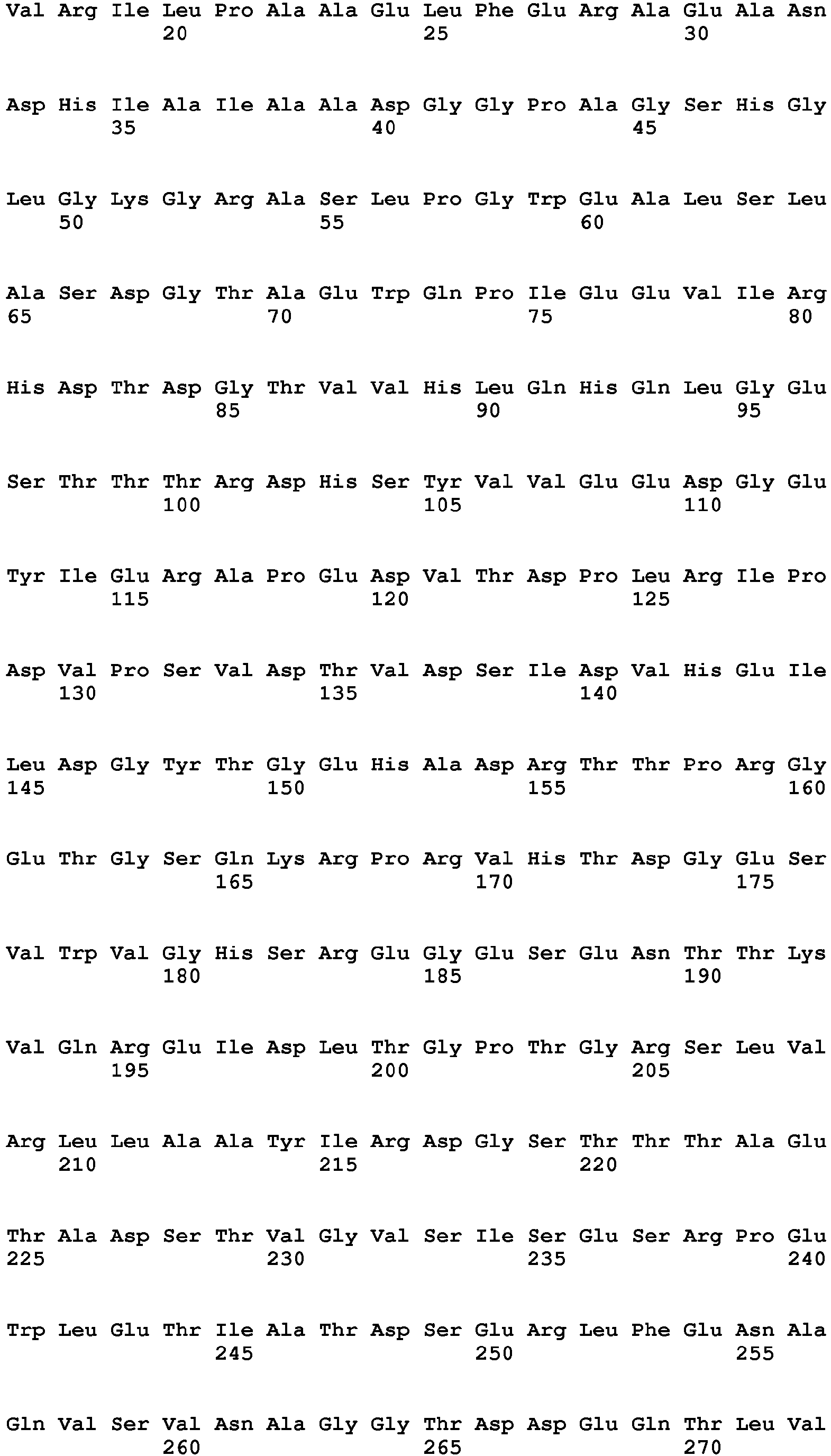
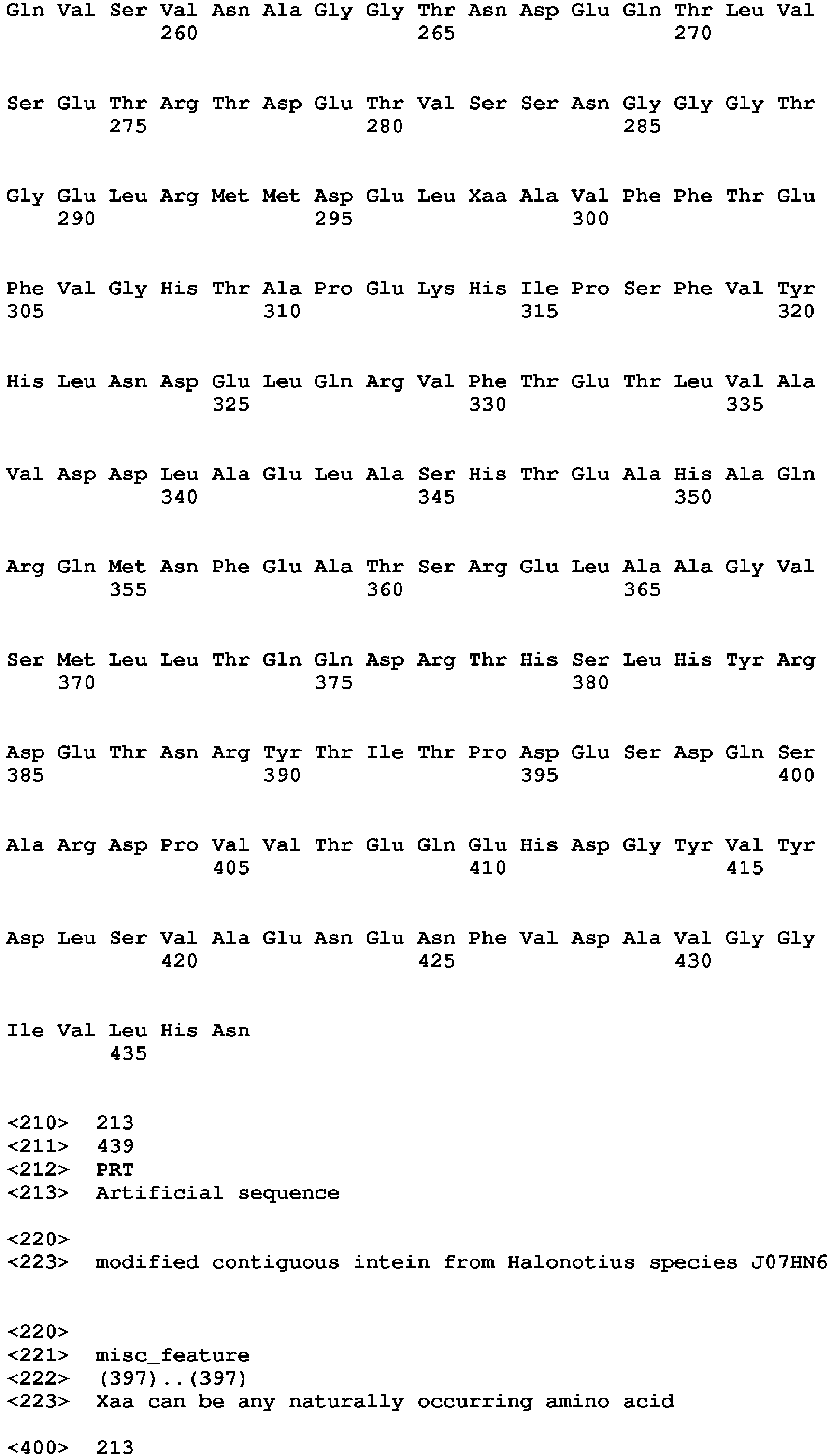
- Figure 30 . Amino acid sequences of N-terminal and C-terminal sequences of split inteins and amino acid sequences of contiguous intein sequences (pol-e integration point alleles/ pol-e type inteins), wherein X is any naturally occuring amino acid residue (with information of intein name, split-intein part name, host protein NCBI accession, species, host type, position in host protein, occuring cysteine residues (positions), comments, aa sequence, in that order). Split intein BtaR-1_PoIB-C-1 is from sequence data from the JGI (Joint Genome Institute) (SEQ ID Nos. 63 and 64). All other accessions are from NCBI.
- Figure 31 . Sequence alignment of potential sequence motifs of pol-e type intein sequences of Figures 29 and 30.
- Figure 32 . Complete and partial amino acid sequences of N-terminal and C-terminal sequences of inteins and amino acid sequences of complete and partial contiguous intein sequences of pol-c-type inteins, wherein X is any naturally occuring amino acid residue (with information of intein name, accession code, source (species or metagenome site), intein position in host, comments, aa sequence).
- Figure 33 . Sequence alignment of potential sequence motifs of pol-c type intein sequences of Figures 32.
DETAILED DESCRIPTION OF THE INVENTION
-
The present invention is based on the unexpected discovery of the inventors that certain split inteins and genetically engineered intein variants, wherein the split inteins comprise a first intein amino acid sequence and a second intein amino acid sequence with the proviso that the catalytic motifs of the at least one first intein amino acid sequence and/or of the at least one second intein amino acid sequence are free of cysteine residues, are able to splice at ambient temperatures, preferably at temperatures under 40 °C, and/or under oxidizing conditions and/or in the absence of a denaturation step and/or they exhibit excellent splicing yields and rates.
-
Unless otherwise defined, all technical and scientific terms used herein have the same meaning as commonly understood by one of ordinary skill in the art. The singular terms "a", "an" and "the" include plural referents unless context clearly indicates otherwise. Similarly, the word "or" is intended to include "and" unless the context clearly indicates otherwise. The term "comprises" means "includes". In case of conflict, the present specification, including explanations of terms, will control.
-
The terms "one or more" or "at least one", as interchangeably used herein, relate to at least 1, or at least 2, 3, 4, 5, 6, 7, 8, 9, 10, 11, 12, 13, 14, 15, 20, 25 or a plurality of species, e.g. at least one first intein amino acid sequence. In this connection, the term "plurality" means more than one, preferably 2 or more, such as up to 1000.
-
Numeric values specified without decimal places here refer to the full value specified with one decimal place, i.e. for example, 99 % means 99.0 %, unless otherwise defined.
-
The terms "about" or "approximately" or "approx.", in connection with a numerical value, refer to a variance of ±10 %, preferably ±5 %, more preferably ±2 %, more preferably ±1 %, more preferably ±0.1 %, and most preferably less than ±0.1 %, with respect to the given numerical value.
-
When an amount, a concentration or other values or parameters (e.g. temperature) is/are expressed in form of a range, a preferable range, or a preferable upper limit value and a preferable lower limit value, it should be understood as that any ranges obtained by combining any upper limit or preferable value with any lower limit or preferable value are specifically disclosed, without considering whether the obtained ranges are clearly mentioned in the context.
-
"Essentially", for example in "essentially free of" typically means that little amounts of the compound can be present. Preferably, the compounds are comprised in amounts of less than 10 wt.-%, more preferably less than 5 wt.-%, more preferably less than 1 wt.-%, more preferably less than 0.1 wt. %, more preferably less than 0.01 wt.-%, more preferably less than 0.001 wt.-%, most preferably free of these compounds, if not explicitly stated otherwise. Similarly, if something "consists essentially of", the listed compound/component forms the major part, typically at least 50% or more.
-
In a first aspect the present invention relates to an isolated polypeptide comprising
- (a) at least one first intein amino acid sequence (a1) and at least one first extein amino acid sequence (a2); wherein the at least one first intein amino acid sequence is an N-terminal sequence of a split intein or fragment thereof; wherein the at least one first extein sequence is fused to the N-terminus of the at least one first intein sequence and has a length of at least 1, preferably at least 5 amino acids; and
- (b) at least one second intein amino acid sequence (b1) and at least one second extein sequence (b2); wherein the at least one second intein sequence is a C-terminal sequence of a split intein or fragment thereof; wherein the at least one second extein sequence is fused to the C-terminus of the at least one second intein sequence and has a length of at least 1, preferably at least 5 amino acids;
wherein the catalytic motifs of the at least one first intein amino acid sequence and/or of the at least one second intein amino acid sequence are free of cysteine residues and wherein the first N-terminal amino acid of the second extein sequence (+1 position) is not a cysteine residue;
wherein the first and second intein amino acid sequence interact with each other to catalyze the cleavage of the peptide bonds between the C-terminal amino acid of the first extein sequence and the N-terminal amino acid of the first intein sequence and the N-terminal amino acid of the second extein sequence and the C-terminal amino acid of the second intein sequence and to ligate the C-terminal amino acid of the first extein sequence to the N-terminal amino acid of the second extein sequence by a peptide bond.
-
In a second aspect, the invention relates to a composition comprising
- (a) a first isolated polypeptide comprising at least one first intein amino acid sequence (a1) and at least one first extein amino acid sequence (a2); wherein the at least one first intein amino acid sequence is an N-terminal sequence of a split intein or fragment thereof; wherein the at least one first extein sequence is fused to the N-terminus of the at least one first intein sequence and has a length of at least 1, preferably at least 5 amino acids; and
- (b) a second isolated polypeptide comprising at least one second intein amino acid sequence (b1), wherein the at least one second intein sequence is a C-terminal sequence of a split intein or fragment thereof and at least one second extein sequence (b2), wherein the at least one second extein sequence is fused to the C-terminus of the at least one second intein sequence and has a length of at least 1, preferably at least 5 amino acids;
wherein the catalytic motifs of the at least one first intein amino acid sequence and/or of the at least one second intein amino acid sequence are free of cysteine residues and wherein the first N-terminal amino acid of the second extein sequence (+1 position) is not a cysteine residue;
wherein the first and second intein amino acid sequence interact with each other to catalyze the cleavage of the peptide bonds between the C-terminal amino acid of the first extein sequence and the N-terminal amino acid of the first intein sequence and the N-terminal amino acid of the second extein sequence and the C-terminal amino acid of the second intein sequence and to ligate the C-terminal amino acid of the first extein sequence to the N-terminal amino acid of the second extein sequence by a peptide bond.
-
As used herein, the term "isolated polypeptide" refers to a polypeptide, peptide, protein segment or domain or fragments of any of the afore-mentioned, which has been separated from other components that accompany it in nature, e.g., proteins, RNA or DNA or other cellular components that naturally accompany it in a cell, for example by purification. Furthermore, in relation to polypeptide sequences, it can further mean that sequences, which flank it in a naturally occurring state, are no longer present, e.g. it can refer to a polypeptide fragment which has been excised from longer polypeptide sequences, in particular sequences which are normally present adjacent to the fragment in the naturally occurring protein. The isolated polypeptides may be artificial polypeptides in that they do not occur in nature but rather are engineered. The term includes, for example, a recombinant polypeptide, which is encoded by a nucleic acid incorporated into a vector, into an autonomously replicating plasmid or virus, or into the genomic DNA of a prokaryote or eukaryote, or which exists as a separate molecule (e.g., as a cDNA or a genomic or cDNA fragment produced by PCR or restriction enzyme digestion) independent of other sequences. It also includes a recombinant polypeptide, which is part of a hybrid polypeptide comprising additional amino acids.
-
Moreover, the isolated polypeptide(s) described herein or the at least one nucleic acid molecule encoding it/them may comprise, in addition to all features described herein, regulatory sequences, i.e. segments that on nucleic acid level are capable of increasing or decreasing the expression of specific genes within an organism or that on protein level regulate location, metabolism and the like.
-
The term "intein" as used herein refers to (a segment of) a protein capable of catalyzing a protein splicing reaction that excises the intein sequence from a precursor protein and joins the flanking sequences (N-and C-exteins) by a peptide bond. Intein and intein-like sequences have been found in a wide variety of organisms and proteins. They are typically 125-650 amino acids in size and may also contain a homing endonuclease domain.
-
The term "split intein" as used herein refers to any intein, which comprises an N-terminal intein sequence and a C-terminal intein sequence, wherein both sequences must be present in order to interact with each other in order to have (splicing) activity. Particularly, the term "split intein" refers to any intein, in which one or more peptide bond breaks exist between the N-terminal and C-terminal intein amino acid sequence such that the N-terminal and C-terminal sequences become separate fragments that can non-covalently reassociate, or reconstitute, into an intein (domain) that is functional for trans-splicing reactions. However, the term "split intein" also refers to a (contiguous) intein, which comprises the N-terminal and the C-terminal amino acid sequence in one contiguous amino acid sequence. Typically, in this case, the C-terminal intein amino acid sequence is linked over its N-terminal end to the C-terminal end of the N-terminal intein amino acid sequence by a peptide bond. Also inteins which comprise a linker sequence, for example of 1 to 10 amino acids in length, between the C-terminal end of the N-terminal intein amino acid sequence and the N-terminal end of the C-terminal intein amino acid sequence are comprised in the scope of the invention. In various non-limiting embodiments, the contiguous intein is functional for cis-splicing reactions. The N-terminal amino acid sequence of a split intein is also referred to herein as "first intein amino acid sequence", while the C-terminal amino acid sequence of a split intein is also referred to as "second intein amino acid sequence".
-
The term "intein fragment" as used herein refers to a separate molecule, e.g. the N-terminal sequence of a split intein or fragment thereof or the C-terminal sequence of a split intein or fragment thereof, typically resulting from peptide bond breaks between the N-terminal and C-terminal amino acid sequences in split inteins.
-
In preferred embodiments, the first intein amino acid sequence described herein is comparably short (e.g. CLN), whereby the isolated polypeptides are ideally suited for use over a wide range of protein modifications, since the protein of interest-IntN (POI-IntN) peptide complex can be easily obtained using solid-phase peptide synthesis.
-
In preferred embodiments according to the invention, the split site between the first intein amino acid sequence, which is an N-terminal sequence of a split intein or fragment thereof and the second intein amino acid sequence, which is a C-terminal sequence of a split intein or fragment thereof is shifted in the engineered intein variant(s) (e.g. CL intein) in comparison to the wild type intein (e.g. Aes intein). This, preferably, results in a shorter IntN fragment and a longer IntC fragment. The described split intein sequences may thus be artificial in that they are split at a different position in relation to their naturally occurring counterpart.
-
In various non-limiting embodiments of some aspects of the present invention, the split takes place after amino acid 10 to 300, preferably after amino acid 11 to 250, more preferably after amino acid 12 to 200, more preferably after amino acids 25 to 200, more preferably after amino acid 26 to 120, more preferably after amino acid 10 or 11 or 12 or 26 or 120, most preferably after amino acid 26 or 120, as calculated from the intein's N-terminal end.
-
In a preferred embodiment of some aspects of the present invention, the N-terminal intein sequence is split from the C-terminal intein sequence after 10, 11, 12, 13, 14, 15, 16, 17, 18, 19, 20, 21 , 22, 23, 24, 25, 26, 27, 28, 29, 30, 31 , 32, 33, 34, 35, 36, 37, 38, 39, 40, 41 , 42, 43, 44, 45, 46, 47, 48, 49, 50, 51 , 52, 53, 54, 55, 56, 57, 58, 59 or 60 amino acids as calculated from the intein's N-terminal end. In an especially preferred embodiment, the N-terminal intein sequence is split from the C-terminal intein sequence after 10 to 40 amino acids, preferably after 11 to 40 amino acids, more preferably after 12 to 40 amino acids, more preferably after 25 to 40 amino acids, most preferably after 10, 11, 12 or 26 amino acids, preferably after 26 amino acids from the intein's N-terminal end.
-
In various non-limiting embodiments, the intein is a split intein with an N-terminal intein sequence of at least 10 or 11 or 14 amino acids, preferably at least 25 amino acids, most preferably 26 amino acids in length. Preferably, the N-terminal intein sequence is an engineered N-terminal intein sequence (e.g. CLN), which is split after 10 to 40 or 11 to 40 or 12 to 40 or 25 to 40 amino acids, most preferably after 26 amino acids from the intein's N-terminal end. More preferably, the engineered N-terminal intein sequence comprises or consists of 26 amino acids in length.
-
Thus, for example, the N-terminal intein sequence of such an intein or fragment thereof and/or the protein of interest-IntN peptide complex is shorter and hence better suited for the chemical synthesis, e.g. for solid peptide synthesis, which is faster, easier to perform and much more reliable than protein generation via recombinant protein expression.
-
In another non-limiting embodiment, the N-terminal intein sequence is split after 100 to 200 amino acids, preferably after 120 amino acids. In various non-limiting embodiments, the intein is a split intein with an N-terminal intein sequence of 120 amino acids in length.
-
In various non-limiting embodiments of aspect 1 or 2 of the present invention, the intein is a split intein with a C-terminal intein sequence of at least 6 amino acids, preferably of at least 24 amino acids, more preferably of at least 30 amino acids, preferably 39 or 129 amino acids in length.
-
Preferably, the C-terminal intein sequence is an engineered C-terminal intein sequence (e.g. CLC) and comprises or consists of at least 6 amino acids, more preferably of at least 24 amino acids, more preferably of at least 30 amino acids, more preferably of 129 amino acids in length.
-
As interchangeably used herein, the terms "N-terminal split intein", "N-terminal intein fragment" and "N-terminal intein sequence" (abbreviated "IntN")" refer to any sequence that comprises an N-terminal amino acid sequence of a split intein or fragment thereof that is functional for (trans-)splicing reactions. Preferably, they refer to the first intein amino acid sequence (a1) as described above. It can comprise a sequence that is a modification of the N-terminal portion of a naturally occurring intein sequence. For example, it can comprise additional amino acid residues and/or mutated residues and/or residues may be deleted as long as the inclusion, modification or deletion of such residues does not render the IntN non-functional in (trans-)splicing. Preferably, the inclusion, modification or deletion of such residues improves or enhances the (trans-)splicing activity of the IntN.
-
As interchangeably used herein, the terms "C-terminal split intein", "C-terminal intein fragment" and "C-terminal intein sequence" (abbreviated "IntC")" refer to any sequence that comprises a C-terminal amino acid sequence of a split intein or fragment thereof that is functional for (trans-)splicing reactions. Preferably, they refer to the second intein amino acid sequence (b1) as described above. An IntC can comprise a sequence that is a modification of the C-terminal portion of a naturally occurring intein sequence. For example, it can comprise additional amino acid residues and/or mutated residues and/or residues may be deleted as long as the inclusion, modification or deletion of such residues does not render the IntC non-functional in (trans-splicing). Preferably, the inclusion, modification or deletion of such residues improves or enhances the (trans-)splicing activity of the IntC.
-
Amino acids which may be any naturally occuring amino acid typically include the amino acids: alanine (A), arginine (R), histidine (H), lysine (K), aspartic acid (D), glutamic acid (E), serine (S), threonine (T), asparagine (N), glutamine (Q), cysteine (C), glycine (G), proline (P), valine (V), isoleucine (I), leucine (L), methionine (M), phenylalanine (F), tyrosine (Y), tryptophan (W), selenocysteine (U) and pyrrolysine (O) and natural derivatives thereof, if not explicity stated otherwise.
-
It is also included within the scope of the invention, but not preferred, that one or more amino acids of N-terminal and/or C-terminal intein amino acid sequences may be unnatural amino acids, preferably in chemically synthetized polypeptides and proteins. This is typically referred to as "genetic code expansion" or "amber stop codon suppression". Suitable unnatural amino acids are, for example, mentioned in the list of reference (71) and their possible synthesis and incorporation is described in the corresponding text of reference (71) and in reference (72), which are hereby incorporated by reference.
-
In preferred embodiments, amino acids which may be any naturally occuring amino acid include only the 20 proteinogenic amino acids (A), arginine (R), histidine (H), lysine (K), aspartic acid (D), glutamic acid (E), serine (S), threonine (T), asparagine (N), glutamine (Q), cysteine (C), glycine (G), proline (P), valine (V), isoleucine (I), leucine (L), methionine (M), phenylalanine (F), tyrosine (Y) and tryptophan (W), and natural derivatives thereof, if not explicity stated otherwise. It is understood that when a sequence is defined to be cysteine-free that "any amino acid" does not include cysteine.
-
Typically, one or more sequence motifs of the first and/or second intein amino acid sequence, in particular the catalytic motifs, are free of cysteine residues. In these cases, the term "any naturally occuring amino acid" refers to the 19 proteinogenic amino acids alanine, arginine, histidine, lysine, aspartic acid, glutamic acid, serine, threonine, asparagine, glutamine, glycine, proline, valine, isoleucine, leucine, methionine, phenylalanine, tyrosine and tryptophan and derivatives thereof, excepting cysteine and derivatives thereof. In most preferred embodiments, all sequence motifs of the first and the second intein amino acid sequences are free of cysteine residues.
-
In cases in which an amino acid is "not present", the adjacent amino acids left and right of the amino acid which is not present are linked to each other by a peptide bond, of not explicitly stated otherwise. "Not present" is thus tantamount to a peptide bond between the adjacent amino acids of the missing/absent amino acid(s).
-
It is a proviso of the present invention that the catalytic motifs of the at least one first intein amino acid sequence and/or of the at least one second intein amino acid sequence are free of cysteine residues.
-
In pol-e type intein sequences, typically one or more of the following sequence motifs may be present in the first or second intein amino acid sequence:
-
In various non-limiting embodiments, the catalytic motif(s) of the at least one first intein amino acid sequence comprise(s) the amino acid sequence (A)
X1X2X3X4X5X6X7X8X9X10X11 (A)
wherein
- X1 is S or T, most preferably S;
- X2 is V, C, F, Q, I, T, S, L, G or A, preferably V, C, F, Q, I or T, more preferably V, F, Q, I or T, most preferably V;
- X3 is V, T, L, S, I, N, D, A, Q, R, H, F, E, Y, C, K or P, preferably V, D, S, T, L or A, more preferably V, D or S, most preferably V or D;
- X4 is any naturally occuring amino acid or not present, preferably G, A, W, E, S, T, K, N, F, H, Y, R, C, Q, M or not present, more preferably G, A, W, S, F, M or K, more preferably G, A, S, F or K, most preferably G;
- X5 is D, S, K, N, L, E, C, T, A, Q or I, preferably D, S, K, N, Q or L, most preferably D or N;
- X6 is T, S, V, A, C, M or E, preferably T, S, E or C, more preferably T or S, most preferably T;
- X7 is I, Q, S, K, E, T, L, V, H, C, F, A, M, N, Y or P, preferably I, L, Q, K or P, more preferably I, L, Q or K, most preferably I or L;
- X8 is any naturally occuring amino acid or not present, preferably I, V, F, L, N, M or not present, more preferably I, V, F, L or M, more preferably I, V, F or L, most preferably I or L;
- X9 is D, N, V, R, F, Y, Q, E, K, C, S, I, M, H, W or L, preferably D, Y, K, R, N, L or V, most preferably D or Y;
- X10 is any naturally occuring amino acid or not present, preferably V, I, L, Y, T, A, C, W or not present, more preferably V, I, L, T, C or W, more preferably V, I, L or T, more preferably V, I or T, most preferably V or I; and
- X11 is S, N, D, R, K, E, T, M, G, I or H, preferably S, N, D, R, K, E or H, preferably S, N, D, R or K, more preferably S, N or D, most preferably S or N;
- wherein the amino acid sequence (A) comprises or consists of at least 8 amino acids (X1-X3, X5-X7, X9, X11), preferably at least 9 amino acids (X1-X3, X5-X7, X9-X11) or 10 amino acids (X1-X3, X5-X11 or X1-X9, X11), most preferably it comprises or consists of 11 amino acids (X1-X11).
-
In various preferred embodiments, amino acid sequence (A) is free of cysteine residues.
-
In various non-limiting embodiments, the catalytic motif(s) of the at least one second intein amino acid sequence comprise(s) the amino acid sequence (B1)
X45X46X47X48X49X50X51X52X53X54X55X56X57 (B1)
wherein
- X45 is N, C, Y, T, D, P, S, H, A, G, M or R, preferably N, C, T, S, or H, more preferably N, T or S, most preferably T or N;
- X46 is H, P, S or F, preferably H, F or P, most preferably H;
- X47 is N, T, C, Y, M, V, A, S or H, preferably N, T, Y, M, A or H, most preferably N or T;
- X48 is F or A, preferably F;
- X49 is F, V, Y, I or G, preferably F, V, Y or I, most preferably F;
- X50 is G, A, C or I, preferably G or A;
- X51 is N, S, D or G, preferably N or G, most preferably N;
- X52 is D, G, N, E, T, S or R, preferably D, N, G or R, more preferably D, N or G, more preferably D or N, most preferably D;
- X53 is I, V, M or T, preferably I, M or V, more preferably I or V, most preferably I;
- X54 is L, C, Y, I or V, preferably L;
- X55 is V, A, I or L, preferably V;
- X56 is H; and
- X57 is N;
- wherein the amino acid sequence (B1) comprises or consists of at least 13 amino acids (X45-X57).
-
In various preferred embodiments, amino acid sequence (B1) is free of cysteine residues.
-
In various non-limiting embodiments, the amino acid sequence (B1) can also be amino acid sequence (B1*)
X44X45X46X47X48X49X50X51X52X53X54X55X56X57 (B1*)
wherein
- X44 is D, E, C, N, S, T, G, L or H, preferably D, E or N; and wherein X45-X57 are as described above.
-
In various non-limiting embodiments, the catalytic motif(s) of the at least one second intein amino acid sequence comprise(s) the amino acid sequence (B2)
X28X29X30X31X32X33X34X35X36X37 (B2)
wherein
- X28 is I, L, E, V, Q, D or N, preferably I, L, E, Q, D or N, more preferably I, E or D, most preferably I or E;
- X29 is D, Y, W, F, P, I or M, preferably D, Y or W, most preferably D or Y;
- X30 is V or A, preferably V;
- X31 is Y or F, preferably Y;
- X32 is D;
- X33 is I, V, L, C, A or M, preferably I, V, L or C, more preferably I, V or L, most preferably I;
- X34 is E, S, G or V, preferably E;
- X35 is any naturally occuring amino acid or not present, preferably V, M, I, T or not present, more preferably V or M, most preferably V;
- X36 is any naturally occuring amino acid or not present, preferably D, E, Q, P, K, F, A, N, G or not present, more preferably D or E, most preferably D; and
- X37 is any naturally occuring amino acid or not present, preferably G, E, D, K, T, N, S or not present, more preferably G, E, D or N, more preferably G, E or D, most preferably G or D;
- wherein the amino acid sequence (B2) comprises or consists of at least 7 amino acids (X28-X34), preferably at least 8 amino acids (X28-X34, X37 or X28-X35) or at least 9 amino acids (X28-X35, X37 or X28-X36), most preferably at least 10 amino acids (X28-X37).
-
In various preferred embodiments, amino acid sequence (B2) is free of cysteine residues.
-
In various non-limiting embodiments, the amino acid sequence (B2) can also be amino acid sequence (B2*)
X24X25X26X27X28X29X30X31X32X33X34X35X36X37X38 (B2*)
wherein
- X24 is F, A, E, I, V, D, Y, K, M, P, T, W, C, S, Q or not present, preferably F, I, Y, M, T or not present; X25 is D, T or not present;
- X26 is N, Q, E, D, V, K, I, R, T, P, C, L or not present, preferably N, Q, E, D, K, T, C or not present;
- X27 is D, P, N, E, F, K, C, G or not present, preferably D, N, E, C or not present;
- X38 is P, T, D, S, G or not present, preferably P, D, S or not present; and wherein X28-X37 are as described above.
-
In various non-limiting embodiments, it is also possible that the amino acid sequence B1 and the amino acid sequence B2 form a combined sequence motif (B)
wherein
- X24 is F, A, E, I, V, D, Y, K, M, P, T, W, C, S, Q or not present, preferably F, I, Y, M, T or not present; X25 is D, T or not present;
- X26 is N, Q, E, D, V, K, I, R, T, P, C, L or not present, preferably N, Q, E, D, K, T, C or not present;
- X27 is D, P, N, E, F, K, C, G or not present, preferably D, N, E, C or not present;
- X28 is I, L, E, V, Q, D or N, preferably I, L, E, Q, D or N, more preferably I, E or D, most preferably I or E;
- X29 is D, Y, W, F, P, I or M, preferably D, Y or W, most preferably D or Y;
- X30 is V or A, preferably V;
- X31 is Y or F, preferably Y;
- X32 is D;
- X33 is I, V, L, C, A or M, preferably I, V, L or C, more preferably I, V or L, most preferably I;
- X34 is E, S, G or V, preferably E;
- X35 is any naturally occuring amino acid or not present, preferably V, M, I, T or not present, more preferably V or M, most preferably V;
- X36 is any naturally occuring amino acid or not present, preferably D, E, Q, P, K, F, A, N, G or not present, more preferably D or E, most preferably D;
- X37 is any naturally occuring amino acid or not present, preferably G, E, D, K, T, N, S or not present, more preferably G, E, D or N, more preferably G, E or D, most preferably G or D;
- X38 is P, T, D, S, G or not present, preferably P, D, S or not present, more preferably P or not present; X39 is E, I or not present, preferably I or not present;
- X40 is N, I or not present, preferably N or not present;
- X41 is D or not present, preferably not present;
- X42 is V or not present, preferably not present;
- X43 is E or not present, preferably not present;
- X44 is D, E, C, N, S, T, G, L, H or not present, preferably D, E, N, S, H or not present, more preferably D, E or not present, more preferably D or not present;
- X45 is N, C, Y, T, D, P, S, H, A, G, M or R, preferably N, C, T, S, or H, more preferably N, T or S, most preferably T or N;
- X46 is H, P, S or F, preferably H, F or P, most preferably H;
- X47 is N, T, C, Y, M, V, A, S or H, preferably N, T, Y, M, A or H, most preferably N or T;
- X48 is F or A, preferably F;
- X49 is F, V, Y, I or G, preferably F, V, Y or I, most preferably F;
- X50 is G, A, C or I, preferably G or A;
- X51 is N, S, D or G, preferably N or G, most preferably N;
- X52 is D, G, N, E, T, S or R, preferably D, N, G or R, more preferably D, N or G, more preferably D or N, most preferably D;
- X53 is I, V, M or T, preferably I, M or V, more preferably I or V, most preferably I;
- X54 is L, C, Y, I or V, preferably L;
- X55 is V, A, I or L, preferably V;
- X56 is H; and
- X57 is N;
- wherein the amino acid sequence (B) comprises or consists of at least 7 amino acids (X28-X34), preferably at least 17 amino acids (X28-X34 and X45-X54), more preferably at least 20 amino acids (X28-X34 and X45-X57), most preferably at least 23 amino acids (X28-X37 and X45-X57).
-
In various preferred embodiments, amino acid sequence (B) is free of cysteine residues.
-
In various non-limiting embodiments, the catalytic motif(s) of the first or the second intein amino acid sequence comprise(s) the amino acid sequence (C)
X12X13X14X15X16X17X18X19X20X21X22X23 (C)
wherein
- X12 is any naturally occuring amino acid or not present, preferably E, K, T, M, S, P, F, D, V, C, Q, A, Y or not present, more preferably E, C, S, V or P, more preferably E, S, V or P, most preferably E;
- X13 is V, L, T or I, most preferably V or I;
- X14 is I, T, E, V, L, F, K, D, S, Y, M or H, preferably I, T, E, V, Y or H, more preferably I, T, E or V, most preferably I;
- X15 is V, M, I, L, T, C or A, preferably V, T, C or I, more preferably V or I, most preferably V;
- X16 is T or S, preferably T;
- X17 is A, E, C, G, N, Q, D, T or S, preferably A, E, C, G, N or T, more preferably A, E, G, N or T, most preferably A, E or G;
- X18 is D, E or N, preferably D;
- X19 is H;
- X20 is S, C, G, I, V or N, preferably S, C, V or N, more preferably S or V, most preferably S;
- X21 is V, I, L, M, C, or F, preferably V, I, L, M or C, more preferably V, I, C or L, more preferably V, I or L, most preferably V;
- X22 is any naturally occuring amino acid or not present, preferably M, I, K, V, L or not present, more preferably M, I or V, most preferably M; and
- X23 is any naturally occuring amino acid or not present, preferably V, I, K, R, A, D or not present, more preferably, V, I, D, R or A, more preferably V, I or A, most preferably V,
- wherein the amino acid sequence (C) comprises or consists of at least 9 amino acids (X13-X21), preferably at least 10 amino acids (X12-X21) or at least 11 amino acids (X13-X23), most preferably 12 amino acids (X12-X23).
-
In various preferred embodiments, the amino acid sequence (C) is free of cysteine residues.
-
The terms "any naturally occuring amino acid" or "not present" are as defined above.
-
In pol-c type intein sequences, typically one or more of the following sequence motifs may be present in the first or second intein amino acid sequence:
-
In various non-limiting embodiments, the catalytic motif(s) of the at least one first intein amino acid sequence comprise(s) the amino acid sequence (A')
X1X2X3X4X5X6X7X8X9X10X11 (A')
wherein
- X1 is S;
- X2 is V, F, I or L, preferably V, F or I, most preferably V;
- X3 is G, A, T, M, L, E, S, V, D, N, I or K, preferably A, T, M, L or V, most preferably T;
- X4 is K, G, A, P, S, E, Y, H, D or N, preferably K, G, A, P, Y or H, most preferably G;
- X5 is D, S, Y, E, G, N, A, T or C, preferably D, S, Y, E or C, more preferably D, S, Y or E, most preferably D;
- X6 is T, S, E or R, preferably T, S or R, more preferably T or S, most preferably T;
- X7 is E, I, V, P, Q, L, A, R, D, C, F, W or M, preferably I, V, P, Q, L, C, W or M, more preferably I, V, P, Q, L, W or M, more preferably I, V, P or L, most preferably P;
- X8 is I, V, L or M, preferably I, V or L, most preferably I;
- X9 is V, A, S, I, M, L, F, Y, T or R, preferably V, I, M, L, F, Y or T, more preferably V, I, M, L or Y, most preferably V, I or L;
- X10 is M, V, T, I, L, A or Y, preferably M, V, T, I or L, more preferably V, I or L, most preferably V; and X11 is any naturally occuring amino acid, preferably N, R, K, Y, S, G, D, E, L or not present, preferably R, K, Y, D or L, more preferably R or K, most preferably R;
- wherein the amino acid sequence (A') comprises or consists of at least 10 amino acids (X1-X10), preferably it comprises or consists of 11 amino acids (X1-X11).
-
In various preferred embodiments, the amino acid sequence (A') is free of cysteine residues.
-
In various non-limiting embodiments, the catalytic motif(s) of the at least one second intein amino acid sequence comprise(s) the amino acid sequence (B1')
X43X44X45X46X47X48X49X50X51X52X53X54 (B1')
wherein
- X43 is any naturally occuring amino acid or not present, preferably R, C, F, V, L, P, H, N or not present, more preferably C, F, V or H, more preferably F, V or H, most preferably F;
- X44 is any naturally occuring amino acid or not present, preferably F, H, Q, V, I, S, A, N, Y, C, T, W or not present, more preferably F, H, V, A, N, C, T or W, more preferably F, H, V, N or A, most preferably F, H, A or V;
- X45 is F, Y, A, V, N, G, S, I, C or D, preferably F, A, N, C or D, most preferably F, A, N or D;
- X46 is any naturally occuring amino acid or not present, preferably G, A, R, F, M or not present, preferably G, A or F, most preferably G;
- X47 is A, V, I, P, L, S, F, G, K or C, preferably A, V, I, P, L or C, more preferably A, V, I, L or C, most preferably A, V, I or L;
- X48 is any naturally occuring amino acid or not present, preferably N, G, D or not present, most preferably N or G;
- X49 is N, D, R, G, E, L, M, S, P or Q, preferably N, D, G, E or M, most preferably N, G, E or M;
- X50 is V, I, M, L or N, preferably I, M or L, most preferably I or L;
- X51 is L, I, V, D or C, preferably L, I, V or C, most preferably L, I or V;
- X52 is V, I, N, L, C or A, preferably V, L or C, most preferably V or L;
- X53 is H, K, S or T, preferably H or K, most preferably H; and
- X54 is N or Q, preferably N;
- wherein the amino acid sequence (B1') comprises or consists of at least 8 amino acids (X45, X49-X54), preferably at least 10 amino acids (X45-X54) or at least 11 amino acids (X43-X45, X47-X54, or X43-X47, X49-X54), most preferably it comprises or consists of 12 amino acids (X43-X54).
-
In various preferred embodiments, the amino acid sequence (B1') is free of cysteine residues.
-
In various non-limiting embodiments, the catalytic motif(s) of the at least one second intein amino acid sequence comprise(s) the amino acid sequence (B2')
X27X28X29X30X31X32X33X34X35X36X37 (B2')
wherein
- X27 is D, E, Y, F, V, T, M or W, preferably Y, F, M or W, most preferably Y;
- X28 is V;
- X29 is Y;
- X30 is D;
- X31 is L, I, M or V, preferably L or I, most preferably L;
- X32 is E, T, S, Q, C or G, preferably E, T, S or C, more preferably E, T or S, most preferably E or S;
- X33 is I, L, M, V, T, C or A, preferably I, L, M, V, T or C, more preferably I, L, M, V or T, most preferably VorT;
- X34 is any naturally occuring amino acid or not present, preferably E, P, D, G, S, A, Q, T, V, K, N, F, G, R or not present, more preferably E, D, A or K, most preferably E;
- X35 is any naturally occuring amino acid or not present, preferably V, D, S, Q, N, R, A, C, H, G, E, T or not present, more preferably D, S, N, C or E, more preferably D, S, N or E, most preferably D or N,
- X36 is any naturally occuring amino acid or not present, preferably D, G, H, Q, N, E, T, S, A or not present, more preferably D, G, H, Q or N, more preferably G, H or N, most preferably G or H,
- X37 is any naturally occuring amino acid or not present, preferably T, D, S, H, V, E, R, Q, K, N, I or not present, more preferably T, D, H or E, most preferably T or H;
- wherein the amino acid sequence (B2') comprises or consists of at least 7 amino acids (X27-X33), preferably at least 9 amino acids (X27-X35) or at least 10 amino acids (X27-X33, X35-X37 or X27-X35, X37 or X27-X34, X36-X37), most preferably at least 11 amino acids (X27-X37).
-
In various preferred embodiments, the amino acid sequence (B2') is free of cysteine residues.
-
In various non-limiting embodiments, the amino acid sequence (B2') can also be amino acid sequence (B2'*)
X24X25X26X27X28X29X30X31X32X33X34X35X36X37X38 (B2'*)
wherein
- X24 is G, L, I, T, K, Q, D, H, V, F, E, S, Y, N, R or not present, preferably G, T, D, V or not present;
- X25 is N, G, V, M, D, E, L, P, K, I or not present, more preferably N, G, M, D, E, P or not present;
- X26 is D, E, N, V, A, R, G, L, T, K or not present, preferably D, E, N, A, R, G or not present;
- X38 is H, R, E, D, N, M, A or not present, preferably H, D, N, M or not present; and
- wherein X27-X37 are as described above.
-
In various preferred embodiments, the amino acid sequence (B2'*) is free of cysteine residues.
-
In various non-limiting embodiments, amino acid sequences B1' and B2' may also form a combined sequence motif (B')
X24X25X26X27X28X29X30X31X32X33X34X35X36X37X38X39X40X41X42X43X44X45X46X47X48X49X50X51X52X53X54 (B')
wherein
- X24 is G, L, I, T, K, Q, D, H, V, F, E, S, Y, N, R or not present, preferably G, T, D, V or not present;
- X25 is N, G, V, M, D, E, L, P, K, I or not present, more preferably N, G, M, D, E, P or not present;
- X26 is D, E, N, V, A, R, G, L, T, K or not present, preferably D, E, N, A, R, G or not present;
- X27 is D, E, Y, F, V, T, M or W, preferably Y, F, M or W, most preferably Y;
- X28 is V;
- X29 is Y;
- X30 is D;
- X31 is L, I, M or V, preferably L or I, most preferably L;
- X32 is E, T, S, Q, C or G, preferably E, T, S or C, more preferably E, T or S, most preferably E or S; X33 is I, L, M, V, T, C or A, preferably I, L, M, V, T or C, more preferably I, L, M, V or T, most preferably V orT;
- X34 is any naturally occuring amino acid or not present, preferably E, P, D, G, S, A, Q, T, V, K, N, F, G, R or not present, more preferably E, D, A or K, most preferably E;
- X35 is any naturally occuring amino acid or not present, preferably V, D, S, Q, N, R, A, C, H, G, E, T or not present, more preferably D, S, N, C or E, more preferably D, S, N or E, most preferably D or N, X36 is any naturally occuring amino acid or not present, preferably D, G, H, Q, N, E, T, S, A or not present, more preferably D, G, H, Q or N, more preferably G, H or N, most preferably G or H,
- X37 is any naturally occuring amino acid or not present, preferably T, D, S, H, V, E, R, Q, K, N, I or not present, more preferably T, D, H or E, most preferably T or H;
- X38 is H, R, E, D, N, M, A or not present, preferably H, D, N, M or not present;
- X39 is D, N, E or not present, preferably not present;
- X40 is D, A, Y or not present, preferably not present;
- X41 is L, E, I or not present, preferably not present;
- X42 is E, K, Q or not present, preferably not present;
- X43 is any naturally occuring amino acid or not present, preferably R, C, F, V, L, P, H, N or not present, more preferably C, F, V or H, more preferably F, V or H, most preferably F;
- X44 is any naturally occuring amino acid or not present, preferably F, H, Q, V, I, S, A, N, Y, C, T, W or not present, more preferably F, H, V, A, N, C, T or W, more preferably F, H, V, N or A, most preferably F, H, A or V;
- X45 is F, Y, A, V, N, G, S, I, C or D, preferably F, A, N, C or D, most preferably F, A, N or D;
- X46 is any naturally occuring amino acid or not present, preferably G, A, R, F, M or not present, preferably G, A or F, most preferably G;
- X47 is A, V, I, P, L, S, F, G, K or C, preferably A, V, I, P, L or C, more preferably A, V, I, L or C, most preferably A, V, I or L;
- X48 is any naturally occuring amino acid or not present, preferably N, G, D or not present, most preferably N or G;
- X49 is N, D, R, G, E, L, M, S, P or Q, preferably N, D, G, E or M, most preferably N, G, E or M;
- X50 is V, I, M, L or N, preferably I, M or L, most preferably I or L;
- X51 is L, I, V, D or C, preferably L, I, V or C, most preferably L, I or V;
- X52 is V, I, N, L, C or A, preferably V, L or C, most preferably V or L;
- X53 is H, K, S or T, preferably H or K, most preferably H; and
- X54 is N or Q, preferably N;
- wherein amino acid sequence (B') comprises or consists of at least 15 amino acids (X27-X33, X45, X47, X49-X54), preferably at least 23 amino acids.
-
In various preferred embodiments, amino acid sequence (B') is free of cysteine residues.
-
In various non-limiting embodiments, the catalytic motif(s) of the first or the second intein amino acid sequence comprise(s) the amino acid sequence (C')
X12X13X14X15X16X17X18X19X20X21X22X23 (C')
wherein
- X12 is Y, H, C, V, I, L, M, S, T, K, E, D, Q, W, R or A, preferably Y, C, I, L, K or E, more preferably Y, C or E, more preferably Y or E, most preferably E;
- X13 is I, V, C, T or S, preferably I, V, C or S, more preferably I, V or S, most preferably V;
- X14 is D, T, M, E, C, K, H, N, V, S, I or R, preferably D, T, E, C, H, V or I, more preferably D, T or H, more preferably D or T, most preferably D;
- X15 is V, C, A, I or T, preferably V, C or T, most preferably V;
- X16 is T;
- X17 is E, R, A, S, D, K, N, H, C, P or T, preferably E, R, D, H or C, more preferably E, R, D or H, more preferably E or R, most preferably E;
- X18 is D, N, Q or E, preferably D;
- X19 is H;
- X20 is S or R, preferably S;
- X21 is L, V, A, I or Y, preferably L, I or Y, most preferably L;
- X22 is I, L, F, V, M or Y, preferably I, L, F, V or M, most preferably I, L, F or V; and
- X23 is G, D, N, L, Q, K, R, Y, V, I, A, T, S or K, preferably G, D, N, V, I or T, more preferably D or V; wherein the amino acid sequence (C') comprises or consists of 12 amino acids (X12-X23).
-
In various preferred embodiments, amino acid sequence (C') is free of cysteine residues.
-
In various preferred embodiments, the amino acid sequence (A) or (A') forms the N-terminus of the first intein amino acid sequence.
-
In various preferred embodiments, the amino acid sequence (B1) or (B1') forms the C-terminus of the second intein amino acid sequence. In other embodiments, also one of the amino acid sequences (B1*) or (B) or (B') may form the C-terminus of the second intein amino acid sequence.
-
In various preferred embodiments, the second extein amino acid sequence (b2) comprises a serine (S) or threonine (T) residue at its N-terminus that is fused to the amino acid of the C-terminus of the second intein amino acid sequence (b1) by a peptide bond. That typically means, that in preferred embodiments, the last amino acid at the C-terminus of the amino acid sequence (B1) or (B1') or (B1*) or (B) or (B') is directly linked to a serine or threonine residue (also referred to as position +1) by a peptide bond, wherein the serine or threonine residue (+1) is part of the second extein amino acid sequence (b2). In preferred embodiments, the serine or threonine residue may also be part of the catalytic motif of (B1) or (B1') or (B1*) or (B) or (B'), since it has an effect on the catalytic activity, in particular the splicing activity, of the intein. In these preferred embodiments, the catalytic motif may be one of:
- X45X46X47X48X49X50X51X52X53X54X55X56X57(+1) (B1-(+1)), wherein (+1) is S or T, preferably S; or
- X44X45X46X47X48X49X50X51X52X53X54X55X56X57(+1) (B1*-(+1)), wherein (+1) is S or T, preferably S; or
- X24X25X26X27X28X29X30X31X32X33X34X35X36X37X38X39X40X41X42X43X44X45X46X47X48X49 X50X51X52X53X54X55X56X57(+1) (B-(+1)), wherein (+1) is S or T, preferably S; or
- X43X44X45X46X47X48X49X50X51X52X53X54(+1) (B1'-(+1)), wherein (+1) is S or T, preferably T; or
- X24X25X26X27X28X29X30X31X32X33X34X35X36X37X38X39X40X41X42X43X44X45X46X47X48X49X50X51X52X53X54(+1) (B'-(+1)), wherein (+1) is S or T, preferably T;
wherein X24-X57 are as described above in the corresponding embodiment.
-
In various preferred embodiments, the amino acid sequence (B2) is located N-terminally to amino acid sequence (B1) in the second intein amino acid sequence, preferably amino acids X37 of (B2) and X45 of (B1) are linked to each other by a peptide bond. In this case, the amino acid sequences of (B2) and (B1) may form a combined amino acid sequence (B).
-
In further preferred embodiments, the amino acid sequence (B2') is located N-terminally to amino acid sequence (B1') in the second intein amino acid sequence, preferably amino acids X37 of (B2') and X43 of (B1') are linked to each other by a peptide bond. In this case, the amino acid sequences of (B2') and of (B1') may form a combined amino acid sequence (B').
-
Analogously, the amino acid sequences B1* or B2* or B2'* may be present.
-
In various preferred embodiments, the amino acid sequence (C), if present in the first intein amino acid sequence, is located C-terminally to amino acid sequence (A), or, if present in the second intein amino acid sequence, is located N-terminally to amino acid sequence (B2) or (B2*) or (B).
-
In various preferred embodiments, the amino acid sequence (C'), if present in the first intein amino acid sequence, is located C-terminally to amino acid sequence (A'), or, if present in the second intein amino acid sequence, is located N-terminally to amino acid sequence (B2') or (B2'*) or (B').
-
In various preferred embodiments, the amino acid sequence (A), the amino acid sequence (B1) or (B1*), the amino acid sequence (B2) or (B2*) and/or the amino acid sequence (C), preferably at least two, more preferably at least three, most preferably all four amino acid sequences are free of cysteine residues.
-
In various preferred embodiments, the amino acid sequence (A'), the amino acid sequence (B1'), the amino acid sequence (B2') or (B2'*) and/or the amino acid sequence (C'), preferably at least two, more preferably at least three, most preferably all four amino acid sequences are free of cysteine residues.
-
Preferably,
- (i) the at least one first intein amino acid sequence is free of cysteine residues, and/or
- (ii) the at least one second intein amino acid sequence is free of cysteine residues. This means that the complete sequences, i.e. not only the catalytic motifs, do not contain any cysteine residue.
-
The term "sequence identity" as used herein refers to peptides that share identical amino acids at corresponding positions or nucleic acids sharing identical nucleotides at corresponding positions. This takes into account of the fact that peptides may exist which do not have significant "sequence identity", as they may not have similar amino acids at corresponding positions, but have the same function, because they contain, e.g., conservative substitutions. The sequence identity is typically given in percent identity, i.e. the portion of identical amino acids relative to the total number of amino acids present. If not indicated otherwise herein, sequence identity is determined based on the entire length of the provided reference sequence. A sequence identity of 90% relative to a 10 aa long reference sequence would thus mean that 9 of 10 amino acids of the corresponding positions in the query sequence are identical to those in the reference sequence.
-
The determination of sequence identity described herein between two amino acid or nucleotide sequences can be accomplished using a mathematical algorithm. For example, a mathematical algorithm useful for comparing two sequences is the algorithm of Karlin and Altschul (1990, Proc. Natl. Acad. Sci. USA 87:2264-2268), modified as in Karlin and Altschul (1993, Proc. Natl. Acad. Sci. USA 90:5873-5877). This algorithm is incorporated into the BLASTN and BLASTX programs and can be accessed, for example, at the National Center for Biotechnology Information (NCBI) world wide web site having the universal resource locator "www.ncbi.nlm.nih.gov/BLAST". Blast nucleotide searches can be performed with BLASTN program, whereas BLAST protein searches can be performed with BLASTX program or the NCBI "blastp" program. Another algorithm available in the art is the FASTA algorithm. Sequence comparisons (alignments), in particular multiple sequence comparisons, can be generated using computer programs. Commonly used are for example the Clustal series (See, e.g. ,Chenna et al. (2003): Multiple sequence alignment with the Clustal series of programs. ), T-Coffee (See, e.g., Notredame et al. (2000): T-Coffee: A novel method for multiple sequence alignments. J. Mol. Biol. 302, 205-217) or programs based thereon or the respective algorithms. Further possible are sequence comparisons (alignments) with the computer program Vector NTI® Suite 10.3 (Invitrogen Corporation, 1600 Faraday Avenue, Carlsbad, CA, USA) with the pre-set standard parameters, the AlignX-module of which is based on ClustalW. If not explicitly defined otherwise, sequence identity is determined using the BLAST algorithm.
-
The term "mutant" or "variant" as used herein refers to a polypeptide the sequence of which has one or more amino acids added, deleted, substituted or otherwise chemically modified in comparison to a polypeptide according to one of the claimed sequences, provided that the mutant/variant retains substantially the same properties as the polypeptide according to one of the claimed sequences.
-
In a further embodiment, the present invention relates to an isolated polypeptide or to a composition of isolated polypeptides as described above, wherein
- (i) the at least one first intein amino acid sequence has at least 70 %, at least 80 %, at least 85 %, at least 90 %, at least 95 %, at least 99 % or 100 % sequence identity with any one of the amino acid sequences set forth in SEQ ID Nos. 1, 3, 5, 7, 9, 11, 13, 15, 17, 19, 21, 23, 25, 27, 29, 31, 33, 35, 37, 39, 41, 43, 45, 48, 51, 53, 55, 58, 61, 63, 65, 67, 70, 74, 76, 78, 80, 82, 85, 87, 89, 92, 97, 100, 102, 106, 108, 111, 114, 117, 120, 122, 124, 126, 128, 130, 132, 134, 136, 138, 140, 142, 144, 146 and 147, preferably SEQ ID Nos. 1, 3, 5, 7, 9, 11, 13, 15, 17, 19, 21, 23, 25, 27, 29, 31, 33, 35, 37, 39, 41, 43 and 45, more preferably SEQ ID NO:1 or 3, more preferably SEQ ID NO:3; and/or
- (ii) the at least one second intein amino acid sequence has at least 70 %, at least 80 %, at least 85 %, at least 90 %, at least 95 %, at least 99 % or 100 % sequence identity with any one of the amino acid sequences set forth in SEQ ID Nos. 2, 4, 6, 8, 10, 12, 14, 16, 18, 20, 22, 24, 26, 28, 30, 32, 34, 36, 38, 40, 42, 44, 46, 49, 52, 54, 56, 59, 62, 64, 66, 68, 71, 75, 77, 79, 81, 83, 86, 88, 90, 93, 98, 101, 103, 107, 109, 112, 115, 118, 121, 123, 125, 127, 129, 131, 133, 135, 137, 139, 141, 143, 145, 148, 149, 150, 151 and 152, preferably SEQ ID Nos. 2, 4, 6, 8, 10, 12, 14, 16, 18, 20, 22, 24, 26, 28, 30, 32, 34, 36, 38, 40, 42, 44 and 46, more preferably SEQ ID NO:2 or 4, more preferably SEQ ID NO:4; or
- (iii) at least one intein amino acid sequence comprising the first intein amino acid sequence and the second intein amino acid sequence in one contiguous amino acid sequence; wherein the C-terminus of the first intein sequence is ligated to the N-terminus of the second intein sequence, and wherein the contiguous amino acid sequence has at least 70 %, at least 80 %, at least 85 %, at least 90 %, at least 95 %, at least 99 % or 100 % sequence identity with any one of the amino acid sequences set forth in SEQ ID Nos. 47, 50, 57, 60, 69, 72, 73, 84, 91, 94, 95, 96, 99, 104, 105, 110, 113, 116, 119, 153, 154, 155, 156, 157, 158, 159, 160, 161, 162, 163, 164, 165, 166, 167, 168, 169, 170, 171, 172, 173, 174, 175, 176, 177, 178, 179, 180, 181, 182,183, 184, 185, 186, 187, 188, 189, 190, 191, 192, 193, 194, 195, 196, 197, 198, 199, 200, 201, 202, 203, 204, 205, 206, 207, 208, 209, 210, 211, 212, 213, 214, 215, 216, 217, 218, 219, 220, 221, 222, 223, 224, 225, 226, 227, 228, 229, 230, 231, 232, 233, 234, 235, 236, 237, 238, 239, 240, 241, 242, 243, 244, 245, 246, 247, 248, 249 and 250.
-
In a preferred embodiment, the present invention relates to an isolated polypeptide as described above, wherein
- (a) said at least one first intein amino acid sequence has at least 70 %, at least 80 %, at least 85 %, at least 90 %, at least 95 %, at least 99 % or 100 % sequence identity with the amino acid sequence set forth in SEQ ID NO:1 and said at least one second intein amino acid sequence has at least 70 %, at least 80 %, at least 85 %, at least 90 %, at least 95 %, at least 99 % or 100 % sequence identity with the amino acid sequence set forth in SEQ ID NO:2; or
- (b) said at least one first intein amino acid sequence has at least 70 %, at least 80 %, at least 85 %, at least 90 %, at least 95 %, at least 99 % or 100 % sequence identity with the amino acid sequence set forth in SEQ ID NO:3 and said at least one second intein amino acid sequence has at least 70 %, at least 80 %, at least 85 %, at least 90 %, at least 95 %, at least 99 % or 100 % sequence identity with the amino acid sequence set forth in SEQ ID NO:4;
- (c) wherein said at least one first intein amino acid sequence has at least 70 %, at least 80 %, at least 85 %, at least 90 %, at least 95 %, at least 99 % or 100 % sequence identity with the amino acid sequence set forth in SEQ ID NO:5 and said at least one second intein amino acid sequence has at least 70 %, at least 80 %, at least 85 %, at least 90 %, at least 95 %, at least 99 % or 100 % sequence identity with the amino acid sequence set forth in SEQ ID NO:6; or
- (d) wherein said at least one first intein amino acid sequence has at least 70 %, at least 80 %, at least 85 %, at least 90 %, at least 95 %, at least 99 % or 100 % sequence identity with the amino acid sequence set forth in SEQ ID NO:7 and said at least one second intein amino acid sequence has at least 70 %, at least 80 %, at least 85 %, at least 90 %, at least 95 %, at least 99 % or 100 % sequence identity with the amino acid sequence set forth in SEQ ID NO:8; or
- (e) wherein said at least one first intein amino acid sequence has at least 70 %, at least 80 %, at least 85 %, at least 90 %, at least 95 %, at least 99 % or 100 % sequence identity with the amino acid sequence set forth in SEQ ID NO:9 and said at least one second intein amino acid sequence has at least 70 %, at least 80 %, at least 85 %, at least 90 %, at least 95 %, at least 99 % or 100 % sequence identity with the amino acid sequence set forth in SEQ ID NO:10; or
- (f) wherein said at least one first intein amino acid sequence has at least 70 %, at least 80 %, at least 85 %, at least 90 %, at least 95 %, at least 99 % or 100 % sequence identity with the amino acid sequence set forth in SEQ ID NO:11 and said at least one second intein amino acid sequence has at least 70 %, at least 80 %, at least 85 %, at least 90 %, at least 95 %, at least 99 % or 100 % sequence identity with the amino acid sequence set forth in SEQ ID NO:12; or
- (g) wherein said at least one first intein amino acid sequence has at least 70 %, at least 80 %, at least 85 %, at least 90 %, at least 95 %, at least 99 % or 100 % sequence identity with the amino acid sequence set forth in SEQ ID NO:13 and said at least one second intein amino acid sequence has at least 70 %, at least 80 %, at least 85 %, at least 90 %, at least 95 %, at least 99 % or 100 % sequence identity with the amino acid sequence set forth in SEQ ID NO:14; or
- (h) wherein said at least one first intein amino acid sequence has at least 70 %, at least 80 %, at least 85 %, at least 90 %, at least 95 %, at least 99 % or 100 % sequence identity with the amino acid sequence set forth in SEQ ID NO:15 and said at least one second intein amino acid sequence has at least 70 %, at least 80 %, at least 85 %, at least 90 %, at least 95 %, at least 99 % or 100 % sequence identity with the amino acid sequence set forth in SEQ ID NO:16; or
- (i) wherein said at least one firstl intein amino acid sequence has at least 70 %, at least 80 %, at least 85 %, at least 90 %, at least 95 %, at least 99 % or 100 % sequence identity with the amino acid sequence set forth in SEQ ID NO:17 and said at least one second intein amino acid sequence has at least 70 %, at least 80 %, at least 85 %, at least 90 %, at least 95 %, at least 99 % or 100 % sequence identity with the amino acid sequence set forth in SEQ ID NO:18; or
- (j) wherein said at least one first intein amino acid sequence has at least 70 %, at least 80 %, at least 85 %, at least 90 %, at least 95 %, at least 99 % or 100 % sequence identity with the amino acid sequence set forth in SEQ ID NO:19 and said at least one second intein amino acid sequence has at least 70 %, at least 80 %, at least 85 %, at least 90 %, at least 95 %, at least 99 % or 100 % sequence identity with the amino acid sequence set forth in SEQ ID NO:20; or
- (k) wherein said at least one first intein amino acid sequence has at least 70 %, at least 80 %, at least 85 %, at least 90 %, at least 95 %, at least 99 % or 100 % sequence identity with the amino acid sequence set forth in SEQ ID NO:21 and said at least one second intein amino acid sequence has at least 70 %, at least 80 %, at least 85 %, at least 90 %, at least 95 %, at least 99 % or 100 % sequence identity with the amino acid sequence set forth in SEQ ID NO:22; or
- (l) wherein said at least one first intein amino acid sequence has at least 70 %, at least 80 %, at least 85 %, at least 90 %, at least 95 %, at least 99 % or 100 % sequence identity with the amino acid sequence set forth in SEQ ID NO:23 and said at least one second intein amino acid sequence has at least 70 %, at least 80 %, at least 85 %, at least 90 %, at least 95 %, at least 99 % or 100 % sequence identity with the amino acid sequence set forth in SEQ ID NO:24; or
- (m) wherein said at least one first intein amino acid sequence has at least 70 %, at least 80 %, at least 85 %, at least 90 %, at least 95 %, at least 99 % or 100 % sequence identity with the amino acid sequence set forth in SEQ ID NO:25 and said at least one second intein amino acid sequence has at least 70 %, at least 80 %, at least 85 %, at least 90 %, at least 95 %, at least 99 % or 100 % sequence identity with the amino acid sequence set forth in SEQ ID NO:26; or
- (n) wherein said at least one first intein amino acid sequence has at least 70 %, at least 80 %, at least 85 %, at least 90 %, at least 95 %, at least 99 % or 100 % sequence identity with the amino acid sequence set forth in SEQ ID NO:27 and said at least one second intein amino acid sequence has at least 70 %, at least 80 %, at least 85 %, at least 90 %, at least 95 %, at least 99 % or 100 % sequence identity with the amino acid sequence set forth in SEQ ID NO:28; or
- (o) wherein said at least one first intein amino acid sequence has at least 70 %, at least 80 %, at least 85 %, at least 90 %, at least 95 %, at least 99 % or 100 % sequence identity with the amino acid sequence set forth in SEQ ID NO:29 and said at least one second intein amino acid sequence has at least 70 %, at least 80 %, at least 85 %, at least 90 %, at least 95 %, at least 99 % or 100 % sequence identity with the amino acid sequence set forth in SEQ ID NO:30; or
- (p) wherein said at least one first intein amino acid sequence has at least 70 %, at least 80 %, at least 85 %, at least 90 %, at least 95 %, at least 99 % or 100 % sequence identity with the amino acid sequence set forth in SEQ ID NO:31 and said at least one second intein amino acid sequence has at least 70 %, at least 80 %, at least 85 %, at least 90 %, at least 95 %, at least 99 % or 100 % sequence identity with the amino acid sequence set forth in SEQ ID NO:32; or
- (q) wherein said at least one first intein amino acid sequence has at least 70 %, at least 80 %, at least 85 %, at least 90 %, at least 95 %, at least 99 % or 100 % sequence identity with the amino acid sequence set forth in SEQ ID NO:33 and said at least one second intein amino acid sequence has at least 70 %, at least 80 %, at least 85 %, at least 90 %, at least 95 %, at least 99 % or 100 % sequence identity with the amino acid sequence set forth in SEQ ID NO:34; or
- (r) wherein said at least one first intein amino acid sequence has at least 70 %, at least 80 %, at least 85 %, at least 90 %, at least 95 %, at least 99 % or 100 % sequence identity with the amino acid sequence set forth in SEQ ID NO:35 and said at least one second intein amino acid sequence has at least 70 %, at least 80 %, at least 85 %, at least 90 %, at least 95 %, at least 99 % or 100 % sequence identity with the amino acid sequence set forth in SEQ ID NO:36; or
- (s) wherein said at least one first intein amino acid sequence has at least 70 %, at least 80 %, at least 85 %, at least 90 %, at least 95 %, at least 99 % or 100 % sequence identity with the amino acid sequence set forth in SEQ ID NO:37 and said at least one second intein amino acid sequence has at least 70 %, at least 80 %, at least 85 %, at least 90 %, at least 95 %, at least 99 % or 100 % sequence identity with the amino acid sequence set forth in SEQ ID NO:38; or
- (t) wherein said at least one first intein amino acid sequence has at least 70 %, at least 80 %, at least 85 %, at least 90 %, at least 95 %, at least 99 % or 100 % sequence identity with the amino acid sequence set forth in SEQ ID NO:39 and said at least one second intein amino acid sequence has at least 70 %, at least 80 %, at least 85 %, at least 90 %, at least 95 %, at least 99 % or 100 % sequence identity with the amino acid sequence set forth in SEQ ID NO:40; or
- (u) wherein said at least one first intein amino acid sequence has at least 70 %, at least 80 %, at least 85 %, at least 90 %, at least 95 %, at least 99 % or 100 % sequence identity with the amino acid sequence set forth in SEQ ID NO:41 and said at least one second intein amino acid sequence has at least 70 %, at least 80 %, at least 85 %, at least 90 %, at least 95 %, at least 99 % or 100 % sequence identity with the amino acid sequence set forth in SEQ ID NO:42; or
- (v) wherein said at least one first intein amino acid sequence has at least 70 %, at least 80 %, at least 85 %, at least 90 %, at least 95 %, at least 99 % or 100 % sequence identity with the amino acid sequence set forth in SEQ ID NO:43 and said at least one second intein amino acid sequence has at least 70 %, at least 80 %, at least 85 %, at least 90 %, at least 95 %, at least 99 % or 100 % sequence identity with the amino acid sequence set forth in SEQ ID NO:44; or
- (w) wherein said at least one first intein amino acid sequence has at least 70 %, at least 80 %, at least 85 %, at least 90 %, at least 95 %, at least 99 % or 100 % sequence identity with the amino acid sequence set forth in SEQ ID NO:45 and said at least one second intein amino acid sequence has at least 70 %, at least 80 %, at least 85 %, at least 90 %, at least 95 %, at least 99 % or 100 % sequence identity with the amino acid sequence set forth in SEQ ID NO:46.
-
In a preferred embodiment, the present invention relates to an isolated polypeptide as described above, wherein
- (1) said at least one N-terminal intein amino acid sequence has at least 70 %, at least 80 %, at least 85 %, at least 90 %, at least 95 %, at least 99 % or 100 % sequence identity with the amino acid sequence set forth in SEQ ID NO:1 and said at least one C-terminal intein amino acid sequence has at least 70 %, at least 80 %, at least 85 %, at least 90 %, at least 95 %, at least 99 % or 100 % sequence identity with the amino acid sequence set forth in SEQ ID NO:2; or
- (2) said at least one N-terminal intein amino acid sequence has at least 70 %, at least 80 %, at least 85 %, at least 90 %, at least 95 %, at least 99 % or 100 % sequence identity with the amino acid sequence set forth in SEQ ID NO:3 and said at least one C-terminal intein amino acid sequence has at least 70 %, at least 80 %, at least 85 %, at least 90 %, at least 95 %, at least 99 % or 100 % sequence identity with the amino acid sequence set forth in SEQ ID NO:4;
- (3) wherein said at least one N-terminal intein amino acid sequence has at least 70 %, at least 80 %, at least 85 %, at least 90 %, at least 95 %, at least 99 % or 100 % sequence identity with the amino acid sequence set forth in SEQ ID NO:5 and said at least one C-terminal intein amino acid sequence has at least 70 %, at least 80 %, at least 85 %, at least 90 %, at least 95 %, at least 99 % or 100 % sequence identity with the amino acid sequence set forth in SEQ ID NO:6; or
- (4) wherein said at least one N-terminal intein amino acid sequence has at least 70 %, at least 80 %, at least 85 %, at least 90 %, at least 95 %, at least 99 % or 100 % sequence identity with the amino acid sequence set forth in SEQ ID NO:7 and said at least one C-terminal intein amino acid sequence has at least 70 %, at least 80 %, at least 85 %, at least 90 %, at least 95 %, at least 99 % or 100 % sequence identity with the amino acid sequence set forth in SEQ ID NO:8; or
- (5) wherein said at least one N-terminal intein amino acid sequence has at least 70 %, at least 80 %, at least 85 %, at least 90 %, at least 95 %, at least 99 % or 100 % sequence identity with the amino acid sequence set forth in SEQ ID NO:9 and said at least one C-terminal intein amino acid sequence has at least 70 %, at least 80 %, at least 85 %, at least 90 %, at least 95 %, at least 99 % or 100 % sequence identity with the amino acid sequence set forth in SEQ ID NO:10; or
- (6) wherein said at least one N-terminal intein amino acid sequence has at least 70 %, at least 80 %, at least 85 %, at least 90 %, at least 95 %, at least 99 % or 100 % sequence identity with the amino acid sequence set forth in SEQ ID NO:11 and said at least one C-terminal intein amino acid sequence has at least 70 %, at least 80 %, at least 85 %, at least 90 %, at least 95 %, at least 99 % or 100 % sequence identity with the amino acid sequence set forth in SEQ ID NO:12; or
- (7) wherein said at least one N-terminal intein amino acid sequence has at least 70 %, at least 80 %, at least 85 %, at least 90 %, at least 95 %, at least 99 % or 100 % sequence identity with the amino acid sequence set forth in SEQ ID NO:13 and said at least one C-terminal intein amino acid sequence has at least 70 %, at least 80 %, at least 85 %, at least 90 %, at least 95 %, at least 99 % or 100 % sequence identity with the amino acid sequence set forth in SEQ ID NO:14; or
- (8) wherein said at least one N-terminal intein amino acid sequence has at least 70 %, at least 80 %, at least 85 %, at least 90 %, at least 95 %, at least 99 % or 100 % sequence identity with the amino acid sequence set forth in SEQ ID NO:15 and said at least one C-terminal intein amino acid sequence has at least 70 %, at least 80 %, at least 85 %, at least 90 %, at least 95 %, at least 99 % or 100 % sequence identity with the amino acid sequence set forth in SEQ ID NO:16; or
- (9) wherein said at least one N-terminal intein amino acid sequence has at least 70 %, at least 80 %, at least 85 %, at least 90 %, at least 95 %, at least 99 % or 100 % sequence identity with the amino acid sequence set forth in SEQ ID NO:17 and said at least one C-terminal intein amino acid sequence has at least 70 %, at least 80 %, at least 85 %, at least 90 %, at least 95 %, at least 99 % or 100 % sequence identity with the amino acid sequence set forth in SEQ ID NO:18; or
- (10) wherein said at least one N-terminal intein amino acid sequence has at least 70 %, at least 80 %, at least 85 %, at least 90 %, at least 95 %, at least 99 % or 100 % sequence identity with the amino acid sequence set forth in SEQ ID NO:19 and said at least one C-terminal intein amino acid sequence has at least 70 %, at least 80 %, at least 85 %, at least 90 %, at least 95 %, at least 99 % or 100 % sequence identity with the amino acid sequence set forth in SEQ ID NO:20; or
- (11) wherein said at least one N-terminal intein amino acid sequence has at least 70 %, at least 80 %, at least 85 %, at least 90 %, at least 95 %, at least 99 % or 100 % sequence identity with the amino acid sequence set forth in SEQ ID NO:21 and said at least one C-terminal intein amino acid sequence has at least 70 %, at least 80 %, at least 85 %, at least 90 %, at least 95 %, at least 99 % or 100 % sequence identity with the amino acid sequence set forth in SEQ ID NO:22; or
- (12) wherein said at least one N-terminal intein amino acid sequence has at least 70 %, at least 80 %, at least 85 %, at least 90 %, at least 95 %, at least 99 % or 100 % sequence identity with the amino acid sequence set forth in SEQ ID NO:23 and said at least one C-terminal intein amino acid sequence has at least 70 %, at least 80 %, at least 85 %, at least 90 %, at least 95 %, at least 99 % or 100 % sequence identity with the amino acid sequence set forth in SEQ ID NO:24; or
- (13) wherein said at least one N-terminal intein amino acid sequence has at least 70 %, at least 80 %, at least 85 %, at least 90 %, at least 95 %, at least 99 % or 100 % sequence identity with the amino acid sequence set forth in SEQ ID NO:25 and said at least one C-terminal intein amino acid sequence has at least 70 %, at least 80 %, at least 85 %, at least 90 %, at least 95 %, at least 99 % or 100 % sequence identity with the amino acid sequence set forth in SEQ ID NO:26; or
- (14) wherein said at least one N-terminal intein amino acid sequence has at least 70 %, at least 80 %, at least 85 %, at least 90 %, at least 95 %, at least 99 % or 100 % sequence identity with the amino acid sequence set forth in SEQ ID NO:27 and said at least one C-terminal intein amino acid sequence has at least 70 %, at least 80 %, at least 85 %, at least 90 %, at least 95 %, at least 99 % or 100 % sequence identity with the amino acid sequence set forth in SEQ ID NO:28; or
- (15) wherein said at least one N-terminal intein amino acid sequence has at least 70 %, at least 80 %, at least 85 %, at least 90 %, at least 95 %, at least 99 % or 100 % sequence identity with the amino acid sequence set forth in SEQ ID NO:29 and said at least one C-terminal intein amino acid sequence has at least 70 %, at least 80 %, at least 85 %, at least 90 %, at least 95 %, at least 99 % or 100 % sequence identity with the amino acid sequence set forth in SEQ ID NO:30; or
- (16) wherein said at least one N-terminal intein amino acid sequence has at least 70 %, at least 80 %, at least 85 %, at least 90 %, at least 95 %, at least 99 % or 100 % sequence identity with the amino acid sequence set forth in SEQ ID NO:31 and said at least one C-terminal intein amino acid sequence has at least 70 %, at least 80 %, at least 85 %, at least 90 %, at least 95 %, at least 99 % or 100 % sequence identity with the amino acid sequence set forth in SEQ ID NO:32; or
- (17) wherein said at least one N-terminal intein amino acid sequence has at least 70 %, at least 80 %, at least 85 %, at least 90 %, at least 95 %, at least 99 % or 100 % sequence identity with the amino acid sequence set forth in SEQ ID NO:33 and said at least one C-terminal intein amino acid sequence has at least 70 %, at least 80 %, at least 85 %, at least 90 %, at least 95 %, at least 99 % or 100 % sequence identity with the amino acid sequence set forth in SEQ ID NO:34; or
- (18) wherein said at least one N-terminal intein amino acid sequence has at least 70 %, at least 80 %, at least 85 %, at least 90 %, at least 95 %, at least 99 % or 100 % sequence identity with the amino acid sequence set forth in SEQ ID NO:35 and said at least one C-terminal intein amino acid sequence has at least 70 %, at least 80 %, at least 85 %, at least 90 %, at least 95 %, at least 99 % or 100 % sequence identity with the amino acid sequence set forth in SEQ ID NO:36; or
- (19) wherein said at least one N-terminal intein amino acid sequence has at least 70 %, at least 80 %, at least 85 %, at least 90 %, at least 95 %, at least 99 % or 100 % sequence identity with the amino acid sequence set forth in SEQ ID NO:37 and said at least one C-terminal intein amino acid sequence has at least 70 %, at least 80 %, at least 85 %, at least 90 %, at least 95 %, at least 99 % or 100 % sequence identity with the amino acid sequence set forth in SEQ ID NO:38; or
- (20) wherein said at least one N-terminal intein amino acid sequence has at least 70 %, at least 80 %, at least 85 %, at least 90 %, at least 95 %, at least 99 % or 100 % sequence identity with the amino acid sequence set forth in SEQ ID NO:39 and said at least one C-terminal intein amino acid sequence has at least 70 %, at least 80 %, at least 85 %, at least 90 %, at least 95 %, at least 99 % or 100 % sequence identity with the amino acid sequence set forth in SEQ ID NO:40; or
- (21) wherein said at least one N-terminal intein amino acid sequence has at least 70 %, at least 80 %, at least 85 %, at least 90 %, at least 95 %, at least 99 % or 100 % sequence identity with the amino acid sequence set forth in SEQ ID NO:41 and said at least one C-terminal intein amino acid sequence has at least 70 %, at least 80 %, at least 85 %, at least 90 %, at least 95 %, at least 99 % or 100 % sequence identity with the amino acid sequence set forth in SEQ ID NO:42; or
- (22) wherein said at least one N-terminal intein amino acid sequence has at least 70 %, at least 80 %, at least 85 %, at least 90 %, at least 95 %, at least 99 % or 100 % sequence identity with the amino acid sequence set forth in SEQ ID NO:43 and said at least one C-terminal intein amino acid sequence has at least 70 %, at least 80 %, at least 85 %, at least 90 %, at least 95 %, at least 99 % or 100 % sequence identity with the amino acid sequence set forth in SEQ ID NO:44; or
- (23) wherein said at least one N-terminal intein amino acid sequence has at least 70 %, at least 80 %, at least 85 %, at least 90 %, at least 95 %, at least 99 % or 100 % sequence identity with the amino acid sequence set forth in SEQ ID NO:45 and said at least one C-terminal intein amino acid sequence has at least 70 %, at least 80 %, at least 85 %, at least 90 %, at least 95 %, at least 99 % or 100 % sequence identity with the amino acid sequence set forth in SEQ ID NO:46; or
- (24) wherein said at least one N-terminal intein amino acid sequence has at least 70 %, at least 80 %, at least 85 %, at least 90 %, at least 95 %, at least 99 % or 100 % sequence identity with the amino acid sequence set forth in SEQ ID NO:48 and said at least one C-terminal intein amino acid sequence has at least 70 %, at least 80 %, at least 85 %, at least 90 %, at least 95 %, at least 99 % or 100 % sequence identity with the amino acid sequence set forth in SEQ ID NO:49; or
- (25) wherein said at least one N-terminal intein amino acid sequence has at least 70 %, at least 80 %, at least 85 %, at least 90 %, at least 95 %, at least 99 % or 100 % sequence identity with the amino acid sequence set forth in SEQ ID NO:51 and said at least one C-terminal intein amino acid sequence has at least 70 %, at least 80 %, at least 85 %, at least 90 %, at least 95 %, at least 99 % or 100 % sequence identity with the amino acid sequence set forth in SEQ ID NO:52; or
- (26) wherein said at least one N-terminal intein amino acid sequence has at least 70 %, at least 80 %, at least 85 %, at least 90 %, at least 95 %, at least 99 % or 100 % sequence identity with the amino acid sequence set forth in SEQ ID NO:53 and said at least one C-terminal intein amino acid sequence has at least 70 %, at least 80 %, at least 85 %, at least 90 %, at least 95 %, at least 99 % or 100 % sequence identity with the amino acid sequence set forth in SEQ ID NO:54; or
- (27) wherein said at least one N-terminal intein amino acid sequence has at least 70 %, at least 80 %, at least 85 %, at least 90 %, at least 95 %, at least 99 % or 100 % sequence identity with the amino acid sequence set forth in SEQ ID NO:55 and said at least one C-terminal intein amino acid sequence has at least 70 %, at least 80 %, at least 85 %, at least 90 %, at least 95 %, at least 99 % or 100 % sequence identity with the amino acid sequence set forth in SEQ ID NO:56; or
- (28) wherein said at least one N-terminal intein amino acid sequence has at least 70 %, at least 80 %, at least 85 %, at least 90 %, at least 95 %, at least 99 % or 100 % sequence identity with the amino acid sequence set forth in SEQ ID NO:58 and said at least one C-terminal intein amino acid sequence has at least 70 %, at least 80 %, at least 85 %, at least 90 %, at least 95 %, at least 99 % or 100 % sequence identity with the amino acid sequence set forth in SEQ ID NO:59; or
- (29) wherein said at least one N-terminal intein amino acid sequence has at least 70 %, at least 80 %, at least 85 %, at least 90 %, at least 95 %, at least 99 % or 100 % sequence identity with the amino acid sequence set forth in SEQ ID NO:61 and said at least one C-terminal intein amino acid sequence has at least 70 %, at least 80 %, at least 85 %, at least 90 %, at least 95 %, at least 99 % or 100 % sequence identity with the amino acid sequence set forth in SEQ ID NO:62; or
- (30) wherein said at least one N-terminal intein amino acid sequence has at least 70 %, at least 80 %, at least 85 %, at least 90 %, at least 95 %, at least 99 % or 100 % sequence identity with the amino acid sequence set forth in SEQ ID NO:63 and said at least one C-terminal intein amino acid sequence has at least 70 %, at least 80 %, at least 85 %, at least 90 %, at least 95 %, at least 99 % or 100 % sequence identity with the amino acid sequence set forth in SEQ ID NO:64; or
- (31) wherein said at least one N-terminal intein amino acid sequence has at least 70 %, at least 80 %, at least 85 %, at least 90 %, at least 95 %, at least 99 % or 100 % sequence identity with the amino acid sequence set forth in SEQ ID NO:65 and said at least one C-terminal intein amino acid sequence has at least 70 %, at least 80 %, at least 85 %, at least 90 %, at least 95 %, at least 99 % or 100 % sequence identity with the amino acid sequence set forth in SEQ ID NO:66; or
- (32) wherein said at least one N-terminal intein amino acid sequence has at least 70 %, at least 80 %, at least 85 %, at least 90 %, at least 95 %, at least 99 % or 100 % sequence identity with the amino acid sequence set forth in SEQ ID NO:67 and said at least one C-terminal intein amino acid sequence has at least 70 %, at least 80 %, at least 85 %, at least 90 %, at least 95 %, at least 99 % or 100 % sequence identity with the amino acid sequence set forth in SEQ ID NO:68; or
- (33) wherein said at least one N-terminal intein amino acid sequence has at least 70 %, at least 80 %, at least 85 %, at least 90 %, at least 95 %, at least 99 % or 100 % sequence identity with the amino acid sequence set forth in SEQ ID NO:70 and said at least one C-terminal intein amino acid sequence has at least 70 %, at least 80 %, at least 85 %, at least 90 %, at least 95 %, at least 99 % or 100 % sequence identity with the amino acid sequence set forth in SEQ ID NO:71; or
- (34) wherein said at least one N-terminal intein amino acid sequence has at least 70 %, at least 80 %, at least 85 %, at least 90 %, at least 95 %, at least 99 % or 100 % sequence identity with the amino acid sequence set forth in SEQ ID NO:74 and said at least one C-terminal intein amino acid sequence has at least 70 %, at least 80 %, at least 85 %, at least 90 %, at least 95 %, at least 99 % or 100 % sequence identity with the amino acid sequence set forth in SEQ ID NO:75; or
- (35) wherein said at least one N-terminal intein amino acid sequence has at least 70 %, at least 80 %, at least 85 %, at least 90 %, at least 95 %, at least 99 % or 100 % sequence identity with the amino acid sequence set forth in SEQ ID NO:76 and said at least one C-terminal intein amino acid sequence has at least 70 %, at least 80 %, at least 85 %, at least 90 %, at least 95 %, at least 99 % or 100 % sequence identity with the amino acid sequence set forth in SEQ ID NO:77; or
- (36) wherein said at least one N-terminal intein amino acid sequence has at least 70 %, at least 80 %, at least 85 %, at least 90 %, at least 95 %, at least 99 % or 100 % sequence identity with the amino acid sequence set forth in SEQ ID NO:78 and said at least one C-terminal intein amino acid sequence has at least 70 %, at least 80 %, at least 85 %, at least 90 %, at least 95 %, at least 99 % or 100 % sequence identity with the amino acid sequence set forth in SEQ ID NO:79; or
- (37) wherein said at least one N-terminal intein amino acid sequence has at least 70 %, at least 80 %, at least 85 %, at least 90 %, at least 95 %, at least 99 % or 100 % sequence identity with the amino acid sequence set forth in SEQ ID NO:80 and said at least one C-terminal intein amino acid sequence has at least 70 %, at least 80 %, at least 85 %, at least 90 %, at least 95 %, at least 99 % or 100 % sequence identity with the amino acid sequence set forth in SEQ ID NO:81; or
- (38) wherein said at least one N-terminal intein amino acid sequence has at least 70 %, at least 80 %, at least 85 %, at least 90 %, at least 95 %, at least 99 % or 100 % sequence identity with the amino acid sequence set forth in SEQ ID NO:82 and said at least one C-terminal intein amino acid sequence has at least 70 %, at least 80 %, at least 85 %, at least 90 %, at least 95 %, at least 99 % or 100 % sequence identity with the amino acid sequence set forth in SEQ ID NO:83; or
- (39) wherein said at least one N-terminal intein amino acid sequence has at least 70 %, at least 80 %, at least 85 %, at least 90 %, at least 95 %, at least 99 % or 100 % sequence identity with the amino acid sequence set forth in SEQ ID NO:85 and said at least one C-terminal intein amino acid sequence has at least 70 %, at least 80 %, at least 85 %, at least 90 %, at least 95 %, at least 99 % or 100 % sequence identity with the amino acid sequence set forth in SEQ ID NO:86; or
- (40) wherein said at least one N-terminal intein amino acid sequence has at least 70 %, at least 80 %, at least 85 %, at least 90 %, at least 95 %, at least 99 % or 100 % sequence identity with the amino acid sequence set forth in SEQ ID NO:87 and said at least one C-terminal intein amino acid sequence has at least 70 %, at least 80 %, at least 85 %, at least 90 %, at least 95 %, at least 99 % or 100 % sequence identity with the amino acid sequence set forth in SEQ ID NO:88; or
- (41) wherein said at least one N-terminal intein amino acid sequence has at least 70 %, at least 80 %, at least 85 %, at least 90 %, at least 95 %, at least 99 % or 100 % sequence identity with the amino acid sequence set forth in SEQ ID NO:89 and said at least one C-terminal intein amino acid sequence has at least 70 %, at least 80 %, at least 85 %, at least 90 %, at least 95 %, at least 99 % or 100 % sequence identity with the amino acid sequence set forth in SEQ ID NO:90; or
- (42) wherein said at least one N-terminal intein amino acid sequence has at least 70 %, at least 80 %, at least 85 %, at least 90 %, at least 95 %, at least 99 % or 100 % sequence identity with the amino acid sequence set forth in SEQ ID NO:92 and said at least one C-terminal intein amino acid sequence has at least 70 %, at least 80 %, at least 85 %, at least 90 %, at least 95 %, at least 99 % or 100 % sequence identity with the amino acid sequence set forth in SEQ ID NO:93; or
- (43) wherein said at least one N-terminal intein amino acid sequence has at least 70 %, at least 80 %, at least 85 %, at least 90 %, at least 95 %, at least 99 % or 100 % sequence identity with the amino acid sequence set forth in SEQ ID NO:97 and said at least one C-terminal intein amino acid sequence has at least 70 %, at least 80 %, at least 85 %, at least 90 %, at least 95 %, at least 99 % or 100 % sequence identity with the amino acid sequence set forth in SEQ ID NO:98; or
- (44) wherein said at least one N-terminal intein amino acid sequence has at least 70 %, at least 80 %, at least 85 %, at least 90 %, at least 95 %, at least 99 % or 100 % sequence identity with the amino acid sequence set forth in SEQ ID NO:100 and said at least one C-terminal intein amino acid sequence has at least 70 %, at least 80 %, at least 85 %, at least 90 %, at least 95 %, at least 99 % or 100 % sequence identity with the amino acid sequence set forth in SEQ ID NO:101; or
- (45) wherein said at least one N-terminal intein amino acid sequence has at least 70 %, at least 80 %, at least 85 %, at least 90 %, at least 95 %, at least 99 % or 100 % sequence identity with the amino acid sequence set forth in SEQ ID NO:102 and said at least one C-terminal intein amino acid sequence has at least 70 %, at least 80 %, at least 85 %, at least 90 %, at least 95 %, at least 99 % or 100 % sequence identity with the amino acid sequence set forth in SEQ ID NO:103; or
- (46) wherein said at least one N-terminal intein amino acid sequence has at least 70 %, at least 80 %, at least 85 %, at least 90 %, at least 95 %, at least 99 % or 100 % sequence identity with the amino acid sequence set forth in SEQ ID NO:106 and said at least one C-terminal intein amino acid sequence has at least 70 %, at least 80 %, at least 85 %, at least 90 %, at least 95 %, at least 99 % or 100 % sequence identity with the amino acid sequence set forth in SEQ ID NO:107; or
- (47) wherein said at least one N-terminal intein amino acid sequence has at least 70 %, at least 80 %, at least 85 %, at least 90 %, at least 95 %, at least 99 % or 100 % sequence identity with the amino acid sequence set forth in SEQ ID NO:108 and said at least one C-terminal intein amino acid sequence has at least 70 %, at least 80 %, at least 85 %, at least 90 %, at least 95 %, at least 99 % or 100 % sequence identity with the amino acid sequence set forth in SEQ ID NO:109; or
- (48) wherein said at least one N-terminal intein amino acid sequence has at least 70 %, at least 80 %, at least 85 %, at least 90 %, at least 95 %, at least 99 % or 100 % sequence identity with the amino acid sequence set forth in SEQ ID NO:111 and said at least one C-terminal intein amino acid sequence has at least 70 %, at least 80 %, at least 85 %, at least 90 %, at least 95 %, at least 99 % or 100 % sequence identity with the amino acid sequence set forth in SEQ ID NO:112; or
- (49) wherein said at least one N-terminal intein amino acid sequence has at least 70 %, at least 80 %, at least 85 %, at least 90 %, at least 95 %, at least 99 % or 100 % sequence identity with the amino acid sequence set forth in SEQ ID NO:114 and said at least one C-terminal intein amino acid sequence has at least 70 %, at least 80 %, at least 85 %, at least 90 %, at least 95 %, at least 99 % or 100 % sequence identity with the amino acid sequence set forth in SEQ ID NO:115; or
- (50) wherein said at least one N-terminal intein amino acid sequence has at least 70 %, at least 80 %, at least 85 %, at least 90 %, at least 95 %, at least 99 % or 100 % sequence identity with the amino acid sequence set forth in SEQ ID NO:117 and said at least one C-terminal intein amino acid sequence has at least 70 %, at least 80 %, at least 85 %, at least 90 %, at least 95 %, at least 99 % or 100 % sequence identity with the amino acid sequence set forth in SEQ ID NO:118; or
- (51) wherein said at least one N-terminal intein amino acid sequence has at least 70 %, at least 80 %, at least 85 %, at least 90 %, at least 95 %, at least 99 % or 100 % sequence identity with the amino acid sequence set forth in SEQ ID NO:120 and said at least one C-terminal intein amino acid sequence has at least 70 %, at least 80 %, at least 85 %, at least 90 %, at least 95 %, at least 99 % or 100 % sequence identity with the amino acid sequence set forth in SEQ ID NO:121; or
- (52) wherein said at least one N-terminal intein amino acid sequence has at least 70 %, at least 80 %, at least 85 %, at least 90 %, at least 95 %, at least 99 % or 100 % sequence identity with the amino acid sequence set forth in SEQ ID NO:122 and said at least one C-terminal intein amino acid sequence has at least 70 %, at least 80 %, at least 85 %, at least 90 %, at least 95 %, at least 99 % or 100 % sequence identity with the amino acid sequence set forth in SEQ ID NO:123; or
- (53) wherein said at least one N-terminal intein amino acid sequence has at least 70 %, at least 80 %, at least 85 %, at least 90 %, at least 95 %, at least 99 % or 100 % sequence identity with the amino acid sequence set forth in SEQ ID NO:124 and said at least one C-terminal intein amino acid sequence has at least 70 %, at least 80 %, at least 85 %, at least 90 %, at least 95 %, at least 99 % or 100 % sequence identity with the amino acid sequence set forth in SEQ ID NO:125; or
- (54) wherein said at least one N-terminal intein amino acid sequence has at least 70 %, at least 80 %, at least 85 %, at least 90 %, at least 95 %, at least 99 % or 100 % sequence identity with the amino acid sequence set forth in SEQ ID NO:126 and said at least one C-terminal intein amino acid sequence has at least 70 %, at least 80 %, at least 85 %, at least 90 %, at least 95 %, at least 99 % or 100 % sequence identity with the amino acid sequence set forth in SEQ ID NO:127; or
- (55) wherein said at least one N-terminal intein amino acid sequence has at least 70 %, at least 80 %, at least 85 %, at least 90 %, at least 95 %, at least 99 % or 100 % sequence identity with the amino acid sequence set forth in SEQ ID NO:128 and said at least one C-terminal intein amino acid sequence has at least 70 %, at least 80 %, at least 85 %, at least 90 %, at least 95 %, at least 99 % or 100 % sequence identity with the amino acid sequence set forth in SEQ ID NO:129; or
- (56) wherein said at least one N-terminal intein amino acid sequence has at least 70 %, at least 80 %, at least 85 %, at least 90 %, at least 95 %, at least 99 % or 100 % sequence identity with the amino acid sequence set forth in SEQ ID NO:130 and said at least one C-terminal intein amino acid sequence has at least 70 %, at least 80 %, at least 85 %, at least 90 %, at least 95 %, at least 99 % or 100 % sequence identity with the amino acid sequence set forth in SEQ ID NO:131; or
- (57) wherein said at least one N-terminal intein amino acid sequence has at least 70 %, at least 80 %, at least 85 %, at least 90 %, at least 95 %, at least 99 % or 100 % sequence identity with the amino acid sequence set forth in SEQ ID NO:132 and said at least one C-terminal intein amino acid sequence has at least 70 %, at least 80 %, at least 85 %, at least 90 %, at least 95 %, at least 99 % or 100 % sequence identity with the amino acid sequence set forth in SEQ ID NO:133; or
- (58) wherein said at least one N-terminal intein amino acid sequence has at least 70 %, at least 80 %, at least 85 %, at least 90 %, at least 95 %, at least 99 % or 100 % sequence identity with the amino acid sequence set forth in SEQ ID NO:134 and said at least one C-terminal intein amino acid sequence has at least 70 %, at least 80 %, at least 85 %, at least 90 %, at least 95 %, at least 99 % or 100 % sequence identity with the amino acid sequence set forth in SEQ ID NO:135; or
- (59) wherein said at least one N-terminal intein amino acid sequence has at least 70 %, at least 80 %, at least 85 %, at least 90 %, at least 95 %, at least 99 % or 100 % sequence identity with the amino acid sequence set forth in SEQ ID NO:136 and said at least one C-terminal intein amino acid sequence has at least 70 %, at least 80 %, at least 85 %, at least 90 %, at least 95 %, at least 99 % or 100 % sequence identity with the amino acid sequence set forth in SEQ ID NO:137; or
- (60) wherein said at least one N-terminal intein amino acid sequence has at least 70 %, at least 80 %, at least 85 %, at least 90 %, at least 95 %, at least 99 % or 100 % sequence identity with the amino acid sequence set forth in SEQ ID NO:138 and said at least one C-terminal intein amino acid sequence has at least 70 %, at least 80 %, at least 85 %, at least 90 %, at least 95 %, at least 99 % or 100 % sequence identity with the amino acid sequence set forth in SEQ ID NO:139; or
- (61) wherein said at least one N-terminal intein amino acid sequence has at least 70 %, at least 80 %, at least 85 %, at least 90 %, at least 95 %, at least 99 % or 100 % sequence identity with the amino acid sequence set forth in SEQ ID NO:140 and said at least one C-terminal intein amino acid sequence has at least 70 %, at least 80 %, at least 85 %, at least 90 %, at least 95 %, at least 99 % or 100 % sequence identity with the amino acid sequence set forth in SEQ ID NO:141; or
- (62) wherein said at least one N-terminal intein amino acid sequence has at least 70 %, at least 80 %, at least 85 %, at least 90 %, at least 95 %, at least 99 % or 100 % sequence identity with the amino acid sequence set forth in SEQ ID NO:142 and said at least one C-terminal intein amino acid sequence has at least 70 %, at least 80 %, at least 85 %, at least 90 %, at least 95 %, at least 99 % or 100 % sequence identity with the amino acid sequence set forth in SEQ ID NO:143; or
- (63) wherein said at least one N-terminal intein amino acid sequence has at least 70 %, at least 80 %, at least 85 %, at least 90 %, at least 95 %, at least 99 % or 100 % sequence identity with the amino acid sequence set forth in SEQ ID NO:144 and said at least one C-terminal intein amino acid sequence has at least 70 %, at least 80 %, at least 85 %, at least 90 %, at least 95 %, at least 99 % or 100 % sequence identity with the amino acid sequence set forth in SEQ ID NO:145; or
- (64) wherein said at least one N-terminal intein amino acid sequence has at least 70 %, at least 80 %, at least 85 %, at least 90 %, at least 95 %, at least 99 % or 100 % sequence identity with the amino acid sequence set forth in SEQ ID NO:146 or 147 and said at least one C-terminal intein amino acid sequence has at least 70 %, at least 80 %, at least 85 %, at least 90 %, at least 95 %, at least 99 % or 100 % sequence identity with any one of the amino acid sequence set forth in SEQ ID NO:148-151.
-
Preferably, the N-terminal intein amino acid sequence is the at least one first intein amino acid sequence (a1) and the C-terminal intein amino acid sequence is the at least one second intein amino acid sequence.
-
Most preferably, the present invention relates to an isolated polypeptide or a composition comprising isolated polypeptides as described above, wherein
- (a) said at least one N-terminal intein amino acid sequence (or at least one first intein amino acid sequence) has at least 70 %, at least 80 %, at least 85 %, at least 90 %, at least 95 %, at least 99 % or 100 % sequence identity with the amino acid sequence set forth in SEQ ID NO:1 and said at least one C-terminal intein amino acid sequence (or at least one second intein amino acid sequence) has at least 70 %, at least 80 %, at least 85 %, at least 90 %, at least 95 %, at least 99 % or 100 % sequence identity with the amino acid sequence set forth in SEQ ID NO:2; or
- (b) said at least one N-terminal intein amino acid sequence (or at least one first intein amino acid sequence) has at least 70 %, at least 80 %, at least 85 %, at least 90 %, at least 95 %, at least 99 % or 100 % sequence identity with the amino acid sequence set forth in SEQ ID NO:3 and said at least one C-terminal intein amino acid sequence (or at least one second intein amino acid sequence) has at least 70 %, at least 80 %, at least 85 %, at least 90 %, at least 95 %, at least 99 % or 100 % sequence identity with the amino acid sequence set forth in SEQ ID NO:4.
-
In a preferred embodiment of the invention, the split intein is formed by two separate polypeptides which are preferably separated by a peptide bond break of the intein's amino acid sequence, i.e. there is one C-terminal intein amino acid sequence and one N-terminal intein amino acid sequence. "Separated by a peptide bond break of the intein's amino acid sequence" thus means that they exist as two separate, not covalently linked molecules, that have a C-terminal and N-terminal end, respectively, which, if covalently coupled to each other, would form the corresponding full intein sequence.
-
In preferred embodiments according to the invention, the IntN sequence is an AesN sequence or a homolog or variant thereof. Preferably, the IntN sequence has at least 70 %, at least 75 %, at least 80 %, at least 85 %, at least 90 %, at least 91 %, at least 92 %, at least 93 %, at least 94 %, at least 95 %, at least 96 %, at least 97 % ,at least 98 %, at least 99 %, at least 99.5 % or 100 % sequence identity with the amino acid sequence set forth in SEQ ID NO:1.
-
In preferred embodiments according to the invention, the IntC sequence is an AesC sequence or a homolog or variant thereof. Preferably, the IntC sequence has at least 70 %, at least 75 %, at least 80 %, at least 85 %, at least 90 %, at least 91 %, at least 92 %, at least 93 %, at least 94 %, at least 95 %, at least 96 %, at least 97 % ,at least 98 %, at least 99 %, at least 99.5 % or 100 % sequence identity with the amino acid sequence set forth in SEQ ID NO:2.
-
In preferred embodiments according to the invention, the IntN sequence is a CLN sequence or a homolog or variant thereof. Preferably, the IntN sequence has at least 70 %, at least 75 %, at least 80 %, at least 85 %, at least 90 %, at least 91 %, at least 92 %, at least 93 %, at least 94 %, at least 95 %, at least 96 %, at least 97 % ,at least 98 %, at least 99 %, at least 99.5 % or 100 % sequence identity with the amino acid sequence set forth in SEQ ID NO:3.
-
In preferred embodiments according to the invention, the IntC sequence is a CLC sequence or a homolog or variant thereof. Preferably, the IntC sequence has at least 70 %, at least 75 %, at least 80 %, at least 85 %, at least 90 %, at least 91 %, at least 92 %, at least 93 %, at least 94 %, at least 95 %, at least 96 %, at least 97 % ,at least 98 %, at least 99 %, at least 99.5 % or 100 % sequence identity with the amino acid sequence set forth in SEQ ID NO:4. "CL intein", as referred to herein is an intein that comprises SEQ ID No. 3 as the N-terminal intein sequence and SEQ ID NO: 4 as the C-terminal intein sequence.
-
In various non-limiting embodiments according to the invention, the first intein amino acid sequence and the second intein amino acid sequence are not derived from a thermophilic organism. This means that the two sequences are not identical to any intein sequence from a thermophilic organism or are not engineered based on a sequence from such an organism. A "thermophilic organism" or "thermophile" is an organism - a type of extremophile - that thrives at relatively high temperatures, such as between 41 and 122 °C. Thermophiles are often archaea or bacteria.
-
In various non-limiting embodiments according to the invention
- (i) the first and the second intein amino acid sequence, preferably the N-terminal and C-terminal sequence of a split intein or fragment thereof, (trans-)splice under oxidizing conditions, preferably when the isolated polypeptide is exposed to atmospheric oxygen; and/or
- (ii) the first and the second intein amino acid sequence, preferably the N-terminal and C-terminal sequence of a split intein or fragment thereof, (trans-)splice under ambient temperatures, preferably at temperatures of 40 °C or less than 40 °C, more preferably in the range of 0 to 37 °C, in particular at 8 °C to 37 °C.
-
In various non-limiting embodiments, the total temperature range in which the first and the second intein amino acid sequence (trans-)splice is 0°C to 80 °C.
-
In one non-limiting embodiment, the first and the second intein amino acid sequence (trans-)splice preferably at 0 °C to 40 °C, more preferably at 0 to 37 °C, more preferably at 5 to 10 °C, more preferably at 8 °C.
-
Further preferred, the first and the second intein amino acid sequence, preferably the N-terminal and C-terminal sequence of a split intein or fragment thereof, (trans-)splice at 37 °C.
-
The feature that the first and the second intein amino acid sequence, preferably the N-terminal and C-terminal sequence of a split intein or fragment thereof, (trans-)splice at the given temperatures means that the splicing efficiency is at least 50 %, preferably at least 75 %, more preferably at least 85 %, more preferably at least 90 % of the maximum splicing efficiency of the intein at its optimum temperature, i.e. the temperature at which it performs best, under otherwise identical conditions.
-
The feature that the first and the second intein amino acid sequence, preferably the N-terminal and C-terminal sequence of a split intein or fragment thereof, (trans-)splice under oxidizing conditions means that the splicing efficiency is at least 50 %, preferably at least 75 %, more preferably at least 85 %, more preferably at least 90 % of the maximum splicing efficiency of the intein under reducing conditions while the other conditions, temperature etc., are identical.
-
Preferably, the first and the second intein amino acid sequence, preferably the N-terminal and C-terminal sequence of a split intein or fragment thereof, (trans)-splice in the absence of any reducing agent. In addition, the trans-splicing is preferably not dependent on a denaturation step.
-
The feature that the first and the second intein amino acid sequence, preferably the N-terminal and C-terminal sequence of a split intein or fragment thereof, (trans-)splice in the absence of any reducing agent preferably means that the splicing efficiency is at least 50 %, preferably at least 75 %, more preferably at least 85 %, more preferably at least 90 % of the maximum splicing efficiency of the intein under reducing conditions, i.e. in the presence of a reducing agent, e.g. DTT or TCEP, while the other conditions, temperature etc., are identical.
-
The feature that the (trans-)splicing of the first and the second intein amino acid sequence, preferably of the N-terminal and C-terminal sequence of a split intein or fragment thereof, is not dependent on a denaturation step preferably means that the splicing efficiency is at least 50 %, preferably at least 75 %, more preferably at least 85 %, more preferably at least 90 % of the maximum splicing efficiency of the intein when a denaturation step is present, while the other conditions, temperature etc., are identical.
-
It is understood that the functional split intein is formed, in various non-limiting embodiments, by two of the isolated polypeptides described herein, one comprising the first intein amino acid sequence and the other one comprising the second intein amino acid sequence, with both being separate molecules, i.e. not being covalently linked by a peptide bond.
-
The isolated polypeptide(s) further comprise(s) at least one first extein sequence (a2) and at least one second extein sequence (b2). The term "extein" or "extein sequence" as used herein refers to the peptide sequences that link to form a new polypeptide after the intein has excised itself during splicing. In other words, the N-terminal and C-terminal exteins (also termed ExN and ExC) flank the IntN and IntC fragments, respectively prior to the (trans-)splicing reaction. It is one feature of the invention that the first amino acid of the second extein sequence (b2), i.e. the amino acid in the so-called +1 position, is not a cysteine residue. As described above, it can be preferred that the amino acid in this position is a serine or threonine residue.
-
In a preferred embodiment, the first and second intein amino acid sequence interact with each other to catalyze the cleavage of the peptide bonds between the C-terminal amino acid of the first extein sequence and the N-terminal amino acid of the first intein sequence and the N-terminal amino acid of the second extein sequence and the C-terminal amino acid of the second intein sequence and to ligate the C-terminal amino acid of the first extein sequence to the N-terminal amino acid of the second extein sequence by a peptide bond
- (a) at a temperature of ≤ 40 °C, preferably less than 40 °C, more preferably 0 to 37 °C, more preferably 8 °C or 37 °C; and/or
- (b) under oxidizing reaction conditions, preferably under atmospheric oxygen.
-
In various non-limiting embodiments of this aspect of the present invention, the isolated polypeptide comprises exactly one C-terminal extein and exactly one N-terminal extein sequence.
-
In yet still other non-limiting embodiments of this aspect of the present invention, at least one of the peptide sequences of the isolated polypeptide(s) selected from N-terminal intein, C-terminal intein, C-terminal extein and/or N-terminal extein is a recombinant protein.
-
Preferably, the first extein amino acid sequence and/or the second extein amino acid sequence is a recombinant protein or a fragment thereof.
-
In various non-limiting embodiments, the extein sequence is heterologous with respect to the intein sequence or fragment thereof to which it is coupled, i.e. the two sequences do not naturally occur together but have been artificially combined. It is understood that all the embodiments described are similarly applicable to scenarios where the N-terminal intein sequence and the C-terminal intein sequence are part of separate molecules. In such cases, each of the two molecules comprises the respective extein sequence, i.e. the polypeptide comprising the N-terminal intein sequence comprises the N-terminal extein and the polypeptide comprising the C-terminal intein sequence comprises the C-terminal extein or the polypeptide comprising the first intein sequence comprises the first extein sequence and the polypeptide comprising the second intein sequence comprises the second extein sequence. In various embodiments, thus either the first or second or both extein sequences are heterologous to the utilized intein sequences, i.e. do not flank the respective intein sequence in nature.
-
Through using extein sequences that are heterologous to the chosen intein sequences, the full performance of (split) inteins can be exploited, as the extein sequences will be joined by a peptide bond following the (trans-)splicing reaction with virtually no trace of the previously existing intein sequences.
-
The isolated polypeptides described herein can advantageously be used for example for labelling of a protein. Due to the small size of the N-terminal intein sequence or fragment thereof, the protein of interest-IntN (POI-IntN) peptide complex can be obtained by using solid-phase peptide synthesis. The label attached to the IntC sequence can be generated by recombinant protein expression. For example, upon combining the two chimeric protein complexes, i.e. "POI-IntN" and "IntC-label", the (trans-)splicing reaction could take place generating "POI-label". Of course, also encompassed are all embodiments wherein N- and C-terminal intein sequences are exchanged, i.e. by coupling the label or any other modifying moiety (that need not be a peptide or protein but only needs to be coupled to an amino acid or amino acid oligomer) to the N-terminal intein sequence and synthesizing the protein of interest as a recombinant fusion protein with the C-terminal intein sequence. It is thus understood that while embodiments may be described herein with reference to only one of these possibilities, the present invention is intended to also cover the respective counterpart where the two intein fragments are exchanged.
-
In various non-limiting embodiments, the two separate intein sequences are useful by themselves. For example, it is possible, to pre-assemble - possibly in form of a composition - the "IntC-label" fusion protein or merely the IntC sequence, e.g., for easy protein labelling. The ready "IntC-label" fusion proteins could then be used as soon as a protein of interest is decided upon for easy and robust protein labelling. Of course, the reverse scenario is also possible, where the protein of interest is known and pre-generated fused to the IntN sequence. As soon as it is decided upon which labels should be used the "IntC-label" fusion proteins could be prepared and protein labelling could be carried out.
-
Moreover, the label of the fusion protein in this example can of course be readily replaced by any protein of interest or any other non-peptide or non-protein moiety. In case of non-peptide, non-protein moieties are used for the modification of proteins or any other purpose, these are used in form of conjugates with at least one amino acid or a short peptide sequence to facilitate the covalent linkage with the corresponding other extein part by a peptide bond.
-
In various non-limiting embodiments, the protein of interest is an antibody, a nanobody, a protein hormone, antibody-like molecules, nanobody-like molecules or a fragment or homolog thereof.
-
In various non-limiting embodiments, including the afore-mentioned, it is preferred that the "IntC-protein" fusion protein, or more generally the "intein sequence-protein of interest" fusion protein, is generated via recombinant expression.
-
In various non-limiting embodiments of this aspect of the present invention an isolated polypeptide comprises at least one first intein amino acid sequence which is an N-terminal sequence of a split intein or fragment thereof and at least one second intein amino acid sequence which is a C-terminal sequence of a split intein or fragment thereof, wherein
- 1) the at least one N-terminal intein sequence is selected from SEQ ID NO:1 and the at least one C-terminal intein sequence is selected from SEQ ID NO:2, or
- 2) the at least one N-terminal intein sequence is selected from SEQ ID NO:3, and the at least one C-terminal intein sequence is selected from SEQ ID NO:4.
-
In these non-limiting embodiments, the two intein sequences that naturally occur in form of separate molecules may be combined in one molecule. Alternatively, the two sequences may still be parts of separate molecules. In the latter case, the isolated polypeptide is a composition of two isolated polypeptides, one of which comprises the N-terminal intein sequence, as defined above, and the other comprises the C-terminal intein sequence, also as defined above.
-
In various non-limiting embodiments, the present invention therefore also covers compositions of two isolated polypeptides as described herein, wherein the first polypeptide comprises at least one first intein amino acid sequence (N-terminal intein sequence) and the second polypeptide comprises at least one second intein amino acid sequence (C-terminal intein sequence), wherein
- 1) the at least one N-terminal intein sequence is selected from any one of SEQ ID Nos. 1, 3, 5, 7, 9, 11, 13, 15, 17, 19, 21, 23, 25, 27, 29, 31, 33, 35, 37, 39, 41, 43, 45, 48, 51, 53, 55, 58, 61, 63, 65, 67, 70, 74, 76, 78, 80, 82, 85, 87, 89, 92, 97, 100, 102, 106, 108, 111, 114, 117, 120, 122, 124, 126, 128, 130, 132, 134, 136, 138, 140, 142, 144, 146 and 147, or a variant thereof and the at least one C-terminal intein sequence is selected from any one of SEQ ID Nos. 2, 4, 6, 8, 10, 12, 14, 16, 18, 20, 22, 24, 26, 28, 30, 32, 34, 36, 38, 40, 42, 44, 46, 49, 52, 54, 56, 59, 62, 64, 66, 68, 71, 75, 77, 79, 81, 83, 86, 88, 90, 93, 98, 101, 103, 107, 109, 112, 115, 118, 121, 123, 125, 127, 129, 131, 133, 135, 137, 139, 141, 143, 145, 148, 149, 150, 151 and 152, or a variant thereof, or
- 2) the at least one N-terminal intein sequence is selected from SEQ ID NO:1 or 3 or a variant thereof and the at least one C-terminal intein sequence is selected from SEQ ID NO:2 or 4 or a variant thereof.
-
In various embodiments, the isolated polypeptide comprises at least one first extein amino acid sequence (N-terminal extein amino acid sequence) fused to at least one first intein amino acid sequence (N-terminal intein sequence), wherein the isolated polypeptide has an amino acid sequence having at least 70 %, at least 75 %, at least 80 %, at least 85 %, at least 90 %, at least 91 %, at least 92 %, at least 93 %, at least 94 %, at least 95 %, at least 96 %, at least 97 % ,at least 98 %, at least 99 %, at least 99.5 % or 100 % sequence identity with any one of the amino acid sequences set forth in SEQ ID Nos. 251 (1), 253 (3), 255 (3a), 257 (5), 259 (7), 261 and 262 (9), 264 (10), 266 (12), 268 (14), or 269 (16).
-
In various non-limiting embodiments, the isolated polypeptide comprises at least one second extein amino acid sequence (C-terminal extein amino acid sequence) fused to at least one second intein amino acid sequence C-terminal intein sequence, wherein the isolated polypeptide has an amino acid sequence having at least 70 %, at least 75 %, at least 80 %, at least 85 %, at least 90 %, at least 91 %, at least 92 %, at least 93 %, at least 94 %, at least 95 %, at least 96 %, at least 97 % ,at least 98 %, at least 99 %, at least 99.5 % or 100 % sequence identity with the amino acid sequences set forth in SEQ ID Nos. 252 (2), 254 (4), 256 (4a), 258 (6), 260 (8), 263 (11), 265 (13), 267 (15), 270 (15a), 271 (17) or 272 (17a).
-
The first and second intein and extein sequences described above can be combined in one molecule or they may be parts of separate molecules. Most preferred, one of the isolated polypeptides comprising at least one N-terminal extein sequence fused to at least one N-terminal intein sequence is used together with one of the isolated polypeptides comprising at least one C-terminal extein sequence fused to at least one C-terminal intein sequence.
-
Advantageously the resulting polypeptide(s) has/have split intein activity exhibiting excellent splicing yields and/or rates.
-
Furthermore, of course all applications envisaged for one of the intein fragments also apply for embodiments where both are used/present together.
-
In preferred embodiments of this aspect of the present invention, the isolated polypeptide comprises exactly one N-terminal intein sequence and exactly one C-terminal intein sequence selected as described above. This similarly applies in case two separate isolated polypeptides are used.
-
The at least one first extein sequence is fused to the N-terminus of the at least one first intein sequence and has a length of at least 1, preferably at least 5 amino acids. The at least one second extein sequence is fused to the C-terminus of the at least one second intein sequence and has a length of at least 1, preferably at least 5 amino acids. In various non-limiting embodiments which are especially preferred, the first amino acid at the N-terminal end of the second extein amino acid sequence is S (serine residue). That means that the second intein amino acid sequence is preferably fused with its C-terminal end to the serine amino acid, which is the first amino acid at the N-terminal end of the second extein amino acid sequence, e.g. IntC-S or CLC-S, or AesC-S.
-
In various non-limiting embodiments, the last amino acid at the C-terminal end of the first extein amino acid sequence is D,
preferably the last two amino acids at the C-terminal end of the first extein amino acid sequence are TD, preferably the last three amino acids at the C-terminal end of the first extein amino acid sequence are DTD,
preferably the last four amino acids at the C-terminal end of the first extein amino acid sequence are IDTD (SEQ ID NO:285),
preferably the last five amino acids at the C-terminal end of the first extein amino acid sequence are YIDTD (SEQ ID NO:283); and/or
wherein the first amino acid at the N-terminal end of the second extein amino acid sequence is S, preferably the first two amino acids at the N-terminal end of the second extein amino acid sequence are SV,
preferably the first three amino acids at the N-terminal end of the second extein amino acid sequence are SVY,
preferably the first four amino acids at the N-terminal end of the second extein amino acid sequence are SVYL (SEQ ID NO:286),
preferably the first five amino acids at the N-terminal end of the second extein amino acid sequence are SVYLN (SEQ ID NO:284). Preferably, the described flanking amino acid sequences flank pol-e type inteins.
-
For pol-c type inteins, the flanking sequences are preferably as follows:
- The last amino acid at the C-terminal end of the first extein amino acid sequence is D or S, preferably D,
- preferably the last two amino acids at the C-terminal end of the first extein amino acid sequence are GD,
- preferably the last three amino acids at the C-terminal end of the first extein amino acid sequence are YGD, VGD or AGD,
- wherein the first amino acid at the N-terminal end of the second extein amino acid sequence is S or T, preferably T,
- preferably the first two amino acids at the N-terminal end of the second extein amino acid sequence are TD,
- preferably the first three amino acids at the N-terminal end of the second extein amino acid sequence are TDG or TDS,
-
Preferably, the first 1 to 15, preferably 1 to 10, more preferably 1 to 6, most preferably 1, 2, 3, 4, or 5 amino acids at the C-terminus of the first extein sequence or at the N-terminus of the second extein sequence that are fused to the intein sequence are also referred to as flanking amino acid sequences.
-
In one preferred embodiment according to the invention, the N-terminal intein sequence is linked at its N-terminal end to a flanking amino acid sequence YIDTD (e.g. YIDTD-IntN) and/or the C-terminal inein sequence is linked at its C-terminal end to a flanking amino acid sequence SVYLN (e.g. IntC-SVYLN), wherein the flanking amino acid sequences are part of the extein sequences.
-
Such an isolated polypeptide may have the advantage that the autocatalytic reaction - the protein splicing - proceeds with higher efficiency, if some, such as 1-15, or 1-10, or 1-6, or 1 or 2 or 3 or 4 or 5 of the wild type extein residues (also termed flanking amino acid sequences, i.e. sequences flanking the intein) are present. If only 1 residue is present, this typically means the directly adjacent amino acid, 2 means the two amino acids closest to the intein sequence, etc.
-
If the intein sequences are part of different isolated polypeptides, the respective flanking sequences may be comprised in the respective polypeptide. In this context, it is emphasized that, in general, the intein sequences of this application are shown without the +1 residue following the IntC, as this residue is strictly not part of the intein sequence, but part of the extein sequence. However, it should be noted that this residue is usually involved in the intein's activity and forms part of the intein active site. Preferably, this +1 residue is a serine residue.
-
In various non-limiting embodiments, the first amino acid at the N-terminal end of the N-terminal intein sequence and/or the first amino acid C-terminally to the C-terminal end of the C-terminal intein sequence (+1) (within the flanking sequence of the extein sequence) is a serine residue.
-
In yet another non-limiting embodiment, the present invention relates to an isolated polypeptide as described above, wherein said polypeptide N-terminally to the N-terminal end of the at least one N-terminal intein sequence and/or C-terminally to the C-terminal end of the at least one C-terminal intein sequence further comprises a flanking amino acid sequence, wherein said flanking amino acid sequence, which is part of the first and/or second extein sequence, is selected from
- 1) in the case the N-terminal intein sequence is SEQ ID NO:1 or 3, the flanking amino acid sequence N-terminally to the N-terminal end of the at least one N-terminal intein sequence is SEQ ID NO:283; and/or
- 2) in the case the C-terminal intein sequence is SEQ ID NO:2 or 4, the flanking amino acid sequence C-terminally to the C-terminal end of the at least one C-terminal intein sequence is SEQ ID NO:284.
-
In various non-limiting embodiments, the above is to be understood such that, for example, the N-terminal intein sequence of SEQ ID NO:1 or 3 is N-terminally flanked by SEQ ID NO:283, i.e. SEQ ID NO:283 is located N-terminal to SEQ ID NO:1 or 3, and the C-terminal intein sequence or fragment thereof of SEQ ID NO:2 or 4 is C-terminally flanked by SEQ ID NO:284, i.e. SEQ ID NO:284 is located C-terminal to SEQ ID NO:2 or 4.
-
In another non-limiting embodiment, the first amino acid at the N-terminal end of the second extein amino acid sequence can be T (threonine residue), preferably, if the intein is a pol-c type intein. That means that the second intein amino acid sequence is preferably fused with its C-terminal end to the threonine amino acid, which is the first amino acid at the N-terminal end of the second extein amino acid sequence, e.g. IntC-T.
-
According to the previous embodiment, preferably, the last amino acid at the C-terminal end of the first extein amino acid sequence is D,
more preferably the last two amino acids at the C-terminal end of the first extein amino acid sequence are CD, MD, GD or AD,
more preferably the last three amino acids at the C-terminal end of the first extein amino acid sequence are VCD, VMD, VGD, YAD or YGD; and/or
wherein the first amino acid at the N-terminal end of the second extein amino acid sequence is T,
more preferably the first two amino acids at the N-terminal end of the second extein amino acid sequence are TD,
more preferably the first three amino acids at the N-terminal end of the second extein amino acid sequence are TDG or TDS. Preferably, the described flanking amino acid sequences flank pol-c type inteins.
-
Preferably, in case of an isolated polypeptide/isolated polypeptides comprising one N-terminal intein sequence and/or one C-terminal intein sequence , wherein the N-terminal intein sequence has at least 70 %, at least 75 %, at least 80 %, at least 85 %, at least 90 %, at least 91 %, at least 92 %, at least 93 %, at least 94 %, at least 95 %, at least 96 %, at least 97 % ,at least 98 %, at least 99 %, at least 99.5 % or 100 % sequence identity with anyone of SEQ ID Nos. 1, 3, 5, 7, 9, 11, 13, 15, 17, 19, 21, 23, 25, 27, 29, 31, 33, 35, 37, 39, 41, 43, 45, 48, 51, 53, 55, 58, 61, 63, 65, 67, 70, 74, 76, 78, 80, 82, 85, 87, 89, 92, 97, 100, 102, 106, 108, 111, 114, 117, 120, 122, 124, 126, 128, 130, 132, 134, 136, 138, 140, 142, 144, 146 and 147, preferably 1, 3, 5, 7, 9, 11, 13, 15, 17, 19, 21, 23, 25, 27, 29, 31, 33, 35, 37, 39, 41, 43 and 45, more preferably 1 or 3, and/or the C-terminal intein sequence has at least 70 %, at least 75 %, at least 80 %, at least 85 %, at least 90 %, at least 91 %, at least 92 %, at least 93 %, at least 94 %, at least 95 %, at least 96 %, at least 97 % ,at least 98 %, at least 99 %, at least 99.5 % or 100 % sequence identity with any one of SEQ ID Nos. 2, 4, 6, 8, 10, 12, 14, 16, 18, 20, 22, 24, 26, 28, 30, 32, 34, 36, 38, 40, 42, 44, 46, 49, 52, 54, 56, 59, 62, 64, 66, 68, 71, 75, 77, 79, 81, 83, 86, 88, 90, 93, 98, 101, 103, 107, 109, 112, 115, 118, 121, 123, 125, 127, 129, 131, 133, 135, 137, 139, 141, 143, 145, 148, 149, 150, 151 and 152, preferably 2, 4, 6, 8, 10, 12, 14, 16, 18, 20, 22, 24, 26, 28, 30, 32, 34, 36, 38, 40, 42, 44 and 46, more preferably 2 or 4, the (split) intein is active in the temperature range of 0°C to 80 °C, more preferably in the temperature range of ≤40 °C, more preferably 40 °C or less than 40 °C, more preferably in the range of 0 °C to 37 °C, more preferably the intein has an activity maximum at temperatures of 8 °C or 37 °C, in particular 37 °C. This is ideal to preserve potentially fragile proteins of interest for example in in vitro protein labelling experiments.
-
Moreover, it is surprisingly possible to provide modified (split) inteins with increased splicing yields and/or rates even at temperatures in the range of 0 °C to 40 °C, preferably in the range of 0 °C to 37 °C, in particular at 8 °C or 37 °C.
-
In addition, the (split) intein is preferably active without the addition of any reducing agent or denaturation step.
-
Thus, in a further non-limiting embodiment, the present invention relates to one or two isolated polypeptide(s) comprising at least one N-terminal intein sequence and at least one C-terminal intein sequence , wherein the N-terminal intein sequence has at least 95 %, 99 % or 100 % sequence identity with a sequence set forth in SEQ ID NO:3, and/or, wherein the C-terminal intein sequence has at least 95 %, 99 %, or 100% sequence identity with a sequence set forth in SEQ ID NO:4. Such isolated polypeptides provide novel split inteins ideally suited for protein modification and semi-synthesis due to their superior splicing yields and/or rates.
-
In various non-limiting embodiments of this aspect of the invention, the isolated polypeptide comprises at least one N-terminal intein sequence and at least one C-terminal intein sequence, wherein the N-terminal intein sequence is set forth in SEQ ID NO:3 and the C-terminal intein sequence is set forth in SEQ ID NO:4. Preferably, the N-terminal intein sequence and the C-terminal intein sequence are comprised in separate isolated polypeptides.
-
Besides their superior splicing yields and/or rates, the novel split inteins are capable of efficient splicing at 37 °C. This characteristic is advantageous as it renders the inteins more thermostable, better suited for expression of fusion proteins in organisms such as E. coli and in general broadens their practical utility for a range of applications.
-
In various non-limiting embodiments, a clear improvement over the wild-type splicing reactions of inteins comprising an N-terminal intein sequence of SEQ ID NO:1 and a C-terminal intein sequence of SEQ ID NO:2 at 8 °C or 37 °C could be observed for the mutants/variants (i.e. the engineered intein mutants/variants, e.g. CL intein) of (split) inteins comprising or consisting of an N-terminal intein sequence having at least 70 %, at least 75 %, at least 80 %, at least 85 %, at least 90 %, at least 91 %, at least 92 %, at least 93 %, at least 94 %, at least 95 %, at least 96 %, at least 97 % ,at least 98 %, at least 99 %, at least 99.5 % or 100 % sequence identity with SEQ ID NO:3 and a C-terminal intein sequence having at least 70 %, at least 75 %, at least 80 %, at least 85 %, at least 90 %, at least 91 %, at least 92 %, at least 93 %, at least 94 %, at least 95 %, at least 96 %, at least 97 % ,at least 98 %, at least 99 %, at least 99.5 % or 100 % sequence identity with SEQ ID NO:4 as described above. Splicing yields were preferably increased, more preferably increased to at least 50 %, more preferably at least 60 %, more preferably to at least 70 %, more preferably at least 80 %, more preferably to at least 90 %, most preferably to approx. 90 or 100 % compared to approx. 30 to 40 % for the wild-type intein.
-
As used herein the term "wild-type" refers to the phenotype of the typical form of a species as it occurs in nature (here preferably the natural occuring Aes intein). In relation to the provided intein sequences it should be noted that the term can also refer to artificially joined sequences, which themselves possess the wild-type succession of amino acids or nucleotides, respectively.
-
The term "splicing yield" as used herein refers to the amount of splice product produced. Ideally, the intein mediated (trans-)splicing reaction would only result in splice product comprising the extein sequences attached to the intein fragments prior to the reaction. However, under unfavorable conditions or when using an intein, which is not suitable, the formation of cleavage side-product may occur. This lowers the overall splicing yield.
-
The term "splicing rate" as used herein refers to the change in concentration of the products per unit time. It is expressed using a rate constant k. The rate constant, k, which is temperature dependent, is a proportionality constant for a given reaction.
-
In various non-limiting embodiments, these polypeptides exhibit high splicing yields and/or rates, even if the IntN and/or IntC sequences were slightly modified. Moreover, one N-terminal intein sequence is not only capable to splice with its corresponding C-terminal intein sequence, but also with modified variants or completely different intein fragments (cross splicing). In addition, one C-terminal intein sequence is not only capable to splice with its corresponding N-terminal intein sequence, but also with modified variants or completely different intein sequences (cross splicing). Cross splicing, is advantageous as it substantially extends the possibilities for use of both intein fragments.
-
For example, it is preferred that any one of the first intein amino acid sequences (N-terminal intein sequences) having an amino acid sequence with at least 90 %, at least 95 %, at least 99 %, or 100 % sequence identity with any one of the amino acid sequences set forth in SEQ ID Nos. 1, 3, 5, 7, 9, 11, 13, 15, 17, 19, 21, 23, 25, 27, 29, 31, 33, 35, 37, 39, 41, 43, 45, 48, 51, 53, 55, 58, 61, 63, 65, 67, 70, 74, 76, 78, 80, 82, 85, 87, 89, 92, 97, 100, 102, 106, 108, 111, 114, 117, 120, 122, 124, 126, 128, 130, 132, 134, 136, 138, 140, 142, 144, 146 and 147, preferably in SEQ ID Nos. 1, 3, 5, 7, 9, 11, 13, 15, 17, 19, 21, 23, 25, 27, 29, 31, 33, 35, 37, 39, 41, 43 and 45, more preferably in SEQ ID NO:1 or 3, can be combined with any one of the second intein amino acid sequences (C-terminal intein sequences) having an amino acid with at least 90 %, at least 95 % at least 99 % or 100 % sequence identity with any one of the sequences set forth in SEQ ID Nos. 2, 4, 6, 8, 10, 12, 14, 16, 18, 20, 22, 24, 26, 28, 30, 32, 34, 36, 38, 40, 42, 44, 46, 49, 52, 54, 56, 59, 62, 64, 66, 68, 71, 75, 77, 79, 81, 83, 86, 88, 90, 93, 98, 101, 103, 107, 109, 112, 115, 118, 121, 123, 125, 127, 129, 131, 133, 135, 137, 139, 141, 143, 145, 148, 149, 150, 151 and 152, preferably in SEQ ID Nos. 2, 4, 6, 8, 10, 12, 14, 16, 18, 20, 22, 24, 26, 28, 30, 32, 34, 36, 38, 40, 42, 44 and 46, more preferably in SEQ ID NO:2 or 4 to carry out the splicing reaction.
-
In one aspect of the invention, the invention relates to two isolated polypeptides as described above, in form of a composition, wherein preferably one of the isolated polypeptides comprises at least one N-terminal intein sequence having at least 70 %, at least 75 %, at least 80 %, at least 85 %, at least 90 %, at least 91 %, at least 92 %, at least 93 %, at least 94 %, at least 95 %, at least 96 %, at least 97 % ,at least 98 %, at least 99 %, at least 99.5 % or 100 % sequence identity with any one of the amino acid sequences set forth in SEQ ID Nos. 1, 3, 5, 7, 9, 11, 13, 15, 17, 19, 21, 23, 25, 27, 29, 31, 33, 35, 37, 39, 41, 43, 45, 48, 51, 53, 55, 58, 61, 63, 65, 67, 70, 74, 76, 78, 80, 82, 85, 87, 89, 92, 97, 100, 102, 106, 108, 111, 114, 117, 120, 122, 124, 126, 128, 130, 132, 134, 136, 138, 140, 142, 144, 146 and 147, preferably in SEQ ID Nos. 1, 3, 5, 7, 9, 11, 13, 15, 17, 19, 21, 23, 25, 27, 29, 31, 33, 35, 37, 39, 41, 43 and 45, more preferably in SEQ ID NO:1 or 3, and wherein the second one of the isolated polypeptides comprises at least one C-terminal intein sequence having at least 70 %, at least 75 %, at least 80 %, at least 85 %, at least 90 %, at least 91 %, at least 92 %, at least 93 %, at least 94 %, at least 95 %, at least 96 %, at least 97 % ,at least 98 %, at least 99 %, at least 99.5 % or 100 % sequence identity with any one of the amino acid sequences set forth in SEQ ID Nos. 2, 4, 6, 8, 10, 12, 14, 16, 18, 20, 22, 24, 26, 28, 30, 32, 34, 36, 38, 40, 42, 44, 46, 49, 52, 54, 56, 59, 62, 64, 66, 68, 71, 75, 77, 79, 81, 83, 86, 88, 90, 93, 98, 101, 103, 107, 109, 112, 115, 118, 121, 123, 125, 127, 129, 131, 133, 135, 137, 139, 141, 143, 145, 148, 149, 150, 151 and 152, preferably in SEQ ID Nos. 2, 4, 6, 8, 10, 12, 14, 16, 18, 20, 22, 24, 26, 28, 30, 32, 34, 36, 38, 40, 42, 44 and 46, more preferably in SEQ ID NO:2 or 4.
-
In a further aspect according to the invention, the invention relates to two isolated polypeptides as described above, in form of a composition, wherein preferably one of the isolated polypeptides comprises at least one heterologous N-terminal extein fused to an N-terminal intein fragment having at least 70 %, at least 75 %, at least 80 %, at least 85 %, at least 90 %, at least 91 %, at least 92 %, at least 93 %, at least 94 %, at least 95 %, at least 96 %, at least 97 % ,at least 98 %, at least 99 %, at least 99.5 % or 100 % sequence identity with any one of the amino acid sequences set forth in SEQ ID Nos. 1, 3, 5, 7, 9, 11, 13, 15, 17, 19, 21, 23, 25, 27, 29, 31, 33, 35, 37, 39, 41, 43, 45, 48, 51, 53, 55, 58, 61, 63, 65, 67, 70, 74, 76, 78, 80, 82, 85, 87, 89, 92, 97, 100, 102, 106, 108, 111, 114, 117, 120, 122, 124, 126, 128, 130, 132, 134, 136, 138, 140, 142, 144, 146 and 147, preferably in SEQ ID Nos. 1, 3, 5, 7, 9, 11, 13, 15, 17, 19, 21, 23, 25, 27, 29, 31, 33, 35, 37, 39, 41, 43 and 45, more preferably in SEQ ID NO:1 or 3, and wherein preferably the second one of the isolated polypeptides comprises at least one C-terminal extein sequence fused to a C-terminal intein fragment having at least 70 %, at least 75 %, at least 80 %, at least 85 %, at least 90 %, at least 91 %, at least 92 %, at least 93 %, at least 94 %, at least 95 %, at least 96 %, at least 97 % ,at least 98 %, at least 99 %, at least 99.5 % or 100 % sequence identity with any one of the amino acid sequences set forth in SEQ ID Nos. 2, 4, 6, 8, 10, 12, 14, 16, 18, 20, 22, 24, 26, 28, 30, 32, 34, 36, 38, 40, 42, 44, 46, 49, 52, 54, 56, 59, 62, 64, 66, 68, 71, 75, 77, 79, 81, 83, 86, 88, 90, 93, 98, 101, 103, 107, 109, 112, 115, 118, 121, 123, 125, 127, 129, 131, 133, 135, 137, 139, 141, 143, 145, 148, 149, 150, 151 and 152, preferably in SEQ ID Nos. 2, 4, 6, 8, 10, 12, 14, 16, 18, 20, 22, 24, 26, 28, 30, 32, 34, 36, 38, 40, 42, 44 and 46, more preferably in SEQ ID NO:2 or 4.
-
All non-limiting embodiments disclosed above in relation to one isolated polypeptide are similarly applicable to such embodiments where two isolated polypeptides in a composition are used. This particularly applies to the above described combinations of intein sequences and their combination with flanking sequences, wherein the flanking sequences are part of the extein sequences.
-
Advantageously, the complementary IntN and IntC sequences with their respective extein sequences are used together, as thereby the full potential of split inteins is realized, e.g. in applications such as modification of a protein, protein modification with a chemically modified tag sequence, preferably with a Cys tag, protein lipidation, protein immobilization, protein backbone semi synthesis, protein or peptide cyclization, artificial control of protein splicing by light and use as a molecular switch. This is especially the case, if the extein sequences are heterologous to the intein sequences and possibly to each other. As mentioned above in such a case the extein sequences, which can be synthesized separately, will be joined by a peptide bond following the (trans-)splicing reaction with virtually no trace of the previously existing intein sequences.
-
In various non-limiting embodiments, the isolated polypeptide(s) may further comprise a cysteine-containing tag (Cys-tag), which preferably comprises one cysteine residue in its amino acid sequence. Preferably, the Cys tag is comprised in the first extein sequence or in the second extein sequence, preferably in the N-terminal extein sequence or in the C-terminal extein sequence, or the Cys tag is present next to the N-terminal extein sequence or next to the C-terminal extein sequence. Preferably, the Cys tag is either comprised in the N-terminal extein sequence or in the C-terminal extein sequence. Alternatively, the Cys tag is present either next to the N-terminal extein sequence or next to the C-terminal extein sequence, wherein the Cys tag can be linked to the extein sequence or to the intein sequence. It is also possible, that the Cys tag is the N-terminal extein sequence or the C-terminal extein sequence. In various embodiments, the cysteine tag is (pre-)modified or (pre-)labeled, preferably with a (fluorescent) label or protein (e.g. with Alexa 647 maleimide) using e.g. cysteine bioconjugation. Preferably, the label binds to the Cys tag over the one cysteine residue of the amino acid sequence. Preferably, the Cys tag is used to modify or label a protein of interest.
-
In various non-limiting embodiments, the Cys tag comprises 1 to 20 amino acids, preferably 1 to 15, more preferably 6 or 14. Examples of suitable Cys tag sequences are set forth in SEQ ID NO:280 or 281. However, the Cys tag may comprise any different amino acid sequence based on insertion, modification (substitution) or deletion of one or more amino acids in the sequences set forth in SEQ ID NO:280 or 281. Preferably, the Cys tag has at least 10 % or 20 % or 30 % or 40 % or 50 % or 60 % or 70 % or 80 % or 90 % or 100 % sequence identity with SEQ ID NO:280 or 281.
-
In various non-limiting embodiments, one cysteine of the Cys tag is selectively modified (e.g. with a fluorescent label). This modified Cys tag is preferably part of the first or second extein sequence according to the invention or it is the first or second extein sequence according to the invention, Preferably by (trans-)splicing of the split intein, the modified Cys tag is ligated to another extein sequence, e.g. a protein of interest.
-
In various non-limiting embodiments, the isolated polypeptide can bind over its Cys tag (over the free thiol group) to a maleimido-coated glass surface (immobilization). Upon addition of the protein of interest fused to the complementary intein sequence and trans-splicing the protein of interest would remain bound to the glass surface. Thus, it is possible to preassemble such a glass surface, e.g. with the IntN sequence, in order to later on immobilize any protein of interest fused to the complementary IntC sequence. Moreover, IntN sequence preassembled in such a fashion could act as capture probe array.
-
In preferred embodiments, the at least one protein of interest or the at least one extein sequence (i.e. the first extein sequence and/or the second extein sequence) is a recombinant protein, an antibody, a nanobody, a protein hormone, or a fragment or homolog thereof.
-
In another non-limiting embodiment, the intein/intein fragments or isolated polypeptides are used for specific fluorescent labeling of membrane receptors on the surface of host cells, preferably mammalian cells, preferably by using a labeled Cys Tag in the isolated polypeptide according to the invention.
-
In various non-limiting embodiments of all aspect of the present invention, the isolated polypeptide can be a contiguous cis splicing polypeptide. The term "cis splicing polypeptide" as used herein refers to a polypeptide, which has a continuous polypeptide sequence, wherein a linker of 1 to 10 amino acids can be present between the C-terminal end of the N-terminal intein amino acid sequence and the N-terminal end of the C-terminal intein amino acid sequence. In some preferred embodiments, the C-terminus of the first intein amino acid sequence and the N-terminus of the second intein amino acid sequence are directly linked to each other by a peptide bond without using a linker.
-
In other preferred embodiments of all aspects of the present invention, the isolated polypeptide is a trans splicing polypeptide, i.e. has a discontinuous polypeptide sequence that needs complementation by another trans splicing polypeptide to become active. In such embodiments, each of the trans splicing polypeptides as such as well as the combination of both, for example in form of a non-covalently associated complex, is intended to be encompassed by the present invention.
-
In a further non-limiting embodiment, the present invention relates to one isolated polypeptide or a composition comprising two isolated polypeptides, wherein the polypeptides further comprise at least one component selected from a solubility factor, a marker, a linker, an epitope, an affinity tag, a fluorophore or a fluorescent protein, a toxic compound or protein and a small-molecule or a small-molecule binding protein.
-
As used herein the term "marker" refers to a component allowing detecting directly or indirectly the molecules having said marker. Thus, in some non-limiting embodiments the marker is a label such as a fluorophore.
-
As used herein the term "linker" refers to a chemical moiety that connects parts of the isolated polypeptide or the nucleic acids described herein. Thus, a linker may be especially employed in the case of cis splicing polypeptides. In various non-limiting embodiments of the present invention, the isolated polypeptide(s) comprise(s) a linker sequence inserted between the at least two intein sequences. The use of these linkers may have the advantage that protein expression of the contiguous cis splicing polypeptide is improved. In various non-limiting embodiments, the C-terminus of the N-terminal intein sequence and the N-terminus of the C-terminal intein sequence are linked in a contiguous sequence without or with only minor influence on the three-dimensional structure of the folded IntN/IntC complex. Preferably, the linker is selected in such a way that it has not a negative effect on the splicing activity of the contiguous sequence. In various non-limiting embodiments of this aspect of the present invention, the linker sequence is selected from the amino acid sequence MG or from the amino acid sequence MGSGGSG (SEQ ID NO:282), without being limited to these examples. One further example of a linker, without limitation, is the amino acid sequence GSH, which is preferably used to create an engineered IntC fragment, more preferably CLC.
-
As used herein the term "epitope" refers to an immunogenic amino acid sequence.
-
As used herein the term "affinity tag" refers to a polypeptide sequence, which has affinity for a specific capture reagent and which can be separated from a pool of proteins and thus can be purified on the basis of its affinity for the capture reagent. In some non-limiting embodiments, the affinity tag is a polyhistidine tag or a Streptag II.
-
As used herein the term "fluorophore" means a compound or group that fluoresces when exposed to and excited by a light source, i.e. it re-emits light. As used herein the term "fluorescent protein" refers to a protein that is fluorescent, e.g., it may exhibit low, medium or intense fluorescence upon exposure to electromagnetic radiation.
-
As used herein the term "small molecule" refers to any molecule, or chemical entity, with a molecular weight of less than about 1,000 Daltons.
-
Preferred solubility factors are, for example, maltose binding protein (MPB), SUMO (small-ubiquitin like modifier), SBP (streptavidin binding peptide) and GST (glutathione-S-transferase).
-
Especially preferred is MBP as an N-terminal tag. This has the advantage that protein expression and solubility are significantly increased.
-
Preferred markers are green and red fluorescent proteins (EGFP and mRFP, e.g. mCherry), or Gaussia princeps luciferase (Gluc).
-
In various non-limiting embodiments, the polypeptide(s) comprise(s) or consist(s) of an amino acid sequence having at least 70 %, at least 80 %, at least 85 %, at least 90 %, at least 95 %, at least 99 %, or 100 % sequence identity with any one of the sequences set forth in SEQ ID Nos. 251 to 272 and 275 to 279.
-
In various non-limiting embodiments, the isolated polypeptide comprising the at least one N-terminal intein sequence has at least 70 %, at least 80 %, at least 90 %, at least 95 % or at least 100 % sequence identity with any one of the sequences set forth in SEQ ID Nos. 251 (1), 253 (3), 255 (3a), 257 (5), 259 (7), 261 and 262 (9), 264 (10), 266 (12), 268 (14), or 269 (16) (see Figures 22/23 and 24/25).
-
In various non-limiting embodiments, the isolated polypeptide comprising the at least one C-terminal intein sequence has at least 70 %, at least 80 %, at least 90 %, at least 95 % or at least 100 % sequence identity with the sequences set forth in SEQ ID Nos. 252 (2), 254 (4), 256 (4a), 258 (6), 260 (8), 263 (11), 265 (13), 267 (15), 270 (15a), 271 (17) or 272 (17a) (see Figures 22/23 and 24/25).
-
Preferably, the isolated polypeptides comprising the at least one N-terminal intein sequence and the isolated polypeptide comprising the at least one C-terminal intein sequence are used in combination for trans-splicing reactions.
-
In various non-limiting embodiments of all aspect of the present invention, the isolated polypeptide(s) has/have the highest splicing yield and/or splicing rate at 8 °C or 37 °C.
-
In a further aspect, the present invention relates to at least one isolated nucleic acid molecule comprising at least one nucleotide sequence encoding one or two isolated polypeptide(s) according to the invention, or a homolog, variant or complement thereof.
-
The term "variant" or "mutant" as used herein refers to a nucleic acid molecule which is substantially similar in structure and biological activity to a nucleic acid molecule according to one of the claimed sequences and/or refers to a nucleic acid molecule, the sequence of which has one or more nucleotides added, deleted, substituted or otherwise chemically modified in comparison to a nucleic acid molecule according to one of the claimed sequences, provided always that the variant/mutant retains substantially the same properties as the nucleic acid molecule according to one of the claimed sequences.
-
As used herein, the term "complement" refers to the complementary nucleic acid of the used/known/discussed nucleic acid. This is an important concept since in molecular biology, complementarity is a property of double-stranded nucleic acids such as DNA and RNA as well as DNA:RNA duplexes. Each strand is complementary to the other in that the base pairs between them are non-covalently connected via two or three hydrogen bonds. Since there is in principle - exceptions apply for thymine/uracil and the tRNA wobble conformation - only one complementary base for any of the bases found in nucleic acids, one can reconstruct a complementary strand for any single strand.
-
However, for double stranded DNA the term "complement" can also refer to the complementary DNA (cDNA). cDNA can be synthesized from a mature mRNA template in a reaction catalyzed by the enzyme reverse transcriptase.
-
In further non-limiting embodiments of this aspect of the invention, the isolated nucleic acid molecule is comprised in a vector, preferably in a plasmid.
-
The term "vector", as used herein, refers to a molecular vehicle used to transfer foreign genetic material into another cell. The vector itself is generally a DNA sequence that consists of an insert (sequence of interest) and a larger sequence. The purpose of a vector to transfer genetic information to another cell is typically to isolate, multiply, or express the insert in the target cell.
-
The term "plasmid", as used herein, refers to plasmid vectors, i.e. circular DNA sequences that are capable of autonomous replication within a suitable host due to an origin of replication ("ORI"). Furthermore, a plasmid may comprise a selectable marker to indicate the success of the transformation or other procedures meant to introduce foreign DNA into a cell and a multiple cloning site which includes multiple restriction enzyme consensus sites to enable the insertion of an insert. Plasmid vectors called cloning or donor vectors are used to ease the cloning and to amplify a sequence of interest. Plasmid vectors called expression or acceptor vectors are specifically for the expression of a gene of interest in a defined target cell. Those plasmid vectors generally show an expression cassette, consisting of a promoter, the transgene and a terminator sequence. Expression plasmids can be shuttle plasmids containing elements that enable the propagation and selection in different host cells.
-
In further non-limiting embodiments of this aspect, the at least one isolated nucleic acid molecule is comprised in a host cell.
-
The term "host cell", as used herein refers to a transgenic cell, which is used as expression host. Said cell, or its progenitor, has thus been transfected with a suitable vector comprising the cDNA of the protein to be expressed.
-
In a further non-limiting embodiment, the present invention relates to a protein expression system comprising an isolated polypeptide as described above or an isolated nucleic acid molecule as described above expressed from a plasmid in a host cell, e.g. E.coli.
-
In another non-limiting embodiment, the host cells are mammalian cells, e.g. HeLa cells.
-
In yet another aspect, the present invention relates to a method for modifying amino acid sequences, preferably ligating two amino acid sequences to each other, using an isolated polypeptide according to the invention or a composition according to the invention or at least one isolated nucleic acid molecule according to the invention, wherein the modification is preferably selected from the group consisting of modification of a protein, protein lipidation, protein immobilization, protein backbone ligation, protein backbone semi-synthesis, protein or peptide cyclization, protein modification with a chemically modified tag sequence, and artificial control of protein splicing by light.
-
As used herein the term "protein lipidation" refers to the covalent modification of peptides, polypeptides and proteins with a variety of lipids, including fatty acids, isoprenoids, and cholesterol. Lipid modifications play important roles in the localization and function of proteins.
-
The term "semi-synthesis" as used herein refers to partial chemical synthesis, i.e. a type of chemical synthesis that uses compounds isolated from natural sources (e.g. plant material or bacterial or cell cultures) as starting materials. This is opposed to a total synthesis where large molecules are synthesized from a stepwise combination of small and cheap (usually petrochemical) building blocks.
-
The term "backbone semi-synthesis" as used herein refers to generation of a protein consisting of a polypeptide segment derived from recombinant protein expression and a segment obtained by organic peptide synthesis.
-
In a preferred embodiment of this aspect of the present invention, the isolated polypeptide is modified in such a way that it can be specifically induced to cleave, resulting in a separation of the intein and the N-terminal and/or C-terminal extein sequences. Such a modification can, for example, be achieved via point mutations in at least one of the extein sequences or by omitting one of the extein sequences. Such a system could, e.g. be used for the purification of proteins with the subsequent cleavage of the employed affinity tag. Protein trans-splicing (PTS) using inteins is especially well suited for these applications since the protein of interest (POI) will be assembled from two parts (fused as extein sequences to the intein fragments) and each of these fusion constructs can be prepared individually before the PTS reaction. Due to the small size of the split intein fragments, one of the intein fusion proteins "POI- IntN" or "Intc-POI" can be obtained by using solid-phase peptide synthesis. Alternatively, both fusion proteins can be recombinant, but treated individually with bioconjugation chemicals to (regioselectively) introduce a synthetic label. In various embodiments, a nanobody-epitope pair is fused to the N- and C-terminal intein fragments. Preferably, the construct may be labeled using the comprised Cys tag.
-
Moreover, a method of protein modification employing an isolated polypeptide as described above can be carried out in complex systems like a living cell or a cell extract, preferably mammalian or bacterial cells or cell extract.
-
In various non-limiting embodiments of this aspect of the present invention, the modification is a protein-terminal modification. In various non-limiting embodiments of this aspect of the present invention, the N-terminal modification is protein labelling.
-
In various non-limiting embodiments, the isolated polypeptide(s), preferably the N-terminal and C-terminal intein sequences, are used for site-specific chemical modification of protein hormones, nanobody-like molecules, antibody-like molecules, nanobodies, antibodies or fragments or homologs thereof, preferably by site-selective in vitro bioconjugation of e.g. nanobodies or the antibody Fc domain, by transferring a short, pre-labeled CysTag in the protein-splicing reaction, under strictly oxidizing conditions, preferably provided by the ubiquitous molecular oxygen.
-
In a further non-limiting embodiment, the present invention relates to a method for the ligation of at least one first peptide to at least one second peptide using an isolated polypeptide or a composition as described above or an isolated nucleic acid molecule as described above. For instance, the first and the second peptide may be antibody fragments.
-
In this context it should be noted that the isolated polypeptide as described above or the isolated nucleic acid molecule as described above, can be used to generate one of the functional groups for the ligation reaction e.g. for native chemical ligation (NCL) or expressed protein ligation (EPL) reactions or can be employed to create the peptide bonds itself via intein mediated protein trans-splicing.
-
Thus, in various non-limiting embodiments of this aspect of the present invention, the method comprises covalently linking the C-terminus of the first protein to the N-terminus of the second protein, i.e. it is an intein mediated protein trans-splicing reaction.
-
In this context the isolated polypeptide(s) as described above is/are advantageous, because it allows for ligation at low concentrations and in the presence of other components.
-
In various non-limiting embodiments of the method according to the invention
- (i) the polypeptide(s) according to the invention is/are exposed to oxidizing conditions, preferably it is exposed to atmospheric oxygen; and/or
- (ii) the polypeptide(s) according to the invention is/are exposed to a temperature of ≤40 °C, preferably 40 °C or less than 40 °C, more preferably 0 to 37 °C, most preferably 8 or 37 °C; and/or
- (iii) the method is essentially free of a reducing step or a reducing agent; and/or
- (iv) the method is free of a denaturation step.
-
Some of the known inteins require a denaturation step to induce the assembly of N-terminal and C-terminal intein sequences, which significantly restricts their scope of application to proteins that can be refolded and prohibits it use in living cells.
-
In preferred embodiments, the method further comprises the step(s) of
- (i) protein preparation, preferably recombinant protein expression or in vitro translation; and/or
- (ii) protein purification; and/or
- (iii) dialysis of expressed/purified proteins.
-
Suitable methods for protein preparation are already described above. Protein purification is preferably conducted by chromatographic methods, e.g affinity chromatography and/or size exclusion chromatography, without being limited to these methods. Dialysis may, for example, be used to replace parts of a buffer or to concentrate a protein solution.
-
In yet another aspect, the present invention relates to the use of a polypeptide or a composition according to the invention or at least one nucleic acid molecule according to the invention, wherein the polypeptide or the composition or the nucleic acid molecule(s) are preferably used for modification of a protein, protein lipidation, protein immobilization, protein backbone ligation, protein backbone semi-synthesis, protein or peptide cyclization, protein modification with a chemically modified tag sequence , and use as molecular switch.
-
Preferably, protein modification comprises (regioselective) protein side chain modification, e.g. covalently joining cells to other cells or other surfaces by proteins that present the split intein parts on the cell outer membrane or attached to the other surfaces.
-
In various non-limiting embodiments, protein backbone ligation refers to the ligation of two proteins by trans-splicing reactions as described above, wherein preferably one or both proteins may be redox-sensitive, e.g. protein backbone ligation may refer to the ligation of an antibody fragment with a cytokine compound.
-
In various non-limiting embodiments, the inteins and the intein (fragment)-containing polypeptides described herein can be used for modification of proteins that have therapeutic utility, e.g. are used as pharmaceuticals. Such proteins include, without limitation, antibodies, nanobodies, protein hormones, antibody-like molecules, nanobody-like molecules or fragments or homologs thereof.
-
In various non-limiting embodiment of the present invention, the modification of a protein is selected from site-selective introduction of synthetic moieties into proteins and N-terminal modification.
-
In various non-limiting embodiment of the invention, the described polypeptide(s) or nucleic acid molecule(s) is/are used for protein engineering or protein semi-synthesis.
-
Moreover, inteins have also been recognized as molecular switches that mediate protein splicing as an output signal only when a certain input signal is given. The latter represents the condition under which the intein is active. By fusing additional polypeptides that mediate a protein-protein interaction to the "free" termini of the split intein fragments, the systems can be designed to either work as a biosensor or as an experimental tool to control biological activities that rely on the primary structure of the spliced polypeptide or protein.
-
All non-limiting embodiments and examples described for the isolated polypeptide according to the invention also apply to the composition comprising isolated polypeptides according to the invention and to the isolated nucleic acid molecule, to the method for modifying amino acid sequences, and to the use of said isolated polypeptide or said composition or said at least one isolated nucleic acid molecule according to the invention, and vice versa.
-
Other non-limiting embodiments are within the following non-limiting examples.
EXAMPLES
MATERIALS AND METHODS
General
-
Solvents and standard chemical reagents were purchased from Sigma Aldrich, Acros Organics, TCI, Alfa Aesar, Iris or Merck and were used without further purification. Restriction enzymes were from Thermo Scientific. Synthetic oligonucleotides were ordered from Biolegio. Plasmids were verified by DNA sequencing by Seqlab. If not further specified, buffer reagents, antibiotics, media components and other compounds used for cell culture or biochemical assays were purchased from Carl Roth, Applichem, Sigma Aldrich, Fluka or Jena Bioscience.
Identification of the Aes123 PoIB1 intein
-
The putative sequence of the intein was identified in the sequences stored in Genbank accession codes JN377899, JN377900, JN377902, JN377903, JN377904, JN377905, NC_019543 and MF479730.
Protein production and purification
-
All proteins except 12 were produced in E. coli BL21(DE3) Gold cells. 12 was produced in E. coli Origami cells. Cells were cultured at 37 °C in LB-medium with the corresponding antibiotic until an OD600 of 0.6 - 0.8 was reached. Protein expression was induced at 28 °C for 4 h by adding IPTG (0.4 mM). Cell pellets were collected by centrifugation, resuspended in the respective purification buffer and stored at -20 °C till further use. Resuspended cells were ruptured using an Emulsiflex C5 emulsifier (Avestin). Insoluble fractions were removed by centrifugation and the supernatant fractions were used to purify the proteins.
-
For purification via Ni-NTA affinity chromatography of His-tagged proteins, cell pellets were resuspended in Ni-NTA buffer (50 mM Tris/HCI, 300 mM NaCl, pH 8.0). Purification was performed at 4 °C using flow gravity flow columns with a bed volume of 2 mL of Ni-NTA resin (Cube Biotech). For washing, two steps with Ni-NTA buffer + 20 mM imidazole and one step with Ni-NTA buffer + 40 mM imidazole were performed. Proteins were eluted in six fractions (1 mL) with Ni-NTA buffer + 250 mM imidazole.
-
For purification via amylose affinity chromatography of MBP-fused proteins, cells were resuspended in amylose column buffer (ACB) (20 mM Tris/HCI, 200 mM NaCl, 1 mM EDTA, pH 7.4). Purification was performed at 4 °C using flow gravity flow columns with a bed volume of ca. 2 mL of amylose resin (New England Biolabs). Before elution the column was washed three times with ACB. Proteins were eluted in six fractions (1 mL) with ACB + 10 mM maltose.
-
For purification via Strep-tactin affinity chromatography of SBP-fused proteins, cells were resuspended in buffer W (100 mM Tris/HCI, 150 mM NaCl, 1 mM EDTA, pH 8.0). Purification was performed at 4 °C using flow gravity flow columns with a bed volume of ca. 2 mL of Strep-tactin resin (IBA Lifesciences). Before elution the column was washed three times with buffer W. Proteins were eluted in six fractions (1 mL) with buffer W + 2.5 mM desthiobiotin.
-
For purification via anion-exchange the protein solution was dialysed against MonoQ buffer A (20 mM Tris/HCI, pH 8.0). Anion exchange was perfomed on a Mono-Q PE 4.6/100 column at 4 °C using an ÄKTA Purifier (GE Healthcare). The proteins were eluted with a gradient from 0 to 500 mM NaCl at a flow rate of 0.75 mL/min.
-
Purified proteins were dialyzed three times against a splice buffer (50 mM Tris/HCI, 300 mM NaCl, 1 mM EDTA, pH 7.0), and finally dialyzed against splice buffer + 10 % glycerol before flash freezing in liquid nitrogen and storage at -80 °C. Protein concentrations were determined using the calculated extinction coefficient at 280 nm.
Splice assays
-
Splicing assays were performed in splice buffer using the described concentrations and at the mentioned temperatures. For determination of splicing rates, one of the intein fragments was used at either a three- or four-fold excess in order to carry out the splicing reaction under pseudo-first order conditions. The splicing reaction was initiated by mixing N- and C-terminal intein fragments. The reaction was stopped at the described time points by taking an aliquot of the reaction mixture and boiling (5 min, 96 °C) the aliquots in 4x SDS sample buffer (500 mM Tris/HCI, 8 % (w/v) SDS, 40 % (v/v) glycerol, 20 % (v/v) 2-mercaptoethanol, 5 mg mL-1 bromophenol blue, pH 6.8). For assays containing Fc-dimer fusion proteins, 4x SDS sample buffer without 2-mercaptoethanol was used and the samples were not boiled.
Densitometric analysis and determination of rate constants
-
Coomassie-stained SDS gels were scanned and the signal intensity of Coomassie-stained bands was determined using ImageJ. The signal intensity was normalized to the molecular weight of the protein. The ratio x of the normalized intensities of the splice product and precursor proteins was calculated and inserted in the following equation to determine the splice yield:
-
The splice yield was plotted against the time and fitted to the following pseudo-first-order equation using GraphPad Prism (version 6.01):
with Pt = yield of product at time t, P
0 = maximum yield of product, t = time and k = pseudo-first-order reaction constant.
Microscale thermophoresis
-
Microscale thermophoresis (MST) was carried out on the Monolith NT.115 (NanoTemper, Munich) using splice-inactive intein mutants. 6 was successively diluted from 56.4 µM to 130 nM. 5 was added to each sample of the dilution series at a final concentration of 170 nM. BSA (0.05% (w/v)) and Tween-20 (0.1% (v/v)) were subsequently added to each sample to prevent aggregation and non-specific adsorption to the MST capillaries. The samples were incubated at 25 °C for 15 minutes before the measurements were conducted. Standard treated MST capillaries were then filled with the samples and measurements were performed using 20% laser intensity for both the blue laser for excitation of eGFP and the IR laser for induction of thermophoresis.
-
Binding was quantified using the ratio of Fhot (fluorescence after thermodiffusion) to Fcold (initial fluorescence) resulting in Fnorm. The change in fluorescence was plotted against the concentration of 6 on a logarithmic scale and the subsequent plot was fitted to a sigmoidal curve using Origin9.0 (OriginLab) to determine the KD.
Fluorescent labeling of CysTag-fusion proteins
-
Purified CysTag-fusion proteins (7, 11 and 16) were diluted in splice buffer to a concentration of 25 µM and incubated with EDTA (5 mM) and TCEP (100 µM) for 20 min at 37 °C. The required fluorophore-maleimide conjugate (Alexa647-C2 maleimide or Fluorescein-5 maleimide, Thermo Fisher Scientific) was added at a final concentration of 200 µM and the reaction mixture was incubated for 2 hours at 25 °C for 11 and on ice for 7 and 16. The reaction was quenched with DTT (2 mM) and the unreacted fluorophore was removed by affinity chromatography on Ni-NTA resin.
Fluorescent labeling of nanobodies
-
The fluorescently labeled CysTag-fusion protein (7a or 11a) (15 µM) and the nanobody-construct (8 or 10) (10 µM) were mixed in splice buffer and incubated at 37 °C for 6 hours. The reaction mix was loaded on a Strep-tactin-column and the labeled nanobody was collected in the flow through. The other bound components in the reaction mix were eluted with buffer W + 2.5 mM desthiobiotin. The purified and labeled nanobody was dialyzed against splice buffer.
Creation of bispecific nanobody
-
The nanobody constructs (8 and 10) were mixed in splice buffer and incubated at 37 °C for 6 hours. The reaction mix was loaded on a Strep-tactin-column and the labeled nanobody was collected in the flow through. The other bound components in the reaction mix were eluted with buffer W + 2.5 mM desthiobiotin. The purified and labeled nanobody was dialyzed against splice buffer.
Labeling of Fc-dimer fusion protein
-
12 (10 µM) and 11b (30 µM) were mixed in splice buffer and incubated at 37 °C for 6 hours. The reaction mix was loaded on a Strep-tactin-column and the labeled nanobody was collected in the flow through. The other bound components in the reaction mix were eluted with buffer W + 2.5 mM desthiobiotin. The purified and labeled Fc-dimer fusion protein was dialyzed against splice buffer.
Solid phase peptide synthesis of Fluorescein-CLN
-
The peptide was assembled on Wang resin by stepwise microwave assisted Fmoc-SPPS on a Liberty peptide synthesizer, operating on a 0.1 mmol scale. Activation of entering Fmoc-protected amino acids (Merck Millipore or Iris Biotech) was performed using Oxyma Pure and DIC in DMF (1:1 molar ratio), with a 4 equivalent excess over the initial resin loading. Coupling steps were performed either for 45 minutes at 35 °C, 15 minutes at 50 °C or 5 minutes at 70°C. Capping steps were introduced after each coupling step and performed by treatment with a 0.3 M acetic anhydride/ 0.3 M iPr2NEt solution in DMF. Fmoc-deprotection steps were performed by treatment of the resin with a 20% piperidine solution in DMF for 10 minutes at room temperature. Following each coupling, capping or deprotection step, the resin was washed with DMF. Fluorescein was manually coupled to the peptide by adding a solution of 5(6)-Carboxyfluorescein-OH (1.5 eq.) (Sigma Aldrich), DIC (1.5eq.) and HOAt (1.5 eq.) in DMF to the resin and shaking at room temperature for 16 hours. The resin was subsequently washed with DMF and DCM, and dried under nitrogen flow. The labelled peptide was finally cleaved off the resin by treatment with an ice-cold TFA, TIS, water mixture (90:5:5) and allowed to shake at room temperature for 2 hours, followed by purification by RP-HPLC.
Cell culture and transfection
-
HeLa cells were cultured in MEM supplemented with Earle's salts, that was further supplemented with 10% fetal calf serum, 1% non-essential amino acids, 1% L-glutamine and 1% penicillin/streptomycin at 37 °C under 5 % CO2. Transfection was carried out using Lipofectamine 2000 (Thermo Fisher Scientific) using the manufacturer's instructions.
Labeling of HeLa cells with nanobodies
-
For labeling with CysTag(AF647)-VHHGFP-H6, HeLa cells transfected with pMBH63 (encoding eGFP-Trx-TMD-mCherry) were washed with PBS and fresh culture medium containing 1 nM CysTag(AF647)-VHHGFP-H6 was added to the cells. The cells were incubated for 5 minutes at 4 °C, followed by washing with PBS.
-
For labelling with VHHEGFR-CysTag(AF647)-H6, HeLa cells transfected with pMBH65 (encoding HA-EGFR-mCherry) were washed with PBS and fresh culture medium containing 10 nM VHHEGFR-CysTag(AF647)-H6 was added to the cells. The cells were incubated for 20 minutes at 4 °C, followed by washing with PBS.
-
For labelling with the bispecific nanobody VHHEGFR-VHHGFP-H6, HeLa cells transfected with pMBH65 (encoding HA-EGFR-mCherry) were washed with PBS and fresh culture medium containing 10 nM VHHEGFR-VHHGFP-H6 was added to the cells. The cells were incubated for 20 minutes at 4 °C, followed by washing with PBS. The cells were subsequently incubated with 1 nM eGFP for 5 minutes at 4 °C and washed again with PBS.
Cell-surface labeling by trans-splicing
-
HeLa cells transfected with plasmids (pMBH41, pMBH42, pMBH53, pRS009 or pRS028) to express the defined cell surface receptor were washed with PBS and fresh culture medium containing the specified CLN-fusion protein (14 or 16a) at the defined concentration was added to them. The cells were then cultured at 37 °C under 5 % CO2 for the specified time durations. The cells were then washed with PBS and further processed either for confocal microscopy or SDS-PAGE analysis and western blotting.
Detection of cell-surface labeling by western blotting and fluorescence detection
-
Cells subjected to cell-surface labeling by trans-splicing were washed three times with PBS and 100 µl RIPA buffer (Thermo Fisher Scientific) supplemented with Halt Protease Inhibitor (Thermo Fisher Scientific) was added to each cell culture plate. Cells were then scraped off the plates and collected in microcentrifuge tubes. The cell suspension was incubated for 30 minutes at 4 °C under constant agitation to induce cell lysis. Cell lysates were then centrifuged at 15,000 g and the supernatant fraction was collected. Laemmli buffer was then added to the supernatant and the samples were boiled at 98 °C for 10 minutes and subjected to polyacrylamide gel electrophoresis on 15% SDS-PAGE gels. Visualization of fluorescent signals when carrying out labeling assays with 16a was carried out by imaging the gels using a Typhoon FLA 9500 (GE Healthcare). For western blotting of cell surface labeling assays carried out with 14, SDS-PAGE separated samples were transferred to PVDF membranes and probed by an anti-GFP primary antibody (Santa Cruz Biotechnology) and detected by chemi-luminescence imaging using an HRP-conjugated secondary antibody (Dako).
Immunostaining
-
HeLa cells transfected with pMBH41 were washed with PBS and fixed with 4 % paraformaldehyde for 20 minutes at room temperature. The cells were washed again with PBS and blocked with 3 % bovine serum albumin (BSA) in PBS for 20 minutes at room temperature. The cells were subsequently incubated with a solution of anti-hemagglutinin A tag primary antibody (Santa Cruz Biotechnology) in PBS containing 3 % BSA for 1 hour at 37 °C, and then washed with PBS. This was flowed by an incubation with a solution of Dy633-labeled anti-mouse secondary antibody (Thermo Fisher Scientific) in PBS containing 3 % BSA for 1 hour at 37 °C. Cells were then washed with PBS and fixed with 4 % paraformaldehyde for 20 minutes at room temperature, followed by washing with PBS. The coverslips on which the cells were plated were finally mounted on slides using Aqua/Poly-Mount mounting solution (Polysciences).
Confocal laser scanning microscopy
-
HeLa cells subjected to cell-surface labeling either with nanobodies or via trans-splicing were washed with PBS and fixed with 4 % paraformaldehyde for 20 minutes at room temperature. Cells were washed three more times with PBS and the coverslips on which the cells were plated were mounted on slides using Aqua/Poly-Mount mounting solution (Polysciences). Confocal microscopy was carried out using a 63X water-immersion objective lens on a Leica DMi8 system.
Mass spectrometry
-
Peptide 9 was analyzed using an Agilent 1260 Infinity series system (Agilent Technologies, Waldbronn, Germany) with a C18 column (ZORBAX SB-C18 RR HT, 3 x 50 mm, 1.8 µm, Agilent Technologies, Waldbronn, Germany).
-
Mass analyses of all proteins were carried out using an UltiMate™ 3000 RS system (Thermo Fisher Scientific Inc., MA, USA), along with maXis II UHR-TOF mass spectrometer (Bruker Daltonik GmbH, Bremen, Germany) equipped with a standard ESI source (Apollo, Bruker Daltonik GmbH, Bremen, Germany).
-
All mass spectroscopic data were analyzed with the software DataAnalysis 4.4 (Bruker Daltonik GmbH, S26 Bremen, Germany).
Example 1
The Aes123 PoIB1 intein (Aes intein) is a novel cysteine-less intein split at the standard endonuclease position
-
Cysteine-less split inteins were identified in PolB-type DNA polymerase genes from T4-like bacteriophages of Aeromonas salmonicida a and from megaphages of Prevotella in guts of humans, baboons, and pigs (43). The Aeromonas bacteriophage Aes123 PoIB1 split intein was chosen for further characterization. It was predicted to consist of fragments of lengths 120 aa (AesN) and 39 aa (AesC) and contain serines at the catalytic 1 and +1 positions (Figure 2A). The split site position corresponds to the typical break point of split inteins (44), where many contiguous inteins carry an inserted homing endonuclease domain (45, 46). For functional characterization the intein fragments were produced as recombinant fusion proteins in Escherichia coli using the model extein sequences maltose-binding protein (MBP) and streptavidin-binding peptide (SBP) (Figure 2B). Mixing of the purified complementary constructs in equimolar ratio led to spontaneous and rapid protein trans-splicing (Figure 2C) with no detectable side reactions in form of N- or C-terminal cleavage. However, whereas the AesC partner (2) could be nearly completely consumed in presence of excess AesN fusion protein (1), only partial consumption up to 30% of the AesN part (1) could be achieved when reversing the stoichiometric ratio (Figure 2C). Quantitative analysis of the trans-splicing reaction between 10 µM 1 and 30 µM 2 revealed splicing rates of 21.6 ± 3.9 x 10⁻³s-1 and 23.0 ± 4.8 x 10⁻³s-1 at 37 °C and 8 °C, respectively (Figures 2D, Figures 3A and B).
The CL intein: an engineered high-yielding variant with an atypically split site
-
To overcome the low yield of protein trans-splicing of the AesN fragment, presumably a result of partial misfolding, engineering the intein halves by shifting the intein split point was intended. Sequence and structure alignments suggested the region between residues -25-40 to be an insertion compared to the sequence of the Ssp DnaB intein (Figures S2A). Thus, first the native AesN and AesC fragments were fused with a short linker (glycine-serine-histidine), and then created new fragments, termed CLN and CLC, encompassing residues 1-26 (CLN) and residues 34-159 (CLC) (Figures 4A and 5B). This engineered variant of the Aes intein is referred to as CL intein (cysteine-less). To our delight, the protein trans-splicing reaction of the purified fusion proteins MBP-CLN-H6 (3) and SBP-CLC-Trx-H6 (4, Trx = thioredoxin, Figure 4B) proceeded to nearly quantitative consumption of each intein half at 37° C (Figure 4C). Only slight amounts of C-terminal cleavage were observed (Figure 4C). Protein trans-splicing proceeded robustly over a range of temperatures and even when the proteins were incubated at 0 °C. It was found that at lower temperatures the levels of undesired cleavage reaction were further reduced to give only trace amounts at best (Figure 4D). Analysis of the trans-splicing reaction between 10 µM 3 and 40 µM 4 gave splicing rates of 0.60 ± 0.04 x 10⁻³s-1 and 0.14 ± 0.01 10-3s-1 at 37 °C and 8 °C, respectively (Figure 4E, Figures 6A and B, respectively). The lower rates of the CL intein compared to the Aes intein could reflect structural perturbations introduced due to the artificial split site and concomitant sequence changes. An affinity of 1.7 ± 0.1 µM was determined using microscale thermophoresis for the interaction between the CLN and CLC fragments inactivated for splicing by point mutagenesis (Figure 4F). Importantly, the CL intein was completely redox-insensitive. No reducing agent was added to the protein trans-splicing reaction and it could also be omitted during the purification steps of the CLN and CLC fragments. Reducing agents in typical concentrations (1 mM TCEP) were tolerated and even high concentrations of nucleophilic DTT (50 mM), that typically cleave the intermediary thioesters in protein splicing, had no effect on the splicing of the CL intein (Figures 7C and D). To further mechanistically characterize the intein, both catalytic serines at the upstream and downstream splice junctions were mutated (Ser1 in the CLN and Ser+1 downstream of the CLC fragment) to cysteines and protein trans-splicing in all four possible combinations was tested. No splicing above negligible levels except for the native Ser1/Ser+1 combination was detected. These findings indicated that the CL intein, and by extension, the Aes inteins, are highly specialized for oxoester intermediates (Figure 7). Together, the engineered CL intein was capable of efficient trans-splicing under native non-reducing conditions at a range of temperatures.
Selective N-terminal chemical modification of proteins under oxidizing conditions using the CL intein
-
Next, the use to split CL intein for selective and reduction-free protein conjugation on cysteine-containing proteins was aimed using the CysTag approach. Nanobodies are single domain antibody fragments derived from Camelidae species with immense potential for a variety applications in imaging, therapy and basic research (47, 48). They contain one or more disulfide bonds, which in many cases are indispensable for stability and antigen recognition. Figure 8A illustrates the novel implementation of the split CL intein into the protocol for N-terminal chemical modification, as applied to the GFP-binding enhancer nanobody (VHHGFP) (49). The fusion proteins CysTag-CLN-SBP (7) and SBP-CLC-VHHGFP-H6 (8) were produced in E. coli and purified using streptactin and Ni-NTA affinity chromatography, respectively. The short CysTag (6 aa; MGCDTD) contains a single cysteine that was subsequently modified with AlexaFluor647-maleimide to give CysTag(AF647)-CLN-SBP (7a), as confirmed by MS (Figure 9A). Subsequently, 7a was purified by affinity chromatography using streptactin beads to separate off excess labeling reagent and reducing agent. To transfer the labeled CysTag to the POI both proteins were incubated in the absence of reducing agents. Analysis of an SDS gel by fluorescence imaging and Coomassie-staining showed that after 6 h the CLN-containing precursor was consumed by protein trans-splicing and a new protein corresponding to the labeled nanobody CysTag(AF647)-VHHGFP-H6 with the expected molecular weight of 16.4 kDa was formed (Figure 8B). The labeled nanobody was then purified from the reaction mixture by an inverse affinity chromatography on streptactin resin (Figure 8B). To test for functionality in binding its GFP epitope, the labeled nanobody (1 nM) was applied on HeLa cells, which were transfected with a plasmid encoding HA-eGFP-Trx-TMD-mCherry (TMD = transmembrane domain of the PDGF receptor) to present eGFP on the cell surface. A specific labeling around the membrane was observed only for the transfected cells (Figure 8C). The efficient binding of the labeled nanobody at such a low concentration close to its Kd value (around 1 nM)(49, 50) indicated that its binding capacity was completely preserved.
-
It was also sought to facilitate N-terminal chemical modification by using semi-synthetic protein trans-splicing with a fully synthetic CLN peptide. The fluorescein-coupled fragment FI-CLN (9; FI = 5,6-carboxyfluorescein) was prepared by solid-phase peptide synthesis (Figures 8D and E) and incubated it with SBP-CLC-Trx-H6 (4; Trx = thioredoxin) in the absence of any reducing agents (Figure 10A). Efficient trans-splicing generating the splice product FI-Trx-H6 was observed by SDS-PAGE analysis followed by fluorescence imaging and Coomassie staining (Figure 10B). It was found that protein trans-splicing using 40 µM 9 and 10 µM 4 occurred very rapidly with a rate of 1.6 ± 0.1 x 10⁻³s-1 (Figure 8F) and virtually quantitative conversion of the Trx precursor to the product labeled with fluorescein could be achieved.
Selective C-terminal chemical modification of proteins under oxidizing conditions using the CL intein
-
The CL intein provides the potential to perform the two-step CysTag protocol not only for N-terminal but also for C-terminal chemical modification. For C-terminal labeling the CysTag protein SBP-CLC-CysTag-H6 (11) was devised, and produced in E. coli. Following purification, the single thiol group in the CysTag sequence (14 aa; SVYASPAAPAPASC) was conjugated with AlexaFluor647-maleimide to obtain SBP-CLC-CysTag(AF647)-H6 (11a; Figure 11A), as verified by ESI-MS (Figure 12A). The anti-EGFR nanobody EgA1 (VHHEGFR) was selected for C-terminal labeling (51). Structural analysis of the complex between this nanobody and EGFR (PDB ID: 4KRO) revealed that the N terminus of the nanobody is located very close to the EGFR surface, suggesting that the conjugation of a fluorophore is likely to be less perturbing on the C terminus of the nanobody. The nanobody was produced as the construct VHHEGFR-CLN-SBP (10) and it was purified from E. coli. It was observed that incubation with 11a resulted in successful transfer of the pre-labeled CysTag to the nanobody (Figure 11B). It was possible to purify the labeled nanobody using inverse affinity purification on a streptactin resin, as confirmed by SDS-PAGE and ESI-MS analyses (Figures 11B; 12C). To functionally characterize the labeled EgA1 nanobody, it was added at 10 nM concentration to HeLa cells transfected with a plasmid encoding HA-EGFR-mCherry. A staining restricted to transfected cells was observed, clearly demonstrating the specific binding of the nanobody (Figure 11C).
Preparation of selectively labeled Fc fragment under oxidizing conditions using the CL intein
-
Next, it was aimed to chemically modify an Fc fragment derived from a human IgG antibody. Compared to a single-domain nanobody, the disulfide bonds in an Fc fragment are more critical as they are crucial for correct connectivity between the two heavy chains. The Fc fragment of an IgG1 chain including the hinge region as the recombinant fusion protein MBP-Fc-CLN-SBP (12) was produced in E. coli Origami cells and it was purified using streptactin resin without exposure to any reducing agent. Analysis of the purified 12 by non-reducing SDS-PAGE showed two bands (Figure 13B, left lane). The lower migrating band at -75 kDa correlated with the calculated size of the reduced monomeric chain (77.3 kDa). The upper and more intense band likely corresponded to the desired homodimer. Its unusual migration behavior of > 200 kDa would be a result of the branched connectivity of the two polypeptide chains. The presence of the monomeric and dimeric species was confirmed by ESI-MS analysis (Figure 14). The data is consistent with only one intramolecular disulfide bond in the dimeric species and suggests that the second cysteine in the hinge region remained unpaired, likely due to incomplete oxidation during expression in E. coli. The cysteine in the complementary intein construct SBP-CLC-CysTag-H6 (11) was biconjugated with 5-carboxyfluorescein maleimide to give SBP-CLC-CysTag(fluorescein)-H6 (11b) and then the modified CysTag was transferred to the C terminus of the Fc fragment by the protein trans-splicing reaction. By-products of splicing and remaining traces of unspliced precursor were removed by inverse affinity purification on a streptactin column to furnish the virtually pure, C-terminally labeled and homodimeric Fc fragment (Figure 13B). Notably, the minor monomeric Fc species present in the initial preparation had disappeared nearly completely in the final product, most probably due to oxidation by oxygen during storage and the splicing reaction. The formation of the desired, doubly labeled Fc fragment was confirmed by an ESI-MS analysis of the purified protein fraction (Figure 13C).
Production of bi-specific nanobodies under oxidizing conditions using the CL intein
-
Protein trans-splicing under oxidizing conditions should also enable the fusion of two disulfide containing proteins without disulfide scrambling caused by temporary reduction. Therefore, it was attempted to create bi-specific nanobodies by incubating the above-described nanobody constructs VHHEGFR-CLN-SBP (10) and SBP-CLC-VHHGFP-H6 (8) (Figure 15A). Indeed, the dimeric nanobody fusion protein VHHEGFR-VHHGFP-H6 was obtained by protein trans-splicing and it was efficiently purified using streptactin resin (Figure 15B), as verified by ESI-MS (Figure 16). 10 nM of the bispecific nanobody were added to HeLa cells transfected with a plasmid encoding HA-EGFR-mCherry, followed by incubation with 1 nM eGFP. Using confocal microscopy, distinct labeling of transfected cells with eGFP was observed, which confirmed that both nanobodies retained their functionality (Figure 15C).
Chemical modification of cell-surface proteins with a minimal tag using nanobody-mediated high-affinity split intein complementation
-
Afterwards, the application of protein trans-splicing to extracellular domains of cell-surface receptors under oxidizing conditions was explored. It was reasoned that a chemical labeling approach that preserves disulfide bonds would be highly valuable for this purpose, given that many extracellular regions of trans-membrane or membrane-anchored proteins contain disulfide bonds important or critical for structural integrity. Labeling of receptors with small, bright and photostable fluorophores is very important for fluorescent microscopy techniques, in particular for single molecule studies (52, 53). Prominent existing techniques for this rely on fusion with large proteins such as the HaloTag and SNAP-tag (54, 55). However, these tags are of considerable size and thus potentially interfere with receptor function. Previous reports to overcome this limitation by exploiting virtually traceless protein trans-splicing of very short fluorophore-conjugated tags used split inteins that contained catalytic cysteines and hence required the presence of reducing agents (21, 22, 56-58).
-
To perform receptor labeling with the new CL intein, HeLa cells were first transfected with a plasmid encoding a model receptor consisting of the transmembrane domain of the platelet derived growth factor receptor (TMD) with a C-terminal intracellular mCherry fusion and an N-terminal extracellular HA-CLC-Trx fusion (HA-CLC-Trx-TMD-mCherry, 13; HA = hemagglutinin A tag, Figure 17A). The sandwiched Trx domain was previously found to support correct localization of such model receptor constructs in the plasma membrane and increase protein splicing activity (19, 21). However, upon treating these cells with the fusion protein eGFP-CLN-H6 (14) at concentrations up to 5 µM, neither any specific eGFP signal on the transfected cells via confocal microscopy (Figure 17B) nor the formation of the splice product by western blot (Figure 17C) were detected. Using immuno-fluorescence analysis, the extracellular N-terminal HA-tag on the model receptor in transfected cells was clearly detected, which confirmed that the receptor was correctly displayed on the cell membrane (Figure 17D). It is hypothesized that the lack of splicing could result from the comparably low interaction affinity between the intein fragments (see above), thus precluding the formation of the splicing-active intein complex at the low levels at which the receptor is present on the cell surface. It is rationalized that complementation of the split intein fragments could be enabled by recombinantly fusing two high affinity interaction partners on either fragment of the CL intein (Figure 18A) (59). In this approach, the two high-affinity interaction partners would first associate leading to a high local concentration of the two intein fragments, thus promoting intein complementation. To this end, the anti-GFP-nanobody Enhancer (VHHGFP) (49) was recombinantly fused on the N terminus of the receptor to yield a construct encoding HA-VHHGFP-CLC-Trx-TMD-mCherry (15, Figure 18A). Upon incubating transfected HeLa cells producing 15 with eGFP-CLN-H6 (14), rapid and specific recruitment of eGFP protein to the cell membrane was observed via fluorescence microscopy (Figure 18B). It could be confirmed that the splice product with eGFP was formed by western blot analysis, whereas no splice product could be observed in a control experiment with a N159'A splicing mutant of the CLC construct (15a) (Figure 18C). Splice product formation was still detected with concentrations of 14 as low as 100 nM.
-
Next, it was attempted to extend this strategy to label receptors with small organic fluorophores using the above-described CysTag concept (Figure 19A). For this, the protein CysTag-H8-CLN-eGFP(C49S) (16) was created and labeled with maleimide Alexa647 to give 16a. In this construct, eGFP was C-terminally fused to the CLN fragment to have it removed with the intein fragments during the protein trans-splicing reaction. The surface-exposed C49 was mutated to avoid chemical labeling. Indeed, when cells expressing the construct HA-VHHGFP-CLC-Trx-TMD-mCherry (15) were incubated with 16a (150 nM), a specific Alexa647 signal accumulation on the cell membrane was detected by fluorescence microscopy (Figure 19B). An SDS-PAGE analysis of cell lysates with a fluorescence read-out was performed that showed the occurrence of a new band that corresponded to the fluorescently labeled receptor as the splice product. Significantly, this band was not observed in control reactions using untransfected cells, the model receptor lacking the VHHGFP fusion (13), or the model receptor containing an inactive intein mutant (15a) (Figure 19C). Together, these results established the successful cell-surface trans-splicing of the CL intein mediated by a high affinity nanobody-epitope pair on an artificial model receptor protein.
-
Finally, a full-length receptor without artificial fusions of solubility-conferring domains was chosen as a biologically relevant test case. The interferon receptor subunit IFNAR1 was selected for these experiments. Heterodimerization of IFNAR1 and IFNAR2, which is mediated by several protein ligands belonging to the Type I interferon family, is known to be crucial for diverse cellular processes, particularly in the context of the anti-viral immune response and cell proliferation (60). HeLa cells were transfected with a plasmid coding for HA-VHHGFP-CLC-IFNAR1-mCherry (17) (Figure 20A). Notably, in this arrangement the CLC fragment is fused with a minimal linker of only 11 amino acids directly to the N terminus of IFNAR1. Following addition of CysTag(AF647)-H8-CLN-eGFP(C49S) (16a) at 150 nM to the cells, a specific Alexa647 signal on transfected cells could be observed via confocal microscopy (Figure 21). Compared to the model receptor, the labeled IFNAR1 fusion protein was observed to be strongly localized to intracellular vesicular structures. Endocytosis mediated internalization of IFNAR1 is known to occur rapidly even in the absence of interferon stimulation (61), which suggests that the observed vesicular structures were endosomes. A fluorescent band could be detected corresponding to the splice product Alexa647-labeled IFNAR1 following SDS-PAGE analysis of cell lysates from this experiment, but not in a control experiment using protein 17a with an inactive CLC fragment (Figure 20B). In order to optimize the experimental conditions, the duration of time used for the splice reaction could be reduced to only 30 min and the concentration of 16a to 10 nM with an almost equal amount of splice product still being formed (Figures 20B and 20C).
-
Thus, it was demonstrated that the CL intein can be used to selectively label cell surface receptors with a synthetic fluorophore on a very short peptide tag. The reactions were carried out within short time periods and using very low concentrations of the labeled CLN fragment, which not only enables low background fluorescence microscopy but also reduces experimental costs. Notably, all reactions were performed in the strict absence of any reducing agents to preserve disulfide bonds in the extracellular domains of cell surface proteins.
-
In conclusion, the first mesophilic split intein that is completely free of cysteines and can splice under native conditions has been discovered. While the N-terminal fragment of the naturally split Aes123 PoIB1 intein could not be consumed to more than 30-40 % in a protein trans-splicing reaction, virtually complete splicing was achieved by shifting the split position close to the N-terminal end in a structural reengineering effort. The new split point of the CLN fragment after 26 amino acids is reminiscent of the fragment architecture of the recently discovered atypically natural split inteins like AceL TerL and GOS TerL inteins, which have IntN fragments of 25 and 37 amino acids, respectively (10, 62). However, the re-engineering of the split site is remarkable because the introduction of artificial split sites into naturally split inteins typically diminishes their activity (11, 63, 64) and additional protein engineering efforts are required to increase their activity (65). The re-engineering of the Aes123 PoIB1 intein was further complicated by the fact that this intein shares only very low sequence similarity with characterized inteins.
-
The resulting engineered split CL intein is an efficient new tool to link two polypeptide chains in a redox-independent manner. It should prove useful whenever reducing conditions are to be avoided, for example when sensitive proteins or probes are present in an extein, or when reducing conditions cannot be established, for example in oxidative cellular compartments and extracellular spaces of whole organisms or ecological habitats. Furthermore, the absence of thioester intermediates in the protein splicing pathway of the CL intein explains its unusual resistance to 50 mM DTT and hence could be useful to perform protein trans-splicing reactions in the presence of high concentrations of nucleophiles.
-
The CL intein was utilized for efficient and site-selective in vitro bioconjugation of nanobodies or antibody domains (e.g. Fc) by transferring a short, pre-labeled CysTag in the protein-splicing reaction under strictly oxidizing conditions provided by the ubiquitous molecular oxygen. Previously, first versions of the CysTag strategy have been reported for site-selective protein C- and N-terminal modification (16, 31, 40, 41). However, while the absence of cysteines in one fragment allowed the use of the CysTag strategy for bioconjugation, the presence of a catalytic cysteine on the complementary fragment necessitated the presence of reducing agents during the trans-splicing reaction to transfer the label to the POI. This severe limitation has now been overcome with the split CL intein. An important advantage of the CysTag protocol is that well-established, commercially available and affordable maleimide and iodacetamide reagents can be employed. The CysTag can be as short as a few amino acids and its only strict sequence requirement is the presence of a single cysteine.
-
Furthermore, a high affinity version of the split CL intein was developed by fusing a nanobody-epitope pair to the N- and C-terminal intein fragments. Importantly, this novel proximity-conferring dimerization system can be encoded fully recombinantly (67), in contrast to previous semi-synthetic interaction pairs (57, 68), and exploits the low nanomolar affinity of the anti-GFP nanobody/eGFP complex (49, 50). Specific fluorescent labeling of membrane receptors on the surface of mammalian cells was possible with the labeled CysTag-intein part added to the growth medium in concentrations as low as 10 nM. While fluorescently labeled high-affinity nanobodies have been previously used to target proteins for microscopic analysis (69, 70), the key advantage of this new approach is the combination with the self-excision property of inteins to enable covalent and nearly traceless labeling. Depending on the desired application, the CysTag approach with the high-affinity split CL intein should therefore be superior or at least complementary to existing technologies like self-labeling enzymes or enzymatically labeled tags (54, 55). Given the membrane-impermeability of the exogenously provided, chemically labeled intein fragment, the reported approach will strictly label receptors on the outside of cells and hence may be used to track uptake mechanisms by endocytosis.
-
In conclusion, these results show the great potential of the novel split CL intein and significantly advance the scope of protein trans-splicing technologies to enable the manipulation of purified proteins and proteins on living cells under oxidizing conditions.
Example 2
1) Additional data showing that the CL intein can splice with full-length IgG antibodies
-
To further test the potential of the CL intein for modifying antibodies or antibody fragments a fusion construct of the IntN fragment with the C-terminus of the heavy chain (HC) of a full length human IgG1 antibody was prepared. The fully human IgG1 monoclonal antibody directed against the human insulin-like growth factor-1 receptor (IGF-1R), also known as Cixutumumab (IMC-A12), was chosen. Two different IntC fusion proteins were added to the purified antibody fusion, one containing E. coli thioredoxin (Trx) as a prototype for a globular protein, and one containing the streptavidin binding peptide (SBP) as a prototype for a short tag sequence. Figure 26 shows that both constructs spliced virtually quantitatively to give the splice products HC-Trx-His6 and HC-SBP, respectively.
2) Additional data showing that the PoIB-16_OarG is fully active and can be rendered completely free of cysteine residues
-
In addition to the above-described CL intein, more natively split inteins without any cysteine residues at the catalytically critical positions were identified. Some of these inteins have one or more cysteine residue(s) at non-conserved positions, whereas other are entirely free of cysteines. The split PolB-16_OarG intein contains two cysteine residues at non-conserved positions in the IntC fragment. Its intein fragments were fused to model sequences as shown in Figure 27A to investigate its activity. The proteins were obtained from overproduction in E. coli and subsequent affinity purification using Ni-NTA chromatograpy. Figure 27B shows that the unmutated, wild-type intein fragments were fully active in protein trans-splicing. Figure 27C shows that a mutated variant of the IntC fragment, in which the two cysteines at position 96 and 150 were mutated to alanine, was also fully active, albeit with a lower reaction rate of the protein trans-splicing reaction.
REFERENCES
-
- 1. Kane PM, et al. (1990) Protein splicing converts the yeast TFP1 gene product to the 69-kD subunit of the vacuolar H(+)-adenosine triphosphatase. Science (New York, N.Y 250(4981):651-657.
- 2. Hirata R, et al. (1990) Molecular structure of a gene, VMA1, encoding the catalytic subunit of H(+)-translocating adenosine triphosphatase from vacuolar membranes of Saccharomyces cerevisiae. The Journal of biological chemistry 265(12):6726-6733.
- 3. Noren CJ, Wang J, & Perler FB (2000) Dissecting the Chemistry of Protein Splicing and Its Applications. Angewandte Chemie (International ed 39(3):450-466.
- 4. Novikova O, Topilina N, & Belfort M (2014) Enigmatic distribution, evolution, and function of inteins. The Journal of biological chemistry 289(21):14490-14497.
- 5. Volkmann G & Mootz HD (2013) Recent progress in intein research: from mechanism to directed evolution and applications. Cellular and molecular life sciences : CMLS 70(7):1185-1206.
- 6. Shah NH & Muir TW (2014) Inteins: nature's gift to protein chemists. Chem Sci 5:446-461.
- 7. Wood DW & Camarero JA (2014) Intein applications: from protein purification and labeling to metabolic control methods. The Journal of biological chemistry 289(21):14512-14519.
- 8. Topilina NI & Mills KV (2014) Recent advances in in vivo applications of intein-mediated protein splicing. Mobile DNA 5(1):5.
- 9. Wu H, Hu Z, & Liu XQ (1998) Protein trans-splicing by a split intein encoded in a split DnaE gene of Synechocystis sp. PCC6803. Proceedings of the National Academy of Sciences of the United States of America 95(16):9226-9231.
- 10. Thiel IV, Volkmann G, Pietrokovski S, & Mootz HD (2014) An atypical naturally split intein engineered for highly efficient protein labeling. Angewandte Chemie (International ed 53(5):1306-1310.
- 11. Mootz HD (2009) Split inteins as versatile tools for protein semisynthesis. Chembiochem 10(16):2579-2589.
- 12. Aranko AS, Wlodawer A, & Iwai H (2014) Nature's recipe for splitting inteins. Protein engineering, design & selection : PEDS 27(8):263-271.
- 13. Callahan BP, Topilina NI, Stanger MJ, Van Roey P, & Belfort M (2011) Structure of catalytically competent intein caught in a redox trap with functional and evolutionary implications. Nature structural & molecular biology 18(5):630-633.
- 14. Nicastri MC, et al. (2013) Internal disulfide bond acts as a switch for intein activity. Biochemistry 52(34):5920-5927.
- 15. Mohlmann S, Bringmann P, Greven S, & Harrenga A (2011) Site-specific modification of ED-B-targeting antibody using intein-fusion technology. BMC biotechnology 11:76.
- 16. Bachmann AL & Mootz HD (2017) N-terminal chemical protein labeling using the naturally split GOS-TerL intein. Journal of peptide science : an official publication of the European Peptide Society 23(7-8):624-630.
- 17. Stevens AJ, et al. (2016) Design of a Split Intein with Exceptional Protein Splicing Activity. Journal of the American Chemical Society 138(7):2162-2165.
- 18. Moll JM, et al. (2017) Split(2) Protein-Ligation Generates Active IL-6-Type Hyper-Cytokines from Inactive Precursors. ACS Synth Biol 6(12):2260-2272.
- 19. Dhar T & Mootz HD (2011) Modification of transmembrane and GPI-anchored proteins on living cells by efficient protein trans-splicing using the Npu DnaE intein. Chemical communications (Cambridge, England) 47(11):3063-3065.
- 20. Palei S, Becher KS, Nienberg C, Jose J, & Mootz HD (2019) Bacterial Cell-Surface Display of Semisynthetic Cyclic Peptides. Chembiochem 20(1):72-77.
- 21. Schütz V & Mootz HD (2014) Click-tag and amine-tag: chemical tag approaches for efficient protein labeling in vitro and on live cells using the naturally split Npu DnaE intein. Angewandte Chemie (International ed 53(16):4113-4117.
- 22. Lee E, Min K, Chang YT, & Kwon Y (2018) Efficient and wash-free labeling of membrane proteins using engineered Npu DnaE split-inteins. Protein science : a publication of the Protein Society 27(9):1568-1574.
- 23. Iwai H, Zuger S, Jin J, & Tam PH (2006) Highly efficient protein trans-splicing by a naturally split DnaE intein from Nostoc punctiforme. FEBS letters 580(7):1853-1858.
- 24. Zettler J, Schütz V, & Mootz HD (2009) The naturally split Npu DnaE intein exhibits an extraordinarily high rate in the protein trans-splicing reaction. FEBS letters 583(5):909-914.
- 25. Dassa B, Amitai G, Caspi J, Schueler-Furman O, & Pietrokovski S (2007) Trans protein splicing of cyanobacterial split inteins in endogenous and exogenous combinations. Biochemistry 46(1):322-330.
- 26. Carvajal-Vallejos P, Pallisse R, Mootz HD, & Schmidt SR (2012) Unprecedented rates and efficiencies revealed for new natural split inteins from metagenomic sources. The Journal of biological chemistry 287(34):28686-28696.
- 27. Tori K, et al. (2010) Splicing of the mycobacteriophage Bethlehem DnaB intein: identification of a new mechanistic class of inteins that contain an obligate block F nucleophile. The Journal of biological chemistry 285(4):2515-2526.
- 28. Qi X, Wang J, Meng Q, & Liu XQ (2011) Alternative Nucleophilic Residues in Intein Catalysis of Protein Splicing. Protein and peptide letters 18(12):1226-1232.
- 29. Choi JJ, et al. (2006) Protein trans-splicing and characterization of a split family B-type DNA polymerase from the hyperthermophilic archaeal parasite Nanoarchaeum equitans. Journal of molecular biology 356(5):1093-1106.
- 30. Southworth MW, et al. (1998) Control of protein splicing by intein fragment reassembly. The EMBO journal 17(4):918-926.
- 31. Brenzel S, Cebi M, Reiss P, Koert U, & Mootz HD (2009) Expanding the scope of protein trans-splicing to fragment ligation of an integral membrane protein: towards modulation of porin-based ion channels by chemical modification. Chembiochem 10(6):983-986.
- 32. Dawson PE, Muir TW, Clark-Lewis I, & Kent SB (1994) Synthesis of proteins by native chemical ligation. Science (New York, N. Y 266(5186):776-779.
- 33. Tamura T & Hamachi I (2019) Chemistry for Covalent Modification of Endogenous/Native Proteins: From Test Tubes to Complex Biological Systems. Journal of the American Chemical Society 141(7):2782-2799.
- 34. Krall N, da Cruz FP, Boutureira O, & Bernardes GJ (2016) Site-selective protein-modification chemistry for basic biology and drug development. Nature chemistry 8(2):103-113.
- 35. Gunnoo SB & Madder A (2016) Chemical Protein Modification through Cysteine. Chembiochem 17(7):529-553.
- 36. Massa S, et al. (2014) Site-specific labeling of cysteine-tagged camelid single-domain antibody-fragments for use in molecular imaging. Bioconjugate chemistry 25(5):979-988.
- 37. Junutula JR, et al. (2008) Site-specific conjugation of a cytotoxic drug to an antibody improves the therapeutic index. Nature biotechnology 26(8):925-932.
- 38. Vazquez-Rey M & Lang DA (2011) Aggregates in monoclonal antibody manufacturing processes. Biotechnology and bioengineering 108(7):1494-1508.
- 39. Li W, et al. (2016) Antibody Aggregation: Insights from Sequence and Structure. antibodies 5:19.
- 40. Kurpiers T & Mootz HD (2007) Regioselective cysteine bioconjugation by appending a labeled cystein tag to a protein by using protein splicing in trans. Angewandte Chemie (International ed 46(27):5234-5237.
- 41. Kurpiers T & Mootz HD (2008) Site-specific chemical modification of proteins with a prelabelled cysteine tag using the artificially split Mxe GyrA intein. Chembiochem 9(14):2317-2325.
- 42. Dai X, Xun Q, Liu XQ, & Meng Q (2015) Cysteine-free non-canonical C-intein for versatile protein C-terminal labeling through trans-splicing. Applied microbiology and biotechnology 99(19):8151-8161.
- 43. Devoto AE, et al. (2019) Megaphages infect Prevotella and variants are widespread in gut microbiomes. Nat Microbiol 4(4):693-700.
- 44. Caspi J, Amitai G, Belenkiy O, & Pietrokovski S (2003) Distribution of split DnaE inteins in cyanobacteria. Molecular microbiology 50(5):1569-1577.
- 45. Dalgaard JZ, Moser MJ, Hughey R, & Mian IS (1997) Statistical modeling, phylogenetic analysis and structure prediction of a protein splicing domain common to inteins and hedgehog proteins. J Comput Biol 4(2):193-214.
- 46. Pietrokovski S (1998) Modular organization of inteins and C-terminal autocatalytic domains. Protein science : a publication of the Protein Society 7(1):64-71.
- 47. Hu Y, Liu C, & Muyldermans S (2017) Nanobody-Based Delivery Systems for Diagnosis and Targeted Tumor Therapy. Front Immunol 8:1442.
- 48. Schumacher D, Helma J, Schneider AFL, Leonhardt H, & Hackenberger CPR (2018) Nanobodies: Chemical Functionalization Strategies and Intracellular Applications. Angewandte Chemie (International ed 57(9):2314-2333.
- 49. Kirchhofer A, et al. (2010) Modulation of protein properties in living cells using nanobodies. Nature structural & molecular biology 17(1): 133-138.
- 50. Klein A, et al. (2018) Nanobody-Displaying Flagellar Nanotubes. Scientific reports 8(1):3584.
- 51. Schmitz KR, Bagchi A, Roovers RC, van Bergen en Henegouwen PM, & Ferguson KM (2013) Structural evaluation of EGFR inhibition mechanisms for nanobodies/VHH domains. Structure 21(7):1214-1224.
- 52. Ibach J, et al. (2015) Single Particle Tracking Reveals that EGFR Signaling Activity Is Amplified in Clathrin-Coated Pits. PloS one 10(11):e0143162.
- 53. Richter D, et al. (2017) Ligand-induced type II interleukin-4 receptor dimers are sustained by rapid re-association within plasma membrane microcompartments. Nature communications 8:15976.
- 54. Los GV, et al. (2008) HaloTag: a novel protein labeling technology for cell imaging and protein analysis. ACS chemical biology 3(6):373-382.
- 55. Keppler A, et al. (2003) A general method for the covalent labeling of fusion proteins with small molecules in vivo. Nature biotechnology 21(1):86-89.
- 56. Dhar T, Kurpiers T, & Mootz HD (2011) Extending the scope of site-specific cysteine bioconjugation by appending a prelabeled cysteine tag to proteins using protein trans-splicing. Methods in molecular biology (Clifton, N.J 751:131-142.
- 57. Ando T, Tsukiji S, Tanaka T, & Nagamune T (2007) Construction of a small-molecule-integrated semisynthetic split intein for in vivo protein ligation. Chemical communications (Cambridge, England) (47):4995-4997.
- 58. Volkmann G & Liu XQ (2009) Protein C-terminal labeling and biotinylation using synthetic peptide and split-intein. PloS one 4(12):e8381.
- 59. Mootz HD & Muir TW (2002) Protein splicing triggered by a small molecule. Journal of the American Chemical Society 124(31):9044-9045.
- 60. Thomas C, et al. (2011) Structural linkage between ligand discrimination and receptor activation by type I interferons. Cell 146(4):621-632.
- 61. Kumar KG, et al. (2008) Basal ubiquitin-independent internalization of interferon alpha receptor is prevented by Tyk2-mediated masking of a linear endocytic motif. The Journal of biological chemistry 283(27):18566-18572.
- 62. Bachmann AL & Mootz HD (2015) An Unprecedented Combination of Serine and Cysteine Nucleophiles in a Split Intein with an Atypical Split Site. The Journal of biological chemistry 290(48):28792-28804.
- 63. Aranko AS, et al. (2014) Structure-based engineering and comparison of novel split inteins for protein ligation. Molecular bioSystems 10(5):1023-1034.
- 64. Aranko AS, Zuger S, Buchinger E, & Iwai H (2009) In vivo and in vitro protein ligation by naturally occurring and engineered split DnaE inteins. PloS one 4(4):e5185.
- 65. Appleby-Tagoe JH, et al. (2011) Highly efficient and more general cis- and trans-splicing inteins through sequential directed evolution. The Journal of biological chemistry 286(39):34440-34447.
- 66. Stevens AJ, Sekar G, Gramespacher JA, Cowburn D, & Muir TW (2018) An Atypical Mechanism of Split Intein Molecular Recognition and Folding. Journal of the American Chemical Society 140(37):11791-11799.
- 67. Brenzel S & Mootz HD (2005) Design of an intein that can be inhibited with a small molecule ligand. Journal of the American Chemical Society 127(12):4176-4177.
- 68. Braner M, Kollmannsperger A, Wieneke R, & Tampe R (2016) 'Traceless' tracing of proteins - high-affinity trans-splicing directed by a minimal interaction pair. Chem Sci 7(4):2646-2652.
- 69. Pleiner T, et al. (2015) Nanobodies: site-specific labeling for super-resolution imaging, rapid epitope-mapping and native protein complex isolation. eLife 4:e11349.
- 70. Albrecht D, Winterflood CM, & Ewers H (2015) Dual color single particle tracking via nanobodies. Methods Appl Fluoresc 3(2):024001.
- 71. Liu CC & Schultz PG (2010) Adding new chemistries to the genetic code. Annu Rev Biochem 79:413-444.
- 72. Chin JW (2017) Expanding and reprogramming the genetic code. Nature 550_53-60.