EP3750894B1 - Urea-substituted aromatic ring-linked dioxazoline compound, preparation method therefor, and uses thereof - Google Patents
Urea-substituted aromatic ring-linked dioxazoline compound, preparation method therefor, and uses thereof Download PDFInfo
- Publication number
- EP3750894B1 EP3750894B1 EP19751364.1A EP19751364A EP3750894B1 EP 3750894 B1 EP3750894 B1 EP 3750894B1 EP 19751364 A EP19751364 A EP 19751364A EP 3750894 B1 EP3750894 B1 EP 3750894B1
- Authority
- EP
- European Patent Office
- Prior art keywords
- phenyl
- trifluoromethyl
- chloro
- alkyl
- group
- Prior art date
- Legal status (The legal status is an assumption and is not a legal conclusion. Google has not performed a legal analysis and makes no representation as to the accuracy of the status listed.)
- Active
Links
Classifications
-
- C—CHEMISTRY; METALLURGY
- C07—ORGANIC CHEMISTRY
- C07D—HETEROCYCLIC COMPOUNDS
- C07D491/00—Heterocyclic compounds containing in the condensed ring system both one or more rings having oxygen atoms as the only ring hetero atoms and one or more rings having nitrogen atoms as the only ring hetero atoms, not provided for by groups C07D451/00 - C07D459/00, C07D463/00, C07D477/00 or C07D489/00
- C07D491/02—Heterocyclic compounds containing in the condensed ring system both one or more rings having oxygen atoms as the only ring hetero atoms and one or more rings having nitrogen atoms as the only ring hetero atoms, not provided for by groups C07D451/00 - C07D459/00, C07D463/00, C07D477/00 or C07D489/00 in which the condensed system contains two hetero rings
- C07D491/04—Ortho-condensed systems
- C07D491/056—Ortho-condensed systems with two or more oxygen atoms as ring hetero atoms in the oxygen-containing ring
-
- A—HUMAN NECESSITIES
- A61—MEDICAL OR VETERINARY SCIENCE; HYGIENE
- A61P—SPECIFIC THERAPEUTIC ACTIVITY OF CHEMICAL COMPOUNDS OR MEDICINAL PREPARATIONS
- A61P35/00—Antineoplastic agents
-
- A—HUMAN NECESSITIES
- A61—MEDICAL OR VETERINARY SCIENCE; HYGIENE
- A61K—PREPARATIONS FOR MEDICAL, DENTAL OR TOILETRY PURPOSES
- A61K31/00—Medicinal preparations containing organic active ingredients
- A61K31/33—Heterocyclic compounds
- A61K31/395—Heterocyclic compounds having nitrogen as a ring hetero atom, e.g. guanethidine or rifamycins
- A61K31/435—Heterocyclic compounds having nitrogen as a ring hetero atom, e.g. guanethidine or rifamycins having six-membered rings with one nitrogen as the only ring hetero atom
- A61K31/44—Non condensed pyridines; Hydrogenated derivatives thereof
- A61K31/445—Non condensed piperidines, e.g. piperocaine
- A61K31/4523—Non condensed piperidines, e.g. piperocaine containing further heterocyclic ring systems
- A61K31/4545—Non condensed piperidines, e.g. piperocaine containing further heterocyclic ring systems containing a six-membered ring with nitrogen as a ring hetero atom, e.g. pipamperone, anabasine
-
- A—HUMAN NECESSITIES
- A61—MEDICAL OR VETERINARY SCIENCE; HYGIENE
- A61K—PREPARATIONS FOR MEDICAL, DENTAL OR TOILETRY PURPOSES
- A61K31/00—Medicinal preparations containing organic active ingredients
- A61K31/33—Heterocyclic compounds
- A61K31/395—Heterocyclic compounds having nitrogen as a ring hetero atom, e.g. guanethidine or rifamycins
- A61K31/435—Heterocyclic compounds having nitrogen as a ring hetero atom, e.g. guanethidine or rifamycins having six-membered rings with one nitrogen as the only ring hetero atom
- A61K31/47—Quinolines; Isoquinolines
- A61K31/4738—Quinolines; Isoquinolines ortho- or peri-condensed with heterocyclic ring systems
-
- A—HUMAN NECESSITIES
- A61—MEDICAL OR VETERINARY SCIENCE; HYGIENE
- A61K—PREPARATIONS FOR MEDICAL, DENTAL OR TOILETRY PURPOSES
- A61K31/00—Medicinal preparations containing organic active ingredients
- A61K31/33—Heterocyclic compounds
- A61K31/395—Heterocyclic compounds having nitrogen as a ring hetero atom, e.g. guanethidine or rifamycins
- A61K31/435—Heterocyclic compounds having nitrogen as a ring hetero atom, e.g. guanethidine or rifamycins having six-membered rings with one nitrogen as the only ring hetero atom
- A61K31/47—Quinolines; Isoquinolines
- A61K31/4738—Quinolines; Isoquinolines ortho- or peri-condensed with heterocyclic ring systems
- A61K31/4741—Quinolines; Isoquinolines ortho- or peri-condensed with heterocyclic ring systems condensed with ring systems having oxygen as a ring hetero atom, e.g. tubocuraran derivatives, noscapine, bicuculline
-
- A—HUMAN NECESSITIES
- A61—MEDICAL OR VETERINARY SCIENCE; HYGIENE
- A61K—PREPARATIONS FOR MEDICAL, DENTAL OR TOILETRY PURPOSES
- A61K31/00—Medicinal preparations containing organic active ingredients
- A61K31/33—Heterocyclic compounds
- A61K31/395—Heterocyclic compounds having nitrogen as a ring hetero atom, e.g. guanethidine or rifamycins
- A61K31/495—Heterocyclic compounds having nitrogen as a ring hetero atom, e.g. guanethidine or rifamycins having six-membered rings with two or more nitrogen atoms as the only ring heteroatoms, e.g. piperazine or tetrazines
- A61K31/496—Non-condensed piperazines containing further heterocyclic rings, e.g. rifampin, thiothixene or sparfloxacin
-
- A—HUMAN NECESSITIES
- A61—MEDICAL OR VETERINARY SCIENCE; HYGIENE
- A61K—PREPARATIONS FOR MEDICAL, DENTAL OR TOILETRY PURPOSES
- A61K31/00—Medicinal preparations containing organic active ingredients
- A61K31/33—Heterocyclic compounds
- A61K31/395—Heterocyclic compounds having nitrogen as a ring hetero atom, e.g. guanethidine or rifamycins
- A61K31/535—Heterocyclic compounds having nitrogen as a ring hetero atom, e.g. guanethidine or rifamycins having six-membered rings with at least one nitrogen and one oxygen as the ring hetero atoms, e.g. 1,2-oxazines
- A61K31/5375—1,4-Oxazines, e.g. morpholine
- A61K31/5377—1,4-Oxazines, e.g. morpholine not condensed and containing further heterocyclic rings, e.g. timolol
-
- A—HUMAN NECESSITIES
- A61—MEDICAL OR VETERINARY SCIENCE; HYGIENE
- A61K—PREPARATIONS FOR MEDICAL, DENTAL OR TOILETRY PURPOSES
- A61K31/00—Medicinal preparations containing organic active ingredients
- A61K31/33—Heterocyclic compounds
- A61K31/395—Heterocyclic compounds having nitrogen as a ring hetero atom, e.g. guanethidine or rifamycins
- A61K31/54—Heterocyclic compounds having nitrogen as a ring hetero atom, e.g. guanethidine or rifamycins having six-membered rings with at least one nitrogen and one sulfur as the ring hetero atoms, e.g. sulthiame
-
- A—HUMAN NECESSITIES
- A61—MEDICAL OR VETERINARY SCIENCE; HYGIENE
- A61K—PREPARATIONS FOR MEDICAL, DENTAL OR TOILETRY PURPOSES
- A61K45/00—Medicinal preparations containing active ingredients not provided for in groups A61K31/00 - A61K41/00
- A61K45/06—Mixtures of active ingredients without chemical characterisation, e.g. antiphlogistics and cardiaca
-
- A—HUMAN NECESSITIES
- A61—MEDICAL OR VETERINARY SCIENCE; HYGIENE
- A61P—SPECIFIC THERAPEUTIC ACTIVITY OF CHEMICAL COMPOUNDS OR MEDICINAL PREPARATIONS
- A61P11/00—Drugs for disorders of the respiratory system
-
- A—HUMAN NECESSITIES
- A61—MEDICAL OR VETERINARY SCIENCE; HYGIENE
- A61P—SPECIFIC THERAPEUTIC ACTIVITY OF CHEMICAL COMPOUNDS OR MEDICINAL PREPARATIONS
- A61P17/00—Drugs for dermatological disorders
- A61P17/06—Antipsoriatics
-
- A—HUMAN NECESSITIES
- A61—MEDICAL OR VETERINARY SCIENCE; HYGIENE
- A61P—SPECIFIC THERAPEUTIC ACTIVITY OF CHEMICAL COMPOUNDS OR MEDICINAL PREPARATIONS
- A61P19/00—Drugs for skeletal disorders
- A61P19/02—Drugs for skeletal disorders for joint disorders, e.g. arthritis, arthrosis
-
- A—HUMAN NECESSITIES
- A61—MEDICAL OR VETERINARY SCIENCE; HYGIENE
- A61P—SPECIFIC THERAPEUTIC ACTIVITY OF CHEMICAL COMPOUNDS OR MEDICINAL PREPARATIONS
- A61P27/00—Drugs for disorders of the senses
-
- A—HUMAN NECESSITIES
- A61—MEDICAL OR VETERINARY SCIENCE; HYGIENE
- A61P—SPECIFIC THERAPEUTIC ACTIVITY OF CHEMICAL COMPOUNDS OR MEDICINAL PREPARATIONS
- A61P9/00—Drugs for disorders of the cardiovascular system
- A61P9/10—Drugs for disorders of the cardiovascular system for treating ischaemic or atherosclerotic diseases, e.g. antianginal drugs, coronary vasodilators, drugs for myocardial infarction, retinopathy, cerebrovascula insufficiency, renal arteriosclerosis
Definitions
- the present disclosure relates to a urea-substituted aromatic ring-linked dioxinoquinoline compound, preparation method thereof and use thereof, which belongs to the technical field of medicinal chemistry.
- VEGF vascular endothelial growth factor
- angiogenesis vascular endothelial growth factor
- VEGF is also essential for the angiogenesis of tumor tissues, and vascular endothelial growth factor A (VEGFA) and vascular endothelial growth factor receptor 2 (VEGFR-2) signaling pathways play the most important role, affecting the proliferation, survival, budding, migration of endothelial cells in tumor tissues, as well as affecting the permeability of tumor blood vessels. Endothelial cells without VEGF protein stimulation can also rely on autocrined VEGF proteins to maintain their integrity and survival.
- Vascular endothelial growth factor C (VEGFR-C)/vascular endothelial growth factor D (VEGF-D) mediates lymphangiogenesis in tumor tissues and promotes the metastasis of tumor tissues. Therefore, the development of drugs targeting angiogenesis have become a hot spot.
- Bevacizumab is a 93% humanized murine VEGF monoclonal antibody, capable of binding to all subtypes of human VEGF A, blocks the VEGF/VEGFR signaling pathway, and inhibits tumor angiogenesis.
- bevacizumab (trade name Avastin) was approved by FDA for selling in the United States, and became the first anti-tumor angiogenesis drug as the first-line drugs for the treatment of metastatic colorectal cancer used in combination with chemotherapeutic drugs.
- Bevacizumab could improve the abnormal tumor blood vessels, making them normalized and assisting chemotherapy drugs to reach tumor tissues. Due to the apoptosis mechanism induced by radiotherapy and chemotherapy, the hypoxic partial pressure in tumor tissues induces the expression of VEGF, and thus the combination of bevacizumab and chemoradiotherapy drugs effectively prevents such secondary reactions.
- sorafenib sorafenib, sunitinib, pazopanib, axitinib, vandetanib, regorafenib, lenvatinib, nintedanib and Cediranib (AZD2171), which have been approved by the FDA for the treatment of cancer.
- Lenvatinib trade name Lenvima
- Lenvatinib is a drug for thyroid cancer developed by Eisai Corporation, Japan, which has specific inhibitory effects on VEGFR-1, VEGFR-2 and VEGFR-3, and also inhibits PDGFR ⁇ and FGFR-1. It is a class of TKI that selectively targets multiple receptors. With a similar mechanism to sorafenib, it inhibits neovascularization by inhibiting VEGFR-1, 2, 3 and PDGFR on one hand, and directly inhibits tumor cell proliferation by inhibiting FGFR-1 on the other hand. In 2015, the FDA approved Lenvatinib for the treatment of thyroid cancer.
- B-RAF is a kind of tyrosine kinase receptor, and its abnormal activation plays an important role in the occurrence and development of various malignant tumors. In most cases, abnormal activation of B-RAF is caused by gene mutations.
- B-RAF belongs to the proto-oncogene. Studies have shown that more than 30 types of B-RAF gene mutations are associated with cancer, especially the V600E gene mutation. Mutations in the B-RAF gene usually cause two diseases. First, mutations can be inherited and cause birth defects. Second, as oncogenes, inherited mutations can lead to cancer in future life. B-RAF gene mutations have been found in many cancer tissues, including melanoma, colon cancer, thyroid cancer, non-small cell lung cancer, and glioma.
- Sorafenib trade name Nexavar, is a drug developed by Onyx Pharmaceuticals of the United States and Bayer AG of Germany, targeting the RAF/MEK/ERK signaling pathway, which mainly inhibits C-RAF and B-RAF, and also inhibits the activities of VEGFR-2, VEGFR-3, PDGFR- ⁇ , Flt-3, and c-Kit receptors. It can effectively inhibit tumor cell proliferation and angiogenesis in preclinical experiments. In a phase III clinical trial of metastatic renal cell carcinoma, sorafenib significantly increased the overall survival of the patient. In July of 2005, sorafenib was approved by the FDA as a drug for the treatment of advanced renal cell carcinoma.
- RET is also a kind of transmembrane receptor tyrosine kinases, which is essential for the normal development of tissues such as brain, nervous system, thyroid and lung. Activation mutation and oncogenic fusion of receptor tyrosine kinases have been discovered in a variety of tumor types, including thyroid cancer, lung cancer, breast cancer and colon cancer. At present, there is no marketed drug with RET as a specific target. Therefore, small molecule inhibitors for RET have extremely high application value.
- R 1 is H, C 1 -C 6 alkyl, C 3 -C 6 cycloalkyl, 5- to 6-membered heterocyclyl, C 1 -C 3 alkyl substituted with C 3 -C 6 cycloalkyl, C 1 -C 3 alkyl substituted with 5- to 6-membered heterocyclyl, or C 1 -C 6 alkyl substituted with one or more of the following: hydroxyl, C 1 -C 3 alkoxy, C 1 -C 3 alkylthio, amino substituted with mono- or di-C 1 -C 3 alkyl, and unsubstituted amino, the above 5- to 6-membered heterocyclyl is a 5- to 6-membered heterocyclyl containing 1 to 2 atoms selected from the group consisting of N, O, and S, which is unsubstituted, or is substituted with C 1 -C 3 alkyl or C 1 -C 3 acyl, or is oxidized by 1 to
- R 1 is selected from the group consisting of H, methyl, ethyl, propyl, isopropyl, methoxyethyl, methoxypropyl, methoxybutyl, methoxypentyl, methoxyhexyl, tetrahydrofuran-3-yl, tetrahydro-2H-pyran-4-yl, tetrahydropyrrol-1-ylethyl, tetrahydropyrrol-1-ylpropyl, piperidin-1-ylethyl, piperidin-1-ylpropyl, piperazin-1-ylethyl, piperazin-1-ylpropyl, morpholin-4-ylethyl, morpholin-4-ylpropyl, methylpiperazin-4-ylethyl, methylpiperazin-4-ylethyl, N-formylpiperazin-4-ylethyl, N-formylpiperazin-4-ylethyl,
- R 1 is selected from the group consisting of butyl, isobutyl, pentyl, isopentyl, hexyl, cyclopropylmethyl, cyclopropylethyl, cyclopropylpropyl, cyclobutylmethyl, cyclobutylethyl, cyclobutylpropyl, 4,4-dimethylpiperidin-1-ylethyl, 4,4-dimethylpiperidin-1-ylpropyl, dimethylaminopentyl, dimethylaminohexyl, and oxetan-3-yl.
- the halogen described in R 2 , R 3 and R 4 is F, Cl or Br.
- R 5 is H, C 1 -C 6 alkyl, C 3 -C 6 cycloalkyl, C 1 -C 3 alkyl substituted with C 3 -C 6 cycloalkyl, unsubstituted aryl or heteroaryl, or an aryl or heteroaryl group substituted with one or more of the following: C 1 -C 3 alkyl, C 1 -C 3 alkoxy, C 1 -C 3 alkylthio, amino substituted with mono- or di-C 1 -C 3 alkyl, unsubstituted amino, halogen, trifluoromethyl, aryloxy and methylsulfonyl; and a heteroaryl group is a monocyclic or bicyclic group containing 5 to 10 ring atoms, which contains 1 to 2 atoms selected from the group consisting of N, O, and S in the ring.
- R 5 is H, C 1 -C 6 alkyl, C 3 -C 6 cycloalkyl, C 1 -C 3 alkyl substituted with C 3 -C 6 cycloalkyl, unsubstituted phenyl, naphthyl or heteroaryl, or a phenyl, naphthyl or heteroaryl group substituted with one or more of the following: methyl, ethyl, propyl, isopropyl, methoxy, ethoxy, propoxy, isopropoxy, methylthio, ethylthio, propylthio, isopropylthio, amino, methylamino, ethylamino, dimethylamino, diethylamino, fluorine, chlorine, bromine, trifluoromethyl, phenoxy or methylsulfonyl; the heteroaryl group is selected from the group consisting of pyridinyl, pyrimidinyl, qui
- R 5 is selected from the group consisting of H, methyl, ethyl, propyl, isopropyl, isopentyl, cyclopropyl, cyclobutyl, cyclopentyl, cyclohexyl, phenyl, 2-methoxyphenyl, 3-methoxyphenyl, 4-methoxyphenyl, 2-fluorophenyl, 3-fluorophenyl, 4-fluorophenyl, 4-phenoxyphenyl, 3-(methylsulfonyl)phenyl, 4-(methylsulfonyl)phenyl, 2,4-difluorophenyl, 2,5-difluorophenyl, 3,4-difluorophenyl, 2,4-dichlorophenyl, 2,5-dichlorophenyl, 3,4-dichlorophenyl, 2-fluoro-4-(trifluoromethyl)phenyl, 2-fluoro-5-(trifluor
- R 5 is selected from the group consisting of butyl, isobutyl, 2-methylphenyl, 3-methylphenyl, 4-methylphenyl, 2-methyl-5-(trifluoromethyl)phenyl, 2-methyl-4-(trifluoromethyl)phenyl, 3-methyl-4-(trifluoromethyl)phenyl, 3-methyl-5-(trifluoromethyl)phenyl, 2-chloro-4-methylphenyl, 2-chloro-5-methylphenyl, and 3-chloro-4-methylphenyl.
- the present disclosure relates to a compound represented by formula (I), or a pharmaceutically acceptable salt, an enantiomer, a diastereomer, a hydrate, or a solvate thereof, in the formula (I),
- R 1 is C 1 -C 6 alkyl substituted with 1 to 3 substituents selected from the group consisting of -F, trifluoromethyl, cyano, -CONH 2 , -NR a R b or 4- to 7-membered heteroalicyclic group, wherein the 4- to 7-membered heteroalicyclic group is a 4- to 7-membered heteroalicyclic group containing 1 to 2 atoms selected from the group consisting of N, O, and S as ring atoms, and the 4- to 7-membered heteroalicyclic group is substituted with 1 to 3 substituents selected from the group consisting of -F, C 1 -C 3 alkyl, hydroxyl, -NH 2 , and C 1 -C 3 acyl, and R a and R b are each independently H, C 1 -C 3 alkyl, C 3 -C 6 cycloalkyl, C 1 -C 3 alkyl substituted with C 1 -C 3 alkoxy
- R 5 is H, C 1 -C 6 alkyl, C 3 -C 6 cycloalkyl, C 1 -C 3 alkyl substituted with C 3 -C 6 cycloalkyl, unsubstituted phenyl, naphthyl or heteroaryl, or a phenyl, naphthyl or heteroaryl group substituted with 1 to 3 substituents -B, wherein the substituents -B are each independently methyl, ethyl, propyl, isopropyl, methoxy, ethoxy, propoxy, isopropoxy, methylthio, ethylthio, propylthio, isopropylthio, amino, methylamino, ethylamino, dimethylamino, diethylamino, fluorine, chlorine, bromine, trifluoromethyl, phenoxy or methylsulfonyl; and the heteroaryl group is selected from the group consisting of pyri
- R 1 is selected from the group consisting of cyanomethyl, cyanoethyl, cyanopropyl, -CH 2 CONH 2 , -CH 2 CF 3 , 4-methyl-4-hydroxypiperidin-1-ylpropyl, 4-methyl-4-hydroxypiperidin-1-ylethyl, 4-methyl-4-aminopiperidin-1-ylpropyl, 4-methyl-4-aminopiperidin-1-ylethyl, hydroxyethylaminoethyl, hydroxypropylaminoethyl, hydroxyethylaminopropyl, methoxyethylaminoethyl, methoxypropylaminoethyl, methoxyethylaminopropyl, N-methyl-N-hydroxyethylaminoethyl, N-methyl-N-hydroxypropylaminoethyl, N-methyl-N-hydroxyethylaminopropyl, N-methyl-N-meth
- R 5 is selected from the group consisting of H, methyl, ethyl, propyl, isopropyl, butyl, isobutyl, isopentyl, cyclopropyl, cyclobutyl, cyclopentyl, cyclohexyl, phenyl, 2-methoxyphenyl, 3-methoxyphenyl, 4-methoxyphenyl, 2-fluorophenyl, 3-fluorophenyl, 4-fluorophenyl, 4-phenoxyphenyl, 3-(methylsulfonyl)phenyl, 4-(methylsulfonyl)phenyl, 2,4-difluorophenyl, 2,5-difluorophenyl, 3,4-difluorophenyl, 2,4-dichlorophenyl, 2,5-dichlorophenyl, 3,4-dichlorophenyl, 2-fluoro-4-(trifluoromethyl)phenyl, 2-fluoro
- the present disclosure also provides a salt of the compounds represented by Formula (I), wherein the salt is an acidic/anionic salt or a basic/cationic salt; a pharmaceutically acceptable acidic/anionic salt is usually in the form in which the basic nitrogen is protonated by an inorganic or organic acid; representative organic or inorganic acids include hydrochloric acid, hydrobromic acid, hydroiodic acid, perchloric acid, sulfuric acid, nitric acid, phosphoric acid, formic acid, acetic acid, propionic acid, glycolic acid, lactic acid, succinic acid, maleic acid, tartaric acid, malic acid, citric acid, fumaric acid, gluconic acid, benzoic acid, mandelic acid, methanesulfonic acid, isethionic acid, benzenesulfonic acid, oxalic acid, palmitic acid, 2-naphthalenesulfonic acid, p-toluenesulfonic acid, cyclohexyls
- a method of preparing a compound of Formula (I), or a pharmaceutically acceptable salt, an enantiomer, a diastereomer, a hydrate, or a solvate thereof comprising the preparation of the compound of Formula (I) from the reaction of the compound of Formula (II) with H 2 N-R 5 , wherein X, Y, Z, R 1 , R 2 , R 3 , R 4 , and R 5 are as defined above,
- substituted includes multiple substituents (e.g., phenyl, aryl, heteroalkyl, heteroaryl), preferably 1 to 5 substituents, more preferably 1 to 3 substituents, most preferably 1 or 2 substituents, independently selected from the list of substituents.
- substituents e.g., phenyl, aryl, heteroalkyl, heteroaryl
- alkyl includes saturated linear and branched hydrocarbon group
- C 1 -C 9 represents the number of carbon atoms of an alkyl is 1-9.
- C 1 -C 3 represents the number of carbon atoms of an alkyl is 1-3, e.g., C 1 -C 6 alkyl includes methyl, ethyl, propyl, isopropyl, n-butyl, isobutyl, sec-butyl, tert-butyl, n-pentyl, 3-(2-methyl)butyl, 2-pentyl, 2-methylbutyl, neopentyl, n-hexyl, 2-hexyl, and 2-methylpentyl, etc.
- alkoxy group is an alkyl-O- group formed from a linear or branched alkyl group described previously and -O-.
- alkenyl and alkynyl groups include linear or branched alkenyl or alkynyl groups.
- Cycloalkyl refers to a cyclic group formed by carbon atoms.
- C 3 -C 7 cycloalkyl may include cyclopropyl, cyclobutyl, cyclopentyl, cyclohexyl, and cycloheptyl.
- cyclic alkenyl group is also included herein.
- aryl refers to an unsubstituted or substituted aromatic group, such as phenyl, naphthyl, anthracenyl.
- Oxidized by one or two oxygen atoms refers to a sulfur atom oxidized by one oxygen atom to form a double bond between the sulfur and oxygen, or oxidized by two oxygen atoms to form double bonds between the sulfur and two oxygen atoms.
- heterocyclyl as used herein, unless otherwise specified, represents an unsubstituted or substituted stable 3 to 8 membered monocyclic saturated ring system consisting of carbon atoms and 1 to 3 heteroatoms selected from N, O, and S, wherein the N, S heteroatoms can be optionally oxidized, and the N heteroatoms can also be optionally quaternized.
- heterocyclyl rings include, but are not limited to, azetidinyl, pyrrolidinyl, tetrahydrofuranyl, tetrahydrothiazolyl, tetrahydropyranyl, morpholinyl, thiomorpholinyl, piperidinyl, piperazinyl, oxopiperazinyl, oxopiperidinyl, dioxolanyl, dioxanyl, tetrahydroimidazolyl, tetrahydrooxazolyl, thiamorpholinyl sulfoxide, thiomorpholine sulfone and oxadiazolyl.
- heteroaryl represents an unsubstituted or substituted stable 5 or 6 membered monocyclic aromatic ring system, and may also represent unsubstituted or substituted 9 or 10-membered benzo-fused heteroaromatic ring system or a bicyclic heteroaromatic ring system consisting of carbon atoms and one to three heteroatoms selected from N, O, S, wherein the N, S heteroatoms may optionally be oxidized, and N heteroatoms may optionally be quaternized. Heteroaryl can be attached at any heteroatom or carbon atom to form a stable structure.
- Heteroaryl includes but is not limited to thienyl, furyl, imidazolyl, pyrrolyl, thiazolyl, oxazolyl, isoxazolyl, pyranyl, pyridinyl, piperazinyl, pyrimidinyl, pyrazinyl, pyridazinyl, pyrazolyl, thiadiazolyl, triazolyl, indolyl, azaindolyl, indazolyl, azaindazolyl, benzimidazolyl, benzofuryl, benzothienyl, benzoisoxazolyl, benzoxazolyl, benzopyrazolyl, benzothiazolyl, benzothiadiazolyl, benzotriazolyl, adeninyl, quinolinyl, or isoquinolinyl.
- carbonyl refers to a -C(O)- group.
- alkyl or aryl or either of their prefix roots appear in the name of a substituent (eg, aralkyl, dialkylamino), it shall be interpreted to contain those limitations given for the above “alkyl” and “aryl”.
- Designated numbers of carbon atoms e.g., C 1 -C 6
- the compounds of Formula I may exist in both solvated and unsolvated forms.
- the solvated form can be a hydrate form.
- the disclosure includes both solvated and unsolvated forms.
- the compounds of the present disclosure may have asymmetric carbon atoms.
- Such diastereomeric mixtures can be separated into their individual diastereomers on the basis of their different physicochemical properties by methods known to those skilled in the art, for example, by chromatography or fractional crystallization.
- Enantiomers can be separated by converting the enantiomeric mixtures into a diastereomeric mixture by reaction with an appropriate optically active compound, separating the diastereomers and converting (e.g., hydrolyzing) the individual diastereomers to the corresponding pure enantiomers. All such isomers, including diastereomer mixtures and pure enantiomers are considered as part of the disclosure.
- the compound of the present disclosure as an active ingredient, and the method of preparing the same, are both included in the present disclosure.
- the crystalline form of some of the compounds may exist as polymorphs, and such forms may also be included in the present disclosure.
- some of the compounds may form solvates with water (i.e., hydrates) or common organic solvents, and such solvates are also included within the scope of the disclosure.
- the compounds of the disclosure may be used in the free form for treatment or, when appropriate, in the form of a pharmaceutically acceptable salt or other derivative for treatment.
- pharmaceutically acceptable salt refers to organic and inorganic salts of the compounds of the present disclosure which are suitable for use in human and lower animals without undue toxicity, irritation, allergic response, etc., and have reasonable benefit/risk ratio.
- Pharmaceutically acceptable salts of amines, carboxylic acids, phosphonates, and other types of compounds are well known in the art.
- the salt can be formed by reacting a compound of the disclosure with a suitable free base or acid, including, but not limited to, salts with inorganic acids such as hydrochloric acid, hydrobromic acid, phosphoric acid, sulfuric acid, perchloric acid or with organic acids such as acetic acid, oxalic acid, maleic acid, tartaric acid, citric acid, succinic acid, malonic acid.
- a suitable free base or acid including, but not limited to, salts with inorganic acids such as hydrochloric acid, hydrobromic acid, phosphoric acid, sulfuric acid, perchloric acid or with organic acids such as acetic acid, oxalic acid, maleic acid, tartaric acid, citric acid, succinic acid, malonic acid.
- inorganic acids such as hydrochloric acid, hydrobromic acid, phosphoric acid, sulfuric acid, perchloric acid
- organic acids such as acetic acid, oxalic acid, maleic acid, tartaric acid,
- salts include adipate, alginate, ascorbate, aspartate, besylate, benzoate, bisulfate, borate, butyrate, camphorate, camphorsulfonate, citrate, digluconate, lauryl sulfate, ethanesulfonate, formate, fumarate, glucoheptonate, glycerol phosphate, glyconate, hemisulfate, hexanoate, hydroiodide, 2-hydroxyethanesulfonate, lactobionate, lactate, laurate, lauryl sulfate, malate, maleate, mesylate, 2-naphthalenesulfonate, nicotinate, nitrate, oleate, palmitate, pamoate, pectate, persulphate, per-3-phenylpropionate, phosphate, picrate, propionate, stearate, sulfate, thi
- Representative alkali or alkaline earth metal salts include salts of sodium, lithium, potassium, calcium, magnesium, and the like.
- Other pharmaceutically acceptable salts include suitable non-toxic salts of ammonium, quaternary ammonium, and amine cations formed from halides, hydroxides, carboxylates, sulfates, phosphates, nitrates, lower alkyl sulfonates and aryl sulfonates.
- compositions of this disclosure comprise a compound of the formula (I) described herein or a pharmaceutically acceptable salt thereof; an additional agent selected from a kinase inhibitory agent (small molecule, polypeptide, antibody, etc.), an immunosuppressant, an anticancer agent, an anti-viral agent, antiinflammatory agent, antifungal agent, antibiotic, or an anti-vascular hyper proliferation compound; and any pharmaceutically acceptable carrier, adjuvant or vehicle.
- a kinase inhibitory agent small molecule, polypeptide, antibody, etc.
- an immunosuppressant an anticancer agent
- an anti-viral agent antiinflammatory agent
- antifungal agent antifungal agent
- antibiotic antibiotic
- anti-vascular hyper proliferation compound any pharmaceutically acceptable carrier, adjuvant or vehicle.
- the compounds of the present disclosure may be used alone or in combination with one or more of other compounds of the present disclosure or with one or more of other agents.
- the therapeutic agents can be formulated for simultaneous or sequential administration at different times, or the therapeutic agents can be administered as a single composition.
- “combination therapy” it refers to the use of a compound of the disclosure in combination with another agent in the form of co-administration of each agent or sequential administration of each agent, in either case, for the purpose of achieving the optimal results.
- Co-administration includes dosage form for simultaneous delivery, as well as separate dosage forms for each compound.
- administration of the compounds of the disclosure can be combined with other therapies known in the art, for example, radiation therapy or cytostatic agents, cytotoxic agents, other anticancer agents, and the like as used in the treatment of cancer, in order to improve the symptoms of cancer.
- therapies known in the art for example, radiation therapy or cytostatic agents, cytotoxic agents, other anticancer agents, and the like as used in the treatment of cancer, in order to improve the symptoms of cancer.
- the administration sequence is not limited in the present disclosure.
- the compounds of the present disclosure may be administered before, simultaneously, or after other anticancer or cytotoxic agents.
- one or more compounds of Formula (I) or salts thereof as an active ingredient can be intimately mixed with a pharmaceutical carrier, which is carried out according to a conventional pharmaceutical Formulation technique.
- the carrier can be used in a wide variety of forms depending on the form of preparation which is designed for different administration modes (for example, oral or parenteral administration).
- Suitable pharmaceutically acceptable carriers are well known in the art. A description of some of these pharmaceutically acceptable carriers can be found in the Handbook of Pharmaceutical Excipients, published jointly by the American Pharmaceutical Association and the Pharmaceutical Society of Great Britain.
- the pharmaceutical composition of the present disclosure may have the following forms, for example, those suitable for oral administration, such as tablets, capsules, pills, powders, sustained release forms, solutions or suspensions; those for parenteral injections such as clear solutions, suspensions, emulsion; or those for topical use such as ointments, creams; or as a suppository for rectal administration.
- the pharmaceutical ingredients may also be presented in unit dosage form for single administration in a precise dosage.
- the pharmaceutical ingredient will include a conventional pharmaceutical carrier or excipient and a compound as an active ingredient prepared according to the present disclosure, and may also include other medical or pharmaceutical preparations, carriers, adjuvants, and the like.
- Therapeutic compounds can also be administered to mammals other than humans.
- the drug dosage for a mammal will depend on the species of the animal and its disease condition or its disordered condition.
- the therapeutic compound can be administered to the animal in the form of a capsule, a bolus, or a tablet or liquid.
- the therapeutic compound can also be introduced into the animal by injection or infusion.
- These drug forms are prepared in a traditional manner complying with standard veterinary practice.
- the therapeutic compounds can be mixed with the animal feed and fed to the animal, so that the concentrated feed additive or premix can be prepared by mixing ordinary animal feed.
- the present disclosure also includes a compound of the present disclosure, or a pharmaceutically acceptable derivative thereof, for use in treating cancer (including non-solid tumors, solid tumors, primary or metastatic cancer, as indicated elsewhere herein and including one or more of other therapies to which the cancer is resistant or refractory), as well as other diseases (including, but not limited to, ocular fundus diseases, psoriasis, atheroma, pulmonary fibrosis, liver fibrosis, myelofibrosis, and the like).
- cancer including non-solid tumors, solid tumors, primary or metastatic cancer, as indicated elsewhere herein and including one or more of other therapies to which the cancer is resistant or refractory
- other diseases including, but not limited to, ocular fundus diseases, psoriasis, atheroma, pulmonary fibrosis, liver fibrosis, myelofibrosis, and the like).
- the cancer includes, but is not limited to any one of non-small cell lung cancer, small cell lung cancer, breast cancer, pancreatic cancer, glioma, glioblastoma, ovarian cancer, cervical cancer, colorectal cancer, melanoma, endometrial cancer, prostate cancer, bladder cancer, leukemia, gastric cancer, liver cancer, gastrointestinal stromal tumor, thyroid cancer, chronic granulocytic leukemia, acute myeloid leukemia, non-Hodgkin's lymphoma, nasopharyngeal carcinoma, esophageal cancer, brain tumor, B-cell and T-cell lymphoma, lymphoma, multiple myeloma, biliary cancer and sarcoma, and cholangiocarcinoma.
- the present disclosure also provides methods for preparing corresponding compounds.
- Various synthetic methods can be used to prepare the compounds described herein, including the following methods.
- the compound disclosed herein or a pharmaceutically acceptable salt, an enantiomer, a diastereomer, or a hydrate thereof can be synthesized using the following methods and synthetic methods known in the field of organic chemical synthesis, or by variations of these methods as understood by those skilled in the art.
- Preferred methods include, but are not limited to, the following methods.
- the compound disclosed herein, or a pharmaceutically acceptable salt, an enantiomer, a diastereomer, or a hydrate thereof is prepared by the following method, wherein X is N or O, and R 1 , R 2 , R 3 , R 4 and R 5 are as described above,
- step 1) 10-chloro-5-methoxy-2,3-dihydro-[1,4]dioxino[2,3-f]quinoline is dissolved in an organic solvent and subjected to the action of Lewis acid to afford 5-hydroxy-10-chloro-2,3-dihydro-[1,4]dioxino[2,3-f]quinoline, wherein the Lewis acid is boron tribromide or boron trichloride, and the organic solvent is dichloromethane.
- step 2) 5-hydroxy-10-chloro-2,3-dihydro-[1,4]dioxino[2,3-f]quinoline is reacted with R 1 X in an organic solvent to afford a compound of formula III-A, in which R 1 is as defined above;
- the organic solvent includes, but is not limited to, one or a combination of two or more of tetrahydrofuran, dioxane, DMF, DMA, DMSO, and acetonitrile;
- X in R 1 X is chlorine, bromine, iodine, mesylate, p-toluenesulfonate or triflate.
- step 3 the compound of formula III-A is dissolved in an organic solvent, mixed with the compound of formula IV'-A and heated to 100°C to 140°C to afford the compound of formula III"; and the organic solvent is selected from the group consisting of one or a combination of two or more of toluene, chlorobenzene, xylene, DMF, DMA, and DMSO.
- a nitro reduction reaction is carried out, which can be conventionally carried out by those skilled in the art; and preferably, the conditions of the nitro reduction reaction include, but are not limited to, hydrogen and Raney nickel, hydrogen and palladium/carbon, iron powder, zinc powder, and stannous chloride.
- step 5 the compound of formula (II-A) is reacted with the compound of formula NH 2 -R 5 in the presence of a condensing agent to afford a compound of formula (I-C);
- step 5) is carried out in an aprotic solvent, which includes, but is not limited to, one and a combination of two or more of dichloromethane, tetrahydrofuran, DMF, dioxane, and dichloroethane; when R 1 is -CH 3 , step 1) and step 2) can be omitted, and the operation of step 3) can be directly carried out. Meanwhile, the order of steps 1 and 2 and step 3 may not be fixed. For example, step 3 may be carried out first, followed by steps 1 and 2.
- Example 1 Preparation of 1-(4-chloro-3-(trifluoromethyl)phenyl)-3-(4-((5-methoxy-2,3-dihydro-[1,4]dioxino[2,3-f]quin olin-10-yl)oxy)phenyl)urea
- Step 1) 10-Chloro-5-methoxy-2,3-dihydro-[1,4]dioxino[2,3-f]quinoline (251 mg, 1 mmol, referring to patent application CN201810160412X for the synthetic route) and p-nitrophenol (139 mg, 1 mmol) were placed in a reaction flask, to which chlorobenzene was then added. The mixture was heated to reflux with stirring until the reaction was completed. After cooling, the mixture was filtered with suction.
- Step 2) The product prepared in step 1 (250 mg, 0.7 mmol) was placed in a reaction flask, to which methanol and Raney nickel (250 mg) were then added. The reaction solution was stirred under hydrogen atmosphere until the reaction was completed. The mixture was filtered with suction and concentrated to afford 226 mg of an off-white solid product (4-((5-methoxy-2,3-dihydro-[1,4]dioxino[2,3-f]quinolin-10-yl)oxy)aniline) with a yield of 99%. MS: 325[M+H] + .
- Step 3) Triphosgene (296 mg, 1 mmol) was dissolved in tetrahydrofuran, to which 4-chloro-3-(trifluoromethyl)aniline (195 mg, 1 mmol) and triethylamine (0.4 mL, 3 mmol) were then added. After stirring for 1 hour, a solution of the product of step 2 (226 mg, 0.7 mmol) and triethylamine (0.4 mL, 3 mmol) in tetrahydrofuran was added and stirred until the reaction was completed. An aqueous solution of sodium carbonate was added to the reaction solution, which was then extracted with ethyl acetate.
- Step 1) 10-Chloro-5-methoxy-2,3-dihydro-[1,4]dioxino[2,3-f]quinoline (251 mg, 1 mmol) was dissolved in dichloromethane, to which a 1 mol/liter solution of boron tribromide in dichloromethane (3 mL, 3 mmol) was then added dropwise. The reaction solution was stirred until the reaction was completed. The mixture was concentrated to afford 236 mg of a light yellow solid product (5-hydroxy-10-chloro-2,3-dihydro-[1,4]dioxino[2,3-f]quinoline) in a yield of 99%. MS: 238[M+H] + .
- Step 2) The product obtained in step 1 (236 mg, 1 mmol) was dissolved in N,N-dimethylformamide, to which 1-bromo-2-methoxyethane (138 mg, 1 mmol) and potassium carbonate (414 mg, 3 mmol) were then added. The mixture was heated with stirring until the reaction was completed. Water was added to the reaction solution, which was then extracted with ethyl acetate. The organic phase was concentrated, and then subjected to column chromatography to afford 236 mg of an off-white solid (10-chloro-5-(2-methoxyethoxy)-2,3-dihydro-[1,4]dioxino[2,3-f]quinoline) with a yield of 80%.
- Steps 3-5) were carried out in a similar manner to Example 1, except that in step 3), an equimolar equivalent of the product prepared in step 2) (10-chloro-5-(2-methoxyethoxy)-2,3-dihydro-[1,4]dioxino[2,3-f]quinoline) was used in place of 10-chloro-5-methoxy-2,3-dihydro-[1,4]dioxino[2,3-f]quinoline in step 1) of Example 1.
- Example 13 Preparation of 1-(4-chloro-3-(trifluoromethyl)phenyl)-3-(4-((5-(cyanomethoxy)-2,3-dihydro-[1,4]dioxino[2, 3 -f] quinolin-10-yl)oxy)phenyl)urea
- Example 15 Preparation of 1-(4-chloro-3-(trifluoromethyl)phenyl)-3-(4-((5-(3-hydroxypropoxy)-2,3-dihydro-[1,4]dioxin o[2,3-f]quinolin-10-yl)oxy)phenyl)urea
- Example 16 Preparation of 1-(4-chloro-3-(trifluoromethyl)phenyl)-3-(4-((5-(3-methoxypropoxy)-2,3-dihydro-[1,4]dioxin o[2,3-f]quinolin-10-yl)oxy)phenyl)urea
- Example 17 Preparation of 1-(4-chloro-3-(trifluoromethyl)phenyl)-3-(4-((5-(3-(dimethylamino)propoxy)-2,3-dihydro-[1, 4]dioxino[2,3-f]quinolin-10-yl)oxy)phenyl)urea
- Example 8 The preparation was carried out in a similar manner to Example 8, except that an equimolar equivalent of 3-chloro-N,N-dimethylpropan-1-amine hydrochloride was used in place of 1-bromo-2-methoxyethane in step 2) of Example 8.
- Example 8 The preparation was carried out in a similar manner to Example 8, except that an equimolar equivalent of 1-(3-chloropropyl)pyrrolidine hydrochloride was used in place of 1-bromo-2-methoxyethane in step 2) of Example 8.
- Example 8 The preparation was carried out in a similar manner to Example 8, except that an equimolar equivalent of 1-(3-chloropropyl)piperidine hydrochloride was used in place of 1-bromo-2-methoxyethane in step 2) of Example 8.
- Example 20 Preparation of 1-(4-chloro-3-(trifluoromethyl)phenyl)-3-(4-((5-(3-morpholinopropoxy)-2,3-dihydro-[1,4]dio xino[2,3-f]quinolin-10-yl)oxy)phenyl)urea
- Example 8 The preparation was carried out in a similar manner to Example 8, except that an equimolar equivalent of 4-(3-chloropropyl)morpholine hydrochloride was used in place of 1-bromo-2-methoxyethane in step 2) of Example 8.
- Example 21 Preparation of 1-(4-chloro-3-(trifluoromethyl)phenyl)-3-(4-((5-(3-(4-methylpiperazin-1-yl)propoxy)-2,3-dih ydro-[1,4]dioxino[2,3-f]quinolin-10-yl)oxy)phenyl)urea
- Example 8 The preparation was carried out in a similar manner to Example 8, except that an equimolar equivalent of 1-(3-chloropropyl)-4-methylpiperazine hydrochloride was used in place of 1-bromo-2-methoxyethane in step 2) of Example 8.
- Example 22 Preparation of 1-(4-((5-(3-(4-acetylpiperazin-1-yl)propoxy)-2,3-dihydro-[1,4]dioxino[2,3-f]quinolin-10-yl)o xy)phenyl)-3-(4-chloro-3-(trifluoromethyl)phenyl)urea
- Example 8 The preparation was carried out in a similar manner to Example 8, except that an equimolar equivalent of 1-(4-(3-chloropropyl)piperazin-1-yl)ethan-1-one hydrochloride was used in place of 1-bromo-2-methoxyethane in step 2) of Example 8.
- Example 23 Preparation of 1-(4-chloro-3-(trifluoromethyl)phenyl)-3-(4-((5-(3-(1,1-dioxothiomorpholino)propoxy)-2,3-d ihydro-[1,4]dioxino[2,3-f]quinolin-10-yl)oxy)phenyl)urea
- Example 8 The preparation was carried out in a similar manner to Example 8, except that an equimolar equivalent of 4-(3-chloropropyl)thiomorpholine-1,1-dioxide hydrochloride was used in place of 1-bromo-2-methoxyethane in step 2) of Example 8.
- Example 8 The preparation was carried out in a similar manner to Example 8, except that an equimolar equivalent of 1-(3-chloropropyl)-4,4-dimethylpiperidine hydrochloride was used in place of 1-bromo-2-methoxyethane in step 2 of Example 8.
- Example 25 Preparation of 1-(4-chloro-3-(trifluoromethyl)phenyl)-3-(4-((5-(3-(4-hydroxy-4-methylpiperidin-1-yl)propo xy)-2,3-dihydro-[1,4]dioxino[2,3-f]quinolin-10-yl)oxy)phenyl)urea
- Example 8 The preparation was carried out in a similar manner to Example 8, except that an equimolar equivalent of 1-(3-chloropropyl)-4-methylpiperidin-4-ol was used in place of 1-bromo-2-methoxyethane in step 2 of Example 8.
- Example 26 Preparation of 1-(4-((5-(3-(4-amino-4-methylpiperidin-1-yl)propoxy)-2,3-dihydro-[1,4]dioxino[2,3-f]quinoli n-10-yl)oxy)phenyl)-3-(4-chloro-3-(trifluoromethyl)phenyl)urea
- Example 27 Preparation of 1-(4-chloro-3-(trifluoromethyl)phenyl)-3-(4-((5-(3-((2-methoxyethyl)(methyl)amino)propoxy) -2,3-dihydro-[1,4]dioxino[2,3-f]quinolin-10-yl)oxy)phenyl)urea
- Example 28 Preparation of 1-(4-chloro-3-(trifluoromethyl)phenyl)-3-(4-((5-(3-(cyclobutyl)(methyl)amino)propoxy)-2,3-dihydro-[1,4]dioxino[2,3-f]quinolin-10-yl)oxy)phenyl)urea
- Example 29 Preparation of 1-(4-chloro-3-(trifluoromethyl)phenyl)-3-(4-((5-((6-methoxyhexyl)oxy)-2,3-dihydro-[1,4]dio xino[2,3-f]quinolin-10-yl)oxy)phenyl)urea
- Example 8 The preparation was carried out in a similar manner to Example 8, except that an equimolar equivalent of 6-chloro-N,N-dimethylhexan-1-amine was used in place of 1-bromo-2-methoxyethane in step 2) of Example 8.
- Example 8 The preparation was carried out in a similar manner to Example 8, except that an equimolar equivalent of oxetan-3-yl 4-methylbenzenesulfonate was used in place of 1-bromo-2-methoxyethane in step 2) of Example 8.
- Example 8 The preparation was carried out in a similar manner to Example 8, except that an equimolar equivalent of tetrahydrofuran-3-yl 4-methylbenzenesulfonate was used in place of 1-bromo-2-methoxyethane in step 2) of Example 8.
- Example 33 Preparation of 1-(4-chloro-3-(trifluoromethyl)phenyl)-3-(4-((5-((tetrahydro-2H-pyran-4-yl)oxy)-2,3-dihydro -[1,4]dioxino[2,3-f]quinolin-10-yl)oxy)phenyl)urea
- Example 8 The preparation was carried out in a similar manner to Example 8, except that an equimolar equivalent of tetrahydro-2H-pyran-4-yl 4-methylbenzenesulfonate was used in place of 1-bromo-2-methoxyethane in step 2) of Example 8.
- Example 8 The preparation was carried out in a similar manner to Example 8, except that an equimolar equivalent of 2-fluoro-5-(trifluoromethyl)aniline was used in place of 4-chloro-3-(trifluoromethyl)aniline in step 5) of Example 8.
- Example 8 The preparation was carried out in a similar manner to Example 8, except that an equimolar equivalent of iodoethane was used in place of 1-bromo-2-methoxyethane in step 2) of Example 8, and an equimolar equivalent of 3-fluoro-4-nitrophenol was used in place of p-nitrophenol in step 3) of Example 8.
- Example 8 The preparation was carried out in a similar manner to Example 8, except that an equimolar equivalent of 1-bromo-3-methoxypropane was used in place of 1-bromo-2-methoxyethane in step 2) of Example 8, and an equimolar equivalent of 2-fluoro-4-nitrophenol was used in place of p-nitrophenol in step 3) of Example 8.
- Example 8 The preparation was carried out in a similar manner to Example 8, except that an equimolar equivalent of 1-bromo-3-methoxypropane was used in place of 1-bromo-2-methoxyethane in step 2) of Example 8, and an equimolar equivalent of 3-fluoro-4-nitrophenol was used in place of p-nitrophenol in step 3) of Example 8.
- Example 40 Preparation of 1-(2-fluoro-5-(trifluoromethyl)phenyl)-3-(4-((5-(3-methoxypropoxy)-2,3-dihydro-[1,4]dioxin o[2,3-f]quinolin-10-yl)oxy)phenyl)urea
- Example 8 The preparation was carried out in a similar manner to Example 8, except that an equimolar equivalent of 1-bromo-3-methoxypropane was used in place of 1-bromo-2-methoxyethane in step 2) of Example 8, and an equimolar equivalent of 2-fluoro-5-(trifluoromethyl)aniline was used in place of 4-chloro-3-(trifluoromethyl)aniline in step 5) of Example 8.
- Example 41 Preparation of 1-(4-chloro-3-(trifluoromethyl)phenyl)-3-(3-fluoro-4-((5-(3-morpholinopropoxy)-2,3-dihydro -[1,4]dioxino[2,3-f]quinolin-10-yl)oxy)phenyl)urea
- Example 8 The preparation was carried out in a similar manner to Example 8, except that an equimolar equivalent of 4-(3-chloropropyl)morpholine hydrochloride was used in place of 1-bromo-2-methoxyethane in step 2) of Example 8, and an equimolar equivalent of 2-fluoro-4-nitrophenol was used in place of p-nitrophenol in step 3) of Example 8.
- Example 42 Preparation of 1-(4-chloro-3-(trifluoromethyl)phenyl)-3-(2-fluoro-4-((5-(3-morpholinopropoxy)-2,3-dihydro -[1,4]dioxino[2,3-f]quinolin-10-yl)oxy)phenyl)urea
- Example 8 The preparation was carried out in a similar manner to Example 8, except that an equimolar equivalent of 4-(3-chloropropyl)morpholine hydrochloride was used in place of 1-bromo-2-methoxyethane in step 2) of Example 8, and an equimolar equivalent of 3-fluoro-4-nitrophenol was used in place of p-nitrophenol in step 3) of Example 8.
- Example 8 The preparation was carried out in a similar manner to Example 8, except that an equimolar equivalent of iodoethane was used in place of 1-bromo-2-methoxyethane in step 2) of Example 8, an equimolar equivalent of 3-chloro-4-nitrophenol was used in place of p-nitrophenol in step 3) of Example 8, and an equimolar equivalent of cyclopropylamine was used in place of 4-chloro-3-(trifluoromethyl)aniline in step 5) of Example 8.
- Example 8 The preparation was carried out in a similar manner to Example 8, except that an equimolar equivalent of isopropyl bromide was used in place of 1-bromo-2-methoxyethane in step 2) of Example 8, an equimolar equivalent of 3-chloro-4-nitrophenol was used in place of p-nitrophenol in step 3) of Example 8, and an equimolar equivalent of cyclopropylamine was used in place of 4-chloro-3-(trifluoromethyl)aniline in step 5) of Example 8.
- Example 8 The preparation was carried out in a similar manner to Example 8, except that an equimolar equivalent of isobutyl bromide was used in place of 1-bromo-2-methoxyethane in step 2) of Example 8, an equimolar equivalent of 3-chloro-4-nitrophenol was used in place of p-nitrophenol in step 3) of Example 8, and an equimolar equivalent of cyclopropylamine was used in place of 4-chloro-3-(trifluoromethyl)aniline in step 5) of Example 8.
- Example 8 The preparation was carried out in a similar manner to Example 8, except that an equimolar equivalent of bromomethylcyclopropane was used in place of 1-bromo-2-methoxyethane in step 2) of Example 8, an equimolar equivalent of 3-chloro-4-nitrophenol was used in place of p-nitrophenol in step 3) of Example 8, and an equimolar equivalent of cyclopropylamine was used in place of 4-chloro-3-(trifluoromethyl)aniline in step 5) of Example 8.
- Example 8 The preparation was carried out in a similar manner to Example 8, except that an equimolar equivalent of bromoacetonitrile was used in place of 1-bromo-2-methoxyethane in step 2) of Example 8, an equimolar equivalent of 3-chloro-4-nitrophenol was used in place of p-nitrophenol in step 3) of Example 8, and an equimolar equivalent of cyclopropylamine was used in place of 4-chloro-3-(trifluoromethyl)aniline in step 5) of Example 8.
- Example 48 Preparation of 1-(2-chloro-4-((5-(2-hydroxyethoxy)-2,3-dihydro-[1,4]dioxino[2,3-f]quinolin-10-yl)oxy)phen yl)-3-cyclopropylurea
- Example 8 The preparation was carried out in a similar manner to Example 8, except that an equimolar equivalent of 2-bromoethan-1-ol was used in place of 1-bromo-2-methoxyethane in step 2) of Example 8, an equimolar equivalent of 3-chloro-4-nitrophenol was used in place of p-nitrophenol in step 3) of Example 8, and an equimolar equivalent of cyclopropylamine was used in place of 4-chloro-3-(trifluoromethyl)aniline in step 5) of Example 8.
- Example 8 The preparation was carried out in a similar manner to Example 8, except that an equimolar equivalent of 3-chloro-4-nitrophenol was used in place of p-nitrophenol in step 3) of Example 8, and an equimolar equivalent of cyclopropylamine was used in place of 4-chloro-3-(trifluoromethyl)aniline in step 5) of Example 8.
- Example 50 Preparation of 1-(2-chloro-4-((5-(3-hydroxypropoxy)-2,3-dihydro-[1,4]dioxino[2,3-f]quinolin-10-yl)oxy)ph enyl)-3-cyclopropylurea
- Example 8 The preparation was carried out in a similar manner to Example 8, except that an equimolar equivalent of 3-bromopropan-1-ol was used in place of 1-bromo-2-methoxyethane in step 2) of Example 8, an equimolar equivalent of 3-chloro-4-nitrophenol was used in place of p-nitrophenol in step 3) of Example 8, and an equimolar equivalent of cyclopropylamine was used in place of 4-chloro-3-(trifluoromethyl)aniline in step 5) of Example 8.
- Example 51 Preparation of 1-(2-chloro-4-((5-(3-methoxypropoxy)-2,3-dihydro-[1,4]dioxino[2,3-f]quinolin-10-yl)oxy)ph enyl)-3-cyclopropylurea
- Example 8 The preparation was carried out in a similar manner to Example 8, except that an equimolar equivalent of 1-bromo-3-methoxypropane was used in place of 1-bromo-2-methoxyethane in step 2) of Example 8, an equimolar equivalent of 3-chloro-4-nitrophenol was used in place of p-nitrophenol in step 3) of Example 8, and an equimolar equivalent of cyclopropylamine was used in place of 4-chloro-3-(trifluoromethyl)aniline in step 5) of Example 8.
- Example 52 Preparation of 1-(2-chloro-4-((5-(3-(dimethylamino)propoxy)-2,3-dihydro-[1,4]dioxino[2,3-f]quinolin-10-yl) oxy)phenyl)-3-cyclopropylurea
- Example 8 The preparation was carried out in a similar manner to Example 8, except that an equimolar equivalent of 3-chloro-N,N-dimethylpropan-1-amine hydrochloride was used in place of 1-bromo-2-methoxyethane in step 2) of Example 8, an equimolar equivalent of 3-chloro-4-nitrophenol was used in place of p-nitrophenol in step 3) of Example 8, and an equimolar equivalent of cyclopropylamine was used in place of 4-chloro-3-(trifluoromethyl)aniline in step 5) of Example 8.
- Example 8 The preparation was carried out in a similar manner to Example 8, except that an equimolar equivalent of 1-(3-chloropropyl)pyrrolidine hydrochloride was used in place of 1-bromo-2-methoxyethane in step 2) of Example 8, an equimolar equivalent of 3-chloro-4-nitrophenol was used in place of p-nitrophenol in step 3) of Example 8, and an equimolar equivalent of cyclopropylamine was used in place of 4-chloro-3-(trifluoromethyl)aniline in step 5) of Example 8.
- Example 54 Preparation of 1-(2-chloro-4-((5-(3-(piperidin-1-yl)propoxy)-2,3-dihydro-[1,4]dioxino[2,3-f]quinolin-10-yl) oxy)phenyl)-3-cyclopropylurea
- Example 8 The preparation was carried out in a similar manner to Example 8, except that an equimolar equivalent of 1-(3-chloropropyl)piperidine hydrochloride was used in place of 1-bromo-2-methoxyethane in step 2) of Example 8, an equimolar equivalent of 3-chloro-4-nitrophenol was used in place of p-nitrophenol in step 3) of Example 8, and an equimolar equivalent of cyclopropylamine was used in place of 4-chloro-3-(trifluoromethyl)aniline in step 5) of Example 8.
- Example 55 Preparation of 1-(2-chloro-4-((5-(3-morpholinopropoxy)-2,3-dihydro-[1,4] dioxino[2,3-f]quinolin-10-yl)oxy) phenyl)-3-cyclopropylurea
- Example 8 The preparation was carried out in a similar manner to Example 8, except that an equimolar equivalent of 4-(3-chloropropyl)morpholine hydrochloride was used in place of 1-bromo-2-methoxyethane in step 2) of Example 8, an equimolar equivalent of 3-chloro-4-nitrophenol was used in place of p-nitrophenol in step 3) of Example 8, and an equimolar equivalent of cyclopropylamine was used in place of 4-chloro-3-(trifluoromethyl)aniline in step 5) of Example 8.
- Example 8 The preparation was carried out in a similar manner to Example 8, except that an equimolar equivalent of 1-(3-chloropropyl)-4-methylpiperazine hydrochloride was used in place of 1-bromo-2-methoxyethane in step 2) of Example 8, an equimolar equivalent of 3-chloro-4-nitrophenol was used in place of p-nitrophenol in step 3) of Example 8, and an equimolar equivalent of cyclopropylamine was used in place of 4-chloro-3-(trifluoromethyl)aniline in step 5) of Example 8.
- Example 57 Preparation of 1-(4-((5-(3-(4-acetylpiperazin-1-yl)propoxy)-2,3-dihydro-[1,4]dioxino[2,3-f]quinolin-10-yl)o xy)-2-chlorophenyl)-3-cyclopropylurea
- Example 8 The preparation was carried out in a similar manner to Example 8, except that an equimolar equivalent of 1-(4-(3-chloropropyl)piperazin-1-yl)ethan-1-one hydrochloride was used in place of 1-bromo-2-methoxyethane in step 2) of Example 8, an equimolar equivalent of 3-chloro-4-nitrophenol was used in place of p-nitrophenol in step 3) of Example 8, and an equimolar equivalent of cyclopropylamine was used in place of 4-chloro-3-(trifluoromethyl)aniline in step 5) of Example 8.
- Example 58 Preparation of 1-(2-chloro-4-((5-(3-(1,1-dioxothiomorpholino)propoxy)-2,3-dihydro-[1,4]dioxino[2,3-f]quin olin-10-yl)oxy)phenyl)-3-cyclopropylurea
- Example 8 The preparation was carried out in a similar manner to Example 8, except that an equimolar equivalent of 4-(3-chloropropyl)thiomorpholine-1,1-dioxide hydrochloride was used in place of 1-bromo-2-methoxyethane in step 2) of Example 8, an equimolar equivalent of 3-chloro-4-nitrophenol was used in place of p-nitrophenol in step 3) of Example 8, and an equimolar equivalent of cyclopropylamine was used in place of 4-chloro-3-(trifluoromethyl)aniline in step 5) of Example 8.
- 4-(3-chloropropyl)thiomorpholine-1,1-dioxide hydrochloride was used in place of 1-bromo-2-methoxyethane in step 2) of Example 8
- an equimolar equivalent of 3-chloro-4-nitrophenol was used in place of p-nitrophenol in step 3) of Example 8
- Example 59 Preparation of 1-(2-chloro-4-((5-(3-(4,4-dimethylpiperidin-1-yl)propoxy)-2,3-dihydro-[1,4]dioxino[2,3-f]qui nolin-10-yl)oxy)phenyl)-3-cyclopropylurea
- Example 8 The preparation was carried out in a similar manner to Example 8, except that an equimolar equivalent of 1-(3-chloropropyl)-4,4-dimethylpiperidine hydrochloride was used in place of 1-bromo-2-methoxyethane in step 2) of Example 8, an equimolar equivalent of 3-chloro-4-nitrophenol was used in place of p-nitrophenol in step 3) of Example 8, and an equimolar equivalent of cyclopropylamine was used in place of 4-chloro-3-(trifluoromethyl)aniline in step 5) of Example 8.
- Example 8 The preparation was carried out in a similar manner to Example 8, except that an equimolar equivalent of 1-(3-chloropropyl)-4-methylpiperidin-4-ol was used in place of 1-bromo-2-methoxyethane in step 2) of Example 8, an equimolar equivalent of 3-chloro-4-nitrophenol was used in place of p-nitrophenol in step 3) of Example 8, and an equimolar equivalent of cyclopropylamine was used in place of 4-chloro-3-(trifluoromethyl)aniline in step 5) of Example 8.
- Example 61 Preparation of 1-(4-((5-(3-(4-amino-4-methylpiperidin-1-yl)propoxy)-2,3-dihydro-[1,4]dioxino[2,3-f]quinoli n-10-yl)oxy)-2-chlorophenyl)-3-cyclopropylurea
- Example 62 Preparation of 1-(2-chloro-4-((5-(3-((2-methoxyethyl)(methyl)amino)propoxy)-2,3-dihydro-[1,4]dioxino[2,3 -f]quinolin-10-yl)oxy)phenyl)-3-cyclopropylurea
- Example 63 Preparation of 1-(2-chloro-4-((5-(3-(cyclobutyl(methyl)amino)propoxy)-2,3-dihydro-[1,4]dioxino[2,3-f]quin olin-10-yl)oxy)phenyl)-3-cyclopropylurea
- Example 64 Preparation of 1-(2-chloro-4-((5-((6-(dimethylamino)hexyl)oxy)-2,3-dihydro-[1,4]dioxino[2,3-f]quinolin-10 -yl)oxy)phenyl)-3-cyclopropylurea
- Example 8 The preparation was carried out in a similar manner to Example 8, except that an equimolar equivalent of 6-chloro-N,N-dimethylhexan-1-amine was used in place of 1-bromo-2-methoxyethane in step 2) of Example 8, an equimolar equivalent of 3-chloro-4-nitrophenol was used in place of p-nitrophenol in step 3) of Example 8, and an equimolar equivalent of cyclopropylamine was used in place of 4-chloro-3-(trifluoromethyl)aniline in step 5) of Example 8.
- Example 65 Preparation of 1-(2-chloro-4-((5-(oxetan-3-yloxy)-2,3-dihydro-[1,4]dioxino[2,3-f]quinolin-10-yl)oxy)phenyl )-3-cyclopropylurea
- Example 8 The preparation was carried out in a similar manner to Example 8, except that an equimolar equivalent of oxetan-3-yl 4-methylbenzenesulfonate was used in place of 1-bromo-2-methoxyethane in step 2) of Example 8, an equimolar equivalent of 3-chloro-4-nitrophenol was used in place of p-nitrophenol in step 3) of Example 8, and an equimolar equivalent of cyclopropylamine was used in place of 4-chloro-3-(trifluoromethyl)aniline in step 5) of Example 8.
- an equimolar equivalent of oxetan-3-yl 4-methylbenzenesulfonate was used in place of 1-bromo-2-methoxyethane in step 2) of Example 8
- an equimolar equivalent of 3-chloro-4-nitrophenol was used in place of p-nitrophenol in step 3) of Example 8
- an equimolar equivalent of cyclopropylamine was used in place of
- Example 66 Preparation of 1-(2-chloro-4-((5-((tetrahydrofuran-3-yl)oxy)-2,3-dihydro-[1,4]dioxino[2,3-f]quinolin-10-yl) oxy)phenyl)-3-cyclopropylurea
- Example 8 The preparation was carried out in a similar manner to Example 8, except that an equimolar equivalent of tetrahydrofuran-3-yl 4-methylbenzenesulfonate was used in place of 1-bromo-2-methoxyethane in step 2) of Example 8, an equimolar equivalent of 3-chloro-4-nitrophenol was used in place of p-nitrophenol in step 3) of Example 8, and an equimolar equivalent of cyclopropylamine was used in place of 4-chloro-3-(trifluoromethyl)aniline in step 5) of Example 8.
- Example 8 The preparation was carried out in a similar manner to Example 8, except that an equimolar equivalent of tetrahydro-2H-pyran-4-yl 4-methylbenzenesulfonate was used in place of 1-bromo-2-methoxyethane in step 2) of Example 8, an equimolar equivalent of 3-chloro-4-nitrophenol was used in place of p-nitrophenol in step 3) of Example 8, and an equimolar equivalent of cyclopropylamine was used in place of 4-chloro-3-(trifluoromethyl)aniline in step 5) of Example 8.
- Example 68 Preparation of 1-(2-chloro-4-((5-methoxy-2,3-dihydro-[1,4]dioxino[2,3-f]quinolin-10-yl)oxy)phenyl)-3-cycl obutylurea
- Example 2 The preparation was carried out in a similar manner to Example 1, except that an equimolar equivalent of 3-chloro-4-nitrophenol was used in place of p-nitrophenol in step 1) of Example 1, and an equimolar equivalent of cyclobutylamine was used in place of 4-chloro-3-(trifluoromethyl)aniline in step 3) of Example 1.
- Example 2 The preparation was carried out in a similar manner to Example 1, except that an equimolar equivalent of 3-chloro-4-nitrophenol was used in place of p-nitrophenol in step 1) of Example 1, and an equimolar equivalent of cyclopentylamine was used in place of 4-chloro-3-(trifluoromethyl)aniline in step 3) of Example 1.
- Example 70 Preparation of 1-(2-chloro-4-((5-(2-methoxyethoxy)-2,3-dihydro-[1,4]dioxino[2,3-f]quinolin-10-yl)oxy)phe nyl)-3-cyclobutylurea
- Example 8 The preparation was carried out in a similar manner to Example 8, except that an equimolar equivalent of 3-chloro-4-nitrophenol was used in place of p-nitrophenol in step 3) of Example 8, and an equimolar equivalent of cyclobutylamine was used in place of 4-chloro-3-(trifluoromethyl)aniline in step 5) of Example 8.
- Example 8 The preparation was carried out in a similar manner to Example 8, except that an equimolar equivalent of 3-chloro-4-nitrophenol was used in place of p-nitrophenol in step 3) of Example 8, and an equimolar equivalent of cyclopentylamine was used in place of 4-chloro-3-(trifluoromethyl)aniline in step 5) of Example 8.
- Example 72 Preparation of 1-(2-chloro-4-((5-(3-methoxypropoxy)-2,3-dihydro-[1,4]dioxino[2,3-f]quinolin-10-yl)oxy)ph enyl)-3-cyclobutylurea
- Example 8 The preparation was carried out in a similar manner to Example 8, except that an equimolar equivalent of 1-bromo-3-methoxypropane was used in place of 1-bromo-2-methoxyethane in step 2) of Example 8, an equimolar equivalent of 3-chloro-4-nitrophenol was used in place of p-nitrophenol in step 3) of Example 8, and an equimolar equivalent of cyclobutylamine was used in place of 4-chloro-3-(trifluoromethyl)aniline in step 5) of Example 8.
- Example 8 The preparation was carried out in a similar manner to Example 8, except that an equimolar equivalent of 1-bromo-3-methoxypropane was used in place of 1-bromo-2-methoxyethane in step 2) of Example 8, an equimolar equivalent of 3-chloro-4-nitrophenol was used in place of p-nitrophenol in step 3) of Example 8, and an equimolar equivalent of cyclopentylamine was used in place of 4-chloro-3-(trifluoromethyl)aniline in step 5) of Example 8.
- Example 74 Preparation of 1-(2-chloro-4-((5-(3-morpholinopropoxy)-2,3-dihydro-[1,4]dioxino[2,3-f]quinolin-10-yl)oxy) phenyl)-3-cyclobutylurea
- Example 8 The preparation was carried out in a similar manner to Example 8, except that an equimolar equivalent of 4-(3-chloropropyl)morpholine hydrochloride was used in place of 1-bromo-2-methoxyethane in step 2) of Example 8, an equimolar equivalent of 3-chloro-4-nitrophenol was used in place of p-nitrophenol in step 3) of Example 8, and an equimolar equivalent of cyclobutylamine was used in place of 4-chloro-3-(trifluoromethyl)aniline in step 5) of Example 8.
- 4-(3-chloropropyl)morpholine hydrochloride was used in place of 1-bromo-2-methoxyethane in step 2) of Example 8
- an equimolar equivalent of 3-chloro-4-nitrophenol was used in place of p-nitrophenol in step 3) of Example 8
- an equimolar equivalent of cyclobutylamine was used in place of 4-chloro-3-(trifluoromethyl
- Example 75 Preparation of 1-(2-chloro-4-((5-(3-morpholinopropoxy)-2,3-dihydro-[1,4]dioxino[2,3-f]quinolin-10-yl)oxy) phenyl)-3-cyclopentylurea
- Example 8 The preparation was carried out in a similar manner to Example 8, except that an equimolar equivalent of 4-(3-chloropropyl)morpholine hydrochloride was used in place of 1-bromo-2-methoxyethane in step 2) of Example 8, an equimolar equivalent of 3-chloro-4-nitrophenol was used in place of p-nitrophenol in step 3) of Example 8, and an equimolar equivalent of cyclopentylamine was used in place of 4-chloro-3-(trifluoromethyl)aniline in step 5) of Example 8.
- 4-(3-chloropropyl)morpholine hydrochloride was used in place of 1-bromo-2-methoxyethane in step 2) of Example 8
- an equimolar equivalent of 3-chloro-4-nitrophenol was used in place of p-nitrophenol in step 3) of Example 8
- an equimolar equivalent of cyclopentylamine was used in place of 4-chloro-3-(trifluoromethyl
- Example 76 Preparation of 1-(2-fluoro-5-(trifluoromethyl)phenyl)-3-(4-((5-(3-morpholinopropoxy)-2,3-dihydro-[1,4]dio xino[2,3-f]quinolin-10-yl)oxy)phenyl)urea
- Example 8 The preparation was carried out in a similar manner to Example 8, except that an equimolar equivalent of 4-(3-chloropropyl)morpholine hydrochloride was used in place of 1-bromo-2-methoxyethane in step 2) of Example 8, and an equimolar equivalent of 2-fluoro-5-(trifluoromethyl)aniline was used in place of 4-chloro-3-(trifluoromethyl)aniline in step 5) of Example 8.
- Example 8 The preparation was carried out in a similar manner to Example 8, except that an equimolar equivalent of 4-(3-chloropropyl)morpholine hydrochloride was used in place of 1-bromo-2-methoxyethane in step 2) of Example 8, and an equimolar equivalent of p-fluoroaniline was used in place of 4-chloro-3-(trifluoromethyl)aniline in step 5) of Example 8.
- Example 78 Preparation of 1-(2,4-difluorophenyl)-3-(4-((5-(3-morpholinopropoxy)-2,3-dihydro-[1,4] dioxino[2,3-f]quino lin-10-yl)oxy)phenyl)urea
- Example 8 The preparation was carried out in a similar manner to Example 8, except that an equimolar equivalent of 4-(3-chloropropyl)morpholine hydrochloride was used in place of 1-bromo-2-methoxyethane in step 2) of Example 8, and an equimolar equivalent of 2,4-difluoroaniline was used in place of 4-chloro-3-(trifluoromethyl)aniline in step 5) of Example 8.
- Example 2 The preparation was carried out in a similar manner to Example 1, except that an equimolar equivalent of 3-chloro-4-nitrophenol was used in place of p-nitrophenol in step 1) of Example 1, and an equimolar equivalent of methylamine was used in place of 4-chloro-3-(trifluoromethyl)aniline in step 3) of Example 1.
- Example 80 Preparation of 1-(2-chloro-4-((5-methoxy-2,3-dihydro-[1,4]dioxino[2,3-f]quinolin-10-yl)oxy)phenyl)-3-ethy lurea
- Example 2 The preparation was carried out in a similar manner to Example 1, except that an equimolar equivalent of 3-chloro-4-nitrophenol was used in place of p-nitrophenol in step 1) of Example 1, and an equimolar equivalent of ethylamine was used in place of 4-chloro-3-(trifluoromethyl)aniline in step 3) of Example 1.
- Example 2 The preparation was carried out in a similar manner to Example 1, except that an equimolar equivalent of 3-chloro-4-nitrophenol was used in place of p-nitrophenol in step 1) of Example 1, and an equimolar equivalent of propylamine was used in place of 4-chloro-3-(trifluoromethyl)aniline in step 3) of Example 1.
- Example 82 Preparation of 1-(2-chloro-4-((5-methoxy-2,3-dihydro-[1,4]dioxino[2,3-f]quinolin-10-yl)oxy)phenyl)-3-isop ropylurea
- Example 2 The preparation was carried out in a similar manner to Example 1, except that an equimolar equivalent of 3-chloro-4-nitrophenol was used in place of p-nitrophenol in step 1) of Example 1, and an equimolar equivalent of isopropylamine was used in place of 4-chloro-3-(trifluoromethyl)aniline in step 3) of Example 1.
- Example 2 The preparation was carried out in a similar manner to Example 1, except that an equimolar equivalent of 3-chloro-4-nitrophenol was used in place of p-nitrophenol in step 1) of Example 1, and an equimolar equivalent of isobutylamine was used in place of 4-chloro-3-(trifluoromethyl)aniline in step 3) of Example 1.
- Example 84 Preparation of 1-cyclopropyl-3-(2-fluoro-4-((5-methoxy-2,3-dihydro-[1,4]dioxino[2,3-f]quinolin-10-yl)oxy) phenyl)urea
- Example 2 The preparation was carried out in a similar manner to Example 1, except that an equimolar equivalent of 3-fluoro-4-nitrophenol was used in place of p-nitrophenol in step 1) of Example 1, and an equimolar equivalent of cyclopropylamine was used in place of 4-chloro-3-(trifluoromethyl)aniline in step 3) of Example 1.
- Example 8 The preparation was carried out in a similar manner to Example 8, except that an equimolar equivalent of 4-(3-chloropropyl)morpholine hydrochloride was used in place of 1-bromo-2-methoxyethane in step 2) of Example 8, an equimolar equivalent of 3-chloro-4-nitrophenol was used in place of p-nitrophenol in step 3) of Example 8, and an equimolar equivalent of methylamine was used in place of 4-chloro-3-(trifluoromethyl)aniline in step 5) of Example 8.
- Example 8 The preparation was carried out in a similar manner to Example 8, except that an equimolar equivalent of 4-(3-chloropropyl)morpholine hydrochloride was used in place of 1-bromo-2-methoxyethane in step 2) of Example 8, an equimolar equivalent of 3-chloro-4-nitrophenol was used in place of p-nitrophenol in step 3) of Example 8, and an equimolar equivalent of ethylamine was used in place of 4-chloro-3-(trifluoromethyl)aniline in step 5) of Example 8.
- Example 8 The preparation was carried out in a similar manner to Example 8, except that an equimolar equivalent of 4-(3-chloropropyl)morpholine hydrochloride was used in place of 1-bromo-2-methoxyethane in step 2) of Example 8, an equimolar equivalent of 3-chloro-4-nitrophenol was used in place of p-nitrophenol in step 3) of Example 8, and an equimolar equivalent of propylamine was used in place of 4-chloro-3-(trifluoromethyl)aniline in step 5) of Example 8.
- Example 88 Preparation of 1-(2-chloro-4-((5-(3-morpholinopropoxy)-2,3-dihydro-[1,4]dioxino[2,3-f]quinolin-10-yl)oxy) phenyl)-3-isopropylurea
- Example 8 The preparation was carried out in a similar manner to Example 8, except that an equimolar equivalent of 4-(3-chloropropyl)morpholine hydrochloride was used in place of 1-bromo-2-methoxyethane in step 2) of Example 8, an equimolar equivalent of 3-chloro-4-nitrophenol was used in place of p-nitrophenol in step 3) of Example 8, and an equimolar equivalent of isopropylamine was used in place of 4-chloro-3-(trifluoromethyl)aniline in step 5) of Example 8.
- Example 8 The preparation was carried out in a similar manner to Example 8, except that an equimolar equivalent of 4-(3-chloropropyl)morpholine hydrochloride was used in place of 1-bromo-2-methoxyethane in step 2) of Example 8, an equimolar equivalent of 3-chloro-4-nitrophenol was used in place of p-nitrophenol in step 3) of Example 8, and an equimolar equivalent of isobutylamine was used in place of 4-chloro-3-(trifluoromethyl)aniline in step 5) of Example 8.
- Example 8 The preparation was carried out in a similar manner to Example 8, except that an equimolar equivalent of bromoethane was used in place of 1-bromo-2-methoxyethane in step 2) of Example 8, an equimolar equivalent of 3-fluoro-4-nitrophenol was used in place of p-nitrophenol in step 3) of Example 8, and an equimolar equivalent of cyclopropylamine was used in place of 4-chloro-3-(trifluoromethyl)aniline in step 5) of Example 8.
- Example 8 The preparation was carried out in a similar manner to Example 8, except that an equimolar equivalent of 3-fluoro-4-nitrophenol was used in place of p-nitrophenol in step 3) of Example 8, and an equimolar equivalent of cyclopropylamine was used in place of 4-chloro-3-(trifluoromethyl)aniline in step 5) of Example 8.
- Example 92 Preparation of 1-cyclopropyl-3-(2-fluoro-4-((5-(3-morpholinopropoxy)-2,3-dihydro-[1,4]dioxino[2,3-f]quin olin-10-yl)oxy)phenyl)-3 -urea
- Example 8 The preparation was carried out in a similar manner to Example 8, except that an equimolar equivalent of 4-(3-chloropropyl)morpholine hydrochloride was used in place of 1-bromo-2-methoxyethane in step 2) of Example 8, an equimolar equivalent of 3-fluoro-4-nitrophenol was used in place of p-nitrophenol in step 3) of Example 8, and an equimolar equivalent of cyclopropylamine was used in place of 4-chloro-3-(trifluoromethyl)aniline in step 5) of Example 8.
- 4-(3-chloropropyl)morpholine hydrochloride was used in place of 1-bromo-2-methoxyethane in step 2) of Example 8
- an equimolar equivalent of 3-fluoro-4-nitrophenol was used in place of p-nitrophenol in step 3) of Example 8
- an equimolar equivalent of cyclopropylamine was used in place of 4-chloro-3-(trifluoromethyl
- Example 8 The preparation was carried out in a similar manner to Example 8, except that an equimolar equivalent of 4-bromobutyronitrile was used in place of 1-bromo-2-methoxyethane in step 2) of Example 8, an equimolar equivalent of 3-chloro-4-nitrophenol was used in place of p-nitrophenol in step 3) of Example 8, and an equimolar equivalent of cyclopropylamine was used in place of 4-chloro-3-(trifluoromethyl)aniline in step 5) of Example 8.
- Example 96 Preparation of 1-(2-methyl-5-(trifluoromethyl)phenyl)-3-(4-((5-(3-morpholinopropoxy)-2,3-dihydro-[1,4]di oxino[2,3-f]quinolin-10-yl)oxy)phenyl)urea
- Example 8 The preparation was carried out in a similar manner to Example 8, except that an equimolar equivalent of 4-(3-chloropropyl)morpholine hydrochloride was used in place of 1-bromo-2-methoxyethane in step 2) of Example 8, and an equimolar equivalent of 2-methyl-5-(trifluoromethyl)aniline was used in place of 4-chloro-3-(trifluoromethyl)aniline in step 5) of Example 8.
- the assay is based on the LANCE TR-FRET technology of Perkin Elmer Inc., and the assay method is as follows:
- Table 1 lists the asssy results of the inhibitory activity of the compounds disclosed herein on the RET tyrosine kinase, wherein A indicates that the IC 50 is less than or equal to 50 nM, B indicates that the IC 50 is greater than 50 nM but less than or equal to 500 nM, C indicates that the IC 50 is greater than 500 nM but less than or equal to 5000 nM, and D indicates that the IC 50 is greater than 5000 nM. Table 1. Assay results of the inhibitory activity of the compounds disclosed herein on the RET tyrosine kinase Example No. RET IC 50 (nM) Example No.
- RET IC 50 (nM) 1 A 49 A 2 A 50 A 3 B 51 A 4 B 52 A 5 A 53 A 6 A 54 A 7 A 55 A 8 A 56 A 9 B 57 A 10 B 58 A 11 C 59 A 12 B 60 A 13 B 61 A 14 A 62 A 15 B 63 A 16 B 64 A 17 A 65 A 18 A 66 A 19 A 67 A 20 B 68 A 21 A 69 A 22 A 70 A 23 B 71 A 24 A 72 A 25 A 73 B 26 A 74 A 27 A 75 A 28 A 76 A 29 A 77 A 30 A 78 A 31 B 79 A 32 B 80 A 33 B 81 A 34 A 82 A 35 A 83 B 36 A 84 A 37 A 85 A 38 B 86 A 39 B 87 A 40 A 88 A 41 B 89 A 42 A 90 A 43 A 91 A 44 A 92 A 45 A 93 A 46 A 94 A 47 A 95 A 48 A 96 A
- the assay is based on the LANCE TR-FRET technology of Perkin Elmer Inc., and the assay method is as follows:
- Table 2 lists the assay results of the inhibitory activity of some of the compounds disclosed herein on the VEGFR2 tyrosine kinase, wherein A indicates that the IC 50 is less than or equal to 50 nM, B indicates that the IC 50 is greater than 50 nM but less than or equal to 500 nM, C indicates that the IC 50 is greater than 500 nM but less than or equal to 5000 nM, and D indicates that the IC 50 is greater than 5000 nM. Table 2. Assay results of the inhibitory activity of some of the compounds disclosed herein on the VEGFR2 tyrosine kinase Example No. VEGFR-2 IC 50 (nM) Example No.
- VEGFR-2 IC 50 (nM) 1 A 58 A 5 B 59 A 6 B 60 A 7 A 61 A 8 B 62 A 9 B 63 A 14 A 64 A 17 A 66 A 18 A 70 A 19 A 72 A 21 A 74 A 25 A 77 A 26 A 78 A 27 B 79 A 28 A 80 A 30 B 81 A 36 B 84 A 43 A 85 A 46 A 86 A 47 A 87 A 48 A 88 A 49 A 89 A 50 A 90 A 51 A 91 A 52 A 92 A 53 A 93 A 54 A 94 B 55 A 95 A 56 A 96 B 57 A
- the biological data provided by the present disclosure indicate that the compounds disclosed herein are useful for treating or preventing diseases caused by abnormalities of VEGFR-2 and RET kinase. Therefore, the compounds disclosed herein are useful in the treatment of cancer, including primary and metastatic cancers, including solid tumors.
- Such cancers include, but are not limited to, non-small cell lung cancer, small cell lung cancer, breast cancer, pancreatic cancer, glioma, glioblastoma, ovarian cancer, cervical cancer, colorectal cancer, melanoma, endometrial cancer, prostate cancer, bladder cancer, leukemia, gastric cancer, liver cancer, gastrointestinal stromal tumor, thyroid cancer, chronic granulocytic leukemia, acute myeloid leukemia, non-Hodgkin's lymphoma, nasopharyngeal carcinoma, esophageal cancer, brain tumor, B-cell and T-cell lymphoma, lymphoma, multiple myeloma, biliary cancer and sarcoma, and cholangiocarcinoma.
- the compounds disclosed herein also treat cancers that are resistant to one or more other therapeutic methods.
- the compounds disclosed herein can also be used for other diseases (besides cancer) related to VEGFR-2 kinase and/or RET kinase, including but not limited to ocular fundus diseases, psoriasis, rheumatic arthritis, atherosclerosis, pulmonary fibrosis, and liver fibrosis.
- the compounds disclosed herein can be used as monotherapy or combination therapy, and can be used in combination with multiple compounds disclosed herein or in combination with other drugs than the present disclosure.
Landscapes
- Health & Medical Sciences (AREA)
- Chemical & Material Sciences (AREA)
- Organic Chemistry (AREA)
- Public Health (AREA)
- Medicinal Chemistry (AREA)
- Veterinary Medicine (AREA)
- Pharmacology & Pharmacy (AREA)
- Life Sciences & Earth Sciences (AREA)
- Animal Behavior & Ethology (AREA)
- General Health & Medical Sciences (AREA)
- Epidemiology (AREA)
- Chemical Kinetics & Catalysis (AREA)
- Nuclear Medicine, Radiotherapy & Molecular Imaging (AREA)
- General Chemical & Material Sciences (AREA)
- Engineering & Computer Science (AREA)
- Bioinformatics & Cheminformatics (AREA)
- Urology & Nephrology (AREA)
- Vascular Medicine (AREA)
- Cardiology (AREA)
- Heart & Thoracic Surgery (AREA)
- Pulmonology (AREA)
- Immunology (AREA)
- Orthopedic Medicine & Surgery (AREA)
- Rheumatology (AREA)
- Physical Education & Sports Medicine (AREA)
- Dermatology (AREA)
- Pharmaceuticals Containing Other Organic And Inorganic Compounds (AREA)
- Nitrogen Condensed Heterocyclic Rings (AREA)
- Medicines That Contain Protein Lipid Enzymes And Other Medicines (AREA)
Description
- The present disclosure relates to a urea-substituted aromatic ring-linked dioxinoquinoline compound, preparation method thereof and use thereof, which belongs to the technical field of medicinal chemistry.
- VEGF (vascular endothelial growth factor) must present for neovascularization and angiogenesis. During embryogenesis, the formation of blood vessels is divided into two stages, neovascularization and angiogenesis. Neovascularization is the differentiation of primitive progenitor cells into endothelial cells; and angiogenesis is the outgrowth of the nascent capillaries from the existing blood vessels in the form of budding. For normal adult mammals, there is only one type of blood vessels formation, i.e., angiogenesis, decomposition of local basement membrane around endothelial cells, and invasion of endothelial cells into the matrix. Such invasion is accompanied by the proliferation of endothelial cells, forming a migration column of endothelial cells that changes shape and forms a ring with each other. Thus, the new blood vessel cavity is formed.
- VEGF is also essential for the angiogenesis of tumor tissues, and vascular endothelial growth factor A (VEGFA) and vascular endothelial growth factor receptor 2 (VEGFR-2) signaling pathways play the most important role, affecting the proliferation, survival, budding, migration of endothelial cells in tumor tissues, as well as affecting the permeability of tumor blood vessels. Endothelial cells without VEGF protein stimulation can also rely on autocrined VEGF proteins to maintain their integrity and survival. Vascular endothelial growth factor C (VEGFR-C)/vascular endothelial growth factor D (VEGF-D) mediates lymphangiogenesis in tumor tissues and promotes the metastasis of tumor tissues. Therefore, the development of drugs targeting angiogenesis have become a hot spot.
- Bevacizumab is a 93% humanized murine VEGF monoclonal antibody, capable of binding to all subtypes of human VEGF A, blocks the VEGF/VEGFR signaling pathway, and inhibits tumor angiogenesis. In 2004, bevacizumab (trade name Avastin) was approved by FDA for selling in the United States, and became the first anti-tumor angiogenesis drug as the first-line drugs for the treatment of metastatic colorectal cancer used in combination with chemotherapeutic drugs. Bevacizumab could improve the abnormal tumor blood vessels, making them normalized and assisting chemotherapy drugs to reach tumor tissues. Due to the apoptosis mechanism induced by radiotherapy and chemotherapy, the hypoxic partial pressure in tumor tissues induces the expression of VEGF, and thus the combination of bevacizumab and chemoradiotherapy drugs effectively prevents such secondary reactions.
- To date, there are nine drugs targeting VEGFR-2/KDR: sorafenib, sunitinib, pazopanib, axitinib, vandetanib, regorafenib, lenvatinib, nintedanib and Cediranib (AZD2171), which have been approved by the FDA for the treatment of cancer.
- Lenvatinib, trade name Lenvima, is a drug for thyroid cancer developed by Eisai Corporation, Japan, which has specific inhibitory effects on VEGFR-1, VEGFR-2 and VEGFR-3, and also inhibits PDGFRβ and FGFR-1. It is a class of TKI that selectively targets multiple receptors. With a similar mechanism to sorafenib, it inhibits neovascularization by inhibiting VEGFR-1, 2, 3 and PDGFR on one hand, and directly inhibits tumor cell proliferation by inhibiting FGFR-1 on the other hand. In 2015, the FDA approved Lenvatinib for the treatment of thyroid cancer.
- B-RAF is a kind of tyrosine kinase receptor, and its abnormal activation plays an important role in the occurrence and development of various malignant tumors. In most cases, abnormal activation of B-RAF is caused by gene mutations. B-RAF belongs to the proto-oncogene. Studies have shown that more than 30 types of B-RAF gene mutations are associated with cancer, especially the V600E gene mutation. Mutations in the B-RAF gene usually cause two diseases. First, mutations can be inherited and cause birth defects. Second, as oncogenes, inherited mutations can lead to cancer in future life. B-RAF gene mutations have been found in many cancer tissues, including melanoma, colon cancer, thyroid cancer, non-small cell lung cancer, and glioma.
- Sorafenib, trade name Nexavar, is a drug developed by Onyx Pharmaceuticals of the United States and Bayer AG of Germany, targeting the RAF/MEK/ERK signaling pathway, which mainly inhibits C-RAF and B-RAF, and also inhibits the activities of VEGFR-2, VEGFR-3, PDGFR-β, Flt-3, and c-Kit receptors. It can effectively inhibit tumor cell proliferation and angiogenesis in preclinical experiments. In a phase III clinical trial of metastatic renal cell carcinoma, sorafenib significantly increased the overall survival of the patient. In July of 2005, sorafenib was approved by the FDA as a drug for the treatment of advanced renal cell carcinoma.
- There are many advantages for multi-targets inhibitors similar to Lenvatinib and Sorafenib, and research on such type of inhibitors is also a hot spot. However, currently, there are still very few similar drugs on the market, with limited availability, and the drugs on the market are subject to drug resistance and side effects. Therefore, such multi-targets small molecule inhibitor will have better therapeutic effects and application prospects compared to the existing single-target inhibitors on the market.
- RET is also a kind of transmembrane receptor tyrosine kinases, which is essential for the normal development of tissues such as brain, nervous system, thyroid and lung. Activation mutation and oncogenic fusion of receptor tyrosine kinases have been discovered in a variety of tumor types, including thyroid cancer, lung cancer, breast cancer and colon cancer. At present, there is no marketed drug with RET as a specific target. Therefore, small molecule inhibitors for RET have extremely high application value.
- In view of the deficiencies in the prior art, the present disclosure provides compounds represented by formula (I), or pharmaceutically acceptable salts, enantiomers, diastereomers, hydrates, or solvates thereof,

- X is O or NH;
- Y is CH;
- Z is CH;
- R1 is H, C1-C9 alkyl, C3-C7 cycloalkyl, 4- to 7-membered heterocyclyl, C1-C6 alkyl substituted with C3-C7 cycloalkyl, C1-C6 alkyl substituted with 4- to 7-membered heterocyclyl, or C1-C9 alkyl substituted with one or more of the following: hydroxyl, C1-C6 alkoxy, C1-C6 alkylthio, amino substituted with mono- or di-C1-C6 alkyl, and unsubstituted amino,
- the above 4- to 7-membered heterocyclyl is a 4- to 7-membered heterocyclyl containing 1 to 2 atoms selected from the group consisting of N, O, and S, which is unsubstituted, or is substituted with C1-C6 alkyl or C1-C3 acyl, or is oxidized by 1 to 2 oxygen atoms;
- R2 is H or halogen;
- R3 is H or halogen;
- R4 is H or halogen;
- R5 is H, C1-C9 alkyl, C3-C8 cycloalkyl, C1-C6 alkyl substituted with C3-C8 cycloalkyl, unsubstituted aryl or heteroaryl, or an aryl or heteroaryl group substituted with one or more of the following: C1-C3 alkyl, C1-C3 alkoxy, C1-C3 alkylthio, amino substituted with mono- or di-C1-C3 alkyl, unsubstituted amino, halogen, trifluoromethyl, aryloxy and methylsulfonyl; and
- the heteroaryl group is a monocyclic or bicyclic group containing 5 to 10 ring atoms, which contains 1 to 3 atoms selected from the group consisting of N, O, and S in the ring.
- In an alternative embodiment, R1 is H, C1-C6 alkyl, C3-C6 cycloalkyl, 5- to 6-membered heterocyclyl, C1-C3 alkyl substituted with C3-C6 cycloalkyl, C1-C3 alkyl substituted with 5- to 6-membered heterocyclyl, or C1-C6 alkyl substituted with one or more of the following: hydroxyl, C1-C3 alkoxy, C1-C3 alkylthio, amino substituted with mono- or di-C1-C3 alkyl, and unsubstituted amino,
the above 5- to 6-membered heterocyclyl is a 5- to 6-membered heterocyclyl containing 1 to 2 atoms selected from the group consisting of N, O, and S, which is unsubstituted, or is substituted with C1-C3 alkyl or C1-C3 acyl, or is oxidized by 1 to 2 oxygen atoms. - In an alternative embodiment, R1 is selected from the group consisting of H, methyl, ethyl, propyl, isopropyl, methoxyethyl, methoxypropyl, methoxybutyl, methoxypentyl, methoxyhexyl, tetrahydrofuran-3-yl, tetrahydro-2H-pyran-4-yl, tetrahydropyrrol-1-ylethyl, tetrahydropyrrol-1-ylpropyl, piperidin-1-ylethyl, piperidin-1-ylpropyl, piperazin-1-ylethyl, piperazin-1-ylpropyl, morpholin-4-ylethyl, morpholin-4-ylpropyl, methylpiperazin-4-ylethyl, methylpiperazin-4-ylpropyl, N-formylpiperazin-4-ylethyl, N-formylpiperazin-4-ylpropyl, N-acetylpiperazin-4-ylethyl, N-acetylpiperazin-4-ylpropyl, (1,1-dioxothiomorpholinyl)-4-ethyl, (1,1-dioxothiomorpholinyl)-4-propyl, methylthioethyl, methylthiopropyl, dimethylaminoethyl, dimethylaminopropyl, dimethylaminobutyl, diethylaminoethyl, diethylaminopropyl, hydroxyethyl, hydroxypropyl, hydroxybutyl, hydroxypentyl, hydroxyhexyl, aminoethyl, aminopropyl, aminobutyl, 2-methyl-2-hydroxypropyl, 3-methyl-3-hydroxybutyl, (3 S)-3-aminobutyl, (3R)-3-aminobutyl, (3S)-3-hydroxybutyl, or (3R)-3-hydroxybutyl.
- In an alternative embodiment, R1 is selected from the group consisting of butyl, isobutyl, pentyl, isopentyl, hexyl, cyclopropylmethyl, cyclopropylethyl, cyclopropylpropyl, cyclobutylmethyl, cyclobutylethyl, cyclobutylpropyl, 4,4-dimethylpiperidin-1-ylethyl, 4,4-dimethylpiperidin-1-ylpropyl, dimethylaminopentyl, dimethylaminohexyl, and oxetan-3-yl.
- In an alternative embodiment, the halogen described in R2, R3 and R4 is F, Cl or Br.
- In an alternative embodiment, R5 is H, C1-C6 alkyl, C3-C6 cycloalkyl, C1-C3 alkyl substituted with C3-C6 cycloalkyl, unsubstituted aryl or heteroaryl, or an aryl or heteroaryl group substituted with one or more of the following: C1-C3 alkyl, C1-C3 alkoxy, C1-C3 alkylthio, amino substituted with mono- or di-C1-C3 alkyl, unsubstituted amino, halogen, trifluoromethyl, aryloxy and methylsulfonyl; and
a heteroaryl group is a monocyclic or bicyclic group containing 5 to 10 ring atoms, which contains 1 to 2 atoms selected from the group consisting of N, O, and S in the ring. - In an alternative embodiment, R5 is H, C1-C6 alkyl, C3-C6 cycloalkyl, C1-C3 alkyl substituted with C3-C6 cycloalkyl, unsubstituted phenyl, naphthyl or heteroaryl, or a phenyl, naphthyl or heteroaryl group substituted with one or more of the following: methyl, ethyl, propyl, isopropyl, methoxy, ethoxy, propoxy, isopropoxy, methylthio, ethylthio, propylthio, isopropylthio, amino, methylamino, ethylamino, dimethylamino, diethylamino, fluorine, chlorine, bromine, trifluoromethyl, phenoxy or methylsulfonyl;
the heteroaryl group is selected from the group consisting of pyridinyl, pyrimidinyl, quinolinyl, quinazolinyl, oxazolyl, isoxazolyl, thiazolyl, thiadiazolyl, pyrazolyl, imidazolyl, and pyrrolyl. - In an alternative embodiment, R5 is selected from the group consisting of H, methyl, ethyl, propyl, isopropyl, isopentyl, cyclopropyl, cyclobutyl, cyclopentyl, cyclohexyl, phenyl, 2-methoxyphenyl, 3-methoxyphenyl, 4-methoxyphenyl, 2-fluorophenyl, 3-fluorophenyl, 4-fluorophenyl, 4-phenoxyphenyl, 3-(methylsulfonyl)phenyl, 4-(methylsulfonyl)phenyl, 2,4-difluorophenyl, 2,5-difluorophenyl, 3,4-difluorophenyl, 2,4-dichlorophenyl, 2,5-dichlorophenyl, 3,4-dichlorophenyl, 2-fluoro-4-(trifluoromethyl)phenyl, 2-fluoro-5-(trifluoromethyl)phenyl, 3-fluoro-4-(trifluoromethyl)phenyl, 3-fluoro-5-(trifluoromethyl)phenyl, 3-(trifluoromethyl)-4fluorophenyl, 2-fluoro-4-chlorophenyl, 2-fluoro-5-chlorophenyl, 3-fluoro-4-chlorophenyl, 3-fluoro-5-chlorophenyl, 3-chloro-4-fluorophenyl, 2-chloro-4-(trifluoromethyl)phenyl, 2-chloro-5-(trifluoromethyl)phenyl, 3-chloro-4-(trifluoromethyl)phenyl, 3-chloro-5-(trifluoromethyl)phenyl, 3-(trifluoromethyl)-4-chlorophenyl, 2-chloro-4-fluorophenyl, 2-chloro-5-fluorophenyl, 3-chloro-4-fluorophenyl, pyridin-2-yl, pyridin-3-yl, pyridin-4-yl, 2-methoxy-pyridin-4-yl, 3-methyl-isoxazol-5-yl, and naphthalen-1-yl.
- In an alternative embodiment, R5 is selected from the group consisting of butyl, isobutyl, 2-methylphenyl, 3-methylphenyl, 4-methylphenyl, 2-methyl-5-(trifluoromethyl)phenyl, 2-methyl-4-(trifluoromethyl)phenyl, 3-methyl-4-(trifluoromethyl)phenyl, 3-methyl-5-(trifluoromethyl)phenyl, 2-chloro-4-methylphenyl, 2-chloro-5-methylphenyl, and 3-chloro-4-methylphenyl.
- The present disclosure relates to a compound represented by formula (I), or a pharmaceutically acceptable salt, an enantiomer, a diastereomer, a hydrate, or a solvate thereof,

- X is O or NH;
- Y is CH;
- Z is CH;
- R1 is C1-C6 alkyl substituted with 1 to 3 substituents selected from the group consisting of C1-C3 acyl, halogen, trifluoromethyl, cyano, -CONH2, -NRaRb and 4- to 7-membered heteroalicyclic group, wherein the 4- to 7-membered heteroalicyclic group is a 4- to 7-membered heteroalicyclic group containing 1 to 2 atoms selected from the group consisting of N, O, and S as ring atoms, and the 4- to 7-membered heteroalicyclic group is substituted with 1 to 3 substituents selected from the group consisting of halogen, C1-C3 alkyl, hydroxyl, -NH2, and C1-C3 acyl,
- Ra and Rb are each independently H, C1-C6 alkyl, C3-C6 cycloalkyl, C1-C6 alkyl substituted with C1-C3 alkoxy, C1-C6 alkyl substituted with C1-C3 alkylthio, C1-C6 alkyl substituted with substituted amino or unsubstituted amino, wherein the substituted amino is substituted with mono- or di-C1-C3 alkyl;
- R2, R3, and R4 are each independently H or halogen;
- R5 is H, C1-C9 alkyl, C3-C8 cycloalkyl, C1-C6 alkyl substituted with C3-C8 cycloalkyl, unsubstituted aryl or heteroaryl, or an aryl or heteroaryl group substituted with 1 to 3 substituents -B, wherein the substituents -B are each independently hydroxyl, cyano, C1-C3 alkyl, C1-C3 alkoxy, C1-C3 alkylthio, amino substituted with mono- or di-C1-C3 alkyl, unsubstituted amino, halogen, trifluoromethyl, aryloxy or methylsulfonyl;
- the heteroaryl group is a monocyclic or bicyclic group containing 5 to 10 ring atoms, which contains 1 to 3 atoms selected from the group consisting of N, O, and S in the ring.
- Alternatively, R1 is C1-C6 alkyl substituted with 1 to 3 substituents selected from the group consisting of -F, trifluoromethyl, cyano, -CONH2, -NRaRb or 4- to 7-membered heteroalicyclic group, wherein the 4- to 7-membered heteroalicyclic group is a 4- to 7-membered heteroalicyclic group containing 1 to 2 atoms selected from the group consisting of N, O, and S as ring atoms, and the 4- to 7-membered heteroalicyclic group is substituted with 1 to 3 substituents selected from the group consisting of -F, C1-C3 alkyl, hydroxyl, -NH2, and C1-C3 acyl, and
Ra and Rb are each independently H, C1-C3 alkyl, C3-C6 cycloalkyl, C1-C3 alkyl substituted with C1-C3 alkoxy, C1-C3 alkyl substituted with C1-C3 alkylthio, or C1-C3 alkyl substituted with substituted amino or unsubstituted amino, wherein the substituted amino is substituted with mono- or di-C1-C3 alkyl. - R5 is H, C1-C6 alkyl, C3-C6 cycloalkyl, C1-C3 alkyl substituted with C3-C6 cycloalkyl, unsubstituted phenyl, naphthyl or heteroaryl, or a phenyl, naphthyl or heteroaryl group substituted with 1 to 3 substituents -B, wherein the substituents -B are each independently methyl, ethyl, propyl, isopropyl, methoxy, ethoxy, propoxy, isopropoxy, methylthio, ethylthio, propylthio, isopropylthio, amino, methylamino, ethylamino, dimethylamino, diethylamino, fluorine, chlorine, bromine, trifluoromethyl, phenoxy or methylsulfonyl; and
the heteroaryl group is selected from the group consisting of pyridinyl, pyrimidinyl, quinolinyl, quinazolinyl, oxazolyl, isoxazolyl, thiazolyl, thiadiazolyl, pyrazolyl, imidazolyl, and pyrrolyl. - Yet alternatively, R1 is selected from the group consisting of cyanomethyl, cyanoethyl, cyanopropyl, -CH2CONH2, -CH2CF3,

- Yet alternatively, R5 is selected from the group consisting of H, methyl, ethyl, propyl, isopropyl, butyl, isobutyl, isopentyl, cyclopropyl, cyclobutyl, cyclopentyl, cyclohexyl, phenyl, 2-methoxyphenyl, 3-methoxyphenyl, 4-methoxyphenyl, 2-fluorophenyl, 3-fluorophenyl, 4-fluorophenyl, 4-phenoxyphenyl, 3-(methylsulfonyl)phenyl, 4-(methylsulfonyl)phenyl, 2,4-difluorophenyl, 2,5-difluorophenyl, 3,4-difluorophenyl, 2,4-dichlorophenyl, 2,5-dichlorophenyl, 3,4-dichlorophenyl, 2-fluoro-4-(trifluoromethyl)phenyl, 2-fluoro-5-(trifluoromethyl)phenyl, 3-fluoro-4-(trifluoromethyl)phenyl, 3-fluoro-5-(trifluoromethyl)phenyl, 3-(trifluoromethyl)-4-fluorophenyl, 2-fluoro-4-chlorophenyl, 2-fluoro-5-chlorophenyl, 3-fluoro-4-chlorophenyl, 3-fluoro-5-chlorophenyl, 3-chloro-4-fluorophenyl, 2-chloro-4-(trifluoromethyl)phenyl, 2-chloro-5-(trifluoromethyl)phenyl, 3-chloro-4-(trifluoromethyl)phenyl, 3-chloro-5-(trifluoromethyl)phenyl, 3-(trifluoromethyl)-4-chlorophenyl, 2-chloro-4-fluorophenyl, 2-chloro-5-fluorophenyl, 3-chloro-4-fluorophenyl, pyridin-2-yl, pyridin-3-yl, pyridin-4-yl, 2-methoxy-pyridin-4-yl, 3-methyl-isoxazol-5-yl, naphthalen-1-yl, 2-methylphenyl, 3-methylphenyl, 4-methylphenyl, 2-methyl-5-(trifluoromethyl)phenyl, 2-methyl-4-(trifluoromethyl)phenyl, 3-methyl-4-(trifluoromethyl)phenyl, 3-methyl-5-(trifluoromethyl)phenyl, 2-chloro-4-methylphenyl, 2-chloro-5-methylphenyl, and 3 -chloro-4-methylphenyl.
- The present disclosure also provides a salt of the compounds represented by Formula (I), wherein the salt is an acidic/anionic salt or a basic/cationic salt; a pharmaceutically acceptable acidic/anionic salt is usually in the form in which the basic nitrogen is protonated by an inorganic or organic acid; representative organic or inorganic acids include hydrochloric acid, hydrobromic acid, hydroiodic acid, perchloric acid, sulfuric acid, nitric acid, phosphoric acid, formic acid, acetic acid, propionic acid, glycolic acid, lactic acid, succinic acid, maleic acid, tartaric acid, malic acid, citric acid, fumaric acid, gluconic acid, benzoic acid, mandelic acid, methanesulfonic acid, isethionic acid, benzenesulfonic acid, oxalic acid, palmitic acid, 2-naphthalenesulfonic acid, p-toluenesulfonic acid, cyclohexylsulfamic acid, salicylic acid, hexonic acid, trifluoroacetic acid. Pharmaceutically acceptable basic/cationic salts include but are not limited to salts of aluminum, calcium, chloroprocaine, choline, diethanolamine, ethylenediamine, lithium, magnesium, potassium, sodium and zinc.
- In one embodiment disclosed herein, provided is a method of preparing a compound of Formula (I), or a pharmaceutically acceptable salt, an enantiomer, a diastereomer, a hydrate, or a solvate thereof, comprising the preparation of the compound of Formula (I) from the reaction of the compound of Formula (II) with H2N-R5, wherein X, Y, Z, R1, R2, R3, R4, and R5 are as defined above,

- Unless otherwise stated, the following terms used in this application (including the specification and claims) have the definitions given below. In this application, the use of "or" or "and" means "and/or" unless stated otherwise. In addition, the use of the term "comprising" and other forms such as "including", "containing" and "having" is not limiting. The chapter headings used herein are for organizational purposes only and should not be interpreted as limitations on the topics described.
- The term "substituted" as used herein, includes multiple substituents (e.g., phenyl, aryl, heteroalkyl, heteroaryl), preferably 1 to 5 substituents, more preferably 1 to 3 substituents, most preferably 1 or 2 substituents, independently selected from the list of substituents.
- Unless otherwise specified, alkyl includes saturated linear and branched hydrocarbon group, C1-C9 represents the number of carbon atoms of an alkyl is 1-9. Similarly, for example, C1-C3 represents the number of carbon atoms of an alkyl is 1-3, e.g., C1-C6 alkyl includes methyl, ethyl, propyl, isopropyl, n-butyl, isobutyl, sec-butyl, tert-butyl, n-pentyl, 3-(2-methyl)butyl, 2-pentyl, 2-methylbutyl, neopentyl, n-hexyl, 2-hexyl, and 2-methylpentyl, etc. An alkoxy group is an alkyl-O- group formed from a linear or branched alkyl group described previously and -O-. Similarly, alkenyl and alkynyl groups include linear or branched alkenyl or alkynyl groups.
- Cycloalkyl refers to a cyclic group formed by carbon atoms. For example, C3-C7 cycloalkyl may include cyclopropyl, cyclobutyl, cyclopentyl, cyclohexyl, and cycloheptyl. Similarly, cyclic alkenyl group is also included herein.
- The term "aryl" as used herein, unless otherwise specified, refers to an unsubstituted or substituted aromatic group, such as phenyl, naphthyl, anthracenyl.
- "Oxidized by one or two oxygen atoms" refers to a sulfur atom oxidized by one oxygen atom to form a double bond between the sulfur and oxygen, or oxidized by two oxygen atoms to form double bonds between the sulfur and two oxygen atoms.
- The term "heterocyclyl" as used herein, unless otherwise specified, represents an unsubstituted or substituted stable 3 to 8 membered monocyclic saturated ring system consisting of carbon atoms and 1 to 3 heteroatoms selected from N, O, and S, wherein the N, S heteroatoms can be optionally oxidized, and the N heteroatoms can also be optionally quaternized. Examples of such heterocyclyl rings include, but are not limited to, azetidinyl, pyrrolidinyl, tetrahydrofuranyl, tetrahydrothiazolyl, tetrahydropyranyl, morpholinyl, thiomorpholinyl, piperidinyl, piperazinyl, oxopiperazinyl, oxopiperidinyl, dioxolanyl, dioxanyl, tetrahydroimidazolyl, tetrahydrooxazolyl, thiamorpholinyl sulfoxide, thiomorpholine sulfone and oxadiazolyl.
- The term "heteroaryl" as used herein, unless otherwise specified, represents an unsubstituted or substituted stable 5 or 6 membered monocyclic aromatic ring system, and may also represent unsubstituted or substituted 9 or 10-membered benzo-fused heteroaromatic ring system or a bicyclic heteroaromatic ring system consisting of carbon atoms and one to three heteroatoms selected from N, O, S, wherein the N, S heteroatoms may optionally be oxidized, and N heteroatoms may optionally be quaternized. Heteroaryl can be attached at any heteroatom or carbon atom to form a stable structure. Heteroaryl includes but is not limited to thienyl, furyl, imidazolyl, pyrrolyl, thiazolyl, oxazolyl, isoxazolyl, pyranyl, pyridinyl, piperazinyl, pyrimidinyl, pyrazinyl, pyridazinyl, pyrazolyl, thiadiazolyl, triazolyl, indolyl, azaindolyl, indazolyl, azaindazolyl, benzimidazolyl, benzofuryl, benzothienyl, benzoisoxazolyl, benzoxazolyl, benzopyrazolyl, benzothiazolyl, benzothiadiazolyl, benzotriazolyl, adeninyl, quinolinyl, or isoquinolinyl.
- The term "carbonyl" refers to a -C(O)- group.
- Whenever the terms "alkyl" or "aryl" or either of their prefix roots appear in the name of a substituent (eg, aralkyl, dialkylamino), it shall be interpreted to contain those limitations given for the above "alkyl" and "aryl". Designated numbers of carbon atoms (e.g., C1-C6) shall independently represent the number of carbon atoms in an alkyl moiety or an alkyl moiety in a larger substituent (wherein the alkyl group is the prefix root).
- It is apparent that the compounds of Formula I, the enantiomers, diastereomers, , and pharmaceutically acceptable salts thereof, may exist in both solvated and unsolvated forms. For example, the solvated form can be a hydrate form. The disclosure includes both solvated and unsolvated forms.
- The compounds of the present disclosure may have asymmetric carbon atoms. Such diastereomeric mixtures can be separated into their individual diastereomers on the basis of their different physicochemical properties by methods known to those skilled in the art, for example, by chromatography or fractional crystallization. Enantiomers can be separated by converting the enantiomeric mixtures into a diastereomeric mixture by reaction with an appropriate optically active compound, separating the diastereomers and converting (e.g., hydrolyzing) the individual diastereomers to the corresponding pure enantiomers. All such isomers, including diastereomer mixtures and pure enantiomers are considered as part of the disclosure.
- The compound of the present disclosure as an active ingredient, and the method of preparing the same, are both included in the present disclosure. Moreover, the crystalline form of some of the compounds may exist as polymorphs, and such forms may also be included in the present disclosure. Additionally, some of the compounds may form solvates with water (i.e., hydrates) or common organic solvents, and such solvates are also included within the scope of the disclosure.
- The compounds of the disclosure may be used in the free form for treatment or, when appropriate, in the form of a pharmaceutically acceptable salt or other derivative for treatment. As used herein, the term "pharmaceutically acceptable salt" refers to organic and inorganic salts of the compounds of the present disclosure which are suitable for use in human and lower animals without undue toxicity, irritation, allergic response, etc., and have reasonable benefit/risk ratio. Pharmaceutically acceptable salts of amines, carboxylic acids, phosphonates, and other types of compounds are well known in the art. The salt can be formed by reacting a compound of the disclosure with a suitable free base or acid, including, but not limited to, salts with inorganic acids such as hydrochloric acid, hydrobromic acid, phosphoric acid, sulfuric acid, perchloric acid or with organic acids such as acetic acid, oxalic acid, maleic acid, tartaric acid, citric acid, succinic acid, malonic acid. Or the salts may be obtained by methods well known in the art, such as ion exchange. Other pharmaceutically acceptable salts include adipate, alginate, ascorbate, aspartate, besylate, benzoate, bisulfate, borate, butyrate, camphorate, camphorsulfonate, citrate, digluconate, lauryl sulfate, ethanesulfonate, formate, fumarate, glucoheptonate, glycerol phosphate, glyconate, hemisulfate, hexanoate, hydroiodide, 2-hydroxyethanesulfonate, lactobionate, lactate, laurate, lauryl sulfate, malate, maleate, mesylate, 2-naphthalenesulfonate, nicotinate, nitrate, oleate, palmitate, pamoate, pectate, persulphate, per-3-phenylpropionate, phosphate, picrate, propionate, stearate, sulfate, thiocyanate, p-toluenesulfonate, undecanoate, and the like. Representative alkali or alkaline earth metal salts include salts of sodium, lithium, potassium, calcium, magnesium, and the like. Other pharmaceutically acceptable salts include suitable non-toxic salts of ammonium, quaternary ammonium, and amine cations formed from halides, hydroxides, carboxylates, sulfates, phosphates, nitrates, lower alkyl sulfonates and aryl sulfonates.
- Pharmaceutical compositions of this disclosure comprise a compound of the formula (I) described herein or a pharmaceutically acceptable salt thereof; an additional agent selected from a kinase inhibitory agent (small molecule, polypeptide, antibody, etc.), an immunosuppressant, an anticancer agent, an anti-viral agent, antiinflammatory agent, antifungal agent, antibiotic, or an anti-vascular hyper proliferation compound; and any pharmaceutically acceptable carrier, adjuvant or vehicle.
- The compounds of the present disclosure may be used alone or in combination with one or more of other compounds of the present disclosure or with one or more of other agents. When administered in combination, the therapeutic agents can be formulated for simultaneous or sequential administration at different times, or the therapeutic agents can be administered as a single composition. By "combination therapy", it refers to the use of a compound of the disclosure in combination with another agent in the form of co-administration of each agent or sequential administration of each agent, in either case, for the purpose of achieving the optimal results. Co-administration includes dosage form for simultaneous delivery, as well as separate dosage forms for each compound. Thus, administration of the compounds of the disclosure can be combined with other therapies known in the art, for example, radiation therapy or cytostatic agents, cytotoxic agents, other anticancer agents, and the like as used in the treatment of cancer, in order to improve the symptoms of cancer. The administration sequence is not limited in the present disclosure. The compounds of the present disclosure may be administered before, simultaneously, or after other anticancer or cytotoxic agents.
- To prepare the pharmaceutical ingredient of the present disclosure, one or more compounds of Formula (I) or salts thereof as an active ingredient can be intimately mixed with a pharmaceutical carrier, which is carried out according to a conventional pharmaceutical Formulation technique. The carrier can be used in a wide variety of forms depending on the form of preparation which is designed for different administration modes (for example, oral or parenteral administration). Suitable pharmaceutically acceptable carriers are well known in the art. A description of some of these pharmaceutically acceptable carriers can be found in the Handbook of Pharmaceutical Excipients, published jointly by the American Pharmaceutical Association and the Pharmaceutical Society of Great Britain.
- The pharmaceutical composition of the present disclosure may have the following forms, for example, those suitable for oral administration, such as tablets, capsules, pills, powders, sustained release forms, solutions or suspensions; those for parenteral injections such as clear solutions, suspensions, emulsion; or those for topical use such as ointments, creams; or as a suppository for rectal administration. The pharmaceutical ingredients may also be presented in unit dosage form for single administration in a precise dosage. The pharmaceutical ingredient will include a conventional pharmaceutical carrier or excipient and a compound as an active ingredient prepared according to the present disclosure, and may also include other medical or pharmaceutical preparations, carriers, adjuvants, and the like.
- Therapeutic compounds can also be administered to mammals other than humans. The drug dosage for a mammal will depend on the species of the animal and its disease condition or its disordered condition. The therapeutic compound can be administered to the animal in the form of a capsule, a bolus, or a tablet or liquid. The therapeutic compound can also be introduced into the animal by injection or infusion. These drug forms are prepared in a traditional manner complying with standard veterinary practice. As an alternative, the therapeutic compounds can be mixed with the animal feed and fed to the animal, so that the concentrated feed additive or premix can be prepared by mixing ordinary animal feed.
- It is a further object of the present disclosure to provide a composition for use in a method for treating cancer in a subject in need thereof, including a method for administering to the subject a therapeutically effective amount of a composition containing the compound of the present disclosure.
- The present disclosure also includes a compound of the present disclosure, or a pharmaceutically acceptable derivative thereof, for use in treating cancer (including non-solid tumors, solid tumors, primary or metastatic cancer, as indicated elsewhere herein and including one or more of other therapies to which the cancer is resistant or refractory), as well as other diseases (including, but not limited to, ocular fundus diseases, psoriasis, atheroma, pulmonary fibrosis, liver fibrosis, myelofibrosis, and the like). The cancer includes, but is not limited to any one of non-small cell lung cancer, small cell lung cancer, breast cancer, pancreatic cancer, glioma, glioblastoma, ovarian cancer, cervical cancer, colorectal cancer, melanoma, endometrial cancer, prostate cancer, bladder cancer, leukemia, gastric cancer, liver cancer, gastrointestinal stromal tumor, thyroid cancer, chronic granulocytic leukemia, acute myeloid leukemia, non-Hodgkin's lymphoma, nasopharyngeal carcinoma, esophageal cancer, brain tumor, B-cell and T-cell lymphoma, lymphoma, multiple myeloma, biliary cancer and sarcoma, and cholangiocarcinoma.
- The present disclosure also provides methods for preparing corresponding compounds. Various synthetic methods can be used to prepare the compounds described herein, including the following methods. The compound disclosed herein or a pharmaceutically acceptable salt, an enantiomer, a diastereomer, or a hydrate thereof can be synthesized using the following methods and synthetic methods known in the field of organic chemical synthesis, or by variations of these methods as understood by those skilled in the art. Preferred methods include, but are not limited to, the following methods.
- In one embodiment, the compound disclosed herein, or a pharmaceutically acceptable salt, an enantiomer, a diastereomer, or a hydrate thereof, is prepared by the following method, wherein X is N or O, and R1, R2, R3, R4 and R5 are as described above,

- The intermediate, 10-chloro-5-methoxy-2,3-dihydro-[1,4]dioxino[2,3-f]quinoline, was synthesized by the synthetic route in the patent application
CN201810160412X - In step 1), 10-chloro-5-methoxy-2,3-dihydro-[1,4]dioxino[2,3-f]quinoline is dissolved in an organic solvent and subjected to the action of Lewis acid to afford 5-hydroxy-10-chloro-2,3-dihydro-[1,4]dioxino[2,3-f]quinoline, wherein the Lewis acid is boron tribromide or boron trichloride, and the organic solvent is dichloromethane.
- In step 2), 5-hydroxy-10-chloro-2,3-dihydro-[1,4]dioxino[2,3-f]quinoline is reacted with R1X in an organic solvent to afford a compound of formula III-A, in which R1 is as defined above; the organic solvent includes, but is not limited to, one or a combination of two or more of tetrahydrofuran, dioxane, DMF, DMA, DMSO, and acetonitrile; X in R1X is chlorine, bromine, iodine, mesylate, p-toluenesulfonate or triflate.
- In step 3), the compound of formula III-A is dissolved in an organic solvent, mixed with the compound of formula IV'-A and heated to 100°C to 140°C to afford the compound of formula III"; and the organic solvent is selected from the group consisting of one or a combination of two or more of toluene, chlorobenzene, xylene, DMF, DMA, and DMSO.
- In step 4), a nitro reduction reaction is carried out, which can be conventionally carried out by those skilled in the art; and
preferably, the conditions of the nitro reduction reaction include, but are not limited to, hydrogen and Raney nickel, hydrogen and palladium/carbon, iron powder, zinc powder, and stannous chloride. - In step 5), the compound of formula (II-A) is reacted with the compound of formula NH2-R5 in the presence of a condensing agent to afford a compound of formula (I-C);
- preferably, the condensing agent includes, but is not limited to, triphosgene, carbonyldiimidazole, phenyl chloroformate, and phenyl p-nitrochloroformate;
- the reaction can also be carried out in the presence of a base, which includes, but is not limited to, one or a combination of two or more of triethylamine, diisopropylethylamine, pyridine, 4-dimethylaminopyridine, 1,8-diazabicycloundec-7-ene and N-methylmorpholine; aprotic solvents include, but are not limited to, one or a combination of two or more of dichloromethane, tetrahydrofuran, DMF, dioxane, and dichloroethane.
- Alternatively, step 5) is carried out in an aprotic solvent, which includes, but is not limited to, one and a combination of two or more of dichloromethane, tetrahydrofuran, DMF, dioxane, and dichloroethane;
when R1 is -CH3, step 1) and step 2) can be omitted, and the operation of step 3) can be directly carried out. Meanwhile, the order of steps 1 and 2 and step 3 may not be fixed. For example, step 3 may be carried out first, followed by steps 1 and 2. - In order to make the objectives, technical solutions and advantages of the present disclosure more clear, the present disclosure will be further described in detail below in conjunction with specific examples. It should be understood that the specific examples described here are only used to explain the present disclosure and are not intended to limit the present invention. If no specific technology or conditions are indicated in examples, the technology or conditions described in the literature in the art or the product specification shall be followed. If reagents or instruments used do not indicate manufacturers, they are all conventional products that are commercially available. The term "and/or" as used herein includes any and all combinations of one or more related listed items. The examples provided below can better illustrate the present disclosure. Unless otherwise specified, all temperatures are in degrees Celsius.
-

- Step 1): 10-Chloro-5-methoxy-2,3-dihydro-[1,4]dioxino[2,3-f]quinoline (251 mg, 1 mmol, referring to patent application
CN201810160412X - Step 2): The product prepared in step 1 (250 mg, 0.7 mmol) was placed in a reaction flask, to which methanol and Raney nickel (250 mg) were then added. The reaction solution was stirred under hydrogen atmosphere until the reaction was completed. The mixture was filtered with suction and concentrated to afford 226 mg of an off-white solid product (4-((5-methoxy-2,3-dihydro-[1,4]dioxino[2,3-f]quinolin-10-yl)oxy)aniline) with a yield of 99%. MS: 325[M+H]+.
- Step 3): Triphosgene (296 mg, 1 mmol) was dissolved in tetrahydrofuran, to which 4-chloro-3-(trifluoromethyl)aniline (195 mg, 1 mmol) and triethylamine (0.4 mL, 3 mmol) were then added. After stirring for 1 hour, a solution of the product of step 2 (226 mg, 0.7 mmol) and triethylamine (0.4 mL, 3 mmol) in tetrahydrofuran was added and stirred until the reaction was completed. An aqueous solution of sodium carbonate was added to the reaction solution, which was then extracted with ethyl acetate. The organic phase was concentrated and subjected to column chromatography to afford 306 mg of a white solid with a yield of 80%. 1HNMR (400 MHz, DMSO-d6) δ 9.22 (s, 1H), 8.97 (s, 1H), 8.42 (d, J = 5.2 Hz, 1H), 8.12 (d, J = 2.4 Hz, 1H), 7.73 - 7.59 (m, 2H), 7.59 - 7.49 (m, 2H), 7.15 - 6.98 (m, 3H), 6.44 (d, J = 5.2 Hz, 1H), 4.34 (s, 4H), 3.93 (s, 3H); MS: 546[M+H]+.
- The preparation was carried out in a similar manner to Example 1, except that in step 3, an equimolar equivalent of 2-fluoro-5-(trifluoromethyl)aniline was used in place of 4-chloro-3-(trifluoromethyl)aniline. 1H NMR (400 MHz, DMSO-d 6) δ 9.26 (s, 1H), 8.90 (d, J = 2.9 Hz, 1H), 8.62 (dd, J = 7.4, 2.4 Hz, 1H), 8.42 (d, J = 5.2 Hz, 1H), 7.61 - 7.45 (m, 3H), 7.45 - 7.34 (m, 1H), 7.15 - 7.02 (m, 3H), 6.44 (d, J= 5.2 Hz, 1H), 4.39 - 4.27 (m, 4H), 3.92 (s, 3H). MS: 530[M+H]+.

- The preparation was carried out in a similar manner to Example 1, except that in step 3, an equimolar equivalent of p-fluoroaniline was used in place of 4-chloro-3-(trifluoromethyl)aniline. 1H NMR (600 MHz, DMSO-d 6) δ 9.34 (d, J = 23.8 Hz, 2H), 8.40 (d, J = 5.2 Hz, 1H), 7.56 (dd, J = 8.9, 2.1 Hz, 2H), 7.53 - 7.46 (m, 2H), 7.15 - 7.09 (m, 2H), 7.09 - 7.04 (m, 3H), 6.41 (d, J = 5.2 Hz, 1H), 4.42 - 4.28 (m, 4H), 3.92 (s, 3H). MS: 462[M+H]+.
- The preparation was carried out in a similar manner to Example 1, except that in step 3, an equimolar equivalent of 2,4-difluoroaniline was used in place of 4-chloro-3-(trifluoromethyl)aniline. 1H NMR (600 MHz, DMSO-d 6) δ 9.19 (s, 1H), 8.58 (d, J = 2.2 Hz, 1H), 8.41 (d, J = 5.2 Hz, 1H), 8.13 - 8.03 (m, 1H), 7.59 - 7.50 (m, 2H), 7.36 - 7.26 (m, 1H), 7.13 - 7.01 (m, 4H), 6.42 (d, J = 5.2 Hz, 1H), 4.38 - 4.30 (m, 4H), 3.92 (s, 3H). MS: 480[M+H]+.

- The preparation was carried out in a similar manner to Example 1, except that in step 1, an equimolar equivalent of 2-fluoro-4-nitrophenol was used in place of p-nitrophenol. 1HNMR (400 MHz, DMSO-d 6) δ 9.32 (s, 1H), 9.22 (s, 1H), 8.48 (d, J = 5.3 Hz, 1H), 8.16 (d, J = 2.5 Hz, 1H), 7.82 - 7.61 (m, 3H), 7.37 - 7.24 (m, 2H), 7.13 (s, 1H), 6.47 (d, J = 5.3 Hz, 1H), 4.41 (s, 4H), 3.98 (s, 3H); 13CNMR (101 MHz, DMSO-d 6 ) δ 161.1, 152.8, 152.5, 152.4, 149.6, 146.6, 139.5, 138.2, 138.2, 136.0, 132.4, 132.3, 123.8, 123.7, 123.0, 117.4, 115.7, 107.9, 107.7, 103.9, 101.5, 64.5, 63.9, 56.2, 49.0; MS: 564[M+H]+.
- The preparation was carried out in a similar manner to Example 1, except that in step 1, an equimolar equivalent of 3-fluoro-4-nitrophenol was used in place of p-nitrophenol. 1HNMR (400 MHz, DMSO-d6) δ 9.48 (s, 1H), 8.66 (d, J = 2.3 Hz, 1H), 8.48 (d, J = 5.2 Hz, 1H), 8.20 - 8.00 (m, 2H), 7.62 (d, J = 1.5 Hz, 2H), 7.20 - 7.13 (m, 1H), 7.09 (s, 1H), 6.97 - 6.87 (m, 1H), 6.59 (d, J = 5.2 Hz, 1H), 4.52 - 4.18 (m, 4H), 3.93 (s, 3H); 13CNMR (101 MHz, DMSO-d 6) δ 160.4, 152.7, 152.4, 149.7, 146.8, 139.5, 138.0, 132.5, 132.3, 123.4, 123.1, 117.10, 116.1, 108.8, 108.3, 106.7, 101.6, 64.4, 63.9, 56.2, 40.2; MS: 564[M+H]+.

- The preparation was carried out in a similar manner to Example 1, except that in step 1, an equimolar equivalent of 3-chloro-4-nitrophenol was used in place of p-nitrophenol. 1H NMR (600 MHz, DMSO-d 6) δ 8.45 (d, J = 5.2 Hz, 1H), 8.17 (d, J = 9.0 Hz, 1H), 7.90 (s, 1H), 7.25 (d, J = 2.8 Hz, 1H), 7.14 (d, J = 2.9 Hz, 1H), 7.10 - 7.02 (m, 2H), 6.54 - 6.48 (m, 1H), 4.35 - 4.26 (m, 4H), 3.92 (s, 3H), 2.60 - 2.52 (m, 1H), 0.70 - 0.61 (m, 2H), 0.46 - 0.38 (m, 2H). MS: 442[M+H]+.
-
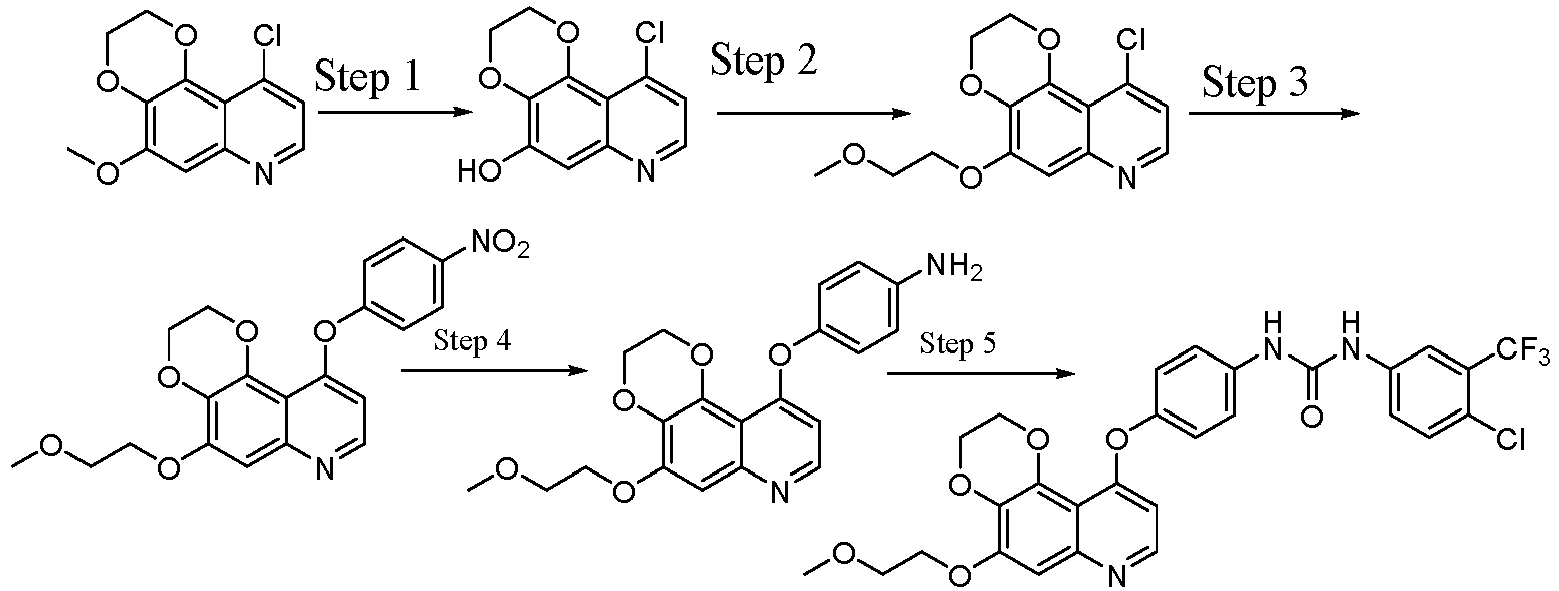
- Step 1): 10-Chloro-5-methoxy-2,3-dihydro-[1,4]dioxino[2,3-f]quinoline (251 mg, 1 mmol) was dissolved in dichloromethane, to which a 1 mol/liter solution of boron tribromide in dichloromethane (3 mL, 3 mmol) was then added dropwise. The reaction solution was stirred until the reaction was completed. The mixture was concentrated to afford 236 mg of a light yellow solid product (5-hydroxy-10-chloro-2,3-dihydro-[1,4]dioxino[2,3-f]quinoline) in a yield of 99%. MS: 238[M+H]+.
- Step 2): The product obtained in step 1 (236 mg, 1 mmol) was dissolved in N,N-dimethylformamide, to which 1-bromo-2-methoxyethane (138 mg, 1 mmol) and potassium carbonate (414 mg, 3 mmol) were then added. The mixture was heated with stirring until the reaction was completed. Water was added to the reaction solution, which was then extracted with ethyl acetate. The organic phase was concentrated, and then subjected to column chromatography to afford 236 mg of an off-white solid (10-chloro-5-(2-methoxyethoxy)-2,3-dihydro-[1,4]dioxino[2,3-f]quinoline) with a yield of 80%. 1H NMR (400 MHz, DMSO-d6) δ 8.70 - 8.46 (m, 1H), 7.50 - 7.33 (m, 1H), 7.25 - 7.09 (m, 1H), 4.40 (s, 4H), 4.30 - 4.23 (m, 2H), 3.77 - 3.71 (m, 2H), 3.33 - 3.32 (m, 3H); MS: 296[M+H]+.
- Steps 3-5): Steps 3-5) were carried out in a similar manner to Example 1, except that in step 3), an equimolar equivalent of the product prepared in step 2) (10-chloro-5-(2-methoxyethoxy)-2,3-dihydro-[1,4]dioxino[2,3-f]quinoline) was used in place of 10-chloro-5-methoxy-2,3-dihydro-[1,4]dioxino[2,3-f]quinoline in step 1) of Example 1. 1H NMR (400 MHz, DMSO-d 6) δ 9.19 (s, 1H), 8.95 (s, 1H), 8.41 (d, J = 5.1 Hz, 1H), 8.12 (d, J = 2.4 Hz, 1H), 7.71 - 7.59 (m, 2H), 7.59 - 7.47 (m, 2H), 7.14 - 7.01 (m, 3H), 6.43 (d, J = 5.1 Hz, 1H), 4.40 - 4.29 (m, 4H), 4.25 (t, J = 4.3 Hz, 2H), 3.74 (t, J = 4.4 Hz, 2H), 3.35 (s, 3H). MS: 590[M+H]+.
- The preparation was carried out in a similar manner to Example 8, except that an equimolar equivalent of iodoethane was used in place of 1-bromo-2-methoxyethane in step 2) of Example 8. 1H NMR (400 MHz, DMSO-d 6) δ 9.14 (s, 1H), 8.89 (s, 1H), 8.34 (d, J = 5.2 Hz, 1H), 8.05 (d, J = 2.4 Hz, 1H), 7.62 - 7.51 (m, 2H), 7.51 - 7.43 (m, 2H), 7.06 - 6.99 (m, 2H), 6.97 (s, 1H), 6.35 (d, J = 5.2 Hz, 1H), 4.33 - 4.19 (m, 4H), 4.11 (q, J = 6.9 Hz, 2H), 1.35 (t, J = 6.9 Hz, 3H). MS: 560[M+H]+.

- The preparation was carried out in a similar manner to Example 8, except that an equimolar equivalent of isopropyl bromide was used in place of 1-bromo-2-methoxyethane in step 2) of Example 8. 1H NMR (400 MHz, DMSO-d 6) δ 9.17 (s, 1H), 8.93 (s, 1H), 8.40 (d, J = 5.2 Hz, 1H), 8.12 (d, J = 2.4 Hz, 1H), 7.73 - 7.47 (m, 4H), 7.16 - 6.92 (m, 3H), 6.42 (d, J = 5.2 Hz, 1H), 4.81 (p, J = 6.1 Hz, 1H), 4.38 - 4.21 (m, 4H), 1.36 (d, J = 6.0 Hz, 6H). MS: 574[M+H]+.
- The preparation was carried out in a similar manner to Example 8, except that an equimolar equivalent of isobutyl bromide was used in place of 1-bromo-2-methoxyethane in step 2) of Example 8. 1H NMR (400 MHz, DMSO-d 6) δ 9.19 (s, 1H), 8.94 (s, 1H), 8.41 (d, J = 5.1 Hz, 1H), 8.12 (d, J = 2.4 Hz, 1H), 7.71 - 7.58 (m, 2H), 7.58 - 7.49 (m, 2H), 7.13 - 7.06 (m, 2H), 7.04 (s, 1H), 6.43 (d, J = 5.2 Hz, 1H), 4.40 - 4.28 (m, 4H), 3.90 (d, J = 6.5 Hz, 2H), 2.19 - 2.03 (m, 1H), 1.03 (d, J = 6.6 Hz, 6H). MS: 588[M+H]+.

- The preparation was carried out in a similar manner to Example 8, except that an equimolar equivalent of bromomethylcyclopropane was used in place of 1-bromo-2-methoxyethane in step 2) of Example 8. 1H NMR (400 MHz, DMSO-d 6) δ 9.12 (s, 1H), 8.88 (s, 1H), 8.33 (d, J = 5.2 Hz, 1H), 8.05 (d, J = 2.4 Hz, 1H), 7.63 - 7.52 (m, 2H), 7.52 - 7.43 (m, 2H), 7.07 - 6.97 (m, 2H), 6.94 (s, 1H), 6.35 (d, J = 5.2 Hz, 1H), 4.33 - 4.21 (m, 4H), 3.90 (d, J = 7.0 Hz, 2H), 1.31 - 1.18 (m, 1H), 0.60 - 0.49 (m, 2H), 0.37 - 0.30 (m, 2H). MS: 586[M+H]+.
- The preparation was carried out in a similar manner to Example 8, except that an equimolar equivalent of bromoacetonitrile was used in place of 1-bromo-2-methoxyethane in step 2) of Example 8. 1H NMR (600 MHz, DMSO-d 6) δ 9.21 (s, 1H), 8.97 (s, 1H), 8.47 (d, J = 5.2 Hz, 1H), 8.12 (d, J = 2.5 Hz, 1H), 7.69 - 7.59 (m, 2H), 7.59 - 7.51 (m, 2H), 7.26 (s, 1H), 7.15 - 7.07 (m, 2H), 6.48 (d, J = 5.2 Hz, 1H), 5.37 (s, 2H), 4.42 - 4.32 (m, 4H). MS: 571[M+H]+.

- The preparation was carried out in a similar manner to Example 8, except that an equimolar equivalent of 2-bromoethan-1-ol was used in place of 1-bromo-2-methoxyethane in step 2) of Example 8. 1H NMR (400 MHz, DMSO-d 6) δ 9.18 (s, 1H), 8.94 (s, 1H), 8.41 (dd, J = 5.2, 1.7 Hz, 1H), 8.11 (d, J = 2.4 Hz, 1H), 7.73 - 7.58 (m, 2H), 7.58 - 7.50 (m, 2H), 7.16 - 7.01 (m, 3H), 6.43 (dd, J = 5.2, 1.8 Hz, 1H), 4.98 - 4.88 (m, 1H), 4.40 - 4.26 (m, 4H), 4.14 (t, J = 4.9 Hz, 2H), 3.85 - 3.72 (m, 2H). MS: 576[M+H]+.
- The preparation was carried out in a similar manner to Example 8, except that an equimolar equivalent of 3-bromopropan-1-ol was used in place of 1-bromo-2-methoxyethane in step 2) of Example 8. 1H NMR (400 MHz, DMSO-d 6) δ 9.24 (s, 1H), 8.99 (s, 1H), 8.41 (d, J = 5.2 Hz, 1H), 8.12 (d, J = 2.5 Hz, 1H), 7.70 - 7.58 (m, 2H), 7.58 - 7.51 (m, 2H), 7.14 - 7.02 (m, 3H), 6.42 (d, J = 5.2 Hz, 1H), 4.58 (t, J = 5.2 Hz, 1H), 4.41 - 4.27 (m, 4H), 4.19 (t, J = 6.4 Hz, 2H), 3.66 - 3.54 (m, 2H), 1.95 (t, J = 6.3 Hz, 2H). MS: 590[M+H]+.

- The preparation was carried out in a similar manner to Example 8, except that an equimolar equivalent of 1-bromo-3-methoxypropane was used in place of 1-bromo-2-methoxyethane in step 2) of Example 8. 1H NMR (600 MHz, DMSO-d 6) δ 9.17 (s, 1H), 8.93 (s, 1H), 8.41 (d, J = 5.2 Hz, 1H), 8.11 (d, J = 2.5 Hz, 1H), 7.72 - 7.58 (m, 2H), 7.58 - 7.50 (m, 2H), 7.13 - 7.06 (m, 2H), 7.04 (s, 1H), 6.43 (d, J = 5.2 Hz, 1H), 4.40 - 4.26 (m, 4H), 4.17 (t, J = 6.4 Hz, 2H), 3.52 (t, J = 6.3 Hz, 2H), 3.27 (s, 3H), 2.07 - 1.98 (m, 2H). MS: 604[M+H]+.
- The preparation was carried out in a similar manner to Example 8, except that an equimolar equivalent of 3-chloro-N,N-dimethylpropan-1-amine hydrochloride was used in place of 1-bromo-2-methoxyethane in step 2) of Example 8. 1H NMR (400 MHz, Methanol-d 4) δ 8.42 (d, J = 5.4 Hz, 1H), 8.08 (d, J = 2.6 Hz, 1H), 7.71 (dd, J = 8.7, 2.6 Hz, 1H), 7.64 - 7.54 (m, 3H), 7.17 - 7.11 (m, 2H), 7.09 (s, 1H), 6.59 (d, J = 5.4 Hz, 1H), 4.49 - 4.39 (m, 4H), 4.29 (t, J = 6.0 Hz, 2H), 2.82 (t, J = 7.6 Hz, 2H), 2.50 (s, 6H), 2.26 - 2.15 (m, 2H). MS: 617[M+H]+.

- The preparation was carried out in a similar manner to Example 8, except that an equimolar equivalent of 1-(3-chloropropyl)pyrrolidine hydrochloride was used in place of 1-bromo-2-methoxyethane in step 2) of Example 8. 1H NMR (600 MHz, DMSO-d 6) δ 9.27 (s, 1H), 9.02 (s, 1H), 8.40 (d, J = 5.2 Hz, 1H), 8.12 (d, J = 2.6 Hz, 1H), 7.70 - 7.58 (m, 2H), 7.58 - 7.50 (m, 2H), 7.12 - 7.05 (m, 2H), 7.03 (d, J = 5.0 Hz, 1H), 6.42 (d, J = 5.2 Hz, 1H), 4.39 - 4.27 (m, 4H), 4.20 - 4.11 (m, 2H), 2.58 - 2.54 (m, 2H), 2.48 - 2.42 (m, 4H), 2.00 - 1.92 (m, 2H), 1.75 - 1.64 (m, 4H). MS: 643[M+H]+.
- The preparation was carried out in a similar manner to Example 8, except that an equimolar equivalent of 1-(3-chloropropyl)piperidine hydrochloride was used in place of 1-bromo-2-methoxyethane in step 2) of Example 8. 1H NMR (400 MHz, DMSO-d6) δ 9.97 (s, 1H), 9.67 (s, 1H), 8.40 (d, J = 5.2 Hz, 1H), 8.27 (s, 1H), 8.15 (d, J = 2.6 Hz, 1H), 7.70 (dd, J = 8.8, 2.6 Hz, 1H), 7.64 - 7.55 (m, 3H), 7.13 - 6.99 (m, 3H), 6.42 (d, J = 5.2 Hz, 1H), 4.42 - 4.25 (m, 4H), 4.16 (t, J = 6.4 Hz, 2H), 3.35 - 3.21 (m, 4H), 2.57 (t, J = 7.3 Hz, 2H), 1.99 (t, J = 7.0 Hz, 2H), 1.62 - 1.49 (m, 4H), 1.47 - 1.35 (m, 2H).. MS: 657[M+H]+.

- The preparation was carried out in a similar manner to Example 8, except that an equimolar equivalent of 4-(3-chloropropyl)morpholine hydrochloride was used in place of 1-bromo-2-methoxyethane in step 2) of Example 8. 1H NMR (400 MHz, DMSO-d 6) δ 9.22 (s, 1H), 8.97 (s, 1H), 8.41 (d, J = 5.2 Hz, 1H), 8.12 (d, J = 2.4 Hz, 1H), 7.70 - 7.58 (m, 2H), 7.58 - 7.50 (m, 2H), 7.14 - 6.99 (m, 3H), 6.43 (d, J = 5.2 Hz, 1H), 4.39 - 4.26 (m, 4H), 4.17 (t, J = 6.4 Hz, 2H), 3.38 - 3.23 (m, 4H), 2.49 - 2.28 (m, 6H), 2.05 - 1.88 (m, 2H). MS: 659[M+H]+.
- The preparation was carried out in a similar manner to Example 8, except that an equimolar equivalent of 1-(3-chloropropyl)-4-methylpiperazine hydrochloride was used in place of 1-bromo-2-methoxyethane in step 2) of Example 8. 1H NMR (600 MHz, DMSO-d 6) δ 9.20 (s, 1H), 8.95 (s, 1H), 8.41 (d, J = 5.2 Hz, 1H), 8.11 (d, J = 2.5 Hz, 1H), 7.70 - 7.58 (m, 2H), 7.58 - 7.50 (m, 2H), 7.14 - 7.05 (m, 2H), 7.03 (s, 1H), 6.42 (d, J = 5.2 Hz, 1H), 4.38 - 4.27 (m, 4H), 4.15 (t, J = 6.4 Hz, 2H), 2.50 - 2.49 (m, 2H), 2.45 (t, J = 7.2 Hz, 2H), 2.43 - 2.20 (m, 6H), 2.15 (s, 3H), 1.99 - 1.90 (m, 2H). MS: 672[M+H]+.

- The preparation was carried out in a similar manner to Example 8, except that an equimolar equivalent of 1-(4-(3-chloropropyl)piperazin-1-yl)ethan-1-one hydrochloride was used in place of 1-bromo-2-methoxyethane in step 2) of Example 8. 1H NMR (400 MHz, DMSO-d 6) δ 9.20 (s, 1H), 8.95 (s, 1H), 8.41 (d, J = 5.2 Hz, 1H), 8.12 (d, J = 2.4 Hz, 1H), 7.70 - 7.58 (m, 2H), 7.58 - 7.50 (m, 2H), 7.14 - 7.02 (m, 3H), 6.42 (d, J = 5.2 Hz, 1H), 4.39 - 4.28 (m, 4H), 4.17 (t, J = 6.4 Hz, 2H), 3.48 - 3.38 (m, 4H), 2.49 - 2.47 (m, 2H), 2.45 - 2.37 (m, 2H), 2.34 (t, J = 5.1 Hz, 2H), 2.03 - 1.93 (m, 5H). MS: 700[M+H]+.
- The preparation was carried out in a similar manner to Example 8, except that an equimolar equivalent of 4-(3-chloropropyl)thiomorpholine-1,1-dioxide hydrochloride was used in place of 1-bromo-2-methoxyethane in step 2) of Example 8. 1H NMR (400 MHz, DMSO-d 6) δ 9.21 (s, 1H), 8.96 (s, 1H), 8.41 (d, J = 5.3 Hz, 1H), 8.12 (d, J = 2.4 Hz, 1H), 7.70 - 7.58 (m, 2H), 7.58 - 7.50 (m, 2H), 7.13 - 7.04 (m, 3H), 6.42 (d, J = 5.2 Hz, 1H), 4.39 - 4.27 (m, 4H), 4.18 (t, J = 6.4 Hz, 2H), 3.16 - 3.06 (m, 4H), 2.98 - 2.87 (m, 4H), 2.71 - 2.61 (m, 2H), 2.03 - 1.89 (m, 2H). MS: 707[M+H]+.

- The preparation was carried out in a similar manner to Example 8, except that an equimolar equivalent of 1-(3-chloropropyl)-4,4-dimethylpiperidine hydrochloride was used in place of 1-bromo-2-methoxyethane in step 2 of Example 8. 1H NMR (400 MHz, DMSO-d 6) δ 9.21 (s, 1H), 8.97 (s, 1H), 8.41 (d, J = 5.1 Hz, 1H), 8.12 (d, J = 2.4 Hz, 1H), 7.69 - 7.58 (m, 2H), 7.58 - 7.49 (m, 2H), 7.13 - 7.06 (m, 2H), 7.04 (s, 1H), 6.42 (d, J = 5.2 Hz, 1H), 4.40 - 4.26 (m, 4H), 4.15 (t, J = 6.4 Hz, 2H), 2.48 - 2.42 (m, 2H), 2.41 - 2.29 (m, 4H), 2.02 - 1.89 (m, 2H), 1.33 (t, J = 5.6 Hz, 4H), 0.89 (s, 6H). MS: 685[M+H]+.
-

- The preparation was carried out in a similar manner to Example 8, except that an equimolar equivalent of 1-(3-chloropropyl)-4-methylpiperidin-4-ol was used in place of 1-bromo-2-methoxyethane in step 2 of Example 8. 1H NMR (600 MHz, DMSO-d 6) δ 9.29 (s, 1H), 9.03 (s, 1H), 8.40 (d, J = 5.3 Hz, 1H), 8.18 - 8.06 (m, 1H), 7.68 - 7.58 (m, 2H), 7.55 (d, J = 8.9 Hz, 2H), 7.08 (d, J = 8.7 Hz, 2H), 7.03 (s, 1H), 6.42 (d, J = 5.3 Hz, 1H), 4.33 (dd, J = 10.6, 4.9 Hz, 4H), 4.20 - 4.11 (m, 2H), 2.60 - 2.57 (m, 1H), 2.46 - 2.35 (m, 6H), 1.99 - 1.92 (m, 2H), 1.52 - 1.44 (m, 4H), 1.12 - 1.05 (m, 3H). MS: 687[M+H]+.
-

- 1) Steps 1-5: Preparation of tert-butyl (1-(3-((10-(4-(3-(4-chloro-3-(trifluoromethyl)phenyl)ureido)phenoxy)-2,3-dihydro-[1,4]dioxi no[2,3-f]quinolin-5-yl)oxy)propyl)-4-methylpiperazin-4-yl)carbamate
The preparation was carried out in a similar manner to Example 8, except that an equimolar equivalent of tert-butyl (1-(3-chloropropyl)-4-methylpiperidin-4-yl)carbamate was used in place of 1-bromo-2-methoxyethane in step 2) of Example 8. MS: 786[M+H]+. - 2) Step 6: The final product (79 mg, 1 mmol) obtained in steps 1-5 above was dissolved in dichloromethane (3 mL), to which trifluoroacetic acid (1 mL) was then added dropwise. The mixture was reacted for 3 hours. The reaction was quenched with a solution of ammonia in methanol at 0 °C. The reaction solution was evaporated to dryness and purified by column chromatography to afford 20 mg of a white solid. 1H NMR (400 MHz, DMSO-d 6) δ 9.26 (s, 1H), 9.01 (s, 1H), 8.40 (d, J = 5.2 Hz, 1H), 8.12 (d, J = 2.5 Hz, 1H), 7.71 - 7.58 (m, 2H), 7.58 - 7.48 (m, 2H), 7.14 - 7.05 (m, 2H), 7.03 (s, 1H), 6.42 (d, J = 5.2 Hz, 1H), 4.39 - 4.28 (m, 4H), 4.15 (t, J = 6.4 Hz, 2H), 2.46 (t, J = 7.1 Hz, 2H), 2.43 - 2.28 (m, 4H), 1.99 - 1.87 (m, 2H), 1.78 - 1.47 (m, 2H), 1.47 - 1.30 (m, 4H), 1.01 (s, 3H). MS: 686[M+H]+.
-
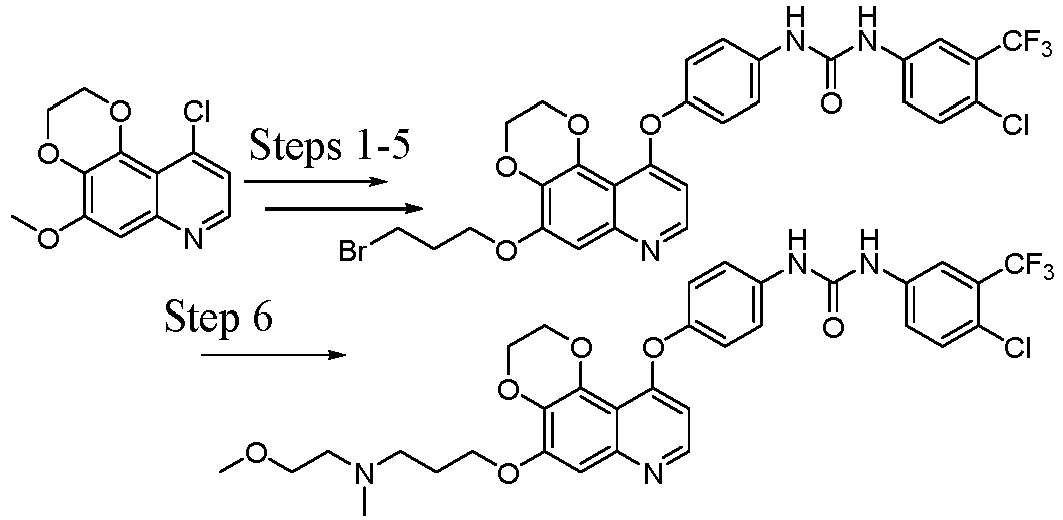
- 1) Steps 1-5): Preparation of 1-(4-((5-(3-bromopropoxy)-2,3-dihydro-[1,4]dioxino[2,3-f]quinolin-10-yl)oxy)phenyl)-3-(4-chloro-3-(trifluoromethyl)phenylurea
The preparation was carried out in a similar manner to Example 8, except that an equimolar equivalent of 1,3-dibromopropane was used in place of 1-bromo-2-methoxyethane in step 2) of Example 8. MS: 652[M+H]+. - 2) Step 6: The product (1-(4-((5-(3-bromopropoxy)-2,3-dihydro-[1,4]dioxino[2,3-f]quinolin-10-yl)oxy)phenyl)-3-(4-chloro-3-(trifluoromethyl)phenylurea) (65 mg, 1 mmol) obtained in steps 1-5) was dissolved in acetonitrile (3 mL), to which triethylamine (202 mg, 2 mmol) and 2-methoxy-N-methylethan-1-amine (135 mg, 1.5 mmol) were then added. The mixture was reacted at 25°C for 3 hours. The reaction solution was evaporated to dryness and subjected to column chromatography to afford 20 mg of a white solid. 1H NMR (600 MHz, DMSO-d 6) δ 9.31 - 9.23 (m, 1H), 9.05 - 8.96 (m, 1H), 8.43 - 8.35 (m, 1H), 8.15 - 8.07 (m, 1H), 7.69 - 7.57 (m, 2H), 7.57 - 7.49 (m, 2H), 7.12 - 7.04 (m, 2H), 7.04 - 6.99 (m, 1H), 6.46 - 6.37 (m, 1H), 4.38 - 4.27 (m, 4H), 4.20 - 4.08 (m, 2H), 3.43 - 3.39 (m, 2H), 3.30 (s, 3H), 3.21 (s, 3H), 2.55 - 2.52 (m, 2H), 2.25 - 2.21 (m, 2H), 1.99 - 1.86 (m, 2H). MS: 661[M+H]+.
- The preparation was carried out in a similar manner to Example 27, except that an equimolar equivalent of N-methylcyclobutylamine was used in place of 2-methoxy-N-methylethan-1-amine in step 6) of Example 27. 1H NMR (600 MHz, DMSO-d 6) δ 10.04 - 9.79 (m, 1H), 9.74 - 9.52 (m, 1H), 8.40 (d, J = 5.2 Hz, 1H), 8.29 (d, J = 16.4 Hz, 1H), 8.15 (d, J = 2.7 Hz, 1H), 7.69 (dd, J = 8.9, 3.0 Hz, 1H), 7.64 - 7.54 (m, 2H), 7.08 (d, J = 8.4 Hz, 2H), 7.05 (s, 1H), 6.41 (d, J = 5.2 Hz, 1H), 4.33 (s, 4H), 4.16 (t, J = 6.5 Hz, 2H), 3.00 - 2.86 (m, 1H), 2.50 - 2.42 (m, 2H), 2.22 - 2.11 (m, 3H), 2.06 - 1.97 (m, 2H), 1.97 - 1.89 (m, 2H), 1.88 - 1.75 (m, 2H), 1.68 - 1.53 (m, 2H). MS: 657[M+H]+.

- The preparation was carried out in a similar manner to Example 8, except that an equimolar equivalent of 1-chloro-6-methoxyhexane was used in place of 1-bromo-2-methoxyethane in step 2) of Example 8. 1H NMR (600 MHz, DMSO-d 6) δ 9.20 (d, J = 4.0 Hz, 1H), 8.95 (s, 1H), 8.45 - 8.38 (m, 1H), 8.12 (d, J = 4.0 Hz, 1H), 7.69 - 7.58 (m, 2H), 7.58 - 7.50 (m, 2H), 7.13 - 7.05 (m, 2H), 7.04 (d, J = 4.1 Hz, 1H), 6.45 - 6.38 (m, 1H), 4.37 - 4.29 (m, 4H), 4.14 - 4.08 (m, 2H), 3.22 (s, 3H), 2.57 - 2.53 (m, 2H), 1.84 - 1.72 (m, 2H), 1.57 - 1.50 (m, 2H), 1.50 - 1.42 (m, 2H), 1.42 - 1.31 (m, 2H). MS: 646[M+H]+.
- The preparation was carried out in a similar manner to Example 8, except that an equimolar equivalent of 6-chloro-N,N-dimethylhexan-1-amine was used in place of 1-bromo-2-methoxyethane in step 2) of Example 8. 1H NMR (600 MHz, DMSO-d 6) δ 9.32 (d, J = 6.1 Hz, 1H), 9.07 (d, J = 6.1 Hz, 1H), 8.43 - 8.34 (m, 1H), 8.17 - 8.06 (m, 1H), 7.70 - 7.58 (m, 2H), 7.58 - 7.48 (m, 2H), 7.12 - 6.98 (m, 3H), 6.45 - 6.35 (m, 1H), 4.38 - 4.26 (m, 4H), 4.16 - 4.04 (m, 2H), 2.35 - 2.25 (m, 2H), 2.20 (s, 6H), 1.85 - 1.72 (m, 2H), 1.52 - 1.40 (m, 4H), 1.40 - 1.29 (m, 2H). MS: 659[M+H]+.

- The preparation was carried out in a similar manner to Example 8, except that an equimolar equivalent of oxetan-3-yl 4-methylbenzenesulfonate was used in place of 1-bromo-2-methoxyethane in step 2) of Example 8. 1H NMR (400 MHz, DMSO-d 6) δ 9.21 (s, 1H), 8.97 (s, 1H), 8.41 (d, J = 5.2 Hz, 1H), 8.12 (d, J = 2.4 Hz, 1H), 7.72 - 7.59 (m, 2H), 7.59 - 7.49 (m, 2H), 7.14 - 7.04 (m, 2H), 6.68 (s, 1H), 6.44 (d, J = 5.2 Hz, 1H), 5.52 - 5.39 (m, 1H), 5.08 - 4.96 (m, 2H), 4.68 - 4.58 (m, 2H), 4.44 - 4.30 (m, 4H). MS: 588[M+H]+.
- The preparation was carried out in a similar manner to Example 8, except that an equimolar equivalent of tetrahydrofuran-3-yl 4-methylbenzenesulfonate was used in place of 1-bromo-2-methoxyethane in step 2) of Example 8. 1H NMR (400 MHz, DMSO-d 6) δ 9.19 (s, 1H), 8.95 (s, 1H), 8.41 (d, J = 5.2 Hz, 1H), 8.12 (d, J = 2.4 Hz, 1H), 7.69 - 7.58 (m, 2H), 7.58 - 7.51 (m, 2H), 7.12 - 7.06 (m, 2H), 7.02 (s, 1H), 6.43 (d, J = 5.2 Hz, 1H), 5.24 - 5.16 (m, 1H), 4.38 - 4.28 (m, 4H), 4.01 - 3.93 (m, 1H), 3.93 - 3.83 (m, 2H), 3.83 - 3.73 (m, 1H), 2.39 - 2.27 (m, 1H), 2.13 - 2.00 (m, 1H). MS: 602[M+H]+.

- The preparation was carried out in a similar manner to Example 8, except that an equimolar equivalent of tetrahydro-2H-pyran-4-yl 4-methylbenzenesulfonate was used in place of 1-bromo-2-methoxyethane in step 2) of Example 8. 1H NMR (400 MHz, DMSO-d 6) δ 9.20 (s, 1H), 8.95 (s, 1H), 8.41 (d, J = 5.1 Hz, 1H), 8.12 (d, J = 2.4 Hz, 1H), 7.70 - 7.58 (m, 2H), 7.58 - 7.50 (m, 2H), 7.16 (s, 1H), 7.11 - 7.05 (m, 2H), 6.42 (d, J = 5.2 Hz, 1H), 4.85 - 4.74 (m, 1H), 4.38 - 4.27 (m, 4H), 3.95 - 3.84 (m, 2H), 3.63 - 3.49 (m, 2H), 2.14 - 2.00 (m, 2H), 1.74 - 1.58 (m, 2H). MS: 616[M+H]+.
- The preparation was carried out in a similar manner to Example 8, except that an equimolar equivalent of 2-fluoro-5-(trifluoromethyl)aniline was used in place of 4-chloro-3-(trifluoromethyl)aniline in step 5) of Example 8. 1H NMR (400 MHz, DMSO-d 6) δ 9.33 (s, 1H), 8.96 (d, J = 2.9 Hz, 1H), 8.62 (dd, J = 7.3, 2.3 Hz, 1H), 8.41 (d, J = 5.2 Hz, 1H), 7.60 - 7.45 (m, 3H), 7.44 - 7.35 (m, 1H), 7.15 - 7.03 (m, 3H), 6.43 (d, J = 5.2 Hz, 1H), 4.39 - 4.29 (m, 4H), 4.29 - 4.20 (m, 2H), 3.78 - 3.70 (m, 2H), 3.30 (s, 3H). MS: 574[M+H]+.

- The preparation was carried out in a similar manner to Example 8, except that an equimolar equivalent of iodoethane was used in place of 1-bromo-2-methoxyethane in step 2) of Example 8, and an equimolar equivalent of 3-fluoro-4-nitrophenol was used in place of p-nitrophenol in step 3) of Example 8. 1H NMR (400 MHz, DMSO-d 6) δ 9.52 (s, 1H), 8.69 (d, J = 2.1 Hz, 1H), 8.46 (d, J = 5.1 Hz, 1H), 8.12 (d, J = 1.8 Hz, 1H), 8.09 - 8.00 (m, 1H), 7.62 (d, J = 1.6 Hz, 2H), 7.16 (dd, J = 11.8, 2.7 Hz, 1H), 7.06 (s, 1H), 6.95 - 6.88 (m, 1H), 6.57 (d, J = 5.1 Hz, 1H), 4.38 - 4.24 (m, 4H), 4.18 (q, J = 6.9 Hz, 2H), 1.41 (t, J = 6.9 Hz, 3H). MS: 578[M+H]+.
- The preparation was carried out in a similar manner to Example 8, except that an equimolar equivalent of 2-fluoro-4-nitrophenol was used in place of p-nitrophenol in step 3) of Example 8. 1HNMR (300 MHz, DMSO-d6) δ 9.33 (s, 1H), 9.22 (s, 1H), 8.42 (d, J = 4.8 Hz, 1H), 8.11 (d, J = 2.0 Hz, 1H), 7.77 - 7.52 (m, 3H), 7.25 (d, J = 2.5 Hz, 2H), 7.12 - 7.04 (m, 1H), 6.47 - 6.35 (m, 1H), 4.47 - 4.32 (m, 4H), 4.30 - 4.19 (m, 2H), 3.80 - 3.69 (m, 2H), 3.35 (s, 3H); MS: 608[M+H]+.


- The preparation was carried out in a similar manner to Example 8, except that an equimolar equivalent of 3-fluoro-4-nitrophenol was used in place of p-nitrophenol in step 3) of Example 8. 1H NMR (400 MHz, DMSO-d 6) δ 9.61 (s, 1H), 8.72 (s, 1H), 8.47 (d, J = 5.2 Hz, 1H), 8.14 (d, J = 11.9 Hz, 1H), 8.10 - 8.01 (m, 1H), 7.62 (s, 2H), 7.17 (dd, J = 11.8, 2.7 Hz, 1H), 7.09 (s, 1H), 6.92 (d, J = 9.1 Hz, 1H), 6.57 (d, J = 5.2 Hz, 1H), 4.40 - 4.19 (m, 6H), 3.74 (t, J = 4.3 Hz, 2H), 3.34 (s, 3H). MS: 608[M+H]+.
- The preparation was carried out in a similar manner to Example 8, except that an equimolar equivalent of 1-bromo-3-methoxypropane was used in place of 1-bromo-2-methoxyethane in step 2) of Example 8, and an equimolar equivalent of 2-fluoro-4-nitrophenol was used in place of p-nitrophenol in step 3) of Example 8. 1H NMR (400 MHz, DMSO-d 6) δ 9.37 (s, 1H), 9.26 (s, 1H), 8.41 (d, J = 5.2 Hz, 1H), 8.11 (d, J = 2.5 Hz, 1H), 7.75 - 7.59 (m, 3H), 7.30 - 7.22 (m, 2H), 7.05 (s, 1H), 6.41 (dd, J = 5.2, 1.1 Hz, 1H), 4.42 - 4.31 (m, 4H), 4.18 (t, J = 6.4 Hz, 2H), 3.52 (t, J = 6.3 Hz, 2H), 3.27 (s, 3H), 2.11 - 1.96 (m, 2H). MS: 622[M+H]+.

- The preparation was carried out in a similar manner to Example 8, except that an equimolar equivalent of 1-bromo-3-methoxypropane was used in place of 1-bromo-2-methoxyethane in step 2) of Example 8, and an equimolar equivalent of 3-fluoro-4-nitrophenol was used in place of p-nitrophenol in step 3) of Example 8. 1H NMR (600 MHz, DMSO-d 6) δ 9.69 (s, 1H), 8.84 (s, 1H), 8.47 (d, J = 5.1 Hz, 1H), 8.13 (d, J = 1.9 Hz, 1H), 8.08 - 8.00 (m, 1H), 7.63 (d, J = 2.2 Hz, 2H), 7.15 (dd, J = 11.8, 2.7 Hz, 1H), 7.07 (s, 1H), 6.95 - 6.87 (m, 1H), 6.58 (d, J = 5.1 Hz, 1H), 4.37 - 4.25 (m, 4H), 4.18 (t, J = 6.4 Hz, 2H), 3.51 (t, J = 6.3 Hz, 2H), 3.27 (s, 3H), 2.08 - 1.97 (m, 2H). MS: 622[M+H]+.
- The preparation was carried out in a similar manner to Example 8, except that an equimolar equivalent of 1-bromo-3-methoxypropane was used in place of 1-bromo-2-methoxyethane in step 2) of Example 8, and an equimolar equivalent of 2-fluoro-5-(trifluoromethyl)aniline was used in place of 4-chloro-3-(trifluoromethyl)aniline in step 5) of Example 8. 1H NMR (400 MHz, DMSO-d 6) δ 9.26 (s, 1H), 8.90 (d, J = 2.9 Hz, 1H), 8.62 (dd, J = 7.3, 2.4 Hz, 1H), 8.41 (d, J = 5.2 Hz, 1H), 7.62 - 7.44 (m, 3H), 7.44 - 7.33 (m, 1H), 7.14 - 7.06 (m, 2H), 7.04 (s, 1H), 6.43 (d, J = 5.2 Hz, 1H), 4.40 - 4.27 (m, 4H), 4.17 (t, J = 6.4 Hz, 2H), 3.51 (t, J = 6.3 Hz, 2H), 3.27 (s, 3H), 2.10 - 1.99 (m, 2H). MS: 588[M+H]+.

- The preparation was carried out in a similar manner to Example 8, except that an equimolar equivalent of 4-(3-chloropropyl)morpholine hydrochloride was used in place of 1-bromo-2-methoxyethane in step 2) of Example 8, and an equimolar equivalent of 2-fluoro-4-nitrophenol was used in place of p-nitrophenol in step 3) of Example 8. 1H NMR (400 MHz, DMSO-d 6) δ 9.30 (s, 1H), 9.20 (s, 1H), 8.41 (d, J = 5.3 Hz, 1H), 8.17 - 8.07 (m, 1H), 7.76 - 7.58 (m, 3H), 7.29 - 7.21 (m, 2H), 7.07 (s, 1H), 6.41 (dd, J = 5.2, 1.0 Hz, 1H), 4.40 - 4.33 (m, 4H), 4.19 (t, J = 6.3 Hz, 2H), 3.68 - 3.58 (m, 4H), 3.34 - 3.32 (m, 4H), 2.63 - 2.53 (m, 2H), 2.07 - 1.95 (m, 2H). MS: 677[M+H]+.
- The preparation was carried out in a similar manner to Example 8, except that an equimolar equivalent of 4-(3-chloropropyl)morpholine hydrochloride was used in place of 1-bromo-2-methoxyethane in step 2) of Example 8, and an equimolar equivalent of 3-fluoro-4-nitrophenol was used in place of p-nitrophenol in step 3) of Example 8. 1H NMR (400 MHz, DMSO-d 6) δ 9.49 (s, 1H), 8.67 (d, J = 2.2 Hz, 1H), 8.48 (d, J = 5.2 Hz, 1H), 8.16 - 8.10 (m, 1H), 8.10 - 8.02 (m, 1H), 7.66 - 7.57 (m, 2H), 7.16 (dd, J = 11.8, 2.7 Hz, 1H), 7.10 (s, 1H), 6.94 - 6.87 (m, 1H), 6.59 (d, J = 5.2 Hz, 1H), 4.37 - 4.26 (m, 4H), 4.21 (t, J = 6.2 Hz, 2H), 3.84 - 3.52 (m, 4H), 3.12 - 2.51 (m, 6H), 2.20 - 1.98 (m, 2H). MS: 677[M+H]+.

- The preparation was carried out in a similar manner to Example 8, except that an equimolar equivalent of iodoethane was used in place of 1-bromo-2-methoxyethane in step 2) of Example 8, an equimolar equivalent of 3-chloro-4-nitrophenol was used in place of p-nitrophenol in step 3) of Example 8, and an equimolar equivalent of cyclopropylamine was used in place of 4-chloro-3-(trifluoromethyl)aniline in step 5) of Example 8. 1H NMR (600 MHz, DMSO-d 6) δ 8.44 (d, J = 5.2 Hz, 1H), 8.17 (d, J = 9.1 Hz, 1H), 7.90 (s, 1H), 7.25 (d, J = 2.8 Hz, 1H), 7.14 (d, J = 2.9 Hz, 1H), 7.09 - 7.01 (m, 2H), 6.50 (d, J = 5.2 Hz, 1H), 4.38 - 4.26 (m, 4H), 4.18 (q, J = 7.0 Hz, 2H), 2.59 - 2.53 (m, 1H), 1.41 (t, J = 7.0 Hz, 3H), 0.70 - 0.60 (m, 2H), 0.44 - 0.37 (m, 2H). MS: 456[M+H]+.
- The preparation was carried out in a similar manner to Example 8, except that an equimolar equivalent of isopropyl bromide was used in place of 1-bromo-2-methoxyethane in step 2) of Example 8, an equimolar equivalent of 3-chloro-4-nitrophenol was used in place of p-nitrophenol in step 3) of Example 8, and an equimolar equivalent of cyclopropylamine was used in place of 4-chloro-3-(trifluoromethyl)aniline in step 5) of Example 8. 1H NMR (600 MHz, DMSO-d 6) δ 8.43 (d, J = 5.1 Hz, 1H), 8.17 (d, J = 9.0 Hz, 1H), 7.90 (s, 1H), 7.24 (d, J = 2.8 Hz, 1H), 7.13 (d, J = 3.0 Hz, 1H), 7.09 - 7.00 (m, 2H), 6.50 (d, J = 5.2 Hz, 1H), 4.81 (p, J = 6.0 Hz, 1H), 4.36 - 4.24 (m, 4H), 2.60 - 2.52 (m, 1H), 1.36 (d, J = 6.0 Hz, 6H), 0.71 - 0.60 (m, 2H), 0.46 - 0.36 (m, 2H). MS: 470[M+H]+.

- The preparation was carried out in a similar manner to Example 8, except that an equimolar equivalent of isobutyl bromide was used in place of 1-bromo-2-methoxyethane in step 2) of Example 8, an equimolar equivalent of 3-chloro-4-nitrophenol was used in place of p-nitrophenol in step 3) of Example 8, and an equimolar equivalent of cyclopropylamine was used in place of 4-chloro-3-(trifluoromethyl)aniline in step 5) of Example 8. 1H NMR (600 MHz, DMSO-d 6) δ 8.44 (d, J = 5.2 Hz, 1H), 8.17 (d, J = 9.0 Hz, 1H), 7.90 (s, 1H), 7.24 (d, J = 2.8 Hz, 1H), 7.13 (d, J = 2.9 Hz, 1H), 7.07 - 7.01 (m, 2H), 6.51 (d, J = 5.2 Hz, 1H), 4.36 - 4.26 (m, 4H), 3.90 (d, J = 6.6 Hz, 2H), 2.57 - 2.55 (m, 1H), 2.16 - 2.05 (m, 1H), 1.03 (d, J = 6.7 Hz, 6H), 0.69 - 0.63 (m, 2H), 0.46 - 0.38 (m, 2H). MS: 484[M+H]+.
- The preparation was carried out in a similar manner to Example 8, except that an equimolar equivalent of bromomethylcyclopropane was used in place of 1-bromo-2-methoxyethane in step 2) of Example 8, an equimolar equivalent of 3-chloro-4-nitrophenol was used in place of p-nitrophenol in step 3) of Example 8, and an equimolar equivalent of cyclopropylamine was used in place of 4-chloro-3-(trifluoromethyl)aniline in step 5) of Example 8. 1H NMR (400 MHz, DMSO-d 6) δ 8.44 (d, J = 5.1 Hz, 1H), 8.17 (d, J = 9.1 Hz, 1H), 7.89 (s, 1H), 7.24 (d, J = 2.7 Hz, 1H), 7.13 (d, J = 2.9 Hz, 1H), 7.09 - 6.98 (m, 2H), 6.51 (d, J = 5.1 Hz, 1H), 4.39 - 4.24 (m, 4H), 3.97 (d, J = 7.0 Hz, 2H), 2.62 - 2.54 (m, 1H), 1.38 - 1.20 (m, 1H), 0.73 - 0.57 (m, 4H), 0.48 - 0.33 (m, 4H). MS: 482[M+H]+.

- The preparation was carried out in a similar manner to Example 8, except that an equimolar equivalent of bromoacetonitrile was used in place of 1-bromo-2-methoxyethane in step 2) of Example 8, an equimolar equivalent of 3-chloro-4-nitrophenol was used in place of p-nitrophenol in step 3) of Example 8, and an equimolar equivalent of cyclopropylamine was used in place of 4-chloro-3-(trifluoromethyl)aniline in step 5) of Example 8. 1H NMR (600 MHz, DMSO-d 6) δ 8.50 (dd, J = 5.2, 1.8 Hz, 1H), 8.19 (dd, J = 9.0, 1.8 Hz, 1H), 7.92 (d, J = 1.8 Hz, 1H), 7.31 - 7.24 (m, 2H), 7.15 (d, J = 2.9 Hz, 1H), 7.10 - 7.05 (m, 1H), 6.57 (dd, J = 5.2, 1.8 Hz, 1H), 5.37 (s, 2H), 4.40 - 4.31 (m, 4H), 2.58 - 2.55 (m, 1H), 0.70 - 0.62 (m, 2H), 0.47 - 0.37 (m, 2H). MS: 467[M+H]+.
- The preparation was carried out in a similar manner to Example 8, except that an equimolar equivalent of 2-bromoethan-1-ol was used in place of 1-bromo-2-methoxyethane in step 2) of Example 8, an equimolar equivalent of 3-chloro-4-nitrophenol was used in place of p-nitrophenol in step 3) of Example 8, and an equimolar equivalent of cyclopropylamine was used in place of 4-chloro-3-(trifluoromethyl)aniline in step 5) of Example 8. 1H NMR (600 MHz, DMSO-d 6) δ 8.44 (d, J = 5.1 Hz, 1H), 8.17 (d, J = 9.1 Hz, 1H), 7.90 (s, 1H), 7.25 (d, J = 2.8 Hz, 1H), 7.13 (d, J = 2.9 Hz, 1H), 7.10 - 7.02 (m, 2H), 6.51 (d, J = 5.1 Hz, 1H), 4.94 (t, J = 5.4 Hz, 1H), 4.37 - 4.27 (m, 4H), 4.14 (t, J = 4.9 Hz, 2H), 3.83 - 3.76 (m, 2H), 2.60 - 2.53 (m, 1H), 0.68 - 0.61 (m, 2H), 0.44 - 0.38 (m, 2H). MS: 472[M+H]+.

- The preparation was carried out in a similar manner to Example 8, except that an equimolar equivalent of 3-chloro-4-nitrophenol was used in place of p-nitrophenol in step 3) of Example 8, and an equimolar equivalent of cyclopropylamine was used in place of 4-chloro-3-(trifluoromethyl)aniline in step 5) of Example 8. 1H NMR (600 MHz, DMSO-d 6) δ 8.44 (d, J = 5.2 Hz, 1H), 8.18 (d, J = 9.0 Hz, 1H), 7.90 (s, 1H), 7.25 (d, J = 2.8 Hz, 1H), 7.14 (d, J = 2.9 Hz, 1H), 7.10 - 7.02 (m, 2H), 6.51 (d, J = 5.2 Hz, 1H), 4.38 - 4.27 (m, 4H), 4.27 - 4.20 (m, 2H), 3.77 - 3.67 (m, 2H), 3.34 (s, 3H), 2.61 - 2.53 (m, 1H), 0.79 - 0.55 (m, 2H), 0.52 - 0.28 (m, 2H). MS: 486[M+H]+.
- The preparation was carried out in a similar manner to Example 8, except that an equimolar equivalent of 3-bromopropan-1-ol was used in place of 1-bromo-2-methoxyethane in step 2) of Example 8, an equimolar equivalent of 3-chloro-4-nitrophenol was used in place of p-nitrophenol in step 3) of Example 8, and an equimolar equivalent of cyclopropylamine was used in place of 4-chloro-3-(trifluoromethyl)aniline in step 5) of Example 8. 1H NMR (600 MHz, DMSO-d 6) δ 8.44 (d, J = 5.2 Hz, 1H), 8.17 (d, J = 9.1 Hz, 1H), 7.90 (s, 1H), 7.24 (d, J = 2.8 Hz, 1H), 7.13 (d, J = 2.9 Hz, 1H), 7.08 - 7.02 (m, 2H), 6.51 (d, J = 5.2 Hz, 1H), 4.63 - 4.57 (m, 1H), 4.35 - 4.27 (m, 4H), 4.19 (t, J= 6.4 Hz, 2H), 3.64 - 3.57 (m, 2H), 2.59 - 2.54 (m, 1H), 1.94 (t, J = 6.3 Hz, 2H), 0.69 - 0.62 (m, 2H), 0.45 - 0.38 (m, 2H). MS: 486[M+H]+.

- The preparation was carried out in a similar manner to Example 8, except that an equimolar equivalent of 1-bromo-3-methoxypropane was used in place of 1-bromo-2-methoxyethane in step 2) of Example 8, an equimolar equivalent of 3-chloro-4-nitrophenol was used in place of p-nitrophenol in step 3) of Example 8, and an equimolar equivalent of cyclopropylamine was used in place of 4-chloro-3-(trifluoromethyl)aniline in step 5) of Example 8. 1H NMR (400 MHz, DMSO-d 6) δ 8.44 (d, J = 5.1 Hz, 1H), 8.17 (d, J = 9.1 Hz, 1H), 7.90 (s, 1H), 7.25 (d, J = 2.8 Hz, 1H), 7.14 (d, J = 2.9 Hz, 1H), 7.08 - 7.01 (m, 2H), 6.51 (d, J = 5.2 Hz, 1H), 4.37 - 4.25 (m, 4H), 4.17 (t, J = 6.4 Hz, 2H), 3.51 (t, J = 6.3 Hz, 2H), 3.27 (s, 3H), 2.59 - 2.54 (m, 1H), 2.09 - 2.01 (m, 2H), 0.71 - 0.58 (m, 2H), 0.47 - 0.37 (m, 2H). MS: 500[M+H]+.
- The preparation was carried out in a similar manner to Example 8, except that an equimolar equivalent of 3-chloro-N,N-dimethylpropan-1-amine hydrochloride was used in place of 1-bromo-2-methoxyethane in step 2) of Example 8, an equimolar equivalent of 3-chloro-4-nitrophenol was used in place of p-nitrophenol in step 3) of Example 8, and an equimolar equivalent of cyclopropylamine was used in place of 4-chloro-3-(trifluoromethyl)aniline in step 5) of Example 8. 1H NMR (600 MHz, DMSO-d 6) δ 8.44 (d, J = 5.1 Hz, 1H), 8.17 (d, J = 9.0 Hz, 1H), 7.90 (s, 1H), 7.24 (d, J = 2.8 Hz, 1H), 7.13 (d, J = 2.9 Hz, 1H), 7.07 - 7.02 (m, 2H), 6.51 (d, J = 5.1 Hz, 1H), 4.36 - 4.27 (m, 4H), 4.15 (t, J = 6.5 Hz, 2H), 2.57 - 2.55 (m, 1H), 2.40 (t, J = 7.1 Hz, 2H), 2.17 (s, 6H), 1.96 - 1.89 (m, 2H), 0.70 - 0.62 (m, 2H), 0.49 - 0.39 (m, 2H). MS: 513[M+H]+.

- The preparation was carried out in a similar manner to Example 8, except that an equimolar equivalent of 1-(3-chloropropyl)pyrrolidine hydrochloride was used in place of 1-bromo-2-methoxyethane in step 2) of Example 8, an equimolar equivalent of 3-chloro-4-nitrophenol was used in place of p-nitrophenol in step 3) of Example 8, and an equimolar equivalent of cyclopropylamine was used in place of 4-chloro-3-(trifluoromethyl)aniline in step 5) of Example 8. 1H NMR (600 MHz, DMSO-d 6) δ 8.40 - 8.34 (m, 1H), 8.10 (d, J = 9.1 Hz, 1H), 7.84 (s, 1H), 7.20 - 7.15 (m, 1H), 7.07 (d, J = 2.9 Hz, 1H), 7.02 - 6.94 (m, 2H), 6.44 (d, J = 5.2 Hz, 1H), 4.33 - 4.19 (m, 4H), 4.10 (t, J = 6.5 Hz, 2H), 2.56 - 2.48 (m, 5H), 1.98 - 1.85 (m, 3H), 1.71 - 1.57 (m, 5H), 0.64 - 0.54 (m, 2H), 0.41 - 0.31 (m, 2H). MS: 539[M+H]+.
- The preparation was carried out in a similar manner to Example 8, except that an equimolar equivalent of 1-(3-chloropropyl)piperidine hydrochloride was used in place of 1-bromo-2-methoxyethane in step 2) of Example 8, an equimolar equivalent of 3-chloro-4-nitrophenol was used in place of p-nitrophenol in step 3) of Example 8, and an equimolar equivalent of cyclopropylamine was used in place of 4-chloro-3-(trifluoromethyl)aniline in step 5) of Example 8. 1H NMR (600 MHz, DMSO-d 6) δ 8.48 - 8.41 (m, 1H), 8.22 - 8.13 (m, 1H), 7.94 - 7.87 (m, 1H), 7.27 - 7.21 (m, 1H), 7.17 - 7.11 (m, 1H), 7.08 - 7.01 (m, 2H), 6.54 - 6.47 (m, 1H), 4.36 - 4.26 (m, 4H), 4.19 - 4.10 (m, 2H), 2.58 - 2.55 (m, 1H), 2.47 - 2.29 (m, 6H), 1.99 - 1.91 (m, 2H), 1.55 - 1.47 (m, 4H), 1.43 - 1.35 (m, 2H), 0.70 - 0.61 (m, 2H), 0.46 - 0.36 (m, 2H). MS: 553[M+H]+.

- The preparation was carried out in a similar manner to Example 8, except that an equimolar equivalent of 4-(3-chloropropyl)morpholine hydrochloride was used in place of 1-bromo-2-methoxyethane in step 2) of Example 8, an equimolar equivalent of 3-chloro-4-nitrophenol was used in place of p-nitrophenol in step 3) of Example 8, and an equimolar equivalent of cyclopropylamine was used in place of 4-chloro-3-(trifluoromethyl)aniline in step 5) of Example 8. 1H NMR (600 MHz, DMSO-d 6) δ 8.38 (dd, J = 8.8, 5.2 Hz, 1H), 8.14 - 8.07 (m, 1H), 7.84 (d, J = 7.7 Hz, 1H), 7.21 - 7.15 (m, 1H), 7.11 - 7.04 (m, 1H), 7.02 - 6.94 (m, 2H), 6.45 (dd, J = 8.8, 5.3 Hz, 1H), 4.30 - 4.18 (m, 4H), 4.15 - 4.05 (m, 2H), 3.56 - 3.49 (m, 4H), 2.53 - 2.48 (m, 1H), 2.39 (t, J = 7.3 Hz, 2H), 2.36 - 2.25 (m, 4H), 1.96 - 1.85 (m, 2H), 0.63 - 0.54 (m, 2H), 0.42 - 0.31 (m, 2H). MS: 555[M+H]+.
- The preparation was carried out in a similar manner to Example 8, except that an equimolar equivalent of 1-(3-chloropropyl)-4-methylpiperazine hydrochloride was used in place of 1-bromo-2-methoxyethane in step 2) of Example 8, an equimolar equivalent of 3-chloro-4-nitrophenol was used in place of p-nitrophenol in step 3) of Example 8, and an equimolar equivalent of cyclopropylamine was used in place of 4-chloro-3-(trifluoromethyl)aniline in step 5) of Example 8. 1H NMR (600 MHz, DMSO-d 6) δ 8.49 - 8.39 (m, 1H), 8.17 (dd, J = 9.1, 3.1 Hz, 1H), 7.91 (d, J = 3.0 Hz, 1H), 7.24 (d, J = 3.5 Hz, 1H), 7.15 (s, 1H), 7.08 - 7.00 (m, 2H), 6.57 - 6.47 (m, 1H), 4.39 - 4.24 (m, 4H), 4.21 - 4.09 (m, 2H), 2.58 - 2.55 (m, 1H), 2.50 - 2.32 (m, 10H), 2.22 (s, 3H), 2.01 - 1.88 (m, 2H), 0.71 - 0.61 (m, 2H), 0.49 - 0.36 (m, 2H). MS: 568[M+H]+.

- The preparation was carried out in a similar manner to Example 8, except that an equimolar equivalent of 1-(4-(3-chloropropyl)piperazin-1-yl)ethan-1-one hydrochloride was used in place of 1-bromo-2-methoxyethane in step 2) of Example 8, an equimolar equivalent of 3-chloro-4-nitrophenol was used in place of p-nitrophenol in step 3) of Example 8, and an equimolar equivalent of cyclopropylamine was used in place of 4-chloro-3-(trifluoromethyl)aniline in step 5) of Example 8. 1H NMR (400 MHz, DMSO-d 6) δ 8.44 (d, J = 5.1 Hz, 1H), 8.17 (d, J = 9.1 Hz, 1H), 7.90 (s, 1H), 7.24 (d, J = 2.8 Hz, 1H), 7.14 (d, J = 2.9 Hz, 1H), 7.09 - 7.01 (m, 2H), 6.51 (d, J = 5.1 Hz, 1H), 4.37 - 4.26 (m, 4H), 4.17 (t, J = 6.4 Hz, 2H), 3.48 - 3.39 (m, 4H), 2.58 - 2.53 (m, 1H), 2.49 - 2.45 (m, 2H), 2.40 (t, J = 5.0 Hz, 2H), 2.33 (t, J = 5.1 Hz, 2H), 2.02 - 1.93 (m, 5H), 0.70 - 0.60 (m, 2H), 0.46 - 0.36 (m, 2H). MS: 596[M+H]+.
- The preparation was carried out in a similar manner to Example 8, except that an equimolar equivalent of 4-(3-chloropropyl)thiomorpholine-1,1-dioxide hydrochloride was used in place of 1-bromo-2-methoxyethane in step 2) of Example 8, an equimolar equivalent of 3-chloro-4-nitrophenol was used in place of p-nitrophenol in step 3) of Example 8, and an equimolar equivalent of cyclopropylamine was used in place of 4-chloro-3-(trifluoromethyl)aniline in step 5) of Example 8. 1H NMR (600 MHz, DMSO-d 6) δ 8.44 (d, J = 5.1 Hz, 1H), 8.17 (d, J = 9.0 Hz, 1H), 7.90 (s, 1H), 7.24 (d, J = 2.6 Hz, 1H), 7.14 (d, J = 2.9 Hz, 1H), 7.09 (s, 1H), 7.05 (dd, J = 9.1, 2.7 Hz, 1H), 6.51 (d, J = 5.1 Hz, 1H), 4.36 - 4.26 (m, 4H), 4.18 (t, J = 6.5 Hz, 2H), 3.14 - 3.06 (m, 4H), 2.96 - 2.87 (m, 4H), 2.65 (t, J = 7.0 Hz, 2H), 2.58 - 2.55 (m, 1H), 1.99 - 1.92 (m, 2H), 0.69 - 0.62 (m, 2H), 0.47 - 0.37 (m, 2H). MS: 603[M+H]+.

- The preparation was carried out in a similar manner to Example 8, except that an equimolar equivalent of 1-(3-chloropropyl)-4,4-dimethylpiperidine hydrochloride was used in place of 1-bromo-2-methoxyethane in step 2) of Example 8, an equimolar equivalent of 3-chloro-4-nitrophenol was used in place of p-nitrophenol in step 3) of Example 8, and an equimolar equivalent of cyclopropylamine was used in place of 4-chloro-3-(trifluoromethyl)aniline in step 5) of Example 8. 1H NMR (600 MHz, DMSO-d 6) δ 8.49 - 8.40 (m, 1H), 8.17 (dd, J = 9.0, 5.8 Hz, 1H), 7.90 (d, J = 5.5 Hz, 1H), 7.27 - 7.21 (m, 1H), 7.17 - 7.11 (m, 1H), 7.05 (dd, J = 6.1, 3.6 Hz, 2H), 6.56 - 6.47 (m, 1H), 4.37 - 4.26 (m, 4H), 4.19 - 4.11 (m, 2H), 2.59 - 2.53 (m, 1H), 2.48 - 2.44 (m, 2H), 2.40 - 2.31 (m, 4H), 2.00 - 1.90 (m, 2H), 1.38 - 1.29 (m, 4H), 0.90 (s, 6H), 0.69 - 0.61 (m, 2H), 0.45 - 0.37 (m, 2H). MS: 581[M+H]+.
-

- The preparation was carried out in a similar manner to Example 8, except that an equimolar equivalent of 1-(3-chloropropyl)-4-methylpiperidin-4-ol was used in place of 1-bromo-2-methoxyethane in step 2) of Example 8, an equimolar equivalent of 3-chloro-4-nitrophenol was used in place of p-nitrophenol in step 3) of Example 8, and an equimolar equivalent of cyclopropylamine was used in place of 4-chloro-3-(trifluoromethyl)aniline in step 5) of Example 8. 1H NMR (600 MHz, DMSO-d 6) δ 8.56 (d, J = 5.8 Hz, 1H), 8.24 (d, J = 9.0 Hz, 1H), 8.00 (s, 1H), 7.47 (d, J = 7.6 Hz, 1H), 7.36 (s, 1H), 7.26 (s, 2H), 6.64 (d, J = 5.6 Hz, 1H), 4.45 - 4.32 (m, 4H), 4.26 (t, J = 5.9 Hz, 2H), 3.27 - 3.24 (m, 2H), 3.18 - 3.04 (m, 4H), 2.59 - 2.55 (m, 1H), 2.33 - 2.26 (m, 2H), 1.90 - 1.78 (m, 2H), 1.74 - 1.62 (m, 2H), 1.27 - 1.23 (m, 1H), 1.19 (s, 3H), 0.72 - 0.61 (m, 2H), 0.47 - 0.37 (m, 2H). MS: 583 [M+H]+.
-

- 1) Steps 1-5): Preparation of tert-butyl (1-(3-((10-(3-chloro-4-(3-cyclopropylureido)phenoxy)-2,3-dihydro-[1,4]dioxino[2,3-f]quinoli n-5-yl)oxy)propyl)-4-methylpiperidin-4-yl)carbamate
The preparation was carried out in a similar manner to Example 8, except that an equimolar equivalent of tert-butyl (1-(3-chloropropyl)-4-methylpiperidin-4-yl)carbamate was used in place of 1-bromo-2-methoxyethane in step 2) of Example 8, an equimolar equivalent of 3-chloro-4-nitrophenol was used in place of p-nitrophenol in step 3) of Example 8, and an equimolar equivalent of cyclopropylamine was used in place of 4-chloro-3-(trifluoromethyl)aniline in step 5) of Example 8. MS: 682[M+H]+. - 2) Step 6): The final product (68 mg, 1 mmol) prepared in steps 1-5) was dissolved in dichloromethane (3 mL), to which trifluoroacetic acid (1 mL) was then added dropwise. The mixture was reacted for 3 hours. The reaction was quenched with a solution of ammonia in methanol at 0 °C. The reaction solution was evaporated to dryness and purified by column chromatography to afford 20 mg of a white solid. 1H NMR (400 MHz, DMSO-d 6) δ 8.44 (d, J = 5.2 Hz, 1H), 8.17 (d, J = 9.0 Hz, 1H), 7.91 (s, 1H), 7.24 (d, J = 2.8 Hz, 1H), 7.15 (d, J = 3.0 Hz, 1H), 7.09 - 7.00 (m, 2H), 6.50 (d, J = 5.1 Hz, 1H), 4.37 - 4.26 (m, 4H), 4.14 (t, J = 6.4 Hz, 2H), 3.39 (s, 2H), 2.58 - 2.53 (m, 1H), 2.48 - 2.27 (m, 6H), 1.99 - 1.86 (m, 2H), 1.50 - 1.32 (m, 4H), 1.02 (s, 3H), 0.71 - 0.61 (m, 2H), 0.47 - 0.37 (m, 2H). MS: 582[M+H]+.
-

- 1) Steps 1-5): Preparation of 1-(4-((5-(3-bromopropoxy)-2,3-dihydro-[1,4]dioxino[2,3-f]quinolin-10-yl)oxy)-2-chlorophen yl)-3-cyclopropylurea
The preparation was carried out in a similar manner to Example 8, except that an equimolar equivalent of 1,3-dibromoethane was used in place of 1-bromo-2-methoxyethane in step 2) of Example 8, an equimolar equivalent of 3-chloro-4-nitrophenol was used in place of p-nitrophenol in step 3) of Example 8, and an equimolar equivalent of cyclopropylamine was used in place of 4-chloro-3-(trifluoromethyl)aniline in step 5) of Example 8. MS: 548[M+H]+. - 2) Step 6): The final product (55 mg, 1 mmol) prepared in steps 1-5) was dissolved in acetonitrile (3 mL), to which triethylamine (202 mg, 2 mmol) and 2-methoxy-N-methylethan-1-amine (135 mg, 1.5 mmol) were then added. The mixture was reacted at 25 °C for 3 hours. The reaction solution was evaporated to dryness and subjected to column chromatography to afford 20 mg of a white solid. 1H NMR (600 MHz, DMSO-d 6) δ 8.47 - 8.41 (m, 1H), 8.17 (d, J = 8.9 Hz, 1H), 7.90 (s, 1H), 7.24 (d, J = 2.8 Hz, 1H), 7.13 (d, J = 3.0 Hz, 1H), 7.08 - 7.02 (m, 2H), 6.53 - 6.48 (m, 1H), 4.37 - 4.26 (m, 4H), 4.15 (t, J = 6.4 Hz, 2H), 3.41 (t, J = 5.9 Hz, 2H), 3.21 (s, 3H), 2.58 - 2.55 (m, 1H), 2.54 - 2.51 (m, 4H), 2.22 (s, 3H), 1.96 - 1.87 (m, 2H), 0.70 - 0.61 (m, 2H), 0.46 - 0.38 (m, 2H). MS: 557[M+H]+.
- The preparation was carried out in a similar manner to Example 62, except that an equimolar equivalent of N-methylcyclobutylamine was used in place of 2-methoxy-N-methylethyl-1-amine in step 6) of Example 62. 1H NMR (600 MHz, DMSO-d 6) δ 8.44 (d, J= 5.1 Hz, 1H), 8.17 (d, J = 9.0 Hz, 1H), 7.91 (s, 1H), 7.24 (d, J = 2.8 Hz, 1H), 7.15 (d, J = 3.0 Hz, 1H), 7.05 (d, J = 7.5 Hz, 2H), 6.51 (d, J = 5.1 Hz, 1H), 4.35 - 4.26 (m, 4H), 4.15 (t, J = 6.4 Hz, 2H), 2.84 - 2.74 (m, 1H), 2.59 - 2.53 (m, 1H), 2.37 (t, J = 7.0 Hz, 2H), 2.05 (s, 3H), 2.02 - 1.94 (m, 2H), 1.94 - 1.87 (m, 2H), 1.81 - 1.70 (m, 2H), 1.63 - 1.52 (m, 2H), 0.72 - 0.59 (m, 2H), 0.46 - 0.37 (m, 2H). MS: 553[M+H]+.

- The preparation was carried out in a similar manner to Example 8, except that an equimolar equivalent of 6-chloro-N,N-dimethylhexan-1-amine was used in place of 1-bromo-2-methoxyethane in step 2) of Example 8, an equimolar equivalent of 3-chloro-4-nitrophenol was used in place of p-nitrophenol in step 3) of Example 8, and an equimolar equivalent of cyclopropylamine was used in place of 4-chloro-3-(trifluoromethyl)aniline in step 5) of Example 8. 1H NMR (600 MHz, DMSO-d 6) δ 8.44 (dd, J= 5.2, 2.7 Hz, 1H), 8.17 (dd, J= 9.1, 2.7 Hz, 1H), 7.90 (d, J= 2.7 Hz, 1H), 7.28 - 7.21 (m, 1H), 7.13 (d, J= 2.8 Hz, 1H), 7.07 - 7.00 (m, 2H), 6.51 (dd, J = 5.2, 2.7 Hz, 1H), 4.38 - 4.26 (m, 4H), 4.11 (t, J = 6.6 Hz, 2H), 2.58 - 2.55 (m, 1H), 2.22 - 2.18 (m, 2H), 2.11 (s, 6H), 1.83 - 1.75 (m, 2H), 1.49 - 1.39 (m, 4H), 1.39 - 1.28 (m, 2H), 0.76 - 0.55 (m, 2H), 0.49 - 0.31 (m, 2H). MS: 555[M+H]+.
- The preparation was carried out in a similar manner to Example 8, except that an equimolar equivalent of oxetan-3-yl 4-methylbenzenesulfonate was used in place of 1-bromo-2-methoxyethane in step 2) of Example 8, an equimolar equivalent of 3-chloro-4-nitrophenol was used in place of p-nitrophenol in step 3) of Example 8, and an equimolar equivalent of cyclopropylamine was used in place of 4-chloro-3-(trifluoromethyl)aniline in step 5) of Example 8. 1H NMR (400 MHz, DMSO-d 6) δ 8.44 (d, J = 5.1 Hz, 1H), 8.18 (d, J = 9.1 Hz, 1H), 7.91 (s, 1H), 7.26 (d, J = 2.8 Hz, 1H), 7.14 (d, J = 2.9 Hz, 1H), 7.05 (dd, J = 9.1, 2.8 Hz, 1H), 6.70 (s, 1H), 6.52 (d, J = 5.2 Hz, 1H), 5.51 - 5.41 (m, 1H), 5.02 (t, J = 6.7 Hz, 2H), 4.66 - 4.58 (m, 2H), 4.39 - 4.29 (m, 4H), 2.57 - 2.54 (m, 1H), 0.71 - 0.61 (m, 2H), 0.47 - 0.37 (m, 2H). MS: 484[M+H]+.

- The preparation was carried out in a similar manner to Example 8, except that an equimolar equivalent of tetrahydrofuran-3-yl 4-methylbenzenesulfonate was used in place of 1-bromo-2-methoxyethane in step 2) of Example 8, an equimolar equivalent of 3-chloro-4-nitrophenol was used in place of p-nitrophenol in step 3) of Example 8, and an equimolar equivalent of cyclopropylamine was used in place of 4-chloro-3-(trifluoromethyl)aniline in step 5) of Example 8. 1H NMR (400 MHz, DMSO-d 6) δ 8.45 (d, J= 5.2 Hz, 1H), 8.18 (d, J = 9.1 Hz, 1H), 7.90 (s, 1H), 7.25 (d, J = 2.8 Hz, 1H), 7.14 (d, J = 2.9 Hz, 1H), 7.09 - 7.00 (m, 2H), 6.52 (d, J = 5.2 Hz, 1H), 5.24 - 5.16 (m, 1H), 4.37 - 4.26 (m, 4H), 4.01 - 3.92 (m, 1H), 3.92 - 3.83 (m, 2H), 3.83 - 3.74 (m, 1H), 2.59 - 2.54 (m, 1H), 2.40 - 2.26 (m, 1H), 2.11 - 2.00 (m, 1H), 0.70 - 0.61 (m, 2H), 0.46 - 0.38 (m, 2H). MS: 498[M+H]+.
- The preparation was carried out in a similar manner to Example 8, except that an equimolar equivalent of tetrahydro-2H-pyran-4-yl 4-methylbenzenesulfonate was used in place of 1-bromo-2-methoxyethane in step 2) of Example 8, an equimolar equivalent of 3-chloro-4-nitrophenol was used in place of p-nitrophenol in step 3) of Example 8, and an equimolar equivalent of cyclopropylamine was used in place of 4-chloro-3-(trifluoromethyl)aniline in step 5) of Example 8. 1H NMR (600 MHz, DMSO-d 6) δ 8.37 (d, J= 5.1 Hz, 1H), 8.10 (d, J = 9.0 Hz, 1H), 7.83 (s, 1H), 7.18 (d, J = 2.8 Hz, 1H), 7.11 (s, 1H), 7.07 (d, J = 3.0 Hz, 1H), 6.98 (dd, J = 9.1, 2.8 Hz, 1H), 6.44 (d, J = 5.1 Hz, 1H), 4.78 - 4.68 (m, 1H), 4.31 - 4.18 (m, 4H), 3.88 - 3.76 (m, 2H), 3.52 - 3.43 (m, 2H), 2.52 - 2.48 (m, 1H), 2.02 - 1.97 (m, 2H), 1.63 - 1.55 (m, 2H), 0.64 - 0.54 (m, 2H), 0.40 - 0.31 (m, 2H). MS: 512[M+H]+.

- The preparation was carried out in a similar manner to Example 1, except that an equimolar equivalent of 3-chloro-4-nitrophenol was used in place of p-nitrophenol in step 1) of Example 1, and an equimolar equivalent of cyclobutylamine was used in place of 4-chloro-3-(trifluoromethyl)aniline in step 3) of Example 1. 1H NMR (400 MHz, DMSO-d 6) δ 8.44 (d, J = 5.2 Hz, 1H), 8.15 (d, J = 8.7 Hz, 1H), 7.92 (s, 1H), 7.30 - 7.19 (m, 2H), 7.11 - 6.98 (m, 2H), 6.51 (d, J = 5.2 Hz, 1H), 4.37 - 4.25 (m, 4H), 4.19 - 4.06 (m, 1H), 3.92 (s, 3H), 2.29 - 2.15 (m, 2H), 1.91 - 1.75 (m, 2H), 1.71 - 1.54 (m, 2H). MS: 456[M+H]+.
- The preparation was carried out in a similar manner to Example 1, except that an equimolar equivalent of 3-chloro-4-nitrophenol was used in place of p-nitrophenol in step 1) of Example 1, and an equimolar equivalent of cyclopentylamine was used in place of 4-chloro-3-(trifluoromethyl)aniline in step 3) of Example 1. 1H NMR (400 MHz, DMSO-d 6) δ 8.44 (d, J= 5.2 Hz, 1H), 8.21 (d, J = 9.1 Hz, 1H), 7.92 (s, 1H), 7.24 (d, J = 2.8 Hz, 1H), 7.11 - 6.99 (m, 3H), 6.50 (d, J= 5.2 Hz, 1H), 4.36 - 4.26 (m, 4H), 4.00 - 3.87 (m, 4H), 1.91 - 1.77 (m, 2H), 1.71 - 1.59 (m, 2H), 1.59 - 1.48 (m, 2H), 1.45 - 1.30 (m, 2H). MS: 470[M+H]+.

- The preparation was carried out in a similar manner to Example 8, except that an equimolar equivalent of 3-chloro-4-nitrophenol was used in place of p-nitrophenol in step 3) of Example 8, and an equimolar equivalent of cyclobutylamine was used in place of 4-chloro-3-(trifluoromethyl)aniline in step 5) of Example 8. 1H NMR (600 MHz, DMSO-d 6) δ 8.44 (d, J= 5.2 Hz, 1H), 8.15 (d, J= 9.1 Hz, 1H), 7.92 (s, 1H), 7.28 - 7.21 (m, 2H), 7.07 (s, 1H), 7.03 (dd, J = 9.1, 2.8 Hz, 1H), 6.50 (d, J = 5.2 Hz, 1H), 4.35 - 4.27 (m, 4H), 4.27 - 4.21 (m, 2H), 4.17 - 4.08 (m, 1H), 3.77 - 3.70 (m, 2H), 3.34 (s, 3H), 2.26 - 2.18 (m, 2H), 1.90 - 1.78 (m, 2H), 1.71 - 1.54 (m, 2H). MS: 500[M+H]+.
- The preparation was carried out in a similar manner to Example 8, except that an equimolar equivalent of 3-chloro-4-nitrophenol was used in place of p-nitrophenol in step 3) of Example 8, and an equimolar equivalent of cyclopentylamine was used in place of 4-chloro-3-(trifluoromethyl)aniline in step 5) of Example 8. 1H NMR (400 MHz, DMSO-d 6) δ 8.43 (d, J= 5.2 Hz, 1H), 8.21 (d, J = 9.2 Hz, 1H), 7.92 (s, 1H), 7.24 (d, J = 2.8 Hz, 1H), 7.11 - 7.00 (m, 3H), 6.49 (d, J= 5.2 Hz, 1H), 4.38 - 4.27 (m, 4H), 4.27 - 4.20 (m, 2H), 4.01 - 3.88 (m, 1H), 3.77 - 3.69 (m, 2H), 3.30 (s, 3H), 1.91 - 1.78 (m, 2H), 1.69 - 1.60 (m, 2H), 1.60 - 1.49 (m, 2H), 1.45 - 1.32 (m, 2H). MS: 514[M+H]+.

- The preparation was carried out in a similar manner to Example 8, except that an equimolar equivalent of 1-bromo-3-methoxypropane was used in place of 1-bromo-2-methoxyethane in step 2) of Example 8, an equimolar equivalent of 3-chloro-4-nitrophenol was used in place of p-nitrophenol in step 3) of Example 8, and an equimolar equivalent of cyclobutylamine was used in place of 4-chloro-3-(trifluoromethyl)aniline in step 5) of Example 8. 1H NMR (400 MHz, DMSO-d 6) δ 8.44 (d, J = 5.2 Hz, 1H), 8.15 (d, J = 9.0 Hz, 1H), 7.92 (s, 1H), 7.28 - 7.21 (m, 2H), 7.09 - 6.99 (m, 2H), 6.53 - 6.47 (m, 1H), 4.38 - 4.26 (m, 4H), 4.22 - 4.07 (m, 3H), 3.51 (t, J = 6.3 Hz, 2H), 3.27 (s, 3H), 2.26 - 2.15 (m, 2H), 2.09 - 1.98 (m, 2H), 1.91 - 1.76 (m, 2H), 1.70 - 1.57 (m, 2H). MS: 514[M+H]+.
- The preparation was carried out in a similar manner to Example 8, except that an equimolar equivalent of 1-bromo-3-methoxypropane was used in place of 1-bromo-2-methoxyethane in step 2) of Example 8, an equimolar equivalent of 3-chloro-4-nitrophenol was used in place of p-nitrophenol in step 3) of Example 8, and an equimolar equivalent of cyclopentylamine was used in place of 4-chloro-3-(trifluoromethyl)aniline in step 5) of Example 8. 1H NMR (600 MHz, DMSO-d 6) δ 8.37 (d, J = 5.2 Hz, 1H), 8.14 (d, J = 9.1 Hz, 1H), 7.86 (s, 1H), 7.17 (d, J = 2.8 Hz, 1H), 7.02 - 6.92 (m, 3H), 6.43 (d, J = 5.1 Hz, 1H), 4.30 - 4.19 (m, 4H), 4.10 (t, J = 6.4 Hz, 2H), 3.93 - 3.81 (m, 1H), 3.45 (t, J = 6.3 Hz, 2H), 3.21 (s, 3H), 2.01 - 1.91 (m, 2H), 1.83 - 1.73 (m, 2H), 1.64 - 1.53 (m, 2H), 1.53 - 1.44 (m, 2H), 1.37 - 1.25 (m, 2H). MS: 528[M+H]+.

- The preparation was carried out in a similar manner to Example 8, except that an equimolar equivalent of 4-(3-chloropropyl)morpholine hydrochloride was used in place of 1-bromo-2-methoxyethane in step 2) of Example 8, an equimolar equivalent of 3-chloro-4-nitrophenol was used in place of p-nitrophenol in step 3) of Example 8, and an equimolar equivalent of cyclobutylamine was used in place of 4-chloro-3-(trifluoromethyl)aniline in step 5) of Example 8. 1H NMR (400 MHz, DMSO-d 6) δ 8.45 (d, J= 5.2 Hz, 1H), 8.18 - 8.13 (m, 1H), 7.92 (s, 1H), 7.28 - 7.21 (m, 2H), 7.08 (s, 1H), 7.02 (dd, J= 9.1, 2.8 Hz, 1H), 6.51 (d, J= 5.2 Hz, 1H), 4.38 - 4.26 (m, 4H), 4.25 - 4.04 (m, 3H), 3.86 - 3.51 (m, 4H), 2.69 - 2.52 (m, 4H), 2.48 - 2.32 (m, 2H), 2.25 - 2.15 (m, 2H), 2.15 - 1.95 (m, 2H), 1.92 - 1.76 (m, 2H), 1.71 - 1.55 (m, 2H). MS: 569[M+H]+.
- The preparation was carried out in a similar manner to Example 8, except that an equimolar equivalent of 4-(3-chloropropyl)morpholine hydrochloride was used in place of 1-bromo-2-methoxyethane in step 2) of Example 8, an equimolar equivalent of 3-chloro-4-nitrophenol was used in place of p-nitrophenol in step 3) of Example 8, and an equimolar equivalent of cyclopentylamine was used in place of 4-chloro-3-(trifluoromethyl)aniline in step 5) of Example 8. 1H NMR (400 MHz, DMSO-d 6) δ 8.43 (d, J= 5.1 Hz, 1H), 8.21 (d, J = 9.1 Hz, 1H), 7.92 (s, 1H), 7.24 (d, J = 2.8 Hz, 1H), 7.09 - 6.98 (m, 3H), 6.49 (d, J = 5.1 Hz, 1H), 4.37 - 4.26 (m, 4H), 4.16 (t, J = 6.4 Hz, 2H), 4.00 - 3.90 (m, 1H), 3.59 (t, J = 4.6 Hz, 4H), 2.46 (t, J = 7.1 Hz, 2H), 2.38 (t, J = 4.6 Hz, 4H), 2.02 - 1.90 (m, 2H), 1.90 - 1.78 (m, 2H), 1.71 - 1.60 (m, 2H), 1.60 - 1.49 (m, 2H), 1.45 - 1.32 (m, 2H). MS: 583[M+H]+.

- The preparation was carried out in a similar manner to Example 8, except that an equimolar equivalent of 4-(3-chloropropyl)morpholine hydrochloride was used in place of 1-bromo-2-methoxyethane in step 2) of Example 8, and an equimolar equivalent of 2-fluoro-5-(trifluoromethyl)aniline was used in place of 4-chloro-3-(trifluoromethyl)aniline in step 5) of Example 8. 1H NMR (600 MHz, DMSO-d 6) δ 9.27 (s, 1H), 8.90 (d, J = 2.9 Hz, 1H), 8.62 (dd, J= 7.2, 2.3 Hz, 1H), 8.41 (d, J= 5.2 Hz, 1H), 7.60 - 7.46 (m, 3H), 7.45 - 7.35 (m, 1H), 7.15 - 7.07 (m, 2H), 7.05 (s, 1H), 6.43 (d, J = 5.2 Hz, 1H), 4.38 - 4.29 (m, 4H), 4.17 (t, J = 6.4 Hz, 2H), 3.59 (t, J = 4.6 Hz, 4H), 2.46 (t, J = 7.1 Hz, 2H), 2.42 - 2.31 (m, 4H), 2.01 - 1.91 (m, 2H). MS: 643[M+H]+.
- The preparation was carried out in a similar manner to Example 8, except that an equimolar equivalent of 4-(3-chloropropyl)morpholine hydrochloride was used in place of 1-bromo-2-methoxyethane in step 2) of Example 8, and an equimolar equivalent of p-fluoroaniline was used in place of 4-chloro-3-(trifluoromethyl)aniline in step 5) of Example 8. 1H NMR (400 MHz, DMSO-d 6) δ 8.80 (d, J = 17.3 Hz, 2H), 8.40 (d, J = 5.2 Hz, 1H), 7.57 - 7.51 (m, 2H), 7.50 - 7.44 (m, 2H), 7.16 - 7.02 (m, 5H), 6.41 (d, J = 5.2 Hz, 1H), 4.39 - 4.28 (m, 4H), 4.17 (t, J= 6.4 Hz, 2H), 3.59 (t, J= 4.6 Hz, 4H), 2.49 - 2.45 (m, 2H), 2.40 (t, J = 4.6 Hz, 4H), 2.01 - 1.91 (m, 2H). MS: 575[M+H]+.

- The preparation was carried out in a similar manner to Example 8, except that an equimolar equivalent of 4-(3-chloropropyl)morpholine hydrochloride was used in place of 1-bromo-2-methoxyethane in step 2) of Example 8, and an equimolar equivalent of 2,4-difluoroaniline was used in place of 4-chloro-3-(trifluoromethyl)aniline in step 5) of Example 8. 1H NMR (600 MHz, DMSO-d 6) δ 9.15 (d, J = 3.4 Hz, 1H), 8.55 (d, J = 3.0 Hz, 1H), 8.40 (d, J = 5.2 Hz, 1H), 8.12 - 8.02 (m, 1H), 7.57 - 7.49 (m, 2H), 7.36 - 7.26 (m, 1H), 7.12 - 7.06 (m, 2H), 7.06 - 7.00 (m, 2H), 6.41 (d, J = 5.2 Hz, 1H), 4.37 - 4.29 (m, 4H), 4.16 (t, J = 6.4 Hz, 2H), 3.59 (t, J = 4.6 Hz, 4H), 2.46 (t, J = 7.2 Hz, 2H), 2.43 - 2.31 (m, 4H), 2.01 - 1.92 (m, 2H). MS: 593[M+H]+.
- The preparation was carried out in a similar manner to Example 1, except that an equimolar equivalent of 3-chloro-4-nitrophenol was used in place of p-nitrophenol in step 1) of Example 1, and an equimolar equivalent of methylamine was used in place of 4-chloro-3-(trifluoromethyl)aniline in step 3) of Example 1. 1H NMR (600 MHz, DMSO-d 6) δ 8.45 (d, J= 5.1 Hz, 1H), 8.14 (d, J = 9.0 Hz, 1H), 8.05 (s, 1H), 7.24 (d, J = 2.8 Hz, 1H), 7.09 - 7.01 (m, 2H), 6.89 - 6.78 (m, 1H), 6.52 (d, J= 5.1 Hz, 1H), 4.37 - 4.27 (m, 4H), 3.92 (s, 3H), 2.66 (d, J= 4.5 Hz, 3H). MS: 416[M+H]+.

- The preparation was carried out in a similar manner to Example 1, except that an equimolar equivalent of 3-chloro-4-nitrophenol was used in place of p-nitrophenol in step 1) of Example 1, and an equimolar equivalent of ethylamine was used in place of 4-chloro-3-(trifluoromethyl)aniline in step 3) of Example 1. 1H NMR (600 MHz, DMSO-d 6) δ 8.44 (d, J= 5.1 Hz, 1H), 8.17 (d, J = 9.0 Hz, 1H), 7.98 (s, 1H), 7.24 (d, J = 2.8 Hz, 1H), 7.07 (s, 1H), 7.04 (dd, J = 9.1, 2.8 Hz, 1H), 6.95 - 6.90 (m, 1H), 6.51 (d, J = 5.2 Hz, 1H), 4.36 - 4.27 (m, 4H), 3.92 (s, 3H), 3.17 - 3.07 (m, 2H), 1.07 (t, J = 7.2 Hz, 3H). MS: 430[M+H]+.
- The preparation was carried out in a similar manner to Example 1, except that an equimolar equivalent of 3-chloro-4-nitrophenol was used in place of p-nitrophenol in step 1) of Example 1, and an equimolar equivalent of propylamine was used in place of 4-chloro-3-(trifluoromethyl)aniline in step 3) of Example 1. 1H NMR (600 MHz, DMSO-d 6) δ 8.44 (d, J= 5.2 Hz, 1H), 8.18 (d, J = 9.1 Hz, 1H), 8.01 (s, 1H), 7.24 (d, J = 2.8 Hz, 1H), 7.07 (s, 1H), 7.04 (dd, J= 9.1, 2.8 Hz, 1H), 6.97 (d, J= 5.6 Hz, 1H), 6.51 (d, J= 5.2 Hz, 1H), 4.41 - 4.23 (m, 4H), 3.92 (s, 3H), 3.11 - 3.02 (m, 2H), 1.50 - 1.38 (m, 2H), 0.90 (t, J = 7.4 Hz, 3H). MS: 444[M+H]+.

- The preparation was carried out in a similar manner to Example 1, except that an equimolar equivalent of 3-chloro-4-nitrophenol was used in place of p-nitrophenol in step 1) of Example 1, and an equimolar equivalent of isopropylamine was used in place of 4-chloro-3-(trifluoromethyl)aniline in step 3) of Example 1. 1H NMR (600 MHz, DMSO-d 6) δ 8.44 (d, J= 5.2 Hz, 1H), 8.20 (d, J = 9.1 Hz, 1H), 7.93 (s, 1H), 7.24 (d, J = 2.8 Hz, 1H), 7.07 (s, 1H), 7.04 (dd, J = 9.0, 2.8 Hz, 1H), 6.91 (d, J = 7.3 Hz, 1H), 6.50 (d, J = 5.2 Hz, 1H), 4.35 - 4.24 (m, 4H), 3.92 (s, 3H), 3.80 - 3.70 (m, 1H), 1.11 (d, J = 6.5 Hz, 6H). MS: 444[M+H]+.
- The preparation was carried out in a similar manner to Example 1, except that an equimolar equivalent of 3-chloro-4-nitrophenol was used in place of p-nitrophenol in step 1) of Example 1, and an equimolar equivalent of isobutylamine was used in place of 4-chloro-3-(trifluoromethyl)aniline in step 3) of Example 1. 1H NMR (600 MHz, DMSO-d 6) δ 8.44 (d, J= 5.1 Hz, 1H), 8.19 (d, J = 9.0 Hz, 1H), 8.05 (s, 1H), 7.24 (d, J = 2.7 Hz, 1H), 7.07 (s, 1H), 7.04 (dd, J = 9.1, 2.8 Hz, 1H), 7.02 - 6.98 (m, 1H), 6.51 (d, J = 5.1 Hz, 1H), 4.38 - 4.23 (m, 4H), 3.92 (s, 3H), 3.00 - 2.87 (m, 2H), 1.73 - 1.64 (m, 1H), 0.89 (d, J= 6.6 Hz, 6H). MS: 458[M+H]+.

- The preparation was carried out in a similar manner to Example 1, except that an equimolar equivalent of 3-fluoro-4-nitrophenol was used in place of p-nitrophenol in step 1) of Example 1, and an equimolar equivalent of cyclopropylamine was used in place of 4-chloro-3-(trifluoromethyl)aniline in step 3) of Example 1. 1H NMR (400 MHz, DMSO-d 6) δ 8.44 (d, J = 5.2 Hz, 1H), 8.17 - 8.05 (m, 2H), 7.15 - 7.03 (m, 2H), 6.87 (dd, J = 8.7, 2.5 Hz, 1H), 6.76 (d, J = 2.9 Hz, 1H), 6.50 (d, J = 5.2 Hz, 1H), 4.38 - 4.26 (m, 4H), 3.92 (s, 3H), 2.59 - 2.52 (m, 1H), 0.70 - 0.59 (m, 2H), 0.45 - 0.34 (m, 2H). MS: 426[M+H]+.
- The preparation was carried out in a similar manner to Example 8, except that an equimolar equivalent of 4-(3-chloropropyl)morpholine hydrochloride was used in place of 1-bromo-2-methoxyethane in step 2) of Example 8, an equimolar equivalent of 3-chloro-4-nitrophenol was used in place of p-nitrophenol in step 3) of Example 8, and an equimolar equivalent of methylamine was used in place of 4-chloro-3-(trifluoromethyl)aniline in step 5) of Example 8. 1H NMR (400 MHz, DMSO-d 6) δ 8.44 (d, J= 5.2 Hz, 1H), 8.14 (d, J = 9.1 Hz, 1H), 8.03 (s, 1H), 7.23 (d, J = 2.8 Hz, 1H), 7.07 - 7.00 (m, 2H), 6.81 (d, J= 4.7 Hz, 1H), 6.51 (d, J= 5.2 Hz, 1H), 4.36 - 4.26 (m, 4H), 4.16 (t, J = 6.4 Hz, 2H), 3.59 (t, J = 4.6 Hz, 4H), 2.66 (d, J = 4.5 Hz, 3H), 2.46 (t, J = 7.1 Hz, 2H), 2.42 - 2.33 (m, 4H), 2.01 - 1.90 (m, 2H). MS: 529[M+H]+.

- The preparation was carried out in a similar manner to Example 8, except that an equimolar equivalent of 4-(3-chloropropyl)morpholine hydrochloride was used in place of 1-bromo-2-methoxyethane in step 2) of Example 8, an equimolar equivalent of 3-chloro-4-nitrophenol was used in place of p-nitrophenol in step 3) of Example 8, and an equimolar equivalent of ethylamine was used in place of 4-chloro-3-(trifluoromethyl)aniline in step 5) of Example 8. 1H NMR (400 MHz, DMSO-d 6) δ 8.44 (d, J = 5.1 Hz, 1H), 8.16 (d, J = 9.1 Hz, 1H), 7.98 (s, 1H), 7.23 (d, J = 2.8 Hz, 1H), 7.08 - 7.00 (m, 2H), 6.97 - 6.90 (m, 1H), 6.50 (d, J = 5.1 Hz, 1H), 4.36 - 4.27 (m, 4H), 4.17 (t, J = 6.4 Hz, 2H), 3.59 (t, J = 4.6 Hz, 4H), 3.18 - 3.06 (m, 2H), 2.46 (t, J = 7.1 Hz, 2H), 2.42 - 2.33 (m, 4H), 2.02 - 1.91 (m, 2H), 1.07 (t, J= 7.2 Hz, 3H). MS: 543[M+H]+.
- The preparation was carried out in a similar manner to Example 8, except that an equimolar equivalent of 4-(3-chloropropyl)morpholine hydrochloride was used in place of 1-bromo-2-methoxyethane in step 2) of Example 8, an equimolar equivalent of 3-chloro-4-nitrophenol was used in place of p-nitrophenol in step 3) of Example 8, and an equimolar equivalent of propylamine was used in place of 4-chloro-3-(trifluoromethyl)aniline in step 5) of Example 8. 1H NMR (400 MHz, DMSO-d 6) δ 8.43 (d, J= 5.2 Hz, 1H), 8.18 (d, J = 9.0 Hz, 1H), 8.00 (s, 1H), 7.23 (d, J = 2.8 Hz, 1H), 7.08 - 7.00 (m, 2H), 7.00 - 6.93 (m, 1H), 6.50 (d, J = 5.1 Hz, 1H), 4.36 - 4.27 (m, 4H), 4.17 (t, J = 6.4 Hz, 2H), 3.59 (t, J = 4.6 Hz, 4H), 3.10 - 3.02 (m, 2H), 2.46 (t, J = 7.1 Hz, 2H), 2.42 - 2.34 (m, 4H), 2.01 - 1.89 (m, 2H), 1.52 - 1.38 (m, 2H), 0.89 (t, J= 7.4 Hz, 3H). MS: 557[M+H]+.

- The preparation was carried out in a similar manner to Example 8, except that an equimolar equivalent of 4-(3-chloropropyl)morpholine hydrochloride was used in place of 1-bromo-2-methoxyethane in step 2) of Example 8, an equimolar equivalent of 3-chloro-4-nitrophenol was used in place of p-nitrophenol in step 3) of Example 8, and an equimolar equivalent of isopropylamine was used in place of 4-chloro-3-(trifluoromethyl)aniline in step 5) of Example 8. 1H NMR (400 MHz, DMSO-d 6) δ 8.43 (d, J= 5.2 Hz, 1H), 8.20 (d, J = 9.1 Hz, 1H), 7.92 (s, 1H), 7.23 (d, J = 2.8 Hz, 1H), 7.07 - 7.00 (m, 2H), 6.90 (d, J = 7.3 Hz, 1H), 6.49 (d, J = 5.2 Hz, 1H), 4.36 - 4.27 (m, 4H), 4.16 (t, J= 6.4 Hz, 2H), 3.83 - 3.69 (m, 1H), 3.59 (t, J= 4.6 Hz, 4H), 2.46 (t, J= 7.1 Hz, 2H), 2.42 - 2.34 (m, 4H), 2.02 - 1.90 (m, 2H), 1.11 (d, J = 6.5 Hz, 6H). MS: 557[M+H]+.
- The preparation was carried out in a similar manner to Example 8, except that an equimolar equivalent of 4-(3-chloropropyl)morpholine hydrochloride was used in place of 1-bromo-2-methoxyethane in step 2) of Example 8, an equimolar equivalent of 3-chloro-4-nitrophenol was used in place of p-nitrophenol in step 3) of Example 8, and an equimolar equivalent of isobutylamine was used in place of 4-chloro-3-(trifluoromethyl)aniline in step 5) of Example 8. 1H NMR (400 MHz, DMSO-d 6) δ 8.46 (d, J= 5.2 Hz, 1H), 8.19 (d, J = 9.1 Hz, 1H), 8.06 (s, 1H), 7.24 (d, J = 2.8 Hz, 1H), 7.11 (s, 1H), 7.07 - 6.97 (m, 2H), 6.53 (d, J = 5.2 Hz, 1H), 4.38 - 4.28 (m, 4H), 4.23 (t, J = 6.0 Hz, 2H), 3.90 - 3.72 (m, 4H), 3.53 - 3.46 (m, 2H), 3.13 - 3.07 (m, 4H), 2.94 (t, J = 6.2 Hz, 2H), 2.24 - 2.13 (m, 2H), 1.76 - 1.63 (m, 1H), 0.89 (d, J= 6.6 Hz, 6H). MS: 571[M+H]+.

- The preparation was carried out in a similar manner to Example 8, except that an equimolar equivalent of bromoethane was used in place of 1-bromo-2-methoxyethane in step 2) of Example 8, an equimolar equivalent of 3-fluoro-4-nitrophenol was used in place of p-nitrophenol in step 3) of Example 8, and an equimolar equivalent of cyclopropylamine was used in place of 4-chloro-3-(trifluoromethyl)aniline in step 5) of Example 8. 1H NMR (400 MHz, DMSO-d 6) δ 8.43 (d, J = 5.2 Hz, 1H), 8.18 - 8.03 (m, 2H), 7.17 - 6.98 (m, 2H), 6.87 (dd, J = 9.0, 2.8 Hz, 1H), 6.77 (d, J = 2.9 Hz, 1H), 6.49 (d, J = 5.2 Hz, 1H), 4.38 - 4.23 (m, 4H), 4.18 (q, J = 7.0 Hz, 2H), 2.58 - 2.52 (m, 1H), 1.41 (t, J = 7.0 Hz, 3H), 0.68 - 0.58 (m, 2H), 0.48 - 0.33 (m, 2H). MS: 440[M+H]+.
- The preparation was carried out in a similar manner to Example 8, except that an equimolar equivalent of 3-fluoro-4-nitrophenol was used in place of p-nitrophenol in step 3) of Example 8, and an equimolar equivalent of cyclopropylamine was used in place of 4-chloro-3-(trifluoromethyl)aniline in step 5) of Example 8. 1H NMR (400 MHz, DMSO-d 6) δ 8.43 (d, J = 5.1 Hz, 1H), 8.17 - 8.06 (m, 2H), 7.16 - 7.04 (m, 2H), 6.88 (dd, J = 9.0, 2.8 Hz, 1H), 6.76 (d, J = 2.9 Hz, 1H), 6.50 (d, J = 5.2 Hz, 1H), 4.38 - 4.27 (m, 4H), 4.27 - 4.19 (m, 2H), 3.78 - 3.70 (m, 2H), 3.34 (s, 3H), 2.58 - 2.53 (m, 1H), 0.76 - 0.55 (m, 2H), 0.49 - 0.34 (m, 2H). MS: 470[M+H]+.

- The preparation was carried out in a similar manner to Example 8, except that an equimolar equivalent of 4-(3-chloropropyl)morpholine hydrochloride was used in place of 1-bromo-2-methoxyethane in step 2) of Example 8, an equimolar equivalent of 3-fluoro-4-nitrophenol was used in place of p-nitrophenol in step 3) of Example 8, and an equimolar equivalent of cyclopropylamine was used in place of 4-chloro-3-(trifluoromethyl)aniline in step 5) of Example 8. 1H NMR (400 MHz, DMSO-d 6) δ 8.43 (d, J = 5.2 Hz, 1H), 8.16 - 8.06 (m, 2H), 7.13 - 7.03 (m, 2H), 6.87 (dd, J = 9.0, 2.7 Hz, 1H), 6.76 (d, J = 2.9 Hz, 1H), 6.50 (d, J = 5.2 Hz, 1H), 4.35 - 4.26 (m, 4H), 4.16 (t, J = 6.4 Hz, 2H), 3.59 (t, J = 4.6 Hz, 4H), 2.59 - 2.53 (m, 1H), 2.46 (t, J= 7.1 Hz, 2H), 2.42 - 2.33 (m, 4H), 2.02 - 1.92 (m, 2H), 0.68 - 0.59 (m, 2H), 0.43 - 0.36 (m, 2H). MS: 539[M+H]+.
- The preparation was carried out in a similar manner to Example 8, except that an equimolar equivalent of 4-bromobutyronitrile was used in place of 1-bromo-2-methoxyethane in step 2) of Example 8, an equimolar equivalent of 3-chloro-4-nitrophenol was used in place of p-nitrophenol in step 3) of Example 8, and an equimolar equivalent of cyclopropylamine was used in place of 4-chloro-3-(trifluoromethyl)aniline in step 5) of Example 8. 1H NMR (400 MHz, DMSO-d 6) δ 8.45 (d, J= 5.1 Hz, 1H), 8.17 (d, J= 9.0 Hz, 1H), 7.90 (s, 1H), 7.24 (d, J= 2.8 Hz, 1H), 7.18 - 6.99 (m, 3H), 6.53 (d, J= 5.2 Hz, 1H), 4.39 - 4.25 (m, 4H), 4.20 (t, J = 6.2 Hz, 2H), 2.69 (t, J = 7.2 Hz, 2H), 2.61 - 2.55 (m, 1H), 2.18 - 2.06 (m, 2H), 0.70 - 0.59 (m, 2H), 0.48 - 0.36 (m, 2H). MS: 495[M+H]+.

- The preparation was carried out in a similar manner to Example 8, except that an equimolar equivalent of 4-bromobutyronitrile was used in place of 1-bromo-2-methoxyethane in step 2) of Example 8. 1H NMR (400 MHz, DMSO-d 6) δ 9.19 (s, 1H), 8.95 (s, 1H), 8.42 (d, J = 5.2 Hz, 1H), 8.11 (d, J = 2.5 Hz, 1H), 7.69 - 7.58 (m, 2H), 7.58 - 7.50 (m, 2H), 7.13 - 7.05 (m, 3H), 6.44 (d, J= 5.2 Hz, 1H), 4.39 - 4.29 (m, 4H), 4.20 (t, J= 6.2 Hz, 2H), 2.69 (t, J = 7.2 Hz, 2H), 2.18 - 2.06 (m, 2H). MS: 599[M+H]+.
- The preparation was carried out in a similar manner to Example 1, except that an equimolar equivalent of 2-methyl-5-(trifluoromethyl)aniline was used in place of 4-chloro-3-(trifluoromethyl)aniline in step 3) of Example 1. 1H NMR (400 MHz, DMSO-d 6) δ 9.32 (s, 1H), 8.43 (d, J = 5.2 Hz, 1H), 8.37 (d, J = 1.9 Hz, 1H), 8.20 (s, 1H), 7.62 - 7.53 (m, 2H), 7.41 (d, J = 7.9 Hz, 1H), 7.31 - 7.23 (m, 1H), 7.13 - 7.03 (m, 3H), 6.44 (d, J = 5.3 Hz, 1H), 4.38 - 4.28 (m, 4H), 3.92 (s, 3H), 2.34 (s, 3H). MS: 526[M+H]+.

- The preparation was carried out in a similar manner to Example 8, except that an equimolar equivalent of 4-(3-chloropropyl)morpholine hydrochloride was used in place of 1-bromo-2-methoxyethane in step 2) of Example 8, and an equimolar equivalent of 2-methyl-5-(trifluoromethyl)aniline was used in place of 4-chloro-3-(trifluoromethyl)aniline in step 5) of Example 8. 1H NMR (600 MHz, DMSO-d 6) δ 9.30 (s, 1H), 8.41 (d, J= 5.2 Hz, 1H), 8.37 (d, J = 1.9 Hz, 1H), 8.19 (s, 1H), 7.60 - 7.53 (m, 2H), 7.41 (d, J = 7.9 Hz, 1H), 7.27 (dd, J = 7.9, 1.8 Hz, 1H), 7.12 - 7.06 (m, 2H), 7.05 (s, 1H), 6.43 (d, J = 5.2 Hz, 1H), 4.38 - 4.29 (m, 4H), 4.17 (t, J = 6.4 Hz, 2H), 3.59 (t, J = 4.5 Hz, 4H), 2.46 (t, J = 7.1 Hz, 2H), 2.39 (s, 4H), 2.34 (s, 3H), 2.01 - 1.92 (m, 2H). MS: 639[M+H]+.
- The assay is based on the LANCE TR-FRET technology of Perkin Elmer Inc., and the assay method is as follows:
- 1. Dilution of compounds: a total of 11 concentrations were obtained using a 3-fold gradient dilution from the highest concentration of 2500 nM (the maximum final concentration of the drug used in this assay was 2500 nM, and the minimum final concentration was 0.042 nM).
- 2. 2.5 µL of the gradient-diluted compounds were taken with a transfer pipette to a 384-well plate.
- 3. Addition of enzyme: 5 µL of 2X RET kinase solution (concentration was 0.8 nM) was taken with a transfer pipette to the corresponding reaction well of the 384-well plate, mixed well and pre-reacted at room temperature for 30 minutes.
- 4. 2.5µL 4X Ultra ULight™-JAK-1 (Tyr1023) Peptide (concentration was 200 nM)/ATP (concentration was 40 µM) mixture was taken with a transfer pipette to the corresponding reaction well of the 384-well plate.
- 5. Negative control: 2.5 µL/well 4X substrate/ATP mixture and 7.5 µL 1X Kinase Assay Buffer were added to the wells of the 384-well plate.
Positive control: 2.5 µL/well 4X substrate/ATP mixture, 2.5 µL/well 1X Kinase Assay Buffer containing 16 % DMSO, and 5 µL/well 2X RET kinase solution were added to the 384-well plate. The final concentration of DMSO in the reaction system was 4 %. - 6. The mixture was mixed well and then centrifuged and reacted at room temperature in dark for 60 min.
- 7. Termination of the enzymatic reaction: 5 µL of 4X stop solution was taken with a transfer pipette to the wells of the 384-well plate, mixed and then centrifuged, and reacted at room temperature for 5 min.
- 8. Development of the reaction: 5 µL of 4X detection solution was taken with a transfer pipette to the wells of the 384-well plate for color development, and the mixture was mixed and then centrifuged and reacted at room temperature for 60 min.
- 9. The 384-well plate was placed into the Envision plate reader and the signal was detected using the appropriate program.
- 10. Analysis and processing of the raw data:
The drug concentrations and the corresponding inhibition rates were input into GraphPad PrismS for calculation, and the inhibition rate of the compounds were calculated as follows: inhibition rate (%) = (reading of positive well - reading of experimental well) / (reading of positive control well - reading of negative control well) x 100%. Processing with GraphPad PrismS software yielded the corresponding IC50 values (the concentration of the compound at which 50% of the highest inhibition of the enzyme is achieved). - Table 1 lists the asssy results of the inhibitory activity of the compounds disclosed herein on the RET tyrosine kinase, wherein A indicates that the IC50 is less than or equal to 50 nM, B indicates that the IC50 is greater than 50 nM but less than or equal to 500 nM, C indicates that the IC50 is greater than 500 nM but less than or equal to 5000 nM, and D indicates that the IC50 is greater than 5000 nM.
Table 1. Assay results of the inhibitory activity of the compounds disclosed herein on the RET tyrosine kinase Example No. RET IC50 (nM) Example No. RET IC50 (nM) 1 A 49 A 2 A 50 A 3 B 51 A 4 B 52 A 5 A 53 A 6 A 54 A 7 A 55 A 8 A 56 A 9 B 57 A 10 B 58 A 11 C 59 A 12 B 60 A 13 B 61 A 14 A 62 A 15 B 63 A 16 B 64 A 17 A 65 A 18 A 66 A 19 A 67 A 20 B 68 A 21 A 69 A 22 A 70 A 23 B 71 A 24 A 72 A 25 A 73 B 26 A 74 A 27 A 75 A 28 A 76 A 29 A 77 A 30 A 78 A 31 B 79 A 32 B 80 A 33 B 81 A 34 A 82 A 35 A 83 B 36 A 84 A 37 A 85 A 38 B 86 A 39 B 87 A 40 A 88 A 41 B 89 A 42 A 90 A 43 A 91 A 44 A 92 A 45 A 93 A 46 A 94 A 47 A 95 A 48 A 96 A - The assay is based on the LANCE TR-FRET technology of Perkin Elmer Inc., and the assay method is as follows:
- 1. Dilution of compounds: a total of 11 concentrations were obtained using a 3-fold gradient dilution from the highest concentration of 2500 nM (the maximum final concentration of the drug used in this assay was 2500 nM, and the minimum final concentration was 0.042 nM).
- 2. 2.5 µL of the gradient-diluted compounds were taken with a transfer pipette to a 384-well plate.
- 3. Addition of enzyme: 5 µL of 2X VEGFR2 kinase solution (concentration was 0.5 nM) was taken with a transfer pipette to the corresponding reaction well of the 384-well plate, mixed well and pre-reacted at room temperature for 30 minutes.
- 4. 2.5µL 4X Ultra ULight™-JAK-1 (Tyr1023) Peptide (concentration was 200 nM)/ATP (concentration was 40 µM) mixture was taken with a transfer pipette to the corresponding reaction well of the 384-well plate.
- 5. Negative control: 2.5 µL/well 4X substrate/ATP mixture and 7.5 µL 1X Kinase Assay Buffer were added to the wells of the 384-well plate.
- 6. Positive control: 2.5 µL/well 4X substrate/ATP mixture, 2.5 µL/well 1X Kinase Assay Buffer containing 16 % DMSO, and 5 µL/well 2X VEGFR2 kinase solution were added to the 384-well plate. The final concentration of DMSO in the reaction system was 4 %.
- 7. The mixture was mixed well and then centrifuged and reacted at room temperature in dark for 60 min.
- 8. Termination of the enzymatic reaction: 5 µL of 4X stop solution was taken with a transfer pipette to the wells of the 384-well plate, mixed and then centrifuged, and reacted at room temperature for 5 min.
- 9. Development of the reaction: 5 µL of 4X detection solution was taken with a transfer pipette to the wells of the 384-well plate for color development, and the mixture was mixed and then centrifuged and reacted at room temperature for 60 min.
- 10. The 384-well plate was placed into the Envision plate reader and the signal was detected using the appropriate program.
- 11. Analysis and processing of the raw data:
The drug concentrations and the corresponding inhibition rates were input into GraphPad PrismS for calculation, and the inhibition rate of the compounds were calculated as follows: inhibition rate (%) = (reading of positive well - reading of experimental well) / (reading of positive control well - reading of negative control well) x 100%. Processing with GraphPad PrismS software yielded the corresponding IC50 values (the concentration of the compound at which 50% of the highest inhibition of the enzyme is achieved). - Table 2 lists the assay results of the inhibitory activity of some of the compounds disclosed herein on the VEGFR2 tyrosine kinase, wherein A indicates that the IC50 is less than or equal to 50 nM, B indicates that the IC50 is greater than 50 nM but less than or equal to 500 nM, C indicates that the IC50 is greater than 500 nM but less than or equal to 5000 nM, and D indicates that the IC50 is greater than 5000 nM.
Table 2. Assay results of the inhibitory activity of some of the compounds disclosed herein on the VEGFR2 tyrosine kinase Example No. VEGFR-2 IC50 (nM) Example No. VEGFR-2 IC50 (nM) 1 A 58 A 5 B 59 A 6 B 60 A 7 A 61 A 8 B 62 A 9 B 63 A 14 A 64 A 17 A 66 A 18 A 70 A 19 A 72 A 21 A 74 A 25 A 77 A 26 A 78 A 27 B 79 A 28 A 80 A 30 B 81 A 36 B 84 A 43 A 85 A 46 A 86 A 47 A 87 A 48 A 88 A 49 A 89 A 50 A 90 A 51 A 91 A 52 A 92 A 53 A 93 A 54 A 94 B 55 A 95 A 56 A 96 B 57 A - The biological data provided by the present disclosure indicate that the compounds disclosed herein are useful for treating or preventing diseases caused by abnormalities of VEGFR-2 and RET kinase. Therefore, the compounds disclosed herein are useful in the treatment of cancer, including primary and metastatic cancers, including solid tumors. Such cancers include, but are not limited to, non-small cell lung cancer, small cell lung cancer, breast cancer, pancreatic cancer, glioma, glioblastoma, ovarian cancer, cervical cancer, colorectal cancer, melanoma, endometrial cancer, prostate cancer, bladder cancer, leukemia, gastric cancer, liver cancer, gastrointestinal stromal tumor, thyroid cancer, chronic granulocytic leukemia, acute myeloid leukemia, non-Hodgkin's lymphoma, nasopharyngeal carcinoma, esophageal cancer, brain tumor, B-cell and T-cell lymphoma, lymphoma, multiple myeloma, biliary cancer and sarcoma, and cholangiocarcinoma. The compounds disclosed herein also treat cancers that are resistant to one or more other therapeutic methods. The compounds disclosed herein can also be used for other diseases (besides cancer) related to VEGFR-2 kinase and/or RET kinase, including but not limited to ocular fundus diseases, psoriasis, rheumatic arthritis, atherosclerosis, pulmonary fibrosis, and liver fibrosis. The compounds disclosed herein can be used as monotherapy or combination therapy, and can be used in combination with multiple compounds disclosed herein or in combination with other drugs than the present disclosure.
Claims (14)
- A compound represented by formula (I), or a pharmaceutically acceptable salt, an enantiomer, a diastereomer, a hydrate, or a solvate thereof,
 X is O or NH;Y is CH;Z is CH;R1 is H, C1-C9 alkyl, C3-C7 cycloalkyl, 4- to 7-membered heterocyclyl, C1-C6 alkyl substituted with C3-C7 cycloalkyl, C1-C6 alkyl substituted with 4- to 7-membered heterocyclyl, or C1-C9 alkyl substituted with one or more of the following: hydroxyl, C1-C6 alkoxy, C1-C6 alkylthio, amino substituted with mono- or di-C1-C6 alkyl or unsubstituted amino,the above 4- to 7-membered heterocyclyl is a 4- to 7-membered heterocyclyl containing 1 to 2 atoms selected from the group consisting of N, O, and S, which is unsubstituted, or substituted with C1-C6 alkyl, or C1-C3 acyl, or is oxidized by 1 to 2 oxygen atoms;R2 is H or halogen;R3 is H or halogen;R4 is H or halogen;R5 is H, C1-C9 alkyl, C3-C8 cycloalkyl, C1-C6 alkyl substituted with C3-C8 cycloalkyl, unsubstituted aryl or heteroaryl, or an aryl or heteroaryl group substituted with one or more of the following: C1-C3 alkyl, C1-C3 alkoxy, C1-C3 alkylthio, amino substituted with mono- or di-C1-C3 alkyl, unsubstituted amino, halogen, trifluoromethyl, aryloxy and methylsulfonyl; andthe heteroaryl group is a monocyclic or bicyclic group containing 5 to 10 ring atoms, which contains 1 to 3 atoms selected from the group consisting of N, O, and S in the ring.
 - The compound, or the pharmaceutically acceptable salt, the enantiomer, the diastereomer, the hydrate, or the solvate thereof according to claim 1, wherein R1 is H, C1-C6 alkyl, C3-C6 cycloalkyl, 5- to 6-membered heterocyclyl, C1-C3 alkyl substituted with C3-C6 cycloalkyl, C1-C3 alkyl substituted with 5- to 6-membered heterocyclyl, or C1-C6 alkyl substituted with one or more of the following: hydroxyl, C1-C3 alkoxy, C1-C3 alkylthio, amino substituted with mono- or di-C1-C3 alkyl, or unsubstituted amino, andthe above 5- to 6-membered heterocyclyl is a 5- to 6-membered heterocyclyl containing 1 to 2 atoms selected from the group consisting of N, O, and S, which is unsubstituted, or substituted with C1-C3 alkyl, or C1-C3 acyl, or is oxidized by 1 to 2 oxygen atoms;alternatively,wherein R1 is selected from the group consisting of H, methyl, ethyl, propyl, isopropyl, methoxyethyl, methoxypropyl, methoxybutyl, methoxypentyl, methoxyhexyl, tetrahydrofuran-3-yl, tetrahydro-2H-pyran-4-yl, tetrahydropyrrol-1-ylethyl, tetrahydropyrrol-1-ylpropyl, piperidin-1-ylethyl, piperidin-1-ylpropyl, piperazin-1-ylethyl, piperazin-1-ylpropyl, morpholin-4-ylethyl, morpholin-4-ylpropyl, methylpiperazin-4-ylethyl, methylpiperazin-4-ylpropyl, N-formylpiperazin-4-ylethyl, N-formylpiperazin-4-ylpropyl, N-acetylpiperazin-4-ylethyl, N-acetylpiperazin-4-ylpropyl, (1,1-dioxothiomorpholin)-4-ylethyl, (1,1-dioxothiomorpholin)-4-ylpropyl, methylthioethyl, methylthiopropyl, dimethylaminoethyl, dimethylaminopropyl, dimethylaminobutyl, diethylaminoethyl, diethylaminopropyl, hydroxyethyl, hydroxypropyl, hydroxybutyl, hydroxypentyl, hydroxyhexyl, aminoethyl, aminopropyl, aminobutyl, 2-methyl-2-hydroxypropyl, 3-methyl-3-hydroxybutyl, (3 S)-3-aminobutyl, (3R)-3-aminobutyl, (3S)-3-hydroxybutyl and (3R)-3-hydroxybutyl;alternatively,wherein R1 is selected from the group consisting of butyl, isobutyl, pentyl, isopentyl, hexyl, cyclopropylmethyl, cyclopropylethyl, cyclopropylpropyl, cyclobutylmethyl, cyclobutylethyl, cyclobutylpropyl, 4,4-dimethylpiperidin-1-ylethyl, 4,4-dimethylpiperidin-1-ylpropyl, dimethylaminopentyl, dimethylaminohexyl, and oxetan-3-yl.
- The compound, or the pharmaceutically acceptable salt, the enantiomer, the diastereomer, the hydrate, or the solvate thereof according to claim 1 or 2, wherein the halogen in R2, R3, and R4 is F, Cl or Br.
- The compound, or the pharmaceutically acceptable salt, the enantiomer, the diastereomer, the hydrate, or the solvate thereof according to any one of claims 1-3, wherein R5 is H, C1-C6 alkyl, C3-C6 cycloalkyl, C1-C3 alkyl substituted with C3-C6 cycloalkyl, unsubstituted aryl or heteroaryl, or an aryl or heteroaryl group substituted with one or more of the following: C1-C3 alkyl, C1-C3 alkoxy, C1-C3 alkylthio, amino substituted with mono- or di-C1-C3 alkyl, unsubstituted amino, halogen, trifluoromethyl, aryloxy or methylsulfonyl; andthe heteroaryl group is a monocyclic or bicyclic group containing 5 to 10 ring atoms, which contains 1 to 2 atoms selected from the group consisting of N, O, and S in the ring;alternatively,wherein R5 is H, C1-C6 alkyl, C3-C6 cycloalkyl, C1-C3 alkyl substituted with C3-C6 cycloalkyl, unsubstituted phenyl, naphthyl or heteroaryl, or a phenyl, naphthyl or heteroaryl group substituted with one or more of the following: methyl, ethyl, propyl, isopropyl, methoxy, ethoxy, propoxy, isopropoxy, methylthio, ethylthio, propylthio, isopropylthio, amino, methylamino, ethylamino, dimethylamino, diethylamino, fluorine, chlorine, bromine, trifluoromethyl, phenoxy or methylsulfonyl; andthe heteroaryl group is selected from the group consisting of pyridinyl, pyrimidinyl, quinolinyl, quinazolinyl, oxazolyl, isoxazolyl, thiazolyl, thiadiazolyl, pyrazolyl, imidazolyl, and pyrrolyl;alternatively,wherein R5 is selected from the group consisting of H, methyl, ethyl, propyl, isopropyl, isopenyl, cyclopropyl, cyclobutyl, cyclopentyl, cyclohexyl, phenyl, 2-methoxyphenyl, 3-methoxyphenyl, 4-methoxyphenyl, 2-fluorophenyl, 3-fluorophenyl, 4-fluorophenyl, 4-phenoxyphenyl, 3-(methylsulfonyl)phenyl, 4-(methylsulfonyl)phenyl, 2,4-difluorophenyl, 2,5-difluorophenyl, 3,4-difluorophenyl, 2,4-dichlorophenyl, 2,5-dichlorophenyl, 3,4-dichlorophenyl, 2-fluoro-4-(trifluoromethyl)phenyl, 2-fluoro-5-(trifluoromethyl)phenyl, 3-fluoro-4-(trifluoromethyl)phenyl, 3-fluoro-5-(trifluoromethyl)phenyl, 3-(trifluoromethyl)-4-fluorophenyl, 2-fluoro-4-chlorophenyl, 2-fluoro-5-chlorophenyl, 3 -fluoro-4-chlorophenyl, 3 -fluoro-5-chlorophenyl, 3 -chloro-4-fluorophenyl, 2-chloro-4-(trifluoromethyl)phenyl, 2-chloro-5-(trifluoromethyl)phenyl, 3-chloro-4-(trifluoromethyl)phenyl, 3-chloro-5-(trifluoromethyl)phenyl, 3-(trifluoromethyl)-4-chlorophenyl, 2-chloro-4-fluorophenyl, 2-chloro-5-fluorophenyl, 3-chloro-4-fluorophenyl, pyridin-2-yl, pyridin-3-yl, pyridin-4-yl, 2-methoxy-pyridin-4-yl, 3-methyl-isoxazol-5-yl, and naphthalen-1-yl;alternatively,wherein R5 is selected from the group consisting of butyl, isobutyl, 2-methylphenyl, 3-methylphenyl, 4-methylphenyl, 2-methyl-5-(trifluoromethyl)phenyl, 2-methyl-4-(trifluoromethyl)phenyl, 3-methyl-4-(trifluoromethyl)phenyl, 3-methyl-5-(trifluoromethyl)phenyl, 2-chloro-4-methylphenyl, 2-chloro-5-methylphenyl, and 3 -chloro-4-methylphenyl.
- A compound represented by formula (I), or a pharmaceutically acceptable salt, an enantiomer, a diastereomer, a hydrate, or a solvate thereof,
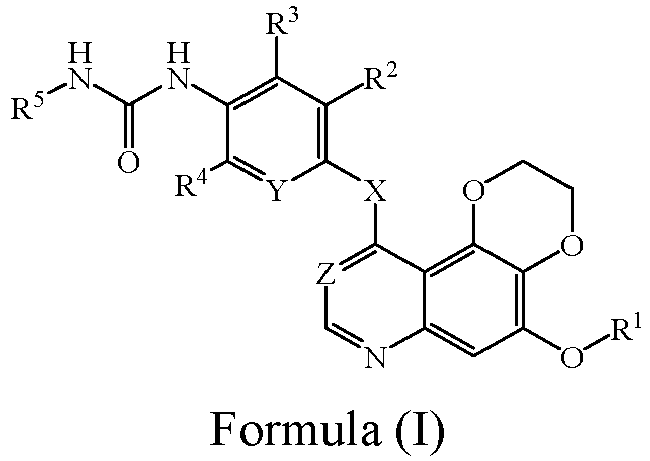 X is O or NH;Y is CH;Z is CH;R1 is C1-C6 alkyl substituted with 1 to 3 substituents selected from the group consisting of C1-C3 acyl, halogen, trifluoromethyl, cyano, -CONH2, -NRaRb and 4- to 7-membered heteroalicyclic group, wherein the 4- to 7-membered heteroalicyclic group is a 4- to 7-membered heteroalicyclic group containing 1 to 2 atoms selected from the group consisting of N, O, and S as ring atoms, and the 4- to 7-membered heteroalicyclic group is substituted with 1 to 3 substituents selected from the group consisting of halogen, C1-C3 alkyl, hydroxyl, -NH2, and C1-C3 acyl,Ra and Rb are each independently H, C1-C6 alkyl, C3-C6 cycloalkyl, C1-C6 alkyl substituted with C1-C3 alkoxy, C1-C6 alkyl substituted with C1-C3 alkylthio, or C1-C6 alkyl substituted with substituted amino or unsubstituted amino, wherein the substituted amino is substituted with mono- or di-C1-C3 alkyl;R2, R3, and R4 are each independently H or halogen;R5 is H, C1-C9 alkyl, C3-C8 cycloalkyl, C1-C6 alkyl substituted with C3-C8 cycloalkyl, unsubstituted aryl or heteroaryl, or an aryl or heteroaryl group substituted with 1 to 3 substituents -B, wherein the substituents -B are each independently hydroxyl, cyano, C1-C3 alkyl, C1-C3 alkoxy, C1-C3 alkylthio, amino substituted with mono- or di-C1-C3 alkyl, unsubstituted amino, halogen, trifluoromethyl, aryloxy or methylsulfonyl; andthe heteroaryl group is a monocyclic or bicyclic group containing 5 to 10 ring atoms, which contains 1 to 3 atoms selected from the group consisting of N, O, and S in the ring.
 - The compound, or the pharmaceutically acceptable salt, the enantiomer, the diastereomer, the hydrate, or the solvate thereof according to claim 5, wherein R1 is C1-C6 alkyl substituted with 1 to 3 substituents selected from the group consisting of -F, trifluoromethyl, cyano, -CONH2, -NRaRb, and 4- to 7-membered heteroalicyclic group, wherein the 4- to 7-membered heteroalicyclic group contains 1 to 2 atoms selected from the group consisting of N, O, and S as ring atoms, and the 4- to 7-membered heteroalicyclic group is substituted with 1 to 3 substituents selected from the group consisting of -F, C1-C3 alkyl, hydroxyl, -NH2, and C1-C3 acyl,Ra and Rb are each independently H, C1-C3 alkyl, C3-C6 cycloalkyl, C1-C3 alkyl substituted with C1-C3 alkoxy, C1-C3 alkyl substituted with C1-C3 alkylthio, or C1-C3 alkyl substituted with substituted amino or unsubstituted amino, wherein the substituted amino is substituted with mono- or di-C1-C3 alkyl;R5 is H, C1-C6 alkyl, C3-C6 cycloalkyl, C1-C3 alkyl substituted with C3-C6 cycloalkyl, unsubstituted phenyl, naphthyl or heteroaryl; or a phenyl, naphthyl or heteroaryl group substituted with 1 to 3 substituents -B, wherein the substituents -B are each independently methyl, ethyl, propyl, isopropyl, methoxy, ethoxy, propoxy, isopropoxy, methylthio, ethylthio, propylthio, isopropylthio, amino, methylamino, ethylamino, dimethylamino, diethylamino, fluorine, chlorine, bromine, trifluoromethyl, phenoxy or methylsulfonyl; andthe heteroaryl group is selected from the group consisting of pyridinyl, pyrimidinyl, quinolinyl, quinazolinyl, oxazolyl, isoxazolyl, thiazolyl, thiadiazolyl, pyrazolyl, imidazolyl, and pyrrolyl.
- The compound, or the pharmaceutically acceptable salt, the enantiomer, the diastereomer, the hydrate, or the solvate thereof according to claims 1-6, wherein the pharmaceutically acceptable salt of the compound is selected from the group consisting of one or more of hydrochloride, hydrobromide, hydroiodide, perchlorate, sulfate, nitrate, phosphate, formate, acetate, propionate, glycolate, lactate, succinate, maleate, tartrate, malate, citrate, fumarate, gluconate, benzoate, mandelate, methanesulfonate, isethionate, benzenesulfonate, oxalate, palmitate, 2-naphthalenesulfonate, p-toluenesulfonate, cyclohexylsulfamate, salicylate, hexonate, trifluoroacetate, aluminum salt, calcium salt, chloroprocaine salt, choline salt, diethanolamine salt, ethylenediamine salt, lithium salt, magnesium salt, potassium salt, sodium salt and zinc salt.
- A method of preparing the compound, or the pharmaceutically acceptable salt, the enantiomer, the diastereomer, the hydrate, or the solvate thereof according to claims 1-6, comprising reacting a compound of Formula (II) with H2N-R5 to prepare the compound of Formula (I), wherein X, Y, Z, R1, R2, R3, R4 and R5 are as defined in claims 1-9 or 10-11, wherein the condensing agent includes, but is not limited to, triphosgene, carbonyldiimidazole, phenyl chloroformate, and phenyl p-nitrochloroformates,

- A pharmaceutical composition for use in treating diseases related to tyrosine kinases VEGFR-2, C-RAF, B-RAF, or RET, which is consisted of the compound of Formula (I) or the pharmaceutically acceptable salt, or the hydrate thereof according to claims 1-6 and pharmaceutically acceptable carrier(s) or excipient(s).
- A pharmaceutical composition, comprising the compound of Formula (I) or the pharmaceutically acceptable salt, the hydrate, or the solvate thereof according to any one of claims 1-6 as an active ingredient, one or more other therapeutic agents, and one or more pharmaceutically acceptable carriers or excipients.
- A compound of Formula (I) or the pharmaceutically acceptable salt, the enantiomer, the diastereomer, the hydrate, or the solvate thereof according to any one of claims 1-6, for use in the treatment of tyrosine kinase VEGFR-2, C-RAF, B-RAF, or RET-related diseases, wherein the diseases include ocular fundus disease, psoriasis, rheumatic arthritis, atherosclerosis, pulmonary fibrosis, liver fibrosis, non-small cell lung cancer, small cell lung cancer, breast cancer, pancreatic cancer, glioma, glioblastoma, ovarian cancer, cervical cancer, colorectal cancer, melanoma, endometrial cancer, prostate cancer, bladder cancer, leukemia, gastric cancer, liver cancer, gastrointestinal stromal tumor, thyroid cancer, chronic myeloid leukemia, acute myeloid leukemia, non-Hodgkin's lymphoma, nasopharyngeal cancer, esophageal cancer, brain tumor, B-cell and T-cell lymphoma, lymphoma, multiple myeloma, biliary cancer and sarcoma, and cholangiocarcinoma.
- The compound, or the pharmaceutically acceptable salt, the enantiomer, the diastereomer, the hydrate, or the solvate thereof according to claim 1, wherein:X is O;Y is CH;Z is CH;R1 is selected from the group consisting of H, methyl, ethyl, propyl, isopropyl, methoxyethyl, methoxypropyl, methoxybutyl, methoxypentyl, methoxyhexyl, tetrahydrofuran-3-yl, tetrahydro-2H-pyran-4-yl, tetrahydropyrrol-1-ylethyl, tetrahydropyrrol-1-ylpropyl, piperidin-1-ylethyl, piperidin-1-ylpropyl, piperazin-1-ylethyl, piperazin-1-ylpropyl, morpholin-4-ylethyl, morpholin-4-ylpropyl, methylpiperazin-4-ylethyl, methylpiperazin-4-ylpropyl, N-formylpiperazin-4-ylethyl, N-formylpiperazin-4-ylpropyl, N-acetylpiperazin-4-ylethyl, N-acetylpiperazin-4-ylpropyl, (1,1-dioxothiomorpholin)-4-ylethyl, (1,1-dioxothiomorpholin)-4-ylpropyl, methylthioethyl, methylthiopropyl, dimethylaminoethyl, dimethylaminopropyl, dimethylaminobutyl, diethylaminoethyl, diethylaminopropyl, hydroxyethyl, hydroxypropyl, hydroxybutyl, hydroxypentyl, hydroxyhexyl, aminoethyl, aminopropyl, aminobutyl, 2-methyl-2-hydroxypropyl, 3-methyl-3-hydroxybutyl, (3 S)-3-aminobutyl, (3R)-3-aminobutyl, (3S)-3-hydroxybutyl and (3R)-3-hydroxybutyl;R2 is H or halogen;R3 is H or halogen;R4 is H or halogen;R5 is selected from the group consisting of H, methyl, ethyl, propyl, isopropyl, isopenyl, cyclopropyl, cyclobutyl, cyclopentyl, cyclohexyl, phenyl, 2-methoxyphenyl, 3-methoxyphenyl, 4-methoxyphenyl, 2-fluorophenyl, 3-fluorophenyl, 4-fluorophenyl, 4-phenoxyphenyl, 3-(methylsulfonyl)phenyl, 4-(methylsulfonyl)phenyl, 2,4-difluorophenyl, 2,5-difluorophenyl, 3,4-difluorophenyl, 2,4-dichlorophenyl, 2,5-dichlorophenyl, 3,4-dichlorophenyl, 2-fluoro-4-(trifluoromethyl)phenyl, 2-fluoro-5-(trifluoromethyl)phenyl, 3-fluoro-4-(trifluoromethyl)phenyl, 3-fluoro-5-(trifluoromethyl)phenyl, 3-(trifluoromethyl)-4-fluorophenyl, 2-fluoro-4-chlorophenyl, 2-fluoro-5-chlorophenyl, 3 -fluoro-4-chlorophenyl, 3 -fluoro-5-chlorophenyl, 3 -chloro-4-fluorophenyl, 2-chloro-4-(trifluoromethyl)phenyl, 2-chloro-5-(trifluoromethyl)phenyl, 3-chloro-4-(trifluoromethyl)phenyl, 3-chloro-5-(trifluoromethyl)phenyl, 3-(trifluoromethyl)-4-chlorophenyl, 2-chloro-4-fluorophenyl, 2-chloro-5-fluorophenyl, 3-chloro-4-fluorophenyl, pyridin-2-yl, pyridin-3-yl, pyridin-4-yl, 2-methoxy-pyridin-4-yl, 3-methyl-isoxazol-5-yl, and naphthalen-1-yl; alternatively, wherein R5 is selected from the group consisting of butyl, isobutyl, 2-methylphenyl, 3-methylphenyl, 4-methylphenyl, 2-methyl-5-(trifluoromethyl)phenyl, 2-methyl-4-(trifluoromethyl)phenyl, 3-methyl-4-(trifluoromethyl)phenyl, 3-methyl-5-(trifluoromethyl)phenyl, 2-chloro-4-methylphenyl, 2-chloro-5-methylphenyl, and 3-chloro-4-methylphenyl.
- The compound, or the pharmaceutically acceptable salt, the enantiomer, the diastereomer, the hydrate, or the solvate thereof according to claim 12, wherein: R1 is methyl, ethyl, propyl, or isopropyl, and R5 is a phenyl substituted with one or more of the following: methyl, ethyl, propyl, isopropyl, fluorine, chlorine, bromine, and trifluoromethyl.
- A compound, or a pharmaceutically acceptable salt, an enantiomer, a diastereomer, a hydrate, or a solvate thereof according to claim 1 or 5, wherein the compound is selected from the group consisting of:



















Applications Claiming Priority (3)
| Application Number | Priority Date | Filing Date | Title |
|---|---|---|---|
| PCT/CN2018/076232 WO2018157730A1 (en) | 2017-03-01 | 2018-02-11 | Urea-substituted aromatic ring-linked dioxane-quinazoline and -linked dioxane-quinoline compounds, preparation method therefor and use thereof |
| CN201810982631.6A CN110156802A (en) | 2017-03-01 | 2018-08-27 | Urea-substituted aromatic ring dioxane-quinoline compounds, preparation method and application thereof |
| PCT/CN2019/073259 WO2019154132A1 (en) | 2018-02-11 | 2019-01-25 | Urea-substituted aromatic ring-linked dioxazoline compound, preparation method therefor, and uses thereof |
Publications (3)
| Publication Number | Publication Date |
|---|---|
| EP3750894A4 EP3750894A4 (en) | 2020-12-16 |
| EP3750894A1 EP3750894A1 (en) | 2020-12-16 |
| EP3750894B1 true EP3750894B1 (en) | 2024-04-03 |
Family
ID=67548190
Family Applications (1)
| Application Number | Title | Priority Date | Filing Date |
|---|---|---|---|
| EP19751364.1A Active EP3750894B1 (en) | 2018-02-11 | 2019-01-25 | Urea-substituted aromatic ring-linked dioxazoline compound, preparation method therefor, and uses thereof |
Country Status (6)
| Country | Link |
|---|---|
| US (1) | US11479559B2 (en) |
| EP (1) | EP3750894B1 (en) |
| JP (1) | JP7018224B2 (en) |
| KR (1) | KR102436669B1 (en) |
| CA (1) | CA3090829C (en) |
| WO (1) | WO2019154132A1 (en) |
Families Citing this family (1)
| Publication number | Priority date | Publication date | Assignee | Title |
|---|---|---|---|---|
| WO2020042972A1 (en) * | 2018-08-27 | 2020-03-05 | 北京赛特明强医药科技有限公司 | Urea-substituted aromatic ring-linked dioxane and quinazoline or quinoline compound, composition and application thereof |
Family Cites Families (18)
| Publication number | Priority date | Publication date | Assignee | Title |
|---|---|---|---|---|
| DE60208364T2 (en) | 2001-04-27 | 2006-09-28 | Kirin Beer K.K. | CHINOLINE DERIVATIVES WITH AN AZOLYL GROUP AND CHINAZOLINE DERIVATIVES |
| EP1566379A4 (en) | 2002-10-29 | 2005-11-09 | Kirin Brewery | QUINOLINE AND QUINAZOLINE DERIVATIVES INHIBITING THE AUTOPHOSPHORYLATION OF FLT3 AND MEDICAL COMPOSITIONS CONTAINING SAME |
| CN101316590B (en) | 2005-11-07 | 2011-08-03 | 卫材R&D管理有限公司 | combined use of angiogenesis inhibitor and c-kit kinase inhibitor |
| WO2007136103A1 (en) | 2006-05-18 | 2007-11-29 | Eisai R & D Management Co., Ltd. | Antitumor agent for thyroid cancer |
| US20110189167A1 (en) | 2007-04-20 | 2011-08-04 | Flynn Daniel L | Methods and Compositions for the Treatment of Myeloproliferative Diseases and other Proliferative Diseases |
| PL2947072T3 (en) | 2008-03-17 | 2017-05-31 | Ambit Biosciences Corporation | 1-(3-(6,7-dimethoxyquinazolin-4-yloxy)phenyl)-3-(5-(1,1,1-trifluoro-2-methylpropan-2-yl)isoxazol-3-yl)urea as raf kinase modulator in the treatment of cancer diseases |
| WO2011038579A1 (en) | 2009-09-30 | 2011-04-07 | Zhejiang Beta Pharma Inc. | Compounds and compositions as protein kinase inhibitors |
| CN102532042A (en) | 2010-12-30 | 2012-07-04 | 上海医药工业研究院 | Aryl urea compound as well as intermediate and application thereof |
| EP2700403B1 (en) | 2011-04-18 | 2015-11-25 | Eisai R&D Management Co., Ltd. | Therapeutic agent for tumor |
| CN102311395B (en) | 2011-07-05 | 2014-04-16 | 张爱华 | Quinazoline ring substituted diphenylurea derivative and its purpose |
| WO2013036232A2 (en) | 2011-09-08 | 2013-03-14 | Deciphera Pharmaceuticals, Llc | Methods and compositions for the treatment of myeloproliferative diseases and other proliferative diseases |
| CN103382206B (en) | 2012-05-04 | 2016-09-28 | 上海恒瑞医药有限公司 | Quinoline or quinazoline derivative, its preparation method and in application pharmaceutically |
| CA2900652C (en) * | 2013-02-15 | 2021-05-04 | Kala Pharmaceuticals, Inc. | Therapeutic compounds and uses thereof |
| CN104530063B (en) * | 2015-01-13 | 2017-01-18 | 北京赛特明强医药科技有限公司 | Quinazoline and heterocyclic ring compounds, preparing method of compounds, and application of compounds serving as epidermal growth factor receptor inhibitors used for treating cancer |
| CN105837586B (en) | 2015-12-14 | 2018-02-13 | 北京赛特明强医药科技有限公司 | Dioxane and quinazoline aminated compounds and preparation method thereof and the application as epidermal growth factor receptor inhibitor |
| CN105884699B (en) | 2016-05-11 | 2019-05-07 | 中国药科大学 | 4-Substituted aniline quinazoline derivatives and preparation method and use thereof |
| WO2018157730A1 (en) * | 2017-03-01 | 2018-09-07 | 北京赛特明强医药科技有限公司 | Urea-substituted aromatic ring-linked dioxane-quinazoline and -linked dioxane-quinoline compounds, preparation method therefor and use thereof |
| CN108530455B (en) | 2017-03-01 | 2021-01-12 | 北京赛特明强医药科技有限公司 | Urea substituted aromatic ring connecting dioxane and quinazoline compound or medicinal salt or hydrate and application as tyrosine kinase inhibitor |
-
2019
- 2019-01-25 WO PCT/CN2019/073259 patent/WO2019154132A1/en not_active Ceased
- 2019-01-25 KR KR1020207025247A patent/KR102436669B1/en active Active
- 2019-01-25 JP JP2020543109A patent/JP7018224B2/en active Active
- 2019-01-25 US US16/968,793 patent/US11479559B2/en active Active
- 2019-01-25 EP EP19751364.1A patent/EP3750894B1/en active Active
- 2019-01-25 CA CA3090829A patent/CA3090829C/en active Active
Also Published As
| Publication number | Publication date |
|---|---|
| EP3750894A4 (en) | 2020-12-16 |
| KR102436669B1 (en) | 2022-08-25 |
| JP2021512936A (en) | 2021-05-20 |
| JP7018224B2 (en) | 2022-02-10 |
| CA3090829C (en) | 2023-05-09 |
| CA3090829A1 (en) | 2019-08-15 |
| WO2019154132A1 (en) | 2019-08-15 |
| KR20200116487A (en) | 2020-10-12 |
| US20200399284A1 (en) | 2020-12-24 |
| US11479559B2 (en) | 2022-10-25 |
| EP3750894A1 (en) | 2020-12-16 |
Similar Documents
| Publication | Publication Date | Title |
|---|---|---|
| JP7383652B2 (en) | B-RAF Kinase Maleate Salt, Crystal Form, Preparation Method, and Use thereof | |
| AU2019218186B2 (en) | Urea-substituted aromatic ring-linked dioxinoquinoline compounds, preparation method and uses thereof | |
| EP3299369B1 (en) | Pyrido-azaheterecydic compound and preparation method and use thereof | |
| AU2019218187B2 (en) | Dioxinoquinoline compounds, preparation method and uses thereof | |
| TWI845819B (en) | Compounds used as kinase inhibitors and their applications | |
| CN114656482A (en) | Macrocyclic heterocyclic compound as EGFR inhibitor and application thereof | |
| WO2018234978A1 (en) | SUBSTITUTED 5-CYANOINDOLE COMPOUNDS AND USES THEREOF | |
| JP7251841B2 (en) | Aromatic ring-bonded dioxino-quinazoline or dioxino-quinoline compounds, compositions and uses thereof | |
| CN110862397A (en) | Dioxane quinazoline and dioxane quinoline compounds, and preparation method and application thereof | |
| WO2018157730A1 (en) | Urea-substituted aromatic ring-linked dioxane-quinazoline and -linked dioxane-quinoline compounds, preparation method therefor and use thereof | |
| EP3750893B1 (en) | Dioxazoline compound, preparation method therefor, and uses thereof | |
| US11479559B2 (en) | Urea-substituted aromatic ring-linked dioxinoquinoline compounds, preparation method and uses thereof | |
| CN110862398B (en) | Urea substituted aromatic ring-linked dioxane quinazoline or quinoline compound, composition and application thereof | |
| HK40039559A (en) | Urea-substituted aromatic ring-linked dioxinoquinoline compounds, preparation method and uses thereof | |
| HK40039559B (en) | Urea-substituted aromatic ring-linked dioxinoquinoline compounds, preparation method and uses thereof | |
| HK40057704A (en) | Aromatic ring-linked dioxane-quinazoline or -quinoline compounds, compositions and use thereof | |
| KR20210050530A (en) | Salt forms and crystal forms of novel azatricyclic compounds and uses thereof |
Legal Events
| Date | Code | Title | Description |
|---|---|---|---|
| STAA | Information on the status of an ep patent application or granted ep patent |
Free format text: STATUS: THE INTERNATIONAL PUBLICATION HAS BEEN MADE |
|
| PUAI | Public reference made under article 153(3) epc to a published international application that has entered the european phase |
Free format text: ORIGINAL CODE: 0009012 |
|
| STAA | Information on the status of an ep patent application or granted ep patent |
Free format text: STATUS: REQUEST FOR EXAMINATION WAS MADE |
|
| 17P | Request for examination filed |
Effective date: 20200828 |
|
| A4 | Supplementary search report drawn up and despatched |
Effective date: 20201103 |
|
| AK | Designated contracting states |
Kind code of ref document: A1 Designated state(s): AL AT BE BG CH CY CZ DE DK EE ES FI FR GB GR HR HU IE IS IT LI LT LU LV MC MK MT NL NO PL PT RO RS SE SI SK SM TR |
|
| AX | Request for extension of the european patent |
Extension state: BA ME |
|
| DAV | Request for validation of the european patent (deleted) | ||
| DAX | Request for extension of the european patent (deleted) | ||
| STAA | Information on the status of an ep patent application or granted ep patent |
Free format text: STATUS: EXAMINATION IS IN PROGRESS |
|
| 17Q | First examination report despatched |
Effective date: 20220617 |
|
| GRAP | Despatch of communication of intention to grant a patent |
Free format text: ORIGINAL CODE: EPIDOSNIGR1 |
|
| STAA | Information on the status of an ep patent application or granted ep patent |
Free format text: STATUS: GRANT OF PATENT IS INTENDED |
|
| INTG | Intention to grant announced |
Effective date: 20231025 |
|
| GRAS | Grant fee paid |
Free format text: ORIGINAL CODE: EPIDOSNIGR3 |
|
| GRAA | (expected) grant |
Free format text: ORIGINAL CODE: 0009210 |
|
| STAA | Information on the status of an ep patent application or granted ep patent |
Free format text: STATUS: THE PATENT HAS BEEN GRANTED |
|
| P01 | Opt-out of the competence of the unified patent court (upc) registered |
Effective date: 20240202 |
|
| AK | Designated contracting states |
Kind code of ref document: B1 Designated state(s): AL AT BE BG CH CY CZ DE DK EE ES FI FR GB GR HR HU IE IS IT LI LT LU LV MC MK MT NL NO PL PT RO RS SE SI SK SM TR |
|
| REG | Reference to a national code |
Ref country code: CH Ref legal event code: EP |
|
| REG | Reference to a national code |
Ref country code: DE Ref legal event code: R096 Ref document number: 602019049514 Country of ref document: DE |
|
| REG | Reference to a national code |
Ref country code: IE Ref legal event code: FG4D |
|
| REG | Reference to a national code |
Ref country code: NL Ref legal event code: FP |
|
| REG | Reference to a national code |
Ref country code: LT Ref legal event code: MG9D |
|
| REG | Reference to a national code |
Ref country code: AT Ref legal event code: MK05 Ref document number: 1672222 Country of ref document: AT Kind code of ref document: T Effective date: 20240403 |
|
| PG25 | Lapsed in a contracting state [announced via postgrant information from national office to epo] |
Ref country code: IS Free format text: LAPSE BECAUSE OF FAILURE TO SUBMIT A TRANSLATION OF THE DESCRIPTION OR TO PAY THE FEE WITHIN THE PRESCRIBED TIME-LIMIT Effective date: 20240803 |
|
| PG25 | Lapsed in a contracting state [announced via postgrant information from national office to epo] |
Ref country code: BG Free format text: LAPSE BECAUSE OF FAILURE TO SUBMIT A TRANSLATION OF THE DESCRIPTION OR TO PAY THE FEE WITHIN THE PRESCRIBED TIME-LIMIT Effective date: 20240403 |
|
| PG25 | Lapsed in a contracting state [announced via postgrant information from national office to epo] |
Ref country code: HR Free format text: LAPSE BECAUSE OF FAILURE TO SUBMIT A TRANSLATION OF THE DESCRIPTION OR TO PAY THE FEE WITHIN THE PRESCRIBED TIME-LIMIT Effective date: 20240403 Ref country code: FI Free format text: LAPSE BECAUSE OF FAILURE TO SUBMIT A TRANSLATION OF THE DESCRIPTION OR TO PAY THE FEE WITHIN THE PRESCRIBED TIME-LIMIT Effective date: 20240403 |
|
| PG25 | Lapsed in a contracting state [announced via postgrant information from national office to epo] |
Ref country code: GR Free format text: LAPSE BECAUSE OF FAILURE TO SUBMIT A TRANSLATION OF THE DESCRIPTION OR TO PAY THE FEE WITHIN THE PRESCRIBED TIME-LIMIT Effective date: 20240704 |
|
| PG25 | Lapsed in a contracting state [announced via postgrant information from national office to epo] |
Ref country code: PT Free format text: LAPSE BECAUSE OF FAILURE TO SUBMIT A TRANSLATION OF THE DESCRIPTION OR TO PAY THE FEE WITHIN THE PRESCRIBED TIME-LIMIT Effective date: 20240805 |
|
| PG25 | Lapsed in a contracting state [announced via postgrant information from national office to epo] |
Ref country code: ES Free format text: LAPSE BECAUSE OF FAILURE TO SUBMIT A TRANSLATION OF THE DESCRIPTION OR TO PAY THE FEE WITHIN THE PRESCRIBED TIME-LIMIT Effective date: 20240403 |
|
| PG25 | Lapsed in a contracting state [announced via postgrant information from national office to epo] |
Ref country code: CZ Free format text: LAPSE BECAUSE OF FAILURE TO SUBMIT A TRANSLATION OF THE DESCRIPTION OR TO PAY THE FEE WITHIN THE PRESCRIBED TIME-LIMIT Effective date: 20240403 |
|
| PG25 | Lapsed in a contracting state [announced via postgrant information from national office to epo] |
Ref country code: AT Free format text: LAPSE BECAUSE OF FAILURE TO SUBMIT A TRANSLATION OF THE DESCRIPTION OR TO PAY THE FEE WITHIN THE PRESCRIBED TIME-LIMIT Effective date: 20240403 |
|
| PG25 | Lapsed in a contracting state [announced via postgrant information from national office to epo] |
Ref country code: PL Free format text: LAPSE BECAUSE OF FAILURE TO SUBMIT A TRANSLATION OF THE DESCRIPTION OR TO PAY THE FEE WITHIN THE PRESCRIBED TIME-LIMIT Effective date: 20240403 |
|
| PG25 | Lapsed in a contracting state [announced via postgrant information from national office to epo] |
Ref country code: LV Free format text: LAPSE BECAUSE OF FAILURE TO SUBMIT A TRANSLATION OF THE DESCRIPTION OR TO PAY THE FEE WITHIN THE PRESCRIBED TIME-LIMIT Effective date: 20240403 |
|
| PG25 | Lapsed in a contracting state [announced via postgrant information from national office to epo] |
Ref country code: PT Free format text: LAPSE BECAUSE OF FAILURE TO SUBMIT A TRANSLATION OF THE DESCRIPTION OR TO PAY THE FEE WITHIN THE PRESCRIBED TIME-LIMIT Effective date: 20240805 Ref country code: PL Free format text: LAPSE BECAUSE OF FAILURE TO SUBMIT A TRANSLATION OF THE DESCRIPTION OR TO PAY THE FEE WITHIN THE PRESCRIBED TIME-LIMIT Effective date: 20240403 Ref country code: NO Free format text: LAPSE BECAUSE OF FAILURE TO SUBMIT A TRANSLATION OF THE DESCRIPTION OR TO PAY THE FEE WITHIN THE PRESCRIBED TIME-LIMIT Effective date: 20240703 Ref country code: LV Free format text: LAPSE BECAUSE OF FAILURE TO SUBMIT A TRANSLATION OF THE DESCRIPTION OR TO PAY THE FEE WITHIN THE PRESCRIBED TIME-LIMIT Effective date: 20240403 Ref country code: IS Free format text: LAPSE BECAUSE OF FAILURE TO SUBMIT A TRANSLATION OF THE DESCRIPTION OR TO PAY THE FEE WITHIN THE PRESCRIBED TIME-LIMIT Effective date: 20240803 Ref country code: HR Free format text: LAPSE BECAUSE OF FAILURE TO SUBMIT A TRANSLATION OF THE DESCRIPTION OR TO PAY THE FEE WITHIN THE PRESCRIBED TIME-LIMIT Effective date: 20240403 Ref country code: GR Free format text: LAPSE BECAUSE OF FAILURE TO SUBMIT A TRANSLATION OF THE DESCRIPTION OR TO PAY THE FEE WITHIN THE PRESCRIBED TIME-LIMIT Effective date: 20240704 Ref country code: FI Free format text: LAPSE BECAUSE OF FAILURE TO SUBMIT A TRANSLATION OF THE DESCRIPTION OR TO PAY THE FEE WITHIN THE PRESCRIBED TIME-LIMIT Effective date: 20240403 Ref country code: ES Free format text: LAPSE BECAUSE OF FAILURE TO SUBMIT A TRANSLATION OF THE DESCRIPTION OR TO PAY THE FEE WITHIN THE PRESCRIBED TIME-LIMIT Effective date: 20240403 Ref country code: CZ Free format text: LAPSE BECAUSE OF FAILURE TO SUBMIT A TRANSLATION OF THE DESCRIPTION OR TO PAY THE FEE WITHIN THE PRESCRIBED TIME-LIMIT Effective date: 20240403 Ref country code: BG Free format text: LAPSE BECAUSE OF FAILURE TO SUBMIT A TRANSLATION OF THE DESCRIPTION OR TO PAY THE FEE WITHIN THE PRESCRIBED TIME-LIMIT Effective date: 20240403 Ref country code: AT Free format text: LAPSE BECAUSE OF FAILURE TO SUBMIT A TRANSLATION OF THE DESCRIPTION OR TO PAY THE FEE WITHIN THE PRESCRIBED TIME-LIMIT Effective date: 20240403 Ref country code: RS Free format text: LAPSE BECAUSE OF FAILURE TO SUBMIT A TRANSLATION OF THE DESCRIPTION OR TO PAY THE FEE WITHIN THE PRESCRIBED TIME-LIMIT Effective date: 20240703 |
|
| REG | Reference to a national code |
Ref country code: DE Ref legal event code: R097 Ref document number: 602019049514 Country of ref document: DE |
|
| PG25 | Lapsed in a contracting state [announced via postgrant information from national office to epo] |
Ref country code: DK Free format text: LAPSE BECAUSE OF FAILURE TO SUBMIT A TRANSLATION OF THE DESCRIPTION OR TO PAY THE FEE WITHIN THE PRESCRIBED TIME-LIMIT Effective date: 20240403 |
|
| PG25 | Lapsed in a contracting state [announced via postgrant information from national office to epo] |
Ref country code: EE Free format text: LAPSE BECAUSE OF FAILURE TO SUBMIT A TRANSLATION OF THE DESCRIPTION OR TO PAY THE FEE WITHIN THE PRESCRIBED TIME-LIMIT Effective date: 20240403 |
|
| PG25 | Lapsed in a contracting state [announced via postgrant information from national office to epo] |
Ref country code: RO Free format text: LAPSE BECAUSE OF FAILURE TO SUBMIT A TRANSLATION OF THE DESCRIPTION OR TO PAY THE FEE WITHIN THE PRESCRIBED TIME-LIMIT Effective date: 20240403 Ref country code: SK Free format text: LAPSE BECAUSE OF FAILURE TO SUBMIT A TRANSLATION OF THE DESCRIPTION OR TO PAY THE FEE WITHIN THE PRESCRIBED TIME-LIMIT Effective date: 20240403 |
|
| PG25 | Lapsed in a contracting state [announced via postgrant information from national office to epo] |
Ref country code: SM Free format text: LAPSE BECAUSE OF FAILURE TO SUBMIT A TRANSLATION OF THE DESCRIPTION OR TO PAY THE FEE WITHIN THE PRESCRIBED TIME-LIMIT Effective date: 20240403 |
|
| PG25 | Lapsed in a contracting state [announced via postgrant information from national office to epo] |
Ref country code: SM Free format text: LAPSE BECAUSE OF FAILURE TO SUBMIT A TRANSLATION OF THE DESCRIPTION OR TO PAY THE FEE WITHIN THE PRESCRIBED TIME-LIMIT Effective date: 20240403 Ref country code: SK Free format text: LAPSE BECAUSE OF FAILURE TO SUBMIT A TRANSLATION OF THE DESCRIPTION OR TO PAY THE FEE WITHIN THE PRESCRIBED TIME-LIMIT Effective date: 20240403 Ref country code: RO Free format text: LAPSE BECAUSE OF FAILURE TO SUBMIT A TRANSLATION OF THE DESCRIPTION OR TO PAY THE FEE WITHIN THE PRESCRIBED TIME-LIMIT Effective date: 20240403 Ref country code: EE Free format text: LAPSE BECAUSE OF FAILURE TO SUBMIT A TRANSLATION OF THE DESCRIPTION OR TO PAY THE FEE WITHIN THE PRESCRIBED TIME-LIMIT Effective date: 20240403 Ref country code: DK Free format text: LAPSE BECAUSE OF FAILURE TO SUBMIT A TRANSLATION OF THE DESCRIPTION OR TO PAY THE FEE WITHIN THE PRESCRIBED TIME-LIMIT Effective date: 20240403 |
|
| PLBE | No opposition filed within time limit |
Free format text: ORIGINAL CODE: 0009261 |
|
| STAA | Information on the status of an ep patent application or granted ep patent |
Free format text: STATUS: NO OPPOSITION FILED WITHIN TIME LIMIT |
|
| 26N | No opposition filed |
Effective date: 20250106 |
|
| PG25 | Lapsed in a contracting state [announced via postgrant information from national office to epo] |
Ref country code: SI Free format text: LAPSE BECAUSE OF FAILURE TO SUBMIT A TRANSLATION OF THE DESCRIPTION OR TO PAY THE FEE WITHIN THE PRESCRIBED TIME-LIMIT Effective date: 20240403 |
|
| PG25 | Lapsed in a contracting state [announced via postgrant information from national office to epo] |
Ref country code: SE Free format text: LAPSE BECAUSE OF FAILURE TO SUBMIT A TRANSLATION OF THE DESCRIPTION OR TO PAY THE FEE WITHIN THE PRESCRIBED TIME-LIMIT Effective date: 20240403 |
|
| PG25 | Lapsed in a contracting state [announced via postgrant information from national office to epo] |
Ref country code: LU Free format text: LAPSE BECAUSE OF NON-PAYMENT OF DUE FEES Effective date: 20250125 Ref country code: MC Free format text: LAPSE BECAUSE OF FAILURE TO SUBMIT A TRANSLATION OF THE DESCRIPTION OR TO PAY THE FEE WITHIN THE PRESCRIBED TIME-LIMIT Effective date: 20240403 |
|
| PGFP | Annual fee paid to national office [announced via postgrant information from national office to epo] |
Ref country code: GB Payment date: 20251215 Year of fee payment: 8 |
|
| PG25 | Lapsed in a contracting state [announced via postgrant information from national office to epo] |
Ref country code: IT Free format text: LAPSE BECAUSE OF NON-PAYMENT OF DUE FEES Effective date: 20250125 |
|
| PGFP | Annual fee paid to national office [announced via postgrant information from national office to epo] |
Ref country code: FR Payment date: 20251215 Year of fee payment: 8 Ref country code: NL Payment date: 20251215 Year of fee payment: 8 |
|
| PGFP | Annual fee paid to national office [announced via postgrant information from national office to epo] |
Ref country code: BE Payment date: 20251215 Year of fee payment: 8 |
|
| PGFP | Annual fee paid to national office [announced via postgrant information from national office to epo] |
Ref country code: IE Payment date: 20251216 Year of fee payment: 8 |
|
| REG | Reference to a national code |
Ref country code: CH Ref legal event code: U11 Free format text: ST27 STATUS EVENT CODE: U-0-0-U10-U11 (AS PROVIDED BY THE NATIONAL OFFICE) Effective date: 20260201 |
|
| PGFP | Annual fee paid to national office [announced via postgrant information from national office to epo] |
Ref country code: DE Payment date: 20260120 Year of fee payment: 8 |
|
| PG25 | Lapsed in a contracting state [announced via postgrant information from national office to epo] |
Ref country code: IT Free format text: LAPSE BECAUSE OF NON-PAYMENT OF DUE FEES Effective date: 20250125 |
|
| PGFP | Annual fee paid to national office [announced via postgrant information from national office to epo] |
Ref country code: IT Payment date: 20260130 Year of fee payment: 8 |
|
| PGRI | Patent reinstated in contracting state [announced from national office to epo] |
Ref country code: IT Effective date: 20250603 |
|
| PGFP | Annual fee paid to national office [announced via postgrant information from national office to epo] |
Ref country code: CH Payment date: 20260201 Year of fee payment: 8 |