EP3750813B1 - Fire seal assemblies for aircraft engines - Google Patents
Fire seal assemblies for aircraft engines Download PDFInfo
- Publication number
- EP3750813B1 EP3750813B1 EP20173379.7A EP20173379A EP3750813B1 EP 3750813 B1 EP3750813 B1 EP 3750813B1 EP 20173379 A EP20173379 A EP 20173379A EP 3750813 B1 EP3750813 B1 EP 3750813B1
- Authority
- EP
- European Patent Office
- Prior art keywords
- seal
- leg
- fire
- firewall
- engine
- Prior art date
- Legal status (The legal status is an assumption and is not a legal conclusion. Google has not performed a legal analysis and makes no representation as to the accuracy of the status listed.)
- Active
Links
Images



Classifications
-
- F—MECHANICAL ENGINEERING; LIGHTING; HEATING; WEAPONS; BLASTING
- F02—COMBUSTION ENGINES; HOT-GAS OR COMBUSTION-PRODUCT ENGINE PLANTS
- F02C—GAS-TURBINE PLANTS; AIR INTAKES FOR JET-PROPULSION PLANTS; CONTROLLING FUEL SUPPLY IN AIR-BREATHING JET-PROPULSION PLANTS
- F02C7/00—Features, components parts, details or accessories, not provided for in, or of interest apart form groups F02C1/00 - F02C6/00; Air intakes for jet-propulsion plants
- F02C7/24—Heat or noise insulation
- F02C7/25—Fire protection or prevention
-
- B—PERFORMING OPERATIONS; TRANSPORTING
- B64—AIRCRAFT; AVIATION; COSMONAUTICS
- B64D—EQUIPMENT FOR FITTING IN OR TO AIRCRAFT; FLIGHT SUITS; PARACHUTES; ARRANGEMENT OR MOUNTING OF POWER PLANTS OR PROPULSION TRANSMISSIONS IN AIRCRAFT
- B64D29/00—Power-plant nacelles, fairings or cowlings
- B64D29/06—Attaching of nacelles, fairings or cowlings
-
- F—MECHANICAL ENGINEERING; LIGHTING; HEATING; WEAPONS; BLASTING
- F16—ENGINEERING ELEMENTS AND UNITS; GENERAL MEASURES FOR PRODUCING AND MAINTAINING EFFECTIVE FUNCTIONING OF MACHINES OR INSTALLATIONS; THERMAL INSULATION IN GENERAL
- F16J—PISTONS; CYLINDERS; SEALINGS
- F16J15/00—Sealings
- F16J15/02—Sealings between relatively-stationary surfaces
- F16J15/06—Sealings between relatively-stationary surfaces with solid packing compressed between sealing surfaces
- F16J15/10—Sealings between relatively-stationary surfaces with solid packing compressed between sealing surfaces with non-metallic packing
- F16J15/102—Sealings between relatively-stationary surfaces with solid packing compressed between sealing surfaces with non-metallic packing characterised by material
-
- B—PERFORMING OPERATIONS; TRANSPORTING
- B64—AIRCRAFT; AVIATION; COSMONAUTICS
- B64D—EQUIPMENT FOR FITTING IN OR TO AIRCRAFT; FLIGHT SUITS; PARACHUTES; ARRANGEMENT OR MOUNTING OF POWER PLANTS OR PROPULSION TRANSMISSIONS IN AIRCRAFT
- B64D27/00—Arrangement or mounting of power plants in aircraft; Aircraft characterised by the type or position of power plants
- B64D27/02—Aircraft characterised by the type or position of power plants
- B64D27/10—Aircraft characterised by the type or position of power plants of gas-turbine type
-
- B—PERFORMING OPERATIONS; TRANSPORTING
- B64—AIRCRAFT; AVIATION; COSMONAUTICS
- B64D—EQUIPMENT FOR FITTING IN OR TO AIRCRAFT; FLIGHT SUITS; PARACHUTES; ARRANGEMENT OR MOUNTING OF POWER PLANTS OR PROPULSION TRANSMISSIONS IN AIRCRAFT
- B64D45/00—Aircraft indicators or protectors not otherwise provided for
-
- F—MECHANICAL ENGINEERING; LIGHTING; HEATING; WEAPONS; BLASTING
- F16—ENGINEERING ELEMENTS AND UNITS; GENERAL MEASURES FOR PRODUCING AND MAINTAINING EFFECTIVE FUNCTIONING OF MACHINES OR INSTALLATIONS; THERMAL INSULATION IN GENERAL
- F16J—PISTONS; CYLINDERS; SEALINGS
- F16J15/00—Sealings
- F16J15/02—Sealings between relatively-stationary surfaces
- F16J15/06—Sealings between relatively-stationary surfaces with solid packing compressed between sealing surfaces
- F16J15/064—Sealings between relatively-stationary surfaces with solid packing compressed between sealing surfaces the packing combining the sealing function with other functions
- F16J15/065—Sealings between relatively-stationary surfaces with solid packing compressed between sealing surfaces the packing combining the sealing function with other functions fire resistant
-
- F—MECHANICAL ENGINEERING; LIGHTING; HEATING; WEAPONS; BLASTING
- F16—ENGINEERING ELEMENTS AND UNITS; GENERAL MEASURES FOR PRODUCING AND MAINTAINING EFFECTIVE FUNCTIONING OF MACHINES OR INSTALLATIONS; THERMAL INSULATION IN GENERAL
- F16J—PISTONS; CYLINDERS; SEALINGS
- F16J15/00—Sealings
- F16J15/02—Sealings between relatively-stationary surfaces
- F16J15/06—Sealings between relatively-stationary surfaces with solid packing compressed between sealing surfaces
- F16J15/10—Sealings between relatively-stationary surfaces with solid packing compressed between sealing surfaces with non-metallic packing
- F16J15/104—Sealings between relatively-stationary surfaces with solid packing compressed between sealing surfaces with non-metallic packing characterised by structure
-
- B—PERFORMING OPERATIONS; TRANSPORTING
- B64—AIRCRAFT; AVIATION; COSMONAUTICS
- B64D—EQUIPMENT FOR FITTING IN OR TO AIRCRAFT; FLIGHT SUITS; PARACHUTES; ARRANGEMENT OR MOUNTING OF POWER PLANTS OR PROPULSION TRANSMISSIONS IN AIRCRAFT
- B64D45/00—Aircraft indicators or protectors not otherwise provided for
- B64D2045/009—Fire detection or protection; Erosion protection, e.g. from airborne particles
Definitions
- This disclosure relates generally to aircraft and, more particularly, to fire seal assemblies for aircraft engines.
- aircraft engines are generally required to include fire seals that are capable of containing and isolating a fire from within the propulsion components of the aircraft engine (e.g., the gas turbine engine).
- the fire seals are intended to prevent such a fire from spreading to other areas of the engine and/or to surrounding aircraft components.
- US 2019/061966 in accordance with its abstract, states that it relates to a nacelle mounted above a wing of an aircraft.
- a support structure on the nacelle above the pylon resists forces in different directions, and includes door supports allowing the door to be opened upwardly.
- a retaining structure on the pylon below the nacelle resists forces in different directions, and includes a fixed support track and multiple keepers.
- Each keeper includes a first end which slides within the channel, and a second end which engages a latch on the closed door.
- a fire seal assembly includes a depressor surface and a fire seal, and the latter does not contact the former until the door is almost closed.
- US 2014/262358 in accordance with its abstract, states that it relates to a multi-member assembly including a first structural member, a second structural member opposed from the first structural member, a crossover seal positioned between the first and second structural members, wherein the crossover seal defines a bore, and an end cap including a cap portion and a plug portion protruding from the cap portion, wherein the plug portion is at least partially received in the bore such that the cap portion bridges the first and second structural members.
- a fire seal assembly is defined in claim 1.
- An aircraft including such fire seal assembly is defined in claim 11.
- any part e.g., a layer, film, area, region, or plate
- any part indicates that the referenced part is either in contact with the other part, or that the referenced part is above the other part with one or more intermediate part(s) located therebetween.
- Stating that any part is in contact with another part means that there is no intermediate part between the two parts.
- Descriptors "first,” “second,” “third,” etc. are used herein when identifying multiple elements or components that may be referred to separately. Unless otherwise specified or understood based on their context of use, such descriptors are not intended to impute any meaning of priority, physical order or arrangement in a list, or ordering in time but are merely used as labels for referring to multiple elements or components separately for ease of understanding the disclosed examples.
- the descriptor "first” may be used to refer to an element in the detailed description, while the same element may be referred to in a claim with a different descriptor such as "second” or “third.” In such instances, it should be understood that such descriptors are used merely for ease of referencing multiple elements or components.
- Aircraft engines are typically connected to wings of an aircraft.
- each engine is coupled to a structural beam of the wing known as a pylon.
- Federal Aviation Administration (FAA) regulations generally require the use of firewalls and/or fire seals to contain a fire within the engine core and prevent the fire from spreading to other parts of the engine and/or other components of the aircraft, such as the pylon.
- One common fire seal boundary that must be formed is a core compartment firewall, which separates the core compartment from a strut dry bay (the pylon).
- This seal boundary is formed by left and right horizontal thrust reverser (TR) seals that run along the sides of the pylon and extend to an engine firewall (which separates the engine core from the fan duct).
- Left and right vertical TR seals run down the sides of the firewall.
- a core service disconnect (CSD) extends downward from the pylon and provides connections to the various hydraulic, electrical, and fuel lines leading to the engine core. The CSD is spaced apart from the engine firewall.
- a fire seal assembly (sometimes referred to as a CSD fire seal) is disposed between the engine firewall, the CSD, and the thrust reverser seals to form a fire seal between these parts.
- a known fire seal assembly includes a P-seal that is connected to the CSD. The P-seal is engaged with the engine firewall to fill the space between the CSD and the engine firewall. The ends of the P-seal are engaged with the left and right TR seals.
- example fire seal assemblies that can advantageously maintain a sufficient fire seal between a CSD, an engine firewall, and left and right TR seals and throughout larger movements of the engine and higher operating temperatures, such as those caused by a larger, more powerful engine.
- the example seal assemblies disclosed herein enable the user of larger, more powerful engines than known fire seal assemblies.
- An example fire seal assembly disclosed herein includes a first L-cap and a second L-cap.
- the first and second L-caps are coupled to the CSD.
- the first and second L-caps includes legs that extend outward from the CSD and form a u-shaped channel.
- One or more P-seals are coupled to the L-caps and disposed in the u-shaped channel between the legs.
- the P-seal(s) is/are to extend the engine firewall.
- the legs of the L-caps extend beyond the P-seals and engage the sides of the engine firewall such that the P-seals are enclosed by the L-caps and the engine firewall.
- end plugs are disposed between the ends of the P-seals and the inner surfaces of the legs, thereby creating a tight seal between the P-seals and the legs of the L-caps.
- the left and right horizontal TR seals run along the outer surfaces of the legs between the sides of the pylon and the sides of the engine firewall. If the engine moves forward or rearward (e.g., during take-off), the legs slide along the sides of the firewall, thereby maintaining a constant, smooth engagement between all of the parts. Further, if the engine shifts or moves sideways (e.g., inboard or outboard), the legs of the L-caps bend inward or outward, but maintain sufficient contact with the outer surfaces of the engine firewall. Additionally, even with vertical movement of the engine, the firewall and the TR seals may slide up and down along the legs. In all instances, the L-caps ensure a tight seal between the CSD, the engine firewall, and the left and right TR seals.
- FIG. 1 illustrates an example aircraft 100 in which the examples disclosed herein can be implemented.
- the aircraft 100 includes a fuselage 102, a first wing 104 (a left wing) coupled to and extending outward from the fuselage 102, and a second wing 106 (a right wing) coupled to and extending outward from the fuselage 102.
- the aircraft 100 includes a first engine 108 carried by the first wing 104 and a second engine 110 carried by the second wing 106.
- the aircraft 100 may include more than two engines.
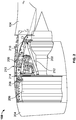
- FIG. 2 is a side view of the first engine 108. Some of the panels of the first engine 108 have been removed to expose various parts within the first engine 108 and the first wing 104.
- the first wing 104 includes a pylon 200 (sometimes referred to as a strut).
- the first engine 108 is coupled to the pylon 200 and, thus, coupled to the first wing 104.
- the first engine 108 has an engine core 202 (such as a gas turbine engine) and a fan (shown in detail in connection with FIG. 4 ) disposed within a nacelle 204.
- the engine core 202 drives the fan to produce thrust.
- the fan is rotatable in a fan cowl compartment 206.
- the first engine 108 is coupled to the pylon 200 via a forward mount 208 and an aft mount 210. More specifically, in this example, the fan cowl compartment 206 is coupled to the pylon 200 at the forward mount 208, and the engine core 202 is coupled to the pylon 200 at the aft mount 210.
- the forward and aft mounts 208, 210 allow for small movement of the first engine 108 relative to the pylon 200. For example, the first engine 108 may roll, yaw, or move forward or backward.
- one or more thrust links 212 are coupled between the aft mount 210 and the fan cowl compartment 206. The thrust links 212 help absorb and/or distribute thrust forces generated by the first engine 108.
- the pylon 200 forms a strut box 213.
- Various hydraulic lines, electrical lines, and fuel lines are routed through the strut box 213.
- the first wing 104 includes a core service disconnect (CSD) 214 that is coupled to and extends downward from the pylon 200 (and, thus, forms part of the pylon 200).
- the CSD 214 is a structural compartment that contains or forms the connections between the hydraulic, electric, and fuel lines in the strut box 213 and the corresponding lines in the engine core 202.
- FIG. 3 is an enlarged view showing the pylon 200 and the first engine 108. Similar to FIG. 2 , some of the panels of the nacelle 204, including the left and right thrust reverser doors, have been removed for clarity.
- the first engine 108 includes a fan 300, which is disposed in and rotates in the fan cowl compartment 206.
- the first engine 108 has a firewall 302 between the fan cowl compartment 206 and the engine core 202.
- the first engine 108 may include one or more fire seals formed along certain boundaries. One such fire seal boundary is shown in a dashed line (labeled 304) in FIG. 3 . As shown in FIG.
- the fire seal boundary 304 extends along the left side of the pylon 200, down a left side of the firewall 302, and along the engine core 202.
- the fire seal boundary 304 is formed by a left thrust reverser seal (shown in further detail) that is disposed between the left thrust reverser and the left sides of the pylon 200 and the firewall 302. Should a fire occur in the engine core 202, the left thrust reverser seal provides a sufficient seal that prevents the fire from spreading up to the pylon 200 (where the various hydraulic, electric, and fuel lines are located) and/or forward to the fan cowl compartment 206.
- FIG. 4 is an enlarged view of the interface between the CSD 214 and the firewall 302.
- the first engine 108 includes a left TR seal 400 (referred to herein as the left TR seal assembly 400).
- the left TR seal assembly 400 includes a left horizontal TR seal 402 that extends along a left side 404 of the pylon 200 (and the CSD 214) to a left side 406 of the firewall 302.
- the left TR seal assembly 400 also includes a left vertical TR seal 408 that extends vertically along the left side 406 of the firewall 302.
- the left horizontal and vertical TR seals 402, 408 intersect (e.g., at a 90° angle).
- the left TR seal assembly 400 includes a left TR barrier seal 410 that forms a corner or bend between the left horizontal TR seal 402 and the left vertical TR seal 408.
- the left TR seal assembly 400 forms a seal between the left TR (removed for clarity) and the left sides 404, 406 of the pylon 200 and the firewall 302.
- the first engine 108 similarly includes a right TR seal assembly on the right side.
- FIG. 5 shows a right TR seal assembly 500 that includes a right horizontal TR seal 502, a right vertical TR seal 504, and a right TR barrier seal 506.
- the firewall 302 has been removed for clarity.
- the right horizontal TR seal 502 extends along a right side 508 of the pylon 200 (and the CSD 214) to a right side 412 ( FIG. 4 ) of the firewall 302 ( FIG. 4 ).
- the right vertical TR seal 504 extends downward along the right side 412 of the firewall 302.
- the aircraft 100 includes an example fire seal assembly 414 as shown in FIGS. 4 and 5 .
- the example fire seal assembly 414 is disposed between the CSD 214, and the firewall 302, and the left and right horizontal TR seals 402, 502 and the left and right TR barrier seals 410, 506.
- the example fire seal assembly 414 functions to maintain sufficient contact between these components to prevent the spread of fire.
- the example fire seal assembly 414 also maintains this contact and sealing ability even when movement occurs between the first engine 108 and the pylon 200, as discussed in further detail herein.
- FIG. 6 is a perspective view of the example fire seal assembly 414 coupled to the CSD 214.
- the first engine 108 has been removed for clarity.
- the fire seal assembly 414 includes a first L-cap 600 and a second L-cap 602.
- the first L-cap 600 has a first leg 604 and a second leg 606 extending outward from the first leg 604 (e.g., at a 90° angle).
- the first L-cap 600 may be constructed of a single piece of material.
- the second L-cap 602 has a third leg 608 and a fourth leg 610 extending outward from the third leg 608 (e.g., at a 90° angle).
- the second L-cap 602 may be constructed of a single piece of material.
- the legs 604, 606, 608, 610 can also be referred to as walls or flanges.
- the first and second L-caps 600, 602 are disposed adjacent each other and form a c- or u-shaped channel 612.
- the first and second L-caps 600, 602 are constructed of a flexible material, such as silicone rubber, which enables the second and fourth legs 606, 610 to bend or deflect inward or outward as the first engine 108 moves, as disclosed in further detail herein.
- the first and/or second L-caps 600, 602 may be constructed of one or more other materials.
- FIG. 7 an isolated perspective view of the first and second L-caps 600, 602 is shown.
- a first inner edge 700 of the first leg 604 is in contact with a second inner edge 702 of the third leg 608.
- the first and second inner edges 700, 702 are spaced apart.
- the first and third legs 604, 608 may include a plurality of openings to receive fasteners.
- the first and third legs 604, 608 include a first row of fastener openings 704 (one of which is referenced in FIG. 6 ), a second row of fastener openings 706 (one of which is referenced in FIG. 6 ), and a third row of fastener openings 708 (one of which is referenced in FIG. 6 ).
- the example fire seal assembly 414 includes a retainer 614 for coupling the first and second L-caps 600, 602 to the CSD 214.
- the retainer 614 extends along the first and third legs 604, 608 (e.g., near a top of the first and third legs 604, 608).
- the retainer 614 may be constructed of a relatively rigid material, such as metal or plastic.
- the fire seal assembly 414 includes a first plurality of fasteners 616 (e.g., bolts, screws, etc.) (one of which is referenced in FIG. 6 ) that couple the first and second L-caps 600, 602 to the CSD 214.
- each of the first plurality of fasteners 616 extends through the retainer 614, one of the first or third legs 604, 608 (via the first plurality of fastener openings 704 ( FIG. 7 )), and into the CSD 214.
- the retainer 614 securely clamps the first and third legs 604, 608 to the CSD 214.
- the fire seal assembly 414 includes a first seal 618.
- the first seal 618 is implemented as a P-seal (referred to hereinafter as the first P-seal 618).
- a P-seal is sometimes referred to as a P-shaped seal, a P-profile seal, or P section seal.
- the first P-seal 618 is coupled to the first and third legs 604, 608 of the first and second L-caps 600, 602.
- the first P-seal 618 is disposed between the second and fourth legs 606, 610.
- the first P-seal 618 is constructed of high temperature silicone rubber with integral plies of fabric.
- the first P-seal 618 contacts the firewall 302 ( FIG.
- the first P-seal 618 can expand or compress (contract) to maintain a sufficient seal between the CSD 214 and the firewall 302 ( FIG. 4 ).
- the fire seal assembly 414 includes a second seal.
- the fire seal assembly 414 includes a second seal 620 (referred to herein as the second P-seal 620), which is disposed below the first P-seal 618.
- the second P-seal 620 may provide additional sealing, as well as seal redundancy.
- the fire seal assembly 414 may include more than two P-seals. While in this example the seals 618, 620 are implemented as P-seals, in other examples, the seals 618, 620 may be implemented as other types of seals (e.g., an omega seal).
- the fire seal assembly 414 includes a first P-seal retainer 622 to couple (e.g., clamp) the first P-seal 618 to the first and third legs 604, 608.
- the first P-seal retainer 622 extends along the first and third legs 604, 608.
- the first P-seal retainer 622 may be constructed of a relatively rigid material, such as metal or plastic.
- a second plurality of fasteners 624 e.g., bolts, screws, etc.
- the fire seal assembly 414 includes a second P-seal retainer 626 and a third plurality of fasteners 628 that couple the second P-seal 620 to the first and third legs 604, 608 and/or the CSD 214.
- FIG. 8 is a cross-sectional view of the fire seal assembly 414 taken along line A-A of FIG. 6 (i.e., through the second L-cap 602).
- the CSD 214 has been removed for clarity.
- FIG. 8 shows one of the first plurality of fasteners 616 extending through the retainer 614 and the second L-cap 602.
- the first P-seal 618 has a first ring portion 800 and a first flange portion 802 (which form a P-shaped profile).
- the first P-seal retainer 622 couples (e.g., clamps) the first flange portion 802 of the first P-seal 618 to the first and second L-caps 600, 602.
- the second plurality of fasteners 624 extends through the first P-seal retainer 622, the first flange portion 802 of the first P-seal 618, and one of the first or second L-caps 600, 602, to couple the first P-seal 618 to the first and second L-caps 600, 602.
- the second P-seal 620 has a second ring portion 804 and a second flange portion 806.
- the second P-seal retainer 826 clamps the second flange portion 806 of the second P-seal 620 to the first and second L-caps 600, 602.
- the third plurality of fasteners 628 extends through the second P-seal retainer 626, the second flange portion 806 of the second P-seal 620, and one of the first or second L-caps 600, 602 to couple the second P-seal 620 to the first and second L-caps 600, 602.
- the fire seal assembly 414 may include one or more end plugs to ensure a tight seal between the first and second P-seals 618, 620 and the second and fourth legs 606, 610.
- the second and fourth legs 606, 610 may bend inward or outward as the first engine 108 moves. Therefore, to ensure a tight seal, the fire seal assembly 414 may include end plugs between the first and second P-seals 618, 620 and the second and fourth legs 606, 610.
- the fire seal assembly 414 includes a first end plug 630 coupled to a first end 632 of the first P-seal 618.
- the first end plug 630 is disposed between first end 632 of the first P-seal 618 and an inner surface 634 of the second leg 606.
- the first end plug 630 is constructed of foam (e.g., a fire resistant foam, silicone rubber foam). As such, the first end plug 630 expands or compresses (contracts) to fill any gap or space between the first end 632 of the first P-seal 618 and the inner surface 634 of the second leg 606 as the second leg 606 deflects inward or outward, thereby ensuring a tightly sealed interface between the first P-seal 618 and the second leg 606.
- a second end plug 636 is coupled to a second end 638 of the first P-seal 618.
- the second end plug 636 is disposed between the second end 638 of the first P-seal 618 and an inner surface 640 of the fourth leg 610.
- the second end plug 636 is also constructed of foam (e.g., a fire resistant foam, silicone rubber foam). As such, the second end plug 636 can expand or compress to fill any gap or space between the second end 638 of the first P-seal 618 and the inner surface 640 of the fourth leg 610 as the fourth leg 610 deflects inward or outward, thereby ensuring a tightly sealed interface between the first P-seal 618 and the fourth leg 610.
- the first and second end plugs 630, 636 also help to keep fuel and other debris out of the first P-seal 618.
- the first and second ends 632, 638 of the first P-seal 618 are tapered.
- a distance between the first and second ends 632, 638 near the first and third legs 604, 608 is longer than a distance between the first and second ends 632, 638 near the opposite end (the end that engages the firewall 302).
- the first and second end plugs 630, 636 are wedge-shaped, which enables the first and second end plugs 630, 636 to fill the wedge-shaped spaces between the first P-seal 618 and the second and fourth legs 606, 610.
- the fire seal assembly 414 similarly includes end plugs 642, 644 for the second P-seal 620.
- the end plugs 642, 644 are substantially the same as the first and second end plugs 630, 636.
- FIG. 9 shows the first end plug 630 as separated from the first end 632 of the first P-seal 618.
- the first end plug 630 has a first portion 900 and a second portion 902.
- a step 904 is formed between the first and second portions 900, 902.
- the second portion 902 extends into the first end 632 of the first P-seal 618, the step 904 engages the first end 632 of the first P-seal 618, and the first portion 900 remains disposed outside of the first P-seal 618.
- the outer diameter of the first portion 900 is the same as the outer diameter of the first ring portion 800 of the first P-seal 618.
- the first end plug 630 is coupled to the first end 632 of the first P-seal 618 via an adhesive (e.g., glue). Additionally or alternatively, the interface between the second portion 902 of the first end plug 630 and the first ring portion 800 of the first P-seal 618 may form an interference fit (e.g., a friction fit) that couples the first end plug 630 to the first end 632 of the first P-seal 618.
- the other plugs 636, 642, 644 may be similarly structured and coupled to their respective ends of the first and second P-seals 618, 620.
- FIG. 10 is a top view showing the fire seal assembly 414 between the CSD 214, the firewall 302, and the left and right horizontal TR seals 402, 502.
- the first P-seal 618 (as well as the second P-seal 620 ( FIG. 6 )) and the first and second end plugs 630, 636 are compressed between the first and third legs 604, 608 and an aft surface 1001 of the firewall 302 and, thus, maintain solid contact between these parts. If the first engine 108 (along with the firewall 302) moves forward or rearward (up or down in FIG.
- the first P-seal 618 and the first and second end plugs 630, 636 expand or compress to take up any space and ensure a sufficient seal between the CSD 214 and the firewall 302. While in the illustrated example the first P-seal 618 is in direct contact with the aft surface 1001 of the firewall 302, in other examples, a plate may be mounted to the aft surface 1001 of the firewall 302 for the first P-seal 618 to slide against while expanding or compressing.
- the second leg 606 of the first L-cap 600 extends outwards from the first leg 604 and is contact with the left side 406 of the firewall 302.
- the first horizontal TR seal 402 extends along and is in contact with the left side 404 of the CSD 214, an outer surface 1000 of the second leg 606, and the left side 406 of the firewall 302.
- at least a portion of the second leg 606 is disposed between the left horizontal TR seal 402 and the left side 406 of the firewall 302.
- the first end plug 630 is in contact with the inner surface 634 of the second leg 606.
- a tight interface is formed between the right horizontal TR seal 402, the second leg 606, the first end plug 630, and first P-seal 618. If the first engine 108 moves forward or rearward (up or down in FIG. 10 ), for example, the firewall 302 slides along the inner surface 634 of the second leg 606. The second leg 606, the first end plug 630, and the first P-seal 618 cooperate to ensure a tight seal between the left horizontal TR seal 402, the CSD 214, and the firewall 302 on the left side.
- the fourth leg 610 of the second L-cap 602 extends outward from the third leg 608 and is contact with the right side 412 of the firewall 302.
- the second horizontal TR seal 502 extends along and is in contact with the right side 508 of the CSD 214, and outer surface 1002 of the fourth leg 610, and the right side 412 of the firewall 302.
- at least a portion of the fourth leg 610 is disposed between the right horizontal TR seal 502 and the right side 412 of the firewall 302.
- the second end plug 636 is in contact with the inner surface 640 of the fourth leg 610.
- a tight interface is formed between the left horizontal TR seal 502, the fourth leg 610, the second end plug 636, and first P-seal 618. If the first engine 108 moves forward or rearward (up or down in FIG. 10 ), for example, the firewall 302 slides along the inner surface 640 of the fourth leg 610. The fourth leg 610, the second end plug 636, and the first P-seal 618 cooperate to ensure a tight seal between the right horizontal TR seal 502, the CSD 214, and the firewall 302 on the right side.
- the second and fourth legs 606, 610 are tapered. In some examples, this taper provides a smooth transition for ensuring sufficient contact between the left and right horizontal TR seals 402, 502 and the respective left and right sides 406, 412 of the firewall 302.
- the first end plug 630 is separated from the left horizontal TR seal 402 by the second leg 606, such that no contact occurs between the first end plug 630 and the left horizontal TR seal 402.
- the second end plug 636 is separated from the right horizontal TR seal 502 by the fourth leg 610, such that no contact occurs between the second end plug 638 and the right horizontal TR seal 502.
- FIG. 11 shows an example in which the first engine 108 (and the firewall 302) has translated and/or rotated slightly to the right (e.g., inboard) relative to the CSD 214, as shown by the arrow.
- the second leg 606 of the first L-cap 600 has been bent or deflected inward (to the right) relative to the position in FIG. 10 .
- the left horizontal TR seal 402 has expanded slightly and remains engaged with the left side 404 of the CSD 214, an outer surface 1000 of the second leg 606, and the left side 406 of the firewall 302.
- first end plug 630 has been compressed, but still fills the space between the first P-seal 618 and the inner surface 634 of the second leg 606.
- the second leg 606, the first end plug 630, and the first P-seal 618 cooperate to ensure a tight seal between the left horizontal TR seal 402, the CSD 214, and the firewall 302 on the left side.
- the fourth leg 610 of the second L-cap 602 is bent or deflected outward (to the right in FIG. 11 ) compared to the position in FIG. 10 .
- the right horizontal TR seal 502 has slightly compressed but remains engaged with the right side 508 of the CSD 214, the outer surface 1002 of the fourth leg 610, and the right side 412 of the firewall 302.
- the second end plug 636 has expanded to fill any space between the first P-seal 618 and the inner surface 640 of the fourth leg 610.
- the fourth leg 610, the second end plug 636, and the first P-seal 618 cooperate to ensure a tight seal between the right horizontal TR seal 502, the CSD 214, and the firewall 302 on the right side.
- first and second L-caps 600, 602 also help to maintain a sufficient seal during vertical movement of the first engine 108.
- the first and second horizontal TR seals 402, 502 may slide up or down along the outer surfaces 1000, 1002 of the second and fourth legs 606, 610.
- the second and fourth legs 606, 610 again ensure a tight seal between the left and right horizontal TR seals 402, 502, the firewall 302, and the CSD 214.
- FIG. 12 is a cross-sectional view of the example fire seal assembly 414 and the left and right horizontal TR seals 402, 502 taken along line B-B of FIG. B. Also shown in FIG. 12 are the left and right TR barrier seals 410, 506. As shown in FIG. 12 , the left and right horizontal TR seals 402, 502 and the left and right TR barrier seals 410, 506 are omega seals (which have an omega shaped profile). The left and right horizontal TR seals 402, 502 and the left and right
- TR barrier seals 410, 506 expand or compress (contract) to maintain contact with the second and fourth legs 606, 610.
- FIG. 12 even if the left and right horizontal TR seals 402, 502 move vertically (up and down in FIG. 12 ), solid contact is maintained between the left and right horizontal TR seals 402, 502 and the respective second and fourth legs 606, 610. Similarly, solid contact is maintained between the left and right TR barrier seals 410, 506 and the respective second and fourth legs 606, 610.
- Known fire seal assemblies do not have the disclosed L-caps. Instead, the left and right horizontal TR seals 402, 502 are in direct contact with the ends of the first P-seal 618.
- the example first and second L-caps 600, 602 disclosed herein maintain a tight sealing interface between these components throughout larger ranges of movement.
- first and second L-caps 600, 602 are described as being two separate components, in other examples, the first and second L-caps 600 602 may be combined a single unitary part or component.
- the first and second L-caps 600, 602 may be constructed as a single-piece c- or u-shaped profile.
- a similar fire seal assembly may likewise be implemented in connection with the second engine 110 on the second wing 106.
- A, B, and/or C refers to any combination or subset of A, B, C such as (1) A alone, (2) B alone, (3) C alone, (4) A with B, (5) A with C, (6) B with C, and (7) A with B and with C.
- the phrase "at least one of A and B" is intended to refer to implementations including any of (1) at least one A, (2) at least one B, and (3) at least one A and at least one B.
- the phrase "at least one of A or B" is intended to refer to implementations including any of (1) at least one A, (2) at least one B, and (3) at least one A and at least one B.
- the phrase "at least one of A and B" is intended to refer to implementations including any of (1) at least one A, (2) at least one B, and (3) at least one A and at least one B.
- the phrase "at least one of A or B" is intended to refer to implementations including any of (1) at least one A, (2) at least one B, and (3) at least one A and at least one B.
- example fire seal assemblies have been disclosed that provide excellent sealing between an engine, a pylon, and thrust reverser areas.
- the example fire seal assemblies disclosed herein provide flexible smooth contact that maintains sealing function throughout larger ranges of movement of an engine and higher operating temperatures than known fire seal assemblies. As such, the example fire seal assemblies disclosed herein enable the use of larger, more powerful engines on aircraft.
Landscapes
- Engineering & Computer Science (AREA)
- General Engineering & Computer Science (AREA)
- Mechanical Engineering (AREA)
- Chemical & Material Sciences (AREA)
- Combustion & Propulsion (AREA)
- Aviation & Aerospace Engineering (AREA)
- Gasket Seals (AREA)
Description
- This disclosure relates generally to aircraft and, more particularly, to fire seal assemblies for aircraft engines.
- Due to regulatory requirements, aircraft engines are generally required to include fire seals that are capable of containing and isolating a fire from within the propulsion components of the aircraft engine (e.g., the gas turbine engine). The fire seals are intended to prevent such a fire from spreading to other areas of the engine and/or to surrounding aircraft components.
-
US 2019/061966 , in accordance with its abstract, states that it relates to a nacelle mounted above a wing of an aircraft. A support structure on the nacelle above the pylon resists forces in different directions, and includes door supports allowing the door to be opened upwardly. A retaining structure on the pylon below the nacelle resists forces in different directions, and includes a fixed support track and multiple keepers. Each keeper includes a first end which slides within the channel, and a second end which engages a latch on the closed door. A fire seal assembly includes a depressor surface and a fire seal, and the latter does not contact the former until the door is almost closed. -
US 2014/262358 , in accordance with its abstract, states that it relates to a multi-member assembly including a first structural member, a second structural member opposed from the first structural member, a crossover seal positioned between the first and second structural members, wherein the crossover seal defines a bore, and an end cap including a cap portion and a plug portion protruding from the cap portion, wherein the plug portion is at least partially received in the bore such that the cap portion bridges the first and second structural members. - A fire seal assembly is defined in claim 1. An aircraft including such fire seal assembly is defined in claim 11.
-
-
FIG. 1 illustrates an example aircraft in which the examples disclosed herein can be implemented. -
FIG. 2 is a side view of an example engine of the aircraft ofFIG. 1 . -
FIG. 3 is an enlarged view of a section of the engine ofFIG. 2 showing an example fire seal boundary. -
FIG. 4 illustrates an example fire seal assembly implemented in connection with the engine ofFIG. 3 and which forms a fire seal between a core service disconnect (CSD) of a pylon, an engine firewall, and left and right thrust reverser seals. -
FIG. 5 is a perspective view of the example fire seal assembly ofFIG. 4 and the left and right thrust reverser seals. -
FIG. 6 is a perspective view of the example fire seal assembly ofFIG. 4 coupled to the CSD. The engine and thrust reverser seals have been removed for clarity. -
FIG. 7 is an isolated perspective view of example first and second L-caps of the example fire seal assembly ofFIG. 6 . -
FIG. 8 is a cross-sectional view of the example fire seal assembly ofFIG. 6 taken along line A-A ofFIG. 6 . -
FIG. 9 shows an example end plug for an example P-seal of the example fire seal assembly ofFIG. 6 . -
FIG. 10 is a top view showing the example fire seal assembly ofFIG. 4 between the CSD, the engine firewall, and the left and right thrust reverser seals. -
FIG. 11 is the top view ofFIG. 10 illustrating an example in which the engine firewall ofFIG. 10 has moved sideways. -
FIG. 12 is a cross-sectional view of the example fire seal assembly and the example left and right thrust reverser seals taken along line B-B ofFIG. 5 . - The figures are not to scale. Instead, the thickness of the layers or regions may be enlarged in the drawings. In general, the same reference numbers will be used throughout the drawing(s) and accompanying written description to refer to the same or like parts. As used in this patent, stating that any part (e.g., a layer, film, area, region, or plate) is in any way on (e.g., positioned on, located on, disposed on, or formed on, etc.) another part, indicates that the referenced part is either in contact with the other part, or that the referenced part is above the other part with one or more intermediate part(s) located therebetween. Stating that any part is in contact with another part means that there is no intermediate part between the two parts.
- Descriptors "first," "second," "third," etc. are used herein when identifying multiple elements or components that may be referred to separately. Unless otherwise specified or understood based on their context of use, such descriptors are not intended to impute any meaning of priority, physical order or arrangement in a list, or ordering in time but are merely used as labels for referring to multiple elements or components separately for ease of understanding the disclosed examples. In some examples, the descriptor "first" may be used to refer to an element in the detailed description, while the same element may be referred to in a claim with a different descriptor such as "second" or "third." In such instances, it should be understood that such descriptors are used merely for ease of referencing multiple elements or components.
- Aircraft engines are typically connected to wings of an aircraft. In known commercial aircraft, for example, each engine is coupled to a structural beam of the wing known as a pylon. Federal Aviation Administration (FAA) regulations generally require the use of firewalls and/or fire seals to contain a fire within the engine core and prevent the fire from spreading to other parts of the engine and/or other components of the aircraft, such as the pylon.
- One common fire seal boundary that must be formed is a core compartment firewall, which separates the core compartment from a strut dry bay (the pylon). This seal boundary is formed by left and right horizontal thrust reverser (TR) seals that run along the sides of the pylon and extend to an engine firewall (which separates the engine core from the fan duct). Left and right vertical TR seals run down the sides of the firewall. A core service disconnect (CSD) extends downward from the pylon and provides connections to the various hydraulic, electrical, and fuel lines leading to the engine core. The CSD is spaced apart from the engine firewall. Therefore, a fire seal assembly (sometimes referred to as a CSD fire seal) is disposed between the engine firewall, the CSD, and the thrust reverser seals to form a fire seal between these parts. A known fire seal assembly includes a P-seal that is connected to the CSD. The P-seal is engaged with the engine firewall to fill the space between the CSD and the engine firewall. The ends of the P-seal are engaged with the left and right TR seals.
- These types of seals must also be able to maintain a sufficient seal even when deflections or movements occur. In particular, when the engine is powered up (e.g., during take-off), the engine produces a large amount of thrust. This large thrust can cause the engine to move or deflect slightly relative to the CSD and the pylon. Therefore, the fire seal assembly must be able to maintain a sufficient seal between the various parts as small movements occur.
- It recent years, it has become more desirable to use larger, more powerful engines on commercial aircraft, especially those with larger bypass ratios (which is the mass flow rate of the bypass stream to the mass flow rate entering the core). These larger, more powerful engines may result in larger deflections of the engine relative to the CSD and the pylon.
- Disclosed herein are example fire seal assemblies that can advantageously maintain a sufficient fire seal between a CSD, an engine firewall, and left and right TR seals and throughout larger movements of the engine and higher operating temperatures, such as those caused by a larger, more powerful engine. Thus, the example seal assemblies disclosed herein enable the user of larger, more powerful engines than known fire seal assemblies.
- An example fire seal assembly disclosed herein includes a first L-cap and a second L-cap. The first and second L-caps are coupled to the CSD. The first and second L-caps includes legs that extend outward from the CSD and form a u-shaped channel. One or more P-seals are coupled to the L-caps and disposed in the u-shaped channel between the legs. The P-seal(s) is/are to extend the engine firewall. The legs of the L-caps extend beyond the P-seals and engage the sides of the engine firewall such that the P-seals are enclosed by the L-caps and the engine firewall. In some examples, end plugs are disposed between the ends of the P-seals and the inner surfaces of the legs, thereby creating a tight seal between the P-seals and the legs of the L-caps. The left and right horizontal TR seals run along the outer surfaces of the legs between the sides of the pylon and the sides of the engine firewall. If the engine moves forward or rearward (e.g., during take-off), the legs slide along the sides of the firewall, thereby maintaining a constant, smooth engagement between all of the parts. Further, if the engine shifts or moves sideways (e.g., inboard or outboard), the legs of the L-caps bend inward or outward, but maintain sufficient contact with the outer surfaces of the engine firewall. Additionally, even with vertical movement of the engine, the firewall and the TR seals may slide up and down along the legs. In all instances, the L-caps ensure a tight seal between the CSD, the engine firewall, and the left and right TR seals.
- Now turning to the figures,
FIG. 1 illustrates anexample aircraft 100 in which the examples disclosed herein can be implemented. Theaircraft 100 includes afuselage 102, a first wing 104 (a left wing) coupled to and extending outward from thefuselage 102, and a second wing 106 (a right wing) coupled to and extending outward from thefuselage 102. In the illustrated example, theaircraft 100 includes afirst engine 108 carried by thefirst wing 104 and a second engine 110 carried by thesecond wing 106. In other examples, theaircraft 100 may include more than two engines. -
FIG. 2 is a side view of thefirst engine 108. Some of the panels of thefirst engine 108 have been removed to expose various parts within thefirst engine 108 and thefirst wing 104. As shown inFIG. 2 , thefirst wing 104 includes a pylon 200 (sometimes referred to as a strut). Thefirst engine 108 is coupled to thepylon 200 and, thus, coupled to thefirst wing 104. Thefirst engine 108 has an engine core 202 (such as a gas turbine engine) and a fan (shown in detail in connection withFIG. 4 ) disposed within anacelle 204. Theengine core 202 drives the fan to produce thrust. The fan is rotatable in afan cowl compartment 206. - In the illustrated example, the
first engine 108 is coupled to thepylon 200 via aforward mount 208 and anaft mount 210. More specifically, in this example, thefan cowl compartment 206 is coupled to thepylon 200 at theforward mount 208, and theengine core 202 is coupled to thepylon 200 at theaft mount 210. The forward andaft mounts first engine 108 relative to thepylon 200. For example, thefirst engine 108 may roll, yaw, or move forward or backward. In the illustrated example, one or more thrust links 212 (e.g., tie rods) are coupled between theaft mount 210 and thefan cowl compartment 206. The thrust links 212 help absorb and/or distribute thrust forces generated by thefirst engine 108. - The
pylon 200 forms astrut box 213. Various hydraulic lines, electrical lines, and fuel lines are routed through thestrut box 213. In the illustrated example, thefirst wing 104 includes a core service disconnect (CSD) 214 that is coupled to and extends downward from the pylon 200 (and, thus, forms part of the pylon 200). TheCSD 214 is a structural compartment that contains or forms the connections between the hydraulic, electric, and fuel lines in thestrut box 213 and the corresponding lines in theengine core 202. -
FIG. 3 is an enlarged view showing thepylon 200 and thefirst engine 108. Similar toFIG. 2 , some of the panels of thenacelle 204, including the left and right thrust reverser doors, have been removed for clarity. As shown inFIG. 3 , thefirst engine 108 includes afan 300, which is disposed in and rotates in thefan cowl compartment 206. Thefirst engine 108 has afirewall 302 between thefan cowl compartment 206 and theengine core 202. As explained above, thefirst engine 108 may include one or more fire seals formed along certain boundaries. One such fire seal boundary is shown in a dashed line (labeled 304) inFIG. 3 . As shown inFIG. 3 , thefire seal boundary 304 extends along the left side of thepylon 200, down a left side of thefirewall 302, and along theengine core 202. Thefire seal boundary 304 is formed by a left thrust reverser seal (shown in further detail) that is disposed between the left thrust reverser and the left sides of thepylon 200 and thefirewall 302. Should a fire occur in theengine core 202, the left thrust reverser seal provides a sufficient seal that prevents the fire from spreading up to the pylon 200 (where the various hydraulic, electric, and fuel lines are located) and/or forward to thefan cowl compartment 206. -
FIG. 4 is an enlarged view of the interface between theCSD 214 and thefirewall 302. As described above, thefirst engine 108 includes a left TR seal 400 (referred to herein as the left TR seal assembly 400). The leftTR seal assembly 400 includes a lefthorizontal TR seal 402 that extends along aleft side 404 of the pylon 200 (and the CSD 214) to aleft side 406 of thefirewall 302. The leftTR seal assembly 400 also includes a leftvertical TR seal 408 that extends vertically along theleft side 406 of thefirewall 302. The left horizontal and vertical TR seals 402, 408 intersect (e.g., at a 90° angle). Further, the leftTR seal assembly 400 includes a leftTR barrier seal 410 that forms a corner or bend between the lefthorizontal TR seal 402 and the leftvertical TR seal 408. The leftTR seal assembly 400 forms a seal between the left TR (removed for clarity) and theleft sides pylon 200 and thefirewall 302. Thefirst engine 108 similarly includes a right TR seal assembly on the right side. Referring briefly toFIG. 5, FIG. 5 shows a rightTR seal assembly 500 that includes a righthorizontal TR seal 502, a rightvertical TR seal 504, and a rightTR barrier seal 506. InFIG. 5 , thefirewall 302 has been removed for clarity. The righthorizontal TR seal 502 extends along aright side 508 of the pylon 200 (and the CSD 214) to a right side 412 (FIG. 4 ) of the firewall 302 (FIG. 4 ). The rightvertical TR seal 504 extends downward along theright side 412 of thefirewall 302. - The
CSD 214 and thefirewall 302 are not directly coupled. Instead, theCSD 214 is spaced apart from thefirewall 302. To create a fire sealed interface between theCSD 214, thefirewall 302, and the left and rightTR seal assemblies aircraft 100 includes an examplefire seal assembly 414 as shown inFIGS. 4 and 5 . The examplefire seal assembly 414 is disposed between theCSD 214, and thefirewall 302, and the left and right horizontal TR seals 402, 502 and the left and right TR barrier seals 410, 506. The examplefire seal assembly 414 functions to maintain sufficient contact between these components to prevent the spread of fire. The examplefire seal assembly 414 also maintains this contact and sealing ability even when movement occurs between thefirst engine 108 and thepylon 200, as discussed in further detail herein. -
FIG. 6 is a perspective view of the examplefire seal assembly 414 coupled to theCSD 214. Thefirst engine 108 has been removed for clarity. In the illustrated example, thefire seal assembly 414 includes a first L-cap 600 and a second L-cap 602. The first L-cap 600 has afirst leg 604 and asecond leg 606 extending outward from the first leg 604 (e.g., at a 90° angle). The first L-cap 600 may be constructed of a single piece of material. Similarly, the second L-cap 602 has athird leg 608 and afourth leg 610 extending outward from the third leg 608 (e.g., at a 90° angle). The second L-cap 602 may be constructed of a single piece of material. Thelegs caps u-shaped channel 612. In some examples, the first and second L-caps fourth legs first engine 108 moves, as disclosed in further detail herein. In other examples, the first and/or second L-caps - Referring briefly to
FIG. 7 , an isolated perspective view of the first and second L-caps caps FIG. 6 )), a firstinner edge 700 of thefirst leg 604 is in contact with a secondinner edge 702 of thethird leg 608. In other examples, the first and secondinner edges third legs FIG. 7 , the first andthird legs FIG. 6 ), a second row of fastener openings 706 (one of which is referenced inFIG. 6 ), and a third row of fastener openings 708 (one of which is referenced inFIG. 6 ). - Referring back to
FIG. 6 , the examplefire seal assembly 414 includes aretainer 614 for coupling the first and second L-caps CSD 214. Theretainer 614 extends along the first andthird legs 604, 608 (e.g., near a top of the first andthird legs 604, 608). Theretainer 614 may be constructed of a relatively rigid material, such as metal or plastic. Thefire seal assembly 414 includes a first plurality of fasteners 616 (e.g., bolts, screws, etc.) (one of which is referenced inFIG. 6 ) that couple the first and second L-caps CSD 214. In particular, each of the first plurality offasteners 616 extends through theretainer 614, one of the first orthird legs 604, 608 (via the first plurality of fastener openings 704 (FIG. 7 )), and into theCSD 214. As such, theretainer 614 securely clamps the first andthird legs CSD 214. - In the illustrated example, the
fire seal assembly 414 includes afirst seal 618. In this example, thefirst seal 618 is implemented as a P-seal (referred to hereinafter as the first P-seal 618). A P-seal is sometimes referred to as a P-shaped seal, a P-profile seal, or P section seal. The first P-seal 618 is coupled to the first andthird legs caps seal 618 is disposed between the second andfourth legs seal 618 is constructed of high temperature silicone rubber with integral plies of fabric. The first P-seal 618 contacts the firewall 302 (FIG. 4 ) to form a seal between theCSD 214 and the firewall 302 (FIG. 4 ). The first P-seal 618 can expand or compress (contract) to maintain a sufficient seal between theCSD 214 and the firewall 302 (FIG. 4 ). - In some examples, the
fire seal assembly 414 includes a second seal. For example, as illustrated inFIG. 6 , thefire seal assembly 414 includes a second seal 620 (referred to herein as the second P-seal 620), which is disposed below the first P-seal 618. The second P-seal 620 may provide additional sealing, as well as seal redundancy. In some examples, thefire seal assembly 414 may include more than two P-seals. While in this example theseals seals - In the illustrated example, the
fire seal assembly 414 includes a first P-seal retainer 622 to couple (e.g., clamp) the first P-seal 618 to the first andthird legs seal retainer 622 extends along the first andthird legs seal retainer 622 may be constructed of a relatively rigid material, such as metal or plastic. A second plurality of fasteners 624 (e.g., bolts, screws, etc.) (one of which is referenced inFIG. 6 ) extend through the first P-seal retainer 622, the first P-seal 618, and one of the first orthird legs 604, 608 (through the second plurality of fastener openings 706 (FIG. 7 )). In some examples, the second plurality offasteners 624 extend into and couple to theCSD 214, which further helps couple thefire seal assembly 414 to theCSD 214. Similarly, thefire seal assembly 414 includes a second P-seal retainer 626 and a third plurality offasteners 628 that couple the second P-seal 620 to the first andthird legs CSD 214. -
FIG. 8 is a cross-sectional view of thefire seal assembly 414 taken along line A-A ofFIG. 6 (i.e., through the second L-cap 602). TheCSD 214 has been removed for clarity.FIG. 8 shows one of the first plurality offasteners 616 extending through theretainer 614 and the second L-cap 602. As shown inFIG. 8 , the first P-seal 618 has afirst ring portion 800 and a first flange portion 802 (which form a P-shaped profile). The first P-seal retainer 622 couples (e.g., clamps) thefirst flange portion 802 of the first P-seal 618 to the first and second L-caps FIG. 8 ) extends through the first P-seal retainer 622, thefirst flange portion 802 of the first P-seal 618, and one of the first or second L-caps seal 618 to the first and second L-caps - Similarly, the second P-
seal 620 has asecond ring portion 804 and asecond flange portion 806. The second P-seal retainer 826 clamps thesecond flange portion 806 of the second P-seal 620 to the first and second L-caps FIG. 8 ) extends through the second P-seal retainer 626, thesecond flange portion 806 of the second P-seal 620, and one of the first or second L-caps seal 620 to the first and second L-caps - Referring back to
FIG. 6 , thefire seal assembly 414 may include one or more end plugs to ensure a tight seal between the first and second P-seals fourth legs fourth legs first engine 108 moves. Therefore, to ensure a tight seal, thefire seal assembly 414 may include end plugs between the first and second P-seals fourth legs FIG. 6 , thefire seal assembly 414 includes afirst end plug 630 coupled to afirst end 632 of the first P-seal 618. Thefirst end plug 630 is disposed betweenfirst end 632 of the first P-seal 618 and aninner surface 634 of thesecond leg 606. In this example, thefirst end plug 630 is constructed of foam (e.g., a fire resistant foam, silicone rubber foam). As such, thefirst end plug 630 expands or compresses (contracts) to fill any gap or space between thefirst end 632 of the first P-seal 618 and theinner surface 634 of thesecond leg 606 as thesecond leg 606 deflects inward or outward, thereby ensuring a tightly sealed interface between the first P-seal 618 and thesecond leg 606. Similarly, asecond end plug 636 is coupled to asecond end 638 of the first P-seal 618. Thesecond end plug 636 is disposed between thesecond end 638 of the first P-seal 618 and aninner surface 640 of thefourth leg 610. Thesecond end plug 636 is also constructed of foam (e.g., a fire resistant foam, silicone rubber foam). As such, thesecond end plug 636 can expand or compress to fill any gap or space between thesecond end 638 of the first P-seal 618 and theinner surface 640 of thefourth leg 610 as thefourth leg 610 deflects inward or outward, thereby ensuring a tightly sealed interface between the first P-seal 618 and thefourth leg 610. The first and second end plugs 630, 636 also help to keep fuel and other debris out of the first P-seal 618. - In the illustrated example, the first and second ends 632, 638 of the first P-
seal 618 are tapered. In other words, a distance between the first and second ends 632, 638 near the first andthird legs seal 618 and the second andfourth legs fire seal assembly 414 similarly includes end plugs 642, 644 for the second P-seal 620. The end plugs 642, 644 are substantially the same as the first and second end plugs 630, 636. -
FIG. 9 shows thefirst end plug 630 as separated from thefirst end 632 of the first P-seal 618. Thefirst end plug 630 has afirst portion 900 and asecond portion 902. Astep 904 is formed between the first andsecond portions first end plug 630 is coupled to thefirst end 632, thesecond portion 902 extends into thefirst end 632 of the first P-seal 618, thestep 904 engages thefirst end 632 of the first P-seal 618, and thefirst portion 900 remains disposed outside of the first P-seal 618. In some examples, the outer diameter of thefirst portion 900 is the same as the outer diameter of thefirst ring portion 800 of the first P-seal 618. In some examples, thefirst end plug 630 is coupled to thefirst end 632 of the first P-seal 618 via an adhesive (e.g., glue). Additionally or alternatively, the interface between thesecond portion 902 of thefirst end plug 630 and thefirst ring portion 800 of the first P-seal 618 may form an interference fit (e.g., a friction fit) that couples thefirst end plug 630 to thefirst end 632 of the first P-seal 618. The other plugs 636, 642, 644 may be similarly structured and coupled to their respective ends of the first and second P-seals -
FIG. 10 is a top view showing thefire seal assembly 414 between theCSD 214, thefirewall 302, and the left and right horizontal TR seals 402, 502. As shown inFIG. 10 , the first P-seal 618 (as well as the second P-seal 620 (FIG. 6 )) and the first and second end plugs 630, 636 are compressed between the first andthird legs aft surface 1001 of thefirewall 302 and, thus, maintain solid contact between these parts. If the first engine 108 (along with the firewall 302) moves forward or rearward (up or down inFIG. 10 ), the first P-seal 618 and the first and second end plugs 630, 636 expand or compress to take up any space and ensure a sufficient seal between theCSD 214 and thefirewall 302. While in the illustrated example the first P-seal 618 is in direct contact with theaft surface 1001 of thefirewall 302, in other examples, a plate may be mounted to theaft surface 1001 of thefirewall 302 for the first P-seal 618 to slide against while expanding or compressing. - As shown in
FIG. 10 , thesecond leg 606 of the first L-cap 600 extends outwards from thefirst leg 604 and is contact with theleft side 406 of thefirewall 302. The firsthorizontal TR seal 402 extends along and is in contact with theleft side 404 of theCSD 214, anouter surface 1000 of thesecond leg 606, and theleft side 406 of thefirewall 302. As can been seen fromFIG. 10 , at least a portion of thesecond leg 606 is disposed between the lefthorizontal TR seal 402 and theleft side 406 of thefirewall 302. Further, thefirst end plug 630 is in contact with theinner surface 634 of thesecond leg 606. Therefore, a tight interface is formed between the righthorizontal TR seal 402, thesecond leg 606, thefirst end plug 630, and first P-seal 618. If thefirst engine 108 moves forward or rearward (up or down inFIG. 10 ), for example, thefirewall 302 slides along theinner surface 634 of thesecond leg 606. Thesecond leg 606, thefirst end plug 630, and the first P-seal 618 cooperate to ensure a tight seal between the lefthorizontal TR seal 402, theCSD 214, and thefirewall 302 on the left side. - Similarly, the
fourth leg 610 of the second L-cap 602 extends outward from thethird leg 608 and is contact with theright side 412 of thefirewall 302. The secondhorizontal TR seal 502 extends along and is in contact with theright side 508 of theCSD 214, andouter surface 1002 of thefourth leg 610, and theright side 412 of thefirewall 302. As can been seen fromFIG. 10 , at least a portion of thefourth leg 610 is disposed between the righthorizontal TR seal 502 and theright side 412 of thefirewall 302. Further, thesecond end plug 636 is in contact with theinner surface 640 of thefourth leg 610. Therefore, a tight interface is formed between the lefthorizontal TR seal 502, thefourth leg 610, thesecond end plug 636, and first P-seal 618. If thefirst engine 108 moves forward or rearward (up or down inFIG. 10 ), for example, thefirewall 302 slides along theinner surface 640 of thefourth leg 610. Thefourth leg 610, thesecond end plug 636, and the first P-seal 618 cooperate to ensure a tight seal between the righthorizontal TR seal 502, theCSD 214, and thefirewall 302 on the right side. - As shown in
FIG. 10 , the second andfourth legs right sides firewall 302. In the illustrated example ofFIG. 12 , thefirst end plug 630 is separated from the lefthorizontal TR seal 402 by thesecond leg 606, such that no contact occurs between thefirst end plug 630 and the lefthorizontal TR seal 402. Similarly, thesecond end plug 636 is separated from the righthorizontal TR seal 502 by thefourth leg 610, such that no contact occurs between thesecond end plug 638 and the righthorizontal TR seal 502. - As disclosed above, in addition to forward and rearward movement, the
first engine 108 may also move laterally or sideways (left or right inFIG. 10 ).FIG. 11 shows an example in which the first engine 108 (and the firewall 302) has translated and/or rotated slightly to the right (e.g., inboard) relative to theCSD 214, as shown by the arrow. As shown inFIG. 11 , thesecond leg 606 of the first L-cap 600 has been bent or deflected inward (to the right) relative to the position inFIG. 10 . The lefthorizontal TR seal 402 has expanded slightly and remains engaged with theleft side 404 of theCSD 214, anouter surface 1000 of thesecond leg 606, and theleft side 406 of thefirewall 302. Additionally, thefirst end plug 630 has been compressed, but still fills the space between the first P-seal 618 and theinner surface 634 of thesecond leg 606. Thus, thesecond leg 606, thefirst end plug 630, and the first P-seal 618 cooperate to ensure a tight seal between the lefthorizontal TR seal 402, theCSD 214, and thefirewall 302 on the left side. - Further, as shown in
FIG. 11 , thefourth leg 610 of the second L-cap 602 is bent or deflected outward (to the right inFIG. 11 ) compared to the position inFIG. 10 . The righthorizontal TR seal 502 has slightly compressed but remains engaged with theright side 508 of theCSD 214, theouter surface 1002 of thefourth leg 610, and theright side 412 of thefirewall 302. Additionally, thesecond end plug 636 has expanded to fill any space between the first P-seal 618 and theinner surface 640 of thefourth leg 610. Thus, thefourth leg 610, thesecond end plug 636, and the first P-seal 618 cooperate to ensure a tight seal between the righthorizontal TR seal 502, theCSD 214, and thefirewall 302 on the right side. - In addition, the first and second L-
caps first engine 108. In such an instance, the first and second horizontal TR seals 402, 502 may slide up or down along theouter surfaces fourth legs fourth legs firewall 302, and theCSD 214. -
FIG. 12 is a cross-sectional view of the examplefire seal assembly 414 and the left and right horizontal TR seals 402, 502 taken along line B-B of FIG. B. Also shown inFIG. 12 are the left and right TR barrier seals 410, 506. As shown inFIG. 12 , the left and right horizontal TR seals 402, 502 and the left and right TR barrier seals 410, 506 are omega seals (which have an omega shaped profile). The left and right horizontal TR seals 402, 502 and the left and right - TR barrier seals 410, 506 expand or compress (contract) to maintain contact with the second and
fourth legs FIG. 12 , even if the left and right horizontal TR seals 402, 502 move vertically (up and down inFIG. 12 ), solid contact is maintained between the left and right horizontal TR seals 402, 502 and the respective second andfourth legs fourth legs seal 618. The example first and second L-caps - While in the illustrated examples the first and second L-
caps caps 600 602 may be combined a single unitary part or component. For example, the first and second L-caps first engine 108 and thepylon 200, a similar fire seal assembly may likewise be implemented in connection with the second engine 110 on thesecond wing 106. - "Including" and "comprising" (and all forms and tenses thereof) are used herein to be open ended terms. Thus, whenever a claim employs any form of "include" or "comprise" (e.g., comprises, includes, comprising, including, having, etc.) as a preamble or within a claim recitation of any kind, it is to be understood that additional elements, terms, etc. may be present without falling outside the scope of the corresponding claim or recitation. As used herein, when the phrase "at least" is used as the transition term in, for example, a preamble of a claim, it is open-ended in the same manner as the term "comprising" and "including" are open ended. The term "and/or" when used, for example, in a form such as A, B, and/or C refers to any combination or subset of A, B, C such as (1) A alone, (2) B alone, (3) C alone, (4) A with B, (5) A with C, (6) B with C, and (7) A with B and with C. As used herein in the context of describing structures, components, items, objects and/or things, the phrase "at least one of A and B" is intended to refer to implementations including any of (1) at least one A, (2) at least one B, and (3) at least one A and at least one B. Similarly, as used herein in the context of describing structures, components, items, objects and/or things, the phrase "at least one of A or B" is intended to refer to implementations including any of (1) at least one A, (2) at least one B, and (3) at least one A and at least one B. As used herein in the context of describing the performance or execution of processes, instructions, actions, activities and/or steps, the phrase "at least one of A and B" is intended to refer to implementations including any of (1) at least one A, (2) at least one B, and (3) at least one A and at least one B. Similarly, as used herein in the context of describing the performance or execution of processes, instructions, actions, activities and/or steps, the phrase "at least one of A or B" is intended to refer to implementations including any of (1) at least one A, (2) at least one B, and (3) at least one A and at least one B.
- From the foregoing, it will be appreciated that example fire seal assemblies have been disclosed that provide excellent sealing between an engine, a pylon, and thrust reverser areas. The example fire seal assemblies disclosed herein provide flexible smooth contact that maintains sealing function throughout larger ranges of movement of an engine and higher operating temperatures than known fire seal assemblies. As such, the example fire seal assemblies disclosed herein enable the use of larger, more powerful engines on aircraft.
- Although certain example methods, apparatus and articles of manufacture have been disclosed herein, the scope of coverage of this patent is not limited thereto. On the contrary, this patent covers all methods, apparatus and articles of manufacture falling within the scope of the claims of this patent.
Claims (15)
- A fire seal assembly (414) comprising:a first L-cap (600) having a first leg (604) and a second leg (606) extending outward from the first leg (604);a second L-cap (602) having a third leg (608) and a fourth leg (610) extending outward from the third leg (608), wherein:the first and second L-caps (600, 602) are disposed adjacent each other and form a u-shaped channel (612),the first and third legs (604, 608) are configured to be coupled to a core service disconnect (CSD) (214) on a pylon (200) of an aircraft (100),the second and fourth legs (606, 610) extend outward and are configured to engage sides of a firewall (302) of an engine (108) of the aircraft (100); andthe fire seal assembly (414) further comprisesa seal (618) coupled to the first and third legs (604, 608) and disposed between the second and fourth legs (606, 610);a first end plug (630) disposed between a first end (632) of the seal (618) and an inner surface (634) of the second leg (606); anda second end plug (636) disposed between a second end (638) of the seal and an inner surface (640) of the fourth leg (610).
- The fire seal assembly (414) of claim 1, wherein the first and second L-caps (600, 602) are constructed of silicone rubber; and wherein the first and second end plugs (630, 636) are constructed of foam.
- The fire seal assembly (414) of claim 2, wherein the first and second end plugs (630, 636) expand or compress as the second and fourth legs (606, 610) are deflected inward or outward.
- The fire seal assembly (414) of any of claims 1 to 3, wherein the first end (632) and the second end (638) of the seal (618) are tapered; and wherein the first and second end plugs (630, 636) are wedge-shaped.
- The fire seal assembly (414) of any of claims 1 to 4, wherein a first portion (900) of the first end plug (630) is disposed outside of the seal (618) and a second portion (902) of the first end plug (630) extends into the seal (618).
- The fire seal assembly (414) of claim 5, wherein the first end plug (630) includes a step (904) formed between the first and second portions (900, 902).
- The fire seal assembly (414) of any of claims 1 to 6, wherein an inner edge (700) of the first leg (604) is in contact with an inner edge (702) of the third leg (608).
- The fire seal assembly (414) of any of claims 1 to 7, wherein the seal (618) is a P-seal.
- The fire seal assembly (414) of claim 8, wherein a flange portion (802) of the P-seal (618) is coupled to the first and third legs (604, 608) via a retainer (622).
- The fire seal assembly (414) of claim 8 or 9, wherein the P-seal (618) is a first P-seal, and the fire seal assembly further includes a second P-seal (620) coupled to the first and third legs (604, 608) and disposed between the second and fourth legs (606, 610).
- An aircraft (100) comprising:the fire seal assembly (414) of any of claims 1 to 10;a pylon (200) with a core service disconnect (CSD) (214),an engine (108) coupled to the pylon (200), the engine (108) having a firewall (302);a left horizontal thrust reverser seal (402) extending along a left side (404) of the CSD (214) and a left side (406) of the firewall (302); anda right horizontal thrust reverser seal (502) extending along a right side (508) of the CSD (214) and a right side (412) of the firewall (302),whereinthe first leg (604) is coupled to the CSD (214); the second leg (606) is in contact with the left side of the firewall (302); and at least a portion of the left horizontal thrust reverser seal (402) is in contact with an outer surface (1000) of the second leg (606); andthe third leg is coupled to the CSD (214); the fourth leg (610) is in contact with the right side of the firewall (302); and at least a portion of the right horizontal thrust reverser seal (502) is in contact with an outer surface (1002) of the fourth leg (610).
- The aircraft (100) of claim 11, wherein at least a portion of the second leg (606) is disposed between the left horizontal thrust reverser seal (402) and the left side (406) of the firewall (302), and at least a portion of the fourth leg (610) is disposed between the right horizontal thrust reverser seal (502) and the right side (412) of the firewall (302).
- The aircraft (100) of claim 11 or 12, wherein the second and fourth legs (606, 610) are bendable inward or outward as the engine (108) moves sideways.
- The aircraft (100) of any of claims 11 to 13, wherein the firewall (302) is configured to slide along inner surfaces (634, 640) of the second and fourth legs (606, 610) as the engine (108) moves forward or rearward.
- The aircraft (100) of claim 11, wherein the first end plug (630) is separated from the left horizontal thrust reverser seal (402) by the second leg (606), and the second end plug (636) is separated from the right horizontal thrust reverser seal (502) by the fourth leg (610).
Applications Claiming Priority (1)
| Application Number | Priority Date | Filing Date | Title |
|---|---|---|---|
| US16/440,326 US11156165B2 (en) | 2019-06-13 | 2019-06-13 | Fire seal assemblies for aircraft engines |
Publications (2)
| Publication Number | Publication Date |
|---|---|
| EP3750813A1 EP3750813A1 (en) | 2020-12-16 |
| EP3750813B1 true EP3750813B1 (en) | 2021-12-29 |
Family
ID=70613722
Family Applications (1)
| Application Number | Title | Priority Date | Filing Date |
|---|---|---|---|
| EP20173379.7A Active EP3750813B1 (en) | 2019-06-13 | 2020-05-07 | Fire seal assemblies for aircraft engines |
Country Status (3)
| Country | Link |
|---|---|
| US (1) | US11156165B2 (en) |
| EP (1) | EP3750813B1 (en) |
| CN (1) | CN112081919B (en) |
Families Citing this family (2)
| Publication number | Priority date | Publication date | Assignee | Title |
|---|---|---|---|---|
| CN116658617A (en) * | 2022-02-18 | 2023-08-29 | 中国航发商用航空发动机有限责任公司 | Seal assembly and aeroengine nacelle |
| US20240157183A1 (en) * | 2022-11-16 | 2024-05-16 | The Boeing Company | Sacrificial fire shield for shielding an aircraft part |
Family Cites Families (15)
| Publication number | Priority date | Publication date | Assignee | Title |
|---|---|---|---|---|
| US4758028A (en) * | 1987-07-30 | 1988-07-19 | Pratt & Whitney Canada Inc. | Firewall seal |
| US5014917A (en) * | 1989-11-27 | 1991-05-14 | The United States Of America As Represented By The Administrator Of The National Aeronautics And Space Administration | High-temperature, flexible, thermal barrier seal |
| US5458343A (en) * | 1994-08-11 | 1995-10-17 | General Electric Company | Aircraft engine firewall seal |
| US5910094A (en) | 1996-09-10 | 1999-06-08 | The Boeing Company | Aircraft labyrinth fire seal |
| US7278258B2 (en) | 2004-11-12 | 2007-10-09 | Honeywell International, Inc. | Floating flexible firewall seal |
| FR2920214B1 (en) * | 2007-08-20 | 2009-10-02 | Aircelle Sa | DOUBLE SEAL SEAL |
| JP6114042B2 (en) * | 2013-01-25 | 2017-04-12 | 三菱航空機株式会社 | Aircraft firewalls, pylons and aircraft |
| US9889323B2 (en) * | 2013-03-13 | 2018-02-13 | The Boeing Company | Fire seal end cap and associated multi-member assembly and method |
| GB201317924D0 (en) * | 2013-10-10 | 2013-11-27 | Rolls Royce Plc | Gas turbine engine |
| FR3020798B1 (en) * | 2014-05-09 | 2017-12-22 | Airbus Operations Sas | AIRCRAFT PROPULSIVE ASSEMBLY COMPRISING A THERMAL BARRIER CONDUIT INTEGRATED WITH THE HOUSING OF THE RIGID STRUCTURE OF THE ATTACHING MAT |
| JP6735216B2 (en) * | 2016-12-05 | 2020-08-05 | 三菱航空機株式会社 | Fire seal structure for aircraft and aircraft |
| CN206318026U (en) * | 2016-12-14 | 2017-07-11 | 中航通飞研究院有限公司 | Aircraft nacelle firewall sealing structure |
| US10689126B2 (en) * | 2017-06-19 | 2020-06-23 | Bell Helicopter Textron Inc. | Two-piece firewall and inlet plenum |
| US10814995B2 (en) | 2017-08-29 | 2020-10-27 | Spirit Aerosystems, Inc. | High-mounted aircraft nacelle |
| FR3096743B1 (en) * | 2019-05-28 | 2021-05-07 | Safran Aircraft Engines | Fire wall and method of opening it |
-
2019
- 2019-06-13 US US16/440,326 patent/US11156165B2/en active Active
-
2020
- 2020-05-07 EP EP20173379.7A patent/EP3750813B1/en active Active
- 2020-05-21 CN CN202010433303.8A patent/CN112081919B/en active Active
Also Published As
| Publication number | Publication date |
|---|---|
| US20200392902A1 (en) | 2020-12-17 |
| CN112081919A (en) | 2020-12-15 |
| EP3750813A1 (en) | 2020-12-16 |
| US11156165B2 (en) | 2021-10-26 |
| CN112081919B (en) | 2024-09-20 |
Similar Documents
| Publication | Publication Date | Title |
|---|---|---|
| US10814995B2 (en) | High-mounted aircraft nacelle | |
| US9404507B2 (en) | Inner cowl structure for aircraft turbine engine | |
| EP3871979B1 (en) | Structural panel with integrated coupler | |
| EP3750813B1 (en) | Fire seal assemblies for aircraft engines | |
| US20050263643A1 (en) | Cowl structure for a gas turbine engine | |
| CA2638840C (en) | Thrust reverser for a turbofan gas turbine engine | |
| US20110024994A1 (en) | Seal having a large compression range | |
| US8998130B2 (en) | Self-aligning inlet plenum system for rotorcraft | |
| EP3789303B1 (en) | Fire seal assembly for nacelle doors | |
| EP3628597B1 (en) | Seal systems for use with aircraft | |
| US10570764B2 (en) | Bulb seal and spring | |
| US20140318149A1 (en) | Seal for a turbojet engine pylon and nacelle, and turbojet engine pylon-nacelle assembly incorporating such a seal | |
| EP3632799B1 (en) | Magnetic fire seal for aircraft nacelle | |
| CN103003151A (en) | Aerodynamic element for an aircraft nacelle | |
| US10907575B2 (en) | Methods and apparatus for sealing variable area fan nozzles of jet engines | |
| US8667802B2 (en) | Variable fan duct nozzle translatable core/inner cowl including two overlapping portions made of different materials | |
| EP3782902A1 (en) | Heat shield flange sliding joint | |
| US6026638A (en) | Thrust reverser door with isolated outer panel | |
| US10882629B2 (en) | Roll load bearing aircraft propulsor moveable panel systems and methods | |
| US20100192540A1 (en) | Closing system for an aircraft fan shroud | |
| EP3323710B1 (en) | Self-locking alignment at a nacelle interface | |
| US20110214405A1 (en) | Nacelle air intake structure | |
| US11939040B2 (en) | Systems and methods for operating a door of an aircraft | |
| US11136938B2 (en) | Bypass turbofan engine comprising a nacelle equipped with a translationally-mobile thrust-reversal system and with a fan case equipped with supports | |
| EP3165446A1 (en) | Aircraft door assembly |
Legal Events
| Date | Code | Title | Description |
|---|---|---|---|
| PUAI | Public reference made under article 153(3) epc to a published international application that has entered the european phase |
Free format text: ORIGINAL CODE: 0009012 |
|
| STAA | Information on the status of an ep patent application or granted ep patent |
Free format text: STATUS: THE APPLICATION HAS BEEN PUBLISHED |
|
| AK | Designated contracting states |
Kind code of ref document: A1 Designated state(s): AL AT BE BG CH CY CZ DE DK EE ES FI FR GB GR HR HU IE IS IT LI LT LU LV MC MK MT NL NO PL PT RO RS SE SI SK SM TR |
|
| AX | Request for extension of the european patent |
Extension state: BA ME |
|
| STAA | Information on the status of an ep patent application or granted ep patent |
Free format text: STATUS: REQUEST FOR EXAMINATION WAS MADE |
|
| 17P | Request for examination filed |
Effective date: 20210421 |
|
| RBV | Designated contracting states (corrected) |
Designated state(s): AL AT BE BG CH CY CZ DE DK EE ES FI FR GB GR HR HU IE IS IT LI LT LU LV MC MK MT NL NO PL PT RO RS SE SI SK SM TR |
|
| GRAP | Despatch of communication of intention to grant a patent |
Free format text: ORIGINAL CODE: EPIDOSNIGR1 |
|
| STAA | Information on the status of an ep patent application or granted ep patent |
Free format text: STATUS: GRANT OF PATENT IS INTENDED |
|
| RIC1 | Information provided on ipc code assigned before grant |
Ipc: B64D 29/06 20060101AFI20210615BHEP Ipc: F16J 15/06 20060101ALI20210615BHEP |
|
| INTG | Intention to grant announced |
Effective date: 20210708 |
|
| GRAJ | Information related to disapproval of communication of intention to grant by the applicant or resumption of examination proceedings by the epo deleted |
Free format text: ORIGINAL CODE: EPIDOSDIGR1 |
|
| STAA | Information on the status of an ep patent application or granted ep patent |
Free format text: STATUS: REQUEST FOR EXAMINATION WAS MADE |
|
| INTC | Intention to grant announced (deleted) | ||
| GRAP | Despatch of communication of intention to grant a patent |
Free format text: ORIGINAL CODE: EPIDOSNIGR1 |
|
| STAA | Information on the status of an ep patent application or granted ep patent |
Free format text: STATUS: GRANT OF PATENT IS INTENDED |
|
| INTG | Intention to grant announced |
Effective date: 20211019 |
|
| GRAS | Grant fee paid |
Free format text: ORIGINAL CODE: EPIDOSNIGR3 |
|
| GRAA | (expected) grant |
Free format text: ORIGINAL CODE: 0009210 |
|
| STAA | Information on the status of an ep patent application or granted ep patent |
Free format text: STATUS: THE PATENT HAS BEEN GRANTED |
|
| AK | Designated contracting states |
Kind code of ref document: B1 Designated state(s): AL AT BE BG CH CY CZ DE DK EE ES FI FR GB GR HR HU IE IS IT LI LT LU LV MC MK MT NL NO PL PT RO RS SE SI SK SM TR |
|
| REG | Reference to a national code |
Ref country code: GB Ref legal event code: FG4D |
|
| REG | Reference to a national code |
Ref country code: CH Ref legal event code: EP |
|
| REG | Reference to a national code |
Ref country code: DE Ref legal event code: R096 Ref document number: 602020001432 Country of ref document: DE |
|
| REG | Reference to a national code |
Ref country code: AT Ref legal event code: REF Ref document number: 1458522 Country of ref document: AT Kind code of ref document: T Effective date: 20220115 |
|
| REG | Reference to a national code |
Ref country code: IE Ref legal event code: FG4D |
|
| REG | Reference to a national code |
Ref country code: LT Ref legal event code: MG9D |
|
| PG25 | Lapsed in a contracting state [announced via postgrant information from national office to epo] |
Ref country code: RS Free format text: LAPSE BECAUSE OF FAILURE TO SUBMIT A TRANSLATION OF THE DESCRIPTION OR TO PAY THE FEE WITHIN THE PRESCRIBED TIME-LIMIT Effective date: 20211229 Ref country code: LT Free format text: LAPSE BECAUSE OF FAILURE TO SUBMIT A TRANSLATION OF THE DESCRIPTION OR TO PAY THE FEE WITHIN THE PRESCRIBED TIME-LIMIT Effective date: 20211229 Ref country code: FI Free format text: LAPSE BECAUSE OF FAILURE TO SUBMIT A TRANSLATION OF THE DESCRIPTION OR TO PAY THE FEE WITHIN THE PRESCRIBED TIME-LIMIT Effective date: 20211229 Ref country code: BG Free format text: LAPSE BECAUSE OF FAILURE TO SUBMIT A TRANSLATION OF THE DESCRIPTION OR TO PAY THE FEE WITHIN THE PRESCRIBED TIME-LIMIT Effective date: 20220329 |
|
| REG | Reference to a national code |
Ref country code: NL Ref legal event code: MP Effective date: 20211229 |
|
| REG | Reference to a national code |
Ref country code: AT Ref legal event code: MK05 Ref document number: 1458522 Country of ref document: AT Kind code of ref document: T Effective date: 20211229 |
|
| PG25 | Lapsed in a contracting state [announced via postgrant information from national office to epo] |
Ref country code: SE Free format text: LAPSE BECAUSE OF FAILURE TO SUBMIT A TRANSLATION OF THE DESCRIPTION OR TO PAY THE FEE WITHIN THE PRESCRIBED TIME-LIMIT Effective date: 20211229 Ref country code: NO Free format text: LAPSE BECAUSE OF FAILURE TO SUBMIT A TRANSLATION OF THE DESCRIPTION OR TO PAY THE FEE WITHIN THE PRESCRIBED TIME-LIMIT Effective date: 20220329 Ref country code: LV Free format text: LAPSE BECAUSE OF FAILURE TO SUBMIT A TRANSLATION OF THE DESCRIPTION OR TO PAY THE FEE WITHIN THE PRESCRIBED TIME-LIMIT Effective date: 20211229 Ref country code: HR Free format text: LAPSE BECAUSE OF FAILURE TO SUBMIT A TRANSLATION OF THE DESCRIPTION OR TO PAY THE FEE WITHIN THE PRESCRIBED TIME-LIMIT Effective date: 20211229 Ref country code: GR Free format text: LAPSE BECAUSE OF FAILURE TO SUBMIT A TRANSLATION OF THE DESCRIPTION OR TO PAY THE FEE WITHIN THE PRESCRIBED TIME-LIMIT Effective date: 20220330 |
|
| PG25 | Lapsed in a contracting state [announced via postgrant information from national office to epo] |
Ref country code: NL Free format text: LAPSE BECAUSE OF FAILURE TO SUBMIT A TRANSLATION OF THE DESCRIPTION OR TO PAY THE FEE WITHIN THE PRESCRIBED TIME-LIMIT Effective date: 20211229 |
|
| PG25 | Lapsed in a contracting state [announced via postgrant information from national office to epo] |
Ref country code: SM Free format text: LAPSE BECAUSE OF FAILURE TO SUBMIT A TRANSLATION OF THE DESCRIPTION OR TO PAY THE FEE WITHIN THE PRESCRIBED TIME-LIMIT Effective date: 20211229 Ref country code: SK Free format text: LAPSE BECAUSE OF FAILURE TO SUBMIT A TRANSLATION OF THE DESCRIPTION OR TO PAY THE FEE WITHIN THE PRESCRIBED TIME-LIMIT Effective date: 20211229 Ref country code: RO Free format text: LAPSE BECAUSE OF FAILURE TO SUBMIT A TRANSLATION OF THE DESCRIPTION OR TO PAY THE FEE WITHIN THE PRESCRIBED TIME-LIMIT Effective date: 20211229 Ref country code: PT Free format text: LAPSE BECAUSE OF FAILURE TO SUBMIT A TRANSLATION OF THE DESCRIPTION OR TO PAY THE FEE WITHIN THE PRESCRIBED TIME-LIMIT Effective date: 20220429 Ref country code: ES Free format text: LAPSE BECAUSE OF FAILURE TO SUBMIT A TRANSLATION OF THE DESCRIPTION OR TO PAY THE FEE WITHIN THE PRESCRIBED TIME-LIMIT Effective date: 20211229 Ref country code: EE Free format text: LAPSE BECAUSE OF FAILURE TO SUBMIT A TRANSLATION OF THE DESCRIPTION OR TO PAY THE FEE WITHIN THE PRESCRIBED TIME-LIMIT Effective date: 20211229 Ref country code: CZ Free format text: LAPSE BECAUSE OF FAILURE TO SUBMIT A TRANSLATION OF THE DESCRIPTION OR TO PAY THE FEE WITHIN THE PRESCRIBED TIME-LIMIT Effective date: 20211229 |
|
| PG25 | Lapsed in a contracting state [announced via postgrant information from national office to epo] |
Ref country code: PL Free format text: LAPSE BECAUSE OF FAILURE TO SUBMIT A TRANSLATION OF THE DESCRIPTION OR TO PAY THE FEE WITHIN THE PRESCRIBED TIME-LIMIT Effective date: 20211229 Ref country code: AT Free format text: LAPSE BECAUSE OF FAILURE TO SUBMIT A TRANSLATION OF THE DESCRIPTION OR TO PAY THE FEE WITHIN THE PRESCRIBED TIME-LIMIT Effective date: 20211229 |
|
| PG25 | Lapsed in a contracting state [announced via postgrant information from national office to epo] |
Ref country code: IS Free format text: LAPSE BECAUSE OF FAILURE TO SUBMIT A TRANSLATION OF THE DESCRIPTION OR TO PAY THE FEE WITHIN THE PRESCRIBED TIME-LIMIT Effective date: 20220429 |
|
| REG | Reference to a national code |
Ref country code: DE Ref legal event code: R097 Ref document number: 602020001432 Country of ref document: DE |
|
| PG25 | Lapsed in a contracting state [announced via postgrant information from national office to epo] |
Ref country code: DK Free format text: LAPSE BECAUSE OF FAILURE TO SUBMIT A TRANSLATION OF THE DESCRIPTION OR TO PAY THE FEE WITHIN THE PRESCRIBED TIME-LIMIT Effective date: 20211229 Ref country code: AL Free format text: LAPSE BECAUSE OF FAILURE TO SUBMIT A TRANSLATION OF THE DESCRIPTION OR TO PAY THE FEE WITHIN THE PRESCRIBED TIME-LIMIT Effective date: 20211229 |
|
| PLBE | No opposition filed within time limit |
Free format text: ORIGINAL CODE: 0009261 |
|
| STAA | Information on the status of an ep patent application or granted ep patent |
Free format text: STATUS: NO OPPOSITION FILED WITHIN TIME LIMIT |
|
| 26N | No opposition filed |
Effective date: 20220930 |
|
| REG | Reference to a national code |
Ref country code: BE Ref legal event code: MM Effective date: 20220531 |
|
| PG25 | Lapsed in a contracting state [announced via postgrant information from national office to epo] |
Ref country code: MC Free format text: LAPSE BECAUSE OF FAILURE TO SUBMIT A TRANSLATION OF THE DESCRIPTION OR TO PAY THE FEE WITHIN THE PRESCRIBED TIME-LIMIT Effective date: 20211229 Ref country code: LU Free format text: LAPSE BECAUSE OF NON-PAYMENT OF DUE FEES Effective date: 20220507 |
|
| PG25 | Lapsed in a contracting state [announced via postgrant information from national office to epo] |
Ref country code: SI Free format text: LAPSE BECAUSE OF FAILURE TO SUBMIT A TRANSLATION OF THE DESCRIPTION OR TO PAY THE FEE WITHIN THE PRESCRIBED TIME-LIMIT Effective date: 20211229 |
|
| PG25 | Lapsed in a contracting state [announced via postgrant information from national office to epo] |
Ref country code: IE Free format text: LAPSE BECAUSE OF NON-PAYMENT OF DUE FEES Effective date: 20220507 |
|
| PG25 | Lapsed in a contracting state [announced via postgrant information from national office to epo] |
Ref country code: IT Free format text: LAPSE BECAUSE OF FAILURE TO SUBMIT A TRANSLATION OF THE DESCRIPTION OR TO PAY THE FEE WITHIN THE PRESCRIBED TIME-LIMIT Effective date: 20211229 Ref country code: BE Free format text: LAPSE BECAUSE OF NON-PAYMENT OF DUE FEES Effective date: 20220531 |
|
| P01 | Opt-out of the competence of the unified patent court (upc) registered |
Effective date: 20230516 |
|
| REG | Reference to a national code |
Ref country code: CH Ref legal event code: PL |
|
| PG25 | Lapsed in a contracting state [announced via postgrant information from national office to epo] |
Ref country code: LI Free format text: LAPSE BECAUSE OF NON-PAYMENT OF DUE FEES Effective date: 20230531 Ref country code: CH Free format text: LAPSE BECAUSE OF NON-PAYMENT OF DUE FEES Effective date: 20230531 |
|
| PG25 | Lapsed in a contracting state [announced via postgrant information from national office to epo] |
Ref country code: MK Free format text: LAPSE BECAUSE OF FAILURE TO SUBMIT A TRANSLATION OF THE DESCRIPTION OR TO PAY THE FEE WITHIN THE PRESCRIBED TIME-LIMIT Effective date: 20211229 Ref country code: CY Free format text: LAPSE BECAUSE OF FAILURE TO SUBMIT A TRANSLATION OF THE DESCRIPTION OR TO PAY THE FEE WITHIN THE PRESCRIBED TIME-LIMIT Effective date: 20211229 |
|
| PG25 | Lapsed in a contracting state [announced via postgrant information from national office to epo] |
Ref country code: HU Free format text: LAPSE BECAUSE OF FAILURE TO SUBMIT A TRANSLATION OF THE DESCRIPTION OR TO PAY THE FEE WITHIN THE PRESCRIBED TIME-LIMIT; INVALID AB INITIO Effective date: 20200507 |
|
| PG25 | Lapsed in a contracting state [announced via postgrant information from national office to epo] |
Ref country code: TR Free format text: LAPSE BECAUSE OF FAILURE TO SUBMIT A TRANSLATION OF THE DESCRIPTION OR TO PAY THE FEE WITHIN THE PRESCRIBED TIME-LIMIT Effective date: 20211229 |
|
| PG25 | Lapsed in a contracting state [announced via postgrant information from national office to epo] |
Ref country code: MT Free format text: LAPSE BECAUSE OF FAILURE TO SUBMIT A TRANSLATION OF THE DESCRIPTION OR TO PAY THE FEE WITHIN THE PRESCRIBED TIME-LIMIT Effective date: 20211229 |
|
| PGFP | Annual fee paid to national office [announced via postgrant information from national office to epo] |
Ref country code: DE Payment date: 20250529 Year of fee payment: 6 |
|
| PGFP | Annual fee paid to national office [announced via postgrant information from national office to epo] |
Ref country code: GB Payment date: 20250527 Year of fee payment: 6 |
|
| PGFP | Annual fee paid to national office [announced via postgrant information from national office to epo] |
Ref country code: FR Payment date: 20250526 Year of fee payment: 6 |