EP3750704A1 - Stretchable sheet, disposable article using stretchable sheet, and method for manufacturing same - Google Patents
Stretchable sheet, disposable article using stretchable sheet, and method for manufacturing same Download PDFInfo
- Publication number
- EP3750704A1 EP3750704A1 EP18904905.9A EP18904905A EP3750704A1 EP 3750704 A1 EP3750704 A1 EP 3750704A1 EP 18904905 A EP18904905 A EP 18904905A EP 3750704 A1 EP3750704 A1 EP 3750704A1
- Authority
- EP
- European Patent Office
- Prior art keywords
- sheet
- width direction
- stretchable
- elastic resin
- region
- Prior art date
- Legal status (The legal status is an assumption and is not a legal conclusion. Google has not performed a legal analysis and makes no representation as to the accuracy of the status listed.)
- Pending
Links
Images




Classifications
-
- B—PERFORMING OPERATIONS; TRANSPORTING
- B29—WORKING OF PLASTICS; WORKING OF SUBSTANCES IN A PLASTIC STATE IN GENERAL
- B29C—SHAPING OR JOINING OF PLASTICS; SHAPING OF MATERIAL IN A PLASTIC STATE, NOT OTHERWISE PROVIDED FOR; AFTER-TREATMENT OF THE SHAPED PRODUCTS, e.g. REPAIRING
- B29C48/00—Extrusion moulding, i.e. expressing the moulding material through a die or nozzle which imparts the desired form; Apparatus therefor
- B29C48/25—Component parts, details or accessories; Auxiliary operations
- B29C48/30—Extrusion nozzles or dies
- B29C48/305—Extrusion nozzles or dies having a wide opening, e.g. for forming sheets
-
- B—PERFORMING OPERATIONS; TRANSPORTING
- B29—WORKING OF PLASTICS; WORKING OF SUBSTANCES IN A PLASTIC STATE IN GENERAL
- B29C—SHAPING OR JOINING OF PLASTICS; SHAPING OF MATERIAL IN A PLASTIC STATE, NOT OTHERWISE PROVIDED FOR; AFTER-TREATMENT OF THE SHAPED PRODUCTS, e.g. REPAIRING
- B29C48/00—Extrusion moulding, i.e. expressing the moulding material through a die or nozzle which imparts the desired form; Apparatus therefor
- B29C48/15—Extrusion moulding, i.e. expressing the moulding material through a die or nozzle which imparts the desired form; Apparatus therefor incorporating preformed parts or layers, e.g. extrusion moulding around inserts
- B29C48/154—Coating solid articles, i.e. non-hollow articles
-
- A—HUMAN NECESSITIES
- A61—MEDICAL OR VETERINARY SCIENCE; HYGIENE
- A61F—FILTERS IMPLANTABLE INTO BLOOD VESSELS; PROSTHESES; DEVICES PROVIDING PATENCY TO, OR PREVENTING COLLAPSING OF, TUBULAR STRUCTURES OF THE BODY, e.g. STENTS; ORTHOPAEDIC, NURSING OR CONTRACEPTIVE DEVICES; FOMENTATION; TREATMENT OR PROTECTION OF EYES OR EARS; BANDAGES, DRESSINGS OR ABSORBENT PADS; FIRST-AID KITS
- A61F13/00—Bandages or dressings; Absorbent pads
- A61F13/15—Absorbent pads, e.g. sanitary towels, swabs or tampons for external or internal application to the body; Supporting or fastening means therefor; Tampon applicators
- A61F13/15577—Apparatus or processes for manufacturing
- A61F13/15666—Wrapping formed fibrous webs or pads, e.g. the pads being formed by uniting pad pieces cut from fibrous webs
- A61F13/15682—Wrapping formed fibrous webs or pads, e.g. the pads being formed by uniting pad pieces cut from fibrous webs by folding webs, moving in their longitudinal direction, around webs or pads
-
- A—HUMAN NECESSITIES
- A61—MEDICAL OR VETERINARY SCIENCE; HYGIENE
- A61F—FILTERS IMPLANTABLE INTO BLOOD VESSELS; PROSTHESES; DEVICES PROVIDING PATENCY TO, OR PREVENTING COLLAPSING OF, TUBULAR STRUCTURES OF THE BODY, e.g. STENTS; ORTHOPAEDIC, NURSING OR CONTRACEPTIVE DEVICES; FOMENTATION; TREATMENT OR PROTECTION OF EYES OR EARS; BANDAGES, DRESSINGS OR ABSORBENT PADS; FIRST-AID KITS
- A61F13/00—Bandages or dressings; Absorbent pads
- A61F13/15—Absorbent pads, e.g. sanitary towels, swabs or tampons for external or internal application to the body; Supporting or fastening means therefor; Tampon applicators
- A61F13/15577—Apparatus or processes for manufacturing
- A61F13/15699—Forming webs by bringing together several webs, e.g. by laminating or folding several webs, with or without additional treatment of the webs
-
- A—HUMAN NECESSITIES
- A61—MEDICAL OR VETERINARY SCIENCE; HYGIENE
- A61F—FILTERS IMPLANTABLE INTO BLOOD VESSELS; PROSTHESES; DEVICES PROVIDING PATENCY TO, OR PREVENTING COLLAPSING OF, TUBULAR STRUCTURES OF THE BODY, e.g. STENTS; ORTHOPAEDIC, NURSING OR CONTRACEPTIVE DEVICES; FOMENTATION; TREATMENT OR PROTECTION OF EYES OR EARS; BANDAGES, DRESSINGS OR ABSORBENT PADS; FIRST-AID KITS
- A61F13/00—Bandages or dressings; Absorbent pads
- A61F13/15—Absorbent pads, e.g. sanitary towels, swabs or tampons for external or internal application to the body; Supporting or fastening means therefor; Tampon applicators
- A61F13/15577—Apparatus or processes for manufacturing
- A61F13/15707—Mechanical treatment, e.g. notching, twisting, compressing, shaping
-
- A—HUMAN NECESSITIES
- A61—MEDICAL OR VETERINARY SCIENCE; HYGIENE
- A61F—FILTERS IMPLANTABLE INTO BLOOD VESSELS; PROSTHESES; DEVICES PROVIDING PATENCY TO, OR PREVENTING COLLAPSING OF, TUBULAR STRUCTURES OF THE BODY, e.g. STENTS; ORTHOPAEDIC, NURSING OR CONTRACEPTIVE DEVICES; FOMENTATION; TREATMENT OR PROTECTION OF EYES OR EARS; BANDAGES, DRESSINGS OR ABSORBENT PADS; FIRST-AID KITS
- A61F13/00—Bandages or dressings; Absorbent pads
- A61F13/15—Absorbent pads, e.g. sanitary towels, swabs or tampons for external or internal application to the body; Supporting or fastening means therefor; Tampon applicators
- A61F13/45—Absorbent pads, e.g. sanitary towels, swabs or tampons for external or internal application to the body; Supporting or fastening means therefor; Tampon applicators characterised by the shape
- A61F13/49—Absorbent pads, e.g. sanitary towels, swabs or tampons for external or internal application to the body; Supporting or fastening means therefor; Tampon applicators characterised by the shape specially adapted to be worn around the waist, e.g. diapers, nappies
-
- A—HUMAN NECESSITIES
- A61—MEDICAL OR VETERINARY SCIENCE; HYGIENE
- A61F—FILTERS IMPLANTABLE INTO BLOOD VESSELS; PROSTHESES; DEVICES PROVIDING PATENCY TO, OR PREVENTING COLLAPSING OF, TUBULAR STRUCTURES OF THE BODY, e.g. STENTS; ORTHOPAEDIC, NURSING OR CONTRACEPTIVE DEVICES; FOMENTATION; TREATMENT OR PROTECTION OF EYES OR EARS; BANDAGES, DRESSINGS OR ABSORBENT PADS; FIRST-AID KITS
- A61F13/00—Bandages or dressings; Absorbent pads
- A61F13/15—Absorbent pads, e.g. sanitary towels, swabs or tampons for external or internal application to the body; Supporting or fastening means therefor; Tampon applicators
- A61F13/45—Absorbent pads, e.g. sanitary towels, swabs or tampons for external or internal application to the body; Supporting or fastening means therefor; Tampon applicators characterised by the shape
- A61F13/49—Absorbent pads, e.g. sanitary towels, swabs or tampons for external or internal application to the body; Supporting or fastening means therefor; Tampon applicators characterised by the shape specially adapted to be worn around the waist, e.g. diapers, nappies
- A61F13/49007—Form-fitting, self-adjusting disposable diapers
- A61F13/49009—Form-fitting, self-adjusting disposable diapers with elastic means
- A61F13/49011—Form-fitting, self-adjusting disposable diapers with elastic means the elastic means is located at the waist region
- A61F13/49012—Form-fitting, self-adjusting disposable diapers with elastic means the elastic means is located at the waist region the elastic means being elastic panels
-
- A—HUMAN NECESSITIES
- A61—MEDICAL OR VETERINARY SCIENCE; HYGIENE
- A61F—FILTERS IMPLANTABLE INTO BLOOD VESSELS; PROSTHESES; DEVICES PROVIDING PATENCY TO, OR PREVENTING COLLAPSING OF, TUBULAR STRUCTURES OF THE BODY, e.g. STENTS; ORTHOPAEDIC, NURSING OR CONTRACEPTIVE DEVICES; FOMENTATION; TREATMENT OR PROTECTION OF EYES OR EARS; BANDAGES, DRESSINGS OR ABSORBENT PADS; FIRST-AID KITS
- A61F13/00—Bandages or dressings; Absorbent pads
- A61F13/15—Absorbent pads, e.g. sanitary towels, swabs or tampons for external or internal application to the body; Supporting or fastening means therefor; Tampon applicators
- A61F13/45—Absorbent pads, e.g. sanitary towels, swabs or tampons for external or internal application to the body; Supporting or fastening means therefor; Tampon applicators characterised by the shape
- A61F13/49—Absorbent pads, e.g. sanitary towels, swabs or tampons for external or internal application to the body; Supporting or fastening means therefor; Tampon applicators characterised by the shape specially adapted to be worn around the waist, e.g. diapers, nappies
- A61F13/49007—Form-fitting, self-adjusting disposable diapers
- A61F13/49009—Form-fitting, self-adjusting disposable diapers with elastic means
- A61F13/4902—Form-fitting, self-adjusting disposable diapers with elastic means characterised by the elastic material
-
- B—PERFORMING OPERATIONS; TRANSPORTING
- B29—WORKING OF PLASTICS; WORKING OF SUBSTANCES IN A PLASTIC STATE IN GENERAL
- B29C—SHAPING OR JOINING OF PLASTICS; SHAPING OF MATERIAL IN A PLASTIC STATE, NOT OTHERWISE PROVIDED FOR; AFTER-TREATMENT OF THE SHAPED PRODUCTS, e.g. REPAIRING
- B29C48/00—Extrusion moulding, i.e. expressing the moulding material through a die or nozzle which imparts the desired form; Apparatus therefor
- B29C48/001—Combinations of extrusion moulding with other shaping operations
- B29C48/0013—Extrusion moulding in several steps, i.e. components merging outside the die
- B29C48/0015—Extrusion moulding in several steps, i.e. components merging outside the die producing hollow articles having components brought in contact outside the extrusion die
- B29C48/0016—Extrusion moulding in several steps, i.e. components merging outside the die producing hollow articles having components brought in contact outside the extrusion die using a plurality of extrusion dies
-
- B—PERFORMING OPERATIONS; TRANSPORTING
- B29—WORKING OF PLASTICS; WORKING OF SUBSTANCES IN A PLASTIC STATE IN GENERAL
- B29C—SHAPING OR JOINING OF PLASTICS; SHAPING OF MATERIAL IN A PLASTIC STATE, NOT OTHERWISE PROVIDED FOR; AFTER-TREATMENT OF THE SHAPED PRODUCTS, e.g. REPAIRING
- B29C48/00—Extrusion moulding, i.e. expressing the moulding material through a die or nozzle which imparts the desired form; Apparatus therefor
- B29C48/001—Combinations of extrusion moulding with other shaping operations
- B29C48/0018—Combinations of extrusion moulding with other shaping operations combined with shaping by orienting, stretching or shrinking, e.g. film blowing
-
- B—PERFORMING OPERATIONS; TRANSPORTING
- B29—WORKING OF PLASTICS; WORKING OF SUBSTANCES IN A PLASTIC STATE IN GENERAL
- B29C—SHAPING OR JOINING OF PLASTICS; SHAPING OF MATERIAL IN A PLASTIC STATE, NOT OTHERWISE PROVIDED FOR; AFTER-TREATMENT OF THE SHAPED PRODUCTS, e.g. REPAIRING
- B29C48/00—Extrusion moulding, i.e. expressing the moulding material through a die or nozzle which imparts the desired form; Apparatus therefor
- B29C48/001—Combinations of extrusion moulding with other shaping operations
- B29C48/0021—Combinations of extrusion moulding with other shaping operations combined with joining, lining or laminating
-
- B—PERFORMING OPERATIONS; TRANSPORTING
- B29—WORKING OF PLASTICS; WORKING OF SUBSTANCES IN A PLASTIC STATE IN GENERAL
- B29C—SHAPING OR JOINING OF PLASTICS; SHAPING OF MATERIAL IN A PLASTIC STATE, NOT OTHERWISE PROVIDED FOR; AFTER-TREATMENT OF THE SHAPED PRODUCTS, e.g. REPAIRING
- B29C48/00—Extrusion moulding, i.e. expressing the moulding material through a die or nozzle which imparts the desired form; Apparatus therefor
- B29C48/03—Extrusion moulding, i.e. expressing the moulding material through a die or nozzle which imparts the desired form; Apparatus therefor characterised by the shape of the extruded material at extrusion
- B29C48/07—Flat, e.g. panels
- B29C48/08—Flat, e.g. panels flexible, e.g. films
-
- B—PERFORMING OPERATIONS; TRANSPORTING
- B29—WORKING OF PLASTICS; WORKING OF SUBSTANCES IN A PLASTIC STATE IN GENERAL
- B29C—SHAPING OR JOINING OF PLASTICS; SHAPING OF MATERIAL IN A PLASTIC STATE, NOT OTHERWISE PROVIDED FOR; AFTER-TREATMENT OF THE SHAPED PRODUCTS, e.g. REPAIRING
- B29C48/00—Extrusion moulding, i.e. expressing the moulding material through a die or nozzle which imparts the desired form; Apparatus therefor
- B29C48/16—Articles comprising two or more components, e.g. co-extruded layers
- B29C48/18—Articles comprising two or more components, e.g. co-extruded layers the components being layers
- B29C48/21—Articles comprising two or more components, e.g. co-extruded layers the components being layers the layers being joined at their surfaces
-
- B—PERFORMING OPERATIONS; TRANSPORTING
- B29—WORKING OF PLASTICS; WORKING OF SUBSTANCES IN A PLASTIC STATE IN GENERAL
- B29C—SHAPING OR JOINING OF PLASTICS; SHAPING OF MATERIAL IN A PLASTIC STATE, NOT OTHERWISE PROVIDED FOR; AFTER-TREATMENT OF THE SHAPED PRODUCTS, e.g. REPAIRING
- B29C48/00—Extrusion moulding, i.e. expressing the moulding material through a die or nozzle which imparts the desired form; Apparatus therefor
- B29C48/25—Component parts, details or accessories; Auxiliary operations
- B29C48/30—Extrusion nozzles or dies
- B29C48/305—Extrusion nozzles or dies having a wide opening, e.g. for forming sheets
- B29C48/31—Extrusion nozzles or dies having a wide opening, e.g. for forming sheets being adjustable, i.e. having adjustable exit sections
-
- B—PERFORMING OPERATIONS; TRANSPORTING
- B29—WORKING OF PLASTICS; WORKING OF SUBSTANCES IN A PLASTIC STATE IN GENERAL
- B29C—SHAPING OR JOINING OF PLASTICS; SHAPING OF MATERIAL IN A PLASTIC STATE, NOT OTHERWISE PROVIDED FOR; AFTER-TREATMENT OF THE SHAPED PRODUCTS, e.g. REPAIRING
- B29C48/00—Extrusion moulding, i.e. expressing the moulding material through a die or nozzle which imparts the desired form; Apparatus therefor
- B29C48/25—Component parts, details or accessories; Auxiliary operations
- B29C48/88—Thermal treatment of the stream of extruded material, e.g. cooling
- B29C48/911—Cooling
- B29C48/9135—Cooling of flat articles, e.g. using specially adapted supporting means
- B29C48/914—Cooling drums
-
- B—PERFORMING OPERATIONS; TRANSPORTING
- B29—WORKING OF PLASTICS; WORKING OF SUBSTANCES IN A PLASTIC STATE IN GENERAL
- B29C—SHAPING OR JOINING OF PLASTICS; SHAPING OF MATERIAL IN A PLASTIC STATE, NOT OTHERWISE PROVIDED FOR; AFTER-TREATMENT OF THE SHAPED PRODUCTS, e.g. REPAIRING
- B29C48/00—Extrusion moulding, i.e. expressing the moulding material through a die or nozzle which imparts the desired form; Apparatus therefor
- B29C48/25—Component parts, details or accessories; Auxiliary operations
- B29C48/92—Measuring, controlling or regulating
-
- B—PERFORMING OPERATIONS; TRANSPORTING
- B29—WORKING OF PLASTICS; WORKING OF SUBSTANCES IN A PLASTIC STATE IN GENERAL
- B29C—SHAPING OR JOINING OF PLASTICS; SHAPING OF MATERIAL IN A PLASTIC STATE, NOT OTHERWISE PROVIDED FOR; AFTER-TREATMENT OF THE SHAPED PRODUCTS, e.g. REPAIRING
- B29C55/00—Shaping by stretching, e.g. drawing through a die; Apparatus therefor
- B29C55/02—Shaping by stretching, e.g. drawing through a die; Apparatus therefor of plates or sheets
- B29C55/023—Shaping by stretching, e.g. drawing through a die; Apparatus therefor of plates or sheets using multilayered plates or sheets
-
- B—PERFORMING OPERATIONS; TRANSPORTING
- B29—WORKING OF PLASTICS; WORKING OF SUBSTANCES IN A PLASTIC STATE IN GENERAL
- B29C—SHAPING OR JOINING OF PLASTICS; SHAPING OF MATERIAL IN A PLASTIC STATE, NOT OTHERWISE PROVIDED FOR; AFTER-TREATMENT OF THE SHAPED PRODUCTS, e.g. REPAIRING
- B29C55/00—Shaping by stretching, e.g. drawing through a die; Apparatus therefor
- B29C55/02—Shaping by stretching, e.g. drawing through a die; Apparatus therefor of plates or sheets
- B29C55/04—Shaping by stretching, e.g. drawing through a die; Apparatus therefor of plates or sheets uniaxial, e.g. oblique
- B29C55/06—Shaping by stretching, e.g. drawing through a die; Apparatus therefor of plates or sheets uniaxial, e.g. oblique parallel with the direction of feed
-
- B—PERFORMING OPERATIONS; TRANSPORTING
- B32—LAYERED PRODUCTS
- B32B—LAYERED PRODUCTS, i.e. PRODUCTS BUILT-UP OF STRATA OF FLAT OR NON-FLAT, e.g. CELLULAR OR HONEYCOMB, FORM
- B32B27/00—Layered products comprising a layer of synthetic resin
- B32B27/06—Layered products comprising a layer of synthetic resin as the main or only constituent of a layer, which is next to another layer of the same or of a different material
-
- B—PERFORMING OPERATIONS; TRANSPORTING
- B32—LAYERED PRODUCTS
- B32B—LAYERED PRODUCTS, i.e. PRODUCTS BUILT-UP OF STRATA OF FLAT OR NON-FLAT, e.g. CELLULAR OR HONEYCOMB, FORM
- B32B27/00—Layered products comprising a layer of synthetic resin
- B32B27/12—Layered products comprising a layer of synthetic resin next to a fibrous or filamentary layer
-
- B—PERFORMING OPERATIONS; TRANSPORTING
- B32—LAYERED PRODUCTS
- B32B—LAYERED PRODUCTS, i.e. PRODUCTS BUILT-UP OF STRATA OF FLAT OR NON-FLAT, e.g. CELLULAR OR HONEYCOMB, FORM
- B32B3/00—Layered products comprising a layer with external or internal discontinuities or unevennesses, or a layer of non-planar shape; Layered products comprising a layer having particular features of form
- B32B3/02—Layered products comprising a layer with external or internal discontinuities or unevennesses, or a layer of non-planar shape; Layered products comprising a layer having particular features of form characterised by features of form at particular places, e.g. in edge regions
-
- B—PERFORMING OPERATIONS; TRANSPORTING
- B32—LAYERED PRODUCTS
- B32B—LAYERED PRODUCTS, i.e. PRODUCTS BUILT-UP OF STRATA OF FLAT OR NON-FLAT, e.g. CELLULAR OR HONEYCOMB, FORM
- B32B3/00—Layered products comprising a layer with external or internal discontinuities or unevennesses, or a layer of non-planar shape; Layered products comprising a layer having particular features of form
- B32B3/02—Layered products comprising a layer with external or internal discontinuities or unevennesses, or a layer of non-planar shape; Layered products comprising a layer having particular features of form characterised by features of form at particular places, e.g. in edge regions
- B32B3/04—Layered products comprising a layer with external or internal discontinuities or unevennesses, or a layer of non-planar shape; Layered products comprising a layer having particular features of form characterised by features of form at particular places, e.g. in edge regions characterised by at least one layer folded at the edge, e.g. over another layer ; characterised by at least one layer enveloping or enclosing a material
-
- B—PERFORMING OPERATIONS; TRANSPORTING
- B32—LAYERED PRODUCTS
- B32B—LAYERED PRODUCTS, i.e. PRODUCTS BUILT-UP OF STRATA OF FLAT OR NON-FLAT, e.g. CELLULAR OR HONEYCOMB, FORM
- B32B3/00—Layered products comprising a layer with external or internal discontinuities or unevennesses, or a layer of non-planar shape; Layered products comprising a layer having particular features of form
- B32B3/02—Layered products comprising a layer with external or internal discontinuities or unevennesses, or a layer of non-planar shape; Layered products comprising a layer having particular features of form characterised by features of form at particular places, e.g. in edge regions
- B32B3/08—Layered products comprising a layer with external or internal discontinuities or unevennesses, or a layer of non-planar shape; Layered products comprising a layer having particular features of form characterised by features of form at particular places, e.g. in edge regions characterised by added members at particular parts
-
- B—PERFORMING OPERATIONS; TRANSPORTING
- B32—LAYERED PRODUCTS
- B32B—LAYERED PRODUCTS, i.e. PRODUCTS BUILT-UP OF STRATA OF FLAT OR NON-FLAT, e.g. CELLULAR OR HONEYCOMB, FORM
- B32B3/00—Layered products comprising a layer with external or internal discontinuities or unevennesses, or a layer of non-planar shape; Layered products comprising a layer having particular features of form
- B32B3/26—Layered products comprising a layer with external or internal discontinuities or unevennesses, or a layer of non-planar shape; Layered products comprising a layer having particular features of form characterised by a particular shape of the outline of the cross-section of a continuous layer; characterised by a layer with cavities or internal voids ; characterised by an apertured layer
- B32B3/263—Layered products comprising a layer with external or internal discontinuities or unevennesses, or a layer of non-planar shape; Layered products comprising a layer having particular features of form characterised by a particular shape of the outline of the cross-section of a continuous layer; characterised by a layer with cavities or internal voids ; characterised by an apertured layer characterised by a layer having non-uniform thickness
-
- B—PERFORMING OPERATIONS; TRANSPORTING
- B32—LAYERED PRODUCTS
- B32B—LAYERED PRODUCTS, i.e. PRODUCTS BUILT-UP OF STRATA OF FLAT OR NON-FLAT, e.g. CELLULAR OR HONEYCOMB, FORM
- B32B37/00—Methods or apparatus for laminating, e.g. by curing or by ultrasonic bonding
- B32B37/06—Methods or apparatus for laminating, e.g. by curing or by ultrasonic bonding characterised by the heating method
-
- B—PERFORMING OPERATIONS; TRANSPORTING
- B32—LAYERED PRODUCTS
- B32B—LAYERED PRODUCTS, i.e. PRODUCTS BUILT-UP OF STRATA OF FLAT OR NON-FLAT, e.g. CELLULAR OR HONEYCOMB, FORM
- B32B5/00—Layered products characterised by the non- homogeneity or physical structure, i.e. comprising a fibrous, filamentary, particulate or foam layer; Layered products characterised by having a layer differing constitutionally or physically in different parts
- B32B5/02—Layered products characterised by the non- homogeneity or physical structure, i.e. comprising a fibrous, filamentary, particulate or foam layer; Layered products characterised by having a layer differing constitutionally or physically in different parts characterised by structural features of a fibrous or filamentary layer
- B32B5/022—Non-woven fabric
-
- B—PERFORMING OPERATIONS; TRANSPORTING
- B32—LAYERED PRODUCTS
- B32B—LAYERED PRODUCTS, i.e. PRODUCTS BUILT-UP OF STRATA OF FLAT OR NON-FLAT, e.g. CELLULAR OR HONEYCOMB, FORM
- B32B5/00—Layered products characterised by the non- homogeneity or physical structure, i.e. comprising a fibrous, filamentary, particulate or foam layer; Layered products characterised by having a layer differing constitutionally or physically in different parts
- B32B5/14—Layered products characterised by the non- homogeneity or physical structure, i.e. comprising a fibrous, filamentary, particulate or foam layer; Layered products characterised by having a layer differing constitutionally or physically in different parts characterised by a layer differing constitutionally or physically in different parts, e.g. denser near its faces
- B32B5/142—Variation across the area of the layer
-
- B—PERFORMING OPERATIONS; TRANSPORTING
- B29—WORKING OF PLASTICS; WORKING OF SUBSTANCES IN A PLASTIC STATE IN GENERAL
- B29C—SHAPING OR JOINING OF PLASTICS; SHAPING OF MATERIAL IN A PLASTIC STATE, NOT OTHERWISE PROVIDED FOR; AFTER-TREATMENT OF THE SHAPED PRODUCTS, e.g. REPAIRING
- B29C2948/00—Indexing scheme relating to extrusion moulding
- B29C2948/92—Measuring, controlling or regulating
- B29C2948/92504—Controlled parameter
- B29C2948/9258—Velocity
- B29C2948/9259—Angular velocity
-
- B—PERFORMING OPERATIONS; TRANSPORTING
- B29—WORKING OF PLASTICS; WORKING OF SUBSTANCES IN A PLASTIC STATE IN GENERAL
- B29C—SHAPING OR JOINING OF PLASTICS; SHAPING OF MATERIAL IN A PLASTIC STATE, NOT OTHERWISE PROVIDED FOR; AFTER-TREATMENT OF THE SHAPED PRODUCTS, e.g. REPAIRING
- B29C2948/00—Indexing scheme relating to extrusion moulding
- B29C2948/92—Measuring, controlling or regulating
- B29C2948/92819—Location or phase of control
- B29C2948/92923—Calibration, after-treatment or cooling zone
-
- B—PERFORMING OPERATIONS; TRANSPORTING
- B29—WORKING OF PLASTICS; WORKING OF SUBSTANCES IN A PLASTIC STATE IN GENERAL
- B29C—SHAPING OR JOINING OF PLASTICS; SHAPING OF MATERIAL IN A PLASTIC STATE, NOT OTHERWISE PROVIDED FOR; AFTER-TREATMENT OF THE SHAPED PRODUCTS, e.g. REPAIRING
- B29C48/00—Extrusion moulding, i.e. expressing the moulding material through a die or nozzle which imparts the desired form; Apparatus therefor
- B29C48/03—Extrusion moulding, i.e. expressing the moulding material through a die or nozzle which imparts the desired form; Apparatus therefor characterised by the shape of the extruded material at extrusion
- B29C48/12—Articles with an irregular circumference when viewed in cross-section, e.g. window profiles
-
- B—PERFORMING OPERATIONS; TRANSPORTING
- B29—WORKING OF PLASTICS; WORKING OF SUBSTANCES IN A PLASTIC STATE IN GENERAL
- B29C—SHAPING OR JOINING OF PLASTICS; SHAPING OF MATERIAL IN A PLASTIC STATE, NOT OTHERWISE PROVIDED FOR; AFTER-TREATMENT OF THE SHAPED PRODUCTS, e.g. REPAIRING
- B29C53/00—Shaping by bending, folding, twisting, straightening or flattening; Apparatus therefor
- B29C53/02—Bending or folding
- B29C53/04—Bending or folding of plates or sheets
-
- B—PERFORMING OPERATIONS; TRANSPORTING
- B32—LAYERED PRODUCTS
- B32B—LAYERED PRODUCTS, i.e. PRODUCTS BUILT-UP OF STRATA OF FLAT OR NON-FLAT, e.g. CELLULAR OR HONEYCOMB, FORM
- B32B2250/00—Layers arrangement
- B32B2250/40—Symmetrical or sandwich layers, e.g. ABA, ABCBA, ABCCBA
-
- B—PERFORMING OPERATIONS; TRANSPORTING
- B32—LAYERED PRODUCTS
- B32B—LAYERED PRODUCTS, i.e. PRODUCTS BUILT-UP OF STRATA OF FLAT OR NON-FLAT, e.g. CELLULAR OR HONEYCOMB, FORM
- B32B2274/00—Thermoplastic elastomer material
-
- B—PERFORMING OPERATIONS; TRANSPORTING
- B32—LAYERED PRODUCTS
- B32B—LAYERED PRODUCTS, i.e. PRODUCTS BUILT-UP OF STRATA OF FLAT OR NON-FLAT, e.g. CELLULAR OR HONEYCOMB, FORM
- B32B2307/00—Properties of the layers or laminate
- B32B2307/50—Properties of the layers or laminate having particular mechanical properties
- B32B2307/51—Elastic
Definitions
- the present invention relates to a stretchable sheet, a disposable wearing article using the stretchable sheet, and a method for manufacturing the same.
- FIG. 10 is a schematic illustration showing a method for manufacturing the stretchable sheet.
- a thermoplastic elastic resin is extruded from a T die 111 to form a film-shape object 103' in a molten state.
- the film-shape object 103' is cooled by a chill roller 120.
- the cooled film-shape object 103" is sandwiched between two sheets of continuous nonwoven fabric 102 and at the same time, embossing is performed thereon.
- the embossing is performed by pressurization and nipping with an embossing roller 112 having a multiplicity of dot-shape convex portions 112a formed on the surface thereof and a backup roller 113.
- a stretchable sheet 101 in which the layers are joined and integrated by the embossing is wounded by a winding roller 116.
- the nonwoven fabric 102 a nonwoven fabric is used that is stretchable at least in a lateral direction (a direction vertical to the flow direction and the thickness direction of the nonwoven fabric 102) (for example, see Patent Literature 1).
- Patent Literature 1 Japanese Patent No. 3054930
- a stretchable sheet in which the stretching characteristics vary along the width direction thereof is used, a high contraction stress can be provided to the parts of a disposable diaper around the waist and around the legs.
- the stretchable sheet manufactured by the method shown in Fig. 5 is uniform in stretching characteristics because the thickness of the film-shape object 103" is uniform.
- a problem to be solved by the present invention is to provide a stretchable sheet in which the stretching characteristics vary along the width direction, a disposable wearing article using the stretchable sheet in which the stretching characteristics vary along the width direction, and a method for manufacturing the same.
- the stretchable sheet is provided with: (a) a sheet body in which an elastic resin material having a main component of a thermoplastic elastic resin is molded into a sheet shape; and (b) a base sheet laminated and joined to at least one of an opposing pair of main surfaces of the sheet body.
- the sheet body includes at least two first and second regions adjoining each other in a width direction and each extending in a direction vertical to the width direction. The thickness of the second region is greater than the thickness of the first region.
- the base sheet is laminated and joined to the first and second regions of the sheet body.
- the first and second regions adjoining in the width direction of the sheet body vary in stretching characteristics according to the variations in thickness.
- the stretchable sheet in which the base sheet is laminated and joined to the first and second regions of the sheet body varies in stretching characteristics along the width direction.
- the sheet body includes: (i) the first region in a center of the sheet body in the width direction; and (ii) the second region on each side of the sheet body in the width direction.
- the thickness of the second region on each side in the width direction is greater than the thickness of the first region in the center in the width direction.
- the present invention provides a disposable wearing article structured as follows:
- the disposable wearing article is structured so that an opening around a body and a pair of openings around legs are formed, and includes the above-described stretchable sheet.
- the stretchable sheet is disposed so that at least a portion of the second region is closer to the opening around the body or the openings around the legs than the first region.
- a high contraction stress can be provided to at least one of the part around waist and the parts around the legs of the disposable wearing article.
- the present invention provides a stretchable sheet manufacturing method structured as follows: In the stretchable sheet manufacturing method, (i) an elastic resin material having a main component of a thermoplastic elastic resin which elastic resin material is heat-melted is extruded into a sheet shape on a die and made to have a thickness that varies along a width direction, and is then cooled to a temperature range in which the elastic resin material elastically deforms, to form a sheet body that varies in thickness along the width direction, and (ii) a base sheet is laminated and joined to at least one of an opposing pair of main surfaces of the sheet body.
- the stretchable sheet in which the base sheet is laminated and joined to at least one of the main surfaces of the sheet body varies in stretching characteristics along the width direction.
- a sheet body that varies in thickness along the width direction can be formed by extruding the heat-melted elastic resin material into a sheet shape on the die to make the thickness thereof vary along the width direction.
- an intermediate product of the elastic resin material extruded in a sheet shape on the die is stretched in the uniaxial direction to thereby contract the width of the intermediate product to make the thickness of the intermediate product vary along the width direction, and is then cooled to the temperature range to form the sheet body that varies in thickness along the width direction.
- the thickness is made to vary along the width direction by using a phenomenon in which the thicknesses of the end parts of the intermediate product in the width direction are greater than the thickness of the middle part thereof in the width direction between the end parts in the width direction.
- the thickness may be made to vary along the width direction by forcibly deforming the intermediate product by blowing hot air to the intermediate product or pressing a tool against the intermediate product when the intermediate product is stretched to thereby contract the width of the intermediate product.
- the heat-melted elastic resin material is discharged from the lip of the die having parts that are different in lip width, to form an intermediate product that is made to vary in thickness along the width direction, and the intermediate product is cooled to the temperature range to form the sheet body that varies in thickness along the width direction.
- the thickness is made to vary along the width direction according to the lip width of the discharge outlet.
- a third mode at least one of one end side in the width direction and the other end side in the width direction of the elastic resin material extruded in a sheet shape from the die is folded back toward the center in the width direction and overlaid to form an intermediate product that is made to vary in thickness along the width direction, and the intermediate product is cooled to the temperature range to form the sheet body that varies in thickness along the width direction.
- the thickness is made to vary along the width direction according to the presence or absence of the overlap by folding back.
- a sheet-shape addition different from the intermediate product is laminated to form a laminated body that is made to vary in thickness along the width direction, and the laminated body is cooled to the temperature range to form the sheet body that varies in thickness along the width direction.
- the thickness is made to vary along the width direction according to the presence or absence of the lamination of the addition.
- the present invention provides a disposable wearing article manufacturing method structured as follows:
- the disposable wearing article manufacturing method is provided with: (i) a first step in which an elastic resin material having a main component of a thermoplastic elastic resin which elastic resin material is heat-melted is extruded into a sheet shape on a die and made to have a thickness that varies along a width direction, to form a sheet body including a first region in a center in the width direction and a second region on each side in the width direction, adjoining the first region and being greater in thickness than the first region; then, a base sheet is laminated and joined to at least one of an opposing pair of main surfaces of the sheet body to form a stretchable sheet; (ii) a second step in which a slit extending in a direction vertical to the width direction of the stretchable sheet and passing through the first region of the sheet body is formed in the stretchable sheet, and the stretchable sheet is divided into a first divisional sheet and a second divisional sheet;
- the front body portion and the rear body portion of the disposable wearing article are formed by the first and second divisional sheets into which the stretchable sheet is divided.
- the second region being greater in thickness than the first region in the part around the waist or the parts around the legs of the disposable wearing article, a high contraction stress can be provided to the part around the waist or the parts around the legs.
- the present invention provides a disposable wearing article manufacturing method structured as follows:
- the disposable wearing article manufacturing method is provided with: (i) a first step in which a first elastic resin material having a main component of a first thermoplastic elastic resin which first elastic resin material is heat-melted is extruded into a sheet shape on a first die and made to have a thickness that varies along a width direction, to form a first sheet body including a first region in a center in the width direction and a second region on each side in the width direction, adjoining the first region and being greater in thickness than the first region; then, a first base sheet is laminated and joined to at least one of an opposing pair of main surfaces of the first sheet body to form a first stretchable sheet; (ii) a second step in which a second elastic resin material having a main component of a second thermoplastic elastic resin which second elastic resin material is heat-melted is extruded into a sheet shape on a second die and made to have a thickness that
- the front body portion and the rear body portion of the disposable wearing article are formed by the first and second stretchable sheets.
- a stretchable sheet in which the stretching characteristics vary along the width direction a disposable wearing article using the stretchable sheet in which the stretching characteristics vary along the width direction, and a method for manufacturing the same can be provided.
- Fig. 1 is a schematic illustration showing the general structure of a stretchable composite sheet manufacturing apparatus 11.
- the stretchable composite sheet manufacturing apparatus 11 is provided with a die 20, a cooling roller 30, a stretching mechanism 38, a laminating mechanism 48, and a non-illustrated control device.
- the control device controls the die 20, the cooling roller 30, the stretching mechanism 38 and the laminating mechanism 48 so as to operate in cooperation with one another.
- the die 20 forms a sheet-shape intermediate product 2 by discharging a heat-melted elastic resin material into a sheet shape from a lip 24.
- the elastic resin material has a main component of a thermoplastic elastic resin, and is heat-melted to a temperature higher than the temperature range in which the elastic resin material elastically deforms.
- the cooling roller 30 is disposed below the die 20.
- the intermediate product 2 discharged from the lip 24 of the die 20 is stretched in a first section 80 to when it reaches the cooling roller 30. That is, the cooling roller 30 rotates at a circumferential speed higher than the feeding speed of the elastic resin material when it is discharged from the discharge outlet of the die 20, and contracts the width (the dimension in the direction vertical to the plane of the figure in Fig. 1 ) of the intermediate product 2 by stretching the intermediate product 2 in the uniaxial direction until the thickness of the intermediate product 2 becomes a predetermined value.
- the thickness is made to vary along the width direction by using a phenomenon in which the thicknesses of both end parts of the intermediate product 2 in the width direction are greater than the thickness of the middle part thereof in the width direction between the end parts in the width direction. That is, generally, when a sheet is manufactured by discharging a heat-melted resin material into a sheet shape and stretching it, only the middle part in the width direction that is uniform in thickness is used, and both end parts in the width direction that are different in thickness are removed. On the contrary, since the thickness of the elastic resin material extruded into a sheet shape on a die is made to vary along the width direction, both end parts of the intermediate product 2 in the width direction are also used positively.
- the thickness of the elastic resin material extruded in a sheet shape on the die 20 may be made to vary along the width direction.
- the cooling roller 30 cools the intermediate product 2 to the temperature range in which the elastic resin material forming the intermediate product 2 elastically deforms, and solidifies it.
- the intermediate product 2 that is made to vary in thickness along the width direction becomes a sheet-shape sheet body 3 that varies in thickness along the width direction in the second section 82, and is drawn from the cooling roller 30.
- the sheet body 3 is sent to the stretching mechanism 38 by way of a guide roller 32.
- the guide roller 32 may be provided with a cooling function.
- the stretching mechanism 38 includes a drawing roller 34, a pinch roller 36 and a stretching roller 40.
- the sheet body 3 is sandwiched between the drawing roller 34 and the pinch roller 36 so as not to slide along the outer peripheral surface of the drawing roller 34.
- the rotation of the drawing roller 34 synchronizes with the rotation of the cooling roller 30.
- the sheet body 3 is stretched in a third section 84 from when it is between the drawing roller 34 and the pinch roller 36 to when it reaches the stretching roller 40. That is, the stretching roller 40 rotates at a circumferential speed higher than that of the drawing roller 34 to stretch the sheet body 3 at a predetermined magnification.
- the sheet body 3 being stretched is along the outer peripheral surface of the stretching roller 40.
- the laminating mechanism 48 supplies continuous first nonwoven fabric 4 as a first base sheet to the stretching roller 40 through a guide roller 50, and supplies continuous second nonwoven fabric 6 as a second base sheet to the stretching roller 40 through guide rollers 52 and 54.
- the sheet body 3 stretched along the stretching roller 40 is sandwiched between the first nonwoven fabric 4 and the second nonwoven fabric 6, so that a laminated body 7 in which the sheet body 3 and the first and second nonwoven fabrics 4 and 6 are laminated is formed.
- the laminated body 7 moves with the rotation of the stretching roller 40, and passes between the stretching roller 40 and a horn 43 of an ultrasonic joining apparatus 42.
- the horn 43 comes into contact with and separates from the stretching roller 40 and when the laminated body 7 is sandwiched between the stretching roller 40 and the horn 43, the sheet body 3 and the first and second nonwoven fabrics 4 and 6 are supersonically joined.
- a stretchable sheet 8 in which the sheet body 3 and the first and second nonwoven fabrics 4 and 6 are intermittently joined is formed and drawn from the laminating mechanism 48.
- parts thereof directly opposing without the sheet body 3 in between may be supersonically joined together.
- the stretching roller 40 has, on its outer peripheral surface, a plurality of non-illustrated protrusions formed at intervals from one another, and functions as an anvil.
- the parts sandwiched between the protrusions of the stretching roller 40 and the horn 43 is supersonically joined. By the supersonic joining, desired parts can be easily and accurately joined.
- the sheet body 3 and the first and second nonwoven fabrics 4 and 6 of the laminated body 7 may be heat-welded by heat sealing or the like, or the sheet body 3 and the first and second nonwoven fabrics 4 and 6 of the laminated body 7 may be bonded by using an adhesive agent. Two or more joining modes may be combined.
- the stretching roller 40 serves as both the stretching mechanism 38 and the laminating mechanism 48. While this simplifies the structure of the stretchable composite sheet manufacturing apparatus 11, a structure provided with separate rollers as the stretching mechanism 38 and the laminating mechanism 48 may be adopted.
- Fig. 2 is a cross-sectional view of the stretchable sheet 8 which is cut in the width direction.
- the stretchable sheet 8 is provided with: the sheet body 3 in which an elastic resin material having a main component of a thermoplastic elastic resin is formed into a sheet shape; and the first and second nonwoven fabrics 4 and 6 as the base sheets laminated and joined to an opposing pair of main surfaces of the sheet body 3, respectively.
- the sheet body 3 includes two first and second regions 3m, and 3s and 3t adjoining each other in the width direction and each extending in a direction vertical to the width direction, that is, the first region 3m in the center of the sheet body 3 in the width direction and the second regions 3s and 3t on both sides of the sheet body 3 in the width direction.
- the thicknesses of the second regions 3s and 3t are greater than the thickness of the first region 3m.
- the first and second nonwoven fabrics 4 and 6 are laminated and joined to the first and second regions 3m, and 3s and 3t of the sheet body 3.
- the first and second regions 3m, and 3s and 3t adjoining in the width direction of the sheet body 3 vary in stretching characteristics according to the variations in thickness. For this reason, the stretchable sheet 8 in which the first and second nonwoven fabrics 4 and 6 are laminated and joined to the first and second regions 3m, and 3s and 3t of the sheet body 3 varies in stretching characteristics along the width direction.
- the laminating mechanism 48 may supply only one of the first and second nonwoven fabrics 4 and 6 to the stretching roller 40 so that a laminated body in which the sheet body 3 and only one of the first and second nonwoven fabrics 4 and 6 are laminated is formed.
- the stretchable sheet manufactured in this case is provided with a base sheet (the first nonwoven fabric 4 or the second nonwoven fabric 6) laminated and joined to one of the opposing pair of main surfaces of the sheet body 3.
- the stretching mechanism 38 may be omitted.
- a stretchable sheet can be manufactured in which the sheet body 3 is laminated and joined to the first and/or the second nonwoven fabric 4 and/or 6 without being stretched.
- thermoplastic elastic resin as the material of the sheet body 3 be a thermoplastic resin that exhibits rubber elasticity at room temperature; for example, an appropriate kind may be selected from among thermoplastic elastomers defined and classified in JIS K 6418:2007 (ISO 18064:2003). For example, a thermoplastic elastomer that elastically deforms in a temperature range of not more than approximately 100 degrees C is used.
- olefinic elastomer such as "VERSIFY” (trademark) of The Dow Chemical Company
- propylene elastomer such as “Vistamaxx” (trademark) of Exxon Mobil Corporation
- styrene elastomer such as "Quintac” (trademark) of Zeon Corporation.
- an elastic resin material having a main component of a thermoplastic elastic resin which elastic resin material is heat-melted is extruded into a sheet shape on the die 20 and made to have a thickness that varies along the width direction, and is then cooled to a temperature range in which the elastic resin material elastically deforms, to form the sheet body 3 that varies in thickness along the width direction.
- the base sheets (the first and second nonwoven fabrics 4 and 6) are laminated and joined to at least one of the opposing pair of main surfaces of the sheet body 3.
- the stretchable sheet in which the base sheets are laminated and joined to at least one of the main surfaces of the sheet body varies in stretching characteristics along the width direction.
- a sheet body that varies in thickness along the width direction can be formed by extruding the heat-melted elastic resin material into a sheet shape on the die 20 to make the thickness thereof vary along the width direction.
- FIG. 3(a) is a bottom view of the die 20 used in the first mode.
- the lip 24 as the discharge outlet for the heat-melted elastic resin material is formed on a bottom surface 22 of the die 20.
- the lip 24 has a uniform lip width.
- the intermediate product 2 of the elastic resin material extruded on the die 20 and discharged from the lip 24 is stretched in the uniaxial direction to thereby contract the width of the intermediate product 2 to make the thickness of the intermediate product 2 vary along the width direction, and is then cooled to a temperature range in which the elastic resin material elastically deforms, to form the sheet body 3 that varies in thickness along the width direction.
- the thickness is made to vary along the width direction by using a phenomenon in which the thicknesses of the end parts of the intermediate product 2 in the width direction are greater than the thickness of the middle part thereof in the width direction.
- the thickness may be made to vary along the width direction by forcibly deforming the intermediate product 2 by blowing hot air to the intermediate product 2 or pressing a tool against the intermediate product 2 when the intermediate product 2 is stretched in the uniaxial direction to contract the width of the intermediate product 2.
- Fig. 3(b) is a bottom view of the die 20 used in the second mode.
- a lip 24a formed on the bottom surface 22 of the die 20 has parts 24m, 24s and 24t that are different in lip width. That is, the lip widths Ws and Wt of the end parts 24s and 24t are greater than the lip width Wm of the middle part 24m between the end parts 24s and 24t.
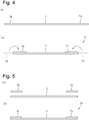
- FIG. 4 is explanatory views of sheet body formation, and shows a cross section of the elastic resin material extruded into a sheet shape from the die which elastic resin material is cut in the width direction.
- the elastic resin material extruded into a sheet shape from the die is sheet-shape. This is folded back as shown in Fig. 4(b) .
- one end side 2p in the width direction of the elastic resin material extruded into a sheet shape from the die is folded back toward the center in the width direction and overlaid, and the other end side 2q in the width direction is also folded back toward the center in the width direction and overlaid to form an intermediate product 2a that is made to vary in thickness along the width direction according to the presence or absence of the overlap by the folding back.
- this intermediate product 2a By cooling this intermediate product 2a to a temperature range in which the elastic resin material elastically deforms, a sheet body that varies in thickness along the width direction is formed. It may be only either one of the one end side 2p in the width direction of the elastic resin material and the other end side 2q in the width direction that is folded back toward the center in the width direction and overlaid.
- Fig. 5 is explanatory views of sheet body formation, and shows a cross section of the intermediate product 2 and additions 2u and 2v which are cut in the width direction.
- sheet-shape additions 2u and 2v different from the intermediate product 2 of the elastic resin material extruded from the die are prepared.
- the additions 2u and 2v may be either sheet-shape extrusions from the die like the intermediate product 2 or previously manufactured ones (for example, ones drawn out from a roller).
- the sheet-shape additions 2u and 2v different from the intermediate product 2 are laminated on predetermined positions in the width direction of the intermediate product 2 of the elastic resin material extruded into a sheet shape from the die, to form a laminated body 2b that is made to vary in thickness along the width direction according to the presence or absence of the lamination of the additions 2u and 2v.
- a laminated body 2b By cooling this laminated body 2b to a temperature range in which the elastic resin material of the intermediate product 2 elastically deforms, a sheet body that varies in thickness along the width direction is formed.
- the laminated body 2b is cooled to a temperature range in which the elastic resin material of the intermediate product 2 and the additions 2u and 2v elastically deforms, to form a sheet body that varies in thickness along the width direction.
- Figs. 6 to 8 are explanatory views of the process for manufacturing a disposable wearing article.
- the stretchable sheet 8 manufactured by the stretchable composite sheet manufacturing apparatus 11 of the first embodiment is conveyed through guide rollers 56, 62, 72, 74 and 82, and after passing through a slitter 60, a widening mechanism 70 and an absorber pasting mechanism 80, the stretchable sheet 8 is divided into pieces by a non-illustrated cutting mechanism.
- the stretchable sheet 8 is formed as in the first embodiment. That is, an elastic resin material having a main component of a thermoplastic elastic resin which elastic resin material is heat-melted is extruded into a sheet shape on the die 20 and made to have a thickness that varies along the width direction, to form the sheet body 3 including the first region 3m in the center in the width direction and the second regions 3s and 3t on both sides in the width direction, adjoining the first region 3m and being greater in thickness than the first region 3m; then, at least one of the first and second nonwoven fabrics 4 and 6 as the base sheets is laminated and joined to at least one of the opposing pair of main surfaces of the sheet body 3 to form the stretchable sheet 8 (first step).
- an elastic resin material having a main component of a thermoplastic elastic resin which elastic resin material is heat-melted is extruded into a sheet shape on the die 20 and made to have a thickness that varies along the width direction, to form the sheet body 3 including the first region 3m in the center in the width direction and the second
- a slit 8x extending in a direction vertical to the width direction of the stretchable sheet 8 is formed in the stretchable sheet 8, and the stretchable sheet 8 is divided into a first divisional sheet 8p and a second divisional sheet 8q.
- the slit 8x passes through the first region 3m of the sheet body (second step).
- the first divisional sheet 8p and the second divisional sheet 8q are crossed to widen the space between the first divisional sheet 8p and the second divisional sheet 8q.
- the space between the first divisional sheet 8p and the second divisional sheet 8q may be widened without the first divisional sheet 8p and the second divisional sheet 8q being crossed as shown in Fig. 8(a) (third step) .
- crotch portions 9 each including an absorber are disposed at intervals in the length direction of the first divisional sheet 8p and the second divisional sheet 8q (the horizontal direction in Figs. 7(a) and 8(a) ) so as to lie astride the first divisional sheet 8p and the second divisional sheet 8q the space between which is widened, and are joined to the first divisional sheet 8p and the second divisional sheet 8q.
- the absorber may be added to the crotch portions 9 after the crotch portions 9 are joined to the first and second divisional sheets 8p and 8q (fourth step).
- first divisional sheet 8p and the second divisional sheet 8q are superposed on each other by folding at the crotch portions 9, and the first divisional sheet 8p and the second divisional sheet 8q are joined together by heat sealing or the like between the adjoining crotch portions 9 to form side seal portions 8s (fifth step).
- first divisional sheet 8p and the second divisional sheet 8q are cut at the side seal portions 8s so as to be divided into ten pieces (sixth step).
- each divisional piece 10 the first divisional sheet 8p and the second divisional sheet 8q are joined together by a pair of side seal portions 8s that are cut.
- the divisional piece 10 is a disposable wearing article 10 structured so that an opening 10m around the body is formed by the first divisional sheet 8p and the second divisional sheet 8q and a pair of openings 10p and 10q around the legs are formed by the first divisional sheet 8p, the second divisional sheet 8q and the crotch portion 9.
- the front body portion and the rear body portion of the disposable wearing article 10 are formed by the first and second divisional sheets 8p and 8q into which the stretchable sheet 8 is divided.
- the stretchable sheet 8 is disposed so that the hatched second regions 3s and 3t are closer to the openings 10p and 10q around the legs than the first region 3m.
- the thicknesses of the second regions 3s and 3t are greater than the thickness of the first region 3m. For this reason, a high contraction stress can be provided to the parts around the legs of the disposable wearing article 10.
- the stretchable sheet 8 is disposed so that the hatched second regions 3s and 3t are closer to the opening 10m around the body than the first region 3m.
- the thicknesses of the second regions 3s and 3t are greater than the thickness of the first region 3m. For this reason, a high contraction stress can be provided to the part around the waist of the disposable wearing article 10a.
- FIG. 9 is explanatory views of the process for manufacturing a disposable wearing article of the third embodiment.
- a disposable wearing article 10b is manufactured by using two stretchable sheets 8a and 8b from the beginning instead of dividing one stretchable sheet 8.
- first and second stretchable sheets 8a and 8b are formed as in the second embodiment.
- a first elastic resin material having a main component of a first thermoplastic elastic resin which first elastic resin material is heat-melted is extruded into a sheet shape on a first die and made to have a thickness that varies along the width direction, to form a first sheet body including the first region 3m in the center in the width direction and the second regions 3s and 3t on both sides in the width direction, adjoining the first region 3m and being greater in thickness than the first region 3m; then, the first base sheet is laminated and joined to at least one of the opposing pair of main surfaces of the first sheet body to form the first stretchable sheet 8a (first step).
- a second elastic resin material having a main component of a second thermoplastic elastic resin which second elastic resin material is heat-melted is extruded into a sheet shape on a second die and made to have a thickness that varies along the width direction, to form a second sheet body including a third region 3n in the center in the width direction and fourth regions 3u and 3v on both sides in the width direction, adjoining the third region 3n and being greater in thickness than the third region 3n; then, the second base sheet is laminated and joined to at least one of the opposing pair of main surfaces of the second sheet body to form the second stretchable sheet 8b (second step).
- the first thermoplastic elastic resin and the second thermoplastic elastic resin may be either the same or different.
- the first elastic resin material and the second elastic resin material may be either the same or different.
- the crotch portions 9 are joined and division into pieces 10a is performed.
- first stretchable sheet 8a and the second stretchable sheet 8b are placed with a predetermined space therebetween (third step).
- the crotch portions 9 each including an absorber are disposed at intervals in the length direction of the first stretchable sheet 8a and the second stretchable sheet 8b so as to lie astride the first stretchable sheet 8a and the second stretchable sheet 8b placed with a predetermined space therebetween, and joined to the first stretchable sheet 8a and the second stretchable sheet 8b.
- the absorber may be added to the crotch portions 9 after the crotch portions 9 are joined to the first and second divisional sheets 8p and 8q (fourth step) .
- first stretchable sheet 8a and the second stretchable sheet 8b are superposed on each other by folding at the crotch portions 9, and the first stretchable sheet 8a and the second stretchable sheet 8b are joined together between the adjoining crotch portions 9 to form side seal portions 8t (fifth step).
- first stretchable sheet 8a and the second stretchable sheet 8b are cut at the side seal portions 8t to take out the pieces 10a (sixth step).
- each divisional piece 10b the first stretchable sheet 8a and the second stretchable sheet 8b are connected together by a pair of side seal portions 8t that are cut.
- the divisional piece 10b is a disposable wearing article 10b structured so that an opening 10n around the body is formed by the first stretchable sheet 8a and the second stretchable sheet 8b and a pair of openings 10s and 10t around the legs are formed by the first stretchable sheet 8a, the second stretchable sheet 8b and the crotch portion 9.
- the front body portion and the rear body portion of the disposable wearing article 10b are formed by the first and second stretchable sheets 8a and 8b.
- the first and second stretchable sheets 8a and 8b are disposed so that a portion 3s of the second region is closer to the opening 10n around the body than the first region 3m and that a portion 3v of the fourth region is closer to the opening 10n around the body than the third region 3n. Moreover, they are disposed so that another portion 3t of the second region is closer to the openings 10s and 10t around the legs than the first region 3m and that another portion 3u of the fourth region is closer to the openings 10s and 10t around the legs than the third region 3n.
- the thicknesses of the second regions 3s and 3t are greater than the thickness of the first region 3m, and the thicknesses of the fourth regions 3u and 3v are greater than the thickness of the third region 3n. For this reason, a high contraction stress can be provided to the part around the waist and the parts around the legs of the disposable wearing article 10b.
- a stretchable sheet in which the stretching characteristics vary along the width direction a disposable wearing article using the stretchable sheet in which the stretching characteristics vary along the width direction, and a method for manufacturing the same can be provided.
- the present invention is not limited to the above-described embodiments and may be variously modified when carried out.
- a sheet material other than nonwoven fabric may be used as the base sheet.
Landscapes
- Engineering & Computer Science (AREA)
- Health & Medical Sciences (AREA)
- Mechanical Engineering (AREA)
- Veterinary Medicine (AREA)
- Epidemiology (AREA)
- Vascular Medicine (AREA)
- Life Sciences & Earth Sciences (AREA)
- Animal Behavior & Ethology (AREA)
- General Health & Medical Sciences (AREA)
- Public Health (AREA)
- Biomedical Technology (AREA)
- Heart & Thoracic Surgery (AREA)
- Manufacturing & Machinery (AREA)
- Textile Engineering (AREA)
- Physics & Mathematics (AREA)
- Thermal Sciences (AREA)
- Absorbent Articles And Supports Therefor (AREA)
- Laminated Bodies (AREA)
- Extrusion Moulding Of Plastics Or The Like (AREA)
- Shaping By String And By Release Of Stress In Plastics And The Like (AREA)
Abstract
Description
- The present invention relates to a stretchable sheet, a disposable wearing article using the stretchable sheet, and a method for manufacturing the same.
- A stretchable sheet that is excellent in stretchability is used for the back sheet of a disposable diaper and the like.
Fig. 10 is a schematic illustration showing a method for manufacturing the stretchable sheet. As shown inFig. 10 , a thermoplastic elastic resin is extruded from aT die 111 to form a film-shape object 103' in a molten state. Then, the film-shape object 103' is cooled by achill roller 120. Then, the cooled film-shape object 103" is sandwiched between two sheets of continuousnonwoven fabric 102 and at the same time, embossing is performed thereon. The embossing is performed by pressurization and nipping with anembossing roller 112 having a multiplicity of dot-shape convex portions 112a formed on the surface thereof and abackup roller 113. Astretchable sheet 101 in which the layers are joined and integrated by the embossing is wounded by awinding roller 116. As thenonwoven fabric 102, a nonwoven fabric is used that is stretchable at least in a lateral direction (a direction vertical to the flow direction and the thickness direction of the nonwoven fabric 102) (for example, see Patent Literature 1). - [Patent Literature 1] Japanese Patent No.
3054930 - For example, if a stretchable sheet in which the stretching characteristics vary along the width direction thereof is used, a high contraction stress can be provided to the parts of a disposable diaper around the waist and around the legs.
- However, the stretchable sheet manufactured by the method shown in
Fig. 5 is uniform in stretching characteristics because the thickness of the film-shape object 103" is uniform. - In view of such circumstances, a problem to be solved by the present invention is to provide a stretchable sheet in which the stretching characteristics vary along the width direction, a disposable wearing article using the stretchable sheet in which the stretching characteristics vary along the width direction, and a method for manufacturing the same.
- To solve the above-mentioned problem, the present invention provides a stretchable sheet structured as follows:
The stretchable sheet is provided with: (a) a sheet body in which an elastic resin material having a main component of a thermoplastic elastic resin is molded into a sheet shape; and (b) a base sheet laminated and joined to at least one of an opposing pair of main surfaces of the sheet body. The sheet body includes at least two first and second regions adjoining each other in a width direction and each extending in a direction vertical to the width direction. The thickness of the second region is greater than the thickness of the first region. The base sheet is laminated and joined to the first and second regions of the sheet body. - According to the above-described structure, the first and second regions adjoining in the width direction of the sheet body vary in stretching characteristics according to the variations in thickness. For this reason, the stretchable sheet in which the base sheet is laminated and joined to the first and second regions of the sheet body varies in stretching characteristics along the width direction.
- Preferably, the sheet body includes: (i) the first region in a center of the sheet body in the width direction; and (ii) the second region on each side of the sheet body in the width direction.
- In this case, in the sheet body, the thickness of the second region on each side in the width direction is greater than the thickness of the first region in the center in the width direction.
- Moreover, the present invention provides a disposable wearing article structured as follows:
The disposable wearing article is structured so that an opening around a body and a pair of openings around legs are formed, and includes the above-described stretchable sheet. The stretchable sheet is disposed so that at least a portion of the second region is closer to the opening around the body or the openings around the legs than the first region. - In this case, a high contraction stress can be provided to at least one of the part around waist and the parts around the legs of the disposable wearing article.
- Moreover, to solve the above-mentioned problem, the present invention provides a stretchable sheet manufacturing method structured as follows:
In the stretchable sheet manufacturing method, (i) an elastic resin material having a main component of a thermoplastic elastic resin which elastic resin material is heat-melted is extruded into a sheet shape on a die and made to have a thickness that varies along a width direction, and is then cooled to a temperature range in which the elastic resin material elastically deforms, to form a sheet body that varies in thickness along the width direction, and (ii) a base sheet is laminated and joined to at least one of an opposing pair of main surfaces of the sheet body. - According to the above-described method, since the sheet body has a thickness that varies along the width direction, the stretching characteristics thereof vary according to the variations in thickness. For this reason, the stretchable sheet in which the base sheet is laminated and joined to at least one of the main surfaces of the sheet body varies in stretching characteristics along the width direction.
- Specifically, in various modes as described below, a sheet body that varies in thickness along the width direction can be formed by extruding the heat-melted elastic resin material into a sheet shape on the die to make the thickness thereof vary along the width direction.
- In a first mode, an intermediate product of the elastic resin material extruded in a sheet shape on the die is stretched in the uniaxial direction to thereby contract the width of the intermediate product to make the thickness of the intermediate product vary along the width direction, and is then cooled to the temperature range to form the sheet body that varies in thickness along the width direction.
- For example, when the intermediate product is stretched to contract the width of the intermediate product, the thickness is made to vary along the width direction by using a phenomenon in which the thicknesses of the end parts of the intermediate product in the width direction are greater than the thickness of the middle part thereof in the width direction between the end parts in the width direction. The thickness may be made to vary along the width direction by forcibly deforming the intermediate product by blowing hot air to the intermediate product or pressing a tool against the intermediate product when the intermediate product is stretched to thereby contract the width of the intermediate product.
- In a second mode, the heat-melted elastic resin material is discharged from the lip of the die having parts that are different in lip width, to form an intermediate product that is made to vary in thickness along the width direction, and the intermediate product is cooled to the temperature range to form the sheet body that varies in thickness along the width direction.
- In this case, the thickness is made to vary along the width direction according to the lip width of the discharge outlet.
- In a third mode, at least one of one end side in the width direction and the other end side in the width direction of the elastic resin material extruded in a sheet shape from the die is folded back toward the center in the width direction and overlaid to form an intermediate product that is made to vary in thickness along the width direction, and the intermediate product is cooled to the temperature range to form the sheet body that varies in thickness along the width direction.
- In this case, the thickness is made to vary along the width direction according to the presence or absence of the overlap by folding back.
- In a fourth mode, on a predetermined position in the width direction of an intermediate product of the elastic resin material extruded into a sheet shape from the die, a sheet-shape addition different from the intermediate product is laminated to form a laminated body that is made to vary in thickness along the width direction, and the laminated body is cooled to the temperature range to form the sheet body that varies in thickness along the width direction.
- In this case, the thickness is made to vary along the width direction according to the presence or absence of the lamination of the addition.
- Moreover, to solve the above-mentioned problem, the present invention provides a disposable wearing article manufacturing method structured as follows:
The disposable wearing article manufacturing method is provided with: (i) a first step in which an elastic resin material having a main component of a thermoplastic elastic resin which elastic resin material is heat-melted is extruded into a sheet shape on a die and made to have a thickness that varies along a width direction, to form a sheet body including a first region in a center in the width direction and a second region on each side in the width direction, adjoining the first region and being greater in thickness than the first region; then, a base sheet is laminated and joined to at least one of an opposing pair of main surfaces of the sheet body to form a stretchable sheet; (ii) a second step in which a slit extending in a direction vertical to the width direction of the stretchable sheet and passing through the first region of the sheet body is formed in the stretchable sheet, and the stretchable sheet is divided into a first divisional sheet and a second divisional sheet; (iii) a third step in which a space between the first divisional sheet and the second divisional sheet is widened; (iv) a fourth step in which crotch portions are disposed at intervals in a length direction of the first and second divisional sheets so as to lie astride the first divisional sheet and the second divisional sheet the space between which is widened, and are joined to the first divisional sheet and the second divisional sheet; (v) a fifth step in which the first divisional sheet and the second divisional sheet are superposed on each other by folding at the crotch portions, and the first divisional sheet and the second divisional sheet are joined together between the adjoining crotch portions to form side seal portions; and (vi) a sixth step in which the first divisional sheet and the second divisional sheet are cut at the side seal portions so as to be divided into pieces. - By the above-described method, the front body portion and the rear body portion of the disposable wearing article are formed by the first and second divisional sheets into which the stretchable sheet is divided. By disposing the second region being greater in thickness than the first region in the part around the waist or the parts around the legs of the disposable wearing article, a high contraction stress can be provided to the part around the waist or the parts around the legs.
- Moreover, to solve the above-mentioned problem, the present invention provides a disposable wearing article manufacturing method structured as follows:
The disposable wearing article manufacturing method is provided with: (i) a first step in which a first elastic resin material having a main component of a first thermoplastic elastic resin which first elastic resin material is heat-melted is extruded into a sheet shape on a first die and made to have a thickness that varies along a width direction, to form a first sheet body including a first region in a center in the width direction and a second region on each side in the width direction, adjoining the first region and being greater in thickness than the first region; then, a first base sheet is laminated and joined to at least one of an opposing pair of main surfaces of the first sheet body to form a first stretchable sheet; (ii) a second step in which a second elastic resin material having a main component of a second thermoplastic elastic resin which second elastic resin material is heat-melted is extruded into a sheet shape on a second die and made to have a thickness that varies along a width direction, to form a second sheet body including a third region in a center in the width direction and a fourth region on each side in the width direction, adjoining the third region and being greater in thickness than the third region; then, a second base sheet is laminated and joined to at least one of an opposing pair of main surfaces of the second sheet body to form a second stretchable sheet; (iii) a third step in which the first stretchable sheet and the second stretchable sheet are placed with a predetermined space therebetween; (iv) a fourth step in which crotch portions are disposed at intervals in a length direction of the first stretchable sheet and the second stretchable sheet so as to lie astride the first stretchable sheet and the second stretchable sheet placed with the predetermined space therebetween, and are joined to the first stretchable sheet and the second stretchable sheet; (v) a fifth step in which the first stretchable sheet and the second stretchable sheet are superposed on each other by folding at the crotch portions, and the first stretchable sheet and the second stretchable sheet are joined together between the adjoining crotch portions to form side seal portions; and (vi) a sixth step in which the first stretchable sheet and the second stretchable sheet are cut at the side seal portions so as to be divided into pieces. - By the above-described method, the front body portion and the rear body portion of the disposable wearing article are formed by the first and second stretchable sheets. By disposing the second region being greater in thickness than the first region and the fourth region being greater in thickness than the third region in the part around the waist and the parts around the legs of the disposable wearing article, a high contraction stress can be provided to the part around the waist and the parts around the legs of the disposable wearing article.
- According to the present invention, a stretchable sheet in which the stretching characteristics vary along the width direction, a disposable wearing article using the stretchable sheet in which the stretching characteristics vary along the width direction, and a method for manufacturing the same can be provided.
-
- [
Fig. 1] Fig. 1 is a schematic illustration showing the general structure of a stretchable sheet manufacturing apparatus (first embodiment). - [
Fig. 2] Fig. 2 is a cross-sectional view of a stretchable sheet (first embodiment). - [
Fig. 3] Fig. 3 is bottom views of a die (first embodiment). - [
Fig. 4] Fig. 4 is explanatory views of sheet body formation (first embodiment. - [
Fig. 5] Fig. 5 is explanatory views of sheet body formation (first embodiment). - [
Fig. 6] Fig. 6 is an explanation of a manufacturing process for manufacturing a disposable wearing article (second embodiment). - [
Fig. 7] Fig. 7 is an explanation of the manufacturing process for manufacturing the disposable wearing article (second embodiment). - [
Fig. 8] Fig. 8 is explanatory views of the disposable wearing article manufacturing process (second embodiment). - [
Fig. 9] Fig. 9 is explanatory views of a disposable wearing article manufacturing process (third embodiment). - [
Fig. 10] Fig. 10 is a schematic illustration showing the method for manufacturing the stretchable sheet (first conventional example). - Hereinafter, embodiments of the present invention will be described with reference to the drawings.
- <First embodiment> A first embodiment will be described with reference to
Figs. 1 to 5 . -
Fig. 1 is a schematic illustration showing the general structure of a stretchable compositesheet manufacturing apparatus 11. As shown inFig. 1 , the stretchable compositesheet manufacturing apparatus 11 is provided with a die 20, a coolingroller 30, a stretchingmechanism 38, alaminating mechanism 48, and a non-illustrated control device. The control device controls thedie 20, the coolingroller 30, the stretchingmechanism 38 and thelaminating mechanism 48 so as to operate in cooperation with one another. - The die 20 forms a sheet-shape
intermediate product 2 by discharging a heat-melted elastic resin material into a sheet shape from alip 24. The elastic resin material has a main component of a thermoplastic elastic resin, and is heat-melted to a temperature higher than the temperature range in which the elastic resin material elastically deforms. - The cooling
roller 30 is disposed below thedie 20. Theintermediate product 2 discharged from thelip 24 of the die 20 is stretched in afirst section 80 to when it reaches the coolingroller 30. That is, the coolingroller 30 rotates at a circumferential speed higher than the feeding speed of the elastic resin material when it is discharged from the discharge outlet of the die 20, and contracts the width (the dimension in the direction vertical to the plane of the figure inFig. 1 ) of theintermediate product 2 by stretching theintermediate product 2 in the uniaxial direction until the thickness of theintermediate product 2 becomes a predetermined value. - At this time, the thickness is made to vary along the width direction by using a phenomenon in which the thicknesses of both end parts of the
intermediate product 2 in the width direction are greater than the thickness of the middle part thereof in the width direction between the end parts in the width direction. That is, generally, when a sheet is manufactured by discharging a heat-melted resin material into a sheet shape and stretching it, only the middle part in the width direction that is uniform in thickness is used, and both end parts in the width direction that are different in thickness are removed. On the contrary, since the thickness of the elastic resin material extruded into a sheet shape on a die is made to vary along the width direction, both end parts of theintermediate product 2 in the width direction are also used positively. - In another mode described later, the thickness of the elastic resin material extruded in a sheet shape on the die 20 may be made to vary along the width direction.
- In the cooling
roller 30, a non-illustrated flow path where a coolant flows is formed, and in asecond section 82 in which theintermediate product 2 is in contact with the outer peripheral surface of the coolingroller 30, the coolingroller 30 cools theintermediate product 2 to the temperature range in which the elastic resin material forming theintermediate product 2 elastically deforms, and solidifies it. Thereby, theintermediate product 2 that is made to vary in thickness along the width direction becomes a sheet-shape sheet body 3 that varies in thickness along the width direction in thesecond section 82, and is drawn from the coolingroller 30. - The
sheet body 3 is sent to thestretching mechanism 38 by way of aguide roller 32. Theguide roller 32 may be provided with a cooling function. - The stretching
mechanism 38 includes a drawingroller 34, apinch roller 36 and a stretchingroller 40. Thesheet body 3 is sandwiched between the drawingroller 34 and thepinch roller 36 so as not to slide along the outer peripheral surface of the drawingroller 34. The rotation of the drawingroller 34 synchronizes with the rotation of the coolingroller 30. - The
sheet body 3 is stretched in athird section 84 from when it is between the drawingroller 34 and thepinch roller 36 to when it reaches the stretchingroller 40. That is, the stretchingroller 40 rotates at a circumferential speed higher than that of the drawingroller 34 to stretch thesheet body 3 at a predetermined magnification. Thesheet body 3 being stretched is along the outer peripheral surface of the stretchingroller 40. - The
laminating mechanism 48 supplies continuous firstnonwoven fabric 4 as a first base sheet to the stretchingroller 40 through aguide roller 50, and supplies continuous secondnonwoven fabric 6 as a second base sheet to the stretchingroller 40 throughguide rollers sheet body 3 stretched along the stretchingroller 40 is sandwiched between the firstnonwoven fabric 4 and the secondnonwoven fabric 6, so that alaminated body 7 in which thesheet body 3 and the first and secondnonwoven fabrics - The
laminated body 7 moves with the rotation of the stretchingroller 40, and passes between the stretchingroller 40 and ahorn 43 of an ultrasonic joiningapparatus 42. Thehorn 43 comes into contact with and separates from the stretchingroller 40 and when thelaminated body 7 is sandwiched between the stretchingroller 40 and thehorn 43, thesheet body 3 and the first and secondnonwoven fabrics stretchable sheet 8 in which thesheet body 3 and the first and secondnonwoven fabrics laminating mechanism 48. Regarding the first and secondnonwoven fabrics sheet body 3 in between may be supersonically joined together. - Specifically, the stretching
roller 40 has, on its outer peripheral surface, a plurality of non-illustrated protrusions formed at intervals from one another, and functions as an anvil. Of thelaminated body 7, the parts sandwiched between the protrusions of the stretchingroller 40 and thehorn 43 is supersonically joined. By the supersonic joining, desired parts can be easily and accurately joined. - Instead of supersonic joining, the
sheet body 3 and the first and secondnonwoven fabrics laminated body 7 may be heat-welded by heat sealing or the like, or thesheet body 3 and the first and secondnonwoven fabrics laminated body 7 may be bonded by using an adhesive agent. Two or more joining modes may be combined. - The stretching
roller 40 serves as both thestretching mechanism 38 and thelaminating mechanism 48. While this simplifies the structure of the stretchable compositesheet manufacturing apparatus 11, a structure provided with separate rollers as the stretchingmechanism 38 and thelaminating mechanism 48 may be adopted. -
Fig. 2 is a cross-sectional view of thestretchable sheet 8 which is cut in the width direction. As shown inFig. 2 , thestretchable sheet 8 is provided with: thesheet body 3 in which an elastic resin material having a main component of a thermoplastic elastic resin is formed into a sheet shape; and the first and secondnonwoven fabrics sheet body 3, respectively. Thesheet body 3 includes two first andsecond regions first region 3m in the center of thesheet body 3 in the width direction and thesecond regions sheet body 3 in the width direction. The thicknesses of thesecond regions first region 3m. The first and secondnonwoven fabrics second regions sheet body 3. - The first and
second regions sheet body 3 vary in stretching characteristics according to the variations in thickness. For this reason, thestretchable sheet 8 in which the first and secondnonwoven fabrics second regions sheet body 3 varies in stretching characteristics along the width direction. - The
laminating mechanism 48 may supply only one of the first and secondnonwoven fabrics roller 40 so that a laminated body in which thesheet body 3 and only one of the first and secondnonwoven fabrics nonwoven fabric 4 or the second nonwoven fabric 6) laminated and joined to one of the opposing pair of main surfaces of thesheet body 3. - Moreover, the stretching
mechanism 38 may be omitted. In this case, a stretchable sheet can be manufactured in which thesheet body 3 is laminated and joined to the first and/or the secondnonwoven fabric 4 and/or 6 without being stretched. - It is desirable that the thermoplastic elastic resin as the material of the
sheet body 3 be a thermoplastic resin that exhibits rubber elasticity at room temperature; for example, an appropriate kind may be selected from among thermoplastic elastomers defined and classified in JIS K 6418:2007 (ISO 18064:2003). For example, a thermoplastic elastomer that elastically deforms in a temperature range of not more than approximately 100 degrees C is used. - Specific examples include an olefinic elastomer such as "VERSIFY" (trademark) of The Dow Chemical Company, a propylene elastomer such as "Vistamaxx" (trademark) of Exxon Mobil Corporation, and a styrene elastomer such as "Quintac" (trademark) of Zeon Corporation.
- Next, referring to
Fig. 1 , the method for manufacturing thestretchable sheet 8 will be described. - First, an elastic resin material having a main component of a thermoplastic elastic resin which elastic resin material is heat-melted is extruded into a sheet shape on the
die 20 and made to have a thickness that varies along the width direction, and is then cooled to a temperature range in which the elastic resin material elastically deforms, to form thesheet body 3 that varies in thickness along the width direction. Then, the base sheets (the first and secondnonwoven fabrics 4 and 6) are laminated and joined to at least one of the opposing pair of main surfaces of thesheet body 3. - According to the above-described method, since the
sheet body 3 has a thickness that varies along the width direction, the stretching characteristics thereof vary according to the variations in thickness. For this reason, the stretchable sheet in which the base sheets are laminated and joined to at least one of the main surfaces of the sheet body varies in stretching characteristics along the width direction. - Specifically, in various modes as described below, a sheet body that varies in thickness along the width direction can be formed by extruding the heat-melted elastic resin material into a sheet shape on the die 20 to make the thickness thereof vary along the width direction.
- A first mode will be described.
Fig. 3(a) is a bottom view of the die 20 used in the first mode. As shown inFig. 3(a) , thelip 24 as the discharge outlet for the heat-melted elastic resin material is formed on abottom surface 22 of thedie 20. Thelip 24 has a uniform lip width. Theintermediate product 2 of the elastic resin material extruded on thedie 20 and discharged from thelip 24 is stretched in the uniaxial direction to thereby contract the width of theintermediate product 2 to make the thickness of theintermediate product 2 vary along the width direction, and is then cooled to a temperature range in which the elastic resin material elastically deforms, to form thesheet body 3 that varies in thickness along the width direction. - For example, when the
intermediate product 2 is stretched in the uniaxial direction to contract the width of theintermediate product 2, the thickness is made to vary along the width direction by using a phenomenon in which the thicknesses of the end parts of theintermediate product 2 in the width direction are greater than the thickness of the middle part thereof in the width direction. Alternatively, the thickness may be made to vary along the width direction by forcibly deforming theintermediate product 2 by blowing hot air to theintermediate product 2 or pressing a tool against theintermediate product 2 when theintermediate product 2 is stretched in the uniaxial direction to contract the width of theintermediate product 2. - A second mode will be described.
Fig. 3(b) is a bottom view of the die 20 used in the second mode. As shown inFig. 3(b) , alip 24a formed on thebottom surface 22 of the die 20 hasparts end parts middle part 24m between theend parts - When the heat-melted elastic resin material is discharged from the
lip 24a having theparts - A third mode will be described.
Fig. 4 is explanatory views of sheet body formation, and shows a cross section of the elastic resin material extruded into a sheet shape from the die which elastic resin material is cut in the width direction. As shown inFig. 4(a) , the elastic resin material extruded into a sheet shape from the die is sheet-shape. This is folded back as shown inFig. 4(b) . That is, oneend side 2p in the width direction of the elastic resin material extruded into a sheet shape from the die is folded back toward the center in the width direction and overlaid, and theother end side 2q in the width direction is also folded back toward the center in the width direction and overlaid to form anintermediate product 2a that is made to vary in thickness along the width direction according to the presence or absence of the overlap by the folding back. By cooling thisintermediate product 2a to a temperature range in which the elastic resin material elastically deforms, a sheet body that varies in thickness along the width direction is formed. It may be only either one of the oneend side 2p in the width direction of the elastic resin material and theother end side 2q in the width direction that is folded back toward the center in the width direction and overlaid. - A forth mode will be described.
Fig. 5 is explanatory views of sheet body formation, and shows a cross section of theintermediate product 2 andadditions Fig. 5 (a) , sheet-shape additions intermediate product 2 of the elastic resin material extruded from the die are prepared. Theadditions intermediate product 2 or previously manufactured ones (for example, ones drawn out from a roller). - As shown in
Fig. 5(b) , the sheet-shape additions intermediate product 2 are laminated on predetermined positions in the width direction of theintermediate product 2 of the elastic resin material extruded into a sheet shape from the die, to form alaminated body 2b that is made to vary in thickness along the width direction according to the presence or absence of the lamination of theadditions laminated body 2b to a temperature range in which the elastic resin material of theintermediate product 2 elastically deforms, a sheet body that varies in thickness along the width direction is formed. - When the
additions intermediate product 2, thelaminated body 2b is cooled to a temperature range in which the elastic resin material of theintermediate product 2 and theadditions - <Second embodiment> A second embodiment will be described with reference to
Figs. 6 to 8. Figs. 6 to 8 are explanatory views of the process for manufacturing a disposable wearing article. - First, the process for manufacturing a disposable wearing article will be described. As shown in
Fig. 6 , thestretchable sheet 8 manufactured by the stretchable compositesheet manufacturing apparatus 11 of the first embodiment is conveyed throughguide rollers slitter 60, a wideningmechanism 70 and anabsorber pasting mechanism 80, thestretchable sheet 8 is divided into pieces by a non-illustrated cutting mechanism. - Specifically, as shown in
Figs. 7(a) and 8(a) , thestretchable sheet 8 is formed as in the first embodiment. That is, an elastic resin material having a main component of a thermoplastic elastic resin which elastic resin material is heat-melted is extruded into a sheet shape on thedie 20 and made to have a thickness that varies along the width direction, to form thesheet body 3 including thefirst region 3m in the center in the width direction and thesecond regions first region 3m and being greater in thickness than thefirst region 3m; then, at least one of the first and secondnonwoven fabrics sheet body 3 to form the stretchable sheet 8 (first step). - Then, at the
slitter 60, as shown inFigs. 7(a) and 8(a) , aslit 8x extending in a direction vertical to the width direction of thestretchable sheet 8 is formed in thestretchable sheet 8, and thestretchable sheet 8 is divided into a firstdivisional sheet 8p and a seconddivisional sheet 8q. Theslit 8x passes through thefirst region 3m of the sheet body (second step). - Then, at the widening
mechanism 70, as shown inFig. 7 (a) , the firstdivisional sheet 8p and the seconddivisional sheet 8q are crossed to widen the space between the firstdivisional sheet 8p and the seconddivisional sheet 8q. The space between the firstdivisional sheet 8p and the seconddivisional sheet 8q may be widened without the firstdivisional sheet 8p and the seconddivisional sheet 8q being crossed as shown inFig. 8(a) (third step) . - Then, at the
absorber pasting mechanism 80, as shown inFigs. 7(a) and 8(a) ,crotch portions 9 each including an absorber are disposed at intervals in the length direction of the firstdivisional sheet 8p and the seconddivisional sheet 8q (the horizontal direction inFigs. 7(a) and 8(a) ) so as to lie astride the firstdivisional sheet 8p and the seconddivisional sheet 8q the space between which is widened, and are joined to the firstdivisional sheet 8p and the seconddivisional sheet 8q. The absorber may be added to thecrotch portions 9 after thecrotch portions 9 are joined to the first and seconddivisional sheets - Then, as shown in
Fig. 7(b) , the firstdivisional sheet 8p and the seconddivisional sheet 8q are superposed on each other by folding at thecrotch portions 9, and the firstdivisional sheet 8p and the seconddivisional sheet 8q are joined together by heat sealing or the like between the adjoiningcrotch portions 9 to formside seal portions 8s (fifth step). - Then, the first
divisional sheet 8p and the seconddivisional sheet 8q are cut at theside seal portions 8s so as to be divided into ten pieces (sixth step). - In each
divisional piece 10, the firstdivisional sheet 8p and the seconddivisional sheet 8q are joined together by a pair ofside seal portions 8s that are cut. Thedivisional piece 10 is a disposable wearingarticle 10 structured so that anopening 10m around the body is formed by the firstdivisional sheet 8p and the seconddivisional sheet 8q and a pair ofopenings divisional sheet 8p, the seconddivisional sheet 8q and thecrotch portion 9. The front body portion and the rear body portion of the disposable wearingarticle 10 are formed by the first and seconddivisional sheets stretchable sheet 8 is divided. - When the first
divisional sheet 8p and the seconddivisional sheet 8q are crossed to widen the space between the firstdivisional sheet 8p and the seconddivisional sheet 8q as shown inFig. 7(a) , as shown inFig. 7(b) , in the disposable wearingarticle 10, thestretchable sheet 8 is disposed so that the hatchedsecond regions openings first region 3m. The thicknesses of thesecond regions first region 3m. For this reason, a high contraction stress can be provided to the parts around the legs of the disposable wearingarticle 10. - When the space is widened without the first
divisional sheet 8p and the seconddivisional sheet 8q being crossed as shown inFig. 8 (a) , as shown inFig. 8(b) , in a disposable wearingarticle 10a, thestretchable sheet 8 is disposed so that the hatchedsecond regions opening 10m around the body than thefirst region 3m. The thicknesses of thesecond regions first region 3m. For this reason, a high contraction stress can be provided to the part around the waist of the disposable wearingarticle 10a. - <Third embodiment> A third embodiment will be described with reference to
Fig. 9. Fig. 9 is explanatory views of the process for manufacturing a disposable wearing article of the third embodiment. - As shown in
Fig. 9 , in the third embodiment, a disposable wearingarticle 10b is manufactured by using twostretchable sheets stretchable sheet 8. - First, the first and second
stretchable sheets - That is, a first elastic resin material having a main component of a first thermoplastic elastic resin which first elastic resin material is heat-melted is extruded into a sheet shape on a first die and made to have a thickness that varies along the width direction, to form a first sheet body including the
first region 3m in the center in the width direction and thesecond regions first region 3m and being greater in thickness than thefirst region 3m; then, the first base sheet is laminated and joined to at least one of the opposing pair of main surfaces of the first sheet body to form the firststretchable sheet 8a (first step). - Moreover, a second elastic resin material having a main component of a second thermoplastic elastic resin which second elastic resin material is heat-melted is extruded into a sheet shape on a second die and made to have a thickness that varies along the width direction, to form a second sheet body including a
third region 3n in the center in the width direction andfourth regions third region 3n and being greater in thickness than thethird region 3n; then, the second base sheet is laminated and joined to at least one of the opposing pair of main surfaces of the second sheet body to form the secondstretchable sheet 8b (second step). - The first thermoplastic elastic resin and the second thermoplastic elastic resin may be either the same or different. When the first and second thermoplastic elastic resins are the same, the first elastic resin material and the second elastic resin material may be either the same or different.
- Then, as in the second embodiment, the
crotch portions 9 are joined and division intopieces 10a is performed. - That is, the first
stretchable sheet 8a and the secondstretchable sheet 8b are placed with a predetermined space therebetween (third step). - Then, the
crotch portions 9 each including an absorber are disposed at intervals in the length direction of the firststretchable sheet 8a and the secondstretchable sheet 8b so as to lie astride the firststretchable sheet 8a and the secondstretchable sheet 8b placed with a predetermined space therebetween, and joined to the firststretchable sheet 8a and the secondstretchable sheet 8b. The absorber may be added to thecrotch portions 9 after thecrotch portions 9 are joined to the first and seconddivisional sheets - Then, the first
stretchable sheet 8a and the secondstretchable sheet 8b are superposed on each other by folding at thecrotch portions 9, and the firststretchable sheet 8a and the secondstretchable sheet 8b are joined together between the adjoiningcrotch portions 9 to formside seal portions 8t (fifth step). - Then, the first
stretchable sheet 8a and the secondstretchable sheet 8b are cut at theside seal portions 8t to take out thepieces 10a (sixth step). - In each
divisional piece 10b, the firststretchable sheet 8a and the secondstretchable sheet 8b are connected together by a pair ofside seal portions 8t that are cut. Thedivisional piece 10b is a disposable wearingarticle 10b structured so that anopening 10n around the body is formed by the firststretchable sheet 8a and the secondstretchable sheet 8b and a pair ofopenings stretchable sheet 8a, the secondstretchable sheet 8b and thecrotch portion 9. The front body portion and the rear body portion of the disposable wearingarticle 10b are formed by the first and secondstretchable sheets - In the disposable wearing
article 10b, the first and secondstretchable sheets portion 3s of the second region is closer to theopening 10n around the body than thefirst region 3m and that aportion 3v of the fourth region is closer to theopening 10n around the body than thethird region 3n. Moreover, they are disposed so that anotherportion 3t of the second region is closer to theopenings first region 3m and that anotherportion 3u of the fourth region is closer to theopenings third region 3n. The thicknesses of thesecond regions first region 3m, and the thicknesses of thefourth regions third region 3n. For this reason, a high contraction stress can be provided to the part around the waist and the parts around the legs of the disposable wearingarticle 10b. - <Summary> As described above, a stretchable sheet in which the stretching characteristics vary along the width direction, a disposable wearing article using the stretchable sheet in which the stretching characteristics vary along the width direction, and a method for manufacturing the same can be provided.
- The present invention is not limited to the above-described embodiments and may be variously modified when carried out.
- For example, a sheet material other than nonwoven fabric may be used as the base sheet.
-
- 2, 2a
- Intermediate product
- 2b
- Laminated body
- 2p
- One end side in the width direction
- 2q
- The other end side in the width direction
- 2u, 2v
- Addition
- 3
- Sheet body
- 3m
- First region
- 3s, 3t
- Second region
- 3n
- Third region
- 3u, 3v
- Fourth region
- 4
- First nonwoven fabric (base sheet)
- 6
- Second nonwoven fabric (base sheet)
- 8, 8a, 8b
- Stretchable sheet
- 8p, 8q
- Divisional sheet
- 8s, 8t
- Side seal portion
- 8x
- Slit
- 9
- Crotch portion
- 10, 10a, 10b
- Piece (disposable wearing article)
- 10m, 10n
- Opening around the body
- 10p, 10q, 10s, 10t
- Opening around the leg
- 20
- Die
- 24, 24a
- Lip
- 24m, 24s, 24t
- Part
- Wm, Ws, Wt
- Lip width
Claims (10)
- A stretchable sheet comprising:a sheet body in which an elastic resin material having a main component of a thermoplastic elastic resin is molded into a sheet shape; anda base sheet laminated and joined to at least one of an opposing pair of main surface of the sheet body,wherein the sheet body includes at least two first and second regions adjoining each other in a width direction and each extending in a direction vertical to the width direction,a thickness of the second region is greater than a thickness of the first region, andthe base sheet is laminated and joined to the first and second regions of the sheet body.
- The stretchable sheet according to claim 1, wherein the sheet body includes:the first region in a center of the sheet body in the width direction; andthe second region on each side of the sheet body in the width direction.
- A disposable wearing article structured so that an opening around a body and a pair of openings around legs are formed, the disposable wearing article including the stretchable sheet according to claim 1 or 2,
wherein the stretchable sheet is disposed so that at least a portion of the second region is closer to the opening around the body or the openings around the legs than the first region. - A stretchable sheet manufacturing method, wherein an elastic resin material having a main component of a thermoplastic elastic resin which elastic resin material is heat-melted is extruded into a sheet shape on a die and made to have a thickness that varies along a width direction, and is then cooled to a temperature range in which the elastic resin material elastically deforms, to form a sheet body that varies in thickness along the width direction, and
a base sheet is laminated and joined to at least one of an opposing pair of main surfaces of the sheet body. - The stretchable sheet manufacturing method according to claim 4, wherein an intermediate product of the elastic resin material extruded into the sheet shape on the die is stretched in a uniaxial direction to thereby contract a width of the intermediate product to make a thickness of the intermediate product vary along the width direction, and is then cooled to the temperature range to form the sheet body that varies in thickness along the width direction.
- The stretchable sheet manufacturing method according to claim 4, wherein the heat-melted elastic resin material is discharged from a lip of the die having a part different in lip width, to form an intermediate product that is made to vary in thickness along the width direction, and the intermediate product is cooled to the temperature range to form the sheet body that varies in thickness along the width direction.
- The stretchable sheet manufacturing method according to claim 4, wherein at least one of one end side in the width direction of the elastic resin material extruded into the sheet shape on the die and another end side in the width direction is folded back toward a center in the width direction and overlaid, to form an intermediate product that is made to vary in thickness along the width direction, and the intermediate product is cooled to the temperature range to form the sheet body that varies in thickness along the width direction.
- The stretchable sheet manufacturing method according to claim 4, wherein on a predetermined position in the width direction of an intermediate product of the elastic resin material extruded into the sheet shape from the die, a sheet-shape addition different from the intermediate product is laminated to form a laminated body that is made to vary in thickness along the width direction, and the laminated body is cooled to the temperature range to form the sheet body that varies in thickness in the width direction.
- A disposable wearing article manufacturing method, comprising:a first step in which an elastic resin material having a main component of a thermoplastic elastic resin which elastic resin material is heat-melted is extruded into a sheet shape on a die and made to have a thickness that varies along a width direction, to form a sheet body including a first region in a center in the width direction and a second region on each side in the width direction, adjoining the first region and being greater in thickness than the first region; then, a base sheet is laminated and joined to at least one of an opposing pair of main surfaces of the sheet body to form a stretchable sheet,a second step in which a slit extending in a direction vertical to the width direction of the stretchable sheet and passing through the first region of the sheet body is formed in the stretchable sheet, and the stretchable sheet is divided into a first divisional sheet and a second divisional sheet,a third step in which a space between the first divisional sheet and the second divisional sheet is widened,a fourth step in which crotch portions are disposed at intervals in a length direction of the first and second divisional sheets so as to lie astride the first divisional sheet and the second divisional sheet the space between which is widened, and are joined to the first divisional sheet and the second divisional sheet,a fifth step in which the first divisional sheet and the second divisional sheet are superposed on each other by folding at the crotch portions, and the first divisional sheet and the second divisional sheet are joined together between the adjoining crotch portions to form side seal portions, anda sixth step in which the first divisional sheet and the second divisional sheet are cut at the side seal portions so as to be divided into pieces.
- A disposable wearing article manufacturing method, comprising:a first step in which a first elastic resin material having a main component of a first thermoplastic elastic resin which first elastic resin material is heat-melted is extruded into a sheet shape on a first die and made to have a thickness that varies along a width direction, to form a first sheet body including a first region in a center in the width direction and a second region on each side in the width direction, adjoining the first region and being greater in thickness than the first region; then, a first base sheet is laminated and joined to at least one of an opposing pair of main surfaces of the first sheet body to form a first stretchable sheet,a second step in which a second elastic resin material having a main component of a second thermoplastic elastic resin which second elastic resin material is heat-melted is extruded into a sheet shape on a second die and made to have a thickness that varies along a width direction, to form a second sheet body including a third region in a center in the width direction and a fourth region on each side in the width direction, adjoining the third region and being greater in thickness than the third region; then, a second base sheet is laminated and joined to at least one of an opposing pair of main surfaces of the second sheet body to form a second stretchable sheet,a third step in which the first stretchable sheet and the second stretchable sheet are placed with a predetermined space therebetween,a fourth step in which crotch portions are disposed at intervals in a length direction of the first stretchable sheet and the second stretchable sheet so as to lie astride the first stretchable sheet and the second stretchable sheet placed with the predetermined space therebetween, and are joined to the first stretchable sheet and the second stretchable sheet,a fifth step in which the first stretchable sheet and the second stretchable sheet are superposed on each other by folding at the crotch portions, and the first stretchable sheet and the second stretchable sheet are joined together between the adjoining crotch portions to form side seal portions, anda sixth step in which the first stretchable sheet and the second stretchable sheet are cut at the side seal portions so as to be divided into pieces.
Applications Claiming Priority (2)
| Application Number | Priority Date | Filing Date | Title |
|---|---|---|---|
| JP2018019662 | 2018-02-06 | ||
| PCT/JP2018/046144 WO2019155765A1 (en) | 2018-02-06 | 2018-12-14 | Stretchable sheet, disposable article using stretchable sheet, and method for manufacturing same |
Publications (2)
| Publication Number | Publication Date |
|---|---|
| EP3750704A1 true EP3750704A1 (en) | 2020-12-16 |
| EP3750704A4 EP3750704A4 (en) | 2021-11-17 |
Family
ID=67547934
Family Applications (1)
| Application Number | Title | Priority Date | Filing Date |
|---|---|---|---|
| EP18904905.9A Pending EP3750704A4 (en) | 2018-02-06 | 2018-12-14 | STRETCH SHEET, DISPOSABLE ARTICLE USING A STRETCH SHEET, AND ASSOCIATED MANUFACTURING PROCESS |
Country Status (5)
| Country | Link |
|---|---|
| US (1) | US12103217B2 (en) |
| EP (1) | EP3750704A4 (en) |
| JP (1) | JP7142036B2 (en) |
| CN (1) | CN111886127B (en) |
| WO (1) | WO2019155765A1 (en) |
Cited By (1)
| Publication number | Priority date | Publication date | Assignee | Title |
|---|---|---|---|---|
| EP3747413A4 (en) * | 2018-01-31 | 2021-11-03 | Zuiko Corporation | ELASTIC COMPOSITE SHEET MANUFACTURING METHOD AND MANUFACTURING DEVICE |
Families Citing this family (4)
| Publication number | Priority date | Publication date | Assignee | Title |
|---|---|---|---|---|
| EP4105004A4 (en) * | 2020-02-13 | 2023-07-05 | Zuiko Corporation | DEVICE AND METHOD FOR PRODUCTION OF A LAYERING SHEET |
| CN116322590A (en) | 2020-10-02 | 2023-06-23 | 株式会社瑞光 | Manufacturing method of wearing article and wearing article manufactured by the method |
| CN112914836B (en) * | 2021-03-29 | 2024-01-26 | 上海智联精工机械有限公司 | Device and method for forming disposable sanitary product core |
| CN118450984A (en) * | 2021-12-27 | 2024-08-06 | 株式会社瑞光 | Laminate body |
Family Cites Families (23)
| Publication number | Priority date | Publication date | Assignee | Title |
|---|---|---|---|---|
| US4259220A (en) | 1978-12-06 | 1981-03-31 | H. B. Fuller Company | Hot melt adhesive for elastic banding |
| US4418123A (en) | 1978-12-06 | 1983-11-29 | H. B. Fuller Company | Extrudable self-adhering elastic and method of employing same |
| DE3423644A1 (en) | 1984-06-27 | 1986-01-02 | Paul Hartmann Ag, 7920 Heidenheim | Garment with gathered elastic regions and method of manufacture thereof |
| ZA889502B (en) | 1987-12-23 | 1990-08-29 | Minnesota Mining & Mfg | Elastic strand construction |
| JP3054930B2 (en) | 1996-07-17 | 2000-06-19 | 花王株式会社 | Laminated sheet and method for producing the same |
| JP3564344B2 (en) * | 1999-11-25 | 2004-09-08 | ユニ・チャーム株式会社 | Elastic stretch laminate sheet and method for producing the same |
| JP2002325793A (en) * | 2001-02-28 | 2002-11-12 | Uni Charm Corp | Method of fabricating throw-away wearing article |
| EP1688113B1 (en) | 2003-11-06 | 2013-05-08 | Zuiko Corporation | Disposable wearing article and method of manufacturing the same |
| EP1900512A1 (en) | 2006-09-15 | 2008-03-19 | 3M Innovative Properties Company | An activatable zero strain composite laminate |
| JP4889439B2 (en) * | 2006-10-23 | 2012-03-07 | 花王株式会社 | Elastic nonwoven fabric |
| JP5144104B2 (en) | 2007-04-09 | 2013-02-13 | ユニ・チャーム株式会社 | Elastic composite sheet and disposable wearing article using the same |
| JP5604041B2 (en) * | 2007-12-10 | 2014-10-08 | 花王株式会社 | Elastic composite sheet |
| FR2943356B1 (en) * | 2009-03-23 | 2011-07-08 | Aplix Sa | ELASTIC AND NON-WOVEN REINFORCED LAMINATE |
| JP6452269B2 (en) | 2011-05-09 | 2019-01-16 | スリーエム イノベイティブ プロパティズ カンパニー | Diapers |
| JP5859867B2 (en) * | 2012-02-07 | 2016-02-16 | ユニ・チャーム株式会社 | Disposable diapers |
| BR112015005214B8 (en) * | 2012-09-10 | 2023-02-14 | Tredegar Film Prod Corp | METHODS FOR FORMING AN ELASTIC STRIP LAMINATE |
| JP5706925B2 (en) * | 2013-05-13 | 2015-04-22 | 花王株式会社 | Pants-type wearing article and manufacturing method thereof |
| JP6498603B2 (en) * | 2013-08-22 | 2019-04-10 | 株式会社瑞光 | Disposable diaper manufacturing method and disposable diaper |
| TWI648281B (en) | 2013-10-17 | 2019-01-21 | 日商安斯泰來製藥股份有限公司 | Sulfur-containing bicyclic compound |
| WO2015056711A1 (en) * | 2013-10-17 | 2015-04-23 | 株式会社瑞光 | Disposable diaper manufacturing method and disposable diaper |
| JP6057347B2 (en) * | 2014-06-24 | 2017-01-11 | 大王製紙株式会社 | Pants-type disposable diaper manufacturing method and pants-type disposable diapers |
| BR112017020650B1 (en) * | 2015-03-27 | 2022-07-19 | Daio Paper Corporation | EXTENDABLE STRUCTURE FOR ABSORBENT ITEM AND DISPOSABLE DIAPER |
| WO2016208513A1 (en) * | 2015-06-22 | 2016-12-29 | 株式会社瑞光 | Composite stretching/contracting member, wearable article, and method for producing wearable article |
-
2018
- 2018-12-14 US US16/967,025 patent/US12103217B2/en active Active
- 2018-12-14 JP JP2019570323A patent/JP7142036B2/en active Active
- 2018-12-14 WO PCT/JP2018/046144 patent/WO2019155765A1/en not_active Ceased
- 2018-12-14 CN CN201880088143.9A patent/CN111886127B/en active Active
- 2018-12-14 EP EP18904905.9A patent/EP3750704A4/en active Pending
Cited By (2)
| Publication number | Priority date | Publication date | Assignee | Title |
|---|---|---|---|---|
| EP3747413A4 (en) * | 2018-01-31 | 2021-11-03 | Zuiko Corporation | ELASTIC COMPOSITE SHEET MANUFACTURING METHOD AND MANUFACTURING DEVICE |
| US11540954B2 (en) | 2018-01-31 | 2023-01-03 | Zuiko Corporation | Elastic composite sheet manufacturing method |
Also Published As
| Publication number | Publication date |
|---|---|
| US12103217B2 (en) | 2024-10-01 |
| EP3750704A4 (en) | 2021-11-17 |
| CN111886127B (en) | 2022-07-26 |
| JPWO2019155765A1 (en) | 2021-01-28 |
| CN111886127A (en) | 2020-11-03 |
| JP7142036B2 (en) | 2022-09-26 |
| WO2019155765A1 (en) | 2019-08-15 |
| US20210031428A1 (en) | 2021-02-04 |
Similar Documents
| Publication | Publication Date | Title |
|---|---|---|
| US12103217B2 (en) | Stretchable sheet manufacturing method | |
| US12097099B2 (en) | Production method of elastic composite sheet, elastic composite sheet, and disposable wearable article using said elastic composite sheet | |
| US12070378B2 (en) | Elastic laminates and methods for assembling elastic laminates for absorbent articles | |
| US11540954B2 (en) | Elastic composite sheet manufacturing method | |
| EP4397288B1 (en) | Split formation of unitary substrates | |
| US11597195B2 (en) | Manufacturing method and manufacturing apparatus for laminate | |
| WO2019151064A1 (en) | Method and apparatus for manufacturing elastic sheet, method and apparatus for manufacturing stretchable composite sheet, and stretchable composite sheet | |
| CN118450984A (en) | Laminate body |
Legal Events
| Date | Code | Title | Description |
|---|---|---|---|
| STAA | Information on the status of an ep patent application or granted ep patent |
Free format text: STATUS: THE INTERNATIONAL PUBLICATION HAS BEEN MADE |
|
| PUAI | Public reference made under article 153(3) epc to a published international application that has entered the european phase |
Free format text: ORIGINAL CODE: 0009012 |
|
| STAA | Information on the status of an ep patent application or granted ep patent |
Free format text: STATUS: REQUEST FOR EXAMINATION WAS MADE |
|
| 17P | Request for examination filed |
Effective date: 20200825 |
|
| AK | Designated contracting states |
Kind code of ref document: A1 Designated state(s): AL AT BE BG CH CY CZ DE DK EE ES FI FR GB GR HR HU IE IS IT LI LT LU LV MC MK MT NL NO PL PT RO RS SE SI SK SM TR |
|
| AX | Request for extension of the european patent |
Extension state: BA ME |
|
| DAV | Request for validation of the european patent (deleted) | ||
| DAX | Request for extension of the european patent (deleted) | ||
| RIC1 | Information provided on ipc code assigned before grant |
Ipc: B32B 3/26 20060101ALI20211007BHEP Ipc: B32B 37/00 20060101ALI20211007BHEP Ipc: B32B 27/12 20060101ALI20211007BHEP Ipc: B32B 5/14 20060101ALI20211007BHEP Ipc: B32B 5/02 20060101ALI20211007BHEP Ipc: B32B 27/00 20060101ALI20211007BHEP Ipc: B32B 25/10 20060101ALI20211007BHEP Ipc: B32B 3/08 20060101ALI20211007BHEP Ipc: B32B 3/04 20060101ALI20211007BHEP Ipc: B29C 48/31 20190101ALI20211007BHEP Ipc: A61F 13/49 20060101ALI20211007BHEP Ipc: A61F 13/15 20060101ALI20211007BHEP Ipc: B32B 3/02 20060101AFI20211007BHEP |
|
| A4 | Supplementary search report drawn up and despatched |
Effective date: 20211015 |
|
| STAA | Information on the status of an ep patent application or granted ep patent |
Free format text: STATUS: EXAMINATION IS IN PROGRESS |
|
| 17Q | First examination report despatched |
Effective date: 20240423 |
|
| TPAC | Observations filed by third parties |
Free format text: ORIGINAL CODE: EPIDOSNTIPA |