EP3750379B1 - Lighting system and method - Google Patents
Lighting system and method Download PDFInfo
- Publication number
- EP3750379B1 EP3750379B1 EP19701250.3A EP19701250A EP3750379B1 EP 3750379 B1 EP3750379 B1 EP 3750379B1 EP 19701250 A EP19701250 A EP 19701250A EP 3750379 B1 EP3750379 B1 EP 3750379B1
- Authority
- EP
- European Patent Office
- Prior art keywords
- power
- luminaire
- solar
- driver
- led lighting
- Prior art date
- Legal status (The legal status is an assumption and is not a legal conclusion. Google has not performed a legal analysis and makes no representation as to the accuracy of the status listed.)
- Active
Links
Images



Classifications
-
- H—ELECTRICITY
- H02—GENERATION; CONVERSION OR DISTRIBUTION OF ELECTRIC POWER
- H02J—ELECTRIC POWER NETWORKS; CIRCUIT ARRANGEMENTS OR SYSTEMS FOR SUPPLYING OR DISTRIBUTING ELECTRIC POWER; SYSTEMS FOR STORING ELECTRIC ENERGY
- H02J7/00—Circuit arrangements for charging or discharging batteries or for supplying loads from batteries
- H02J7/34—Parallel operation in networks using both storage and other DC sources, e.g. providing buffering
- H02J7/35—Parallel operation in networks using both storage and other DC sources, e.g. providing buffering with light sensitive cells
-
- H—ELECTRICITY
- H02—GENERATION; CONVERSION OR DISTRIBUTION OF ELECTRIC POWER
- H02J—ELECTRIC POWER NETWORKS; CIRCUIT ARRANGEMENTS OR SYSTEMS FOR SUPPLYING OR DISTRIBUTING ELECTRIC POWER; SYSTEMS FOR STORING ELECTRIC ENERGY
- H02J3/00—Circuit arrangements for AC mains or AC distribution networks
- H02J3/38—Arrangements for feeding a single network from two or more generators or sources in parallel; Arrangements for feeding already energised networks from additional generators or sources in parallel
- H02J3/381—Dispersed generators
-
- H—ELECTRICITY
- H02—GENERATION; CONVERSION OR DISTRIBUTION OF ELECTRIC POWER
- H02J—ELECTRIC POWER NETWORKS; CIRCUIT ARRANGEMENTS OR SYSTEMS FOR SUPPLYING OR DISTRIBUTING ELECTRIC POWER; SYSTEMS FOR STORING ELECTRIC ENERGY
- H02J3/00—Circuit arrangements for AC mains or AC distribution networks
- H02J3/38—Arrangements for feeding a single network from two or more generators or sources in parallel; Arrangements for feeding already energised networks from additional generators or sources in parallel
- H02J3/388—Arrangements for the handling of islanding, e.g. for disconnection or for avoiding the disconnection of power
-
- H—ELECTRICITY
- H05—ELECTRIC TECHNIQUES NOT OTHERWISE PROVIDED FOR
- H05B—ELECTRIC HEATING; ELECTRIC LIGHT SOURCES NOT OTHERWISE PROVIDED FOR; CIRCUIT ARRANGEMENTS FOR ELECTRIC LIGHT SOURCES, IN GENERAL
- H05B45/00—Circuit arrangements for operating light-emitting diodes [LED]
- H05B45/10—Controlling the intensity of the light
-
- H—ELECTRICITY
- H02—GENERATION; CONVERSION OR DISTRIBUTION OF ELECTRIC POWER
- H02J—ELECTRIC POWER NETWORKS; CIRCUIT ARRANGEMENTS OR SYSTEMS FOR SUPPLYING OR DISTRIBUTING ELECTRIC POWER; SYSTEMS FOR STORING ELECTRIC ENERGY
- H02J2101/00—Supply or distribution of decentralised, dispersed or local electric power generation
- H02J2101/20—Dispersed power generation using renewable energy sources
- H02J2101/22—Solar energy
- H02J2101/24—Photovoltaics
- H02J2101/25—Photovoltaics involving maximum power point tracking control for photovoltaic sources
-
- Y—GENERAL TAGGING OF NEW TECHNOLOGICAL DEVELOPMENTS; GENERAL TAGGING OF CROSS-SECTIONAL TECHNOLOGIES SPANNING OVER SEVERAL SECTIONS OF THE IPC; TECHNICAL SUBJECTS COVERED BY FORMER USPC CROSS-REFERENCE ART COLLECTIONS [XRACs] AND DIGESTS
- Y02—TECHNOLOGIES OR APPLICATIONS FOR MITIGATION OR ADAPTATION AGAINST CLIMATE CHANGE
- Y02E—REDUCTION OF GREENHOUSE GAS [GHG] EMISSIONS, RELATED TO ENERGY GENERATION, TRANSMISSION OR DISTRIBUTION
- Y02E10/00—Energy generation through renewable energy sources
- Y02E10/50—Photovoltaic [PV] energy
- Y02E10/56—Power conversion systems, e.g. maximum power point trackers
Definitions
- This invention relates to a lighting system according to claim 1, a driver unit according to claim 12 and a method according to claim 14, which make use of solar energy.
- Power conversion systems are used to collect energy from a solar panel and to deliver the energy to a load or energy storage system.
- the storage of energy enables the lighting to be powered during nighttime, using energy collected during the day.
- lighting may also be desired during the day, in particular for indoor lighting, and there are therefore also energy saving benefits in using solar power to power lighting even during daylight periods.
- MPPT maximum power point tracking
- the energy obtained from a solar system typically needs to be stored so that energy may be available from the system both during times when the solar cells are illuminated (during the daytime) and when they are not (during the nighttime).
- a conventional solar system for example makes use of a MPPT charge controller to charge a battery from the solar system. The charged battery can then be used to power electrical loads. This requires additional investment for the battery. Furthermore, the battery charging and discharging process typically causes 5-10% round trip efficiency loss.
- a grid tie inverter is able to directly feed the solar power to the AC grid, without using any battery.
- One approach which would enable solar energy to be used directly for LED based lighting would be to use a grid inverter and then perform AC-DC conversion. However, this results in a two stage (DC-AC and AC-DC) conversion process, which results in around 10-15% efficiency loss before reaching the LED load.
- a grid feeding installation also requires a power purchase agreement (PPA) with utility company.
- PPA power purchase agreement
- Such a PPA is not beneficial for small amounts of power transaction so that the use of a grid inverter is not appropriate in many situations.
- EP 2023037A1 discloses a luminaire that can utilize AC power as well as DC power directly from a solar panel.
- JP2013211248A discloses a system that can switch to either one of the solar energy and AC energy.
- US20130002142A1 and US20120212050A1 disclose similar hybrid power systems that first integrate both solar energy and AC energy and then convert the integrated energy to the load.
- a drawback of the above prior art is that it only provides a single luminaire application. For indoor applications, there are usually a lot of luminaires. How to utilize the solar energy for a batch of the luminaires in a high efficiency way is desired.
- a solar converter is used for the solar energy and a driver is used for the grid power supply.
- This lighting system makes use of multiple luminaires. They are associated with conventional drivers which provides power conversion from an external AC or DC grid power supply (e.g. AC mains).
- the luminaires have their own driver.
- the lighting units of the luminaires are connected together by an extra connection unit, for example in series, and they are controlled/driven by a shared solar converter which provides power conversion from the solar panel.
- This unit avoids the need for battery storage when the solar energy is received at the same time that it is desired for the LED lighting. This provides a more efficient use of energy.
- the connection of the LED lighting units together for control as a single unit from the point of view of the solar panel provides reduced hardware cost. For example, it enables sharing of driver components such as an MPPT driver or an MPPT controller of an MPPT driver.
- the solar converter (from the solar panel) and the driver (the grid driver) are effectively connected in parallel from the point of view of each LED lighting unit, in that power can be received from one or other or both power sources.
- the solar panel solar converter for example delivers as much energy as it produces and the remaining requirement is met by the associated driver. This parallel connection allows controlling the power to the LED lighting unit more conveniently.
- the power rate of the driver is at least 10% of the peak output power rate of the solar panel, for example at least 20% and more preferably at least 30%.
- the driver can compensate for the power reduction.
- the grid driver may however have a lower peak power delivery than the peak solar panel output power rate, for example below 50%.
- the aim is to provide grid energy savings while maintaining light output stability.
- the feedback control implemented by the driver is used to regulate the total current flowing, e.g. from both the solar panel and from the external grid. This provides a feedback loop to maintain the current thus flickering is prevented/reduced.
- the driver is controlled to maintain a desired power transfer to the luminaires, and can also respond quickly to changes in solar panel output.
- Each set of luminaires may be considered to comprise a cluster.
- the invention also provides a driver unit for a luminaire according to claim 12.
- This driver unit may be used in a luminaire to implement the system described above, for example with a hybrid series connection to solar power and parallel connection to grid power.
- the LED lighting unit is connected to the LED lighting unit of a preceding and/or following luminaire so that a set of connected lighting units may be formed. At the ends of the set, a connection can be made (using the same interface) to the first power received from the solar converter.
- the driver unit design enables a set of such driver units to be connected with their LED lighting units in series and with that series connection supplied by a solar converter.
- the invention also provides a luminaire comprising:
- This provides the combination of a driver as defined above with an LED lighting unit.
- the invention also provides a driving method for an LED luminaire system according to claim 14.
- the invention provides a lighting system with a set of multiple LED luminaires, and which combines solar panel power and external grid power.
- a solar converter converts the output from the solar panel into a first power.
- Each luminaire is associated with a respective driver to inject current into the LED lighting unit from the external grid power supply.
- the LED lighting units of the luminaires are connected together to the solar converter and are thereby driven together by the first power simultaneously. This simplifies the structure of driving the multiple luminaries from solar power.
- Figure 1 shows in simplified schematic form a block diagram of a battery-less, power and control scheme for direct LED driving from harvested solar power.
- the lighting system 10 comprises a solar input 12 for connection to a solar panel 14 and a grid input 16 for connection to an external grid power supply 18, such as an AC mains supply.
- a solar converter 20 is connected to the solar input 12 to convert the output from the solar panel 14 into a first power, shown in this example as output current I_LEDSL.
- An LED luminaire system 22 which comprises a set of multiple luminaires (not individually shown in Figure 1 ), each comprising an LED lighting unit (which typically comprises a series LED arrangement). Each LED luminaire is associated with a driver 24 connected to the grid input 16 to inject current into the LED lighting unit from the grid power supply. This injected current is shown as I_LEDAC.
- Each luminaire is described as "associated with" a driver, because there may be a driver within each luminaire, or there may be a shared driver architecture as shown in the simplified schematic of Figure 1 , which embodiment is covered by the invention, or there may be a partially shared driver architecture, which embodiments are not covered by the invention. These different possibilities are discussed further below.
- the solar converter 20 and the driver 24 are effectively connected in parallel from the point of view of the luminaire system, in that power can be received from one or other or both power sources.
- connection unit to directly connect the LED lighting units of the multiple luminaires together to the solar converter 20 so that the LED lighting units of the set of multiple luminaires are driven together by the first power simultaneously.
- FIG. 1 shows a current sensing (CS) feedback signal LED_CS which is used as part of the control of the driver.
- CS current sensing
- LED_CSREF current sensing
- the solar panel converter 20 for example is used to deliver as much energy as it produces and the remaining requirement is met in a dynamic controlled way by the associated driver 24.
- the luminaire system 22 makes use of multiple luminaires.
- a shared solar converter 20 provides power conversion from a solar panel. This avoids the need for battery storage when the solar energy is received at the same time that it is desired for the LED lighting. This provides a more efficient use of energy.
- the connection of the LED lighting units together for control as a single unit from the point of view of the solar panel provides reduced hardware cost. For example, it enables sharing of driver components such as an MPPT driver or an MPPT controller of an MPPT driver.
- the individual units used to form the overall system may be conventional.
- the system may make use of a known MPPT (maximum power point tracking) based LED driver module (which is termed a "converter” in this application) for the solar panel and a conventional grid powered LED driver module.
- MPPT maximum power point tracking
- the MPPT based converter 20 will try to maintain a current through LED by extracting maximum power from the solar system.
- the solar insolation will vary with time causing changes in output power, hence causing changes in output current.
- Continuous changes in LED current are of course not accepted so the conventional LED grid driver 24 functions as an LED current balancer and controller to smoothen the LED current.
- the total LED current will be formed by the summation of the current supplied by MPPT converter 20 and the grid-based LED driver 24.
- a typical LED driver 24 already includes a current controller, and the system enables integration of the solar panel while still using the same LED driver 24 and making use of current control implemented by the LED driver 24.
- Figure 1 represents a single luminaire as a single block 22 driven by the solar converter 20.
- the invention proposes driving multiple luminaires, which together from a luminaire system, by a single solar converter/solar panel. For this purpose, an interconnection scheme between multiple luminaires is provided.
- FIG. 2 shows in schematic form one possible interconnection scheme between multiple luminaires which together form a luminaire system 22.
- Each luminaire comprises a respective driver unit 24a, 24b, 24c, 24d and an associated lighting unit 30a, 30b, 30c, 30d.
- each luminaire has its own conventional grid driver unit 24a-24d. Together, these grid driver units 24a-24d form the overall driver 24 for the set of luminaires.
- FIG. 2 shows for the first driver unit 24a a solar input 26 for connecting the LED lighting unit 30a either to an LED lighting unit of a connected preceding luminaire or to a first power which is derived from a solar panel.
- this solar input 26 connects to the converter 20, whereas for other driver units 24b-24d, this solar input connects to the preceding luminaire.
- a first output 28 is for connecting the LED lighting unit either to an LED lighting unit of a connected following luminaire or to the first power. For the first driver unit 24a, this first output 28 connects to the next luminaire, whereas for the last driver unit 24d in the series, this first output 28 connects back to the converter.
- the solar input 26 is also connected to the anode of the LED lighting unit, and the first output 28 is also connected to the cathode of the LED lighting unit. This is represented by the dotted connection lines in Figure 2 .
- the lighting units 30a-30d are connected in series to the converter 20.
- a grid input 29 is provided for connection of a driver within each driver unit to the external grid power supply 18.
- the solar input 26 and first output 28 define an interface to another luminaire such that the LED lighting unit 30a-30d is directly connected to the LED lighting unit of the other luminaire, and that interface is also for receiving the first power from the solar converter 20.
- the wiring could also connect directly to the anode and cathode of the LED lighting unit, in case the driver units 24a to 24d do not provide the separate solar input and first output.
- Figure 2 shows the converter 20 forming part of a distribution unit 32 between the grid 18 and the solar panel 14 on one side and the luminaire system 22 on the other side.
- This distribution unit includes the single converter 20 which is shared between all luminaires.
- the grid (AC) power is provided to all individual driver units 24a-24d in conventional parallel way through the distribution unit.
- solar power is provided to the luminaires as a series bank of lighting units.
- the series connection is made by a connection unit 34, in particular a set of electrical connections between the lighting units of the luminaires.
- each lighting unit voltage is 40V DC and four such units are connected in series
- the MPPT converter output will be 160V DC.
- the output current sense resistor of each driver unit 24a, 24b, 24c, 24d will sense the total current flowing to the LED unit of that driver unit, namely including the contributions both from the solar converter 20 as well as from the grid.
- the driver has a sense resistor that is placed between the solar input and the first output and in series with the LED units.
- the rated lighting unit current will be slightly higher than the maximum MPPT output current from the driver 20 at the highest solar insolation, to provide a best utilization of solar power.
- PFC power factor correction
- TDD total harmonic distortion
- each luminaire of the set is equipped with two extra wires.
- a boost type MPPT LED converter 20 is for example used to boost the voltage from the solar panel (for example 30V to 37V) to 160V to power the series-connected LED strings.
- the boost MPPT LED converter 20 tracks the solar voltage and current and extracts the maximum power from the solar panel and feeds this power to the LED strings.
- the control loop of the grid LED driver units 24a to 24d has a response time which is fast enough to handle changes in solar insolation without producing any deviations in visible light output from the set level. Therefore, it can provide a stable light output by adjusting its own current contribution to the LEDs.
- the solar panel output may drop by 60% in one second due to insolation change (such as when the sun is blocked by a cloud).
- the driver units are adapted with a response capability to increase their output, within at most one second, to counteract at most 60% percent drop in the power of the solar panel within the same one second.
- the power rate of the (grid) driver is at least 10% of the peak output power rate of the solar panel.
- the MPPT converter varies the first power from the solar panel in order provide maximum power point tracking from the solar panel given different solar radiation conditions.
- the driver units then provide variable instantaneous power corresponding to the variable instantaneous power from the converter such that the sum power to the LED lighting unit is constant at a given dimming level of the luminaire.
- a number of solar panels may be connected in series or parallel according to the requirements for power level, current and voltage, so that only two wires are needed from the solar panel (or solar panel array).
- Figure 2 shows one set of multiple luminaires. There maybe a plurality of sets of multiple luminaires, and each set may then be considered to be a luminaire cluster within the overall set of luminaires of the luminaire system. Each set has the lighting units combined and controlled by a single MPPT converter 20 as explained above.
- FIG 3 shows a first example showing eight sets 22a to 22h of multiple luminaires (22d to 22g are not shown). Each set is shown with four luminaires (L# where # is a luminaire number), and each luminaire has its own grid driver unit (i.e. the driver units 24a-24d which together define the driver 24). There are thus 32 grid driver units (4 x 8) shown as “Driver-1" to "Driver-32". They are each part of a corresponding luminaire L1 to L32. Each driver unit is connected to the grid supply.
- each luminaire lighting unit in each set is connected in series as shown.
- Figure 3 represents each luminaire lighting unit as a single LED, but there will be a series and/or parallel connection of LEDs within each luminaire.
- each set 22a-22h has an associated DC-DC converter 36a to 36h (36d to 36g are not shown).
- the DC-DC converters function as power conditioning units which give good controllability.
- the lighting units of the luminaires in each set are connected in series and connected with one DC-DC converter for easy installation (wiring).
- the DC-DC converter supplies four to six luminaires.
- the DC-DC converters operate as parallel-connected MPPT converters but sharing the MPPT controller.
- the MPPT controller 38 senses the solar voltage V_sol and current I sol and generates a pulse width modulation signal which is common to all of the DC-DC converters 36a to 36h, with the goal of maximizing the output power of the solar panel namely V_sol ⁇ I_sol.
- a known method of perturb and observe can be used. Because the same PWM signal is provided, all of the DC-DC converters are intended to operate at the same power level. However, due to differences in LED forward voltage between luminaires and different sets of luminaires, the DC-DC converters will not be able to operate at same power level in practice.
- each DC-DC converter operates at a limited power mode, whereby at any condition, no DC-DC converter operates its associated luminaires beyond the rated power of the luminaires.
- a power limited mode boost converter can be implemented using commercially available peak current control MOSFET driver ICs.
- An alternative option is to provide different PWM signals to each of the individual DC-DC converters especially when the DC-DC converters have different rating. This option can be useful to match the current flowing through different parallel sets of luminaires.
- the (single) PWM duty cycle is modulated until the maximum power point has been achieved.
- some DC-DC converters will then operate at the limited peak power whereas other converters will operate below this limited peak power to achieve the goal of the overall system operating at the maximum power point.
- a total generated solar power may be 880W for 8 DC-DC converters and 32 luminaires (as shown in Figure 3 ).
- the generated solar power is intended to be divided equally between the 8 DC-DC converters so that each DC-DC converter should receive 110W of power.
- each DC-DC converter will limit its own power so that the system as a whole will still operate at the maximum power point of the solar panel.
- Luminaire L1 associated with Driver-1 may want to dim down to 20W.
- the DC-DC converter 36a will operate to supply 40W output power instead of 80W. All four luminaires of the set 22a will be supplied with 10W of average power from solar, i.e. based on the same PWM duty cycle control.
- luminaire L1 will receive 10W from the AC grid whereas the other three luminaires L2, L3, L4 (in non-dimming mode) will each receive 30W from the AC grid, based on the feedback control implemented within each individual driver.
- the solar panel delivers 10W to each luminaire in the set through the converter 36a, and the grid driver delivers the rest.
- the driver associated with the at least one luminaire is also adapted to reduce the power from the grid power supply.
- the drivers associated with the other luminaries in the set are adapted to increase the power from the grid power supply so as to maintain the power to the other luminaires.
- the DC-DC converter associated with other sets of luminaires is then adapted to increase power from the solar panel in order to maintain the maximum power output from the solar panel.
- a reduction in solar power demand to one set of luminaires is compensated by an increased demand from the others, so as to maintain the maximum power point tracking.
- the solar MPPT controller 38 may need to operate below the maximum power point or else the system may seek permission from a building management system to provide further dimming down even though the system had already reached a maximum power saving mode.
- a user may want to dim down the light source to focus on an object such as a presentation screen etc.
- the user may intend to reduce the light output even though a maximum power saving mode is reached.
- extra solar power than is needed for the lighting may be utilized for some other purpose.
- the respective DC-DC converter can be switched to zero power mode so that power can diverted to other DC-DC converters to meet the maximum power point operation.
- the DC-DC converters can operate at constant power mode which will be at a slightly lower operating point than the maximum power point of operation. In this case, power to the lighting units will be completely supplied by the solar panel.
- the AC grid can be eliminated completely to prevent the driver operating at a low power factor or low total harmonic distortion. The AC power will only kick in when the generated solar power is less than the demand.
- the MPPT converter may be equipped with a communications module to communicate with the building management system. In this way, the dimming function can also be controlled through the MPPT converter along with the grid driver.
- the lighting units are described above as connected in series to the converter 20 but they may be connected in parallel or series based on the installation requirements and maximum voltage and maximum current of operation.
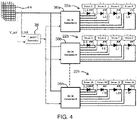
- FIG. 4 shows an arrangement with the luminaires L1 to L32 in parallel. Each again has an associated driver Driver-1 to Driver-32, but there are also separate outputs to each luminaire from the associated DC-DC converter 36a to 36h.
- the DC-DC converter drives the LED lighting unit of one luminaire independently from the driving of another luminaire.
- the failure/open circuit of one LED lighting unit does not influence the others.
- the DC-DC converter may be implemented by a voltage source and multiple linear switches to regulate the currents to different luminaires. This is useful when the LED lighting units have similar forward voltage.
- FIG. 5 shows that different sets of luminaires may have different configurations.
- Each set in this example has the lighting units again connected in series to the associated DC-DC converter.
- the grid driver 24 comprises a shared AC-DC converter 40 with power factor correction and one of a set of DC-DC drivers 42a to 42h associated with each set of luminaires.
- the first DC-DC driver 42a connects to each luminaire L1 to L4 in parallel and has a respective output for each luminaire.
- the second DC-DC driver 42b connects to the set of series luminaires with only one output for the full set and connects all LED lighting units of the luminaries in series, similar to the DC-DC converter for the solar panel.
- the DC-DC driver 42a may be implemented by a voltage source and multiple linear switches to regulate the currents to different luminaires. This is useful when the LED lighting units have similar forward voltage.
- the DC-DC driver 42b maybe implemented by a current source and is easy and convenient to implement and the wiring is simple.
- the lighting system may be powered by solar energy to avoid periods of darkness.
- the invention is of particular interest for indoor lighting systems especially in offices and commercial buildings.
Landscapes
- Engineering & Computer Science (AREA)
- Power Engineering (AREA)
- Circuit Arrangement For Electric Light Sources In General (AREA)
Description
- This invention relates to a lighting system according to
claim 1, a driver unit according toclaim 12 and a method according toclaim 14, which make use of solar energy. - Power conversion systems are used to collect energy from a solar panel and to deliver the energy to a load or energy storage system. For lighting applications, the storage of energy enables the lighting to be powered during nighttime, using energy collected during the day. However, lighting may also be desired during the day, in particular for indoor lighting, and there are therefore also energy saving benefits in using solar power to power lighting even during daylight periods.
- Power conversion takes place for the energy delivered by a solar system to provide the most efficient collection and storage of energy. Typically, this makes use of maximum power point tracking ("MPPT") systems, which control the operating point of the solar system (current and voltage) to achieve optimum power transfer.
- The energy obtained from a solar system typically needs to be stored so that energy may be available from the system both during times when the solar cells are illuminated (during the daytime) and when they are not (during the nighttime). A conventional solar system for example makes use of a MPPT charge controller to charge a battery from the solar system. The charged battery can then be used to power electrical loads. This requires additional investment for the battery. Furthermore, the battery charging and discharging process typically causes 5-10% round trip efficiency loss.
- Therefore, there is a need for a solution to enable direct solar power to be used for daytime lighting loads without using the battery. A grid tie inverter is able to directly feed the solar power to the AC grid, without using any battery. One approach which would enable solar energy to be used directly for LED based lighting would be to use a grid inverter and then perform AC-DC conversion. However, this results in a two stage (DC-AC and AC-DC) conversion process, which results in around 10-15% efficiency loss before reaching the LED load.
- A grid feeding installation also requires a power purchase agreement (PPA) with utility company. Such a PPA is not beneficial for small amounts of power transaction so that the use of a grid inverter is not appropriate in many situations.
- Therefore, a solution is needed to use direct solar energy for an LED lighting (or other DC load), without using any battery storage or grid tie inverter. The purpose is simply to make use of solar energy when it is available, rather than to collect and store the energy, so that efficiency gains may be made at low cost, for example without providing battery storage.
-
EP 2023037A1 discloses a luminaire that can utilize AC power as well as DC power directly from a solar panel.JP2013211248A US20130002142A1 andUS20120212050A1 disclose similar hybrid power systems that first integrate both solar energy and AC energy and then convert the integrated energy to the load. - A drawback of the above prior art is that it only provides a single luminaire application. For indoor applications, there are usually a lot of luminaires. How to utilize the solar energy for a batch of the luminaires in a high efficiency way is desired.
- The invention is defined by the claims.
- It is a concept of embodiments the invention to provide a lighting system which makes use of solar panel energy as well as an external grid power supply. A solar converter is used for the solar energy and a driver is used for the grid power supply. There are multiple luminaires, and their lighting units are connected together to be driven as one unit by the solar converter. Thus, a limited number of solar converters is enough for the batch of the luminaires. This reduces hardware cost and simplifies the overall system.
- According to examples in accordance with an aspect of the invention, there is provided a lighting system according to
claim 1. - This lighting system makes use of multiple luminaires. They are associated with conventional drivers which provides power conversion from an external AC or DC grid power supply (e.g. AC mains). The luminaires have their own driver. Most importantly, the lighting units of the luminaires are connected together by an extra connection unit, for example in series, and they are controlled/driven by a shared solar converter which provides power conversion from the solar panel. This unit avoids the need for battery storage when the solar energy is received at the same time that it is desired for the LED lighting. This provides a more efficient use of energy. The connection of the LED lighting units together for control as a single unit from the point of view of the solar panel provides reduced hardware cost. For example, it enables sharing of driver components such as an MPPT driver or an MPPT controller of an MPPT driver.
- The solar converter (from the solar panel) and the driver (the grid driver) are effectively connected in parallel from the point of view of each LED lighting unit, in that power can be received from one or other or both power sources. The solar panel solar converter for example delivers as much energy as it produces and the remaining requirement is met by the associated driver. This parallel connection allows controlling the power to the LED lighting unit more conveniently.
- The power rate of the driver is at least 10% of the peak output power rate of the solar panel, for example at least 20% and more preferably at least 30%. Thus, when the solar panel delivers a dropped power output due to the insolation on the solar panel, the driver can compensate for the power reduction.
- The grid driver may however have a lower peak power delivery than the peak solar panel output power rate, for example below 50%. The aim is to provide grid energy savings while maintaining light output stability.
- The feedback control implemented by the driver is used to regulate the total current flowing, e.g. from both the solar panel and from the external grid. This provides a feedback loop to maintain the current thus flickering is prevented/reduced.
- The driver is controlled to maintain a desired power transfer to the luminaires, and can also respond quickly to changes in solar panel output.
- In order to dim down one luminaire, less current is provided to the lighting units of that luminaire. Due to the connection of all lighting units, less current is also provided to the lighting units of other luminaires. Therefore, excess grid power is provided to other luminaires to maintain the output of other luminaires since they are not to be dimmed down.
- There may be a plurality of sets of multiple luminaires. There may then be sharing of some hardware of the solar converter even between multiple sets of luminaires. Each set of luminaires may be considered to comprise a cluster.
- The invention also provides a driver unit for a luminaire according to
claim 12. - This driver unit may be used in a luminaire to implement the system described above, for example with a hybrid series connection to solar power and parallel connection to grid power. The LED lighting unit is connected to the LED lighting unit of a preceding and/or following luminaire so that a set of connected lighting units may be formed. At the ends of the set, a connection can be made (using the same interface) to the first power received from the solar converter. Thus, the driver unit design enables a set of such driver units to be connected with their LED lighting units in series and with that series connection supplied by a solar converter.
- The invention also provides a luminaire comprising:
- an LED lighting unit; and
- a driver unit as defined above.
- This provides the combination of a driver as defined above with an LED lighting unit.
- The invention also provides a driving method for an LED luminaire system according to
claim 14. - These and other aspects of the invention will be apparent from and elucidated with reference to the embodiment(s) described hereinafter.
- Examples of the invention will now be described in detail with reference to the accompanying drawings, in which:
-
Fig. 1 shows in simplified schematic form a block diagram of a battery-less, power and control scheme for direct LED driving from harvested solar power; -
Fig. 2 shows in schematic form one possible interconnection scheme between multiple luminaires which together form the luminaire system; -
Fig. 3 shows a first example of a system with eight sets of multiple luminaires; -
Fig. 4 shows a second example of a system with eight sets of multiple luminaires; and -
Fig. 5 shows a third example of a system with eight sets of multiple luminaires. - It should be understood that the detailed description and specific examples, while indicating exemplary embodiments of the apparatus, systems and methods, are intended for purposes of illustration only and are not intended to limit the scope of the invention. These and other features, aspects, and advantages of the apparatus, systems and methods of the present invention will become better understood from the following description, appended claims, and accompanying drawings. It should be understood that the Figures are merely schematic and are not drawn to scale. It should also be understood that the same reference numerals are used throughout the Figures to indicate the same or similar parts.
- The invention provides a lighting system with a set of multiple LED luminaires, and which combines solar panel power and external grid power. A solar converter converts the output from the solar panel into a first power. Each luminaire is associated with a respective driver to inject current into the LED lighting unit from the external grid power supply. The LED lighting units of the luminaires are connected together to the solar converter and are thereby driven together by the first power simultaneously. This simplifies the structure of driving the multiple luminaries from solar power.
-
Figure 1 shows in simplified schematic form a block diagram of a battery-less, power and control scheme for direct LED driving from harvested solar power. - The
lighting system 10 comprises asolar input 12 for connection to asolar panel 14 and agrid input 16 for connection to an externalgrid power supply 18, such as an AC mains supply. - A
solar converter 20 is connected to thesolar input 12 to convert the output from thesolar panel 14 into a first power, shown in this example as output current I_LEDSL. - An
LED luminaire system 22 is provided which comprises a set of multiple luminaires (not individually shown inFigure 1 ), each comprising an LED lighting unit (which typically comprises a series LED arrangement). Each LED luminaire is associated with adriver 24 connected to thegrid input 16 to inject current into the LED lighting unit from the grid power supply. This injected current is shown as I_LEDAC. - Each luminaire is described as "associated with" a driver, because there may be a driver within each luminaire, or there may be a shared driver architecture as shown in the simplified schematic of
Figure 1 , which embodiment is covered by the invention, or there may be a partially shared driver architecture, which embodiments are not covered by the invention. These different possibilities are discussed further below. - The
solar converter 20 and thedriver 24 are effectively connected in parallel from the point of view of the luminaire system, in that power can be received from one or other or both power sources. - Within the
luminaire system 22, there is a connection unit to directly connect the LED lighting units of the multiple luminaires together to thesolar converter 20 so that the LED lighting units of the set of multiple luminaires are driven together by the first power simultaneously. - There is a feedback system for controlling the driving of the luminaire system or indeed individual luminaires within the luminaire system.
Figure 1 , which embodiment is not covered by the invention, shows a current sensing (CS) feedback signal LED_CS which is used as part of the control of the driver. Thus, the active control is implemented by the driver in response to an input reference drive level LED_CSREF. Thesolar panel converter 20 for example is used to deliver as much energy as it produces and the remaining requirement is met in a dynamic controlled way by the associateddriver 24. - The
luminaire system 22 makes use of multiple luminaires. A sharedsolar converter 20 provides power conversion from a solar panel. This avoids the need for battery storage when the solar energy is received at the same time that it is desired for the LED lighting. This provides a more efficient use of energy. The connection of the LED lighting units together for control as a single unit from the point of view of the solar panel provides reduced hardware cost. For example, it enables sharing of driver components such as an MPPT driver or an MPPT controller of an MPPT driver. - The individual units used to form the overall system may be conventional. For example, the system may make use of a known MPPT (maximum power point tracking) based LED driver module (which is termed a "converter" in this application) for the solar panel and a conventional grid powered LED driver module. The MPPT based
converter 20 will try to maintain a current through LED by extracting maximum power from the solar system. The solar insolation will vary with time causing changes in output power, hence causing changes in output current. Continuous changes in LED current are of course not accepted so the conventionalLED grid driver 24 functions as an LED current balancer and controller to smoothen the LED current. - In this way, the total LED current will be formed by the summation of the current supplied by
MPPT converter 20 and the grid-basedLED driver 24. - A
typical LED driver 24 already includes a current controller, and the system enables integration of the solar panel while still using thesame LED driver 24 and making use of current control implemented by theLED driver 24. -
Figure 1 represents a single luminaire as asingle block 22 driven by thesolar converter 20. - The invention proposes driving multiple luminaires, which together from a luminaire system, by a single solar converter/solar panel. For this purpose, an interconnection scheme between multiple luminaires is provided.
-
Figure 2 shows in schematic form one possible interconnection scheme between multiple luminaires which together form aluminaire system 22. Each luminaire comprises arespective driver unit lighting unit grid driver unit 24a-24d. Together, thesegrid driver units 24a-24d form theoverall driver 24 for the set of luminaires. -
Figure 2 shows for thefirst driver unit 24a asolar input 26 for connecting theLED lighting unit 30a either to an LED lighting unit of a connected preceding luminaire or to a first power which is derived from a solar panel. For thefirst driver unit 24a, thissolar input 26 connects to theconverter 20, whereas forother driver units 24b-24d, this solar input connects to the preceding luminaire. - A
first output 28 is for connecting the LED lighting unit either to an LED lighting unit of a connected following luminaire or to the first power. For thefirst driver unit 24a, thisfirst output 28 connects to the next luminaire, whereas for thelast driver unit 24d in the series, thisfirst output 28 connects back to the converter. - Within each driver, the
solar input 26 is also connected to the anode of the LED lighting unit, and thefirst output 28 is also connected to the cathode of the LED lighting unit. This is represented by the dotted connection lines inFigure 2 . Thus, thelighting units 30a-30d are connected in series to theconverter 20. Agrid input 29 is provided for connection of a driver within each driver unit to the externalgrid power supply 18. - In this way, the
solar input 26 andfirst output 28 define an interface to another luminaire such that theLED lighting unit 30a-30d is directly connected to the LED lighting unit of the other luminaire, and that interface is also for receiving the first power from thesolar converter 20. Note that the wiring could also connect directly to the anode and cathode of the LED lighting unit, in case thedriver units 24a to 24d do not provide the separate solar input and first output. -
Figure 2 shows theconverter 20 forming part of adistribution unit 32 between thegrid 18 and thesolar panel 14 on one side and theluminaire system 22 on the other side. This distribution unit includes thesingle converter 20 which is shared between all luminaires. - The grid (AC) power is provided to all
individual driver units 24a-24d in conventional parallel way through the distribution unit. However, solar power is provided to the luminaires as a series bank of lighting units. The series connection is made by aconnection unit 34, in particular a set of electrical connections between the lighting units of the luminaires. - By way of example, if each lighting unit voltage is 40V DC and four such units are connected in series, the MPPT converter output will be 160V DC. The output current sense resistor of each
driver unit solar converter 20 as well as from the grid. The driver has a sense resistor that is placed between the solar input and the first output and in series with the LED units. - In this approach, the rated lighting unit current will be slightly higher than the maximum MPPT output current from the
driver 20 at the highest solar insolation, to provide a best utilization of solar power. By way of example, it has been found by experiment that around 80% of solar current and 20% of grid current to the lighting units provides a desired operating point in order to achieve grid energy savings but also light output stability. However, for better power factor correction (PFC) and total harmonic distortion (THD) performance it is advisable to limit the solar power to a maximum of 70% of the total lighting unit power, which is equivalent to 30% dimming for the AC-DCLED driver units - To enable the lighting units to be connected together as explained, each luminaire of the set is equipped with two extra wires.
- A boost type
MPPT LED converter 20 is for example used to boost the voltage from the solar panel (for example 30V to 37V) to 160V to power the series-connected LED strings. The boostMPPT LED converter 20 tracks the solar voltage and current and extracts the maximum power from the solar panel and feeds this power to the LED strings. - The control loop of the grid
LED driver units 24a to 24d has a response time which is fast enough to handle changes in solar insolation without producing any deviations in visible light output from the set level. Therefore, it can provide a stable light output by adjusting its own current contribution to the LEDs. According to statistics, the solar panel output may drop by 60% in one second due to insolation change (such as when the sun is blocked by a cloud). By way of example, the driver units are adapted with a response capability to increase their output, within at most one second, to counteract at most 60% percent drop in the power of the solar panel within the same one second. - In general, the power rate of the (grid) driver is at least 10% of the peak output power rate of the solar panel. The MPPT converter varies the first power from the solar panel in order provide maximum power point tracking from the solar panel given different solar radiation conditions. The driver units then provide variable instantaneous power corresponding to the variable instantaneous power from the converter such that the sum power to the LED lighting unit is constant at a given dimming level of the luminaire.
- To reduce the wiring cost and complexity, a number of solar panels may be connected in series or parallel according to the requirements for power level, current and voltage, so that only two wires are needed from the solar panel (or solar panel array).
-
Figure 2 shows one set of multiple luminaires. There maybe a plurality of sets of multiple luminaires, and each set may then be considered to be a luminaire cluster within the overall set of luminaires of the luminaire system. Each set has the lighting units combined and controlled by asingle MPPT converter 20 as explained above. -
Figure 3 shows a first example showing eightsets 22a to 22h of multiple luminaires (22d to 22g are not shown). Each set is shown with four luminaires (L# where # is a luminaire number), and each luminaire has its own grid driver unit (i.e. thedriver units 24a-24d which together define the driver 24). There are thus 32 grid driver units (4 x 8) shown as "Driver-1" to "Driver-32". They are each part of a corresponding luminaire L1 to L32. Each driver unit is connected to the grid supply. - The lighting units of luminaires in each set are connected in series as shown.
Figure 3 represents each luminaire lighting unit as a single LED, but there will be a series and/or parallel connection of LEDs within each luminaire. In the example shown, each set 22a-22h has an associated DC-DC converter 36a to 36h (36d to 36g are not shown). There is one sharedMPPT controller 38 which drives all of the DC-DC converters. - The DC-DC converters function as power conditioning units which give good controllability. The lighting units of the luminaires in each set are connected in series and connected with one DC-DC converter for easy installation (wiring). Typically, the DC-DC converter supplies four to six luminaires.
- The DC-DC converters operate as parallel-connected MPPT converters but sharing the MPPT controller. The
MPPT controller 38 senses the solar voltage V_sol and current I sol and generates a pulse width modulation signal which is common to all of the DC-DC converters 36a to 36h, with the goal of maximizing the output power of the solar panel namely V_sol∗ I_sol. A known method of perturb and observe can be used. Because the same PWM signal is provided, all of the DC-DC converters are intended to operate at the same power level. However, due to differences in LED forward voltage between luminaires and different sets of luminaires, the DC-DC converters will not be able to operate at same power level in practice. - To prevent any luminaire from being operated at power levels greater than the rated power level of luminaire, each DC-DC converter operates at a limited power mode, whereby at any condition, no DC-DC converter operates its associated luminaires beyond the rated power of the luminaires.
- A power limited mode boost converter can be implemented using commercially available peak current control MOSFET driver ICs.
- An alternative option is to provide different PWM signals to each of the individual DC-DC converters especially when the DC-DC converters have different rating. This option can be useful to match the current flowing through different parallel sets of luminaires.
- In order to achieve maximum power point operation of the solar panel, and with constant PWM control of all of the DC-DC converters, the (single) PWM duty cycle is modulated until the maximum power point has been achieved. However, at times of high solar radiation, some DC-DC converters will then operate at the limited peak power whereas other converters will operate below this limited peak power to achieve the goal of the overall system operating at the maximum power point. For example, a total generated solar power may be 880W for 8 DC-DC converters and 32 luminaires (as shown in
Figure 3 ). When each DC-DC converter is controlled with the same PWM signal, the generated solar power is intended to be divided equally between the 8 DC-DC converters so that each DC-DC converter should receive 110W of power. Due to differences in the LED string voltages,converters converters 36a to 36c may instead operate at a power of 112W at which the power is limited. The other converters 36d to 36h may then be operated at a power below the 112W limit, for example to maintain the same overall power. For example, 880W-112W ∗3 = 544W is then shared between the five remaining converters, which thus may operate at 108.8W. - In this way each DC-DC converter will limit its own power so that the system as a whole will still operate at the maximum power point of the solar panel.
- It may be desirable to be able to dim an individual luminaire, or a sub-set of luminaires within a set, or all of the luminaires of one set, compared to the rest (when there are multiple sets). It is however still desirable to be able to operate the solar panel at the maximum power point.
- Assuming for example that 40W luminaires are being powered with 20W from the grid and 20W from the solar power. In combination, four luminaires in a set will operate at 80W of power from the solar panel and 80W of power from the grid. For a daylight harvesting operation, one particular luminaire may want to dim down to 50% i.e. 20W of power. For example Luminaire L1 associated with Driver-1 may want to dim down to 20W.
- To achieve this aim while maintaining maximum power point operation of the solar panel, the DC-
DC converter 36a will operate to supply 40W output power instead of 80W. All four luminaires of theset 22a will be supplied with 10W of average power from solar, i.e. based on the same PWM duty cycle control. - In that case luminaire L1 will receive 10W from the AC grid whereas the other three luminaires L2, L3, L4 (in non-dimming mode) will each receive 30W from the AC grid, based on the feedback control implemented within each individual driver.
- Thus, the solar panel delivers 10W to each luminaire in the set through the
converter 36a, and the grid driver delivers the rest. - There is a reduction of 40W of power supply from the
converter 36a. This additional 40W is distributed among the other converters (36b to 36h) in such a way that all converters will operate at a power level above the previous 80W but below the solar power limit, given as 112W above. Therefore, luminaires L5 to L32 will thus receive a slightly increased solar power share (>50%) than AC power share (<50%). In this way partial dimming of one or more luminaires with the overall system can be achieved while maintaining system-level maximum power point tracking operation. Those DC-DC converters (36b to 36h) will be instructed with a new PWM duty cycle (a larger duty cycle, for example) so as to increase the power drawn from the solar panel. - Thus, by this approach, if one converter is adapted to reduce power to its associated set of luminaires according to a dimming down command for at least one luminaire in the set of luminaires, the driver associated with the at least one luminaire is also adapted to reduce the power from the grid power supply. The drivers associated with the other luminaries in the set are adapted to increase the power from the grid power supply so as to maintain the power to the other luminaires.
- The DC-DC converter associated with other sets of luminaires is then adapted to increase power from the solar panel in order to maintain the maximum power output from the solar panel. Thus, a reduction in solar power demand to one set of luminaires is compensated by an increased demand from the others, so as to maintain the maximum power point tracking.
- If all luminaires in a set are desired to be dimmed down, the
solar MPPT controller 38 may need to operate below the maximum power point or else the system may seek permission from a building management system to provide further dimming down even though the system had already reached a maximum power saving mode. - For example, for a particular desired ambience (scene setting) or during a meeting room presentation, a user may want to dim down the light source to focus on an object such as a presentation screen etc. In this kind of application, the user may intend to reduce the light output even though a maximum power saving mode is reached.
- In some arrangements, extra solar power than is needed for the lighting may be utilized for some other purpose.
- Similarly, in case of luminaires with integrated presence detection sensors which are required to turn off when there is no presence detection, during these situations the respective DC-DC converter can be switched to zero power mode so that power can diverted to other DC-DC converters to meet the maximum power point operation.
- In another example, when the solar panel has excess generated power than is required by the lighting units, the DC-DC converters can operate at constant power mode which will be at a slightly lower operating point than the maximum power point of operation. In this case, power to the lighting units will be completely supplied by the solar panel. The AC grid can be eliminated completely to prevent the driver operating at a low power factor or low total harmonic distortion. The AC power will only kick in when the generated solar power is less than the demand.
- The MPPT converter may be equipped with a communications module to communicate with the building management system. In this way, the dimming function can also be controlled through the MPPT converter along with the grid driver.
- The lighting units are described above as connected in series to the
converter 20 but they may be connected in parallel or series based on the installation requirements and maximum voltage and maximum current of operation. -
Figure 4 shows an arrangement with the luminaires L1 to L32 in parallel. Each again has an associated driver Driver-1 to Driver-32, but there are also separate outputs to each luminaire from the associated DC-DC converter 36a to 36h. In short, within in one set, the DC-DC converter drives the LED lighting unit of one luminaire independently from the driving of another luminaire. The failure/open circuit of one LED lighting unit does not influence the others. More specifically, the DC-DC converter may be implemented by a voltage source and multiple linear switches to regulate the currents to different luminaires. This is useful when the LED lighting units have similar forward voltage. -
Figure 5 shows that different sets of luminaires may have different configurations. Each set in this example has the lighting units again connected in series to the associated DC-DC converter. - The
grid driver 24 comprises a shared AC-DC converter 40 with power factor correction and one of a set of DC-DC drivers 42a to 42h associated with each set of luminaires. - The first DC-
DC driver 42a connects to each luminaire L1 to L4 in parallel and has a respective output for each luminaire. The second DC-DC driver 42b connects to the set of series luminaires with only one output for the full set and connects all LED lighting units of the luminaries in series, similar to the DC-DC converter for the solar panel. Thus different combinations of circuit configurations are possible. The DC-DC driver 42a may be implemented by a voltage source and multiple linear switches to regulate the currents to different luminaires. This is useful when the LED lighting units have similar forward voltage. The DC-DC driver 42b maybe implemented by a current source and is easy and convenient to implement and the wiring is simple. - During load shedding or during changeover of the supply (i.e. from the grid supply to the DC supply), the lighting system may be powered by solar energy to avoid periods of darkness.
- The invention is of particular interest for indoor lighting systems especially in offices and commercial buildings.
- Other variations to the disclosed embodiments can be understood and effected by those skilled in the art in practicing the claimed invention, from a study of the drawings, the disclosure, and the appended claims. In the claims, the word "comprising" does not exclude other elements or steps, and the indefinite article "a" or "an" does not exclude a plurality. Any reference signs in the claims should not be construed as limiting the scope.
Claims (14)
- A lighting system (10) comprising:a grid input (16) configured for connection to an external grid power supply (18);an LED luminaire system (22) comprising a set of multiple luminaires (L1-L32), each luminaire comprising an LED lighting unit (30a-30d) and a driver (24; 24a-24d) connected to the grid input configured to inject current into the LED lighting unit from the external grid power supply (18); anda solar input (12) configured for connection to a solar panel (14);a solar converter (20) connected to the solar input configured to convert the output from the solar panel (14) into a first power;a connection unit (34) configured to connect the LED lighting units of the set of the multiple luminaires together and to the solar converter (20) and thereby the LED lighting units of the set of multiple luminaires are adapted to share the first power,characterized in that the respective driver of each luminaire and the solar converter are in parallel connection with the respective LED lighting unit of the luminaire, and the solar converter (20) and the respective driver (24) of each luminaire are adapted to drive the respective LED lighting unit of the luminaire simultaneously.
- A lighting system as claimed in claim 1, wherein each respective driver is decoupled from the solar input or the solar converter at its input, and comprises a feedback control system configured to control the respective driver in dependence on the current flowing to the respective LED lighting unit of the luminaire from both the first power and from the respective driver itself.
- A lighting system as claimed in claim 1 or 2, comprising a plurality of sets (22a-22h) of multiple luminaires.
- A lighting system as claimed in claim 2 or 3, wherein:the solar converter (20) is adapted to vary the first power in order to track a maximum output power from the solar panel (14) given different solar radiation conditions;the respective driver (24a-24d) of each luminaire is adapted to provide variable instantaneous power corresponding to the variable instantaneous power from the solar converter such that the sum power to the LED lighting unit (30a-30d) is constant at a given dimming level of the luminaire; andthe respective driver of each luminaire is adapted with a response capability to increase its output, within at most one second, to counteract at least 60% percent drop in the power of the solar panel within the same at most one second.
- A lighting system as claimed in claim 4, wherein:
the solar converter (20) is adapted to reduce power to the set of luminaires, according to a dimming down command for at least one luminaire in the set of luminaires, wherein in response to the dimming down command:the driver (24a-24d) of the at least one luminaire is adapted to reduce the power from the external grid power supply; andthe respective drivers of the other luminaires in the set are adapted to increase the power from the grid power supply so as to maintain the power to the other luminaires. - A lighting system as claimed in claim 5 when not dependent on claim 3 , comprising a plurality of sets (22a-22h) of multiple luminaires or a lighting system as claimed in claim 5 when dependent on claim 3, wherein the solar converter (20) comprises a single MPPT controller (38) and a respective DC-DC converter (36a-36h) within each set (22a-22h) of multiple luminaires, wherein the respective DC-DC converter associated with other sets, different from the set to which the dimming down command relates, is adapted to increase power from the solar panel (14) in order to maintain the maximum power output from the solar panel.
- A lighting system as claimed in claim 6, wherein the respective driver of each luminaire in the other sets is adapted to reduce the power from the external grid power supply (18) so as to maintain the power to the luminaires of the other sets.
- A lighting system as claimed in any preceding claim, wherein the connection unit (34) is adapted:to connect at least some of the LED lighting units (30a-30d) of different luminaires in series to the solar converter (20); orto connect at least some of the LED lighting units (30a-30d) of different luminaires in parallel to the solar converter (20).
- A lighting system as claimed in any preceding claim, wherein the drivers (24a-24h) are connected in parallel to the external grid power supply.
- A lighting system as claimed in any preceding claim when not dependent on claim 3, comprising a plurality of sets (22a-22h) of multiple luminaires or a lighting system as claimed in any preceding claim when dependent on claim 3, and further comprising an AC-DC PFC stage (40),
wherein each set of luminaires comprises a DC-DC stage (42a-42h) for receiving power from the AC-DC PFC stage (40), the AC-DC PFC stage (40) and one DC-DC stage (42a-42h) together functioning as the respective driver. - A lighting system as claimed in any preceding claim, wherein each LED lighting unit comprises an array of LED chips.
- A driver unit (24) for a luminaire which comprises an LED lighting unit (30a-30d), the driver unit comprising:a grid input (29) configured for connection to an external grid power supply; anda driver (24a-24d) connected to the grid input configured to inject current at a driver output into the LED lighting unit of the luminaire from the external grid power supply,a solar input (26) configured for connecting the LED lighting unit either to an LED lighting unit of a connected preceding luminaire or to a first power from a solar converter which is derived from a solar panel;a first output (28) configured for connecting the LED lighting unit either to an LED lighting unit of a connected following luminaire or to the first power;wherein the solar input and first output define an interface to another luminaire such that the LED lighting unit is connected to the LED lighting unit of the another luminaire together and share the first power from the solar converter different from the driver, whereinthe solar input and the first output are in parallel connection with the driver output to the LED lighting unit, the driver (24) is adapted to drive the LED lighting units simultaneously as the first power powering the LED lighting units.
- A luminaire comprising:an LED lighting unit (30a-30d); anda driver unit as claimed in claim 12.
- A driving method for an LED luminaire system comprising a set of multiple luminaires, the method comprising:receiving energy from an external grid power supply;using the respective driver of each luminaire to inject current into the respective LED lighting unit of the luminaire from the external grid power supply;receiving energy from a solar panel;converting the energy from the solar panel into a first power; andconnecting the LED lighting units of the luminaires together to the first power such that the LED lighting units of the set of multiple luminaires share the first power,connecting the respective driver of each luminaire and the first power in a parallel connection with the respective LED lighting unit of the luminaire from the perspective of the LED lighting unit, and injecting current simultaneously by the driver as the first power powering the LED lighting unit.
Applications Claiming Priority (3)
| Application Number | Priority Date | Filing Date | Title |
|---|---|---|---|
| IN201841004656 | 2018-02-07 | ||
| EP18165327 | 2018-03-30 | ||
| PCT/EP2019/051952 WO2019154649A1 (en) | 2018-02-07 | 2019-01-28 | Lighting system and method |
Publications (2)
| Publication Number | Publication Date |
|---|---|
| EP3750379A1 EP3750379A1 (en) | 2020-12-16 |
| EP3750379B1 true EP3750379B1 (en) | 2022-03-30 |
Family
ID=65139018
Family Applications (1)
| Application Number | Title | Priority Date | Filing Date |
|---|---|---|---|
| EP19701250.3A Active EP3750379B1 (en) | 2018-02-07 | 2019-01-28 | Lighting system and method |
Country Status (4)
| Country | Link |
|---|---|
| US (1) | US11289916B2 (en) |
| EP (1) | EP3750379B1 (en) |
| CN (1) | CN111684865A (en) |
| WO (1) | WO2019154649A1 (en) |
Families Citing this family (2)
| Publication number | Priority date | Publication date | Assignee | Title |
|---|---|---|---|---|
| CN110601256B (en) * | 2019-09-04 | 2020-09-18 | 北京妙微科技有限公司 | Power flow control method |
| JP2023554131A (en) * | 2020-12-21 | 2023-12-26 | ヴァレオ ビジョン | Lighting assembly to perform multiple lighting functions |
Family Cites Families (16)
| Publication number | Priority date | Publication date | Assignee | Title |
|---|---|---|---|---|
| TW200830687A (en) * | 2007-01-15 | 2008-07-16 | zhen-yue Fan | Control apparatus of solar power system |
| NL1034237C2 (en) | 2007-08-08 | 2009-02-10 | Etap Nv | Lighting system. |
| US20090224681A1 (en) * | 2008-03-10 | 2009-09-10 | S & A Solar Technologies, Inc. | Hybrid Solar Powered and Grid Powered Lighting System |
| CN101534590B (en) * | 2009-04-16 | 2012-07-04 | 陆启升 | Solar energy illuminating control power supply |
| JP5303394B2 (en) | 2009-08-05 | 2013-10-02 | 株式会社キルトプランニングオフィス | LED lighting system using solar cells |
| JP5518419B2 (en) | 2009-10-05 | 2014-06-11 | パナソニック株式会社 | Power supply management device |
| EP2547175B1 (en) | 2010-03-11 | 2020-05-06 | Rohm Co., Ltd. | Illumination system |
| US8841862B2 (en) | 2011-06-29 | 2014-09-23 | Chong Uk Lee | LED driving system and method for variable voltage input |
| JP6168643B2 (en) | 2012-02-29 | 2017-07-26 | サンコネックス株式会社 | Lighting system |
| CN103826354A (en) * | 2012-11-19 | 2014-05-28 | 拓普盛达信息技术(大连)有限公司 | LED constant current source |
| US9748772B2 (en) * | 2013-02-14 | 2017-08-29 | Abb Schweiz Ag | Method of controlling a solar power plant, a power conversion system, a DC/AC inverter and a solar power plant |
| EP2979353A2 (en) | 2013-03-29 | 2016-02-03 | Koninklijke Philips N.V. | Power conversion for solar / wind / water energy |
| CN103547043B (en) * | 2013-11-07 | 2015-10-28 | 东莞市石龙富华电子有限公司 | A kind of centralized direct-current micro-grid electric power system of LED and method for controlling power supply |
| CN103647283A (en) * | 2013-12-11 | 2014-03-19 | 湖北工业大学 | Solar power grid and municipal power grid no-countercurrent combination power supply control system and method thereof |
| US9470413B2 (en) * | 2014-06-11 | 2016-10-18 | ATLeisure LLC | Solar powered LED lighting system and a umbrella having the same |
| EP3666043B1 (en) * | 2017-09-20 | 2026-01-21 | 10644137 Canada Inc. | Led lighting system and a method therefor |
-
2019
- 2019-01-28 EP EP19701250.3A patent/EP3750379B1/en active Active
- 2019-01-28 WO PCT/EP2019/051952 patent/WO2019154649A1/en not_active Ceased
- 2019-01-28 US US16/967,187 patent/US11289916B2/en active Active
- 2019-01-28 CN CN201980012112.XA patent/CN111684865A/en active Pending
Also Published As
| Publication number | Publication date |
|---|---|
| CN111684865A (en) | 2020-09-18 |
| US11289916B2 (en) | 2022-03-29 |
| WO2019154649A1 (en) | 2019-08-15 |
| US20210050727A1 (en) | 2021-02-18 |
| EP3750379A1 (en) | 2020-12-16 |
Similar Documents
| Publication | Publication Date | Title |
|---|---|---|
| Weiss et al. | Energy efficient low-voltage DC-grids for commercial buildings | |
| US10381930B2 (en) | Three-port direct current converter | |
| US8053929B2 (en) | Solar power array with maximized panel power extraction | |
| US8436555B2 (en) | DC low voltage distribution box for indoor multi LEDs lamp | |
| US11147138B2 (en) | Lighting power supply system and method | |
| KR102753400B1 (en) | LED lighting system and method thereof | |
| CN108767842B (en) | A DC air-conditioning power supply system complementary to photovoltaic and power grid | |
| US20120112641A1 (en) | Led night light/led emergency light | |
| JP2020522221A (en) | Battery control system, and battery system and solar power generation system using the control system | |
| CA2734211A1 (en) | Solid state device controller | |
| EP3750379B1 (en) | Lighting system and method | |
| CN117335537B (en) | Current control circuit and control method for parallel DC voltage sources | |
| US20200396810A1 (en) | Constant current driver charging energy storage unit | |
| CN216626120U (en) | Constant voltage power supply centralized power supply system | |
| BG66619B1 (en) | Method for control of the accumulation and consumption of energy and device for its implementation | |
| KR20180104443A (en) | Apparatus for driving composite led | |
| JP2012054142A (en) | Led lighting system | |
| JP2012029374A (en) | Power supply unit, lighting apparatus therewith, display unit therewith, and lighting control system with lighting apparatus | |
| JP6072991B1 (en) | Converter between solar panel, source and load | |
| Mujumdar et al. | Photovoltaic based led lighting with maximum power point tracking | |
| EP4451804A1 (en) | Driver and power supply system for lighting means | |
| US20230092612A1 (en) | Dual-Input Renewable Energy DC Microgrid-Ready Lighting Fixtures | |
| CN102149239A (en) | LED (light-emitting diode) string current-equalizing circuit and control method | |
| Chandrasingh et al. | An Incremental MPPT-Controlled Soft-Switched LED Driver Using a PV-Fed Boost Converter for Street Lighting | |
| Kato et al. | Individual PV Cell Control based on Time Division Power Transmission System1 |
Legal Events
| Date | Code | Title | Description |
|---|---|---|---|
| STAA | Information on the status of an ep patent application or granted ep patent |
Free format text: STATUS: UNKNOWN |
|
| STAA | Information on the status of an ep patent application or granted ep patent |
Free format text: STATUS: THE INTERNATIONAL PUBLICATION HAS BEEN MADE |
|
| PUAI | Public reference made under article 153(3) epc to a published international application that has entered the european phase |
Free format text: ORIGINAL CODE: 0009012 |
|
| STAA | Information on the status of an ep patent application or granted ep patent |
Free format text: STATUS: REQUEST FOR EXAMINATION WAS MADE |
|
| 17P | Request for examination filed |
Effective date: 20200907 |
|
| AK | Designated contracting states |
Kind code of ref document: A1 Designated state(s): AL AT BE BG CH CY CZ DE DK EE ES FI FR GB GR HR HU IE IS IT LI LT LU LV MC MK MT NL NO PL PT RO RS SE SI SK SM TR |
|
| AX | Request for extension of the european patent |
Extension state: BA ME |
|
| DAV | Request for validation of the european patent (deleted) | ||
| DAX | Request for extension of the european patent (deleted) | ||
| REG | Reference to a national code |
Ref country code: DE Ref legal event code: R079 Ref document number: 602019013062 Country of ref document: DE Free format text: PREVIOUS MAIN CLASS: H05B0033080000 Ipc: H02J0003380000 |
|
| GRAP | Despatch of communication of intention to grant a patent |
Free format text: ORIGINAL CODE: EPIDOSNIGR1 |
|
| STAA | Information on the status of an ep patent application or granted ep patent |
Free format text: STATUS: GRANT OF PATENT IS INTENDED |
|
| RIC1 | Information provided on ipc code assigned before grant |
Ipc: H05B 45/10 20200101ALI20210907BHEP Ipc: H02J 7/35 20060101ALI20210907BHEP Ipc: H02J 3/38 20060101AFI20210907BHEP |
|
| GRAJ | Information related to disapproval of communication of intention to grant by the applicant or resumption of examination proceedings by the epo deleted |
Free format text: ORIGINAL CODE: EPIDOSDIGR1 |
|
| GRAP | Despatch of communication of intention to grant a patent |
Free format text: ORIGINAL CODE: EPIDOSNIGR1 |
|
| INTG | Intention to grant announced |
Effective date: 20211013 |
|
| INTG | Intention to grant announced |
Effective date: 20211027 |
|
| GRAS | Grant fee paid |
Free format text: ORIGINAL CODE: EPIDOSNIGR3 |
|
| GRAA | (expected) grant |
Free format text: ORIGINAL CODE: 0009210 |
|
| STAA | Information on the status of an ep patent application or granted ep patent |
Free format text: STATUS: THE PATENT HAS BEEN GRANTED |
|
| AK | Designated contracting states |
Kind code of ref document: B1 Designated state(s): AL AT BE BG CH CY CZ DE DK EE ES FI FR GB GR HR HU IE IS IT LI LT LU LV MC MK MT NL NO PL PT RO RS SE SI SK SM TR |
|
| REG | Reference to a national code |
Ref country code: GB Ref legal event code: FG4D |
|
| REG | Reference to a national code |
Ref country code: CH Ref legal event code: EP |
|
| REG | Reference to a national code |
Ref country code: AT Ref legal event code: REF Ref document number: 1480070 Country of ref document: AT Kind code of ref document: T Effective date: 20220415 |
|
| REG | Reference to a national code |
Ref country code: DE Ref legal event code: R096 Ref document number: 602019013062 Country of ref document: DE |
|
| REG | Reference to a national code |
Ref country code: IE Ref legal event code: FG4D |
|
| REG | Reference to a national code |
Ref country code: LT Ref legal event code: MG9D |
|
| PG25 | Lapsed in a contracting state [announced via postgrant information from national office to epo] |
Ref country code: SE Free format text: LAPSE BECAUSE OF FAILURE TO SUBMIT A TRANSLATION OF THE DESCRIPTION OR TO PAY THE FEE WITHIN THE PRESCRIBED TIME-LIMIT Effective date: 20220330 Ref country code: RS Free format text: LAPSE BECAUSE OF FAILURE TO SUBMIT A TRANSLATION OF THE DESCRIPTION OR TO PAY THE FEE WITHIN THE PRESCRIBED TIME-LIMIT Effective date: 20220330 Ref country code: NO Free format text: LAPSE BECAUSE OF FAILURE TO SUBMIT A TRANSLATION OF THE DESCRIPTION OR TO PAY THE FEE WITHIN THE PRESCRIBED TIME-LIMIT Effective date: 20220630 Ref country code: LT Free format text: LAPSE BECAUSE OF FAILURE TO SUBMIT A TRANSLATION OF THE DESCRIPTION OR TO PAY THE FEE WITHIN THE PRESCRIBED TIME-LIMIT Effective date: 20220330 Ref country code: HR Free format text: LAPSE BECAUSE OF FAILURE TO SUBMIT A TRANSLATION OF THE DESCRIPTION OR TO PAY THE FEE WITHIN THE PRESCRIBED TIME-LIMIT Effective date: 20220330 Ref country code: BG Free format text: LAPSE BECAUSE OF FAILURE TO SUBMIT A TRANSLATION OF THE DESCRIPTION OR TO PAY THE FEE WITHIN THE PRESCRIBED TIME-LIMIT Effective date: 20220630 |
|
| REG | Reference to a national code |
Ref country code: NL Ref legal event code: MP Effective date: 20220330 |
|
| REG | Reference to a national code |
Ref country code: AT Ref legal event code: MK05 Ref document number: 1480070 Country of ref document: AT Kind code of ref document: T Effective date: 20220330 |
|
| PG25 | Lapsed in a contracting state [announced via postgrant information from national office to epo] |
Ref country code: LV Free format text: LAPSE BECAUSE OF FAILURE TO SUBMIT A TRANSLATION OF THE DESCRIPTION OR TO PAY THE FEE WITHIN THE PRESCRIBED TIME-LIMIT Effective date: 20220330 Ref country code: GR Free format text: LAPSE BECAUSE OF FAILURE TO SUBMIT A TRANSLATION OF THE DESCRIPTION OR TO PAY THE FEE WITHIN THE PRESCRIBED TIME-LIMIT Effective date: 20220701 Ref country code: FI Free format text: LAPSE BECAUSE OF FAILURE TO SUBMIT A TRANSLATION OF THE DESCRIPTION OR TO PAY THE FEE WITHIN THE PRESCRIBED TIME-LIMIT Effective date: 20220330 |
|
| PG25 | Lapsed in a contracting state [announced via postgrant information from national office to epo] |
Ref country code: NL Free format text: LAPSE BECAUSE OF FAILURE TO SUBMIT A TRANSLATION OF THE DESCRIPTION OR TO PAY THE FEE WITHIN THE PRESCRIBED TIME-LIMIT Effective date: 20220330 |
|
| PG25 | Lapsed in a contracting state [announced via postgrant information from national office to epo] |
Ref country code: SM Free format text: LAPSE BECAUSE OF FAILURE TO SUBMIT A TRANSLATION OF THE DESCRIPTION OR TO PAY THE FEE WITHIN THE PRESCRIBED TIME-LIMIT Effective date: 20220330 Ref country code: SK Free format text: LAPSE BECAUSE OF FAILURE TO SUBMIT A TRANSLATION OF THE DESCRIPTION OR TO PAY THE FEE WITHIN THE PRESCRIBED TIME-LIMIT Effective date: 20220330 Ref country code: RO Free format text: LAPSE BECAUSE OF FAILURE TO SUBMIT A TRANSLATION OF THE DESCRIPTION OR TO PAY THE FEE WITHIN THE PRESCRIBED TIME-LIMIT Effective date: 20220330 Ref country code: PT Free format text: LAPSE BECAUSE OF FAILURE TO SUBMIT A TRANSLATION OF THE DESCRIPTION OR TO PAY THE FEE WITHIN THE PRESCRIBED TIME-LIMIT Effective date: 20220801 Ref country code: ES Free format text: LAPSE BECAUSE OF FAILURE TO SUBMIT A TRANSLATION OF THE DESCRIPTION OR TO PAY THE FEE WITHIN THE PRESCRIBED TIME-LIMIT Effective date: 20220330 Ref country code: EE Free format text: LAPSE BECAUSE OF FAILURE TO SUBMIT A TRANSLATION OF THE DESCRIPTION OR TO PAY THE FEE WITHIN THE PRESCRIBED TIME-LIMIT Effective date: 20220330 Ref country code: CZ Free format text: LAPSE BECAUSE OF FAILURE TO SUBMIT A TRANSLATION OF THE DESCRIPTION OR TO PAY THE FEE WITHIN THE PRESCRIBED TIME-LIMIT Effective date: 20220330 Ref country code: AT Free format text: LAPSE BECAUSE OF FAILURE TO SUBMIT A TRANSLATION OF THE DESCRIPTION OR TO PAY THE FEE WITHIN THE PRESCRIBED TIME-LIMIT Effective date: 20220330 |
|
| PG25 | Lapsed in a contracting state [announced via postgrant information from national office to epo] |
Ref country code: PL Free format text: LAPSE BECAUSE OF FAILURE TO SUBMIT A TRANSLATION OF THE DESCRIPTION OR TO PAY THE FEE WITHIN THE PRESCRIBED TIME-LIMIT Effective date: 20220330 Ref country code: IS Free format text: LAPSE BECAUSE OF FAILURE TO SUBMIT A TRANSLATION OF THE DESCRIPTION OR TO PAY THE FEE WITHIN THE PRESCRIBED TIME-LIMIT Effective date: 20220730 Ref country code: AL Free format text: LAPSE BECAUSE OF FAILURE TO SUBMIT A TRANSLATION OF THE DESCRIPTION OR TO PAY THE FEE WITHIN THE PRESCRIBED TIME-LIMIT Effective date: 20220330 |
|
| REG | Reference to a national code |
Ref country code: DE Ref legal event code: R097 Ref document number: 602019013062 Country of ref document: DE |
|
| RAP4 | Party data changed (patent owner data changed or rights of a patent transferred) |
Owner name: SIGNIFY HOLDING B.V. |
|
| PG25 | Lapsed in a contracting state [announced via postgrant information from national office to epo] |
Ref country code: DK Free format text: LAPSE BECAUSE OF FAILURE TO SUBMIT A TRANSLATION OF THE DESCRIPTION OR TO PAY THE FEE WITHIN THE PRESCRIBED TIME-LIMIT Effective date: 20220330 |
|
| PLBE | No opposition filed within time limit |
Free format text: ORIGINAL CODE: 0009261 |
|
| STAA | Information on the status of an ep patent application or granted ep patent |
Free format text: STATUS: NO OPPOSITION FILED WITHIN TIME LIMIT |
|
| 26N | No opposition filed |
Effective date: 20230103 |
|
| PG25 | Lapsed in a contracting state [announced via postgrant information from national office to epo] |
Ref country code: SI Free format text: LAPSE BECAUSE OF FAILURE TO SUBMIT A TRANSLATION OF THE DESCRIPTION OR TO PAY THE FEE WITHIN THE PRESCRIBED TIME-LIMIT Effective date: 20220330 |
|
| PG25 | Lapsed in a contracting state [announced via postgrant information from national office to epo] |
Ref country code: IT Free format text: LAPSE BECAUSE OF FAILURE TO SUBMIT A TRANSLATION OF THE DESCRIPTION OR TO PAY THE FEE WITHIN THE PRESCRIBED TIME-LIMIT Effective date: 20220330 |
|
| REG | Reference to a national code |
Ref country code: DE Ref legal event code: R119 Ref document number: 602019013062 Country of ref document: DE |
|
| REG | Reference to a national code |
Ref country code: CH Ref legal event code: PL |
|
| GBPC | Gb: european patent ceased through non-payment of renewal fee |
Effective date: 20230128 |
|
| PG25 | Lapsed in a contracting state [announced via postgrant information from national office to epo] |
Ref country code: LU Free format text: LAPSE BECAUSE OF NON-PAYMENT OF DUE FEES Effective date: 20230128 |
|
| REG | Reference to a national code |
Ref country code: BE Ref legal event code: MM Effective date: 20230131 |
|
| PG25 | Lapsed in a contracting state [announced via postgrant information from national office to epo] |
Ref country code: LI Free format text: LAPSE BECAUSE OF NON-PAYMENT OF DUE FEES Effective date: 20230131 Ref country code: GB Free format text: LAPSE BECAUSE OF NON-PAYMENT OF DUE FEES Effective date: 20230128 Ref country code: DE Free format text: LAPSE BECAUSE OF NON-PAYMENT OF DUE FEES Effective date: 20230801 Ref country code: CH Free format text: LAPSE BECAUSE OF NON-PAYMENT OF DUE FEES Effective date: 20230131 |
|
| PG25 | Lapsed in a contracting state [announced via postgrant information from national office to epo] |
Ref country code: FR Free format text: LAPSE BECAUSE OF NON-PAYMENT OF DUE FEES Effective date: 20230131 Ref country code: BE Free format text: LAPSE BECAUSE OF NON-PAYMENT OF DUE FEES Effective date: 20230131 |
|
| PG25 | Lapsed in a contracting state [announced via postgrant information from national office to epo] |
Ref country code: IE Free format text: LAPSE BECAUSE OF NON-PAYMENT OF DUE FEES Effective date: 20230128 |
|
| PG25 | Lapsed in a contracting state [announced via postgrant information from national office to epo] |
Ref country code: MC Free format text: LAPSE BECAUSE OF FAILURE TO SUBMIT A TRANSLATION OF THE DESCRIPTION OR TO PAY THE FEE WITHIN THE PRESCRIBED TIME-LIMIT Effective date: 20220330 |
|
| PG25 | Lapsed in a contracting state [announced via postgrant information from national office to epo] |
Ref country code: MC Free format text: LAPSE BECAUSE OF FAILURE TO SUBMIT A TRANSLATION OF THE DESCRIPTION OR TO PAY THE FEE WITHIN THE PRESCRIBED TIME-LIMIT Effective date: 20220330 |
|
| PG25 | Lapsed in a contracting state [announced via postgrant information from national office to epo] |
Ref country code: CY Free format text: LAPSE BECAUSE OF FAILURE TO SUBMIT A TRANSLATION OF THE DESCRIPTION OR TO PAY THE FEE WITHIN THE PRESCRIBED TIME-LIMIT; INVALID AB INITIO Effective date: 20190128 |
|
| PG25 | Lapsed in a contracting state [announced via postgrant information from national office to epo] |
Ref country code: HU Free format text: LAPSE BECAUSE OF FAILURE TO SUBMIT A TRANSLATION OF THE DESCRIPTION OR TO PAY THE FEE WITHIN THE PRESCRIBED TIME-LIMIT; INVALID AB INITIO Effective date: 20190128 |
|
| PG25 | Lapsed in a contracting state [announced via postgrant information from national office to epo] |
Ref country code: TR Free format text: LAPSE BECAUSE OF FAILURE TO SUBMIT A TRANSLATION OF THE DESCRIPTION OR TO PAY THE FEE WITHIN THE PRESCRIBED TIME-LIMIT Effective date: 20220330 |