EP3748749A1 - Fuel cell and cell unit thereof, and cell stack structure body - Google Patents
Fuel cell and cell unit thereof, and cell stack structure body Download PDFInfo
- Publication number
- EP3748749A1 EP3748749A1 EP18904159.3A EP18904159A EP3748749A1 EP 3748749 A1 EP3748749 A1 EP 3748749A1 EP 18904159 A EP18904159 A EP 18904159A EP 3748749 A1 EP3748749 A1 EP 3748749A1
- Authority
- EP
- European Patent Office
- Prior art keywords
- openings
- cell
- fluid
- fuel
- cooling medium
- Prior art date
- Legal status (The legal status is an assumption and is not a legal conclusion. Google has not performed a legal analysis and makes no representation as to the accuracy of the status listed.)
- Withdrawn
Links
- 239000000446 fuel Substances 0.000 title claims description 227
- 239000012530 fluid Substances 0.000 claims description 408
- 230000001590 oxidative effect Effects 0.000 claims description 138
- 239000002826 coolant Substances 0.000 claims description 135
- 239000003054 catalyst Substances 0.000 claims description 43
- 239000012528 membrane Substances 0.000 claims description 35
- 238000009792 diffusion process Methods 0.000 claims description 22
- 239000003792 electrolyte Substances 0.000 claims description 18
- 238000010248 power generation Methods 0.000 claims description 16
- 230000001154 acute effect Effects 0.000 claims description 14
- 239000003566 sealing material Substances 0.000 claims description 14
- 230000000737 periodic effect Effects 0.000 claims description 8
- 230000000295 complement effect Effects 0.000 claims description 2
- 238000006073 displacement reaction Methods 0.000 claims description 2
- 239000010410 layer Substances 0.000 description 62
- 230000015572 biosynthetic process Effects 0.000 description 27
- 238000005755 formation reaction Methods 0.000 description 27
- 239000007789 gas Substances 0.000 description 25
- 238000006243 chemical reaction Methods 0.000 description 22
- 239000001257 hydrogen Substances 0.000 description 16
- 229910052739 hydrogen Inorganic materials 0.000 description 16
- QVGXLLKOCUKJST-UHFFFAOYSA-N atomic oxygen Chemical compound [O] QVGXLLKOCUKJST-UHFFFAOYSA-N 0.000 description 14
- 239000001301 oxygen Substances 0.000 description 14
- 229910052760 oxygen Inorganic materials 0.000 description 14
- 238000009826 distribution Methods 0.000 description 13
- 238000007789 sealing Methods 0.000 description 13
- UFHFLCQGNIYNRP-UHFFFAOYSA-N Hydrogen Chemical compound [H][H] UFHFLCQGNIYNRP-UHFFFAOYSA-N 0.000 description 11
- 239000005518 polymer electrolyte Substances 0.000 description 11
- 239000013598 vector Substances 0.000 description 10
- 229910052751 metal Inorganic materials 0.000 description 9
- 239000002184 metal Substances 0.000 description 9
- 230000001427 coherent effect Effects 0.000 description 8
- 238000000034 method Methods 0.000 description 8
- 230000008859 change Effects 0.000 description 7
- 230000008878 coupling Effects 0.000 description 7
- 238000010168 coupling process Methods 0.000 description 7
- 238000005859 coupling reaction Methods 0.000 description 7
- OKTJSMMVPCPJKN-UHFFFAOYSA-N Carbon Chemical compound [C] OKTJSMMVPCPJKN-UHFFFAOYSA-N 0.000 description 5
- 239000004215 Carbon black (E152) Substances 0.000 description 5
- 229910052799 carbon Inorganic materials 0.000 description 5
- 230000000694 effects Effects 0.000 description 5
- 229930195733 hydrocarbon Natural products 0.000 description 5
- 150000002430 hydrocarbons Chemical class 0.000 description 5
- 150000002431 hydrogen Chemical class 0.000 description 5
- 239000002346 layers by function Substances 0.000 description 5
- 238000004519 manufacturing process Methods 0.000 description 5
- 229920000642 polymer Polymers 0.000 description 5
- 230000008569 process Effects 0.000 description 5
- YCKRFDGAMUMZLT-UHFFFAOYSA-N Fluorine atom Chemical compound [F] YCKRFDGAMUMZLT-UHFFFAOYSA-N 0.000 description 4
- 238000005530 etching Methods 0.000 description 4
- 229910052731 fluorine Inorganic materials 0.000 description 4
- 239000011737 fluorine Substances 0.000 description 4
- 239000011888 foil Substances 0.000 description 4
- 230000007246 mechanism Effects 0.000 description 4
- 230000036647 reaction Effects 0.000 description 4
- XLYOFNOQVPJJNP-UHFFFAOYSA-N water Substances O XLYOFNOQVPJJNP-UHFFFAOYSA-N 0.000 description 4
- OKKJLVBELUTLKV-UHFFFAOYSA-N Methanol Chemical compound OC OKKJLVBELUTLKV-UHFFFAOYSA-N 0.000 description 3
- 238000001816 cooling Methods 0.000 description 3
- 238000005520 cutting process Methods 0.000 description 3
- 230000007423 decrease Effects 0.000 description 3
- 238000007254 oxidation reaction Methods 0.000 description 3
- 239000011148 porous material Substances 0.000 description 3
- 238000006722 reduction reaction Methods 0.000 description 3
- 239000007787 solid Substances 0.000 description 3
- TXEYQDLBPFQVAA-UHFFFAOYSA-N tetrafluoromethane Chemical compound FC(F)(F)F TXEYQDLBPFQVAA-UHFFFAOYSA-N 0.000 description 3
- LSNNMFCWUKXFEE-UHFFFAOYSA-M Bisulfite Chemical compound OS([O-])=O LSNNMFCWUKXFEE-UHFFFAOYSA-M 0.000 description 2
- NBIIXXVUZAFLBC-UHFFFAOYSA-N Phosphoric acid Chemical compound OP(O)(O)=O NBIIXXVUZAFLBC-UHFFFAOYSA-N 0.000 description 2
- 239000003570 air Substances 0.000 description 2
- 230000008901 benefit Effects 0.000 description 2
- 239000000498 cooling water Substances 0.000 description 2
- 230000007797 corrosion Effects 0.000 description 2
- 238000005260 corrosion Methods 0.000 description 2
- 239000013078 crystal Substances 0.000 description 2
- 238000005516 engineering process Methods 0.000 description 2
- 239000004744 fabric Substances 0.000 description 2
- 239000000463 material Substances 0.000 description 2
- 230000002093 peripheral effect Effects 0.000 description 2
- BASFCYQUMIYNBI-UHFFFAOYSA-N platinum Chemical compound [Pt] BASFCYQUMIYNBI-UHFFFAOYSA-N 0.000 description 2
- PAKNPEMFWIUWQV-UHFFFAOYSA-N 1,2-difluoro-2-(2-fluorophenyl)ethenesulfonic acid Chemical compound OS(=O)(=O)C(F)=C(F)C1=CC=CC=C1F PAKNPEMFWIUWQV-UHFFFAOYSA-N 0.000 description 1
- 229920003934 Aciplex® Polymers 0.000 description 1
- BVKZGUZCCUSVTD-UHFFFAOYSA-L Carbonate Chemical compound [O-]C([O-])=O BVKZGUZCCUSVTD-UHFFFAOYSA-L 0.000 description 1
- RYGMFSIKBFXOCR-UHFFFAOYSA-N Copper Chemical compound [Cu] RYGMFSIKBFXOCR-UHFFFAOYSA-N 0.000 description 1
- VGGSQFUCUMXWEO-UHFFFAOYSA-N Ethene Chemical compound C=C VGGSQFUCUMXWEO-UHFFFAOYSA-N 0.000 description 1
- 239000005977 Ethylene Substances 0.000 description 1
- 229920003935 Flemion® Polymers 0.000 description 1
- 206010024769 Local reaction Diseases 0.000 description 1
- 229920000557 Nafion® Polymers 0.000 description 1
- 239000002033 PVDF binder Substances 0.000 description 1
- ABLZXFCXXLZCGV-UHFFFAOYSA-N Phosphorous acid Chemical compound OP(O)=O ABLZXFCXXLZCGV-UHFFFAOYSA-N 0.000 description 1
- 229910052782 aluminium Inorganic materials 0.000 description 1
- XAGFODPZIPBFFR-UHFFFAOYSA-N aluminium Chemical compound [Al] XAGFODPZIPBFFR-UHFFFAOYSA-N 0.000 description 1
- 229910000147 aluminium phosphate Inorganic materials 0.000 description 1
- 239000004020 conductor Substances 0.000 description 1
- 229920001577 copolymer Polymers 0.000 description 1
- 229910052802 copper Inorganic materials 0.000 description 1
- 239000010949 copper Substances 0.000 description 1
- 230000003247 decreasing effect Effects 0.000 description 1
- 238000010494 dissociation reaction Methods 0.000 description 1
- 230000005593 dissociations Effects 0.000 description 1
- 230000007613 environmental effect Effects 0.000 description 1
- 229920000840 ethylene tetrafluoroethylene copolymer Polymers 0.000 description 1
- 238000001704 evaporation Methods 0.000 description 1
- 230000008020 evaporation Effects 0.000 description 1
- 230000002349 favourable effect Effects 0.000 description 1
- GPRLSGONYQIRFK-UHFFFAOYSA-N hydron Chemical compound [H+] GPRLSGONYQIRFK-UHFFFAOYSA-N 0.000 description 1
- 230000002452 interceptive effect Effects 0.000 description 1
- 239000003014 ion exchange membrane Substances 0.000 description 1
- 238000010030 laminating Methods 0.000 description 1
- 239000000203 mixture Substances 0.000 description 1
- 239000003607 modifier Substances 0.000 description 1
- 238000000465 moulding Methods 0.000 description 1
- 238000010422 painting Methods 0.000 description 1
- 238000005192 partition Methods 0.000 description 1
- 230000000149 penetrating effect Effects 0.000 description 1
- 229910052697 platinum Inorganic materials 0.000 description 1
- 229920005597 polymer membrane Polymers 0.000 description 1
- 229920002981 polyvinylidene fluoride Polymers 0.000 description 1
- 238000007639 printing Methods 0.000 description 1
- 230000002035 prolonged effect Effects 0.000 description 1
- 239000005871 repellent Substances 0.000 description 1
- 238000007493 shaping process Methods 0.000 description 1
- 238000004088 simulation Methods 0.000 description 1
- 230000000153 supplemental effect Effects 0.000 description 1
Images






Classifications
-
- H—ELECTRICITY
- H01—ELECTRIC ELEMENTS
- H01M—PROCESSES OR MEANS, e.g. BATTERIES, FOR THE DIRECT CONVERSION OF CHEMICAL ENERGY INTO ELECTRICAL ENERGY
- H01M8/00—Fuel cells; Manufacture thereof
- H01M8/02—Details
- H01M8/0202—Collectors; Separators, e.g. bipolar separators; Interconnectors
- H01M8/0258—Collectors; Separators, e.g. bipolar separators; Interconnectors characterised by the configuration of channels, e.g. by the flow field of the reactant or coolant
-
- H—ELECTRICITY
- H01—ELECTRIC ELEMENTS
- H01M—PROCESSES OR MEANS, e.g. BATTERIES, FOR THE DIRECT CONVERSION OF CHEMICAL ENERGY INTO ELECTRICAL ENERGY
- H01M8/00—Fuel cells; Manufacture thereof
- H01M8/02—Details
- H01M8/0202—Collectors; Separators, e.g. bipolar separators; Interconnectors
- H01M8/0258—Collectors; Separators, e.g. bipolar separators; Interconnectors characterised by the configuration of channels, e.g. by the flow field of the reactant or coolant
- H01M8/0265—Collectors; Separators, e.g. bipolar separators; Interconnectors characterised by the configuration of channels, e.g. by the flow field of the reactant or coolant the reactant or coolant channels having varying cross sections
-
- H—ELECTRICITY
- H01—ELECTRIC ELEMENTS
- H01M—PROCESSES OR MEANS, e.g. BATTERIES, FOR THE DIRECT CONVERSION OF CHEMICAL ENERGY INTO ELECTRICAL ENERGY
- H01M8/00—Fuel cells; Manufacture thereof
- H01M8/02—Details
- H01M8/0202—Collectors; Separators, e.g. bipolar separators; Interconnectors
- H01M8/0267—Collectors; Separators, e.g. bipolar separators; Interconnectors having heating or cooling means, e.g. heaters or coolant flow channels
-
- H—ELECTRICITY
- H01—ELECTRIC ELEMENTS
- H01M—PROCESSES OR MEANS, e.g. BATTERIES, FOR THE DIRECT CONVERSION OF CHEMICAL ENERGY INTO ELECTRICAL ENERGY
- H01M8/00—Fuel cells; Manufacture thereof
- H01M8/02—Details
- H01M8/0271—Sealing or supporting means around electrodes, matrices or membranes
- H01M8/0276—Sealing means characterised by their form
-
- H—ELECTRICITY
- H01—ELECTRIC ELEMENTS
- H01M—PROCESSES OR MEANS, e.g. BATTERIES, FOR THE DIRECT CONVERSION OF CHEMICAL ENERGY INTO ELECTRICAL ENERGY
- H01M8/00—Fuel cells; Manufacture thereof
- H01M8/10—Fuel cells with solid electrolytes
- H01M8/1004—Fuel cells with solid electrolytes characterised by membrane-electrode assemblies [MEA]
-
- H—ELECTRICITY
- H01—ELECTRIC ELEMENTS
- H01M—PROCESSES OR MEANS, e.g. BATTERIES, FOR THE DIRECT CONVERSION OF CHEMICAL ENERGY INTO ELECTRICAL ENERGY
- H01M8/00—Fuel cells; Manufacture thereof
- H01M8/10—Fuel cells with solid electrolytes
- H01M8/1007—Fuel cells with solid electrolytes with both reactants being gaseous or vaporised
-
- H—ELECTRICITY
- H01—ELECTRIC ELEMENTS
- H01M—PROCESSES OR MEANS, e.g. BATTERIES, FOR THE DIRECT CONVERSION OF CHEMICAL ENERGY INTO ELECTRICAL ENERGY
- H01M8/00—Fuel cells; Manufacture thereof
- H01M8/24—Grouping of fuel cells, e.g. stacking of fuel cells
- H01M8/2465—Details of groupings of fuel cells
- H01M8/2483—Details of groupings of fuel cells characterised by internal manifolds
-
- H—ELECTRICITY
- H01—ELECTRIC ELEMENTS
- H01M—PROCESSES OR MEANS, e.g. BATTERIES, FOR THE DIRECT CONVERSION OF CHEMICAL ENERGY INTO ELECTRICAL ENERGY
- H01M8/00—Fuel cells; Manufacture thereof
- H01M8/24—Grouping of fuel cells, e.g. stacking of fuel cells
- H01M8/2465—Details of groupings of fuel cells
- H01M8/2484—Details of groupings of fuel cells characterised by external manifolds
-
- Y—GENERAL TAGGING OF NEW TECHNOLOGICAL DEVELOPMENTS; GENERAL TAGGING OF CROSS-SECTIONAL TECHNOLOGIES SPANNING OVER SEVERAL SECTIONS OF THE IPC; TECHNICAL SUBJECTS COVERED BY FORMER USPC CROSS-REFERENCE ART COLLECTIONS [XRACs] AND DIGESTS
- Y02—TECHNOLOGIES OR APPLICATIONS FOR MITIGATION OR ADAPTATION AGAINST CLIMATE CHANGE
- Y02E—REDUCTION OF GREENHOUSE GAS [GHG] EMISSIONS, RELATED TO ENERGY GENERATION, TRANSMISSION OR DISTRIBUTION
- Y02E60/00—Enabling technologies; Technologies with a potential or indirect contribution to GHG emissions mitigation
- Y02E60/30—Hydrogen technology
- Y02E60/50—Fuel cells
Definitions
- the present invention relates to a cell unit of a fuel cell and a cell stack structure body, having high output density and high capacity.
- the fuel cell is a device that generates power by a chemical reaction between hydrogen and oxygen via an electrolyte. Owing to its potential for reducing the environmental burdens, the implementation and the widespread use of the fuel cells are receiving much attention. Also, depending on the types of electrolyte in use, the fuel cells have different temperatures for generating power and different characteristics. Mainly, the fuel cells are classified according to the types of electrolyte being used. The fuel cells are broadly classified into 4 types, namely; polymer electrolyte fuel cell (PEFC), solid oxide fuel cell (SOFC), phosphoric acid (PAFC) and molten carbonate fuel cell (MCFC).
- PEFC polymer electrolyte fuel cell
- SOFC solid oxide fuel cell
- PAFC phosphoric acid
- MCFC molten carbonate fuel cell
- the polymer electrolyte fuel cell is provided with a membrane electrode assembly (MEA) that arranges an anode electrode on one side of the polymeric ion exchange membrane and a cathode electrode on the other side.
- MEA membrane electrode assembly
- the operating temperature of PEFC is low ranging from 60 to 90 degrees centigrade.
- the advantage of using PEFC is in that it can exhibit a good output efficiency at a small device size.
- PEFC is being utilized in a fuel cell vehicle.
- PEFC is also utilized in a solar battery, a backup battery for remote antenna, and a drone used in depopulated area.
- a structure in which the electrolyte membrane is sandwiched by a positive electrode plate and a negative electrode plate is known as a cell.
- the power generating reaction takes place when the externally supplied oxygen and hydrogen pass through these channels that sandwich the electrolyte membrane. Since the output of a single cell is limited, therefore, many cells are piled up to constitute a single package so that the required output may be obtained. This is known as the stacked-type fuel cell.
- the cell area could not have been increased by using the conventional technology due to the peripheral arrangement of the manifolds and the crossing of the various flows that have resulted in the flow resistances of the fuel fluid, the cooling medium and the oxidizing fluid.
- the fuel cells disclosed in the non-patent document 1 and the patent document 2 lack in flexibility for extending the catalyst reaction area within 2 dimensions since the manifolds are arranged at a periphery of the catalyst layer. Also, regarding the fuel cell for vehicle disclosed in the non-patent document 1, its flow channel distribution is intersecting 3 dimensionally, therefore, the enlargement of the catalyst reaction area is even more difficult for this fuel cell. Also, according to the fuel cell disclosed in patent document 1, since a gutter of the channel formed on the separator is deep, therefore, a local strain stress was applied on a layer having power generation function, that contacts a corner of the channel gutter. This has caused a decline of durability. There is a disadvantage of significant problem affecting the fuel cell lifetime.
- the patent document 3 discloses a fuel cell having low aspect ratio at with direction, and providing a plurality of fuel fluid channel openings, cooling medium channel openings and oxidizing fluid channel openings at two outer peripheries facing the MEA.
- the number of cells for stacking could not have been increased by using the conventional technology because a high pressure of the gases supplied to the manifolds, and the flow resistances of the fuel fluid, the cooling medium and the oxidizing gas need be dealt with.
- the fuel cell stack for vehicle due to its space restriction, the increase in the number of cells for stacking is limited.
- the present invention relates to fuel cell, cell unit thereof, and cell stack structure body, having high output density and high capacity.
- a cell unit comprising: a first separator and a second separator opposite to each other; and a membrane electrode assembly laminated between the first and the second separators; wherein the cell unit includes a plurality of fuel fluid openings, a plurality of cooling medium openings, and a plurality of oxidizing fluid openings of the first separator, the second separator and the membrane electrode assembly, that pass through an extension plane of the cell unit; wherein at least one of the fuel fluid openings, at least one of the cooling medium openings, and at least one of the oxidizing fluid openings, are arranged at a center area of the cell unit.
- the cell unit comprises the plurality of fuel fluid openings, the plurality of cooling medium openings, and the plurality of oxidizing fluid openings configured with a plurality of basic units periodically repeated throughout the cell unit or periodically repeated with fluctuation to some extent, and that include an edge structure for terminating the periodic repetition of the basic units at edge portions other than the center area.
- the cell unit comprises the fuel fluid openings, the cooling medium openings, and the oxidizing fluid openings that are provided with their respective supply openings and exhaust openings.
- the basic unit includes at least two fuel fluid openings, at least two cooling medium openings, and at least two oxidizing fluid openings.
- the basic units include the same or the different shapes, positions, and sizes of the various fluid openings, or their combinations, as follows: the shapes, positions, and sizes of the fuel fluid openings are the same or different, or their combinations; the shapes, positions, and sizes of the cooling medium openings are the same or different, or their combinations; and the shapes, the position, and the size of the oxidizing fluid openings are the same or different, or their combinations.
- the cell unit comprises the basic unit is a unit having a minimum repeating arrangement periodicity of pattern of the openings, for which a pattern of openings is formed by a two-dimensional Bravais lattice arrangement.
- the cell unit comprises at least two of the fuel fluid openings, at least two of the cooling medium openings, and at least two of the oxidizing fluid openings, that are provided with their respective supply openings and exhaust openings.
- the cell unit comprises at least two fuel fluid openings including a multiple fuel fluid openings or a partial fuel fluid openings; at least two cooling medium openings including a multiple cooling medium openings or a partial cooling medium openings; and at least two oxidizing fluid openings including a multiple oxidizing fluid openings or a partial oxidizing fluid openings.
- the cell unit includes the basic unit and the minimum power generating unit are geometrically similar.
- the first row includes the supply openings only, and the second row that includes the exhaust openings only, wherein the first row and the second row are alternately arranged in the fluid channel direction.
- the membrane electrode assembly of the cell unit comprises a first gas diffusion layer, a first catalyst layer, an electrolyte membrane, a second catalyst layer, and a second gas diffusion layer.
- the internal common manifolds are basically formed perpendicular to a plane of the plurality of cell units and/or formed at the acute inclined angles to the plane.
- the cell stack structure body which comprises the followings; a first channel, arranged inside each cell unit, for supplying fuel fluid flow; a second channel, arranged inside each cell unit, for supplying oxidizing fluid flow; and a third channel, arranged between adjacent cell units, for supplying cooling medium flow; wherein the first channel, the second channel, and the third channel are connected to their respective internal common manifolds, and wherein each cell unit is provided with a sealing material for controlling flows of the first channel, the second channel, and the third channel.
- the cell stack structure body formed by stacking the plurality of cell units, wherein the internal common manifolds have slight displacement in their shapes and sizes, respectively, to be aligned in a straight line and/or curved lines; for forming the internal common manifolds.
- a fuel cell having the cell stack structure body comprising: a first end plate; and a second end plate; wherein the first end plate and the second end plate have external common manifolds corresponding to the internal common manifolds, for supplying and exhausting the fuel fluid, the cooling medium and the oxidizing fluid, and for sandwiching the cell stack structure body from both sides.
- the external common manifolds include a plurality of first pipes connected to the external power generation auxiliary system, and a plurality of second pipes connected to the internal common manifolds.
- the external common manifolds have basic units corresponding to the internal common manifolds, and the edge structure for terminating the periodic repetition of the basic units.
- the plurality of first pipes are arranged along the aligned direction of the openings, wherein the plurality of first pipes are provided in parallel or semi-parallel to each other so as not to come in contact with one another.
- the fuel cell is characterized in that the plurality of second pipes are arranged along the stacking direction of the cell units, extend the internal common manifolds, and installed so as not to come in contact with one another.
- the plurality of first pipes and the plurality of the second pipes are connected perpendicular to and/or at the acute inclined angles to each other, wherein the second pipes penetrate at the center or at a vicinity of the center of the first pipes, or penetrate at the edge or near to the edge of the first pipes, or penetrate between the center or the edge of the first pipes, viewing from the cross section of the first pipes.
- the second pipe increases width size of a first axis at the inner plane of the cell unit stepwisely from the first zone positioned most apart from the cell stack structure body, via the second zone, to the third zone positioned closest to the cell stack structure body.
- the first pipe connected to the external power generation auxiliary system for the cooling medium is set back with respect to a reference line by taking the width size of the second pipe for connecting to the internal common manifold of the fuel fluid positioned at the first zone as the reference line.
- the first pipe connected to the external power generation auxiliary system for the oxidizing fluid is set back with respect to a reference line by taking the second pipe for connecting to the internal common manifold of the cooling medium positioned at the second zone as the reference line.
- the edge structure of the internal common manifolds and the external common manifolds is provided so that the cross-sectional areas of the internal common manifolds and the external common manifolds at the edge portions are half or approximately half of the cross sectional areas of the internal common manifolds and the external common manifolds at the intermediate portion; and as for the edge structure that terminates a second axis extension of the openings in the cell unit, the extension to the second axis of the openings is terminated by setting the dividing line having an integer multiple of the basic segment as a reference, based on the basic segment provided with pipes for connecting to the internal common manifolds and the internal common manifolds of the fuel fluid, the cooling medium and the oxidizing fluid.
- the supply external common manifolds and the exhaust external common manifolds for any one of the fuel fluid, the cooling medium and the oxidizing fluid is installed to the same end plate, alternatively, they are installed separately to the two end plates.
- the preferred embodiments of the stacked-type fuel cell for the present invention is exemplified and described in detail with reference to the drawings.
- the polymer electrolyte fuel cell (PEFC) is taken as an example.
- the materials, dimensions, shapes, angles and the relative layout positions of the components mentioned in the embodiments are not particularly limited to those mentioned in this specification unless otherwise stated in this specification document.
- the cell unit comprises a first separator and a second separator opposite to each other, as well as a membrane electrode assembly laminated between the first and the second separators.
- the cell unit includes a plurality of fuel fluid openings, a plurality of cooling medium openings, and a plurality of oxidizing fluid openings of the first separator, the second separator and the membrane electrode assembly, that pass through an extension plane of the cell unit. At least one of the fuel fluid openings, at least one of the cooling medium openings, and at least one of the oxidizing fluid openings, are arranged at a center area of the cell unit.
- the openings arranged in the center area can balance the flow of the fuel fluid, the cooling medium, and the oxidizing fluid in the cell unit even more, as compared with the openings arranged only at the end portions.
- the openings can be arranged at a portion of the center area.
- the scope of the term "center area” should be understood broadly without being limited to a small portion in the center of a cell unit.
- the area of the center area can reach 80% or more of the surface of the cell.
- the plurality of fuel fluid openings, the plurality of cooling medium openings, and the plurality of oxidizing fluid openings are periodically repeated throughout the cell unit or are periodically repeated with fluctuation to some extent, to constitute the basic unit.
- the openings are arranged not only in the center area but also in the edge portions other than the center area.
- the cell unit may have an edge structure that terminates the periodic repetition of the basic units in the edge portion other than the center area.
- PEFC polymer electrolyte fuel cell
- the electrolyte membrane 1 is a polymer membrane having a proton conductivity. Being made of solid, the electrolyte has excellent characteristics such as no loss due to evaporation, thin membrane formation is possible, and the operating temperature is low ranging from a normal temperature to 90 degrees centigrade. The low operating temperature and the high output density are suitable as the power source in vehicle.
- An anode fuel cell reaction and a cathode fuel cell reaction occur on the electrode catalyst layers 2 and 3 arranged at both sides of the electrolyte membrane 1.
- Dissociation of hydrogen into proton and electron is promoted at the anode side of the electrode catalyst layer 2, 3.
- Reactions for forming water from the proton, the electron and oxygen are promoted at the cathode side of the electrode catalyst layer 2, 3.
- the separators 6 and 7 have been called by this name since they separate the anode reaction fluid (the fuel fluid) and the cathode reaction fluid (the oxidizing fluid).
- a first channel 31 where the fuel fluid flows through is formed on the anode side of the separators 6, 7.
- a second channel 33 where the oxidizing fluid flows through is formed on the cathode side of the separators 6, 7.
- a third channel 32 where the cooling medium flows through is formed on the adjacent sides of the separators 6, 7.
- a sealing material 19 serves to seal each cell unit 8 and takes a role of forming channels 31, 32, 33 on the cell unit 8, where various fluids can flow through them. This role can be implemented by reducing the thickness of the separator 6, 7 itself and by reducing the height of the channels 31, 32, 33 for various fluids.
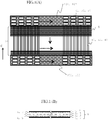
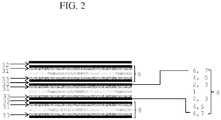
- the fuel cell's power generation function of cell unit 8 that forms the cell stack structure body 9 is realized by a structure of laminating the seven functional layers illustrated in Fig. 1 (B) and Fig. 2 .
- the structure of the stacked-type fuel cell according to the embodiments of the present invention will be described in detail below, explained mainly in 4 parts, namely: the cell unit 8, the internal common manifolds 41, 42, 43, the channels 31, 32, 33, and the external common manifolds 51, 52, 53.
- the external common manifold 51 includes, for example, the pipes 61 and 72
- the external common manifold 52 includes, for example, the pipes 62 and 72
- the external common manifold 53 includes, for example, the pipes 63 and 73.
- the external common manifold 51A includes, for example, pipes 61A and 71A, and the analogy therewith.
- the cell unit 8 can arbitrarily be extended within 2 dimensions in the plane direction of the cell unit 8.
- the meaning of “can arbitrarily be extended within 2 dimensions in the plane direction” is that the effective area of the cell unit 8 can be extended freely in the plane direction as required, as illustrated in Fig. 3 .
- the number of openings 11, 12, 13 for constituting the internal common manifolds 41, 42, 43 can be increased by following a pattern having a symmetry of Bravais lattice within 2 dimensions, which will be described later.
- plane direction means the direction parallel with respect to the plane of the cell unit 8.
- effective area in the plane direction of the cell unit 8 indicates the reaction area of the catalyst layer 2, 3.
- the large output current from the stacked-type fuel cell is acquired without changing the voltage of the stacked-type fuel cell, and the output density can be increased without relying on the power voltage, since the power current that relies only on the reaction area of the catalyst layer 2, 3 included in the cell unit 8 is determined by changing the effective area of the cell unit 8.
- the cell unit 8 is laminated by 7 functional layers in the following order, namely: a separator 6 or 7, a gas diffusion layer 4 or 5, an electrode catalyst layer 2 or 3, an electrolyte membrane 1, an electrode catalyst layer 2 or 3, a gas diffusion layer 4 or 5, and a separator 6 or 7.
- each opening 11, 12, 13 of the cell unit 8 is connected only to their desired functional layer.
- the opening 11 is connected to only one of the gas diffusion layers 4 or 5 for flowing the fuel fluid.
- the opening 13 allows the oxidizing fluid to flow, and it is connected only to the other one of the gas diffusion layers 4 or 5.
- the opening 12 allows the cooling medium flows, and it is connected only to the cooling medium channel between the adjacent partition walls.
- the sealing material can be installed around and between the opening and the layer where fluids are not desired to flow through.
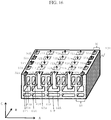
- the cell stack structure body 9 is formed by stacking up a plurality of cell units 8 mentioned above.
- the cell stack structure body 9 is the fuel cell's main body formed by stacking up the plurality of cell units 8. Several hundreds of cell units 8 are stacked up to be used in vehicles. Further, the cell stack structure body 9 formed by stacking the cell units 8 according to the embodiments of the present invention can arbitrarily be extended in 3 dimensions. What we mean by "arbitrarily be extended in 3 dimensions" is that, as shown in Fig. 1 , the number of cell units 8 to be stacked is increased freely in the stacking direction of the cell units 8, in addition to the extension within 2 dimensions in the plane direction of the cell units 8.
- direction C is defined as the direction of stacking up the cell units 8 (i.e., the stacking direction).
- the dotted line drawn horizontally in Fig. 1 indicates the direction of extension within 2 dimensions.
- the dotted line drawn vertically in Fig. 1 indicates the extension along the stacking direction.
- the output voltage of stacked-type fuel cell can be decided by changing the number of cell units 8 for stacking.
- the various fluids are the fuel fluid, the cooling medium and the oxidizing fluid circulating within the staked-type fuel cell.
- the specific route inside the fuel cell for the various fluids sent externally from the outside source involves: an inlet port for various fluids output from an external BOP (to be described later); a supply external common manifold 51A, 52A, 53A (include a supply pipe for connecting with external BOP 61A, 62A, 63A and a supply pipe for connecting with internal common manifold 71A, 72A, 73A); a supply internal common manifold 41A, 42A, 43A; the cell unit 8 (made up of seven functional layers), an exhaust internal common manifold 41B, 42B, 43B; an exhaust external common manifold 51B, 52B, 53B (include an exhaust pipe for connecting with external BOP 61B, 62B, 63B and an exhaust pipe for connecting with internal BOP 71B, 72B, 73B) and
- opening holes formed on the cell unit 8 for constituting the internal common manifolds 41, 42, 43 inside the cell stack structure body 9 are called “openings 11, 12, 13", and connecting portion that connects the internal common manifolds 41, 42, 43 with the external common manifolds 51, 52, 53 are called “connection ports 21, 22, 23".
- the openings 11, 12, 13 formed on the cell unit 8 before the cell units 8 are stacked for constituting the internal common manifolds 41, 42, 43, the openings 11, 12, 13 are regarded as a part of the cell unit 8. After the formation of the cell stack structure body 9 is complete by stacking the cell units 8, the openings 11, 12, 13 can be taken as the internal common manifolds 41, 42, 43. In simple terms, the openings 11, 12, 13 on the cell units 8 become the internal common manifolds 41, 42, 43 after stacking the cell units 8.
- the internal common manifolds 41, 42, 43 are disposed inside of the cell stack structure body 9 constructed by stacking the plurality of cell units 8.
- the internal common manifolds 41, 42, 43 serve to supply various fluids supplied from the external source to the fuel fluid channel 31, the cooling medium channel 32 and the oxidizing fluid channel 33, and to exhaust the used gas and fluid to outside.
- the supply internal common manifolds for various fluids 41A, 42A, 43A and the exhaust internal common manifolds for various fluids 41B, 42B, 43B are arranged perpendicularly or at the acute inclined angles to the plane direction of the cell units 8.
- a portion comprising the internal common manifold for fuel fluid 41 involves a distance from the fuel fluid supply connection port 21A, via the fuel fluid supply opening 11A and the fuel fluid exhaust opening 11B, to the fuel fluid exhaust connection port 21B.
- a portion comprising the internal common manifold for cooling medium 42 involves a distance from the cooling medium supply connection port 22A, via the cooling medium supply opening 12A and the cooling medium exhaust opening 12B, to the cooling medium exhaust connection port 22B.
- a portion comprising the internal common manifolds for oxidizing fluid 43 involves a distance from the oxidizing fluid supply connection port 23A, via the oxidizing fluid supply opening 13A and the oxidizing fluid exhaust opening 13B, to the oxidizing fluid exhaust connection port 23B.
- the pattern having the symmetry of Bravais lattice in 2 dimensions is adopted to the openings 11, 12, 13 by repeating the basic unit 16.
- the number of internal common manifolds 41, 42, 43 will be the same as the number of openings 11, 12, 13 installed on the plane of a single cell unit 8.
- the basic unit 16 is a unit having a minimum repeating periodic arrangement pattern for the openings formed by a two-dimensional Bravais lattice arrangement.
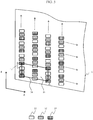
- Figs. 3 to 5 illustrate a schematic drawing showing the plane direction of the cell unit 8.
- the openings 11, 12, 13 that construct the internal common manifolds for various fluids 41, 42, 43 are shown.
- a layout of the openings 11, 12, 13 is arranged with a pattern having a symmetry of Bravais lattice within 2 dimensions, in the plane of the cell unit 8.
- the openings 11, 12, 13 is arranged with a pattern having a symmetry of Bravais lattice within 2 dimensions with some fluctuations, in the plane of the cell unit 8.
- layout arranged on a plane with a pattern having the symmetry of Bravais lattice is that, because the basic unit 16 for extending in 2 dimensions expressed by a vector A (14 in Fig. 3 ) and a vector B (15 in Fig.
- the basic unit 16 comprises the vector A and the vector B that can be drawn by starting from any openings 11, 12, 13 shown in Fig. 3 , if the pattern having the symmetry of Bravais lattice is applied.
- Fig. 3 shows the basic unit 16 for extending within 2 dimensions of Bravais lattice expressed by a vector A and a vector B.
- the basic unit 16 is shaping an oblique lattice.
- the basic unit 16 is determined by the number of openings 11, 12, 13 surrounded by the 4 edge lines of the oblique lattice.
- the basic unit 16 is comprised of six openings altogether by including the openings 11, 12, 13 encompassed by the 4 edge lines and the openings 11, 12, 13 not encompassed by the edge lines (inside of the edge lines).
- the meaning of "encompass” in this context is a portion of the openings surrounded by the edge lines (vectors) of the basic unit 16 of Bravais lattice within 2 dimensions.
- the openings 11, 12, 13 are divided into the supply openings and the exhaust openings, respectively. These include a fuel fluid supply opening 11A, a cooling medium supply opening 12A, an oxidizing fluid supply opening 13A, a fuel fluid exhaust opening 11B, a cooling medium exhaust opening 12B, and an oxidizing fluid exhaust opening 13B.
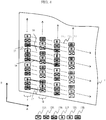
- a layout of the supply openings 11A, 12A, 13A that constitute the supply internal common manifolds 41A, 42A, 43A and the exhaust openings 11B, 12B, 13B that constitute the exhaust internal common manifolds 41B, 42B, 43B is comprised by repeating the basic unit 16 which is based on the regularity of Bravais lattice for extending within 2 dimensions, as indicated on Figs. 4 and 5 .
- "Minimum power generating element 17" shown in Figs. 4 and 5 denotes the power generating element comprising the supply and exhaust openings 11, 12, 13 required at least for the fuel cell to function.
- the number of the openings 11, 12, 13 encompassed within the 4 edge lines comprises a total of 2 or more openings including a quarter or more, or less than quarter of fuel fluid supply opening 11A, a half or more, or less than half of cooling medium supply openings 12A and, a quarter or more, or less than quarter of oxidizing fluid supply openings 13A, and a quarter or more, or less than quarter of fuel fluid exhaust openings 11B, a half or more, or less than half of cooling medium exhaust openings 12B, and a quarter or more, or less than quarter of oxidizing fluid exhaust openings 13B.
- the dimensions, shapes and layout positions of the openings 11, 12, 13 designed and positioned in the plane of the cell unit 8 does not need to be perfect. They can be designed and positioned with slight fluctuations. Specifically, there may be some differences in size, shape, and/or arrangement position among the openings 11 in each basic unit, and similarly, there may be some differences among the openings 12 in each basic unit. Alternatively, there may be some differences among the openings 13 in each basic unit.
- Bravais lattice is explained hereinbelow.
- Crystal has a periodic and regular atomic arrangement known as lattice. It can be said that the crystal has a repeating lattice unit (where lattice points are interconnected).
- lattice structure classified by using the regularity of arrangement, and classified based on the symmetry of lattice points, as Bravais lattice.
- Classification of Bravais lattice within 2 dimensions includes 5 repeating units, namely: oblique lattice, rectangular lattice, hexagonal lattice, square lattice and centered rectangular lattice.
- the reasons for applying the repeating basic unit 16 that has the regularity of Bravais lattice as such in designing the layout of the openings 11, 12, 13 of the cell unit 8 to constitute the internal common manifolds 41, 42, 43 are: supplying and exhausting various fluids uniformly throughout the cell unit 8; improving flow distribution by suppressing the pressure loss of the flow; and using the area of cell unit 8 effectively.
- Figs. 3 to 5 illustrate the openings 11, 12, 13 that constitute the internal common manifolds 41, 42, 43, arranged in the plane direction of the cell unit 8.
- the dimension and shape of the openings 11, 12, 13 are all expressed as identical in size.
- the dimension of the openings 11, 12, 13 does not necessarily has to be the same.
- the dimension of the openings 11, 12, 13 may appropriately be set depending on the shape and the width of the internal common manifold for various fluids 41, 42, 43 and depending on their flow change (refer to Figs. 6 and 7 for the internal common manifolds 41, 42, 43 having different width dimensions, which will be described later in the specification document).
- a shape of the openings is expressed in rectangle with rounded edges, however, another shape may be used, or different shapes may be used in combination.
- Fig. 3 is a schematic view within the plane direction of the cell units 8, illustrating the regularity of oblique pattern of Bravais lattice.
- the supply openings for various fluids 11A, 12A, 13A and the exhaust openings for various fluids 11B, 12B, 13B are positioned along the channels 31, 32, 33 at the closest and opposing position with each another.
- the oxidizing fluid supply opening 13A which is set closest to the oxidizing fluid exhaust opening 13B, at the opposing position with each other along the oxidizing fluid channel direction of the cell units 8.
- Fig. 4 further illustrates the case in which both the supply openings for various fluids 11A, 12A, 13A and the exhaust openings for various fluids 11B, 12B, 13B are co-existing.
- Row F and row G including these openings 11, 12, 13 are under a supplemental relationship with each other. That is, on either one of the row F or the row G, the supply openings 11A, 12A or 13A for the same fluid does not exist on the same row as the exhaust openings 11B, 12B or 13B for the same fluid.
- Fig. 5 illustrates the case in which either one of the supply openings for various fluids 11A, 12A, 13A or the exhaust openings for various fluids 11B, 12B, 13B are arranged exclusively on a row J or a row K along the plane direction of the cell unit 8. Either one of the openings 11A, 12A, 13A or the openings 11B, 12B, 13B are arranged on the same row, and the rows are alternately arranged in the channel direction (direction A). That is, a row specialized for supplying (row J in Fig. 5 ) and a row specialized for exhausting (row K in Fig. 5 ) are alternately arranged. If the internal common manifolds 41, 42, 43 for the fluids are designed in a row unit by using such a crystallographic pattern, the external common manifolds 51, 52, 53 can be arranged easily.
- the openings 11, 12, 13 arranged in the plane direction of the cell unit 8 are designed by using the previously-described pattern having the symmetry of Bravais lattice within 2 dimensions and designed by a periodic 2-dimensional arrangement. That is, they are arranged at a regularity (with periodicity) by taking the pattern having the symmetry of Bravais lattice within 2 dimensions as the repeating unit.
- the openings 11, 12, 13 can be designed by using the pattern having the symmetry of Bravais lattice with certain fluctuation, for arrangement in 2 dimensions.
- the embodiments of the present invention are not limited to the example described in Figs. 3 to 5 as there are 5 types of symmetry of Bravais lattice pattern (oblique lattice, rectangular lattice, hexagonal lattice, square lattice and centered rectangular lattice).
- the internal common manifolds 41, 42, 43 are formed by putting together the relevant openings 11, 12, 13, to result in the shapes shown in Figs. 6 and 7 . Also, according to the internal common manifolds 41, 42, 43 formed in this manner, the internal common manifolds 41, 42, 43 are formed by stacking the cell units 8, by coherently combining the openings 11, 12, 13 above and below having the same shape and size on a straight line or a curved line.
- the internal common manifolds 41, 42, 43 are formed by stacking the cell units 8, by incoherently combining the openings 11, 12, 13 of the cell units 8 above and below having a slightly displaced shape and size on a straight line or a curved line.
- the internal common manifolds 41, 42, 43 are communicated through without problem. That is, as described above, the openings 11, 12, and 13 provided in the plane direction in which the cell units 8 is extended, such openings may be combined (arranged) to have coherency within the extension plane of the cell unit 8 along the perpendicular direction or the acute inclined angle direction. Alternatively, the openings may be combined (arranged) to have incoherency. These arrangements were effective for improving the flow of various fluids.
- Fig.6 (A) is the case of being coherent where the internal common manifolds for various fluids 41, 42, 43 are all in parallel to one another, in the perpendicular direction to the cell units 8.
- Fig.6 (B) is the case of being coherent where the internal common manifolds for various fluids 41, 42, 43 are all in parallel to one another, in the acute inclined angle direction to the cell units 8.
- Fig.6 (C) is the case of being coherent where the internal common manifolds for various fluids 41, 42, 43 are all non-parallel to one another, in the acute inclined angle direction to the cell units 8.
- incoherent is the state of acquiring incoherence by combining the openings 11, 12, 13 of the first cell units 8 and the second cell unit 8 at a slightly displaced size and shape.
- the result of "being incoherent” is that the cross-sectional width sizes of the straight or the curved internal common manifolds for various fluids 41, 42, 43 will change throughout the whole pipe (refer to Fig. 7 (A) (B) (C) (D) ).
- Fig. 7 (A) illustrates the case in which the various fluids flowing through the internal common manifolds 41, 42, 43 are in the same direction, and the center line of the internal common manifolds 41, 42, 43 are in parallel to one another.
- FIG. 7 (B) illustrates the case in which the various fluids flowing through the internal common manifolds 41, 42, 43 are not in the same direction, and the center line of the internal common manifolds 41, 42, 43 are not in parallel to one another.
- Fig. 7 (C) illustrates the case in which the various fluids flowing through the internal common manifolds 41, 42, 43 are not in the same direction, and the center line of the internal common manifolds 41, 42, 43 are in parallel to one another.
- Fig. 7 (D) illustrates the case in which the various fluids flowing through the internal common manifolds 41, 42, 43 are not in the same direction, and the center line of the internal common manifolds 41, 42, 43 are in parallel to one another.
- FIG. 7 (A), (B), (C) and (D) the internal common manifolds 41, 42, 43 are installed perpendicularly or at the acute inclined angles to the cell unit 8.
- Fig. 7 (B) and (C) illustrate the example of compactly arranged internal common manifolds 41, 42, 43.
- the internal common manifolds 41, 42, 43 of Fig. 7 show a nozzle shape having a narrow end. That is, the width size at the inlet of the internal common manifold 41, 42, 43 is greater than the width size near to the exit of the internal common manifold 41, 42, 43.
- the width size of the internal common manifolds 41, 42, 43 are equal throughout as in Fig. 6 .
- the loss of kinetic energy at the inlet gets large, and the fluid speed near the exit tends to get low due to the distance the fluid must travel from the inlet.
- the kinetic energy is increased without having to reduce the flow, at the expense of fluid flow energy and pressure.
- Various fluids can be supplied to the cell unit 8 accordingly.
- Fig. 8 shows the internal common manifold 41, 42, 43 formed as the results of helically rotating and then stacking the plane of the cell units 8.
- the internal common manifolds 41, 42, 43 can be formed under the following cases.
- the case in which the plane rotation angle of the plane arrangement between the adjacent cell units 8 is zero.
- zero rotation angle is that the cell units 8 are stacked in a perfect alignment without rotation.
- the channels 31, 32, 33 related to the present invention will be described with reference to Figs. 2 , 4 and 5 . This improves the flow of various fluids in the internal common manifolds 41, 42, 43.
- Examples shown in Figs. 9 to 12 depict the examples where the pipes for connecting with external BOP for various fluids 61, 62, 63 are arranged in parallel with one another.
- the pipes for connecting with internal common manifold for various fluids 71, 72, 73 are arranged in parallel with one another.
- the pipe for connecting with external BOP for the same fluid 61, 62, 63 intersects the pipe for connecting with internal common manifold for the same fluid 71, 72, 73 at an angle of 90 degrees.
- the intersecting angle can be set, for example, within the range of 1 to 90 degrees.
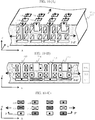
- Fig. 11 (A) illustrates a partial 3-dimensional view showing the formation of external common manifolds for various fluids 51, 52, 53 in the endplates 101 or 102, according to the embodiments of the present invention.
- Fig. 11 (B) illustrates a cross-sectional view Q-Q' showing the formations of a joint between the cooling medium supply pipe for connecting with internal common manifold 72A and the cooling_medium_supply pipe for connecting with external BOP 62A and a joint between the cooling_medium_exhaust pipe for connecting with internal common manifold 72B and the cooling_medium_exhaust pipe for connecting with external BOP 62B, in the endplates 101 or 102, according to the embodiments of the present invention.
- cooling_medium_exhaust pipe for connecting with internal common manifold 72B which has a greater width size compared with the width size of the pipes for connecting with internal common manifold for the fuel fluid 71 and which has a smaller width size compared to the width size of the pipes for connecting with internal common manifold for the oxidizing fluid 73, and penetrates the cooling_medium_exhaust pipe for connecting with external BOP 62B.
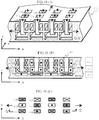
- Fig. 12 (A) illustrates a partial 3-dimensional drawing showing the formation of external common manifolds for various fluids 51, 52, 53 in the endplates 101 or 102, according to the embodiments of the present invention.
- Fig. 12 (B) illustrates a cross-sectional view R-R' showing the formations of a joint between the oxidizing_fluid_supply pipe for connecting with internal common manifold 73A and the oxidizing_fluid_supply pipe for connecting with external BOP 63A and a joint between the fuel_fluid_supply pipe for connecting with internal common manifold 71A and the fuel_fluid_supply pipe for connecting with external BOP 61A, in the endplates 101 or 102, according to the embodiments of the present invention.
- the oxidizing_fluid_supply pipe for connecting with internal common manifold 73A has the greatest width size compared to the width sizes of the pipes for connecting with internal common manifold for the fuel fluid and the cooling medium 71, 72, and penetrates the oxidizing_fluid_supply pipe for connecting with external BOP 63A.
- connection ports 21, 22, 23 the connections between the external common manifold for various fluids 51, 52, 53 and the internal common manifold for various fluids 41, 42 43 are called "connection ports 21, 22, 23".
- connection ports 21, 22, 23 the connections between the external common manifold for various fluids 51, 52, 53 and the internal common manifold for various fluids 41, 42 43.
- the pipes for connecting with the internal common manifold 71, 72, 73 need to match in the shape and size between the two by changing the shape of the coupling part 711, 712, 713 with the connection ports 21, 22, 23.
- the pipe for connecting with internal common manifold for the fuel fluid 71 has a greater width size than the with sizes of the pipes for connecting with internal common manifolds for the cooling medium and the oxidizing fluid 72, 73, therefore, an inclined plane is lengthened towards the coupling part 711, the inclination angle alpha ( ⁇ ) of the inclined plane is 90 degrees and less, and prepared at 2 locations in the left and right directions (along B-axis).
- ⁇ inclination angle alpha
- the pipe for connecting with internal common manifold for the cooling medium 72 has a greater width size than the width size of the pipe for connecting with internal common manifold for the fuel fluid 71, and has a smaller width size than the width size of the pipe for connecting with internal common manifold for the oxidizing fluid 73, therefore, the inclined plane is appropriately formed towards the coupling part 712, the inclination angle alpha ( ⁇ ) of the inclined plane is 90 degrees and less, and prepared at 2 locations in the left and right directions (along B-axis). As shown in Fig.
- the cell unit 8 can be formed by arranging two electrode catalyst layers 2 and 3 at both sides of the electrolyte membrane 1, and the gas diffusion layers 4 and 5 at the outer side of the electrode catalyst layers 2 and 3, and the pair of separators 6 and 7 that further sandwiches them between.
- the cell unit 8 according to one of the embodiments of the present invention that has the fuel cell's power generation function.
- Fig.2 illustrates a cross-sectional view for explaining the channels for supplying various fluids (that is, a fuel fluid flow 31, a cooling medium flow 32, and a oxidizing fluid flow 33), between each layer of cell unit 8 and between a plurality of cell units 8.
- the cell unit 8 is laminated by 7 layers in the following order, namely: a separator 6 or 7, a gas diffusion layer 4 or 5, an electrode catalyst layer 2 or 3, an electrode membrane 1, an electrode catalyst layer 2 or 3, a gas diffusion layer 4 or 5, and a separator 6 or 7.
- the cell unit 8 can be made at a thickness thinner than the thickness of the commonly used cell today.
- the cell unit 8 can be made at a thickness that is much thinner than the thickness of commonly used cell units.
- the catalyst layer includes the cathode catalyst layer and the anode catalyst layer, and comprises a structure in which a catalyst component such as platinum which is held on the surface of a conductive carrier consisting of carbon.
- the cathode catalyst layer promotes the oxygen reduction reaction (a reaction that generates water from protons, electrons and oxygen).
- the anode catalyst layer promotes the hydrogen oxidation reaction (a reaction that dissociates hydrogen into protons and electrons).
- the openings 11, 12, 13 formed on such a cell unit 8 there is, for example, machine processing, laser processing, etching, and so forth.
- Various organic sealing materials, inorganic sealing materials and combination of organic and inorganic mixed sealing materials can be used in the sealing process method applied in the vicinity of the openings 11, 12, and 13, alternatively, the sealing adherence process can be implemented after carrying out processing such as machine processing, laser processing, etching and so forth.
- the openings 11, 12, 13 installed on the cell unit 8 formed accordingly are put together one by one, and the internal common manifolds 41, 42, 43 illustrated in Figs. 6 and 7 are disposed in the cell stack structure body 9.
- Various fluids flowing through the internal common manifolds 41, 42, 43 are supplied to and exhausted from the cell unit 8 via their respective supply openings 11A, 12A, 13A and the exhaust openings 11B, 12B and 13B.
- the flows of various fluids in and out of the cell unit 8 are controlled by the sealing material 19.
- the effect of penetrating the pipes for connecting with internal manifold 71, 72, 73 with the pipes for connecting with external BOP 61, 62, 63 is to prevent turbulent flow of various fluids.
- the pipes for connecting with external BOP 61, 62, 63 can be installed on the same end plate 101, 102 as three kinds of inflow ports and out-flow ports.
- Fig. 13 illustrates an external view of the stacked-type fuel cell, according to the second embodiment.
- the edge structures of the internal common manifolds 41, 42, 43 and the external common manifolds 51, 52, 53 are the main point of difference.
- Other parts are mostly identical to the first embodiment described in Figs. 1 to 12 and 18 .
- the stacked-type fuel cell of the second embodiment has the cell stack structure body 9 formed by stacking the cell units 8 and this is sandwiched by the endplates 101, 102.
- the external common manifolds 51, 52, 53 are not installed in the endplate 101.
- the external common manifolds are arranged in the endplate 102.
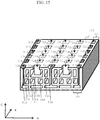
- Fig. 15 illustrates a cross-sectional view showing the formations of a joint between the fuel_fluid_exhaust pipe for connecting with internal common manifold 91B and the fuel fluid exhaust pipe for connecting with external BOP 81B at the edge portion, and a joint between the fuel_fluid_exhaust pipe for connecting with internal common manifold 71B and the fuel fluid exhaust pipe for connecting with external BOP 61B at the intermediate portion, and a joint between the oxidizing_fluid_exhaust pipe for connecting with internal common manifold 73B and the oxidizing_fluid_exhaust pipe for connecting with external BOP 63B at the intermediate portion, in the endplate 102, according to the second embodiment of the present invention.
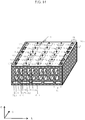
- Fig. 17 illustrates a cross-sectional view showing the formations of a joint between the oxidizing_fluid_supply pipe for connecting with internal common manifold 93A and the oxidizing_fluid_supply pipe for connecting with external BOP 83A at the edge portion, and a joint between the fuel_fluid_supply pipe for connecting with internal common manifold 71A and the fuel_fluid_supply pipe for connecting with external BOP 61A at the intermediate portion, and a joint between the oxidizing_fluid_supply pipe for connecting with internal common manifold 73A and the oxidizing_fluid_supply pipe for connecting with external BOP 63A at the intermediate portion, in the endplate 102, according to the second embodiment of the present invention.
- the arrangement and the cross-sectional area of the oxidizing fluid supply internal common manifold 43A (the supply distribution and the flow amount) and the arrangement and the cross-sectional area of the oxidizing fluid exhaust internal common manifold 43B (the exhaust distribution and the flow amount) are in equilibrium.
- the edge structure that terminates the extension of openings in the 2 directions of A-axis is the edge structure installed along the direction B.
- the edge structure that terminates the extension of openings in the 2 directions of A-axis includes the edge structure of internal common manifold (not illustrated) and the edge structures of external common manifolds 80, 90.
- the edge structure of the internal common manifold, although not illustrated, is installed at the 2 edges along the 2 directions of B-axis of the cell stack structure body 9.
- Fig. 14 illustrates the edge structures of the external common manifold 80, 90 disposed at the 2 edges along the 2 directions of B-axis of the endplate 102.
- the arrangements and the cross-sectional areas of supply internal common manifolds for various fluids 41A, 42A, 43A (at the edge portion and the intermediate portion) that correspond to the supply flow distribution and the total flow amount, and the arrangements and the cross-sectional areas of exhaust internal common manifolds for various fluids 41B, 42B, 43B (at the edge portion and the intermediate portion) that correspond to the exhaust flow distribution and the total flow amount are in equilibrium.
- the edge structure that terminates the extension of openings in the 2 directions of B-axis is the edge structure installed along the direction A.
- the edge structure that terminates the extension of openings in the 2 directions of B-axis includes the edge structure of internal common manifold (not illustrated) and the edge structures of external common manifold 80, 90.
- the edge structure of the internal common manifolds, although not illustrated, is installed at the 2 edges along the direction A of the cell stack structure body 9.
- Fig. 14 illustrates the edge structures of the external common manifolds 80, 90 disposed at the 2 edges along the direction A in the endplate 102.
- the edge structure that terminates the extension of openings in the 2 directions of B-axis sets a basic segment 18 for maintaining the power generating function as a reference.
- the basic segment 18 provides the internal common manifolds 41, 42, 43 and the pipes for connecting with internal common manifold 71, 72, 73, for fuel fluid, cooling medium and oxidizing fluid, in B direction.
- Two edges are installed along the direction A of the cell stack structure body 9 and the endplate 102 for terminating the extension of openings in the 2 directions of B-axis by setting the dividing line having an integer multiple of the basic segment 18 as a reference.
- the basic segment 18 includes a pipe for connecting with internal common manifold for fuel fluid 71, a pipe for connecting with internal common manifold for cooling medium 72, and a pipe for connecting with internal common manifold for oxidizing fluid 73.
- the stacked-type fuel cell of the present invention can be mounted to a limited space such as engine room of a vehicle.
- a compressor for sending the oxidizing fluid at high pressure is not always required so that the manufacturing cost can be reduced.
- the stacked-type fuel cell is light in weight so that it can be utilized as a power source in aero plane.
- the layouts of the internal common manifolds 41, 42, 43 and the external common manifolds 51, 52, 53 for the first and second embodiments of the present invention are not limited to these examples.
- the present invention can be embodied in various forms within the scope not deviating the principle of the invention.
- Hydrogen fluid is supplied to an anode (called fuel electrode) and a proton is removed from the supplied hydrogen fluid, with an aid of the catalyst, and the electron is transferred to the external circuit.
- the hydrogen is converted to hydrogen ion (called proton).
- an oxygen is supplied to a cathode (called air electrode). The oxygen reacts with the proton permeating through the electrolyte membrane and the electron from the external circuit to generate water.
- the output density can be increased by changing the effective area of the cell unit 8 without relying on the power voltage.
- the output voltage of the fuel cell can be determined by changing the number of cell units 8 for stacking.
- the output density and the energy density can be increased by significantly decreasing the volume of the cell stack structure body 9 without changing the output voltage, by using a thin cell unit 8.
- the height of the channel and the pitch for stacking the cell units 8 are reduced so that number of stacking can be increased, and a fluid machinery "compressor" used to circulate the oxidizing fluid at high pressure is not always necessary.
- the layouts for the internal common manifolds 41, 42, 43 and the external common manifolds 51, 52, 53 the occurrence of uneven flow can be suppressed. Further, they can be constructed compactly so that a small-sized and a high output stacked-type fuel cell is provided for an efficient power generation. Furthermore, the stacked-type fuel cell being small occupies less space so that the degree of freedom in the layout inside the engine room is increased. The drift flow within the internal common manifolds 41, 42, 43 in the stacking direction is suppressed so that supplying and exhausting of various fluids become uniform even more. The pressure loss in the flow is reduced so that a favorable flow distribution is achieved. Also, this layout can cope with the variance in manufacturing at assembly.
- the structures of the external common manifolds 51, 52, 53 and the internal common manifolds 41, 42, 43 are simple so that they can readily be formed by using the cutting processing.
- the manufacturing of the endplates 101, 102 is simplified. It can be manufactured at a low cost compared to the case of having to weld many parts for assembling.
- the small-sized stacked-type fuel cell is excellent for loading to vehicle, and excellent in terms of productivity and cost.
- the flow resistances of various fluids are reduced so that the fluids can flow throughout the plane of the cell unit 8, without having to install any special external apparatus to the stacked-type fuel cell.
- a local stress put on the electrolyte membrane 1 is eliminated that the concentrated internal stress is prominently reduced, making it capable to achieve a prolonged lifetime of the cell unit stacked-type fuel cell.
- the embodiments of the present invention can be utilized as the fuel cell for vehicle.
Landscapes
- Chemical & Material Sciences (AREA)
- Chemical Kinetics & Catalysis (AREA)
- Electrochemistry (AREA)
- General Chemical & Material Sciences (AREA)
- Life Sciences & Earth Sciences (AREA)
- Engineering & Computer Science (AREA)
- Manufacturing & Machinery (AREA)
- Sustainable Development (AREA)
- Sustainable Energy (AREA)
- Fuel Cell (AREA)
- Composite Materials (AREA)
Abstract
Description
- The present invention relates to a cell unit of a fuel cell and a cell stack structure body, having high output density and high capacity.
- The fuel cell is a device that generates power by a chemical reaction between hydrogen and oxygen via an electrolyte. Owing to its potential for reducing the environmental burdens, the implementation and the widespread use of the fuel cells are receiving much attention. Also, depending on the types of electrolyte in use, the fuel cells have different temperatures for generating power and different characteristics. Mainly, the fuel cells are classified according to the types of electrolyte being used. The fuel cells are broadly classified into 4 types, namely; polymer electrolyte fuel cell (PEFC), solid oxide fuel cell (SOFC), phosphoric acid (PAFC) and molten carbonate fuel cell (MCFC).
- For example, the polymer electrolyte fuel cell (PEFC) is provided with a membrane electrode assembly (MEA) that arranges an anode electrode on one side of the polymeric ion exchange membrane and a cathode electrode on the other side. MEA is sandwiched in between a pair of separators to constitute a cell. The operating temperature of PEFC is low ranging from 60 to 90 degrees centigrade. The advantage of using PEFC is in that it can exhibit a good output efficiency at a small device size. Mostly, PEFC is being utilized in a fuel cell vehicle. PEFC is also utilized in a solar battery, a backup battery for remote antenna, and a drone used in depopulated area.
- A structure in which the electrolyte membrane is sandwiched by a positive electrode plate and a negative electrode plate is known as a cell. There are many minute channels formed on the positive electrode (the oxygen electrode) and the negative electrode (the hydrogen electrode) of the cell. The power generating reaction takes place when the externally supplied oxygen and hydrogen pass through these channels that sandwich the electrolyte membrane. Since the output of a single cell is limited, therefore, many cells are piled up to constitute a single package so that the required output may be obtained. This is known as the stacked-type fuel cell.
- The fuel cell desires to have a high output density and a high capacity (high energy density). That is, to generate the fuel cell's power efficiently, an individual cell that constitutes the fuel cell stack must generate power efficiently. For this purpose, the fuel cell needs be designed so that various fluids such as hydrogen, cooling water and air are supplied to each cell uniformly. The output of a fuel cell is proportional to the membrane area and is not proportional to the fuel cell volume. In attempt to achieve a high-output and a small-sized stacked fuel cell, it is most effective to increase the cell area (catalyst reaction area) and to reduce the pitch for stacking the cells. The power generation current of the stack is effectively increased by enlarging the catalyst reaction area. Also, the output density of the fuel cell is increased by reducing the pitch.
- However, just by enlarging the cell area and reducing the pitch for stacking the cells it would result in the increase in the pressure loss when various fluids such as hydrogen, cooling water and air pass through the inner planes of the cells. The excessive pressure loss will lead to a drop in the power generation efficiency. Some measures are needed to reduce the pressure loss as much as possible.
- Furthermore, the cell area could not have been increased by using the conventional technology due to the peripheral arrangement of the manifolds and the crossing of the various flows that have resulted in the flow resistances of the fuel fluid, the cooling medium and the oxidizing fluid.
- According to the fuel cells disclosed in the
non-patent document 1 and thepatent document 2, they lack in flexibility for extending the catalyst reaction area within 2 dimensions since the manifolds are arranged at a periphery of the catalyst layer. Also, regarding the fuel cell for vehicle disclosed in thenon-patent document 1, its flow channel distribution is intersecting 3 dimensionally, therefore, the enlargement of the catalyst reaction area is even more difficult for this fuel cell. Also, according to the fuel cell disclosed inpatent document 1, since a gutter of the channel formed on the separator is deep, therefore, a local strain stress was applied on a layer having power generation function, that contacts a corner of the channel gutter. This has caused a decline of durability. There is a disadvantage of significant problem affecting the fuel cell lifetime. - The
patent document 3 discloses a fuel cell having low aspect ratio at with direction, and providing a plurality of fuel fluid channel openings, cooling medium channel openings and oxidizing fluid channel openings at two outer peripheries facing the MEA. Although this type of design may be advantageous in enlarging thecatalyst reaction area 2 dimensionally, however, when one continues to enlarge the area in the width direction, the pressure loss of various fluids that passes through the inner planes of the cell unit still remains to be large to an unacceptable extent. - The number of cells for stacking could not have been increased by using the conventional technology because a high pressure of the gases supplied to the manifolds, and the flow resistances of the fuel fluid, the cooling medium and the oxidizing gas need be dealt with. According to the conventional problems, the fuel cell stack for vehicle, due to its space restriction, the increase in the number of cells for stacking is limited.
-
- Patent Document 1: Japanese Laid-open Application Publication No.
2017-147134 - Patent Document 2: Japanese Laid-open Application Publication No.
2016-096015 - Patent Document 3: International Patent Publication No.
WO2014/136965 - Non-patent Document 1: Product Information for 2016 Toyota Sedan type fuel cell powered vehicle MIRAI
- The present invention relates to fuel cell, cell unit thereof, and cell stack structure body, having high output density and high capacity.
- According to one aspect of the present invention, a cell unit comprising: a first separator and a second separator opposite to each other; and a membrane electrode assembly laminated between the first and the second separators; wherein the cell unit includes a plurality of fuel fluid openings, a plurality of cooling medium openings, and a plurality of oxidizing fluid openings of the first separator, the second separator and the membrane electrode assembly, that pass through an extension plane of the cell unit; wherein at least one of the fuel fluid openings, at least one of the cooling medium openings, and at least one of the oxidizing fluid openings, are arranged at a center area of the cell unit.
- According to the embodiments of the present invention, the cell unit comprises the plurality of fuel fluid openings, the plurality of cooling medium openings, and the plurality of oxidizing fluid openings configured with a plurality of basic units periodically repeated throughout the cell unit or periodically repeated with fluctuation to some extent, and that include an edge structure for terminating the periodic repetition of the basic units at edge portions other than the center area.
- According to the embodiments of the present invention, the cell unit comprises the fuel fluid openings, the cooling medium openings, and the oxidizing fluid openings that are provided with their respective supply openings and exhaust openings.
- According to the embodiments of the present invention, the basic unit includes at least two fuel fluid openings, at least two cooling medium openings, and at least two oxidizing fluid openings.
- According to the embodiments of the present invention, the basic units include the same or the different shapes, positions, and sizes of the various fluid openings, or their combinations, as follows: the shapes, positions, and sizes of the fuel fluid openings are the same or different, or their combinations; the shapes, positions, and sizes of the cooling medium openings are the same or different, or their combinations; and the shapes, the position, and the size of the oxidizing fluid openings are the same or different, or their combinations.
- According to the embodiments of the present invention, the cell unit comprises the basic unit is a unit having a minimum repeating arrangement periodicity of pattern of the openings, for which a pattern of openings is formed by a two-dimensional Bravais lattice arrangement.
- According to the embodiments of the present invention, the cell unit comprises at least two of the fuel fluid openings, at least two of the cooling medium openings, and at least two of the oxidizing fluid openings, that are provided with their respective supply openings and exhaust openings.
- According to the embodiments of the present invention, the cell unit comprises at least two fuel fluid openings including a multiple fuel fluid openings or a partial fuel fluid openings; at least two cooling medium openings including a multiple cooling medium openings or a partial cooling medium openings; and at least two oxidizing fluid openings including a multiple oxidizing fluid openings or a partial oxidizing fluid openings.
- According to the embodiments of the present invention, the cell unit comprises a minimum power generating element including approximately one quarter of the fuel fluid supply opening, approximately one quarter of the fuel fluid exhaust opening, approximately one quarter of the oxidizing fluid supply opening, approximately one quarter of the oxidizing fluid exhaust opening, approximately half of the cooling medium supply opening, and approximately half of the cooling medium exhaust opening.
- According to the embodiments of the present invention, the cell unit includes the basic unit and the minimum power generating unit are geometrically similar.
- According to the embodiments of the present invention, the cell unit characterized in that the supply opening and exhaust openings for the same fluid are arranged to a first row and a second row in a complementary relationship with one another, wherein the first row does not includes the supply opening and exhaust openings of the same fluid both in the same row, and wherein the second row does not include the supply opening and exhaust openings of the same fluid both in the same row.
- According to the embodiments of the present invention, the first row includes the supply openings only, and the second row that includes the exhaust openings only, wherein the first row and the second row are alternately arranged in the fluid channel direction.
- According to the embodiments of the present invention, the membrane electrode assembly of the cell unit comprises a first gas diffusion layer, a first catalyst layer, an electrolyte membrane, a second catalyst layer, and a second gas diffusion layer.
- According to one aspect of the present invention, comprising: a cell stack structure body, wherein the cell stack structure body is stacked by the plurality of cell units, wherein the fuel fluid openings, the cooling medium openings, and the oxidizing fluid openings of the cell units are respectively piled to form respective internal common manifolds within the cell stack structure body, and wherein the internal common manifolds supply and exhaust the fuel fluid, the cooling medium and the oxidizing fluid to/from the plurality of cell units.
- According to the embodiments of the present invention, the internal common manifolds are basically formed perpendicular to a plane of the plurality of cell units and/or formed at the acute inclined angles to the plane.
- According to the embodiments of the present invention, the cell stack structure body which comprises the followings; a first channel, arranged inside each cell unit, for supplying fuel fluid flow; a second channel, arranged inside each cell unit, for supplying oxidizing fluid flow; and a third channel, arranged between adjacent cell units, for supplying cooling medium flow; wherein the first channel, the second channel, and the third channel are connected to their respective internal common manifolds, and wherein each cell unit is provided with a sealing material for controlling flows of the first channel, the second channel, and the third channel.
- According to the embodiments of the present invention, the cell stack structure body which is formed by stacking the plurality of cell units, wherein the adjacent cell units have a pre-determined rotation angle of 0 degree or more than 0 degree.
- According to the embodiments of the present invention, the cell stack structure body which is formed by stacking the plurality of cell units, wherein the fuel fluid openings, the cooling medium openings, and the oxidizing fluid openings have the same shapes and sizes, respectively, to be aligned coherently in a straight line and/or curved lines, for forming the internal common manifolds.
- According to the embodiments of the present invention, the cell stack structure body formed by stacking the plurality of cell units, wherein the internal common manifolds have slight displacement in their shapes and sizes, respectively, to be aligned in a straight line and/or curved lines; for forming the internal common manifolds.
- According to one aspect of the present invention, a fuel cell having the cell stack structure body, comprising: a first end plate; and a second end plate; wherein the first end plate and the second end plate have external common manifolds corresponding to the internal common manifolds, for supplying and exhausting the fuel fluid, the cooling medium and the oxidizing fluid, and for sandwiching the cell stack structure body from both sides.
- According to the embodiments of the present invention, the external common manifolds include a plurality of first pipes connected to the external power generation auxiliary system, and a plurality of second pipes connected to the internal common manifolds.
- According to the embodiments of the present invention, the external common manifolds have basic units corresponding to the internal common manifolds, and the edge structure for terminating the periodic repetition of the basic units.
- According to the embodiments of the present invention, the plurality of first pipes are arranged along the aligned direction of the openings, wherein the plurality of first pipes are provided in parallel or semi-parallel to each other so as not to come in contact with one another.
- According to the embodiments of the present invention, the fuel cell is characterized in that the plurality of second pipes are arranged along the stacking direction of the cell units, extend the internal common manifolds, and installed so as not to come in contact with one another.
- According to the embodiments of the present invention, the plurality of first pipes and the plurality of the second pipes are connected perpendicular to and/or at the acute inclined angles to each other, wherein the second pipes penetrate at the center or at a vicinity of the center of the first pipes, or penetrate at the edge or near to the edge of the first pipes, or penetrate between the center or the edge of the first pipes, viewing from the cross section of the first pipes.
- According to the embodiments of the present invention, wherein the second pipe increases width size of a first axis at the inner plane of the cell unit stepwisely from the first zone positioned most apart from the cell stack structure body, via the second zone, to the third zone positioned closest to the cell stack structure body. The first pipe connected to the external power generation auxiliary system for the cooling medium is set back with respect to a reference line by taking the width size of the second pipe for connecting to the internal common manifold of the fuel fluid positioned at the first zone as the reference line. The first pipe connected to the external power generation auxiliary system for the oxidizing fluid is set back with respect to a reference line by taking the second pipe for connecting to the internal common manifold of the cooling medium positioned at the second zone as the reference line.
According to the embodiments of the present invention, the edge structure of the internal common manifolds and the external common manifolds, as for the edge structure that terminates a first axis extension of the openings in the cell unit, is provided so that the cross-sectional areas of the internal common manifolds and the external common manifolds at the edge portions are half or approximately half of the cross sectional areas of the internal common manifolds and the external common manifolds at the intermediate portion; and as for the edge structure that terminates a second axis extension of the openings in the cell unit, the extension to the second axis of the openings is terminated by setting the dividing line having an integer multiple of the basic segment as a reference, based on the basic segment provided with pipes for connecting to the internal common manifolds and the internal common manifolds of the fuel fluid, the cooling medium and the oxidizing fluid. - According to the embodiments of the present invention, the supply external common manifolds and the exhaust external common manifolds for any one of the fuel fluid, the cooling medium and the oxidizing fluid is installed to the same end plate, alternatively, they are installed separately to the two end plates.
- The characteristics, functions of the present invention will further be explained based on the following embodiments and drawings.
-
Fig. 1 (A) illustrates a perspective view of the stacked-type fuel cell according to the embodiments of the present invention. -
Fig. 1 (B) illustrates a cross-sectional view of thecell unit 8 structure, according to the embodiments of the present invention. -
Fig. 2 illustrates a cross-sectional view for explaining the channels forvarious fluids cell unit 8 and between thecell units 8, according to the embodiments of the present invention. -
Fig. 3 illustrates a schematic drawing of thecell unit 8 for explaining the regularity of Bravais lattice pattern extended within 2 dimensions applied to the arrangement of theopenings 11, 12, 13 formed on the plane of thecell unit 8, according to the embodiments of the present invention. -
Fig. 4 illustrates a schematic drawing for explaining the regularity of the arrangement of theopenings 11, 12, 13 formed on the plane of thecell unit 8, according to the embodiments of the present invention. -
Fig. 5 illustrates a schematic drawing for explaining the regularity of the arrangement of theopenings 11, 12, 13 formed on the plane of thecell unit 8, according to the embodiments of the present invention. -
Fig. 6 illustrates cross-sectional views for explaining the shapes of the internal common manifolds 41, 42, 43 formed in the perpendicular direction to the cellstack structure body 9, according to the embodiments of the present invention. -
Fig. 6 (A) illustrates the case of coherent internal common manifolds for various fluids 41, 42, 43 that are all formed in parallel to one another, in the perpendicular direction to the cellstack structure body 9. -
Fig. 6 (B) illustrates the case of coherent internal common manifolds for various fluids 41, 42, 43 that are all formed in parallel to one another, at the acute inclined angles to the cellstack structure body 9. -
Fig. 6 (C) illustrates the case of coherent internal common manifolds for various fluids 41, 42, 43 that are all formed in non-parallel to one another, at the acute inclined angles to the cellstack structure body 9. -
Fig. 7 illustrates cross-sectional views for explaining the shape of the internal common manifolds 41, 42, 43 formed in the perpendicular direction to the cellstack structure body 9, according to the embodiments of the present invention. -
Fig. 7 (A) illustrates the case of incoherent internal common manifolds for various fluids 41, 42, 43 formed in the perpendicular to the cellstack structure body 9, flows are in the same direction, and prepared in parallel to one another. -
Fig. 7 (B) illustrates the case of incoherent internal common manifolds for various fluids 41, 42, 43 formed in the perpendicular to the cellstack structure body 9, flows are not in the same direction, and prepared non-parallel to one another. -
Fig. 7 (C) illustrates the case of incoherent internal common manifolds for various fluids 41, 42, 43 formed in the perpendicular to the cellstack structure body 9, the flows are not in the same direction, and prepared in parallel to one another. -
Fig. 7 (D) illustrates the case of incoherent internal common manifolds for various fluids 41, 42, 43 formed in the perpendicular to the cellstack structure body 9, the flows are not in the same direction, and prepared in non-parallel to one another. -
Fig. 8 illustrates a cross-sectional view for explaining the internal common manifolds 41, 42, 43 formed by rotating the cellstack structure body 9 within the plane, according to the embodiments of the present invention. -
Fig. 9 (A) illustrates a partial 3-dimensional view showing the formation of external common manifolds forvarious fluids endplates -
Fig. 9 (B) illustrates a projection view showing the formation of external common manifolds forvarious fluids endplates -
Fig. 9 (C) illustrates a schematic plan drawing showing the arrangement of connection ports 21, 22, 23 formed on the externalcommon manifolds -
Fig. 10 (A) illustrates a partial 3-dimensional view with cross section P-P' showing the formation of external common manifolds forvarious fluids endplates -
Fig. 10 (B) illustrates a cross-sectional view P-P' showing the formation of external common manifolds forvarious fluids endplates -
Fig. 10 (C) illustrates a schematic plan drawing showing the arrangement of connection ports 21, 22, 23 formed on the externalcommon manifolds -
Fig. 11 (A) illustrates a partial 3-dimensional view with cross section Q-Q' showing the formation of external common manifolds forvarious fluids endplates -
Fig. 11 (B) illustrates a cross-sectional view Q-Q' showing the formation of external common manifolds forvarious fluids endplates -
Fig. 11 (C) illustrates a schematic plan drawing showing the connection ports 21, 22, 23 formed on the externalcommon manifolds -
Fig. 12 (A) illustrates a partial 3-dimensional view with cross section R-R' showing the formation of external common manifolds forvarious fluids endplates -
Fig. 12 (B) illustrates a cross-sectional view R-R' showing the formation of external common manifolds forvarious fluids endplates -
Fig. 12 (C) a schematic plan drawing showing the arrangement of connection ports 21, 22, 23 formed on the externalcommon manifolds -
Fig. 13 illustrates an external view of the stacked-type fuel cell, according to the second embodiment. -
Fig. 14 illustrates an external view showing the situation in which the cellstack structure body 9 is removed from the stacked-type fuel cell, according to the second embodiment. -
Fig. 15 illustrates a 3-dimensional drawing in cross section showing the formation of external common manifolds forvarious fluids endplate 102, according to the second embodiment of the present invention. -
Fig. 16 illustrates a 3-dimensional drawing in cross section showing the formation of external common manifolds forvarious fluids endplate 102, according to the second embodiment of the present invention. -
Fig. 17 illustrates a 3-dimensional drawing in cross section showing the formation of external common manifolds forvarious fluids endplate 102, according to the second embodiment. -
Fig. 18 illustrates cross-sectional views for explaining thechannels cell unit 8, according to the embodiments of the present invention. -
Fig. 18 (A) illustrates thechannel 31 for the fuel fluid flowing through the anode side. -
Fig. 18 (B) illustrates thechannel 33 for the oxidizing fluid flowing through the cathode side. -
Fig. 18 (C) illustrates thechannel 32 for the cooling medium, which is formed between the separators of theadjacent cell unit 8. - The element symbols in the figure are as follows.
- 1 electrolyte membrane
- 2,3 electrode catalyst layer, catalyst layer
- 4,5 gas diffusion layer
- 6,7 separator,
- 8 cell unit
- 9 cell stack structure body
- 11 openings for fuel fluid
- 11A fuel fluid supply openings
- 11B fuel fluid exhaust openings
- 12 openings for cooling medium
- 12A cooling medium supply openings
- 12B cooling medium exhaust openings
- 13 openings for oxidizing fluid
- 13A oxidizing fluid supply openings
- 13B oxidizing fluid exhaust openings
- 14 vector A
- 15 vector B
- 16 basic unit of Bravais lattice within 2 dimensions
- 17 minimum power generating element
- 18 basic segment
- 19 sealing material
- 21 connection port for fuel fluid
- 21A fuel fluid supply connection port
- 21B fuel fluid exhaust connection port
- 22 connection port for cooling medium
- 23A cooling medium supply connection port
- 22B cooling medium exhaust connection port
- 23 connection port for oxidizing fluid
- 23A oxidizing fluid supply connection port
- 23B oxidizing fluid exhaust connection port
- 31 fuel fluid flow, a channel for fuel fluid
- 32 cooling medium flow, a channel for cooling medium
- 33 oxidizing fluid flow, a channel for oxidizing fluid
- 41 internal common manifold for fuel fluid
- 41A fuel fluid supply internal common manifold
- 41B fuel fluid exhaust internal common manifold
- 42 internal common manifold for cooling medium
- 42A cooling medium supply internal common manifold
- 42B cooling medium exhaust internal common manifold
- 43 internal common manifold for oxidizing fluid
- 43A oxidizing fluid supply internal common manifold
- 43B oxidizing fluid exhaust internal common manifold
- 51 external common manifold for fuel fluid
- 51A fuel fluid supply external common manifold
- 51B fuel fluid exhaust external common manifold
- 52 external common manifold for cooling medium
- 52A cooling medium supply external common manifold
- 52B cooling medium exhaust external common manifold
- 53 external common manifold for oxidizing fluid
- 53A oxidizing fluid supply external common manifold
- 53B oxidizing fluid exhaust external common manifold
- 61 pipe for connecting with external BOP for fuel fluid
- 61A fuel_fluid_supply pipe for connecting with external BOP
- 61B fuel_fluid_exhaust pipe for connecting with external BOP
- 62 pipe for connecting with external BOP for cooling medium
- 62A cooling_medium_supply pipe for connecting with external BOP
- 62B cooling_medium_exhaust pipe for connecting with external BOP
- 63 pipe for connecting with external BOP for oxidizing fluid
- 63A oxidizing_fluid_supply pipe for connecting with external BOP
- 63B oxidizing_fluid_exhaust pipe for connecting with external BOP
- 71 pipe for connecting with internal common manifold for fuel fluid
- 71A fuel_fluid_supply pipe for connecting with internal common manifold
- 71B fuel_fluid_exhaust pipe for connecting with internal common manifold
- 72 pipe for connecting with internal common manifold for cooling medium
- 72A cooling_medium_supply pipe for connecting with internal common manifold
- 72B cooling_medium_exhaust pipe for connecting with internal common manifold
- 73 pipe for connecting with internal common manifold for oxidizing fluid
- 73A oxidizing_fluid_supply pipe for connecting with internal common manifold
- 73B oxidizing_fluid_exhaust pipe for connecting with internal common manifold
- 80 edge structure of external common manifold
- 81 pipe for connecting with external BOP for fuel fluid (for edge)
- 81A fuel_fluid_supply pipe for connecting with external BOP (for edge)
- 81B fuel _fluid _exhaust pipe for connecting with external BOP (for edge)
- 82A cooling_medium_supply pipe for connecting with external BOP for supplying cooling medium (for edge)
- 82B cooling_medium_exhaust pipe for connecting with external BOP (for edge)
- 83A oxidizing_fluid_supply pipe for connecting with external BOP (for edge)
- 83B oxidizing_fluid_exhaust pipe for connecting with external BOP (for edge)
- 90 edge structure for external common manifold
- 91 pipe for connecting with internal common manifold for fuel fluid (for edge)
- 91A fuel_fluid_supply pipe for connecting with internal common manifold (for edge)
- 91B fuel _fluid _exhaust pipe for connecting with internal common manifold (for edge)
- 92 pipe for connecting with internal common manifold for cooling medium (for edge)
- 92A cooling_medium_supply pipe for connecting with internal common manifold (for edge)
- 92B cooling_medium_exhaust pipe for connecting with internal common manifold (for edge)
- 93 pipe for connecting with internal common manifold for oxidizing fluid (for edge)
- 93A oxidizing_fluid_supply pipe for connecting with internal common manifold (for edge)
- 93B oxidizing_fluid_exhaust pipe for connecting with internal common manifold (for edge)
- 101 endplate
- 102 endplate
- 511 First zone
- 522 Second zone
- 533 Third zone
- 711 coupling unit of the pipe for connecting with internal common manifold for fuel fluid
- 722 coupling unit of the pipe for connecting with internal common manifold for cooling medium
- 733 coupling unit of the pipe for connecting with internal common manifold for oxidizing fluid
- F Row F
- G Row G
- K Row K
- J Row J
- In order to more clearly understand the above objectives, features, and advantages of the present invention, specific embodiments of the present invention will now be described in detail with reference to the drawings.
- In the following description, many specific details are set forth in order to provide a thorough understanding of the present invention, however, the present invention may be embodied in other ways than those set forth herein. The present invention is not limited by the specific embodiments disclosed.
- As shown in this application and the claims, words such as "a", "one," "one type," and/or "corresponding" being used do not particularly indicate single element, and it can include plural elements unless the context clearly indicates otherwise. In general, the terms "including" and "comprising" are meant to simply include the explicitly identified steps and elements, but these steps and elements do not constitute an exclusive element. The method or apparatus of the present invention may also include other steps or elements.
- Hereinbelow, the embodiments of the present invention will be described in detail.
- The preferred embodiments of the stacked-type fuel cell for the present invention is exemplified and described in detail with reference to the drawings. In the description below, the polymer electrolyte fuel cell (PEFC) is taken as an example. However, the materials, dimensions, shapes, angles and the relative layout positions of the components mentioned in the embodiments are not particularly limited to those mentioned in this specification unless otherwise stated in this specification document.
- According to one aspect of the invention, the cell unit comprises a first separator and a second separator opposite to each other, as well as a membrane electrode assembly laminated between the first and the second separators. The cell unit includes a plurality of fuel fluid openings, a plurality of cooling medium openings, and a plurality of oxidizing fluid openings of the first separator, the second separator and the membrane electrode assembly, that pass through an extension plane of the cell unit. At least one of the fuel fluid openings, at least one of the cooling medium openings, and at least one of the oxidizing fluid openings, are arranged at a center area of the cell unit. The openings arranged in the center area can balance the flow of the fuel fluid, the cooling medium, and the oxidizing fluid in the cell unit even more, as compared with the openings arranged only at the end portions. One can understand that the openings can be arranged at a portion of the center area. In the context of the present invention, the scope of the term "center area" should be understood broadly without being limited to a small portion in the center of a cell unit. For example, the area of the center area can reach 80% or more of the surface of the cell.
- According to the embodiments, the plurality of fuel fluid openings, the plurality of cooling medium openings, and the plurality of oxidizing fluid openings are periodically repeated throughout the cell unit or are periodically repeated with fluctuation to some extent, to constitute the basic unit. In the embodiments, the openings are arranged not only in the center area but also in the edge portions other than the center area. Further, the cell unit may have an edge structure that terminates the periodic repetition of the basic units in the edge portion other than the center area.
- A structure of polymer electrolyte fuel cell (PEFC) having the cell
stack structure body 9 will be explained hereinbelow. -
Fig. 1 (A) illustrates one example of the perspective view showing the cross-sectional structure of the PEFC having the cellstack structure body 9. The stacked-type fuel cell according to one embodiment of the present invention can utilize various fuels such as pure hydrogen and methanol. The example below is explained by taking hydrogen as the fuel. - The cell
stack structure body 9 is stacked in layer one by one or a plurality ofcell units 8.Fig. 1 (B) showing a laminate structure of thecell unit 8 is provided with anelectrolyte membrane 1 and a pair of electrode catalyst layers 2, 3 (that is, a cathode side catalyst layer and an anode side catalyst layer) are arranged by sandwiching theelectrolyte membrane 1. On the outer side of the electrode catalyst layers 2 and 3,gas diffusion layers gas diffusion layers separators layers 1 through 5. - The
electrolyte membrane 1 is a polymer membrane having a proton conductivity. Being made of solid, the electrolyte has excellent characteristics such as no loss due to evaporation, thin membrane formation is possible, and the operating temperature is low ranging from a normal temperature to 90 degrees centigrade. The low operating temperature and the high output density are suitable as the power source in vehicle. - An anode fuel cell reaction and a cathode fuel cell reaction occur on the electrode catalyst layers 2 and 3 arranged at both sides of the
electrolyte membrane 1. Dissociation of hydrogen into proton and electron (hydrogen oxidation reaction) is promoted at the anode side of theelectrode catalyst layer electrode catalyst layer - The
gas diffusion layers separators - The
separators Fig. 2 , afirst channel 31 where the fuel fluid flows through is formed on the anode side of theseparators second channel 33 where the oxidizing fluid flows through is formed on the cathode side of theseparators third channel 32 where the cooling medium flows through is formed on the adjacent sides of theseparators - A sealing
material 19 serves to seal eachcell unit 8 and takes a role of formingchannels cell unit 8, where various fluids can flow through them. This role can be implemented by reducing the thickness of theseparator channels - The fuel cell's power generation function of
cell unit 8 that forms the cellstack structure body 9 is realized by a structure of laminating the seven functional layers illustrated inFig. 1 (B) andFig. 2 . The structure of the stacked-type fuel cell according to the embodiments of the present invention will be described in detail below, explained mainly in 4 parts, namely: thecell unit 8, the internal common manifolds 41, 42, 43, thechannels common manifolds common manifold 51 includes, for example, thepipes common manifold 52 includes, for example, thepipes common manifold 53 includes, for example, thepipes common manifold 51A includes, for example,pipes - Next, the
cell unit 8 related to the present invention will be described with reference toFigs. 1 to 5 . - The
cell unit 8 according to the embodiments of the present invention can arbitrarily be extended within 2 dimensions in the plane direction of thecell unit 8. The meaning of "can arbitrarily be extended within 2 dimensions in the plane direction" is that the effective area of thecell unit 8 can be extended freely in the plane direction as required, as illustrated inFig. 3 . In accordance with the increase in the effective area of thecell unit 8 in the plane direction, the number ofopenings 11, 12, 13 for constituting the internal common manifolds 41, 42, 43 can be increased by following a pattern having a symmetry of Bravais lattice within 2 dimensions, which will be described later. Note that even if the effective area of thecell unit 8 is extended, the dimension of theopenings 11, 12, 13 to be installed on the plane ofcell unit 8 remains the same, or, they do not change greatly, and their dimensions will not enlarge accompanying the extension of the effective area ofcell unit 8. Also, "plane direction" means the direction parallel with respect to the plane of thecell unit 8. Further, "effective area in the plane direction of thecell unit 8" indicates the reaction area of thecatalyst layer - The large output current from the stacked-type fuel cell is acquired without changing the voltage of the stacked-type fuel cell, and the output density can be increased without relying on the power voltage, since the power current that relies only on the reaction area of the
catalyst layer cell unit 8 is determined by changing the effective area of thecell unit 8. - As shown in
Fig. 1(B) , thecell unit 8 is laminated by 7 functional layers in the following order, namely: aseparator gas diffusion layer electrode catalyst layer electrolyte membrane 1, anelectrode catalyst layer gas diffusion layer separator opening 11, 12, 13 of thecell unit 8 is connected only to their desired functional layer. For example, the opening 11 is connected to only one of thegas diffusion layers gas diffusion layers opening 12 allows the cooling medium flows, and it is connected only to the cooling medium channel between the adjacent partition walls. The sealing material can be installed around and between the opening and the layer where fluids are not desired to flow through. - The cell
stack structure body 9 is formed by stacking up a plurality ofcell units 8 mentioned above. The cellstack structure body 9 is the fuel cell's main body formed by stacking up the plurality ofcell units 8. Several hundreds ofcell units 8 are stacked up to be used in vehicles. Further, the cellstack structure body 9 formed by stacking thecell units 8 according to the embodiments of the present invention can arbitrarily be extended in 3 dimensions. What we mean by "arbitrarily be extended in 3 dimensions" is that, as shown inFig. 1 , the number ofcell units 8 to be stacked is increased freely in the stacking direction of thecell units 8, in addition to the extension within 2 dimensions in the plane direction of thecell units 8. Here, direction C is defined as the direction of stacking up the cell units 8 (i.e., the stacking direction). The dotted line drawn horizontally inFig. 1 indicates the direction of extension within 2 dimensions. The dotted line drawn vertically inFig. 1 indicates the extension along the stacking direction. - Also, the output voltage of stacked-type fuel cell can be decided by changing the number of
cell units 8 for stacking. - Herein, the various fluids mentioned in the present invention will be described. The various fluids are the fuel fluid, the cooling medium and the oxidizing fluid circulating within the staked-type fuel cell. The specific route inside the fuel cell for the various fluids sent externally from the outside source involves: an inlet port for various fluids output from an external BOP (to be described later); a supply external
common manifold 51A, 52A, 53A (include a supply pipe for connecting withexternal BOP common manifold common manifold common manifold external BOP internal BOP - Further, for the purpose of this specification document, in the above-mentioned circulation route, opening holes formed on the
cell unit 8 for constituting the internal common manifolds 41, 42, 43 inside the cellstack structure body 9 are called "openings 11, 12, 13", and connecting portion that connects the internal common manifolds 41, 42, 43 with the externalcommon manifolds - Further, as for the
openings 11, 12, 13 formed on thecell unit 8, before thecell units 8 are stacked for constituting the internal common manifolds 41, 42, 43, theopenings 11, 12, 13 are regarded as a part of thecell unit 8. After the formation of the cellstack structure body 9 is complete by stacking thecell units 8, theopenings 11, 12, 13 can be taken as the internal common manifolds 41, 42, 43. In simple terms, theopenings 11, 12, 13 on thecell units 8 become the internal common manifolds 41, 42, 43 after stacking thecell units 8. - Manufacturing methods for forming the
openings 11, 12, 13 provided on thecell unit 8 to constitute the internal common manifolds 41, 42, 43 may include machine processing, laser processing, etching, and so forth. - Next, the internal common manifolds 41, 42, 43 related to the present invention will be described with reference to
Figs. 3 to 8 . - The internal common manifolds 41, 42, 43 are disposed inside of the cell
stack structure body 9 constructed by stacking the plurality ofcell units 8. The internal common manifolds 41, 42, 43 serve to supply various fluids supplied from the external source to thefuel fluid channel 31, the coolingmedium channel 32 and the oxidizingfluid channel 33, and to exhaust the used gas and fluid to outside. The supply internal common manifolds forvarious fluids various fluids cell units 8. - A portion comprising the internal common manifold for fuel fluid 41 involves a distance from the fuel fluid
supply connection port 21A, via the fuelfluid supply opening 11A and the fuel fluid exhaust opening 11B, to the fuel fluidexhaust connection port 21B. A portion comprising the internal common manifold for cooling medium 42 involves a distance from the cooling mediumsupply connection port 22A, via the coolingmedium supply opening 12A and the coolingmedium exhaust opening 12B, to the cooling mediumexhaust connection port 22B. A portion comprising the internal common manifolds for oxidizing fluid 43 involves a distance from the oxidizing fluidsupply connection port 23A, via the oxidizingfluid supply opening 13A and the oxidizing fluid exhaust opening 13B, to the oxidizing fluidexhaust connection port 23B. - As already described, in the plane of the
cell unit 8, the pattern having the symmetry of Bravais lattice in 2 dimensions is adopted to theopenings 11, 12, 13 by repeating thebasic unit 16. As a matter of course, the number of internal common manifolds 41, 42, 43 will be the same as the number ofopenings 11, 12, 13 installed on the plane of asingle cell unit 8. Thebasic unit 16 is a unit having a minimum repeating periodic arrangement pattern for the openings formed by a two-dimensional Bravais lattice arrangement. - In the above statement, a term "perpendicular" is mentioned which means that the internal common manifold 41, 42, 43 is installed at the right angle of 90 degrees with respect to the plane of the
cell unit 8, and "acute inclined angles" means that the internal common manifold is installed at the angles ranging from 1 to 90 degrees with respect to the plane of thecell unit 8. -
Figs. 3 to 5 illustrate a schematic drawing showing the plane direction of thecell unit 8. In these drawings, theopenings 11, 12, 13 that construct the internal common manifolds for various fluids 41, 42, 43 are shown. - A layout of the
openings 11, 12, 13 is arranged with a pattern having a symmetry of Bravais lattice within 2 dimensions, in the plane of thecell unit 8. Alternatively, theopenings 11, 12, 13 is arranged with a pattern having a symmetry of Bravais lattice within 2 dimensions with some fluctuations, in the plane of thecell unit 8. What we mean by "layout arranged on a plane with a pattern having the symmetry of Bravais lattice" is that, because thebasic unit 16 for extending in 2 dimensions expressed by a vector A (14 inFig. 3 ) and a vector B (15 inFig. 3 ) is regarded as a repeating unit, therefore, thebasic unit 16 comprises the vector A and the vector B that can be drawn by starting from anyopenings 11, 12, 13 shown inFig. 3 , if the pattern having the symmetry of Bravais lattice is applied.Fig. 3 shows thebasic unit 16 for extending within 2 dimensions of Bravais lattice expressed by a vector A and a vector B. In this example, thebasic unit 16 is shaping an oblique lattice. Thebasic unit 16 is determined by the number ofopenings 11, 12, 13 surrounded by the 4 edge lines of the oblique lattice. Specifically, in terms of the number ofopenings 11, 12, 13 encompassed by the 4 edge lines (includes vector A and B) of thebasic unit 16 ofFig. 3 , there are four fuel fluid openings 11 which are all half-sized openings 11, underneath the 4 edge lines of thebasic unit 16, and together these are counted as two fuel fluid openings 11. There are two coolingmedium openings 12, which are all half-sized openings 12, underneath the 2 edge lines of thebasic unit 16, and together these are counted as onecooling medium opening 12. There is one morecooling medium opening 12 inside the area surrounded by thebasic unit 16, and together these two are counted as two coolingmedium openings 12. There are four oxidized fuel openings 13, which are quarter-sized openings 13, underneath the 4 corners of thebasic unit 16, and together these are counted as one oxidizing fluid opening 13. There is one more oxidizing fluid opening 13 inside the area encompassed by thebasic unit 16, and together these two are counted as two oxidizing fluid openings 13. Henceforth, thebasic unit 16 is comprised of six openings altogether by including theopenings 11, 12, 13 encompassed by the 4 edge lines and theopenings 11, 12, 13 not encompassed by the edge lines (inside of the edge lines). The meaning of "encompass" in this context is a portion of the openings surrounded by the edge lines (vectors) of thebasic unit 16 of Bravais lattice within 2 dimensions. Besides, there are 6 edge lines in the example of using the hexagonal lattice as thebasic unit 16 of Bravais lattice within 2 dimensions. - In
Figs. 4 and5 , in order to provide a power generation function to thecell unit 8, theopenings 11, 12, 13 are divided into the supply openings and the exhaust openings, respectively. These include a fuelfluid supply opening 11A, a coolingmedium supply opening 12A, an oxidizingfluid supply opening 13A, a fuel fluid exhaust opening 11B, a coolingmedium exhaust opening 12B, and an oxidizing fluid exhaust opening 13B. In order to facilitate the arrangement of externalcommon manifolds supply openings common manifolds exhaust openings 11B, 12B, 13B that constitute the exhaust internalcommon manifolds basic unit 16 which is based on the regularity of Bravais lattice for extending within 2 dimensions, as indicated onFigs. 4 and5 . "Minimumpower generating element 17" shown inFigs. 4 and5 denotes the power generating element comprising the supply andexhaust openings 11, 12, 13 required at least for the fuel cell to function. In the minimumpower generating element 17, the number of theopenings 11, 12, 13 encompassed within the 4 edge lines comprises a total of 2 or more openings including a quarter or more, or less than quarter of fuelfluid supply opening 11A, a half or more, or less than half of coolingmedium supply openings 12A and, a quarter or more, or less than quarter of oxidizingfluid supply openings 13A, and a quarter or more, or less than quarter of fuel fluid exhaust openings 11B, a half or more, or less than half of coolingmedium exhaust openings 12B, and a quarter or more, or less than quarter of oxidizing fluid exhaust openings 13B. - As is apparent from
Figs. 4 and5 , the minimumpower generating element 17 cannot be extended periodically. The number ofopenings 11, 12, 13 encompassed within 4 edge lines of the minimumpower generating element 17 is not the same as the number ofopenings 11, 12, 13 encompassed within 4 edge lines of thebasic unit 16. However, thebasic unit 16 and the minimumpower generating element 17 have geometric similarity. They both have 6 types of openings including thesupply openings exhaust openings 11B, 12B, 13B for the fuel fluid, the cooling medium and the oxidizing fluid. Accordingly, thebasic unit 16 of the Bravais lattice within 2 dimensions expresses more logically the periodicity and the symmetry and corresponds to the minimumpower generating element 17 which serves to function the fuel cell. InFigs. 4 and5 , a symbol used to express thesupply openings exhaust openings 11B, 12B, 13B is black circle. - "Fluctuation" in physics indicates a change from spatial average value to time average value having a range and strength (such as energy, density and voltage). As the way of thinking about the fluctuation, one may simply think that the measured value is the value of the physical quantity, however, various conditions appear probabilistically in the real world. Therefore, there are many fluctuation values of the physical quantity. The fluctuation specifies to what extent the physical value differs from the measured values.
- In other words, the dimensions, shapes and layout positions of the
openings 11, 12, 13 designed and positioned in the plane of thecell unit 8 does not need to be perfect. They can be designed and positioned with slight fluctuations. Specifically, there may be some differences in size, shape, and/or arrangement position among the openings 11 in each basic unit, and similarly, there may be some differences among theopenings 12 in each basic unit. Alternatively, there may be some differences among the openings 13 in each basic unit. - Bravais lattice is explained hereinbelow. Crystal has a periodic and regular atomic arrangement known as lattice. It can be said that the crystal has a repeating lattice unit (where lattice points are interconnected). We call the lattice structure, classified by using the regularity of arrangement, and classified based on the symmetry of lattice points, as Bravais lattice. Classification of Bravais lattice within 2 dimensions includes 5 repeating units, namely: oblique lattice, rectangular lattice, hexagonal lattice, square lattice and centered rectangular lattice.
- The reasons for applying the repeating basic unit 16 (refer to
Fig. 3 ) that has the regularity of Bravais lattice as such in designing the layout of theopenings 11, 12, 13 of thecell unit 8 to constitute the internal common manifolds 41, 42, 43 are: supplying and exhausting various fluids uniformly throughout thecell unit 8; improving flow distribution by suppressing the pressure loss of the flow; and using the area ofcell unit 8 effectively. -
Figs. 3 to 5 illustrate theopenings 11, 12, 13 that constitute the internal common manifolds 41, 42, 43, arranged in the plane direction of thecell unit 8. According toFigs. 3 to 5 which explain the layout of theopenings 11, 12, 13, the dimension and shape of theopenings 11, 12, 13 are all expressed as identical in size. However, the dimension of theopenings 11, 12, 13 does not necessarily has to be the same. The dimension of theopenings 11, 12, 13 may appropriately be set depending on the shape and the width of the internal common manifold for various fluids 41, 42, 43 and depending on their flow change (refer toFigs. 6 and7 for the internal common manifolds 41, 42, 43 having different width dimensions, which will be described later in the specification document). On the drawings, due to the limitation in drawing capability, a shape of the openings is expressed in rectangle with rounded edges, however, another shape may be used, or different shapes may be used in combination. - Herein, one example of the regularity in arranging the
openings 11, 12, 13 of thecell units 8 to constitute the internal common manifolds 41, 42, 43 will be described specifically, by referring toFigs. 3 and4 . - As shown in
Fig.3 , thebasic unit 16 in arranging the openings forvarious fluids 11, 12, 13 are being extended within 2 dimensions according to various patterns of Bravais lattice.Fig. 3 is a schematic view within the plane direction of thecell units 8, illustrating the regularity of oblique pattern of Bravais lattice. - Also, according to the
openings 11, 12, 13 that constitute the internal common manifolds for various fluids 41, 42, 43 arranged perpendicularly or at the acute inclined angles to the plane of thecell units 8 as shown inFig. 4 , the supply openings forvarious fluids various fluids 11B, 12B, 13B are positioned along thechannels Fig. 4 , one can see that there is the oxidizingfluid supply opening 13A which is set closest to the oxidizing fluid exhaust opening 13B, at the opposing position with each other along the oxidizing fluid channel direction of thecell units 8. By setting theseopenings 13A and 13B most close to one another, the fluid flow of the same kind (the oxidizing fluid in this example) will not cease its flow on its way, and this is effective in improving the fuel cell reaction. All catalyst reaction area will be utilized at maximum so that the catalyst reaction area is not wasted. - Herein, another example of the regularity in arranging the
openings 11, 12, 13 of thecell units 8 that constitute the internal common manifolds 41, 42, 43 will be described specifically, by referring toFig. 4 . -
Fig. 4 further illustrates the case in which both the supply openings forvarious fluids various fluids 11B, 12B, 13B are co-existing. Row F and row G including theseopenings 11, 12, 13 are under a supplemental relationship with each other. That is, on either one of the row F or the row G, thesupply openings exhaust openings 11B, 12B or 13B for the same fluid. - A specific example is given to illustrate this point. If the fuel fluid exhaust opening 11B is arranged on the row F, then the fuel
fluid supply opening 11A is arranged on another row G adjacent to the row F, if the coolingmedium supply opening 12A is arranged on the row F, then the coolingmedium exhaust opening 12B is arranged on another row G adjacent to the row F, and if the oxidizingfluid supply opening 13A is arranged on the row F, then the oxidizing fluid exhaust opening 13B is arranged on another row G adjacent to the row F. - Further, another example of the regularity in arranging the
openings 11, 12, 13 of thecell units 8 that constitute the internal common manifolds 41, 42, 43 will be described specifically, by referring toFig. 5 . -
Fig. 5 illustrates the case in which either one of the supply openings forvarious fluids various fluids 11B, 12B, 13B are arranged exclusively on a row J or a row K along the plane direction of thecell unit 8. Either one of theopenings openings 11B, 12B, 13B are arranged on the same row, and the rows are alternately arranged in the channel direction (direction A). That is, a row specialized for supplying (row J inFig. 5 ) and a row specialized for exhausting (row K inFig. 5 ) are alternately arranged. If the internal common manifolds 41, 42, 43 for the fluids are designed in a row unit by using such a crystallographic pattern, the externalcommon manifolds - As mentioned before, according to
Figs. 3 to 5 , theopenings 11, 12, 13 arranged in the plane direction of thecell unit 8 are designed by using the previously-described pattern having the symmetry of Bravais lattice within 2 dimensions and designed by a periodic 2-dimensional arrangement. That is, they are arranged at a regularity (with periodicity) by taking the pattern having the symmetry of Bravais lattice within 2 dimensions as the repeating unit. Alternatively, theopenings 11, 12, 13 can be designed by using the pattern having the symmetry of Bravais lattice with certain fluctuation, for arrangement in 2 dimensions. - Also, the embodiments of the present invention are not limited to the example described in
Figs. 3 to 5 as there are 5 types of symmetry of Bravais lattice pattern (oblique lattice, rectangular lattice, hexagonal lattice, square lattice and centered rectangular lattice). - As described previously, based on the above-mentioned layout of
openings 11, 12, 13, the internal common manifolds 41, 42, 43 are formed by putting together therelevant openings 11, 12, 13, to result in the shapes shown inFigs. 6 and7 . Also, according to the internal common manifolds 41, 42, 43 formed in this manner, the internal common manifolds 41, 42, 43 are formed by stacking thecell units 8, by coherently combining theopenings 11, 12, 13 above and below having the same shape and size on a straight line or a curved line. Further, the internal common manifolds 41, 42, 43 are formed by stacking thecell units 8, by incoherently combining theopenings 11, 12, 13 of thecell units 8 above and below having a slightly displaced shape and size on a straight line or a curved line. The internal common manifolds 41, 42, 43 are communicated through without problem. That is, as described above, theopenings 11, 12, and 13 provided in the plane direction in which thecell units 8 is extended, such openings may be combined (arranged) to have coherency within the extension plane of thecell unit 8 along the perpendicular direction or the acute inclined angle direction. Alternatively, the openings may be combined (arranged) to have incoherency. These arrangements were effective for improving the flow of various fluids. - Further, what we mean by "coherency" is the state of acquiring coherence by combining the
openings 11, 12, 13 of thefirst cell units 8 and thesecond cell unit 8 at the same size and shape. The result of "being coherent" is that the cross-sectional width sizes of the straight or the curved internal common manifolds for various fluids 41, 42, 43 will be the same throughout the whole pipe (refer toFig. 6 (A) (B) (C) ). - In case of stacking up the
cell units 8 exemplified inFigs. 3 ,4 and5 where theopenings 11, 12, 13 for various fluids are formed on thecell units 8 in the perpendicular direction of thecell units 8, the coherent internal common manifolds 41, 42, 43 can be formed as shown inFig. 6. Fig.6 (A) is the case of being coherent where the internal common manifolds for various fluids 41, 42, 43 are all in parallel to one another, in the perpendicular direction to thecell units 8.Fig.6 (B) is the case of being coherent where the internal common manifolds for various fluids 41, 42, 43 are all in parallel to one another, in the acute inclined angle direction to thecell units 8.Fig.6 (C) is the case of being coherent where the internal common manifolds for various fluids 41, 42, 43 are all non-parallel to one another, in the acute inclined angle direction to thecell units 8. - Further, what we mean by "incoherent" is the state of acquiring incoherence by combining the
openings 11, 12, 13 of thefirst cell units 8 and thesecond cell unit 8 at a slightly displaced size and shape. The result of "being incoherent" is that the cross-sectional width sizes of the straight or the curved internal common manifolds for various fluids 41, 42, 43 will change throughout the whole pipe (refer toFig. 7 (A) (B) (C) (D) ). - In case of stacking up the
cell unit 8 where theopenings 11, 12, 13 of thecell units 8 are combined in the perpendicular direction as exemplified inFigs. 3 ,4 and5 , the internal common manifolds 41, 42, 43 that are incoherent can be formed as shown inFig. 7. Fig. 7 (A) illustrates the case in which the various fluids flowing through the internal common manifolds 41, 42, 43 are in the same direction, and the center line of the internal common manifolds 41, 42, 43 are in parallel to one another.Fig. 7 (B) illustrates the case in which the various fluids flowing through the internal common manifolds 41, 42, 43 are not in the same direction, and the center line of the internal common manifolds 41, 42, 43 are not in parallel to one another.Fig. 7 (C) illustrates the case in which the various fluids flowing through the internal common manifolds 41, 42, 43 are not in the same direction, and the center line of the internal common manifolds 41, 42, 43 are in parallel to one another.Fig. 7 (D) illustrates the case in which the various fluids flowing through the internal common manifolds 41, 42, 43 are not in the same direction, and the center line of the internal common manifolds 41, 42, 43 are in parallel to one another. For all cases ofFigs. 7 (A), (B), (C) and (D) , the internal common manifolds 41, 42, 43 are installed perpendicularly or at the acute inclined angles to thecell unit 8.Fig. 7 (B) and (C) illustrate the example of compactly arranged internal common manifolds 41, 42, 43. - The internal common manifolds 41, 42, 43 of
Fig. 7 show a nozzle shape having a narrow end. That is, the width size at the inlet of the internal common manifold 41, 42, 43 is greater than the width size near to the exit of the internal common manifold 41, 42, 43. As for the normal shape where the width size of the internal common manifolds 41, 42, 43 are equal throughout as inFig. 6 , the loss of kinetic energy at the inlet gets large, and the fluid speed near the exit tends to get low due to the distance the fluid must travel from the inlet. However, by narrowing the width size near to the exit accordingly, the kinetic energy is increased without having to reduce the flow, at the expense of fluid flow energy and pressure. Various fluids can be supplied to thecell unit 8 accordingly. -
Fig. 8 shows the internal common manifold 41, 42, 43 formed as the results of helically rotating and then stacking the plane of thecell units 8. When thecell units 8 are stacked in the perpendicular direction of the cellstack structure body 9, then the internal common manifolds 41, 42, 43 can be formed under the following cases. The case in which the plane rotation angle of the plane arrangement between theadjacent cell units 8 is zero. And, the case in which thecell units 8 are rotated at a pre-determined angle. What we mean by "zero rotation angle" is that thecell units 8 are stacked in a perfect alignment without rotation. As for "rotated at a pre-determined angle", Thechannels Figs. 2 ,4 and5 . This improves the flow of various fluids in the internal common manifolds 41, 42, 43. - As described above, since the
cell units 8 are stacked, theidentical cell units 8 are being placed adjacent to them as shown in detail inFig. 2 . Achannel 31 for fuel fluid that passes through thegas diffusion layer separator gas diffusion layer cell unit 8. Achannel 33 for the oxidizing fluid that passes through thegas diffusion layer separator gas diffusion layer cell unit 8. Achannel 32 for the cooling medium that flows between thecell units 8. InFigs. 4 and5 , a trajectory of flow paths for thechannels openings 11, 12, 13 along the direction B. The fluid flows in the two direction of A-axis. - As shown in
Fig. 18 , the supply and exhaust of various fluids into and out from thecell unit 8 are controlled by the sealingmaterial 19. Sealing is implemented at the vicinity of thesupply openings exhaust openings 11B, 12B, 13B. That is, the irrelevant openings of the fluid concerned are blocked so that the fluid concerned will not flow into the irrelevant channels. That is, a role of the sealingmaterial 19 is to connect the internal common manifold 41, 42 and 43 with theirrespective channels cell unit 8 and between thecell units 8, and to allow supply and exhaust of various fluids without interfering with each another. Here, solid arrows shown inFig. 18 indicate flow directions of various fluids. -
Fig. 18 (A) illustrates thechannel 31 where the fuel fluid flows through, wherein thesupply opening 12A that serves as an inlet of the coolingmedium channel 32 and theexhaust opening 12B that serves as an exit of the cooling medium channel 32 (refer toFig. 18 (C) ), and thesupply opening 13A that serves as an inlet of the oxidizingfluid channel 33 and the exhaust opening 13B that serves as an exit of the oxidizing fluid channel 33 (refer toFig. 18 (B) ), are all blocked by the sealingmaterial 19, for supplying and exhausting the fuel fluid to thecell unit 8, so that the cooling medium and the oxidizing fluid do not flow into thechannel 31 of the fuel fluid. -
Fig. 18 (B) illustrates thechannel 33 where the oxidizing fluid flows through, wherein thesupply opening 11A that serves as an inlet of thefuel fluid channel 31 and the exhaust opening 11B that serves as an exit of the fuel fluid channel 31 (refer toFig. 18 (A) ), and thesupply opening 12A that serves as an inlet of the coolingmedium channel 32 and theexhaust opening 12B that serves as an exit of the cooling medium channel 32 (refer toFig. 18 (C) ), are all blocked by the sealingmaterial 19, for supplying and exhausting the oxidizing fluid to thecell unit 8, so that the fuel fluid and the cooling medium do not flow into thechannel 33 of the oxidizing fluid. -
Fig. 18 (C) illustrates thechannel 32 where the cooling medium flows through, wherein thesupply opening 11A that serves as an inlet of thefuel fluid channel 31 and theexhaust opening 12B that serves as an exit of the fuel fluid channel 31 (refer toFig. 18 (A) ), and thesupply opening 13A that serves as an inlet of the oxidizingfluid channel 33 and the exhaust opening 13B that serves as an exit of the oxidizing fluid channel 31 (refer toFig. 18 (B) ), are all blocked by the sealingmaterial 19, for circulating the cooling medium to thecell unit 8, so that the fuel fluid and the oxidizing fluid do not flow into thechannel 32 of the cooling medium. -
Fig. 18 (A) shows the sealing portions of thechannel 31 through which the fuel fluid flows, the fuelfluid supply opening 11A and the fuel fluid exhaust opening 11B. By connecting theopenings 11A and 11B above thechannel 31 without sealing, and by sealing theopenings 11A and 11B above thechannel 32 and thechannel 33, the supply and exhaust of the fuel fluid to thecell unit 8 is realized. A flow route for the fuel fluid is in the following order: the supply internalcommon manifold 41A, thesupply opening 11A, thechannel 31, the exhaust opening 11B, and the exhaust internalcommon manifold 41B. As a result of this, the supplied fuel fluid reaches theanode catalyst layer 2 via the anode sidegas diffusion layer 4, where the hydrogen oxidation reaction that separates electron from the fuel fluid is promoted, and electron moves to the external circuit. Thecell unit 8 generates power accordingly. -
Fig. 18 (B) shows the sealing portions of thechannel 33 through which the oxidizing fluid flows, the oxidizingfluid supply opening 13A and the oxidizing fluid exhaust opening 13B. By connecting theopenings 13A and 13B above thechannel 33 without sealing, and by sealing theopenings 13A and 13B above thechannel 31 and thechannel 32, the supply and exhaust of the oxidizing fluid to thecell unit 8 is realized. A flow route for the oxidizing fluid is in the following order: the supply internalcommon manifold 43A, thesupply opening 13A, thechannel 33, the exhaust opening 13B, and the exhaust internalcommon manifold 43B. As a result of this, the supplied oxidizing fluid reaches thecathode catalyst layer 3 via the cathode sidegas diffusion layer 5, where the oxygen reduction reaction that generates water from proton, electron and oxygen is promoted. Thecell unit 8 generates power accordingly. -
Fig. 18 (C) shows the sealing portions of thechannel 32 through which the cooling medium flows, the coolingmedium supply opening 12A and the coolingmedium exhaust opening 12B. By connecting theopenings channel 32 without sealing, and by sealing theopenings channel 31 and thechannel 33, the circulation of the cooling medium between thecell units 8 is realized. A flow route for the cooling medium is in the following order: the supply internalcommon manifold 42A, thesupply opening 12A, thechannel 32, theexhaust opening 12B, and the exhaust internalcommon manifold 42B. - Next, the external
common manifolds Figs. 9 to 12 . The dotted arrow in the drawings ofFigs. 3 to 12 indicates a portion where the repeating portion is abbreviated, due to the limitation in drawing capability. The dotted arrow does not imply that the abbreviated portion is repeated infinitely. Also, a wave-shaped profile shown on the externalcommon manifolds Figs. 9 to 12 indicates the abbreviated portion. - Both ends of the cell
stack structure body 9 are sandwiched by the endplates 101 (the first endplate) and 102 (the second endplate). The supply external common manifold forfuel fluid 51A, the supply external common manifolds for cooling medium 52A, the supply external common manifolds for oxidizing fluid 53A, the exhaust external common manifolds for fuel fluid 51B, the exhaust external common manifolds for cooling medium 52B, and the exhaust external common manifolds for oxidizing fluid 53B are provided to theseendplates endplates stack structure body 9 from two directions for stacking thecell units 8 from above and below, and functioning as a current collector for the electrodes. The externalcommon manifolds endplates cell unit 8. In the embodiments of the present invention, theendplates endplates common manifolds - As already described, the
basic unit 16 having a regularity of Bravais lattice within 2 dimensions is applied to theopenings 11, 12, 13, in the plane of thecell unit 8 in repeat. Therefore, as a matter of course, the internal common manifolds 41, 42, 43 are formed by repeating thebasic unit 16, by correspond to the number ofopenings 11, 12, 13 provided on asingle cell unit 8. Furthermore, since the internal common manifolds 41, 42, 43 are connected to the externalcommon manifolds common manifolds openings 11, 12, 13 provided on asingle cell unit 8 and the number of internal common manifolds 41, 42, 43 (refer toFigs. 9 to 12 ). - There is one exception. The
basic unit 16 having the regularity of Bravais lattice within 2 dimensions is not applied to the pipes for connecting withexternal BOP common manifolds basic unit 16 having the regularity of Bravais lattice penetrates the pipe for connecting withexternal BOP basic unit 16 having the regularity of Bravais lattice. -
Figs. 9 (A) to 12 (A) illustrate the 3-dimensional drawings showing the formation of external common manifolds forvarious fluids endplates Figs. 9 (A) to 12 (A) , the externalcommon manifolds external BOP common manifolds common manifolds Figs. 9 to 12 are based on the schematic drawings for explaining the regularity of arrangement of theopenings 11, 12, 13 formed on the plane of thecell unit 8 ofFig. 4 . - BOP is an abbreviation for "Balance of Plant". It is a name given to the power generation auxiliary devices such as pump for supplying fuel and air and electrical circuit for controlling the power generation. BOP denotes peripheral devices of the power system such as modifier, blower, booster, humidifier, heat exchanger, DC-AC converter, and so forth.
- The pipe for connecting with
external BOP cell unit 8. The direction B is the same direction as the row F and the row G (seeFig. 4 ) comprised of theopenings 11, 12, 13. The pipes for connecting with external BOP forvarious fluids - What we mean by mentioning "installed in semi-parallel" is that the pipes are being installed by deviating from the direction B and this is the results of oblique working on the pipes. Even if the pipes for connecting with
external BOP common manifolds - The pipes for connecting with internal
common manifolds cell unit 8 so as to extend the internal common manifolds 41, 42, 43. The pipes for connecting with internalcommon manifolds - Examples shown in
Figs. 9 to 12 depict the examples where the pipes for connecting with external BOP forvarious fluids various fluids same fluid same fluid -
Fig. 9 (A) is a partial 3-dimensional view showing the formation of the external common manifolds forvarious fluids endplates -
Fig. 9 (C) is a schematic plan drawing showing the arrangement of connection ports 21, 22, 23 that coincide with the pipes for connecting with externalcommon manifolds Fig. 9 (A) . Specifically, the fuel fluidsupply connection port 21A and the fuel fluidexhaust connection port 21B, the cooling mediumsupply connection port 22A and the cooling mediumexhaust connection port 22B, and the oxidizing fluidsupply connection port 23A and the oxidizing fluidexhaust connection port 23B correspond to the pipes for connecting with internalcommon manifolds Fig. 9 (A) . InFig. 9 (A) , the short upward arrows indicate the supplying direction to the cellstack structure body 9 and correspond to the supply connection port forvarious fluids Fig. 9 (C) . InFig. 9 (A) , the downward arrows indicate the exhausting direction out from the cellstack structure body 9 and correspond to the exhaust connection ports forvarious fluids Fig. 9 (C) . A line T-T' indicated onFig 9(C) shows the direction of the projection drawing for theendplates Fig. 9 (B) . -
Fig. 9 (B) illustrates in projected view when forming the external common manifolds forvarious fluids endplates Fig. 9 (C) , a visible line from the cross section is indicated by a solid line, and an invisible line is supplemented by a broken line. According to this projected view, the width sizes of the pipes for connecting with internalcommon manifold endplate 102 into afirst zone 511, asecond zone 522, to athird zone 533. The width sizes in the 2 directions of A-axis are increased stepwisely in the 2 directions of A-axis from thefirst zone 511 positioned most apart from the cellstack structure body 9, via thesecond zone 522 which is an intermediate position, to thethird zone 533 positioned closest to the cellstack structure body 9, respectively. The position relationship of the respective zones is indicated on the right-hand side ofFig. 9 (B) . Further, the pipe for connecting with external BOP for cooling medium 62 sets the width size of the pipe for connecting with internal common manifold forfuel fluid 71 positioned at thefirst zone 511 as a reference line, and is set back with respect to the reference line, along the 2 directions of A-axis. The pipe for connecting with external BOP for oxidizingfluid 63 sets the width size of the pipe for connecting with internal common manifold for cooling medium 72 positioned at thesecond zone 522 as a reference line, and is set back with respect to the reference line, along the 2 directions of A-axis. - As shown in
Fig 9 (B) , the pipes for connecting withexternal BOP common manifold common manifold 71A penetrates the center of the fuel_fluid_supply pipe for connecting withexternal BOP 61A positioned in thefirst zone 511. Then, the cooling_medium_exhaust pipe for connecting with internalcommon manifold 72B penetrates at the edge of the cooling medium exhaust pipe for connecting withexternal BOP 62B positioned in thesecond zone 522. Further, the oxidizing_fluid_exhaust pipe for connecting with internalcommon manifold 73B penetrates the edge of the oxidizing _fluid _exhaust pipe for connecting withexternal BOP 63B positioned at thethird zone 533. Although this is not illustrated, however, the pipes for connecting with externalcommon manifolds common manifolds common manifolds external BOP - The cross-sectional areas of external common manifolds for
various fluids fuel fluid 51 having a prominent flow change, all composition of fuel fluid can be consumed during its flow, however, since the flow speed is fast so that the cross-sectional area for the external common manifold forfuel fluid 51 is preferably set small to allow a fuel fluid supply at a constant pressure. The cooling medium is not consumed during the power generation. The cooling medium without change in the amount of flow is preferably set between the external common manifold forfuel fluid 51 and the external common manifold for oxidizingfluid 53 to increase the cooling efficiency and to exhibit the cooling effect from both sides of the external common manifold for coolingmedium 52. The larger the surface area of the external common manifold the greater the cooling effect, therefore, the cross-sectional area is set large. As for the external common manifold for oxidizingfluid 53, the most fluid is not consumed while the oxygen which is a part of the whole component is consumed, so the amount of decrease is smaller as compared to the external common manifold forfuel fluid 51. That is, in order to appropriately supply the oxidizing fluid with less oxygen content, the cross-sectional area of the external common manifold for oxidizingfluid 53 is preferably set large. - There are
endplates stack structure body 9, therefore, the supply external common manifolds forvarious fluids 51A, 52A, 53A and the exhaust external common manifolds for various fluids 51B, 52B, 53B can be installed to one of theendplates common manifolds endplates common manifold 51A and the fuel fluid exhaust external common manifold 51B can be provided to theendplate 101, and the cooling medium supply external common manifold 52A and the cooling medium exhaust external common manifold 52B and the oxidizing fluid supply external common manifold 53A and the oxidizing fluid exhaust external common manifold 53B can be installed at theendplate 102. -
Fig. 10 (A) illustrates a partial 3-dimensional view showing the formation of external common manifolds forvarious fluids endplates Fig. 10 (B) illustrates a cross-sectional view P-P' showing the formations of a joint between the fuel_fluid_exhaust pipe for connecting with internalcommon manifold 71B and the fuel_fluid_exhaust pipe for connecting withexternal BOP 61B, and a joint between the oxidizing_fluid_exhaust pipe for connecting with internalcommon manifold 73B and the oxidizing_fluid_exhaust pipe for connecting withexternal BOP 63B, in theendplates first zone 511 positioned most apart from the cellstack structure body 9, the fuel_fluid_exhaust pipe for connecting with internalcommon manifold 71B has the smallest width size compared to the width sizes of the pipes for connecting with internal common manifold for the cooling medium and the oxidizingfluid external BOP 61B. In thethird zone 533 positioned closest to the cellstack structure body 9, the oxidizing_fluid_exhaust pipe for connecting with internalcommon manifold 73B has the greatest width size compared to the width sizes of the pipes for connecting with internal common manifold for the fuel fluid and the coolingmedium external BOP 63B. -
Fig. 10 (C) illustrates a schematic plan drawing showing the arrangement of connection ports 21, 22, 23 that coincides with the pipes for connecting with the internalcommon manifold Fig. 10 (A) . The fuel fluidsupply connection port 21A and the fuel fluidexhaust connection port 21B, the cooling mediumsupply connection port 22A and the cooling mediumexhaust connection port 22B, and the oxidizing fluidsupply connection port 23A and the oxidizing fluidexhaust connection port 23B illustrated inFig. 10(C) correspond to the pipes for connecting with internalcommon manifolds Fig. 10 (A) . InFig. 10 (A) , short upward arrows indicate the supplying direction to the cellstack structure body 9 and coincide with the supply connection ports for various fluids expressed in X ofFig. 10 (C) . InFig. 10 (A) , downward arrows indicate the exhausting direction out from the cellstack structure body 9 and coincide with the exhaust connection ports for various fluids expressed in black circle ofFig. 10 (C) . The cross section cut through P-P' onFig. 10 (C) is shown onFig.10 (B) . -
Fig. 11 (A) illustrates a partial 3-dimensional view showing the formation of external common manifolds forvarious fluids endplates Fig. 11 (B) illustrates a cross-sectional view Q-Q' showing the formations of a joint between the cooling medium supply pipe for connecting with internalcommon manifold 72A and the cooling_medium_supply pipe for connecting withexternal BOP 62A and a joint between the cooling_medium_exhaust pipe for connecting with internalcommon manifold 72B and the cooling_medium_exhaust pipe for connecting withexternal BOP 62B, in theendplates second zone 522 at the intermediate position from the cellstack structure body 9, the cooling medium supply pipe for connecting with internalcommon manifold 72A has a greater width size compared with the width size of the pipe for connecting with internal common manifold for thefuel fluid 71 and has a smaller width size compared with the width size of the pipes for connecting with internal common manifold for the oxidizingfluid 73, and penetrates the cooling_medium_supply pipe for connecting withexternal BOP 62A. At the adjacent position in the 2 directions of A-axis, there is the cooling_medium_exhaust pipe for connecting with internalcommon manifold 72B which has a greater width size compared with the width size of the pipes for connecting with internal common manifold for thefuel fluid 71 and which has a smaller width size compared to the width size of the pipes for connecting with internal common manifold for the oxidizingfluid 73, and penetrates the cooling_medium_exhaust pipe for connecting withexternal BOP 62B. -
Fig. 11 (C) illustrates a schematic plan drawing showing the arrangement of connection ports 21, 22, 23 that coincides with the pipes for connecting with the internalcommon manifold Fig. 11 (A) . The cross section cut through Q-Q' onFig. 11 (B) is shown onFig.11 (C) . The same reference number is designated to those parts identical toFigs. 10 (A) to (C) and the explanations are omitted in part. -
Fig. 12 (A) illustrates a partial 3-dimensional drawing showing the formation of external common manifolds forvarious fluids endplates Fig. 12 (B) illustrates a cross-sectional view R-R' showing the formations of a joint between the oxidizing_fluid_supply pipe for connecting with internalcommon manifold 73A and the oxidizing_fluid_supply pipe for connecting withexternal BOP 63A and a joint between the fuel_fluid_supply pipe for connecting with internalcommon manifold 71A and the fuel_fluid_supply pipe for connecting withexternal BOP 61A, in theendplates first zone 511 positioned most apart from the cellstack structure body 9, the fuel_fluid_supply pipe for connecting with internalcommon manifold 71A has the smallest width size compared with the width sizes of the pipes for connecting with internal common manifold for the cooling medium and the oxidizingfluid external BOP 61A. In thethird zone 533 positioned closest to the cellstack structure body 9, the oxidizing_fluid_supply pipe for connecting with internalcommon manifold 73A has the greatest width size compared to the width sizes of the pipes for connecting with internal common manifold for the fuel fluid and the coolingmedium external BOP 63A. -
Fig. 12 (C) illustrates a schematic plan drawing showing the arrangement of connection ports 21, 22, 23 that coincides with the pipes for connecting with the internalcommon manifold Fig. 12 (A) . The cross section cut through R-R' onFig. 12(B) is shown onFig.12 (C) . The same reference number is designated to those parts identical toFigs. 10 (A) to (C) and the explanations are omitted in part. - As already defined, in this specification document, the connections between the external common manifold for
various fluids common manifolds common manifold common manifold common manifold coupling part 711, 712, 713 with the connection ports 21, 22, 23. As shown inFig. 9(B) , the pipe for connecting with internal common manifold for thefuel fluid 71 has a greater width size than the with sizes of the pipes for connecting with internal common manifolds for the cooling medium and the oxidizingfluid coupling part 711, the inclination angle alpha (α) of the inclined plane is 90 degrees and less, and prepared at 2 locations in the left and right directions (along B-axis). As shown inFig. 9 (B) , the pipe for connecting with internal common manifold for the coolingmedium 72 has a greater width size than the width size of the pipe for connecting with internal common manifold for thefuel fluid 71, and has a smaller width size than the width size of the pipe for connecting with internal common manifold for the oxidizingfluid 73, therefore, the inclined plane is appropriately formed towards the coupling part 712, the inclination angle alpha (α) of the inclined plane is 90 degrees and less, and prepared at 2 locations in the left and right directions (along B-axis). As shown inFig. 9(B) , the pipe for connecting with internal common manifold for the oxidizingfluid 73 has a greater width size than the width size of the pipes for connecting with internal common manifold for the cooling medium and thefuel fluid - Hereinbelow, the first and the second embodiments of the present invention will be described with reference to the attached drawings of
Figs. 1 to 18 . However, the present invention is not limited to the first and second embodiments only. - The stacked-type fuel cell of the first embodiment will be described based on the structural concepts explained above, with reference to the drawings
Figs. 1 to 18 . - As already described, the
cell unit 8 according to one of the embodiments of the present invention can be formed by arranging two electrode catalyst layers 2 and 3 at both sides of theelectrolyte membrane 1, and thegas diffusion layers separators cell unit 8 according to one of the embodiments of the present invention that has the fuel cell's power generation function.Fig.2 illustrates a cross-sectional view for explaining the channels for supplying various fluids (that is, afuel fluid flow 31, a coolingmedium flow 32, and a oxidizing fluid flow 33), between each layer ofcell unit 8 and between a plurality ofcell units 8. - As shown in
Fig. 1(B) , thecell unit 8 is laminated by 7 layers in the following order, namely: aseparator gas diffusion layer electrode catalyst layer electrode membrane 1, anelectrode catalyst layer gas diffusion layer separator cell unit 8 can be made at a thickness thinner than the thickness of the commonly used cell today. Thecell unit 8 can be made at a thickness that is much thinner than the thickness of commonly used cell units. - The
polymer electrolyte membranes 1 can be roughly classified into fluorine-based polymer electrolyte membranes and hydrocarbon-based polymer electrolyte membranes. As the fluorine-based polymer electrolyte membrane, there can be included films of perfluorocarbon sulfonic acid polymers such as Nafion (trade name; manufactured by DuPont CO., Ltd.), Flemion (trade name; manufactured by ASAHI GLASS CO., LTD), and Aciplex (trade name; manufactured by Asahi Kasei Corporation.), perfluorocarbon phosphonic acid polymers, trifluorostyrene sulfonic acid polymers, ethylene tetrafluoroethylene-g-styrenesulfonic acid polymers, an ethylene-tetrafluoroethylene copolymer, polyvinylidene fluoride perfluorocarbon sulfonic acid polymers, and the like. - On the other hand, as the hydrocarbon-based polymer electrolyte membrane, there can be included perfluorinated type, semifluorinated type and hydrocarbon type.
- In the present invention, both the fluorine-based and hydrocarbon-based polymer electrolyte membranes can be used as the polymer electrolyte membrane. Electrolytes can be used alone or in combination of two or more. A fluorine-based and hydrocarbon-based copolymer structure or a pore filling membrane using a porous support membrane may also be used.
- The gas diffusion layer generally consists of a support layer and a microporous layer having a smaller average pore diameter than that of the support layer. The support layer is preferably constituted of a conductive carbon base material having a pore size distribution of 100 nm or more and 90 µm or less, and water-repellent treated carbon cloth, carbon paper, carbon nonwoven cloth, and so forth, can be used.
- As separators, for example, various metal sheet, metal foil or metal film such as aluminum, copper, and stainless can be used. Such metal sheet, metal foil or metal film is preferably made from conductive material having high resistance to corrosion and mechanical strength. Further, the metal sheet, metal foil or metal foil is preferably coated and the surface is processed physically and chemically for increasing even more the conductivity, the resistance to corrosion, and the mechanical strength. Channels are formed on the separators, and the channels are comprised of projected portion and dented portion. Methods of forming the separators are cutting process, painting, printing, etching, press processing, and so forth.
- The catalyst layer includes the cathode catalyst layer and the anode catalyst layer, and comprises a structure in which a catalyst component such as platinum which is held on the surface of a conductive carrier consisting of carbon. The cathode catalyst layer promotes the oxygen reduction reaction (a reaction that generates water from protons, electrons and oxygen). The anode catalyst layer promotes the hydrogen oxidation reaction (a reaction that dissociates hydrogen into protons and electrons).
- Several hundreds of
cell units 8 formed accordingly are stacked up to be used in fuel cells for vehicles. On each one of thecell units 8, there areopenings 11, 12, 13 formed by following thebasic unit 16 of Bravais lattice within 2 dimensions, the sealing process is applied in the vicinity of theopenings 11, 12, and 13, and theopenings 11, 12, 13 are placed together following the stacking process ofcell units 8. As the results of this, the internal common manifolds 41, 42, 43 are disposed in the cellstack structure body 9. Refer to [Internal Common Manifolds] section in the present specification for the specific details of the structure and mechanism of the internal common manifolds 41, 42, 43. As a manufacturing method of theopenings 11, 12, 13 formed on such acell unit 8, there is, for example, machine processing, laser processing, etching, and so forth. Various organic sealing materials, inorganic sealing materials and combination of organic and inorganic mixed sealing materials can be used in the sealing process method applied in the vicinity of theopenings 11, 12, and 13, alternatively, the sealing adherence process can be implemented after carrying out processing such as machine processing, laser processing, etching and so forth. - The
openings 11, 12, 13 installed on thecell unit 8 formed accordingly are put together one by one, and the internal common manifolds 41, 42, 43 illustrated inFigs. 6 and7 are disposed in the cellstack structure body 9. Various fluids flowing through the internal common manifolds 41, 42, 43 are supplied to and exhausted from thecell unit 8 via theirrespective supply openings exhaust openings 11B, 12B and 13B. As described previously inFig. 18 , the flows of various fluids in and out of thecell unit 8 are controlled by the sealingmaterial 19. By applying thebasic unit 16 having the regularity of Bravais lattice within 2 dimensions shown inFigs. 3 to 5 in repeat in designing the layout of theopenings 11, 12, 13 on thecell unit 8 that constitute the internal common manifolds 41, 42, 43, the various fluid flow passing through the internal common manifolds 41, 42 43 are promoted. Also, the effective area of the catalyst layer of thecell unit 8 can be maximized. - Next, the internal common manifolds 41, 42, 43 formed accordingly are connected to the external
common manifolds Figs. 9(A) to 12(A) , the pipes for connecting withexternal BOP common manifolds - The pipes for connecting with internal
common manifold common manifolds - As shown in
Fig. 9 (B) , the pipes for connecting withexternal BOP common manifold common manifolds external BOP - As described above, the effect of penetrating the pipes for connecting with
internal manifold external BOP external BOP same end plate - Refer to [External Common Manifolds] section in the present specification for the specific details of the structure and mechanism of the external
common manifolds - The pipes for connecting with
external BOP common manifold common manifolds common manifolds endplates - Next, the stacked-type fuel cell of the second embodiment will be described with reference to
Figs. 13 to 17 . -
Fig. 13 illustrates an external view of the stacked-type fuel cell, according to the second embodiment. -
Fig. 14 illustrates an external view showing the situation in which the cellstack structure body 9 is removed from the stacked-type fuel cell of thesecond embodiment 2 of the present invention shown inFig. 13 .Fig. 15 illustrates a 3-dimensional drawing in cross section showing the formation of externalcommon manifolds endplate 102, according to the second embodiment.Fig. 16 illustrates a 3-dimensional drawing in cross section showing the formation of external common manifolds forvarious fluids endplate 102, according to the second embodiment.Fig. 17 illustrates a 3-dimensional drawing in cross section showing the formation of external common manifolds forvarious fluids endplate 102, according to the second embodiment. The same reference sign is used, and the explanation is omitted in part for the components that are common to the components shown in the drawings ofFigs. 1 to 12 and18 . - According to the second embodiment shown in
Fig. 13 to 17 , the edge structures of the internal common manifolds 41, 42, 43 and the externalcommon manifolds Figs. 1 to 12 and18 . - As shown in
Fig. 13 , the stacked-type fuel cell of the second embodiment has the cellstack structure body 9 formed by stacking thecell units 8 and this is sandwiched by theendplates common manifolds endplate 101. The external common manifolds are arranged in theendplate 102. -
Figs. 15 to 17 illustrate the cross-sectional drawings showing the connection of the pipe for connecting withexternal BOP common manifold endplate 102. Also in the same drawings, the cross-sectional drawings are illustrated, showing the connection of the pipe for connecting withexternal BOP endplate 102. -
Fig. 15 illustrates a cross-sectional view showing the formations of a joint between the fuel_fluid_exhaust pipe for connecting with internalcommon manifold 91B and the fuel fluid exhaust pipe for connecting withexternal BOP 81B at the edge portion, and a joint between the fuel_fluid_exhaust pipe for connecting with internalcommon manifold 71B and the fuel fluid exhaust pipe for connecting withexternal BOP 61B at the intermediate portion, and a joint between the oxidizing_fluid_exhaust pipe for connecting with internalcommon manifold 73B and the oxidizing_fluid_exhaust pipe for connecting withexternal BOP 63B at the intermediate portion, in theendplate 102, according to the second embodiment of the present invention. -
Fig. 16 illustrates a cross-sectional view showing the formations of a joint between the cooling_medium_supply pipe for connecting with internalcommon manifold 92A and the cooling_medium_supply pipe for connecting withexternal BOP 82A at the edge portion, and a joint between the cooling_medium_exhaust pipe for connecting with internalcommon manifold 72B and the cooling_medium_exhaust pipe for connecting withexternal BOP 62B at the intermediate portion, and a joint between the cooling_medium_supply pipe for connecting with internalcommon manifold 72A and the cooling_medium_supply pipe for connecting withexternal BOP 62A at the intermediate portion, in theendplate 102, according to the second embodiment of the present invention. -
Fig. 17 illustrates a cross-sectional view showing the formations of a joint between the oxidizing_fluid_supply pipe for connecting with internalcommon manifold 93A and the oxidizing_fluid_supply pipe for connecting withexternal BOP 83A at the edge portion, and a joint between the fuel_fluid_supply pipe for connecting with internalcommon manifold 71A and the fuel_fluid_supply pipe for connecting withexternal BOP 61A at the intermediate portion, and a joint between the oxidizing_fluid_supply pipe for connecting with internalcommon manifold 73A and the oxidizing_fluid_supply pipe for connecting withexternal BOP 63A at the intermediate portion, in theendplate 102, according to the second embodiment of the present invention. - The edge structure of the second embodiment will be described by using
Figs. 14 to 17 . In reality, the extension within 2 dimensions for cellstack structure body 9 is finite. There always exists an edge. The edge must be installed at both the internal common manifolds 41, 42, 43 and the externalcommon manifolds stack structure body 9 that is formed by stacking up thecell units 8, and for evenly exhausting various fluids exhausted from the cellstack structure body 9. For this purpose, on the plane of thesame cell unit 8, the arrangement and the cross-sectional area of the fuel fluid supply internalcommon manifold 41A (the supply distribution and the flow amount) and the arrangement and the cross-sectional area of the fuel fluid exhaust internalcommon manifold 41B (the exhaust distribution and the flow amount) are in equilibrium. The arrangement and the cross-sectional area of the cooling medium supply internalcommon manifold 42A (the supply distribution and the flow amount) and the arrangement and the cross-sectional area of the cooling medium exhaust internalcommon manifold 42B (the exhaust distribution and the flow amount) are in equilibrium. The arrangement and the cross-sectional area of the oxidizing fluid supply internalcommon manifold 43A (the supply distribution and the flow amount) and the arrangement and the cross-sectional area of the oxidizing fluid exhaust internalcommon manifold 43B (the exhaust distribution and the flow amount) are in equilibrium. - Further, although it is best that the supply flow and the exhaust flow for various fluids are in the state of equilibrium, however, it goes without saying that the fuel cell of the present invention can generate power even if the equilibrium is not extorted.
- The edge structure that terminates the extension of openings in the 2 directions of A-axis is the edge structure installed along the direction B. The edge structure that terminates the extension of openings in the 2 directions of A-axis includes the edge structure of internal common manifold (not illustrated) and the edge structures of external
common manifolds stack structure body 9.Fig. 14 illustrates the edge structures of the externalcommon manifold endplate 102. The edge structure that terminates the extension of openings in the 2 directions of A-axis is formed by halving the cross sections of the original shapes of the pipe for connecting withexternal BOP common manifold common manifold same cell unit 8, the arrangements and the cross-sectional areas of supply internal common manifolds forvarious fluids various fluids - The edge structure that terminates the extension of openings in the 2 directions of B-axis is the edge structure installed along the direction A. The edge structure that terminates the extension of openings in the 2 directions of B-axis includes the edge structure of internal common manifold (not illustrated) and the edge structures of external
common manifold stack structure body 9.Fig. 14 illustrates the edge structures of the externalcommon manifolds endplate 102. - The edge structure that terminates the extension of openings in the 2 directions of B-axis sets a
basic segment 18 for maintaining the power generating function as a reference. Thebasic segment 18 provides the internal common manifolds 41, 42, 43 and the pipes for connecting with internalcommon manifold stack structure body 9 and theendplate 102 for terminating the extension of openings in the 2 directions of B-axis by setting the dividing line having an integer multiple of thebasic segment 18 as a reference. According to the example shown inFig. 14 , thebasic segment 18 includes a pipe for connecting with internal common manifold forfuel fluid 71, a pipe for connecting with internal common manifold for coolingmedium 72, and a pipe for connecting with internal common manifold for oxidizingfluid 73. - Without the edge structure, the supply and exhaust balance of various fluids will be disrupted near to the edge. The local reaction is enhanced. A significant damage is put on the catalyst layer. The damage will lead to an extensive decline in durability.
- In the first and second embodiments described above, it is desired that the length of the internal common manifolds 41, 42, 43 is suppressed as least as possible along the direction C while stacking as many stacks as much as possible (that is, to make it flat). In this way, the stacked-type fuel cell of the present invention can be mounted to a limited space such as engine room of a vehicle. In addition to that, a compressor for sending the oxidizing fluid at high pressure is not always required so that the manufacturing cost can be reduced. The stacked-type fuel cell is light in weight so that it can be utilized as a power source in aero plane.
- Also, based on the notion of the supply and exhaust balance, the layouts of the internal common manifolds 41, 42, 43 and the external
common manifolds - The various fluid flows within the stacked-type fuel cell according to the first and second embodiments of the present invention configured accordingly may be confirmed experimentally by flow simulation.
- The mechanism of the stacked-type fuel cell is described below. Hydrogen fluid is supplied to an anode (called fuel electrode) and a proton is removed from the supplied hydrogen fluid, with an aid of the catalyst, and the electron is transferred to the external circuit. Here, the hydrogen is converted to hydrogen ion (called proton). Meanwhile, an oxygen is supplied to a cathode (called air electrode). The oxygen reacts with the proton permeating through the electrolyte membrane and the electron from the external circuit to generate water.
- As already described in the structural concept section, the output density can be increased by changing the effective area of the
cell unit 8 without relying on the power voltage. Also, the output voltage of the fuel cell can be determined by changing the number ofcell units 8 for stacking. Further, the output density and the energy density can be increased by significantly decreasing the volume of the cellstack structure body 9 without changing the output voltage, by using athin cell unit 8. Furthermore, the height of the channel and the pitch for stacking thecell units 8 are reduced so that number of stacking can be increased, and a fluid machinery "compressor" used to circulate the oxidizing fluid at high pressure is not always necessary. The reasons for applying the repeating basic unit 16 (seeFig. 3 ) that has the regularity of Bravais lattice as such in designing the layout of theopenings 11, 12, 13 of thecell units 8 to constitute the internal common manifolds 41, 42, 43 are: supplying and exhausting various fluids uniformly throughout thecell unit 8; improving flow distribution by suppressing the pressure loss of the flow; and using thecell unit area 8 effectively. By setting thesupply openings exhaust openings 11B 12B, 13B for the same kind (the fuel fluid, the cooling medium or the oxidizing fluid) closest to one another along the channel direction, the fluid flow of the same kind will not cease its flow on its way, and this is effective in improving the fuel cell reaction. All catalyst reaction area will be maximized. - According to the layouts for the internal common manifolds 41, 42, 43 and the external
common manifolds - The structures of the external
common manifolds endplates cell unit 8, without having to install any special external apparatus to the stacked-type fuel cell. On top of the notion of the fluid flow, a local stress put on theelectrolyte membrane 1 is eliminated that the concentrated internal stress is prominently reduced, making it capable to achieve a prolonged lifetime of the cell unit stacked-type fuel cell. - The embodiments of the present invention can be utilized as the fuel cell for vehicle.
- The present invention is not limited to the first and second embodiments, but it can be realized at various structure within the scope not deviating from the purport. For example, the technical feature mentioned in the first and second embodiments in the description of the present invention, can appropriately be changed, combined for solving all or part of the problems and effects mentioned above.
Claims (28)
- A cell unit, comprising: a first separator and a second separator opposite to each other; and a membrane electrode assembly laminated between the first and the second separators; wherein the cell unit includes a plurality of fuel fluid openings, a plurality of cooling medium openings, and a plurality of oxidizing fluid openings of the first separator, the second separator, and the membrane electrode assembly, that pass through an extension plane of the cell unit; wherein at least one of the fuel fluid openings, at least one of the cooling medium openings, and at least one of the oxidizing fluid openings, are arranged at a center area of the cell unit.
- The cell unit according to claim 1, wherein the plurality of fuel fluid openings, the plurality of cooling medium openings, and the plurality of oxidizing fluid openings configured with a plurality of basic units periodically repeated throughout the cell unit or periodically repeated with fluctuation to some extent; and that include an edge structure for terminating the periodic repetition of the basic units at edge portions other than the center area.
- The cell unit according to claim 1, wherein the fuel fluid openings, the cooling medium openings, and the oxidizing fluid openings that provided with their respective supply openings and exhaust openings.
- The cell unit according to claim 2, wherein the basic unit includes at least two fuel fluid openings, at least two cooling medium openings, and at least two oxidizing fluid openings.
- The cell unit according to claim 2, wherein the basic units include the same or the different shapes, positions, and sizes of the various fluid openings, or their combinations, as follows:the shapes, positions, and sizes of the fuel fluid openings are the same or different, or their combinations;the shapes, positions, and sizes of the cooling medium openings are the same or different, or their combinations; andthe shapes, positions, and sizes of the oxidizing fluid openings are the same or different, or their combinations.
- The cell unit according to claim 2, wherein the basic unit is a unit having a minimum repeating arrangement periodicity of pattern of the openings, for which a pattern of openings is formed by a two-dimensional Bravais lattice arrangement.
- The cell unit according to claim 4 comprises at least two of the fuel fluid openings, at least two of the cooling medium openings, and at least two of the oxidizing fluid openings, that are provided with their respective supply openings and exhaust openings.
- The cell unit according to claim 4 comprises at least two fuel fluid openings including a multiple fuel fluid openings or a partial fuel fluid openings; at least two cooling medium openings including a multiple cooling medium openings or a partial cooling medium openings; and at least two oxidizing fluid openings including a multiple oxidizing fluid openings or a partial oxidizing fluid openings.
- The cell unit according to claim 7 comprises a minimum power generating element that includes approximately one quarter of the fuel fluid supply opening, approximately one quarter of the fuel fluid exhaust opening, approximately one quarter of the oxidizing fluid supply opening, approximately one quarter of the oxidizing fluid exhaust opening, approximately half of the cooling medium supply opening, and approximately half of the cooling medium exhaust opening.
- The cell unit according to claim 9, wherein the basic unit and the minimum power generating unit are geometrically similar.
- The cell unit according to claims 3 and 8 characterized in that the supply opening and exhaust openings for the same fluid are arranged to a first row and a second row in a complementary relationship with one another, wherein the first row does not include the supply opening and exhaust openings of the same fluid both in the same row, and wherein the second row does not include the supply opening and exhaust openings of the same fluid both in the same row.
- The cell unit according to claims 3 and 8, wherein the first row includes the supply openings only, and the second row includes the exhaust openings only, wherein the first row and the second row are alternately arranged in the fluid channel direction.
- The cell unit according to claim 1, wherein the membrane electrode assembly of the cell unit comprises a first gas diffusion layer, a first catalyst layer, an electrolyte membrane, a second catalyst layer, and a second gas diffusion layer.
- A cell stack structure body, having the cell unit of any one of claims 1 to 13, including the cell stack structure body which is stacked by a plurality of cell units, wherein the fuel fluid openings, the cooling medium openings, and the oxidizing fluid openings of the cell units are respectively piled to form respective internal common manifolds within the cell stack structure body, and wherein the internal common manifolds supply and exhaust the fuel fluid, the cooling medium and the oxidizing fluid to/from the plurality of cell units.
- The cell stack structure body according to claim 14, wherein the internal common manifolds are basically formed perpendicular to a plane of the plurality of cell units and/or formed at the acute inclined angles to the plane.
- The cell stack structure body according to claim 14, which comprises the followings;
a first channel, arranged inside each cell unit, for supplying fuel fluid flow;
a second channel, arranged inside each cell unit, for supplying oxidizing fluid flow; and
a third channel, arranged between adjacent cell units, for supplying cooling medium flow;
wherein the first channel, the second channel, and the third channel are connected to their respective internal common manifolds, and wherein each cell unit is provided with a sealing material for controlling flows of the first channel, the second channel, and the third channel. - The cell stack structure body according to claim 14 formed by stacking the plurality of cell units, wherein the adjacent cell units have a pre-determined rotation angle of 0 degree or more than 0 degree.
- The cell stack structure body according to claim 14 formed by stacking the plurality of cell units, wherein the fuel fluid openings, the cooling medium openings, and the oxidizing fluid openings have the same shapes and sizes, respectively, to be aligned coherently in a straight line or/or the curved lines, for forming the internal common manifolds.
- The cell stack structure body according to claim 14 formed by stacking the plurality of cell units, wherein the internal common manifolds have slight displacement in their shapes and sizes, respectively, to be aligned in a straight line and/or curved lines; for forming the internal common manifolds.
- A fuel cell having the cell stack structure body of any one of claims 14 to 19, comprising: a first end plate; and a second end plate; wherein the first end plate and the second end plate have external common manifolds corresponding to the internal common manifolds, for supplying and exhausting the fuel fluid, the cooling medium and the oxidizing fluid, and for sandwiching the cell stack structure body from both sides.
- The fuel cell according to claim 20, wherein the external common manifolds include a plurality of first pipes connected to the external power generation auxiliary system, and a plurality of second pipes connected to the internal common manifolds.
- The fuel cell according to claim 20, wherein the external common manifolds have basic units corresponding to the internal common manifolds, and the edge structure for terminating the periodic repetition of the basic units.
- The fuel cell according to claim 21, wherein the plurality of first pipes are arranged along the aligned direction of the openings, wherein the plurality of first pipes are provided in parallel or semi-parallel to each other so as not to come in contact with one another.
- The fuel cell according to claim 21, wherein the plurality of second pipes are arranged along the stacking direction of the cell units, extend the internal common manifolds, and are installed so as not to come in contact with one another.
- The fuel cell according to claim 21, wherein the plurality of first pipes and the plurality of the second pipes are connected perpendicular to and/or at the acute inclined angles to each other, wherein the second pipes penetrate at the center or at a vicinity of the center of the first pipes, or penetrate at the edge or near to the edge of the first pipes, or penetrate between the center or the edge of the first pipes, viewing from the cross section of the first pipes.
- The fuel cell according to claim 21, wherein the second pipe increases width size of a first axis at the inner plane of the cell unit stepwisely from the first zone positioned most apart from the cell stack structure body, via the second zone, to the third zone positioned closest to the cell stack structure body;
wherein the first pipe connected to the external power generation auxiliary system for the cooling medium is set back with respect to a reference line by taking the width size of the second pipe for connecting to the internal common manifold of the fuel fluid positioned at the first zone as the reference line, and
wherein the first pipe connected to the external power generation auxiliary system for the oxidizing fluid is set back with respect to a reference line by taking the second pipe for connecting to the internal common manifold of the cooling medium positioned at the second zone as the reference line. - The fuel cell according to claim 21, wherein the edge structure of the internal common manifolds and the external common manifolds, as for the edge structure that terminates a first axis extension of the openings in the cell unit, is provided so that the cross-sectional areas of the internal common manifolds and the external common manifolds at the edge portions are half or approximately half of the cross sectional areas of the internal common manifolds and the external common manifolds at the intermediate portion; and as for the edge structure that terminates a second axis extension of the openings in the cell unit, the extension to the second axis of the openings is terminated by
setting the dividing line having an integer multiple of the basic segment as a reference, based on the basic segment provided with pipes for connecting to the internal common manifolds and the internal common manifolds of the fuel fluid, the cooling medium and the oxidizing fluid. - The fuel cell according to claim 22, wherein the supply external common manifolds and the exhaust external common manifolds for any one of the fuel fluid, the cooling medium and the oxidizing fluid is installed to the same end plate, alternatively, they are installed separately to the two end plates.
Applications Claiming Priority (1)
| Application Number | Priority Date | Filing Date | Title |
|---|---|---|---|
| PCT/CN2018/074657 WO2019148338A1 (en) | 2018-01-31 | 2018-01-31 | Fuel cell and cell unit thereof, and cell stack structure body |
Publications (2)
| Publication Number | Publication Date |
|---|---|
| EP3748749A1 true EP3748749A1 (en) | 2020-12-09 |
| EP3748749A4 EP3748749A4 (en) | 2021-10-13 |
Family
ID=67477807
Family Applications (2)
| Application Number | Title | Priority Date | Filing Date |
|---|---|---|---|
| EP18904159.3A Withdrawn EP3748749A4 (en) | 2018-01-31 | 2018-01-31 | Fuel cell and cell unit thereof, and cell stack structure body |
| EP18903722.9A Withdrawn EP3748748A1 (en) | 2018-01-31 | 2018-05-29 | Fuel cell and cell unit thereof, and electric stack structure |
Family Applications After (1)
| Application Number | Title | Priority Date | Filing Date |
|---|---|---|---|
| EP18903722.9A Withdrawn EP3748748A1 (en) | 2018-01-31 | 2018-05-29 | Fuel cell and cell unit thereof, and electric stack structure |
Country Status (6)
| Country | Link |
|---|---|
| US (2) | US20210043948A1 (en) |
| EP (2) | EP3748749A4 (en) |
| JP (2) | JP2021516846A (en) |
| KR (2) | KR20200111196A (en) |
| CN (2) | CN111788729B (en) |
| WO (2) | WO2019148338A1 (en) |
Families Citing this family (4)
| Publication number | Priority date | Publication date | Assignee | Title |
|---|---|---|---|---|
| WO2019148338A1 (en) * | 2018-01-31 | 2019-08-08 | 上海旭济动力有限公司 | Fuel cell and cell unit thereof, and cell stack structure body |
| KR20220158742A (en) * | 2020-03-26 | 2022-12-01 | 에하 그룹 엔지니어링 아게 | fuel cell |
| CN116581351A (en) * | 2022-02-09 | 2023-08-11 | 博隆能源股份有限公司 | Reactant feed and return assemblies for fuel cell stacks including nozzle arrangements |
| FR3147908B1 (en) * | 2023-04-17 | 2025-04-18 | Symbio France | Stack for a fuel cell, associated fuel cell and vehicle |
Family Cites Families (22)
| Publication number | Priority date | Publication date | Assignee | Title |
|---|---|---|---|---|
| US5268241A (en) * | 1992-02-20 | 1993-12-07 | Electric Power Research Institute, Inc. | Multiple manifold fuel cell |
| US5445903A (en) * | 1993-09-09 | 1995-08-29 | Technology Management, Inc. | Electrochemical apparatus |
| JP3424223B2 (en) * | 1995-03-29 | 2003-07-07 | マツダ株式会社 | Fuel cell stack structure |
| JP4516229B2 (en) * | 2001-03-06 | 2010-08-04 | 本田技研工業株式会社 | Solid polymer cell assembly |
| US20030118880A1 (en) * | 2001-11-28 | 2003-06-26 | Ballard Power Systems | Evaporative edge cooling of a fuel cell |
| JP2005026118A (en) | 2003-07-03 | 2005-01-27 | Mitsubishi Electric Corp | Polymer electrolyte fuel cell |
| CA2535830A1 (en) * | 2003-08-15 | 2005-02-24 | Hydrogenics Corporation | End plate for an electrochemical cell stack |
| US20050118487A1 (en) * | 2003-12-02 | 2005-06-02 | Whiton John H. | Small volume, fuel cell inlet fuel gas distributor having low pressure drop |
| JP5143336B2 (en) * | 2004-12-13 | 2013-02-13 | パナソニック株式会社 | Polymer electrolyte fuel cell |
| JP5098202B2 (en) * | 2006-03-31 | 2012-12-12 | 大日本印刷株式会社 | Solid oxide fuel cell |
| US20080076005A1 (en) * | 2006-09-22 | 2008-03-27 | Michel Bitton | Fuel cell fluid distribution system |
| US20110281193A1 (en) * | 2006-09-22 | 2011-11-17 | Energyor Technologies Inc. | Fuel cell fluid distribution system |
| CN100426571C (en) | 2006-10-17 | 2008-10-15 | 哈尔滨工业大学 | Fuel cell two-sided homopolar electrode array structure and fuel cell system comprising same |
| JP5123279B2 (en) * | 2009-11-25 | 2013-01-23 | 本田技研工業株式会社 | Fuel cell |
| GB2502519A (en) * | 2012-05-28 | 2013-12-04 | Intelligent Energy Ltd | A Bipolar Plate for a fuel cell |
| CN105027343B (en) | 2013-03-08 | 2017-09-12 | 日产自动车株式会社 | Fuel cell, flow distribution device for fuel cell, and vehicle equipped with fuel cell |
| US9425469B2 (en) * | 2013-05-29 | 2016-08-23 | Yong Gao | Integrated gas diffusion layer with sealing function and method of making the same |
| JP6102892B2 (en) | 2014-11-14 | 2017-03-29 | トヨタ自動車株式会社 | Fuel cell |
| JP6084996B2 (en) | 2015-02-04 | 2017-02-22 | 株式会社不二機販 | Strengthening adhesion of low temperature ceramic coating |
| JP2017147134A (en) | 2016-02-18 | 2017-08-24 | トヨタ自動車株式会社 | Fuel cell |
| CN105932314B (en) * | 2016-05-19 | 2018-10-26 | 武汉众宇动力系统科技有限公司 | Fuel battery negative pole plate sealing device, fuel cell and fuel cell pack |
| WO2019148338A1 (en) | 2018-01-31 | 2019-08-08 | 上海旭济动力有限公司 | Fuel cell and cell unit thereof, and cell stack structure body |
-
2018
- 2018-01-31 WO PCT/CN2018/074657 patent/WO2019148338A1/en not_active Ceased
- 2018-01-31 JP JP2020542265A patent/JP2021516846A/en active Pending
- 2018-01-31 EP EP18904159.3A patent/EP3748749A4/en not_active Withdrawn
- 2018-01-31 KR KR1020207022805A patent/KR20200111196A/en not_active Ceased
- 2018-01-31 US US16/966,779 patent/US20210043948A1/en not_active Abandoned
- 2018-01-31 CN CN201880088220.0A patent/CN111788729B/en active Active
- 2018-05-29 KR KR1020207025143A patent/KR102550850B1/en active Active
- 2018-05-29 JP JP2020542258A patent/JP7171747B2/en active Active
- 2018-05-29 EP EP18903722.9A patent/EP3748748A1/en not_active Withdrawn
- 2018-05-29 WO PCT/CN2018/088816 patent/WO2019148711A1/en not_active Ceased
- 2018-05-29 CN CN201880088261.XA patent/CN111788730B/en active Active
- 2018-05-29 US US16/966,780 patent/US20200365928A1/en not_active Abandoned
Also Published As
| Publication number | Publication date |
|---|---|
| JP2021512472A (en) | 2021-05-13 |
| WO2019148711A1 (en) | 2019-08-08 |
| EP3748749A4 (en) | 2021-10-13 |
| EP3748748A1 (en) | 2020-12-09 |
| CN111788730B (en) | 2023-06-27 |
| WO2019148338A1 (en) | 2019-08-08 |
| CN111788729B (en) | 2023-12-15 |
| US20210043948A1 (en) | 2021-02-11 |
| CN111788729A (en) | 2020-10-16 |
| KR20200111196A (en) | 2020-09-28 |
| CN111788730A (en) | 2020-10-16 |
| JP7171747B2 (en) | 2022-11-15 |
| JP2021516846A (en) | 2021-07-08 |
| US20200365928A1 (en) | 2020-11-19 |
| KR20200111258A (en) | 2020-09-28 |
| KR102550850B1 (en) | 2023-07-04 |
Similar Documents
| Publication | Publication Date | Title |
|---|---|---|
| US9905880B2 (en) | Fuel cell stack | |
| US8367270B2 (en) | Flow field plate arrangement for a fuel cell | |
| JP4344484B2 (en) | Solid polymer cell assembly | |
| US8278007B2 (en) | Fuel cell and fuel cell stack comprising the same | |
| EP3748749A1 (en) | Fuel cell and cell unit thereof, and cell stack structure body | |
| US8153288B2 (en) | Fuel cell and fuel cell stack | |
| JP5541291B2 (en) | Fuel cell and vehicle equipped with fuel cell | |
| CN108736039B (en) | The fuel cell | |
| CN110571449B (en) | Fuel cell stack assembly | |
| US9634340B2 (en) | Plate-style water vapor transfer unit with integral headers | |
| WO2006090464A1 (en) | Solid polymer fuel cell and method for producing same | |
| JP2004119189A (en) | Fuel cell | |
| JP3811382B2 (en) | Fuel cell stack | |
| US11710835B2 (en) | Fuel cell module | |
| WO2025204372A1 (en) | Fuel cell stack | |
| JP2024101579A (en) | Air-cooled fuel cell | |
| WO2025204371A1 (en) | Fuel cell stack | |
| JP2024104345A (en) | Air-cooled fuel cell | |
| JP2025020595A (en) | Air-cooled fuel cell system | |
| CN119742389A (en) | Separator for fuel cell and fuel cell stack | |
| JP2012003875A (en) | Fuel cell | |
| CN1866597A (en) | Method for reasonably arranging positive and negative lead wires of integrated fuel cell |
Legal Events
| Date | Code | Title | Description |
|---|---|---|---|
| STAA | Information on the status of an ep patent application or granted ep patent |
Free format text: STATUS: THE INTERNATIONAL PUBLICATION HAS BEEN MADE |
|
| PUAI | Public reference made under article 153(3) epc to a published international application that has entered the european phase |
Free format text: ORIGINAL CODE: 0009012 |
|
| STAA | Information on the status of an ep patent application or granted ep patent |
Free format text: STATUS: REQUEST FOR EXAMINATION WAS MADE |
|
| 17P | Request for examination filed |
Effective date: 20200828 |
|
| AK | Designated contracting states |
Kind code of ref document: A1 Designated state(s): AL AT BE BG CH CY CZ DE DK EE ES FI FR GB GR HR HU IE IS IT LI LT LU LV MC MK MT NL NO PL PT RO RS SE SI SK SM TR |
|
| AX | Request for extension of the european patent |
Extension state: BA ME |
|
| DAV | Request for validation of the european patent (deleted) | ||
| DAX | Request for extension of the european patent (deleted) | ||
| A4 | Supplementary search report drawn up and despatched |
Effective date: 20210908 |
|
| RIC1 | Information provided on ipc code assigned before grant |
Ipc: H01M 8/2484 20160101ALI20210903BHEP Ipc: H01M 8/2483 20160101ALI20210903BHEP Ipc: H01M 8/1007 20160101ALI20210903BHEP Ipc: H01M 8/04082 20160101ALI20210903BHEP Ipc: H01M 8/0258 20160101ALI20210903BHEP Ipc: H01M 8/04 20160101ALI20210903BHEP Ipc: H01M 8/02 20160101AFI20210903BHEP |
|
| STAA | Information on the status of an ep patent application or granted ep patent |
Free format text: STATUS: THE APPLICATION IS DEEMED TO BE WITHDRAWN |
|
| 18D | Application deemed to be withdrawn |
Effective date: 20220409 |