EP3748709A1 - Solid state battery cathode material - Google Patents
Solid state battery cathode material Download PDFInfo
- Publication number
- EP3748709A1 EP3748709A1 EP20177341.3A EP20177341A EP3748709A1 EP 3748709 A1 EP3748709 A1 EP 3748709A1 EP 20177341 A EP20177341 A EP 20177341A EP 3748709 A1 EP3748709 A1 EP 3748709A1
- Authority
- EP
- European Patent Office
- Prior art keywords
- alkyl
- polymer
- naught
- perfluoroalkyl
- phenyl
- Prior art date
- Legal status (The legal status is an assumption and is not a legal conclusion. Google has not performed a legal analysis and makes no representation as to the accuracy of the status listed.)
- Withdrawn
Links
- 239000007787 solid Substances 0.000 title claims abstract description 27
- 239000010406 cathode material Substances 0.000 title claims abstract description 22
- 229920000642 polymer Polymers 0.000 claims abstract description 95
- 125000001997 phenyl group Chemical group [H]C1=C([H])C([H])=C(*)C([H])=C1[H] 0.000 claims abstract description 37
- 125000005010 perfluoroalkyl group Chemical group 0.000 claims abstract description 34
- 229910052717 sulfur Inorganic materials 0.000 claims abstract description 23
- 125000004178 (C1-C4) alkyl group Chemical group 0.000 claims abstract description 20
- 125000004209 (C1-C8) alkyl group Chemical group 0.000 claims abstract description 20
- 125000002030 1,2-phenylene group Chemical group [H]C1=C([H])C([*:1])=C([*:2])C([H])=C1[H] 0.000 claims abstract description 20
- 125000003118 aryl group Chemical group 0.000 claims abstract description 20
- 125000000753 cycloalkyl group Chemical group 0.000 claims abstract description 20
- 229910052760 oxygen Inorganic materials 0.000 claims abstract description 20
- LYCAIKOWRPUZTN-UHFFFAOYSA-N Ethylene glycol Chemical compound OCCO LYCAIKOWRPUZTN-UHFFFAOYSA-N 0.000 claims description 51
- 239000002245 particle Substances 0.000 claims description 32
- 239000006182 cathode active material Substances 0.000 claims description 24
- 239000011248 coating agent Substances 0.000 claims description 23
- 238000000576 coating method Methods 0.000 claims description 23
- 229910052744 lithium Inorganic materials 0.000 claims description 23
- 125000004169 (C1-C6) alkyl group Chemical group 0.000 claims description 17
- 125000005157 alkyl carboxy group Chemical group 0.000 claims description 17
- 125000003178 carboxy group Chemical group [H]OC(*)=O 0.000 claims description 17
- 239000003792 electrolyte Substances 0.000 claims description 17
- 150000002825 nitriles Chemical class 0.000 claims description 17
- 150000003839 salts Chemical class 0.000 claims description 14
- 239000011149 active material Substances 0.000 claims description 13
- -1 metals salts Chemical class 0.000 claims description 13
- 229920001400 block copolymer Polymers 0.000 claims description 12
- 229910052751 metal Inorganic materials 0.000 claims description 11
- 239000002184 metal Substances 0.000 claims description 11
- 229920001577 copolymer Polymers 0.000 claims description 9
- OKTJSMMVPCPJKN-UHFFFAOYSA-N Carbon Chemical compound [C] OKTJSMMVPCPJKN-UHFFFAOYSA-N 0.000 claims description 7
- 229910052791 calcium Inorganic materials 0.000 claims description 7
- 229910032387 LiCoO2 Inorganic materials 0.000 claims description 6
- 229910002097 Lithium manganese(III,IV) oxide Inorganic materials 0.000 claims description 6
- 239000011230 binding agent Substances 0.000 claims description 6
- 229910052700 potassium Inorganic materials 0.000 claims description 6
- 229910052708 sodium Inorganic materials 0.000 claims description 6
- ZXMGHDIOOHOAAE-UHFFFAOYSA-N 1,1,1-trifluoro-n-(trifluoromethylsulfonyl)methanesulfonamide Chemical group FC(F)(F)S(=O)(=O)NS(=O)(=O)C(F)(F)F ZXMGHDIOOHOAAE-UHFFFAOYSA-N 0.000 claims description 5
- 229910052493 LiFePO4 Inorganic materials 0.000 claims description 5
- VYPSYNLAJGMNEJ-UHFFFAOYSA-N Silicium dioxide Chemical compound O=[Si]=O VYPSYNLAJGMNEJ-UHFFFAOYSA-N 0.000 claims description 5
- WVQUCYVTZWVNLV-UHFFFAOYSA-N boric acid;oxalic acid Chemical compound OB(O)O.OC(=O)C(O)=O WVQUCYVTZWVNLV-UHFFFAOYSA-N 0.000 claims description 5
- 229910001914 chlorine tetroxide Inorganic materials 0.000 claims description 5
- VLTRZXGMWDSKGL-UHFFFAOYSA-M perchlorate Chemical compound [O-]Cl(=O)(=O)=O VLTRZXGMWDSKGL-UHFFFAOYSA-M 0.000 claims description 5
- 229920005604 random copolymer Polymers 0.000 claims description 5
- 125000002827 triflate group Chemical group FC(S(=O)(=O)O*)(F)F 0.000 claims description 5
- 229910000676 Si alloy Inorganic materials 0.000 claims description 4
- 239000010439 graphite Substances 0.000 claims description 4
- 229910002804 graphite Inorganic materials 0.000 claims description 4
- 229910044991 metal oxide Inorganic materials 0.000 claims description 4
- 150000004706 metal oxides Chemical class 0.000 claims description 4
- 229910000733 Li alloy Inorganic materials 0.000 claims description 3
- 229910015020 LiNiCoAlO2 Inorganic materials 0.000 claims description 3
- 239000001989 lithium alloy Substances 0.000 claims description 3
- 229910010271 silicon carbide Inorganic materials 0.000 claims description 3
- 229910052814 silicon oxide Inorganic materials 0.000 claims description 3
- XUIMIQQOPSSXEZ-UHFFFAOYSA-N Silicon Chemical compound [Si] XUIMIQQOPSSXEZ-UHFFFAOYSA-N 0.000 claims description 2
- 229910052710 silicon Inorganic materials 0.000 claims description 2
- 239000010703 silicon Substances 0.000 claims description 2
- HBMJWWWQQXIZIP-UHFFFAOYSA-N silicon carbide Chemical compound [Si+]#[C-] HBMJWWWQQXIZIP-UHFFFAOYSA-N 0.000 claims description 2
- 229910001317 nickel manganese cobalt oxide (NMC) Inorganic materials 0.000 claims 2
- 239000000463 material Substances 0.000 description 22
- 229920003171 Poly (ethylene oxide) Polymers 0.000 description 19
- 229910001416 lithium ion Inorganic materials 0.000 description 15
- 239000000203 mixture Substances 0.000 description 11
- WHXSMMKQMYFTQS-UHFFFAOYSA-N Lithium Chemical compound [Li] WHXSMMKQMYFTQS-UHFFFAOYSA-N 0.000 description 10
- HBBGRARXTFLTSG-UHFFFAOYSA-N Lithium ion Chemical compound [Li+] HBBGRARXTFLTSG-UHFFFAOYSA-N 0.000 description 10
- ZMXDDKWLCZADIW-UHFFFAOYSA-N N,N-Dimethylformamide Chemical compound CN(C)C=O ZMXDDKWLCZADIW-UHFFFAOYSA-N 0.000 description 9
- 239000011572 manganese Substances 0.000 description 8
- 238000000034 method Methods 0.000 description 8
- 239000000243 solution Substances 0.000 description 8
- PXHVJJICTQNCMI-UHFFFAOYSA-N nickel Substances [Ni] PXHVJJICTQNCMI-UHFFFAOYSA-N 0.000 description 7
- WYURNTSHIVDZCO-UHFFFAOYSA-N Tetrahydrofuran Chemical compound C1CCOC1 WYURNTSHIVDZCO-UHFFFAOYSA-N 0.000 description 6
- 230000015572 biosynthetic process Effects 0.000 description 6
- 239000011777 magnesium Substances 0.000 description 6
- 229910052748 manganese Inorganic materials 0.000 description 6
- VLKZOEOYAKHREP-UHFFFAOYSA-N n-Hexane Chemical compound CCCCCC VLKZOEOYAKHREP-UHFFFAOYSA-N 0.000 description 6
- 230000001590 oxidative effect Effects 0.000 description 6
- 238000003786 synthesis reaction Methods 0.000 description 6
- RTZKZFJDLAIYFH-UHFFFAOYSA-N Diethyl ether Chemical compound CCOCC RTZKZFJDLAIYFH-UHFFFAOYSA-N 0.000 description 5
- 229920001955 polyphenylene ether Polymers 0.000 description 5
- 239000007784 solid electrolyte Substances 0.000 description 5
- DREPONDJUKIQLX-UHFFFAOYSA-N 1-[ethenyl(ethoxy)phosphoryl]oxyethane Chemical compound CCOP(=O)(C=C)OCC DREPONDJUKIQLX-UHFFFAOYSA-N 0.000 description 4
- 239000002033 PVDF binder Substances 0.000 description 4
- 239000011651 chromium Substances 0.000 description 4
- 229910052759 nickel Inorganic materials 0.000 description 4
- 229920013636 polyphenyl ether polymer Polymers 0.000 description 4
- 229920002981 polyvinylidene fluoride Polymers 0.000 description 4
- 239000000047 product Substances 0.000 description 4
- 239000011734 sodium Substances 0.000 description 4
- 238000003756 stirring Methods 0.000 description 4
- 239000010936 titanium Substances 0.000 description 4
- OZAIFHULBGXAKX-UHFFFAOYSA-N 2-(2-cyanopropan-2-yldiazenyl)-2-methylpropanenitrile Chemical compound N#CC(C)(C)N=NC(C)(C)C#N OZAIFHULBGXAKX-UHFFFAOYSA-N 0.000 description 3
- OZAIFHULBGXAKX-VAWYXSNFSA-N AIBN Substances N#CC(C)(C)\N=N\C(C)(C)C#N OZAIFHULBGXAKX-VAWYXSNFSA-N 0.000 description 3
- YMWUJEATGCHHMB-UHFFFAOYSA-N Dichloromethane Chemical compound ClCCl YMWUJEATGCHHMB-UHFFFAOYSA-N 0.000 description 3
- XEKOWRVHYACXOJ-UHFFFAOYSA-N Ethyl acetate Chemical compound CCOC(C)=O XEKOWRVHYACXOJ-UHFFFAOYSA-N 0.000 description 3
- CSNNHWWHGAXBCP-UHFFFAOYSA-L Magnesium sulfate Chemical compound [Mg+2].[O-][S+2]([O-])([O-])[O-] CSNNHWWHGAXBCP-UHFFFAOYSA-L 0.000 description 3
- OKKJLVBELUTLKV-UHFFFAOYSA-N Methanol Chemical compound OC OKKJLVBELUTLKV-UHFFFAOYSA-N 0.000 description 3
- NINIDFKCEFEMDL-UHFFFAOYSA-N Sulfur Chemical compound [S] NINIDFKCEFEMDL-UHFFFAOYSA-N 0.000 description 3
- ZMANZCXQSJIPKH-UHFFFAOYSA-N Triethylamine Chemical compound CCN(CC)CC ZMANZCXQSJIPKH-UHFFFAOYSA-N 0.000 description 3
- 229910052782 aluminium Inorganic materials 0.000 description 3
- NDPGDHBNXZOBJS-UHFFFAOYSA-N aluminum lithium cobalt(2+) nickel(2+) oxygen(2-) Chemical compound [Li+].[O--].[O--].[O--].[O--].[Al+3].[Co++].[Ni++] NDPGDHBNXZOBJS-UHFFFAOYSA-N 0.000 description 3
- 150000001721 carbon Chemical class 0.000 description 3
- 229910052804 chromium Inorganic materials 0.000 description 3
- 239000000470 constituent Substances 0.000 description 3
- 239000010949 copper Substances 0.000 description 3
- 239000010408 film Substances 0.000 description 3
- 230000009477 glass transition Effects 0.000 description 3
- XEEYBQQBJWHFJM-UHFFFAOYSA-N iron Substances [Fe] XEEYBQQBJWHFJM-UHFFFAOYSA-N 0.000 description 3
- 239000011244 liquid electrolyte Substances 0.000 description 3
- 229910052749 magnesium Inorganic materials 0.000 description 3
- 238000004519 manufacturing process Methods 0.000 description 3
- 229910001092 metal group alloy Inorganic materials 0.000 description 3
- 125000002524 organometallic group Chemical group 0.000 description 3
- 238000010526 radical polymerization reaction Methods 0.000 description 3
- 150000003384 small molecules Chemical class 0.000 description 3
- 239000011593 sulfur Substances 0.000 description 3
- XKRFYHLGVUSROY-UHFFFAOYSA-N Argon Chemical compound [Ar] XKRFYHLGVUSROY-UHFFFAOYSA-N 0.000 description 2
- BTBUEUYNUDRHOZ-UHFFFAOYSA-N Borate Chemical compound [O-]B([O-])[O-] BTBUEUYNUDRHOZ-UHFFFAOYSA-N 0.000 description 2
- 229910004183 Li(NiCoAl)O2 Inorganic materials 0.000 description 2
- 229910004271 Li(NiMnCo)O2 Inorganic materials 0.000 description 2
- 229910000572 Lithium Nickel Cobalt Manganese Oxide (NCM) Inorganic materials 0.000 description 2
- WMFOQBRAJBCJND-UHFFFAOYSA-M Lithium hydroxide Chemical compound [Li+].[OH-] WMFOQBRAJBCJND-UHFFFAOYSA-M 0.000 description 2
- 230000008901 benefit Effects 0.000 description 2
- 229910052799 carbon Inorganic materials 0.000 description 2
- 238000006243 chemical reaction Methods 0.000 description 2
- 239000002131 composite material Substances 0.000 description 2
- 229910052802 copper Inorganic materials 0.000 description 2
- 239000012043 crude product Substances 0.000 description 2
- 229910052738 indium Inorganic materials 0.000 description 2
- 230000003993 interaction Effects 0.000 description 2
- 238000009830 intercalation Methods 0.000 description 2
- 150000002500 ions Chemical class 0.000 description 2
- 229910052742 iron Inorganic materials 0.000 description 2
- GELKBWJHTRAYNV-UHFFFAOYSA-K lithium iron phosphate Chemical compound [Li+].[Fe+2].[O-]P([O-])([O-])=O GELKBWJHTRAYNV-UHFFFAOYSA-K 0.000 description 2
- 238000005259 measurement Methods 0.000 description 2
- 239000000178 monomer Substances 0.000 description 2
- 238000007254 oxidation reaction Methods 0.000 description 2
- 239000005518 polymer electrolyte Substances 0.000 description 2
- 239000002861 polymer material Substances 0.000 description 2
- BWHMMNNQKKPAPP-UHFFFAOYSA-L potassium carbonate Chemical compound [K+].[K+].[O-]C([O-])=O BWHMMNNQKKPAPP-UHFFFAOYSA-L 0.000 description 2
- 238000007348 radical reaction Methods 0.000 description 2
- 239000002904 solvent Substances 0.000 description 2
- 239000000126 substance Substances 0.000 description 2
- RBYFNZOIUUXJQD-UHFFFAOYSA-J tetralithium oxalate Chemical compound [Li+].[Li+].[Li+].[Li+].[O-]C(=O)C([O-])=O.[O-]C(=O)C([O-])=O RBYFNZOIUUXJQD-UHFFFAOYSA-J 0.000 description 2
- 229910052719 titanium Inorganic materials 0.000 description 2
- 229910052723 transition metal Inorganic materials 0.000 description 2
- 150000003624 transition metals Chemical class 0.000 description 2
- BDZBKCUKTQZUTL-UHFFFAOYSA-N triethyl phosphite Chemical compound CCOP(OCC)OCC BDZBKCUKTQZUTL-UHFFFAOYSA-N 0.000 description 2
- XLYOFNOQVPJJNP-UHFFFAOYSA-N water Substances O XLYOFNOQVPJJNP-UHFFFAOYSA-N 0.000 description 2
- QSKPIOLLBIHNAC-UHFFFAOYSA-N 2-chloro-acetaldehyde Chemical compound ClCC=O QSKPIOLLBIHNAC-UHFFFAOYSA-N 0.000 description 1
- NIXOWILDQLNWCW-UHFFFAOYSA-M Acrylate Chemical compound [O-]C(=O)C=C NIXOWILDQLNWCW-UHFFFAOYSA-M 0.000 description 1
- NLHHRLWOUZZQLW-UHFFFAOYSA-N Acrylonitrile Chemical compound C=CC#N NLHHRLWOUZZQLW-UHFFFAOYSA-N 0.000 description 1
- 101710141544 Allatotropin-related peptide Proteins 0.000 description 1
- VEXZGXHMUGYJMC-UHFFFAOYSA-M Chloride anion Chemical compound [Cl-] VEXZGXHMUGYJMC-UHFFFAOYSA-M 0.000 description 1
- VYZAMTAEIAYCRO-UHFFFAOYSA-N Chromium Chemical compound [Cr] VYZAMTAEIAYCRO-UHFFFAOYSA-N 0.000 description 1
- RYGMFSIKBFXOCR-UHFFFAOYSA-N Copper Chemical compound [Cu] RYGMFSIKBFXOCR-UHFFFAOYSA-N 0.000 description 1
- MYMOFIZGZYHOMD-UHFFFAOYSA-N Dioxygen Chemical compound O=O MYMOFIZGZYHOMD-UHFFFAOYSA-N 0.000 description 1
- IAYPIBMASNFSPL-UHFFFAOYSA-N Ethylene oxide Chemical compound C1CO1 IAYPIBMASNFSPL-UHFFFAOYSA-N 0.000 description 1
- PXGOKWXKJXAPGV-UHFFFAOYSA-N Fluorine Chemical compound FF PXGOKWXKJXAPGV-UHFFFAOYSA-N 0.000 description 1
- 229910003700 Li(Ni0.5-xCo0.5-xM2x)O2 Inorganic materials 0.000 description 1
- 229910007857 Li-Al Inorganic materials 0.000 description 1
- 229910008365 Li-Sn Inorganic materials 0.000 description 1
- 229910012752 LiNi0.5Mn0.5O2 Inorganic materials 0.000 description 1
- 229910013200 LiNiMnCo Inorganic materials 0.000 description 1
- 229910013113 LiNiVO2 Inorganic materials 0.000 description 1
- 229910018595 Lix(FeyM1-y)PO4 Inorganic materials 0.000 description 1
- 229910015211 LixMn2-yMyO2 Inorganic materials 0.000 description 1
- 229910015819 LixMyMn4-yO8 Inorganic materials 0.000 description 1
- 229910008447 Li—Al Inorganic materials 0.000 description 1
- 229910006309 Li—Mg Inorganic materials 0.000 description 1
- 229910006759 Li—Sn Inorganic materials 0.000 description 1
- PWHULOQIROXLJO-UHFFFAOYSA-N Manganese Chemical compound [Mn] PWHULOQIROXLJO-UHFFFAOYSA-N 0.000 description 1
- 229920000557 Nafion® Polymers 0.000 description 1
- 229930040373 Paraformaldehyde Natural products 0.000 description 1
- 229920001609 Poly(3,4-ethylenedioxythiophene) Polymers 0.000 description 1
- 239000004734 Polyphenylene sulfide Substances 0.000 description 1
- 239000004793 Polystyrene Substances 0.000 description 1
- BQCADISMDOOEFD-UHFFFAOYSA-N Silver Chemical compound [Ag] BQCADISMDOOEFD-UHFFFAOYSA-N 0.000 description 1
- FKNQFGJONOIPTF-UHFFFAOYSA-N Sodium cation Chemical compound [Na+] FKNQFGJONOIPTF-UHFFFAOYSA-N 0.000 description 1
- ATJFFYVFTNAWJD-UHFFFAOYSA-N Tin Chemical compound [Sn] ATJFFYVFTNAWJD-UHFFFAOYSA-N 0.000 description 1
- RTAQQCXQSZGOHL-UHFFFAOYSA-N Titanium Chemical compound [Ti] RTAQQCXQSZGOHL-UHFFFAOYSA-N 0.000 description 1
- FBDMTTNVIIVBKI-UHFFFAOYSA-N [O-2].[Mn+2].[Co+2].[Ni+2].[Li+] Chemical compound [O-2].[Mn+2].[Co+2].[Ni+2].[Li+] FBDMTTNVIIVBKI-UHFFFAOYSA-N 0.000 description 1
- 239000000654 additive Substances 0.000 description 1
- HSFWRNGVRCDJHI-UHFFFAOYSA-N alpha-acetylene Natural products C#C HSFWRNGVRCDJHI-UHFFFAOYSA-N 0.000 description 1
- XAGFODPZIPBFFR-UHFFFAOYSA-N aluminium Chemical compound [Al] XAGFODPZIPBFFR-UHFFFAOYSA-N 0.000 description 1
- 229910052787 antimony Inorganic materials 0.000 description 1
- WATWJIUSRGPENY-UHFFFAOYSA-N antimony atom Chemical compound [Sb] WATWJIUSRGPENY-UHFFFAOYSA-N 0.000 description 1
- 238000013459 approach Methods 0.000 description 1
- 229910052786 argon Inorganic materials 0.000 description 1
- 238000010560 atom transfer radical polymerization reaction Methods 0.000 description 1
- 229910052788 barium Inorganic materials 0.000 description 1
- 230000027455 binding Effects 0.000 description 1
- 229910052797 bismuth Inorganic materials 0.000 description 1
- JCXGWMGPZLAOME-UHFFFAOYSA-N bismuth atom Chemical compound [Bi] JCXGWMGPZLAOME-UHFFFAOYSA-N 0.000 description 1
- 229910052796 boron Inorganic materials 0.000 description 1
- 239000012267 brine Substances 0.000 description 1
- 239000006229 carbon black Substances 0.000 description 1
- 150000007942 carboxylates Chemical class 0.000 description 1
- 238000005266 casting Methods 0.000 description 1
- 239000003795 chemical substances by application Substances 0.000 description 1
- 229910017052 cobalt Inorganic materials 0.000 description 1
- 239000010941 cobalt Substances 0.000 description 1
- GUTLYIVDDKVIGB-UHFFFAOYSA-N cobalt atom Chemical compound [Co] GUTLYIVDDKVIGB-UHFFFAOYSA-N 0.000 description 1
- 238000004891 communication Methods 0.000 description 1
- 230000005494 condensation Effects 0.000 description 1
- 229920001940 conductive polymer Polymers 0.000 description 1
- 238000002425 crystallisation Methods 0.000 description 1
- 230000008025 crystallization Effects 0.000 description 1
- 238000007872 degassing Methods 0.000 description 1
- 238000009831 deintercalation Methods 0.000 description 1
- 230000002939 deleterious effect Effects 0.000 description 1
- 230000001419 dependent effect Effects 0.000 description 1
- 230000000881 depressing effect Effects 0.000 description 1
- CPAXQHLPZLSFDF-UHFFFAOYSA-N dimethoxyphosphorylmethyl prop-2-enoate Chemical compound COP(=O)(OC)COC(=O)C=C CPAXQHLPZLSFDF-UHFFFAOYSA-N 0.000 description 1
- CZHYKKAKFWLGJO-UHFFFAOYSA-N dimethyl phosphite Chemical compound COP([O-])OC CZHYKKAKFWLGJO-UHFFFAOYSA-N 0.000 description 1
- 229910001882 dioxygen Inorganic materials 0.000 description 1
- 239000007772 electrode material Substances 0.000 description 1
- 239000000284 extract Substances 0.000 description 1
- 238000009501 film coating Methods 0.000 description 1
- 239000000706 filtrate Substances 0.000 description 1
- 239000011737 fluorine Substances 0.000 description 1
- 229910052731 fluorine Inorganic materials 0.000 description 1
- 229920002313 fluoropolymer Polymers 0.000 description 1
- 239000011888 foil Substances 0.000 description 1
- 239000000499 gel Substances 0.000 description 1
- 238000005227 gel permeation chromatography Methods 0.000 description 1
- 229910052732 germanium Inorganic materials 0.000 description 1
- GNPVGFCGXDBREM-UHFFFAOYSA-N germanium atom Chemical compound [Ge] GNPVGFCGXDBREM-UHFFFAOYSA-N 0.000 description 1
- 229910021385 hard carbon Inorganic materials 0.000 description 1
- 238000010438 heat treatment Methods 0.000 description 1
- 229920006158 high molecular weight polymer Polymers 0.000 description 1
- 239000012535 impurity Substances 0.000 description 1
- APFVFJFRJDLVQX-UHFFFAOYSA-N indium atom Chemical compound [In] APFVFJFRJDLVQX-UHFFFAOYSA-N 0.000 description 1
- 238000003780 insertion Methods 0.000 description 1
- 230000037431 insertion Effects 0.000 description 1
- 238000002955 isolation Methods 0.000 description 1
- 229910003002 lithium salt Inorganic materials 0.000 description 1
- 159000000002 lithium salts Chemical class 0.000 description 1
- 238000011068 loading method Methods 0.000 description 1
- 229910052943 magnesium sulfate Inorganic materials 0.000 description 1
- 235000019341 magnesium sulphate Nutrition 0.000 description 1
- 150000002739 metals Chemical class 0.000 description 1
- 238000002156 mixing Methods 0.000 description 1
- 238000012986 modification Methods 0.000 description 1
- 230000004048 modification Effects 0.000 description 1
- 229910052750 molybdenum Inorganic materials 0.000 description 1
- 239000002070 nanowire Substances 0.000 description 1
- 229910052758 niobium Inorganic materials 0.000 description 1
- 230000000269 nucleophilic effect Effects 0.000 description 1
- 239000003921 oil Substances 0.000 description 1
- 150000005677 organic carbonates Chemical class 0.000 description 1
- 230000003647 oxidation Effects 0.000 description 1
- 125000004430 oxygen atom Chemical group O* 0.000 description 1
- 229920002866 paraformaldehyde Polymers 0.000 description 1
- 230000037361 pathway Effects 0.000 description 1
- 125000002467 phosphate group Chemical group [H]OP(=O)(O[H])O[*] 0.000 description 1
- 229920001523 phosphate polymer Polymers 0.000 description 1
- 125000004437 phosphorous atom Chemical group 0.000 description 1
- 230000000704 physical effect Effects 0.000 description 1
- 229920001197 polyacetylene Polymers 0.000 description 1
- 229920000767 polyaniline Polymers 0.000 description 1
- 229920000515 polycarbonate Polymers 0.000 description 1
- 239000004417 polycarbonate Substances 0.000 description 1
- 238000012643 polycondensation polymerization Methods 0.000 description 1
- 229920002098 polyfluorene Polymers 0.000 description 1
- 229920000069 polyphenylene sulfide Polymers 0.000 description 1
- 229920000128 polypyrrole Polymers 0.000 description 1
- 229920001296 polysiloxane Polymers 0.000 description 1
- 229920000123 polythiophene Polymers 0.000 description 1
- 229910000027 potassium carbonate Inorganic materials 0.000 description 1
- 230000008569 process Effects 0.000 description 1
- 238000010992 reflux Methods 0.000 description 1
- 238000009877 rendering Methods 0.000 description 1
- 230000000979 retarding effect Effects 0.000 description 1
- 229910052703 rhodium Inorganic materials 0.000 description 1
- 238000007151 ring opening polymerisation reaction Methods 0.000 description 1
- 229910002027 silica gel Inorganic materials 0.000 description 1
- 239000000741 silica gel Substances 0.000 description 1
- 239000000377 silicon dioxide Substances 0.000 description 1
- LIVNPJMFVYWSIS-UHFFFAOYSA-N silicon monoxide Chemical class [Si-]#[O+] LIVNPJMFVYWSIS-UHFFFAOYSA-N 0.000 description 1
- 229910052709 silver Inorganic materials 0.000 description 1
- 239000004332 silver Substances 0.000 description 1
- 239000002002 slurry Substances 0.000 description 1
- 229910001415 sodium ion Inorganic materials 0.000 description 1
- YLKTWKVVQDCJFL-UHFFFAOYSA-N sodium;bis(trifluoromethylsulfonyl)azanide Chemical compound [Na+].FC(F)(F)S(=O)(=O)[N-]S(=O)(=O)C(F)(F)F YLKTWKVVQDCJFL-UHFFFAOYSA-N 0.000 description 1
- HPALAKNZSZLMCH-UHFFFAOYSA-M sodium;chloride;hydrate Chemical compound O.[Na+].[Cl-] HPALAKNZSZLMCH-UHFFFAOYSA-M 0.000 description 1
- 230000009870 specific binding Effects 0.000 description 1
- 230000006641 stabilisation Effects 0.000 description 1
- 238000011105 stabilization Methods 0.000 description 1
- 229910052712 strontium Inorganic materials 0.000 description 1
- IAHFWCOBPZCAEA-UHFFFAOYSA-N succinonitrile Chemical compound N#CCCC#N IAHFWCOBPZCAEA-UHFFFAOYSA-N 0.000 description 1
- JBQYATWDVHIOAR-UHFFFAOYSA-N tellanylidenegermanium Chemical compound [Te]=[Ge] JBQYATWDVHIOAR-UHFFFAOYSA-N 0.000 description 1
- YLQBMQCUIZJEEH-UHFFFAOYSA-N tetrahydrofuran Natural products C=1C=COC=1 YLQBMQCUIZJEEH-UHFFFAOYSA-N 0.000 description 1
- 239000010409 thin film Substances 0.000 description 1
- 229910052718 tin Inorganic materials 0.000 description 1
- 238000012546 transfer Methods 0.000 description 1
- 229910052721 tungsten Inorganic materials 0.000 description 1
- 238000005292 vacuum distillation Methods 0.000 description 1
- 229910052720 vanadium Inorganic materials 0.000 description 1
- 229910052727 yttrium Inorganic materials 0.000 description 1
Images

Classifications
-
- H—ELECTRICITY
- H01—ELECTRIC ELEMENTS
- H01M—PROCESSES OR MEANS, e.g. BATTERIES, FOR THE DIRECT CONVERSION OF CHEMICAL ENERGY INTO ELECTRICAL ENERGY
- H01M10/00—Secondary cells; Manufacture thereof
- H01M10/05—Accumulators with non-aqueous electrolyte
- H01M10/056—Accumulators with non-aqueous electrolyte characterised by the materials used as electrolytes, e.g. mixed inorganic/organic electrolytes
- H01M10/0561—Accumulators with non-aqueous electrolyte characterised by the materials used as electrolytes, e.g. mixed inorganic/organic electrolytes the electrolyte being constituted of inorganic materials only
- H01M10/0562—Solid materials
-
- H—ELECTRICITY
- H01—ELECTRIC ELEMENTS
- H01M—PROCESSES OR MEANS, e.g. BATTERIES, FOR THE DIRECT CONVERSION OF CHEMICAL ENERGY INTO ELECTRICAL ENERGY
- H01M4/00—Electrodes
- H01M4/02—Electrodes composed of, or comprising, active material
- H01M4/36—Selection of substances as active materials, active masses, active liquids
- H01M4/362—Composites
- H01M4/366—Composites as layered products
-
- H—ELECTRICITY
- H01—ELECTRIC ELEMENTS
- H01M—PROCESSES OR MEANS, e.g. BATTERIES, FOR THE DIRECT CONVERSION OF CHEMICAL ENERGY INTO ELECTRICAL ENERGY
- H01M4/00—Electrodes
- H01M4/02—Electrodes composed of, or comprising, active material
- H01M4/62—Selection of inactive substances as ingredients for active masses, e.g. binders, fillers
- H01M4/621—Binders
- H01M4/622—Binders being polymers
-
- C—CHEMISTRY; METALLURGY
- C08—ORGANIC MACROMOLECULAR COMPOUNDS; THEIR PREPARATION OR CHEMICAL WORKING-UP; COMPOSITIONS BASED THEREON
- C08F—MACROMOLECULAR COMPOUNDS OBTAINED BY REACTIONS ONLY INVOLVING CARBON-TO-CARBON UNSATURATED BONDS
- C08F30/00—Homopolymers or copolymers of compounds having one or more unsaturated aliphatic radicals, each having only one carbon-to-carbon double bond, and containing phosphorus, selenium, tellurium or a metal
- C08F30/02—Homopolymers or copolymers of compounds having one or more unsaturated aliphatic radicals, each having only one carbon-to-carbon double bond, and containing phosphorus, selenium, tellurium or a metal containing phosphorus
-
- H—ELECTRICITY
- H01—ELECTRIC ELEMENTS
- H01M—PROCESSES OR MEANS, e.g. BATTERIES, FOR THE DIRECT CONVERSION OF CHEMICAL ENERGY INTO ELECTRICAL ENERGY
- H01M10/00—Secondary cells; Manufacture thereof
- H01M10/05—Accumulators with non-aqueous electrolyte
- H01M10/052—Li-accumulators
-
- H—ELECTRICITY
- H01—ELECTRIC ELEMENTS
- H01M—PROCESSES OR MEANS, e.g. BATTERIES, FOR THE DIRECT CONVERSION OF CHEMICAL ENERGY INTO ELECTRICAL ENERGY
- H01M10/00—Secondary cells; Manufacture thereof
- H01M10/05—Accumulators with non-aqueous electrolyte
- H01M10/052—Li-accumulators
- H01M10/0525—Rocking-chair batteries, i.e. batteries with lithium insertion or intercalation in both electrodes; Lithium-ion batteries
-
- H—ELECTRICITY
- H01—ELECTRIC ELEMENTS
- H01M—PROCESSES OR MEANS, e.g. BATTERIES, FOR THE DIRECT CONVERSION OF CHEMICAL ENERGY INTO ELECTRICAL ENERGY
- H01M10/00—Secondary cells; Manufacture thereof
- H01M10/05—Accumulators with non-aqueous electrolyte
- H01M10/056—Accumulators with non-aqueous electrolyte characterised by the materials used as electrolytes, e.g. mixed inorganic/organic electrolytes
- H01M10/0564—Accumulators with non-aqueous electrolyte characterised by the materials used as electrolytes, e.g. mixed inorganic/organic electrolytes the electrolyte being constituted of organic materials only
- H01M10/0565—Polymeric materials, e.g. gel-type or solid-type
-
- H—ELECTRICITY
- H01—ELECTRIC ELEMENTS
- H01M—PROCESSES OR MEANS, e.g. BATTERIES, FOR THE DIRECT CONVERSION OF CHEMICAL ENERGY INTO ELECTRICAL ENERGY
- H01M4/00—Electrodes
- H01M4/02—Electrodes composed of, or comprising, active material
- H01M4/13—Electrodes for accumulators with non-aqueous electrolyte, e.g. for lithium-accumulators; Processes of manufacture thereof
- H01M4/131—Electrodes based on mixed oxides or hydroxides, or on mixtures of oxides or hydroxides, e.g. LiCoOx
-
- H—ELECTRICITY
- H01—ELECTRIC ELEMENTS
- H01M—PROCESSES OR MEANS, e.g. BATTERIES, FOR THE DIRECT CONVERSION OF CHEMICAL ENERGY INTO ELECTRICAL ENERGY
- H01M50/00—Constructional details or processes of manufacture of the non-active parts of electrochemical cells other than fuel cells, e.g. hybrid cells
-
- H—ELECTRICITY
- H01—ELECTRIC ELEMENTS
- H01M—PROCESSES OR MEANS, e.g. BATTERIES, FOR THE DIRECT CONVERSION OF CHEMICAL ENERGY INTO ELECTRICAL ENERGY
- H01M4/00—Electrodes
- H01M4/02—Electrodes composed of, or comprising, active material
- H01M2004/026—Electrodes composed of, or comprising, active material characterised by the polarity
- H01M2004/028—Positive electrodes
-
- H—ELECTRICITY
- H01—ELECTRIC ELEMENTS
- H01M—PROCESSES OR MEANS, e.g. BATTERIES, FOR THE DIRECT CONVERSION OF CHEMICAL ENERGY INTO ELECTRICAL ENERGY
- H01M2300/00—Electrolytes
- H01M2300/0017—Non-aqueous electrolytes
- H01M2300/0065—Solid electrolytes
- H01M2300/0082—Organic polymers
-
- H—ELECTRICITY
- H01—ELECTRIC ELEMENTS
- H01M—PROCESSES OR MEANS, e.g. BATTERIES, FOR THE DIRECT CONVERSION OF CHEMICAL ENERGY INTO ELECTRICAL ENERGY
- H01M2300/00—Electrolytes
- H01M2300/0085—Immobilising or gelification of electrolyte
-
- Y—GENERAL TAGGING OF NEW TECHNOLOGICAL DEVELOPMENTS; GENERAL TAGGING OF CROSS-SECTIONAL TECHNOLOGIES SPANNING OVER SEVERAL SECTIONS OF THE IPC; TECHNICAL SUBJECTS COVERED BY FORMER USPC CROSS-REFERENCE ART COLLECTIONS [XRACs] AND DIGESTS
- Y02—TECHNOLOGIES OR APPLICATIONS FOR MITIGATION OR ADAPTATION AGAINST CLIMATE CHANGE
- Y02E—REDUCTION OF GREENHOUSE GAS [GHG] EMISSIONS, RELATED TO ENERGY GENERATION, TRANSMISSION OR DISTRIBUTION
- Y02E60/00—Enabling technologies; Technologies with a potential or indirect contribution to GHG emissions mitigation
- Y02E60/10—Energy storage using batteries
Definitions
- the present disclosure relates to a cathode polymer material, having a phosphoester group in a sidechain, of a solid state battery and a method of making the cathode polymer material.
- Lithium ion batteries have become a staple among rechargeable batteries. Yet, despite their prevalence, lithium ion batteries are limited in power density, can become a safety hazard when damaged, and feature relatively short lifespans. Solid state batteries are being developed to replace and outperform lithium ion batteries.
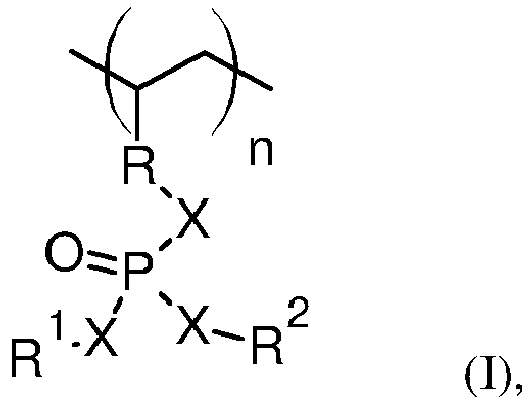
- a solid state battery cathode material includes a first polymer of the general formula (I): where R is naught, C 1 -C 4 alkyl, C 1 -C 4 perfluoroalkyl, or C 1 -C 4 alkanone; X is naught, O, S, or NR 1 ; and R 1 , R 2 are H, C 1 -C 8 alkyl, C 2 -C 4 cycloalkyl, C 1 -C 8 perfluoroalkyl, aryl, phenyl, or 1,2-phenylene.
- the first polymer may be a binder of cathode active material particles.
- the first polymer may form a coating on cathode active material particles.
- the cathode active material particles may include LiFePO 4 , LiCoO 2 , LiMn 2 O 4 , Li(NiCoAl)O 2 (NCA), Li(NiMnCo)O 2 (NCM), or a combination thereof.
- R is naught, C 1 -C 4 alkyl, C 1 -C 4 perfluoroalkyl, or C 1 -C 4 alkanone;
- R is naught, C 1 -C 4 alkyl, C 1 -C 4 perfluoroalkyl, or C 1 -C 4 alkanone;
- the cathode material may further include one or more metal salts mixed in the first polymer.
- the one or more metal salts may have the general formula (V) MX n (V), where M is Li, Na, K, Ca, or Mg; X is triflate, bis(trifluoromethanesulfonimide), bis(perfluoroethylsulfonylimide), ClO 4 , bis(oxalate-borate), BF 4 , B(CN) 4 , or PF 6 ; and n is 1 or 2.
- a solid state polymer battery in an alterative embodiment, includes an anode; a cathode comprising a first polymer of the general formula (I): where R is naught, C 1 -C 4 alkyl, C 1 -C 4 perfluoroalkyl, or C 1 -C 4 alkanone; X is naught, O, S, or NR 1 ; R 1 , R 2 are H, C 1 -C 8 alkyl, C 2 -C 4 cycloalkyl, C 1 -C 8 perfluoroalkyl, aryl, phenyl, or 1,2-phenylene; and a separator electrolyte.
- the first polymer may form a catholyte.
- the cathode may further include active material particles and the first polymer forms a coating on the particles.
- the cathode active material particles may include LiFePO 4 , LiCoO 2 , LiMn 2 O 4 , Li(NiCoAl)O 2 (NCA), Li(NiMnCo)O 2 (NCM), or a combination thereof.
- the anode may include graphite, lithium metal lithium alloy(s), silicon, silicon alloy(s),
- a solid state battery catholyte in yet another embodiment, includes a first polymer of the general formula (I): where R is naught, C 1 -C 4 alkyl, C 1 -C 4 perfluoroalkyl, or C 1 -C 4 alkanone; X is naught, O, S, or NR 1 ; and R 1 , R 2 are H, C 1 -C 8 alkyl, C 2 -C 4 cycloalkyl, C 1 -C 8 perfluoroalkyl, aryl, phenyl, or 1,2-phenylene.
- R is naught, C 1 -C 4 alkyl, C 1 -C 4 perfluoroalkyl, or C 1 -C 4 alkanone
- X is naught, O, S, or NR 1
- R 1 , R 2 are H, C 1 -C 8 alkyl, C 2 -C 4 cycloalkyl, C 1 -C 8 perfluoro
- the catholyte may further include one or more metal salts of the general formula (V) MX n (V), where M is Li, Na, K, Ca, or Mg; X is triflate, bis(trifluoromethanesulfonimide), bis(perfluoroethylsulfonylimide), ClO 4 , bis(oxalate-borate), BF 4 , B(CN) 4 , or PF 6 ; and n is 1 or 2.
- V general formula (V) MX n (V)
- M Li, Na, K, Ca, or Mg
- X is triflate, bis(trifluoromethanesulfonimide), bis(perfluoroethylsulfonylimide), ClO 4 , bis(oxalate-borate), BF 4 , B(CN) 4 , or PF 6 ; and n is 1 or 2.
- R is naught, C 1 -C 4 alkyl, C 1 -C 4 perfluoroalkyl, or C 1 -C 4 alkanone;
- R is naught, C 1 -C 4 alkyl, C 1 -C 4 perfluoroalkyl, or C 1 -C 4 alkanone;
- Figure 1 is a schematic depiction of a solid state battery according to one or more embodiments disclosed herein.
- negative electrode and “anode” are both used to mean “negative electrode.”
- positive electrode and “cathode” are both used to mean “positive electrode.”
- Solid state batteries which feature both solid electrolyte and solid electrodes. Solid state batteries may be thinner, flexible and have more energy per unit weight than the traditional lithium-ion batteries. They may be much safer than lithium-ion batteries due to replacement of a liquid electrolyte with a solid electrolyte. Solid electrolyte may be inorganic or polymer.
- PEO poly(ethylene oxide)
- PEO poly(ethylene oxide)
- Other materials have been developed such as polycarbonate, polysiloxane, succinonitrile, or organic-inorganic hybrid composites. Yet, it would be useful to develop a material which would be highly stable at relatively high voltage, have good Li salt solubility, and Li ion conductivity.
- the material's structure is adapted to provide high ionic conductivity, stability, and good physical properties.
- the material includes a first polymer.
- the first polymer includes one or more phosphoester groups in its side chain(s).
- a phosphoester bond is a bond between the phosphorous atom of a phosphate group and an oxygen atom.
- the first polymer has a general formula (I): where
- the first polymer may be thus utilized in a variety of ways in a solid state battery.
- the first polymer may be used as a cathode material. More specifically, the first polymer may be used as a solid state electrolyte in the cathode or catholyte. Additionally, the first polymer may be also used as a binder for cathode active material particles, holding or drawing the active material particles together to help achieve a cohesive cathode structure.
- the first polymer may form a coating on the active material particles. Due to the first polymer's affinity to metal oxide surfaces, the first polymer may form a layer encompassing the active material particles of the highly oxidizing cathode material.
- the first polymer especially useful in and near the cathode as the first polymer may provide ionic conductivity while remaining stable against a strong oxidizing voltage.
- a battery containing the first polymer as a cathode material may be operated at relatively high potential at oxidizing conditions.
- Phosphate polymers are stable to voltages as high as 4V and more.
- PEO electrolytes are stable only to 3.8V.
- the first polymer offers the possibility of operating batteries at a voltage at least 5% higher than is possible in PEO-based batteries.
- a 5% increase in voltage results in a 5% increase in both battery power and battery energy, all other things being equal, which translates into a significant increase in battery performance.
- a monomer of the first polymer may be copolymerized in either a random or block pattern with other monomers that contribute additional functionality.
- additional functionalities include high polarity, suppressed glass transition temperature, single ion conductivity, or specific binding to a cathode active material.
- the first and the second polymers may form a random copolymer of the general formula (III): where
- first and second polymers may form a block copolymer of the general formula (IV): where
- a cathode material may contain a residual amount of strong basic or nucleophilic species like LiOH, which could be involved in reactions resulting in breakage of the P-X bond of the polymers of the formulas (I), (III), and (IV). Yet, if the P-X bond is broken in the structures, the polymer backbone is unchanged since the P-X is located in the side chain. The main polymer backbone, containing C-C bonds, is thus stable as the C-C bond is relatively difficult to break. Having the P-X bond in the sidechain thus increases the overall stability of the polymer structures of the formulas (I), (III), and (IV) while providing the benefits associated with having the one or more phosphoester groups in the polymer.
- strong basic or nucleophilic species like LiOH
- the polymers of the formulas (I), (III), and (IV) having one or more phosphoester group in their side chain(s) have good stability to high voltages of >3.6V when compared to Li + /Li, good Li salt solubility and Li + ion conductivity provided by the polar phosphoester group, and greater polymer stability than polymers incorporating the phosphoester group(s) into the polymer main chain.
- the polymers of the formulas (I), (III), and (IV) may be combined with a metal salt to provide ionic conductivity.
- the polymers of the formulas (I), (III), and (IV) may be combined with the following non-limiting example metal salts having the general formula MX n (V), where
- metals may be used, depending on the battery chemistry.
- the metal salts named above are suitable for a lithium battery cell.
- Other example salts may include NaTFSI or other salts appropriate for sodium ion insertion batteries with an anode such as organic carboxylates and a cathode such as hard carbon, hollow carbon nanowires, etc.
- the first polymer may be fluorinated or perfluorinated. Fluorine may be introduced to the first polymer structure through the R 1 and R 2 groups depicted in the structures above. Fluorinated polymers may have different electrolyte properties, which may include better high-voltage stability and higher conductivity due to altering polymer/salt interactions and depressing the polymer glass transition temperature. Nafion is an example of a common, perfluorinated polymer electrolyte. Fluorinated electrolytes are typically unstable to the reducing potentials at the lithium anode, may be used in a cathode due to physical isolation from the anode.
- a solid state battery/battery cell 100 includes a cathode 110, an anode 112, and a separator electrolyte 114.
- the cathode 110 may include active material particles 116 surrounded by catholyte 118.
- the catholyte 118 may provide ionic communication between the separator electrolyte 114 and the cathode active particles 116.
- the catholyte 118 may include the first polymer or the copolymer.
- the catholyte 118 may act as a binder of the active material particles 116.
- the active material particles 116 may include a coating 120.
- the coating 120 may include the first polymer or the copolymers discussed herein.
- the coating 120 is oxidatively stable to the potential at which the cathode 110 operates.
- the catholyte 118 may have higher ionic conductivity than the coating 120, improved binding properties to maintain structural integrity of the cathode composite, or both.
- the polymers of the formulas (I), (III), and/or (IV) may act as a binding agent when mixed with redox-active, ionically intercalating/deintercalating cathode active material particles 116 to form the cathode film or coating 120.
- PVDF polyvinylidene fluoride
- the coating 120 may be uniform or non-uniform having the same or different thickness, respectively. The same or different thickness may relate to a single active material particle 116 or more than one active material particles 116.
- the coating 120 may be a thin film coating having a thickness from about 1 to 500, 10 to 250, or 50 to 100 nm.
- the coating 120 may cover an entire or partial surface of the active material particles 116.
- the coating 120 may cover 20, 30, 40, 50, 60 70, 80, 90% or more of an active material particle 116 surface area. All cathode active particles 116 may include a coating 120. Alternatively, at least a portion of the cathode active particles 116 may be free from the coating 120.
- the coating 120 and the catholyte 118 may be the same or different material.
- both the coating 120 and the catholyte 118 may include the first polymer, the copolymers of formulas (III) and (IV) or a combination thereof.
- the coating 120 may have a different composition than the first polymer, the copolymers of formulas (III) and (IV) or a combination thereof forming the catholyte 118.
- the coating 120 may include the first polymer, the copolymers of formulas (III) and (IV) or a combination thereof while the catholyte 118 may chemically differ from the coating 120.
- the cathode active material may include, but is not limited to, lithium iron phosphate (LiFePO 4 , LFP), LiCoO 2 , LiMn 2 O 4 , lithium nickel cobalt aluminum oxide (LiNiCoAlO 2 , NCA), lithium nickel cobalt manganese oxide (LiNiMnCo, NCM), or a combination thereof.
- the first polymer may be mixed with non-intercalating cathode active material particles 116 to form a cathode film or coating 120.
- Examples of such cathode active material include, but are not limited to, sulfur, microstructured carbon/sulfur composites, lithium peroxides, metal alloys of lithium, and organometallic molecules such as ferrocenes.
- the cathode film or coating 120 may also include agents such as carbon black to provide increased electrical conductivity, other polymers such as PEO to provide additional ionic conductivity, additional polymers such as polyvinylidene fluoride (PVDF) or polystyrene (PS) to provide improved mechanical strength, the like, or a combination thereof.
- agents such as carbon black to provide increased electrical conductivity
- other polymers such as PEO to provide additional ionic conductivity
- additional polymers such as polyvinylidene fluoride (PVDF) or polystyrene (PS) to provide improved mechanical strength, the like, or a combination thereof.
- PVDF polyvinylidene fluoride
- PS polystyrene
- the cathode active material particles 116 may include one or more of the following: sulfur, microstructured carbon/sulfur composites, lithium peroxides, metal alloys of lithium, or organometallic molecules.
- the cathode active material may be any of a variety of materials depending on the type of chemistry for which the battery cell 100 is designed.
- the battery 100 may be a lithium or lithium ion cell.
- the cathode active material may be any material that can serve as a host material for lithium ions. Examples of such materials include, but are not limited to materials described by the general formula Li x A 1-y M y O 2 (VI), where
- An example cathode material is LiNi 0.5 Mn 0.5 O 2 .
- the cathode active material may be described by the general formula Li x Mn 2-y M y O 2 (VII), where
- the cathode active material may be described by the general formula Li x M y Mn 4-y O 8 (VIII), where
- the cathode electrode active material may be described by the general formula Li x (Fe y M 1-y )PO 4 (IX), where
- the cathode active material may be described by the general formula: Li(Ni 0.5-x Co 0.5-x M 2x )O 2 (X), where
- the cathode active material may include LiNiVO 2 .
- the cathode active material particles may include lithium iron phosphate (LFP), LiCoO 2 , LiMn 2 O 4 , lithium nickel cobalt aluminum oxide (NCA), lithium nickel cobalt manganese oxide (NCM), or a combination thereof.
- LFP lithium iron phosphate
- NCA lithium nickel cobalt aluminum oxide
- NCM lithium nickel cobalt manganese oxide
- the cathode active material particles may include sulfur, microstructured carbon/sulfur composites, lithium peroxides, metal alloys of lithium, organometallic molecules, or a combination thereof.
- the separator electrolyte 114 may be PEO-based.
- PEO-based electrolyte When a PEO-based electrolyte is used in the separator between the cathode 110 and the anode 112, it may be useful to include some PEO in the cathode 110 to improve interfacial ionic transfer between the cathode 110 and the separator electrolyte 114.
- PEO may be added to the cathode 110 through intimate mixing with other cathode components.
- PEO may be added to the cathode 110 in the form of a PEO-PPE (poly phenylene ether) block copolymer.
- PEO or a PEO-PPE block copolymer may be used as an intermediate layer between the cathode 110 and the separator electrolyte 114.
- Other electrolytes commonly used as the separator electrolyte 114 may include, but are not limited to, PS-PEO block copolymers and PPE-PEO block copolymers.
- Electronically conductive block copolymers based on PPE may be added to the cathode 110.
- Examples include, but are not limited to, block copolymers of PPE and electronically conductive polymers such as polythiophene, polyvinylphenylene, polyaniline, polypyrrole, polyacetylene, polyphenylene sulfide, poly(3,4-ethylenedioxythiophene) (pedot), or polyfluorenes.
- electronically conductive polymers such as polythiophene, polyvinylphenylene, polyaniline, polypyrrole, polyacetylene, polyphenylene sulfide, poly(3,4-ethylenedioxythiophene) (pedot), or polyfluorenes.
- the anode 112 active material may include any of a variety of materials depending on the type of chemistry for which the battery cell 100 is designed.
- the anode 112 material may include any material that can serve as a host material (i.e., can absorb and release) lithium ions.
- Examples of such materials include, but are not limited to graphite, lithium metal, and lithium alloys such as Li-Al, Li-Si, Li-Sn, and Li-Mg, Si and silicon alloys of tin (Sn), nickel (Ni), copper (Cu), iron (Fe), cobalt (Co), manganese (Mn), zinc (Zn), indium (In), silver (Ag), titanium (Ti), germanium (Ge), bismuth (Bi), antimony (Sb), and chromium (Cr), and mixtures thereof.
- graphite, metal oxides, silicon oxides, or silicon carbides may also be used as anode 112 materials.
- the first polymer may be synthesized using radical polymerization techniques, including both free radical polymerizations and controlled radical polymerizations (NMP, ATRP, RAFT). These methods are able to generate high molecular weight polymers with less difficulty than condensation and ring-opening polymerization methods. Foremost, impurities are less likely to interfere with radical reaction pathways. Care should be taken with radical reactions to remove dioxygen, which is a well-known interference.
- radical polymerization techniques including both free radical polymerizations and controlled radical polymerizations (NMP, ATRP, RAFT).
- a non-limiting example of a polymer synthesis of the first polymer of the general formula (I) may be synthesis of diethyl vinyl phosphate (DEVP).
- DEVP diethyl vinyl phosphate
- 50 g of 45 wt. % aqueous chloroacetaldehyde is stirred with 250 mL dichloromethane and 25 g anhydrous magnesium sulfate for 1 h, then filtered.
- To the filtrate is added dropwise triethyl phosphite (47.6 g), following which the mixture is heated to reflux for 1 h.
- the mixture is then purified by vacuum distillation, isolating the desired product at 90-95 °C at 5 torr. This fraction is redistilled under vacuum to DEVP in 61% yield and >90% purity.
- Another example includes synthesis of poly-DEVP.
- a flask is charged with DEVP (16 g), triethyl phosphite (160 mg) and 2,2'-azobisisobutyrylnitrile (AIBN, 160 mg) and closed.
- the reaction flask is then heated to 80°C using a thermostat-controlled oil bath for 2 h.
- the flask is cooled, and the contents are diluted with tetrahydrofuran (32 mL) and poured into hexane (150 mL) to precipitate the polymer.
- the polymer is reprecipitated once from THF/hexane to give PDEVP as a yellow, tacky gel.
- Gel permeation chromatography (DMF, vs PEO standards): Mn 22,900, PDI 2.5
- DMPA dimethylphosphonomethyl acrylate
- An example synthesis of dimethylphosphonomethyl acrylate may include charging a flask with dimethylphosphite (11 g), paraformaldehyde (3.0 g), potassium carbonate (0.69 g), and methanol and closed. The mixture is stirred for 3 hours until it turns clear transparent solution. The solvent is removed under reduced pressure and the concentrated oily product hydroxymethyldimethylphosphonate is purified by passing through a silica plug. To the solution of hydroxymethyldimethylphosphonate (8.5 g) and triethylamine (12.26 g) in dry THF (250 mL), is added acryloryl chloride (6.6 g) in dropwise.
- the resulting mixture is allowed to stir overnight and then is diluted with water and extracted with ethyl acetate. The extracts are combined and washed with water and brine, dried over magnesium sulfate, and concentrated under reduced pressure to yield crude product DMPA.
- the crude product is purified by passing through a silica gel column to yield pure DMPA 10 g in 85% yield.
- PDMPA poly-dimethylphosphonomethyl acrylate
- An example synthesis of P(DMPA-co-AN) includes degassing a solution of DMPA (5 g), acrylonitrile (5 g), and AIBN (50 mg) in DMF (10 g) and heating the solution to 80°C with stirring for 12 hours. The resulting viscous solution is cooled to room temperature and precipitated in diethyl ether to yield the product P(DMPA-co-AN) as a solid.
- a non-limiting example of the cathode may be made by using PDMPA as the polymer of the catholyte.
- the composition is lithium nickel cobalt aluminum oxide (61 wt.%), acetylene carbon (4 wt.%), PDMPA (27 wt.%), lithium bis(oxalate)borate (3 wt.%), and polyvinyldifluoride (5 wt.%).
- the cathode is made by a solution casting method. The materials are dispersed/dissolved in dimethylformamide with a solid weight percentage of 36 wt.%. The obtained slurry is casted on carbon-coated aluminum foil and dried at 60°C. The loading of the cathode is about 4.2 mg/cm 2 .
- the example battery cell may include a laminate structure including discreet layers of the cathode / polymer or separator electrolyte / anode.
- the anode may be a lithium anode.
- the polymer/separator electrolyte may be composed of an ethylene oxide-styrene copolymer and lithium bis(oxalate)borate and/or another material.
- the molar ratio n(ethylene oxide) / n(lithium) may be about 0.085.
- the thickness of the polymer electrolyte may be about 10-30, 12-25, or 15-20 ⁇ .
- the thickness of the lithium layer may be about 5-50, 10-40, or 20-30 ⁇ .
- the laminate may be placed into and sealed in a pouch.
- the battery cell may be cycled at either 3V - 4.2V or 3V - 4.3V.
Landscapes
- Chemical & Material Sciences (AREA)
- Chemical Kinetics & Catalysis (AREA)
- General Chemical & Material Sciences (AREA)
- Electrochemistry (AREA)
- Engineering & Computer Science (AREA)
- Manufacturing & Machinery (AREA)
- Condensed Matter Physics & Semiconductors (AREA)
- Physics & Mathematics (AREA)
- Materials Engineering (AREA)
- General Physics & Mathematics (AREA)
- Inorganic Chemistry (AREA)
- Composite Materials (AREA)
- Dispersion Chemistry (AREA)
- Health & Medical Sciences (AREA)
- Medicinal Chemistry (AREA)
- Polymers & Plastics (AREA)
- Organic Chemistry (AREA)
- Secondary Cells (AREA)
- Battery Electrode And Active Subsutance (AREA)
Abstract
Description
- The present disclosure relates to a cathode polymer material, having a phosphoester group in a sidechain, of a solid state battery and a method of making the cathode polymer material.
- Lithium ion batteries have become a staple among rechargeable batteries. Yet, despite their prevalence, lithium ion batteries are limited in power density, can become a safety hazard when damaged, and feature relatively short lifespans. Solid state batteries are being developed to replace and outperform lithium ion batteries.
- According to one embodiment, a solid state battery cathode material is disclosed. The cathode material includes a first polymer of the general formula (I):


MXn (V),
where M is Li, Na, K, Ca, or Mg; X is triflate, bis(trifluoromethanesulfonimide), bis(perfluoroethylsulfonylimide), ClO4, bis(oxalate-borate), BF4, B(CN)4, or PF6; and n is 1 or 2. - In an alterative embodiment, a solid state polymer battery is disclosed. The battery includes an anode; a cathode comprising a first polymer of the general formula (I):


- In yet another embodiment, a solid state battery catholyte is disclosed. The catholyte includes a first polymer of the general formula (I):

MXn (V),
where M is Li, Na, K, Ca, or Mg; X is triflate, bis(trifluoromethanesulfonimide), bis(perfluoroethylsulfonylimide), ClO4, bis(oxalate-borate), BF4, B(CN)4, or PF6; and n is 1 or 2. The catholyte may also include a second polymer of the general formula (II):


-
Figure 1 is a schematic depiction of a solid state battery according to one or more embodiments disclosed herein. - Embodiments of the present disclosure are described herein. It is to be understood, however, that the disclosed embodiments are merely examples and other embodiments may take various and alternative forms. The figures are not necessarily to scale; some features could be exaggerated or minimized to show details of particular components. Therefore, specific structural and functional details disclosed herein are not to be interpreted as limiting, but merely as a representative basis for teaching one skilled in the art to variously employ the present invention. As those of ordinary skill in the art will understand, various features illustrated and described with reference to any one of the figures may be combined with features illustrated in one or more other figures to produce embodiments that are not explicitly illustrated or described. The combinations of features illustrated provide representative embodiments for typical applications. Various combinations and modifications of the features consistent with the teachings of this disclosure, however, could be desired for particular applications or implementations.
- Except where expressly indicated, all numerical quantities in this description indicating dimensions or material properties are to be understood as modified by the word "about" in describing the broadest scope of the present disclosure.
- In this disclosure, the terms "negative electrode" and "anode" are both used to mean "negative electrode." Likewise, the terms "positive electrode" and "cathode" are both used to mean "positive electrode."
- The first definition of an acronym or other abbreviation applies to all subsequent uses herein of the same abbreviation and applies mutatis mutandis to normal grammatical variations of the initially defined abbreviation. Unless expressly stated to the contrary, measurement of a property is determined by the same technique as previously or later referenced for the same property.
- Reference is being made in detail to compositions, embodiments, and methods of embodiments known to the inventors. However, it should be understood that disclosed embodiments are merely exemplary of the present invention which may be embodied in various and alternative forms. Therefore, specific details disclosed herein are not to be interpreted as limiting, rather merely as representative bases for teaching one skilled in the art to variously employ the present invention.
- The description of a group or class of materials as suitable for a given purpose in connection with one or more embodiments implies that mixtures of any two or more of the members of the group or class are suitable. Description of constituents in chemical terms refers to the constituents at the time of addition to any combination specified in the description, and does not necessarily preclude chemical interactions among constituents of the mixture once mixed. The first definition of an acronym or other abbreviation applies to all subsequent uses herein of the same abbreviation and applies mutatis mutandis to normal grammatical variations of the initially defined abbreviation. Unless expressly stated to the contrary, measurement of a property is determined by the same technique as previously or later referenced for the same property.
- While lithium-ion batteries have become common and their use wide-spread, lithium-ion batteries continue to have certain disadvantages. Therefore, alternative battery types have been developed with the hope of replacing traditional lithium-ion batteries. One of the alternatives are solid state batteries which feature both solid electrolyte and solid electrodes. Solid state batteries may be thinner, flexible and have more energy per unit weight than the traditional lithium-ion batteries. They may be much safer than lithium-ion batteries due to replacement of a liquid electrolyte with a solid electrolyte. Solid electrolyte may be inorganic or polymer.
- A frequently used material used for production of polymer solid electrolytes has been poly(ethylene oxide) (PEO). But PEO has several drawbacks such as temperature-dependent ion conductivity and low stability under highly oxidizing conditions. PEO crystallizes at 60° C, below which point its ionic conductivity is severely reduced. PEO is stable only to about 3.8 V vs Li+/Li, as higher voltages present oxidizing conditions that render PEO unstable. These two drawbacks limit the overall power, voltage, and temperature range at which batteries that use PEO electrolytes can operate. Other materials have been developed such as polycarbonate, polysiloxane, succinonitrile, or organic-inorganic hybrid composites. Yet, it would be useful to develop a material which would be highly stable at relatively high voltage, have good Li salt solubility, and Li ion conductivity.
- Greater stability in traditional lithium batteries with liquid electrolyte is based primarily on the major components of the liquid electrolyte itself, of which usually more than 90% is an organic carbonate solvent and lithium salt, with the remainder made up of specialized small molecule additives which aid in stabilization of the electrolyte-electrode interfaces. In contrast, an addition of small molecules to solid electrolyte cells may be deleterious as the small molecules may migrate to a block copolymer separator and cause undesirable softening. Thus, a different approach has to be developed to improve performance and stability in solid state batteries.
- In one or more embodiments discussed below, a material overcoming the above-mentioned drawbacks is disclosed. The material's structure is adapted to provide high ionic conductivity, stability, and good physical properties. The material includes a first polymer. The first polymer includes one or more phosphoester groups in its side chain(s). A phosphoester bond is a bond between the phosphorous atom of a phosphate group and an oxygen atom.
- The first polymer has a general formula (I):

- R is naught, C1-C4 alkyl, C1-C4 perfluoroalkyl, or C1-C4 alkanone,
- X is naught, O, S, or NR1, and
- R1, R2 are H, C1-C8 alkyl, C2-C4 cycloalkyl, C1-C8 perfluoroalkyl, aryl, phenyl, or 1,2-phenylene.
- The first polymer based on repeating phosphoesters features a variety of advantages. For example, due to their polarity, polymeric phosphoesters that contain a P=O bond can readily dissolve metal salts to provide a path for ionic conduction. Polymeric phosphoesters are generally non-crystalline and amorphous with low glass transition temperatures. As a result, they do not experience a drop in ionic conductivity due to crystallization over a wide range of operating temperatures. Polymeric phosphoesters are highly oxidized, and thus flame retarding, making it difficult for further oxidization to occur and rendering them very stable at highly oxidizing voltages, for example, at a battery cathode.
- The first polymer may be thus utilized in a variety of ways in a solid state battery. For example, the first polymer may be used as a cathode material. More specifically, the first polymer may be used as a solid state electrolyte in the cathode or catholyte. Additionally, the first polymer may be also used as a binder for cathode active material particles, holding or drawing the active material particles together to help achieve a cohesive cathode structure. The first polymer may form a coating on the active material particles. Due to the first polymer's affinity to metal oxide surfaces, the first polymer may form a layer encompassing the active material particles of the highly oxidizing cathode material.
- Resistance to oxidation makes the first polymer especially useful in and near the cathode as the first polymer may provide ionic conductivity while remaining stable against a strong oxidizing voltage. A battery containing the first polymer as a cathode material may be operated at relatively high potential at oxidizing conditions. Phosphate polymers are stable to voltages as high as 4V and more. As discussed above, PEO electrolytes are stable only to 3.8V. With stability up to 4V and more, the first polymer offers the possibility of operating batteries at a voltage at least 5% higher than is possible in PEO-based batteries. A 5% increase in voltage results in a 5% increase in both battery power and battery energy, all other things being equal, which translates into a significant increase in battery performance.
- A monomer of the first polymer may be copolymerized in either a random or block pattern with other monomers that contribute additional functionality. Examples of additional functionalities that can be useful include high polarity, suppressed glass transition temperature, single ion conductivity, or specific binding to a cathode active material. For example, the first polymer may be combined with a second polymer of the general formula (II):

R3, R4 = H, C1-C4 alkylcarboxy, oligo(ethylene glycol)carboxy, nitrile, C1-C6 alkyl, phenyl, or C2-C4 alkanoate. - The first and the second polymers may form a random copolymer of the general formula (III):

- R is naught, C1-C4 alkyl, C1-C4 perfluoroalkyl, or C1-C4 alkanone,
- X is naught, O, S, or NR1,
- R1, R2 are H, C1-C8 alkyl, C2-C4 cycloalkyl, C1-C8 perfluoroalkyl, aryl, phenyl, or 1,2-phenylene, and
- R3, R4 = H, C1-C4 alkylcarboxy, oligo(ethylene glycol)carboxy, nitrile, C1-C6 alkyl, phenyl, or C2-C4 alkanoate.
- Alternatively, the first and second polymers may form a block copolymer of the general formula (IV):

- R is naught, C1-C4 alkyl, C1-C4perfluoroalkyl, or C1-C4 alkanone,
- X is naught, O, S, or NR1,
- R1, R2 are H, C1-C8 alkyl, C2-C4 cycloalkyl, C1-C8 perfluoroalkyl, aryl, phenyl, or 1,2-phenylene, and
- R3, R4 = H, C1-C4 alkylcarboxy, oligo(ethylene glycol)carboxy, nitrile, C1-C6 alkyl, phenyl, or C2-C4 alkanoate.
- It is contemplated that a cathode material may contain a residual amount of strong basic or nucleophilic species like LiOH, which could be involved in reactions resulting in breakage of the P-X bond of the polymers of the formulas (I), (III), and (IV). Yet, if the P-X bond is broken in the structures, the polymer backbone is unchanged since the P-X is located in the side chain. The main polymer backbone, containing C-C bonds, is thus stable as the C-C bond is relatively difficult to break. Having the P-X bond in the sidechain thus increases the overall stability of the polymer structures of the formulas (I), (III), and (IV) while providing the benefits associated with having the one or more phosphoester groups in the polymer.
- The polymers of the formulas (I), (III), and (IV) having one or more phosphoester group in their side chain(s) have good stability to high voltages of >3.6V when compared to Li+/Li, good Li salt solubility and Li+ ion conductivity provided by the polar phosphoester group, and greater polymer stability than polymers incorporating the phosphoester group(s) into the polymer main chain.
- The polymers of the formulas (I), (III), and (IV) may be combined with a metal salt to provide ionic conductivity. The polymers of the formulas (I), (III), and (IV) may be combined with the following non-limiting example metal salts having the general formula
MXn (V),
where - M is Li, Na, K, Ca, or Mg,
- X is triflate, bis(trifluoromethanesulfonimide), bis(perfluoroethylsulfonylimide), ClO4, bis(oxalate-borate), BF4, B(CN)4, or PF6, and
- n is 1 or 2, specifically n = 1 for Li, Na, K and n = 2 for Ca or Mg.
- Other metals may be used, depending on the battery chemistry. The metal salts named above are suitable for a lithium battery cell. Other example salts may include NaTFSI or other salts appropriate for sodium ion insertion batteries with an anode such as organic carboxylates and a cathode such as hard carbon, hollow carbon nanowires, etc.
- The first polymer may be fluorinated or perfluorinated. Fluorine may be introduced to the first polymer structure through the R1 and R2 groups depicted in the structures above. Fluorinated polymers may have different electrolyte properties, which may include better high-voltage stability and higher conductivity due to altering polymer/salt interactions and depressing the polymer glass transition temperature. Nafion is an example of a common, perfluorinated polymer electrolyte. Fluorinated electrolytes are typically unstable to the reducing potentials at the lithium anode, may be used in a cathode due to physical isolation from the anode.
- A schematic example embodiment of a solid state battery or
battery cell 100 according to one or more embodiments disclosed herein is depicted inFigure 1 . As can be seen inFigure 1 , a solid state battery/battery cell 100 includes acathode 110, ananode 112, and aseparator electrolyte 114. Thecathode 110 may includeactive material particles 116 surrounded bycatholyte 118. Thecatholyte 118 may provide ionic communication between theseparator electrolyte 114 and the cathodeactive particles 116. Thecatholyte 118 may include the first polymer or the copolymer. Thecatholyte 118 may act as a binder of theactive material particles 116. - The
active material particles 116 may include acoating 120. Thecoating 120 may include the first polymer or the copolymers discussed herein. Thecoating 120 is oxidatively stable to the potential at which thecathode 110 operates. Thecatholyte 118 may have higher ionic conductivity than thecoating 120, improved binding properties to maintain structural integrity of the cathode composite, or both. The polymers of the formulas (I), (III), and/or (IV) may act as a binding agent when mixed with redox-active, ionically intercalating/deintercalating cathodeactive material particles 116 to form the cathode film orcoating 120. Other binders such as polyvinylidene fluoride (PVDF) may be used to increase cohesiveness among the coated cathodeactive material particles 116 in the alternative or in addition to the first polymer and the copolymers of formulas (III) and (IV). - The
coating 120 may be uniform or non-uniform having the same or different thickness, respectively. The same or different thickness may relate to a singleactive material particle 116 or more than oneactive material particles 116. Thecoating 120 may be a thin film coating having a thickness from about 1 to 500, 10 to 250, or 50 to 100 nm. Thecoating 120 may cover an entire or partial surface of theactive material particles 116. Thecoating 120 may cover 20, 30, 40, 50, 60 70, 80, 90% or more of anactive material particle 116 surface area. All cathodeactive particles 116 may include acoating 120. Alternatively, at least a portion of the cathodeactive particles 116 may be free from thecoating 120. - The
coating 120 and thecatholyte 118 may be the same or different material. For example, both thecoating 120 and thecatholyte 118 may include the first polymer, the copolymers of formulas (III) and (IV) or a combination thereof. Alternatively, thecoating 120 may have a different composition than the first polymer, the copolymers of formulas (III) and (IV) or a combination thereof forming thecatholyte 118. Alternatively still, thecoating 120 may include the first polymer, the copolymers of formulas (III) and (IV) or a combination thereof while thecatholyte 118 may chemically differ from thecoating 120. - The cathode active material may include, but is not limited to, lithium iron phosphate (LiFePO4, LFP), LiCoO2, LiMn2O4, lithium nickel cobalt aluminum oxide (LiNiCoAlO2, NCA), lithium nickel cobalt manganese oxide (LiNiMnCo, NCM), or a combination thereof. Alternatively, the first polymer may be mixed with non-intercalating cathode
active material particles 116 to form a cathode film orcoating 120. Examples of such cathode active material include, but are not limited to, sulfur, microstructured carbon/sulfur composites, lithium peroxides, metal alloys of lithium, and organometallic molecules such as ferrocenes. The cathode film orcoating 120 may also include agents such as carbon black to provide increased electrical conductivity, other polymers such as PEO to provide additional ionic conductivity, additional polymers such as polyvinylidene fluoride (PVDF) or polystyrene (PS) to provide improved mechanical strength, the like, or a combination thereof. - The cathode
active material particles 116 may include one or more of the following: sulfur, microstructured carbon/sulfur composites, lithium peroxides, metal alloys of lithium, or organometallic molecules. - The cathode active material may be any of a variety of materials depending on the type of chemistry for which the
battery cell 100 is designed. Thebattery 100 may be a lithium or lithium ion cell. The cathode active material may be any material that can serve as a host material for lithium ions. Examples of such materials include, but are not limited to materials described by the general formula
LixA1-yMyO2 (VI),
where - A is at least one transition metal such as Mn, Co, and Ni,
- M is B, Mg, Ca, Sr, Ba, Ti, V, Cr, Mn, Fe, Co, Ni, Cu, Al, In, Nb, Mo, W, Y, and Rh, or a combination thereof,
- x is 0.05≤x≤1.1, and
- y is 0≤y≤0.5.
- An example cathode material is LiNi0.5Mn0.5O2.
- Alternatively, the cathode active material may be described by the general formula
LixMn2-yMyO2 (VII),
where - M is Mn, Ni, Co, Cr, or a combination thereof,
- x is 0.05≤x≤1.1, and
- y is 0≤y≤2.
- Alternatively still, the cathode active material may be described by the general formula
LixMyMn4-yO8 (VIII),
where - M is Fe, Co, or both,
- x is 0.05≤x≤2, and
- y is 0≤y≤4.
- The cathode electrode active material may be described by the general formula
Lix(FeyM1-y)PO4 (IX),
where - M is chosen from transition metals such as Mn, Co and/or Ni,
- x is 0.9≤x≤1.1, and
- y is 0≤y≤1.
- In yet another embodiment, the cathode active material may be described by the general formula:
Li(Ni0.5-xCo0.5-xM2x)O2 (X),
where - M is chosen from Al, Mg, Mn, and/or Ti,
- and x is 0≤x≤0.2.
- The cathode active material may include LiNiVO2.
- The cathode active material particles may include lithium iron phosphate (LFP), LiCoO2, LiMn2O4, lithium nickel cobalt aluminum oxide (NCA), lithium nickel cobalt manganese oxide (NCM), or a combination thereof.
- In another embodiment, the cathode active material particles may include sulfur, microstructured carbon/sulfur composites, lithium peroxides, metal alloys of lithium, organometallic molecules, or a combination thereof.
- The
separator electrolyte 114 may be PEO-based. When a PEO-based electrolyte is used in the separator between thecathode 110 and theanode 112, it may be useful to include some PEO in thecathode 110 to improve interfacial ionic transfer between thecathode 110 and theseparator electrolyte 114. PEO may be added to thecathode 110 through intimate mixing with other cathode components. Alternatively, PEO may be added to thecathode 110 in the form of a PEO-PPE (poly phenylene ether) block copolymer. In yet another embodiment, PEO or a PEO-PPE block copolymer may be used as an intermediate layer between thecathode 110 and theseparator electrolyte 114. Other electrolytes commonly used as theseparator electrolyte 114 may include, but are not limited to, PS-PEO block copolymers and PPE-PEO block copolymers. Electronically conductive block copolymers based on PPE may be added to thecathode 110. Examples include, but are not limited to, block copolymers of PPE and electronically conductive polymers such as polythiophene, polyvinylphenylene, polyaniline, polypyrrole, polyacetylene, polyphenylene sulfide, poly(3,4-ethylenedioxythiophene) (pedot), or polyfluorenes. - The
anode 112 active material may include any of a variety of materials depending on the type of chemistry for which thebattery cell 100 is designed. Theanode 112 material may include any material that can serve as a host material (i.e., can absorb and release) lithium ions. Examples of such materials include, but are not limited to graphite, lithium metal, and lithium alloys such as Li-Al, Li-Si, Li-Sn, and Li-Mg, Si and silicon alloys of tin (Sn), nickel (Ni), copper (Cu), iron (Fe), cobalt (Co), manganese (Mn), zinc (Zn), indium (In), silver (Ag), titanium (Ti), germanium (Ge), bismuth (Bi), antimony (Sb), and chromium (Cr), and mixtures thereof. Alternatively, graphite, metal oxides, silicon oxides, or silicon carbides may also be used asanode 112 materials. - In one or more embodiments, a process for production of the cathode material and the battery is disclosed. The first polymer may be synthesized using radical polymerization techniques, including both free radical polymerizations and controlled radical polymerizations (NMP, ATRP, RAFT). These methods are able to generate high molecular weight polymers with less difficulty than condensation and ring-opening polymerization methods. Foremost, impurities are less likely to interfere with radical reaction pathways. Care should be taken with radical reactions to remove dioxygen, which is a well-known interference.
- A non-limiting example of a polymer synthesis of the first polymer of the general formula (I) may be synthesis of diethyl vinyl phosphate (DEVP). 50 g of 45 wt. % aqueous chloroacetaldehyde is stirred with 250 mL dichloromethane and 25 g anhydrous magnesium sulfate for 1 h, then filtered. To the filtrate is added dropwise triethyl phosphite (47.6 g), following which the mixture is heated to reflux for 1 h. The mixture is then purified by vacuum distillation, isolating the desired product at 90-95 °C at 5 torr. This fraction is redistilled under vacuum to DEVP in 61% yield and >90% purity.
- Another example includes synthesis of poly-DEVP. A flask is charged with DEVP (16 g), triethyl phosphite (160 mg) and 2,2'-azobisisobutyrylnitrile (AIBN, 160 mg) and closed. The mixture is degassed by applying vacuum at room temperature to <=1 torr, stirring 1 minute, then refilling with argon, then repeating these steps through two more cycles. The reaction flask is then heated to 80°C using a thermostat-controlled oil bath for 2 h. The flask is cooled, and the contents are diluted with tetrahydrofuran (32 mL) and poured into hexane (150 mL) to precipitate the polymer. The polymer is reprecipitated once from THF/hexane to give PDEVP as a yellow, tacky gel. Gel permeation chromatography (DMF, vs PEO standards): Mn 22,900, PDI 2.55.
- An example synthesis of dimethylphosphonomethyl acrylate (DMPA) may include charging a flask with dimethylphosphite (11 g), paraformaldehyde (3.0 g), potassium carbonate (0.69 g), and methanol and closed. The mixture is stirred for 3 hours until it turns clear transparent solution. The solvent is removed under reduced pressure and the concentrated oily product hydroxymethyldimethylphosphonate is purified by passing through a silica plug. To the solution of hydroxymethyldimethylphosphonate (8.5 g) and triethylamine (12.26 g) in dry THF (250 mL), is added acryloryl chloride (6.6 g) in dropwise. The resulting mixture is allowed to stir overnight and then is diluted with water and extracted with ethyl acetate. The extracts are combined and washed with water and brine, dried over magnesium sulfate, and concentrated under reduced pressure to yield crude product DMPA. The crude product is purified by passing through a silica gel column to yield pure DMPA 10 g in 85% yield.
- An example synthesis of poly-dimethylphosphonomethyl acrylate (PDMPA) has been disclosed for example in
U.S. Patent No. 2,934,555 ,U.S. Patent No. 3,030,347 , orU.S. Patent Publication No. 2013/0131258 , content of which is hereby incorporated by reference. A solution of DMPA (2 g) and AIBN (8.4 mg) in DMF (2.5 g) is degassed and heated to 80°C with stirring for 12 hours. The resulting viscous solution is cooled to room temperature and precipitated in ditheyl ether to yield the product PDMPA as a viscous solid. - An example synthesis of P(DMPA-co-AN) includes degassing a solution of DMPA (5 g), acrylonitrile (5 g), and AIBN (50 mg) in DMF (10 g) and heating the solution to 80°C with stirring for 12 hours. The resulting viscous solution is cooled to room temperature and precipitated in diethyl ether to yield the product P(DMPA-co-AN) as a solid.
- A non-limiting example of the cathode may be made by using PDMPA as the polymer of the catholyte. The composition is lithium nickel cobalt aluminum oxide (61 wt.%), acetylene carbon (4 wt.%), PDMPA (27 wt.%), lithium bis(oxalate)borate (3 wt.%), and polyvinyldifluoride (5 wt.%). The cathode is made by a solution casting method. The materials are dispersed/dissolved in dimethylformamide with a solid weight percentage of 36 wt.%. The obtained slurry is casted on carbon-coated aluminum foil and dried at 60°C. The loading of the cathode is about 4.2 mg/cm2.
- A non-limiting example of an assembled all-solid-state battery cell with the cathode material described above may be built. The example battery cell may include a laminate structure including discreet layers of the cathode / polymer or separator electrolyte / anode. The anode may be a lithium anode. The polymer/separator electrolyte may be composed of an ethylene oxide-styrene copolymer and lithium bis(oxalate)borate and/or another material. The molar ratio n(ethylene oxide) / n(lithium) may be about 0.085. The thickness of the polymer electrolyte may be about 10-30, 12-25, or 15-20 µ. The thickness of the lithium layer may be about 5-50, 10-40, or 20-30 µ. The laminate may be placed into and sealed in a pouch. The battery cell may be cycled at either 3V - 4.2V or 3V - 4.3V.
- While exemplary embodiments are described above, it is not intended that these embodiments describe all possible forms of the invention. Rather, the words used in the specification are words of description rather than limitation, and it is understood that various changes may be made without departing from the spirit and scope of the invention. Additionally, the features of various implementing embodiments may be combined to form further embodiments of the invention.
Claims (20)
- A solid state battery cathode material comprising:
a first polymer of the general formula (I): R is naught, C1-C4 alkyl, C1-C4 perfluoroalkyl, or C1-C4 alkanone,X is naught, O, S, or NR1, andR1 , R2 are H, C1-C8 alkyl, C2-C4 cycloalkyl, C1-C8 perfluoroalkyl, aryl, phenyl, or 1,2-phenylene.
 - The cathode material of claim 1, wherein the first polymer is a binder between cathode active material particles.
- The cathode material of claim 1, wherein the first polymer forms a coating on cathode active material particles.
- The cathode material of claim 3, wherein the cathode active material particles comprise LiFePO4, LiCoO2, LiMn2O4, LiNiCoAlO2, LiNiMnCoO2, or a combination thereof.
- The cathode material of claim 1, further comprising a second polymer of the general formula (II):

R3, R4 = H, C1-C4 alkylcarboxy, oligo(ethylene glycol)carboxy, nitrile, C1-C6 alkyl, phenyl, or C2-C4 alkanoate. - The cathode material of claim 5, wherein the first and second polymers form a random copolymer of the general formula (III):
 R is naught, C1-C4 alkyl, C1-C4 perfluoroalkyl, or C1-C4 alkanone,X is naught, O, S, or NR1,R1, R2 are H, C1-C8 alkyl, C2-C4 cycloalkyl, C1-C8 perfluoroalkyl, aryl, phenyl, or 1,2-phenylene, andR3, R4 = H, C1-C4 alkylcarboxy, oligo(ethylene glycol)carboxy, nitrile, C1-C6 alkyl, phenyl, or C2-C4 alkanoate.
 - The cathode material of claim 5, wherein the first and second polymers form a block copolymer of the general formula (IV):
 R is naught, C1-C4 alkyl, C1-C4 perfluoroalkyl, or C1-C4 alkanone,X is naught, O, S, or NR1,R1, R2 are H, C1-C8 alkyl, C2-C4 cycloalkyl, C1-C8 perfluoroalkyl, aryl, phenyl, or 1,2-phenylene, andR3, R4 = H, C1-C4 alkylcarboxy, oligo(ethylene glycol)carboxy, nitrile, C1-C6 alkyl, phenyl, or C2-C4 alkanoate.
 - The cathode material of claim 1, further comprising one or more metal salts mixed in the first polymer.
- The cathode material of claim 8, wherein the one or more metals salts have the general formula (V)
MXn (V),
whereM is Li, Na, K, Ca, or Mg,X is triflate, bis(trifluoromethanesulfonimide), bis(perfluoroethylsulfonylimide), ClO4, bis(oxalate-borate), BF4, B(CN)4, or PF6, andn is 1 or 2. - A solid state polymer battery comprising:an anode;a cathode comprising a first polymer of the general formula (I):
 R is naught, C1-C4 alkyl, C1-C4perfluoroalkyl, or C1-C4 alkanone,X is naught, O, S, or NR1, andR1, R2 are H, C1-C8 alkyl, C2-C4 cycloalkyl, C1-C8 perfluoroalkyl, aryl, phenyl, or 1,2-phenylene; anda separator electrolyte.
 - The solid state polymer battery of claim 10, wherein the first polymer forms a catholyte.
- The solid state polymer battery of claim 10, wherein the cathode further comprises active material particles and the first polymer forms a coating on the particles.
- The solid state polymer battery of claim 10, wherein the cathode active material particles comprise LiFePO4, LiCoO2, LiMn2O4, LiNiCoAlO2, LiNiMnCoO2, or a combination thereof.
- The solid state polymer battery of claim 10, wherein the cathode further comprises a second polymer such that the first and second polymers form a copolymer of the general formula (III) or (IV):
 R is naught, C1-C4 alkyl, C1-C4perfluoroalkyl, or C1-C4 alkanone,X is naught, O, S, or NR1,R1, R2 are H, C1-C8 alkyl, C2-C4 cycloalkyl, C1-C8 perfluoroalkyl, aryl, phenyl, or 1,2-phenylene, andR3, R4 = H, C1-C4 alkylcarboxy, oligo(ethylene glycol)carboxy, nitrile, C1-C6 alkyl, phenyl, or C2-C4 alkanoate.
 - The solid state polymer battery of claim 10, wherein the anode comprises graphite, lithium metal lithium alloy(s), silicon, silicon alloy(s), metal oxide(s), silicon oxide(s), silicon carbide(s), or a combination thereof.
- A solid state battery catholyte comprising:
a first polymer of the general formula (I): R is naught, C1-C4 alkyl, C1-C4perfluoroalkyl, or C1-C4 alkanone,X is naught, O, S, or NR1, andR1, R2 are H, C1-C8 alkyl, C2-C4 cycloalkyl, C1-C8 perfluoroalkyl, aryl, phenyl, or 1,2-phenylene.
 - The catholyte of claim 16, further comprising one or more metal salts of the general formula (V)
MXn (V),
whereM si Li, Na, K, Ca, or Mg,X is triflate, bis(trifluoromethanesulfonimide), bis(perfluoroethylsulfonylimide), ClO4, bis(oxalate-borate), BF4, B(CN)4, or PF6, andn is 1 or 2. - The catholyte of claim 16, further comprising a second polymer of the general formula (II):

R3, R4 = H, C1-C4 alkylcarboxy, oligo(ethylene glycol)carboxy, nitrile, C1-C6 alkyl, phenyl, or C2-C4 alkanoate. - The catholyte of claim 18, wherein the first and second polymers form a random copolymer of the general formula (III):
 R is naught, C1-C4 alkyl, C1-C4 perfluoroalkyl, or C1-C4 alkanone,X is naught, O, S, or NR1,R1, R2 are H, C1-C8 alkyl, C2-C4 cycloalkyl, C1-C8 perfluoroalkyl, aryl, phenyl, or 1,2-phenylene, andR3, R4 = H, C1-C4 alkylcarboxy, oligo(ethylene glycol)carboxy, nitrile, C1-C6 alkyl, phenyl, or C2-C4 alkanoate.
 - The catholyte of claim 18, wherein the first and second polymers form a block copolymer of the general formula (IV):
 R is naught, C1-C4 alkyl, C1-C4 perfluoroalkyl, or C1-C4 alkanone,X is naught, O, S, or NR1,R1, R2 are H, C1-C8 alkyl, C2-C4 cycloalkyl, C1-C8 perfluoroalkyl, aryl, phenyl, or 1,2-phenylene, andR3, R4 = H, C1-C4 alkylcarboxy, oligo(ethylene glycol)carboxy, nitrile, C1-C6 alkyl, phenyl, or C2-C4 alkanoate.
Applications Claiming Priority (1)
| Application Number | Priority Date | Filing Date | Title |
|---|---|---|---|
| US16/430,920 US10957904B2 (en) | 2019-06-04 | 2019-06-04 | Solid state battery cathode material |
Publications (1)
| Publication Number | Publication Date |
|---|---|
| EP3748709A1 true EP3748709A1 (en) | 2020-12-09 |
Family
ID=70921880
Family Applications (1)
| Application Number | Title | Priority Date | Filing Date |
|---|---|---|---|
| EP20177341.3A Withdrawn EP3748709A1 (en) | 2019-06-04 | 2020-05-29 | Solid state battery cathode material |
Country Status (3)
| Country | Link |
|---|---|
| US (1) | US10957904B2 (en) |
| EP (1) | EP3748709A1 (en) |
| CN (1) | CN112038634A (en) |
Citations (6)
| Publication number | Priority date | Publication date | Assignee | Title |
|---|---|---|---|---|
| US2934555A (en) | 1957-12-12 | 1960-04-26 | Rohm & Haas | Dialkylphosphonoalkyl acrylates and methacrylates and process for preparing same |
| US3030347A (en) | 1960-04-25 | 1962-04-17 | Rohm & Haas | Dialkylphosphonoalkyl acrylate and methacrylate copolymers |
| US20040142246A1 (en) * | 2003-01-14 | 2004-07-22 | Samsung Sdi Co., Ltd. | Organic electrolytic solution and lithium battery using the same |
| US20130131258A1 (en) | 2010-07-28 | 2013-05-23 | Cheil Industries Inc. | Transparent Thermoplastic Resin Composition |
| US20150303515A1 (en) * | 2014-04-18 | 2015-10-22 | Seeo, Inc | Polymer composition with electrophilic groups for stabilization of lithium sulfur batteries |
| EP3182499A1 (en) * | 2015-12-18 | 2017-06-21 | Toyota Jidosha Kabushiki Kaisha | Solid-state lithium battery |
Family Cites Families (4)
| Publication number | Priority date | Publication date | Assignee | Title |
|---|---|---|---|---|
| US20110003211A1 (en) | 2008-02-13 | 2011-01-06 | Seeo, Inc. | Electrodes with solid polymer electrolytes |
| US9240586B2 (en) * | 2012-01-18 | 2016-01-19 | E I Du Pont De Nemours And Company | Compositions, layerings, electrodes and methods for making |
| US9985292B2 (en) | 2012-11-27 | 2018-05-29 | Seeo, Inc. | Oxyphosphorus-containing polymers as binders for battery cathodes |
| KR102244907B1 (en) * | 2017-10-16 | 2021-04-26 | 주식회사 엘지화학 | Binder, Electrode Comprising the Same and Lithium-Surfur Battery |
-
2019
- 2019-06-04 US US16/430,920 patent/US10957904B2/en not_active Expired - Fee Related
-
2020
- 2020-05-29 EP EP20177341.3A patent/EP3748709A1/en not_active Withdrawn
- 2020-06-04 CN CN202010499239.3A patent/CN112038634A/en active Pending
Patent Citations (7)
| Publication number | Priority date | Publication date | Assignee | Title |
|---|---|---|---|---|
| US2934555A (en) | 1957-12-12 | 1960-04-26 | Rohm & Haas | Dialkylphosphonoalkyl acrylates and methacrylates and process for preparing same |
| US3030347A (en) | 1960-04-25 | 1962-04-17 | Rohm & Haas | Dialkylphosphonoalkyl acrylate and methacrylate copolymers |
| US20040142246A1 (en) * | 2003-01-14 | 2004-07-22 | Samsung Sdi Co., Ltd. | Organic electrolytic solution and lithium battery using the same |
| US20130131258A1 (en) | 2010-07-28 | 2013-05-23 | Cheil Industries Inc. | Transparent Thermoplastic Resin Composition |
| EP2599832A1 (en) * | 2010-07-28 | 2013-06-05 | Cheil Industries Inc. | Transparent thermoplastic resin composition having superior fire resistance and heat resistance |
| US20150303515A1 (en) * | 2014-04-18 | 2015-10-22 | Seeo, Inc | Polymer composition with electrophilic groups for stabilization of lithium sulfur batteries |
| EP3182499A1 (en) * | 2015-12-18 | 2017-06-21 | Toyota Jidosha Kabushiki Kaisha | Solid-state lithium battery |
Also Published As
| Publication number | Publication date |
|---|---|
| US20200388831A1 (en) | 2020-12-10 |
| US10957904B2 (en) | 2021-03-23 |
| CN112038634A (en) | 2020-12-04 |
Similar Documents
| Publication | Publication Date | Title |
|---|---|---|
| JP7034930B2 (en) | High energy density metal lithium polymer battery | |
| Jeong et al. | Revisiting polymeric single lithium-ion conductors as an organic route for all-solid-state lithium ion and metal batteries | |
| KR100532180B1 (en) | Electrolytes Containing Mixed Fluorocarbon/Hydrocarbon Imide and Methide Salts | |
| EP2736103B1 (en) | Oxyphosphorous-containing polymers as binders for battery cathodes | |
| JP2011523765A (en) | Electrochemical cell containing ionic liquid electrolyte | |
| US20130130102A1 (en) | Ether compound, electrolyte composition for non-aqueous battery, binder composition for non-aqueous battery electrode, slurry composition for non-aqueous battery electrode, electrode for non-aqueous battery and non-aqueous battery | |
| US8993157B2 (en) | Acrylonitrile grafted to PVDF | |
| CN110391396B (en) | Composite film for secondary battery, preparation method thereof and secondary battery comprising the same | |
| JP2019189822A (en) | Eutectic mixture, polymer, electrode for electrochemical device and method for producing the same, electrochemical device, eutectic mixture electrolyte composition, and polymer electrolyte composition | |
| CN111065658A (en) | Polymers comprising imidazole derivatives and their use in electrochemical cells | |
| KR20050024926A (en) | Organic electrolytic solution and lithium sulfur battery comprising the same | |
| US11923509B2 (en) | Electrolyte including mixture of siloxane-based oligomer and polyalkylene carbonate-based oligomer and lithium secondary battery including the same | |
| KR20050024925A (en) | Organic electrolytic solution and lithium sulfur battery comprising the same | |
| EP3696897A1 (en) | Acrylate polymers with dicarbonyl pendant groups as electrolytes for lithium ion batteries | |
| CN112126068B (en) | Polymer electrolyte material for lithium battery cells | |
| US10957904B2 (en) | Solid state battery cathode material | |
| US20250343262A1 (en) | Non-Aqueous Electrolyte Composition and Lithium Secondary Battery Comprising Same | |
| JP7528457B2 (en) | Electrode layer forming sheet, battery, and method for manufacturing battery | |
| EP3700962A1 (en) | Poly(ketone)-based polymer electrolytes for high voltage lithium ion batteries | |
| JP4337654B2 (en) | Cationic conductor | |
| CN110997750B (en) | Diester-based polymer electrolyte for high voltage lithium ion batteries | |
| CN121002097A (en) | Compounds, composites, solid electrolytes containing them, and all-solid-state batteries | |
| WO2025178028A1 (en) | Polymer material for power storage device using inorganic solid electrolyte, and power storage device containing polymer material for power storage device using inorganic solid electrolyte | |
| Fernández De Añastro Arrieta | Ionogels for sodium rechargeable batteries. | |
| WO2024150813A1 (en) | Composition for electrode formation and additive |
Legal Events
| Date | Code | Title | Description |
|---|---|---|---|
| PUAI | Public reference made under article 153(3) epc to a published international application that has entered the european phase |
Free format text: ORIGINAL CODE: 0009012 |
|
| STAA | Information on the status of an ep patent application or granted ep patent |
Free format text: STATUS: THE APPLICATION HAS BEEN PUBLISHED |
|
| AK | Designated contracting states |
Kind code of ref document: A1 Designated state(s): AL AT BE BG CH CY CZ DE DK EE ES FI FR GB GR HR HU IE IS IT LI LT LU LV MC MK MT NL NO PL PT RO RS SE SI SK SM TR |
|
| AX | Request for extension of the european patent |
Extension state: BA ME |
|
| STAA | Information on the status of an ep patent application or granted ep patent |
Free format text: STATUS: REQUEST FOR EXAMINATION WAS MADE |
|
| 17P | Request for examination filed |
Effective date: 20210609 |
|
| RBV | Designated contracting states (corrected) |
Designated state(s): AL AT BE BG CH CY CZ DE DK EE ES FI FR GB GR HR HU IE IS IT LI LT LU LV MC MK MT NL NO PL PT RO RS SE SI SK SM TR |
|
| STAA | Information on the status of an ep patent application or granted ep patent |
Free format text: STATUS: THE APPLICATION IS DEEMED TO BE WITHDRAWN |
|
| 18D | Application deemed to be withdrawn |
Effective date: 20241203 |