EP3748231B1 - Burner and burner tip - Google Patents
Burner and burner tip Download PDFInfo
- Publication number
- EP3748231B1 EP3748231B1 EP19178465.1A EP19178465A EP3748231B1 EP 3748231 B1 EP3748231 B1 EP 3748231B1 EP 19178465 A EP19178465 A EP 19178465A EP 3748231 B1 EP3748231 B1 EP 3748231B1
- Authority
- EP
- European Patent Office
- Prior art keywords
- burner
- cooling fin
- tip
- provides
- burner tip
- Prior art date
- Legal status (The legal status is an assumption and is not a legal conclusion. Google has not performed a legal analysis and makes no representation as to the accuracy of the status listed.)
- Active
Links
Images


Classifications
-
- F—MECHANICAL ENGINEERING; LIGHTING; HEATING; WEAPONS; BLASTING
- F23—COMBUSTION APPARATUS; COMBUSTION PROCESSES
- F23R—GENERATING COMBUSTION PRODUCTS OF HIGH PRESSURE OR HIGH VELOCITY, e.g. GAS-TURBINE COMBUSTION CHAMBERS
- F23R3/00—Continuous combustion chambers using liquid or gaseous fuel
- F23R3/28—Continuous combustion chambers using liquid or gaseous fuel characterised by the fuel supply
- F23R3/283—Attaching or cooling of fuel injecting means including supports for fuel injectors, stems, or lances
-
- F—MECHANICAL ENGINEERING; LIGHTING; HEATING; WEAPONS; BLASTING
- F02—COMBUSTION ENGINES; HOT-GAS OR COMBUSTION-PRODUCT ENGINE PLANTS
- F02C—GAS-TURBINE PLANTS; AIR INTAKES FOR JET-PROPULSION PLANTS; CONTROLLING FUEL SUPPLY IN AIR-BREATHING JET-PROPULSION PLANTS
- F02C7/00—Features, components parts, details or accessories, not provided for in, or of interest apart form groups F02C1/00 - F02C6/00; Air intakes for jet-propulsion plants
- F02C7/12—Cooling of plants
-
- F—MECHANICAL ENGINEERING; LIGHTING; HEATING; WEAPONS; BLASTING
- F23—COMBUSTION APPARATUS; COMBUSTION PROCESSES
- F23D—BURNERS
- F23D2900/00—Special features of, or arrangements for burners using fluid fuels or solid fuels suspended in a carrier gas
- F23D2900/00016—Preventing or reducing deposit build-up on burner parts, e.g. from carbon
-
- F—MECHANICAL ENGINEERING; LIGHTING; HEATING; WEAPONS; BLASTING
- F23—COMBUSTION APPARATUS; COMBUSTION PROCESSES
- F23R—GENERATING COMBUSTION PRODUCTS OF HIGH PRESSURE OR HIGH VELOCITY, e.g. GAS-TURBINE COMBUSTION CHAMBERS
- F23R2900/00—Special features of, or arrangements for continuous combustion chambers; Combustion processes therefor
- F23R2900/00004—Preventing formation of deposits on surfaces of gas turbine components, e.g. coke deposits
Definitions
- the present invention refers to an optimized burner to be used in the streaming engine. Additionally, the present invention refers to the method of manufacturing such a burner.
- the present invention refers to a streaming engine providing such improved burner. Additionally, the present invention refers to the use of such improved burner.
- Burners are essential components of streaming engines like gas turbines. Herein, they play an essential role to provide the fluid stream enabling the streaming engine to convert chemical energy into kinetic energy of the rotor being itself again converted into electrical energy to be distributed.
- Such burners are point of research for longer time they are still subject to developments to further improve their properties. Based on the extreme conditions especially at the burner tip such burners are easily subject to damages resulting from the utilization of said burners and are subject to repair or replacement.
- burners or parts of burners are disclosed in US 2017/370590 A1 , US 2012/031098 A1 , and US 2007/193272 A1 .
- Example of further developments are, for example, disclosed in US 2004/040310 A1 .
- a specific method of manufacturing is disclosed in US 2018/214954 A1 . Based on the materials used being highly developed to withstand the harsh conditions as well as highly developed designs adapted to provide maximum efficiency and lowest emission possible such burner provide a significant cost factor for providing or maintaining such streaming engine. Improving the design, prolonging the durability and increasing the reliability are therefore highly interesting targets to be achieved. Therefore, there is the constant need to provide such further improvement for such already highly developed component.
- the present invention refers to a burner adapted to be used in a streaming engine, preferably a gas turbine, wherein the burner provides a combustion channel and a burner tip, wherein the burner tip provides at least one longitudinal cooling fin, and wherein the at least one longitudinal cooling fin provides a longitudinal direction helically circling the combustion channel, wherein the burner is adapted to provide a flow direction through the combustion channel, wherein the at least one cooling fin provides an angle between the at least one cooling fin and a plane perpendicular to the flow direction being at most 50°, and wherein the at least one cooling fin provides an angle between the at least one cooling fin and a plane perpendicular to the flow direction being at least 6°, wherein the burner tip (1, 1', 1") comprises a heat shield (3', 3'') providing the at least one cooling fin (4', 4''), wherein the heat shield (3', 3") is detachably connected or inseparably connected to the rest of the burner (2).
- the burner tip can be manufactured separately to replace a damaged burner tip of an existing burner or to produce the new burner.
- providing the burner tip separately allows to easily utilize different manufacturing methods like additive manufacturing, preferably 3D printing, to provide the inventive cooling fins in a simplified fashion. Thereafter, the burner tip can be attached to the remaining part of the burner that might be manufactured using conventional means.
- the present invention refers to a method of manufacturing an inventive burner, wherein a burner tip providing the at least one cooling fin is manufactured on top of the burner or is manufactured separately to be attached to the burner in a further step.
- a burner tip providing the at least one cooling fin is manufactured on top of the burner or is manufactured separately to be attached to the burner in a further step.
- applying the burner tip directly onto the remaining part of the burner typically ensures that a secure connection of burner tip and the rest of the burner is provided.
- building up the burner tip directly upon the remaining part of the burner is a difficult task.
- manufacturing the burner tip separately allows to mass manufacture the burner tips, for example, in an additive manufacturing device, easily store and transport them to the location in need, and, for example, simply attach it to the undamaged part of a burner to be repaired at the location as required.
- the present invention refers to a streaming engine, preferably a gas turbine, containing at least one of the inventive burner. It was noted that such streaming engines provides a higher reliability with regard to their burners and allow to prolong the intervals between the planned maintenance.
- the present invention refers to a use of the inventive burner or the inventive burner tip to provide a streaming engine.
- providing such streaming engine includes manufacturing a new streaming engine as well as upgrading an existing streaming engine by implementing the burner or servicing an existing streaming engine by replacing at least one identical used burner.
- the use of the inventive burners allows to easily improve the properties of an existing steaming engine with low effort.
- the present invention refers to a burner as specified above.
- the helical arrangement of the at least one cooling fin results in a multitude of cooling fins provided in a cross-section along the flow direction of the combustion channel. It was noted that it is preferred that such arrangements are provided in every cross-section along the flow direction of the combustion channel. According to further embodiments it is preferred that the burner tip provides at least 2, more preferred at least 3, even more preferred at least 4, cooling fins in a cross-section along the flow direction of the combustion channel.
- the at least one cooling fin of the burner provides at least 2, more preferred at least 3, more preferred at least 5, cooling fins being essentially parallel, more preferred parallel, to each other within the burner tip.
- the term "essentially parallel to each other" as used herein refers to an orientation, wherein the corresponding cooling fins essentially keep the same distance to each other.
- the deviation of the distance is less than 10%, more preferred less than 7%, even more preferred less than 5%, of the average distance between the corresponding pair of cooling fins.
- the burner tip provides the at least one cooling fin on the interior of the burner tip.
- the phrase "interior of the burner tip" as used herein refers to the inner side of the burner tip directed to the combustion channel of the burner.
- the burner tip can provide further cooling fins located on the outside of the burner tip.
- the features as disclosed herein in connection with the at least one cooling fin do not necessarily apply to additional cooling fins located on the outside of the burner tip. Combining the inventive cooling fins on the inside and further cooling fins on the outside providing the inventive design or the conventional design further improves the reliability.
- each cooling fin of the at least one cooling fin and the burner tip circles the combustion channel by at least 10%, more preferred at least 25%, more preferred at least 35%.
- each cooling fin of the at least one cooling fin and the burner tip circles the combustion channel by at least 50%, more preferred at least 60%, more preferred at least 75%. It was noted that the inventive effect for typical applications increases in case the at least one cooling fin extends around a bigger percentage of the combustion channel.
- the at least one cooling fin provides an orientation, wherein the orientation results in an average movement of the at least one cooling fin of at least 8 mm, more preferred at least 10 mm, even more preferred at least 11 mm, downstream for each circling of the combustion channel.
- downstream refers to the flow direction through the combustion channel.
- the aforementioned at least one cooling fin does not have to extend completely around the combustion channel. In case the at least one cooling fin does not circle the combustion channel once said distance refers to the theoretical distance resulting in case the cooling fin would be prolonged to circle the combustion channel at least once.
- the at least one cooling fin provides an orientation, wherein the orientation results in an average movement of the at least one cooling fin of at most 35 mm, more preferred at most 33 mm, even more preferred at most 32 mm, downstream for each circling of the combustion channel.
- the burner is adapted to provide a flow direction through the combustion channel during usage, wherein the at least one cooling fin provides an angle between the at least one cooling fin and a plane perpendicular to the flow direction being at least 6°, more preferred at least 7°, even more preferred at least 8°. It was noted that too small angles of the at least one cooling fin provide less beneficial effects for certain embodiments.
- the burner is adapted to provide a flow direction through the combustion channel during usage, wherein the at least one cooling fin provides an angle between the at least one cooling fin and a plane perpendicular to the flow direction being at most 50°, more preferred at most 46°, even more preferred at most 42°. According to further embodiments it is typically especially preferred that said angle is at most 30°, more preferred at most 23°, even more preferred at most 19°. It was noted that too big angles of the at least one cooling fin provide less beneficial effects for certain embodiments.
- the burner is containing an alloy providing a high temperature resistance like nickel superalloys.
- the burner can be consisting of a mixture of CMC (ceramic matrix composites) material and high temperature resisting alloy.
- CMC ceramic matrix composites
- the burner provides at least 90 wt.-%, more preferred at least 93 wt.-%, even more preferred at least 95 wt.-%, high temperature resisting alloy, based on the total weight of the burner.
- the burner completely consists of high temperature resistant alloy, like a nickel superalloy.
- the at least one cooling fin provides an angle between the at least one cooling fin and a plane perpendicular to the downstream direction being selected from the range from 6° to 46°, more preferred from 7° to 30°, even more preferred from 8° to 23°.
- the burner tip has been manufactured using additive manufacturing, preferably 3D printing.
- additive manufacturing preferably 3D printing.
- 3D printing is especially beneficial for typical embodiments as it allows to realize highly complex shapes with optimized designs with little effort.
- Utilizing 3D printing processes to manufacture the present burner are surprisingly simple, as the inventive design in addition to the other benefits also provide a simple build up process.
- the specific orientation of the cooling fins in combination with typical arrangements of a component to be built provides no major overhang to be printed simplifying the design of such modified structure. This allows to avoid the typically required utilization of support structures significantly decreasing the effort required to realize the inventive cooling fins.
- the burner tip comprises a heat shield providing the at least one cooling fin, wherein the heat shield is detachably connected or inseparably connected to the rest of the burner. Providing such heat shield additionally provides a protection against the significant temperatures developing in front of the burner and typically simplifies the exchange of this especially stressed parts of the burner during repair or service.
- the at least one cooling fin provides a height of at least 0.4 mm, more preferred at least 0.6 mm, even more preferred at least 0.7 mm, measured in a cross-section along the flow direction of the combustion channel. It was noted, that providing a certain minimum height of the cooling fins positively influence the effect achieved with the present invention.
- the at least one cooling fin provides a broadness of at least 0.5 mm, more preferred at least 0.8 mm, even more preferred 0.9 mm, measured in a cross-section along the flow direction of the combustion channel. Surprisingly, it was noted that such broadness of the cooling fins increases the reliability of the burner tip for typical applications.
- the burner tip consists of a high temperature resistant alloy like nickel superalloy.
- the burner tip is adapted to fasten a heat shield, wherein the fastening mechanism allows to detachably connect the heat shield to the burner tip. Providing such fastening mechanism significantly decreases the required effort to exchange the heat shield during maintenance.
- the present invention refers to a method of manufacturing the inventive burner as specified above.
- the burner tip is manufactured using additive manufacturing, preferably 3D printing.
- additive manufacturing can be directly printed upon the remaining part of the burner.
- the remaining part of the burner can be directly printed in some AM (additive manufacturing) device like some 3D printing device, or it may be manufactured using conventional means and be introduced into such AM device.
- the burner tip can be manufactured separately, for example inside an AM device like an 3D printing device in the bigger amount, taken out of the AM manufacturing device and be attached to the remaining part of the burner using for example laser welding.
- conventional manufacturing methods refers to manufacturing methods besides additive manufacturing methods using essentially traditional means like casting.
- At least 90 wt.-%, more preferred at least 93 wt.-%, even more preferred at least 99 wt.% are shaped using traditional means like, for example, casting or grinding.
- the additive manufacturing method can be selected from the additive manufacturing methods, preferably 3D printing methods, as known in the art.
- methods of additive manufacturing include selective laser melting (SLM), selective laser sintering (SLS), electron beam melting (EBM) and binder jetting.
- SLM selective laser melting
- SLS selective laser sintering
- EBM electron beam melting
- binder jetting binder jetting
- the present invention refers to an inventive streaming engine as described above.
- the present invention refers to a use of the inventive burner to provide a streaming engine.
- Figure 1 shows a burner 2 adapted to be used in a gas turbine comprising a burner tip 1.
- the fuel and air are entering the burner 2 from the left before being mixed in the middle of the burner 2.
- Said mixture is ignited while exiting the combustion channel to provide the heated fluid to power the streaming engine containing the burner 2.
- the at least one cooling fin being a plurality of longitudinal cooling fins located on the inside of the burner tip 1.
- the longitudinal cooling fins provide a longitudinal direction helically circling the combustion channel.
- the plurality of longitudinal cooling fins provides a row of longitudinal cooling fins being located next to each other and being essentially parallel to each other.
- the burner 2 as shown in figure 1 has been manufactured using 3D printing as a whole.
- the longitudinal cooling fins located on the inside of the burner tip 1 have been directly printed to provide the inventive longitudinal direction inside the burner tip 1.
- FIG 2 shows a magnification of the burner tip 1' of conventional design.
- the burner comprising said burner tip 1' is adapted to be used in a gas turbine.
- the burner tip 1' does not provide a longitudinal direction helically circling the combustion channel of the longitudinal cooling fins 4' contained in the burner tip 1'.
- the longitudinal cooling channels only circle the combustion channel of the burner, resulting in cooling fins 4' being located on a plane perpendicular to the flow direction of the combustion channel.
- the longitudinal cooling fins 4' are located on the inside of a heat shield 3' the is detachably connected to provide the burner tip 1' of the burner.
- the heat shield 3' in the comparative example as shown in figure 2 has been manufactured using conventional means including casting and milling.
- Figure 3 shows a magnified cutout of a cross-section along the flow direction of the combustion channel showing the burner tip 1' of the comparative design as shown in figure 2 .
- the cutout along the flow direction of the combustion channel clearly shows the arrangement of the cooling fins 4' in a plane perpendicular to the flow direction of the combustion channel.
- Figure 4 shows a further magnified cutout of the cross-section of figure 2 .
- the cooling fins 4' are clearly visible on the inner side of the burner tip 1'.
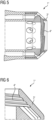
- Figure 5 shows a magnified cross-section along the flow direction of the combustion channel of a burner tip 1'' of an inventive design.
- the burner being adapted to be used in a streaming engine provides a combustion channel and a burner tip 1".
- the burner tip 1'' provides a multitude of longitudinal cooling fins 4'' being arranged essentially parallel to each other on the inside of the burner tip 1''.
- the longitudinal cooling fins 4'' provide a longitudinal direction helically circling the combustion channel.
- the burner tip 1'' providing the longitudinal cooling fins 4'' comprises a heat shield 3'' containing said longitudinal cooling fins 4''.
- the heat shield 3'' is detachably connected to the rest of the burner.
- the heat shield 3'' has been manufactured by 3D printing, wherein the cooling fins 4'' have been directly printed along with the rest of the heat shield 3''.
- Figure 6 shows a further magnified cutout of a cross-section showing the burner tip 1'' of the inventive design as shown in figure 5 .
- the cooling fins 4'' are clearly visible on the inner sides of the burner tip 1''.
Landscapes
- Engineering & Computer Science (AREA)
- Chemical & Material Sciences (AREA)
- Combustion & Propulsion (AREA)
- Mechanical Engineering (AREA)
- General Engineering & Computer Science (AREA)
- Turbine Rotor Nozzle Sealing (AREA)
Description
- The present invention refers to an optimized burner to be used in the streaming engine. Additionally, the present invention refers to the method of manufacturing such a burner.
- Furthermore, the present invention refers to a streaming engine providing such improved burner. Additionally, the present invention refers to the use of such improved burner. Burners are essential components of streaming engines like gas turbines. Herein, they play an essential role to provide the fluid stream enabling the streaming engine to convert chemical energy into kinetic energy of the rotor being itself again converted into electrical energy to be distributed. Although, such burners are point of research for longer time they are still subject to developments to further improve their properties. Based on the extreme conditions especially at the burner tip such burners are easily subject to damages resulting from the utilization of said burners and are subject to repair or replacement.
- For example, such burners or parts of burners are disclosed in
US 2017/370590 A1 ,US 2012/031098 A1 , andUS 2007/193272 A1 . Example of further developments are, for example, disclosed inUS 2004/040310 A1 . For example, a specific method of manufacturing is disclosed inUS 2018/214954 A1 . Based on the materials used being highly developed to withstand the harsh conditions as well as highly developed designs adapted to provide maximum efficiency and lowest emission possible such burner provide a significant cost factor for providing or maintaining such streaming engine. Improving the design, prolonging the durability and increasing the reliability are therefore highly interesting targets to be achieved. Therefore, there is the constant need to provide such further improvement for such already highly developed component. - These problems are solved by the products and methods as disclosed hereafter and in the claims. Further beneficial embodiments are disclosed in the dependent claims and the further description. These benefits can be used to adapt the corresponding solution to specific needs or to solve further problems.
- According to one aspect the present invention refers to a burner adapted to be used in a streaming engine, preferably a gas turbine, wherein the burner provides a combustion channel and a burner tip, wherein the burner tip provides at least one longitudinal cooling fin, and wherein the at least one longitudinal cooling fin provides a longitudinal direction helically circling the combustion channel, wherein the burner is adapted to provide a flow direction through the combustion channel, wherein the at least one cooling fin provides an angle between the at least one cooling fin and a plane perpendicular to the flow direction being at most 50°, and wherein the at least one cooling fin provides an angle between the at least one cooling fin and a plane perpendicular to the flow direction being at least 6°, wherein the burner tip (1, 1', 1") comprises a heat shield (3', 3'') providing the at least one cooling fin (4', 4''), wherein the heat shield (3', 3") is detachably connected or inseparably connected to the rest of the burner (2). Herein, it is to be understood that such helically circling does not require a complete circling of the combustion channel. Based on the typically very short length of the burner tip even a low angle helical orientation of the longitudinal cooling fin usually results in only a small percentage of the combustion channel being circled by a single cooling fin. The term "helical" as used herein refers to the direction being simultaneously oriented around the combustion channel and in the flow direction of the combustion channel. Surprisingly, it was noted that such cooling fins provide a significantly improved lifetime of the burner tip. It is assumed, that certain deviations of the flow of the gas stream at this position result in some kind of channeling or swirls building up normalizing the heat exchange. This seems to reduce the stress resulting from typical utilizations of the burner on the long term and increasing the lifetime and reliability.
- The burner tip can be manufactured separately to replace a damaged burner tip of an existing burner or to produce the new burner. Herein, providing the burner tip separately allows to easily utilize different manufacturing methods like additive manufacturing, preferably 3D printing, to provide the inventive cooling fins in a simplified fashion. Thereafter, the burner tip can be attached to the remaining part of the burner that might be manufactured using conventional means.
- According to a further aspect the present invention refers to a method of manufacturing an inventive burner, wherein a burner tip providing the at least one cooling fin is manufactured on top of the burner or is manufactured separately to be attached to the burner in a further step. For example, applying the burner tip directly onto the remaining part of the burner typically ensures that a secure connection of burner tip and the rest of the burner is provided. However, building up the burner tip directly upon the remaining part of the burner is a difficult task. On the other hand manufacturing the burner tip separately allows to mass manufacture the burner tips, for example, in an additive manufacturing device, easily store and transport them to the location in need, and, for example, simply attach it to the undamaged part of a burner to be repaired at the location as required. Surprisingly, it was still possible to reliably connect the burner tip and the remaining part of the burner without extensively increasing the postprocessing steps and valuation procedures.
- According to a further aspect the present invention refers to a streaming engine, preferably a gas turbine, containing at least one of the inventive burner. It was noted that such streaming engines provides a higher reliability with regard to their burners and allow to prolong the intervals between the planned maintenance.
- According to a further aspect the present invention refers to a use of the inventive burner or the inventive burner tip to provide a streaming engine. Herein, providing such streaming engine includes manufacturing a new streaming engine as well as upgrading an existing streaming engine by implementing the burner or servicing an existing streaming engine by replacing at least one identical used burner. Typically, it is preferred that at least 50%, more preferred at least 70%, even more preferred all, burners in the combustion area of the streaming engine are replaced by the inventive burners during an upgrade. The use of the inventive burners allows to easily improve the properties of an existing steaming engine with low effort.
- To simplify understanding of the present invention it is referred to the detailed description hereafter and the figures attached as well as their description. Herein, the figures are to be understood being not limiting the scope of the present invention, but disclosing preferred embodiments explaining the invention further.
-
Fig. 1 shows a burner adapted to be used in a gas turbine comprising a burner tip. -
Fig. 2 shows a magnification of the burner tip of conventional design. -
Fig. 3 shows a magnified cutout of a cross-section along the flow direction of the combustion channel showing the burner tip of the conventional design as shown infigure 2 . -
Fig. 4 shows a further magnified cutout of a cross-section offigure 2 . -
Fig. 5 shows a magnified cross-section along the flow direction of the combustion channel of a burner tip of the inventive design. -
Fig. 6 shows a further magnified cutout of a cross-section offigure 5 . - According to one aspect the present invention refers to a burner as specified above.
- The helical arrangement of the at least one cooling fin results in a multitude of cooling fins provided in a cross-section along the flow direction of the combustion channel. It was noted that it is preferred that such arrangements are provided in every cross-section along the flow direction of the combustion channel. According to further embodiments it is preferred that the burner tip provides at least 2, more preferred at least 3, even more preferred at least 4, cooling fins in a cross-section along the flow direction of the combustion channel.
- In further embodiments it is preferred that the at least one cooling fin of the burner provides at least 2, more preferred at least 3, more preferred at least 5, cooling fins being essentially parallel, more preferred parallel, to each other within the burner tip. The term "essentially parallel to each other" as used herein refers to an orientation, wherein the corresponding cooling fins essentially keep the same distance to each other. Preferably, the deviation of the distance is less than 10%, more preferred less than 7%, even more preferred less than 5%, of the average distance between the corresponding pair of cooling fins.
- According to further embodiments it is preferred that the burner tip provides the at least one cooling fin on the interior of the burner tip. The phrase "interior of the burner tip" as used herein refers to the inner side of the burner tip directed to the combustion channel of the burner. In addition to the aforementioned at least one cooling fin the burner tip can provide further cooling fins located on the outside of the burner tip. Herein, the features as disclosed herein in connection with the at least one cooling fin do not necessarily apply to additional cooling fins located on the outside of the burner tip. Combining the inventive cooling fins on the inside and further cooling fins on the outside providing the inventive design or the conventional design further improves the reliability.
- In further embodiments it is preferred that each cooling fin of the at least one cooling fin and the burner tip circles the combustion channel by at least 10%, more preferred at least 25%, more preferred at least 35%. Typically, it is preferred that each cooling fin of the at least one cooling fin and the burner tip circles the combustion channel by at least 50%, more preferred at least 60%, more preferred at least 75%. It was noted that the inventive effect for typical applications increases in case the at least one cooling fin extends around a bigger percentage of the combustion channel.
- According to further embodiments it is preferred that the at least one cooling fin provides an orientation, wherein the orientation results in an average movement of the at least one cooling fin of at least 8 mm, more preferred at least 10 mm, even more preferred at least 11 mm, downstream for each circling of the combustion channel. The term "downstream" as used herein refers to the flow direction through the combustion channel. Herein, it has to be understood that the aforementioned at least one cooling fin does not have to extend completely around the combustion channel. In case the at least one cooling fin does not circle the combustion channel once said distance refers to the theoretical distance resulting in case the cooling fin would be prolonged to circle the combustion channel at least once. In further embodiments it is preferred that the at least one cooling fin provides an orientation, wherein the orientation results in an average movement of the at least one cooling fin of at most 35 mm, more preferred at most 33 mm, even more preferred at most 32 mm, downstream for each circling of the combustion channel.
- The burner is adapted to provide a flow direction through the combustion channel during usage, wherein the at least one cooling fin provides an angle between the at least one cooling fin and a plane perpendicular to the flow direction being at least 6°, more preferred at least 7°, even more preferred at least 8°. It was noted that too small angles of the at least one cooling fin provide less beneficial effects for certain embodiments.
- The burner is adapted to provide a flow direction through the combustion channel during usage, wherein the at least one cooling fin provides an angle between the at least one cooling fin and a plane perpendicular to the flow direction being at most 50°, more preferred at most 46°, even more preferred at most 42°. According to further embodiments it is typically especially preferred that said angle is at most 30°, more preferred at most 23°, even more preferred at most 19°. It was noted that too big angles of the at least one cooling fin provide less beneficial effects for certain embodiments.
- Typically, it is preferred that the burner is containing an alloy providing a high temperature resistance like nickel superalloys. For example, the burner can be consisting of a mixture of CMC (ceramic matrix composites) material and high temperature resisting alloy. For typical embodiments it is preferred that the burner provides at least 90 wt.-%, more preferred at least 93 wt.-%, even more preferred at least 95 wt.-%, high temperature resisting alloy, based on the total weight of the burner. For certain embodiments it is especially preferred that the burner completely consists of high temperature resistant alloy, like a nickel superalloy. According to further embodiments it is preferred that the at least one cooling fin provides an angle between the at least one cooling fin and a plane perpendicular to the downstream direction being selected from the range from 6° to 46°, more preferred from 7° to 30°, even more preferred from 8° to 23°.
- According to further embodiments it is preferred that the burner tip has been manufactured using additive manufacturing, preferably 3D printing. Especially the high flexibility provided by additive manufacturing is very beneficial to realize the inventive burner. Herein, 3D printing is especially beneficial for typical embodiments as it allows to realize highly complex shapes with optimized designs with little effort. Utilizing 3D printing processes to manufacture the present burner are surprisingly simple, as the inventive design in addition to the other benefits also provide a simple build up process. Herein, the specific orientation of the cooling fins in combination with typical arrangements of a component to be built provides no major overhang to be printed simplifying the design of such modified structure. This allows to avoid the typically required utilization of support structures significantly decreasing the effort required to realize the inventive cooling fins.
- The burner tip comprises a heat shield providing the at least one cooling fin, wherein the heat shield is detachably connected or inseparably connected to the rest of the burner. Providing such heat shield additionally provides a protection against the significant temperatures developing in front of the burner and typically simplifies the exchange of this especially stressed parts of the burner during repair or service.
- According to further embodiments it is preferred that the at least one cooling fin provides a height of at least 0.4 mm, more preferred at least 0.6 mm, even more preferred at least 0.7 mm, measured in a cross-section along the flow direction of the combustion channel. It was noted, that providing a certain minimum height of the cooling fins positively influence the effect achieved with the present invention.
- In further embodiments it is preferred that the at least one cooling fin provides a broadness of at least 0.5 mm, more preferred at least 0.8 mm, even more preferred 0.9 mm, measured in a cross-section along the flow direction of the combustion channel. Surprisingly, it was noted that such broadness of the cooling fins increases the reliability of the burner tip for typical applications.
- In further embodiments it is preferred that the burner tip consists of a high temperature resistant alloy like nickel superalloy.
- In further embodiments it is preferred that the burner tip is adapted to fasten a heat shield, wherein the fastening mechanism allows to detachably connect the heat shield to the burner tip. Providing such fastening mechanism significantly decreases the required effort to exchange the heat shield during maintenance.
- According to another aspect the present invention refers to a method of manufacturing the inventive burner as specified above.
- In further embodiments it is preferred that the burner tip is manufactured using additive manufacturing, preferably 3D printing. Herein, such burner tip manufactured using additive manufacturing can be directly printed upon the remaining part of the burner. The remaining part of the burner can be directly printed in some AM (additive manufacturing) device like some 3D printing device, or it may be manufactured using conventional means and be introduced into such AM device. Alternatively, the burner tip can be manufactured separately, for example inside an AM device like an 3D printing device in the bigger amount, taken out of the AM manufacturing device and be attached to the remaining part of the burner using for example laser welding. The term "conventional manufacturing methods" as used herein refers to manufacturing methods besides additive manufacturing methods using essentially traditional means like casting. While, for example, a coating might be applied using an additive manufacturing method like laser cladding the essential part of the corresponding component has to be manufactured using such traditional means in such cases. Preferably, at least 90 wt.-%, more preferred at least 93 wt.-%, even more preferred at least 99 wt.%, are shaped using traditional means like, for example, casting or grinding.
- Herein, the additive manufacturing method can be selected from the additive manufacturing methods, preferably 3D printing methods, as known in the art. Examples of such methods of additive manufacturing include selective laser melting (SLM), selective laser sintering (SLS), electron beam melting (EBM) and binder jetting. Naturally, other methods of additive manufacturing or specific variants of the methods mentioned before can be employed.
- Herein, using a laser based method of additive manufacturing, more preferred 3D printing, typically provides especially useful results as such methods are well established and allow to process materials with a high temperature resistance like nickel superalloys.
- According to another aspect the present invention refers to an inventive streaming engine as described above.
- According to another aspect the present invention refers to a use of the inventive burner to provide a streaming engine.
- The present invention is only described in further detail for explanatory purposes. However, the invention is not to be understood being limited to these embodiments as they represent embodiments providing benefits to solve specific problems or fulfilling specific needs. The scope of the protection should be understood to be only limited by the claims attached.
-
Figure 1 shows aburner 2 adapted to be used in a gas turbine comprising aburner tip 1. Herein, the fuel and air are entering theburner 2 from the left before being mixed in the middle of theburner 2. Said mixture is ignited while exiting the combustion channel to provide the heated fluid to power the streaming engine containing theburner 2. - Not shown in the figure is the at least one cooling fin being a plurality of longitudinal cooling fins located on the inside of the
burner tip 1. Herein, the longitudinal cooling fins provide a longitudinal direction helically circling the combustion channel. The plurality of longitudinal cooling fins provides a row of longitudinal cooling fins being located next to each other and being essentially parallel to each other. - The
burner 2 as shown infigure 1 has been manufactured using 3D printing as a whole. Herein, the longitudinal cooling fins located on the inside of theburner tip 1 have been directly printed to provide the inventive longitudinal direction inside theburner tip 1. -
Figure 2 shows a magnification of the burner tip 1' of conventional design. The burner comprising said burner tip 1' is adapted to be used in a gas turbine. Contrary to the inventive burner as shown infigure 1 the burner tip 1' does not provide a longitudinal direction helically circling the combustion channel of the longitudinal cooling fins 4' contained in the burner tip 1'. Instead the longitudinal cooling channels only circle the combustion channel of the burner, resulting in cooling fins 4' being located on a plane perpendicular to the flow direction of the combustion channel. Furthermore, the longitudinal cooling fins 4' are located on the inside of a heat shield 3' the is detachably connected to provide the burner tip 1' of the burner. - The heat shield 3' in the comparative example as shown in
figure 2 has been manufactured using conventional means including casting and milling. -
Figure 3 shows a magnified cutout of a cross-section along the flow direction of the combustion channel showing the burner tip 1' of the comparative design as shown infigure 2 . Herein, the cutout along the flow direction of the combustion channel clearly shows the arrangement of the cooling fins 4' in a plane perpendicular to the flow direction of the combustion channel. -
Figure 4 shows a further magnified cutout of the cross-section offigure 2 . Herein, the cooling fins 4' are clearly visible on the inner side of the burner tip 1'. -
Figure 5 shows a magnified cross-section along the flow direction of the combustion channel of a burner tip 1'' of an inventive design. Comparable to the design as shown infigure 1 the burner being adapted to be used in a streaming engine provides a combustion channel and aburner tip 1". The burner tip 1'' provides a multitude of longitudinal cooling fins 4'' being arranged essentially parallel to each other on the inside of the burner tip 1''. Herein, the longitudinal cooling fins 4'' provide a longitudinal direction helically circling the combustion channel. - The burner tip 1'' providing the longitudinal cooling fins 4'' comprises a heat shield 3'' containing said longitudinal cooling fins 4''. Comparable to the example as shown in
figures 2 to 4 the heat shield 3'' is detachably connected to the rest of the burner. Herein, the heat shield 3'' has been manufactured by 3D printing, wherein the cooling fins 4'' have been directly printed along with the rest of the heat shield 3''. -
Figure 6 shows a further magnified cutout of a cross-section showing the burner tip 1'' of the inventive design as shown infigure 5 . Herein, the cooling fins 4'' are clearly visible on the inner sides of the burner tip 1''.
Claims (11)
- Burner (2) adapted to be used in a streaming engine, preferably a gas turbine,wherein the burner (2) provides a combustion channel and a burner tip (1, 1', 1"),wherein the burner tip (1, 1', 1'') provides at least one longitudinal cooling fin (4', 4"), andwherein the at least one longitudinal cooling fin (4', 4'') provides a longitudinal direction helically circling the combustion channel,wherein the burner (2) is adapted to provide a flow direction through the combustion channel,wherein the at least one cooling fin (4', 4'') provides an angle between the at least one cooling fin (4', 4'') and a plane perpendicular to the flow direction being at most 50°, andwherein the at least one cooling fin provides an angle between the at least one cooling fin and a plane perpendicular to the flow direction being at least 6°, wherein the burner tip (1, 1', 1") comprises a heat shield (3', 3'') providing the at least one cooling fin (4', 4''), wherein the heat shield (3', 3") is detachably connected or inseparably connected to the rest of the burner (2).
- Burner (2) according to claim 1, wherein the at least one cooling fin (4', 4'') provides at least 2 cooling fins (4', 4'') being essentially parallel to each other within the burner tip (1, 1', 1").
- Burner (2) according to any of claims 1 to 2, wherein the burner tip (1, 1', 1'') provides the at least one cooling fin (4', 4'') on the interior of the burner tip (1, 1', 1'').
- Burner (2) according to any of claims 1 to 3, wherein each cooling fin (4', 4'') of the at least one cooling fin (4', 4'') and the burner tip (1, 1', 1'') circles the combustion channel by at least 10%.
- Burner (2) according to any of claims 1 to 4, wherein the burner tip (1, 1', 1'') has been manufactured using additive manufacturing.
- Burner (2) according to any of claims 1 to 5, wherein the at least one cooling fin (4', 4") provides a height of at least 0.4 mm, measured in a cross-section along the flow direction of the combustion channel.
- Burner (2) according to any of claims 1 to 6, wherein the at least one cooling fin (4', 4'') provides a broadness of at least 0.5 mm, measured in a cross-section along the flow direction of the combustion channel.
- Method of manufacturing a burner (2) according any of claims 1 to 7 wherein a burner tip (1, 1', 1'') providing the at least one cooling fin (4', 4'') is manufactured on top of the burner (2) or is manufactured separately to be attached to the burner (2) in a further step.
- Method according to claim 8,
wherein burner tip (1, 1', 1") is manufactured using additive manufacturing. - Streaming engine containing at least one burner (2) according to any of claims 1 to 7.
- Use of the burner (2) according to any of claims 1 to 7 to provide a streaming engine according to claim 10.
Priority Applications (4)
| Application Number | Priority Date | Filing Date | Title |
|---|---|---|---|
| EP19178465.1A EP3748231B1 (en) | 2019-06-05 | 2019-06-05 | Burner and burner tip |
| PCT/EP2020/060146 WO2020244835A1 (en) | 2019-06-05 | 2020-04-09 | Burner for use in a streaming engine |
| US17/614,599 US12169067B2 (en) | 2019-06-05 | 2020-04-09 | Burner for use in a streaming engine |
| CN202080041259.4A CN113939688A (en) | 2019-06-05 | 2020-04-09 | burners for flow engines |
Applications Claiming Priority (1)
| Application Number | Priority Date | Filing Date | Title |
|---|---|---|---|
| EP19178465.1A EP3748231B1 (en) | 2019-06-05 | 2019-06-05 | Burner and burner tip |
Publications (2)
| Publication Number | Publication Date |
|---|---|
| EP3748231A1 EP3748231A1 (en) | 2020-12-09 |
| EP3748231B1 true EP3748231B1 (en) | 2023-08-30 |
Family
ID=66770368
Family Applications (1)
| Application Number | Title | Priority Date | Filing Date |
|---|---|---|---|
| EP19178465.1A Active EP3748231B1 (en) | 2019-06-05 | 2019-06-05 | Burner and burner tip |
Country Status (4)
| Country | Link |
|---|---|
| US (1) | US12169067B2 (en) |
| EP (1) | EP3748231B1 (en) |
| CN (1) | CN113939688A (en) |
| WO (1) | WO2020244835A1 (en) |
Families Citing this family (1)
| Publication number | Priority date | Publication date | Assignee | Title |
|---|---|---|---|---|
| EP4345181A1 (en) * | 2022-09-29 | 2024-04-03 | Linde GmbH | Method for providing a high-temperature component with a high-temperature-resistant material, high-temperature component and method using a high-temperature component |
Family Cites Families (18)
| Publication number | Priority date | Publication date | Assignee | Title |
|---|---|---|---|---|
| US6772595B2 (en) * | 2002-06-25 | 2004-08-10 | Power Systems Mfg., Llc | Advanced cooling configuration for a low emissions combustor venturi |
| US6823677B2 (en) * | 2002-09-03 | 2004-11-30 | Pratt & Whitney Canada Corp. | Stress relief feature for aerated gas turbine fuel injector |
| US20070193272A1 (en) * | 2006-02-21 | 2007-08-23 | Woodward Fst, Inc. | Gas turbine engine fuel injector |
| RU2010132334A (en) * | 2010-08-03 | 2012-02-10 | Дженерал Электрик Компани (US) | FUEL NOZZLE FOR TURBINE ENGINE AND COOLING HOUSING FOR COOLING THE EXTERNAL PART OF A CYLINDRICAL FUEL NOZZLE OF A TURBINE ENGINE |
| EP2743582A1 (en) * | 2012-12-14 | 2014-06-18 | Siemens Aktiengesellschaft | Burner tip and burner |
| JP6066065B2 (en) * | 2013-02-20 | 2017-01-25 | 三菱日立パワーシステムズ株式会社 | Gas turbine combustor with heat transfer device |
| PL2999923T3 (en) * | 2013-05-22 | 2019-02-28 | Johns Manville | Submerged combustion melter with improved burner and corresponding method |
| EP2837883B1 (en) | 2013-08-16 | 2018-04-04 | Ansaldo Energia Switzerland AG | Premixed can annular combustor with mixing lobes for the second stage of a sequential gas turbine |
| US9765974B2 (en) * | 2014-10-03 | 2017-09-19 | Pratt & Whitney Canada Corp. | Fuel nozzle |
| FR3028020B1 (en) * | 2014-10-29 | 2016-11-11 | Snecma | THERMAL EXCHANGE PANEL AND IMPROVED NOISE REDUCTION FOR TURBOMACHINE |
| EP3023696B1 (en) * | 2014-11-20 | 2019-08-28 | Ansaldo Energia Switzerland AG | Lobe lance for a gas turbine combustor |
| EP3141321A1 (en) * | 2015-09-14 | 2017-03-15 | Siemens Aktiengesellschaft | Turbomachine component and method of manufacturing of such component with an incorporated fluid channel |
| US10208621B2 (en) * | 2015-12-07 | 2019-02-19 | General Electric Company | Surface cooler and an associated method thereof |
| JP2019512661A (en) * | 2016-03-15 | 2019-05-16 | ケラー,ジェイ | Non-premixed swirl burner tip and combustion strategy |
| US10830060B2 (en) * | 2016-12-02 | 2020-11-10 | General Electric Company | Engine component with flow enhancer |
| KR102099307B1 (en) * | 2017-10-11 | 2020-04-09 | 두산중공업 주식회사 | Turbulence generating structure for enhancing cooling performance of liner and a gas turbine combustor using the same |
| US10890328B2 (en) * | 2018-11-29 | 2021-01-12 | DOOSAN Heavy Industries Construction Co., LTD | Fin-pin flow guide for efficient transition piece cooling |
| US20200224876A1 (en) * | 2019-01-15 | 2020-07-16 | Delavan Inc. | Lattice supported dual coiled fuel tubes |
-
2019
- 2019-06-05 EP EP19178465.1A patent/EP3748231B1/en active Active
-
2020
- 2020-04-09 WO PCT/EP2020/060146 patent/WO2020244835A1/en not_active Ceased
- 2020-04-09 CN CN202080041259.4A patent/CN113939688A/en active Pending
- 2020-04-09 US US17/614,599 patent/US12169067B2/en active Active
Also Published As
| Publication number | Publication date |
|---|---|
| CN113939688A (en) | 2022-01-14 |
| WO2020244835A1 (en) | 2020-12-10 |
| EP3748231A1 (en) | 2020-12-09 |
| US20220228746A1 (en) | 2022-07-21 |
| US12169067B2 (en) | 2024-12-17 |
Similar Documents
| Publication | Publication Date | Title |
|---|---|---|
| EP1654495B1 (en) | Heat shield arrangement for a high temperature gas conveying component, in particular for a gas turbine combustion chamber | |
| US10668528B2 (en) | Method for producing a rotor blade | |
| US7665309B2 (en) | Secondary fuel delivery system | |
| US10329950B2 (en) | Nozzle guide vane with composite heat shield | |
| EP2766664B1 (en) | Combustion chamber of a combustor for a gas turbine | |
| EP2185870B1 (en) | Secondary fuel delivery system | |
| JP4974101B2 (en) | Method and apparatus for assembling a gas turbine engine | |
| US20160069185A1 (en) | Method for reconditioning a hot gas path part of a gas turbine | |
| EP2935836B1 (en) | Closure of cooling holes with a filling agent | |
| US7540156B2 (en) | Combustion liner for gas turbine formed of cast nickel-based superalloy | |
| EP3748231B1 (en) | Burner and burner tip | |
| US20050214121A1 (en) | Layer system, and process for producing a layer system | |
| EP3865775B1 (en) | Gas turbine combustor with a dilution chute and associated method of manufacturing | |
| US11371438B2 (en) | Machine component, particularly a turbomachine component, with cooling features and a method for manufacturing and of operation | |
| EP2657453B1 (en) | Transition piece for a gas turbine engine | |
| EP1588102B1 (en) | Heat shield element, combustion chamber and gas turbine | |
| WO2004109187A1 (en) | Heat shield element | |
| EP3029267A1 (en) | Method of manufacturing a vibration damper for a turbine blade by laser build-up welding | |
| WO2007141091A1 (en) | Armor-plated machine components and gas turbines | |
| US11713684B2 (en) | Coolable component for a streaming engine | |
| WO2004057157A1 (en) | Turbine blade | |
| EP3751098A1 (en) | Improved blade | |
| Moskowitz et al. | Design and Test of a Small Turbine at 2500F with Transpiration Cooled Blading | |
| Parker et al. | Secondary fuel delivery system |
Legal Events
| Date | Code | Title | Description |
|---|---|---|---|
| PUAI | Public reference made under article 153(3) epc to a published international application that has entered the european phase |
Free format text: ORIGINAL CODE: 0009012 |
|
| STAA | Information on the status of an ep patent application or granted ep patent |
Free format text: STATUS: THE APPLICATION HAS BEEN PUBLISHED |
|
| AK | Designated contracting states |
Kind code of ref document: A1 Designated state(s): AL AT BE BG CH CY CZ DE DK EE ES FI FR GB GR HR HU IE IS IT LI LT LU LV MC MK MT NL NO PL PT RO RS SE SI SK SM TR |
|
| AX | Request for extension of the european patent |
Extension state: BA ME |
|
| STAA | Information on the status of an ep patent application or granted ep patent |
Free format text: STATUS: REQUEST FOR EXAMINATION WAS MADE |
|
| RAP1 | Party data changed (applicant data changed or rights of an application transferred) |
Owner name: SIEMENS ENERGY GLOBAL GMBH & CO. KG |
|
| 17P | Request for examination filed |
Effective date: 20210119 |
|
| RBV | Designated contracting states (corrected) |
Designated state(s): AL AT BE BG CH CY CZ DE DK EE ES FI FR GB GR HR HU IE IS IT LI LT LU LV MC MK MT NL NO PL PT RO RS SE SI SK SM TR |
|
| STAA | Information on the status of an ep patent application or granted ep patent |
Free format text: STATUS: EXAMINATION IS IN PROGRESS |
|
| 17Q | First examination report despatched |
Effective date: 20220928 |
|
| GRAP | Despatch of communication of intention to grant a patent |
Free format text: ORIGINAL CODE: EPIDOSNIGR1 |
|
| STAA | Information on the status of an ep patent application or granted ep patent |
Free format text: STATUS: GRANT OF PATENT IS INTENDED |
|
| INTG | Intention to grant announced |
Effective date: 20230411 |
|
| GRAS | Grant fee paid |
Free format text: ORIGINAL CODE: EPIDOSNIGR3 |
|
| GRAA | (expected) grant |
Free format text: ORIGINAL CODE: 0009210 |
|
| STAA | Information on the status of an ep patent application or granted ep patent |
Free format text: STATUS: THE PATENT HAS BEEN GRANTED |
|
| AK | Designated contracting states |
Kind code of ref document: B1 Designated state(s): AL AT BE BG CH CY CZ DE DK EE ES FI FR GB GR HR HU IE IS IT LI LT LU LV MC MK MT NL NO PL PT RO RS SE SI SK SM TR |
|
| REG | Reference to a national code |
Ref country code: GB Ref legal event code: FG4D |
|
| REG | Reference to a national code |
Ref country code: CH Ref legal event code: EP |
|
| REG | Reference to a national code |
Ref country code: DE Ref legal event code: R096 Ref document number: 602019035946 Country of ref document: DE |
|
| REG | Reference to a national code |
Ref country code: IE Ref legal event code: FG4D |
|
| REG | Reference to a national code |
Ref country code: SE Ref legal event code: TRGR |
|
| REG | Reference to a national code |
Ref country code: LT Ref legal event code: MG9D |
|
| REG | Reference to a national code |
Ref country code: NL Ref legal event code: MP Effective date: 20230830 |
|
| REG | Reference to a national code |
Ref country code: AT Ref legal event code: MK05 Ref document number: 1605885 Country of ref document: AT Kind code of ref document: T Effective date: 20230830 |
|
| PG25 | Lapsed in a contracting state [announced via postgrant information from national office to epo] |
Ref country code: GR Free format text: LAPSE BECAUSE OF FAILURE TO SUBMIT A TRANSLATION OF THE DESCRIPTION OR TO PAY THE FEE WITHIN THE PRESCRIBED TIME-LIMIT Effective date: 20231201 |
|
| PG25 | Lapsed in a contracting state [announced via postgrant information from national office to epo] |
Ref country code: IS Free format text: LAPSE BECAUSE OF FAILURE TO SUBMIT A TRANSLATION OF THE DESCRIPTION OR TO PAY THE FEE WITHIN THE PRESCRIBED TIME-LIMIT Effective date: 20231230 |
|
| PG25 | Lapsed in a contracting state [announced via postgrant information from national office to epo] |
Ref country code: RS Free format text: LAPSE BECAUSE OF FAILURE TO SUBMIT A TRANSLATION OF THE DESCRIPTION OR TO PAY THE FEE WITHIN THE PRESCRIBED TIME-LIMIT Effective date: 20230830 Ref country code: NO Free format text: LAPSE BECAUSE OF FAILURE TO SUBMIT A TRANSLATION OF THE DESCRIPTION OR TO PAY THE FEE WITHIN THE PRESCRIBED TIME-LIMIT Effective date: 20231130 Ref country code: LV Free format text: LAPSE BECAUSE OF FAILURE TO SUBMIT A TRANSLATION OF THE DESCRIPTION OR TO PAY THE FEE WITHIN THE PRESCRIBED TIME-LIMIT Effective date: 20230830 Ref country code: LT Free format text: LAPSE BECAUSE OF FAILURE TO SUBMIT A TRANSLATION OF THE DESCRIPTION OR TO PAY THE FEE WITHIN THE PRESCRIBED TIME-LIMIT Effective date: 20230830 Ref country code: IS Free format text: LAPSE BECAUSE OF FAILURE TO SUBMIT A TRANSLATION OF THE DESCRIPTION OR TO PAY THE FEE WITHIN THE PRESCRIBED TIME-LIMIT Effective date: 20231230 Ref country code: HR Free format text: LAPSE BECAUSE OF FAILURE TO SUBMIT A TRANSLATION OF THE DESCRIPTION OR TO PAY THE FEE WITHIN THE PRESCRIBED TIME-LIMIT Effective date: 20230830 Ref country code: GR Free format text: LAPSE BECAUSE OF FAILURE TO SUBMIT A TRANSLATION OF THE DESCRIPTION OR TO PAY THE FEE WITHIN THE PRESCRIBED TIME-LIMIT Effective date: 20231201 Ref country code: FI Free format text: LAPSE BECAUSE OF FAILURE TO SUBMIT A TRANSLATION OF THE DESCRIPTION OR TO PAY THE FEE WITHIN THE PRESCRIBED TIME-LIMIT Effective date: 20230830 Ref country code: AT Free format text: LAPSE BECAUSE OF FAILURE TO SUBMIT A TRANSLATION OF THE DESCRIPTION OR TO PAY THE FEE WITHIN THE PRESCRIBED TIME-LIMIT Effective date: 20230830 |
|
| PG25 | Lapsed in a contracting state [announced via postgrant information from national office to epo] |
Ref country code: PL Free format text: LAPSE BECAUSE OF FAILURE TO SUBMIT A TRANSLATION OF THE DESCRIPTION OR TO PAY THE FEE WITHIN THE PRESCRIBED TIME-LIMIT Effective date: 20230830 Ref country code: NL Free format text: LAPSE BECAUSE OF FAILURE TO SUBMIT A TRANSLATION OF THE DESCRIPTION OR TO PAY THE FEE WITHIN THE PRESCRIBED TIME-LIMIT Effective date: 20230830 |
|
| PG25 | Lapsed in a contracting state [announced via postgrant information from national office to epo] |
Ref country code: ES Free format text: LAPSE BECAUSE OF FAILURE TO SUBMIT A TRANSLATION OF THE DESCRIPTION OR TO PAY THE FEE WITHIN THE PRESCRIBED TIME-LIMIT Effective date: 20230830 |
|
| PG25 | Lapsed in a contracting state [announced via postgrant information from national office to epo] |
Ref country code: SM Free format text: LAPSE BECAUSE OF FAILURE TO SUBMIT A TRANSLATION OF THE DESCRIPTION OR TO PAY THE FEE WITHIN THE PRESCRIBED TIME-LIMIT Effective date: 20230830 Ref country code: RO Free format text: LAPSE BECAUSE OF FAILURE TO SUBMIT A TRANSLATION OF THE DESCRIPTION OR TO PAY THE FEE WITHIN THE PRESCRIBED TIME-LIMIT Effective date: 20230830 Ref country code: ES Free format text: LAPSE BECAUSE OF FAILURE TO SUBMIT A TRANSLATION OF THE DESCRIPTION OR TO PAY THE FEE WITHIN THE PRESCRIBED TIME-LIMIT Effective date: 20230830 Ref country code: EE Free format text: LAPSE BECAUSE OF FAILURE TO SUBMIT A TRANSLATION OF THE DESCRIPTION OR TO PAY THE FEE WITHIN THE PRESCRIBED TIME-LIMIT Effective date: 20230830 Ref country code: DK Free format text: LAPSE BECAUSE OF FAILURE TO SUBMIT A TRANSLATION OF THE DESCRIPTION OR TO PAY THE FEE WITHIN THE PRESCRIBED TIME-LIMIT Effective date: 20230830 Ref country code: CZ Free format text: LAPSE BECAUSE OF FAILURE TO SUBMIT A TRANSLATION OF THE DESCRIPTION OR TO PAY THE FEE WITHIN THE PRESCRIBED TIME-LIMIT Effective date: 20230830 Ref country code: PT Free format text: LAPSE BECAUSE OF FAILURE TO SUBMIT A TRANSLATION OF THE DESCRIPTION OR TO PAY THE FEE WITHIN THE PRESCRIBED TIME-LIMIT Effective date: 20240102 Ref country code: SK Free format text: LAPSE BECAUSE OF FAILURE TO SUBMIT A TRANSLATION OF THE DESCRIPTION OR TO PAY THE FEE WITHIN THE PRESCRIBED TIME-LIMIT Effective date: 20230830 |
|
| REG | Reference to a national code |
Ref country code: DE Ref legal event code: R097 Ref document number: 602019035946 Country of ref document: DE |
|
| PLBE | No opposition filed within time limit |
Free format text: ORIGINAL CODE: 0009261 |
|
| STAA | Information on the status of an ep patent application or granted ep patent |
Free format text: STATUS: NO OPPOSITION FILED WITHIN TIME LIMIT |
|
| PG25 | Lapsed in a contracting state [announced via postgrant information from national office to epo] |
Ref country code: SI Free format text: LAPSE BECAUSE OF FAILURE TO SUBMIT A TRANSLATION OF THE DESCRIPTION OR TO PAY THE FEE WITHIN THE PRESCRIBED TIME-LIMIT Effective date: 20230830 |
|
| 26N | No opposition filed |
Effective date: 20240603 |
|
| PG25 | Lapsed in a contracting state [announced via postgrant information from national office to epo] |
Ref country code: BG Free format text: LAPSE BECAUSE OF FAILURE TO SUBMIT A TRANSLATION OF THE DESCRIPTION OR TO PAY THE FEE WITHIN THE PRESCRIBED TIME-LIMIT Effective date: 20230830 |
|
| PG25 | Lapsed in a contracting state [announced via postgrant information from national office to epo] |
Ref country code: BG Free format text: LAPSE BECAUSE OF FAILURE TO SUBMIT A TRANSLATION OF THE DESCRIPTION OR TO PAY THE FEE WITHIN THE PRESCRIBED TIME-LIMIT Effective date: 20230830 |
|
| PG25 | Lapsed in a contracting state [announced via postgrant information from national office to epo] |
Ref country code: MC Free format text: LAPSE BECAUSE OF FAILURE TO SUBMIT A TRANSLATION OF THE DESCRIPTION OR TO PAY THE FEE WITHIN THE PRESCRIBED TIME-LIMIT Effective date: 20230830 |
|
| PG25 | Lapsed in a contracting state [announced via postgrant information from national office to epo] |
Ref country code: LU Free format text: LAPSE BECAUSE OF NON-PAYMENT OF DUE FEES Effective date: 20240605 |
|
| PG25 | Lapsed in a contracting state [announced via postgrant information from national office to epo] |
Ref country code: IE Free format text: LAPSE BECAUSE OF NON-PAYMENT OF DUE FEES Effective date: 20240605 |
|
| PG25 | Lapsed in a contracting state [announced via postgrant information from national office to epo] |
Ref country code: BE Free format text: LAPSE BECAUSE OF NON-PAYMENT OF DUE FEES Effective date: 20240630 |
|
| REG | Reference to a national code |
Ref country code: BE Ref legal event code: MM Effective date: 20240630 |
|
| PGFP | Annual fee paid to national office [announced via postgrant information from national office to epo] |
Ref country code: DE Payment date: 20250626 Year of fee payment: 7 |
|
| PGFP | Annual fee paid to national office [announced via postgrant information from national office to epo] |
Ref country code: GB Payment date: 20250617 Year of fee payment: 7 |
|
| PGFP | Annual fee paid to national office [announced via postgrant information from national office to epo] |
Ref country code: FR Payment date: 20250624 Year of fee payment: 7 |
|
| PGFP | Annual fee paid to national office [announced via postgrant information from national office to epo] |
Ref country code: SE Payment date: 20250619 Year of fee payment: 7 |
|
| PGFP | Annual fee paid to national office [announced via postgrant information from national office to epo] |
Ref country code: IT Payment date: 20250623 Year of fee payment: 7 |
|
| PGFP | Annual fee paid to national office [announced via postgrant information from national office to epo] |
Ref country code: CH Payment date: 20250701 Year of fee payment: 7 |
|
| PG25 | Lapsed in a contracting state [announced via postgrant information from national office to epo] |
Ref country code: CY Free format text: LAPSE BECAUSE OF FAILURE TO SUBMIT A TRANSLATION OF THE DESCRIPTION OR TO PAY THE FEE WITHIN THE PRESCRIBED TIME-LIMIT; INVALID AB INITIO Effective date: 20190605 |
|
| PG25 | Lapsed in a contracting state [announced via postgrant information from national office to epo] |
Ref country code: HU Free format text: LAPSE BECAUSE OF FAILURE TO SUBMIT A TRANSLATION OF THE DESCRIPTION OR TO PAY THE FEE WITHIN THE PRESCRIBED TIME-LIMIT; INVALID AB INITIO Effective date: 20190605 |