EP3747866B1 - Benzamide compound and preparation method, use, and pharmaceutical composition thereof - Google Patents
Benzamide compound and preparation method, use, and pharmaceutical composition thereof Download PDFInfo
- Publication number
- EP3747866B1 EP3747866B1 EP19747114.7A EP19747114A EP3747866B1 EP 3747866 B1 EP3747866 B1 EP 3747866B1 EP 19747114 A EP19747114 A EP 19747114A EP 3747866 B1 EP3747866 B1 EP 3747866B1
- Authority
- EP
- European Patent Office
- Prior art keywords
- pharmaceutically acceptable
- methyl
- tautomer
- stereoisomer
- acceptable salt
- Prior art date
- Legal status (The legal status is an assumption and is not a legal conclusion. Google has not performed a legal analysis and makes no representation as to the accuracy of the status listed.)
- Active
Links
Images


Classifications
-
- C—CHEMISTRY; METALLURGY
- C07—ORGANIC CHEMISTRY
- C07D—HETEROCYCLIC COMPOUNDS
- C07D401/00—Heterocyclic compounds containing two or more hetero rings, having nitrogen atoms as the only ring hetero atoms, at least one ring being a six-membered ring with only one nitrogen atom
- C07D401/02—Heterocyclic compounds containing two or more hetero rings, having nitrogen atoms as the only ring hetero atoms, at least one ring being a six-membered ring with only one nitrogen atom containing two hetero rings
- C07D401/12—Heterocyclic compounds containing two or more hetero rings, having nitrogen atoms as the only ring hetero atoms, at least one ring being a six-membered ring with only one nitrogen atom containing two hetero rings linked by a chain containing hetero atoms as chain links
-
- C—CHEMISTRY; METALLURGY
- C07—ORGANIC CHEMISTRY
- C07D—HETEROCYCLIC COMPOUNDS
- C07D213/00—Heterocyclic compounds containing six-membered rings, not condensed with other rings, with one nitrogen atom as the only ring hetero atom and three or more double bonds between ring members or between ring members and non-ring members
- C07D213/02—Heterocyclic compounds containing six-membered rings, not condensed with other rings, with one nitrogen atom as the only ring hetero atom and three or more double bonds between ring members or between ring members and non-ring members having three double bonds between ring members or between ring members and non-ring members
- C07D213/04—Heterocyclic compounds containing six-membered rings, not condensed with other rings, with one nitrogen atom as the only ring hetero atom and three or more double bonds between ring members or between ring members and non-ring members having three double bonds between ring members or between ring members and non-ring members having no bond between the ring nitrogen atom and a non-ring member or having only hydrogen or carbon atoms directly attached to the ring nitrogen atom
- C07D213/24—Heterocyclic compounds containing six-membered rings, not condensed with other rings, with one nitrogen atom as the only ring hetero atom and three or more double bonds between ring members or between ring members and non-ring members having three double bonds between ring members or between ring members and non-ring members having no bond between the ring nitrogen atom and a non-ring member or having only hydrogen or carbon atoms directly attached to the ring nitrogen atom with substituted hydrocarbon radicals attached to ring carbon atoms
- C07D213/36—Radicals substituted by singly-bound nitrogen atoms
- C07D213/40—Acylated substituent nitrogen atom
-
- C—CHEMISTRY; METALLURGY
- C07—ORGANIC CHEMISTRY
- C07D—HETEROCYCLIC COMPOUNDS
- C07D213/00—Heterocyclic compounds containing six-membered rings, not condensed with other rings, with one nitrogen atom as the only ring hetero atom and three or more double bonds between ring members or between ring members and non-ring members
- C07D213/02—Heterocyclic compounds containing six-membered rings, not condensed with other rings, with one nitrogen atom as the only ring hetero atom and three or more double bonds between ring members or between ring members and non-ring members having three double bonds between ring members or between ring members and non-ring members
- C07D213/04—Heterocyclic compounds containing six-membered rings, not condensed with other rings, with one nitrogen atom as the only ring hetero atom and three or more double bonds between ring members or between ring members and non-ring members having three double bonds between ring members or between ring members and non-ring members having no bond between the ring nitrogen atom and a non-ring member or having only hydrogen or carbon atoms directly attached to the ring nitrogen atom
- C07D213/24—Heterocyclic compounds containing six-membered rings, not condensed with other rings, with one nitrogen atom as the only ring hetero atom and three or more double bonds between ring members or between ring members and non-ring members having three double bonds between ring members or between ring members and non-ring members having no bond between the ring nitrogen atom and a non-ring member or having only hydrogen or carbon atoms directly attached to the ring nitrogen atom with substituted hydrocarbon radicals attached to ring carbon atoms
- C07D213/44—Radicals substituted by doubly-bound oxygen, sulfur, or nitrogen atoms, or by two such atoms singly-bound to the same carbon atom
- C07D213/53—Nitrogen atoms
-
- A—HUMAN NECESSITIES
- A61—MEDICAL OR VETERINARY SCIENCE; HYGIENE
- A61K—PREPARATIONS FOR MEDICAL, DENTAL OR TOILETRY PURPOSES
- A61K31/00—Medicinal preparations containing organic active ingredients
- A61K31/16—Amides, e.g. hydroxamic acids
- A61K31/18—Sulfonamides
-
- A—HUMAN NECESSITIES
- A61—MEDICAL OR VETERINARY SCIENCE; HYGIENE
- A61K—PREPARATIONS FOR MEDICAL, DENTAL OR TOILETRY PURPOSES
- A61K31/00—Medicinal preparations containing organic active ingredients
- A61K31/33—Heterocyclic compounds
- A61K31/395—Heterocyclic compounds having nitrogen as a ring hetero atom, e.g. guanethidine or rifamycins
- A61K31/435—Heterocyclic compounds having nitrogen as a ring hetero atom, e.g. guanethidine or rifamycins having six-membered rings with one nitrogen as the only ring hetero atom
-
- A—HUMAN NECESSITIES
- A61—MEDICAL OR VETERINARY SCIENCE; HYGIENE
- A61K—PREPARATIONS FOR MEDICAL, DENTAL OR TOILETRY PURPOSES
- A61K31/00—Medicinal preparations containing organic active ingredients
- A61K31/33—Heterocyclic compounds
- A61K31/395—Heterocyclic compounds having nitrogen as a ring hetero atom, e.g. guanethidine or rifamycins
- A61K31/435—Heterocyclic compounds having nitrogen as a ring hetero atom, e.g. guanethidine or rifamycins having six-membered rings with one nitrogen as the only ring hetero atom
- A61K31/4353—Heterocyclic compounds having nitrogen as a ring hetero atom, e.g. guanethidine or rifamycins having six-membered rings with one nitrogen as the only ring hetero atom ortho- or peri-condensed with heterocyclic ring systems
- A61K31/4355—Heterocyclic compounds having nitrogen as a ring hetero atom, e.g. guanethidine or rifamycins having six-membered rings with one nitrogen as the only ring hetero atom ortho- or peri-condensed with heterocyclic ring systems the heterocyclic ring system containing a five-membered ring having oxygen as a ring hetero atom
-
- A—HUMAN NECESSITIES
- A61—MEDICAL OR VETERINARY SCIENCE; HYGIENE
- A61K—PREPARATIONS FOR MEDICAL, DENTAL OR TOILETRY PURPOSES
- A61K31/00—Medicinal preparations containing organic active ingredients
- A61K31/33—Heterocyclic compounds
- A61K31/395—Heterocyclic compounds having nitrogen as a ring hetero atom, e.g. guanethidine or rifamycins
- A61K31/435—Heterocyclic compounds having nitrogen as a ring hetero atom, e.g. guanethidine or rifamycins having six-membered rings with one nitrogen as the only ring hetero atom
- A61K31/4353—Heterocyclic compounds having nitrogen as a ring hetero atom, e.g. guanethidine or rifamycins having six-membered rings with one nitrogen as the only ring hetero atom ortho- or peri-condensed with heterocyclic ring systems
- A61K31/436—Heterocyclic compounds having nitrogen as a ring hetero atom, e.g. guanethidine or rifamycins having six-membered rings with one nitrogen as the only ring hetero atom ortho- or peri-condensed with heterocyclic ring systems the heterocyclic ring system containing a six-membered ring having oxygen as a ring hetero atom, e.g. rapamycin
-
- A—HUMAN NECESSITIES
- A61—MEDICAL OR VETERINARY SCIENCE; HYGIENE
- A61K—PREPARATIONS FOR MEDICAL, DENTAL OR TOILETRY PURPOSES
- A61K31/00—Medicinal preparations containing organic active ingredients
- A61K31/33—Heterocyclic compounds
- A61K31/395—Heterocyclic compounds having nitrogen as a ring hetero atom, e.g. guanethidine or rifamycins
- A61K31/435—Heterocyclic compounds having nitrogen as a ring hetero atom, e.g. guanethidine or rifamycins having six-membered rings with one nitrogen as the only ring hetero atom
- A61K31/44—Non condensed pyridines; Hydrogenated derivatives thereof
-
- A—HUMAN NECESSITIES
- A61—MEDICAL OR VETERINARY SCIENCE; HYGIENE
- A61K—PREPARATIONS FOR MEDICAL, DENTAL OR TOILETRY PURPOSES
- A61K31/00—Medicinal preparations containing organic active ingredients
- A61K31/33—Heterocyclic compounds
- A61K31/395—Heterocyclic compounds having nitrogen as a ring hetero atom, e.g. guanethidine or rifamycins
- A61K31/435—Heterocyclic compounds having nitrogen as a ring hetero atom, e.g. guanethidine or rifamycins having six-membered rings with one nitrogen as the only ring hetero atom
- A61K31/44—Non condensed pyridines; Hydrogenated derivatives thereof
- A61K31/4406—Non condensed pyridines; Hydrogenated derivatives thereof only substituted in position 3, e.g. zimeldine
-
- A—HUMAN NECESSITIES
- A61—MEDICAL OR VETERINARY SCIENCE; HYGIENE
- A61K—PREPARATIONS FOR MEDICAL, DENTAL OR TOILETRY PURPOSES
- A61K31/00—Medicinal preparations containing organic active ingredients
- A61K31/33—Heterocyclic compounds
- A61K31/395—Heterocyclic compounds having nitrogen as a ring hetero atom, e.g. guanethidine or rifamycins
- A61K31/435—Heterocyclic compounds having nitrogen as a ring hetero atom, e.g. guanethidine or rifamycins having six-membered rings with one nitrogen as the only ring hetero atom
- A61K31/44—Non condensed pyridines; Hydrogenated derivatives thereof
- A61K31/4427—Non condensed pyridines; Hydrogenated derivatives thereof containing further heterocyclic ring systems
-
- A—HUMAN NECESSITIES
- A61—MEDICAL OR VETERINARY SCIENCE; HYGIENE
- A61K—PREPARATIONS FOR MEDICAL, DENTAL OR TOILETRY PURPOSES
- A61K31/00—Medicinal preparations containing organic active ingredients
- A61K31/33—Heterocyclic compounds
- A61K31/395—Heterocyclic compounds having nitrogen as a ring hetero atom, e.g. guanethidine or rifamycins
- A61K31/435—Heterocyclic compounds having nitrogen as a ring hetero atom, e.g. guanethidine or rifamycins having six-membered rings with one nitrogen as the only ring hetero atom
- A61K31/44—Non condensed pyridines; Hydrogenated derivatives thereof
- A61K31/4427—Non condensed pyridines; Hydrogenated derivatives thereof containing further heterocyclic ring systems
- A61K31/443—Non condensed pyridines; Hydrogenated derivatives thereof containing further heterocyclic ring systems containing a five-membered ring with oxygen as a ring hetero atom
-
- A—HUMAN NECESSITIES
- A61—MEDICAL OR VETERINARY SCIENCE; HYGIENE
- A61K—PREPARATIONS FOR MEDICAL, DENTAL OR TOILETRY PURPOSES
- A61K31/00—Medicinal preparations containing organic active ingredients
- A61K31/33—Heterocyclic compounds
- A61K31/395—Heterocyclic compounds having nitrogen as a ring hetero atom, e.g. guanethidine or rifamycins
- A61K31/435—Heterocyclic compounds having nitrogen as a ring hetero atom, e.g. guanethidine or rifamycins having six-membered rings with one nitrogen as the only ring hetero atom
- A61K31/44—Non condensed pyridines; Hydrogenated derivatives thereof
- A61K31/4427—Non condensed pyridines; Hydrogenated derivatives thereof containing further heterocyclic ring systems
- A61K31/4433—Non condensed pyridines; Hydrogenated derivatives thereof containing further heterocyclic ring systems containing a six-membered ring with oxygen as a ring hetero atom
-
- A—HUMAN NECESSITIES
- A61—MEDICAL OR VETERINARY SCIENCE; HYGIENE
- A61K—PREPARATIONS FOR MEDICAL, DENTAL OR TOILETRY PURPOSES
- A61K31/00—Medicinal preparations containing organic active ingredients
- A61K31/33—Heterocyclic compounds
- A61K31/395—Heterocyclic compounds having nitrogen as a ring hetero atom, e.g. guanethidine or rifamycins
- A61K31/435—Heterocyclic compounds having nitrogen as a ring hetero atom, e.g. guanethidine or rifamycins having six-membered rings with one nitrogen as the only ring hetero atom
- A61K31/44—Non condensed pyridines; Hydrogenated derivatives thereof
- A61K31/4427—Non condensed pyridines; Hydrogenated derivatives thereof containing further heterocyclic ring systems
- A61K31/4436—Non condensed pyridines; Hydrogenated derivatives thereof containing further heterocyclic ring systems containing a heterocyclic ring having sulfur as a ring hetero atom
-
- A—HUMAN NECESSITIES
- A61—MEDICAL OR VETERINARY SCIENCE; HYGIENE
- A61K—PREPARATIONS FOR MEDICAL, DENTAL OR TOILETRY PURPOSES
- A61K31/00—Medicinal preparations containing organic active ingredients
- A61K31/33—Heterocyclic compounds
- A61K31/395—Heterocyclic compounds having nitrogen as a ring hetero atom, e.g. guanethidine or rifamycins
- A61K31/435—Heterocyclic compounds having nitrogen as a ring hetero atom, e.g. guanethidine or rifamycins having six-membered rings with one nitrogen as the only ring hetero atom
- A61K31/44—Non condensed pyridines; Hydrogenated derivatives thereof
- A61K31/4427—Non condensed pyridines; Hydrogenated derivatives thereof containing further heterocyclic ring systems
- A61K31/444—Non condensed pyridines; Hydrogenated derivatives thereof containing further heterocyclic ring systems containing a six-membered ring with nitrogen as a ring heteroatom, e.g. amrinone
-
- A—HUMAN NECESSITIES
- A61—MEDICAL OR VETERINARY SCIENCE; HYGIENE
- A61P—SPECIFIC THERAPEUTIC ACTIVITY OF CHEMICAL COMPOUNDS OR MEDICINAL PREPARATIONS
- A61P13/00—Drugs for disorders of the urinary system
- A61P13/12—Drugs for disorders of the urinary system of the kidneys
-
- A—HUMAN NECESSITIES
- A61—MEDICAL OR VETERINARY SCIENCE; HYGIENE
- A61P—SPECIFIC THERAPEUTIC ACTIVITY OF CHEMICAL COMPOUNDS OR MEDICINAL PREPARATIONS
- A61P25/00—Drugs for disorders of the nervous system
-
- A—HUMAN NECESSITIES
- A61—MEDICAL OR VETERINARY SCIENCE; HYGIENE
- A61P—SPECIFIC THERAPEUTIC ACTIVITY OF CHEMICAL COMPOUNDS OR MEDICINAL PREPARATIONS
- A61P29/00—Non-central analgesic, antipyretic or antiinflammatory agents, e.g. antirheumatic agents; Non-steroidal antiinflammatory drugs [NSAID]
-
- A—HUMAN NECESSITIES
- A61—MEDICAL OR VETERINARY SCIENCE; HYGIENE
- A61P—SPECIFIC THERAPEUTIC ACTIVITY OF CHEMICAL COMPOUNDS OR MEDICINAL PREPARATIONS
- A61P3/00—Drugs for disorders of the metabolism
-
- A—HUMAN NECESSITIES
- A61—MEDICAL OR VETERINARY SCIENCE; HYGIENE
- A61P—SPECIFIC THERAPEUTIC ACTIVITY OF CHEMICAL COMPOUNDS OR MEDICINAL PREPARATIONS
- A61P35/00—Antineoplastic agents
-
- A—HUMAN NECESSITIES
- A61—MEDICAL OR VETERINARY SCIENCE; HYGIENE
- A61P—SPECIFIC THERAPEUTIC ACTIVITY OF CHEMICAL COMPOUNDS OR MEDICINAL PREPARATIONS
- A61P37/00—Drugs for immunological or allergic disorders
- A61P37/02—Immunomodulators
-
- A—HUMAN NECESSITIES
- A61—MEDICAL OR VETERINARY SCIENCE; HYGIENE
- A61P—SPECIFIC THERAPEUTIC ACTIVITY OF CHEMICAL COMPOUNDS OR MEDICINAL PREPARATIONS
- A61P5/00—Drugs for disorders of the endocrine system
-
- A—HUMAN NECESSITIES
- A61—MEDICAL OR VETERINARY SCIENCE; HYGIENE
- A61P—SPECIFIC THERAPEUTIC ACTIVITY OF CHEMICAL COMPOUNDS OR MEDICINAL PREPARATIONS
- A61P9/00—Drugs for disorders of the cardiovascular system
-
- C—CHEMISTRY; METALLURGY
- C07—ORGANIC CHEMISTRY
- C07D—HETEROCYCLIC COMPOUNDS
- C07D213/00—Heterocyclic compounds containing six-membered rings, not condensed with other rings, with one nitrogen atom as the only ring hetero atom and three or more double bonds between ring members or between ring members and non-ring members
- C07D213/02—Heterocyclic compounds containing six-membered rings, not condensed with other rings, with one nitrogen atom as the only ring hetero atom and three or more double bonds between ring members or between ring members and non-ring members having three double bonds between ring members or between ring members and non-ring members
- C07D213/04—Heterocyclic compounds containing six-membered rings, not condensed with other rings, with one nitrogen atom as the only ring hetero atom and three or more double bonds between ring members or between ring members and non-ring members having three double bonds between ring members or between ring members and non-ring members having no bond between the ring nitrogen atom and a non-ring member or having only hydrogen or carbon atoms directly attached to the ring nitrogen atom
- C07D213/24—Heterocyclic compounds containing six-membered rings, not condensed with other rings, with one nitrogen atom as the only ring hetero atom and three or more double bonds between ring members or between ring members and non-ring members having three double bonds between ring members or between ring members and non-ring members having no bond between the ring nitrogen atom and a non-ring member or having only hydrogen or carbon atoms directly attached to the ring nitrogen atom with substituted hydrocarbon radicals attached to ring carbon atoms
- C07D213/28—Radicals substituted by singly-bound oxygen or sulphur atoms
- C07D213/32—Sulfur atoms
-
- C—CHEMISTRY; METALLURGY
- C07—ORGANIC CHEMISTRY
- C07D—HETEROCYCLIC COMPOUNDS
- C07D213/00—Heterocyclic compounds containing six-membered rings, not condensed with other rings, with one nitrogen atom as the only ring hetero atom and three or more double bonds between ring members or between ring members and non-ring members
- C07D213/02—Heterocyclic compounds containing six-membered rings, not condensed with other rings, with one nitrogen atom as the only ring hetero atom and three or more double bonds between ring members or between ring members and non-ring members having three double bonds between ring members or between ring members and non-ring members
- C07D213/04—Heterocyclic compounds containing six-membered rings, not condensed with other rings, with one nitrogen atom as the only ring hetero atom and three or more double bonds between ring members or between ring members and non-ring members having three double bonds between ring members or between ring members and non-ring members having no bond between the ring nitrogen atom and a non-ring member or having only hydrogen or carbon atoms directly attached to the ring nitrogen atom
- C07D213/60—Heterocyclic compounds containing six-membered rings, not condensed with other rings, with one nitrogen atom as the only ring hetero atom and three or more double bonds between ring members or between ring members and non-ring members having three double bonds between ring members or between ring members and non-ring members having no bond between the ring nitrogen atom and a non-ring member or having only hydrogen or carbon atoms directly attached to the ring nitrogen atom with hetero atoms or with carbon atoms having three bonds to hetero atoms with at the most one bond to halogen, e.g. ester or nitrile radicals, directly attached to ring carbon atoms
- C07D213/62—Oxygen or sulfur atoms
- C07D213/70—Sulfur atoms
- C07D213/71—Sulfur atoms to which a second hetero atom is attached
-
- C—CHEMISTRY; METALLURGY
- C07—ORGANIC CHEMISTRY
- C07D—HETEROCYCLIC COMPOUNDS
- C07D405/00—Heterocyclic compounds containing both one or more hetero rings having oxygen atoms as the only ring hetero atoms, and one or more rings having nitrogen as the only ring hetero atom
- C07D405/02—Heterocyclic compounds containing both one or more hetero rings having oxygen atoms as the only ring hetero atoms, and one or more rings having nitrogen as the only ring hetero atom containing two hetero rings
-
- C—CHEMISTRY; METALLURGY
- C07—ORGANIC CHEMISTRY
- C07D—HETEROCYCLIC COMPOUNDS
- C07D405/00—Heterocyclic compounds containing both one or more hetero rings having oxygen atoms as the only ring hetero atoms, and one or more rings having nitrogen as the only ring hetero atom
- C07D405/02—Heterocyclic compounds containing both one or more hetero rings having oxygen atoms as the only ring hetero atoms, and one or more rings having nitrogen as the only ring hetero atom containing two hetero rings
- C07D405/12—Heterocyclic compounds containing both one or more hetero rings having oxygen atoms as the only ring hetero atoms, and one or more rings having nitrogen as the only ring hetero atom containing two hetero rings linked by a chain containing hetero atoms as chain links
-
- C—CHEMISTRY; METALLURGY
- C07—ORGANIC CHEMISTRY
- C07D—HETEROCYCLIC COMPOUNDS
- C07D407/00—Heterocyclic compounds containing two or more hetero rings, at least one ring having oxygen atoms as the only ring hetero atoms, not provided for by group C07D405/00
- C07D407/02—Heterocyclic compounds containing two or more hetero rings, at least one ring having oxygen atoms as the only ring hetero atoms, not provided for by group C07D405/00 containing two hetero rings
- C07D407/12—Heterocyclic compounds containing two or more hetero rings, at least one ring having oxygen atoms as the only ring hetero atoms, not provided for by group C07D405/00 containing two hetero rings linked by a chain containing hetero atoms as chain links
-
- C—CHEMISTRY; METALLURGY
- C07—ORGANIC CHEMISTRY
- C07D—HETEROCYCLIC COMPOUNDS
- C07D409/00—Heterocyclic compounds containing two or more hetero rings, at least one ring having sulfur atoms as the only ring hetero atoms
- C07D409/02—Heterocyclic compounds containing two or more hetero rings, at least one ring having sulfur atoms as the only ring hetero atoms containing two hetero rings
- C07D409/12—Heterocyclic compounds containing two or more hetero rings, at least one ring having sulfur atoms as the only ring hetero atoms containing two hetero rings linked by a chain containing hetero atoms as chain links
Definitions
- This invention relates to the technical field of pharmacy, and relates to a type of benzamide compounds, a preparation method, use, and a pharmaceutical composition thereof.
- STAT Signal Transducer and Activator of Transcription
- STAT3 plays an important role in the occurrence and development of cancer, inflammation, ischemia/reperfusion injury, and self-renewal of stem cell.
- STAT3 can be activated by receptor tyrosine kinases and non-receptor tyrosine kinases.
- cytokine When cytokine binds to its receptor, dimerization of the receptor occurs and leads to phosphorylation of JAK kinase, thus making phosphorylation of the tyrosine residue (Tyr705) at the C-terminal of the STAT3 molecule, and therefore the STAT3 molecule is activated through the formation of dimer in its SH2 region and transferred into the nucleus to bind to specific DNA sequences and regulate the transcription of target genes.
- Ser727 located in the Stat3 transcription activation domain is further activated by the MAPK or mTOR pathway to regulate Stat3 transcription activity, and this is considered to be necessary for its complete activation.
- acetylation of Lys685 stabilizes the Stat3 dimer and regulates the Stat3 activity.
- STAT3 inhibitors have entered the clinical research stage for the treatment of tumor and autoimmune diseases.
- the STAT3 inhibitor napabucasin developed by Boston Biomedical Co., Ltd. was approved the FDA orphan drug designation in June 2016 for the treatment of gastroesophageal junction cancer, and it is currently in the phase III clinical trial stage; while the STAT3 inhibitor napabucasin was approved the FDA orphan drug designation in November 2016 for the treatment of pancreatic cancer and is currently in the phase III clinical trial stage.
- STAT3 inhibitors in various clinical trials.
- the STAT3 inhibitor GLG-302 developed by GLG is in the phase I clinical trials for the treatment of tumors and polycystic kidney disease; and GLG-801 used for the treatment of kidney disease, Leukemia and psoriasis is in the phase II clinical trials.
- the STAT3 inhibitor MOL-4249 developed by Moleculin Biotechnology is used for the treatment of mild to moderate psoriasis and is currently in the phase II clinical trial.
- Takeda's AK-114 is used for treating ulcerative colitis and is currently in phase II clinical research stage.
- STAT3 has become a very attractive drug target.
- STAT3 inhibitors for prevention and/or treatment of tumors, autoimmune diseases, renal diseases, cardiovascular diseases, inflammation, metabolic/endocrine dysfunction or neurological diseases.
- US5962682A1 is concerned with sulphonamides and their use as medicaments.
- WO9640100A1 relates to compounds that are inhibitors of thrombin production via factor Xa inhibition, their pharmaceutically acceptable salts, and pharmaceutically acceptable compositions thereof.
- the technical problem solved by the present invention is to provide a new STAT3 inhibitor, a preparation method, a pharmaceutical composition and use thereof.
- the STAT3 inhibitor has strong inhibitory activity on tumor cells with high expression of STAT, especially on human prostate cancer cell DU-145, thus having better prevention and/or treatment effects on diseases mediated by STAT3, such as tumors, autoimmune diseases, renal diseases, cardiovascular diseases, inflammation, metabolic/endocrine dysfunction or neurological diseases.
- the present invention provides the following technical solutions.
- the first aspect of the present invention is to provide a compound represented by Formula (I), or a stereoisomer, a geometric isomer, a tautomer or a pharmaceutically acceptable salt thereof: wherein
- R 1 is selected from hydrogen, cyano, difluoromethyl, trifluoromethyl, chlorine, methyl, ethyl, n-propyl, isopropyl, methoxy or ethoxy.
- the present invention provides a compound represented by Formula (I), or a stereoisomer, a geometric isomer, a tautomer or a pharmaceutically acceptable salt thereof: wherein
- R 2 is selected from: Ra is selected from the following groups: cyano, difluoromethyl, trifluoromethyl, halogen, C 1-3 alkyl, C 3-7 cycloalkyl or C 1-3 alkoxy.
- Ra is selected from the following groups: chlorine, methyl, ethyl, cyclopropyl, methoxy or ethoxy.
- the present invention provides a compound represented by Formula (I), or a stereoisomer, a geometric isomer, a tautomer or a pharmaceutically acceptable salt thereof: wherein
- the present invention provides a compound represented by Formula (I), or a stereoisomer, a geometric isomer, a tautomer or a pharmaceutically acceptable salt thereof: wherein
- R 3 is selected from methyl, and R 4 , R 5 and R 6 are all selected from hydrogen.
- the preferred compounds according to the present invention are as follows:
- the second aspect of the present invention provides a method for preparing the compound of the present invention, or a stereoisomer, a geometric isomer and a tautomer thereof, comprising the following steps:
- the second aspect of the present invention also provides another method for preparing the compound, or a stereoisomer, a geometric isomer and a tautomer thereof, comprising the following steps:
- the third aspect of the present present invention provides a pharmaceutical composition, which comprises the compound, or stereoisomers, geometric isomers, tautomers or pharmaceutically acceptable salts thereof, and optionally pharmaceutically acceptable carriers and/or excipients; preferably, the pharmaceutical composition further comprises one or more other active pharmaceutical ingredients for preventing and/or treating tumors, autoimmune diseases, renal diseases, cardiovascular diseases, inflammation, metabolic/endocrine dysfunction or neurological diseases besides the compound, or stereoisomers, geometric isomers, tautomers or pharmaceutically acceptable salts thereof; preferably, the pharmaceutical composition is a pharmaceutically acceptable pharmaceutical preparation for preventing and/or treating tumors, autoimmune diseases, renal diseases, cardiovascular diseases, inflammation, metabolic/endocrine dysfunction or neurological diseases.
- the present invention also provides a pharmaceutical preparation, which comprises at least one compound mentioned above, or a stereoisomer, a geometric isomer, a tautomer or a pharmaceutically acceptable salt thereof, and optionally a pharmaceutically acceptable carrier and/or excipient.
- the pharmaceutical preparation is selected from the following preparations: parenteral preparation, such as solution for injection or suspension; enteral preparation, such as oral preparation, e.g. tablet or capsule; topical preparation such as lotion, gel, ointment, emulsion, nasal preparation, suppository, transdermal preparation or ophthalmic preparation.
- the present invention also provides the compound, or a stereoisomer, a geometric isomer, a tautomer or a pharmaceutically acceptable salt thereof, or the pharmaceutical composition for use in preventing and/or treating tumors, immune diseases, renal diseases, cardiovascular diseases, inflammation, metabolism/endocrine dysfunction or neurological diseases.
- the present invention provides a method for prevention and/or treatment of tumors, immune diseases, renal diseases, cardiovascular diseases, inflammation, metabolism/endocrine dysfunction or neurological diseases.
- the method comprises administering a prophylactically and/or therapeutically effective amount of the compound, the stereoisomer, the geometric isomer, the tautomer or the pharmaceutically acceptable salt thereof, or the pharmaceutical composition to a subject in need.
- Halogen refers to fluorine, chlorine, bromine or iodine.
- C 1-3 alkyl refers to a straight or branched saturated aliphatic hydrocarbon group having 1 to 3 carbon atoms. Examples of such groups include methyl, ethyl, propyl, isopropyl.
- C 1-3 alkoxy refers to -O-alkyl, wherein the alkyl contains 1 to 3 carbon atoms and is straight, branched or cyclic. Examples of such groups include methoxy, ethoxy, n-propoxy, iso-propoxy, or cyclopropoxy.
- C 3-7 cycloalkyl refers to a saturated monocyclic, fused, spiral or polycyclic structure having 3 to 7 carbon ring atoms.
- Examples of such groups include cyclopropyl, cyclobutyl, cyclopentyl, cyclopentenyl, cyclohexyl and cycloheptyl.
- Examples of such groups include 2,3- dihydrofuran, 2,5- dihydrofuran, 1,3-m-dioxacyclopentene, 1,4- dioxa -2- hexene, 2,3- dihydro -1 H - pyrrole, 1,2,3,4-tetrahydropyridine, 1,2,3,6-tetrahydropyridine.
- C 1-3 alkylamino refers to -NHR, wherein R is C 1-3 alkyl, and examples of such groups include methylamino, ethylamino, propylamino, isopropylamino or cyclopropylamino.
- Di (C 1-3 alkyl) amino refers to -NR'R, wherein R' and R are independently C 1-3 alkyl.
- R' and R are independently C 1-3 alkyl.
- examples of such groups include dimethylamino, diethylamino, dipropylamino, diisopropylamino, methylethylamino, methylpropylamino, methylisopropylamino, ethylpropylamino, ethylisopropylamino and propylisopropylamino.
- Aryl refers to a monocyclic or bicyclic aromatic carbocyclic group, which usually has 6-10 carbon atoms; such as phenyl or naphthyl; phenyl is preferred.
- Heteroaryl refers to 5-10-membered aromatic heterocyclic group, including 5- membered heteroaryl: furyl, thienyl, pyrrolyl, oxazolyl, isoxazolyl, thiazolyl, isothiazolyl, imidazolyl, pyrazolyl, triazolyl (1,2,4- triazolyl, 1,3,4- triazolyl or 1,2,3- triazolyl), thiadiazolyl (1,3,4- thiadiazolyl, 1,2,5- thiadiazolyl, 1,2,3- thiadiazolyl or 1,2,4-thiadiazolyl) and oxadiazolyl (1,3,4- oxadiazolyl, 1,2,5- oxadiazolyl, 1,2,3-oxadiazolyl or 1,2,4- oxadiazolyl); and 6- membered heteroaryl: pyridyl, pyrimidinyl, pyrazinyl and pyri
- Preferred heteroaryl groups are thienyl, thiazolyl, pyridyl and pyrimidinyl.
- “optionally” means that the event or environment described later can but does not necessarily occur, and the description includes the occasion when the event or environment occurs or does not occur.
- “alkyl optionally substituted by halogen” means that halogen can but does not necessarily exist, and this description includes the case in which alkyl is substituted by halogen and the case in which alkyl is not substituted by halogen.
- Compounds of the present invention may contain one or more chiral centers, which exist in different stereoisomeric forms. All stereoisomeric forms of the compounds of the present invention, including diastereoisomers, enantiomers and atropisomers, and their mixtures (such as racemic mixtures) are within the scope of the present invention.
- the compounds described in the present invention include geometric isomers thereof.
- the compounds of the present invention may have geometric isomers, and their cis-forms, trans-forms and mixtures of cis-forms and trans-forms are all included in the scope of the present invention.
- the compounds described in the present invention include tautomers.
- the tautomers refer to the structural isomers with different energies which are mutually transformed via low energy barriers, such as keto-enol and imine-enamine tautomerization.
- the compound of the present invention also includes its isotopically labelled compound, wherein one or more atoms are replaced by an atom having the same atomic number but different atomic mass or mass number found in nature.
- Examples include hydrogen isotopes 2 H and 3 H; carbon isotopes 11 C, 13 C and 14 C; chlorine isotope 36 Cl; fluorine isotope 18 F; iodine isotopes 123 I and 125 I; nitrogen isotopes 13 N and 15 N; oxygen isotopes 15 O, 17 O and 18 O; phosphorus isotope 32 P and sulfur isotope 35 S.
- prodrug of the compound of the present disclosure is also included in the scope of the present disclosure.
- Some derivatives of the compound of the present disclosure have weak or no pharmacological activity themselves, but when these derivatives are administered in vivo or on the body, they can be converted into the compound of the present disclosure having pharmacological activity by means of such as hydrolytic cleavage, and these derivatives are referred to as prodrugs. Further information on prodrug use can be found in Pro-drugs as Novel Delivery Systems, Vol.14, ACS Symposium Series (T. Higuchi and W. Stella ) and Bioreversible Carriers in Drug Design, Pergamon Press, 1987 (ed. E. B. Roche, American Pharmaceutical Associati on).
- the compound of the present invention includes pharmaceutically acceptable salt.
- Pharmaceutically acceptable salt refers to a salt that is pharmaceutically acceptable and has pharmacological activity required by the parent compound.
- the pharmaceutically acceptable salt was described in detail by Berge et al. in J. Pharma. Sci., 1977,66,1-19 .
- the compound of the present invention can include sufficient acidic groups, sufficient alkaline groups or functional groups with both acidic and alkaline properties, and react with corresponding inorganic or organic bases, or inorganic and organic acids to form pharmaceutically acceptable salt.
- Examples of pharmaceutically acceptable salt include sulfate salt, pyrosulfate salt, bisulfate salt, sulfite salt, bisulfite salt, phosphate salt, monohydrogen phosphate salt, dihydrogen phosphate salt, metaphosphate salt, pyrophosphate salt, hydrochloride salt, hydrobromide salt, hydriodate salt, acetate salt, propionate salt, decanoate salt, caprylate salt, acrylate salt, formate salt, isobutyrate salt, caproate salt, heptylate salt, propiolate salt, oxalate salt, malonate salt, succinate salt, suberate salt, sebacate salt, fumarate salt, maleate salt, butyne-1,4-dicarboxylate salt, hexyne-1,6-dicarboxylate salt, benzoate salt, chlorinated benzoate salt, methylbenzoate salt, dinitrobenzoate salt, hydroxybenzoate salt, methoxybenz
- composition comprising the compound of the present invention and pharmaceutically acceptable carriers, diluents or excipients is also included in the scope of the present invention.
- the carriers, auxiliaries and excipients used herein include any and all solvents, diluents or other liquid excipients, dispersants or suspending agents, surfactants, isotonic agents, thickeners or emulsifiers, preservatives, solid binders, lubricants. suitable for the desired specific preparation.
- Various carriers for preparing pharmaceutically acceptable compositions and known technique for their preparation are disclosed in Remington: The Science and Practice of Pharmacy, 21st edition, 2005, ed. D. B. Troy, Lippincott Williams&Wilkins, Philadelphia , and Encyclopedia of Pharmaceutical Technology, eds. J. Swarbrick, and J. C. Boylan, 1988-1999, Marcel Dekker, New York .
- composition of the present invention can be administered in any route suitable for diseases to be treated, in particular administration routes as follows: parenterally, such as in injection solution or suspension form; transenterally, such as orally, for example in tablet or capsule form; topically, such as in lotion, gel, ointment or emulsion form or in nasal or suppository form.
- Topical administration is for example applied to the skin. Another form of topical administration is administration to eye.
- composition can be administered in solid, semi-solid, liquid or gaseous form, or can be as dried powder, such as in freeze-drying form.
- Pharmaceutical composition can be packaged in transportable form, including, for example, solid preparation such as capsule, medicine capsule, cachet, gelatin, paper, tablet, suppository, pellet, pill, lozenge and pastille.
- solid preparation such as capsule, medicine capsule, cachet, gelatin, paper, tablet, suppository, pellet, pill, lozenge and pastille.
- the packaging type generally depends on administration route.
- Implantable sustained release preparations as well as transdermal preparations are also included.
- materials as pharmaceutically acceptable carrier include ion exchanger, alumina, aluminum stearate, lecithin, serum protein (e.g. human serum albumin), buffering substance (e.g., phosphate salt), glycine, sorbic acid and potassium sorbate, partial glyceride mixture of saturated vegetable fatty acids, water, salt or electrolyte (for example, protamine sulfate, disodium hydrogen phosphate, potassium hydrogen phosphate, sodium chloride, zinc salt), colloidal silicon dioxide, magnesium trisilicate, polyvinylpyrrolidone, polyacrylate, wax, polyethylene-polyoxypropylene block copolymer, lanolin, sugar (e.g.
- lactose glucose and sucrose
- starch such as corn starch and potato starch
- cellulose and its derivatives such as sodium carboxymethyl cellulose, ethyl cellulose and cellulose acetate
- tragacanth powder malt
- gelatin gelatin
- talc powder excipient such as cocoa butter and wax for suppository
- oil such as peanut oil, cottonseed oil, safflower oil, sesame oil, olive oil, corn oil and soybean oil
- glycol such as propylene glycol or polyethylene glycol
- ester such as ethyl oleate and ethyl laurate
- agar buffer agent such as magnesium hydroxide and aluminum hydroxide
- alginic acid pyrogen-free water
- isotonic brine Ringer's liuqid
- ethanol and phosphate buffer, and other non-toxic and compatible lubricants
- sodium lauryl sulfate and magnesium stearate According to the judge of
- the compound of the present invention can be used alone or in combination with other therapeutic agents for treating the diseases or conditions (such as cancer) described in the present invention.
- the compound of the present invention is combined in pharmaceutical combination preparation or combined in administration scheme as combination therapy with a second compound having high-proliferation resistance or for treating highly proliferative diseases (such as cancer).
- the second compound in the pharmaceutical combination preparation or quantitative administration scheme preferably has activity complementary to the compound of the present invention, so that they do not adversely affect each other.
- Such compounds in the combination appropriately exist in an amount that is effective for planning purpose.
- the compound of the present invention is combined with other anti-tumor drugs.
- the antitumor drugs include: alkylating agents including cyclophosphamide, nitrogen mustard, melphalan, chlorambucil, carmostine; platinum metals including carboplatin, cisplatin, oxaliplatin; topoisomerase inhibitors including topotecan, camptothecin, topotecan, irinotecan; antibiotics including anisomycin, actinomycin D, daunorubicin, doxorubicin, mitoxantrone, bleomycin and mithramycin; anti-microtubule or anti-mitotic agents including paclitaxel, vinorelbine, docetaxel, doxorubicin; antimetabolites including fluorouracil, methotrexate, cytarabine, mecaptopurine, thioguanine and gemcitabine; antibodies including herceptin and bevacizumab; hormones including letrazole, vorazole, tamoxifen, toremifen
- the fourth aspect of the present invention provides use of the compound, a stereoisomer, a geometric isomer, a tautomer or a pharmaceutically acceptable salt thereof described in the first aspect, or the pharmaceutical composition described in the third aspect in the preparation of a medicament for preventing and/or treating diseases mediated by STAT3, wherein the diseases mediated by STAT3 include cancer, immune diseases, cardiovascular diseases, viral infections, inflammation, metabolic/endocrine dysfunction or neurological diseases.
- the compound of the present invention has high antiproliferative activity in vitro on human prostate cancer cell DU145 with high STAT3 expression.
- the compound of the present invention shows obvious STAT3 transcription inhibition activity in the STAT3 specific luciferase double reporter gene experiment of human prostate cancer cell DU145, and shows obvious inhibition activity on STAT3 phosphorylation of human prostate cancer DU145 in the western blotting experiment.
- In vivo pharmacodynamic studies show that the compound of the present invention has a remarkable inhibitory effect on the growth of xenograft tumor formed by subcutaneous xenotransplantation of human prostate cancer DU145 in nude mice.
- molecule with single chiral center exists in the form of racemic mixture unless structural formula or chemical name is specified otherwise.
- Molecules with two or more chiral centers exist in form of diastereomer racemic mixture unless structural formula or chemical name is specified otherwise.
- Single enantiomer/diastereomer can be obtained by methods known to those skilled in the art.
- the compounds of the present invention can be synthesized according to the synthetic scheme in the present invention and/or techniques well known in the art.
- the compounds provided by the invention can be prepared according to the following general synthetic method.
- the benzamide compound of the present invention can be synthesized by 2-step reaction.
- compound C was obtained from compounds A and B as starting materials via condensation reaction; and the benzamide compound of the present invention was obtained from the compound C via sulfonylation reaction.
- the benzamide compound of the present invention can be synthesized by three steps.
- compound E was obtained from compound D as starting material via sulfonylation reaction, and then compound F was obtained from the compound E via hydrolysis with sodium hydroxide.
- the benzamide compound of the present invention was obtained by the reaction of the compound F with pyridine-3-methylamine or substituted pyridine-3-methylamine.
- the compounds of the present invention can be synthesized according to one or more synthetic schemes and/or techniques well known in the art. Those skilled in the art should realize that the synthetic method of some embodiments described in detail in the present invention can be easily applied to other embodiments.
- the compound described herein can be prepared by appropriate combinations of synthetic methods known in the art. Many starting materials and other reagents can be purchased from commercial suppliers, such as Alfa aesar (China) chemical co., LTD., or easily prepared by synthetic methods commonly used in the art.
- 1 H NMR spectra were recorded on instruments operated at 400 MHz or 500MHz. 1 H NMR spectra were obtained in solution form (reported as ppm), using CDCl 3 (7.26 ppm) or DMSO- d 6 (2.50 ppm) or internal standard tetramethylsilane (0.00 ppm) as reference standard. When reporting peak multiplicity, the following abbreviations are used: s (singlet), d (doublet), t (triplet), q (quartet), m (multiplet), br (broad peak), dd (double-doublet), dt (double-triplet). The given coupling constant is measured in Hertz (Hz).
- (R)- and (S)-isomers of non-restrictive exemplary compounds can be separated by methods known to those skilled in the art, if needed, such as can be separated by, for example, crystallization through forming diastereomeric salts or complexes; can be separated by, for example, crystallization or chromatography through forming diastereomeric derivatives; can be separated by allowing one enantiomer to selectively react with an enantiomer-specific reagent, then separating the modified and unmodified enantiomers; or can be separated through chromatographic separation in chiral environment such as chiral chromatographic column.
- specific enantiomers can be prepared by asymmetric synthesis using optically-active reagents, substrates, catalysts or solvents, or prepared by converting one enantiomer into another one through asymmetric conversion.
- Me refers to methyl
- Et refers to ethyl
- PE refers to petroleum ether
- EtOAc refers to ethyl acetate
- MeOH refers to methanol
- DMSO- d 6 refers to deuterated dimethyl sulfoxide
- DCM refers to methylene chloride
- DMAP 4- dimethylaminopyridine
- HATU refers to O-(7-azabenzotriazolyl)- N , N , N ', N '-tetramethyluronium hexafluorophosphate
- rt refers to room temperature
- mL refers to milliliters
- mmol refers to millimoles
- ⁇ M refers to micromoles
- nM refers to nanomoles
- °C refers to degrees Celsius.
- Step 1 Preparation of 3-amino-4- methyl- N -(pyridin-3-ylmethyl) benzamide
- Step 2 Preparation of 4-methyl-3- ((4-methylphenyl)sulfonamido) -N- (pyridin-3-ylmethyl) benzamide
- the title compound was synthesized from 3- aminobenzoic acid.
- Step 2 Preparation of 3-((4-methylphenyl)sulfonamido)-N-(pyridin-3-ylmethyl) benzamide
- the title compound was synthesized from 3-amino-N-(pyridin-3-ylmethyl) benzamide.
- Step 1 Preparation of 3-amino-4-fluoro- N -(pyridin-3-ylmethyl) benzamide
- the title compound was synthesized from 3- amino -4- fluorobenzoic acid.
- Step 2 Preparation of 4-fluoro-3-((4-methylphenyl)sulfonamido)- N -(pyridin -3-ylmethyl)benzamide
- step 2 in Example 1 the title compound was synthesized from 3- amino -4- fluoro - N - (pyridin -3-ylmethyl) benzamide.
- the title compound was synthesized from 3- amino -4- chlorobenzoic acid.
- Step 2 Preparation of 4-chloro-3-((4-methylphenyl)sulfonamido)-N-(pyridin-3- ylmethyl)benzamide
- the title compound was synthesized from 4- chloro -3-((4- methylphenyl) sulfonamido) benzoic acid.
- the title compound was synthesized from 3- amino -4- methoxybenzoic acid.
- Step 2 Preparation of 4-methoxy-3-((4-methylphenyl)sulfonamido)- N -(pyridin-3-ylmethyl)benza mide
- the title compound was synthesized from 3- amino -4- methoxy - N - (pyridin -3- ylmethyl) benzamide.
- the title compound was synthesized from 3- amino -4- ethylbenzoic acid.
- Step 2 Preparation of 4-ethyl-3-((4-methylphenyl)sulfonamido)- N -(pyridin-3-ylmethyl)benzamide
- step 2 in Example 1 the title compound was synthesized from 3- amino -4- ethyl - N - (pyridin -3-ylmethyl) benzamide.
- the title compound was synthesized from 3- amino -5- methylbenzoic acid.
- Step 2 Preparation of 3-methyl-5-((4-methylphenyl)sulfonamido)- N -(pyridin-3-ylmethyl)benzamide
- the title compound was synthesized from 3- amino -5- methyl - N - (pyridin -3- ylmethyl) benzamide.
- the title compound was synthesized from 3- amino -5- methoxybenzoic acid.
- the title compound was synthesized from 3- amino -5- methoxy -N- (pyridin -3- ylmethyl) benzamide.
- the title compound was synthesized from 3- amino -5- fluorobenzoic acid.
- Step 2 Preparation of 3-fluoro-5-((4-methylphenyl)sulfonamido)- N -(pyridin-3-ylmethyl)benzamide
- the title compound was synthesized from 3- amino -5- fluoro - N - (pyridin -3- ylmethyl) benzamide.
- the title compound was synthesized from 3- amino -5- chlorobenzoic acid.
- Step 2 Preparation of 3-chloro-5-((4-methylphenyl)sulfonamido)- N -(pyridin-3-ylmethyl)benzamide
- the title compound was synthesized from 3- amino -5- chloro - N - (pyridin -3- ylmethyl) benzamide.
- the title compound was synthesized from 5- amino -2- methylbenzoic acid.
- Step 2 Preparation of 2-methyl-5-((4-methylphenyl)sulfonamido)- N -(pyridin-3-ylmethyl)benzamide
- the title compound was synthesized from 5- amino -2- methyl - N - (pyridin -3- ylmethyl) benzamide.
- the title compound was synthesized from 3- amino -4- methyl - N - (pyridin -3- ylmethyl) benzamide and p-ethylbenzenesulfonyl chloride.
- the title compound was synthesized from 3- amino -4- methyl -N- (pyridin -3- ylmethyl) benzamide and 4- methoxybenzenesulfonyl chloride.
- the title compound was synthesized from 3- amino -4- methyl - N - (pyridin -3- ylmethyl) benzamide and 3- methoxybenzenesulfonyl chloride.
- the title compound was synthesized from 3- amino -4- methyl - N - (pyridin -3- ylmethyl) benzamide and 4- ethoxybenzenesulfonyl chloride.
- the title compound was synthesized from 3- amino -4- methyl - N - (pyridin -3- ylmethyl) benzamide and 3,4- dimethylbenzenesulfonyl chloride.
- the title compound was synthesized from 3- amino -4- methyl - N - (pyridin -3- ylmethyl) benzamide and 2,4- dimethylbenzenesulfonyl chloride.
- Example 18 4-methyl- N -(pyridin-3-ylmethyl)-3 -((4-(trifluoromethyl)phenyl) sulfonamido)benzamide
- the title compound was synthesized from 3- amino -4- methyl - N - (pyridin -3- ylmethyl) benzamide and 4- trifluoromethylbenzenesulfonyl chloride.
- the title compound was synthesized from 3- amino -4- methyl - N - (pyridin -3- ylmethyl) benzamide and 3- trifluoromethylbenzenesulfonyl chloride.
- the title compound was synthesized from 3- amino -4- methyl - N - (pyridin -3- ylmethyl) benzamide and 4- fluorobenzenesulfonyl chloride.
- the title compound was synthesized from 3- amino -4- methyl - N - (pyridin -3- ylmethyl) benzamide and 4- chlorobenzenesulfonyl chloride.
- the title compound was synthesized from 3- amino -4- methyl - N - (pyridin -3- ylmethyl) benzamide and 4- isopropylbenzenesulfonyl chloride.
- the title compound was synthesized from 3- amino -4- methyl - N - (pyridin -3- ylmethyl) benzamide and 4- cyclopropylbenzenesulfonyl chloride.
- Example 24 4-methyl-3-((4-n-propylphenyl) sulfonamido)- N -(pyridin-3-ylmethyl) benzamide
- the title compound was synthesized from 3- amino -4- methyl - N - (pyridin -3- ylmethyl) benzamide and 4- n-propylbenzenesulfonyl chloride.
- the title compound was synthesized from 3- amino -4- methyl - N - (pyridin -3- ylmethyl) benzamide and 2,3- dihydro -1 H - indene -5- sulfonyl chloride.
- the title compound was synthesized from 3- amino -4- methyl - N - (pyridin -3- ylmethyl) benzamide and benzo [d][1,3] dioxole -5- sulfonyl chloride.
- the title compound was synthesized from 3- amino -4- methyl - N - (pyridin -3- ylmethyl) benzamide and 2,3- dihydrobenzofuran -5- sulfonyl chloride.
- the title compound was synthesized from 3- amino -4- methyl -N- (pyridin -3- ylmethyl) benzamide and (2,3- dihydrobenzo [b][1,4] dioxin) -6- sulfonyl chloride.
- the title compound was synthesized from 3- amino -4- methyl - N - (pyridin -3- ylmethyl) benzamide and naphthalene -2- sulfonyl chloride.
- the title compound was synthesized from 3- amino -4- methyl - N - (pyridin -3- ylmethyl) benzamide and 5- methylthiophene -2- sulfonyl chloride.
- the title compound was synthesized from 3- amino -4- methyl - N - (pyridin -3- ylmethyl) benzamide and 5- chlorothiophene -2- sulfonyl chloride.
- the title compound was synthesized from 3- amino -4- methyl -N- (pyridin -3- ylmethyl) benzamide and 6- methoxypyridine -3- sulfonyl chloride.
- Step 1 Preparation of methyl 4-methyl-3-((4-methylphenyl)sulfonamido) benzoate
- Step 3 Preparation of 4-methyl-3-((4-methylphenyl)sulfonamido)-N -((6-methylpyridin-3-yl)methyl)benzamide
- the title compound was synthesized from 4- methyl -3-((4- methylphenyl) sulfonamido) benzoic acid and 6- methoxypyridin -3- ylmethylamine according to the method of Example 33.
- Example 35 4-methyl-3-((4-methylphenyl) sulfonamido)- N- ((6-(trifluoromethyl) pyridin-3-yl)methyl)benzamide
- Example 34 the title compound was synthesized from 4- methyl -3-((4- methylphenyl) sulfonamido) benzoic acid and 6- trifluoromethylpyridin -3- ylmethylamine.
- DU145 cells human prostate cancer cells
- DU145 cells in logarithmic growth phase were digested with 0.25% trypsin -EDTA to prepare single cell suspension, which was inoculated into 96-well plate overnight according to 1500 cells/well /100 ⁇ L, and fresh medium containing different concentrations of compounds to be tested and corresponding solvent control was added, and 100pL(DMSO final concentration ⁇ 0.1%) was added to each well, and the 96-well plate was further cultured at 37°C for 72 h. 20 ⁇ L of freshly prepared PBS solution containing 5mg/mL MTT was added to each well, and the 96-well plate was further cultured for 4 h.
- Inhibition rate (%) (average OD value of control group-average OD value of dosing group)/average OD value of control group ⁇ 100%
- the luciferase plasmids STAT3-TA-Luc and pGMLR-TK were transiently co-transfected into DU145 cells by Lipofectamine 3000. After staying overnight, different concentrations of compounds to be tested were added and cultured for 24 hours. The supernatant was discarded, and the residue was washed twice with PBS, and then 20 ⁇ L of lysis solution was added to shake and lyse for 5min.
- the supernatant was transfered to a 96-well Costar whiteplate, and 70 ⁇ L of Dual-Glo luciferase substrate solution was added, and the relative fluorescence intensity of firefly luciferase was detected, and then 70 ⁇ L of Stop-Glo substrate solution was added, and the relative fluorescence intensity of sea kidney luciferase was detected, the normalized value was obtained, and the inhibition rate and IC 50 value were calculated.
- DU145 cells treated for 16h with different concentrations of examples 12, 23, 33 and 34 and DU145 cells in control group were collected and washed twice with pre-cooled PBS.
- RIPA lysate 50 mM Tris-HCI, 1 mM EDTA, 1% Triton X-100, 150 mM NaCl, 0.1% SDS, 1mM NaF, Na 3 VO 4 , protease inhibitor, pH 7.4
- RIPA lysate 50 mM Tris-HCI, 1 mM EDTA, 1% Triton X-100, 150 mM NaCl, 0.1% SDS, 1mM NaF, Na 3 VO 4 , protease inhibitor, pH 7.4
- Tumor cells of human prostate cancer DU145 were collected under aseptic conditions, and the cell density was adjusted to 1 ⁇ 10 6 cells /mL with sterilized normal saline, and then 0.2 mL of which was inoculated subcutaneously in the axillary back of nude mice.
- the tumor grew to 1 cm in diameter, it was taken out under aseptic conditions, cut into tumor blocks with the size of 1 mm ⁇ 1 mm, and inoculated subcutaneously in the axillary back of nude mice.
- Two weeks later, after the tumor grew to 100 ⁇ 300 mm 3 the animals were randomly divided into groups and began to be administered (recorded as day 0). The compound to be tested is administered orally.
- the animals were weighed twice a week and the length and width of tumor were measured with vernier caliper. After the experiment, the nude mice were dislocated and killed, and the tumor tissues were stripped, weighed and photographed. Finally, the tumor inhibition rate was calculated, and the anti-tumor effect was evaluated by the tumor inhibition rate. The results are shown in tables 3 and 4 and figures 2 and 3 .
- Tumor volume a ⁇ b 2 / 2 , where a and b represent the length and width of tumor respectively.
- Example 1 The inhibitory effect of Example 1 on the growth of xenograft tumor formed by subcutaneous xenotransplantation of human prostate cancer DU145 in nude mice
- Example Dose (mg/kg ⁇ times) Tumor growth inhibition (%) 1 10 ⁇ 7 58.8*** 20 ⁇ 7 62.7*** 40 ⁇ 7 73.5*** ⁇ p ⁇ 0.001
- Table 4 The inhibitory effect of Example 1 on the growth of xenograft tumor formed by subcutaneous xenotransplantation of human prostate cancer DU145 in nude mice.
- Examples 1, 6, 9, 12, 13, 17, 20, 23, 30, 33, 34 and 35 showed obvious STAT3 transcription inhibition activity in the STAT3 specific luciferase double reporter gene experiment of human prostate cancer cell DU145.
- Example 1 showed obvious inhibitory activity on STAT3 phosphorylation of human prostate cancer DU145 at 1 ⁇ M concentration
- Examples 12 and 23 showed obvious inhibitory activity on STAT3 phosphorylation of human prostate cancer DU145 at 0.5 ⁇ M concentration
- Examples 33 and 34 showed obvious inhibitory activity on STAT3 phosphorylation of human prostate cancer DU145 at 0.1 ⁇ M concentration.
- Examples 1, 12 and 33 have significant inhibitory effects on the growth of xenograft tumor formed by subcutaneous xenotransplantation of human prostate cancer DU145 in nude mice.
Landscapes
- Chemical & Material Sciences (AREA)
- Organic Chemistry (AREA)
- Health & Medical Sciences (AREA)
- General Health & Medical Sciences (AREA)
- Pharmacology & Pharmacy (AREA)
- Life Sciences & Earth Sciences (AREA)
- Animal Behavior & Ethology (AREA)
- Medicinal Chemistry (AREA)
- Public Health (AREA)
- Veterinary Medicine (AREA)
- Epidemiology (AREA)
- Chemical Kinetics & Catalysis (AREA)
- General Chemical & Material Sciences (AREA)
- Nuclear Medicine, Radiotherapy & Molecular Imaging (AREA)
- Engineering & Computer Science (AREA)
- Bioinformatics & Cheminformatics (AREA)
- Diabetes (AREA)
- Immunology (AREA)
- Cardiology (AREA)
- Endocrinology (AREA)
- Rheumatology (AREA)
- Biomedical Technology (AREA)
- Neurology (AREA)
- Neurosurgery (AREA)
- Pain & Pain Management (AREA)
- Heart & Thoracic Surgery (AREA)
- Obesity (AREA)
- Urology & Nephrology (AREA)
- Hematology (AREA)
- Pharmaceuticals Containing Other Organic And Inorganic Compounds (AREA)
- Pyridine Compounds (AREA)
- Medicines That Contain Protein Lipid Enzymes And Other Medicines (AREA)
- Plural Heterocyclic Compounds (AREA)
Description
- This invention relates to the technical field of pharmacy, and relates to a type of benzamide compounds, a preparation method, use, and a pharmaceutical composition thereof.
- The Signal Transducer and Activator of Transcription (STAT) protein family performs dual functions of signal transduction and transcription regulation. Although the members of the STAT family are similar in structure, they are involved in different cellular processes. There are currently 7 STAT-family members that have been isolated and purified, namely STAT1, STAT2, STAT3, STAT4, STAT5A, STAT5B and STAT6.
- As a member of the STAT family, STAT3 plays an important role in the occurrence and development of cancer, inflammation, ischemia/reperfusion injury, and self-renewal of stem cell. STAT3 can be activated by receptor tyrosine kinases and non-receptor tyrosine kinases. When cytokine binds to its receptor, dimerization of the receptor occurs and leads to phosphorylation of JAK kinase, thus making phosphorylation of the tyrosine residue (Tyr705) at the C-terminal of the STAT3 molecule, and therefore the STAT3 molecule is activated through the formation of dimer in its SH2 region and transferred into the nucleus to bind to specific DNA sequences and regulate the transcription of target genes. In addition, Ser727 located in the Stat3 transcription activation domain is further activated by the MAPK or mTOR pathway to regulate Stat3 transcription activity, and this is considered to be necessary for its complete activation. In addition to the phosphorylation of Tyr705 and Ser727, acetylation of Lys685 stabilizes the Stat3 dimer and regulates the Stat3 activity.
- At present, some STAT3 inhibitors have entered the clinical research stage for the treatment of tumor and autoimmune diseases. The STAT3 inhibitor napabucasin developed by Boston Biomedical Co., Ltd. was approved the FDA orphan drug designation in June 2016 for the treatment of gastroesophageal junction cancer, and it is currently in the phase III clinical trial stage; while the STAT3 inhibitor napabucasin was approved the FDA orphan drug designation in November 2016 for the treatment of pancreatic cancer and is currently in the phase III clinical trial stage. There are also some STAT3 inhibitors in various clinical trials. For example, the STAT3 inhibitor GLG-302 developed by GLG is in the phase I clinical trials for the treatment of tumors and polycystic kidney disease; and GLG-801 used for the treatment of kidney disease, Leukemia and psoriasis is in the phase II clinical trials. The STAT3 inhibitor MOL-4249 developed by Moleculin Biotechnology is used for the treatment of mild to moderate psoriasis and is currently in the phase II clinical trial. Takeda's AK-114 is used for treating ulcerative colitis and is currently in phase II clinical research stage.
- STAT3 has become a very attractive drug target. However, there is still a need to develop safer and more effective STAT3 inhibitors for prevention and/or treatment of tumors, autoimmune diseases, renal diseases, cardiovascular diseases, inflammation, metabolic/endocrine dysfunction or neurological diseases.
-
US5962682A1 is concerned with sulphonamides and their use as medicaments. -
WO9640100A1 - The technical problem solved by the present invention is to provide a new STAT3 inhibitor, a preparation method, a pharmaceutical composition and use thereof. The STAT3 inhibitor has strong inhibitory activity on tumor cells with high expression of STAT, especially on human prostate cancer cell DU-145, thus having better prevention and/or treatment effects on diseases mediated by STAT3, such as tumors, autoimmune diseases, renal diseases, cardiovascular diseases, inflammation, metabolic/endocrine dysfunction or neurological diseases.
- In order to solve the above technical problem, the present invention provides the following technical solutions.
- The first aspect of the present invention is to provide a compound represented by Formula (I), or a stereoisomer, a geometric isomer, a tautomer or a pharmaceutically acceptable salt thereof:

- R1 is selected from hydrogen, cyano, difluoromethyl, trifluoromethyl, halogen, C1-3 alkyl, C1-3 alkoxy;
- R2 is selected from 6- to 10- membered aryl or 5- to 10- membered heteroaryl; wherein the 6- to 10- membered aryl or 5- to 10- membered heteroaryl is optionally substituted by m Ra; or the 6- to 10-membered aryl or 5- to 10- membered heteroaryl is 6- to 10- membered aryl fused to 4- to 6- membered cycloalkene or 4- to 6- membered heterocycloalkene or 5- to 10- membered heteroaryl fused to 4- to 6- membered cycloalkene or 4- to 6- membered heterocycloalkene;
- each Ra is independently selected from the following groups: cyano, difluoromethyl, trifluoromethyl, halogen, C1-3 alkyl, C3-7 cycloalkyl, C1-3 alkoxy;
- m is 0, 1, 2, 3, 4 or 5;
- R3, R4, R5 and R6 are each independently selected from hydrogen, cyano, difluoromethyl, trifluoromethyl, halogen, C1-3 alkyl, C1-3 alkoxy.
- In a further preferred embodiment, R1 is selected from hydrogen, cyano, difluoromethyl, trifluoromethyl, chlorine, methyl, ethyl, n-propyl, isopropyl, methoxy or ethoxy.
- In another preferred embodiment, the present invention provides a compound represented by Formula (I), or a stereoisomer, a geometric isomer, a tautomer or a pharmaceutically acceptable salt thereof:
wherein - R1 is selected from hydrogen, cyano, difluoromethyl, trifluoromethyl, halogen, C1-3 alkyl, C1-3 alkoxy; preferably selected from hydrogen, cyano, difluoromethyl, trifluoromethyl, chlorine, methyl, ethyl, n-propyl, isopropyl, methoxy or ethoxy.
- R2 is selected from:

- each Ra is independently selected from the following groups: cyano, difluoromethyl, trifluoromethyl, halogen, C1-3 alkyl, C3-7 cycloalkyl, C1-3 alkoxy;
- m is 0, 1, 2, 3, 4 or 5;
- R3, R4, R5 and R6 are each independently selected from hydrogen, cyano, difluoromethyl, trifluoromethyl, halogen, C1-3 alkyl, C1-3 alkoxy.
- In a further preferred embodiment, R2 is selected from:

- In a further preferred embodiment, Ra is selected from the following groups: chlorine, methyl, ethyl, cyclopropyl, methoxy or ethoxy.
- In another preferred embodiment, the present invention provides a compound represented by Formula (I), or a stereoisomer, a geometric isomer, a tautomer or a pharmaceutically acceptable salt thereof:
wherein - R1 is selected from hydrogen, cyano, difluoromethyl, trifluoromethyl, halogen, C1-3 alkyl, C1-3 alkoxy; preferably selected from hydrogen, cyano, difluoromethyl, trifluoromethyl, chlorine, methyl, ethyl, n-propyl, isopropyl, methoxy or ethoxy.
- R2 is selected from:

- R3, R4, R5, R6 are each independently selected from hydrogen, cyano, difluoromethyl, trifluoromethyl, halogen, C1-3 alkyl, C1-3 alkoxy.
- In a still further preferred embodiment, the present invention provides a compound represented by Formula (I), or a stereoisomer, a geometric isomer, a tautomer or a pharmaceutically acceptable salt thereof:
wherein - R1 is selected from hydrogen, cyano, difluoromethyl, trifluoromethyl, halogen, C1-3 alkyl, C1-3 alkoxy; preferably selected from hydrogen, cyano, difluoromethyl, trifluoromethyl, chlorine, methyl, ethyl, n-propyl, isopropyl, methoxy or ethoxy.
- R2 is selected from 6- to 10- membered aryl or 5- to 10- membered heteroaryl; wherein, the 6- to 10- membered aryl or 5- to 10- membered heteroaryl is optionally substituted by m Ra;
- each Ra is independently selected from the following groups: cyano, difluoromethyl, trifluoromethyl, halogen, C1-3 alkyl, C3-7 cycloalkyl, C1-3 alkoxy;
- m is 0, 1, 2, 3, 4 or 5;
- preferably, R2 is selected from:

- each Ra is independently selected from cyano, difluoromethyl, trifluoromethyl, halogen, C1-3 alkyl, C3-7 cycloalkyl, C1-3 alkoxy;
- m is 0, 1, 2, 3, 4 or 5;
- more preferably, R2 is selected from:

- Ra is selected from the following groups: cyano, difluoromethyl, trifluoromethyl, halogen, C1-3 alkyl, C3-7 cycloalkyl or C1-3 alkoxy;
- further preferably, Ra is selected from the following groups: chlorine, methyl, ethyl, cyclopropyl, methoxy or ethoxy;
- or R2 is selected from 6- to 10- membered aryl or 5- to 10- membered heteroaryl; wherein, the 6- to 10- membered aryl or 5- to 10- membered heteroaryl is 6- to 10- membered aryl fused to 4- to 6- membered cycloalkene or 4- to 6- membered heterocycloalkene or 5- to 10- membered heteroaryl fused to 4- to 6- membered cycloalkene or 4- to 6- membered heterocycloalkene;
- preferably, R2 is selected from:

- R3, R4, R5, R6 are each independently selected from hydrogen, cyano, difluoromethyl, trifluoromethyl, fluorine, chlorine, methyl, ethyl, methoxy.
- In a further preferred embodiment, R3 is selected from methyl, and R4, R5 and R6 are all selected from hydrogen.
- Specifically, the preferred compounds according to the present invention are as follows:





- The second aspect of the present invention provides a method for preparing the compound of the present invention, or a stereoisomer, a geometric isomer and a tautomer thereof, comprising the following steps:

- (1) using compounds A and B as starting materials and preparing compound C via condensation reaction;
- (2) reacting the compound C via sulfonylation reaction to obtain the compound, or a stereoisomer, a geometric isomer, a tautomer or a pharmaceutically acceptable salt thereof.
- The second aspect of the present invention also provides another method for preparing the compound, or a stereoisomer, a geometric isomer and a tautomer thereof, comprising the following steps:

- (1) using compound D as starting material and preparing compound E via sulfonylation reaction;
- (2) hydrolyzing the compound E with sodium hydroxide to obtain compound F;
- (3) reacting the compound F with pyridine-3-methylamine and substituted pyridine-3-methylamine to obtain the compound, or a stereoisomer, a geometric isomer, a tautomer or a pharmaceutically acceptable salt thereof.
- The third aspect of the present present invention provides a pharmaceutical composition, which comprises the compound, or stereoisomers, geometric isomers, tautomers or pharmaceutically acceptable salts thereof, and optionally pharmaceutically acceptable carriers and/or excipients; preferably, the pharmaceutical composition further comprises one or more other active pharmaceutical ingredients for preventing and/or treating tumors, autoimmune diseases, renal diseases, cardiovascular diseases, inflammation, metabolic/endocrine dysfunction or neurological diseases besides the compound, or stereoisomers, geometric isomers, tautomers or pharmaceutically acceptable salts thereof; preferably, the pharmaceutical composition is a pharmaceutically acceptable pharmaceutical preparation for preventing and/or treating tumors, autoimmune diseases, renal diseases, cardiovascular diseases, inflammation, metabolic/endocrine dysfunction or neurological diseases.
- In another aspect, the present invention also provides a pharmaceutical preparation, which comprises at least one compound mentioned above, or a stereoisomer, a geometric isomer, a tautomer or a pharmaceutically acceptable salt thereof, and optionally a pharmaceutically acceptable carrier and/or excipient. Preferably, the pharmaceutical preparation is selected from the following preparations: parenteral preparation, such as solution for injection or suspension; enteral preparation, such as oral preparation, e.g. tablet or capsule; topical preparation such as lotion, gel, ointment, emulsion, nasal preparation, suppository, transdermal preparation or ophthalmic preparation.
- In another aspect, the present invention also provides the compound, or a stereoisomer, a geometric isomer, a tautomer or a pharmaceutically acceptable salt thereof, or the pharmaceutical composition for use in preventing and/or treating tumors, immune diseases, renal diseases, cardiovascular diseases, inflammation, metabolism/endocrine dysfunction or neurological diseases. In other words, the present invention provides a method for prevention and/or treatment of tumors, immune diseases, renal diseases, cardiovascular diseases, inflammation, metabolism/endocrine dysfunction or neurological diseases. The method comprises administering a prophylactically and/or therapeutically effective amount of the compound, the stereoisomer, the geometric isomer, the tautomer or the pharmaceutically acceptable salt thereof, or the pharmaceutical composition to a subject in need.
- Some of the terms used in the present invention are defined as follows, and other undefined terms have the meaning known to those skilled in the art.
- Halogen refers to fluorine, chlorine, bromine or iodine.
- C1-3 alkyl refers to a straight or branched saturated aliphatic hydrocarbon group having 1 to 3 carbon atoms. Examples of such groups include methyl, ethyl, propyl, isopropyl.
- C1-3 alkoxy refers to -O-alkyl, wherein the alkyl contains 1 to 3 carbon atoms and is straight, branched or cyclic. Examples of such groups include methoxy, ethoxy, n-propoxy, iso-propoxy, or cyclopropoxy.
- C3-7 cycloalkyl refers to a saturated monocyclic, fused, spiral or polycyclic structure having 3 to 7 carbon ring atoms. Examples of such groups include cyclopropyl, cyclobutyl, cyclopentyl, cyclopentenyl, cyclohexyl and cycloheptyl.
- C4-6 cycloalkene refers to a monocyclic structure with 4 to 6 carbon ring atoms and a C=C double bond. Examples of such groups include cyclobutene, cyclopentene and cyclohexene.
- C4-6 heterocycloalkene refers to a monocyclic structure with 4 to 6 ring atoms and a C=C double bond, in which one or more ring atoms are heteroatoms selected from nitrogen, oxygen or S(O)m (wherein m is an integer from 0 to 2) but ring parts of -O-O-, -O-S- or -S-S- are not included, and the rest ring atoms are carbon atoms. Examples of such groups include 2,3- dihydrofuran, 2,5- dihydrofuran, 1,3-m-dioxacyclopentene, 1,4- dioxa -2- hexene, 2,3- dihydro -1H- pyrrole, 1,2,3,4-tetrahydropyridine, 1,2,3,6-tetrahydropyridine.
- C1-3 alkylamino refers to -NHR, wherein R is C1-3 alkyl, and examples of such groups include methylamino, ethylamino, propylamino, isopropylamino or cyclopropylamino.
- Di (C1-3 alkyl) amino refers to -NR'R, wherein R' and R are independently C1-3 alkyl. Examples of such groups include dimethylamino, diethylamino, dipropylamino, diisopropylamino, methylethylamino, methylpropylamino, methylisopropylamino, ethylpropylamino, ethylisopropylamino and propylisopropylamino.
- Aryl refers to a monocyclic or bicyclic aromatic carbocyclic group, which usually has 6-10 carbon atoms; such as phenyl or naphthyl; phenyl is preferred.
- Heteroaryl refers to 5-10-membered aromatic heterocyclic group, including 5- membered heteroaryl: furyl, thienyl, pyrrolyl, oxazolyl, isoxazolyl, thiazolyl, isothiazolyl, imidazolyl, pyrazolyl, triazolyl (1,2,4- triazolyl, 1,3,4- triazolyl or 1,2,3- triazolyl), thiadiazolyl (1,3,4- thiadiazolyl, 1,2,5- thiadiazolyl, 1,2,3- thiadiazolyl or 1,2,4-thiadiazolyl) and oxadiazolyl (1,3,4- oxadiazolyl, 1,2,5- oxadiazolyl, 1,2,3-oxadiazolyl or 1,2,4- oxadiazolyl); and 6- membered heteroaryl: pyridyl, pyrimidinyl, pyrazinyl and pyridazinyl; and bicyclic groups such as benzofuranyl, benzothiophenyl, indazolyl, purinyl, quinolinyl, isoquinolinyl, phthalazinyl, naphthyridinyl, chinocalinyl, quinazolinyl, cinnolinyl, pteridinyl, indolizinyl, indolyl and isoindolyl. Preferred heteroaryl groups are thienyl, thiazolyl, pyridyl and pyrimidinyl.
"optionally" means that the event or environment described later can but does not necessarily occur, and the description includes the occasion when the event or environment occurs or does not occur. For example, "alkyl optionally substituted by halogen" means that halogen can but does not necessarily exist, and this description includes the case in which alkyl is substituted by halogen and the case in which alkyl is not substituted by halogen. - Compounds of the present invention may contain one or more chiral centers, which exist in different stereoisomeric forms. All stereoisomeric forms of the compounds of the present invention, including diastereoisomers, enantiomers and atropisomers, and their mixtures (such as racemic mixtures) are within the scope of the present invention.
- The compounds described in the present invention include geometric isomers thereof. For example, if the compounds of the present invention contain double bonds or fused rings, the compounds may have geometric isomers, and their cis-forms, trans-forms and mixtures of cis-forms and trans-forms are all included in the scope of the present invention.
- The compounds described in the present invention include tautomers. The tautomers refer to the structural isomers with different energies which are mutually transformed via low energy barriers, such as keto-enol and imine-enamine tautomerization.
- The compound of the present invention also includes its isotopically labelled compound, wherein one or more atoms are replaced by an atom having the same atomic number but different atomic mass or mass number found in nature. Examples include hydrogen isotopes 2H and 3H; carbon isotopes 11C, 13C and 14C; chlorine isotope 36Cl; fluorine isotope 18F; iodine isotopes 123I and 125I; nitrogen isotopes 13N and 15N; oxygen isotopes 15O, 17O and 18O; phosphorus isotope 32P and sulfur isotope 35S.
- Various hydrates, solvates and polymorphisms of the compound of the present disclosure or its salt are also included in the scope of the present disclosure.
- The prodrug of the compound of the present disclosure is also included in the scope of the present disclosure. Some derivatives of the compound of the present disclosure have weak or no pharmacological activity themselves, but when these derivatives are administered in vivo or on the body, they can be converted into the compound of the present disclosure having pharmacological activity by means of such as hydrolytic cleavage, and these derivatives are referred to as prodrugs. Further information on prodrug use can be found in Pro-drugs as Novel Delivery Systems, Vol.14, ACS Symposium Series (T. Higuchi and W. Stella) and Bioreversible Carriers in Drug Design, Pergamon Press, 1987 (ed. E. B. Roche, American Pharmaceutical Association).
- The compound of the present invention includes pharmaceutically acceptable salt. Pharmaceutically acceptable salt refers to a salt that is pharmaceutically acceptable and has pharmacological activity required by the parent compound. The pharmaceutically acceptable salt was described in detail by Berge et al. in J. Pharma. Sci., 1977,66,1-19. The compound of the present invention can include sufficient acidic groups, sufficient alkaline groups or functional groups with both acidic and alkaline properties, and react with corresponding inorganic or organic bases, or inorganic and organic acids to form pharmaceutically acceptable salt. Examples of pharmaceutically acceptable salt include sulfate salt, pyrosulfate salt, bisulfate salt, sulfite salt, bisulfite salt, phosphate salt, monohydrogen phosphate salt, dihydrogen phosphate salt, metaphosphate salt, pyrophosphate salt, hydrochloride salt, hydrobromide salt, hydriodate salt, acetate salt, propionate salt, decanoate salt, caprylate salt, acrylate salt, formate salt, isobutyrate salt, caproate salt, heptylate salt, propiolate salt, oxalate salt, malonate salt, succinate salt, suberate salt, sebacate salt, fumarate salt, maleate salt, butyne-1,4-dicarboxylate salt, hexyne-1,6-dicarboxylate salt, benzoate salt, chlorinated benzoate salt, methylbenzoate salt, dinitrobenzoate salt, hydroxybenzoate salt, methoxybenzoate salt, phthalate salt, sulfonate salt, xylenesulfonate salt, phenylacetate salt, phenylpropionate salt, phenylbutyrate salt, citrate salt, lactate salt, gamma-hydroxybutyrate salt, hydroxyacetate salt, tartrate salt, methane sulfonate salt, propanesulfonate salt, naphthalene-1-sulfonate salt, naphthalene-2-sulfonate salt and mandelate salt.
- When the compound of the present invention is used as drug, it is usually administered in the form of pharmaceutical composition. Therefore, pharmaceutical composition comprising the compound of the present invention and pharmaceutically acceptable carriers, diluents or excipients is also included in the scope of the present invention. The carriers, auxiliaries and excipients used herein include any and all solvents, diluents or other liquid excipients, dispersants or suspending agents, surfactants, isotonic agents, thickeners or emulsifiers, preservatives, solid binders, lubricants. suitable for the desired specific preparation. Various carriers for preparing pharmaceutically acceptable compositions and known technique for their preparation are disclosed in Remington: The Science and Practice of Pharmacy, 21st edition, 2005, ed. D. B. Troy, Lippincott Williams&Wilkins, Philadelphia, and Encyclopedia of Pharmaceutical Technology, eds. J. Swarbrick, and J. C. Boylan, 1988-1999, Marcel Dekker, New York.
- The composition of the present invention can be administered in any route suitable for diseases to be treated, in particular administration routes as follows: parenterally, such as in injection solution or suspension form; transenterally, such as orally, for example in tablet or capsule form; topically, such as in lotion, gel, ointment or emulsion form or in nasal or suppository form. Topical administration is for example applied to the skin. Another form of topical administration is administration to eye.
- Pharmaceutical composition can be administered in solid, semi-solid, liquid or gaseous form, or can be as dried powder, such as in freeze-drying form. Pharmaceutical composition can be packaged in transportable form, including, for example, solid preparation such as capsule, medicine capsule, cachet, gelatin, paper, tablet, suppository, pellet, pill, lozenge and pastille. The packaging type generally depends on administration route. Implantable sustained release preparations as well as transdermal preparations are also included.
- Examples of materials as pharmaceutically acceptable carrier include ion exchanger, alumina, aluminum stearate, lecithin, serum protein (e.g. human serum albumin), buffering substance (e.g., phosphate salt), glycine, sorbic acid and potassium sorbate, partial glyceride mixture of saturated vegetable fatty acids, water, salt or electrolyte (for example, protamine sulfate, disodium hydrogen phosphate, potassium hydrogen phosphate, sodium chloride, zinc salt), colloidal silicon dioxide, magnesium trisilicate, polyvinylpyrrolidone, polyacrylate, wax, polyethylene-polyoxypropylene block copolymer, lanolin, sugar (e.g. lactose, glucose and sucrose), starch (such as corn starch and potato starch), cellulose and its derivatives such as sodium carboxymethyl cellulose, ethyl cellulose and cellulose acetate; tragacanth powder; malt; gelatin; talc powder; excipient such as cocoa butter and wax for suppository; oil such as peanut oil, cottonseed oil, safflower oil, sesame oil, olive oil, corn oil and soybean oil; glycol such as propylene glycol or polyethylene glycol; ester such as ethyl oleate and ethyl laurate; agar; buffer agent such as magnesium hydroxide and aluminum hydroxide; alginic acid; pyrogen-free water; isotonic brine; Ringer's liuqid; ethanol; and phosphate buffer, and other non-toxic and compatible lubricants such as sodium lauryl sulfate and magnesium stearate. According to the judge of the personnel for preparing preparation, colorant, releaser, coating agent, sweetener, flavoring agent, fragrant agent, preservative and antioxidant can also be present in the composition.
- The compound of the present invention can be used alone or in combination with other therapeutic agents for treating the diseases or conditions (such as cancer) described in the present invention. In some embodiments, the compound of the present invention is combined in pharmaceutical combination preparation or combined in administration scheme as combination therapy with a second compound having high-proliferation resistance or for treating highly proliferative diseases (such as cancer). The second compound in the pharmaceutical combination preparation or quantitative administration scheme preferably has activity complementary to the compound of the present invention, so that they do not adversely affect each other. Such compounds in the combination appropriately exist in an amount that is effective for planning purpose. In one embodiment, the compound of the present invention is combined with other anti-tumor drugs. The antitumor drugs include: alkylating agents including cyclophosphamide, nitrogen mustard, melphalan, chlorambucil, carmostine; platinum metals including carboplatin, cisplatin, oxaliplatin; topoisomerase inhibitors including topotecan, camptothecin, topotecan, irinotecan; antibiotics including anisomycin, actinomycin D, daunorubicin, doxorubicin, mitoxantrone, bleomycin and mithramycin; anti-microtubule or anti-mitotic agents including paclitaxel, vinorelbine, docetaxel, doxorubicin; antimetabolites including fluorouracil, methotrexate, cytarabine, mecaptopurine, thioguanine and gemcitabine; antibodies including herceptin and bevacizumab; hormones including letrazole, vorazole, tamoxifen, toremifene, fulvestrant, flutamide, nilutamide and triptorelin; kinase inhibitors such as EGFR kinase inhibitors including gefitinib, erlotinib, lapatinib and afatinib; VEGFR inhibitors including sorafenib, regorafenib, sunitinib, cabozantinib, pazopanib, vandetanib, axitinib; ALK inhibitors including crizotinib, ceritinib and alectinib; Bcr-Abl inhibitors including imatinib, ponatinib, nilotinib and dasatinib; BTK inhibitors including ibrutinib; B-RAF inhibitors including vemurafenib; cyclin-dependent kinase CDK4/6 inhibitor palbociclib; mTOR inhibitors including rapamycin and everolimus; deacetylase inhibitors including vorinostat; and PD1/PDL1 antibodies such as Keytruda (Pembrolizumab) and Opdivo (Nivolumab).
- The fourth aspect of the present invention provides use of the compound, a stereoisomer, a geometric isomer, a tautomer or a pharmaceutically acceptable salt thereof described in the first aspect, or the pharmaceutical composition described in the third aspect in the preparation of a medicament for preventing and/or treating diseases mediated by STAT3, wherein the diseases mediated by STAT3 include cancer, immune diseases, cardiovascular diseases, viral infections, inflammation, metabolic/endocrine dysfunction or neurological diseases.
- Beneficial technical effect: the compound of the present invention has high antiproliferative activity in vitro on human prostate cancer cell DU145 with high STAT3 expression. The compound of the present invention shows obvious STAT3 transcription inhibition activity in the STAT3 specific luciferase double reporter gene experiment of human prostate cancer cell DU145, and shows obvious inhibition activity on STAT3 phosphorylation of human prostate cancer DU145 in the western blotting experiment. In vivo pharmacodynamic studies show that the compound of the present invention has a remarkable inhibitory effect on the growth of xenograft tumor formed by subcutaneous xenotransplantation of human prostate cancer DU145 in nude mice.
-
-
Fig. 1 shows the effects of Examples 12, 23, 33 and 34 on the expression of p-STAT3 of human prostate cancer cell DU145, which shows the inhibitory effects of Examples 12, 23, 33 and 34 on the expression of p-STAT3 of human prostate cancer cell DU145. -
Fig. 2 is a tumor growth curve, which shows the inhibitory effect of Example 1 on the growth of xenograft tumor formed by subcutaneous xenotransplantation of human prostate cancer DU145 in nude mice. -
Fig. 3 is a tumor growth curve, which shows the inhibitory effect of Examples 12 and 33 on the growth of xenograft tumor formed by subcutaneous xenotransplantation of human prostate cancer DU145 in nude mice. - The followings are specific examples of the present invention, which further describe the technical solution of the present invention.
- In the following examples, molecule with single chiral center exists in the form of racemic mixture unless structural formula or chemical name is specified otherwise. Molecules with two or more chiral centers exist in form of diastereomer racemic mixture unless structural formula or chemical name is specified otherwise. Single enantiomer/diastereomer can be obtained by methods known to those skilled in the art.
- The compounds of the present invention can be synthesized according to the synthetic scheme in the present invention and/or techniques well known in the art. For example, the compounds provided by the invention can be prepared according to the following general synthetic method.
- In a general synthesis method, the compound represented by formula (I) is synthesized according to method -1.
-

- Specifically, in method-1, the benzamide compound of the present invention can be synthesized by 2-step reaction. For example, compound C was obtained from compounds A and B as starting materials via condensation reaction; and the benzamide compound of the present invention was obtained from the compound C via sulfonylation reaction.
- In another general synthesis method, the compound represented by formula (I) is synthesized according to method -2.
-

- Specifically, in the general synthesis method-2, the benzamide compound of the present invention can be synthesized by three steps. For example, compound E was obtained from compound D as starting material via sulfonylation reaction, and then compound F was obtained from the compound E via hydrolysis with sodium hydroxide. The benzamide compound of the present invention was obtained by the reaction of the compound F with pyridine-3-methylamine or substituted pyridine-3-methylamine.
- The compounds of the present invention can be synthesized according to one or more synthetic schemes and/or techniques well known in the art. Those skilled in the art should realize that the synthetic method of some embodiments described in detail in the present invention can be easily applied to other embodiments. In some embodiments, the compound described herein can be prepared by appropriate combinations of synthetic methods known in the art. Many starting materials and other reagents can be purchased from commercial suppliers, such as Alfa aesar (China) chemical co., LTD., or easily prepared by synthetic methods commonly used in the art.
- 1H NMR spectra were recorded on instruments operated at 400 MHz or 500MHz. 1H NMR spectra were obtained in solution form (reported as ppm), using CDCl3 (7.26 ppm) or DMSO-d 6 (2.50 ppm) or internal standard tetramethylsilane (0.00 ppm) as reference standard. When reporting peak multiplicity, the following abbreviations are used: s (singlet), d (doublet), t (triplet), q (quartet), m (multiplet), br (broad peak), dd (double-doublet), dt (double-triplet). The given coupling constant is measured in Hertz (Hz).
- (R)- and (S)-isomers of non-restrictive exemplary compounds, if present, can be separated by methods known to those skilled in the art, if needed, such as can be separated by, for example, crystallization through forming diastereomeric salts or complexes; can be separated by, for example, crystallization or chromatography through forming diastereomeric derivatives; can be separated by allowing one enantiomer to selectively react with an enantiomer-specific reagent, then separating the modified and unmodified enantiomers; or can be separated through chromatographic separation in chiral environment such as chiral chromatographic column. Selectively, specific enantiomers can be prepared by asymmetric synthesis using optically-active reagents, substrates, catalysts or solvents, or prepared by converting one enantiomer into another one through asymmetric conversion.
- In the following preparative methods and examples, "Me" refers to methyl, "Et" refers to ethyl, "PE" refers to petroleum ether, "EtOAc" refers to ethyl acetate, "MeOH" refers to methanol, "DMSO-d 6" refers to deuterated dimethyl sulfoxide, "DCM" refers to methylene chloride, "DMAP" refers to 4- dimethylaminopyridine, "HATU" refers to O-(7-azabenzotriazolyl)-N,N,N',N'-tetramethyluronium hexafluorophosphate, "rt" refers to room temperature, "mL" refers to milliliters, "mmol" refers to millimoles, "µM" refers to micromoles, "nM" refers to nanomoles, and "°C" refers to degrees Celsius.
-

-

- A reaction mixture of 3- amino-4- methylbenzoic acid (3.02 g, 20 mmol), pyridin-3-ylmethylamine (3.24 g, 30 mmol), HATU(9.12 g, 24 mmol) and triethylamine (6.07 g, 60 mmol) in DCM (150 mL) was stirred overnight. Water (100 mL) was added and the resulting suspension was stirred vigorously for 10 minutes. The resulting yellow solid was collected by suction filtration, washed with water (50 mL×2) and DCM (30 mL×3), and dried to obtain a yellow solid (4.02 g, yield 83%).
- 1H NMR (400 MHz, DMSO-d6) δ 8.79 (t, J = 6.0 Hz, 1H), 8.53 (d, J = 1.8 Hz, 1H), 8.44 (dd, J = 4.8, 1.6 Hz, 1H), 7.69 (dt, J = 7.8, 1.9 Hz, 1H), 7.34 (ddd, J = 7.8, 4.8, 0.8 Hz, 1H), 7.11 (s, 1H), 7.02 - 6.94 (m, 2H), 4.99 (s, 2H), 4.44 (d, J = 6.0 Hz, 2H), 2.08 (s, 3H).
-

- A mixture of 3-amino-4- methyl- N-(pyridin-3-ylmethyl) benzamide (121 mg, 0.5 mmol), p-toluenesulfonyl chloride (111 mg, 0.6 mmol), pyridine (59 mg, 0.75 mmol) and DMAP(12 mg, 0.1 mmol) in DCM (10 mL) was stirred overnight at room temperature. Water (50 mL) was added, and the resulting mixture was extracted with DCM (30 mL×3). The combined organic layers were washed with water (30 mL×2) and saline (30 mL), dried with anhydrous sodium sulfate, filtered and concentrated. The residue was purified by preparative thin layer chromatography (silica gel, DCM/MEOH = 15:1) to obtain a yellow foamy solid (132 mg, yield 63%).
- 1H NMR (400 MHz, DMSO-d6) δ 9.64 (s, 1H), 9.02 (t, J = 5.9 Hz, 1H), 8.53 (d, J = 1.8 Hz, 1H), 8.46 (dd, J = 4.8, 1.6 Hz, 1H), 7.70 (dt, J = 7.8, 1.9 Hz, 1H), 7.66 - 7.57 (m, 2H), 7.52 (d, J = 8.3 Hz, 2H), 7.39 - 7.36 (m, 1H), 7.33 (d, J = 8.1 Hz, 2H), 7.21 (d, J = 7.7 Hz, 1H), 4.45 (d, J = 5.8 Hz, 2H), 2.35 (s, 3H), 1.95 (s, 3H).
-

-

- According to the method of
step 1 in Example 1, the title compound was synthesized from 3- aminobenzoic acid. - 1H NMR (400 MHz, DMSO-d6) δ 8.85 (t, J = 5.9 Hz, 1H), 8.53 (d, J = 1.2 Hz, 1H), 8.45 (dd, J = 4.5, 1.1 Hz, 1H), 7.74 - 7.67 (m, 1H), 7.36 (ddd, J = 7.7, 4.7, 0.4 Hz, 1H), 7.08 (t, J = 7.8 Hz, 1H), 7.05 (t, J = 2.0 Hz, 1H), 7.00 - 6.96 (m, 1H), 6.69 (ddd, J = 7.9, 2.3, 1.0 Hz, 1H), 5.31 (br s, 2H), 4.44 (d, J = 5.9 Hz, 2H).
- MS (ESI+) m/z 228.0 [M + H]+.
-

- According to the method of step 2 in Example 1, the title compound was synthesized from 3-amino-N-(pyridin-3-ylmethyl) benzamide.
- 1H NMR (400 MHz, DMSO-d6) δ 10.39 (s, 1H), 9.05 (t, J = 5.7 Hz, 1H), 8.61 - 8.39 (m, 2H), 7.78 - 7.59 (m, 4H), 7.52 (dd, J = 7.7, 1.1 Hz, 1H), 7.45 - 7.29 (m, 4H), 7.28 - 7.21 (m, 1H), 4.45 (d, J = 5.7 Hz, 2H), 2.32 (s, 3H).
-

-

- According to the method of
step 1 in Example 1, the title compound was synthesized from 3- amino -4- fluorobenzoic acid. - 1H NMR (400 MHz, DMSO-d 6) δ 8.90 (t, J = 5.7 Hz, 1H), 8.53 (s, 1H), 8.46 (d, J = 4.6 Hz, 1H), 7.70 (dt, J = 7.8, 1.8 Hz, 1H), 7.35 (dd, J = 7.8, 4.7 Hz, 1H), 7.32 - 7.26 (m, 1H), 7.10 - 7.01 (m, 2H), 5.34 (br s, 2H), 4.44 (d, J = 5.9 Hz, 2H).
- MS (ESI+) m/z 245.9 [M + H]+.
-
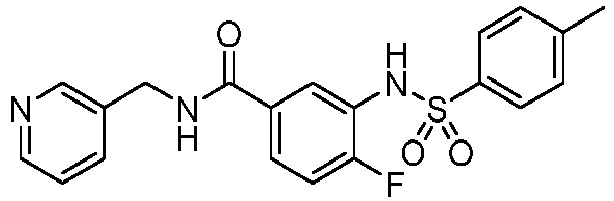
- According to the synthesis method of step 2 in Example 1, the title compound was synthesized from 3- amino -4- fluoro -N- (pyridin -3-ylmethyl) benzamide.
- 1H NMR (400 MHz, DMSO-d 6) δ 10.26 (s, 1H), 9.12 (t, J = 5.9 Hz, 1H), 8.54 (s, 1H), 8.47 (d, J = 4.0 Hz, 1H), 7.86 (dd, J = 7.7, 2.2 Hz, 1H), 7.75 - 7.67 (m, 2H), 7.60 (d, J = 8.3 Hz, 2H), 7.40 - 7.31 (m, 3H), 7.26 (dd, J = 10.0, 8.6 Hz, 1H), 4.46 (d, J = 5.8 Hz, 2H), 2.35 (s, 3H).
-

-

- According to the method of
step 1 in Example 1, the title compound was synthesized from 3- amino -4- chlorobenzoic acid. - 1H NMR (400 MHz, DMSO-d6) δ 8.95 (t, J = 5.9 Hz, 1H), 8.53 (d, J = 1.7 Hz, 1H), 8.45 (dd, J = 4.8, 1.6 Hz, 1H), 7.74 - 7.65 (m, 1H), 7.35 (ddd, J = 7.8, 4.8, 0.7 Hz, 1H), 7.29 (d, J = 2.1 Hz, 1H), 7.27 (d, J = 8.3 Hz, 1H), 7.02 (dd, J = 8.3, 2.1 Hz, 1H), 5.53 (br s, 2H), 4.45 (d, J = 5.9 Hz, 2H).
- MS (ESI+) m/z 261.9 [M + H]+.
-

- According to the method of step 2 in Example 1, the title compound was synthesized from 4- chloro -3-((4- methylphenyl) sulfonamido) benzoic acid.
- 1H NMR (400 MHz, DMSO- d6 ) δ 10.08 (s, 1H), 9.18 (t, J = 5.8 Hz, 1H), 8.54 (d, J = 1.6 Hz, 1H), 8.47 (dd, J = 4.7, 1.4 Hz, 1H), 7.85 (d, J = 2.1 Hz, 1H), 7.75 - 7.66 (m, 2H), 7.59 (d, J = 8.3 Hz, 2H), 7.51 (d, J = 8.4 Hz, 1H), 7.40 - 7.31 (m, 3H), 4.47 (d, J = 5.8 Hz, 2H), 2.36 (s, 3H).
-

-

- According to the method of
step 1 in Example 1, the title compound was synthesized from 3- amino -4- methoxybenzoic acid. - 1H NMR (400 MHz, DMSO- d6 ) δ 8.75 (t, J = 5.9 Hz, 1H), 8.52 (d, J = 1.8 Hz, 1H), 8.44 (dd, J = 4.7, 1.5 Hz, 1H), 7.73 - 7.65 (m, 1H), 7.38 - 7.31 (m, 1H), 7.17 (d, J = 2.2 Hz, 1H), 7.11 (dd, J = 8.3, 2.2 Hz, 1H), 6.83 (d, J = 8.4 Hz, 1H), 4.85 (s, 2H), 4.43 (d, J = 5.9 Hz, 2H), 3.80 (s, 3H).
-

- According to the method of step 2 in Example 1, the title compound was synthesized from 3- amino -4- methoxy -N- (pyridin -3- ylmethyl) benzamide.
- 1H NMR (400 MHz, DMSO- d6 ) δ 9.52 (s, 1H), 8.97 (t, J = 5.8 Hz, 1H), 8.53 (d, J = 2.0 Hz, 1H), 8.46 (dd, J = 4.8, 1.5 Hz, 1H), 7.82 (d, J = 2.2 Hz, 1H), 7.74 - 7.66 (m, 2H), 7.57 (d, J = 8.3 Hz, 2H), 7.36 (dd, J = 7.8, 4.8 Hz, 1H), 7.31 (d, J = 8.3 Hz, 2H), 6.96 (d, J = 8.7 Hz, 1H), 4.45 (d, J = 5.9 Hz, 2H), 3.52 (s, 3H), 2.34 (s, 3H).
-

-

- According to the method of
step 1 in Example 1, the title compound was synthesized from 3- amino -4- ethylbenzoic acid. - 1H NMR (400 MHz, DMSO- d6 ) δ 8.81 (t, J = 6.0 Hz, 1H), 8.52 (d, J = 1.7 Hz, 1H), 8.45 (dd, J = 4.7, 1.5 Hz, 1H), 7.73 - 7.65 (m, 1H), 7.39 - 7.31 (m, 1H), 7.11 (d, J = 1.6 Hz, 1H), 7.04 - 6.95 (m, 2H), 5.03 (s, 2H), 4.44 (d, J = 6.0 Hz, 2H), 2.46 (q, J = 7.5 Hz, 2H), 1.12 (t, J = 7.5 Hz, 3H).
-

- According to the synthesis method of step 2 in Example 1, the title compound was synthesized from 3- amino -4- ethyl -N- (pyridin -3-ylmethyl) benzamide.
- 1H NMR (400 MHz, DMSO- d6 ) δ 9.64 (s, 1H), 9.00 (t, J = 5.9 Hz, 1H), 8.52 (d, J = 2.0 Hz, 1H), 8.46 (dd, J = 4.8, 1.6 Hz, 1H), 7.71 - 7.64 (m, 2H), 7.57 - 7.51 (m, 3H), 7.39 - 7.31 (m, 3H), 7.27 (d, J = 8.1 Hz, 1H), 4.45 (d, J = 5.9 Hz, 2H), 2.44 (q, J = 7.5 Hz, 2H), 2.35 (s, 3H), 0.92 (t, J = 7.5 Hz, 3H).
-

-

- According to the method of
step 1 in Example 1, the title compound was synthesized from 3- amino -5- methylbenzoic acid. - 1H NMR (400 MHz, DMSO- d6 ) δ 8.81 (t, J = 6.0 Hz, 1H), 8.53 (d, J = 1.7 Hz, 1H), 8.45 (dd, J = 4.8, 1.6 Hz, 1H), 7.70 (ddd, J = 7.9, 2.1, 1.7 Hz, 1H), 7.36 (ddd, J = 7.8, 4.8, 0.8 Hz, 1H), 6.86 (t, J = 1.7 Hz, 1H), 6.84 - 6.81 (m, 1H), 6.58 - 6.48 (m, 1H), 5.29 (br s, 2H), 4.43 (d, J = 6.0 Hz, 2H), 2.20 (s, 3H).
- MS (ESI+) m/z 242.2 [M + H]+.
-

- According to the method of step 2 in Example 1, the title compound was synthesized from 3- amino -5- methyl -N- (pyridin -3- ylmethyl) benzamide.
- 1H NMR (400 MHz, DMSO- d6 ) δ 10.32 (s, 1H), 8.99 (t, J = 5.9 Hz, 1H), 8.52 (d, J = 1.8 Hz, 1H), 8.46 (dd, J = 4.7, 1.6 Hz, 1H), 7.73 - 7.59 (m, 3H), 7.41 (t, J = 1.6 Hz, 1H), 7.38 - 7.30 (m, 4H), 7.10 - 7.05 (m, 1H), 4.43 (d, J = 5.9 Hz, 2H), 2.32 (s, 3H), 2.24 (s, 3H).
- MS (ESI+) m/z 396.3 [M + H]+.
-

- Step 1: Preparation of 3-amino-5-methoxy-N-(pyridin-3-ylmethyl)benzamide

- According to the method of
step 1 in Example 1, the title compound was synthesized from 3- amino -5- methoxybenzoic acid. - 1H NMR (400 MHz, DMSO- d6 ) δ 8.84 (t, J = 6.0 Hz, 1H), 8.53 (d, J = 1.2 Hz, 1H), 8.45 (dd, J = 4.6, 1.2 Hz, 1H), 7.70 (ddd, J = 7.9, 2.1, 1.7 Hz, 1H), 7.36 (ddd, J = 7.8, 4.8, 0.7 Hz, 1H), 6.71 - 6.63 (m, 1H), 6.58 (dd, J = 2.3, 1.5 Hz, 1H), 6.28 (t, J = 2.1 Hz, 1H), 5.33 (s, 2H), 4.44 (d, J = 5.9 Hz, 2H), 3.70 (s, 3H).
-

- According to the method of step 2 in Example 1, the title compound was synthesized from 3- amino -5- methoxy -N- (pyridin -3- ylmethyl) benzamide.
- 1H NMR (400 MHz, DMSO- d6 ) δ 10.44 (s, 1H), 9.22 (t, J = 5.3 Hz, 1H), 8.78 (s, 1H), 8.72 (d, J = 5.3 Hz, 1H), 8.26 (d, J = 6.1 Hz, 1H), 7.90 - 7.79 (m, 1H), 7.73 - 7.61 (m, 2H), 7.35 (d, J = 7.9 Hz, 2H), 7.26 - 7.18 (m, 1H), 7.15 (s, 1H), 6.83 (t, J = 2.1 Hz, 1H), 4.56 (d, J = 5.7 Hz, 2H), 3.73 (s, 3H), 2.33 (s, 3H).
-

-

- According to the method of
step 1 in Example 1, the title compound was synthesized from 3- amino -5- fluorobenzoic acid. - 1H NMR (400 MHz, DMSO- d6 ) δ 8.93 (t, J = 5.9 Hz, 1H), 8.53 (d, J = 1.8 Hz, 1H), 8.46 (dd, J = 4.8, 1.6 Hz, 1H), 7.76 - 7.65 (m, 1H), 7.36 (ddd, J = 7.9, 4.8, 0.7 Hz, 1H), 6.92 - 6.84 (m, 1H), 6.74 (ddd, J = 9.8, 2.3, 1.5 Hz, 1H), 6.45 (dt, J = 11.4, 2.2 Hz, 1H), 5.64 (br s, 2H), 4.44 (d, J = 5.9 Hz, 2H).
- MS (ESI+) m/z 246.2 [M + H]+.
-

- According to the method of step 2 in Example 1, the title compound was synthesized from 3- amino -5- fluoro -N- (pyridin -3- ylmethyl) benzamide.
- 1H NMR (400 MHz, DMSO- d6 ) δ 10.82 (s, 1H), 9.42 (t, J = 4.7 Hz, 1H), 8.87 (s, 1H), 8.80 (d, J = 5.5 Hz, 1H), 8.44 (d, J = 8.0 Hz, 1H), 8.03 - 7.91 (m, 1H), 7.77 - 7.64 (m, 2H), 7.47 (dd, J = 10.9, 1.5 Hz, 2H), 7.37 (d, J = 8.4 Hz, 2H), 7.11 (dt, J = 10.4, 2.1 Hz, 1H), 4.60 (d, J = 5.7 Hz, 2H), 2.34 (s, 3H).
- MS (ESI+) m/z 400.3 [M + H]+.
-

-

- According to the method of
step 1 in Example 1, the title compound was synthesized from 3- amino -5- chlorobenzoic acid. - 1H NMR (400 MHz, DMSO- d6 ) δ 8.98 (t, J = 5.9 Hz, 1H), 8.53 (d, J = 1.4 Hz, 1H), 8.46 (d, J = 4.6 Hz, 1H), 7.70 (d, J = 7.8 Hz, 1H), 7.36 (dd, J = 7.8, 4.8 Hz, 1H), 7.04 - 6.96 (m, 2H), 6.72 (t, J = 1.9 Hz, 1H), 5.64 (br s, 2H), 4.44 (d, J = 5.9 Hz, 2H).
- MS (ESI+) m/z 262.2 [M + H]+.
-

- According to the method of step 2 in Example 1, the title compound was synthesized from 3- amino -5- chloro -N- (pyridin -3- ylmethyl) benzamide.
- 1H NMR (400 MHz, DMSO- d6 ) δ 10.77 (s, 1H), 9.31 (t, J = 5.8 Hz, 1H), 8.76 (d, J = 1.4 Hz, 1H), 8.70 (dd, J = 5.3, 1.0 Hz, 1H), 8.21 (d, J = 8.0 Hz, 1H), 7.78 (dd, J = 7.9, 5.4 Hz, 1H), 7.71 - 7.66 (m, 2H), 7.65 (t, J = 1.7 Hz, 1H), 7.59 (dd, J = 2.0, 1.5 Hz, 1H), 7.38 (dd, J = 8.5, 0.5 Hz, 2H), 7.29 (t, J = 2.0 Hz, 1H), 4.55 (d, J = 5.7 Hz, 2H), 2.34 (s, 3H).
- MS (ESI+) m/z 416.3 [M + H]+.
-

-

- According to the method of
step 1 in Example 1, the title compound was synthesized from 5- amino -2- methylbenzoic acid. - 1H NMR (400 MHz, DMSO- d6 ) δ 8.70 (t, J = 6.0 Hz, 1H), 8.55 (d, J = 1.8 Hz, 1H), 8.46 (dd, J = 4.7, 1.4 Hz, 1H), 7.76 - 7.68 (m, 1H), 7.37 (ddd, J = 7.9, 4.8, 0.7 Hz, 1H), 6.86 (d, J = 8.1 Hz, 1H), 6.58 (d, J = 2.4 Hz, 1H), 6.53 (dd, J = 8.1, 2.5 Hz, 1H), 5.03 (s, 2H), 4.41 (d, J = 6.0 Hz, 2H), 2.12 (s, 3H).
- MS (ESI+) m/z 242.2 [M + H]+.
-

- According to the method of
step 1 in Example 1, the title compound was synthesized from 5- amino -2- methyl -N- (pyridin -3- ylmethyl) benzamide. - 1H NMR (400 MHz, DMSO- d6 ) δ 10.24 (s, 1H), 8.82 (t, J = 6.0 Hz, 1H), 8.56 - 8.51 (m, 1H), 8.48 (dd, J = 4.8, 1.6 Hz, 1H), 7.73 - 7.67 (m, 1H), 7.67 - 7.60 (m, 2H), 7.38 (ddd, J = 7.8, 4.8, 0.7 Hz, 1H), 7.36 - 7.31 (m, 2H), 7.11 - 7.02 (m, 3H), 4.42 (d, J = 6.0 Hz, 2H), 2.33 (s, 3H), 2.16 (s, 3H).
- MS (ESI+) m/z 396.3 [M + H]+.
-

- According to the method of step 2 in Example 1, the title compound was synthesized from 3- amino -4- methyl -N- (pyridin -3- ylmethyl) benzamide and p-ethylbenzenesulfonyl chloride.
- 1H NMR (400 MHz, ) δ 9.65 (s, 1H), 9.04 (t, J = 6.0 Hz, 1H), 8.53 (d, J = 2.0 Hz, 1H), 8.46 (dd, J = 4.8, 1.6 Hz, 1H), 7.70 (dt, J = 7.9, 2.0 Hz, 1H), 7.65 - 7.60 (m, 2H), 7.58 - 7.53 (m, 2H), 7.40 - 7.33 (m, 3H), 7.21 (d, J = 8.0 Hz, 1H), 4.45 (d, J = 6.0 Hz, 2H), 2.65 (d, J = 7.6 Hz, 2H), 1.95 (s, 3H), 1.16 (t, J = 7.6 Hz, 3H).
-

- According to the method of step 2 in Example 1, the title compound was synthesized from 3- amino -4- methyl -N- (pyridin -3- ylmethyl) benzamide and 4- methoxybenzenesulfonyl chloride.
- 1H NMR (400 MHz, DMSO- d6 ) δ 9.55 (s, 1H), 9.02 (t, J = 5.9 Hz, 1H), 8.53 (s, 1H), 8.46 (d, J = 4.2 Hz, 1H), 7.69 (d, J = 7.9 Hz, 1H), 7.66 - 7.59 (m, 2H), 7.56 (d, J = 8.9 Hz, 2H), 7.36 (dd, J = 7.8, 4.8 Hz, 1H), 7.21 (d, J = 8.0 Hz, 1H), 7.05 (d, J = 8.9 Hz, 2H), 4.45 (d, J = 5.8 Hz, 2H), 3.80 (s, 3H), 1.97 (s, 3H).
-

- According to the method of step 2 in Example 1, the title compound was synthesized from 3- amino -4- methyl -N- (pyridin -3- ylmethyl) benzamide and 3- methoxybenzenesulfonyl chloride.
- 1H NMR (400 MHz, DMSO- d6 ) δ 9.72 (s, 1H), 9.03 (t, J = 5.9 Hz, 1H), 8.53 (d, J = 1.8 Hz, 1H), 8.46 (dd, J = 4.8, 1.6 Hz, 1H), 7.69 (dt, J = 7.9, 1.9 Hz, 1H), 7.64 (dd, J = 7.8, 1.8 Hz, 1H), 7.61 (d, J = 1.7 Hz, 1H), 7.46 (t, J = 8.0 Hz, 1H), 7.36 (ddd, J = 7.8, 4.7, 0.6 Hz, 1H), 7.26 - 7.17 (m, 3H), 7.15 - 7.10 (m, 1H), 4.45 (d, J = 5.9 Hz, 2H), 3.73 (s, 3H), 1.99 (s, 3H).
- MS (ESI+) m/z 412.3 [M + H]+.
-

- According to the method of step 2 in Example 1, the title compound was synthesized from 3- amino -4- methyl -N- (pyridin -3- ylmethyl) benzamide and 4- ethoxybenzenesulfonyl chloride.
- 1H NMR (400 MHz, DMSO- d6 ) δ 9.57 (s, 1H), 9.04 (t, J = 5.8 Hz, 1H), 8.53 (d, J = 1.4 Hz, 1H), 8.46 (dd, J = 4.6, 1.2 Hz, 1H), 7.69 (dt, J = 7.9, 1.9 Hz, 1H), 7.66 - 7.58 (m, 2H), 7.54 (d, J = 8.9 Hz, 2H), 7.40 - 7.32 (m, 1H), 7.21 (d, J = 7.9 Hz, 1H), 7.03 (d, J = 9.0 Hz, 2H), 4.45 (d, J = 5.9 Hz, 2H), 4.07 (q, J = 7.0 Hz, 2H), 1.96 (s, 3H), 1.32 (t, J = 7.0 Hz, 3H).
-

- According to the method of step 2 in Example 1, the title compound was synthesized from 3- amino -4- methyl -N- (pyridin -3- ylmethyl) benzamide and 3,4- dimethylbenzenesulfonyl chloride.
- 1H NMR (400 MHz, DMSO- d6 ) δ 9.58 (s, 1H), 9.02 (t, J = 5.9 Hz, 1H), 8.52 (d, J = 1.2 Hz, 1H), 8.46 (dd, J = 4.7, 1.1 Hz, 1H), 7.69 (dt, J = 7.8, 1.8 Hz, 1H), 7.65 - 7.58 (m, 2H), 7.42 (s, 1H), 7.39 - 7.33 (m, 2H), 7.29 (d, J = 8.0 Hz, 1H), 7.22 (d, J = 8.4 Hz, 1H), 4.45 (d, J = 5.8 Hz, 2H), 2.26 (s, 3H), 2.22 (s, 3H), 1.99 (s, 3H).
-

- According to the method of step 2 in Example 1, the title compound was synthesized from 3- amino -4- methyl -N- (pyridin -3- ylmethyl) benzamide and 2,4- dimethylbenzenesulfonyl chloride.
- 1H NMR (400 MHz, DMSO- d6 ) δ 9.66 (s, 1H), 9.00 (t, J = 5.9 Hz, 1H), 8.52 (d, J = 0.8 Hz, 1H), 8.49 (t, J = 4.8, 0.8 Hz, 1H), 7.68 (dt, J = 7.7, 1.7 Hz, 1H), 7.65 - 7.57 (m, 2H), 7.51 (d, J = 8.1 Hz, 1H), 7.36 (dd, J = 7.8, 4.8 Hz, 1H), 7.26 - 7.17 (m, 2H), 7.08 (d, J = 8.0 Hz, 1H), 4.44 (d, J = 5.8 Hz, 2H), 2.50 (s, 3H), 2.30 (s, 3H), 2.01 (s, 3H).
-

- According to the method of step 2 in Example 1, the title compound was synthesized from 3- amino -4- methyl -N- (pyridin -3- ylmethyl) benzamide and 4- trifluoromethylbenzenesulfonyl chloride.
- 1H NMR (400 MHz, DMSO- d6 ) δ 10.04 (s, 1H), 9.05 (s, 1H), 8.53 (d, J = 1.8 Hz, 1H), 8.46 (dd, J = 4.8, 1.5 Hz, 1H), 7.96 (d, J = 8.3 Hz, 2H), 7.86 (d, J = 8.2 Hz, 2H), 7.72 - 7.64 (m, 2H), 7.61 (d, J = 1.8 Hz, 1H), 7.35 (ddd, J = 7.9, 4.8, 0.7 Hz, 1H), 7.26 (d, J = 8.1 Hz, 1H), 4.46 (d, J = 5.9 Hz, 2H), 1.96 (s, 3H).
-

- According to the method of step 2 in Example 1, the title compound was synthesized from 3- amino -4- methyl -N- (pyridin -3- ylmethyl) benzamide and 3- trifluoromethylbenzenesulfonyl chloride.
- 1H NMR (400 MHz, DMSO- d6 ) δ 10.06 (s, 1H), 9.27 (t, J = 5.5 Hz, 1H), 8.84 (d, J = 1.4 Hz, 1H), 8.79 (d, J = 5.4 Hz, 1H), 8.39 (d, J = 7.8 Hz, 1H), 8.07 (d, J = 7.8 Hz, 1H), 8.00 - 7.90 (m, 2H), 7.89 - 7.80 (m, 2H), 7.73 (dd, J = 8.0, 1.8 Hz, 1H), 7.54 (d, J = 1.7 Hz, 1H), 7.28 (d, J = 8.1 Hz, 1H), 4.60 (d, J = 5.8 Hz, 2H), 1.98 (s, 3H).
- MS (ESI+) m/z 450.3 [M + H]+.
-

- According to the method of step 2 in Example 1, the title compound was synthesized from 3- amino -4- methyl -N- (pyridin -3- ylmethyl) benzamide and 4- fluorobenzenesulfonyl chloride.
- 1H NMR (400 MHz, DMSO- d6 ) δ 9.78 (s, 1H), 9.03 (t, J = 5.9 Hz, 1H), 8.53 (s, 1H), 8.46 (d, J = 3.8 Hz, 1H), 7.72 - 7.62 (m, 3H), 7.64 (dd, J = 7.9, 1.8 Hz, 1H), 7.58 (d, J = 1.8 Hz, 1H), 7.43 - 7.33 (m, 3H), 7.24 (d, J = 8.1 Hz, 1H), 4.45 (d, J = 5.9 Hz, 2H), 1.98 (s, 3H).
-

- According to the method of step 2 in Example 1, the title compound was synthesized from 3- amino -4- methyl -N- (pyridin -3- ylmethyl) benzamide and 4- chlorobenzenesulfonyl chloride.
- 1H NMR (400 MHz, DMSO- d6 ) δ 9.86 (s, 1H), 9.04 (t, J = 5.9 Hz, 1H), 8.53 (d, J = 1.9 Hz, 1H), 8.46 (dd, J = 4.8, 1.6 Hz, 1H), 7.69 (dt, J = 7.8, 1.9 Hz, 1H), 7.67 - 7.62 (m, 5H), 7.60 (d, J = 1.7 Hz, 1H), 7.39 - 7.33 (m, 1H), 7.25 (d, J = 8.0 Hz, 1H), 4.46 (d, J = 5.8 Hz, 2H), 1.98 (s, 3H).
-

- According to the method of step 2 in Example 1, the title compound was synthesized from 3- amino -4- methyl -N- (pyridin -3- ylmethyl) benzamide and 4- isopropylbenzenesulfonyl chloride.
- 1H NMR (400 MHz, DMSO- d6 ) δ 9.63 (s, 1H), 9.02 (t, J = 5.9 Hz, 1H), 8.53 (d, J = 1.8 Hz, 1H), 8.46 (dd, J = 4.8, 1.6 Hz, 1H), 7.69 (dt, J = 7.8, 1.9 Hz, 1H), 7.65 - 7.59 (m, 2H), 7.56 (d, J = 8.4 Hz, 2H), 7.40 (d, J = 8.4 Hz, 2H), 7.38 - 7.33 (m, 1H), 7.21 (d, J = 8.5 Hz, 1H), 4.45 (d, J = 5.9 Hz, 2H), 3.01 - 2.88 (m, 1H), 1.94 (s, 3H), 1.18 (d, J = 6.9 Hz, 6H).
-

- According to the method of step 2 in Example 1, the title compound was synthesized from 3- amino -4- methyl -N- (pyridin -3- ylmethyl) benzamide and 4- cyclopropylbenzenesulfonyl chloride.
- 1H NMR (400 MHz, DMSO- d6 ) δ 9.61 (s, 1H), 9.02 (t, J = 5.9 Hz, 1H), 8.53 (d, J = 1.6 Hz, 1H), 8.46 (dd, J = 4.7, 1.4 Hz, 1H), 7.69 (dt, J = 7.9, 2.1 Hz, 1H), 7.66 - 7.57 (m, 2H), 7.49 (d, J = 8.5 Hz, 2H), 7.39 - 7.33 (m, 1H), 7.23 - 7.18 (m, 3H), 4.45 (d, J = 5.9 Hz, 2H), 2.03 - 1.96 (m, 1H), 1.95 (s, 3H), 1.10 - 0.94 (m, 2H), 0.78 - 0.65 (m, 2H).
-

- According to the method of step 2 in Example 1, the title compound was synthesized from 3- amino -4- methyl -N- (pyridin -3- ylmethyl) benzamide and 4- n-propylbenzenesulfonyl chloride.
- 1H NMR (400 MHz, DMSO- d6 ) δ 9.63 (s, 1H), 9.02 (t, J = 5.9 Hz, 1H), 8.53 (d, J = 1.8 Hz, 1H), 8.46 (dd, J = 4.8, 1.5 Hz, 1H), 7.69 (dt, J = 7.7, 1.7 Hz, 1H), 7.65 - 7.59 (m, 2H), 7.53 (d, J = 8.3 Hz, 2H), 7.39 - 7.31 (m, 3H), 7.21 (d, J = 7.9 Hz, 1H), 4.45 (d, J = 5.8 Hz, 2H), 2.60 (t, J = 7.5 Hz, 2H), 1.92 (s, 3H), 1.66 - 1.49 (m, 2H), 0.85 (t, J = 7.3 Hz, 3H).
-

- According to the method of step 2 in Example 1, the title compound was synthesized from 3- amino -4- methyl -N- (pyridin -3- ylmethyl) benzamide and 2,3- dihydro -1H- indene -5- sulfonyl chloride.
- 1H NMR (400 MHz, DMSO- d6 ) δ 9.59 (s, 1H), 9.02 (t, J = 5.9 Hz, 1H), 8.52 (d, J = 1.6 Hz, 1H), 8.46 (dd, J = 4.7, 1.5 Hz, 1H), 7.75 - 7.65 (m, 1H), 7.64 - 7.58 (m, 2H), 7.51 - 7.46 (m, 1H), 7.44 - 7.39 (m, 1H), 7.38 - 7.32 (m, 2H), 7.21 (dd, J = 8.4, 0.4 Hz, 1H), 4.45 (d, J = 5.9 Hz, 2H), 2.98 - 2.76 (m, 4H), 2.09 - 1.92 (m, 5H).
-

- According to the method of step 2 in Example 1, the title compound was synthesized from 3- amino -4- methyl -N- (pyridin -3- ylmethyl) benzamide and benzo [d][1,3] dioxole -5- sulfonyl chloride.
- 1H NMR (400 MHz, DMSO- d6 ) δ 9.60 (s, 1H), 9.03 (t, J = 5.9 Hz, 1H), 8.53 (s, 1H), 8.46 (d, J = 3.9 Hz, 1H), 7.73 - 7.67 (m, 1H), 7.63 (dd, J = 7.8, 1.8 Hz, 1H), 7.60 (d, J = 1.8 Hz, 1H), 7.39 - 7.32 (m, 1H), 7.24 (d, J = 7.9 Hz, 1H), 7.15 (dd, J = 8.2, 1.9 Hz, 1H), 7.10 (d, J = 1.8 Hz, 1H), 7.02 (d, J = 8.2 Hz, 1H), 6.15 (s, 2H), 4.46 (d, J = 5.9 Hz, 2H), 2.03 (s, 3H).
-

- According to the method of step 2 in Example 1, the title compound was synthesized from 3- amino -4- methyl -N- (pyridin -3- ylmethyl) benzamide and 2,3- dihydrobenzofuran -5- sulfonyl chloride.
- 1H NMR (400 MHz, DMSO- d6 ) δ 9.52 (s, 1H), 9.16 (t, J = 5.1 Hz, 1H), 8.78 (s, 1H), 8.73 (d, J = 4.2 Hz, 1H), 8.27 (d, J = 5.3 Hz, 1H), 7.85 (s, 1H), 7.64 (dd, J = 4.1, 2.3 Hz, 2H), 7.49 (d, J = 1.8 Hz, 1H), 7.38 (dd, J = 8.4, 2.1 Hz, 1H), 7.24 (dd, J = 8.4, 0.6 Hz, 1H), 6.85 (d, J = 8.4 Hz, 1H), 4.61 (t, J = 8.8 Hz, 2H), 4.58 (d, J = 5.6 Hz, 2H), 3.18 (dd, J = 8.8 Hz, 2H), 2.01 (s, 3H).
- MS (ESI+) m/z 424.3 [M + H]+.
-

- According to the method of step 2 in Example 1, the title compound was synthesized from 3- amino -4- methyl -N- (pyridin -3- ylmethyl) benzamide and (2,3- dihydrobenzo [b][1,4] dioxin) -6- sulfonyl chloride.
- 1H NMR (400 MHz, DMSO- d6 ) δ 9.61 (s, 1H), 9.21 (t, J = 5.6 Hz, 1H), 8.83 (s, 1H), 8.77 (d, J = 5.4 Hz, 1H), 8.37 (d, J = 7.7 Hz, 1H), 7.95 - 7.86 (m, 1H), 7.66 (dd, J = 7.9, 1.6 Hz, 1H), 7.63 (d, J = 1.7 Hz, 1H), 7.25 (d, J = 8.0 Hz, 1H), 7.11 - 7.06 (m, 2H), 6.98 (d, J = 9.0 Hz, 1H), 4.60 (d, J = 5.7 Hz, 2H), 4.38 - 4.23 (m, 4H), 2.01 (s, 3H).
- MS (ESI+) m/z 440.3 [M + H]+.
-

- According to the method of step 2 in Example 1, the title compound was synthesized from 3- amino -4- methyl -N- (pyridin -3- ylmethyl) benzamide and naphthalene -2- sulfonyl chloride.
- 1H NMR (400 MHz, DMSO- d6 ) δ 9.85 (s, 1H), 9.01 (t, J = 5.9 Hz, 1H), 8.51 (d, J = 1.6 Hz, 1H), 8.46 (dd, J = 4.7, 1.4 Hz, 1H), 8.28 (d, J = 1.6 Hz, 1H), 8.13 - 8.00 (m, 3H), 7.77 - 7.58 (m, 6H), 7.36 - 7.31 (m, 1H), 7.18 (d, J = 8.1 Hz, 1H), 4.43 (d, J = 5.8 Hz, 2H), 1.94 (s, 3H).
-

- According to the method of step 2 in Example 1, the title compound was synthesized from 3- amino -4- methyl -N- (pyridin -3- ylmethyl) benzamide and 5- methylthiophene -2- sulfonyl chloride.
- 1H NMR (400 MHz, DMSO- d6 ) δ 9.87 (s, 1H), 9.21 (t, J = 5.7 Hz, 1H), 8.81 (d, J = 1.4 Hz, 1H), 8.76 (d, J = 5.4 Hz, 1H), 8.34 (d, J = 8.0 Hz, 1H), 7.90 (dd, J = 7.9, 5.5 Hz, 1H), 7.73 - 7.67 (m, 2H), 7.31 - 7.25 (m, 1H), 7.19 (d, J = 3.7 Hz, 1H), 6.84 (dd, J = 3.7, 1.1 Hz, 1H), 4.60 (d, J = 5.7 Hz, 2H), 2.46 (s, 3H), 2.03 (s, 3H).
- MS (ESI+) m/z 402.3 [M + H]+.
-

- According to the method of step 2 in Example 1, the title compound was synthesized from 3- amino -4- methyl -N- (pyridin -3- ylmethyl) benzamide and 5- chlorothiophene -2- sulfonyl chloride.
- 1H NMR (400 MHz, DMSO- d6 ) δ 10.13 (s, 1H), 9.08 (t, J = 5.8 Hz, 1H), 8.54 (s, 1H), 8.47 (d, J = 3.1 Hz, 1H), 7.73 - 7.67 (m, 2H), 7.64 (d, J = 1.8 Hz, 1H), 7.36 (dd, J = 7.8, 4.7 Hz, 1H), 7.31 (d, J = 8.0 Hz, 1H), 7.29 (d, J = 4.1 Hz, 1H), 7.23 (d, J = 4.1 Hz, 1H), 4.47 (d, J = 5.9 Hz, 2H), 2.08 (s, 3H).
-

- According to the method of step 2 in Example 1, the title compound was synthesized from 3- amino -4- methyl -N- (pyridin -3- ylmethyl) benzamide and 6- methoxypyridine -3- sulfonyl chloride.
- 1H NMR (400 MHz, DMSO- d6 ) δ 9.87 (s, 1H), 9.22 (t, J = 5.5 Hz, 1H), 8.82 (s, 1H), 8.76 (d, J = 4.0 Hz, 1H), 8.43 - 8.32 (m, 2H), 8.00 - 7.83 (m, 2H), 7.70 (d, J = 7.9 Hz, 1H), 7.61 (d, J = 1.7 Hz, 1H), 7.28 (d, J = 8.1 Hz, 1H), 6.99 (dd, J = 8.8, 0.4 Hz, 1H), 4.59 (d, J = 5.7 Hz, 2H), 3.90 (s, 3H), 2.04 (s, 3H).
- MS (ESI+) m/z 413.3 [M + H]+.
-

-

- A mixture of 3- amino-4-methyl benzoic acid (1.65 g, 10 mmol), p-toluenesulfonyl chloride (2.8 g, 12 mmol), pyridine (1.19 g, 15 mmol) and DMAP(0.122 g, 1 mmol) in DCM(40 mL) was stirred at rt overnight. The reaction mixture was diluted with water (100 mL) and acidified to pH = 3-4 with dilute hydrochloric acid. The mixture was extracted with dichloromethane (50 mL×3). The combined organic layers were washed with water (100 mL×2) and saline (100 mL), dried with anhydrous sodium sulfate, filtered and concentrated. The residue was purified by column chromatography (silica gel, PE/EtOAc = 3:1) to obtain the produt as yellow oil (2.82 g, yield 88%).
- 1H NMR (400 MHz, DMSO-d6 ) δ 9.73 (s, 1H), 7.70 - 7.63 (m, 2H), 7.55 (d, J = 8.0 H, 2H), 7.36 (d, J = 8.0 Hz, 2H), 7.28 (d, J = 7.7 Hz, 1H), 3.81 (s, 3H), 2.36 (s, 3H), 2.03 (s, 3H).
- MS (ESI+) m/z 319.8 [M + H]+.
-

- The mixture of methyl 4- methyl -3-((4- methylphenyl) sulfonamido) benzoate (2.71 g, 8.5 mmol) and sodium hydroxide (1.36 g, 34 mmol, 4 eq.) in methanol (51 mL) and water (17 mL) was refluxed for 7 hours. The resulting mixture was evaporated to dryness under reduced pressure, and the reaction mixture was diluted with water (100 mL), acidified to pH=2 with concentrated hydrochloric acid, and extracted with ethyl acetate (50 mL×3). The combined organic layers were washed with water (100 mL×2) and saline (100 mL), dried with anhydrous sodium sulfate, filtered, and concentrated until solid began to precipitate in the solution. The resulting suspension was left still for 1 hour, and the solid was collected by suction filtration and dried to afford a light yellow solid (2.1 g, yield 81%).
- 1H NMR (400 MHz, DMSO-d6 ) δ 12.89 (br s, 1H), 9.69 (br s, 1H), 7.66 (dd, J = 7.8, 1.6 Hz, 1H), 7.63 (d, J = 1.5 Hz, 1H), 7.55 (d, J = 8.2 Hz, 2H), 7.36 (d, J = 8.1 Hz, 2H), 7.25 (d, J = 7.9 Hz, 1H), 2.36 (s, 3H), 2.05 (s, 3H).
- MS (ESI+) m/z 305.8 [M + H]+.
-

- The reaction mixture of 4- methyl -3-((4- methylphenyl) sulfonamido) benzoic acid (0.153 g, 0.5 mmol), 6- methylpyridin -3- ylmethylamine (0.080 g, 0.65 mmol), HATU(0.285 g, 0.75 mmol) and triethylamine (0.152g, 1.5 mmol) in DCM(10 mL) was stirred overnight. Water (50 mL) was added, and the resulting mixture was extracted with DCM (30 mL×3). The combined organic layers were washed with water (30 mL×2) and saline (30 mL), dried with anhydrous sodium sulfate, filtered and concentrated. The residue was purified by preparative thin layer chromatography (silica gel, DCM/MeOH = 15:1) to obtain a yellow foamy solid (126 mg, yield 62%).
- 1H NMR (400 MHz, DMSO-d6) δ 9.63 (s, 1H), 8.97 (t, J = 5.9 Hz, 1H), 8.38 (d, J = 2.1 Hz, 1H), 7.64 - 7.55 (m, 3H), 7.55 - 7.49 (m, 2H), 7.33 (d, J = 8.0 Hz, 2H), 7.20 (d, J = 7.8 Hz, 2H), 4.40 (d, J = 5.8 Hz, 2H), 2.44 (s, 3H), 2.35 (s, 3H), 1.95 (s, 3H).
-

- The title compound was synthesized from 4- methyl -3-((4- methylphenyl) sulfonamido) benzoic acid and 6- methoxypyridin -3- ylmethylamine according to the method of Example 33.
- 1H NMR (400 MHz, DMSO- d6 ) δ 9.63 (s, 1H), 8.93 (t, J = 5.9 Hz, 1H), 8.10 (d, J = 2.1 Hz, 1H), 7.69 - 7.56 (m, 3H), 7.52 (d, J = 8.3 Hz, 2H), 7.33 (d, J = 8.0 Hz, 2H), 7.20 (d, J = 8.0 Hz, 1H), 6.79 (dd, J = 8.8, 0.4 Hz, 1H), 4.36 (d, J = 5.8 Hz, 2H), 3.83 (s, 3H), 2.35 (s, 3H), 1.94 (s, 3H).
-

- According to the method of Example 34, the title compound was synthesized from 4- methyl -3-((4- methylphenyl) sulfonamido) benzoic acid and 6- trifluoromethylpyridin -3- ylmethylamine.
- 1H NMR (400 MHz, DMSO- d6 ) δ 9.65 (s, 1H), 9.11 (t, J = 5.8 Hz, 1H), 8.71 (d, J = 1.4 Hz, 1H), 7.97 (dd, J = 8.1, 1.5 Hz, 1H), 7.88 (d, J = 8.1 Hz, 1H), 7.67 - 7.58 (m, 2H), 7.52 (d, J = 8.3 Hz, 2H), 7.33 (d, J = 8.1 Hz, 2H), 7.22 (d, J = 8.6 Hz, 1H), 4.55 (d, J = 5.8 Hz, 2H), 2.35 (s, 3H), 1.96 (s, 3H).
- DU145 cells (human prostate cancer cells) in logarithmic growth phase were digested with 0.25% trypsin -EDTA to prepare single cell suspension, which was inoculated into 96-well plate overnight according to 1500 cells/well /100µL, and fresh medium containing different concentrations of compounds to be tested and corresponding solvent control was added, and 100pL(DMSO final concentration < 0.1%) was added to each well, and the 96-well plate was further cultured at 37°C for 72 h. 20µL of freshly prepared PBS solution containing 5mg/mL MTT was added to each well, and the 96-well plate was further cultured for 4 h. After the supernatant was discarded, 180 µL of DMSO was added to each well to dissolve the MTT formazan precipitate. After the 96-well plate was shaked and mixed by a micro oscillator, the optical density (OD) at the detection wavelength of 570nm was measured. With DMSO-treated tumor cells as the control group, the inhibition rate on the growth of tumor cells of the compound to be tested was calculated from the following formula, and the IC50 was calculated according to the median-effect equation.
- Inhibition rate (%) = (average OD value of control group-average OD value of dosing group)/average OD value of control group× 100%
- The results are shown in table 1. The experimental results showed that all the examples showed antiproliferative activity against human prostate cancer DU145, and their IC50 values were all less than 10 µM.
Table 1: Antiproliferative activity against human prostate cancer cell DU145 Example IC50 (µM) 1 0.12±0.03 2 0.7±0.15 3 0.79±0.13 4 0.8±0.12 6 0.86±0.08 7 0.34±0.01 9 0.9±0.02 10 0.34±0.01 11 2.0±0.03 12 0.04±0.01 13 0.18±0.08 14 2.5±0.02 15 0.86±0.06 16 0.97±0.03 17 0.5±0.04 20 3.47±1.22 21 0.93±0.05 22 1±0.16 23 0.05±0.008 25 0.9±0.04 26 0.61±0.14 27 1.2±0.01 28 0.42±0.01 29 1±0.07 30 1.2±0.03 32 0.4±0.02 33 0.008±0.001 34 0.006±0.002 35 0.2±0.07 - The luciferase plasmids STAT3-TA-Luc and pGMLR-TK were transiently co-transfected into DU145 cells by
Lipofectamine 3000. After staying overnight, different concentrations of compounds to be tested were added and cultured for 24 hours. The supernatant was discarded, and the residue was washed twice with PBS, and then 20µL of lysis solution was added to shake and lyse for 5min. The supernatant was transfered to a 96-well Costar whiteplate, and 70µL of Dual-Glo luciferase substrate solution was added, and the relative fluorescence intensity of firefly luciferase was detected, and then 70µL of Stop-Glo substrate solution was added, and the relative fluorescence intensity of sea kidney luciferase was detected, the normalized value was obtained, and the inhibition rate and IC50 value were calculated. - The results are shown in table 2. The experimental results showed that Examples 1, 6, 9, 12, 13, 17, 20, 23, 30, 33, 34 and 35 showed obvious STAT3 transcription inhibition activity in the STAT3 specific luciferase double reporter gene experiment of human prostate cancer cell DU145.
Table 2: Experimental results of luciferase double reporter gene on human prostate cancer cell DU145 with high STAT3 expression Example IC50 (µM) 1 7±1.3 6 9.7±1.3 9 6.2±0.3 12 1±0.35 13 10±2.1 17 8.2±0.02 20 15±1.4 23 1±0.19 30 17.5±0.3 33 0.5±0.12 34 0.8±0.27 35 8±0.43 - DU145 cells treated for 16h with different concentrations of examples 12, 23, 33 and 34 and DU145 cells in control group were collected and washed twice with pre-cooled PBS. After appropriate amount of RIPA lysate (50 mM Tris-HCI, 1 mM EDTA, 1% Triton X-100, 150 mM NaCl, 0.1% SDS, 1mM NaF, Na3VO4, protease inhibitor, pH 7.4) was added to lyse for 1h on ice, the reaction mixture was centrifuged at 4°C, 12,000rpm for 20 min, and then the supernatant was collected for protein quantification and boiled for denaturation. Equal amount of protein was taken for 10%SDS-PAGE electrophoresis. The specific antibodies of p-STAT3(Tyr705) and STAT3 were used as primary antibody, which was incubated overnight at 4°C. The corresponding HRP-labeled secondary antibody was used, incubated at room temperature for 2h, and washed. ECL chemiluminescence substrate reaction solution was added to develop in gel imaging system, and the image was saved. β-actin was used as internal reference.
- The results are shown in
figure 1 . - Tumor cells of human prostate cancer DU145 were collected under aseptic conditions, and the cell density was adjusted to 1 × 10⁶ cells /mL with sterilized normal saline, and then 0.2 mL of which was inoculated subcutaneously in the axillary back of nude mice. When the tumor grew to 1 cm in diameter, it was taken out under aseptic conditions, cut into tumor blocks with the size of 1 mm×1 mm, and inoculated subcutaneously in the axillary back of nude mice. Two weeks later, after the tumor grew to 100~300 mm3, the animals were randomly divided into groups and began to be administered (recorded as day 0). The compound to be tested is administered orally. The animals were weighed twice a week and the length and width of tumor were measured with vernier caliper. After the experiment, the nude mice were dislocated and killed, and the tumor tissues were stripped, weighed and photographed. Finally, the tumor inhibition rate was calculated, and the anti-tumor effect was evaluated by the tumor inhibition rate. The results are shown in tables 3 and 4 and
figures 2 and3 . - The tumor volume is calculated according to the following formula:

where a and b represent the length and width of tumor respectively. - The tumor growth inhibition percentage is calculated according to the following formula: tumor growth inhibition (%)=(1-T/C) ×100, T is the tumor volume of group of the compound to be tested, and C is the tumor volume of the solvent control group.
- The results are shown in tables 3 and 4, and
figures 2 and3 .Table 3. The inhibitory effect of Example 1 on the growth of xenograft tumor formed by subcutaneous xenotransplantation of human prostate cancer DU145 in nude mice Example Dose (mg/kg × times) Tumor growth inhibition (%) 1 10×7 58.8*** 20×7 62.7*** 40×7 73.5*** ∗∗∗p<0.001 Table 4. The inhibitory effect of Examples 12 and 33 on the growth of xenograft tumor formed by subcutaneous xenotransplantation of human prostate cancer DU145 in nude mice Example Dose (mg/kg × times) Tumor growth inhibition (%) 12 20×14 40.4 40×11 79.7*** 33 20×6 63.0** 40×5 80.0** ***p<0.001; **p<0.01 - All the examples showed antiproliferative activity against human prostate cancer DU145, and their IC50 values were all less than 10 µM m. Examples 1, 6, 9, 12, 13, 17, 20, 23, 30, 33, 34 and 35 showed obvious STAT3 transcription inhibition activity in the STAT3 specific luciferase double reporter gene experiment of human prostate cancer cell DU145. Example 1 showed obvious inhibitory activity on STAT3 phosphorylation of human prostate cancer DU145 at 1 µM concentration, Examples 12 and 23 showed obvious inhibitory activity on STAT3 phosphorylation of human prostate cancer DU145 at 0.5 µM concentration, and Examples 33 and 34 showed obvious inhibitory activity on STAT3 phosphorylation of human prostate cancer DU145 at 0.1 µM concentration. Among them, Examples 1, 12 and 33 have significant inhibitory effects on the growth of xenograft tumor formed by subcutaneous xenotransplantation of human prostate cancer DU145 in nude mice.
Claims (12)
- A compound represented by Formula (I), or a stereoisomer, a geometric isomer, a tautomer or a pharmaceutically acceptable salt thereof:
 R1 is selected from hydrogen, cyano, difluoromethyl, trifluoromethyl, halogen, C1-3 alkyl, C1-3 alkoxy;R2 is selected from 6- to 10- membered aryl or 5- to 10- membered heteroaryl; wherein the 6- to 10- membered aryl or 5- to 10- membered heteroaryl is optionally substituted by m Ra; or the 6- to 10-membered aryl or 5- to 10- membered heteroaryl is phenyl fused to 4- to 6- membered cycloalkene or 4- to 6- membered heterocycloalkene or 5- to 6- membered heteroaryl fused to the same;each Ra is independently selected from the following groups: cyano, difluoromethyl, trifluoromethyl, halogen, C1-3 alkyl, C3-7 cycloalkyl, C1-3 alkoxy;m is 0, 1, 2, 3, 4 or 5;R3, R4, R5, R6 are each independently selected from hydrogen, cyano, difluoromethyl, trifluoromethyl, halogen, C1-3 alkyl, C1-3 alkoxy.
 - The compound according to claim 1, or a stereoisomer, a geometric isomer, a tautomer or a pharmaceutically acceptable salt thereof, characterized in that,
R1 is selected from hydrogen, cyano, difluoromethyl, trifluoromethyl, chlorine, methyl, ethyl, n-propyl, isopropyl, methoxy or ethoxy. - The compound according to any one of claims 1 to 2, or a stereoisomer, a geometric isomer, a tautomer or a pharmaceutically acceptable salt thereof, characterized in that, R2 is selected from:
 each Ra is independently selected from cyano, difluoromethyl, trifluoromethyl, halogen, C1-3 alkyl, C3-7 cycloalkyl, C1-3 alkoxy;m is 0, 1, 2, 3, 4, or 5.
 - The compound according to claim 3, or a stereoisomer, a geometric isomer, a tautomer or a pharmaceutically acceptable salt thereof, characterized in that, R2 is selected from:

- The compound according to claim 4, or a stereoisomer, a geometric isomer, a tautomer or a pharmaceutically acceptable salt thereof, characterized in that, Ra is selected from the following groups: chlorine, methyl, ethyl, cyclopropyl, methoxy or ethoxy.
- The compound according to any one of claims 1 to 2, or a stereoisomer, a geometric isomer, a tautomer or a pharmaceutically acceptable salt thereof, characterized in that, the R2 is selected from:

- The compound according to any one of claims 1 to 6, or a stereoisomer, a geometric isomer, a tautomer or a pharmaceutically acceptable salt thereof, characterized in that, R3, R4, R5, R6 are each independently selected from hydrogen, cyano, difluoromethyl, trifluoromethyl, fluorine, chlorine, methyl, ethyl, methoxy.
- The compound according to claim 7, or a stereoisomer, a geometric isomer, a tautomer or a pharmaceutically acceptable salt thereof, characterized in that, R3 is selected from methyl, R4, R5 and R6 are selected from hydrogen.
- The compound according to claim 1, or a stereoisomer, a geometric isomer, a tautomer or a pharmaceutically acceptable salt thereof, wherein, the compound is selected from:


- A pharmaceutical composition comprising at least one compound according to any one of claims 1-9, or a stereoisomer, a geometric isomer, a tautomer or a pharmaceutically acceptable salt thereof and optionally a pharmaceutically acceptable carrier and/or excipient.
- The pharmaceutical composition according to claim 10, characterized in that, the pharmaceutical composition further comprises other active pharmaceutical ingredient in addition to the compound, or a stereoisomer, a geometric isomer, a tautomer or a pharmaceutically acceptable salt thereof.
- The compound according to any one of claims 1 to 9, or a stereoisomer, a geometric isomer, a tautomer or a pharmaceutically acceptable salt thereof, or the pharmaceutical composition according to claim 10 or 11 for use in preventing and/or treating STAT3-mediated diseases, wherein the STAT3-mediated diseases include tumors, autoimmune diseases, renal diseases, cardiovascular diseases, inflammation, metabolic/endocrine dysfunction or neurological diseases.
Applications Claiming Priority (2)
| Application Number | Priority Date | Filing Date | Title |
|---|---|---|---|
| CN201810090951.0A CN110092743B (en) | 2018-01-30 | 2018-01-30 | Benzamide compound and its preparation method, use and pharmaceutical composition |
| PCT/CN2019/073942 WO2019149223A1 (en) | 2018-01-30 | 2019-01-30 | Benzamide compound and preparation method, use, and pharmaceutical composition thereof |
Publications (3)
| Publication Number | Publication Date |
|---|---|
| EP3747866A1 EP3747866A1 (en) | 2020-12-09 |
| EP3747866A4 EP3747866A4 (en) | 2021-04-07 |
| EP3747866B1 true EP3747866B1 (en) | 2023-03-01 |
Family
ID=67442701
Family Applications (1)
| Application Number | Title | Priority Date | Filing Date |
|---|---|---|---|
| EP19747114.7A Active EP3747866B1 (en) | 2018-01-30 | 2019-01-30 | Benzamide compound and preparation method, use, and pharmaceutical composition thereof |
Country Status (7)
| Country | Link |
|---|---|
| US (2) | US11518744B2 (en) |
| EP (1) | EP3747866B1 (en) |
| JP (1) | JP7110362B2 (en) |
| CN (1) | CN110092743B (en) |
| AU (1) | AU2019214694B2 (en) |
| CA (1) | CA3092600C (en) |
| WO (1) | WO2019149223A1 (en) |
Families Citing this family (1)
| Publication number | Priority date | Publication date | Assignee | Title |
|---|---|---|---|---|
| WO2026088050A1 (en) * | 2024-10-23 | 2026-04-30 | Fondazione Per L'istituto Oncologico Di Ricerca (Ior) | Small molecule inhibitor of foxa1 and foxa2 for the treatment of foxa1/foxa2-dependent cancers or other diseases |
Family Cites Families (8)
| Publication number | Priority date | Publication date | Assignee | Title |
|---|---|---|---|---|
| JP2930731B2 (en) * | 1994-12-20 | 1999-08-03 | エフ・ホフマン−ラ ロシュ アーゲー | Aryl- and heteroaryl-sulfonamide derivatives, their preparation and their use as endothelin antagonists |
| US5741819A (en) * | 1995-06-07 | 1998-04-21 | 3-Dimensional Pharmaceuticals, Inc. | Arylsulfonylaminobenzene derivatives and the use thereof as factor Xa inhibitors |
| WO2005085188A2 (en) * | 2004-03-02 | 2005-09-15 | Compass Pharmaceuticals Llc | Compounds and methods for anti-tumor therapy |
| CN1944398A (en) * | 2005-01-11 | 2007-04-11 | 中国医学科学院药物研究所 | New benzoyl amide compounds and its preparing method and medicine use |
| GB0815782D0 (en) * | 2008-08-29 | 2008-10-08 | Xention Ltd | Novel potassium channel blockers |
| US9562002B2 (en) * | 2013-01-15 | 2017-02-07 | Board Of Regents, The University Of Texas System | STAT3 inhibitor |
| EP2975936A4 (en) * | 2013-03-22 | 2017-03-15 | University of Hawaii | Novel stat3 inhibitors |
| WO2017007634A1 (en) | 2015-07-06 | 2017-01-12 | The Board Of Regents Of The University Of Texas System | Benzamide or benzamine compounds useful as anticancer agents for the treatment of human cancers |
-
2018
- 2018-01-30 CN CN201810090951.0A patent/CN110092743B/en active Active
-
2019
- 2019-01-30 US US16/966,433 patent/US11518744B2/en active Active
- 2019-01-30 AU AU2019214694A patent/AU2019214694B2/en active Active
- 2019-01-30 WO PCT/CN2019/073942 patent/WO2019149223A1/en not_active Ceased
- 2019-01-30 CA CA3092600A patent/CA3092600C/en active Active
- 2019-01-30 JP JP2020541673A patent/JP7110362B2/en active Active
- 2019-01-30 EP EP19747114.7A patent/EP3747866B1/en active Active
-
2022
- 2022-10-27 US US18/050,396 patent/US12391647B2/en active Active
Also Published As
| Publication number | Publication date |
|---|---|
| CA3092600C (en) | 2024-03-19 |
| US20210047270A1 (en) | 2021-02-18 |
| US11518744B2 (en) | 2022-12-06 |
| US12391647B2 (en) | 2025-08-19 |
| JP2021512097A (en) | 2021-05-13 |
| EP3747866A4 (en) | 2021-04-07 |
| CN110092743B (en) | 2022-03-15 |
| WO2019149223A1 (en) | 2019-08-08 |
| CA3092600A1 (en) | 2019-08-08 |
| CN110092743A (en) | 2019-08-06 |
| AU2019214694A1 (en) | 2020-09-24 |
| AU2019214694B2 (en) | 2021-07-01 |
| EP3747866A1 (en) | 2020-12-09 |
| US20230099912A1 (en) | 2023-03-30 |
| JP7110362B2 (en) | 2022-08-01 |
Similar Documents
| Publication | Publication Date | Title |
|---|---|---|
| EP4112606A1 (en) | Aromatic compound and use thereof in preparing antineoplastic drugs | |
| CA2986930C (en) | Chemical modulators of signaling pathways and therapeutic use | |
| CN107176933B (en) | Indoleamine-2,3-dioxygenase inhibitor of nitrogen-containing alkylated and arylated sulfoximines | |
| CN105481789A (en) | Indoleamine-2, 3-dioxygenase inhibitor and preparation method thereof | |
| RU2292344C2 (en) | Derivatives of pyridylcyanoguanidines and pharmaceutical composition based on thereof | |
| CN105246887B (en) | Coumarin derivative and the method for treating hyperproliferative disease | |
| JP2020509017A (en) | Novel isoindoline derivatives, pharmaceutical compositions and uses thereof | |
| WO2016082713A1 (en) | 2-aminopyrimidine compound and pharmaceutical composition and use thereof | |
| CA3152508A1 (en) | Perk inhibiting pyrrolopyrimidine compounds | |
| CN108530444A (en) | A kind of novel NAMPT and IDO double inhibitors and preparation method thereof and medical usage | |
| JP2015526396A (en) | Substituted tropolone derivatives and methods of use thereof | |
| CN110156674A (en) | A kind of spiro-compound as indoles amine -2,3- dioxygenase inhibitor | |
| ES2581327T3 (en) | Compound 2- (pyridin-2-yl) -1,7-diazaspiro [4.4] nonan-6-one as a modulator of voltage-dependent sodium ionotropic channels | |
| TWI597062B (en) | Nitrile derivatives and their pharmaceutical use and compositions | |
| WO2014116962A1 (en) | Selective histone deacetylase 8 inhibitors | |
| US12391647B2 (en) | Benzamide compound and preparation method, use, and pharmaceutical composition thereof | |
| EA011406B1 (en) | Pyrido pyrimidine derivatives, preparation thereof, therapeutic use thereof for treating cancer | |
| CN103664734B (en) | Heterocycle hydroximic acid compound and medicinal compositions thereof and application | |
| WO2018068357A1 (en) | Novel sirt2 protein inhibitor and pharmaceutical use thereof | |
| CN107501279B (en) | Furanoquinoline dione compound and medical application thereof | |
| EP3560914A1 (en) | Sulfonyl amidine as indoleamine-2,3-dioxygenase inhibitor, and preparation method therefor and use thereof | |
| CN111285806B (en) | Pyrazole compound and preparation method, application and pharmaceutical composition thereof | |
| CN107304200B (en) | New himbacine analogue and application thereof in medicine | |
| WO2021248256A1 (en) | Pyrazole compound, and preparation method therefor, use thereof and pharmaceutical composition thereof | |
| WO2024140671A1 (en) | Fused tricyclic derivative, pharmaceutical composition comprising same, and use thereof |
Legal Events
| Date | Code | Title | Description |
|---|---|---|---|
| STAA | Information on the status of an ep patent application or granted ep patent |
Free format text: STATUS: THE INTERNATIONAL PUBLICATION HAS BEEN MADE |
|
| PUAI | Public reference made under article 153(3) epc to a published international application that has entered the european phase |
Free format text: ORIGINAL CODE: 0009012 |
|
| STAA | Information on the status of an ep patent application or granted ep patent |
Free format text: STATUS: REQUEST FOR EXAMINATION WAS MADE |
|
| 17P | Request for examination filed |
Effective date: 20200831 |
|
| AK | Designated contracting states |
Kind code of ref document: A1 Designated state(s): AL AT BE BG CH CY CZ DE DK EE ES FI FR GB GR HR HU IE IS IT LI LT LU LV MC MK MT NL NO PL PT RO RS SE SI SK SM TR |
|
| AX | Request for extension of the european patent |
Extension state: BA ME |
|
| A4 | Supplementary search report drawn up and despatched |
Effective date: 20210305 |
|
| RIC1 | Information provided on ipc code assigned before grant |
Ipc: A61K 31/435 20060101ALI20210301BHEP Ipc: C07D 405/02 20060101ALI20210301BHEP Ipc: A61K 31/436 20060101ALI20210301BHEP Ipc: C07D 401/12 20060101ALI20210301BHEP Ipc: C07D 475/12 20060101ALI20210301BHEP Ipc: C07D 213/32 20060101AFI20210301BHEP Ipc: C07D 407/12 20060101ALI20210301BHEP Ipc: A61K 31/4427 20060101ALI20210301BHEP Ipc: A61K 31/4355 20060101ALI20210301BHEP Ipc: A61K 31/18 20060101ALI20210301BHEP |
|
| DAV | Request for validation of the european patent (deleted) | ||
| DAX | Request for extension of the european patent (deleted) | ||
| GRAP | Despatch of communication of intention to grant a patent |
Free format text: ORIGINAL CODE: EPIDOSNIGR1 |
|
| STAA | Information on the status of an ep patent application or granted ep patent |
Free format text: STATUS: GRANT OF PATENT IS INTENDED |
|
| RIC1 | Information provided on ipc code assigned before grant |
Ipc: A61P 37/02 20060101ALI20220818BHEP Ipc: A61P 35/00 20060101ALI20220818BHEP Ipc: A61P 29/00 20060101ALI20220818BHEP Ipc: A61P 25/00 20060101ALI20220818BHEP Ipc: A61K 31/4427 20060101ALI20220818BHEP Ipc: A61K 31/436 20060101ALI20220818BHEP Ipc: A61K 31/4355 20060101ALI20220818BHEP Ipc: A61K 31/435 20060101ALI20220818BHEP Ipc: A61K 31/18 20060101ALI20220818BHEP Ipc: C07D 475/12 20060101ALI20220818BHEP Ipc: C07D 409/12 20060101ALI20220818BHEP Ipc: C07D 407/12 20060101ALI20220818BHEP Ipc: C07D 405/12 20060101ALI20220818BHEP Ipc: C07D 405/02 20060101ALI20220818BHEP Ipc: C07D 401/12 20060101ALI20220818BHEP Ipc: C07D 213/71 20060101ALI20220818BHEP Ipc: C07D 213/40 20060101ALI20220818BHEP Ipc: C07D 213/32 20060101AFI20220818BHEP |
|
| INTG | Intention to grant announced |
Effective date: 20220909 |
|
| GRAS | Grant fee paid |
Free format text: ORIGINAL CODE: EPIDOSNIGR3 |
|
| GRAA | (expected) grant |
Free format text: ORIGINAL CODE: 0009210 |
|
| STAA | Information on the status of an ep patent application or granted ep patent |
Free format text: STATUS: THE PATENT HAS BEEN GRANTED |
|
| AK | Designated contracting states |
Kind code of ref document: B1 Designated state(s): AL AT BE BG CH CY CZ DE DK EE ES FI FR GB GR HR HU IE IS IT LI LT LU LV MC MK MT NL NO PL PT RO RS SE SI SK SM TR |
|
| REG | Reference to a national code |
Ref country code: GB Ref legal event code: FG4D |
|
| REG | Reference to a national code |
Ref country code: CH Ref legal event code: EP Ref country code: AT Ref legal event code: REF Ref document number: 1550889 Country of ref document: AT Kind code of ref document: T Effective date: 20230315 |
|
| REG | Reference to a national code |
Ref country code: DE Ref legal event code: R096 Ref document number: 602019025873 Country of ref document: DE |
|
| REG | Reference to a national code |
Ref country code: IE Ref legal event code: FG4D |
|
| REG | Reference to a national code |
Ref country code: LT Ref legal event code: MG9D |
|
| REG | Reference to a national code |
Ref country code: NL Ref legal event code: MP Effective date: 20230301 |
|
| PG25 | Lapsed in a contracting state [announced via postgrant information from national office to epo] |
Ref country code: RS Free format text: LAPSE BECAUSE OF FAILURE TO SUBMIT A TRANSLATION OF THE DESCRIPTION OR TO PAY THE FEE WITHIN THE PRESCRIBED TIME-LIMIT Effective date: 20230301 Ref country code: NO Free format text: LAPSE BECAUSE OF FAILURE TO SUBMIT A TRANSLATION OF THE DESCRIPTION OR TO PAY THE FEE WITHIN THE PRESCRIBED TIME-LIMIT Effective date: 20230601 Ref country code: LV Free format text: LAPSE BECAUSE OF FAILURE TO SUBMIT A TRANSLATION OF THE DESCRIPTION OR TO PAY THE FEE WITHIN THE PRESCRIBED TIME-LIMIT Effective date: 20230301 Ref country code: LT Free format text: LAPSE BECAUSE OF FAILURE TO SUBMIT A TRANSLATION OF THE DESCRIPTION OR TO PAY THE FEE WITHIN THE PRESCRIBED TIME-LIMIT Effective date: 20230301 Ref country code: HR Free format text: LAPSE BECAUSE OF FAILURE TO SUBMIT A TRANSLATION OF THE DESCRIPTION OR TO PAY THE FEE WITHIN THE PRESCRIBED TIME-LIMIT Effective date: 20230301 Ref country code: ES Free format text: LAPSE BECAUSE OF FAILURE TO SUBMIT A TRANSLATION OF THE DESCRIPTION OR TO PAY THE FEE WITHIN THE PRESCRIBED TIME-LIMIT Effective date: 20230301 |
|
| REG | Reference to a national code |
Ref country code: AT Ref legal event code: MK05 Ref document number: 1550889 Country of ref document: AT Kind code of ref document: T Effective date: 20230301 |
|
| PG25 | Lapsed in a contracting state [announced via postgrant information from national office to epo] |
Ref country code: SE Free format text: LAPSE BECAUSE OF FAILURE TO SUBMIT A TRANSLATION OF THE DESCRIPTION OR TO PAY THE FEE WITHIN THE PRESCRIBED TIME-LIMIT Effective date: 20230301 Ref country code: PL Free format text: LAPSE BECAUSE OF FAILURE TO SUBMIT A TRANSLATION OF THE DESCRIPTION OR TO PAY THE FEE WITHIN THE PRESCRIBED TIME-LIMIT Effective date: 20230301 Ref country code: NL Free format text: LAPSE BECAUSE OF FAILURE TO SUBMIT A TRANSLATION OF THE DESCRIPTION OR TO PAY THE FEE WITHIN THE PRESCRIBED TIME-LIMIT Effective date: 20230301 Ref country code: GR Free format text: LAPSE BECAUSE OF FAILURE TO SUBMIT A TRANSLATION OF THE DESCRIPTION OR TO PAY THE FEE WITHIN THE PRESCRIBED TIME-LIMIT Effective date: 20230602 Ref country code: FI Free format text: LAPSE BECAUSE OF FAILURE TO SUBMIT A TRANSLATION OF THE DESCRIPTION OR TO PAY THE FEE WITHIN THE PRESCRIBED TIME-LIMIT Effective date: 20230301 |
|
| PG25 | Lapsed in a contracting state [announced via postgrant information from national office to epo] |
Ref country code: SM Free format text: LAPSE BECAUSE OF FAILURE TO SUBMIT A TRANSLATION OF THE DESCRIPTION OR TO PAY THE FEE WITHIN THE PRESCRIBED TIME-LIMIT Effective date: 20230301 Ref country code: RO Free format text: LAPSE BECAUSE OF FAILURE TO SUBMIT A TRANSLATION OF THE DESCRIPTION OR TO PAY THE FEE WITHIN THE PRESCRIBED TIME-LIMIT Effective date: 20230301 Ref country code: PT Free format text: LAPSE BECAUSE OF FAILURE TO SUBMIT A TRANSLATION OF THE DESCRIPTION OR TO PAY THE FEE WITHIN THE PRESCRIBED TIME-LIMIT Effective date: 20230703 Ref country code: EE Free format text: LAPSE BECAUSE OF FAILURE TO SUBMIT A TRANSLATION OF THE DESCRIPTION OR TO PAY THE FEE WITHIN THE PRESCRIBED TIME-LIMIT Effective date: 20230301 Ref country code: CZ Free format text: LAPSE BECAUSE OF FAILURE TO SUBMIT A TRANSLATION OF THE DESCRIPTION OR TO PAY THE FEE WITHIN THE PRESCRIBED TIME-LIMIT Effective date: 20230301 Ref country code: AT Free format text: LAPSE BECAUSE OF FAILURE TO SUBMIT A TRANSLATION OF THE DESCRIPTION OR TO PAY THE FEE WITHIN THE PRESCRIBED TIME-LIMIT Effective date: 20230301 |
|
| PG25 | Lapsed in a contracting state [announced via postgrant information from national office to epo] |
Ref country code: SK Free format text: LAPSE BECAUSE OF FAILURE TO SUBMIT A TRANSLATION OF THE DESCRIPTION OR TO PAY THE FEE WITHIN THE PRESCRIBED TIME-LIMIT Effective date: 20230301 Ref country code: IS Free format text: LAPSE BECAUSE OF FAILURE TO SUBMIT A TRANSLATION OF THE DESCRIPTION OR TO PAY THE FEE WITHIN THE PRESCRIBED TIME-LIMIT Effective date: 20230701 |
|
| REG | Reference to a national code |
Ref country code: DE Ref legal event code: R097 Ref document number: 602019025873 Country of ref document: DE |
|
| PLBE | No opposition filed within time limit |
Free format text: ORIGINAL CODE: 0009261 |
|
| STAA | Information on the status of an ep patent application or granted ep patent |
Free format text: STATUS: NO OPPOSITION FILED WITHIN TIME LIMIT |
|
| PG25 | Lapsed in a contracting state [announced via postgrant information from national office to epo] |
Ref country code: SI Free format text: LAPSE BECAUSE OF FAILURE TO SUBMIT A TRANSLATION OF THE DESCRIPTION OR TO PAY THE FEE WITHIN THE PRESCRIBED TIME-LIMIT Effective date: 20230301 Ref country code: DK Free format text: LAPSE BECAUSE OF FAILURE TO SUBMIT A TRANSLATION OF THE DESCRIPTION OR TO PAY THE FEE WITHIN THE PRESCRIBED TIME-LIMIT Effective date: 20230301 |
|
| 26N | No opposition filed |
Effective date: 20231204 |
|
| PG25 | Lapsed in a contracting state [announced via postgrant information from national office to epo] |
Ref country code: IT Free format text: LAPSE BECAUSE OF FAILURE TO SUBMIT A TRANSLATION OF THE DESCRIPTION OR TO PAY THE FEE WITHIN THE PRESCRIBED TIME-LIMIT Effective date: 20230301 |
|
| REG | Reference to a national code |
Ref country code: DE Ref legal event code: R119 Ref document number: 602019025873 Country of ref document: DE |
|
| PG25 | Lapsed in a contracting state [announced via postgrant information from national office to epo] |
Ref country code: MC Free format text: LAPSE BECAUSE OF FAILURE TO SUBMIT A TRANSLATION OF THE DESCRIPTION OR TO PAY THE FEE WITHIN THE PRESCRIBED TIME-LIMIT Effective date: 20230301 |
|
| PG25 | Lapsed in a contracting state [announced via postgrant information from national office to epo] |
Ref country code: MC Free format text: LAPSE BECAUSE OF FAILURE TO SUBMIT A TRANSLATION OF THE DESCRIPTION OR TO PAY THE FEE WITHIN THE PRESCRIBED TIME-LIMIT Effective date: 20230301 |
|
| REG | Reference to a national code |
Ref country code: CH Ref legal event code: PL |
|
| PG25 | Lapsed in a contracting state [announced via postgrant information from national office to epo] |
Ref country code: LU Free format text: LAPSE BECAUSE OF NON-PAYMENT OF DUE FEES Effective date: 20240130 |
|
| PG25 | Lapsed in a contracting state [announced via postgrant information from national office to epo] |
Ref country code: LU Free format text: LAPSE BECAUSE OF NON-PAYMENT OF DUE FEES Effective date: 20240130 |
|
| PG25 | Lapsed in a contracting state [announced via postgrant information from national office to epo] |
Ref country code: DE Free format text: LAPSE BECAUSE OF NON-PAYMENT OF DUE FEES Effective date: 20240801 |
|
| PG25 | Lapsed in a contracting state [announced via postgrant information from national office to epo] |
Ref country code: BE Free format text: LAPSE BECAUSE OF NON-PAYMENT OF DUE FEES Effective date: 20240131 |
|
| PG25 | Lapsed in a contracting state [announced via postgrant information from national office to epo] |
Ref country code: FR Free format text: LAPSE BECAUSE OF NON-PAYMENT OF DUE FEES Effective date: 20240131 |
|
| PG25 | Lapsed in a contracting state [announced via postgrant information from national office to epo] |
Ref country code: CH Free format text: LAPSE BECAUSE OF NON-PAYMENT OF DUE FEES Effective date: 20240131 |
|
| PG25 | Lapsed in a contracting state [announced via postgrant information from national office to epo] |
Ref country code: FR Free format text: LAPSE BECAUSE OF NON-PAYMENT OF DUE FEES Effective date: 20240131 Ref country code: DE Free format text: LAPSE BECAUSE OF NON-PAYMENT OF DUE FEES Effective date: 20240801 Ref country code: CH Free format text: LAPSE BECAUSE OF NON-PAYMENT OF DUE FEES Effective date: 20240131 Ref country code: BE Free format text: LAPSE BECAUSE OF NON-PAYMENT OF DUE FEES Effective date: 20240131 |
|
| REG | Reference to a national code |
Ref country code: BE Ref legal event code: MM Effective date: 20240131 |
|
| PG25 | Lapsed in a contracting state [announced via postgrant information from national office to epo] |
Ref country code: BG Free format text: LAPSE BECAUSE OF FAILURE TO SUBMIT A TRANSLATION OF THE DESCRIPTION OR TO PAY THE FEE WITHIN THE PRESCRIBED TIME-LIMIT Effective date: 20230301 |
|
| PG25 | Lapsed in a contracting state [announced via postgrant information from national office to epo] |
Ref country code: BG Free format text: LAPSE BECAUSE OF FAILURE TO SUBMIT A TRANSLATION OF THE DESCRIPTION OR TO PAY THE FEE WITHIN THE PRESCRIBED TIME-LIMIT Effective date: 20230301 |
|
| PG25 | Lapsed in a contracting state [announced via postgrant information from national office to epo] |
Ref country code: IE Free format text: LAPSE BECAUSE OF NON-PAYMENT OF DUE FEES Effective date: 20240130 |
|
| PG25 | Lapsed in a contracting state [announced via postgrant information from national office to epo] |
Ref country code: IE Free format text: LAPSE BECAUSE OF NON-PAYMENT OF DUE FEES Effective date: 20240130 |
|
| PG25 | Lapsed in a contracting state [announced via postgrant information from national office to epo] |
Ref country code: CY Free format text: LAPSE BECAUSE OF FAILURE TO SUBMIT A TRANSLATION OF THE DESCRIPTION OR TO PAY THE FEE WITHIN THE PRESCRIBED TIME-LIMIT; INVALID AB INITIO Effective date: 20190130 |
|
| PG25 | Lapsed in a contracting state [announced via postgrant information from national office to epo] |
Ref country code: HU Free format text: LAPSE BECAUSE OF FAILURE TO SUBMIT A TRANSLATION OF THE DESCRIPTION OR TO PAY THE FEE WITHIN THE PRESCRIBED TIME-LIMIT; INVALID AB INITIO Effective date: 20190130 |
|
| PG25 | Lapsed in a contracting state [announced via postgrant information from national office to epo] |
Ref country code: TR Free format text: LAPSE BECAUSE OF FAILURE TO SUBMIT A TRANSLATION OF THE DESCRIPTION OR TO PAY THE FEE WITHIN THE PRESCRIBED TIME-LIMIT Effective date: 20230301 |
|
| PGFP | Annual fee paid to national office [announced via postgrant information from national office to epo] |
Ref country code: GB Payment date: 20260128 Year of fee payment: 8 |