EP3747709B1 - Windshield wiper blade connector - Google Patents
Windshield wiper blade connector Download PDFInfo
- Publication number
- EP3747709B1 EP3747709B1 EP19305739.5A EP19305739A EP3747709B1 EP 3747709 B1 EP3747709 B1 EP 3747709B1 EP 19305739 A EP19305739 A EP 19305739A EP 3747709 B1 EP3747709 B1 EP 3747709B1
- Authority
- EP
- European Patent Office
- Prior art keywords
- connector
- protrusions
- wiper blade
- blade frame
- wiper
- Prior art date
- Legal status (The legal status is an assumption and is not a legal conclusion. Google has not performed a legal analysis and makes no representation as to the accuracy of the status listed.)
- Active
Links
Images



Classifications
-
- B—PERFORMING OPERATIONS; TRANSPORTING
- B60—VEHICLES IN GENERAL
- B60S—SERVICING, CLEANING, REPAIRING, SUPPORTING, LIFTING, OR MANOEUVRING OF VEHICLES, NOT OTHERWISE PROVIDED FOR
- B60S1/00—Cleaning of vehicles
- B60S1/02—Cleaning windscreens, windows or optical devices
- B60S1/04—Wipers or the like, e.g. scrapers
- B60S1/32—Wipers or the like, e.g. scrapers characterised by constructional features of wiper blade arms or blades
- B60S1/40—Connections between blades and arms
- B60S1/4006—Connections between blades and arms for arms provided with a hook-shaped end
- B60S1/4009—Connections between blades and arms for arms provided with a hook-shaped end comprising a detachable intermediate element mounted on the hook-shaped end
- B60S1/4016—Connections between blades and arms for arms provided with a hook-shaped end comprising a detachable intermediate element mounted on the hook-shaped end the element being provided with retention means co-operating with the hook-shaped end of the arm
- B60S1/4019—Connections between blades and arms for arms provided with a hook-shaped end comprising a detachable intermediate element mounted on the hook-shaped end the element being provided with retention means co-operating with the hook-shaped end of the arm the retention means being protrusions or holes
Definitions
- Windshield wipers are used to remove water from the windshield or windscreen of motor vehicles and in related applications.
- a wiper blade connects to the free end of an oscillating or sweeping wiper arm through a central connection device, known as a connector.
- the connector is usually clipped onto the top side of the wiper blade, generally midway along its length.
- hook-slot style arms present an end portion which is bent to form a hook. They are attached by sliding the hook over the connector until a tab borne by a cantilevered beam of the connector automatically locks in a slot of the hook when the arm reach an attached position. Generally, the hook is prevented to slide beyond its attached position by abutment against a stop.
- Hook-slot type of wiper arm end may come in a variety of sizes.
- hook-slot type arms typically have hook bar widths of 9 mm or 12 mm, and a thickness of 4 mm.
- the hook of these two size classes are referred to as either 9x4 or 12x4 styles.
- long 9x4 wiper arms and short 9x4 wiper arms There are for instance long 9x4 wiper arms and short 9x4 wiper arms.
- the connector typically comprises a first stop to block the 12x4 wiper arm in attached position, and a second stop to block the 9x4 wiper arm in attached position.
- the first stop and the second stop are generally offset longitudinally so that the 9x4 wiper arm passes between the first stop during its sliding toward the attached position.
- the connector For replacement blade sales, the connector must be able to accommodate several, or more preferably all, of these arm end sizes.
- wiper arms with the same width but having hooks of different length can be secured by the same tab, but they cannot be blocked in their attached position by the same stop. Indeed, the slot of a short 9x4 arm will abut in its attached by the second stop, but the long 12x4 arm will reach its attached position before the abutment against the second stop.
- the invention provides a connector for joining a wiper blade frame to a hook wiper arm, the connector comprising:
- the invention also provides an assembly comprising a wiper blade frame comprising a rivet extending crosswise between two ears of a bridge portion and a connector according to the teachings of the invention, characterized in that the connector is adapted to snap-fit over the rivet pivotally around an axis of the rivet so that the wiper blade frame can pivot between a first service up position in which a rear portion the side walls comprising the protrusions is out of the bridge portion and a second use position in which the protrusions of the lower channel are received between the ears of the bridge portion.
- windshield wiper blade frame is generally shown at 20 in figures 1 and 2 .
- the wiper blade frame 20 illustrated here is designed to receive an elongated wiper element (not showed) adapted for direct contact against the windshield of a motor vehicle to scrape water and snow from the windshield as the blade assembly is swept back and forth in an oscillating, repetitive pattern.
- the wiper blade frame 20 comprises a bridge piece or portion 22 midway along its length.
- a rivet 24 is fixed crosswise between upstanding ears 26 of the bridge 22.
- a connector, generally indicated at 28, is adapted to snap-fit over the rivet 24.
- the connector 28 forms the basis for connecting to a variety of hook-shaped wiper arms.
- the connector 28 is adapted to cooperate with any style of wiper blade frame 20 by attaching directly to the rivet 24.
- the wiper blade frame 20 can be pivoted around an axis of the rivet 24 between:
- a distal end portion 32 of the wiper arm 30 is bent to define a hook 34.
- the hook 34 presents a U-shaped configuration comprises a longitudinal main portion 36 of the arm 30, the distal end portion 32 which is parallel to the main portion 36, and a bight portion 38 which link the distal end portion 32 to the main portion 36.
- the distal end portion 32 extends in a longitudinal direction.
- a slot 40 is located in the distal end portion 32 near a free end 42 of the wiper arm 30.
- the bight portion 38 is arranged at a front extremity of the wiper arm 30 while the free end 42 of the wiper arm 30 is turned backward because of the U-shaped configuration of the hook 34.
- the slot 40 faces the main portion 36 of the wiper arm 30.
- the slot 40 is delimited longitudinally by a front end 44 which is closer to the bight portion 38 and by a rear end 46 which is closer to the free end 42 of the wiper arm 30.
- Hook type wiper arms 30 typically have hook bar thicknesses of 4 mm, especially for the wiper arms 30 for trucks.
- the hook 34 widths are commonly 9 mm or 12 mm with a thickness of 4 mm, so that these two size classes are referred to as either 9x4, as illustrated by the wiper arms 30A and 30B in the figures 3A and 3B , or 12x4, as illustrated by the wiper arm 30C in the figure 3C .
- wiper arms 30 with short distal end portion 32 and some with long distal end portion 32.
- the slot 40 is arranged at a shorter longitudinal distance "D1" of the bight end 38 than the distance "D2" between the slot 40 of a long 9x4 wiper arm 30B and its bight portion 38.
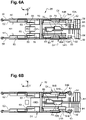
- FIGS 4, 5 , 6A and 6B show various views of the connector 28 from different perspectives and also in a longitudinally sectioned view ( FIG. 5 ).
- the connector 28 includes a central body section 48 in which a rivet-receiving socket 50 is formed.
- the rivet-receiving socket 50 has a key-hole shape that snap-locks to the rivet 24 via an interference-fit in its narrow throat area.
- the rivet-receiving socket 50 opens longitudinally toward the back.
- the central body section 48 presents a rounded forward nose profile 52.
- the connector 28 further includes a pair of side walls 54 extending in vertical longitudinal planes.
- the side walls 54 interconnect the central body section 48 on respective inner faces 54A thereof.
- Each side wall 54 also comprises an outer face 54B opposite to the inner face 54A.
- the side walls 54 are identical by symmetry with respect to a median longitudinal vertical plan of the connector 28.
- the side walls 54 include extensions 56 projecting beyond the nose profile 52.
- the side walls 54 also extend above and below the central body section 48 to define a lower channel 58A and an upper channel 58B.
- the width of the channels 58A, 58B is greater than the width of the wider type of wiper arm intended to be attached, in this case, 12x4 wiper arm 30C.
- each channel 58A, 58B secures the main portion 36 or the distal end portion 32 of the hook 34.
- Each side wall 54 comprises a first projection 60 which extends transversally into the channel 58A, 58B from an inner face.
- This first projection 60 is delimited in the forward direction by a rounded end face which forms a first stop 62 which block the sliding of the wider type of wiper arm, for example the 12x4 wiper arm 30C, in an attached position.
- the first stop 62 is arranged at a distance forward from the nose profile 52 of the central body section 48.
- the first projection 60 also comprises an upper and a lower elastically flexible legs 64 extending from each end of the first stop 62 and inclined toward the back. These legs 64 are intended to center the hook 34 vertically relative to the central body section 48 of the connector 28.
- Each side wall 54 also comprises a second projection 66 which extends transversally in the channel 58A, 58B beyond the first projection 60.
- This second projection 66 is limited to the front by a rounded end face which forms a second stop 68 in an attached position for the short 9x4 wiper arm 30A.
- the second stop 68 is offset longitudinally with respect to the first stop 62. More particularly, the second stop 68 is arranged longitudinally between the nose profile 52 of the central body section 48 and the first stop 62.
- the second projection 66 also comprises generally planar upper and lower faces 70 which extend longitudinally to the back from the ends of the second stop 68.
- the upper, respectively lower, planar face 70 is globally coplanar with the upper end, respectively lower end, of the first stop 62.
- the first projections 60 are transversally spaced with a distance "W1" which is greater the width "W2" of the narrower type of wiper arms 30A, 30B, but less than the width of the wider type of wiper arm 30C. Therefore, the hook 34 of the 9x4 wiper arms 30A, 30B can be received in the channels 58A, 58B between the first projections 60.
- a first cantilevered beam 72A extends from the central body section 48.
- the first cantilevered beam 72A which is not directly attached to the side walls 54, is positioned at the top of the lower channel 58A.
- the first cantilevered beam 72A is used to secure the connector 28 to the wiper arms 30, particularly the 9x4 wiper arms 30A, 30B.
- the first cantilevered beam 72A includes a first tab 74 that is used to secure the connector 28 to a 9x4 wiper arm 30A, 30B in its attached position.
- the first tab 74 includes a ramped face 76 at a front end closer to the nose profile 52 and a stepped face 78 at the back end.
- the first tab 74 is arranged in a first longitudinal position with respect to the nose profile 52. When the first cantilevered beam 72A is in rest position, the first tab 74 extends vertically in the lower channel 58A. The first cantilevered beam 72A can resiliently bend from the rest position toward retracted position in which the first tab 74 is pushed upward outside the lower channel 58A.
- the first cantilevered beam 72A comprises a rear free end that goes beyond a rear edge 82 of the side walls 54 to the back.
- the free end of the first cantilevered beam 72A includes a textured pushbutton 84 that may be depressed to bend the first cantilevered beam 72A and retract the first tab 74 from the slot 40 to release the connector 28 from the wiper arm 30.
- the invention provides a connector 28 comprising at least a second cantilevered beam 86A extending longitudinally to the back from the central body section 48 to accommodate a 12x4 wiper arm 30C as illustrated in figure 3C .
- the slot 40 is longitudinally offset from the first tab 74 when the wiper arm 30C abuts against the first stop 62 in its attached position.
- the second cantilevered beam 86A presents a structure similar to the first cantilevered beam 72A. Therefore, it comprises a second tab 88 which is essentially similar to the first tab 74. It thus comprises a front ramped face 89 and a rear stepped face 91 However, the second tab 88 extends in a second position longitudinally offset with respect to the first tab 74 so that the second tab 88 engages a slot 40 of the 12x4 wiper arm 30C to secure the connector 28 to the wiper arm 30C in the attached position.
- the second tab 88 is closer to the first stop 62 than the first tab 74 so that it can engage the slot 40 of a 12x4 wiper arm 30C in its attached position.
- first tab 74 and the second tab 88 are aligned longitudinally on the same side of the central body section 48, that is to say in the same channel 58A.
- the first cantilevered beam 72A and the second cantilevered beam 86A form a pair of cantilevered beams extending side by side on the top of the lower channel 58A, between the two side walls 54.
- each cantilevered beam 72A, 86A of the pair can be bent independently of each other. Therefore, each cantilevered beam 72A, 86A can be bent toward its retracted position while the other cantilevered beam 86A, 72A stays in its rest position.
- the pushbuttons 84 of the two cantilevered beams 72A of the pair are arranged side by side so that they can be pushed simultaneously with one finger to bend manually the cantilevered beams 72A, 86A of the pair toward their retracted position.
- each cantilevered beams 72B, 86B of the second pair also comprises a first tab 74 and a second tab 88.
- the tabs 74, 88 of second pair are arranged symmetrically with respect to the tabs 74, 88 of the first pair in relation to a median transverse longitudinal plane of the central body section 48.
- the connector 28 can thus be used upside down with the same result and the same procedure of attachment.
- the connector 28 is positioned with the upper channel 58B (or indifferently the lower channel 58A when the connector 28 is symmetric) next to the main portion 36 of the wiper arm 30B. Since there are no slots in the main portion 36 of the wiper arm 30A, the cantilevered beams 72B, 86B of the upper pair are biased toward their retracted position in which they stay until the detachment of the wiper arm 30A.
- the connector 28 is then moved along the wiper arm 30A in the direction indicated by the arrow F, so that the nose profile 52 of the central body section 48 passes between the distal end portion 32 and the main portion 36 of the wiper arm 30A, and the bight portion 38 of the wiper arm 30A passes between extensions 56 of the connector 28.
- the distal end portion 32 is thus received in the lower channel 58A.
- the hook 34 slides along the ramped face 89 in a horizontal direction. This generates an upward force that pushes up on the second cantilevered beam 86A and bends the beam 86A ( Fig. 8 ) from the rest position toward the retracted position. The hook 34 continues to exert the upward force on the second cantilevered beam 86A until the stepped face 91 of the second tab 88 is aligned with the slot 40. The second cantilevered beam 86A snaps back toward its rest position and engages the second tab 88 into the slot 40 ( Fig. 9 ).
- the connector 28 continues to slide longitudinally forward in the hook 34, the front end 44 of the slot 40 slides along the ramped face 89 of the second tab 88 in a horizontal direction. This generates an upward force that pushes up again on the second cantilevered beam 86A and bends the beam 86A ( Fig. 10 ) from the rest position toward the retracted position.
- the second cantilevered beam 86A will be maintained toward its retracted position by contact with the distal end portion 32 of the hook 34 until the detachment of the wiper arm 30A.
- the hook 34 slides along the ramped face 76 in a longitudinal direction. This generates an upward force that pushes down on the first cantilevered beam 72A and bends the beam 72A ( Fig. 9 ) from the rest position toward the retracted position.
- the hook 34 continues to exert the upward force on the first cantilevered beam 72A until the stepped face 78 of the first tab 74 is aligned with the slot 40.
- the first cantilevered beam 72A snaps back into place in its rest position and engages the first tab 74 into the slot 40 ( Fig. 10 ).
- the short 9x4 wiper arm 30A is prevented to continue its longitudinal sliding by abutment of the bight portion 38 against the associated stop 68.
- the wiper arm 30A is in its attached position.
- the stepped face 78 of the first tab 74 abuts against the rear end 46 of the slot 40 to secure the wiper arm 30A in its attached position on the connector 28.
- the connector 28 may be removed from the arm 30A in a two-step process.
- a user first depresses the pushbuttons 84 to push down simultaneously on the two cantilevered beams 72A, 86A of the lower pair to release the engaged tab 74 or 88 from the slot 40, and to maintain the other tab in its rest position.
- the user then slides the connector 28 backward from between the distal end portion 32 and the main portion 36.
- the connector 28 comprises at least a protrusion 92 mounted movable transversally in a side wall 54 between:
- the connector 28 comprises at least a pair of opposed movable protrusion 92 each arranged symmetrically on a side wall 54 on both sides of the same channel 58A, 58B.
- the connector comprises two pairs of opposed movable protrusion 92 extending in each channel 58A, 58B.
- Each movable protrusion 92 is borne by a resilient leg 94 which present a front end fixed to the associated side wall 54 and a rear free end.
- the leg 94 is formed by slitting a rear end portion of the associated side wall 54 with a longitudinal slit 96.
- the rear portion the side walls 54 comprising the four protrusions 92 is out of the bridge portion 22. In this angular position, the protrusions 92 can be pushed in their outer position.
- the protrusions 92 of the lower channel 58A are received between the ears 26 of the bridge portion 22.
- the ears 26 of the bridge portion 22 are transversally spaced to receive the connector with a slight transversal clearance sufficient to allow the rotation of the connector 28.
- the protrusions 92 are blocked in their inner position, their displacement toward the outer position being blocked by the ears 26.
- the wiper blade frame 20 When a long 9x4 wiper arm 30B is attached to the connector 28, the wiper blade frame 20 is in its service up position, as shown in figure 12 . If the user pushes the connector 28 too far on the long 9x4 hook of the wiper arm 30B, the front end 44 of the slot 40 slides along the ramped face 76 of the first tab 74 in a horizontal direction. This generates an upward force that pushes up again on the first cantilevered beam 72A and bends the beam 72A from the rest position toward the retracted position. The first cantilevered beam 72A will be maintained toward its retracted position by contact with the distal end portion 32 of the hook 34. In this position, no tab is engaged in the slot 40 of the wiper arm 30B. This means that the wiper blade frame 20 is able to move freely with respect of the wiper arm 30B.
- the free end 42 spreads the opposite protrusions 92 of the pair to their outer position by pushing on the stepped faces 93, wherein the protrusions 92 extend into the external area outside of the channels 58A, 58B.
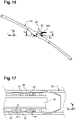
- the protrusions 92 are stuck in their outer position by contact with the distal end portion 32 of the hook 34 as shown in figure 15 .
- an upper edge of the ears 26 abuts against the protrusions 92, blocking the wiper blade frame 20 in an intermediate position shown in figure 16 .
- the protrusions 92 act as a mistake proof device which warns the user that the connector 28 is not properly attached to the wiper arm 30B.
- the user can thus pull the connector 28 until the first cantilevered beam 72A snaps back toward in rest position, the first tab 74 being engaged in the slot 40. In this position, the free end 42 of the wiper arm 30B has returned before the protrusions 92. The protrusions snap back in their inner position where the stepped faces 93 face longitudinally the free end 42 of the wiper arm 30B.
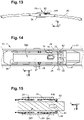
- the wiper blade frame 20 can be pivoted in its use position ( Fig. 13 ) with respect to the connector 28.
- this angular position the movement of the protrusions 92 toward their outer position is prevented by transversal abutment of the protrusions 92 against an inner faces of the ears 26, as shown in figure 14 .
- the protrusions 92 of the upper channel 58B are constantly pushed in their outer position by the main portion 36 of the wiper arm 30B even when the connector 28 is properly attached to the wiper arm 30B.
- the protrusions 92 of the upper channel stay outside of the ears 26 so that the wiper blade frame 20 can pivot freely between its two angular positions even when the protrusions occupy their outer position.
Landscapes
- Engineering & Computer Science (AREA)
- Mechanical Engineering (AREA)
- Insertion Pins And Rivets (AREA)
- Pivots And Pivotal Connections (AREA)
- Connector Housings Or Holding Contact Members (AREA)
Description
- A wiper blade assembly of the type used for clearing water from a windshield or windscreen, and more particularly toward an improved connector for joining a wiper blade to any one of various style wiper arms ends including hook slot styles.
- Windshield wipers are used to remove water from the windshield or windscreen of motor vehicles and in related applications. In a typical wiper assembly, a wiper blade connects to the free end of an oscillating or sweeping wiper arm through a central connection device, known as a connector. The connector is usually clipped onto the top side of the wiper blade, generally midway along its length.
- Traditionally, the free sweeping end of wiper arms are configured in one of several recurring styles which include hook slot arms. Hook-slot style arms present an end portion which is bent to form a hook. They are attached by sliding the hook over the connector until a tab borne by a cantilevered beam of the connector automatically locks in a slot of the hook when the arm reach an attached position. Generally, the hook is prevented to slide beyond its attached position by abutment against a stop.
- Hook-slot type of wiper arm end may come in a variety of sizes. For example, hook-slot type arms typically have hook bar widths of 9 mm or 12 mm, and a thickness of 4 mm. The hook of these two size classes are referred to as either 9x4 or 12x4 styles. In at least one of these size classes, there are also long hooks and short hooks. There are for instance long 9x4 wiper arms and short 9x4 wiper arms.
- To adapt these two thicknesses of arm wiper hook, the connector typically comprises a first stop to block the 12x4 wiper arm in attached position, and a second stop to block the 9x4 wiper arm in attached position. The first stop and the second stop are generally offset longitudinally so that the 9x4 wiper arm passes between the first stop during its sliding toward the attached position.
- For replacement blade sales, the connector must be able to accommodate several, or more preferably all, of these arm end sizes. However, wiper arms with the same width but having hooks of different length can be secured by the same tab, but they cannot be blocked in their attached position by the same stop. Indeed, the slot of a short 9x4 arm will abut in its attached by the second stop, but the long 12x4 arm will reach its attached position before the abutment against the second stop.
- Document
US 2007/017054 A1 discloses the preamble of independent claim 1. - The invention provides a connector for joining a wiper blade frame to a hook wiper arm, the connector comprising:
- a central body portion;
- two side walls interconnected to the central body which define an upper and a lower channels for receiving a hook of the wiper arm in an attached position in which it is hooked around the central body portion of the connector;
- Embodiments of the connector according to the invention may also include one or more of the following features:
- in its inner position, each protrusion is wholly retracted with respect to the outer face of the corresponding side wall;
- each movable protrusion is borne by a resilient leg which present a front end fixed to the associated side wall and a rear free end;
- the leg is formed by slitting a rear end portion of the associated side wall.
- The invention also provides an assembly comprising a wiper blade frame comprising a rivet extending crosswise between two ears of a bridge portion and a connector according to the teachings of the invention, characterized in that the connector is adapted to snap-fit over the rivet pivotally around an axis of the rivet so that the wiper blade frame can pivot between a first service up position in which a rear portion the side walls comprising the protrusions is out of the bridge portion and a second use position in which the protrusions of the lower channel are received between the ears of the bridge portion.
- Embodiments of the assembly according to the invention may also include one or more of the following features:
- when the protrusions of the lower channel occupy their inner position while the wiper blade frame is in its service up position, pivoting of the wiper blade frame toward the use position is prevented by abutment of upper edge of the ears against the protrusions;
- when the wiper blade frame occupies its use position, the movement of the protrusions toward their outer position is prevented by abutment of the protrusions against an inner face of the ear;
- in the use position of the connector, the protrusions of the upper channel stay outside of the ears so that the wiper blade frame can pivot freely between its two angular positions even when the protrusions occupy their outer position.
- Other features and advantages of the invention will be apparent from the following detailed description, including the drawings, in which:
-
figure 1 is a perspective view of an exemplary wiper blade frame with a connector according to the invention exploded therefrom; -
figure 2 is a perspective view of a hook-slot type wiper arm intended to be attached with the connector offigure 1 ; -
figure 3A to 3B is an illustrative view of a variety of 9x4 and 12 x4 wiper arms that can be connected directly to the connector offigure 1 ; -
figure 4 is a bottom perspective view of the connector offigure 1 ; -
figure 5 is a perspective cross-sectional view of the connector taken generally along the longitudinal line 5-5 infigure 4 ; -
figure 6A is a bottom view of the connector offigure 4 in which protrusions of the lower channel are in their inner position; -
figure 6B is a top view of the connector offigure 4 in which protrusions of the upper channel are in their outer position; -
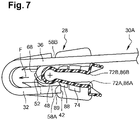
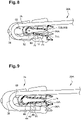
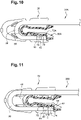
figure 7 to 10 illustrate the connector in cross-section as a short 9x4 hook end of a wiper arm is progressively connected thereto; -
figure 11 shows the connector in cross-section with a long 9x4 hook end of a wiper arm connected thereto; -
figure 12 is a side view of the wiper blade frame in a service up position with respect to the connector and the wiper arm; -
figure 13 is a side view of the wiper blade frame in a use position with respect to the connector and the wiper arm; -
figure 14 is a bottom view of the connector when the wiper blade frame is in its use position; -
figure 15 is a cross section view according to the cross section 15-15 of thefigure 16 ; -
figure 16 is a side view of the wiper blade frame in an intermediate position with respect to the connector and the wiper arm; -
figure 17 is a top view of the connector when the wiper blade frame is in its use position. - Referring to the figures, wherein like numerals indicate like or corresponding parts throughout the several views, one style of windshield wiper blade frame is generally shown at 20 in
figures 1 and 2 . - In the following description, longitudinal, vertical and transverse orientations are indicated by the geometrical frame of reference "L,V,T" of the figures. The vertical orientation is not related to the direction of gravity.
- The
wiper blade frame 20 illustrated here is designed to receive an elongated wiper element (not showed) adapted for direct contact against the windshield of a motor vehicle to scrape water and snow from the windshield as the blade assembly is swept back and forth in an oscillating, repetitive pattern. - The
wiper blade frame 20 comprises a bridge piece orportion 22 midway along its length. Arivet 24 is fixed crosswise betweenupstanding ears 26 of thebridge 22. - A connector, generally indicated at 28, is adapted to snap-fit over the
rivet 24. Theconnector 28 forms the basis for connecting to a variety of hook-shaped wiper arms. Theconnector 28 is adapted to cooperate with any style ofwiper blade frame 20 by attaching directly to therivet 24. - Once the
connector 28 is adapted to therivet 24, thewiper blade frame 20 can be pivoted around an axis of therivet 24 between: - a first angular position, said service up position, as shown in
figure 12 , where thewiper blade frame 20 is placed substantially perpendicular to thewiper arm 30. Only in this service up position can thewiper blade frame 20 equipped with theconnector 28 be installed or removed from ahook style arm 30; and - a second angular position, said use position, as shown in
figure 13 , in which thewiper blade frame 20 is arranged substantially parallel to thewiper arm 30. - As shown in
Figure 2 , in a hook-slot wiper arm 30, adistal end portion 32 of thewiper arm 30 is bent to define ahook 34. Thehook 34 presents a U-shaped configuration comprises a longitudinalmain portion 36 of thearm 30, thedistal end portion 32 which is parallel to themain portion 36, and abight portion 38 which link thedistal end portion 32 to themain portion 36. Thedistal end portion 32 extends in a longitudinal direction. - A
slot 40 is located in thedistal end portion 32 near afree end 42 of thewiper arm 30. Thebight portion 38 is arranged at a front extremity of thewiper arm 30 while thefree end 42 of thewiper arm 30 is turned backward because of the U-shaped configuration of thehook 34. - The
slot 40 faces themain portion 36 of thewiper arm 30. Theslot 40 is delimited longitudinally by afront end 44 which is closer to thebight portion 38 and by arear end 46 which is closer to thefree end 42 of thewiper arm 30. - Hook
type wiper arms 30 typically have hook bar thicknesses of 4 mm, especially for thewiper arms 30 for trucks. Thehook 34 widths are commonly 9 mm or 12 mm with a thickness of 4 mm, so that these two size classes are referred to as either 9x4, as illustrated by thewiper arms figures 3A and 3B , or 12x4, as illustrated by thewiper arm 30C in thefigure 3C . - Moreover, there are
wiper arms 30 with shortdistal end portion 32 and some with longdistal end portion 32. For instance, there are 9x4 hook ends of the short length variety or short9x4 wiper arms 30A, as illustrated infigure 3A , and of the long length variety or long9x4 wiper arms 30B as illustrated onfigure 3B . On a short9x4 wiper arm 30A, theslot 40 is arranged at a shorter longitudinal distance "D1" of thebight end 38 than the distance "D2" between theslot 40 of a long9x4 wiper arm 30B and itsbight portion 38. -
Figures 4, 5 ,6A and 6B show various views of theconnector 28 from different perspectives and also in a longitudinally sectioned view (FIG. 5 ). Theconnector 28 includes acentral body section 48 in which a rivet-receivingsocket 50 is formed. The rivet-receivingsocket 50 has a key-hole shape that snap-locks to therivet 24 via an interference-fit in its narrow throat area. The rivet-receivingsocket 50 opens longitudinally toward the back. - The
central body section 48 presents a roundedforward nose profile 52. Theconnector 28 further includes a pair ofside walls 54 extending in vertical longitudinal planes. Theside walls 54 interconnect thecentral body section 48 on respective inner faces 54A thereof. Eachside wall 54 also comprises anouter face 54B opposite to theinner face 54A. - The
side walls 54 are identical by symmetry with respect to a median longitudinal vertical plan of theconnector 28. Theside walls 54 includeextensions 56 projecting beyond thenose profile 52. - The
side walls 54 also extend above and below thecentral body section 48 to define alower channel 58A and anupper channel 58B. The width of thechannels 12x4 wiper arm 30C. As discussed below, eachchannel main portion 36 or thedistal end portion 32 of thehook 34. - Each
side wall 54 comprises afirst projection 60 which extends transversally into thechannel first projection 60 is delimited in the forward direction by a rounded end face which forms afirst stop 62 which block the sliding of the wider type of wiper arm, for example the12x4 wiper arm 30C, in an attached position. Thefirst stop 62 is arranged at a distance forward from thenose profile 52 of thecentral body section 48. - The
first projection 60 also comprises an upper and a lower elasticallyflexible legs 64 extending from each end of thefirst stop 62 and inclined toward the back. Theselegs 64 are intended to center thehook 34 vertically relative to thecentral body section 48 of theconnector 28. - Each
side wall 54 also comprises asecond projection 66 which extends transversally in thechannel first projection 60. Thissecond projection 66 is limited to the front by a rounded end face which forms asecond stop 68 in an attached position for the short9x4 wiper arm 30A. - The
second stop 68 is offset longitudinally with respect to thefirst stop 62. More particularly, thesecond stop 68 is arranged longitudinally between thenose profile 52 of thecentral body section 48 and thefirst stop 62. - The
second projection 66 also comprises generally planar upper and lower faces 70 which extend longitudinally to the back from the ends of thesecond stop 68. The upper, respectively lower,planar face 70 is globally coplanar with the upper end, respectively lower end, of thefirst stop 62. - The
first projections 60 are transversally spaced with a distance "W1" which is greater the width "W2" of the narrower type ofwiper arms wiper arm 30C. Therefore, thehook 34 of the9x4 wiper arms channels first projections 60. - A first
cantilevered beam 72A extends from thecentral body section 48. The firstcantilevered beam 72A, which is not directly attached to theside walls 54, is positioned at the top of thelower channel 58A. The firstcantilevered beam 72A is used to secure theconnector 28 to thewiper arms 30, particularly the9x4 wiper arms cantilevered beam 72A includes afirst tab 74 that is used to secure theconnector 28 to a9x4 wiper arm first tab 74 includes a rampedface 76 at a front end closer to thenose profile 52 and a steppedface 78 at the back end. Thefirst tab 74 is arranged in a first longitudinal position with respect to thenose profile 52. When the firstcantilevered beam 72A is in rest position, thefirst tab 74 extends vertically in thelower channel 58A. The firstcantilevered beam 72A can resiliently bend from the rest position toward retracted position in which thefirst tab 74 is pushed upward outside thelower channel 58A. - The first
cantilevered beam 72A comprises a rear free end that goes beyond arear edge 82 of theside walls 54 to the back. The free end of the firstcantilevered beam 72A includes atextured pushbutton 84 that may be depressed to bend the firstcantilevered beam 72A and retract thefirst tab 74 from theslot 40 to release theconnector 28 from thewiper arm 30. - Optionally, in the embodiment showed on the figures, the invention provides a
connector 28 comprising at least a secondcantilevered beam 86A extending longitudinally to the back from thecentral body section 48 to accommodate a12x4 wiper arm 30C as illustrated infigure 3C . Indeed, for short12x4 wiper arms 30C, theslot 40 is longitudinally offset from thefirst tab 74 when thewiper arm 30C abuts against thefirst stop 62 in its attached position. - The second
cantilevered beam 86A presents a structure similar to the firstcantilevered beam 72A. Therefore, it comprises asecond tab 88 which is essentially similar to thefirst tab 74. It thus comprises a front rampedface 89 and a rear steppedface 91 However, thesecond tab 88 extends in a second position longitudinally offset with respect to thefirst tab 74 so that thesecond tab 88 engages aslot 40 of the12x4 wiper arm 30C to secure theconnector 28 to thewiper arm 30C in the attached position. - In this embodiment, the
second tab 88 is closer to thefirst stop 62 than thefirst tab 74 so that it can engage theslot 40 of a12x4 wiper arm 30C in its attached position. - In the embodiments showed in the figures, the
first tab 74 and thesecond tab 88 are aligned longitudinally on the same side of thecentral body section 48, that is to say in thesame channel 58A. The firstcantilevered beam 72A and the secondcantilevered beam 86A form a pair of cantilevered beams extending side by side on the top of thelower channel 58A, between the twoside walls 54. - The cantilevered beams 72A, 86A of the pair can be bent independently of each other. Therefore, each
cantilevered beam cantilevered beam - The
pushbuttons 84 of the twocantilevered beams 72A of the pair are arranged side by side so that they can be pushed simultaneously with one finger to bend manually the cantileveredbeams - In order to simplify the use of the
connector 28, it presents a second pair of first and secondcantilevered beams upper channel 58B. Each cantileveredbeams first tab 74 and asecond tab 88. Thetabs tabs central body section 48. Theconnector 28 can thus be used upside down with the same result and the same procedure of attachment. - As shown in
Figs. 7 to 11 , to attach theconnector 28 to a short9x4 wiper arm 30A, theconnector 28 is positioned with theupper channel 58B (or indifferently thelower channel 58A when theconnector 28 is symmetric) next to themain portion 36 of thewiper arm 30B. Since there are no slots in themain portion 36 of thewiper arm 30A, the cantileveredbeams wiper arm 30A. - The
connector 28 is then moved along thewiper arm 30A in the direction indicated by the arrow F, so that thenose profile 52 of thecentral body section 48 passes between thedistal end portion 32 and themain portion 36 of thewiper arm 30A, and thebight portion 38 of thewiper arm 30A passes betweenextensions 56 of theconnector 28. Thedistal end portion 32 is thus received in thelower channel 58A. - When the
free end 42 of thewiper arm 30A encounters thesecond tab 88, thehook 34 slides along the rampedface 89 in a horizontal direction. This generates an upward force that pushes up on the secondcantilevered beam 86A and bends thebeam 86A (Fig. 8 ) from the rest position toward the retracted position. Thehook 34 continues to exert the upward force on the secondcantilevered beam 86A until the steppedface 91 of thesecond tab 88 is aligned with theslot 40. The secondcantilevered beam 86A snaps back toward its rest position and engages thesecond tab 88 into the slot 40 (Fig. 9 ). - The
connector 28 continues to slide longitudinally forward in thehook 34, thefront end 44 of theslot 40 slides along the rampedface 89 of thesecond tab 88 in a horizontal direction. This generates an upward force that pushes up again on the secondcantilevered beam 86A and bends thebeam 86A (Fig. 10 ) from the rest position toward the retracted position. The secondcantilevered beam 86A will be maintained toward its retracted position by contact with thedistal end portion 32 of thehook 34 until the detachment of thewiper arm 30A. - When the
free end 42 of thewiper arm 30A encounters thefirst tab 74, thehook 34 slides along the rampedface 76 in a longitudinal direction. This generates an upward force that pushes down on the firstcantilevered beam 72A and bends thebeam 72A (Fig. 9 ) from the rest position toward the retracted position. Thehook 34 continues to exert the upward force on the firstcantilevered beam 72A until the steppedface 78 of thefirst tab 74 is aligned with theslot 40. The firstcantilevered beam 72A snaps back into place in its rest position and engages thefirst tab 74 into the slot 40 (Fig. 10 ). - At that point, the short
9x4 wiper arm 30A is prevented to continue its longitudinal sliding by abutment of thebight portion 38 against the associatedstop 68. Thewiper arm 30A is in its attached position. When thefirst tab 74 is in theslot 40, the steppedface 78 of thefirst tab 74 abuts against therear end 46 of theslot 40 to secure thewiper arm 30A in its attached position on theconnector 28. - The
connector 28 may be removed from thearm 30A in a two-step process. A user first depresses thepushbuttons 84 to push down simultaneously on the twocantilevered beams tab slot 40, and to maintain the other tab in its rest position. The user then slides theconnector 28 backward from between thedistal end portion 32 and themain portion 36. - As represented in
figure 11 , when the wiper arm is of thelong 9x4 type 30B, thefirst tab 74 is received inslot 40 while thebight portion 38 has not reached thesecond stop 68. Therefore, if a user continues to slide theconnector 28 forward until thebight portion 38 encounters thesecond stop 66, the firstcantilevered beam 72A will bent toward its retracted position by contact of thefront end 44 of theslot 40 with the rampedface 76 of thefirst tab 74. Therefore thefirst tab 74 will no longer block the sliding of theconnector 28 backward with respect to thewiper arm 30B. - To solve this problem, the invention proposes that the
connector 28 comprises at least aprotrusion 92 mounted movable transversally in aside wall 54 between: - an inner position where to it is elastically biased and in which the protrusion extends from an
inner face 54A of theside wall 54 in one of thechannels 9x4 wiper arm 30B in its attached position by contact of a steppedface 93 of theprotrusion 92 turned to the front with theend face 42 of thewiper arm 30B, as shown infigure 6A ; and - an outer position in which the
protrusion 92 extend from anouter face 54B theside wall 54, as shown infigure 6B . To this end, eachprotrusion 92 is arranged near theedge 82 of theside wall 54, at proximity of the free end of the cantileveredbeams - In its inner position, the
whole protrusion 92 is retracted with respect to theouter face 54B of theside wall 54. - In the embodiment represented on the figures, the
connector 28 comprises at least a pair of opposedmovable protrusion 92 each arranged symmetrically on aside wall 54 on both sides of thesame channel movable protrusion 92 extending in eachchannel - Each
movable protrusion 92 is borne by aresilient leg 94 which present a front end fixed to the associatedside wall 54 and a rear free end. Theleg 94 is formed by slitting a rear end portion of the associatedside wall 54 with alongitudinal slit 96. - In the service up position of the
wiper blade frame 20, the rear portion theside walls 54 comprising the fourprotrusions 92 is out of thebridge portion 22. In this angular position, theprotrusions 92 can be pushed in their outer position. - In use position of the
wiper blade frame 20, theprotrusions 92 of thelower channel 58A are received between theears 26 of thebridge portion 22. Theears 26 of thebridge portion 22 are transversally spaced to receive the connector with a slight transversal clearance sufficient to allow the rotation of theconnector 28. However, as shown infigure 14 , in this angular position, theprotrusions 92 are blocked in their inner position, their displacement toward the outer position being blocked by theears 26. - When a long
9x4 wiper arm 30B is attached to theconnector 28, thewiper blade frame 20 is in its service up position, as shown infigure 12 . If the user pushes theconnector 28 too far on the long 9x4 hook of thewiper arm 30B, thefront end 44 of theslot 40 slides along the rampedface 76 of thefirst tab 74 in a horizontal direction. This generates an upward force that pushes up again on the firstcantilevered beam 72A and bends thebeam 72A from the rest position toward the retracted position. The firstcantilevered beam 72A will be maintained toward its retracted position by contact with thedistal end portion 32 of thehook 34. In this position, no tab is engaged in theslot 40 of thewiper arm 30B. This means that thewiper blade frame 20 is able to move freely with respect of thewiper arm 30B. - However, when the
wiper arm 30B continues its sliding, thefree end 42 spreads theopposite protrusions 92 of the pair to their outer position by pushing on the stepped faces 93, wherein theprotrusions 92 extend into the external area outside of thechannels protrusions 92 are stuck in their outer position by contact with thedistal end portion 32 of thehook 34 as shown infigure 15 . When the user tries to pivot thewiper blade frame 20 from its service up position (Fig. 12 ) to its use position (Fig. 13 ) as indicated by the arrow "R", an upper edge of theears 26 abuts against theprotrusions 92, blocking thewiper blade frame 20 in an intermediate position shown infigure 16 . Theprotrusions 92 act as a mistake proof device which warns the user that theconnector 28 is not properly attached to thewiper arm 30B. - The user can thus pull the
connector 28 until the firstcantilevered beam 72A snaps back toward in rest position, thefirst tab 74 being engaged in theslot 40. In this position, thefree end 42 of thewiper arm 30B has returned before theprotrusions 92. The protrusions snap back in their inner position where the stepped faces 93 face longitudinally thefree end 42 of thewiper arm 30B. - In this position, the
wiper blade frame 20 can be pivoted in its use position (Fig. 13 ) with respect to theconnector 28. In this angular position, the movement of theprotrusions 92 toward their outer position is prevented by transversal abutment of theprotrusions 92 against an inner faces of theears 26, as shown infigure 14 . This means that the sliding of thewiper arm 30B with respect to theconnector 28 is blocked in both directions by thefirst tab 74 and by the steppedface 93 of theprotrusions 92. - According to another aspect of the invention, since the width of the
main portion 36 of thewiper arm 30B is generally the same as the width of thedistal end portion 32, theprotrusions 92 of theupper channel 58B are constantly pushed in their outer position by themain portion 36 of thewiper arm 30B even when theconnector 28 is properly attached to thewiper arm 30B. As shown infigures 13 and17 , in the use position of thewiper blade frame 20, theprotrusions 92 of the upper channel stay outside of theears 26 so that thewiper blade frame 20 can pivot freely between its two angular positions even when the protrusions occupy their outer position.
Claims (8)
- A connector (28) for joining a wiper blade frame (20) to a hook-slot wiper arm (30A, 30B), the connector (28) comprising:- a central body portion (48);- two side walls (54) interconnected to the central body (48) which define an upper and a lower channels (58A, 58B) for receiving a hook (34) of the wiper arm (30A, 30B) in an attached position in which it is hooked around the central body portion (48) of the connector (28), each side wall (54) at least partially delimiting said upper and lower channels (58A, 58B) from an external area outside said channels;- at least one protrusion (92) extending at one free end of at least one of said side walls (54), the protrusion being mounted so as to pivot transversally between an inner position to which the protrusion (92) is elastically biased and in which the protrusion (92) extends into one of the channels (58A, 58B), and an outer position in which the protrusion (92) extends into the external area; and- at least a pair of opposed movable protrusions (92) each arranged symmetrically on a side wall (54) on both sides of the same channel (58A, 58B);characterized in that the connector comprises two pairs of opposed movable protrusions (92), each pair being arranged in each channel (58A, 58B).
- A connector (28) according to claim 1, characterized in that in its inner position, each protrusion (92) is wholly retracted with respect to the outer face (54B) of the corresponding side wall (54).
- A connector (28) according to any one of the previous claims, characterized in that each movable protrusion (92) is borne by a resilient leg (96) which present a front end fixed to the associated side wall (54) and a rear free end (82).
- A connector (28) according to the previous claim, characterized in that the leg (96) is formed by slitting a rear end portion of the associated side wall (54).
- An assembly comprising a wiper blade frame (20) comprising a rivet (24) extending crosswise between two ears (26) of a bridge portion (22) and a connector (28) according to any one of the previous claims, characterized in that the connector (28) is adapted to snap-fit over the rivet (24) pivotally around an axis of the rivet (24) so that the wiper blade frame (20) can pivot between a first service up position in which a rear portion the side walls (54) comprising the protrusions (92) is out of the bridge portion (22) and a second use position in which the protrusions (92) of the lower channel (58A) are received between the ears (26) of the bridge portion (22).
- An assembly according to the previous claim, characterized in that when the protrusions (92) of the lower channel (58A) occupy their inner position while the wiper blade frame (20) is in its service up position, pivoting of the wiper blade frame (20) toward the use position is prevented by abutment of upper edge of the ears (26) against the protrusions (92).
- An assembly according to any one of the claims 5 or 6, characterized in that when the wiper blade frame (20) occupies its use position, the movement of the protrusions (28) toward their outer position is prevented by abutment of the protrusions (92) against an inner face of the ears (26).
- An assembly according to any one of the claims 5 to 7, characterized in that in the use position of the connector (28), the protrusions (92) of the upper channel (58B) stay outside of the ears (26) so that the wiper blade frame (20) can pivot freely between its two angular positions even when the protrusions (92) occupy their outer position.
Priority Applications (2)
| Application Number | Priority Date | Filing Date | Title |
|---|---|---|---|
| EP19305739.5A EP3747709B1 (en) | 2019-06-07 | 2019-06-07 | Windshield wiper blade connector |
| PCT/EP2020/064474 WO2020244958A1 (en) | 2019-06-07 | 2020-05-25 | Windshield wiper blade connector |
Applications Claiming Priority (1)
| Application Number | Priority Date | Filing Date | Title |
|---|---|---|---|
| EP19305739.5A EP3747709B1 (en) | 2019-06-07 | 2019-06-07 | Windshield wiper blade connector |
Publications (2)
| Publication Number | Publication Date |
|---|---|
| EP3747709A1 EP3747709A1 (en) | 2020-12-09 |
| EP3747709B1 true EP3747709B1 (en) | 2023-01-04 |
Family
ID=67003393
Family Applications (1)
| Application Number | Title | Priority Date | Filing Date |
|---|---|---|---|
| EP19305739.5A Active EP3747709B1 (en) | 2019-06-07 | 2019-06-07 | Windshield wiper blade connector |
Country Status (2)
| Country | Link |
|---|---|
| EP (1) | EP3747709B1 (en) |
| WO (1) | WO2020244958A1 (en) |
Family Cites Families (2)
| Publication number | Priority date | Publication date | Assignee | Title |
|---|---|---|---|---|
| US6640380B2 (en) * | 2001-10-05 | 2003-11-04 | Pylon Manufacturing Corporation | Wiper blade connector |
| US7584520B2 (en) * | 2005-07-19 | 2009-09-08 | Rally Manufacturing, Inc. | Windshield wiper arm and adaptor assembly |
-
2019
- 2019-06-07 EP EP19305739.5A patent/EP3747709B1/en active Active
-
2020
- 2020-05-25 WO PCT/EP2020/064474 patent/WO2020244958A1/en not_active Ceased
Also Published As
| Publication number | Publication date |
|---|---|
| WO2020244958A1 (en) | 2020-12-10 |
| EP3747709A1 (en) | 2020-12-09 |
Similar Documents
| Publication | Publication Date | Title |
|---|---|---|
| JP4625217B2 (en) | Wiper blade for automotive window glass with elongated spring elastic support element | |
| KR100712872B1 (en) | Connecting parts for wiper arm and wiper blade connection | |
| US10155501B2 (en) | Locking device between a wiper blade and a windscreen wiper blade holder | |
| KR101170905B1 (en) | Connecting unit for hook wiper arm and flat wiper blade with the same | |
| US9079569B2 (en) | Windscreen wiper device | |
| US5168597A (en) | Connector for fastening a windshield wiper blade to a windshield wiper arm | |
| JP2010519108A (en) | Connecting member for pivotally connecting the wiper blade and the wiper arm | |
| EP2670637B1 (en) | Windscreen wiper device | |
| CN107226069B (en) | Adapter for connecting the free ends of a scraper arm and assembly comprising the same | |
| EP3003799B1 (en) | Connecting device for a windscreen wiper device | |
| EP0863058A2 (en) | Blade to arm connection for windshield wiper | |
| EP4139173B1 (en) | A windscreen wiper device of the flat blade type | |
| US20170120873A1 (en) | Adapter for a motor vehicle windscreen wiper | |
| EP0220883B1 (en) | Windscreen and like surface wiper device and connector device for use therein | |
| EP3747709B1 (en) | Windshield wiper blade connector | |
| CN119451870A (en) | Windshield wiper blade adapters and wiping devices | |
| EP3747711B1 (en) | Windshield wiper blade connector | |
| US12122330B2 (en) | Device for connecting a wiper blade to a wiper arm | |
| CN107444349B (en) | Adapter, assembly comprising such an adapter and a windscreen wiper arm | |
| EP3747710B1 (en) | Windshield wiper blade connector | |
| CN113561941A (en) | Adapter and windshield wiper | |
| CN113453965B (en) | Window wiper equipment | |
| EP3943348B1 (en) | Adapter for wiping systems | |
| JP7377872B2 (en) | windshield wiper blade adapter | |
| GB2112276A (en) | Windscreen wiper blade for motor vehicles |
Legal Events
| Date | Code | Title | Description |
|---|---|---|---|
| PUAI | Public reference made under article 153(3) epc to a published international application that has entered the european phase |
Free format text: ORIGINAL CODE: 0009012 |
|
| STAA | Information on the status of an ep patent application or granted ep patent |
Free format text: STATUS: THE APPLICATION HAS BEEN PUBLISHED |
|
| AK | Designated contracting states |
Kind code of ref document: A1 Designated state(s): AL AT BE BG CH CY CZ DE DK EE ES FI FR GB GR HR HU IE IS IT LI LT LU LV MC MK MT NL NO PL PT RO RS SE SI SK SM TR |
|
| AX | Request for extension of the european patent |
Extension state: BA ME |
|
| STAA | Information on the status of an ep patent application or granted ep patent |
Free format text: STATUS: REQUEST FOR EXAMINATION WAS MADE |
|
| 17P | Request for examination filed |
Effective date: 20210609 |
|
| RBV | Designated contracting states (corrected) |
Designated state(s): AL AT BE BG CH CY CZ DE DK EE ES FI FR GB GR HR HU IE IS IT LI LT LU LV MC MK MT NL NO PL PT RO RS SE SI SK SM TR |
|
| STAA | Information on the status of an ep patent application or granted ep patent |
Free format text: STATUS: EXAMINATION IS IN PROGRESS |
|
| 17Q | First examination report despatched |
Effective date: 20210930 |
|
| GRAP | Despatch of communication of intention to grant a patent |
Free format text: ORIGINAL CODE: EPIDOSNIGR1 |
|
| STAA | Information on the status of an ep patent application or granted ep patent |
Free format text: STATUS: GRANT OF PATENT IS INTENDED |
|
| INTG | Intention to grant announced |
Effective date: 20220830 |
|
| GRAS | Grant fee paid |
Free format text: ORIGINAL CODE: EPIDOSNIGR3 |
|
| GRAA | (expected) grant |
Free format text: ORIGINAL CODE: 0009210 |
|
| STAA | Information on the status of an ep patent application or granted ep patent |
Free format text: STATUS: THE PATENT HAS BEEN GRANTED |
|
| AK | Designated contracting states |
Kind code of ref document: B1 Designated state(s): AL AT BE BG CH CY CZ DE DK EE ES FI FR GB GR HR HU IE IS IT LI LT LU LV MC MK MT NL NO PL PT RO RS SE SI SK SM TR |
|
| REG | Reference to a national code |
Ref country code: GB Ref legal event code: FG4D |
|
| REG | Reference to a national code |
Ref country code: DE Ref legal event code: R096 Ref document number: 602019023932 Country of ref document: DE |
|
| REG | Reference to a national code |
Ref country code: CH Ref legal event code: EP |
|
| REG | Reference to a national code |
Ref country code: AT Ref legal event code: REF Ref document number: 1541733 Country of ref document: AT Kind code of ref document: T Effective date: 20230115 |
|
| REG | Reference to a national code |
Ref country code: IE Ref legal event code: FG4D |
|
| REG | Reference to a national code |
Ref country code: LT Ref legal event code: MG9D |
|
| REG | Reference to a national code |
Ref country code: NL Ref legal event code: MP Effective date: 20230104 |
|
| REG | Reference to a national code |
Ref country code: AT Ref legal event code: MK05 Ref document number: 1541733 Country of ref document: AT Kind code of ref document: T Effective date: 20230104 |
|
| PG25 | Lapsed in a contracting state [announced via postgrant information from national office to epo] |
Ref country code: NL Free format text: LAPSE BECAUSE OF FAILURE TO SUBMIT A TRANSLATION OF THE DESCRIPTION OR TO PAY THE FEE WITHIN THE PRESCRIBED TIME-LIMIT Effective date: 20230104 |
|
| P01 | Opt-out of the competence of the unified patent court (upc) registered |
Effective date: 20230528 |
|
| PG25 | Lapsed in a contracting state [announced via postgrant information from national office to epo] |
Ref country code: RS Free format text: LAPSE BECAUSE OF FAILURE TO SUBMIT A TRANSLATION OF THE DESCRIPTION OR TO PAY THE FEE WITHIN THE PRESCRIBED TIME-LIMIT Effective date: 20230104 Ref country code: PT Free format text: LAPSE BECAUSE OF FAILURE TO SUBMIT A TRANSLATION OF THE DESCRIPTION OR TO PAY THE FEE WITHIN THE PRESCRIBED TIME-LIMIT Effective date: 20230504 Ref country code: NO Free format text: LAPSE BECAUSE OF FAILURE TO SUBMIT A TRANSLATION OF THE DESCRIPTION OR TO PAY THE FEE WITHIN THE PRESCRIBED TIME-LIMIT Effective date: 20230404 Ref country code: LV Free format text: LAPSE BECAUSE OF FAILURE TO SUBMIT A TRANSLATION OF THE DESCRIPTION OR TO PAY THE FEE WITHIN THE PRESCRIBED TIME-LIMIT Effective date: 20230104 Ref country code: LT Free format text: LAPSE BECAUSE OF FAILURE TO SUBMIT A TRANSLATION OF THE DESCRIPTION OR TO PAY THE FEE WITHIN THE PRESCRIBED TIME-LIMIT Effective date: 20230104 Ref country code: HR Free format text: LAPSE BECAUSE OF FAILURE TO SUBMIT A TRANSLATION OF THE DESCRIPTION OR TO PAY THE FEE WITHIN THE PRESCRIBED TIME-LIMIT Effective date: 20230104 Ref country code: ES Free format text: LAPSE BECAUSE OF FAILURE TO SUBMIT A TRANSLATION OF THE DESCRIPTION OR TO PAY THE FEE WITHIN THE PRESCRIBED TIME-LIMIT Effective date: 20230104 Ref country code: AT Free format text: LAPSE BECAUSE OF FAILURE TO SUBMIT A TRANSLATION OF THE DESCRIPTION OR TO PAY THE FEE WITHIN THE PRESCRIBED TIME-LIMIT Effective date: 20230104 |
|
| PG25 | Lapsed in a contracting state [announced via postgrant information from national office to epo] |
Ref country code: SE Free format text: LAPSE BECAUSE OF FAILURE TO SUBMIT A TRANSLATION OF THE DESCRIPTION OR TO PAY THE FEE WITHIN THE PRESCRIBED TIME-LIMIT Effective date: 20230104 Ref country code: PL Free format text: LAPSE BECAUSE OF FAILURE TO SUBMIT A TRANSLATION OF THE DESCRIPTION OR TO PAY THE FEE WITHIN THE PRESCRIBED TIME-LIMIT Effective date: 20230104 Ref country code: IS Free format text: LAPSE BECAUSE OF FAILURE TO SUBMIT A TRANSLATION OF THE DESCRIPTION OR TO PAY THE FEE WITHIN THE PRESCRIBED TIME-LIMIT Effective date: 20230504 Ref country code: GR Free format text: LAPSE BECAUSE OF FAILURE TO SUBMIT A TRANSLATION OF THE DESCRIPTION OR TO PAY THE FEE WITHIN THE PRESCRIBED TIME-LIMIT Effective date: 20230405 Ref country code: FI Free format text: LAPSE BECAUSE OF FAILURE TO SUBMIT A TRANSLATION OF THE DESCRIPTION OR TO PAY THE FEE WITHIN THE PRESCRIBED TIME-LIMIT Effective date: 20230104 |
|
| REG | Reference to a national code |
Ref country code: DE Ref legal event code: R097 Ref document number: 602019023932 Country of ref document: DE |
|
| PG25 | Lapsed in a contracting state [announced via postgrant information from national office to epo] |
Ref country code: SM Free format text: LAPSE BECAUSE OF FAILURE TO SUBMIT A TRANSLATION OF THE DESCRIPTION OR TO PAY THE FEE WITHIN THE PRESCRIBED TIME-LIMIT Effective date: 20230104 Ref country code: RO Free format text: LAPSE BECAUSE OF FAILURE TO SUBMIT A TRANSLATION OF THE DESCRIPTION OR TO PAY THE FEE WITHIN THE PRESCRIBED TIME-LIMIT Effective date: 20230104 Ref country code: EE Free format text: LAPSE BECAUSE OF FAILURE TO SUBMIT A TRANSLATION OF THE DESCRIPTION OR TO PAY THE FEE WITHIN THE PRESCRIBED TIME-LIMIT Effective date: 20230104 Ref country code: DK Free format text: LAPSE BECAUSE OF FAILURE TO SUBMIT A TRANSLATION OF THE DESCRIPTION OR TO PAY THE FEE WITHIN THE PRESCRIBED TIME-LIMIT Effective date: 20230104 Ref country code: CZ Free format text: LAPSE BECAUSE OF FAILURE TO SUBMIT A TRANSLATION OF THE DESCRIPTION OR TO PAY THE FEE WITHIN THE PRESCRIBED TIME-LIMIT Effective date: 20230104 |
|
| PLBE | No opposition filed within time limit |
Free format text: ORIGINAL CODE: 0009261 |
|
| STAA | Information on the status of an ep patent application or granted ep patent |
Free format text: STATUS: NO OPPOSITION FILED WITHIN TIME LIMIT |
|
| PG25 | Lapsed in a contracting state [announced via postgrant information from national office to epo] |
Ref country code: SK Free format text: LAPSE BECAUSE OF FAILURE TO SUBMIT A TRANSLATION OF THE DESCRIPTION OR TO PAY THE FEE WITHIN THE PRESCRIBED TIME-LIMIT Effective date: 20230104 |
|
| 26N | No opposition filed |
Effective date: 20231005 |
|
| PG25 | Lapsed in a contracting state [announced via postgrant information from national office to epo] |
Ref country code: MC Free format text: LAPSE BECAUSE OF FAILURE TO SUBMIT A TRANSLATION OF THE DESCRIPTION OR TO PAY THE FEE WITHIN THE PRESCRIBED TIME-LIMIT Effective date: 20230104 |
|
| PG25 | Lapsed in a contracting state [announced via postgrant information from national office to epo] |
Ref country code: SI Free format text: LAPSE BECAUSE OF FAILURE TO SUBMIT A TRANSLATION OF THE DESCRIPTION OR TO PAY THE FEE WITHIN THE PRESCRIBED TIME-LIMIT Effective date: 20230104 Ref country code: MC Free format text: LAPSE BECAUSE OF FAILURE TO SUBMIT A TRANSLATION OF THE DESCRIPTION OR TO PAY THE FEE WITHIN THE PRESCRIBED TIME-LIMIT Effective date: 20230104 |
|
| REG | Reference to a national code |
Ref country code: CH Ref legal event code: PL |
|
| REG | Reference to a national code |
Ref country code: BE Ref legal event code: MM Effective date: 20230630 |
|
| GBPC | Gb: european patent ceased through non-payment of renewal fee |
Effective date: 20230607 |
|
| PG25 | Lapsed in a contracting state [announced via postgrant information from national office to epo] |
Ref country code: LU Free format text: LAPSE BECAUSE OF NON-PAYMENT OF DUE FEES Effective date: 20230607 |
|
| REG | Reference to a national code |
Ref country code: IE Ref legal event code: MM4A |
|
| PG25 | Lapsed in a contracting state [announced via postgrant information from national office to epo] |
Ref country code: LU Free format text: LAPSE BECAUSE OF NON-PAYMENT OF DUE FEES Effective date: 20230607 |
|
| PG25 | Lapsed in a contracting state [announced via postgrant information from national office to epo] |
Ref country code: IE Free format text: LAPSE BECAUSE OF NON-PAYMENT OF DUE FEES Effective date: 20230607 |
|
| PG25 | Lapsed in a contracting state [announced via postgrant information from national office to epo] |
Ref country code: IE Free format text: LAPSE BECAUSE OF NON-PAYMENT OF DUE FEES Effective date: 20230607 Ref country code: CH Free format text: LAPSE BECAUSE OF NON-PAYMENT OF DUE FEES Effective date: 20230630 Ref country code: GB Free format text: LAPSE BECAUSE OF NON-PAYMENT OF DUE FEES Effective date: 20230607 |
|
| PG25 | Lapsed in a contracting state [announced via postgrant information from national office to epo] |
Ref country code: IT Free format text: LAPSE BECAUSE OF FAILURE TO SUBMIT A TRANSLATION OF THE DESCRIPTION OR TO PAY THE FEE WITHIN THE PRESCRIBED TIME-LIMIT Effective date: 20230104 Ref country code: BE Free format text: LAPSE BECAUSE OF NON-PAYMENT OF DUE FEES Effective date: 20230630 |
|
| PG25 | Lapsed in a contracting state [announced via postgrant information from national office to epo] |
Ref country code: BG Free format text: LAPSE BECAUSE OF FAILURE TO SUBMIT A TRANSLATION OF THE DESCRIPTION OR TO PAY THE FEE WITHIN THE PRESCRIBED TIME-LIMIT Effective date: 20230104 |
|
| PG25 | Lapsed in a contracting state [announced via postgrant information from national office to epo] |
Ref country code: BG Free format text: LAPSE BECAUSE OF FAILURE TO SUBMIT A TRANSLATION OF THE DESCRIPTION OR TO PAY THE FEE WITHIN THE PRESCRIBED TIME-LIMIT Effective date: 20230104 |
|
| PGFP | Annual fee paid to national office [announced via postgrant information from national office to epo] |
Ref country code: DE Payment date: 20250617 Year of fee payment: 7 |
|
| PGFP | Annual fee paid to national office [announced via postgrant information from national office to epo] |
Ref country code: FR Payment date: 20250630 Year of fee payment: 7 |
|
| PG25 | Lapsed in a contracting state [announced via postgrant information from national office to epo] |
Ref country code: CY Free format text: LAPSE BECAUSE OF FAILURE TO SUBMIT A TRANSLATION OF THE DESCRIPTION OR TO PAY THE FEE WITHIN THE PRESCRIBED TIME-LIMIT; INVALID AB INITIO Effective date: 20190607 |
|
| PG25 | Lapsed in a contracting state [announced via postgrant information from national office to epo] |
Ref country code: HU Free format text: LAPSE BECAUSE OF FAILURE TO SUBMIT A TRANSLATION OF THE DESCRIPTION OR TO PAY THE FEE WITHIN THE PRESCRIBED TIME-LIMIT; INVALID AB INITIO Effective date: 20190607 |
|
| PG25 | Lapsed in a contracting state [announced via postgrant information from national office to epo] |
Ref country code: TR Free format text: LAPSE BECAUSE OF FAILURE TO SUBMIT A TRANSLATION OF THE DESCRIPTION OR TO PAY THE FEE WITHIN THE PRESCRIBED TIME-LIMIT Effective date: 20230104 |